

Submitted:
09 March 2026
Posted:
10 March 2026
You are already at the latest version
Abstract
Structural Health Monitoring (SHM) is essential for the safety and long-term performance of civil and mechanical infrastructure, yet traditional vibration-based approaches often struggle with nonlinear behavior and environmental variability. Koopman operator theory provides a promising alternative by enabling linear analysis of nonlinear structural dynamics through observable functions. This review examines 67 peer-reviewed studies published between 2010 and 2025 and selected using Preferred Reporting Items for Systematic Reviews and Meta-Analysis (PRISMA) guidelines. We outline the development of Koopman-based methods from Dynamic Mode Decomposition (DMD) and Extended-DMD (EDMD) to recent applications in civil, mechanical, and aerospace systems. The review clarifies the mathematical foundations of Koopman analysis and its relationship to structural dynamics. It also identifies major research gaps, including limited damage-sensitive observable design, insufficient use of structural mechanics constraints, the absence of quantitative links between Koopman spectra and physical damage, inadequate benchmarking, and the need for real-time deployment strategies. We conclude by outlining a hybrid Koopman framework that integrates physics-based information with data-driven learning to support interpretable and scalable SHM.
Keywords:
structural health monitoring
; Koopman operator
; dynamic mode decomposition
; hybrid modeling
; physics-informed learning
; damage detection
1. Introduction
Structural Health Monitoring (SHM), which promotes early detection of degradation in civil infrastructure, serves as the first line of defense for ensuring usability and safety in the civil and transportation sectors around the globe. The main task of SHM is the detection, localization, and quantification of damage by processing sensor data extracted from the structures under operational loads [1,2]. As infrastructure systems grow older and have to cope with the growing demands of climate change, population growth, and changing patterns of use, the need for dependable, automated, and interpretable monitoring systems has become critically important. The American Society of Civil Engineers estimates that infrastructure investment for America alone is more than USD 4.5 trillion needed by 2025, adding to the importance of being able to effectively assess the condition and develop a maintenance priority [3].
Cawley and Adams [4] showed in 1979 that even small cracks produce detectable shifts in natural frequencies, and this observation launched four decades of vibration-based damage detection (VBDD) research that monitors changes in modal characteristics like natural frequencies, mode shapes, and damping ratios [5,6]. The basic premise on which these methods are based is that physical damage results in changes in the distributions of structural stiffness, mass, or damping, which result in measurable changes in dynamic properties. Subsequent decades have seen a massive growth of indicators based on the modal response, such as the mode shape curvature [7], the modal strain energy [8], and the flexibility-based approaches [9], all based on the linear vibration theory.
However, one essential drawback of traditional VBDD methods is the linear assumption that is used in the method. Real civil structures often experience nonlinear behaviors that have multiple causes: responding by opening and closing the cracks under the dynamic loading, nonlinearity of geometry in slender members, degradation of material, friction in joints and connections, and soil-structure interaction effects [10]. These nonlinear phenomena make the linear modal analysis unable to capture the full complexity of structural response, especially under damage situations where nonlinearity is often strong. A breathing crack, for example, adds bilinear stiffness properties that cause higher harmonics in the response spectrum—properties that linear models are fundamentally incapable of modeling [11]. Consequently, the presence of damage signatures embedded in the nonlinear response components can be undetected with traditional linear response analysis methods, hence turning into false negatives, which is disadvantageous to structural safety.
Furthermore, the presence of environmental and operational variability (EOV) is a constant problem that delays the damage detection process [12,13]. Temperature variations, changes in humidity, loading due to traffic, and the effects of wind can cause parameter variations of modal properties that conceal or simulate real damage effects. Numerous studies have been run in which variations of several percent in frequency due to environmental factors have been documented, magnitudes that often exceed damage-induced changes, particularly for incipient damage [14,15]. This sensitivity to benign variability causes high rates of false alarm if simple threshold-based schemes are used, thus destroying the confidence of operators in monitoring systems.
In order to overcome all these shortcomings, researchers have increasingly approached SHM as a data-driven approach, treating SHM as a statistical pattern recognition problem [16,17]. In this context, data-driven damage identification has proven effective for cantilever-type infrastructure, including catenary poles, through both frequency-based Bayesian inference and robust vibration monitoring techniques [18,19]. Furthermore, machine learning methodologies, encompassing both established methods like principal component analysis and support vector machines and more recent approaches such as convolutional neural networks and autoencoders, have demonstrated considerable potential in identifying subtle anomalies that might be overlooked by physics-based analyses [20,21]. Deep learning methods, in particular, have achieved notable performance on benchmark datasets, enabling the automatic learning of discriminative features from raw sensor data without the need for explicit modal identification [22].
The practical deployment of such sensor-driven pipelines, however, depends not only on algorithmic capability but also on the feasibility of embedding reliable sensing hardware into real structures, a challenge that remains nontrivial for reinforced concrete environments [23]. Moreover, purely data-driven methods have their own limitations: they often work like "black boxes" with limited interpretability, they may overfit to the conditions in which they were trained and cannot generalize well to scenarios they have never seen, and they do not give any guarantee of physical consistency in the predictions they make [24]. For safety-critical infrastructure applications, not being able to explain why a damage indication was generated makes such methods difficult to adopt [25]. Grey-box modeling frameworks that combine physics-based constraints with data-driven learning offer a promising pathway toward bridging this gap, connecting the interpretability of classical model-based SHM with the flexibility of modern machine learning and, ultimately, moving the field closer to explainable diagnostics.
The practical implementation of sensor-driven pipelines, however, depends on both the algorithms used and the ability to reliably integrate sensing hardware into existing structures. This is a significant challenge, especially in reinforced concrete environments [23]. Moreover, data-driven methods have their own limitations. They often act like "black boxes," making them hard to understand. They can also overfit to the conditions they were trained on, which reduces their ability to generalize to new situations. These methods also don’t guarantee that their predictions are physically consistent [24]. For safety-critical infrastructure, the inability to explain why a damage indication was generated makes these methods difficult to use [25]. Grey-box modeling frameworks, which combine physics-based constraints with data-driven learning, offer a promising way to address this issue. They connect the interpretability of traditional model-based SHM with the flexibility of modern machine learning, ultimately moving the field closer to explainable diagnostics.
Several reviews have addressed Koopman operator methods and SHM separately, but their intersection remains underexplored. Brunton and his team [26] provided a detailed overview of modern Koopman theory in their SIAM Review article. This overview covered the mathematical foundations, algorithms, and applications in fields like fluid dynamics, neuroscience, and control. However, structural health monitoring was only briefly mentioned. Conversely, extensive SHM reviews by Farrar and Worden [1], Azimi et al. [20], and Flah et al. [21] thoroughly cover traditional and machine learning methods but do not address Koopman-based approaches. The present review fills this gap by providing the first systematic synthesis specifically examining the application of Koopman operator methods to structural health monitoring, with particular emphasis on the emerging hybrid physics-data paradigm that holds promise for interpretable, physics-consistent damage detection.
This confluence of challenges, that is, nonlinearity, environmental confounding, and the trade-off between interpretability and performance, is the motivation for exploring other mathematical frameworks that are capable of bridging the physics-based and data-driven models. In this regard, Koopman operator theory has emerged as a particularly promising framework. Originally, the theory was developed by Bernard O. Koopman in 1931 [27] and asserts that the evolution of observable functions of any nonlinear dynamical system can be described by an infinite-dimensional linear operator. This remarkable property allows the use of the powerful linear analysis techniques for the inherently nonlinear problems without the linearization errors that exist with linearizing approximations like the Jacobian-based methods. The Koopman perspective has seen a dramatic resurgence since the early 2000s thanks to the advances in computation and the development of data-driven approximation algorithms, most notably DMD [28] and EDMD [29].
The attractiveness of Koopman methods in SHM is manifold. First, they give a principled, mathematical way of handling nonlinear structural dynamics without giving up the analytical tractability of linear systems. Second, the spectral characteristics of the Koopman operator, its eigenvalues and eigenfunctions, contain information on global dynamics of the system, such as frequencies, decay rates, and spatial patterns, which represent natural features related to system damage [30,31]. Third, Koopman-based methods are basically data-driven methods while still preserving meaningful relationships to physical dynamics, which may provide the interpretability that is missing in approaches based on pure machine learning. Fourth, recent developments in deep learning have led to automatic discovery of Koopman-invariant observables, which does not require the use of manual feature engineering and retains the linear evolution structure [32].
Through a systematic claim-support-critique analysis of the reviewed literature, we identify five important research gaps that currently limit the adoption of Koopman methods in practical SHM systems. First, there is a notable absence of damage-sensitive observable functions (dictionaries) specifically tailored for structural damage detection; existing approaches predominantly employ generic polynomial or radial basis function dictionaries without exploiting domain knowledge. Second, current Koopman learning frameworks lack systematic integration of structural mechanics constraints, such as stability, energy conservation, and modal orthogonality, leading to physically inconsistent models. Third, a quantitative mapping from Koopman spectral changes () to physical damage parameters (e.g., stiffness reduction , crack length) remains largely unexplored, restricting most studies to Level 1 (damage detection) rather than Level 3 (damage quantification) in Rytter’s hierarchy [33]. Fourth, the literature lacks standardized benchmarking on established SHM datasets, making cross-study comparisons difficult and hindering objective assessment of method performance. Fifth, real-time implementation strategies for online Koopman-based SHM remain underdeveloped, with most studies focusing on offline batch processing rather than continuous monitoring scenarios. These gaps motivate our proposed hybrid physics-data framework presented in Section 5.
This review is intended as an overview as well as a critical analysis of the Koopman operator methods in the framework of SHM, and it is intended both as a resource for other researchers who are new to the field and as a synthesis of the state-of-the-art for experienced practitioners. We organize our review thematically in the following way: (Section 2): We describe the PRISMA-guided systematic search methodology of the literature from 2010 to 2025. (Section 3):We present the mathematical foundations of traditional SHM methods, Koopman operator theory, and data-driven approximation algorithms like DMD and EDMD. (Section 4): We critically evaluate current applications using a claim-support-critique approach in civil infrastructure, mechanical systems, and aerospace structures. (Section 5): We examine the emerging field of physics-informed Koopman learning and physics-data fusion strategies. (Section 6): We pinpoint significant research deficiencies and elucidate how hybrid Koopman frameworks can mitigate these shortcomings. In Section 7, we summarise the principal findings and formulate priority research questions for the field.
By synthesising and critically evaluating the literature in this manner, we trace the evolution of Koopman-based SHM methods, assess the current state of the field, and identify the research questions that remain open. In doing so, we establish a foundation for future research into hybrid frameworks capable of advancing damage detection, localization, and quantification
Figure 1.
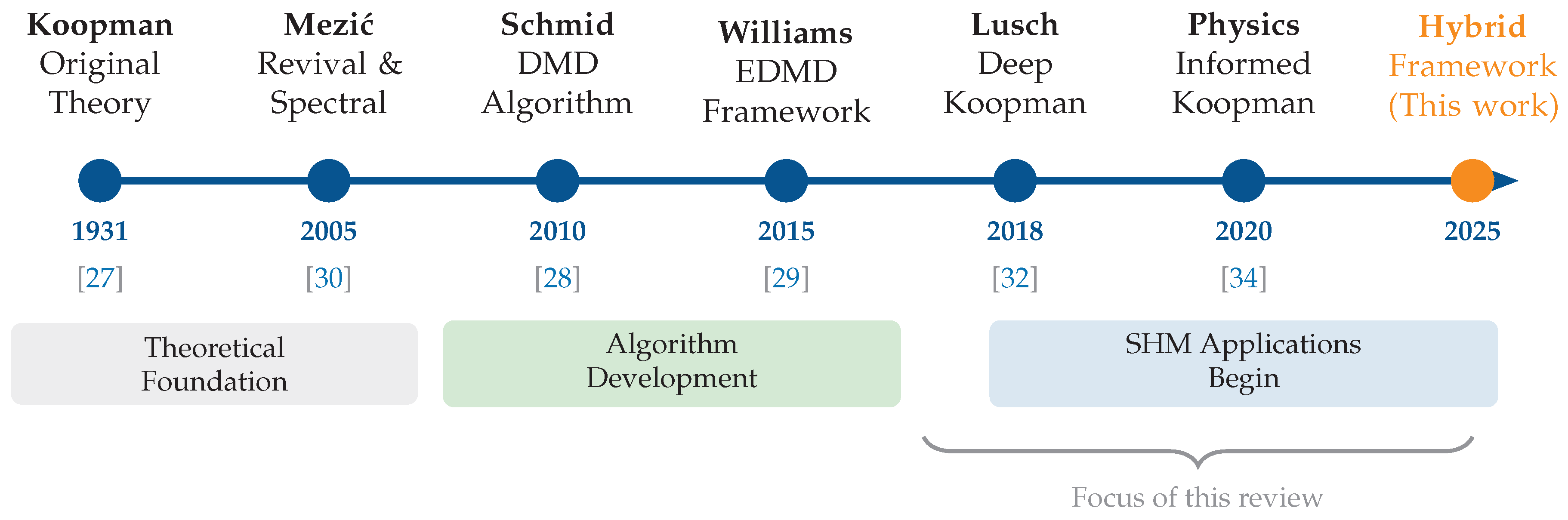
Timeline of Koopman operator methodology development and its application to structural health monitoring. The field evolved from Koopman’s foundational operator theory (1931), through Mezić’s revival connecting spectral analysis to dynamical systems (2005), to Schmid’s introduction of DMD (2010). Recent advances in deep learning (2018–present) have enabled data-driven Koopman learning, while physics-informed approaches are emerging as the state-of-the-art. This review synthesizes SHM applications from 2010 to 2025 and proposes a hybrid framework integrating these developments.
Figure 1.
Timeline of Koopman operator methodology development and its application to structural health monitoring. The field evolved from Koopman’s foundational operator theory (1931), through Mezić’s revival connecting spectral analysis to dynamical systems (2005), to Schmid’s introduction of DMD (2010). Recent advances in deep learning (2018–present) have enabled data-driven Koopman learning, while physics-informed approaches are emerging as the state-of-the-art. This review synthesizes SHM applications from 2010 to 2025 and proposes a hybrid framework integrating these developments.
2. Review Methodology
This systematic review was performed in accordance with the PRISMA guidelines [35], to ensure transparency, reproducibility, and comprehensiveness. The period of time covered in this review starts from 2010 and extends to 2025 and includes the theoretical renaissance of Koopman operator methods that was awakened by DMD Schmid [28] and also extends to the latest research in hybrid physics-data methods.
2.1. Study Selection and Data Extraction
The selection process had three phases: title/abstract screening, full-text assessment, and quality appraisal. Two reviewers independently assessed studies at each stage, with disagreements resolved through discussion. Database searches yielded 847 records, which were augmented by 89 additional records discovered through forward and backward citation searches, culminating in a total of 936 records. Following the removal of 401 duplicates, 535 unique records underwent title and abstract screening. Of these, 332 were deemed irrelevant and subsequently excluded, leaving 203 for full-text assessment. In accordance with the eligibility criteria, 136 articles were excluded after full-text evaluation (54 due to a lack of SHM focus, 53 because of insufficient methodological detail, and 29 representing duplicate content), thereby resulting in the inclusion of 67 studies in the final qualitative synthesis.

Table 1.
Systematic search strategy
| Component | Search Terms |
|---|---|
| Group A (Koopman/ DMD) | “Koopman operator” OR “Dynamic Mode Decomposition” OR “DMD” OR “Extended DMD” OR “EDMD” OR “Koopman eigenfunction” OR “Koopman mode” |
| Group B (SHM) | “structural health monitoring” OR “damage detection” OR “damage identification” OR “condition monitoring” OR “fault diagnosis” OR “vibration-based” OR “modal analysis” |
| Group C (Domain) | “civil structure” OR “bridge” OR “building” OR “mechanical system” OR “aerospace” OR “infrastructure” OR “nonlinear dynamics” |
| Combined query: (Group A) AND (Group B OR Group C). Databases searched: Scopus, Web of Science, IEEE Xplore, Google Scholar. Supplemented by forward and backward citation searching of seminal papers. | |
For each study, we gathered bibliographic details about the publication, its application area (civil, mechanical, or aerospace engineering), the specific type of structure, the Koopman or DMD variant used, the observable dictionary chosen, the types of damage considered, the validation method (simulation, laboratory, or field), the main findings, and any limitations mentioned. This data was then used for our thematic analysis and critical synthesis.
Table 2.
Eligibility criteria for study inclusion and exclusion
| Inclusion criteria | |
|---|---|
| IC1 | Published in peer-reviewed journals, conferences, or doctoral dissertations between 2010 and 2025 |
| IC2 | Written in English |
| IC3 | Applied Koopman operator theory, DMD, or closely related spectral methods to structural or mechanical system analysis |
| IC4 | Addressed damage detection, health monitoring, condition assessment, or prognostic objectives |
| IC5 | Provided sufficient methodological detail for critical evaluation |
| Exclusion criteria | |
| EC1 | Fluid dynamics applications without structural relevance |
| EC2 | Purely theoretical developments not applied to physical systems |
| EC3 | Duplicate publications or extended abstracts of already included full papers |
| EC4 | Non-peer-reviewed material (e.g., preprints without subsequent publication) |
In total, 67 publications met all inclusion criteria and were retained as primary studies in the qualitative synthesis. The final reference list contains 97 entries, because in addition to these 67 Koopman/DMD-based SHM studies, we also cited foundational works on structural health monitoring, Koopman operator theory, dynamic mode decomposition, physics-informed learning, and benchmark datasets that provide conceptual and methodological context but do not themselves satisfy the inclusion criteria for the systematic review
Figure 2.
PRISMA flow diagram illustrating the systematic literature search and selection process for Koopman operator methods in structural health monitoring (2010–2025). A total of 936 records were identified before deduplication; after removal of 401 duplicates, 535 unique records were screened, leading to 67 studies included in the qualitative synthesis.
Figure 2.
PRISMA flow diagram illustrating the systematic literature search and selection process for Koopman operator methods in structural health monitoring (2010–2025). A total of 936 records were identified before deduplication; after removal of 401 duplicates, 535 unique records were screened, leading to 67 studies included in the qualitative synthesis.
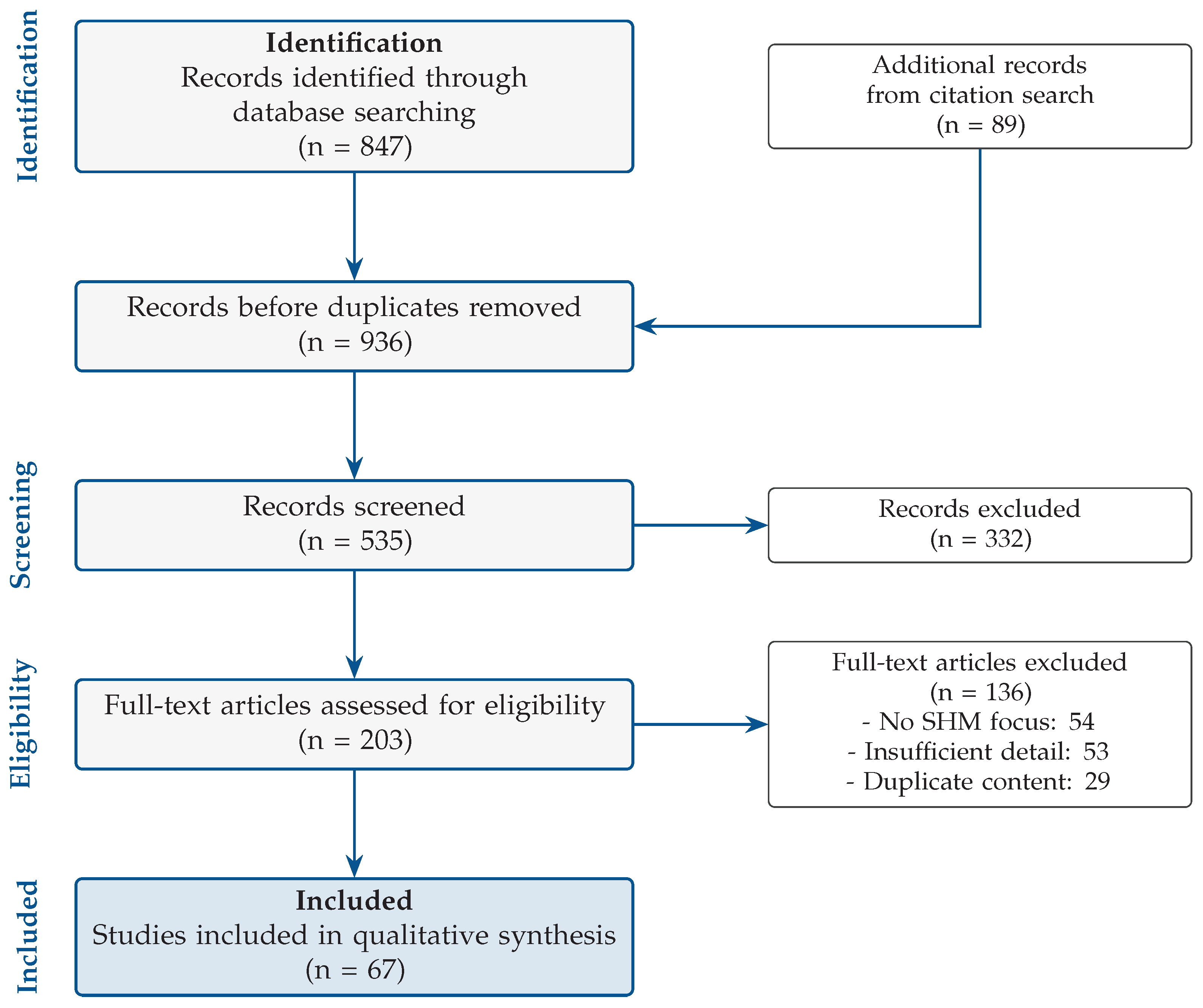
Figure 3.
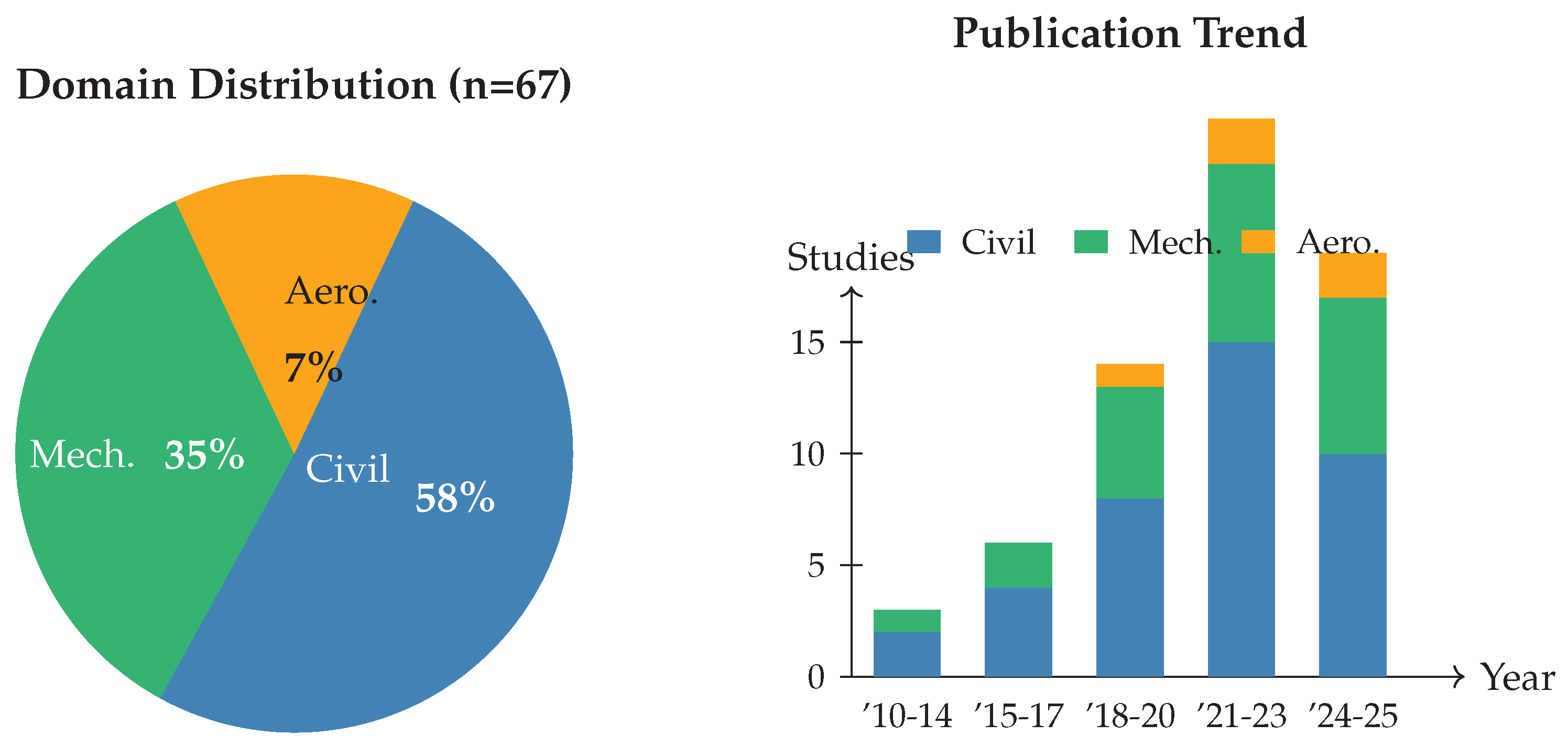
Distribution of the 67 reviewed Koopman/DMD-based SHM studies by application domain (left) and publication year (right). Civil infrastructure applications dominate the literature (58%), followed by mechanical systems (35%), with aerospace applications notably underrepresented (7%). The publication trend shows accelerating interest since 2018, coinciding with advances in deep learning-based Koopman methods.
Figure 3.
Distribution of the 67 reviewed Koopman/DMD-based SHM studies by application domain (left) and publication year (right). Civil infrastructure applications dominate the literature (58%), followed by mechanical systems (35%), with aerospace applications notably underrepresented (7%). The publication trend shows accelerating interest since 2018, coinciding with advances in deep learning-based Koopman methods.
2.2. Thematic Organization
After data extraction, we grouped the literature based on the development and diversification of Koopman methods in SHM into the following thematic groups:
- 1.
- Foundational Methods: Processes that have established DMD/EDMD algorithms and theoretical properties
- 2.
- Civil Infrastructure Applications: Bridges, buildings, towers, and other infrastructure structures on large scale
- 3.
- Mechanical Systems: Rotating machinery, gearboxes, bearings, industrial equipment
- 4.
- Aerospace Structures: Aircraft parts, space vehicles and aerospace structures
- 5.
- Hybrid Approaches: Physics-informed learning, constrained optimization, multi-fidelity approaches
- 6.
- Deep Learning Integration: Neural network-based Koopman embeddings & auto-encode neural network architectures
For each theme, we used a Claim-Support-Critique, or C-S-C, methodology to avoid bias in evaluation; that is, we tried to identify the central claims of each article, the evidence used to support the claims, and the critical evaluation of the limitations and open questions.
Table 3.
Representative studies applying Koopman/DMD methods to structural health monitoring
| Authors | Year | Domain | Method | Structure | Validation |
|---|---|---|---|---|---|
| Peng et al. | 2022 | Civil | EDMD | Frame building | Numerical |
| Deng et al. | 2025 | Civil | Koopman | Cable-stayed bridge | Field data |
| Colombo et al. | 2025 | Civil | DMD | Beam | Laboratory |
| Climaco et al. | 2023 | Mechanical | mrDMD | Wind turbine gearbox | Numerical |
| Ma et al. | 2023 | Mechanical | Adaptive DMD | Rolling Bearing | Benchmark data |
| Dang et al. | 2018 | Mechanical | Improved DMD | Rolling bearing | Benchmark data |
| Bruder et al. | 2021 | Robotics | Deep Koopman | Soft robot | Laboratory |
3. Theoretical Background
This section proves the theoretical bases required to understand Koopman operator methods in SHM. We start by introducing traditional methods of SHM and the limitations associated with them, followed by a brief introduction of the mathematical framework of Koopman theory, and end with data-driven approximation algorithms.
3.1. Traditional Structural Health Monitoring: Methods and Limitations
3.1.1. The SHM Hierarchy
Structural health monitoring is classically represented by a hierarchical process that contains four levels of increasing complexity [33]:
- 1.
- Level 1—Detection: Estimation of existence of damages in the structure
- 2.
- Level 2—Localization: Possible location(s) of the damage identified
- 3.
- Level 3—Quantification: Determination of extent or severity of damage
- 4.
- Level 4—Prognosis: Prediction of the remaining useful life
This hierarchy indicates an increase in demands for information: in Level 1, it is only required to identify the object (damaged/undamaged); in Level 4, it is needed to understand fully the dynamics of the damage evolution. Most of the methods that currently exist tackle Levels 1 and 2, with Levels 3 and 4 being critical open challenges [1].
3.1.2. Model-Based Methods
Model-based SHM approaches rely on physics-derived models, typically through finite element models (FEM) of the structure under investigation. The basic paradigm is comparing the measured and predicted dynamic properties and attributing discrepancies to damage [36]. Model updating techniques aim at iterating model parameters (stiffness, mass, and damping) to reduce a difference between predicted and measured modal properties [37,38]. As the changes in the required parameter increase beyond reasonable environmental impacts, damage is assumed.
The strengths of model-based approaches are that they are physically interpretable, damage localization can be done using parameter maps, and the theoretical base of the approach (structural mechanics) is solid. There are several limitations, however, that limit their practical applicability:
- Model uncertainty: In practice, real structures are inevitably different from the idealized representations that are used in finite element simulations because of construction tolerances, material variabilities, approximations of boundary conditions, and the omission of one or more components [39]. The propagation of such parameter uncertainties through coupled multi-field models has been shown to produce considerable scatter in both forward predictions and inverse identification results [40,41].
- Computational cost: High-fidelity FEM updating for large civil structures might be computationally too expensive, especially for real-time monitoring applications [42]. Even moderately complex coupled thermo-hydro-mechanical simulations require parallel computation strategies and optimized sparse storage schemes to remain tractable [43], and the repeated model evaluations needed for probabilistic sensitivity analyses further compound this burden [44].
- Nonlinearity handling: Standard FEM updating is based on the assumption that the structure behaves linearly, which restricts its application to structures showing notable nonlinear response [45]. Extending model-based identification to coupled nonlinear settings, such as thermo-hydro-mechanical problems in masonry dams, demands substantially more sophisticated formulations and solver strategies [43], while the reconstruction of nonlinear deformations in thin shell structures introduces additional geometric complexities into the inverse analysis [46].
- Ill-posedness: The inverse problem of inferring distributed damage from limited modal measurements of an object can often be ill-posed, with multiple damage configurations potentially yielding similar modal changes [47]. This difficulty persists in multi-field inverse problems such as crack identification in hydro-mechanically coupled systems, where regularizing iterative methods must be applied to obtain stable reconstructions [48]. Optimal experimental design strategies have been proposed to mitigate this ill-posedness by maximizing the information content of the available measurements [49].
3.1.3. Data-Driven Methods
Data-driven SHM treats damage detection as a pattern recognition problem, and the discriminative features are learned directly from the sensor measurements without any explicit physics models [2,16]. Classical approaches involve the use of statistical process control on extracted features, time-series modeling (ARIMA and AR), and machine learning classifiers (SVM and random forests) [50,51]. More recently, deep learning architectures have achieved state-of-the-art performance over benchmark datasets [20,52].
Data-driven methods have some appealing properties: they can find small patterns that are invisible to physics-based analysis, they can be scaled to high-dimensional sensor networks, and they do not require any previous structural model. However, there are still major limitations, as deep learning models offer limited insight into why a damage indication was generated, which reduces trust in safety-critical contexts [53]. Models trained under particular conditions often fail when deployed on different structures or under shifted operating envelopes [54], and even on a single experimental structure, environmental variability can mask or mimic damage trends [55]. Supervised approaches further require labeled damage examples that are rarely available for civil structures where damaging tests are impractical [56]. Also, Pure data-driven models can learn spurious correlations or make predictions that do not adhere to physical constraints [24]
3.1.4. The Need for Hybrid Approaches
The complementary limitations of model-based and data-driven approaches lead to the motivation of hybrid ways of integrating the strengths of the two paradigms. Physics-informed machine learning in particular has become a promising research direction where physical constraints, equations, or prior knowledge are included in the data-driven algorithms [24,57]. In the context of computational mechanics, this idea has been realized through deep energy methods that use variational principles as the loss function for neural network training, enabling the solution of forward and inverse problems across linear elasticity, hyperelasticity, and fracture mechanics without the need for labeled data [58]. Transfer learning strategies have further extended the applicability of such physics-informed architectures by allowing models trained on one physical configuration to be efficiently adapted to new loading or damage scenarios [59]. Koopman operator theory is one way to explain such hybridization that provides a principled mathematical structure (linearity in observable space) but is ultimately data-driven in implementation.
3.1.5. Koopman Operator
Consider a discrete-time dynamical system defined by the map , where is the state space:
Rather than tracking the evolution of states instead Koopman theory tracks the evolution of observables—scalar-valued functions belonging to some function space . The Koopman operator is defined by its action on observables:
The operator advances any observable function by one time step along the flow of the dynamical system. Critically, is linear even when is nonlinear:
This linearity constitutes the basic fact in Koopman theory: the price paid for linearization is infinite-dimensionality, as acts on a function space rather than a finite-dimensional state space [30,31].
For continuous-time systems , an analogous construction yields the Koopman generator , satisfying , with the Koopman operator recovered for flow time t.
3.1.6. Spectral Properties
The spectral decomposition gives profound information on the dynamics of the system. An eigenfunction is such that:
where is the corresponding eigenvalue. The evolution of eigenfunctions is simply under the dynamics:
For many systems of interest, it is possible to expand an observable, g, in Koopman eigenfunctions:
where are the Koopman modes associated with observable g. The time evolution then becomes
This decomposition is similar to modal expansion in the linear case but is applied globally to nonlinear dynamics. The eigenvalues capture temporal behavior: represents the growth/decay rates and represents the oscillation frequencies [31,60].
Figure 4.
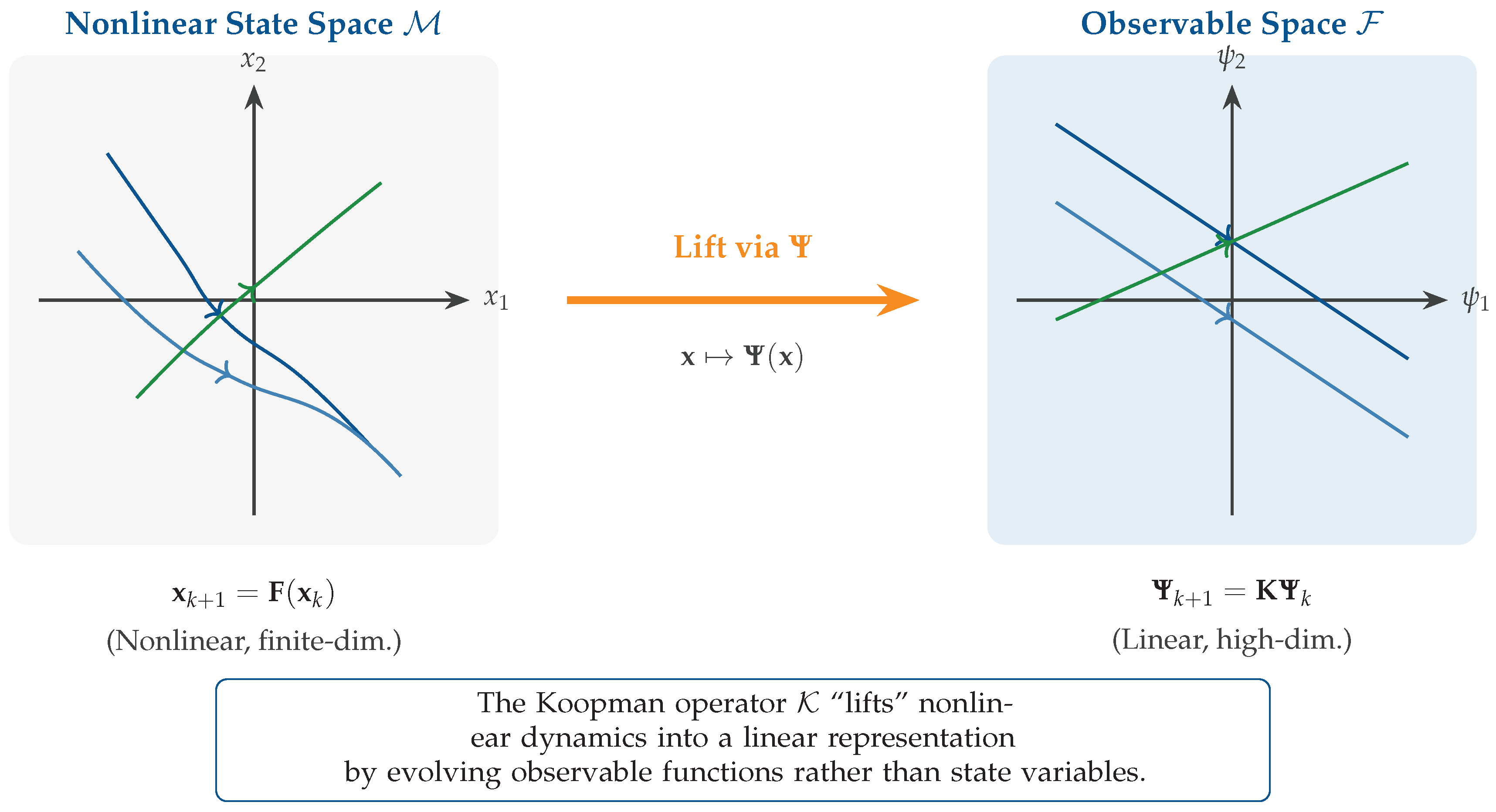
Conceptual illustration of the Koopman operator framework. Left: Trajectories in the original nonlinear state space exhibit complex, curved paths. Right: Through the lifting map , these same trajectories become linear in the high-dimensional observable space, governed by the linear operator .
Figure 4.
Conceptual illustration of the Koopman operator framework. Left: Trajectories in the original nonlinear state space exhibit complex, curved paths. Right: Through the lifting map , these same trajectories become linear in the high-dimensional observable space, governed by the linear operator .
3.1.7. Relevance to Structural Dynamics
In the case of linear structural systems, Koopman eigenfunctions include classical normal modes but are not limited to them, and the eigenvalues are modal frequencies and damping ratios. In the case of nonlinear systems, Koopman analysis can capture more information: nonlinearity-induced harmonics are represented by new eigenfunctions, quasi-periodic responses to nonlinearity are represented by new eigenvalues on the unit circle with insufficient phases, and chaotic dynamics are represented by continuous spectra [30].
This relation to modal analysis is what renders Koopman theory especially important in SHM. Changes caused by damage, either linear (reduced stiffness) or nonlinear (crack breathing, loose joints) will change the Koopman spectrum in predictable ways. A reduction of the stiffness reduces the modal frequencies; the new spectral components are introduced by the emerging nonlinearity. Using Koopman eigenvalues and modes to monitor damage, it is possible to potentially detect and characterize damage more sensitively than classical linear modal analysis.
3.2. Data-Driven Approximations: DMD and EDMD
Since is infinite-dimensional, practical applications require finite-dimensional approximations constructed from measurement data.
3.2.1. Dynamic Mode Decomposition (DMD)
Schmid proposed a data-driven technique to approximate Koopman operator; this technique is known as Dynamic Mode Decomposition [28]. Given a sequence of m snapshots where , DMD seeks the best-fit linear operator satisfying
Organizing the snapshots in matrices: and , the DMD solution is:
where denotes the Moore-Penrose pseudoinverse. The eigenvalues of approximate Koopman eigenvalues and corresponding eigenvectors provide DMD modes representing spatial coherence patterns depending on the dictionary completeness [61].
3.2.2. Extended Dynamic Mode Decomposition (EDMD)
Standard DMD implicitly assumes the identity map as the observable, which is inadequate for strongly nonlinear systems. To mitigate this, Extended DMD, which [29] formulated as such, employs a dictionary of observable functions .
Considering data pairs of the form: , EDMD finds the matrix minimizing:
The solution is given by:
where and .
The most frequent examples of dictionaries are polynomials, radial basis functions (RBFs), Fourier modes, and time-delay embeddings [29,64]. The dictionary used has a critical influence on the quality of approximation; namely, if spans a near-invariant subspace under , the finite-dimensional accurately captures the dominant Koopman spectrum.
3.2.3. Deep Learning Extensions
Rather than manually designing dictionaries, deep learning approaches learn optimal observables automatically. The seminal work of Lusch et al. [32] employs an autoencoder architecture where the encoder maps states to a latent representation , constrained to evolve linearly:
The decoder reconstructs states from latent codes. Training minimizes a combined loss:
This encourages the network to discover a coordinate system where dynamics are linear and learns Koopman-invariant observables [65,66,67].
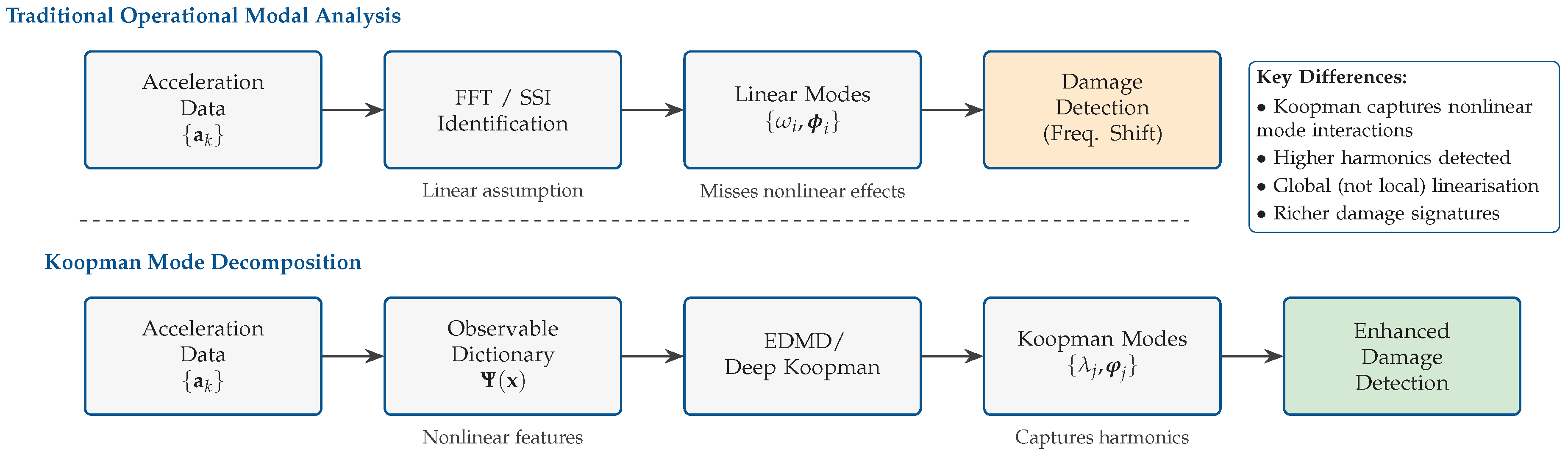
Figure 5.
Comparison of traditional operational modal analysis (top) and Koopman mode decomposition (bottom) for structural health monitoring. The Koopman approach captures nonlinear phenomena such as higher harmonics and mode interactions that linear methods inherently miss, potentially yielding enhanced damage sensitivity.
Figure 5.
Comparison of traditional operational modal analysis (top) and Koopman mode decomposition (bottom) for structural health monitoring. The Koopman approach captures nonlinear phenomena such as higher harmonics and mode interactions that linear methods inherently miss, potentially yielding enhanced damage sensitivity.
4. Applications of Koopman Methods in Structural Health Monitoring
This section critically evaluates the use of Koopman operator techniques in SHM in the civil infrastructure, mechanical systems, and aerospace structures. We will use a Claim-Support-Critique (C-S-C) approach to offer a fair evaluation of any study area that we have.
4.1. Civil Infrastructure: Bridges, Buildings, and Large-Scale Structures
The complex dynamic behavior of civil structures is due to the operational loads (traffic, wind, pedestrians), environmental effects (temperature, humidity), aging mechanisms (corrosion, fatigue), and structural nonlinearities. The Koopman method used in monitoring civil infrastructure is in its infancy but has a lot of potential.
4.1.1. Phase-Space Embedding and Stochastic Koopman Operators
Peng et al. [68] introduced a pioneering study to examine the use of phase-space reconstruction with Koopman operator theory in the evaluation of damages under stochastic excitations. In the context of the study conducted by Peng et al., time-delay embedding is used to reconstruct the attractor of the structural response of the single-channel acceleration data and is followed by EDMD to compute a finite-dimensional Koopman approximation.
The phase-space embedding method allows the decoupling of intrinsic and stochastic input system dynamics, and Koopman eigenvector variations can provide robust damage indicators even when the system is driven by ambient excitation.
The paper has proven the ability of successful damage detection in simulated multi-story frame buildings with breathing nonlinearity of cracking. Koopman eigenvalues of fundamental modes were observed to shift (2-5 percent) with the introduction of damage, and new eigenvalues were observed due to the harmonic generation of nonlinear behavior of cracks. The Koopman approach was more robust to noise and identified damage at earlier stages as compared to the traditional frequency identification in the FFT.
Nevertheless, these findings are limited by a number of limitations limiting external validity. To begin with, the research was based on numerical simulation only, and idealized damage models were used; experimental or field validation was not conducted. Second, the decision on embedding dimension and delay parameters was made in an ad hoc manner without logical optimization. Third, the relation between Koopman eigenvalue changes and physical damage parameters (magnitude of stiffness reduction, crack extent) is restricted to Level 1 or 2.
4.1.2. Cable Force Estimation in Bridge Networks
Notably, Deng et al. [69] used the Koopman theory to predict the forces in cables in cable-stayed bridge networks by taking advantage of the spatiotemporal correlation between cables. The method regarded the cable network as a coupled dynamical system and used higher-order derivatives of vibration signals as observables to linearize inherently nonlinear cable dynamics According to them, Koopman-based modeling is able to model cable tension forces on the same level of accuracy even with incomplete sensor coverage and is able to compute such models more efficiently than time-series methods.
The approach delivered correlation coefficients that were greater than 0.99 between estimated and measured cable forces with computation times that were about 20% lower than competing methods. The Koopman model was very successful in spreading information over the cable network, and the information can be estimated at locations that are not monitored at all, i.e. the capability is in itself very relevant to SHM where extensive instrumentation is not always realistic.
While demonstrating impressive performance metrics, this study involved the use of data imputation as opposed to direct damage detection. Although the results clearly showed high levels of performance in terms of performance metrics. This capability to identify the presence of abnormal behavior in cables (e.g., the abrupt loss of tension and failure) was implied but not directly tested. Besides, the effectiveness of environmental effects (tension changes due to environmental factors) on the fidelity of Koopman models was not considered.
4.1.3. Vision-Based DMD for Modal Identification
Emerging literature has examined non-contact structural monitoring by coupling a computer vision sensor with DMD analysis. It has been shown that DMD used on high-speed video sequences can capture modal parameters similar to those obtained with accelerator-based measurements as well as DMD measurements of acceleration, angular momentum, and torque in specific situations, like component handling on a conveyor belt, manufacturing plants, and car and motorcycle chassis [70,71]. The observables are pixel intensities, giving information about the spatial deformation patterns represented by DMD modes, and eigenvalues, giving information about frequency distributions.
They claim that vision-based DMD allows widespread full-field modal detection without any physical instrumentation, with which localized damage might be detected based on high-resolution mode shape representations.
Although DMD on video data has been applied to beam structures, laboratory experiments have demonstrated that the initial few modes of bending can be identified with frequency errors of less than 2% relative to reference sensors. The mode shapes in reconstructions of the spatial mode of DMD display local variations at locations of damage [72].
Nonetheless, vision-based methods have serious difficulties being deployed to the field: changes in lighting, camera motion, occlusion, and processing of high-resolution video are expensive. The detectability of minor emerging damage is also unknown, with the detectability of mode shape variation being minor compared to the noise of measurements.
4.2. Mechanical Systems: Rotating Machinery and Gearboxes
Mechanical systems, especially rotating machinery, possess very complicated dynamics that comprise parametric excitation and varying operational circumstances. Such fault diagnosis methods as Koopman-based methods have been developed.
4.2.1. Multi-Resolution DMD for Gearbox Monitoring
The authors of the work by Climaco et al. [73] used multi-resolution DMD (mrDMD) to detect gear tooth damage in wind turbine gearboxes. The mrDMD algorithm is a hierarchical decomposition algorithm, and it is appropriate for machinery with different loads and speeds, as it breaks down the dynamics in multiple time scales.
mrDMD is a good isolating approach to detect damaged signatures in non-stationary operational variability and turbulent excitation, whereas traditional spectral analysis detects faults in non-stationary flow.
Interestingly, mrDMD was applied to simulated gearbox vibration data with realistic winds obtained with turbulence, where it was successful in extracting a DMD mode at the tooth mesh frequency, which exhibited different amplitude changes between healthy and damaged conditions. The hierarchical decomposition allowed the separation of slow modulation by the wind and the fast gear mesh dynamics.
One potential flaw Is that the investigation employed simulated data with known damage characteristics; the performance on data with uncertain states of damage has not been established yet. The calculation cost of mrDMD in continuous monitoring on the Internet was not compared.
4.2.2. Bearing Fault Diagnosis
DMD variants have been used in several studies to apply them to diagnostics of rolling element bearings propagation diagnostics [74,75]. Bearings will have standard defect frequencies based on geometry and speed of rotation; the damage will also introduce impulses activating the defect frequencies. Vibration signals on DMD may be split out into modes of defect frequency, and the magnitude of the eigenvalues is a measure of the severity of the fault.
It is clear that DMD-based features are effective for bearing fault detection across varying load and speed conditions, particularly in scenarios where traditional envelope analysis encounters difficulties due to non-stationary operating conditions.
Notably, Ma et al. [74] developed an adaptive DMD (ADMD) method for compound fault diagnosis in rolling bearings, demonstrating successful decoupling of multiple simultaneous fault signatures. The method achieved reliable fault identification on both simulated signals and experimental data from bearing test rigs. Cai et al. [76] combined adaptive DMD with genetic algorithm-optimized support vector machines (GA-SVM) for planetary bearing fault classification, achieving 96.43% classification accuracy across four bearing states (inner ring fault, outer ring fault, rolling element fault, and normal condition), outperforming both empirical mode decomposition (EMD) and convolutional neural network (CNN) approaches on the same dataset. Dang et al. [75] introduced an improved DMD algorithm with optimal rank truncation and hierarchical mode selection, successfully extracting fault characteristics from noisy bearing signals where conventional spectral methods failed.
While these results are promising, several limitations warrant consideration. The majority of DMD-based bearing studies utilize standard benchmark datasets (CWRU, IMS, Paderborn University) with artificially seeded faults under controlled laboratory conditions. The performance of these methods on naturally developing faults under industrial noise conditions, variable speeds, and fluctuating loads remains less thoroughly validated. Additionally, most studies focus on fault detection and classification rather than establishing quantitative relationships between DMD spectral features and physical damage parameters such as crack depth or spall area.
4.3. Aerospace Structures and Control-Oriented Applications
Aerospace systems require highly reliable monitoring and strong weight requirements, so efficient, explainable algorithms are of interest. Although most of the work on aerospace SHM with Koopman methods specifically is absent, other related efforts in control and robotics provide transferable information.
Aerospace structural health monitoring represents a domain where Koopman-based methods remain notably underexplored, despite the significant potential benefits. The aerospace industry faces unique challenges that could benefit from advanced data-driven approaches: composite structures with complex failure modes [77], stringent weight and real-time computational constraints, and the need to detect barely visible impact damage (BVID) before it propagates to critical failure [78].
4.3.1. Koopman-Based Control and Prediction
Koopman methods have been applied extensively in model predictive control (MPC) of nonlinear systems [26,79,80]. The central advantage is straightforward: once a linear Koopman model has been constructed, standard linear MPC techniques can be applied directly to nonlinear plants [32]. In aerospace contexts, this enables real-time trajectory optimization and fault-tolerant control without the computational overhead of repeatedly solving nonlinear programming problems.
In the robotics and control literature, Koopman-based approaches have proved effective for soft robots and flexible structures that exhibit significant geometric nonlinearity [80]. These systems share important characteristics with aerospace composite structures, where damage-induced nonlinearities such as delamination breathing or control surface freeplay may manifest as detectable changes in the Koopman spectrum [81].
Translating these methods from controlled laboratory settings to operational aerospace structures, however, raises several challenges that must be acknowledged. Aircraft operate under coupled aero-thermo-structural loads with far greater variability than most civil infrastructure, and environmental compensation techniques developed for bridges and buildings [12] cannot be assumed to transfer directly to such extreme operating envelopes. Aerospace composites also exhibit multiple interacting failure mechanisms, including matrix cracking, delamination, and fiber breakage, which may require specialized observable dictionaries tailored to these damage modes [29,78]. From a regulatory perspective, aviation authorities such as the FAA and EASA demand rigorous validation of any SHM system, including demonstration of probability of detection (POD) curves, and this level of validation has not yet been achieved for Koopman-based approaches [82]. Finally, onboard SHM systems must operate within strict power and computational budgets, which places additional constraints on the complexity of any Koopman algorithm deployed in flight.
Despite these challenges, several promising avenues exist for advancing Koopman-based aerospace SHM. DMD analysis of strain or acceleration data from wing-mounted sensors could detect stiffness degradation associated with fatigue crack growth or disbonding [83], and the modal character of Koopman analysis aligns naturally with flutter monitoring requirements [26]. Combining Koopman methods with guided wave measurements, which are already well established in aerospace SHM [84], could further improve damage localization capabilities for composite panels. At a system level, Koopman operators could serve as reduced-order models within digital twin frameworks [85], supporting real-time structural state estimation and remaining useful life prediction [83]. Unmanned aerial vehicles represent a particularly attractive initial application domain, since their less stringent certification requirements relative to manned aircraft would allow Koopman-based SHM concepts to be validated under realistic flight conditions before being scaled to larger platforms.
5. Hybrid Koopman Approaches: Integrating Physics with Data-Driven Learning
As noted in the review above, it can be seen that purely data-driven Koopman approaches are promising and have challenges, including physical inconsistency, limited interpretability, and uncertain damage quantification. The use of hybrid solutions that bring physics-based knowledge to Koopman learning is a new area of research with high potential application in SHM.
The methods presented in this section have been developed and validated in adjacent fields, primarily fluid dynamics, control theory, and general dynamical systems modeling. Their application to structural health monitoring remains largely unexplored. We synthesize these existing techniques here and articulate how they can be adapted to the SHM context, drawing on the structural mechanics constraints and damage detection requirements identified in the preceding sections. Where we present mathematical formulations, these represent adaptations of established methods to the SHM setting rather than novel algorithmic contributions.
5.1. Physics-Informed Koopman Learning
Physics-informed models incorporate physical constraints, equations, or priors within the Koopman operator learning procedure and conditions, ensuring that identified models respect known structural behavior.
5.1.1. Stability-Guaranteed Learning
Pan and Duraisamy [34] introduced a physics-informed framework for learning Koopman embeddings with guaranteed stability. In the case of autonomous systems, stability requires that all Koopman eigenvalues satisfy (discrete time) or (continuous time). Data-driven methods can fit unstable models without constraints because of noise, limited data, or limited dictionaries.
The suggested scheme parameterizes the Koopman matrix to provide structural stability, such as by ensuring that eigenvalues are in the unit circle when factorized through a specified matrix. This was applied to fluid dynamics problems and produced physically plausible models, which were stable in long prediction times.
Implications for SHM: Structural systems become inherently stable (passive, energy-dissipating); learned Koopman models should reflect this. The stability enforcement would help to exclude false unstable modes on the false alarm and make sure that real instability (e.g., flutter onset) would be seen as a constraint violation.
5.1.2. Constrained Optimization Formulations
Other physics-based types of constraints may be included in EDMD optimization besides stability:
- Symmetry: For geometrically symmetrical structures, Koopman modes are expected to appear in symmetric pairs. This is implementable either by constrained optimization or by dictionary design that is symmetrically designed [86].
- Energy conservation: The eigenvalues of lightly damped structures should be concentrated around unity. Penalizing deviation from for identified modes can improve physical consistency
- Modal orthogonality: In the event that mass-normalized mode shapes are provided by an FEM baseline, orthogonality can be imposed almost in the learned Koopman basis by constraints.
5.2. Fusion of First-Principles Models with Koopman Learning
A particularly powerful hybrid approach incorporates physics-based models as priors, which are subsequently refined or corrected through data-driven Koopman learning. This fusion leverages the interpretability and physical consistency of first-principles models while exploiting the adaptability of data-driven methods to capture unmodeled dynamics and system variations.
5.2.1. Regularized Koopman Optimization
The integration of physics priors into Koopman learning can be achieved through regularized optimization formulations. A regularized EDMD formulation that penalizes deviations from a physics-based prior is given by:
where represents a Koopman matrix derived from a physics-based model (e.g., a linearized finite element model), and controls the regularization strength. This regularized formulation follows the general framework of constrained operator regression [34], here adapted to SHM by using an undamaged FEM model as the physics prior. The first term ensures the model accurately represents the observed data, while the second term, however, connects the learned operator to the basic physical principles. This formulation encourages the trained operator to remain consistent with known physical behavior while adapting to measured data.
Physics-informed Dynamic Mode Decomposition (PiDMD), a method that formalizes a related approach, was developed by [87]. This method shows how fundamental physical principles, such as conservation laws, symmetry, and stability constraints, can be directly included in the DMD optimization process. Their formulation restricts the family of admissible models to a matrix manifold that respects the physical structure of the system:
where the manifold encodes physical constraints such as energy conservation (unitary or orthogonal matrices), self-adjointness (symmetric matrices), or shift-equivariance (circulant matrices). This constrained optimization can be cast as a Procrustes problem, admitting closed-form solutions for many physically meaningful manifolds.
In the context of SHM, an undamaged finite element model could serve as the physics prior . Under healthy operating conditions, the regularization term in Equation (14) would dominate, yielding a learned operator close to the physics baseline. However, when structural damage occurs, the data-driven approach would require adjustments to the previous model to accurately reflect the observed behavior. These deviations are quantified through that provides a natural damage indicator, with larger departures suggesting more significant structural changes. This approach offers the dual benefit of producing predictions that are consistent with physical laws under normal conditions, while also allowing for the sensitive detection of damage when unusual events occur..
5.2.2. Hybrid Observable Dictionaries
In lieu of using generic polynomial or RBF dictionaries, hybrid methods may divide observables into data-driven and physics-based parts:
Hybrid dictionaries of this form have been used implicitly in control applications [86]; we formalize the concept here for damage-sensitive observable design.
Physics-based observables may consist of modal coordinates calculated using known mode shapes, strain energy content, or even kinematic values. The observed data-driven variables (which are observables) can be cited as learned features of the neural networks or adaptive basis functions.
This hybrid dictionary is such that the Koopman model directly captures known linear dynamics (by using ) but it is allowed to have nonlinear or unmodeled effects (by using ). The value of data-driven observables offers an interpretable indicator of the inadequacy of the model or change of the system.
5.3. Deep Learning with Physical Constraints
Modern deep Koopman methods can include physics by changing the architectural design or loss function modifications:
- Physics-informed loss terms: Adding penalty terms for energy non-conservation, constraint violation, or deviation from known equilibria guides the network toward physically consistent solutions [57].
- Equivariant architectures: Neural network architectures that uphold identified symmetries (e.g., rotation equivariance in rotationally symmetric architectures) reduce the hypothesis space and enhance generalization, which is why they are called equivariant architectures [88].
- Residual learning: Residual learning trains networks to recall the difference between a physics baseline and observations instead of the whole dynamic to exploit prior knowledge while allowing modeling of random effects that do not change the model.
5.4. Insights from Hybrid Models in Structural Mechanics
Several research programs within computational structural mechanics have developed hybrid physics-data strategies that, while not explicitly framed in Koopman terms, address the same fundamental challenge: combining the interpretability of physics-based models with the flexibility of data-driven methods. These efforts provide both methodological precedents and concrete tools that can inform the design of hybrid Koopman frameworks for SHM.
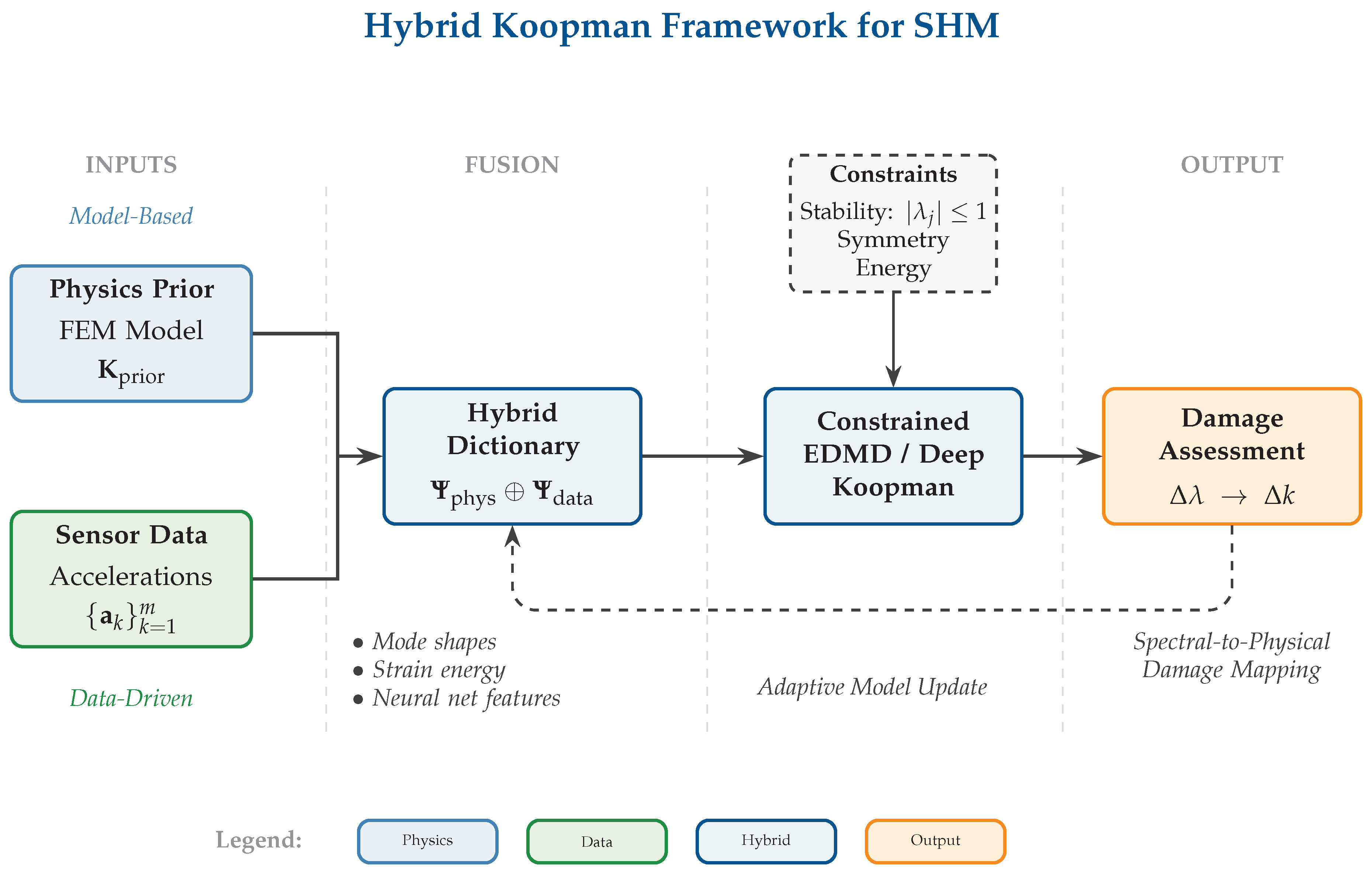
Figure 6.
Proposed hybrid Koopman framework for structural health monitoring. The framework integrates physics priors from finite element models with sensor data streams through a hybrid observable dictionary combining physics-based features ( mode shapes, strain energy) and data-driven features ( neural network embeddings). Constrained EDMD or deep Koopman learning, identifies the Koopman operator while ensuring physical consistency by enforcing constraints related to stability, symmetry, and energy conservation. The output module links Koopman spectrum () to physical damage parameters (). Moreover, a feedback loop allows the model to be updated adaptively as new data becomes available.
Figure 6.
Proposed hybrid Koopman framework for structural health monitoring. The framework integrates physics priors from finite element models with sensor data streams through a hybrid observable dictionary combining physics-based features ( mode shapes, strain energy) and data-driven features ( neural network embeddings). Constrained EDMD or deep Koopman learning, identifies the Koopman operator while ensuring physical consistency by enforcing constraints related to stability, symmetry, and energy conservation. The output module links Koopman spectrum () to physical damage parameters (). Moreover, a feedback loop allows the model to be updated adaptively as new data becomes available.
5.4.1. Inverse Analysis and Uncertainty Quantification
A prerequisite for any quantitative damage assessment is the ability to solve inverse problems robustly under uncertainty. Lahmer [48] developed regularizing iterative methods for crack identification in hydro-mechanically coupled gravity dams, demonstrating that stable damage reconstruction is achievable even when the forward problem involves multi-field coupling. Subsequent work on optimal experimental design for nonlinear ill-posed problems [49] showed that the information content of sensor measurements can be maximized through systematic sensor placement, a concept directly transferable to the selection of Koopman observables. If the observables used in EDMD are chosen to maximize sensitivity to damage parameters, the resulting Koopman operator will be better conditioned for inverse damage mapping.
The treatment of uncertainty in inverse problems has been advanced through both global and local sensitivity analyses for coupled thermo-hydro-mechanical problems [40], uncertainty assessment in masonry dam damage detection [41], and probabilistic sensitivity frameworks for computationally expensive models [44]. These methods quantify how parameter uncertainties propagate through forward models, information that is essential for calibrating the regularization strength in the hybrid Koopman formulation of Equation (14).
5.4.2. Frequency-Based Damage Identification Under Uncertainty
Alkam and Lahmer’s research on eigenfrequency-based Bayesian damage identification in catenary poles [18] offers a direct connection between traditional vibration-based structural health monitoring (SHM) and the Koopman spectral framework discussed in this review. Their methodology estimates both the location and severity of damage by analyzing shifts in measured eigenfrequencies, employing transitional Markov Chain Monte Carlo sampling to explicitly quantify posterior uncertainty in the inferred parameters. A complementary monitoring strategy for the same class of structures [19] demonstrated that robust status classification is achievable under field conditions using unified damage indices derived from multiple vibration features.
The connection to Koopman methods is immediate: Koopman eigenvalues generalize the concept of eigenfrequencies to the nonlinear setting. A Bayesian inference framework analogous to that of Alkam and Lahmer, but operating on Koopman eigenvalues rather than linear natural frequencies, would constitute a principled approach to the spectral-to-physical damage mapping identified as Gap 3 in Section 6. The posterior distributions over damage parameters would naturally account for measurement noise, environmental variability, and modeling uncertainty.
5.4.3. Sensor Integration and Deployment Challenges
The feasibility of any SHM framework depends ultimately on the quality and reliability of the underlying sensor data. Walther and colleagues [23] examined the practical difficulties associated with integrating RFID sensors within reinforced concrete for streamlined structural health monitoring, pinpointing electromagnetic shielding caused by the reinforcement cage as a significant impediment. Alkam et al. subsequently investigated distributed fiber optic sensing (DFOS) for damage detection in civil structures, illustrating that spatially continuous strain measurements can reveal damage signatures that discrete accelerometer networks might overlook.
These sensor-level considerations have direct implications for Koopman-based SHM. The choice of observable dictionary (Section 6) is constrained by what can be measured in practice: if only acceleration data are available from a sparse sensor network, the Koopman observables must be constructed from time-delay embeddings or derived features rather than from spatially resolved strain fields. Conversely, if dense DFOS data are available, strain energy-based observables (Equation (18)) become directly computable, potentially enabling the physics-informed dictionaries advocated in this review.
5.4.4. Explainability and Trust in Data-Driven SHM
For safety-critical infrastructure, the ability to explain diagnostic outcomes is not merely desirable but a prerequisite for adoption by asset owners and regulatory bodies. Luckey et al. [25] examined how explainable artificial intelligence (XAI) concepts can advance structural health monitoring, arguing that interpretability must be designed into the monitoring pipeline rather than retrofitted onto opaque models. The Koopman framework offers a natural pathway toward this goal: because the learned representation preserves a linear evolution structure with physically meaningful eigenvalues (frequencies, damping ratios), the diagnostic outputs are inherently more interpretable than those of generic deep learning classifiers. The hybrid framework proposed in this review extends this advantage by anchoring the learned operator to a physics baseline, ensuring that deviations from expected behavior can be traced to specific physical mechanisms.
6. Research Gaps and Future Directions
Our systematic review reveals a diverse lack in the literature that needs to be addressed to achieve the full potential of Koopman methods for SHM. We organize this analysis using the Claim-Support-Critique methodology, stating each of the gaps and offering some suggestions for resolution.
6.1. Gap 1: Observable Dictionary Design for Damage Sensitivity
Most current Koopman and DMD implementations in structural health monitoring continue to rely on generic observable dictionaries such as polynomials, radial basis functions, and time delays. Experts argue that these bases are not optimized for damage sensitivity, which leaves the lifted representation poorly equipped to highlight the subtle signatures that damage produces in vibration responses or strain patterns.
Studies have shown that generic dictionaries need to contain a massive number of terms in order to approximate the Koopman invariant subspaces, which brings the increase in computational cost and possibility of overfitting [29,89]. More seriously, however, the type of observables employed may not be the most sensitive to damage-induced change, and physically motivated features, such as modal strain energy or curvature, have been shown to exhibit better damage sensitivity in traditional SHM [8].
As a result, there is no systematic methodology that exists for designing ` "damage-sensitive dictionaries" where knowledge on physics and data-driven feature learning are combined. Research is needed on:
- Hybrid dictionaries using strain energy, modal coordinates, and learning nonlinear features
- Sensitivity analysis between composition of dictionary and damage detectability
- Adaptive dictionary learning with a focus on damage-relevant dynamics
6.1.1. Strategies for Physics-Informed Observable Design
The selection of observables fundamentally determines the Koopman operator’s ability to capture damage-sensitive dynamics. While generic dictionaries (polynomials, radial basis functions, Fourier modes) have been successful in many dynamical systems, SHM applications require observables specifically tuned to structural damage signatures. We outline several promising strategies:
Mode Shape-Based Observables
Classical SHM research has established that mode shape curvatures and derivatives are more sensitive to localized damage than mode shapes themselves [7]. This insight can be directly incorporated into EDMD dictionaries:
where represents the i-th mode shape. For discretely sensed structures, curvatures can be approximated using central difference operators. Rucevskis et al. [90] demonstrated that mode shape curvature methods can detect and localize damage in plate structures without baseline data, a property highly desirable for operational SHM.
Strain Energy-Based Observables
Modal strain energy distributions concentrate at damage locations, providing natural damage indicators [8]. Strain energy observables can be constructed as follows:
where represents the local stiffness contribution. Changes in these observable characteristics after damage directly reflect local changes in stiffness.
Nonlinear Feature Observables:
Damage often introduces nonlinearity through mechanisms such as crack breathing or friction at interfaces. Observables capturing these effects include
- Products of modal coordinates: (capturing mode coupling)
- Higher harmonics: (capturing harmonic generation)
- Time-frequency features: wavelet coefficients at damage-sensitive frequency bands
Sensitivity Optimization
Beyond intuition-driven observable selection, a systematic optimization approach can identify maximally damage-sensitive dictionaries. Drawing on feature selection techniques from machine learning, one can formulate the dictionary design as:
where is a sensitivity metric (e.g., Fisher discriminant ratio, mutual information) quantifying the separability between healthy and damaged classes in the Koopman feature space. This sensitivity-based formulation connects to established feature selection methodologies in pattern recognition [50] and could leverage neural dictionary learning [32]..
6.2. Gap 2: Integration of Structural Mechanics Constraints
Without explicit structural mechanics constraints, learned Koopman operators frequently generate non-physical behavior that no real passive structure could produce. Findings indicate that purely data-driven EDMD/deep Koopman methods do not necessarily have a congruence with the principles of structural mechanics, and this can lead to non-physical models. Research suggests that learned Koopman operators, without clear restrictions, can have unstable eigenvalues and might not follow the principle of reciprocity. And possibly predict energy generation for passive structures, all of which are physically impossible for real structures [34]. With noise and limited data, these problems become more severe.
Although physics-informed Koopman learning has been developed for system fluids, the systematic usage in structural mechanics contexts is still limited. Directions for the research include:
- stability-constrained EDMD for structural systems
- Incorporation of mass/stiffness matrix structure into learned operators
- Energy-preserving Koopman formulations for conservative systems
6.3. Gap 3: Quantitative Spectral-to-Physical Damage Mapping
Although damage consistently causes observable changes in Koopman eigenvalues, the field still lacks any established, quantitative way to translate those spectral shifts back into physical damage parameters. Studies have shown that Koopman eigenvalues change as damage occurs, yet no sufficient methodology exists for quantitatively relating changes in spectra to physical damage parameters. Although former work reports that damage leads to eigenvalue shifts [18,68,69], it does not present functional relationships between the magnitude of spectral deviations and damage severity (e.g., percentage stiffness reduction).
Even in frequency-based approaches where Bayesian inference has been used to estimate damage location and severity from eigenfrequency changes [18], the mapping remains indirect and structure-specific rather than providing a general spectral-to-physical law. This confines Koopman methods largely to Level 1 SHM (detection) rather than Level 3 (quantification).
Considering that the design of inverse mappings from Koopman spectral space to physical parameter space is crucial in quantitative damage assessment, the research approach may include:
- Perturbation analysis to obtain Eigen sensitivity to localized changes in stiffness
- Bayesian inference frameworks of damage parameters from spectral observations
- Physics-regularized regression learning spectral-damage mappings from simulation data
6.4. Gap 4: Benchmarking & Comparative Validation
Rigorous, side-by-side comparisons between Koopman-based SHM approaches and established alternatives remain conspicuously absent from the literature. Specifically, comparisons between Koopman-based methods and other methods (traditional modal analysis, deep learning classifiers) are still missing from rigorous and comparative studies.
For instance, most of the Koopman SHM studies report results by themselves with no method of systematic comparison to baselines. Performance measures (detection rate, false alarm rate, and localization accuracy) are inconsistently shown, making it difficult to objectively compare the benefit of methods [17]..
However, community-wide benchmarking on standardized datasets with agreed metrics is needed. This should include:
- Comparison on benchmarks for SHM (Z24 bridge, IASC-ASCE buildings)
- Evaluation at different noise levels, levels of damage, and environmental conditions
- Computational Cost and real-time feasibility assessment
6.4.1. Established SHM Benchmark Datasets
The absence of standardized benchmarking represents a significant barrier to objective assessment of Koopman-based SHM methods. We highlight several established benchmark datasets that should be prioritized for future validation studies:
Z24 Bridge (Switzerland):
- Nearly one year of continuous ambient vibration monitoring
- 17 progressive damage scenarios applied before demolition
- Documented environmental effects (temperature-frequency relationships)
- Publicly available through KU Leuven
This dataset has been used extensively for environmental normalization research and novelty detection algorithm development, yet systematic Koopman/DMD analysis remains limited.
IASC-ASCE Benchmark Structure:
The International Association for Structural Control (IASC) and the American Society of Civil Engineers (ASCE) jointly developed a 4-story steel frame benchmark [93], providing:
- Simulated and experimental data
- Multiple damage scenarios (brace removal, connection loosening)
- Standardized evaluation metrics
Los Alamos National Laboratory Datasets:
LANL has released several SHM benchmark datasets, including an 8-DOF system and a three-story building structure, with documented damage states and environmental variations.
Rotating Machinery Datasets:
For mechanical system applications, established datasets include the following:
- CWRU Bearing Dataset: Case Western Reserve University bearing fault data with multiple fault types, locations, and severities
- IMS/NASA Bearing Dataset: Run-to-failure data enabling prognostic algorithm development
- Paderborn University Bearing Dataset: Multiple operating conditions and damage types
Table 4.
Summary of established SHM benchmark datasets for Koopman method validation
| Dataset | Domain | Structure Type | Key Features | Koopman Studies |
|---|---|---|---|---|
| Z24 Bridge | Civil | Highway bridge | Environmental effects, progressive damage | Limited |
| IASC-ASCE | Civil | Steel frame | Multiple damage scenarios | None identified |
| LANL 8-DOF | Civil | Shear building | Controlled damage levels | None identified |
| CWRU Bearing | Mechanical | Rolling bearing | Multiple fault types | Yes [74,75] |
| IMS/NASA | Mechanical | Rolling bearing | Run-to-failure | Limited |
Quantitative Performance Summary:
Aggregating performance metrics across the reviewed studies remains challenging due to inconsistent reporting. However, several trends emerge:
- Frequency estimation: Studies reporting frequency recovery accuracy typically achieve errors below 2% for dominant modes. [94]
- Damage localization: Cable force estimation studies demonstrate correlation coefficients exceeding 0.99 between predicted and measured values. [69]
- Detection sensitivity: Most studies demonstrate damage detection capability for damage severities exceeding 5–10% stiffness reduction, though systematic sensitivity characterization is rare
These results, while encouraging, highlight the need for standardized evaluation protocols enabling direct cross-study comparison.
6.5. Gap 5: Real-Time Implementation and Scalability
The great majority of published Koopman-based structural health monitoring work stops at offline, batch processing of recorded data. It is observed that most Koopman SHM studies are done using batch, offline analysis; real-time, adaptive implementations that allow for continuous monitoring are still underdeveloped.
In support of this, civil infrastructure monitoring produces continuous data streams over years; methods must be efficient in their ability to update with new data without total re-computation. While there are variants of DMD online [62] their use for SHM with adaptive damage tracking is unexplored.
Hence, research needs include the following:
- Recursive/streaming EDMD algorithms for on-line Koopman updating
- Anomaly detection frameworks that trigger detailed analysis on change detection
- Scalability tests on large sensor networks and extended time periods of monitoring
6.6. Noise Sensitivity and Robustness Considerations
A critical consideration for practical SHM deployment is the robustness of Koopman/DMD methods to measurement noise, a challenge that has received substantial attention in the broader DMD literature but limited explicit treatment in SHM applications.
Sources of Noise in SHM Data
Structural health monitoring data are subject to multiple noise sources:
- Sensor noise: Accelerometers, strain gauges, and other transducers introduce measurement uncertainties, typically modeled as additive white Gaussian noise.
- Environmental variability: Temperature, humidity, and boundary condition changes induce response variations that may mask or mimic damage effects [12].
- Operational variability: Varying loads, traffic patterns, and excitation sources create non-stationary conditions.
Impact on Standard DMD
Analytical work by [95] showed that standard DMD is biased when sensor noise is present. The magnitude of this bias depends on the signal-to-noise ratio and the number of snapshots used. Specifically, DMD eigenvalues are consistently underestimated. This could lead to incorrect damage assessments in SHM applications, where changes in eigenvalues are the main way to diagnose issues.
Noise-Robust DMD Variants
Several DMD modifications have been developed to improve its robustness:
- 1.
- Forward-Backward DMD: This method reduces bias by averaging the results of DMD applied in both forward and time-reversed directions [95].
- 2.
- Total Least-Squares DMD (TLS-DMD): Addresses noise in both the input and output snapshot matrices. This approach avoids the bias that is often present in standard least-squares methods [62].
- 3.
- Optimized DMD: Distributes reconstruction error across all snapshots, rather than concentrating it in the last snapshot. This improves the method’s robustness, as shown in [96].
- 4.
- Robust DMD (RDMD): This method uses robust statistical frameworks, specifically Huber estimators, to lessen the impact of outliers [97].
Implications for SHM Applications
The SHM studies reviewed in Section 4 rarely included analyses of noise robustness or used DMD methods that were adjusted for noise. This represents a significant gap between algorithmic developments in the DMD community and SHM applications. We recommend that future Koopman-based SHM studies:
- 1.
- Characterize the noise floor of their measurement systems
- 2.
- Use TLS-DMD or similar noise-resistant methods when the situation calls for it.
- 3.
- Report sensitivity analyses quantifying detection capability versus noise level
- 4.
- Consider environmental compensation techniques to separate damage effects from benign variability
Table 5.
Summary of identified research gaps and proposed directions for Koopman-based SHM
| Gap | Current Limitation | Proposed Direction |
|---|---|---|
| Dictionary Design | Generic observables not optimized for damage | Hybrid physics-data dictionaries with sensitivity optimization |
| Physics Constraints | Learned models may violate mechanics principles | Stability, symmetry, and energy constraints in optimization |
| Damage Quantification | Spectral shifts not mapped to physical damage | Perturbation analysis and inverse mapping frameworks |
| Benchmarking | Lack of systematic comparisons | Standardized datasets and evaluation protocols |
| Real-Time Operation | Batch processing unsuitable for continuous monitoring | Online/streaming algorithms with adaptive updating |
6.7. Limitations of This Review
Several limitations should be acknowledged when interpreting these findings. Our search was restricted to English-language publications in Scopus, Web of Science, and IEEE Xplore, and the interdisciplinary terminology surrounding Koopman methods means that relevant studies framed under broader labels such as spectral analysis or dynamic mode decomposition without explicit reference to structural health monitoring may have been missed.
A more specific concern is the size and maturity of this literature. Koopman-based SHM remains a young field with a relatively small body of directly relevant studies, which constrains the strength of any trend-level conclusions. A significant proportion of the incorporated research is predicated on numerical simulations or controlled laboratory experiments, as opposed to operational field data, thereby constraining the inferences that can be drawn regarding practical readiness within authentic environmental and operational contexts.
The diversity of performance metrics, validation protocols, and reporting standards across the studies examined precluded formal meta-analysis and complicated systematic quality assessment. Furthermore, the search period concluding in early 2025 implies that the most recent preprints and conference papers within this dynamic field may not be comprehensively represented.
Despite these limitations, we believe this review offers a thorough and balanced assessment of research on structural health monitoring using Koopman methods, and it also highlights possible directions for future work.
7. Conclusions
This systematic review has examined 67 peer-reviewed studies published between 2010 and 2025 that apply Koopman operator methods to structural health monitoring. The analysis reveals a field that has matured rapidly in algorithmic terms but remains at an early stage of integration with the engineering requirements of practical SHM deployment.
The primary theoretical advantage of the Koopman framework is readily apparent: the global linearization of nonlinear dynamics via observable lifting facilitates the utilization of established linear analysis techniques for systems characterized by damage-induced nonlinearities, including breathing cracks, joint degradation, and material yielding. This capability has been demonstrated in civil, mechanical, and aerospace applications through DMD and EDMD, with Koopman eigenvalues and modes serving as physically meaningful indicators of structural change.
However, the current literature exhibits a consistent pattern: methods are validated on numerical simulations or controlled laboratory experiments using generic observable dictionaries, with limited attention to damage quantification, physical consistency, or field deployment. The five research gaps identified in this review, such as observable dictionary design, structural mechanics constraints, spectral-to-physical damage mapping, standardized benchmarking, and real-time scalability, all collectively explain why Koopman-based SHM has not yet progressed beyond Level 1 detection in most reported studies.
The hybrid physics-data framework synthesised in Section 5 offers a viable path forward. By anchoring learned Koopman operators to physics-based priors, enforcing mechanical constraints during optimization, and constructing observable dictionaries informed by structural damage mechanics, the interpretability and quantitative capability required for safety-critical infrastructure monitoring become achievable. The inverse analysis, uncertainty quantification, and sensor integration methodologies reviewed from adjacent fields provide the necessary building blocks.
Three priorities merit particular attention. First, the development of damage-sensitive hybrid dictionaries that combine modal strain energy, structural kinematics, and adaptively learned nonlinear features would directly address the observable design gap that currently limits detection sensitivity. Second, systematic validation on established SHM benchmarks (Z24 bridge, IASC-ASCE structure, CWRU bearings) using agreed performance metrics is essential for the field to move beyond isolated demonstrations toward objective method comparison. Third, the construction of inverse mappings from Koopman spectral changes to physical damage parameters, potentially through Bayesian inference operating on Koopman eigenvalues, would enable the transition from detection to quantification that SHM practice demands.
Addressing these priorities will require collaboration between the dynamical systems, structural engineering, and machine learning communities. The mathematical elegance of Koopman theory is necessary but not sufficient; what remains is the sustained engineering effort to translate that elegance into reliable, field-validated monitoring systems for aging infrastructure worldwide.
Author Contributions
Conceptualization, A.V.A. and T.L.; Methodology, A.V.A., and T.L.; Validation, A.V.A., and T.L; Formal analysis, A.V.A., and T.L.; Investigation, A.V.A; Writing–original draft, A.V.A.; Writing–review and editing, T.L.,and A.V.A.; Supervision, T.L. All authors have read and agreed to the published version of the manuscript.
Funding
The authors gratefully acknowledge the financial support provided by the Petroleum Technology Development Fund [PTDF], Nigeria and German Academic Exchange Service [DAAD].
Data Availability Statement
No primary data were generated for this review article. The literature search strategy and inclusion criteria are detailed in Section 2 to enable reproducibility.
Conflicts of Interest
The authors declare that they have no known competing financial interests or personal relationships that could have appeared to influence the work reported in this paper.
References
- Farrar, C.R.; Worden, K. An Introduction to Structural Health Monitoring. Philosophical Transactions of the Royal Society A: Mathematical, Physical and Engineering Sciences 2007, 365, 303–315. [Google Scholar] [CrossRef] [PubMed]
- Worden, K.; Dulieu-Barton, J.M. An Overview of Intelligent Fault Detection in Systems and Structures. Structural Health Monitoring 2004, 3, 85–98. [Google Scholar] [CrossRef]
- American Society of Civil Engineers. 2021 Infrastructure Report Card. https://infrastructurereportcard.org, 2021.
- Cawley, P.; Adams, R.D. The Location of Defects in Structures from Measurements of Natural Frequencies. Journal of Strain Analysis for Engineering Design 1979, 14, 49–57. [Google Scholar] [CrossRef]
- Doebling, S.W.; Farrar, C.R.; Prime, M.B.; Shevitz, D.W. Damage Identification and Health Monitoring of Structural and Mechanical Systems from Changes in Their Vibration Characteristics: A Literature Review. Technical Report LA-13070-MS, Los Alamos National Laboratory, 1996. [CrossRef]
- Carden, E.P.; Fanning, P. Vibration Based Condition Monitoring: A Review. Structural Health Monitoring 2004, 3, 355–377. [Google Scholar] [CrossRef]
- Pandey, A.K.; Biswas, M.; Samman, M.M. Damage Detection from Changes in Curvature Mode Shapes. Journal of Sound and Vibration 1991, 145, 321–332. [Google Scholar] [CrossRef]
- Stubbs, N.; Kim, J.T.; Topole, K. An Efficient and Robust Algorithm for Damage Localization in Offshore Platforms. In Proceedings of the Proceedings of the ASCE 10th Structures Congress, San Antonio, TX, USA, 1992; pp. 543–546. [Google Scholar]
- Pandey, A.K.; Biswas, M. Damage Detection in Structures Using Changes in Flexibility. Journal of Sound and Vibration 1994, 169, 3–17. [Google Scholar] [CrossRef]
- Worden, K.; Tomlinson, G.R. Nonlinearity in Structural Dynamics: Detection, Identification and Modelling; CRC Press, 2001. [Google Scholar]
- Andreaus, U.; Casini, P.; Vestroni, F. Non-Linear Dynamics of a Cracked Cantilever Beam under Harmonic Excitation. International Journal of Non-Linear Mechanics 2007, 42, 566–575. [Google Scholar] [CrossRef]
- Sohn, H. Effects of Environmental and Operational Variability on Structural Health Monitoring. Philosophical Transactions of the Royal Society A: Mathematical, Physical and Engineering Sciences 2007, 365, 539–560. [Google Scholar] [CrossRef]
- Cross, E.J.; Worden, K.; Chen, Q. Cointegration: A Novel Approach for the Removal of Environmental Trends in Structural Health Monitoring Data. Proceedings of the Royal Society A: Mathematical, Physical and Engineering Sciences 2011, 467, 2712–2732. [Google Scholar] [CrossRef]
- Peeters, B.; De Roeck, G. One-Year Monitoring of the Z24 Bridge: Environmental Effects versus Damage Events. Earthquake Engineering & Structural Dynamics 2001, 30, 149–171. [Google Scholar]
- Cornwell, P.; Farrar, C.R.; Doebling, S.W.; Sohn, H. Environmental Variability of Modal Properties. Experimental Techniques 1999, 23, 45–48. [Google Scholar] [CrossRef]
- Bao, Y.; Chen, Z.; Wei, S.; Xu, Y.Y.; Tang, Z.Z.; Li, H. The State of the Art of Data Science and Engineering in Structural Health Monitoring. Engineering 2019, 5, 234–242. [Google Scholar] [CrossRef]
- Sun, L.; Shang, Z.; Xia, Y.; Bhowmick, S.L.; Nagarajaiah, S. Review of Bridge Structural Health Monitoring Aided by Big Data and Artificial Intelligence: From Condition Assessment to Damage Detection. Journal of Structural Engineering 2020, 146, 04020073. [Google Scholar] [CrossRef]
- Alkam, F.; Lahmer, T. Eigenfrequency-Based Bayesian Approach for Damage Identification in Catenary Poles. Infrastructures 2021, 6, 57. [Google Scholar] [CrossRef]
- Alkam, F.; Lahmer, T. A Robust Method of the Status Monitoring of Catenary Poles Installed along High-Speed Electrified Train Tracks. Results in Engineering 2021, 12, 100289. [Google Scholar] [CrossRef]
- Azimi, M.; Eslamlou, A.D.; Pekcan, G. Data-Driven Structural Health Monitoring and Damage Detection through Deep Learning: State-of-the-Art Review. Sensors 2020, 20, 2778. [Google Scholar] [CrossRef]
- Flah, M.; Nunez, I.; Ben Chaabene, W.; Nehdi, M.L. Machine Learning Algorithms in Civil Structural Health Monitoring: A Systematic Review. Archives of Computational Methods in Engineering 2021, 28, 2621–2643. [Google Scholar] [CrossRef]
- Abdeljaber, O.; Avci, O.; Kiranyaz, S.; Gabbouj, M.; Inman, D.J. Real-Time Vibration-Based Structural Damage Detection Using One-Dimensional Convolutional Neural Networks. Journal of Sound and Vibration 2017, 388, 154–170. [Google Scholar] [CrossRef]
- Walther, C.; Alkam, F.; Nguyen-Tuan, L.; Lieboldt, M.; Lahmer, T. Challenges for Embedding RFID Sensors in Reinforced Concrete for Low-Effort Structural Health Monitoring. ce/papers 2023, 6, 1460–1469. [Google Scholar] [CrossRef]
- Karniadakis, G.E.; Kevrekidis, I.G.; Lu, L.; Perdikaris, P.; Wang, S.; Yang, L. Physics-Informed Machine Learning. Nature Reviews Physics 2021, 3, 422–440. [Google Scholar] [CrossRef]
- Luckey, D.; Fritz, H.; Legatiuk, D.; Abadía, J.J.P.; Walther, C.; Smarsly, K. Explainable Artificial Intelligence to Advance Structural Health Monitoring. In Structural Health Monitoring Based on Data Science Techniques; Springer: Cham, 2022; Vol. 21, Structural Integrity, pp. 331–346. [CrossRef]
- Brunton, S.L.; Budišić, M.; Kaiser, E.; Kutz, J.N. Modern Koopman Theory for Dynamical Systems. SIAM Review 2022, 64, 229–340. [Google Scholar] [CrossRef]
- Koopman, B.O. Hamiltonian Systems and Transformation in Hilbert Space. Proceedings of the National Academy of Sciences 1931, 17, 315–318. [Google Scholar] [CrossRef] [PubMed]
- Schmid, P.J. Dynamic Mode Decomposition of Numerical and Experimental Data. Journal of Fluid Mechanics 2010, 656, 5–28. [Google Scholar] [CrossRef]
- Williams, M.O.; Kevrekidis, I.G.; Rowley, C.W. A Data-Driven Approximation of the Koopman Operator: Extending Dynamic Mode Decomposition. Journal of Nonlinear Science 2015, 25, 1307–1346. [Google Scholar] [CrossRef]
- Mezić, I. Spectral Properties of Dynamical Systems, Model Reduction and Decompositions. Nonlinear Dynamics 2005, 41, 309–325. [Google Scholar] [CrossRef]
- Budišić, M.; Mohr, R.; Mezić, I. Applied Koopmanism. Chaos: An Interdisciplinary Journal of Nonlinear Science 2012, 22, 047510. [Google Scholar] [CrossRef]
- Lusch, B.; Kutz, J.N.; Brunton, S.L. Deep Learning for Universal Linear Embeddings of Nonlinear Dynamics. Nature Communications 2018, 9, 4950. [Google Scholar] [CrossRef]
- Rytter, A. Vibration Based Inspection of Civil Engineering Structures. PhD thesis, Aalborg University, 1993. [Google Scholar]
- Pan, S.; Duraisamy, K. Physics-Informed Probabilistic Learning of Linear Embeddings of Nonlinear Dynamics with Guaranteed Stability. SIAM Journal on Applied Dynamical Systems 2020, 19, 480–509. [Google Scholar] [CrossRef]
- Moher, D.; Liberati, A.; Tetzlaff, J.; Altman, D.G.; PRISMA Group. Preferred Reporting Items for Systematic Reviews and Meta-Analyses: The PRISMA Statement. PLOS Medicine 2009, 6, e1000097. [Google Scholar] [CrossRef]
- Friswell, M.I.; Mottershead, J.E. Finite Element Model Updating in Structural Dynamics, 1 ed.; Solid Mechanics and Its Applications, Springer Dordrecht, 1995; pp. XII, 292. [CrossRef]
- Teughels, A.; Maeck, J.; De Roeck, G. Damage Assessment by FE Model Updating Using Damage Functions. Computers & Structures 2002, 80, 1869–1879. [Google Scholar] [CrossRef]
- Jaishi, B.; Ren, W.X. Structural Finite Element Model Updating Using Ambient Vibration Test Results. Journal of Structural Engineering 2005, 131, 617–628. [Google Scholar] [CrossRef]
- Beck, J.L.; Katafygiotis, L.S. Updating Models and Their Uncertainties. I: Bayesian Statistical Framework. Journal of Engineering Mechanics 1998, 124, 455–461. [Google Scholar] [CrossRef]
- Nguyen-Tuan, L.; Lahmer, T.; Datcheva, M.; Schanz, T. Global and Local Sensitivity Analyses for Coupled Thermo–Hydro–Mechanical Problems. International Journal for Numerical and Analytical Methods in Geomechanics 2017, 41, 707–720. [Google Scholar] [CrossRef]
- Nguyen-Tuan, L.; Könke, C.; Bettzieche, V.; Lahmer, T. Uncertainty Assessment in the Results of Inverse Problems: Applied to Damage Detection in Masonry Dams. International Journal of Reliability and Safety 2018, 12, 2–23. [Google Scholar] [CrossRef]
- Simoen, E.; De Roeck, G.; Lombaert, G. Dealing with Uncertainty in Model Updating for Damage Assessment: A Review. Mechanical Systems and Signal Processing 2015, 56-57, 123–149. [Google Scholar] [CrossRef]
- Nguyen-Tuan, L.; Könke, C.; Bettzieche, V.; Lahmer, T. Numerical Modeling and Validation for 3D Coupled-Nonlinear Thermo-Hydro-Mechanical Problems in Masonry Dams. Computers and Structures 2017, 178, 143–154. [Google Scholar] [CrossRef]
- Vu-Bac, N.; Lahmer, T.; Zhuang, X.; Nguyen-Thoi, T.; Rabczuk, T. A Software Framework for Probabilistic Sensitivity Analysis for Computationally Expensive Models. Advances in Engineering Software 2016, 100, 19–31. [Google Scholar] [CrossRef]
- Kerschen, G.; Worden, K.; Vakakis, A.F.; Golinval, J.C. Past, Present and Future of Nonlinear System Identification in Structural Dynamics. Mechanical Systems and Signal Processing 2006, 20, 505–592. [Google Scholar] [CrossRef]
- Vu-Bac, N.; Duong, T.X.; Lahmer, T.; Zhuang, X.; Sauer, R.A.; Park, H.S.; Rabczuk, T. A NURBS-Based Inverse Analysis for Reconstruction of Nonlinear Deformations of Thin Shell Structures. Computer Methods in Applied Mechanics and Engineering 2018, 331, 427–455. [Google Scholar] [CrossRef]
- Titurus, B.; Friswell, M.I. Regularization in Model Updating. International Journal for Numerical Methods in Engineering 2008, 75, 440–478. [Google Scholar] [CrossRef]
- Lahmer, T. Crack Identification in Hydro-Mechanical Systems with Applications to Gravity Water Dams. Inverse Problems in Science and Engineering 2010, 18, 1083–1101. [Google Scholar] [CrossRef]
- Lahmer, T. Optimal Experimental Design for Nonlinear Ill-Posed Problems Applied to Gravity Dams. Inverse Problems 2011, 27, 125005. [Google Scholar] [CrossRef]
- Figueiredo, E.; Park, G.; Farrar, C.R.; Worden, K.; Figueiras, J. Machine Learning Algorithms for Damage Detection under Operational and Environmental Variability. Structural Health Monitoring 2011, 10, 559–572. [Google Scholar] [CrossRef]
- Santos, A.; Figueiredo, E.; Silva, M.; Santos, R.; Sales, C.; Costa, J.C. Genetic-Based EM Algorithm to Improve the Robustness of GMMs for Damage Detection in Bridges. Structural Control and Health Monitoring 2016, 24, e1886. [Google Scholar] [CrossRef]
- Avci, O.; Abdeljaber, O.; Kiranyaz, S.; Hussein, M.; Gabbouj, M.; Inman, D.J. A Review of Vibration-Based Damage Detection in Civil Structures: From Traditional Methods to Machine Learning and Deep Learning Applications. Mechanical Systems and Signal Processing 2021, 147, 107077. [Google Scholar] [CrossRef]
- Rudin, C. Stop Explaining Black Box Machine Learning Models for High Stakes Decisions and Use Interpretable Models Instead. Nature Machine Intelligence 2019, 1, 206–215. [Google Scholar] [CrossRef]
- Gardner, P.; Liu, X.; Worden, K. On the Application of Domain Adaptation in Structural Health Monitoring. Mechanical Systems and Signal Processing 2020, 138, 106550. [Google Scholar] [CrossRef]
- Alemu, Y.L.; Lahmer, T.; Walther, C. Damage Detection with Data-Driven Machine Learning Models on an Experimental Structure. Eng 2024, 5, 629–656. [Google Scholar] [CrossRef]
- Bull, L.A.; Gardner, P.; Gosliga, J.; Rogers, T.J.; Dervilis, N.; Cross, E.J.; Papatheou, E.; Maguire, A.E.; Campos, C.; Worden, K. Foundations of Population-Based SHM, Part I: Homogeneous Populations and Forms. Mechanical Systems and Signal Processing 2021, 148, 107141. [Google Scholar] [CrossRef]
- Raissi, M.; Perdikaris, P.; Karniadakis, G.E. Physics-Informed Neural Networks: A Deep Learning Framework for Solving Forward and Inverse Problems Involving Nonlinear Partial Differential Equations. Journal of Computational Physics 2019, 378, 686–707. [Google Scholar] [CrossRef]
- Samaniego, E.; Anitescu, C.; Goswami, S.; Nguyen-Thanh, V.M.; Guo, H.; Hamdia, K.M.; Zhuang, X.; Rabczuk, T. An Energy Approach to the Solution of Partial Differential Equations in Computational Mechanics via Machine Learning: Concepts, Implementation and Applications. Computer Methods in Applied Mechanics and Engineering 2020, 362, 112790. [Google Scholar] [CrossRef]
- Goswami, S.; Anitescu, C.; Chakraborty, S.; Rabczuk, T. Transfer Learning Enhanced Physics Informed Neural Network for Phase-Field Modeling of Fracture. Theoretical and Applied Fracture Mechanics 2020, 106, 102447. [Google Scholar] [CrossRef]
- Mezić, I. Analysis of Fluid Flows via Spectral Properties of the Koopman Operator. Annual Review of Fluid Mechanics 2013, 45, 357–378. [Google Scholar] [CrossRef]
- Kutz, J.N.; Brunton, S.L.; Brunton, B.W.; Proctor, J.L. Dynamic Mode Decomposition: Data-Driven Modeling of Complex Systems; SIAM, 2016. [Google Scholar]
- Hemati, M.S.; Rowley, C.W.; Deem, E.A.; Cattafesta, L.N. De-Biasing the Dynamic Mode Decomposition for Applied Koopman Spectral Analysis of Noisy Datasets. Theoretical and Computational Fluid Dynamics 2017, 31, 349–368. [Google Scholar] [CrossRef]
- Askham, T.; Kutz, J.N. Variable Projection Methods for an Optimized Dynamic Mode Decomposition. SIAM Journal on Applied Dynamical Systems 2018, 17, 380–416. [Google Scholar] [CrossRef]
- Brunton, S.L.; Brunton, B.W.; Proctor, J.L.; Kaiser, E.; Kutz, J.N. Chaos as an Intermittently Forced Linear System. Nature Communications 2017, 8, 19. [Google Scholar] [CrossRef] [PubMed]
- Takeishi, N.; Kawahara, Y.; Yairi, T. Learning Koopman Invariant Subspaces for Dynamic Mode Decomposition. Proceedings of the Advances in Neural Information Processing Systems 2017, Vol. 30, 1130–1140. [Google Scholar]
- Otto, S.E.; Rowley, C.W. Linearly Recurrent Autoencoder Networks for Learning Dynamics. SIAM Journal on Applied Dynamical Systems 2019, 18, 558–593. [Google Scholar] [CrossRef]
- Azencot, O.; Erichson, N.B.; Lin, V.; Mahoney, M. Forecasting Sequential Data Using Consistent Koopman Autoencoders. Proceedings of the International Conference on Machine Learning (ICML) 2020, Vol. 119, 475–485. [Google Scholar]
- Peng, Z.; Li, J.; Hao, H. Data Driven Structural Damage Assessment Using Phase Space Embedding and Koopman Operator under Stochastic Excitations. Engineering Structures 2022, 255, 113906. [Google Scholar] [CrossRef]
- Deng, C.; Ren, Y.; Xu, X.; Fan, Z.; Huang, Q. Novel Cable Force Estimation Based on Koopman Operator Leveraging Spatiotemporal Correlation in Cable Networks. Journal of Civil Structural Health Monitoring 2025, 15, 3607–3624. [Google Scholar] [CrossRef]
- Chen, J.G.; Davis, A.; Wadhwa, N.; Durand, F.; Freeman, W.T.; Büyüköztürk, O. Video Camera-Based Vibration Measurement for Civil Infrastructure Applications. Journal of Infrastructure Systems 2017, 23, B4016013. [Google Scholar] [CrossRef]
- Sarrafi, A.; Mao, Z.; Niezrecki, C.; Poozesh, P. Vibration-Based Damage Detection in Wind Turbine Blades Using Phase-Based Motion Estimation and Motion Magnification. Journal of Sound and Vibration 2018, 421, 300–318. [Google Scholar] [CrossRef]
- Colombo, F.T.; da Silva, S.; Garrido, H.; Domizio, M. Damage Identification in Structures Using Dynamic Mode Decomposition for Vibration Analysis of Low-Resolution Videos. Structural Health Monitoring 2025. Early Access. [CrossRef]
- Climaco, P.; Garcke, J.; Iza-Teran, R. Multi-Resolution Dynamic Mode Decomposition for Damage Detection in Wind Turbine Gearboxes. Data-Centric Engineering 2023, 4, e1. [Google Scholar] [CrossRef]
- Ma, P.; Zhang, H.; Wang, C. Adaptive Dynamic Mode Decomposition and its Application in Rolling Bearing Compound Fault Diagnosis. Structural Health Monitoring 2023, 22, 398–416. [Google Scholar] [CrossRef]
- Dang, Z.; Lv, Y.; Li, Y.; Wei, G. Improved Dynamic Mode Decomposition and Its Application to Fault Diagnosis of Rolling Bearing. Sensors 2018, 18, 1972. [Google Scholar] [CrossRef]
- Cai, Z.; Dang, Z.; Lü, Y.; Yuan, R.; An, B. Adaptive Dynamic Mode Decomposition and GA-SVM with Application to Fault Classification of Planetary Bearing. Chinese Journal of Engineering 2023, 45, 1559–1568. [Google Scholar] [CrossRef]
- Sause, M.G.R.; Jasiuniene, E. Structural Health Monitoring Damage Detection Systems for Aerospace; Springer Aerospace Technology, Springer, 2021. [CrossRef]
- Ogunleye, R.; Rusnáková, S.; Javořík, J.; Žaludek, M.; Kotlánová, B. Advanced Sensors and Sensing Systems for Structural Health Monitoring in Aerospace Composites. Advanced Engineering Materials 2024. [Google Scholar] [CrossRef]
- Korda, M.; Mezić, I. Linear Predictors for Nonlinear Dynamical Systems: Koopman Operator Meets Model Predictive Control. Automatica 2018, 93, 149–160. [Google Scholar] [CrossRef]
- Bruder, D.; Fu, X.; Gillespie, R.B.; Remy, C.D.; Vasudevan, R. Data-Driven Control of Soft Robots Using Koopman Operator Theory. IEEE Transactions on Robotics 2021, 37, 948–961. [Google Scholar] [CrossRef]
- Bakhtiaridoust, M.; Yadegar, M.; Meskin, N. Data-Driven Fault Detection and Isolation of Nonlinear Systems using Deep Learning for Koopman Operator. ISA Transactions 2023, 134, 200–211. [Google Scholar] [CrossRef] [PubMed]
- SAE International. ARP6461A: Guidelines for Implementation of Structural Health Monitoring on Fixed Wing Aircraft. Technical report, SAE International, 2021.
- Cheng, C.; Ding, J.; Zhang, Y. A Koopman Operator Approach for Machinery Health Monitoring and Prediction with Noisy and Low-Dimensional Industrial Time Series. Neurocomputing 2020, 406, 204–214. [Google Scholar] [CrossRef]
- Memmolo, V.; Boffa, N.D.; Maio, L.; Monaco, E.; Ricci, F. Damage Localization in Composite Structures Using a Guided Waves Based Multi-Parameter Approach. Aerospace 2018, 5, 111. [Google Scholar] [CrossRef]
- Glaessgen, E.; Stargel, D. The Digital Twin Paradigm for Future NASA and U.S. Air Force Vehicles. In Proceedings of the 53rd AIAA/ASME/ASCE/AHS/ASC Structures, Structural Dynamics and Materials Conference, 2012, pp. 1–14. [CrossRef]
- Kaiser, E.; Kutz, J.N.; Brunton, S.L. Data-Driven Discovery of Koopman Eigenfunctions for Control. Machine Learning: Science and Technology 2021, 2, 035023. [Google Scholar] [CrossRef]
- Baddoo, P.J.; Herrmann, B.; McKeon, B.J.; Kutz, J.N.; Brunton, S.L. Physics-Informed Dynamic Mode Decomposition. Proceedings of the Royal Society A: Mathematical, Physical and Engineering Sciences 2023, 479, 20220576. [Google Scholar] [CrossRef]
- Wang, R.; Walters, R.; Yu, R. Incorporating Symmetry into Deep Dynamics Models for Improved Generalization. In Proceedings of the International Conference on Learning Representations, 2021; pp. 1–20. [Google Scholar]
- Li, Q.; Dietrich, F.; Bollt, E.M.; Kevrekidis, I.G. Extended Dynamic Mode Decomposition with Dictionary Learning: A Data-Driven Adaptive Spectral Decomposition of the Koopman Operator. Chaos: An Interdisciplinary Journal of Nonlinear Science 2017, 27, 103111. [Google Scholar] [CrossRef]
- Rucevskis, S.; Janeliukstis, R.; Akishin, P.; Chate, A. Mode Shape-Based Damage Detection in Plate Structure without Baseline Data. Structural Control and Health Monitoring 2016, 23, 1180–1193. [Google Scholar] [CrossRef]
- Maeck, J.; De Roeck, G. Description of Z24 Benchmark. Mechanical Systems and Signal Processing 2003, 17, 127–131. [Google Scholar] [CrossRef]
- Reynders, E.; De Roeck, G. Vibration-Based Damage Identification: The Z24 Bridge Benchmark. In Encyclopedia of Earthquake Engineering; Springer, 2014; pp. 3871–3879. [Google Scholar] [CrossRef]
- Johnson, E.A.; Lam, H.F.; Katafygiotis, L.S.; Beck, J.L. Phase I IASC-ASCE Structural Health Monitoring Benchmark Problem Using Simulated Data. Journal of Engineering Mechanics 2004, 130, 3–15. [Google Scholar] [CrossRef]
- Yang, Y.; Dorn, C.; Mancini, T.; Talken, Z.; Kenyon, G.; Farrar, C.; Mascareñas, D. Blind Identification of Full-Field Vibration Modes from Video Measurements with Phase-Based Video Motion Magnification. Mechanical Systems and Signal Processing 2017, 85, 567–590. [Google Scholar] [CrossRef]
- Dawson, S.T.M.; Hemati, M.S.; Williams, M.O.; Rowley, C.W. Characterizing and Correcting for the Effect of Sensor Noise in the Dynamic Mode Decomposition. Experiments in Fluids 2016, 57, 42. [Google Scholar] [CrossRef]
- Chen, K.K.; Tu, J.H.; Rowley, C.W. Variants of Dynamic Mode Decomposition: Boundary Condition, Koopman, and Fourier Analyses. Journal of Nonlinear Science 2012, 22, 887–915. [Google Scholar] [CrossRef]
- Abolmasoumi, A.H.; Netto, M.; Mili, L. Robust Dynamic Mode Decomposition. IEEE Access 2022, 10, 65473–65484. [Google Scholar] [CrossRef]
Disclaimer/Publisher’s Note: The statements, opinions and data contained in all publications are solely those of the individual author(s) and contributor(s) and not of MDPI and/or the editor(s). MDPI and/or the editor(s) disclaim responsibility for any injury to people or property resulting from any ideas, methods, instructions or products referred to in the content. |
© 2026 by the authors. Licensee MDPI, Basel, Switzerland. This article is an open access article distributed under the terms and conditions of the Creative Commons Attribution (CC BY) license (http://creativecommons.org/licenses/by/4.0/).
Copyright: This open access article is published under a Creative Commons CC BY 4.0 license, which permit the free download, distribution, and reuse, provided that the author and preprint are cited in any reuse.


