

Submitted:
09 March 2026
Posted:
10 March 2026
You are already at the latest version
Abstract
Office workers are exposed to a range of occupational health risks, including prolonged sedentary behaviour, postural load, elevated heart rate, and noise, yet objective and continuous monitoring of these risk factors in workplace settings remains uncommon. This study aimed to co-design occupational health visualizations based on smartphone and smartwatch data, through a multi-stakeholder group of office workers and occupational health professionals. A generative co-design framework was applied, comprising a pre-design phase with a field study and questionnaire, a structured multi-stakeholder workshop, and a follow-up evaluation session. Thematic analysis of the workshop transcript yielded 17 occupational health themes, which were subsequently assessed for technical feasibility relative to the available sensing platform. Of the 27 discrete visualization elements proposed across both groups, the majority were classified as directly addressable using smartphone and smartwatch sensor data. Visualizations covering physical activity and sedentary behaviour, heart rate, environmental noise exposure, and postural load were implemented in Python using real-world data collected from office workers. The follow-up session confirmed the interpretability and clarity of the developed visualizations. The generative co-design framework proved well-suited to the occupational health visualization context, enabling structured translation of stakeholder requirements into technically feasible and interpretable visualization outputs.
Keywords:
co-design
; data visualization
; office environments
; occupational health
; biomedical engineering
1. Introduction
People invest a major portion of their lives in paid employment, thereby subjecting themselves to motor, physiological, and mental adaptations that can significantly shape their long-term health status. Work-related disorders (WRDs) encompass a broad spectrum of conditions, ranging from musculoskeletal complaints to psychosocial conditions, in which occupational exposures constitute a contributing or aggravating factor [1,2]. Among WRDs, work-related musculoskeletal disorders (WRMSDs) are the most prevalent category, representing the leading cause of absenteeism, productivity losses, and associated societal costs in Europe [2,3]. The incidence of WRMSDs is not confined to physically demanding occupations, as they are increasingly prevalent in office environments, where prolonged static postures, repetitive upper-limb movements, and sustained sedentary behaviour represent well-established risk factors [1,4,5]. According to Eurostat, approximately 39% of employed individuals in Europe spend the majority of their working time seated [6], with the associated risks of prolonged sedentary behaviour extending well beyond the musculoskeletal domain to include cardiovascular and metabolic consequences [5,7]. Beyond musculoskeletal risk, office workers are further exposed to psychosocial stressors, elevated ambient noise levels, and inadequate ergonomic conditions, all of which can adversely affect health and well-being [8,9].
Occupational health assessments, which aim to identify and mitigate potential risk factors before they manifest as disease, are becoming more prevalent. In practice, however, these assessments are typically conducted by trained experts within a limited time frame, relying on observational or self-reported measures to evaluate workstations and working conditions [4]. Continuous information about motor and physiological adaptations occurring during the working day is rarely collected, leaving occupational health professionals without objective longitudinal data upon which to base their recommendations [10,11].
The widespread adoption of consumer-grade wearable technology offers a promising means of addressing this data gap. Smartphones and smartwatches are now ubiquitous in daily life and are equipped with an extensive array of embedded sensors, including accelerometers, gyroscopes, and optical heart rate monitors, enabling the continuous, unobtrusive acquisition of physiologically and behaviourally relevant data [12,13]. Several studies have demonstrated the feasibility of using smartphone accelerometers to classify activity states, estimate postural load, and detect prolonged sedentary episodes in occupational contexts [14,15,16]. A growing body of work has further explored smartphone-based interventions to reduce sedentary behaviour in office workers, with results indicating modest but consistent reductions in sitting time [15,17,18]. Smartphone-based applications for occupational health monitoring have also been reviewed more broadly, confirming the potential of these platforms to support health monitoring and risk identification in workplace settings [19]. Despite this potential, consumer-grade devices have not yet been leveraged to deliver multimodal occupational health visualizations that integrate data from multiple risk domains simultaneously.
Even where sensor data are available, their communicative value depends critically on how they are presented. Raw physiological and kinematic signals are difficult to interpret without specialist expertise. Health professionals and workers alike may lack the background required to extract meaningful, actionable insights from the data [20,21]. Data visualizations serve as a common language between data generators and data consumers, translating complex sensor outputs into representations that can inform individual behavioral change, support clinical assessment, and facilitate evidence-based decision-making at the organizational level [22]. For occupational health applications specifically, effective visualizations must balance technical accuracy with interpretability across diverse user groups, including workers, occupational health specialists, ergonomists, and managers, each of whom may bring different levels of data literacy and different informational needs to the same dataset.
Co-design, defined broadly as the structured involvement of end users and domain experts in the iterative design of tools or interventions, has emerged as a methodological approach for ensuring that digital health products are grounded in the needs, expectations, and contextual realities of those who will use them [23,24,25]. Within the occupational health domain, participatory approaches have been shown to raise awareness of musculoskeletal risk factors, promote stakeholder ownership of designed solutions, and improve the probability of adoption [26]. Applying co-design specifically to the development of occupational health data visualizations ensures that the resulting representations are both technically feasible and practically meaningful, thereby bridging the gap between sensor data and actionable insight for heterogeneous end-user groups.
The present work was conducted within the framework of the Prevention of Occupational Disorders in Public Administrations based on Artificial Intelligence PLUS (PrevOccupAI+) project, which aims to characterize daily working activities, working conditions, and potential risk factors on an individual and organizational level within the Public Administration. Data collection within PrevOccupAI+ is performed using a consumer-grade Android smartphone (Xiaomi Redmi Note 9, Beijing, China) placed on the chest and a smartwatch (OPPO watch 41 mm, DongGuan City, China) worn on the wrist, providing access to inertial, acoustic, and cardiovascular sensor streams without the need for dedicated research-grade instrumentation [27,28]. The co-design study described in the present work was carried out in collaboration with the Câmara Municipal de Lisboa (CML), a Portuguese local government body, whose occupational health specialists, ergonomists, psychologists, nurses, and customer service managers participated in the design process.
The present paper makes the following contributions:
- The application of the generative co-design framework for healthcare innovation proposed by Bird et al. [23] to the development of multimodal occupational health data visualizations in an office environment, representing, to the best of our knowledge, the first structured co-design study of this kind in the context of office work.
- A systematic feasibility assessment of the participant-generated visualization concepts against the sensor capabilities of the PrevOccupAI+ consumer-grade sensing platform, classifying each proposed concept as directly addressable, partially addressable, or out of scope.
- The implementation of an initial set of eight smartphone- and smartwatch-based occupational health visualizations in Python, covering the domains of physical activity and sedentary behaviour, heart rate, environmental noise exposure, and postural load, developed in direct response to the co-design outcomes and validated through a dedicated participant follow-up session.
The remainder of this paper is organized as follows. Section 2 reviews related work on co-design in digital health and occupational ergonomics, and on the visualization of occupational health data. Section 3 describes the materials and methods, encompassing the co-design framework, the pre-design phase, the co-design workshop, the post-design analysis, and the development of the visualizations. Section 4 presents the results. Section 5 discusses the findings, limitations, and directions for future work. Section 6 concludes the paper.
2. Related Work
2.1. Co-Design in Digital Health and Occupational Ergonomics
The involvement of end users and domain experts in the iterative design of digital health tools has gained substantial recognition as a means of improving the relevance, usability, and adoption of health interventions [24,29]. Participatory approaches, which range from consultative user studies to fully generative co-design workshops, share the objective of grounding system design in the lived experience of those who will ultimately use the resulting tools [23,24,25]. The principal benefit of structured co-design is that it surfaces implicit needs and contextually relevant design requirements that are unlikely to emerge from expert-driven development alone [24,29]. A systematic review by Duffy et al. [29] identified collaboration between heterogeneous stakeholder groups, in-situ contextualization of design activities, and iterative testing as the defining characteristics of successful co-design in digital health.
Within the occupational domain, Gyi et al. [26] demonstrated that co-developing ergonomic interventions with business drivers and their managers led to raised awareness of musculoskeletal symptoms affecting the workforce, successfully inducing change at the management level. More recently, Branco et al. [30] conducted a two-phase study combining a focus group with six co-design workshops to develop customizable clinical dashboards for multidisciplinary care teams managing neurodegenerative conditions, specifically Parkinson’s disease. The study engaged a clinically diverse group of fifteen healthcare professionals, namely physiotherapists, speech therapists, occupational therapists, and nurses, alongside HCI researchers, revealing distinct visualization priorities across clinical disciplines while identifying shared interests in role-adaptable granularity, dynamic dashboard customization, and structured information sharing between team members. The work underscores that co-designing visualizations with multidisciplinary stakeholders from the outset of the design process is essential for ensuring that data representations align with the specific workflows and informational needs of different professional roles.
2.2. Data Visualization of Occupational Health Risk
Efforts to visualize occupational health data for office workers have emerged across several distinct risk domains, yet they have largely remained isolated to individual health dimensions rather than providing an integrated multimodal view of occupational risk.
In the domain of workplace stress, Stepanovic et al. [22] developed and piloted a set of physiolytics-based visualizations for a Swiss public administration municipality, using physiological data collected via wearable biosensors to generate aggregate-level representations of employee stress patterns. The study demonstrated that data visualizations can provide meaningful and evidence-based organizational insights regarding occupational stress that potentially can be translated into change management strategies. Similarly, ambient noise at the workplace, which is recognized contributor to stress and cognitive impairment in open-plan offices [9,31,32], has been explored as a target for situated visualization [33]. This work conducted design workshops with office workers to elicit requirements for ambient noise displays, and derived first-generation visualization mockups for personal and shared desk-level displays. While this work illustrates the value of participatory requirement elicitation, it relied on dedicated custom microphone and display hardware.
Postural risk in office environments has received considerable attention in the ergonomics literature, with structured assessment tools such as the Rapid Office Strain Assessment (ROSA) [34] providing observational frameworks for ergonomic risk quantification. More recent work has sought to automate posture assessment using wearable inertial measurement units (IMUs). Martins et al. [35] presented ErgoReport, a holistic posture assessment framework that combines IMU-derived joint kinematics with deep learning-based posture classification to generate interpretable ergonomic risk reports via a graphical user interface. While ErgoReport represents a significant advance in automating and communicating ergonomic risk, its sensing configuration relies on dedicated research-grade IMU systems rather than consumer devices, and its design was not informed by an end-user co-design process.
With regards to usage of consumer-grade devices, such as smartphones and smartwatches, sedentary behaviour and physical inactivity in office workers have been the most extensively investigated topics. Multiple studies have demonstrated the feasibility of smartphone accelerometers for monitoring sitting and movement patterns and delivering real-time prompts to interrupt prolonged sedentary behavior [14,15,16,17]. For example, the Walk@Work mHealth intervention [18] used a smartphone application to monitor occupational sitting and standing, yielding moderate reductions in sedentary time during the intervention period, though changes were not sustained in working hours specifically. Just-in-time adaptive interventions (JITAIs) [36] have extended this approach by personalizing prompt delivery based on real-time sedentary detection, showing initial promise for promoting activity breaks. A systematic review of digital workplace interventions targeting sedentary behaviour [15] confirmed that smartphone- and wearable-based tools can reduce sitting time, but highlighted inconsistency across studies in sensor configuration, outcome measurement, and the extent of end-user involvement in tool design. However, these interventions are predominantly single-domain in scope, addressing physical activity in isolation from other occupational health dimensions.
The SWELL project [37] represents the most comprehensive attempt to date to build a multimodal, sensor-informed occupational health support system for knowledge workers. SWELL combined computer interaction logging, Kinect-based posture tracking, physiological wearables, and ecological momentary assessment to model stress and workload and to develop personalized coaching interventions. The project demonstrated that multimodal sensing enables richer and more accurate health state modelling than any single modality in isolation, and explicitly called for approaches that address the full temporal complexity of occupational exposure. However, SWELL relied on a laboratory-based data collection environment, employed a mix of non-portable and research-grade sensors, and did not employ a co-design process to elicit end-user visualization requirements.
The presented approaches demonstrate that occupational health monitoring in office environments has advanced considerably. Nevertheless, a clear gap persists: no existing work integrates a structured co-design methodology with the development of multimodal occupational health visualizations grounded in consumer-grade, widely accessible sensing hardware. Existing visualization systems address isolated dimensions, such as noise, stress, posture, or sedentary behaviour. These typically depend on dedicated hardware, proprietary sensing platforms, or laboratory-grade equipment. mHealth interventions exploit smartphone sensors but are narrowly focused on physical activity and do not leverage the broader sensor array available. Furthermore, to the best of our knowledge, a structured co-design process for occupational health data visualization, including both workers and occupational health professionals, has not been reported yet within the domain of office work. The present study addresses this gap by applying the generative co-design framework [23] to identify multimodal occupational health visualization requirements, and by implementing the resulting visualizations using data acquired exclusively through the sensor modalities available on a consumer-grade Android smartphone and smartwatch.
3. Materials and Methods
3.1. Co-Design Framework
The generative co-design framework for healthcare innovation, proposed by Bird et al. [23], was selected to guide the study design. This framework was chosen for its structured yet flexible approach to end-user engagement in digital health contexts, and for its explicit support of iterative requirement translation from participant-generated insights into implementable technical solutions. The framework organizes the co-design process into seven steps distributed across three phases: (1) pre-design, (2) co-design, and (3) post-design.
The pre-design phase comprises two steps. First, a contextual inquiry was conducted to frame the occupational context and identify key challenges through observational fieldwork and an informational questionnaire. In the second step, the co-design phase was prepared through participant selection, facilitator assignment, and the allocation of preparatory materials.
The co-design phase was carried out as a structured three-hour workshop, comprising three steps. The workshop began by framing the identified issues through a presentation of the contextual inquiry findings, allowing participants to share their experiences and visions. This was followed by a generative design session in which participants were encouraged to brainstorm and develop low-fidelity visualization prototypes representing solutions to the discussed occupational health challenges. In the final step, participants presented and discussed their concepts with the broader group. The workshop was audio-recorded to facilitate subsequent analysis.
The post-design phase encompassed the final two steps: data analysis and requirement translation. The audio recordings were transcribed, coded, and organized to identify key thematic categories and to evaluate the developed prototypes in terms of technical feasibility. The resulting insights were subsequently translated into design requirements to guide the implementation of the proposed visualizations.
3.2. Pre-Design Phase
3.2.1. Field Study
A field study was carried out in April 2025, prior to the distribution of the questionnaire, to obtain a detailed understanding of the contexts in which the public administration workers of the CML performed their daily tasks. During the study, 11 offices spread across four locations were visited, encompassing both front-office and back-office environments. For each location, a predefined set of general features was systematically documented, including the number of workers, equipment in use, environmental factors such as lighting and noise, floor level, and the services provided. Photographs were taken at each location for post-analysis purposes.
Where workers were available and not attending to citizens, informal conversations were encouraged to gather subjective impressions of the workplace and working conditions. The availability of workers for conversation varied across offices, as several locations were actively engaged in citizen-facing services at the time of the visit. The primary objective of the field study was not to inform questionnaire design, but rather to observe the diversity of working contexts and to identify potential occupational pain points.
3.2.2. Questionnaire
A questionnaire was developed in collaboration with CML and distributed via email to potential workshop participants in April 2025. Participants were selected by CML to ensure diversity in professional roles and years of experience within the organization. The questionnaire was distributed to 14 individuals, of whom ten responded, corresponding to a response rate of 71 %. The questionnaire was implemented in LimeSurvey [38] to facilitate distribution and data collection.
The questionnaire was written in European Portuguese, and responses were collected and analyzed in the same language. It was organized into five thematic sections: (1) general information, covering professional role, years of experience, and health data consultation habits; (2) current challenges and needs, addressing the perceived difficulty of interpreting health data and existing gaps; (3) data interpretation and visualization preferences, exploring preferred visualization types and update frequencies; (4) understanding occupational risks through data visualization, examining awareness of workplace risks and the perceived utility of risk visualizations; and (5) collaboration between stakeholders and decision-making, investigating how health data is currently communicated across organizational roles. The questions consisted mainly of multiple-choice, Likert scale, and open-answer formats. The full translation of the questionnaire to English is provided in Table A1 and Table A2 in the Appendix.
3.3. Co-Design Workshop
3.3.1. Location and Participants
The co-design workshop was held at the premises of CML in May 2025. Participants were recruited from among the questionnaire respondents by CML, based on three criteria: availability, role diversity, and years of experience within the organization. An explicit effort was made to ensure that the selected participants represented a broad range of professional roles, so that the resulting design insights would reflect the perspectives of multiple stakeholder groups within the occupational health context and the organization.
A total of 12 participants (two male, ten female) took part in the workshop. Table 1 presents each participant’s assigned identifier, professional role, gender, and years of experience within CML. The group included occupational health specialists, ergonomists, psychologists, a nurse, a health professional, and customer service managers
3.3.2. Structure of the Workshop
The co-design workshop was structured into five parts: (1) presentation of co-design objectives and project overview, (2) framing of the identified issues through presentation of questionnaire insights, (3) brainstorming and idea summarization, (4) co-design of visualizations, and (5) group presentations and plenary discussion of the co-designed visualizations. The workshop was facilitated by members of the research team, who were responsible for organizing the overall structure and guiding the session. During the brainstorming and co-design activities, the facilitators adopted a non-directive role, remaining available exclusively to answer participant questions regarding the functionality and data capabilities of the utilized sensors. Before the workshop commenced, all participants were asked to sign an informed consent form explaining the necessity of audio recording the session. Participants were seated in a semicircle, with Zoom H6 (Tokyo, Japan) stereo microphone audio recorder positioned approximately at its center.
The workshop opened with a 30-minute presentation introducing the overall objectives of the PrevOccupAI+ project, defining the objectives of the workshop, explaining the relevance of data visualization for communicating occupational risk factors at both individual and organizational levels, and describing the utilized sensors, their placement on the worker as shown in Figure 1, and their respective data acquisition procedures. With regards to the acquisition procedure, it was explained that the phone acquires data throughout the working day, while the smartwatch is set to acquire at four instances for 20 minutes, due to battery limitations of the device. The presentation concluded with an overview of the types of information extractable from each device, as summarized in Table 2.
Following the presentation, the insights obtained from the questionnaire were shared in a 15-minute plenary session. This was done to provide participants with a shared understanding of how technology and health data visualizations were currently used across different departments within CML, while also highlighting existing gaps and challenges, thereby establishing a common foundation for the subsequent brainstorming activity.
For the brainstorming session, participants were divided into two groups of six. Each group was given 30 minutes to discuss and identify which occupational risk factors they considered most relevant to prioritize. To support a flexible ideation process, each group was provided with white paper, A4 colored paper, pencils, ballpoint pens, markers, post-it notes, scissors, and glue. Following the brainstorming session, a 30-minute plenary discussion was held to consolidate the proposed risk factors across groups, from which four main thematic categories were identified to focus subsequent prototyping efforts.
For the co-design of data visualizations, participants were reorganized into two new mixed groups of six, ensuring that the brainstorming group composition was not replicated. Each group was allocated 45 minutes to develop visualization prototypes for each of the four identified categories. Participants were explicitly encouraged to be creative and not to constrain their ideas based on perceived technical limitations. The same materials as used in the brainstorming session were provided. Upon completion, 20 minutes were allocated for group presentations and plenary discussion, with each group given ten minutes to present and discuss their developed visualizations.
The workshop concluded with a 10-minute debrief that summarized the key outcomes of the session, after which participation certificates were presented to all participants.
Figure 1.
Device placement within the PrevOccupAI+ setup as presented to the co-design workshop participants. (a) Smartphone (Xiaomi Redmi Note 9, Beijing, China); (b) Smartwatch (OPPO watch 41 mm, DongGuan City, China).
Figure 1.
Device placement within the PrevOccupAI+ setup as presented to the co-design workshop participants. (a) Smartphone (Xiaomi Redmi Note 9, Beijing, China); (b) Smartwatch (OPPO watch 41 mm, DongGuan City, China).
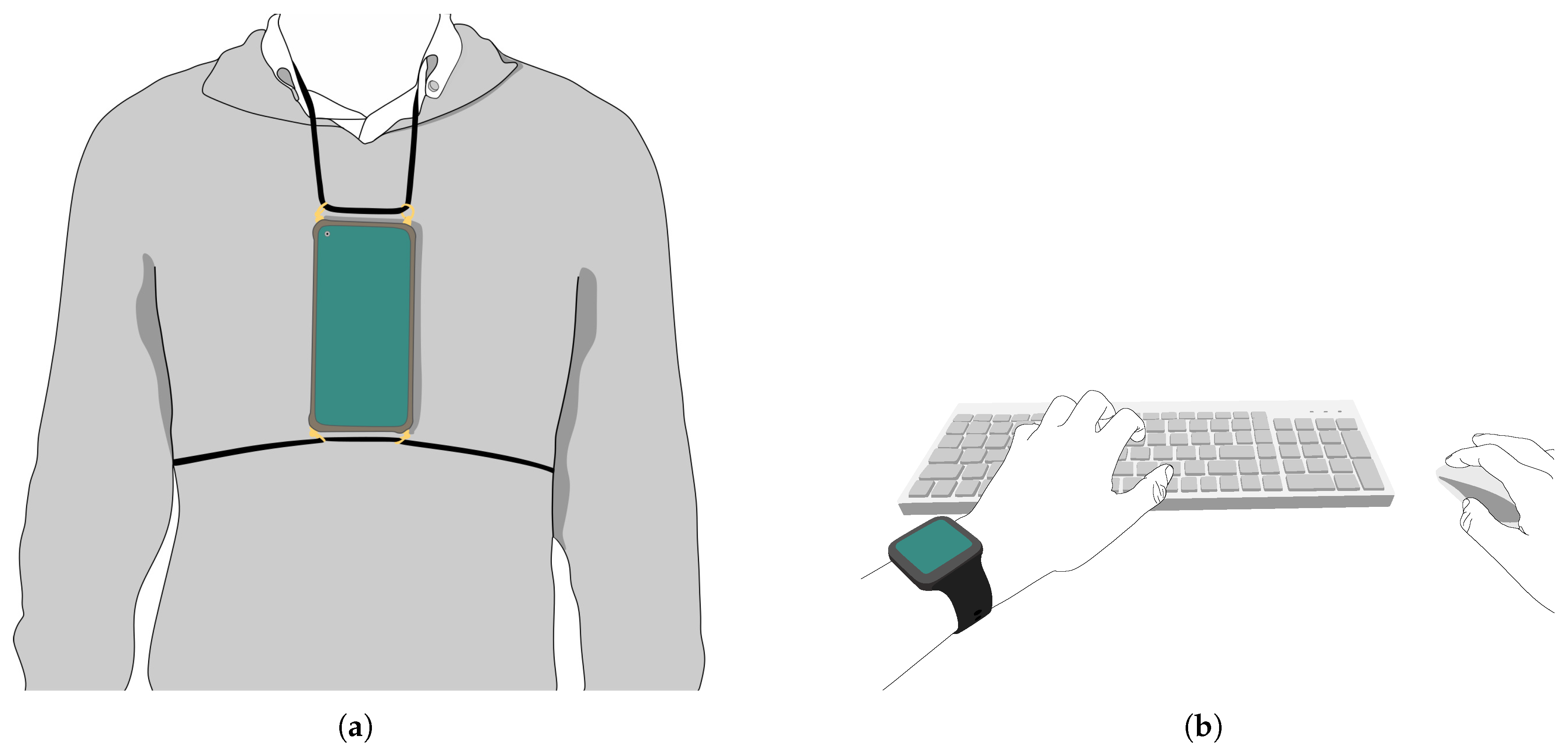

Table 2.
Information extractable from the utilized devices, as presented to co-design workshop participants.
Table 2.
Information extractable from the utilized devices, as presented to co-design workshop participants.
| Device | Sensor | Extractable Information |
|---|---|---|
| Smartphone | Accelerometer Gyroscope Magnetometer Rotation Vector |
Human activities (e.g., sitting, standing, and walking) Upper body movement (e.g., trunk displacement when seated) General spatial orientation of the worker |
| Smartphone | Internal Microphone | Approximate ambient noise levels (dBA) |
| Smartwatch | Accelerometer Heart Rate |
Wrist movements (e.g., acceleration and repetitive movements) Heart rate (beats per minute) |
3.4. Post-Design Phase
To ensure a robust and transparent qualitative analysis of the co-development sessions, a multi-stage process comprising transcription, verification, inductive coding, and thematic organization, was carried out. This process is described in the following sections.
3.4.1. Transcription and Diarization
The audio recording of the co-design workshop was split into sections of 15 to 20 minutes prior to transcription, retaining only those segments in which participant dialogue occurred. Segments consisting exclusively of facilitator-led presentations were excluded from the transcription pipeline. Transcription was performed using WhisperX [39], an open-source automatic speech recognition (ASR) system, configured for European Portuguese using a wav2vec2-based forced alignment model [40] for word-level time alignment. The standard model configuration was used. Although WhisperX supports automatic speaker diarization, the diarization output was found to be of insufficient quality for the present recording and was therefore discarded.
To validate and enhance the accuracy of the machine-generated transcripts and to perform speaker diarization, two researchers conducted an independent proofreading and correction process. Each researcher independently (1) verified semantic coherence and corrected transcription errors, and (2) manually assigned speaker identifiers and precise timestamps to each utterance, ensuring transcript consistency and the preservation of the speakers’ authentic voice. The two independently corrected transcripts were subsequently merged into a single unified transcript using ChatGPT (GPT-4.1) [41], a large language model (LLM) developed by OpenAI. This step was undertaken solely to accelerate the merging process, the resulting unified transcript was reviewed and approved by both researchers prior to any further analysis.
3.4.2. Coding and Affinity Mapping
Using the diarized and merged transcript, an inductive thematic analysis was performed following the approach described by Clarke and Braun [42]. To support the generation of preliminary codes, the transcript was imported into ChatGPT (GPT-4.1) [41], consistent with emerging practices for LLM-assisted qualitative analysis [43,44]. The preliminary codes and their locations within the transcript were subsequently verified, reviewed, and refined by the researchers. The finalized codes were compiled into a codebook, listing each code alongside its frequency of appearance within the transcript.
Based on the compiled codebook, an affinity mapping was carried out to cluster conceptually related codes and to identify overarching thematic categories reflecting the shared concerns and design priorities of the participants. The resulting categories were grounded not only in participants’ verbal expressions but also in the collective concerns and needs expressed across different professional roles and teams.
Finally, the co-designed visualization prototypes were cross-referenced with the inductive codes and the affinity map. Each prototype was aligned with its corresponding thematic category, ensuring that the participant-generated visual artifacts were interpreted within the same semantic structure as the verbal data. This multimodal approach, integrating both the diarized transcript and the physical co-design materials, provided a comprehensive basis for translating participant insights into visualization requirements.
3.4.3. Feasibility Assessment
Following the inductive coding, affinity mapping, and prototype cross-referencing, the identified occupational health themes and the discrete visualization elements proposed by the two co-design groups were subjected to a systematic feasibility assessment. The purpose of this assessment was to determine which of the participant-generated concepts can be realized using the sensing configuration as defined in Table 2, and which require sensor modalities or data sources beyond its current scope.
The assessment was applied at two levels. At the thematic level, each inductive code derived from the workshop transcript was evaluated against the available data streams. At the prototype level, each discrete visualization element proposed by either group was evaluated individually, given that prototype concepts are more concrete and may depend on multiple sensor modalities simultaneously.
Three classification categories were defined for both levels of analysis:
- (1)
- Directly addressable: the theme or visualization element can be measured or derived from data streams available within the current sensing platform, without requiring additional sensors, instruments, or data sources.
- (2)
- Partially addressable: the theme or visualization element can be approximated or partially realized using available data streams, but its full implementation requires one or more sensor modalities not currently available.
- (3)
- Out of scope: the phenomenon or visualization element cannot be measured or approximated using the current sensing configuration.
The classification was applied by the research team based on direct inspection of the sensor capabilities listed in Table 2. Themes and prototype elements assigned to the partially addressable or out of scope categories are reported in the results alongside directly addressable ones, as they reflect genuine participant needs and constitute priorities for future extensions of the sensing platform and visualization system.
3.5. Developed Data Visualizations
Based on the feasibility assessment, an initial set of data visualizations that integrated concepts from both co-designed prototypes, was implemented in Python 3.12 using the matplotlib [45] and seaborn [46] libraries. The following visualizations were developed:
- Physical activity and sedentary behavior: a daily activity timeline, an activity distribution comparison chart (sensor-derived vs. OSPAQ self-report [47]), and a daily step count and distance summary.
- Heart rate: a circular heart rate class distribution across the working week and a daily heart rate range chart.
- Environmental noise exposure: a noise exposure timeline and a daily noise distribution chart.
- Postural load: a multi-view postural load visualization displaying trunk orientation in the superior, lateral, and posterior anatomical projections.
Following development, the visualizations were presented to the co-design workshop participants in a dedicated follow-up session. Participants were invited to provide structured feedback and propose refinements, which were subsequently incorporated into the final designs. This iterative review step ensured alignment between the implemented visualizations and stakeholder expectations.
4. Results
4.1. Questionnaire
The results are presented below, organized according to the five thematic sections of the questionnaire: (1) General Information, (2) Current Challenges and Needs, (3) Data Interpretation and Visualization Preferences, (4) Understanding Occupational Risks Through Data Visualization, and (5) Collaboration between Stakeholders and Decision-Making.
4.1.1. General Information
Respondents held the following roles within CML: customer service manager (), ergonomist or occupational health specialist (), clinician (), clinical psychologist (), and occupational safety technician (). Participants reported a mean of years of experience within CML (range: 1–30 years; median: 21 years), indicating a predominantly experienced cohort.
With respect to health data consultation habits (Q3), responses were distributed across multiple frequencies. The most common response was every six months (), followed by daily and once a week ( each), and once a year and once a month ( each). Medical appointments () were the most consistently cited source of health information (Q4), followed by wearables (), and health apps (), while workplace reports were mentioned by three respondents. Two respondents stated using books and the internet as additional sources. When asked about the types of data monitored through health or fitness applications (Q5), physical activity levels (e.g., step count) and heart rate were the most frequently reported categories ( and , respectively), followed by sleep patterns () and stress indicators (). Three participants reported not using any health or fitness applications.
4.1.2. Current Challenges and Needs
The majority of respondents reported finding it easy or very easy to interpret received health data (Q6). Specifically, six participants rated the task as easy, one as very easy, and three as neutral. No participant rated interpretation as difficult or very difficult. With regards to facing challenges when trying to understand health data (Q7), participants reported consistently not having any major challenges.
Despite reporting relatively high ease of interpretation, respondents identified several factors that they found confusing in health data visualizations (Q8). The most frequently cited issue was lack of explanation (), followed by confusing visual elements and difficulty relating the visuals to one’s own situation ( each), and too much information (). One respondent noted that health information was fragmented across multiple systems and expressed a preference for centralizing it within a single application.
When asked what they would change about the way health data is currently presented (Q9), respondents converged on three recurring themes. First, personalization was emphasized, with multiple participants noting that data should be more closely related to the individual user’s condition and situation. Second, language and vocabulary were identified as barriers, with several respondents indicating that the terminology used in health data presentations should be simplified. Third, conciseness was noted as a desirable property, with participants requesting more succinct and actionable presentations.
4.1.3. Data Interpretation and Visualization Preferences
The preferred types of data visualization reported by respondents (Q10) were, colour-coded risk levels, being the most preferred format (), followed by charts such as bar charts and line graphs (), simplified numerical values with explanation (), and tables ().
Among those who had previously used a health or fitness application (Q11; substantive responses), the most useful visualizations cited included heart rate oscillations and blood pressure trends, step count and physical activity summaries, sleep quality indicators, and simplified numerical values contextualised against reference thresholds.
All respondents who provided a substantive answer to Q12 () expressed a preference for periodic summaries over real-time updates. Among these, seven preferred weekly summaries and three preferred daily summaries. Reasons cited for this preference included the practical relevance of weekly overviews for detecting day-to-day variability across working and rest days, as well as the motivational value of daily feedback for sustaining behaviour change.
With regard to factors that would make occupational health visualizations easier to understand (Q13; substantive responses), respondents noted the importance of clarity, conciseness, and actionability. One participant emphasized that visualizations should explicitly demonstrate the influence of identified risk factors on the probability and severity of injury or disease development, while another expressed a preference for a single, unified application rather than data spread across multiple platforms.
4.1.4. Understanding Occupational Risks Through Data Visualization
Respondents identified a range of occupational risks in their daily activities (Q14). The most frequently mentioned categories were psychosocial risks, including occupational stress, moral harassment, interpersonal conflicts, and mental health deterioration; postural and ergonomic risks associated with prolonged seated computer work, including repetitive movements, visual fatigue, and thermal discomfort; and musculoskeletal complaints, specifically tendinitis of the wrist and shoulder, and general postural problems. Physical aggression was cited by one participant working in a front-office customer-facing role. Organizational factors such as excessive workload, poor information management, and inadequate management practices were also noted.
Responses to Q15, which assessed the perceived sufficiency of information received about occupational risks, spread across the full scale: two participants rated sufficiency as not at all sufficient, one as slightly sufficient, three as neutral, one as sufficient, and two as very sufficient. One respondent did not answer to this question.
Musculoskeletal risks were considered most useful in occupational risk visualizations (Q16) with seven respondents selecting this option, followed by postural risk and environmental factors such as ambient noise ( each), and physical activity levels (). Psychosocial risks were suggested by two respondents as an additional option.
Regarding respondents’ preferences with respect to how occupational risk information should be presented (Q17), team or department-level summaries based on average values were the most frequently selected format (), followed equally by personal risk reports for individual use and general organizational trends ( each). These results suggest a preference for multi-level reporting, where individual, team-level, and organizational perspectives are presented in parallel.
When asked whether they would take action if a visualization indicated that their work habits posed a health risk (Q18; substantive responses), all respondents indicated that they would act. The nature of the intended actions varied in specificity: responses ranged from general affirmations of intent to modify harmful habits, to more concrete expressions of willingness to change working conditions and posture, or to invest in eliminating identified risks. One participant acknowledged the difficulty of sustaining behavioural change, noting that, despite recognizing existing risk factors, returning to habitual risk-associated behaviours was common.
4.1.5. Collaboration Between Stakeholders and Decision-Making
Among the four respondents who had previously received occupational health reports in the workplace (Q19), the formats cited included Word and Excel documents, formal written reports, the organizational intranet, and paper-based documents. No respondent reported having received interactive or digital visualization-based reports, suggesting that current occupational health reporting practices within the studied organization remain primarily document-centric.
Three respondents indicated prior experience explaining health data to others (Q20). Two of these identified challenges: one noted difficulties arising from the language and terminology used in health data, while the other highlighted the challenge of clarifying the correlations between data variables and their direct influence on health outcomes. One respondent reported no particular challenges.
Respondents who provided a substantive answer to Q21 ( after excluding uninformative responses) generally expressed a positive view of the potential role of health data visualizations in improving communication. The most recurrently expressed themes were: shared access to a common information base enabling alignment between workers, health professionals, and managers; the communicative power of visual representations in clarifying data and facilitating shared understanding; and the role of data confrontation, that is, presenting concrete numerical evidence of risk, as a driver of improvement proposals and intervention. One respondent cautioned that visualizations alone would be insufficient, emphasizing the need for organizational structures to be oriented toward occupational health in order for any tool to have meaningful impact.
A single respondent provided a comment in the final open-answer section (Q22), reiterating the importance of organizational commitment to occupational health, and noting that the effectiveness of any health-oriented initiative, regardless of the engagement of individual managers, ultimately depends on the degree to which the broader organizational structure supports it.
4.2. Narrative Synthesis of Co-Design Workshop
Inductive coding of the co-design workshop transcript yielded 17 distinct codes, which were subsequently clustered into five higher-order thematic categories through affinity mapping: Stress, Posture, Physical Activity, Environmental Factors, and Data Visualization and Awareness. Table 3 presents the resulting affinity map, listing each code alongside its thematic category and frequency of appearance (f.a.) within the included participant utterances. Codes with higher frequencies reflect concerns raised recurrently across participants and across different stages of the discussion, and therefore carry greater weight as design requirements. The thematic narrative below follows the affinity map categories.
4.2.1. Stress
Work-related stress was the most frequently coded theme (f.a. = 13) and pervaded the workshop discussion across professional roles. Participants described stress not as a static state but as a dynamic phenomenon that fluctuated across the workday, driven by the nature and intensity of service interactions, organizational constraints, and environmental conditions. Customer service managers in front-office roles emphasized the near-continuous character of stress exposure: interruptions were identified as a primary driver, with one participant noting that no service interaction in their workplace was completed without external disruption. Another participant described the influence of shared service floors, where noise from adjacent desks, waiting clients, and competing conversations was experienced as a sustained physiological burden. Instances of verbal aggression by members of the public toward service staff were also reported, underscoring the severity of the psychosocial risk context.
Closely related to stress, noise distraction (f.a. = 6) was identified as both a stressor in its own right and a mediating factor that amplified the intensity of service interactions. Participants described the acoustic environment of shared front-desk settings as a significant source of cognitive load and difficulty concentrating.
A recurring concern was the limited control workers had over their pauses. Participants acknowledged that mandatory or self-initiated breaks were often structurally impossible in high-demand front-office settings, raising the question of whether a notification system prompting breaks based on elapsed work time would be perceived as helpful or as an additional stressor. This tension was explicitly debated, with one participant acknowledging that such prompts might increase rather than reduce distress in contexts where breaks are organizationally infeasible.
Work organization (f.a. = 7), the third most frequently coded theme within the stress category, reflects the organizational and structural conditions under which work is performed: task allocation, rotation between front-office and back-office roles, the management of service queues, staffing levels, and the distribution of cognitively demanding tasks. Participants identified these factors as primary drivers of occupational stress and musculoskeletal strain, and proposed that data-driven insights about physiological risk patterns could support evidence-based decisions about work scheduling and role rotation. One participant articulated this explicitly, describing the joint responsibility of workers, managers, and occupational health departments in translating risk data into organizational improvement measures.
4.2.2. Posture
Postural risk and ergonomic concerns were the second most frequently coded theme (f.a. = 10), reflecting a broad awareness among participants, particularly those with occupational health and ergonomics backgrounds, of the cumulative musculoskeletal burden associated with prolonged computer work. Discussions covered trunk inclination, lateral asymmetries, and the distinction between seated and standing static postures. Notably, one participant drew attention to the ergonomic importance of differentiating between standing with movement (i.e., walking) and standing in a static position, observing that conventional step-count metrics do not capture this distinction and that colour-coded posture indicators could make this visible to workers in an intuitive way. Participants also emphasized the temporal dimension of postural risk: they were interested not only in instantaneous posture but in patterns across the workday, including how posture evolved relative to fatigue, break periods, and environmental conditions. Proposals for three-axis posture visualizations, combining views from above, from the side, and from behind, were put forward to capture the full spatial distribution of postural loading. Trunk inclination and spatial orientation derived from the smartphone IMU (accelerometer, gyroscope, magnetometer, and rotation vector) constitute the primary data streams for postural assessment within the current platform.
Muscular tension (f.a. = 5) was discussed extensively in relation to postural loading, particularly the oscillation of tension levels across the workday and their dependence on task intensity. Participants proposed body-region-specific comparisons, distinguishing between shoulder, neck, and spinal loading, and suggested correlating tension levels during active service periods with periods of rest or lower cognitive demand.
Pain and symptom reporting (f.a. = 5) was raised as a necessary complement to objective sensor data. Participants expressed interest in tracking not only the physiological and postural correlates of discomfort but also the subjective experience of pain, including its location, intensity, and temporal relationship to specific tasks or environmental conditions. Proposals included body mapping tools that would allow workers to record where discomfort was felt and when, and the correlation of such records with sensor-derived activity and posture data.
Work equipment (f.a. = 2) and formal ergonomic assessment (f.a. = 1) were raised in the context of the relationship between postural risk and workstation configuration, such as chair type, desk height, monitor position, and lumbar support. Participants proposed integrating workstation variables alongside postural data to allow joint interpretation of equipment and posture.
4.2.3. Physical Activity and Active Breaks
Active breaks (f.a. = 6) emerged as a high-priority theme, with participants requesting explicit tracking of break duration, frequency, and quality. The emphasis was not simply on the absence of sedentary behaviour but on the nature of the transition: whether a break involved genuine physical displacement or remained confined to the immediate workstation area.
Sedentary behaviour (f.a. = 2) and human activity recognition (f.a. = 2) are closely coupled with posture and breaks: the ability to distinguish between sitting, standing, and walking states, and to quantify the duration of each across the workday, provides the behavioural context within which postural risk and recovery periods can be interpreted. Participants proposed that break patterns be visualized alongside physiological indicators so that the relationship between recovery periods and stress or muscular load could be made explicit.
4.2.4. Environmental Factors
Environmental stressors were a recurrent concern, with participants identifying noise distraction (Section 4.2.1), temperature discomfort (f.a. = 2), and light conditions (f.a. = 1) as factors influencing both physiological state and postural behaviour. Temperature discomfort was described as a factor that influenced both muscular tension and general well-being, with participants noting that thermal extremes, as excessive cold from air conditioning or excessive warmth from crowded spaces, were a recurring source of discomfort. Light conditions were mentioned in relation to postural compensation, with the suggestion that insufficient or poorly directed lighting contributed to sustained awkward postures. The broader category of environment conditions (f.a. = 2) encompassed both of these dimensions alongside general workspace comfort.
4.2.5. Data Visualization and Awareness
Although data visualization (f.a. = 2), risk awareness (f.a. = 1), and sensor data (f.a. = 1) had relatively low frequencies, their qualitative impact was substantial. Participants valued representations that could synthesize physiological, contextual, and postural data into interpretable formats, particularly when these could offer daily or weekly summaries with clear risk thresholds and actionable recommendations. The differentiation between worker-facing, manager-facing, and occupational health professional-facing views was a recurring theme, reflecting the need for role-adapted granularity in how risk information is communicated. These requirements informed the design priorities pursued in the co-design prototype session.
4.3. Co-Designed Visualization Prototypes
During the co-design workshop, participants were organized into two working groups, each tasked with developing low-fidelity visualization prototypes on A2 paper. The groups presented their proposals at the end of the session, followed by a collective discussion. The results are presented in Figure 2 and Figure 3, respectively. While both groups addressed the same four thematic categories identified through affinity mapping (stress, posture, physical activity, and environmental factors), their design approaches differed substantially in underlying architecture and intended audience. It should be noted that the prototypes developed by each group comprise collections of distinct visualization concepts rather than a single unified interface. The spatial organization of each A2 sheet reflects the available paper area rather than a proposed screen layout. The first group developed a set of concepts anchored around an integrative daily chronogram, with layered, expert-configurable variable tracks and multi-axis postural representations, with an emphasis on professional-level analysis. The second group proposed a set of independent visualization concepts covering stress, physical activity, posture, and environmental factors, each with explicit weekly and daily views, designed for use by both individual workers and occupational health professionals. The following subsections describe each group’s concepts in detail.
4.3.1. Group 1: Integrative Daily Chronogram
The first group organized their prototype around a single horizontal daily timeline (Cronograma diário) representing the full workday from start to finish. Along this timeline, discrete events were plotted as colour-coded markers, with red markers indicating risk during work periods and pauses indicated in-between boxed segments. The fundamental design principle underlying this prototype was the concept of configurable layers: the notation on the sketch stated explicitly that variables could be chosen or toggled by professionals, making the view adaptable to different analytical contexts rather than fixed in content.
Below the timeline, the prototype added two parallel horizontal tracks. The first plotted stress as a separate track using the same axis. A note below both tracks read "dores / fadiga / postura — variáveis de cores ao longo do cronograma" (pain / fatigue / posture — color-coded variables along the chronogram), indicating that subjective discomfort states were intended to be represented using the same colour-along-time convention. The second plotted environmental variables, such as noise (ruído), temperature (temperatura), and light (luz), allowing their co-occurrence with work and pause periods to be read directly.
A central structural element was the Barra Integradora (integrator bar), a composite summary bar positioned at a higher level of abstraction, aggregating risk signals from all tracked variables into a single colour-coded ribbon. Sections of the integrator bar appearing in red indicated periods of combined discomfort or risk, regardless of which specific variable was responsible. The design included an expandable mechanic: selecting a red segment would expand the view to show the variáveis parcelares (component variables) contributing to that risk period, with each component appearing as a separate fixed sub-bar. This created a three-level hierarchy consisting of the integrator bar, current variable set, and component variables. These were intended to serve different user roles at different levels of detail.
In addition to the timeline-based panels, the prototype incorporated a pain annotation feature: a timestamped log allowing the worker to record the time at which pain was experienced (hora de dor), independently of sensor data. This element acknowledged the irreducibly subjective nature of pain and proposed a lightweight self-report mechanism to complement objective measurements.
The right column of the prototype was devoted to postural representation through three distinct spatial views. The top-down view (de Cima) depicted the worker at a desk from above, with markers on the head, shoulders, and arms indicating trunk position, head orientation, and arm extension. The lateral view (de Lado) showed the worker in profile, with colour-coded markers identifying muscle tension at the trapezius muscles (labelled explicitly in cyan), the thorax position relative to desk height, and the chair and foot support level (highlighted in yellow). This view integrated workstation variables, such as the desk surface height, chair configuration with musculoskeletal tension markers. The posterior view (Visão Posterior) depicted the worker from behind and emphasized bilateral lateralization of arm and elbow position as well as foot support, enabling the detection of asymmetric loading patterns. Finally, a fourth sketch proposed a dedicated workstation ergonomic view (Relação Ergonómica do Posto de Trabalho), depicting the desk from the side to document the spatial relationship between the worker and the physical workstation, e.g., desk height, monitor position, and chair geometry.
4.3.2. Group 2: Thematic Weekly–Daily Visualization Concepts
The second group proposed a set of independent visualization concepts organized thematically across their working sheet, with each concept addressing one of the four thematic categories. Unlike the first group’s chronogram approach, these concepts share a common temporal architecture: each adopts the working day and the working week as its primary temporal units, and where applicable distinguishes between a weekly summary view and a daily drill-down linked by an interactive selection mechanism. A consistent three-tier colour-coded risk legend appears across the concepts: critical, moderate, and normal, rendered in red, orange, and green respectively. Thus, providing a shared visual language across the individual visualizations.
The stress panel (top-left) was headed by the label "Cronograma de Stress (Freq. Cardíaca | Tensão Muscular)", identifying heart rate and muscular tension as the intended data sources. The weekly view consisted of a grouped bar chart with one bar per day (Dia 1 through Dia 4 visible in the sketch), each bar subdivided into colour bands corresponding to the three risk levels. An annotation beside this chart read: "Ao selecionar o Resumo Semanal conseguir perceber ao pormenor — Diária — Identificar Áreas Críticas" (By selecting the weekly summary, gain access to the daily detail — identify critical areas). This drill-down interaction was illustrated by a second, smaller panel showing the daily view as a set of horizontal bars at three time bands across the day, enabling identification of the specific periods in which stress reached critical or moderate levels.
The physical activity panel (top-right) was organized around two linked charts. The first depicted a single workday as a step-function chart with two states, standing (Pé) and seated (Sentado), plotted against a continuous time axis, capturing the sequence and duration of transitions between activities across the day. The second chart presented a weekly summary as a grouped bar chart, with one stacked bar per day showing the proportion of time spent standing and seated. An arrow from this chart led to a detail box that decomposed standing time into two ergonomically distinct sub-states: static standing (time spent in a fixed standing position) and walking (number of steps taken). This distinction was explicitly motivated: the group recognized that a step counter alone does not capture static standing, and that occupational ergonomics treats static standing posture as a risk factor independent of step count. A supplementary panel represented breaks and compensatory movements as a grid of dots, proposing that the system provide movement recommendations based on the accumulated postural profile.
The posture quadrant (bottom-left) was introduced by an overhead map of the worker’s spatial position at the desk (labeled Secretária), depicted as a top-down schematic of the workstation with a body outline superimposed. This spatial displacement view was intended to show where worker spent most of the time within the workstation area while seated.
From this overhead map, two arrows led to a pair of parallel time-series bar charts. The left chart was labeled "Postura e TM — Lado Esquerdo" (Posture and Muscular Tension — Left side) and the right "Postura e TM — Lado Direito" (Posture and Muscular Tension — Right side). Each chart plotted stacked multi-coloured bars at daily intervals (2’: Monday, 3’: Tuesday, etc.), with colour bands corresponding to risk levels. The bilateral structure of this visualization was designed to make asymmetries in postural loading and muscular tension visible, supporting the identification of habitual compensatory postures that might not be apparent from single-side or aggregate measures.
Finally, the environmental factors panel (bottom-right) contained three linked visualizations. The first was a dual-line chart superimposing noise (R) and stress (S) over a seven-hour workday axis, with an annotation indicating that a weekly summary view was also available. The intent was to make the temporal co-variation of noise exposure and physiological stress immediately readable, enabling identification of periods in which noise peaks preceded or coincided with stress elevations. The second visualization addressed the relationship between lighting and postural positioning (Iluminação | Posicionamento), depicted as a conceptual sketch showing undulating curves within a square frame, with directional arrows suggesting that changes in ambient light drive postural adjustments. The third visualization paired thermal comfort (Conforto Térmico) with muscular tension (Tensão Muscular) in two vertical stacked strip charts aligned on a shared time axis running from the start to the end of the workday, each strip coloured by risk level. The design aimed to reveal whether thermal discomfort and muscular tension co-varied across the workday.
4.3.3. Cross-Cutting Observations from the Collective Discussion
Following the two group presentations, a collective discussion surfaced several additional design considerations that applied across both prototypes. One participant proposed adding a work intensity indicator, a daily count of service interactions, as a contextual complement to the physiological stress chronogram, reasoning that correlating interaction volume with heart rate data would help distinguish organizationally driven stress from other sources. A related proposal was the inclusion of a critical event flag: a worker-initiated marker that could be placed manually on the timeline at moments of particular psychological or physical stress, such as a verbally aggressive interaction. Both of these additions are independent of sensor scope and could be implemented as lightweight manual input features within an application interface.
A further cross-cutting theme was the differentiation of visualization complexity by user role. One participant observed explicitly that workers less accustomed to data-dense interfaces would benefit from simpler, more concrete representations. This role-based distinction echoes the layer-toggling design principle proposed by the first group and implies that any implemented system should offer at minimum two levels of view: a simplified worker-facing interface and a richer professional-facing interface.
Finally, participants converged on the behavioural purpose of these visualizations: the primary value of the system was not monitoring per se but the promotion of behaviour change — in workers, managers, and occupational health departments alike. Colour-coded risk indicators were explicitly valued as "facilitating" in this regard, making risk states legible without requiring technical literacy.
4.4. Feasibility Assessment
The participant-generated insights reported in Section 4.2 and Section 4.3 span a broader range of occupational health phenomena and visualization concepts than can be realized using the smartphone and smartwatch sensing configuration deployed in this study, as defined in Table 2. Following the feasibility assessment methodology described in Section 3.4.3, each inductive code and each discrete prototype element was classified as directly addressable, partially addressable, or out of scope. This section presents the results of both assessments and explains the reasoning underlying each classification, with particular attention to the partially addressable and out-of-scope items, which represent priorities for future platform extensions.
4.4.1. Theme-Level Feasibility
Table 4 presents the feasibility classification of all 17 inductive codes derived from the workshop transcript. Fourteen directly or partially addressable codes correspond to phenomena measurable through the available sensor streams; seven codes fall partially or entirely outside the current platform’s scope.
Partially Addressable Themes
Work organization cannot be measured directly by any wearable sensor, as it reflects organizational and structural conditions (e.g., task allocation, staffing levels, queue management, and role rotation) rather than a physiological or behavioural signal. However, the downstream physiological and behavioural consequences of poor work organization, namely elevated heart rate, prolonged uninterrupted sedentary periods, and the absence of break transitions, are detectable through the smartwatch and smartphone IMU respectively.
Muscular tension requires surface electromyography (EMG) to directly quantify muscle activity. While the smartphone IMU provides trunk inclination and lateral tilt data that can indicate awkward or sustained static postures, these do not constitute a direct tension measure and should not be treated as equivalent.
Ergonomic assessment and environment conditions are partially addressable because IMU-derived postural data can serve as objective supporting evidence within a broader ergonomic evaluation and ambient noise is directly captured by the smartphone microphone.
Out-of-Scope Themes
Pain and symptom reporting is inherently subjective and cannot be inferred from any sensor modality available in the current platform. While correlations between postural load and pain onset are well established in the musculoskeletal literature [48,49,50,51], sensor data alone cannot validate or quantify a subjective symptom. Integration of structured self-report instruments, such as digital body maps or numeric pain rating scales, would be required.
Work equipment and workstation ergonomics cannot be characterized from inertial data alone. Sensor data may reflect the postural consequences of a suboptimal workstation setup, but a formal workstation assessment addressing desk height, chair configuration, monitor position, and foot support, requires structured instruments such as the ROSA [34].
Temperature discomfort and light conditions require dedicated environmental sensors such as thermometers or humidity sensors, and lux meters respectively. These are not part of the current smartphone or smartwatch configuration as defined in Table 2.
4.4.2. Prototype-Level Feasibility
Table 5 presents the feasibility classification of all 27 discrete visualization elements proposed across the two co-design groups and the collective discussion. The reasoning for partially addressable and out-of-scope classifications at the prototype level reflects and extends the theme-level analysis above, with two additional elements arising from the greater specificity of the prototype concepts.
The stress chronogram proposed by Group 2 was explicitly designed to integrate both heart rate and muscular tension. Heart rate is directly available, however muscular tension requires EMG, which is not part of the current platform. The chronogram can therefore be implemented using heart rate as the sole physiological stress proxy, with EMG integration deferred to future system extensions.
Table 5.
Feasibility classification of prototype visualization elements relative to the smartphone and smartwatch sensing configuration defined in Table 2.
Table 5.
Feasibility classification of prototype visualization elements relative to the smartphone and smartwatch sensing configuration defined in Table 2.
| Group | Prototype element | Available sensor(s) | Feasibility |
|---|---|---|---|
| G1 | Daily chronogram — work/pause timeline | Smartphone IMU | Directly addressable |
| G1 | Configurable variable layer toggle | UI feature | Directly addressable |
| G1 | Stress track (colour-coded events) | Smartwatch HR | Directly addressable |
| G1 | Environmental track — noise | Smartphone microphone | Directly addressable |
| G1 | Physical activity/mobility track | Smartphone IMU | Directly addressable |
| G1 | Integrator bar with drill-down | Derived from all feasible streams | Directly addressable |
| G1 | Posture view — posterior (lateralization) | Smartphone IMU | Directly addressable |
| G1 | Posture view — top-down (trunk, head, arm) | Smartphone IMU (trunk only) | Partially addressable |
| G1 | Posture view — lateral (posture + muscle tension) | Smartphone IMU; EMG required for tension | Partially addressable |
| G1 | Environmental track — temperature | None | Out of scope |
| G1 | Environmental track — light | None | Out of scope |
| G1 | Pain/discomfort annotation (timestamped) | Self-report input (manual) | Out of scope |
| G1 | Workstation ergonomic view | Ergonomic assessment instrument | Out of scope |
| G2 | Stress chronogram — daily drill-down | Smartwatch HR | Directly addressable |
| G2 | Physical activity — daily step chart (Pé/Sentado) | Smartphone IMU | Directly addressable |
| G2 | Physical activity — weekly grouped bar chart | Smartphone IMU | Directly addressable |
| G2 | Physical activity — static standing vs. walking | Smartphone IMU; Smartwatch ACC | Directly addressable |
| G2 | Breaks and compensatory movement panel | Smartphone IMU; UI feature | Directly addressable |
| G2 | Posture — displacement map | Smartphone IMU | Directly addressable |
| G2 | Environmental — noise vs. stress dual-line chart | Smartphone microphone; Smartwatch HR | Directly addressable |
| G2 | Stress chronogram — weekly bar chart | Smartwatch HR; EMG deferred | Partially addressable |
| G2 | Posture — bilateral bar charts (posture + TM) | Smartphone IMU; EMG deferred for TM | Partially addressable |
| G2 | Environmental — lighting vs. positioning sketch | Dedicated light sensor required | Out of scope |
| G2 | Environmental — thermal comfort vs. TM charts | Temperature sensor; EMG required | Out of scope |
| Both | Role-differentiated view complexity | UI feature | Directly addressable |
| Both | Critical event flag (worker-initiated) | UI feature (manual input) | Directly addressable |
| Both | Work intensity indicator (service count) | Administrative data source | Out of scope |
TM: muscular tension; IMU: inertial measurement unit (accelerometer, gyroscope, magnetometer, rotation vector); HR: heart rate; ACC: accelerometer; UI: user interface.
4.5. Developed Data Visualization
The visualizations presented in this section are based on real-world data collected from office workers participating in the PrevOccupAI+ project. The examples shown are drawn from representative monitoring periods and were selected to illustrate the informational content and interpretive potential of each visualization type. Where applicable, the observed data patterns are briefly discussed in terms of their occupational health implications for the individual worker, reflecting the intended use of the visualizations as tools for self-monitoring and structured reflection.
4.5.1. Physical Activity and Sedentary Behaviour
Daily Activity Timeline
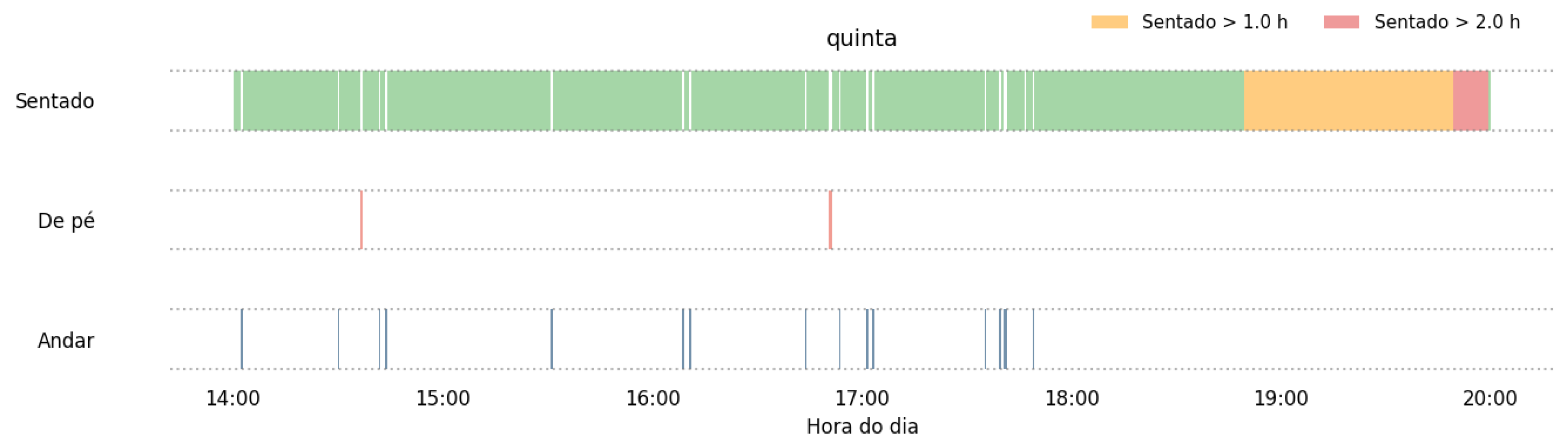
Figure 4 presents the daily activity timeline for a representative workday (Thursday). This timeline has been extracted through a human activity recognition model as described in [52], with some additional post-processing steps. Each of the three horizontal bars encodes a distinct activity state across the shift: seated (green), standing (salmon), and walking (blue). Within the seated bar, the colour progressively transitions to yellow following one hour of uninterrupted sitting, and to red upon exceeding two hours of continuous sedentary time without interruption. This feature indicating risk of prolonged sedentary behaviour was proposed during the follow-up session.
On the day illustrated, the participant was predominantly seated throughout the shift, with only brief and infrequent standing and walking episodes. A sustained sedentary bout is visible in the late afternoon, during which the seated bar transitions first to yellow and subsequently to red, indicating that the participant remained seated continuously for more than two hours without a postural break.
Figure 4.
Daily activity timeline for a representative workday (Thursday). Each horizontal bar encodes a distinct activity state throughout the shift: seated (green), standing (salmon), and walking (blue). Within the seated bar, the colour transitions to yellow following one hour of uninterrupted sitting, and to red upon exceeding two hours of continuous sedentary time.
Figure 4.
Daily activity timeline for a representative workday (Thursday). Each horizontal bar encodes a distinct activity state throughout the shift: seated (green), standing (salmon), and walking (blue). Within the seated bar, the colour transitions to yellow following one hour of uninterrupted sitting, and to red upon exceeding two hours of continuous sedentary time.
Activity Distribution
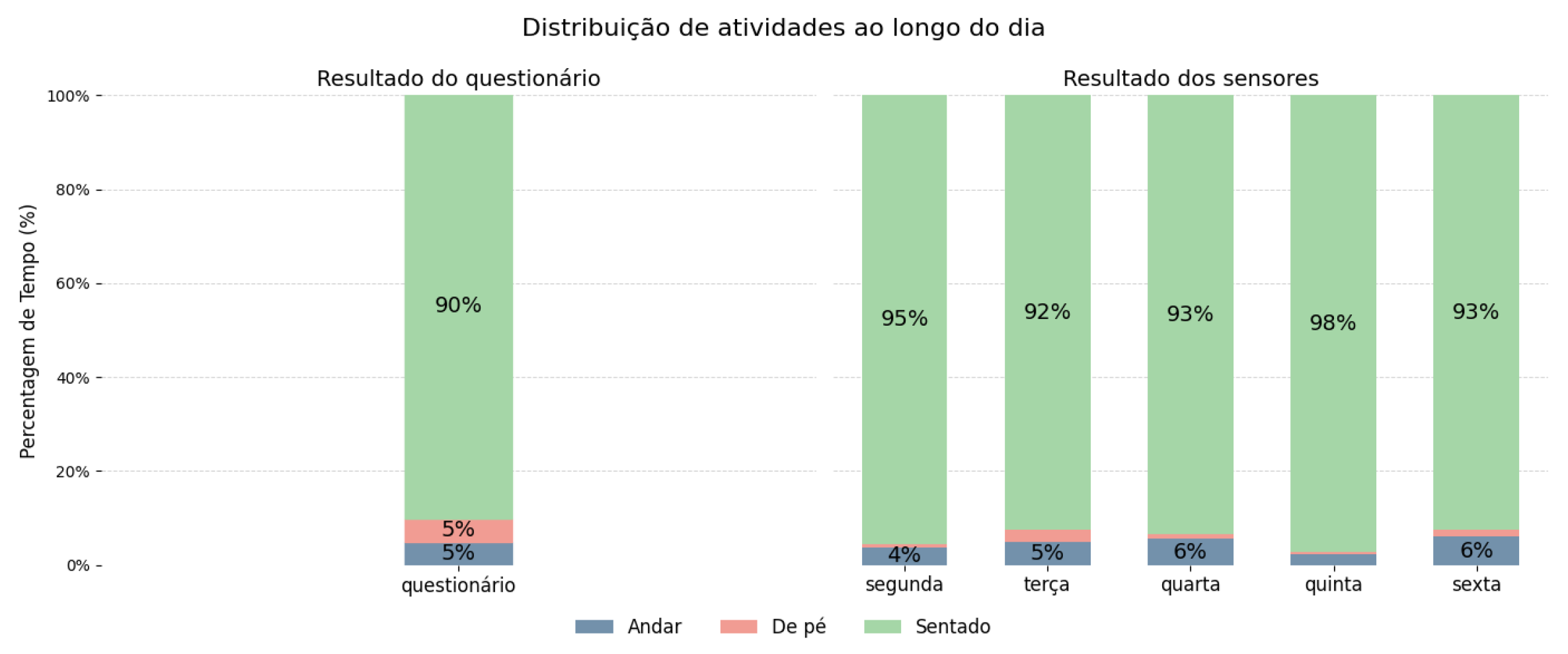
Figure 5 presents the activity distribution across the monitored working week. The leftmost bar reflects the participant’s self-reported activity distribution as collected through the usage of the OSPAQ questionnaire [47], while the remaining bars display the sensor-derived distributions for each monitored workday. Proportions below 2% are omitted from the bars for legibility. The juxtaposition of self-reported and sensor-derived estimates was deliberately designed to prompt reflection on the discrepancy between perceived and objective activity patterns.
Across all days, the sensor data consistently indicate a predominantly sedentary work pattern, with seated time ranging from 92% to 98% of the shift, and combined walking and standing time not exceeding 8% on any given day. The self-reported estimate was broadly consistent with the sensor-derived results, with the participant reporting 90% seated time, 5% standing, and 5% walking. While the overall distributions are comparable in this instance, the visualization is intended to surface cases where subjective perception diverges meaningfully from objective measurement, thereby encouraging workers to critically reassess their habitual activity levels.
Figure 5.
Activity distribution across the monitored working week. The leftmost bar represents the participant’s self-reported estimate of time spent seated, standing, and walking, as obtained from the OSPAQ questionnaire. The remaining bars display the corresponding sensor-derived distributions for each monitored workday. Proportions below 2% are omitted for legibility.
Figure 5.
Activity distribution across the monitored working week. The leftmost bar represents the participant’s self-reported estimate of time spent seated, standing, and walking, as obtained from the OSPAQ questionnaire. The remaining bars display the corresponding sensor-derived distributions for each monitored workday. Proportions below 2% are omitted for legibility.
Daily Step Count
Figure 6 presents the daily step count and distance covered within the workplace across the monitored week. For each day, the blue portion of the bar represents the number of steps recorded during the work shift, while the grey portion represents the remaining steps needed to reach the age-adjusted recommended daily target [53], indicated at the top of the chart. The corresponding distance covered during working hours is annotated to the right of each bar.
Across the monitored week, the participant accumulated between 716 and 1199 steps per workday, covering distances ranging from 0.4 km to 0.8 km. In all cases, workplace step counts fell substantially short of the recommended daily target of 9000 steps for a person of 51 years of age [53], with the highest single-day count (Friday, 1199 steps) representing approximately 13% of the recommended total. This visualization contextualizes walking patterns during working hours against an individualized health benchmark, reinforcing the picture of a highly sedentary occupational profile observed in Figure 4 and Figure 5.
Figure 6.
Daily workplace step count and distance covered across the monitored working week. The blue portion of each bar indicates the number of steps recorded during the work shift; the grey portion represents the gap relative to the age-adjusted recommended daily step target (9000 steps for a person aged 51 years). The distance covered within the workplace on each day is annotated to the right of each bar.
Figure 6.
Daily workplace step count and distance covered across the monitored working week. The blue portion of each bar indicates the number of steps recorded during the work shift; the grey portion represents the gap relative to the age-adjusted recommended daily step target (9000 steps for a person aged 51 years). The distance covered within the workplace on each day is annotated to the right of each bar.
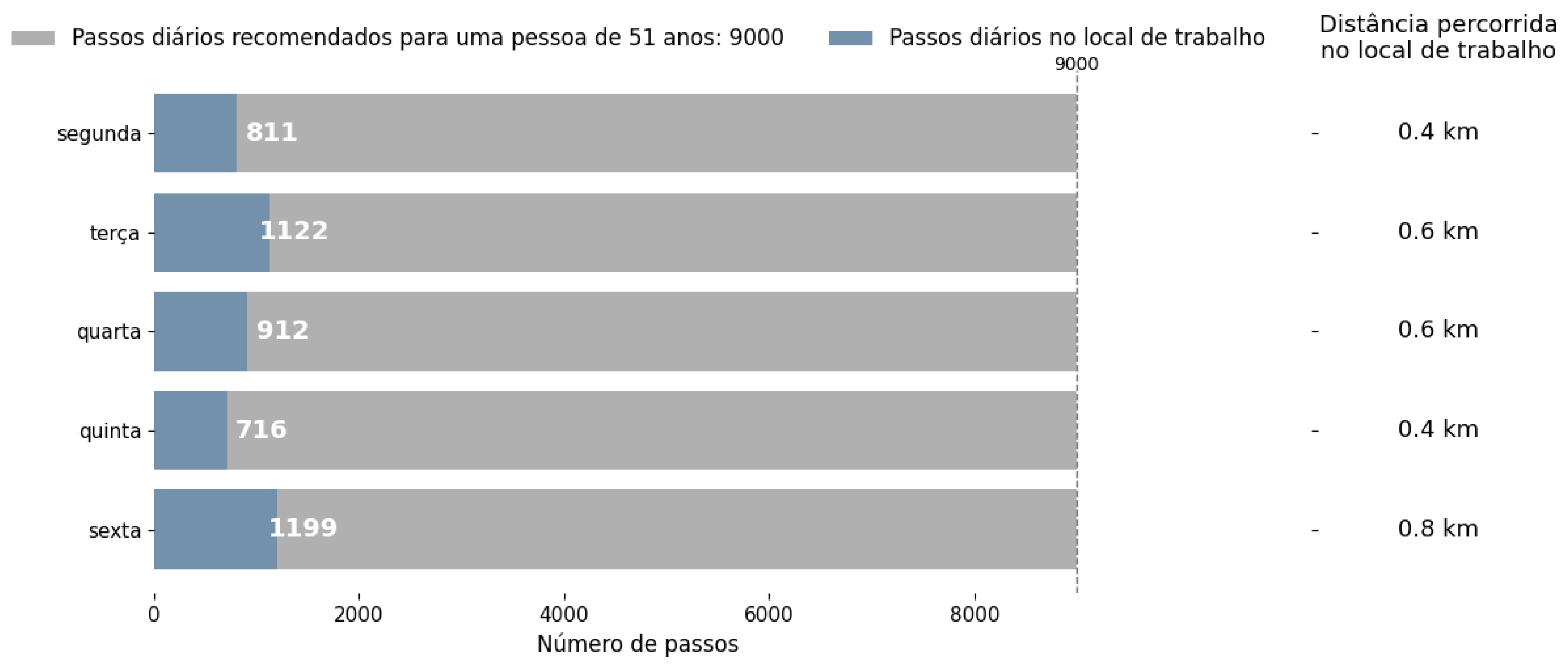
4.5.2. Heart Rate
Circular Heart Rate Class Distributions
Figure 7 presents the weekly circular distribution of heart rate classifications across the monitored working week during instances in which the participant was seated (i.e., at their workstation). To enable meaningful comparison across individuals, heart rate was expressed by the heart rate ratio [54]. Based on this ratio, three classification levels were defined: normal (ratio below 30%), slightly elevated (ratio between 30% and 39%), and elevated (ratio above 39%). The rationale for these thresholds is that ratios between 30% and 39% are considered typical during light physical activity [55]; the presence of such values during sedentary work may therefore be interpreted as a potential indicator of occupational stress. Each day of the working week is represented as a sector of the chart, subdivided into four 20-minute acquisition session whose corresponding time intervals are listed to the right of the figure. Arc segments are colour-coded according to the classification level.
Across the monitored week, the majority of acquisition windows were classified as normal. However, elevated and slightly elevated values were observed throughout the week with Monday and Thursday having more prominent occurrences, suggesting transient periods of elevated cardiovascular demand during those workdays.
Figure 7.
Circular distribution of heart rate classifications across the monitored working week. Each sector corresponds to one workday, subdivided into four 20-minute acquisition session whose time intervals are listed to the right. Arc segments are colour-coded according to three classification levels based on the heart rate ratio: normal (green, ratio <30%), slightly elevated (yellow, 30–39%), and elevated (red, >39%).
Figure 7.
Circular distribution of heart rate classifications across the monitored working week. Each sector corresponds to one workday, subdivided into four 20-minute acquisition session whose time intervals are listed to the right. Arc segments are colour-coded according to three classification levels based on the heart rate ratio: normal (green, ratio <30%), slightly elevated (yellow, 30–39%), and elevated (red, >39%).
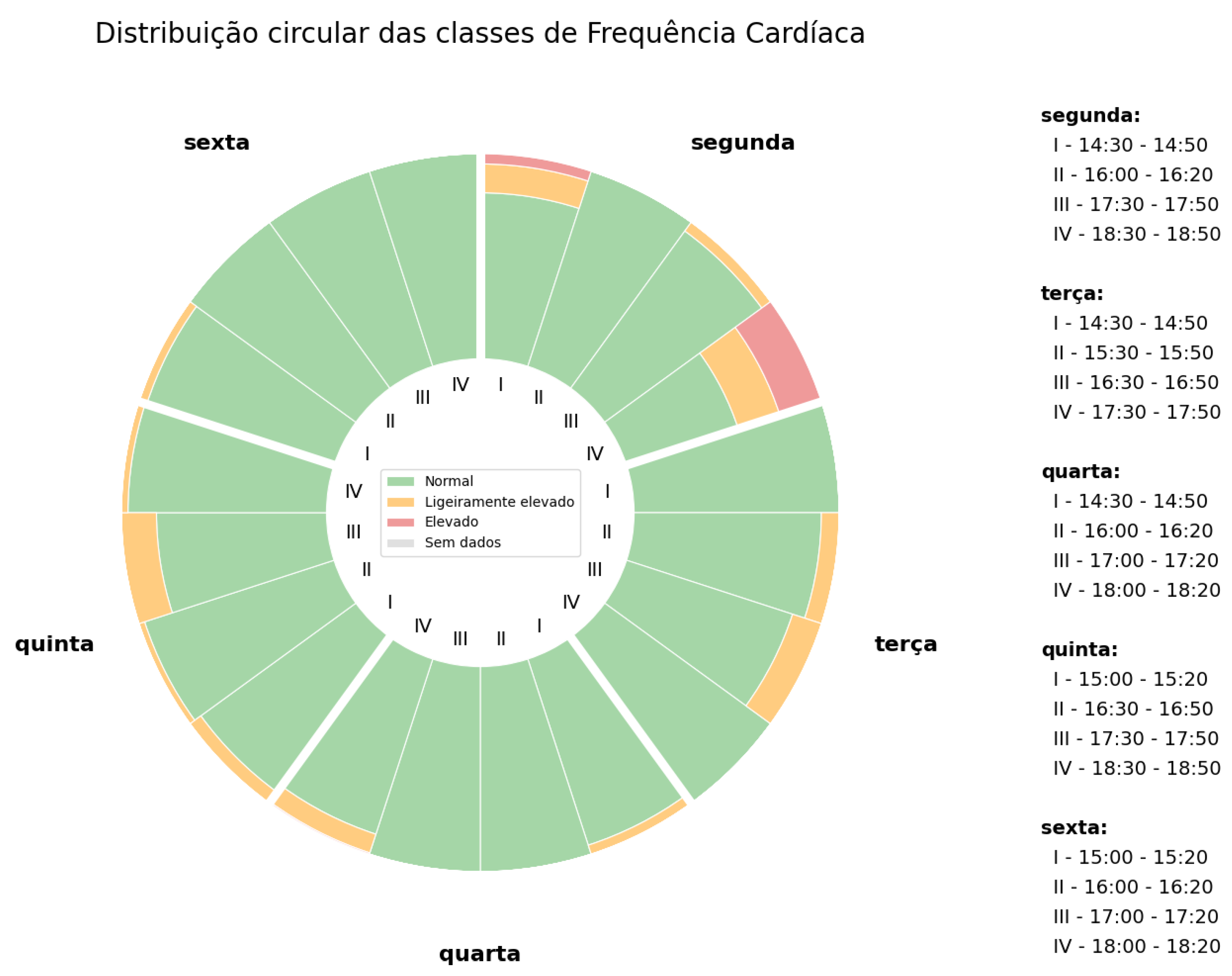
Heart Rate Range Chart
Figure 8 presents the heart rate range recorded during each acquisition window (I – IV) across the monitored working week. Each bar spans the minimum to maximum heart rate observed within the corresponding 20-minute window, with both values annotated directly on the bar. This layout enables comparison of within-day cardiovascular variability across acquisition windows, as well as between-day differences in overall heart rate range.
Across the monitored week, maximum heart rate values were consistently elevated, frequently exceeding 100 BPM, with the highest recorded values observed on Monday, namely session I with 132 BPM and session IV with 128 BPM, which is consistent with the elevated classifications identified in Figure 7. Minimum values remained relatively stable across the week, ranging from 66 to 82 BPM. The within-window ranges were generally broad, indicating considerable short-term heart rate variability during each acquisition period.
Figure 8.
Heart rate range per acquisition window (I–IV) across the monitored working week. Each bar spans the minimum (base) to maximum (top) heart rate recorded during the corresponding 20-minute window, with both values annotated directly on the bar. Gray bars indicate acquisition windows for which no data were available.
Figure 8.
Heart rate range per acquisition window (I–IV) across the monitored working week. Each bar spans the minimum (base) to maximum (top) heart rate recorded during the corresponding 20-minute window, with both values annotated directly on the bar. Gray bars indicate acquisition windows for which no data were available.
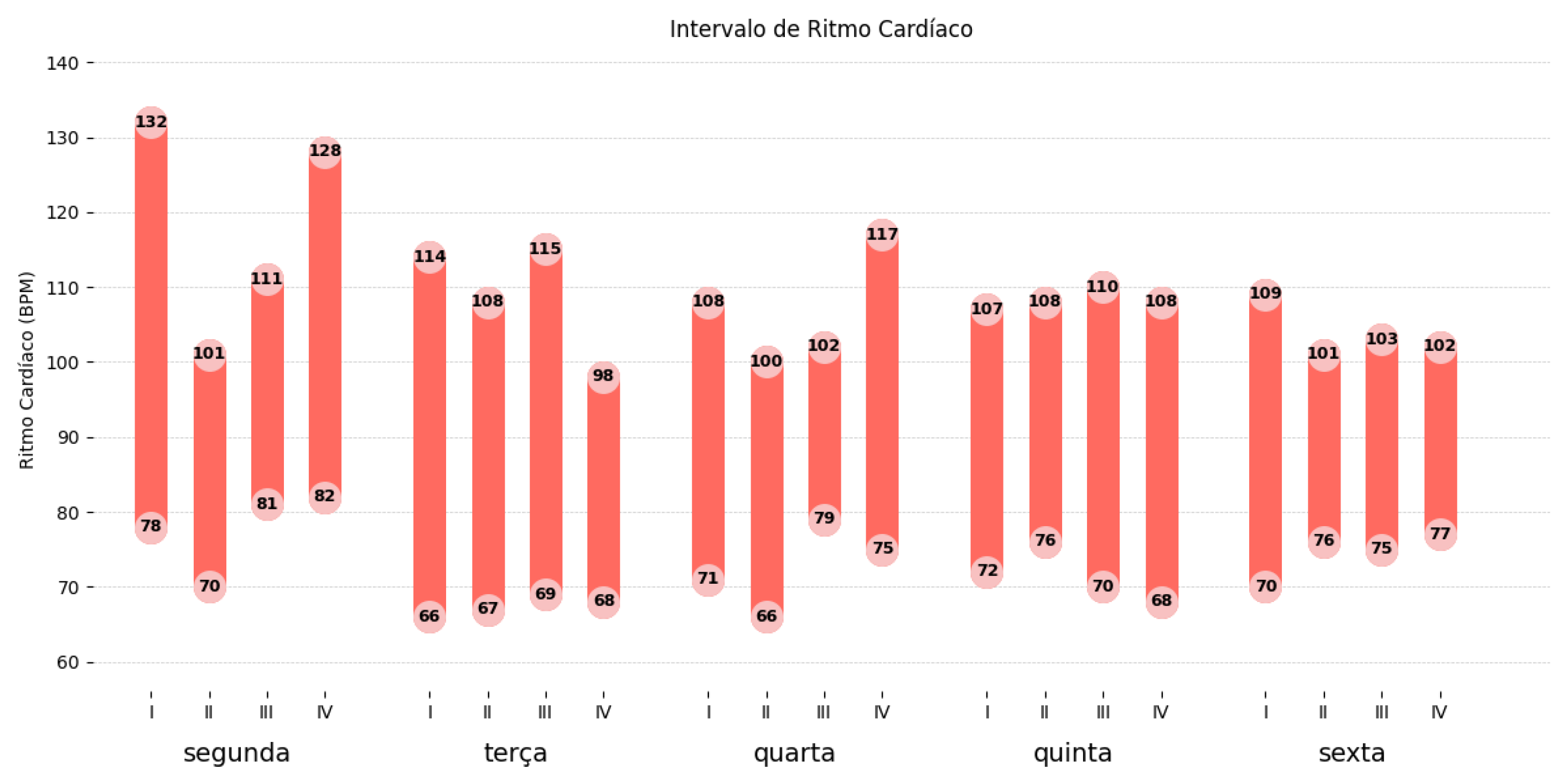
4.5.3. Environmental Noise Exposure
Noise Exposure Timeline
Figure 9 presents the noise exposure timeline across the monitored working week. Each horizontal bar corresponds to one workday, with the horizontal axis representing the time of day. Noise levels are encoded using four colour categories: silent (≤40 dBA, dark green), low noise (40–60 dBA, light green), disruptive noise (60–80 dBA, yellow), and high noise (≥80 dBA, red). These categories were defined in consultation with the occupational health ergonomists during the follow-up co-design session. To construct the timeline, noise data were aggregated into 10-minute intervals, with each interval assigned the most frequently occurring noise level within that period. It is important to note, that these levels are meant to be seen as estimates of the true values. Measurement of noise levels using smartphones are not truly accurate. However, the presented data can still be informative and should be followed up by a true measurement using dedicated equipment, if higher values are consistently measured.
Across all monitored days, low noise levels predominated, with disruptive noise episodes occurring intermittently throughout the shift. Silent periods were observed on Wednesday and Thursday, appearing as brief dark green segments in the mid-morning. Disruptive noise was most sustained on Thursday, where an extended yellow segment is visible between approximately 12:30 h and 13:30 h. No instances of high noise were recorded across the monitored week.
Figure 9.
Noise exposure timeline across the monitored working week. Each horizontal bar corresponds to one workday, colour-coded according to four noise categories: silent (≤40 dBA, dark green), low noise (40–60 dBA, light green), disruptive noise (60–80 dBA, amber), and high noise (≥80 dBA, red). Each 10-minute interval is assigned the most frequently occurring noise level within that period.
Figure 9.
Noise exposure timeline across the monitored working week. Each horizontal bar corresponds to one workday, colour-coded according to four noise categories: silent (≤40 dBA, dark green), low noise (40–60 dBA, light green), disruptive noise (60–80 dBA, amber), and high noise (≥80 dBA, red). Each 10-minute interval is assigned the most frequently occurring noise level within that period.
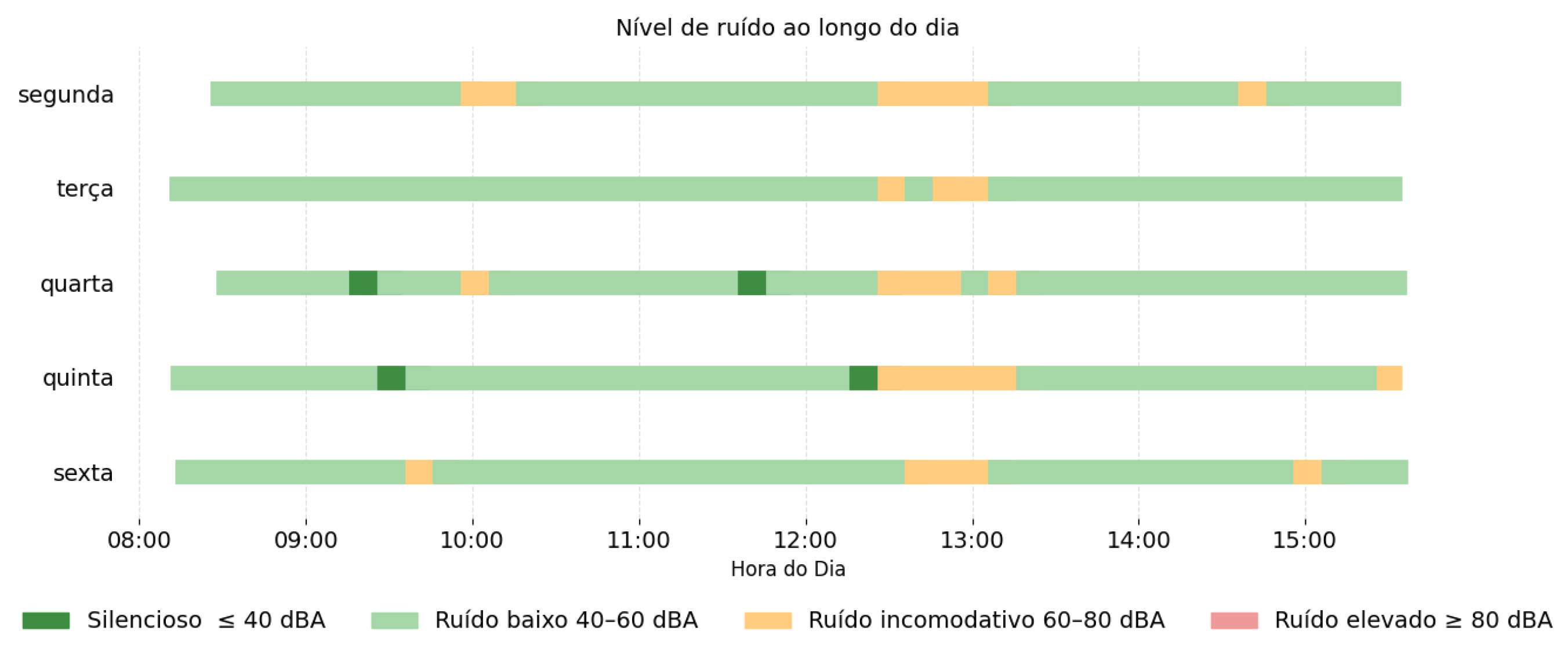
Daily Noise Distribution
Figure 10 presents the daily noise exposure distribution across the monitored working week. Each stacked bar corresponds to one workday and displays the proportion of shift time spent in each of the four noise categories.
Across all days, low noise (40–60 dBA) was the dominant exposure level, accounting for 58% to 66% of the shift. Disruptive noise (60–80 dBA) represented a consistent and non-negligible proportion of each workday, ranging from 18% on Tuesday to 24% on Monday. Silent periods (≤40 dBA) were most prevalent on Wednesday, Thursday, and Friday, where they accounted for approximately 20–22% of the shift, compared to 10% on Monday. No high noise (≥80 dBA) was recorded on any monitored day. Taken together with Figure 9, this visualization provides a complementary aggregate perspective on the acoustic environment, enabling identification of days with a comparatively higher disruptive noise burden.
Figure 10.
Daily noise exposure distribution across the monitored working week. Each stacked bar represents the proportion of shift time spent in each of the four noise categories: silent (≤40 dBA, dark green), low noise (40–60 dBA, light green), disruptive noise (60–80 dBA, yellow), and high noise (≥80 dBA, red).
Figure 10.
Daily noise exposure distribution across the monitored working week. Each stacked bar represents the proportion of shift time spent in each of the four noise categories: silent (≤40 dBA, dark green), low noise (40–60 dBA, light green), disruptive noise (60–80 dBA, yellow), and high noise (≥80 dBA, red).
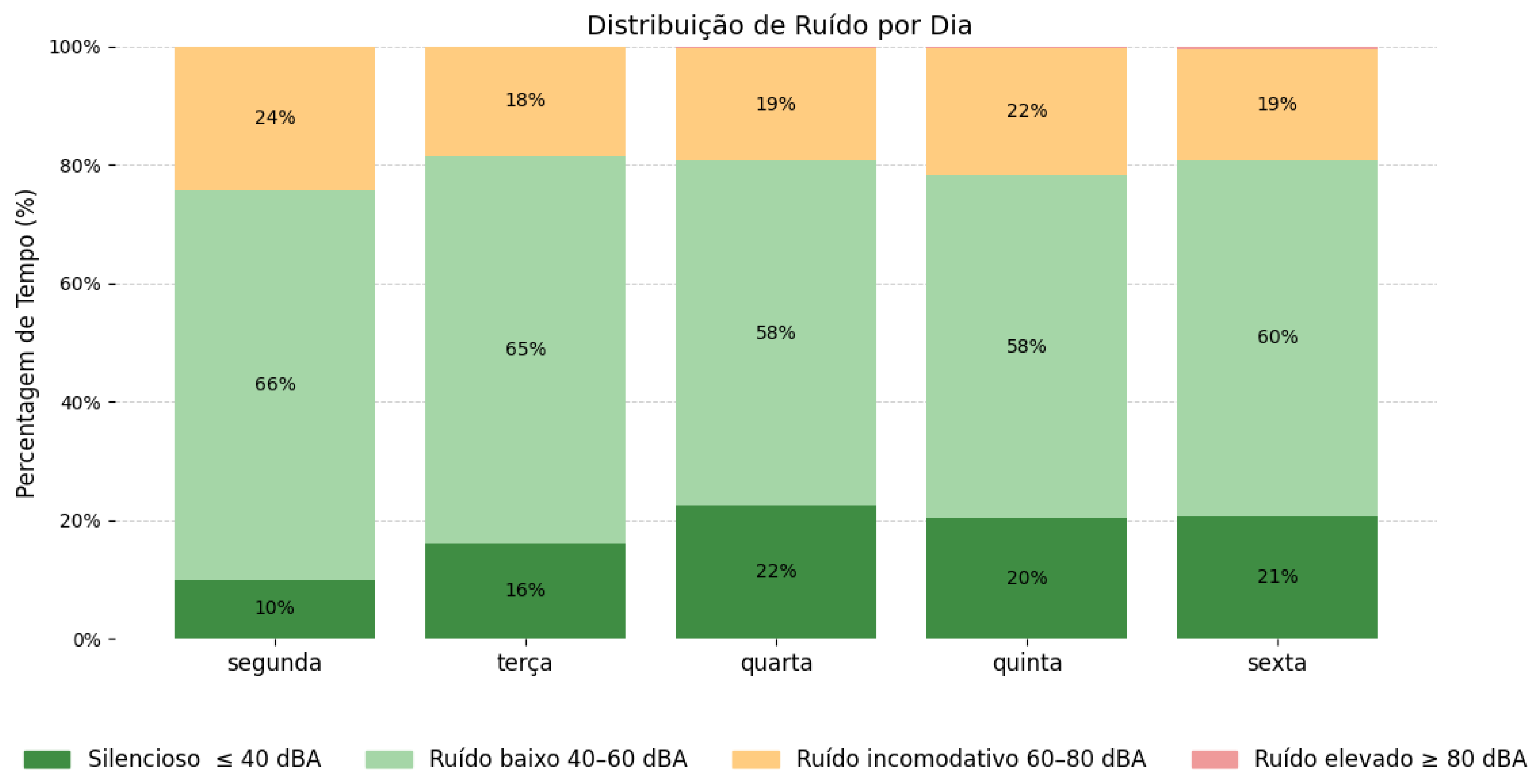
4.5.4. Postural Load
Figure 11 presents the distribution of trunk posture during seated periods across the monitored working week. Each row corresponds to one workday, and each column represents a distinct anatomical projection: superior view (left), lateral view (centre), and posterior view (right). The background schematic illustration is adapted to the participant’s sex. The density of recorded trunk positions is rendered as a two-dimensional KDE (kernel density estimation), with darker regions indicating positions adopted more frequently and lighter regions corresponding to positions occupied more briefly. The spread and intensity of the density cloud thus reflect both the range and the dwell time of postural variation throughout the day.
The superior view provides a combined representation of forward/backward and lateral trunk displacement, offering an overview of overall postural variability within the horizontal plane. The lateral view isolates sagittal plane motion, capturing forward and backward trunk inclination and reflecting natural adjustments such as leaning toward the workstation or returning to an upright position. The posterior view represents lateral trunk deviation in the coronal plane, enabling identification of postural asymmetries that may indicate a habitual lateral bias during seated work.
Across all monitored days, the density clouds in the lateral and posterior views are concentrated in a narrow region, suggesting relatively consistent trunk positioning with limited sagittal and lateral excursion. The superior view reveals slightly greater day-to-day variability in the combined postural distribution, most notably on Monday and Thursday, where the density cloud appears more dispersed and displaced relative to the remaining days.
Figure 11.
Multi-view postural load visualization across the monitored working week. Each row corresponds to one workday; each column represents a distinct anatomical projection: superior view (left), lateral view (centre), and posterior view (right). The background schematic is adapted to the participant’s sex. The blue density cloud represents the distribution of trunk positions recorded during seated periods, with darker regions indicating more frequently adopted postures.
Figure 11.
Multi-view postural load visualization across the monitored working week. Each row corresponds to one workday; each column represents a distinct anatomical projection: superior view (left), lateral view (centre), and posterior view (right). The background schematic is adapted to the participant’s sex. The blue density cloud represents the distribution of trunk positions recorded during seated periods, with darker regions indicating more frequently adopted postures.
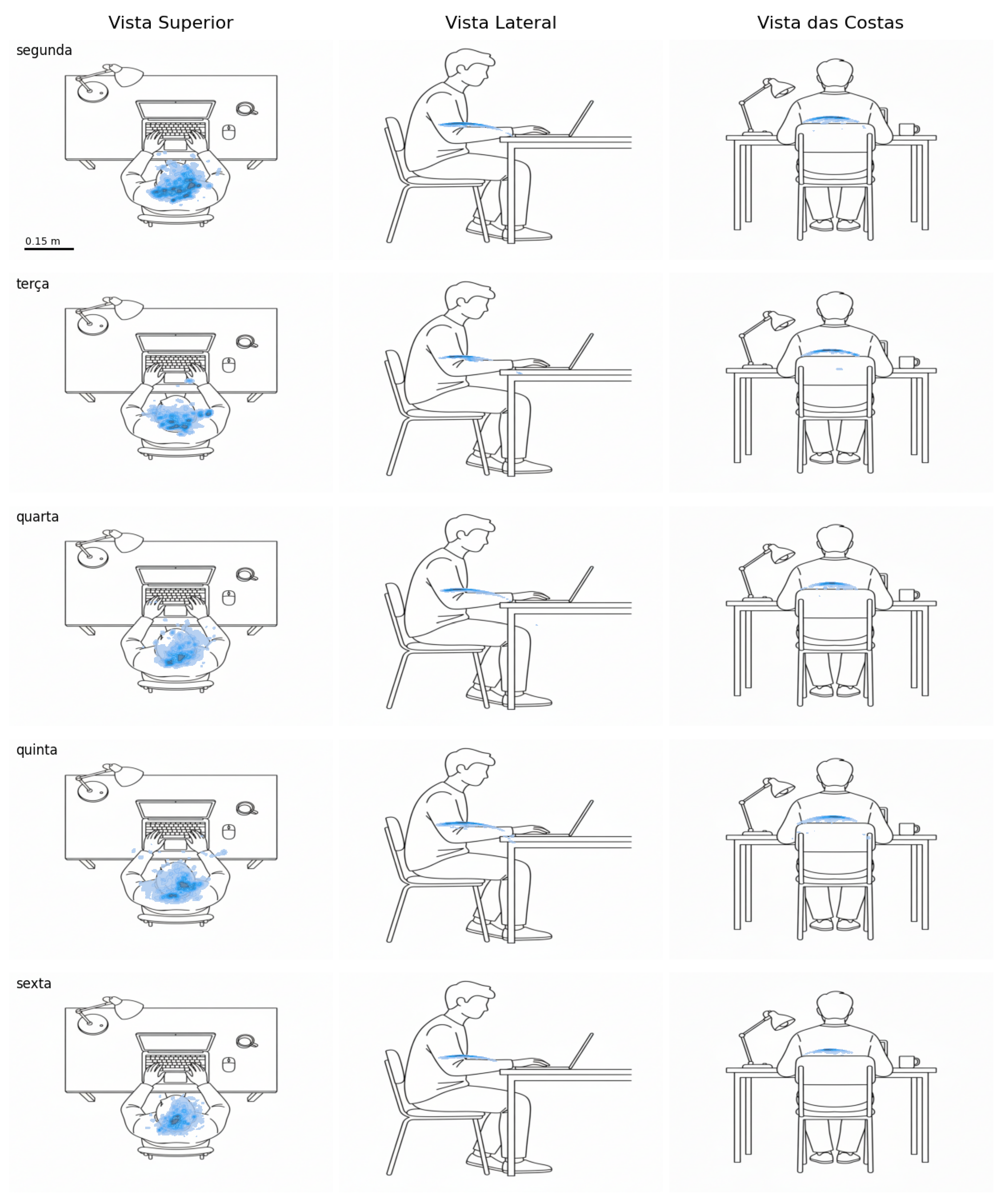
5. Discussion
The present study applied a generative co-design framework [23] to elicit, structure, and translate occupational health visualization requirements from a multi-stakeholder group of office workers and occupational health professionals, and subsequently implemented a set of visualizations grounded in the identified requirements using real-world data collected from a smartwatch and a smartphone. The following sections interpret the findings of each phase of this process and position them within the broader context of occupational health monitoring and participatory design.
5.1. Suitability of the Generative Co-Design Framework
The adoption of the generative co-design framework [23] proved appropriate for the occupational health visualization context. The framework’s explicit separation of pre-design, co-design, and post-design phases supported a structured progression from contextual understanding to prototype elicitation and, ultimately, to requirement translation. The field study and questionnaire administered during the pre-design phase ensured that the subsequent workshop was grounded in the actual working conditions of the participant population, rather than in abstract or hypothetical occupational scenarios. This alignment between contextual inquiry and workshop content is consistent with established principles of generative design practice, in which sensitization of participants to their own lived experience is considered a prerequisite for meaningful co-creation [23].
The multi-stakeholder composition of the co-design workshop, comprising office workers alongside occupational health specialists and ergonomists, contributed directly to the quality and diversity of the requirements elicited. Office workers brought experiential knowledge of daily working conditions, recurring discomforts, and perceived risk factors, while health professionals contributed domain expertise on clinically relevant occupational exposure thresholds, ergonomic risk frameworks, and visualization needs from a professional assessment perspective. The interaction between these two perspectives during the collective discussion phase led to cross-cutting design observations. In particular, the explicit differentiation of visualization complexity by user role, and the convergence on behaviour change as the primary purpose of the system.
The follow-up session conducted after the initial implementation further validated the utility of the framework’s iterative structure. Participants reported that their expectations from the co-design workshop had been met and expressed that the developed visualizations, given their clear visual design and interpretability, could effectively support office workers in identifying occupational health risks. The gathered feedback resulted in the refinement of specific visualization elements, for example: the noise exposure categories were finalized in consultation with occupational health ergonomists, and the sedentary risk colour-transition feature was introduced at this stage. These iterative refinements illustrate the added value of including a structured post-design evaluation loop and highlight the importance of stakeholder validation before concluding the implementation process.
5.2. Stakeholder-Driven Theme Identification and Feasibility
The thematic analysis of the co-design workshop transcript yielded 17 inductive codes, reflecting the diversity of occupational health concerns perceived as relevant by the participant group. The most frequently appearing themes broadly correspond to well-established risk domains in office ergonomics and WRMD research [2,28,48,50]. Their recurrence across both co-design groups and the collective discussion suggests that these represent primary and shared concerns among the participant population.
The prominence of work organization as a theme is particularly noteworthy, as it reflects an awareness among participants that physiological and postural risks do not arise in isolation, but are mediated by structural working conditions such as task allocation, staffing levels, and the availability of rest opportunities. This perception aligns with the occupational health literature, which has increasingly recognized organizational factors as upstream determinants of ergonomic and psychosocial risk [2,4,8]. From a technical perspective, however, work organization cannot be directly measured by any sensor modality available in the current platform, as it constitutes an organizational construct rather than a physiological or behavioural signal. This disconnect between what participants identified as a risk factor and what the current system can observe underscores a fundamental challenge in sensor-based occupational health monitoring: the dominant risks identified by worker’s cannot always be covered through deployment of sensorized systems alone.
The presence of out-of-scope themes, such as pain and symptom reporting, work equipment and workstation ergonomics, temperature discomfort, and light conditions, further illustrates this gap. While these themes represent legitimate occupational health concerns, they either require subjective self-report instruments, dedicated environmental sensors, or formal ergonomic assessment tools that lie beyond the smartphone and smartwatch platform deployed in this study. Their emergence from the co-design process is nonetheless informative: it maps the boundaries between what the current system can offer and what a more comprehensive occupational health monitoring platform would require, thereby providing a structured basis for prioritizing future system extensions. Conversely, the directly and partially addressable themes, which together account for the large majority of the identified codes, confirm that the smartphone and smartwatch sensing configuration is sufficient to address the primary occupational health concerns expressed by participants and to support the implementation of the core visualization components.
5.3. Visualizations as Communication Tools Between Stakeholders
A recurrent theme across both co-design groups and the collective discussion was that the primary value of the proposed system lay not in automated monitoring per se, but in its capacity to support meaningful communication between workers, occupational health professionals, and organizational decision-makers. The effective use of these visualizations as communication tools requires that both the worker and the health professional share a common understanding of what the data represent. The multi-stakeholder composition of the co-design process ensured that the resulting designs were interpretable to both groups. The confirmation of visualization clarity during the follow-up session further supports the conclusion that the proposed designs fulfil this communicative purpose.
The role-differentiated view complexity proposed during the collective discussion reflects an important design consideration: workers less accustomed to data-dense interfaces require simpler, more concrete representations, while occupational health professionals may benefit from richer, more granular views. The visualizations developed in the present study were intentionally designed to prioritize clarity and direct interpretability, with colour-coded risk indicators valued explicitly by participants as facilitating legibility without requiring technical literacy. This positions the current implementation primarily as a worker-facing tool that is simultaneously accessible to health professionals, thereby serving as a shared reference point for structured occupational health dialogue.
The current visualizations operate exclusively at the individual level, presenting data for a single worker over a defined monitoring period. A natural extension of this framework would be to populate the same visualization templates with population-level reference values (e.g.,group means or percentile distributions across the monitored workforce) enabling direct comparison of individual exposure profiles against broader occupational baselines. Such an approach would extend the communicative function of the system to support organizational-level occupational health surveillance and decision-making.
5.4. Limitations
Several limitations of the present study warrant acknowledgment. First, the co-design workshop involved a relatively small number of participants recruited from a single public administration organization, which limits the generalizability of the identified themes and design requirements to other occupational sectors or cultural contexts. Future co-design studies should aim to include larger and more occupationally diverse participant groups to increase the breadth of the resulting requirements.
Second, the developed visualizations are demonstrated using data from representative workers, providing an illustrative rather than evaluative assessment of the visualization outputs. Population-level validation, namely assessment of usability, interpretability, and impact on occupational health behaviour, was beyond the scope of the present study and constitutes a priority for future work.
Third, the current sensing platform is limited to the modalities available on a consumer-grade Android smartphone and smartwatch. This constrains the range of occupational health phenomena that can be directly observed. For example, the absence of EMG means that muscular tension, a factor highlighted repeatedly by participants, can only be inferred indirectly from postural proxy measures derived from the IMU. Additionally, the battery capacity of the smartwatch imposes constraints on continuous data acquisition: heart rate data are currently collected across four discrete 20-minute sessions per shift rather than continuously, which may result in the under-detection of transient physiological events occurring between acquisition periods.
Finally, the data streams derived from consumer-grade sensors cannot be considered equivalent to measurements obtained with dedicated, properly calibrated instrumentation. This is particularly relevant for the smartphone microphone-based noise assessment, for which the reported dBA values represent estimates of the ambient acoustic environment rather than accurate measurements. Consumer-grade microphones are not designed for precision sound level measurement and their output is subject to device-specific frequency responses, placement variability, and the absence of formal calibration procedures. The resulting estimates should therefore be interpreted as general indicators of the acoustic exposure profile, suitable for identifying periods and patterns of elevated noise that may warrant further investigation, rather than as definitive exposure values. Cases in which consistently elevated noise levels are identified should be followed up with dedicated and properly calibrated sound level measurement equipment.
5.5. Future Work
Several directions for future development emerge from the present study. The interactive design elements proposed by the first co-design group, such as the configurable variable layer toggles and drill-down mechanisms enabling navigation from weekly summaries to daily detail, were not implemented in the current visualization framework. These represent questions of application implementation rather than data availability, and their development would substantially increase the functional utility of the system for end-users. Similarly, the critical event flag and the role-differentiated view complexity proposed during the collective discussion could be addressed through application-level design in future iterations.
The partially addressable themes identified during the feasibility assessment highlight two priority extensions at the sensing level. Integration of EMG would enable direct quantification of muscular tension, completing the stress chronogram and postural load visualizations as originally envisaged by the co-design groups. Expansion of the sensing platform to include dedicated environmental sensors (e.g., lux meters and thermometers) would address the lighting and thermal comfort conditions currently classified as out of scope, closing the remaining gap between the occupational health concerns expressed by participants and the phenomena observable by the system.
Finally, the extension of the individual-level visualization framework to support population-level reference values and aggregate dashboards would substantially broaden the utility of the system for organizational occupational health surveillance, enabling institutional decision-makers to monitor workforce-level exposure trends alongside individual worker profiles.
6. Conclusions
This study applied a generative co-design framework to develop occupational health visualizations grounded in the requirements of a multi-stakeholder group comprising office workers and occupational health professionals. The structured progression through pre-design, co-design, and post-design phases enabled the systematic elicitation of 17 occupational health themes, the assessment of their technical feasibility relative to a smartphone and smartwatch sensing platform, and the subsequent implementation of a set of visualizations addressing physical activity and sedentary behaviour, heart rate, environmental noise exposure, and postural load.
The co-design process confirmed that the adopted framework is well-suited to the occupational health visualization context, facilitating meaningful dialogue between experiential and domain-expert knowledge. The feasibility analysis demonstrated that the smartphone and smartwatch configuration is sufficient to address the majority of the identified occupational health concerns directly or partially, while simultaneously delineating the boundaries of the current platform and identifying clear directions for future system extension. The follow-up session validated the interpretability of the developed visualizations and led to targeted refinements, illustrating the value of including an iterative post-design evaluation loop.
Future work should prioritize the formal evaluation of the developed visualizations with a broader and more occupationally diverse user population, with particular attention to usability, behaviour change support, and the integration of interactive application-level features proposed during the co-design workshop. Expansion of the sensing platform through the addition of surface electromyography and dedicated environmental sensors would further close the gap between the occupational health concerns expressed by participants and the phenomena currently observable by the system.
Author Contributions
Conceptualization, P.P., S.S. and G.B. ; methodology, P.P., S.S., G.B., M.M., S.G., A.L., R.P., S.A., T.M. and J.B.D.; software, P.P., S.S., G.B., M.M. and S.G.; validation, P.P., S.S. and G.B.; formal analysis, P.P., S.S., G.B. and P.K.; investigation, P.P., S.S., G.B. M.M. and S.G.; resources, P.P., A.L., C.P., J.B.D., and H.G.; data curation, P.P., S.S., G.B., M.M. and S.G.; writing—original draft preparation, P.P. and G.B.; writing—review and editing, P.P., S.S., G.B., M.M., S.G., P.K., J.B.D., R.V. and H.G.; visualization, P.P., S.S., G.B., M.M. and S.G.; supervision, P.P., P.K., J.B.D., R.V. and H.G.; project administration, P.P., A.L., C.P., R.V. and H.G.; funding acquisition, P.P., J.B.D., C.P., R.V. and H.G. All authors have read and agreed to the published version of the manuscript.
Funding
The research was partly supported by the Science and Technology Foundation (FCT) under the PrevOccupAI+ project (2024.07630.IACDC). P. Probst was supported by doctoral grant RT/BD/152843/2021 financed by the Portuguese Foundation for Science and Technology (FCT) and with funds from the State Budget under the MIT Portugal Program..
Institutional Review Board Statement
The presented study was approved by the NOVA School of Science and Technology Ethics Committee (CENOVAFCT) under approval number CE_FCT_005-2022-A25, and conducted in accordance with the Declaration of Helsinki.
Informed Consent Statement
All participants were asked to sign an informed consent after receiving a thorough explanation of the purpose of the study and the need for recording the audio of the co-design workshop for post-design analysis.
Acknowledgments
This study was conducted within the scope of the PrevOccupAI+ project (Prevention of Occupational Disorders in Public Administration based on Artificial Intelligence PLUS), a follow-up to the PrevOccupAI project, which aims to characterize daily working activities, working conditions, and potential risk factors associated with the occupational environment on an individual organizational levels within the Public Administration. The project was carried out in cooperation with the Camâra Municipal de Lisboa (Municipality of Lisbon).
Conflicts of Interest
The authors declare no conflicts of interest.
Abbreviations
The following abbreviations are used in this manuscript:
| WRDs | Work-Related Disorders |
| WRMDs | Work-Related Musculoskeletal Disorders |
| CML | Câmara Municipal de Lisboa |
| ROSA | Rapid Office Strain Assessment |
| IMUs | Inertial Measurement Unit |
| JITAIs | Just-In-Time Interventions |
| ASR | Automatic Speech Recognition |
| LLM | Large Language Model |
| f.a. | frequency of appearance |
| HR | Heart Rate |
| EMG | Electromyography |
Appendix A
Table A1.
Summary of translated co-design survey questions and answer types.
| ID | Section | Question | Answer Type / Options |
|---|---|---|---|
| Q1 | General Information | What is your job or profession? | Multiple choice: (1) Office worker (2) Health professional (3) Specialist in Occupational Health (4) Psychologist (5) Other - option to specify |
| Q2 | General Information | How long have you worked in your current profession within CML? | Numeric: (number of years) |
| Q3 | General Information | How often do you consult health data? | Multiple choice: (1) Never (2) Once a year (3) Every six months (4) Once a month (5) Once a week (6) Daily |
| Q4 | General Information | Where do you usually get health information? | Multiple choice: (1) Workplace reports (2) Health apps (3) Wearabeles (e.g., smartwatch, fitness tracker) (4) Medical appointments (5) Other - option to specify |
| Q5 | General Information | If you use health or fitness apps, what types of data do you monitor? | Multiple choice: (1) Heart rate (2) Physical activity (3) Sleep patterns (4) Stress indicators (5) Movement/posture (6) Other - option to specify |
| Q6 | Current Challenges and Needs | How easy or difficult is it for you to interpret health data when you receive it? | Likert Scale: (1) Very difficult (2) Difficult (3) Neutral (4) Easy (5) Very easy |
| Q7 | Current Challenges and Needs | What challenges do you face when trying to understand or use this data? | Open answer |
| Q8 | Current Challenges and Needs | When you look at health data visualizations (e.g. graphs, trend lines), what do you usually find confusing? | Multiple choice: (1) Too much information (2) Lack of explanation (3) Confusing visual elements (4) Hard to relate the visuals with my situation (5) Other - option to specify |
| Q9 | Current Challenges and Needs | If you could improve the way health data is presented, what would you change? | Open answer |
| Q10 | Data Interpretation and Visualization Preferences |
What type of data visualization do you find easier to understand? | Multiple choice: (1) Charts (e.g., bar charts, line graphs, etc.) (2) Color-coded risk levels (3) Simplified numerical values with explanation (4) Tables (5) Interactive data panels (6) Other - option to specify |
| Q11 | Data Interpretation and Visualization Preferences |
If you’ve used a health or fitness app, which of the presented visualizations have you found most useful? | Open answer |
Table A2.
Summary of translated co-design survey questions and answer types. (continued)
| ID | Section | Question | Answer Type / Options |
|---|---|---|---|
| Q12 | Data Interpretation and Visualization Preferences |
Would you prefer to receive this type of information in real time (e.g. live updates) or in periodic summaries (e.g. daily or weekly reports)? Please explain your choice | Open answer |
| Q13 | Data Interpretation and Visualization Preferences |
What factors would make visualizations of occupational health data easier for you to understand? | Open answer |
| Q14 | Understanding Occupational Risks Through Data Visualization |
What are the main workplace risks that you are aware of in your daily activity? | Open answer |
| Q15 | Understanding Occupational Risks Through Data Visualization |
Do you think you receive enough information about the occupational risks of your job? | Likert Scale: (1) Not at all (2) Slightly (3) Moderately (4) Very (5) Completely |
| Q16 | Understanding Occupational Risks Through Data Visualization |
If you had access to occupational risk visualizations, what kind of information would be most useful? | Multiple choice: (1) Physical activity levels (2) Postural risk (3) Musculoskeletal risks (4) Environmental risks (e.g., ambient noise) (5) Other - option to specify |
| Q17 | Understanding Occupational Risks Through Data Visualization |
How would you like information about workplace risks to be presented? | Multiple choice: (1) Personal risk reports (for personal use only) (2) Summaries by team/department (only average values to ensure employee privacy) (3) General trends in the organization (4) Other - option to specify |
| Q18 | Understanding Occupational Risks Through Data Visualization |
If a visualization showed that your work habits increased the risks to your health, would you take any action? If so, what kind of action would you take? | Open answer |
| Q19 | Collaboration between Stakeholders and Decision-Making |
If you have received reports on occupational health in the workplace, how was the information presented? | Open answer |
| Q20 | Collaboration between Stakeholders and Decision-Making |
Have you ever had to explain health data to someone else? If so, what challenges did you face? | Open answer |
| Q21 | Collaboration between Stakeholders and Decision-Making |
How do you think health data visualizations can help improve communication between workers, health professionals and managers? | Open answer |
| Q22 | Final Comments | If you have any comments, suggestions or any information that you think is relevant and could contribute to the development of occupational health data visualizations, this is the place to share it. You can write in any format you feel most comfortable with (e.g. long text, bullet points, etc.). | Open answer |
References
- Punnett, L.; Wegman, D.H. Work-related musculoskeletal disorders: the epidemiologic evidence and the debate. Journal of electromyography and kinesiology 2004, 14, 13–23. [CrossRef]
- European Agency for Safety and Health at Work (EU-OSHA). Work-related musculoskeletal disorders. Technical report, European Agency for Safety and Health at Work (EU-OSHA), Luxembourg, 2020. Publications Office of the European Union. Available at: https://op.europa.eu/en/publication-detail/-/publication/5819be4f-0393-11eb-a511-01aa75ed71a1/language-en (accessed 12 December 2025).
- European Agency for Safety and Health at Work (EU-OSHA). Estimating the cost of work-related accidents and ill-health. Technical report, European Agency for Safety and Health at Work (EU-OSHA), Luxembourg, 2019. Publications Office of the European Union. Available at: https://op.europa.eu/en/publication-detail/-/publication/2d75613d-1878-11e9-8d04-01aa75ed71a1/language-en (accessed 12 December 2025).
- Langella, F.; Christensen, S.W.M.; Palsson, T.S.; Høgh, M.; Gagni, N.; Bellosta-López, P.; Christiansen, D.H.; Delle Chiaie, M.; Domenéch-García, V.; Johnston, V.; et al. Development of the Prevent for Work questionnaire (P4Wq) for assessment of musculoskeletal risk in the workplace: part 1—literature review and domains selection. BMJ open 2021, 11, e043800. [CrossRef]
- Owen, N.; Healy, G.N.; Dempsey, P.C.; Salmon, J.; Timperio, A.; Clark, B.K.; Goode, A.D.; Koorts, H.; Ridgers, N.D.; Hadgraft, N.T.; et al. Sedentary behavior and public health: integrating the evidence and identifying potential solutions. Annual review of public health 2020, 41, 265–287. [CrossRef]
- Eurostat. Sit at work? You are one of 39%. https://ec.europa.eu/eurostat/web/products-eurostat-news/-/ddn-20190305-1, 2019. Accessed: 2025-12-12.
- Peereboom, K.; de Langen, N.; Bortkiewicz, A.; Copsey, S. Prolonged static sitting at work: Health effects and good practice advice. Executive summary. Technical report, European Agency for Safety and Health at Work (EU-OSHA), Luxembourg, 2021. Available at: https://osha.europa.eu/sites/default/files/Sitting_at_work_%20summary_EN.pdf (accessed 12 December 2025).
- Bakker, A.B.; De Vries, J.D. Job Demands–Resources theory and self-regulation: New explanations and remedies for job burnout. Anxiety, stress, & coping 2021, 34, 1–21.
- Lee, P.J.; Lee, B.K.; Jeon, J.Y.; Zhang, M.; Kang, J. Impact of noise on self-rated job satisfaction and health in open-plan offices: a structural equation modelling approach. Ergonomics 2016, 59, 222–234. [CrossRef]
- Bustos, D.; Guedes, J.C.; Baptista, J.S.; Vaz, M.P.; Costa, J.T.; Fernandes, R.J. Applicability of physiological monitoring systems within occupational groups: a systematic review. Sensors 2021, 21, 7249. [CrossRef]
- Mueller, W.; Smith, A.; Kuijpers, E.; Pronk, A.; Loh, M. Worker perspectives on improving occupational health and safety using wearable sensors: a cross-sectional survey. Annals of Work Exposures and Health 2024, 68, 867–873. [CrossRef]
- Majumder, S.; Deen, M.J. Smartphone sensors for health monitoring and diagnosis. Sensors 2019, 19, 2164. [CrossRef]
- Michard, F. Toward smart monitoring with phones, watches, and wearable sensors. Anesthesiology clinics 2021, 39, 555–564. [CrossRef]
- Maiti, A.; Ye, A.; Schmidt, M.; Pedersen, S. A privacy-preserving desk sensor for monitoring healthy movement breaks in smart office environments with the internet of things. Sensors 2023, 23, 2229. [CrossRef]
- Parés-Salomón, I.; Señé-Mir, A.M.; Martín-Bozas, F.; Loef, B.; Coffey, A.; Dowd, K.P.; Jabardo-Camprubí, G.; Proper, K.I.; Puig-Ribera, A.; Bort-Roig, J. Effectiveness of workplace interventions with digital elements to reduce sedentary behaviours in office employees: a systematic review and meta-analysis. International Journal of Behavioral Nutrition and Physical Activity 2024, 21, 41. [CrossRef]
- Van Dantzig, S.; Geleijnse, G.; Van Halteren, A.T. Toward a persuasive mobile application to reduce sedentary behavior. Personal and ubiquitous computing 2013, 17, 1237–1246.
- Bond, D.S.; Thomas, J.G.; Raynor, H.A.; Moon, J.; Sieling, J.; Trautvetter, J.; Leblond, T.; Wing, R.R. B-MOBILE-a smartphone-based intervention to reduce sedentary time in overweight/obese individuals: a within-subjects experimental trial. PloS one 2014, 9, e100821. [CrossRef]
- Bort-Roig, J.; Chirveches-Perez, E.; Gine-Garriga, M.; Navarro-Blasco, L.; Bausa-Peris, R.; Iturrioz-Rosell, P.; Gonzalez-suarez, A.M.; Martinez-Lemos, I.; Puigoriol-Juvanteny, E.; Dowd, K.; et al. An m-health workplace-based’sit less, move more’program: Impact on employees’ sedentary and physical activity patterns. In Proceedings of the JOURNAL OF PHYSICAL ACTIVITY & HEALTH. HUMAN KINETICS PUBL INC 1607 N MARKET ST, PO BOX 5076, CHAMPAIGN, IL 61820 …, 2018, Vol. 15, pp. S118–S118.
- Karlsen, I.L.; Svendsen, P.A.; Abildgaard, J.S. A review of smartphone applications designed to improve occupational health, safety, and well-being at workplaces. BMC public health 2022, 22, 1520. [CrossRef]
- Ferreira, J.C.; Elvas, L.B.; Correia, R.; Mascarenhas, M. Empowering health professionals with digital skills to improve patient care and daily workflows. In Proceedings of the Healthcare. MDPI, 2025, Vol. 13, p. 329. [CrossRef]
- Hamer, D.; Gustafson, M.; Gumina, C.O.; Landis, D.C.; Bockelman, P.; Perry, E.; Matthews, S.D. Bridging the gap: enhancing data science and leadership knowledge and skills in the context of the public health workforce. Frontiers in public health 2025, 13, 1505869. [CrossRef]
- Stepanovic, S.; Mozgovoy, V.; Mettler, T. Designing visualizations for workplace stress management: results of a pilot study at a swiss municipality. In Proceedings of the International Conference on Electronic Government. Springer, 2019, pp. 94–104.
- Bird, M.; McGillion, M.; Chambers, E.; Dix, J.; Fajardo, C.; Gilmour, M.; Levesque, K.; Lim, A.; Mierdel, S.; Ouellette, C.; et al. A generative co-design framework for healthcare innovation: development and application of an end-user engagement framework. Research involvement and engagement 2021, 7, 1–12. [CrossRef]
- Shirk, J.L.; Ballard, H.L.; Wilderman, C.C.; Phillips, T.; Wiggins, A.; Jordan, R.; McCallie, E.; Minarchek, M.; Lewenstein, B.V.; Krasny, M.E.; et al. Public participation in scientific research: a framework for deliberate design. Ecology and society 2012, 17. [CrossRef]
- Barcellini, F.; Prost, L.; Cerf, M. Designers’ and users’ roles in participatory design: What is actually co-designed by participants? Applied ergonomics 2015, 50, 31–40. [CrossRef]
- Gyi, D.; Sang, K.; Haslam, C. Participatory ergonomics: co-developing interventions to reduce the risk of musculoskeletal symptoms in business drivers. Ergonomics 2013, 56, 45–58. [CrossRef]
- Silva., S.; Cepeda., C.; Rodrigues., J.; Probst., P.; Gamboa., H. Assessing Occupational Health with a Cross-platform Application based on Self-reports and Biosignals. In Proceedings of the Proceedings of the 15th International Joint Conference on Biomedical Engineering Systems and Technologies (BIOSTEC 2022) - HEALTHINF. INSTICC, SciTePress, 2022, pp. 549–556. [CrossRef]
- Oliosi, E.; Probst, P.; Rodrigues, J.; Silva, L.; Zagalo, D.; Cepeda, C.; Gamboa, H. Week-long Multimodal Data Acquisition of Occupational Risk Factors in Public Administration Workers. In Proceedings of the 2023 19th International Conference on Intelligent Environments, IE 2023 - Proceedings. IEEE, 2023. [CrossRef]
- Duffy, A.; Boroumandzad, N.; Sherman, A.L.; Christie, G.; Riadi, I.; Moreno, S. Examining challenges to co-design digital health interventions with end users: systematic review. Journal of Medical Internet Research 2025, 27, e50178. [CrossRef]
- Branco, D.; Móteiro, M.; Bouça-Machado, R.; Miranda, R.; Reis, T.; Decoroso, É.; Cardoso, R.; Ramalho, J.; Rato, F.; Malheiro, J.; et al. Co-designing customizable clinical dashboards with multidisciplinary teams: Bridging the gap in chronic disease care. In Proceedings of the Proceedings of the 2024 CHI Conference on Human Factors in Computing Systems, 2024, pp. 1–18.
- Meng, Q.; An, Y.; Yang, D. Effects of acoustic environment on design work performance based on multitask visual cognitive performance in office space. Building and Environment 2021, 205, 108296. [CrossRef]
- Jahncke, H.; Hygge, S.; Halin, N.; Green, A.M.; Dimberg, K. Open-plan office noise: Cognitive performance and restoration. Journal of Environmental Psychology 2011, 31, 373–382. [CrossRef]
- Alipour, M.; Dragicevic, P.; Isenberg, T.; Isenberg, P. Situated Visualizations of Office Noise to Promote Personal Health. In Proceedings of the InfoVis 2018-IEEE Conference on Information Visualization, 2018, pp. 1–2.
- Sonne, M.; Villalta, D.L.; Andrews, D.M. Development and evaluation of an office ergonomic risk checklist: ROSA–Rapid office strain assessment. Applied ergonomics 2012, 43, 98–108. [CrossRef]
- Martins, D.R.; Cerqueira, S.M.; Pombeiro, A.; da Silva, A.F.; Rocha, A.M.A.; Santos, C.P. ErgoReport: A Holistic Posture Assessment Framework Based on Inertial Data and Deep Learning. Sensors 2025, 25, 2282. [CrossRef]
- Thomas, J.G.; Bond, D.S. Behavioral response to a just-in-time adaptive intervention (JITAI) to reduce sedentary behavior in obese adults: Implications for JITAI optimization. Health Psychology 2015, 34, 1261. [CrossRef]
- Kraaij, W.; Verberne, S.; Koldijk, S.; de Korte, E.; van Dantzig, S.; Sappelli, M.; Shoaib, M.; Bosems, S.; Achterkamp, R.; Bonomi, A.; et al. Personalized support for well-being at work: an overview of the SWELL project. User modeling and user-adapted interaction 2020, 30, 413–446. [CrossRef]
- LimeSurvey Project Team. LimeSurvey: An Open Source survey tool. LimeSurvey GmbH, Hamburg, Germany, 2026.
- Bain, M.; Huh, J.; Han, T.; Zisserman, A. WhisperX: Time-Accurate Speech Transcription of Long-Form Audio. INTERSPEECH 2023 2023.
- Grosman, J. Fine-tuned XLSR-53 large model for speech recognition in Portuguese. https://huggingface.co/jonatasgrosman/wav2vec2-large-xlsr-53-portuguese, 2021.
- OpenAI. ChatGPT (GPT-4.1). https://chat.openai.com/, 2025. Large language model by OpenAI, accessed June 2025.
- Clarke, V.; Braun, V. Thematic analysis. The journal of positive psychology 2017, 12, 297–298.
- De Paoli, S. Performing an inductive thematic analysis of semi-structured interviews with a large language model: An exploration and provocation on the limits of the approach. Social Science Computer Review 2024, 42, 997–1019.
- Deiner, M.S.; Honcharov, V.; Li, J.; Mackey, T.K.; Porco, T.C.; Sarkar, U. Large language models can enable inductive thematic analysis of a social media corpus in a single prompt: human validation study. JMIR infodemiology 2024, 4, e59641. [CrossRef]
- Hunter, J.D. Matplotlib: A 2D graphics environment. Computing in Science & Engineering 2007, 9, 90–95. [CrossRef]
- Waskom, M.L. seaborn: statistical data visualization. Journal of Open Source Software 2021, 6, 3021. [CrossRef]
- Kurko, J. Validity of the occupational sitting and physical activity questionnaire. Medicine and science in sports and exercise 2012. [CrossRef]
- Neumann, W.; Wells, R.; Norman, R.; Frank, J.; Shannon, H.; Kerr, M.S.; Group, O.W.; et al. A posture and load sampling approach to determining low-back pain risk in occupational settings. International Journal of Industrial Ergonomics 2001, 27, 65–77. [CrossRef]
- Oliosi, E.; Júlio, A.; Probst, P.; Silva, L.; Vilas-Boas, J.P.; Pinheiro, A.R.; Gamboa, H. Exploring the real-time variability and complexity of sitting patterns in office workers with non-specific chronic spinal pain and pain-free individuals. Sensors 2024, 24, 4750. [CrossRef]
- Park, J.; Nguyen, V.Q.; Ho, R.L.; Coombes, S.A. The effect of chronic low back pain on postural control during quiet standing: A meta-analysis. Scientific Reports 2023, 13, 7928. [CrossRef]
- Søndergaard, K.H.; Olesen, C.G.; Søndergaard, E.K.; De Zee, M.; Madeleine, P. The variability and complexity of sitting postural control are associated with discomfort. Journal of biomechanics 2010, 43, 1997–2001. [CrossRef]
- Probst, P.; Santos, S.; Barros, G.; Koch, P.; Vigário, R.; Gamboa, H. PrevOccupAI-HAR: A Public Domain Dataset for Smartphone Sensor-Based Human Activity Recognition in Office Environments. Electronics 2026, 15, 807. [CrossRef]
- Paluch, A.E.; Bajpai, S.; Bassett, D.R.; Carnethon, M.R.; Ekelund, U.; Evenson, K.R.; Galuska, D.A.; Jefferis, B.J.; Kraus, W.E.; Lee, I.M.; et al. Daily steps and all-cause mortality: a meta-analysis of 15 international cohorts. The Lancet Public Health 2022, 7, e219–e228. [CrossRef]
- Tanaka, H.; Monahan, K.D.; Seals, D.R. Age-predicted maximal heart rate revisited. Journal of the american college of cardiology 2001, 37, 153–156. [CrossRef]
- Coenen, P.; Korshøj, M.; Hallman, D.M.; Huysmans, M.A.; van der Beek, A.J.; Straker, L.M.; Holtermann, A. Differences in heart rate reserve of similar physical activities during work and in leisure time–a study among Danish blue-collar workers. Physiology & behavior 2018, 186, 45–51. [CrossRef]
Figure 2.
Low-fidelity visualization prototype developed by Group 1 during the co-design workshop. The design centers on an integrative daily chronogram with layered variable tracks (left) and three complementary spatial posture views with a workstation ergonomic sketch (right).
Figure 2.
Low-fidelity visualization prototype developed by Group 1 during the co-design workshop. The design centers on an integrative daily chronogram with layered variable tracks (left) and three complementary spatial posture views with a workstation ergonomic sketch (right).
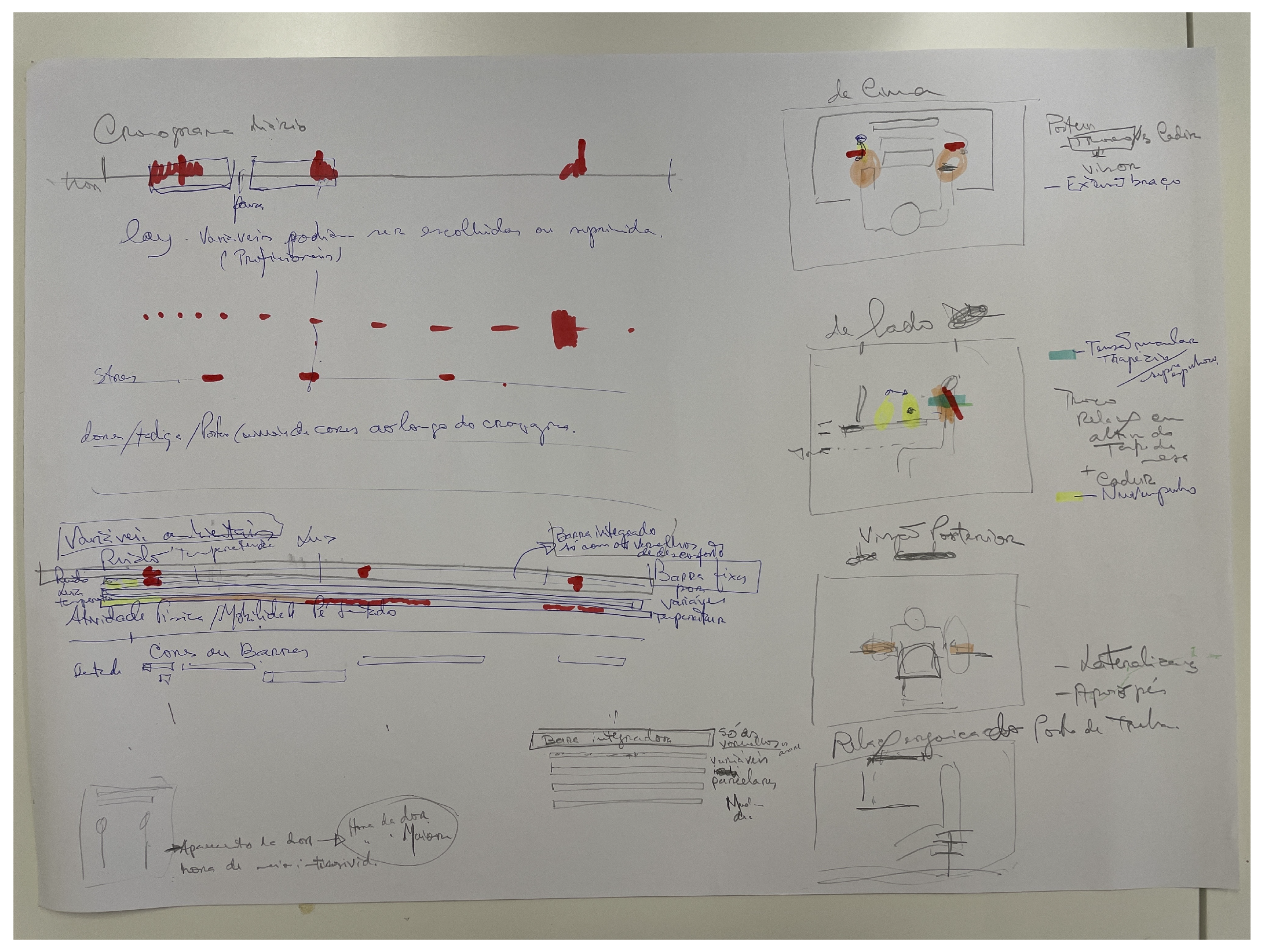
Figure 3.
Low-fidelity visualization prototypes developed by Group 2 during the co-design workshop. The sheet presents distinct visualization concepts covering stress (top-left), physical activity (top-right), posture (bottom-left), and environmental factors (bottom-right), each with explicit weekly and daily views.
Figure 3.
Low-fidelity visualization prototypes developed by Group 2 during the co-design workshop. The sheet presents distinct visualization concepts covering stress (top-left), physical activity (top-right), posture (bottom-left), and environmental factors (bottom-right), each with explicit weekly and daily views.
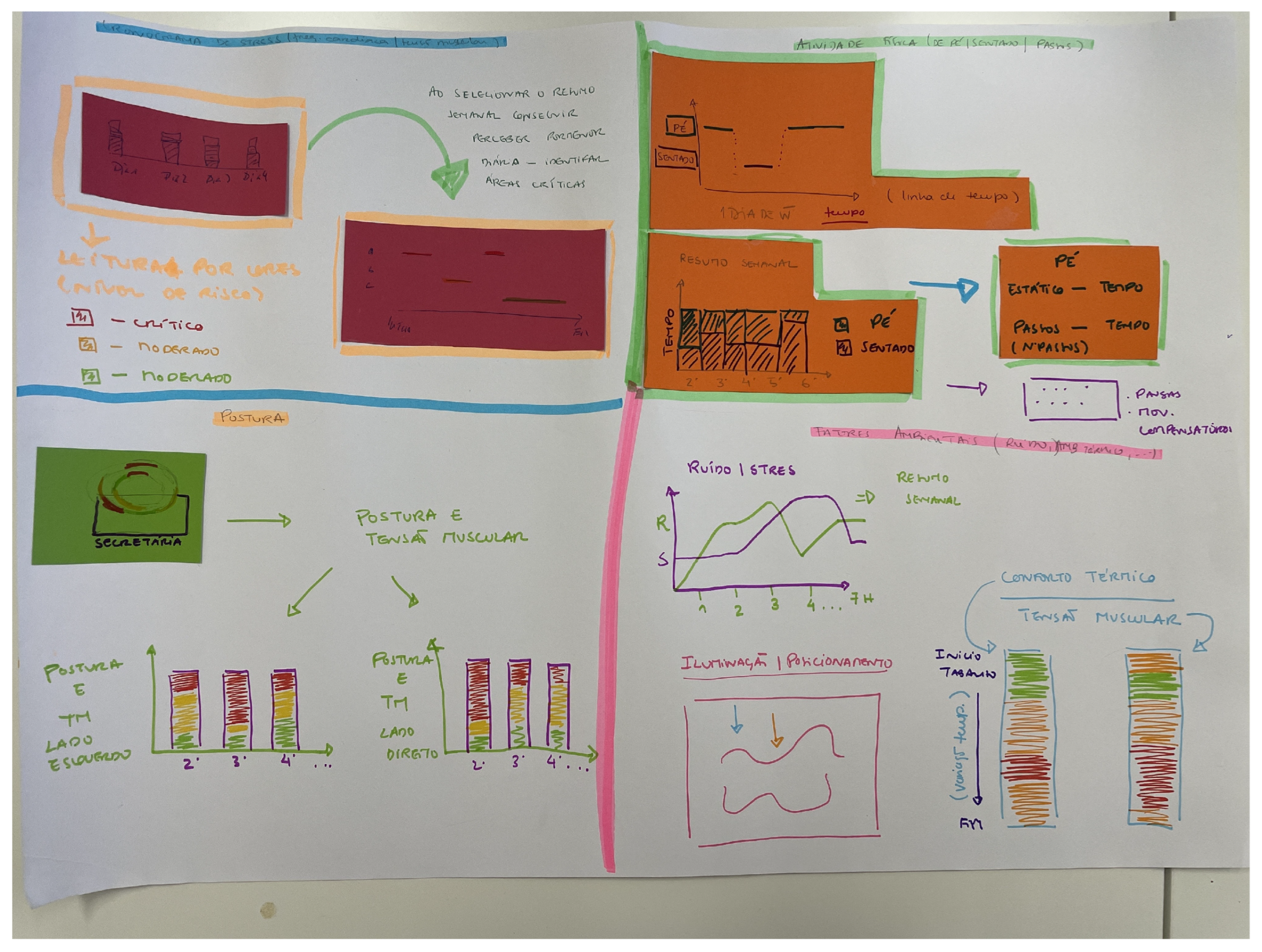
Table 1.
Co-design workshop participants
| ID | Role | Gender | YE-CML |
| 001 | Ergonomist | F | 7 |
| 002 | Specialist in Occupational Safety | M | 3 |
| 003 | Specialist in Occupational Health | F | 2 |
| 004 | Specialist in Occupational Health | F | 20 |
| 005 | Customer Service Manager | F | 5 |
| 006 | Customer Service Manager | F | 18 |
| 007 | Customer Service Manager | F | 22 |
| 008 | Customer Service Manager | F | 30 |
| 009 | Customer Service Manager | F | 30 |
| 010 | Psychologist | F | 24 |
| 011 | Psychologist | F | 30 |
| 012 | Health Professional | M | 25 |
YE-CML: years of experience within CML.
Table 3.
Affinity map derived from inductive coding of the co-design workshop transcript. Codes are clustered into higher-order thematic categories; frequency of appearance (f.a.) reflects counts within included participant utterances only.
Table 3.
Affinity map derived from inductive coding of the co-design workshop transcript. Codes are clustered into higher-order thematic categories; frequency of appearance (f.a.) reflects counts within included participant utterances only.
| Category | Code | f.a. |
|---|---|---|
| Stress | Work stress | 13 |
| Work organization | 7 | |
| Noise distraction | 6 | |
| Posture | Ergonomics / posture | 10 |
| Muscular tension | 5 | |
| Pain / symptom reporting | 5 | |
| Work equipment | 2 | |
| Ergonomic assessment | 1 | |
| Physical Activity | Active breaks | 6 |
| Sedentary behavior | 2 | |
| Human activity | 2 | |
| Environmental Factors | Environment conditions | 2 |
| Temperature discomfort | 2 | |
| Light conditions | 1 | |
| Data Visualization & Awareness | Data visualization | 2 |
| Risk awareness | 1 | |
| Sensor data | 1 |
f.a.: frequency of appearance
Table 4.
Feasibility classification of inductive codes relative to the smartphone and smartwatch sensing configuration defined in Table 2.
Table 4.
Feasibility classification of inductive codes relative to the smartphone and smartwatch sensing configuration defined in Table 2.
| Code | Feasibility | Available sensor(s) / rationale |
|---|---|---|
| Work stress | Directly addressable | Smartwatch HR |
| Work organization | Partially addressable | Physiological consequences via Smartwatch HR and Smartphone IMU; organizational construct not sensor-measurable |
| Noise distraction | Directly addressable | Smartphone microphone |
| Ergonomics / posture | Directly addressable | Smartphone IMU |
| Muscular tension | Partially addressable | Postural proxy via Smartphone IMU; direct measurement requires EMG |
| Pain / symptom reporting | Out of scope | Subjective; requires self-report instrument |
| Work equipment | Out of scope | Requires ergonomic assessment instrument |
| Ergonomic assessment | Partially addressable | IMU-derived posture as supporting evidence; formal assessment requires ROSA or equivalent |
| Active breaks | Directly addressable | Smartphone IMU (activity recognition) |
| Sedentary behaviour | Directly addressable | Smartphone IMU |
| Human activity | Directly addressable | Smartphone IMU |
| Environment conditions | Partially addressable | Noise via smartphone microphone; temperature and light require dedicated sensors |
| Temperature discomfort | Out of scope | Requires dedicated temperature / humidity sensor |
| Light conditions | Out of scope | Requires dedicated lux meter |
| Data visualization | N/A — design requirement | Informs visualization design; not a sensor-measurable phenomenon |
| Risk awareness | Directly addressable | Visualization output derived from available sensor data |
| Sensor data | N/A — methodological reference | General discussion of sensor data; not a specific measurable phenomenon |
HR: heart rate; IMU: inertial measurement unit (accelerometer, gyroscope, magnetometer); EMG: electromyography; f.a.: frequency of appearance
Disclaimer/Publisher’s Note: The statements, opinions and data contained in all publications are solely those of the individual author(s) and contributor(s) and not of MDPI and/or the editor(s). MDPI and/or the editor(s) disclaim responsibility for any injury to people or property resulting from any ideas, methods, instructions or products referred to in the content. |
© 2026 by the authors. Licensee MDPI, Basel, Switzerland. This article is an open access article distributed under the terms and conditions of the Creative Commons Attribution (CC BY) license (http://creativecommons.org/licenses/by/4.0/).
Copyright: This open access article is published under a Creative Commons CC BY 4.0 license, which permit the free download, distribution, and reuse, provided that the author and preprint are cited in any reuse.


