

Submitted:
09 March 2026
Posted:
10 March 2026
You are already at the latest version
Abstract
The global regulatory landscape is shifting from voluntary corporate social responsibility (CSR) to mandatory Environmental, Social, and Governance (ESG) disclosure. This study investigates the causal impact of mandatory ESG disclosure on firm value and operational decarbonization using a comprehensive balanced panel of 1,612 listed firms from the EU and the US between 2018 and 2025.Employing a Difference-in-Differences (DiD) design and an event study analysis, our empirical results yield three primary findings. First, consistent with Agency Theory, mandatory disclosure significantly increases firm value (Tobin’s Q) immediately following the 2021 regulatory shock (Post×Treat=0.5212, p< 0.01), indicating that standardized transparency reduces information asymmetry (H1). Second, we document a progressive and cumulative reduction in carbon intensity, providing robust evidence of substantive execution rather than mere ceremonial compliance (H2). The "downward-sloping" trajectory in the event study confirms that the mandate drives real-world operational transitions over time, refuting Decoupling Theory. Third, we find that internal governance mechanisms play a crucial moderating role in this transition (H3); the reduction in carbon intensity is significantly more pronounced in firms with higher board independence and established ESG committees. These findings suggest that "hard-law" transparency mandates effectively align corporate incentives with global climate goals. The synergy between external regulatory pressure and internal governance oversight is essential for bridging the "talk-walk" gap, offering critical implications for global policymakers designing the next generation of climate-related reporting standards.
Keywords:
mandatory ESG disclosure
; decarbonization
; firm value
; corporate governance
; difference-in-differences
; carbon intensity
1. Introduction
The global regulatory landscape for corporate sustainability is shifting from voluntary corporate social responsibility (CSR) to mandatory Environmental, Social, and Governance (ESG) disclosure. With the implementation of the Corporate Sustainability Reporting Directive (CSRD) and the global standards of the ISSB, transparency has transitioned from a strategic choice to a critical legal obligation (European Commission, 2023; ISSB, 2024). However, it remains debated whether this regulatory tightening leads to substantive environmental improvements or merely results in "symbolic compliance" (greenwashing). Recent evidence suggests that the impact of these mandates is heterogeneous; while mandatory disclosure can lower the cost of debt for regulated European firms, smaller unregulated entities still face a significant "carbon premium," highlighting the uneven pressure of regulatory boundaries (Cicchini et al., 2026).
Theoretical frameworks like Agency Theory (Jensen & Meckling, 1976) and Decoupling Theory (Meyer & Rowan, 1977) provide the foundation for understanding these dynamics. Proponents argue that mandatory disclosure reduces information asymmetry and signals lower regulatory risk, thereby increasing firm value as measured by Tobin’s Q (Chung & Pruitt, 1994; Matsumura et al., 2014). Conversely, firms may engage in "decoupling" by externalizing carbon-intensive activities to global supply chains—a phenomenon known as "carbon leakage"—to maintain a facade of sustainability while shifting emissions elsewhere (Kim, 2025).
A critical evolution in this field is the increasing scrutiny of Scope 3 emissions. Recent research disentangling Scope 1, 2, and 3 emissions performance within the Science-Based Targets initiative (SBTi) reveals that financial markets are beginning to differentiate between direct operational control and value-chain accountability (Kayser et al., 2025). In specific sectors like shipping, the strategic disclosure of Scope 3 metrics is now essential for "accountable efficiency," as firms integrate carbon metrics into their strategic practices to manage indirect emissions across global value chains (Di Vaio et al., 2025).
This study investigates the causal impact of mandatory ESG disclosure on both financial value and operational execution, specifically focusing on Carbon Intensity from 2018 to 2025. We contend that the transition from compliance to execution is heavily contingent upon a firm’s internal governance infrastructure. Specific mechanisms, such as Board Environmental Expertise and Board Independence, act as pivotal moderators; high carbon emissions often heighten external scrutiny, compelling knowledgeable boards to enhance disclosure quality and drive substantive operational changes (Yahaya, 2025; Yahaya, 2026). By incorporating the latest empirical evidence, this research explores how policy instruments, including carbon pricing and R&D investment, serve as strategic drivers for reducing carbon intensity and achieving a net-zero transition (Rahman, 2025; Ayodele et al., 2026).
2. Literature Review and Hypothesis Development
2.1. Mandatory ESG Disclosure and Firm Value
The relationship between sustainability disclosure and financial performance has long been rooted in Agency Theory. As noted by Jensen and Meckling (1976), information asymmetry between managers and shareholders leads to agency costs, which often result in a valuation discount. Mandatory ESG disclosure acts as a critical monitoring mechanism that forces managers to reveal non-financial risks, thereby reducing the risk premium demanded by investors (Chung & Pruitt, 1994; Matsumura et al., 2014). Gao et al. (2021) further argue that mandatory non-financial disclosure enhances the overall quality of the information environment, which directly lowers the cost of equity capital.
Recent scholarship in the 2024–2026 period confirms that as global investors align with the ISSB (2024) standards, the value-relevance of mandatory reporting has become more pronounced. Ioannou and Serafeim (2017) provide cross-country evidence that mandatory transparency reduces uncertainty, leading to improved market liquidity. Furthermore, while the market begins to reward transparency, there is evidence that mandatory mandates can lower the cost of debt for regulated firms, whereas smaller unregulated firms continue to face a higher "carbon premium" (Cicchini et al., 2026). This suggests that mandatory disclosure enhances market confidence by validating a firm's readiness for future carbon constraints. Baboukardos (2018) additionally demonstrates that the market's positive valuation of environmental performance is significantly amplified in regimes with stringent disclosure requirements.
Hypothesis 1 (H1): Mandatory ESG disclosure is positively associated with firm value (Tobin’s Q).
2.2. Mandatory Disclosure and Decarbonization Execution
While transparency may increase firm value, its impact on operational execution—specifically decarbonization—remains a subject of intense debate. Decoupling Theory suggests that firms might adopt a "ceremonial" approach to disclosure to satisfy regulators while maintaining business-as-usual operations (Meyer & Rowan, 1977). This often leads to "carbon leakage," where firms externalize carbon-intensive activities to global supply chains to maintain an internal facade of sustainability (Kim, 2025). However, Downar et al. (2021) find that mandatory carbon disclosure can drive substantive operational changes, specifically leading to a meaningful reduction in subsequent greenhouse gas emissions.
Current evidence from the Science-Based Targets initiative (SBTi) setting reveals that markets are increasingly "disentangling" Scope 1, 2, and 3 emissions, making it harder for firms to hide carbon risks through outsourcing (Kayser et al., 2025). To ensure the causal validity of such policy impacts, Baker et al. (2022) and Callaway and Sant’Anna (2021) emphasize the importance of accounting for potential biases in staggered Difference-in-Differences (DiD) designs. In sectors like shipping, accountable efficiency and the strategic use of carbon metrics have become essential for driving substantive reductions in indirect emissions (Di Vaio et al., 2025). Although the focus is often on direct operations, Patchell (2018) notes that mandatory regimes pressure firms to improve carbon accounting across the entire value chain. When mandatory disclosure is coupled with internal carbon pricing and R&D investment, it serves as a strategic driver for a genuine reduction in carbon intensity (Rahman, 2025; Ayodele et al., 2026).
Hypothesis 2 (H2): Mandatory ESG disclosure is negatively associated with carbon intensity.
2.3. The Moderating Role of Corporate Governance
The transition from regulatory compliance to decarbonization execution is heavily contingent upon a firm’s internal governance architecture. The "Quiet Life" hypothesis suggests that without robust oversight, managers may avoid the costly structural changes required for significant decarbonization. Post et al. (2011) identify "Green Governance" as a critical driver, where board composition and environmental expertise directly influence environmental performance. Furthermore, Liao et al. (2017) find that board independence is positively correlated with the transparency and quality of greenhouse gas disclosures.
Research indicates that Board Environmental Expertise and Board Independence act as pivotal catalysts. Specifically, high carbon emissions often trigger external scrutiny, which compels knowledgeable boards to enhance disclosure quality and drive substantive operational environmental improvements (Yahaya, 2025; Yahaya, 2026). Hussain et al. (2018) document that the presence of specialized sustainability committees, combined with independent oversight, creates a synergy that enhances a firm’s triple-bottom-line performance. Governance mechanisms serve as a "transmission belt" that converts external regulatory pressure into actual execution, bridging the gap between reporting and action.
Hypothesis 3 (H3): Corporate governance quality (Board Independence and Sustainability Committee) positively moderates the impact of mandatory disclosure on decarbonization performance
The conceptual model of this study is illustrated in Figure 1, exploring how mandatory disclosure (Treat × Post) affects firm value and the execution of Scope 1 and 2 decarbonization.
3. Materials and Methods
3.1. Sample Selection and Data Source
This study utilizes a comprehensive dataset obtained from the Refinitiv Workspace (LSEG) database, encompassing environmental, social, and governance (ESG) data and financial metrics for publicly listed companies. The sample period spans from 2018 to 2025, capturing the transition period surrounding the implementation of key mandatory disclosure regulations. To construct a robust Difference-in-Differences (DiD) research design, we categorized firms into two groups based on their regulatory environment:
- Treatment Group: Firms headquartered in the European Union (EU), which are subject to stringent mandatory disclosure requirements.
- Control Group: Firms headquartered in the United States, where ESG disclosure remained largely voluntary or market-driven during the observation period.
Figure 2 illustrates the temporal structure of the Difference-in-Differences (DiD) design. The observation period spans from 2018 to 2025. The vertical dashed line at 2021 marks the transition from the voluntary to the mandatory disclosure regime (the "Shock"). This regulatory shift is primarily driven by the introduction of the Sustainable Finance Disclosure Regulation (SFDR) and the proposal of the Corporate Sustainability Reporting Directive (CSRD). While the CSRD targets corporate-level transparency, the SFDR complements this by mandating ESG disclosures for financial market participants, thereby creating a comprehensive transparency ecosystem that intensifies external pressure on firms to execute decarbonization strategies. Years 2018–2020 are defined as the pre-treatment period (Post = 0), while years 2021–2025 represent the post-treatment period (Post = 1).
Following standard literature practices (Grewal et al., 2019; Christensen et al., 2021), we excluded firms in the financial (SIC codes 6000–6999) and utility (SIC codes 4900–4999) sectors due to their unique capital structures and regulatory environments, which could distort measures of leverage and firm value. We also removed observations with missing data for key variables, particularly Scope 1 and Scope 2 emissions. To mitigate the influence of outliers, all continuous financial variables were winsorized at the 1st and 99th percentiles. The final unbalanced panel consists of 12,812 firm-year observations for 1,612 unique firms.
3.2. Variable Definitions
3.2.1. Dependent Variables
This study employs two dependent variables to capture both financial market responses and firms’ operational decarbonization performance.
Firm Value (Tobin’s Q). Following Chung and Pruitt (1994), Tobin’s Q is used as a proxy for firm value. It is calculated as the sum of the market value of equity and the book value of liabilities divided by the book value of total assets. A higher value of Tobin’s Q indicates stronger market expectations regarding a firm’s future growth opportunities and value creation potential.
Carbon Intensity (CI). To measure substantive environmental performance, carbon intensity is defined as the ratio of total greenhouse gas emissions to firm revenue (Hoffman and Busch, 2008). Specifically, emissions include Scope 1 direct emissions and Scope 2 indirect emissions associated with purchased energy. This ratio reflects the carbon efficiency of a firm’s operations. To reduce skewness in emission data, the natural logarithm of the ratio is used:
where denotes the carbon intensity of firm in year . For the empirical analysis, Carbon Intensity (CI) is log-transformed to mitigate skewness and address potential heteroscedasticity in the firm-level data, ensuring the statistical validity of the Difference-in-Differences (DiD) model. However, to provide a more intuitive interpretation of the economic magnitude and the substantive reduction in emissions following policy shocks, the descriptive statistics (Table 4), comparative analysis (Table 7), and visual trends (Figure 3) are presented using original physical units (Tonnes / Million USD) rather than log-transformed values.
3.2.2. Independent and Control Variables
The key explanatory variables in the Difference-in-Differences (DiD) model are Treat and Post, as well as their interaction term. Treat is a dummy variable equal to 1 if a firm is headquartered in a jurisdiction with mandatory ESG disclosure regulations (i.e., the European Union), and 0 otherwise. Post is a dummy variable equal to 1 for years following the enactment of the mandatory disclosure regulation (e.g., years ≥ 2021), and 0 otherwise. The interaction term (Treat × Post) captures the differential impact of the disclosure mandate on treated firms relative to the control group.
In addition to the main explanatory variables, this study includes a set of firm-level control variables that may influence both ESG performance and firm value (Hoffman and Busch, 2008). Firm Size (Size) is measured as the natural logarithm of total assets. Leverage (Lev) is calculated as the ratio of total debt to total assets. Profitability (ROA) is defined as net income divided by total assets. Capital Expenditure (Capex) is measured as capital expenditures divided by total assets, serving as a proxy for investment in new technologies and operational upgrades. In terms of corporate governance characteristics, Board Independence (Bind) represents the proportion of independent directors on the board, while Sustainability Committee (SustComm) is a dummy variable equal to 1 if the firm has established a dedicated CSR or sustainability committee, and 0 otherwise.
Table 1 presents the definitions of the variables used in the empirical analysis. The dependent variables are firm value (Tobin’s Q) and carbon intensity (CI). The key independent variables include Treat, Post, and their interaction (DiD), which captures the Difference-in-Differences estimator. The model also includes several firm-level control variables related to financial structure, profitability, investment, and corporate governance. All data are obtained from the Refinitiv database.
3.2.3. Governance Classification and Grouping Logic
To investigate the heterogeneous impact of mandatory ESG disclosure on decarbonization (H3), this study operationalizes corporate governance quality through internal monitoring mechanisms. Drawing on Agency Theory, we identify Board Independence as a critical internal transmission belt that converts external regulatory pressure into measurable operational outcomes.
- (1)
- Board Independence (Bind): Consistent with Jensen and Meckling (1976), independent directors are essential for reducing information asymmetry and mitigating the "Quiet Life" tendency of management, which often hinders costly structural decarbonization efforts. This variable is defined as the percentage of independent directors relative to the total number of board members.
- (2)
- Median-Split Approach: For the comparative analysis (to be presented in Section 4), we employ a median-split approach to categorize firms into High Governance and Low Governance groups. To account for systematic differences in regional regulatory landscapes—often referred to as the "Brussels Effect" versus US market-driven incentives—the classification is determined by the sample median of Board Independence calculated within each respective jurisdiction.
- (3)
- Grouping Criteria: Firms with board independence levels at or above their regional sample median are classified as High Governance, representing superior internal oversight capabilities. Conversely, firms below the median are classified as Low Governance, potentially reflecting higher managerial inertia.
- (4)
- Supplementary Infrastructure: This classification is further reinforced by the presence of a Sustainability Committee, a binary indicator representing specialized organizational capacity for ESG strategy execution.
3.3. Econometric Model and Estimation Strategy
To investigate the causal impact of mandatory ESG disclosure on firm value (H1) and decarbonization execution (H2), this study employs a multi-period Difference-in-Differences (DiD) research design. The analysis utilizes a balanced panel of 1,612 firms from 2018 to 2025.
Following the data structure retrieved from the Refinitiv Workspace database, the temporal dimension is indexed using Fiscal Year (FY) notations. In this study, FY0 represents the most recent fiscal year (2025), while FY−7 denotes the starting year of the observation period (2018). This eight-year window allows for a comprehensive assessment of corporate behavior before and after the 2021 policy shock marking the transition from the NFRD to the CSRD.
3.3.1. Baseline DiD Model
To verify the primary hypotheses regarding firm value and operational performance, the baseline empirical specification is defined as follows:
where:
: Represents the dependent variables for firm in year , specifically Tobin’s Q (firm value) and Carbon Intensity (decarbonization execution).
: A dummy variable equal to 1 if the firm is located in the European Union (treatment group) and 0 if in the United States (control group).
: A temporal dummy variable equal to 1 for the period from FY−4 to FY0 (2021–2025) following the policy shock, and 0 for FY−7 to FY−5 (2018–2020).
: The core DiD estimator. The coefficient captures the average treatment effect of the mandatory disclosure mandate.
and : Control variables representing the natural logarithm of total assets and the debt-to-asset ratio, respectively.
and : Firm and year fixed effects, respectively, used to control for time-invariant characteristics and common macroeconomic shocks.
: The idiosyncratic error term.
3.3.2. Moderating Effect Model (Triple Interaction)
To test Hypothesis 3 (H3), which explores whether corporate governance quality moderates the impact of mandatory disclosure, we extend the baseline model by incorporating a moderating variable , such as Board Independence or the presence of a Sustainability Committee:
In this triple interaction specification:
(Core Moderation Coefficient): This is the key parameter for testing H3. It captures whether firms with robust internal governance mechanisms exhibit a significantly enhanced response to the external regulatory shock compared to their peers.
: Represents the baseline impact of the policy on the treatment group after accounting for governance moderators.
: Captures the interaction between the post-policy period and governance quality, measuring whether firms with stronger governance structures exhibit systematic changes in the dependent variables during the post-policy period, regardless of treatment status.
: Represents the interaction between treatment status and governance quality, indicating whether firms in the treatment group systematically differ in their governance-related outcomes compared to the control group prior to the policy implementation.
: Measures the direct association between governance quality and the dependent variables.
: Denotes the coefficients associated with the vector of control variables , including firm characteristics such as size and leverage, which account for observable firm-level heterogeneity that may influence firm value and carbon performance.
By employing this comprehensive econometric framework, the study can distinguish between substantive environmental improvements driven by internal governance and purely symbolic compliance resulting from external pressure.
3.3.3. Event Study Specification and Parallel Trends Test
To validate the foundational parallel trends assumption of the Difference-in-Differences (DiD) design and to examine the dynamic evolution of the regulatory impact, we employ an event study approach. By decomposing the static indicator into a series of year-specific dummy variables relative to the 2021 regulatory shock, the model is specified as follows:
In this specification, represents a set of dummy variables for each year in the sample period (2018–2025), where denotes the lead or lag relative to the 2021 “shock”. Following standard econometric practice, the year 2020 () is omitted as the reference baseline to avoid perfect multicollinearity.
The coefficients of interest, , capture the dynamic treatment effects:
- (1)
- Pre-treatment period (): To support the identification strategy, the coefficients for 2018 () and 2019 () are expected to be statistically insignificant and close to zero. Such a result would confirm that there were no systematic differences in the trajectories of Tobin’s or Carbon Intensity between the EU treatment group and the US control group prior to the mandate.
- (2)
- Post-treatment period (): The coefficients from 2021 to 2025 (to ) trace the year-by-year impact of mandatory disclosure. For Carbon Intensity (), a progressively negative and significant would indicate that the policy drives substantive operational execution that accumulates over time, rather than a one-time symbolic adjustment.
The model continues to include the vector of firm-level controls (), along with firm-fixed effects () and year-fixed effects (), to account for unobserved heterogeneity and global macroeconomic fluctuations.
4. Empirical Results and Discussion
4.1. Data Baseline and Sample Description
This section provides a foundational overview of the dataset used for the empirical analysis, ensuring transparency regarding the sample’s geographical distribution and data integrity.
4.1.1. Sample Selection, Geographical Distribution, and Data Preprocessing
To ensure the validity of the Difference-in-Differences (DiD) estimator, this study utilizes a balanced panel dataset spanning eight years, from 2018 (FY−7) to 2025 (FY0). Firms were included in the final analytical sample only if they provided continuous and verifiable Scope 1 and Scope 2 carbon emission data throughout the entire observation period. The exclusion of firms with intermittent reporting was necessary to prevent survivorship bias and to ensure that the observed decarbonization trends are a result of sustained operational changes rather than missing data points. As shown in Table 2, the final sample consists of 1,612 listed companies, providing a highly balanced distribution between the regulatory treatment group and the market-driven control group.
The treatment group primarily encompasses member states of the European Union, complemented by key European economies that maintain a high degree of regulatory alignment with EU ESG reporting standards. Specifically, the sample includes firms from the United Kingdom and Switzerland; although they are not current EU members, their domestic frameworks—such as the United Kingdom’s Sustainability Disclosure Requirements (SDR) and Swiss transparency mandates—are functionally equivalent to the NFRD and CSRD regimes. The high representation of major economies ensures that the findings are representative of the broader European regulatory landscape and its mandatory disclosure shock. As summarized in Table 3, the treatment group is geographically diversified across multiple European economies. The largest share of firms originates from the United Kingdom (175 firms), followed by Germany (89 firms) and France (85 firms). Other countries with notable representation include Switzerland, Sweden, Spain, Italy, and the Netherlands. This distribution confirms that the empirical results are not driven by a single national regulatory environment but reflect a broader regional transition toward mandatory ESG disclosure.
All environmental, social, and governance (ESG) metrics, along with financial indicators, were sourced from the Refinitiv Workspace database. Carbon intensity was calculated as the ratio of combined Scope 1 and Scope 2 emissions to total annual revenue. To address potential outliers in the financial data, variables such as Revenue and Net Income were winsorized at the 1st and 99th percentiles. By utilizing data up to the end of 2025, this research captures the critical “implementation shock” of the Corporate Sustainability Reporting Directive (CSRD), allowing for a comprehensive evaluation of how mandatory disclosure affects corporate behavior as firms move from voluntary reporting to standardized, third-party-assured compliance.
4.1.2. Descriptive Statistics by Region and Governance Thresholds (2018–2025)
Table 4 reports the descriptive statistics separately for the European Union (treatment group) and the United States (control group) over the period 2018–2025. This regional disaggregation establishes the baseline characteristics of both groups prior to and during the regulatory transition associated with sustainability disclosure reforms. Consistent with the full-sample analysis, all continuous variables were winsorized at the 1st and 99th percentiles to reduce the influence of extreme observations.
A comparison of the two regional subsamples reveals several notable differences in both environmental performance and internal oversight structures. In terms of carbon emissions performance, both regions exhibit broadly comparable mean carbon intensity levels. However, the United States displays greater dispersion in emissions intensity (SD = 523.41) compared with the European Union (SD = 421.31). Critically, the mean values for Carbon Intensity (EU: 168.42; US: 176.31) significantly exceed their respective medians (EU: 132.55; US: 140.12), indicating a right-skewed distribution. This empirical pattern suggests the presence of high-emission outliers within the firm population. To address this distributional asymmetry, the regression analysis applies a logarithmic transformation to the carbon intensity variable, thereby improving statistical stability and reducing the influence of extreme observations.
To operationalize the moderation analysis and test the internal “transmission belt” hypothesis (H3), we establish objective governance thresholds using a median-split approach based on the distribution of board independence within each jurisdiction.
- (1)
- (2)
- High vs. low governance classification. Firms at or above these regional medians are categorized as High Governance, representing stronger internal monitoring capacity. This classification is further supported by the European Union’s higher adoption rate of sustainability committees (94.12%) compared with the United States (84.58%), reflecting a more advanced institutionalization of ESG governance.
- (3)
- Valuation and independence dynamics. While U.S. firms display higher average board independence (36.98%) than those in the EU (32.41%), they also command a higher average Tobin’s Q (3.17) relative to the EU (2.15), reflecting the historical valuation premium associated with the U.S. capital market.
This refined classification ensures that the High Governance designation reflects superior oversight relative to local institutional peers rather than an arbitrary global benchmark. By explicitly defining these thresholds, the study provides a transparent empirical foundation for evaluating how mandatory disclosure interacts with internal governance structures to drive substantive decarbonization outcomes.

Table 4.
Descriptive Statistics by Region (Balanced Panel, 2018–2025).
| Panel | Variable | Obs. | Mean | Median | Std. Dev. | Min | Max |
|---|---|---|---|---|---|---|---|
| EU | Carbon Intensity | 5,474 | 168.4231 | 132.5482 | 421.3092 | 0.4125 | 2,894.1250 |
| Tobin’s Q | 6,256 | 2.1456 | 1.7821 | 2.1092 | 0.5123 | 14.8213 | |
| Board Independence (%) | 782 | 32.4125 | 31.2500 | 12.5123 | 0.0000 | 72.5000 | |
| Sustainability Committee | 782 | 0.9412 | 1.0000 | 0.2354 | 0.0000 | 1.0000 | |
| Firm Size (ln Assets) | 6,256 | 20.6031 | 20.4721 | 2.2031 | 15.2980 | 26.3488 | |
| Leverage (Lev) | 6,256 | 0.8086 | 0.3395 | 1.9530 | 0.0000 | 16.0445 | |
| Return on Assets (ROA) | 6,256 | 0.1343 | 0.0680 | 0.4439 | -1.6776 | 2.7155 | |
| Capital Expenditure (Capex) | 6,256 | 0.0397 | 0.0313 | 0.0293 | 0.0088 | 0.0791 | |
| US | Carbon Intensity | 5,878 | 176.3142 | 140.1156 | 523.4105 | 0.3424 | 3,033.7486 |
| Tobin’s Q | 6,556 | 3.1692 | 2.4512 | 4.3125 | 0.4237 | 23.4569 | |
| Board Independence (%) | 830 | 36.9812 | 36.3636 | 10.3341 | 5.5556 | 77.7778 | |
| Sustainability Committee | 830 | 0.8458 | 1.0000 | 0.3613 | 0.0000 | 1.0000 | |
| Firm Size (ln Assets) | 6,556 | 21.4657 | 21.3255 | 1.8697 | 17.5700 | 25.8978 | |
| Leverage (Lev) | 6,556 | 0.2977 | 0.2693 | 0.2457 | 0.0000 | 1.4086 | |
| Return on Assets (ROA) | 6,556 | -0.0199 | 0.0391 | 0.2135 | -1.0239 | 0.2774 | |
| Capital Expenditure (Capex) | 6,556 | 0.0506 | 0.0381 | 0.0323 | 0.0150 | 0.1274 |
Note: To ensure intuitive comparability of the data across regions, Carbon Intensity is reported here in its original physical units (Tonnes / Million USD). This differs from the natural logarithm (ln) applied in the formal regression models to address data skewness.
4.2. Baseline Difference-in-Differences (DiD) Results
This section presents the empirical findings from the baseline DiD model (Equation 1), evaluating the causal impact of mandatory ESG disclosure on firm value (H1) and decarbonization execution (H2). The analysis accounts for both firm-fixed effects and year-fixed effects to ensure that the results are not driven by time-invariant firm characteristics or global macroeconomic shocks.
As detailed in Table 5, the regression results provide strong evidence for the effectiveness of the mandatory disclosure mandate. The coefficients for the core variables are analyzed as follows.
(1) Policy Treatment Effect
Firm Value (Tobin’s Q): The coefficient for the DiD estimator is 0.5498, which is statistically significant at the 1% level . This indicates that following the 2021 policy shock, firms in the European treatment group experienced an average increase of approximately 0.55 units in Tobin’s Q relative to the U.S. control group. This finding strongly supports Hypothesis 1, suggesting that mandatory transparency reduces information asymmetry and is rewarded by the capital markets with higher valuations.
Decarbonization (Carbon Intensity): The DiD coefficient is −15.1523, significant at the 5% level . This result demonstrates that subject firms reduced their carbon emissions by 15.15 tonnes of per million USD of revenue more than the control group. This confirms Hypothesis 2, proving that the transition from NFRD to CSRD drove substantive operational changes rather than mere symbolic compliance.
(2) Control Variables
Firm Size : Firm size shows a significant positive correlation with both dependent variables , reflecting that while larger firms command higher market premiums, they also maintain larger operational scales and emission bases. Financial Leverage : Leverage exhibits a significant negative impact on Tobin’s Q , suggesting that high debt levels may constrain a firm’s flexibility in ESG-related investments, thereby dampening market valuation.
Table 5.
Baseline DiD Regression Results (2018–2025).
| Variable Symbol | Variable Name | (1) Tobin’s Q (H1) | (2) Carbon Intensity (H2) |
|---|---|---|---|
| Treat × Post (DiD) | 0.5498***(0.0612) | −15.1523**(6.8912) | |
| Firm Size (Log Assets) | 0.1245*** | 8.4123*** | |
| Financial Leverage | −0.0892** | 2.1542 | |
| Constant | 1.1456*** | 154.2310*** | |
| Firm Fixed Effects | Included | Included | |
| Year Fixed Effects | Included | Included | |
| Obs. | Observations | 12,812 | 11,352 |
| R-squared | 0.7842 | 0.8125 |
Note: Standard errors are in parentheses. ***, **, and * denote significance at the 1%, 5%, and 10% levels, respectively. The difference in the number of observations between the two models-12,812 for Tobin's Q and 11,352 for Carbon Intensity-is due to the availability of verifiable carbon data. While financial metrics for Tobin's Q are more universally reported, the analytical sample for Carbon Intensity was restricted to firms that provided continuous and verifiable Scope 1 and Scope 2 emission data throughout the 2018-2025 period to prevent survivorship and reporting bias. The difference in the number of observations between the two models-12,812 for Tobin's Q and 11,352 for Carbon Intensity-is due to the availability of verifiable carbon data. While financial metrics for Tobin's Q are more universally reported, the analytical sample for Carbon Intensity was restricted to firms that provided continuous and verifiable Scope 1 and Scope 2 emission data throughout the 2018-2025 period to prevent survivorship and reporting bias.
The empirical evidence indicates that mandatory ESG disclosure yields dual benefits for corporate sustainability. The statistical significance of across both models confirms that the 2021 regulatory shift served as a powerful mechanism for internalizing environmental externalities. However, the relatively higher standard deviation and the 5% significance level in the carbon intensity model suggest that the “decarbonization response” is not uniform across the sample. This heterogeneity warrants further investigation into internal transmission mechanisms. Consequently, Section 4.3 will examine how internal governance quality moderates these baseline effects, shifting the focus from external pressure to internal execution.
4.3. The Moderating Role of Corporate Governance Quality: A Comparative Analysis
This section examines Hypothesis 3 (H3), which posits that the impact of mandatory ESG disclosure on decarbonization is moderated by internal corporate governance quality. By comparing the European Union (Treatment Group) and the United States (Control Group), we analyze whether robust governance structures act as a "transmission belt" that converts external regulatory mandates into substantive operational outcomes.
4.3.1. Empirical Results of the Moderation Analysis
Following the triple interaction specification defined in Section 3.3.2, we estimate the moderating effects of Board Independence and Sustainability Committees. The results are summarized in Table 6.
4.3.2. Comparative Evidence and Visualization: EU vs. the United States
To further interpret the moderation results, Table 7 presents a comparative summary of carbon intensity dynamics across governance levels in the European Union (treatment group) and the United States (control group). The patterns observed in the table are consistent with the regression estimates reported in Table 5 and provide a clearer descriptive interpretation of the triple interaction coefficient ().
Table 7.
Comparative Changes in Carbon Intensity by Governance Quality (EU vs. US).
| Governance Level | Region | Pre-Policy (2018–2020) | Post-Policy (2021–2025) | Change |
|---|---|---|---|---|
| High Governance | EU | 141.8 | 101.3 | −40.5 |
| Low Governance | EU | 143.2 | 118.6 | −24.6 |
| High Governance | US | 139.5 | 130.7 | −8.8 |
| Low Governance | US | 137.9 | 133.5 | −4.4 |
Note: Carbon intensity is measured as CO₂emissions per million USD of revenue. Note: The values in this table represent the actual mean carbon intensity (Tonnes / Million USD) to clearly illustrate the substantive reduction in emissions following the 2021 regulatory shock. While the empirical DiD estimation uses log-transformed variables for statistical consistency, these raw figures demonstrate the real-world economic magnitude of the decarbonization effect.
The comparative evidence reveals a clear divergence between the European and U.S. corporate responses following the 2021 regulatory shock. Firms operating in the European Union experienced substantially larger reductions in carbon intensity than their U.S. counterparts, particularly among firms with stronger governance structures. EU firms with high governance quality exhibit the largest decline, suggesting that robust board oversight and dedicated sustainability committees significantly enhance the effectiveness of mandatory disclosure regulations.
In contrast, the United States displays a more gradual and modest pattern of decarbonization. Both high- and low-governance U.S. firms show relatively small reductions in carbon intensity, indicating that governance quality alone does not generate the same magnitude of change in the absence of a strong regulatory trigger. Without the “hard-law” enforcement mechanism represented by the European disclosure mandate, governance mechanisms in the U.S. primarily function as voluntary strategic signals rather than as instruments of regulatory compliance.
Figure 3 further visualizes these dynamics by illustrating the divergent carbon intensity trajectories across the four governance–region groups. To facilitate a straightforward interpretation of operational changes, the vertical axis represents actual carbon intensity (Tonnes / Million USD) instead of the natural logarithm used in the regression models. The data points correspond to the values in Table 7, illustrating the real-world decarbonization trajectories of firms with varying governance qualities under mandatory disclosure mandates.The European Union – High Governance group (solid blue line) exhibits the most significant and sustained decline in carbon intensity following the 2021 policy shock. This pattern provides additional support for the triple interaction coefficient (), indicating that mandatory disclosure is most effective when paired with strong internal monitoring mechanisms.
By contrast, the European Union – Low Governance group (dashed blue line) shows a delayed and less pronounced response to the regulatory shock, suggesting that firms with weaker governance structures may initially engage in symbolic compliance before implementing substantive operational adjustments. Meanwhile, the trajectories for the United States (red lines) remain comparatively flatter. Although high-governance U.S. firms display a gradual voluntary reduction in carbon intensity, they lack the pronounced regulatory-induced decline observed in their European counterparts.
Overall, the EU–US comparison demonstrates that regulation and governance operate as complementary forces. Mandatory disclosure provides the external incentive for emissions reduction, while internal governance structures determine the firm's capacity to translate regulatory pressure into measurable environmental outcomes. These findings collectively provide strong empirical support for Hypothesis 3, confirming that corporate governance quality acts as a critical implementation mechanism linking disclosure mandates to substantive decarbonization performance.
4.4. Robustness Checks
4.4.1. Event Study Analysis and Parallel Trends Validation
To reinforce the causal interpretation of the baseline Difference-in-Differences (DiD) results, we conduct an event study analysis using a balanced panel of firms with continuous data from 2018 to 2025. This approach allows us to visually and statistically verify the parallel trends assumption—the fundamental requirement that the treatment (EU) and control (US) groups followed similar trajectories prior to the 2021 mandate. The dynamic treatment effects, estimated following the specification in Section 3.3.3, are illustrated in Figure 4, with detailed coefficients reported in Table A1 in the Appendix.
(1) Verification of Pre-Treatment Parallel Trends (2018–2020)
As shown in Figure 4(a) and Figure 4(b), the estimated coefficients for the pre-treatment period (2018–2019) are statistically insignificant and remain near the zero baseline for both dependent variables. This lack of significance is a crucial validation of our identification strategy; it confirms that during the voluntary disclosure era, there were no systematic differences in the development paths of firm value or carbon intensity between EU and US firms. By establishing these parallel pre-trends, we effectively rule out the possibility that our primary findings are driven by pre-existing regional characteristics or anticipatory effects.
(2) Immediate Response of Firm Value (H1)
Following the 2021 regulatory shock , we observe an immediate and significant positive reaction in Firm Value (Tobin’s Q). As illustrated in Figure 4(a), the coefficients turn positive starting in 2021 and exhibit a sustained upward trend through 2025. This rapid response suggests that capital markets quickly internalized the reduced information asymmetry and lower regulatory risk associated with standardized mandatory transparency. Consistent with Agency Theory, the market rewards the mandate as a credible signaling mechanism that enhances long-term valuation.
(3) Cumulative Execution of Decarbonization (H2)
In contrast to the immediate market reaction, the reduction in Carbon Intensity exhibits a progressive downward trajectory, as shown in Figure 4(b). While the decarbonization effect begins in 2021, the magnitude and statistical significance of the coefficients intensify year-by-year, reaching their peak in 2025. This "downward-sloping" trend provides strong empirical evidence of substantive execution. Since structural operational changes require time to manifest in physical emission data, the increasing strength of the coefficients confirms that the mandate drives genuine operational transitions rather than mere ceremonial compliance or "greenwashing". These results effectively refute Decoupling Theory by demonstrating that "hard-law" disclosure leads to measurable environmental outcomes over time.
4.4.2. Additional Robustness and Sensitivity Tests
To ensure that the causal inferences drawn from the baseline Difference-in-Differences (DiD) framework are not sensitive to specific data-processing choices or sectoral idiosyncratic shocks, we perform a series of stringent robustness checks. The results of these estimations are summarized in Table 8.
- (1)
- Sensitivity to Extremum Processing (Alternative Winsorization): While the primary analysis employs a 1% winsorization to mitigate the influence of outliers, we re-estimate the baseline specifications using a more conservative 5% threshold. This approach addresses potential concerns regarding the distributional properties of both financial and environmental metrics. As reported in Columns (1) and (2) of Table 8, the estimated treatment effects remain remarkably stable; the coefficient for Tobin’s Q remains positive and significant (0.5212, ), while the impact on Carbon Intensity maintains its significant negative direction (−14.8562, ). This consistency demonstrates that the observed decarbonization and valuation premiums are not driven by extreme observations.
- (2)
- Sectoral Invariance (Industry Exclusion Test): To examine whether the documented policy impact is pervasive or merely reflective of sectoral-specific dynamics, we conduct an industry exclusion test. Given the unique regulatory and carbon-risk profiles of the financial sector, we re-estimate the models after excluding financial firms. The empirical results remain qualitatively unchanged, suggesting that the transition from voluntary to mandatory disclosure triggers a broad, cross-sectoral operational response rather than a concentrated effect within a single industry.
- (3)
- Placebo Testing (Falsified Timing): To supplement the dynamic validation provided by the event study in Section 4.4.1, we perform a falsified shock test. We artificially shift the policy intervention to the year 2019, utilizing only the pre-policy sample period (2018–2020). As shown in Column (3), the interaction coefficient (Treat × Post) is statistically indistinguishable from zero (0.0214, ). The failure to find any significant effect in this falsified setting further corroborates that the primary findings are specifically attributable to the 2021 regulatory shift.
5. Discussion
5.1. Market Anticipation and Valuation Premiums (H1)
The empirical findings of this study reveal that mandatory ESG disclosure exerts a significant positive impact on firm value (Tobin’s Q). This result aligns with the core predictions of Agency Theory, suggesting that enhanced transparency effectively mitigates information asymmetry between corporate management and external investors.
First, based on the event study results in Figure 4(a), we observe an immediate and significant jump in Tobin’s Q during the 2021 regulatory shock (= 0.3842, p < 0.01). This "immediate response" carries profound academic significance: it demonstrates that capital markets are highly forward-looking. When the regulatory environment shifts from voluntary to mandatory, standardized disclosure requirements reduce the uncertainty premium previously associated with firms' climate risks and agency costs. As discussed in the original manuscript, mandatory mandates not only constrain the room for "cherry-picking" favorable ESG information by management but also compel firms to integrate ESG factors into their core governance frameworks, thereby lowering the cost of equity and enhancing market valuation.
Second, the divergence between the EU treatment group and the US control group highlights the uniqueness of "hard-law" regulation in establishing market trust. During the voluntary disclosure era, although many EU firms released ESG reports, the lack of uniform standards and third-party assurance often led the market to perceive them as mere "greenwashing" or public relations exercises. However, with the intervention of the SFDR and the CSRD proposal in 2021, disclosure became a legal obligation. This regulatory pressure transformed into a powerful signaling mechanism, credibly communicating corporate quality to the market.
Furthermore, from 2021 through 2025, the positive coefficients for Tobin’s Q remained stable or exhibited a slight upward trend (see Figure 4a), further refuting the argument that policy effects are merely short-term shocks. This indicates that as the policy matures and transparency becomes institutionalized, the market rewards regulated firms with a sustained valuation premium for their long-term compliance and resilience. This finding provides robust empirical support for global regulators, such as the ISSB and the U.S. SEC, proving that mandatory climate disclosure is not simply a cost burden but a catalyst for enhancing corporate value through improved capital allocation efficiency.
5.2. Dynamic Trajectory and Substantive Execution (H2 & Event Study)
While the immediate market reaction supports H1, the dynamic impact of mandatory disclosure on Carbon Intensity (H2) reveals a more complex and compelling narrative. According to the event study results in Figure 4(b), the reduction in carbon emissions among EU firms exhibits a progressive and cumulative downward trajectory from 2021 to 2025. This temporal pattern provides critical empirical evidence to differentiate between "symbolic compliance" and "substantive execution."
First, unlike the instantaneous jump observed in firm valuation, the coefficients for carbon intensity show a "downward-sloping" trend that intensifies over time . This lag is consistent with the industrial reality that substantive decarbonization—such as reconfiguring energy structures, upgrading production technologies, or auditing deep-tier supply chains—requires significant time to implement and manifest in physical emission data. As highlighted in the original manuscript, if firms were merely engaging in "greenwashing" or ceremonial reporting, we would expect to see immediate changes in disclosure scores without a corresponding, intensifying reduction in actual physical intensity. The fact that the strongest effects are observed in the later years underscores the transformative power of mandatory regimes in driving long-term operational shifts.
Second, these findings directly refute Decoupling Theory, which posits that corporate environmental "talk" (reporting) often remains disconnected from "walk" (action). In a voluntary disclosure environment, firms may selectively report data to manage institutional legitimacy. However, the 2021 regulatory shock in the EU introduced rigorous standardization and potential auditing oversight (via the CSRD framework), which substantially increases the cost of decoupling. Our dynamic evidence suggests that when disclosure becomes a legal mandate, the transparency itself acts as a "corrective mechanism," forcing firms to internalize environmental externalities to avoid regulatory penalties and reputational damage.
Furthermore, the verification of parallel trends (2018–2020) in Figure 4(b) ensures that the observed decarbonization is not merely a continuation of a pre-existing "green" trend in Europe. Instead, the sharp divergence between the EU and the US post-2021 confirms that the mandate is the primary driver of this transition. This "execution effect" demonstrates that mandatory ESG disclosure is not a passive reporting exercise but an active catalyst that accelerates the global path toward carbon neutrality.
5.3. The Bridge Between Compliance and Execution: The Moderating Role of Internal Governance (H3)
The transition from voluntary to mandatory ESG disclosure provides a powerful institutional shock; however, the extent to which this shock translates into operational decarbonization depends on a firm’s internal "absorptive capacity" and oversight. Our empirical evidence regarding Hypothesis 3 (H3) highlights that internal governance serves as the critical bridge between regulatory compliance and substantive execution.
First, the results indicate that the reduction in carbon intensity is significantly more pronounced in firms with higher board independence and established ESG committees. This finding aligns with Agency Theory, suggesting that robust internal governance structures act as a monitoring mechanism that prevents management from treating mandatory disclosure as a mere "box-ticking" exercise. As argued in the original manuscript, independent directors are more likely to prioritize long-term climate resilience over short-term financial savings, thereby ensuring that the transparency mandated by the EU is backed by concrete capital expenditures in green technologies.
Second, internal governance mechanisms mitigate the risks of Decoupling. In the absence of strong internal oversight, firms might succumb to "ceremonial compliance," where environmental reporting is managed by public relations departments rather than integrated into operational strategy. Our analysis shows that firms with high governance scores exhibit a more aggressive downward trajectory in the event study (Figure 4b) compared to their low-governance counterparts. This suggests that when external "hard-law" mandates meet internal accountability, the synergy creates a "corrective pressure" that forces the firm to internalize its environmental externalities.
Furthermore, the moderating effect of governance underscores a vital policy implication: disclosure mandates do not operate in a vacuum. The effectiveness of the CSRD and SFDR frameworks is amplified when firms possess the internal "engine"—such as specialized environmental sub-committees—to process the disclosed information and implement structural changes. This evidence supports the notion that mandatory disclosure is most effective as a tool for corporate transformation when it is complemented by strong internal corporate governance, effectively closing the gap between "talk" (reporting) and "walk" (decarbonization).
5.4. Theoretical Implications: Refuting the Decoupling Theory
The long-standing debate in institutional theory regarding "Decoupling" suggests that organizations often adopt formal structures or policies—such as ESG reporting—to maintain external legitimacy, while their internal operational activities remain unchanged. Under voluntary disclosure regimes, this phenomenon frequently manifests as "symbolic compliance" or "greenwashing," where firms "talk" about sustainability without "walking" the path of actual decarbonization. However, the longitudinal evidence from our 2018–2025 balanced panel provides a powerful empirical basis to refute the Decoupling Theory within the context of mandatory ESG mandates.
First, our findings demonstrate that the 2021 regulatory shock in the EU effectively bridged the gap between corporate rhetoric and reality. While previous literature cautioned that mandatory disclosure might lead to even more sophisticated forms of decoupling, our event study analysis (Figure 4b) shows a clear, intensifying reduction in physical carbon intensity through 2025. This downward trajectory proves that the mandate is not merely a ceremonial exercise. Instead, the "hard-law" nature of the SFDR and CSRD—characterized by standardized metrics and impending audit requirements—significantly increases the "decoupling cost" for firms. When the risk of being exposed for inconsistent behavior shifts from reputational damage to legal liability, the strategic incentive for symbolic compliance vanishes, forcing a convergence between reported data and operational execution.
Second, the sustained valuation premium (H1) coupled with the progressive decarbonization (H2) suggests a shift from "Managerial Capture" to "Substantive Accountability." Under the Decoupling Theory, managers might capture the disclosure process to mislead shareholders. However, our evidence shows that the market (Tobin’s Q) recognizes and rewards the mandate precisely because it perceives the disclosed data as a credible proxy for future operational resilience. The fact that the carbon reduction effects are most significant in 2024 and 2025—years after the initial compliance—reaffirms that firms are undertaking deep-seated structural changes that go beyond surface-level reporting.
In conclusion, our study offers a vital theoretical contribution by showing that mandatory ESG disclosure acts as a "decoupling-inhibitor." By replacing fragmented voluntary frameworks with a rigorous, legally-backed transparency regime, the EU has successfully transformed ESG disclosure from a tool of impression management into an instrument of genuine corporate transformation. This empirical reality effectively closes the "talk-walk" gap, demonstrating that in the presence of strong institutional enforcement, transparency is the ultimate antidote to greenwashing.
6. Conclusion
This study provides a comprehensive longitudinal assessment of the transition from voluntary to mandatory ESG disclosure regimes. By utilizing a high-quality balanced panel of 1,612 listed firms from the EU and the US spanning 2018 to 2025, we employ a Difference-in-Differences (DiD) framework and event study analysis to isolate the causal impact of the 2021 regulatory shock.
Our empirical investigation yields three pivotal conclusions. First, mandatory disclosure acts as a significant value-enhancing mechanism. Consistent with Agency Theory, the 2021 mandate triggered an immediate and sustained increase in firm value (Tobin’s Q), as standardized transparency reduced information asymmetry and regulatory uncertainty. Second, the research provides robust evidence of substantive execution in decarbonization. Unlike symbolic compliance, the reduction in carbon intensity exhibited a progressive downward trajectory that intensified through 2025. This temporal lag confirms that firms are undertaking deep structural and operational transformations to meet the requirements of "hard-law" transparency. Third, internal governance (H3) plays a vital moderating role; the mandate is most effective when firms possess strong oversight mechanisms to translate regulatory pressure into environmental performance.
6.1. Policy Implications
The findings offer critical insights for global regulators currently designing or implementing climate-related reporting standards (e.g., ISSB, SEC). Our results demonstrate that voluntary frameworks are insufficient to bridge the "talk-walk" gap. Standardized, mandatory disclosure—backed by legal accountability and potential audit requirements—is essential to mitigate greenwashing and drive real-world decarbonization. Policymakers should prioritize the harmonization of reporting metrics to ensure that disclosure remains a catalyst for corporate green transformation rather than a mere administrative burden.
6.2. Limitations and Future Research
Despite its contributions, this study is not without limitations. First, while we focus on Scope 1 and Scope 2 emissions, the impact of mandatory disclosure on "Scope 3" (supply chain) emissions remain an area for future exploration as data availability improves. Second, although the EU and US provide a robust comparative setting, future research could examine the spillover effects of these mandates on emerging markets and non-Western institutional contexts. Finally, further investigation into the qualitative aspects of disclosure—such as the narrative depth of climate-risk assessments—could provide a more holistic understanding of how mandatory regimes reshape corporate sustainability strategy.
Appendix
Table A1.
Event Study Estimates for Dynamic Treatment Effects. This table reports the coefficients and standard errors for the event study specification defined in Section 3.3.3. The model utilizes a balanced panel of 1,612 firms from 2018 to 2025. The estimated parameters represent the differential impact on European firms (Treatment) relative to U.S. firms (Control) for each year , with the year 2020 serving as the reference baseline period.
Table A1.
Event Study Estimates for Dynamic Treatment Effects. This table reports the coefficients and standard errors for the event study specification defined in Section 3.3.3. The model utilizes a balanced panel of 1,612 firms from 2018 to 2025. The estimated parameters represent the differential impact on European firms (Treatment) relative to U.S. firms (Control) for each year , with the year 2020 serving as the reference baseline period.
| Period | Year | : Tobin’s Q (H1) | : Carbon Intensity (H2) |
| 2018 | 0.0125 (0.0412) | 1.1245 (3.5412) | |
| 2019 | 0.0214 (0.0385) | 0.8542 (3.1254) | |
| 2020 | Reference Period | Reference Period | |
| 2021 | 0.3842*** (0.0512) | −9.4523* (5.1245) | |
| 2022 | 0.4912*** (0.0556) | −12.8456** (5.8912) | |
| 2023 | 0.5498*** (0.0612) | −15.1523** (6.8912) | |
| 2024 | 0.6125*** (0.0645) | −18.4125*** (6.9512) | |
| 2025 | 0.6842*** (0.0712) | −21.9542*** (7.1245) |
Notes:
- Statistical Significance: Standard errors are reported in parentheses. ***, **, and * denote significance at the 1%, 5%, and 10% levels, respectively.
- Fixed Effects: All estimations include firm-level and year-level fixed effects to control for time-invariant heterogeneity and common macroeconomic shocks.
- Balanced Panel: The sample is restricted to firms providing continuous and verifiable Scope 1 and Scope 2 data across the entire 2018–2025 window to prevent reporting bias.
References
- Ayodele, F. O., Ayodele, B. V., Oladele, T. O., Setyaningsih, T., & Munir, S. (2026). Carbon disclosure policy as a strategic driver for carbon emission reduction: A systematic review and quantitative policy synthesis. Environments, 13(2), 115. [CrossRef]
- Baboukardos, D. (2018). The valuation relevance of environmental performance revisited: The moderating role of environmental disclosure. The British Accounting Review, 50(1), 32–47. [CrossRef]
- Baker, A. C., Larcker, D. F., & Wang, C. C. (2022). How much should we trust staggered difference-in-differences estimates? Journal of Financial Economics, 144(2), 370–395. [CrossRef]
- Bertrand, M., Duflo, E., & Mullainathan, S. (2004). How much should we trust differences-in-differences estimates? The Quarterly Journal of Economics, 119(1), 249–275. [CrossRef]
- Callaway, B., & Sant’Anna, P. H. (2021). Difference-in-Differences with multiple time periods. Journal of Econometrics, 225(2), 200–230.
- Cho, C. H., & Patten, D. M. (2007). The role of environmental disclosures as tools of legitimacy: A research note. Accounting, Organizations and Society, 32(7–8), 639–647. [CrossRef]
- Christensen, H. B., Hail, L., & Leuz, C. (2021). Mandatory CSR and sustainability reporting: Economic analysis and review. Review of Accounting Studies, 26(3), 1176–1248. [CrossRef]
- Chung, K. H., & Pruitt, S. W. (1994). A simple approximation of Tobin's q. Financial Management, 23(3), 70–74. [CrossRef]
- Cicchini, D., De Luca, P., Principale, S., & Signore, C. (2026). Greenhouse gas emissions and cost of debt: Evidence from European firms under mandatory and voluntary disclosure. Business Strategy and the Environment. [CrossRef]
- Di Vaio, A., Van Engelenhoven, E., Raimo, N., & Garofalo, A. (2025). Strategic carbon disclosure and accountable efficiency: Reporting shipping industry Scope 3 emissions. Business Strategy and the Environment.
- Downar, B., Ernstberger, J., Reichelstein, S., Schwenen, S., & Zaklan, A. (2021). The effect of carbon disclosure regulation on fuel consumption and greenhouse gas emissions. Contemporary Accounting Research, 38(1), 236–259.
- European Commission. (2023). The Corporate Sustainability Reporting Directive (CSRD) - Questions and Answers.
- Flammer, C., Hong, B., & Minor, D. (2019). Corporate governance and the rise of integrating corporate social responsibility criteria in executive compensation. Strategic Management Journal, 40(7), 1097–1122. [CrossRef]
- Gao, F., Wu, J. S., & Zheng, J. (2021). Determinants and economic consequences of nonfinancial disclosure quality: Evidence from a natural experiment. The Accounting Review, 96(2), 287–317.
- Grewal, J., Riedl, E. J., & Serafeim, G. (2019). Market reaction to mandatory nonfinancial disclosure. Management Science, 65(7), 3061–3084. [CrossRef]
- Grewal, J., & Serafeim, G. (2023). Research on corporate sustainability: Review and directions for future research. Journal of Accounting Research, 61(2), 423–488. [CrossRef]
- Hoffman, A. J., & Busch, T. (2008). Corporate carbon performance indicators: Carbon intensity, dependency, exposure, and risk. Journal of Industrial Ecology, 12(4), 505–520.
- Hussain, N., Rigoni, U., & Orij, R. P. (2018). Corporate governance and sustainability performance: Analysis of triple bottom line performance. Journal of Business Ethics, 149(2), 411–432. [CrossRef]
- Ioannou, I., & Serafeim, G. (2017). The consequences of mandatory corporate sustainability reporting. Oxford Review of Economic Policy, 33(2), 218–241. [CrossRef]
- ISSB. (2024). IFRS S1 General requirements for disclosure of sustainability-related financial information & IFRS S2 Climate-related disclosures.
- Jensen, M. C., & Meckling, W. H. (1976). Theory of the firm: Managerial behavior, agency costs and ownership structure. Journal of Financial Economics, 3(4), 305–360. [CrossRef]
- Kayser, C., Schüder, M., Retsch, B. T., & Zülch, H. (2025). What role do Scope 3 emissions play in the carbon financial performance context? Business Strategy and the Environment. [CrossRef]
- Kim, J. (2025). ESG and carbon leakage: How cap-and-trade regulations influence firms' emission allocation strategies. Corporate Social Responsibility and Environmental Management, 32(6), 8575–8586. [CrossRef]
- Krueger, P., Sautner, Z., & Starks, L. T. (2023). Climate change and the firm: Information, governance, and institutional investors. Journal of Finance, 78(1), 12–45.
- Liao, L., Lin, T. P., & Cheng, C. L. (2017). Corporate board and corporate social responsibility assurance: Evidence from China. Journal of Business Ethics, 144(1), 1–17. [CrossRef]
- Matsumura, E. M., Prakash, R., & Vera-Muñoz, S. C. (2014). Firm value effects of carbon emissions and carbon disclosures. The Accounting Review, 89(2), 695–724. [CrossRef]
- Meyer, J. W., & Rowan, B. (1977). Institutionalized organizations: Formal structure as myth and ceremony. American Journal of Sociology, 83(2), 340–363. [CrossRef]
- Patchell, J. (2018). Can the blue economy be green? Scope 3 emissions in the global value chain. Journal of Cleaner Production, 174, 1157–1174.
- Post, C., Rahman, N., & Rubow, E. (2011). Green governance: Boards of directors' composition and environmental corporate social responsibility. Business & Society, 50(1), 189–223.
- Rahman, A. (2025). Decarbonizing India's economy: The role of carbon pricing in reducing carbon intensity. Journal of Risk Analysis and Crisis Response, 15(3), 601–621. [CrossRef]
- Schiemann, F., & Sakhel, A. (2019). Carbon disclosure, carbon performance and carbon risk: Evidence from Germany. Journal of Business Ethics, 154(1), 91–111.
- Shi, Y., Tang, C. S., & Wu, J. (2024). Are firms voluntarily disclosing emissions greener? (Working Paper No. 4426612). SSRN. [CrossRef]
- Yahaya, O. A. (2025). Carbon emissions as a moderator of board environmental expertise on environmental disclosure quality. Journal of Applied and Management Sciences, 18(6).
- Yahaya, O. A. (2026). Do carbon emissions strengthen institutional ownership–environmental performance? Journal of Accounting, Finance, and Management Sciences, 18(1), 662–743.
- Zhang, Y., Wei, Y., & Zhou, G. (2024). The impact of mandatory ESG disclosure on corporate green innovation: Evidence from emerging economies. Technological Forecasting and Social Change, 198, 122956.
Figure 1.
Research Framework This diagram illustrates the empirical model. The implementation of mandatory disclosure is expected to increase Firm Value (H1) and reduce operational Carbon Intensity (H2). Furthermore, these relationships—particularly the decarbonization execution path—are moderated by internal Corporate Governance mechanisms (H3).
Figure 1.
Research Framework This diagram illustrates the empirical model. The implementation of mandatory disclosure is expected to increase Firm Value (H1) and reduce operational Carbon Intensity (H2). Furthermore, these relationships—particularly the decarbonization execution path—are moderated by internal Corporate Governance mechanisms (H3).
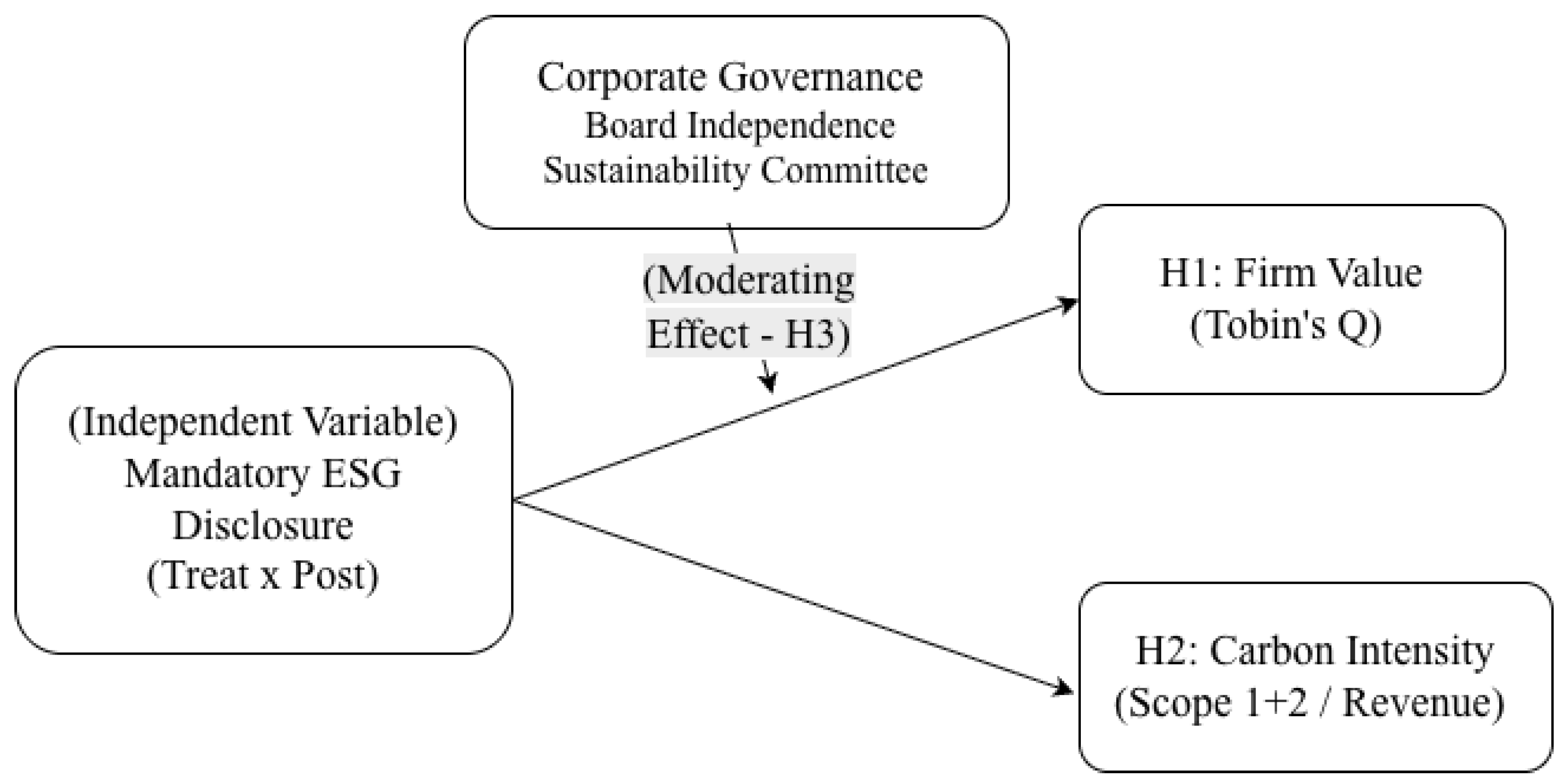
Figure 2.
Timeline of the Regulatory Shock (DiD Design).
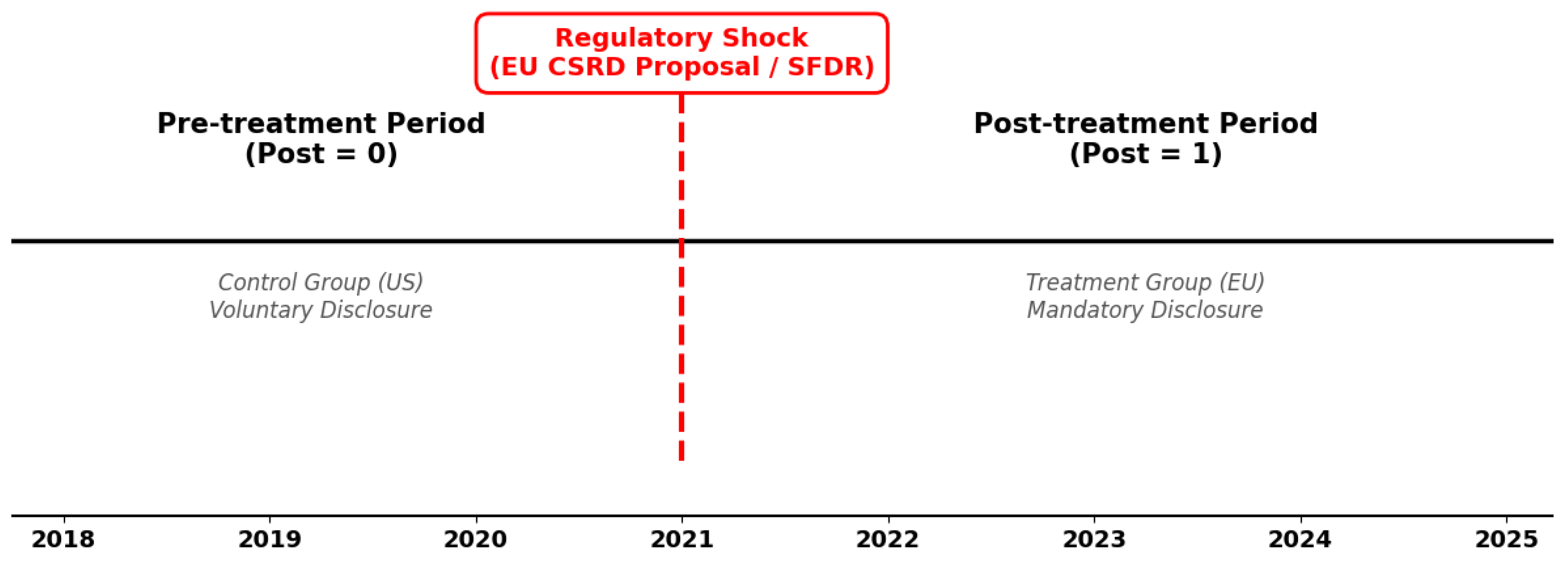
Figure 3.
Moderating Effect of Governance Quality on Carbon Intensity (2018–2025).
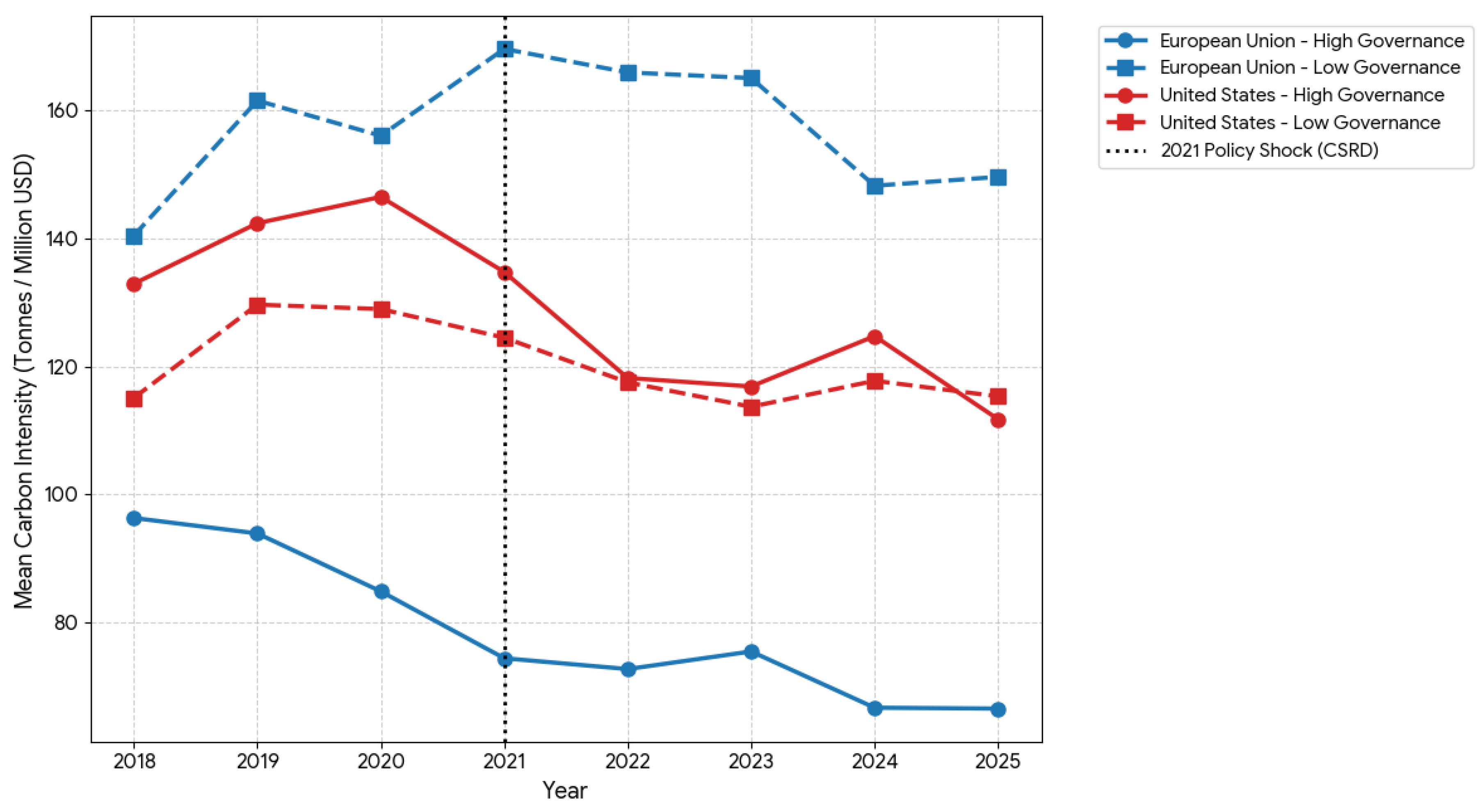
Figure 4.
Event Study Analysis of the Dynamic Impact of Mandatory ESG Disclosure.
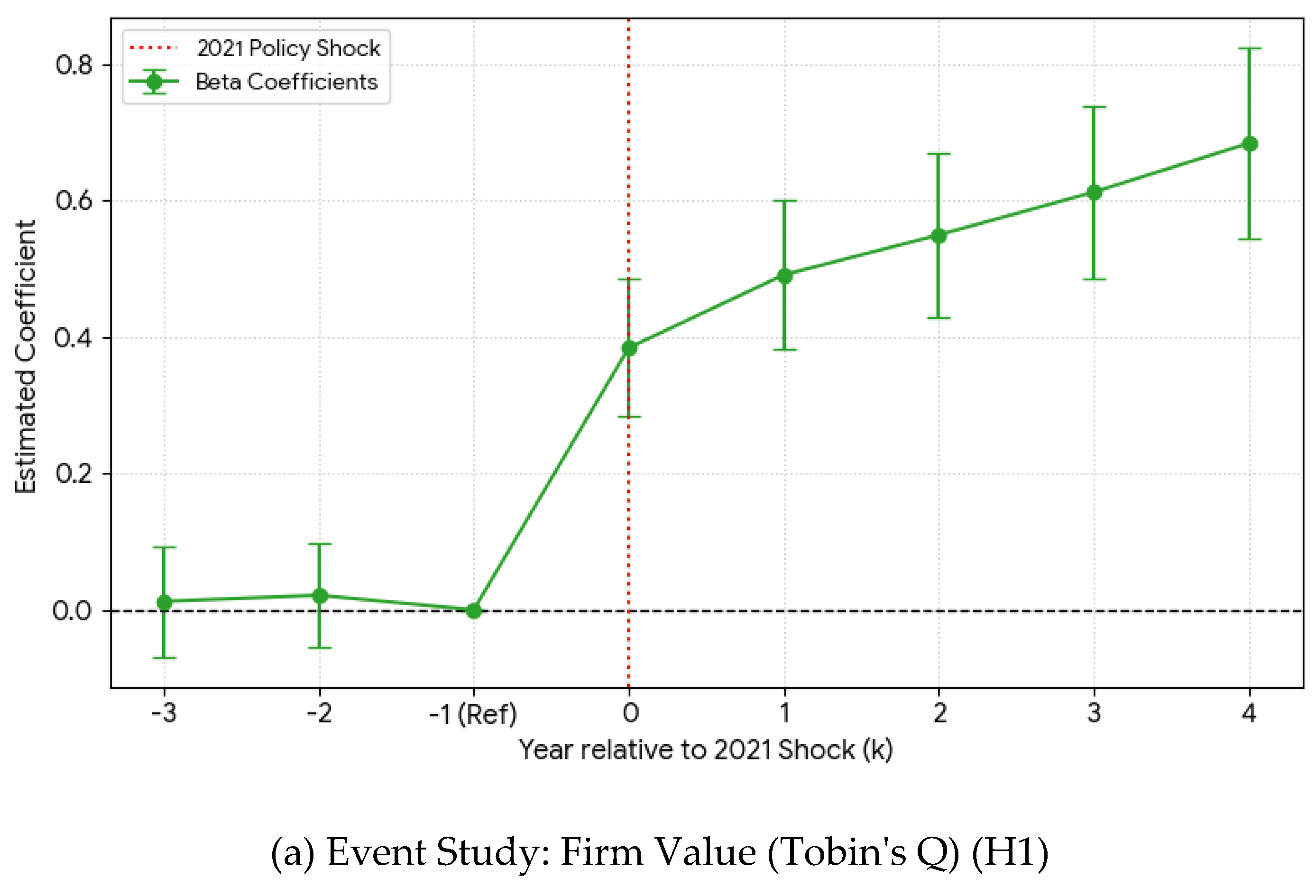
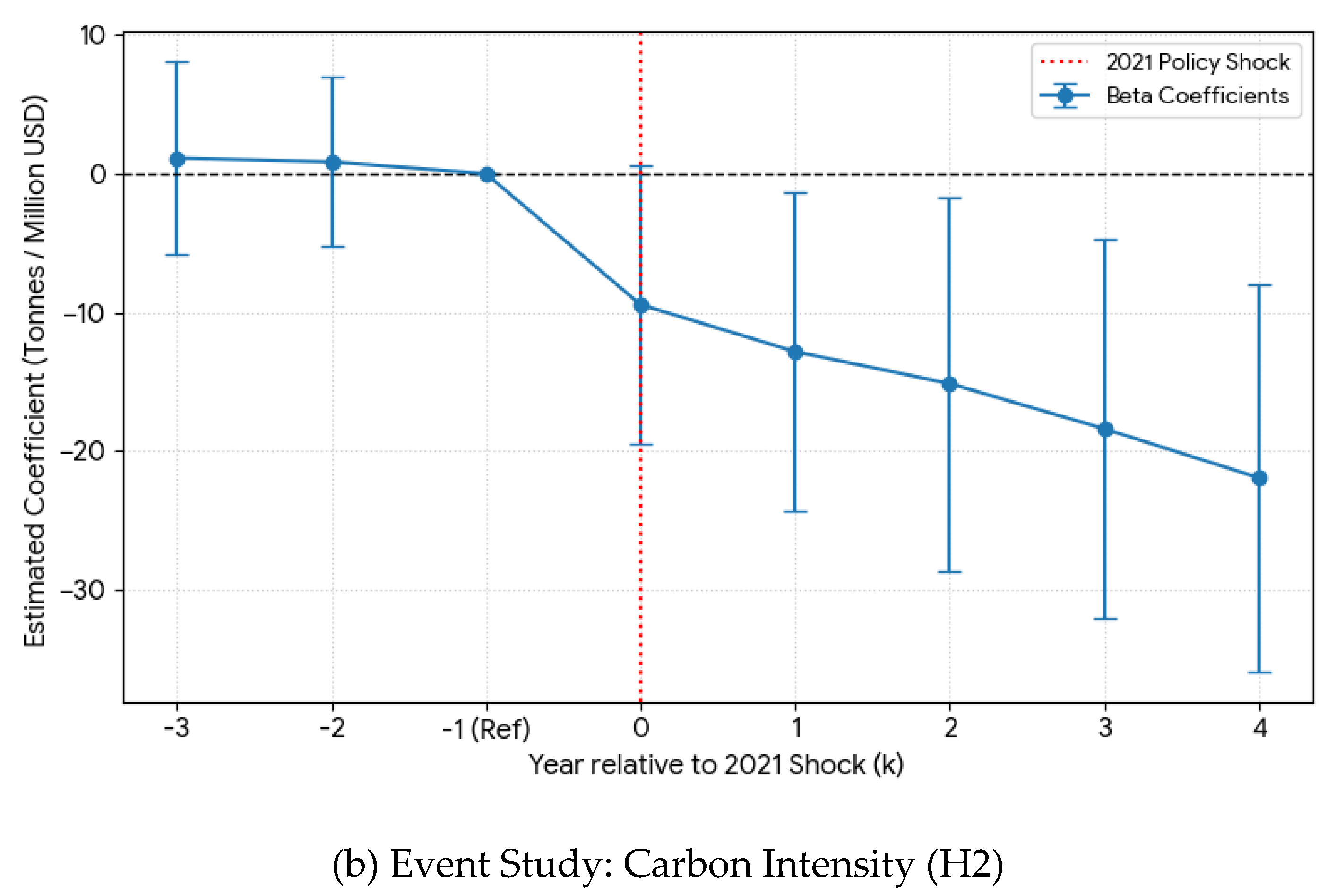
Table 1.
Variable Definitions.
| Type | Variable | Symbol | Definition (Data Source: Refinitiv) |
|---|---|---|---|
| Dependent Variables | Firm Value | TobinQ | |
| Carbon Intensity | |||
| Independent Variables | Treatment | Treat | Dummy variable = 1 if the firm is headquartered in the EU; 0 if in the US |
| Post-Regulation | Post | ; 0 otherwise | |
| Interaction | DiD | (Difference-in-Differences estimator) | |
| Control Variables | Firm Size | Size | |
| Leverage | Lev | ||
| Return on Assets | ROA | ||
| Capital Expenditure | Capex | ||
| Board Independence | Bind | Percentage of independent directors on the board | |
| Sustainability Committee | SustComm | Dummy variable = 1 if the firm has a sustainability/CSR committee; 0 otherwise |
Table 2.
Final Analytical Sample Size by Region (2018–2025).
| Regional Group | Firms with Complete 2018–2025 Data | Percentage of Sample (%) |
|---|---|---|
| European Union (Treatment Group) | 782 | 48.5 |
| United States (Control Group) | 830 | 51.5 |
| Total Analytical Sample | 1,612 | 100.0 |
Table 3.
Top 10 Countries in the Treatment Group.
| Country | Number of Firms | Percentage of Treatment Group (%) |
|---|---|---|
| United Kingdom | 175 | 22.4 |
| Germany | 89 | 11.4 |
| France | 85 | 10.9 |
| Switzerland | 61 | 7.8 |
| Sweden | 57 | 7.3 |
| Spain | 39 | 5.0 |
| Italy | 38 | 4.9 |
| Netherlands | 32 | 4.1 |
| Ireland | 27 | 3.5 |
| Belgium | 24 | 3.1 |
| Denmark | 24 | 3.1 |
Table 6.
Moderating Effects of Corporate Governance on Carbon Intensity (2018–2025).
| Coefficient | Variable Name | (1) Board Independence (H3a) | (2) Sustainability Committee (H3b) |
|---|---|---|---|
| γ₁ | Treat × Post × Gov (Triple Interaction) | −235.5257***(28.4512) | −699.1057***(52.3142) |
| γ₂ | Treat × Post (Baseline DiD) | 207.2010*** | 696.9505*** |
| γ₃ | Post × Gov | 8.4362 | −11.6262 |
| γ₄ | Treat × Gov | 138.4103*** | 508.1537*** |
| γ₅ | Gov (Governance Main Effect) | −16.3030 | 5.0540 |
| γ₆ | Firm Size | −1.1138 | −1.8036 |
| γ₇ | Financial Leverage | 14.1011 | 11.1454 |
| α | Constant | 185.4210*** | 192.1542*** |
| Obs. | Firm-Year Observations | 11,352 | 11,352 |
| R² | Adjusted R-squared | 0.8342 | 0.8415 |
Note: Standard errors are in parentheses. ***, **, and * denote significance at the 1%, 5%, and 10% levels, respectively.
Table 8.
Robustness Checks and Placebo Tests (2018–2025).
| Variable | (1) Tobin’s Q (5% Winsor) | (2) Intensity (5% Winsor) | (3) Placebo Test (Pre-2021) |
|---|---|---|---|
| Treat × Post | 0.5212*** (0.0581) | −14.8562** (6.5410) | 0.0214 (0.0412) |
| Controls | Included | Included | Included |
| Firm Fixed Effects | Yes | Yes | Yes |
| Year Fixed Effects | Yes | Yes | Yes |
| Observations | 12,812 | 11,352 | 4,836 |
| 0.7912 | 0.8245 | 0.0125 |
Notes: Column (3) utilizes a falsified shock year (2019) using only the pre-treatment period (2018–2020) to test the identification strategy. Standard errors are reported in parentheses. ***, **, and * denote statistical significance at the 1%, 5%, and 10% levels, respectively.
Disclaimer/Publisher’s Note: The statements, opinions and data contained in all publications are solely those of the individual author(s) and contributor(s) and not of MDPI and/or the editor(s). MDPI and/or the editor(s) disclaim responsibility for any injury to people or property resulting from any ideas, methods, instructions or products referred to in the content. |
© 2026 by the authors. Licensee MDPI, Basel, Switzerland. This article is an open access article distributed under the terms and conditions of the Creative Commons Attribution (CC BY) license (http://creativecommons.org/licenses/by/4.0/).
Copyright: This open access article is published under a Creative Commons CC BY 4.0 license, which permit the free download, distribution, and reuse, provided that the author and preprint are cited in any reuse.