

Submitted:
07 March 2026
Posted:
10 March 2026
You are already at the latest version
Abstract
Background:
Gynecologic cancers constitute a major public health burden worldwide, with marked regional and temporal variations influenced by demographic changes, healthcare access, and screening practices. In Turkey, contemporary nationwide data capturing recent temporal trends—particularly during the COVID-19 pandemic—remain limited.
Methods:
This nationwide, retrospective observational study integrated six independent gynecologic cancer datasets obtained from the İstinye University Dataset Sharing Platform, comprising 22,468 adult patients (≥18 years) diagnosed between 2014 and 2024 across 33 hospitals in Turkey. Cancer types included ovarian, endometrial, cervical, vulvar, vaginal, and fallopian tube malignancies. Annual case counts were analyzed, and normalized admission rates were calculated per 100,000 unique patient admissions to account for variations in healthcare utilization. Cancer-type–specific analyses and descriptive pandemic-period sensitivity analyses were performed.
Results:
The mean age of the study population was 62.75 ± 13.95 years, with most patients aged over 60 years (60.9%). Ovarian cancer was the most frequent diagnosis (40.8%), followed by endometrial (34.7%) and cervical cancers (20.7%), while rarer malignancies accounted for less than 4% of cases. Annual diagnoses increased progressively from 2014 to 2019, followed by a marked rise in 2020 and a pronounced peak in 2021, during which 30.6% of all cases were recorded. When normalized to total unique patient admissions, gynecologic cancer admission rates ranged from 45.2–55.1 per 100,000 in the pre-pandemic period and peaked sharply in 2021 at 239.1 per 100,000 admissions. Cancer-type–specific normalization revealed parallel temporal patterns across all malignancies, with the most pronounced increases observed for ovarian (104.1 per 100,000) and endometrial cancers (77.4 per 100,000) in 2021. Overall mortality was 2.8%, with a mean survival of 13.13 ± 17.79 months among exitus patients, and no significant differences in survival duration across cancer types.
Conclusions:
This nationwide multicenter analysis demonstrates a substantial increase in gynecologic cancer presentations in Turkey over the past decade, with a pronounced, system-wide surge during the COVID-19 pandemic period. Normalized analyses indicate that this increase exceeded overall healthcare utilization, suggesting pandemic-related diagnostic delays and backlog effects. Continuous surveillance using utilization-adjusted metrics is essential to accurately interpret temporal trends and to guide future cancer control and healthcare resilience strategies.
Keywords:
gynecologic cancers
; cancer prevalence
; temporal trends
; nationwide study
Introduction
Gynecologic cancers, including ovarian, endometrial, cervical, vulvar, vaginal, and fallopian tube malignancies, represent a substantial and heterogeneous burden on women’s health worldwide, with marked variation in incidence, mortality, and survival patterns across regions and over time [1,2]. Population-based registry studies from Europe and Asia have demonstrated divergent temporal trends, reflecting differences in screening practices, reproductive patterns, healthcare access, and cancer control policies [3,4].
Recent analyses from the United Kingdom have shown declining incidence and mortality rates for cervical and ovarian cancers, contrasted by a sustained increase in corpus uteri cancer incidence and mortality, underscoring shifting disease patterns even within well-established healthcare systems [2]. Similarly, population-based data from southeastern China indicate a continuous rise in the incidence of major gynecologic cancers, particularly uterine cancer, alongside increasing mortality trends for cervical and ovarian cancers, highlighting the growing public health challenge in rapidly developing regions [1].
In Turkey, nationwide registry-based data have previously suggested that gynecologic cancer incidence patterns resemble those of European countries rather than Asian populations, with uterine corpus and ovarian cancers being the most common, while cervical cancer incidence remains comparatively low [5]. However, earlier national reports were limited to shorter observation periods and predated recent healthcare system changes and global disruptions, restricting their ability to capture evolving long-term trends.
Beyond incidence, survival outcomes for gynecologic cancers have improved globally over recent decades, particularly for cervical and endometrial cancers, although substantial disparities persist by age, cancer subtype, and geographic region.[6] Mortality analyses from Europe further indicate that while overall gynecologic cancer mortality has declined, uterine cancer mortality is projected to increase in several countries, emphasizing the need for continuous surveillance and targeted prevention strategies [7].
Less common gynecologic malignancies, such as vulvar and vaginal cancers, although accounting for a smaller proportion of cases, predominantly affect older women and have shown increasing incidence over time, particularly in association with human papillomavirus–related disease and demographic shifts [8,9]. Data from Nordic countries further demonstrate that, unlike cervical cancer, vulvar and vaginal cancers lack effective screening programs, resulting in relatively stable incidence but limited survival gains [10].
Despite the growing body of international literature, comprehensive, contemporary, multicenter evaluations of gynecologic cancer trends in Turkey—especially those spanning the period surrounding the COVID-19 pandemic—remain limited. In particular, the impact of healthcare system disruptions on cancer presentation patterns and the relative distribution of gynecologic cancer subtypes over time has not been fully characterized at a national level.
Therefore, the aim of this study was to perform a nationwide comparative assessment of gynecologic cancer trends in Turkey between 2014 and 2024, using multicenter hospital-based data, to evaluate temporal changes in cancer type distribution, age-related patterns, and normalized admission rates, with special attention to variations observed during the COVID-19 pandemic period.
Materials and Methods
Study Design and Data Source
This nationwide, retrospective observational study was conducted using aggregated gynecologic cancer datasets obtained from the İstinye University Dataset Sharing Platform (dataset.istinye.edu.tr). The study integrated six independent datasets, collectively comprising 22,468 adult patients (≥18 years) diagnosed with gynecologic malignancies, derived from 33 hospitals across Turkey. The datasets covered a 10-year period between 2014 and 2024, enabling a comprehensive evaluation of temporal trends in gynecologic cancer epidemiology. All datasets were merged to construct a unified Gynecologic Cancer Prevalence Database for analytical purposes. The primary objective of this study was to assess the distribution of gynecologic cancer types and to examine temporal changes and trends over time, with particular emphasis on year-to-year variations, including the period affected by the COVID-19 pandemic.
The aggregated data used in this study were obtained from six publicly accessible gynecologic cancer datasets hosted on the İstinye University Dataset Sharing Platform. Specifically, the analysis incorporated datasets available at https://dataset.istinye.edu.tr/dataset?did=39, https://dataset.istinye.edu.tr/dataset?did=46, https://dataset.istinye.edu.tr/dataset?did=51, https://dataset.istinye.edu.tr/dataset?did=25, https://dataset.istinye.edu.tr/dataset?did=28, and https://dataset.istinye.edu.tr/dataset?did=31. These datasets were independently curated, fully anonymized, and derived from multiple hospitals, and were merged after variable harmonization to construct the unified Gynecologic Cancer Prevalence Database used for all analyses.
Variables and Data Integration
For each patient, the following variables were extracted and harmonized across datasets: Age, cancer type (cervical, endometrial, fallopian tube, ovarian, vaginal, vulvar), year of diagnosis, age group, exitus status, and survival month. Following extraction, all datasets were standardized and merged into a single analytical database to ensure consistency in variable definitions and coding across sources.
Outcome Measures
The primary outcome of interest was the annual temporal distribution of gynecologic cancer types. To account for variations in overall healthcare utilization across years, a normalized annual admission rate was calculated by dividing the number of gynecologic cancer cases in a given year by the total number of unique patient admissions for the same year. Normalized rates were expressed as cases per 100,000 unique patient admissions and were applied to both overall gynecologic cancer counts and cancer-type–specific analyses. For survival-related analyses, overall survival was evaluated. Patients with an exitus status were analyzed separately, and survival duration in months was calculated exclusively for deceased patients to allow computation of mean overall survival durations while minimizing bias related to censored observations.
Pandemic-Period Sensitivity Analysis
To assess the robustness of observed temporal trends and to contextualize deviations during the COVID-19 pandemic, descriptive sensitivity analyses were performed by comparing pre-pandemic (2014–2019), pandemic (2020–2021), and post-pandemic (2022–2024) periods. Both raw case counts and normalized admission rates were examined to evaluate whether observed peaks reflected changes in overall healthcare utilization or disproportionate shifts in gynecologic cancer presentations.
Statistical Analyses and Tools
All statistical analyses were conducted using Wistats v3.0 (WisdomEra Corp., Istanbul, Turkey), incorporating Python-based libraries including SciPy, scikit-learn, and statsmodels. Data distribution was assessed using skewness, kurtosis, and the Shapiro–Wilk test. Continuous variables were expressed as mean ± standard deviation, while categorical variables were reported as counts and percentages. Group comparisons were performed using the independent samples t-test or Mann–Whitney U test for continuous variables and the Chi-square test or Fisher’s exact test for categorical variables, as appropriate. All statistical tests were two-sided, and a p-value < 0.05 was considered statistically significant.
Results
Study Population and Demographic Characteristics
A total of 22,468 adult patients (≥18 years) diagnosed with gynecologic malignancies between 2014 and 2024 were included in the analysis. The mean age of the study population was 62.75 ± 13.95 years. Most patients were aged >60 years (60.9%), followed by those aged 40–60 years (33.7%), while 5.4% were younger than 40 years. Ovarian cancer constituted the most frequent diagnosis (40.8%), followed by endometrial (34.7%) and cervical cancer (20.7%). Fallopian tube, vaginal, and vulvar cancers together accounted for less than 4% of all cases. Overall mortality during follow-up was 2.8%, with a mean survival of 13.13 ± 17.79 months among exitus patients (Table 1).
Temporal Distribution of Gynecologic Cancer Diagnoses
The annual number of gynecologic cancer diagnoses increased progressively from 2014 to 2019, followed by a marked rise in 2020 and a pronounced peak in 2021, during which 30.6% of all cases were recorded. After 2021, annual case counts declined but remained higher than pre-pandemic levels through 2022–2024 (Table 1).
Normalized Annual Gynecologic Cancer Admission Rates
When annual case counts were normalized to the total number of unique patient admissions, gynecologic cancer admission rates ranged from 45.2 to 55.1 per 100,000 admissions between 2014 and 2019. A notable increase was observed in 2020 (76.9 per 100,000), followed by a sharp peak in 2021 (239.1 per 100,000). Although normalized rates decreased after 2021, they remained elevated compared to pre-pandemic years through 2024 (Table 2, Figure 1).
Comparative 0. Patients with endometrial, vaginal, and vulvar cancers were older on average, whereas cervical and fallopian tube cancer patients were relatively younger. Age group distributions also differed significantly, with a predominance of patients aged >60 years across most cancer types, particularly in endometrial and vulvar cancers. Year-of-diagnosis distributions demonstrated a consistent surge across all cancer types in 2021, with the highest proportional increases observed in ovarian, endometrial, vaginal, and vulvar cancers. Exitus rates differed modestly among cancer types (p < 0.001), while mean survival duration among exitus patients did not differ significantly (p = 0.369) (Table 3).
Cancer-Type–Specific Normalized Trends
Cancer-type–specific normalization revealed a parallel temporal pattern across all gynecologic malignancies. Between 2014 and 2019, normalized admission rates remained relatively stable for each cancer type. In contrast, 2021 exhibited a marked peak across all cancer types, most prominently for ovarian (104.1 per 100,000) and endometrial cancers (77.4 per 100,000). Vaginal, vulvar, and fallopian tube cancers—despite lower absolute case numbers—also demonstrated proportional increases in 2021. Following this peak, normalized rates declined but did not return to pre-pandemic baseline levels by 2024 (Table 4, Figure 2).
Discussion
The present nationwide, multicenter study provides a comprehensive assessment of gynecologic cancer trends in Turkey over a recent 10-year period, integrating data from 33 hospitals and more than 22,000 adult patients. Our primary findings demonstrate a progressive increase in gynecologic cancer diagnoses from 2014 to 2019, followed by a marked and system-wide surge during the COVID-19 pandemic period, peaking in 2021. When adjusted for healthcare utilization, normalized admission rates increased nearly fivefold in 2021 compared with the pre-pandemic period (239.1 vs. 45.2–55.1 per 100,000 admissions), highlighting that the observed peak cannot be explained solely by increased patient volume but reflects a disproportionate rise in gynecologic cancer presentations. Although endometrial cancer is generally more prevalent than ovarian cancer in population-based national and global data, our cohort demonstrated a higher proportion of ovarian cancer diagnoses. This finding should be interpreted with caution, as our dataset does not represent the entire national population but reflects hospital-based prevalence derived primarily from private healthcare institutions. Easier access to specialist care and advanced diagnostic facilities in the private healthcare system may facilitate more frequent detection of ovarian cancer, particularly in symptomatic patients. In contrast, endometrial cancer is often diagnosed across a wider range of healthcare settings, including public and primary care services, which are underrepresented in our dataset. The relatively lower proportion of cervical cancer observed in this study is consistent with previous national reports and may reflect improvements in healthcare delivery in Turkey, approaching standards observed in developed countries. Increased awareness of human papillomavirus infection, along with expanding vaccination and screening efforts, may have contributed to this pattern. However, cervical cancer remains highly prevalent in many developing regions, underscoring the continued importance of vaccination programs, screening strategies, and public health education.
Our findings are broadly consistent with international reports demonstrating long-term increases in gynecologic cancer burden, particularly for ovarian and endometrial cancers. Population-based analyses from Wales and Southeastern China reported divergent temporal patterns across cancer types, with declining ovarian and cervical cancer incidence in some Western regions but rapidly increasing endometrial cancer incidence, especially among older women [1,2]. Similarly, national registry data from Japan documented a several-fold increase in uterine corpus and ovarian cancer incidence over the past four decades, underscoring the global impact of demographic aging and lifestyle-related risk factors [4].
Earlier nationwide data from Turkey suggested that gynecologic cancer incidence patterns more closely resemble those of European countries than Asian populations, with uterine corpus and ovarian cancers being the most common and cervical cancer remaining relatively infrequent [5]. Our study extends these observations into a more contemporary period and confirms that ovarian (40.8%) and endometrial cancers (34.7%) remain the dominant malignancies. Importantly, although cervical cancer constituted a smaller proportion of cases (20.7%), its normalized admission rate followed the same pandemic-related surge observed across all cancer types, indicating that healthcare system dynamics during COVID-19 affected gynecologic oncology broadly rather than selectively.
The mean age of 62.75 years and the predominance of patients aged over 60 years (60.9%) in our cohort align with global evidence that gynecologic cancer burden increases substantially with age. Studies from Europe, Asia, and North America consistently report higher incidence and mortality rates among older women, particularly for endometrial and vulvar cancers [6,9]. In our analysis, patients with endometrial, vulvar, and vaginal cancers were significantly older, whereas cervical and fallopian tube cancers tended to occur at relatively younger ages, mirroring epidemiological patterns reported in Nordic countries and Germany [9,10].
Cancer-type–specific normalization revealed strikingly parallel temporal trends across all gynecologic malignancies. Between 2014 and 2019, normalized rates remained relatively stable, but in 2021 ovarian cancer reached 104.1 per 100,000 admissions and endometrial cancer 77.4 per 100,000 admissions. Even rare malignancies such as vulvar, vaginal, and fallopian tube cancers demonstrated proportional increases despite low absolute numbers. This synchronized pattern across cancer types strongly suggests a shared external driver rather than disease-specific etiologies.
The pronounced 2021 peak coincides temporally with the COVID-19 pandemic and is most plausibly explained by delayed diagnoses, postponed screening and elective care, and subsequent backlog effects once healthcare services resumed. While global studies have primarily focused on long-term incidence and mortality trends [3,11], our utilization-adjusted approach demonstrates that the relative burden of gynecologic cancers increased disproportionately compared with overall healthcare activity during the pandemic. This observation aligns with broader concerns regarding pandemic-related disruptions in cancer detection pathways and delayed presentations.
Overall mortality in our cohort was 2.8%, with a mean survival of 13.13 ± 17.79 months among exitus patients, and no significant differences in survival duration across cancer types. Although survival analyses were limited to deceased patients, global data indicate improving long-term survival for cervical and endometrial cancers, with more modest gains for ovarian cancer, particularly in older populations [6]. Advances in systemic therapies, including immunotherapy and PARP inhibitors, are likely to further influence future survival trends [12].
The observed trends underscore the growing gynecologic cancer burden in Turkey and globally, consistent with projections indicating substantial increases in incidence and mortality over the coming decades [12,13]. Rising endometrial cancer incidence, partly driven by obesity and metabolic risk factors, further emphasizes the need for preventive strategies targeting modifiable risks [14,15,16]. Strengthening cervical cancer screening and HPV vaccination remains essential, particularly in light of persistent global disparities and elimination targets [17].
A pronounced deviation from pre-existing temporal patterns was observed during the COVID-19 pandemic period, with a marked peak in gynecologic cancer diagnoses in 2021. This increase is unlikely to reflect a true abrupt rise in cancer incidence; rather, it is most plausibly explained by pandemic-related disruptions in healthcare delivery. During 2020, routine screening programs, elective outpatient visits, and diagnostic procedures were substantially delayed or suspended, leading to deferred cancer diagnoses across multiple sites. As healthcare services progressively resumed in 2021, a backlog of previously undiagnosed cases was released, resulting in a concentrated surge in recorded diagnoses. Notably, this pattern persisted even after normalization to total unique patient admissions, with rates increasing from 45.2–55.1 per 100,000 admissions in the pre-pandemic period to 239.1 per 100,000 in 2021, indicating that the observed peak cannot be attributed solely to increased healthcare utilization. The concurrent rise across all gynecologic cancer types, including rarer malignancies, further supports a system-wide diagnostic delay and catch-up effect rather than cancer-specific etiological changes. Similar pandemic-related diagnostic rebounds have been reported in population-based cancer surveillance studies from Europe, reinforcing this interpretation [2,7].
Several limitations warrant consideration. First, the retrospective and hospital-based design limits direct estimation of population-level incidence rates and may not fully reflect national epidemiologic patterns. In particular, the study dataset was derived predominantly from private healthcare institutions, which may introduce selection bias related to healthcare access, referral pathways, and diagnostic practices. Patients presenting to private hospitals may differ systematically from those managed in public or primary care settings, potentially influencing the observed distribution of cancer types, especially for malignancies requiring advanced diagnostic evaluation such as ovarian cancer. Second, the absence of detailed clinical variables, including cancer stage, histological subtype, treatment modality, and comorbid conditions, precluded more granular analyses of disease characteristics and outcomes. Third, survival assessment was restricted to patients with exitus status, preventing the use of censored survival modeling and limiting interpretation of long-term survival patterns. Finally, heterogeneity in healthcare delivery and diagnostic intensity during the COVID-19 pandemic across participating centers could not be fully adjusted for, which may have contributed to variability in observed temporal trends.
Conclusions
In conclusion, this nationwide analysis demonstrates a substantial increase in gynecologic cancer presentations in Turkey over the past decade, with ovarian and endometrial cancers comprising the majority of cases. Utilization-adjusted analyses revealed a pronounced, system-wide surge during the COVID-19 pandemic, affecting all gynecologic cancer types. Continuous surveillance using standardized and normalized metrics, combined with strengthened screening, prevention, and healthcare system resilience, is essential to mitigate the future burden of gynecologic cancers.
Author Contributions
Conceptualization: İnci OZ; Methodology: İnci OZ; Investigation: İnci OZ; Resources: İnci OZ; Data Curation: İnci OZ; Writing – Original Draft Preparation: İnci OZ; Writing – Review & Editing: İnci OZ; Supervision: İnci OZ.
Funding
This research received no external funding.
Data Availability Statement
The anonymized dataset used in this study is publicly available through the Istinye University Dataset Sharing Platform and can be accessed at https://dataset.istinye.edu.tr/dataset?did=85. All data were fully anonymized in compliance with ethical regulations and are provided for research use under the platform’s standard data-sharing and licensing policies.
Acknowledgments
The authors thank the Artificial Intelligence Research and Application Center of Istinye University (https://yzaum.istinye.edu.tr/) for technical support during manuscript preparation, including data integrity checks and pre-submission similarity assessment. The authors also acknowledge the Ditako Data Analytics Team (https://ditako.com) for their contribution to the statistical analyses.
Conflicts of Interest
None of the authors has any potential financial conflict of interest related to this manuscript.
References
- Liu, L; Zhou, Y; Lin, J; Xie, N; Yu, H; Deng, S; et al. Trends in incidence and mortality for gynaecological cancers in Southeastern China during 2011-2020: a retrospective analysis of registry data. BMJ Open 2024, 14, e083336. [Google Scholar] [CrossRef] [PubMed]
- Sekar, S; Budithi, S; Fernando, S. Trends in the incidence and mortality of cervical, ovarian, and corpus uteri cancers in Wales, UK: A joinpoint regression analysis from 2002 to 2021. Cancer Epidemiol 2024, 93, 102660. [Google Scholar] [CrossRef] [PubMed]
- Lian, Y; Luo, P. Mortality of Three Major Gynecological Cancers in the European Region: An Age-Period-Cohort Analysis from 1992 to 2021 and Predictions in a 25-Year Period. Ann Glob Health 2025, 91, 30. [Google Scholar] [CrossRef] [PubMed]
- Nakai, H; Higashi, T; Kakuwa, T; Matsumura, N. Trends in gynecologic cancer in Japan: incidence from 1980 to 2019 and mortality from 1981 to 2021. Int J Clin Oncol 2024, 29, 363–71. [Google Scholar] [CrossRef] [PubMed]
- Gultekin, M; Kucukyildiz, I; Karaca, MZ; Dundar, S; Boztas, G; Turan, SH; et al. Trends of Gynecological Cancers in Turkey: Toward Europe or Asia? Int J Gynecol Cancer Off J Int Gynecol Cancer Soc 2017, 27, 1525–33. [Google Scholar] [CrossRef] [PubMed]
- Zhou, XH; Yang, DN; Zou, YX; Tang, DD; Chen, J; Li, ZY; et al. Long-Term Survival Trend of Gynecological Cancer: A Systematic Review of Population-Based Cancer Registration Data. Biomed Environ Sci BES 2024, 37, 897–921. [Google Scholar] [CrossRef] [PubMed]
- Lian, Y; Luo, P. Mortality of Three Major Gynecological Cancers in the European Region: An Age-Period-Cohort Analysis from 1992 to 2021 and Predictions in a 25-Year Period. Ann Glob Health 2025, 91, 30. [Google Scholar] [CrossRef] [PubMed]
- Olawaiye, AB; Cuello, MA; Rogers, LJ. Cancer of the vulva: 2021 update. Int J Gynaecol Obstet Off Organ Int Fed Gynaecol Obstet 2021, 155 Suppl 1, 7–18. [Google Scholar] [CrossRef] [PubMed]
- Dittmer, C; Katalinic, A; Mundhenke, C; Thill, M; Fischer, D. Epidemiology of vulvar and vaginal cancer in Germany. Arch Gynecol Obstet 2011, 284, 169–74. [Google Scholar] [CrossRef] [PubMed]
- Hemminki, K; Kanerva, A; Försti, A; Hemminki, A. Cervical, vaginal and vulvar cancer incidence and survival trends in Denmark, Finland, Norway and Sweden with implications to treatment. BMC Cancer 2022, 22, 456. [Google Scholar] [CrossRef] [PubMed]
- Zhu, B; Gu, H; Mao, Z; Beeraka, NM; Zhao, X; Anand, MP; et al. Global burden of gynaecological cancers in 2022 and projections to 2050. J Glob Health 2024, 14, 04155. [Google Scholar] [CrossRef] [PubMed]
- Emons, J; Gocke, J; Schulmeyer, C; Stübs, FA; Krückel, A; Amann, N; et al. Update Gynecologic Malignancies 2025 - Expert Opinion on Systemic Therapy for Early and Advanced Gynecological Cancers. Geburtshilfe Frauenheilkd 2025, 85, 736–45. [Google Scholar] [CrossRef] [PubMed]
- Duan, R; Zhang, H; Yu, J; Deng, S; Yang, H; Zheng, Y-T; et al. Temporal trends and projections of gynecological cancers in China, 2007-2030. BMC Womens Health 2023, 23, 346. [Google Scholar] [CrossRef] [PubMed]
- Wijayabahu, AT; Shiels, MS; Arend, RC; Clarke, MA. Uterine cancer incidence trends and 5-year relative survival by race/ethnicity and histology among women under 50 years. Am J Obstet Gynecol 2024, 231, 526.e1–526.e22. [Google Scholar] [CrossRef] [PubMed]
- Rodriguez, VE; Tanjasiri, SP; Ro, A; Hoyt, MA; Bristow, RE; LeBrón, AMW. Trends in endometrial cancer incidence in the United States by race/ethnicity and age of onset from 2000 to 2019. Am J Epidemiol 2025, 194, 103–13. [Google Scholar] [CrossRef] [PubMed]
- Zhao, X; Kong, W; Jiang, Y; Sui, F. Current and future burden of gynecological cancers attributable to high body-mass index: A comprehensive global analysis and projection study. PloS One 2025, 20, e0333281. [Google Scholar] [CrossRef] [PubMed]
- Son, Y; Hong, S; Jang, W; Kim, S; Lee, H; Lee, S; et al. Global, regional, and national burden of cervical cancer in 2022 and projections to 2050: a population-based analysis of GLOBOCAN. Int J Gynecol Cancer Off J Int Gynecol Cancer Soc 2026, 36, 102751. [Google Scholar] [CrossRef] [PubMed]
Figure 1.
Temporal trend of normalized gynecologic cancer admissions (2014–2024). Figure 1 illustrates the annual normalized gynecologic cancer admission rates between 2014 and 2024. Annual case counts were divided by the total number of unique patient admissions for each corresponding year and expressed as cases per 100,000 unique patient admissions to account for variations in overall healthcare utilization. Between 2014 and 2019, normalized admission rates remained relatively stable, ranging from approximately 45 to 55 per 100,000 admissions. A moderate increase was observed in 2020, followed by a pronounced peak in 2021, during which normalized admission rates reached 239.1 per 100,000 admissions. Although rates declined after 2021, they remained consistently higher than pre-pandemic levels through 2024.
Figure 2.
Cancer-type–specific normalized gynecologic cancer trends by year (2014–2024). Figure 2 presents cancer-type–specific normalized admission rates for cervical, endometrial, fallopian tube, ovarian, vaginal, and vulvar cancers between 2014 and 2024. For each cancer type, annual case counts were normalized to the total number of unique patient admissions in the corresponding year and expressed per 100,000 admissions. All gynecologic cancer types demonstrated relatively stable normalized rates during the pre-pandemic period (2014–2019), followed by a marked and concurrent surge in 2021. The most pronounced increases were observed for ovarian cancer (104.1 per 100,000 admissions) and endometrial cancer (77.4 per 100,000 admissions), while rarer malignancies such as vaginal, vulvar, and fallopian tube cancers also showed proportional increases despite lower absolute case numbers. After 2021, normalized rates declined across all cancer types but did not return to pre-pandemic baseline levels by 2024.
Figure 2.
Cancer-type–specific normalized gynecologic cancer trends by year (2014–2024). Figure 2 presents cancer-type–specific normalized admission rates for cervical, endometrial, fallopian tube, ovarian, vaginal, and vulvar cancers between 2014 and 2024. For each cancer type, annual case counts were normalized to the total number of unique patient admissions in the corresponding year and expressed per 100,000 admissions. All gynecologic cancer types demonstrated relatively stable normalized rates during the pre-pandemic period (2014–2019), followed by a marked and concurrent surge in 2021. The most pronounced increases were observed for ovarian cancer (104.1 per 100,000 admissions) and endometrial cancer (77.4 per 100,000 admissions), while rarer malignancies such as vaginal, vulvar, and fallopian tube cancers also showed proportional increases despite lower absolute case numbers. After 2021, normalized rates declined across all cancer types but did not return to pre-pandemic baseline levels by 2024.
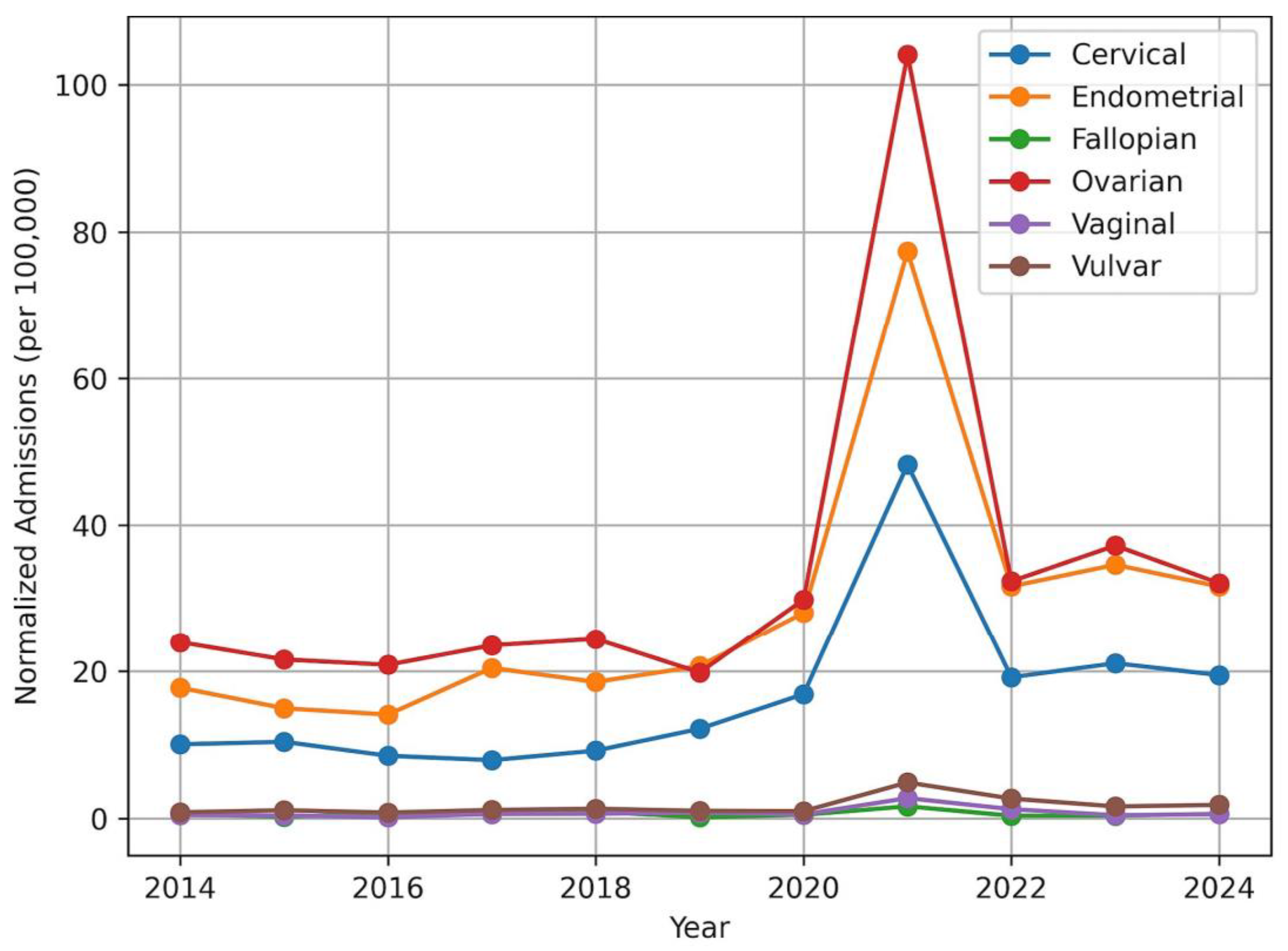

Table 1.
Demographic Characteristics of Gynecologic Cancer Patients.
| Variables | Cases Mean ± SD, N (%) |
|---|---|
| Age | 62.75 ± 13.95 n= 22468 |
| Age Group | |
| 18 - 40 | 1211 (5.4%) |
| 40 - 60 | 7573 (33.7%) |
| > 60 | 13684 (60.9%) |
| CancerType | |
| cervical cancer | 4646 (20.7%) |
| endometrial cancer | 7789 (34.7%) |
| fallopian tube cancer | 164 (0.7%) |
| ovarian cancer | 9173 (40.8%) |
| vaginal cancer | 225 (1.0%) |
| vulvar cancer | 471 (2.1%) |
| Year of Diagnosis | |
| 2014 | 693 (3.1%) |
| 2015 | 773 (3.4%) |
| 2016 | 769 (3.4%) |
| 2017 | 1021 (4.5%) |
| 2018 | 1154 (5.1%) |
| 2019 | 1196 (5.3%) |
| 2020 | 1744 (7.8%) |
| 2021 | 6873 (30.6%) |
| 2022 | 2677 (11.9%) |
| 2023 | 2884 (12.8%) |
| 2024 | 2684 (11.9%) |
| Exitus Status | |
| No | 21844 (97.2%) |
| Yes | 624 (2.8%) |
| Overall Survival For Exitus Patients (months) | 13.13 ± 17.79 n= 563 |
Table 2.
Normalized Annual Gynecologic Cancer Admission Rates.
| Year | Gynecologic Cancer Cases (n) | Annual Unique Patient Admissions (n) | Normalized Cancer Admission Rate (per 100,000) |
|---|---|---|---|
| 2014 | 693 | 1,289,817 | 53.7 |
| 2015 | 773 | 1,583,468 | 48.8 |
| 2016 | 769 | 1,700,543 | 45.2 |
| 2017 | 1,021 | 1,878,278 | 54.4 |
| 2018 | 1,154 | 2,093,384 | 55.1 |
| 2019 | 1,196 | 2,182,777 | 54.8 |
| 2020 | 1,744 | 2,267,602 | 76.9 |
| 2021 | 6,873 | 2,874,999 | 239.1 |
| 2022 | 2,677 | 3,055,568 | 87.6 |
| 2023 | 2,884 | 3,021,390 | 95.5 |
| 2024 | 2,684 | 3,108,271 | 86.4 |
Table 3.
Descriptive and Comparative Characteristics of Patients According to Gynecologic Cancer Type.
Table 3.
Descriptive and Comparative Characteristics of Patients According to Gynecologic Cancer Type.
| Variables | cervical cancer Mean ± SD, N (%) |
endometrial cancer Mean ± SD, N (%) |
fallopian tube cancer Mean ± SD, N (%) |
ovarian cancer Mean ± SD, N (%) |
vaginal cancer Mean ± SD, N (%) |
vulvar cancer Mean ± SD, N (%) |
p |
|---|---|---|---|---|---|---|---|
| Age | 58.78 ± 13.86 n= 4646 |
65.63 ± 12.34 n= 7789 |
59.54 ± 13.51 n= 164 |
62.10 ± 14.51 n= 9173 |
65.52 ± 14.26 n= 225 |
66.82 ± 17.08 n= 471 |
<0.001 |
| Age Group | |||||||
| 18 - 40 | 369 (7.9%) | 187 (2.4%) | 20 (12.2%) | 587 (6.4%) | 8 (3.6%) | 40 (8.5%) | |
| 40 - 60 | 2093 (45.0%) | 2042 (26.2%) | 56 (34.1%) | 3230 (35.2%) | 62 (27.6%) | 90 (19.1%) | |
| > 60 | 2184 (47.0%) | 5560 (71.4%) | 88 (53.7%) | 5356 (58.4%) | 155 (68.9%) | 341 (72.4%) | |
| Year of Diagnosis | |||||||
| 2014 | 130 (2.8%) | 229 (2.9%) | 8 (4.9%) | 309 (3.4%) | 6 (2.7%) | 11 (2.3%) | |
| 2015 | 165 (3.6%) | 237 (3.0%) | 4 (2.4%) | 342 (3.7%) | 7 (3.1%) | 18 (3.8%) | |
| 2016 | 145 (3.1%) | 240 (3.1%) | 12 (7.3%) | 355 (3.9%) | 3 (1.3%) | 14 (3.0%) | |
| 2017 | 149 (3.2%) | 384 (4.9%) | 12 (7.3%) | 442 (4.8%) | 12 (5.3%) | 22 (4.7%) | |
| 2018 | 193 (4.2%) | 388 (5.0%) | 20 (12.2%) | 511 (5.6%) | 14 (6.2%) | 28 (5.9%) | |
| 2019 | 266 (5.7%) | 452 (5.8%) | 4 (2.4%) | 433 (4.7%) | 18 (8.0%) | 23 (4.9%) | |
| 2020 | 383 (8.2%) | 636 (8.2%) | 12 (7.3%) | 677 (7.4%) | 13 (5.8%) | 23 (4.9%) | |
| 2021 | 1387 (29.9%) | 2225 (28.6%) | 48 (29.3%) | 2992 (32.6%) | 80 (35.6%) | 141 (29.9%) | |
| 2022 | 586 (12.6%) | 968 (12.4%) | 12 (7.3%) | 989 (10.8%) | 39 (17.3%) | 83 (17.6%) | |
| 2023 | 637 (13.7%) | 1046 (13.4%) | 12 (7.3%) | 1125 (12.3%) | 14 (6.2%) | 50 (10.6%) | |
| 2024 | 605 (13.0%) | 984 (12.6%) | 20 (12.2%) | 998 (10.9%) | 19 (8.4%) | 58 (12.3%) | |
| Exitus | <0.001 | ||||||
| No | 4546 (97.8%) | 7596 (97.5%) | 164 (100.0%) | 8859 (96.6%) | 220 (97.8%) | 459 (97.5%) | |
| Yes | 100 (2.2%) | 193 (2.5%) | 0 (0.0%) | 314 (3.4%) | 5 (2.2%) | 12 (2.5%) | |
| Overall Survival For Exitus Patients (months) | 13.07 ± 16.22 n= 89 |
12.35 ± 18.28 n= 175 |
n= 0 |
13.74 ± 18.27 n= 285 |
23.70 ± 13.15 n= 2 |
8.67 ± 9.66 n= 12 |
0.369 |
Table 4.
Cancer-Type–Specific Normalized Annual Admission Rates (per 100,000 Admissions).
| Year | Cervical | Endometrial | Fallopian Tube | Ovarian | Vaginal | Vulvar |
|---|---|---|---|---|---|---|
| 2014 | 10.1 | 17.8 | 0.62 | 24.0 | 0.47 | 0.85 |
| 2015 | 10.4 | 15.0 | 0.25 | 21.6 | 0.44 | 1.14 |
| 2016 | 8.5 | 14.1 | 0.71 | 20.9 | 0.18 | 0.82 |
| 2017 | 7.9 | 20.4 | 0.64 | 23.5 | 0.64 | 1.17 |
| 2018 | 9.2 | 18.5 | 0.96 | 24.4 | 0.67 | 1.34 |
| 2019 | 12.2 | 20.7 | 0.18 | 19.8 | 0.82 | 1.05 |
| 2020 | 16.9 | 28.0 | 0.53 | 29.9 | 0.57 | 1.01 |
| 2021 | 48.2 | 77.4 | 1.67 | 104.1 | 2.78 | 4.90 |
| 2022 | 19.2 | 31.7 | 0.39 | 32.4 | 1.28 | 2.72 |
| 2023 | 21.1 | 34.6 | 0.40 | 37.2 | 0.46 | 1.65 |
| 2024 | 19.5 | 31.7 | 0.64 | 32.1 | 0.61 | 1.87 |
Disclaimer/Publisher’s Note: The statements, opinions and data contained in all publications are solely those of the individual author(s) and contributor(s) and not of MDPI and/or the editor(s). MDPI and/or the editor(s) disclaim responsibility for any injury to people or property resulting from any ideas, methods, instructions or products referred to in the content. |
© 2026 by the authors. Licensee MDPI, Basel, Switzerland. This article is an open access article distributed under the terms and conditions of the Creative Commons Attribution (CC BY) license (http://creativecommons.org/licenses/by/4.0/).
Copyright: This open access article is published under a Creative Commons CC BY 4.0 license, which permit the free download, distribution, and reuse, provided that the author and preprint are cited in any reuse.


