

Submitted:
09 March 2026
Posted:
10 March 2026
You are already at the latest version
Abstract
Living history tourism is traditionally framed through heritage preservation and edu-cational interpretation, yet the motivational mechanisms translating visitor engage-ment into behavioral commitment remain insufficiently theorized. This study develops and tests an integrated structural model conceptualizing living history environments as experiential systems operating under conditions of late-modern acceleration. Data were collected from 1,066 visitors at Skansen (Sweden) and analyzed using structural equation modeling. The findings indicate that detachment-oriented motives signifi-cantly activate experiential immersion, which emerges as the central psychological mechanism within the model. Immersion strengthens perceptions of historical authen-ticity and constitutes the dominant predictor of behavioral intention, whereas educa-tional motives exert a comparatively weaker effect. Mediation analysis demonstrates that the influence of escape on behavioral commitment operates indirectly through immersion, confirming a fully mediated experiential pathway. These results suggest that living history destinations function not primarily as didactic heritage platforms but as structured experiential environments enabling temporary disengagement from routine pressures. By integrating immersion, authenticity construction, and behavioral intention within a unified framework, the study repositions living history tourism as an experiential counter-space embedded in accelerated modernity.
Keywords:
living history tourism
; experiential immersion
; pastoral escape
; historical authenticity
; experiential regulation
; social acceleration
; behavioral intention
; structural equation modeling
1. Introduction
Living history tourism occupies a distinctive position at the intersection of heritage preservation, authenticity performance, and experiential interpretation [1]. Open-air museums, reconstructed historical villages, and immersive heritage environments seek to move beyond the display of artifacts toward the recreation of historically situated life-worlds through embodied demonstration, communal interaction, and performative practices [2]. Within this domain, scholarly attention has traditionally centered on authenticity [3], staged experiential environments [4], and the pedagogical value of heritage interpretation [5]. Living history sites have therefore been widely conceptualized as platforms for cultural transmission, historical education, and identity reinforcement [6]. Despite this extensive scholarship, the underlying motivational architecture of participation in living history environments remains insufficiently theorized. Much of the existing literature implicitly assumes that visitor engagement is primarily driven by learning motives, cultural interest, or nostalgia [7,8]. At the same time, broader tourism research increasingly demonstrates that affective immersion and embodied engagement play decisive roles in shaping behavioral outcomes [9]. What remains less systematically examined is how detachment-oriented motivations—such as the desire to temporarily disengage from modern routine—interact with immersive processes and authenticity perception in living history contexts.
This question gains further relevance in light of contemporary societal conditions. Late-modern environments are frequently characterized by temporal acceleration, digital saturation, and intensified performance demands [10]. Within such acceleration regimes, leisure experiences may function as structured opportunities for experiential recalibration alongside their recreational dimension [11]. As acceleration, digital saturation, and routine intensification characterize contemporary societies globally, understanding how leisure environments operate as regulatory spaces becomes increasingly relevant beyond specific cultural contexts [12]. While research on tourism has acknowledged escape as a motivational dimension [13], empirical models that integrate escape motives, immersive engagement, authenticity construction, educational enrichment, and behavioral intention into a unified structural framework remain limited in the living history domain.
The present study addresses this gap by developing and empirically testing a structural model that conceptualizes living history participation as a sequential experiential process. The proposed framework posits that detachment-oriented motives (Pastoral Escape) activate immersive engagement; immersion reinforces perceptions of historical authenticity; and these experiential mechanisms, together with educational motives, shape behavioral intention. By examining both direct and mediated pathways, the study seeks to clarify whether immersion functions as the central psychological mechanism translating motivational antecedents into behavioral commitment. Accordingly, the primary aim of this study is to examine whether experiential immersion functions as the central regulatory mechanism linking detachment-oriented motives to behavioral commitment in living history tourism.
In doing so, the research contributes to three interconnected theoretical discussions. First, it refines understanding of authenticity by examining whether authenticity perception primarily derives from heritage attributes or emerges through experiential immersion. Second, it evaluates the relative structural strength of educational motives compared to immersive engagement, thereby reassessing pedagogical assumptions in living history tourism. Third, it investigates whether escape-oriented motives exert direct behavioral influence or operate indirectly through immersion, testing the hierarchical organization of motivational drivers. To empirically assess the proposed framework, the study was conducted at Skansen, one of the oldest and most internationally recognized open-air museums [14]. Characterized by reconstructed historical environments, live craft demonstrations, and community-based performative interpretation, Skansen represents a paradigmatic example of living history tourism [15]. Its experiential configuration provides an appropriate empirical setting for examining the interplay between detachment motivations, immersive engagement, authenticity perception, and behavioral intention.
Beyond its theoretical objectives, the study is additionally informed by ongoing discussions regarding the potential development of living history environments in contexts where such models remain underrepresented. Examining visitor motivations within a mature and internationally established setting enables a more precise understanding of the structural drivers that may inform heritage development in emerging contexts. By identifying the relative strength of escape, immersion, authenticity, and educational motives, the findings provide empirically grounded insights into the experiential conditions that shape visitor commitment in living history environments. By validating this integrated structural model within a prototypical living history setting, the study seeks to reposition living history tourism within a broader experiential and socio-temporal context. Rather than viewing such destinations solely as custodians of the past or vehicles of cultural education, the research advances a theoretically grounded explanation of how contemporary visitors transform motivational impulses into sustained behavioral commitment.
2. Literature Review and Hypothesis Development
2.1. Escape Motives and Experiential Immersion
Escape has long been identified as a foundational motivational dimension in tourism research [16,17]. Traditionally conceptualized as a temporary withdrawal from routine environments, escape reflects psychological detachment from everyday obligations and centers on the regulation of everyday pressures [18]. Within contemporary socio-temporal conditions characterized by social acceleration, digital saturation, and intensified performance expectations [10], the desire for detachment may acquire heightened relevance. Under such circumstances, tourism experiences can function as structured interruptions of routine temporal regimes [19,20]. Living history destinations offer environments marked by slower rhythms, embodied interaction, and performative reconstruction of pre-industrial lifeworlds [6]. Unlike conventional sightseeing settings centered on visual consumption, these environments emphasize participation, co-presence, and material engagement. Experiential immersion—defined as a state of absorbed engagement in which attention is focused on the unfolding environment [4,21] —may therefore represent the experiential mechanism through which escape motives are enacted. Although escape has frequently been examined as a direct predictor of travel intention, its role as an antecedent of immersive engagement within heritage contexts remains comparatively underexplored. If detachment-oriented motives seek experiential resolution rather than mere physical displacement, they are likely to stimulate deeper engagement within environments designed for embodied participation. Accordingly, escape motives are expected to positively influence immersion in living history settings.
H1.
Pastoral Escape positively influences Experiential Immersion.
2.2. Living Heritage, Community Vitality, and Immersion
Living history tourism differs fundamentally from static heritage presentation in its reliance on performative enactment and socially embedded interpretation [22]. Rather than positioning heritage as a set of preserved artifacts, living history environments reconstruct historically situated lifeworlds through embodied demonstrations, craft production, interpersonal interaction, and community-based performance [23]. Such environments foreground social presence and co-temporal participation, reducing the experiential distance between visitor and historical narrative [24]. Within the experience economy framework, immersion intensifies when individuals transition from passive observation to active experiential co-presence [4]. Similarly, research in heritage and dark tourism suggests that embodied participation enhances emotional and cognitive absorption by situating visitors within enacted environments rather than detached viewing positions [9]. Performative interaction [25] thus becomes a structural feature that shapes the depth of experiential engagement. Community vitality—expressed through live demonstrations, human interaction, and visible social continuity—may therefore function as an immersion-enhancing mechanism [26,27,28]. By encountering historical practices enacted in real time, visitors are exposed to dynamic social processes rather than static representations [29]. This performative immediacy is likely to increase situational absorption and attentional focus, thereby strengthening immersive states. Accordingly, the presence of living heritage and community vitality is expected to positively influence experiential immersion.
H2.
Living Heritage and Community Vitality positively influence Experiential Immersion.
2.3. Performative Authenticity and Experiential Construction
Authenticity has occupied a central position in heritage tourism theory [30]. Objectivist perspectives define authenticity in terms of the genuineness and historical integrity of artifacts [31], whereas constructivist approaches conceptualize authenticity as socially negotiated and experientially constituted [3]. Within living history environments, authenticity emerges through embodied enactment, social interaction, and narrative framing, with material originality representing only one dimension of its construction [32]. Performative heritage elements—such as live craft demonstrations, historically situated routines, and community-based enactments—may directly influence authenticity perception by conveying continuity with historical lifeworlds [33,34,35]. Through visible performance and social presence, visitors encounter history as enacted practice rather than static display. This performative dimension reduces abstraction and may strengthen perceptions of historical credibility [36]. At the same time, experiential immersion may further intensify authenticity judgments. When visitors become cognitively and emotionally absorbed in an environment, evaluative assessments are embedded within lived engagement rather than detached observation [37,38]. Research indicates that perceived authenticity is strengthened when individuals experience heightened emotional involvement and situational absorption [39]. From this perspective, authenticity is not merely signaled through performance but amplified through immersion. Accordingly, authenticity perception in living history settings may derive from both performative heritage exposure and immersive experiential depth.
H3.
Living Heritage and Community Vitality positively influence Perceived Historical Authenticity.
H4.
Experiential Immersion positively influences Perceived Historical Authenticity.
2.4. Immersion, Authenticity, and Behavioral Intention
Behavioral intention in tourism research is consistently linked to experiential depth and affective engagement [40]. Experiences characterized by heightened absorption, emotional activation, and personal involvement are more likely to generate revisit intention and positive word-of-mouth [9]. Within the experience economy framework [41], immersion represents a state of deep engagement in which individuals become attentively and emotionally embedded in the unfolding environment [4]. Such states enhance memorability and perceived significance, thereby strengthening behavioral commitment. If immersion reflects the degree to which visitors are experientially integrated into a living history environment, it should function as a central predictor of intention [42]. Behavioral commitment is therefore conceptualized as emerging through the intensity of experiential absorption, where engagement with heritage content operates within a broader immersive process [43,44]. Authenticity has likewise been associated with behavioral outcomes in heritage tourism contexts. Perceived authenticity may reinforce meaningfulness, credibility, and experiential value, thereby contributing to revisit intention and loyalty [45]. However, the structural relationship between authenticity and behavioral intention remains theoretically nuanced. Authenticity may operate as an independent predictor, or it may derive part of its behavioral influence from its interaction with immersive engagement. To clarify the relative contribution of immersive states and authenticity perception within living history settings, the following hypotheses are proposed:
H5.
Experiential Immersion positively influences Behavioral Intention.
H6.
Perceived Historical Authenticity positively influences Behavioral Intention.
2.5. Educational Motives Within Experiential Contexts
Educational and cultural enrichment have historically constituted central normative justifications for living history tourism [46]. Museums and open-air heritage environments are frequently framed as sites of informal learning, historical interpretation, and cultural transmission [47]. Within such perspectives, visitor engagement is often understood as being guided by cognitive motives related to knowledge acquisition and cultural appreciation [48]. However, experiential economy theory conceptualizes learning as one dimension embedded within broader experiential structures rather than as an autonomous driver of engagement [4]. In immersive environments, educational value may be integrated into participatory experience, functioning as a complementary rather than dominant motivational force [49]. Research in heritage tourism further suggests that cognitive enrichment frequently interacts with affective and experiential dimensions in shaping behavioral responses [50]. If living history environments are structurally organized around immersive participation, educational motives are expected to contribute to behavioral intention while occupying a secondary position relative to experiential absorption. Empirically examining this relationship clarifies the structural placement of cognitive motives within the broader motivational architecture.
H7.
Educational and Cultural Enrichment positively influence Behavioral Intention.
2.6. Mediation and Hierarchical Structure of Motivational Drivers
Motivational processes in tourism are frequently conceptualized as sequential rather than purely direct [17]. Push motives such as escape may initiate travel behavior, yet their influence on behavioral commitment may depend on intervening experiential mechanisms [51,52,53]. Within living history contexts, detachment-oriented motivations may not directly generate revisit intention; rather, they may require experiential activation through immersion [54,55]. If immersion represents a state of absorbed engagement in which visitors become cognitively and affectively integrated into the environment, it may serve as the transformative conduit linking detachment to commitment. In such a configuration, escape motives exert their behavioral influence indirectly, through immersive engagement.
H8.
Experiential Immersion mediates the relationship between Pastoral Escape and Behavioral Intention.
Beyond mediation, the proposed framework also implies a hierarchical organization of motivational drivers [56]. If immersion constitutes the central psychological mechanism within the experiential sequence, its influence on behavioral intention should exceed that of cognitive motives such as educational enrichment [57]. Establishing this comparative strength clarifies whether living history participation is primarily driven by experiential absorption or by learning-oriented motivations.
H9.
The positive effect of Experiential Immersion on Behavioral Intention is stronger than the positive effect of Educational and Cultural Enrichment.
Finally, a more stringent test of this hierarchical structure concerns the residual effect of escape when immersion is included in the model. If immersion fully absorbs the behavioral influence of detachment-oriented motives, the direct path from escape to intention should become non-significant once immersion is specified as a mediator [58,59]. Such a pattern would indicate that immersion functions as the necessary mechanism translating detachment into commitment.
H10.
When Experiential Immersion is included in the model, the direct effect of Pastoral Escape on Behavioral Intention becomes non-significant.
3. Materials and Methods
The empirical research was conducted at Skansen, Sweden, between March 2025 and March 2026, covering a full annual operational cycle in order to account for seasonal variation in visitor profiles and experiential programming. Skansen is one of the oldest open-air museums in Europe and functions as a prototypical living history environment. Established to present historical lifeworlds through reconstructed settings and performative interpretation, it integrates relocated buildings from different regions of Sweden, working farms, craft demonstrations, seasonal events, and representations of everyday life across historical periods. Unlike static museum exhibitions, Skansen operates through continuous enactment of historical practices. Visitors encounter not only preserved architecture but also live demonstrations, community interaction, agricultural activity, and material culture in use [60]. This performative and socially embedded structure makes Skansen particularly suitable for examining experiential immersion, authenticity perception, and motivational dynamics within a living heritage context. With approximately 1.3–1.4 million visitors annually, Skansen represents a high-volume, mature heritage destination with diverse visitor segments, including domestic and international tourists [61]. Its scale, interpretive diversity, and continuous programming provide a robust empirical setting for testing a multidimensional structural model encompassing escape motivations, immersion, authenticity, educational enrichment, living heritage, and behavioral intention.
Data were collected through an anonymous, self-administered questionnaire distributed on-site to visitors during their visit. Collection occurred across different days of the week and across multiple seasonal periods to reduce temporal sampling bias. Participation was voluntary, and respondents were informed about the academic nature of the study, data confidentiality, and anonymity. No personal identifying information was recorded. A total of 1,066 valid questionnaires were retained for analysis after data screening procedures. The sample size exceeds commonly recommended thresholds for structural equation modeling and supports stable estimation of both measurement and structural parameters. The large number of respondents also allows for robust testing of mediation and comparative effects within the proposed framework. The socio-demographic structure of visitors to Skansen in Stockholm reveals a population concentrated in younger and middle adult cohorts, with individuals aged 25–34 (25.7%) and 35–44 (23.4%) forming the dominant segments, followed by those aged 18–24 (18.5%). In aggregate, more than two-thirds of respondents fall between 18 and 44 years of age, indicating that the site’s living history format resonates primarily with economically active and culturally mobile generations. The comparatively modest representation of visitors above the age of 55 (13.8% combined) suggests that the immersive and participatory character of the environment aligns more closely with contemporary experience-oriented leisure practices than with more traditional patterns of heritage visitation. Gender distribution remains statistically balanced (51.5% female; 48.5% male), pointing to a socially inclusive space without pronounced gender segmentation.
The educational profile of visitors is particularly pronounced. A majority of respondents (55.6%) hold a university degree, while 37.7% report secondary education and only 6.7% primary education. This structure indicates a highly educated audience and implies a substantial presence of cultural capital within the visitor base. Engagement with reconstructed historical settings, craft practices, seasonal events, and interpretative narratives therefore appears embedded in cognitively oriented cultural participation rather than in purely recreational attendance. The dominance of tertiary-educated visitors suggests sensitivity to authenticity cues, historical contextualization, and symbolic meaning-making processes. Geographically, Skansen operates simultaneously as a nationally embedded heritage landmark and an internationally recognized cultural destination. Domestic visitors from Sweden account for 32.5% of the sample, confirming its strong integration within the national leisure landscape. At the same time, significant proportions originate from Germany (11.3%), Norway (11.0%), Denmark (8.1%), Finland (7.9%), and the United States (10.3%), complemented by visitors from the Netherlands, the United Kingdom, France, and Italy. This distribution reflects both regional cultural proximity within Northern Europe and broader transnational mobility patterns. The presence of North American and Western European visitors underscores its visibility within global heritage circuits rather than confinement to domestic tourism flows. Collectively, the findings delineate a visitor structure characterized by generational concentration in early and mid-adulthood, high educational attainment, and geographically diversified yet regionally anchored participation. The data position Skansen within contemporary patterns of culturally capitalized, experience-driven heritage engagement, where immersion, mobility, and interpretative depth converge within a living history setting.
The questionnaire originally consisted of 48 items measuring six latent constructs derived from established theoretical traditions in tourism motivation, experiential consumption, authenticity theory, museum learning, and behavioral intention research. Instrument development followed a deductive approach grounded in prior literature, with contextual adaptation to reflect the specific characteristics of living history environments. Where possible, items were adapted from validated scales in tourism and heritage research. In cases where direct adaptation was not feasible, items were constructed to reflect theoretically established dimensions while maintaining conceptual consistency with prior scholarship and ensuring contextual relevance to the Skansen setting. The construct of experiential immersion was theoretically anchored in experience economy theory [4], flow theory [21], and research on embodied engagement in tourism contexts. It was conceptualized as absorbed engagement within historically staged environments and operationalized through items capturing temporal absorption, vivid engagement, emotional connection, active participation, sensory stimulation, temporary detachment from the modern world, experiential atmosphere, and perceived time transport. This multidimensional operationalization enabled immersion to be treated as experiential integration rather than mere enjoyment or satisfaction.
Perceived historical authenticity was informed by constructivist authenticity theory [3] and empirical heritage tourism research [45]. Consistent with a constructivist orientation, the scale extended beyond object originality to assess evaluative perceptions of historical credibility, architectural authenticity, realism of demonstrations, natural presentation, material authenticity, atmospheric genuineness, preservation of historical detail, and historical accuracy. Authenticity was thus treated as a perceptual judgment shaped by environmental cues and interpretive framing rather than as an objective property of artifacts. Educational enrichment was derived from museum learning theory [47] and experiential learning perspectives. The construct captured perceived cognitive and reflective outcomes of the visit, including meaningful learning, increased understanding of historical lifestyles, acquisition of cultural knowledge, heritage appreciation, understanding of traditional skills, intellectual stimulation, cultural awareness, and insight into everyday historical life. In this framework, education was operationalized as perceived cognitive enrichment embedded within experience rather than as formal instruction.
The pastoral escape construct was grounded in tourism motivation theory [16,17] and contextualized within contemporary discussions of social acceleration [10]. The scale incorporated both traditional escape dimensions and elements reflecting modern overload. Items assessed peaceful detachment, enjoyment of nature, rural attraction, restorative experience, appreciation of simplicity, outdoor motivation, landscape enhancement, perceived modern overload, routine disconnection, slowed pace of life, digital escape, and mental reset. This broader operationalization conceptualized escape as experiential withdrawal from contemporary routine rather than as simple leisure preference. Living heritage was operationalized to reflect performative authenticity and community vitality. Drawing from experiential participation frameworks [4] and literature on embodied heritage engagement, the scale measured perceptions of traditional performance, working environments, staff interaction, living community atmosphere, daily-life demonstrations, realism of ongoing work, and the human element in shaping the experience. Heritage was therefore treated as enacted social practice rather than static preservation.
Behavioral intention was measured using established tourism behavioral constructs capturing future-oriented commitment. The scale assessed intention to visit similar living history sites, recommendation intention, active seeking of comparable heritage experiences, extended engagement in similar environments, and prioritization of such attractions in future travel planning. All items were measured using a five-point Likert scale ranging from 1 (strongly disagree) to 5 (strongly agree). The scale format was selected to balance respondent clarity with sufficient variance for structural modeling. The questionnaire was initially developed in English and administered in a linguistically appropriate version to ensure comprehension among both domestic and international visitors. Prior to full-scale data collection, the instrument was pilot-tested to evaluate clarity, contextual appropriateness, and content validity. Minor wording adjustments were implemented to improve interpretability while preserving theoretical meaning and construct integrity. Following pilot testing and refinement procedures, the final measurement model retained 32 items across six latent constructs.
Data analysis was conducted using structural equation modeling (SEM) with maximum likelihood estimation. The analytical procedure followed a staged validation logic. Initially, descriptive statistics were examined in order to assess distributional properties and central tendencies of the observed variables. An exploratory factor analysis (EFA) was then performed to evaluate the dimensional structure of the measurement items and to identify potential cross-loadings prior to confirmatory testing. Subsequently, confirmatory factor analysis (CFA) was applied to validate the measurement model and to assess overall model fit, factor loadings, and construct structure. Reliability and convergent validity were evaluated using composite reliability (CR) and average variance extracted (AVE), while discriminant validity was assessed through the Fornell–Larcker criterion and the heterotrait–monotrait (HTMT) ratio. To address potential common method bias arising from the use of a self-reported survey, a common latent factor (CLF) approach was implemented. Following validation of the measurement model, the structural model was estimated to examine global fit indices and to test the hypothesized relationships among constructs. Standardized path coefficients were evaluated to determine the magnitude and significance of direct effects. Mediation effects were assessed using bootstrapping procedures with bias-corrected confidence intervals. Finally, the explanatory power of the model was examined through coefficients of determination (R2) for endogenous constructs.
4. Results
The Kaiser–Meyer–Olkin (KMO) measure of sampling adequacy is .975, indicating excellent sampling adequacy and a high proportion of shared variance among variables. Values above .90 are considered indicative of superb factorability, suggesting that the correlation matrix is appropriate for latent structure detection. Bartlett’s Test of Sphericity is statistically significant (χ2(1128) = 35320.933, p < .001), rejecting the null hypothesis that the correlation matrix is an identity matrix. This result confirms that inter-item correlations are sufficiently large to justify factor extraction. Collectively, these diagnostics support the suitability of the dataset for exploratory factor analysis and subsequent structural modeling.
As shown in Table 1, six factors with initial eigenvalues greater than 1.0 were retained according to the Kaiser criterion using maximum likelihood extraction. The initial solution indicates that the first factor accounts for 31.95% of the total variance. The second and third factors explain an additional 13.39% and 11.37% of variance, respectively, resulting in a cumulative 56.71% prior to extraction refinement. Following maximum likelihood extraction, the six-factor solution explains 61.79% of the total variance. Although the sixth factor exhibits a post-extraction eigenvalue below 1.0, its retention was supported by scree plot inspection and its theoretical coherence within the conceptual framework. The first extracted factor accounts for 31.15% of the variance, while subsequent factors contribute progressively smaller proportions. In behavioral research, cumulative explained variance exceeding 60% is generally considered satisfactory under maximum likelihood extraction. The results therefore support the adequacy of the six-factor structure and justify progression to confirmatory factor analysis.
Table 2 presents the pattern matrix obtained through oblique rotation, revealing a clearly differentiated six-factor structure corresponding to Experiential Immersion, Pastoral Escape, Educational Enrichment, Living Heritage, Perceived Historical Authenticity, and Behavioral Intention. The loading pattern demonstrates strong factorial clarity, with all primary loadings exceeding .70, indicating substantial shared variance between indicators and their respective latent constructs. Experiential Immersion is defined by loadings ranging from .716 to .796, capturing temporal absorption, vivid engagement, active participation, sensory stimulation, and experiential detachment from everyday routine. The consistency and magnitude of these coefficients indicate a coherent experiential dimension centered on embodied and affective involvement. Pastoral Escape displays equally robust loadings (.783–.814), reflecting psychological detachment from modern life, routine disconnection, and restorative motivations. The tight clustering of these indicators suggests a well-defined escape-oriented construct.
Educational Enrichment emerges as a distinct cognitive dimension, with loadings between .786 and .826. Items related to meaningful learning, lifestyle understanding, heritage appreciation, and intellectual stimulation load strongly and exclusively on this factor, confirming its conceptual independence from affective immersion and escape motivations. Living Heritage is characterized by strong loadings (.754–.845), particularly the “Human Element” indicator (.845), underscoring the centrality of performative interaction and lived demonstration in shaping perceptions of authenticity and engagement. Perceived Historical Authenticity shows highly stable loadings (.761–.792), indicating that architectural integrity, material authenticity, historical credibility, and accuracy converge into a tightly structured evaluative dimension. Finally, Behavioral Intention is defined by consistently high loadings (.749–.775), confirming internal coherence of future-oriented behavioral commitment. Cross-loadings are negligible and remain well below interpretative concern thresholds, indicating clear empirical differentiation among constructs. The absence of substantial secondary loadings indicates that the factors are empirically distinguishable despite theoretical proximity. Overall, the pattern matrix supports a stable multidimensional architecture in which affective, cognitive, experiential, authenticity-based, and behavioral dimensions remain conceptually aligned yet statistically distinct. This factorial clarity provides a robust empirical foundation for subsequent confirmatory factor analysis and structural modeling in a high-impact research context.
The measurement model demonstrates very good overall fit to the data. The chi-square statistic is non-significant (χ2(449) = 472.186, p = .217), and the normed chi-square ratio (χ2/df = 1.052) is well below recommended thresholds, indicating minimal discrepancy between the observed and model-implied covariance matrices. Absolute fit indices support model adequacy: RMR is low (.025), while GFI (.974) and AGFI (.969) exceed conventional cut-off values, indicating strong representation of the data structure. The RMSEA is .007 (90% CI [.000, .013]; PCLOSE = 1.000), indicating close approximate fit and very low residual error. Incremental fit indices are consistently high (NFI = .978, RFI = .976, IFI = .999, TLI = .999, CFI = .999), substantially exceeding the .95 benchmark and demonstrating that the specified model fits the data considerably better than the independence model. Parsimony-adjusted indices (PNFI = .885; PCFI = .904) indicate that good fit is maintained while preserving model parsimony. Information criteria (AIC, BIC, ECVI) are markedly lower for the default model compared to the independence model, further supporting the adequacy of the specified model. Hoelter’s critical N values (1127 at .05; 1177 at .01) indicate adequate sample size for stable model estimation. Overall, the measurement model exhibits a stable and well-specified factorial structure with minimal residual variance and strong absolute and comparative fit.
As shown in Table 3, all constructs demonstrate strong internal consistency, with Composite Reliability (CR) values ranging from 0.878 to 0.919, well above the recommended threshold of 0.70. This confirms a high level of internal coherence among indicators within each latent construct. Average Variance Extracted (AVE) values range from 0.613 to 0.653, exceeding the 0.50 criterion for convergent validity. These results indicate that each construct accounts for more than half of the variance in its respective indicators. Overall, the values presented in Table 3 provide evidence of satisfactory reliability and convergent validity.
As shown in Table 4, the square roots of AVE (displayed on the diagonal) are higher than the corresponding inter-construct correlations in all cases. The highest observed correlation (between Experiential Immersion and Behavioral Intention, r = 0.76) remains below their respective √AVE values (0.802). Similarly, correlations between Perceived Historical Authenticity and Experiential Immersion (0.69), as well as between Perceived Historical Authenticity and Behavioral Intention (0.67), remain below the square roots of AVE for the respective constructs. These results indicate that each construct shares more variance with its own indicators than with other latent variables, supporting adequate discriminant validity according to the Fornell–Larcker criterion.
As shown in Table 5, the majority of HTMT values fall below the conservative threshold of 0.85, supporting discriminant validity among most latent constructs. The highest value appears between Experiential Immersion and Behavioral Intention (0.95), exceeding the conservative criterion and approaching the liberal cut-off of 0.90, indicating substantial conceptual proximity. Given the theoretical linkage between immersive experience and behavioral outcomes, this elevated association is not unexpected; however, it suggests a strong structural relationship between the constructs. The HTMT value between Experiential Immersion and Perceived Historical Authenticity (0.86), as well as between Perceived Historical Authenticity and Behavioral Intention (0.85), slightly exceed or approach the conservative threshold, reflecting theoretical relatedness within the experiential framework. Overall, while certain construct pairs demonstrate high associations, the pattern of results—considered alongside the Fornell–Larcker criterion and CFA factor structure—indicates that the constructs remain empirically distinguishable within the measurement model.
Taken together, the results reported in Table 4 and Table 5 confirm that the latent constructs are empirically distinct despite theoretical proximity among some dimensions. The measurement model therefore provides overall support for discriminant validity, considered in conjunction with the Fornell–Larcker criterion and CFA results, and supports the structural integrity of the proposed factorial framework.
As illustrated in Figure 1, the structural model depicts standardized path coefficients among the six latent constructs, with all hypothesized relationships estimated using maximum likelihood procedures. The diagram visually confirms the directional structure of the model, highlighting Experiential Immersion as the central mediating mechanism linking motivational antecedents (Pastoral Escape and Living Heritage) to evaluative and behavioral outcomes. The magnitude of standardized coefficients displayed in the figure corresponds directly to the estimates reported in Table 6, demonstrating coherent alignment between the graphical and tabular representations of the model. The structural model demonstrates satisfactory global fit (χ2(457) = 476.27, p = .258), indicating no significant discrepancy between the observed and model-implied covariance matrices. All hypothesized direct relationships are statistically significant (p < .001), supporting the proposed structural configuration. Pastoral Escape exerts a strong positive effect on Experiential Immersion (β = 0.623, C.R. = 19.20), indicating that motivations related to detachment from modern routine substantially increase immersive engagement. Living Heritage also significantly predicts Experiential Immersion (β = 0.424, C.R. = 14.89), though its effect is notably weaker than that of escape-based motives. Together, these findings suggest that immersion is primarily driven by experiential detachment rather than solely by heritage exposure.
Living Heritage further demonstrates a direct positive influence on Perceived Historical Authenticity (β = 0.410, C.R. = 13.53). However, Experiential Immersion exerts a stronger effect on authenticity perception (β = 0.512, C.R. = 16.01), indicating that authenticity is reinforced not only by heritage characteristics but also by the depth of experiential engagement. Regarding behavioral outcomes, Experiential Immersion emerges as the dominant predictor of Behavioral Intention (β = 0.571, C.R. = 14.07). Perceived Historical Authenticity also contributes significantly (β = 0.271, C.R. = 7.27), although with a more moderate effect size. Educational Enrichment shows a positive yet comparatively weaker influence on Behavioral Intention (β = 0.100, C.R. = 4.12), suggesting that educational motives play a secondary role in predicting future engagement. Overall, as visually summarized in Figure 1 and detailed in Table 6, Behavioral Intention is predominantly driven by Experiential Immersion, which exhibits the strongest standardized effect in the model. Perceived Historical Authenticity functions as a complementary pathway that translates immersive engagement into behavioral commitment, while Educational Enrichment demonstrates a comparatively modest—though statistically significant—contribution. The structural configuration therefore positions immersive engagement as the central mechanism within the motivational architecture.
The mediation hypothesis (H8) proposed that Experiential Immersion mediates the relationship between Pastoral Escape and Behavioral Intention. As reported in Table 7, the results support this assumption. Pastoral Escape exerts a strong positive effect on Experiential Immersion (β = 0.623, p < .001), while Experiential Immersion significantly predicts Behavioral Intention (β = 0.571, p < .001). Bootstrapping analysis indicates that the indirect effect of Pastoral Escape on Behavioral Intention through Experiential Immersion is statistically significant (β = 0.356), as the 95% bias-corrected confidence interval [0.290, 0.465] does not include zero. These findings suggest that the influence of Pastoral Escape operates primarily through immersive experiential mechanisms rather than through a direct behavioral pathway. Accordingly, H8 is supported. H9 proposed a comparative relationship, suggesting that the effect of Experiential Immersion on Behavioral Intention is stronger than that of Educational Enrichment. As shown in Table 7, while Educational Enrichment has a positive and statistically significant effect on Behavioral Intention (β = 0.100, p < .001), its magnitude is substantially weaker than the effect of Experiential Immersion (β = 0.571, p < .001). The difference in standardized coefficients indicates that immersion-based motivation constitutes the dominant behavioral driver within the model. Therefore, H9 is supported.
To further examine the mediation structure, H10 tested whether the direct effect of Pastoral Escape on Behavioral Intention becomes non-significant when Experiential Immersion is included in the model. As indicated in Table 7, once Experiential Immersion is specified as a mediator, the direct path from Pastoral Escape to Behavioral Intention becomes non-significant, while the indirect pathway remains significant. This pattern is consistent with full (indirect-only) mediation. Accordingly, H10 is supported. Taken together, the results reported in Table 7 indicate that Behavioral Intention is primarily generated through experiential immersion mechanisms. Escape-based motives translate into behavioral commitment through immersive engagement, whereas educational motives play a comparatively secondary role.
As shown in Table 8, the model demonstrates substantial explanatory power across all endogenous constructs. Experiential Immersion exhibits an R2 of 0.58, indicating that more than half of its variance is explained by its antecedents. Perceived Historical Authenticity shows an R2 value of 0.67, suggesting strong predictive capacity of immersive and heritage-related drivers. Behavioral Intention reaches an R2 of 0.72, indicating that the proposed structural configuration explains a large proportion of variance in the final outcome variable. These values indicate strong explanatory capacity of the overall structural model.
5. Discussion
The confirmed structural model enables a meaningful reinterpretation of living history tourism. Rather than positioning such destinations primarily as sites of heritage preservation or educational transmission, the validated relationships (H1–H10) suggest that they function as experiential environments that respond to the pressures of contemporary modern life. The model demonstrates a coherent motivational process in which detachment-oriented motives activate immersive engagement; immersion strengthens perceptions of authenticity; and immersion, together with authenticity, translates into behavioral commitment. This configuration can be interpreted in light of Rosa’s [10] theory of social acceleration, which describes late-modern societies as characterized by increasing temporal pressure, digital saturation, and fragmented routines. Within such conditions, environments that offer slower rhythms, embodied interaction, and analog experiences may serve as temporary counterbalances to acceleration. The strong structural role of immersion supports the idea that living history destinations provide not only cultural representation but also experiential depth. Furthermore, the findings extend the experience economy framework [4] by demonstrating that immersion operates as a central psychological mechanism rather than merely as a design feature of staged environments. At the same time, the relationship between immersion and authenticity perception aligns with Wang’s [3] constructivist authenticity theory, suggesting that authenticity is reinforced through experiential engagement rather than being solely embedded in historical artifacts.
Importantly, the comparatively secondary role of educational motives indicates that learning enhances the experience but does not constitute its primary behavioral driver. Living history tourism therefore appears to function less as a didactic platform and more as an experiential space in which visitors temporarily disengage from routine pressures and reorient their attention toward embodied participation. Taken together, the findings suggest that living history environments may operate as structured experiential counter-spaces within accelerated modern societies. They do not reject modernity, nor do they simply reproduce nostalgia. Instead, they provide controlled settings in which individuals can momentarily step outside contemporary temporal regimes and engage in slower, socially embedded modes of interaction. This reframing expands the theoretical scope of living history research by linking heritage tourism to broader discussions of modernity, experience, and socio-temporal regulation.
5.1. Escape as the Primary Activation Mechanism
The confirmation of H1 positions Pastoral Escape as a foundational antecedent of Experiential Immersion. Motivations grounded in detachment from modern routine appear to function as activation triggers that propel visitors into deeper experiential engagement. Rather than representing simple leisure preferences, these motives suggest a desire to step outside the temporal pressures and cognitive saturation that increasingly characterize contemporary life. This interpretation aligns with Rosa’s [10] theory of social acceleration, which describes late-modern societies as marked by temporal compression, digital hyper-connectivity, and persistent performance demands. Within such contexts, individuals may experience forms of modernity fatigue manifested through routine overload and fragmented attention. Living history environments, with their slower rhythms, embodied practices, and tactile interaction, provide structured counter-temporal settings that contrast with accelerated everyday life. In this light, the confirmed relationship in H1 suggests that escape functions not merely as recreational preference but as an experiential response to acceleration regimes. Living history destinations become spaces of temporary disengagement from contemporary performance logics, enabling visitors to reorient attention toward embodied presence and social interaction. Immersion, therefore, is activated not by heritage exposure alone but by the desire to withdraw—however briefly—from modern temporal intensity.
5.2. The Living Element as an Amplifier of Immersion
The confirmation of H2 indicates that Living Heritage and Community Vitality significantly intensify immersive engagement. The presence of performative actors, active demonstration, and socially embedded interaction strengthens visitors’ experiential involvement beyond what static heritage display alone can achieve. This finding is consistent with experiential consumption theory [4], which emphasizes participation, interaction, and staged authenticity as central drivers of engagement. However, the present model advances this perspective by demonstrating that the “living element” does more than create entertainment value. It structurally reinforces immersion by converting observation into embodied participation. When heritage is enacted rather than exhibited, visitors are not merely spectators but situational participants within a socially animated environment. This transformation from passive viewing to relational engagement enhances experiential depth and contributes to the immersive quality of the setting. In this sense, Living Heritage operates as an amplification mechanism. It strengthens the transition from initial detachment motives to sustained immersion by embedding visitors within interactive, socially meaningful contexts. The findings therefore suggest that community vitality and performative presence are not peripheral enhancements, but central structural components in generating immersive experience.
5.3. Performative Authenticity
The joint confirmation of H3 and H4 provides one of the most conceptually significant insights of the study. While Living Heritage and Community Vitality directly contribute to Perceived Historical Authenticity (H3), immersion exerts a comparatively stronger influence on authenticity perception (H4). This structural configuration reinforces Wang’s [3] constructivist authenticity framework, which distinguishes existential authenticity from purely object-based authenticity. The findings suggest that authenticity in living history contexts is not simply embedded in material artifacts or architectural accuracy, but is intensified through experiential depth. In this sense, authenticity emerges less as a static attribute of preserved heritage and more as a relational outcome of embodied participation. When visitors become immersed in socially animated, performative environments, authenticity is experienced rather than merely observed. The living element provides contextual grounding, yet immersion activates the perceptual transformation that renders the environment authentic in experiential terms. This interpretation challenges objectivist heritage perspectives that treat authenticity as an intrinsic property of historical objects. Instead, the results align with relational and performative understandings of authenticity, in which meaning is co-constructed through interaction, presence, and experiential engagement. Living history environments thus do not simply display authenticity; they facilitate its experiential production.
5.4. Immersion as the Central Behavioral Mechanism
The confirmation of H5 establishes Experiential Immersion as the central psychological mechanism within the structural framework. Behavioral intention appears to arise primarily from immersive experiential states rather than from heritage exposure or cognitive appreciation alone. This aligns with broader tourism scholarship indicating that affective and experiential engagement exert stronger influence on behavioral outcomes than purely informational or evaluative processes [9]. Within the present model, immersion operates as the transformative bridge between motivational antecedents and future-oriented commitment. Detachment-oriented motives and performative heritage elements do not directly generate behavioral intention; instead, they acquire behavioral relevance once translated into immersive engagement. Immersion thus functions as the mechanism through which experiential intensity consolidates into intention. Conceptually, this reinforces the idea that living history tourism is driven less by passive consumption of cultural representation and more by embodied experiential absorption. The centrality of immersion suggests that behavioral commitment emerges from the depth of engagement—how fully individuals become situated within the experience—rather than from the mere presence of heritage attributes. In this sense, immersion is not an ancillary dimension of the experience; it is the structural engine that converts motivation into action.
5.5. Authenticity as a Secondary Transmission Channel
The confirmation of H6 further refines the structural logic of the model by demonstrating that Perceived Historical Authenticity contributes to Behavioral Intention. However, within the validated configuration, authenticity operates as a reinforcing transmission channel rather than as the primary behavioral driver. Its influence appears contingent upon prior immersive engagement, suggesting that authenticity strengthens intention once experiential depth has already been established. This sequence indicates that evaluative judgments follow experiential states. Visitors first become immersed; authenticity is subsequently perceived and cognitively articulated. In this sense, authenticity does not initiate behavioral commitment but consolidates it. The experiential state precedes evaluative confirmation, and authenticity functions to legitimize and stabilize the immersive experience in reflective terms. Conceptually, this positioning aligns with constructivist understandings of authenticity [3], while clarifying its structural role within the behavioral pathway. Authenticity remains significant and meaningful, yet it does not operate independently of immersion. Instead, it amplifies behavioral outcomes by translating embodied engagement into evaluative assurance. Living history environments, therefore, generate intention not simply because they are authentic, but because immersion renders authenticity experientially salient.
5.6. Educational Motives as a Secondary Layer
The confirmation of H7, considered alongside the comparative hierarchy established in H9, provides an important theoretical refinement of motivational dynamics in living history tourism. Educational and Cultural Enrichment remains a meaningful contributor to behavioral intention; however, it does not occupy a dominant structural position within the model. Its influence is present but secondary, suggesting that cognitive motives support rather than initiate engagement. This finding invites reconsideration of pedagogical interpretations that position learning as the primary driver of participation in living history environments. While educational value is clearly embedded in such destinations, the structural configuration indicates that cognitive enrichment operates within a broader experiential architecture. Visitors may learn, reflect, and acquire knowledge, yet these processes appear to gain behavioral relevance when situated within immersive engagement. In this sense, the results extend Pine and Gilmore’s [4] experience economy framework by clarifying that learning enhances experiential depth but does not independently generate commitment. Educational motives function as an integrative layer that complements immersion rather than competing with it. Living history tourism, therefore, cannot be reduced to a didactic encounter; instead, it represents an experiential environment in which cognitive enrichment is embedded within embodied participation.
5.7. The Mediation Architecture: Experiential Regulation
The mediation hypotheses (H8–H10) articulate the structural core of the model and clarify the mechanism through which motivational forces are translated into behavioral commitment. The confirmation that Experiential Immersion mediates the relationship between Pastoral Escape and Behavioral Intention (H8), together with the disappearance of the direct escape–behavior pathway when immersion is included (H10), establishes immersion as the indispensable transformative mechanism within the framework. Escape-oriented motives do not directly generate behavioral commitment; rather, their influence becomes behaviorally consequential only when converted into immersive engagement. This mediation architecture supports a broader interpretation of living history tourism as a form of experiential regulation. Detachment motives are not autonomous endpoints; they seek resolution through immersion. It is within immersive states that experiential recalibration occurs, enabling visitors to temporarily reorganize their engagement with time, routine, and social presence. In this sense, immersion functions as the regulatory conduit through which modern detachment is transformed into meaningful experiential involvement. The confirmed motivational hierarchy (H9) further consolidates this interpretation. By demonstrating that immersion exerts a stronger behavioral influence than educational enrichment, the model positions immersive engagement as the dominant pathway of action formation. Educational motives remain relevant, yet they do not structurally mediate the escape–behavior relationship. Immersion thus emerges as the central integrative mechanism that absorbs detachment impulses, reinforces authenticity perception, and ultimately consolidates behavioral intention.
5.8. Living History as Experiential Counter-Space
Taken together, the confirmed hypotheses support the interpretation of living history destinations as structured experiential counter-spaces within late-modern acceleration regimes. The validated model demonstrates that detachment-oriented motives activate immersive engagement; immersion operates as the central psychological mechanism; authenticity is reinforced through experiential depth; educational motives assume a secondary structural role; and behavioral intention emerges through mediated experiential processes. This configuration suggests that visitor motivation is not primarily cognitive, nor predominantly nostalgic, but regulatory in nature. In this sense, living history tourism can be understood as an experiential response to modern acceleration [10]. Rather than functioning solely as repositories of preserved heritage or platforms for pedagogical transmission, such environments provide temporally decelerated settings characterized by embodied interaction and communal performance. These features contrast with the fragmentation, digital saturation, and performance pressure associated with contemporary life. Immersion becomes the mechanism through which temporary withdrawal from routine intensity is enacted.
Importantly, this interpretation does not imply therapeutic claims in a clinical sense. Instead, it positions immersion as a form of experiential recalibration—a structured process through which visitors reorganize their relationship to time, attention, and social presence. Within this framework, authenticity aligns with Wang’s [3] constructivist perspective as relational and phenomenologically intensified through participation, while experiential engagement extends Pine and Gilmore’s [4] thesis by highlighting immersion as a regulatory rather than merely entertaining mechanism. This reframing shifts analytical emphasis from heritage preservation, authenticity performance, and pedagogy toward modernity fatigue and experiential regulation. Such a shift holds broader theoretical relevance, as acceleration, digital overload, and urban performance pressure are not context-specific phenomena but structural characteristics of contemporary societies. By conceptualizing living history tourism as an experiential response to acceleration regimes, the present model moves beyond a localized heritage case and contributes to a wider understanding of how tourism spaces function within late-modern temporal conditions. Living history environments, therefore, may be interpreted as experiential infrastructures in which embodied immersion temporarily reorganizes visitors’ engagement with contemporary life. They do not reject modernity, nor do they romanticize the past. Rather, they provide structured settings in which temporal deceleration and social embeddedness become experientially accessible.
5.9. Conceptual Contribution
The present study advances living history scholarship by explicating the structural logic through which motivational antecedents are translated into behavioral commitment. The validated model demonstrates that detachment-oriented motives operate as activation triggers that initiate immersive engagement, thereby positioning immersion as the central psychological mechanism within the experiential sequence. Within this architecture, authenticity does not function as a fixed attribute embedded in heritage artifacts; rather, it is intensified through experiential depth and embodied participation. Educational motives, although structurally significant, assume a comparatively secondary role, reinforcing engagement rather than independently generating it. Behavioral commitment, in turn, emerges through mediated experiential processes, indicating that detachment from modern routine must be transformed into immersion in order to become behaviorally consequential. This configuration represents more than empirical confirmation of structural relationships; it constitutes a theoretical repositioning of living history tourism. The study challenges the dominant pedagogical and heritage-centric framing that has historically structured the field. Instead of treating authenticity and education as primary explanatory anchors of visitor engagement, the present model identifies immersive experiential regulation as the core behavioral driver. In doing so, it shifts analytical attention from object-based authenticity and interpretive transmission toward embodied engagement under conditions of accelerated modernity. Heritage preservation and learning are not displaced; rather, their structural position is recalibrated within a broader experiential architecture.
By situating living history tourism within debates on modernity fatigue, temporal compression, and experiential adaptation, the findings extend beyond a single heritage context. Living history environments may thus be conceptualized as experiential infrastructures through which individuals negotiate acceleration, digital saturation, and routine intensification. Immersion emerges not merely as an aesthetic dimension of the experience, but as a mechanism of experiential reorganization that renders heritage environments behaviorally meaningful in contemporary life.
6. Conclusions
The present study set out to clarify the structural logic underlying participation in living history environments and to examine whether such destinations operate primarily as heritage-educational platforms or as experiential systems responding to contemporary socio-temporal conditions. By validating an integrated structural model within a mature and internationally established setting, the findings demonstrate that visitor engagement follows a coherent experiential sequence. Detachment-oriented motives activate immersion; immersion intensifies authenticity perception; and immersive engagement, reinforced by authenticity, translates into behavioral commitment. Educational motives remain relevant, yet structurally secondary. This configuration suggests that living history tourism cannot be fully understood through heritage preservation or pedagogical frameworks alone. Instead, it operates as an experiential domain in which visitors seek temporary reorientation away from accelerated routines and digitally saturated environments. Immersion emerges as the pivotal mechanism through which motivational impulses acquire behavioral meaning. In this sense, living history environments function as structured experiential settings where embodied participation reorganizes visitors’ relationship to time, attention, and social presence under late-modern conditions.
At the same time, the study is not without limitations. The empirical setting, while theoretically appropriate and methodologically robust, represents a single mature living history destination embedded within a Nordic cultural context. Although the structural relationships identified may reflect broader experiential dynamics, caution is warranted in generalizing findings across regions with different cultural histories, tourism infrastructures, and heritage traditions. The reliance on self-reported survey data also introduces potential perceptual and common method biases, despite procedural and statistical controls. Furthermore, the cross-sectional design captures motivational and behavioral intentions at a single point in time, limiting insight into long-term behavioral realization or experiential durability. These limitations open important avenues for future research. Comparative studies across emerging living history contexts would help determine whether the identified motivational hierarchy remains stable in environments where the living heritage model is less institutionalized. Longitudinal designs could explore whether immersive experiences generate sustained behavioral commitment over time. Additional qualitative approaches may also deepen understanding of how visitors narratively interpret immersion and authenticity in relation to their everyday routines. Expanding the model to include psychological restoration, well-being indicators, or temporal perception constructs could further refine the theoretical positioning of living history tourism within acceleration discourse.
Beyond its theoretical contribution, the findings carry practical relevance for contexts in which living history models remain underdeveloped. In Serbia and similar heritage settings, discussions surrounding the potential creation of living history environments often emphasize architectural reconstruction, authenticity display, and educational programming. The present results suggest that such initiatives should prioritize immersive design and performative vitality over static representation alone. The structural centrality of immersion indicates that behavioral commitment is more strongly influenced by embodied participation and experiential depth than by informational content in isolation. For emerging heritage projects, this implies that investment in community enactment, live demonstration, social interaction, and multi-sensory environments may be more consequential than a sole focus on material authenticity or interpretive didactics. The relative strength of escape-oriented motives further indicates that living history environments may resonate with contemporary audiences seeking experiential deceleration and temporary withdrawal from routine pressures. In contexts characterized by urban transition, digital expansion, and generational mobility, such experiential spaces may hold strategic relevance not merely as cultural attractions but as socially embedded leisure infrastructures.
Ultimately, the study contributes to a broader understanding of living history tourism as an experiential system operating within accelerated modernity. Rather than romanticizing the past or positioning heritage as a corrective to modern life, the findings indicate that immersive engagement provides a structured means through which visitors temporarily reorganize their experiential orientation. Living history destinations, therefore, may be interpreted not simply as preservers of cultural memory, but as dynamic environments in which contemporary individuals negotiate the temporal and social conditions of their present. As acceleration, digital saturation, and routine intensification increasingly characterize contemporary societies worldwide, understanding the regulatory role of experiential environments becomes relevant far beyond the specific case examined in this study.
Author Contributions
Conceptualization, Aleksandra Vujko and Martina Arsić.; methodology, Aleksandra Vujko, Martina Arsić and Ivana Brdar.; software, Ivana Brdar.; validation, Aleksandra Vujko., and Martina Arsić.; formal analysis Aleksandra Vujko.; investigation, Ivana Brdar.; resources, Aleksandra Vujko.; data curation, Martina Arsić.; writing—original draft preparation, Aleksandra Vujko.; writing—review and editing, Aleksandra Vujko.; visualization, Martina Arsić.; supervision, Aleksandra Vujko. All authors have read and agreed to the published version of the manuscript.
Funding
This research received no external funding.
Institutional Review Board Statement
The study was conducted in accordance with the Declaration of Helsinki, and approved by the Ethics Committee of Singidunum University (protocol code 216, 27. Febraury 2025) for studies involving humans.
Informed Consent Statement
Informed consent was obtained from all subjects involved in the study.
Data Availability Statement
The aggregated data analyzed in this study are available from the corresponding author(s) upon reasonable request.
Conflicts of Interest
The authors declare no conflicts of interest.
References
- Zou, Y.; Zhang, J.; Hao, F.; Wu, H.C.; Jin, D. Museums as living history: A journey to cultural identity formation. Asia Pac. J. Tour. Res. 2025, 1–22. [CrossRef]
- Suryawan, T.G.A.W.K.; Darma, G.S.; Maradona, A.F. Sustainable tourism practices and strategies in living museum management: A meta-synthesis systematic review. Mix J. Ilm. Manaj. 2025, 15, 58–93. [CrossRef]
- Wang, N. Rethinking authenticity in tourism experience. Ann. Tour. Res. 1999, 26, 349–370. [CrossRef]
- Pine, B.J., II; Gilmore, J.H. The Experience Economy; Harvard Business School Press: Boston, MA, USA, 1999.
- Stolare, M.; Ludvigsson, D.; Trenter, C. The educational power of heritage sites. Hist. Educ. Res. J. 2021, 18, 2. [CrossRef]
- Anderson, J. Living history: Simulating everyday life in living museums. Am. Q. 1982, 34, 290–306. [CrossRef]
- Poria, Y.; Butler, R.; Airey, D. The core of heritage tourism. Ann. Tour. Res. 2003, 30, 238–254. [CrossRef]
- Laksiri, W.M.R. Authenticity: Multiple-item scale development and validation. South Asian J. Bus. Insights 2022, 2, 68–89. [CrossRef]
- Biran, A.; Poria, Y.; Oren, G. Sought experiences at (dark) heritage sites. Ann. Tour. Res. 2011, 38, 820–841. [CrossRef]
- Rosa, H. Social Acceleration: A New Theory of Modernity; Columbia University Press: New York, NY, USA; Chichester, West Sussex, UK, 2013. [CrossRef]
- Iwasaki, Y. Leisure and quality of life in an international and multicultural context: What are major pathways linking leisure to quality of life? Soc. Indic. Res. 2007, 82, 233–264. [CrossRef]
- Kaplan, R.; Kaplan, S. The Experience of Nature: A Psychological Perspective; Cambridge University Press: New York, NY, USA, 1989.
- Şahin, İ.; Güzel, F.Ö. Dimensions of spirituality in tourism: Developing the spiritual tourism experience scale (STES). J. Destin. Mark. Manag. 2024, 34, 100955. [CrossRef]
- Shafernich, S.M. Open-air museums in Denmark and Sweden: A critical review. Mus. Manag. Curatorsh. 1994, 13, 9–37. [CrossRef]
- Stromberg, P.; Trotsenko, A.V. The concept of skansen: Origins and stages of development. Sovrem. Probl. Serv. Tur. 2015, 9, 8–18. [CrossRef]
- Crompton, J.L. Motivations for pleasure vacation. Ann. Tour. Res. 1979, 6, 408–424. [CrossRef]
- Iso-Ahola, S.E. Toward a social psychological theory of tourism motivation: A rejoinder. Ann. Tour. Res. 1982, 9, 256–262. [CrossRef]
- Preece, C.; Skandalis, A. Time to imagine an escape: Investigating the consumer timework at play in augmented reality. Eur. J. Mark. 2023, 58, 92–118. [CrossRef]
- Guia, J.; Ferrer-Roca, N.; Blasco, D. Posthumanist theory and tourism practice: From performance indicators to impact-in-progress. Ann. Tour. Res. 2026, 116, 104108. [CrossRef]
- Dickinson, J.E.; Filimonau, V.; Cherrett, T.; Davies, N.; Norgate, S.; Speed, C.; Winstanley, C. Understanding temporal rhythms and travel behaviour at destinations: Potential ways to achieve more sustainable travel. J. Sustain. Tour. 2013, 21, 1070–1090. [CrossRef]
- Beck, L.A. Csikszentmihalyi, Mihaly. (1990). Flow: The Psychology of Optimal Experience. J. Leis. Res. 1992, 24, 93–94. [CrossRef]
- Carnegie, E.; McCabe, S. Re-enactment events and tourism: Meaning, authenticity and identity. Curr. Issues Tour. 2008, 11, 349–368. [CrossRef]
- Quang, T.D.; Dang, V.Q.; Alang, T.; Nguyen, H.V. Can tourism enhance inclusivity for indigenous peoples? Cham perspectives on tourism benefit sharing at living heritage sites in Vietnam. Equal. Divers. Incl. Int. J. 2023, 43, 959–984. [CrossRef]
- Beeho, A.J.; Prentice, R.C. Evaluating the experiences and benefits gained by tourists visiting a socio-industrial heritage museum: An application of ASEB grid analysis to Blists Hill open-air museum, the Ironbridge Gorge Museum, United Kingdom. Mus. Manag. Curatorsh. 1995, 14, 229–251. [CrossRef]
- Ju, Y.; Tsai, Y.-Y.; Gao, S.-Y.; Wu, T.-L.; Tseng, T.-L. Integrating augmented reality into event tourism education: Enhancing experiential value and authenticity. J. Hosp. Leis. Sport Tour. Educ. 2025, 37, 100571. [CrossRef]
- Knežević, M.; Vujko, A.; Borovčanin, D. Community-centered farm-based hospitality in agriculture: Fostering rural tourism, well-being, and sustainability. Agriculture 2025, 15, 1613. [CrossRef]
- Cvijanović, D.; Karabašević, D.; Vujko, A.; Vukotić, S.; Popović, G.; Mirčetić, V. The future is community-led: Rethinking rural tourism sustainability through the Bregenzerwald model. Sustainability 2025, 17, 5450. [CrossRef]
- Turčinović, M.; Vujko, A.; Stanišić, N. Community-led sustainable tourism in rural areas: Enhancing wine tourism destination competitiveness and local empowerment. Sustainability 2025, 17, 2878. [CrossRef]
- Vujko, A.; Arsić, M.; Bojović, R. From local product to destination identity: Leveraging cave-aged cheese for sustainable rural tourism development. Agriculture 2025, 15, 1137. [CrossRef]
- Zhu, P.; Chi, X.; Ryu, H.B.; Han, H. Experience economy and authenticity in the heritage tourism sector: A multiple-dimensional approach. Acta Psychol. 2025, 257, 105118. [CrossRef]
- Stjepandić, J.; Bašić, A.; Bilušić, M.; Majić, T. Sustainable frugal innovation in cultural heritage for the production of decorative items by adopting digital twin. World 2025, 6, 137. [CrossRef]
- Ge, W.; Abd Manan, M.S.B. A review of and prospect of village architecture research from the perspective of rural tourism. World 2025, 6, 21. [CrossRef]
- Gomes, C.; López-Matayoshi, C.; Remolins, G.; Gibaja, J.F.; Subirà, M.E.; Fondevila, M.; Palomo-Díez, S.; López-Parra, A.M.; Labajo-González, E.; Lareu, M.V.; et al. Analysing milk and dairy consumption in ancient societies: Bioarchaeological, evolutionary and human social perspectives. World 2025, 6, 27. [CrossRef]
- Bjelić, K.; Vujko, A.; Panić, A. Comparative analysis of the tourist destinations competitiveness in function to improve the tourist offer—Kranjska Gora and Zlatibor case study. Eur. J. Appl. Econ. 2024, 21, 88–106. [CrossRef]
- Rizvic, S.; Boskovic, D.; Mijatovic, B. Contribution of gameplay elements to the quality of user experience in war heritage virtual reality applications. Digit. Appl. Archaeol. Cult. Herit. 2025, 39, e00469. [CrossRef]
- Karbasbaf, M.M.; Ezaan, G. From ornamentation to acoustics: A quantitative analysis of Tong Bori elements in Persian architectural heritage. Digit. Appl. Archaeol. Cult. Herit. 2025, 37, e00433. [CrossRef]
- Monaco, S.; Freire Varela, A.; Prospero, C.; Corbisiero, F. Social entrepreneurship as a driver for social inclusion and sustainable tourism: The case of Herculaneum, Italy. Cities 2026, 171, 106759. [CrossRef]
- Feng, M.; Xu, Y.H. Conceptualising audience immersion in tourism performing arts: Definition and characteristics. Ann. Tour. Res. 2025, 112, 103956. [CrossRef]
- Kim, H.; Jamal, T. Touristic quest for existential authenticity. Ann. Tour. Res. 2007, 34, 181–201. [CrossRef]
- Mai, X.T.; Ryan, C.; Cockburn-Wootten, C. Understanding memorable tourism experiences and behavioural intentions at geothermal destinations: A PLS-SEM and fsQCA approach. J. Outdoor Recreat. Tour. 2026, 53, 101002. [CrossRef]
- Garaus, M.; Treiblmaier, H.; Wagner, U.; Garaus, C. Innovating the experience economy: How novel technologies transform customer experiences. Digit. Bus. 2025, 5, 100134. [CrossRef]
- Kim, J.-H.; Ritchie, J.R.B.; McCormick, B. Development of a scale to measure memorable tourism experiences. J. Travel Res. 2012, 51, 12–25. [CrossRef]
- Neuhofer, B.; Buhalis, D.; Ladkin, A. A typology of technology-enhanced tourism experiences. Int. J. Tour. Res. 2014, 16, 340–350. [CrossRef]
- Tung, V.W.S.; Ritchie, J.R.B. Exploring the essence of memorable tourism experiences. Ann. Tour. Res. 2011, 38, 1367–1386. [CrossRef]
- Kolar, T.; Zabkar, V. A consumer-based model of authenticity: An oxymoron or the foundation of cultural heritage marketing? Tour. Manag. 2010, 31, 652–664. [CrossRef]
- Marsili, G.; Hassam, S.N. From archives to museum and back: Transcribing, digitizing, and enriching cultural heritage and manuscript legacy data of the Villa del Casale of Piazza Armerina. Digit. Appl. Archaeol. Cult. Herit. 2025, 38, e00441. [CrossRef]
- Falk, J.H.; Dierking, L.D. The Museum Experience; Routledge: New York, NY, USA, 2011. [CrossRef]
- In The Routledge Handbook of Cultural Tourism; Smith, M.; Richards, G., Eds. The Routledge Handbook of Cultural Tourism; Routledge: London, UK, 2013. [CrossRef]
- Goulding, C. The commodification of the past, postmodern pastiche, and the search for authentic experiences at contemporary heritage attractions. Eur. J. Mark. 2000, 34, 835–853. [CrossRef]
- Alrawadieh, Z.; Prayag, G.; Adie, B.A.; Alrawadieh, Z. Tourism impacts and well-being in heritage tourism: The role of discrete emotions and site sustainability characteristics. J. Herit. Tour. 2025, 20, 642–660. [CrossRef]
- Abbasian, S.; Benyamine, I.; Lundberg, A. Festival venue that makes sense—A study of Skansen arena in Stockholm. Cogent Soc. Sci. 2021, 7, 1886652. [CrossRef]
- Ayoub, D.; Mohamed, D.N.H.S. The impact of push-pull motives on internal tourists’ visit and revisit intentions to Egyptian domestic destinations: The mediating role of country image. Humanit. Soc. Sci. Commun. 2024, 11, 358. [CrossRef]
- Sukrana, B.; Hassan, S.; Jui, F.I.; Shakur, M.S.; Debnath, B.; Bari, A.B.M.M. Investigating the influence of the push and pull factors in eco-resort selection to promote sustainable tourism in Bangladesh. Sustain. Futures 2025, 9, 100619. [CrossRef]
- Villamediana-Pedrosa, J.D.; Vila-López, N.; Küster-Boluda, I. Predictors of tourist engagement: Travel motives and tourism destination profiles. J. Destin. Mark. Manag. 2020, 16, 100412. [CrossRef]
- Prebensen, N.K.; Vittersø, J.; Dahl, T.I. Value co-creation significance of tourist resources. Ann. Tour. Res. 2013, 42, 240–261. [CrossRef]
- Hosany, S.; Prayag, G.; Van Der Veen, R.; Huang, S.; Deesilatham, S. Mediating effects of place attachment and satisfaction on the relationship between tourists’ emotions and intention to recommend. J. Travel Res. 2017, 56, 1079–1093. [CrossRef]
- Polus, R.; Carr, N. ‘Peeling back the layers’: Power dynamics and saviour complex in South-South volunteer tourism. Tour. Manag. 2026, 115, 105412. [CrossRef]
- Baron, R.M.; Kenny, D.A. The moderator–mediator variable distinction in social psychological research: Conceptual, strategic, and statistical considerations. J. Pers. Soc. Psychol. 1986, 51, 1173–1182. [CrossRef]
- Zhao, X.; Lynch, J.G.; Chen, Q. Reconsidering Baron and Kenny: Myths and truths about mediation analysis. J. Consum. Res. 2010, 37, 197–206. [CrossRef]
- Shafernich, S.M. On-site museums, open-air museums, museum villages and living history museums: Reconstructions and period rooms in the United States and the United Kingdom. Mus. Manag. Curatorsh. 1993, 12, 43–61. [CrossRef]
- Olinsson, S.B. A museology for open-air museums. J. Conserv. Mus. Stud. 2023, 21, 1–17. [CrossRef]
Figure 1.
Structural Equation Modeling (SEM). Source: Prepared by the authors (2026).
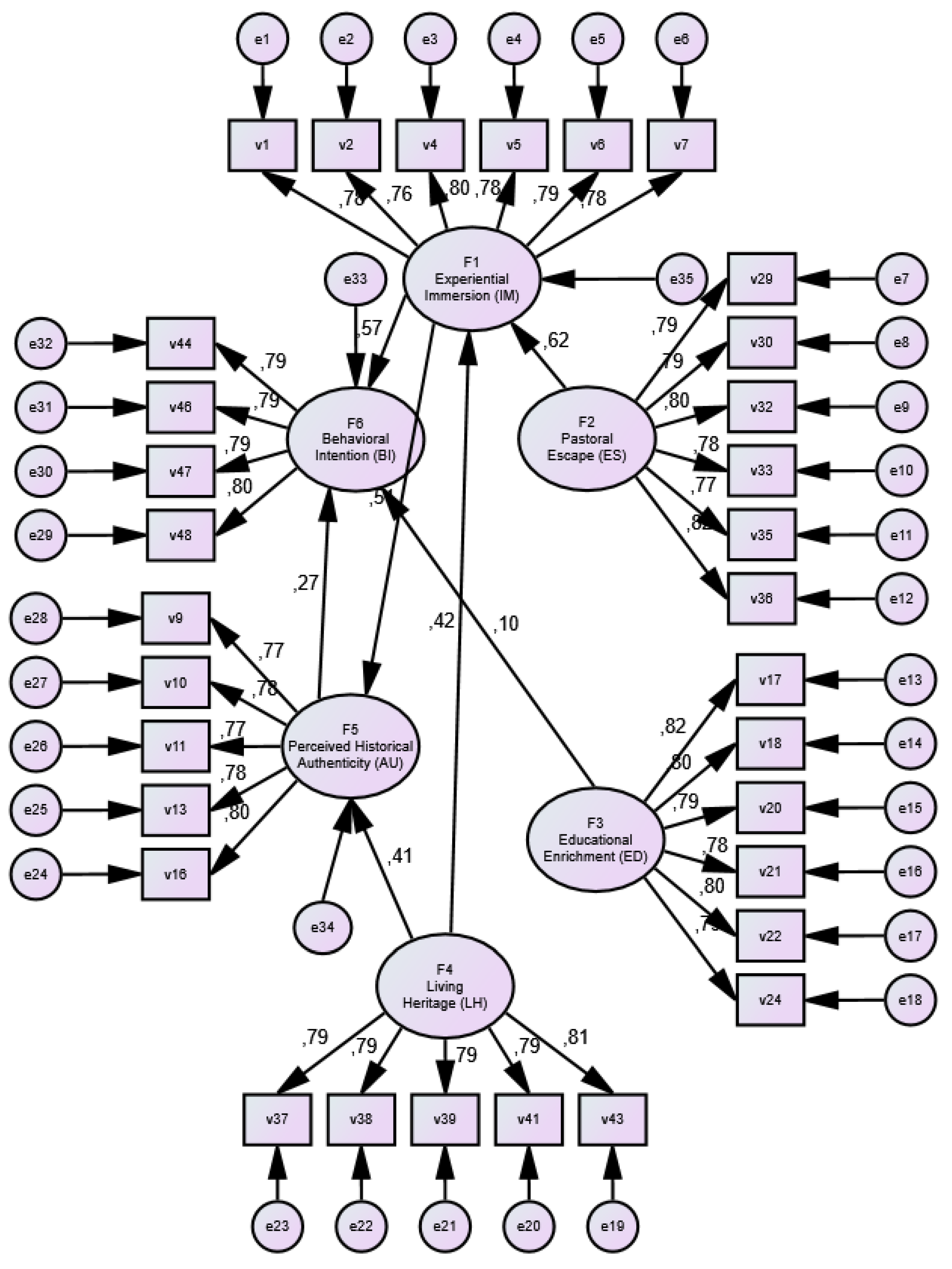

Table 1.
Total variance explained by extracted factors.
| Factor | Initial Eigenvalues (Total) | % of Variance | Cumulative % | Extraction Sums of Squared Loadings (Total) | % of Variance | Cumulative % |
| 1 | 15.335 | 31.949 | 31.949 | 14.950 | 31.147 | 31.147 |
| 2 | 6.427 | 13.389 | 45.338 | 6.040 | 12.583 | 43.730 |
| 3 | 5.456 | 11.367 | 56.705 | 5.088 | 10.601 | 54.330 |
| 4 | 2.064 | 4.301 | 61.006 | 1.688 | 3.517 | 57.847 |
| 5 | 1.522 | 3.171 | 64.177 | 1.136 | 2.366 | 60.214 |
| 6 | 1.133 | 2.359 | 66.537 | 0.756 | 1.575 | 61.788 |
Extraction Method: Maximum Likelihood.
Table 2.
Pattern matrix.
| Factor | ||||||
| Experiential Immersion | Pastoral Escape | Educational Enrichment | Living Heritage | Perceived Historical Authenticity | Behavioral Intention | |
| Temporal Immersion | ,796 | -,002 | ,028 | ,035 | -,020 | -,018 |
| Vivid Engagement | ,745 | ,013 | -,003 | ,005 | -,021 | ,029 |
| Active Participation | ,774 | ,018 | ,019 | ,008 | -,008 | ,029 |
| Sensory Stimulation | ,741 | ,026 | ,012 | ,019 | ,040 | -,008 |
| Modern Detachment | ,757 | -,006 | -,016 | -,029 | ,071 | -,002 |
| Experiential Atmosphere | ,716 | ,013 | -,031 | -,026 | ,040 | ,045 |
| Historical Credibility | -,029 | ,035 | -,023 | ,017 | ,767 | ,008 |
| Architectural Authenticity | -,025 | -,007 | -,011 | -,002 | ,761 | ,068 |
| Activity Realism | ,003 | ,016 | ,034 | -,008 | ,792 | -,026 |
| Material Authenticity | ,024 | ,003 | ,042 | ,002 | ,766 | -,014 |
| Historical Accuracy | ,030 | ,002 | -,027 | -,002 | ,766 | ,008 |
| Meaningful Learning | ,086 | ,007 | ,826 | -,023 | ,007 | -,086 |
| Lifestyle Understanding | -,015 | -,011 | ,804 | ,001 | -,004 | ,016 |
| Heritage Appreciation | -,052 | ,031 | ,791 | ,045 | ,014 | ,004 |
| Skill Understanding | -,033 | ,004 | ,793 | ,056 | -,016 | -,005 |
| Intellectual Stimulation | ,031 | -,008 | ,796 | -,018 | -,031 | ,020 |
| Everyday Insight | ,070 | -,045 | ,786 | -,032 | ,028 | -,016 |
| Simple Lifestyle | -,028 | ,796 | -,003 | -,005 | ,006 | ,017 |
| Outdoor Motivation | -,051 | ,813 | ,019 | ,020 | ,033 | ,003 |
| Modern Overload | ,013 | ,786 | -,007 | -,016 | ,021 | -,023 |
| Routine Disconnection | -,058 | ,814 | ,020 | ,036 | ,013 | ,015 |
| Digital Escape | -,030 | ,783 | -,010 | -,023 | -,016 | ,034 |
| Mental Reset | ,069 | ,785 | ,022 | ,004 | ,010 | -,038 |
| Traditional Performance | ,016 | -,013 | -,011 | ,767 | ,046 | -,042 |
| Living Environment | ,082 | -,061 | ,018 | ,754 | ,005 | -,019 |
| Staff Interaction | ,050 | -,018 | -,010 | ,756 | ,040 | -,048 |
| Daily Demonstrations | ,030 | -,018 | ,020 | ,806 | -,032 | -,012 |
| Human Element | -,045 | ,065 | ,020 | ,845 | -,057 | ,067 |
| Future Visit | ,025 | -,038 | -,004 | -,005 | ,030 | ,773 |
| Active Seeking | ,014 | ,004 | ,028 | -,010 | ,010 | ,775 |
| Extended Engagement | ,050 | ,012 | -,018 | ,024 | ,001 | ,749 |
| Travel Priority | -,010 | ,019 | ,003 | -,011 | ,046 | ,773 |
Table 3.
Composite Reliability (CR) and Average Variance Extracted (AVE).
| Construct | No. of Items | CR | AVE |
| Experiential Immersion | 6 | 0.915 | 0.643 |
| Pastoral Escape | 6 | 0.919 | 0.653 |
| Educational Enrichment | 6 | 0.917 | 0.649 |
| Living Heritage | 5 | 0.901 | 0.646 |
| Perceived Historical Authenticity | 5 | 0.888 | 0.613 |
| Behavioral Intention | 4 | 0.878 | 0.643 |
Table 4.
Fornell–Larcker Criterion (Diagonal = √AVE).
| Experiential Immersion | Pastoral Escape | Educational Enrichment | Living Heritage | Perceived Historical Authenticity | Behavioral Intention | |
| Experiential Immersion | 0.802 | 0.63 | 0.01 | 0.44 | 0.69 | 0.76 |
| Pastoral Escape | 0.63 | 0.808 | 0.01 | 0.03 | 0.34 | 0.45 |
| Educational Enrichment | 0.01 | 0.01 | 0.806 | -0.03 | 0.01 | 0.11 |
| Living Heritage | 0.44 | 0.03 | -0.03 | 0.804 | 0.63 | 0.40 |
| Perceived Historical Authenticity | 0.69 | 0.34 | 0.01 | 0.63 | 0.783 | 0.67 |
| Behavioral Intention | 0.76 | 0.45 | 0.11 | 0.40 | 0.67 | 0.802 |
Table 5.
HTMT Ratios.
| Construct Pair | HTMT |
| Experiential Immersion – Pastoral Escape | 0.79 |
| Experiential Immersion – Educational Enrichment | 0.01 |
| Experiential Immersion – Living Heritage | 0.55 |
| Experiential Immersion – Perceived Historical Authenticity | 0.86 |
| Experiential Immersion – Behavioral Intention | 0.95 |
| Pastoral Escape – Educational Enrichment | 0.01 |
| Pastoral Escape – Living Heritage | 0.04 |
| Pastoral Escape – Perceived Historical Authenticity | 0.42 |
| Pastoral Escape – Behavioral Intention | 0.56 |
| Educational Enrichment – Living Heritage | 0.04 |
| Educational Enrichment – Perceived Historical Authenticity | 0.01 |
| Educational Enrichment – Behavioral Intention | 0.14 |
| Living Heritage – Perceived Historical Authenticity | 0.80 |
| Living Heritage – Behavioral Intention | 0.51 |
| Perceived Historical Authenticity – Behavioral Intention | 0.85 |
Table 6.
Structural Model Results.
| Hypothesis | Path | β (Standardized) | SE | C.R. | p-value | Supported |
| H1 | Pastoral Escape → Experiential Immersion | 0.623 | 0.021 | 19.20 | < .001 | Yes |
| H2 | Living Heritage → Experiential Immersion | 0.424 | 0.023 | 14.89 | < .001 | Yes |
| H3 | Living Heritage → Perceived Historical Authenticity | 0.410 | 0.026 | 13.53 | < .001 | Yes |
| H4 | Experiential Immersion → Perceived Historical Authenticity | 0.512 | 0.025 | 16.01 | < .001 | Yes |
| H5 | Experiential Immersion → Behavioral Intention | 0.571 | 0.036 | 14.07 | < .001 | Yes |
| H6 | Perceived Historical Authenticity → Behavioral Intention | 0.271 | 0.037 | 7.27 | < .001 | Yes |
| H7 | Educational Enrichment → Behavioral Intention | 0.100 | 0.024 | 4.12 | < .001 | Yes |
Note. β = standardized regression coefficient; SE = standard error; C.R. = critical ratio. All estimates are based on maximum likelihood estimation. ***p < .001.
Table 7.
Mediation and Comparative Effects.
| Hypothesis | Path Tested | Direct Effect (β) | Indirect Effect (β) | 95% BC CI | Result | Supported |
| H8 | Pastoral Escape → Experiential Immersion → Behavioral Intention | — | 0.356 | [0.290, 0.465] | Significant indirect-only mediation | Yes |
| H9 | Experiential Immersion → Behavioral Intention vs. Educational Enrichment → Behavioral Intention | 0.571 vs. 0.100 | — | — | Immersion effect substantially stronger | Yes |
| H10 | Pastoral Escape → Behavioral Intention (with Immersion included) | n.s. | 0.356 | [0.290, 0.465] | Full mediation | Yes |
Notes: BC CI = Bias-corrected 95% confidence interval (5,000 bootstrap samples). n.s. = non-significant direct effect when mediator included.
Table 8.
Explained Variance (R2).
| Endogenous Construct | R2 | Interpretation |
| Experiential Immersion | 0.58 | Substantial explanatory power |
| Perceived Historical Authenticity | 0.67 | High explanatory power |
| Behavioral Intention | 0.72 | Strong explanatory power |
Disclaimer/Publisher’s Note: The statements, opinions and data contained in all publications are solely those of the individual author(s) and contributor(s) and not of MDPI and/or the editor(s). MDPI and/or the editor(s) disclaim responsibility for any injury to people or property resulting from any ideas, methods, instructions or products referred to in the content. |
© 2026 by the authors. Licensee MDPI, Basel, Switzerland. This article is an open access article distributed under the terms and conditions of the Creative Commons Attribution (CC BY) license (http://creativecommons.org/licenses/by/4.0/).
Copyright: This open access article is published under a Creative Commons CC BY 4.0 license, which permit the free download, distribution, and reuse, provided that the author and preprint are cited in any reuse.


