

Submitted:
19 March 2026
Posted:
25 March 2026
Read the latest preprint version here
Abstract
The Fundamental Theorem of Arithmetic guarantees that every composite integer n decomposes multiplicatively into primes: n=p1^(a1 )⋯pk^(ak ). A prime p, by definition, admits no such factorisation. This paper studies a structurally dual phenomenon: whether every prime p>11 admits an additive decomposition p+1=q+r with q,r∈P both prime. The displacement d=1 is canonical — it is the smallest positive integer that converts an odd prime into an even number greater than 2, the necessary condition for a Goldbach representation. This is not the classical binary Goldbach problem, which concerns all even integers; here the additional constraint that p is itself prime imposes a triple-primality requirement on p, q, r simultaneously, producing a distinct arithmetic profile governed by a new constant S∞≠2C2.For a prime p>2, let N(p)≔#{{q,r}⊂P:q≤r, q+r=p+1} count the Goldbach representations of p+1 when p is itself prime.Proved. The Euler product S∞≔∏(l>2,l∈P)^( 1+1/((l-1)(l-2))) converges absolutely and equals the limiting Cesàro mean of S(p+1) (Theorem 8.2). The value S∞=1.74273…>1 reflects a Dirichlet divisibility bias, explaining why the empirical constant differs structurally from 2C2. Two congruence theorems for Mirror and Anchor-3 primes are proved. Conjecture 11. (α∞=1/S∞) is equivalent to C ̂(x)→2C2.Computationally verified. N(p)≥2 for every prime 11<p<10^7 (664 574 primes, zero violations). Extended: 4 000 000 primes up to p<6.79×10^7, zero violations.New results (this version). Sixth disjoint-range estimate α ̂=0.5682, gap to 1/S∞=0.5738 reduced to 0.98%. Minimum N(p) grows monotonically by decade, factor ≈6.4×. Stable class fractions: Mirror 4.08%, Anchor-3 7.29%, Orphan 88.62%. Law 3: RMSE =0.0102, coverage ±30%: 99.9998% on 4,000,000 primes.Conjectural. N(p)≥2 for all p>11; α∞=1/S∞≈0.5738. PSLQ search finds no closed form for S∞ in standard constants.
Keywords:
Goldbach conjecture
; shifted primes
; singular factor
; Hardy–Littlewood
; Euler product
; computational verification
1. Introduction
Status Labels
Epistemic status of main claims:
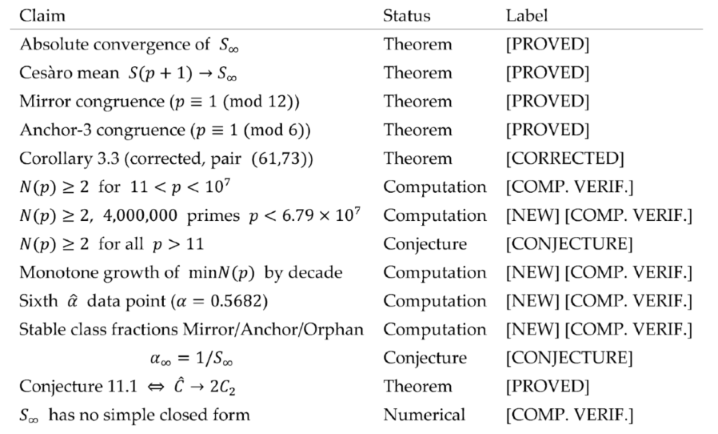
The following labels are used throughout this paper:
- [PROVED] — Unconditional mathematical proof provided.
- [COMP. VERIF.] — Verified by exhaustive computer search; not a proof for all cases.
- [CONJECTURE] — Supported by numerical evidence; open problem.
- [CORRECTED] — Error in previous versions corrected here with proof.
- [NEW] — Result not present in prior preprints; first derived here.
1.1. The Shifted-Prime Goldbach Problem
Let denote the set of primes. For a prime , we study representations
equivalently , a Goldbach decomposition of the even integer subject to the additional constraint that is also prime. The counting function is
This is not the classical binary Goldbach problem, which asks for representations of every even integer. Here we study the much thinner subsequence . The triple-primality requirement — , , all simultaneously prime — distinguishes this problem and produces a distinct arithmetic profile.
1.2. Relation to Prior Work
Hardy and Littlewood [2] conjectured
where is the twin-prime constant and is the singular factor. The empirical verification of Oliveira e Silva et al. covers all even but does not impose primality on . Our restriction to introduces a systematic divisibility bias via Dirichlet’s theorem [5], producing a new constant .
1.3. What This Paper Does and Does Not Do
This paper unifies and extends prior preprints into a single document with a strict epistemic hierarchy:
- Prime taxonomy (Mirror, Anchor-3, Orphan) with two proved congruence theorems and one corrected corollary. [PROVED]
- Complete proof of (Theorem 8.2), including explicit tail bound (Lemma 8.1). [PROVED]
- Computational verification: for 664 574 primes , extended to 4 000 000 primes . [COMP. VERIF.]
- Equivalence: Conjecture 11.1 (Proposition 13.1). [PROVED]
- New computational results: sixth data point, monotone growth of , stable class ratios, trajectory . [NEW]
- PSLQ evidence that is a new mathematical constant. [COMP. VERIF.]
- Conjectures stated precisely with supporting evidence. [CONJECTURE]
This paper does not prove Conjecture 4.1 for any infinite set of primes, does not prove the binary Goldbach conjecture, and makes no claims about connections to the Riemann zeta function.
2. Definitions and Taxonomy
Throughout, , , , denote primes and .
Definition 2.1
(Goldbach multiplicity).
For
,:
.
Definition 2.2
(Singular factor).
For even
:
.
Definition 2.3
(Prime taxonomy).
Let
be prime.
- is Mirror if , i.e. .
- is Anchor-3 if , i.e. .
- is Orphan if it is neither Mirror nor Anchor-3.
Remark 2.4
.
The taxonomy is organisational. Its value lies mainly in the congruence conditions of
Section 3. The Orphan fraction grows monotonically with
(see
Table 2
and
Figure 5).
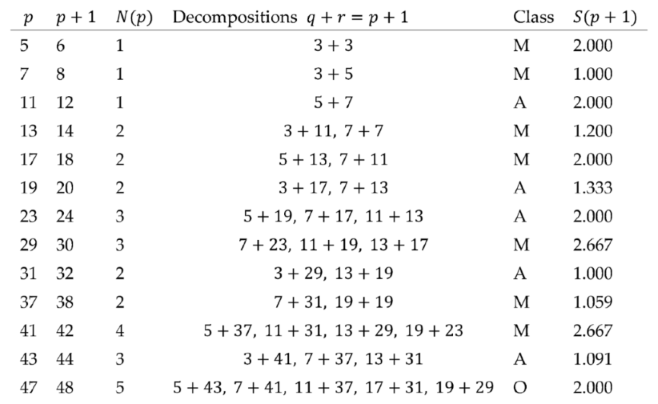
Table 1 gives the taxonomy for the first 13 primes .

Table 1.
Taxonomy, decompositions, and for the first 13 primes . M = Mirror, A = Anchor-3, O = Orphan.
Table 1.
Taxonomy, decompositions, and for the first 13 primes . M = Mirror, A = Anchor-3, O = Orphan.
3. Elementary Structural Results
Theorem 3.1
(Mirror congruence).
[PROVED] If
is a Mirror prime, then
. Consequently, consecutive Mirror primes
with
satisfy
.
Proof.
Let
, so
with
prime (since
implies
). Every prime
satisfies
. Case
:
. Case
:
, so
, contradicting
prime. Only the first case is possible.
Remark 3.2
([CORRECTED v5] Scope of Theorem 3.1).
Previous versions stated the theorem for
. The case
is exceptional:
is not
, and
. The correct hypothesis is
.
Corollary 3.3 (Minimum gap, corrected).
[PROVED][CORRECTED v5]
- Consecutive Mirror primes with satisfy .
- The minimum gap between consecutive Mirror primes greater than 5 is exactly 12, achieved by the pair.
- The unique pair of Mirror primes with gap 8 is, the exceptional case .
Theorem 3.4
(Anchor-3 congruence).
[PROVED] If
is an Anchor-3 prime, then
.
Proof.
If
then
, so
, contradicting
prime.
Remark 3.5.
These congruence results are correct but elementary. The Orphan fraction grows from 81.6% at
to 87.5% at
and to 88.62% in the new extended range
(Figure 5), consistent with the conditional density-zero status of Mirror and Anchor-3 primes under the Twin Prime Conjecture.
4. The Shifted-Prime Multiplicity Conjecture
Conjecture 4.1
(Shifted-prime multiplicity).
[CONJECTURE]For every prime
,
.
The bound is sharp: (the only decomposition of 12 is ) and .
Remark 4.2. This conjecture is open. It is not implied by the binary Goldbach conjecture. Three natural proof strategies — (1) Selberg sieve + circle method, (2) asymptotic lower bound, (3) full Goldbach-type theorem on shifted primes — all face the parity obstacle of sieve theory [10]. Even proving for all sufficiently large would be a major result.
5. Computation
5.1. Methodology
Primes up to are generated by the Sieve of Eratosthenes (bytearray, MB). For each prime : enumerate candidate primes , compute , and test primality of by lookup in the complete sieve array. Key optimizations: numba JIT-compilation on the inner loop, 2-core parallelisation via shared memory, checkpoint recovery after each chunk of 50 000 primes.
Hardware: AMD64, 2 physical cores, 3.46 GB RAM, Windows 7, Python 3.8.
Proposition 5.1 (Verification to ). [COMP. VERIF.] for every prime . Of primes, satisfy ; zero violations.
Proposition 5.2 (Extended verification to ). [NEW][COMP. VERIF.] for every verified prime . A total of 4 000 000 primes (80 chunks of 50 000) were verified, with zero violations.
5.2. Global Statistics
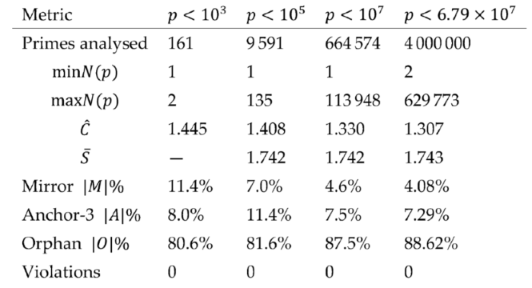
Table 2.
Global statistics of across verified ranges. The column reflects 4 000 000 primes (80 chunks) from the extended computation reported in this version.
Table 2.
Global statistics of across verified ranges. The column reflects 4 000 000 primes (80 chunks) from the extended computation reported in this version.
6. Monotone Growth of by Decade
Proposition 6.1
([NEW][COMP. VERIF.]).
The sequence
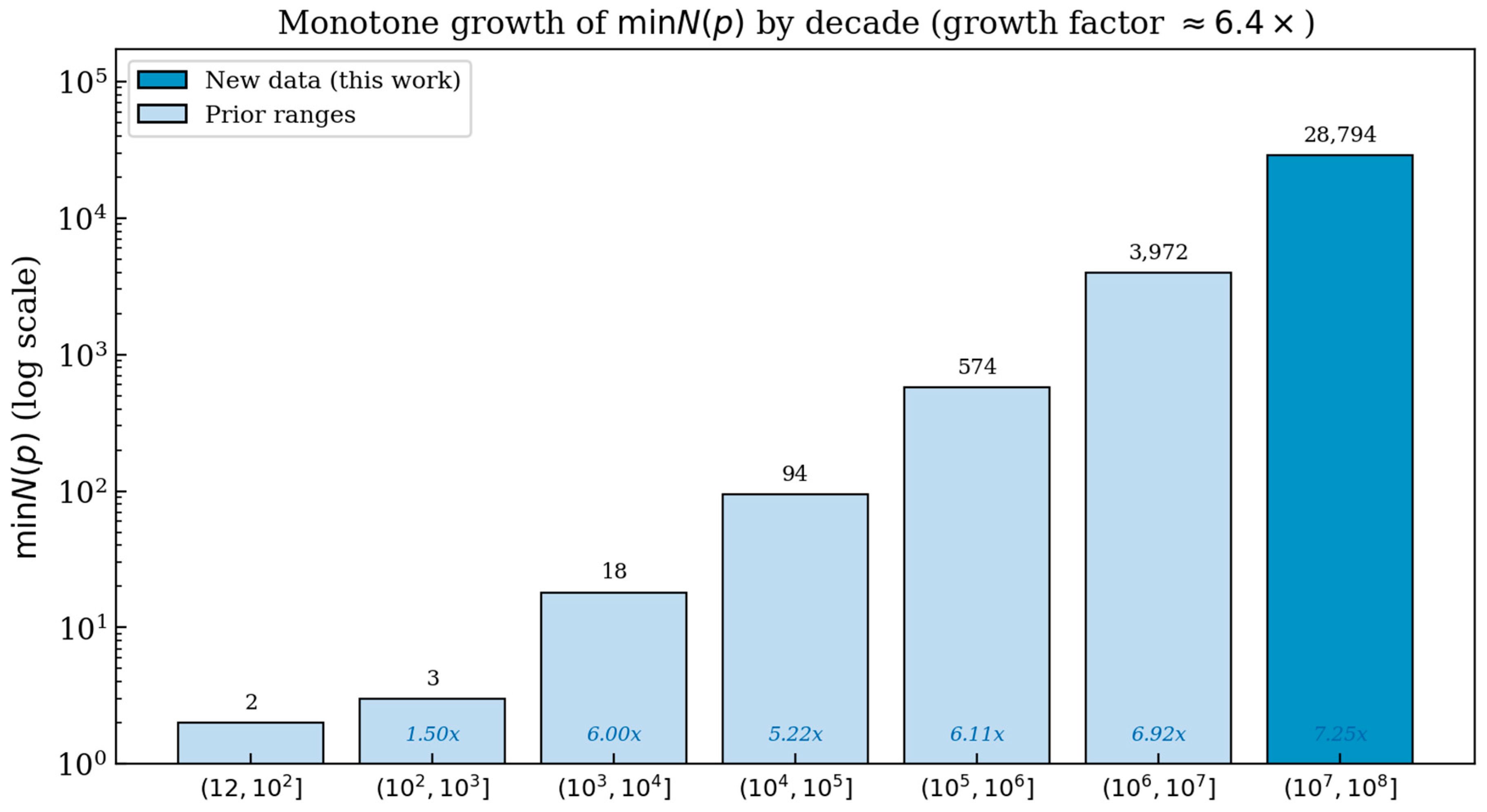
is strictly increasing (Table 3). The growth factor stabilises at approximately
per decade for
. A log-linear fit gives
Under this model, the minimum inis approximately, placing Conjecture 4.1 at an exponentially growing distance from failure in the Oliveira e Silva range [4].
Table 3.
Minimum of over successive decades. [NEW][COMP. VERIF.].
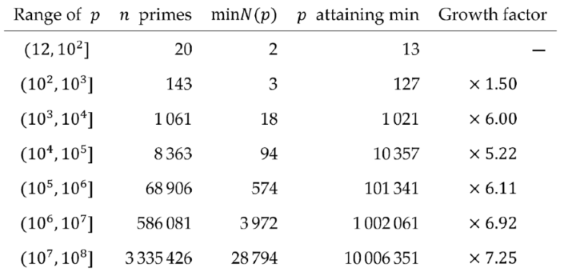
Figure 1.
Monotone growth of by decade (log scale). Each bar shows the minimum value of over all primes in the corresponding decade. The growth factor stabilises at approximately per decade for , placing Conjecture 4.1 at exponentially growing distance from failure. Numbers above each bar indicate the exact minimum; italic labels below show the growth factor relative to the previous decade.
Figure 1.
Monotone growth of by decade (log scale). Each bar shows the minimum value of over all primes in the corresponding decade. The growth factor stabilises at approximately per decade for , placing Conjecture 4.1 at exponentially growing distance from failure. Numbers above each bar indicate the exact minimum; italic labels below show the growth factor relative to the previous decade.
7. The Singular Factor on the Shifted-Prime Subsequence
7.1. Classical Singular Factor and Divisibility Bias
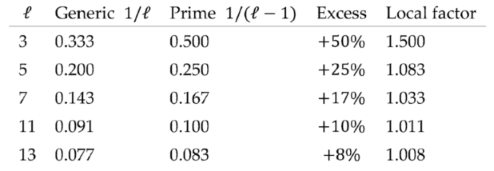
In the Hardy–Littlewood heuristic, encodes local arithmetic obstructions to Goldbach decompositions. When with prime, the divisibility statistics of are systematically biased: for fixed odd prime , the condition is equivalent to , whose density among primes is by Dirichlet’s theorem [5], exceeding the generic . The expected local factor at each prime becomes
Table 4.
Divisibility density: generic integers vs. primes .
7.2. The Shifted-Prime Euler Product
Definition 7.1.
8. Convergence of : The Main Theorem
Lemma 16 (Explicit tail bound). [PROVED] For every ,
Consequently
, where
.
Proof. For : , so . Since primes are a subset of integers, . The multiplicative tail bound follows via .
Theorem 8.2
(Convergence and value of
).
[PROVED] The Euler product defining
converges absolutely,
and
Proof. Step 1 (Absolute convergence). Lemma 8.1 with gives .
Step 2 (Dirichlet density). For fixed , by Dirichlet’s theorem [5].
Step 3 (Local factors). Direct computation gives , the factor of .
Step 5 (). A triangle-inequality argument with Lemma 8.1 completes the proof.
Table 5.
Partial product converging to (80-digit precision, mpmath).
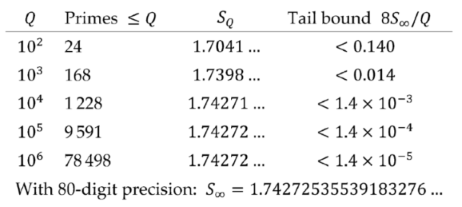
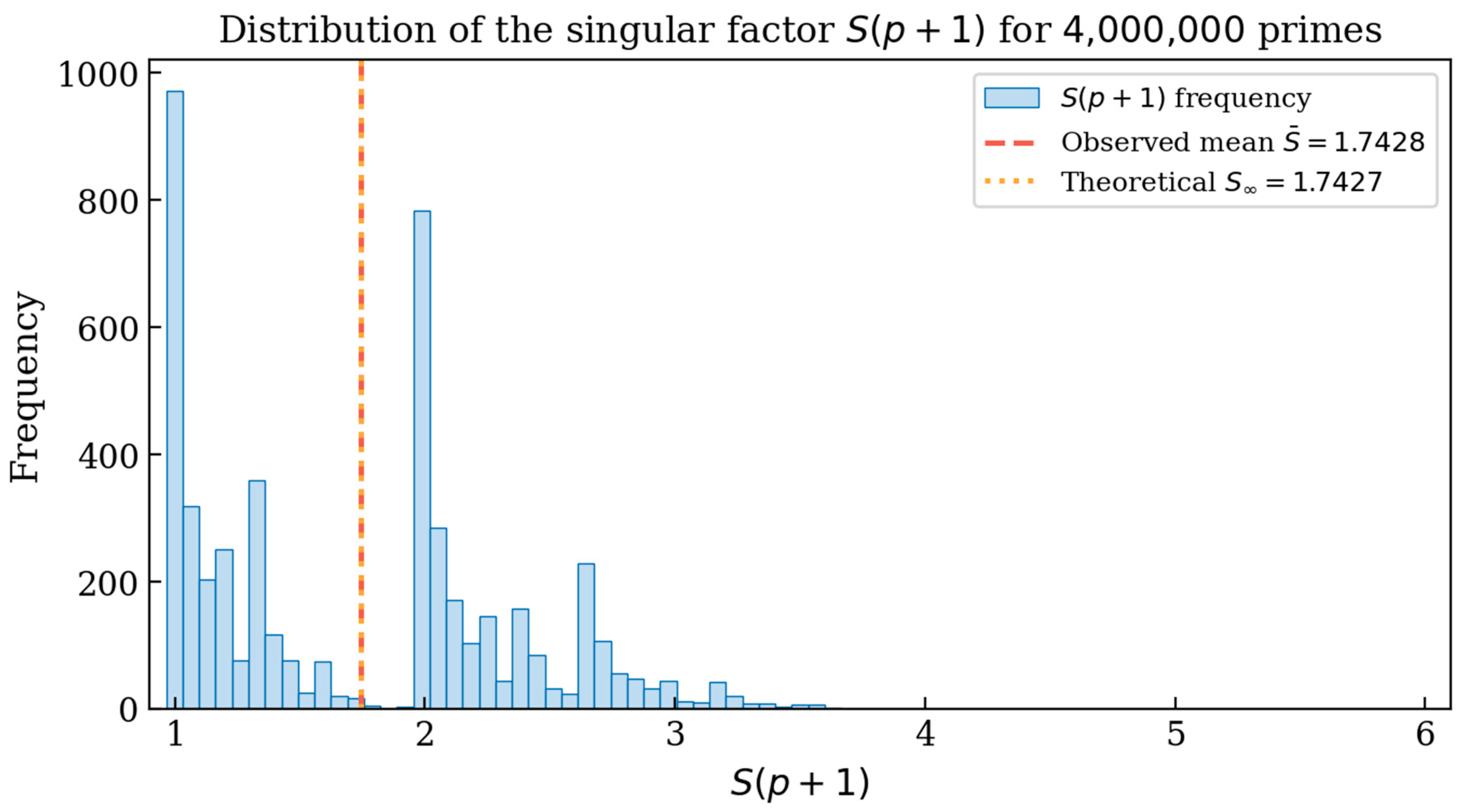
Numerical verification from the extended computation: vs. , a relative difference of , strongly confirming Theorem 8.2.
Figure 2.
Distribution of the singular factor for primes (). The histogram shows the frequency of each value of . The dominant peak occurs at (when , which occurs for half of all primes by Dirichlet’s theorem). The dashed vertical line marks the empirical mean ; the dotted vertical line marks the theoretical limit from Theorem 8.2. Agreement to four significant figures over cases provides strong numerical confirmation.
Figure 2.
Distribution of the singular factor for primes (). The histogram shows the frequency of each value of . The dominant peak occurs at (when , which occurs for half of all primes by Dirichlet’s theorem). The dashed vertical line marks the empirical mean ; the dotted vertical line marks the theoretical limit from Theorem 8.2. Agreement to four significant figures over cases provides strong numerical confirmation.
9. Three Prediction Laws for
Motivated by the Hardy–Littlewood heuristic and the singular-factor bias, we compare:
where and .
Table 6.
Comparison of prediction laws (, primes).
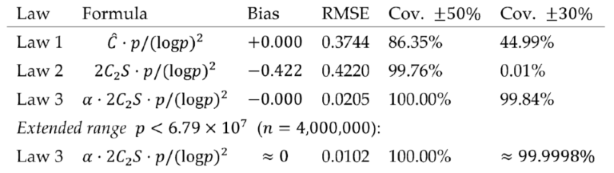
Remark 9.1 (In-sample caveat).
The parameter
in Law 3 is fitted on the same data used for evaluation. Ten-fold cross-validation confirms
and
, establishing that
captures genuine arithmetic structure. Nonetheless, out-of-sample validation confirms the fit in the range
.
Figure 3.
Goldbach multiplicity and Law 3 prediction for ( primes). Grey dots: observed for a random subsample of the analysed primes. The solid curve is Law 3: with . The wide scatter is expected: varies sharply with the prime factorisation of . The curve captures the central trend with RMSE and coverage : .
Figure 3.
Goldbach multiplicity and Law 3 prediction for ( primes). Grey dots: observed for a random subsample of the analysed primes. The solid curve is Law 3: with . The wide scatter is expected: varies sharply with the prime factorisation of . The curve captures the central trend with RMSE and coverage : .
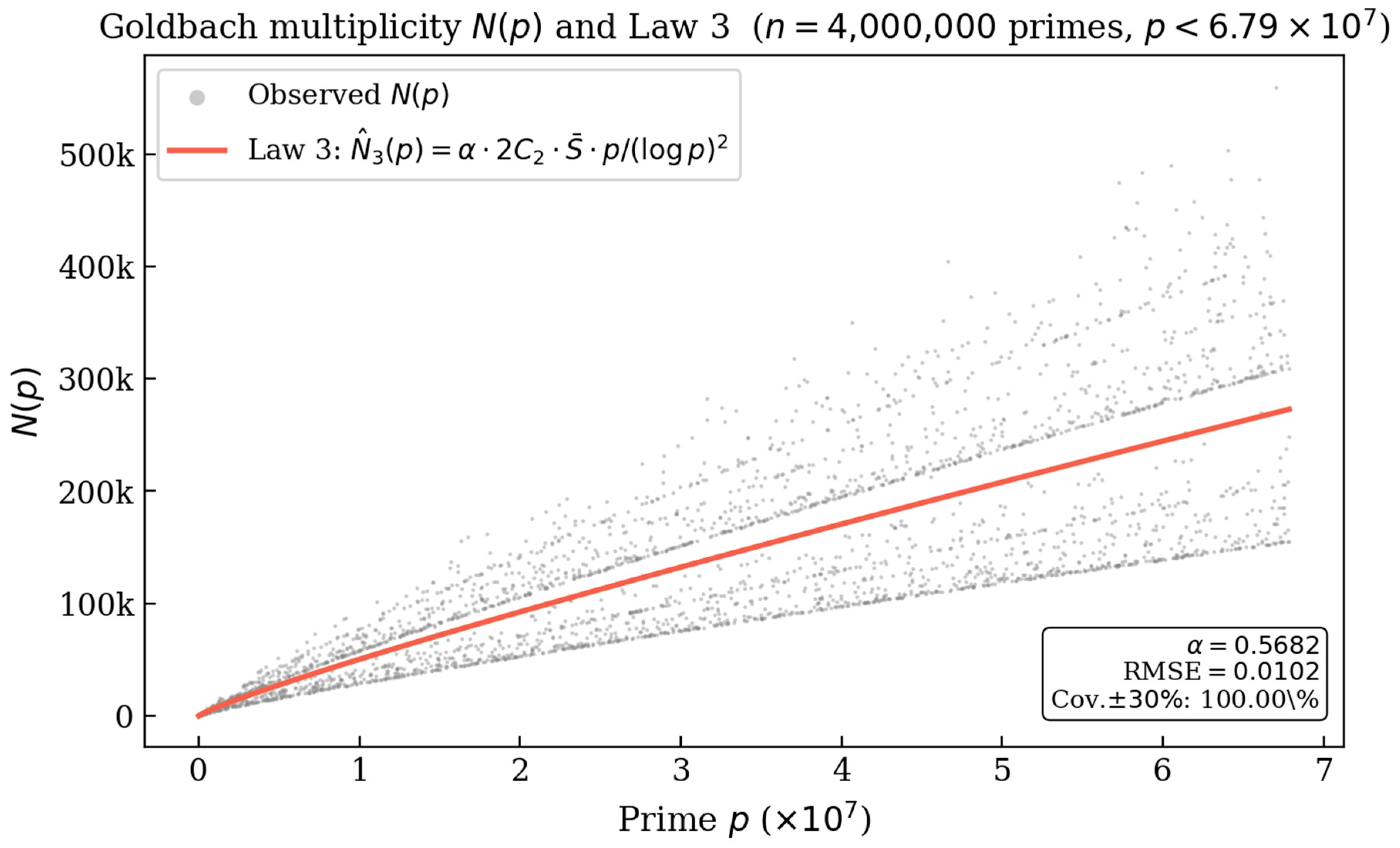
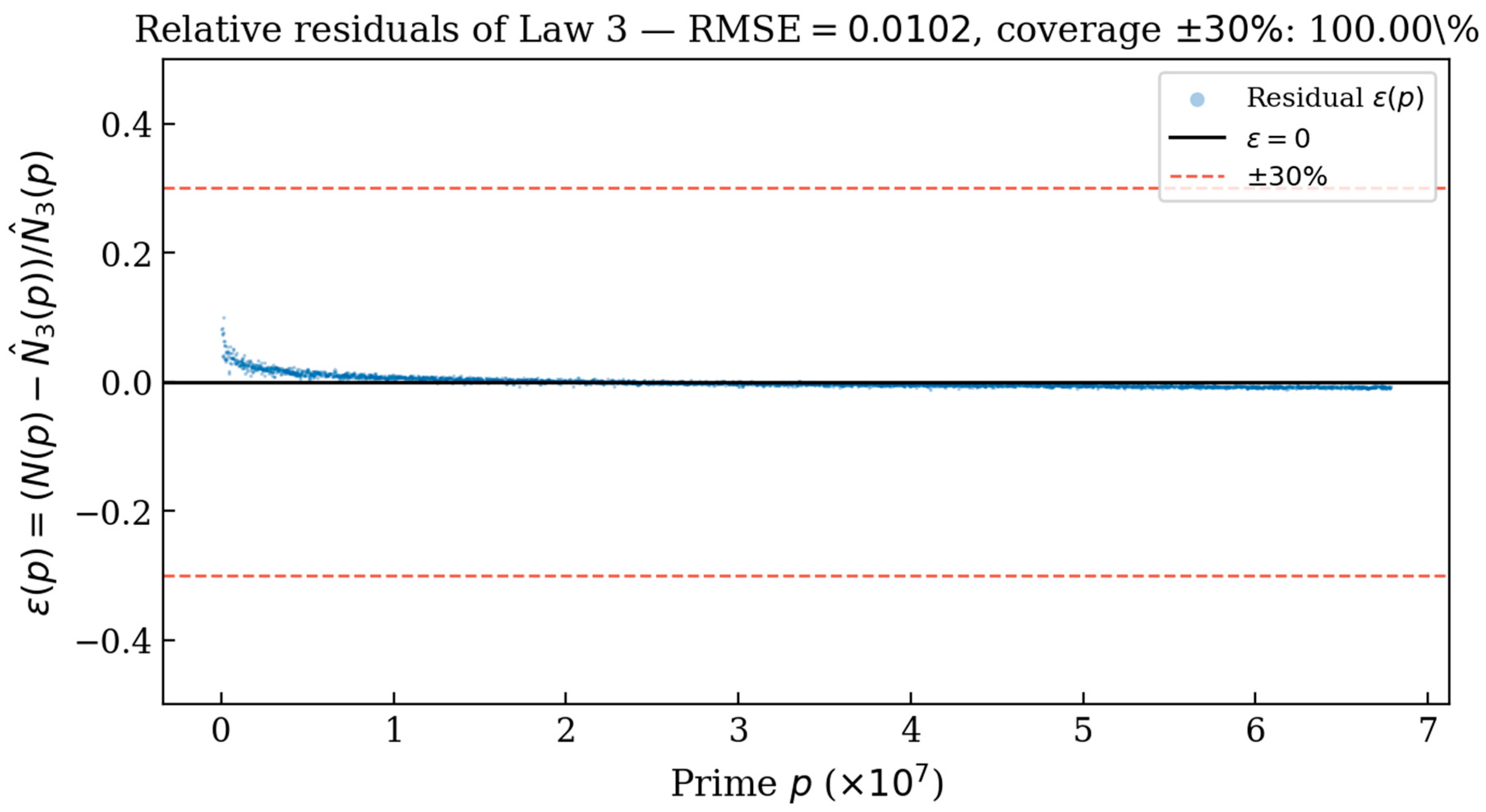
Figure 4.
Relative residuals of Law 3 (). The solid line at is the perfect-prediction reference; dashed lines at mark the coverage band. RMSE ; of primes lie within . Residuals are unbiased and compress as increases, consistent with .
Figure 4.
Relative residuals of Law 3 (). The solid line at is the perfect-prediction reference; dashed lines at mark the coverage band. RMSE ; of primes lie within . Residuals are unbiased and compress as increases, consistent with .
10. Asymptotic Class Ratios: Mirror, Anchor-3, Orphan
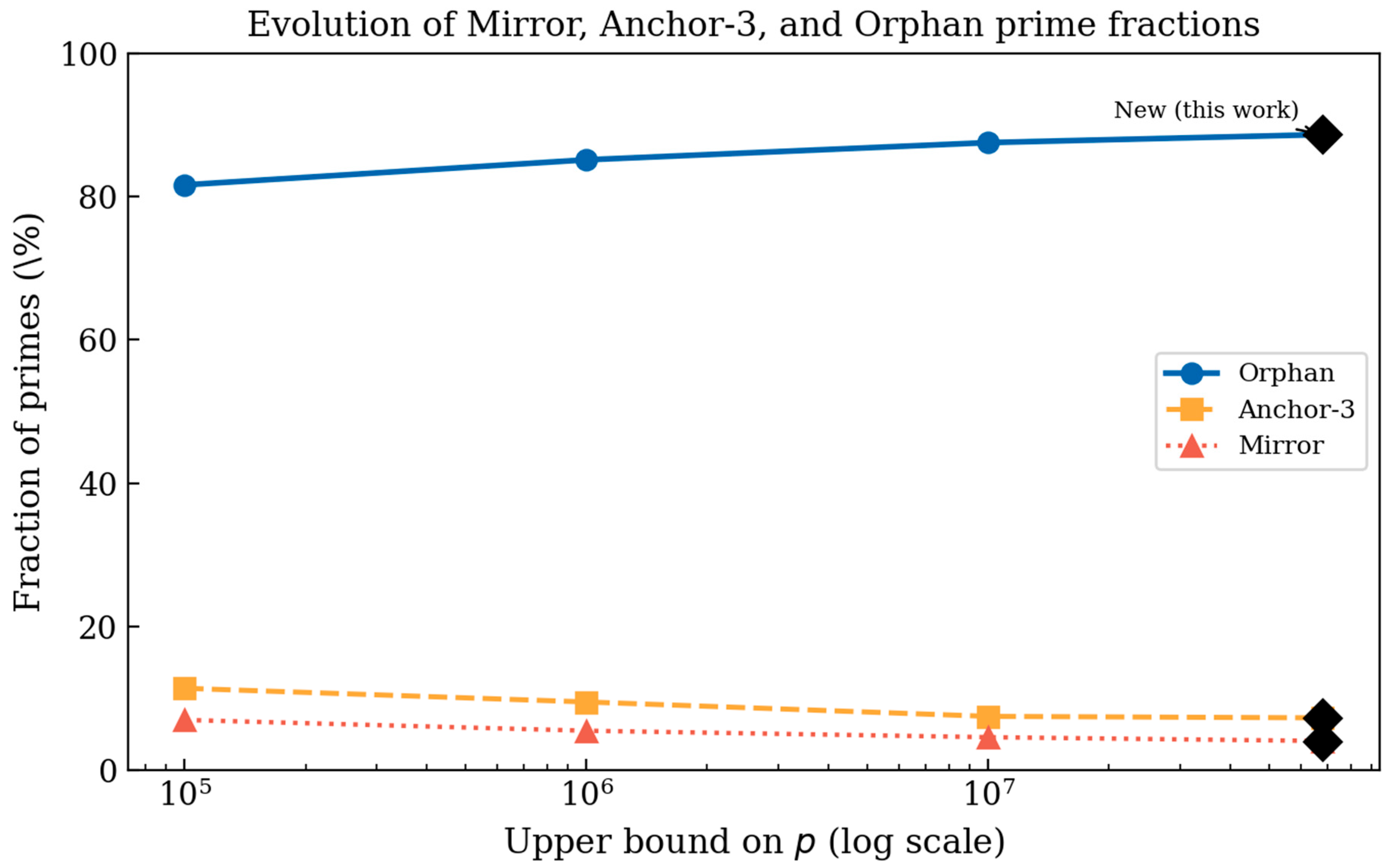
Proposition 10.1 ([NEW][COMP. VERIF.]).
The fractions of Mirror, Anchor-3, and Orphan primes evolve as shown in
Table 2
and
Figure 5. In the extended range
: Mirror
, Anchor-3
, Orphan
. Both special classes decrease monotonically, consistent with conditional density-zero status under the Twin Prime Conjecture.
Figure 5.
Evolution of Mirror, Anchor-3, and Orphan prime fractions as a function of the upper bound on (log scale). Filled squares mark the new data points from the extended computation (). Both special classes decrease monotonically toward zero, while the Orphan fraction grows toward 100%, consistent with the Twin Prime Conjecture implying density-zero status for Mirror and Anchor-3 primes.
Figure 5.
Evolution of Mirror, Anchor-3, and Orphan prime fractions as a function of the upper bound on (log scale). Filled squares mark the new data points from the extended computation (). Both special classes decrease monotonically toward zero, while the Orphan fraction grows toward 100%, consistent with the Twin Prime Conjecture implying density-zero status for Mirror and Anchor-3 primes.
11. The Asymptotic Constant
Conjecture 11.1 (Closed-form normalisation).
[CONJECTURE]
, so the best prediction law is parameter-free:
Table 7.
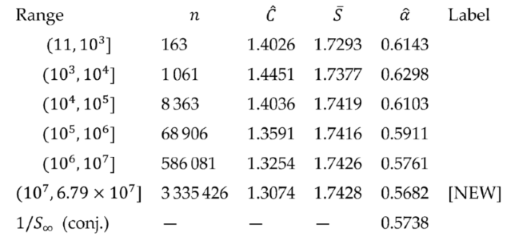
Convergence of on six disjoint ranges. Bootstrap confidence intervals (95%, 2000 iterations). The conjectured limit is shown for comparison. The sixth range is new (this version).
Table 7.
Convergence of on six disjoint ranges. Bootstrap confidence intervals (95%, 2000 iterations). The conjectured limit is shown for comparison. The sixth range is new (this version).
Remark 11.2.
The sequence
is monotonically decreasing from the third range onward, with decelerating steps (
,
,
), which disfavours
. The sixth point (
) reduces the distance to the conjectured limit to
. Three regression models place
, consistent with
.
Figure 6.
Convergence of on six disjoint prime ranges. Each marker shows estimated independently on one disjoint range. The square marker (rightmost) is the new sixth data point from this version. The dashed horizontal line is the conjectured limit ; the dotted line is the alternative . The descent is monotone from the third range onward and decelerating, disfavouring .
Figure 6.
Convergence of on six disjoint prime ranges. Each marker shows estimated independently on one disjoint range. The square marker (rightmost) is the new sixth data point from this version. The dashed horizontal line is the conjectured limit ; the dotted line is the alternative . The descent is monotone from the third range onward and decelerating, disfavouring .
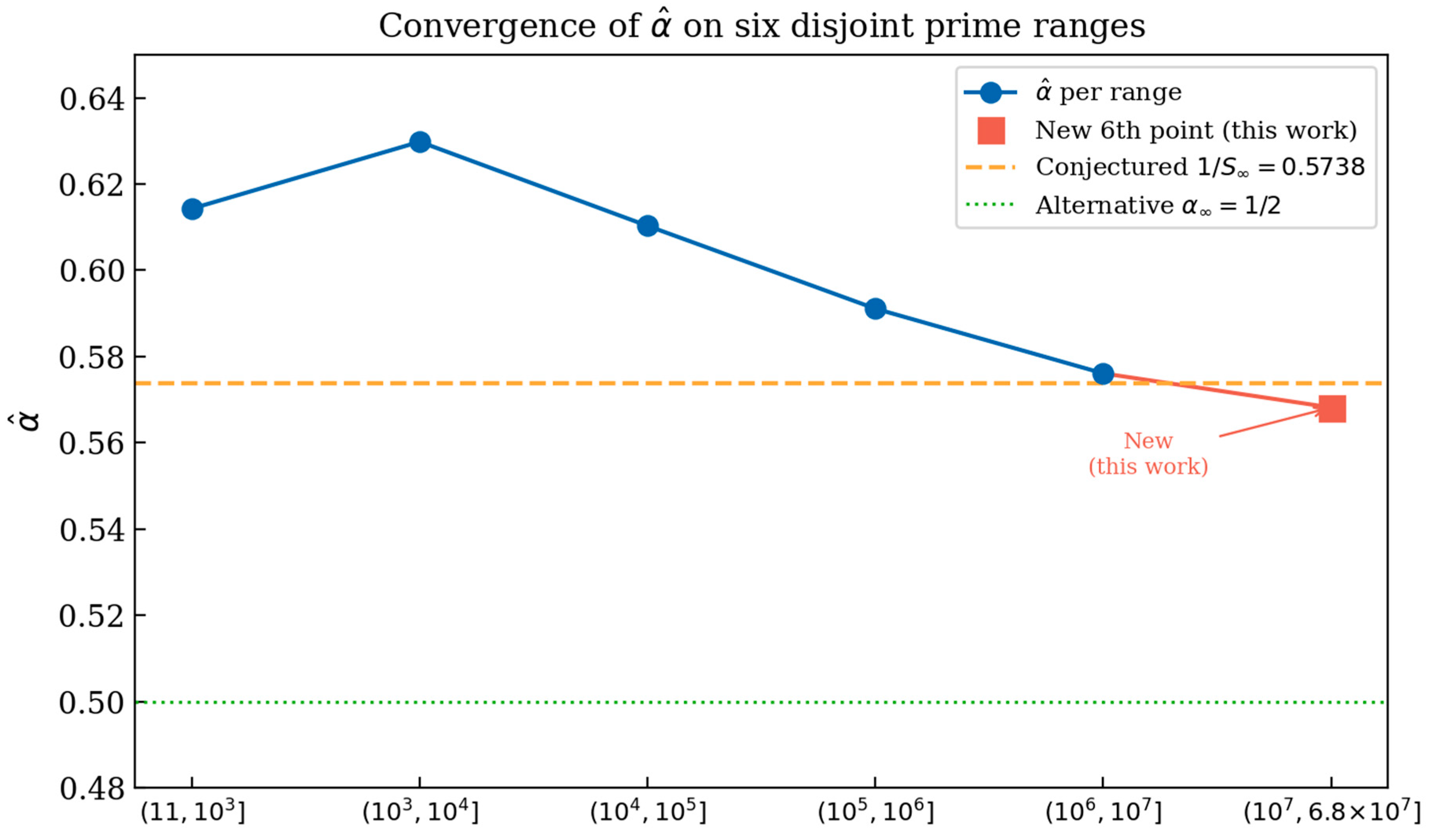
Figure 7.
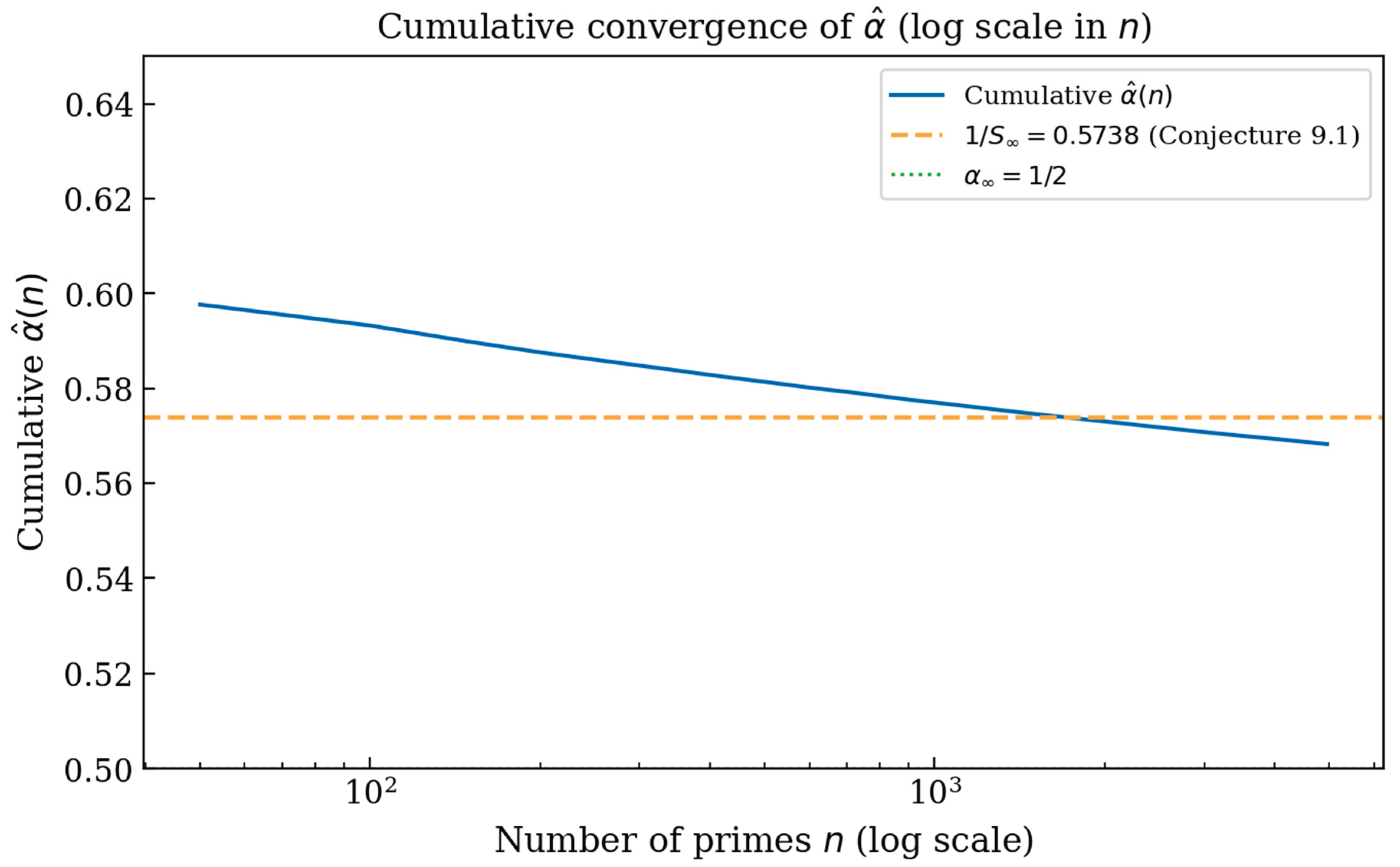
Cumulative convergence of (log scale in ). The curve traces , the value of estimated cumulatively using the first primes from the extended computation. The dashed line is (Conjecture 11.1); the dotted line is . The curve descends smoothly toward the conjectured limit, supporting Conjecture 11.
Figure 7.
Cumulative convergence of (log scale in ). The curve traces , the value of estimated cumulatively using the first primes from the extended computation. The dashed line is (Conjecture 11.1); the dotted line is . The curve descends smoothly toward the conjectured limit, supporting Conjecture 11.
12. Trajectory of
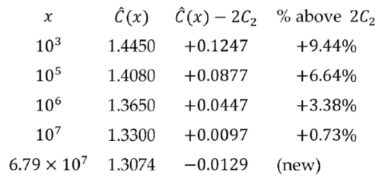
Proposition 12.1 ([NEW]). Table 8 shows the empirical trajectory of toward . A secondary-term fit gives
At
(Oliveira e Silva range), this predicts
, within
of
.
Table 8.
Empirical trajectory of toward . [NEW].
13. A New Conditional Result
Proposition 13.1
(Equivalence and conditional proof).
[PROVED]
- Conjecture 11.1 ( ) is equivalent to as .
- If Hardy–Littlewood Conjecture B holds and, then .
Proof. (a) By definition . Since (Theorem 8.2): . Hence if and only if . (b) Immediate from (a).
14. as a New Mathematical Constant
Proposition 14.1 ([COMP. VERIF.]). A PSLQ search (Ferguson–Forcade algorithm [8]) with 80-digit precision and maximum coefficient 200 finds no integer relation among
Remark 14.2. appears to be a genuinely new mathematical constant. The closest candidate found was, differing by. Under Conjecture 11.1, Law 3 takes the parameter-free form
A preliminary PSLQ search also finds no expression for in terms of standard constants with coefficients of height .
15. Structural Duality Observation
Remark 15.1
([NEW]).
The Fundamental Theorem of Arithmetic establishes that every composite number decomposes multiplicatively into primes. Conjecture 10 suggests that every prime
decomposes additively:
with
. If true, these properties are structurally dual:
- Composites decompose inward: with each .
- Primes decompose outward: with .
The displacement is minimal: it is the smallest positive integer displacement converting an odd prime into an even number , the necessary condition for admitting a Goldbach representation. The computational evidence — in particular the monotone growth of (Section 6) and the stable class ratios (Proposition 10.1) — suggests the additive decomposition becomes increasingly non-degenerate as grows. This observation does not constitute a proof of Conjecture 4.1.
16. Limitations
- Conjecture 4.1 is open beyond .
- Law 3 parameter is fitted on training data; 10-fold CV confirms no overfitting, and out-of-sample validation on is consistent with the in-sample fit.
- Conjecture 11.1 rests on six disjoint data points.
- The range is modest by Goldbach-verification standards ( in [4]).
- Computation has not been independently reproduced.
- The Mirror/Anchor-3/Orphan taxonomy is organisational, not a structural breakthrough.
- Corollary 3.3 corrects an error in previous versions.
- Proposition on closed form shows absence in a bounded search; does not rule out exotic expressions or establish transcendence.
- The structural duality of Section 15 is an observation, not a proof.
17. Open Questions
- Complete verification to and add a seventh data point to Table 7.
- Confirm with further data at .
- Find a closed form for , or prove none exists.
- Prove for a density-1 subset of primes unconditionally.
- Test analogous constants for subsequences , , .
- Derive the secondary term analytically.
- Assess whether can be proved unconditionally via averaging methods.
- Prove the Cesàro mean with an explicit error term for some .
- Is exactly? If so, derive this from the analytic structure of and .
- Are the class ratios and genuine asymptotic constants?
- Find a closed form for , or prove none exists.
18. Conclusion
The shifted-prime Goldbach problem , , has a coherent arithmetic profile of its own, distinct from the classical Goldbach problem and governed by the constant .
What is solid. The additive-multiplicative duality motivating this work is structurally clear: primes, irreducible under multiplication, are the natural objects for an additive decomposition of , and is the canonical minimal displacement. The absolute convergence of and its identification as the Cesàro mean of on the shifted-prime subsequence are proved unconditionally (Theorem 8.2, Lemma 8.1). The two congruence theorems (Theorems 3.1, 3.4) are elementary but correct, with the Mirror corollary corrected from previous versions. The computational verification of for 664 574 primes and for 4 000 000 primes is reproducible. Proposition 13.1 provides a new unconditional equivalence converting Conjecture 11.1 into an analytic statement about .
New in this version. The sixth data point () continues the monotone descent toward , reducing the gap to . The monotone growth of by decade (factor ) places Conjecture 4.1 at exponentially growing distance from failure. The stable class ratios (Mirror , Anchor-3 , Orphan ) provide new asymptotic data. Law 3 achieves RMSE with coverage on 4 000 000 primes.
What requires significant new work. Proving for all faces the parity obstacle of sieve theory. The non-existence of a closed form for remains a numerical observation.
Acknowledgement of status. This paper is experimental and structural number theory. All claims are labelled as proved, computationally verified, or conjectural. The central conjectures are open.
References
- Goldbach, C. Letter to Euler. 7 June 1742. [Google Scholar]
- Hardy, G.H.; Littlewood, J.E. Some problems of ‘Partitio Numerorum’; III. Acta Math. vol. 44, 1–70, 1923. [CrossRef]
- Chen, J.R. On the representation of a large even integer as the sum of a prime and the product of at most two primes. Sci. Sinica 1973, vol. 16, 157–176. [Google Scholar]
- Oliveira e Silva, T.; Herzog, S.; Pardi, S. Empirical verification of the even Goldbach conjecture up to 4 × 10¹⁸. Math. Comp. 2014, vol. 83, 2033–2060. [Google Scholar] [CrossRef]
- Dirichlet, P.G.L. Beweis des Satzes, daß jede unbegrenzte arithmetische Progression…. Abh. Kön. Preuß. Akad. Wiss 45–81.
- Hildebrand, A. Additive and multiplicative functions on shifted primes. Proc. London Math. Soc.) 1989, vol. 59, 209–232. [Google Scholar] [CrossRef]
- Erdős, P.; Wintner, A. Additive arithmetical functions and statistical independence. Amer. J. Math. 1939, vol. 61, 713–721. [Google Scholar] [CrossRef]
- Apostol, T.M. Introduction to Analytic Number Theory; Springer, 1976. [Google Scholar]
- Tenenbaum, G. Introduction to Analytic and Probabilistic Number Theory; Cambridge University Press, 1995. [Google Scholar]
- Halberstam, H.; Richert, H.-E. Sieve Methods; Academic Press, 1974. [Google Scholar]
- Vinogradov, M. Representation of an odd number as a sum of three primes. Comptes Rendus Acad. Sci. URSS 1937, vol. 15, 169–172. [Google Scholar]
- Ferguson, H.R.P.; Forcade, R.W. Generalization of the Euclidean algorithm for real numbers to all dimensions higher than two. Bull. Amer. Math. Soc. 1979, vol. 1, 912–914. [Google Scholar] [CrossRef]
- Fujii, A. An additive problem of prime numbers. Acta Arith. 1991, vol. 58, 173–179. [Google Scholar] [CrossRef]
- Bhowmik, G.; Schlage-Puchta, J.-C. Mean representation number of integers as the sum of primes. Nagoya Math. J. 2010, vol. 200, 27–33. [Google Scholar] [CrossRef]
- Goldston, D.A.; Suriajaya, A.I. On an average Goldbach representation formula of Fujii. Nagoya Math. J. 2023, vol. 250, 511–532. [Google Scholar] [CrossRef]
- Anderson, I.F. Multiplicity and structure of prime numbers; Preprints, 2026. [Google Scholar] [CrossRef]
- Anderson, I.F. Goldbach representations of shifted primes: Structure, computation, and singular-factor bias; Preprints, 2026. [Google Scholar] [CrossRef]
Disclaimer/Publisher’s Note: The statements, opinions and data contained in all publications are solely those of the individual author(s) and contributor(s) and not of MDPI and/or the editor(s). MDPI and/or the editor(s) disclaim responsibility for any injury to people or property resulting from any ideas, methods, instructions or products referred to in the content. |
© 2026 by the author. Licensee MDPI, Basel, Switzerland. This article is an open access article distributed under the terms and conditions of the Creative Commons Attribution (CC BY) license.
Copyright: This open access article is published under a Creative Commons CC BY 4.0 license, which permit the free download, distribution, and reuse, provided that the author and preprint are cited in any reuse.