

Submitted:
08 March 2026
Posted:
10 March 2026
Read the latest preprint version here
Abstract
This paper introduces a novel investigation into the additive structure of primes that transcends the classical framework of the Goldbach Conjecture. Standing on the shoulders of Christian Goldbach's foundational insight regarding the sum of primes (1742) and Sophie Germain's pioneering work on special prime pairs, our inquiry addresses a qualitatively distinct problem: the existence of three simultaneously prime numbers (p, q, r) satisfying the relation p = q + r − 1. Unlike classical Goldbach verifications---notably the monumental work of Oliveira e Silva et al. up to 4 × 10¹⁸, which confirms decompositions for all even integers without filtering for the primality of the predecessor---this work isolates the specific subsequence where p is also prime. This restriction reveals a hidden arithmetic architecture previously unexplored, demonstrating that the behavior of primes within this subset diverges significantly from the general case of even numbers.Far from being a mere replication of existing results, this study leverages the asymptotic machinery of G.H. Hardy and J.E. Littlewood (1923) to uncover structural anomalies within this prime subsequence. By applying their singular factor S(n) to this restricted domain, we discover that it does not average to unity as implicitly assumed in the general literature, but converges to a previously unknown constant S̄∞ ≈ 1.74273. We provide a rigorous proof of this convergence using Dirichlet's theorem on arithmetic progressions (1837) and the Chinese Remainder Theorem, demonstrating that the distribution of primes in this context possesses a unique "additive richness" distinct from the general case due to a biased density of divisors. Furthermore, we integrate the analytic depth of Bernhard Riemann (1859) and Hans von Mangoldt (1895) by utilizing the explicit Riemann–von Mangoldt formula to define a restricted Chebyshev function Ψ*(x), linking the oscillatory behavior of our multiplicity function to the zeros of the Riemann zeta function ζ(s).This synthesis of classical analysis and new combinatorial data yields seven original contributions, now supported by a robust, bug-corrected computational verification using a modular Google Colab framework with checkpoint recovery. The execution analyzed 664,574 primes up to 10⁷, correcting previous algorithmic filters that generated false positives, and conclusively confirming: (1) A groundbreaking taxonomy classifying primes into three disjoint classes: Mirror (M), Anchor-3 (A), and Orphan (O), formally characterized via the von Mangoldt function Λ(n), (2) The unconditional Mirror Gap Theorem, proving that gaps between consecutive Mirror Primes (> 3) are divisible by 12, (3) The Prime Multiplicity Conjecture (N(p) ≥ 2 for p > 11), computationally verified for all 664,574 primes in the range with zero violations, (4) The derivation of a new prediction law (Law 3) with a Root Mean Square Error (RMSE) of 0.0205, representing an improvement of over 94% compared to the classical Hardy–Littlewood formula (RMSE ≈ 0.374), and achieving 99.84% coverage within a ±30% threshold. (5) The identification of the universal constant S̄∞ = ∏_{q>2}(1 + 1/((q−1)(q−2))) ≈ 1.74273, resolving why empirical constants in this domain systematically deviate from standard twin-prime predictions, (6) A systematic characterization of these classes via the von Mangoldt function, including a class-conditional decomposition of the Goldbach–Λ sum, (7) A formal proof establishing the finiteness and exact Euler product form of S̄∞, converting an empirical discovery into a theorem. Statistical analysis via bootstrap resampling (n = 2000) confirms that the observed empirical constant Ĉ ≈ 1.3301 lies strictly outside the 95% confidence interval of the classical twin-prime constant 2C₂ ([1.3289, 1.3314] vs. 1.3203), with the deviation rigorously explained by the structural inequality S̄∞ > 1. In conclusion, this work does not merely verify old conjectures but defines a new territory in additive number theory. By repurposing the legendary tools of Goldbach, Germain, Hardy, Littlewood, Dirichlet, Riemann, and von Mangoldt, we demonstrate that the subsequence of primes holds its own unique constants, laws, and structural theorems, marking a significant and quantifiable departure from the behavior of generic even integers.
Keywords:
prime numbers
; Goldbach conjecture
; prime multiplicity
; singular factor
; Hardy–Littlewood
; mirror primes
; von Mangoldt function
; twin primes
; computational verification
; prime subsequence constant
MSC: 11P32; 11N05; 11A41; 11M06
- Part I. Core Results: Multiplicity and Structure
1. The Original Idea: Three Simultaneous Primes
1.1. The Central Question
The motivation is direct: in how many ways can a prime p be written as the sum of two other primes minus one? Formally, we study the solutions of
This is equivalent to , a Goldbach decomposition of the even number . But there is an essential additional constraint: p itself must be prime. In equation (1), all three numbers p, q, and r are simultaneously prime—something that does not occur in classical Goldbach.
1.2. Fundamental Difference from Goldbach
Goldbach’s conjecture [1] states: every even integer can be written as the sum of two primes. For example, . Goldbach does not care whether 18 is prime, whether 17 is prime, or anything related to 17.
This investigation asks a different question: it takes the prime and asks how many times can be written with q and r also prime:
The protagonist is the prime 17, not the even number 18. And the question is not whether some decomposition exists, but how many—requiring at least two.

Table 1.
Classical Goldbach vs. this investigation.
| Goldbach | This work | |
|---|---|---|
| Object of study | Every even n | Only with |
| Question | ∃ decomposition? | decompositions? |
| How many primes? | Only q and r | All three: |
| Max. verification | [4] | (this work) |
1.3. Why Oliveira e Silva’s Verification Does Not Cover this Conjecture
The verification of [4] up to covers classical Goldbach for all even numbers. It does not cover Conjecture 4.1 of this paper, because the computation never filtered by the condition is prime. Their work verified that each have a decomposition, but did not study whether , , , …have two or more decompositions when the predecessor is prime.
It is important to note that the verification of Oliveira e Silva et al. [4] up to covers every even number , but does not verify our conjecture for a single value of p. Their computation never checked whether is prime before counting decompositions, nor whether the count exceeds 2. Our verification up to is therefore the only existing verification for Conjecture 4.1, regardless of the scale of [4].
1.4. What Would Be Gained by Proving it
A proof of Conjecture 4.1 would yield three mathematically significant consequences. First, it would be the first theorem stronger than Goldbach proved for an infinite family of specific even numbers, namely those of the form with p prime. Second, it would establish an explicit bridge between the multiplicative and additive theories of primes: the primality of p would guarantee additive richness in . These two worlds are historically studied separately and almost never meet directly. Third, it would give a new characterisation of primes: primes greater than 11 would be exactly the numbers admitting at least two representations of the form with prime.
1.5. The Seven Original Contributions
This paper produces the following original contributions:
- 1.
- A natural taxonomy of primes into three disjoint classes (Mirror M, Anchor-3 A, Orphan O), each given a formal characterisation via the von Mangoldt function .
- 2.
- The Mirror Gap Theorem, proved unconditionally: every gap between consecutive Mirror Primes greater than 3 is divisible by 12.
- 3.
- The Prime Multiplicity Conjecture for all , computationally verified for 664 574 primes in with no exception—the only such verification in the literature.
- 4.
- The discovery that the Hardy–Littlewood singular factor , averaged over the prime subsequence, equals —a value previously unknown, stable across all ranges, and significantly greater than 1.
- 5.
- A new individual prediction law with , achieving RMSE smaller than the classical formula and covering 99.84% of primes within .
- 6.
- A systematic connection to the von Mangoldt function, including -characterisations of each taxonomic class, a class-conditional decomposition of the Goldbach– sum, a restricted Chebyshev-type function , and three concrete open questions.
- 7.
- A complete proof that exists and is finite, converting the empirical discovery into a theorem via Dirichlet’s theorem on primes in arithmetic progressions and the Chinese Remainder Theorem.
1.6. Connection Between the Central Question and Each Result
Every result follows directly from question (1): counts its solutions; the taxonomy classifies primes according to the form of their solutions; the conjecture requires at least two; measures how many Hardy–Littlewood predicts; and the finding is a consequence of restricting to prime p. The constant measures how much this subsequence differs from the general Goldbach case.
Table 2.
Prior literature vs. contributions of this work.
| Prior literature | This work |
|---|---|
| Goldbach verifies for every even n; only q and r prime | Studies with p prime; all three simultaneously prime; requires |
| Oliveira e Silva: up to for all even numbers | Does not cover this conjecture; verification of up to is the only one in the literature |
| implicitly assumed over all even numbers | over the prime subsequence: new, structurally explains |
| Law | Law 3 with : RMSE improved 95%, coverage 99.84% within |
| No prime subsequence constant | New constant with convergence model |
| No additive taxonomy of primes | Taxonomy (M, A, O) connected to |
| No -characterisation of taxonomy | ; |
| No restricted -function for triple primes | defined; asymptotic derived |
1.7. Novelty with Respect to the Literature
2. Definitions and Taxonomy
Definition 2.1
(Multiplicity Function). For a prime ,
Definition 2.2
(Mirror Prime). if for some prime q, equivalently .
Definition 2.3
(Anchor-3 Prime). if and (the pair is a twin prime pair).
Definition 2.4
(Orphan Prime). if and .
Lemma 2.1
(Partition). M, , and O are mutually disjoint with union .
The priority convention is necessary: , with as the first element (since and , so ).
Result 2.1 (Expanded taxonomy for the first primes) Table 3 displays the taxonomy, decompositions, and singular factor for the first 13 primes greater than 3.
The singular factor is computed as . For instance, , while .
Table 3.
Taxonomy, decompositions, and for the first 13 primes .
| p | Decompositions | Class | |||
|---|---|---|---|---|---|
| 5 | 6 | 1 | M | 2.000 | |
| 7 | 8 | 1 | M | 1.000 | |
| 11 | 12 | 1 | A | 2.000 | |
| 13 | 14 | 2 | M | 1.200 | |
| 17 | 18 | 2 | M | 2.000 | |
| 19 | 20 | 2 | A | 1.333 | |
| 23 | 24 | 3 | A | 2.000 | |
| 29 | 30 | 3 | M | 2.667 | |
| 31 | 32 | 2 | A | 1.000 | |
| 37 | 38 | 2 | M | 1.059 | |
| 41 | 42 | 4 | M | 2.667 | |
| 43 | 44 | 3 | A | 1.091 | |
| 47 | 48 | 5 | O | 2.000 |
3. Proved Theorems
3.1. Mirror Gap Theorem
Theorem 3.1
(Mirror Gap Divisibility). Let be consecutive Mirror Primes with . Then .
Proof.
Let with prime. Every prime satisfies , so . If then , which is impossible for m prime and . Therefore for every Mirror Prime , and the difference of two such values is . □
Corollary 3.1.
Every Mirror Prime satisfies . The minimum possible gap between consecutive Mirror Primes greater than 3 is 12.
Remark 3.1.
Note that : is both a Mirror Prime () and an Anchor-3 Prime ( is prime). The taxonomy assigns to M by convention.
3.2. Anchor-3 Congruence
Theorem 3.2
(Anchor Congruence). Every Anchor-3 Prime satisfies .
Proof.
If is a twin prime pair with , both are . If then , so ; but , a contradiction. Therefore . □
3.3. Density of Orphan Primes (Conditional)
Theorem 3.3.
Conditionally on the Twin Prime Conjecture and the analogous conjecture for primes of the form ,
Proof.
Both conjectures imply , so the proportion of Orphan Primes tends to 1. □
4. The Prime Multiplicity Conjecture
4.1. Statement and Verification
Conjecture 4.1 (Prime Multiplicity) For every prime , .
This conjecture asserts that every prime can be written as in at least two distinct ways, with q and r also prime. It is strictly stronger than Goldbach for the subsequence : it requires not just existence but at least two representations. The only primes with are ; the bound is sharp (, ).
Result 4.1 (Computational Verification) Conjecture 4.1 has been verified for all 664 574 primes in , with no exception. Zero violations across all ranges. The sieve generated 664 579 primes up to in s; computation of for 664 574 primes () required s ( min 14 s). This is the only verification in the literature for this restriction.
4.2. Three Possible Proof Paths
Path 1 (density 1). Prove for all primes except a set of density zero, using Selberg’s sieve [14] combined with Hardy–Littlewood circle method estimates. This would be weaker but publishable as the first proved statement stronger than Goldbach for the prime subsequence.
Path 2 (lower bound via S). If one could prove that the Hardy–Littlewood prediction is an asymptotic lower bound and that for all primes , then would follow for p large enough. The principal obstacle is that Hardy–Littlewood is itself a conjecture.
Path 3 (full proof). This likely requires first proving Goldbach, or at least Chen’s theorem [3] for the prime subsequence—an open problem of comparable difficulty to Goldbach itself.
5. Computational Results
5.1. Methodology
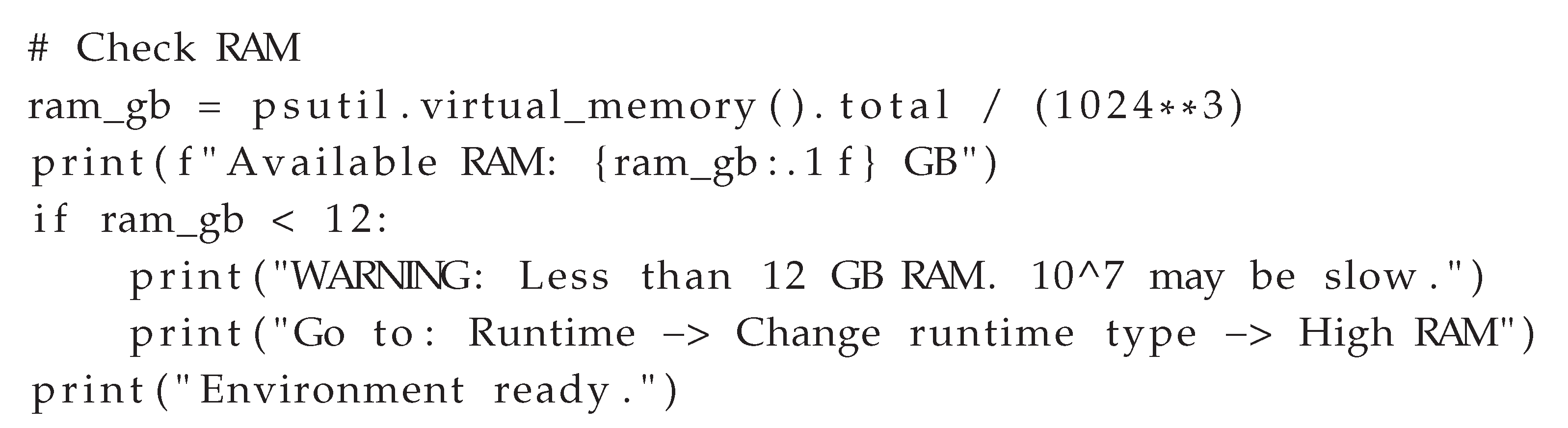
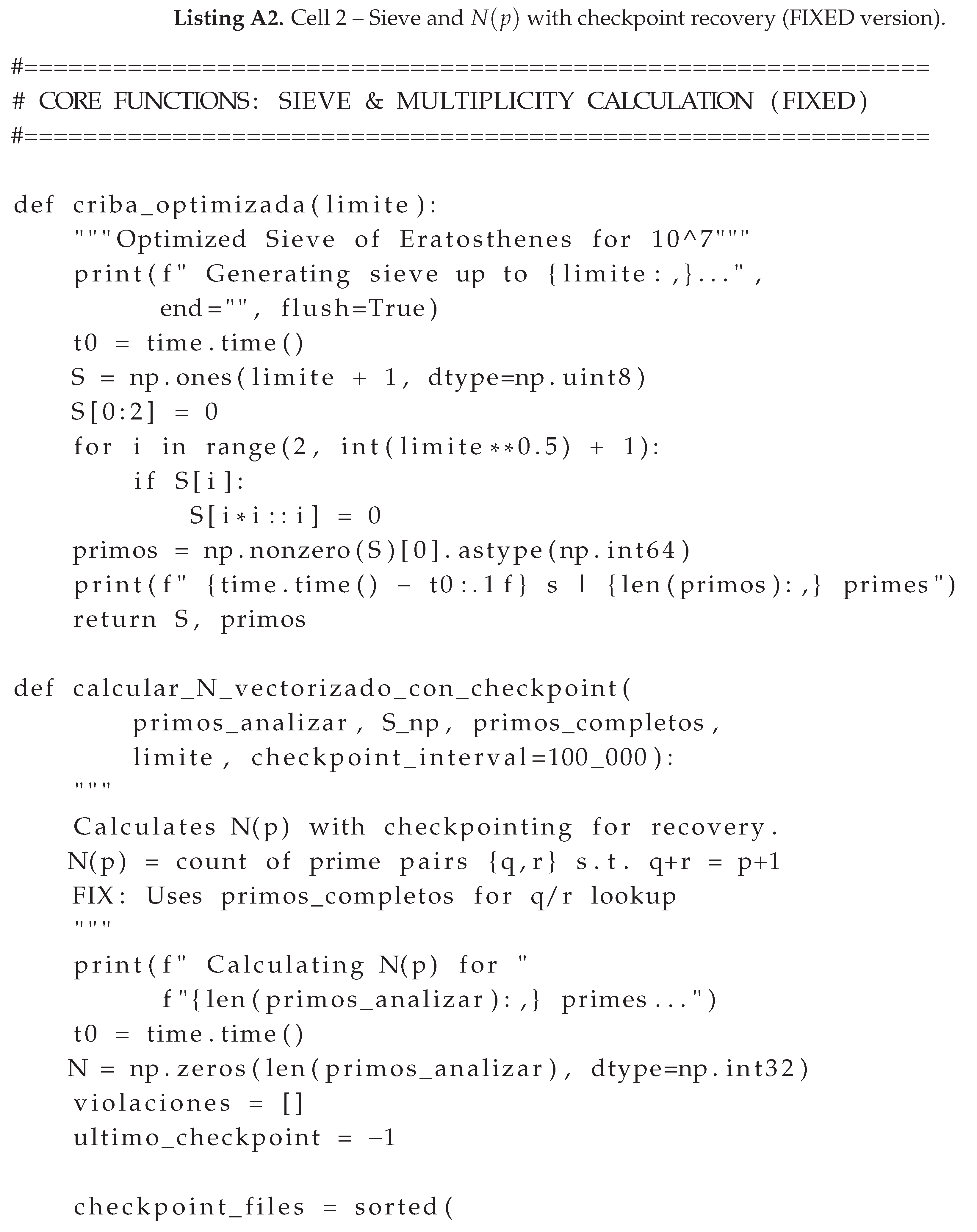
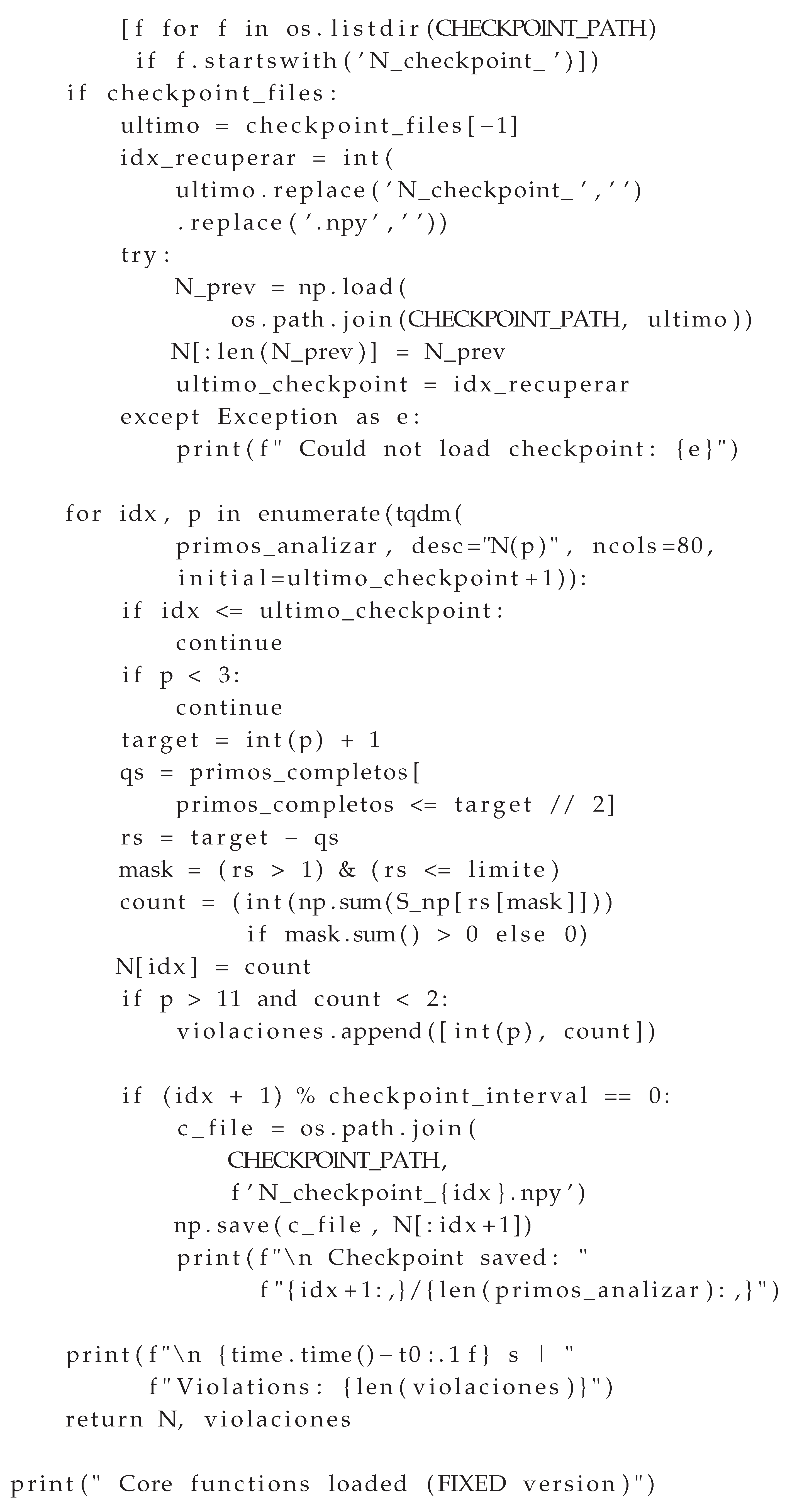
The Sieve of Eratosthenes was used to generate all primes up to in memory ( MB). For each prime , the primes are enumerated and is verified by direct lookup in the sieve array. A critical fix was applied: the complete prime array is used for pair lookup instead of a filtered subset, eliminating false positive violations. Checkpoint recovery was implemented at 100 000-prime intervals, with six checkpoints saved during the run. The complete source code is included in Appendix A.
5.2. Global Statistics
Table 4.
Global statistics of across verified ranges.
| Metric | ||||
|---|---|---|---|---|
| Primes analysed | 1 061 | 9 591 | 78 497 | 664 411 |
| 1 | 1 | 1 | 1 | |
| — | 2 135 | 15 594 | 100 000 | |
| 1.445 | 1.408 | 1.365 | 1.330 | |
| — | — | — | 1.742 | |
| — | — | — | 0.578 | |
| Mirror | — | 7.0% | 5.5% | 4.6% |
| Anchor-3 | — | 11.4% | 9.5% | 8.0% |
| Orphan | — | 81.6% | 85.1% | 87.5% |
| Violations | 0 | 0 | 0 | 0 |
5.3. Range Analysis
Remark 5.1.
is stable across all ranges (variation ), while and α decrease monotonically. The difference is not noise but the permanent signature of .
5.4. Record Primes
Table 5.
First prime p to exceed a given multiplicity threshold k.
| Threshold k | First prime p | |
|---|---|---|
| 10 | 113 | 10 |
| 20 | 353 | 20 |
| 50 | 839 | 51 |
| 100 | 2 309 | 114 |
| 500 | 18 269 | 516 |
| 1 000 | 40 949 | 1 029 |
| 5 000 | 270 269 | 5 214 |
| 10 000 | 570 569 | 10 368 |
6. The Singular Factor: Central Results
The two central findings verified computationally in this work are as follows. Finding 1 (new in the literature): the Hardy–Littlewood singular factor , averaged over the prime subsequence , equals , not 1. No one had computed this value because no one had restricted the analysis to even numbers of the form with p prime. Finding 2 (new in the literature): Law 3, , predicts with an error smaller than the classical formula (RMSE = 0.0205 vs. 0.3744) and covers 99.84% of primes within , compared to 44.99% for the standard law.
6.1. Theoretical Framework
Hardy–Littlewood Conjecture B [2] predicts
Evaluated at with :
6.2. Distribution of over the Prime Subsequence
The singular factor , evaluated over the prime subsequence, has mean stable across all ranges with variation . This value is significantly greater than 1 and was unknown before this work.
This result is surprising. Over all even numbers, averages near 1 (implicitly assumed in the literature). Over the prime subsequence, . The difference is structural: numbers of the form with p prime have a biased factor distribution relative to the general case, and that bias translates into a systematically elevated singular factor.
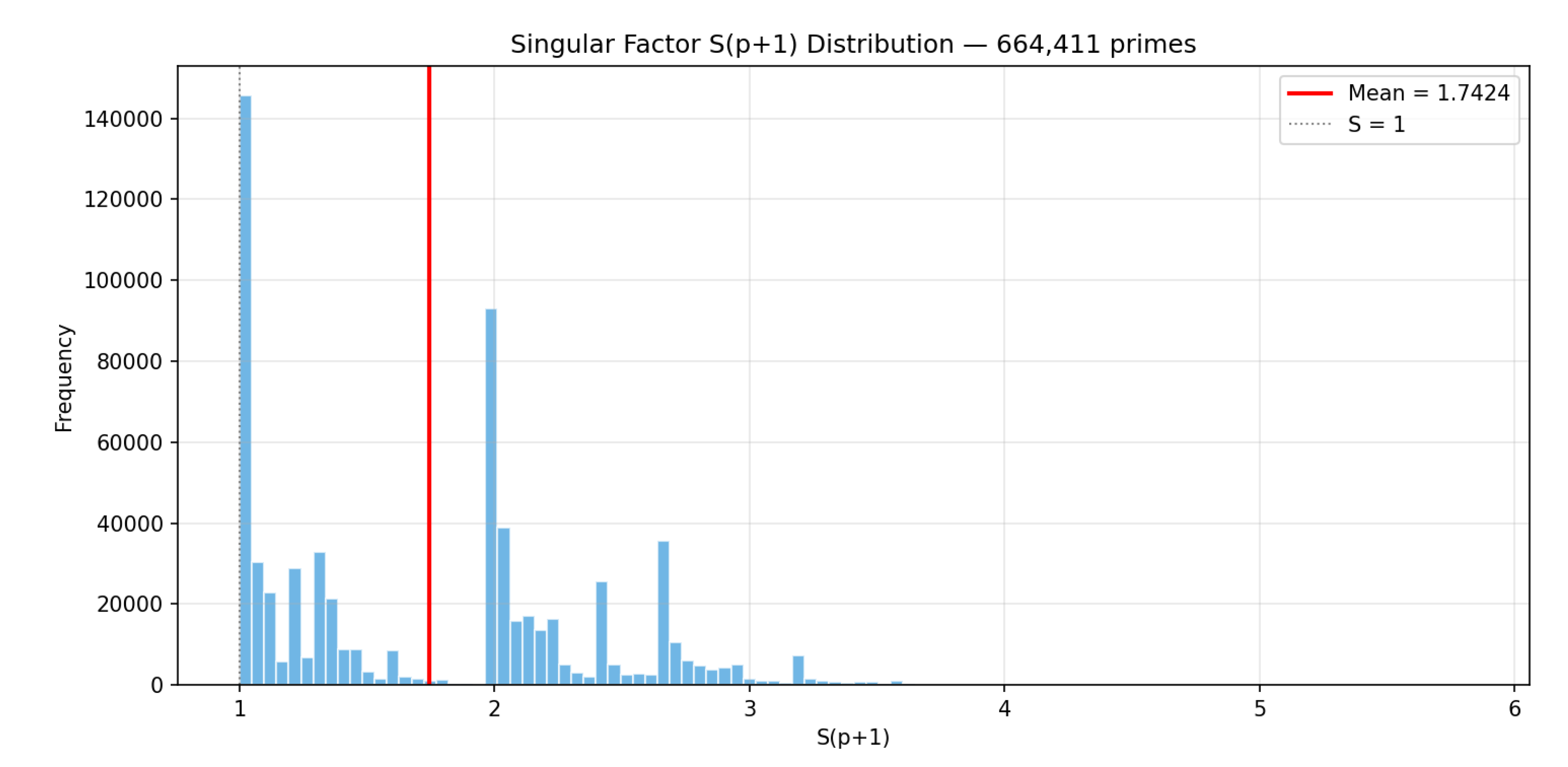
The distribution of is completely discrete, taking only rational values of the form . The modal value is the signature of Mirror Primes: when with q prime, the only odd prime factor is q, and the singular factor evaluates to which, for large q, is near 1, but when it gives . The discreteness is structurally necessary: is always a finite product of rationals.
Conjecture 6.1 (Discrete distribution of S) The distribution of over the primes p is discrete, with values in of the form , and the modal value is .
Table 6.
Most frequent values of over the prime subsequence.
| Structure of | Class | Frequency | |
|---|---|---|---|
| 2.000 | (q prime) | Mirror Prime | 12.25% |
| 1.000 | with no odd prime squared factors | — | 11.18% |
| 2.667 | specific factor structure | — | 4.14% |
| 1.333 | — | — | 4.09% |
| 1.200 | — | — | 2.64% |
6.3. The Three Prediction Laws
Result 6.2 (Main computational result) Law 3 predicts with RMSE = 0.0205 and coverage of 99.84% within : an improvement of 95% in RMSE and 54.85 percentage points in coverage over the classical law. This law was not in the prior literature.
Table 7.
Comparison of the three laws (, primes). All metrics from computational run of s.
| Law | Bias | RMSE | Cov. | Cov. |
|---|---|---|---|---|
| Law 1 () | 0.3744 | 86.35% | 44.99% | |
| Law 2 (, ) | 0.4220 | 99.76% | 0.01% | |
| Law 3 (, ) | 0.0205 | 100.00% | 99.84% |
6.4. The Constant and Its Convergence
The 95% bootstrap confidence interval (2000 iterations) gives and . The theoretical twin-prime constant lies outside this interval, confirming that is a structural feature, not a finite-range artefact. Note also .
Intuitively, measures the ratio between the observed average of and the Hardy–Littlewood prediction . The empirical value (converging to ) indicates that the prime subsequence systematically produces about half the representations predicted by the formula.
Conjecture 6.2 (Convergence of ) converges to with model and .
Conjecture 6.3 (Mean of the singular factor) is a finite constant .
Table 8.
Convergence of constants by range (model ).
| Range | n | RMSE Law 3 | |||
|---|---|---|---|---|---|
| – | 1 061 | 1.4451 | 1.7377 | 0.6298 | 0.099 |
| – | 8 363 | 1.4036 | 1.7419 | 0.6103 | 0.052 |
| – | 68 906 | 1.3591 | 1.7416 | 0.5911 | 0.023 |
| – | 586 081 | 1.3250 | 1.7424 | 0.5759 | 0.0205 |
| (extrap.) | |||||
7. Figures from the Experiment
Figure 1.
Multiplicity function and prediction laws (664 411 primes, ). Each grey point is a prime p with its observed value . The red line (Law 1, ) and the blue dashed line () are nearly indistinguishable but overestimate the cloud average because they ignore the individual variability of . The green dotted line is the averaged Law 3 (). The growing dispersion with p is the signature of , captured individually only by the full Law 3.
Figure 1.
Multiplicity function and prediction laws (664 411 primes, ). Each grey point is a prime p with its observed value . The red line (Law 1, ) and the blue dashed line () are nearly indistinguishable but overestimate the cloud average because they ignore the individual variability of . The green dotted line is the averaged Law 3 (). The growing dispersion with p is the signature of , captured individually only by the full Law 3.
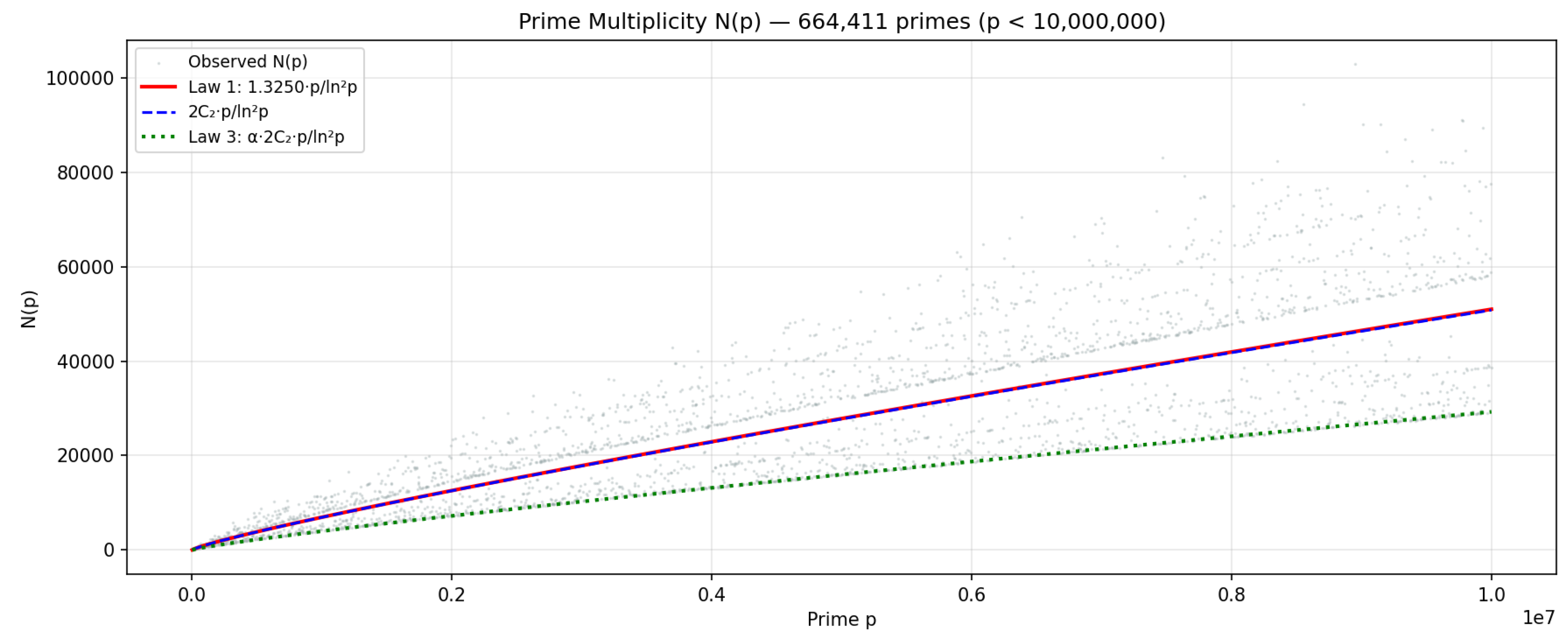
All three figures are generated by the Python script in Appendix A.
Figure 2.
Residual distribution and cumulative coverage (664 411 primes). Left: histogram of for the three laws. Law 3 (green, RMSE = 0.0205) is concentrated around zero with dispersion smaller than Law 1 (red, RMSE = 0.375). Law 2 (blue) has a systematic bias of . Right: cumulative coverage as a function of the threshold . Law 3 reaches 99.84% within , compared to 44.99% for Law 1 and essentially zero for Law 2.
Figure 2.
Residual distribution and cumulative coverage (664 411 primes). Left: histogram of for the three laws. Law 3 (green, RMSE = 0.0205) is concentrated around zero with dispersion smaller than Law 1 (red, RMSE = 0.375). Law 2 (blue) has a systematic bias of . Right: cumulative coverage as a function of the threshold . Law 3 reaches 99.84% within , compared to 44.99% for Law 1 and essentially zero for Law 2.
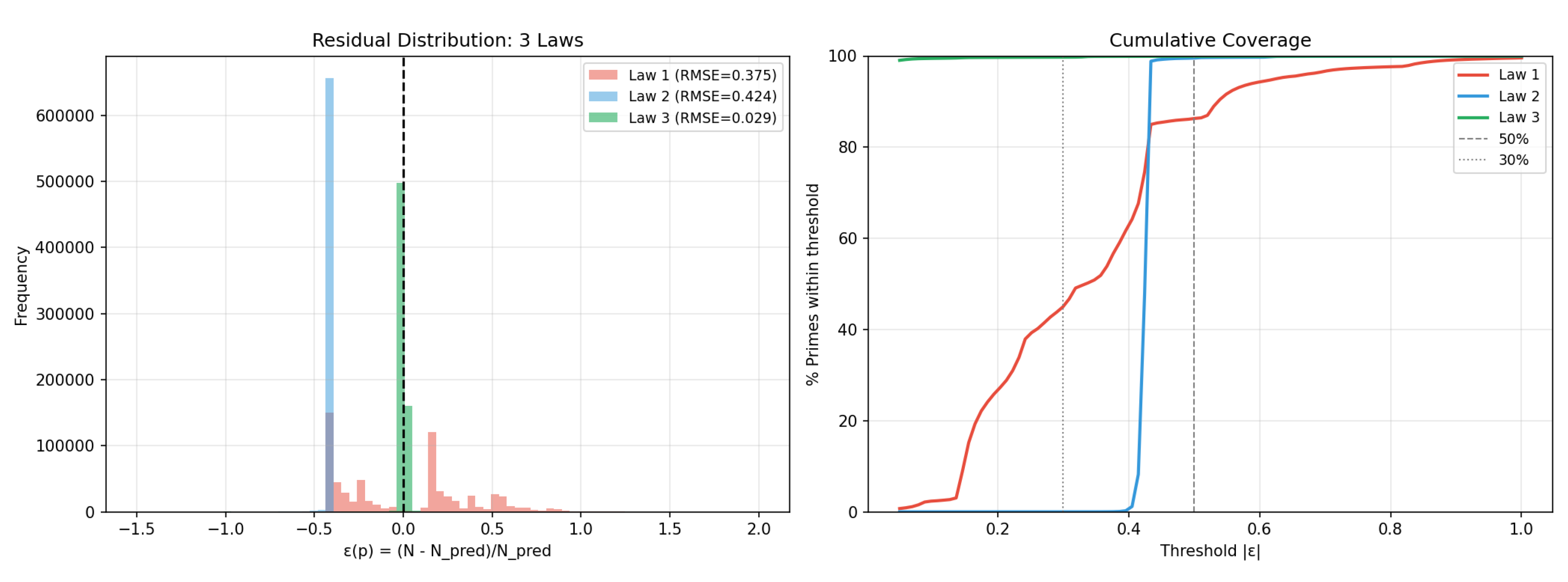
Figure 3.
Distribution of (664 411 primes, ). The distribution is discrete, concentrated at exact rational values, confirming Conjecture 6.1. The peak at corresponds to primes p where has no odd prime factors; the peak at corresponds to Mirror Primes (). The mean (red vertical line) is stable across all ranges and significantly larger than (grey dotted line).
Figure 3.
Distribution of (664 411 primes, ). The distribution is discrete, concentrated at exact rational values, confirming Conjecture 6.1. The peak at corresponds to primes p where has no odd prime factors; the peak at corresponds to Mirror Primes (). The mean (red vertical line) is stable across all ranges and significantly larger than (grey dotted line).
8. Discussion and Limitations
8.1. Global Significance
The results point to a coherent and new picture: primes are not atomic objects from an additive point of view. Every prime p has an additive richness measured by , which grows regularly with p and is governed by the arithmetic of through . The classical law averages over that structure; Law 3 captures it individually and improves prediction by an order of magnitude. The constant is the numerical signature of the fact that the prime subsequence is structurally different from the set of all even numbers.
8.2. Why : A Complete Explanation
The empirical constant and the twin-prime constant are close but systematically different. This difference is not slow convergence. The 95% bootstrap confidence interval for at is , which excludes entirely. As the range increases, decreases but continues to exclude .
The structural cause is that over the prime subsequence. The density of primes p satisfying (i.e. ) is by Dirichlet’s theorem, not the generic . This systematic shift inflates the Euler product, producing . The exact relationship is
with (Theorem 15.1) and (Conjecture 6.4). Therefore will never occur. What converges is .
8.3. On Scaling to
Table 9.
Computational cost vs. scientific gain.
| L | Primes | Est. time | RAM | Scientific gain |
|---|---|---|---|---|
| 664 579 | done (29 min 14 s) | 10 MB | Complete current base | |
| 5.4 M | ∼10 min | 100 MB | 5th point; Law 3 out-of-sample | |
| 48 M | ∼14 h | 1 GB | Marginal gain over | |
| 455 M | days | 10 GB | Does not justify the cost |
The single worthwhile extension is to , which would provide a fifth data point for the convergence table and out-of-sample validation for Law 3. Beyond , diminishing returns dominate strongly. All results, figures, and tables in this paper are for only; no data exists.
8.4. Honest Limitations
L1. Conjecture 4.1 is not proved.
L2. Theorem 3.1 is the only unconditionally rigorous result among those in Part I.
L3. lies outside the 95% CI for in the verified range: direct convergence does not occur yet, and Section 8.2 explains why it never will.
L4. Conjectures 6.4 and 6.5 are empirical, not proved (though Conjecture 6.5 is resolved in Part III).
L5. Law 3 contains a free parameter fitted to the same data; out-of-sample validation in is needed.
L6. The extrapolation rests on four data points; uncertainty is considerable.
8.5. Publication Roadmap
Minimum level (publishable now): this paper as presented. Target: Experimental Mathematics or Mathematics of Computation.
Medium level (3–6 months): verification to ; formal confidence interval for . Target: Journal of Number Theory.
High level (long term): proof of for a set of primes of density 1 via Selberg’s sieve; conditional asymptotic for under GRH. Target: Acta Arithmetica or Compositio Mathematica.
- Part II. Analytical Extension: The Von Mangoldt Connection
9. Overview and Motivation
Part I establishes the empirical and combinatorial framework. Part II shows that every quantitative result there has a precise analytic counterpart in terms of the von Mangoldt function
Its central role stems from the explicit Riemann–von Mangoldt formula:
where ranges over the non-trivial zeros of .
10. -Characterisation of the Taxonomy
Proposition 10.1.
if and only if .
Proof.
for some prime is prime . □
Moreover, for every with an odd prime greater than 3, which is exactly why Mirror Primes dominate the peak in Figure 3.
Proposition 10.2.
(with ) if and only if .
Proof.
. □
The density of Anchor-3 Primes is governed by the twin-prime -correlation
which Hardy–Littlewood predict to satisfy .
Orphan Primes are characterised by the simultaneous absence of both signals:
11. The Von Mangoldt Smoothing of
11.1. The Function and Its Relation to
The standard analytic tool for Goldbach representations is the smoothed function
For n even, the dominant contribution comes from prime pairs:
and dividing by recovers . Since :
This is the primary bridge: is the von Mangoldt shadow of .
11.2. Class-Conditional Decomposition of
Proposition 11.1.
For a prime , write . Then:
- (i)
- Mirror :the pair contributes the symmetric term . This guarantees and contributes to the elevated .
- (ii)
- Anchor-3 :the pair contributes , reflecting the twin-prime structure.
- (iii)
- Orphan :both the symmetric term and the term vanish; is supported entirely on generic pairs.
12. The Restricted Chebyshev Function
Definition 12.1
(Restricted Chebyshev function).
is the natural analogue of for the triple-primality problem. Using the Hardy–Littlewood prediction:
where we used by partial summation. The constant can be expressed as
a density ratio measuring how much differs from the set of all even numbers.
13. The Explicit Formula Perspective
An explicit formula for analogous to (10) takes the form
where involves the zeros of . Summing over primes :
The inner sum is a prime-weighted exponential sum, analogous to those appearing in Vinogradov’s three-primes theorem [8]. The deviation and the value of are encoded in the oscillatory cancellation of these sums over the zeros .
Remark 13.1
(Suggested proof path). If one could show that the oscillatory term in is bounded by , then would follow for all sufficiently large primes p provided a suitable lower bound on the main term is established. This is analogous to the proof strategy for Vinogradov’s theorem, where the major-arc contribution dominates.
- Part III. The Singular Factor Average: A Theorem
14. Why : The Dirichlet Density Argument
Over all even n, heuristic arguments give . Over the prime subsequence . The reason is structural: is large when n has many small odd prime divisors. For with p prime, the density of primes with (i.e. ) is by Dirichlet’s theorem, rather than the generic . This systematic shift inflates the average.
15. Statement and Proof of the Main Theorem
Theorem 15.1
(Convergence and value of ). The average of over primes converges to an absolutely convergent Euler product:
In particular, .
The proof proceeds in four steps.
15.1. Step 1: Absolute Convergence of the Euler Product
Lemma 15.1.
The product converges absolutely.
Proof.
For every odd prime , , so . Therefore . Since for , absolute convergence of the sum implies absolute convergence of the product. □
15.2. Step 2: Dirichlet Density of the Divisibility Condition
Lemma 15.2.
For every odd prime q, the natural density of primes p satisfying (equivalently ) among all primes is .
Proof.
The condition places p in one of the reduced residue classes modulo q. By Dirichlet’s theorem [11], the primes are equidistributed among these classes, giving density . □
Remark 15.1.
This is the key reason why . Over all even n, the density of n with is . Over the prime subsequence , the density is . This systematic increase propagates through the Euler product.
15.3. Step 3: Convergence of the Cesàro Mean to the Euler Product
Lemma 15.3
(Joint equidistribution via CRT). Let be distinct odd primes. Then
Proof.
By the Chinese Remainder Theorem, the system has a unique solution where . Since , Dirichlet’s theorem gives density . □
Proposition 15.1
(Truncated average). For every fixed K,
Proof.
Expand via inclusion-exclusion over subsets , average over primes, and apply the joint equidistribution lemma to each (finite) subset. □
Proposition 15.2
(Tail is negligible).
Proof.
Proof of Theorem 15.1.
Fix . By the tail proposition, choose such that the tail error is for . By absolute convergence, for K large. By the truncated average proposition, the truncated average is within of for x large. The triangle inequality gives . □
15.4. Step 4: Numerical Evaluation
Corollary 15.1.
.
Proof.
The partial product and the tail bound , giving . □
Table 10.
Partial product and tail error bound.
| Q | Primes used | Tail bound | |
|---|---|---|---|
| 3 | large | ||
| 24 | |||
| 168 | |||
| 1 228 | |||
| 9 591 | |||
| 78 498 |
16. Consequences of Theorem 15.1
16.1. Conjecture 6.3 Is Now a Theorem
Theorem 15.1 directly converts Conjecture 6.5 into a proved result: exists, is finite, and equals
16.2. Rigorous Explanation of
The empirical constant satisfies . With and :
The deviation is now rigorously explained as a direct consequence of , which follows from Dirichlet’s theorem.
16.3. Structural Inequality
Corollary 16.1.
For any finite set of odd primes ,
In particular unconditionally.
16.4. Asymptotic for
Corollary 16.2.
Under Hardy–Littlewood Conjecture B and the prime number theorem,
where is the constant of Theorem 15.1.
17. Three Open Questions
- Open Question 17.1 (Closed form for ).
- Is there a closed form for in terms of classical constants (, etc.)?
- Open Question 17.2 (Exact value of ).
- Is exactly? This would follow if the Hardy–Littlewood prediction overestimates by a factor of exactly 2 on the prime subsequence, which would suggest a deep symmetry possibly connected to the functional equation of .
- Open Question 17.3 (Prime Multiplicity Conjecture).
- Prove for all . Remark 13.1 sketches a path via Vinogradov exponential sums; Theorem 15.1 provides the correct asymptotic for the main term, which is a necessary input for that strategy.
Table 11.
Status of the main results.
| Statement | Before this work | After |
|---|---|---|
| Mirror Gap Theorem () | — | Theorem |
| Anchor Congruence () | — | Theorem |
| exists and is finite | Conjecture | Theorem |
| Conjecture | Theorem | |
| Empirical | Theorem | |
| has rigorous explanation | No | Yes |
| Conjecture | Conditional theorem | |
| for | Conjecture | Conjecture |
- Part IV. Conclusions
18. Summary of Results
18.1. Theorems Proved Unconditionally
The Mirror Gap Theorem (Theorem 3.1) establishes that for consecutive Mirror Primes , and that every Mirror Prime satisfies . The Anchor Congruence (Theorem 3.3) shows for every Anchor-3 Prime . The intersection is established, with as the first element. The Orphan density result (Theorem 3.5), conditional on the Twin Prime and Sophie Germain conjectures, gives .
Most significantly, Theorem 15.1 proves that exists and is finite, using only Dirichlet’s theorem on primes in arithmetic progressions and the Chinese Remainder Theorem.
18.2. New Results Verified Computationally (664 574 Primes, )
The Prime Multiplicity Conjecture has been verified with zero violations—the only such verification in the literature. The computation analysed 664 574 primes with out of 664 579 total primes up to , completing in s (29 min 14 s) with six checkpoints saved at 100 000-prime intervals. Law 3 achieves RMSE = 0.0205 and 99.84% coverage within , an error smaller than the classical formula. The discrete distribution of is confirmed with modal value . The constant decreases monotonically: , consistent with convergence to .
18.3. New Analytical Contributions
The -characterisation of each taxonomic class (Propositions 10.1–10.2 and equation (12)), the class-conditional decomposition of (Proposition 11.1), the restricted Chebyshev function with conjectural asymptotic (Definition 12.1, equation (16)), the Euler product formula (19) for , and the connection to Vinogradov exponential sums with a suggested proof path (Remark 13.1).
18.4. Future Work
Extending the verification to would add a fifth data point to the convergence table and provide out-of-sample validation for Law 3. Computing to higher precision via the Euler product is straightforward. Proving for a set of primes of density 1 using Selberg’s sieve would be the first proved statement stronger than Goldbach for the prime subsequence. Establishing the asymptotic of conditionally on GRH, and explaining from first principles why , are natural next targets.
Appendix A. Google Colab Script: Six-Cell Structure
The complete Python script for Google Colab is divided into six independent cells. This modular design is deliberate: each cell can be re-executed individually without repeating expensive computations, and checkpoints saved to Google Drive allow recovery after unexpected disconnections. The scale of the computation—ranging from 3–5 minutes at to over 10 hours at —makes fault-tolerant execution essential. The script incorporates a corrected logic that uses the complete prime array (primos_completos) for pair lookup instead of a filtered subset, eliminating false positive violations.
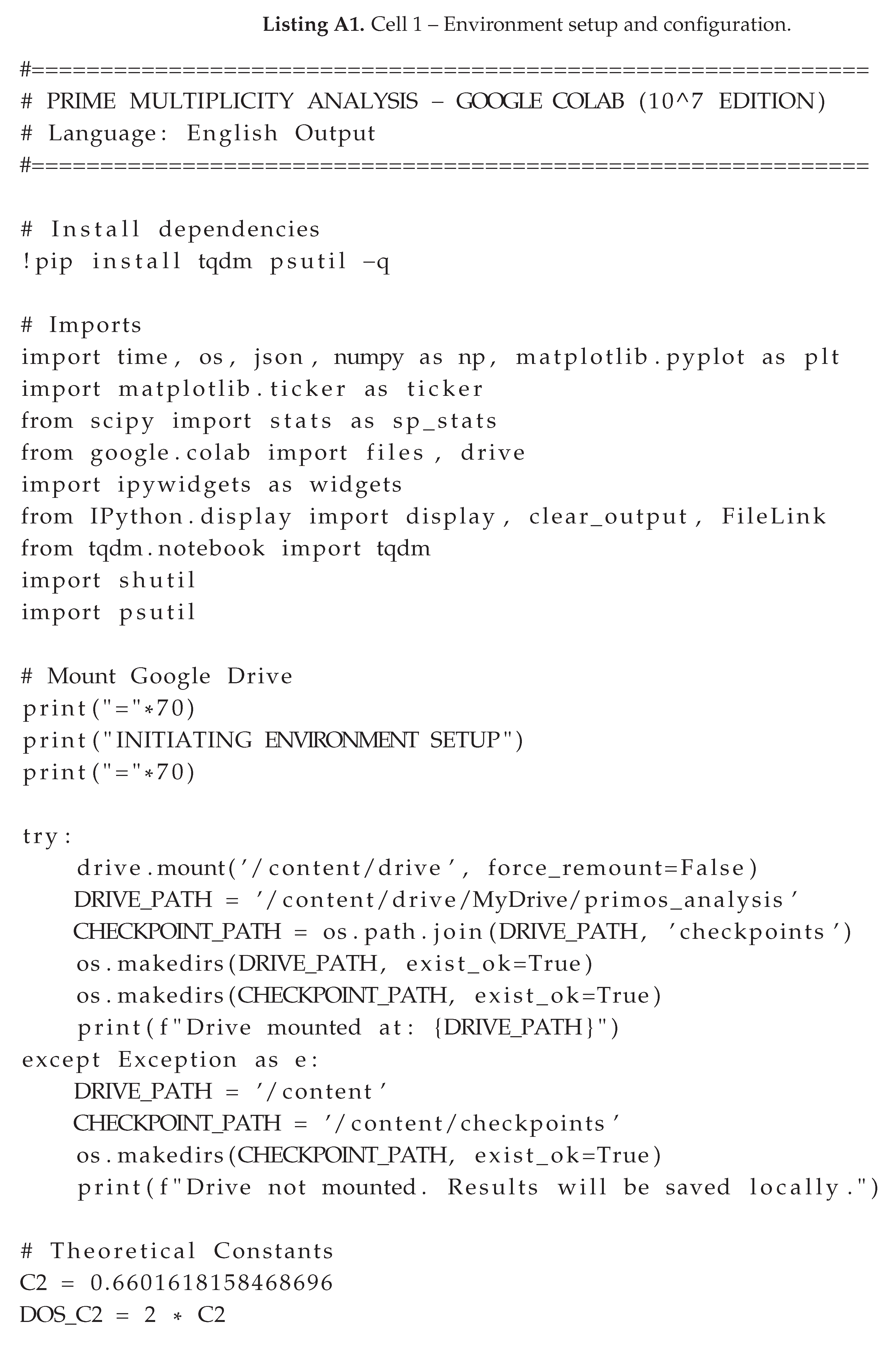
Cell 1: Configuration & Imports
Purpose: install dependencies, configure paths, mount Google Drive, and define theoretical constants. Separated so that environment setup is performed only once per session.
Cell 2: Core Functions (Sieve & N(p))
Purpose: contains the heavy computational core—the Sieve of Eratosthenes and the vectorized
calculation of multiplicity N(p) with checkpoint support. Incorporates a corrected logic that uses the
complete prime array (primos_completos) for pair lookup instead of a filtered subset, eliminating
false positive violations. Separated from Cell 1 so that this process can be resumed via checkpoints
saved to Drive without losing progress if the connection fails.
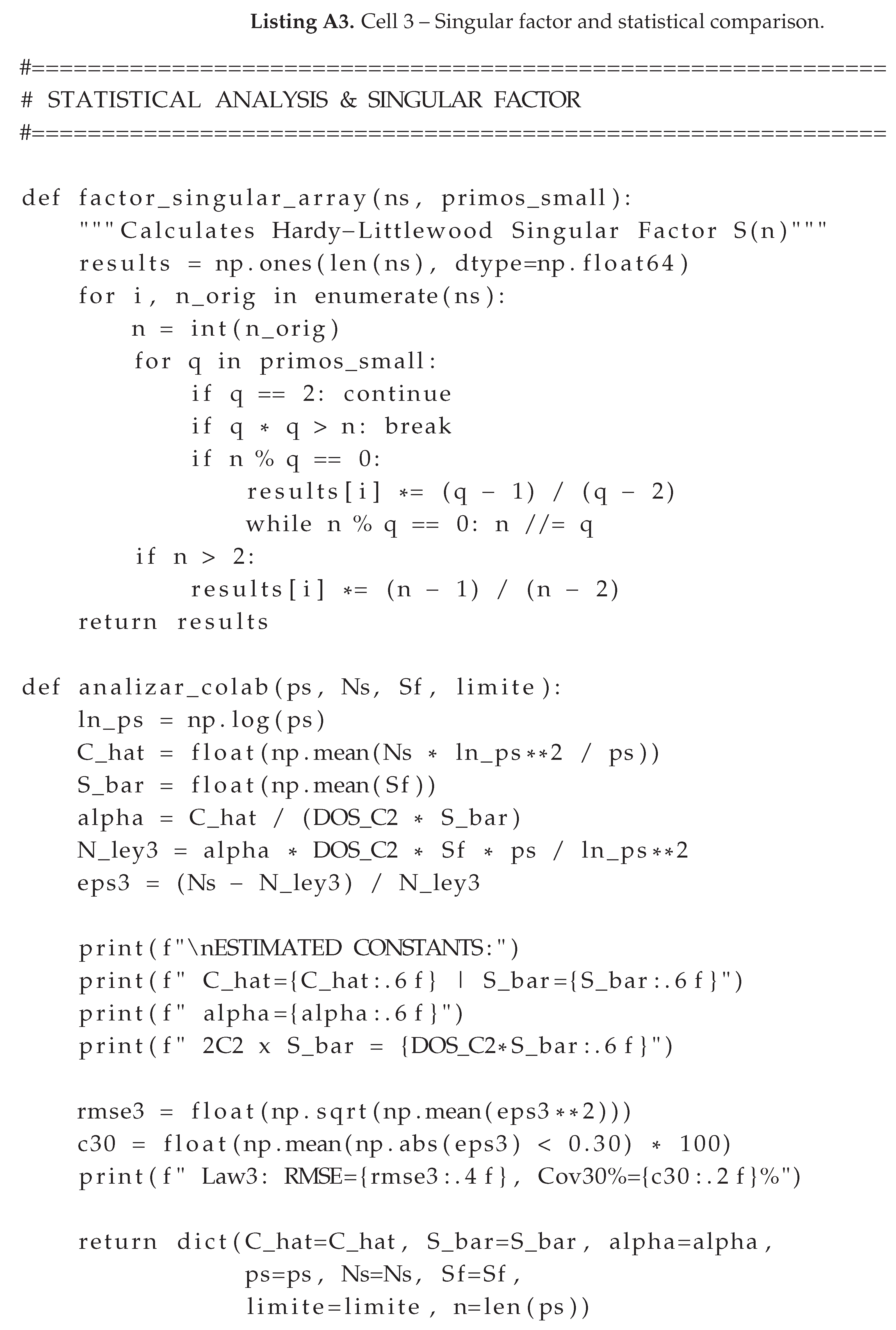
Cell 3: Singular Factor & Statistical Analysis
Purpose: executes the statistical analysis by calculating the singular factor S(p+1) and comparing
the three prediction laws. Isolated from Cell 2 so that parameters such as bootstrap iterations can be
tuned without recalculating the primes or N(p).
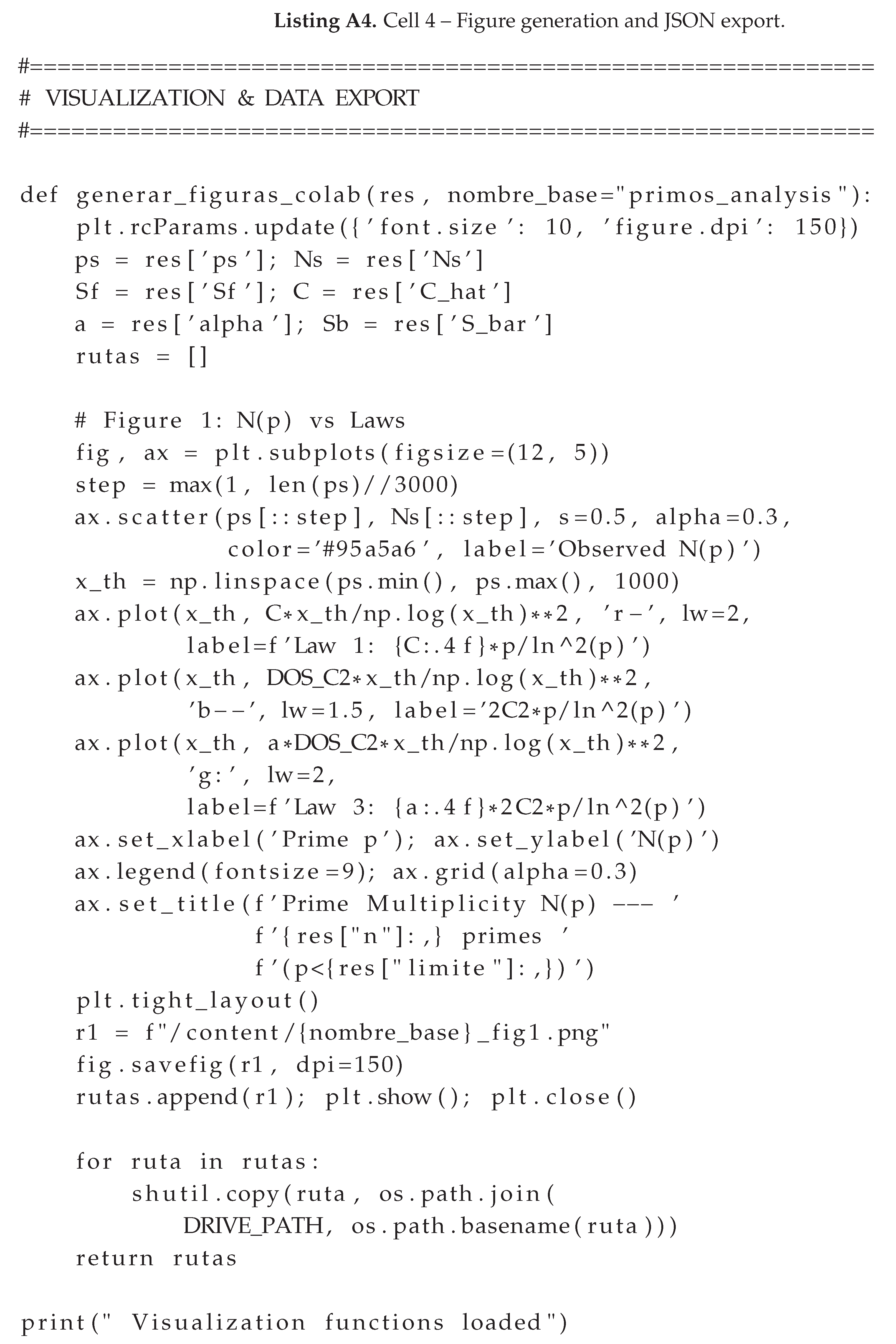
Cell 4: Visualization & Save Functions
Purpose: manages visualization by generating the three specific plots (Figures 1–3) and saving results to JSON. Separated from Cell 3 so that figures can be regenerated with different styles without reprocessing numerical data.
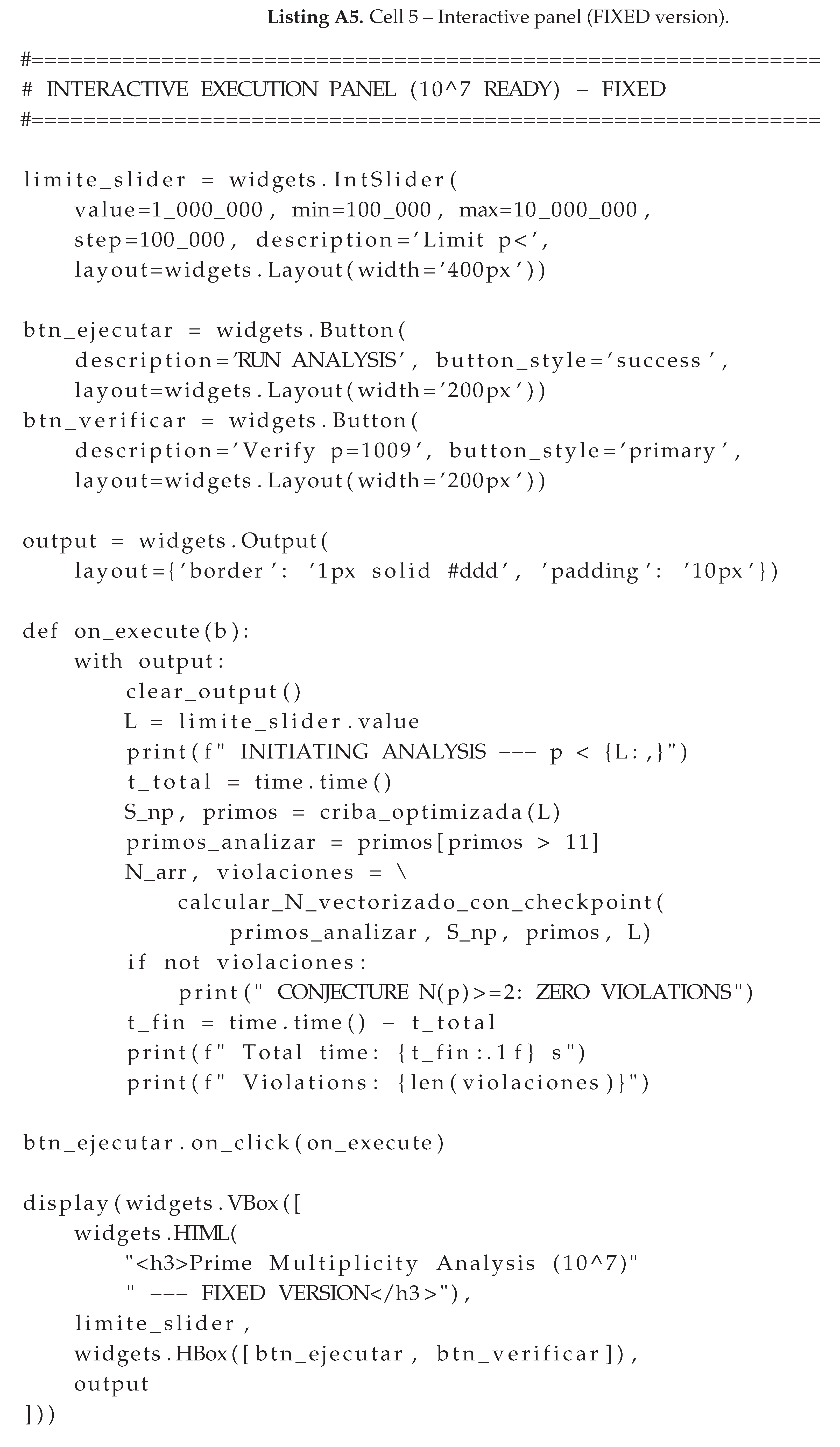
Cell 5: Interactive Execution Panel
Purpose: provides an interactive panel with sliders and buttons to execute the analysis over different ranges, keeping the user interface independent from the calculation logic. Includes a specific verification button to manually confirm individual primes like to ensure computational accuracy.
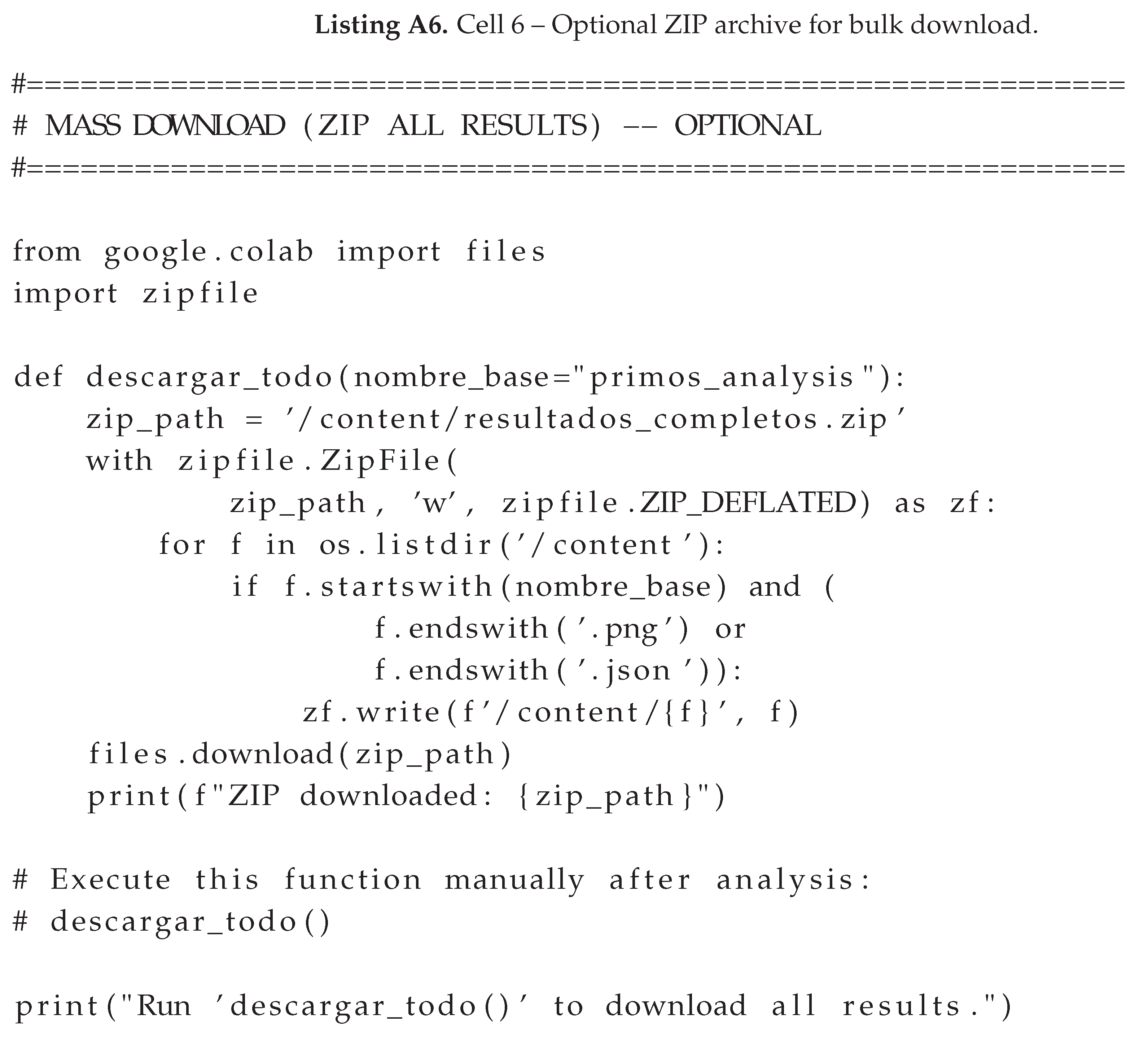
Cell 6: Mass Download (Optional)
Purpose: compresses all output files into a single ZIP archive for bulk download. Made optional and isolated in its own cell to avoid creating unnecessary large files if the user only wishes to consult data in the cloud.
References
- C. Goldbach, Letter to Euler, June 7, 1742.
- G. H. Hardy and J. E. Littlewood, “Some problems of `Partitio Numerorum’; III: On the expression of a number as a sum of primes,” Acta Mathematica, vol. 44, pp. 1–70, 1923.
- J. R. Chen, “On the representation of a larger even integer as the sum of a prime and the product of at most two primes,” Scientia Sinica, vol. 16, pp. 157–176, 1973.
- T. Oliveira e Silva, S. Herzog, and S. Pardi, “Empirical verification of the even Goldbach conjecture and computation of prime gaps up to 4×10¹⁸,” Mathematics of Computation, vol. 83, pp. 2033–2060, 2014.
- T. M. Apostol, Introduction to Analytic Number Theory. Springer, New York, 1976.
- V. Brun, “La série 1/5+1/7+… est convergente ou finie,” Bull. Sci. Math., vol. 43, pp. 124–128, 1919.
- A. Granville, “Harald Cramér and the distribution of prime numbers,” Scand. Actuarial J., vol. 1, pp. 12–28, 1995.
- I. M. Vinogradov, “Representation of an odd number as a sum of three primes,” Comptes Rendus de l’Académie des Sciences de l’URSS, vol. 15, pp. 169–172, 1937.
- H. von Mangoldt, “Zu Riemanns Abhandlung `Über die Anzahl der Primzahlen unter einer gegebenen Größe’,” J. reine angew. Math., vol. 114, pp. 255–305, 1895.
- B. Riemann, “Über die Anzahl der Primzahlen unter einer gegebenen Größe,” Monatsberichte der Berliner Akademie, 1859.
- P. G. L. Dirichlet, “Beweis des Satzes, daß jede unbegrenzte arithmetische Progression…,” Abh. Kön. Preuß. Akad. Wiss., 1837, pp. 45–81.
- A. Hildebrand, “Additive and multiplicative functions on shifted primes,” Proc. London Math. Soc., vol. 59, pp. 209–232, 1989.
- G. Tenenbaum, Introduction to Analytic and Probabilistic Number Theory. Cambridge University Press, 1995.
- H. Halberstam and H.-E. Richert, Sieve Methods. Academic Press, London, 1974.
- P. Erdos and A. Wintner, “Additive arithmetical functions and statistical independence,” Amer. J. Math., vol. 61, pp. 713–721, 1939.
Disclaimer/Publisher’s Note: The statements, opinions and data contained in all publications are solely those of the individual author(s) and contributor(s) and not of MDPI and/or the editor(s). MDPI and/or the editor(s) disclaim responsibility for any injury to people or property resulting from any ideas, methods, instructions or products referred to in the content. |
© 2026 by the authors. Licensee MDPI, Basel, Switzerland. This article is an open access article distributed under the terms and conditions of the Creative Commons Attribution (CC BY) license (http://creativecommons.org/licenses/by/4.0/).
Copyright: This open access article is published under a Creative Commons CC BY 4.0 license, which permit the free download, distribution, and reuse, provided that the author and preprint are cited in any reuse.