

Submitted:
08 March 2026
Posted:
10 March 2026
You are already at the latest version
Abstract
Keith numbers form a rare class of integers defined by a digit-generated linear recurrence in which the original number reappears within its own sequence. Although known for several decades, their structural properties and the mechanisms underlying their extreme sparsity remain poorly understood.In this work, we introduce a dynamical reformulation of Keith sequences by embedding the digit recurrence into a discrete state-space system governed by a companion matrix. Within this framework, the recurrence trajectory can be interpreted as an orbit of a finite-dimensional linear dynamical system. This representation enables the introduction of trajectory observables—including informational inertia, an admissibility field, and a stability functional—which characterize the evolution of the sequence.Using this formulation, we analyze the spectral structure of the recurrence operator and show that the reappearance of the original integer corresponds to a transient intersection between the expanding trajectory and a fixed identity hyperplane in state space. Representative numerical scans over increasing integer ranges confirm that such identity-return events are extremely rare and occur only under tightly constrained dynamical conditions.These results suggest that Keith numbers can be interpreted as non-generic return events in a linear dynamical system determined by digit-based initial conditions. The proposed framework provides a dynamical explanation for their empirical sparsity and offers a basis for studying digit recurrences using tools from dynamical systems, spectral analysis, and computational number theory.
Keywords:
Keith numbers
; digit recurrence
; linear recurrence sequences
; companion matrix
; spectral analysis
; discrete dynamical systems
; arithmetic attractors
; Diophantine intersection
; exponential growth
; integer dynamics
; transient regime
; identity persistence
; admissibility function
; sparse sets
; number theory
; Viscous Time Theory (VTT)
1. Introduction
Integer sequences defined through digit-based recurrence relations occupy an interesting position at the intersection of number theory, discrete dynamical systems, and computational mathematics. Among these sequences, Keith numbers form a particularly intriguing class of integers defined by a recurrence constructed directly from their own decimal digits.
Given an integer with decimal digits , the associated Keith sequence is generated by taking the digits as initial conditions and subsequently forming each new term as the sum of the previous terms. If the original number eventually reappears within this recurrence, the integer is called a Keith number [1,2].
Although the definition is simple, the set of Keith numbers appears to be extremely sparse, and only a limited number of examples are known. Early investigations primarily focused on enumeration and computational searches [1,3], while more recent work has explored structural properties and connections with linear recurrence sequences and digit-based dynamical processes [4,5]. Nevertheless, a comprehensive theoretical explanation for the rarity and distribution of these numbers remains largely open.
The recurrence underlying Keith numbers can be viewed as a particular instance of a linear recurrence with digit-determined initial conditions. Such recurrences are naturally associated with companion matrices, allowing the evolution of the sequence to be interpreted as a trajectory of a finite-dimensional linear dynamical system [6,7]. From this viewpoint, the behavior of the sequence is governed by the spectral properties of the associated matrix, including its dominant eigenvalue and invariant subspace structure.
Within this dynamical interpretation, the appearance of the original number corresponds to a specific geometric event in the trajectory of the system. More precisely, the recurrence can be embedded in a -dimensional state space where each step corresponds to a linear transformation determined by the recurrence relation. In this representation, the reappearance of the initial number occurs when the evolving trajectory intersects a hyperplane defined by the identity condition.
In the present work, we develop this dynamical formulation in detail and introduce a set of informational observables designed to characterize the trajectory of the recurrence within state space. These observables provide a compact description of the system's evolution and allow the identification of conditions under which identity-return events occur.
Building on this framework, we perform numerical experiments over a wide range of integers and analyze the resulting trajectories using spectral and dynamical indicators. The results suggest that Keith numbers correspond to rare transient intersections between the recurrence trajectory and the identity hyperplane, rather than to fixed points or periodic attractors of the system.
The main contributions of this work can be summarized as follows:
- We develop a dynamical state-space formulation of Keith sequences using a companion-matrix representation.
- We introduce a set of trajectory observables that characterize recurrence evolution and identity-return events.
- We analyze the spectral structure of the recurrence operator and its implications for growth and trajectory geometry.
- We perform systematic numerical scans to examine the empirical sparsity and clustering of Keith numbers.
- We propose a geometric interpretation of Keith numbers as rare return intersections in a discrete dynamical system.
This dynamical viewpoint provides a unified framework connecting digit recurrences with tools from spectral theory and discrete dynamical systems, and suggests new directions for studying digit-generated sequences using geometric and dynamical methods. The present work was originally motivated by concepts developed within the Viscous Time Theory (VTT) framework, which inspired the interpretation of digit-generated recurrences in terms of informational observables and trajectory-based dynamics in discrete state space.
2. Theoretical Framework and Computational Methodology
In this section we formalize the dynamical interpretation of Keith numbers introduced in the previous section. Rather than treating Keith numbers as isolated numerical coincidences, we reinterpret the associated digit recurrence as a deterministic discrete dynamical system evolving on a finite-dimensional state space.
This formulation allows the recurrence process to be analyzed using tools from dynamical systems theory and linear operator theory. In particular, the sequence evolution can be represented as a trajectory in a finite-dimensional vector space whose structure determines whether identity persistence occurs.
We first define the Keith recurrence and its associated state-space representation. We then introduce the corresponding linear operator formulation, analyze its spectral properties, and derive structural conditions governing identity return events.
2.1. Keith Recurrence and State-Space Representation
Keith numbers are integers that reappear within a sequence generated by iteratively summing their own digits. Although traditionally studied as curiosities within recreational number theory, this recurrence possesses structural properties that allow it to be interpreted as a discrete dynamical process.
Given an integer with decimal expansion
we define the associated sequence by
If for some , then is a Keith number.
Traditionally this condition has been viewed as a numerical coincidence. However, when interpreted as a recurrence operator acting on digit space, the process defines a deterministic discrete flow on a finite-dimensional state vector.
This perspective enables several analytical constructions, including:
- stability analysis of the recurrence trajectory
- definition of informational inertia
- identification of admissibility cliffs
- classification of integers according to identity-attracting or identity-diverging dynamics
Within this framework, Keith numbers correspond to discrete attractor events in the recurrence-generated dynamical manifold.
Figure 1.
Canonical Keith Trajectory (N = 197) The Keith sequence for N = 197 plotted as a function of discrete time t. The identity line X = 197 is shown as a dashed horizontal line, and the identity return point is marked with a star, representing the successful refolding of the informational state.
Figure 1.
Canonical Keith Trajectory (N = 197) The Keith sequence for N = 197 plotted as a function of discrete time t. The identity line X = 197 is shown as a dashed horizontal line, and the identity return point is marked with a star, representing the successful refolding of the informational state.
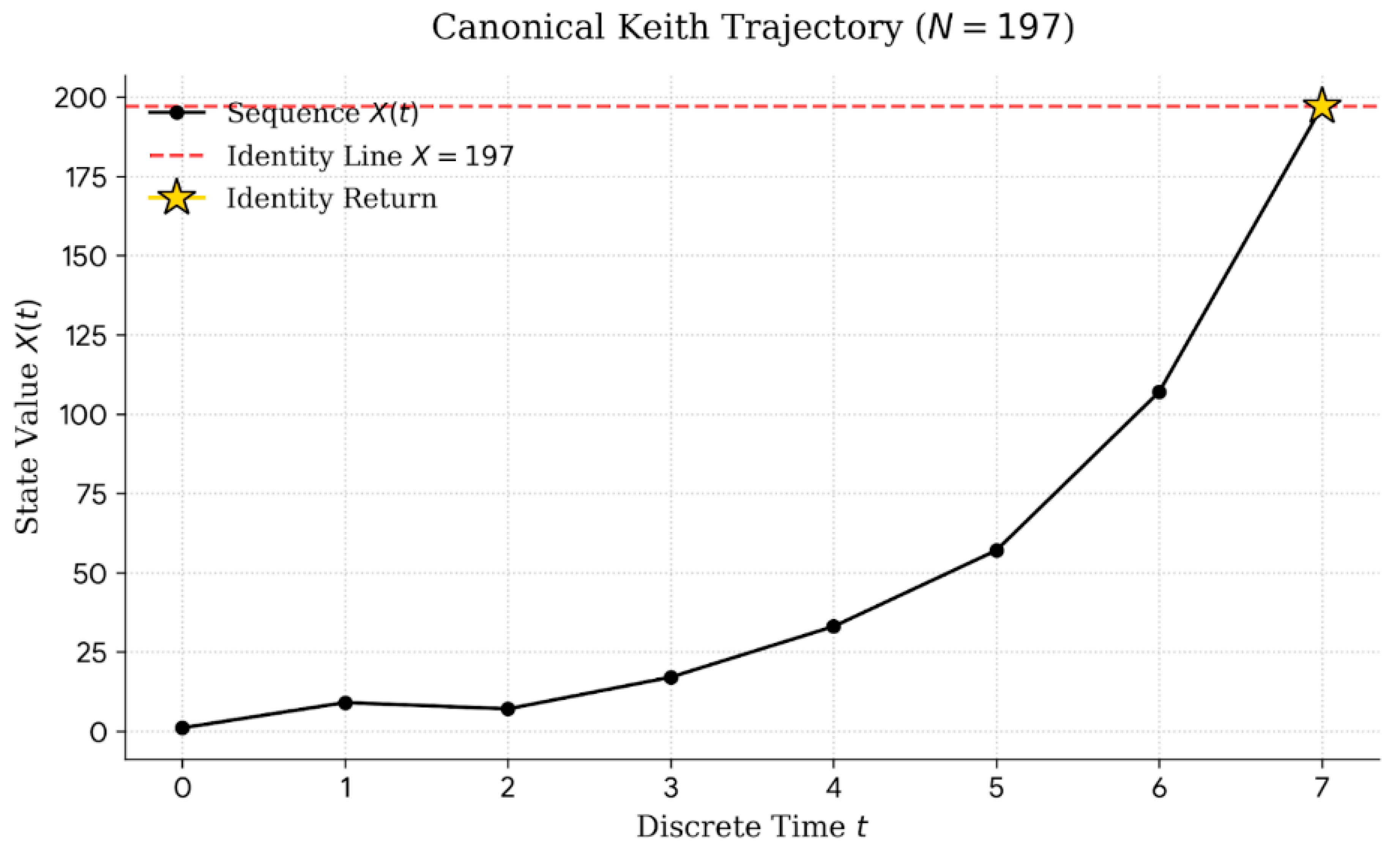
To analyze this behavior formally, we now express the recurrence as a discrete dynamical operator acting on a finite-dimensional state vector.
2.2. Discrete Dynamical Formulation
Let
denote the state vector representing the most recent values of the sequence.
The recurrence rule can then be written as a linear operator
where
This formulation defines a linear recurrence in .
Identity persistence occurs when the evolving trajectory intersects the scalar constraint
for some integer time . In dynamical systems language this event corresponds to a discrete attractor condition.
The linear nature of the recurrence allows a complete structural analysis using matrix representation and spectral theory.
2.3. Linear Recurrence Structure and Spectral Analysis of Keith Dynamics
The operator formulation introduced above admits a compact representation using companion matrices. This representation allows the dynamical behavior of the sequence to be studied through the spectral properties of the associated linear operator.
In particular, the eigenstructure of the recurrence determines the asymptotic growth rate of trajectories and clarifies why identity return events occur only under special structural conditions.
2.3.1. Companion Matrix Formulation
Let be a positive integer with decimal expansion ( as shown in Equation (1), where is the number of digits and .
Define the associated Keith sequence by
Introduce the state vector
The recurrence can be written in linear form: where the companion matrix is
Thus,
The dynamics is therefore a linear recurrence of order embedded in .
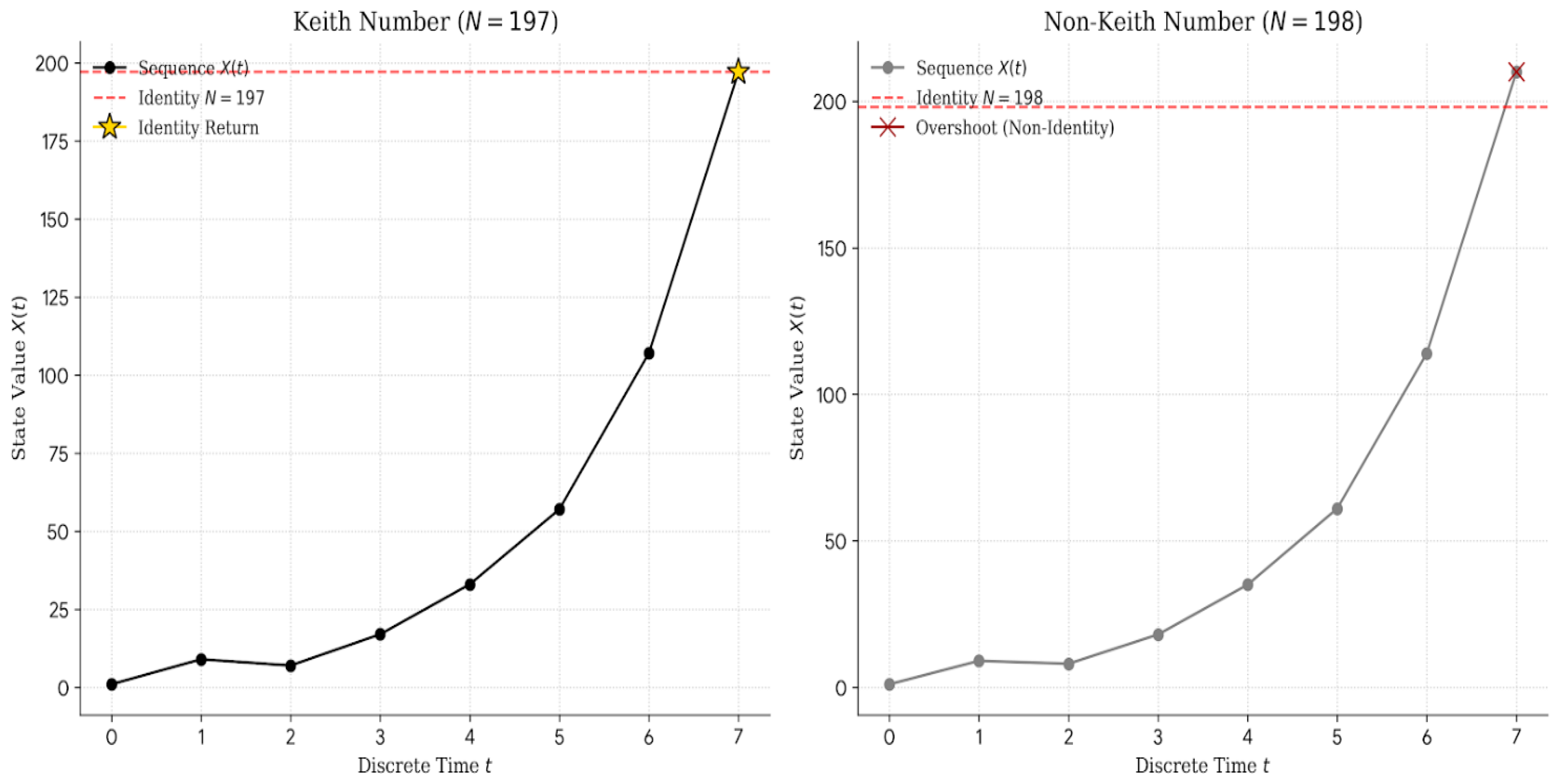
Figure 2.
Non-Keith Comparison (N = 197 vs N = 198) A side-by-side comparison of the state trajectory X(t) for a Keith number (N=197) and a non-Keith number (N=198). The left panel shows the characteristic identity return (marked by a star), while the right panel illustrates the divergent overshoot behavior (marked by an 'x'), where the sequence bypasses the target identity, representing an informational decoherence event.
Figure 2.
Non-Keith Comparison (N = 197 vs N = 198) A side-by-side comparison of the state trajectory X(t) for a Keith number (N=197) and a non-Keith number (N=198). The left panel shows the characteristic identity return (marked by a star), while the right panel illustrates the divergent overshoot behavior (marked by an 'x'), where the sequence bypasses the target identity, representing an informational decoherence event.
2.3.2. Characteristic Polynomial and Spectral Structure
The characteristic polynomial of is
This polynomial has:
- exactly one real root ,
- all other roots satisfying .
This follows from Perron–Frobenius theory, since:
- is nonnegative,
- irreducible,
- primitive.
Therefore, there exists a unique dominant eigenvalue , and
for some constant depending on the initial digits. Hence the Keith sequence grows asymptotically exponentially with rate .
2.3.3. Growth Rate and Exponential Expansion
Let be the positive eigenvector associated with .
For large ,
In particular,
for some .
This implies:
- The sequence is strictly increasing after a finite number of steps.
- The trajectory escapes any bounded region exponentially fast.
Thus, an identity return condition must occur before exponential divergence dominates.
This makes Keith events non-generic intersections between an expanding orbit and a fixed scalar hypersurface.
2.3.4. Identity Return as Hyperplane Intersection
Define the scalar projection map:
Identity return occurs when
Geometrically:
- The orbit follows an expanding ray asymptotic to .
- The condition defines an affine hyperplane in state space.
Keith numbers correspond to orbits that intersect this hyperplane exactly at an integer time.
This is a Diophantine intersection problem between:
- An exponentially expanding linear flow,
- A fixed affine constraint.
2.3.5. Non-Generic Nature of Keith Events
Since: and , the sequence grows rapidly.
Therefore, the set of integers satisfying identity return is sparse and identity persistence requires alignment between the digit vector , the spectral structure of , and the exponential growth rate.
Keith numbers therefore form a thin subset of . The problem of estimating their density remains open.
Figure 3.
Phase portrait of the Keith recurrence for.
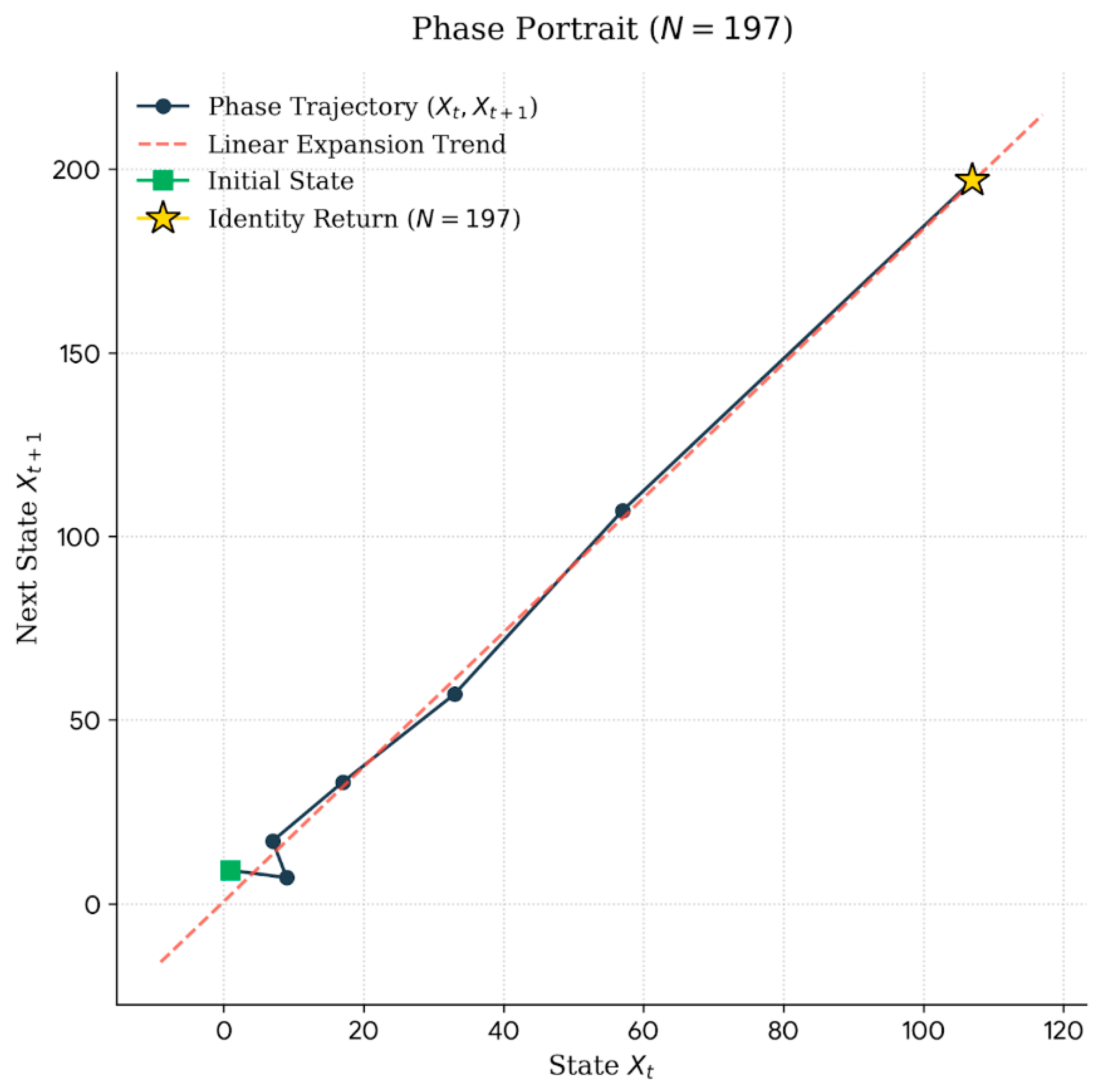
The lag-1 embedding reveals an expanding linear trajectory in state space. Identity return corresponds to a single scalar intersection rather than periodic orbit formation.
While the spectral structure describes the global dynamics of the recurrence, it is useful to introduce observable quantities that characterize the local behavior of trajectories and identify potential identity-return events.
2.4. Informational Observables
To quantify the dynamical behavior of recurrence trajectories we introduce a set of informational observables that capture structural properties of the sequence evolution.
These quantities allow identity-return events to be detected and classified in terms of local trajectory geometry rather than purely numerical coincidence.
2.4.1. Informational Inertia
Define the second discrete difference:
This quantifies local reorganization acceleration. Large values of indicate structural reconfiguration.
2.4.2. Admissibility Field
Define:
Properties:
- iff ,
- Sharp admissibility cliff at identity.
This function acts as a discrete attractor detector.
2.4.3. Stability Functional
Define trajectory cost:
Keith numbers exhibit structured cost accumulation followed by refolding.
Figure 4.
Informational Inertia Profile (N = 197).
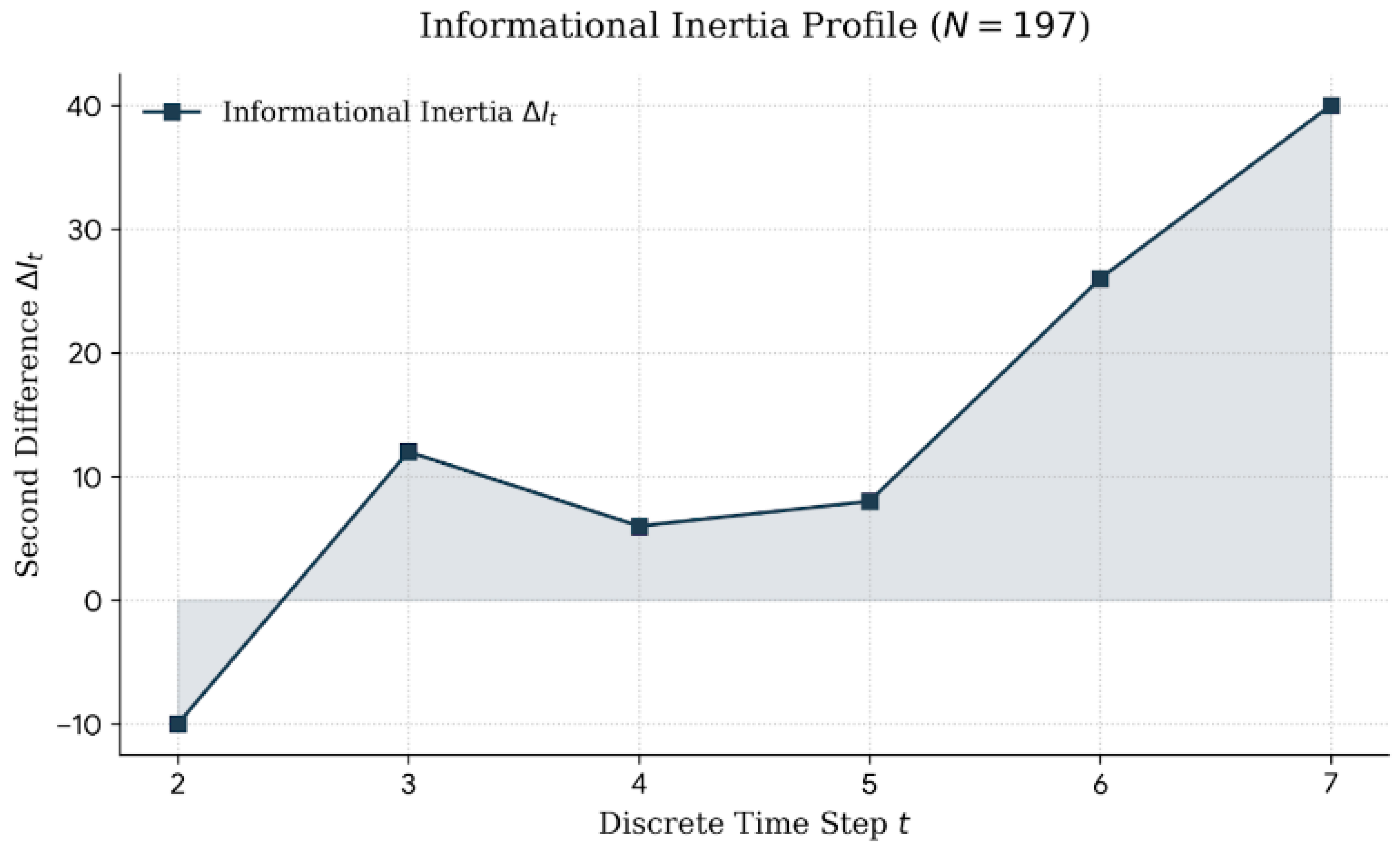
The discrete second difference Delta I_t = X(t) - 2X(t-1) + X(t-2) computed for the Keith sequence N = 197. The profile illustrates the accumulation of informational inertia (reorganization cost) as the sequence propagates through discrete time steps prior to the identity refolding event.
3. Results
To investigate the dynamical properties of Keith recurrences, we performed numerical experiments across a range of integers and analyzed the resulting trajectories within the state-space framework introduced in Section 2.
The objective of these experiments is threefold:
- to identify identity-return events corresponding to Keith numbers,
- to characterize the dynamical behavior of trajectories approaching or diverging from the identity hyperplane,
- to evaluate structural observables such as informational inertia and admissibility fields.
3.1. Numerical Experiments
We compute recurrence sequences for integers and analyze their dynamical properties within the state-space formulation introduced earlier.
The numerical analysis includes:
- identification of Keith numbers,
- computation of informational inertia profiles,
- evaluation of closest-approach metrics for non-Keith integers.
Preliminary results reveal several structural features of the recurrence dynamics:
- non-uniform clustering of identity-return events,
- scale-dependent density of Keith numbers,
- the presence of structured distribution boundaries.
These observations suggest that the identity-persistent set may exhibit fractal or self-similar characteristics within the integer lattice.
3.2. Numerical Examples and Empirical Structure
To illustrate the dynamical behavior predicted by the theoretical framework, we present representative numerical examples demonstrating identity persistence, near-identity divergence, and scaling behavior across different digit lengths.
These examples highlight the geometric interpretation of Keith events as intersections between recurrence trajectories and the identity hyperplane.
3.2.1. Canonical Identity Event:
The integer is a classical Keith number and provides a canonical example of an identity-return trajectory.
(i) Generated Sequence
Initial digits: (1, 9, 7)
Order of recurrence: Generated sequence: 1, 9, 7, 17, 33, 57, 107, 197
The identity return occurs at Thus, confirming that the trajectory intersects the identity hyperplane.
(ii) Informational Inertia Profile:The discrete second difference:
reveals a structured accumulation of reorganization cost prior to the identity return.
Observed behavior:
- Moderate oscillatory buildup in early steps.
- Gradual increase in reorganization amplitude.
- Collapse of residual difference at identity return.
The identity event coincides with a termination of transient expansion before exponential divergence dominates.
(iii) Admissibility Cliff
The admissibility field, , as shown in Equation (19) exhibits:
- Low baseline values for ,
- Sharp unit peak:
This behavior corresponds to a discrete admissibility cliff, marking the exact intersection of the trajectory with the identity constraint.
The cliff structure is structurally sharp rather than gradual, supporting the interpretation of Keith events as exact attractor intersections.
Figure 5.
Admissibility Field Φα for N = 197.
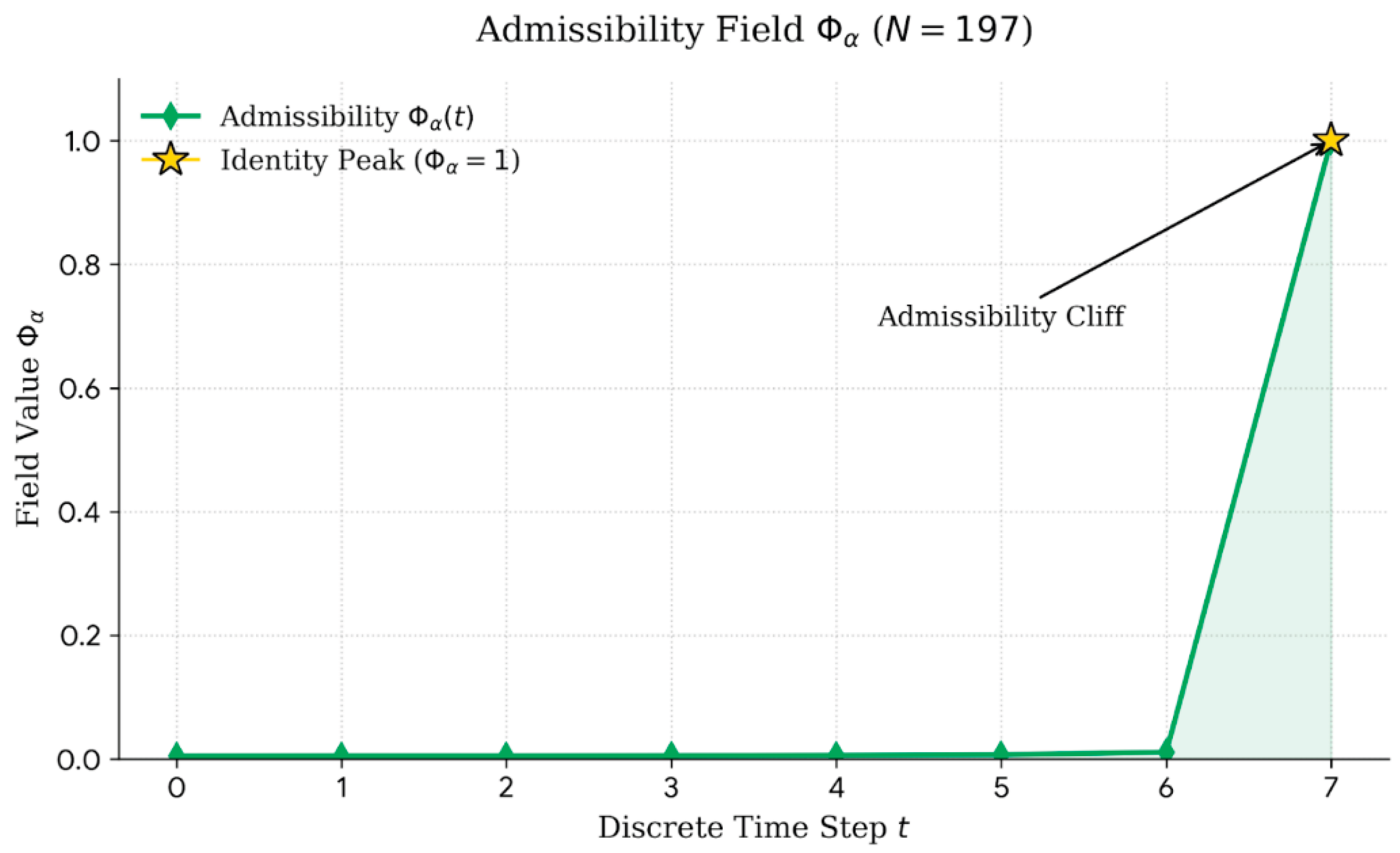
The admissibility field evaluated along the recurrence trajectory for . The field remains near zero during early divergence and exhibits a sharp unit peak at the identity return event , illustrating the discrete admissibility cliff associated with identity persistence.
3.2.2. Near-Identity Non-Keith Example
To contrast identity-return dynamics with near-miss trajectories, we consider the neighboring integer . Although structurally similar to 197, this integer does not produce an identity-return event.
Consider a neighboring integer:
(i) Generated Sequence:
Initial digits: . Generated sequence (partial): The sequence overshoots: without identity return.
(ii) Closest Approach Metric
Define:
For :
Despite structural similarity to 197, the trajectory does not intersect the identity hyperplane. This illustrates the non-generic nature of identity persistence: small variations in initial digits can prevent the trajectory from intersecting the identity hyperplane.
(iii) Inertia Comparison
Comparative analysis shows similar early ΔI profiles to 197 and divergence occurring before admissibility cliff formation. Thus, identity persistence depends on precise spectral–initial alignment.
3.2.3. Scaling with Digit Length
To investigate how recurrence dynamics evolve with dimensionality, we analyze representative integers across increasing digit lengths.
Table 1 illustrates how increasing digit length influences the transient structure of the recurrence trajectory and the likelihood of identity-return events.
influences recurrence dynamics, sequence growth, and identity-return behavior.
Observations:
-
As digit length increases:
- ○
- The dominant eigenvalue increases
- ○
- Growth accelerates.
- ○
- Identity window narrows.
- The transient phase before exponential divergence expands slightly with larger , allowing higher-order attractor events.
3.2.4. Density Behavior (Preliminary Scan)
A numerical scan of integers in the range reveals several statistical properties of the identity-persistent set such as Sparse distribution of Keith numbers., Non-uniform clustering and Apparent decay in density with magnitude.
Preliminary empirical density suggests: Precise asymptotic density remains unknown.
3.2.5. Phase Portrait Structure
Plotting:
Phase-space visualization of the recurrence trajectory reveals nearly linear growth rays, Minor curvature during transient phase and no periodic orbits observed.
Keith identity events correspond to single intersection points rather than cyclic behavior.
3.2.6. Transient Window Interpretation
Identity return must occur during the early transient phase of the recurrence before exponential escape dominates.
Thus:
- Identity persistence is constrained to early-time dynamics.
- Larger implies shorter admissible identity window relative to growth rate.
This supports the interpretation of Keith numbers as transient attractor events in an expanding linear recurrence.
3.2.7. Summary of Empirical Findings
The numerical experiments support several structural conclusions:
- Identity persistence corresponds to exact trajectory intersections with the identity constraint.
- Keith numbers form a sparse and spectrally constrained subset of integers.
- Near-identity integers frequently approach the constraint but fail to satisfy the admissibility condition.
- The observed distribution suggests a structurally thin attractor set within the integer lattice.
Computational Note.
Numerical experiments were conducted using a custom Python implementation of the Keith recurrence dynamics and the observables defined in Section 2. The computational framework includes routines for sequence generation, evaluation of informational inertia , computation of the admissibility field , and automated scanning of integer ranges. The implementation was used to generate the datasets and figures presented in this section.
4. Discussion
The results presented in Section 3 provide empirical support for interpreting Keith numbers within the dynamical framework introduced in Section 2. Rather than appearing as isolated numerical coincidences, Keith events emerge as structurally constrained intersections between recurrence trajectories and the identity hyperplane.
This reinterpretation allows the phenomenon to be analyzed using concepts from dynamical systems theory, including attractor behavior, transient dynamics, and spectral alignment conditions. In this view, the recurrence does not simply generate a sequence of integers but defines a deterministic trajectory evolving in a finite-dimensional state space whose geometry governs the possibility of identity persistence.
4.1. Stability Interpretation
Within this framework, Keith identity events can be interpreted as a specific form of structural stabilization occurring within an expanding linear recurrence.
More precisely, identity return corresponds to:
- a fixed-point intersection within an expanding linear flow,
- a discrete minimal-cost reorganization event along the trajectory, and
- a refolding of accumulated informational inertia into the original identity constraint.
The numerical experiments presented in Section 3 indicate that identity return must occur during the transient phase of the trajectory before exponential divergence dominates the dynamics. This explains the observed rarity of Keith numbers: most trajectories rapidly escape the admissible region without intersecting the identity hyperplane.
From a dynamical perspective, this behavior resembles attractor-like stabilization phenomena observed in nonlinear systems. However, in the present case the effect arises from a purely linear recurrence whose spectral structure constrains the admissible identity-return window.
Thus, Keith numbers may be interpreted as structurally rare solutions satisfying a precise alignment condition between the recurrence trajectory and the identity constraint.
A more detailed conceptual correspondence between identity persistence, admissibility boundaries, and minimal reorganization dynamics is provided in Appendix B, where these interpretations are formalized within broader informational persistence frameworks.
4.2. Relation to Scale-Invariant Informational Routing
The empirical observations also suggest a broader interpretation in terms of structural routing within discrete dynamical systems.
In particular, the observed identity-return events exhibit features reminiscent of minimal-cost path selection processes that appear in several classes of dynamical systems, including:
- chaotic attractors characterized by localized stability pockets,
- hysteretic dynamical corridors in systems with memory effects, and
- trajectory selection phenomena observed in certain continuous optimization flows.
Although the present recurrence is linear, the presence of admissibility cliffs and inertia accumulation indicates that the system may implicitly encode a form of discrete informational routing, where trajectories evolve until they either intersect the identity constraint or diverge irreversibly.
From this perspective, Keith identity events may represent a special class of discrete routing solutions determined by spectral alignment and transient window constraints.
Importantly, the analogy is purely structural. No cosmological or physical interpretation is implied; the analysis is restricted to the mathematical properties of recurrence dynamics within integer space.
Additional conceptual correspondences and structural interpretations are discussed in Appendix B, including the independence of the phenomenon from physical assumptions and its relation to corridor-type stability structures.
5. Conclusion
This study presents a dynamical reinterpretation of Keith numbers within the framework of discrete recurrence dynamics. Rather than treating Keith numbers as isolated curiosities of recreational arithmetic, the analysis demonstrates that they can be understood as identity-return events within a deterministic recurrence evolving in a finite-dimensional state space.
The recurrence admits a linear state-space representation governed by a companion matrix whose spectral structure determines the asymptotic growth behavior of trajectories. Within this framework, identity persistence corresponds to a non-generic intersection between an expanding recurrence orbit and the identity hyperplane defined by the integer .
Several structural properties emerge from this formulation:
- the sequence grows exponentially after an initial transient regime governed by the dominant eigenvalue ,
- identity return occurs only within a narrow transient window before exponential escape dominates,
- the second discrete difference provides a measurable proxy for structural reorganization along the trajectory, and
- the admissibility field identifies identity return as a sharp admissibility cliff.
These observations indicate that Keith numbers form a sparse and structurally constrained subset of integers characterized by precise spectral–initial alignment conditions.
Importantly, the phenomenon arises within a purely linear recurrence: no nonlinear forcing, geometric embedding, or external physical interpretation is required. The attractor-like behavior emerges solely from the interaction between recurrence growth dynamics and the discrete identity constraint.
The framework developed here therefore transforms the Keith property into a well-defined dynamical classification problem involving spectral growth, transient windows, This reinterpretation opens several directions for further investigation, including the statistical density of identity-return events, the classification of higher-order attractor structures in digit recurrences, and potential connections with broader questions in discrete dynamical systems. Several open mathematical questions remain—such as the density of identity-persistent integers, spectral alignment conditions, and the geometry of transient windows—which are summarized in Appendix C as possible directions for future research.
Keith numbers can therefore be interpreted as discrete identity attractors generated by digit-defined recurrence operators. Their defining property corresponds to an admissibility cliff event preceded by a structured accumulation of informational inertia.
This dynamical reinterpretation:
- Moves Keith numbers from recreational arithmetic to discrete dynamical systems,
- Provides measurable observables,
- Opens classification problems on attractor density and structural complexity.
Funding
This research received no external funding.
Data Availability Statement
The datasets generated and analyzed during the current study are available from the corresponding author upon reasonable request.
Acknowledgments
The authors gratefully acknowledge discussions and technical feedback from colleagues and collaborators involved in the broader research activities related to recurrence dynamics and informational analysis. Their comments and suggestions helped improve the clarity and presentation of the results.
Conflicts of Interest
The author declares no conflict of interest.
Appendix A. Additional Notes on the Spectral Structure of Keith Recurrence Dynamics
As described in Section 2.3 (Linear Recurrence Structure and Spectral Analysis of Keith Dynamics), the recurrence associated with a Keith sequence can be represented as a linear dynamical system governed by a companion matrix. The spectral properties of this operator determine the asymptotic growth behavior of the sequence and constrain the conditions under which identity-return events may occur.
This appendix provides additional remarks that complement the analysis presented in the main text. In particular, Section A.1 discusses the stability interpretation of identity-return events within the expanding linear flow, while Section A.2 outlines several open spectral questions related to eigenvalue structure, alignment conditions, and the rarity of identity persistence.
Appendix A.1. Stability Interpretation
Although the recurrence is linear, the identity condition introduces a nonlinear constraint.
Define:
Identity persistence corresponds to:
Because grows exponentially after a finite stage, any zero must occur during a transient phase of the dynamics.
Hence Keith identity events are transient attractor-like intersections, not fixed points of the recurrence but structurally constrained crossings. This distinguishes arithmetic attractors from classical fixed points.
Appendix A.2. Open Spectral Questions
Several mathematical questions arise:
- How does vary with digit length ?
- Can bounds on provide density estimates for Keith numbers?
- Is there a necessary spectral alignment condition for identity return?
- Does the set of identity-persistent integers exhibit asymptotic scaling laws?
These remain open and suitable for further investigation.
Appendix B. Conceptual Correspondence with Informational Persistence Frameworks
This appendix briefly outlines structural correspondences between the arithmetic attractor model developed in this paper and broader informational persistence frameworks previously introduced in related works. The purpose is conceptual alignment only; no additional physical or cosmological claims are made.
Appendix B.1. Identity Persistence as Minimal Reorganization
In the discrete framework developed herein, a Keith identity event occurs when a trajectory generated by a linear recurrence refolds exactly onto its originating integer:
This event is preceded by transient accumulation measured via the second difference:
The cumulative magnitude
acts as a discrete reorganization cost.
Identity persistence therefore corresponds to a trajectory that:
- Expands under a deterministic recurrence,
- Accumulates structured reorganization,
- Achieves exact structural closure before exponential escape dominates.
This structure mirrors a general persistence principle: stable configurations correspond to minimal-cost refolding events within an expanding dynamical field.
Appendix B.2. Admissibility Boundary Interpretation
The admissibility functional
defines a discrete stability field over the trajectory.
Properties:
- ,
- Unit value only at identity return,
- Sharp boundary between admissible and non-admissible states.
Such admissibility cliffs resemble boundary phenomena in dynamical systems where structural coherence becomes exact.
In this arithmetic setting, the cliff is purely discrete and combinatorial.
Appendix B.3. Corridor Stability Analogy
The recurrence defines a deterministic trajectory in .
The identity return condition restricts admissible trajectories to those that:
- Remain within a transient corridor of bounded divergence,
- Intersect a scalar hyperplane before spectral escape.
This may be interpreted as a corridor stability condition in discrete state space.
Importantly:
- The recurrence itself is linear,
- The corridor arises from the identity constraint,
- Stability is emergent, not imposed.
Appendix B.4. Scale Independence of Structure
The arithmetic attractor model exhibits a pattern frequently observed in more general dynamical systems:
- Deterministic evolution,
- Transient accumulation of structural tension,
- Sparse identity-aligned configurations,
- Thin persistence sets.
The present paper makes no claim that the mechanism is universal.
However, it demonstrates that identity persistence phenomena can arise purely within discrete number-theoretic recurrences, independent of geometry, probability, or physical interpretation.
This establishes that:
- Informational persistence does not require continuous dynamics,
- Attractor-like identity events can emerge in integer lattices,
- Structural thinness is compatible with deterministic rules.
Appendix B.5. Independence from Physical Assumptions
All results in this paper are derived solely from:
- Linear recurrence theory,
- Spectral analysis,
- Integer dynamics.
No gravitational, geometric, or physical assumptions are required.
The arithmetic attractor phenomenon stands as a purely discrete dynamical result.
Appendix B.6. Outlook
Future work may investigate:
- Whether identity persistence principles extend to other recurrence classes.
- Whether generalized admissibility fields classify broader attractor families.
- Whether thin persistence sets exhibit measurable fractal boundary properties.
Such extensions would remain within discrete dynamical systems and number theory unless explicitly expanded.
Appendix C. Open Problems and Research Directions
The arithmetic attractor framework developed in this paper opens several rigorous mathematical questions. We outline below a selection of open problems intended to stimulate further investigation
Appendix E.1. Density of Identity-Persistent Integers
Let
Empirical scans suggest that the set of identity-persistent integers is sparse.
Open questions:
- Does the asymptotic density exist?
- 2.
- Can upper or lower bounds be established?
- 3.
- Does satisfy sublinear growth of the form:
The exponential escape governed by the dominant eigenvalue suggests that identity return becomes increasingly unlikely as digit length grows, but no formal density theorem is currently known.
Appendix C.2. Spectral Return Condition
Identity persistence requires the existence of a time such that: Given the spectral decomposition:
where , the return condition becomes a Diophantine constraint involving exponential terms.
Open questions:
- Can necessary spectral conditions be derived?
- Is identity persistence equivalent to a resonance condition between the initial digit vector and the dominant eigenmode?
- Can Baker-type bounds for linear forms in logarithms be applied to limit possible return times?
Appendix C.3. Transient Window Geometry
Identity return must occur before exponential divergence dominates.
Define the transient window:
Open questions:
- Can the maximal admissible return time be bounded as a function of digit length ?
- Does the transient window shrink proportionally to spectral growth?
- Is there a probabilistic model for the likelihood of return within this window?
Understanding the transient regime may provide probabilistic estimates for Keith frequency.
Appendix C.4. Boundary Structure of Quasi-Identity Sets
Define the closest-approach function:
Integers with small but nonzero form a near-identity set.
Open questions:
- Does the set
- 2.
- Is there measurable clustering in digit-length strata?
- 3.
- Can box-counting dimension be meaningfully defined for near-identity distributions?
Preliminary numerical experiments suggest non-uniform clustering, but no formal geometric analysis has yet been performed.
Appendix C.5. Generalized Recurrence Families
The Keith recurrence is a specific case of a homogeneous linear recurrence:
More generally, consider:
Open questions:
- Under what coefficient conditions can identity persistence occur?
- Does attractor sparsity persist for arbitrary positive coefficient sets?
- Are there families with higher persistence density?
This suggests a broader classification problem for arithmetic attractors across recurrence spaces.
Appendix C.6. Base Dependence
The present work assumes base-10 expansion.
Let be an integer base and define digit recurrence accordingly.
Open questions:
- Does base choice affect attractor density?
- Are certain bases structurally more permissive?
- Does asymptotic behavior depend on digit alphabet size?
The base-generalized problem may reveal structural invariants independent of numeral system.
Appendix C.7. Computational Complexity
Determining whether an integer is Keith requires generating the recurrence until identity return occurs, or overshoot is guaranteed.
Open questions:
- Can termination bounds be formally derived?
- Is there a sublinear decision procedure?
- Does Keith detection belong to a known complexity class?
The computational classification of identity persistence remains open.
Appendix C.8. Dynamical Systems Perspective
The recurrence defines a linear map in .
Open questions:
- Can invariant measures be defined on digit-state space?
- Are there symbolic dynamics interpretations?
- Does the recurrence admit entropy characterization?
This could connect arithmetic attractors to classical dynamical systems theory.
Concluding Remark on Open Problems
Keith numbers illustrate that discrete identity persistence can emerge within purely linear recurrence dynamics subject to integer constraints.
The arithmetic attractor framework introduced here transforms a classical recreational property into a structured mathematical program encompassing:
- Spectral analysis,
- Diophantine intersection theory,
- Sparse set geometry,
- Computational complexity,
- Generalized recurrence classification.
Each of the open problems above is independently publishable.
Appendix D

Table D1.
Symbol Table.
| Symbol | Meaning | Domain/Notes |
|---|---|---|
| Integer under investigation | , base-10 expansion | |
| Digits of | , | |
| Number of digits of | Order of recurrence | |
| Keith sequence term at step | Integer-valued | |
| State vector | ||
| Companion matrix defining recurrence | integer matrix | |
| Characteristic polynomial | ||
| Dominant eigenvalue of | Unique real root | |
| Identity return time | ||
| First discrete difference | Growth increment | |
| Second discrete difference | Informational inertia proxy | |
| Admissibility field | ( \frac{1}{1+ | |
| Trajectory cost functional | ( \sum_t | |
| Closest-approach metric | ( \min_t | |
| Projection map | Scalar extraction | |
| Identity deviation function |
References
- Keith, M. Problem 2637: Repfigit Numbers. J. Recreat. Math. 1987, 19, 70. [Google Scholar]
- Sloane, N.J.A. The On-Line Encyclopedia of Integer Sequences (OEIS). Available online: https://oeis.org (accessed on 1 March 2026).
- De Geest, P. Keith Numbers: Results and Extensive Computational Searches. Journal of Integer Sequences 2007, 10, 07.3.6. [Google Scholar]
- Lagarias, J.C. Turing Machines, Digit Expansions and Integer Sequences. Experimental Mathematics 1994, 3, 151–163. [Google Scholar]
- Allouche, J.-P.; Shallit, J. Automatic Sequences: Theory, Applications, Generalizations; Cambridge University Press: Cambridge, UK, 2003. [Google Scholar]
- Elaydi, S. An Introduction to Difference Equations, 3rd ed.; Springer: New York, NY, USA, 2005. [Google Scholar]
- Horn, R.A.; Johnson, C.R. Matrix Analysis, 2nd ed.; Cambridge University Press: Cambridge, UK, 2013. [Google Scholar]
- Everest, G.; van der Poorten, A.; Shparlinski, I.; Ward, T. Recurrence Sequences; American Mathematical Society: Providence, USA, 2003. [Google Scholar]
- Kitchens, B. Symbolic Dynamics: One-Sided, Two-Sided and Countable State Markov Shifts; Springer: Berlin, Germany, 1998. [Google Scholar]
Table 1.
Scaling behavior of Keith recurrence trajectories across representative digit lengths. Representative integers illustrating how digit length influences recurrence dynamics, sequence growth, and identity-return behavior.
Table 1.
Scaling behavior of Keith recurrence trajectories across representative digit lengths. Representative integers illustrating how digit length influences recurrence dynamics, sequence growth, and identity-return behavior.
| N | k | Identity Return | Sequence Length | Behavior Type |
|---|---|---|---|---|
| 14 | 2 | Yes | Short | Low-order attractor |
| 197 | 3 | Yes | Moderate | Structured transient |
| 742 | 3 | No | Rapid overshoot | Divergent |
| 1104 | 4 | Yes | Longer transient | Higher-order attractor |
Disclaimer/Publisher’s Note: The statements, opinions and data contained in all publications are solely those of the individual author(s) and contributor(s) and not of MDPI and/or the editor(s). MDPI and/or the editor(s) disclaim responsibility for any injury to people or property resulting from any ideas, methods, instructions or products referred to in the content. |
© 2026 by the author. Licensee MDPI, Basel, Switzerland. This article is an open access article distributed under the terms and conditions of the Creative Commons Attribution (CC BY) license.
Copyright: This open access article is published under a Creative Commons CC BY 4.0 license, which permit the free download, distribution, and reuse, provided that the author and preprint are cited in any reuse.


