

Submitted:
09 March 2026
Posted:
09 March 2026
You are already at the latest version
Abstract
Hybrid robotic manufacturing systems integrating additive and subtractive processes enable fabrication of complex, high-value components but are typically executed sequentially, resulting in long cycle times. Concurrent execution of Directed Energy Deposition (DED) and milling promises productivity gains but introduces coupled thermal, mechanical and spatial interactions that challenge conventional process planning. This work addresses the methodological problem of planning milling operations in the presence of an ongoing DED process. The concurrent planning task is formulated as a mixed-integer, nonlinear, multi-objective optimisation problem capturing sequencing and orientation decisions, cutting parameters and temporal coupling to the deposition trajectory. A hierarchical, surrogate-assisted optimisation framework is proposed, combining unified decision-variable encoding, deterministic decoding and staged feasibility enforcement to ensure robotic executability. Disturbance mechanisms such as thermal interaction, particulate interference and pose-dependent dynamic compatibility are incorporated as modular objective abstractions, enabling systematic trade-offs between machining productivity and preservation of deposition process integrity. The proposed framework is demonstrated on a large-scale hybrid manufacturing case study with sparsely distributed machining segments, illustrating interaction between spatial sequencing, temporal feasibility and disturbance-aware optimisation under stated assumptions. The framework is methodological and provides a transferable foundation for future development and validation of disturbance-aware planning strategies for concurrent additive-subtractive manufacturing.
Keywords:
hybrid manufacturing
; directed energy deposition
; concurrent machining
; multi-objective optimisation
; surrogate modeling
; robotic process planning
1. Introduction
The continuous demand for increased flexibility, reduced lead times, and improved resource efficiency has stimulated the integration of multiple manufacturing processes within unified hybrid production systems. Hybrid manufacturing, understood as the synergistic combination of additive and subtractive processes, enables the fabrication of complex near-net-shape components while maintaining geometric accuracy and surface quality [1]. In this context, the coupling of Directed Energy Deposition (DED) with milling operations has emerged as a promising approach for agile production of high-value metallic components in aerospace, energy and tooling applications.
In most existing hybrid robotic cells, additive and subtractive operations are executed sequentially. Material is first deposited in near-net shape, followed by milling operations to refine geometry and surface properties. While effective, this temporal decoupling leads to long cycle times and limited utilisation of available system resources, particularly for large-scale parts where deposition dominates overall process duration. A key opportunity therefore lies in the concurrent or tightly interleaved execution of additive and subtractive tasks, enabling continuous surface accessibility and early shape correction. However, such simultaneous operation fundamentally alters the interaction landscape between processes and introduces tightly coupled physical effects that must be addressed at the planning stage [2].
Concurrent execution of milling and DED gives rise to multiple interdependent disturbance mechanisms. Milling-generated chips and debris may contaminate the deposition zone, perturb shielding-gas flows and interfere with melt-pool stability, increasing the risk of porosity or lack-of-fusion defects. Thermal interaction constitutes an additional critical coupling: recently deposited regions may remain thermally affected, leading to altered material properties that influence chip formation, cutting forces and tool wear if milling is performed before sufficient cooling [3]. When robotic manipulators are used for both processes, dynamic coupling further complicates simultaneous operation. Milling-induced vibrations may excite posture-dependent structural modes of the robot-tool-workpiece system, degrading positioning accuracy and force stability and potentially disturbing the deposition process [4]. Together, these thermomechanical and dynamic interactions impose stringent, highly parameter-dependent constraints on feasible tool orientations, sequencing and timing.
Conventional hybrid process planning approaches, which typically rely on sequential heuristics or manually defined rules, are not suitable to address this coupled and high-dimensional planning problem. Decisions such as selecting a milling orientation or execution time during deposition can have far-reaching implications for tool wear, dynamic stability and deposition quality. Moreover, many of the relevant process interactions cannot be captured by closed-form models and must instead be represented through empirical or data-driven abstractions. As a result, planning for concurrent hybrid operation naturally gives rise to a mixed-integer, nonlinear, multi-objective optimisation problem (MINLP-MOP) that exceeds the scope of classical scheduling or trajectory planning methods.
To enable systematic investigation and exploitation of concurrent hybrid manufacturing, there is a need for a formal planning framework that integrates discrete sequencing and orientation decisions with continuous process parameters, explicitly accounts for temporal and spatial coupling between additive and subtractive trajectories, and provides a structured interface for incorporating surrogate representations of disturbance mechanisms. Such a framework must be able to generate executable plans that expose trade-offs between machining efficiency and preservation of deposition process integrity, while remaining extensible as higher-fidelity models and experimental data become available.
The present work addresses this need by proposing a hierarchical, surrogate-assisted optimisation framework for concurrent robot-assisted wire-based DED-LB/M and milling. The focus is placed on the formal problem formulation, decision-variable encoding, deterministic temporal coupling and optimisation architecture, rather than on the instantiation or experimental validation of specific surrogate models. The framework is intended as a methodological foundation that supports systematic development, comparison and future validation of disturbance-aware hybrid process planning strategies. The main contributions of this work are as follows:
- A disturbance-aware formulation of concurrent hybrid process planning is introduced, in which milling-path planning for wire-based DED-LB/M is cast as a MINLP-MOP with explicit temporal coupling to the deposition trajectory. In contrast to sequential or weakly coupled approaches, disturbance mechanisms arising from thermal interaction, particulate interference and pose-dependent dynamic effects are treated as first-class planning criteria.
- A unified continuous decision encoding is proposed that simultaneously represents discrete sequencing decisions, discrete pose selections and continuous cutting parameters within a single optimisation vector. Combined with deterministic, causality-preserving decoding of machining start times, this encoding eliminates explicit temporal decision variables, reduces search dimensionality and guarantees temporally consistent candidate solutions.
- A hierarchical, surrogate-assisted optimisation architecture is developed that separates global structural decisions from local continuous refinement while embedding robot-aware feasibility checks and disturbance-aware objective evaluation. This architecture provides a generic and extensible foundation for integrating experimentally calibrated surrogate models, robot cell-specific constraints and future sensing-driven refinements without modification of the core planning logic.
By framing concurrent hybrid operation as a disturbance-aware and robot-feasible optimisation problem, this work establishes a transferable methodological foundation for future research on experimentally calibrated surrogate models, sensor-informed refinement and system-specific validation. In doing so, it provides a principled basis for extending concurrent hybrid manufacturing from heuristic process coordination toward predictive and optimisation-driven planning.
2. State of the Art
2.1. Additive Manufacturing
Additive manufacturing (AM) refers to a suite of layerwise material deposition processes capable of producing complex geometries directly from digital models [5,6]. Unlike traditional subtractive manufacturing, which removes material from a solid workpiece, AM builds parts additively, offering unprecedented design freedom, reduced material waste, and the ability to fabricate components with internal features such as lattice structures or conformal channels [7,8]. This capability is particularly valuable in applications where weight reduction, functional integration, or rapid design iterations are crucial, such as in aerospace, biomedical implants, and energy sectors [8,9,10].
Metal additive manufacturing encompasses a variety of technologies, including powder bed fusion (PBF), DED, and binder jetting, each with distinct advantages, limitations, and industrial readiness levels [11]. PBF methods, such as selective laser melting (SLM), are capable of high-resolution, dense parts with complex features, but are often limited in build size, deposition rate, and cost efficiency for large components [12,13]. Binder jetting offers high throughput and scalability but typically requires post-processing, such as sintering or infiltration, to achieve adequate mechanical properties [5].
DED represents one of the major categories of metal-AM as defined by ASTM/ISO standards [14]. Unlike PBF-technologies, which spread and selectively fuse thin powder layers, DED employs a focused energy source (laser, electron beam, or electric arc) to create a melt pool into which feedstock material is delivered either as powder or wire [7,11]. This approach enables near-net-shape fabrication of medium- to large-scale metallic components, as well as localized repair and functional grading of existing structures [12].
A defining characteristic of DED is its high deposition rate, which typically exceeds that of PBF by up to 16 times [15,16]. Deposition rates from several hundred grams to multiple kilograms per hour are routinely achieved depending on the feedstock form and energy source [17,18]. This makes DED highly attractive for producing large structural parts where PBF would be economically or technically impractical. Furthermore, the ability to supply feedstock in different forms (powder or wire) offers flexibility. Powders facilitate alloy development and compositional grading, while wires maximize material utilization efficiency and reduce handling risks [5]. In addition, the multi-axis nature of DED setups, often realized through robotic arms or CNC systems, allows complex deposition strategies and geometric freedom beyond what is feasible in powder bed systems [19].
From a technological perspective, DED encompasses several sub-variants:
- Laser-based DED (DED-LB), where a laser generates a localized melt pool and powder or wire is fed coaxially or off-axis [14].
- Arc-based DED (DED-Arc, e.g., WAAM), which uses gas metal arc welding (GMAW), gas tungsten arc welding (GTAW) or plasma arc welding (PAW) principles to melt wire feedstock, achieving the highest deposition rates at the expense of accuracy and surface finish [22].
At the same time, significant challenges remain. The as-built surface quality of DED parts is relatively poor compared to PBF, necessitating downstream machining to achieve required tolerances and finishes [11]. Thermal gradients inherent to the process promote the development of residual stresses, distortion, and anisotropic microstructures [18]. Powder-fed variants suffer from reduced material efficiency and potential contamination, while wire-fed systems, although more efficient, typically exhibit even coarser bead geometries and reduced dimensional accuracy [23,24]. Moreover, process stability is strongly affected by interactions between deposition parameters, material properties, and part geometry, complicating predictive process planning and control [12].
Overall, DED occupies a strategic niche within AM by bridging the gap between the high precision but low throughput of powder bed fusion and the requirements of large-scale, cost-effective production and repair. Within this process category, wire-based DED-LB/M has gained particular attention in recent years due to its combination of high deposition efficiency, compatibility with robotic integration, and industrial scalability [25].
2.2. Post-Processing and Robotic Milling of Wire-Based DED-LB/M Components
Wire-based DED-LB/M processes inherently produce near-net-shape components with coarse surface topographies, bead-induced geometric irregularities, and pronounced thermally induced residual stresses [23,24]. For most functional applications, subtractive post-processing is therefore indispensable, with milling being the dominant finishing operation. Milling serves not only to restore dimensional accuracy and surface quality but also to mitigate geometric deviations and material-state effects introduced during deposition. When performed on additively manufactured parts, however, milling departs fundamentally from conventional machining of wrought stock and gives rise to a coupled set of planning, process, and system-level challenges.
At the process level, DED deposits exhibit spatially varying surface geometry, microstructure, hardness, and residual stress states as a consequence of localized and cyclic thermal loading during deposition [18]. These heterogeneities lead to strongly non-uniform tool engagement, elevated and fluctuating cutting forces, and an increased susceptibility to chatter, tool wear, and workpiece deformation during machining. As a result, process stability and surface integrity become highly sensitive to local engagement conditions and material state.
When milling is executed by articulated robotic systems rather than conventional CNC machine tools, these process-level challenges are compounded by system-level constraints. Industrial robots offer extended reach and flexibility and are therefore widely adopted for large-scale and hybrid additive-subtractive manufacturing cells [26,27,28]. At the same time, their comparatively low and posture-dependent stiffness, limited dynamic bandwidth, and pronounced coupling between kinematics and structural dynamics constrain achievable accuracy and surface quality during machining operations [29,30]. Experimental and modelling studies demonstrate that robot posture, joint compliance, and end-effector dynamics significantly influence cutting-force-induced deflections and chatter propensity, motivating compensation strategies such as feed-rate modulation, trajectory reshaping, and model-based inverse compensation [30,31].
Taken together, post-processing of wire-based DED-LB/M components in robotic systems constitutes a tightly coupled problem space in which heterogeneous workpiece geometry and material state interact with robot-specific kinematic and stiffness limitations. These characteristics give rise to competing objectives involving productivity, surface quality, tool wear, and process robustness and render purely sequential or heuristic planning approaches insufficient.
2.3. Path Planning and Multi-Objective Toolpath Optimisation for Robotic Milling of Additively Manufactured Components
In response to the challenges associated with milling of additively manufactured components, a substantial body of research has focused on the development of advanced path planning and optimisation strategies. Milling-path planning for AM-derived parts is widely recognised as an inherently multi-objective problem, as pronounced surface variability, geometric uncertainty, and heterogeneous material states exacerbate fluctuations in cutter engagement, cutting forces, and process stability, directly impacting surface integrity, tool wear, and productivity [32,33].
One major line of research focuses on engagement-aware toolpath generation methods that explicitly regulate instantaneous cutter-workpiece engagement. Early algorithmic approaches proposed geometric offsetting and local reparameterization of tool trajectories to control engagement angles and scallop height on freeform surfaces [34,35]. Building on these concepts, Jácsó et al. introduced offsetting schemes designed to maintain constant engagement or constant scallop height, thereby reducing peak cutting forces and improving surface consistency during finishing operations [33]. Trochoidal and ellipse-based trochoidal toolpath formulations further extend engagement control by constraining the cutter to repeated arc-like motions, which limit instantaneous engagement and enable higher effective material removal rates under dynamically constrained conditions [36,37]. These strategies are particularly well suited to the post-processing of AM deposits with pronounced bead geometry, where abrupt engagement variations would otherwise induce excessive loads and dynamic instabilities.
In parallel to these geometric developments, a second and closely intertwined research stream addresses the explicit multi-objective optimisation of toolpaths and cutting parameters. Evolutionary multi-objective algorithms (MOEAs), and in particular Non-dominated Sorting Genetic Algorithm II (NSGA-II) and its variants, have become the dominant solution approach due to their ability to approximate Pareto fronts for complex, non-convex problems involving mixed continuous and discrete decision variables [38]. In machining applications, MOEAs have been used to balance competing objectives such as cycle time, surface roughness, cutting forces, energy consumption and tool wear, providing trade-off curves that support informed decision making [32,39].
Because high-fidelity evaluation of machining objectives is often computationally expensive or experimentally costly, surrogate-assisted multi-objective evolutionary algorithms (SA-MOEAs) have gained substantial attention in manufacturing research. Surveys and methodological studies document a wide range of surrogate-assisted strategies that combine MOEAs with kriging or Gaussian-process models, random forests, or neural-network surrogates to reduce evaluation cost while preserving solution quality [40,41]. In machining-specific contexts, surrogate-assisted formulations have been successfully applied by Gosh et al. to end-milling problems, where cutting forces, surface roughness and material removal rates are jointly modelled and optimised using data-driven surrogates to limit the number of expensive experiments or simulations [42]. Similar approaches have been reported for optimising toolpath smoothness and non-productive motion, yielding substantial reductions in path length and dynamic excitation [43].
Integration of engagement-aware toolpath parameterizations into multi-objective optimisation frameworks has been identified as a key enabler for robustness in AM post-processing. Several studies advocate hybrid, multi-fidelity strategies that combine fast analytical proxies (e.g., scallop-height formulas or simplified engagement metrics) with higher-fidelity surrogate or simulation-based re-evaluations to balance exploration efficiency and predictive accuracy [43,44]. Embedding constant-engagement or trochoidal constructs directly into the decision space or as constraints has been shown to meaningfully reduce peak cutting forces and to stabilize candidate solutions when applied to highly irregular AM surfaces [33,37].
For robotic execution of milling paths, additional layers of complexity arise that must be reflected in the optimisation formulation. Posture-dependent kinematic reachability, joint limits, and dynamic stiffness variations constrain the set of physically executable toolpaths and influence achievable process stability. Consequently, recent contributions emphasize the need for robot-aware feasibility checks or embedded robot models within the evaluation pipeline to ensure that Pareto-optimal solutions are not only optimal in abstract performance metrics but also executable by the manipulator [29,45]. Feature-based decomposition and surface partitioning strategies have been proposed to reduce the dimensionality of the optimisation problem and to facilitate scalable planning for complex geometries and multi-robot scenarios [32,45].
Despite these advances, several limitations persist when transferring state-of-the-art path-planning and multi-objective optimisation techniques to the post-processing of wire-based DED-LB/M components in hybrid manufacturing environments. Existing studies on robotic milling predominantly address either toolpath geometry and engagement control or robot kinematics and dynamic behaviour in isolation, with limited methodological coupling between these aspects [29,31]. While hybrid additive-subtractive systems have been demonstrated, comprehensive optimisation frameworks that jointly account for machining dynamics, robot-specific constraints and process interaction effects remain rare [28].
Moreover, surrogate-assisted multi-objective optimisation approaches in machining are typically validated for conventional geometries and material states, and their applicability to the pronounced geometric and material heterogeneities characteristic of wire-based DED-LB/M deposits has seen only limited experimental validation [40,42,44]. In particular, experimental demonstrations of surrogate-assisted toolpath optimisation for milling in hybrid or multi-robot cells, where concurrent additive and subtractive operations introduce additional thermal or mechanical coupling, remain scarce.
2.4. Synthesis and Research Gaps
The reviewed literature demonstrates substantial progress in engagement-aware toolpath generation, multi-objective optimisation of machining processes, and robotic execution of milling operations. Nevertheless, several limitations persist when these approaches are transferred to the post-processing of wire-based DED components in hybrid manufacturing environments. Existing studies predominantly address toolpath geometry, robot kinematics, or process dynamics in isolation, with limited methodological coupling between engagement-aware trajectory design, robot-specific feasibility constraints, and disturbance effects arising from concurrent additive operations. Moreover, surrogate-assisted multi-objective optimisation methods are typically validated for conventional geometries and material states; their robustness under the pronounced geometric and material heterogeneities characteristic of wire-based DED-LB/M deposits remains insufficiently explored. Finally, while hybrid additive-subtractive manufacturing cells have been demonstrated, planning frameworks that generate robot-feasible, offline-executable milling schedules and explicitly balance machining performance against quantified interference with an ongoing DED process are scarce.
Collectively, these gaps motivate the development of integrated planning and optimisation frameworks that jointly encode engagement-aware toolpath parameterisations, robot-aware feasibility constraints, and disturbance-sensitive performance models within a unified multi-objective formulation.
3. Process Interaction and Disturbance Mechanisms in Concurrent Wire-Based DED-LB/M and Milling
Concurrent or closely coupled execution of wire-based DED-LB/M and milling within a shared work envelope introduces interaction mechanisms that are fundamentally absent in sequential or spatially separated process chains. When additive deposition and subtractive finishing are performed in temporal proximity or in parallel on the same workpiece, thermal, mechanical and particulate disturbances can propagate across process boundaries and affect both deposition quality and machining performance. This section consolidates the principal interaction mechanisms relevant to concurrent wire-based DED-LB/M and milling, clarifies their implications for planning and optimisation in hybrid manufacturing cells. The focus is deliberately on physical and process-level causality rather than on control or optimisation strategies, which are addressed in subsequent sections.
3.1. Thermal Coupling Between Deposition and Machining
Thermal interaction constitutes one of the dominant coupling mechanisms that must be accounted for when coordinating DED and milling within a shared work envelope. The DED process generates highly localised, transient heat input with steep thermal gradients, leading to evolving temperature fields, residual stresses and microstructural transformations in the as-built material. These thermally induced material states directly condition the machinability of recently deposited regions by modifying local hardness, flow stress and tool-workpiece friction, thereby influencing cutting forces, tool wear and surface integrity during subsequent or near-concurrent milling operations [46,47].
From a planning perspective, additional complexity arises when milling is scheduled before sufficient thermal equilibration has occurred. Residual heat in the workpiece can cause transient softening or altered chip formation behaviour, while heat generated during cutting may further elevate local temperatures near newly deposited regions through plastic deformation and tool-chip friction. The superposition of these effects can induce dimensional drift, tool elongation and trajectory deviations unless anticipated at the planning stage [48,49]. Reduced-order thermal predictors and experimentally informed approximations have therefore been proposed to estimate layer-wise thermal histories and deformation risks in DED processes [50]. For concurrent or tightly interleaved operation, such predictors serve not as end models in themselves, but as abstractions that enable conservative assessment of admissible temporal offsets and process parameter combinations.
3.2. Particulate Interaction and Chip-Induced Contamination
Chip ejection during milling represents a primary particulate disturbance channel for concurrent DED operation. High-velocity chips, fines and airborne particulates generated during cutting can enter the vicinity of the active deposition zone, where they may impinge on the molten pool, become entrained in the melt or shielding gas flow, or adhere to critical surfaces such as the deposition nozzle or freshly deposited layers. Such interactions can perturb melt-pool stability, degrade wetting behaviour and promote defect formation, including lack-of-fusion and porosity.
The severity and likelihood of chip-induced interference depend on a combination of cutting parameters, tool orientation, local geometry and the spatial-temporal relationship between milling and deposition operations. While physical shielding, spatial separation and conservative sequencing are commonly employed mitigation measures, systematic characterisation of chip trajectories and probabilistic interaction with active deposition regions under concurrent execution remains limited. As a result, particulate contamination is recognised as a key obstacle to reliable parallel operation and must be treated as a first-class disturbance mechanism in planning contexts.
3.3. Dynamic Disturbances and Structural Coupling
Dynamic interaction between milling and deposition arises from vibrations induced by the milling process that can propagate through the robot, workpiece and fixtures and interfere with the laser-based deposition process. In robot-assisted hybrid cells, the structural response of the combined robot-tool-workpiece system depends strongly on robot posture and part geometry, resulting in configuration-dependent stiffness and natural frequencies [51].
When milling excites structural modes of the system, particularly near dominant natural frequencies, vibration amplitudes can increase substantially. Under concurrent or closely interleaved operation, such vibrations may perturb melt-pool stability, affect layer placement accuracy or induce defects in the deposited material. The risk of dynamic interference is therefore governed less by vibration levels in a generic sense and more by whether milling is performed in configurations that coincide with dynamically weak poses or unfavourable modal characteristics.
These considerations highlight dynamic compatibility as a key system-level constraint for concurrent DED and milling, motivating the use of pose-dependent stiffness or modal descriptors to assess and limit vibration-induced interference during planning.
3.4. Temporal Coupling and Process Synchronisation
Beyond individual disturbance channels, concurrent DED and milling are governed by strict temporal and causal relationships. Machining operations on a given region must respect minimum spatial and temporal separation from the deposition process to avoid interference with the melt pool or thermally unstable material states. At the same time, excessive delays between deposition and machining may negate potential productivity gains or lead to unfavourable residual stress redistribution.
In multi-robot hybrid cells, temporal coordination is further constrained by collision avoidance, shared workspace access and safety requirements. These factors impose causal ordering constraints and admissible timing windows that must be respected regardless of the specific disturbance mechanism considered. As such, temporal coupling serves as a unifying dimension through which thermal, particulate and dynamic interactions are mediated and must be explicitly accounted for when planning concurrent or closely interleaved operations.
3.5. Implications for Planning and Modelling
Taken together, thermal, particulate, dynamic and temporal interactions define a tightly coupled disturbance landscape for concurrent DED and milling. These mechanisms are highly context-dependent, vary across the build geometry and evolve over time as the part is constructed. While individual effects have been studied in isolation, their combined impact under concurrent execution motivates modelling abstractions that are sufficiently expressive to capture dominant interactions yet computationally tractable for repeated evaluation.
The subsequent sections build on this mechanistic understanding. The conceptual framework formalises the system scope, decision variables and modelling assumptions required to reason about these interactions in an offline planning context. Thereafter, the identified disturbance channels are operationalised through quantitative objective functions and constraints suitable for multi-objective optimisation.
4. Conceptual Framework and Problem Context
In response to the limitations highlighted in the state of the art and the interaction mechanisms discussed above, the technical scope of this work is a robot-assisted manufacturing cell in which two articulated robots (ABB IRB 6700) operate on a common workpiece: one robot executes wire-based DED-LB/M according to a prespecified deposition trajectory, and a second robot performs milling passes on pre-segmented surface patches of the partially built component (see Figure 1) [52]. The deposition toolpath is assumed fixed and externally supplied (from CAD/CAM or a deposition planner); the planning task considered here concerns exclusively the milling side and its temporal coordination with the ongoing DED trajectory. The objective of the planning stage is therefore to determine machining sequences, tool poses, continuous cutting parameters and a temporal schedule for the milling robot such that machining performance is optimised while quantified interference with the DED process remains within acceptable limits.
The problem setting is explicitly offline: all planning computations are performed prior to execution and the resulting plan (toolpaths, timings, and contingency buffers) is intended to be executed without further online trajectory redesign. This offline posture reflects two pragmatic constraints typical of industrial environments: hard real-time sensing and control resources that would be required for fully closed-loop concurrent control are often unavailable or prohibitively expensive, while delivering executable plans that satisfy robot kinematic and safety constraints a priori increases deployability on existing hardware. Consequently, the planning framework must embed conservative, experimentally grounded models of mutual interference (thermal coupling, vibration transmission, and particle/contamination pathways) so that offline-generated schedules are robust to plausible runtime variability while still enabling substantial concurrency gains.
Formally, the milling planning task belongs to the class of MINLP-MOP. Decision degrees include combinatorial sequencing of pre-segmented machining patches, selection from finite orientation sets for each patch, continuous process parameters (feed rates and immersion depths), and temporal offsets relative to the deposition trajectory. The temporal coupling is causal: each machining segment must not begin before the deposition tool has passed within a prescribed proximity to the segment centre, and the delay between deposition and machining is bounded by application-specific thermal windows. Feasibility constraints further encode robot joint limits, reachability, singularity avoidance, collision clearance with the deposition head and with as-built geometry, and admissible instantaneous kinematic loads. A compact mathematical specification and a practical encoding of the decision vector are provided in the subsequent methodology (section 6); the present section places that formalism in the context of modelling choices, scope delimitations and verification obligations.
Key modelling components are the surrogate-based disturbance predictors, the robot-aware feasibility filters and the hierarchical search strategy. Disturbance predictors must be sufficiently compact and cheap for repeated evaluation within an optimiser yet retain fidelity to the dominant multi-physics mechanisms that couple milling and deposition. Typical surrogate inputs comprise local process parameters (feed, immersion, orientation), and geometric proximity to the deposition toolpath at the planned machining time. Surrogate outputs include contamination likelihood, an index of local thermal elevation, and an estimated propensity for induced chatter or excessive structural deflection at the planned pose (see Figure 2). Conservative calibration of these surrogates, via targeted experiments and physics-informed simulations is essential to ensure that offline plans prioritize safety where model uncertainty is significant.
Robot feasibility is enforced through a staged verification pipeline. Low-cost, early filters reject candidates violating simple kinematic bounds or gross collision criteria. Candidates that pass initial screening proceed to more demanding checks, including inverse kinematics solvability for the sampled waypoints, high-resolution collision geometry checks using full robot models described in the Unified Robot Description Format (URDF), and interrogation of precomputed posture-dependent stiffness or modal maps to estimate dynamic susceptibility. Where surrogate uncertainty or borderline feasibility is encountered, chance-constraint formulations and conservative penalties are applied so that the optimisation favours robust, executable solutions over marginally superior but practically fragile designs.
The optimisation architecture adopts a hierarchical two-stage search to manage combinatorial complexity while allowing detailed continuous refinement. An initial discrete skeleton search explores permutation orderings and orientation selections with continuous process controls held at nominal values. Promising discrete skeletons are then subjected to continuous multi-objective refinement optimising feeds, immersions and schedule slack jointly with disturbance-aware objective terms. Iterative re-visitation between stages is permitted: infeasibilities or poor trade-offs discovered in the refinement stage provoke constrained adjustments of the discrete skeleton. Surrogate-assisted, multi-fidelity evaluation is integrated throughout: inexpensive proxies guide global exploration, while higher-fidelity surrogate or experimental evaluations are reserved for candidate regions close to the Pareto frontier.
Objective functions balance conventional machining metrics (cycle time, surface quality proxies, tool wear) against explicit disturbance metrics that quantify the expected adverse impact on the DED process (contamination probability, local thermal elevation, and vibration-induced deposition perturbation). Robustness is incorporated by augmenting surrogate mean predictions with uncertainty penalties, or by using chance-constraint thresholds where safety margins are mandated. The outcome of the offline optimisation is a Pareto set of candidate plans that explicitly trade milling productivity against DED disturbance; subsequent selection and verification procedures reduce this set to an implementable plan by applying rigorous collision, kinematic and chance-constraint checks.
Several operational assumptions and limitations are made explicit at the conceptual stage. The deposition trajectory and its timing (or a conservative estimate thereof) are assumed known a priori, while environmental and hardware configurations are assumed static during execution, except for the planned deposition and machining motions, and sensorisation available during execution is limited to monitoring and abort functions rather than enabling full closed-loop path correction. These assumptions justify the offline approach but also motivate conservative surrogate design and the inclusion of contingency buffers in the temporal schedule. Explicit fallback procedures, such as temporal gating around critical deposition phases, predefined execution aborts on threshold violations, and the availability of an operator intervention mode, are considered indispensable complements to the offline plan.
Finally, the conceptual framework specifies validation and iterative improvement paths. Surrogate fidelity and candidate robustness are to be validated through a staged experimental protocol: space-filling sampling for surrogate training, active learning iterations that prioritise high-utility regions of the decision space, and experimental execution of selected Pareto candidates with detailed measurement of deposition and machining quality metrics. Discrepancies between predicted and observed responses drive targeted surrogate retraining and, if necessary, recalibration of safety margins. This closed but deliberately offline loop produces empirically grounded, executable milling schedules that reconcile the twin objectives of machining efficiency and preservation of DED process integrity, thereby furnishing a sound bridge from the literature gaps identified earlier to the mathematical apparatus described in the following.
5. Objective Functions and Disturbance Metrics
Building on the process interaction mechanisms discussed in section 3 and the problem formulation introduced in section 4, this section operationalises the identified disturbance channels and performance criteria through a set of computationally tractable objective functions. The objectives are designed for repeated evaluation within an offline multi-objective optimisation framework and serve as abstract, planning-level descriptors of machining performance and interference with the DED process. Rather than resolving detailed multi-physics behaviour, the formulation deliberately relies on compact surrogate-based metrics that capture dominant effects while remaining compatible with practical optimisation runtimes.
Each objective represents a distinct and non-redundant aspect of the planning problem, enabling explicit trade-offs between milling productivity and preservation of deposition process integrity. The modular structure of the objective set allows additional disturbance metrics to be incorporated as further interaction mechanisms are prioritised or refined.
5.1. Chip Scattering and Particulate Interference ()
This objective quantifies the propensity for milling-induced chip ejection to interfere with the active deposition process, as described in section 3.2. For each machining segment, a surrogate model predicts a scalar scattering-risk index as a function of local cutting parameters, tool orientation and the spatial-temporal relationship to the deposition trajectory. Segment-wise contributions are accumulated over the complete machining plan to yield a cumulative particulate-interference metric.
The objective does not attempt to resolve individual chip trajectories or melt-pool interactions. Instead, it provides a conservative planning-level abstraction that discriminates between parameter combinations associated with low and elevated contamination risk. Predictive uncertainty is incorporated through explicit penalties on high-variance surrogate outputs, thereby biasing the optimisation towards solutions that remain robust under modelling uncertainty.
5.2. Thermal Interference with the Deposition Process ()
Thermal interaction between milling and deposition, introduced in section 3.1, is represented through a thermal-interference objective that captures the risk of excessive local temperature elevation in recently deposited regions. Compact surrogate predictors map geometric proximity, temporal offset between deposition and machining, and local process parameters to a scalar thermal-risk index.
5.3. Dynamic Compatibility and Pose-Dependent Stability ()
Dynamic coupling between milling and deposition, discussed in section 3.3, is operationalised through an objective that penalises machining in dynamically unfavourable robot configurations. The objective is derived from pose-dependent stiffness, natural frequency or stability descriptors obtained from modal or stability maps of the robot-tool-workpiece system.
Rather than predicting vibration amplitudes or chatter onset directly, this objective acts as a surrogate indicator of dynamic compatibility. Configurations associated with low stiffness or proximity to critical natural frequencies are assigned elevated penalty values, reflecting an increased risk of vibration-induced interference with the deposition process.
5.4. Cycle Time ()
Cycle time represents the primary measure of operational efficiency. Segment durations are determined by toolpath length and feed rate, while start times respect causal and safety-related temporal constraints relative to the deposition trajectory, as defined in the problem formulation. Minimisation of total cycle time directly competes with disturbance-related objectives, providing a quantitative measure of the cost associated with increased robustness and reduced inter-process interference.
5.5. Normalisation and Uncertainty-Aware Formulation
All objectives are normalised to comparable scales to support balanced multi-objective optimisation. Surrogate predictive uncertainty is explicitly incorporated, either through weighted combinations of mean prediction and scaled variance or via chance-constrained formulations where safety margins are mandated. This uncertainty-aware treatment ensures that Pareto-optimal solutions reflect not only nominal performance but also robustness to modelling error, yielding plans that are both executable and resilient under realistic execution conditions.
6. Methodology and Formal Problem Definition
This section presents the methodological core of the proposed planning framework. Building on the interaction mechanisms identified in section 3, the conceptual problem formulation in section 4, and the objective definitions in section 5, the following describes how the concurrent DED-milling planning problem is cast into a solvable optimisation task. Emphasis is placed on the formal encoding of decision variables, deterministic decoding with temporal causality, staged feasibility enforcement, and a surrogate-assisted hierarchical optimisation strategy that enables tractable exploration of a high-dimensional, mixed discrete-continuous search space.
6.1. Mathematical Formulation of the Milling Planning Problem
The planning problem for concurrent robot-assisted wire-based DED-LB/M and milling is defined as the search for a machining plan that specifies: an ordered sequence of machining segments, a tool pose for each segment, continuous cutting parameters, and a temporal schedule coordinated with the laser deposition trajectory.
The resulting problem belongs to the class of MINLP-MOPs. Its complexity arises from the combinatorial nature of sequencing and orientation selection, continuous process parameters, and causal temporal coupling to the deposition process. Rather than attempting to solve this problem through monolithic formulations, the proposed methodology relies on a structured encoding and decoding strategy that exposes exploitable regularities for optimisation.
6.2. Decision Variables and Practical Encoding
Let N denote the number of pre-segmented machining patches. The decision vector is decomposed into discrete and continuous components,
which are jointly encoded in a unified continuous representation to facilitate evolutionary optimisation.
The discrete component consists of:
- Permutation keyswhere sorting u induces a machining order . This continuous permutation encoding enables standard genetic operators while implicitly representing combinatorial structure.
- Orientation keysmapped to discrete orientation indices within predefined admissible sets .
The continuous component contains normalised process parameters:
- Feed-rate keys mapped to ,
- Immersion keys mapped to .
Temporal variables are not explicitly optimised but are deterministically derived during decoding. The optimiser therefore operates on a continuous vector
as illustrated in Figure 3. This encoding constitutes a key enabler for scalable search in the presence of mixed decision types.
6.3. Temporal Coupling with the Laser and Causality
Let the laser tool-centre-point trajectory be denoted by . For each machining segment i with reference point , the corresponding laser passage time is defined as
Causality constraints enforce
ensuring that machining does not precede material deposition at the corresponding location.
During decoding, machining start times are computed deterministically as
This deterministic decoding removes explicit temporal decision variables from the optimisation problem while guaranteeing causally valid schedules. As a result, the search space dimensionality is reduced and temporal consistency with the deposition process is ensured by construction (see Figure 4).
6.4. Feasibility Constraints and Staged Enforcement
Feasibility is expressed through constraint functions covering kinematic limits, collision avoidance, pose reachability, and thermal timing constraints.
To maintain tractability, feasibility checks are staged. Low-cost filters (joint limits, coarse collision checks) are applied during decoding, while computationally expensive checks (inverse kinematics, high-resolution collision queries, posture-dependent dynamic admissibility) are reserved for candidates that pass initial screening. Hard violations lead to rejection, whereas marginal violations may be penalised, biasing the search toward robust solutions.
6.5. Formal Optimisation Problem
The optimisation problem is stated as
subject to
Objective functions are evaluated as defined in section 5. The present section focuses on how these objectives are embedded into a computationally viable optimisation workflow.
6.6. Hierarchical Surrogate-Assisted Optimisation Strategy
The methodological contribution of this work lies in a hierarchical discrete-continuous optimisation scheme tailored to the structure of the milling planning problem.
In the first stage, a population-based metaheuristic explores sequencing and orientation decisions while holding continuous parameters at nominal values. This stage identifies structurally promising skeletons and eliminates infeasible or dynamically fragile configurations early.
In the second stage, selected skeletons undergo continuous multi-objective refinement, optimising cutting parameters and schedule slack under full surrogate-based objective evaluation and feasibility enforcement. Iterative feedback between stages allows the search to adaptively refine discrete decisions in response to continuous-level performance.
6.7. Surrogate Modelling and Mixed-Fidelity Evaluation
Data-driven surrogate models are employed for objectives whose direct evaluation is computationally prohibitive. Gaussian-process and ensemble-based regressors provide both mean predictions and uncertainty estimates, enabling uncertainty-aware optimisation.
Surrogates are trained using structured experimental datasets and refined through active learning. Candidates associated with high predictive uncertainty are either penalised or selected for higher-fidelity evaluation, resulting in a mixed-fidelity optimisation loop that balances exploration efficiency and model reliability.
6.8. Post-Optimisation Selection and Validation
The optimisation yields a Pareto approximation of candidate plans. Final selection employs knee-point detection or stakeholder-weighted utility functions, followed by rigorous verification including collision checking, inverse kinematics validation and chance-constraint evaluation.
Selected plans may undergo local continuous refinement with fixed discrete structure to further improve performance while preserving feasibility. Experimental execution and measurement close the loop by validating surrogate predictions and informing subsequent model updates.
To summarise the interaction between decision-variable encoding, deterministic decoding, staged feasibility enforcement and hierarchical optimisation, Figure 5 provides a compact overview of the offline planning workflow. The figure highlights how candidate solutions are progressively filtered through low-cost kinematic checks, surrogate-based objective evaluation and high-fidelity feasibility verification, before contributing to the Pareto front approximation. This staged structure enables tractable exploration of a high-dimensional mixed discrete-continuous design space while preserving robotic executability and disturbance-aware planning objectives.
7. Demonstrative Case Study of Disturbance-Aware Planning for Hybrid Manufacturing
This section presents a demonstrative numerical application of the proposed planning framework to a large-scale hybrid manufacturing scenario with sparsely distributed machining segments. The case study instantiates the previously introduced models and optimisation strategy under explicitly stated assumptions and provides a reproducible example illustrating the resulting interaction between spatial sequencing and temporal feasibility. The employed surrogate models are synthetic and serve solely to demonstrate the behaviour of the planning framework. The purpose of the case study is not quantitative performance validation, but to expose structural planning effects arising from enforced temporal causality, robot-feasible decoding and disturbance-aware objective coupling. The employed surrogate models are therefore deliberately simplified, as the observed trade-offs and infeasibility patterns are properties of the planning formulation itself rather than artefacts of surrogate fidelity or parameter tuning.
7.1. Workpiece Geometry and Segment Distribution
The considered workpiece consists of a planar surface with dimensions
at constant height z. A set of machining segments is defined on this surface. All segments are assumed to be identical in size and shape and occupy small local regions relative to the total surface area (see Figure 6). Each segment is characterised by a reference point
and a fixed representative equivalent machining path length
The segments are distributed irregularly across the surface and do not form a contiguous tiling. Large unprocessed regions remain between segments, resulting in non-negligible robot travel distances between consecutive machining operations.
The segment centres used for the demonstrative study are fixed and reproducible. Example coordinates (in mm) are given by
7.2. Externally Imposed Deposition Sequence
Material deposition is performed using a wire-based DED-LB/M process. The deposition order is assumed to be externally imposed and is therefore not subject to optimisation. The resulting deposition sequence is spatially non-monotonic and is defined as
Each segment is deposited exactly once and is not revisited by the laser after deposition. During deposition, the DED process is assumed to move at a constant process velocity of
Non-depositing traversal motions of the DED-robot are executed at twice this velocity.
The laser trajectory is parameterised accordingly. For each segment i, the corresponding laser passage time is computed as
7.3. Milling Planning and Temporal Decoding
Machining operations are planned concurrently with the deposition process. While the deposition order is fixed, the milling sequence constitutes a decision variable of the planning problem and is instantiated for the present case study subject to the causal constraint
Machining start times are derived deterministically during decoding according to
Robot travel time between consecutive machining operations is modelled as
with and .
7.4. Surrogate-Based Disturbance Modelling
Disturbance effects are evaluated using the surrogate models introduced in Section 6. For the present case study, these models are instantiated with fixed parameter settings to assess particulate interference, thermal interaction and pose-dependent dynamic compatibility during concurrent deposition and machining.
7.4.1. Surrogate Model for Particulate Interference
For the present case study, the particulate-interference surrogate introduced in Section 6 is instantiated using a simplified analytic proxy. This proxy preserves the input structure and spatio-temporal coupling logic of an experimentally trained surrogate model, while enabling reproducible and computationally efficient evaluation.
The surrogate depends on the local milling parameters, the spatial relation between the machining segment and the current DED position, and the temporal overlap of both processes. Chip generation is assumed to scale monotonically with milling engagement and is approximated by the volumetric chip flow rate
where denotes the feed rate, the radial immersion, and a constant scaling factor.
The spatial coupling between milling and deposition is approximated by an exponentially decaying geometric influence term
where denotes the reference point of machining segment i, the instantaneous DED position, and a characteristic decay length.
Particulate interference is evaluated only when machining and deposition are active simultaneously, which is enforced by the activity indicator
The cumulative particulate-interference surrogate for machining segment i is obtained as
where denotes the machining start time and the corresponding machining duration.
7.4.2. Surrogate Model for Thermal Interaction
For the present case study, thermal interaction between deposition and subsequent milling is represented using a simplified, segment-local surrogate model. This formulation is based on the following explicit assumptions:
- Machining segments are sparsely distributed across the workpiece such that thermal interaction between different segments can be neglected.
- Heat input from the DED process is spatially localised and does not induce relevant temperature rise outside the deposited segment.
- The thermal state of each segment is therefore governed solely by its own deposition history.
Under these assumptions, thermal interaction reduces to a local, time-dependent constraint characterised by the temporal offset between deposition and machining. Let denote the time at which deposition on segment i is completed and the corresponding machining start time. The relevant temporal separation is given by
Thermal interaction is modelled using a minimum cooling-time criterion represented by a truncated linear penalty
where denotes a characteristic cooling time and is a scaling coefficient. For , the segment is assumed to have cooled sufficiently and no thermal penalty is applied.
7.4.3. Surrogate Model for Pose-Dependent Dynamic Compatibility
For the present case study, pose-dependent dynamic effects during milling are evaluated using a simplified kinematic surrogate. This formulation is based on the following assumptions:
- Dynamic robustness during milling is dominated by the robot pose and its associated kinematic characteristics.
- Kinematic configurations close to singularities are associated with reduced dynamic robustness.
- The influence of milling parameters on dynamic behaviour is neglected in favour of a purely pose-dependent representation.
Dynamic compatibility is quantified using a kinematic condition measure derived from the robot Jacobian. Let denote the joint configuration associated with the selected milling pose for segment i, and let denote the corresponding Jacobian matrix. The scalar condition measure is defined as
where and denote the largest and smallest singular values, respectively.
The pose-dependent dynamic penalty for machining segment i is defined as
where is a scaling coefficient.
7.5. Optimisation Setup
For the present case study, the planning problem is solved using the optimisation framework introduced in Section 6. The decision vector
is instantiated to encode the milling sequence, the associated tool orientations, and the local process parameters, namely the feed rates and radial immersions for each machining segment.
Discrete sequencing decisions are explored using NSGA-II with a population size of 150 over 120 generations. Continuous refinement of the process parameters is subsequently performed using NSGA-II with a population size of 120 over 180 generations, while keeping the discrete decisions fixed. Standard simulated binary crossover and polynomial mutation operators are employed.
The optimisation objective is evaluated based on the decoded temporal schedule. The overall cycle time is defined as
where denotes the machining start time of segment i and l is the fixed representative equivalent machining path length common to all segments.
7.6. Representative Numerical Results
Representative optimisation runs yield well-populated Pareto fronts that characterise the interaction between disturbance-related robustness and overall cycle time for the demonstrative large-scale hybrid manufacturing scenario. In the considered application, disturbance minimisation constitutes the primary planning objective, whereas cycle time reduction is treated as a secondary performance criterion.
To facilitate interpretation, three characteristic execution strategies are distinguished. First, a sequential reference strategy is considered, in which all deposition operations are completed prior to any machining. This strategy represents a strictly disturbance-free execution but results in a comparatively long cycle time due to the absence of temporal overlap between processes. For the present case study, this reference yields a total cycle time of approximately .
Second, an aggressive parallel strategy is identified at the lower bound of achievable cycle times. This solution exploits extensive temporal overlap between deposition and machining and prioritises spatially compact sequencing to minimise robot travel distances. As a result, a cycle time of approximately is achieved. However, this strategy is associated with pronounced disturbance exposure and is therefore considered unfavourable from a process-robustness perspective. It is included solely as a reference to illustrate the potential cycle-time reduction attainable when robustness considerations are relaxed.
Third, the robust-optimal solution is located at the low-disturbance end of the Pareto front and represents the practically preferred operating point. This solution maintains minimal disturbance exposure while still exploiting limited temporal overlap between deposition and machining wherever feasible. For the present case study, the corresponding cycle time is approximately , representing a substantial reduction relative to the sequential reference while preserving a high degree of process robustness.
The characteristics of these three representative strategies are summarised in Table 1. Here, denotes the cumulative disturbance metric obtained as a weighted aggregation of the particulate, thermal and pose-dependent dynamic surrogate penalties introduced in the preceding subsections. Lower values of correspond to increased robustness with respect to disturbance effects.
7.7. Scope and Limitations
The presented case study constitutes a numerical instantiation of the proposed planning framework under explicitly stated modelling assumptions. The surrogate models employed are synthetic and not experimentally calibrated. The reported numerical results illustrate typical planning trade-offs rather than quantitative process performance.
8. Conclusion, Scope and Outlook
This work presented a disturbance-aware planning and optimisation framework for concurrent robot-assisted wire-based DED-LB/M and milling. The proposed approach addresses the structural complexity arising from tightly coupled additive and subtractive processes by treating dominant process-interference mechanisms as first-class planning objectives rather than as secondary constraints or heuristic considerations.
Building on a structured analysis of particulate, thermal and pose-dependent dynamic interactions, the milling planning problem was formulated as a temporally coupled multi-objective optimisation task. A unified decision encoding and deterministic temporal decoding were introduced to enable scalable exploration of sequencing, pose selection and process parameters while ensuring causal consistency with the deposition process. A hierarchical surrogate-assisted optimisation strategy was employed to separate discrete structural decisions from continuous parameter refinement and to embed staged feasibility enforcement.
A demonstrative numerical case study was used to instantiate the framework and to illustrate its practical behaviour under explicitly stated assumptions. The presented results highlight the ability of the proposed approach to systematically expose and manage trade-offs between process robustness and productivity under concurrent operation. These results are intended to be illustrative rather than predictive and do not constitute an experimental validation of process performance.
At the current stage, the framework is deliberately decoupled from experimentally trained surrogate models and from validation on a physical hybrid manufacturing cell. Surrogates are treated as modular abstractions whose functional role within the planning architecture is specified, while their concrete parametrisation and calibration are deferred to future work. This separation between methodological structure and empirical instantiation ensures generality, transferability and extensibility across different robotic platforms, material systems and levels of model fidelity.
Future work will focus on the experimental calibration and validation of the proposed surrogate models using dedicated hybrid DED-milling testbeds, as well as on the integration of in-situ sensing to enable uncertainty-aware disturbance estimation. Extensions toward adaptive scheduling, closed-loop replanning and multi-robot coordination represent natural next steps. Beyond the specific application considered here, the proposed framework provides a general foundation for disturbance-aware planning and optimisation in hybrid and multi-process robotic manufacturing systems.
Author Contributions
Conceptualization, J.S.; methodology, J.S.; validation, J.S.; formal analysis, J.S.; investigation, J.S.; resources, J.S.; data curation, J.S.; writing—original draft preparation, J.S.; writing—review and editing, B.K.; visualization, J.S.; supervision, B.K.; project administration, J.S. and B.K.; funding acquisition, B.K. All authors have read and agreed to the published version of the manuscript.
Funding
This project is funded by the Deutsche Forschungsgemeinschaft (DFG, German Research Foundation)—512940050.
Conflicts of Interest
The authors declare no conflicts of interest.
Abbreviations
The following abbreviations are used in this manuscript:
| AM | Additive Manufacturing |
| ASTM | American Society for Testing and Materials |
| CAD | Computer Aided Design |
| CAM | Computer Aided Manufacturing |
| CNC | Computerized Numerical Control |
| DED | Directed Energy Deposition |
| DED-EB | Directed Energy Deposition with an Electron Beam |
| DED-LB | Directed Energy Deposition with a Laser Beam |
| DED-LB/M | Directed Energy Deposition of Metal with a Laser Beam |
| GMAW | Gas Metal Arc Welding |
| GTAW | Gas Tungsten Arc Welding |
| ISO | International Organization of Standardization |
| MINLP-MOP | Mixed Integer, Nonlinear, Multi-objective Optimisation |
| MOEA | Multi Objective Evolutionary Algorithm |
| NSGA II | Non-dominant Sorting Genetic Algorithm II |
| PAW | Plasma Arc Welding |
| PBF | Powder Bed Fusion |
| SA-MOEA | Surrogate-assisted Multi Objective Evolutionary Algorithm |
| SLM | Selective Laser Melting |
| URDF | Unified Robot Description Format |
| WAAM | Wire Arc Additive Manufacturing |
References
- Sefene, E. M.; Hailu, Y. M.; Tsegaw, A. Metal Hybrid Additive Manufacturing: State-of-the-Art. Prog. Addit. Manuf. 2022, 7, 737–749. [Google Scholar] [CrossRef]
- Cortina, M.; Arrizubieta, J. I.; Ruiz, J. E.; Ukar, E.; Lamikiz, A. Latest Developments in Industrial Hybrid Machine Tools That Combine Additive and Subtractive Operations. Materials 2018, 11. [Google Scholar] [CrossRef] [PubMed]
- Li, S.; Zhang, B.; Bai, Q. Effect of Temperature Buildup on Milling Forces in Additive/Subtractive Hybrid Manufacturing of Ti–6Al–4V. Int. J. Adv. Manuf. Technol. 2020, 107, 4191–4200. [Google Scholar] [CrossRef]
- Xin, S.; Peng, F.; Tang, X.; Yan, R.; Li, Z.; Wu, J. Research on the Influence of Robot Structural Mode on Regenerative Chatter in Milling and Analysis of Stability Boundary Improvement Domain. Int. J. Mach. Tools Manuf. 2022, 103918. [Google Scholar] [CrossRef]
- Gibson, I.; Rosen, D. W.; Stucker, B. Additive Manufacturing Technologies; Springer: New York, NY, USA, 2015. [Google Scholar]
- Ngo, T. D.; Kashani, A.; Imbalzano, G.; Nguyen, K. T. Q.; Hui, D. Additive Manufacturing (3D Printing): A Review of Materials, Methods, Applications and Challenges. Compos. Part B Eng. 2018, 143, 172–196. [Google Scholar] [CrossRef]
- Frazier, W. E. Metal Additive Manufacturing: A Review. J. Mater. Eng. Perform. 2014, 23, 1917–1928. [Google Scholar] [CrossRef]
- Guo, N.; Leu, M. C. Additive Manufacturing: Technology, Applications and Research Needs. Front. Mech. Eng. 2013, 8, 215–243. [Google Scholar] [CrossRef]
- Tepylo, N.; Huang, X.; Patnaik, P. Laser-Based Additive Manufacturing Technologies for Aerospace Applications. Adv. Eng. Mater. 2019, 21, 1900617. [Google Scholar] [CrossRef]
- Panta, M.; Pidgea, P.; Kumara, H.; Nagdeve, L.; Moona, G. Additive Manufacturing: The Significant Role in Biomedical and Aerospace Applications. Indian J. Eng. Mater. Sci. 2021. [Google Scholar] [CrossRef]
- DebRoy, T.; Wei, H. L.; Zuback, J. S.; Mukherjee, T.; Elmer, J. W.; Milewski, J. O.; Beese, A. M.; Wilson-Heid, A.; De, A.; Zhang, W. Additive Manufacturing of Metallic Components – Process, Structure and Properties. Prog. Mater. Sci. 2018, 92, 112–224. [Google Scholar] [CrossRef]
- Herzog, D.; Seyda, V.; Wycisk, E.; Emmelmann, C. Additive Manufacturing of Metals. Acta Mater. 2016, 117, 371–392. [Google Scholar] [CrossRef]
- King, W. E.; Barth, H. D.; Castillo, V. M.; et al. Observation of Keyhole-Mode Laser Melting in Metal Additive Manufacturing. J. Mater. Process. Technol. 2015, 214, 2915–2925. [Google Scholar] [CrossRef]
- ISO/ASTM. Additive Manufacturing — General Principles — Fundamentals and Vocabulary (ISO/ASTM 52900:2021); DIN Deutsches Institut für Normung e. V.: Berlin, Germany, 2021. [Google Scholar]
- Wang, J.; Zhou, X.; Li, J.; Zhu, J.; Zhang, M. A Comparative Study of Cu–15Ni–8Sn Alloy Prepared by L-DED and L-PBF: Microstructure and Properties. Mater. Sci. Eng. A 2022, 142934. [Google Scholar] [CrossRef]
- Wang, C.; Wang, J.; Bento, J.; Ding, J.; Pardal, G.; Chen, G.; Qin, J.; Suder, W.; Williams, S. A Novel Cold Wire Gas Metal Arc (CW-GMA) Process for High Productivity Additive Manufacturing. Addit. Manuf. 2023, 103681. [Google Scholar] [CrossRef]
- Langebeck, A.; Bohlen, A.; Rentsch, R.; Vollertsen, F. Mechanical Properties of High-Strength Aluminum Alloy EN AW-7075 Additively Manufactured by Directed Energy Deposition. Metals 2020, 10, 579. [Google Scholar] [CrossRef]
- Song, X.; Feih, S.; Zhai, W.; Sun, C.-N.; Li, F.; Maiti, R.; Wei, J.; Yang, Y.; Oancea, V.; Brandt, L. R.; Korsunsky, A. Advances in Additive Manufacturing Process Simulation: Residual Stresses and Distortion Predictions in Complex Metallic Components. Mater. Des. 2020, 108779. [Google Scholar] [CrossRef]
- Manoharan, M.; Kumaraguru, S. Novel Process Planning Approach for Support-Free Additive Manufacturing Using Multi-Axis Deposition Systems. Int. J. Comput. Integr. Manuf. 2022, 36, 807–829. [Google Scholar] [CrossRef]
- Raute, J.; Beret, A.; Biegler, M.; Rethmeier, M. Life Cycle Assessment in Additive Manufacturing of Copper Alloys—Comparison between Laser and Electron Beam. Weld. World 2024. [Google Scholar] [CrossRef]
- Liang, Z.; Liao, Z.; Zhang, H.; Li, Z.; Wang, L.; Chang, B.; Du, D. Improving Process Stability of Electron Beam Directed Energy Deposition by Closed-Loop Control of Molten Pool. Addit. Manuf. 2023, 103638. [Google Scholar] [CrossRef]
- Kumar, N.; Bhavsar, H.; Mahesh, P. V. S.; Srivastava, A. K.; Bora, B. J.; Saxena, A.; Dixit, A. R. Wire Arc Additive Manufacturing—A Revolutionary Method in Additive Manufacturing. Mater. Chem. Phys. 2022, 285, 126144. [Google Scholar] [CrossRef]
- Syed, W.; Pinkerton, A.; Li, L. A Comparative Study of Wire Feeding and Powder Feeding in Direct Diode Laser Deposition for Rapid Prototyping. Appl. Surf. Sci. 2005, 247, 268–276. [Google Scholar] [CrossRef]
- Menon, N.; Sawyer, B.; Jamieson, C.; Reutzel, E.; Basak, A. A Comparison of Microstructure and Microhardness Properties of IN718 Fabricated via Powder- and Wire-Fed Laser-Directed Energy Deposition. Materials 2023, 16, 1129. [Google Scholar] [CrossRef] [PubMed]
- Svetlizky, D.; Zheng, B.; Vyatskikh, A. L.; Das, M.; Bose, S.; Bandyopadhyay, A.; Schoenung, J.; Lavernia, E.; Eliaz, N. Laser-Based Directed Energy Deposition (DED-LB) of Advanced Materials. Mater. Sci. Eng. A 2022, 142967. [Google Scholar] [CrossRef]
- Lehmann, T.; Rose, D.; Ranjbar, E.; Ghasri-Khouzani, M.; Tavakoli, M.; Henein, H.; Wolfe, T.; Qureshi, A. J. Large-Scale Metal Additive Manufacturing: A Holistic Review of the State of the Art and Challenges. Int. Mater. Rev. 2021, 67, 410–459. [Google Scholar] [CrossRef]
- Pragana, J. P. M.; Sampaio, R. F. V.; Bragança, I. M. F.; Silva, C. M. A.; Martins, P. A. F. Hybrid Metal Additive Manufacturing: A State-of-the-Art Review. Adv. Ind. Manuf. Eng. 2021, 2, 100032. [Google Scholar] [CrossRef]
- Lalegani Dezaki, M.; Serjouei, A.; Zolfagharian, A.; Fotouhi, M.; Moradi, M.; Ariffin, M.; Bodaghi, M. A Review on Additive/Subtractive Hybrid Manufacturing of Directed Energy Deposition (DED) Process. Adv. Powder Mater. 2022. [Google Scholar] [CrossRef]
- Huynh, H. N.; Assadi, H.; Rivière-Lorphèvre, É.; Verlinden, O.; Ahmad, K. Modelling the Dynamics of Industrial Robots for Milling Operations. Robotics Comput.-Integr. Manuf. 2020, 61, 101852. [Google Scholar] [CrossRef]
- Makulavičius, M.; Petkevičius, S.; Rožėnė, J.; Dzedzickis, A.; Bučinskas, V. Industrial Robots in Mechanical Machining: Perspectives and Limitations. Robotics 2023, 12, 160. [Google Scholar] [CrossRef]
- Wang, W.; Guo, Q.; Yang, Z. A State-of-the-Art Review on Robotic Milling of Complex Parts with High Efficiency and Precision. Robotics Comput.-Integr. Manuf. 2023, 79, 102436. [Google Scholar] [CrossRef]
- Bui, H.; Pierson, H. A.; Nurre, S. G.; Sullivan, K. M. Tool Path Planning Optimization for Multi-Tool Additive Manufacturing. Procedia Manuf. 2019, 39, 457–464. [Google Scholar] [CrossRef]
- Jácsó, A.; Matyasi, G.; Szalay, T. The Fast Constant Engagement Offsetting Method for Generating Milling Tool Paths. Int. J. Adv. Manuf. Technol. 2019. [Google Scholar] [CrossRef]
- Dumitrache, A.; Borangiu, T.; Dogar, A. Automatic Generation of Milling Toolpaths with Tool Engagement Control for Complex Part Geometry. In Proceedings of IMS 2010; 2010. [Google Scholar] [CrossRef]
- Uddin, M.; Ibaraki, S.; Matsubara, A.; Nishida, S.; Kakino, Y. A Tool Path Modification Approach to Cutting Engagement Regulation for the Improvement of Machining Accuracy in 2D Milling with a Straight End Mill. J. Manuf. Sci. Eng. 2007, 129. [Google Scholar] [CrossRef]
- Jacsó, Á.; Mátyási, G.; Szalay, T. Trochoidal Tool Path Planning Method for Slot Milling with Constant Cutter Engagement. Proc. Int. Conf. Manuf. Syst. 2021, 659–668. [Google Scholar] [CrossRef]
- Zhou, X.; Zhou, J.; Qi, Q.; Zhang, C.; Zhang, D. Effects of Toolpath Parameters on Engagement Angle and Cutting Force in Ellipse-Based Trochoidal Milling. Appl. Sci. 2023, 13, 6550. [Google Scholar] [CrossRef]
- Deb, K.; Pratap, A.; Agarwal, S.; Meyarivan, T. A Fast and Elitist Multiobjective Genetic Algorithm: NSGA-II. IEEE Trans. Evol. Comput. 2002, 6, 182–197. [Google Scholar] [CrossRef]
- Yusoff, Y.; Ngadiman, M. S.; Zain, A. M. Overview of NSGA-II for Optimizing Machining Process Parameters. Procedia Eng. 2011, 15, 3978–3983. [Google Scholar] [CrossRef]
- Jin, Y. Surrogate-Assisted Evolutionary Computation: Recent Advances and Future Challenges. Swarm Evol. Comput. 2011, 1, 61–70. [Google Scholar] [CrossRef]
- Díaz-Manríquez, A.; Toscano, G.; Barron-Zambrano, J.H.; Tello-Leal, E. A Review of Surrogate-Assisted Multiobjective Evolutionary Optimization Methods. Appl. Soft Comput. 2016, 44, 72–88. [Google Scholar] [CrossRef]
- Ghosh, T.; Wang, Y.; Martinsen, K.; Wang, K. A Surrogate-Assisted Optimization Approach for Multi-Response End Milling of Aluminum Alloy AA3105. Int. J. Adv. Manuf. Technol. 2020. [Google Scholar] [CrossRef]
- Demir, G.; Acar Vural, R. Non-Cutting Moving Toolpath Optimization with Elitist Non-Dominated Sorting Genetic Algorithm-II. Appl. Sci. 2024, 14, 4471. [Google Scholar] [CrossRef]
- Chen, Y.; Wang, L.; Huang, H. An Effective Surrogate Model Assisted Algorithm for Multi-Objective Optimization. Front. Energy Res. 2023, 11. [Google Scholar] [CrossRef]
- Zhao, T.; Yan, Z.; Wang, L.; Pan, R.; Wang, X.; Liu, K.; Guo, K.; Hu, Q.; Chen, S. Hybrid Path Planning Method Based on Skeleton Contour Partitioning for Robotic Additive Manufacturing. Robotics Comput.-Integr. Manuf. 2024. [Google Scholar] [CrossRef]
- Ghanadi, N.; Pasebani, S. A Review on Wire-Laser Directed Energy Deposition: Parameter Control, Process Stability, and Future Research Paths. J. Manuf. Mater. Process. 2024, 8, 84. [Google Scholar] [CrossRef]
- Zhang, K.; Zhang, Y.; Liu, X.; et al. Pore Evolution Mechanisms during Directed Energy Deposition. Nat. Commun. 2024. [Google Scholar] [CrossRef]
- Wojciechowski, S.; Suszyński, M.; Talar, R.; Černohlávek, V.; Štěrba, J. Cutting Force–Vibration Interactions in Precise and Micromilling Processes: A Critical Review on Prediction Methods. Materials 2025, 18, 3539. [Google Scholar] [CrossRef] [PubMed]
- Duro, M.; Silva, T. E. F.; Marques, M.; Castanhola Batista, A.; Rosa, P.; De Jesus, A. Influence of Post-Processing Milling Conditions on the Machinability and Residual Stresses Evolution of LPBF 18Ni300 Maraging Steel. Int. J. Adv. Manuf. Technol. 2023, 127, 1–11. [Google Scholar] [CrossRef]
- Raj, R.; Chiu, L. N. S.; Marla, D.; Huang, A. Development and Validation of a Fully Coupled Thermo-Mechanical Model for In-Situ Micro-Rolling in Laser-Directed Energy Deposition: Single-Track Multi-Layer Case. Mater. Des. 2024, 245, 113210. [Google Scholar] [CrossRef]
- Glogowski, P.; Rieger, M.; Sun, J.; Kuhlenkötter, B. Natural Frequency Analysis in the Workspace of a Six-Axis Industrial Robot Using Design of Experiments. WGP Congress 2016 2016, 1140, 345–352. [Google Scholar] [CrossRef]
- Schachtsiek, J.; Adler, P.; Kuhlenkötter, B. Integrative Multi-Robot System for Advanced Manufacturing OPTIMA: Combining Additive and Subtractive Processes. TechRxiv 2024. [Google Scholar] [CrossRef]
Figure 1.
Conceptual illustration of the concurrent robot-assisted wire-based DED-LB/M (left) and milling (right) cell considered in this work, showing simultaneous operation on a shared workpiece within the assumed planning context.
Figure 1.
Conceptual illustration of the concurrent robot-assisted wire-based DED-LB/M (left) and milling (right) cell considered in this work, showing simultaneous operation on a shared workpiece within the assumed planning context.
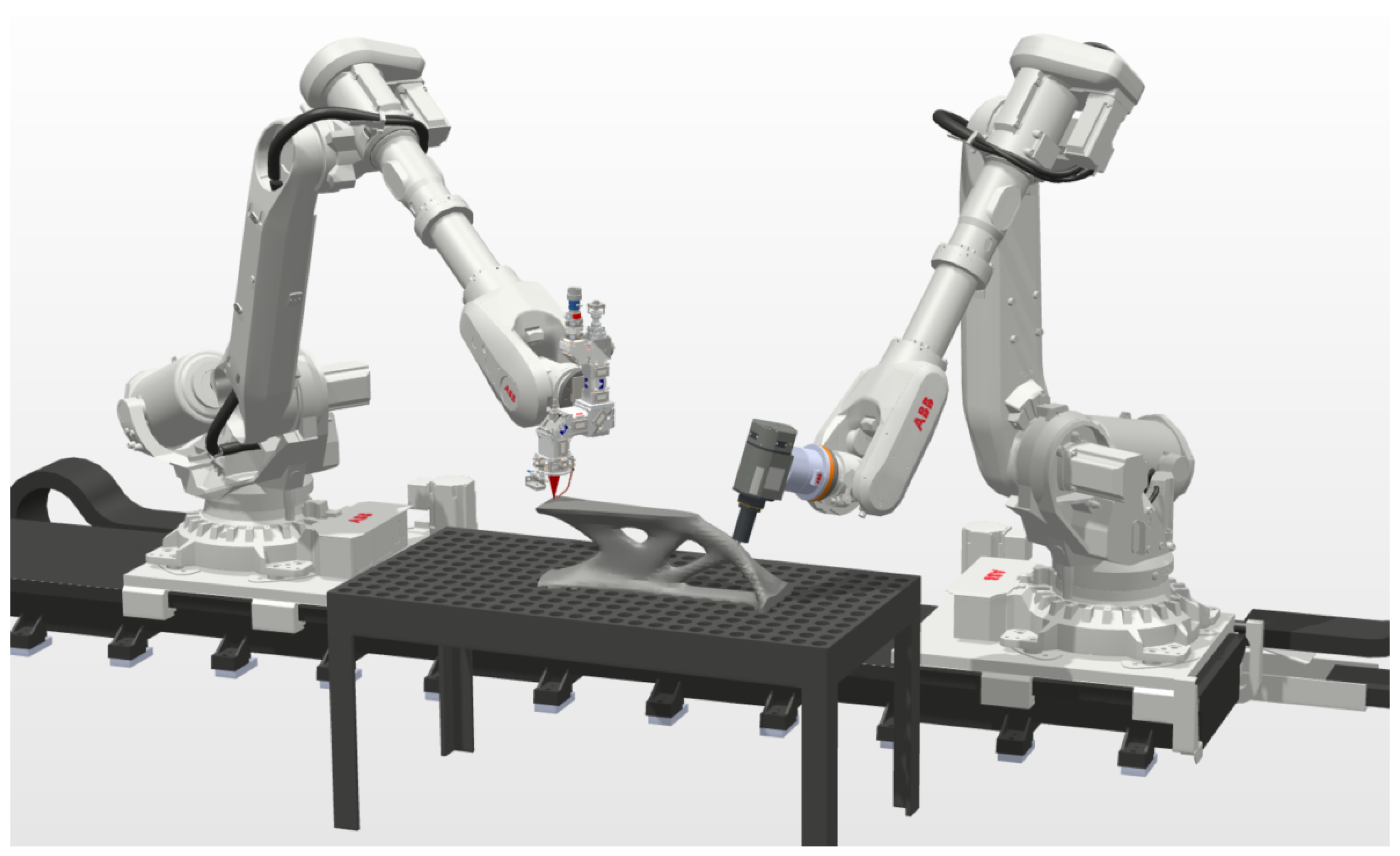
Figure 2.
Schematic representation of the surrogate-model structure. Local process parameters and geometric proximity are mapped to disturbance-related outputs via calibrated surrogate models, enabling efficient and uncertainty-aware evaluation within the optimisation framework.
Figure 2.
Schematic representation of the surrogate-model structure. Local process parameters and geometric proximity are mapped to disturbance-related outputs via calibrated surrogate models, enabling efficient and uncertainty-aware evaluation within the optimisation framework.
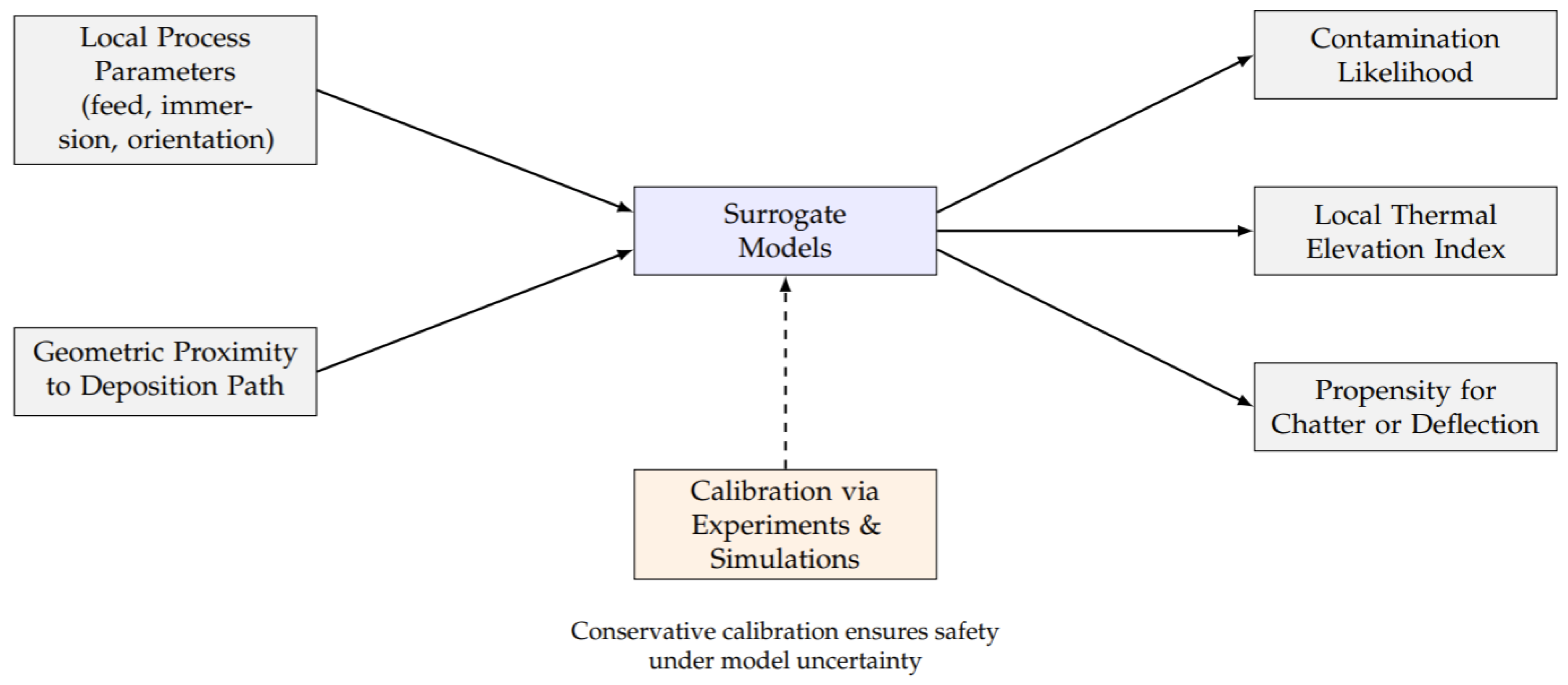
Figure 3.
Structure of the decision vector for the multi-objective optimisation. Discrete components encode sequence and orientation, continuous components encode process parameters.
Figure 3.
Structure of the decision vector for the multi-objective optimisation. Discrete components encode sequence and orientation, continuous components encode process parameters.
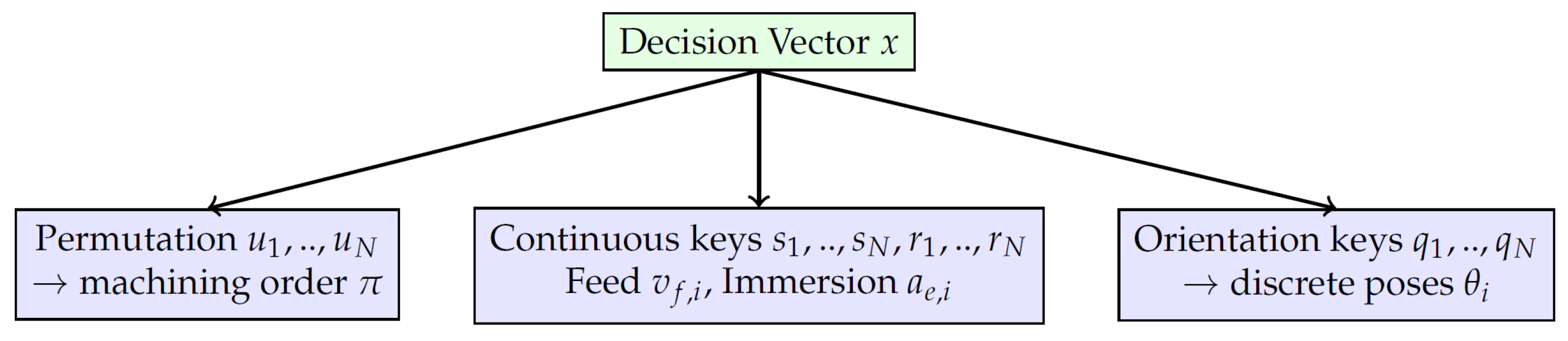
Figure 4.
Illustration of causal temporal coupling between the laser deposition trajectory and milling operations. Machining at a given segment is constrained to occur only after the laser has passed the corresponding location.
Figure 4.
Illustration of causal temporal coupling between the laser deposition trajectory and milling operations. Machining at a given segment is constrained to occur only after the laser has passed the corresponding location.
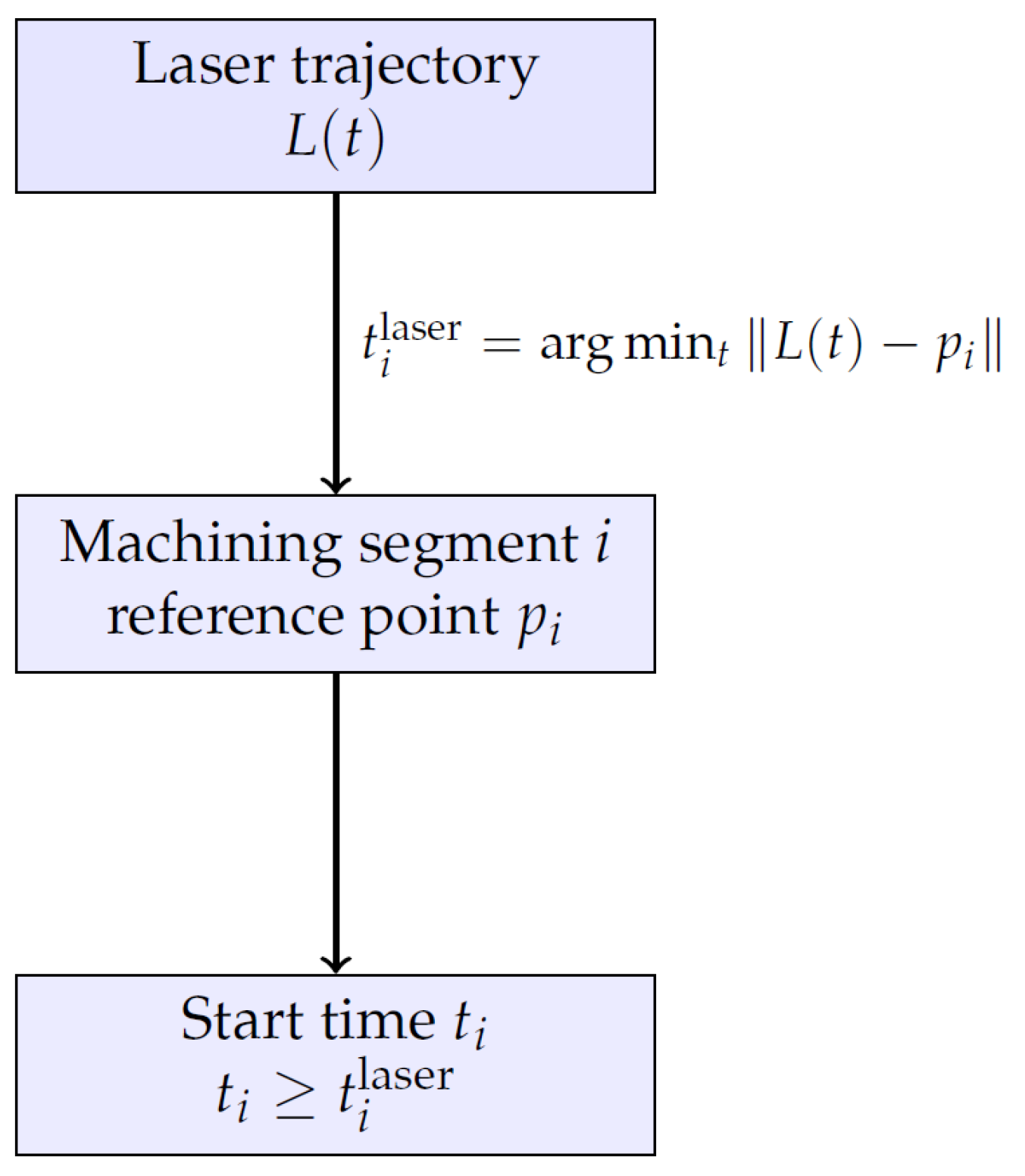
Figure 5.
Hierarchical overview of the offline multi-objective optimisation framework for concurrent robot-assisted wire-based DED-LB/M and milling. Deterministic decoding, staged feasibility filtering and surrogate-based objective evaluation are embedded within an iterative evolutionary optimisation loop to generate executable Pareto-optimal process plans.
Figure 5.
Hierarchical overview of the offline multi-objective optimisation framework for concurrent robot-assisted wire-based DED-LB/M and milling. Deterministic decoding, staged feasibility filtering and surrogate-based objective evaluation are embedded within an iterative evolutionary optimisation loop to generate executable Pareto-optimal process plans.
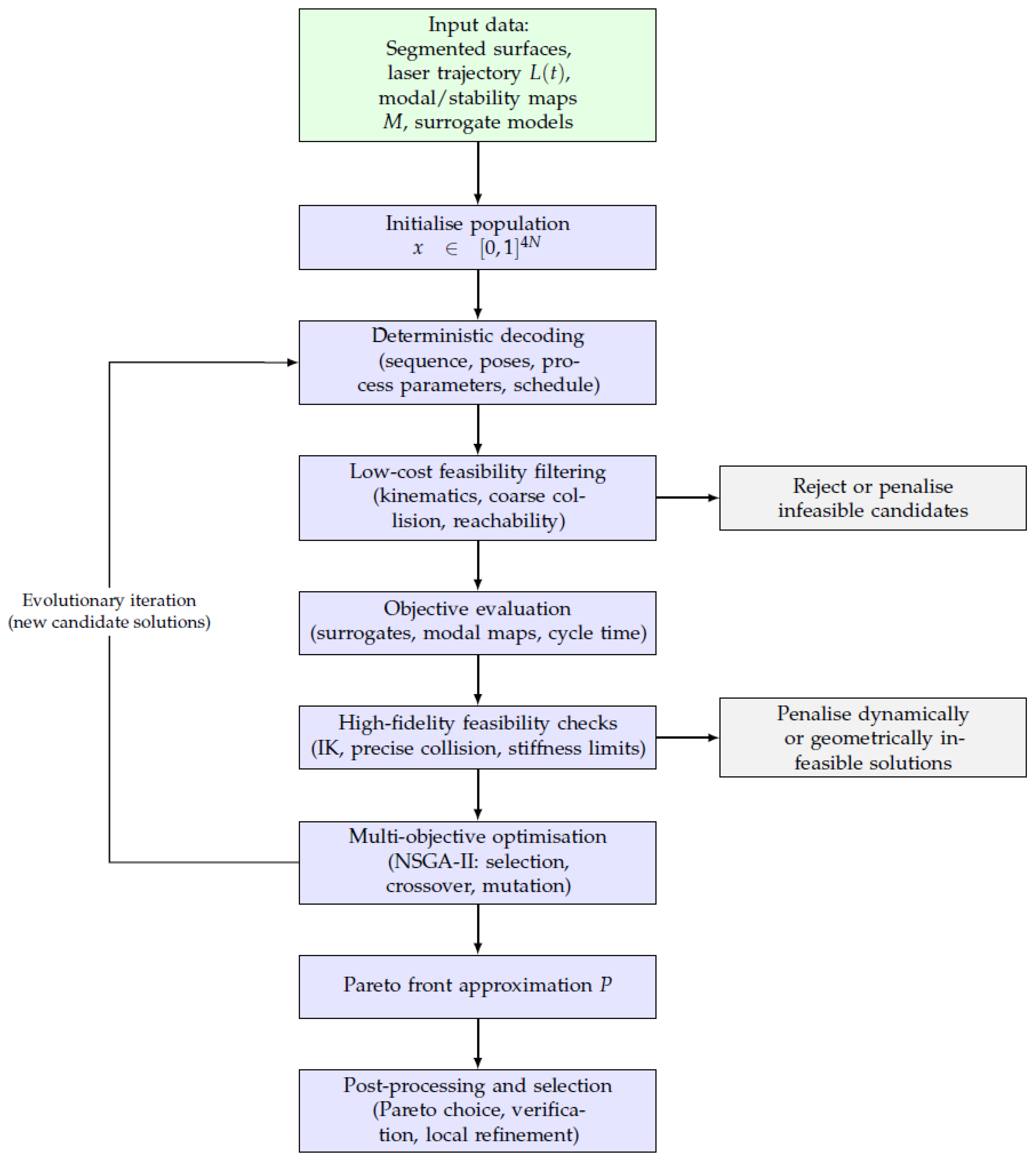
Figure 6.
Schematic illustration of the demonstrative workpiece used in the case study. The left panel shows the planar workpiece surface with the spatial distribution of the nine machining segments highlighted in red. The right panel depicts a schematic representation of the workpiece placement within the robotic DED-milling cell.
Figure 6.
Schematic illustration of the demonstrative workpiece used in the case study. The left panel shows the planar workpiece surface with the spatial distribution of the nine machining segments highlighted in red. The right panel depicts a schematic representation of the workpiece placement within the robotic DED-milling cell.
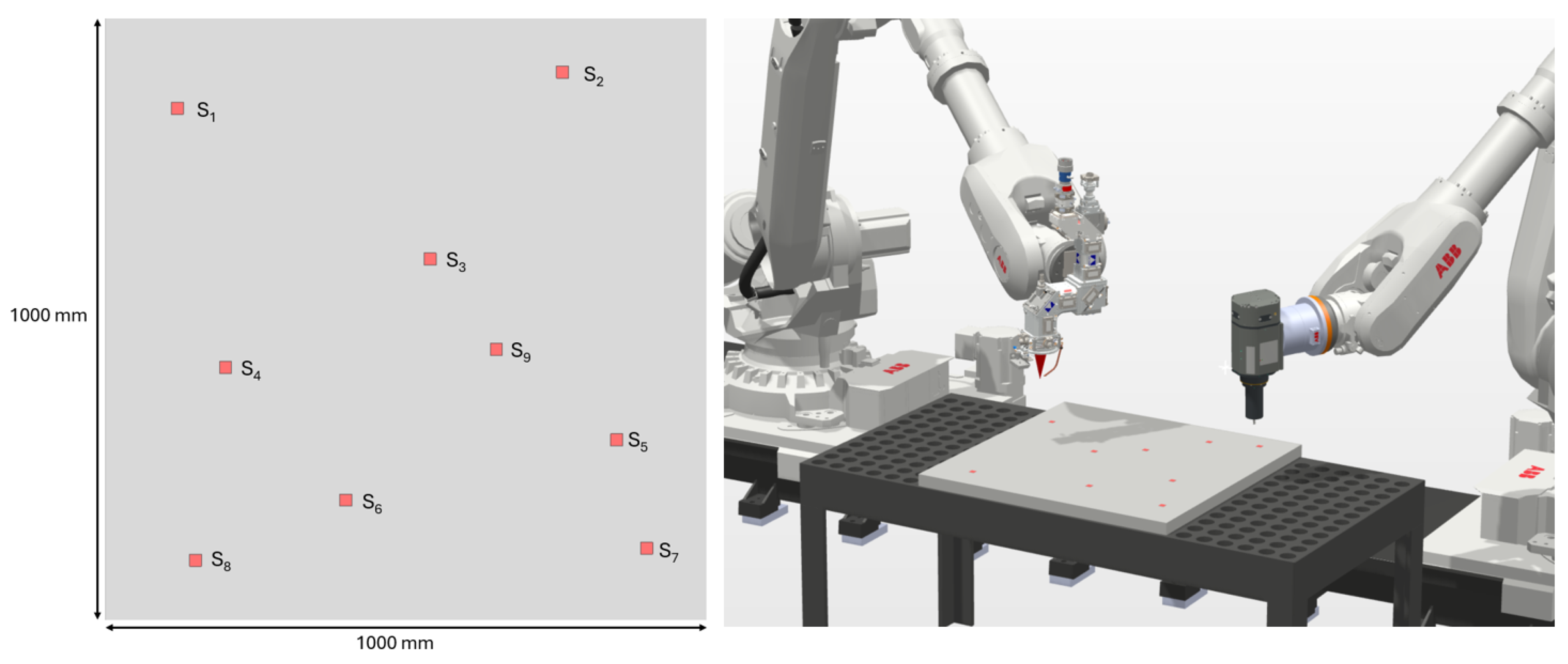

Table 1.
Characteristic execution strategies for the demonstrative case study, contrasting a strictly sequential reference, an aggressive parallel strategy with elevated disturbance exposure, and the robust-optimal solution preferred for practical operation. The values are indicative and serve to illustrate structural trade-offs between robustness and temporal overlap rather than to predict absolute process performance.
Table 1.
Characteristic execution strategies for the demonstrative case study, contrasting a strictly sequential reference, an aggressive parallel strategy with elevated disturbance exposure, and the robust-optimal solution preferred for practical operation. The values are indicative and serve to illustrate structural trade-offs between robustness and temporal overlap rather than to predict absolute process performance.
| Case | (s) | |
|---|---|---|
| Sequential reference | 500 | 0.00 |
| Aggressive parallel | 290 | 1.05 |
| Robust-optimal (preferred) | 330 | 0.20 |
Disclaimer/Publisher’s Note: The statements, opinions and data contained in all publications are solely those of the individual author(s) and contributor(s) and not of MDPI and/or the editor(s). MDPI and/or the editor(s) disclaim responsibility for any injury to people or property resulting from any ideas, methods, instructions or products referred to in the content. |
© 2026 by the authors. Licensee MDPI, Basel, Switzerland. This article is an open access article distributed under the terms and conditions of the Creative Commons Attribution (CC BY) license (http://creativecommons.org/licenses/by/4.0/).
Copyright: This open access article is published under a Creative Commons CC BY 4.0 license, which permit the free download, distribution, and reuse, provided that the author and preprint are cited in any reuse.


