

Submitted:
09 March 2026
Posted:
09 March 2026
You are already at the latest version
Abstract
Urban regeneration frequently encounters a critical trade-off: whether to accelerate planning and implementation of design solutions or safeguard participation. To address this challenge, the paper introduces the concept of the governance “grey zone”—an informal yet institutional interface that flexibly reconfigures the relationship between planning and design to transcend the impasse. This perspective is grounded in an analysis of the recent urban regeneration of Hsinchu City, where a weekly, mayor-led coordination forum with external consultants functioned as an informal yet institutional organizational hub. This forum broke down departmental silos, unified multiple design teams under shared principles, and expedited implementation of numerous projects—all while maintaining public scrutiny and inclusivity. The study draws on interviews with high-profile administrators, planners, and designers involved in Hsinchu’s regeneration, as well as official documents. Elaborating on this, the paper finally advances a set of implications regarding urban regeneration scholarship with attention to aspects of urban design governance.
Keywords:
urban regeneration
; urban design governance
; governance design
; grey zone
; public administration creativity
; Hsinchu
1. Introduction
Regeneration is now the main approach to urban development in mature cities, where expanding outward is rare. Here, the focus is retrofitting existing urban fabrics, including upgrading infrastructures, reprogramming public spaces, improving daily environments under ecological or socio-economic stress, and so on [1,2]. These pressures are often referred to as “polycrisis,” a term that emphasizes how climate risk, housing, aging infrastructure, demographic change, and social instability interact and build upon each other [3]. An important implication is a “mismatch in the timing of the city:” public demands grow urgent, but governments often respond slowly. This is especially true in liberal democracies, where decisions face pluralistic procedures, accountability issues, and debates over public value [4], as it is the case with regeneration and the innovative solutions that this demands.
This mismatch is often framed as a governance dilemma. Either leaders make quick decisions through their authority, sacrificing inclusion or transparency, or participation is widened, often slowing progress, raising costs, or limiting design innovation. Such a dilemma worsens when regeneration involves several linked projects, as polycrisis often demands [5]. The pattern is recurrent: planners and designers set ambitious goals, but implementation stalls since administrations struggle to coordinate intent, expertise, and scrutiny. Given these limits, regeneration often settle for “lowest common denominator” solutions, which are safe for procurement and risk management, but do not allow design innovation [6].
1.1. Beyond the Dilemma?
Recent scholarship offers comprehensive analyses of urban transformation, policy instrumentation, and the political economy of regeneration. Furthermore, it shows that developmental breakdowns frequently arise from factors other than insufficient value commitment or technical competence. Instead, they result from failures at organizational interfaces, where political intent, expert knowledge, and public scrutiny should combine to produce actionable solutions [7,8]. Yet, the micro-organization—or design—of these interfaces remains relatively under-theorized.
The paper argues that presenting the aforementioned tension as a black-or-white, binary choice hides a range of intermediate, grey ways for governments to reorganize the decision-making without giving up formal safeguards. So, the paper introduces the idea of governance grey zone, that is, an informal yet institutional design decision arena between formal municipal routines and professional design expertise. In this context, the use of the term “grey” is analytical rather than euphemistic. It does not mean extra-legal bypass or romanticizing informality. Instead, it refers to the peculiar semi-formality of an administrative arrangements that has arisen when existing bureaucratic structures could not coordinate complex, design-intensive work under time pressure.
Empirically, the paper develops this idea through a field study of Hsinchu City’s urban regeneration during the mayoralty of Chih-Chien Lin (December 2014–July 2022). In this period, a weekly mayor-led forum brought together urban bureau leaders and a number of consultants to align projects, resolve interdepartmental communications, and stabilize design standards across several interlinked regeneration projects.
1.2. Literature Review
During the last three decades, urban governance research has moved away from seeing city governments as single, unified actors. Instead, the scholars now view them as systems involving many actors working together [9,10]. Such understanding permeates studies of how public administrations coordinate in networks, adopt novel management approaches, or form partnerships [11,12,13], and helps to show how coordination is not a given or occurs naturally. Rather, it needs to be guided and stabilized through rules, support, and decision-making organization [6,9]. Moreover, the scholars studying urban design governance per se have shown that design quality also depends on coordination between administrations and designers, much more than the individual designer’s talent alone [8,14,15].
Collaborative governance research has further clarified how collaboration is not a mere normative ideal but an organizational accomplishment that depends on procedural design, facilitation, and iterative trust-building [10,16]. On the other hand, public value scholarship has emphasized that governments are not merely service providers but also producers of public value through collaborative efforts [17,18,19]. Further, participatory debates have promoted collaborative inclusion as development goal. Yet, they have also shown that participatory practices can lose political force under political-administrative pressures [16,20,21,22].
That said, the idea of “grey” connects with research on informality, too. Scholars in the field have shown that informality can serve governance in complex situations with many disconnected stakeholders, although it is most often tied to discretionary practices [23,24,25]. However, much of this research focuses on marginalization, providing fewer tools for examining semi-formal practices where such arrangements may help adapt and coordinate within formal legal frameworks.
In Taiwan—the context of the case study—research on public space, landscape, and urban regeneration has increased since the 1990s. Such a growth has occurred alongside democratization, shifting civic expectations, and the rising political importance of design quality in public spaces [26,27,28,29,30]. The studies show that government departments are separate and that outside consultants are used too often, raising questions about how governance processes can translate public value into projects [31,32,33,34].
A decolonial sensibility is also relevant here. Research on governance reforms in East Asia suggests that Western benchmark for "good governance” may well be adopted symbolically only. Effective reforms then rely on semi-formal or informal collaborative arrangements that rework the imported models [35,36]. In this respect, however, it is important to mention a safeguard: this paper aims not to celebrate exceptionality, but to treat procedural formality as a variable rather than the default benchmark of governance quality, thus challenge ideological constraints embedded in Western paradigms.
That said, synthesizing the above literature reveals a knowledge gap in terms of the design of the organizational interfaces within governance, through which political intent, expert knowledge, and public scrutiny are synthesized into coordinated, implementable decisions under conditions of urgency and accountability, as is the case in regeneration at the time of polycrisis. Design is most often treated in terms of implementation outputs rather than an epistemic practice that can structure governance itself. Design governance research, too—the concerns of which are the closest to this knowledge gap—documents administrative mechanisms but rarely reconstructs coordination routines through which implementation design can be stabilized across bureaus, projects, and consultants.
1.3. Contribution and Structure of the Paper
In consideration of such a knowledge gap, the paper intends to make the following contributions through discussion of the case study:
- Empirically, to explain how the Hsinchu forum worked and how it eased design governance under time pressure;
- Conceptually and based on the Hsinchu forum, to define the governance grey zone as a peculiar micro-organization of design governance;
- Operationally, to define guidelines for the application of this micro-organization of design governance; however, here the aim is not to present universal templates, but an abstraction that helps distinguish essential and context-dependent features;
- Epistemically, to theorize from a non-Western case in order to challenge established procedural assumptions regarding governance.
In order to deliver these contributions, the remainder of the paper is structured as follows: Section 2, Materials and Methods, develops the framework and methodology of the research behind the paper. Section 3, Results, examines the Hsinchu forum. Section 4, Discussion, addressees transferability, safeguards, and implications for the regeneration scholarship.
2. Materials and Methods
2.1. Research Case Study
This study examines Hsinchu City’s urban regeneration during the mayoralty of Chih-Chien Lin (December 2014–July 2022) as an information-rich case for theorizing the governance grey zone—defined here as semi-formal decision interfaces that operates between routine municipal administration and professional design expertise. The case is analytically because, first, Hsinchu pursued a sustained, design-led regeneration agenda in which a weekly, mayor-chaired coordination forum appears to have served as a key decision interface for multi-bureau regeneration projects. This makes the case suitable for examining how planning, design, and delivery can be aligned in practice under the portfolio logic of urban regeneration at the time of polycrisis.
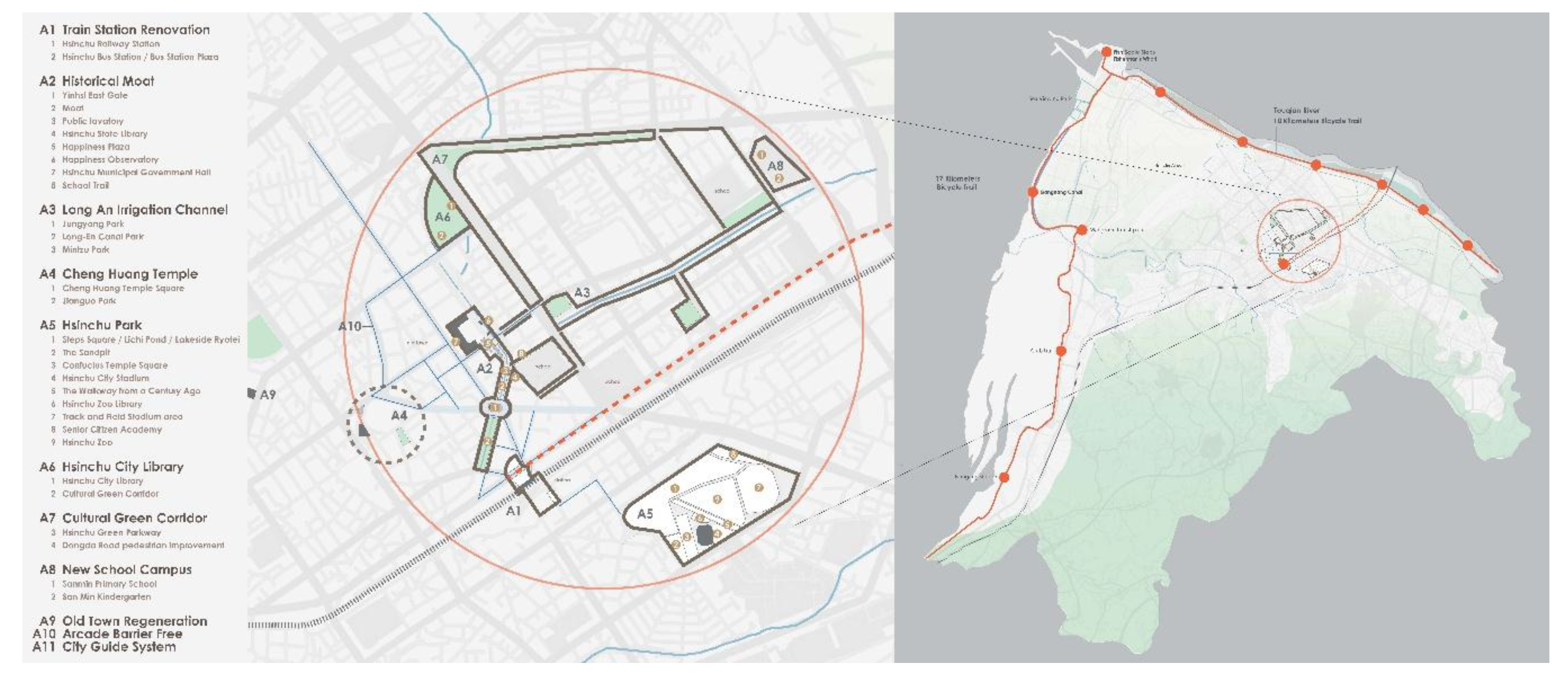
Second, the Hsinchu experience was characterized by the time pressures typical of electoral democracies: a large portfolio had to be initiated, coordinated, and delivered within the four-year political-budgetary cycles. This corresponds to the tension between implementation speed, accountability, and design ambition, which the paper points to. As an indication of portfolio intensity and coordination load, it is here meaningful to note how the municipal records indicate that about 700 projects reached implementation (see Figure 1) through ca. 230 iterations of the forum over eight years [37], although this is no measure of social or distributive achievements.
Finally, the urban and administrative setting of the case study exhibits features that are common to many cities in contemporary advanced liberal democratic contexts, e.g., functional differentiation into administration bureaus, a strong vertical accountability within the bureaus, and reliance on a formal procurement and contracting system. Such a combination allows the paper to speak to governance challenges that are not unique to the case study, while still recognizing its peculiarity.
2.2. Research Questions
The study is guided by one primary and two subordinate research questions:
- (1’) How did the forum mediate between planning, design, and implementation?
- (2’) Which aspects of the forum enabled to synchronize bureaus and sustain design innovation?
- (2’) Which safeguards allowed the forum to speed up the projects without creating bypass or opacity?
It is implied that these questions position urban regeneration not only as a matter of policy agenda or project portfolio, but also design of the organizational interfaces within the governance.
2.3. Research Design
The study adopts a qualitative, process-focused analysis design aimed at refining a middle-range conceptualization of a design of the organizational interfaces within the governance and identifying transferable mechanisms under bounded scope conditions [38]. The unit of analysis is the Hsinchu forum, here understood as a key organizational interface with the local governance.
To strengthen inferential precision, the design is embedded: within the single case, the analysis traces formative episodes through which the forum emerged and routines through which it shaped coordination, review, and decision-making. The inferential strategy is mechanism-centered. The analysis combines interpretive reconstruction with basic process tracing and triangulation to identify causal pathways [39,40].
Finally, empirical claims are organized and assessed across three domains, i.e.: coordination capacity, design quality control, within the scope of the governance practice, and accountability safeguard.
2.4. Research Materials
The study draws on two sets of sources. The first is a corpus of ten semi-structured, extensive interviews conducted in person by the author of the paper, accompanied by a Chinese mother-tongue research assistant, between May 2021 and June 2023. The second is composed of official documents and records publicly available online or retrieved in person during the interviews, with particular attention to the documentation collected by the government for communication, publication, award-submission materials, as well as portfolios for international exhibitions. These sources were cross-checked against each other to triangulate the accounts and thus verify them.
Interviewees were selected purposively to capture roles with direct involvement in, or close observation of, the Hsinchu forum and the surrounding governance system. The rationale was to ensure that perspectives included those with operational, strategic, and technical knowledge of the governance. Sampling was role-based to cover the leadership, senior administrators, external consultants working in an advisory capacity, and design professionals engaged through project work. This elite interview strategy is appropriate because governance mechanisms are often embedded in routines, thus not captured in formal documentation fully.
In particular, the Mayor Chih-Chien Lin, the Secretary General, a past Mayor, two external consultants, and five design professionals, of which three major architects and two major landscape architects, were interviewed in various setting, ranging from Hsinchu City Hall, informal locations, universities, and the architects offices. Interviews followed a shared core protocol to ensure comparability across roles. Each interview also included role-specific modules. Emphasis was on a episodic reconstruction of how some decisions were prepared, contested, revised, and implemented. Anyhow, several aspects were addressed. First, respondents were asked to describe the circumstances through which they became involved in Hsinchu’s regeneration. Second, their perceptions of the city before regeneration and their interpretation of the socio-spatial changes occurred. Third, the governance underlying the regeneration, including functioning of the forum, the roles of various actors within and outside the administration, and the ways decisions were formulated and implemented. Fourth, the collaboration between government and the design professionals, the management of public participation and conflict, and the constraints shaping project delivery. Finally, forward-looking perspectives together with the extent to which the experience might be transferable.
All the interviews were audio-video recorded with consent of the interviewees and later transcribed for analysis. Because the case involves public administration and thus is politically sensitive, reporting in the paper relies on role-based attribution while direct identification is used only if information is already publicly disclosed.
2.5. Research Limitations
This study has clear limitations, but these also define the research scope. First, as a single-case study, it does not claim statistical generalization. Contributions are foremost analytical, e.g., specifying an institutional morphology, identifying mechanisms within, proposing bounded heuristics, etc. Consequently, transferability is highly conditional.
Second, the empirical material is inevitably partial. The interview sample, although strategic, cannot represent all viewpoints, and accounts may be shaped by retrospective rationalization and bias. Materials triangulation mitigates but does not eliminate all the limitations.
Third, documentary evidence is constrained, especially because the Hsinchu forum was a semi-formal arrangement. So, although gaps were addressed through inference, a conservative claim-making stance was taken.
Finally, it is important to remark that the study focuses on governance itself, rather than long-term social or distributive achievements, which are beyond the research scope.
3. Results
Building on the study, this section presents the research results and describes the conditions that shaped the emergence of the Hsinchu forum in the context of the city’s regeneration process.
3.1. Before the Forum
The interviews describe Taiwan's average municipal administration as structurally uncoordinated, but not incompetent. Municipal bureaus focus on their legal duties, but cross-department projects—especially those involving public space, landscape, and regeneration—fall into unclear jurisdictions. So, "interdepartmental barriers" and poor communication cause procedural bottlenecks.
The deficit is compounded by the civil service system's stability. An official noted that mayors can make only minor personnel changes upon taking office, partly because the system has fixed positions that cannot be easily reassigned without previous vacancies—an arrangement designed to guarantee public servants' job security.
Expanding on these challenges, a consultant described the situation more starkly: poor coordination makes the bureaus act like “separate governments.” So, coordination is forced up in the governance chain to a small executive group, which often becomes overwhelmed by the tasks.
Also, the interviews highlight a second cluster of constraints: public procurement routines tend to privilege procedural defensibility over design innovation. One official argued that improving the situation requires system-level reforms, including revisions to bidding practices. He favored “moving away from a choice for the lowest bid to the most advantageous one,” adding that talented architects and engineers avoid the public sector because they are often treated “like vendors.” Further complicating the situation, interviews emphasized that procurement constraints operate within a national legal framework that the local governments cannot easily adjust.
According to one of the designers, procurement challenges also reflect reputational or institutional trust issues. The public works bureaus impose many restrictions. Also, the wrong composition of the public bid juries raises concerns about the bid's credibility within designers and dilutes their interests. Finally, the administrations do not provide time, resources, and constructive feedback during project development, nor an adequate support during construction. All in all, recruiting design talent becomes difficult.
Finally, the interviews indicated chronic deficits during early-stage programming, including project scoping, feasibility studies, stakeholder coordination, and design brief stabilization. Programming time is structurally limited, often compressed by electoral timelines. Consequently, mayors—motivated to finish projects within their terms—also tend to prefer procedural defensibility over design innovation to avoid political or legal risk from incomplete implementations. Elaborating on this, a consultant highlighted one last financial issue: because the budgets are set without proper early-stage programming, they are often “too little” or “too much,” adding additional complexities.
3.2. Enter the Forum
According to the interviews, the forum was a deliberate response to a specific issue, i.e., the difficulty of executing multi-bureau projects. That is, first of all, the forum was intended to integrate the bureaus and allow the mayor to assign responsibilities.
At a later stage, then, the semi-institutionalization of the forum became tied to the problem of recruiting design talent. Indeed, since an improved jury system was needed to address reputational issues, interviews indicate that the mayor sought respected consultants, knowing that without them on board, “talented architects will not bid.”
The consultants required a weekly meeting with the mayor as a condition for their help: their agreement depended on the mayor personally chairing it as a public works review, and this finally became integrated into the forum. Such a demand drew in part on a precedent experience of a senior consultant in another county in Taiwan [41].
Throughout Chih-Chien Lin's mayoralty, the forum served as a boundary-spanning decision-making arena, regularly bringing together stakeholders for the project portfolio review. If we look at the core characteristics, we can say that, first, it brought together executive leaders and bureau heads, but also gathered consultants, designers, and, when needed, the construction teams.
Second, it turned the consultants into a standing advisory group, rather than using them as occasional opinionists. Although “outside the system,” these well-regarded experts—mostly professors—had the chance to stand between the government and the designers, lending credibility to the government and offering protection to the designers, that is to say, mediating.
Third, the interviews describe the forum as dynamic and cross-functional, but, most of all, an iterative process, ultimately making the government a trustworthy interlocutor. In this framework, projects could be openly contested by the government officials, as the advisory group mediated and lent credibility, while the mayor’s presence enabled some immediate decision-making. Despite being open to contestation, interviews confirm that the forum secured projects design alignment and improved lateral problem-solving.
Finally, the forum's purpose was not limited to project monitoring; it also served as an upstream platform for project initiation. A consultant described this activity as key: potential projects were framed in the forum through departmental inputs, alternatives, and site-based assessments. Only after clarifying funding, vision , and feasibility would a formal design commission proceed. This helps explain why the forum had leverage over both implementation speed and project quality: it intervened at the source interface where political intent, bureaucratic routines, and professional expertise converge in the inception of executable briefs.
If we look at the forum’s micro-organization, this could be defined semi-formal, or “grey,” since situated between formal municipal reorganization and external advisory practice. Through this, it blended organizational informality with institutional stability. Interviews frame it as a workaround. Since municipal bureaus tended to act as “separate governments,” the forum greatly "helped," but it remained just "an informal mechanism, not truly a formal part of government."
Second, the forum bridged the public–professional divide through hybrid advisory. Indeed, the consultants neither were internal public officials nor hired through typical outsourcing arrangement. Interviews describe them as "not part of the government," but crucial intermediaries in the mayor’s decisions. Additionally, if some change was legally unattainable—such as for centrally controlled procurement rules—interviews stress that the consultants play a key role further enhancing credibility, pre-planning, and real-time support, including revising designers contracts and helping to manage budget flexibility as design evolved.
Third, there was no extralegal governance in the forum but rather an “other place” for decision-making, where a range of stakeholders and mediators could be consistently assembled over time. The interviews identify quality gains in procurement credibility and pre-planning discipline. In these respects, the weekly forum seems essential, serving as a chance to collaboratively define project hierarchies, enhance programming, prepare and implement rigorous juries or reviews, ensure equitable compensation for designers, and support construction beyond routines.
However, one of the designers noted that the forum’s “grey-ness” posed legitimacy risks as well. Indeed, the forum concentrated power, making it fragile. This could spark rumors and undermine legitimacy, even if intentions are good.
3.3. Organizational Effects
Taken together with literature review outcomes, these research results suggest that the forum represented a re-design of the city’s decision interface. Indeed, its effects were mostly organizational: it reduced coordination uncertainty, established a stable cadence for project steering, and made design reviews a collective executive practice. In essence, it did not bypass formal procedures; it changed how problems were surfaced, assigned, and checked.
3.3.1. Softening Silos
The departmental silo was addressed not by a structural merger but by recurrent arbitration under conditions of shared visibility. By repeatedly placing bureau heads in the same room and asking issues to be clarified in real time under the mayor's overview, the forum turned ambiguous “shared” problems into work packages with identifiable responsibilities. In practice, it cut the transaction costs of inter-bureau negotiation.
This matters analytically because fragmentation in municipal administrations is not a structural feature only; it is also a responsibility-allocation issue. When boundaries are blurred, inertia results from uncertainty about who has the mandate to act or bears the risk. The forum addressed this by restructuring the moment of responsibility allocation and, crucially, making it observable to everyone.
Interestingly, in the interviews, one official noted that the forum took two years to work smoothly on coordination matters; that is, over time, routinized exposure reshaped tacit procedures. Indeed, bureaus learned that interdependencies would be surfaced and that unresolved interface problems would no longer remain private through the forum.
3.3.2. Synchronizing Projects
A second effect was on portfolio synchronization,. The weekly cadence of the forum provided a shared rhythm and reduced the uneven pacing typical of fragmented project pipelines. Normally, the projects tend to drift because bureaus apply different schedules, readiness to act, and interpretations of project readiness. The forum countered this by creating predictable checkpoints where multiple projects were reviewed together under the same executive and professional purview.
As a result, the forum enabled active cross-project trade-offs—including allocating limited time, human, and financial resources—rather than allowing them to be passively resolved through delays and informal priority ranking. Also, it supported standard setting across several projects, since reviewing them in a common arena allowed for the development and application of a shared sense of what counts as design quality. This created a stable environment where design decisions could accumulate rather than being repeatedly reopened due to misalignment.
3.3.3. Accelerating Without Loss of Scrutiny
The case study supports an important claim: acceleration can be produced not by relaxing scrutiny, but by moving scrutiny upstream and making it iterative. The forum accelerated implementation chiefly by compressing decision cycles: long gaps between interdependent approvals were replaced by a high-frequency review loop. However, the same loop also increased the opportunities for checking, critique, and correction, which were accepted by the professional teams since the advisors provided to the reviews a sense of worthiness and respectability.
The interviews’ attention to legal and political risk clarifies why speed could not be automatically translated into careless execution. That is, since actors perceived downside exposure, acceleration became possible only if coupled with stronger oversight practices, that made faster decision-making publicly defensible.
3.3.4. Protecting Design Ambition
A fourth effect concerns the relationship between procurement and design quality. Here, the forum can be understood as a credible commitment to design ambition within a legally constrained procurement environment. The recurring problem described in the interviews is that public procurement often incentivizes procedural defensibility and risk aversion, against design ambition. The forum addressed this not by trying to change procurement law, but by manifestly altering the institutional conditions that determine whether ambitious design can survive the pipeline.
First, the forum strengthened the municipality’s capacity for programming discipline. As a result, later rework was reduced, and design intent protected from late- stage administrative surprises. Second, the forum supported procurement credibility —especially through the consultants’ legitimacy. This directly affected whether talented designers consider public commissions worth pursuing. Third, the forum sustained implementation quality through ongoing executive attention and consultant-led critique. This reduced the likelihood that design intent would be compromised in development and construction. In this setting, “design quality” is not an aesthetic add-on. It is an organizational achievement produced by stable coordination, credible evaluation, and continuous supervision. In Hsinchu, the forum served as enabling infrastructure for those conditions.
4. Discussion
The previous section reconstructed the emergence and operations of the Hsinchu forum. Here, the discussion makes the interpretive step from case-specific description to conceptual-comparative leverage.
4.1. Core Characteristics of a Grey Zone
The reality of the organizational effects of the Hsinchu forum makes it a peculiar governance design, which we name here governance grey zone. Since some features recur throughout the analysis, we consider them core characteristics.
The first is routinized, high-frequency encounters and decision cadence; the key is not just meeting often, but governing through cadence. Decisions become cumulative, revisable, and continuously updated as the design matures. However, this timing also brings risks. It favors those who attend often, creates "always-on" pressures, and shifts influence by presence. For these reasons, a grey zone needs ad hoc safeguards, such as documented rationale and varied participation channels.
A second characteristic is executive arbitration without formal reorganization —authority is exercised without creating new administrative units. This also clarifies that a grey zone is not a delivery unit or permanent project office. The strength is speed and cross-bureau alignment without upheaval; the weakness is reliance on routines and executive discretion. Accordingly, a key challenge is setting clear bounds for arbitration.
A last characteristic is design-mediated deliberation. A grey zone makes design reasoning and professional critique central to design governance. Specific design tools, such as models and site-based evidence, serve as boundary objects, allowing departments, consultants, and designers to debate the same problem using a shared reference. If the grey zone thus translates technical constraints into collectively agreed, actionable decisions, such an approach also brings risks: deliberation can drift toward technocratic closure if expert critique replaces broader accountability, or if design quality is assumed self-evident rather than justified. A grey zone, therefore, needs clear criteria and intentional links between internal deliberation and external participation.
4.2. Distinction from Other Forms of Governance Design
Because governance design is seldom addressed in the scholarship, comparative differentiation is crucial for defining a governance grey zone beyond the characteristics outlined, regardless of how it is defined in interviews.
Grey zones are not task forces. These are typically temporary organizations—time- limited entities created to achieve a specific goal and dissolve. They have a clear timeline and concrete deliverables, such as reports or reform packages [42,43]. By contrast, the Hsinchu forum operated as an ongoing decision-making interface, spanning multiple project portfolios and shifting its scope over time. While one interviewee called it a "task force," it functioned as a recurring weekly forum within the administration’s operating rhythm.
Grey zones are not committees. These are formal: they have fixed membership, codified procedures, and a defined administrative role [42,43]. The Hsinchu forum may appear committee-like with its meetings and agendas, but unlike committees, it holds only semi-formal status and pragmatic authority. Its authority comes not from mandate, but from convening power, cross-bureau presence, and integration of expert judgment into executive action.
Grey zones are not participatory workshops. These are short, structured events that broaden inclusion, gather local knowledge, and generate ideas through facilitation [30]. Such workshops are usually external-facing and organized for the civic deliberation. In contrast, the Hsinchu forum, although it involved participation, had a different purpose: it served as an internal decision infrastructure, connecting externally in regulated ways.
Finally, grey zones differ from urban project offices in terms of the organizational structure and approaches. Barcelona's urban projects office and later the Olympic Office, created in the 1980s to coordinate citywide regeneration for the 1992 Olympics [44,45,46], were formal units with internal staff and explicit mandates for project development and delivery. By contrast, the Hsinchu forum operated as a recurring decision-making arena, utilizing executive authority and external design expertise to align various actions. This highlights that, while both foster coordination and design coherence, the offices rely on a formal structure and mandate, whereas a grey zone depends on leadership practices and the stability of the convening format.
4.3. Transferability, Safeguards, and Implications
A challenge for theorizing grey zones is avoiding two symmetrical errors: treating Hsinchu as idiosyncratic exception that cannot inform broader debates, or treating it as a universal template. The paper, therefore, frames transferability as conditional replication. At the same time, because grey zone concentrate power at the boundary between formal and informal agency, transferability is considered alongside safeguards, too.
4.3.1. Transferability
Building on this, the Hsinchu case suggests that a governance grey zone can be effectively exploited under specific conditions. These are not unique to Hsinchu, but common to many mature cities facing design-intensive regeneration agendas under political time pressure.
First, a portfolio—not a single-project regeneration. A governance grey zone is most effective when regeneration involves interdependent projects requiring sequencing, standardization, and mutual adjustment. Here, coordination is a technical and temporal challenge: one bureau's delay disrupts others, and standards fragment across teams.
Second, high administrative fragmentation and blurred jurisdictional boundaries. In Hsinchu, the forum’s value lay in translating ambiguous, shared problems into tasks with clear ownership. This approach is relevant to bureaucracies with strong functional divisions and siloed accountability, yet that rely on cross-departmental action for regeneration. When jurisdictions are unambiguous and coordination costs are low, this mechanism is less necessary.
Third, design intensity under procedural constraint. A grey zone is useful where design quality is politically significant, but standard procurement restrains ambition. Here, value lies not merely in informality but in a recursive design reasoning that shapes governance and mitigation of downstream conflict.
Fourth, time pressure paired with substantial downside risk. In Hsinchu, political and legal stakes heighten the impact of delays or mistakes. In such environments, robust checking practices are crucial. In this respect, the forum excelled by both accelerating governance and enhancing review.
That said, if the transferability of a grey zone does not require formal reorganization, a new delivery agency, or a wholesale legal rewrite. However, it does require enabling capacities that ensure that cross-project coordination, responsibility assignment, and authoritative design input are feasible within. Among these, first, there is the need for a stable convening authority. An actor holding decisional power—mayor, deputy, city manager, or delegate—must compel attendance, arbitrate cross-bureau conflict, and maintain cadence. Then, a coordinating “spine.” Even a semi-formal forum requires a compact secretariat to prepare the works. Finally, credible expert intermediation. Hsinchu’s consultants mediated between the administration and designers. Key to transferability is convening expertise respected by both government and designers, and shielded from capture. Besides this, institutional form can vary. For example, a transferable element is not the chair’s position—if the system is not mayor-based, another authority will be involved.
4.3.2. Safeguards
Because a grey zone lies between formal procedures and hands-on coordination, it introduces legitimacy risks, such as concentrated influence, uneven access, potential conflicts of interest, and perceptions of bypass. So, to justify the grey zone as a governance design rather than a charismatic workaround, safeguards are required to connect the semi-formality with formal accountability and inclusive scrutiny.
In this respect, procedural traceability is essential. A grey zone cannot rely on tacit decisions made 'in the room' only. Minimal traceability must be provided through the work of the compact secretariat, including the production of agendas, decision logs, and follow-up protocols. The main idea is that a grey zone accelerates coordination—not legal authorization—so the outputs should serve as inputs into formal processes, not substitutes.
Boundary rules for the advisory group are also important. When the consultants occupy a hybrid role, conflict-of-interest declarations, rules on advisors’ eligibility to bid on related projects, and clarity about the advisory role are crucial. These prevent a grey zone from becoming an informal gatekeeping structure that deters competition and produces a perception of favoritism.
Inclusion safeguards are finally to be considered. As mentioned, a grey zone is not a participatory forum, but it cannot serve as a substitute for participation. In this respect, explicit coupling is relevant, that is, stating which decisions require external engagement, when and how that engagement occurs, and how feedback is incorporated into design revisions. Representational fairness within the forum cannot be disregarded: bureaus with less power or attendance capacity cannot be disadvantaged.
Ultimately, the key question is not whether the grey zone is 'good' or 'bad,' but whether the governance design includes accountability mechanisms that balance the discretion it enables.
4.3.3. Implications for Regeneration Scholarship and Conclusions
The concept of the governance grey zone developed in this paper has some implications for how urban regeneration is studied and evaluated. The scholarship has long explained failures in regeneration implementation through political conflict, resource scarcity, policy inconsistency, or weak instrumentation. Yet, as aforementioned, a recurring and under-theorized source of breakdown lies in the organizational interfaces where political intent, administrative responsibility, and expert knowledge are integrated. The Hsinchu case indicates that regeneration capacity can hinge on the design of these interfaces, not as abstract institutional forms, but as routinized decision arenas shaped by specific cadence, composition, and epistemic practice.
A first implication is that regeneration scholarship should treat governance not only as a set of actor constellations and formal institutions, but also as a designed assemblage of material and immaterial routines that structures project feasibility under real constraints. This directs attention to the micro-organization—or design—of governance: how responsibilities are allocated; how problems are surfaced, decomposed, and recomposed; how design evidence is made comparable across bureaus; how decisions are iterated as projects mature; and so on. In this view, design is not merely an implementation output; it is an epistemic mode of coordination that can stabilize shared problem definitions and enable cross-bureau action.
A second implication concerns temporality. The Hsinchu forum suggests that the tempo of regeneration can be as decisive as the substantive content of plans. This invites regeneration research to conceptualize time not only as an external constraint, but as an internal governance variable that can be designed. In light of this sense, acceleration does not need to be achieved by reducing scrutiny. Rather, it can be achieved by relocating scrutiny upstream and rendering it iterative. The dilemma is therefore not “speed versus participation,” but how speed is produced: whether it is generated through discretionary shortcuts, or through iterative review practices that compress decision cycles while multiplying opportunities for critique, correction, and final alignment.
A third implication is relevant to innovation. If creativity and design ambition in regeneration are organizational achievements, then “innovation” should not be attributed only to visionary leadership, elite designers, or exceptional projects. It should be studied as the outcome of governance designs that protect design intent across procurement, development, and construction, coordinate multiple teams under shared principles, and reduce the transaction costs of cross-bureau negotiation without dissolving accountability. Under this lens, the grey zone is not a romanticized form of informality; it is an adaptive governance design that makes experimentation administratively viable. Its significance lies in demonstrating how a municipality can create a credible commitment to design quality within constrained procurement environments but maintain accountability.
A fourth implication concerns decolonial critique and comparative governance theory. The Hsinchu case cautions against treating Western procedural formality as the default metric of “good governance” for which semi-formal arrangements are a governance deficit by default. Instead, formality should be treated as one dimension within a wider field of governance design choices. What matters for regeneration is not whether a forum is fully formalized, but whether its design can integrate various concerns into a coherent decision infrastructure. Read in this way, the value of the Hsinchu forum is precisely that it enables a semi-formal arrangement to function as a legitimate interface, neither extra-legal bypass nor purely discretionary exceptionalism. This reframing supports a decolonial sensibility in regeneration scholarship and suggests comparisons of governance designs based on their functional mechanisms and safeguards, rather than on their resemblance to imported procedural ideals.
A fifth implication concerns transferability and the role of culture and administrative path-dependence. Several characteristics of the Hsinchu forum are reasonably transferable in mechanism. However, their original development is inseparable from the local institutional culture. For instance, many of the interviews in the research behind this paper point to how designers approach public bids with skepticism, and how the presence of respected external consultants can lend credibility to the administration and protect designers. Comparable dynamics exist in other contexts, but they may carry slightly different meanings and thus have a different impact; that is, what is transferable is not a template but a principle.
Taken together, these implications suggest a research agenda. Future studies should examine how a grey zone performs over time, including whether it reshapes distributive priorities, alters whose needs become legible in fast decision loops, or unintentionally crowds out participatory arenas. Failure modes also have to be investigated: personality dependence, consultant capture, opaque gatekeeping, or the production of public distrust through perceptions of bypass, and so on. Comparative research is finally needed to examine the possibility of a grey zone across contexts and how it may need to be inflected.
In conclusion, this paper argues that the black-or-white dilemma often posed in regeneration—accelerate delivery or safeguard participation at the expense of design quality—conceals a much broader range of intermediate organizational solutions. In particular, the Hsinchu case shows that by offering a case in which regeneration was accelerated without abandoning scrutiny. Then, the concept of governance grey zone crystallizes the governance design that made this possible, naming it. For regeneration scholarship, the claim is therefore that implementation capacity and design innovation are not only functions of policy intent or resources; they are produced in organizational interfaces whose design deserves explicit theorization and evaluation.
Funding
This research received no external funding.
Data Availability Statement
The data supporting the findings of the study presented in this paper consist primarily of semi-structured interviews with public officials, planners, architects, and consultants involved in the urban regeneration of Hsinchu City during recent years, together with analysis of planning and policy documents. The interview materials include transcripts and field research notes. Due to ethical considerations, confidentiality agreements with participants, and the politically sensitive nature of administrative decision-making processes discussed in the interviews, the full interview transcripts are not publicly available. Selected excerpts necessary to support the analysis are included in the article. Additional contextual documentation used in the study is derived from publicly accessible municipal records and project reports. Further information regarding the research materials may be obtained from the author upon reasonable request, subject to ethical and confidentiality restrictions.
Acknowledgments
During the preparation of this manuscript, the author used ChatGPT and Grammarly for the purposes of data summary, text editing, and proofreading. The author has reviewed and edited the output and takes full responsibility for the content of this publication.
Conflicts of Interest
The author declares no conflicts of interest.
References
- Couch, C.; Sykes, O.; Börstinghaus, W. Thirty years of urban regeneration in Britain, Germany and France: The importance of context and path dependency. Prog. Plan. 2011, 75, 1–52. [Google Scholar] [CrossRef]
- Roberts, P. The Evolution, Definition and Purpose of Urban Regeneration. In Urban Regeneration: A Handbook; Roberts, P., Sykes, H., Eds.; SAGE Publications: London, UK, 2008; pp. 9–36. [Google Scholar]
- Tooze, A. Welcome to the World of the Polycrisis. 2022. Available online: https://adamtooze.com/ (accessed on 1/2/2026).
- White, J. Politics of Last Resort: Governing by Emergency in the European Union; Oxford University Press: Oxford, UK, 2020. [Google Scholar]
- Lawrence, M.; Homer-Dixon, T.; Janzwood, S.; Rockström, J.; Renn, O.; Donges, J.F. Global polycrisis: The causal mechanisms of crisis entanglement. Glob. Sustain. 2024, 7, e6. [Google Scholar] [CrossRef]
- Scott, I.; Gong, T. Coordinating government silos: Challenges and opportunities. Glob. Public Policy Gov. 2021, 1(1), 20–38. [Google Scholar] [CrossRef]
- Carmona, M.; Bento, C.; Gabrieli, T. Urban Design Governance: Soft Powers and the European Experience; UCL Press: London, UK, 2023. [Google Scholar]
- Carmona, M. Marketizing the governance of design: Design review in England. J. Urban Des. 2019, 24(4), 523–555. [Google Scholar] [CrossRef]
- Emerson, K.; Nabatchi, T.; Balogh, S.B. An integrative framework for collaborative governance. J. Public Adm. Res. Theory 2012, 22, 1–29. [Google Scholar] [CrossRef]
- Ansell, C.; Gash, A. Collaborative governance in theory and practice. J. Public Adm. Res. Theory 2008, 18, 543–571. [Google Scholar] [CrossRef]
- Provan, K.G.; Kenis, P. Modes of network governance: Structure, management, and effectiveness. J. Public Adm. Res. Theory 2008, 18, 229–252. [Google Scholar] [CrossRef]
- Hodge, G.A.; Greve, C. Public–private partnerships: An international performance review. Public Adm. Rev. 2007, 67, 545–558. [Google Scholar] [CrossRef]
- Osborne, S.P. The new public governance? Public Manag. Rev. 2006, 8, 377–387. [Google Scholar] [CrossRef]
- Carmona, M. Principles for public space design, planning to do better. Urban Des. Int. 2019, 24, 47–59. [Google Scholar] [CrossRef]
- Carmona, M. The formal and informal tools of design governance. J. Urban Des. 2017, 22, 1–36. [Google Scholar] [CrossRef]
- Innes, J.E.; Booher, D.E. Planning with Complexity: An Introduction to Collaborative Rationality for Public Policy; Routledge: London, UK, 2010. [Google Scholar]
- Mazzucato, M. Mission Economy: A Moonshot Guide to Changing Capitalism; Allen Lane: London, UK, 2021. [Google Scholar]
- Mazzucato, M. The Entrepreneurial State: Debunking Public vs. Private Sector Myths; Anthem Press: London, UK, 2013. [Google Scholar]
- Kattel, R.; Mazzucato, M. Mission-oriented innovation policy and dynamic capabilities in the public sector. Ind. Corp. Change 2018, 27, 787–801. [Google Scholar] [CrossRef]
- Costanza-Chock, S. Design Justice: Community-Led Practices to Build the Worlds We Need; MIT Press: Cambridge, MA, USA, 2020. [Google Scholar]
- Allmendinger, P.; Haughton, G. Post-political spatial planning in England: A crisis of consensus? Trans. Inst. Br. Geogr. 2012, 37, 89–103. [Google Scholar] [CrossRef]
- Swyngedouw, E. Interrogating post-democratization: Reclaiming egalitarian political spaces. Polit. Geogr. 2011, 30, 370–380. [Google Scholar] [CrossRef]
- Porter, L.; Lombard, M.; Huxley, M.; Ingin, A.K.; Islam, T.; Briggs, J.; Rukmana, D.; Devlin, R.; Watson, V. Informality, the commons and the paradoxes for planning: Concepts and debates for informality and planning. Plan. Theory Pract. 2011, 12, 115–153. [Google Scholar] [CrossRef]
- Watson, V. Seeing from the South: Refocusing urban planning on the globe’s central urban issues. Urban Stud. 2009, 46, 2259–2275. [Google Scholar] [CrossRef]
- Ong, A. Neoliberalism as Exception: Mutations in Citizenship and Sovereignty; Duke University Press: Durham, NC, USA, 2006. [Google Scholar]
- Wang, C.-H. A Review of Critical Research on Cultural Strategies for Urban and Regional Development in Taiwan, 1990s–2010s. Router: A J. Cult. Stud. 2019, 29, 13–62. [Google Scholar]
- Chang, W.-H. Urban Renewal Regime: The Emergence and Transformation of the Urban Renewal Regime in Taipei City. Doctoral Dissertation, National Taiwan University, Taipei, Taiwan, 2012. [Google Scholar]
- Fu, K.-J. Translating participatory budgeting into an administrative system: The case of Taipei City. J. Asian Public Policy 2023, 16(3), 312–331. [Google Scholar] [CrossRef]
- Kuo, N.; Chen, T.; Su, T. A new tool for urban governance or just rhetoric? The case of participatory budgeting in Taipei City. Aust. J. Soc. Issues 2020, 55(2), 125–140. [Google Scholar] [CrossRef]
- Wan, P.-Y. Outsourcing participatory democracy: Critical reflections on the participatory budgeting experiences in Taiwan. J. Public Delib. 2018, 14(1), Art. 7. [Google Scholar] [CrossRef]
- Park, B.-B.; Leng, T.-K.; Wu, K.-H. The urban regeneration station as a new model of urban regeneration governance? The case of Taiwan. Int. Plan. Stud. 2023, 28, 39–54. [Google Scholar]
- Lin, C.-L.; Chan, E.H.W.; Chiang, W.-H. Urban renewal governance and manipulation of plot ratios: A comparison between Taipei, Hong Kong and Singapore. Land Use Policy 2022, 119, 106158. [Google Scholar] [CrossRef]
- Chiu, Y.-H.; Lee, M.-S.; Wang, J.-W. Culture-led urban regeneration strategy: An evaluation of the management strategies and performance of urban regeneration stations in Taipei City. Habitat Int. 2019, 86, 1–9. [Google Scholar] [CrossRef]
- Lin, Y.-H.; Chiu, Y.-H. The mobilisation of creative city building as a new mode of urban governance: The case of Taipei. Geoforum 2019, 106, 320–329. [Google Scholar] [CrossRef]
- Woolcock, M.; Andrews, M.; Pritchett, L. Building State Capability: Evidence, Analysis, Action; Oxford University Press: Oxford, UK, 2017. [Google Scholar]
- Pritchett, L.; Woolcock, M.; Andrews, M. Looking like a state: Techniques of persistent failure in state capability for implementation. J. Dev. Stud. 2013, 49, 1–18. [Google Scholar] [CrossRef]
- Hsinchu City Government. Transforming City by Foot: Hsinchu City; Hsinchu City Government: Hsinchu, Taiwan, 2021. [Google Scholar]
- Yin, R.K. Case Study Research: Design and Methods, 5th ed.; SAGE Publications: Thousand Oaks, CA, USA, 2014. [Google Scholar]
- Beach, D.; Pedersen, R.B. Process-Tracing Methods: Foundations and Guidelines; University of Michigan Press: Ann Arbor, MI, USA, 2013. [Google Scholar]
- George, A.L.; Bennett, A. Case Studies and Theory Development in the Social Sciences; MIT Press: Cambridge, MA, USA, 2005. [Google Scholar]
- Martinelli, A. The City beyond Architecture: Sheng-Yuan Huang and the work of Fieldoffice Architects; ListLab Publisher: Trento, ITA, 2019. [Google Scholar]
- Lundin, R.A.; Söderholm, A. A theory of the temporary organization. Scand. J. Manag. 1995, 11, 437–455. [Google Scholar] [CrossRef]
- Packendorff, J. Inquiring into the temporary organization: New directions for project management research. Scand. J. Manag. 1995, 11, 319–333. [Google Scholar] [CrossRef]
- García, M. The transformation of Barcelona. In Transforming Barcelona: The Renewal of a European Metropolis; Marshall, T., Ed.; Routledge: London, UK, 2004; pp. 95–113. [Google Scholar]
- Marshall, T. Urban planning and governance: Is there a Barcelona model? Int. Plan. Stud. 2000, 5, 299–319. [Google Scholar] [CrossRef]
- Essex, S.; Chalkley, B. Olympic Games: Catalyst of urban change. Leisure Stud. 1998, 17, 187–206. [Google Scholar] [CrossRef]
Figure 1.
Infographics of major regeneration projects in Hsinchu City during the mayoralty of Chih-Chien Lin, developed for international communication by the city government. On the left, the city area with project list; on the right, the hinterland with indications of regenerated landscape sites and novel waterfront bikeways. Image publicly available, gathered during interview with the consultants of the Hsinchu’s coordination forum.
Figure 1.
Infographics of major regeneration projects in Hsinchu City during the mayoralty of Chih-Chien Lin, developed for international communication by the city government. On the left, the city area with project list; on the right, the hinterland with indications of regenerated landscape sites and novel waterfront bikeways. Image publicly available, gathered during interview with the consultants of the Hsinchu’s coordination forum.
Disclaimer/Publisher’s Note: The statements, opinions and data contained in all publications are solely those of the individual author(s) and contributor(s) and not of MDPI and/or the editor(s). MDPI and/or the editor(s) disclaim responsibility for any injury to people or property resulting from any ideas, methods, instructions or products referred to in the content. |
© 2026 by the authors. Licensee MDPI, Basel, Switzerland. This article is an open access article distributed under the terms and conditions of the Creative Commons Attribution (CC BY) license (http://creativecommons.org/licenses/by/4.0/).
Copyright: This open access article is published under a Creative Commons CC BY 4.0 license, which permit the free download, distribution, and reuse, provided that the author and preprint are cited in any reuse.


