
Submitted:
08 March 2026
Posted:
10 March 2026
You are already at the latest version
Abstract
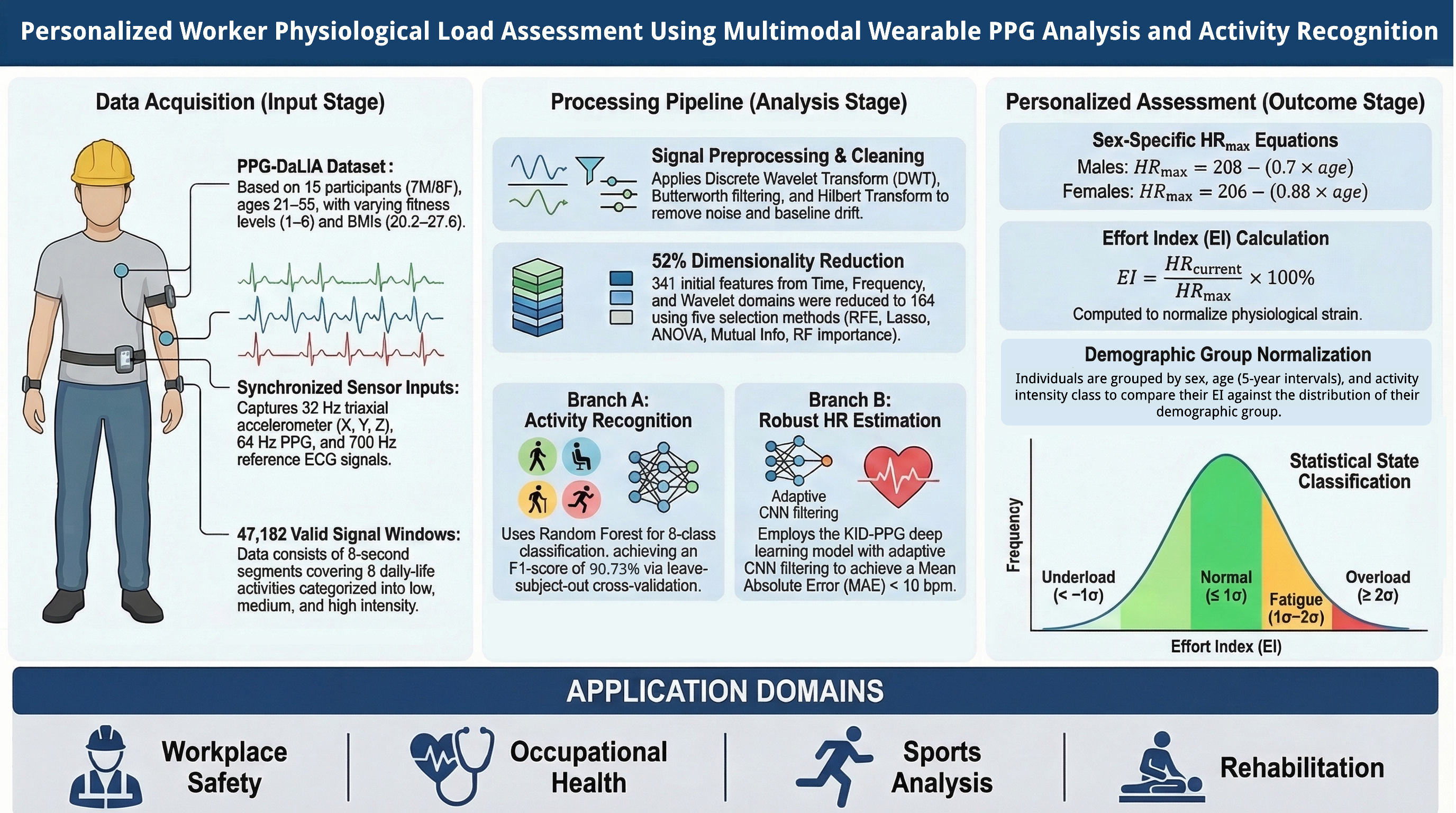
Wearable sensors enable continuous monitoring of human activity and physiological state, with applications in workplace health monitoring, occupational safety, sports performance analysis, and rehabilitation. However, effective use of these devices requires specialized data-processing algorithms and machine-learning (ML) methods. This work proposes a methodology for assessing workers’ physiological load using ML, combining accelerometer and photoplethysmography (PPG) signal processing. An ensemble Random Forest algorithm is used for activity recognition, while the KID-PPG deep learning model is applied for heart rate (HR) estimation. A personalized physiological load assessment framework normalizes effort indices against demographic-group-specific distributions defined by sex, age, and activity intensity. The methodology was validated on the PPG-DaLiA dataset comprising 15 participants with diverse demographic profiles across eight daily activities. Experiments demonstrated high accuracy in activity recognition (macro F1-score of 90.73%) and robust HR estimation even in the presence of motion artifacts (MAE below 10 bpm). The personalized assessment revealed that participant age substantially influences physiological-load patterns, confirming that demographic-aware normalization is essential for accurate workload interpretation. The main factors influencing system performance have been identified, and directions for improving the models across diverse user groups and limited-signal-quality conditions are discussed.
Keywords:
photoplethysmography
; human activity recognition
; heart rate estimation
; wearable sensors
; machine learning
; accelerometer signals
; motion artifact removal
; KID-PPG
; physiological monitoring
Copyright: This open access article is published under a Creative Commons CC BY 4.0 license, which permit the free download, distribution, and reuse, provided that the author and preprint are cited in any reuse.


