

Submitted:
06 March 2026
Posted:
10 March 2026
You are already at the latest version
Abstract
In the introduction, a brief history of the body selection that would define the inertial frame of reference in mechanics (and electrodynamics) is given. At the same time, attention has been drawn to Einstein's opinion about the (unrealized) causal relationship which should exist between the frame of reference and the law that is formulated from it. Therefore, parts 2 to 5 gradually present and elaborate the idea that, instead of directly choosing a body of reference, the criterion which will give legitimacy to the selection result should be defined first. And the criterion is such that the reference body is ensured by causality just mentioned by Einstein. Such a criterion for the fields of mechanics and thermodynamics is defined here and called the "criterion of observer's non-involvement in the observed” by a reference body. In the conclusion, as the main result, significant changes in the formulations of mechanics and thermodynamics, which the application of the criterion leads to, are stated. In those improved formulations the contents related to the observer are separated from the contents related to laws of nature.
Keywords:
frame of reference
; thermodynamics
1. Introduction
When formulating mechanics of the special theory of relativity, Einstein - as well as Galilei and Newton - needed the same “universal” inertial reference frame for the formulation of the law of inertia as a universal law of nature. Namely, laws of nature are universal, but only the measurable manifestations of those laws in visible phenomena are directly available to the observer. Those measurable manifestations are dependent on the body of reference. This is the reason why a special body of reference should be looked for to make these manifestations “universal” like the laws they express.
For known reasons, it could no longer be Galilei’s heliocentric system, nor - for other reasons - Newton’s absolutely immobile space with absolutely passing of time. That is why, in the special theory of relativity, Einstein considered that body as a “Galilean reference body” which is far enough from all the other bodies and which does not rotate. Later, he justifiably believed that none of the bodies that would be proposed as a reference body, including the “Galilean” one, provides an answer to the question: what, specifically, is the inertial reference system? In [1] Einstein says: We have laws, but we do not know the body of reference in relation to which these laws apply …… and our whole structure of physics turns out to be built on sand.
In fact, Einstein saw two problems in this entire area, present equally in classical Newtonian mechanics, as well as in the mechanics of the special theory of relativity, namely: first - none of the above-mentioned reference bodies is at the same time an accurate and available solution. Second - even bigger problem according to Einstein: there is no essential physical basis for dividing all material bodies into those that can be the carrier of the inertial reference system and those that cannot be. According to Einstein, this is because a body, proposed as a reference body, would be causally related to the possibility of discovering and formulating the law of motion from it [2].
The Role of Einstein’s Request for Causality
In the continuation of his research, Einstein for some reason did not look for a reference body in such a way as to make use of his own above-mentioned request for causality. Instead, he used the equality of inertial and gravitational mass to propose any body as a reference body, if it is in the free falling in the local gravitation field and which does not rotate. According to Einstein, though, the observer in that reference system would be inertial in a broader sense and the “general principle of relativity” would apply to him. The elaboration of these ideas led him to his theory of gravitation and to continued work on the general theory of relativity.
However, there are grounds for thinking that a free-falling observer is not inertial in completeness*, but that it is correct only in a partial sense. This fact, therefore, is not an obstacle for the theory of gravity to be correct, because the targeted use of a non-inertial reference system also in classical mechanics leads to correct relations. But the hidden presence of inertial force in a free falling observer makes it fundamentally problematic to formulate the general laws of mechanics in such a reference system.
2. Criterion of the Non-Involvement of the Observer with a Reference Body in Mechanics
Independently of the elaboration of the general theory of relativity, the idea presented and considered here that the source of the problem with the body of reference in mechanics, is that the body of reference was sought in the wrong way. That is, it was sought in some physical property or in a special physical state of that body. The idea is that the wrong way of searching could not lead to a good result in principle.
With its aforementioned request for causality Einstein came close to see the difference between the result of direct selection of the reference body and the selection of the method of choosing it. But, as far as it is known, Einstein never problematized the method of choosing, so he didn’t even look for a way how to do it. In the correct method of choosing a reference body, that choice must be conditioned in such a way to satisfy one criterion for its choice, whereby that criterion provides the causality Einstein was looking for.
That criterion actually relates to the observer, so that the observer from or out of that body as a body of reference sees the circumstances that - due to the power of causality - will provide him with the discovery of the law of motion in the continuation of the experimental research. These circumstances concern the observer and the body – a candidate for the reference body. And the bodies that are the candidates for a reference body have no physical connection in macrophysics with the observed body and with the bodies affecting it, but only with the observer and the way he sees the observed body.
It is easy to be convinced that this criterion can only be in the fact that the body (candidate for the reference body) shows neither more, nor less than the content of the “law of inertia”. Therefore, the “law of inertia” is not a law related to nature, but by seeing its contents the observer satisfies the criterion according to which he can discover the law of motion in the continuation of research. According to the property and the role of this criterion, it ensures the objectivity of the observer and therefore it can be called the “criterion of observer’s non-involvement in the observed” by using the body of reference. Or, more generally, it can be called the criterion of non-involvement of the observer in the observed by his arbitrary standpoint [3,4].
With the introduction and the definition of the criteria, the problem of an available and accurate reference body in mechanics (and in electrodynamics) has been elegantly solved and everything falls into place, not only in the special theory of relativity but also within its classical Galilei – Newton’s approximation.
2.1. The Role of Galileo Galilei
It is known that Galileo Galilei, as the first of the big three, obtained in his laboratory two well-known results, or conclusions, after examining the motion of a ball. First he examined the motion on a horizontal smooth plate, and then the motion on an inclined one, at different inclinations. The first derived conclusion actually indicated that in Galilei’s laboratory the criterion was met, according to which this very laboratory is the reference body for the reference system called inertial (IN). In which reference system - in the continuation of the research - the general law of motion can be discovered. Thus the second derived conclusion (which was a rudimentary form of the general law of motion) was causally conditioned with the first one. It was in the way Einstein had been just looking for, but not realized [5].
However, Galilei - unlike us today - did not expect to check whether the current body of reference (laboratory) is causally connected with the possibility that exactly is the reference body (for the discovery and formulation of the law of motion as a universal law of nature). Instead, he had already decided in advance that the reference system for the formulation of the universal laws of mechanics must be Copernicus heliocentric system and not the other one. Having started arbitrarily from already having the correct reference system, he - in the continuation of reasoning - logically concluded that what he had discovered from the already chosen body of reference could be nothing else but one of the universal laws of nature, the “law of inertia”.
2.2. Discussion and Results for Mechanics
The firm acceptance of the opinion that the content called “law of inertia” is a universal law of nature and not something else, was a very subtle error, which remained unrecognized even after Galileo. So far refined, but it did not in any way affect the accuracy of results in all technical and astronomical applications of mechanics. Namely, it was (and still is) in this respect completely irrelevant whether the content of the “law of inertia” was satisfied as a criterion of non-involvement, or whether the same content was satisfied as a law of nature. But in essence, the error is fundamental, because if the content of the “law of inertia” (which as a criterion relates exclusively to the observer) is included among the laws of nature, the relationship between the observer and the laws of nature is falsified. It is not the same, though, whether there are three laws of mechanics (with a very poorly predefined reference body!), or if there are only two laws of mechanics, with a precisely and causally determined reference body.
It is interesting that - if one insists on the three laws of mechanics - mechanics would formally be consistent and complete science considering the accuracy of all calculations in its field of application. In this sense, mechanics can be formally formulated and applied only with its “three laws” as axioms, without defining any reference system. But - taking a closer look - without predefining the body of reference, the formulation of all the laws of nature are just phrases without concrete content.
2.3. Criterion of Non-Involvement in Thermodynamics
Let’s now look at the situation in thermodynamics from an analogous point of view. Let’s assume that its “standard formulation” contains five laws namely: the first postulate of equilibrium, the second postulate of equilibrium or zeroth law of thermodynamics, the first law of thermodynamics, the second law of thermodynamics and Nernst’s theorem. The observer’s reference frame, which in the general case needs to be defined before the formulation of the law, is not mentioned here.
But we have already seen that, formally, mechanics can also be formulated only with its “three” laws without mentioning the body of reference, because the perception of the content of the “law of inertia” as the first of the laws actually defines the reference body of the inertial system of reference. It is easy to show that by seeing the content of the first of the five mentioned laws of thermodynamics, the reference body of the thermodynamic observer is defined. Again in analogy with mechanics, it is shown that the laws of nature are only the remaining four laws, while the content of the first postulate of equilibrium defines the system of reference in thermodynamics [3,4,5].
3. Thermodynamic Approach to Rotation
It is also easy to show that the hereby defined reference body in thermodynamics must be stationary in relation to the center of mass of the observed body and without rotation [4,5] - abbreviated: CMNR. In this CMNR system of reference the observer will see, among all the others, those that characterize rotation (around an axis through the center of mass) as thermodynamic properties of non-equilibrium and equilibrium states. These are the angular momentum vector and the angular velocity vector . By including them in the macroscopic thermodynamic properties associated with a body the number of forms of work also increases as a thermodynamic external influences, as well as the number of forms of energy that fall into the internal energy. Thus the CMNR system of reference expands the area in which the laws of thermodynamics create a consistent and complete theory. The rotation itself in the thermodynamic equilibrium state characterizes the state, not the process.
4. Complementarity of Mechanics and Thermodynamics
Formulating his mechanics as the science of the motion of bodies (more precisely: of the change of its position with time relative to other bodies), Newton described the position and velocity of the body with vectors of position and velocity respectively, meaning that the observed body was relatively far from the observer (as a material point). This enabled him to formulate a simple law of motion:
where is the force exerted by other bodies, and is the mass of the material point. If we imagine that a mechanical observer came closer, he would see, instead of a material point, a more complex situation, in the general case a deformable and rotating body, and - why not - also another, thermodynamic observer in the CMNR system of reference. Newton’s observer in this closer seeing could neither directly attribute to the body any unique position vector, nor a unique velocity vector. He could see, however, the body as a set of material points, each with its own position, velocity and mass. Newton’s second law (1), which he saw from a distance, has no reason to disappear just by applying another (closer) inertial (IN) reference system. That is why the observer can look for the same law (1) in his new inertial reference body, from which he sees the body as a set of n material points, Figure 1.
So (1) is also present via the corresponding equality (2)
On the other hand, the relationship between seeing the position and the velocity of the body’s particle in IN and in the CMNR reference frame is expressed by (3) and (4):
Relations (1)–(4) are written from the inertial reference system, but the relative velocity vector ‘ is the same in both reference systems, in IN and in CMNR. It will be instructive to look for the total momentum in the IN reference system:
According to the definition of the center of mass it turns into
Before conclusions, let’s look for the total kinetic energy of the body in the IN reference system.
With (7) follows the conclusion (König’s theorem):
According to the relation (5), Newton’s mechanics separates the total momentum into two parts. One part is related to the changing of body position defined by the motion of the center of mass. The other part is related to the relative motion in relation to the center of mass also visible in CMNR reference system. For a mechanically isolated body, the amount of momentum related to the center of mass in the inertial frame of reference is constant over time. The other part of the total momentum present in (5) is the sum of the “relative momentums” of individual body parts. According to the thermodynamic observer located in the CMNR system, these quantities will generally decrease over time. At the same time, their vector sum is equal to zero from the beginning of the isolation.
Analogous to the momentum, the kinetic energy in (9) is also separated into two parts. The first part is determined by the motion of the body’s center of mass, and the second is related to the relative motion, also visible in the CMNR reference system. For a mechanically isolated body, the part related to the motion of the center of mass in the inertial frame of reference remains constant over time. The second part, again according to the thermodynamic observer in the CMNR system, decreases over time in the general case. At the same time, the sum of kinetic energies of relative motion tends to zero, or to the minimum kinetic energy of rotation, if the body rotates. Such a conclusion follows from the tendency to reach the maximum entropy with the absence of heat exchange and with the condition of conservation of angular momentum.
In conclusion, the following can be said. Newton’s mechanics is a borderline case of the theory of relativity, when the velocities of observed bodies are much lower than the speed of light in a vacuum. As a science, it is consistent and complete in its entire field of application to the motions of bodies as material points. If its application is extended to bodies as deformable or rotating systems of material points, it ceases to be “complete” in that part of the application. Namely, the finite processes of deformation are mechanically indeterminate without thermodynamics and its observer in the CMNR system of reference. Likewise, it has already been shown that the rotation of the body is a thermodynamic phenomenon, which is registered and must be taken into account by the thermodynamic observer [5].
5. The Clock as a Thermodynamic Engine in Mechanics
In addition to the described complementarity of the mechanical and thermodynamic reference systems, it should also be noted that the inertial mechanical observer in Figure 1 must have a clock among its measuring instruments. Moreover, in mechanics of the special theory of relativity this observer must have the whole series of synchronized clocks related to each location in each and all inertial reference systems.
However, the clocks in Figure 1 are not mechanical but thermodynamical machines, which are only mechanical or electrodynamical in nature. More precisely, a clock is a thermodynamical engine that works “in idle speed”, has a dial as a “revolution counter”. As a source of (working) availability necessary for mastering various forms of dissipation of energy it uses the potential energy of weights in the external field of gravity or some other form of availability. It was also derived [3,6,7,8] that the time shown by each clock is proportional to the loss of the clock’s availability, and this loss in this case is equal to the amount of heat transferred to the environment. That mechanics (with electrodynamics) and thermodynamics are complementary, but interconnected aspects of the material world.
It is known that each inertial frame of reference has its own time. It is related to adoption of the invariance of the speed of light in Einstein’s synchronization process of all locally distributed clocks in each and every inertial reference system. The very process of synchronizing the clocks at places A and B is derived from a series of the following events: the emission of a flash of light at A at the moment , the motion of that flash at the speed c to the observed location B*, the reflection of radiation at the same location in the moment , the motion back at the same speed and the absorption of radiation at the starting location A in the moment . Due to the equality of the propagation speed of the light signal in both directions, the elapsed time in both directions is also the same. Therefore it reads:
The equality of the speed of light in both directions used here was proven by the Michelson-Morley experiments, but without any idea why it is so.
Invariance of the Speed of Light and Thermodynamics
The proof will be proposed below, that from the laws of thermodynamics, applied to the special thermodynamical object, the speed of light in a vacuum must be invariant. This object is a non-transparent solid body with closed cavity within which photons of EM radiation can be exchanged between opposite parts of the surface of that cavity wall. So let’s observe a cavity with a wall as a heterogeneous thermodynamic object composed of an arbitrary substance and a photon gas surrounded by it, all in thermodynamic equilibrium. This equilibrium state of the object will be completely determined by the common thermodynamic temperature T itself. This completely determined state includes, among other properties, the internal energy density of the photon gas in the cavity.
The inner surface of the wall and the nature of the photon gas are such that, in equilibrium, both forms of matter (wall and photon gas) exchange photons by emission, absorption and reflection on the whole contact surface. The photons themselves do not interact with each other in their motion, but the equilibrium state is established only through their interaction with the wall. And that state is characterized by the equilibrium photon gas itself as equilibrium (black) radiation in the cavity and at the same time it characterizes the “radiosity” (all the radiation that leaves the surface) of the wall as a flow of photons with the same distribution of energies as with photons in the cavity. In this case, the mechanism of maintaining thermodynamic equilibrium, defined by the common temperature T, is achieved by the connection between the total flow of energy from the wall and the constant energy density of the photon gas in the cavity, which is kept constant by this constant flow from the wall. If it were not so, the object would be out of thermodynamic equilibrium, which would contradict the assumed constant temperature and the second law of thermodynamics.
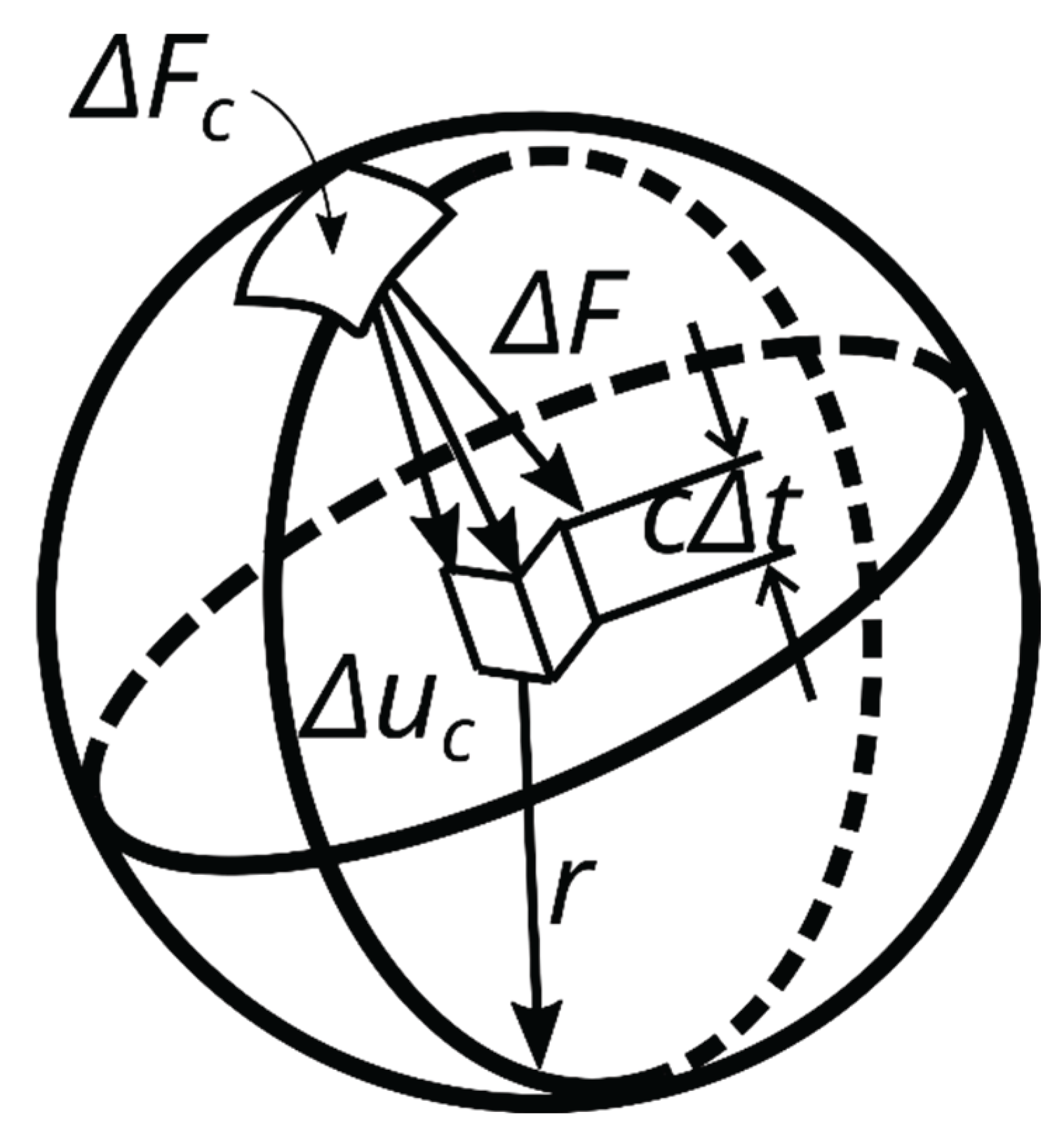
Let’s elaborate according to [9] that connection of the constant flow of energy using the total black radiation from the inner surfaces of the wall and maintaining a constant specific internal energy of the photon gas . We will do it on a geometrically simple example, which will have general significance, because the equilibrium state depends neither on the geometry nor on the material of the wall, nor on the radiation properties of its internal surfaces*, but only on the (homogeneous) temperature. Let the cavity be specially spherical, r in radius. In the center we are considering the photons flow from one small part of the cavity surface c and its small contribution to the internal energy of the photon gas inside a small prism, the size of the base c and length c time and c the speed of light related to the wall. Index c indicates black radiation. This equality of energy inflow and its contribution to the internal energy reads like this (see Figure 2):
where is the energy emitted per second in the direction perpendicular to the surface c, per 1 m2 and within the solid angle 1 steradian; is a real small solid angle that includes is contribution to the specific internal energy of the photon gas inside the entire ventilated prism with base from the surface c. Analogous contributions from all other parts of the inner surface will give the whole amount in the sum. By switching to differential increments and by rearranging it follows that
and
With there is where is the energy emitted into the half-space per second. Finally, taking into account the Stefan – Boltzmann’s law
there is
It has already been said that the specific internal energy, and, in general, the thermodynamic state of the equilibrium photon gas in the cavity, depends only on the common temperature. Hence the speed of light c in a vacuum must be a universal constant, as confirmed by the Michelson - Morley experiments.
Here, the reasoning assumed that the mechanism of photon transfer over time, as it exists before the establishment of thermodynamic equilibrium, remains the same until the equilibrium is established. However, simultaneous transmissions from all parts of the inner surface of the cavity in this moment (according to the observer’s clock) are mutually balanced. Once an equilibrium state is established, no further changes occur in the body and its own passing of time stops [7].
6. Results and Conclusions
The choice of the reference systems in mechanics (with electrodynamics) and in thermodynamics should be done only after choosing the correct way of selecting the reference body for such systems of reference. In this, the correct way of choosing is conditioned by satisfying the “criterion of non-involvement” of the observer in the observed by using his body of reference. For mechanics, the criterion coincides with seeing the content of the “law of inertia”, and for thermodynamics with seeing the content of the “postulate of thermodynamic equilibrium”. Without satisfying these criteria, Einstein’s request for causality would not be fulfilled. The main consequences derived from this as results and conclusions are listed here:
- The criteria of observer’s non-involvement (using his body of reference) have been derived, which define the inertial (IN) and centre of mass, non rotating (CMNR) system of reference in mechanics and respectivelly in thermodynamics. Consequently, there are not three laws in mechanics but only two, and in thermodynamics there are not five laws, but only four.
- In the formulations of mechanics and thermodynamics the very laws of nature have been separated from the conditions which the observer must satisfy if he wants to discover and formulate laws of nature. In current formulations, therefore, there is something referring to the observer, exposed on an equal footing to what refers to the universal laws of nature.
- Body rotation is recognized as a thermodynamic phenomenon (although mechanical in nature) because it conforms to the realms of consistency and completeness for the laws of mechanics and thermodynamics in their systems of reference.
- In this, treating clock as a thermodynamic engine at idle speed, thermodynamics offers a physical basis for the concept of the passing of time in mechanics. Lather in the text it is shown that constancy of the speed of light in vacuum is a consequence of thermodynamic equilibrium in solid body with photon gas in the cavity.
References
- Einstein, A.L. Infeld: The Evolution of Physics; Cambridge University Press, 1938. [Google Scholar]
- Einstein: On the Special and General Theory of Relativity, Commonly Understood, Braunschweig 1917. (paragraph 4). (Original text in German).
- N. Ninić: Introduction to Thermodynamics and Its Technical Applications; (Original text in Croatian); FESB: Split, 2008.
- N. Ninić: Fundamentals of Thermodynamics and the Relationship with Newtonian Mechanics. In Faculty of Science and Mathematics; Split, 2011; Available online: www.pmfst.hr.
- Ninić, N.; Tolj, I.; Poljak, D.D. Sedlar: The collection of papers from the Seminar on the Method of Choosing the Reference Systems in Exact Natural and Technical Sciences, publication of the Faculty of Electrical Engineering, Mechanical Engineering and Shipbuilding, Split 2025. (Original text in Croatian) Also: Overview of the Seminar Proceedings contents. Available online: https://www.fesb.unist.hr/wp-content/uploads/2025/07/Zbornik_svibanj_2025.pdf.
- N. Ninić: The Theory of Observer’s Involvement and the Original Sin of Scientists; (Original text in Croatian); OMH: Šibenik, 2016.
- Jesperson, J.J. J. Fitz-Randolph: From Sundials to Atomic Clocks; Dover Publications, Inc, 1999; ISBN 0-486-40913-9. [Google Scholar]
- Lucia, U.G. Grisolia: Time & Clocks: A Thermodynamic Approach. Results in Physics 2020, 16, 102977. [Google Scholar] [CrossRef]
- F. Bošnjaković: Thermodynamics II. In Tehnička knjiga; (Original text in Croatian); Zagreb, 1976.
Figure 1.
Inertial (top) and center-of-mass (bottom) reference system.
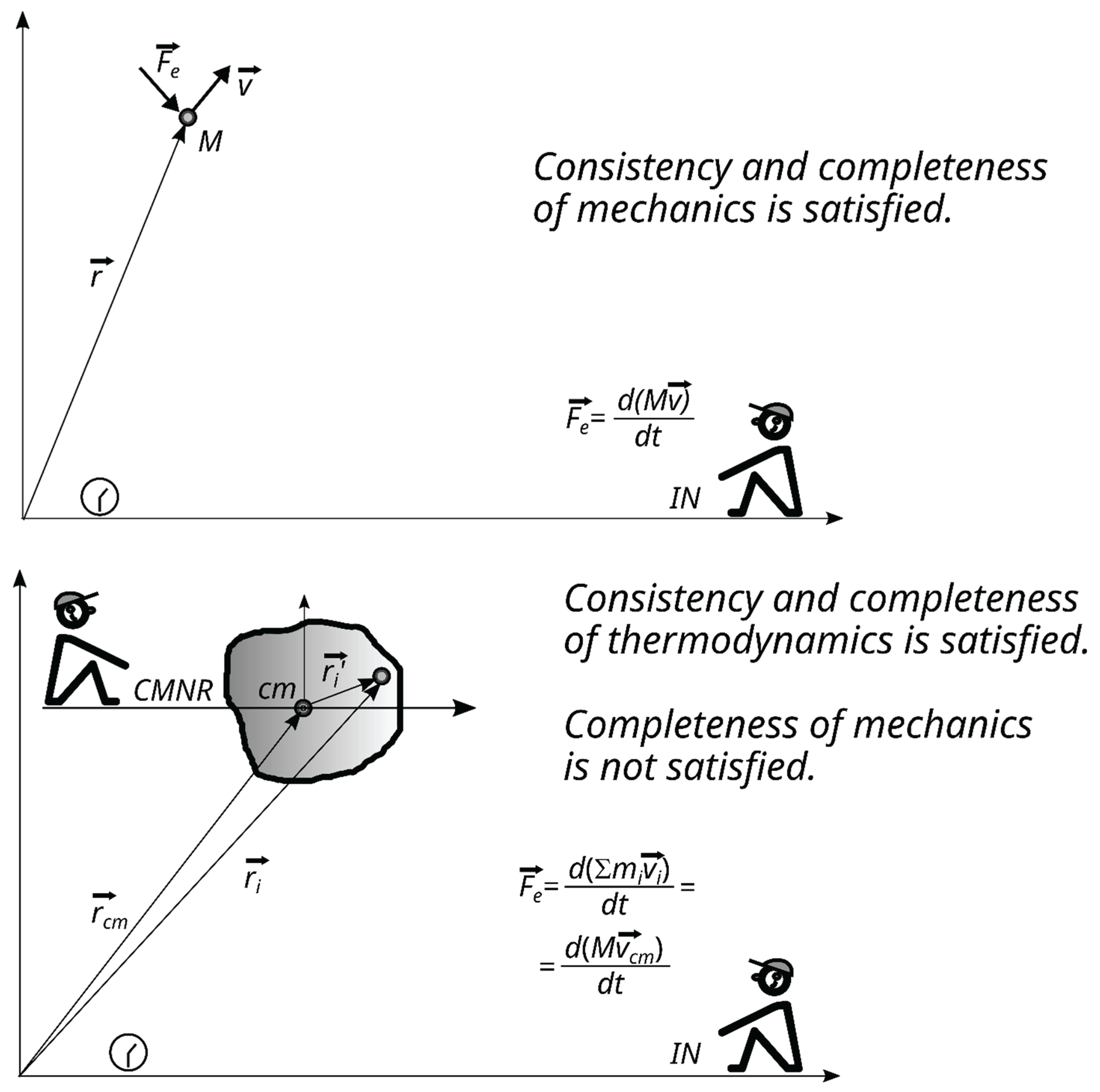
Figure 2.
Small contribution from c to in the center of the photon gas sphere.
* It does not take into account all forces from external bodies |
|
* B is the point of electromagnetic (EM) contact with the observed body, here in the same reference system as A. |
|
* In fact, there is only one limitation: that the entire surface of the cavity is not completely reflective, and that the same applies to all wavelengths separately. |
Disclaimer/Publisher’s Note: The statements, opinions and data contained in all publications are solely those of the individual author(s) and contributor(s) and not of MDPI and/or the editor(s). MDPI and/or the editor(s) disclaim responsibility for any injury to people or property resulting from any ideas, methods, instructions or products referred to in the content. |
© 2026 by the authors. Licensee MDPI, Basel, Switzerland. This article is an open access article distributed under the terms and conditions of the Creative Commons Attribution (CC BY) license (http://creativecommons.org/licenses/by/4.0/).
Copyright: This open access article is published under a Creative Commons CC BY 4.0 license, which permit the free download, distribution, and reuse, provided that the author and preprint are cited in any reuse.