

Submitted:
06 March 2026
Posted:
09 March 2026
You are already at the latest version
Abstract
Background: Vitamin D (25(OH)D) deficiency affects over one billion people globally and is associated with type 2 diabetes (T2D) and cardiometabolic diseases. However, causal relationships remain unclear, as vitamin D supplementation have shown limited benefit in reducing T2D risk. Genetic studies have identified variants influencing circulating 25(OH)D levels, but whether genetically determined vitamin D status predicts cardiometabolic outcomes is still uncertain. We therefore used bidirectional Mendelian randomization with genome-wide polygenic scores to evaluate the causal relationship and directionality between vitamin D status and T2D. Methods and Results: We analyzed multi-ethnic populations from the UK Biobank (N = 471,861), and 3,486 participants from the Asian Indian Diabetic Heart Study/Sikh Diabetes Study with serum 25(OH)D measures and genome-wide genotype data. A global polygenic score of vitamin D–raising alleles did not significantly reduce the risk of T2D, coronary artery disease, stroke, or other cardiometabolic risk factors. In contrast, a higher T2D polygenic risk score (PRS) was strongly associated with increased risk for 25(OH)D deficiency (<50 nmol/L). Genetically instrumented analyses showed per SD increase in T2D PRS significantly reduced circulating 25(OH)D levels (β = −8.9 nmol/L; 95% CI: −9.3 to −8.5; p = 3.6 × 10⁻²⁸). Conclusions: Our findings suggest low circulating vitamin D levels are unlikely to causally predict T2D risk but may serve as a marker for secondary prevention in endocrine and cardiovascular health. Instead, genetic susceptibility to T2D appears to contribute to reduced vitamin D levels. Further studies are needed to clarify the mechanisms underlying vitamin D deficiency in diabetes.
Keywords:
vitamin D deficiency
; type 2 diabetes
; cardiometabolic risk
; mendelian randomization
; polygenic scores
1. Introduction
Vitamin D (25(OH)D) deficiency has emerged as a major global public health crisis, affecting 30-50% of the world’s population [1,2]. Vitamin D plays a crucial role in metabolic pathways and in the regulation of gene transcription across various tissues [3]. As a primary regulator of key components in metabolism, its deficiency is closely associated with the development of various health conditions, including cardiovascular disease (CVD), hypertension, and certain types of cancer [4,5,6,7]. The reciprocal relationship of circulating 25(OH)D levels with type 2 diabetes (T2D), obesity, and CVD is well established through multiple clinical and observational studies performed in diverse cohorts of European (EU), Australian, Asian, and American populations [8,9,10,11,12]. However, a causal association and the exact biological mechanism between low 25(OH)D levels and cardiometabolic disease risk remain unknown [13]. Clinical trials have also shown that vitamin D supplementation does not reduce the risk of T2D [14,15] even though the environmental and genetic factors account for 50%-80% of the variability in 25(OH)D levels [16,17].
Genome-wide association studies (GWAS) have identified multiple loci associated with circulating 25(OH)D levels and, interestingly, most robustly associated gene variants (identified mainly in large GWAS originating from EUs) map near genes involved in vitamin D synthesis, transport, or metabolism, such as DHCR7/NADSYN1, CYP2R1, GC, and CYP24A1 [18,19,20]. In addition to the contribution of these pathway genes, studies have identified the genome-wide common variant associations and ancestry-specific associations that regulate circulating 25(OH)D, exhibiting a positive and significant association between 25(OH)D-raising alleles (as polygenic scores or PGS) and circulating 25(OH)D levels [21,22,23]. However, it is still unclear if the genetically increased 25(OH)D by genome-wide variants can predict the cardiometabolic outcomes.
Mendelian randomization (MR) studies provide a framework to assess the causal relationship between 25(OH)D levels and cardiometabolic disease outcomes, while minimizing confounding factors such as geographic location, diet, and vitamin D supplementation, and accounting for reverse causation. Several studies have identified causal links between genetically determined 25(OH)D levels and the risk of conditions including psoriasis, atopic dermatitis, vitiligo, Graves’ disease, cataracts, and esophageal cancer in EU populations [24,25]. However, studies investigating the genetic relationship between 25(OH)D levels and T2D, including potential reverse effects, have produced inconsistent results [26]. To explore if the 25(OH)D insufficiency predisposes people to T2D, we previously performed a candidate-gene targeted bidirectional MR study and meta-analysis using 3 candidate gene variants of T2D (IGF2BP2, TCF7L2, and KCNQ1) and 3 GWAS-variants from vitamin D pathway genes (GC, CYP2R1, and DHCR7). Our MR study could not detect any causal evidence between T2D and 25(OH)D using eight multiethnic study cohorts comprising 59,890 individuals [27].
This study aimed to further investigate the putative role of vitamin D insufficiency in predicting endocrine and cardiometabolic health risk through genome-wide polygenic score analysis and identify the directional effects by utilizing distinct datasets. The first dataset consists of 471,861 individuals from the UK Biobank (UKBB), which includes 459,143 EU, 9372 South Asians (SA), and 3346 Africans (AF). The second population comprises a well-characterized cohort of 3,486 individuals from the Asian Indian Diabetic Heart Study/Sikh Diabetes Study (AIDHS/SDS), both available with serum 25(OH)D levels and genome-wide genotypes.
2. Methodology
2.1. Study Subjects
A total of 475,347 individuals with 25(OH)D levels from the UKBB and AIDHS/SDS were used for this study. We used genome-wide genotype and phenotype data from the UKBB in individuals of EU (n=459,143), SA (n=9372), and AF (n=3346), following the approval (Application #78635) described previously [28,29]. Serum 25(OH)D levels were measured by chemiluminescence immunoassay (DiaSorin LIAISON XL, Italy) [30]. T2D was characterized by physician-diagnosed disease phenotype and glycated hemoglobin (HbA1c) levels. Coronary artery disease (CAD) was classified based on physician-diagnosed vascular/heart problems. Additionally, we studied 3486 subjects from the AIDHS/SDS who were available with genome-wide genotype data and serum 25(OH)D levels [10,22,27,31]. The Sikh population is a relatively homogenous endogamous community from Northern India. Sikhs are primarily non-smokers, and ~ 50% of them are vegetarians. However, the incidence of cardiometabolic diseases in Sikhs and SAs has markedly increased over the past two decades [32,33]. T2D was diagnosed based on their medical records, including symptoms and use of antidiabetic medications, and in accordance with the American Diabetes Association guidelines described earlier [34,35]. Non-diabetic controls were selected based on a fasting blood glucose (FBG) < 100.8 mg/dL (5.6 mmol/L) or a 2-hour glucose < 141.0 mg/dL (7.8 mmol/L) as previously described [31,35,36]. CAD was considered if there was use of nitrate medication (nitroglycerine), electrocardiographic evidence of angina pain, coronary angiographic evidence of severe (greater than 50%) stenosis, or echocardiographic evidence of myocardial infarction. The diagnosis was based on the date of coronary artery bypass graft (CABG) or angioplasty and medication usage obtained from patient records, as described previously [22,35]. Body mass index (BMI) was calculated as [weight (kg)/height (m2)]. A tape measure of the waist and hip circumferences at the abdomen and the hip, respectively, were recorded. For using BMI thresholds for obesity, we used the World Health Organization’s (WHO) guidelines [37]. Blood pressure (BP) was measured twice after a 5-minute seated rest period with the participant’s feet flat on the floor. Serum lipids [total cholesterol (TC), triglycerides (TGs), high-density lipoprotein cholesterol (HDL-C), and low-density lipoprotein cholesterol (LDL-C)] were measured using standard enzymatic methods (Roche, Basel, Switzerland) as described previously [22,35,38,39,40]. Vitamin D levels were measured using 10 μL serum with standard monoclonal antibody-based ELISA kits from ALPCO Diagnostics (Salem, NH, USA) in the entire AIDHS/SDS cohort, as described previously [10]. A standard curve was used across a range of concentrations (2-fold dilutions), and any sample that fell out of range was repeated. All participants in this study were recruited after providing written informed consent, and the study was approved by the institutional review boards (IRBs). All AIDHS/SDS protocols and consent documents were reviewed and approved by the University of Oklahoma Health Science Center’s IRB and by the Human Subject Protection (Ethics) Committees at the participating hospitals and institutes in India, as described previously [41,42,43]. All human studies reported in this manuscript abide by the Declaration of Helsinki principles.
2.2. Genotyping, Imputation, and Quality Controls
For genetic analysis, we used imputed data released by the UKBB for EU, AF, and SA subjects and excluded outliers based on heterozygosity or genotype missingness (missing rate> 0.2) and ambiguous SNPs (MAF > 0.44). Participants with inconsistent reports and genotypic inferred sex inconsistencies or withdrawn consent were removed, as explained previously [44].
For the AIDHS/SDS, samples were genotyped using the Illumina 660W Quad BeadChip, Illumina Global Screening Arrays (GSA), and GSA with multi-disease content (GSA+) arrays as described previously [22,36,45]. Samples with genotyping call rate <95%, cryptic relatedness, population outliers, departures from Hardy-Weinberg equilibrium (HWE) (p<10-7), or MAF<5% were excluded before association testing. To increase genome coverage, data were imputed using Minimac4 [46] (https://imputationserver.sph.umich.edu/) with TOPMED r3 multiethnic reference panel in NCBI Build 38 (hg38) coordinates as reported previously [29,47]. Of a total of 23,739,260 variants, we removed variants with an imputation certainty info score <0.5, MAF<0.001, and with HWE in controls (p<1×10⁻⁶) before further analysis. The genetic principal components (PCs) were estimated from our Sikh population, as the existing HapMap2, HapMap3, and 1000 Genomes data do not include data from Punjabi Sikhs, as described previously [35,48].
2.3. Genome-Wide Genetic Score Construction and Analysis
Ancestry-specific PGS for 25(OH) D-raising alleles were constructed using candidate variants derived from genome-wide genotypes of UKBB and AIDHS/SDS. To construct EU-ancestry PGS, we used summary statistics from Revez et al. (2020) [3] comprising 6,098,063 variants from Sunlight Consortium. To test the associations of SNPs with circulating 25(OH)D levels, linear regression and an additive genetic model were used, with the natural-log-transformed 25(OH)D level adjusted for age, gender, BMI, 10 genetic PCs, and T2D status. We excluded INDELs, duplicate and multiallelic SNPs, and SNPs with info score<0.80, and included SNPs with MAF>0.01 and MAF<0.45. After regression analysis, SNPs with p<10-4 were chosen. After linkage disequilibrium (LD) clumping using R2 <=0.25 and 500 Kb distance, a total of 2179 SNPs were used for the construction of the PGS. The EU-derived PGS performed poorly in SAs from AIDHS/SDS and the UK. We constructed ancestry-specific PGS using ~15 million variants from the AIDHS/SDS tested and trained using discovery (n=1616) and validation (n= 1870) cohorts of the same Punjabi ethnicity and 9372 SAs from UKBB. A total of 2051 SNPs were chosen for the construction of the PGS using the same selection criteria and LD clumping and regression analysis model as described for EU. For the construction of the AF PGS, we used GWAS summary statistics of 23,615,737 SNPs derived from African ancestry from Wang et al. 2023 [49] for vitamin D. The individual-level regression coefficients were multiplied by the number of risk alleles to compute the PGS as described previously [27,29,47]. The weighted PGS was calculated using the following equation 1:
where N is the number of SNPs in the score, βi is the effect size (or beta) of variant i, and dosage is the number of copies of SNP in the genotype of individual j [50]. The polygenic risk score (PRS) for T2D was constructed using the summary statistics data from O’Connor et al., [51] which was derived from 312,646 individuals of EU ancestry with a similar methodology as described above for all ethnic groups.
2.4. Statistical Analysis
The clinical and demographic variables were summarized as means for continuous variables and percentages for categorical variables, using SPSS version 31 (IBM, New York City, USA). Multivariate linear regression analyses were performed to assess the impact of 25(OH)D PGS on T2D, CAD, acute ischemic stroke (AIS), and other cardiometabolic risk factors (e.g., waist, waist-to-hip ratio (WHR), and glucose) after adjusting for covariates such as age, sex, and BMI. To evaluate the discrimination capability at the extreme tail of the genetic score, we divided the PGS into quartiles. We then compared the extreme scores in the 4th quartile with those in the 1st quartile to assess the protective effects of genetically raised 25(OH)D on T2D, CAD, and AIS. Additionally, we also assessed the effects of genetically enhanced diabetes risk (T2D PRS) for modulating 25(OH)D levels in UKBB(EU/AF/SA) and AIDHS/SDS cohorts.
We used genetic instrumental variable methods to obtain estimates of the causal association between circulating vitamin D levels and T2D and determined the direction of causality by performing a bidirectional MR study [27,36]. The associations between the exposure (T2D) and the outcome (25(OH)D) levels and vice versa are estimated from different cohorts, mainly UKBB (EU, SA, and AF), and AIDHS/SDS. For conducting MR analysis, three fundamental hypotheses were considered: a. Cumulative genetic instrument variables (IVs) should be strongly linked to the exposure. b. IVs must not directly correlate with the outcome, influencing it solely through the exposure. c. IVs need to be independent of potential confounders. The combined estimates were calculated using the conventional MR method [52,53]. In sensitivity analyses, we used the two-stage least squares (2SLS) method to validate the causal effect and the strength of the association since the allelic score methods were used for the MR [53,54]. In stage 1, the exposure of interest is regressed on the polygenic score (controlling for covariates of age, gender, BMI, and ancestry) to obtain predicted values of the exposure. The stage 2 estimates the causal effect by regressing the predicted values of the exposure obtained from the first stage [55] and F values > 10 were considered for confirming for causal effect. All analyses were performed using PLINK 2.0 [56], SVS version 8.9.1 (Golden Helix, Bozeman, MT, USA), and SPSS version 31 (IBM, New York City, USA), and R (version 4.3.3).
3. Results
The clinical and demographic characteristics of the UKBB and AIDHS/SDS study participants are presented in Table 1. The AIDHS/SDS individuals showed higher levels of most clinical risk traits than the UKBB cohort. For instance, the mean WHR was significantly higher for AIDHS/SDS (0.94+0.08) compared to UKBB EU (0.87+0.09) (p= 2.5x10-225). Similarly, the average blood glucose levels were significantly higher in AIDHS/SDS (134.78+63.72) than in UKBBEU (80.30+36.89; p= 4.65x10-325) and UKBBSA (97.66+33.94; p= 2.07x10-196). Similarly, triglycerides were significantly higher in AIDHS/SDS (169.87+112.60) in comparison to UKBB (EU, and AF) individuals (Table 1). The participant flow chart and study workflow is presented in Supplementary Figure 1.
The assessment of cumulative effects of vitamin D-raising alleles as PGS for each ancestry showed a stronger association with 25(OH)D levels, as indicated by larger effect sizes. As shown in Figure 1A the AIDHS/SDS showed the strongest allelic effect for increasing 25(OH)D levels (β= 0.76 (95% CI 0.61-0.91; p = 9.5x10-178), and a similar trend was observed in AF β= 0.29 (95% CI 0.25-0.33; p = 4.4x10-56), SA β= 0.28 (95% CI 0.24-0.31; p = 4.6x10-129), and EU β= 0.09 (95% CI 0.08-0.10; p = 2.5x10-350) (Figure 1A). Combining all cohorts, the overall meta-analysis showed a strong effect of vitamin D PGS on increasing 25(OH)D levels, β= 0.38 (95% CI 0.14-0.62; p = 4.5x10-440) (Figure 1A). However, the reverse effects of vitamin D-raising alleles (25(OH)D PGS) on reducing the risk for T2D were not observed in these cohorts (Supplementary 2b). To further evaluate if genetically increased vitamin D lowers T2D susceptibility, we divided the vitamin D-PGS into quartiles. When comparing the individuals in the 4th quartile (high 25(OH)D levels) vs. the 1st quartile (25(OH)D deficiency group), there was a marginal non-significant decrease in the risk for T2D in EU, showing a protective odds ratio (OR) of 0.97 (95%CI 0.93-1.00; p=0.08). Similarly, a protective but non-significant association was observed in AIDHS/SDS OR 0.74 (95%CI 0.54-0.95; p=0.19), and in AF OR 0.76 (95%CI 0.45-1.08; p=0.09), showing the reduced risk for T2D with increased 25(OH)D PGS (Figure 2A). Similarly, comparing the extreme quartiles of vitamin D PGS, the individuals with genetically enhanced 25(OH)D levels reduced the risk of CAD with marginal significance in EU (OR 0.96 (95%CI 0.92-1.00; p=0.05). A similar but non-significant trend was observed in AIDHS/SDS and AF, showing the decreased CAD risk with increased 25(OH)D (Supplementary Table 1). However, it was interesting to observe that the extreme quartiles (4th vs 1st) of the vitamin D-raising PGS showed a significantly decreased risk of AIS in EU, with the OR of 0.95 (95%CI 0.92-0.98; p=6.9x10⁻⁴). The same but non-significant pattern for decreased AIS risk was observed in all cohorts: AIDHS/SDS (OR 0.65 (95%CI 0.06-1.24; p=0.15)), SA (OR 0.83 (95%CI 0.68-0.98; p=0.18)), and AF (OR 0.81 (95%CI 0.54-1.08; p=0.15)) (Supplementary Table 1).
Conversely, the cumulative PRS score for T2D exhibited significantly lowered 25(OH)D levels across all ethnic groups. People with an increased T2D PRS had consistently lower 25(OH)D levels when compared with those with lower T2D PRS (β = -0.086; 95% CI, -0.085, -0.087; p = 5.2x10⁻⁷) in AIDHS/SDS and UKBB cohort EU (β = -0.009; 95% CI, -0.005, -0.013; p = 2.4x10⁻⁹), SA (β = -0.051; 95% CI -0.045, -0.057; p = 3.7x10⁻⁶), and AF (β = -0.109; 95% CI -0.105, -0.113; p = 1.5x10⁻⁹), respectively (Figure 1B). The combined meta-analysis of all cohorts showed significantly reduced 25(OH)D levels (β = -0.089; 95% CI -0.085, -0.093; p = 3.6x10⁻²⁸) with increased T2D PRS (Figure 1B).
Next, we compared the extreme 4th quartile (high T2D risk) vs. the 1st quartile (low T2D risk) PRS. In the EU, 25(OH)D levels were significantly decreased (β = -0.04, 95% CI = -0.02, -0.06; p = 5.3x10⁻⁶) in individuals with high T2D PRS. In AIDHS/SDS, 25(OH)D levels were also significantly reduced (β = -0.22, 95% CI = -0.10, -0.34; p = 7.5x10⁻⁵). Similarly, SA and AF showed a significantly decreased 25(OH)D levels in the group with the extremely high T2D PRS (β -0.19; 95% CI -0.05, -0.33; p = 0.003) and (β -0.36; 95% CI -0.12, -0.60; p = 0.002), respectively (Figure 2B).
We further studied the association between ancestry-derived vitamin D PGS effects on cardiometabolic traits, which revealed a significantly negative association with WHR in UKBB EU (β ± SE = -0.008 ± 0.001; p = 8.9 × 10⁻¹¹). Similarly, individuals with increased vitamin D PGS had a significant reduction in waist circumference in SA (β ± SE = -0.009 ± 0.001; p = 1.5 × 10⁻¹³ (Supplementary Table 2a) and, also had a significantly lowered glucose levels (β+SE = -0.12+0.06; p=0.03) (Supplementary Table 2a) and T2D risk (OR 0.91 (95%CI 0.85-0.98; p=0.009)) in the AF (Supplementary Table 2b).
We also analyzed individual variants from bonafide/established candidate genes involved in vitamin D synthesis, transport, and metabolism such as GC, DHCR7, CYP24A1, CYP2R1, LIPC, CETP, HAL, and CRX, that also showed GWAS-level significance for 25(OH)D levels in this study. We found that individuals with and without vitamin D supplements had a similar association between these variants and vitamin D levels (Supplementary Table 3a). However, no significant association of these variants was observed with other cardiometabolic risk factors in the UKBB EU (Supplementary Tables 3b-f).
Next, we constructed PGS of these candidate genes (GC, DHCR7, CYP24A1, CYP2R1, LIPC, CETP, HAL, and CRX) involved in vitamin D synthesis, transport, and metabolism. As expected, the targeted genetic score of candidate genes using GWAS-level significant variants revealed strong association for increasing 25(OH)D levels in each ethnicity (Supplementary Table 4a). However, the targeted vitamin D-raising PGS was ineffective in predicting protection against T2D or CAD risk (Supplementary Table 4b).
We further investigated the relationship between individual SNPs (T2D risk alleles) that are part of the T2D PRS for their effect on vitamin D levels. We found that some of these T2D risk gene variants were associated with a reduction in 25(OH)D levels; however, the significance of these associations was either marginal or not significant across all cohorts (Supplementary Table 5).
We also observed that circulating 25(OH)D levels did differ by T2D onset in UKBB EU decreasing significantly from (41.38+23.83) nmol/L at 17-30 years to (38.51+22.05) nmol/L at 31-50 years and then increased from (41.12+22.75) nmol/L at 51-60 years to (44.63+22.63) nmol/L at 61-70 years (F = 79.99; p= 1.79x10-51). But the 25(OH)D levels did not differ for the duration of T2D in UKBB EU (F = 0.72; p= 0.54) (Supplementary Table 6a). In AIDHS/SDS the average 25(OH)D levels showed a significant linear increase from (34.07+39.12) nmol/L to (45.21+45.43) nmol/L for age of T2D onset at 13 years to 92 years (F = 6.68; p= 1.75x10-04), while vitamin D levels decreased significantly from (44.26+45.18) nmol/L at the fresh T2D onset (0 year duration) to (28.66+33.03) nmol/L with >11 years of T2D duration (F = 15.54; p= 5.58x10⁻¹⁰) (Supplementary Table 6b).
Additionally, as expected, the T2D PRS was also associated with an increased risk for CAD in all cohorts. UKBB EU (β+SE = 0.018+0.003; p = 4.9x10⁻¹⁰), AIDHS/SDS (β+SE = 10.773+3.066; p = 4.4x10-04), UKBB SA (β+SE = 0.238+0.046; p = 1.7x10-07), and UKBB AF (β+SE = 0.955+0.325; p = 0.003) (Supplementary Table 7). Likewise, the T2D PRS was linked to a significantly increased risk of stroke across all UK Biobank cohorts: EU (β+SE = 0.091+0.002; p = 3.1x10-308), SA (β+SE = 1.178+0.050; p = 4.9x10-118), and AF (β+SE = 4.503+0.211; p = 1.2x10-94). Although the effect of T2D PRS on AIS was in the same direction, it was not significant in AIDHS/SDS (β+SE = 1.349+0.795; p = 0.84), perhaps because of the small number of stroke cases (n=111) in this cohort. (Supplementary Table 7).
4. Discussion
This study aimed to determine the critical role of vitamin D insufficiency in predicting the risk of cardiometabolic diseases, utilizing diverse ethnic cohorts and advanced genome-wide approaches. Using candidate gene variants and cumulative genome-wide polygenic scores, our findings could not confirm whether vitamin D insufficiency would predispose people to the development of T2D and other cardiovascular complications; rather, it suggests that vitamin D may only be considered as a marker for secondary prevention for endocrine and cardiometabolic health. Although ancestry-derived 25(OH)D PGS were strongly associated with circulating 25(OH)D levels in this multi-ethnic study, they did not translate into predictive value for significant protection against cardiometabolic risk. This pattern was consistent across multiple analytical frameworks, including continuous and quartile-based analysis. On the other hand, our MR findings suggest that people with T2D would be more likely to develop vitamin D deficiency and subsequent cardiovascular complications.
Vitamin D deficiency is an established risk factor for T2D, CAD, and other cardiometabolic diseases [57,58]. We earlier reported a very high prevalence of vitamin D deficiency in this Punjabi diabetic cohort (AIDHS/SDS), showing a strong association of reduced 25(OH)D with T2D and other cardiometabolic risk traits [10,22,59]. In a bidirectional MR study conducted by our group, using GWAS variants from 3 T2D candidate genes (IGF2BP2, TCF7L2, KCNQ1) and three vitamin D pathway genes (GC, CYP2R1, DHCR7) across 59,890 individuals from EU and Asian Indian ethnic groups, no causal link between T2D and 25(OH)D was found [27]. Our current findings again failed to establish a causal relationship between genetically instrumented increase in 25(OH)D to reduce susceptibility to T2D and other cardiovascular diseases and traits after including the genome-wide polygenic scores and an expanded study cohort of more than 450,000 individuals from UKBB. These results support the prior published studies from other groups, where MR analyses have shown no causal association between vitamin D levels and the risk of T2D [60], including MR analysis of large consortia studies (European Prospective Investigation into Cancer and Nutrition [EPIC]–InterAct, EPIC-Norfolk, EPIC-CVD, Ely, and the SUNLIGHT consortium) [61]. Similarly, a study by La Barrera et al. (2023) found that increased 25(OH)D levels did not affect youth-onset T2D risk [62]. Even when restricting the PGS analysis to variants in established vitamin D pathway genes and lipid metabolism genes, which were strongly associated with 25(OH)D levels, we observed no association with T2D and cardiometabolic traits.
On the contrary, our results demonstrate a strong causal association between genetically enhanced T2D susceptibility due to PRS for significantly reducing 25(OH)D levels across multiple ethnic groups. A genetically instrumented per SD increase in T2D PRS would reduce 25(OH)D levels to 8.9 nmol/L with 95%CI from 8.5 nmol/L to 9.3 nmol/L (p = 3.6x10⁻²⁸). These results also support epidemiological evidence, including studies from our group, which have consistently shown that vitamin D deficiency is more prevalent in individuals with T2D than in people without T2D in multiple populations [63,64]. Prospective studies have shown that vitamin D deficiency accelerates the development, progression, and severity of T2D [57]. In patients with T2D, circulating 25(OH)D levels are often reduced due to sequestration of vitamin D in adipose tissue, metabolic dysfunction, and diabetes-related complications [65]; however, the exact molecular mechanism remains unexplored.
Animal studies in diabetic rat models have demonstrated reduced renal expression of key vitamin D–regulating genes, including Lrp2 (megalin), Cubn (cubilin), and Dab2, resulting in impaired vitamin D metabolism. As shown in Supplementary Figure 2, downregulation of the Lrp2 -Cubn-Dab2 complex disrupts renal reabsorption of vitamin D bound to D-binding protein, leading to its increased elimination through the urinary tract [66]. Furthermore, gene expression studies have reported downregulation of the vitamin D receptor (VDR) in diabetic individuals, which may also contribute to reduced circulating 25(OH)D levels in T2D [67]. Additionally, epigenetic mechanisms may further exacerbate vitamin D deficiency in metabolic disease. Hypermethylation of VDR and vitamin D metabolizing genes, such as CYP27B1, CYP2R1 has been shown to reduce gene expression of these proteins, leading to decreased synthesis of active vitamin D, leading to impaired calcium homeostasis, and metabolic dysfunction [68,69,70]. Similarly, reduced 25(OH)D levels have been reported in obese Saudi women due to hypermethylation of CYP2R1 and CYP27B1 [71]. Collectively, these findings underscore the need for further investigation into the biological and molecular mechanisms underlying reduced vitamin D levels in T2D.
This study has several notable strengths. First, it investigates the impact of genome-wide vitamin D PGS on T2D and cardiometabolic disease risk across multi-ethnic populations. To our knowledge, no studies have yet explored this potentially causal connection using a genome-wide bidirectional MR approach. The genome-wide risk score information was from summary statistics obtained from large consortium studies to reduce the genetic score inflation, and sensitivity analysis was performed to check the reliability of causal inference. The inclusion of diverse ethnic groups improved the generalizability of our findings and reinforced the evidence of no association between vitamin D and protection against T2D. Similarly, this study has limitations, including a lack of diversity in the sample; over 80% of participants are from the EU. Also, the lack of genome-wide data and vitamin D measures in other diverse non-EU cohorts might have contributed to creating a weak genetic instrument. There was observable phenotypic and genotypic heterogeneity between SA populations from UKBB and AIDHS/SDS. The SA cohort from UKBB is a random collection of SAs living in the UK originating from all over the world, and the AIDHS/SDS included one homogenous population of Punjabis and predominantly Sikhs from North India. Despite limitations, our polygenic score models demonstrated robustness for predicting T2D and were significantly effective for predicting 25(OH)D status across all ethnic cohorts. Our MR results have revealed important insights into the causal link between cumulative genetic risk for T2D and vitamin D levels.
In summary, our findings provide no evidence for an association between the genetically increased vitamin D levels or exogenous supplementation for protecting against T2D and cardiovascular risk. In contrast, our new findings using genome-wide scores demonstrated that people with genetically enhanced T2D risk are more prone to vitamin D insufficiency, which can substantiate T2D-related complications across ethnic groups. These findings may partly explain why individuals with T2D are 2 to 4 times more likely to develop fatal CAD, heart failure, and AIS than those without T2D. And that improved vitamin D status can be a modifying factor for endocrine and cardiovascular health. Given the rising prevalence of T2D, these results are timely and important and highlight the need for developing a deeper understanding of the biological mechanisms linking diabetes to vitamin D deficiency and consequent cardiovascular complications affecting aging and health span.
Author Contributions
MR performed data curation and genetic data analysis and assisted in manuscript preparation. PB read and edited the manuscript. DKS contributed to the study design, genotyping, and phenotyping as a cohort PI of AIDHS/SDS and co-wrote the manuscript. All authors read, edited, and approved the submitted version.
Funding
The Asian Indian Diabetic Heart Study/Sikh Diabetes Study was supported by National Institute of Health grants R01DK082766 and R01DK118427 (National Institute of Diabetes and Digestive and Kidney Diseases, NIDDK) and partly by Dr. Geoffrey Altshuler Children’s Hospital Foundation Endowment funds, and funding from Presbyterian Health Foundation of Oklahoma.
Acknowledgments
The authors thank all participants in AIDHS/SDS and UKBB and are grateful for their contributions to this study.
Conflicts of Interest
We declare that no conflict of interest could be perceived as prejudicing the impartiality of the research reported. The author(s) declare that no generative AI or AI-assisted technologies were used in the writing of this manuscript. The funders had no role in study design, data collection and analysis, decision to publish, or preparation of the manuscript.
Abbreviations
- AIS: Acute Ischemic Stroke
- AIDHS/SDS: Asian Indian Diabetic Heart Study/Sikh Diabetes Study
- AF: Africans
- BG: Blood glucose
- BMI: Body mass index
- BP: Blood pressure
- CABG: Coronary artery bypass graft
- CAD: Coronary artery disease
- CVD : Cardiovascular disease
- DBP: Diastolic blood pressure
- EU: European
- GSA: Global Screening Arrays
- GWAS: Genome-wide association studies
- HDL-C: High-density lipoprotein cholesterol
- HWE: Hardy-Weinberg equilibrium
- LD: Linkage disequilibrium
- LDL-C: Low-density lipoprotein cholesterol
- MAF: Minor allele frequency
- MR: Mendelian randomization
- PC: Principal components
- PGS: Polygenic score
- PRS: Polygenic risk score
- SA: South Asians
- SBP: Systolic blood pressure
- T2D: Type 2 diabetes
- TC: Total cholesterol
- TG: Triglycerides
- UKBB: UK Biobank
- Vitamin D: 25(OH)D
- WHR: Waist-to-hip ratio
References
- Holick, M.F.; Chen, T.C. Vitamin D deficiency: a worldwide problem with health consequences. Am J Clin Nutr 2008, 87, 1080S–1086S. [Google Scholar] [CrossRef] [PubMed]
- Amrein, K.; Scherkl, M.; Hoffmann, M.; Neuwersch-Sommeregger, S.; Kostenberger, M.; Tmava Berisha, A.; et al. Vitamin D deficiency 2.0: an update on the current status worldwide. Eur J Clin Nutr 2020, 74, 1498–1513. [Google Scholar] [CrossRef] [PubMed]
- Revez, J.A.; Lin, T.; Qiao, Z.; Xue, A.; Holtz, Y.; Zhu, Z.; et al. Genome-wide association study identifies 143 loci associated with 25 hydroxyvitamin D concentration. Nat Commun 2020, 11, 1647. [Google Scholar] [CrossRef]
- Bouillon, R.; Lips, P.; Bilezikian, J.P. Vitamin D supplementation and musculoskeletal health. Lancet Diabetes Endocrinol 2019, 7, 85–86. [Google Scholar] [CrossRef]
- Davis, C.D. Vitamin D and cancer: current dilemmas and future research needs. Am J Clin Nutr 2008, 88, 565S–569S. [Google Scholar] [CrossRef]
- Dawson-Hughes, B.; Staten, M.A.; Knowler, W.C.; Nelson, J.; Vickery, E.M.; LeBlanc, E.S.; et al. Intratrial Exposure to Vitamin D and New-Onset Diabetes Among Adults With Prediabetes: A Secondary Analysis From the Vitamin D and Type 2 Diabetes (D2d) Study. Diabetes Care 2020, 43, 2916–2922. [Google Scholar] [CrossRef]
- Ramagopalan, S.V.; Heger, A.; Berlanga, A.J.; Maugeri, N.J.; Lincoln, M.R.; Burrell, A.; et al. A ChIP-seq defined genome-wide map of vitamin D receptor binding: associations with disease and evolution. Genome Res 2010, 20, 1352–1360. [Google Scholar] [CrossRef]
- Afzal, S.; Brondum-Jacobsen, P.; Bojesen, S.E.; Nordestgaard, B.G. Vitamin D concentration, obesity, and risk of diabetes: a mendelian randomisation study. Lancet Diabetes Endocrinol 2014, 2, 298–306. [Google Scholar] [CrossRef]
- Autier, P.; Boniol, M.; Pizot, C.; Mullie, P. Vitamin D status and ill health: a systematic review. Lancet Diabetes Endocrinol 2014, 2, 76–89. [Google Scholar] [CrossRef] [PubMed]
- Braun, T.R.; Been, L.F.; Blackett, P.R.; Sanghera, D.K. Vitamin D Deficiency and Cardio-Metabolic Risk in a North Indian Community with Highly Prevalent Type 2 Diabetes. J Diabetes Metab 2012, 3. [Google Scholar] [CrossRef]
- Gagnon, C.; Lu, Z.X.; Magliano, D.J.; Dunstan, D.W.; Shaw, J.E.; Zimmet, P.Z.; et al. Serum 25-hydroxyvitamin D, calcium intake, and risk of type 2 diabetes after 5 years: results from a national, population-based prospective study (the Australian Diabetes, Obesity and Lifestyle study). Diabetes Care 2011, 34, 1133–1138. [Google Scholar] [CrossRef] [PubMed]
- Scragg, R.; Sowers, M.; Bell, C.; Third National, H.; Nutrition Examination, S. Serum 25-hydroxyvitamin D, diabetes, and ethnicity in the Third National Health and Nutrition Examination Survey. Diabetes Care 2004, 27, 2813–2818. [Google Scholar] [CrossRef]
- Theodoratou, E.; Tzoulaki, I.; Zgaga, L.; Ioannidis, J.P. Vitamin D and multiple health outcomes: umbrella review of systematic reviews and meta-analyses of observational studies and randomised trials. BMJ 2014, 348, g2035. [Google Scholar] [CrossRef]
- Pittas, A.G.; Dawson-Hughes, B.; Sheehan, P.; Ware, J.H.; Knowler, W.C.; Aroda, V.R.; et al. Vitamin D Supplementation and Prevention of Type 2 Diabetes. N Engl J Med 2019, 381, 520–530. [Google Scholar] [CrossRef]
- Tobias, D.K.; Pradhan, A.D.; Duran, E.K.; Li, C.; Song, Y.; Buring, J.E.; et al. Vitamin D supplementation vs. placebo and incident type 2 diabetes in an ancillary study of the randomized Vitamin D and Omega-3 Trial. Nat Commun 2025, 16, 3332. [Google Scholar] [CrossRef] [PubMed]
- Hunter, D.; De Lange, M.; Snieder, H.; MacGregor, A.J.; Swaminathan, R.; Thakker, R.V.; et al. Genetic contribution to bone metabolism, calcium excretion, and vitamin D and parathyroid hormone regulation. J Bone Miner Res 2001, 16, 371–378. [Google Scholar] [CrossRef] [PubMed]
- Karohl, C.; Su, S.; Kumari, M.; Tangpricha, V.; Veledar, E.; Vaccarino, V.; et al. Heritability and seasonal variability of vitamin D concentrations in male twins. Am J Clin Nutr 2010, 92, 1393–1398. [Google Scholar] [CrossRef]
- Ahn, J.; Yu, K.; Stolzenberg-Solomon, R.; Simon, K.C.; McCullough, M.L.; Gallicchio, L.; et al. Genome-wide association study of circulating vitamin D levels. Hum Mol Genet 2010, 19, 2739–2745. [Google Scholar] [CrossRef] [PubMed]
- Jiang, X.; O’Reilly, P.F.; Aschard, H.; Hsu, Y.H.; Richards, J.B.; Dupuis, J.; et al. Genome-wide association study in 79,366 European-ancestry individuals informs the genetic architecture of 25-hydroxyvitamin D levels. Nat Commun 2018, 9, 260. [Google Scholar] [CrossRef]
- Wang, T.J.; Zhang, F.; Richards, J.B.; Kestenbaum, B.; van Meurs, J.B.; Berry, D.; et al. Common genetic determinants of vitamin D insufficiency: a genome-wide association study. Lancet 2010, 376, 180–188. [Google Scholar] [CrossRef]
- Becerra-Cervera, A.; Jimenez-Ortega, R.F.; Aparicio-Bautista, D.I.; Lopez-Perez, T.V.; Patino, N.; Castillejos-Lopez, M.; et al. Genetic variants in vitamin D metabolism-related genes are associated with vitamin D status and adiposity markers. Nutr Res 2025, 136, 105–119. [Google Scholar] [CrossRef]
- Sapkota, B.R.; Hopkins, R.; Bjonnes, A.; Ralhan, S.; Wander, G.S.; Mehra, N.K.; et al. Genome-wide association study of 25(OH) Vitamin D concentrations in Punjabi Sikhs: Results of the Asian Indian diabetic heart study. J Steroid Biochem Mol Biol 2016, 158, 149–156. [Google Scholar] [CrossRef] [PubMed]
- Vasileiou, E.S.; Hu, C.; Bernstein, C.N.; Lublin, F.; Wolinsky, J.S.; Cutter, G.R.; et al. Association of Vitamin D Polygenic Risk Scores and Disease Outcome in People With Multiple Sclerosis. Neurol Neuroimmunol Neuroinflamm 2023, 10. [Google Scholar] [CrossRef]
- Liu, H.; Shen, X.; Yu, T.; Wang, Y.; Cai, S.; Jiang, X.; et al. A putative causality of vitamin D in common diseases: A mendelian randomization study. Front Nutr 2022, 9, 938356. [Google Scholar] [CrossRef]
- Ren, Y.; Liu, J.; Li, W.; Zheng, H.; Dai, H.; Qiu, G.; et al. Causal Associations between Vitamin D Levels and Psoriasis, Atopic Dermatitis, and Vitiligo: A Bidirectional Two-Sample Mendelian Randomization Analysis. Nutrients 2022, 14. [Google Scholar] [CrossRef]
- Ye, Z.; Sharp, S.J.; Burgess, S.; Scott, R.A.; Imamura, F.; InterAct, C.; et al. Association between circulating 25-hydroxyvitamin D and incident type 2 diabetes: a mendelian randomisation study. Lancet Diabetes Endocrinol 2015, 3, 35–42. [Google Scholar] [CrossRef]
- Bejar, C.A.; Goyal, S.; Afzal, S.; Mangino, M.; Zhou, A.; van der Most, P.J.; et al. A Bidirectional Mendelian Randomization Study to evaluate the causal role of reduced blood vitamin D levels with type 2 diabetes risk in South Asians and Europeans. Nutr J 2021, 20, 71. [Google Scholar] [CrossRef] [PubMed]
- Rout, M.; Tung, G.K.; Singh, J.R.; Mehra, N.K.; Wander, G.S.; Ralhan, S.; et al. Polygenic Risk Score Assessment for Coronary Artery Disease in Asian Indians. J Cardiovasc Transl Res 2024, 17, 1086–1096. [Google Scholar] [CrossRef] [PubMed]
- Rout, M.; Wander, G.S.; Ralhan, S.; Singh, J.R.; Aston, C.E.; Blackett, P.R.; et al. Assessing the prediction of type 2 diabetes risk using polygenic and clinical risk scores in South Asian study populations. Ther Adv Endocrinol Metab 2023, 14, 20420188231220120. [Google Scholar] [CrossRef]
- Lin, L.Y.; Smeeth, L.; Langan, S.; Warren-Gash, C. Distribution of vitamin D status in the UK: a cross-sectional analysis of UK Biobank. BMJ Open 2021, 11, e038503. [Google Scholar] [CrossRef]
- Sanghera, D.K.; Bhatti, J.S.; Bhatti, G.K.; Ralhan, S.K.; Wander, G.S.; Singh, J.R.; et al. The Khatri Sikh Diabetes Study (SDS): Study design, methodology, sample collection, and initial results. Hum Biol 2006, 78, 43–63. [Google Scholar] [CrossRef]
- Sanghera DK DS. Cardiovascular disease in South Asians; Risk factors, genetics and environment. Medicine Update 2016-1. New Delhi, London, Philadelphia, Panama: The Health Sciences Publishers 2016;2.
- Goyal, S.; Sanghera, D.K. Genetic and Non-genetic Determinants of Cardiovascular Disease in South Asians. Curr Diabetes Rev 2021, 17, e011721190373. [Google Scholar] [CrossRef]
- Sanghera, D.K.; Nath, S.K.; Ortega, L.; Gambarelli, M.; Kim-Howard, X.; Singh, J.R.; et al. TCF7L2 polymorphisms are associated with type 2 diabetes in Khatri Sikhs from North India: genetic variation affects lipid levels. Ann Hum Genet 2008, 72, 499–509. [Google Scholar] [CrossRef]
- Saxena, R.; Bjonnes, A.; Prescott, J.; Dib, P.; Natt, P.; Lane, J.; et al. Genome-wide association study identifies variants in casein kinase II (CSNK2A2) to be associated with leukocyte telomere length in a Punjabi Sikh diabetic cohort. Circ Cardiovasc Genet 2014, 7, 287–295. [Google Scholar] [CrossRef]
- Goyal, S.; Tanigawa, Y.; Zhang, W.H.; Chai, J.F.; Almeida, M.; Sim, X.L.; et al. APOC3 genetic variation, serum triglycerides, and risk of coronary artery disease in Asian Indians, Europeans, and other ethnic groups. Lipids in Health and Disease 2021, 20. [Google Scholar] [CrossRef] [PubMed]
- Consultation WHOE. Appropriate body-mass index for Asian populations and its implications for policy and intervention strategies. Lancet 2004, 363, 157–163. [Google Scholar] [CrossRef] [PubMed]
- Schierer, A.; Been, L.F.; Ralhan, S.; Wander, G.S.; Aston, C.E.; Sanghera, D.K. Genetic variation in cholesterol ester transfer protein, serum CETP activity, and coronary artery disease risk in Asian Indian diabetic cohort. Pharmacogenet Genomics 2012, 22, 95–104. [Google Scholar] [CrossRef] [PubMed]
- Rout, M.; Lerner, M.; Blackett, P.R.; Peyton, M.D.; Stavrakis, S.; Sidorov, E.; et al. Ethnic differences in ApoC-III concentration and the risk of cardiovascular disease: No evidence for the cardioprotective role of rare/loss of function APOC3 variants in non-Europeans. Am Heart J Plus 2022, 13. [Google Scholar] [CrossRef]
- Sapkota, B.; Subramanian, A.; Priamvada, G.; Finely, H.; Blackett, P.R.; Aston, C.E.; et al. Association of APOE polymorphisms with diabetes and cardiometabolic risk factors and the role of APOE genotypes in response to anti-diabetic therapy: results from the AIDHS/SDS on a South Asian population. J Diabetes Complications 2015, 29, 1191–1197. [Google Scholar] [CrossRef]
- Sanghera, D.K.; Bejar, C.; Sapkota, B.; Wander, G.S.; Ralhan, S. Frequencies of poor metabolizer alleles of 12 pharmacogenomic actionable genes in Punjabi Sikhs of Indian Origin. Sci Rep 2018, 8, 15742. [Google Scholar] [CrossRef]
- Sanghera, D.K.; Hopkins, R.; Malone-Perez, M.W.; Bejar, C.; Tan, C.; Mussa, H.; et al. Targeted sequencing of candidate genes of dyslipidemia in Punjabi Sikhs: Population-specific rare variants in GCKR promote ectopic fat deposition. PloS one 2019, 14, e0211661. [Google Scholar] [CrossRef] [PubMed]
- Rout, M.; Ramu, D.; Mariana, M.; Koshy, T.; Venkatesan, V.; Lopez-Alvarenga, J.C.; et al. Excess of rare noncoding variants in several type 2 diabetes candidate genes among Asian Indian families. Commun Med (Lond) 2025, 5, 47. [Google Scholar] [CrossRef] [PubMed]
- Sudlow, C.; Gallacher, J.; Allen, N.; Beral, V.; Burton, P.; Danesh, J.; et al. UK biobank: an open access resource for identifying the causes of a wide range of complex diseases of middle and old age. PLoS Med 2015, 12, e1001779. [Google Scholar] [CrossRef] [PubMed]
- Saxena, R.; Saleheen, D.; Been, L.F.; Garavito, M.L.; Braun, T.; Bjonnes, A.; et al. Genome-Wide Association Study Identifies a Novel Locus Contributing to Type 2 Diabetes Susceptibility in Sikhs of Punjabi Origin From India. Diabetes 2013, 62, 1746–1755. [Google Scholar] [CrossRef]
- Das, S.; Forer, L.; Schonherr, S.; Sidore, C.; Locke, A.E.; Kwong, A.; et al. Next-generation genotype imputation service and methods. Nat Genet 2016, 48, 1284–1287. [Google Scholar] [CrossRef]
- Rout, M.; Tung, G.K.; Singh, J.R.; Mehra, N.K.; Wander, G.S.; Ralhan, S.; et al. Polygenic Risk Score Assessment for Coronary Artery Disease in Asian Indians. J Cardiovasc Transl Res. 2024. [Google Scholar] [CrossRef]
- Saxena, R.; Saleheen, D.; Been, L.F.; Garavito, M.L.; Braun, T.; Bjonnes, A.; et al. Genome-wide association study identifies a novel locus contributing to type 2 diabetes susceptibility in Sikhs of Punjabi origin from India. Diabetes 2013, 62, 1746–1755. [Google Scholar] [CrossRef]
- Wang, X.; Hivert, V.; Groot, S.; Wang, Y.; Yengo, L.; McGrath, J.J.; et al. Cross-ancestry analyses identify new genetic loci associated with 25-hydroxyvitamin D. PLoS Genet 2023, 19, e1011033. [Google Scholar] [CrossRef]
- Collister, J.A.; Liu, X.; Clifton, L. Calculating Polygenic Risk Scores (PRS) in UK Biobank: A Practical Guide for Epidemiologists. Front Genet 2022, 13, 818574. [Google Scholar] [CrossRef]
- O’Connor, M.J.; Schroeder, P.; Huerta-Chagoya, A.; Cortes-Sanchez, P.; Bonas-Guarch, S.; Guindo-Martinez, M.; et al. Recessive Genome-Wide Meta-analysis Illuminates Genetic Architecture of Type 2 Diabetes. Diabetes 2022, 71, 554–565. [Google Scholar] [CrossRef]
- Burgess, S.; Scott, R.A.; Timpson, N.J.; Davey Smith, G.; Thompson, S.G.; Consortium, E.-I. Using published data in Mendelian randomization: a blueprint for efficient identification of causal risk factors. Eur J Epidemiol 2015, 30, 543–552. [Google Scholar] [CrossRef] [PubMed]
- Burgess, S.; Thompson, S.G. Use of allele scores as instrumental variables for Mendelian randomization. Int J Epidemiol 2013, 42, 1134–1144. [Google Scholar] [CrossRef] [PubMed]
- Rees, J.M.B.; Foley, C.N.; Burgess, S. Factorial Mendelian randomization: using genetic variants to assess interactions. Int J Epidemiol 2020, 49, 1147–1158. [Google Scholar] [CrossRef]
- Sanderson, E.; Glymour, M.M.; Holmes, M.V.; Kang, H.; Morrison, J.; Munafo, M.R.; et al. Mendelian randomization. Nat Rev Methods Primers 2022, 2. [Google Scholar] [CrossRef]
- Weeks, J.P. plink: An R Package for Linking Mixed-Format Tests Using IRT-Based Methods. J Stat Softw 2010, 35, 1–33. [Google Scholar] [CrossRef]
- Deleskog, A.; Hilding, A.; Brismar, K.; Hamsten, A.; Efendic, S.; Ostenson, C.G. Low serum 25-hydroxyvitamin D level predicts progression to type 2 diabetes in individuals with prediabetes but not with normal glucose tolerance. Diabetologia 2012, 55, 1668–1678. [Google Scholar] [CrossRef]
- Vacek, J.L.; Vanga, S.R.; Good, M.; Lai, S.M.; Lakkireddy, D.; Howard, P.A. Vitamin D deficiency and supplementation and relation to cardiovascular health. Am J Cardiol 2012, 109, 359–363. [Google Scholar] [CrossRef]
- Sanghera, D.K.; Sapkota, B.R.; Aston, C.E.; Blackett, P.R. Vitamin D Status, Gender Differences, and Cardiometabolic Health Disparities. Ann Nutr Metab 2017, 70, 79–87. [Google Scholar] [CrossRef]
- Sun, K.; Chen, Y.; Lam, H.; Nelson, E.A.S.; Kong, A.P.; Au Yeung, S.L.; et al. Association between vitamin D level and risk of type 2 diabetes: a systematic review of Mendelian Randomization studies. Crit Rev Food Sci Nutr 2025, 65, 7301–7310. [Google Scholar] [CrossRef]
- Zheng, J.S.; Luan, J.; Sofianopoulou, E.; Sharp, S.J.; Day, F.R.; Imamura, F.; et al. The association between circulating 25-hydroxyvitamin D metabolites and type 2 diabetes in European populations: A meta-analysis and Mendelian randomisation analysis. PLoS Med 2020, 17, e1003394. [Google Scholar] [CrossRef] [PubMed]
- De La Barrera, B.; Manousaki, D. Serum 25-Hydroxyvitamin D Levels and Youth-Onset Type 2 Diabetes: A Two-Sample Mendelian Randomization Study. Nutrients 2023, 15. [Google Scholar] [CrossRef] [PubMed]
- Al-Shami, A.S.; Alzumor, M.; Aladhal, A.; Al-Saban, A. Association between vitamin D level and insulin resistance among patients with type 2 diabetes mellitus in Sana’a City. BMC Endocr Disord 2025, 25, 152. [Google Scholar] [CrossRef]
- Ramirez Stieben, L.A.; Dobry, R.; Anca, L.; Gonzalez, A.; Lopez, M.I.; Bayo, S.; et al. Hypovitaminosis D in patients with type 2 diabetes: risk factors and association with glycemic control and established microvascular complications. Rev Fac Cien Med Univ Nac Cordoba 2022, 79, 235–240. [Google Scholar] [CrossRef] [PubMed]
- Dharambir, K.; Sanghera, P.R.B. Vitamin D Status, Genetics, and Diabetes Risk; Academic Press, 2016. [Google Scholar]
- Anderson, R.L.; Ternes, S.B.; Strand, K.A.; Rowling, M.J. Vitamin D homeostasis is compromised due to increased urinary excretion of the 25-hydroxycholecalciferol-vitamin D-binding protein complex in the Zucker diabetic fatty rat. Am J Physiol Endocrinol Metab 2010, 299, E959–E967. [Google Scholar] [CrossRef]
- Yi, B.; Huang, J.; Zhang, W.; Li, A.M.; Yang, S.K.; Sun, J.; et al. Vitamin D Receptor Down-Regulation Is Associated With Severity of Albuminuria in Type 2 Diabetes Patients. J Clin Endocrinol Metab 2016, 101, 4395–4404. [Google Scholar] [CrossRef] [PubMed]
- Parsanathan, R.; Jain, S.K. Glutathione deficiency induces epigenetic alterations of vitamin D metabolism genes in the livers of high-fat diet-fed obese mice. Sci Rep 2019, 9, 14784. [Google Scholar] [CrossRef]
- Tarfeen, N.; Masoodi, S.R.; Nisa, K.U.; Ali, S.; Ahmad, M.B.; Ganai, B.A. VDR downregulation and promoter hypermethylation as one of the causes for triggering type 2 diabetes mellitus: Clinical and molecular studies. J Diabetes Metab Disord 2023, 22, 1443–1451. [Google Scholar] [CrossRef]
- Mirza, I.; Mohamed, A.; Deen, H.; Balaji, S.; Elsabbahi, D.; Munasser, A.; et al. Obesity-Associated Vitamin D Deficiency Correlates with Adipose Tissue DNA Hypomethylation, Inflammation, and Vascular Dysfunction. Int J Mol Sci 2022, 23. [Google Scholar] [CrossRef]
- AlSedairy, S.A.; Al-Harbi, L.N.; Binobead, M.A.; Athinarayanan, J.; Arzoo, S.; Al-Tamimi, D.S.; et al. Association of CYP2R1 and CYP27B1 genes with the risk of obesity and vitamin D metabolism in Saudi women. J Genet Eng Biotechnol 2023, 21, 59. [Google Scholar] [CrossRef]
Figure 1.
Forest plots showing effect sizes and confidence intervals of (A) Vitamin D PGS effect on vitamin D levels. Allele score regression using two-stage least squares (2-SLS) showed a mean F = 5563.31; p = 3.62x10-338; % covariance = 1.172. (B) T2D PRS effect on vitamin D levels in UK Biobank and AIDHS/SDS cohorts. Allele score regression showed a mean F = 228.02; p = 1.66x10-51; % covariance = 0.049. AIDHS/SDS: Asian Indian Diabetic Heart Study/Sikh Diabetes Study; PGS: Polygenic score; PRS: Polygenic risk scores; T2D: Type 2 diabetes.
Figure 1.
Forest plots showing effect sizes and confidence intervals of (A) Vitamin D PGS effect on vitamin D levels. Allele score regression using two-stage least squares (2-SLS) showed a mean F = 5563.31; p = 3.62x10-338; % covariance = 1.172. (B) T2D PRS effect on vitamin D levels in UK Biobank and AIDHS/SDS cohorts. Allele score regression showed a mean F = 228.02; p = 1.66x10-51; % covariance = 0.049. AIDHS/SDS: Asian Indian Diabetic Heart Study/Sikh Diabetes Study; PGS: Polygenic score; PRS: Polygenic risk scores; T2D: Type 2 diabetes.
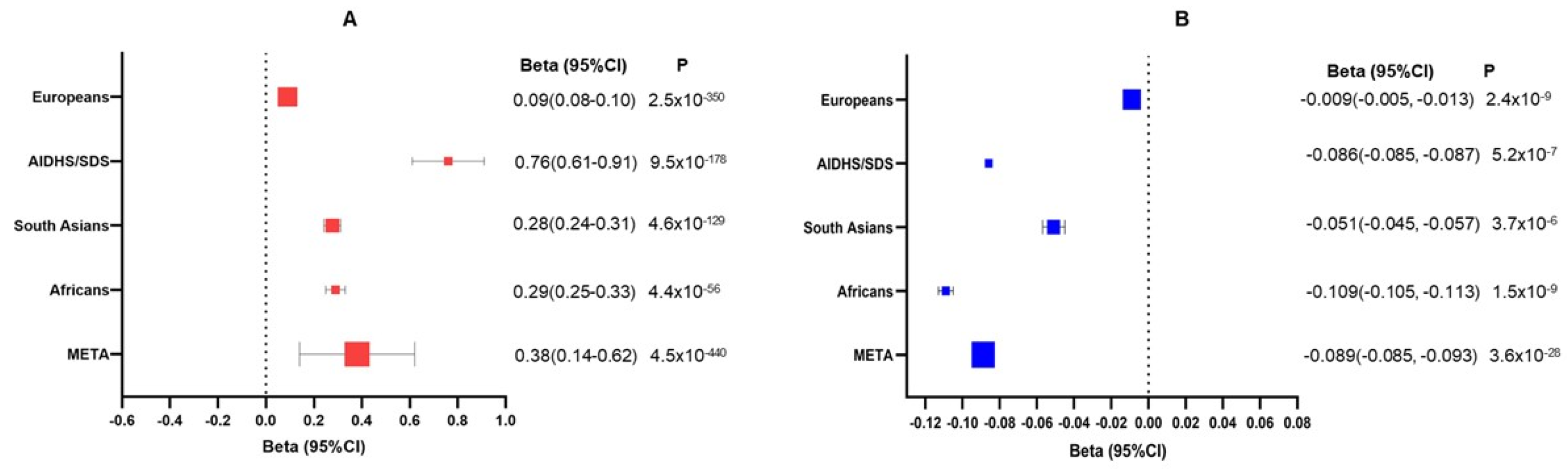
Figure 2.
Forest plots showing effect sizes and confidence intervals of individuals with extreme PGS in the 4th quartile compared with those in the 1st quartile to determine the risk for (A) Vitamin D PGS effect on T2D (B) T2D PRS effect on vitamin D levels in UK Biobank and AIDHS/SDS cohorts. AIDHS/SDS: Asian Indian Diabetic Heart Study/Sikh Diabetes Study; PGS: Polygenic score; PRS: Polygenic risk scores; T2D: Type 2 diabetes.
Figure 2.
Forest plots showing effect sizes and confidence intervals of individuals with extreme PGS in the 4th quartile compared with those in the 1st quartile to determine the risk for (A) Vitamin D PGS effect on T2D (B) T2D PRS effect on vitamin D levels in UK Biobank and AIDHS/SDS cohorts. AIDHS/SDS: Asian Indian Diabetic Heart Study/Sikh Diabetes Study; PGS: Polygenic score; PRS: Polygenic risk scores; T2D: Type 2 diabetes.
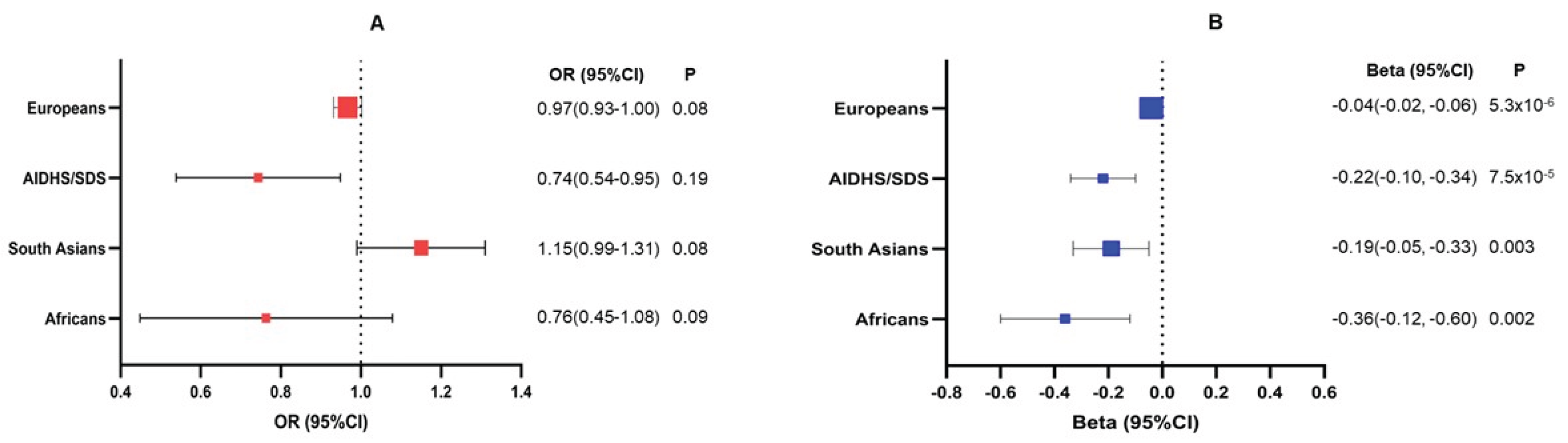

Table 1.
Clinical characteristics of the UKBB and AIDHS/SDS individuals.
| Trait | Europeans (N =459,143) |
AIDHS/SDS (N = 3486) |
South Asians (N = 9372) |
Africans (N=3346) |
|---|---|---|---|---|
| Males (%) | 46 | 55 | 54 | 51 |
| Age (years) | 56.77+8.03 | 51.98+13.27* | 53.30+8.45^ | 51.00+7.94 |
| BMI (kg/m2) | 27.40+4.77 | 26.56+4.79* | 27.16+4.40^ | 29.68+5.14 |
| Waist (cm) | 90.26+13.51 | 92.23+11.94* | 91.45+11.86^ | 94.16+11.63 |
| Waist-to-hip ratio | 0.87+0.09 | 0.94+0.08* | 0.90+0.09^ | 0.88+0.08 |
| Systolic BP (mmHg) | 137.98+18.64 | 137.07+28.83 | 129.90+29.73^ | 138.66+18.87 |
| Diastolic BP (mmHg) | 82.18+10.12 | 82.51+12.43 | 79.45+17.47^ | 84.92+10.83 |
| Blood glucose (mg/dL) | 80.30+36.89 | 134.78+63.72* | 97.66+33.94^ | 91.99+27.23 |
| Triglycerides (mg/dL) | 147.89+94.52 | 169.87+112.60* | 173.98+103.35 | 107.29+67.55 |
| HDL-C (mg/dL) | 49.03+23.28 | 40.53+14.80* | 48.79+12.48^ | 53.84+13.84 |
| LDL-C (mg/dL) | 131.31+44.17 | 112.79+39.04* | 129.34+32.96^ | 123.96+32.19 |
| Total Cholesterol (mg/dL) | 212.05+61.18 | 184.06+61.74* | 205.38+43.62^ | 198.73+42.34 |
| Vitamin D levels (nmol/L) | 41.23+26.13 | 35.05+26.69* | 21.36+17.81^ | 27.67+19.04 |
| T2D (%) | 5 | 51* | 21^ | 11 |
| CAD (%) | 5 | 19* | 31^ | 6 |
Values are displayed in mean±SD; * Comparison between UKBB Europeans and AIDHS/SDS (p<0.001); ^Comparison between UKBB South Asians and AIDHS/SDS (p<0.001); AIDHS/SDS: Asian Indian Diabetic Heart Study/Sikh Diabetes Study; BMI: Body mass index; BP: Blood Pressure; CAD: Coronary artery disease; HDL-C: High-density lipoproteins-Cholesterol; LDL-C: Low-density lipoproteins-Cholesterol; T2D: Type 2 diabetes; UKBB: UK Biobank.
Disclaimer/Publisher’s Note: The statements, opinions and data contained in all publications are solely those of the individual author(s) and contributor(s) and not of MDPI and/or the editor(s). MDPI and/or the editor(s) disclaim responsibility for any injury to people or property resulting from any ideas, methods, instructions or products referred to in the content. |
© 2026 by the authors. Licensee MDPI, Basel, Switzerland. This article is an open access article distributed under the terms and conditions of the Creative Commons Attribution (CC BY) license (http://creativecommons.org/licenses/by/4.0/).
Copyright: This open access article is published under a Creative Commons CC BY 4.0 license, which permit the free download, distribution, and reuse, provided that the author and preprint are cited in any reuse.


