

Submitted:
08 March 2026
Posted:
10 March 2026
You are already at the latest version
Abstract
Right‑ventricular (RV) remodeling is a decisive determinant of symptoms, decompensation, and survival across pulmonary arterial hypertension, chronic thromboembolic pulmonary hypertension, chronic lung disease, left‑heart disease with secondary pulmonary hypertension, congenital heart disease, and selected post–myocardial infarction (MI) phenotypes in which RV dysfunction emerges through infarction, ischemia, or ventriculo‑pulmonary interactions. Compared with the left ventricle (LV), RV remodeling mechanics is less often reviewed as a coherent multiscale field that links fiber architecture and extracellular matrix remodeling to constitutive parameters, imaging‑derived deformation, and clinically interpretable endpoints. This review unifies these layers with a specific aim that is useful to both cardiovascular mechanicians and medical imaging researchers: to clarify what RV mechanics quantities are measured, what are inferred, and what must be assumed.
We synthesize RV geometry and microstructure, pressure–volume based coupling metrics, tissue‑scale passive and active mechanics, and the dominant constitutive modeling families used in RV finite element studies. We then map imaging observables from echocardiography and cardiac magnetic resonance (CMR) to mechanical interpretation, focusing on deformation (strain, strain‑rate), chamber performance (volumes, ejection fraction), afterload characterization, and tissue substrate proxies (late gadolinium enhancement and mapping methods). Throughout, we show how septal mechanics and pericardial constraint shape RV stress–strain relationships and can confound biomarker interpretation if omitted. We propose an implementable mechanics‑aware interpretation framework that decomposes RV remodeling into load, pump–arterial coupling, passive stiffness/substrate, and activation/coordination components, each tied to measurable quantities and model parameters.
Finally, we argue that transferable “reference ranges” for RV mechanics should be expressed as physiology‑conditioned envelopes that specify loading state, acquisition protocol, and analysis software rather than as single numbers. The review concludes with a practical research agenda centered on multi‑modal datasets with synchronized pressures, transparent segmentation and region definitions, uncertainty reporting, and open modeling pipelines that enable prospective prediction of decompensation and therapy response.
Keywords:
right ventricle (RV) mechanics
; RV remodeling
; pressure overload
; ventricular-arterial coupling
; myocardial microstructure
; constitutive modeling
; finite element modeling
; cardiac magnetic resonance
; strain imaging
1. Introduction
The right ventricle is not a smaller left ventricle. It is a distinct pump evolved to deliver high flow against low impedance with minimal energy loss, and it remodels under overload in ways that are strongly shaped by geometry, wall thickness, fiber architecture, and boundary conditions. Clinically, RV function is a major driver of symptoms and survival in pulmonary arterial hypertension, chronic thromboembolic disease, and mixed-etiology pulmonary hypertension; it also predicts outcomes in congenital heart disease and in left-heart disease complicated by elevated pulmonary pressures. Despite this centrality, RV mechanics has historically been reviewed in fragments, separated into physiological coupling, imaging strain indices, tissue remodeling biology, or numerical modeling. The consequence is that mechanical quantities are often used as if they were interchangeable: a longitudinal strain value is interpreted as contractility, a change in TAPSE is interpreted as reverse remodeling, and a wall thickness measurement is interpreted as load compensation, even when the underlying determinants differ. This review aims to unify these fragments into a coherent mechanics perspective that connects measurable quantities across scales and modalities [1,2,3,4].
RV remodeling is most commonly discussed in the context of pressure overload and increased pulmonary vascular resistance, but mechanical remodeling is equally driven by changes in preload, pericardial constraint, interventricular interaction, and myocardial substrate. Post-MI RV remodeling spans several mechanisms: (i) primary RV infarction, usually associated with inferior MI; (ii) ischemia from right coronary disease with impaired RV perfusion; (iii) secondary RV afterload elevation due to LV failure and pulmonary venous hypertension; and (iv) chronic geometric interaction through the shared septum and pericardium. These processes produce overlapping phenotypes: chamber dilatation, wall thickening, increased diastolic stiffness, reduced systolic reserve, altered timing of contraction, and progressive tricuspid regurgitation. The mechanics question is not only which phenotype is present, but which load pathway produced it, and which measurable metrics can distinguish adaptation from impending failure [5,6,7,8,9,10,11,12,13].
Several factors explain why RV remodeling mechanics is under-reviewed compared with LV remodeling. The RV free wall is thin, highly trabeculated, and difficult to isolate for testing; imaging resolution and segmentation errors are proportionally larger; pressure-volume analysis is less routinely performed; and constitutive modeling is complicated by large deformation, heterogeneous fiber orientation, and strong boundary interaction with the septum. In addition, clinical practice historically relied on global and surrogate metrics such as TAPSE, fractional area change, and qualitative assessment, which have limitations under altered loading. Recent advances in 3D echocardiography, speckle tracking strain, feature-tracking cardiac magnetic resonance (CMR), and 4D flow CMR now enable richer kinematic descriptions, and the computational community has developed RV-specific finite element (FE) and inverse approaches. Yet, the translation between these imaging descriptors and classical mechanics parameters, and their linkage to endpoints, remains inconsistent [14,15,16,17,18,19,20,21,22,23].
Figure 1 summarises the multiscale pathway by which pressure overload and post-MI contexts can produce either adaptive RV remodelling or progressive maladaptation. At the system level, pulmonary vascular afterload (resistance, compliance, impedance, and pulsatility) governs the loading problem that determines RV–arterial coupling; this coupling, in turn, interacts with RV geometry (radius, wall thickness, curvature) to set a heterogeneous wall-stress landscape rather than a uniform “Laplace” state. The resulting stress gradients, shaped further by septal mechanics and pericardial constraint, provide the mechanobiological stimulus for microstructural remodelling, myocyte hypertrophy and changes in extracellular matrix quantity/quality (collagen accumulation, cross-linking) alongside altered fibre dispersion, that shifts passive stiffness and modifies active force transmission. Over time, these stress-driven tissue changes can create reinforcing feedback loops in which elevated metabolic demand and fibrosis reduce contractile reserve, promote functional tricuspid regurgitation, and accelerate RV–arterial uncoupling and dilatation. This framing also clarifies why standard clinical metrics are indispensable yet incomplete: they primarily report kinematics and coupled system behaviour, so mechanistic interpretation of “stiffness” or “contractility” typically requires a model-based bridge between measured motion/hemodynamics and underlying material and microstructural state
2. Scope, Terminology, and Literature Sampling
In this review, right-ventricular (RV) remodelling denotes the time-dependent evolution of RV structure and function arising from altered loading conditions and myocardial substrate, encompassing hypertrophy and/or dilation, fibrotic remodelling, changes in sarcomere and myofibre architecture, and shifts in electrical and electromechanical activation. “Mechanics” is used in a broad and integrative sense, including kinematics, forces, stresses, strains, constitutive material behaviour, and their coupling to growth-and-remodelling processes that link measurable deformation to underlying biological [24,25,26,27,28,29].
2.1. Why a Mechanics Unification Is Needed
A central challenge in RV remodeling research is that most clinical measurements are not direct mechanical properties but are outputs of an interacting system: myocardium as an active and passive material; geometry and wall thickness; ventricular-arterial coupling; heart rate and rhythm; and pericardial and septal constraints. Inverse interpretations are therefore ill-posed unless the measurement context is specified. For example, a reduction in RV longitudinal strain can reflect decreased contractility, increased afterload, altered fiber orientation, reduced preload, or imaging tracking bias. Conversely, a preserved ejection fraction can coexist with increased wall stress if afterload is underestimated, or with severe dysfunction if chamber size is small. A unified framework should make these dependencies explicit, treat each metric as a function of load, geometry, and material state, and encourage reproducible reporting [30,31,32,33,34,35,36,37,38,39,40].
2.2. Literature Sampling and Evidence Mapping
Right-ventricular (RV) remodelling is investigated across partially disconnected literatures spanning physiology, biomechanics, cardiovascular imaging, computational modelling, and clinical outcomes. To maintain coherence while reflecting this interdisciplinarity, the reference set underpinning this review was assembled using a purposive, evidence-mapping approach designed to ensure representation across these communities. Priority was given to studies that report at least one explicit mechanical observable or constraint relevant to RV remodelling—namely RV deformation (global or regional), loading/hemodynamics (including pressure–volume and coupling metrics), microstructural measurements, ex vivo or in situ tissue mechanical testing, model-based parameter estimation (forward or inverse), or associations between RV mechanical markers and clinical outcomes. Citations are thematically grouped to make the evidentiary basis traceable and to support readers who wish to construct focused bibliographies for specific mechanistic or translational sub-questions. The grouped evidence statements below should be interpreted as a transparent map of representative work rather than a formal systematic review [41,42,43,44,45,46,47].
Within this framework, the echocardiography-focused evidence slice was sampled to preserve breadth across deformation imaging and RV shape/size markers, particularly free-wall longitudinal strain, three-dimensional (3D) echo-derived volumes, and emerging transverse or area-strain indices, while remaining anchored in studies that explicitly report RV mechanics, geometry, deformation, and/or loading. Representative studies in this thematic slice include [5,6,7,8,9,10,11,13,14,15,48]. The cardiovascular magnetic resonance (CMR) evidence slice was sampled to capture CMR-derived RV geometry and strain alongside tissue-characterisation measures that act as proxies for myocardial substrate, including feature tracking, late gadolinium enhancement, and T1/ECV mapping. Selection remained centred on studies that provide explicit RV mechanics, geometry, deformation, and/or hemodynamic context. Representative studies in this thematic slice include [24,25,26,27,28,29,30,31,32,33,34,36,37,38,39,40,49,50,51].
The hemodynamics and pressure–volume evidence slice was sampled to preserve breadth across RV–arterial coupling, load sensitivity, and approaches that seek to separate contractile reserve from afterload, again prioritising studies with explicit mechanical or loading readouts. Representative studies in this thematic slice include [41,42,43,44,45,46,47,52]. The computational modelling evidence slice was sampled to represent patient-specific reconstructions, inverse parameter estimation, and finite-element (FE) pipelines used to infer RV stress/strain or regional material/contractile parameters, while remaining anchored in work that links modelling outputs to measured geometry, deformation, and/or hemodynamics. Representative studies in this thematic slice include [1,12,14,18,53,54,55,56,57,58,59,60,61,62,63,64,65,66]
The experimental and translational evidence slice was sampled to capture models of pressure overload, pulmonary vascular disease, and RV failure biology that include explicit mechanical readouts (e.g., deformation, loading, tissue properties, or mechanically interpretable phenotypes), providing mechanistic grounding for clinical observations. Representative studies in this thematic slice include [2,21,25,36,67,68,69,70,71,72,73,74,75,76,77,78,79]. Because RV remodelling is strongly modulated by ventricular interdependence, the septal mechanics evidence slice was sampled to reflect studies on septal deformation, pericardial constraint, and biventricular coupling as amplifiers or buffers of RV remodelling trajectories, with emphasis on work reporting explicit mechanics, deformation, and loading. Representative studies in this thematic slice include [35,61,62,71,80,81,82,83,84,85,86,87,88,89,90,91,92,93,94]
Congenital heart disease and repaired-lesion cohorts constitute long-horizon “natural experiments” in RV adaptation and maladaptation; accordingly, this evidence slice was sampled to include studies where RV geometry, deformation, and loading are tracked over extended time scales and linked to clinical trajectories. Representative studies in this thematic slice include [95,96,97,98,99,100,101,102,103,104,105,106,107,108,109,110,111]. To support clinical translation, the interventional and pharmacologic evidence slice was sampled to include studies where RV mechanics-related metrics are used as endpoints, mediators, or treatment-response markers, emphasising explicit deformation/hemodynamic readouts and interpretable changes in loading or coupling. Representative studies in this thematic slice include [16,112,113,114,115,116,117,118,119,120,121,122,123].
Model structure and parameter identifiability depend on microstructure; therefore, the microstructural evidence slice was sampled to represent studies of myofibre and collagen architecture, anisotropy, and regional heterogeneity that motivate constitutive assumptions and region definitions in RV modelling. Representative studies in this thematic slice include [65,100,124,125,126,127,128,129,130,131,132,133].
Finally, because RV mechanics measures are sensitive to acquisition, post-processing, and modelling choices, the methodological evidence slice was sampled to include work on reproducibility, cross-vendor comparability, and statistical handling of heterogeneity and uncertainty, with emphasis on implications for interpretation and synthesis across studies. Representative studies in this thematic slice include [134,135,136,137,138,139,140,141,142,143,144,145].
To make cross-study comparisons mechanistically interpretable, the key determinants of RV remodeling and the corresponding measurable metrics across length scales are summarized in Table 1. This multiscale mapping is motivated by the fact that most clinical observables (e.g., strain, ejection fraction, or coupling surrogates) are not direct mechanical properties, but emergent outputs of an interacting system that couples load, geometry, myocardial material state, rhythm, and septal/pericardial constraints; consequently, inverse interpretation is ill-posed unless the measurement context is made explicit. At the organ level, RV–arterial coupling metrics integrate contractile performance with afterload; at the chamber level, geometric adaptation and wall thickness influence stress proxies but are sensitive to segmentation uncertainty in a thin, trabeculated wall. Regional deformation metrics partition free-wall and septal contributions and can reveal dyssynchrony, yet remain sensitive to loading, tethering, and tracking algorithms. Tissue-scale stiffness and fibrosis are informed by ex-vivo testing, substrate imaging proxies, or model-inferred parameters, each carrying distinct identifiability and model-dependence risks. Finally, microstructural descriptors (fiber dispersion and collagen architecture) motivate anisotropic constitutive structure but are limited by in-vivo accessibility and sampling/region-definition bias.
3. RV Anatomy, Fiber Architecture, and the Mechanical Consequences of Geometry
The RV is a crescentic chamber wrapped around the LV, with a thin free wall, complex trabeculation, and a distinct inflow-outflow organization. This geometry is not an aesthetic detail; it sets the relationship between cavity pressure and wall stress and determines which regions carry load under pressure overload. Under Laplace-like reasoning, a thin wall implies high stress for a given pressure and radius, but the RV is not a thin-walled cylinder. Its curvature varies strongly from inflow to outflow, and the septal boundary shifts with LV pressure and pericardial constraint. Consequently, regional stress and strain can vary markedly even under uniform cavity pressure, and global metrics can miss localized failure. In pressure overload, the RV may increase wall thickness, reduce radius, and change curvature to restore stress; however, these geometric adaptations often lag behind afterload changes and may not prevent progressive dilation once coupling deteriorates [109,146,147,148,149,150,151,152,153].
Myofiber architecture in the RV differs from the LV in both orientation and transmural organization. The LV is often idealized as having a smooth transmural helix angle gradient, while the RV free wall exhibits more variable orientation with strong regional dependence and influence from trabecular bundles. Collagen architecture, including perimysial and endomysial networks, contributes to anisotropic stiffness and the recruitment of fibers with stretch. Remodeling alters both myocyte and collagen organization, typically increasing collagen content and cross-linking, thickening the wall, and changing fiber dispersion. These microstructural changes can increase passive stiffness and shift the operating point on the stress-strain curve, impairing diastolic filling and augmenting afterload sensitivity. Importantly, the same gross wall thickness can arise from different microstructural states, such as myocyte hypertrophy with limited fibrosis versus fibrosis-dominated stiffening, which have different reversibility and prognostic meaning [14,29,53,54,56,57,58,63,64,65,77].
Septal mechanics and pericardial constraint are often treated as boundary conditions in modeling, but they are mechanistic drivers of RV function. The septum is shared myocardium, and its curvature and fiber activation contribute to RV ejection, especially under increased afterload. In acute pressure overload, the septum can flatten or shift toward the LV, altering LV filling and generating a feedback loop that worsens overall cardiac output. The pericardium constrains diastolic volume and couples ventricles through external pressure, which means that RV dilation can impair LV filling even when LV contractility is preserved. These interactions are not fully captured by single-chamber metrics and are one reason why RV remodeling metrics require interpretation in a biventricular context [33,59,60,61,66,67,69,129,154,155,156].
Figure 2 motivates a regional (rather than global) interpretation of RV mechanics by making explicit how segmentation choices and septal interaction shape both measured deformation and inferred stresses under pressure overload. Because the RV is geometrically complex and mechanically anisotropic, partitioning into inflow–apex–outflow regions and distinguishing free wall from septum is not merely descriptive; it defines the spatial units over which fiber orientation, dispersion, and constitutive parameters are assumed constant and therefore determines where heterogeneity can be detected. The figure further highlights ventricular interdependence: as RV pressure rises, septal flattening changes septal curvature and constraint, reduces LV filling, and alters load sharing, such that the apparent location of peak RV stress may shift even when pulmonary afterload is unchanged. Finally, the tricuspid regurgitation subpanel shows why deformation metrics require loading context—regurgitation can change effective afterload and stroke work, producing strain patterns that may not map uniquely to intrinsic contractility or stiffness. Taken together, these effects explain why rigorous reporting of region definition, reference configuration (including the assumed stress-free or diastatic baseline), and boundary conditions (septal coupling, pericardial constraint, and valve competence) is essential when comparing studies, calibrating models, or constructing normative and pathological envelopes for regional RV mechanics.
4. Mechanobiology of RV Remodeling Under Pressure Overload and Post-MI Contexts
RV remodeling is a mechanobiological process in which cells and extracellular matrix (ECM) respond to changes in strain, stress, and metabolic demand. Pressure overload increases systolic wall stress, augments myocyte work, and can induce capillary rarefaction, ischemia, and metabolic shifts. Mechanotransduction pathways link these stimuli to hypertrophy, fibrosis, inflammation, and changes in titin phosphorylation and ECM cross-linking. The result is a material state change: passive stiffness increases, active force generation may initially rise via hypertrophy and altered calcium handling, and then declines as fibrosis, ischemia, and maladaptive signaling dominate. The temporal sequence matters: the same afterload can produce different remodeling trajectories depending on the speed of afterload increase, the presence of comorbidities, and baseline myocardial substrate [2,68,71,74,76,78,79,82,157,158,159].
In post-MI settings, RV remodeling may be driven by infarction in the RV free wall, by chronic elevation in pulmonary pressures from LV dysfunction, and by altered septal mechanics due to LV remodeling. Even when RV infarction is absent, the RV can experience increased afterload through pulmonary venous hypertension and reactive pulmonary vasoconstriction. This coupled remodeling can lead to a phenotype resembling pressure-overload RV failure but with additional contributions from ventricular interdependence and neurohormonal activation. Mechanically, these contexts emphasize that RV remodeling cannot be categorized solely by the presence of pulmonary arterial disease; the same RV phenotype can be produced by different pathways, and the mechanical signature should be used to infer pathway when possible [62,70,72,75,80,81,88,90,92,160,161].
An important translation point is that microstructural remodeling changes not only stiffness but also the mapping between measured strains and underlying stresses. When collagen recruitment increases, small changes in strain correspond to larger stress changes, which may explain why some imaging strain metrics show early prognostic signals even when conventional metrics remain preserved. Conversely, fibrosis can reduce strain magnitudes while leaving stresses high, potentially masking ongoing mechanical injury if strain is interpreted alone. These nuances motivate combined reporting of geometry, pressure, strain, and, when possible, coupling indices [71,73,83,84,85,86,87,89,93,94,162,163].
5. Mechanical Characterization: From Pressure-Volume Loops to Ex-Vivo Tissue Testing
Mechanical characterization of the RV can be approached at organ scale via pressure-volume (PV) analysis and at tissue scale via mechanical testing. PV loops provide a direct framework for separating load from contractility through end-systolic elastance and for quantifying afterload via effective arterial elastance. Their ratio, often used as an index of ventricular-arterial coupling, captures whether the RV can generate sufficient pressure and stroke volume for a given afterload. Importantly, coupling is a system property, not a myocardial property, and can deteriorate because of rising afterload, falling contractility, or both. PV analysis also yields diastolic stiffness metrics, such as end-diastolic elastance or the exponential coefficient of the diastolic PV relationship, which may increase with fibrosis and titin changes. Despite its conceptual clarity, PV loop acquisition in clinical RV practice is limited, and studies vary in methodology and assumptions [95,96,97,98,101,102,103,104,164,165,166,167].
Tissue-level testing of RV myocardium, including uniaxial tension, biaxial extension, shear, and indentation, is less common than LV testing and is complicated by specimen size, fiber dispersion, and trabecular content. Nevertheless, these tests are essential because imaging strain alone cannot identify material parameters without assumptions. RV tissue testing must contend with viscoelasticity, anisotropy, and active contraction; it is therefore sensitive to preconditioning protocols, strain rate, temperature, and post-mortem delay. When RV tissue is tested, results can vary depending on whether samples are taken from free wall versus outflow tract, whether fibers are aligned, and whether ECM remodeling is present. A key message for the field is that RV mechanical property datasets are not inconsistent because the myocardium is unknowable, but because experimental metadata and region definitions are often insufficient for cross-study equivalence [105,106,107,108,110,111,112,121,168,169,170,171].
Bridging organ-scale PV metrics to tissue-scale properties requires modeling. A PV loop does not directly reveal constitutive stiffness because geometry and boundary conditions influence the PV relationship. Similarly, a strain map does not directly reveal stress without pressure and wall thickness. Therefore, the most informative characterization studies combine imaging-derived geometry, pressure recordings, and deformation measures with FE-based inference of stress-strain behavior. Such studies can estimate passive stiffness parameters, active tension parameters, and, crucially, uncertainty bounds that quantify identifiability. The RV is an especially strong candidate for such integrative inference because wall thickness changes and septal interaction make purely geometric interpretations unreliable [113,116,117,118,120,122,123,151,172,173,174].
6. Constitutive and Electromechanical Models Tailored to the RV
Constitutive modeling of myocardium aims to encode passive anisotropic stiffness, active stress generation, and, in some cases, viscoelastic effects. For RV applications, transversely isotropic or orthotropic hyperelastic models are common, often using exponential strain-energy forms that separate fiber, sheet, and matrix contributions. Active contraction is frequently modeled as an additive stress along fibers, with activation timing and length dependence. The RV poses particular modeling challenges: the thin free wall experiences large curvature changes, the outflow tract has distinct structure, trabeculations complicate mesh generation, and regional fiber orientation can deviate from LV-based rules. Consequently, RV FE models often rely on rule-based fiber assignment or limited diffusion tensor data, and parameter estimation can be underdetermined unless multiple data types are combined [100,114,115,124,125,131,133,175,176,177,178,179].
Parameter identifiability is not a technical footnote; it is central to whether RV modeling can become clinically credible. Many combinations of passive stiffness parameters and active tension parameters can reproduce a given ejection fraction if afterload and preload are adjusted. Similarly, multiple fiber orientations can reproduce a surface strain field if the wall thickness and boundary conditions are uncertain. Modern RV modeling therefore increasingly uses inverse frameworks that estimate parameters by minimizing mismatch between measured and simulated strains, volumes, and pressures, often with regularization and Bayesian uncertainty quantification. A mechanics-aware review must emphasize that reporting a single parameter set without uncertainty can mislead readers into believing that a model is uniquely identified [29,126,127,128,129,130,132,180,181,182].
Growth and remodeling (G&R) modeling extends constitutive modeling by introducing time-dependent evolution laws for mass deposition, fiber reorientation, and ECM turnover in response to mechanical stimuli. In RV pressure overload, plausible G&R drivers include elevated fiber stress, altered strain energy density, and hypoxia-related signals. A key conceptual distinction is between homeostatic set points and pathological signaling: an RV may hypertrophy to restore stress toward a homeostatic target, but persistent afterload elevation, ischemia, or inflammation can shift the target or impair the remodeling capacity. A practical modeling goal is to predict when adaptation will transition to failure, which likely requires coupling mechanics to perfusion, metabolism, and fibrosis kinetics [134,135,136,137,138,139,140,141,142,143,144,145].
Electromechanical aspects are particularly relevant to the RV because conduction delays, dyssynchrony, and altered activation patterns can have disproportionate effects on a thin-walled chamber. In pressure overload, prolonged RV contraction and interventricular dyssynchrony can reduce effective stroke volume and increase myocardial work. Modeling frameworks that integrate activation timing with mechanics can, in principle, separate pure afterload effects from electromechanical inefficiency. Such models also provide a way to interpret pacing or resynchronization interventions and to quantify the mechanical cost of conduction abnormalities [48,99,183,184,185,186,187,188].
Because most clinical RV measurements provide kinematics and coupled system behaviour rather than intrinsic material properties, constitutive and electromechanical models are required to translate observed deformation and hemodynamics into interpretable descriptors such as passive stiffness, anisotropy, and contractile function.
Paper 90—Right-Ventricular Re…
Table 2 provides a structured overview of common model families and the practical implications of choosing each for RV applications. In brief, transversely isotropic hyperelastic laws offer a widely used baseline for anisotropic nonlinear stiffness, whereas orthotropic (fiber–sheet) formulations can represent richer directional behaviour but typically demand more informative deformation data and/or ex vivo calibration to avoid over-parameterization. Active stress models—most often implemented as an additive fibre-aligned stress with prescribed or estimated activation timing—enable separation of passive and active contributions, but introduce additional non-uniqueness when loading is uncertain. These identifiability challenges are amplified in the RV because thin-wall curvature changes, outflow-tract structural differences, trabeculations, and regionally variable fibre orientations increase sensitivity to geometric reconstruction and boundary-condition specification. Consequently, patient-specific inference increasingly relies on inverse frameworks that fit strains, volumes, and pressures with regularization and Bayesian/ensemble uncertainty quantification, since reporting a single “best-fit” parameter set can imply spurious uniqueness. Finally, G&R and electromechanical extensions formalize time-dependent adaptation (hypertrophy, ECM turnover, fibre reorientation) and the mechanical consequences of dyssynchrony, but generally require longitudinal or multi-modal constraints for credible calibration in pressure-overload settings.
7. Imaging-Derived RV Mechanics: What Is Measured, What Is Inferred, and What Is Comparable
The RV is increasingly assessed using deformation imaging, but a mechanics-aware interpretation requires careful distinction between measured kinematics and inferred mechanics. Echocardiography provides global surrogates such as TAPSE, S’ velocity, fractional area change, and estimates of pulmonary pressure; newer speckle-tracking approaches provide longitudinal strain of the free wall and, in some protocols, strain rate and transverse deformation. 3D echocardiography improves volume and ejection fraction estimates but remains sensitive to image quality and segmentation. CMR provides high-quality geometry and can measure strain via tagging, DENSE, SENC, or feature tracking, and can assess substrate via late gadolinium enhancement and T1 mapping. 4D flow CMR provides pulmonary artery flow patterns and may refine afterload estimation beyond pressure alone. Each modality has distinct error modes and dependencies, so cross-study comparability requires explicit reporting of acquisition, segmentation, tracking algorithms, and load context [5,6,7,8,9,10,11,13,14,15,48].
From a mechanics perspective, RV longitudinal strain is a kinematic measure of deformation along the long axis. Its magnitude depends on the projection of the underlying fiber shortening onto the imaging coordinate, on regional tethering, and on whether strain is computed in a Lagrangian or Eulerian frame. In the RV, longitudinal shortening of the free wall dominates in health, but under pressure overload the contribution of radial thickening and septal contraction may change, and the pattern of shortening can become heterogeneous. Therefore, changes in longitudinal strain should be interpreted together with geometry, RV outflow dynamics, and septal strain, rather than treated as a single contractility marker. Feature-tracking CMR strain and echo strain can correlate but are not interchangeable, and different vendors and algorithms can produce systematic biases [16,17,18,19,20,21,22,23,24,25,26,49,65,78,133].
Imaging-derived coupling metrics are an active area of translation. RV-arterial coupling can be approximated using PV analysis, but when PV loops are unavailable, surrogate indices such as TAPSE-to-pulmonary artery systolic pressure, or strain-to-afterload ratios, have been proposed. These surrogates embed assumptions about linearity and load estimation; they can be useful for risk stratification but should not be interpreted as direct elastance ratios. CMR-derived stroke volume combined with invasive or estimated pressures can provide improved coupling approximations, and 4D flow may refine pulmonary vascular impedance estimates. A consistent reporting standard should state the exact formulas and units used, the pressure estimation method, and whether the measurements were taken at rest or during stress [27,28,29,30,31,32,33,34,36,37,50,189].
Elastography and MR elastography offer the possibility of measuring shear-wave speed and viscoelastic moduli in vivo, but RV applications remain challenging because of wall thickness, motion, and adjacency to lung tissue. When used, elastography metrics must be interpreted as effective properties of a layered, moving, anisotropic structure, not as direct equivalents of small-strain shear modulus from ex-vivo tests. A realistic near-term role for RV elastography may be in tracking relative changes over time within individuals, rather than establishing absolute reference ranges across centers. Integrating elastography with FE models, where wave propagation is simulated in subject-specific geometry, may help convert measured wave properties into constitutive parameters, but this remains a research frontier [38,39,41,42,43,44,45,46,47,51].
To prevent over-interpretation of routinely reported RV “mechanics” readouts, Table 3 summarizes a set of commonly used imaging-derived metrics and separates (i) the quantity that is directly measured from (ii) the most defensible mechanical interpretation that can be supported without additional constraints. In particular, free-wall longitudinal strain should be treated as a kinematic measure of long-axis deformation whose magnitude depends on loading, tethering and methodological choices, including whether strain is computed in different reference frames and which tracking algorithm and vendor pipeline are used; consequently, it is better interpreted as a composite marker of systolic shortening under load rather than a standalone contractility surrogate. Global indices such as 3D RV volumes and ejection fraction provide pump performance but remain strongly load- and geometry-dependent, while low-dimensional surrogates (TAPSE, S′) are angle- and rhythm-sensitive and are insufficient in isolation for mechanistic inference. Tissue characterisation (LGE/T1) provides substrate proxies that may inform spatial priors on stiffness heterogeneity but is indirect and sequence-dependent, and 4D flow metrics offer an avenue to refine afterload characterisation and boundary conditions beyond pressure alone. Framed this way, Table 3 also clarifies how imaging outputs enter patient-specific modelling: strain fields can serve as objective functions for inverse estimation of active parameters, volumes provide pressure–volume consistency constraints, and flow-derived impedance proxies can strengthen coupling estimates—provided that acquisition, segmentation, tracking/sequence choices, and load context are explicitly reported to enable reproducible comparison and uncertainty-aware interpretation.
8. Patient-Specific Modeling Pipelines: Geometry, Fibers, Inference, and Uncertainty
Patient-specific RV modeling typically proceeds from imaging-derived geometry to mesh generation, fiber assignment, boundary condition specification, and parameter estimation. Each step introduces uncertainty that can dominate the final stress estimate. Geometry extraction is particularly sensitive in the RV because endocardial borders are trabeculated and the free wall is thin; small segmentation differences can change wall thickness estimates and therefore stress. Fiber assignment is often rule-based due to limited diffusion tensor data; errors in fiber orientation propagate directly into predicted strain patterns and inferred active tension. Boundary conditions include pericardial contact, septal coupling, and pulmonary artery impedance; simplifying these can bias predictions. Therefore, personalization pipelines should report not only the final parameters but also the sensitivity of key outputs to plausible variations in geometry and boundary assumptions [8,52,109,113,146,147,148,149,150,151,152,190].
Inverse modeling uses observed kinematics and hemodynamics to infer material parameters. In RV studies, inverse methods can fit passive stiffness parameters using diastolic filling data and active parameters using systolic deformation, often constrained by pressure recordings. When only noninvasive pressure estimates are available, parameter uncertainty increases, and models can become underdetermined. Bayesian approaches and ensemble methods provide a principled way to represent this uncertainty and to avoid overconfident conclusions. A further challenge is that many imaging strain measures are surface-based and do not uniquely determine transmural strain, yet constitutive models are volumetric. Regularization strategies, including smoothness priors and physiologically plausible parameter bounds, are therefore essential and should be explicitly reported [14,18,29,53,54,56,57,58,63,64,77].
Model validation is frequently claimed but rarely performed at the level needed for clinical translation. For RV mechanics, validation can occur at several levels: reproducing measured volumes and strains; predicting hemodynamic responses to known afterload changes; predicting regional stress patterns that correlate with known remodeling patterns; and prospective prediction of outcomes or intervention responses. Validation is complicated by the lack of a gold-standard stress measurement in vivo. Therefore, multi-modality consistency checks, such as agreement between CMR and echo volumes, or between modeled pressures and invasive measurements in subsets, are practical validation steps. Ultimately, clinical credibility will require pre-specified modeling protocols, cross-center reproducibility, and blinded prediction studies [33,59,60,61,62,66,67,69,154,156,191].
Figure 3 outlines an imaging-to-mechanics pipeline that treats RV remodeling inference as a patient-specific inverse problem rather than a direct readout from clinical images. Cine CMR and/or 3D echocardiography provide kinematic data, such as geometry, volumes, and deformation fields, which must be translated into intrinsic mechanical descriptors through mesh construction, fibre assignment, and explicit boundary condition specification. Passive stiffness and active tension are then estimated by fitting model predictions to measured motion and strain while enforcing pressure–volume consistency, but the figure makes clear that identifiability depends critically on where assumptions are injected: segmentation choices alter wall thickness and curvature; fiber rules shape directional stress and strain; and pressure specification (measured, estimated, or surrogate) controls the stiffness–pressure and stiffness–tension trade-offs. For this reason, uncertainty quantification is not optional: ensembles over segmentation, pressure estimation, and fiber architecture are propagated to yield parameter and prediction distributions, enabling sensitivity-aware interpretation of “stiffness” versus “contractility.” Finally, the workflow is anchored by validation beyond fit quality, including cross-modality agreement of volumes/strain, prediction of hemodynamic response to a known afterload perturbation, and assessment of whether inferred mechanics can predict subsequent regional remodeling patterns.
9. From Mechanics to Endpoints: What Should Be Predicted and How to Interpret Associations
Clinical endpoints in RV disease include functional capacity (such as six-minute walk distance and peak oxygen consumption), biomarkers (including natriuretic peptides), hospitalization, need for advanced therapies, and mortality or transplant-free survival. Imaging and hemodynamic metrics are often evaluated for prognostic value, but mechanistic interpretation requires caution. A strain metric that predicts survival may do so because it is a proxy for afterload, for myocardial fibrosis, or for reduced contractile reserve; without coupling measures, the mechanism remains ambiguous. Mechanics-based modeling can add value by decomposing observed function into contributions from afterload, contractility, geometry, and stiffness, and by producing mechanistically interpretable intermediate outcomes such as regional wall stress, myocardial work, or energetic cost. These intermediate outcomes may better explain why certain patients decompensate despite similar global ejection fractions [35,68,71,74,76,78,79,82,157,158].
A useful translation target is the prediction of response to therapy. In pulmonary arterial hypertension, vasodilator therapies reduce afterload, and reverse remodeling is expected if the RV retains contractile reserve and the myocardial substrate is not irreversibly fibrotic. Mechanical modeling can, in principle, distinguish patients whose poor strain is primarily load-driven from those with intrinsic contractile failure, thereby predicting who will respond to afterload reduction. Similarly, in tricuspid regurgitation and congenital lesions, interventions change loading and geometry; mechanical metrics that capture stress normalization or improved coupling may provide early indicators of durable benefit. To support such uses, studies should report pre- and post-intervention load, geometry, and deformation, and should avoid interpreting deformation changes without concurrent afterload assessment [61,62,70,72,75,80,81,88,90,92,160,161].
Post-MI and heart failure contexts add an additional layer: LV therapies can indirectly affect RV load through changes in pulmonary venous pressure and pulmonary vascular remodeling. Therefore, RV mechanics metrics may track both direct RV changes and secondary changes in pulmonary circulation. This reinforces the need for integrated RV-pulmonary and biventricular frameworks, particularly when evaluating therapies in mixed etiologies. In future clinical trials, RV modeling could be used to stratify patients by mechanical phenotype, such as predominantly afterload-driven dysfunction versus stiffness-dominated diastolic limitation, enabling more targeted interventions [71,73,83,84,86,87,89,93,94,95,162,163].
10. Towards Reference Ranges and Reproducible Reporting for RV Remodeling Mechanics
Reference ranges in RV mechanics cannot be defined as single numbers independent of context. A meaningful reference must specify the state variables and measurement conditions: heart rate, blood pressure, loading state, modality and algorithm, and geometric definitions. For example, a reference range for RV free-wall longitudinal strain should specify whether it is derived from 2D or 3D echocardiography, whether the region includes the outflow tract, the tracking algorithm, and whether pulmonary pressure is estimated or measured. Similarly, a reference range for coupling should specify the formula and afterload estimate. Without such specificity, reference ranges become artifacts of methodology rather than biology [95,96,97,98,101,102,103,104,164,165,166,167].
Reproducible reporting should therefore treat RV mechanics studies as multi-component experiments. At minimum, studies should report geometry acquisition and segmentation approach; definition of RV regions; method for estimating afterload; deformation metric definitions; and, when models are used, the constitutive law, fiber assignment method, boundary conditions, optimization procedure, and uncertainty reporting. Cross-vendor comparability remains a known challenge for strain imaging and for some CMR feature-tracking implementations. Multi-center initiatives that use standardized phantoms are not directly applicable to the heart, but cross-algorithm benchmarking on shared datasets with expert segmentations is feasible and should be prioritized [91,105,106,107,108,110,111,112,121,168,169,170,171,192,193,194].
For computational models [91,192,193,194,195,196], reproducibility requires code and mesh transparency. Small changes in mesh density or smoothing can influence regional strain and stress, and rule-based fiber assignment can vary across implementations. Therefore, model publications should provide sufficient detail to reproduce the pipeline, ideally with open-source code and example data. When patient data cannot be shared, synthetic benchmark cases and parameter files can still be provided. Such practices are standard in some fields of computational science and are increasingly expected for clinical translation [91,113,116,117,118,120,122,123,172,174,195,197,198,199,200,201,202,203].
11. Research Agenda: What to Measure Next
Several measurement gaps currently block mechanistic progress. First, the field needs more RV-specific tissue property datasets with standardized region definitions and metadata sufficient for constitutive fitting and model comparison. Second, in-vivo studies should more routinely combine deformation with contemporaneous afterload measurement or estimation beyond simple pulmonary artery systolic pressure, ideally incorporating impedance or flow-based descriptors. Third, microstructural imaging of fiber and collagen architecture in RV disease, linked to mechanical testing, would enable better-informed constitutive models and more credible mechanobiology. Fourth, modeling studies should embrace uncertainty quantification and identifiability analysis, reporting not only best-fit parameters but credible intervals and sensitivity to boundary conditions [100,114,115,124,125,131,133,175,176,177,178,179].
From a translational perspective, a practical near-term goal is to establish device-agnostic, physiology-aware mechanical phenotypes rather than fixed reference ranges. For example, patients might be classified by whether deformation impairment is disproportionate to afterload (suggesting intrinsic contractile limitation), whether diastolic stiffness is elevated relative to hypertrophy (suggesting fibrosis-dominant remodeling), or whether septal interaction dominates RV output. Such phenotypes would guide therapy selection and trial stratification, and could be validated against outcomes. Achieving this will require shared datasets, agreed-upon segmentation and metric definitions, and model repositories that enable independent replication [29,126,127,128,129,130,132,180,181,182].
12. Conclusions
RV remodeling mechanics is now positioned for rapid integration across imaging, modeling, and clinical science, but only if the community treats deformation and hemodynamic metrics as context-dependent mechanical outputs rather than stand-alone biomarkers. A unified framework that links fiber architecture, constitutive behavior, and coupling to measurable imaging and clinical endpoints can reduce contradictory interpretations and enable uncertainty-aware patient-specific prediction. By combining transparent reporting with integrative modeling and multi-modality validation, RV mechanics can mature into a clinically credible discipline parallel to, and not trailing, LV remodeling science.
References
- Naeije, R.; Manes, A. The right ventricle in pulmonary arterial hypertension. European respiratory review 2014, 23, 476–487. [Google Scholar] [CrossRef] [PubMed]
- Ryan, J.J.; Huston, J.; Kutty, S.; Hatton, N.D.; Bowman, L.; Tian, L.; Herr, J.E.; Johri, A.M.; Archer, S.L. Right ventricular adaptation and failure in pulmonary arterial hypertension. Canadian Journal of Cardiology 2015, 31, 391–406. [Google Scholar] [CrossRef]
- Bernardo, R.J.; Haddad, F.; Couture, E.J.; Hansmann, G.; de Jesus Perez, V.A.; Denault, A.Y.; de Man, F.S.; Amsallem, M. Mechanics of right ventricular dysfunction in pulmonary arterial hypertension and heart failure with preserved ejection fraction. Cardiovascular diagnosis and therapy 2020, 10, 1580. [Google Scholar] [CrossRef]
- Dayer, N.; Ltaief, Z.; Liaudet, L.; Lechartier, B.; Aubert, J.-D.; Yerly, P. Pressure overload and right ventricular failure: from pathophysiology to treatment. Journal of clinical medicine 2023, 12, 4722. [Google Scholar] [CrossRef]
- Moceri, P.; Bouvier, P.; Baudouy, D.; Dimopoulos, K.; Cerboni, P.; Wort, S.J.; Doyen, D.; Schouver, E.-D.; Gibelin, P.; Senior, R. Cardiac remodelling amongst adults with various aetiologies of pulmonary arterial hypertension including Eisenmenger syndrome—implications on survival and the role of right ventricular transverse strain. European Heart Journal-Cardiovascular Imaging 2017, 18, 1262–1270. [Google Scholar] [CrossRef]
- Ryo, K.; Goda, A.; Onishi, T.; Delgado-Montero, A.; Tayal, B.; Champion, H.C.; Simon, M.A.; Mathier, M.A.; Gladwin, M.T.; Gorcsan, J., III. Characterization of right ventricular remodeling in pulmonary hypertension associated with patient outcomes by 3-dimensional wall motion tracking echocardiography. Circulation: Cardiovascular Imaging 2015, 8, e003176. [Google Scholar] [CrossRef]
- Fukuda, Y.; Tanaka, H.; Sugiyama, D.; Ryo, K.; Onishi, T.; Fukuya, H.; Nogami, M.; Ohno, Y.; Emoto, N.; Kawai, H. Utility of right ventricular free wall speckle-tracking strain for evaluation of right ventricular performance in patients with pulmonary hypertension. Journal of the American Society of Echocardiography 2011, 24, 1101–1108. [Google Scholar] [CrossRef] [PubMed]
- Koestenberger, M.; Avian, A.; Chouvarine, P.; Gamillscheg, A.; Cvirn, G.; Schweintzger, S.; Kurath-Koller, S.; Cantinotti, M.; Hohmann, D.; Hansmann, G. Right ventricular end-systolic remodeling index in the assessment of pediatric pulmonary arterial hypertension. The European Pediatric Pulmonary Vascular Disease Network (EPPVDN). Pediatric Research 2020, 88, 285–292. [Google Scholar] [CrossRef] [PubMed]
- Haddad, F.; Guihaire, J.; Skhiri, M.; Denault, A.Y.; Mercier, O.; Al-Halabi, S.; Vrtovec, B.; Fadel, E.; Zamanian, R.T.; Schnittger, I. Septal curvature is marker of hemodynamic, anatomical, and electromechanical ventricular interdependence in patients with pulmonary arterial hypertension. Echocardiography 2014, 31, 699–707. [Google Scholar] [CrossRef]
- Sanz, J.; García-Alvarez, A.; Fernández-Friera, L.; Nair, A.; Mirelis, J.G.; Sawit, S.T.; Pinney, S.; Fuster, V. Right ventriculo-arterial coupling in pulmonary hypertension: a magnetic resonance study. Heart 2012, 98, 238–243. [Google Scholar] [CrossRef] [PubMed]
- Gomez-Arroyo, J.; Santos-Martinez, L.E.; Aranda, A.; Pulido, T.; Beltran, M.; Muñoz-Castellanos, L.; Dominguez-Cano, E.; Sonnino, C.; Voelkel, N.F.; Sandoval, J. Differences in right ventricular remodeling secondary to pressure overload in patients with pulmonary hypertension. American journal of respiratory and critical care medicine 2014, 189, 603–606. [Google Scholar] [CrossRef]
- Tello, K.; Axmann, J.; Ghofrani, H.A.; Naeije, R.; Narcin, N.; Rieth, A.; Seeger, W.; Gall, H.; Richter, M.J. Relevance of the TAPSE/PASP ratio in pulmonary arterial hypertension. International journal of cardiology 2018, 266, 229–235. [Google Scholar] [CrossRef]
- Breeman, K.; Dufva, M.; Ploegstra, M.; Kheyfets, V.; Willems, T.; Wigger, J.; Hunter, K.; Ivy, D.; Berger, R.; Truong, U. Right ventricular-vascular coupling ratio in pediatric pulmonary arterial hypertension: a comparison between cardiac magnetic resonance and right heart catheterization measurements. International journal of cardiology 2019, 293, 211–217. [Google Scholar] [CrossRef] [PubMed]
- Tello, K.; Dalmer, A.; Husain-Syed, F.; Seeger, W.; Naeije, R.; Ghofrani, H.A.; Gall, H.; Richter, M.J. Multibeat right ventricular–arterial coupling during a positive acute vasoreactivity test. American journal of respiratory and critical care medicine 2019, 199, e41–e42. [Google Scholar] [CrossRef] [PubMed]
- Kusakari, Y.; Urashima, T.; Shimura, D.; Amemiya, E.; Miyasaka, G.; Yokota, S.; Fujimoto, Y.; Akaike, T.; Inoue, T.; Minamisawa, S. Impairment of excitation-contraction coupling in right ventricular hypertrophied muscle with fibrosis induced by pulmonary artery banding. PLoS One 2017, 12, e0169564. [Google Scholar] [CrossRef]
- Rain, S.; Andersen, S.; Najafi, A.; Gammelgaard Schultz, J.; da Silva Gonçalves Bós, D.; Handoko, M.L.; Bogaard, H.-J.; Vonk-Noordegraaf, A.; Andersen, A.; van der Velden, J. Right ventricular myocardial stiffness in experimental pulmonary arterial hypertension: relative contribution of fibrosis and myofibril stiffness. Circulation: Heart Failure 2016, 9, e002636. [Google Scholar] [CrossRef]
- Guazzi, M.; Naeije, R.; Arena, R.; Corrà, U.; Ghio, S.; Forfia, P.; Rossi, A.; Cahalin, L.P.; Bandera, F.; Temporelli, P. Echocardiography of right ventriculoarterial coupling combined with cardiopulmonary exercise testing to predict outcome in heart failure. Chest 2015, 148, 226–234. [Google Scholar] [CrossRef]
- Vanderpool, R.R.; Pinsky, M.R.; Naeije, R.; Deible, C.; Kosaraju, V.; Bunner, C.; Mathier, M.A.; Lacomis, J.; Champion, H.C.; Simon, M.A. RV-pulmonary arterial coupling predicts outcome in patients referred for pulmonary hypertension. Heart 2015, 101, 37–43. [Google Scholar] [CrossRef]
- Meris, A.; Faletra, F.; Conca, C.; Klersy, C.; Regoli, F.; Klimusina, J.; Penco, M.; Pasotti, E.; Pedrazzini, G.B.; Moccetti, T. Timing and magnitude of regional right ventricular function: a speckle tracking-derived strain study of normal subjects and patients with right ventricular dysfunction. Journal of the American Society of Echocardiography 2010, 23, 823–831. [Google Scholar] [CrossRef]
- Vonk-Noordegraaf, A.; Marcus, J.T.; Gan, C.T.; Boonstra, A.; Postmus, P.E. Interventricular mechanical asynchrony due to right ventricular pressure overload in pulmonary hypertension plays an important role in impaired left ventricular filling. Chest 2005, 128, 628S–630S. [Google Scholar] [CrossRef] [PubMed]
- Piao, L.; Fang, Y.-H.; Cadete, V.J.; Wietholt, C.; Urboniene, D.; Toth, P.T.; Marsboom, G.; Zhang, H.J.; Haber, I.; Rehman, J. The inhibition of pyruvate dehydrogenase kinase improves impaired cardiac function and electrical remodeling in two models of right ventricular hypertrophy: resuscitating the hibernating right ventricle. Journal of molecular medicine 2010, 88, 47–60. [Google Scholar] [CrossRef]
- Wang, Z.; Chesler, N.C. Pulmonary vascular wall stiffness: an important contributor to the increased right ventricular afterload with pulmonary hypertension. Pulmonary circulation 2011, 1, 212–223. [Google Scholar] [CrossRef] [PubMed]
- Guihaire, J.; Haddad, F.; Boulate, D.; Decante, B.; Denault, A.Y.; Wu, J.; Hervé, P.; Humbert, M.; Dartevelle, P.; Verhoye, J.-P. Non-invasive indices of right ventricular function are markers of ventricular–arterial coupling rather than ventricular contractility: insights from a porcine model of chronic pressure overload. European Heart Journal–Cardiovascular Imaging 2013, 14, 1140–1149. [Google Scholar] [CrossRef] [PubMed]
- Richter, M.J.; Peters, D.; Ghofrani, H.A.; Naeije, R.; Roller, F.; Sommer, N.; Gall, H.; Grimminger, F.; Seeger, W.; Tello, K. Evaluation and prognostic relevance of right ventricular–arterial coupling in pulmonary hypertension. American journal of respiratory and critical care medicine 2020, 201, 116–119. [Google Scholar] [CrossRef]
- Hsu, S.; Simpson, C.E.; Houston, B.A.; Wand, A.; Sato, T.; Kolb, T.M.; Mathai, S.C.; Kass, D.A.; Hassoun, P.M.; Damico, R.L. Multi-beat right ventricular-arterial coupling predicts clinical worsening in pulmonary arterial hypertension. Journal of the American Heart Association 2020, 9, e016031. [Google Scholar] [CrossRef]
- Bekedam, F.; Goumans, M.; Bogaard, H.; De Man, F.; Llucià-Valldeperas, A. Molecular mechanisms and targets of right ventricular fibrosis in pulmonary hypertension. Pharmacology & Therapeutics 2023, 244, 108389. [Google Scholar] [CrossRef]
- Rako, Z.A.; Kremer, N.; Yogeswaran, A.; Richter, M.J.; Tello, K. Adaptive versus maladaptive right ventricular remodelling. ESC Heart Failure 2023, 10, 762–775. [Google Scholar] [CrossRef] [PubMed]
- Fayyaz, A.U.; Edwards, W.D.; Maleszewski, J.J.; Konik, E.A.; DuBrock, H.M.; Borlaug, B.A.; Frantz, R.P.; Jenkins, S.M.; Redfield, M.M. Global pulmonary vascular remodeling in pulmonary hypertension associated with heart failure and preserved or reduced ejection fraction. Circulation 2018, 137, 1796–1810. [Google Scholar] [CrossRef]
- Amsallem, M.; Boulate, D.; Aymami, M.; Guihaire, J.; Selej, M.; Huo, J.; Denault, A.Y.; McConnell, M.V.; Schnittger, I.; Fadel, E. Load adaptability in patients with pulmonary arterial hypertension. The American Journal of Cardiology 2017, 120, 874–882. [Google Scholar] [CrossRef]
- Attard, M.I.; Dawes, T.J.; de Marvao, A.; Biffi, C.; Shi, W.; Wharton, J.; Rhodes, C.J.; Ghataorhe, P.; Gibbs, J.S.R.; Howard, L.S. Metabolic pathways associated with right ventricular adaptation to pulmonary hypertension: 3D analysis of cardiac magnetic resonance imaging. European Heart Journal-Cardiovascular Imaging 2019, 20, 668–676. [Google Scholar] [CrossRef]
- Trip, P.; Rain, S.; Handoko, M.L.; Van der Bruggen, C.; Bogaard, H.J.; Marcus, J.T.; Boonstra, A.; Westerhof, N.; Vonk-Noordegraaf, A.; de Man, F.S. Clinical relevance of right ventricular diastolic stiffness in pulmonary hypertension. European Respiratory Journal 2015, 45, 1603–1612. [Google Scholar] [CrossRef]
- Barker, N.; Fidock, B.; Johns, C.S.; Kaur, H.; Archer, G.; Rajaram, S.; Hill, C.; Thomas, S.; Karunasaagarar, K.; Capener, D. A systematic review of right ventricular diastolic assessment by 4D flow CMR. BioMed research international 2019, 2019, 6074984. [Google Scholar] [CrossRef]
- Fredriksson, A.G.; Svalbring, E.; Eriksson, J.; Dyverfeldt, P.; Alehagen, U.; Engvall, J.; Ebbers, T.; Carlhäll, C.J. 4D flow MRI can detect subtle right ventricular dysfunction in primary left ventricular disease. Journal of magnetic resonance imaging 2016, 43, 558–565. [Google Scholar] [CrossRef] [PubMed]
- Hussain, I.; Mohammed, S.F.; Forfia, P.R.; Lewis, G.D.; Borlaug, B.A.; Gallup, D.S.; Redfield, M.M. Impaired right ventricular–pulmonary arterial coupling and effect of sildenafil in heart failure with preserved ejection fraction: An ancillary analysis from the phosphodiesterase-5 inhibition to improve clinical status and exercise capacity in diastolic heart failure (RELAX) trial. Circulation: Heart Failure 2016, 9, e002729. [Google Scholar]
- Van Der Bruggen, C.E.; Tedford, R.J.; Handoko, M.L.; Van Der Velden, J.; De Man, F.S. RV pressure overload: from hypertrophy to failure. Cardiovascular research 2017, 113, 1423–1432. [Google Scholar] [CrossRef] [PubMed]
- Piao, L.; Fang, Y.-H.; Parikh, K.S.; Ryan, J.J.; D'Souza, K.M.; Theccanat, T.; Toth, P.T.; Pogoriler, J.; Paul, J.; Blaxall, B.C. GRK2-mediated inhibition of adrenergic and dopaminergic signaling in right ventricular hypertrophy: therapeutic implications in pulmonary hypertension. Circulation 2012, 126, 2859–2869. [Google Scholar] [CrossRef]
- Ghio, S.; Klersy, C.; Magrini, G.; D'Armini, A.M.; Scelsi, L.; Raineri, C.; Pasotti, M.; Serio, A.; Campana, C.; Viganò, M. Prognostic relevance of the echocardiographic assessment of right ventricular function in patients with idiopathic pulmonary arterial hypertension. International journal of cardiology 2010, 140, 272–278. [Google Scholar] [CrossRef]
- Pirat, B.; McCulloch, M.L.; Zoghbi, W.A. Evaluation of global and regional right ventricular systolic function in patients with pulmonary hypertension using a novel speckle tracking method. The American journal of cardiology 2006, 98, 699–704. [Google Scholar] [CrossRef]
- Haeck, M.L.; Scherptong, R.W.; Marsan, N.A.; Holman, E.R.; Schalij, M.J.; Bax, J.J.; Vliegen, H.W.; Delgado, V. Prognostic value of right ventricular longitudinal peak systolic strain in patients with pulmonary hypertension. Circulation: Cardiovascular Imaging 2012, 5, 628–636. [Google Scholar] [CrossRef]
- Katz, J.; Whang, J.; Boxt, L.M.; Barst, R.J. Estimation of right ventricular mass in normal subjects and in patients with primary pulmonary hypertension by nuclear magnetic resonance imaging. Journal of the American College of Cardiology 1993, 21, 1475–1481. [Google Scholar] [CrossRef] [PubMed]
- Oosterhof, T.; Tulevski, I.I.; Vliegen, H.W.; Spijkerboer, A.M.; Mulder, B.J. Effects of volume and/or pressure overload secondary to congenital heart disease (tetralogy of fallot or pulmonary stenosis) on right ventricular function using cardiovascular magnetic resonance and B-type natriuretic peptide levels. The American journal of cardiology 2006, 97, 1051–1055. [Google Scholar] [CrossRef] [PubMed]
- Usui, S.-i.; Yao, A.; Hatano, M.; Kohmoto, O.; Takahashi, T.; Nagai, R.; Kinugawa, K. Upregulated neurohumoral factors are associated with left ventricular remodeling and poor prognosis in rats with monocrotaline-induced pulmonary arterial hypertension. Circulation Journal 2006, 70, 1208–1215. [Google Scholar] [CrossRef]
- Friedberg, M.K.; Cho, M.-Y.; Li, J.; Assad, R.S.; Sun, M.; Rohailla, S.; Honjo, O.; Apitz, C.; Redington, A.N. Adverse biventricular remodeling in isolated right ventricular hypertension is mediated by increased transforming growth Factor–β1 signaling and is abrogated by angiotensin receptor blockade. American journal of respiratory cell and molecular biology 2013, 49, 1019–1028. [Google Scholar] [CrossRef]
- Guazzi, M.; Bandera, F.; Pelissero, G.; Castelvecchio, S.; Menicanti, L.; Ghio, S.; Temporelli, P.; Arena, R. Tricuspid annular plane systolic excursion and pulmonary arterial systolic pressure relationship in heart failure: an index of right ventricular contractile function and prognosis. American Journal of Physiology-Heart and Circulatory Physiology 2013, 305, H1373–H1381. [Google Scholar] [CrossRef]
- Stevens, G.R.; Garcia-Alvarez, A.; Sahni, S.; Garcia, M.J.; Fuster, V.; Sanz, J. RV dysfunction in pulmonary hypertension is independently related to pulmonary artery stiffness. JACC: Cardiovascular Imaging 2012, 5, 378–387. [Google Scholar] [CrossRef] [PubMed]
- Dambrauskaite, V.; Delcroix, M.; Claus, P.; Herbots, L.; Palecek, T.; D’hooge, J.; Bijnens, B.; Rademakers, F.; Sutherland, G.R. The evaluation of pulmonary hypertension using right ventricular myocardial isovolumic relaxation time. Journal of the American Society of Echocardiography 2005, 18, 1113–1120. [Google Scholar] [CrossRef] [PubMed]
- Wang, L.; Zhang, Y.; Yan, C.; He, J.; Xiong, C.; Zhao, S.; Fang, W. Evaluation of right ventricular volume and ejection fraction by gated 18F-FDG PET in patients with pulmonary hypertension: comparison with cardiac MRI and CT. Journal of Nuclear Cardiology 2013, 20, 242–252. [Google Scholar] [CrossRef]
- Tello, K.; Richter, M.J.; Axmann, J.; Buhmann, M.; Seeger, W.; Naeije, R.; Ghofrani, H.A.; Gall, H. More on single-beat estimation of right ventriculoarterial coupling in pulmonary arterial hypertension. American journal of respiratory and critical care medicine 2018, 198, 816–818. [Google Scholar] [CrossRef]
- Ghuysen, A.; Lambermont, B.; Kolh, P.; Tchana-Sato, V.; Magis, D.; Gerard, P.; Mommens, V.; Janssen, N.; Desaive, T.; D'Orio, V. Alteration of right ventricular-pulmonary vascular coupling in a porcine model of progressive pressure overloading. Shock 2008, 29, 197–204. [Google Scholar] [CrossRef]
- Tello, K.; Richter, M.J.; Yogeswaran, A.; Ghofrani, H.A.; Naeije, R.; Vanderpool, R.; Gall, H.; Tedford, R.J.; Seeger, W.; Lahm, T. Sex differences in right ventricular–pulmonary arterial coupling in pulmonary arterial hypertension. American journal of respiratory and critical care medicine 2020, 202, 1042–1046. [Google Scholar] [CrossRef]
- Sachdev, A.; Villarraga, H.R.; Frantz, R.P.; McGoon, M.D.; Hsiao, J.-F.; Maalouf, J.F.; Ammash, N.M.; McCully, R.B.; Miller, F.A.; Pellikka, P.A. Right ventricular strain for prediction of survival in patients with pulmonary arterial hypertension. Chest 2011, 139, 1299–1309. [Google Scholar] [CrossRef]
- Koestenberger, M.; Apitz, C.; Abdul-Khaliq, H.; Hansmann, G. Transthoracic echocardiography for the evaluation of children and adolescents with suspected or confirmed pulmonary hypertension. Expert consensus statement on the diagnosis and treatment of paediatric pulmonary hypertension. The European Paediatric Pulmonary Vascular Disease Network, endorsed by ISHLT and DGPK. Heart 2016, 102, ii14–ii22. [Google Scholar] [CrossRef]
- Badagliacca, R.; Poscia, R.; Pezzuto, B.; Nocioni, M.; Mezzapesa, M.; Francone, M.; Giannetta, E.; Papa, S.; Gambardella, C.; Sciomer, S. Right ventricular remodeling in idiopathic pulmonary arterial hypertension: adaptive versus maladaptive morphology. The Journal of Heart and Lung Transplantation 2015, 34, 395–403. [Google Scholar] [CrossRef]
- Naeije, R. Assessment of right ventricular function in pulmonary hypertension. Current hypertension reports 2015, 17, 35. [Google Scholar] [CrossRef] [PubMed]
- Tello, K.; Seeger, W.; Naeije, R.; Vanderpool, R.; Ghofrani, H.A.; Richter, M.; Tedford, R.J.; Bogaard, H.J. Right heart failure in pulmonary hypertension: diagnosis and new perspectives on vascular and direct right ventricular treatment. British journal of pharmacology 2021, 178, 90–107. [Google Scholar] [CrossRef]
- Philip, J.L.; Chesler, N.C. Know Your Limitations: Assumptions in the Single-Beat Method for Estimating Right Ventricular–Pulmonary Vascular Coupling; American Thoracic Society, 2018; pp. 707–709. [Google Scholar] [CrossRef] [PubMed]
- Murch, S.D.; Gerche, A.L.; Roberts, T.J.; Prior, D.L.; MacIsaac, A.I.; Burns, A.T. Abnormal right ventricular relaxation in pulmonary hypertension. Pulmonary circulation 2015, 5, 370–375. [Google Scholar] [CrossRef]
- French, S.; Amsallem, M.; Ouazani, N.; Li, S.; Kudelko, K.; Zamanian, R.T.; Haddad, F.; Chung, L. Non-invasive right ventricular load adaptability indices in patients with scleroderma-associated pulmonary arterial hypertension. Pulmonary circulation 2018, 8, 2045894018788268. [Google Scholar] [CrossRef] [PubMed]
- Browning, J.; Hertzberg, J.; Schroeder, J.; Fenster, B. 4D Flow Assessment of Vorticity in Right Ventricular Diastolic Dysfunction. Bioengineering 2017, 4, 30. [Google Scholar] [CrossRef]
- Berthelot, E.; Montani, D.; Algalarrondo, V.; Dreyfuss, C.; Rifai, R.; Benmalek, A.; Jais, X.; Bouchachi, A.; Savale, L.; Simonneau, G. A clinical and echocardiographic score to identify pulmonary hypertension due to HFpEF. Journal of Cardiac Failure 2017, 23, 29–35. [Google Scholar] [CrossRef]
- Swift, A.J.; Capener, D.; Johns, C.; Hamilton, N.; Rothman, A.; Elliot, C.; Condliffe, R.; Charalampopoulos, A.; Rajaram, S.; Lawrie, A. Magnetic resonance imaging in the prognostic evaluation of patients with pulmonary arterial hypertension. American journal of respiratory and critical care medicine 2017, 196, 228–239. [Google Scholar] [CrossRef]
- Swift, A.J.; Rajaram, S.; Campbell, M.J.; Hurdman, J.; Thomas, S.; Capener, D.; Elliot, C.; Condliffe, R.; Wild, J.M.; Kiely, D.G. Prognostic value of cardiovascular magnetic resonance imaging measurements corrected for age and sex in idiopathic pulmonary arterial hypertension. Circulation: Cardiovascular Imaging 2014, 7, 100–106. [Google Scholar] [CrossRef]
- Prins, K.W.; Rose, L.; Archer, S.L.; Pritzker, M.; Weir, E.K.; Olson, M.D.; Thenappan, T. Clinical determinants and prognostic implications of right ventricular dysfunction in pulmonary hypertension caused by chronic lung disease. Journal of the American Heart Association 2019, 8, e011464. [Google Scholar] [CrossRef]
- Vanderpool, R.R.; Desai, A.A.; Knapp, S.M.; Simon, M.A.; Abidov, A.; Yuan, J.X.-J.; Garcia, J.G.; Hansen, L.M.; Knoper, S.R.; Naeije, R. How prostacyclin therapy improves right ventricular function in pulmonary arterial hypertension. European Respiratory Journal 2017, 50. [Google Scholar] [CrossRef]
- Vanderpool, R.R.; Rischard, F.; Naeije, R.; Hunter, K.; Simon, M.A. Simple functional imaging of the right ventricle in pulmonary hypertension: can right ventricular ejection fraction be improved? International journal of cardiology 2016, 223, 93–94. [Google Scholar] [CrossRef] [PubMed]
- Brittain, E.L.; Talati, M.; Fessel, J.P.; Zhu, H.; Penner, N.; Calcutt, M.W.; West, J.D.; Funke, M.; Lewis, G.D.; Gerszten, R.E. Fatty acid metabolic defects and right ventricular lipotoxicity in human pulmonary arterial hypertension. Circulation 2016, 133, 1936–1944. [Google Scholar] [CrossRef] [PubMed]
- Brewis, M.J.; Bellofiore, A.; Vanderpool, R.R.; Chesler, N.C.; Johnson, M.K.; Naeije, R.; Peacock, A.J. Imaging right ventricular function to predict outcome in pulmonary arterial hypertension. International journal of cardiology 2016, 218, 206–211. [Google Scholar] [CrossRef] [PubMed]
- Ryan, J.J.; Archer, S.L. The right ventricle in pulmonary arterial hypertension: disorders of metabolism, angiogenesis and adrenergic signaling in right ventricular failure. Circulation research 2014, 115, 176–188. [Google Scholar] [CrossRef]
- Dawes, T.J.; de Marvao, A.; Shi, W.; Fletcher, T.; Watson, G.M.; Wharton, J.; Rhodes, C.J.; Howard, L.S.; Gibbs, J.S.R.; Rueckert, D. Machine learning of three-dimensional right ventricular motion enables outcome prediction in pulmonary hypertension: a cardiac MR imaging study. Radiology 2017, 283, 381–390. [Google Scholar] [CrossRef]
- Simon, M.A.; Pinsky, M.R. Right ventricular dysfunction and failure in chronic pressure overload. Cardiology research and practice 2011, 2011, 568095. [Google Scholar] [CrossRef]
- Piao, L.; Fang, Y.-H.; Parikh, K.; Ryan, J.J.; Toth, P.T.; Archer, S.L. Cardiac glutaminolysis: a maladaptive cancer metabolism pathway in the right ventricle in pulmonary hypertension. Journal of molecular medicine 2013, 91, 1185–1197. [Google Scholar] [CrossRef]
- Addetia, K.; Bhave, N.M.; Tabit, C.E.; Gomberg-Maitland, M.; Freed, B.H.; Dill, K.E.; Lang, R.M.; Mor-Avi, V.; Patel, A.R. Sample size and cost analysis for pulmonary arterial hypertension drug trials using various imaging modalities to assess right ventricular size and function end points. Circulation: Cardiovascular Imaging 2014, 7, 115–124. [Google Scholar] [CrossRef] [PubMed]
- Archer, S.L.; Fang, Y.-H.; Ryan, J.J.; Piao, L. Metabolism and bioenergetics in the right ventricle and pulmonary vasculature in pulmonary hypertension. Pulmonary circulation 2013, 3, 144–152. [Google Scholar] [CrossRef] [PubMed]
- Bogaard, H.J.; Abe, K.; Noordegraaf, A.V.; Voelkel, N.F. The right ventricle under pressure: cellular and molecular mechanisms of right-heart failure in pulmonary hypertension. Chest 2009, 135, 794–804. [Google Scholar] [CrossRef]
- Matthews, J.C.; McLaughlin, V. Acute right ventricular failure in the setting of acute pulmonary embolism or chronic pulmonary hypertension: a detailed review of the pathophysiology, diagnosis, and management. Current cardiology reviews 2008, 4, 49–59. [Google Scholar] [CrossRef]
- Wang, L.; Li, W.; Yang, Y.; Wu, W.; Cai, Q.; Ma, X.; Xiong, C.; He, J.; Fang, W. Quantitative assessment of right ventricular glucose metabolism in idiopathic pulmonary arterial hypertension patients: a longitudinal study. European Heart Journal-Cardiovascular Imaging 2016, 17, 1161–1168. [Google Scholar] [CrossRef]
- Hsu, S.; Houston, B.A.; Tampakakis, E.; Bacher, A.C.; Rhodes, P.S.; Mathai, S.C.; Damico, R.L.; Kolb, T.M.; Hummers, L.K.; Shah, A.A. Right ventricular functional reserve in pulmonary arterial hypertension. Circulation 2016, 133, 2413–2422. [Google Scholar] [CrossRef]
- Hsu, S.; Kokkonen-Simon, K.M.; Kirk, J.A.; Kolb, T.M.; Damico, R.L.; Mathai, S.C.; Mukherjee, M.; Shah, A.A.; Wigley, F.M.; Margulies, K.B. Right ventricular myofilament functional differences in humans with systemic sclerosis–associated versus idiopathic pulmonary arterial hypertension. Circulation 2018, 137, 2360–2370. [Google Scholar] [CrossRef] [PubMed]
- Ohira, H.; deKemp, R.; Pena, E.; Davies, R.A.; Stewart, D.J.; Chandy, G.; Contreras-Dominguez, V.; Dennie, C.; Mc Ardle, B.; Mc Klein, R. Shifts in myocardial fatty acid and glucose metabolism in pulmonary arterial hypertension: a potential mechanism for a maladaptive right ventricular response. European Journal of Echocardiography 2015, 17, 1424–1431. [Google Scholar] [CrossRef]
- Benza, R.; Biederman, R.; Murali, S.; Gupta, H. Role of cardiac magnetic resonance imaging in the management of patients with pulmonary arterial hypertension. Journal of the American College of Cardiology 2008, 52, 1683–1692. [Google Scholar] [CrossRef]
- Grothues, F.; Moon, J.C.; Bellenger, N.G.; Smith, G.S.; Klein, H.U.; Pennell, D.J. Interstudy reproducibility of right ventricular volumes, function, and mass with cardiovascular magnetic resonance. American heart journal 2004, 147, 218–223. [Google Scholar]
- van der Bruggen, C.E.; Happé, C.M.; Dorfmüller, P.; Trip, P.; Spruijt, O.A.; Rol, N.; Hoevenaars, F.P.; Houweling, A.C.; Girerd, B.; Marcus, J.T. Bone morphogenetic protein receptor type 2 mutation in pulmonary arterial hypertension: a view on the right ventricle. Circulation 2016, 133, 1747–1760. [Google Scholar] [CrossRef]
- Fang, Y.-H.; Piao, L.; Hong, Z.; Toth, P.T.; Marsboom, G.; Bache-Wiig, P.; Rehman, J.; Archer, S.L. Therapeutic inhibition of fatty acid oxidation in right ventricular hypertrophy: exploiting Randle’s cycle. Journal of molecular medicine 2012, 90, 31–43. [Google Scholar] [CrossRef]
- Cavasin, M.A.; Demos-Davies, K.; Horn, T.R.; Walker, L.A.; Lemon, D.D.; Birdsey, N.; Weiser-Evans, M.C.; Harral, J.; Irwin, D.C.; Anwar, A. Selective class I histone deacetylase inhibition suppresses hypoxia-induced cardiopulmonary remodeling through an antiproliferative mechanism. Circulation research 2012, 110, 739–748. [Google Scholar] [CrossRef] [PubMed]
- Tual, L.; Morel, O.-E.; Favret, F.; Fouillit, M.; Guernier, C.; Buvry, A.; Germain, L.; Dhonneur, G.; Bernaudin, J.-F.; Richalet, J.-P. Carvedilol inhibits right ventricular hypertrophy induced by chronic hypobaric hypoxia. Pflügers Archiv 2006, 452, 371–379. [Google Scholar] [CrossRef] [PubMed]
- Engelfriet, P.M.; Duffels, M.G.; Møller, T.; Boersma, E.; Tijssen, J.G.; Thaulow, E.; Gatzoulis, M.A.; Mulder, B.J. Pulmonary arterial hypertension in adults born with a heart septal defect: the Euro Heart Survey on adult congenital heart disease. Heart 2007, 93, 682–687. [Google Scholar] [CrossRef] [PubMed]
- Nootens, M.; Kaufmann, E.; Rector, T.; Toher, C.; Judd, D.; Francis, G.S.; Rich, S. Neurohormonal activation in patients with right ventricular failure from pulmonary hypertension: relation to hemodynamic variables and endothelin levels. Journal of the American College of Cardiology 1995, 26, 1581–1585. [Google Scholar] [CrossRef]
- Vogel-Claussen, J.; Skrok, J.; Shehata, M.L.; Singh, S.; Sibley, C.T.; Boyce, D.M.; Lechtzin, N.; Girgis, R.E.; Mathai, S.C.; Goldstein, T.A. Right and left ventricular myocardial perfusion reserves correlate with right ventricular function and pulmonary hemodynamics in patients with pulmonary arterial hypertension. Radiology 2011, 258, 119–127. [Google Scholar] [CrossRef]
- Hopkins, W.E.; Waggoner, A.D. Severe pulmonary hypertension without right ventricular failure: the unique hearts of patients with Eisenmenger syndrome. The American journal of cardiology 2002, 89, 34–38. [Google Scholar] [CrossRef]
- Gómez, A.; Bialostozky, D.; Zajarias, A.; Santos, E.; Palomar, A.; Martínez, M.L.; Sandoval, J. Right ventricular ischemia in patients with primary pulmonary hypertension. Journal of the American College of Cardiology 2001, 38, 1137–1142. [Google Scholar] [CrossRef] [PubMed]
- Masithulela, F. Bi-ventricular finite element model of right ventricle overload in the healthy rat heart. Bio-medical materials and engineering 2016, 27, 507–525. [Google Scholar] [CrossRef]
- Dellegrottaglie, S.; Sanz, J.; Poon, M.; Viles-Gonzalez, J.F.; Sulica, R.; Goyenechea, M.; Macaluso, F.; Fuster, V.; Rajagopalan, S. Pulmonary hypertension: accuracy of detection with left ventricular septal-to–free wall curvature ratio measured at cardiac MR. Radiology 2007, 243, 63–69. [Google Scholar] [CrossRef] [PubMed]
- Puwanant, S.; Priester, T.C.; Mookadam, F.; Bruce, C.J.; Redfield, M.M.; Chandrasekaran, K. Right ventricular function in patients with preserved and reduced ejection fraction heart failure. European Journal of Echocardiography 2009, 10, 733–737. [Google Scholar] [CrossRef]
- Kaufman, B.D.; Desai, M.; Reddy, S.; Osorio, J.C.; Chen, J.M.; Mosca, R.S.; Ferrante, A.W.; Mital, S. Genomic profiling of left and right ventricular hypertrophy in congenital heart disease. Journal of cardiac failure 2008, 14, 760–767. [Google Scholar] [CrossRef]
- Reddy, S.; Zhao, M.; Hu, D.-Q.; Fajardo, G.; Hu, S.; Ghosh, Z.; Rajagopalan, V.; Wu, J.C.; Bernstein, D. Dynamic microRNA expression during the transition from right ventricular hypertrophy to failure. Physiological genomics 2012, 44, 562–575. [Google Scholar] [CrossRef]
- Paulin, R.; Sutendra, G.; Gurtu, V.; Dromparis, P.; Haromy, A.; Provencher, S.; Bonnet, S.; Michelakis, E.D. A miR-208–Mef2 axis drives the decompensation of right ventricular function in pulmonary hypertension. Circulation research 2015, 116, 56–69. [Google Scholar] [CrossRef]
- Rajagopalan, V.; Zhao, M.; Reddy, S.; Fajardo, G.; Wang, X.; Dewey, S.; Gomes, A.V.; Bernstein, D. Altered ubiquitin-proteasome signaling in right ventricular hypertrophy and failure. American Journal of Physiology-Heart and Circulatory Physiology 2013, 305, H551–H562. [Google Scholar] [CrossRef]
- Hoeper, M.M.; Barberà, J.A.; Channick, R.N.; Hassoun, P.M.; Lang, I.M.; Manes, A.; Martinez, F.J.; Naeije, R.; Olschewski, H.; Pepke-Zaba, J. Diagnosis, assessment, and treatment of non-pulmonary arterial hypertension pulmonary hypertension. Journal of the American College of Cardiology 2009, 54, S85–S96. [Google Scholar] [CrossRef] [PubMed]
- Hoeper, M.M.; Bogaard, H.J.; Condliffe, R.; Frantz, R.; Khanna, D.; Kurzyna, M.; Langleben, D.; Manes, A.; Satoh, T.; Torres, F. Definitions and diagnosis of pulmonary hypertension. Journal of the American College of Cardiology 2013, 62, D42–D50. [Google Scholar] [CrossRef] [PubMed]
- Hoeper, M.M.; Humbert, M.; Souza, R.; Idrees, M.; Kawut, S.M.; Sliwa-Hahnle, K.; Jing, Z.-C.; Gibbs, J.S.R. A global view of pulmonary hypertension. The Lancet Respiratory Medicine 2016, 4, 306–322. [Google Scholar] [CrossRef]
- Bellofiore, A.; Chesler, N.C. Methods for measuring right ventricular function and hemodynamic coupling with the pulmonary vasculature. Annals of biomedical engineering 2013, 41, 1384–1398. [Google Scholar] [CrossRef]
- Fine, N.M.; Chen, L.; Bastiansen, P.M.; Frantz, R.P.; Pellikka, P.A.; Oh, J.K.; Kane, G.C. Outcome prediction by quantitative right ventricular function assessment in 575 subjects evaluated for pulmonary hypertension. Circulation: Cardiovascular Imaging 2013, 6, 711–721. [Google Scholar] [CrossRef]
- Singh, A.; Huang, X.; Dai, L.; Wyler, D.; Alfirevic, A.; Blackstone, E.H.; Pettersson, G.B.; Duncan, A.E. Right ventricular function is reduced during cardiac surgery independent of procedural characteristics, reoperative status, or pericardiotomy. The Journal of Thoracic and Cardiovascular Surgery 2020, 159, 1430–1438. e1434. [Google Scholar] [CrossRef]
- Tamborini, G.; Muratori, M.; Brusoni, D.; Celeste, F.; Maffessanti, F.; Caiani, E.G.; Alamanni, F.; Pepi, M. Is right ventricular systolic function reduced after cardiac surgery? A two-and three-dimensional echocardiographic study. European Journal of Echocardiography 2009, 10, 630–634. [Google Scholar] [CrossRef]
- Kind, T.; Mauritz, G.-J.; Marcus, J.T.; van de Veerdonk, M.; Westerhof, N.; Vonk-Noordegraaf, A. Right ventricular ejection fraction is better reflected by transverse rather than longitudinal wall motion in pulmonary hypertension. Journal of Cardiovascular Magnetic Resonance 2010, 12, 35. [Google Scholar] [CrossRef] [PubMed]
- Maughan, W.L.; Shoukas, A.A.; Sagawa, K.; Weisfeldt, M.L. Instantaneous pressure-volume relationship of the canine right ventricle. Circulation research 1979, 44, 309–315. [Google Scholar] [CrossRef] [PubMed]
- Brimioulle, S.; Wauthy, P.; Ewalenko, P.; Rondelet, B.; Vermeulen, F.; Kerbaul, F.; Naeije, R. Single-beat estimation of right ventricular end-systolic pressure-volume relationship. American Journal of Physiology-Heart and Circulatory Physiology 2003, 284, H1625–H1630. [Google Scholar] [CrossRef]
- Burkett, D.A.; Patel, S.S.; Mertens, L.; Friedberg, M.K.; Ivy, D.D. Relationship between left ventricular geometry and invasive hemodynamics in pediatric pulmonary hypertension. Circulation: Cardiovascular Imaging 2020, 13, e009825. [Google Scholar] [CrossRef]
- Burkett, D.A.; Slorach, C.; Patel, S.S.; Redington, A.N.; Ivy, D.D.; Mertens, L.; Younoszai, A.K.; Friedberg, M.K. Left ventricular myocardial function in children with pulmonary hypertension: relation to right ventricular performance and hemodynamics. Circulation: Cardiovascular Imaging 2015, 8, e003260. [Google Scholar] [CrossRef] [PubMed]
- Tedford, R.J. Determinants of right ventricular afterload (2013 Grover Conference series). Pulmonary circulation 2014, 4, 211–219. [Google Scholar] [CrossRef]
- Tedford, R.J.; Mudd, J.O.; Girgis, R.E.; Mathai, S.C.; Zaiman, A.L.; Housten-Harris, T.; Boyce, D.; Kelemen, B.W.; Bacher, A.C.; Shah, A.A. Right ventricular dysfunction in systemic sclerosis–associated pulmonary arterial hypertension. Circulation: Heart Failure 2013, 6, 953–963. [Google Scholar] [CrossRef]
- Bréchot, N.; Gambotti, L.; Lafitte, S.; Roudaut, R. Usefulness of right ventricular isovolumic relaxation time in predicting systolic pulmonary artery pressure. European Journal of Echocardiography 2008, 9, 547–554. [Google Scholar] [CrossRef]
- Humbert, M.; Kovacs, G.; Hoeper, M.M.; Badagliacca, R.; Berger, R.M.; Brida, M.; Carlsen, J.; Coats, A.J.; Escribano-Subias, P.; Ferrari, P. 2022 ESC/ERS Guidelines for the diagnosis and treatment of pulmonary hypertension: Developed by the task force for the diagnosis and treatment of pulmonary hypertension of the European Society of Cardiology (ESC) and the European Respiratory Society (ERS). Endorsed by the International Society for Heart and Lung Transplantation (ISHLT) and the European Reference Network on rare respiratory diseases (ERN-LUNG). European heart journal 2022, 43, 3618–3731. [Google Scholar]
- Iles, L.; Pfluger, H.; Phrommintikul, A.; Cherayath, J.; Aksit, P.; Gupta, S.N.; Kaye, D.M.; Taylor, A.J. Evaluation of diffuse myocardial fibrosis in heart failure with cardiac magnetic resonance contrast-enhanced T1 mapping. Journal of the American College of Cardiology 2008, 52, 1574–1580. [Google Scholar] [CrossRef]
- Acosta, F.; Sansano, T.; Palenciano, C.; Falcon, L.; Domenech, P.; Robles, R.; Bueno, F.; Ramirez, P.; Parrilla, P. Effects of dobutamine on right ventricular function and pulmonary circulation in pulmonary hypertension during liver transplantation. In Proceedings of the Transplantation proceedings, 2005; pp. 3869–3870. [Google Scholar]
- Verbelen, T.; Godinas, L.; Maleux, G.; Coolen, J.; Claessen, G.; Belge, C.; Meyns, B.; Delcroix, M. Chronic thromboembolic pulmonary hypertension: diagnosis, operability assessment and patient selection for pulmonary endarterectomy. Annals of cardiothoracic surgery 2022, 11, 82. [Google Scholar] [CrossRef]
- Bhullar, S.K.; Dhalla, N.S. Angiotensin II-induced signal transduction mechanisms for cardiac hypertrophy. Cells 2022, 11, 3336. [Google Scholar] [CrossRef]
- Kim, D.; Jang, W.J.; Park, T.K.; Cho, Y.H.; Choi, J.-O.; Jeon, E.-S.; Yang, J.H. Echocardiographic predictors of successful extracorporeal membrane oxygenation weaning after refractory cardiogenic shock. Journal of the American Society of Echocardiography 2021, 34, 414–422. e414. [Google Scholar] [CrossRef]
- Kim, R.J.; Wu, E.; Rafael, A.; Chen, E.-L.; Parker, M.A.; Simonetti, O.; Klocke, F.J.; Bonow, R.O.; Judd, R.M. The use of contrast-enhanced magnetic resonance imaging to identify reversible myocardial dysfunction. New England Journal of Medicine 2000, 343, 1445–1453. [Google Scholar] [CrossRef] [PubMed]
- Rain, S.; Handoko, M.L.; Trip, P.; Gan, C.T.-J.; Westerhof, N.; Stienen, G.J.; Paulus, W.J.; Ottenheijm, C.A.; Marcus, J.T.; Dorfmüller, P. Right ventricular diastolic impairment in patients with pulmonary arterial hypertension. Circulation 2013, 128, 2016–2025. [Google Scholar] [CrossRef] [PubMed]
- Wong, Y.Y.; Ruiter, G.; Lubberink, M.; Raijmakers, P.G.; Knaapen, P.; Marcus, J.T.; Boonstra, A.; Lammertsma, A.A.; Westerhof, N.; van der Laarse, W.J. Right ventricular failure in idiopathic pulmonary arterial hypertension is associated with inefficient myocardial oxygen utilization. Circulation: Heart Failure 2011, 4, 700–706. [Google Scholar] [CrossRef] [PubMed]
- Tang, B.T.; Pickard, S.S.; Chan, F.P.; Tsao, P.S.; Taylor, C.A.; Feinstein, J.A. Wall shear stress is decreased in the pulmonary arteries of patients with pulmonary arterial hypertension: an image-based, computational fluid dynamics study. Pulmonary circulation 2012, 2, 470–476. [Google Scholar] [CrossRef] [PubMed]
- Ltaief, Z.; Yerly, P.; Liaudet, L. Pulmonary hypertension in left heart diseases: pathophysiology, hemodynamic assessment and therapeutic management. International journal of molecular sciences 2023, 24, 9971. [Google Scholar] [CrossRef] [PubMed]
- Chen, E.P.; Bittner, H.B.; Davis, R.D., Jr.; Van Trigt, P., III. Milrinone improves pulmonary hemodynamics and right ventricular function in chronic pulmonary hypertension. The Annals of thoracic surgery 1997, 63, 814–821. [Google Scholar] [CrossRef]
- Wiklund, A.; Kylhammar, D.; Rådegran, G. Levosimendan attenuates hypoxia-induced pulmonary hypertension in a porcine model. Journal of Cardiovascular Pharmacology 2012, 59, 441–449. [Google Scholar] [CrossRef]
- Gorter, T.M.; Hoendermis, E.S.; van Veldhuisen, D.J.; Voors, A.A.; Lam, C.S.; Geelhoed, B.; Willems, T.P.; van Melle, J.P. Right ventricular dysfunction in heart failure with preserved ejection fraction: a systematic review and meta-analysis. European journal of heart failure 2016, 18, 1472–1487. [Google Scholar] [CrossRef]
- Zakeri, R.; Mohammed, S.F. Epidemiology of right ventricular dysfunction in heart failure with preserved ejection fraction. Current heart failure reports 2015, 12, 295–301. [Google Scholar] [CrossRef]
- Raina, A.; Meeran, T. Right ventricular dysfunction and its contribution to morbidity and mortality in left ventricular heart failure. Current Heart Failure Reports 2018, 15, 94–105. [Google Scholar] [CrossRef] [PubMed]
- Hansmann, G.; Koestenberger, M.; Alastalo, T.-P.; Apitz, C.; Austin, E.D.; Bonnet, D.; Budts, W.; D'Alto, M.; Gatzoulis, M.A.; Hasan, B.S. 2019 updated consensus statement on the diagnosis and treatment of pediatric pulmonary hypertension: The European Pediatric Pulmonary Vascular Disease Network (EPPVDN), endorsed by AEPC, ESPR and ISHLT; Elsevier, 2019; pp. 879–901. [Google Scholar] [CrossRef] [PubMed]
- Kang, G.; Ha, R.; Banerjee, D. Pulmonary artery pulsatility index predicts right ventricular failure after left ventricular assist device implantation. The Journal of Heart and Lung Transplantation 2016, 35, 67–73. [Google Scholar] [CrossRef]
- Masarone, D.; Melillo, E.; Errigo, V.; Martucci, M.L.; Pacileo, R.; Pollesello, P.; Petraio, A.; Pacileo, G. Hemodynamic effects of levosimendan in outpatients with advanced heart failure: an echocardiographic pilot study. Journal of Cardiovascular Pharmacology 2022, 79, e36–e40. [Google Scholar] [CrossRef] [PubMed]
- Lahm, T.; Douglas, I.S.; Archer, S.L.; Bogaard, H.J.; Chesler, N.C.; Haddad, F.; Hemnes, A.R.; Kawut, S.M.; Kline, J.A.; Kolb, T.M. Assessment of right ventricular function in the research setting: knowledge gaps and pathways forward. An Official American Thoracic Society Research Statement. American journal of respiratory and critical care medicine 2018, 198, e15–e43. [Google Scholar] [CrossRef]
- Vanderpool, R.R.; Saul, M.; Nouraie, M.; Gladwin, M.T.; Simon, M.A. Association between hemodynamic markers of pulmonary hypertension and outcomes in heart failure with preserved ejection fraction. JAMA cardiology 2018, 3, 298–306. [Google Scholar] [CrossRef] [PubMed]
- Fenster, B.E.; Browning, J.; Schroeder, J.D.; Schafer, M.; Podgorski, C.A.; Smyser, J.; Silveira, L.J.; Buckner, J.K.; Hertzberg, J.R. Vorticity is a marker of right ventricular diastolic dysfunction. American Journal of Physiology-Heart and Circulatory Physiology 2015, 309, H1087–H1093. [Google Scholar] [CrossRef]
- Legchenko, E.; Chouvarine, P.; Borchert, P.; Fernandez-Gonzalez, A.; Snay, E.; Meier, M.; Maegel, L.; Mitsialis, S.A.; Rog-Zielinska, E.A.; Kourembanas, S. PPARγ agonist pioglitazone reverses pulmonary hypertension and prevents right heart failure via fatty acid oxidation. Science translational medicine 2018, 10, eaao0303. [Google Scholar] [CrossRef]
- Culley, M.K.; Chan, S.Y. Mitochondrial metabolism in pulmonary hypertension: beyond mountains there are mountains. The Journal of clinical investigation 2018, 128, 3704–3715. [Google Scholar] [CrossRef]
- Aschauer, S.; Kammerlander, A.A.; Zotter-Tufaro, C.; Ristl, R.; Pfaffenberger, S.; Bachmann, A.; Duca, F.; Marzluf, B.A.; Bonderman, D.; Mascherbauer, J. The right heart in heart failure with preserved ejection fraction: insights from cardiac magnetic resonance imaging and invasive haemodynamics. European journal of heart failure 2016, 18, 71–80. [Google Scholar] [CrossRef]
- Panagiotou, M.; Vogiatzis, I.; Louvaris, Z.; Jayasekera, G.; MacKenzie, A.; Mcglinchey, N.; Baker, J.S.; Church, A.C.; Peacock, A.J.; Johnson, M.K. Near infrared spectroscopy for the assessment of peripheral tissue oxygenation in pulmonary arterial hypertension. The European Respiratory Journal 2016, 48, 1224–1227. [Google Scholar] [CrossRef]
- Frost, A.; Badesch, D.; Gibbs, J.S.R.; Gopalan, D.; Khanna, D.; Manes, A.; Oudiz, R.; Satoh, T.; Torres, F.; Torbicki, A. Diagnosis of pulmonary hypertension. European Respiratory Journal 2019, 53. [Google Scholar] [CrossRef] [PubMed]
- Tabassian, M.; Sunderji, I.; Erdei, T.; Sanchez-Martinez, S.; Degiovanni, A.; Marino, P.; Fraser, A.G.; D'hooge, J. Diagnosis of heart failure with preserved ejection fraction: machine learning of spatiotemporal variations in left ventricular deformation. Journal of the American society of echocardiography 2018, 31, 1272–1284. e1279. [Google Scholar] [CrossRef]
- Pinsky, M.R. The right ventricle: interaction with the pulmonary circulation. Critical Care 2016, 20, 266. [Google Scholar] [CrossRef] [PubMed]
- Vieillard-Baron, A.; Naeije, R.; Haddad, F.; Bogaard, H.; Bull, T.; Fletcher, N.; Lahm, T.; Magder, S.; Orde, S.; Schmidt, G. Diagnostic workup, etiologies and management of acute right ventricle failure: a state-of-the-art paper. Intensive care medicine 2018, 44, 774–790. [Google Scholar] [CrossRef] [PubMed]
- Lyon, R.C.; Zanella, F.; Omens, J.H.; Sheikh, F. Mechanotransduction in cardiac hypertrophy and failure. Circulation research 2015, 116, 1462–1476. [Google Scholar] [CrossRef]
- Bitker, L.; Sens, F.; Payet, C.; Turquier, S.; Duclos, A.; Cottin, V.; Juillard, L. Presence of kidney disease as an outcome predictor in patients with pulmonary arterial hypertension. American journal of nephrology 2018, 47, 134–143. [Google Scholar] [CrossRef]
- Medvedofsky, D.; Mor-Avi, V.; Amzulescu, M.; Fernandez-Golfin, C.; Hinojar, R.; Monaghan, M.J.; Otani, K.; Reiken, J.; Takeuchi, M.; Tsang, W. Three-dimensional echocardiographic quantification of the left-heart chambers using an automated adaptive analytics algorithm: multicentre validation study. European Heart Journal-Cardiovascular Imaging 2018, 19, 47–58. [Google Scholar] [CrossRef]
- Brugger, N.; Lichtblau, M.; Maeder, M.T.; Müller, H.; Pellaton, C.; Yerly, P. Two-dimensional transthoracic echocardiography at rest for the diagnosis, screening and management of pulmonary hypertension. Swiss medical weekly 2021, 151, w20486. [Google Scholar] [CrossRef]
- Schmeißer, A.; Rauwolf, T.; Groscheck, T.; Fischbach, K.; Kropf, S.; Luani, B.; Tanev, I.; Hansen, M.; Meißler, S.; Schäfer, K. Predictors and prognosis of right ventricular function in pulmonary hypertension due to heart failure with reduced ejection fraction. ESC heart failure 2021, 8, 2968–2981. [Google Scholar] [CrossRef]
- He, Q.; Lin, Y.; Zhu, Y.; Gao, L.; Ji, M.; Zhang, L.; Xie, M.; Li, Y. Clinical usefulness of right ventricle–pulmonary artery coupling in cardiovascular disease. Journal of clinical medicine 2023, 12, 2526. [Google Scholar] [CrossRef] [PubMed]
- Leather, H.A.; Segers, P.; Berends, N.; Vandermeersch, E.; Wouters, P.F. Effects of vasopressin on right ventricular function in an experimental model of acute pulmonary hypertension. Critical care medicine 2002, 30, 2548–2552. [Google Scholar] [CrossRef]
- Vildbrad, M.D.; Andersen, A.; Holmboe, S.; Ringgaard, S.; Nielsen, J.M.; Nielsen-Kudsk, J.E. Acute effects of levosimendan in experimental models of right ventricular hypertrophy and failure. Pulmonary circulation 2014, 4, 511–519. [Google Scholar] [CrossRef] [PubMed]
- Vonk Noordegraaf, A.; Westerhof, B.E.; Westerhof, N. The relationship between the right ventricle and its load in pulmonary hypertension. Journal of the American College of Cardiology 2017, 69, 236–243. [Google Scholar] [CrossRef]
- Kovács, A.; Lakatos, B.; Tokodi, M.; Merkely, B. Right ventricular mechanical pattern in health and disease: beyond longitudinal shortening. Heart failure reviews 2019, 24, 511–520. [Google Scholar] [CrossRef]
- Koestenberger, M.; Friedberg, M.K.; Nestaas, E.; Michel-Behnke, I.; Hansmann, G. Transthoracic echocardiography in the evaluation of pediatric pulmonary hypertension and ventricular dysfunction. Pulmonary circulation 2016, 6, 15–29. [Google Scholar] [CrossRef]
- Amsallem, M.; Sternbach, J.M.; Adigopula, S.; Kobayashi, Y.; Vu, T.A.; Zamanian, R.; Liang, D.; Dhillon, G.; Schnittger, I.; McConnell, M.V. Addressing the controversy of estimating pulmonary arterial pressure by echocardiography. Journal of the American Society of Echocardiography 2016, 29, 93–102. [Google Scholar] [CrossRef]
- Morrison, T.M.; Hariharan, P.; Funkhouser, C.M.; Afshari, P.; Goodin, M.; Horner, M. Assessing computational model credibility using a risk-based framework: application to hemolysis in centrifugal blood pumps. Asaio Journal 2019, 65, 349–360. [Google Scholar] [CrossRef]
- Yang, W.; Marsden, A.L.; Ogawa, M.T.; Sakarovitch, C.; Hall, K.K.; Rabinovitch, M.; Feinstein, J.A. Right ventricular stroke work correlates with outcomes in pediatric pulmonary arterial hypertension. Pulmonary circulation 2018, 8, 2045894018780534. [Google Scholar] [CrossRef]
- Chen, X.; Zhai, Z.; Huang, K.; Xie, W.; Wan, J.; Wang, C. Bosentan therapy for pulmonary arterial hypertension and chronic thromboembolic pulmonary hypertension: A systemic review and meta-analysis. The clinical respiratory journal 2018, 12, 2065–2074. [Google Scholar] [CrossRef]
- Guazzi, M.; Dixon, D.; Labate, V.; Beussink-Nelson, L.; Bandera, F.; Cuttica, M.J.; Shah, S.J. RV contractile function and its coupling to pulmonary circulation in heart failure with preserved ejection fraction: stratification of clinical phenotypes and outcomes. JACC: Cardiovascular Imaging 2017, 10, 1211–1221. [Google Scholar] [PubMed]
- Van De Veerdonk, M.C.; Kind, T.; Marcus, J.T.; Mauritz, G.-J.; Heymans, M.W.; Bogaard, H.-J.; Boonstra, A.; Marques, K.M.; Westerhof, N.; Vonk-Noordegraaf, A. Progressive right ventricular dysfunction in patients with pulmonary arterial hypertension responding to therapy. Journal of the American College of Cardiology 2011, 58, 2511–2519. [Google Scholar] [CrossRef] [PubMed]
- Forfia, P.R.; Fisher, M.R.; Mathai, S.C.; Housten-Harris, T.; Hemnes, A.R.; Borlaug, B.A.; Chamera, E.; Corretti, M.C.; Champion, H.C.; Abraham, T.P. Tricuspid annular displacement predicts survival in pulmonary hypertension. American journal of respiratory and critical care medicine 2006, 174, 1034–1041. [Google Scholar] [CrossRef]
- Freed, B.H.; Gomberg-Maitland, M.; Chandra, S.; Mor-Avi, V.; Rich, S.; Archer, S.L.; Jamison, E.B., Jr.; Lang, R.M.; Patel, A.R. Late gadolinium enhancement cardiovascular magnetic resonance predicts clinical worsening in patients with pulmonary hypertension. Journal of Cardiovascular Magnetic Resonance 2012, 14, 14. [Google Scholar] [CrossRef] [PubMed]
- Reddy, S.; Zhao, M.; Hu, D.-Q.; Fajardo, G.; Katznelson, E.; Punn, R.; Spin, J.M.; Chan, F.P.; Bernstein, D. Physiologic and molecular characterization of a murine model of right ventricular volume overload. American Journal of Physiology-Heart and Circulatory Physiology 2013, 304, H1314–H1327. [Google Scholar] [CrossRef]
- Oikawa, M.; Kagaya, Y.; Otani, H.; Sakuma, M.; Demachi, J.; Suzuki, J.; Takahashi, T.; Nawata, J.; Ido, T.; Watanabe, J. Increased [18F] fluorodeoxyglucose accumulation in right ventricular free wall in patients with pulmonary hypertension and the effect of epoprostenol. Journal of the American College of Cardiology 2005, 45, 1849–1855. [Google Scholar] [CrossRef]
- Kitahori, K.; He, H.; Kawata, M.; Cowan, D.B.; Friehs, I.; Del Nido, P.J.; McGowan, F.X., Jr. Development of left ventricular diastolic dysfunction with preservation of ejection fraction during progression of infant right ventricular hypertrophy. Circulation: Heart Failure 2009, 2, 599–607. [Google Scholar] [CrossRef]
- Mauritz, G.-J.; Kind, T.; Marcus, J.T.; Bogaard, H.-J.; van de Veerdonk, M.; Postmus, P.E.; Boonstra, A.; Westerhof, N.; Vonk-Noordegraaf, A. Progressive changes in right ventricular geometric shortening and long-term survival in pulmonary arterial hypertension. Chest 2012, 141, 935–943. [Google Scholar] [CrossRef]
- Marrone, G.; Mamone, G.; Luca, A.; Vitulo, P.; Bertani, A.; Pilato, M.; Gridelli, B. The role of 1.5 T cardiac MRI in the diagnosis, prognosis and management of pulmonary arterial hypertension. The international journal of cardiovascular imaging 2010, 26, 665–681. [Google Scholar] [CrossRef]
- Paulus, W.J.; Tschöpe, C. A novel paradigm for heart failure with preserved ejection fraction: comorbidities drive myocardial dysfunction and remodeling through coronary microvascular endothelial inflammation. Journal of the American college of cardiology 2013, 62, 263–271. [Google Scholar] [CrossRef] [PubMed]
- Trip, P.; Kind, T.; van de Veerdonk, M.C.; Marcus, J.T.; de Man, F.S.; Westerhof, N.; Vonk-Noordegraaf, A. Accurate assessment of load-independent right ventricular systolic function in patients with pulmonary hypertension. The Journal of Heart and Lung Transplantation 2013, 32, 50–55. [Google Scholar] [CrossRef]
- Leeuwenburgh, B.P.; Steendijk, P.; Helbing, W.A.; Baan, J. Indexes of diastolic RV function: load dependence and changes after chronic RV pressure overload in lambs. American Journal of Physiology-Heart and Circulatory Physiology 2002, 282, H1350–H1358. [Google Scholar] [CrossRef] [PubMed]
- Fitzpatrick, J.M.; Grant, B.J. Effects of Pulmonary Vascular Obstruction on Right Ventricular Afterload1-3. Am Rev Respir Dis 1990, 141, 944–952. [Google Scholar] [CrossRef] [PubMed]
- Nickel, N.P.; Yuan, K.; Dorfmuller, P.; Provencher, S.; Lai, Y.-C.; Bonnet, S.; Austin, E.D.; Koch, C.D.; Morris, A.; Perros, F. Beyond the lungs: systemic manifestations of pulmonary arterial hypertension. American Journal of Respiratory and Critical Care Medicine 2020, 201, 148–157. [Google Scholar] [CrossRef]
- Opotowsky, A.R.; Ojeda, J.; Rogers, F.; Prasanna, V.; Clair, M.; Moko, L.; Vaidya, A.; Afilalo, J.; Forfia, P.R. A simple echocardiographic prediction rule for hemodynamics in pulmonary hypertension. Circulation: Cardiovascular Imaging 2012, 5, 765–775. [Google Scholar] [CrossRef]
- Ruiter, G.; Wong, Y.Y.; de Man, F.S.; Handoko, M.L.; Jaspers, R.T.; Postmus, P.E.; Westerhof, N.; Niessen, H.W.; van der Laarse, W.J.; Vonk-Noordegraaf, A. Right ventricular oxygen supply parameters are decreased in human and experimental pulmonary hypertension. The Journal of Heart and Lung Transplantation 2013, 32, 231–240. [Google Scholar] [CrossRef]
- Rosenkranz, S.; Howard, L.S.; Gomberg-Maitland, M.; Hoeper, M.M. Systemic consequences of pulmonary hypertension and right-sided heart failure. Circulation 2020, 141, 678–693. [Google Scholar] [CrossRef]
- Ghignone, M.; Girling, L.; Prewitt, R. Volume expansion versus norepinephrine in treatment of a low cardiac output complicating an acute increase in right ventricular afterload in dogs. Survey of Anesthesiology 1984, 28, 413. [Google Scholar] [CrossRef]
- Eichhorn, E.J.; Konstam, M.A.; Weiland, D.S.; Roberts, D.J.; Martin, T.T.; Stransky, N.B.; Salem, D.N. Differential effects of milrinone and dobutamine on right ventricular preload, afterload and systolic performance in congestive heart failure secondary to ischemic or idiopathic dilated cardiomyopathy. The American journal of cardiology 1987, 60, 1329–1333. [Google Scholar] [CrossRef] [PubMed]
- Revermann, M.; Schloss, M.; Mieth, A.; Babelova, A.; Schröder, K.; Neofitidou, S.; Buerkl, J.; Kirschning, T.; Schermuly, R.; Hofstetter, C. Levosimendan attenuates pulmonary vascular remodeling. Intensive care medicine 2011, 37, 1368–1377. [Google Scholar] [CrossRef] [PubMed]
- Houston, B.A.; Brittain, E.L.; Tedford, R.J. Right ventricular failure. New England Journal of Medicine 2023, 388, 1111–1125. [Google Scholar] [CrossRef]
- Klinke, A.; Schubert, T.; Müller, M.; Legchenko, E.; Zelt, J.G.; Shimauchi, T.; Napp, L.C.; Rothman, A.M.; Bonnet, S.; Stewart, D.J. Emerging therapies for right ventricular dysfunction and failure. Cardiovascular Diagnosis and Therapy 2020, 10, 1735. [Google Scholar] [CrossRef]
- Noordegraaf, A.V.; Galiè, N. The role of the right ventricle in pulmonary arterial hypertension. European Respiratory Review 2011, 20, 243–253. [Google Scholar] [CrossRef]
- Bosch, L.; Lam, C.S.; Gong, L.; Chan, S.P.; Sim, D.; Yeo, D.; Jaufeerally, F.; Leong, K.T.G.; Ong, H.Y.; Ng, T.P. Right ventricular dysfunction in left-sided heart failure with preserved versus reduced ejection fraction. European journal of heart failure 2017, 19, 1664–1671. [Google Scholar] [CrossRef]
- Nagueh, S.F.; Smiseth, O.A.; Appleton, C.P.; Byrd, B.F.; Dokainish, H.; Edvardsen, T.; Flachskampf, F.A.; Gillebert, T.C.; Klein, A.L.; Lancellotti, P. Recommendations for the evaluation of left ventricular diastolic function by echocardiography: an update from the American Society of Echocardiography and the European Association of Cardiovascular Imaging. European Journal of Echocardiography 2016, 17, 1321–1360. [Google Scholar]
- Lang, R.M.; Badano, L.P.; Mor-Avi, V.; Afilalo, J.; Armstrong, A.; Ernande, L.; Flachskampf, F.A.; Foster, E.; Goldstein, S.A.; Kuznetsova, T. Recommendations for cardiac chamber quantification by echocardiography in adults: an update from the American Society of Echocardiography and the European Association of Cardiovascular Imaging. European Heart Journal-Cardiovascular Imaging 2015, 16, 233–271. [Google Scholar] [CrossRef] [PubMed]
- Weatherald, J.; Boucly, A.; Chemla, D.; Savale, L.; Peng, M.; Jevnikar, M.; Jaïs, X.; Taniguchi, Y.; O’connell, C.; Parent, F. Prognostic value of follow-up hemodynamic variables after initial management in pulmonary arterial hypertension. Circulation 2018, 137, 693–704. [Google Scholar] [CrossRef]
- Madani, M.M. Surgical treatment of chronic thromboembolic pulmonary hypertension: pulmonary thromboendarterectomy. Methodist DeBakey cardiovascular journal 2016, 12, 213. [Google Scholar] [CrossRef] [PubMed]
- Sarkar, J.; Golden, P.J.; Kajiura, L.N.; Murata, L.-A.M.; Uyehara, C.F. Vasopressin Decreases Pulmonary–to–Systemic Vascular Resistance Ratio in a Porcine Model of Severe Hemorrhagic Shock. Shock 2015, 43, 475–482. [Google Scholar] [CrossRef]
- Jiang, R.; Zhao, Q.H.; Wu, W.H.; Zhang, R.; Yuan, P.; Gong, S.G.; He, J.; Luo, C.J.; Qiu, H.L.; Wang, L. Efficacy and safety of a calcium sensitizer, levosimendan, in patients with right heart failure due to pulmonary hypertension. The clinical respiratory journal 2018, 12, 1518–1525. [Google Scholar] [CrossRef]
- Grignola, J.C.; Domingo, E. Acute right ventricular dysfunction in intensive care unit. BioMed Research International 2017, 2017, 8217105. [Google Scholar] [CrossRef]
- Amsallem, M.; Boulate, D.; Kooreman, Z.; Zamanian, R.T.; Fadel, G.; Schnittger, I.; Fadel, E.; McConnell, M.V.; Dhillon, G.; Mercier, O. Investigating the value of right heart echocardiographic metrics for detection of pulmonary hypertension in patients with advanced lung disease. The International Journal of Cardiovascular Imaging 2017, 33, 825–835. [Google Scholar] [CrossRef] [PubMed]
- Gerges, M.; Gerges, C.; Pistritto, A.-M.; Lang, M.B.; Trip, P.; Jakowitsch, J.; Binder, T.; Lang, I.M. Pulmonary hypertension in heart failure. Epidemiology, right ventricular function, and survival. American journal of respiratory and critical care medicine 2015, 192, 1234–1246. [Google Scholar] [CrossRef] [PubMed]
- Amsallem, M.; Sweatt, A.J.; Aymami, M.C.; Kuznetsova, T.; Selej, M.; Lu, H.; Mercier, O.; Fadel, E.; Schnittger, I.; McConnell, M.V. Right heart end-systolic remodeling index strongly predicts outcomes in pulmonary arterial hypertension: comparison with validated models. Circulation: Cardiovascular Imaging 2017, 10, e005771. [Google Scholar] [CrossRef] [PubMed]
- Masithulela, F. The effect of over-loaded right ventricle during passive filling in rat heart: A biventricular finite element model. In ASME international mechanical engineering congress and exposition; American Society of Mechanical Engineers, 2015. [Google Scholar]
- Masithulela, F. Analysis of passive filling with fibrotic myocardial infarction. In ASME international mechanical engineering congress and exposition; American Society of Mechanical Engineers, 2015. [Google Scholar]
- Masithulela, F.J. Computational biomechanics in the remodelling rat heart post myocardial infarction; 2016. [Google Scholar]
- Nemavhola, F. Detailed structural assessment of healthy interventricular septum in the presence of remodeling infarct in the free wall–A finite element model. Heliyon 2019, 5. [Google Scholar] [CrossRef]
- Nemavhola, F. Fibrotic infarction on the LV free wall may alter the mechanics of healthy septal wall during passive filling. Bio-medical materials and engineering 2017, 28, 579–599. [Google Scholar] [CrossRef] [PubMed]
- Nemavhola, F.; Ngwangwa, H.; Davies, N.; Franz, T. Passive biaxial tensile dataset of three main rat heart myocardia: left ventricle, mid-wall and right ventricle. 2021. [Google Scholar] [CrossRef]
- Nemavhola, F.; Ngwangwa, H.; Pandelani, T.; Davies, N.; Franz, T. Understanding regional mechanics of rat myocardia by fitting hyperelatsic models. 2021. [Google Scholar] [CrossRef]
- Nemavhola, F.; Ngwangwa, H.M.; Pandelani, T. An investigation of uniaxial mechanical properties of excised sheep heart muscle fibre–fitting of different hyperelastic constitutive models. 2021. [Google Scholar]
- Nemavhola, F.; Pandelani, T.; Ngwangwa, H. Fitting of hyperelastic constitutive models in different sheep heart regions based on biaxial mechanical tests. Russian journal of biomechanics 2022, 26, 19–30. [Google Scholar] [CrossRef]
- Ngwangwa, H.; Nemavhola, F.; Pandelani, T.; Msibi, M.; Mabuda, I.; Davies, N.; Franz, T. Determination of cross-directional and cross-wall variations of passive biaxial mechanical properties of rat myocardia. Processes 2022, 10, 629. [Google Scholar] [CrossRef]
- Ngwangwa, H.M.; Nemavhola, F. Evaluating computational performances of hyperelastic models on supraspinatus tendon uniaxial tensile test data. Journal of Computational Applied Mechanics 2021, 52, 27–43. [Google Scholar]
- Nemavhola, F. Mechanics of the septal wall may be affected by the presence of fibrotic infarct in the free wall at end-systole. International Journal of Medical Engineering and Informatics 2019, 11, 205–225. [Google Scholar] [CrossRef]
Figure 1.
Multiscale mechanics of RV adaptation and maladaptation under pressure overload and post-MI contexts. Pulmonary vascular afterload, captured by resistance, compliance, impedance, and pulsatility, loads the right ventricle and shapes RV–arterial coupling. Coupling interacts with RV geometry (radius, wall thickness, and curvature) to generate heterogeneous wall stress, which drives microstructural remodelling (myocyte hypertrophy; collagen accumulation and cross-linking; and changes in fibre dispersion). These tissue-scale changes shift passive stiffness and alter active force transmission, with boundary influences from septal mechanics (ventricular interdependence) and pericardial constraint modulating the stress field and deformation patterns. The schematic illustrates plausible feedback loops whereby elevated stress and metabolic demand promote fibrosis, reduce contractile reserve, precipitate or worsen tricuspid regurgitation, and ultimately lead to RV–arterial uncoupling and chamber dilatation. Importantly, most routinely available clinical readouts (e.g., volumes, strain, TAPSE, FAC, pressure surrogates) are kinematic or system-level outputs rather than intrinsic myocardial material properties, motivating model-based interpretation when inferring stiffness, contractility, and region-specific remodelling.
Figure 1.
Multiscale mechanics of RV adaptation and maladaptation under pressure overload and post-MI contexts. Pulmonary vascular afterload, captured by resistance, compliance, impedance, and pulsatility, loads the right ventricle and shapes RV–arterial coupling. Coupling interacts with RV geometry (radius, wall thickness, and curvature) to generate heterogeneous wall stress, which drives microstructural remodelling (myocyte hypertrophy; collagen accumulation and cross-linking; and changes in fibre dispersion). These tissue-scale changes shift passive stiffness and alter active force transmission, with boundary influences from septal mechanics (ventricular interdependence) and pericardial constraint modulating the stress field and deformation patterns. The schematic illustrates plausible feedback loops whereby elevated stress and metabolic demand promote fibrosis, reduce contractile reserve, precipitate or worsen tricuspid regurgitation, and ultimately lead to RV–arterial uncoupling and chamber dilatation. Importantly, most routinely available clinical readouts (e.g., volumes, strain, TAPSE, FAC, pressure surrogates) are kinematic or system-level outputs rather than intrinsic myocardial material properties, motivating model-based interpretation when inferring stiffness, contractility, and region-specific remodelling.
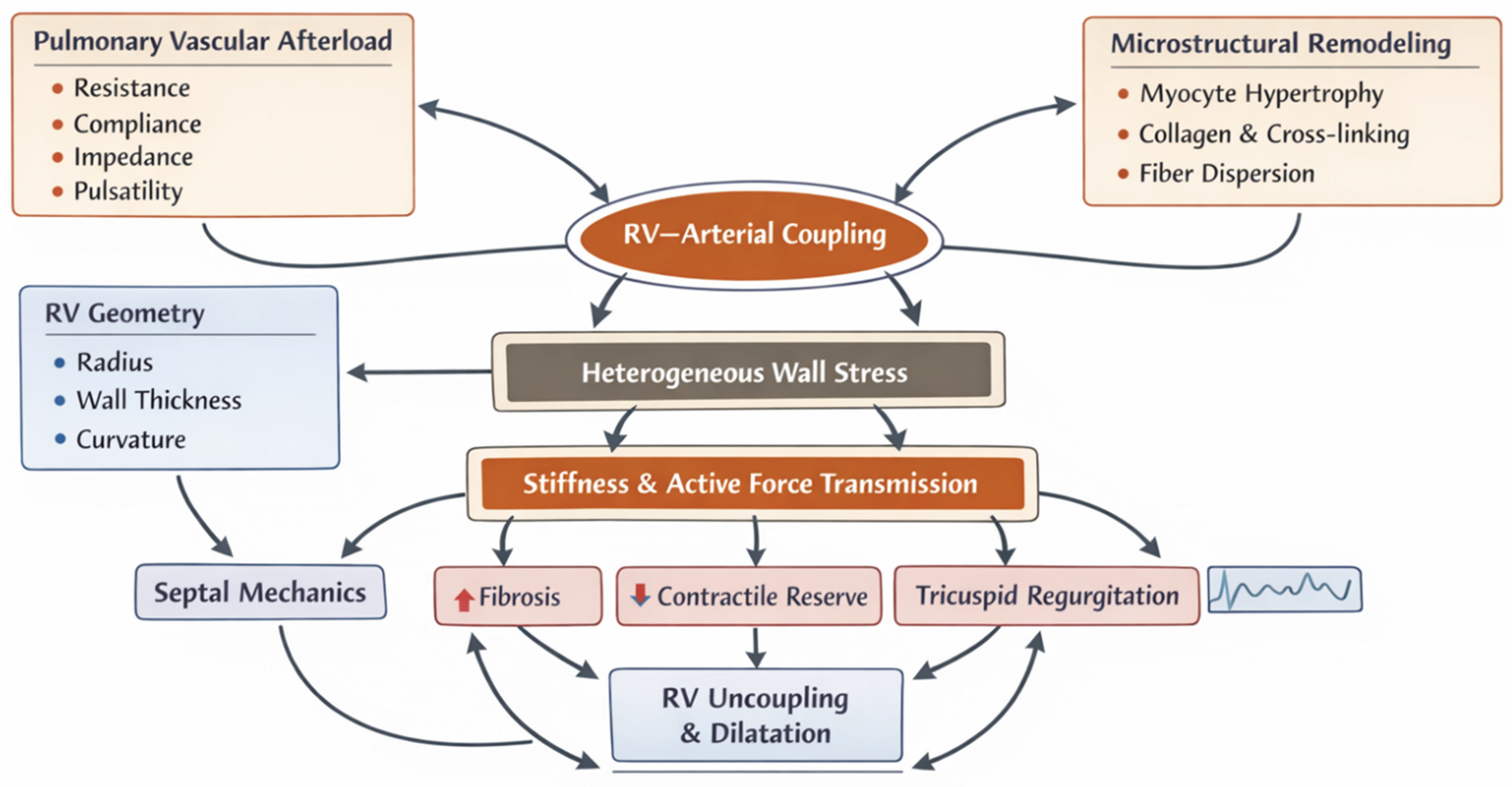
Figure 2.
Regional RV mechanics map and the role of septal interaction. The right ventricle is partitioned into clinically and mechanically meaningful regions (inflow, apex, and outflow) and into free-wall versus septal compartments to reflect known heterogeneity in structure, loading, and function. Schematic fiber-orientation patterns emphasize regional differences in myofiber direction and dispersion that condition how pressure overload is converted into local strain and stress. Example maps illustrate spatially varying strain and inferred wall stress under elevated afterload, highlighting that “hot spots” depend on both geometry and boundary conditions. The septal-interaction subpanel depicts septal flattening as RV pressure rises, demonstrating ventricular interdependence: altered septal curvature shifts LV filling and can relocate the apparent region of peak RV stress by changing constraint and load sharing across the septum. The tricuspid-regurgitation subpanel illustrates how regurgitant volume modifies effective RV loading, potentially producing high deformation metrics despite partial unloading, and therefore complicating direct interpretation of strain-based severity. The figure underscores that region definitions, the reference configuration used for strain/stress (e.g., end-diastolic frame and assumed zero-stress state), and the imposed boundary conditions (septal coupling, pericardial constraint, and valvular competence/loading) must be reported to enable meaningful cross-study comparison and to build reproducible “reference envelopes” for RV mechanics.
Figure 2.
Regional RV mechanics map and the role of septal interaction. The right ventricle is partitioned into clinically and mechanically meaningful regions (inflow, apex, and outflow) and into free-wall versus septal compartments to reflect known heterogeneity in structure, loading, and function. Schematic fiber-orientation patterns emphasize regional differences in myofiber direction and dispersion that condition how pressure overload is converted into local strain and stress. Example maps illustrate spatially varying strain and inferred wall stress under elevated afterload, highlighting that “hot spots” depend on both geometry and boundary conditions. The septal-interaction subpanel depicts septal flattening as RV pressure rises, demonstrating ventricular interdependence: altered septal curvature shifts LV filling and can relocate the apparent region of peak RV stress by changing constraint and load sharing across the septum. The tricuspid-regurgitation subpanel illustrates how regurgitant volume modifies effective RV loading, potentially producing high deformation metrics despite partial unloading, and therefore complicating direct interpretation of strain-based severity. The figure underscores that region definitions, the reference configuration used for strain/stress (e.g., end-diastolic frame and assumed zero-stress state), and the imposed boundary conditions (septal coupling, pericardial constraint, and valvular competence/loading) must be reported to enable meaningful cross-study comparison and to build reproducible “reference envelopes” for RV mechanics.
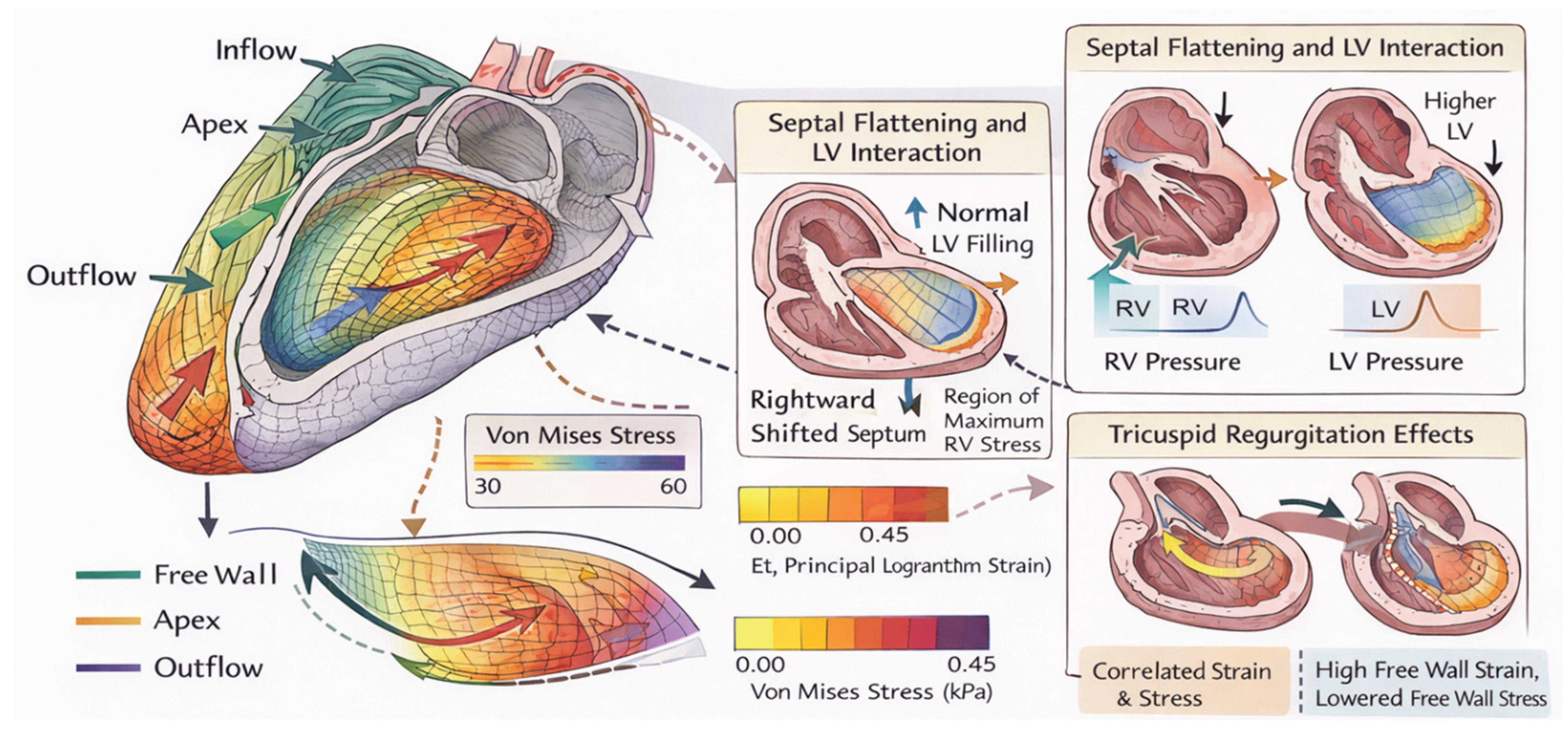
Figure 3.
Imaging-to-mechanics translation pipeline for RV remodeling. Patient-specific cine CMR and/or 3D echocardiography are segmented to generate an RV geometry ensemble, which is converted into a computational mesh and augmented with fiber architecture (rule-based assignment or diffusion-informed priors where available) and boundary conditions (pressure waveforms/levels, septal coupling, and pericardial constraint). Passive material parameters (diastolic stiffness/anisotropy) and active parameters (time-varying tension/contractility) are then estimated via inverse fitting to measured deformation fields (e.g., strain) together with pressure and volume constraints. Uncertainty quantification is performed explicitly by propagating ensembles over segmentation variability, pressure estimation (including surrogate pressures), and fiber-rule choices, yielding distributions rather than point estimates for inferred parameters and predictions. Validation steps include cross-modality agreement of volumes and strain, prediction of hemodynamic response under a known afterload change, and prediction of regional remodeling patterns. The pipeline highlights where assumptions enter (geometry, fibers, boundary conditions, constitutive form) and how these assumptions govern the identifiability and potential confounding of passive stiffness versus active tension.
Figure 3.
Imaging-to-mechanics translation pipeline for RV remodeling. Patient-specific cine CMR and/or 3D echocardiography are segmented to generate an RV geometry ensemble, which is converted into a computational mesh and augmented with fiber architecture (rule-based assignment or diffusion-informed priors where available) and boundary conditions (pressure waveforms/levels, septal coupling, and pericardial constraint). Passive material parameters (diastolic stiffness/anisotropy) and active parameters (time-varying tension/contractility) are then estimated via inverse fitting to measured deformation fields (e.g., strain) together with pressure and volume constraints. Uncertainty quantification is performed explicitly by propagating ensembles over segmentation variability, pressure estimation (including surrogate pressures), and fiber-rule choices, yielding distributions rather than point estimates for inferred parameters and predictions. Validation steps include cross-modality agreement of volumes and strain, prediction of hemodynamic response under a known afterload change, and prediction of regional remodeling patterns. The pipeline highlights where assumptions enter (geometry, fibers, boundary conditions, constitutive form) and how these assumptions govern the identifiability and potential confounding of passive stiffness versus active tension.
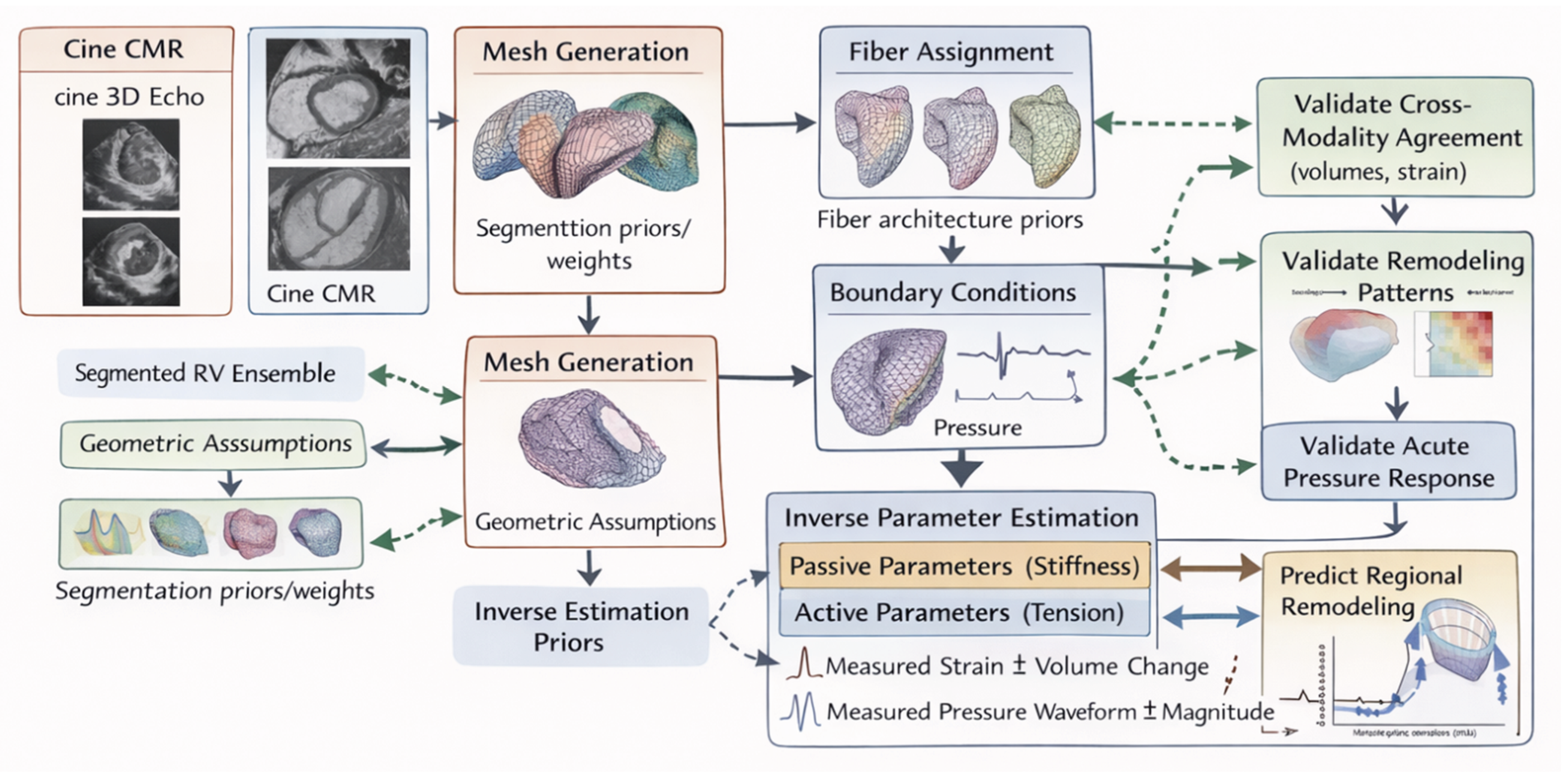

Table 1.
Multiscale determinants of right-ventricular (RV) remodeling and corresponding measurable metrics. The table organizes RV remodeling determinants across organ, chamber, regional, tissue, and microstructural scales, linking each structural/functional feature to its primary mechanical quantity, typical measurement modality, and common interpretation pitfalls. The final column highlights how each metric family connects to clinically relevant questions (e.g., prognosis, therapy response, decompensation risk, and remodeling stage), emphasizing that many routinely reported “biomarkers” are context-dependent outputs rather than direct measures of intrinsic myocardial properties.
Table 1.
Multiscale determinants of right-ventricular (RV) remodeling and corresponding measurable metrics. The table organizes RV remodeling determinants across organ, chamber, regional, tissue, and microstructural scales, linking each structural/functional feature to its primary mechanical quantity, typical measurement modality, and common interpretation pitfalls. The final column highlights how each metric family connects to clinically relevant questions (e.g., prognosis, therapy response, decompensation risk, and remodeling stage), emphasizing that many routinely reported “biomarkers” are context-dependent outputs rather than direct measures of intrinsic myocardial properties.
| Scale | Structural / functional feature | Primary mechanical quantity | Typical measurement modality | Interpretation pitfalls | Clinical linkage |
| Organ | RV-arterial coupling and afterload sensitivity | End-systolic elastance, effective arterial elastance, coupling ratio | Pressure-volume analysis; invasive hemodynamics with imaging | Coupling is system-level; surrogates mix load and contractility | Prognosis, therapy response, decompensation risk |
| Chamber | Geometry and wall thickness adaptation | Wall stress proxies; curvature; volume changes | Echo/CMR volumes; wall thickness from imaging | Thin wall makes thickness errors large; trabeculation complicates segmentation | Remodeling stage, dilation risk, tricuspid regurgitation progression |
| Regional | Free-wall versus septal contribution; dyssynchrony | Regional strain, strain rate, timing | Speckle tracking; CMR feature tracking/tagging | Strain depends on load, tethering, algorithm; timing influenced by conduction | Risk stratification; pacing/resynchronization targets |
| Tissue | Passive stiffness and fibrosis | Nonlinear stress-strain behavior; diastolic stiffness indices | Ex-vivo testing; CMR T1/LGE; modeling-inferred stiffness | Imaging fibrosis proxies are indirect; stiffness inference is model-dependent | Diastolic dysfunction; filling limitation; reverse remodeling potential |
| Microstructure | Fiber dispersion; collagen network architecture | Anisotropy parameters; recruitment behavior | Histology; diffusion tensor MRI (research); modeling | Limited in-vivo availability; sampling bias; region definition | Mechanistic insight; model structure selection |
Table 2.
Common constitutive and electromechanical modelling choices for right-ventricular (RV) myocardium and their implications. The table summarizes widely used passive constitutive families (transversely isotropic hyperelastic forms; orthotropic/fiber–sheet formulations) and common extensions for active stress generation, viscoelasticity, and growth-and-remodelling (G&R). For each model family, we indicate the key assumptions, the parameters typically inferred, and the minimum data required to constrain those parameters (e.g., deformation fields with pressure/volume constraints versus ex vivo calibration). The final columns emphasize RV-specific trade-offs, thin-wall geometry, trabeculations, and regional fibre heterogeneity, where uncertainty in fibre architecture and boundary conditions can render parameter estimation underdetermined unless multiple data types and uncertainty quantification are incorporated.
Table 2.
Common constitutive and electromechanical modelling choices for right-ventricular (RV) myocardium and their implications. The table summarizes widely used passive constitutive families (transversely isotropic hyperelastic forms; orthotropic/fiber–sheet formulations) and common extensions for active stress generation, viscoelasticity, and growth-and-remodelling (G&R). For each model family, we indicate the key assumptions, the parameters typically inferred, and the minimum data required to constrain those parameters (e.g., deformation fields with pressure/volume constraints versus ex vivo calibration). The final columns emphasize RV-specific trade-offs, thin-wall geometry, trabeculations, and regional fibre heterogeneity, where uncertainty in fibre architecture and boundary conditions can render parameter estimation underdetermined unless multiple data types and uncertainty quantification are incorporated.
| Model family | Key assumptions | Parameters typically estimated | Data requirements | Strengths | Limitations in RV context |
| Transversely isotropic hyperelastic (exponential forms) | Single preferred fiber direction; nonlinear stiffening | Fiber and matrix stiffness coefficients; dispersion terms | Strain field plus pressure; or tissue test data | Captures basic anisotropy and nonlinearity; widely used | Sensitive to fiber rules; may miss sheet structure; identifiability issues |
| Orthotropic / fiber–sheet models | Distinct fiber, sheet, and normal responses | Multiple directional stiffness parameters | Richer deformation data; often requires ex-vivo calibration | More physiologically faithful; supports transmural effects | High parameter count; difficult to fit from noninvasive data |
| Active stress models (additive along fibers) | Active tension aligned with fibers; time-varying activation | Peak active tension; activation timing; length dependence | Systolic deformation with pressure; activation timing | Separates passive and active components; supports coupling analysis | Activation timing uncertain; load-dependence confounding |
| Viscoelastic extensions | Time-dependent relaxation and hysteresis | Relaxation times; viscosity coefficients | Rate-dependent tests or multi-phase imaging | Explains rate effects and filling dynamics | Data rarely sufficient for fitting; increases complexity |
| Growth and remodeling frameworks | Mass deposition guided by stress/strain stimuli | Homeostatic targets; growth rates; collagen turnover | Longitudinal datasets; biomarker or imaging fibrosis proxies | Links mechanics to progression and reverse remodeling | Many unmeasured drivers; calibration challenging; uncertainty high |
Table 3.
Imaging-derived RV deformation metrics and their most defensible mechanical interpretations. The table distinguishes what is directly observed in clinical imaging (kinematics, chamber volumes, signal proxies, and flow fields) from what can be inferred mechanically under explicit assumptions about loading, geometry, and boundary conditions. For each metric, key dependencies (afterload/preload, tethering, rhythm and conduction, segmentation and tracking algorithms, and sequence/post-processing choices) and minimum reporting requirements are listed to support cross-study comparability and reproducible model-based inference. The final column indicates how each measurement can be used within mechanics frameworks, either as an inverse-fitting objective (e.g., strain), as a calibration/constraint on boundary conditions (e.g., volumes and stroke volume), or as a prior on spatial heterogeneity (e.g., substrate imaging), with 4D flow metrics enabling richer afterload specification beyond pressure alone.
Table 3.
Imaging-derived RV deformation metrics and their most defensible mechanical interpretations. The table distinguishes what is directly observed in clinical imaging (kinematics, chamber volumes, signal proxies, and flow fields) from what can be inferred mechanically under explicit assumptions about loading, geometry, and boundary conditions. For each metric, key dependencies (afterload/preload, tethering, rhythm and conduction, segmentation and tracking algorithms, and sequence/post-processing choices) and minimum reporting requirements are listed to support cross-study comparability and reproducible model-based inference. The final column indicates how each measurement can be used within mechanics frameworks, either as an inverse-fitting objective (e.g., strain), as a calibration/constraint on boundary conditions (e.g., volumes and stroke volume), or as a prior on spatial heterogeneity (e.g., substrate imaging), with 4D flow metrics enabling richer afterload specification beyond pressure alone.
| Metric | What is directly measured | Most defensible mechanical interpretation | Key dependencies | Reporting essentials | Use in modeling |
| Free-wall longitudinal strain (echo/CMR) | Kinematic deformation along long axis | Composite marker of systolic shortening under load | Afterload, preload, tethering, tracking algorithm | Vendor/software, segmentation, region definition, frame convention | Objective function for inverse fitting of active parameters |
| 3D RV volumes and ejection fraction | Chamber volume change | Global pump performance, not contractility | Afterload, heart rate, geometry errors | Acquisition mode, contouring rules, inclusion/exclusion of trabeculae | Boundary condition constraint; calibration of stroke volume |
| TAPSE and S’ velocity | Basal annular motion | Longitudinal shortening surrogate | Angle dependence, loading, conduction | View, alignment, rhythm status, averaging | Low-dimensional constraint; insufficient alone |
| CMR tissue characterization (LGE/T1) | Signal intensity or relaxation proxies | Substrate marker related to fibrosis/injury | Sequence parameters, hematocrit, motion artifacts | Sequence, post-processing, thresholds | Prior on stiffness spatial heterogeneity |
| 4D flow pulmonary metrics | Flow patterns and derived impedance proxies | Afterload characterization beyond pressure | Temporal resolution, segmentation, model assumptions | Acquisition, segmentation, derived formulae | Improves coupling estimation and boundary conditions |
Disclaimer/Publisher’s Note: The statements, opinions and data contained in all publications are solely those of the individual author(s) and contributor(s) and not of MDPI and/or the editor(s). MDPI and/or the editor(s) disclaim responsibility for any injury to people or property resulting from any ideas, methods, instructions or products referred to in the content. |
© 2026 by the authors. Licensee MDPI, Basel, Switzerland. This article is an open access article distributed under the terms and conditions of the Creative Commons Attribution (CC BY) license (http://creativecommons.org/licenses/by/4.0/).
Copyright: This open access article is published under a Creative Commons CC BY 4.0 license, which permit the free download, distribution, and reuse, provided that the author and preprint are cited in any reuse.


