

Submitted:
07 March 2026
Posted:
09 March 2026
You are already at the latest version
Abstract
Although oral leukoplakia (OL) is recognized as a precancerous lesion, only a proportion of cases undergo malignant transformation (7,2 % to 9.5%). That's why recently, increasing attention has been directed toward molecular biomarkers that may better reflect the biological behaviour of OL Infiltration density of T and B lymphocytes, macrophages, plasma cells were assessed semi-quantitatively using a 4-point scale adapted from Nankivel study. CD9 antigen was assessed in epithelial and immune cells by counting them in three 400x fields. CD138 and CD68 biomarkers were associated with significantly elevated expression across both clinical types of OL where dysplasia was diagnosed. The increase in infiltration density with CD3 and CD20 labelled lymphocytes was statistically reliably confirmed only in non-homogeneous OL with dysplasia. CD9, as a protein reflecting the exosome compartments, revealed the interaction between the epithelium and immune cells. A moderate, statistically significant positive correlation was found only in leukoplakia with dysplasia between CD9+ immune cell levels and the number of epithelial layers expressing this antigen. Assessment of combinations of CD3, CD9, CD20, CD68, and CD138 biomarker expression, cons idering clinical type of leukoplakia, particularly non-homogeneous, appears to improve the accuracy of determining the risk of malignancy in individuals with oral dysplasia.
Keywords:
oral leukoplakia
; dysplasia
; CD9
; CD138
; CD68
; CD3
; CD20 proteins
1. Introduction
Oral leukoplakia (OL) is the most prevalent oral potentially malignant disorder (OPMD), with an estimated global prevalence ranging from 3.41% to 11.74% [1]. Early-stage leuk oplakia is often asymptomatic and may present with a benign clinical appearance, making differentiation from other white oral lesions difficult. A detailed meta-analysis conducted by Guan et al. [2], covering the years 2018-2022, shows that the malignant transformation rate of OL ranges from 7,2% to 9.5% [2,3]. Well-established risk factors for the develop- ment of OPMDs and oral squamous cell carcinoma (OSCC) includes smoking, alcohol consumption, smokeless use, chronic inflammatory conditions of the oral mucosa, and infection with high-risk human papillomavirus, particularly HPV-16 [4,5]. It should be noted that in society, both in the world and in Latvia, tobacco products, such as e- cigaret- tes, smokeless tobacco products, snus and nicotine pouches, are becoming increasingly attractive. It has been found that alternative nicotine products cause changes in the oral mucosa, microbiota and increase inflammatory biomarkers in saliva [6]. Although OL is recognized as a precursor lesion, since only a proportion of cases undergo malignant transformation [7,8]. The dysplasia grade of oral leukoplakia is one of the most important pathohistological parameters in the evaluation of nonhomogeneous and homogeneous OL and in predicting them course. At present, histopathological assessment of epithelial dysplasia is considered the gold standard for estimating the risk of malignant progression, however, its predictive value is limited by interobserver variability and biological hetero geneity. This progression involves proliferation of squamous epithelium, gradual cytolog ical atypia [9]. Despite advances in clinical examinations and histopathological diagnos- tics, predicting which OPMDs will progress to invasive carcinoma remains a major clinical challenge. That’s why in recent years, increasing attention has been directed toward mo- lecular biomarkers that may better reflect the biological behavior of oral leukoplakia. Among these, extracellular vesicles (EVs), particularly exosomes, have emerged as im- portant mediators of intercellular communication and promising diagnostic tools in on- cology [10,11]. Exosomes are nanoscale vesicles released via the endosomal pathway and capable of transferring bioactive cargo, including proteins, lipids, messenger RNAs, and microRNAs, between cells [12,13]. A characteristic feature of exosomes is their enrichment in tetraspanins, a family of transmembrane proteins commonly used as EV markers [12,13]. CD9 is a member of this family and has been implicated in several biological processes, including cell adhesion, migration, membrane fusion, and signal transduction. In cancer biology, CD9 antigen is generally regarded as a metastasis suppressor, with reduced exp ression reported in various epithelial malignancies and frequently associated with poor prognosis [14,15]. Experimental studies suggest that CD9 inhibits tumor cell motility and invasion by promoting stable cell–cell interactions [16,17,18]. Despite growing interest in EV-related biomarkers, relatively few studies have evaluated CD9 expression in oral prec ancerous lesions. Available data suggest that CD9 expression may be preserved in oral leukoplakia regardless of the degree of epithelial dysplasia [14,19,20], however, systema tic comparisons between different clinical subtypes of leukoplakia, presence or lack of dysplasia and invasive OSCC remain limited [14,21]. EVs can be detected in a variety of body fluids, including saliva, making them particularly attractive for non-invasive diagn ostics in oral medicine [22,23] but results may be affected by the state of the oral microbio ta, pathology of salivary glands and biochemical characteristics of saliva itself. In tissues, exosomes themselves can only be demonstrated by transmission electron microscopy or immunoelectron microscopy, but in the oral mucosa, such studies predominate on exso mes that are isolated from saliva or oral mucosa by centrifugation, by special kits of isola tion and size exclusion chromatography rather than studied in the epithelium and the immune cells of lamina propria themselves [24,25,26,27,28]. Furthermore, the relationship between epithelial CD9 expression and the local immune microenvironment in leukoplakia and mal ignant lesions is still poorly understood. From both academic and clinical perspectives, it is important to study how immune cells interact with tissue regions in OL and oral carcino ma where exosome-rich compartments are marked by CD9. This plays a role in the early diagnosis of both precancerous conditions and carcinomas, in predicting their course, and even in treatment with targeted immunotherapy. The oral mucosa has a rather complex immune system that ensures and maintains immunological homeostasis. Immune cells, including dendritic cells, mast cells, monocytes, macrophages, plasma cells, neutrophils, T lymphocytes, and B cells, help the body fight against infections and other pathologies [29]. The main representatives of human immune system are T cells, what is represented by helper T cells (CD4+ T cells) providing release of cytokines; cytotoxic T cells (CD8+ T cells) which kills infected cells or initiates an immune response and regulatory T cells, which control the immune system and prevent autoimmunity. The important T cells surface markers are CD3 molecules, which play a role in the development and function of T cells: CD4 and CD8 define T cells into CD4+ helper T cells and CD8+ cytotoxic T cells, which co operate with antigen-presenting cells (APC) to initiate the activation. Besides that, the surf ace of T cells contains specific antigen receptors (TCR) which allow them to recognize these specific antigens and thus be able to attack infected cells directly or by sending signals to the immune system. The cytokines produced by CD4+ helper T cells ensure the activation of macrophages and other immune cells, stimulate B cells to produce antibodies and regulate inflammatory responses [30]. For the identification of T lymphocytes, CD3 is generally reco gnized as the main marker, reflecting the immune microenvironment around the lesion. It is an integral component of the T cell receptor (TCR) complex, which is a surface marker and plays a role in the transmission of activation signals after antigen recognition. It prov ides the so-called “first signal” that initiates T cell activation and determines the specificity of the immune response [31]. The TCR consists of two functional components: the antigen- binding TCR and the CD3 signalling complex. While TCR recognizes peptide-MHC comp lexes, CD3 is responsible for intracellular signal transduction. Thus, the TCR-CD3 complex regulates T cell function and participates in the body’s immunological response to prevent immune dysregulation and inflammatory responses by identifying and binding exogenous antigen [32]. In humans, CD3 antigen is expressed on almost all mature T lymphocytes, including CD4+ helper T cells and CD8+ cytotoxic T cells, making it a reliable pan-T cell marker [33]. The role of T lymphocytes is to fight not only against intracellular infections, altered self-cells, potential tumor cells but also recognize intracellular antigens. The second major group of T lymphocytes, that function is the control of virally infected cells and tumors, are the CD8 T cytotoxic population. This is composed of Tc1 and Tc2 sub populations, with similar cytokine profiles to Th1 and Th2 cells [34]. CD8 binds to class I MHC molecules and play a critical role in both combating intracellular pathogens that act as antigens and against dysplastic and malignant cells in cancer [35]. Effector CD8+ T cells, known as CD8+ cytotoxic lymphocyte, can directly induce target cell death through the interaction between Fas/Fas ligand and the secretion of the cytolytic mediator perforin, which creates pores in target cells, allowing the delivery of granular serine proteases (granzymes) [33,36]. The immune microenvironment plays a direct role in the dysplastic changes of oral keratinocytes at the beginning of the process, showing a gradual increase in mononuclear cells. This is confirmed by Ӧhman et al. [2015] in his study that the presence of CD3-positive T cells in the precancerous condition of the mouth, such as leukoplakia, indicates the prevention of cancerous transformation [37]. Several studies [38,39,40,41] analyse early changes in the immune microenvironment during oral tumorigenesis and cell -to -cell interactions. They believe that with the gradual development of dysplastic changes in cells, potentially malignant cells create an immunosuppressive, hypoxic, acidic and unchanging microenvironment that promotes carcinogenesis. CD20 is B lymphocyte cell-surface molec ule, a 33-37 kDa non-glycosylated protein, expressed on all stages of B cell development from pre-B cells in the bone-marrow through immature, naive, mature and memory cells in lymphoid tissues and blood. The expression is lost on plasmablasts and plasma cells [42,43]. Most B lymphocytes express CD20 antigen, but a number of T cells also contain it. CD20+ T cells are mostly CD8+ effector memory T cells with proinflammatory features [44]. B cells belong also to the antigen-presenting cells (APCs), they secrete cytokines, provide regulatory molecules and recognize antigen through the B cell receptor complex on their cell membrane [43,45,46]. Gannot et al., [2002] in their study describe an increase in B lymphocyte infiltration with the progression of oral epithelium from hyperkeratosis to dysplasia and carcinoma [46].
CD138, also known as Syndecan-1 (SDC1), is a transmembrane proteoglycan involved in cell adhesion and extracellular matrix remodelling. It is highly and specifically expressed on the surface of immature B cells and mature plasma cells and is considered a highly spe cific surface marker for plasma cell identification [47]. Available research shows that syndecan-1 is expressed in normal oral mucosa, but altered in pathological states [48]. In tissues undergoing dysplastic changes, CD138 expression was shown to be decreased, which could point out the malignant changes initiated in the epithelium of the oral tissues [49]. CD68 is a highly glycosylated glycoprotein that is intensively expressed in macrophages and other mononuclear phagocytes. It is located mainly in the endosomal / lysosomal compartm ent but can rapidly shuttle to the cell surface. Traditionally, CD68 antibody is used as an immunohistochemical marker for pan-macrophage staining of inflamed tissues, for tumor tissue analysis, and for other immunohistopathological applications. CD68 has also been shown to be a good prognostic marker in cancer patients [50]. Previous studies confirm the active role of macrophages in regulating immunosuppression, oncogenesis, and tumor prog ression in precancerous lesions (OPMD) and during their progression to oral squamous cell carcinoma [51]. A progressive increase in the number of CD68+ cells from oral leukoplakia to oral squamous cell carcinoma was observed, and this correlated with the severity of epit helial dysplasia. Therefore, it is important to understand whether there is a correlation between the immune cell microenvironment and the presence of dysplasia in leukoplakia. The aim of the current study is to determine the molecular interactions between squamous epithelium, lamina propria immune cells, and exosome-rich compartments in oral leukopl akia before its progression to carcinoma.
2. Results
2.1. Descriptive Characteristics of the Analysed Cases
The study cohort comprised 50 patients diagnosed with oral leukoplakia. The mean age of the participants were 57.0 years (SD 14.1; range 18–75 years), with a male non-significant predominance (n = 29, 58.0% vs. n = 21, 42.0% female, p = 0.322). All oral leukoplakia were solitary, primary and were located on the buccal mucosa (n = 18, 36.0%) and the lateral side of the tongue (n = 17, 34.0%), followed by the floor of the mouth (n = 11, 22.0%). Other sides, including the lower lip and alveolar ridge, accounted for the remaining 8.0% (n = 4). Assessing the clinical types of leukoplakia, 18 (36.0%) homogeneous OL and 32 (64.0%) non – homogeneous ones were clinically diagnosed. Histopathological evaluation confirmed the presence of epithelial dysplasia in 33 cases (66.0%): 13 of them were mild, 7-moderate, but 13-severe which according to the new WHO classification [52] were: 13 - of low grade and 20 of high grade. The only type of dysplasia detected in homogeneous leukoplakia was of low grade in 6 cases (33,3% of homogenous OL). In turn, in non-homogenous OL dysplasia was in such proportion: low grade-7 and high grade-in 20 cases which are 21,9% and 62,5% respectively. The prevalence of dysplasia was notably higher in the non-homogeneous OL (26/32, 81.3%) compared to the homogeneous type (7/18, 38.9%).
2.1.1. Impact of Anatomical Localization
To determine whether the anatomic site of the lesion influences the immune microenvironm ent, we analysed marker expression across the three primary sub-sites of oral leukoplakia: buccal mucosa, lateral side of the tongue, and floor of the mouth. Kruskal-Wallis tests indic ated no statistically significant differences in the median expression levels of CD20 (p = 0.240), CD138 (p = 0.154), or CD68 (p = 0.115) based on localization alone. Although CD3 expression showed a trend towards variation (p = 0.057), this did not reach the threshold for significance (Table 1).
2.2. Immunohistochemical Characteristics of Immune Cells in Oral Leukoplakia
In the assessment of oral leukoplakia, we evaluated T and B lymphocytes, plasma cells, and macrophages using the following markers: CD3, CD20, CD138, CD9, and CD68. In our anal ysed cases of healthy mucosa B lymphocytes were absent in epithelial layer and very rare found in lamina propria. Infiltration with B (CD20) lymphocytes was predominant in homog eneous OL at score1 level (Figure 1). No differences in CD20-positive cell density were det ected when dysplasia was found in this type of OL. And although in 43% of cases the B lymphocyte infiltration density increased till score 2 but mathematical processing of the res ults did not show a statistically significant difference (p=284). In non-homogeneous OL without dysplasia the density of CD20 + cells were of score1 like in homogenous OL. Imm une response with B lymphocytes were manifested mainly in the form of small pericapillary infiltrates. In cases of non-homogeneous OL with dysplasia, B lymphocyte infiltration was variable and reached a score of 4 in 38% of cases (Figure 3). These differences were statistic ally reliable (p<0.01).
Immunoperoxidase, anti-CD20, 200 × magnification In control group of healthy mucosae very few T lymphocytes were proved under basement membrane and in the epithelial layer till keratinization areas on the surface of OL. In OL CD3 lymphocytes were diagnosed to be more frequently located just in subepithelial zone and pattern of infiltrate was diffuse. The density of CD3-labelled lymphocytes in homogen eous oral leukoplakia, both with and without dysplasia, showed not statistically significant difference (p = 0.894). In contrast, in non-homogeneous OL without dysplasia dominated T lymphocytes infiltration of score 2 but when dysplasia was diagnosed infiltration density increased, achieving a score of 4 in 50% of cases (p<0,001) (Figure 2).
In the immune microenvironment of non-homogeneous leukoplakia with dysplasia T and B cell infiltration densities were synchronous with changes in plasma cell and macrophage responses.
Figure 3.
Distribution of semi-quantitative immunohistochemical staining scores. Stacked bars show the relative proportion of patients exhibiting expression scores from 1 (lowest) to 4 (highest) across the clinical types of OL with and without dysplasia.
Figure 3.
Distribution of semi-quantitative immunohistochemical staining scores. Stacked bars show the relative proportion of patients exhibiting expression scores from 1 (lowest) to 4 (highest) across the clinical types of OL with and without dysplasia.
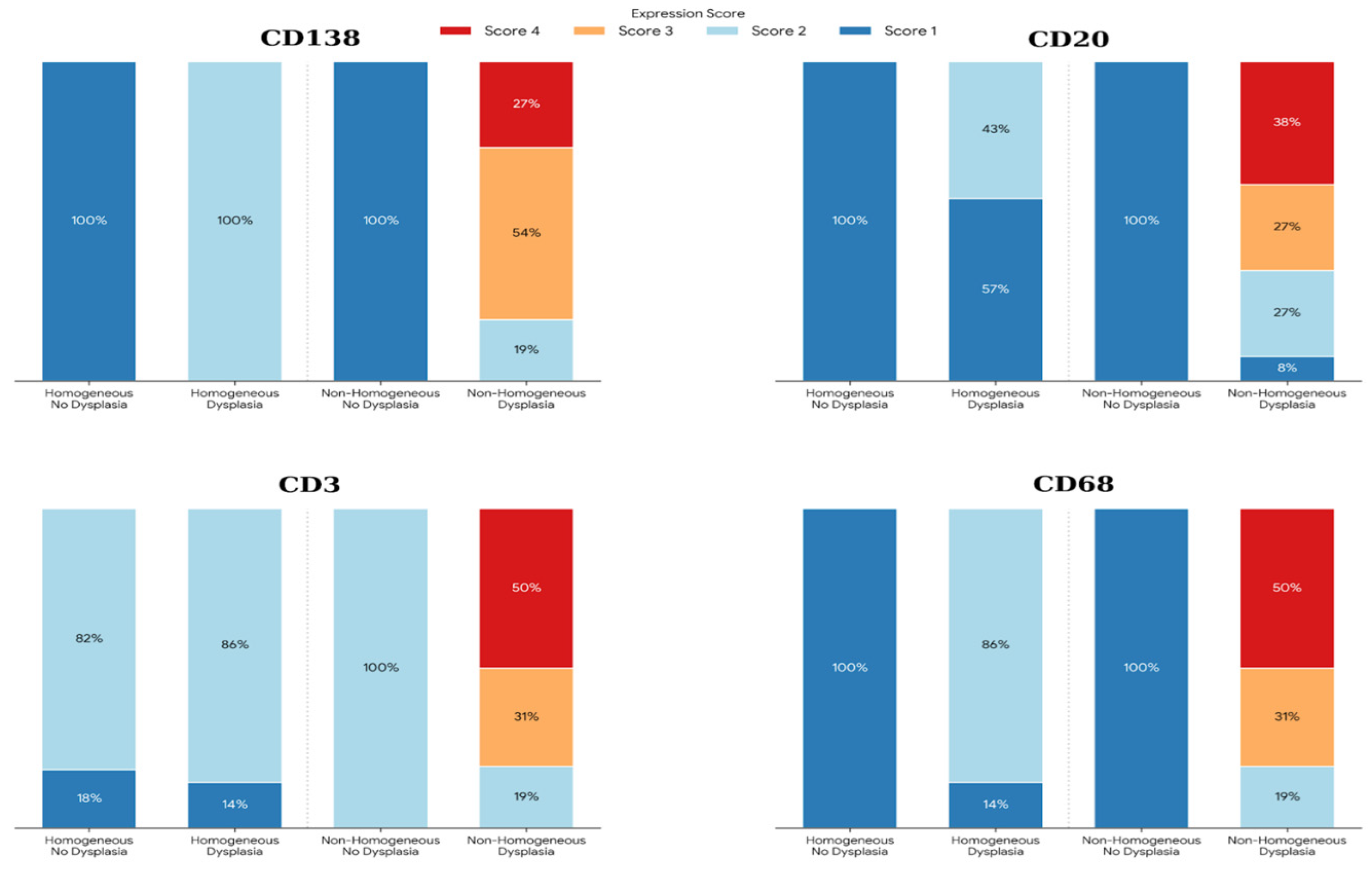
In both normal tissues and oral leukoplakia, CD138 antigen was expressed on plasma cells, the endothelium of lymphatic capillaries and on the membranes of squamous epit helial cells, except in regions where keratinization occurs and the epithelium was with keratohyalin granules. In normal mucosa density of plasma cells in lamina propria were at the lower limit of score 1. In homogenous leukoplakia the density of CD138+ cells only slightly elevated from score 1 to score 2 when dysplasia was detected in them. In contrast, in non-homogeneous OL plasma cell response increases rapidly with the appearance of dysplasia and 81% of patients have infiltration of score 3 and 4 (p<0,001). In both clinical types of leukoplakia without dysplasia there is lack of the statistical difference in the dens ity of infiltrate with plasma cells (score 1). In turn, the difference in the density of infiltra te with plasma cells between homogeneous and non-homogeneous leukoplakia with dysp lasia was statistically significant (p<0,001).
The CD138 marker demonstrated that the plasma cell infiltrate was diffuse and often located beneath the lymphocyte layer rather than directly beneath the basement membrane (Figure 4). In homogeneous oral leukoplakias, low-grade dysplasia did not affect syndecan-1 expression in squamous epithelium, as the number of epithelial layers labelled with CD138 antigen did not decrease. In non-homogeneous leukoplakias, both low-grade and high-grade dysplasia showed reduced CD138 antigen expression, with 11% of cases testing negative. In non-homogeneous OL, we often diagnosed async hronous expression of CD138 antigen in epithelial and immune cells. As a result, syndecan-1 expression decreases in dysplastic epithelium, while the density of labelled plasma cells rise to levels scored as 3 and 4.
Subsequently, we evaluated the quantity, distribution, and infiltration pattern of macr ophages using the CD68 antigen. Furthermore, employing the CD9 marker enabled us to gather additional insights into the interactions between mononuclear cells in lamina propria under leukoplakia, both with and without dysplasia. In healthy mucosa there are few macrophages in one field of vision at 400x under basement membrane. In hom ogenous OL without dysplasia, all cases were characterized by the density of macrop hages of score 1, but with dysplasia 86% of OL have score 2 (p=0.05). In contrast, in non-homogeneous OL without dysplasia all cases were with mild macrophage reaction (score 1), but when dysplasia was diagnosed scores were different: score 2 was in 19%, score 3-31%, score 4 in 50% of cases (p<001) (Figure 5).
2.3. General Linear Model and Interaction Analysis
The GLM constructed for CD138, CD20, CD3, and CD68 demonstrated large effect sizes (partial η² = 0.588–0.794), indicating strong associations between predictors and immune marker expression (Table 2).
The primary analysis revealed a consistent and statistically significant interaction bet ween dysplasia presence and clinical types of OL across all four markers (p < 0.05). This suggests that the immune response involving lymphocytes, plasma cells, and macrophages are linked to the grade of dysplasia in both types of lesions (homogeneous vs. non-homogeneous). Consequently, simple effects analyses were conducted to decomp ose these interactions.
2.4. Characteristics of Dysplasia in the Various Clinical Types of Oral Leukoplakia
Decomposition of the interaction effects revealed that the upregulation of immune markers in dysplastic tissue are driven primarily, and for some lineages exclusively, by the non-homogeneous leukoplakia (Table 3).
Specifically, for CD3 and CD20 markers, a significant increase in expression associated ted with dysplasia was recorded entirely to the non-homogeneous leukoplakia. In non-hom ogeneous lesions, dysplasia resulted in a mean increase of 1.31 units for CD3 (95% CI 0.92– 1.67, p < 0.001) and 1.95 units for CD20 (95% CI 1.49–2.38, p < 0.001). Conversely, within homogeneous OL, neither marker showed a statistically significant deviation from non- dysplastic baseline levels (CD3: Estimate 0.043, 95% CI -0.36–0.42, p = 0.894; CD20: Estimate 0.419, 95% CI 0.006–0.95, p = 0.284). A distinct pattern emerged for CD138 and CD68 markers, where dysplasia was associated with significantly elevated expression across both clinical forms of leukoplakia, though the magnitude of the effect was roughly two-fold higher in non-homogeneous OL. For CD138 protein, the mean difference is attributed to dysplasia in non-homogeneous lesions was approximately double that observed in the homogeneous subgroup (Estimate 2.08 [95% CI 1.76–2.39] vs. 1.00 [95% CI 0.80–1.18], respectively; p < 0.001 for both). Similarly, CD68 exp ression demonstrated a more robust response in the non-homogeneous leukoplakia (Estim ate 2.34, 95% CI 1.95–2.66, p < 0.001) compared to the moderate increase seen in homogen eous OL (Estimate 0.89, 95% CI 0.51–1.18, p = 0.005). Adjusting for demographic factors, neither age nor gender showed a statistically significant main effect on the expression levels of any of the four markers (p > 0.05 for all forms of leukoplakia), confirming that the obs erved immunological changes are driven by the morphological characteristics of the OL rather than demographic confounders
2.5. Distribution of Immunohistochemical Expression Scores in Oral Leukoplakia
Beyond the comparison of mean values, an analysis of the semi-quantitative staining distribution revealed a fundamental shift in the immune profile dependent on clinic al form of OL (Figure 3). In the homogeneous leukoplakia, the immune response remained largely subdued, even in the presence of dysplasia, most cases clustered within the low intensity range (scores 1 and 2), with high-grade expression (Score 4) being absent. In sharp contrast, the non-homogeneous leukoplakia demonstrated a distinct polarization associated with dysplasia. While non-dysplastic lesions showed a mixed distribution, the development of dysplasia in non-homogeneous lesions was characterized by a strong shift towards higher infiltrate density. Specifically, for CD138 and CD68 antigens (plasma cells and macrop hages), the dysplastic non-homogeneous cohort exhibited a marked dominance of score 4, suggesting that this clinical type of leukoplakia represents a distinct, high-grade immune microenvironment state rather than a mere linear progression of the baseline immunity.
2.6. Immunohistochemical Characteristics of Exosome-Associated Antigen CD9 of epi Thelium and Immune Cells in Oral Leukoplakia
CD9 antigen was present in the lower third of the structurally preserved oral mucosa but absent from the upper third. CD9 was expressed in an average of five epithelial layers, and its localization was exclusively membranous. Additionally, CD9 protein was was found in the epithelial cells of the small salivary gland ducts and at macrovesicle concentration sites in the lumens of salivary gland ducts of oral mucosa [Figure 6].
CD9 antigen was absent in the superficial layers of oral leukoplakia and in regions containing keratohyalin granules. CD9 expression reflected slight membranous thickening and irregularities of its structure. In leukoplakia without dysplasia 24.8 ± 3.1 epithelial layers were labelled, compared to 17.5 ± 5.0 layers in the OL with dysplasia (Figure 7).
In regions showing low-grade dysplasia, exosome-associated marker CD9 contin ues to be expressed on the epithelial cell membrane. However, in cases of high- grade dysplasia CD9 antigen was also detected within the cytoplasm (Figure 8).
Exosome-associated CD9 protein in lamina propria is expressed not only on macr ophages but also on monocytes, part of B and T lymphocytes, lymphatic endothelial cells and in fibrosis zones of lamina propria (Figure 9). We assessed the number, localization, and pattern of infiltrate of them by this tetraspanin. In healthy mucosa there are average 5±1,01 mononuclear cells in one field of vision at 400x magnification under basal membrane. In oral leukoplakia without dysplasia CD9 labelled mononuclear cells in subepithelial zone were 24.8 ± 3.1 but with with dysplasia 15.8 ± 5.4 (p < 0.001) and these were mainly non - homogeneous leukoplakia. In contrast, while the number of CD9 marked epithelial layers of OL was slightly reduced in cases with dysplastic lesions (17.5 ± 5.0 vs. 19.9 ± 4.6), this difference did not reach statistical significance (p = 0.097) (Figure 10).
Evaluation of the co-expression of protein of exosome compartments uncovered a fundam ental shift in the epithelial and immune microenvironment interaction in lamina propria under OL. In oral leukoplakia with dysplastic lesions, a moderate but statistically signific ant positive correlation was observed between the number of CD9 labelled epithelial layers and CD9 positive immune cells (r = 0.43, p = 0.013). Conversely, in oral leukoplakia without dysplasia, no significant correlation was found between amount of epithelium layers and connective tissue cells of lamina propria which were labelled with CD9 antigen (r = -0.29, p = 0.258) (Figure 11).
3. Discussion
One of the most common OPMDs diagnosed in the clinic is leukoplakia, which in each specific situation requires careful clinical and morphological evaluation to prevent progression of malignant transformation in a timely manner. When evaluating clinical parameters, first regarding anatomical localization. In our study, leukoplakia was most often found in the buccal mucosa, then on the ventral/lateral side of the tongue and the floor of the mouth. If we compare, for example, with the meta-analysis conducted in 2023 [2], then, however, the most affected localizations are the side surface of the tongue (6.38- fold) and the floor of the mouth (3.75-fold). In another study [53] the following most freq uent localizations are indicated ventral side of the tongue and floor of mouth, then lateral side, dorsal part of the tongue, buccal mucosa, lip and gingivae. Pimenta-Barros et al. [54] who conducted a large meta-analysis covering from 1934 to 2023, publications from Euro pe, Asia, North America, South America and Oceania, conclude that the likelihood of mal ignant transformation increases in cases with large, non - homogeneous lesions located on the lateral side of the tongue, with epithelial dysplasia, and in individuals who smoke [54]. The patients’ age ranged from 18 to 75 years (average 57.0). It is consistent with other data, indicating under 60 years of age [2]. However, there is a study that testifying that it is most often diagnosed after the fourth decade of life [55]. Since some of study group patients were young, we also paid attention to possible etiological factors of OL. We have not inc luded an analysis of patients’ bad habits because the data were incomplete for all individu als. However, we would like to emphasize that there is a trend that information about smokeless tobacco use is increasingly appearing in the medical records of younger pat ients. The trend we observed, is consistent with reports from WHO in recent years. It is well known from Asian countries, where Areca nut, commonly used with betel leaves in “betel quid” have been proven to be a risk factor (or cause) for the development of OL [56,57]. However, many authors emphasize the rapid spread of nicotine patches and elec tronic cigarettes, both in European countries where they are allowed, and in large regions where sales of smokeless tobaccos are restricted [4]. WHO reports that the European Region has the world’s highest e-cigarette usage, with 4.6% of adults and 14.3% of 13–15- year-olds using them. But electronic cigarette usage in the USA is also rising among adults, increasing from 4.5% in 2019 to 6.5% by 2023, with the highest prevalence (15.5%) in young adults aged 18–25. Oral nicotine pouches (tobacco-free) are seeing a rapid increase in popu larity, with usage rates among young people increasing from 11% to 14% in last five years. Also, in countries around Baltic Sea, it is actual and scientists from this region have proven that smokeless tobacco causes microbiota changes, precancerous lesions of oral mucosa with the increase of inflammatory biomarkers in saliva [58,59,60].
Our study also showed a predominance of men diagnosed with leukoplakia compared to women, which is consistent with data available in the literature [3]. However, it has been found that oral leukoplakias in females, non-homogeneous clinical type, location on tongue and presence of epithelial dysplasia more likely undergo malignant transforma tion [2,61]. Although literature data demonstrate, that, homogeneous leukoplakia is the most common clinical form of OL, often representing over 80-95% of cases in clinical studi es, reflecting no dysplastic changes [62,63,64,65]. In our study, a non-homogeneous form prev ailed. And although data show that homogeneous leukoplakia has lower, slower rate of transformation (the overall lifetime of MT rate is 8.6% [3] they are not completely risk-free, so constant monitoring is necessary. According to Tenore et al., [65] the most common homogeneous type, was followed by the verrucous and speckled types of non – homogen ous leukoplakia, which is consistent also with our observations, putting first the speckled subtype or erythroleukoplakia.
According to Power analysis, it should be noted, although the overall sample size was limited, the interaction effects between dysplasia and clinical form of OL were characteri zed by large effect sizes (partial η² = 0.17–0.23). Post-hoc power estimates indicated moderate to high statistical sensitivity (0.80–0.90), suggesting that the study was sufficiently sensitive to detect interaction effects of the magnitude observed. The fact that non-homogeneous leukoplakia carries a higher risk of malignant transformation to invas ive carcinoma due to the increase in the severity of dysplastic features has been noted by several authors [9,62,64,66]. The meta-analysis performed by Aguirre-Urizar et al. [67] demonstrated a 4.06-fold increased risk of malignization for non-homogeneous OL, but 23.8 -fold increased risk by presence of oral epithelial dysplasia. Although the three-grade system is the most widely used in the assessment of dysplasia and the determination of the risk of malignancy, the binary system is also recommended and recognized. Combin ing both systems to double-grade intermediate lesions might enhance risk assessment [68] and the reproducibility of the binary system has the potential to be better for prognostic purposes [69]. It is suggested as an alternative approach for the characterisation and class ification of oral epithelial dysplasias and evaluated as a promising prognostic model for malignant transformation [53,70].
The anatomical site of oral leukoplakia within the oral cavity did not affect the density scores of immune cell markers in homogeneous and non-homogeneous OL which may be explained by the relatively small number of patients in current study. Crucially, the intera ction pattern between dysplasia and immune upregulation was consistent across all anat omic sites. The presence of dysplasia was uniformly associated with elevated immune marker scores regardless of whether the lesion was located on the tongue, buccal mucosa, or floor of the mouth, suggesting that the observed immune response is driven principally by the dysplastic transformation rather than the local tissue environment. Regarding the gender of the patients, it did not affect the frequency of dysplasia, as well as the charact eristics of the immune environment in homogeneous and non- homogeneous OL (p=0.322). Our study demonstrates highly variable cellular immunity around two clinically distinct OL. Taken together, the combined evaluation of CD9, CD138, CD20, CD3 and CD68 und erscores the interplay between epithelial dysregulation and immune microenvironment remodelling in premalignant oral lesions and may provide insight into mechanisms und erlying malignant transformation, especially in non - homogeneous leukoplakia. We would like to emphasize that our study is based on immunohistochemical demonstration of exosome concentration sites by CD9 protein expression in oral mucosal tissues. It was performed on serial histological sections, counting both the number of epithelial layers and stromal cells in one field of view at 400x magnification in three areas of OL. In turn, recent studies on oral mucosal exosomes have been based on their isolation from saliva [71], serum [23,27] and mucosal tissues mainly by centrifugation [25]. Exosome accumul ation sites in such cells as epithelium, endothelium [72], macrophages [73], lymphocytes [74] or fibroblasts [28], are marked by a single CD 9 antibody. They transport nanoparticles of different proteins, tetraspanins, receptors, adhesion molecules, nucleic acids (some RNA forms, occasionally participles of DNA), lipids and enzymes which carry variable informa tion between epithelial-mesenchymal structures. Due to their location and content, exoso- mes should be evaluated using a uniform method, which has not been observed in many literature reviews. The shape, size and localization of exosomes are most accurately chara cterized by transmission electron microscopy [26], immunohistochemical electronmicros copy [75]. Research over the past decade has shown a growing interest in extracellular ves icles including exosomes in the context of oral leukoplakia and its transformation into canc er. However, limited work has specifically examined CD9 antigen expression in the tissue of oral precancerous lesions and epithelial dysplasia by immunohistochemical method [14,18,19,72]. Most scientists have focused on studying the role of exosomes in the epithel ium [10,14,20] but only a few groups of authors have evaluated their presence and signific ance in the lamina propria of oral mucosa under OL [73,76,77]. Under a light microscope, CD9 antigen expression appears as irregular, thickened lines on the membrane, which may indicate the presence of exosomes or microvesicles [16,17,78]. But rather than exosomes themselves, this proves the presence of proteins that indicate their accumulation in the cell membrane, cytoplasm, and intercellular substance. CD9-positive areas of the oral epithel ium likely function as transport or channel proteins, providing insight into mechanisms of fluid movement in healthy tissue and OL [79]. In addition, CD9 has been recognized as a mediator of intercellular communication [80,81], which we propose also occurs among mal ignant cells—except in cases which show complete CD9 loss in carcinomas [19,82]. CD9 antigen was strongly expressed in epithelial membrane of OL without dysplasia but its translocation into cytoplasm of dysplastic epithelium points to the involvement of orga nelles in this process [82]. Previous reports have suggested that reduced CD9 levels in squa mous epithelium are linked to leukoplakia progressing toward malignancy [14], whereas a study by Wang [78] indicated that CD9 might suppress malignant development. Statistical processing of our results proves a tendency that in homogeneous OL CD9-positive epithel ial layers were more than non-homogeneous leukoplakia with dysplastic lesions, but this difference did not reach statistical significance. That is because the epithelial layer in hom ogeneous OL is relatively intact, dominated hyperplasia and hyperkeratosis but in low- grade dysplasia as usually only one third of epithelial thickness is with architectural changes and immature cells. It was diagnosed in only 33,3% of cases. Since the frequency of high-grade dysplasia increases significantly in non-homogeneous OL (62,5% of cases), a decrease in CD9 protein expression to average 17 layers was demonstrated but it was not statistically significant (p=0,097). But parallel to this, the frequency and area of intracellular compartments of exosome protein CD9 increases.
In this study, the overall increased exome-expressing protein in non-homogeneous OLs with high-grade dysplasia indicates the process of OL transformation into carcinoma. It correlates with Baghban et al. [80] study who proposed that exosomes may promote tumor growth, as cancer cells can secrete vesicles carrying molecular cargo that modifies the tumor microenvironment to support metastasis. Study group of Buim et al. [83] in carcinoma cases proved that disease-free survival and the 5-year overall survival of pat ients with downregulated or negative CD9 expression were significantly lower than in pat ients with positive CD9 protein expression. Other scientists have also mentioned the disa ppearance of the CD9 protein in malignant keratinocytes of the oral mucosa and linked it to tumor dedifferentiation and its metastatic process [19]. The loss of CD9 protein as marker of exosome compartments does not mean that communication between dysplastic and mal ignant cells disappears in these areas. Previous studies show that CD44 protein marks large extracellular vesicles in the epithelium and plays a role in this interaction [84]. The interact ion between keratinocytes and lamina propria immune cells via exosomes expressing protein CD9 is also important in precancers like non-homogenous OL. Comparison of serial histol ogical specimens from our study with the investigated markers demonstrated that the exo some-expressing protein CD9 was found on B lymphocytes, macrophages, plasma cells and rarer on part of T lymphocytes subsets and fibroblasts. The number of CD9+ cells in one field of vision (400x) in subepithelial zone of homogenous leukoplakia is almost five time larger than in healthy mucosa. The latter is characterized by an intense immune-competent cell response to epithelial hyperplasia and mild reversible dysplasia.
Exosome-rich compartments decrease in number as dysplasia severity increases in non- homogeneous OL. But by analysing each marker (CD3, CD20, CD68, CD138) separately, we demonstrate that the density of immune cells increases statistically significantly in non- homogeneous OL. This can be explained by the fact that CD9 does not label other immune cells that do not contain the protein characterizing the site of exosome concentration. Conversely, study group of Shetty et al. [48] in her detailed review about head and neck squamous cell carcinomas, concludes that CD9 antigen can be both a tumor suppress or (when lost on epithelial cells) and a tumor promoter (when present on stroma cells) as these proteins form multimeric complexes with each other and other cell surface proteins, including integrins, leukocyte antigens and signalling molecules, at specialized tetraspanin -enriched microdomains. Authors found that CD9 as marker of exosome proteins in tumour inhibition or tumour progression depends on the molecule that interacts with this antigen. Infiltration of the subepithelial zone with mononuclear CD9-labeled cells was int ense in homogeneous OL leukoplakia and we explain it with a rich immune cell response to hyperplasia, keratinization, and mild dysplasia processes in them. The rich immune res ponse possibly slows down the progression of mild dysplasia to a more severe form or even ensures its regression. According to literature data even moderate dysplasia in oral leuk oplakia may regress in 85-97% of cases [85]. In both clinical types of OL exosome-associated CD9 protein was also expressed in the endothelium of lymphatic vessels. It proves that they pick up proteins, metabolites of interstitial substance and immune cells from lamina propria and suggests their cargo function of exosomes in communicating with the microcirc ulatory network of the subepithelial zone of oral mucosa. Exosomes may deliver enzymes capable of degrading the extracellular matrix around the primary tumor, thereby enabling invasion and later dissemination of cancer cells [80,86]. Our view is that only when the exosome membrane ruptures can metabolic enzymes and proteases cause destruction of the basal membrane beneath OL with severe dysplasia and thus promote the transition of high-grade dysplasia and cancer in situ to invasive squamous cell carcinoma. CD9+ exos ome-rich compartments were found in fibroblasts of lamina propria in 17% of non-homogen eous OL cases with high-grade dysplasia. It shows that they also participate in interaction between intercellular substance and microcirculation net and epithelial layer [28]. Most cases were identified when the density of immune cells dropped from score 4 to score 2, resulting in fibrosis of the lamina propria. That intensifies tissue hypoxia, worsens trop hism in connective tissue under epithelium, and thus promotes epithelial cell dedifferentia tion in leukoplakia with high-grade dysplasia. In intact oral mucosa macrophages are ess ential for innate immunity but with the development of leukoplakia, adaptive local imm unity processes start. This study demonstrated the dynamics of macrophage infiltration density and location from healthy mucosa to various clinical types of leukoplakia with and without dysplasia. Transmembrane glycoprotein CD68 acts as a marker for all types of macrophages but there are studies showing that this antigen is more frequently expressed on M1 macrophages [87], while CD163 and CD206 antibodies mark M2 macrophages [88]. In oral mucosa are proved M1 macrophages what display pro-inflammatory properties, and they have an antitumor role. On the contrary M2 macrophages demonstrate anti-inf lammatory features and they have a pro-tumor profile [51]. In recent years, in vitro studies have shown that M2 cells can be further divided into M2a, M2b, M2c, and M2d subtypes [89]. As antigen-presenting cells, they mediate immune responses to oral microbiota, food, and other antigens, but can function within microenvironments of any pathological lesion of oral mucosa, too. In oral pathology important are the findings of Wang et al. [87] that M1 macrophages can polarize into the M2 variant. In healthy mucosa of control group there were few CD68 positive cells under basement membrane. The density of macrophage infilt ration under homogeneous OL changes from score 1 to score 2, diagnosing low-grade dysp lasia, and this difference was statistically significant (p=0.005) and the effect of dysplasia was 0.885. The battle for influence between epithelial and immune cells will continue if the leukoplakia is not removed in time. It is possible that infiltration by macrophages may slow or prolong the progression of low-grade dysplasia to high-grade in homogenous OL. This indicates a balanced macrophage activity in the homogeneous OL. Not every homogeneous OL turns into a non-homogeneous one and later to carcinoma, therefore, the positive activi ty of macrophages in epithelial maturation and migration should be emphasized. The diff erences in OL macrophage infiltration densities were more pronounced in non-homogeneo us OL. Accordingly, OL with and without dysplasia CD68 labelled cells ranged from score 1 to score 4. This points to a heterogeneous picture of immune responses in non-homogen eous OL and clinical course may be variable. Therefore, we agree that the highest macrop hage infiltration rates (score 3 and 4) are the most prognostically important as a large densi ty of macrophages may influence the progression of high-grade dysplasia to malignancy as proved also by groups of Chistiakov et al. [50] and Sutera et al. [51]. Many authors sug gest that macrophages, especially M2 type, stimulate the transformation of high-grade dysplasia into cancer in situ and later to carcinoma as Hanania et al. [90] has proved that activated CD163+ macrophages may secrete matrix metalloproteinases-9 that degrade the basement membrane and it is basic for invasive tumor. In studies by Weber et al. [76] and Feltraco et al. [91] groups, was showed a significant rise in M2 macrophages in OL with malignant transformation within five years compared to those without. But research of Sutera et al. [51] proved that in OL with severe dysplasia macrophages begin to produce cytokines that promote epithelial instability [51]. The antigen expression on macrophages is a highly regulated process, as shown by the Shigeoka et al. [88] study in which M2 macr ophages are labelled with CD163 and CD206 antigens, but only the CD163 protein shows a correlation between clinic-morphological data and the grade of dysplasia in leukoplakia. Comparing the molecular weights of M1 and M2 macrophages, we see that it differs slightly, accordingly CD68 is 110 kDa, CD163 is 125 kDa but CD 206 is 158-166 kDa. Bioc hemists have proven that in both epithelium and immune/inflammatory cells, the bonds between amino acids are functionally labile. Both cytoskeletal and cell junction proteins change under the influence of oxidative stress, inflammation and tumors [92]. Therefore, the demonstration of M1/M2 macrophages in tissues is a very sensitive process and we understand that this is due to a slight rearrangement of amino acids. This can be caused by any disturbance in the immune microenvironment, such as when the proportion of lamina propria cell (lymphocyte/plasma cells/ mast cells/macrophages) infiltrate changes in the oral cavity due to various factors. It should be emphasized also that protein turnover in immune cells is faster than in epithelial cells. By analogy, in oral squamous cell carcino mas, strong macrophage infiltration has been shown to correlate with advanced malign ancy, lower its differentiation grade and metastasis. Data from literature shows that OSCC samples showed the highest macrophage infiltration and strongest M2 polarization [93]. Tumor associated macrophages act in a tumor-promoting manner through immunosupp ression, angiogenesis, and the promotion of cancer cell invasion [40].
Another antigen whose expression we analysed in OL epithelium and plasma cells was CD138. CD138 (syndecan-1) is heparan sulphate proteoglycan with three domains: extrac ellular, transmembrane and cytoplasmatic. It is important that biochemists have proven that molecular weight of syndecan-1 varies significantly due to its glycosylation from 30- 80 kDa up to 200 kDa whether it’s the core protein or full proteoglycan. We consider that it may affect the intensity of antigen expression. Different biochemical forms of CD138 are crucial for squamous epithelium development, adhesion, and migration in benign and malignant processes. The structure allows syndecan-1 to act as a receptor, binding to vario us growth factors, extracellular matrix components, and cytokines via its heparan sulpha te chains. For oral leukoplakia epithelium most scientists agree that CD138 antigen expression decreases. Thus, Soukka et al., [94], Lakkam et al. [95], Tegginamani et al.[96], Akkaloori et al. [49] showed that CD138 is gradually lost as the severity of dysplasia prog resses. The findings of our study are fully consistent with the data of the author’s mention ed above and we agree that the loss of syndecan-1 in epithelium is associated with the breakdown of cell-cell adhesion in progressive dysplasia.
In oral squamous cell carcinoma, an analogous trend is observed as syndecan-1 expression levels correlate with the differentiation grade of cancer. Basharat et al. [97] study has proved that loss of CD-138 expression in oral squamous cell carcinoma is associated also with tumor aggressiveness and poor prognosis. But study of Kind et al. [98] of different neoplasia showed that CD138 immunostaining was highest in squamous cell carcinomas, slowly decreased in adenocarcinomas and is absent in germ cell tumors, sarcomas and endocrine tumors. Shetty and collaborators [48] in a modern study of syndecan-1 demonstrated a statistically significant difference between carcinomas of three grades with “TissueQuant”. This device works on the principle of scoring pixels of an ima ge based on a reference color representing a specific biological component but does not analyse plasma cells and squamous cell structures separately, as morphologists do. The most frequent analysis of CD138+ plasma cells by researchers has been done in oral inflammatory processes [99] and such malignancies as multiple myeloma [100] and OSCC. Máthé et al. [101] research group has concluded that conversely, stromal CD138 expression proved to be a significant risk factor of recurrence and tumor-specific death within a 24-month period after surgery. But conclusions of Mukunyadzi et al. [102] about connective tissue cells were that the increased syndecan-1 expression in lamina propria may contribute to tumor cell invasion and the development of metastases in head and neck carcinomas. For an accurate prediction of the clinical course of OL, the detection of CD138 antigen in the epithelium must be accompanied by an analysis of its expression in plasma cells but there are very few such reports. As far back as 1979, Loning and Burkhardt [103] by immunoenzymatic method reported that the incidence of immunoglobulin (IgA and IgG) labelled plasma cells were twice as high in those cases of leukoplakia in which dys plasia was present. In the oral mucosa, these molecular reactions play an important role both in squamous epithelium and in the subepithelial zone, by interacting with other im mune competent cells. In our analysed group of cases, CD138 (syndecan-1) under base- ment membrane was expressed on plasma cells and endothelium of lymphatic vessels in healthy oral mucosa and of both clinical subtypes of OL with and without dysplasia. While no dysplasia was detected in either clinical type of leukoplakia, the infiltration den sity with plasma cells did not differ and was at score level 1. We evaluate the density of plasma cells of this intensity in OL as a reaction to the processes of epithelial proliferation and hyperkeratosis in them by producing Ig A, IgG and IgM that play important role in immune environment of subepithelial zone. If we analyse the homogeneous OL cases separately, we see that the dysplastic process affects the infiltrate density in a very stereo typical way. It changes in most of patients from score 1 to score 2, respectively when low-grade dysplasia was diagnosed. The fact that also non-homogeneous OL without dysplasia has only a mild infiltration with plasma cells (score 1) is clinically important. In nonhomogeneous leukoplakia with dysplasia density of plasma cells in subepithelial zone was variable whereas intensive infiltration prevailed: in 81% of cases was score 3 and 4, but also the grade of dysplasia in this type of OL varied from low grade in 21,9% till high grade- 62,5%. Simple effects analysis of dysplasia on immune marker expression stratified by clinical form, showed that infiltration by plasma cells correlate with dysplasia grade specifically within the non-homogeneous subgroup as estimated effect of dysplasia was 2,075 opposites in homogeneous-0.999. The expression of CD138 in oral mucosa should be assessed in a complex manner, both in epithelium and plasma cells together. Thus, we conclude that the loss of CD138 antigen expression in OL epithelium with high- density infiltration of plasma cells in lamina propria indicates about increased risk of deve loping malignancy. Since the plasma cells are the most important producers of such anti bodies as immunoglobulins, it would be valuable to evaluate IgA and IgG in oral leuko plakia. Immunoglobulins can be detected directly in the oral mucosa through various methods, such as immunohistochemistry, enzyme-linked immunosorbent assay (ELISA), and immunofluorescence. In recent years, modern studies of the oral mucosa have been carried out on its immunoglobulins A, G and M in saliva and gingival crevicular fluid [104,105], which undoubtedly reflect the functional activity of plasma cells not only in the small mucosal lesion of a few square centimetres like oral leukoplakia, but also in the ent ire 200 sq. cm oral mucosa and in the salivary glands. Increased levels of salivary immuno globulins are often observed in oral potentially malignant disorders (OPMD) and oral squamous cell carcinoma (OSCC), indicating a local immune response to epithelial changes.
Next important participants of immune processes of oral mucosa are T and B lymphoc ytes. It is well known that B lymphocytes are not found in healthy mucosa. Data on CD20- expressing lymphocytes in OL are rather contradictory. Our study showed that in hom ogenous and non-homogeneous OL without dysplasia density of infiltrate with B lymp hocytes did not differ, but it was present at score 1 and there was the immune cells react ion to long term hyperplasia and keratinization processes in them. However, with the onset of dysplasia, the intensity of their infiltration increases which correlates with the results of Gannot et al. [46] who found that B lymphocytes increase most rapidly in tongue pathology as oral epithelium progresses from hyperkeratosis to dysplasia. Scient ists noted that the B cell reaction in both clinical types of oral leukoplakia without dyspla sia did not differ but CD20 labelled cells were more inert than the T lymphocyte. In cases of low-grade dysplasia, immature epithelium occupies one-third of the thickness of the layer, and B and T lymphocytes do not respond to this slightly altered number of epithelial cells. With the development of high-grade dysplasia in non-homogeneous OL, B lymphocyte infiltration becomes variable. The density of infiltration ranged from score 1 to score 4, but 65% of cases had a score of 3 or 4. This may indicate the different clinical courses of non-homogeneous OL: dysplasia may progress till cancer in situ or remain at the previous level. We justify our approach by the dual nature of B lymphocytes, which has been discussed in extensive scientific reviews. A comparative analysis of a large set of publications allows the authors to conclude that B lymphocytes may either suppress or promote tumor growth [46,106,107].
Debates over their anti-tumor and pro-tumor effects also continue in studies on oral canc er [108,109,110]. Extensive research is needed to clarify how CD20 cell subtypes influence the transformation of oral leukoplakia into carcinoma. The expression of pan-T lymphocyte antigen CD3 in OL was more pronounced than the B cell response. Under homogeneous leukoplakia in lamina propria, T lymphocyte density corresponded to a score of 2 and was not statistically significantly affected by the presence of mild dysplasia, like the re action of CD20-labeled cells. In contrast, in non-homogeneous leukoplakia, T lymphocyte density increased significantly in 81% of patients and it was a statistically reliable differen ce (p<0,001). Both original research and literature reviews about oral leukoplakia and SCC have demonstrated variable functions for different subtypes of T lymphocytes. Sci- entific group of Öhman et al. [111] with confocal laser scaning microscopy revealed co- localization of LCs and T cells in OL with dysplasia and in OSCC. It was concluded that it reflects an ongoing immune response against cells with dysplasia and malignant trans formation in oral leukoplakia. But in oral cancer research Hladikova with coworkers [112] revealed that CD8+ T cells and B lymphocyte interactions can predict patients with good prognosis. Studies of Pellicioli et al. [113] analysing CD8 lymphocytes has proved that their number decreased in oral potentially malignant disorders in comparison with carci- noma but there is no statistical correlation with clinical data. But Pretscher et al. [114] pointed out that CD8+ T-cells and CD20+B-cells in metastatic lymphnodes are associated with favourable outcome in patients with oro-pharyngeal carcinoma. In contrast, other authors using computer programs did not demonstrate a correlation between immune cell infiltration density and clinical stage or prognosis of OS carcinoma [115,116]. As in non-homogeneous OL we mostly found a wide band of T and B lymphocytes under base ment membrane, followed by a zone of plasma cells, we believe that abundant immuno- globulin synthesis may slow down the progression of OL to carcinoma. Dynamic changes in the immune microenvironment of leukoplakia can only be accurately demonstrated by repeated biopsy examinations, which are not always possible. It should be highlighted that in non-homogeneous leukoplakia infiltration with B and T cell infiltration increases alongside plasma cells and CD68 macrophages, indicating a coordinated immune micro environment response under this type of leukoplakia. To a certain extent, the density of infiltration is also influenced by the duration of leukoplakia, which patients note in their medical history, and the condition of the microbiota in the mouth.
4. Materials and Methods
4.1. Study Group
All included patients of the study gave their informed consent for inclusion. The study was conducted in accordance with the Declaration of Helsinki and the Decision No 3 / 18.08.2016 of the Ethics Committee of Rīga Stradiņš University. Each phase of the study was conducted in accordance with ethical principles. The study included 50 patients with homogenous and nonhomogeneous oral leukoplakia who were consulted and treated at the RSU Institute of Stomatology, Oral Medicine Cent re. Radical surgical excision in the borders of healthy tissues was performed in the Oral and Maxillo -facial Surgery Centre of P. Stradiņš Clinical University Hospital (PSKUS). Comparative group consisted of 20 patients with benign formations: their intact distal and proximal mucosal regions were used as whole mucosa samples if they were visually una ltered. The presence of healthy mucosa was confirmed by microscopic evaluation.
4.2. Microscopic and Immunohistochemical Examination
The tissue samples obtained during clinical examination were fixed in neutral buffered 10% formalin solution. The samples were processed in a Sakura Tissue-Tek VIP 5 TM vacuum tissue infiltration processor and embedded in paraplast (Diapath, Bergamo, Italy). Samples from the obtained paraffin blocks were cut into 4 micron-thick sections. The mi cro specimens were stained with haematoxylin and eosin and then assessed under a light microscope by two independent morphologists. The clinical type (homogeneous/non- homogenous), degree of dysplasia and amount, location and pattern of lamina propria cells infiltrate under leukoplakia were evaluated.
To evaluate homogeneous leukoplakia, the following clinical parameters were considered: unifor mly white, well-demarcated, flat, and thin appearance (some may be thick); smooth, wrinkled, or fissured (corrugated) surface texture; may show shallow cracks, asymptomatic [117].
There were n = 18 samples corresponding to this category of leukoplakia (leukoplakia simplex). To evaluate clinically non-homogeneous leukoplakia, we considered the followi ng parameters: appearance of non-uniform white or mixed red-and-white patches; irregu lar surface; granular, nodular or verrucous texture; irregular or indistinct border [66]. There were n = 32 samples corresponding to this category (erythroleukoplakia n = 17; verruc ous n= 11; nodular n= 4). Since the individual subtypes of non-homogeneous leukoplakia were in small numbers, we used only the total number of non-homogeneous leukoplakia in our study.
We evaluated the morphological samples of oral leukoplakia identifying tissues without signs of dysplasia and with signs of dysplasia. To determine the grade of dysplasia [mild, moderate, severe) the currently known classical architectural and cytological changes, as well as the new ones recommended according to WHO 2024, were considered. However, to assess more precisely the expression of immune cell beneath the dysplastic tissue, we used the binary system [118], dividing the dysplastic leukoplakia into low-grade (mild/moderate) and high-grade (severe/CIS [52]. Presence or lack of small salivary glands in the tissue samples were checked.
Immunohistochemical visualization of the antigens of interest was performed on the same formalin-fixed, paraffin-embedded oral leukoplakia and healthy tissues. We evaluated the infiltration of immune cell expressing CD3, CD20, CD68, CD138 antigens at 4 scores of labelled cells using a semiquantitative method adapted from the study of Nankivel [14]. The cell count was expressed as a percentage in three fields of view at 400x magnification: score 1 (< 5%), score 2 (5-10%), score 3 (11-15%) and score 4 (16-20%), and the mean arithm etic was calculated. To more accurately evaluate CD9 as a protein that characterizes exos ome compartments, we determined its expression in three fields of view at 400x magnific ation both in epithelium and immune cells of lamina propria.
Immunohistochemical Examination
Antigen expression in immunohistochemistry was assessed using a standard polymerba- sed visualization system, specifically the EnVision method from Dako Denmark/ Agilent. For immunohistochemistry slides were incubated with 3% H2 O2 for 10 minutes to block endogenous peroxidase and protein activity. The micro-wave-based antigen retrieval was done in a freshly prepared 0,01mol/l sodium citrate buffer (pH=6.0) solution at 750W for 3 cycles, for 10 minutes each. Specimens were stained using the primary antibodies of CD3, CD9 CD20, CD68 and CD138 (Table 4). All positive controls stained correctly during the procedure. Slides were counterstained with Mayer’s haematoxylin, dehydrated in alcohol, cleared in xylene and cover slipped. Photomicrographs were taken with Kappa image-based software using an Axiolab microscope (Zeiss, Oberkochen, Germany).
4.3. Statistical Data Analysis
Descriptive statistics were calculated to summarize the demographic and clinical chara cteristics of the study cohort. Continuous variables were expressed as mean ± standard deviation (SD), while categorical variables were presented as absolute frequencies and percentages. Differences in baseline characteristics (age, gender, localization, and grade of dysplasia) between clinical types (homogeneous vs. non-homogeneous) were assessed usi ng independent samples T test for continuous data and Pearson’s Chi-square test for cate gorical data.
General Linear Model (GLM) coupled with non-parametric bootstrapping was conducted to ensure robust inference. This approach avoids the strict normality assumptions req uired by classical parametric tests and provides more reliable confidence intervals for smaller datasets. Although the outcome is ordinal, scores were treated as approximately continuous, a common approach for semi-quantitative immunohistochemical scales. For each marker (CD3, CD20, CD138, and CD68), a separate GLM was constructed. The model specification included fixed factors – dysplasia status (Yes vs. no) and clinical form (homogeneous vs. non-homogeneous); interaction term – dysplasia × clinical type of OL Bootstrap resampling (1000 iterations) was used to derive confidence intervals for parame ter estimates. Model goodness-of-fit was assessed using overall model significance and effect size estimates (partial η²). Upon detection of significant interaction effects, a simple effects analysis was conducted. This involved decomposing the interaction to evaluate the effect of dysplasia specifically within the homogeneous and non-homogeneous oral leuk oplakia separately. The influence of anatomical localization (buccal mucosa, lateral border of tongue, floor of mouth) on marker expression was assessed using the Kruskal-Wallis H test. Differences in the mean count of CD9+ stromal cells and the number of CD9+ epithel ial layers between dysplastic and non-dysplastic tissues were assessed using the indep endent samples T-test. Equality of variances was verified using Levene’s test; in cases where the assumption of homogeneity of variances was violated, Welch’s t-test was app lied. Furhermore, the linear relationship between epithelial and stromal CD9 expression within each diagnostic group was quantified using Pearson’s correlation to determine whether the coordinated regulation of this marker is altered during dysplastic transform ation. To validate the reliability of the findings, a post-hoc power analysis was performed based on the observed effect sizes derived from the GLM results. The statistical data analysis was conducted with Jamovi (v.2.7). The results were considered statistically sign ificant when p- value < 0.05.
5. Conclusions
A recent morphological study that included thorough statistical analysis of the microenvironment in oral leukoplakia found that CD138 and CD68 markers had notably higher expression in both clinical types of OL when dysplasia was present. The statistic ally significant increase of B and T lymphocyte infiltration density was confirmed only in non-homogeneous OL with dysplasia. A combination of CD3, CD9, CD20, CD68, CD138 biomarkers with clinical types of OL appeared to improve the accuracy of determining the risk of malignancy in individuals with oral dysplasia. CD9, as a protein reflecting exos ome compartments, showed fundamental changes in the epithelial and immune environm ent of the lamina propria beneath leukoplakia when assessed for total expression. A mode rate, statistically significant positive correlation was found only in OL with dysplasia bet ween CD9+ immune cell levels and the number of epithelial layers expressing this antigen. This study demonstrates that in the future, information about the CD9 protein—an indic ator of exosome locations within cells—may be valuable not only for diagnostic purposes as well as for treatment. By blocking or stimulating exosome activity according to individ ual clinical cases, new therapeutic approaches could be developed. Insights into immune disturbances of non-homogenous OL with dysplasia, considered true precancer, may sugg est new immunotherapy approaches for oral carcinoma too.
Author Contributions
Writing—original draft preparation, R.K., I.Č.; M. Dz. and M.Z.; writing—review and editing, I.Č., R.K.; processing of morphological and immunohistochemical data, R.K., A.D., K.L.; validation and formal analysis M. Dz., K.L.; photomicrographs of microscopical images, T.F.; statistical data processing, M.Z.; technical design, M.Z., A.D. All authors have read and agreed to the published version of the manuscript
Funding
This research received no external funding.
Institutional Review Board Statement
The study was conducted according to the guidelines of the Declaration of Helsinki and approved by the Committee of Ethics of the Rīga Stradinš University (Decision of the Ethics Committee Nr 3/18.08.2016) for studies involving humans.
Informed Consent Statement
Informed consent was obtained from all subjects involved in the study.
Data Availability Statement
The data presented in this study are available on request from the corresponding author. The data are not publicly available due to patient data protection law and confidentiality.
Conflicts of Interest
The authors declare no conflicts of interest.
References
- Zhang, C.; Li, B.; Zeng, X.; Hu, X.; Hua, H. The global prevalence of oral leukoplakia: a systematic review and meta-analysis from 1996 to 2022. BMC Oral Health 2023, 23, 645. [Google Scholar] [CrossRef] [PubMed]
- Guan, J.Y.; Luo, Y.H.; Lin, Y.Y.; Wu, Z.Y.; Ye, J.Y.; Xie, S.M.; Li, J. Malignant transformation rate of oral leukoplakia in the past 20 years: A systematic review and meta-analysis. J Oral Pathol Med 2023, 52, 691–700. [Google Scholar] [CrossRef] [PubMed]
- Gates, J.C.; Abouyared, M.; Shnayder, Y.; Farwell, D.G.; Day, A.; Alawi, F.; Moore, M.; Holcomb, A.J.; Birkeland, A.; Epstein, J. Clinical Management Update of Oral Leukoplakia: A Review From the American Head and Neck Society Cancer Prevention Service. Head Neck 2025, 47, 733–741. [Google Scholar] [CrossRef] [PubMed]
- Leon, M.E.; Lugo, A.; Boffetta, P.; Gilmore, A.; Ross, H.; Schüz, J.; La Vecchia, C.; Gallus, S. Smokeless tobacco use in Sweden and other 17 European countries. Eur J Public Health 2016, 26, 817–821. [Google Scholar] [CrossRef]
- Tan, Y.; Wang, Z.; Xu, M.; Li, B.; Huang, Z.; Qin, S.; Nice, E.C.; Tang, J.; Huang, C. Oral squamous cell carcinomas: state of the field and emerging directions. Int J Oral Sci 2023, 15, 44. [Google Scholar] [CrossRef]
- Miluna, S.; Melderis, R.; Briuka, L.; Skadins, I.; Broks, R.; Kroica, J.; Rostoka, D. The Correlation of Swedish Snus, Nicotine Pouches and Other Tobacco Products with Oral Mucosal Health and Salivary Biomarkers. Dent J (Basel) 2022, 10. [Google Scholar] [CrossRef]
- Kuribayashi, Y.; Tsushima, F.; Morita, K.I.; Matsumoto, K.; Sakurai, J.; Uesugi, A.; Sato, K.; Oda, S.; Sakamoto, K.; Harada, H. Long-term outcome of non-surgical treatment in patients with oral leukoplakia. Oral Oncol 2015, 51, 1020–1025. [Google Scholar] [CrossRef]
- Iocca, O.; Sollecito, T.P.; Alawi, F.; Weinstein, G.S.; Newman, J.G.; De Virgilio, A.; Di Maio, P.; Spriano, G.; Pardiñas López, S.; Shanti, R.M. Potentially malignant disorders of the oral cavity and oral dysplasia: A systematic review and meta-analysis of malignant transformation rate by subtype. Head Neck 2020, 42, 539–555. [Google Scholar] [CrossRef]
- Maloney, B.D.; Galvin, S.D.; Healy, C.P. Oral leukoplakia: an update for dental practitioners. Journal of the Irish Dental Association 2024. [Google Scholar] [CrossRef]
- Li, W.; Han, Y.; Zhao, Z.; Ji, X.; Wang, X.; Jin, J.; Wang, Q.; Guo, X.; Cheng, Z.; Lu, M.; et al. Oral mucosal mesenchymal stem cell-derived exosomes: A potential therapeutic target in oral premalignant lesions. Int J Oncol 2019, 54, 1567–1578. [Google Scholar] [CrossRef]
- Zou, Y.; Zhou, Y.; Li, G.; Dong, Y.; Hu, S. Clinical applications of extracellular vesicles: recent advances and emerging trends. Front Bioeng Biotechnol 2025, 13, 1671963. [Google Scholar] [CrossRef]
- Andreu, Z.; Yáñez-Mó, M. Tetraspanins in extracellular vesicle formation and function. Front Immunol 2014, 5, 442. [Google Scholar] [CrossRef] [PubMed]
- Mamand, R.D.; Gustafsson, O.; Sork, H.; Wiklander, J.R.; Bazaz, S.; Liang, X.; Hou, W.Q.V.; Gupta, D.; Görgens, A.; Nordin, Z.J.; et al. Evaluation of Tetraspanins in Extracellular Vesicle Bioengineering. 2026. [Google Scholar] [CrossRef]
- Nankivell, P.; Williams, H.; McConkey, C.; Webster, K.; High, A.; MacLennan, K.; Senguven, B.; Rabbitts, P.; Mehanna, H. Tetraspanins CD9 and CD151, epidermal growth factor receptor and cyclooxygenase-2 expression predict malignant progression in oral epithelial dysplasia. Br J Cancer 2013, 109, 2864–2874. [Google Scholar] [CrossRef] [PubMed]
- Menck, K.; Sivaloganathan, S.; Bleckmann, A.; Binder, C. Microvesicles in Cancer: Small Size, Large Potential. Int J Mol Sci 2020, 21. [Google Scholar] [CrossRef]
- Xiao, M.; Zhang, J.; Chen, W. M1-like tumor-associated macrophages activated by exosome-transferred THBS1 promote malignant migration in oral squamous cell carcinoma. J Exp Clin Cancer Res 2018, 37, 143. [Google Scholar] [CrossRef]
- Peng, Q.; Yang, J.Y.; Zhou, G. Emerging functions and clinical applications of exosomes in human oral diseases. Cell Biosci 2020, 10, 68. [Google Scholar] [CrossRef]
- Li, X.; Corbett, A.L.; Taatizadeh, E.; Tasnim, N.; Little, J.P.; Garnis, C.; Daugaard, M.; Guns, E.; Hoorfar, M.; Li, I.T.S. Challenges and opportunities in exosome research-Perspectives from biology, engineering, and cancer therapy. APL Bioeng 2019, 3, 011503. [Google Scholar] [CrossRef]
- Kusukawa, J.; Ryu, F.; Kameyama, T.; Mekada, E. Reduced expression of CD9 in oral squamous cell carcinoma: CD9 expression inversely related to high prevalence of lymph node metastasis. J Oral Pathol Med 2001, 30, 73–79. [Google Scholar] [CrossRef]
- Vered, P.M.; Georgy, D.I.; Hamer, M.S.; Buchner, P.A.; Zlotogorski-hurvitz, D.A. DOWN-EXPRESSION OF TETRASPANIN CD9 IS A SENSITIVE MARKER FOR IDENTIFYING PRE-MALIGNANT CHANGES IN THE ORAL EPITHELIUM. Oral Surgery, Oral Medicine, Oral Pathology and Oral Radiology 2019, 128, e26. [Google Scholar] [CrossRef]
- Yap, T.; Pruthi, N.; Seers, C.; Belobrov, S.; McCullough, M.; Celentano, A. Extracellular Vesicles in Oral Squamous Cell Carcinoma and Oral Potentially Malignant Disorders: A Systematic Review. Int J Mol Sci 2020, 21. [Google Scholar] [CrossRef]
- Lorico, A.; Lorico-Rappa, M.; Karbanová, J.; Corbeil, D.; Pizzorno, G. CD9, a tetraspanin target for cancer therapy? Exp Biol Med (Maywood) 2021, 246, 1121–1138. [Google Scholar] [CrossRef] [PubMed]
- Leung, L.L.; Qu, X.; Chen, B.; Chan, J.Y. Extracellular vesicles in liquid biopsies: there is hope for oral squamous cell carcinoma. Extracell Vesicles Circ Nucl Acids 2024, 5, 639–659. [Google Scholar] [CrossRef] [PubMed]
- Coumans, F.A.W.; Brisson, A.R.; Buzas, E.I.; Dignat-George, F.; Drees, E.E.E.; El-Andaloussi, S.; Emanueli, C.; Gasecka, A.; Hendrix, A.; Hill, A.F.; et al. Methodological Guidelines to Study Extracellular Vesicles. Circ Res 2017, 120, 1632–1648. [Google Scholar] [CrossRef] [PubMed]
- Jung, K.M.; Mun, Y.J. Sample Preparation and Imaging of Exosomes by Transmission Electron Microscopy. Journal of Visualized Experiments 2018. [Google Scholar] [CrossRef]
- Daroit, B.N.; Prunes, B.D.B.; Maraschin, J.B.; Visioli, F.; Rados, V.P. Microscopia eletrônica de transmissão em citopatologia bucal - um estudo piloto. Revista da Faculdade de Odontologia de Porto Alegre 2022, 63, 56–63. [Google Scholar] [CrossRef]
- Miao, Q.; Li, S.; Lyu, W.; Zhang, J.; Han, Y. Exosomes in Oral Diseases: Mechanisms and Therapeutic Applications. Drug Des Devel Ther 2025, 19, 457–469. [Google Scholar] [CrossRef]
- Mitic, D.; Karisik, J.M.; Lazarevic, M.; Carkic, J.; Zivkovic, E.; Ajtic, M.O.; Milasin, J. Oral Squamous Cell Carcinoma Exosomes Upregulate PIK3/AKT, PTEN, and NOTCH Signaling Pathways in Normal Fibroblasts. Current Issues in Molecular Biology 2025, 47, 568. [Google Scholar] [CrossRef]
- Wang, R.; Lan, C.; Benlagha, K.; Camara, S.O.N.; Miller, H.; Kubo, M.; Heegaard, S.; Lee, P.; Yang, L.; Forsman, H.; et al. The interaction of innate immune and adaptive immune system. MedComm 2024, 5. [Google Scholar] [CrossRef]
- Zhu, X.; Zhu, J. CD4 T Helper Cell Subsets and Related Human Immunological Disorders. International Journal of Molecular Sciences 2020, 21, 8011. [Google Scholar] [CrossRef]
- Menon, P.A.; Moreno, B.; Meraviglia-Crivelli, D.; Nonatelli, F.; Villanueva, H.; Barainka, M.; Zheleva, A.; Santen, V.M.H.; Pastor, F. Modulating T Cell Responses by Targeting CD3. Cancers 2023, 15, 1189. [Google Scholar] [CrossRef] [PubMed]
- Liu, D.; Hu, X.; Chen, Z.; Wei, W.; Wu, Y. Key links in the physiological regulation of the immune system and disease induction: T cell receptor -CD3 complex. Biochemical Pharmacology 2024, 227, 116441. [Google Scholar] [CrossRef] [PubMed]
- Sun, L.; Su, Y.; Jiao, A.; Wang, X.; Zhang, B. T cells in health and disease. Signal Transduct Target Ther 2023, 8, 235. [Google Scholar] [CrossRef] [PubMed]
- Koch, F.P.; Kaemmerer, P.W.; Biesterfeld, S.; Kunkel, M.; Wagner, W. Effectiveness of autofluorescence to identify suspicious oral lesions--a prospective, blinded clinical trial. Clin Oral Investig 2011, 15, 975–982. [Google Scholar] [CrossRef]
- Dhatchinamoorthy, K.; Colbert, D.J.; Rock, L.K. Cancer Immune Evasion Through Loss of MHC Class I Antigen Presentation. Frontiers in Immunology 2021, 12. [Google Scholar] [CrossRef]
- Liu, J.; Ye, Y.; Cai, L. Supramolecular attack particle: the way cytotoxic T lymphocytes kill target cells. Signal Transduction and Targeted Therapy 2020, 5. [Google Scholar] [CrossRef]
- Öhman, J.; Mowjood, R.; Larsson, L.; Kovacs, A.; Magnusson, B.; Kjeller, G.; Jontell, M.; Hasseus, B. Presence of CD3-positive T-cells in oral premalignant leukoplakia indicates prevention of cancer transformation. Anticancer Res 2015, 35, 311–317. [Google Scholar]
- Ai, R.; Tao, Y.; Hao, Y.; Jiang, L.; Dan, H.; Ji, N.; Zeng, X.; Zhou, Y.; Chen, Q. Microenvironmental regulation of the progression of oral potentially malignant disorders towards malignancy. Oncotarget 2017, 8, 81617–81635. [Google Scholar] [CrossRef]
- Bouaoud, J.; Foy, J.P.; Tortereau, A.; Michon, L.; Lavergne, V.; Gadot, N.; Boyault, S.; Valantin, J.; De Souza, G.; Zrounba, P.; et al. Early changes in the immune microenvironment of oral potentially malignant disorders reveal an unexpected association of M2 macrophages with oral cancer free survival. Oncoimmunology 2021, 10, 1944554. [Google Scholar] [CrossRef]
- Deng, S.; Wang, S.; Shi, X.; Zhou, H. Microenvironment in Oral Potentially Malignant Disorders: Multi-Dimensional Characteristics and Mechanisms of Carcinogenesis. Int J Mol Sci 2022, 23. [Google Scholar] [CrossRef]
- Huang, D.M.; Sakhdari, D.A.; Aiman, D.A.; Guidos, D.C.; Magalhaes, D.M. Characterizing oral dysplasia immune microenvironment (DIME) using imaging mass cytometry. Oral Surgery, Oral Medicine, Oral Pathology and Oral Radiology 2024, 138, e33–e34. [Google Scholar] [CrossRef]
- Perosa, F.; Favoino, E.; Caragnano, M.A.; Prete, M.; Dammacco, F. CD20: a target antigen for immunotherapy of autoimmune diseases. Autoimmun Rev 2005, 4, 526–531. [Google Scholar] [CrossRef] [PubMed]
- Gómez-Manríquez, J.; Hernández-Bello, J.; Muñoz-Valle, F.J.; Sifuentes-Franco, S.; Graciano-Machuca, O.; Morales-Núñez, J.J. B cell development: transcriptional regulation and immunological mechanisms in homeostasis. Frontiers in Immunology 2025, 16. [Google Scholar] [CrossRef] [PubMed]
- Lee, S.Y.A. CD20+ T cells: an emerging T cell subset in human pathology. Inflammation Research 2022, 71, 1181–1189. [Google Scholar] [CrossRef]
- Lund, F.E. Cytokine-producing B lymphocytes-key regulators of immunity. Curr Opin Immunol 2008, 20, 332–338. [Google Scholar] [CrossRef]
- Gannot, G.; Gannot, I.; Vered, H.; Buchner, A.; Keisari, Y. Increase in immune cell infiltration with progression of oral epithelium from hyperkeratosis to dysplasia and carcinoma. Br J Cancer 2002, 86, 1444–1448. [Google Scholar] [CrossRef] [PubMed]
- McCarron, M.J.; Park, P.W.; Fooksman, D.R. CD138 mediates selection of mature plasma cells by regulating their survival. Blood 2017, 129, 2749–2759. [Google Scholar] [CrossRef]
- Shetty, K.P.; Gonsalves, N.; Desai, D.; Pandit, S.; Aradhya, C.; Shahid, M.; Shubhalakshmi; Shetty, J.S. Expression of syndecan-1 in different grades of oral squamous cell carcinoma. Journal of Cancer Research and Therapeutics 2022, 18, S191–S196. [Google Scholar] [CrossRef]
- Akkaloori, A.; Saikia, J.; Kuppusamy, A.; Rana, K.; Dashatwar, P.D.; Behura, S.S. Comparison of the IHC Markers CD138 and CD43 in Oral Leukoplakia: An Original Research. J Pharm Bioallied Sci 2023, 15, S209–s212. [Google Scholar] [CrossRef]
- Chistiakov, A.D.; Killingsworth, C.M.; Myasoedova, A.V.; Orekhov, N.A.; Bobryshev, V.Y. CD68/macrosialin: not just a histochemical marker. Laboratory Investigation 2017, 97, 4–13. [Google Scholar] [CrossRef]
- Sutera, S.; Furchì, O.A.; Pentenero, M. Macrophages and the immune microenvironment in OPMDs: a systematic review of the literature. Front Oral Health 2025, 6, 1605978. [Google Scholar] [CrossRef] [PubMed]
- WHO. WHO Classification of Tumours. In Head and Neck Tumours, 5th ed.; IARC, 2024; Volume 9. [Google Scholar]
- Hankinson, P.; Clark, M.; Walsh, H.; Khurram, A.S. A head-to-head comparison of four grading systems for oral epithelial dysplasia. Histopathology 2025, 86, 933–941. [Google Scholar] [CrossRef]
- Pimenta-Barros, A.L.; Ramos-García, P.; González-Moles, Á.M.; Aguirre-Urizar, M.J.; Warnakulasuriya, S. Malignant transformation of oral leukoplakia: Systematic review and comprehensive meta-analysis. Oral Diseases 2025, 31, 69–80. [Google Scholar] [CrossRef] [PubMed]
- Warnakulasuriya, S.; Kujan, O.; Aguirre-Urizar, J.M.; Bagan, J.V.; González-Moles, M.; Kerr, A.R.; Lodi, G.; Mello, F.W.; Monteiro, L.; Ogden, G.R.; et al. Oral potentially malignant disorders: A consensus report from an international seminar on nomenclature and classification, convened by the WHO Collaborating Centre for Oral Cancer. Oral Dis 2021, 27, 1862–1880. [Google Scholar] [CrossRef] [PubMed]
- Warnakulasuriya, S.; Chen, T.H.H. Areca Nut and Oral Cancer: Evidence from Studies Conducted in Humans. Journal of Dental Research 2022, 101, 1139–1146. [Google Scholar] [CrossRef]
- Sari, F.E.; Johnson, W.N.; Mccullough, J.M.; Cirillo, N. Prevalence and risk factors of oral potentially malignant disorders in Indonesia: a cross-sectional study undertaken in 5 provinces. Scientific Reports 2024, 14. [Google Scholar] [CrossRef]
- Liutkutė-Gumarov, V.; Galkus, L.; Petkevičienė, J.; Štelemėkas, M.; Miščikienė, L.; Mickevičienė, A.; Vaitkevičiūtė, J. Illicit Tobacco in Lithuania: A Cross-Sectional Survey. International Journal of Environmental Research and Public Health 2020, 17, 7291. [Google Scholar] [CrossRef]
- Salokannel, M.; Ollila, E. Snus and snus-like nicotine products moving across Nordic borders: Can laws protect young people? Nordic Studies on Alcohol and Drugs 2021, 38, 540–554. [Google Scholar] [CrossRef]
- Miļuna-Meldere, S. The Impact of Smokeless Tobacco, Nicotine Pouches, and Electronic Cigarettes on Oral Health: Summary of the Doctoral Thesis: Sub-Sector – Stomatology. 2025. [Google Scholar] [CrossRef]
- Aguirre-Urizar, J.M.; Lafuente-Ibáñez de Mendoza, I.; Warnakulasuriya, S. Malignant transformation of oral leukoplakia: Systematic review and meta-analysis of the last 5 years. Oral Dis 2021. [Google Scholar] [CrossRef]
- Rubert, A.; Bagán, L.; Bagán, J. Oral leukoplakia, a clinical-histopathological study in 412 patients. Journal of Clinical and Experimental Dentistry 2020, e540–e546. [Google Scholar] [CrossRef] [PubMed]
- Saldivia-Siracusa, C.; González-Arriagada, W.A. Difficulties in the Prognostic Study of Oral Leukoplakia: Standardisation Proposal of Follow-Up Parameters. Front Oral Health 2021, 2, 614045. [Google Scholar] [CrossRef] [PubMed]
- Venkatesh, P.D.; Ramalingam, K.; Ramani, P.; Krishnan, M.; Vadivel, K.J. Epidemiological Trends and Clinicopathological Characteristics of Oral Leukoplakia: A Retrospective Analysis From a Single Institution in Chennai, Tamil Nadu, India. Cureus 2024. [Google Scholar] [CrossRef] [PubMed]
- Tenore, G.; Mohsen, A.; Fantozzi, J.P.; Golrang, A.; Podda, M.G.; Rocchetti, F.; Borghetti, L.; Sansotta, L.; Gioia, D.T.R.C.; Romeo, U. Risk Assessment for Malignant Transformation in Patients with Oral Proliferative Leukoplakia: A 10-Year Retrospective Cohort Study. Cancers 2025, 18, 2. [Google Scholar] [CrossRef]
- DB, M.; DrS, G.; PC, H. Oral leukoplakia: an update for dental practitioners. Journal of the Irish Dental Association 2024. [Google Scholar] [CrossRef]
- Aguirre-Urizar, J.M. Proliferative multifocal leukoplakia better name that proliferative verrucous leukoplakia. World J Surg Oncol 2011, 9, 122. [Google Scholar] [CrossRef]
- Sperandio, M.; Warnakulasuriya, S.; Soares, A.B.; Passador-Santos, F.; Mariano, F.V.; Lima, C.S.P.; Scarini, J.F.; Dominguete, M.H.L.; de Camargo Moraes, P.; Montalli, V.A.M.; et al. Oral epithelial dysplasia grading: Comparing the binary system to the traditional 3-tier system, an actuarial study with malignant transformation as outcome. J Oral Pathol Med 2023, 52, 418–425. [Google Scholar] [CrossRef]
- de Freitas Silva, B.S.; Batista, D.C.R.; de Souza Roriz, C.F.; Silva, L.R.; Normando, A.G.C.; Dos Santos Silva, A.R.; Silva, M.A.G.; Yamamoto-Silva, F.P. Binary and WHO dysplasia grading systems for the prediction of malignant transformation of oral leukoplakia and erythroplakia: a systematic review and meta-analysis. Clin Oral Investig 2021, 25, 4329–4340. [Google Scholar] [CrossRef]
- Yan, F.; Reddy, P.D.; Nguyen, S.A.; Chi, A.C.; Neville, B.W.; Day, T.A. Grading systems of oral cavity pre-malignancy: a systematic review and meta-analysis. Eur Arch Otorhinolaryngol 2020, 277, 2967–2976. [Google Scholar] [CrossRef]
- Solomon, C.M.; Chandrashekar, C.; Kulkarni, S.; Shetty, N.; Pandey, A. Exosomes: Mediators of cellular communication in potentially malignant oral lesions and head and neck cancers. F1000Research 2023, 12, 58. [Google Scholar] [CrossRef]
- Erovic, B.M.; Pammer, J.; Hollemann, D.; Woegerbauer, M.; Geleff, S.; Fischer, M.B.; Burian, M.; Frommlet, F.; Neuchrist, C. Motility-related protein-1/CD9 expression in head and neck squamous cell carcinoma. Head Neck 2003, 25, 848–857. [Google Scholar] [CrossRef] [PubMed]
- Brosseau, C.; Colas, L.; Magnan, A.; Brouard, S. CD9 Tetraspanin: A New Pathway for the Regulation of Inflammation? Front Immunol 2018, 9, 2316. [Google Scholar] [CrossRef] [PubMed]
- Mckelvey, J.K.; Powell, L.K.; Ashton, W.A.; Morris, M.J.; Mccracken, A.S. Exosomes: Mechanisms of Uptake. Journal of Circulating Biomarkers 2015, 4, 7. [Google Scholar] [CrossRef] [PubMed]
- Zlotogorski-Hurvitz, A.; Dayan, D.; Chaushu, G.; Korvala, J.; Salo, T.; Sormunen, R.; Vered, M. Human saliva-derived exosomes: comparing methods of isolation. J Histochem Cytochem 2015, 63, 181–189. [Google Scholar] [CrossRef]
- Weber, M.; Wehrhan, F.; Baran, C.; Agaimy, A.; Büttner-Herold, M.; Öztürk, H.; Neubauer, K.; Wickenhauser, C.; Kesting, M.; Ries, J. Malignant transformation of oral leukoplakia is associated with macrophage polarization. Journal of Translational Medicine 2020, 18. [Google Scholar] [CrossRef]
- Buim, C.E.M.; Lourenço, V.S.; Carvalho, C.K.; Cardim, R.; Pereira, C.; Carvalho, L.A.; Fregnani, H.J.; Soares, A.F. Downregulation of CD9 protein expression is associated with aggressive behavior of oral squamous cell carcinoma. Oral Oncology 2010, 46, 166–171. [Google Scholar] [CrossRef]
- Wang; Wang, L.; Yang, H.; Lu, H.; Zhang, J.; Li, N.; Guo, C.B. Development and validation of nomogram for prediction of malignant transformation in oral leukoplakia: A large-scale cohort study. J Oral Pathol Med 2019, 48, 491–498. [Google Scholar] [CrossRef]
- Čēma, I.; Dzudzilo, M.; Kleina, R.; Franckevica, I.; Svirskis, Š. Correlation of Soluble CD44 Expression in Saliva and CD44 Protein in Oral Leukoplakia Tissues. Cancers 2021, 13, 5739. [Google Scholar] [CrossRef]
- Baghban, N.; Kodam, S.P.; Ullah, M. Role of CD9 Sensing, AI, and Exosomes in Cellular Communication of Cancer. Int J Stem Cell Res Ther 2023, 10. [Google Scholar] [CrossRef]
- Xing, C.; Xu, W.; Shi, Y.; Zhou, B.; Wu, D.; Liang, B.; Zhou, Y.; Gao, S.; Feng, J. CD9 knockdown suppresses cell proliferation, adhesion, migration and invasion, while promoting apoptosis and the efficacy of chemotherapeutic drugs and imatinib in Ph+ ALL SUP-B15 cells. Mol Med Rep 2020, 22, 2791–2800. [Google Scholar] [CrossRef]
- Dzudzilo, M. Detecting Early Signs of Malignancy of Oral Leukoplakia in its Tissues and Saliva: Summary of the Doctoral Thesis: Sub-Sector – Dentistry. Rīga Stradiņš University, Riga, 2024. [Google Scholar]
- Buim, M.E.; Lourenço, S.V.; Carvalho, K.C.; Cardim, R.; Pereira, C.; Carvalho, A.L.; Fregnani, J.H.; Soares, F.A. Downregulation of CD9 protein expression is associated with aggressive behavior of oral squamous cell carcinoma. Oral Oncol 2010, 46, 166–171. [Google Scholar] [CrossRef]
- Dzudzilo, M.; Kleina, R.; Čēma, I.; Dabuzinskiene, A.; Svirskis, Š. Expression and Localisation of CD44 Antigen as a Prognostic Factor of Oral Leukoplakia. Proceedings of the Latvian Academy of Sciences. Section B. Natural, Exact, and Applied Sciences 2021, 75, 68–74. [Google Scholar] [CrossRef]
- Bouquot, E.J.; Speight, M.P.; Farthing, M.P. Epithelial dysplasia of the oral mucosa—Diagnostic problems and prognostic features. Current Diagnostic Pathology 2006, 12, 11–21. [Google Scholar] [CrossRef]
- Yousafzai, N.A.; Jin, H.; Ullah, M.; Wang, X. Recent advances of SIRT1 and implications in chemotherapeutics resistance in cancer. Am J Cancer Res 2021, 11, 5233–5248. [Google Scholar] [PubMed]
- Wang, Y.; Mao, J.; Wang, R.; Duan, D.; Liu, Z.; Hu, X.; Yu, Z.; Shi, X. Macrophage-induced immunomodulation in oral tissue repair and regeneration: Recent advances and future perspectives. J Adv Res 2025. [Google Scholar] [CrossRef]
- Shigeoka, M.; Koma, Y.I.; Nishio, M.; Komori, T.; Yokozaki, H. CD163+ macrophages infiltration correlates with the immunosuppressive cytokine interleukin 10 expression in tongue leukoplakia. Clinical and Experimental Dental Research 2019, 5, 627–637. [Google Scholar] [CrossRef]
- Liu, C.; Xiao, K.; Xie, L. Advances in the Regulation of Macrophage Polarization by Mesenchymal Stem Cells and Implications for ALI/ARDS Treatment. Frontiers in Immunology 2022, 13. [Google Scholar] [CrossRef]
- Hanania, R.; Sun, H.S.; Xu, K.; Pustylnik, S.; Jeganathan, S.; Harrison, R.E. Classically activated macrophages use stable microtubules for matrix metalloproteinase-9 (MMP-9) secretion. J Biol Chem 2012, 287, 8468–8483. [Google Scholar] [CrossRef]
- Feltraco, K.L.; Fernandes, R.J.; Diel, F.L.; Bittencourt, S.D.L.; Bernardi, L.; Lamers, L.M. Macrophages infiltration and oral potentially malignant disorders: A systematic review and meta-analysis. Oral Oncology Reports 2024, 11, 100559. [Google Scholar] [CrossRef]
- Akbarian, M.; Chen, S.-H. Instability Challenges and Stabilization Strategies of Pharmaceutical Proteins. Pharmaceutics 2022, 14, 2533. [Google Scholar] [CrossRef]
- Chaurasia, A.; Brigi, C.; Daghrery, A.; Asa’Ad, F.; Spirito, F.; Hasuike, A.; González-Alva, P.; Kojic, D.D.; Ünsal, K.B.R.; Sivaramakrishnan, G. Tumour-Associated Macrophages in Oral Squamous Cell Carcinoma. Oral Diseases 2025, 31, 1546–1563. [Google Scholar] [CrossRef]
- Soukka, T.; Pohjola, J.; Inki, P.; Happonen, R.P. Reduction of syndecan-1 expression is associated with dysplastic oral epithelium. Journal of Oral Pathology & Medicine 2000, 29, 308–313. [Google Scholar] [CrossRef]
- Lakkam, B.; Majage, B.; Astekar, M.; Gugwad, R.S.; Giri, G.; Ramasahayam, S. Immunohistochemical expression of syndecan-1 in oral dysplastic epithelium. J Cancer Res Ther 2014, 10, 103–106. [Google Scholar] [CrossRef] [PubMed]
- AS, T.; VH, S.; SM, I.; MT, A.; PR, H.; AT, B.Z. Expressions of CD 138 and CD43 in Oral Leukoplakia. Oral Maxillofac Pathol J 2022, 13(1), 1–5. [Google Scholar]
- Basharat, S.; Javaid, F.; Sajjad, A.; Khattak, M.; Ali, N.; Khan, M. Comparison of CD-138 Expression in Different Grades of Oral Squamous Cell Carcinoma. Life and Science 2024, 5, 06. [Google Scholar] [CrossRef]
- Kind, S.; Merenkow, C.; Büscheck, F.; Möller, K.; Dum, D.; Chirico, V.; Luebke, M.A.; Höflmayer, D.; Hinsch, A.; Jacobsen, F.; et al. Prevalence of Syndecan-1 (CD138) Expression in Different Kinds of Human Tumors and Normal Tissues. Disease Markers 2019, 2019, 1–11. [Google Scholar] [CrossRef]
- Kaur, H.; Mishra, D.; Roychoudhury, A.; Bhalla, S.A.; Ramteke, S.P.P.; Kumar, L. Plasma cells in oral lesion. Journal of Oral and Maxillofacial Pathology 2022, 26, 591. [Google Scholar] [CrossRef]
- Kamath, P.; Babu, C.; Tamgadge, A.; Pereira, T. Multiple myeloma with presentation in the oral cavity. Journal of Oral and Maxillofacial Pathology 2022, 26, 104–107. [Google Scholar] [CrossRef]
- Máthé, M.; Suba, Z.; Németh, Z.; Tátrai, P.; Füle, T.; Borgulya, G.; Barabás, J.; Kovalszky, I. Stromal syndecan-1 expression is an adverse prognostic factor in oral carcinomas. Oral Oncol 2006, 42, 493–500. [Google Scholar] [CrossRef]
- Mukunyadzi, P.; Liu, K.; Hanna, Y.E.; Suen, Y.J.; Fan, C.-Y. Induced Expression of Syndecan-1 in the Stroma of Head and Neck Squamous Cell Carcinoma. Modern Pathology 2003, 16, 796–801. [Google Scholar] [CrossRef]
- Löning, T.; Burkhardt, A. Plasma cells and immunoglobulin-synthesis in oral precancer and cancer. Virchows Archiv A Pathological Anatomy and Histology 1979, 384, 109–120. [Google Scholar] [CrossRef] [PubMed]
- Matsuoka, M.; Soria, A.S.; Pires, R.J.; Sant’Ana, P.C.A.; Freire, M. Natural and induced immune responses in oral cavity and saliva. BMC Immunology 2025, 26. [Google Scholar] [CrossRef] [PubMed]
- Kim, W.; Oh, J.-H.; Park, W.C.; Kim, H.; Kang, G.Y.; Oh, E.D.; Lee, J.H.; Kim, H.J.; Sung, O.C. Recombinant antibodies from clonally expanded cancer-associated plasma cells. Cancer Immunology, Immunotherapy 2025, 74. [Google Scholar] [CrossRef] [PubMed]
- Yeh, C.-Y.; Lin, C.-L.; Chang, M.-C.; Chen, H.-M.; Kok, S.-H.; Chang, S.-H.; Kuo, Y.-S.; Hahn, L.-J.; Chan, C.-P.; Lee, J.-J.; et al. Differences in oral habit and lymphocyte subpopulation affect malignant transformation of patients with oral precancer. Journal of the Formosan Medical Association 2016, 115, 263–268. [Google Scholar] [CrossRef]
- Lv, Z.; Yang, R.; Zhang, K.; Wang, R.; Shi, X.; Wu, J.; Liu, L.; Jiao, J. The dual immunomodulatory role of B cells in tumorigenesis: mechanisms, microenvironment crosstalk, and therapeutic implications. Frontiers in Immunology 2025, 16. [Google Scholar] [CrossRef]
- Sá, D.S.R.; Galvis, M.M.; Mariz, A.L.A.B.; Leite, A.A.; Schultz, L.; Almeida, P.O.; Santos-Silva, R.A.; Pinto, L.A.C.; Vargas, A.P.; Gollob, J.K.; et al. Increased Tumor Immune Microenvironment CD3+ and CD20+ Lymphocytes Predict a Better Prognosis in Oral Tongue Squamous Cell Carcinoma. Frontiers in Cell and Developmental Biology 2021, 8. [Google Scholar] [CrossRef]
- Xue, D.; Hu, S.; Zheng, R.; Luo, H.; Ren, X. Tumor-infiltrating B cells: Their dual mechanistic roles in the tumor microenvironment. Biomed Pharmacother 2024, 179, 117436. [Google Scholar] [CrossRef]
- Jiang, F.; Zheng, Q.; Chang, L.; Li, X.; Wang, X.; Gu, X. Pro-oncogene Pokemon Promotes Prostate Cancer Progression by Inducing STRN4 Expression. J Cancer 2019, 10, 1833–1845. [Google Scholar] [CrossRef]
- Öhman, J.; Magnusson, B.; Telemo, E.; Jontell, M.; Hasséus, B. Langerhans Cells and T Cells Sense Cell Dysplasia in Oral Leukoplakias and Oral Squamous Cell Carcinomas – Evidence for Immunosurveillance. Scandinavian Journal of Immunology 2012, 76, 39–48. [Google Scholar] [CrossRef]
- Hladíková, K.; Koucký, V.; Bouček, J.; Laco, J.; Grega, M.; Hodek, M.; Zábrodský, M.; Vošmik, M.; Rozkošová, K.; Vošmiková, H.; et al. Tumor-infiltrating B cells affect the progression of oropharyngeal squamous cell carcinoma via cell-to-cell interactions with CD8(+) T cells. J Immunother Cancer 2019, 7, 261. [Google Scholar] [CrossRef]
- Pellicioli, A.C.A.; Bingle, L.; Farthing, P.; Lopes, A.M.; Martins, D.M.; Vargas, A.P. Immunosurveillance profile of oral squamous cell carcinoma and oral epithelial dysplasia through dendritic and T-cell analysis. Journal of Oral Pathology & Medicine 2017, 46, 928–933. [Google Scholar] [CrossRef]
- Pretscher, D.; Distel, L.V.; Grabenbauer, G.G.; Wittlinger, M.; Buettner, M.; Niedobitek, G. Distribution of immune cells in head and neck cancer: CD8+ T-cells and CD20+ B-cells in metastatic lymph nodes are associated with favourable outcome in patients with oro- and hypopharyngeal carcinoma. BMC Cancer 2009, 9, 292. [Google Scholar] [CrossRef]
- Sharma, D.; Thomas, M.A.; Kwatra, S.K.; Koshy, G.; Mashon, S.R. Assessment of immune infiltrate in oral cancer: An immunohistochemical study. Journal of Oral and Maxillofacial Pathology 2025, 29, 66–75. [Google Scholar] [CrossRef]
- Seenivasagam, K.R.; Singh, A.; Gowda, N.V.; Poonia, R.D.; Majumdar, S.K.; Abhinav, T.; Kaul, P.; Panuganti, A.; Kailey, S.V.; Kumar, R.; et al. Clinico-Pathological Significance of Tumor Infiltrating Immune Cells in Oral Squamous Cell Carcinoma—Hope or Hype? Head & Neck 2025, 47, 1706–1716. [Google Scholar] [CrossRef]
- Jäwert, F.; Pettersson, H.; Jagefeldt, E.; Holmberg, E.; Kjeller, G.; Öhman, J. Clinicopathologic factors associated with malignant transformation of oral leukoplakias: a retrospective cohort study. International Journal of Oral and Maxillofacial Surgery 2021, 50, 1422–1428. [Google Scholar] [CrossRef]
- Kujan, O.; Oliver, R.J.; Khattab, A.; Roberts, S.A.; Thakker, N.; Sloan, P. Evaluation of a new binary system of grading oral epithelial dysplasia for prediction of malignant transformation. Oral Oncol 2006, 42, 987–993. [Google Scholar] [CrossRef]
Figure 1.
B lymphocytes in subepithelial area of homogenous oral leukoplakia with low-grade dysplasia.
Figure 1.
B lymphocytes in subepithelial area of homogenous oral leukoplakia with low-grade dysplasia.
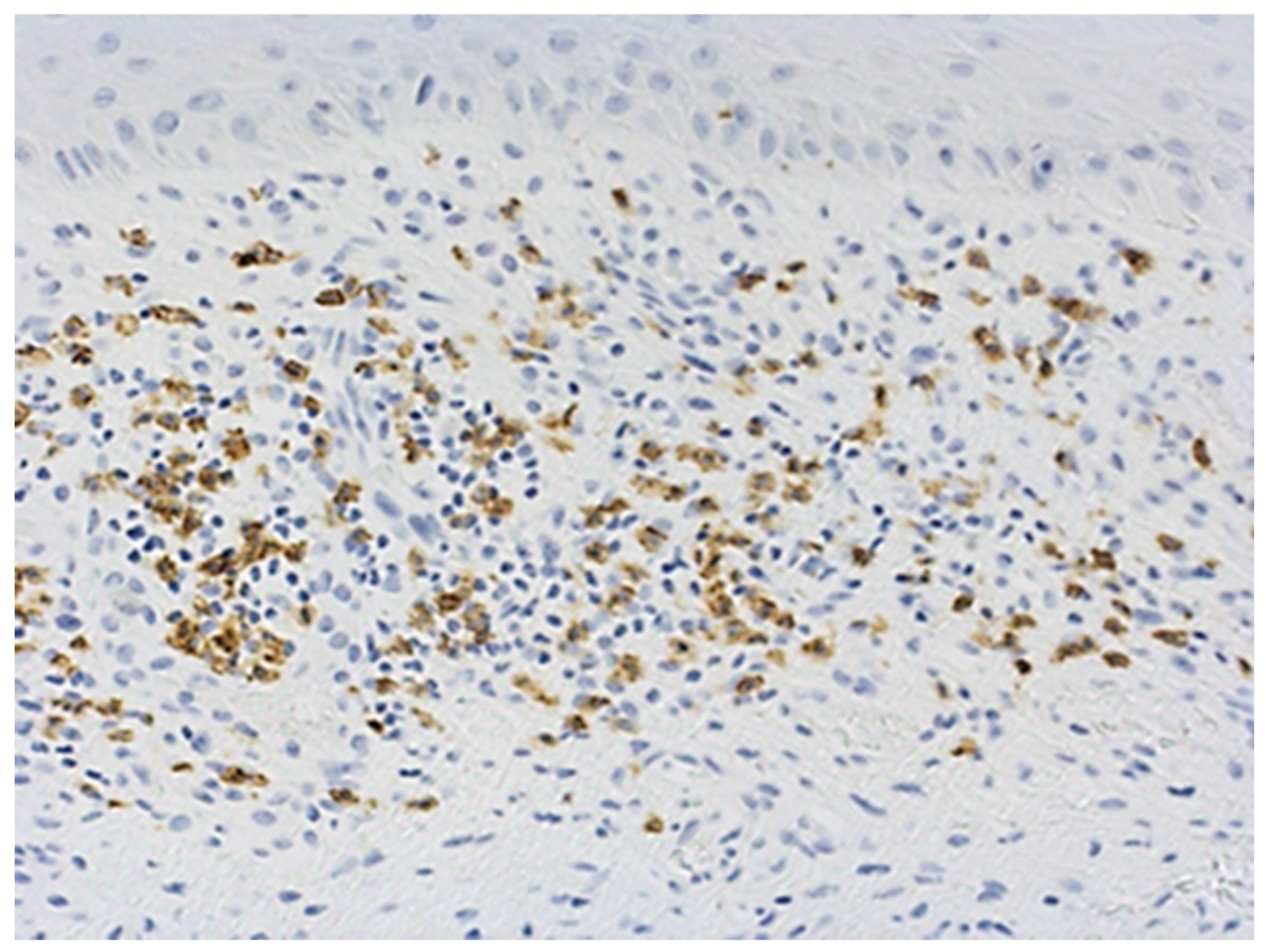
Figure 2.
Dense T lymphocyte infiltration (score 4) under non-homogeneous oral leukoplakia. Immunoperoxidase, anti-CD3, 200 × magnification.
Figure 2.
Dense T lymphocyte infiltration (score 4) under non-homogeneous oral leukoplakia. Immunoperoxidase, anti-CD3, 200 × magnification.
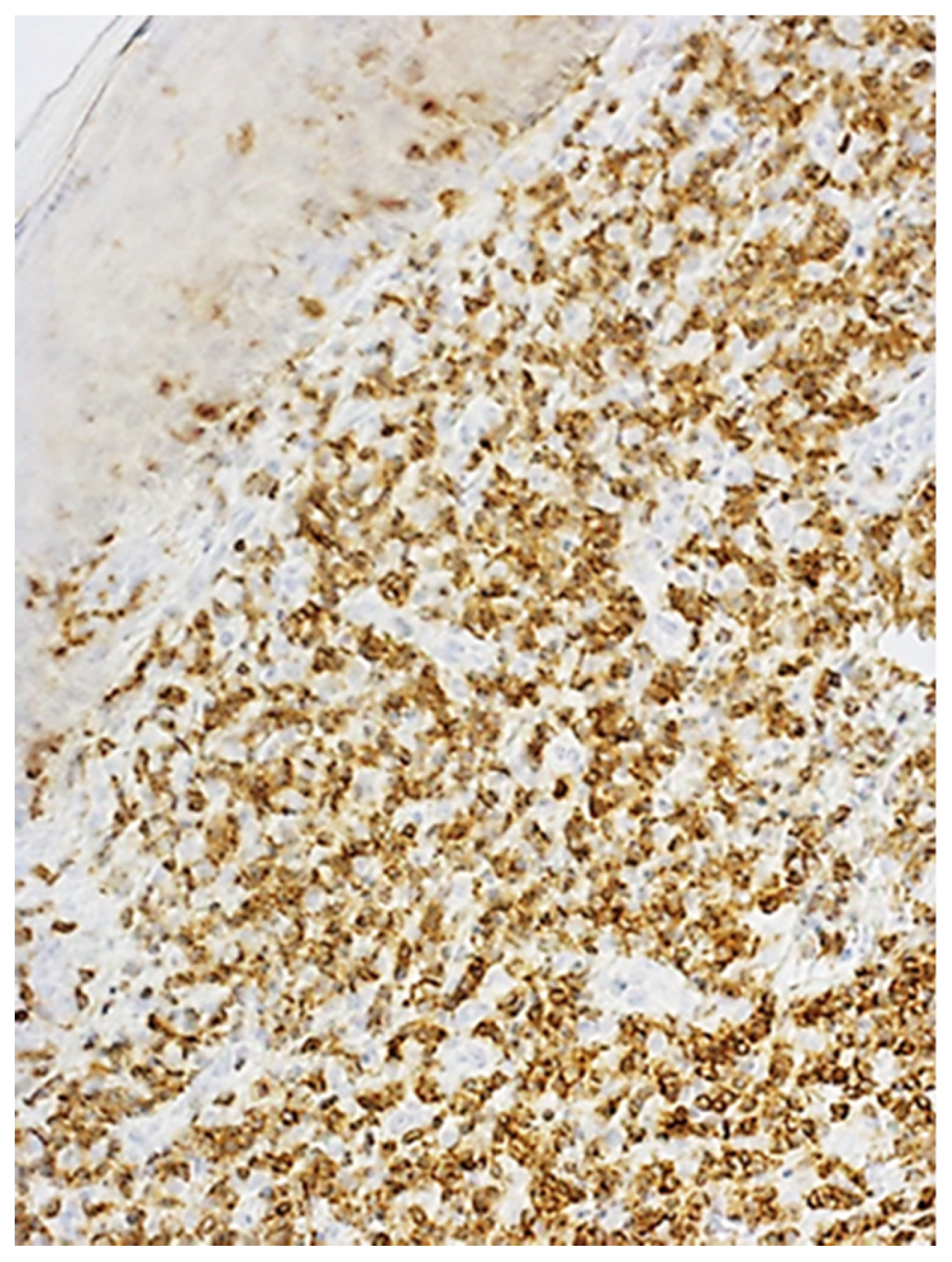
Figure 4.
CD138 antigen expression on squamous epithelial cell membranes and score 1 infiltration with plasma cells under basement membrane of homogeneous oral leukoplakia without dysplasia. Immunoperoxidase, anti-CD138, 200 × magnification.
Figure 4.
CD138 antigen expression on squamous epithelial cell membranes and score 1 infiltration with plasma cells under basement membrane of homogeneous oral leukoplakia without dysplasia. Immunoperoxidase, anti-CD138, 200 × magnification.
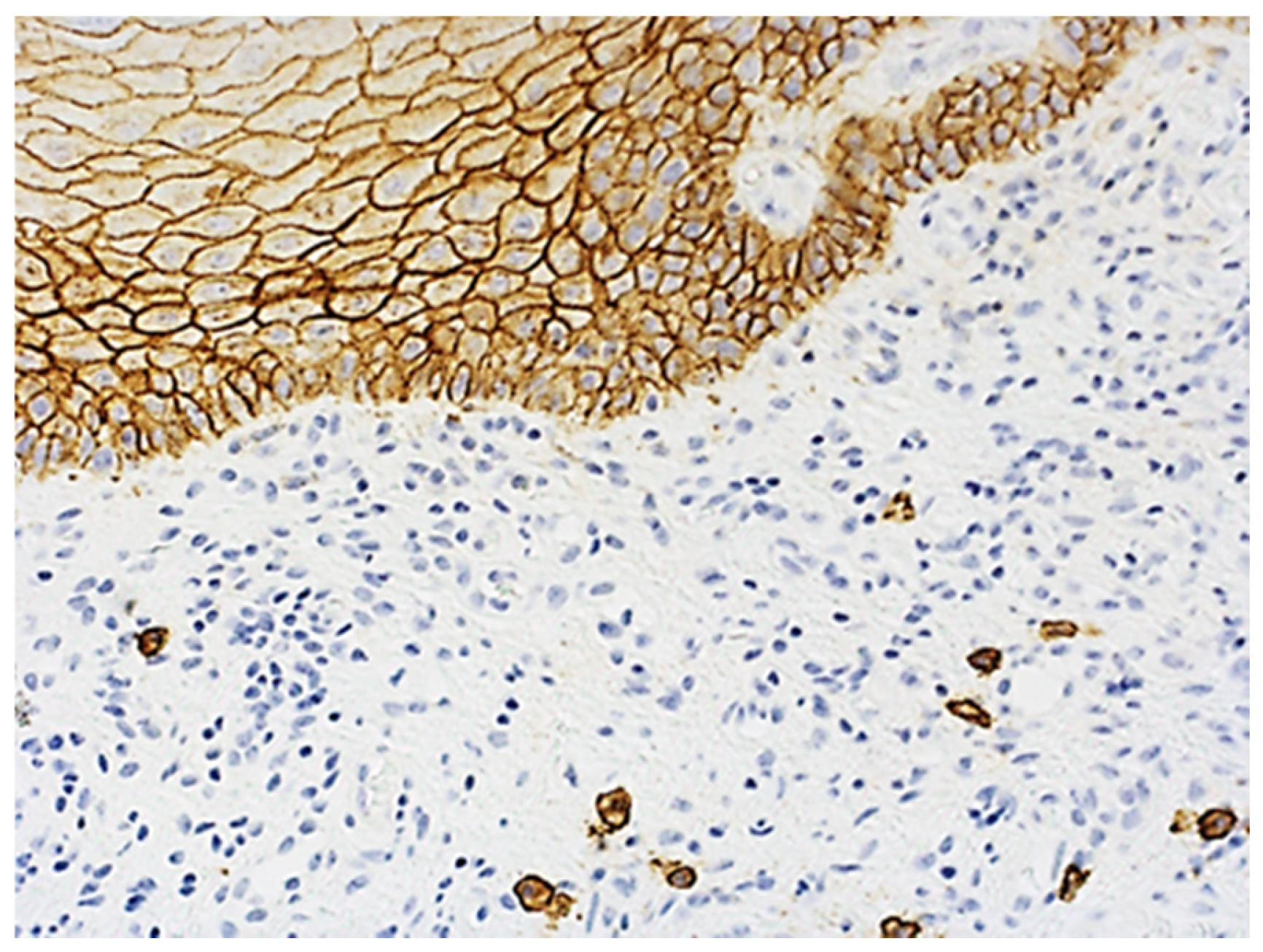
Figure 5.
Dense macrophage CD68 infiltration (score 4) within the deeper zone of lamina propria of non-homogeneous leukoplakia. Immunoperoxidase, anti-CD68, 400 × magnification.
Figure 5.
Dense macrophage CD68 infiltration (score 4) within the deeper zone of lamina propria of non-homogeneous leukoplakia. Immunoperoxidase, anti-CD68, 400 × magnification.
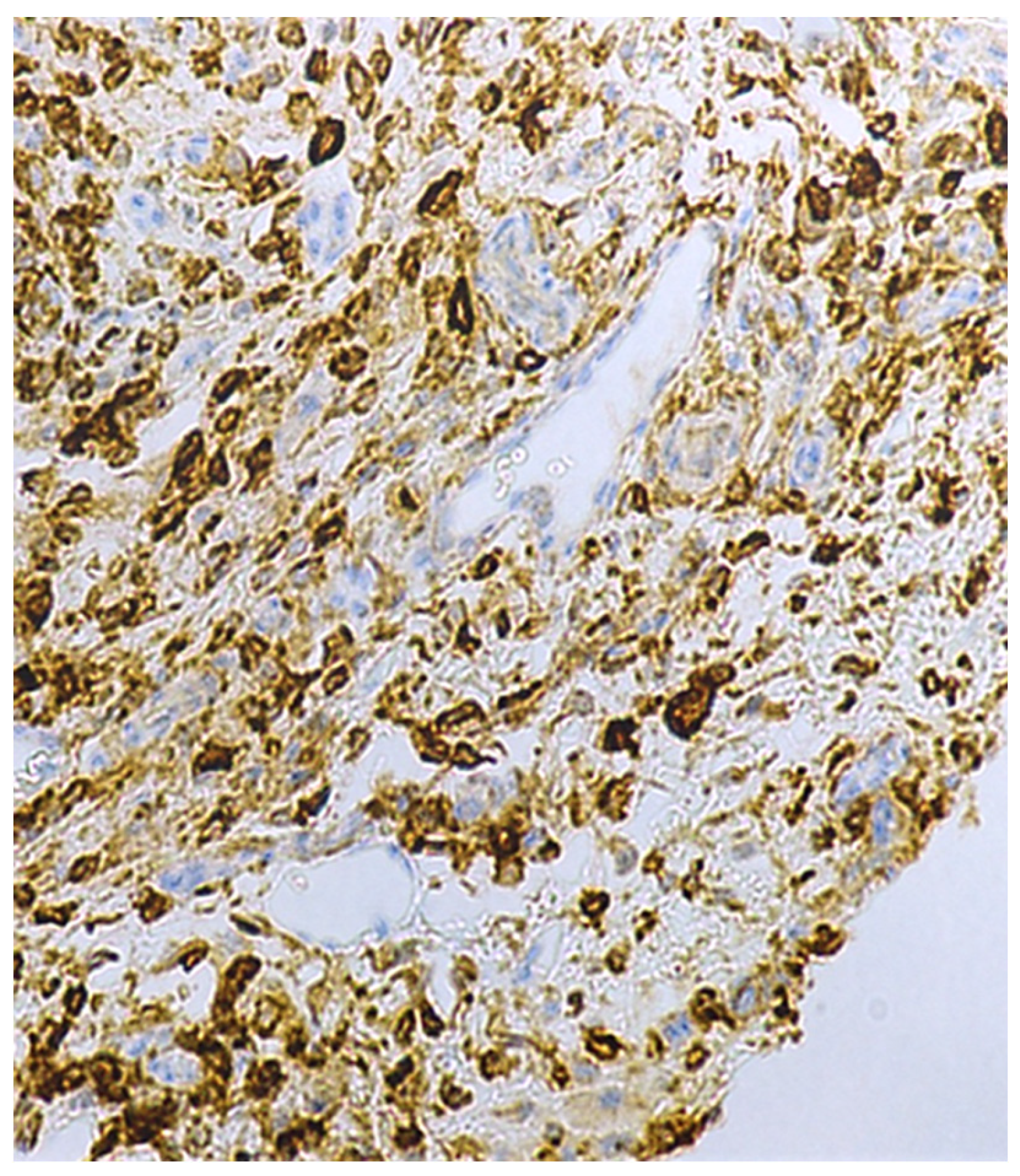
Figure 6.
CD9 antigen expression in the epithelium of small salivary gland duct of oral mucosa, part of lamina propria cells and microparticles of saliva. Immunoperoxidase, anti-CD9, 400 × magnification.
Figure 6.
CD9 antigen expression in the epithelium of small salivary gland duct of oral mucosa, part of lamina propria cells and microparticles of saliva. Immunoperoxidase, anti-CD9, 400 × magnification.
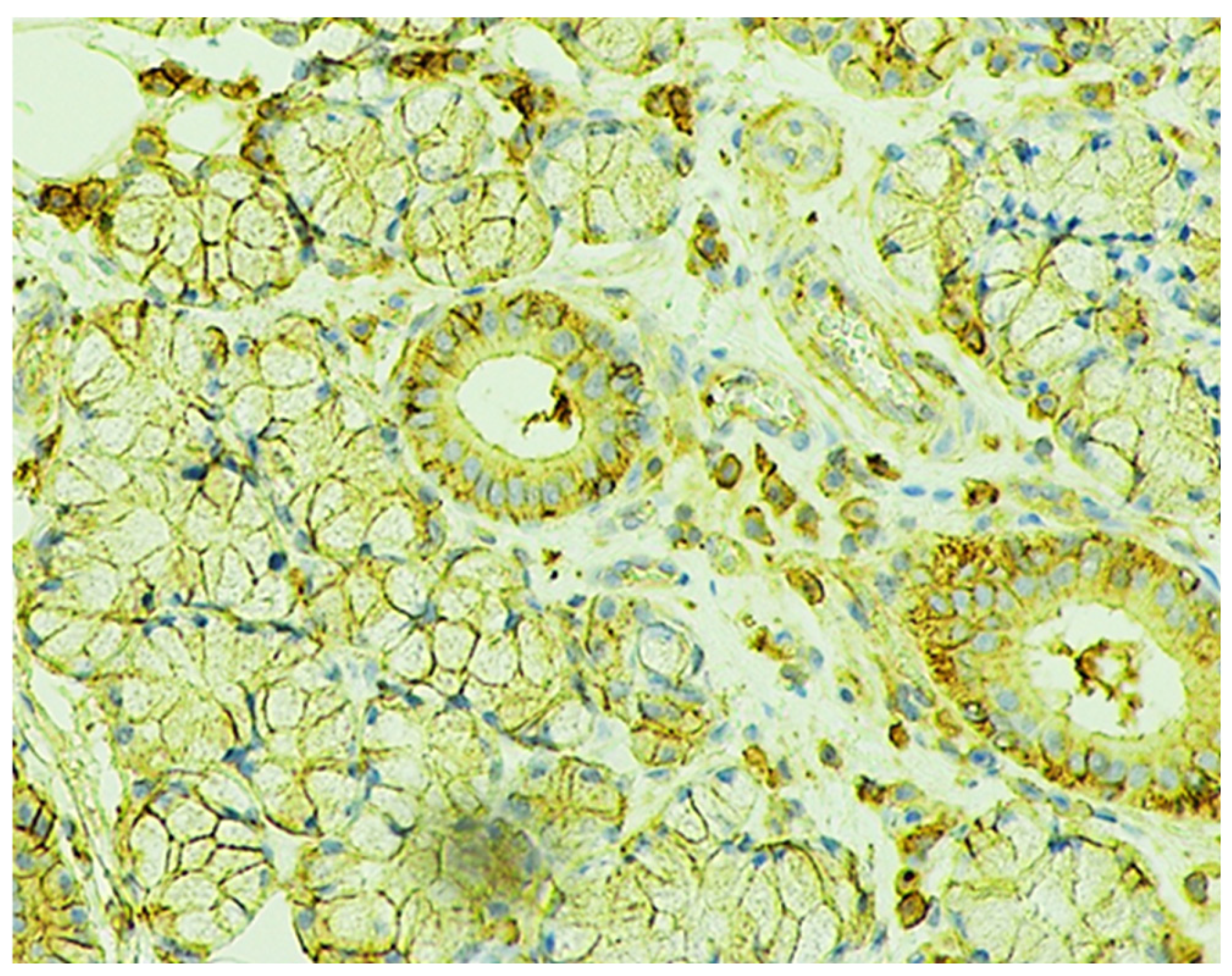
Figure 7.
Homogenous oral leukoplakia without dysplasia. Expression of exosomes associated protein CD9 in the cell membranes of hyperplastic squamous epithelium and on some mononuclear phagocytes (monocytes and macrophages). Immunoperoxidase, anti-CD9, 400 × magnifications.
Figure 7.
Homogenous oral leukoplakia without dysplasia. Expression of exosomes associated protein CD9 in the cell membranes of hyperplastic squamous epithelium and on some mononuclear phagocytes (monocytes and macrophages). Immunoperoxidase, anti-CD9, 400 × magnifications.
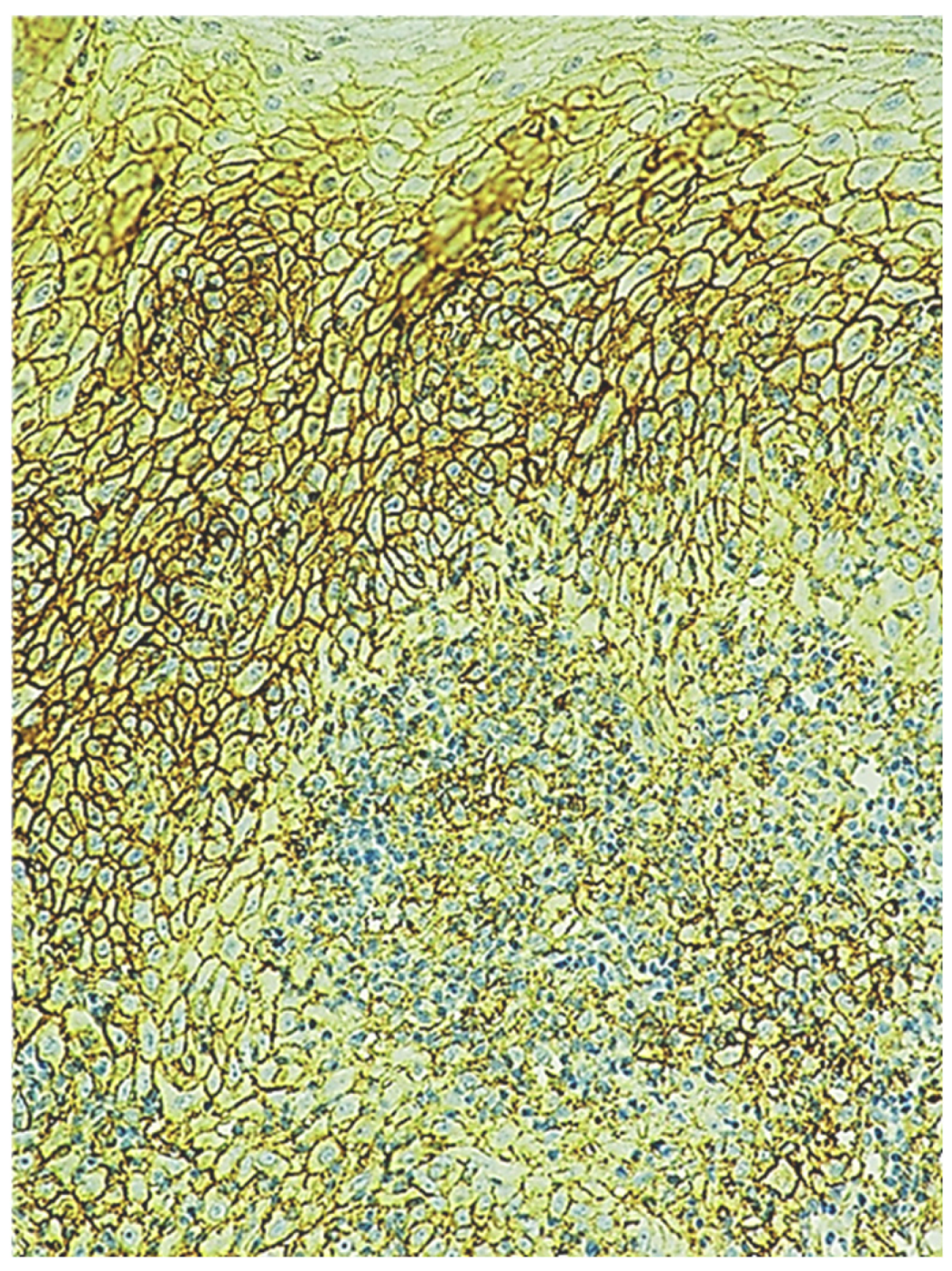
Figure 8.
Compartments abundant in exosomes are present within the membranes and cytoplasm of dysplastic squamous epithelium in non-homogenous oral leuko plakia. Immunoperoxidase, anti-CD9, 400 × magnification. Figure adapted from PhD Thesis by M. Dzudzilo, Riga Stradiņš university, 2024, [83].
Figure 8.
Compartments abundant in exosomes are present within the membranes and cytoplasm of dysplastic squamous epithelium in non-homogenous oral leuko plakia. Immunoperoxidase, anti-CD9, 400 × magnification. Figure adapted from PhD Thesis by M. Dzudzilo, Riga Stradiņš university, 2024, [83].
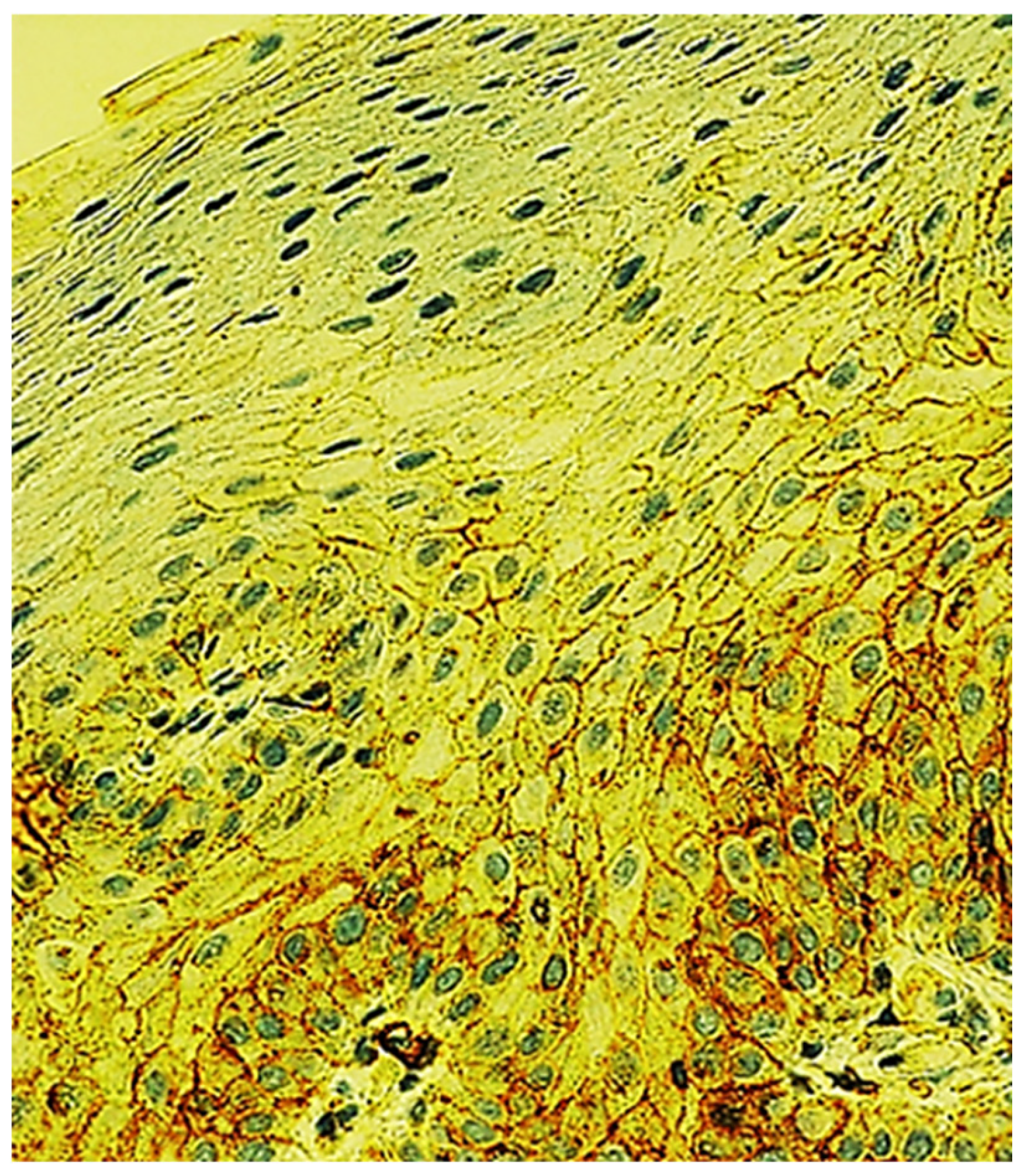
Figure 9.
Non-homogeneous oral leukoplakia. Synchronous strong expression of CD 9 antigen on epithelium and in fibrosis zone of lamina propria. Immunoperoxidase, anti-CD9, 200 × magnification.
Figure 9.
Non-homogeneous oral leukoplakia. Synchronous strong expression of CD 9 antigen on epithelium and in fibrosis zone of lamina propria. Immunoperoxidase, anti-CD9, 200 × magnification.
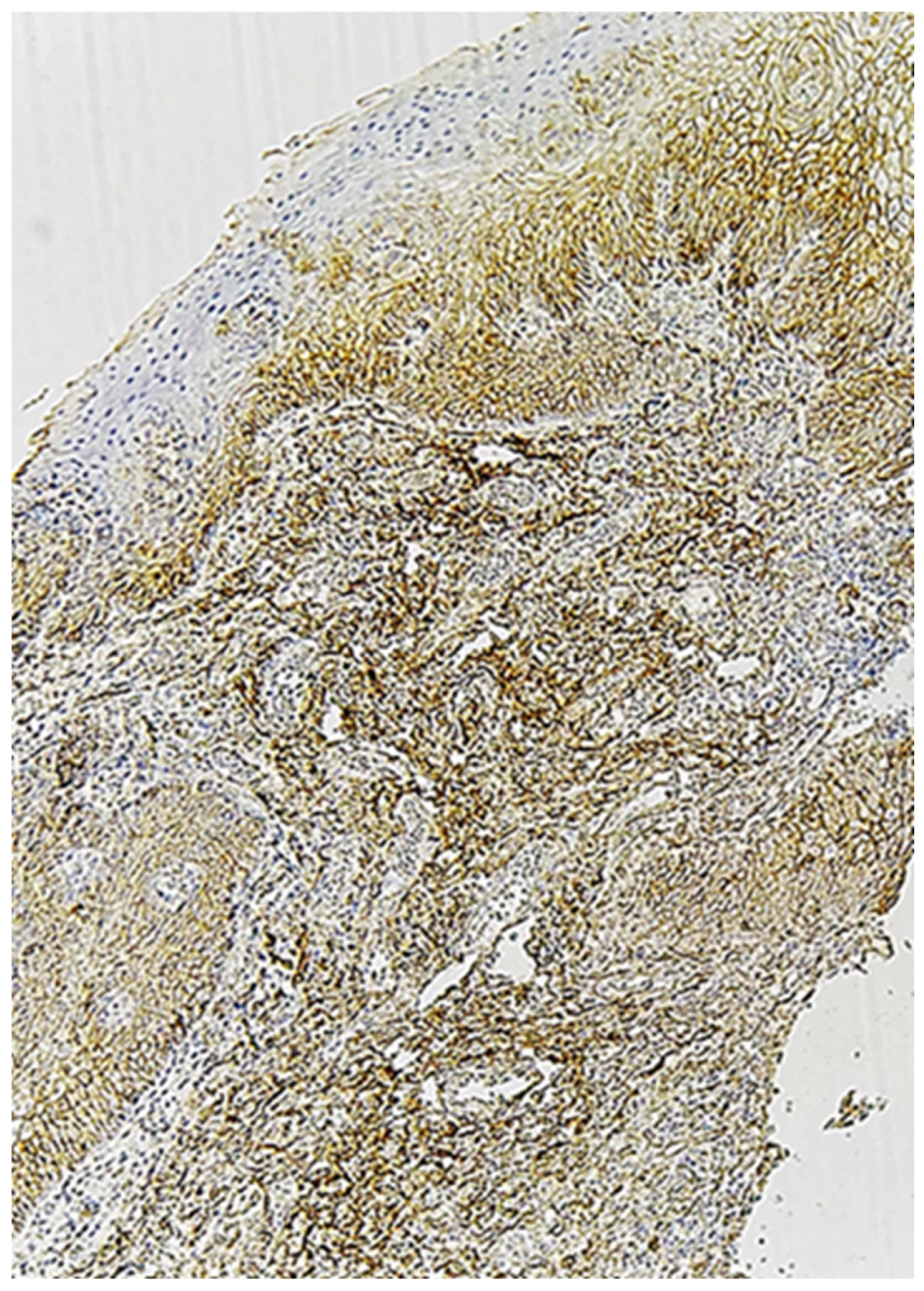
Figure 10.
Compartment-specific analysis of CD9 antigen expression in dysplastic versus non-dysplastic lesions of oral leukoplakia.
Figure 10.
Compartment-specific analysis of CD9 antigen expression in dysplastic versus non-dysplastic lesions of oral leukoplakia.
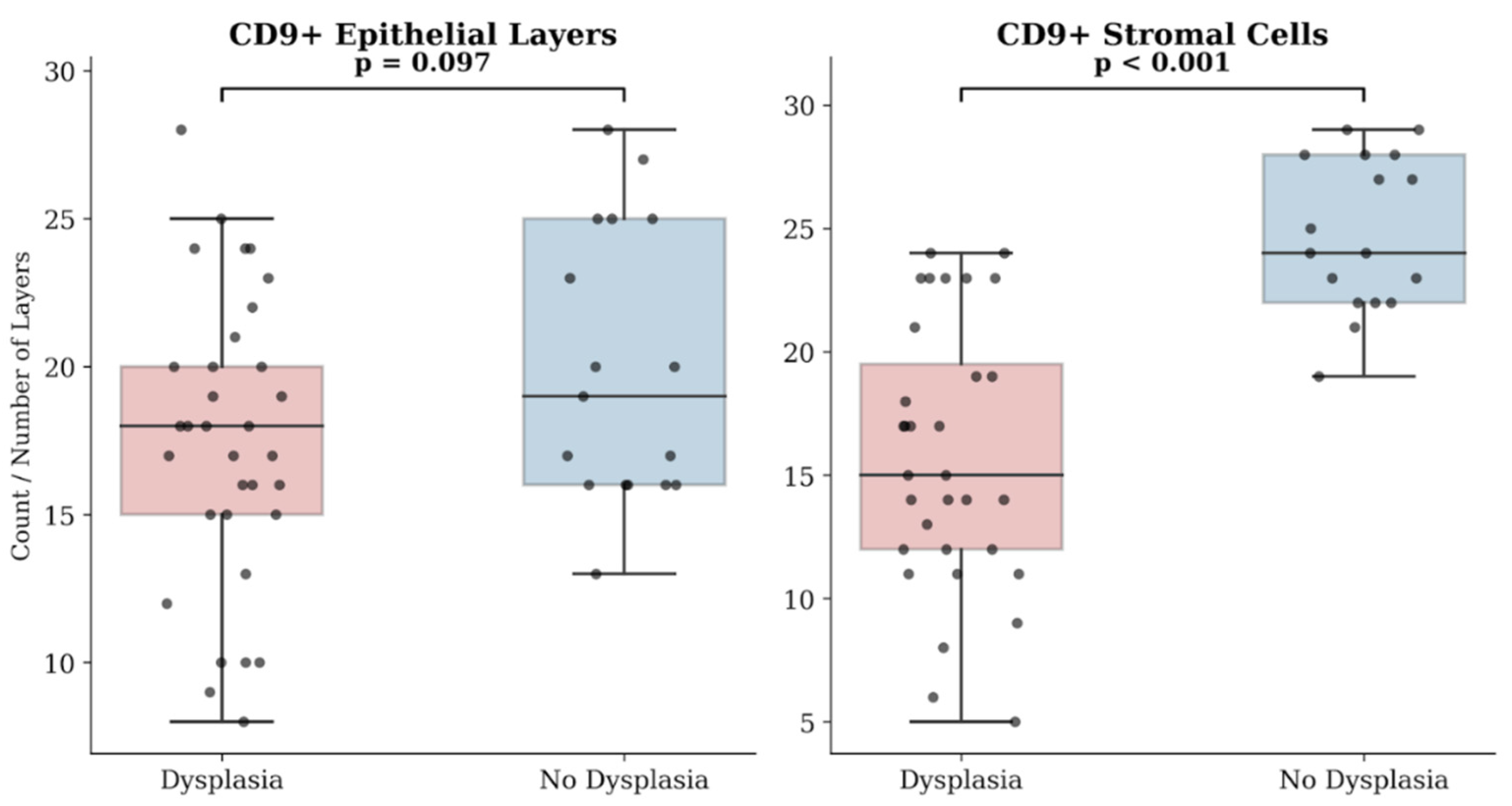
Figure 11.
Scatter plots with linear regression lines and 95% confidence intervals (CI) (shaded areas) show the relationship between epithelial and lamina propria cells labelled with CD9 antigen as a marker of proteins of exosome compartments.
Figure 11.
Scatter plots with linear regression lines and 95% confidence intervals (CI) (shaded areas) show the relationship between epithelial and lamina propria cells labelled with CD9 antigen as a marker of proteins of exosome compartments.
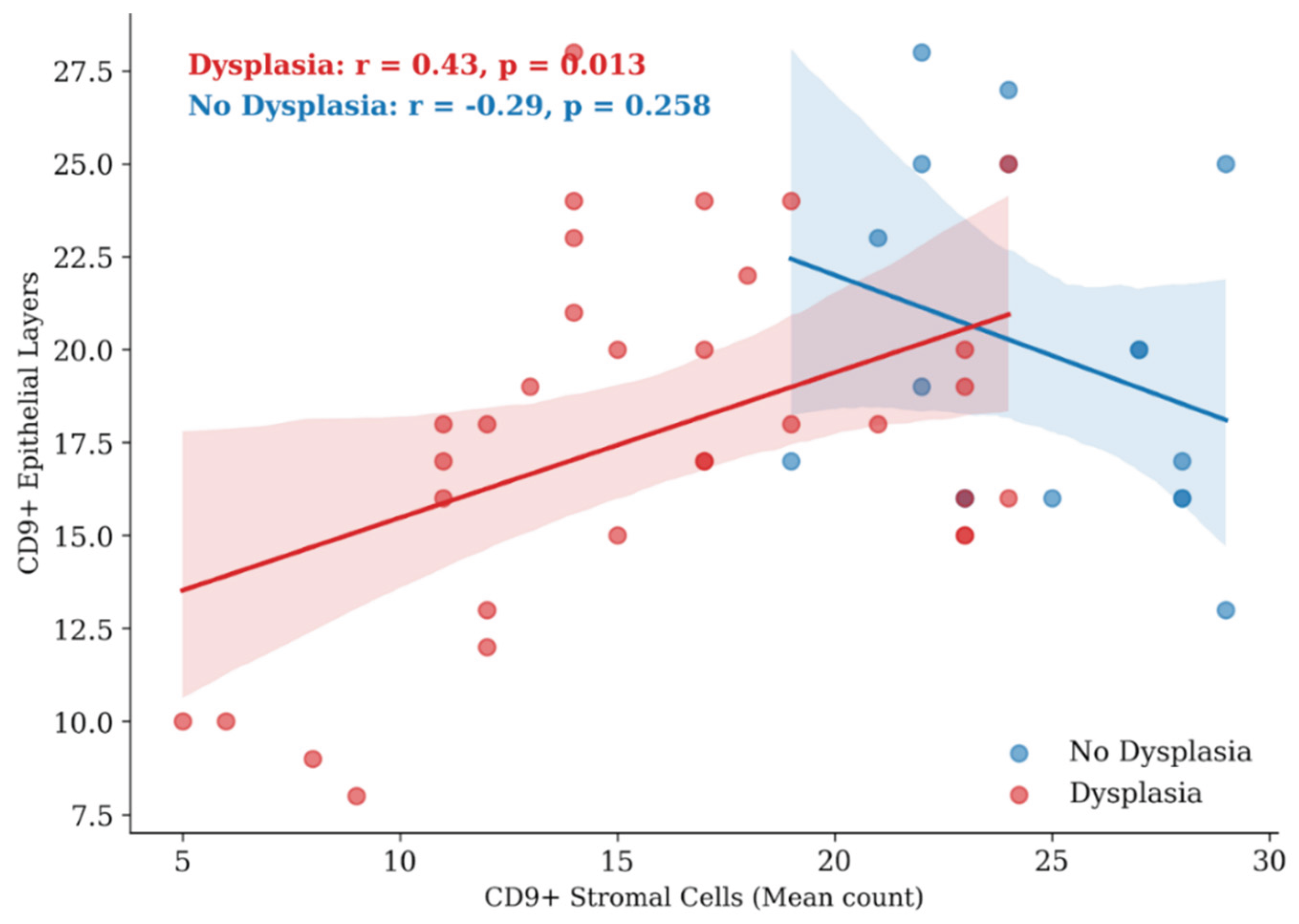

Table 1.
Demographic and clinical characteristics of the study group.
| Characteristic | Total (N=50) | Homogeneous (N=18) | Non-homogeneous (N=32) | p-value |
|---|---|---|---|---|
| Age, years (Mean ± SD) | 57.0 (±14.1) | 54.8 (±13.7) | 58.2 (±14.5) | 0.41 |
| Gender, n (%) | ||||
| Male | 29 (58.0%) | 9 (50.0%) | 20 (62.5%) | 0.575 |
| Female | 21 (42.0%) | 9 (50.0%) | 12 (37.5%) | |
| Localization, n (%) | ||||
| Buccal mucosa | 18 (36.0%) | 8 (44.4%) | 10 (31.2%) | 0.194 |
| Lateral border of tongue | 17 (34.0%) | 4 (22.2%) | 13 (40.6%) | |
| Floor of mouth | 11 (22.0%) | 3 (16.7%) | 8 (25.0%) | |
| Other (Lip, Alveolar ridge) | 4 (8.0%) | 3 (16.7%) | 1 (3.1%) | |
| Dysplasia status, n (%) | ||||
| Presence | 33 (66.0%) | 7 (38.9%) | 26 (81.2%) | 0.006 |
Table 2.
General Linear Model results evaluating the effects of dysplasia and clinical type of oral leukoplakia on immune marker expression, adjusted for age and gender.
Table 2.
General Linear Model results evaluating the effects of dysplasia and clinical type of oral leukoplakia on immune marker expression, adjusted for age and gender.
| Marker | Parameters | df | F | p | Partial η2 |
|---|---|---|---|---|---|
| CD138 | Model | 5 | 33.95 | < 0.001 | 0.794 |
| Clinical type | 1 | 10.54 | 0.002 | 0.193 | |
| Dysplasia | 1 | 72.94 | < 0.001 | 0.624 | |
| Clinical type x dysplasia | 1 | 9.96 | 0.003 | 0.185 | |
| Age | 1 | 0.70 | 0.407 | 0.016 | |
| Gender | 1 | 0.09 | 0.768 | 0.002 | |
| CD20 | Model | 5 | 14.27 | < 0.001 | 0.618 |
| Clinical type | 1 | 8.37 | 0.006 | 0.160 | |
| Dysplasia | 1 | 19.00 | < 0.001 | 0.302 | |
| Clinical type x dysplasia | 1 | 8.87 | 0.005 | 0.168 | |
| Age | 1 | 0.11 | 0.747 | 0.002 | |
| Gender | 1 | 0.06 | 0.811 | 0.001 | |
| CD3 | Model | 5 | 12.57 | < 0.001 | 0.588 |
| Clinical type | 1 | 14.39 | < 0.001 | 0.246 | |
| Dysplasia | 1 | 9.14 | 0.004 | 0.172 | |
| Clinical type x dysplasia | 1 | 8.95 | 0.005 | 0.169 | |
| Age | 1 | 0.00 | 0.974 | 0.000 | |
| Gender | 1 | 0.00 | 0.966 | 0.000 | |
| CD68 | Model | 5 | 30.47 | < 0.001 | 0.776 |
| Clinical type | 1 | 12.47 | < 0.001 | 0.221 | |
| Dysplasia | 1 | 57.08 | < 0.001 | 0.565 | |
| Clinical type x dysplasia | 1 | 12.93 | < 0.001 | 0.227 | |
| Age | 1 | 0.00 | 0.964 | 0.000 | |
| Gender | 1 | 0.16 | 0.687 | 0.004 |
Table 3.
Simple effects analysis decomposing the significant clinical type of oral leukoplakia x dysplasia interaction for each marker. Note: All General Linear Models used 1000 bootstrap resamples for parameter estimation. CI = Confidence Interval. Estimate represents the mean difference in expression levels (dysplasia - no dysplasia) within the specified clinical type of oral leukoplakia.
Table 3.
Simple effects analysis decomposing the significant clinical type of oral leukoplakia x dysplasia interaction for each marker. Note: All General Linear Models used 1000 bootstrap resamples for parameter estimation. CI = Confidence Interval. Estimate represents the mean difference in expression levels (dysplasia - no dysplasia) within the specified clinical type of oral leukoplakia.
| Marker | Oral Leukoplakia: clinical types | Effect of dysplasia (Estimate) | 95% CI | p |
|---|---|---|---|---|
| CD138 | Homogeneous | 0.999 | 0.800 – 1.182 | < 0.001 |
| Non-homogeneous | 2.075 | 1.758 – 2.385 | < 0.001 | |
| CD20 | Homogeneous | 0.419 | 0.006 – 0.951 | 0.284 |
| Non-homogeneous | 1.952 | 1.487 – 2.383 | < 0.001 | |
| CD3 | Homogeneous | 0.043 | -0.363 – 0.419 | 0.894 |
| Non-homogeneous | 1.312 | 0.922 – 1.667 | < 0.001 | |
| CD68 | Homogeneous | 0.885 | 0.509 – 1.178 | 0.005 |
| Non-homogeneous | 2.336 | 1.953 – 2.656 | < 0.001 |
Table 4.
Antibody clones, manufacturers and dilutions.
| Antibody | Clone | Manufacturer | Dilution |
|---|---|---|---|
| CD3 | F7.2.38 | DAKO | Ready-to-use |
| CD20 | L26 | DAKO | Ready-to-use |
| CD138 | M15 | DAKO | Ready-to-use |
| CD68 | KP1 | DAKO | Ready-to-use |
| CD9 | No.4H7B9 | Proteintech | 1:1000 |
Disclaimer/Publisher’s Note: The statements, opinions and data contained in all publications are solely those of the individual author(s) and contributor(s) and not of MDPI and/or the editor(s). MDPI and/or the editor(s) disclaim responsibility for any injury to people or property resulting from any ideas, methods, instructions or products referred to in the content. |
© 2026 by the authors. Licensee MDPI, Basel, Switzerland. This article is an open access article distributed under the terms and conditions of the Creative Commons Attribution (CC BY) license (http://creativecommons.org/licenses/by/4.0/).
Copyright: This open access article is published under a Creative Commons CC BY 4.0 license, which permit the free download, distribution, and reuse, provided that the author and preprint are cited in any reuse.


