

Submitted:
06 March 2026
Posted:
09 March 2026
You are already at the latest version
Abstract
This paper investigates the application of the Symbolic Difference Structure (SSD) method as an innovative tool for multidimensional analysis and classification of elements in the periodic system. By applying the SSD algorithm (\(k=3\)) to five key physicochemical properties—atomic mass, electronegativity, first ionization energy, number of unpaired electrons, and melting point—the study demonstrates that the periodic system exhibits a recognizable numerical geometry that can be systematically quantified. The results show that SSD classification does not alter established chemical periodicity but enables: (1) quantitative discrimination between genuine nuclear anomalies and metrological artifacts, (2) identification of characteristic “hotspots’’ where multiple properties change simultaneously, and (3) a heuristic framework for predicting properties of heavy and superheavy elements. The analysis is extended using monoisotopic masses and correlation studies, confirming the diagnostic value of the method and opening new pathways for comparative analysis in materials science and chemical education.
Keywords:
periodic table
; atomic properties
; symbolic difference structures
; computational chemistry
; numerical periodicity
; materials informatics
1. Introduction
The periodic system of elements represents the foundation of modern chemistry, organizing elements according to their atomic number and recurring (periodic) chemical properties. Although this classification is widely used, quantitatively describing local deviations from periodic trends and the interrelationships among different physicochemical properties remains challenging.
Traditional approaches typically examine each property independently, which makes it difficult to detect synchronous changes of multiple parameters at the level of individual atoms or small groups of elements.
This work introduces the Symbolic Difference Structure (SSD) method as a new diagnostic tool for overcoming these limitations. SSD analysis transforms numerical sequences (such as atomic masses along the periodic system) into symbolic codes that quantify the local geometry of the data—that is, patterns of increase, decrease, or stagnation between three consecutive points.
The goal of this research is to apply the SSD method to several key elemental properties in order to:
- Map local patterns of change and identify statistically significant anomalies.
- Examine whether fundamental nuclear effects can be distinguished from artifacts caused by natural isotopic abundance.
- Identify locations in the periodic system where simultaneous changes in multiple properties occur, indicating fundamental atomic reconfigurations.
- Define a multidimensional “fingerprint’’ for each element based on its SSD profile.
- Test whether the numerical periodicity of SSD patterns follows and confirms classical chemical periodicity.
2. Configuration-Space Interpretation of the Periodic System
Beyond its tabular representation, the periodic system may also be interpreted as a trajectory through a discrete configuration space defined by electronic structure.
Let each element be represented by the tuple
where:
- n is the principal quantum number of the outer shell,
- l is the dominant orbital type (s,p,d,f),
- f represents a coarse-grained electron filling state of the subshell.
Within this representation the periodic system becomes an ordered path
through a discrete configuration manifold.
Local irregularities in physicochemical properties correspond to structural transitions in this configuration space. The SSD method can therefore be interpreted as a diagnostic tool that detects local discontinuities along this trajectory.
3. Methodology
3.1. SSD Algorithm ()
The SSD method is based on analyzing sliding windows within an ordered data sequence. For this study, a window of three consecutive elements ordered by increasing atomic number (Z) was used.
For each triple , where a represents the value of a selected physicochemical property, the following relations are calculated:
Each of these differences is mapped into a symbolic value s according to its sign or magnitude relation.
- Symbol < is assigned if the difference is negative (for primary differences) or if (for the secondary difference). Value: .
- Symbol > is assigned if the difference is positive (for primary differences) or if . Value: .
- Symbol = is assigned if the differences are equal within a defined tolerance. Value: .
The final SSD code is calculated as:
where , , and correspond to the first primary, second primary, and secondary differences. The SSD code therefore ranges from 0 to 26.
3.2. Data Sources
The SSD method was applied to the following datasets:
- Standard atomic masses from IUPAC Standard Atomic Weights.
- Monoisotopic masses from the NIST Atomic Weights and Isotopic Compositions database.
- Pauling electronegativities from the CRC Handbook of Chemistry and Physics (100th edition).
- First ionization energies (kJ/mol) from the CRC Handbook.
- Number of unpaired electrons determined from ground-state electron configurations using Hund’s rule.
- Melting points (°C) obtained from the NIST Chemistry WebBook and related sources, supplemented with theoretical estimates for superheavy elements.
3.3. Interpretation of SSD as a Structural Detector
Within the configuration-space representation, SSD codes may be interpreted as local topological descriptors of the trajectory of the periodic system.
A change in SSD code corresponds to a change in the local curvature of the physicochemical sequence. In many cases these transitions coincide with electronic structural reorganizations such as:
- shell closure,
- subshell half-filling,
- orbital transition (e.g. s–p or p–d),
- relativistic stabilization effects in heavy elements.
The SSD method therefore acts as a numerical sensor for structural transitions in atomic systems.
4. Results and Analysis
4.1. Distribution of SSD Codes Across Properties
Analysis of SSD code distributions provides insight into the overall nature of change for each property across the periodic system.
Figure 1.
Typical distribution of SSD codes illustrating the dominance of monotonic growth patterns and the rarity of structural anomalies.
Figure 1.
Typical distribution of SSD codes illustrating the dominance of monotonic growth patterns and the rarity of structural anomalies.
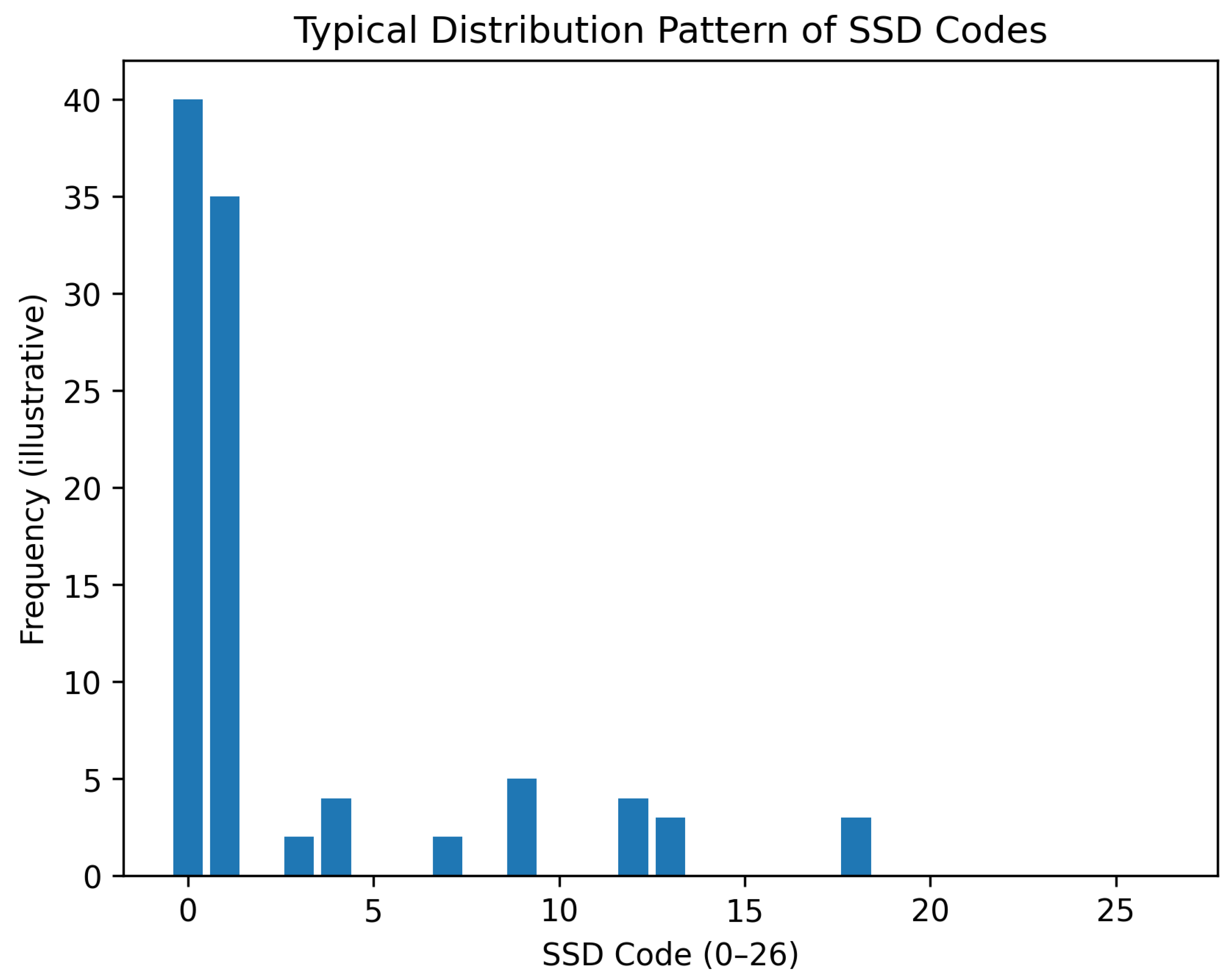
Figure 2.
Workflow of the Symbolic Difference Structure (SSD) algorithm applied to physicochemical sequences.
Figure 2.
Workflow of the Symbolic Difference Structure (SSD) algorithm applied to physicochemical sequences.
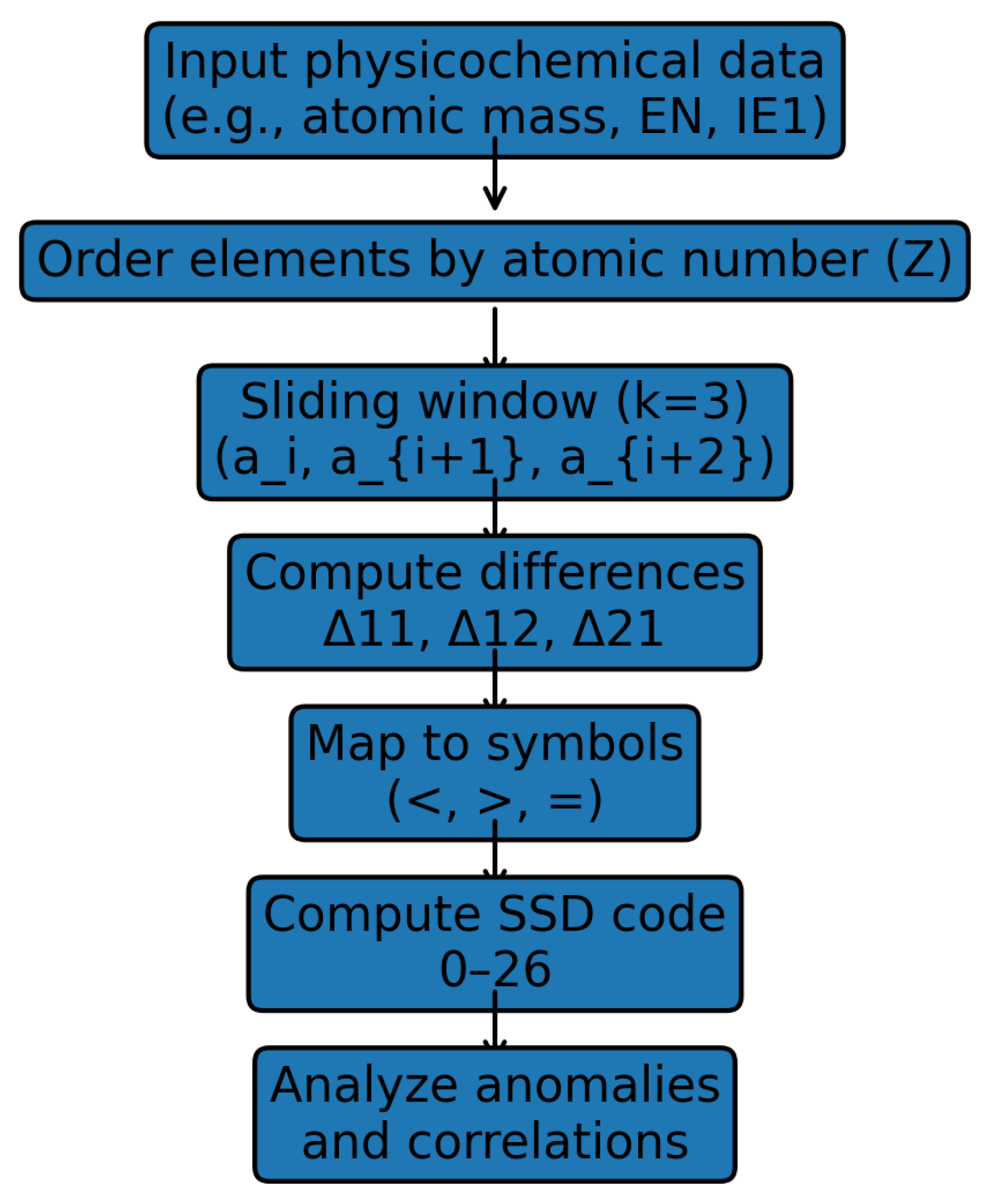
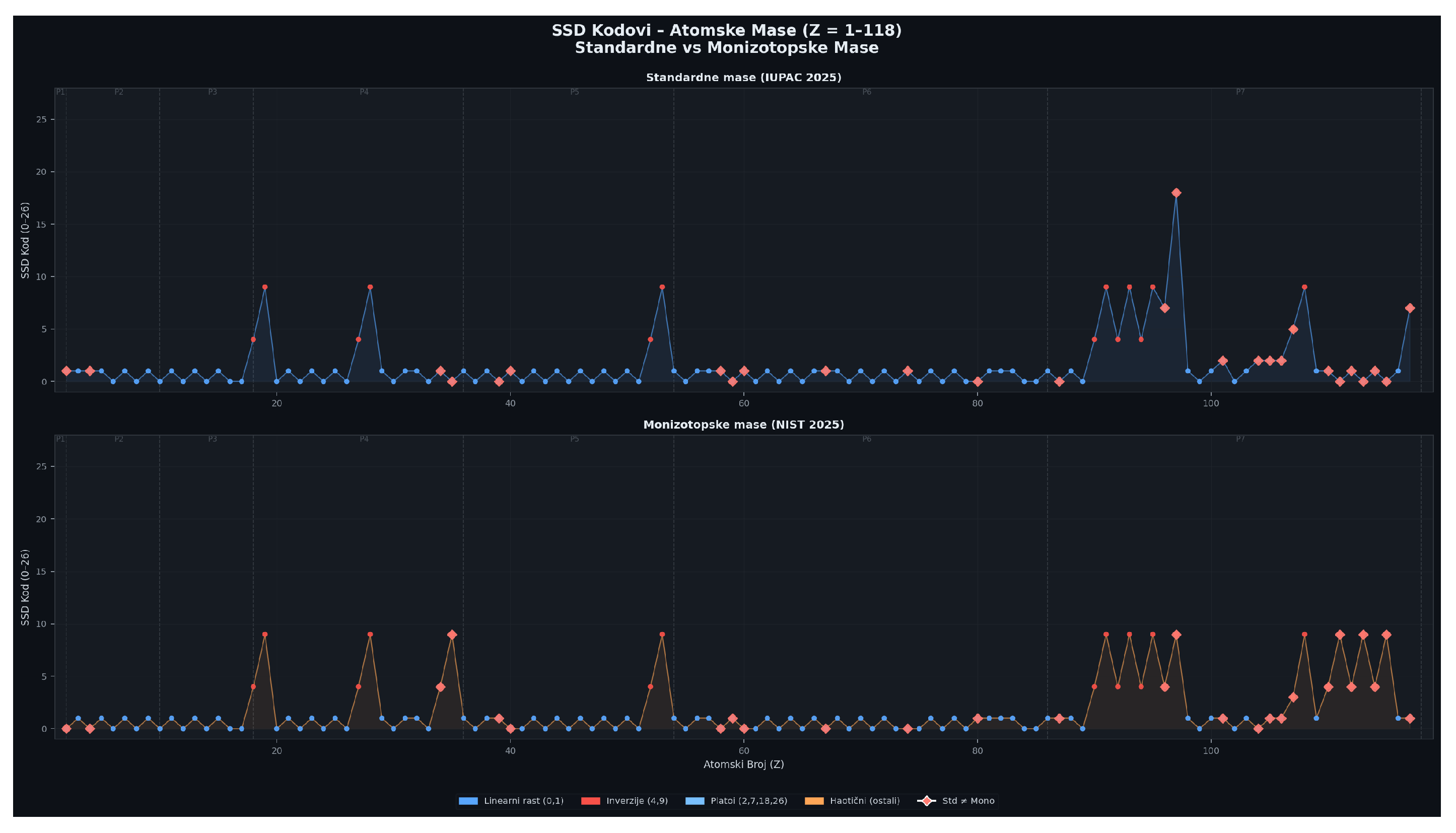
Figure 3.
SSD codes for atomic masses across the periodic table ().
Atomic Mass.
Figure 4.
Schematic distribution of SSD structural transitions across atomic numbers. Peaks correspond to electronic structural boundaries such as shell closures and subshell reorganizations.
Figure 4.
Schematic distribution of SSD structural transitions across atomic numbers. Peaks correspond to electronic structural boundaries such as shell closures and subshell reorganizations.
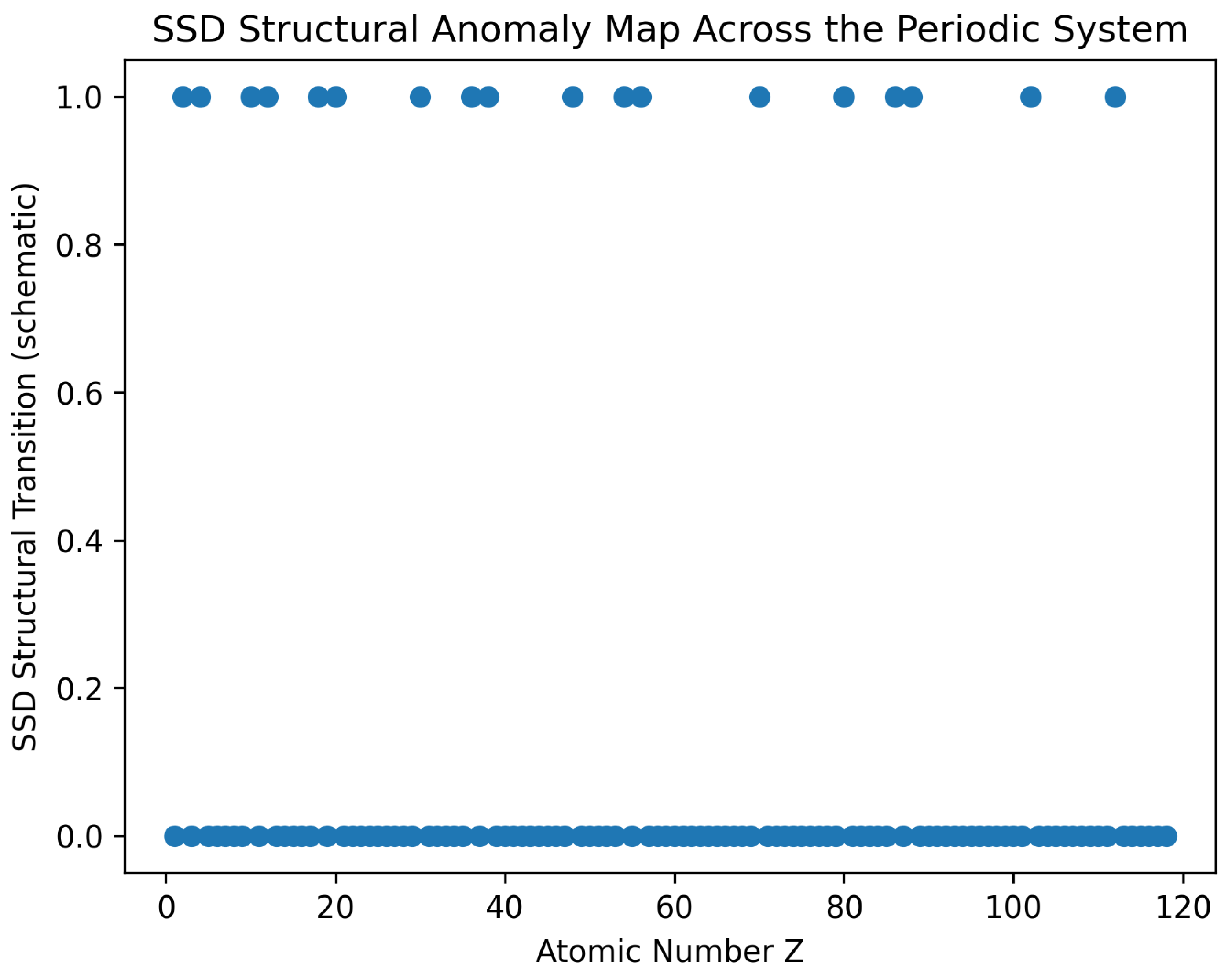
Figure 5.
Trajectory of the periodic system through a coarse configuration space defined by the tuple representing principal shell, orbital type, and filling state.
The SSD distribution for atomic masses shows a strong dominance of codes 0 and 1 . This reflects the expected nearly monotonic growth of atomic mass with increasing atomic number.
Code 0 represents constant acceleration of growth, whereas code 1 indicates steady growth with slight deceleration.
Rare codes such as 3, 4, 7, 9, and 18 correspond to statistically significant anomalies.
Melting Points.
Unlike atomic mass, the SSD distribution for melting points is considerably more diverse. Codes 12 and 13 appear frequently. This diversity reflects the complex nature of melting points, which depend on bonding type, crystal structure, and intermolecular forces.
4.2. Topological Classification of Elements
Based on characteristic SSD codes, elements can be classified into several topological groups describing their local behavior relative to neighboring elements.
| SSD Group | Characteristic Codes | Key Feature | Example Elements |
| Linear Growers | 0,1 | Stable monotonic increase | Lanthanides |
| Inverters | 4,9 | Reversal of trend | Ar–K–Ca |
| Plateaus | 7,18,2 | Stagnation or slowing | Cm–Bk–Cf |
| Chaotic Jumpers | 3,12,13 | Sudden complex changes | Mn–Fe–Co |
| Perfect Plateaus | 26 | Complete equality | He–Li–Be |
4.3. Critical Points: Atomic Mass Anomalies
To quantify anomaly significance, the absolute change in SSD code relative to the previous triple was calculated:
Large values correspond to abrupt structural changes in the mass progression pattern.
The strongest anomalies occur in the actinide region (Cm–Bk–Cf) and among superheavy elements (Sg–Bh–Hs).
Classical inversions such as Ar–K, Co–Ni, and Te–I are clearly detected by the SSD method.
4.4. Taxonomy of SSD Structural Transitions
SSD transitions may be categorized according to the physical origin of the detected anomaly.
| Type | Structural Origin | Example |
| T1 | Orbital transition | Be–B |
| T2 | Shell closure | Cl–Ar |
| T3 | Principal shell jump | Ar–K |
| T4 | Half-filled stabilization | Cr–Mn |
| T5 | Subshell reconstruction | Fe–Co–Ni |
This classification helps distinguish purely numerical anomalies from transitions associated with known quantum-chemical mechanisms.
5. Advanced Analyses
5.1. Discrimination of Nuclear Anomalies
Applying SSD analysis to monoisotopic masses allows separation of genuine nuclear phenomena from artifacts caused by natural isotopic distributions.
For example:
- Ar–K inversion remains present using monoisotopic masses, confirming a nuclear origin.
- Co–Ni and Te–I inversions also remain robust.
- Actinide anomalies disappear when monoisotopic masses are used, revealing isotopic abundance effects.
5.2. Electronegativity and Ionization Energy
Electronegativity SSD distributions resemble those of atomic masses, dominated by codes 0 and 1.
The strongest anomaly occurs at the triple P–S–Cl, reflecting a sharp increase in electronegativity toward chlorine.
Ionization energy distributions are broader, reflecting sensitivity to electron configuration.
5.3. Correlation Analysis: Synchronous Ticks
Figure 6.
Correlation structure between SSD patterns derived from different physicochemical properties.
Figure 6.
Correlation structure between SSD patterns derived from different physicochemical properties.
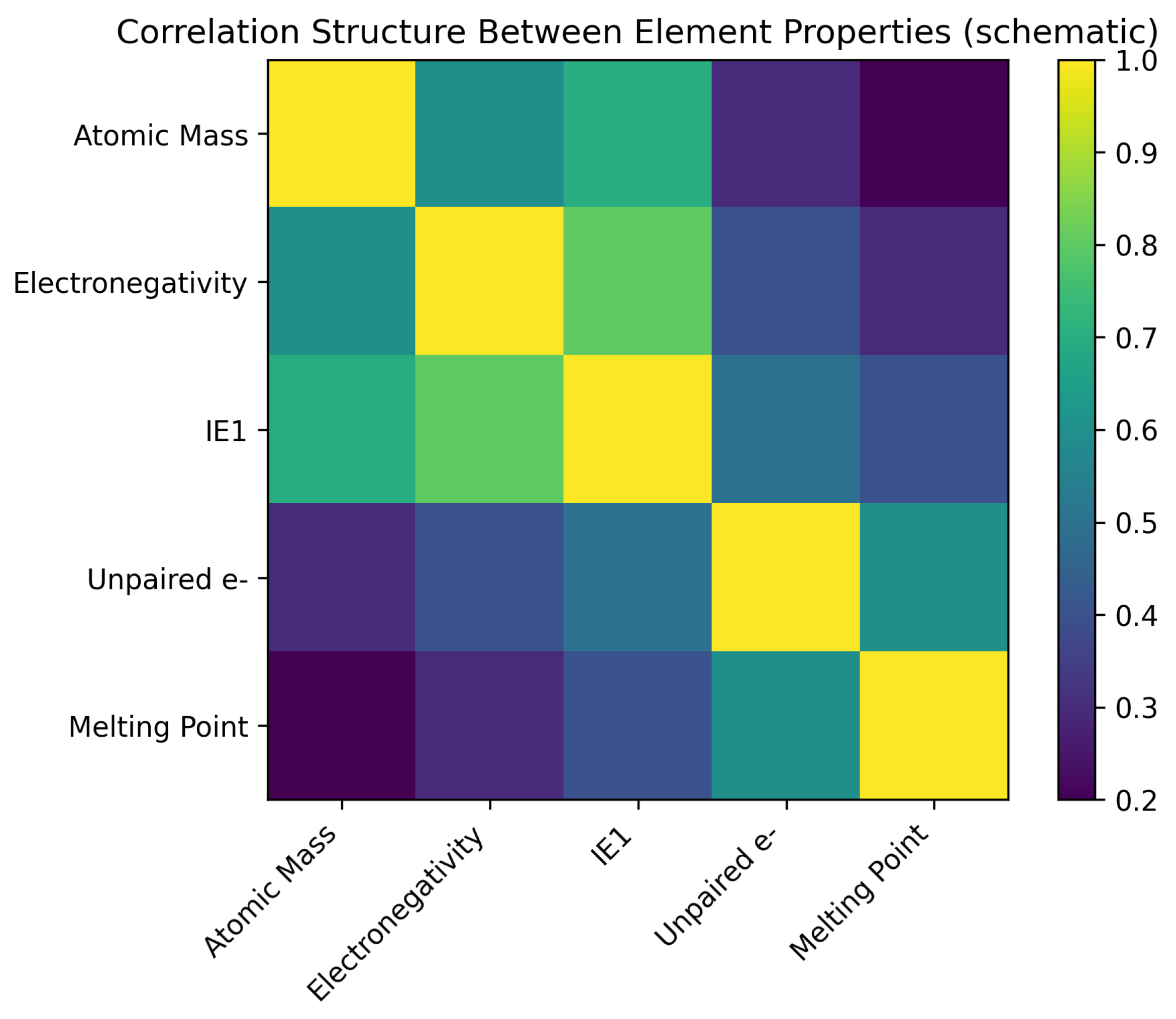
One of the most significant results is the identification of “hotspots’’ where SSD codes change simultaneously for multiple properties.
Figure 7.
Schematic distribution of SSD anomalies across atomic numbers highlighting structural transitions in the periodic system.
Figure 7.
Schematic distribution of SSD anomalies across atomic numbers highlighting structural transitions in the periodic system.
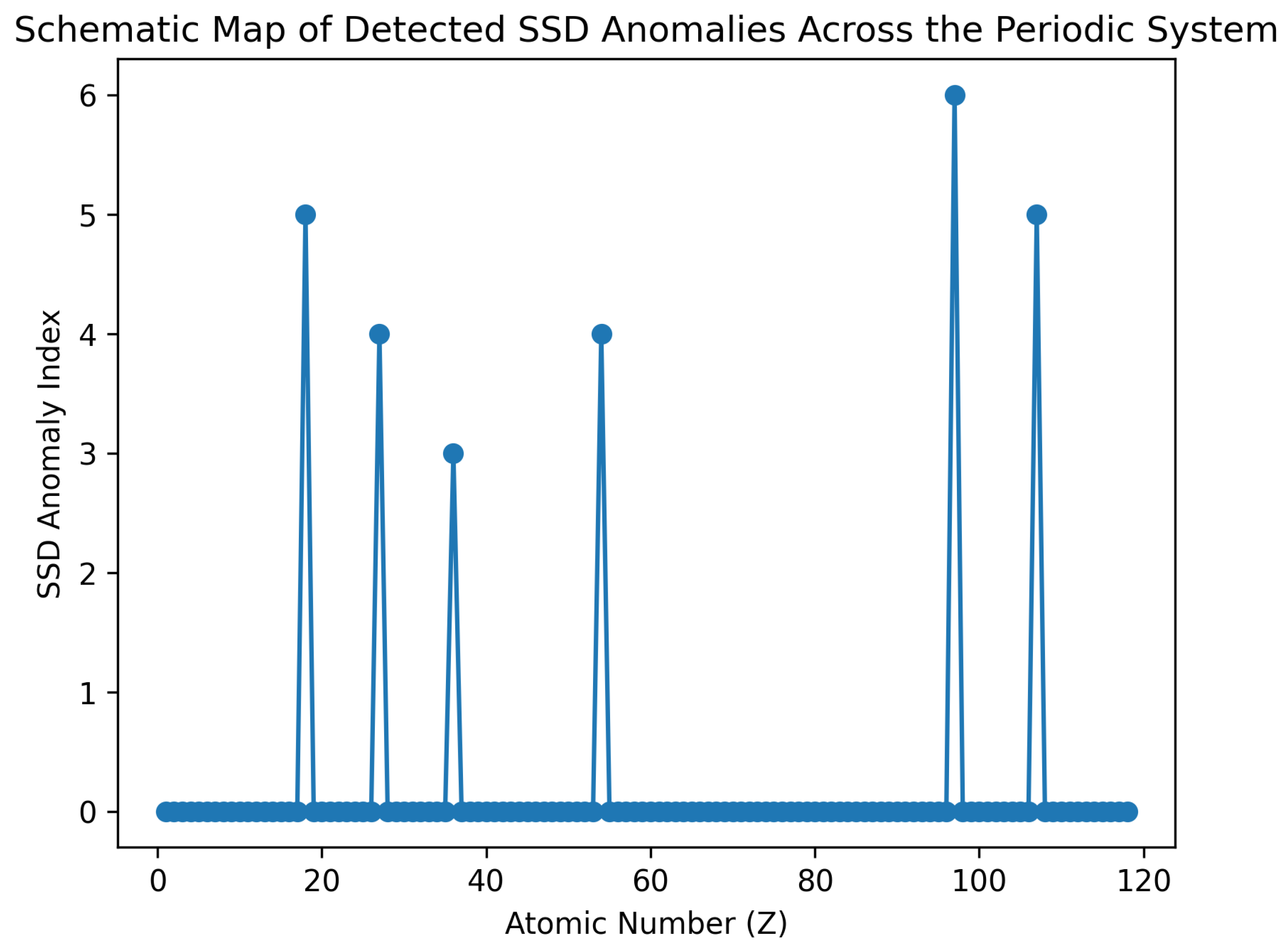
Examples include:
- Cl–Ar–K
- I–Xe–Cs
These transitions represent fundamental boundaries in the periodic system, marking transitions from halogens to noble gases and alkali metals.
5.4. Element SSD Fingerprint
Each element can be described by an SSD vector containing codes for all analyzed properties.
For iron (Fe, ):
This fingerprint quantitatively characterizes iron as a nucleus-stable element with complex electronic and structural behavior associated with ferromagnetism.
6. Predictions for Superheavy Elements
Using SSD heuristics, predictions can be formulated for yet-undiscovered elements of the eighth period.
| Element | Predicted Isotope | Expected SSD Code | Behavior |
| Z=119 (Uue) | 297Uue | 18 | Plateau-to-growth transition |
| Z=120 (Ubn) | 302Ubn | 0 | Stable monotonic growth |
These predictions represent heuristic guides for future experimental exploration.
7. Discussion
From a broader perspective, the periodic system may be interpreted as a discrete dynamical trajectory through configuration space. Within this framework SSD codes represent local curvature descriptors of physicochemical trends. Regions where multiple properties exhibit synchronous SSD transitions correspond to structural boundaries in the periodic system. These boundaries frequently coincide with known electronic phenomena such as shell closure or subshell stabilization.
SSD methodology proves to be a powerful operational tool for quantifying local irregularities in physicochemical sequences.
Its main contributions include:
- distinguishing artifacts from genuine nuclear anomalies,
- objectively identifying periodic boundaries,
- providing multidimensional numerical profiles of elements,
- mapping complex non-monotonic properties such as melting points.
However, several limitations should be considered:
- Dependence on data quality, especially for superheavy elements.
- Local nature of the method due to window size .
- Descriptive character; SSD detects anomalies but does not explain them.
8. Conclusion
This study presented the Symbolic Difference Structure (SSD) method as a new diagnostic, classificatory, and heuristic tool for analyzing the periodic system of elements.
The results demonstrate that:
- SSD analysis can distinguish genuine nuclear anomalies from isotopic artifacts.
- Synchronous SSD ticks across multiple properties identify critical periodic boundaries.
- The SSD vector provides a unique multidimensional fingerprint for each element.
- Numerical periodicity of SSD patterns independently confirms classical periodicity.
- The method successfully quantifies complex properties such as melting points.
Future research directions include expanding the analysis to additional properties such as atomic radii and thermal conductivity, exploring larger SSD windows (, ), and integrating SSD vectors into machine learning models for materials prediction.
Funding
This research received no external funding.
Institutional Review Board Statement
Not applicable.
Informed Consent Statement
Not applicable.
Acknowledgments
The author thanks the open mathematical computing community for publicly accessible high-precision datasets.
Conflicts of Interest
The author declares no conflict of interest.
References
- Scerri, E. The Periodic Table: Its Story and Its Significance. Oxford University Press.
- Jensen, W.B. The Origin of the Periodic Table. Journal of Chemical Education.
- Pyykkö, P. Relativistic Effects in Chemistry. Chemical Reviews.
- Schwarz, W.H.E. The Full Story of the Electron Configurations of the Periodic Table. Journal of Chemical Education.
- IUPAC (2025). Standard Atomic Weights. https://www.iupac.org/atomic-weights/.
- NIST (2025). Atomic Weights and Isotopic Compositions.
- Rumble, J.R. (Ed.) CRC Handbook of Chemistry and Physics, 100th Edition.
- NIST Chemistry WebBook SRD 69.
- NIST Atomic Weights and Isotopic Composition Database.
- Pangarić, Z. Symbolic Geometry of the Number π: Structures, Statistics, and Security. Preprints (2026).
Disclaimer/Publisher’s Note: The statements, opinions and data contained in all publications are solely those of the individual author(s) and contributor(s) and not of MDPI and/or the editor(s). MDPI and/or the editor(s) disclaim responsibility for any injury to people or property resulting from any ideas, methods, instructions or products referred to in the content. |
© 2026 by the authors. Licensee MDPI, Basel, Switzerland. This article is an open access article distributed under the terms and conditions of the Creative Commons Attribution (CC BY) license (http://creativecommons.org/licenses/by/4.0/).
Copyright: This open access article is published under a Creative Commons CC BY 4.0 license, which permit the free download, distribution, and reuse, provided that the author and preprint are cited in any reuse.