

Submitted:
05 March 2026
Posted:
06 March 2026
You are already at the latest version
Abstract
Background/Objective: Nurses play a central role in operationalizing integration through coordination, screening, nursing care processes, community empowerment, and reporting. This study to examine the empirical distribution of an Implementation Fidelity Index (IFI) for nurse-led integrated primary care in Indonesia, grounded in five core domains: planning and coordination, early detection, nursing care processes, community education and empowerment, and reporting. Methods: We conducted a cross-sectional, facility-based online survey in 2025 among registered nurses working in Indonesian primary health care facilities (Puskesmas) and involved in integrated primary care activities. Implementation was measured using a structured 28-item questionnaire across five domains: planning/coordination, early detection, nursing care processes, community education/empowerment, and reporting (Likert 1–5). Domain scores were calculated as the mean of items within each domain; the overall Implementation IFI was calculated as the mean across all items and as the summed total score (range 28–140). We summarized domain and overall distributions (mean, SD, range) and examined inter-domain associations using Spearman correlations. Results: A total of 252 nurses completed the survey with no missing item responses. Overall IFI (item-mean) was 3.99 (SD 0.92; range 1.04–5.00), corresponding to a total score mean of 111.84 (SD 25.90; range 29–140). Domain means were highest for nursing care processes (4.28, SD 0.91) and early detection (4.09, SD 0.94), and lowest for community education/empowerment (3.75, SD 1.10). Using mean ±1 SD thresholds, 12.3% of nurses were categorized as low implementers, 71.8% moderate, and 15.9% high, indicating substantial heterogeneity. Inter-domain correlations were consistently positive and moderate-to-strong (ρ≈0.54–0.80; p<0.001). Conclusions: Nurse-led integrated primary care implementation in Indonesia was moderate-to-high overall but uneven across nurses and domains, with comparatively weaker performance in community empowerment and reporting.
Keywords:
implementation fidelity
; integrated primary care
; nurses
; primary health care
; integrated primary services
1. Introduction
Health systems worldwide continue to struggle with a familiar paradox: primary health care (PHC) is expected to deliver comprehensive, people-centered services across the life course, yet service delivery often remains fragmented across programs, cadres, and information systems. This fragmentation is particularly costly as populations age and non-communicable diseases (NCDs) rise, increasing the need for coordinated prevention, early detection, longitudinal care, and community-based self-management support. In practice, integration is not achieved by policy intent alone; it depends on whether frontline teams consistently enact core integration functions planning and coordination, proactive screening, standardized clinical processes, community empowerment, and reliable documentation/reporting at scale and with quality [1].
Nurses are central to closing this “integration gap.” Across PHC settings, nurses increasingly coordinate multidisciplinary work, deliver patient education and self-management support, and serve as continuity anchors between facilities and communities. Evidence from scoping and integrative reviews shows that nurse-led models and nurse-led clinics can expand access, strengthen continuity, and support integrated care functions, particularly in underserved settings provided that nurses’ roles are enabled by organizational and regulatory support [2]. Likewise, integrated self-management support by primary care nurses is repeatedly highlighted as an essential, yet variably specified, component of integrated chronic care in PHC.
Indonesia offers a salient case for the global integrated-care agenda. The PHC transformation agenda launched in recent years explicitly emphasizes PHC integration and continuity across the life cycle, implemented through a dense PHC network (Puskesmas and linked community platforms). However, peer-reviewed evidence indicates persistent governance and coordination challenges at the primary care level, including the complexity of aligning actors and accountability within local PHC ecosystems [3]. Readiness for PHC integration is uneven; a mixed-methods study of health posts found that, after the initiation of PHC integration reforms, implementation readiness remained incomplete in many localities, underscoring the risk of policy–practice divergence [2]. At the same time, inequalities in facility readiness and provider knowledge remain a recognized concern in Indonesian PHC, reinforcing that integration must be monitored not only for coverage but also for quality and equity.
A further challenge is measurement. A recent scoping review of PHC performance measurement in Indonesia identified gaps in indicators and limited use of nationally designed instruments, suggesting that the system lacks practical, routine-friendly metrics to track PHC transformation at the service-delivery level [4]. In parallel, integration-relevant community programs such as NCD screening platforms (Posbindu) are being positioned within the integrated PHC policy landscape; yet survey evidence from multiple provinces highlights persistent constraints in workforce sufficiency, infrastructure, and information materials precisely the operational bottlenecks that compromise integrated service delivery [5]. Without robust, actionable measures, it is difficult to identify which integration components are failing, why they fail, and where improvement efforts should be targeted.
Implementation science provides a direct lens on this problem: integration “works” only if core components are delivered with sufficient fidelity [6]. Recent scholarship argues that fidelity is not a bureaucratic afterthought; it is essential to attribute outcomes to an intervention and to avoid confusing well-intended adaptation with dilution of core mechanisms. This is especially relevant for complex, multi-component service models where local tailoring is inevitable. However, fidelity measurement remains methodologically inconsistent and operationally burdensome. Quantitative, multi-component fidelity approaches have been proposed for complex interventions, yet their translation into pragmatic, survey-based tools for routine PHC monitoring remains limited [7]. Methodological work on fidelity checklists and fidelity measures emphasizes the need to specify core components, define scoring rules, and demonstrate acceptable reliability/validity requirements that many implementation evaluations still do not meet.
In addition, implementation research often measures outcomes but under-measures implementation constructs with validated tools. A recent systematic review of reviews highlights that instrument selection and psychometric rigor vary widely across settings, and that many measures are not fit-for-purpose when transferred to fast-paced clinical environments [8]. In integrated PHC reforms, this gap is consequential: without credible measurement, decision-makers cannot distinguish low fidelity (implementation failure) from ineffective design (theory failure), nor can they conduct targeted quality improvement.
A critical but under-addressed gap, therefore, is the absence of a nurse-focused, context-grounded Implementation Fidelity Index for integrated primary care in Indonesia that is (i) aligned with the actual integration work performed by nurses and (ii) feasible for survey-based use at scale [9]. Existing Indonesian PHC studies emphasize readiness, governance, and performance measurement gaps, but they do not operationalize a fidelity index that captures the five nurse-relevant integration domains planning/coordination, early detection, nursing care processes, community education/empowerment, and recording/reporting and that can be used to benchmark progress and prioritize implementation supports. The recording/reporting domain is particularly pragmatic: even when service delivery improves, weak information system integration parallel PHC reporting platforms can obscure performance, impede continuity, and reduce accountability [10].
This study advances implementation science and primary care integration by operationalizing nurse-led integrated primary care in Indonesia into a pragmatic, multi-domain Implementation Fidelity Index spanning five core domains: planning/coordination, early detection, nursing care processes, community empowerment, and recording/reporting, that are frequently advocated but rarely measured together as fidelity in routine primary care settings. By designing the index for scalable, survey-based application, the study directly addresses a common measurement bottleneck in PHC transformation namely, the lack of feasible tools that translate integrated-care policy expectations into observable, quantifiable implementation. Importantly, the index provides actionable granularity by yielding both an overall fidelity estimate and domain-specific fidelity profiles, enabling implementers to pinpoint where integration breaks down coordination routines versus documentation rather than treating “integration” as a single undifferentiated construct.
Finally, by quantifying fidelity in a complex, multi-component service model, this work supports an implementation-to-improvement pathway: it strengthens the ability to distinguish implementation failure from theory failure and to prioritize targeted implementation supports and quality improvement actions during ongoing primary care reform. The purpose of this study to examine the empirical distribution of an Implementation Fidelity Index for nurse-led integrated primary care in Indonesia, grounded in five core domains (planning and coordination, early detection, nursing care processes, community empowerment, and reporting).
2. Materials and Methods
2.1. Study Design
We conducted a cross-sectional, facility-based survey to examine the empirical distribution of an Implementation Fidelity Index (IFI) for nurse-led integrated primary care in Indonesia across five core domains: (1) planning and coordination, (2) early detection, (3) nursing care processes, (4) community education and empowerment, and (5) recording and reporting.
2.2. Setting
The study was implemented in primary health care facilities (Puskesmas) and their catchment communities in Indonesia. Puskesmas are the operational backbone of Indonesian primary care and routinely deliver preventive, promotive, curative, and community outreach services, making them the most policy-relevant setting for assessing integrated primary care implementation.
2.3. Participants
Eligibility criteria. Participants were registered nurses working at participating Puskesmas who were involved in delivering integrated primary care services (facility-based and/or community outreach). Inclusion criteria were: (i) actively employed at the Puskesmas during data collection, (ii) directly involved in at least one ILP-related activity within the last 10 months, and (iii) willing to provide informed consent. Exclusion criteria were: nurses on long leave during the survey period and nurses with administrative roles only (no direct involvement in ILP activities), unless the role included routine ILP coordination.
Recruitment. Eligible nurses were identified through coordination with the Puskesmas head and nursing coordinator. All eligible nurses in selected facilities were invited where feasible; where staff numbers were large, a roster-based selection approach was applied.
Sampling strategy. A multistage cluster sampling approach is recommended for representativeness and operational feasibility: Stage 1 (cluster selection): Puskesmas were sampled from province sampling frame using simple random stratified by urban and rural selection; and Stage 2 (participant selection): Within each selected Puskesmas, nurses meeting eligibility criteria were invited sampled using random selection.
Sample size. Sample size for descriptive distribution estimation was determined based on the desired precision around the overall IFI mean and/or domain means, accounting for clustering at facility level. Final sample size: 205 nurses.
2.4. Ethics and Consent
All participants received an information sheet and provided written or electronic informed consent prior to participation. Participation was voluntary; refusal had no workplace consequences. Data were anonymized using unique study codes; identifiers were stored separately with restricted access.
2.5. Variables and Constructs
The primary outcome was the IFI total score and domain-specific scores reflecting fidelity to nurse-led integrated primary care across five domains: Planning and coordination, Captures fidelity to preparatory and coordination work (team coordination, referral coordination, scheduling, inter-program alignment); Early detection, Captures fidelity to screening and early case-finding protocols (risk assessment, targeted screening, follow-up of screening results); Nursing care processes, Captures fidelity to standardized nursing process within ILP (assessment, diagnosis, planning, implementation, evaluation/continuity); Community education and empowerment, Captures fidelity to community-facing education, counseling, and empowerment activities (health education, self-management support, family/community engagement); Reporting, Captures fidelity to documentation, reporting completeness/timeliness, and use of information systems for continuity and accountability.
2.6. Instruments
The IFI was measured using a structured questionnaire adapted for this study, comprising items grouped into the five domains above. Each item assessed the frequency/consistency of performing key ILP activities over a defined reference period (in the past 4 weeks). Response options used a Likert-type scale (1 = never to 5 = always), or an ordinal attainment scale aligned to operational feasibility.
2.7. Data Collection Procedures
Data was collected over an 8-month period in 2025. Once facility permission was obtained, trained data collectors coordinated with nursing coordinators to schedule the surveys. Surveys were completed independently online in a private area to reduce social desirability bias. Participants were informed that their responses were confidential and would only be reported in aggregate. Digital data was stored on password-protected devices and uploaded to a secure repository.
2.8. Data Analysis
We check the completeness of data per item and domain, and summarize the level of data completeness. Domain scores were computed if at least 80% of items within the domain were answered; otherwise the domain score was set to missing. For each of the five domains, we reported: Mean, standard deviation (SD), and range (min–max) of domain scores. We similarly reported the overall IFI score distribution (mean, SD, range).
3. Results
A total of 252 nurses completed the survey and were included in the analysis. Item-level completeness was high, with no missing responses across the ILP implementation items. Domain scores were computed as the mean of item responses within each domain (1–5 scale; higher scores indicate more frequent/consistent implementation), and an overall Implementation Fidelity Index (IFI) was derived as the mean score across all items as well as the total summed score (possible range 28–140).
Across the five domains Figure 1, the highest mean implementation was observed for nursing care processes (4.28, SD 0.91), followed by early detection (4.09, SD 0.94). Planning and coordination (3.91, SD 1.13) and recording and reporting (3.89, SD 1.13) were slightly lower but remained in the moderate-to-high range. The lowest mean score was found for community education and empowerment (3.75, SD 1.10), suggesting that community-facing activities were less consistently implemented relative to clinical-process components. Visual inspection of domain distributions (boxplots) further showed wide dispersion and lower-tail outliers across multiple domains, reinforcing that implementation is not uniform across nurses and that some domains exhibit more variability than others.
The boxplot distributions (Figure 2) suggest that the pattern is not driven solely by average differences: several domains exhibit wide dispersion and lower-tail outliers, indicating that a subset of nurses reported substantially lower implementation even when the overall mean was high. This heterogeneity is programmatically important because integrated care performance is typically constrained by the weakest components; low performance in coordination, empowerment, or reporting can disrupt continuity and accountability even when clinical care processes are strong. The bar chart with 95% confidence intervals reinforces that differences are not trivial at the population level, with the nursing care process domain clearly exceeding community education/ empowerment, and early detection exceeding most operational domains.
Taken together, the findings support a pragmatic interpretation: nurse-led ILP implementation is strongest in direct care processes and screening, while upstream coordination and downstream documentation/reporting and especially community empowerment represent comparatively weaker elements and likely candidates for targeted implementation support. From an implementation perspective, the observed spread within domains suggests that improvement efforts should not assume uniform readiness; instead, they should focus on lifting low-performing pockets (facilities or teams with low empowerment or reporting scores) through feasible strategies such as structured coordination routines, protected time for community outreach, simplified documentation workflows, and supportive supervision aligned to ILP tasks.
Based on Table 1, overall implementation was generally high, with an overall IFI (item-mean) of 3.99 (SD 0.92) and an observed range of 1.04–5.00, corresponding to a total score mean of 111.84 (SD 25.90) and range 29–140. Using ±1 SD cut-offs, most respondents fell into the moderate category (71.8%, 181/252), while 12.3% (31/252) were classified as low and 15.9% (40/252) as high implementation. These distributions indicate substantial heterogeneity, with a minority of nurses reporting markedly lower implementation despite a strong overall average.
Based on Table 2, the mean ± 1 SD categorization of total IFI scores, the distribution indicates that nurse-led ILP implementation is predominantly moderate, but meaningfully heterogeneous across respondents. Most nurses were classified as moderate implementers (71.8%, 181/252), suggesting that integrated primary care activities are being carried out with reasonable consistency across the workforce, yet not uniformly at the highest level. Importantly, a non-trivial minority fell into the low implementation category (12.3%, 31/252), indicating the presence of implementation “pockets” where ILP delivery may be insufficient to reliably achieve intended integration functions. In complex service models, such a low-performing tail is programmatically consequential because weaknesses in any core component can compromise continuity, coordination, and accountability even when average implementation appears strong.
Conversely, 15.9% (40/252) were classified as high implementers, demonstrating that near-complete implementation is achievable within the current system. This pattern substantial moderate uptake alongside both low and high extremes supports a practical implementation inference: variability is likely driven less by the inherent feasibility of ILP and more by differences in local implementation conditions (workflow organization, supervisory support, staffing/time constraints, and documentation/ reporting infrastructure). From a quality improvement and implementation strategy perspective, the distribution implies that system-level efforts should prioritize lifting the low-implementation subgroup (to reduce inequity and implementation failure) while simultaneously learning from high-performing contexts to identify transferable routines and supports that can shift the modal “moderate” group toward consistently high fidelity.
4. Discussion
This survey provides an empirical snapshot of implementation fidelity for nurse-led integrated primary care in Indonesia across five domains. Overall performance was high-to-moderate on average (overall domain mean ≈ 3.99/5; total IFI mean 111.84 with SD 25.90), but with substantial dispersion (wide score range), indicating meaningful heterogeneity in day-to-day delivery. Most respondents were classified as moderate implementers (≈72%), with smaller but programmatically important subgroups of low (≈12%) and high implementers (≈16%). At the domain level, planning/coordination, early detection, and nursing care tended to score higher than community empowerment and reporting, and inter-domain correlations were consistently positive, suggesting that ILP delivery behaves as a bundled practice pattern rather than isolated activities. From a CFIR 2.0 perspective, the observed “moderate-with-wide-variance” pattern is consistent with a complex intervention that is sensitive to contextual conditions especially the inner setting (available resources, workload, leadership engagement, team communication) and process (planning, executing, reflecting/ evaluating) constructs [11].
The relatively strong performance in clinical-facing domains (early detection and nursing care processes) likely reflects domains that are more protocol-driven, clinically salient, and easier to routinize within existing nursing workflows [12,13]. In contrast, community empowerment and reporting are domains that typically require (i) time beyond clinical encounters, (ii) coordination with cadres/community structures, and (iii) dependable documentation systems elements that often sit at the interface between the intervention and the system. That interface is where fidelity commonly erodes unless implementation infrastructure is deliberately strengthened. This aligns with contemporary fidelity scholarship emphasizing that fidelity is not optional for achieving predictable outcomes and that implementation should change systems to support delivery of essential components [14].
Internationally, nurse-led primary care models are consistently positioned as a pragmatic response to rising demand, workforce constraints, and chronic disease burden; integrative reviews emphasize nurses’ roles in assessment, follow-up, education, coordination, and interdisciplinary care [15]. Our domain pattern supports that nurses can deliver core clinical components at scale, but also highlights the implementation challenge of sustaining broader integration functions (community empowerment and reporting) that are structurally dependent on time and system supports rather than individual competence alone [14].
Within Indonesia, recent syntheses underscore that PHC strengthening requires better performance measurement and more systematic tracking of service delivery [4], while readiness research on PHC integration identifies persistent barriers in local capability and resources, especially in community-facing units [16]. The heterogeneity in our IFI distribution is also coherent with documented inequalities in service readiness and provider knowledge across geographies and facility contexts in Indonesian primary care [5], suggesting that variation in fidelity is likely shaped by uneven system capacity rather than idiosyncratic individual behavior alone.
Our lower-scoring empowerment/reporting domains are strongly consistent with evidence from Indonesian community-based screening programs. Evaluations of POSBINDU implementation report missed opportunities and barriers linked to capability, resources, and protocols, while large-scale participant surveys highlight deficits in service availability, infrastructure, health worker sufficiency, and health education materials [17]. These findings triangulate well with our pattern: the “clinical core” can be delivered, but community outreach, empowerment materials, and downstream reporting remain frequent bottlenecks.
Comparatively, implementation analyses of integrated care in other LMIC contexts show that integrated care often fails to be delivered as an integrated bundle when collaboration and organizational supports are weak [18]. Our stronger overall performance than the low implementation levels reported in some LMIC case studies may reflect Indonesia’s policy momentum and nursing workforce scale, but the persistence of lower scores in empowerment and reporting indicates that integration remains vulnerable at the system-interface points.
Community empowerment and reporting are undermined by insufficient staff time and excessive workloads. A synthesis of global evidence on PHC workforce development consistently highlights workload pressures, retention challenges, and limited protected time as persistent structural barriers [18]. In such circumstances, activities perceived as “add-ons” (such as community empowerment sessions, inter-sectoral coordination, and extensive reporting) are often the first to be deprioritized, even when nurses remain motivated. Additionally, substantial evidence indicates that documentation workload reduces the time available for direct patient or community engagement and increases the risk of burnout [19]. Nurse-specific findings reveal that usability issues and workflow misalignments in EHR systems significantly contribute to the documentation burden [20], while surveys show that considerable time is devoted to documentation tasks frequently regarded by healthcare professionals as unnecessary. Where reporting systems are fragmented or overlapping, reliability in reporting processes is likely to be compromised, particularly in settings where digital infrastructure and data governance are still developing [21].
Implications for nursing practice
The implementation profile indicated by the IFI has direct implications for nursing practice and service organization. At the clinical front line, the index can be used to guide targeted coaching and supportive supervision toward the domains that tend to lag or vary most, particularly community education and empowerment and recording/ reporting. Embedding brief, repeatable micro-practices such as standardized counseling scripts, simple referral and feedback loops, and a minimum dataset checklist for documentation may help nurses sustain high-fidelity delivery under time and workload constraints while preserving the integrity of core ILP functions [22].
At the primary care management level, strengthening integration requires deliberate redesign of routines and resources rather than reliance on individual effort alone. Puskesmas leadership can increase implementation consistency by protecting time and role clarity for coordination and outreach, formalizing team huddles and case-review touch points, and ensuring staffing coverage that enables community-facing work. In parallel, reporting processes should be treated as implementation infrastructure: streamlining forms, reducing duplicative reporting requirements, and aligning indicators to a small set of actionable measures can reduce friction and improve data quality for continuity and accountability [23].
These operational steps should be reinforced by policy that embeds pragmatic fidelity monitoring into performance management to identify low-fidelity pockets and guide equity-oriented resource allocation, consistent with the broader need to strengthen PHC performance measurement, while funding implementation supports training, supervision, community materials, and data systems linked to the expected integration functions rather than service volume alone. Education and workforce development should similarly prioritize competencies for integrated care delivery, including coordination, community empowerment, and data literacy for quality improvement, complemented by applied implementation science training to support systematic diagnosis of barriers and selection of context-appropriate strategies [9].
Finally, digital health investments should prioritize workflow fit, usability, and interoperability between community activities and facility reporting, with explicit attention to reducing documentation burden through simplified datasets and automation where feasible, as a quality and workforce-retention strategy. This study contributes a multi-domain, nurse-centered fidelity profile for integrated primary care in Indonesia and quantifies distributional heterogeneity rather than reporting only averages an approach aligned with modern fidelity measurement practice [24]. The domain correlations also provide empirical support that integrated primary care functions as an interconnected bundle rather than independent tasks.
Limitations
First, findings are based on a cross-sectional self-report survey, vulnerable to recall and social desirability bias, and cannot establish causality. Second, the IFI captures perceived delivery, not verified delivery; objective verification (records audit, direct observation) was not performed. Third, without linking IFI to patient/community outcomes, we cannot confirm the strength of the fidelity–outcome relationship in this context. Finally, contextual heterogeneity (facility readiness, digital infrastructure, supervision intensity) was not modeled; thus, determinants of low fidelity remain inferred rather than tested.
5. Conclusions
This survey demonstrates that nurse-led integrated primary care implementation in Indonesia is moderate-to-high on average (overall IFI mean score 3.99/5), yet highly heterogeneous, with a meaningful low-implementation subgroup (12.3%) alongside high performers (15.9%). Domain profiles suggest stronger delivery of nursing care processes and early detection, while community education/empowerment and recording/reporting remain comparatively weaker and more variable potentially limiting continuity, accountability, and population-level impact of ILP. We recommend using the IFI as a pragmatic monitoring tool to identify low-fidelity pockets and prioritize support.
Implementation strengthening should focus on protected time for outreach and empowerment, standardized coordination routines, supportive supervision, and streamlined documentation workflows supported by interoperable digital reporting systems. These actions may reduce variability and shift the modal “moderate” performance toward consistently high fidelity. Average implementation is encouraging, but variability is the real risk for integrated care. Prioritize system supports that make empowerment and reporting feasible time, supervision, simplified workflows, and digital interoperability. Routine IFI monitoring can guide targeted improvements and reduce inequities across facilities.
Author Contributions
Conceptualization, E.T. and W.W.; methodology, E.T.; software, U.R.; validation, L.H.K., M.J. and U.H.; formal analysis, M.A.; investigation, M.A.; resources, I.P.S.; data curation, M.J.; writing original draft preparation, E.T.; writing, review and editing, E.T.; visualization, M.M.S.; supervision, W.W.; project administration, K.N.D.; funding acquisition, W.W. All authors have read and agreed to the published version of the manuscript.
Funding
This research was funded by Universitas Indonesia grant number ND-833/UN2.RST/PPM.00.00/2025 and The APC was funded by Universitas Indonesia.
Institutional Review Board Statement
The study was conducted in accordance with the Declaration of Helsinki, and approved by the Ethics Committee of Universitas Indonesia (protocol code KET-312/UN2.F12.D1.2.1/PPM.00.02/2025 and date of approval: September 10, 2025).
Informed Consent Statement
Informed consent was obtained from all subjects involved in the study. Written informed consent has been obtained from the patient(s) to publish this paper.
Data Availability Statement
Data available in section “MDPI Research Data Policies” at https://www.mdpi.com/ethics.
Public Involvement Statement
No patients or members of the public were involved in the design, conduct, analysis, or dissemination of this nurse survey study because it focused on measuring nurse-led implementation processes and collected no patient-level data. Patient and community involvement will be incorporated in subsequent work to co-design and validate patient-relevant indicators, particularly for community empowerment and continuity of care.
Guidelines and Standards Statement
This manuscript was drafted against the equator network: https://www.equator-network.org/.
Use of Artificial Intelligence
Artificial intelligence (AI)–assisted tools were used during manuscript preparation. Specifically, an AI language model (ChatGPT) was used to support English-language editing and academic style refinement, including improving clarity, concision, and grammar; restructuring sentences and paragraphs; and generating draft text for selected manuscript sections (Methods, Discussion, and administrative statements). The AI tool was also used to assist with summarizing analytic outputs and formatting narrative interpretations of results based on author-provided data summaries. All outputs were reviewed, edited, and verified by the authors, who take full responsibility for the accuracy of the content, the interpretation of findings, and the integrity of the final manuscript. No AI tool was used to generate, fabricate, or manipulate data, and no AI tool was used to create or alter images. Confidential or identifying participant information was not entered into the AI tool.
Acknowledgments
In this section, you can acknowledge any support given which is not covered by the author contribution or funding sections. This may include administrative and technical support, or donations in kind (e.g., materials used for experiments). Where GenAI has been used for purposes such as generating text, data, or graphics, or for study design, data collection, analysis, or interpretation of data, please add “During the preparation of this manuscript/study, the author(s) used [tool name, version information] for the purposes of [description of use]. The authors have reviewed and edited the output and take full responsibility for the content of this publication.”
Conflicts of Interest
The authors declare no conflicts of interest. The funders had no role in the design of the study; in the collection, analyses, or interpretation of data; in the writing of the manuscript; or in the decision to publish the results.
Abbreviations
The following abbreviations are used in this manuscript:
| IFI | Implementation Fidelity Index |
| PHC | Primary Health Care |
| NCDs | Non-communicable diseases |
| SD | Standard Deviation |
References
- Hasanbasri, M; Maula, AW; Wiratama, BS; Espressivo, A; Marthias, T. Analyzing Primary Healthcare Governance in Indonesia: Perspectives of Community Health Workers Data. Cureus 2024, 16(3). [Google Scholar] [CrossRef]
- Setiaasih, R; Sunjaya, DK; Sofiatin, Y; Afriandi, I; Hilfi, L. Readiness of health posts for primary health care integration in Indonesia: a mixed- methods study. BMC Public Health 2025, 25(1). [Google Scholar] [CrossRef]
- Widyaningsih, V; Augustania, C; Agustia, D; Febrinasari, RP; Fritz, M; Koot, J. Opportunities for improvement of community-based non-communicable disease screening practices in Indonesia: a participant satisfaction survey. BMC Health Serv Res. 2025, 25(1). [Google Scholar] [CrossRef]
- Solikha, DA; Butler, DC; Setiawan, E; Korda, RJ; Kelly, M. Primary health care performance measurement at the service delivery level in Indonesia: a scoping review. BMC Health Serv Res. 2025, 25(8). [Google Scholar] [CrossRef]
- Haemmerli, M; Jackson, TP; Goodman, C; Thabrany, H; Wiseman, V. Poor quality for the poor ? A study of inequalities in service readiness and provider knowledge in Indonesian primary health care facilities. Int J Equity Health 2021, 20(2), 1–12. [Google Scholar] [CrossRef]
- Beaudin, J; Chouinard, MC; Girard, A; Houle, J; Ellefsen, É; Hudon, C. Integrated self - management support provided by primary care nurses to persons with chronic diseases and common mental disorders: a scoping review. BMC Nurs. 2022, 21(2), 1–19. [Google Scholar] [CrossRef] [PubMed]
- Salma, Karami; Andrea Puspa Evindiyah Prita D; Umniyatun, Y. Evaluation of the Management Information System. J Community Health 2023, 9(3), 588–98. [Google Scholar]
- Sitthimongkol, Y; Srimoragot, M; Kasemsuk, W; Meekusol, S; Pongpattanapisit, P; Saenkla, P; et al. International Journal of Nursing Sciences Enhancing accessibility through nurse-led clinics in primary care: An integrative review of models of care. Int J Nurs Sci. 2025, 12(6), 593–600. [Google Scholar] [PubMed]
- Olson, MB; Mccreedy, EM; Baier, RR; Shield, RR; Zediker, EE; Uth, R; et al. Measuring implementation fidelity in a cluster-randomized pragmatic trial: development and use of a quantitative multi-component approach. BMC Prim Care 2022, 23(4), 1–12. [Google Scholar] [CrossRef]
- Azzellino, G; Vagnarelli, P; Passamonti, M; Mengoli, L; Ginaldi, L; De Martinis, M. Integrated Hospital – Territory Organizational Models and the Role of Family and Community Nurses in the Management of Chronic Conditions: A Scoping Review. Medicina (B Aires) 2025, 61(7), 1–23. [Google Scholar] [CrossRef]
- Damschroder, LJ; Reardon, CM; Widerquist, MAO; Lowery, J. The updated Consolidated Framework for Implementation Research based on user feedback. Implement Sci [Internet] 2022, 0, 1–16. [Google Scholar] [CrossRef] [PubMed]
- Powers, K; Clarke, S; Phillips, J; Holmes, JA; Cripps, R; Craven, K; et al. Developing an implementation fidelity checklist for a vocational rehabilitation intervention. Pilot Feasibility Stud. 2022, 1–12. [Google Scholar]
- Golden, CA; Estabrooks, PA; Heelan, KA; Bartee, RT; Porter, GC; Pereira, EL; et al. Developing an implementation fidelity measure for a family healthy weight program. Int J Behav Nutr Phys Act. 2025, 1–11. [Google Scholar]
- Fixsen, DL. Fidelity, not adaptation, is essential for implementation. Front Public Heal. 2025, 5(1), 1–8. [Google Scholar] [CrossRef] [PubMed]
- Sitthimongkol, Y; Srimoragot, M; Kasemsuk, W; Meekusol, S; Pongpattanapisit, P; Saenkla, P; et al. Enhancing accessibility through nurse-led clinics in primary care: An integrative review of models of care. Int J Nurs Sci [Internet] 2025, 12(6), 593–600. [Google Scholar] [CrossRef]
- Setiaasih, R; Sunjaya, DK; Sofiatin, Y; Afriandi, I; Hilfi, L; Herawati, DMD. Readiness of health posts for primary health care integration in Indonesia: a mixed-methods study. BMC Public Health [Internet] 2025, 25(1), 1429. [Google Scholar] [CrossRef]
- Haemmerli, M; Powell-Jackson, T; Goodman, C; Thabrany, H; Wiseman, V. Poor quality for the poor? A study of inequalities in service readiness and provider knowledge in Indonesian primary health care facilities. Int J Equity Health [Internet] 2021, 20(1), 239. [Google Scholar] [CrossRef]
- Widyaningsih, V; Augustania, C; Agustia, D; Febrinasari, RP; Fritz, M; Koot, J; et al. Opportunities for improvement of community-based non-communicable disease screening practices in Indonesia: a participant satisfaction survey. BMC Health Serv Res [Internet] 2025, 25(1), 1051. [Google Scholar] [CrossRef] [PubMed]
- Endalamaw, A; Khatri, RB; Erku, D; Zewdie, A; Wolka, E; Nigatu, F; et al. Barriers and strategies for primary health care workforce development: synthesis of evidence. BMC Prim Care [Internet] 2024, 25(1), 99. [Google Scholar] [CrossRef]
- Murad, MH; Vaa Stelling, BE; West, CP; Hasan, B; Simha, S; Saadi, S; et al. Measuring Documentation Burden in Healthcare. J Gen Intern Med [Internet] 2024, 39(14), 2837–48. [Google Scholar] [CrossRef]
- Cho, H; Nguyen, OT; Weaver, M; Pruitt, J; Marcelle, C; Salloum, RG; et al. Electronic health record system use and documentation burden of acute and critical care nurse clinicians: a mixed-methods study. J Am Med Informatics Assoc [Internet] 2024, 31(11), 2540–9. [Google Scholar] [CrossRef]
- Hesselink, G; Verhage, R; Hoiting, O; Verweij, E; Janssen, I; Westerhof, B; et al. Time spent on documenting quality indicator data and associations between the perceived burden of documenting these data and joy in work among professionals in intensive care units in the Netherlands: a multicentre cross-sectional survey. BMJ Open [Internet] 2023, 13(3), e062939–e062939. [Google Scholar] [CrossRef]
- Van Eeghen, C; Soucie, J; Clifton, J; Hitt, J; Mollis, B; Rose, GL; et al. Implementation outcomes from a randomized, controlled trial of a strategy to improve integration of behavioral health and primary care services. BMC Health Serv Res. 2024, 7(3). [Google Scholar]
- Dodds, E; Redsell, S; Timmons, S; Manning, JC. What validated instruments, that measure implementation outcomes, are suitable for use in the Paediatric Intensive Care Unit ( PICU ) setting ? A systematic review of systematic reviews. Implement Sci 2024. [Google Scholar] [CrossRef] [PubMed]
- Fontaine, G; Vinette, B; Weight, C; Maheu-Cadotte, MA; Lavallée, A; Deschênes, MF; et al. Effects of implementation strategies on nursing practice and patient outcomes: a comprehensive systematic review and meta-analysis. Implement Sci [Internet] 2024, 19(1), 68. [Google Scholar] [CrossRef] [PubMed]
Figure 1.
Mean implementation across five ILP domains.
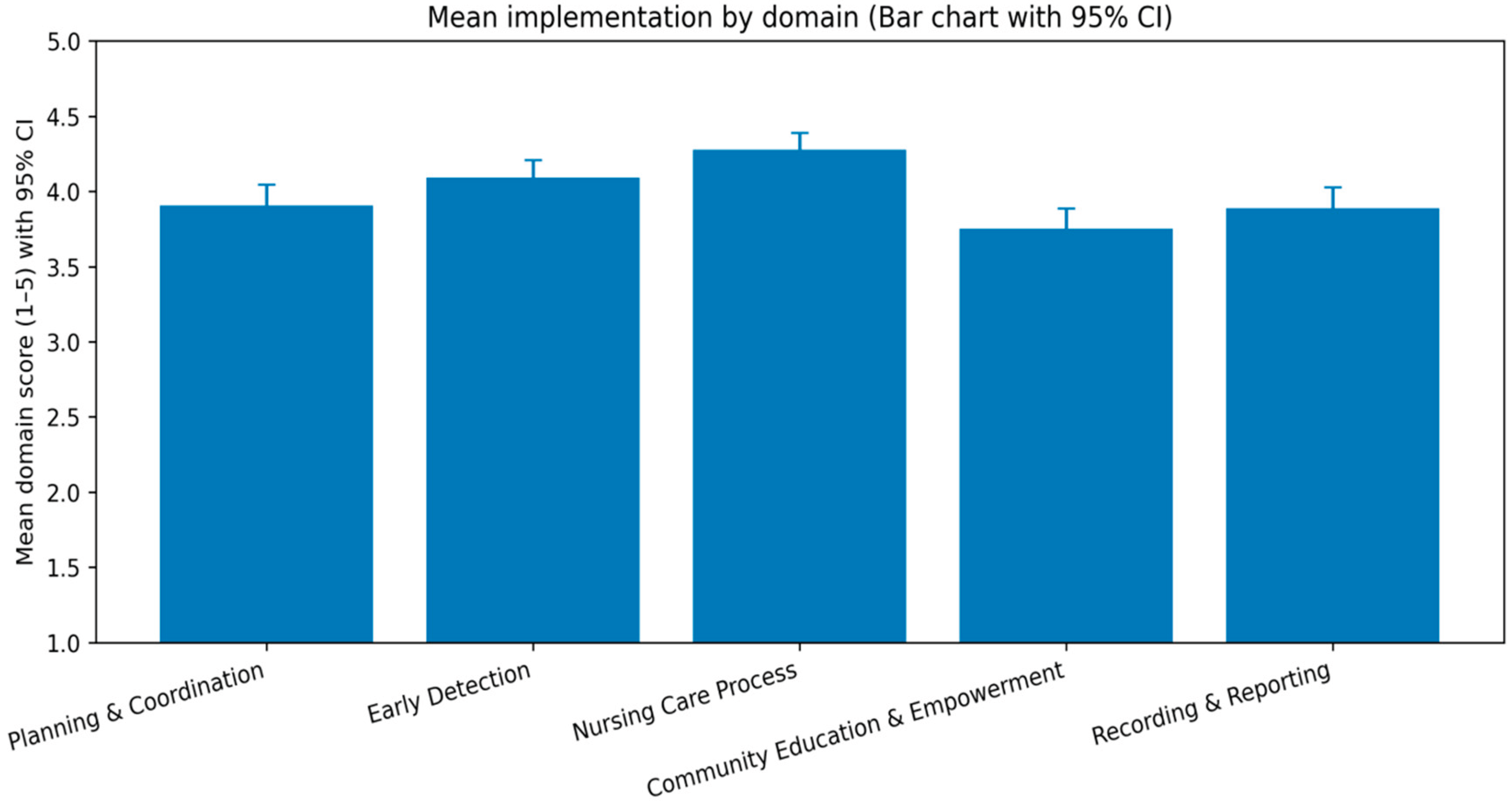
Figure 2.
The boxplot distributions five ILP domains.
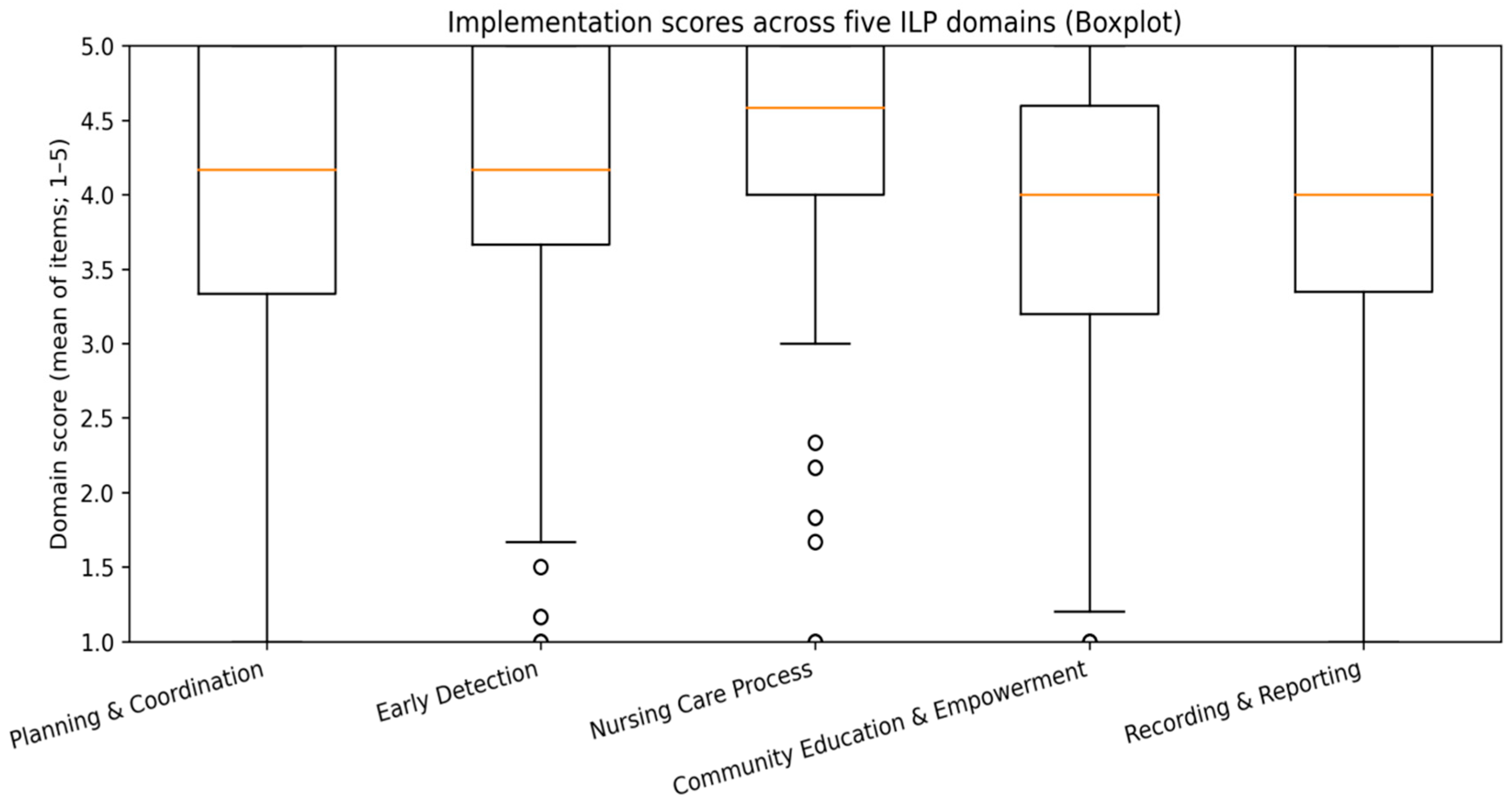

Table 1.
Overall Implementation Fidelity Index (IFI) score distribution (N = 252).
| Measure | Scoring approach | Possible range | Mean (SD) | Median (IQR) | Observed range |
|---|---|---|---|---|---|
| Overall IFI (mean score) | Mean of 28 items (each 1–5; equal weight) | 1.00–5.00 | 3.99 (0.92) | 4.14 (3.57–4.82) |
1.04–5.00 |
| Overall IFI (total score) | Sum of 28 items (each 1–5; equal weight) | 28–140 | 111.84 (25.90) | 116 (100–135) |
29–140 |
Note: Higher scores indicate higher implementation of nurse-led integrated primary care activities across the five domains. IQR = interquartile range (25th–75th percentile).
Table 2.
Distribution of Total IFI categories (Mean ± 1 SD cut-offs).
| Category | Cut-off (total score) | n | % |
|---|---|---|---|
| Low implementation | < 86 | 31 | 12.3 |
| Moderate implementation | 86–137 | 181 | 71.8 |
| High implementation | ≥ 138 | 40 | 15.9 |
| Total | 252 | 100.0 |
Note: Total IFI score is the sum of 28 items (each scored 1–5; possible range 28–140). Cut-offs were derived from Mean = 111.84 and SD = 25.90 (Mean − 1 SD = 85.94; Mean + 1 SD = 137.74), then rounded to practical integer thresholds.
Disclaimer/Publisher’s Note: The statements, opinions and data contained in all publications are solely those of the individual author(s) and contributor(s) and not of MDPI and/or the editor(s). MDPI and/or the editor(s) disclaim responsibility for any injury to people or property resulting from any ideas, methods, instructions or products referred to in the content. |
© 2026 by the authors. Licensee MDPI, Basel, Switzerland. This article is an open access article distributed under the terms and conditions of the Creative Commons Attribution (CC BY) license (http://creativecommons.org/licenses/by/4.0/).
Copyright: This open access article is published under a Creative Commons CC BY 4.0 license, which permit the free download, distribution, and reuse, provided that the author and preprint are cited in any reuse.


