

Submitted:
05 March 2026
Posted:
06 March 2026
You are already at the latest version
Abstract
The peroxisome proliferator-activated receptor alpha (PPARα) is a ligand-activated nuclear transcription factor belonging to the nuclear receptor superfamily. Although classically characterised as the master regulator of hepatic fatty acid oxidation (FAO) and lipid catabolism, accumulating evidence positions PPARα as an indispensable molecular conductor at the feto-maternal interface. Within the human placenta, PPARα is expressed in both cytotrophoblast and syncytiotrophoblast layers throughout gestation, where it governs mitochondrial and peroxisomal β-oxidation, orchestrates pro-resolution inflammatory signalling, modulates trophoblast differentiation and invasion, and participates in epigenetic programming of the developing fetus. Derangements of placental PPARα activity are increasingly identified in major obstetric complications, including preeclampsia, gestational diabetes mellitus, and intrauterine growth restriction, where aberrant lipid accumulation, heightened oxidative stress, and amplified pro-inflammatory cytokine signalling converge. This review synthesises current knowledge on the molecular biology and genomic targets of PPARα in the placenta, its integration with maternal metabolic adaptations of pregnancy, its role in nutrient sensing and fetal programming, and the consequences of its dysregulation in pregnancy pathology. We further discuss emerging therapeutic implications of PPARα modulation and outstanding questions in this rapidly evolving field.
Keywords:
PPARα
; placenta
; trophoblast
; fatty acid oxidation
; feto-maternal metabolism
; preeclampsia
; gestational diabetes
; intrauterine growth restriction
; fetal programming
; nuclear receptor
1. Introduction
The human placenta is an ephemeral yet extraordinary organ that serves simultaneously as the site of respiratory gas exchange, nutrient transport, endocrine signalling, and immunological tolerance between two genetically distinct individuals, mother and fetus, across approximately 280 days of gestation. The placenta grows from a single fertilised oocyte into a disc-shaped organ weighing approximately 500 grams at term, consuming roughly 40% of uteroplacental oxygen delivery to sustain its own oxidative metabolic demands while actively transporting fatty acids, glucose, amino acids, and hormones to the developing [1]. Given this extraordinary metabolic workload, it is perhaps unsurprising that lipid metabolism, and the transcription factors that govern it occupy central positions in placental physiology.
The peroxisome proliferator-activated receptors (PPARs) are ligand-activated nuclear transcription factors belonging to the nuclear receptor superfamily, which includes retinoic acid receptors (RAR), thyroid hormone receptors (TR), liver X receptors (LXR), and steroid hormone receptors [2]. Three PPAR isotypes have been identified, viz. PPARα (NR1C1), PPARβ/δ (NR1C2), and PPARγ (NR1C3), each encoded by distinct genes and expressed in characteristic tissue distributions. All three isotypes are expressed in the human placenta, where they play non-redundant roles in trophoblast biology [3].
Among the three isotypes, PPARγ has historically received the greatest attention in placental research, reflecting its essential role in early trophoblast differentiation identified in murine knockout models [4,5]. However, a rapidly expanding body of evidence now positions PPARα as a functionally distinct and equally critical regulator at the feto-maternal interface. PPARα was originally characterised as a hepatic receptor activated by long-chain fatty acids and fibrate drugs to stimulate mitochondrial and peroxisomal fatty acid β-oxidation (FAO), regulate ketogenesis, and coordinate the fasting metabolic response [6]. These functions lipid catabolism, energy homeostasis, and anti-inflammatory signalling, which are precisely the processes that must be finely calibrated in the placenta across gestation to support optimal fetal development. The pivotal 2022 study by Holdsworth-Carson and colleagues [7] demonstrated that PPARα protein expression is significantly reduced in the placentas of women with gestational diabetes mellitus and intrauterine growth restriction, and identified distinct patterns of PPAR isoform dysregulation across three major obstetric complications, providing a compelling impetus for focused review of this receptor in pregnancy biology.
The present review outlines the molecular structure and mechanism of action of PPARα with specific addressal towards the expression and target gene network in placental trophoblasts. Further examination on PPARα’s role in fatty acid β-oxidation, maternal lipid adaptation, and its involvement in fetal programming and epigenetic regulation, and their corresponding therapeutic perspectives have been discussed.
2. Molecular Structure, Ligand Activation, and Mechanism of Action
Like all members of the nuclear receptor superfamily, PPARα is organised into five functional domains: an N-terminal ligand-independent activation function 1 (AF-1) domain; a highly conserved DNA-binding domain (DBD) containing two zinc-finger motifs; a flexible hinge region; a C-terminal ligand-binding domain (LBD) housing the AF-2 transactivation helix (helix 12); and a short C-terminal extension [8]. Receptor activation follows a classical two-step model: endogenous or pharmacological ligands bind within the hydrophobic LBD pocket, inducing conformational repositioning of helix 12 to create a co-activator docking surface. PPARα then obligatorily heterodimerises with retinoid X receptor alpha (RXRα), and the resulting PPARα: RXRα complex binds to specific cis-regulatory DNA elements termed peroxisome proliferator response elements (PPREs), characteristically direct repeat 1 (DR1) motifs (5’-AGGNCA-N-AGGNCA-3’), in the promoter regions of target genes to activate transcription [9].
PGC-1α (PPARγ coactivator-1α), SRC-1 (steroid receptor coactivator-1), and CBP/p300 arex the most prominent coactivators that are recruited to finely tune transcriptional activity. Corepressors (NCoR, SMRT) are also displaced upon ligand binding. Through non-genomic transrepression mechanisms, such as protein-protein interactions that sequester AP-1 and NF-κB p65 and prevent them from binding to pro-inflammatory gene promoters, PPARα can also have anti-inflammatory effects . Because of its dual ability to both directly activate metabolic genes and indirectly decrease inflammatory programs, PPARα is in a unique position to coordinate the placenta’s immunological and metabolic responses [10].
Endogenous PPARα ligands include long-chain saturated and unsaturated fatty acids (particularly palmitic acid C16:0, oleic acid C18:1, and arachidonic acid C20:4n-6), fatty acyl-CoA esters, oxidised phospholipids, eicosanoids (leukotriene B4, 8(S)-HETE), and the lysophospholipid LPA [11]. These lipid ligands are abundant at the maternal-fetal interface, where lipolysis of maternal triglyceride-rich lipoproteins by placental lipoprotein lipase continuously generates free fatty acids that can activate PPARα. Synthetic PPARα agonists, including fibrates (fenofibrate, gemfibrozil, clofibrate) and the GW7647 experimental ligand, have been widely exploited in research settings to dissect PPARα-dependent transcriptional programmes in trophoblast models [12,13].
3. Pparα Expression and Target Gene Networks in the Human Placenta
All three PPAR isotypes are detectable in both mouse and human placenta at the transcript and protein level, with characteristic spatial and temporal patterns [3,14]. In the human placenta, PPARα immunoreactivity has been localised to both the cytotrophoblast and syncytiotrophoblast layers of chorionic villi, as well as in extravillous trophoblasts (EVTs) that invade the decidua and remodel uterine spiral arteries [15]. Importantly, the relative expression of PPARα shifts across gestation: early-gestation placentas demonstrate higher fatty acid oxidation enzyme activities, consistent with high PPARα transcriptional activity, reflecting the disproportionately large energetic investment in placental growth relative to fetal growth in the first trimester [16].
The canonical PPARα target gene network in the placenta encompasses enzymes of mitochondrial β-oxidation and the carnitine shuttle, including: Carnitine palmitoyltransferase 1B (CPT1B), the rate-limiting enzyme catalysing transfer of long-chain fatty acyl-CoA across the inner mitochondrial membrane; CPT2, catalysing regeneration of acyl-CoA in the mitochondrial matrix; Medium-chain acyl-CoA dehydrogenase (MCAD/ACADM), the first step of β-oxidation; Acyl-CoA oxidase 1 (ACOX1), the initiating enzyme of peroxisomal FAO; and Fatty acid binding proteins (FABP1, FABP4), intracellular lipid chaperones facilitating fatty acid trafficking [17,18]. Additional targets include MFSD2A, the major facilitator superfamily domain-containing protein 2A that mediates placental uptake of DHA-containing lysophosphatidylcholines from maternal circulation — a PPARα-regulated gene whose expression is markedly reduced by maternal obesity [18]. PPARα also regulates perilipin 2 (PLIN2), a lipid droplet-coating protein that modulates intracellular triglyceride storage.
This target gene program’s functional consequence is a close link between the trophoblast’s oxidative energy production and fatty acid supply. Importantly, syncytiotrophoblasts possess greater mitochondrial FAO activity than cytotrophoblasts [16], that is consistent with the syncytiotrophoblast’s high bioenergetic requirements as the main layer mediating maternal-fetal exchange. Trophoblast cells experience lipid droplet accumulation, lipotoxicity, and mitochondrial dysfunction when this program is disrupted by maternal obesity, hyperglycemia, or oxidative stress [19].
4. Pparα and Placental Fatty Acid Metabolism: Central Role in Feto-Maternal Lipid Homeostasis
Normal pregnancy is characterised by a progressive and physiologically orchestrated dyslipidaemia: maternal serum triglycerides rise two- to three-fold during the third trimester to ensure adequate lipid substrate availability for the fetus, whose demands for fatty acids, particularly long-chain polyunsaturated fatty acids (LCPUFAs) that peak in the final trimester in parallel with accelerated brain and retinal development [1,11]. The placenta navigates this lipid-rich environment through a precisely regulated set of processes: hydrolysis of maternal triglyceride-rich lipoproteins by placental lipoprotein lipase on the microvillous (maternal-facing) membrane; uptake of free fatty acids via fatty acid translocase (FAT/CD36) and fatty acid transport proteins (FATPs); intracellular esterification and storage in lipid droplets; selective oxidation for trophoblast energy production; and transcellular transport of LCPUFAs to the fetal circulation.
PPARα sits at the nexus of this regulatory network. By transcriptionally inducing CPT1B, CPT2, and the FAO enzyme cascade, PPARα determines the partitioning of incoming fatty acids between β-oxidation (energy production) and esterification/storage. By upregulating FABP4 and MFSD2A, PPARα also enhances intracellular fatty acid trafficking and DHA import respectively [18]. Critically, the long-chain fatty acids themselves that enter the trophoblast from maternal lipoprotein hydrolysis serve as endogenous PPARα ligands, creating an autoregulatory feed-forward loop that matches FAO capacity to substrate supply.
This autoregulatory circuit is perturbed in maternal obesity. Rasool and colleagues [18] demonstrated in first-trimester placentas from obese women that high maternal triglycerides paradoxically increase peroxisomal ACOX1 activity, consuming long-chain fatty acids (including potential PPARα ligands), and thereby reduce endogenous ligand availability, leading to decreased PPRE binding and downregulation of PPARα target genes including MFSD2A, CPT2, and PLIN2. The resulting deficit in DHA uptake and lipid esterification capacity may prime trophoblasts for lipotoxic injury later in gestation. This model illustrates how a critical threshold of PPARα activation is required for adaptive, rather than maladaptive responses to lipid surfeit.
The developmental regulation of placental FAO is also noteworthy. Shekhawat et al. [16] demonstrated higher β-oxidation enzyme activities at lower gestational ages in human placenta, suggesting that PPARα-driven FAO is especially critical in early pregnancy when the placental energetic demand relative to fetal mass is highest and when glucose supply may be more restricted relative to fatty acid availability. This temporal regulation has important implications for understanding the windows of vulnerability in early gestation when maternal nutritional perturbations, viz. obesity, undernutrition, gestational diabetes, may most severely affect placental lipid metabolism.
5. PPARα as a Placental Anti-Inflammatory Regulator
Pregnancy requires a carefully calibrated immune environment at the maternal-fetal interface: pro-inflammatory signalling supports implantation, placentation, and eventually parturition, but sustained or excessive inflammation during mid-gestation is damaging to placental development and fetal wellbeing [20]. PPARα contributes to placental immune homeostasis through several converging mechanisms. Via transrepression, activated PPARα sequesters the NF-κB p65 subunit, preventing its nuclear translocation and transcriptional activation of genes encoding TNF-α, IL-1β, IL-6, and MCP-1, cytokines elevated in preeclampsia and intrauterine growth restriction placentas [10,14]. PPARα also induces IκBα, the primary cytoplasmic inhibitor of NF-κB, creating a further constraint on inflammatory activation [10].
PPARα additionally coordinates eicosanoid metabolism in the placenta. Arachidonic acid and its oxygenated derivatives, viz. prostaglandins, thromboxanes, hydroxyeicosatetraenoic acids, are potent regulators of uterine contractility, placental vascular tone, and trophoblast function. PPARα modulates the balance between pro-inflammatory eicosanoids (prostaglandin E2, thromboxane A2) and pro-resolving mediators, partly by inducing fatty acid catabolism that reduces arachidonic acid availability for cyclooxygenase (COX) pathways, and partly by directly repressing COX-2 transcription [21]. Martinez and colleagues [22] demonstrated that PPARα agonists reduce nitric oxide production and prevent placental overgrowth in diabetic animal models, an effect with implications for uterine blood flow regulation.
Oxidative stress is a cardinal feature of preeclampsia and severe intrauterine growth restriction placentas, and it directly impairs placental FAO. Thomas et al. [19] showed that acute oxidative stress (hydrogen peroxide exposure) decreased palmitate oxidation by up to 24% in human placental explants, independent of changes in PPARα mRNA or protein expression, suggesting that oxidative stress may impair PPARα-driven FAO at the post-translational level, potentially through mitochondrial membrane damage or direct enzyme oxidation. This creates a pathogenic cycle: placental ischaemia drives oxidative stress, which impairs FAO, which promotes lipid accumulation and further mitochondrial dysfunction, which amplifies oxidative stress.
6. PPARα in Fetal Metabolic Programming and Epigenetic Regulation
The Developmental Origins of Health and Disease (DOHaD) hypothesis, first articulated by Barker and colleagues, posits that the intrauterine environment permanently programmes the metabolic and physiological setpoints of developing fetal organ systems, with consequences that persist into adult life [23]. The placenta, as the primary interface between the maternal environment and fetus, is a key mediator of this programming. PPARα is emerging as a molecular mechanism linking maternal metabolic signals, viz dietary fat composition, glucose levels, adipokine signalling, to epigenetic and transcriptional changes in placental and fetal tissues.
Maternal glucose concentrations have been associated with differential DNA methylation of PPAR pathway genes in the human placenta. Hypomethylation of ACAA1 (acetyl-CoA acyltransferase 1) and ACADM (encoding MCAD), both PPARα transcriptional targets, has been observed in placentas of women with elevated fasting plasma glucose, and these methylation changes partially mediate the association between maternal hyperglycaemia and increased neonatal adiposity [24]. This epigenetic mechanism would imply that maternal glucose excess amplifies PPARα-driven fatty acid oxidation in the placenta, leading to altered lipid partitioning and greater fatty acid delivery to the fetus during critical windows of adipocyte differentiation.
Adiponectin, an adipokine with insulin-sensitising and anti-inflammatory properties, exerts its placental effects partly through PPARα activation. Adiponectin receptor 2 (AdipoR2) couples adiponectin signalling to PPARα in the trophoblast, and this axis modulates ceramide synthesis, which in turn regulates insulin sensitivity in placental cells [25]. This adiponectin-PPARα-ceramide axis may be a mechanism by which maternal adiposity, characterised by hypoadiponectinaemia, impairs placental insulin signalling and nutrient transport.
Epigenetic regulation of CPT1A, a primary PPARα target, has been described in the context of high-fat diet exposure. Maternal high-fat diet is associated with reduced DNA methylation and altered histone modifications (increased H3K4Me2) at the CPT1A promoter and first intron, with concurrent increased PPARα and PGC-1α binding, a mechanism that programs offspring hepatic fat oxidation capacity [26]. Whether analogous epigenetic remodelling occurs at placental CPT1B in response to maternal overnutrition is an important unresolved question with potential implications for understanding inter-generational transmission of metabolic risk.
The maternal-fetal crosstalk mediated by the placenta extends beyond direct nutrient transport. Emerging evidence indicates that placenta-derived extracellular vesicles (EVs), containing proteins, mRNAs, and miRNAs, enter both maternal and fetal circulations and modulate distal organ function . The discovery that PPARγ protein is transported from trophoblasts to fetal adipocytes via exosomal vesicles [27] raises the intriguing possibility that placental PPARα-regulated lipid metabolites and signalling molecules similarly reach fetal tissues to programme adipogenic, hepatic, and cardiovascular gene expression. This EV-mediated inter-organ signalling may represent a hitherto underappreciated pathway by which placental PPARα activity translates maternal metabolic state into lasting fetal epigenetic marks.
7. PPARα Dysregulation in Obstetric Complications
7.1. Gestational Diabetes Mellitus
Gestational diabetes mellitus (GDM) complicates 5–15% of pregnancies worldwide and is defined by impaired glucose tolerance first recognised during pregnancy [28]. Placentas from women with GDM at term exhibit significantly reduced PPARα protein expression alongside decreased PPARγ protein and RXRα protein, while overall PPAR DNA-binding activity is maintained, suggesting post-translational or compartment-specific mechanisms of PPARα downregulation rather than a generalised failure of PPRE occupancy [7]. The functional consequence of reduced PPARα protein in GDM placentas is likely impaired FAO capacity, promoting lipid accumulation in trophoblasts. This is corroborated by observations of increased lipid droplet deposition and triglyceride accumulation in GDM placentas [28]. Additionally, elevated maternal glucose concentrations associated with GDM hypomethylate PPARα pathway genes including ACADM and ACAA1 [24], potentially amplifying lipid metabolic dysregulation via epigenetic mechanisms.
7.2. Preeclampsia
Preeclampsia (PE) is a hypertensive disorder of pregnancy affecting 2–10% of gestations and representing a leading cause of maternal and perinatal morbidity and mortality globally [14]. The pathophysiology involves impaired trophoblast invasion of spiral arteries in early pregnancy, leading to placental ischaemia, oxidative stress, and release of anti-angiogenic factors (sFlt-1, soluble endoglin) into the maternal circulation. In placentas from women with preterm PE, PPARα expression is significantly reduced compared with gestation-matched controls [7]. This reduction occurs in the context of markedly elevated pro-inflammatory cytokines (TNF-α, IL-6, IL-1β), reactive oxygen species, and phospholipase A2 activity, all features that PPARα would normally help restrain through transrepression and eicosanoid modulation. Reduced PPARα activity would therefore both reflect and amplify the inflammatory-oxidative milieu of the preeclamptic placenta, impair FAO (further promoting lipid-mediated endoplasmic reticulum stress), and compromise the energy supply to a placenta already challenged by ischaemia-reperfusion injury.
7.3. Intrauterine Growth Restriction
Intrauterine growth restriction (IUGR), defined as birth weight below the 10th percentile for gestational age, frequently co-occurs with PE and shares its underlying pathophysiology of inadequate trophoblast invasion and placental insufficiency [7]. PPARα protein expression is significantly reduced in preterm IUGR placentas, and co-existing PE with IUGR further diminishes PPARα expression relative to isolated PE [7]. Mechanistically, IUGR placentas demonstrate impaired mitochondrial function and reduced FAO activity, consistent with functional PPARα insufficiency [19]. The resulting energy deficit in the trophoblast may restrict active transport of amino acids and glucose across the placental barrier, contributing to the growth-restricting phenotype. Crucially, fetal adipogenesis is also impaired in IUGR: placental PPARγ deficiency in this context impairs exosomal delivery of PPARγ to fetal adipocyte progenitors [27], and analogous disruption of PPARα-mediated lipid metabolism may further restrict fatty acid delivery to the fetus during critical windows of adipose tissue and neural development.
7.4. Maternal Obesity and Environmental Exposures
Maternal obesity represents a growing obstetric challenge affecting approximately 20–40% of pregnant women in many countries. Obese pregnancies are associated with reduced placental PPARα target gene expression, particularly MFSD2A, CPT2, PLIN2, and ACOX1, as a consequence of paradoxically reduced endogenous PPARα ligand availability driven by excessive peroxisomal β-oxidation consuming putative ligand pools [18]. Environmental contaminants including perfluoroalkyl substances (PFAS) activate PPARα in trophoblast cells via their structural resemblance to fatty acid ligands, potentially disrupting normal PPARα-regulated placental gene expression patterns and contributing to the associations observed between PFAS exposure and adverse pregnancy outcomes including GDM and fetal growth restriction [29].
8. Therapeutic Perspectives and Future Research Priorities
The evidence reviewed above establishes placental PPARα as a functionally important target in obstetric pathology. Several therapeutic and research priorities emerge from this literature.
First, nutritional strategies to optimise placental PPARα ligand availability represent an attractive, clinically accessible intervention. Long-chain polyunsaturated fatty acids, particularly EPA (20:5n-3) and DHA (22:6n-3), are potent endogenous PPARα ligands. Maternal omega-3 LCPUFA supplementation during pregnancy increases placental DHA content and may enhance PPARα-driven FAO and anti-inflammatory signalling [11]. Maternal diets enriched in PPARα-activating PUFAs have been shown to mitigate placental overgrowth and normalise nitric oxide production in diabetic animal models [22], and represent a rational dietary approach to supporting placental PPARα activity in at-risk pregnancies.
Second, pharmacological PPARα activation requires careful evaluation in the pregnancy context. Fibrate drugs (fenofibrate) are contraindicated in pregnancy due to teratogenic concerns in rodent studies; however, tissue-selective or partial PPARα agonists with reduced systemic effects warrant investigation for placenta-targeted delivery strategies. The success of nanoparticle-mediated placenta-targeted delivery of PPARγ agonists in rescuing fetal growth restriction in mouse models [27] suggests an analogous strategy for PPARα agonists may be feasible. Placenta-specific drug delivery platforms targeting trophoblast surface receptors (e.g., chondroitin sulfate A) could potentially enable PPARα activation without fetal drug exposure.
Third, PPARα and its target genes represent a promising source of placental biomarkers for early identification of obstetric complications. Cell-free placental RNA fragments, placenta-derived exosomes, and circulating acylcarnitines, all reflecting PPARα-driven FAO activity, are detectable in maternal plasma and may provide non-invasive windows into placental metabolic health. Integrating PPAR pathway DNA methylation signatures in placental tissue with circulating biomarker profiles could establish diagnostic frameworks for GDM, PE, and IUGR risk stratification.
Fourth, significant mechanistic questions remain unresolved. The relative contributions of mitochondrial versus peroxisomal β-oxidation to total placental FAO, and the cell-type-specific PPARα target gene programmes in cytotrophoblast, syncytiotrophoblast, and EVT populations, await single-cell transcriptomic characterisation. The extent to which placental PPARα activity influences fetal organ programming through EV-mediated inter-organ signalling is largely unexplored. Sex-specific differences in placental PPARα expression, suggested by the finding that reduced MFSD2A in obese pregnancies preferentially affects male fetal DHA status [18], warrant dedicated investigation given the known sexual dimorphism in placental gene expression and metabolic responses.
9. Conclusions
Long known for its roles in hepatic and cardiovascular metabolism, PPARα is a pleiotropic nuclear receptor that is now clearly essential to the biology of the human placenta and the feto-maternal interface. PPARα integrates the nutritional needs of the developing fetus with the metabolic demands of the placenta through its regulation of trophoblast fatty acid β-oxidation, anti-inflammatory transrepression activities, and regulatory influence on lipid transport and epigenetic programming. Its dysregulation is a convergent pathogenic mechanism that influences intrauterine growth restriction, gestational diabetes, and preeclampsia, three major obstetric complications that affect millions of pregnancies each year and have long-term health effects on both mothers and their offspring. Clarifying the cell-type-specific, gestational age-dependent, and sex-differentiated aspects of PPARα function in the placenta is an exciting area of research that might lead to both beneficial interventions and mechanistic insights for enhancing maternal and fetal health outcomes.
Author Contributions
SS, AG, NK, NV, RD and SK – Writing – original draft, review and editing, OSS – Writing – original draft, review and editing, Visualization, RD – Writing – original draft, review and editing, Conceptualization, Supervision, SK – Writing – original draft, review and editing, Project Administration, Conceptualization, Supervision.
Funding
SK would like to thank ICMR for funding the study, vide Project Code I-1144.
Ethics Statement
Not Applicable.
Acknowledgments
SK would like to thank Indian Council of Medical Research (ICMR) for their generous funding, vide Project Code I-1144.
Conflicts of Interest
The authors declare no competing interests.
References
- Bidne, K; Uhlson, C; Palmer, C; Zemski-Berry, K; Powell, T. Human placental lipid content and lipid metabolic enzyme abundance in obesity and across gestation Available to Purchas. Clin Sci. 2022, 136(19), 1389–1404. [Google Scholar] [CrossRef]
- Michalik, L; Auwerx, J; Berger, J; Chatterjee, V; Glass, C; et al. International Union of Pharmacology. LXI. Peroxisome proliferator-activated receptors. Pharmacol Rev. 2006, 58(4), 726–741. [Google Scholar] [CrossRef] [PubMed]
- Fournier, T; Tsatsaris, V; Handschuh, K; Evain-Brion, D. PPARs and the Placenta. Placenta 2007, 28(2-3), 65–76. [Google Scholar] [CrossRef] [PubMed]
- Barak, Y; Nelson, M; Ong, E; et al. PPAR gamma is required for placental, cardiac, and adipose tissue development. Mol Cell. 1999, 4, 585–595. [Google Scholar] [CrossRef] [PubMed]
- Nadra, K; Anghel, SI; Joye, E; et al. Differentiation of Trophoblast Giant Cells and Their Metabolic Functions Are Dependent on Peroxisome Proliferator-Activated Receptor β/δ. Mol Cell Biol. 2006, 26(8), 3266–3281. [Google Scholar] [CrossRef]
- Tahri-Joutey, M; Andreoletti, P; Surapureddi, S; Nasser, B; Cherkaoui-Malki, M; Latruffe, N. Mechanisms mediating the regulation of peroxisomal fatty acid beta-oxidation by pparα. Int J Mol Sci. 2021, 22(16). [Google Scholar] [CrossRef]
- Holdsworth-Carson, S; Lim, R; Mitton, A; et al. Peroxisome proliferator-activated receptors are altered in pathologies of the human placenta: Gestational diabetes mellitus, intrauterine growth restriction and preeclampsia. Placenta 2010, 31(3), 222–229. [Google Scholar] [CrossRef]
- Kersten, S; Desvergne, B; Wahli, W. Roles of PPARs in health and disease. Nature 2000, 405, 421–424. [Google Scholar] [CrossRef]
- Tugwood, J; Issemann, I; Anderson, R; Bundell, K; McPheat, W; Green, S. The mouse peroxisome proliferator activated receptor recognizes a response element in the 5’ flanking sequence of the rat acyl CoA oxidase gene. EMBO J 1992, 11(2), 433–439. [Google Scholar] [CrossRef]
- Delerive, P; De Bosscher, K; Besnard, S; et al. Peroxisome proliferator-activated receptor α negatively regulates the vascular inflammatory gene response by negative cross-talk with transcription factors NF-κB and AP-1. Journal of Biological Chemistry 1999, 274(45), 32048–32054. [Google Scholar] [CrossRef]
- Duttaroy, AK; Basak, S. Maternal Fatty Acid Metabolism in Pregnancy and Its Consequences in the Feto-Placental Development. Front Physiol. Frontiers Media S.A. 2022;12. [CrossRef]
- Singh, S; Dhar, R; Karmakar, S. Fenofibrate mediated activation of PPARα negatively regulates trophoblast invasion. Placenta 2022, 126, 140–149. [Google Scholar] [CrossRef] [PubMed]
- Rogers, JM; Heintz, MM; Thompson, CM; Haws, LC. A putative adverse outcome network for neonatal mortality and lower birth weight in rodents: Applicability to per- and polyfluoroalkyl substances and relevance to human health. Birth Defects Res. 2023, 115(11), 1011–1062. [Google Scholar] [CrossRef]
- Psilopatis, I; Vrettou, K; Fleckenstein, FN; Theocharis, S. The Role of Peroxisome Proliferator-Activated Receptors in Preeclampsia. Cells. MDPI 2023, 12(4). [Google Scholar] [CrossRef]
- Tarrade, A; Schoonjans, K; Guibourdenche, J; et al. PPARγ/RXRα Heterodimers Are Involved in Human CGβ Synthesis and Human Trophoblast Differentiation. Endocrinology 2001, 142(10), 4504–4514. [Google Scholar] [CrossRef]
- Shekhawat, P; Matern, D; Strauss, A. Fetal Fatty Acid Oxidation Disorders, Their Effect on Maternal Health and Neonatal Outcome: Impact of Expanded Newborn Screening on Their Diagnosis and Management. Pediatr Res. 2005, 57, 78–86. [Google Scholar] [CrossRef]
- Song, S; Attia, R; Connaughton, S; et al. Peroxisome proliferator activated receptor α (PPARα) and PPAR gamma coactivator (PGC-1α) induce carnitine palmitoyltransferase IA (CPT-1A) via independent gene elements. Mol Cell Endocrinol. 2010, 325(1-2), 54–63. [Google Scholar] [CrossRef]
- Rasool, A; Mahmoud, T; Mathyk, B; et al. Obesity downregulates lipid metabolism genes in first trimester placenta. Sci Rep. 2022, 12(1). [Google Scholar] [CrossRef]
- Thomas, MM; Haghiac, M; Grozav, C; Minium, J; Calabuig-Navarro, V; O’Tierney-Ginn, P. Oxidative Stress Impairs Fatty Acid Oxidation and Mitochondrial Function in the Term Placenta. Reproductive Sciences 2019, 26(7), 972–978. [Google Scholar] [CrossRef]
- Kramer, AC; Jansson, T; Bale, TL; Powell, TL. Maternal-fetal cross-talk via the placenta: influence on offspring development and metabolism. Development (Cambridge). Company of Biologists Ltd. 2023;150(20). [CrossRef]
- Devchand, P; Keller, H; Peters, J; Vazquek, M; Gonzalez, F; Wahli, W. The PPARα–leukotriene B4 pathway to inflammation control. Nature 1996, 384, 39–43. [Google Scholar] [CrossRef] [PubMed]
- Martínez, N; Kurtz, M; Capobianco, E; Higa, R; White, V; Jawerbaum, A. PPARα agonists regulate lipid metabolism and nitric oxide production and prevent placental overgrowth in term placentas from diabetic rats. J Mol Endocrinol. 2011, 47(1), 1–12. [Google Scholar] [CrossRef] [PubMed]
- Barker, DJP. The origins of the developmental origins theory. Journal of Internal Medicine 2007, 261, 412–417. [Google Scholar] [CrossRef]
- Li, L; Zhang, L; Chen, Y; et al. Maternal glucose concentrations and DNA methylation of genes related to the PPAR signaling pathway in human placenta: insights for maternal glucose concentrations’ effects on neonatal anthropometrics. Clin Epigenetics 2025, 17(1). [Google Scholar] [CrossRef] [PubMed]
- Aye, I; Gao, X; Weintraub, S; Jansson, T; Powell, T. Adiponectin inhibits insulin function in primary trophoblasts by PPARα-mediated ceramide synthesis. Molecular Endocrinology 2014, 28(4), 512–524. [Google Scholar] [CrossRef] [PubMed]
- Moody, L; Xu, G; Chen, H; Pan, Y. Epigenetic regulation of carnitine palmitoyltransferase 1 (Cpt1a) by high fat diet. Biochimica et Biophysica Acta (BBA) - Gene Regulatory Mechanisms 2019, 1862(2), 141–152. [Google Scholar] [CrossRef]
- Luo, X; Huang, B; Xu, P; et al. The Placenta Regulates Intrauterine Fetal Growth via Exosomal PPARγ. Advanced Science 2025, 12(15). [Google Scholar] [CrossRef] [PubMed]
- Qin, Y; Bily, D; Aguirre, M; Zhang, K; Xie, L. Understanding PPARγ and Its Agonists on Trophoblast Differentiation and Invasion: Potential Therapeutic Targets for Gestational Diabetes Mellitus and Preeclampsia. Nutrients. MDPI 2023, 15(11). [Google Scholar] [CrossRef]
- Szilagyi, J; Avula, V; Fry, R. Perfluoroalkyl Substances (PFAS) and Their Effects on the Placenta, Pregnancy, and Child Development: a Potential Mechanistic Role for Placental Peroxisome Proliferator–Activated Receptors (PPARs). Curr Environ Health Rep. 2020, 7, 222–230. [Google Scholar] [CrossRef]
Figure 1.
PPAR activity in Obstetrics.
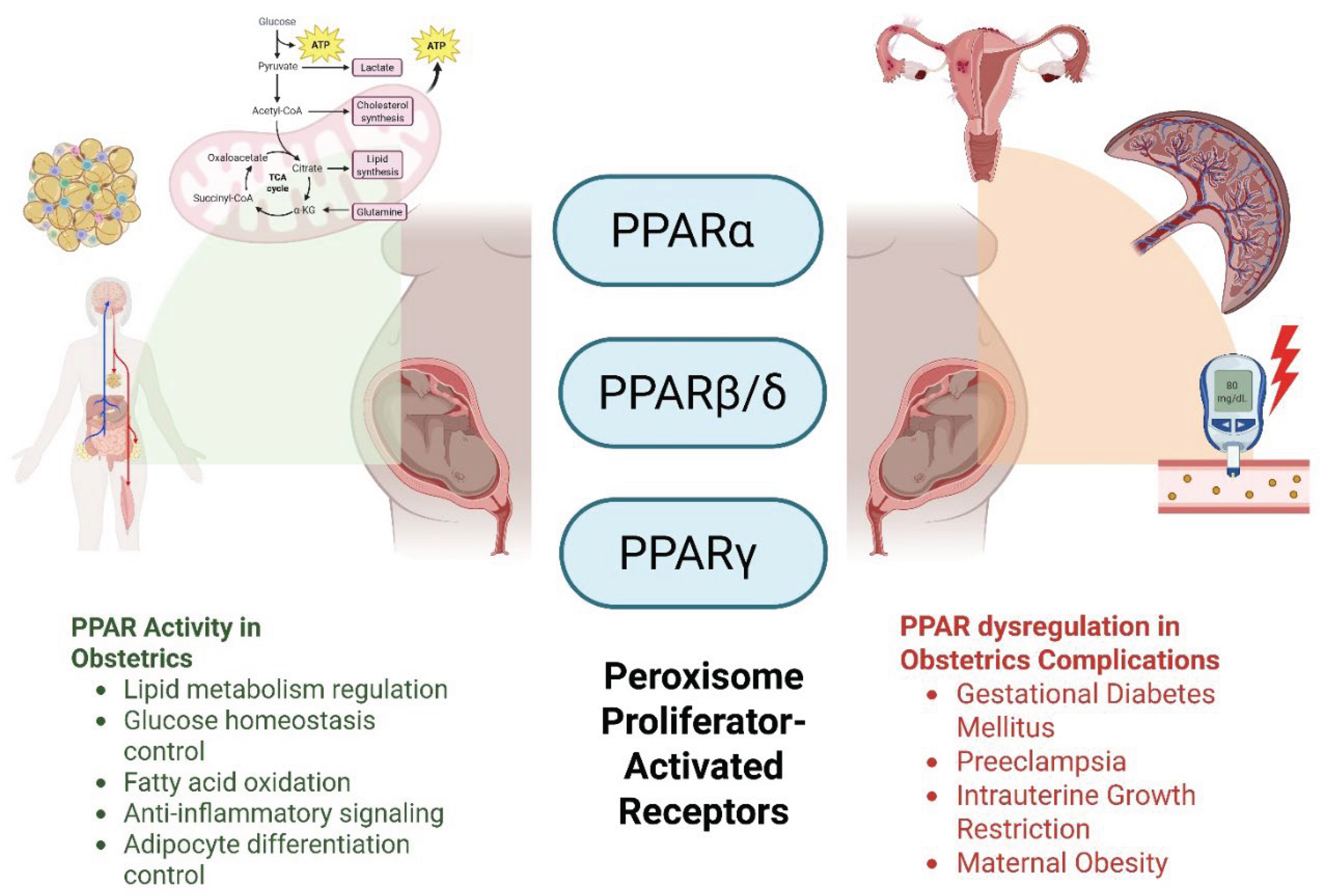

Table 1.
Summary of PPARα Expression, Target Genes, and Functional Outcomes in Human Placental Pathologies.
Table 1.
Summary of PPARα Expression, Target Genes, and Functional Outcomes in Human Placental Pathologies.
| Condition | PPARα Expression | Key Downstream Effects | Functional Consequence | Key References |
|---|---|---|---|---|
| Normal Pregnancy | Abundant; higher in syncytiotrophoblast | CPT1B, MFSD2A, FABP4, ACOX1 upregulated | Balanced FAO; DHA transport; anti-inflammatory tone | [3,16,18] |
| Gestational Diabetes Mellitus | ↓ Protein; normal DNA binding activity | Reduced MCAD, CPT2; epigenetic changes in ACADM, ACAA1 | Lipid accumulation; impaired FAO; altered fetal lipid delivery | [7,24] |
| Preeclampsia | ↓ Protein; preterm placentas | Reduced NF-κB repression; eicosanoid dysbalance | Amplified inflammation; mitochondrial dysfunction; oxidative stress | [7,14] |
| Intrauterine Growth Restriction | ↓ Protein; lowest in PE+IUGR co-morbidity | Impaired FAO; reduced nutrient transport | Fetal energy deficit; impaired adipogenesis; growth restriction | [7,19] |
| Maternal Obesity | ↓ Target gene expression (1st trimester) | ↓ MFSD2A, CPT2, PLIN2 via reduced endogenous ligand | Reduced DHA uptake; lipotoxic risk; male-specific DHA deficit | [18] |
FAO = fatty acid β-oxidation; CPT1B = carnitine palmitoyltransferase 1B; MFSD2A = major facilitator superfamily domain-containing protein 2A; ACADM = medium-chain acyl-CoA dehydrogenase gene; DHA = docosahexaenoic acid; IUGR = intrauterine growth restriction; PE = preeclampsia; GDM = gestational diabetes mellitus. ↓ = significantly reduced.
Disclaimer/Publisher’s Note: The statements, opinions and data contained in all publications are solely those of the individual author(s) and contributor(s) and not of MDPI and/or the editor(s). MDPI and/or the editor(s) disclaim responsibility for any injury to people or property resulting from any ideas, methods, instructions or products referred to in the content. |
© 2026 by the authors. Licensee MDPI, Basel, Switzerland. This article is an open access article distributed under the terms and conditions of the Creative Commons Attribution (CC BY) license (http://creativecommons.org/licenses/by/4.0/).
Copyright: This open access article is published under a Creative Commons CC BY 4.0 license, which permit the free download, distribution, and reuse, provided that the author and preprint are cited in any reuse.


