

Submitted:
04 March 2026
Posted:
05 March 2026
You are already at the latest version
Preprints on COVID-19 and SARS-CoV-2
Abstract
Latina and Black female students are more likely than their White and Asian counterparts to leave science majors after their first-year of college. Supportive peer mentorship has been shown to positively impact science retention but limited data exists on the peer-mentoring impact to first-year Latinas and Black science students. We present an assessment of a peer mentoring intervention supporting the experience of first-year science female students at an urban public university during the COVID-19 pandemic.
Keywords:
first-year undergraduate students
; peer mentoring
; STEM retention
; STEM persistence
; virtual peer mentoring
; COVID-19
1. Introduction and Background
The campus closures and remote learning that took place as the COVID-19 pandemic spread through the United States, forced college students to face a wide range of challenges. Mainly, the social isolation and remote educational experience have been linked to a loss of meta-cognition, self-confidence, self-regulation, sense of belonging and engagement (Camfield et al., 2021; Desrochers et al., 2020). For students in the science, technology, engineering and mathematics (STEM) fields, the lack of access to laboratories, libraries, tutoring services, and other college physical spaces that supported their learning negatively impacted their college experience and limited the type of skills they could develop (Thacker et al., 2022). In addition, the COVID-19 pandemic magnified digital inequities affecting racially/ethnically minoritized (REM) STEM students, who encounter unique challenges related to their technical access to remote learning. They also experienced job insecurity, and other negative impacts on their health or emotional state (Ashford-Hanserd et al., 2022; Brown et al., 2023). Disproportionate impacts were observed on Latinas and Black female STEM students due to the caregiving responsibilities many Latinas and Black women have among their family and community structures, the financial stress imposed by the closures related to the COVID-19 pandemic, and the limited access to reliable technology. These dynamics contributed to differential course engagement and persistence patterns in STEM with data showing that during this time. For instance, data shows that during this time Latinas were disproportionately more likely to take less college credits and earned lower grades than other students (Victorino et al., 2025). These findings underscore the necessity for equity approaches that support these students in their college experience; highlighting the fragile structures in existence that cannot provide support when they need it most.
Forty percent of all Latinx STEM graduates earn their college degree at Hispanic Serving Institutions (HSIs). Designated because of their enrollment (above 25% Latinx and 50% Pell-recipient students), HSIs also attract students from other race and ethnic backgrounds being more diverse in their enrollment than non-HSIs (Excelencia in Education, 2023). Commonly under-resourced, these institutions become a portal to higher education for many students and have the potential to play a significant role in strengthening STEM education to increase its reach and making the STEM workforce more diverse (Miles et al., n.d.). During the COVID-19 pandemic, preexisting inequities at HSIs became amplified. The shift to online instruction and the loss of physical spaces challenged these institutions to maintain STEM persistence amid digital inequities and disruptions to campus-based support. Limited research exists that discusses how COVID-19 related short-term interventions impacted long-term STEM outcomes at HSIs (Ro et al., 2024a); however, the studies published to this point shed light on the relevance of combining academic support with culturally sustaining practices that include mentoring and family- and community-centered approaches (Contreras Aguirre, 2024; Thacker et al., 2022).
Pre-pandemic research strongly pointed to the benefits of mentoring programs using peers, near-peers, faculty and other science professionals, in improving the experience of STEM students, showing that mentoring has positive effects on retention as well as on improving the academic performance of all STEM students (Castellanos et al., 2016; Estrada et al., 2018; Thomas et al., 2007; Yomtov et al., 2017; Zaniewski & Reinholz, 2016). Researchers have found that participating in mentoring may increase science identity and self-efficacy. Across most studies, evidence points to decrease feelings of isolation, higher sense of belonging, higher psychosocial and academic support, and a normalization of the struggles the students are facing (Atkins et al., 2020; Estrada et al., 2018; Tenenbaum et al., 2014; Zaniewski & Reinholz, 2016). In addition, studies found that academic and social engagement from mentoring programs also promote retention (Núñez, 2008). Few studies exist on the impact of mentoring on STEM students from a specific gender and race/ethnic. However, some studies have found gains for Latinas and African American female students (Moschetti et al., 2018; Salas et al., 2014; Zaniewski & Reinholz, 2016). Latinas, who are usually also first generation students or from immigrant families, have found that peer mentorship provides them with a source of social capital that gives them a more positive perception of the college environment and enhances their academic and social integration (Bordes-Edgar et al., 2011; Cruz et al., 2019; Moschetti et al., 2018; Salas et al., 2014). Peer mentoring programs engaging first-year Latina students have led to higher sense of belonging, academic outcomes, and social integration (Cruz et al., 2019; Salas et al., 2014). Based on this solid evidence, we implemented an identity-congruent peer-mentoring program focused on supporting the retention in STEM of majorly REM first year female students. The intervention was conducted during the COVID-19 pandemic at an urban public HSI in New York. We present here the evaluation of this intervention, with the goals to: 1) gain insight into the experience of first-year STEM students that enrolled in the program as mentees, 2) explore their outcomes up to two years after participation, and 3) share a model of effective peer-mentoring that describes specific areas of support. We anticipate that this work can strengthen our understanding of programs targeting specific student populations at our HSIs and support the development of other programs by faculty with similar challenges.
2. Program Structure & Analysis of Outcomes
2.1. Peer Mentoring Program
Program Participants: The Female Empowerment through Mentoring Minorities in Science (FEMMS) program at John Jay College of Criminal Justice, one of the City University of New York (CUNY) colleges took place between 2020 and 2022, spanning two academic years (AYs) in which students were attending classes online due to the COVID-19 pandemic. Students were recruited through flyers and posts on their course website as well as encouragement from the first-year faculty teaching the courses. The recruitment encouraged Latina and Black female students to join and mentioned specific interest in activities that these students might find relevant including: Black female and Latinas peer mentors, a network of Black female and Latinas alumni and/or scientists and presentations about career and professional opportunities. However, all first-year female students that completed the application were accepted into the program.
Mentees were placed in groups with one Latina or Black female student with junior and senior academic standing. Latina or Black female upper classmen were recruited to serve as mentors. Recruitment took place over the summer. Email blasts to students and faculty members teaching higher level courses were used to reach as many potential students as possible. Interested students completed a short online application. Once a student was accepted to participate as a mentor in the program, they completed an agreement in which they committed to monthly meetings with their mentees, communication with the program faculty co-directors, and received a small stipend to compensate for their time. Mentors engaged in recruitment of first-year students through video introductions which were shared with first-year students through the Blackboard learning management systems (LMS).
Program structure: The FEMMS program paired first-year female students in groups of 2-3 to a mentor for the AY. The mentor-mentee group was created at the beginning of the AY and stayed throughout. In Figure 1, the overall structure of the program is presented. The program included 4 meetings (approximately 30-60 minutes) per semester for each mentor-mentee group. Meetings were conducted online for most of the program. When schools started opening during the AY 2021-2022, students were encouraged to select the best modality for their mentor-mentees meetings. This flexibility allowed accommodation of students with various obligations and schedules. However, most meetings continued occurring virtually. Mentors worked together and met with faculty members leading the program to identify the best approaches to support mentees based on the following four major areas:
- Access to Resources: Sharing the knowledge of resources available and helping connect mentees to the resources available in the college including tutoring services, emergency funds, and student wellness center among others. Specific information about how to access these resources, eligibility, and how to best benefit from each was highlighted by mentors. In addition to their personal experience with resources, peer mentors kept a list of resources for reference and discussed in mentor meetings the best approaches to encourage first-year students to access the resources.
- Academic Supports: Mentors helped mentees navigate the transition to the college classroom. They aided students in decoding the syllabus and shared how to effectively study for the first-year science courses. They discussed study strategies and time management to help them in this important transition.
- Community Building: Small groups of mentees to mentor allowed organic relationships between the mentor and mentees as well as between the mentees. Students were able to build relationships that allowed them to share their thoughts and concerns. Specifically selecting mentors who were female minority students allowed for greater connection between the mentor and mentees shared experiences both inside and outside the academic space. Because the program was a yearlong, it allowed time to build strong connections within their groups. Whole group meetings and events with female STEM professionals also provided opportunities to build community and connect with each other.
- Professional and Career Planning: Mentors and mentees were required to attend at least three guest seminars per semester. These guest seminars covered scientific research, career explorations, internships planning and applications, and psychosocial development. The seminars included individual speakers or panels featuring STEM REM women in various stages of their careers. Every invited speaker shared their professional and academic trajectories as well as discussing specific topics of interest. Guest speakers shared their contacts at the end of each seminar to encourage FEMMS students to further connect and network with them.
2.2. Data Collection and Analysis
Data was collected during the program and at two times after the program had ended. Demographic and academic data was collected during students’ participation in the program, and academic outcomes data was collected one and two years after they had participated in the program to determine potential long-term impacts of their participation. College retention was the main academic outcome analyzed. We divided this metric into two categories, college retention in any major, and college retention in STEM. For both categories, participant data was compared to classroom level outcomes. All outcomes’ data was provided by the John Jay College of Criminal Justice Office of Institutional Research.
FEMMS participants were asked to complete anonymous surveys as part of the program’s evaluation and assessment, after each mentor-mentee meeting. In these surveys, participants shared their experience and provided feedback on what they thought was working or could be improved. The survey was offered online and included a mix of multiple-choice, Likert scale and an open-ended question. The survey questions, the type of questions, and answer choices are presented in Table 1.
Answers to the open-ended segment of the survey were analyzed by a qualitative researcher that was not part of the program’s conception, implementation, or development. Qualitative analysis of participants’ written responses was conducted using an emergent, iterative coding approach designed to amplify students’ voices and capture their multi-faceted experiences and perspectives. We parsed narrative data into content segments, compared them constantly across cases and time, and refined codes as new patterns and constructs surfaced. This recursive process generated themes that revealed patterns in the program activities, and broader socio-structural factors that shaped students’ experiences and outcomes, highlighting mechanisms behind the intervention effects.
Statistical Analysis: We used statistical tools to analyze retention of mentees after 1- and 2-years of program participation. We report these metrics as percentages of students still in the program and those that were originally enrolled as freshman. We calculated science major retention, which included only students that declared one of the biological and physical science majors our college offers, as well as college retention, which considered whether the student was still at the college taking courses. Data was analyzed with Microsoft Excel and Dotmatics GraphPad. Program participants and all first-year science major women retention count data (science retention, and major retention) were analyzed using the χ2 test or Fisher’s Exact test (when sample sizes were below 10). Statistical significance was defined as p ≤ 0.05.
3. Program Outcomes & Evaluation
3.1. Program Participation and Outcomes
In the two AYs that we conducted this program, 44 first-year female undergraduate students participated as mentees, and we are outcomes here. A total of 20 in AY 2020-21, and 24 in AY 2021-22. In Table 2, we report the demographic and academic characteristics of program participants. Because there are some differences between the AY 2020-21 and AY 2021-22 cohorts, we report the composition of each cohort separately as well as the average. Overall, the majority of the students were Latinas or Black, lower income and freshmen majoring in biological or physical sciences. In AY 2020-21 a total of 65% of the participants were Latinas and Black female students. This number rose to 71% in AY 2021-22, and for this AY almost half the cohort was composed of Latinas (46%). Asian American and White female students also participated, in smaller proportions.
The race/ethnicity breakdown is similar to the one from our college’s entering classes (Table S1). The percentage of Black students in the program was slightly higher, as well as the number of Asian American students. However, the number of Latinas was the same. The majority of the first-year program mentees were also Pell-recipients. Up to 70% of the mentees received financial aid in this form, indicating that they were from lower income households as defined by federal guidelines.
Academically, students that participated in the peer-mentoring program were also mostly first-year, on average 68%. More incoming first year students joined the program in AY 2021-22 than in AY 2020-21. However, all mentees were enrolled in first year courses or 100-level biology and chemistry courses. Those classified as sophomores were enrolled in these courses for a second time, either because they had failed or dropped when originally registered in these classes. Most students that participated had declared their major to be within the biological or physical sciences, which in the case of our institution, includes majors in forensic sciences with specialties in criminalistics, toxicology and molecular biology. We also have students enrolled to earn toxicology and cell and molecular biology degrees. A smaller percentage (<30%) were pursuing other majors but intended to earn a minor in biology or chemistry.
We explore retention one and two years after program participation (Figure 2 and Table 3). We compare their retention at the college in any major and specifically in a STEM major for mentees with their corresponding incoming female student population. FEMMS mentees had higher retention in the science majors after one year than the overall female cohort (1Y-RetentionFEMMS=81% vs 1Y-RetentionAll=46%, p=0.0001, Figure 2). The difference remained after two years, while the percent difference did not change much (2Y-RetentionFEMMS=65% vs 2Y-RetentionAll=31%, p=0.0003, Figure 2). We did not observe differences in college retention in any major after 1 or 2 years for mentees and their matching cohort population, while they had slightly higher retention than their corresponding entering classes. 1-year retention was 88% for the FEMMS mentees and 76% for the comparison cohort, while 2-year retention for mentees was 79% compared to 67% for all female students. These differences were not statistically significant. It is important to note that retention differed for AY 2020-21 and 2021-22 participants (Table 3). AY 2020-21 FEMMS participants had higher retention in STEM than the AY 2021-22 students. However, both FEMMS cohorts showed relevant increases in retention that their corresponding comparison groups.
We also compared retention by race/ethnicity, because published data points to lower graduation rates for REM students nationwide. Here, we observed that Latinas have the lowest retention of all racial and ethnic groups (Table S2). The percent drop for Latinas is larger for retention in STEM but also the largest across groups for college retention. Black female students have a higher decline in two-year retention, while their one-year retention parallels that of Asian American and White female students. The retention of all mentees participating in the program regardless of race/ethnicity is better than their non-participant counterparts after one and two years. While the retention of Latinas participating in our FEMMS program is 24% higher than Latinas not participating, higher gains were observed for participants in other racial/ethnic groups.
We conducted an analysis of the mentees’ responses to the post meeting survey. This survey provided a unique opportunity for real-time program improvement and overall program evaluation. In Figure 3, we present the results of the survey responses. Students reported that meeting time varied depending on their needs through the academic year, with a tendency to have more meetings that lasted close to one hour. With the amount of time spent on academic topics being the largest, followed by discussions around professional development and lastly discussion of personal concerns. Overall, students found the sessions to be productive, and they looked forward to the next session, with more than 95% of responses in the categories “strongly agree” and “agree”.
3.2. Qualitative Analysis of Mentee Experiences
Below we summarize the findings that resulted from the analysis of student responses to the open question about their experience after each mentor-mentee meeting. This analysis helps inform how the program supported them as students and how their participation specifically impacted their STEM trajectories. We describe three main areas, or domains, that were found to reflect aspects of mentoring that students most consistently identified as supporting their first-year experience as STEM students.
Professional Development and Educational Advancement: FEMMS participants emphasized the value of mentoring conversations that directly supported their academic preparedness and confidence as STEM students. Mentors created a space where students could discuss their courses, study strategies, and workload management, and receive concrete guidance on navigating academic challenges. These exchanges strengthened mentees’ sense of agency and positioned mentors as both knowledgeable peers and empathetic guides.
Students consistently described meetings that focused on coursework, study techniques, and time management as among the most useful components of their mentoring experience. Mentors frequently shared specific tools or strategies, ranging from personalized study methods and online resources to tips for managing heavy course loads and upcoming finals. When reflecting on the benefits of these mentorship spaces, one mentee shared: “I liked venting and figuring out what to do with my upcoming finals and how to study better.” As this comment illustrates, mentees highlighted the relief of being able to “vent” about academic stress, while receiving practical advice and reassurance from someone who had successfully navigated similar challenges.
Mentors also played an informal academic advising role, helping students plan future semesters, choose courses or professors, and understand program sequencing. For some, these conversations filled information gaps about academic policies or degree requirements. The opportunity to talk through decisions about majors, minors, and class selections helped mentees feel more in control of their educational path.
Mentees consistently described mentoring as a catalyst for exploring, preparing for, and pursuing academic and career opportunities in STEM. Through resume-building workshops, discussions about internships and research programs, and guidance on professional communication, students developed concrete skills and greater clarity about their future pathways. Sessions also served as an avenue for personal planning and goal setting, as described by this mentee: “One thing that went well was how we were able to think deeply about our goals. We established the goals we wanted [earlier on] but now we planned out more in-depth what our journey to these goals would look like.” Mentoring sessions often introduced them to opportunities, such as lab research, summer internships, and graduate programs, that they might not have otherwise known about, helping them envision themselves as professionals in their fields.
By connecting academic experiences, skill development, and goal setting, mentoring helped students align coursework, internships, and research opportunities with longer-term objectives. This combination of exposure, preparation, and encouragement positioned mentoring as both a professional resource and a developmental bridge between college and career, strengthening confidence, agency, and readiness for post-college pathways while complementing academic preparation and other facets of mentored support.
Programmatic and Structural Supports: Mentees highlighted the importance of well-structured mentoring sessions and clear program organization in creating productive and engaging experiences. Students noted that meetings with an outlined agenda, prepared materials, and clear expectations helped them stay focused, understand what to anticipate, and maximize the value of each session. One mentee plainly shared: “I liked that the mentor outlined the whole program and what we could expect.” Students also appreciated how the organization supported virtual group interaction and engagement. Small group sizes and structured conversation flow allowed mentees to ask questions, share experiences, and receive precise feedback from mentors. Participants described meetings as productive, thorough, and well-paced, highlighting how thoughtful planning enabled meaningful dialogue and ensured that key topics were consistently addressed. Recounting valued structural attributes, another mentee offered: “One thing that went well in this session was that it was flexible and allowed the mentees an opportunity to discuss their concerns and stresses with their mentor and get a better idea of what they needed.” Mentees highlighted that quality mentoring included access to relevant resources and responsive support tailored to their needs. This responsiveness extended beyond structured agendas, allowing mentees to discuss concerns, explore resources, and seek guidance in real time.
Mentees also described their mentors as proactive in anticipating questions, pointing them to additional resources, and making themselves available outside scheduled sessions. This adaptability helped mentees feel supported, confident in accessing guidance, and empowered to pursue academic and professional opportunities independently. Mentees emphasized that trusting, supportive relationships with mentors were central to their positive experiences in FEMMS. Students described interactions that felt both professional and personal, balancing guidance with approachability. A mentee noted: “It didn’t feel like I was speaking to a mentor. Instead, it felt as if I were speaking to a friend and I liked that.” suggesting that conversations felt informal and comfortable, which allowed them to be fully honest about their academic challenges, personal struggles, and aspirations. This friendship-like rapport created a safe space for open dialogue, reflection, and personal growth.
Mentoring sessions often included interactive or playful activities, such as games, icebreakers, and collaborative exercises, which students described as fun and engaging. These activities not only made meetings enjoyable but also facilitated connection, eased tension, and strengthened peer-to-peer and mentor-mentee relationships. Mentoring sessions were further strengthened by opportunities for peer connection. Small group discussions and one-on-one breakout sessions allowed mentees to share experiences, learn from one another, and build a sense of community.
Relational and Holistic Support: Mentees consistently highlighted that FEMMS mentoring sessions provided critical support for mental, emotional, and overall wellbeing. One of the mentees notes: “I liked how she always started with a mental check.” These check-ins at the start of meetings, in which mentors asked about personal lives, stressors, and how mentees were managing both academic and non-academic demands, helped mentees feel seen as whole individuals, not just as students navigating coursework. Students described learning practical strategies to manage stress and maintain balance, including wellness techniques, mental health tips, and guided meditation exercises. These practices were particularly valuable in contexts such as virtual learning and heavy academic workloads, helping mentees cope with uncertainty, building resilience, and approach challenges with greater calm and focus.
Beyond structured techniques and playful activities, mentors created an environment of care, empathy, and validation, normalizing conversations about mental health and encouraging mentees to reflect on their personal goals alongside academic and professional objectives. This emphasis on wellbeing reinforced mentees’ confidence and sense of support, powerfully signaling that FEMMS mentoring was a trusted anchor that prioritized their holistic success: “I really appreciate how my mentor shows that she cares… I know I can rely on her and that she will help me.”
By attending to students’ emotional and physical health, mentors strengthened the broader relational foundation of FEMMS. Health and wellbeing support not only helped mentees manage stress and maintain balance but also enhanced their engagement with other pillars, cultivating an integrated system of support that particularly nurtures the REM female experiences in STEM.
3.3. Pillars of Quality Mentoring
Grounded in the experiences and reflections of FEMMS mentees, six pillars emerged as core features that make mentorship meaningful, affirming, and effective for female students in STEM. These pillars reflect the aspects of mentoring that students consistently described as supporting their academic growth, professional development, personal wellbeing, and sense of connection. Together, they form a multidimensional model of mentoring that nurtures confidence, persistence, and belonging.
The pillars are organized across three interconnected Domains of Mentoring Influence (Figure 4). The first, Academic and Professional Development, includes guidance on coursework, study strategies, career exploration, and goal setting. The second, Programmatic and Structural Supports, emphasizes organized, consistent, and accessible structures that help mentees navigate resources, opportunities, and expectations. The third, Relational and Holistic Support, highlights the importance of trust, caring relationships, peer connection, and attention to mental and emotional wellbeing.
The Academic and Professional Development domain captures mentoring practices that equip mentees with the skills, knowledge, and confidence necessary to succeed in STEM academically and professionally. Within this domain, mentoring fosters both mastery of core academic competencies and strategic preparation for future career pathways. Through these interactions, mentors helped mentees build both academic skill and academic self-efficacy. Reinforcing that success in STEM is not only about intelligence or preparation, but about strategies, planning, and persistence. The mentoring space offered affirmation that challenges are normal and surmountable, helping mentees reframe academic struggle as part of growth rather than a personal deficit. Academic preparation thus functioned as both a practical and psychological form of support, equipping students with tools while also strengthening their confidence and belonging as STEM learners.
The reflections of the FEMMS participants highlight that effective mentoring combines practical guidance, such as study strategies, time management, and course planning, with exposure to professional opportunities, including research experiences, internships, and career development activities. By supporting both academic skill-building and professional growth, mentoring in this domain strengthens students’ agency, clarifies their trajectories, and cultivates confidence in their ability to navigate the challenges and opportunities of STEM education and careers.
The Programmatic and Structural Supports domain encompasses the systems, organization, and responsive resources that create a stable and productive mentoring environment. Mentees’ reflections emphasize that clear agendas, prepared materials, and well-planned sessions allow them to focus on learning, reflection, and skill-building without navigating confusion or uncertainty. At the same time, responsive supports, such as individualized guidance, access to resources, and adaptation to mentees’ questions or circumstances, ensure that the program meets diverse needs in real time. By simultaneously and intentionally providing structure and flexibility, this domain strengthens the reliability, accessibility, and effectiveness of mentoring.
The Relational and Holistic Support domain emphasizes the importance of trusting relationships and attention to students’ overall wellbeing in fostering effective mentoring. Mentees consistently described interactions that combine approachability, empathy, and reliability, creating a safe space for candid discussion of academic challenges, personal struggles, and future aspirations. Mentors’ accessibility, responsiveness, and attentiveness, alongside opportunities for peer connection, reinforced students’ sense of belonging, emotional support, and confidence. At the same time, structured attention to health and wellbeing through check-ins, stress-management strategies, and validation of personal experiences helped students maintain balance and resilience. Together, these relational and holistic elements cultivate an environment where mentees can engage fully with academic and professional development opportunities.
4. Learned Approaches to Support First Year Students Through Peer Mentoring
We conducted an intervention for first-year female STEM students during the COVID-19 pandemic that helped them build social connections, provided academic support, aided launch their STEM career development, supported their psychosocial wellbeing and led to higher STEM retention after one and two years of its implementation.
Retention gains for different racial and ethnic groups differed. The increase in STEM retention a year or two, depending on the group, after participation in the peer-mentoring program was relevant for Latinas, White and Asian female students suggesting that the strategies that the students learned during the program might have been valuable in supporting their STEM identity and academic progression. It is interesting to note that while Black female students that participated in the program had gains in retention after one and two years, theirs was the smallest increase and did not reach statistical significance. Latinas, the group with the lowest STEM retention, had significant gains in retention after one year and while not statistically significant after two years, their retention doubled. The results of the statistical analysis by race/ethnicity need to be considered with caution because our sample size was small, but we believe the findings are worth reporting.
Few studies have previously conducted research on the experiences of first-year REM students engaged in peer mentoring. Studies exploring the mentoring experience of first-year Latinas in STEM have shown that mentees report greater social belonging, perceived academic support, higher STEM grades, and positive perceptions of support and integration to the university environment (Bordes & Arredondo, 2005; Cruz et al., 2019; Yomtov et al., 2017). Others, focusing on first-year female STEM students or Historical Black Colleges and Universities (HBCUs) female STEM students, have shown that peer-mentoring enhances interest in STEM, encourages STEM identity, helps students build STEM self-efficacy, and promotes persistence in STEM (Jones & Wendt, 2025; Rockinson-Szapkiw & Wendt, 2021). One limitation of most studies in this area is the lack of student outcome data after the programs or interventions have ended. One previous study presented findings of participants in a first-year peer mentoring and identified gains in retention and graduation (Lucietto et al., n.d.). Similarly, we were able to evaluate the impact on retention of our peer-mentoring intervention and found gains for participants two years after participation. We could not analyze beyond this time point at present. When we consider our retention gains and the findings from our qualitative analysis we surmise that the impacts on retention we observed might be at least in part related to the changes to STEM identity, self-efficacy and integration previously demonstrated on other populations similar to ours (Bordes & Arredondo, 2005; Cruz et al., 2019; Jones & Wendt, 2025; Rockinson-Szapkiw & Wendt, 2021; Yomtov et al., 2017).
Because our intervention took place during the COVID-19 pandemic, it focused mostly on a virtual mentoring model. This has some clear advantages and also limitations (Gregg et al., 2017; Jones & Wendt, 2025; Rockinson-Szapkiw & Wendt, 2020; Smailes & Gannon-Leary, 2011). One advantage is accessibility, because the peer-mentoring element takes place online; its benefits can be extended to a wider audience. It can also potentially promote higher inclusiveness by promoting diversity and inclusion in STEM fields through increased access. The virtual aspect of the program also makes it more flexible; many of our students have other responsibilities and have limited time to be on campus. In this way, they can participate in cohort activities and engage with their mentors more easily. There are inherent challenges that result from virtual mentoring which might include communication issues, and mismatches between mentors and mentees in terms of identity or schedules that might lead to infrequent meetings. In future work, it might be important to consider an offering that combines virtual and in-person programming to allow a benefit from both modalities in the mentoring structure.
We set out to address some of the issues first-year students, in particular REM female students, were facing because of the COVID-19 pandemic closures. Research suggests that the most impactful pandemic-era interventions at HSIs were those that combined academic support with identity-affirming STEM engagement and role modeling, culturally responsive mentoring and tutoring, mental health and well-being that considers the intersections of gender and race (Ro et al., 2024b). One important aspect to highlight is the elevated mental health burden among REM female students with a clear need for trauma-informed, culturally sensitive support structures (Wiedermann et al., 2023). Our intervention did not intentionally focus on supporting the health and wellbeing of our FEMMS students; however, this topic arose in conversations with mentors and mentees through the implementation of the program and it was one of the aspects students mentioned in their survey responses. We find that it is important to highlight that peer-mentoring structures can provide a first level of health and wellbeing support. In addition, we suggest that future studies consider training mentors to better support REM female students using trauma-informed and culturally sensitive frameworks. These have shown to work well along with programs that increase mental health literacy and use the input of other health support structures to aid students during crises (Wiedermann et al., 2023).
We would like to emphasize that our analysis lays out a supportive peer-mentoring model offering three central domains (Figure 4). Two of these connect with proposed areas of support offered by peer-mentoring for REM female students, the Programmatic and Structural Supports and the Relational and Holistic Supports domains. Identity-affirming STEM engagement and role modeling (Crane et al., 2022), culturally responsive mentoring and tutoring (Dika & Martin, 2018; Robinson, n.d.), and mental health and well-being (Cooley-Strickland et al., 2023), all areas previously found to be supported by peer-mentoring can all be mapped to the two domains mentioned above. In addition, our program supported the academic preparation of first-year students through discussions of study skills and time management. We have included this aspect in the Academic and Professional Development domain. Previous work has not highlighted this dimension of peer-mentoring, but we believe it is an important contribution when students that join peer-mentoring programs as mentors can share the successful strategies they have developed and can tailor their advice to specific students. This dimension is particularly important for students undergoing the high school to college transition during their first year of college, and that are also first-generation college students. We propose here that faculty and administrators at HSIs consider a similar approach and adapt to this model when implementing peer-mentoring intervention. Additional areas of support might be relevant for other populations, and it would be important these are considered as more programs are implemented and evaluated.
Finally, this work adds to the current knowledge and best practices in student support specifically for female first-year REM STEM students. Inserting peer-mentoring into first-year curricula and bridge programs, and combining this approach with cohort-based learning, tutoring, and opportunities for early research exposure might be the best way to sustain engagement and persistence of these students. Future programs should be tailored to the specific needs of the students they serve, considering their intersectional identities potentially contributing to broader institutional gains in STEM persistence and culture. In addition, these programs promote inclusive opportunities for mentors and mentees alike, and help cultivate a diverse and equitable STEM workforce.
Funding
This work was partially funded by a research grant from the Black, Race and Ethnic Studies Initiative (BRESI) at the City University of New York (CUNY) to LDC and YL. In addition, partial funding was received by the Program for Research Initiatives in Science and Math (PRISM) at John Jay College of Criminal Justice, through a New York State Education Department Collegiate Science and Technology Entry Program award (Project #0537-22-2003).
Institutional Review Board Statement
This research was approved by John Jay College’s Institutional Review Board under number 2020-0611.
Conflicts of Interest
The authors declare no conflict of interest.
References
- Ashford-Hanserd, S.; Franco Carrera, L.; Moreno, T.; Belcher, S. The COVID-19 Pandemic’s Impact on Black or African American Undergraduate STEM+C Students at a Hispanic Serving Institution. The Journal of Negro Education 2022, Vol. 91, Number 3. [Google Scholar]
- Atkins, K.; Dougan, B. M.; Dromgold-Sermen, M. S.; Potter, H.; Sathy, V.; Panter, A. T. “Looking at Myself in the Future”: how mentoring shapes scientific identity for STEM students from underrepresented groups. International Journal of STEM Education 2020, 7, 1–15. [Google Scholar] [CrossRef]
- Bordes, V.; Arredondo, P. Mentoring and 1st-Year Latina/o College Students. Journal of Hispanic Higher Education 2005, 4(2), 114–133. [Google Scholar] [CrossRef]
- Bordes-Edgar, V.; Arredondo, P.; Kurpius, S. R.; Rund, J. A longitudinal analysis of Latina/o students’ academic persistence. Journal of Hispanic Higher Education 2011, 10(4), 358–368. [Google Scholar] [CrossRef]
- Brown, N. I.; Buro, A. W.; Jones, R.; Himmelgreen, D.; Dumford, A. D.; Conner, K.; Stern, M.; DeBate, R. Multi-Level Determinants of Food Insecurity among Racially and Ethnically Diverse College Students. Nutrients 2023, 15(18). [Google Scholar] [CrossRef]
- Camfield, E. K.; Schiller, N. R.; Land, K. M. Nipped in the bud: Covid-19 reveals the malleability of stem student self-efficacy. CBE Life Sciences Education 2021, 20(2). [Google Scholar] [CrossRef]
- Castellanos, J.; Gloria, A. M.; Besson, D.; Harvey, L. O. C. Mentoring matters: Racial ethnic minority undergraduates’ cultural fit, mentorship, and college and life satisfaction. Journal of College Reading and Learning 2016, 46(2), 81–98. [Google Scholar] [CrossRef]
- Contreras Aguirre, H. C. Latinas’ Identity Exploration in STEM During COVID-19. Journal of Latino/Latin American Studies 2024, 13(1), 61–79. [Google Scholar] [CrossRef]
- Cooley-Strickland, M.; Wyatt, G. E.; Loeb, T. B.; Nicholas, L. A.; Smith-Clapham, A.; Hamman, A.; Abraham, M.; Scott, E. N.; Albarran, G. Need for Sexual, Reproductive, and Mental Health Promotion Among Diverse College Students in a COVID-19 Era. Clinical Child and Family Psychology Review 2023, 26(4), 1077–1096. [Google Scholar] [CrossRef]
- Crane, P. R.; Talley, A. E.; Piña-Watson, B. This Is What a Scientist Looks Like: Increasing Hispanic/Latina Women’s Identification With STEM Using Relatable Role Models. Journal of Latinx Psychology 2022, 10(2), 112–127. [Google Scholar] [CrossRef]
- Cruz, C.; Rajpal, G.; Lecocke, M.; Martines, I.; Lurie, A. Peer Coaching Program Development: A Framework of First-Year Latina/o Student Persistence Pursuing STEM Pathways at a Hispanic Serving Institution. Journal of Hispanic Higher Education 2019, 20(4), 365–384. [Google Scholar] [CrossRef]
- Desrochers, M.; Naybor, D.; Kelting, D. Perceived Impact of COVID-19 and Other Factors on STEM Students’ Career Development. Journal of Research in STEM Education 2020, 6(2), 138–157. [Google Scholar] [CrossRef]
- Dika, S. L.; Martin, J. P. Bridge to Persistence: Interactions With Educators as Social Capital for Latina/o Engineering Majors. Journal of Hispanic Higher Education 2018, 17(3), 202–215. [Google Scholar] [CrossRef]
- Excelencia in Education. Hispanic-serving institutions (HSIs): 2021–22. 2023. Available online: https://www.edexcelencia.org/media/2105.
- Estrada, M.; Hernandez, P. R.; Schultz, P. W. A longitudinal study of how quality mentorship and research experience integrate underrepresented minorities into STEM careers. CBE—Life Sciences Education 2018, 17(1), ar9. [Google Scholar] [CrossRef]
- Gregg, N.; Galyardt, A.; Wolfe, G.; Moon, N.; Todd, R. Virtual Mentoring and Persistence in STEM for Students With Disabilities. Career Development and Transition for Exceptional Individuals 2017, 40(4), 205–214. [Google Scholar] [CrossRef]
- Jones, V. O.; Wendt, J. L. Encouraging Confidence: The Impact of an Online Peer Mentoring Program on Women Peer Mentees in STEM at Two HBCUs. Trends in Higher Education 2025, 4(1). [Google Scholar] [CrossRef]
- Lucietto, A.; Buckner, H.; Munguia, A. Improving Retention and Graduation of Female Engineering and Polytechnic Students With First-Year Interventions n.d.
- Miles, L.; And, J.; Rudin, T. Minority-Serving Institutions: America’s Overlooked STEM Asset; n.d. [Google Scholar]
- Moschetti, R. V; Plunkett, S. W.; Efrat, R.; Yomtov, D. Peer mentoring as social capital for Latina/o college students at a Hispanic-serving institution. Journal of Hispanic Higher Education 2018, 17(4), 375–392. [Google Scholar] [CrossRef]
- Núñez, A.-M. Modeling the Effects of Diversity Experiences and Multiple Capitals on Latina/o College Students’ Academic Self-Confidence. Journal of Hispanic Higher Education 2008, 8(2), 179–196. [Google Scholar] [CrossRef]
- Ro, H. K.; Aguilar-Smith, S.; Anderson, S. Y.; Rodriguez, T.; Ramon, E. J.; Javier, D. Attending to STEM education in servingness at Hispanic-serving institutions: a systematic review of more than a decade of scholarship. In International Journal of STEM Education; Springer Science and Business Media Deutschland GmbH, 2024a; Vol. 11, p. Number 1. [Google Scholar] [CrossRef]
- Ro, H. K.; Aguilar-Smith, S.; Anderson, S. Y.; Rodriguez, T.; Ramon, E. J.; Javier, D. Attending to STEM education in servingness at Hispanic-serving institutions: a systematic review of more than a decade of scholarship. In International Journal of STEM Education; Springer Science and Business Media Deutschland GmbH, 2024b; Vol. 11, p. Number 1. [Google Scholar] [CrossRef]
- Robinson, C. Motivation of Latina Students Leading to Retention in Engineering n.d.
- Rockinson-Szapkiw, A.; Wendt, J. L. The benefits and challenges of a blended peer mentoring program for women peer mentors in science, technology, engineering and mathematics (STEM). International Journal of Mentoring and Coaching in Education 2020, 10(1), 1–16. [Google Scholar] [CrossRef]
- Rockinson-Szapkiw, A.; Wendt, J. L. The benefits and challenges of a blended peer mentoring program for women peer mentors in science, technology, engineering and mathematics (STEM). International Journal of Mentoring and Coaching in Education 2021, 10(1), 1–16. [Google Scholar] [CrossRef]
- Salas, R.; Aragon, A.; Alandejani, J.; Timpson, W. M. Mentoring experiences and Latina/o university student persistence. Journal of Hispanic Higher Education 2014, 13(4), 231–244. [Google Scholar] [CrossRef]
- Smailes, J.; Gannon-Leary, P. Peer mentoring—Is a virtual form of support a viable alternative? ALT-J: Research in Learning Technology 2011, Vol. 19(Number 2), 129–142. [Google Scholar] [CrossRef]
- Tenenbaum, L. S.; Anderson, M. K.; Jett, M.; Yourick, D. L. An innovative near-peer mentoring model for undergraduate and secondary students: STEM focus. Innovative Higher Education 2014, 39, 375–385. [Google Scholar] [CrossRef]
- Thacker, I.; Seyranian, V.; Madva, A.; Duong, N. T.; Beardsley, P. Social Connectedness in Physical Isolation: Online Teaching Practices That Support Under-Represented Undergraduate Students’ Feelings of Belonging and Engagement in STEM. Education Sciences 2022, 12(2). [Google Scholar] [CrossRef]
- Thomas, K. M.; Willis, L. A.; Davis, J. Mentoring minority graduate students: Issues and strategies for institutions, faculty, and students. Equal Opportunities International 2007, 26(3), 178–192. [Google Scholar] [CrossRef]
- Victorino, C. A.; Ing, M.; Claassen Thrush, E.; Heil, S.; Harris, H.; Cano Matute, A.; Colchete, N. Latin* Student Success After the COVID-19 Pandemic. Journal of Hispanic Higher Education 2025, 24(1), 62–80. [Google Scholar] [CrossRef]
- Wiedermann, C. J.; Barbieri, V.; Plagg, B.; Marino, P.; Piccoliori, G.; Engl, A. Fortifying the Foundations: A Comprehensive Approach to Enhancing Mental Health Support in Educational Policies Amidst Crises. Healthcare (Switzerland) 2023, 11(10). [Google Scholar] [CrossRef]
- Yomtov, D.; Plunkett, S. W.; Efrat, R.; Marin, A. G. Can Peer Mentors Improve First-Year Experiences of University Students? Journal of College Student Retention: Research, Theory and Practice 2017, 19(1), 25–44. [Google Scholar] [CrossRef]
- Zaniewski, A. M.; Reinholz, D. Increasing STEM success: a near-peer mentoring program in the physical sciences. International Journal of STEM Education 2016, 3(1), 1–12. [Google Scholar] [CrossRef]
Figure 1.
Structure of the peer-mentoring intervention for first-year female STEM students.
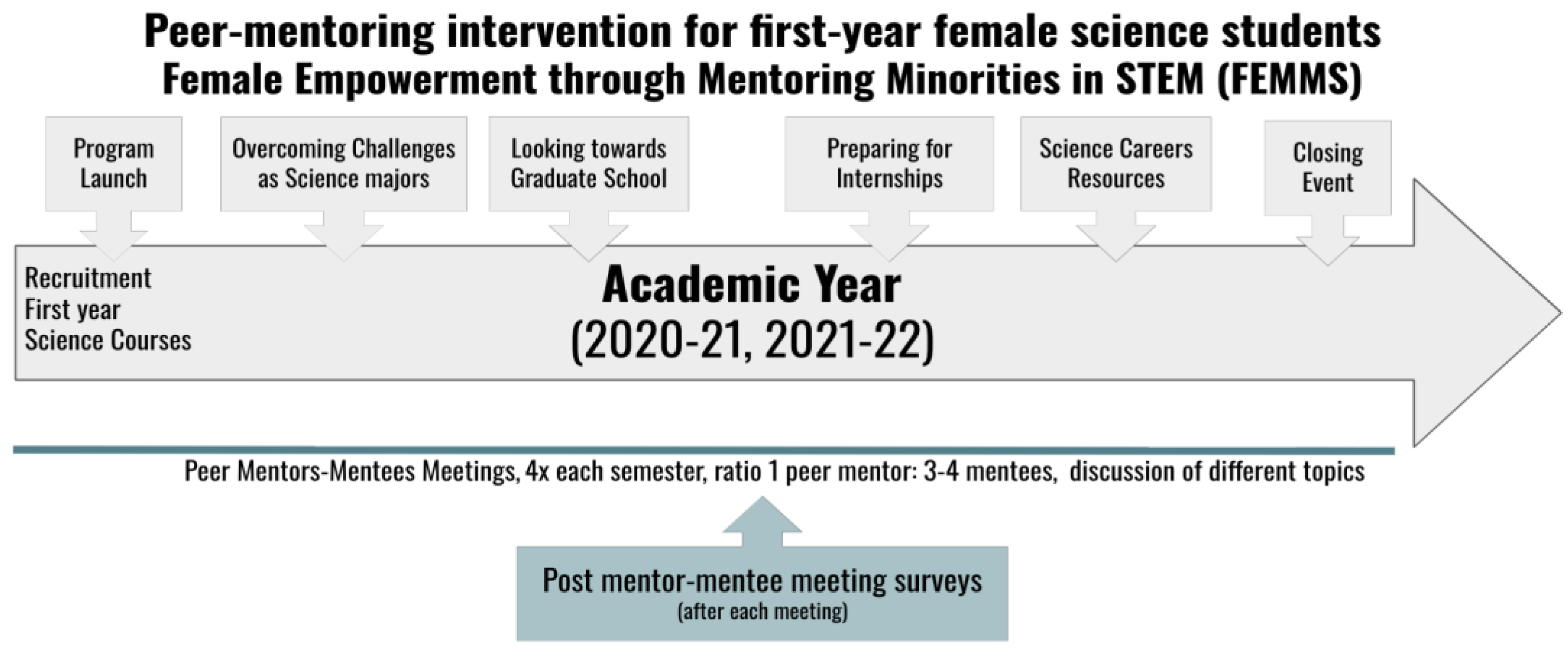
Figure 2.
One- and two-year retention for FEMMS participants and all female students. (A) Retention in the originally enrolled STEM majors. (B) Retention in any major. *p<0.05.
Figure 2.
One- and two-year retention for FEMMS participants and all female students. (A) Retention in the originally enrolled STEM majors. (B) Retention in any major. *p<0.05.
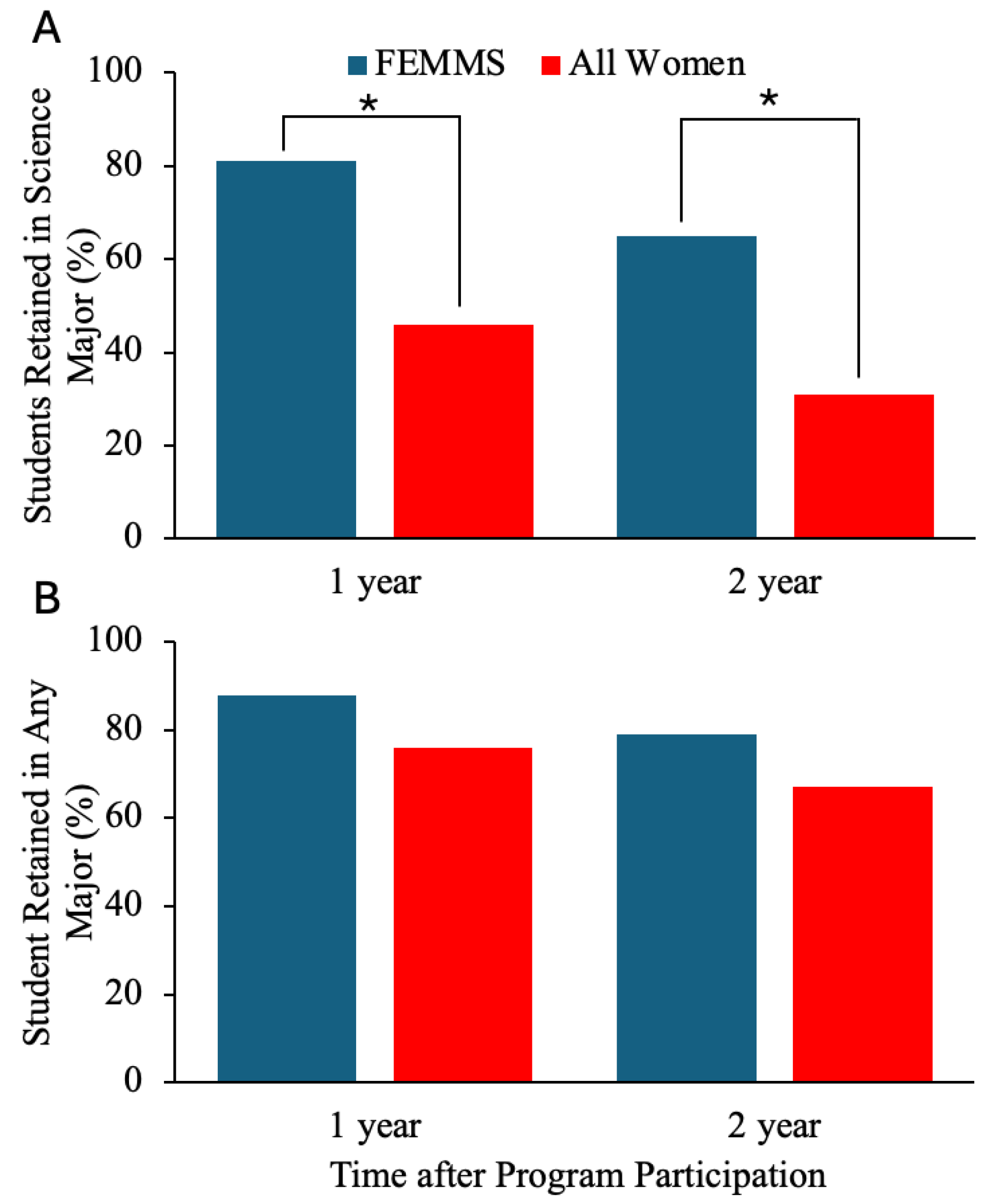
Figure 3.
Post mentor-mentee meeting survey results. (A) Meeting length and time spent per topic category. (B) Perception of meeting productivity and satisfaction (Likert scale).
Figure 3.
Post mentor-mentee meeting survey results. (A) Meeting length and time spent per topic category. (B) Perception of meeting productivity and satisfaction (Likert scale).
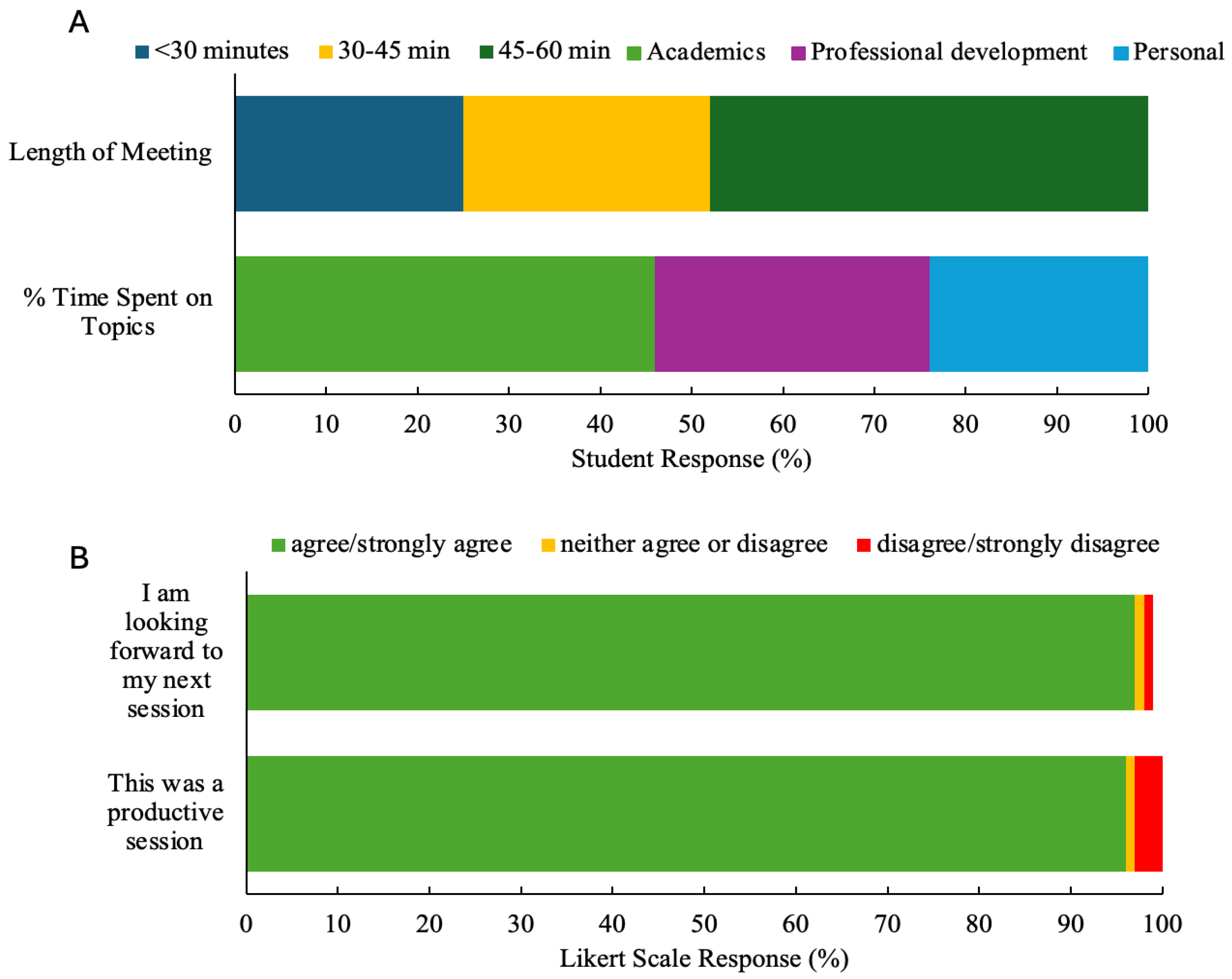
Figure 4.
Six pillars of quality mentoring identified through the implementation of the FEMMS program.
Figure 4.
Six pillars of quality mentoring identified through the implementation of the FEMMS program.
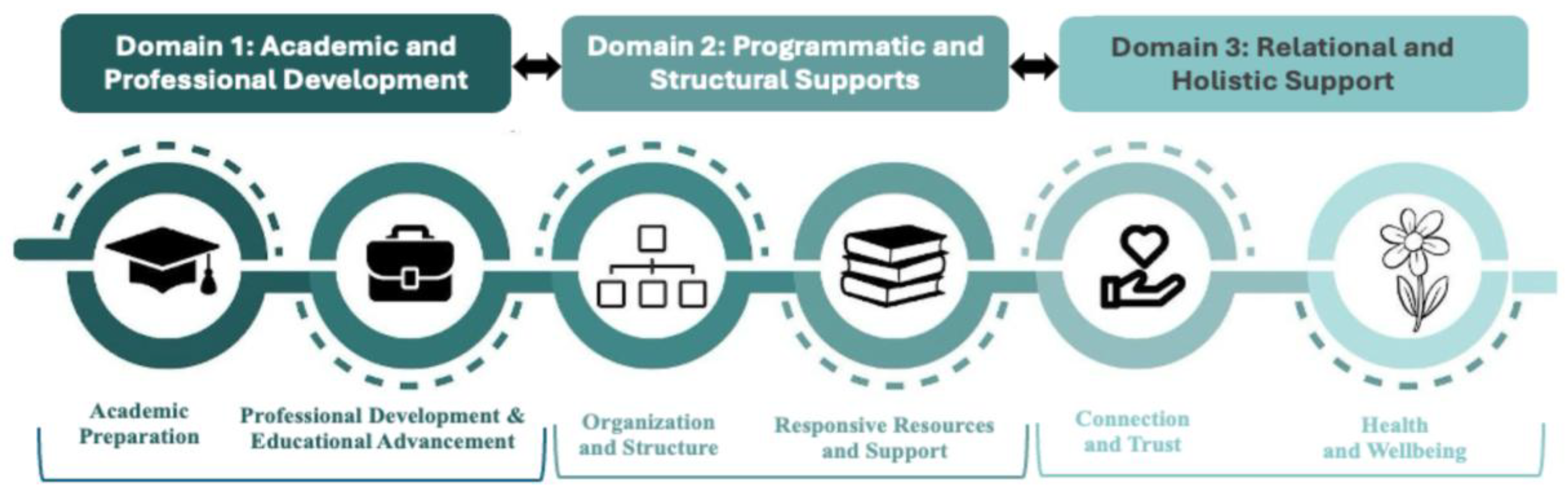

Table 1.
Post mentor-mentee meeting survey.
| Question | Response options |
| 1. What was the length of this session? | 0-15 minutes |
| 15-30 minutes | |
| 30-45 minutes | |
| 45-60 minutes | |
| 2. What percentage of the meeting was dedicated to | academic issues (e.g., classes schedule, school projects/papers/exercises, study habits, etc.): % |
| professional development issues (e.g., job & internships opportunities, interview techniques, etc.): % | |
| personal issues (e.g., life experiences, personal challenges & strategies for success, etc): % | |
| 3. How much do you agree with the following statements: | |
| - This was a productive session | Likert five-item scale |
| - I am looking forward to my next mentoring session | Likert five-item scale |
| 4. Share your feedback about your mentor-mentee meeting. What do you think went well in this meeting? What do you think can be improved? | Open response |
Table 2.
Demographic and academic characteristics of the peer mentoring program participants.
| Characteristics | AY 2020-21 | AY 2021-22 | Average |
| Number (N) | 20 | 24 | 44 |
| Race/Ethnicity | |||
| Asian | 25% | 21% | 23% |
| Black | 30% | 25% | 27% |
| Latinx | 35% | 46% | 41% |
| White | 10% | 8% | 9% |
| Financial Aid | |||
| Pell grant recipient | 70% | 71% | 70% |
| Not a Pell grant recipient | 30% | 36% | 30% |
| Academic Standing | |||
| Freshman | 60% | 75% | 68% |
| Sophomore | 30% | 17% | 23% |
| Junior | 0% | 4% | 2% |
| Senior | 0% | 0% | 0% |
| others (transfer, e-permit) | 10% | 4% | 7% |
| Academic major | |||
| Biological or Physical Sciences | 80% | 67% | 73% |
| Other | 20% | 33% | 27% |
Table 3.
Academic outcomes of FEMMS peer-mentoring program participants.
| FEMMS | STEM Female Students | ||||
| AY 2020-21 | AY 2021-22 | All | AY 2020-21 & 2021-22 | p-value | |
| College Retention | |||||
| Number (N) | 19 | 23 | 42 | 295 | |
| 1 year | 100% | 78% | 88% | 76% | 0.233 |
| 2 year | 89% | 70% | 79% | 67% | 0.686 |
| STEM Major Retention | |||||
| Number (N) | 16 | 15 | 31 | 295 | |
| 1 year | 94% | 67% | 81% | 46% | 0.0001 |
| 2 year | 81% | 47% | 65% | 31% | 0.0003 |
Disclaimer/Publisher’s Note: The statements, opinions and data contained in all publications are solely those of the individual author(s) and contributor(s) and not of MDPI and/or the editor(s). MDPI and/or the editor(s) disclaim responsibility for any injury to people or property resulting from any ideas, methods, instructions or products referred to in the content. |
© 2026 by the authors. Licensee MDPI, Basel, Switzerland. This article is an open access article distributed under the terms and conditions of the Creative Commons Attribution (CC BY) license (http://creativecommons.org/licenses/by/4.0/).
Copyright: This open access article is published under a Creative Commons CC BY 4.0 license, which permit the free download, distribution, and reuse, provided that the author and preprint are cited in any reuse.


