

Submitted:
04 March 2026
Posted:
06 March 2026
You are already at the latest version
Abstract
Sodium-ion batteries (SIBs) have emerged as one of the most promising alternatives to lithium-ion systems, driven by the abundance and low cost of sodium resources as well as the urgent demand for sustainable large-scale energy storage. In recent years, re-markable advances have been achieved in electrode materials, electrolytes, and inter-facial engineering, which have significantly improved the electrochemical performance of SIBs. Hard carbons and alloy-type anodes have shown encouraging progress in balancing capacity and stability, while layered oxides, polyanionic compounds, and Prussian blue analogues are leading candidates for cathodes due to their structural diversity and tunable redox properties. Concurrently, the development of advanced liquid and solid electro-lytes, together with strategies to control the solid–electrolyte interphase (SEI) and cathode–electrolyte interphase (CEI), is enhancing safety and long-term cycling. Despite these achievements, critical challenges remain, including limited energy density, volumetric expansion in alloying anodes, interfacial instability, and scalability issues. This review provides a comprehensive overview of the fundamental principles, recent material in-novations, and failure mechanisms of SIBs, and highlights the current status of industrial progress led by companies such as Faradion, HiNa Battery, CATL, and Tiamat. Finally, future perspectives are discussed, emphasizing the role of sodium-ion technology in grid-scale storage, renewable energy integration, and sustainable battery recycling. By bridging academic advances and industrial development, this article outlines the roadmap toward the commercialization of sodium-ion batteries.
Keywords:
sodium-ion batteries
; layered oxides
; Prussian blue analogues
; solid-electrolyte interphase (SEI)
; cathode-electrolyte interphase (CEI)
; presodiation
; stationary energy storage
; recycling and circular economy
1. Introduction
The accelerating demand for rechargeable batteries, driven by electrification, grid modernization, and deeper renewable energy penetration, has increased interest in alternatives to lithium-ion systems. Sodium-ion batteries (SIBs) have re-emerged as a credible technology platform because sodium is abundant, geographically widespread, and potentially lower-cost for large-scale deployment. From a commercialization standpoint, the field has benefited from industrial perspectives describing how high-energy SIB concepts translate into manufacturable cells and scalable supply chains [1]. Foundational and comprehensive reviews have also mapped the scientific and technological landscape of SIBs, including operating principles, electrode materials, electrolyte chemistries, and major barriers to practical adoption [2,3]. Earlier seminal overviews consolidated the core chemistries and performance trade-offs relative to Li-ion systems and clarified why sodium hosts, interfaces, and electrode designs often require distinct optimization strategies [4,5,6].
Over the last decade, SIB research has increasingly shifted from proof-of-concept demonstrations to application-oriented development centered on durability, safety, and manufacturability [7]. Multiple analyses emphasize that SIBs are especially attractive for stationary energy storage and other cost-sensitive use cases where supply-chain robustness and resource sustainability are prioritized over maximum gravimetric energy density [8]. Recent perspectives discuss realistic competitive windows for SIBs at the cell and system levels, including constraints imposed by energy density, temperature performance, and long-term stability [9,10,11]. Comparative assessments of Li-ion versus Na-ion systems further highlight the practical implications of chemistry-specific limitations and deployment contexts [12], and materials-focused reviews summarize the present maturity of electrode families and remaining technical bottlenecks for next-step performance gains [13]. Low-temperature operation remains a persistent deployment gap and has motivated targeted strategies spanning electrolyte formulation, interphase control, and electrode engineering [14,15].
Independent testing of early-stage commercial SIB cells has begun to clarify practical performance signatures, aging behavior, and safety-relevant characteristics under realistic operating conditions [16,17]. Safety-focused reviews provide a consolidated view of hazard modes and mitigation approaches spanning materials selection, electrolyte choices, and cell and system design [18]. Sector-specific assessments, particularly those evaluating automotive suitability, offer a pragmatic framework for matching SIB capabilities to use-case requirements and constraints [19]. Collectively, these works motivate an integrated materials, electrolyte, and interface perspective, because many performance and aging limitations in SIBs are ultimately expressed through interphase stability and transport losses rather than through bulk thermodynamics alone [20]. The fundamental operation of sodium-ion batteries is illustrated in Figure 1, highlighting the coupled transport of Na⁺ through the electrolyte and electron flow through the external circuit between a Na-insertion cathode and a carbon-based anode.
2. Fundamentals of Sodium-Ion Batteries
2.1. Electrochemical operating principle
SIBs store and release energy through coupled ionic and electronic transport. Na⁺ migrates through the electrolyte and electrons flow through the external circuit. Charge storage can occur through reversible Na⁺ insertion and extraction in host lattices, alloying and dealloying reactions, or conversion reactions, depending on the electrode chemistry [2,3]. Although the high-level operating principle resembles Li-ion batteries, Na⁺ storage often exhibits stronger sensitivity to host-structure stability and to solvation and interphase chemistry, reflecting sodium’s larger ionic size and distinct coordination preferences across many frameworks [2,3].
At equilibrium, the open-circuit voltage can be expressed in terms of the sodium chemical potentials at the anode and cathode, normalized by Faraday’s constant [2]:
This relation highlights a practical point. Shifts in composition-dependent thermodynamics, structural transitions, and interface-induced polarization shape the observable voltage profile and extractable energy [2]. Beyond pure intercalation, alloying and conversion mechanisms can provide higher theoretical capacities, but they also tend to amplify mechanical and interfacial demands because large volume changes and continuous surface renewal destabilize the interphase and accelerate impedance growth [5,8].
2.2. Comparison with lithium-ion batteries
SIBs generally exhibit lower gravimetric energy density than lithium-ion cells due to sodium’s higher atomic mass, typically lower average cathode voltages, and practical constraints in reversible capacity for commercial electrode pairs [9,10,11]. These thermodynamic penalties can be partly offset at the system level by material availability, potential cost advantages, and supply-chain resilience, especially for stationary storage [8,9,10,11,12]. From a kinetics standpoint, Na⁺ transport can be slower in compact frameworks but can be relatively fast in open-structure hosts, enabling strong power capability in appropriately designed chemistries [4,7]. In practice, rate performance is governed by coupled resistances including ionic transport through porous electrodes, charge transfer and desolvation across SEI and CEI, solid-state diffusion, and electronic conduction. For that reason, reliable power delivery requires coordinated electrode architecture and electrolyte and interphase optimization [2,7].
Because interphase stability is often decisive for long-life operation, many development pathways also consider solid electrolytes and polymer-ceramic concepts as potential routes to improved safety and interface control, even though interfacial resistance and manufacturability remain key obstacles [21,22]. The main cathode material families used in sodium-ion batteries and their structure–property trade-offs are compared in Figure 2, illustrating representative structural motifs together with their characteristic advantages and limitations.
The materials and component choices available for sodium-ion batteries span a remarkably wide design space, and their practical relevance is best appreciated when cathodes, anodes, electrolytes and binders are considered together rather than in isolation. While the previous section outlined the fundamental differences between Na-ion and Li-ion chemistries and their implications for cell-level energy density, the next sections focus on how these constraints are addressed through materials selection and engineering trade-offs. In particular, the achievable operating voltage, specific capacity and rate capability emerge from a coupled balance between the redox chemistry and structural stability of the cathode, the Na-storage mechanism and interphase formation on the anode, and the electrolyte formulation that ultimately governs SEI/CEI composition, ionic transport and parasitic reactions. In parallel, electrode processing—strongly influenced by binder choice—controls porosity, mechanical integrity and electronic percolation, and therefore determines how successfully promising active materials translate from half-cell studies to thick, high-loading electrodes required in practical devices. Figure 3 provides a compact overview of this coupled landscape. It summarizes representative cathode and anode families in terms of working potential and specific capacity, and highlights the prevalence of electrolyte salts/solvents/additives and binder chemistries reported in the literature. Beyond serving as a “map” of materials options, the figure underscores a central message that will recur throughout this review: performance limitations and degradation pathways are frequently expressed at the interfaces and at the electrode level, meaning that the most viable routes toward high-performance sodium-ion cells are those that combine compatible electrodes with electrolyte/interphase stabilization and manufacturable electrode formulations. With this context, the following section examines anode materials, starting from hard carbon as the current commercial baseline and then discussing higher-capacity alternatives and the engineering strategies required to render them practical.
3. Anode Materials
3.1. Carbon-based anodes
Hard carbon, also called non-graphitizable carbon, remains the leading anode candidate for near-term commercialization because it provides practical reversible capacity and can achieve acceptable first-cycle efficiency when paired with suitable electrolytes and additives [20,23]. Its Na-storage behavior is commonly described as a combination of a sloping region, often linked to defect and surface-related processes, and a low-voltage plateau, frequently associated with Na storage in nanopores. Both regions are strongly influenced by SEI formation and evolution [20,23]. A key limitation is the initial coulombic efficiency. First-cycle irreversible loss can be substantial due to SEI formation and parasitic reactions, which may require cathode oversizing or pre-sodiation strategies in full cells [20,23].
Hard-carbon performance is sensitive to temperature and rate. Under cold conditions and at high current, polarization and SEI resistance can reduce accessible capacity and power, which constrains deployment in colder climates or fast-charge regimes [14,15,20,23]. Graphitic carbons typically show poor Na⁺ intercalation in standard carbonate electrolytes. Appreciable Na storage often requires alternative formulations, including some ether-based approaches, and co-intercalation mechanisms, which introduce additional electrolyte compatibility constraints [3,14,15]. For these reasons, hard carbon remains the most practical anode baseline in many commercialization pathways [1,17].
3.2. Alloy-type anodes (Sn, Sb, Bi, P)
Alloying anodes based on Sn, Sb, Bi, and P offer high theoretical capacities because Na storage proceeds through the formation of multiple Na–M alloy phases during sodiation and their reversal during desodiation. In practice, multi-step alloying and dealloying is accompanied by large and often anisotropic volume changes that generate substantial mechanical stress within particles and across the composite electrode. Particle fracture, pulverization, and loss of electronic percolation progressively isolate active domains. Repeated exposure of fresh surfaces drives continuous SEI re-formation. Together, these processes cause impedance growth and accelerated capacity fade [5,8].
These failure modes become more severe at practical areal loadings because reaction non-uniformity increases through the electrode thickness, stress gradients intensify, and binder fatigue and contact loss accumulate over cycling [8]. Mitigation strategies focus on decoupling electrochemical activity from mechanical damage. Nanoconfinement within conductive carbon matrices reduces absolute strain per active domain and helps maintain electronic pathways during repeated phase changes [8]. Engineered void space can accommodate expansion and reduce the probability of catastrophic cracking and large-scale SEI rupture [8]. Elastic binders and conformal coatings stabilize electrode cohesion and adhesion to the current collector, limiting debonding and preserving percolation networks [8,20,23,24,25].
Electrolyte and additive selection is equally critical because the alloy surface repeatedly challenges interphase stability. When the SEI is mechanically fragile or chemically unstable, it ruptures and reforms, consuming cyclable sodium and thickening into a resistive layer that increases polarization [25,26]. The practical viability of alloy anodes therefore depends not only on specific capacity but also on thickness swelling, impedance evolution, and full-cell balancing under realistic formation protocols and cycling conditions [8]. From a cell-engineering standpoint, alloy anodes are high-capacity options that require integrated microstructural design and interphase engineering to translate intrinsic capacity into durable full-cell performance [8,25,26].
3.3. Conversion-Type Anodes
Conversion-type anodes can deliver high initial capacities because Na storage proceeds through multielectron reactions that transform the starting compound into new phases during discharge and reverse them during charge. This chemistry can provide large charge storage per formula unit, but it introduces intrinsic drawbacks that often limit practical full-cell implementation. Conversion reactions commonly exhibit pronounced voltage hysteresis. This reflects large polarization associated with bond breaking and formation, phase nucleation, and complex reaction pathways. The result is lower round-trip energy efficiency and potentially higher heat generation under load [5,8]. Cycling also continuously generates and consumes nanophases and interfacial area, which effectively renews reactive surfaces each cycle. This accelerates electrolyte reduction, destabilizes the SEI, and promotes the formation of resistive interphase layers and parasitic species that raise impedance over time [5,8,25].
Interfacial instability is therefore a dominant degradation route for conversion anodes. Even if the bulk conversion reaction remains partly reversible, progressive SEI thickening and non-uniform current distribution can concentrate reactions in lower-resistance regions, increasing local degradation and polarization [25,26]. Carbon confinement, conductive scaffolds, and protective coatings can mitigate coarsening and help maintain electrical contact with dynamically formed phases. Optimized SEI-forming electrolytes can slow continuous decomposition and reduce interphase resistance growth [25,26]. Relative to hard carbon, achieving long-life full-cell performance with conversion anodes remains challenging because the mechanism involves repeated microstructural rearrangement and persistent interphase stress, particularly at practical areal loadings and current densities [5,8,25,26].
3.4. Electrolyte/Interphase Considerations for Anodes (SEI)
The solid electrolyte interphase is central to obtaining high initial coulombic efficiency and stable long-term cycling in SIBs, particularly for hard carbon and mechanically dynamic alloy and conversion anodes. The SEI forms primarily from electrolyte reduction during early cycles and continues to evolve with electrode potential, temperature, current density, and the availability of reactive surface sites. Electrolyte degradation pathways, salt chemistry, and additive selection influence SEI composition, morphology, thickness, and ionic resistance. These parameters determine polarization, rate capability, and capacity retention [25,26]. Because Na-based systems can exhibit solvation and decomposition behaviors distinct from Li-based analogs, stable SIB operation often requires an SEI tailored to Na⁺ transport and to the specific surface chemistry of the anode [25,26].
Mechanically, an effective SEI must tolerate strain without cracking or delamination. This requirement is especially acute for alloying and conversion anodes, where volume changes and surface reconstruction repeatedly stress the interphase. Each rupture exposes fresh surface, triggers renewed electrolyte reduction, consumes cyclable sodium, and thickens the SEI into a more resistive layer [25,26]. Chemically, the SEI must remain electronically insulating to suppress further solvent reduction, while being sufficiently Na⁺-conductive to avoid excessive overpotential. This balance is particularly important at low temperature, where interphase resistance can dominate polarization [14,15,25,26]. In practical electrodes, SEI quality is also coupled to electrode architecture. Binder chemistry, conductive network continuity, porosity, and electrolyte wetting influence where the SEI forms and whether it remains uniform across electrode thickness.
Accordingly, anode development in SIBs is inseparable from electrolyte and interphase engineering. The most robust anode concepts combine mechanically stable microstructures that limit surface renewal and preserve electronic pathways, and electrolyte formulations and additives that promote compact, resilient SEI layers capable of surviving realistic cycling stresses and formation protocols [25,26].
Table 1 summarizes the principal anode families used in sodium-ion batteries, highlighting dominant Na-storage mechanisms and the key practical bottlenecks that limit full-cell performance. It also outlines the main engineering levers, spanning electrode microstructure, mechanical stabilization, and SEI and interphase control, that are needed to translate intrinsic capacity into durable, scalable operation.
4. Cathode Materials
4.1. Layered transition-metal oxides (NaMO2)
Layered transition-metal oxides, commonly written as NaₓMeO₂ where Me is a transition-metal mixture, are among the most extensively studied SIB cathodes due to their relatively high practical capacities and broad compositional design space [27]. In these materials, Na⁺ is extracted and inserted through predominantly topotactic reactions within stacked MeO₂ slabs. Performance depends on phase stability across the Na content window, the reversibility of structural transitions, and surface and interphase stability during cycling [27].
A key challenge is balancing energy density and structural robustness. As Na is removed, many compositions undergo phase transitions that can induce lattice strain, microcracking, impedance rise, and gradual loss of accessible capacity [27]. These effects are intensified by particle morphology, grain boundaries, and surface chemistry, particularly when electrolyte-derived surface layers evolve into resistive cathode electrolyte interphases under demanding conditions [27,28]. In practice, layered-oxide optimization often requires combining bulk composition and doping strategies that stabilize the host framework with surface engineering and electrolyte choices that suppress parasitic reactions at elevated potentials [27,28].
4.2. Polyanionic compounds, including sulfate frameworks
Polyanionic cathodes, including phosphate and sulfate frameworks, offer robust structures with strong thermal stability and generally favorable safety characteristics, which can be advantageous in large-format cells and abuse scenarios [2]. Sulfate-based cathodes are an important polyanionic subfamily whose electrochemical behavior and design strategies have been reviewed in detail [29]. Across polyanionic systems, redox potentials are strongly influenced by the anion group via inductive effects, enabling competitive voltages in selected compositions while preserving structural integrity [2,29]. In many frameworks, Na⁺ migration proceeds through well-defined channels and polyhedral networks, supporting stable cycling when diffusion pathways remain open and mechanical strain is well managed [29].
The main limitations often include lower gravimetric energy density relative to layered oxides and limited intrinsic electronic conductivity. These constraints typically require particle-size control, conductive coatings, and electrode architectures that reduce tortuosity and sustain electronic percolation across practical thicknesses [29]. Even in robust frameworks, interphase behavior still matters. Cathode surfaces can drive electrolyte oxidation and CEI formation, so electrolyte selection and additive strategies remain important to stabilize surface chemistry and maintain low impedance during long cycling [28,29].
4.3. Prussian blue analogues (PBAs)
Prussian blue analogues (PBAs), typically represented by NaₓM[Fe(CN)₆]·yH₂O and related compositions, have open 3D frameworks that can enable fast Na⁺ transport and strong rate capability, making them attractive for power-focused and moderate-energy applications [20]. A major practical advantage is the potential for scalable aqueous synthesis routes, which may reduce processing cost and environmental burden relative to some oxide synthesis methods [20]. These features have positioned PBAs as serious candidates for near-term commercial cathodes in SIBs, particularly in segments where power, cost, and manufacturability are dominant drivers [1,14,15,20].
Despite these advantages, PBAs are highly sensitive to defect chemistry and water content. Vacancies in the [Fe(CN)₆] sublattice and variable amounts of coordinated/interstitial water can influence electronic structure, Na⁺ mobility, mechanical stability, and side-reaction propensity. High defect density can reduce practical capacity, broaden voltage hysteresis, and amplify structural heterogeneity, which may accelerate degradation under repeated cycling. Likewise, water content can be a double-edged parameter: it may facilitate synthesis and influence ion transport but can also promote parasitic reactions and complicate electrolyte compatibility in organic systems [20,21,22,26,27,28].
For these reasons, recent efforts emphasize low-defect synthesis, water control, and stoichiometry optimization. Strategies include controlling precipitation conditions, post-synthesis treatments to reduce residual water, and compositional tuning (including high-entropy or multi-metal approaches) to improve structural resilience and electrochemical stability [21,22,26,27,28]. In parallel, surface and interphase engineering remains important because PBAs can still drive electrolyte decomposition under some operating conditions, and dissolved species may contribute to cross-talk and anode degradation [24,30]. In practical cell designs, PBA cathodes must balance rapid Na⁺ transport with stable interfacial chemistry, reproducible quality control, and acceptable volumetric energy density once electrode density and inactive components are accounted for [8,9,10,11,20].
4.4. Iron-based sulfate cathodes
Iron-based sulfate cathodes have attracted attention as a polyanionic cathode class because they can combine structural robustness and potentially favorable safety characteristics while leveraging iron-based chemistries [29]. The review literature emphasizes that key performance outcomes depend on how framework stability, Na⁺ transport, and electrode-level conductivity limitations are addressed through particle engineering and carbon-network design [29] In practical terms, iron-based sulfate cathodes illustrate a recurring theme in SIB development. Even when bulk frameworks are stable, full-cell competitiveness depends on electrode architecture and interphase control, because polarization and impedance growth can dominate long-term performance if electronic and ionic transport and CEI evolution are not well managed [28,29].
4.5. Organic/polymer redox cathodes
Organic redox cathodes and polymeric systems offer sustainability and molecular design flexibility, enabling tuning of redox potential, solubility, and functional-group chemistry [29]. These materials can also support alternative processing methods and potentially reduce reliance on transition metals. However, the primary limitations often include dissolution of active species into organic electrolytes, voltage hysteresis, limited intrinsic conductivity, and relatively high fractions of conductive carbon needed to achieve practical electrode performance [29].
Mitigation typically relies on polymerization (to suppress dissolution), covalent anchoring onto conductive scaffolds, electrolyte engineering to reduce solubility, and electrode designs that provide robust electronic percolation. Even with these strategies, long-term durability can be constrained by gradual loss of active material, side reactions at functional groups, and impedance growth driven by interphase evolution [29]. As a result, organic cathodes are promising for niche applications and as a research frontier, but their near-term commercial role depends on achieving stable full-cell performance with manufacturable electrodes and acceptable volumetric energy density.
Table 2 provides a qualitative, application-oriented comparison of major SIB cathode families, linking intrinsic strengths to the dominant bottlenecks that typically constrain long-term full-cell performance. The table also summarizes common mitigation strategies used at the material, surface and interphase, and electrode-architecture levels.
5. Electrolytes and Interphases
5.1. Liquid electrolytes: salts, solvents, and formulation principles
Electrolytes in SIBs must enable fast Na⁺ transport, support stable SEI formation on the anode, and resist oxidation on the cathode at relevant operating potentials. Electrolyte selection is therefore a core determinant of initial coulombic efficiency, impedance evolution, calendar life, and safety-relevant behavior [25,26,36]. Carbonate-based electrolytes, often formulated with sodium salts in mixtures of cyclic and linear carbonates, are widely used because they align with conventional manufacturing workflows. However, they frequently require careful formulation and additives to form robust SEI and CEI layers and to limit continuous parasitic reactions [25,26,36].
A practical difference between Li-ion and Na-ion electrolyte behavior is the sensitivity of interphase composition to solvation and decomposition pathways, which can change substantially with salt choice, solvent composition, and additive chemistry [25,26]. In carbonate systems, undesirable outcomes include resistive SEI layers on hard carbon, which reduce ICE and increase polarization, and oxidative decomposition on reactive cathode surfaces, which thickens the CEI and accelerates impedance rise [25,26,28]. For this reason, electrolyte optimization for commercial SIBs is best framed as an interphase engineering problem. The most effective electrolyte is the one that produces low-resistance, chemically stable interphases on both electrodes while remaining manufacturable and compatible with the targeted voltage and temperature windows [25,26,28,36].
Ether-based electrolytes can offer improved low-temperature kinetics and reduced interfacial impedance in selected chemistries, which is relevant because low-temperature performance remains a deployment gap for many SIB configurations [14,15]. However, the lower oxidative stability of some ether-based systems can limit compatibility with higher-voltage cathodes unless surface and electrolyte strategies are aligned to suppress oxidation and manage CEI evolution [28]. In practice, electrolyte selection depends on the targeted cathode family, the voltage range, and the temperature requirements rather than on a single solvent class.
5.2. Electrolyte degradation, gas evolution, and lifetime limitations
Electrolyte degradation in SIBs includes reductive decomposition at the anode, which contributes to SEI formation and growth, and oxidative decomposition at the cathode, which contributes to CEI formation and thickening. Bulk chemical decomposition can also occur, promoted by impurities, trace moisture, and reactive surface species [25]. Degradation can manifest as gas evolution, salt decomposition products, and soluble byproducts that migrate between electrodes, contributing to impedance growth and loss of cyclable sodium [25,26]. These phenomena often determine practical lifetime and influence safety-relevant behavior under temperature excursions or abusive conditions [18,25].
Because many commercial SIB concepts rely on hard-carbon anodes, controlling SEI formation is especially important. If the SEI is chemically unstable or mechanically fragile, it can reform repeatedly, consuming electrolyte and Na inventory and driving early capacity fade [25,26]. On the cathode side, oxidative stability and CEI composition become increasingly critical as cell voltages rise and as reactive cathode surfaces catalyze solvent breakdown [27,28]. Long-term stability therefore requires minimizing continuous electrolyte decomposition and limiting cross-talk species that destabilize the opposite electrode’s interphase [25,26].
5.3. High-voltage electrolyte screening and cathode compatibility
High-voltage operation is an important lever for improving energy density, but it places stringent requirements on electrolyte oxidation stability and cathode interphase control. Screening approaches aim to identify solvent, salt, and additive combinations that resist oxidative breakdown and form protective CEI layers while maintaining adequate ionic conductivity and acceptable transport properties [28]. The practical objective is controlled formation of a thin, ion-conductive CEI that prevents continuous solvent attack and suppresses surface-driven degradation pathways [27,28]. Because cathode morphology, surface treatments, and electrode composition influence CEI chemistry, electrolyte screening must be interpreted alongside cathode design and processing, particularly for layered oxides operated at demanding potentials [27,28].
5.4. Concentrated electrolytes and transport–stability trade-offs
Electrolyte strategies involve trade-offs between transport properties such as conductivity, viscosity, and wetting, and interphase stability such as SEI and CEI composition and robustness. Reviews of SIB electrolyte development emphasize that approaches intended to stabilize interphases may alter solvation environments and shift reduction and oxidation pathways. These changes can improve interphase chemistry but may also increase viscosity or reduce low-temperature transport [36]. Electrolyte selection for practical SIB cells therefore requires balancing interphase stability with manufacturability and performance across the intended temperature and power windows [14,15,36].
5.5. Solid and quasi-solid electrolytes
Solid-state sodium batteries can improve safety by removing flammable solvents, but interfacial resistance and mechanical contact remain dominant hurdles. NASICON-type ceramics can exhibit high ionic conductivity yet may suffer high interfacial impedance unless engineered with interlayers, coatings, or other interface-control strategies [33,34]. Evaluations of NASICON stability under electrochemical conditions underscore that chemical compatibility and interface evolution can dominate long-term performance even when bulk conductivity is high [21,22]. Polymer electrolytes provide conformal contact but often require elevated temperature for adequate conductivity, which motivates composite polymer–ceramic concepts that seek to combine mechanical compliance with higher ionic transport [30,37]. Polymer-modified or coated NASICON interfaces have been investigated to reduce mismatch and stabilize interfacial transport, reinforcing that interface engineering is frequently the limiting barrier rather than bulk electrolyte conductivity alone [38]. Broad reviews of NASICON-based solid electrolytes consolidate these challenges and summarize processing and interface strategies aimed at practical deployment [39].
5.6. Interfacial phenomena (SEI/CEI) and cross-talk: a system-level view
Interphase stability is decisive for long cycle life. The SEI governs ICE and anode impedance growth, and the CEI governs cathode surface stability and interfacial polarization. Cross-talk between electrodes, via migration of dissolved species, decomposition products, and trace impurities, can destabilize both interphases simultaneously, producing accelerating impedance growth and loss of cyclable sodium [25,26]. The operationally relevant goal is therefore a coupled pair of interphases that remain chemically compatible under sustained cycling and realistic temperature windows [14,15,25,26,28].
In commercial contexts, system-level coupling becomes more pronounced because electrodes are thicker, areal loadings are higher, and transport limitations magnify the impact of interphase resistance. Interphase engineering must align with electrode design, including porosity, tortuosity, binder choice, and conductive network, and with cell constraints, including formation protocols, pressure management, and temperature exposure. In practice, formation procedures and electrolyte selection often determine whether a promising cathode and anode pairing can achieve stable full-cell behavior [1,16,17,25,26].
5.7. Safety considerations
Safety strategies span materials selection, electrolyte and interphase stabilization, separator design, and cell-level protection. Safety-focused reviews summarize hazard modes and mitigation approaches relevant to SIB chemistries, including thermal stability considerations, gas evolution risks, and the role of aging in changing safety-relevant behavior [18]. Experimental evaluations of early commercial SIB cells further emphasize the value of standardized safety testing and careful interpretation of failure modes as a function of state of charge and aging state [16,17].
Bridging from electrolyte safety to architecture, it is important to note that many safety- and lifetime-relevant phenomena (gas evolution, impedance rise, and localized hot spots) become more pronounced as electrodes thicken and areal loadings increase. Consequently, electrolyte/interphase design and safety testing must be discussed alongside electrode architecture, current collector/contact design, and formation-because these factors jointly determine polarization, heat generation, and usable SOC windows in practical cells.
6. Advanced Cell Architectures and Performance Enhancements
Moving from half-cell proof-of-concepts to commercially relevant sodium-ion batteries is largely an exercise in cell engineering. In full cells, first-cycle irreversible Na loss-especially pronounced for hard carbon-reduces cyclable sodium and can force cathode oversizing unless addressed by higher ICE, sodium-compensation strategies, or presodiation. Accordingly, the most robust gains typically come from co-optimizing electrode microstructure and density, electrolyte/interphase chemistry, and formation protocols under realistic areal loadings and voltage windows [40]. A second, equally practical issue is that the performance “penalties” of scaling (ionic/electronic transport through thicker porous networks, adhesion and mechanical integrity under cycling-induced stress, and impedance growth at both SEI and CEI) are amplified in SIBs because the electrolyte/interphase chemistry is often more sensitive than in mature LIB chemistries. This is precisely why recent high-impact full-cell and pouch-cell demonstrations increasingly highlight interface engineering and “cell-level thinking” rather than isolated material metrics. For example, a Nature Energy study demonstrated >200 Wh kg⁻¹ at the cell level through interfacial/electrolyte engineering strategies [41], underscoring that reaching competitive energy density in sodium systems is not simply a cathode capacity problem but a coordinated interfacial and architectural one.
6.1. Binder-free/self-standing electrodes: why architecture matters more at scale
Binder-free (self-standing) electrodes are often introduced as a route to reduce inactive mass and simplify electrode processing, but their real value in SIBs emerges when one asks a more demanding question: can the electrode retain low polarization and structural integrity at realistic thickness and loading? When electrodes become thicker, slurry-cast formulations can suffer from heterogeneous conductive pathways, binder-rich domains, and weak particle–particle contacts that aggravate local current constriction. Self-standing architectures—such as carbon cloth/paper scaffolds, electrospun carbon fiber mats, or integrated conductive backbones (CNT/graphene/MXene-reinforced frameworks)—can provide a mechanically continuous, electrically percolating network that better tolerates thick-electrode operation, because electron pathways remain continuous even as ionic transport becomes the limiting factor. The caveat, repeatedly observed in scale-up discussions, is that highly porous self-standing networks can “look excellent” gravimetrically while underperforming volumetrically if packing density is too low; in other words, architecture must be reported with areal capacity, electrode density, and thickness, not only mAh g⁻¹. In practice, binder-free designs tend to show their strongest advantage in two cases. First, for mechanically fragile or high-strain anodes (alloying/conversion-type systems), where a compliant conductive skeleton reduces crack formation and maintains electrical contact. Second, for high-loading HC anodes where uniform SEI formation and stable electronic connectivity become decisive. Here, the interphase literature on HC is especially relevant: SEI composition and evolution are strongly coupled to surface chemistry and electrolyte choice, and this coupling persists (and often intensifies) when the electrode architecture increases surface area or alters wetting dynamics (again consistent with SEI-focused analyses, including the influence of salt/additives on HC surface layers [40]).
6.2. Nanostructured current collectors and conductive matrices: distributing current and suppressing impedance growth
Current collector engineering is sometimes treated as a “minor optimization,” but at high areal loadings it becomes a powerful lever for reducing internal resistance and improving utilization across the electrode thickness. Textured or carbon-coated foils can reduce contact resistance and improve adhesion; meanwhile, 3D collectors (foams/porous metals) can distribute current more uniformly and shorten electronic path lengths. The key is that these approaches alter the local current density distribution and the electrochemical microenvironment, which in turn can reshape SEI/CEI formation during formation cycles. This is why high-surface-area collectors can be beneficial or harmful depending on whether electrolyte formulation and formation protocols are tuned to avoid excessive parasitic decomposition. From a manufacturability standpoint, the most compelling collector-level interventions are those compatible with roll-to-roll processing (e.g., coated foils), because they can improve thick-electrode performance without introducing exotic scaffolds. For layered oxide cathodes, widely considered one of the most energy-dense routes in SIBs, collector/contact optimization complements interfacial stabilization strategies, particularly at high voltage where microcracking and metal dissolution accelerate CEI growth. A recent Nature Communications work, for instance, coupled surface/interface stabilization (fast-ion-conductor coating with gradient doping) to demonstrate robust high-voltage performance and then validated practical feasibility in a pouch-type full cell paired with HC, retaining 82.9% after 300 cycles at 0.5C [42]. That result illustrates how “electrode architecture” and “interface engineering” converge: once a cell is pushed into a pouch format, mechanical integrity, interphase stability, and uniform current distribution must all work together [42].
6.3. Pre-sodiation: compensating Na loss to unlock full-cell energy density
If one had to name a single technology that repeatedly appears as the enabler for practical HC-based SIB full cells, it would be pre-sodiation. The reason is simple: the cathode in a conventional full cell is the only sodium reservoir, and the cathode must “pay” the sodium cost of SEI formation and other irreversible sinks on the anode during the first cycle. This sodium tax can be large for HC, making it difficult to reach competitive energy density even if both electrodes look excellent in half-cells. Accordingly, the last few years have produced an intense focus on strategies that restore sodium inventory—either at the anode, at the cathode, or as a cell-level step during manufacturing. A particularly industrially attractive direction is the use of sacrificial cathode additives (SCAs), because it can be integrated into existing electrode fabrication with relatively straightforward process changes. A 2025 Chemical Communications highlight explicitly frames SCA-based pre-sodiation as appealing for practical deployment due to safety and operational simplicity, and surveys optimization strategies aimed at approaching “ideal” sacrificial behavior [43]. Presodiation technology: progress, strategy and prospects of sacrificial cathode additives in sodium-based energy storage systems. In parallel, the field has also advanced specific compensation reagents and protocols. An influential example is the use of sodium oxalate (Na₂C₂O₄) as a high-efficiency cathode sodium compensation reagent in full cells, chosen for its high theoretical capacity and practical handling characteristics [44]. The broader message across these studies is that pre-sodiation is not a “band-aid” but a design requirement: without sodium compensation, full cells frequently operate sodium-limited from the start, depressing capacity utilization and raising impedance growth sensitivity. This becomes even more evident when pairing HC with cathode families that are intrinsically sensitive to interface chemistry, such as high-voltage layered oxides. Full-cell demonstrations that reach high energy density therefore tend to report not only active material selections but also explicit sodium inventory strategies and interface stabilization, as exemplified by the layered-oxide HC full-cell literature [45].
Finally, pre-sodiation interacts strongly with cathode selection. When PBAs (Prussian blue analogues) are used as cathodes, their attractive cost and rate capability can be offset by defect chemistry (vacancies, coordinated water) and interfacial side reactions that influence sodium inventory and impedance growth. Recent reviews consolidate these mechanistic constraints and mitigation pathways for PBAs in SIB cathodes [46]. In that context, pre-sodiation is not merely compensating the anode; it can also buffer full cells against cathode-side inefficiencies and facilitate more robust formation.
7. Challenges and Failure Mechanisms
A recurring lesson in sodium-ion batteries (SIBs) is that many of the “best-in-class” material metrics reported in half-cells are not the limiting factors once one builds realistic electrodes and full cells. Instead, failure is commonly governed by a coupled set of mechanical (chemo-mechanical) instabilities, interfacial reactivity, and cell-level constraints (Na inventory, electrode balancing, and manufacturability). In what follows, the major challenges are discussed in a mechanism-driven way, highlighting how they manifest in alloy-type anodes, at electrode/electrolyte interfaces, and ultimately at the pack-relevant metrics of energy density, cost, and lifetime.
7.1. Volume expansion in alloy-type anodes
Alloying anodes (Sn, Sb, P and related compounds) are attractive for SIBs because they can, in principle, push energy density upward relative to hard carbon, yet their dominant failure mode remains massive volume change upon sodiation/desodiation. This repeated expansion–contraction induces particle pulverization, loss of electrical percolation, electrode thickening, and mechanical damage to the SEI; the result is a classic cascade: cracking → fresh surface exposure → continuous electrolyte decomposition → SEI re-growth → impedance increase and rapid capacity fade. These alloy-anode degradation pathways and their coupling to electrode architecture have been articulated in foundational mechanistic accounts that already emphasized that, for Na systems, the larger ionic radius and different thermodynamics/kinetics can exacerbate mechanical stress relative to Li analogues [47]. At the material level, the magnitude of expansion can be extreme (for Sb, formation of Na₃Sb is frequently associated with ~hundreds of percent volume change), and even “successful” nanostructuring strategies often trade one problem for another: reducing particle size and introducing void space improves strain accommodation but simultaneously increases surface area, which can accelerate parasitic reactions and SEI growth. The long-standing strategy space—hollow/yolk-shell particles, porous frameworks, buffering carbon matrices, and elastic binders—was built precisely to decouple mechanical strain from electrical connectivity. A representative early demonstration of this design logic for Sb employed hollow architectures to mitigate pulverization and maintain cycling stability [48]. What is increasingly clear, however, is that stabilizing alloy anodes in practical cells requires moving beyond nanoscale “stress relief” alone. Dense electrodes are needed for competitive volumetric energy density, but densification tends to worsen connectivity loss during cycling because expansion collapses conductive pathways and induces delamination. A very recent Nature Energy report addresses this directly by designing a durable, dense alloy anode that maintains connectivity and supports ampere-hour-class pouch-cell operation with improved volumetric energy density [49]. This work is significant not only as an alloy-anode result, but as evidence that the key barrier is increasingly an architectural/mechanical percolation problem rather than only intrinsic electrochemistry. Across alloy systems, the same pattern repeats: void engineering and compositing stabilize cycling, yet one must also demonstrate performance at realistic areal capacities and densities. For instance, yolk–shell design has continued to be explored for Sn-based anodes as a way to buffer expansion while maintaining kinetics [50]. Meanwhile, red-phosphorus composites, motivated by very high theoretical capacities, remain constrained by both volume expansion and inherently low electronic conductivity, hence the near-universal need for carbon confinement strategies; recent work surveying phosphorus/carbon composites highlights exactly these bottlenecks [51].
7.2. Interfacial instability
Even when bulk electrode structures remain intact, SIBs often fail by interfacial runaway: the SEI on the anode and the CEI on the cathode thicken, crack, dissolve, and reform in response to cycling, temperature, and voltage extremes. For hard carbon, the dominant anode in many near-term SIB designs, the challenge is particularly acute during formation because initial sodium consumption is high and the SEI composition depends sensitively on salt and additive chemistry. A widely cited experimental study showed that NaPF₆ and FEC can produce a more effective passivation layer on hard carbon than NaClO₄-based formulations, with improved cycling associated with a thinner/more stable surface film [52]. More recent work has sharpened this narrative from “FEC helps” to “interphase chemistry must be designed for Na⁺ transport and mechanical integrity.” For example, systematic additive studies for SIB anodes increasingly aim to increase inorganic SEI fraction (e.g., NaF-rich components) while maintaining low impedance and robust adhesion; a 2025 ACS Applied Materials & Interfaces paper, for instance, reports how DFEC changes the SEI toward more inorganic character and correlates this with improved Na-ion transport and cycling outcomes [53]. Complementarily, broader mechanistic syntheses of hard-carbon SEI evolution emphasize that stability is not a single “best SEI composition” but a dynamic balance among electrolyte reduction pathways, carbon surface functionality, and cycling protocols [40]. On the cathode side, interfacial instability is frequently coupled to structural degradation (microcracking, transition-metal migration/dissolution, oxygen loss at high states of charge) and to surface reactions driven by highly oxidizing potentials. For layered NaₓTMO₂ cathodes, interfacial degradation is additionally complicated by air sensitivity (H₂O/CO₂ uptake, Na⁺/H⁺ exchange) that can pre-damage surfaces before a cell is even assembled. Recent literature has consolidated these failure routes and their mitigation via doping, surface coatings, and electrolyte optimization [54,55]. Critically, “interfacial stability” here is not cosmetic: once CEI growth and metal dissolution begin, they can cross-talk with the anode by contaminating the SEI, increasing impedance and accelerating capacity loss.
7.3. Lower energy density compared to Li-ion
The lower energy density of SIBs relative to state-of-the-art Li-ion is not a single-factor limitation; it arises from a combination of electrochemical potential differences, heavier ionic mass, and materials/cell-design constraints. At the materials level, many Na cathodes operate at lower average voltages than leading Li cathodes, while common Na anodes (hard carbon) sit at higher potentials than graphite versus Li/Li⁺, compressing cell voltage. At the cell level, the need to manage sodium inventory (especially first-cycle loss) can force cathode oversizing, further penalizing practical energy density. These intertwined constraints are central in techno-economic and roadmap discussions that compare SIBs against incumbent Li-ion chemistries under realistic engineering floors rather than idealized material capacities [56]. Importantly, the energy-density gap is not uniform across metrics. Gravimetric and volumetric energy densities can be penalized differently depending on whether the anode is hard carbon (often better cycle life but lower energy) or an alloy (potentially higher energy but more severe mechanical failure). The most competitive recent demonstrations typically combine high-voltage layered cathodes, tightly controlled interfaces, and deliberate electrode/cell engineering; for example, high-energy full-cell demonstrations in Nature Energy illustrate how cell-level energy density becomes achievable only when interfacial/electrolyte design is treated as a first-class variable [41]. The implication for this review is that “lower energy density” should be framed as a systems design challenge—not merely that Na is worse than Li, but that achieving parity demands simultaneous optimization of cathode voltage stability, anode potential/ICE, electrolyte robustness, and high-loading electrode architectures.
7.4. Scalability and cost
SIBs are often promoted for cost and supply-chain resilience, yet cost advantages are not automatic; they must survive manufacturing realities. Several architectural choices that look attractive in the lab with exotic nanostructures, high-surface-area scaffolds, or complex multi-step syntheses can be cost-prohibitive or difficult to scale with quality control. Conversely, SIB manufacturing can leverage much of the Li-ion industrial base (electrode coating, calendaring, cell assembly), suggesting that the best near-term pathways are those that minimize process disruption while substituting materials toward lower-criticality elements. Recent work on scalable manufacturing explicitly targets solvent and process costs; a 2025 report on DRYtraec® dry electrode processing presents a route to cost-efficient SIB full-cell manufacturing by avoiding N-methyl-2-pyrrolidone (NMP) and simplifying electrode production, which directly addresses both capex/opex and environmental compliance constraints [57]. At the macro scale, cost competitiveness is increasingly evaluated by coupled techno-economic models and mineral price constraints rather than by raw-material abundance narratives. Nature Energy has published a quantitative assessment of SIB roadmaps and competitiveness that emphasizes learning curves, engineering floors, and minerals price volatility, highlighting that SIB cost trajectories depend strongly on achievable performance and manufacturing scale [56]. In addition, forward-looking bottom-up cost modelling linked to energy-system scenarios suggests that SIBs could play a role in future utility-scale storage cost structures, though such conclusions are sensitive to assumptions about scaling and performance evolution [58].
7.5. Long-term degradation
Long-term degradation in SIBs is best understood as the gradual dominance of parasitic processes that are initially “small” but become cumulative: SEI/CEI thickening, loss of cyclable sodium, electrolyte depletion, gas evolution and swelling, and structural fatigue of electrodes. In many cases, calendar aging and elevated-temperature storage accelerate these mechanisms because reaction rates increase and interphases become more fragile, leading to impedance rise and capacity loss even when cycling conditions are not aggressive. A 2025 review devoted to gas generation in SIBs provides a useful mechanistic map of gas sources from anodes, cathodes, and electrolytes, and connects these pathways to safety risks such as swelling and leakage—an increasingly important issue as SIBs move toward pouch formats and higher areal capacities [59]. Long-term degradation is also highly sensitive to operating boundaries (upper cutoff voltage, overcharge tolerance, and temperature). Overcharge, in particular, can trigger accelerated cathode breakdown and interfacial failure in layered oxides; a recent Journal of Power Sources study explicitly links overcharge to capacity degradation in a representative layered oxide cathode composition [60]. Elevated temperature similarly amplifies transition-metal dissolution and SEI/CEI rupture, shortening lifetime; this effect is repeatedly highlighted in recent discussions of voltage/thermal constraints and practical operation windows [61]. On the mitigation side, the field is moving toward deliberately engineered interphases that resist dissolution and maintain stability under heat; an example is the explicit construction of dissolution-resistant interphases for long-life SIBs at elevated temperatures [62]. Taken together, these observations argue that long-term stability in SIBs is rarely limited by a single material failure. Rather, it is the emergent outcome of (i) mechanical integrity (especially for alloy anodes), (ii) interphase chemistry and mechanics (SEI/CEI), and (iii) cell-level sodium inventory and operating protocols. This is also why the most credible “practical” reports increasingly validate performance in full cells (and, ideally, pouch cells), under realistic loadings and temperatures, with transparent reporting of formation conditions and impedance evolution.
8. Industrial Progress and Commercialization
Industrial momentum in sodium-ion batteries (SIBs) has accelerated because the value proposition is not “beat Li-ion everywhere,” but rather “deliver bankable performance where cost, supply-chain resilience, cold-temperature operation, and safety-by-design matter more than ultimate energy density.” The industrialization pathway has therefore bifurcated into (i) high-power, long-life SIBs targeting fast charge/discharge, high cycle counts, and stationary/industrial duty cycles, and (ii) moderate-energy SIBs (often layered-oxide/hard-carbon) attempting to converge toward LFP-like pack economics for entry-level mobility and large stationary deployments. This transition from laboratory proof-of-concept to credible product platforms has been driven by a small set of companies that have aligned chemistry choices with manufacturability and certification requirements, while leveraging “drop-in” compatibility with much of Li-ion manufacturing infrastructure. Figure 4 summarizes major industrial actors and the chemistry ‘clusters’ most commonly associated with their early commercial platforms (layered oxides/hard carbon, PBA-based systems, and polyanionic chemistries), highlighting the application-driven diversification of sodium-ion technology.
8.1. Key companies and industrial strategies
Faradion is widely recognized as one of the earliest companies explicitly founded to commercialize non-aqueous SIBs and to translate layered-oxide + hard-carbon chemistries into manufacturable cells and modules. Their strategy—documented in a detailed commercialization account—emphasized (i) manufacturing compatibility with existing Li-ion lines, (ii) a supply chain free of Li/Ni/Co constraints, and (iii) “system-level” advantages such as the use of aluminum current collectors on both electrodes and operational protocols that can simplify safe transport and storage. The most-cited technical-commercial narrative remains Rudola et al. [1], which outlines Faradion’s chemistry choices, scale-up logic, and target markets.
HiNa’s commercialization path has been strongly associated with layered oxide cathodes (including Cu/Fe/Mn-containing compositions) paired with hard/soft carbon anodes, moving quickly into demonstrators and early deployments. The early industrial narrative of HiNa and related Chinese activity is captured in Hu et al. [64], which explicitly discusses the emergence of SIB technology and points to grid-relevant installations. A broader “bridge” paper frequently used to contextualize HiNa, Faradion, and Tiamat within commercialization trajectories is Chayambuka et al. [65], which emphasizes SIBs as a “drop-in” manufacturing opportunity and catalogs early industrial actors and cell formats.
CATL’s entry reshaped perceptions of SIB bankability by signaling that sodium-ion could be pursued with gigafactory logic rather than boutique scale-up. CATL publicly disclosed first-generation sodium-ion cells with reported ~160 Wh kg⁻¹ energy density and fast-charge claims (e.g., 15 minutes to 80% SOC under stated conditions) in 2021 [66]. More recently, CATL introduced the sodium-ion brand “Naxtra,” with reporting indicating planned mass production timelines and an energy density around ~175 Wh kg⁻¹ for the product framing disclosed at the time. While corporate announcements are not substitutes for peer-reviewed validation, they matter in commercialization because they trigger supplier commitments (electrolytes, binders, separators, formation equipment), downstream OEM qualification pathways, and “design-to-cost” learning curves that smaller players often cannot force.
Tiamat’s differentiation has been unusually clear: prioritize high power and long cycle life in cylindrical formats, historically associated with robustness and mature manufacturing know-how. A key peer-reviewed data point is the characterization of Tiamat-type NVPF/HC chemistry in cylindrical prototypes: He et al. [67] reports performance/safety evaluation of NVPF (Na₃V₂(PO₄)₂F₃) cathodes paired with hard carbon anodes, explicitly framing competitiveness for power applications. This “power-first” positioning naturally aligns with light mobility (e-scooters, e-bikes in certain duty cycles, power tools) and stationary/industrial use cases where charge acceptance, thermal stability, and cycle life dominate the business case.
8.2. Prototypes and applications
- (i)
- Stationary storage and behind-the-meter systems
Stationary markets are where SIBs can plausibly win first at scale because volumetric/gravimetric penalties versus Li-ion are less punitive than in long-range EVs, while sodium’s supply-chain advantages and safety narratives can be economically decisive. A landmark early demonstration often cited is a ~30 kW / 100 kWh sodium-ion system deployed in Liyang, China, described in Hu et al. [64] and discussed as an energy-arbitrage/load-shifting use case. Such prototypes matter because they force system integration decisions with thermal management, BMS tuning, balancing strategy, transport/storage protocols, where many “promising” chemistries fail to translate. Beyond individual demos, policy-facing technology briefs have increasingly treated sodium-ion as an emerging mainstream option for stationary storage portfolios (often alongside LFP, flow batteries, NaS, and Zn-based aqueous systems), reflecting a maturation of the narrative from “laboratory curiosity” to “bankable candidate” [68].
- (ii)
- Light mobility and short-range commercial vehicles
Light mobility is a natural bridge market: required range is modest, pack cost sensitivity is extreme, and high power (fast acceleration/regen, rapid charging) can be disproportionately valuable. CATL’s public positioning has increasingly pointed to sodium-ion penetration in mobility-adjacent segments and hybrid pack configurations (including systems that combine sodium-ion and Li-ion to optimize cost/temperature performance) [66]. Press reporting in 2025–2026 also points toward sodium-ion offerings being marketed for light commercial vehicles, reinforcing the view that “SIBs are not just stationary.” Meanwhile, Tiamat’s NVPF/HC platform is frequently framed as a high-power solution that can be competitive where C-rate performance and cycle durability dominate over energy density [67].
- (iii)
- Grid-scale systems and “bankability” constraints
At grid scale, cost per delivered kWh over lifetime, safety, and supply stability can outweigh absolute energy density—yet bankability requirements (warranties, safety certification, performance guarantees across temperature) are strict. Here, what has shifted recently is the availability of commercial-format cells that independent labs can tear down and benchmark using established Li-ion diagnostic toolkits. A particularly relevant example is Laufen et al. [69], which analyzes a commercial 1.2 Ah 18650 SIB cell, explicitly discussing “drop-in potential” and high-power capability, while also showing that early commercial cells can exhibit limitations (e.g., electrolyte decomposition under abusive conditions triggering protection mechanisms) [69]. This kind of third-party, cell-level characterization is a major commercialization inflection point: it enables realistic modeling, certification planning, and credible comparisons against Li-ion baselines.
8.3. Benchmarking vs. Li-ion and alternative batteries (Mg, K, Ca, Zn)
- (i)
- Benchmarking vs Li-ion (especially LFP for cost-driven markets)
Commercial narratives converge on a pragmatic claim: SIBs can approach LFP-adjacent economics where (a) energy density is “good enough,” and (b) sodium’s material set and aluminum current collector advantages reduce cost and supply risks. Chayambuka et al. [65] emphasizes the “drop-in replacement” logic and highlights that much of Li-ion manufacturing can be reused, which compresses scale-up timelines relative to entirely new architectures. CATL’s disclosures and subsequent reporting suggest a product trajectory from ~160 Wh kg⁻¹ (first generation) toward ~175 Wh kg⁻¹ class products under the Naxtra brand framing, with mass production timelines discussed publicly. From a cell design standpoint, independent studies of commercial-format SIB cells (e.g., the 18650 analysis by Laufen et al. [69] support two commercialization-relevant conclusions:
- a)
- many Li-ion characterization/QA workflows transfer well to SIBs (helpful for ramp and yield learning), and
- b)
- early-generation commercial cells may be power-capable but still exhibit interfacial/electrolyte constraints that limit lifetime claims until formulations mature.
In short, Li-ion remains dominant for high-energy mobility, but SIBs are increasingly credible for stationary and power-oriented mobility niches, where “good-enough energy” plus cost and thermal advantages can win.
- (ii)
- Benchmarking vs post-Li alternatives (Mg, K, Ca, Zn)
Commercialization comparisons are often misunderstood because the relevant question is not “which chemistry is best scientifically,” but “which chemistry can satisfy manufacturing + safety + performance + cost + supply chain at scale, now.”
Aqueous Zn-ion batteries (AZIBs): Zn systems are attractive for stationary storage due to intrinsic safety and aqueous electrolytes, and the field is explicitly discussing the “academia-to-market” gap. Liu et al. [70] frames ZIBs as promising for grid-scale while clarifying commercialization barriers (materials stability, side reactions, cathode durability). A complementary, commercialization-focused critique appears in an ACS perspective explicitly reassessing commercialization of AZIBs [71]. Relative to SIBs, Zn-ion may win where nonflammability and water-based systems are paramount, but SIBs may win where higher operating voltage/energy density and Li-ion-like manufacturing are advantageous.
Potassium-ion batteries (KIBs): KIBs offer some appealing kinetics and graphite compatibility narratives, yet full-cell maturity and safety/electrolyte stability remain active challenges. A major state-of-the-art review that explicitly connects development to commercialization considerations is Li et al. [72]. Compared to SIBs, KIBs currently appear less industrially consolidated, with fewer widely documented commercial-format products, despite strong academic momentum.
Rechargeable magnesium batteries (RMBs): Mg is compelling for resource abundance and multivalent charge, but commercialization is constrained by electrolyte compatibility, cathode kinetics, and interphase control. A system-level review aimed at energy storage applications is Herodotou et al. [73]. In benchmarking terms, Mg batteries remain generally lower TRL for mainstream rechargeable formats than SIBs, even if long-term upside exists.
Calcium batteries (Ca-based): Calcium is attractive for abundance and potential energy density, but reversible plating/stripping, stable electrolytes, and interphases remain critical hurdles. A broad review on Ca-ion batteries is Taghavi-Kahagh et al. [74], but mechanistic bottlenecks are clearly highlighted in interfacial studies [75]. Overall, Ca rechargeable systems are typically viewed as earlier-stage than SIBs for near-term commercialization in conventional cell formats.
8.4. Technology Readiness Levels (TRLs) and where sodium-ion sits today
TRL language is increasingly used (sometimes loosely) to communicate maturity to funders, policymakers, and OEM qualification teams. In batteries, TRL should be interpreted alongside manufacturing readiness, certification status (UN 38.3, IEC/UL pathways), warranty data, and bankability evidence (field performance). A useful literature anchor that explicitly discusses TRL progression for sodium-ion is Nekahi et al. [12]. This article claims rapid TRL movement for Na-ion over 2021–2024 timeframes and situates commercial actors (including CATL, Faradion, Tiamat, Natron) within that progression. In parallel, forward-looking commercialization roadmaps and perspectives [76] emphasize that the limiting factors for TRL advancement are increasingly system-level: consistent cell-to-cell quality, interfacial stability under realistic duty cycles, calendar aging, and supply-chain scale-out—not simply discovering new cathode materials. From an evidence-based industrial standpoint, one can map today’s SIB landscape approximately as follows:
- a)
- b)
- TRL 8–9 (qualified system / early commercial rollout): high-power niche products where duty cycles are favorable and performance claims can be validated (e.g., NVPF/HC power cells characterized in He 2023, [67] and large-scale manufacturer productization signals (CATL disclosures and production plans).
The critical point for a review paper is that TRL is no longer chemistry-limited alone: SIBs have crossed into the stage where manufacturing learning curves (yield, formation optimization, electrolyte additive packages, gas management, SEI/CEI control) and qualification infrastructure (standards, safety testing, bankability studies) determine adoption speed. Independent teardown/benchmarking work on commercial cells is therefore disproportionately important, because it provides the “reality check” needed for credible TRL claims and procurement decisions [69].
9. Future Perspectives
Sodium-ion batteries (SIBs) are increasingly best discussed through the lens of power-system needs rather than as a direct, universal substitute for Li-ion. The rapid growth of variable renewables (solar and wind) makes flexibility and controllability valuable at multiple grid layers (transmission, distribution, behind-the-meter, and microgrids). In that context, the “right” storage technology is selected by the service it must deliver (frequency regulation, ramp-rate control, peak shaving, energy shifting, resilience) and by constraints such as safety, siting, temperature range, and total cost of ownership. This service-oriented framing is consistent with widely cited system-level discussions of electrochemical storage, which emphasize that technology choice is multi-criteria and application-specific rather than dictated by a single performance metric like Wh kg⁻¹ [77,78]. For SIBs, the key near-term enabler of renewable integration is no longer only the maturity of materials classes (layered oxides, Prussian frameworks, polyanions, hard carbon), but the ability to establish bankable performance under realistic duty profiles. A major commercialization inflection is the appearance of independent, multi-method characterization and teardown studies on commercial-format sodium-ion cells, because they provide parameter sets, failure-mode maps, and reproducible baselines that grid integrators and financiers can actually use. The multi-method study of a commercial 1.2 Ah 18650 sodium-ion cell shows that much of the Li-ion diagnostic and metrology toolbox transfers well (composition, porosity, structural analysis, electrochemical signatures), while also revealing constraints associated with early-generation commercial designs and the need to define conservative operating windows [69]. A closely related step toward grid deployment is moving from “characterization” to “model-ready” descriptions: full-cell parameterization of a commercial layered-oxide/hard-carbon sodium-ion 18650 for physico-chemical models explicitly supports degradation-aware dispatch and controller design [79]. From a grid-integration perspective, this matters because dispatch strategies that maximize market value (high power transients, partial cycling, rapid response) can also accelerate aging; therefore, connecting cell-level physics and degradation to grid-level control is a central pathway to reliable renewable integration. Broad reviews of grid-connected BESS integration already emphasize that duty profiles, data transparency, and operational strategies are inseparable from lifetime and economics [80].
Techno-economic work suggests that the competitiveness of SIBs in renewable-heavy systems will be set by a combination of learning curves, minerals price floors, and “engineering design floors” (that is, constraints that limit how far energy density and cost can be improved without violating safety, manufacturability, or durability). A recent Nature Energy analysis makes this point explicitly by modeling how roadmap variables (voltage, capacity, areal loading, design constraints) interact with industrial learning; it concludes that near-term price advantage against low-cost Li-ion is not automatic, and that realistic competitiveness depends on achieving specific engineering targets rather than assuming a generic “sodium is cheap” narrative [56]. This complements earlier resource/cost arguments that position sodium-ion as a strategically important option for scaling storage with reduced exposure to lithium, nickel, and cobalt supply constraints, while acknowledging that lower cell-level energy density remains a persistent penalty that must be compensated elsewhere [81]. In practical renewable-integrated deployments, this implies that SIBs may first win where footprint/weight constraints are weaker and where reliability, safety, and predictable scaling dominate the business case, while Li-ion continues to dominate applications where energy density is non-negotiable.
That leads naturally into the stationary-versus-mobility question. The most defensible medium-term framing is segmentation and complementarity, not head-to-head replacement. Tarascon has argued explicitly that Na-ion and Li-ion should be viewed as complementary technologies: sodium-ion’s strengths align with certain use cases, while Li-ion remains structurally advantaged in high-energy mobility [82]. Stationary storage, especially grid-connected systems and renewable-coupled assets, is likely to remain the main scaling domain because cost, safety, calendar life, and service capability dominate, and because weight/volume penalties are more tolerable. Mobility adoption is plausible but selective: light mobility and short-range fleets can accept moderate energy density if the technology offers robust cycling, acceptable fast-charge behavior, and compelling economics; long-range passenger EVs remain a difficult target unless sodium systems close much of the energy-density gap and demonstrate stable high-voltage operation. The scientific literature has long emphasized that sodium-ion bottlenecks are strongly governed by interfaces and operational stability particularly for layered oxides at higher voltages and for hard-carbon SEI behavior, so mobility expansion will depend as much on electrolyte/interphase engineering and operating-window discipline as on new cathode compositions [3]. In addition, hybridization is a plausible transitional strategy: packs or portfolios that combine Li-ion and Na-ion (or Na-ion with other stationary technologies) can use Na-ion where power/cost/temperature advantages matter most and reserve Li-ion for energy-dense portions of the system. The techno-economic modeling of roadmaps reinforces why such hybrid approaches are credible: when a single chemistry faces multiple simultaneous constraints, system-level design can partially bypass them while manufacturing and materials mature [56].
AI/ML will likely accelerate this whole transition, but the most realistic impact pathway is not only “discovering new materials.” For SIBs, AI/ML is poised to contribute across a chain that links materials selection to manufacturability and field operation: predicting stable composition spaces (especially in multicomponent layered oxides and Prussian frameworks), optimizing electrode formulation and calendering/porosity targets, designing formation protocols, detecting defects early to improve yield, and forecasting lifetime in a way that supports warranties and bankability. A comprehensive Journal of Power Sources survey on machine learning for battery systems explicitly covers these system-level uses (state estimation, fault detection, optimization, and lifetime prediction) precisely the areas that become decisive once a chemistry moves into commercial deployment and begins generating large operational datasets [83]. In parallel, the evolution toward AI “ecosystems” for electrolyte and interface engineering is particularly relevant to SIBs because many of the performance-limiting phenomena are interfacial, protocol-dependent, and hard to optimize by intuition alone. A Science Advances review frames this ecosystem approach, integrating data, models, and experimentation for electrolytes and interfaces [84]. Although that piece is written with solid-state batteries in mind, the logic maps well to sodium-ion: electrolyte oxidative stability, CEI composition on layered oxides, SEI chemistry on hard carbon, and gas evolution are all areas where closed-loop data-driven workflows could compress development timelines. The key point for a review paper is to present AI/ML as a tool to close engineering loops (materials → electrode → cell → pack → operation) and to reduce uncertainty under domain shifts (different climates, duty cycles, and manufacturing lots), rather than as a purely computational substitute for electrochemical understanding. Here again, the rise of independent characterization and parameterization of commercial sodium-ion cells is important: it creates the standardized “ground truth” datasets that AI/ML needs to be reliable beyond lab-scale demonstrations [69,79].
Finally, the future credibility of sodium-ion at large scale will depend on how convincingly it can be embedded in a circular-economy framework. This requires moving beyond general claims about “abundance” and demonstrating cradle-to-grave environmental and economic performance under realistic manufacturing and recycling assumptions. The prospective component-level LCA by Peters et al. remains a foundational quantitative baseline for sodium-ion batteries using layered oxide cathodes and hard carbon anodes [85]. Critically, a later update by the same group develops a chemistry-specific modeling approach under a full life-cycle perspective and includes a cell-specific model for advanced hydrometallurgical recycling, making it possible to compare different SIB chemistries and recycling strategies in a more decision-relevant way [86]. Prospective industrial-scale LCA work further stresses that environmental competitiveness is sensitive to supply-chain assumptions and production scaling, which is precisely the regime in which sodium-ion is now trying to compete [87]. Recycling is where the circular-economy narrative becomes operational. A key sign of maturation is the emergence of studies working with spent, commercialized sodium-ion batteries rather than idealized lab cells. The Energy Material Advances paper on cathode recycling reports evaluations of disassembly of spent commercialized SIBs and subsequent leaching/regeneration of a layered oxide cathode, emphasizing the role of pretreatment for separation and impurity removal [88]. In parallel, “design-for-recyclability” can be more than a slogan: a Nature Communications study demonstrates a sustainability-inspired sodium-ion cell design using a bipolar electrode structure with aluminum as a shared current collector, enabling very high recovery of solid components and aluminum without toxic releases [89]. Even if such exact architectures do not dominate near-term commercial products, the principle is powerful for the field: cell architecture and materials pairing choices made today can sharply reduce separation complexity, waste, and energy demand tomorrow. A realistic future perspective is therefore that SIB circularity will be driven less by the high intrinsic value of recovered metals (as in some Co/Ni-containing Li-ion streams) and more by low-cost, low-impact processing, aluminum and carbon recovery, solvent/electrolyte management, and regulatory drivers—supported by quantitative LCA tools and demonstrated recycling pathways for real spent cells [86,88].
Taken together, the most probable trajectory is that sodium-ion will deepen its role in renewable-integrated stationary storage first, expanding as commercial datasets, model validation, and standards/qualification pathways mature. Mobility growth will likely remain selective, dominated by segments where energy density is “good enough” and where system-level advantages compensate. AI/ML will increasingly operate as an enabling layer that reduces uncertainty and accelerates engineering closure, especially around interfaces and manufacturability. Circular-economy success will depend on whether the field internalizes “recyclability-by-design” early, couples scale-up to chemistry-specific LCA, and proves recycling flowsheets on spent commercial cells rather than hypothetical materials.
10. Conclusions
This review has shown that sodium-ion batteries have moved decisively beyond “academic plausibility” into an application-driven technology platform whose most credible near-term role is in stationary storage and other cost-sensitive segments, with selective expansion into mobility where energy density is not the overriding constraint. The core scientific achievement is that the field now possesses multiple electrode families with demonstrated, repeatable Na-storage mechanisms and increasingly mature engineering strategies to translate half-cell performance into full-cell outcomes. On the anode side, hard carbon has consolidated its position as the most practical baseline for commercialization because it combines manufacturable processing with acceptable reversible capacity, provided that first-cycle losses and SEI evolution are controlled through electrolyte formulation and formation protocols (e.g., the role of NaPF₆ and FEC in shaping hard-carbon surface layers has been clearly demonstrated) [52]. At the same time, alloy-type anodes (Sn/Sb/P-based) remain the clearest route to higher specific capacity, and the literature has progressed from purely nanoscale stress-relief concepts toward dense, mechanically durable architectures that preserve electronic percolation at practical loadings—an essential step if these anodes are to contribute meaningfully to cell-level volumetric energy density [47,49]. On the cathode side, layered transition-metal oxides, polyanionic frameworks and Prussian blue analogues now form a credible triad for application-specific designs. Layered oxides remain the main pathway to higher energy density, but their long-term success is increasingly tied to controlling phase transitions, microcracking and surface/interphase degradation at higher potentials [54,55]. Polyanionic systems, especially robust frameworks, offer a durability and safety-driven route, although they pay a penalty in gravimetric energy and often require careful conductive-network and particle engineering [29]. PBAs remain highly attractive for power-oriented and cost-sensitive markets, but their commercialization hinges on reproducible control of vacancy chemistry and structural water—parameters that directly impact capacity, hysteresis and electrolyte compatibility [46]. A second major achievement is the improved understanding that, in SIBs, many decisive limitations are not bulk-thermodynamic but interfacial and operational. The SEI on hard carbon and the CEI on high-voltage cathodes are repeatedly implicated as the principal determinants of initial coulombic efficiency, impedance growth, low-temperature power delivery, gas evolution and long-term stability [3,25,26]. This has helped the field shift from “materials shopping” toward integrated electrolyte/interphase engineering strategies, including high-voltage electrolyte screening, additive design, and formation protocols tuned to stabilize both interphases simultaneously. The importance of treating energy density as a cell-engineering outcome rather than a single-material property has been highlighted by full-cell demonstrations exceeding 200 Wh kg⁻¹ enabled by interfacial engineering [41]. In parallel, presodiation has emerged as a genuinely enabling technology for hard-carbon full cells because it directly addresses sodium-inventory loss during formation; recent synthesis work on sacrificial additives and sodium compensation reagents provides practical routes that could be compatible with manufacturing workflows [43,44]. Perhaps the most important marker of maturity—and a clear “key achievement” at the technology level—is that commercial sodium-ion cells are now available for independent evaluation and benchmarking. Early third-party studies have shown that much of the Li-ion diagnostic toolbox can be transferred to SIBs, enabling realistic modeling, qualification planning and the identification of failure modes under abuse or aggressive operation [69,79]. Complementary safety- and performance-focused assessments of commercial cells underscore that “bankability” will depend on standardized protocols, transparent aging data and well-defined operating envelopes [16,17,18]. Despite this progress, limitations remain substantial and should be framed as coupled constraints rather than isolated weaknesses. First, the energy-density gap versus state-of-the-art Li-ion is real and multi-factorial: lower average cathode voltages for many Na hosts, the higher operating potential of hard carbon relative to graphite, and sodium-inventory losses that force cathode oversizing unless presodiation is implemented. Techno-economic analysis shows that competitiveness is highly sensitive to achievable engineering targets (voltage windows, areal capacities, electrode density, learning curves), meaning that sodium’s elemental abundance alone does not guarantee cost leadership [56,81]. Second, mechanically dynamic anodes (alloying and conversion types) still face a fundamental chemo-mechanical challenge: suppressing fracture and SEI rupture at practical loadings while maintaining dense electrodes and low impedance. Third, interfacial instability remains the dominant “silent killer” across chemistries, particularly at high voltage and at temperature extremes, because SEI/CEI evolution and cross-talk can accelerate impedance rise and capacity loss even when bulk structures appear stable [59,61,62]. Fourth, scalability and manufacturing realism will likely eliminate many elegant lab architectures: the most promising pathways are those compatible with roll-to-roll processing and industrial constraints. In this regard, dry or solvent-minimized processing and scalable electrode manufacturing strategies are highly relevant to mass commercialization [57]. Looking forward, the most credible pathway to mass commercialization is a convergence of application targeting, manufacturability, and verification. In the near term, stationary storage remains the prime scaling domain, because it tolerates lower energy density and rewards supply-chain resilience, safety, and LCOS optimization. This is consistent with the complementarity argument that Na-ion should not be positioned as a universal replacement for Li-ion but as a technology optimized for specific use cases [6,82]. Within stationary applications, a realistic commercialization roadmap will emphasize (i) conservative voltage windows and degradation-aware BMS strategies informed by commercial-cell parameterization; (ii) electrolyte and interphase packages engineered for low gas evolution and long calendar life; and (iii) standardized third-party testing to build confidence in warranties and safety certifications [18,69]. For mobility, the pathway is selective: light mobility and short-range fleets are plausible early markets where “good-enough” energy density can be compensated by cost and power capability, while long-range passenger EVs remain a harder target unless layered-oxide stability at high voltage, presodiation integration, and thick-electrode engineering mature substantially. Here, the industrial narrative and the academic roadmap converge on the same conclusion: moving from lab to market will be governed by reproducibility, manufacturability, and interphase control rather than by incremental increases in half-cell capacity. The recent “pathways toward commercial sodium-ion” perspective supports this systems view, stressing that the limiting factors are increasingly cell- and supply-chain-level [76]. Two cross-cutting accelerators can plausibly compress timelines. The first is AI/ML applied not only to materials discovery but to manufacturing quality, formation optimization, and lifetime prediction, areas where commercial deployment produces large datasets and where uncertainty reduction directly translates into bankability [83,84]. The second is circular-economy integration. For SIBs to scale responsibly, sustainability claims must be supported by chemistry-specific life-cycle modeling and by practical recycling demonstrations on spent cells. Foundational and updated LCAs show how environmental competitiveness depends on realistic manufacturing and recycling assumptions [85,86,87]. Early recycling demonstrations and “design-for-recyclability” concepts provide a concrete direction: SIB circularity may be driven more by low-impact processing, aluminum and carbon recovery, and regulation than by high-value metal recovery [88,89]. In conclusion, sodium-ion batteries have reached a stage where their scientific foundation is mature, their industrial momentum is demonstrable, and their commercial success will be decided by integrated engineering: stabilizing interfaces, managing sodium inventory, manufacturing at scale with reproducibility, and validating performance under real duty cycles. The most realistic route to mass commercialization is therefore not a single “breakthrough material,” but the coordinated maturation of cell design, electrolyte/interphase packages, scalable processing, and application-focused qualification—initially for stationary storage and power-oriented niches, with mobility adoption following where those engineering constraints can be met consistently.
Author Contributions
Conceptualization, F.M.; methodology, F.M., A.M.; formal analysis, F.M., A.M.; investigation, F.M., A.M.; resources, F.M., A.M.; writing—original draft preparation, F.M., A.M.; writing—review and editing, F.M., A.M.; supervision, F.M.; project administration, F.M.; funding acquisition, F.M. All authors have read and agreed to the published version of the manuscript.
Funding
The authors gratefully acknowledge financial support from the NSF Center for the Advancement of Wearable Technologies (CAWT, Grant 1849243), the Consortium of Hybrid Resilient Energy Systems (CHRES, Grant DE-NA0003982).
Institutional Review Board Statement
Not applicable.
Informed Consent Statement
Not applicable.
Data Availability Statement
The data is contained in the article and is available from the authors on reasonable request.
Acknowledgments
The authors gratefully acknowledge Raúl S. García, Dock García and Dina Márquez, for their valuable assistance in organizing and updating the research databases, as well as for their support in coordinating the bibliography.
Conflicts of Interest
The authors declare no conflict of interest.
Abbreviations
The following abbreviations are used in this manuscript:
| ALD | Atomic Layer Deposition |
| AM1.5G | Air Mass 1.5 Global (solar irradiance standard) |
| CDC | Carbide-Derived Carbon |
| CNT(s) | Carbon Nanotube(s) |
References
- Rudola, A.; Rennie, A.J.R.; Heap, R.; Meysami, S.S.; Lowbridge, A.; Mazzali, F.; Sayers, R.; Wright, C.J.; Barker, J. Commercialisation of High Energy Density Sodium-Ion Batteries: Faradion’s Journey and Outlook. J. Mater. Chem. A 2021, 9, 8279–8302. [Google Scholar] [CrossRef]
- Yabuuchi, N.; Kubota, K.; Dahbi, M.; Komaba, S. Research Development on Sodium-Ion Batteries. Chem. Rev. 2014, 114, 11636–11682. [Google Scholar] [CrossRef]
- Hwang, J.-Y.; Myung, S.-T.; Sun, Y.-K. Sodium-Ion Batteries: Present and Future. Chem. Soc. Rev. 2017, 46, 3529–3614. [Google Scholar] [CrossRef] [PubMed]
- Slater, M.D.; Kim, D.; Lee, E.; Johnson, C.S. Sodium-Ion Batteries. Adv Funct Materials 2013, 23, 947–958. [Google Scholar] [CrossRef]
- Palomares, V.; Casas-Cabanas, M.; Castillo-Martínez, E.; Han, M.H.; Rojo, T. Update on Na-Based Battery Materials. A Growing Research Path. Energy Environ. Sci. 2013, 6, 2312. [Google Scholar] [CrossRef]
- Pan, H.; Hu, Y.-S.; Chen, L. Room-Temperature Stationary Sodium-Ion Batteries for Large-Scale Electric Energy Storage. Energy Environ. Sci. 2013, 6, 2338. [Google Scholar] [CrossRef]
- Delmas, C. Sodium and Sodium-Ion Batteries: 50 Years of Research. Advanced Energy Materials 2018, 8, 1703137. [Google Scholar] [CrossRef]
- Chayambuka, K.; Mulder, G.; Danilov, D.L.; Notten, P.H.L. Sodium-Ion Battery Materials and Electrochemical Properties Reviewed. Advanced Energy Materials 2018, 8, 1800079. [Google Scholar] [CrossRef]
- Lee, M.J.; Shin, D.O.; Kim, J.Y.; Oh, J.; Kang, S.H.; Kim, J.; Kim, K.M.; Lee, Y.M.; Kim, S.O.; Lee, Y.-G. Interfacial Barrier Free Organic-Inorganic Hybrid Electrolytes for Solid State Batteries. Energy Storage Materials 2021, 37, 306–314. [Google Scholar] [CrossRef]
- Bača, P.; Libich, J.; Gazdošová, S.; Polkorab, J. Sodium-Ion Batteries: Applications and Properties. Batteries 2025, 11, 61. [Google Scholar] [CrossRef]
- Kundu, D.; Talaie, E.; Duffort, V.; Nazar, L.F. The Emerging Chemistry of Sodium Ion Batteries for Electrochemical Energy Storage. Angew Chem Int Ed 2015, 54, 3431–3448. [Google Scholar] [CrossRef] [PubMed]
- Nekahi, A.; Dorri, M.; Rezaei, M.; Bouguern, M.D.; Madikere Raghunatha Reddy, A.K.; Li, X.; Deng, S.; Zaghib, K. Comparative Issues of Metal-Ion Batteries toward Sustainable Energy Storage: Lithium vs. Sodium. Batteries 2024, 10, 279. [Google Scholar] [CrossRef]
- Nguyen, T.P.; Kim, I.T. Recent Advances in Sodium-Ion Batteries: Cathode Materials. Materials 2023, 16, 6869. [Google Scholar] [CrossRef]
- Zhao, Y.; Zhang, Z.; Zheng, Y.; Luo, Y.; Jiang, X.; Wang, Y.; Wang, Z.; Wu, Y.; Zhang, Y.; Liu, X.; et al. Sodium-Ion Battery at Low Temperature: Challenges and Strategies. Nanomaterials 2024, 14, 1604. [Google Scholar] [CrossRef]
- Li, P.; Hu, N.; Wang, J.; Wang, S.; Deng, W. Recent Progress and Perspective: Na Ion Batteries Used at Low Temperatures. Nanomaterials 2022, 12, 3529. [Google Scholar] [CrossRef]
- Droese, D.; Luc, P.-M.; Otto, M.; Schlösser, A.; Evans, D.; Kowal, J. Evaluation of Commercial Sodium-Ion Batteries by State-of-the-Art Lithium-Ion Battery Configurations. Batteries 2025, 11, 420. [Google Scholar] [CrossRef]
- Carter, R.; Waller, G.H.; Jacob, C.; Hayman, D.; West, P.J.; Love, C.T. First Look at Safety and Performance Evaluation of Commercial Sodium-Ion Batteries. Energies 2025, 18, 661. [Google Scholar] [CrossRef]
- Bhutia, P.T.; Grugeon, S.; El Mejdoubi, A.; Laruelle, S.; Marlair, G. Safety Aspects of Sodium-Ion Batteries: Prospective Analysis from First Generation Towards More Advanced Systems. Batteries 2024, 10, 370. [Google Scholar] [CrossRef]
- Gulyas, P. Beyond Lithium: Evaluating Sodium-Ion Batteries for the Next Generation of Electric Vehicles. In Proceedings of the SMTS 2025; MDPI, November 7 2025; p. 41.
- Jia, Q.; Li, Z.; Ruan, H.; Luo, D.; Wang, J.; Ding, Z.; Chen, L. A Review of Carbon Anode Materials for Sodium-Ion Batteries: Key Materials, Sodium-Storage Mechanisms, Applications, and Large-Scale Design Principles. Molecules 2024, 29, 4331. [Google Scholar] [CrossRef]
- Iordache, M.; Oubraham, A.; Borta, S.; Ungureanu, G.; Marinoiu, A. Testing the Stability of NASICON Solid Electrolyte in Seawater Batteries. Energies 2024, 17, 5241. [Google Scholar] [CrossRef]
- Iordache, M.; Oubraham, A.; Petreanu, I.; Sisu, C.; Borta, S.; Capris, C.; Soare, A.; Marinoiu, A. NASICON Membrane with High Ionic Conductivity Synthesized by High-Temperature Solid-State Reaction. Materials 2024, 17, 823. [Google Scholar] [CrossRef] [PubMed]
- Tan, S.; Yang, H.; Zhang, Z.; Xu, X.; Xu, Y.; Zhou, J.; Zhou, X.; Pan, Z.; Rao, X.; Gu, Y.; et al. The Progress of Hard Carbon as an Anode Material in Sodium-Ion Batteries. Molecules 2023, 28, 3134. [Google Scholar] [CrossRef]
- Ji, Y.; Li, J.; Li, J. Recent Development of Electrolyte Engineering for Sodium Metal Batteries. Batteries 2022, 8, 157. [Google Scholar] [CrossRef]
- Hashimov, M.; Hofmann, A. Deciphering Electrolyte Degradation in Sodium-Based Batteries: The Role of Conductive Salt Source, Additives, and Storage Condition. Batteries 2023, 9, 530. [Google Scholar] [CrossRef]
- Kulova, T.L.; Skundin, A.M. Electrode/Electrolyte Interphases of Sodium-Ion Batteries. Energies 2022, 15, 8615. [Google Scholar] [CrossRef]
- Ahangari, M.; Zhou, M.; Luo, H. Review of Layered Transition Metal Oxide Materials for Cathodes in Sodium-Ion Batteries. Micromachines 2025, 16, 137. [Google Scholar] [CrossRef]
- Drozhzhin, O.A.; Shevchenko, V.A.; Bobyleva, Z.V.; Alekseeva, A.M.; Antipov, E.V. Rational Screening of High-Voltage Electrolytes and Additives for Use in LiNi0.5Mn1.5O4-Based Li-Ion Batteries. Molecules 2022, 27, 3596. [Google Scholar] [CrossRef]
- Zheng, Y.; Zhang, Z.; Jiang, X.; Zhao, Y.; Luo, Y.; Wang, Y.; Wang, Z.; Zhang, Y.; Liu, X.; Fang, B. A Comprehensive Review on Iron-Based Sulfate Cathodes for Sodium-Ion Batteries. Nanomaterials 2024, 14, 1915. [Google Scholar] [CrossRef]
- Kumar, S.; Raghupathy, R.; Vittadello, M. Sodium Polymer Electrolytes: A Review. Batteries 2024, 10, 73. [Google Scholar] [CrossRef]
- Song, W.; Li, Y.; Chen, J.; Min, H.; Wu, X.; Liu, X.; Yang, H. Open-Pore Skeleton Prussian Blue as a Cathode Material to Achieve High-Performance Sodium Storage. Materials 2025, 18, 3174. [Google Scholar] [CrossRef] [PubMed]
- Lin, Y.-T.; Niu, B.-T.; Wang, Z.-H.; Li, Y.-X.; Xu, Y.-P.; Liu, S.-W.; Chen, Y.-X.; Lin, X.-M. High-Entropy and Component Stoichiometry Tuning Strategies Boost the Sodium-Ion Storage Performance of Cobalt-Free Prussian Blue Analogues Cathode Materials. Molecules 2024, 29, 4559. [Google Scholar] [CrossRef]
- Dong, X.; Wang, H.; Wang, J.; Wang, Q.; Wang, H.; Hao, W.; Lu, F. Preparation of Low-Defect Manganese-Based Prussian Blue Cathode Materials with Cubic Structure for Sodium-Ion Batteries via Coprecipitation Method. Molecules 2023, 28, 7267. [Google Scholar] [CrossRef]
- Li, C.; Xiao, Y.; Zhang, D.; Yuan, X.; Xiao, J.; Zhao, Y.; Gao, H.; Liu, H. Stable Manganese-Based High-Entropy Prussian Blue for Enhanced Sodium-Ion Storage. Batteries 2025, 11, 328. [Google Scholar] [CrossRef]
- Li, Z.; Zhong, S.; Zhou, B.; Chen, D.; Qiu, Z.; Zhang, R.; Zheng, R.; Zhao, C.; Zhou, J. Synthesis of Low-Defect Iron-Based Prussian Blue with Low Water Content for High-Stability Sodium-Ion Batteries. Materials 2025, 18, 1455. [Google Scholar] [CrossRef] [PubMed]
- Karahan Toprakci, H.A.; Toprakci, O. Recent Advances in New-Generation Electrolytes for Sodium-Ion Batteries. Energies 2023, 16, 3169. [Google Scholar] [CrossRef]
- Senthilkumar, K.K.; Thiruvengadathan, R.; Raghava, R.B.T.S. Recent Advancements in Na Super Ionic Conductor-Incorporated Composite Polymer Electrolytes for Sodium-Ion Battery Application. Electrochem 2025, 6, 6. [Google Scholar] [CrossRef]
- Salgueiro, T.A.; Veloso, R.C.; Ventura, J.; Danzi, F.; Oliveira, J. Ionic Conductivity Analysis of NASICON Solid Electrolyte Coated with Polyvinyl-Based Polymers. Batteries 2024, 10, 157. [Google Scholar] [CrossRef]
- Shang, R.; Ma, Y.; Anduaga-Quiros, K.; Briseno, G.; Ning, Y.; Chang, H.-J.; Ozkan, M.; Ozkan, C.S. Powering the Future: Unveiling the Potential of Na, K, and Mg Solid-State Batteries. Nanomaterials 2025, 15, 859. [Google Scholar] [CrossRef] [PubMed]
- Meng, J.; Jia, G.; Yang, H.; Wang, M. Recent Advances for SEI of Hard Carbon Anode in Sodium-Ion Batteries: A Mini Review. Front. Chem. 2022, 10, 986541. [Google Scholar] [CrossRef]
- Li, Y.; Zhou, Q.; Weng, S.; Ding, F.; Qi, X.; Lu, J.; Li, Y.; Zhang, X.; Rong, X.; Lu, Y.; et al. Interfacial Engineering to Achieve an Energy Density of over 200 Wh Kg−1 in Sodium Batteries. Nat Energy 2022, 7, 511–519. [Google Scholar] [CrossRef]
- Liang, X.; Song, X.; Sun, H.H.; Kim, H.; Kim, M.-C.; Sun, Y.-K. High-Energy and Long-Life O3-Type Layered Cathode Material for Sodium-Ion Batteries. Nat Commun 2025, 16, 3505. [Google Scholar] [CrossRef] [PubMed]
- Zhang, L.; Xiong, B.; Gao, S.; Li, J.; Li, D.; Deng, W.; Hou, H.; Zou, G.; Ji, X. Presodiation Technology: Progress, Strategy and Prospects of Sacrificial Cathode Additives in Sodium-Based Energy Storage Systems. Chem. Commun. 2025, 61, 5386–5394. [Google Scholar] [CrossRef]
- Niu, Y.; Guo, Y.; Yin, Y.; Zhang, S.; Wang, T.; Wang, P.; Xin, S.; Guo, Y. High-Efficiency Cathode Sodium Compensation for Sodium-Ion Batteries. Advanced Materials 2020, 32, 2001419. [Google Scholar] [CrossRef]
- Deng, J.; Luo, W.; Lu, X.; Yao, Q.; Wang, Z.; Liu, H.; Zhou, H.; Dou, S. High Energy Density Sodium-Ion Battery with Industrially Feasible and Air-Stable O3-Type Layered Oxide Cathode. Advanced Energy Materials 2018, 8, 1701610. [Google Scholar] [CrossRef]
- Xiao, Y.; Xiao, J.; Zhao, H.; Li, J.; Zhang, G.; Zhang, D.; Guo, X.; Gao, H.; Wang, Y.; Chen, J.; et al. Prussian Blue Analogues for Sodium-Ion Battery Cathodes: A Review of Mechanistic Insights, Current Challenges, and Future Pathways. Small 2024, 20, 2401957. [Google Scholar] [CrossRef]
- Luo, W.; Shen, F.; Bommier, C.; Zhu, H.; Ji, X.; Hu, L. Na-Ion Battery Anodes: Materials and Electrochemistry. Acc. Chem. Res. 2016, 49, 231–240. [Google Scholar] [CrossRef]
- Hou, H.; Jing, M.; Yang, Y.; Zhu, Y.; Fang, L.; Song, W.; Pan, C.; Yang, X.; Ji, X. Sodium/Lithium Storage Behavior of Antimony Hollow Nanospheres for Rechargeable Batteries. ACS Appl. Mater. Interfaces 2014, 6, 16189–16196. [Google Scholar] [CrossRef]
- Chen, Z.; Li, Y.; Wang, L.; Zhang, J.; Dang, R.; Yu, H.; Wang, B.; Xu, C.; Li, H.; Li, Y.; et al. Durable Alloy Anode for Na-Ion Batteries with High Volumetric Energy Density. Nat Energy 2026. [Google Scholar] [CrossRef]
- Lim, H.; Yu, S.; Chang, W.; Chung, K.Y.; Choi, W.; Kim, S. Boosting the Sodiation Kinetics of Sn Anode Using a Yolk–Shell Nanohybrid Structure for High-Rate and Ultrastable Sodium-Ion Batteries. Advanced Science 2024, 11, 2408450. [Google Scholar] [CrossRef] [PubMed]
- Liu, Y.; Sun, J.; Zhang, S.; Zhang, H.; Wang, P.; Guo, J.; Geng, S. Research Progress on Phosphorus/Carbon Anode Materials for Sodium-Ion Batteries. ACS Omega 2025, 10, 32511–32531. [Google Scholar] [CrossRef] [PubMed]
- Dahbi, M.; Nakano, T.; Yabuuchi, N.; Fujimura, S.; Chihara, K.; Kubota, K.; Son, J.; Cui, Y.; Oji, H.; Komaba, S. Effect of Hexafluorophosphate and Fluoroethylene Carbonate on Electrochemical Performance and the Surface Layer of Hard Carbon for Sodium-Ion Batteries. ChemElectroChem 2016, 3, 1856–1867. [Google Scholar] [CrossRef]
- Gogoi, P.; Ge, X.; Janpandit, M.; Prakash, S.; Kalita, N.; Li, Y.C. Investigations on Electrolyte Additives and Formation Mechanism of the Solid Electrolyte Interphase for Sodium Ion Batteries. ACS Appl. Mater. Interfaces 2025, 17, 13980–13987. [Google Scholar] [CrossRef]
- Li, Y.; Liu, G.; Che, J.; Chen, L.; Wang, X.; Wang, G.; Lei, L.; Hou, J.; Li, S.; Wang, J.; et al. Review on Layered Oxide Cathodes for Sodium-ion Batteries: Degradation Mechanisms, Modification Strategies, and Applications. Interdisciplinary Materials 2025, 4, 24–51. [Google Scholar] [CrossRef]
- Kuang, Y.; Wu, Y.; Zhang, H.; Sun, H. Interface Issues of Layered Transition Metal Oxide Cathodes for Sodium-Ion Batteries: Current Status, Recent Advances, Strategies, and Prospects. Molecules 2024, 29, 5988. [Google Scholar] [CrossRef]
- Yao, A.; Benson, S.M.; Chueh, W.C. Critically Assessing Sodium-Ion Technology Roadmaps and Scenarios for Techno-Economic Competitiveness against Lithium-Ion Batteries. Nat Energy 2025, 10, 404–416. [Google Scholar] [CrossRef]
- Kühn, J.; Schmidt, F.; Seete, P.; Boenke, T.; Hoffmann, F.S.; Dupuy, A.; Schumm, B.; Abendroth, T.; Althues, H.; Kaskel, S. Towards Scalable Production of Sodium-Ion Batteries: Solvent-Free Layered-Oxide Cathodes and Aqueous-Processed Hard Carbon Anodes for Cost-Effective Full-Cell Manufacturing. Batteries & Supercaps 2025, 8, e202400572. [Google Scholar] [CrossRef]
- Keiner, D.; Jasper, F.; Bogdanov, D.; Lopez, G.; Peters, J.; Baumann, M.; Breyer, C.; Weil, M. Sodium-Ion Battery Cost Projections and Their Impact on the Global Energy System Transition until 2050. Journal of Energy Storage 2026, 146, 119861. [Google Scholar] [CrossRef]
- Li, X.; Chen, X.; Li, M.; Wei, H.; Yang, X.; Ye, S.; Li, L.; Chen, J.; Ren, X.; Ouyang, X.; et al. Mechanisms and Mitigation Strategies of Gas Generation in Sodium-Ion Batteries. Nano-Micro Lett. 2025, 17, 177. [Google Scholar] [CrossRef]
- Xu, B.; Li, J.; Xie, Y.; Gui, Q.; Wu, Q.; Liu, W.; Mao, L. Capacity Degradation Study of NaNi1/3Fe1/3Mn1/3O2 Cathode Sodium-Ion Batteries Induced by Overcharge. Journal of Power Sources 2024, 623, 235448. [Google Scholar] [CrossRef]
- Chang, X.; Chen, J.; Xu, W.; Li, M.; Zhou, Q.; Dai, B.; Zhou, H.; Liu, Y.; Qiao, Y. Designing Robust Electrolytes for Extreme Environments: Overcoming Voltage and Thermal Constraints in Sodium-Ion Batteries. Energy Storage Materials 2025, 81, 104526. [Google Scholar] [CrossRef]
- Deng, W.; Du, X.; Xu, G.; Wang, S.; Du, L.; Dong, T.; Wu, R.; Li, C.; Lv, Z.; Ju, J.; et al. Constructing Dissolution–Resistant Interphases for Long-Life Sodium-Ion Batteries at Elevated Temperatures. Advanced Science 2025, 12, 2502860. [Google Scholar] [CrossRef]
- Yadav, P.; Shelke, V.; Patrike, A.; Shelke, M. Sodium-Based Batteries: Development, Commercialization Journey and New Emerging Chemistries. Oxford Open Materials Science 2023, 3, itac019. [Google Scholar] [CrossRef]
- Hu, Y.; Komaba, S.; Forsyth, M.; Johnson, C.; Rojo, T. A New Emerging Technology: Na-Ion Batteries. Small Methods 2019, 3, 1900184. [Google Scholar] [CrossRef]
- Chayambuka, K.; Mulder, G.; Danilov, D.L.; Notten, P.H.L. From Li-Ion Batteries toward Na-Ion Chemistries: Challenges and Opportunities. Advanced Energy Materials 2020, 10, 2001310. [Google Scholar] [CrossRef]
- CATL Unveils Its Latest Breakthrough Technology by Releasing Its First Generation of Sodium-Ion Batteries 2026.
- He, M.; Mejdoubi, A.El.; Chartouni, D.; Morcrette, M.; Troendle, P.; Castiglioni, R. High Power NVPF/HC-Based Sodium-Ion Batteries. Journal of Power Sources 2023, 588, 233741. [Google Scholar] [CrossRef]
- Sodium Ion Batteries. A Technology Brief 2026.
- Laufen, H.; Klick, S.; Ditler, H.; Quade, K.L.; Mikitisin, A.; Blömeke, A.; Schütte, M.; Wasylowski, D.; Sonnet, M.; Henrich, L.; et al. Multi-Method Characterization of a Commercial 1.2 Ah Sodium-Ion Battery Cell Indicates Drop-in Potential. Cell Reports Physical Science 2024, 5, 101945. [Google Scholar] [CrossRef]
- Liu, S.; Zhang, R.; Wang, C.; Mao, J.; Chao, D.; Zhang, C.; Zhang, S.; Guo, Z. Zinc Ion Batteries: Bridging the Gap from Academia to Industry for Grid-Scale Energy Storage. Angew Chem Int Ed 2024, 63, e202400045. [Google Scholar] [CrossRef]
- Jian, R.; Mashhadian, A.; Wang, C.; Hwang, T.; Hao, Y.; Cho, K.; Xiong, G. Reassessing the Commercialization of Aqueous Zinc-Ion Batteries Based on Laboratory Achievements. ACS Appl. Energy Mater. 2025, 8, 12460–12479. [Google Scholar] [CrossRef]
- Li, M.; Wang, C.; Wang, C.; Lyu, Y.; Wang, J.; Xia, S.; Mao, J.; Guo, Z. 10 Years Development of Potassium-Ion Batteries. Advanced Materials 2025, 37, 2416717. [Google Scholar] [CrossRef]
- Herodotou, P.; Hao, R.; E․ Georghiou, G.; Yagi, S. Rechargeable Magnesium Batteries: System-Level Opportunities and Challenges for Battery Energy Storage Applications. Electrochimica Acta 2026, 555, 148315. [Google Scholar] [CrossRef]
- Taghavi-Kahagh, A.; Roghani-Mamaqani, H.; Salami-Kalajahi, M. Powering the Future: A Comprehensive Review on Calcium-Ion Batteries. Journal of Energy Chemistry 2024, 90, 77–97. [Google Scholar] [CrossRef]
- Lin, H.; Meng, J.; Guo, W.; Li, R.; Yi, Y.; Ma, Y.; Cheung, C.F.; Aurbach, D.; Xu, Z.-L. Deciphering the Dynamic Interfacial Chemistry of Calcium Metal Anodes. Energy Environ. Sci. 2024, 17, 6548–6558. [Google Scholar] [CrossRef]
- Cui, Z.; Liu, C.; Manthiram, A. A Perspective on Pathways Toward Commercial Sodium-Ion Batteries. Advanced Materials 2025, 37, 2420463. [Google Scholar] [CrossRef] [PubMed]
- Thackeray, M.M.; Wolverton, C.; Isaacs, E.D. Electrical Energy Storage for Transportation—Approaching the Limits of, and Going beyond, Lithium-Ion Batteries. Energy Environ. Sci. 2012, 5, 7854. [Google Scholar] [CrossRef]
- Dunn, B.; Kamath, H.; Tarascon, J.-M. Electrical Energy Storage for the Grid: A Battery of Choices. Science 2011, 334, 928–935. [Google Scholar] [CrossRef]
- Schütte, M.; Laufen, H.; Luder, D.; Ditler, H.; Kern, J.; Klick, S.; Junker, M.; Stahl, G.; Frie, F.; Sauer, D.U. First Full Cell Parameterization of a Commercial Layered Oxide/Hard Carbon Sodium-Ion 18650 Battery Cell for a Physico-Chemical Model. Journal of Energy Storage 2025, 107, 114931. [Google Scholar] [CrossRef]
- Zhao, C.; Andersen, P.B.; Træholt, C.; Hashemi, S. Grid-Connected Battery Energy Storage System: A Review on Application and Integration. Renewable and Sustainable Energy Reviews 2023, 182, 113400. [Google Scholar] [CrossRef]
- Vaalma, C.; Buchholz, D.; Weil, M.; Passerini, S. A Cost and Resource Analysis of Sodium-Ion Batteries. Nat Rev Mater 2018, 3, 18013. [Google Scholar] [CrossRef]
- Tarascon, J.-M. Na-Ion versus Li-Ion Batteries: Complementarity Rather than Competitiveness. Joule 2020, 4, 1616–1620. [Google Scholar] [CrossRef]
- Nozarijouybari, Z.; Fathy, H.K. Machine Learning for Battery Systems Applications: Progress, Challenges, and Opportunities. Journal of Power Sources 2024, 601, 234272. [Google Scholar] [CrossRef]
- Wang, Z.; Zeier, W.G.; You, F. Toward AI Ecosystems for Electrolyte and Interface Engineering in Solid-State Batteries. Sci. Adv. 2025, 11, eaea0638. [Google Scholar] [CrossRef] [PubMed]
- Peters, J.; Buchholz, D.; Passerini, S.; Weil, M. Life Cycle Assessment of Sodium-Ion Batteries. Energy Environ. Sci. 2016, 9, 1744–1751. [Google Scholar] [CrossRef]
- Peters, J.F.; Baumann, M.; Binder, J.R.; Weil, M. On the Environmental Competitiveness of Sodium-Ion Batteries under a Full Life Cycle Perspective – a Cell-Chemistry Specific Modelling Approach. Sustainable Energy Fuels 2021, 5, 6414–6429. [Google Scholar] [CrossRef]
- Wickerts, S.; Arvidsson, R.; Nordelöf, A.; Svanström, M.; Johansson, P. Prospective Life Cycle Assessment of Sodium-ion Batteries Made from Abundant Elements. J of Industrial Ecology 2024, 28, 116–129. [Google Scholar] [CrossRef]
- Zhang, J.; Wang, Y.; Kang, Y.; Du, H.; Jia, T.; Xu, J.; Huang, Y.; Zhao, Y.; Kang, F.; Li, B. Cathode Recycling of Spent Sodium Ion Batteries. Energy Mater Adv 2024, 5, 0128. [Google Scholar] [CrossRef]
- Liu, T.; Zhang, Y.; Chen, C.; Lin, Z.; Zhang, S.; Lu, J. Sustainability-Inspired Cell Design for a Fully Recyclable Sodium Ion Battery. Nat Commun 2019, 10, 1965. [Google Scholar] [CrossRef]
Figure 1.
Schematic illustration of the SIB working principle showing Na⁺ migration through electrolyte, electron flow through the external circuit, a Na-insertion cathode, and a carbon-based anode. Adapted from reference [3].
Figure 1.
Schematic illustration of the SIB working principle showing Na⁺ migration through electrolyte, electron flow through the external circuit, a Na-insertion cathode, and a carbon-based anode. Adapted from reference [3].
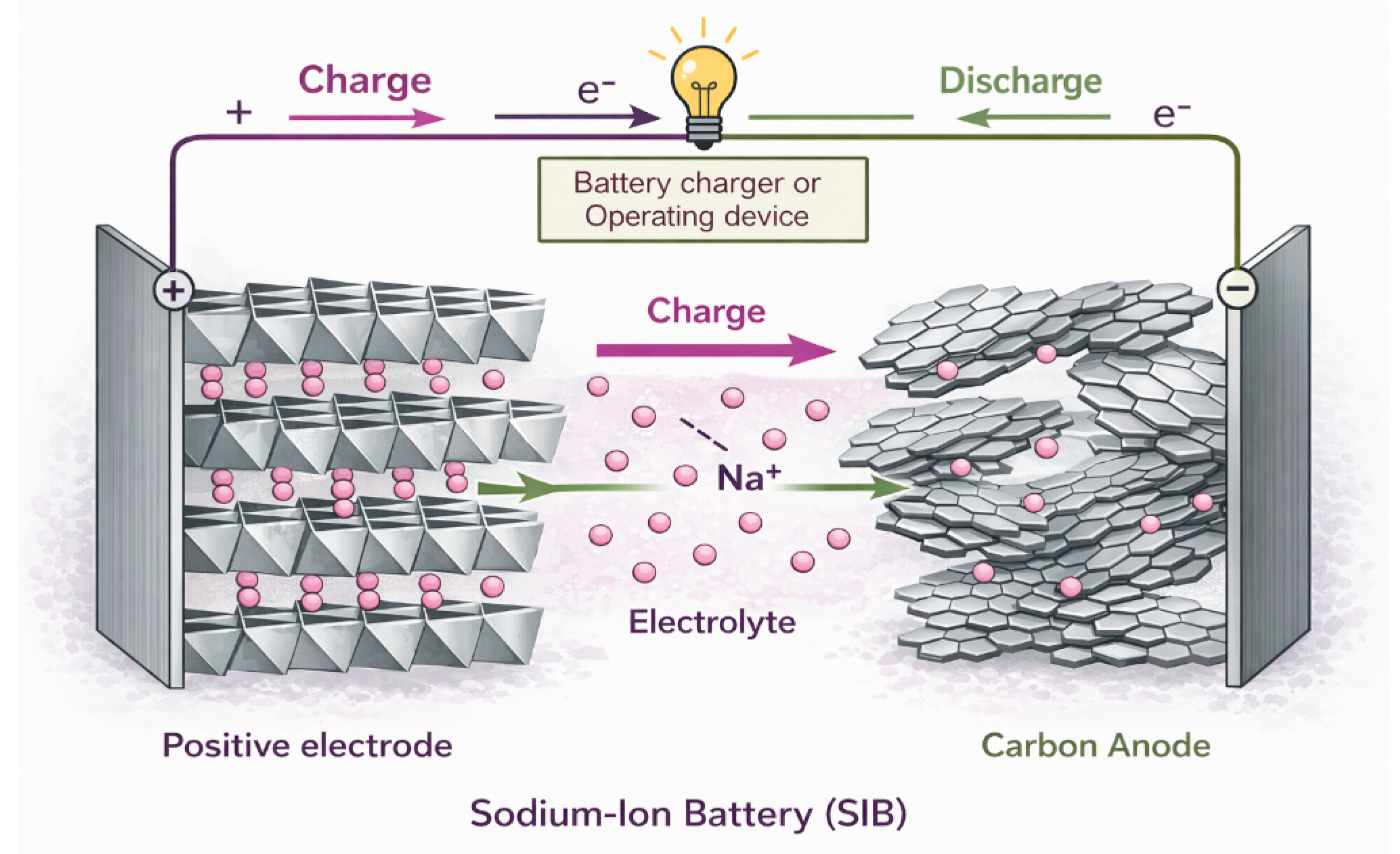
Figure 2.
Comparative schematic of major SIB cathode families, layered oxides, polyanionic frameworks, and Prussian blue analogues, highlighting structural motifs and typical advantages and limitations. Adapted from references [2,3].
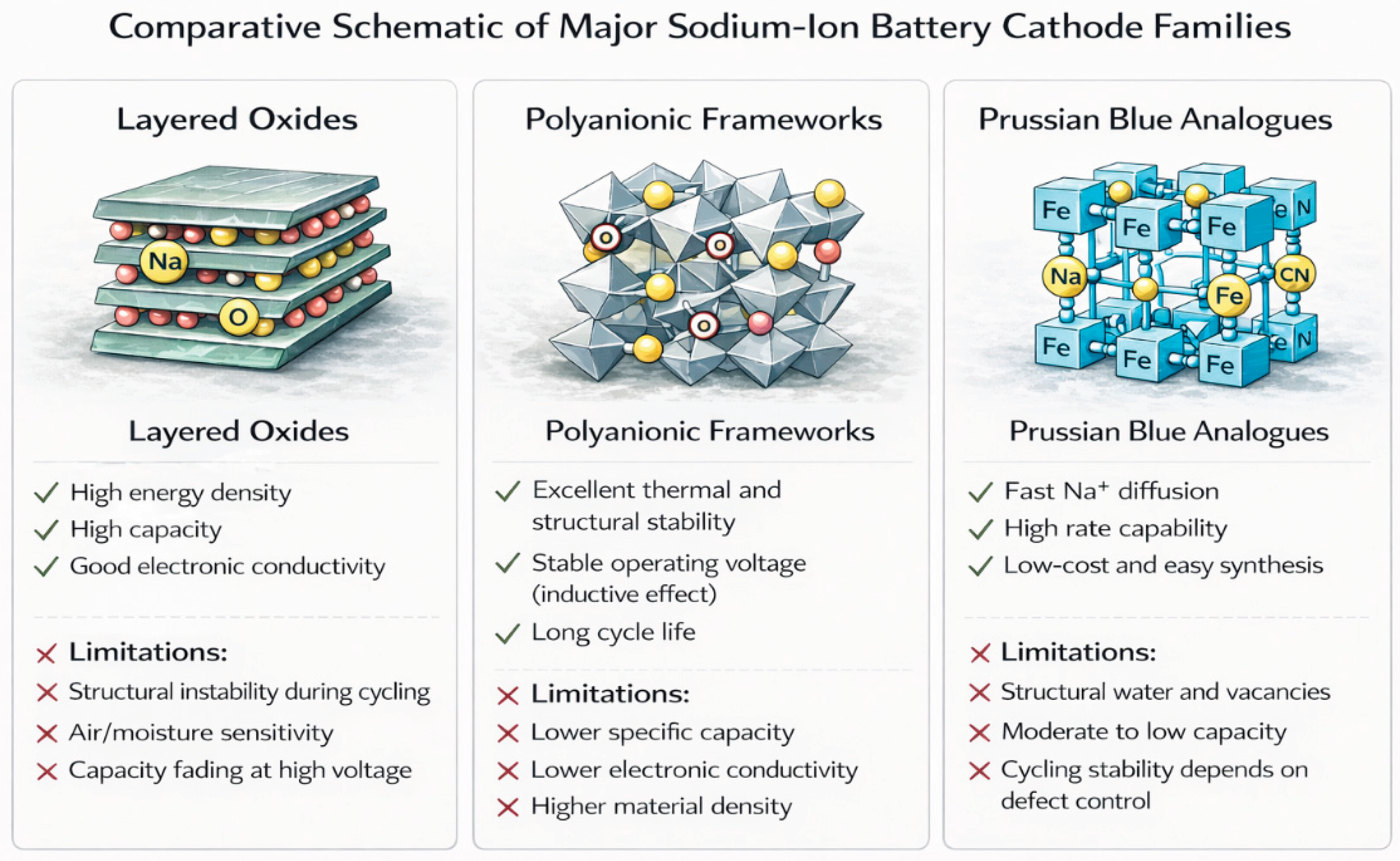
Figure 3.
Overview of reported material choices in sodium-ion batteries. (a) Representative cathode families plotted as working potential vs. specific capacity. (b) Representative anode families plotted as working potential vs. specific capacity. (c) Frequency of use of common electrolyte components, grouped into salts, solvents and additives. (d) Frequency of use of common binder chemistries and their typical application domains in sodium-ion electrodes (Adapted with permission from ref. [3], The Royal Society of Chemistry, 2017).
Figure 3.
Overview of reported material choices in sodium-ion batteries. (a) Representative cathode families plotted as working potential vs. specific capacity. (b) Representative anode families plotted as working potential vs. specific capacity. (c) Frequency of use of common electrolyte components, grouped into salts, solvents and additives. (d) Frequency of use of common binder chemistries and their typical application domains in sodium-ion electrodes (Adapted with permission from ref. [3], The Royal Society of Chemistry, 2017).
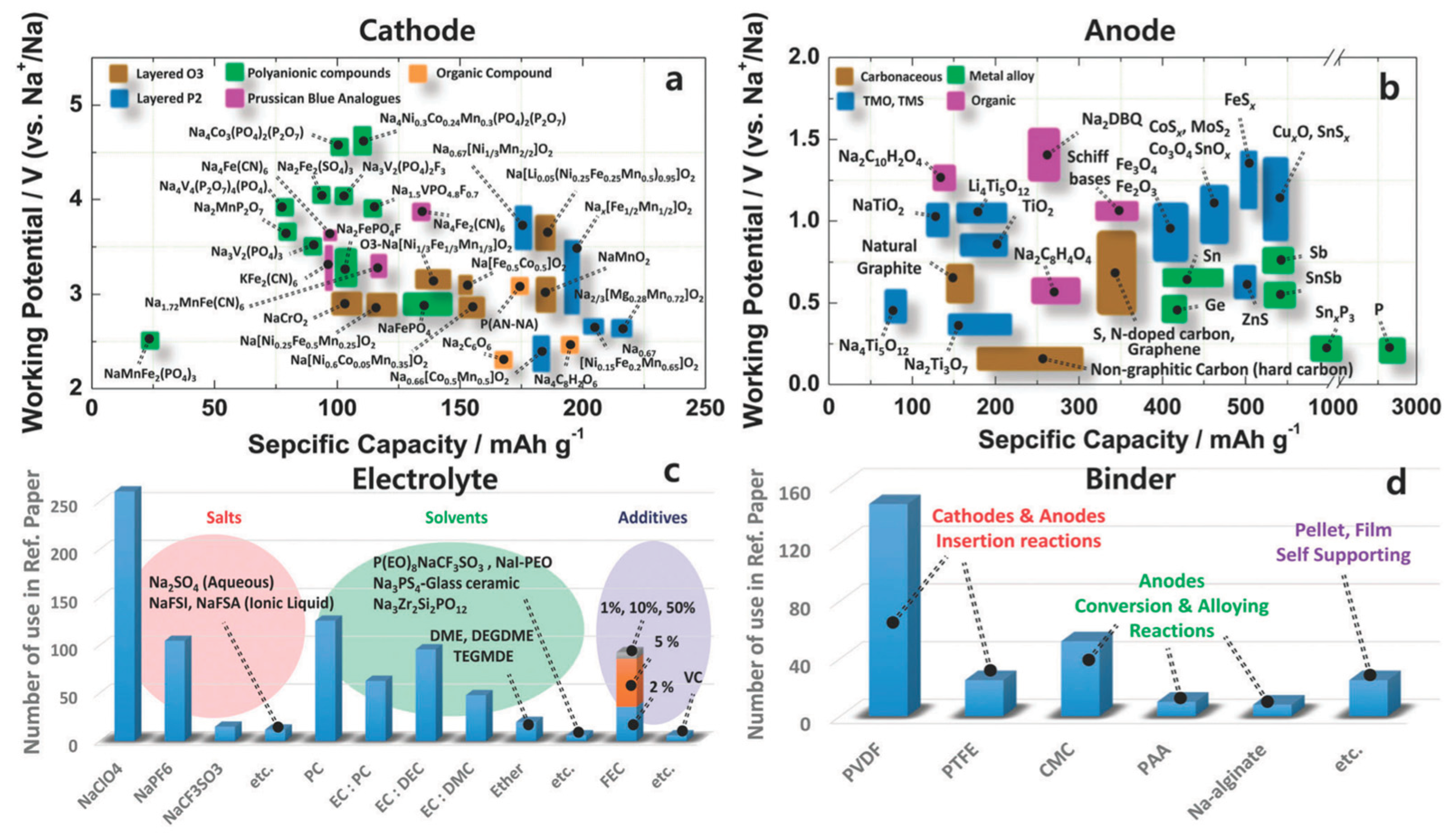
Figure 4.
Schematic overview of key industrial sodium-ion battery (SIB) developers and the electrode/electrolyte combinations commonly reported for their commercial platforms (layered oxides, Prussian blue analogues, and polyanionic cathodes; typically paired with hard carbon anodes; organic or aqueous electrolytes depending on the system). (Adapted with permission from ref. [63], Oxford Academic, 2023).
Figure 4.
Schematic overview of key industrial sodium-ion battery (SIB) developers and the electrode/electrolyte combinations commonly reported for their commercial platforms (layered oxides, Prussian blue analogues, and polyanionic cathodes; typically paired with hard carbon anodes; organic or aqueous electrolytes depending on the system). (Adapted with permission from ref. [63], Oxford Academic, 2023).
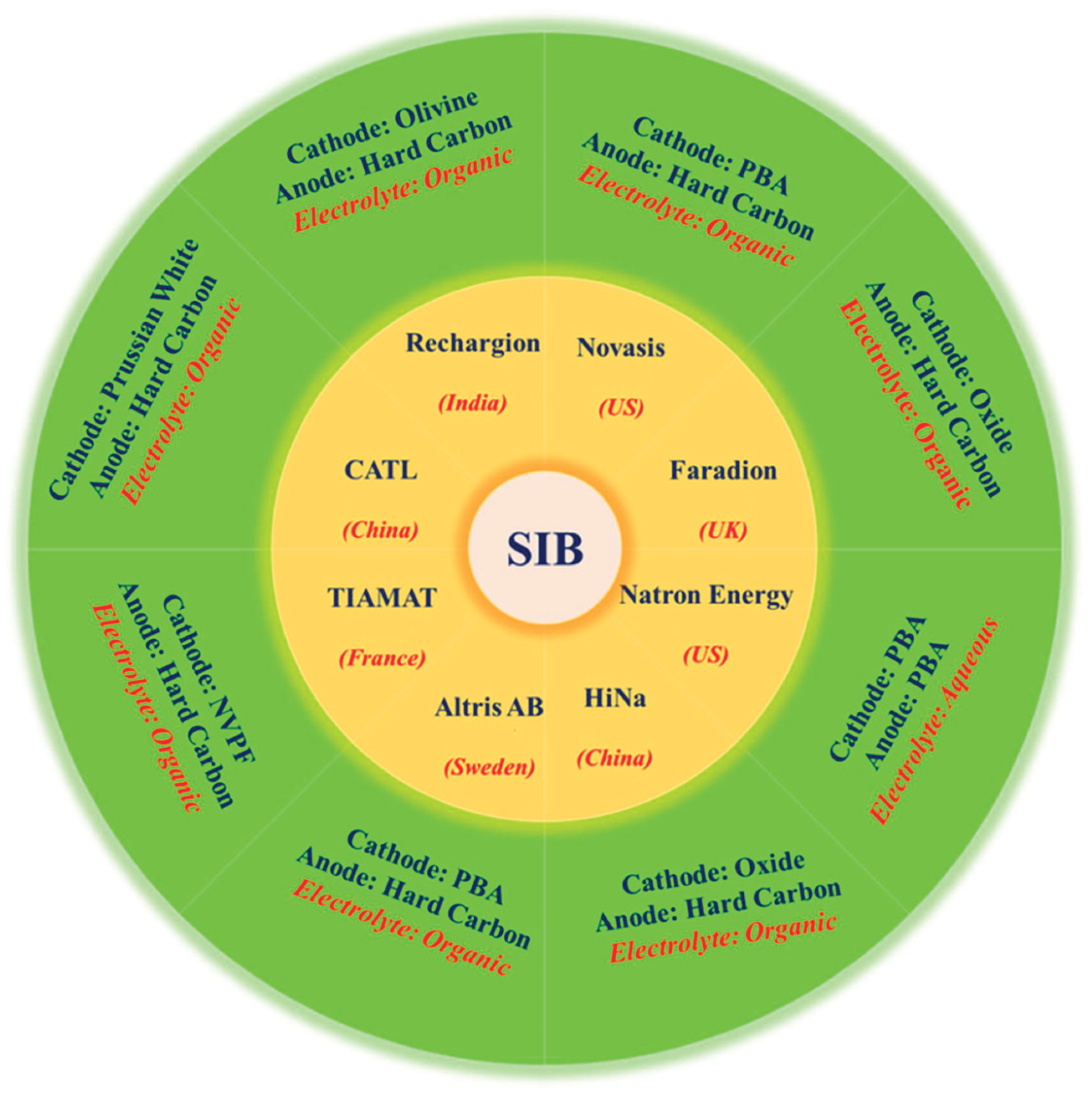

Table 1.
Main SIB anode families, dominant storage mechanisms, and practical bottlenecks.
| Anode Family | Dominant storage mechanisms | Key practical bottlenecks / design levers | Reference |
|---|---|---|---|
| Hard carbon | Mixed: defect/surface storage (sloping) + low-voltage plateau (nanopore filling), SEI-dependent | Low ICE (Na consumption in SEI); microstructure/porosity control; densification vs wetting/transport trade-off; cold-temperature polarization | [14,15,20,23] |
| Graphitic/soft carbon | Limited Na intercalation in carbonate electrolytes; improved storage in some ether systems via co-intercalation | Poor capacity with standard electrolytes; requires specialized formulations; interphase control | [3,14,15] |
| Alloy-type (Sn, Sb, Bi, P) | Na alloying/dealloying with multiple NaxM phases | Large volume change; particle fracture; repeated SEI rupture; mitigation via nanoconfinement/void engineering/elastic matrices/SEI additives | [5,8,25,26] |
| Conversion-type | Multielectron conversion reactions with extensive interfacial area evolution during cycling | High hysteresis; continuous surface renewal; SEI instability; partial mitigation via confinement/coatings/electrolyte engineering | [5,8,25,26] |
Table 2.
Qualitative comparison of major SIB cathode families and common bottlenecks.
| Family | Strengths | Main limitations | Common mitigations | Reference |
|---|---|---|---|---|
| Layered oxides | High energy-density potential, broad compositional tunability | Phase transitions, surface and CEI instability at higher voltages, sensitivity to processing and handling | Doping, particle engineering, surface coatings, high-voltage electrolyte screening | [27,28] |
| Polyanionic cathodes, including sulfates | Robust frameworks, generally favorable safety, good structural stability | Lower gravimetric energy density, limited electronic conductivity, polarization at high loading | Particle control, conductive coatings and networks, electrode architecture optimization | [2,29] |
| PBAs | Fast Na⁺ kinetics, scalable synthesis routes, strong rate capability | Defects and vacancies, structural water management, reproducibility constraints | Low-defect synthesis, water control, stoichiometry tuning, surface and interphase stabilization | [31,32,33,34,35] |
| Organic cathodes | Sustainability; flexible molecular design | Dissolution; hysteresis; low conductivity | Polymerization/anchoring; electrolyte optimization; conductive scaffolds | [29] |
Disclaimer/Publisher’s Note: The statements, opinions and data contained in all publications are solely those of the individual author(s) and contributor(s) and not of MDPI and/or the editor(s). MDPI and/or the editor(s) disclaim responsibility for any injury to people or property resulting from any ideas, methods, instructions or products referred to in the content. |
© 2026 by the authors. Licensee MDPI, Basel, Switzerland. This article is an open access article distributed under the terms and conditions of the Creative Commons Attribution (CC BY) license (http://creativecommons.org/licenses/by/4.0/).
Copyright: This open access article is published under a Creative Commons CC BY 4.0 license, which permit the free download, distribution, and reuse, provided that the author and preprint are cited in any reuse.


