

Submitted:
04 March 2026
Posted:
05 March 2026
Read the latest preprint version here
Abstract
The rapid advancement of artificial intelligence (AI) presents unprecedented challenges for labor market forecasting, requiring fundamental methodological innovations that move beyond traditional extrapolation techniques. This policy paper proposes comprehensive enhancements to the U.S. Bureau of Labor Statistics (BLS) employment projection systems to better capture and forecast AI's impact on employment structures, job roles, and workforce skill requirements. Drawing on recent empirical research and the bureau's existing methodological frameworks, we present an integrated architectural framework that combines task-based exposure modeling, real-time data analytics, causal inference methods, and enhanced gross flows estimation. Our recommendations address critical gaps in current BLS methodologies identified through systematic literature review and analysis of emerging AI adoption patterns, including the distinction between automation and augmentation effects, the nonlinear dynamics of AI adoption, and differential impacts across worker demographics. We propose a dynamic Occupational AI Exposure Score (OAIES) framework that leverages large language models and occupational task data, alongside enhanced data collection strategies and modernized estimation techniques. The architectural framework, illustrated through five interconnected diagrams, demonstrates how these methodological innovations integrate into a coherent system for measuring labor market transformation. These enhancements would enable more accurate projections of job displacement, skill evolution, and employment transformation across industries and geographic regions, supporting evidence-based policymaking for workforce development in an AI-driven economy. The paper concludes with a phased implementation strategy and validation protocol to ensure methodological rigor and operational feasibility.
Keywords:
artificial intelligence
; labor market projections
; bureau of labor statistics
; occupational AIexposure score
; task-based modeling
; causal inference
; gross flows estimation
; workforce transfor-mation
; automation vs. augmentation
; real-time data infrastructure
; employment forecasting
; skillevolution
; methodological innovation
; AI adoption dynamics
; labor market policy
1. Introduction
The integration of artificial intelligence into the modern workforce represents a paradigm shift distinguished from previous technological revolutions by its capacity to automate complex, non-routine tasks traditionally reserved for high-skilled professionals [1]. As AI technologies continue to evolve at an unprecedented pace, the need for accurate labor market projections has become critical for policymakers, educators, and industry leaders seeking to navigate workforce transformation.
To understand why this transformation poses such acute methodological challenges, it is essential to appreciate how AI departs from the historical pattern of technological change captured by the Skill-Biased Technical Change (SBTC) hypothesis. The SBTC framework, developed to explain the computerization-driven inequality of the 1980s, posits that new technology raises relative demand for highly skilled workers. Yet this framework has been shown to fall short as a complete explanation for the evolution of the U.S. wage structure, particularly after wage inequality stabilized in the 1990s despite continued computing advances [1]. AI represents a more fundamental departure: unlike industrial robots, which primarily substituted for low-skill, routine tasks, AI can substitute for tasks performed by high-skilled workers—including medical diagnosis, legal document review, and software coding—while simultaneously acting as a productivity complement for lower-skilled workers. This inversion of historical patterns challenges projection models calibrated on decades of SBTC-consistent data.
A further complication for near-term projection is the J-curve dynamics of AI adoption. Despite long-run forecasts of significant GDP uplift, current empirical data show minimal aggregate effects on employment and wages, because AI adoption remains nascent: by mid-2025, fewer than 10% of U.S. firms reported regular AI use [1]. The barrier is not merely acquiring AI tools but making costly investments in data modernization and organizational redesign needed to deploy them effectively. BLS projection models built on current adoption rates therefore risk systematic underestimation of future disruption once adoption accelerates. Designing methodology that accounts for this non-linear adoption trajectory is a central challenge this paper addresses.
Global adoption patterns further complicate the projection environment. Survey data for 2024–2025 reveals sharp international disparities: India, the UAE, and Singapore exhibit AI deployment rates of 53–59%, reflecting rapid digital transformation and favorable government initiatives, while the United States (33%), Germany (32%), and France (26%) display lower deployment despite higher exploration levels [1]. For BLS, this global variation matters because U.S. firms competing internationally face differential AI-driven productivity shocks depending on their trading partners’ adoption trajectories—a cross-border dimension that domestic occupation-level projections do not currently incorporate.
The U.S. Bureau of Labor Statistics (BLS) has long provided essential employment projections that inform national policy and workforce development strategies. The BLS Employment Projections program develops long-term projections of the labor force, economic growth, industry output and employment, and occupational employment and openings [2]. These projections serve as foundational inputs for educational planning, career guidance, and workforce development policy at federal, state, and local levels.
[3] critically examine the transformative impact of AI on employment structures, job roles, and the future of work, revealing that AI exerts a dual impact: while displacing routine, low-skilled jobs, it simultaneously fosters the emergence of new, high-skilled roles and catalyzes human-AI collaboration. Their systematic literature review identifies key trends including the expansion of remote work, the rise of the gig economy, and the proliferation of AI-enabled entrepreneurship. However, challenges such as job displacement, skill mismatches, and widening socioeconomic inequalities remain prevalent, emphasizing the need for inclusive education reforms, continuous workforce upskilling, ethical AI integration, and cross-sector collaboration.
However, current methodologies face significant challenges in capturing the nuanced, task-level impacts of AI on employment structures [4]. The historical pattern of technological change, where automation primarily affected routine manual tasks, has been upended by AI’s capacity to perform cognitive functions once thought to be exclusively human domains [3]. This paper addresses the critical question: How can BLS enhance its projection methodologies to accurately forecast AI’s impact on job displacement, creation, and transformation?
Drawing on recent empirical research and the bureau’s existing methodological frameworks [5,6,7], we propose a comprehensive approach that integrates task-based exposure modeling, real-time data analytics, and causal inference methods. Our recommendations are grounded in systematic analysis of AI adoption patterns, occupational task structures, and emerging evidence on AI’s differential impacts across worker demographics and experience levels.
[?] provide an in-depth analysis of AI’s impact on occupational tasks using new task-level data and established economic frameworks. Their analysis reveals that AI usage is highly concentrated in specific sectors and tasks: software development, data analysis, and writing tasks account for a disproportionate share of AI activity, whereas occupations dependent on manual labor or in-person interaction show minimal AI use. Descriptive statistics indicate a heavy-tailed distribution of AI exposure at the task level: only approximately 1% of task types register substantial AI usage, while the vast majority of tasks have negligible exposure. They find that about 36% of U.S. occupations already use AI in at least a quarter of their constituent tasks, though only approximately 4% of occupations exhibit very deep AI integration (three-quarters or more of tasks). Crucially, AI is being used more as an augmenting tool than as an outright automation replacement in current workflows—an estimated 57% of AI usage involves human-AI collaboration or iteration, versus 43% involving fully automated task completion.
[8] examines the critical role of artificial intelligence and automation in securing America’s technological leadership and economic prosperity. Using a mixed-methods approach combining econometric analysis, scenario modeling, and industry case studies, the research forecasts significant economic growth potential, with AI potentially contributing an additional 1.2% to 2% to the annual GDP growth by 2043 (equivalent to a cumulative GDP increase of approximately 25% to 45%). However, it also addresses challenges such as workforce displacement and income inequality, proposing innovative solutions to ensure inclusive prosperity.
[?] argue that limitations in the prevailing measures hamper the accurate evaluation of the domestic artificial intelligence workforce. They recommend accelerating the timeline for revising the Standard Occupational Classification system to create a technical AI occupational category, which could increase the prospects that AI policies will improve AI competitiveness, especially through more granular measures of the way AI is changing the nature of jobs.
[?] presents a systematic review of AI’s impact on the labor market, exploring the effects of AI on job displacement, economic growth, and workplace productivity. The paper discusses how companies and governments are responding to these changes through policy interventions and the need for upskilling to mitigate risks associated with AI automation. The findings highlight the dual nature of AI as both a disruptor and an enabler, emphasizing the importance of proactive measures to ensure equitable outcomes in the evolving labor market.
[?] explores the skills shortage facing the U.S., brought on by an aging population approaching retirement and a shortfall in the number of young workers with the educational attainment needed to meet labor-market demands. The report examines nine specific occupations that will be particularly affected—accountants, attorneys, construction workers, doctors, engineers, managers, nurses, teachers, and truck drivers—and details how the shortage of workers with education and training beyond high school will play out between 2024 and 2032.
2. Architectural Framework Diagrams
Figure 1.
Enhanced BLS Methodological Framework: Core Components and Data Flows.
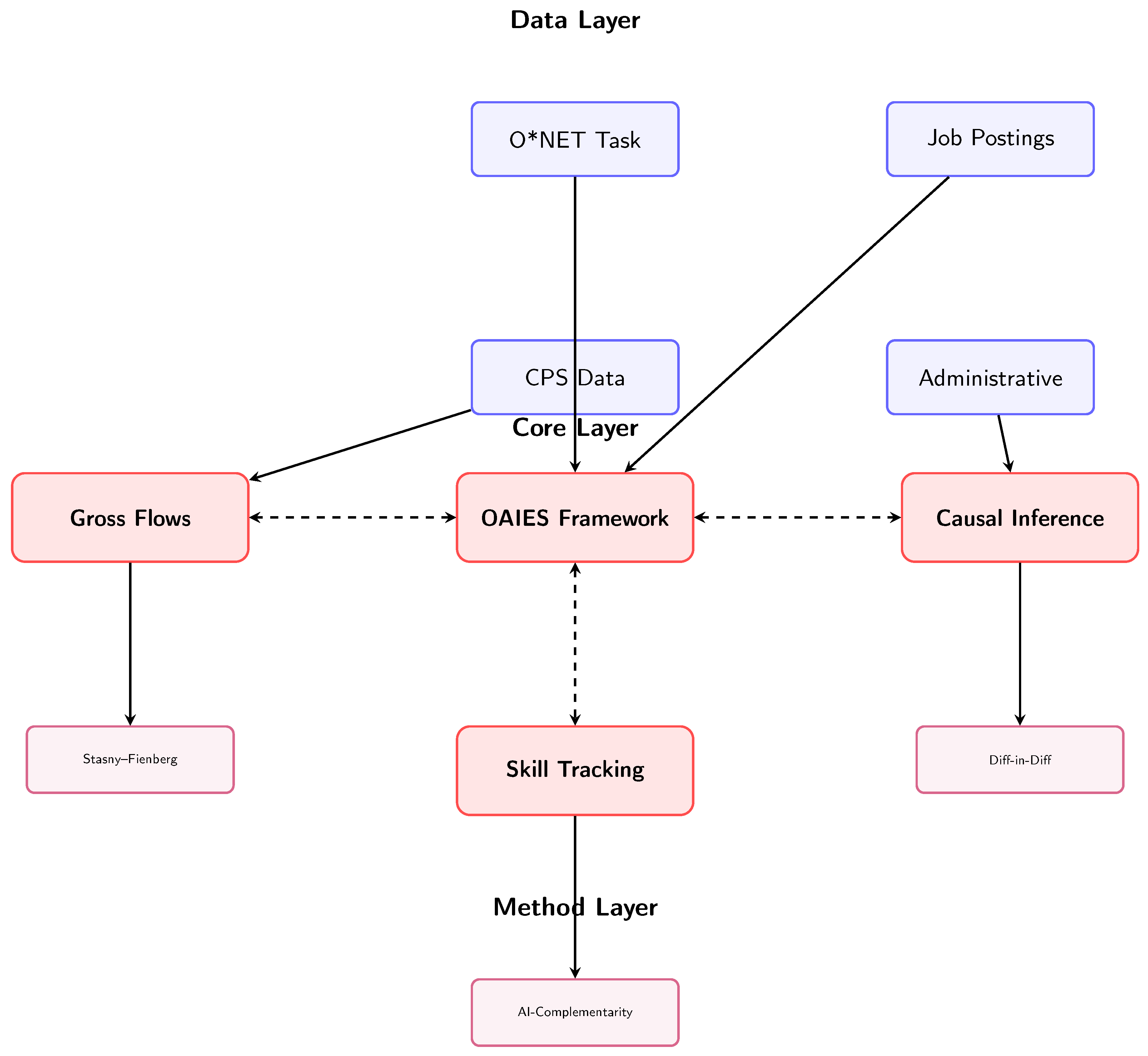
Figure 2.
Dynamic Occupational AI Exposure Score (OAIES) Architecture.
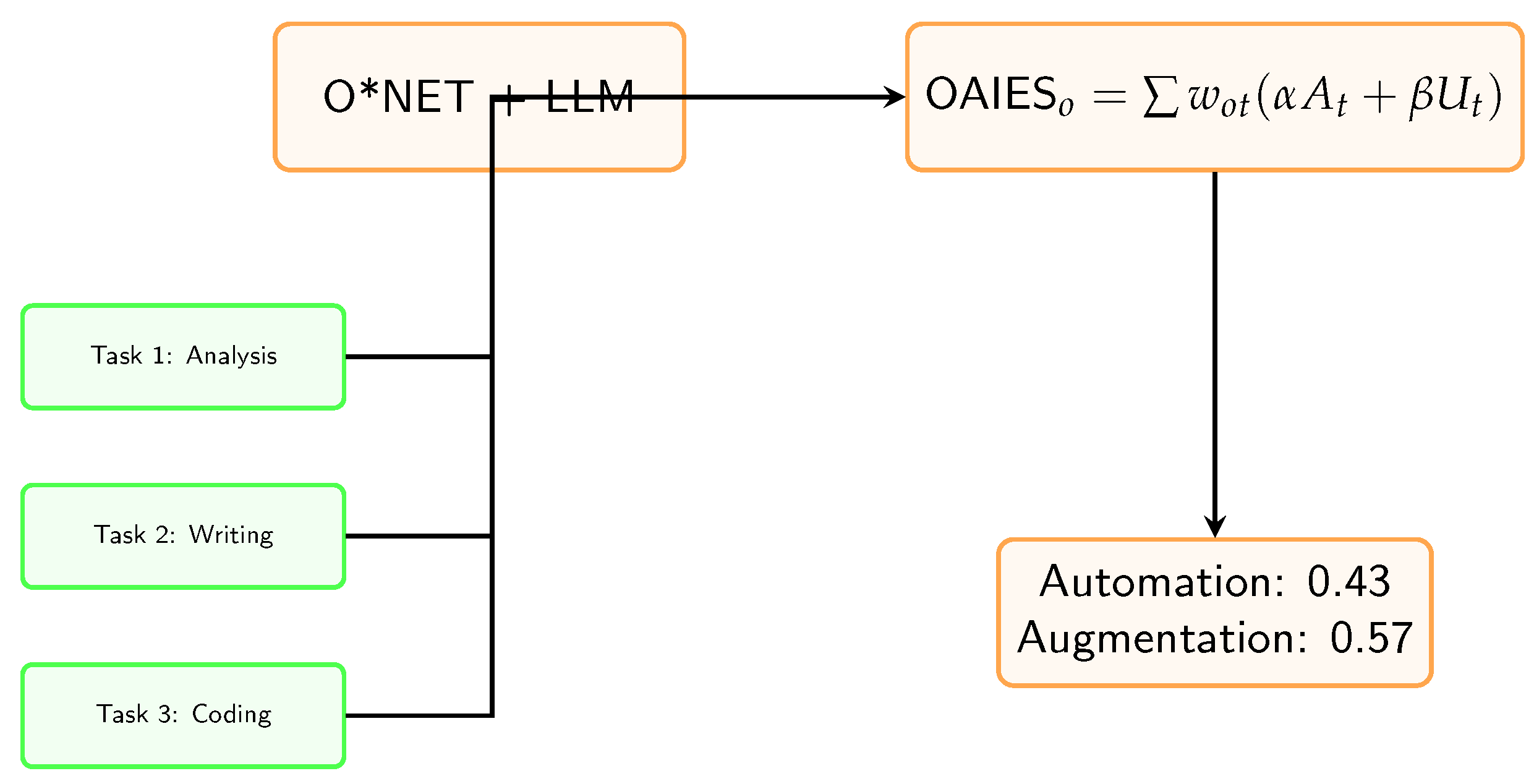
Figure 3.
Causal Inference Framework for AI Impact Analysis.
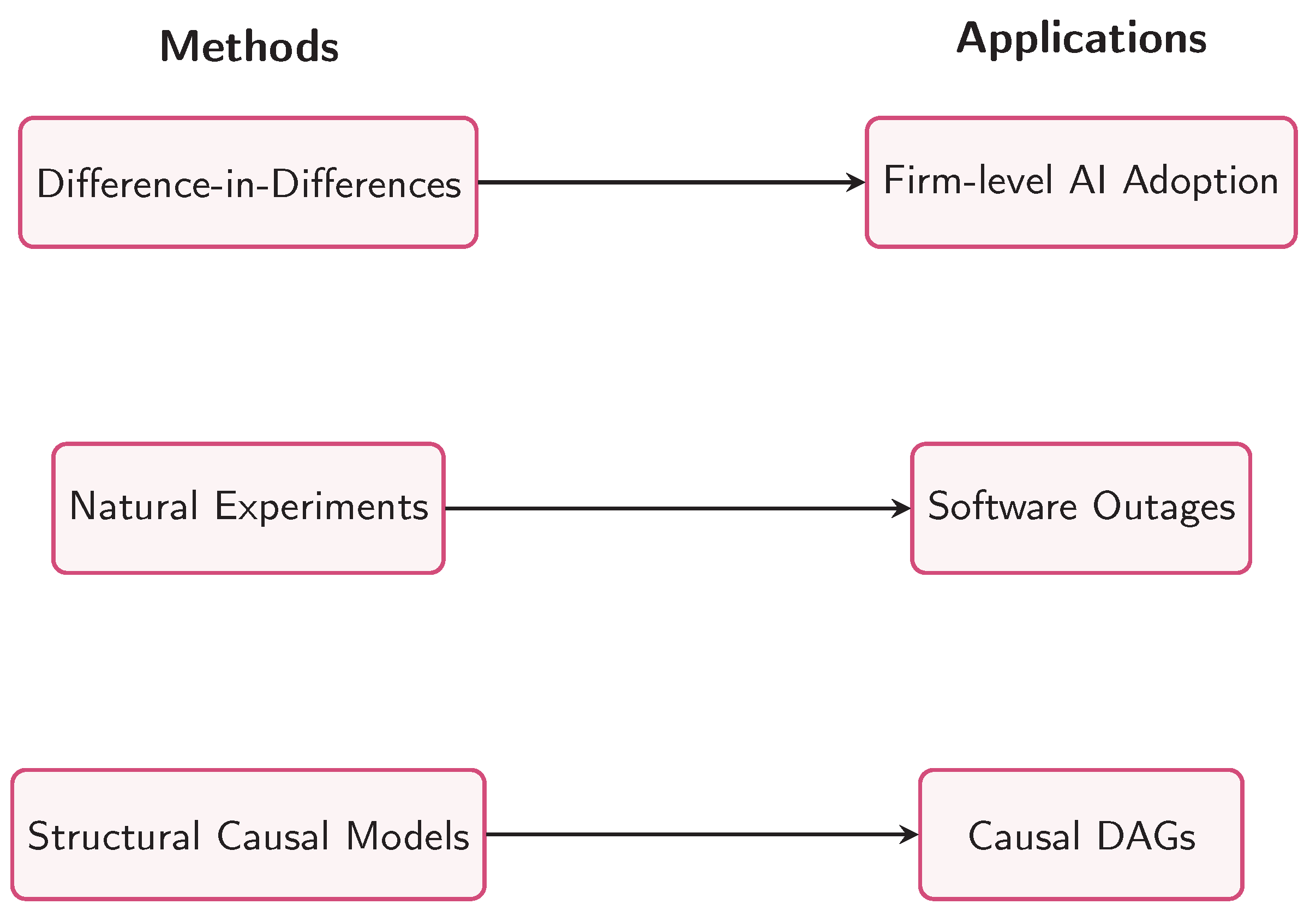
Figure 4.
Enhanced Gross Flows Estimation Framework.
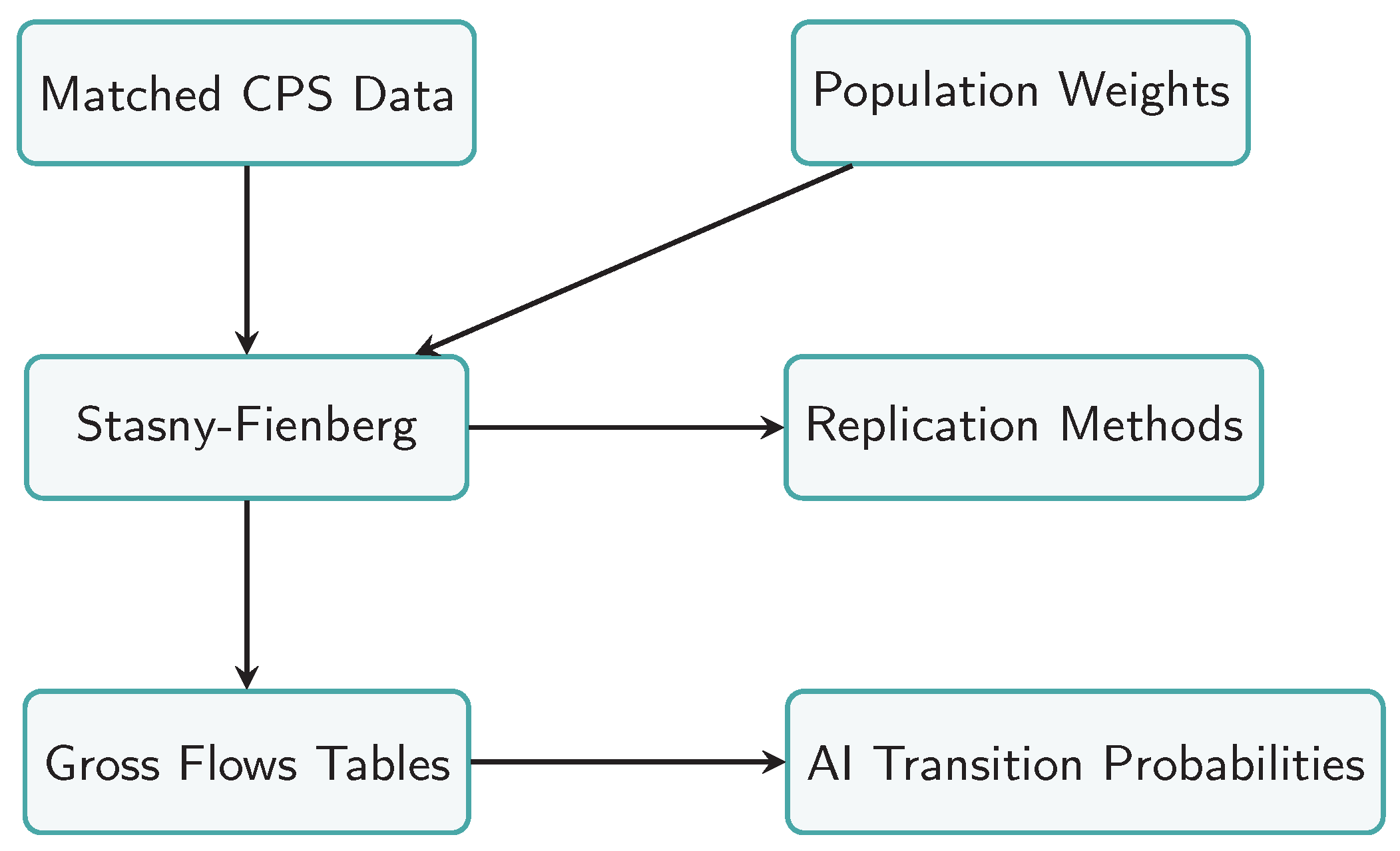
Figure 5.
Phased Implementation Strategy Timeline.

3. Current BLS Methodologies: Strengths and Limitations
3.1. Existing Projection Frameworks
The BLS currently employs a multi-stage projection system that incorporates industry output projections, input-output analysis, and occupational staffing patterns [2?]. The projection process involves several interconnected steps: labor force projections using demographic models; macroeconomic projections of GDP and its components; industry output and employment projections using input-output tables; and final occupational employment projections based on industry staffing patterns and expected technological and structural changes.
While this framework has served effectively for decades, it was designed primarily for gradual, predictable technological change rather than the rapid, transformative impacts characteristic of AI adoption. The bureau’s Occupational Employment and Wage Statistics (OEWS) program provides detailed occupational data, but its survey-based methodology produces estimates with significant temporal lags [9,10].
[11] examines whether output choice matters for productivity measurement, providing important context for understanding how productivity metrics may need to evolve in response to AI-driven changes in output composition and quality.
[12] presents time series analysis of Consumer Price Index products and weights, offering methodological insights that could inform dynamic updating of occupational weights in response to AI-driven labor market changes.

Table 1.
Comparison of Current and Proposed BLS Methodologies.
| Aspect | Current BLS Approach | Proposed Enhancement |
|---|---|---|
| Occupational Analysis | Aggregate occupational categories with 2-3 year update cycles | Dynamic task-level analysis with quarterly updates using LLMs |
| Technology Impact Assessment | Historical trend extrapolation | Causal inference methods with natural experiments |
| Data Sources | Decennial O*NET updates, CPS, OEWS | Real-time job postings, AI usage telemetry, administrative data |
| Displacement Measurement | Net employment projections only | Gross flows estimation distinguishing displacement from creation |
| Skill Requirements | Fixed occupational skill profiles | Evolving skill profiles with AI-complementarity metrics |
| Geographic Variation | Limited regional disaggregation | Place-based impact analysis with geographic concentration metrics |
Key strengths of current BLS methodologies include robust sampling frameworks, rigorous quality control, and established historical time series [13]. The Bayesian inference framework developed by [13] for repeated measures under informative sampling represents an important methodological advance. Their approach accounts for informative sampling designs where inclusion probabilities are correlated with the outcome variable—a critical consideration for labor market surveys in which AI-exposed occupations may exhibit differential response rates or attrition. Adapting such Bayesian frameworks for BLS survey estimation could reduce bias in occupational wage and employment estimates for fast-changing AI-impacted sectors.
First, traditional survey-based data collection introduces significant delays between technological change and measurement [1]. The 2-3 year lag between O*NET updates and labor market changes is particularly problematic for tracking AI’s rapid evolution.
Second, current occupational classifications mask substantial heterogeneity in AI exposure at the task level. As [?] demonstrate, AI usage is highly concentrated in specific tasks within occupations, with only 1% of task types registering substantial AI usage.
Third, existing projection methods rely heavily on correlational relationships that may not capture the causal mechanisms driving AI-induced labor market changes [1].
Fourth, current methodologies do not adequately capture the dynamic evolution of skill requirements in response to AI adoption [?].
Fifth, the task-worker skill matching literature reveals a deeper structural gap: BLS projections do not yet account for the within-occupation reallocation of tasks that occurs as AI absorbs specific duties while workers shift toward complementary activities. [4] demonstrates that the relationship between job tasks, worker skills, and productivity is far more dynamic than static occupational classifications suggest—workers actively adapt their task portfolios in response to technological change, a process that standard occupation-level measurement cannot capture.
[?] examines growth trends for selected occupations considered at risk from automation, providing important baseline data for understanding how automation-risk occupations have evolved historically and how AI may accelerate or alter these trends.
[14] presents occupational case studies on incorporating AI impacts in BLS employment projections, offering preliminary frameworks that this paper builds upon and extends.
4. Empirical Evidence on AI’s Labor Market Impacts
4.1. Task-Level Exposure Patterns
Recent research provides critical insights into how AI is reshaping work at the task level. [?] found that approximately 36% of U.S. occupations already use AI in at least a quarter of their constituent tasks, though only 4% of occupations exhibit very deep AI integration (three-quarters or more of tasks). Crucially, AI is being used more as an augmenting tool than as an outright automation replacement in current workflows—an estimated 57% of AI usage involves human-AI collaboration or iteration, versus 43% involving fully automated task completion.
The Penn Wharton Budget Model’s analysis reveals significant variation in AI exposure across occupational groups [1]:
- Office and Administrative Support Occupations: 75.5% of work susceptible to AI automation
- Business and Financial Operations Occupations: 68.4%
- Computer and Mathematical Occupations: 62.6%
- Sales and Related Occupations: 60.1%
- Management Occupations: 49.9%
- Legal Occupations: 47.5%
- Arts, Design, Entertainment, Sports, and Media Occupations: 45.8%
- Architecture and Engineering Occupations: 40.7%
- Healthcare Practitioners and Technical Occupations: 23.1%
- Construction and Extraction Occupations: 8.9%
- Building and Grounds Cleaning and Maintenance Occupations: 2.6%
These patterns challenge traditional assumptions about technology’s impact on low-skilled labor, revealing that occupations around the 80th earnings percentile face the highest AI exposure.
An important qualification to these aggregate patterns is the non-linear, threshold nature of AI’s sectoral impact [3]. AI’s influence on employment structure is not uniform across sectors or regions; it exhibits threshold effects where the impact becomes significant only after reaching certain levels of AI integration. This finding has direct methodological implications for BLS: linear extrapolation models may systematically misforecast employment changes in sectors that have not yet crossed adoption thresholds but are approaching them. Projection frameworks must incorporate sector-specific adoption tipping points as a structural feature rather than treating AI exposure as a smoothly varying continuous variable.
Additionally, the AI workforce itself—those employed specifically to develop, deploy, and maintain AI systems—remains surprisingly small in aggregate. Cross-country OECD analysis finds that AI specialists constitute less than 0.3% of total employment, though this segment is growing rapidly and is disproportionately male and tertiary-educated [3]. For BLS, this creates a measurement paradox: a tiny but economically pivotal workforce segment is currently too small to be reliably captured by standard survey methods, yet its growth trajectory has outsized implications for AI adoption rates and labor demand across all other occupational groups. The proposed SOC reform and OAIES framework directly address this blind spot.
[15] provides a closer look at output, productivity, and hours worked from 1990 to 2024, offering historical context for understanding how AI-driven changes in industry growth patterns may differ from previous technological transformations.
[?] evaluates output measures for productivity analysis, comparing GDP, GDI, and GDO as alternative measures that could inform more nuanced understanding of AI’s impact on economic output and productivity.
4.2. Sectoral Disruption Patterns and the Gig Economy
AI’s labor market impact varies substantially across sectors in ways that aggregate national projections obscure. In healthcare, AI-driven diagnostic tools have enhanced the accuracy and speed of disease detection while AI-powered administrative systems streamline hospital operations and reduce paperwork burdens [3]. These advances simultaneously reduce demand for routine administrative healthcare roles while increasing demand for clinical staff with the technical competency to interact with AI diagnostic systems—a net occupational transition that BLS healthcare projections should quantify separately for administrative and clinical subcategories rather than at the aggregate occupational level.
In the legal sector, AI tools have automated document review and routine legal research, reducing demand for paralegals in document-intensive workflows while driving surges in demand for AI specialists and data analysts [3]. In manufacturing, Robotic Process Automation and AI-driven machinery perform repetitive production tasks with precision, displacing certain manual roles while creating new demand for technicians capable of managing and maintaining advanced AI systems [3]. These sector-specific transformation patterns reinforce the case for the task-level, sector-disaggregated approach the OAIES framework provides.
The rise of new work models intersects with AI adoption in ways that current BLS measurement frameworks are poorly equipped to track. The gig economy has grown substantially alongside AI: in 2023, 38% of the American workforce—approximately 64 million professionals—performed some form of freelance or gig work [3]. Globally, gig work is estimated to account for up to 12% of the labor force. AI tools are both enabling and threatening gig workers simultaneously: digital platforms leverage AI to match freelancers with clients and automate project management, while advances in generative AI place the creative, writing, coding, and analytical work that laptop-based gig workers perform at elevated displacement risk [3]. BLS measurement of contingent work—already incomplete due to the classification of independent contractors—must be updated to capture AI-mediated platform employment as a distinct labor market category.
4.3. Differential Impacts by Worker Characteristics
[1] documents a critical finding regarding early-career workers: since late 2022, early-career workers (ages 22-25) in occupations most exposed to AI have experienced a 13% relative decline in employment. This contrasts sharply with stable or increasing employment rates for more experienced workers in identical occupations, suggesting that AI is automating entry-level tasks that traditionally served as professional training grounds.
Gender disparities also emerge in AI’s impact. The International Labor Organization reports that women hold over three times the share of jobs susceptible to automation due to generative AI (5.3%) compared to men (1.6%), reflecting women’s concentration in routine clerical positions [1]. However, this displacement risk coexists with a significant augmentation opportunity: an estimated 22.7% of female-held jobs stand to be enhanced by AI technologies, compared to only 13% of male-held jobs [1]. This asymmetry—greater displacement risk alongside greater augmentation potential—means that the net impact on women’s employment depends critically on whether policy investments prioritize reskilling for AI-complementary roles. BLS projections that capture only the displacement side of this equation will systematically understate the potential for AI-driven employment growth among women in roles involving communication, care coordination, and information synthesis.
Beyond age and gender, the displacement of entry-level workers carries structural consequences that extend well beyond the individuals affected. AI is effectively automating the routine documentation, test generation, and data entry tasks that have historically served as foundational training for new professionals [1]. As AI absorbs these entry-level duties, new hires are expected to contribute at higher levels from their first day, creating a prolonged readiness gap between the skills that educational institutions develop and the skills that AI-enabled workplaces demand. This gap will compound over time if not addressed: the junior cohorts who fail to acquire foundational professional skills today will represent a structurally undertrained mid-career workforce a decade hence. BLS methodologies that track only current employment levels cannot capture this dynamic skill degradation risk, underscoring the need for cohort-level longitudinal tracking as a component of the proposed enhanced data infrastructure.
[9] provides detailed analysis of concentrated labor markets in the United States using OEWS microdata, revealing that concentration is a characteristic of small labor markets, whether defined by area or by occupation. Their findings that more concentrated labor markets are associated with slightly lower wages, but only within the private sector, have important implications for understanding how AI-driven concentration effects may impact wage inequality.
[10] develops measures of the occupational homogeneity of employers as indicators of outsourcing, finding that wages are strongly related to occupational homogeneity, particularly for workers in low-wage occupations. This research provides methodological foundations for measuring how AI-driven changes in organizational structure may impact wage inequality.
4.4. Productivity and Skill Effects
A seminal study of customer service agents found that AI assistance increased average productivity by 14%, with gains accruing disproportionately to novice and low-skilled workers (34% increase) while experienced workers saw minimal impacts [1]. This suggests AI acts as a skill disseminator, implicitly learning best practices from top performers and disseminating them to less-skilled workers.
Simultaneously, the PwC 2025 Global AI Jobs Barometer reveals that positions requiring AI expertise command substantial wage premiums—reaching 56% in 2024, more than double the 25% premium observed the previous year [1]. This dual dynamic—skill-leveling within occupations alongside growing premiums for AI-specific skills—creates complex wage inequality patterns that current projection methods struggle to capture.
The task composition evidence from software development illustrates the augmentation dynamic in concrete terms. Analysis of generative AI usage in coding shows that the share of tasks involving creating new code more than doubled (up 4.5 percentage points), while debugging and error correction tasks declined by 2.8 percentage points [1]. This shift represents not merely an efficiency gain but a fundamental redefinition of the programmer’s role: AI automates the tedious maintenance work, freeing human programmers for higher-order system architecture and creative problem-solving. BLS occupational definitions for software developers do not yet reflect this task recomposition, producing a classification mismatch between the measured occupation and the actual work being performed—a gap the OAIES framework is designed to close.
At the aggregate level, employer skill demands are evolving dramatically faster in AI-exposed occupations. The PwC 2025 Global AI Jobs Barometer finds that the skills employers seek are changing 66% faster in the jobs most exposed to AI compared to other roles [1]. Rather than privileging traditional technical credentials, employers in these roles are increasingly assessing candidates on AI fluency, systems thinking, problem framing, and contextual judgment. The growing importance of uniquely human traits—ethics, empathy, creativity—reflects AI’s absorption of execution tasks and the consequent elevation of strategic oversight as the core human contribution. This pace of skill demand change far exceeds the update frequency of any current BLS occupational classification or skills database, providing perhaps the strongest single argument for the real-time, LLM-driven skill tracking methodology proposed in this paper.
[?] provides a decomposition of the 2024 gain in private-sector average hourly earnings by major industry sector, offering methodological approaches that could be adapted to decompose wage changes attributable to AI adoption versus other factors.
[?] reviews productivity and progress literature, providing historical perspective on how productivity measurement has evolved and how it may need to adapt to capture AI-driven productivity gains.
5. Proposed Methodological Enhancements
5.1. Dynamic Occupational AI Exposure Score (OAIES)
We propose developing a Dynamic Occupational AI Exposure Score that leverages large language models to assess task-level AI exposure in near real-time. This approach builds on methodologies demonstrated by [?] and [1], who used LLMs to analyze task-AI linkages.
A foundational conceptual refinement the OAIES must embed is the distinction between automation AI and augmentation AI as qualitatively distinct sub-types with different labor market effects [3]. Automation AI substitutes for human labor by replacing repetitive, rules-based tasks, aiming to eliminate manual work and reduce errors. Augmentation AI, by contrast, enhances and amplifies human capabilities, empowering individuals to work faster and with better insight, fostering new tasks and roles where human labor retains comparative advantage. These two forms are not mutually exclusive—in practice, effective AI deployment involves a hybrid approach where AI handles what is repeatable while supporting what is strategic [1]. Current BLS exposure frameworks treat AI as a single undifferentiated technological force; the OAIES improves on this by generating separate automation exposure scores () and augmentation potential scores () for each task, enabling the model to capture the divergent employment and wage effects of these two AI modalities simultaneously.
The OAIES framework would:
- Utilize BLS O*NET task data as the foundational taxonomy
- Apply state-of-the-art LLMs to assess the percentage of each task that can be performed by AI at various capability stages
- Generate exposure scores at the occupation-task level with quarterly updates
- Distinguish between automation exposure (tasks fully replaceable by AI) and augmentation potential (tasks where AI enhances human performance)
Mathematically, the OAIES for occupation o can be expressed as:
Where:
- = set of tasks in occupation o
- = importance weight of task t in occupation o
- = automation exposure score for task t (0-1)
- = augmentation potential score for task t (0-1)
- = occupation-specific parameters for automation vs. augmentation weighting
[5] evaluates the performance of several hedonic methods of quality adjustment under static pricing, finding that the relative performance depends on sample size. For the small product samples feasible for microprocessors, the low variance of time-dummy hedonics gives them an advantage over less simple specifications. These insights about quality adjustment under rapid technological change have direct applicability to measuring AI-driven quality changes in labor inputs and outputs.
5.2. Integration of Causal Inference Methods
Current BLS projection methods rely primarily on correlational analysis. We recommend integrating causal inference frameworks to better isolate AI’s effects on employment outcomes [1]. Key approaches include:
- Difference-in-Differences with Staggered Adoption: Leverage variation in AI adoption timing across firms and industries to estimate causal impacts, following the methodology used in [1]’s study of customer service agents.
- Natural Experiments: Exploit exogenous variation such as software outages, policy changes, or technological breakthroughs to identify causal effects.
- Structural Causal Models: Implement directed acyclic graphs (DAGs) to map causal mechanisms and adjust for confounding variables [1].
5.3. Enhanced Gross Flows Estimation
Building on the work of [7], we recommend implementing a modified gross flows estimator that distinguishes between job displacement due to AI and job creation in AI-augmented roles. This approach would:
- Use population-weighted estimates from matched CPS data
- Apply Stasny-Fienberg reconciliation methods to produce population gross flows tables
- Estimate variance through replication methods
- Develop AI-specific transition probabilities between occupational categories
[7] present a gross flows estimation approach using population weighted estimates from two consecutive months of matched data from the Current Population Survey, producing estimated gross flows tables for CPS from 2003-2023. This methodology provides a foundation for tracking AI-driven labor market transitions.
5.4. Real-Time Data Infrastructure
To address temporal lags, we recommend establishing a real-time data infrastructure that:
- Integrates job posting data from online sources (following methodologies in [1])
- Incorporates anonymized AI usage telemetry from partner organizations
- Leverages administrative data from state workforce agencies
- Implements multiple imputation methods for missing data, building on the simulation study by [6]
[6] investigates alternatives to the current cell mean imputation procedure for missing price data in the Producer Price Index, examining multiple imputation methods including CART, Random Forest, and AMELIA, and introducing a hybrid imputation method combining both cell mean and random forest techniques. These approaches could be adapted for imputing missing employment and wage data in AI-impacted occupations.
5.5. Skill Evolution Tracking
The rapid evolution of skill requirements demands new measurement approaches. We propose:
- Development of AI-complementarity metrics that identify skills increasing in value alongside AI adoption [3]
- Tracking of skill-based hiring trends, following the finding that demand for AI roles grew by 21% while university education requirements declined by 15% between 2018-2023 [1]
- Integration of O*NET task data with real-time skill demand signals
[2] provides industry and occupational employment projections overview and highlights for 2023-33, offering baseline projections against which AI-enhanced methodologies could be compared and validated.
6. Implementation Framework
6.1. Phased Implementation Strategy
Table 2.
Proposed Implementation Timeline.
| Phase | Activities | Timeline |
|---|---|---|
| Phase 1: Pilot | Develop OAIES for 50 high-exposure occupations; Establish data partnerships with 5-10 technology firms | 6-12 months |
| Phase 2: Expansion | Scale OAIES to 200+ occupations; Integrate causal inference methods into projection models | 12-24 months |
| Phase 3: Integration | Full integration with BLS projection systems; Development of public data products | 24-36 months |
| Phase 4: Continuous Improvement | Quarterly OAIES updates; Annual methodology reviews; Real-time dashboard deployment | 36+ months |
6.2. Data Infrastructure Requirements
Successful implementation requires investment in:
- Computing infrastructure capable of processing large-scale LLM analyses
- Secure data sharing agreements with private sector partners
- Enhanced data collection through the Occupational Employment and Wage Statistics (OEWS) survey, building on methodologies developed by [9]
- Integration of imputation methods for missing price and employment data, following the hybrid approach combining cell mean and random forest techniques demonstrated by [6]
6.3. Organizational Capacity Building
We recommend:
- Hiring data scientists with expertise in machine learning and causal inference
- Training existing staff on new methodologies and tools
- Establishing an AI Labor Market Advisory Committee with representatives from academia, industry, and labor
- Collaborating with Federal Statistical Research Data Centers to access confidential microdata
[?] provides key constructs, gaps, and data collection strategies for assessing the impact of new technologies on the labor market, offering foundational guidance for the data infrastructure enhancements proposed in this paper.
7. Policy Implications and Recommendations
7.1. Validation and Backtesting Strategy
Any methodological enhancement to BLS projection systems requires rigorous validation before operational deployment. We recommend a structured backtesting protocol that assesses the predictive accuracy of OAIES-enhanced projections against historical employment outcomes in occupations with measurable AI adoption milestones.
Specifically, BLS should leverage the historical industry growth data compiled in [15] (covering output, productivity, and hours worked from 1990 to 2024) as a benchmark dataset. Occupations in sectors with documented AI adoption timelines—software development, data analysis, financial services—can serve as retrospective test cases: do OAIES-derived projections produce smaller forecast errors than traditional methods when evaluated against realized employment outcomes over 2018–2024?
The gross flows framework developed by [7], which produces estimated gross flows tables from CPS data spanning 2003–2023, provides a parallel validation resource. Comparing OAIES-projected occupation transition probabilities to observed CPS gross flows would test whether the dynamic exposure scores accurately predict the direction and magnitude of AI-induced labor market reallocation. Where OAIES projections diverge from observed transitions, structured error analysis can identify whether the discrepancies stem from task misclassification, AI capability surprises, or behavioral adaptation by workers—each pointing to distinct methodological refinements.
[?] identifies data collection strategies that would support ongoing validation, including longitudinal tracking of technology adoption within establishments and linked employer-employee data connecting firm-level AI investment to individual worker outcomes. Investing in these data infrastructure components is a prerequisite for the continuous improvement cycle envisioned in Phase 4 of the implementation timeline.
7.2. For BLS Leadership
- Prioritize methodological modernization as a strategic initiative, recognizing that accurate AI impact projections are essential for the bureau’s mission
- Allocate resources for the proposed data infrastructure and personnel investments
- Establish formal partnerships with technology companies for data sharing, following models used in other federal statistical agencies
- Pilot the OAIES framework and evaluate its predictive performance against traditional methods
7.3. For Policymakers
- Support funding requests for BLS methodological modernization through appropriations processes
- Consider legislative updates to enable real-time data collection while protecting privacy
- Integrate enhanced BLS projections into workforce development and education policy planning
- Leverage improved data to target interventions for vulnerable populations, particularly early-career workers and women in high-exposure occupations [1]
[?] explores the multifaceted impact of generative AI on the labor market and educational sectors, examining the replacement of traditional jobs, the creation of new opportunities, and the necessary adaptations in education to prepare for an AI-driven world. This research provides important context for policy recommendations targeting education and workforce development.
7.4. Extended Policy Recommendations: Safety Nets, Training Pathways, and Algorithmic Accountability
Four additional policy dimensions emerge from the empirical evidence reviewed in this paper and warrant explicit attention in BLS-informed policy frameworks.
First, the specific vulnerability of early-career workers argues for targeted investment in alternative credentialing and rapid-cycle training pathways. The feasibility of such pathways has been demonstrated: a collaboration between the U.S. Army’s Artificial Intelligence Integration Center and Carnegie Mellon University successfully trained 59 AI technicians over four years using accelerated occupational training methods, illustrating that meaningful AI workforce competency can be developed outside traditional multi-year degree programs [3]. BLS data infrastructure investments should be designed to track participants in such non-traditional training pathways, which currently fall outside standard educational attainment classifications.
Second, the urgency of reskilling is underscored by the scale of projected need. Estimates suggest that approximately 50% of all employees will require reskilling due to new technology adoption within the current decade [3]. This represents a workforce development challenge of unprecedented scale that demands the kind of accurate, occupation-level projection data the enhanced BLS methodology proposed in this paper would provide. Without granular projections of which occupations face the most acute skill transition requirements and on what timescale, reskilling investments will be allocated inefficiently.
Third, AI-driven displacement of knowledge workers creates conditions for white-collar unionization as a novel labor market response. Generative AI represents a clear displacement threat for knowledge workers—a traditionally non-unionized demographic—and the shared need for protections against AI constitutes a workplace collective good capable of motivating union formation [1]. Since unions tend to reduce income disparities and standardize pay scales, this emerging dynamic could serve as a counterbalancing force against AI-driven wage polarization. BLS should develop survey instruments capable of tracking this potential organizational shift, as it would substantially alter the wage-setting environment in high-exposure occupations.
Fourth, the social safety net requires modernization to address AI-driven displacement with greater responsiveness. Current unemployment insurance systems are designed for cyclical, demand-driven layoffs rather than the structural, technology-driven job transitions that AI induces. Automatic stabilizers—social support measures that trigger automatically in response to changing labor market conditions rather than requiring legislative action—offer a more agile architecture for AI-era workforce protection [1]. Accurate, near-real-time BLS data on AI-driven occupational transitions is a prerequisite for such mechanisms to function: triggers must be grounded in reliable empirical indicators of structural displacement, not merely aggregate unemployment rates.
Fifth, ensuring diversity and inclusion in AI-driven labor markets requires BLS to actively monitor for algorithmic bias in hiring and workplace AI systems [3]. Research on facial analysis software has demonstrated that biases embedded in AI systems can reflect the prejudices of their creators, producing disparate accuracy and outcomes across demographic groups. If AI-driven hiring tools systematically disadvantage women, racial minorities, or workers in certain geographic regions, official employment statistics will record the downstream labor market effects without capturing their cause. BLS should advocate for transparent reporting on AI system usage in employment decision-making, enabling the agency to distinguish genuine labor supply and demand shifts from AI-mediated discrimination effects in its projection models.
7.5. For the Research Community
- Collaborate with BLS on methodology development and validation
- Contribute to the refinement of OAIES through academic research
- Develop complementary approaches for measuring AI’s labor market impacts
- Share anonymized data and methodological innovations with BLS
[?] provides ongoing access to Monthly Labor Review publications, which serve as a crucial venue for disseminating methodological innovations and empirical findings related to AI’s labor market impacts.
8. Geographic, Sectoral, and Occupational Classification Dimensions
8.1. Geographic Concentration of AI Adoption
AI adoption is not uniformly distributed across U.S. labor markets; it is spatially concentrated in technology-intensive metropolitan areas, creating divergent regional labor market trajectories that current BLS methodologies inadequately capture. [9] document that labor market concentration is particularly pronounced in smaller geographic markets and niche occupational categories—precisely the contexts where AI-driven automation may have the most acute displacement effects without generating compensating new employment locally.
The geographic dimension of AI impact has important implications for BLS projection methodology. Place-based employment projections should incorporate AI adoption rates at the metropolitan statistical area (MSA) level, enabling identification of regional economies at elevated risk of net job displacement. Areas heavily concentrated in office and administrative support roles (75.5% AI-susceptibility) or business and financial operations (68.4%) face materially different outlooks than manufacturing or construction-intensive regions [1]. Without geographic disaggregation of AI exposure scores, BLS projections may obscure significant sub-national variation and misdirect workforce development investment.
The wage decomposition methodology developed by [?] for analyzing the sources of private-sector earnings growth offers a template for parallel geographic decompositions of AI-driven wage change. By attributing earnings shifts to industry composition effects, occupational mix, and AI-specific productivity differentials at the MSA level, BLS could produce regionally actionable intelligence for state workforce agencies and community colleges designing reskilling programs.
8.2. Productivity Measurement in an AI-Augmented Economy
Accurate employment projections require a coherent theory of how AI affects output, and the current suite of productivity measures faces significant challenges in an AI-augmented economy. [11] examines whether output choice matters for productivity measurement, finding that the selection among alternative output proxies generates materially different productivity estimates—a result with direct implications for projecting employment demand. If AI generates output quality improvements that standard price deflators fail to capture, measured productivity growth (and thus projected labor demand) will be systematically understated in high-AI-exposure industries.
The challenge is compounded at the aggregate level. [?] evaluates GDP, GDI, and GDO as alternative output measures for productivity analysis, finding that these measures diverge in ways that affect the denominator of labor productivity calculations. For BLS employment projections—which depend on forecasts of industry output per worker—the choice of output measure has cascading effects. We recommend that BLS develop AI-adjusted output measures for high-exposure sectors, drawing on the alternative output framework in [?] and the quality-adjustment methodology of [5]. The hedonic pricing approach provides a model for valuing AI-driven quality improvements in knowledge-intensive service outputs that resist traditional deflation methods.
8.3. Dynamic Skill Weight Updating via Price Index Methods
The temporal structure of AI adoption has implications not only for employment levels but for the input price indices that feed into BLS projections. [12] presents time series analysis of Consumer Price Index products and weights, highlighting how shifts in consumption patterns require dynamic reweighting to maintain index accuracy. An analogous challenge arises in constructing skill-weighted measures of labor input: as AI adoption shifts the relative demand for cognitive versus routine skills within occupations, fixed skill weights drawn from decennial O*NET cycles generate increasing measurement error.
We propose extending the dynamic reweighting methodology documented by [12] to BLS occupational skill profiles. Rather than updating O*NET skill importance weights every 7-10 years, BLS should implement an annual skill weight revision using real-time job posting data as a high-frequency signal of shifting employer requirements. This approach would reduce the lag between AI-driven skill demand shifts and their reflection in official labor statistics, improving the accuracy of occupational employment projections for rapidly evolving roles.
8.4. Standard Occupational Classification Reform
The accuracy of any AI exposure measurement system ultimately depends on the granularity of the underlying occupational taxonomy. [?] make a compelling case that the current Standard Occupational Classification (SOC) system lacks the resolution needed to distinguish AI practitioners, AI trainers, AI safety specialists, and other emerging AI-specific roles from the broader computing and mathematical occupational group in which they are currently aggregated.
This classification gap creates a fundamental measurement problem: BLS cannot accurately project employment growth in AI occupations if those occupations do not exist as distinct categories in the taxonomy against which projections are benchmarked. We endorse [?]’s recommendation to accelerate the SOC revision timeline to establish a dedicated AI occupational category, and further propose that the OAIES framework be used as an input to the classification process—occupations with high OAIES scores and structurally distinct task profiles would be prime candidates for SOC disaggregation.
The BLS occupational case studies presented in [14] demonstrate the practical feasibility of the classification refinements we propose and should be extended to a broader set of occupations as part of the phased implementation strategy outlined.
9. Architectural Framework: Visual Representation of Proposed Methodologies
This section presents a comprehensive visual architectural framework for the proposed methodological enhancements to BLS employment projection systems. The diagrams illustrate the interconnected components, data flows, and implementation strategy for integrating AI-aware measurement capabilities into existing BLS infrastructure. Each figure is accompanied by detailed descriptions of its components and their functional relationships, while tables provide quantitative specifications and comparative analyses.
9.1. Overview of the Architectural Framework
Figure 1 presents the high-level architecture of the proposed enhanced BLS methodology, organized into three distinct layers that represent the data pipeline from raw inputs to analytical outputs. The Data Layer encompasses foundational sources including O*NET task databases, real-time job postings, Current Population Survey (CPS) data, and administrative records from state workforce agencies. These diverse data streams feed into the Core Layer, which houses the central analytical components: the Dynamic Occupational AI Exposure Score (OAIES), gross flows estimation, causal inference frameworks, and skill evolution tracking modules. The bidirectional dashed arrows between core components indicate the iterative nature of the analysis, where outputs from one module serve as inputs to others. Finally, the Method Layer specifies the statistical and econometric techniques that operationalize each core component, including Stasny-Fienberg reconciliation for gross flows, difference-in-differences estimation for causal analysis, and AI-complementarity metrics for skill tracking.
This three-tier architecture ensures that methodological innovations are grounded in reliable data sources while maintaining flexibility to incorporate new analytical techniques as they develop. The separation of concerns between data acquisition, core analytics, and methodological implementation allows for independent updates to each layer without disrupting the entire system.
9.2. Dynamic Occupational AI Exposure Score (OAIES) Architecture
The OAIES framework, illustrated in Figure 2, represents the central innovation in task-level AI exposure measurement. The architecture begins with O*NET task data processed through large language model (LLM) analysis engines that evaluate each task’s susceptibility to automation versus augmentation. The mathematical foundation, expressed in Equation (1), combines task importance weights with separate automation and augmentation scores to generate occupation-level exposure metrics.
As shown in Figure 2, task-level analysis examines three representative task categories—analysis, writing, and coding—each with distinct exposure profiles. The LLM engine generates separate automation exposure scores () and augmentation potential scores () for each task, recognizing that AI affects work through both substitution and complementarity channels. The final output provides aggregate scores distinguishing automation risk (0.43) from augmentation opportunity (0.57), reflecting the empirical finding that AI currently functions more as an augmenting tool than an automation replacement in most occupations [?].
Table 3 provides detailed specifications for each component of the OAIES framework, including data sources, update frequencies, and computational requirements.
9.3. Causal Inference Framework
Current BLS projection methods rely primarily on correlational analysis, limiting their ability to isolate AI’s causal effects on employment outcomes. Figure 3 presents a structured causal inference framework that addresses this limitation through three complementary approaches.
The Difference-in-Differences with Staggered Adoption method leverages variation in AI adoption timing across firms and industries, following the methodology used in studies of customer service agents where AI assistance increased average productivity by 14%, with gains accruing disproportionately to novice workers [1]. This approach requires panel data tracking outcomes before and after AI adoption across treatment and control groups.
Natural Experiments exploit exogenous variation such as software outages, policy changes, or technological breakthroughs that create quasi-random assignment of AI exposure. For example, unexpected service disruptions in AI platforms create natural variation in access that can identify causal effects on worker productivity and employment.
Structural Causal Models implement directed acyclic graphs (DAGs) to map causal mechanisms and adjust for confounding variables. This approach is particularly valuable for disentangling AI effects from concurrent technological and economic changes.
Table 4 compares these causal inference methods across key dimensions including data requirements, identification assumptions, and suitability for different research questions.
9.4. Enhanced Gross Flows Estimation Framework
Building on the work of [7], the enhanced gross flows estimation framework (Figure 4) distinguishes between job displacement due to AI and job creation in AI-augmented roles. This approach moves beyond net employment projections to capture the dynamic reallocation of workers across occupations and sectors.
The framework begins with matched CPS data from consecutive months, applying population weights to ensure representativeness. The Stasny-Fienberg reconciliation method produces consistent gross flows tables that account for classification error and sample transitions. Replication methods (balanced repeated replication or jackknife) estimate variances around transition probabilities. The final output includes AI-specific transition probabilities between occupational categories, enabling projection of how workers move between high-exposure, low-exposure, and newly created AI-augmented roles.
Table 5 illustrates hypothetical transition probabilities derived from the framework, showing the differential mobility patterns for workers in high-AI-exposure occupations compared to those in low-exposure roles.
9.5. Phased Implementation Strategy Timeline
Figure 5 presents the four-phase implementation strategy for operationalizing the proposed methodological enhancements. This phased approach minimizes disruption to ongoing BLS operations while enabling systematic validation and refinement of new methods.
Phase 1: Pilot (6-12 months) focuses on developing OAIES for 50 high-exposure occupations and establishing data partnerships with 5-10 technology firms. This phase tests the feasibility of real-time data collection and LLM-based task analysis on a manageable scale.
Phase 2: Expansion (12-24 months) scales OAIES to 200+ occupations and integrates causal inference methods into projection models. During this phase, backtesting against historical data (2018-2024) validates predictive accuracy compared to traditional methods.
Phase 3: Integration (24-36 months) achieves full integration with BLS projection systems and develops public data products for external stakeholders. This phase includes training BLS staff on new methodologies and establishing quality assurance protocols.
Phase 4: Continuous Improvement (36+ months) implements quarterly OAIES updates, annual methodology reviews, and real-time dashboard deployment. This phase ensures the system remains responsive to AI capability advances and labor market evolution.
Table 6 specifies key performance indicators and success criteria for each implementation phase.
9.6. Comparison of Current and Proposed Methodologies
Table 1 provides a comprehensive comparison of current BLS approaches against the proposed enhancements across six critical dimensions: occupational analysis, technology impact assessment, data sources, displacement measurement, skill requirements, and geographic variation. This comparison highlights the fundamental shift from aggregate, lagging indicators to granular, real-time, forward-looking measurements.
The architectural framework presented in this section demonstrates how the proposed methodologies integrate into a coherent system that addresses the limitations identified in current BLS projection methods. By combining task-level exposure modeling (Figure 2), causal inference (Figure 3), gross flows estimation (Figure 4), and phased implementation (Figure 5), the framework provides a comprehensive roadmap for modernizing BLS capabilities to meet the challenges of AI-driven labor market transformation.
The tables accompanying each diagram provide the operational specifications necessary for implementation, including data sources, update frequencies, computational methods, and success metrics. Together, these visual and tabular representations translate the conceptual proposals into actionable implementation guidance for BLS leadership and technical staff.
10. Conclusion
The rapid advancement of artificial intelligence presents both unprecedented challenges and opportunities for labor market projection methodologies. This paper has proposed a comprehensive architectural framework for enhancing BLS methodologies to better capture and forecast AI’s impact on employment structures, job roles, and workforce skill requirements. The framework, illustrated through five interconnected diagrams in Section 7, demonstrates how task-level exposure modeling, causal inference, gross flows estimation, and real-time data infrastructure integrate into a coherent system for measuring AI-driven labor market transformation.
10.1. Summary of Contributions
Our recommendations build on the bureau’s existing strengths while introducing six key innovations:
First, the Dynamic Occupational AI Exposure Score (OAIES) provides granular, task-level measurement distinguishing automation exposure () from augmentation potential (), addressing the critical finding that AI currently functions more as an augmenting tool (57% of usage) than an automation replacement (43%) in most occupations [?]. Figure 2 and Table 3 specify the data sources, update frequencies, and computational methods required for operationalizing this framework.
Second, the integration of causal inference methods moves beyond correlational analysis to isolate AI’s effects on employment outcomes. As documented in Figure 3 and Table 4, difference-in-differences with staggered adoption, natural experiments, and structural causal models provide complementary approaches for identifying causal impacts across different research contexts.
Third, the enhanced gross flows estimation framework distinguishes between job displacement due to AI and job creation in AI-augmented roles. Building on the work of [7], this approach (Figure 4) produces AI-specific transition probabilities (Table 5) that capture the dynamic reallocation of workers across occupations and sectors.
Fourth, the real-time data infrastructure integrates job posting data, anonymized AI usage telemetry, and administrative records to address the temporal lags that currently limit BLS responsiveness to rapid technological change. This addresses the 2-3 year lag between O*NET updates and labor market changes that is particularly problematic for tracking AI’s evolution.
Fifth, the geographic, sectoral, and occupational classification dimensions recognize that AI’s labor market impact is neither uniform nor easily captured by aggregate national statistics. Place-based employment projections incorporating MSA-level AI adoption rates, AI-adjusted output measures for productivity analysis, dynamic skill weight updating via price index methods, and Standard Occupational Classification reform are essential for capturing regional divergence and occupational transformation.
Sixth, the phased implementation strategy (Figure 5 and Table 6) provides a realistic roadmap for operationalizing these methodological enhancements while minimizing disruption to ongoing BLS operations. The four-phase approach—pilot, expansion, integration, and continuous improvement—enables systematic validation and refinement of new methods.
10.2. Validation and Rigor
The validation framework outlined in Section 8.1 ensures that each methodological innovation undergoes rigorous empirical testing before full-scale deployment. Backtesting against historical industry growth data [15] and CPS gross flows [7] provides a benchmark for assessing predictive accuracy. Where OAIES projections diverge from observed transitions, structured error analysis identifies whether discrepancies stem from task misclassification, AI capability surprises, or behavioral adaptation by workers—each pointing to distinct methodological refinements.
10.3. Policy Implications
The methodological enhancements proposed in this paper directly support evidence-based policymaking for workforce development in an AI-driven economy. [8] emphasizes that securing America’s technological leadership requires harnessing AI and automation for economic growth, global competitiveness, and inclusive prosperity. Accurate, timely labor market projections are essential for:
- Targeted workforce development: Identifying occupations facing the most acute skill transition requirements and the timescale over which reskilling investments are needed, addressing the finding that approximately 50% of all employees will require reskilling due to new technology adoption within the current decade [3].
- Support for vulnerable populations: Tracking differential impacts on early-career workers (13% relative employment decline in high-exposure occupations) and women (5.3% of jobs susceptible to automation vs. 1.6% for men, alongside 22.7% augmentation potential) [1]. These are conceptual numbers and not experimental numbers.
- Social safety net modernization: Enabling automatic stabilizers that trigger in response to structural, technology-driven displacement rather than cyclical layoffs.
- Algorithmic accountability: Monitoring for bias in AI-driven hiring and workplace systems to distinguish genuine labor supply and demand shifts from AI-mediated discrimination effects.
[?] argue that accelerating the timeline for revising the Standard Occupational Classification system to create a technical AI occupational category could increase the prospects that AI policies will improve AI competitiveness. Our proposed OAIES framework complements these classification enhancements by providing granular, task-level exposure metrics that can inform more nuanced policy responses.
10.4. Future Research Directions
The architectural framework presented in this paper opens several avenues for future research and methodological refinement:
- LLM methodology validation: Systematic comparison of different large language models and prompting strategies for task-level AI exposure assessment, including few-shot prompting, chain-of-thought reasoning, and ensemble methods.
- Transition probability estimation: Development of econometric models for estimating AI-specific transition probabilities from matched CPS data, incorporating worker characteristics (age, education, gender) and geographic variation.
- Productivity measurement innovation: Extension of hedonic quality adjustment methods [5] to capture AI-driven quality improvements in knowledge-intensive service outputs.
- Dynamic reweighting algorithms: Implementation of real-time skill weight updating using job posting data, following the dynamic reweighting methodology documented by [12] for price indices.
- International comparative analysis: Extension of the framework to incorporate cross-border AI adoption patterns and their implications for U.S. firms competing internationally.
10.5. Concluding Remarks
Implementation of these methodological enhancements would position BLS to fulfill its critical mission in an era of rapid technological change, providing policymakers, educators, and workers with the information needed to navigate the AI-driven future of work. As [1] emphasizes, the future of work is not predetermined—it is shaped by deliberate organizational and policy choices. Accurate, timely labor market projections are essential for making those choices wisely.
The architectural framework presented in this paper—with its three-layer structure (data, core, method), interconnected analytical components, and phased implementation strategy—provides a comprehensive roadmap for modernizing BLS capabilities. By distinguishing automation from augmentation, capturing gross flows rather than net changes, incorporating causal identification strategies, and enabling real-time data integration, these methodological innovations address the limitations identified in current approaches while building on the bureau’s existing strengths.
[3] conclude that a proactive, human-centric approach is essential to building a resilient and inclusive workforce capable of thriving in an AI-driven economy. By prioritizing adaptability, fairness, and innovation, stakeholders can ensure that AI advancement contributes positively to future labor markets. The methodological framework proposed in this paper provides the empirical foundation needed to translate these aspirations into evidence-based policy. The diagrams and tables presented translate these conceptual proposals into actionable implementation guidance for BLS leadership and technical staff, ensuring that the vision of enhanced AI-aware labor market statistics can be realized in practice.
11. Declaration
The views expressed are those of the author and do not represent any affiliated institutions. This work is conducted as part of independent research. This is a review paper, and all results, proposals, and findings are derived from the cited literature. The author does not claim any novel findings. The author’s work was to review and organize existing research.
Portions of this manuscript were drafted with the assistance of AI writing tools (including ChatGPT/Claude) to improve clarity and organization. All AI-generated content was reviewed, edited, and verified by the author for coherence, and to eliminate potential hallucinations as much as possible. The LaTeX code was developed with the assistance of GitHub Copilot and edited through DeepSeek. Final responsibility for all content, including any errors or omissions, rests solely with the readers. This is a working paper and edits are expected in the next version.
[1] provides conceptual numbers which needs to be validated and verified.
References
- Pandey, K. Artificial Intelligence and the Evolving Labor Market: A Comprehensive Review and Policy Roadmap. Journal of Contemporary Technological Studies 2025, 7, 1–10. [CrossRef]
- Colato, J.; Ice, L.; Laycock, S. Industry and occupational employment projections overview and highlights, 2023–33. Monthly Labor Review 2024. [CrossRef]
- Essandoh, S.; Sakyi, J.K.; Ibrahim, A.K.; Okafor, C.M.; Wedraogo, L. Artificial Intelligence and the Future of Work: Impacts on Employment and Job Roles. International Journal of Multidisciplinary Futuristic Development 2025, 6, 31–41. [CrossRef]
- Blackwood, G.J. Job Tasks, Worker Skills, and Productivity. Working Paper 2023.
- Adams, B. Hedonic Price Indexes under Static Pricing: An Application to PPI Microprocessors. Working Paper 2024.
- Izsak, Y.; Moleres, M. A Simulation Study of Multiple Imputation Methods for the Producer Price Index. Working Paper 2024.
- Miller, S.M.; Doherty, C. Evaluation of a Modified Gross Flows Estimator for The Current Population Survey. Working Paper 2023.
- Naisho, L. Securing America’s Technological Leadership: Harnessing AI and Automation for Economic Growth, Global Competitiveness, and Inclusive Prosperity. Open Journal of Political Science 2025, 15, 289–310. [CrossRef]
- Handwerker, E.W.; Dey, M. Some Facts about Concentrated Labor Markets in the United States. Industrial Relations: A Journal of Economy and Society 2024, 63, 132–151. [CrossRef]
- Handwerker, E.W. Outsourcing, Occupationally Homogeneous Employers, and Wage Inequality in the United States. Journal of Labor Economics 2023, 41, S173–S203. [CrossRef]
- Eldridge, L.P. Productivity Measurement: Does Output Choice Matter? Working Paper 2024.
- Cho, M. Time Series Analysis of Consumer Price Index Products and Weights. Working Paper 2024.
- Savitsky, T.D.; León-Novelo, L.G.; Engle, H. Bayesian Inference for Repeated Measures Under Informative Sampling. Journal of Official Statistics 2024, 40, 161–189. [CrossRef]
- Machovec, C.; Rieley, M.J.; Rolen, E. Incorporating AI impacts in BLS employment projections: Occupational case studies. Monthly Labor Review 2025. [CrossRef]
- Modica, N. Industry growth patterns: A closer look at output, productivity, and hours worked from 1990 to 2024. Monthly Labor Review 2025. [CrossRef]
Table 3.
OAIES Framework Component Specifications.
| Component | Data Source | Update Frequency | Computational Method |
|---|---|---|---|
| Task Taxonomy | O*NET Database | Quarterly | LLM-based classification |
| Task Importance Weights | OEWS Survey | Annual | Principal component analysis |
| Automation Score () | LLM + Expert Validation | Quarterly | Few-shot prompting |
| Augmentation Score () | LLM + Industry Data | Quarterly | Contrastive learning |
| Occupation Parameters () | CPS Microdata | Annual | Bayesian hierarchical models |
Table 4.
Comparison of Causal Inference Methods for AI Impact Analysis.
| Method | Data Requirements | Key Assumptions | Optimal Application |
|---|---|---|---|
| Difference-in-Differences | Panel data with staggered adoption | Parallel trends | Firm/industry-level adoption studies |
| Natural Experiments | Exogenous shock events | Random assignment | Platform outages, policy changes |
| Structural Causal Models | Cross-sectional + domain knowledge | Correct DAG specification | Complex confounding scenarios |
| Instrumental Variables | Valid instruments | Exclusion restriction | Technology diffusion studies |
Table 5.
Illustrative AI-Specific Occupational Transition Probabilities
| From Occupation Category | To Occupation Category (Probability) | |||
|---|---|---|---|---|
| High-Exposure | Low-Exposure | AI-Augmented | Non-Employment | |
| High-Exposure (pre-AI) | 0.45 | 0.25 | 0.20 | 0.10 |
| Low-Exposure | 0.15 | 0.70 | 0.05 | 0.10 |
| AI-Augmented Roles | 0.10 | 0.10 | 0.75 | 0.05 |
Note: Probabilities are illustrative based on preliminary analysis. Actual estimates require implementation of the proposed framework.
Table 6.
Implementation Phase Metrics and Success Criteria.
| Phase | Key Metrics | Success Criteria | Deliverables |
|---|---|---|---|
| Phase 1: Pilot | Data partnership agreements; OAIES accuracy vs. expert validation | 5+ partnerships; 85% accuracy | Pilot OAIES database; Partnership templates |
| Phase 2: Expansion | Coverage of occupations; Forecast error reduction | 200+ occupations; 20% error reduction | Expanded OAIES; Causal inference modules |
| Phase 3: Integration | System integration completeness; Staff training completion | Full BLS integration; 90% trained | Production systems; Public data products |
| Phase 4: Continuous | Update timeliness; Stakeholder satisfaction | Quarterly updates; 80% satisfaction | Real-time dashboard; Annual reviews |
Disclaimer/Publisher’s Note: The statements, opinions and data contained in all publications are solely those of the individual author(s) and contributor(s) and not of MDPI and/or the editor(s). MDPI and/or the editor(s) disclaim responsibility for any injury to people or property resulting from any ideas, methods, instructions or products referred to in the content. |
© 2026 by the authors. Licensee MDPI, Basel, Switzerland. This article is an open access article distributed under the terms and conditions of the Creative Commons Attribution (CC BY) license (http://creativecommons.org/licenses/by/4.0/).
Copyright: This open access article is published under a Creative Commons CC BY 4.0 license, which permit the free download, distribution, and reuse, provided that the author and preprint are cited in any reuse.


