
Submitted:
02 March 2026
Posted:
04 March 2026
You are already at the latest version
Abstract
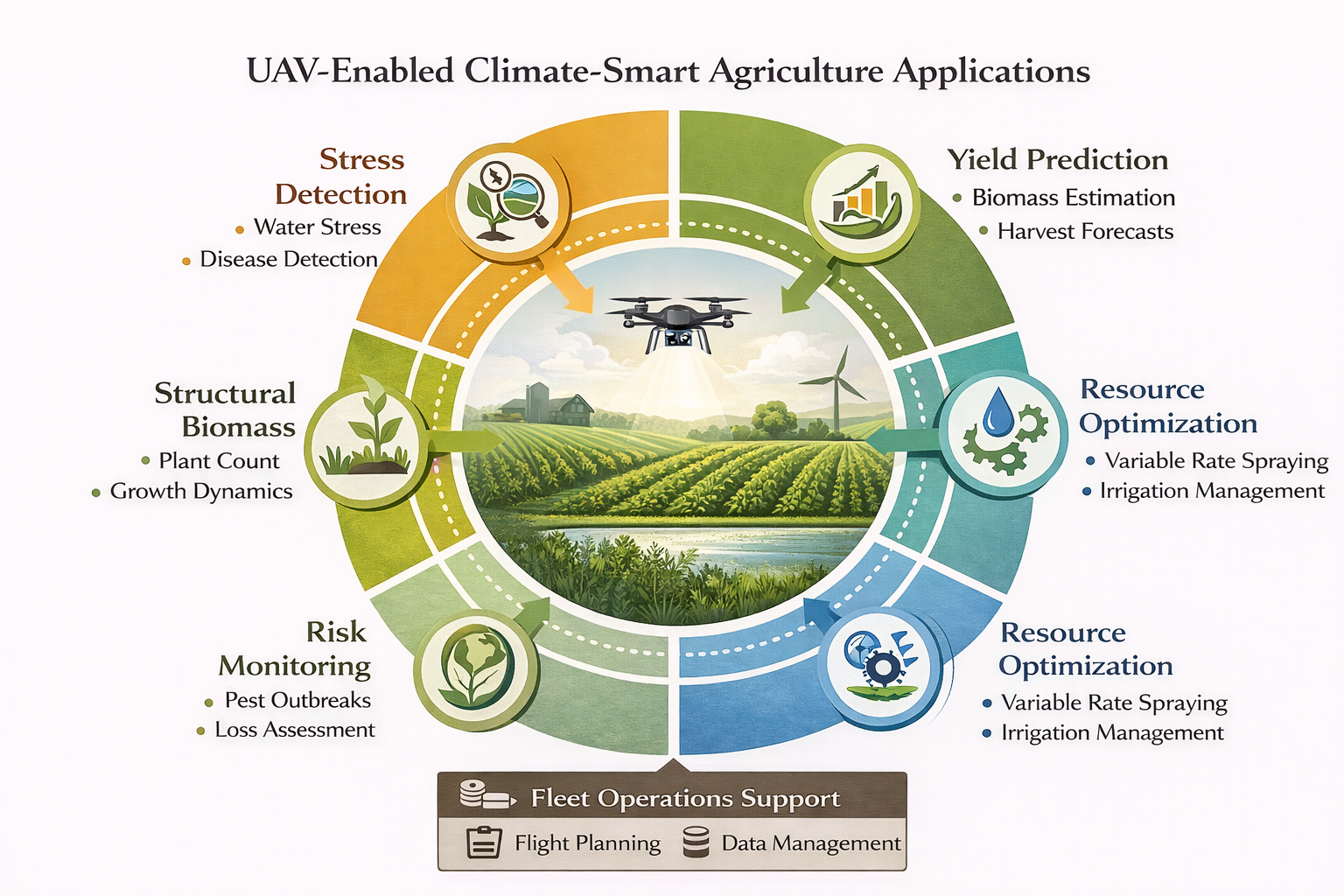
Unmanned aerial vehicle (UAV) remote sensing has evolved from experimental imaging into an operational diagnostic infrastructure supporting climate-smart agriculture through high-resolution, flexible, and timely crop observation. This review synthesizes advances in UAV platforms, multisensor payloads, artificial intelligence (AI) analytics, and multisource data fusion to evaluate their combined potential for monitoring heterogeneous smallholder systems. A PRISMA-guided analysis of 59 studies (2013–2024) classified sensing architectures, analytical approaches, and application domains across diverse agroecological contexts. Integrated UAV–AI frameworks improve detection of crop stress, yield variability, biomass distribution, and phenological dynamics compared with conventional monitoring, particularly when multimodal sensor data are fused with satellite and ground observations. Predictive performance and diagnostic reliability increase when spectral, thermal, and structural datasets are analyzed jointly using machine-learning or deep-learning models. However, scalability remains constrained by operational, infra-structural, and regulatory factors, especially in resource-limited systems. These findings demonstrate that integrated sensing–analytics systems form a critical foundation for scalable climate-smart agricultural transformation and data-driven decision support across farm, landscape, and institutional scales.
Keywords:
UAV remote sensing
; climate-smart agriculture
; artificial intelligence
; machine learning
; precision agriculture
; smallholder farming systems
; multispectral imaging
; crop monitoring
Copyright: This open access article is published under a Creative Commons CC BY 4.0 license, which permit the free download, distribution, and reuse, provided that the author and preprint are cited in any reuse.


