

Submitted:
31 May 2026
Posted:
02 June 2026
You are already at the latest version
Abstract
In this work, we describe a new dynamic rotational Thomson effect induced on rotating conductors exposed to chopped laser beam which generalizes analogue magneto transverse Thomson effects recently observed. We assume the existence of an out of-equilibrium self induced Barnett magnetic field which depends on helical thermal fields propagating on rotating conductors and it is associated to thermoelectric vortices . We deduce, assuming validity of Faraday law on the rotating out of equilibrium conductors, a time dependent rotational Thomson voltage, showing that is detectable on rotating ferromagnetic samples. We prove then the existence of dynamic tunable local magnetic phase transitions on rotating conductors associated to time dependent Curie temperature fluctuations proportional to the dynamic Thomson voltage. Finally we outline the relevance of this new time dependent magneto transverse Thomson effect either for dynamic thermal management that for dynamic tunable local insulator-metal transitions on rotating nano disks exploiting metamaterials.
Keywords:
out of equilibrium Barnett effect
; thermoelectric vortices
; dynamic chiral Thomson effect
; dynamic rotational Thomson voltage
; dynamic tunable magnetic phase transitions
; time dependent Curie temperature
Department of Basic and Applied Sciences for Engineering, Sapienza University of Rome
1. Introduction
Thermoelectric cooling is a research topic that has attracted significant attention in recent years, driven by the growing importance of solid-state cooling technology for developing more efficient thermoelectric modules in electronics and medicine.
Thermoelectric effects consist in the mutual conversion of heat in electricity and were discovered in 1821 by T.J. Seebeck when he observed that two different metals at different temperatures generate an electric current at their two junctions. A few years later, in 1834, J.C.A. Peltier discovered the inverse effect, that is a thermal gradient at the junction of two metals induced by an electric current. Based on these effects W.Thomson predicted in 1851 a third thermoelectric effect where the cooling-heating effect depends on the sign of the thermal gradient along a single conductor carrying electric current [1].
It was then understood empirically that a good thermoelectric device should have a low thermal conductivity k, a big electric conductivity and a big Seebeck coefficient S to minimize irreversible heat dissipation due to the Joule effect and to preserve a big temperature gradient. Until the 1940s, thermoelectricity had been investigated only in metals, which had high thermal conductivity and therefore poor electrical performance and were not attractive for technological applications on thermoelectric coolers. In the late 1950’s Joffe applied thermoelectricity to semiconductor samples and introduced the figure of merit [2]
to measure its electric performance, proving that the maximum temperature difference was proportional to the figure of merit
with the cold junction of a Peltier cooler module.
Despite the efforts of many researchers to improve the figure of merit, particularly at cryogenic temperatures the power generation and efficiency of the thermoelectric coolers were still very low for technological applications and thermoelectricity was nearly abandoned. In the 1990’s, green technology research stimulated renewed interest in thermoelectric coolers, due to its potential technological application to waste heat recycling. It was only in recent years that Thomson cooler devices were investigated, abandoning the conventional temperature-independent assumption so far exploited and extending the working range of Peltier coolers to larger temperature gradients and higher electrical currents introducing Thomson cooler [2]. Thermal diodes were then realized with temperature dependent properties observing metal-insulator phase transitions when the electric conductivity and the Seebeck coefficient had sharp changes. In fact, due to the Thomson effect since the heat density Q is proportional to both the electric current density and the temperature gradient by
with the thermal gradient and the Thomson coefficient given by
and the Seebeck coefficient associated to nonlinear heat transport .
This non linear contribution due to the temperature dependent Seebeck coefficient implies an extra Joule-Thomson current in the heat diffusion equation which modifies the efficiency of thermoelectric devices which was evaluated by most authors assuming a constant Thomson coefficient and exploiting for unidimensional thermoelectric modules the balance equation in the stationary approximation
neglecting, as conventionally assumed in the literature on thermoelectricity, stochastic fluctuations due to thermal noise and disorder effect.
Few years ago, in 2022, this new framework based on the hypothesis of a constant Thomson coefficient was applied successfully to magnetic phase transitions [3] and it was detected at T=305K ,using particular ferrite alloys, a giant Thomson coefficient . It was then proved experimentally in 2023 that an enhanced Thomson effect with big temperature drops, measuring a steady temperature relative span [4].This result greatly improved the performance of conventional thermoelectric coolers and was then confirmed, proving that an enhanced Thomson coefficient improves the efficiency of Thomson coolers in presence of electronic and magnetic phase transitions.
Despite these impressive results obtained in the last three years and the efforts to improve Thomson cooler efficiency the strategy to try to find materials to improve just the figure of merit by enhancing temperature gradients was not successful. In fact, these experimental investigations were not justified theoretically since they assumed the existence of a figure of merit zT whose magnitude has been deduced so far using a stationary framework with a constant local equilibrium temperature T(x). Anyway, differently from the conventional approach to thermoelectricity introduced originally by Joffe, it is not possible to define an equivalent definition of figure of merit zT of Thomson cooler devices [2] in a non-stationary framework with a dynamic balance equation given by
,with a convective time derivative of an helical thermal field T propagating on the out of equilibrium rotating conductors. This generalized balance equation does not depend on the laser average power w since it is assumed to be negligible far from the laser ultrathin focus compared to the dynamic power associated to T that are the rate of heat released in the unit of time caused by thermal emission , the rate of heat dissipated by the Joule effect in the unit of time and the rate of heat released or absorbed in the unit of time due to the Thomson effect.
Our work in fact is aimed to stimulate the thermoelectricity community to investigate new ways to improve the performance of thermoelectric Thomson coolers overcoming the conventional stationary approach based on the figure of merit zT.
We will illustrate therefore a new dynamic approach to Thomson thermoelectric coolers, which, differently from standard ones so far investigated, will have a complex valued thermal field dependent magneto Seebeck coefficient S(T).
The main result of the framework proposed in this work is the prediction of a new dynamic chiral magneto thermoelectric effect, which we called dynamic rotational homson effect, that consists in a pulsating Thomson voltage associated to chiral helicoidal thermal waves propagating on rotating conductors exposed to the harmonic heat source of the laser beam. We will show that the harmonic heat source of the chopped laser beam induces an out of equilibrium Barnett magnetic field which allows to control dynamically the direction and the intensity of the heat flux via a dynamic self-induced Righi-Leduc effect. The new dynamic chiral approach to thermoelectricity is non linear and non-stationary and therefore, differently from conventional stationary approaches, predicts complex valued time dependent transport coefficients such as thermal conductivity, electric conductivity and Seebeck coefficient.
Therefore, it is not possible to evaluate the electric performances of the new rotating Thomson coolers applying the conventional definition of the figure of merit zT since it cannot be extended to non stationary thermal gradients [5].
We will give some simple estimates of average Thomson voltages associated to the dynamic non linear Thomson cooling effect in accordance with recent experimental results measured on Thomson coolers associated to phase transitions [4].We will show that on rotating ferromagnetic conductors this effect can be exploited to implement dynamic tunable local magnetic phase transitions associated to detectable Curie temperature fluctuations.
We remark that this new time-dependent rotational approach to thermoelectricity which depends on the thermal field T due to the harmonic heat source induced by the chopped laser beam, cannot be described by standard stationary random fluctuations usually considered in complex systems with metastable states. In fact, it cannot be applied on out-of-equilibrium rotating metallic disks the well-known Fluctuation-Dissipation theorem [6],valid for stationary fluctuations, nor can be deduced the Johnson-Nyquist theorem.
In fact its thermal noise is usually assumed to be white noise associated to a uniform stationary equilibrium temperature T
with the statistical variance of the voltage drops V due to thermal fluctuations, the Boltzmann constant, R the constant resistance of the resistor of the Thevenin equivalent circuit, the bandwidth of the noise .
Therefore, it is difficult to estimate the magnitude of the voltage perturbations due to statistical fluctuations on the new dynamic thermoelectric phenomena predicted by our model since to deduce quantitative estimates it would require a generalization of the Johnson-Nyquist theorem associated to a non Gaussian time dependent noise, as Levy statistical noise caused by a non-Markovian process.
As for example the order of magnitude of the square root of the variance of the voltage fluctuations due to Johnson noise on a resistor with resistance of 1kΩ is about 1microVolt , that is
We remark that the previous one is not a realistic estimate of the effective resistance of Thomson thermoelectric devices since usually, having at room temperature a resistance , should produce a very little square root of the Johnson voltage variance
making it negligible with respect to the average Thomson voltage predicted by our model to be of the order of millivolts .
We expect therefore that the predicted dynamic chiral thermal management effect is a stable effect with respect to thermal noise and that time-dependent non-Gaussian random fluctuations might not affect chiral symmetry breaking transport effects induced on rotating conductors exposed to chopped laser beam. An indirect experimental proof of our dynamic chiral Thomson effect could be given by measuring time-dependent violations of the Johnson noise on rotating nonlinear thermoelectric devices.
More generally, in accordance with recent investigations on the Fluctuation-Dissipation Theorem in the presence of external oscillating fields [7], we could interpret microscopically our chiral wavelike heat diffusion model as a non-Markovian heat transport process associated to non-Gaussian and non-stationary thermal noise with memory .
We remark that violations of the Fluctuation-Dissipation theorem have been discovered recently in spin glass systems models [8],associated , as in our predicted thermomagnetic phase transitions, to time dependent local maximum of the specific magnetic entropy
Despite these important results investigations on the relevance of random fluctuations on the performance of thermoelectric devices are still missing and is impossible, as we will see in the sixth section, to estimate the magnitude of the thermal noise enhanced effect on rotating metallic samples with bidimensional stationary isothermal profiles T(x,y).
Moreover it is missing too in the modern literature on thermoelectric coolers a discussion on the possible generalization of the Johnson-Nyquist Theorem on accelerated samples [9],although a covariant generalization of this theorem could help to implement nano Thomson coolers and to improve some experimental results on giant spin Thomson effect on semimetals with strong spin-orbit coupling as bismuth.
In fact, although in the last ten years, the search for more efficient spintronic devices has stimulated some authors to investigate electric-field-induced orbital angular momentum in metals, a discussion on the relevance of a generalized Fluctuation-Dissipation Theorem is missing in the nascent research issue of non-equilibrium orbital physics called orbitronics [10]. One important research direction that has been explored very recently, using a stationary approach , assuming negligible perturbations due to non Gaussian thermal noise effects, is how to convert orbital currents to charge currents to enhance the spin Seebeck effect and improve electric performance of thermoelectric devices. This new research issue of orbital physics, although currently lacking a solid experimental verification of the predicted orbital currents, might explain new phenomena such as the orbital Hall effect and anomalous Hall effect in ferromagnets and semimetals [1]. These studies have not previously investigated the effects of out-of-equilibrium orbital currents on enhancing the efficiency of junction less thermoelectric devices which, conventionally, exploit the classical stationary Thomson effect or its phase-transition-induced enhancement [11,12,13].
Our work, on the contrary, is aimed at developing an out-of-equilibrium generalization of the Thomson effect on macroscopic rotating metals and semimetals with Thomson coefficient dependent on the thermal waves propagating on moving samples [14,15], which might be exploited to implement dynamic rotational Thomson thermoelectric coolers. The principal motivation that inspired our proposal is to elaborate a new unified framework of heat diffusion and thermal emission based on orbital physics which might implement chiral thermal management and tunable magnetic phase transitions via a dynamic chiral Thomson effect.
The theoretical proposal we will illustrate in the following sections develops a novel dynamic rotational chiral approach to thermoelectricity and thermal emission due to a new generalized magneto-chiral Thomson effect. Whenever confirmed experimentally the stability of this chiral symmetry breaking effect with respect to stochastic fluctuations due to thermal noise and disorder effects it might be exploited for technological applications such as chiral thermal management, non reciprocal heat transport and non reciprocal chiral photonics. Therefore, as we will explain in the Section 6, the predicted dynamic chiral magneto Thomson cooling-heating effect could be enhanced by non Gaussian Levy stochastic fluctuations, paving the way to dynamic extension of noise enhanced effect on wavelike heat diffusion process different from solitons propagation in quantum Josephson junctions.
This broader physical framework based on statistical fluctuations might affect, we think, the deterministic stationary approach used so far in recent experiments confirming the existence of the magneto-Thomson effect and of the transverse Thomson effect [16,17].On the contrary as we will show in the following, the stability and the observability of our dynamical chiral Thomson effect ,depending on the convective time derivative of the out-of-equilibrium Barnett magnetic field , will not be affected by the presence of a time dependent Poisson like thermal noise, since this random fluctuations has not so far been analyzed on rotating samples with ynamic chiral symmetry breaking effect .
We will show in fact that the harmonic heat source due to a chopped laser beam induces a dynamic enhancement of the Thomson coefficient , giving an average detectable estimate of this giant chiral thermoelectric effect on rotating iron samples .
Finally, we will deduce the existence of a chiral tunable thermal emissivity associated to the gauge breaking dynamic Thomson voltages, discussing its relevance for a future nonlinear approach to thermal harvesting[18],chiral thermal emission, and nonreciprocal photonics [19,20] on rotating conductors.
2. Out of Equilibrium Barnett Effect, Dynamic Thermal Management and Irrotational Thermoelectric Fields
The theoretical proposal we will illustrate in this section develops a novel dynamic rotational approach to thermal conduction based on out of equilibrium generalization of the Barnett effect associated to an effective magnetic field dependent on helical thermal fields generated on rotating metallic disks. We remark, as illustrated in the Introduction, that although this magnetic field might depend on time dependent stochastic fluctuations, it is robust and detectable with respect to conventional stationary thermal noise effects.
We will assume that the harmonic heat source due to the chopped laser beam on the rotating disk induces an effective temperature-dependent Barnett magnetic field parallel to the angular velocity vector of the body [21,22], that is, an out-of-equilibrium thermomagnetic effect:
with e the electron charge, g(T) the out of equilibrium electron gyromagnetic ratio, m(T) the effective electron mass and the out of equilibrium Barnett magnetic field perturbation , measured with respect to the average vertical component of Earth magnetic field
This effective magnetic field induced on rotating conductors by cha copped laser beam depend on a time dependent thermal field T , which it is assumed to be an harmonic solution of a telegraphist equation associated to a wavelike non linear heat diffusion law (Appendix)
, with a convective time derivative solidal to the rotating disk and Ta chiral helical thermal fields
and the space time dependent phase of the helical thermal field T.
This new dynamic approach to magnetic phase transitions via a time dependent self induced Barnett magnetic field depends on the existence of a new time thermal field dependent function b(T)) so that the equation (1) can be rewritten as
, with A an average of the unknown Righi-Leduc coefficient A(T) with respect to T , dependent on the metal sample considered (Appendix).
In fact the out of equilibrium Barnett field makes irrotational and anisotropic the heat flux density , due to the presence of an additive transverse heat flux term due to dynamic Righi-Leduc effect [15].
Therefore, assuming the validity of the Wiedermann-Franz law, the non linear magnetic controlled heat transport process must be must be associated to an out of equilibrium irrotational thermoelectric field
with S(T) a time dependent complex valued magneto Seebeck coefficient.
Assuming on the rotating out of equilibrium conductors a generalized out of equilibrium Faraday-Maxwell induction law
that shows that the thermoelectric field is irrotational whenever it is present a thermal field propagating on the rotating disk. We note that by finding approximate solutions of (6) it is possible to deduce estimates of the electron effective mass m(T) and its dependence on the dynamic magneto Seebeck coefficient S(T). For example assuming that rotor of the thermoelectric field of (5) is proportional to it it easy to show that S, showing that a constant m(T) makes S(T) equal to zero.
The non linear and transverse heat flux law due to chopped laser beam incident on the rotating conductors can be described, neglecting thermal effects due to phonon scattering, by a wavelike model (Appendix), in accordance with a gauge symmetric approach to wavelike heat conduction recently investigated [23].
In fact the out of equilibrium Barnett magnetic field of (1) induces, via a dynamic self induced Righi-Leduc effect, a transverse heat flux [16], which makes heat transport a non linear transverse anisotropic process described by
with a local non linear electron relaxation time of the rotating conductor that can be determined explicitly (Appendix) and k the standard thermal conductivity of the conductor at rest and T harmonic helical thermal field
Since the wavelike non linear heat flux of (7) is irrotational, that is , it implements, due to the linear dependence on the angular velocity vector of the rotating conductor, a new dynamic chiral approach to thermal management. The heat transfer is controlled by the transverse thermoelectric current density associated to the transverse thermoelectric field introduced in (5), and is defined , assuming Weidermann-Franz law on the rotating conductors ,by
,with an average Seebeck coefficient, an effective time dependent electric conductivity, L the Lorenz number and k(T) an effective thermal conductivity. The irrotational thermoelectric density vector can be associated to topological stable thermoelectric vortices propagating on the rotating conductors which ,in the simple case of a linear dependent Seebeck coefficient S(T) are proportional to the phase change on the isothermal profile circuit of lnT.
3. Dynamic Chiral Thomson Effect and Tunable Magnetic Phase Transitions on Rotating Metallic Disks
We will show in this section that the Barnett magnetic field self-induced by rotation of (1) ,parallel to the axis of symmetry of the rotating disks, , will generate a dynamic Thomson voltage [15],whose radial pulsating electric field will tend to counteract the dissipative heating process due to the Joule effect .
In fact, according to Faraday's law, an out of equilibrium oscillating electromotive force proportional to the time derivative of the Barnett magnetic field of (1) is induced on the rotating disk proportional to the angular velocity Ω of the rotating conductor
which by using the Zel’dovich condition (Appendix) and the function b(T) introduced in (2), can be shown to be proportional to the angular velocity of the rotating disk Ω
with the shifted pulsation of the thermal field due to o the Zel’ dovich rotational super radiance effect [26,27],
assuming a non Fourier wavelike heat diffusion model [28], with convective time derivative of the thermal field T given by (Appendix)
This dynamic Thomson voltage is associated to an oscillating chiral radial Thomson electric field (T,Ω) tuned by Ω with a radial component given by
, which is proportional to the dynamic magneto Seebeck coefficient S(T) of (5) since .
This new dynamic chiral Thomson electric field might be used to improve the electric performance of Thomson cooler devices exploiting thermally driven magnetic phase transitions. In fact the radial component of the time dependent Thomson electric field depends on the time derivative of the Barnett magnetic field and can be enhanced , tuning by (13), the shifted pulsation of the thermal field and the angular velocity Ω of the rotating disk.
This time dependent radial thermoelectric field perturbs dynamically electron conduction bands making Fermi energy time dependent, pushing electrons harmonically outward and inward with respect to the center of the rotating disk , in accordance with a generalization of the Stewart-Tolman effect recently investigated by some authors interested on general approaches to out of equilibrium thermodynamics of neutron stars [29,30,31].
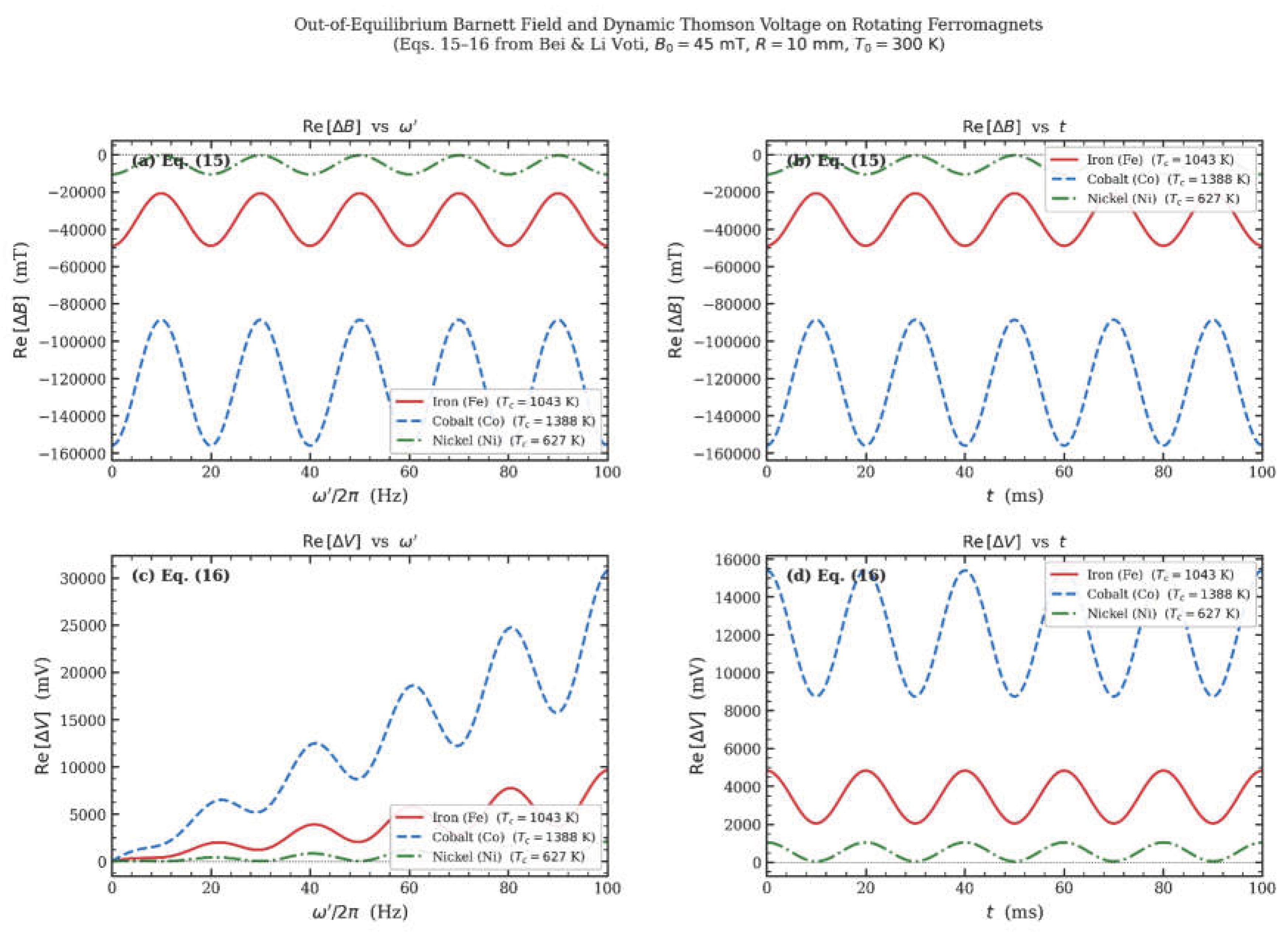
As a case study of the rotation induced thermoelectric effect associated to magnetic phase transitions we illustrate some simple estimates of the average dynamic Thomson voltage of (28) in the simple case of ferromagnetic disks. We will introduce a generalized Curie-Weiss like magnetization law associated to the out of equilibrium Barnett magnetic field of (1), assuming as first approximation a time dependent Curie-Weiss like law for the paramagnetic state of the out of equilibrium rotating ferromagnetic disks (Figure 1)
with the the average constant real part of the magnetic susceptivity, the constant average vertical component of the environment magnetic field chosen in the experimental set up and the constant and uniform Curie temperature of the metallic sample at rest.
Taking the real part of the Barnett field at first member of (14) we get an harmonic time dependent magnetization in the paramagnetic state of the rotating conductor
of (11) in Herz b) plot of the harmonic oscillations of the real part of the Barnett magnetic field with respect to time t c) plot of the dependence of real part of the dynamic rotational Thomson voltage on the the shifted pulsation of (11) in Herz d) plot of dependence of the real part of the dynamic rotational Thomson voltage on the time t.
Inserting this relation (13) in equation (9) we can deduce an estimate of the real part of the oscillating rotational Thomson voltage self induced on the border of the rotating disk in the paramagnetic state
We reported in figure 1 the plots for the three ferromagnetic conductors iron, nichel and cobalt as a function of the shifted pulsation in Herz of (11) and as function of time, either of the real part of the Barnett magnetic field that of the real part of the self induced dynamic rotational Thomson voltage of (15) and (16).
We remark that the predicted giant peaks of the real part of the rotational Thomson voltage of Figure 1c) could be detected as giant magnetoresistance resonances associated to magnetic and thermal phase transitions. The order of magnitude of these dynamic magnetoresistance resonances could be estimated by inserting in (16) a complex valued thermal field dependent magnetic susceptivity and Curie temperature and imposing that the dynamic Thomson electric power is equal to the Joule dissipative power.
Anyway we expect , as we illustrated in the introduction, that the dynamic rotational Thomson effect is stable with respect to the thermal noise effects and disorder effects since in (1) due to rotation induced stable thermoelectric vortices associated to the irrotational thermoelectric current of (8). It is possible to improve the estimate by solving the recursive differential equation obtained by substituting in (14) to the constant Curie temperature the dynamic one given by
, getting as a second order approximationof the recursive equation
, with the average Seebeck coefficient of the ferromagnetic sample at rest.
Therefore we have proven that that by assuming a Barnett magnetic field in the paramagnetic state given by (14) the harmonic heat source of a chopped laser beam induces on rotating ferromagnetic disks tunable magnetic phase transitions associated to time dependent Curie temperature fluctuations , that by equation (17) can be estimated to be of the order of magnitude of 100 Kellvin
This prediction could be tested in Laboratories with modern infrared thermocamera applying lock in technique, tuning the physical constants in (16) so to detect peaks of the average rotation induced chiral Thomson voltage or of the average of the oscillating magnetic susceptivity .
We will study the stability of the effects from a general out of equilibrium thermodynamic approach assuming that dynamic magnetic phase transitions induced on the rotating conductors are associated to non stationary local equilibrium states predicted by the general principle of equilibrium of maximum local entropy rate production.
In fact the new oscillating thermoelectric field dependent of (5) dependent on the dynamic magneto Seebeck coefficient S(T) can be associated to an out of equilibrium thermodynamic process with specific entropy production in a rotating frame which generalizes the conventional one on sample at rest [7]
with the electric conductivity.
We note that our model, differently from a similar wavelike nonlinear heat diffusion model recently investigated [32], depends on the dynamic chiral Thomson effect previously discussed by
, with S(T) a dynamic generalization of the magneto Seebeck coefficient recently investigated [33].
From (6) we deduce a relation which will allows to express the dynamic magneto Seebeck coefficient as a function of the free parameter b(T) , introduced in (1)
with the orbital electric current density given by
We note that the specific entropy production of (31) can be negative whenever the gradient term due to the Thomson effect is bigger than the first term due to the Joule effect. Moreover equation (31) can be exploited to tune dynamically magnetic phase transitions, assuming that they are associated to maxima or minima of the entropy flux rate comoving with the rotating disks, that is
using the time convective derivative solidal to the rotating disks of (11).
From (35) we can generalize the stationary local conservation law of energy density and the conventional specific entropy flux rate of a system at rest [13], taking in account that it depends on helical thermal fields solutions of telegraphist equation introduced in (16)
by (31) and (35) it follows that the electric current density on the thermal field T satisfies the relation
This equation is the stability condition which must satisfied to have a dynamic chiral Thomson effect on rotating conductors robust with respect to random fluctuations and disorder effects , which usually are associated in the literature to random magnetic fluctuations described by Gaussian white noise.
We remark that by inserting the second member of (21) in equation (24) it can be deduced the explicit dependence on the thermal field T of the dynamic magneto Seebeck coefficient S(T)), making possible to compare the order of magnitude of this effect with the stationary estimates associated to Joule dissipative noise..
The equation (24) shows therefore that the dynamic chiral Thomson effect is a robust experimentally detectable effect that can be exploited on rotating conductors exposed to chopper laser beams to coherent control by thermal fields of magnetization in ferromagnetic samples tuning their dynamically local magnetic phase transitions. Therefore, the predicted Curie temperature harmonic fluctuations could be easily detected in Laboratories with modern infrared thermocamera applying lock in technique and could be exploited as signature of giant magnetic phase transitions on rotating ferromagnets and of thermal phase transition on rotating metamaterial disks as vanadium dioxide.
We note that the laser induced out of equilibrium thermodynamics on rotating metallic disks implies, taking in account the dynamic chiral Thomson effect, the following generalization of the Faraday law on the rotating metallic disk given by
with the out of equilibrium Barnett magnetic field of (1).
This equation implies that by (11) due to the Zel’dovich superradiant effect that rotation induces on out of equilibrium conductors topological stable chiral thermoelectric vortices. Independently from thermal noise fefcts and disorder effects they can be can be detected experimentally by observing a change of sign of the rotor of dynamic Thomson electric field of (5) since we have
whenever the shifted pulsation is non zero,
Therefore our model predicts the existence of a time dependent irrotational magneto Thomson effect, which is stable and robust with respect to random fluctuations which generalizes recently observed magneto and transverse Thomson effects [10,11], whenever the shifted pulsation is non zero.
We remark that the predicted dynamic chiral magneto Thomson effect allows to deduce, once equation (26) is solved, the dynamic magneto Seebeck coefficient S(T), and hence the thermal field dependence of the Thomson coefficient [13],
,allowing to deduce estimates of the performance of this non linear time dependent thermoelectric effect.
Finally we note Zel’dovich rotational super radiant effect could be exploited to improve the electric performance of a dynamic Thomson cooler making the thermoelectric c field of (30) reduce the relative magnitude of the Joule heating process, by the effective thermal field dependent impedance of the disk Z(T).
4. Dynamic Rotational Thomson Effect and Gauge Breaking Chiral Thermal Emission
We showed in the previous section that the oscillating chiral Thomson voltage , introduced in equation (40) for an iron disk ,depends on the sign of the rotational Doppler shift of thermal field T . Therefore, since its time derivative is proportional to the thermal power density it can be associated to chiral thermal radiation emitted by the out of equilibrium rotating conductors. .
In fact, in accordance with new recent approach to non reciprocal photonics and tunable thermal emissivity on metamaterials [19,34], assuming Stefan-Boltzmann law it can be introduced a chiral dynamic tunable thermal emissivity dependent on the out of equilibrium Barnett magnetic field
,with the Stefan-Boltzmann constant, a dimensional constant dependent on the disk sample and and an irrotational chiral thermal Poynting vector proportional to the dynamic magneto Seebeck coefficient S(T)
with Using equation (4) it can be rewritten making explicit the linear dependence on the angular velocity Ω of the Poynting vector
,proving that the dynamic chiral Thomson effect is associated to chiral thermal remission process.
Equation (49) implies that the thermal emissivity of (47) implements chiral polarized thermal radiation emitted by rotating conductors exposed to chopped laser beam which could be detected looking for a dynamic nonlinear magneto Kerr effect.
We can introduce an out of equilibrium magnetic vector potential whose rotor can be associated to the out of equilibrium Barnett magnetic field by the conventional definition
which breaks gauge invariance since it is satisfied the relation
,that can be approximated as
Introducing a path integral on a closed circuit of the time derivative of the out of equilibrium magnetic at first member of (32) it can be deduced the existence of chiral electromagnetic radiation emitted by the rotating disks since
associated to topological stable chiral electromagnetic vortices
We note that the gauge breaking dynamic rotational Thomson is a gauge breaking filed that can be exploited , by (43) to enhance performance of Thomson coolers-heating devices and whenever confirmed experimentally could be an indirect test of recent applications of Extended Electrodynamics theory to thermal induced gauge breaking effects and to recent investigations on magnetic field driven thermal management [35,36,37,38,39].
We hope that our theoretical proposal will stimulate the thermoelectricity community to investigate, the relevance of gauge breaking dynamic magneto Thomson effect to understand out of equilibrium thermodynamics processes and anisotropic magnetization processes either of rotating nanodisks and of fast rotating macroscopic systems such as neutron stars [30,31].
6. Discussion
The main motivation which inspired our novel proposal of dynamic rotating thermoelectric coolers is to elaborate a new unified framework of anomalous heat diffusion, tunable chiral thermal emission and dynamical orbital physics which might have innovative technological applications in the future such as chiral tunable thermal diodes and heat assisted dynamic magnetic recording.
We illustrated a new dynamic chiral approach to Thomson electric coolers which, differently from conventional stationary approaches so far investigated, predicts complex valued time dependent Seebeck coefficient and Thomson coefficient. Therefore, in our dynamical non linear approach to thermoelectricity it is not possible to use standard notion of electric performance, since they are based on the well-known static figure of merit zT .
We deduced in the particular case of an iron rotating disk, a naïve estimate of the average real part of the dynamic Thomson coefficient in equation (46), showing its giant enhancement due to rotation and to the chopped laser beam.
We remark that this prediction was deduced neglecting the effect due to the imaginary part of the average magnetic susceptivity , which could be associated, by the Fluctuation-Dissipation Theorem, to a thermal noise contribution to Thomson coefficient and Thomson voltage fluctuations.
These experimental detectable predictions could be theoretically perturbed by statistical fluctuations associated to the Nyquist theorem but, as recently investigated [6] ,it is not possible to extend the Johnson noise to non-equilibrium time dependent framework with non-uniform bidimensional temperature profiles.
In fact, all the time dependent measures of the variance of the squared voltage were estimated so far using the linear relation [6].
which is predict voltage drops proportional to the constant equilibrium temperature T, while quadratic relations in T have been deduced recently just assuming thermal conductance dominated by phonon scattering [40]. On the contrary in our dynamical approach to thermoelectricity chiral heat conduction is assumed to be dominated by electron scattering on two dimensional out of equilibrium rotating disks and cannot be applied the stationary nor the relation (53), that can be deduced only for one-dimensional samples at rest, nor the quadratic one valid valid neglecting thermal electron conduction .
We remark that the chiral symmetry breaking effect of our wavelike non linear heat diffusion model is a specific signature of the existence of a dynamic Thomson effect and cannot be associated neither to any equilibrium thermal noise nor to any stationary disorder effect, as recently showed in a recent paper investigating Fluctuation-Dissipation theorem in non equilibrium steady states of quantum Hall liquids [41]. .
We think that the predicted chiral symmetry breaking effects associated to dynamic Thomson voltage of (28) is stable with respect to Gaussian and non Gaussian stochastic fluctuations since, differently from recent models based on Levy distributed thermal noise of Josephson junctions [42,43], and on giant thermoelectric effects in ferromagnetic superconducting Junctions [44]. In fact, either dynamic thermal management that dynamic tunable local magnetic phase transitions depend on harmonic thermal fields and not on local metastable sates, as conventionally assumed in spin glass systems too. Anyway, it would be important to test indirectly dynamic chiral thermoelectric effects by measuring the heat torque transfer associated to the chiral thermal emission associated to the chiral thermal Poynting vector of (48), for example by measuring anisotropic optical activity due to a dynamic chiral magnetic effect [45], or by observing a rotation induced analogue of a nonlinear chiral thermoelectric Hall effect, recently observed with tellurium samples [46].
We outline that the predicted dynamic chiral thermal emissivity introduced in equation (47), whenever confirmed experimentally, would prove the existence of a dynamical heat torque transfer due to the strong linear coupling between chiral polarized thermal emission and wavelike chiral heat diffusion on the out of equilibrium rotating disks
We hope that the prediction of angular momentum controlled chiral heat transport on rotating iron disks associated to the dynamic chiral Thomson effect will stimulate to investigate the role of rotation induced spin orbit interaction on spin dependent electron scattering in chiral thermal conduction and in chiral thermoelectricity, extending an approach recently discussed in spintronics [47].
Finally, we expect that the hypothesis of a chiral polarized thermal emission on out of equilibrium rotating conductors might find interesting technological applications linking researches on thermal diodes to those on non reciprocal thermal conduction and on non reciprocal nanophotonics.
7. Conclusions
We have illustrated in this work a new dynamic chiral Thomson effect self-induced on rotating conductors exposed to a chopped laser beam, assuming the existence of a rotational nonlinear thermal Hall effect due to an out-of-equilibrium Barnett magnetic field. We showed that this new framework allows for implementing a novel rotational chiral approach to thermal management associated with structured helical thermal waves transporting angular momentum. We proved the existence of a dynamic chiral Thomson voltage which can be used to enhance dynamically magnetic phase transitions and to improve the performance of rotating thermoelectric devices.
We showed , finally, that this novel dynamic chiral Thomson effect is associated with a gauge-breaking thermal Poynting vector, leading to a chiral dynamic tunable thermal emissivity which, we hope, might be exploited in the future to develop a new chiral non linear approach to nonreciprocal photonics and to chiral thermal control of magnetic storage on rotating chiral magnetic nanodevices.
Appendix: Helical Chiral Thermal Fields, Non Linear Wavelike Heat Diffusion and Dynamic Chiral Thermal Managment
The non linear dynamic approach proposed to Thermoelectricity depends on the existence of the thermal fields T spropagating on rotating conductors exposed to chopped lase beam. The non linear heat diffusion is a generalized Cattaneo-Vernotte anisotropic model , due to the selfinduced Righi-Leduc effect, given by the equations Therefore, the new non linear anisotropic heat transport process will depend on the out of equilibrium Barnett field of (1) and it will be described by the non linear heat flux law
Unlike the conventional analysis of the thermal Hall effect the deflection angle of the transverse heat flux is a dynamic deflection angle dependent on the thermal field T that, in polar coordinates [15], is given by
where on the right-hand side we have the real part of the complex valued functions, and with the polar and azimuthal gradients given by
We will assume in the following a frequency shift due to a rotational Doppler effect of the thermal field due T to a thermal analogue of the Zel’dovich effect [26,27].
with a rotational Doppler shifted pulsation of the thermal field T.
and m an integer number associated to the angular momentum transferred by the chiral helical thermal field, whose chirality depends on its sign . We note that the time derivative of (8) is a convective time derivative comoving with the rotating disk
Therefore using (9) and (10) it is possible to introduce a thermal Hall angular velocity proportional to this shifted pulsation
with
which changes sign when the shifted pulsation does and is zero if the resonant condition of Zel’dovich rotational superradiance is satisfied , that is if
We note that this rotation induced chiral thermal control via the Zel’dovich effect can be tuned changing the angular velocity Ω of the disk , as we will see in the next paragraph, can be associated to peaks of the Thomson coefficient and to symmetry breaking chiral magnetic phase transitions.
In fact, it is possible to show [15] that the new thermal fields T satisfy, far from the focus of the laser beam incident on an ultrathin disk, a homogeneous generalized telegraphist wave equation, which generalizes the well known Cattaneo-Vernotte model by introducing on the rotating disk the convective time derivative of (9) can be written
We remark that our dynamic approach to thermoelectricity is based on the introduction of a Seebeck coefficient S(T) which depends on this deterministic out of equilibrium thermal fields T and thermal fluctuations due to stationary stochastic effects and thermal noise are averaged out.
We will find the local relaxation time looking for particular solutions temporally periodic and spatially attenuated (SATP solutions) given in polar coordinates ) by
with the average environment temperature and a local complex valued wave vector whose real part is a solution of the differential equation in the r variable
with k the thermal conductivity and the specific heat at constant pressure of the disk at rest.
These new structured chiral thermal fields have, differently from conventional one local tunable phase velocity given by
with the phase velocity at rest on the border of the disk and the effective index of refraction of thermal waves defined respectively as
and
Taking in account (17), (18), (19) it is possible to write the local electron relaxation time as
We note that the tunable thermal phase velocity of (16) becomes linearly dependent on the rotational Doppler frequency shift on the border of the disk
which, going to zero when can be exploited to prove existence of thermal rotational super radiant effect by measuring heat transport arrest on the border of the disk.
In fact, the thermal wave phase velocity (16), depending on the local relaxation time ,depending on the effective local thermal refractive index n, makes the disk an effective dispersive medium in a similar way to what has recently been proposed in a study on the hyperbolic propagation of heat on metamaterials [28].
It is possible to show [9] that the nonlinear telegraphist equation with particular solutions (16), singular at the center of the disk, have chiral isothermal helical wavefront profiles
with R the disk radius and the phase velocity of the conductor at rest and with m associated to the angular momentum of the polarized laser beam and transported by the helical thermal wave considered.
It is possible to test experimentally the rotation induced thermal control predicted by our model introducing a new parameter given by the difference between the angle of the isothermal profile on the border R of thin rotating disks and those of identical disks at rest given by
For example, assuming that the rotating disk is iron, inserting the values of its thermal conductivity and specific heat and choosing angular velocity Ω=100Hz and R=0,01m, from (19) we have an experimentally detectable estimate of the detectable relative angle of deviation induced by rotation given by
This angle of relative thermal deflection induced by rotation could be easily tested in laboratories by using IR thermal cameras with lock in thermography technique to map isothermal profiles of the helical thermal waves and, whenever confirmed, could pave the way to dynamic chiral thermal management.
Author Contributions
Conceptualization, G.B.; methodology, G.B.; validation, G.B. and R.L.V.; formal analysis, G.B.; investigation, G.B.; writing—original draft preparation, G.B.; writing—review and editing, G.B. and R.L.V.; funding acquisition, R.L.V. All authors have read and agreed to the published version of the manuscript.
Funding
This research received no external funding. “The authors have reviewed and edited the output and take full responsibility for the content of this publication.”
Conflicts of Interest
The authors declare no conflicts of interest
References
- Suyao Liu, Bingchao Qin, Li-Dong Zhao. Thomson effect facilitates thermoelectric cooling[J]. Materials Lab, 2025, 4(2): 240017. [CrossRef]
- Zebarjadi, M.; Akbari, O. A Model for Material Metrics in Thermoelectric Thomson Coolers. Entropy 2023, 25, 1540. [CrossRef]
- R. Modak; M. Murata;D. Hou; A. Miura; R. Iguchi; B. Xu; R. Guo ;I.Shiemi.; Y. Sakuraba; K.I. Uchida. Phase transition-induced giant Thomson effect for thermoelectric cooling. Applied Physics Reviews 2022, 9, 011414. [CrossRef]
- Chen, Z., Zhang, X., Zhang, S. et al. Demonstration of efficient Thomson cooler by electronic phase transition. Nat. Mater.2025, 24 , 34–38 .. [CrossRef]
- Goupil, C.; Seifert, W.; Zabrocki, K.; Müller, E.; Snyder, G.J. Thermodynamics of Thermoelectric Phenomena and Applications. Entropy 2011, 13, 1481-1517. [CrossRef]
- J .Berger; G. Katriel. Non local origin and correlations in the Johnson noise at nonuniform temperature Physical Review,2025, 112,224311. [CrossRef]
- B. Cui; A. Zaccone. Phys.Rev.E,2018 , 97, 060102(R). [CrossRef]
- G. Parisi. Nobel lecture: Multiple equilibria Rev. Mod. Phys., 2023, 95,030501 . [CrossRef]
- N. A. M. Tran et al Fluctuation-dissipation in thermoelectric sensors, EPL, 2023 , 141 26002. [CrossRef]
- Lee KJ, Cros V, Lee HW. Electric-field-induced orbital angular momentum in metals. Nat Mater. 2024, 23(10):1302-1304.. [CrossRef]
- Zebarjadi, M., Akbari, O. A Model for Material Metrics in Thermoelectric Thomson Coolers. Entropy 2023, 25,1540. [CrossRef]
- Sandoz-Rosado, E.J., Weinstein S.J., Stevens R.J.,, On the Thomson effect in thermoelectric power devices, International Journal of Thermal Sciences 2013 , 66, 1-7. [CrossRef]
- Lee H S. ,The Thomson effect and the ideal equation on thermoelectric coolers, Energy 2013, 56, 61-69. [CrossRef]
- Li Voti R., Bertolotti M.,Thermal waves emitted by moving sources and the Doppler effect, International Journal of Heat and Mass Transfer 2021 , 176,121098. [CrossRef]
- Bei, G., Anisotropic and wave diffusion of heat and self-induced oscillating thermomagnetic and thermoelectric effects on rotating conductors, PHD Thesis Sapienza University of Rome 2025 . https://hdl.handle.net/20.500.14242/210058.
- K. Uchida et al., “Observation of the magneto-Thomson effect,” Phys. Rev. Lett. 2020,125, 106601. [CrossRef]
- Takahagi, A., Hirai, T., Alasli, A. et al. Observation of the transverse Thomson effect. Nat. Phys. 2025,21, 1283–1289 . [CrossRef]
- Ordonez-Miranda J., Anufriev R., Nomura M., Volz S.,Harnessing thermal waves for heat pumping, Phys. Rev. Applied 2024,21, 054037. [CrossRef]
- Jun Lu et al.,Bright, circularly polarized black-body radiation from twisted nanocarbon filaments, Science 2024,386,1400-1404. [CrossRef]
- Yang, S., Liu, M., Zhao, C. et al.,Nonreciprocal thermal photonics. Nat.Photon. 2024,18,412–424. [CrossRef]
- Barnett S.J., Magnetization by Rotation, Phys. Rev. 1915,6, 239. [CrossRef]
- Chudo H. et al, Observation of Barnett fields in solids by nuclear magnetic resonance, Appl. Phys. Express 2014,7 063004.
- Yang C. Quantization of nonequilibrium heat transport models based on isomorphism and gauge symmetry. Sci Rep. 2025, 15,14829. [CrossRef]
- Cattaneo C., Sulla Conduzione del Calore vol.3 p.83, Atti del Seminar 1958, 247, Mat. Fis. Univ. Modena p. 431, Comptes Rendus Acad. Scie., Paris.
- Vernotte P., Comptes Rendus Acad. Scie. 1958, Paris, 246p. 3145.
- Zel’dovich, Y.B.,Amplification of Cylindrical Electromagnetic Waves Reflected from a Rotating Body. JETP: Journal of Experimental and Theoretical Physics 1972, 35, 1085.
- Braidotti, M.C.; et al.,Amplification of electromagnetic fields by a rotating body. Nat Commun 2024,15,5453 . [CrossRef]
- Li Z.Y., et al , Non-Fourier thermal focusing by gradient thermal metamaterials based on the Cattaneo–Vernotte model, J. Appl. Phys. 2024,136, 193106. [CrossRef]
- Tolman, R.C., Stewart T.D, 1916, Phys Rev.8,97. [CrossRef]
- Gavassino L., Spontaneous charge separation in accelerating relativistic plasmas, Phys. Rev. D 2025,112, 084067. [CrossRef]
- Gavassino L., Antonelli M., Heat propagation in rotating relativistic bodies, Phys. Rev D 2025,112 (10).
- Munafò C.F.,Rogolino P.,Kovacks R., Nonlinear thermal analysis of two- dimensional materials with memory, International Journal of Heat and Mass Transfer 2024,219, 124847. [CrossRef]
- Spathelf F., Faquè B.,Behnia K., Magneto -Seebeck effect in bismuth, Phys. Rev B 2025,105,235116. [CrossRef]
- Larciprete M.C. et al., Tunable IR perfect absorbers enabled by tungsten doped VO2 thin films. APL Mater. 2023, 11 (9): 091107. [CrossRef]
- Hively L.M. and Land M., Extended electrodynamics and SHP theory, J. Phys.: Conf. Ser. 2021,1956, Article ID: 012011.
[CrossRef] - Márkus, F., & Gambár, K.,Symmetry Breaking and Dynamic Transition in the Negative Mass Term Klein–Gordon Equations. Symmetry 2024, 16(2), 144.. [CrossRef]
- Cai, K., Yang, M., Ju, H. et al. Electric field control of deterministic current-induced magnetization switching in a hybrid ferromagnetic/ferroelectric structure. Nature Mater 2017,16, 712–716.. [CrossRef]
- Adamantopoulos, T., Go, D., Oppeneer, P.M. et al. Light-induced orbital and spin magnetism in 3d, 4d, and 5d transition metals. npj Spintronics 2025,3, 27 . [CrossRef]
- He, J., Yang, L., Wang, Q. et al. Dynamic thermal management under variable operating conditions through magnetic field control. Nat Commun 2026,17, 1958. [CrossRef]
- K. Xia, Power Spectral Density of Thermal Noise at Low Frequencies in Thermal Conductance, in IEEE Transactions on Electron Devices, 2025, 72, 5. [CrossRef]
- Wang, Chenjie and Feldman, D. E, Chirality, Causality, and Fluctuation-Dissipation Theorems in Nonequilibrium Steady States,Phys. Rev. Lett., 2013, 110, 3, 030602 . [CrossRef]
- Guarcello C., Filatrella G., Spagnolo B.; et al. Voltage drop across Josephson junctions for Lévy noise detection, Phys. Rev. Res., 2020, 2, 4, 043332. [CrossRef]
- Guarcello C., Filatrella G., Spagnolo B.; et al. , Lévy noise-induced effects in a long Josephson junction in the presence of two different spatial noise distributions, Chaos, Solitons & Fractals, 2024, 187,115421. [CrossRef]
- Ozaeta A., Virtanen P., Bergeret, F.S. and Heikkilä T. T. ,Predicted Very Large Thermoelectric Effect in Ferromagnet-Superconductor Junctions in the Presence of a Spin-Splitting Magnetic Field, Phys. Rev. Lett. 2014, 112, 057001. [CrossRef]
- Dey U, Nandy S, Taraphder A. Dynamic chiral magnetic effect and anisotropic natural optical activity of tilted Weyl semimetals. Sci Rep. 2020, 10(1):2699. [CrossRef]
- Nomoto, T., Kikkawa, A., Nakazawa, K. et al. Observation of the nonlinear chiral thermoelectric Hall effect in tellurium. Nat. Phys. , 2025, 21, 1920. [CrossRef]
- Yu T., Luo Z., Bauer G.E.W., Chirality as generalized spin–orbit interaction in spintronics, Physics Reports, 2023, 1009, 1-115. [CrossRef]
Figure 1.
Dependence of the real part of the dynamic Barnet magnetic field and of the dynamic rotational Thomson voltage of iron, nichel and cobalt on the shifted pulsation and on time: a) plot of the harmonic oscillations of the real part of the Barnett magnetic field with respect to the shifted pulsation
Figure 1.
Dependence of the real part of the dynamic Barnet magnetic field and of the dynamic rotational Thomson voltage of iron, nichel and cobalt on the shifted pulsation and on time: a) plot of the harmonic oscillations of the real part of the Barnett magnetic field with respect to the shifted pulsation
Disclaimer/Publisher’s Note: The statements, opinions and data contained in all publications are solely those of the individual author(s) and contributor(s) and not of MDPI and/or the editor(s). MDPI and/or the editor(s) disclaim responsibility for any injury to people or property resulting from any ideas, methods, instructions or products referred to in the content. |
© 2026 by the authors. Licensee MDPI, Basel, Switzerland. This article is an open access article distributed under the terms and conditions of the Creative Commons Attribution (CC BY) license (http://creativecommons.org/licenses/by/4.0/).
Copyright: This open access article is published under a Creative Commons CC BY 4.0 license, which permit the free download, distribution, and reuse, provided that the author and preprint are cited in any reuse.


