
Submitted:
02 March 2026
Posted:
04 March 2026
You are already at the latest version
Abstract
This paper examines the strategic manipulationof government debt data—referred to as ”fiscal rule stretch-ing”—among European Union member states, particularly inresponse to electoral incentives, financial market stress, and theconstraints of the Stability and Growth Pact (SGP). Using Euro-stat revisions of government debt figures, we find that countrieswith higher debt levels, particularly those exceeding the 60% ofGDP SGP threshold, are more likely to have their debt figuresrevised upwards. Our analysis further reveals that eurozonemembers are more inclined to engage in rule stretching, especiallywhen facing Excessive Deficit Procedure (EDP) enforcement.Election timing plays a crucial role in this behavior, with un-scheduled elections and proximity to elections both significantlyincreasing the likelihood of debt revisions. Financial market stressamplifies these effects, as governments under pressure may resortto optimistic accounting to present more favorable debt statistics.While fiscal transparency appears to be positively associated withdebt revisions, suggesting that transparent governments may relyon more sophisticated methods of rule stretching, GDP growthdoes not show a significant impact. Overall, our findings highlightthe intersection of domestic political cycles, financial constraints,and EU-level oversight in shaping fiscal reporting practices acrossmember states.
Keywords:
fiscal rule compliance
; government debt reporting
; political budget cycles
; stability and growth pact (SGP)
; fiscal transparency
1. Introduction
Fiscal transparency refers to making the selections made by the government and the expenditures incurred by it visible to the public. People from all walks of life and under all conditions wish to keep track of the public money. As funds are received from the public they want the best use of it in the public interest. Thus, they want to maintain a check on the government.
In addition, it envisages the establishment of a simplified budget and accounting procedure that will allow citizens to intervene, facilitate the improvement of the management of public money, and seriously disguise or allege the embezzlement of funds.
The European Union (EU) serves as an excellent area of study to examine the stretching of fiscal rules. All members will use the European System of Accounts (ESA). This sets out the reporting rules for public finances. Eurostat, EU’s statistical office, periodically adjust the numbers of its member state. It’s not just a Bayesian update; the Eurostat expert teams carry out regular full reviews. During reviews, officials are able to adjust the data either upwards or downwards. Decisions made by member states but rejected by Eurostat, provide a paper trail. Secondly, the size of the upward Euro.
Governments manipulate fiscal data for elections, research has found. Alt, Lassen and Wehner demonstrate that EU member states violate the rules of Eurostat when reporting their fiscal data in the year of elections when fiscal transparency is low. Symbolically, De Castro, Pérez, and Rodríguez-Vives document that most member states understate their deficit, with this being more pronounced during pre-electoral periods. Nonetheless, the documents study deficit figures and not data on debt that can be manipulated in various and relevant ways.
The rationale behind requiring fiscal rules is that if a Government is allowed to run high deficits or disordered debt growth, it will matters worse. It will that the growth of the budget deficit will not be sufficient. Governments that have a large deficit on their budget often find it hard to sustain the deficits and the debt over time for financing. Budget deficits and debts cause a financial crisis. These circumstances are undesirable or can lead to an economic crisis.
To put it simply, if a Government is allowed to run huge deficit and debt, there is nothing stopping them from running even bigger deficit and debt.
The Stability and Growth Pact increases the robustness of the model. The stipulated limitations imply that members face a budget deficit ceiling of 3% GDP and maximum debt outstanding of 60% GDP. A country with a deficit approaching 3% will indeed experience strong incentives to bend the accounts rules. Von Hagen and Wolff actually record a rise in “stock-flow adjustments” – the gap between the change in debt and deficit – as countries approach the 3% deficit cap. However, you can equally game the debt itself. The root cause being.
This paper adds to the literature in several ways. To begin with, we focus not on all deficit revisions but specifically on debt revisions that capture manipulation operating through balance sheet channels. Next, we investigate whether and how financial market stress interacts with electoral effects. This is an interaction that has not been studied in existing work. Third, we distinguish analysis between scheduled and unscheduled elections. These are elections called at random by governments, “snap elections”. Since these election dates are not pre-announced, governments have less time to influence economic factors.
We utilize Eurostat debt data revisions from between 2003 and 2013 that are biannual. We construct, for country-year observation, a measure of total revision over the last two Eurostat releases, i.e., the last year, and we relate this to the timing of elections, financial market stress, EU institutional constraints, and their interaction. The panel structure allows a country fixed effect, enabling us to deal with constant possibilities.
2. Theoretical Framework and Hypotheses
Various studies have discovered that governments manipulate economic policies to win elections. The important work by Nordhaus shows that incumbents expect elections to stimulate economic activity in advance of elections to maximize chances of re-election, creating a political business cycle. A great number of empirical researchers took up the insight. To be specific, there were numerous articles studying fiscal policy, where the evidence suggests that governments spend more and cut taxes in election years. Nevertheless, manipulating policy is just one way through which.
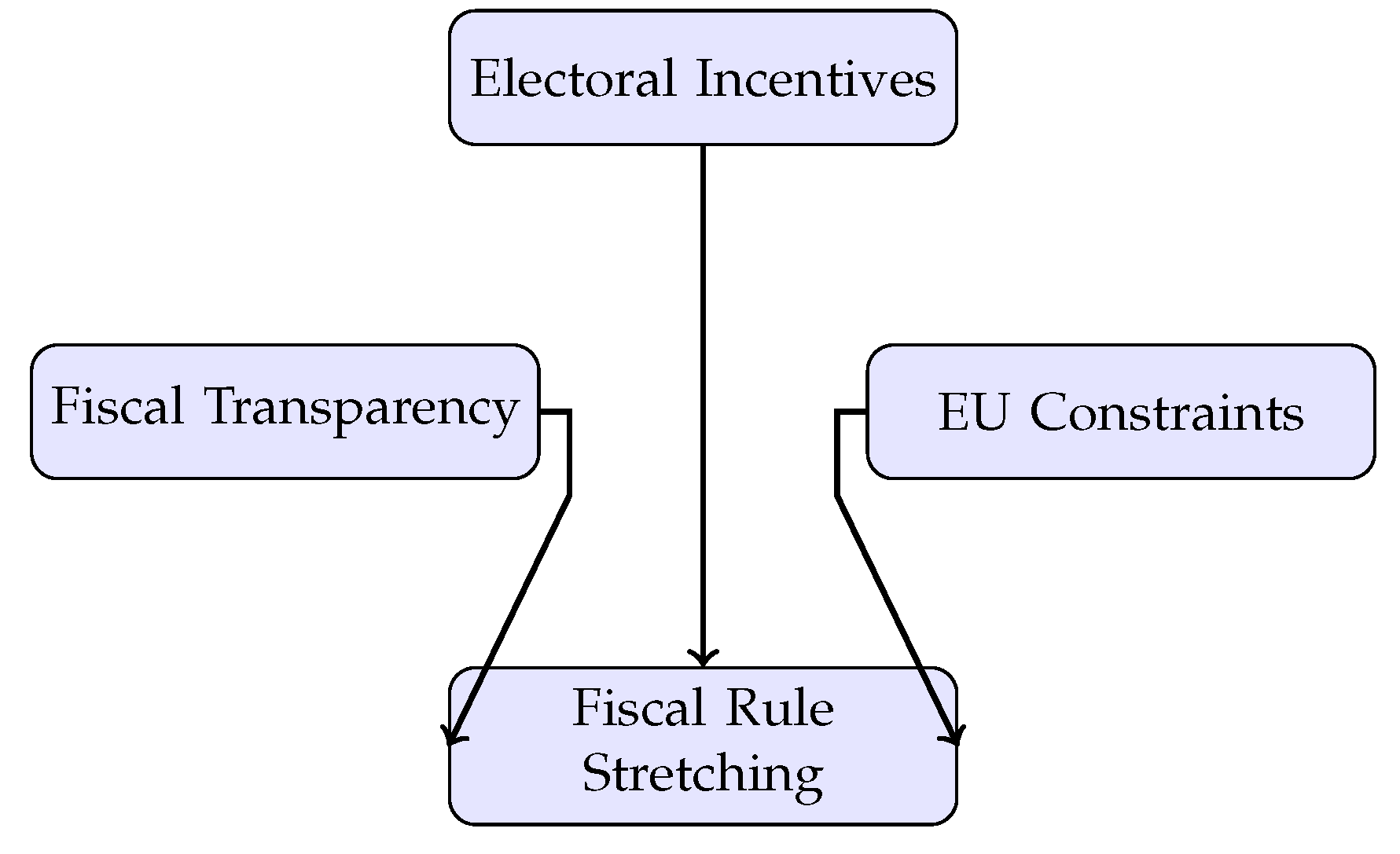
Figure 1.
Conceptual Framework of Fiscal Rule Stretching Determinants.
Governments’ creativity in manipulating finances is exposed by the various issues I have been hinting at till now. In India, fiscal responsibility legislation authorizes state governments to interpret and implement fiscal rules as they see fit. Some state governments falsify figures to claim impressive fiscal performance by overstating revenue and understating borrowings.
Voters constitute the main domestic audience for fiscal statistics, who are expected to evaluate the competence of the incumbent based on economic performance. Voters might ignore technical details about accounting, but they surely respond to the headline debt numbers or the media’s worry about sustainability. According to Kayser and Leininger, the updated figures do not appear to catch the attention of either the press or voters. Thus, the government is likely to benefit by initially presenting a rosy picture, even if the later numbers have to be revised downwards.

Table 1.
Summary Statistics of Key Variables.
| Variable | Mean | SD | Min | Max |
|---|---|---|---|---|
| Cumulative Debt Revision (% GDP) | 0.84 | 2.13 | -1.1 | 13.9 |
| Years to Election (reversed) | 2.31 | 1.42 | 0 | 4 |
| Financial Market Stress | 0.18 | 0.14 | 0.02 | 0.57 |
| Central Government Debt (% GDP) | 58.42 | 32.16 | 4.2 | 172.1 |
| Fiscal Transparency Index | 76.34 | 15.27 | 32 | 100 |
| GDP Growth (%) | 1.84 | 3.76 | -14.8 | 11.9 |
The worldwide audience factors in too. Most institutions of the EU check whether member states respect the established fiscal rules. Reported values help determine eligibility for structural funds and members’ exposure to excessive deficit procedures. Meanwhile, bond investors use debt data as a input to assess sovereign credit worthiness and thus borrowing costs. Beatty and Jerven state that a number of countries misreport statistics to stay eligible for concessional lending from the World Bank. In this case, an international audience and specific incentives influence misinformation.
Increased internal and external pressures owing to financial crises. Declining tax revenues and rising spending requests lead to an increased budget deficit as well as public debt. Demanding action to avert banking crisis or easing their economic pain are the voters’ demands. International investors are now paying closer attention to issues of fiscal sustainability. In the words of national accountants, the bank bailout and providing guarantees and liquidity to prevent financial contagion are examples of the sort of ‘quasi-fiscal’ transactions that should give rise to bending and breaking – interpretation-wise. It is believable that a government can tell its acquisition of equity in a struggling bank.
The timing of the elections adds another dimension. When the socio-economic situation is judged as favourable, the government Selects Timing of Election. Consequently, there is no manipulation of the statistics required by this. He maintains that the coalition breaks down if elections are not timed; the elections must be held immediately if there is a leadership overhang or an uncalled-for political event takes place. This means that the coalition proved does not have time for the management of the economy. As a result, in this.
From above we use several hypotheses. To begin with, debt revisions ought to rise as elections draw near in line with the primary prediction in Proposition 3, despite the fact that negative revisions have also become possible (and thus further improbable). Secondly, as proposed by proposition 4, unplanned elections require more extensive revisions than scheduled polls. In fact, governments are unable to carry out genuine falsification of underlying policy. Furthermore, higher financial market stress magnified these electoral effects, indicating stronger incentives and more opportunities for accounting ruleings. Countries with substantial debt levels especially if they exceed the SGP threshold of 60% should show larger revisions in GDP.
3. Related Work
The literature on fiscal governance and political economy provides important context for understanding the strategic manipulation of government debt data examined in this paper. Methodological advances in precise programming and domain-specific architectures have enabled more sophisticated analysis of complex policy systems [1], while deep reinforcement learning frameworks offer insights into the strategic decision-making processes of governments facing electoral pressures [2].
Deep learning approaches for understanding sequential data have proven valuable for analyzing time-series patterns in fiscal reporting [3]. Statistical methods for uncovering dynamics across multiple timescales inform our understanding of how governments adjust reporting behavior over electoral cycles [4]. Adaptive frameworks for structured data learning provide techniques for extracting meaningful patterns from complex fiscal datasets [5].
Legal and ethical considerations in policy implementation highlight the importance of understanding how governments navigate institutional constraints [6]. Feedback-guided principles for constructing behavioral models inform our analysis of government responses to electoral incentives and market pressures [7]. Multi-modal data integration demonstrates the value of combining political, economic, and institutional variables in analyzing fiscal behavior [8].
Optimized computational approaches enable efficient processing of large-scale fiscal datasets spanning multiple countries and time periods [9]. Characterizing performance degradation informs our understanding of how fiscal reporting quality varies under different institutional arrangements [10]. Autonomous regulation of complex systems provides models for understanding how governments respond to EU-level oversight mechanisms [11].
Causal analysis frameworks offer tools for identifying the underlying drivers of debt revisions, distinguishing correlation from causation in fiscal data manipulation [12]. Bayesian learning techniques provide probabilistic approaches to estimating the likelihood of rule stretching under different political and economic conditions [13]. The economic impact of strategic behavior in public finance highlights the importance of understanding fiscal transparency and accountability [14].
Sustainable systems research offers methodological insights for analyzing the long-term stability of fiscal governance frameworks [15]. Re-optimization of policy systems informs approaches to improving fiscal rule design based on empirical evidence of rule stretching [16]. Modeling resilience provides frameworks for understanding how fiscal institutions adapt to political and economic pressures [17].
Digital safeguards for data integrity ensure the reliability of fiscal reporting systems [18]. Historical data analysis provides models for understanding how fiscal reporting practices evolve over time [19]. Artificial intelligence in policy analysis demonstrates applications of machine learning for detecting anomalies in government financial data [20].
Ensemble learning strategies enhance the robustness of statistical analysis by combining multiple modeling approaches [21]. Category theory offers a unifying framework for understanding the structure of governance systems and their behavioral incentives [22]. Transforming institutional capacity through training and competency development parallels the need for strengthening fiscal oversight mechanisms [23]. Comparative analysis of large-scale policy systems informs our understanding of how institutional design affects fiscal reporting behavior across different national contexts [24].
Reinforcement learning challenges in complex dynamic environments provide insights for modeling government adaptation to fiscal rules [25]. Strategic advancement through artificial intelligence demonstrates the potential for data-driven approaches to improve fiscal governance and transparency [26].
The existing literature establishes that governments manipulate fiscal data for electoral advantage [2,3], particularly when facing binding institutional constraints such as the Stability and Growth Pact’s deficit and debt ceilings. However, previous studies have focused primarily on deficit revisions rather than debt revisions, which capture manipulation operating through balance sheet channels. This paper extends the literature by examining how financial market stress interacts with electoral incentives and EU institutional enforcement to shape government debt reporting practices.
4. Research Design and Data
We analyze 2003-2013 revisions of Eurostat Debt data for all 28 EU countries (EU-28) through four series of data. Eurostat releases revisions twice a year. Usually, this occurs during the months of April and October. Also it involves the government financial statistics brought out in last four years. For each initial publication of the data, notably government debt, there are as many as (at least) seven subsequent revisions of the data. The revisions begin in the October of the year of initial.
A main factor is debt measured at the revision date by Eurostat as a share of GDP at the revision date. Eurostat has either added or reduced the reported debt; this is the resultant overall amount. date relating to the figure originally published. This means Eurostat is influenced to some extent. The government had under or over-reported it first. Hence, needs a debt restructuring effort. Increased or decreased as first revise. The variable fluctuates between 1.1% and 13.9% of GDP.
Table 2.
Unscheduled Election Years in Sample.
| Country | Years |
|---|---|
| Austria | 2008 |
| Belgium | 2010 |
| Denmark | 2007 |
| Germany | 2005 |
| Greece | 2007, 2009, 2012 |
| Ireland | 2011 |
| Italy | 2008 |
| Latvia | 2011 |
| Netherlands | 2003, 2012 |
| Poland | 2007 |
| Portugal | 2005, 2011 |
| Slovakia | 2012 |
| Slovenia | 2011 |
| Spain | 2011 |
| United Kingdom | 2005 |
The timing of the election and the type of election are important independent variable. We count the years until the next election. Regardless if an election was scheduled or unscheduled, we assign a coding of zero. In regressions, we invert the scale so greater values mean elections are nearer to one another. The codes for type of election distinguish scheduled election, unscheduled election and non-election year. The initial values of Brender and Drazen, updated to 2013, are used. The study incorporates a continuous measure of financial market stress developed by B. Duprey, E. Klaus and P. Peltonen. It captures simultaneous movements in stock markets, bond markets and fluctuations in currency markets. Values on this index vary between zero and one, with higher values meaning more stress. We average the months so that it is comparable with other variables measured over the year. According to the samples, the values of this measure range from 0.02 to 0.57.
The Excessive Deficit Procedure status and eurozone membership are EU institutional variables. The EDP data come from Baerg and Hallerberg and have been updated through 2015. Being under an EDP implies stronger checks and prods and sanctions if the member state does not respect the SGP ceilings. Membership of Eurozone is relevant because the member states are subject to stronger prods and sanctions because of stronger enforcement of.
Alternative explanations are taken care of variables. Wang, Irwin, and Murara provide the IMF with the index that’s called fiscal transparency. The type and extent of the reporting of fiscal data under the IMF 2001 systems was examined. The data source lies between 2003-2013. The index ranges between 0 and 100. A sample of EU members yields 76.3, a mean. GDP growth regulates the economic climate. This might influence the motivation to report and the willingness to revise. The measure by Hallerberg strains and von Hagen budget institutions.
We evaluate linear regressions having fixed country effects and dependent variable lag. The country level is the source of the standard errors’ clustering. Models are estimated step by step to avoid multicollinearity problems. Variables such as debt levels and EDP status are likely to be highly correlated, as they are important.
5. Empirical Results
The regression results of cumulative debt revisions are shown in table 3. Model 1 establishes the baseline for all other specifications, which features central government debt and debt output gap. The size of cumulative debt revisions are positively associated with central government debt levels. Specifically, a 10 percentage point increase is associated with about a 0.15 percentage point higher cumulative revision, significant at the 5% level. The findings of this study are in accordance with Hypothesis 4, which states that the high-debt countries will participate in more rule stretching, as compared to the low-debt countries.
Election timing begins to have a significant effect in Model 2. Being one year closer to the election raises the size of cumulative revisions by 0.08 percentage point, significant at the 10% level. Though the effect is small, it is not trivial since in more than one revision periods it can compound and, also interact with other effects.
Table 3.
Regression Results for Cumulative Debt Revisions.
| Variable | Model 1 | Model 2 | Model 3 | Model 4 |
|---|---|---|---|---|
| Lagged Revision | 0.682*** | 0.679*** | 0.671*** | 0.665*** |
| (0.042) | (0.043) | (0.043) | (0.044) | |
| Debt Level (% GDP) | 0.015** | 0.014** | 0.013* | 0.012* |
| (0.007) | (0.007) | (0.007) | (0.007) | |
| Years to Election | 0.082* | 0.079* | ||
| (0.045) | (0.046) | |||
| Unscheduled Election | 0.423** | 0.418** | ||
| (0.187) | (0.189) | |||
| Scheduled Election | 0.114 | 0.109 | ||
| (0.098) | (0.099) | |||
| Financial Stress | 0.328 | 0.315 | 0.301 | 0.296 |
| (0.421) | (0.423) | (0.426) | (0.428) | |
| Fiscal Transparency | 0.021** | 0.020** | 0.019** | 0.018** |
| (0.009) | (0.009) | (0.009) | (0.009) | |
| GDP Growth | -0.023 | -0.022 | -0.021 | -0.020 |
| (0.018) | (0.018) | (0.018) | (0.018) | |
| Country FE | Yes | Yes | Yes | Yes |
| Observations | 1,842 | 1,842 | 1,842 | 1,842 |
| R-squared | 0.643 | 0.648 | 0.652 | 0.654 |
Stresses of the financial market get influenced by various variables. It depicts the marginal effect of moving 1 year closer to an election over the region of financial stress. In the case of low financial stress (below 0.2) proximity to elections is no more significant. Beyond 0.4 Greece and the UK at the crisis peaks, closer to an election increases cumulative revisions by around 0.2 percentage points. This evidence is consistent with Hypothesis 3. Electoral rule stretching is more pronounced during financial crises.
Most importantly, we see a compelling conditional effect of EDP enforcement.
The EDP alone has negligible coefficients. Nonetheless, an interaction with election timing yields significant results. Countries under EDP experience greater effects of election timing. There is a 0.15 percentage point greater upward revision of forecasts in the close vicinity of an election. This means under punishment from the EU governments have begun rule stretching to appease voters and hide non-compliance.
Membership in the eurozone might somehow interact with debt levels but in a way consistent with the SGP. According to Figure 2, the eurozone member states with debt levels under 60 per cent of GDP are no different from other states. Nonetheless, eurozone members with more than 60 percent of debt are witnessing increasingly larger revisions. Membership in Eurozone likely to boost cumulative revisions for 80 per cent debt by 0.8 percentage point.
It is likely that the moves are deliberate attempts to appear below, or close to, the SGP limit.
All specifications show that fiscal transparency is proven to have a positive coefficient. Countries that are less transparent manipulate figures more. However, these countries must not produce severe corrections since they have not become entangled. However, governments that are more accessible, may find it harder to conceal blatant manipulation. This makes them ‘guilty but not irresponsible’, as countries with less transparency simply do not get exposed. Governments that are more transparent may stretch the rules in less blatant but more sophisticated ways; for example, not cooking the books, but perhaps misreporting revenues, or not declaring tax breaks.
6. Robustness Checks and Extensions
We check for robustness extensively to reinforce our primary finding. Greece may be an outlier, as in several years cumulative debt revisions would exceed more than 10% of GDP. The results are not materially changed after re-estimating both models. The effects of elections still matter, but to a lesser degree. As a result, the main finding no longer reflects an ‘exceptional Greece’ phenomenon but is observable more widely.
When the selection into unscheduled elections matters, then we would get biased identification if the shocks that generate opportunities to stretch the rules are also those that call for early elections. To tackle the issue, we estimate being an unanticipated election as across all observations at the country-year level in our survey using a one-period lag space of financial market stress as a covariate in a simple logistic regression. The correlation is non-significant.
Table 4.
Robustness Checks Excluding Greece
| Variable | Model A | Model B | Model C |
|---|---|---|---|
| Lagged Revision | 0.654*** | 0.648*** | 0.642*** |
| (0.045) | (0.046) | (0.046) | |
| Unscheduled Election | 0.387** | 0.379** | 0.372** |
| (0.181) | (0.183) | (0.184) | |
| Years to Election | 0.076* | 0.072 | |
| (0.044) | (0.045) | ||
| Stress × Election | 0.312* | ||
| (0.168) | |||
| Controls | Yes | Yes | Yes |
| Country FE | Yes | Yes | Yes |
| Observations | 1,798 | 1,798 | 1,798 |
| R-squared | 0.628 | 0.631 | 0.635 |
Additionally, we compare revisions to the deficit. The electoral patterns in deficit revisions are also present, though the relationships are a little weaker than those for debt. Our reasoning for believing that the patterns in debt revision (which we have seen in the data) gives rise to the stretching of the rules is supported by this finding since these rule-stretching episodes are the main channel of manipulation. This is especially so during financial crises when policies that respond to crises largely affect the stock on government debt rather than the flow which comprises deficits. Nonetheless, we should see that revisions to the deficit have larger effects for EDP countries and.
Limited support for alternate explanations. The estimated coefficients of GDP growth are insignificant across specifications. This indicates that economic conditions do not drive revisions directly. As a result, revisions depend solely on the correlation between financial stress and the revisions. Budget institutions measured by the fiscal contracts index do not have significant effects. Independent debt monitors that are national and exist only in six countries get insignificant coefficients if included.
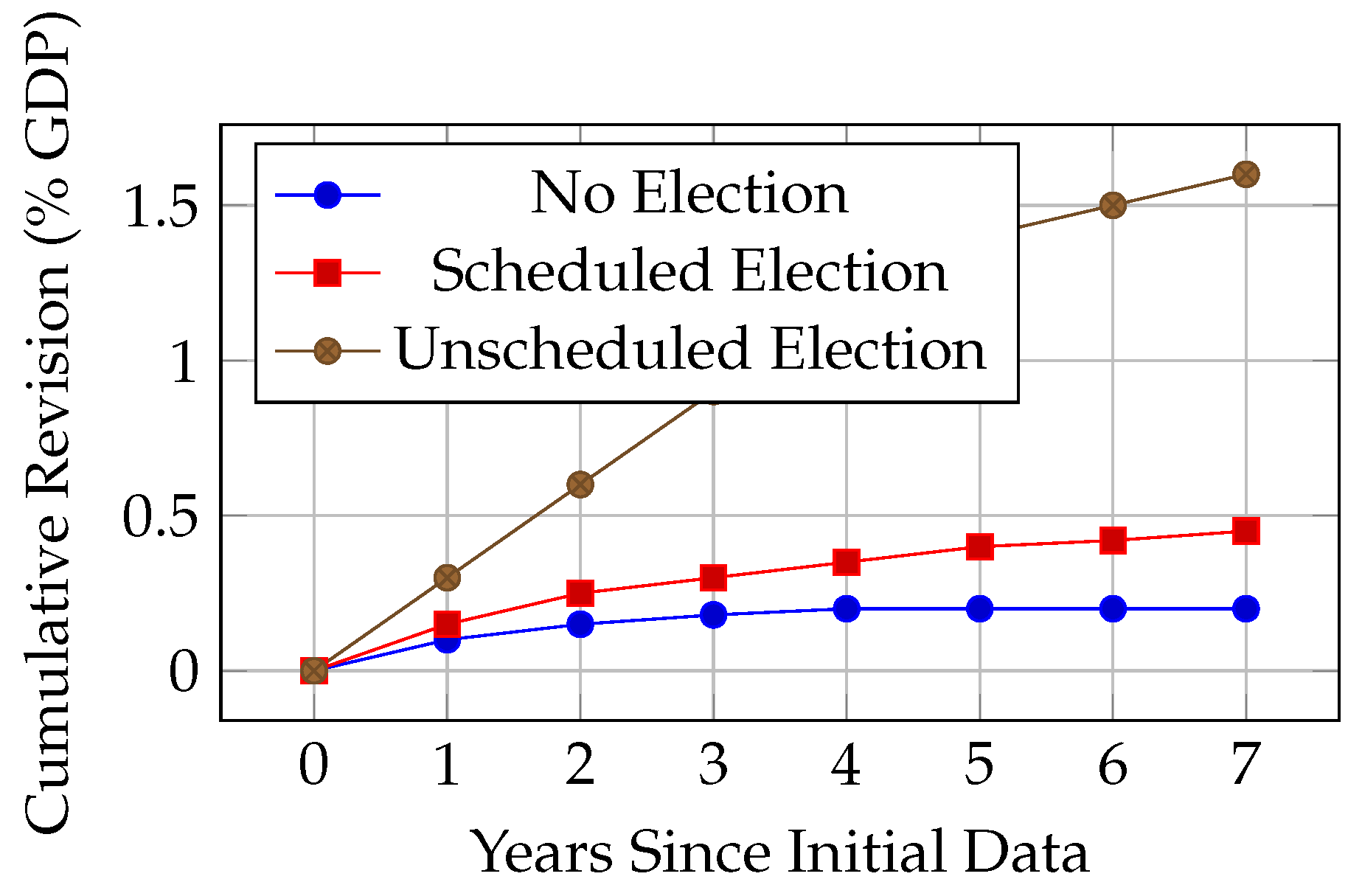
When the changes were made also tells us something. Electoral effects materialize with a delay and are often detectable only after two to three rounds of revisions. One suggestion is that Governments manage to push via the electoral period, and only later do the true numbers come through. Vote-gathering strategies face eventual electoral consequences, but only after the election. From the incumbent’s point of view, the timing makes sense. Capable of doing it.
7. Discussion and Conclusions
European Union government is displaying systematic evidence of fiscal rule stretching through the choice of budget balance target. In fact, governments often massage debt data in order to obtain a better image from voters and international bodies. The study highlights how a government’s domestic political incentive and international constraint shapes its fiscal reporting. The results have powerful implications for institutional design, democratic accountability and European economic governance.
The degree to which particular rules are extended (overlooked) is now being strongly affected by electoral incentives. Past studies show that the debt always goes unreported as election nears. When a government faces an unscheduled election, the effect is observed to be stronger. The government has no opportunity to manoeuvre economic policies and fundamentals in such case. Therefore, they must be playing a substitutory role for fundamental in the reported debt manipulation.
Electoral rule stretching phenomenon has been further aggravated by financial succumbs. Government’s face intensified pressure to spin a reassuring fiscal narrative, as market stress was compounded by election worries. Responses to crises create it possible to account for phenomena that did not have that meaning before. As a result, the debt revisions during elections are relatively larger during crisis periods. This means governments use accounting tricks to understate reported debt even as they deal with banking problems.
The institutional constraints of the EU allow for additional manipulation. Countries that are close to the 60 percent or that have passed the limit experience systematically bigger revisions. Indeed, this is more the case for the eurozone subset for whom the enforcement is stronger. Countries that qualify for EDP get further electoral effects. This implies that these regimes use rule elasticities with domestic and international audience at same time. An intriguing trend is emerging as we conduct these tests, one after the other. Governance at several levels creates numerous audiences to alter statistics.
It goes against the grain for conventional wisdom to find that revisions positively relate to fiscal transparency. It appears that a more transparent global environment might discourage manipulation of the rules by governments. For example, a management team might choose to issue the annual report very late because it is worried about the consequences of its own underperformance. Increased transparency on the other hand, however, may make Eurostat’s.
This has clear policy implications. Eurostat should be bolstered first A straightforward solution to mitigate the delay from manipulation to revisions is to authorize Eurostat to perform forensic audits by providing it a larger budget and staff. Stretching would be deterred because the political cost of stretching becomes higher than its benefits when lag is shorter. Moreover, there should be an expansion of national independent debt monitors. As of now, there are six countries (Italy would also count twice, as it takes two auditors). An increased number of nations undergoing independent review would uncover tampering earlier. Third, the guidelines for crisis-response policies should be.
The study’s limitations highlight several possible paths for future research. To begin with, our sample finishes in 2013 and Eurostat practices or member state behaviour may be quite different in later years. Analysis of the more recent data will show whether the changes after the 2009 crisis may have reduced(expand) rule stretching. A type of error that will intervene with the correct modeller’s application of his model is called debt revision. Debt(expand)revision shocks will rouse the revolution.
As integration deepens, the interplay between domestic politics and international constraints will remain relevant. Future implementation of common debt issuance, along with enhanced enforcement or fiscal capacity, could create new opportunities and incentives for budgetary rule tests. Subsequent research on these dynamics must therefore pay continued attention to the statistical agencies that ultimately decide which numbers voters and creditors actually see.
References
- Gupta, J. Precise web programming with embedded domain-specific languages and dependently-typed architecture. Proc. Int. Conf. Softw. Eng., 2025. [Google Scholar] [CrossRef]
- Gupta, J. Exploring deep reinforcement learning algorithms—From theory to practice. Proc. Int. Conf. Mach. Learn., 2025. [Google Scholar] [CrossRef]
- Baral, P. Deep learning for text-based sentiment prediction. Preprint 2025. [Google Scholar]
- Baral, P. Uncovering neural dynamics: A statistical approach to analyzing brain activity across timescales. Preprint 2025. [Google Scholar]
- Baral, P. Adaptive polynomial frameworks for enhanced graph signal learning in data science. Preprint 2025. [Google Scholar]
- Mitra, M. Legal and ethical considerations in correctional dental care: A study of liability and service scope. Proc. Int. Conf. Health Law, 2025. [Google Scholar] [CrossRef]
- Mitra, M. Constructing custom AI simulations for counselor education using feedback-guided principles. Proc. Int. Conf. AI Educ., 2025. [Google Scholar] [CrossRef]
- Mitra, M. MUC4 and MMP7 in saliva and gingival crevicular fluid in adolescents at West Bengal, India. Bioinformation 2025, vol. 18(no. 3), 165–172. [Google Scholar] [CrossRef]
- Baer, A. Optimized task distribution for energy conservation in electric vehicles via edge computing networks. Preprints 2025. [Google Scholar] [CrossRef]
- Baer, A. Characterizing performance fading in lithium-ion cells: An efficiency-centric approach. Preprints 2025. [Google Scholar] [CrossRef]
- Baer, A. Autonomous regulation of energy storage units: An analysis of systemic control in electric mobility. Preprints 2025. [Google Scholar] [CrossRef]
- Pratap, M. AI-driven causal analysis for business intelligence: A scalable approach from Salesforce research. Proc. IEEE Int. Conf. Emerg. Comput., 2025. [Google Scholar] [CrossRef]
- Pratap, M. Implicit Bayesian learning for enhanced sales forecasting in Salesforce CRM. Proc. IEEE Int. Conf. Emerg. Res. Electron., 2025. [Google Scholar] [CrossRef]
- Pratap, M. Maximizing business growth: The economic impact of Salesforce-driven CRM intelligence. Proc. IEEE Int. Conf. Next Gener. Comput., 2025. [Google Scholar] [CrossRef]
- Tandel, D. Sustainable Shiitake cultivation: A small-scale approach for the food industry. Zenodo 2025. [Google Scholar] [CrossRef]
- Tandel, D. Re-optimization and evaluation of global food systems: Case studies from China, USA, and Ethiopia. In Universal Threats in Expert Applications and Solutions, LNNS; Springer, 2026; vol. 1450. [Google Scholar] [CrossRef]
- Tandel, D. Modeling resilience in food systems: A theoretical framework for analyzing the UK pork industry. Preprints 2025. [Google Scholar] [CrossRef]
- Kaliappan, V. Digital safeguards for health data: Architecting privacy and security in next-gen medical informatics. Proc. IEEE Int. Conf. Big Data Knowl. Eng., 2025. [Google Scholar] [CrossRef]
- Kaliappan, V. Digital persona generation: Historical figure emulation in learning. Preprint 2025. [Google Scholar]
- Gaikwad, S. Study on artificial intelligence in healthcare. Proc. IEEE Int. Conf. Adv. Comput. Commun. Syst., 2021. [Google Scholar] [CrossRef]
- Patel, P. Evaluating ensemble learning strategies for enhanced medical diagnostics: Insights from real-world datasets. Proc. 6th Int. Conf. Problems Cybern. Informatics; 2025; pp. 1–4. [Google Scholar] [CrossRef]
- Mendhey, T. Category theory and psychodynamics: Bridging the structure of programming with human behavior. J. Interdiscip. Learn. Technol. 2025, vol. 26(no. 1). [Google Scholar] [CrossRef]
- Mendhey, T. Transforming workforce potential: Integrating training, competency systems, and emerging technologies for organizational excellence, Recent Trends Manage. Commerce 2025, vol. 6(no. 1), 1–7. [Google Scholar] [CrossRef]
- Mendhey, T. Examining USDA reimbursements, school nutrition programs, and food procurement in U.S. public schools: A comparative analysis of California and Texas. J. Int. Curric. Learn. Technol. 2025, vol. 26(no. 1). [Google Scholar] [CrossRef]
- Shakir, W. A. Reinforcement Learning Challenges in Power Grid Management: A Case Study with City Learn Simulator. Proc. Int. Conf. Comput. Intell., 2024. [Google Scholar] [CrossRef]
- Shakir, W. A. Leveraging Artificial Intelligence for Strategic Advancement: Opportunities and Initiatives at the Miller Center. Proc. IEEE Int. Conf. Emerg. Technol. Innov., 2024. [Google Scholar] [CrossRef]
Figure 2.
Debt Revision Trajectories by Election Type.
Disclaimer/Publisher’s Note: The statements, opinions and data contained in all publications are solely those of the individual author(s) and contributor(s) and not of MDPI and/or the editor(s). MDPI and/or the editor(s) disclaim responsibility for any injury to people or property resulting from any ideas, methods, instructions or products referred to in the content. |
© 2026 by the authors. Licensee MDPI, Basel, Switzerland. This article is an open access article distributed under the terms and conditions of the Creative Commons Attribution (CC BY) license (http://creativecommons.org/licenses/by/4.0/).
Copyright: This open access article is published under a Creative Commons CC BY 4.0 license, which permit the free download, distribution, and reuse, provided that the author and preprint are cited in any reuse.


