

Submitted:
03 March 2026
Posted:
04 March 2026
You are already at the latest version
Abstract
This article analyses how capacity building programmes interact with structural constraints in mission-oriented climate policy, focusing on the Italian pilot Let’sGOv (GOverning the Transition through Pilot Actions) within the EU Mission “100 Climate-Neutral and Smart Cities by 2030”. Using an iterative, reflexive methodology (document analysis, participant observation, and qualitative analysis of questionnaires, workshop outputs, and online training feedback), it examines how municipal actors experience and reinterpret capacity building across three coupled dimensions: internal organisational capacity, external stakeholder relations, and multilevel governance interfaces. The empirical setting is a network of nine Italian Mission Cities (Bergamo, Bologna, Florence, Milan, Padua, Parma, Prato, Rome, Turin) supported by technical partners. The bench-learning pathway combined barriers diagnosis, an intensive in-person workshop, and a codesigned online curriculum structured around three thematic clusters (engagement, data, climate finance). Findings indicate that persistent barriers - departmental silos, resource and time scarcity, rigid HR and procurement routines, asymmetric data access, and regulatory instability - are not removed by capacity building; rather, they are progressively articulated, specified, and reframed into actionable organisational and policy demands. Bench-learning strengthens diagnostic and relational capacities and enables modest institutional innovations (templates, protocols, internal task forces, shared policy briefs), while “hard” governance infrastructures largely remain unchanged. The paper argues that networked capacity building contributes to an emerging national climate governance architecture only when it supports collective negotiation with national actors and translates local experimentation into durable multilevel interfaces, mitigating risks of projectification and downward responsibility shifting.
Keywords:
transformative climate governance
; reflexive governance
; capacity building
; bench-learning / peer-learning
; EU mission-oriented policy
; multilevel governance
; urban decarbonization
1. Introduction
Climate neutrality policies and targets in Europe have generated an unprecedented demand for capacity building in the public sector [1,2], a key instrument, usually framed as able to improve skills and reframe institutional arrangements for urban planning and implementation of adaptation and mitigation actions. However, the concept is often mobilised in ways that might hide power relations and structural constraints. National and local governments are urged to strengthen their capacities [3] to design policies, coordinate actors and monitor progress, while the systemic nature of climate transitions and the political conflicts they entail are often downplayed or depoliticised in policy discourse [4]. The assumption that more training and better procedures will close the “governance gap” remains dominant in EU climate policy documents, including those underpinning the Mission “100 Climate-Neutral and Smart Cities by 2030”.
Research on climate governance is attempting to challenge this perspective, by working on transformative and reflexive governance [5,6,7] emphasising that transitions unfold in conditions of uncertainty, path dependency [8] and distributed control, where conventional steering and rational problem-solving often fail. Seen from the municipal side, “capacities” concern not only technical expertise but also the ability to navigate conflicts, to learn from experiments (and failures), questioning dominant problem framings to reconfigure institutional arrangements. Studies on urban transformative capacity show that organisational routines, interdepartmental coordination, political leadership and multilevel power relations shape what cities can do, often more than the availability of specific tools or data [9,10]. Capacity building, if reduced to generic training or project-based support, risks reinforcing projectification [11,12] and reproducing existing gaps rather than enabling structural institutional change.
The debate on capacity building for ecological transition in the public sector is therefore undergoing a tension. On the one hand, there is growing recognition that administrations lack time, resources, staff and skills to know, design and implement integrated climate policies. On the other hand, empirical analyses of transformative governance point out that many capacity building initiatives do not address the legal, financial and multilevel governance conditions that constrain action [13], and tend to individualise responsibility for systemic problems. In the context of the Cities Mission [14], research highlight a gap between the ambition of Climate City Contracts and the everyday realities of municipal bureaucracies, including uneven mandates, unstable funding and unclear divisions of roles across levels of government [15,16,17]. Nevertheless, there is still limited empirical work that systematically examines how concrete capacity building programmes interact with these constraints and monitor the aspect they can change.
This article addresses this research gap by analysing a national pilot project that explicitly targets governance capacity for ecological transition in the public sector: Horizon Europe project Let’sGOv (NZC-H2020-202209). It is a Net-Zero-Cities funded pilot project, developed with the nine Italian cities selected among the 100 Climate-Neutral and Smart Cities by 2030, aims at strengthening internal, external and multilevel governance for climate neutrality. The project engages the cities of Bergamo, Bologna, Florence, Milan, Padua, Parma, Prato, Rome and Turin. And three technical partners (AESS Agenzia per l'Energia e lo Sviluppo Sostenibile, Energy Center Politecnico di Torino, UNIBO University of Bologna), with UNIBO being also the scientific coordinator, as part of a national response to the EU Cities Mission. The experience of the researchers in the project gives access to internal municipal debates, cross-city negotiations and interactions with national actors that are rarely documented in the literature on mission-oriented climate policy.
The hypothesis of the paper is that capacity building can support ecological transition only when it is explicitly oriented towards changing organisational routines, regulatory interfaces and multilevel coordination, to overcome the risk of simply adding new tasks and expectations to already overstretched administrations.
In this scenario, the article is guided by two main research questions:
RQ1: how do municipal actors experience and interpret capacity building activities in relation to their internal organisation, external relations and multilevel climate governance?
RQ2: under which conditions can a networked bench-learning programme contribute to developing internal, external and multilevel capacities that are relevant for the emergence of a national climate governance architecture for ecological transition?
By combining insights from transformative climate governance and reflexive governance literature with empirical evidence from Let’sGOv’s questionnaires, workshops and training pilots, the article contributes to a more critical understanding of the promises and limits of capacity building in mission-oriented climate policy.
2. Methodology
The article follows a combination of document analysis, participant observation and qualitative analysis of empirical activities of the Let’sGOv pilot to draw lessons from the design and implementation of the bench-learning pathway within the capacity building activities. The methodological approach is iterative and reflexive, i.e. data collection and interpretation unfolded alongside the evolution of the bench-learning deployment and insights from early phases inform the focus of observation in later activities. The authors took part in the codesign of the programme, in preparatory meetings, in the intensive workshop and in online training sessions. The nine cities and their partners created a sustained field of interaction between municipal administrations, national actors and technical agencies. During the activities, it was possible to observe how municipal staff described their governance gaps and constraints and how they reacted to proposed capacity building tools and formats.
The multisited character of Let’sGOv, spanning different cities and on internal, external and multilevel capacities of governance, allowed the study to trace convergences and divergences across the different Italian institutional contexts and to identify patterns that are relevant for debates on national climate governance (Figure 1).
At the methodological level, the work was divided into three core phases: barriers analysis (named Phase 1) carried out mainly through the questionnaire instrument; the organization of an intensive in-person workshop of two days in Bologna in the beginning of 2024 (named Phase 2) and an online bench-learning curriculum between the end of 2024 and the beginning 2025 (named Phase 3).
As said, Phase 1 was mainly devoted to gathering information on barriers evolutions. The questionnaire phase was organized with three different iterations, as Table 1 also detail. The first iteration was conducted in June-August 2022. This was a preliminary scouting of the main barriers and identification of common aspects to work on, and it was done before the starting of the project. The methodology used was the collection of feedback based on a PowerPoint provided template. This iteration will be called from now on Preliminary Phase. The second iteration was conducted between August and September 2023, through the method of the questionnaire. This iteration is called First Questionnaire. Questionnaires were issued digitally on Microsoft Forms. Only invited cities were able to access the questionnaire. The final iteration was conducted in May 2024, again using the questionnaire methodology. This iteration is called Intermediate Questionnaire. At the end of the project, a final questionnaire was sent to cities mainly to gather feedback on the entire programme issued. All the interactions had the highest possible response rate, as the cities were just nine. In addition, a questionnaire to the Follower Cities was released after the Intensive Workshop, between August and September 2024. All the questionnaires asked staff in the nine cities to identify internal, external and multilevel barriers to the energy transition, to rank their perceived importance and to identify potential future challenges. These responses were coded thematically to reconstruct dominant problem framings and variations across departments and cities. The Follower Cities questionnaire was useful to broaden the analytical base and assess whether the commonality of barriers and perceived future challenges across the Italian cities. In total, the study engaged with 24 Italian cities, mainly located in the North and Central of the country, with Lecce as the sole representative from the South.
Phase 2 consisted in an intensive in-person workshop that brought together city representatives to present real governance initiatives (i.e. climate assemblies, one-stop-shops and energy communities) and to discuss obstacles and enabling factors. Fieldnotes and workshop outputs were analysed to trace how individual perceptions were confirmed, contested or reframed in a collective setting. The intensive workshop was designed to facilitate an operational and structured exchange among the nine cities involved in the project, focusing on selected practices currently implemented within their climate transition pathways. The primary objective was to initiate a comparative reflection on pilot initiatives and experimental actions to identify replicable models and shared structural challenges. The secondary objective was to consolidate an environment of trust among the participants. Indeed, participants were asked to provide precise technical information on a best or worst practice of choice in their city, related with the transition.
Phase 3 consisted in a cycle of online pilot trainings focused on energy infrastructure, energy communities and monitoring. Here the analysis concentrated on how participants linked their local situations to national regulations and expert inputs, and how they positioned their administrations within wider multilevel governance debates. The online pilot training was codesigned with the cities, through an iterative process of proposing themes and vote the most challenging but also urgent ones. The process allowed the identification of six key topics, spanning from the electrification of the built environment to the monitoring of climate transition projects.
Methodologically, a bench-learning approach was applied across all phases. Within this definition, a peer-learning approach was identified, aiming at improving policy and pilot projects design and implementation through comparative analysis, self-assessment, and facilitated peer exchange among the municipal staff [18].
These activities were coordinated by the University of Bologna, and they were a central element of the project’s capacity building strategy. These three steps generated complementary evidence on how capacity building activities were experienced and interpreted by municipal actors.
The empirical material used in this article consists of: (a) the baseline and intermediate questionnaires on governance barriers and anticipated challenges; (b) synthesis reports from the bench-learning workshop; and (c) documentation and feedback from the online training sessions. The analysis focused on how municipal actors articulated barriers and needs, how these articulations evolved over time, and how they connected to internal, external and multilevel capacities.
Analytically, the study proceeds in three steps. First, it reconstructs the main categories of internal, external and multilevel barriers as expressed by the cities at different moments and examines their perceived persistence or change over time. Second, it analyses how the bench-learning and training activities respond to these barriers, in terms of themes, formats and expected outcomes, and how participants reflect on their added value. Third, it interprets these findings through the lens of transformative and reflexive climate governance, to assess under which conditions the observed capacity building activities might contribute to a broader national climate governance architecture. This strategy allows linking the concrete experiences of Let’sGOv to wider debates on capacity, experimentation and multilevel climate governance.
3. Theoretical and Analytical Framework
3.1. Governance Architecture for Climate Neutrality and Positioning of Capacity Building
To address capacity building for ecological transition in the public sector, research must first be situated within the evolving European and national governance architecture for climate neutrality. Capacity building is widely recognized as a central means of implementation for global climate goals, as it was formalized in Article 11 of the Paris Agreement [19] and supported by the Sustainable Development Goals (SDG 13). This means that debates on how cities learn and the way municipal officials experience capacity building activities, cannot be separated from the broader institutional policy settings in which that learning is supposed to operate [20].
The European Green Deal, the “Fit for 55” package and the Mission “100 Climate-Neutral and Smart Cities by 2030” (hereafter called Mission) all frame climate neutrality as a systemic objective that demands new skills and multi-actor coalitions across levels of government. The Mission places cities at the core of an urban-oriented policy that asks local administrations to move beyond sectoral interventions and to design integrated, coproduced Climate City Contracts (CCC) within multilevel governance settings. CCCs [21] are presented as engines for this transformation, securing city level capacity building to multilevel governance, long-term investment planning to cocreated transition roadmaps with quintuple helix actors’ commitment to climate justice goals. The CCCs are not legally binding instruments. But represent an explicit political commitment, validated by the European Commission through the awarding of the Mission Label, which recognizes the quality of the path undertaken and strengthens its visibility and facilitates access to new funding and partnership opportunities. The CCC is a dynamic and continuous process, a ‘living’ document, that should be intended to adapt over time to changes in local conditions, political priorities, and available knowledge.
3.2. Capacity Building Beyond Training: Constraints, Justice Tensions, and “Governance Traps”
In practice, this turns CCCs into a key interface where expectations about local capacities and multilevel coordination are crystallised while periodically renegotiated. In the Mission framework, capacity building aims at intercepting and enhancing the ability of administrations to hold together ambitious climate objectives, reduced resources, dispersed regulatory frameworks [22], often the social conflicts that emerge around unequal exposure to climate risks and the uneven spatial distribution of transition benefits and burdens [23].
In parallel to the mission, national frameworks and regional strategies for climate and energy define binding targets and funding architectures that condition what local administrations can implement [24], therefore what “capacity” means in practice. Seen from this angle, capacity building is as much about navigating constraints set elsewhere as it is about improving local skills.
In this context, research on capacity building moves beyond a narrow focus on training and technical assistance, to question how public sector capacities are shaped by contextual factors, such as justice claims. Recent work on urban climate governance and the Cities Mission highlights both the enabling role of transnational municipal networks and contracts [25], and the risk of “governance traps” where cities remain locked in weak institutional settings despite ambitious rhetoric [26]. The debate increasingly recognises that capacity building must be read as part of a broader transition for governance architecture, one that links European missions, national regulatory choices and local institutional experimentation. In the public sector, this transition needs long-term sustainable capacity systems and human resource development and the extension of curricula to prepare future public servants for effective climate governance arrangements. The question is therefore not only what individual officials know, but how whole administrations are positioned within this evolving architecture.
3.3. Transformative and Reflexive Governance as Lenses for Capacity Building
Debate on climate governance have progressively moved from incremental policy adjustments, transfer of technical skills, or the diffusion of predesigned solutions to questions of structural transformation. Work on transformative climate governance emphasises that climate change is embedded in sociotechnical systems whose stability relies on deep-rooted technologies, institutional routines and assigned interests [6], and that these systems cannot be redirected through single sector measures [11]. Here, governance is not limited to formal institutions but includes the large configuration of actors, rules, discourses and resources that shape how problems are defined and which solutions become thinkable and implementable. Transformative climate governance seeks to understand how such configurations can be reoriented over time and over different issues, and which capacities public institutions need to support that reorientation. This body of work invites us to treat capacity building as part of system change [9], and not as a technical add on.
Against this backdrop, an emerging strand of research advocates a shift from traditional capacity building towards “transformative capacity building frameworks”: an evidence-informed [27], justice-oriented approach that equips practitioners and public institution staff to understand system interdependencies and the importance of long-term planning and orientation, to enhance institutional flexibility and cross-sectoral coordination, to learn and revise strategies to tackle context specific constraints before designing experimental interventions [13,28,29]. These studies show that many urban administrations remain trapped in rigid bureaucratic cycles, budgeting rules and departmental isolation, even when they adopt ambitious climate targets. Transformative capacity building, in this view, concerns the development of institutional settings that imply a movement from skills transfer to collaborative problem setting, generating both solution-oriented position (based on evidence) and experimentation informed by evidence. This approach marks a shift from individual to relational institutional capacity that deal with uncertainty and conflict and connect local initiatives with wider shifts in policy and investment. The analysis of Let’sGOv capacity building process speaks directly to this shift, as it examines how far a concrete programme can move from one model of capacity to the other.
In the evolving European and national governance architecture for climate neutrality this transformative perspective reframes capacity building as the gradual construction of analytical competences, e.g. the ability to measure and monitor urban emissions overlapped to urban vulnerability indicators, that enable public institutions to negotiate their own priorities and align climate action with questions of justice and territorial inequality. Analytical capacity here affects whose vulnerabilities become visible and which territories are prioritised, avoiding neutral positioning.
Reflexive governance adds a focus on how knowledge, power and uncertainty are handled inside these arrangements [5]. Several authors insist that, under conditions of high uncertainty and contested values, climate governance cannot rely on linear planning and optimisation [30], but should require continuous questioning of goals and instruments, attention to side effects, deliberation about trade-offs. Instruments such as strategic experiments, adaptive policy mixes and participatory assessment are seen as means to open governance to learning and contestation without reducing the debate around predefined solutions. From this angle, capacity building must support reflexivity inside institutions, however, as pointed out by Voss and Bornemann [30] reflexive governance risks to remain primarily concerned with problem-solving through experimentation and learning at the focal level of governance arrangements. While neglecting agonism [31], asymmetric power relations and avoiding embedding processes within broader political contexts. Transformative capacity building must instead foster the ability of public officials to engage with criticism, to recognise conflicts as informative, and to adjust their own categories and routines considering new evidence and arguments [27]. For mission-oriented programmes, this implies treating training sessions and peer exchanges as political arenas where definitions of problems, solutions and legitimate expertise are open to contestation, not merely as technical exercises. Integrating these critiques, reflexive governance raises a warning for capacity building in climate neutrality missions, highlighting the no-neutrality of such activities. They can instead be arenas where problems, solutions and legitimate expertise are constantly negotiated, keeping debates on goals and pathways open, and linking local experimental practices to ongoing conflicts and structural reforms at higher levels. Otherwise, capacity building may slide into technocratic routines that stabilise arrangements under the language of participation and learning, a tension that becomes particularly evident in urban climate experiments.
3.4. Urban Experiments and Multilevel Governance: Scaling, Feedback Loops, and Power Asymmetries
Urban climate experiments, including living labs and mission-oriented pilots, have been presented as concrete arenas where transformative and reflexive governance can take shape [12,32,33]. These experiments can generate new coalitions and make visible overlooked dimensions of climate vulnerability or injustice. However, they can also become highly technocratic, having tendency to cluster in specific sociotechnical systems, confined to demonstration sites and taking the form of discrete, project-based interventions that leave institutional logics untouched. The literature shows that experiments tend to remain isolated when they are not connected to processes of institutional scaling [34], and when they do not challenge underlying power relations and dominant narratives [35]. Reflexive and transformative governance viewpoints also insist on the need to link experimentation to broader policy and institutional reforms, and to treat experiments as occasions for collective learning [36] about system dynamics and political choices. This is where the multilevel dimension becomes crucial to correct the limits of urban experimentation, and to build the vertical feedback loops, regulatory interfaces that would allow experiments to contribute meaningfully to systemic climate governance.
Multilevel governance and polycentricity draw attention to the vertical and horizontal relations that condition cities’ action towards climate neutrality [3,37]. Italian cities operate in an energy landscape where competences and resources are owned by the state, regions and national regulators, while municipalities retain limited fiscal autonomy and formal powers over energy infrastructures [24,38,39]. Energy systems are treated as national assets, and planning for grids is largely isolated from urban policy, even though cities are expected to deliver climate neutrality. Climate governance literature documents how responsibilities and resources are distributed misaligned across these levels, leaving local administrations with extensive implementation duties but limited influence over regulatory and financial frameworks [24,40,41]. While it is commonly shared that multiple centres of decision-making can enhance experimentation and learning [42]. And can reduce the risks of centralised failure, they risk hiding accountability and reproduce inequalities [43] as uneven capacities to set agendas, define problems and shape outcomes becomes frequently overlooked or treated as external to governance design. In this context, multilevel capacity building cannot be reduced to better coordination. But it needs to address how Italian cities might gain durable roles in shaping climate and energy rules and investment decisions, and how Mission instruments such as Climate City Contracts can be used to renegotiate the current division of authority rather than only adding new responsibilities at the local level. These findings caution against celebrations of local and transnational experimentation and call for closer attention to how multilevel coordination and power asymmetries condition what experiments can achieve and whose interests they serve.
3.5. Analytical Framework for Let’sGOv: Internal, External and Multilevel Capacities
In this article, these strands of literature inform the analytical framework in two ways. First, they ground the understanding of capacity building as a matter of institutional and relational reconfiguration, oriented toward the ability to govern and technically operationalise action under uncertainty and conflict. Second, they support the focus on internal, external and multilevel capacities as interconnected dimensions through which transformative and reflexive governance either becomes possible or remains aspirational. Bringing these strands together, the article treats capacity building for ecological transition as a question of institutional and relational reconfiguration across three interconnected dimensions: internal organisational arrangements, external relations with local stakeholders and system actors, and multilevel interfaces with regional, national and European institutions. The links between the analytical framework, the core concepts, and the research questions are synthesised in Table 2.
This integrated lens underpins the analysis of Let’sGOv, guiding the questions posed to the pilot: how municipal actors experience capacity building activities in each of these fields. And under which conditions a networked bench-learning programme can contribute to capacities that matter for the emergence of a national climate governance architecture for climate neutrality.
The following sections apply this framework to the Italian case, showing where capacity building efforts begin to shift these three dimensions and where they remain constrained.

Table 1.
Synthesis of the discussion framework, main concepts and their relevance for the research questions.
Table 1.
Synthesis of the discussion framework, main concepts and their relevance for the research questions.
| Perspective | Capacity building | Main risks | Relevance for RQ1 | Relevance for RQ2 |
| Transformative governance. ?Structural change in socio-technical systems |
Should reconfigure institutional settings: from skills transfer to collaborative problem-setting, long-term orientation, cross-sectoral coordination, and attention to justice | Capacity reduced to training; projectification; ambitious targets without changing budget rules, HR regimes, mandates | Helps read staff frustration when new tasks are added without changing structures; explains why officials experience a gap between rhetoric and organisational reality | Bench-learning is relevant only if it feeds into changes in mandates, procedures, investment priorities, not just “learning events” |
| Reflexive governance. ?How institutions handle uncertainty, knowledge, conflict and learning |
Should foster critical self-questioning, openness to contestation, and revision of goals and instruments through experiments and deliberation | Focus on problem-solving within existing arrangements; underplays power asymmetries and agonistic conflict; risk of technocratic “learning” | Reflects how officials use capacity-building spaces to question routines and name conflicts, but also how these spaces can feel constrained | Bench-learning contributes when it is designed as a political arena where problem framings and expertise are negotiable, not as neutral best-practice exchange |
| Urban climate experimentations. ?Pilots, living labs, mission projects as sites where new practices and coalitions are tested |
Seen as practical tools for learning-by-doing, demonstrating solutions, and building coalitions around specific interventions | Remaining isolated, short-term and project-based; clustering in “safe” areas; failing to challenge underlying logics or to scale institutionally | Helps explain why staff may value concrete pilots but also perceive them as parallel to ordinary work, with limited impact on everyday constraints | Bench-learning matters when it links local experiments to institutional scaling strategies and to shared diagnosis of structural barriers, not when it only showcases projects |
| Multi-level governance / polycentricity. ?Vertical and horizontal relations between EU, state, regions, municipalities, utilities and other actors |
Should build cities’ ability to navigate and influence regulations, funding schemes and data/infrastructure governance across levels | Celebrating decentralisation while leaving agenda-setting power at higher levels; obscuring accountability; reproducing territorial inequalities | Frames how municipal actors experience external and multi-level constraints as part of capacity | Bench-learning is effective when it helps cities act collectively towards national/EU actors, creating real interfaces for rule and resource renegotiation |
4. Results
Let’sGOv (“GOverning the Transition through Pilot Actions”) is a Horizon Europe pilot developed within the EU Mission “100 Climate-Neutral and Smart Cities by 2030” as a shared initiative of the nine Italian Mission Cities. The project targets the governance side of the climate and energy transition starting from the shared diagnosis that internal silos, weak participation mechanisms and fragile multilevel coordination are major bottlenecks for local climate action. And it seeks to experiment with new ways of organising, negotiating and learning across administrations and levels of government. The project architecture is articulated in five work packages that together construct a multilayered governance laboratory. A first package designs and runs a cross city-bench-learning programme that combines an initial survey of governance barriers, an intensive in-person workshop and a digital training curriculum, with continuous monitoring of internal, external and multilevel obstacles throughout the pilot. A second package organises three thematic clusters (engagement, data, finance) to map stakeholders and data needs, codesign toolkits (on participation, data agreements, innovative financial models) and prepare approaches, tools and methods to be tested in the participating cities and beyond. A third package supports the finetuning and implementation of test beds in each city, aligning local experimentations with the learning and toolkits, and documents their pathways and governance barriers. The project is completed by a sensemaking framework, shared Key Performance Indicators and evaluation briefs that link city-level experiments, cluster work and network-level learning, with attention to both impacts and financial sustainability.
This scheme translates into three interconnected levels. At network level, it builds a structured collaboration among the nine cities, supported by a Memorandum of Understanding, signed in 2022 with the national Ministry of Infrastructure, and by a bench-learning programme. At cluster level, it organises activities around three levers considered crucial for energy-related emissions reduction where cities face similar governance barriers but have developed different practices. At city level, it links this shared work to concrete pilot actions, such as energy communities, one-stop-shops, data platforms or new public–private agreements, which serve both local purposes and the collective learning ambition of the network. This article focuses mostly on the network level of this architecture, making the Let’sGOv deployment the empirical field in which the interaction between capacity building efforts and structural constraints was observed. And in which the extent to which a national city network can operate as a laboratory for climate governance was assessed.
4.1. Internal Governance and Organisational Capacity
Internal silos and weak coordination emerged as the most persistent barriers across all nine cities. In the questionnaires almost all administrations described fragmented responsibilities, limited transversal collaboration and an overload of project-related duties concentrated on a small group of recurring officers as structural, ongoing condition and shortcoming. The bench-learning work made visible how these issues are experienced in everyday routines and how they vary across departments. Respondents captured these conditions noting a "great difficulty in getting the priority of climate transition recognised within the various Directorates, where it is put in second place compared to contingent priorities"
Moreover, the first phase of bench-learning showed that internal climate governance relationships are often translated into very tangible tensions. A limited list of examples are: difficulty in coordinating procurement and Minimum Environmental Criteria (CAM) for green public procurement requirements, misalignment between climate objectives and HR or IT procedures, lack of shared tools to track processes’ responsibilities on energy-related files. Participants described climate tasks as an “extra layer” added on top of existing responsibilities, with limited or absent formal recognition in job descriptions or quality evaluation systems. This reinforces a perception of climate sensitive work as project-based and dependent on a few motivated individuals, mainly working in dedicated departments. As a result, “the sustainability and stability of these groups, for example after drafting the Climate City Contract and at the end of specific projects, will also depend on the willingness and availability of the individual officers to participate and act as connectors” (all citations come from the questionnaires). At the same time, several cities report first attempts to institutionalise cross-sectoral spaces, such as interdepartmental task forces, climate offices, political dedicated councillors (such as the city of Bologna’s Councillor for Ecological Transition and the Climate Pact, or the City of Florence Climate Direction Office, directly linked to the mayor office) or steering groups linked to SECAP and/or Climate City Contract processes, which Let’sGOv takes as starting points.
The Intensive Workshop phase made this heterogeneity explicit and was a critical moment of further reflection of the evolution of the governance barriers and the production of alliances to overcome them. When presenting peer case studies such as climate assemblies’ pathways, energy communities implementation processes, one-stop-shops or internal task forces, city teams were asked to map both outputs and internal procedures: which departments were involved, who convened whom, how were decisions made, what was the resource allocation process. This exercise revealed that organisational learning is often informal and person-based, relying on personal networks and shadow coordination. Bench-learning does not solve these structural constraints. But it allows participants to see that others face similar problems and to name recurrent patterns: the central role of a few brokers who translate between political leadership and technical departments, the difficulty of maintaining transversal knowledge groups beyond project timelines, the fragility of arrangements when key individuals move or elections change priorities.
Furthermore, an important aspect marked as crucial need from the questionnaires and workshop discussions, is training and transversal skills development, stressing that basic climate and energy literacy is uneven within administrations and that many colleagues perceive the topic as too complex or technical. At the same time, participants expressed fatigue with generic training offers and asked for formats that are closely tied to ongoing work (e.g. permitting for PV in historic centres, data-sharing agreements with DSOs, design of MoUs - Memorandum of Understandings for energy communities). The online sessions responded to this by inviting national agencies, grid operators and expert cities to discuss specific bottlenecks, while keeping a focus on governance implications. Feedback collected after the sessions suggests that city staff valued this situated training, but also that they struggled to involve colleagues outside the climate or project teams, due to time constraints and the lack of internal incentives. This points to the limits of external capacity building offers when internal HR and management systems do not recognise transversal learning as key. Despite these constraints, small incremental changes were traced over the two years’ span project. In the intermediate survey and in the lessons-learnt report, some cities reported that climate objectives have been integrated into performance plans, that that cross-sectoral groups created for Let’sGOv or related projects have been maintained, or that new internal procedures for data requests or pilot selection have been formalised. Others noted that the project has mainly reinforced existing awareness without yet changing embedded routines. Overall, internal barriers such as limited resources, rigid procedures and political precariousness remain, but they are now more clearly articulated and, in some cases, translated into concrete organisational demands (e.g. a dedicated coordination unit, clearer mandates for climate offices, necessity to monitor training results, shared templates for MoUs).
4.2. External and Multilevel Governance Capacity
On the external governance side, the project confirmed that relations with higher-level governments and key system actors are considered crucial but also challenging to implement and demanding to maintain. In all phases of the bench-learning, the nine cities identified interactions (or lack thereof) with national-level ministries, regional regulators, private grid operators as primary barriers to local energy transition. They often described a misalignment between national rules and local trajectories: e.g. burdensome authorisation procedures for renewable plants, uncertainty and continuous shift around the regulation of energy communities, dispersed responsibilities for data access, and rigid constraints on the use of public finance for long-term investments. These issues appear repeatedly in open responses to questionnaires and in workshop debates, where participants highlighted that many bottlenecks would require dedicated changes and commitments in national frameworks.
Relations with local stakeholders and private actors are another component of external capacity building. In the questionnaires and workshop discussions, cities report progress in engaging condominium administrators, banks, professional associations and civil society organisations around energy communities and building renovation, often through one-stop-shops or energy desks. At the same time, they underlined difficulties in maintaining these alliances over time, in managing expectations and negotiating fair distribution of benefits, especially in contexts of energy poverty. Bench-learning addressed these issues mainly through peer exchange: cities presented different models of public–private agreements, governance of RECs and local partnership arrangements, while participants discussed legal risks, trust-building and the role of municipalities as guarantors. The online sessions on innovative finance and public–private partnerships further explored how local administrations can use their power without overstepping legal limits or assuming unsustainable risks.
Data and finance emerged as crosscutting external and multilevel issues, especially regarding the lack of appropriate and interoperable energy data as a major obstacle for monitoring and communicating climate actions. The participants reported asymmetric relations with utilities, who control key datasets and infrastructures but are not obliged or incentivised to share information in forms usable for local governance. There is an “absence of data-sharing protocols and updated databases on urban energy data, held by various entities including the Region, the national management energy agency, etc.” and “difficulty with the energy utility in retrieving consumption data in a precise way, due to privacy and competition issues” (cit. from surveys). The data cluster of Let’sGOv responded to this request by focusing training on data agreements, sharing experiences of interoperable platforms and thematic digital twins, inviting cities and regional actors who have already negotiated such arrangements to share templates and strategies. Regarding the topic of finance, the project highlighted both the opportunities offered by NRRP (National Recovery and Resilience Plan) and EU funds and the difficulties of aligning short-term project funding with long-term investment needs and of designing financial schemes that reach private buildings and vulnerable households. The subsequent discussions pointed to the need for national schemes that recognise municipalities as strategic partners in deploying innovative financial instruments, and not only as mere project applicants.
The multilevel dimension became more visible towards the end of the pilot, when the nine Mission Cities used Let’sGOv as a platform to address national institutions through joint messages and to position themselves as a collective speaker with unique, situated point of view on the challenges of project and action implementation. On this assumption the project, while it did not have a formal mandate to reform national regulation, committed to create limited multilevel interfaces that began to address this gap. It built on the existing Memorandum of Understanding between the nine Mission Cities and the Italian Ministry of Infrastructure and Sustainable Mobility and used the bench-learning outputs to feed into joint policy messages. The policy brief produced at the end of the pilot, for example, synthesised local experiences with one-stop-shops and energy communities and translated them into requests for more stable support schemes and more agile procedures for authorisations and grid connections. In this specific case, capacity building was able to include learning to collectively address messages to national actors through shared demands.
The activation of a “follower” network of additional Italian cities reinforced this movement, highlighting that governance capacity building can also mean building horizontal coalitions that can negotiate more effectively with ministries and regulators. At the same time, the project team made clear that these steps are initial and fragile: coordination among cities still depends on project structures and external funding and currently there is no formalised national mechanism that ensures continuity of this dialogue beyond the Mission framework.
Overall, the results suggest that Let’sGOv did not remove internal, external and multilevel barriers, but it made them more visible, creating shared language and generating modest institutional innovations in how cities organise internally, engage stakeholders and relate to higher and lower levels of government. The next step for the article is to interpret these findings through the lens of transformative climate governance understanding which of these changes can be seen as elements of a national laboratory for climate governance. And under what conditions these elements can be consolidated or scaled beyond the project.
5. Discussion
The findings of Let’sGOv bench-learning activities confirmed that capacity building for ecological transition is still moving through institutional constrains. On the one hand, internal disconnections and structural fragmentations persisted throughout the pilot, on the other the recognition, naming and definition of such barriers changed radically. It was observed that municipal staff moved from an abstract understanding of climate challenges to the identification of specific friction points (e.g., lack of shared templates and guidance for community governance, unclear mandates for climate offices, asymmetric relationships with grid operators, rigid procedures for innovative green finance), to be translated into tangible organisational and political demands for climate governance. This result marks a shift towards the ability to articulate diagnosis, toward achieving the capacity to recognise signals and alarms, prior to the emergence of certain challenges, stimulated by a relational capacity. Transformative and reflexive governance scholarship argues that transitions require both the ability to “see” system interdependencies and structural drivers of problems [28] and to alter the rules, routines and resource flows that lock systems in place [13]. In Let’sGOv, the bench-learning pathway clearly strengthens the first dimension, while the “hard wiring” of administrations largely remained untouched, aligning to the concerns that reflexive governance often stops at the level of discursive problematisation [44] without shifting underlying power relations.
As a result, capacity building designed as a relational and diagnostic process can open spaces for the implementation of reflexive governance [5]. In this regard, the bench-learning programme, based on peer exchange and targeting governance barriers, allowed participants to question their own routines and to expose tensions between ambition and resources (or lack thereof). This analytical self-observation confirmed also that bottlenecks regarding climate governance cannot be only solved locally, as they might generate parallel infrastructures. Much like the urban experiments analysed by Bulkeley and Castán Broto [34] and the climate governance experiments discussed by Sengers and colleagues [35], Let’sGOv creates spaces of experimentation and peer-learning that, however, sit alongside ordinary administrative circuits. These infrastructures generate valuable knowledge, but they depend on project funding, a small team of motivated officers and temporary task forces. From a transformative governance standpoint, the key question is therefore not whether and how cities learn, but if they gain levers to renegotiate their position in multilevel energy and climate regimes.
On the multilevel side, Let’sGOv seemed to be able to build vertical networks that were absent before: e.g. the policy brief on energy communities, one-stop-shops and data access coproduced through the network was distributed and addressed to ministries and regulators, marking a tangible attempt to transfer local experiments into national governance; the activation of a followers city network and the explicit positioning of the nine cities as a collective entity and interlocutor, suggested the emergence of a potential coalition around climate, with negotiation power. In this light, the project can be read as an attempt to build “transformative capacity” [9] in a context where key decisions on fiscal rules, debt limits and procurement models sit elsewhere.
This coordination was also aimed at preventing the risks of a polycentric governance, leading to dispersed experimentation often without orchestration, which might eventually lead to failure in both the local implementation and the multilevel grafting of measures. Nevertheless, the Mission Cities started to act as a multilevel intermediary [33], a national laboratory proposing to translate scattered local best practices into shared inquiries, while creating accountability structures that link city pilots to national policy debates. However, the emerging of this informal negotiation infrastructure is precarious and project-dependent, it works under conditions of chronic under funding and high regulatory rigidity [45] and it can now be tested against the lack of additional resources and beyond the pilot phase. Furthermore, the limited geographical representation of the nine cities, might risk sending a message of exclusion to less organised territories, which are mostly located in the southern parts of Italy. Moreover, the reduced coordination and funding agreement might generate cities developing advanced narratives about transformative and reflexive capacity, while everyday work remains committed to compliance with national hegemonic regulations and short-term results achievements. This might result in missions becoming arenas where the responsibility for systemic failures is quietly shifted downwards: when cities cannot deliver, the problem is framed as lack of local capacity rather than as a misalignment between objectives and the structures that shape local action.
In this regard, the multilevel influence power of this network could be carefully curated and valued, building strong relationships around the three dimensions of governance to leverage national institutional reforms.
The project showed that planners and energy officers could use networked programmes to sharpen their diagnosis capacities (internal governance), to build coalitions across departments and across cities (internal-external governance), and construct more credible claims vis à vis national authorities (multilevel governance). The bench-learning materials, test bed reports and policy briefs can give planners and policymakers specific and tailored language and examples to argue for internal reforms: e.g. the creation of climate coordination units, shared protocols for data access, standard models for governing energy communities and one stop shops. On the other hand, the findings underline that without adjustments in legal frameworks, budgeting rules and intergovernmental transfers, municipal departments will continue to be asked to “innovate” inside narrow boundaries [45].
This is among the diverse limitations of this study, mainly regarding geographic representation and time limitedness. Concerning the geographic representation, as mentioned earlier, the project is based on a single national pilot involving nine cities that are relatively large, resourced and politically committed to climate action. However, the findings may not generalise to smaller municipalities, to cities in regions with weaker institutional capacity, or to contexts where political support for climate neutrality is contested or unstable.
An important limitation concerns the time span of the pilot, too short to assess whether the small changes observed, such as formalised task forces or new data protocols, will be sustained or scaled. Many governance innovations documented in transition studies do not survive the end of project funding or changes in political leadership. Moreover, a fuller assessment would require linking the network level capacity building activities to concrete governance changes in specific pilots, tracing how shared diagnostics and tools are adapted or resisted in different local contexts.
Finally, the research findings are also shaped by the position of the authors as participant observer researchers involved in designing and facilitating the bench-learning pathway: this role enabled privileged access to internal conversations and emerging practices. While also inevitably influencing them, as the questions posed, the formats proposed, and the concepts introduced contributed to how cities narrated their governance gaps and possibilities. The analysis offered here should therefore be read as situated and partial, grounded in close engagement with actors and processes, but also marked by the normative commitments and interpretative frames that come with such proximity.
7. Conclusions
The article has engaged with climate governance debates that call for reflexive and transformative approaches and has tested how these concepts can be applied to the everyday government and governance practice of Italian Mission Cities. The study has shown that building “capacity” is about opening decision-making spaces and challenging established routines to negotiate the structural constraints that shape climate-related municipal action. At the same time, it has highlighted the limits of reflexivity when such discussion spaces remain parallel to ordinary administration, precarious, and vulnerable to shifts in political leadership and funding.
The inquiry to be tested out of the Let’Gov empirical evidence is how municipal actors experience capacity building for ecological transition (RQ1) and under which conditions a networked bench-learning programme can contribute to developing governance capacities relevant for a national climate architecture (RQ2).
Regarding the first question, the analysis shows that municipal staff did not experience capacity building as a linear skills’ acquisition, nor as a technical juxtaposition of new competences or a way to solve bottlenecks. In fact, the persistent internal, external and multilevel barriers were collectively diagnosed only to become more precisely articulated through peer exchange and shared reflection. It appears as this political interpretation of constraints, became a precondition for any interaction with the national level of government. However, the local, daily experience of climate work continues to rely on a few committed individuals, mostly due to the persistence of hard infrastructure of municipal governance like HR system, bureaucratic heavy load, budget cycles, departmental mandates and procurement procedures.
Regarding the second question, the observation of Let'sGOv bench-learning programme suggests that a networked programme of collaborating cities, can begin to construct multilevel interfaces and collective negotiating capacity, only if it creates a space in which the nine cities learn to speak as a collective interlocutor towards ministries and EU institutions, converting local observations into joint policy briefs and regulatory demands. This horizontal coalition-building can begin to fill a gap that Italian national climate governance has not addressed through formal mechanisms, however it needs to escape its project-funding dependency and develop institutional mechanism that ensures its continuation.
Future research should examine whether the follower city network activated by Let'sGOv develops its own governance dynamics or remains dependent on the original nine cities, and how asymmetries between frontrunner and follower cities shape the politics of the network.
Author Contributions
Conceptualization, S.B., M.M., D.L. and B.T.; methodology, S.B., M.M., D.L. and B.T.; formal analysis, M.M.; investigation, S.B.; resources, D.L.; writing—original draft preparation, S.B., M.M.; writing—review and editing, S.B., M.M. and B.T.; visualization, S.B; supervision, D.L.; funding acquisition, D.L. All authors have read and agreed to the published version of the manuscript.
Funding
The Let’sGOv project was funded by the H2020 NetZeroCities Pilot Cities Programme, under Grant Agreement No. 101036519.
Institutional Review Board Statement
Not applicable.
Informed Consent Statement
Not applicable.
Data Availability Statement
Conflicts of Interest
The authors declare no conflicts of interest
References
- Cohen, J.M. Capacity Building in the Public Sector: A Focused Framework for Analysis and Action. International Review of Administrative Sciences 1995, 61, 407–422. [CrossRef]
- Robins, L. Making Capacity Building Meaningful: A Framework for Strategic Action. Environmental Management 2008, 42, 833–846. [CrossRef]
- Betsill, M.M.; Bulkeley, H. Cities and the Multilevel Governance of Global Climate Change. In Understanding Global Cooperation; Brill, 2021; pp. 219–236 ISBN 90-04-46260-0.
- Sovacool, B.K. Who Are the Victims of Low-Carbon Transitions? Towards a Political Ecology of Climate Change Mitigation. Energy Research & Social Science 2021, 73, 101916. [CrossRef]
- Feindt, P.H.; Weiland, S. Reflexive Governance: Exploring the Concept and Assessing Its Critical Potential for Sustainable Development. Introduction to the Special Issue. Journal of Environmental Policy & Planning 2018, 20, 661–674.
- Chaffin, B.C.; Garmestani, A.S.; Gunderson, L.H.; Benson, M.H.; Angeler, D.G.; Arnold, C.A.; Cosens, B.; Craig, R.K.; Ruhl, J.; Allen, C.R. Transformative Environmental Governance. Annual Review of Environment and Resources 2016, 41, 399–423. [CrossRef]
- Hölscher, K.; Frantzeskaki, N.; Loorbach, D. Steering Transformations under Climate Change: Capacities for Transformative Climate Governance and the Case of Rotterdam, the Netherlands. Regional Environmental Change 2019, 19, 791–805. [CrossRef]
- Stack, M.; Gartland, M.P. Path Creation, Path Dependency, and Alternative Theories of the Firm. Journal of Economic Issues 2003, 37, 487–494. [CrossRef]
- Sousa, A.R.; Cruz, S.S.; Breda-Vázquez, I. Understanding Transformative Capacity to Boost Urban Climate Adaptation: A Semi-Systematic Literature Review. Ambio 2024, 53, 276–291. [CrossRef] [PubMed]
- Wolfram, M. Assessing Transformative Capacity for Sustainable Urban Regeneration: A Comparative Study of Three South Korean Cities. Ambio 2019, 48, 478–493. [CrossRef]
- Voss, J.-P.; Kemp, R. Reflexive Governance for Sustainable Development–Incorporating Feedback in Social Problem Solving.; 2005.
- Torrens, J.; von Wirth, T. Experimentation or Projectification of Urban Change? A Critical Appraisal and Three Steps Forward. Urban Transformations 2021, 3, 8. [CrossRef]
- Wolfram, M. Conceptualizing Urban Transformative Capacity: A Framework for Research and Policy. Cities 2016, 51, 121–130. [CrossRef]
- Commission, E.; Research, D.-G. for; Innovation Study Supporting the Assessment of EU Missions and the Review of Mission Areas – Mission Climate-Neutral and Smart Cities Assessment Report; Publications Office of the European Union, 2023.
- Wiener, J.B. Think Globally, Act Globally: The Limits of Local Climate Policies. University of Pennsylvania Law Review 2007, 155, 1961–1979.
- Martínez, N. Unpacking the Global Climate Politicsto-Local Nexus: Renewables, Community Struggles, and Social Impacts. Current Sociology 2024, 72, 753–773. [CrossRef]
- Hoppe, T.; van den Berg, M.M.; Coenen, F.H. Reflections on the Uptake of Climate Change Policies by Local Governments: Facing the Challenges of Mitigation and Adaptation. Energy, sustainability and society 2014, 4, 8. [CrossRef]
- European Commission. Directorate General for Employment, Social Affairs and Inclusion.; ICON INSTITUT Public Sector GmbH. PES Network Bench-learning Manual. 2022.
- .
- Hölscher, K.; Frantzeskaki, N. Perspectives on Urban Transformation Research: Transformations in, of, and by Cities. Urban Transformations 2021, 3, 2. [CrossRef]
- Nucci, C.A. Climate Neutral and Smart Cities: Towards the Energy Transition.; EDP Sciences, 2024; Vol. 310, p. 00016. [CrossRef]
- Ulpiani, G.; Rebolledo, E.; Vetters, N.; Florio, P.; Bertoldi, P. Funding and Financing the Zero Emissions Journey: Urban Visions from the 100 Climate-Neutral and Smart Cities Mission. Humanities and Social Sciences Communications 2023, 10, 1–14. [CrossRef]
- Rizzo, F.; Komatsu, T. The Role of Social Innovation in Climate Neutrality. In Social innovation projects for climate neutral cities: making municipalities sustainable with peoplebased solutions; Springer Nature Switzerland Cham, 2025; pp. 1–11.
- Massari, M. Powering Change: The Urban Scale of Energy, an Italian Overview. Sustainability 2025, 17, 7900. [CrossRef]
- Boulanger, S.O.M.; Massari, M. Advocating Urban Transition: A Qualitative Review of Institutional and Grassroots Initiatives in Shaping Climate-Aware Cities. Sustainability 2022, 14, 2701. [CrossRef]
- Newell, P.; Bulkeley, H.; Turner, K.; Shaw, C.; Caney, S.; Shove, E.; Pidgeon, N. Governance Traps in Climate Change Politics: Re-framing the Debate in Terms of Responsibilities and Rights. Wiley interdisciplinary reviews: climate change 2015, 6, 535–540. [CrossRef]
- Boaz, A.; Davies, H. What Works Now?: Evidence-Informed Policy and Practice; Policy press, 2019; ISBN 1-4473-4548-7.
- Woodhill, J. Capacities for Institutional Innovation: A Complexity Perspective. IDS bulletin 2010, 41, 47–59. [CrossRef]
- Babu, S.C.; Sengupta, D. Capacity Development as a Research Domain: Frameworks, Approaches, and Analytics. 2006.
- Voß, J.-P.; Bornemann, B. The Politics of Reflexive Governance: Challenges for Designing Adaptive Management and Transition Management. Ecology and society 2011, 16. [CrossRef]
- Mäntysalo, R.; Balducci, A.; Kangasoja, J. Planning as Agonistic Communication in a Trading Zone: Re-Examining Lindblom’s Partisan Mutual Adjustment. Planning Theory 2011, 10, 257–272. [CrossRef]
- Savini, F.; Bertolini, L. Urban Experimentation as a Politics of Niches. Environ Plan A 2019, 51, 831–848. [CrossRef]
- Matschoss, K.; Heiskanen, E. Making It Experimental in Several Ways: The Work of Intermediaries in Raising the Ambition Level in Local Climate Initiatives. Journal of Cleaner Production 2017, 169, 85–93. [CrossRef]
- Bulkeley, H.; Castán Broto, V. Government by Experiment? Global Cities and the Governing of Climate Change. Transactions of the institute of British geographers 2013, 38, 361–375. [CrossRef]
- Sengers, F.; Turnheim, B.; Berkhout, F. Beyond Experiments: Embedding Outcomes in Climate Governance. Environment and Planning C: Politics and Space 2021, 39, 1148–1171. [CrossRef]
- Djinlev, V.; Pearce, B.J. Collective Action Lessons for the Energy Transition: Learning from Social Movements of the Past. Sustain Sci 2024, 19, 847–863. [CrossRef]
- Kern, K.; Bulkeley, H. Cities, Europeanization and Multi-Level Governance: Governing Climate Change through Transnational Municipal Networks. JCMS: Journal of Common Market Studies 2009, 47, 309–332. [CrossRef]
- De Pascali, P.; Bagaini, A. L’energia Nella Pianificazione in Italia: Tentativi Passati e Attuali Prospettive per Una Non Facile Integrazione. ARCHIVIO DI STUDI URBANI E REGIONALI 2021, 1–204.
- Verones, S.; Zanon, B. Energia e Pianificazione Urbanistica. Verso Una Integrazione Delle Politiche Urbane. 2012.
- Bulkeley, H. Accomplishing Climate Governance; Cambridge University Press, 2015; ISBN 1-316-44516-X.
- Tosun, J.; Schoenefeld, J.J. Collective Climate Action and Networked Climate Governance. Wiley Interdisciplinary Reviews: Climate Change 2017, 8, e440. [CrossRef]
- Avelino, F.; Wittmayer, J.M. Shifting Power Relations in Sustainability Transitions: A Multi-Actor Perspective. Journal of environmental policy & planning 2016, 18, 628–649.
- Morrison, T.H.; Adger, W.N.; Brown, K.; Lemos, M.C.; Huitema, D.; Phelps, J.; Evans, L.; Cohen, P.; Song, A.M.; Turner, R. The Black Box of Power in Polycentric Environmental Governance. Global Environmental Change 2019, 57, 101934. [CrossRef]
- Westman, L.; Castán Broto, V. Urban Transformations to Keep All the Same: The Power of Ivy Discourses. Antipode 2022.
- Kupper, D.; Pennino, S.; Deshayes, E.; Veskioja, K.; Haseth, R. Financing the Net-Zero Transition of Mission Cities: Governance Barriers and Enablers to the Use of Innovative Financing Instruments. Front. Sustain. Cities 2026, 7, 1665973. [CrossRef]
Figure 1.
Methodological framework and implementation components (Copyright 2022, Let’sGOv Project Consortium Partnership).
Figure 1.
Methodological framework and implementation components (Copyright 2022, Let’sGOv Project Consortium Partnership).
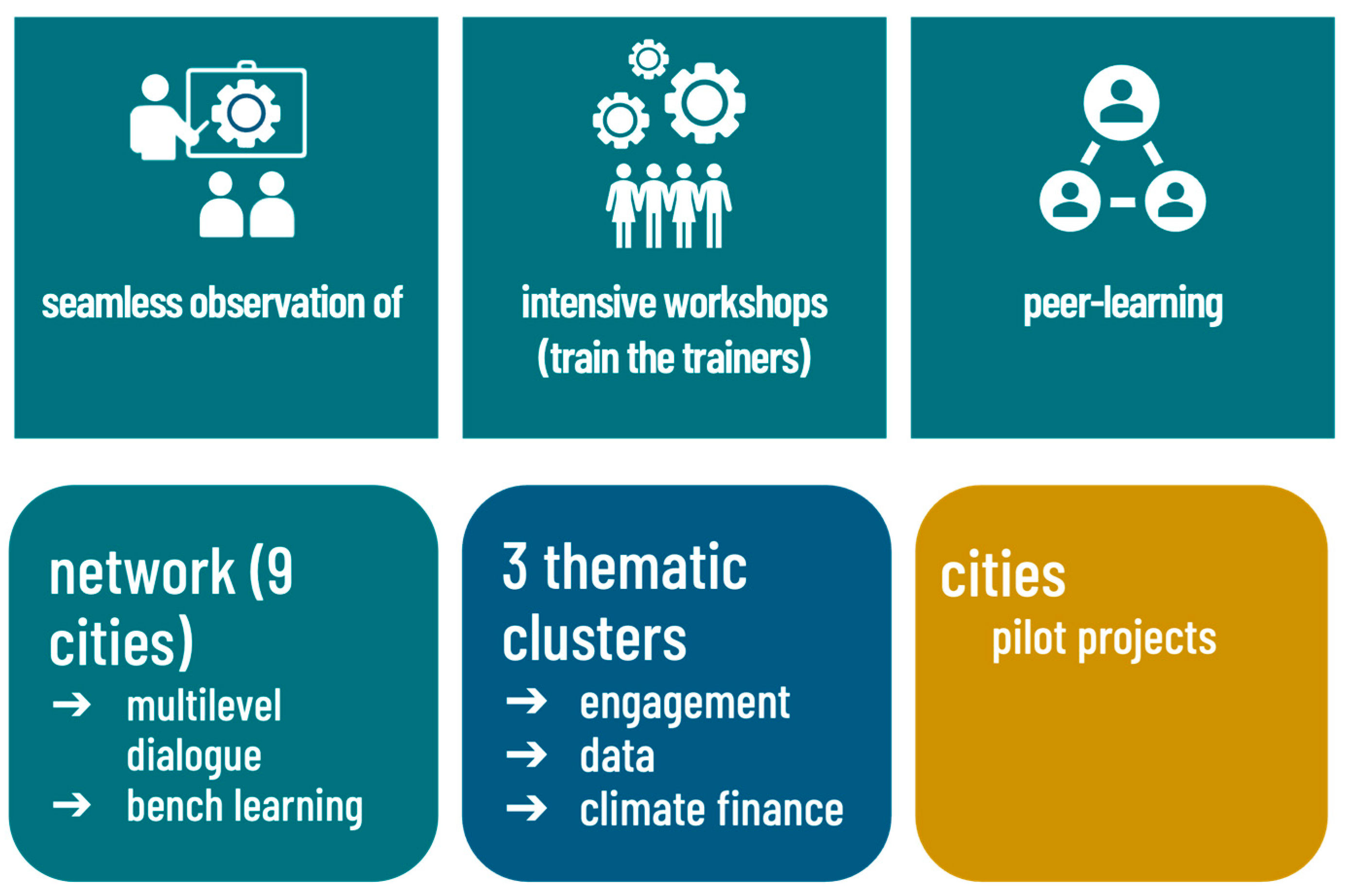
Table 1.
Scheme of the data collection phases.
| Iteration name | Period of ref. | Method used | Types of questions |
| Preliminary phase | Jun-Aug 2022 | Power Point Template | Identification of main barriers (internal, external), identification of priority themes to focus on to address the transition acceleration. |
| First ?Questionnaire |
Aug-Sep 2023 | Online survey | Evolution of the main barriers (internal, external, multi-level), identification of key challenges for the future of the transition. |
| Intermediate ?Questionnaire |
May 2024 | Online survey | Evolution of the main barriers (internal, external, multi-level), perceived evolution of key challenges for the future of the transition. |
| Follower ?Questionnaire |
Aug-Sep 2024 | Online survey | Identification of main barriers (internal, external), identification of key challenges for the future of the transition. |
Disclaimer/Publisher’s Note: The statements, opinions and data contained in all publications are solely those of the individual author(s) and contributor(s) and not of MDPI and/or the editor(s). MDPI and/or the editor(s) disclaim responsibility for any injury to people or property resulting from any ideas, methods, instructions or products referred to in the content. |
© 2026 by the authors. Licensee MDPI, Basel, Switzerland. This article is an open access article distributed under the terms and conditions of the Creative Commons Attribution (CC BY) license (http://creativecommons.org/licenses/by/4.0/).
Copyright: This open access article is published under a Creative Commons CC BY 4.0 license, which permit the free download, distribution, and reuse, provided that the author and preprint are cited in any reuse.


