
Submitted:
02 March 2026
Posted:
03 March 2026
You are already at the latest version
Abstract
The Mongolian Ulaan Uul Tungsten Deposit is located in the southern segment of the Altai Cu-Pb-Zn-W-MoNi-Au-Ag-Sb-Co-Fe Metallogenic Belt. The metallogenic belt is situated in the border area of China, Russia, Mongolia, and Kazakhstan, where over 40 large-sized deposits have been discovered. Among these, only one large-sized deposit is found on the Mongolian side, while the others are medium or small in size. Therefore, strengthening the study of typical deposits and summarizing the metallogenic rules of this region is the best way to achieve a breakthrough in mineral exploration of Altai region in Mongolia. This study focuses on the Ulaan Uul W deposit, a newly identified deposit of Tungsten mineralization within the southern segment of the belt. We examine the deposit’s zircon U-Pb geochronology and Sm-Nd isotopic data. The LA-ICP-MS zircon U–Pb dating of the ore-bearing alkali feldspar granite indicates crystallization ages of 212.5±2.2 Ma, which closely align with the wolframite Sm-Nd isochron age of 211.2±1.5 Ma for the Ulaan Uul W deposit, suggesting an Late Triassic magmatic event marked by W-dominated mineralization coinciding with the extensional tectonic setting following the subduction-collision of the Tarim Craton and the Altai Orogenic Belt. Regional data indicate that the Altai metallogenic belt experienced concentrated W mineralization between 242 and 211 Ma. The formation of W- dominated deposits, such as Ulaan Uul in the southern segment of the belt, is at least 30Ma later, which underscores the presence of a significant W metallogenic event during this critical post-collision to extensional mineralization period.
Keywords:
granite
; Zircon LA-ICP-MS U-Pb dating
; Wolframite Sm-Nd isotopic dating
; Ulaan Uul W deposit
; Mongolia
1. Introduction
The Central Asian Orogenic Belt (CAOB) spans a vast region between the Siberian Craton, the North China and the Tarim Cratons, representing the longest-lived and most tectonically and magmatically complex giant orogenic-mineralized belt in the Asian continent [1,2,3,4,5,6,7,8,9,10,11,12]. From west to east, this area belongs to the Paleotethyan Mineralization Domain and the Circum-Pacific Mineralization Domain (overlying the Paleotethyan domain). The China-Russia-Kazakhstan-Mongolian Altai Cu-Pb-Zn-W-Sn-Mo-Ni-Au-Ag-Sb-Co-Fe Mineralization Belt, located in the central part of the CAOB, boasts excellent mineralization geological conditions and abundant mineral resources. It hosts over forty large-sized deposits have been discovered deposits such as China’s Ashele Cu-Zn Deposit, Koktala Pb-Zn Deposit, Mengku Iron Deposit, Keketai Rare Metal Deposit, and Dolanasay Gold Deposit; Russia’s Kalguta Mo-W Deposit, Karakul Cu-Co-W Deposit, Kholzunskoye Iron Deposit, Murzinskoe Gold Deposit, Alakhinskoe Lithium-Tantalum Deposit, Ozernoe Ag-Sb Deposit, and Kurai Mercury Deposit; Kazakhstan’s Nikolaevskoye Large-sized Cu-Zn Deposit; and Mongolia’s Asgat Large-sized Ag-Sb Deposit, Kyzyltau W-Sn Deposit, and Ulaan uul W Deposit [2,7,8,12,13,14,15,16,17]. This region is one of the current key areas for geological research and exploration both domestically and internationally. Compared to the numerous large-sized deposits found in the China, Russia, and Kazakhstan Altai Mineralization Belts, although the Mongolian Altai Mineralization Belt has similar mineralization geological conditions, the discovered deposits are relatively smaller in scale. Apart from the Asgat large-site Ag-Sb Deposit, all others are medium or small in size. Therefore, strengthening the study of typical deposits in this area, summarizing mineralization laws, and conducting mineralization prediction are the best ways to achieve breakthroughs in mineral exploration. The Ulaan uul W Deposit is located in Bayan-Ulgii Province, Mongolia, and is a newly discovered medium-sized W deposit in recent years. Its central geographic coordinates are 49°10′N latitude and 90°15′E longitude. The deposit was discovered in 1974, and the former Soviet Union conducted exploration work in the area (1974-1977), identifying a small W deposit. Later, Mongolian Zhengyuan Company (2010) carried out exploration and confirmed it as a medium-sized W deposit (WO3 resource reserves of about 40,000 tons) [18]. The exposed formations in the mining area are mainly Carboniferous volcanic rocks, pyroclastic rocks, and Quaternary deposits. Northeast-trending fault structures, which are ore-controlling structures, are well developed in the area. The intrusive rocks here are mainly the Ulaan uul alkali feldspar granite of the Middle-Late Triassic to Early Jurassic, which is closely related to W mineralization. Mineralization geochronology is one of the most critical aspects of deposit studies. Accurately determining the temporal sequence of magmatic activities and mineralization is the basis for exploring the genetic relationship between hydrothermal deposits and magmatic activities. Due to its late discovery, apart from the exploration report, no research articles on the Ulaan uul W Deposit have been published, and there is a lack of chronological constraints on the ages of magmatism and mineralization, which limits the understanding of its mineralization process. This paper uses LA-ICP-MS zircon U-Pb dating and wolframite Sm-Nd dating methods to establish chronological constraints on magmatic and mineralization events. By exploring the causes and significance of mineralization dynamics and clarifying the mineralization time frame, this study provides valuable references for mineral exploration work in the Altai Mineralization Belt.
2. Deposit Geology
The Ulaan Uul W deposit is located within the homonymous Ulaan Uul alkali feldspar granite pluton. The mineralization zone extends in a northeast–southwest direction, with a length exceeding 1,200 meters and a width of approximately 400 meters. The ore bodies occur as veins, primarily hosted in granite. Both horizontally and vertically, these ore bodies appear as large veins with relatively steep dip angles, classifying them as steeply dipping ore bodies (Figure 1 and Figure 2). The deposit comprises 13 ore bodies, of which No. 14, No. 16, and No. 22 are the main ore bodies, while the others are subsidiary ore bodies [18]. Ore Body No. 14 is located between exploration lines 5 and 4. It extends for 600 meters, with a strike of N30°E, dipping to the southeast at an inclination of 70°. The thickness of the ore body ranges from 0.28 to 1.48 meters, with an average thickness of 0.87 meters. The average WO₃ grade is 1.051%, and the highest grade reaches 8.030%. Ore Body No. 16 is situated between lines 15 and 4, presenting as a vein-type body. It extends for more than 1,200 meters, with a strike of 25-30°, dipping to the southeast at an inclination of 70°. The thickness varies from 0.29 to 2.26 meters, averaging 0.90 meters. The average WO₃ grade is 0.663%, with a maximum grade of 15.80%. Ore Body No. 22 is located between lines 13 and 2, extending for over 1,000 meters. It strikes N30°E and dips to the southeast at 70°. The thickness ranges from 0.36 to 2.76 meters, with an average of 1.35 meters. The average WO₃ grade is 1.391%, and the highest grade is 6.13%.
The ore type is wolframite-quartz vein (Figure 1 and Figure 2). The metallic minerals in the ore are primarily wolframite, followed by pyrite, chalcopyrite, scheelite, molybdenite, and others. The non-metallic minerals are mainly quartz and muscovite. Wolframite occurs as tabular crystals or aggregates hosted within quartz veins. The wolframite crystals are reddish-brown to black in color and closely intergrown with quartz (Figure 3a). The crystal size generally ranges from 0.5 to 1.5 cm. Pyrite mostly occurs as masses (Figure 3b), fine veins, and irregular forms. Chalcopyrite appears as anhedral grains (Figure 3b), with aggregates forming fine veins. Quartz occurs as milky white veins. Muscovite mainly appears as flakes associated with quartz, and partially occurs as fine veins. The ore exhibits euhedral to subhedral medium-to-fine-grained textures, with massive dense structures, followed by stockwork structures. The main useful element in the ore is tungsten, with an average grade of 0.971% and a maximum grade of 15.80%. Associated beneficial elements include gallium, rubidium, molybdenum, copper, and others.
The ore bodies are wolframite-quartz veins, with clear boundaries from the surrounding rock. The hanging wall and footwall of the ore bodies consist of alkali feldspar granite and greisenized granite. The wall rocks adjacent to the ore bodies commonly exhibit greisenization, pyritization, scheelitization, silicification, and potassic alteration. Late-stage alterations associated with mineralization include carbonatization, chloritization, and kaolinization.
3. Samples
The alkali feldspar granite (M16-29) used for dating in this study was collected from the north-western part of the No. 16 main ore vein (Figure 1). Serving as the main host rock in the mining area, the granite exerts a controlling influence on tungsten mineralization.It exhibits a flesh-red color, medium-fine grained texture, and massive structure (Figure 3c). Its primary mineral composition consists of quartz, K-feldspar, plagioclase, and a small amount of muscovite. Among these, the plagioclase shows strong sericitization and accounts for about 15% of the rock. It exhibits a light flesh-red color, medium-fine grained texture and massive structure, composed of quartz (30–35%), K- feldspar (50–55%),plagioclase (10–15%), and muscovite (3-5%).The size of quartz particles ranges from 0.5 to 1.0 mm. K-feldspar occurs as tabular crystals with dimensions of (0.5–1.0) mm × (1.0–2.0) mm. Plagioclase also forms tabular crystals, with sizes ranging from (0.3–0.8) mm × (1.5–2) mm (Figure 3d).
The five wolframite samples (No. M16-30-1, M16-30-2, M16-30-3, M16-30-4, and M16-30-5)used for Sm-Nd isotope dating were collected from fresh primary ores of No. 16 W-bearing quartz vein in this deposit (Figure 1). To exclude the influence of late hydrothermal processes on the Sm-Nd isotope system, fresh ore samples were collected at intervals of 10 m along the same wolframite -quartz vein. All samples originated from different locations within the central section of ore body No. 16 in the Ulaan Uul W deposit, which represents both the thickest part of the ore body and a zone characterized by relatively high and consistent W grades. The dominant ore type in this area is wolframite-quartz veins. Wolframite occurs as tabular crystals hosted within quartz veins. It appears black and is closely intergrown with quartz. The wolframite monominerals separated from these five samples are pure, uncontaminated, and have a purity(volume fraction) exceeding 99%.
4. Analytical Methods
The U-Pb isotopic dating of zircon by LA-ICP-MS was undertaken in the laboratory of isotopic geochronology of the Tianjin Center, China Geological Survey. First, Zircons were separated from the alkali feldspar granite (M16-29) using conventional crushing and sieving followed by standard heavy liquid and magnetic separation before pure separates were obtained by handpicking under a binocular microscope at the Hebei Institute of Regional Geological and Mineral Resource Survey (Langfang). The separated zircons were then mounted in epoxy and polished to expose grain center for optical microscopy and cathodoluminescence (CL)imaging to identify target areas for U-Pb analyses (Figure 4).
Zircon LA-ICP-MS U-Pb analysis was undertaken in the laboratory of isotopic geochronology of the Tianjin Center, China Geological Survey. The Zircon LA-ICP-MS U-Pb dating method and data processing methods have been described in detail elsewhere, and thus are not elaborated upon here [19,20,21,22,23].
Previous studies have shown that strong fractionation between rare earth elements can occur during the formation of hydrothermal deposits, leading to large changes in Sm and Nd contents in some hydrothermal minerals, reaching values far higher than the normal values of crustal rocks. This discovery lays a foundation for the appli-cation of Sm–Nd isotopes in metallogenic chronology [24,25]. Calcium-bearing minerals are always rich in rare earth ele-ments, making minerals like fluorite, scheelite (wolframite), tourmaline, calcite, and other calcium-bearing minerals ideal targets for Sm–Nd isotopic dating of hydrothermal deposits [26,27,28,29]. The wolframite samples (No. M16-30-1, M16-30-2, M16-30-3, M16-30-4 and M16-30-5, respectively) investigated in this study were collected from the No.16 main ore vein representing the main stage of mineralization in the Ulaan Uul W deposit. The samples collected in the field were crushed into powder fine enough to pass through a 40-60 mesh. Pure wolframite grains were manually picked under a binocular microscope, and the resulting separates, with a purity exceeding 99%, were rinsed with distilled water and dried at low temperature. These pure wolframite samples were ground in an agate mortar to approximately 200 mesh prior to being measured.
5. Results
5.1. Zircon U-Pb Geochronology
The zircons separated from the ore-hosting alkali feldspar granite (M16-29) via manual heavy mineral separation appear pale yellow, transparent, and elongated in shape, with no dissolution marks on the crystal surfaces. Under cathodoluminescence imaging, the zircons exhibit typical oscillatory zoning, indicating a magmatic origin (Figure 4). During the testing process, two relatively older zircon grains were identified.
A total of 16 analyses were conducted on 16 zircon grains. The results (Table 1, Figure 5) indicate that all 16 analytical points fall on the concordia curve and can be divided into two age groups. Among them, 14 LA-ICP-MS analytical points form a coherent age group, which is closely distributed on the concordia diagram. The obtained 206Pb/238U apparent ages are relatively consistent, ranging from 206 to 217 Ma. The weighted mean age of the 206Pb/238U apparent ages for this group is 212.5 ± 2.2 Ma (Figure 5). The Th/U ratios of the zircons vary between 0.41 and 0.91, exhibiting geochemical characteristics typical of magmatic zircons (Table 1, [33]). Two analytical points, labeled M17-29-4 and M17-29-5, also fall on the concordia curve, yielding 206Pb/238U apparent ages of 428 Ma and 424 Ma, respectively. The Th/U ratios of these zircons range from 0.52 to 0.91, similarly reflecting geochemical features of magmatic zircons (Table 1, [33]). The younger age group (212.5 ± 2.2 Ma) represents the formation age of the protolith, while the older age group (428 Ma and 424 Ma) likely corresponds to the age of early Paleozoic granites that are widely distributed in the Altai region surrounding the mining area, possibly representing inherited or captured zircons from these rocks [34].
5.2. Sm-Nd Age for Wolframites
The measured Sm and Nd contents as well as their isotopic compositions of the wolframite samples are presented in Table 2. In all wolframite samples, the Sm content exceeds that of Nd, with high Sm/Nd ratios indicating significant isotopic fractionation, which is favorable for Sm-Nd isotopic dating. On the 147Sm/144Nd vs. 143Nd/144Nd diagram (Figure 6), all samples exhibit a strong linear relationship. Using the ISOPLOT program, the Sm-Nd isochron age of the wolframite is determined to be 211.2 ± 1.5 Ma (2σ), with an MSWD of 0.92 and an initial (143Nd/144Nd)i value of 0.5120158. Considering that all five wolframite samples were collected from the No. 16 tungsten-bearing quartz vein, representing products of homologous and contemporaneous hydrothermal activity unaffected by later hydrothermal alterations, the age data obtained in this study reliably represent the formation age of the wolframite. The positive initial εNd value of the wolframite (0.5120158) is consistent with the characteristic positive εNd values of numerous granites in the Central Asian Orogenic Belt [3], indicating a depleted mantle source.
6. Discussion
6.1. Implications of Zircon U-Pb and Wolframite Sm-Nd Ages
Accurate determination of ore deposit age is crucial for establishing ore deposit models and explaining the geological dynamic background of mineralization [30,35]. The host rocks of the Ulaan uul W deposit are Early-Mesozoic alkali feldspar granites, which are closely related to tungsten mineralization. Previous studies considered these granites to be Late Triassic to Early Jurassic [2,18]. LA-ICP-MS zircon U-Pb dating results indicate that the emplacement age of the host alkali feldspar granite (sample M16-29) of the Ulaan uul W deposit is 212.5±2.2 Ma (Figure 6) . Based on zircon morphology and Th/U ratios, these zircons are interpreted as products of Early-Mesozoic magmatic activity. Late Permian to Early Triassic (253–251 Ma) and Early-Mesozoic (244–180 Ma) granites are widely developed in the Mongolian Altai and its surrounding areas, formed in the extensional tectonic environment after subduction-collision of the Early Mesozoic Tarim Craton beneath the Altai Orogenic Belt [33,34,35,36,37]. This study reports for the first time the Sm-Nd age of wolframite from the Ulaan uul W deposit as 211.2±1.5 Ma, and the LA-ICP-MS zircon U-Pb age of the host granite as 212.5±2.2 Ma. The consistency of the magmatic and mineralization ages indicates that the Ulaan uul W deposit formed in the Late Triassic. The Ulaan uul W deposit is located in the Mongolian Altai Cu-Pb-Zn-W-Sn-Mo-Ni-Au-Ag-Sb-Co-Fe mineralization belt, which is part of the Sayan-Altai mineralization belt [7,8,15]. Tungsten-molybdenum deposits are widely developed in the Altai mineralization belt and are important mineralization features in this region. These deposits mainly occur within Early-Mesozoic granite bodies or near their contacts. Many age constraints have been provided by previous studies on deposits within this mineralization belt. Annikova et al. [38] obtained a SHRIMP zircon U-Pb age of 218±1 Ma for the host granite of the Kalgut tungsten deposit. Seltmann et al. [39] reported an Ar-Ar age of 242.3±2.7 Ma for the host granite of the Sagangorsky molybdenum-tungsten deposit, and an Rb-Sr isochron age of 218±10 Ma for the host granite of the Indetlinsky tungsten polymetallic deposit. Demin et al. [40] obtained zircon U-Pb ages of 225±10 Ma for the host granites of the Sassey molybdenum-tungsten deposit and the Chigertaysky molybdenum-tungsten deposit. Regional data show that the Altai mineralization belt experienced concentrated W(Mo) mineralization between 242–211 Ma. The Sagangorsky molybdenum-tungsten deposit in the northern segment of the mineralization belt formed in the Middle Triassic (about 242 Ma), while the Kalgut tungsten deposit, Sassey molybdenum-tungsten deposit, Chigertaysky molybdenum-tungsten deposit, and Ulaan uul tungsten deposit in the southern segment formed in the Late Triassic (about 225–211 Ma), confirming the presence of significant tungsten (molybdenum) mineralization events during the critical Early-Mesozoic extensional mineralization period following subduction of the Tarim Craton beneath the Altai Orogenic Belt [33,34,35,36,37]. This finding broadens the perspective for mineral resource exploration in the Mongolian Altai mineralization belt.
6.2. Genetic Type and Metallogenic Processes
Most W(Mo) deposits worldwide are magmatic-hydrothermal in origin and closely related to the formation of granites [41]. The Ulaan Uul W deposit is spatially closely associated with medium-fine grained alkali feldspar granite. The mineralization age of the Ulaan Uul W deposit obtained in this study is consistent with the age of the ore-bearing granite, at 212.2 Ma. The ore-bearing alkali feldspar granites have the following composition ranges: SiO2=75.86-76.97wt%,TiO2=0.06-0.08wt%, TFeO=0.57-0.69wt%, MgO=0.05-0.09wt%,Al2O3=12.77-13.41wt%, K2O=4.37-4.74wt%, Na2O=4.04-4.12wt%.These rocks are characterized by high SiO2, K2O and Na2O, high A/CNK values (average 1.45), low Cao, MgO, FeO, low Sr (5.53-6.53×10⁻⁶),and high Rb/Sr ratios (average 53)[42,43], classifying them as High fractionated alkali feldspar granite formed in a post-collisional extensional tectonic setting [31,32,33].There is a close and complex genetic relationship between high-differentiated alkali feldspar granites and tungsten mineralization, which is one of the core topics in current metallogeny research. Regional studies show that the Central Asian Orogenic Belt (CAOB) experienced long-term continental growth from the Neoproterozoic to the Permian, extending from the Ural Mountains in the west to the Pacific Ocean in the east, bounded by the Siberian Craton in the north and the Tarim-Hulu Craton in the south [1,6,9,10,11,13,14,40]. The formation of the CAOB resulted from the continuous accretion of ancient Asian Ocean intra-oceanic island arcs, microcontinents, ophiolite suites, oceanic islands, seamounts, accretionary wedges, and oceanic plateaus [1,6,42,44,45]. During the Middle to Late Triassic, due to the closure of the Paleotethys Ocean, the Tarim Craton collided and amalgamated with the Altai Orogenic Belt [1,2,3,4,5,6,7,8,9,10,11,46], entering a post-collisional intra-plate extensional phase in the Ulaan Uul region of Altai [34,35,36,42]. Under the extensional tectonic setting, mantle fluids interacted with crustal materials, underwent strong fractional crystallization, forming the Ulaan Uul high-differentiated alkali feldspar granite. Tungsten is a highly lithophile element that continuously enriches with the evolution of residual melt during magma crystallization differentiation. High-differentiated granites have undergone intense fractional crystallization; during the evolution of their parent magma, tungsten elements are highly concentrated and finally enriched in residual fluids during the late stage of the magma system [47]. During the intrusion and cooling of the Ulaan Uul alkali feldspar granite, uplift zones of the pluton and contact zones with country rocks often form a series of fracture systems, creating open channels. These open fracture systems provide favorable conditions for the ascent, precipitation, and enrichment of mineralizing fluids. As fluid temperature decreases and physical and chemical conditions change, tungsten precipitates rapidly, forming the Ulaan Uul wolframite-quartz vein-type deposit. The Ulaan Uul W deposit is a post-magmatic high-temperature hydrothermal quartz vein-type deposit.
7. Conclusions
(1)The LA-ICP-MS zircon U-Pb dating of the ore-bearing alkali feldspar granite indicates crystallization ages of 212.5±2.2Ma, which closely align with the wolframite Sm-Nd isochron age of 211.2±1.5 Ma for the Ulaan Uul W deposit in Nouthwestern Mongolia, suggesting an Late Triassic magmatic event marked by W-dominated mineralization coinciding with the extensional tectonic setting following the subduction and collision of the Tarim Craton with the Altai Orogenic Belt.
(2)Regional data indicate that the Altai W-Mo-Sn-Ag-Sb-Hg-Cu-Ni-Co metallogenic belt experienced concentrated W (Mo) mineralization between 242Ma and 211Ma. The formation of W-dominated deposits, such as Ulaan Uul W deposit in the southern segment of the belt, is at least 30Ma later, underscores the presence of a significant W metallogenic event during this critical post-collision to extensional mineralization period.
Author Contributions
L.-J.J. and D.-Z.C. conceived and designed the ideas, and prepared the original draft; L.-J.J., D.-Z.C., J.-P. and S. C-J. performed field sampling; D.-Z.C., L.-J.J. and J –X.L. performed the experiments; F.-C., J. -P., S.-C.J. and J –X.L performed the data analysis and figures; L.-J.J. reviewed and edited the draft. All authors have read and agreed to the published version of the manuscript.
Funding
This study was financially supported by the National Key R&D Program of China (Grant No. 2022YFE0119900); the National Science and Technology Major Project of China (Grant No.2024ZD1001902-1 and 2024ZD1002205-1) and the China Geological Survey Project (DD20221695-30 and DD202402015).
Acknowledgments
We are grateful to Li Deliang for his help during the field work in Ulaan Uul W deposit, as well as Tu Jiarun and Liu Wengang for their help during LA-ICP-MS zircon U-Pb and wolframite Sm-Nd isotope analyses.
References
- Byamba, J.; Batkhishig, B.; Munkhtsengel, B. Fundamentals of geodynamic reconstruction and tectonic zoning of Mongolia; Soyombo Printing: Ulaanbaatar, 2024; 182p, (In Mongolia with English abstract). [Google Scholar]
- Gerel, O.; Pirajno, F.; Batkhishig, B.; Dostal, J. Mineral Resources of Mongolia. In Modern Approaches in Solid Earth Sciences; Pirajno, F., Ed.; Springer Nature Singapore Pte Ltd., 2021; Volume 19, 315p. [Google Scholar]
- Jahn, B.M.; Wu, F.Y.; Chen, B. Massive granitoid generation in Central Asia: Nd isotope evidence and implication for continental growth in the Phanerozoic. Episodes 2000, 23, 82–92. [Google Scholar] [CrossRef]
- David, B.; Vojtěch, J.; Pavel, H.; Jiang, Yingde; Karel, S.; Ondrej, L.; Battushig, A. Petrogenesis of the Late Carboniferous Sagsai Pluton in the SE Mongolian Altai. Journal of Geosciences 2016, 61, 67–92. [Google Scholar]
- Cai, K.D.; Sun, M.; Jahn, B.M.; Xiao, W.J.; Yuan, C.; Long, X.P.; Chen, H.Y.; Dondov, T. A synthesis of zircon U-Pb ages and Hf isotopic compositions of granitoids from Southwest Mongolia: Implications for crustal nature and tectonic evolution of the Altai Superterrane. Lithos 2015, 232, 131–142. [Google Scholar]
- Badarch, G.; Cunnirgham, W.D.; Windley, B.F. A new terrane subdivision for Mongolia: implications for the Phanerozoic crustal growth of central Asia. Asian Earth Sc 2002, 20, 87–100. [Google Scholar] [CrossRef]
- Dejidmaa G, Badarch G. Summary of preaccretiobary and accretionary metallogenic belts of Mongolia.Seltmann R, Gerel O, Kirwin D J. Geodynamics and Metallogeny of Mongolia with a Special Emphasis on Copper and Gold Deposits. IAGOD Guide⁃book Series 11, London, 2005a: 25-30.
- Dejidmaa G. Mineral Resources and Metallogenic Belts in southern Mongolia. Seltmann R, Gerel O, Kirwin DJ. Geodynamics and Metallogeny of Mongolia with a Special Emphasis on Copper and Gold Deposits. IAGOD Guidebook Series 11. London, 2005b: 149-153.
- Kröner, A.; Badarch, G. Tectonic models for accretion of the Central Asian Orogenic Belt. Journal of the Geological Society of London 2007, 164, 31–47. [Google Scholar]
- Windley, B.F.; Alexeiev, D.; Xiao, W.J.; Kröner, A.; Badarch, G. Tectonic models for accretion of the Central Asian Orogenic Belt. Journal of the Geological Society of London 2007, 164, 31–47. [Google Scholar] [CrossRef]
- Xiao, W.J.; Windley, B.F.; Allen, M.B.; Han, C.M. Paleozoic multiple accretionary and collisional tectonics of the Chinese Tianshan orogenic collage. Gondwana Research 2013, 13, 1316–1341. [Google Scholar] [CrossRef]
- Li, J.J.; Fu, C.; Dang, Z.C.; Tang, W.L.; Liu, D.W.; Zhao, Z.l.; Zhang, S. The metallogeny and prospecting directions of the metallogenie belts in Sino-Mongolian border area; Geologican Prusi: Beijing, 2021; 446p, (In Chinese with English Abstract). [Google Scholar]
- Sengör, A.M.C.; Natal’in, B.A.; Burtman, V.S. Evolution of the Altaid tectonic collage and Palaeozoic crustal growth in Eurasia. Nature 1993, 364, 299–307. [Google Scholar] [CrossRef]
- Sengör, A.M.C.; Natal’in, B.A. Paleotectonics of Asia: fragments of a synthesis. In The Tectonic Evolution of Asia; Yin, A., Harisson, T.M., Eds.; Cambridge University Press: Cambridge, 1996; pp. 445–473. [Google Scholar]
- Li, J.J.; Fu, C.; Tang, W.L.; Li, H.M.; Lin, Y.X.; Zhang, T.; Wang, S.G.; Zhao, Z.L.; Dang, Z.C.; Zhao, L.J. The division of metallogenie belts in Sino-Mongolian border area. Geological Bulletin of China 2016, 35, 461–487, (In Chinese with English abstract). [Google Scholar]
- Dostal, J.; Gerel, O. Rare Earth Element Deposits in Mongolia. Minerals 2023, 13, 129. [Google Scholar] [CrossRef]
- Bilegsaikhan, B.E.; Yonezu, K.; Sereenen, J.; Sarantuya, O.; Borshigo, B. Geochemistry, Mineralization, and Fluid Inclusion Study of the Bayan-Uul Porphyry Au-Cu-(Mo) Deposit, Central Mongolia. Minerals 2024, 14, 320. [Google Scholar] [CrossRef]
- Li, D.L.; Li, Q.L.; Zhang, F.S.; Guo, B.C. Exploration Report on Molybdenum Mine in Mongolia; Mongolia Zhengyuan Co.Ltd.: Ulaanbaatar, 2010; (unpublished report In Mongolian). [Google Scholar]
- Jackson, S.E.; Pearson, N.J.; Griffin, W.L. The application of laser ablation-inductively coupled plasma-mass spectrometry to in situ U-Pb zircon geochronology. Chemical Geology 2004, 211, 47–69. [Google Scholar] [CrossRef]
- Ludwig, K.R. User’s manual for isoplot/Ex version 3.00: a Geochronological Toolkit for Microsoft excel. Berkeley Geochronology Center Special Publication 2003, 4, 1–70. [Google Scholar]
- Liu, Y.S.; Gao, S.; Hu, Z.C.; et al. Continental and oceanic crust recycling-induced melt–peridotite interactions in the Trans-North China Orogen: U-Pb dating, Hf isotopes and trace elements in zircons from mantle xenoliths. Journal of petrology 2010, 51, 537–571. [Google Scholar] [CrossRef]
- Andersen, T. Correction of common lead in U-Pb analyses that do not report 204Pb. Chemical Geology 2002, 192, 59–79. [Google Scholar] [CrossRef]
- Li, H. K.; Geng, J. Z.; Hao, S. Study on the age of zircon U-Pb isotopes by laser ablation multi-receiver plasma mass spectrometer (LA-MC-ICPMS). Acta Mineralogica Sinica 2009, 29, 600–601, (in Chinese with English Abstract). [Google Scholar]
- Fryer, BJ; Taylor, RP. Sm-Nd direct dating of the Collins Bay hydroth ermal uranium deposit, Saskatchewan. Geology 1984, 12, 479–482. [Google Scholar] [CrossRef]
- Zhao, K.D.; Jiang, S.Y. Direct isotope dating for metallic ore deposits. Earth Science Frontiers 2004, 11, 425–434, (in Chinese with English Abstract). [Google Scholar]
- Bell, K.; Anglin, C.D.; Franklin, J. M. Sm-Nd and Rb-Sr isotope systematic of scheelites: Possible implication for the age and genesis of vein-hosted gold deposits. Geology 1989, 17, 500–504. [Google Scholar] [CrossRef]
- Brugger, J.; Maas, R.; Lahaye, Y.; McRae, C.; Ghaderi, M.; Costa, S.; Prince, K. Origins of Nd-Sr-Pb isotopic variations in single scheelite grains from Archaean gold deposits, Western Australia. Chemical Geology 2002, 182, 203–225. [Google Scholar] [CrossRef]
- Peng, J.T.; Zhang, D.L.; Hu, R.Z.; Wu, M.J.; Lin, Y.X. Sm-Nd and Sr isotope geochemistry of hydrothermal scheelite from the Zhazixi W-Sb deposit, Western Hunan. Acta Geologica Sinica 2008, 82, 1514–1521, (in Chinese with English Abstract). [Google Scholar]
- Kröner, A.; Kovach, V; Belousova, E; et al. Reassessment of continental growth during the accretionary history of the Central Asian Orogenic Belt. Gondwana Res. 2014, 25, 103–125. [Google Scholar] [CrossRef]
- Liu, W. G.; Li, G. Z.; Liu, H. Micro-fluorite sample digestion technology and high precision thermionic mass spectrometry determination for Sm-Nd isotopes. Acta Geoscientica Sinica 2018, 39, 119–124, (in Chinese with English Abstract). [Google Scholar]
- Liu, W.G.; Liu, H.; Li, G.Z. The application of ion exchange resins in Sr-Nd isotopic assay geological samples. Acta Geologica Sinica 2017, 91, 2584–2592, (in Chinese with English Abstract). [Google Scholar]
- Li, J.J.; Dang, Z.C.; Fu, C.; Zhang, P.P.; Tian, J.P.; He, J.T. Genesis of theYangjiakuang gold deposit, Jiaodong peninsula, China: Constraints from S-He-Ar-Pb isotopes, and Sm-Nd and UPb geochronology. Front. Earth Sci. 2023, 11, 1048509. [Google Scholar] [CrossRef]
- Claesson, S.; Vetrin, V.; Bayanova, T. U-Pb Zircon Age from a Devonian Carbonatite Dyke, KolaPeninsula, Russia: A Record of Geological Evolution fromthe Archean to the Paleozoic. Lithos 2000, 51, 95–108. [Google Scholar] [CrossRef]
- Cai, K.D.; Sun, M.; Jahn, B.M.; Xiao, W.J.; Yuan, C.; Long, X.P.; Chen, H.Y.; Dondov, T. A synthesis of zircon U-Pb ages and Hf isotopic compositions of granitoids from Southwest Mongolia: Implications for crustal nature and tectonic evolution of the Altai Superterrane. Lithos 2015, 232, 131–142. [Google Scholar] [CrossRef]
- Li, J.J.; Zhang, P.P.; Li, G.H.; Liu, W.G.; Zhao, Z.L.; Li, X.Z.; et al. Formation of the Liaoshang gold deposit, Jiaodong Peninsula, eastern China:Evidence from geochronology and geochemistry. Geol. J. 2020, 55, 5903–5913. [Google Scholar] [CrossRef]
- Zhang, Y.Y.; Li, P.F.; Sun, M.; Yuan, C. Late Paleozoic to early Triassic granitoids from the Rudny Altai, Central Asian Orogenic Belt: Petrogenesis and implications for continental crustal evolution. Solid Earth Sciences 2020, 5, 115–129. [Google Scholar] [CrossRef]
- Wang, T.; Huang, H.; Zhang, J.J.; Wang, C.Y.; Cao, G.Y.; Xiao, W.J.; Yang, Q.D.; Bao, X.W. Voluminous continental growth of the Altaids and its control on metallogeny. Natl Sci Rev. 2023, 10, 1–16. [Google Scholar] [CrossRef]
- Annikova, I. Yu.; Vladimirov, A.G.; Vystavnoy, S.A.; et al. U-Pb, 39Ar/40Ar data and Sm-Nd, Pb-Pb isotopic study of Kalguta Mo-W ore-magmatic system (Southern Altai, Russia). Petrologiya 2006, 14, 90–108. [Google Scholar]
- Seltmann Reimar, Borisenko Alexander and Fedoseev Geliy edited. Magmatism and Metallogeny of the Altai and Adjacent Large Igneous. CERCAMS (Centre for Russian and Central EurAsian Mineral Studies) Natural History Museum, United Kongdom and IGM (Institute of Geology and Mineralogy) Novosibirsk, Russsia. Landon, 2007, 1-294.
- Demin, A.N., Demin, P.A., Storozhenko, A.A. Geodynamics and Evolution of Vendian and Paleozoic Structures in Western Mongolia, in: Geology and Metallogeny of Mongolia and Adjacent Areas. Abstracts, 7th International Conference of the Kerulen Geological Survey Group [in Russian]. MTU, Ulanaabaatar. 1991, 92-94.
- Sun, J.; Cheng, Y.; Liu, X.; Meng, G.; Dong, X. Molybdenum Mineralization in Eastern Hebei, China: Evidence from Geochro-nology and Isotopic Composition. Minerals 2024, 14, 662. [Google Scholar] [CrossRef]
- Gerel, O.; Batkhishig, B.; Amar-Amgalan, A.; Jargal, L.; Oyungerel, S.; Munkhtsengel, B.; Majigsuren Yo Javkhlan, S. Intrusive Rocks. In Geology and Minaral Resources of Mongolia; Byamba, J., Ed.; Soyombo Printing: Ulaanbaatar, Mongolia, 2012; Volume 3, pp. 1–463. [Google Scholar]
- Xi, H.; Li, J.J.; Li, H.M.; Fu, C.; Dang, Z.C.; Tang, W. Geochemical characteristics of Late Paleozoic magmatic rocks in southern Mongolia. North China Geol. 2023, 46, 1–21, (in Chinese with English Abstract). [Google Scholar]
- Xiao, W.J.; Huang, B.C.; Han, C.M.; Sun, S.; Li, J.L. A review of the western part of the Altaids: a key to understanding the architecture of accretionary orogens. Gondwana Research 2010, 18, 253–273. [Google Scholar] [CrossRef]
- Tomurtogoo, O. (Ed.) Geological map of Mongolia: Mineral Resources Authority of Mongolia; Mongolian Academy of Sciences: Ulaanbaatar, 1998; scale 1:100,000, CD-ROM (with English summary). [Google Scholar]
- Bilegsaikhan, B.E.; Yonezu, K.; Sereenen, J.; Sarantuya, O.; Borshigo, B. Geochemistry, Mineralization, and Fluid Inclusion Study of the Bayan-Uul Porphyry Au-Cu-(Mo) Deposit, Central Mongolia. Minerals 2024, 14, 320. [Google Scholar] [CrossRef]
- W.X., Lou F.S. On the ore-forming period of magmatic-hydrothermal deposits—A case study of the Yanshanian tungsten deposits in the Nanling Range. Geological Review 2022, 68, 507–530, (in Chinese with English Abstract). [Google Scholar]
Figure 1.
Distrinution map of metallogenic belts in Mongolia (a) (modified after [12])and simplified geological map of the Ulaan Uul W deposit (b)(modified after [18]).
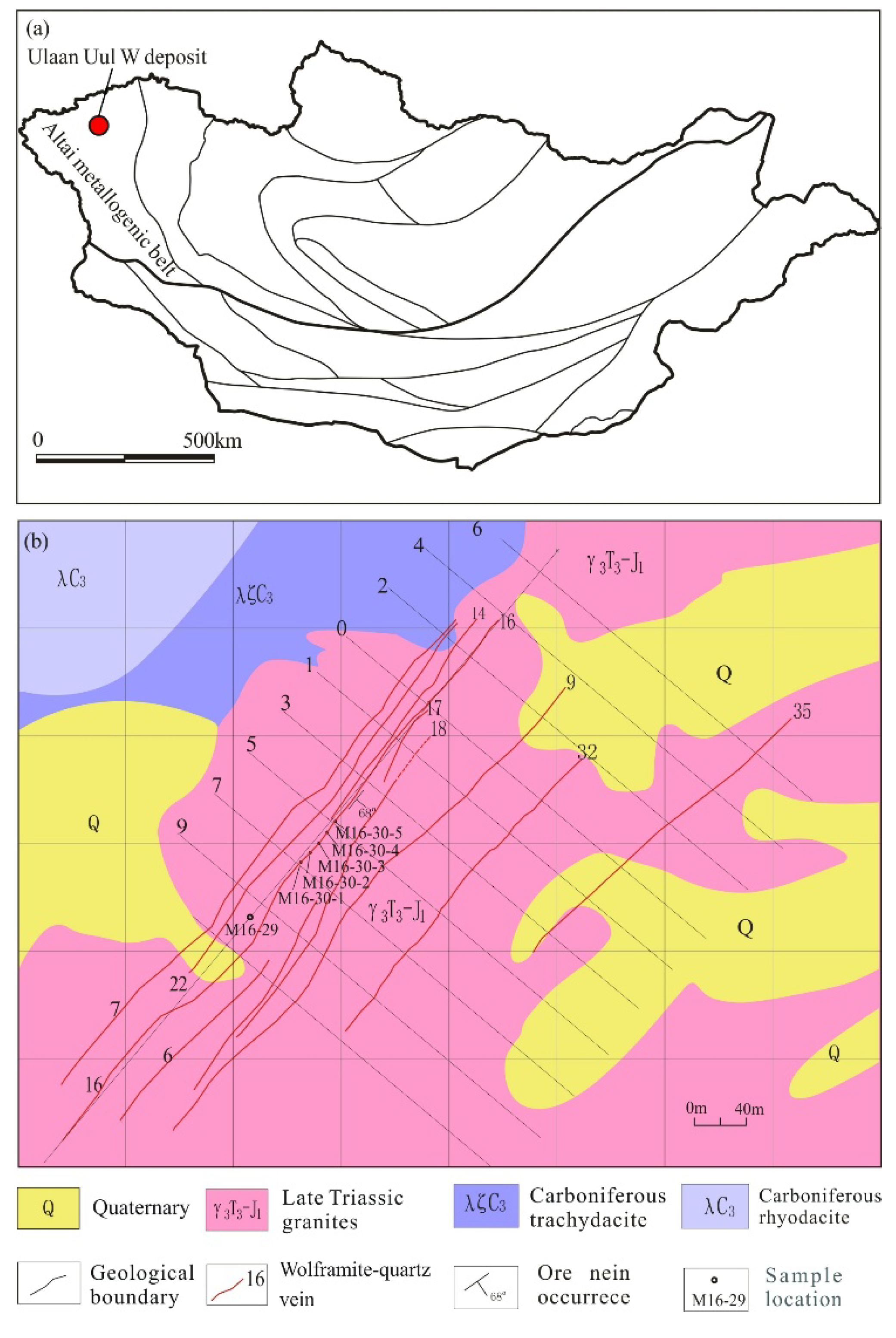
Figure 2.
Geological profile along No.7 line of the Ulaan Uul W deposit(modified after [18]).
Figure 2.
Geological profile along No.7 line of the Ulaan Uul W deposit(modified after [18]).
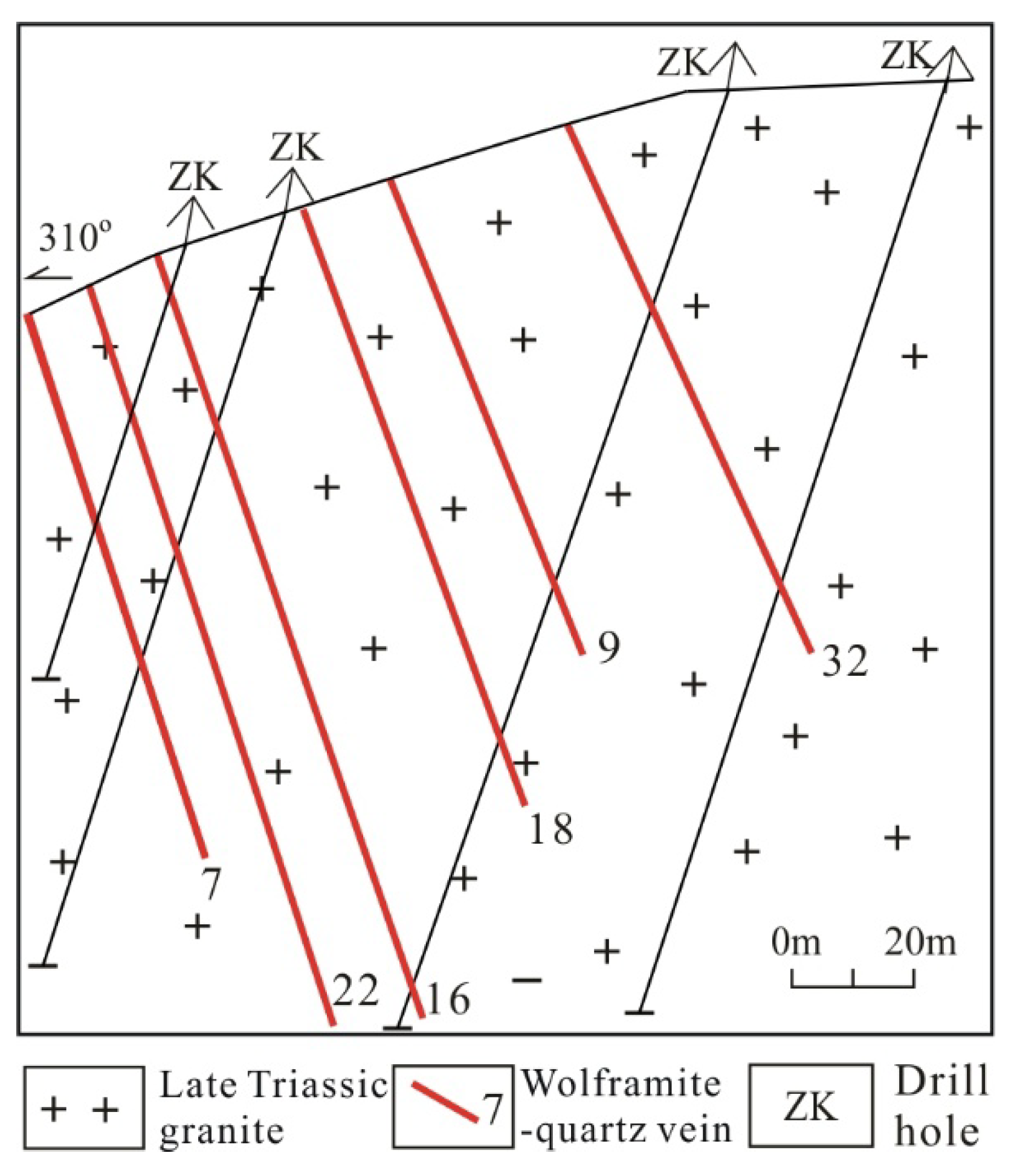
Figure 3.
Tungsten ore and ore-bearing alkali feldspar granite;(a,b) wolframite-quartz vein tungsten ore; (c,d) alkali feldspar granite (sample M16-29):representative outcrop (c) and microscope photograph (d). Qz= quartt; Wf= wolframite;Py=pyrites; Cp= chalcopyrite;Kf= alkali feldspar; Pl=plagioclase.
Figure 3.
Tungsten ore and ore-bearing alkali feldspar granite;(a,b) wolframite-quartz vein tungsten ore; (c,d) alkali feldspar granite (sample M16-29):representative outcrop (c) and microscope photograph (d). Qz= quartt; Wf= wolframite;Py=pyrites; Cp= chalcopyrite;Kf= alkali feldspar; Pl=plagioclase.
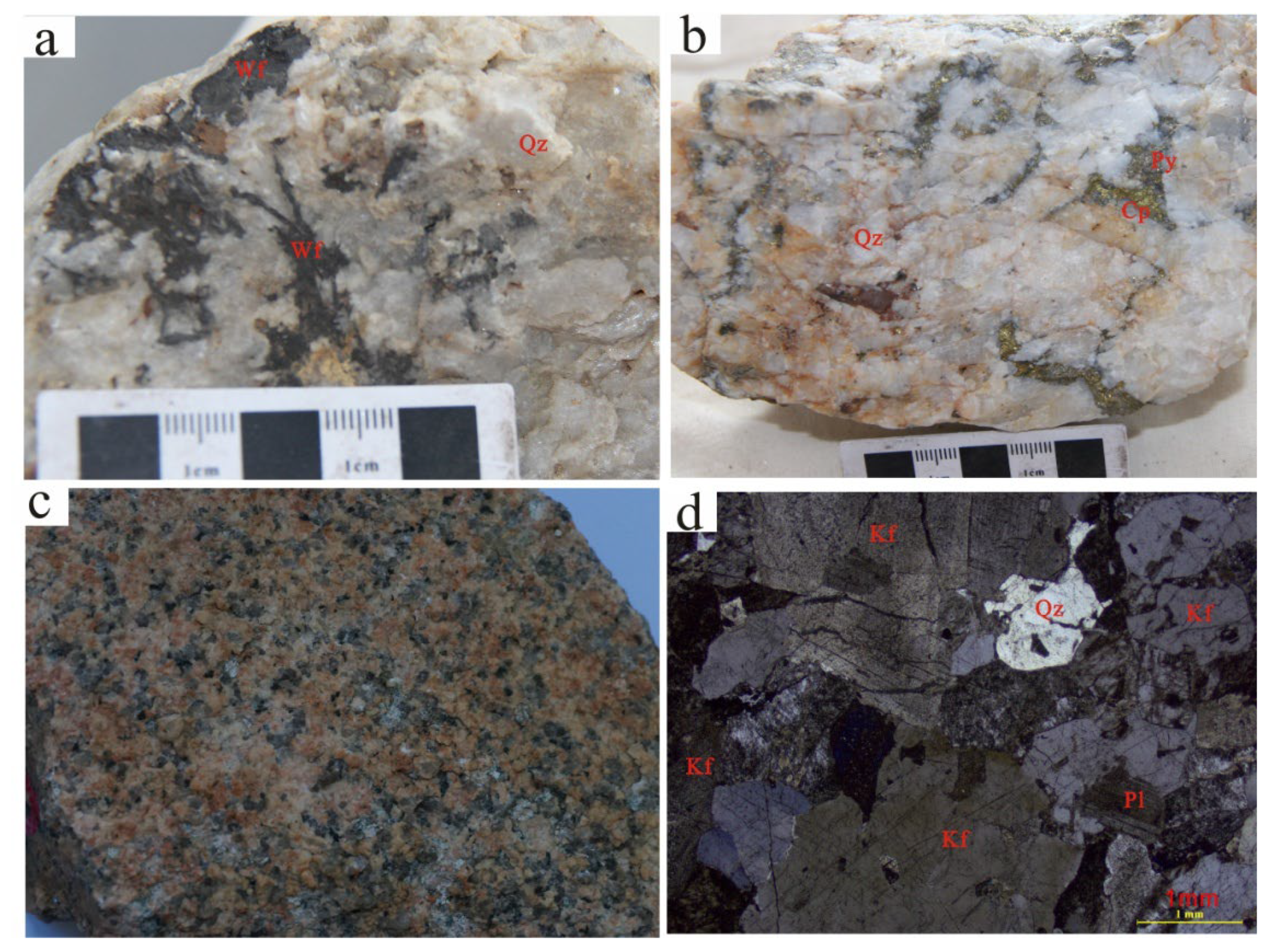
Figure 4.
CL imagine of zircon grians of the alkali feldspar granite (sample M16-29) from the Ulaan Uul W deposit (data number is the same as that in Table 1).
Figure 4.
CL imagine of zircon grians of the alkali feldspar granite (sample M16-29) from the Ulaan Uul W deposit (data number is the same as that in Table 1).
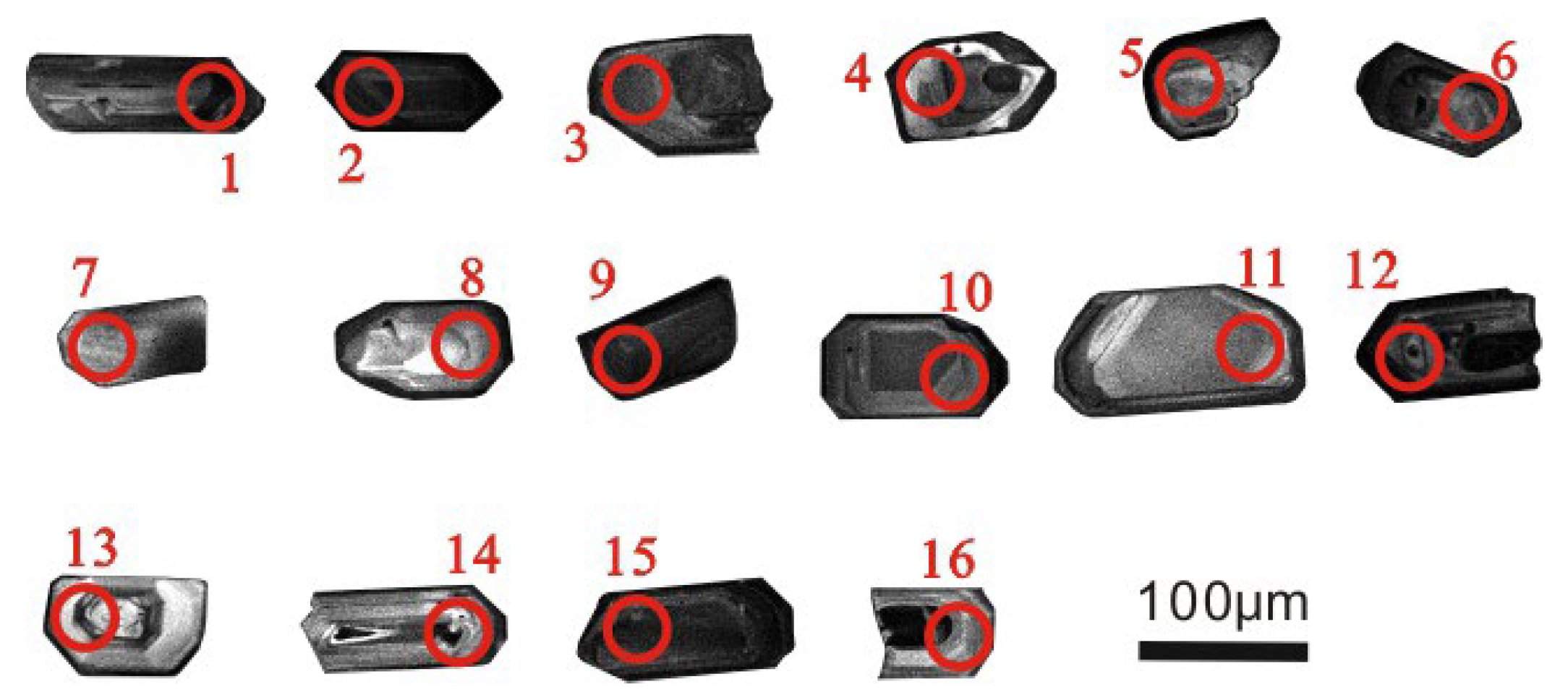
Figure 5.
Zircon LA-ICP-MS U-Pb Concordia diagram for the alkali feldspar granite (sample M16-29) from the Ulaan Uul W deposit.
Figure 5.
Zircon LA-ICP-MS U-Pb Concordia diagram for the alkali feldspar granite (sample M16-29) from the Ulaan Uul W deposit.
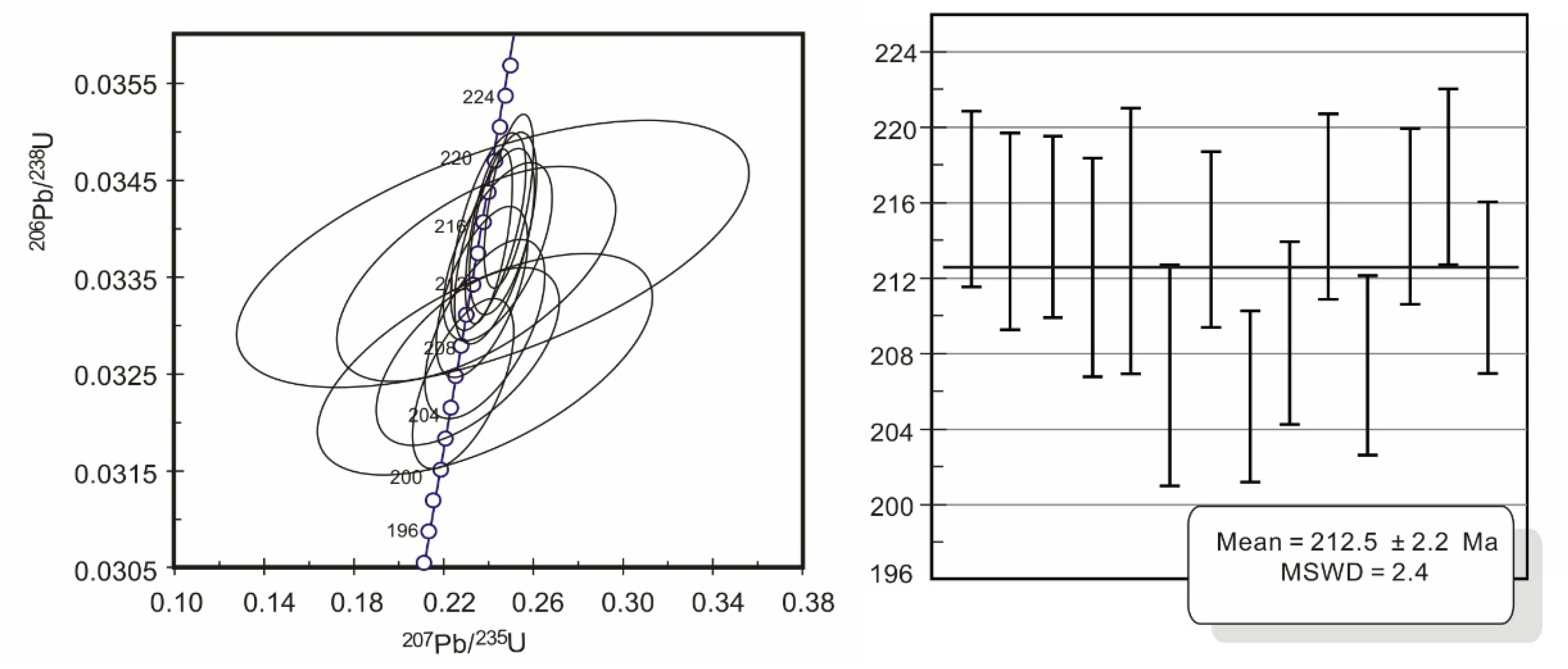
Figure 6.
Sm-Nd isochron age of the wolframite from Ulaan Uul W deposit.
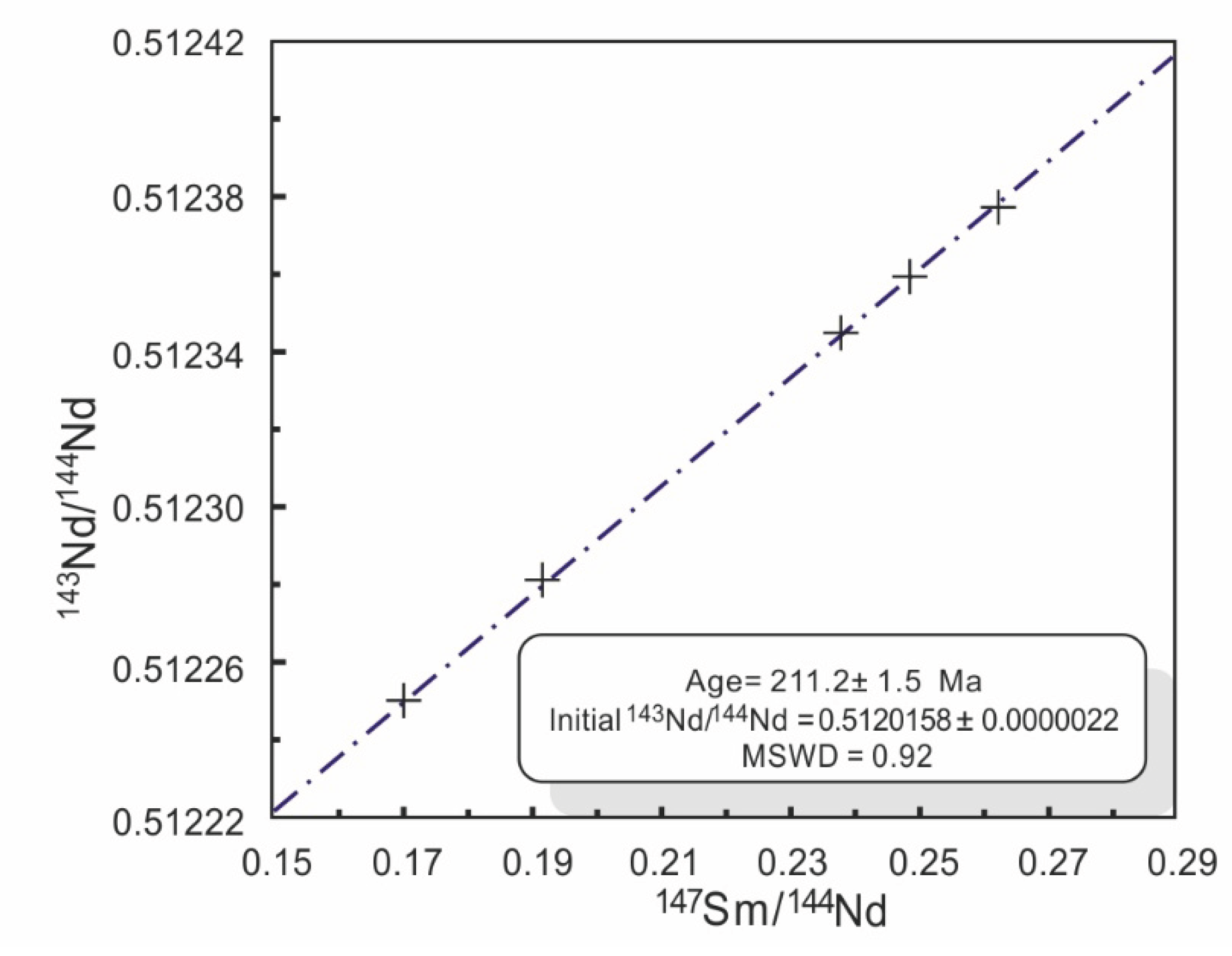

Table 1.
LA-ICP-MS U-Pb isotopic analysis data of single zircon grains of the granite (sample M16-29) from the Ulaan Uul Wolfram deposit.
Table 1.
LA-ICP-MS U-Pb isotopic analysis data of single zircon grains of the granite (sample M16-29) from the Ulaan Uul Wolfram deposit.
| Sample NO. | Content(×10-6) | Th/U | Isotopic ratio | Age(Ma) | |||||||||||
|---|---|---|---|---|---|---|---|---|---|---|---|---|---|---|---|
| Pb | U | 206Pb/238U | 1σ | 207Pb/235U | 1σ | 207Pb/206Pb | 1σ | 206Pb/238U | 1σ | 207Pb/235U | 1σ | 207Pb/206Pb | 1σ | ||
| M16-29-1 | 24 | 486 | 0.76 | 0.0341 | 0.0004 | 0.2427 | 0.0054 | 0.0516 | 0.0011 | 216 | 2 | 221 | 5 | 268 | 48 |
| M16-29-2 | 14 | 209 | 0.54 | 0.0338 | 0.0004 | 0.2419 | 0.0068 | 0.0519 | 0.0013 | 214 | 3 | 220 | 6 | 280 | 59 |
| M16.-29-3 | 23 | 310 | 0.48 | 0.0339 | 0.0004 | 0.2368 | 0.0060 | 0.0507 | 0.0012 | 215 | 2 | 216 | 5 | 228 | 54 |
| M16-29-4 | 25 | 308 | 0.91 | 0.0687 | 0.0008 | 0.5368 | 0.0110 | 0.0567 | 0.0011 | 428 | 5 | 436 | 9 | 480 | 41 |
| M16-29-5 | 11 | 82 | 0.52 | 0.0680 | 0.0007 | 0.5301 | 0.0148 | 0.0565 | 0.0015 | 424 | 5 | 432 | 12 | 473 | 59 |
| M16-29-6 | 3 | 62 | 0.79 | 0.0335 | 0.0005 | 0.2342 | 0.0255 | 0.0507 | 0.0054 | 213 | 3 | 214 | 23 | 225 | 246 |
| M16-29-7 | 2 | 45 | 0.67 | 0.0338 | 0.0006 | 0.2412 | 0.0468 | 0.0518 | 0.0095 | 214 | 4 | 219 | 43 | 278 | 419 |
| M16-29-8 | 2 | 38 | 0.72 | 0.0326 | 0.0005 | 0.2381 | 0.0304 | 0.0530 | 0.0068 | 207 | 3 | 217 | 28 | 328 | 293 |
| M16-29-9 | 9 | 161 | 0.67 | 0.0338 | 0.0004 | 0.2436 | 0.0099 | 0.0523 | 0.0020 | 214 | 2 | 221 | 9 | 300 | 89 |
| M16-29-10 | 7 | 135 | 0.69 | 0.0324 | 0.0004 | 0.2283 | 0.0092 | 0.0511 | 0.0020 | 206 | 2 | 209 | 8 | 244 | 91 |
| M16-29-11 | 6 | 76 | 0.41 | 0.0330 | 0.0004 | 0.2377 | 0.0108 | 0.0523 | 0.0023 | 209 | 2 | 217 | 10 | 299 | 101 |
| M16-29-12 | 13 | 297 | 0.91 | 0.0341 | 0.0004 | 0.2467 | 0.0059 | 0.0526 | 0.0012 | 216 | 2 | 224 | 5 | 309 | 50 |
| M16-29-13 | 4 | 71 | 0.76 | 0.0327 | 0.0004 | 0.2306 | 0.0167 | 0.0512 | 0.0035 | 207 | 2 | 211 | 15 | 249 | 158 |
| M16-29-14 | 23 | 398 | 0.65 | 0.0339 | 0.0004 | 0.2396 | 0.0044 | 0.0512 | 0.0009 | 215 | 2 | 218 | 4 | 250 | 39 |
| M16-29-15 | 21 | 268 | 0.46 | 0.0343 | 0.0004 | 0.2474 | 0.0045 | 0.0523 | 0.0009 | 217 | 2 | 224 | 4 | 299 | 38 |
| M16-29-16 | 9 | 187 | 0.81 | 0.0334 | 0.0004 | 0.2364 | 0.0081 | 0.0514 | 0.0017 | 212 | 2 | 215 | 7 | 258 | 75 |
Table 2.
Sm and Nd isotopic data of wolframite from the Ulaan Uul W deposit.
| Sample No. | Sm/μg.g-1 | Nd/μg.g-1 | 147Sm/144Nd | 143Nd/144Nd(2σ) |
|---|---|---|---|---|
| M16-30-1 | 167.5 | 42.32 | 0.2623 | 0.512378 (4) |
| M16-30-2 | 162.7 | 38.76 | 0.2489 | 0.512360(4) |
| M16-30-3 | 146.8 | 30.06 | 0.1703 | 0.512251(9) |
| M16-30-4 | 152.8 | 32.36 | 0.1918 | 0.512281(2) |
| M16-30-5 | 154.2 | 36.78 | 0.2382 | 0.512345(4) |
Disclaimer/Publisher’s Note: The statements, opinions and data contained in all publications are solely those of the individual author(s) and contributor(s) and not of MDPI and/or the editor(s). MDPI and/or the editor(s) disclaim responsibility for any injury to people or property resulting from any ideas, methods, instructions or products referred to in the content. |
© 2026 by the authors. Licensee MDPI, Basel, Switzerland. This article is an open access article distributed under the terms and conditions of the Creative Commons Attribution (CC BY) license.
Copyright: This open access article is published under a Creative Commons CC BY 4.0 license, which permit the free download, distribution, and reuse, provided that the author and preprint are cited in any reuse.


