

Submitted:
02 March 2026
Posted:
03 March 2026
You are already at the latest version
Preprints on COVID-19 and SARS-CoV-2
Abstract
Background: In Canada, racialized communities, including African, Caribbean, and Black (ACB) people, are disproportionately affected by HIV and COVID-19. Experiencing multiple forms of discrimination in healthcare settings compromises care engagement and health outcomes. The objective of this study was to assess the various forms of discrimination experienced by ACB people during the COVID-19 pandemic, changes in the levels of discrimination experienced before and during the pandemic and the demographic factors associated with increased experience of discrimination among ACB people when accessing healthcare services during the pandemic. Methods: Data were collected via an online survey co-led by the Public Health Agency of Canada, University of Ottawa, ACB community leaders and researchers across Canada. Participants were recruited via email contact. Eligibility criteria included living in Canada at the time of the survey, aged 18 years or older, ability to read English or French, and self-identifying as African, Caribbean or Black. The survey queried access to health services, and experiences of multiple forms of discrimination when accessing healthcare services before and during the COVID-19 pandemic. Multivariable logistic regression was used to identify factors associated with discrimination. Results: Of 1,556 participants, 39.6% were aged 25-39, 42.7% were resident in Ontario, and 63.2% were of African origin. Prior to the COVID-19 pandemic, 75% experienced at least one form of discrimination in a healthcare setting. During the COVID-19 pandemic, over 66% experienced at least a form of discrimination, with 25% reporting a perceived increase in the frequency with which they experienced discrimination. The perceived increase in the frequency of discrimination was 10.8%, 15.3%, 15.9%, 17.0%, 18.1%, 18.7%, and 31.2% among participants who experienced sexual orientation, gender, substance use, disability, age-based, economic status, and race-based discrimination, respectively. In the multivariate logistic regression, the odds of experiencing discrimination in participants aged 50 and above was 0.38 times (95%CI:0.21, 0.69) that in participants who were 31-40 years of age. Conclusion: The proportion of participants with perceived increased experience of discrimination when accessing healthcare services during the COVID-19 pandemic was high. Although there is variation in levels of experienced discrimination, the different forms of discrimination participants experienced (race, gender, sexual orientation, substance use, economic status, disability and age-based discrimination) are alarming. This underscores the need for concerted efforts to address multiple forms of discrimination in healthcare settings to improve care engagement and health equity among ACB communities. There was a significant association between perceived increased experience of discrimination and only one sociodemographic factor - older age (50 and above), other factors that could possibly contribute to participants perceived increased experience of discrimination when accessing healthcare services needs to be explored.
Keywords:
multiple discrimination
; healthcare access
; ACB people
; COVID-19
; Canada
Background
The COVID-19 pandemic worsened health inequities and profoundly impacted healthcare systems worldwide [1,2]. It exacerbated existing health disparities and introduced new challenges especially among Black populations in Canada, who were disproportionately affected [3,4,5]. One critical area of concern is the experience of discrimination among this population within healthcare settings. This discrimination in healthcare manifest in various forms, including racial, ethnic, gender, and socioeconomic biases, which can significantly affect patient outcomes and healthcare access [5,6].
Prior to the pandemic, a prevalence of experiencing discrimination above 21% have been reported in healthcare settings [7,8]. Racial and ethnic minorities, women, immigrants with precarious immigration status and individuals from lower socioeconomic backgrounds have been reported to have experienced biased treatment, which have contributed to disparities in health outcomes [9,10]. In fact, racial and ethnic minorities have frequently faced longer wait times, less thorough examinations, and lower quality of care compared to their white counterparts [11,12]. Discrimination based on gender has also been documented with women reporting belittlement by colleagues, unequal opportunities for professional advancement, and gendered workload distributions [13]. The most reported form of discrimination is race-based discrimination followed by discrimination based on education or income, weight, sex, disability including HIV, and age [14].
Since the start of the COVID-19 pandemic, healthcare systems have become overwhelmed, and the strain on resources have led to heightened stress, further resulting in burnout among healthcare workers [15,16]. The impact of this is profound on racial and ethnic minorities. In fact, a study found that racial and ethnic minorities were more likely to report negative healthcare experiences during the pandemic, which correlated with lower COVID-19 vaccination rates among these groups [3,17]. Additionally, women reported increased gender discrimination, including greater support needs and lower team cohesion [13].
Overall, although forms of discrimination such as racial and ethnic discrimination experienced during the pandemic in healthcare settings have been documented in Canada and USA, Black, Indigenous, and other racialized individuals have worse healthcare service experiences compared to other racial and ethnic groups due to discrimination [14,18,19]. This discrimination led to lower rates of COVID-19 vaccination and increased difficulties in accessing healthcare, particularly among Asian, Indigenous, and Latino adults [17,20,21]. In fact, a study reported that 22.1% of participants experienced COVID-19-related discriminatory behaviors [22], and others stated that compared to White adults, people from all racial and ethnic minority groups were more likely to have experienced COVID-19-related discrimination [22,23,24]. In 2019, a national survey reported that for the past five years, discrimination was experienced by 33%, 44%, 24%, 29%, and 41% of Indigenous, First Nations, Metis, Inuit and Black people in Canada respectively [25]. Besides this, it has been documented that discrimination can occur on the basis of more than one perceived characteristic – an individual discriminated on grounds of ethnicity, may also be discriminated on grounds of sexual orientation, gender, and or age; which creates cumulative disadvantage [26,27]. For a comprehensive understanding of the cumulative burden of discrimination, and in order to develop targeted interventions and policies that recognize and address the unique experiences of individuals facing multiple discrimination, examining multiple forms of discrimination has been recommended [28,29]. Nevertheless, there is little or no information about the levels and forms of discrimination experienced by ACB people when accessing healthcare services during the pandemic in Canada. The objective of this study therefore was to assess the various forms of discrimination experienced by ACB people during the pandemic, changes in the levels of discrimination experienced before and during the pandemic and the demographic factors associated with the increased experience of discrimination among ACB people when accessing healthcare services during the COVID-19 pandemic.
Methods
Study Design and Setting
This was a national online, self-administered, cross-sectional survey to assess the impact of COVID-19 on access to STBBI-related services among ACB people in Canada. The overall objective of the survey was to better understand the impact of the COVID-19 pandemic on access to sexually transmitted and blood borne infection-related services and also assessed experiences of discrimination when accessing services before and during the COVID-19 pandemic [30]. The survey design was inspired by the rapid assessment trendspotter methodology used in the European Monitoring Centre for Drug Addiction’s online survey on the impact of COVID-19. It was conducted online to avoid the COVID-19 risk associated with close contact with people when conducting face-to-face interviews. Further methodological details on this survey have been reported elsewhere [31].
Study Population, Participants, and Sampling
The study targeted ACB people who accessed healthcare services during the COVID-19 pandemic. To be eligible, a participant had to be living in Canada, be of age 18 years or older, be able to read English or French, and self-identify as an ACB individual.
Eligible participants were recruited through collaborative efforts between the Public Health Agency of Canada (PHAC), University of Ottawa, ACB community leaders and researchers across Canada. The survey used a purposive, stratified, and proportional allocation sampling technique. The PHAC contacted over 800 stakeholders to participate in the study and to distribute the survey link to others. All stakeholders including service providers were encouraged to promote the survey link among their networks. Overall, more than 5,000 organizations and individuals were emailed the survey link using the contact lists of stakeholders.
Data Collection
Data were collected through an online survey using Voxco. The questionnaire included items regarding health providers knowledge and experience working with ACB communities and their capacity to respond to the needs of ACB patients during and post-COVID-19. Data collection was conducted in both English and French with targeted efforts via key partner organizations at each site; Ottawa (Montfort hospital, Ottawa Public Health and its affiliates- CHCs, and long-term care facilities) and Toronto (St Mike’s Hospital, Taibu CHC; Women’s Health in Women’s Hands, etc). Participant recruitment and data collection was conducted from 25/05/2021 to 12/07/2021.
Using a list of discrimination related attributes, participants’ self-perceptions about the change in their experiences of discrimination when accessing healthcare services prior and during the pandemic were asked. The response options included “increase”, “decrease”, “no change”, and “did not experience.” All participants that responded “increase”,” decrease” or “no change” to any discrimination attribute were considered to have experienced discrimination when accessing healthcare services.
Statistical Analysis
The collected data was analyzed using the statistical software program STATA version 14. The participants’ socio-demographic characteristics (all categorical variables) have been described using frequencies and percentages.
To determine the levels of the various forms of discrimination experienced by participants, the proportion of participants who experienced any form of discrimination and the proportion of the perceived change in the frequency of discrimination experienced was computed.
To assess the sociodemographic factors associated with perceived increase experience of discrimination when accessing health services during the pandemic, bivariate and multivariate analysis were done. The bivariate analysis comprised of using perceived increased experience of discrimination when accessing healthcare services as a binary outcome variable and participants’ sociodemographic factors as correlates. The odds of perceived increased experience of discrimination between participants using unadjusted odds ratios, 95% confidence intervals and p-values were computed. A p-value ≤ 0.25 was set as the determining point in the bivariate analysis for a variable to be considered as appearing to have an association with perceived increased experience of discrimination and be included in the multivariate logistic model [32]. For the multivariate analysis, perceived increased experience of discrimination when accessing healthcare services during the pandemic was considered as a binary outcome variable and all variables with p-values ≤ 0.25 in the bivariate analysis were considered as correlates and included in the multivariate logistic regression model. Adjusted odds ratios, 95% confidence intervals and p-values were computed. All variables with p-values < 0.05 were considered to have a statistically significant association with perceived increased experience of discrimination when accessing healthcare services.
Ethical Considerations
The study was conducted in accordance with the Declaration of Helsinki, and the protocol was approved by the Health Canada and Public Health Agency of Canada (PHAC) Research Ethics Board (Project File Number: REB 2020-013P) on 29/10/2020, and the Health Sciences and Science Research Ethics Board (REB) of the University of Ottawa (Ethics file number: H-04-22-7687) on 05/05/2022. Written informed consent for participation and publication was obtained from all participants involved in the study.
Results
Characteristics of Study Participants
The characteristics of the 1,556 participants who took part in this study are presented in Table 1. Nearly 40% were between 25-39 years old. Participants were from all 10 provinces and three territories, with the largest proportion residing in Ontario (42.7%). Overall, 63.2% were Black African and 28.3% were Black Caribbean. Two-thirds (66.2%) identified as cisgender women and majority (81.8%) of participants were heterosexual or straight. Over a quarter of the participants (40.8%) were Canadian citizens, 29.0% of whom had been living in Canada for less than 5 years. Four hundred and twenty-nine (29.3%) of participants had university graduate or professional degrees and about half of them (50.3%) were working full time. Majority of the participants (93.6%) had a stable housing status with more than half of them having health insurance coverages.
Forms of Discrimination Experienced by Participants Since Start of COVID-19 Pandemic
Table 2 shows the forms of discrimination experienced by participants when accessing healthcare services during the COVID-19 pandemic. Two-thirds (66.4%) of participants experienced any form of discrimination following the pandemic. However, the experienced discrimination frequency varied by type.
- a)
- Race-based discrimination
Two-thirds (66.4%) experienced race-based discrimination when accessing healthcare services following the pandemic. Of those, 31.2% experienced an increase in race-based discrimination while 65.8% experienced no change.
- b) Gender-based discrimination
More than half of the participants, 555 (57.8%) reported having experienced gender-based discrimination while accessing healthcare services following the pandemic. Although 81.6% experienced no change in this discrimination frequency, 15.3% of participants reported having experienced an increase in the frequency with which they experience gender-based discrimination when accessing healthcare services during the pandemic.
- c) Sexual orientation-based discrimination
Four hundred and forty-five (46.8%) of participants reported having experienced sexual orientation-based discrimination when accessing healthcare services since the start of the pandemic. Even though 86.3% of participants reported no change in the frequency with which this form of discrimination was experienced, 10.8% of participants reported having experienced an increase.
- d) Substance use-based discrimination
One third, 333 (35.5%) of participants reported having experienced substance use-based discrimination. Majority of the participants (81.1%) did not experience any change in the frequency of this discrimination. However, 53 (15.9%) of participants reported having experienced an increase in this discrimination frequency following the pandemic.
- e) Economic status-based discrimination
More than half (57.3%) of participants reported having experienced economic status-based discrimination. While 376 (67.8%) did not experience a change, 18.7% of participants reported having experienced an increase in this discrimination frequency.
- f) Disability-based discrimination
Three hundred and eighty-two (40.3%) of participants reported experiencing disability status-based discrimination. Among this group, 77.0% reported no change in the frequency of this discrimination. Nevertheless, 17.0% of the participants experienced an increase in this discrimination frequency.
- g) Age-based discrimination
Four hundred and sixty-three (48.8%) of participants experienced age-based discrimination when accessing healthcare services. Although many (80.4%) of these participants did not report any change in the frequency with which they experienced this form of discrimination, 18.1% reported an increase.
Participants’ Discrimination Prior and During COVID-19 Pandemic
Overall, only 37.9% of participants reported never experiencing any form of discrimination prior to the pandemic. Among those who experienced any form of discrimination, 32.8% reported that these experiences only occurred sometimes (Figure 1). Since the beginning of the pandemic, although 65.6% of those who experienced discrimination did not report a change in the frequency with which they experienced it, 25.2% of them reported an increase in the frequency with which they experienced discrimination when accessing healthcare services (Figure 2).
Factors Associated with Increased Experiences of Discrimination During COVID-19
The factors associated with participants’ overall experience of discrimination during the pandemic are presented in Table 3 and Table 4. In the bivariate analysis, the factors that appeared to be associated with a participant’s overall experience of discrimination when accessing healthcare services during the pandemic included being a resident of the northern provinces or territories when compared to being a resident of the western province, being of age above 50 when compared to age 31-40, having a heterosexual sexual orientation when compared to non-heterosexual sexual orientation, being a Canadian citizen compared to non-Canadian citizens, living in Canada for more than 10 years compared to living in Canada for less than 5 years, having some college/vocational training education compared to those with high school level of education, and living with family when compared to living with a friend/roommate. In fact, the odds of experiencing discrimination in participants resident in the northern provinces or territories was 0.52 times (95%CI:0.19, 1.47) that in participants resident in the western province. The odds of experiencing discrimination comparing participants aged 50 and above to participants 31-40 years of age was 0.43 times (95%CI:0.27, 0.68). Also, the odds of experiencing discrimination in heterosexual or straight sexual orientation participants was 0.79 times (95%CI:0.54, 1.16) that in non-heterosexual sex orientation participants. The odds of experiencing discrimination in participants with Canadian citizenship was 0.72 times (95%CI:0.51, 1.03) that in participants who were non-Canadian citizens. With regards to the number of years lived in Canada, the odds of experiencing discrimination in participants who had been living in Canada for more than 10 years was 0.72 times (95%CI:0.47, 1.13) that in participants who had been living in Canada for less than 5 years. Furthermore, the odds of experiencing discrimination in participants with some college/vocational training education was 0.75 times (95%CI:0.50, 1.11) that in participants who had attained high school level of education. When considering participants’ housing status, the odds of experiencing discrimination in participants living with family was 0.75 times (95%CI:0.49, 1.15) that in participants living with a friend/roommate (Table 3).
After adjusting for potential confounding by each of the demographic factors that appeared to have an association with the experience of discrimination by a participant when accessing healthcare services during the COVID-19 pandemic, only being of an older age (50 and above) remained a significant factor associated with experiencing discrimination. The odds of experiencing discrimination in participants aged 50 and above was 0.38 times (95%CI:0.21, 0.69) that in participants who were 31-40 years of age (Table 4).
Discussion
In this study, we assessed the levels of discrimination experienced by ACB people when accessing healthcare services before and during the COVID-19 pandemic, the various forms of discrimination they experienced, and the factors associated with their experience of discrimination. We document that prior to the COVID-19 pandemic, more than a quarter of the participants reported that they never experienced any form of discrimination. For those that experienced at least one form of discrimination, approximately 33% of them reported experiencing it sometimes. However, we also document that since the start of the pandemic, over 66% of participants experienced at least a form of discrimination with more than 25% of them reporting a perceived increase in the frequency with which they experienced the discrimination when accessing healthcare services. Added to these, we document a perceived increase in the frequency with which participants experienced various forms of discrimination when accessing healthcare services – 31.2%, 15.3%, 10.8%, 15.9%, 18.7%, 17.0%, and 18.1% of participants reported a perceived increase in their experience of race, gender, sexual orientation, substance use, economic status, disability, and age-based discrimination respectively. In this study, available participants’ sociodemographic factors both individually and as a group did not accurately distinguish between participants who perceived increased experience of discrimination and those who did not when accessing healthcare services during the COVID-19 pandemic. However, being of an older age (50 and above) had a statistically significant association with the overall participants perceived increased experience of discrimination when accessing healthcare services during the pandemic.
While the overall level of perceived increased experience of discrimination during the pandemic appears high (25%) in this study, it is within the range of levels of discrimination reported in similar studies conducted elsewhere. We found no studies that have assessed changes in participants experienced levels of discrimination prior and during the pandemic in Canada before this study, but the levels of discrimination participants have experienced when accessing healthcare services ranges from 3.5% to 64.5% [7,8,17,18,22,25,33,34,35,36,37]. The highest level of discrimination (64.5%) reported so far was experienced by participants in a study conducted in USA [36].
A series of studies have reported on the various forms of discrimination experienced by ACB people including discrimination based on race/ethnicity, gender discrimination, and sexual orientate discrimination [8,22,33,38,39,40,41]. Others have reported that the racial/ethnic-based form of discrimination is very common [8,14,22,23,36]. In our study however, in addition to the various forms of discrimination ACB people experienced while accessing healthcare, we also report the frequency with which participants perceived an increased experience of the forms of discrimination.
Some studies have found that factors significantly associated with participants experience of discrimination include age, language, education, income and place of residence [8,22,35,42]. While our study sample was adequate for estimating the levels of discrimination experienced by participants when accessing healthcare services during the COVID-19 pandemic, only one covariate (age) had a statistically significant association with the experience of discrimination. This is similar to studies that found that age had a statistical association with discrimination [8,35,42], but dissimilar with studies that found loneliness, depression, level of education, income level and place of residence as associated factors with discrimination [22,36]. The implications of experiencing discrimination on healthcare access and health outcomes are very negative. On healthcare access, the impact of experiencing discrimination causes people to delay or avoid care, experience unequal treatment, and to distrust the healthcare system [43,44,45]. On health outcomes, the experience of discrimination leads to worse health outcomes such as high rates of chronic diseases, poor mental health, increased hospital waiting times and worse outcomes for certain conditions like diabetes [11,36,46].
Limitations and Strengths of This Study
The levels of the various forms of discrimination reported in this study could be influenced by population characteristics and the policies that were enforced to fight the COVID-19 pandemic which might have either limited access to healthcare services or affected participants’ perception of how they were treated when accessing healthcare services. Although this was a national survey, the sample may not have been representative of all ACB people who faced discrimination when accessing healthcare services during the pandemic. Furthermore, the study only included a cross-section of ACB people who could fill out the survey online. The levels of the various forms of discrimination reported therefore reflects only the detection of cases of experienced discrimination in our online survey and not necessarily the incidence of discrimination or the overall level of experienced discrimination in the Canadian ACB population. Participants’ differences in use of online services might also have contributed to an underestimation of the proportion of participants that experienced discrimination but may not have been able to respond to our online survey. Also, there is the possibility of response bias as participants might not have revealed the truth about their experiences during the pandemic. Equally, there might be recall bias as participants might not have fully remembered whether they experienced discrimination or not.
Nevertheless, this study was strengthened by the fact that it was a national survey that was available online, making it possible for ACB people across the country to participate in the study. In addition, the online survey enabled data collection from many participants within a short time. Our statistical analysis also allowed for an accurate description of the levels of the various forms of discrimination participants experienced when accessing healthcare services during the pandemic and the factors associated with the experience of discrimination regarding ACB people in Canada.
Conclusion
The proportion of participants with perceived increased experience of discrimination when accessing healthcare services during the COVID-19 pandemic was high. Although there is variation in levels of experienced discrimination, the different forms of discrimination participants experienced are alarming. This underscores the need for concerted efforts to address multiple forms of discrimination in healthcare settings in order to improve care engagement and health equity among ACB communities. There was a significant association between perceived increased experience of discrimination and only one sociodemographic factor - older age (50 and above), other factors that could possibly contribute to participants perceived increased experience of discrimination when accessing healthcare services needs to be explored. Future studies including both online surveys and face-to-face interviews with ACB people are needed to assess trends in experienced discrimination and related determinants.
Availability of data and materials
All data relevant to the study are included in the article or uploaded as supplementary information.
Competing interests
The authors declare that they have no competing interests.
Funding Statement
This study was founded by the Public Health Agency of Canada. The Catalogue Number for the study is HP40-327/2023E-PDF.
Author Contributions
Conceptualization: JE; Methodology: JE and AB; Writing – original draft: AB; review and editing: JE, AB, AK, SB, JO, JAO, LN, EE, GB, and DE; Supervision: JE. All authors read and approved the final version of the manuscript.
Acknowledgments
The study was made possible by study participants and the Public Health Agency of Canada in partnership with several community stakeholders. We thank key stakeholders - the University of Ottawa and Women’s Health in Women’s Hands (WHIWH) who assisted with study implementation. We acknowledge that the opinions expressed in this manuscript are those of the authors and do not necessarily reflect the views of the Public Health Agency of Canada.
Abbreviations
The following abbreviations are used in this manuscript:
| AB | Alberta |
| ACB | African, Caribbean and Black |
| aOR | Adjusted odds ratio |
| BC | British Columbia |
| CHC | Community Health Centre |
| COVID-19 | Coronavirus disease 2019 |
| CI | Confidence interval |
| HIV | Human immunodeficiency virus |
| MB | Manitoba |
| N | Frequency |
| NB | New Brunswick |
| NL | Newfoundland and Labrador |
| NS | Nova Scotia |
| NU | Nunavut |
| NWT | Northwest Territories |
| ON | Ontario |
| OR | Odds ratio |
| PEI | Prince Edward Island |
| PHAC | Public Health Agency of Canada |
| QC | Québec |
| REB | Research Ethics Board |
| Ref | Reference variable |
| SK | Saskatchewan |
| STBBI | Sexually transmitted and blood-borne infections |
| USA | United States of America |
| YT | Yukon Territories |
References
- WHO. The COVID-19 pandemic and continuing challenges to global health [Internet]. 2025. Available online: https://www.who.int/about/funding/invest-in-who/investment-case-2.0/challenges.
- Filip, R; Gheorghita Puscaselu, R; Anchidin-Norocel, L; Dimian, M; Savage, WK. Global Challenges to Public Health Care Systems during the COVID-19 Pandemic: A Review of Pandemic Measures and Problems. J Pers Med. 2022, 12(8), 1295. [Google Scholar] [CrossRef]
- Olanlesi-Aliu, A; Kemei, J; Alaazi, D; Tunde-Byass, M; Renzaho, A; Sekyi-Out, A; Mullings, DV; Osei-Tutu, K; Salami, B. Evidence synthesis - COVID-19 among Black people in Canada: a scoping review. Health Promot Chronic Dis Prev Can Res Policy Pract. 2024, 44(3), 112–25. [Google Scholar]
- Vanden Bossche, D; Zhao, QJ; Ares-Blanco, S; Peña, MPA; Decat, P; Kondo, N; Kroneman, M; Nishioka, D; Petrazzuoli, F; Rortveit, G; Schaubroeck, E; Stark, S; Pinto, AD; Willems, S. Addressing health inequity during the COVID-19 pandemic through primary health care and public health collaboration: a multiple case study analysis in eight high-income countries. Int J Equity Health 2023, 22(1), 171. [Google Scholar] [CrossRef]
- Komeiha, M; Artyukh, I; Ogundele, OJ; Zhao, QJ; Massaquoi, N; Straus, S; Razak, F; Hosseini, B; Persaud, N; Mishra, S; Eissa, A; Isabel, M; Pinto, AD. Unveiling the Impact: A Scoping Review of the COVID-19 Pandemic’s Effects on Racialized Populations in Canada. Int J Environ Res Public Health 2025, 22(7), 1054. [Google Scholar] [CrossRef] [PubMed]
- Willems, SJ; Castells, MC; Baptist, AP. The Magnification of Health Disparities During the COVID-19 Pandemic. J Allergy Clin Immunol Pract. 2022, 10(4), 903–8. [Google Scholar] [CrossRef] [PubMed]
- Malcom. 1 in 5 Have Been Discriminated Against in the Healthcare Setting [Internet]. 2020. Available online: https://www.michiganmedicine.org/health-lab/1-5-have-been-discriminated-against-healthcare-setting.
- Nong, P; Raj, M; Creary, M; Kardia, SLR; Platt, JE. Patient-Reported Experiences of Discrimination in the US Health Care System. JAMA Netw Open 2020, 3(12), e2029650. [Google Scholar] [CrossRef]
- Rosemberg, MAS; Tsai, JHC. Connecting Gender, Race, Class, and Immigration Status to Disease Management at the Workplace. J Health Disparities Res Pract. 2014, 7(5), 13–31. [Google Scholar]
- Loi, S; Li, P; Myrskylä, M. Unequal weathering: How immigrants’ health advantage vanishes over the life-course. J Migr Health 2025, 11, 100303. [Google Scholar] [CrossRef]
- Macias-Konstantopoulos, WL; Collins, KA; Diaz, R; Duber, HC; Edwards, CD; Hsu, AP; Ranney, ML; Riviello, RJ; Wettstein, ZS; Sachs, CJ. Race, Healthcare, and Health Disparities: A Critical Review and Recommendations for Advancing Health Equity. West J Emerg Med 2023, 24(5), 906–18. [Google Scholar] [CrossRef]
- DiA, AL. Minorities have longer wait times at hospital than whites [Internet]. Al Día News. 2025. Available online: https://aldianews.com/en/leadership/advocacy/minorities-have-longer-wait.
- Hennein, R; Gorman, H; Chung, V; Lowe, SR. Gender discrimination among women healthcare workers during the COVID-19 pandemic: Findings from a mixed methods study. PloS One 2023, 18(2), e0281367. [Google Scholar] [CrossRef]
- Statistics Canada. The Daily — Half of racialized people have experienced discrimination or unfair treatment in the past five years [Internet]. 2024. Available online: https://www150.statcan.gc.ca/n1/daily-quotidien/240516/dq240516b-eng.htm.
- Burrowes, SAB; Casey, SM; Pierre-Joseph, N; Talbot, SG; Hall, T; Christian-Brathwaite, N; Del-Carmen, M; Garofalo, C; Lundberg, B; Mehta, PK; Mottl-Santiago, J; Schechter-Perkins, EM; Weber, A; Yarrington, CD; Perkins, RB. COVID-19 pandemic impacts on mental health, burnout, and longevity in the workplace among healthcare workers: A mixed methods study. J Interprofessional Educ Pract. 2023, 32, 100661. [Google Scholar] [CrossRef]
- Maunder, RG; Heeney, ND; Strudwick, G; Shin, HD; O’Neill, B; Young, N; Jeffs, LP; Barrett, K; Bodmer, NS; Born, KB; Hopkins, J; Jüni, P; Perkhun, A; Price, DJ; Razak, F; Mushquash, CJ; Mah, L. Burnout in Hospital-Based Healthcare Workers during COVID-19 [Internet]. Ontario COVID-19 Science Advisory Table. Oct 2021. Available online: https://covid19-sciencetable.ca/sciencebrief/burnout-in-hospital-based-healthcare-workers-during-covid-19.
- Cénat, JM. Racial discrimination in healthcare services among Black individuals in Canada as a major threat for public health: its association with COVID-19 vaccine mistrust and uptake, conspiracy beliefs, depression, anxiety, stress, and community resilience. Public Health 2024, 230, 207–15. [Google Scholar] [CrossRef] [PubMed]
- Elam-Evans, LD; Jones, CP; Vashist, K; Yankey, D; Smith, CS; Kriss, JL; Lu, PJ; St. Louis, ME; Brewer, NT; Singleton. The Association of Reported Experiences of Racial and Ethnic Discrimination in Health Care with COVID-19 Vaccination Status and Intent — United States, April 22, 2021–November 26, 2022. In MMWR Morb Mortal Wkly Rep [Internet]; 2023; p. 72. Available online: https://www.cdc.gov/mmwr/volumes/72/wr/mm7216a5.htm.
- Statistics Canada. Quality of life indicator: Discrimination and unfair treatment [Internet]. 2022. Available online: https://www.statcan.gc.ca/hub-carrefour/quality-life-qualite-vie/good-governance-saine-gouvernance/discrimination-eng.htm.
- Fernandez, JR; Richmond, J; Strassle, PD; Cunningham-Erves, J; Forde, AT. Motivators and Barriers to COVID-19 Vaccination Intentions Across U.S. County-Level Barriers in the COVID-19 Vaccine Coverage Index. J Racial Ethn Health Disparities [Internet]. Available from. 2 Aug 2024. [CrossRef]
- Kriss, JL; Hung, MC; Srivastav, A; Black, CL; Lindley, MC; Lee, JT; Koppaka, R; Tsai, Y; Lu, PJ; Yankey, D; Elam-Evans, LD; Singleton, JA. COVID-19 Vaccination Coverage, by Race and Ethnicity - National Immunization Survey Adult COVID Module, United States, December 2020-November 2021. MMWR Morb Mortal Wkly Rep. 2022, 71(23), 757–63. [Google Scholar] [CrossRef] [PubMed]
- Strassle, PD; Stewart, AL; Quintero, SM; Bonilla, J; Alhomsi, A; Santana-Ufret, V; Maldonado, AI; Forde, AT; Nápoles, AM. COVID-19-Related Discrimination Among Racial/Ethnic Minorities and Other Marginalized Communities in the United States. Am J Public Health 2022, 112(3), 453–66. [Google Scholar] [CrossRef] [PubMed]
- Suran, M. White Individuals Experience Less COVID-19–Related Discrimination. JAMA 2022, 327(16), 1538. [Google Scholar] [CrossRef]
- NIH. People from racial, ethnic, and other groups report frequent COVID-19–related discrimination | National Institutes of Health (NIH) [Internet]. 2025. Available online: https://www.nih.gov/news-events/news-releases/people-racial-ethnic-other-groups-report-frequent-covid-19-related-discrimination.
- Statistics Canada. Experiences of discrimination among the Black and Indigenous populations in Canada, 2019 [Internet]. 2022. Available online: https://www150.statcan.gc.ca/n1/pub/85-002-x/2022001/article/00002-eng.htm.
- Council of Europe. Intersectionality and Multiple Discrimination - Gender Matters - www.coe.int [Internet]. Gender Matters. 2025. Available online: https://www.coe.int/en/web/gender-matters/intersectionality-and-multiple-discrimination.
- Cormack, D; Stanley, J; Harris, R. Multiple forms of discrimination and relationships with health and wellbeing: findings from national cross-sectional surveys in Aotearoa/New Zealand. Int J Equity Health 2018, 17(1), 26. [Google Scholar] [CrossRef]
- Ontario Human Rights Commission. An intersectional approach to discrimination: Addressing multiple grounds in human rights claims [Internet]. 2025. Available online: https://www.ohrc.on.ca/en/book/export/html/2467.
- Grollman, TS. The Importance of Intersectionality: Multiple Forms of Discrimination and Health - Sociological Images [Internet]. 2025. Available online: https://thesocietypages.org/socimages/2012/07/05/the-importance-of-intersectionality-multiple-forms-of-discrimination-and-health/.
- PHAC. COVID-19 and the impact on services for sexually transmitted and blood-borne infections: Overview [Internet]. 2023. Available online: https://www.canada.ca/en/public-health/services/publications/diseases-conditions/covid-19-impact-services-sexually-transmitted-blood-borne-infections.html.
- PHAC. Survey on the impact of COVID-19 on access to STBBI-related services, including harm reduction services, for African, Caribbean and Black people in Canada [Internet]. 2022. Available online: https://www.canada.ca/en/public-health/services/publications/diseases-conditions/survey-impact-covid-19-access-stbbi-harm-reduction-services-african-caribbean-black-people.html.
- Bursac, Z; Gauss, CH; Williams, DK; Hosmer, DW. Purposeful selection of variables in logistic regression. Source Code Biol Med. 2008, 3, 17. [Google Scholar] [CrossRef]
- Ryu, S; Hirschtick, JL; Allgood, KL; Orellana, R; Fleischer, NL. Racial discrimination in healthcare settings and mental health among a population-based sample of racial and ethnic minoritized adults with COVID-19 in Michigan. Prev Med Rep. 2023, 36, 102529. [Google Scholar] [CrossRef]
- Zhang, X; Yu, P; Yan, J; Ton, A M; Spil, I. Using diffusion of innovation theory to understand the factors impacting patient acceptance and use of consumer e-health innovations: a case study in a primary care clinic. BMC Health Serv Res 2015, 15, 71. [Google Scholar] [CrossRef]
- Miconi, D; Li, ZY; Frounfelker, RL; Venkatesh, V; Rousseau, C. Socio-cultural correlates of self-reported experiences of discrimination related to COVID-19 in a culturally diverse sample of Canadian adults. Int J Intercult Relat. 2021, 81, 176–92. [Google Scholar] [CrossRef]
- Yu, H; Bauermeister, JA; Oyiborhoro, U; Villarruel, AM; Bonett, S. The relationship between racial discrimination in healthcare, loneliness, and mental health among Black Philadelphia residents. Int J Equity Health 2025, 24(1), 109. [Google Scholar] [CrossRef]
- McMurtry, CL; Findling, MG; Casey, LS; Blendon, RJ; Benson, JM; Sayde, JM; Miller, C. Discrimination in the United States: Experiences of Asian Americans. Health Serv Res. 2019, 54 (Suppl 2), 1419–30. [Google Scholar] [CrossRef] [PubMed]
- Ojukwu, E; Hirani, S; Sotindjo, T; McKay, E; Okedo-Alex, I; Magagula, P; Pashaei, A; Agudosi, GM. The Impact of Intersectional Discrimination and Stigma on HIV Care for African, Caribbean, and Black Women Living With HIV During the COVID-19 Pandemic in British Columbia: A Descriptive Study. J Assoc Nurses AIDS Care 2024, 35(3), 175–88. [Google Scholar] [CrossRef] [PubMed]
- Logie, C; Ll, James; Tharao, W; Loutfy, M. Associations Between HIV-Related Stigma, Racial Discrimination, Gender Discrimination, and Depression Among HIV-Positive African, Caribbean, and Black Women in Ontario, Canada. AIDS Patient Care STDs 2013, 27(2), 114–22. [Google Scholar] [CrossRef] [PubMed]
- Agterberg, S; Weinberger, AH; Stanton, CA; Shuter, J. Perceived racial/ethnic discrimination and cigarette smoking behaviors among a sample of people with HIV. J Behav Med. 2023, 46(5), 801–11. [Google Scholar] [CrossRef]
- Alexander, AC; Hébert, ET; Businelle, MS; Kendzor, DE. Everyday discrimination indirectly influences smoking cessation through post-quit self-efficacy. Drug Alcohol Depend. 2019, 198, 63–9. [Google Scholar] [CrossRef]
- Janoušková, M; Pekara, J; Kučera, M; Kearns, PB; Šeblová, J; Wolfová, K; Kuklová, M; Šeblová, D. Experiences of stigma, discrimination and violence and their impact on the mental health of health care workers during the COVID-19 pandemic. Sci Rep. 2024, 14(1), 10534. [Google Scholar] [CrossRef]
- Williams, DR; Lawrence, JA; Davis, BA; Vu, C. Understanding how discrimination can affect health. Health Serv Res. 2019, 54 (Suppl 2), 1374–88. [Google Scholar] [CrossRef]
- Hamed, S; Bradby, H; Ahlberg, BM; Thapar-Björkert, S. Racism in healthcare: a scoping review. BMC Public Health 2022, 22(1), 988. [Google Scholar] [CrossRef]
- Ramsoondar, N; Anawati, A; Cameron, E. Racism as a determinant of health and health care. Can Fam Physician 2023, 69(9), 594–8. [Google Scholar] [CrossRef]
- Baciu, A; Negussie, Y; Geller, A; Weinstein, JN; National Academies of Sciences E; Division H and M; Practice B on PH and PH; States C on CBS to PHE in the U. The Root Causes of Health Inequity. In Communities in Action: Pathways to Health Equity [Internet]; National Academies Press (US), 2017; Available online: https://www.ncbi.nlm.nih.gov/books/NBK425845/.
Figure 1.
Proportion of participants and level of discrimination experienced prior to COVID-19.
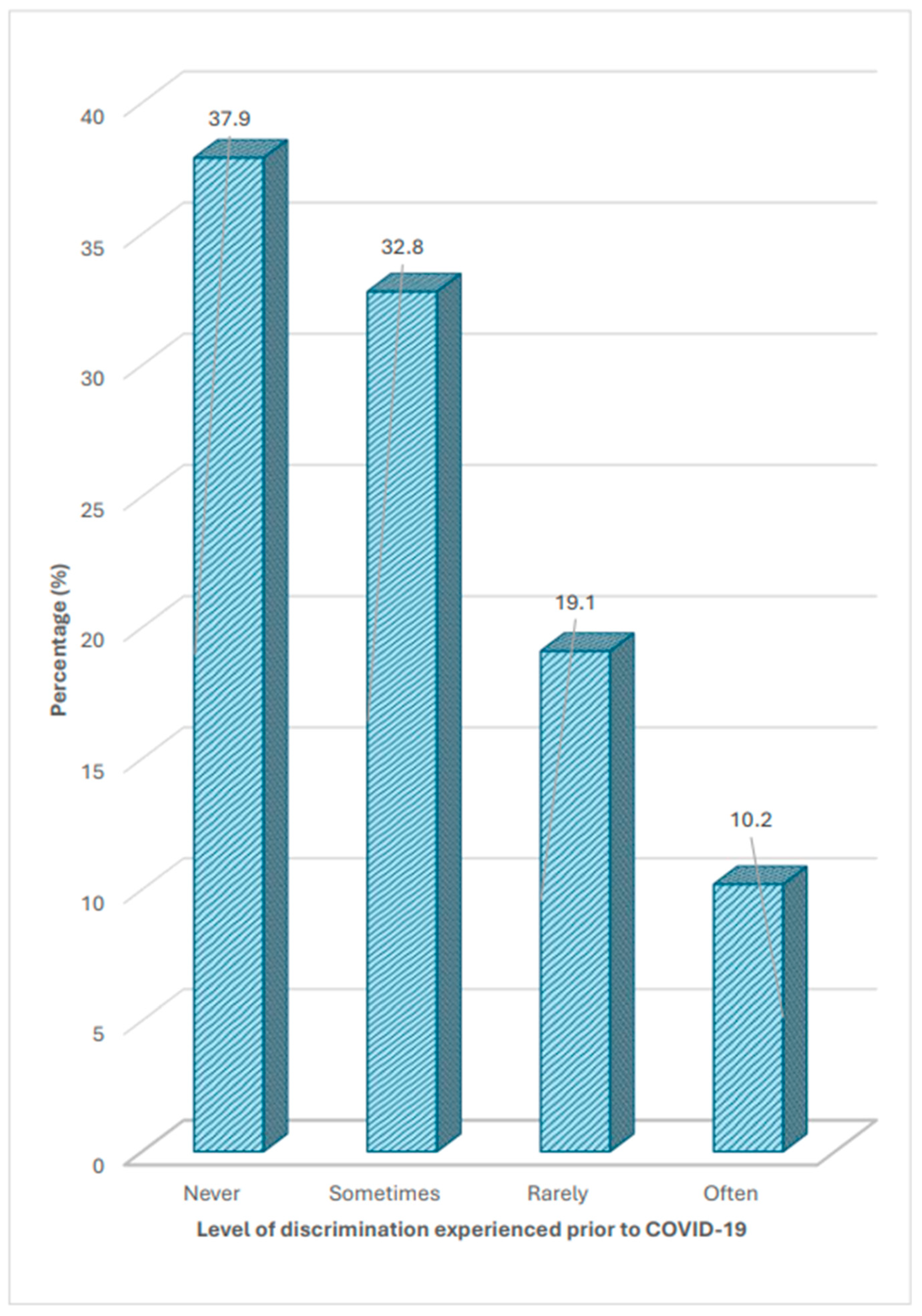
Figure 2.
Proportion of participants and levels of discrimination experienced during COVID-19.
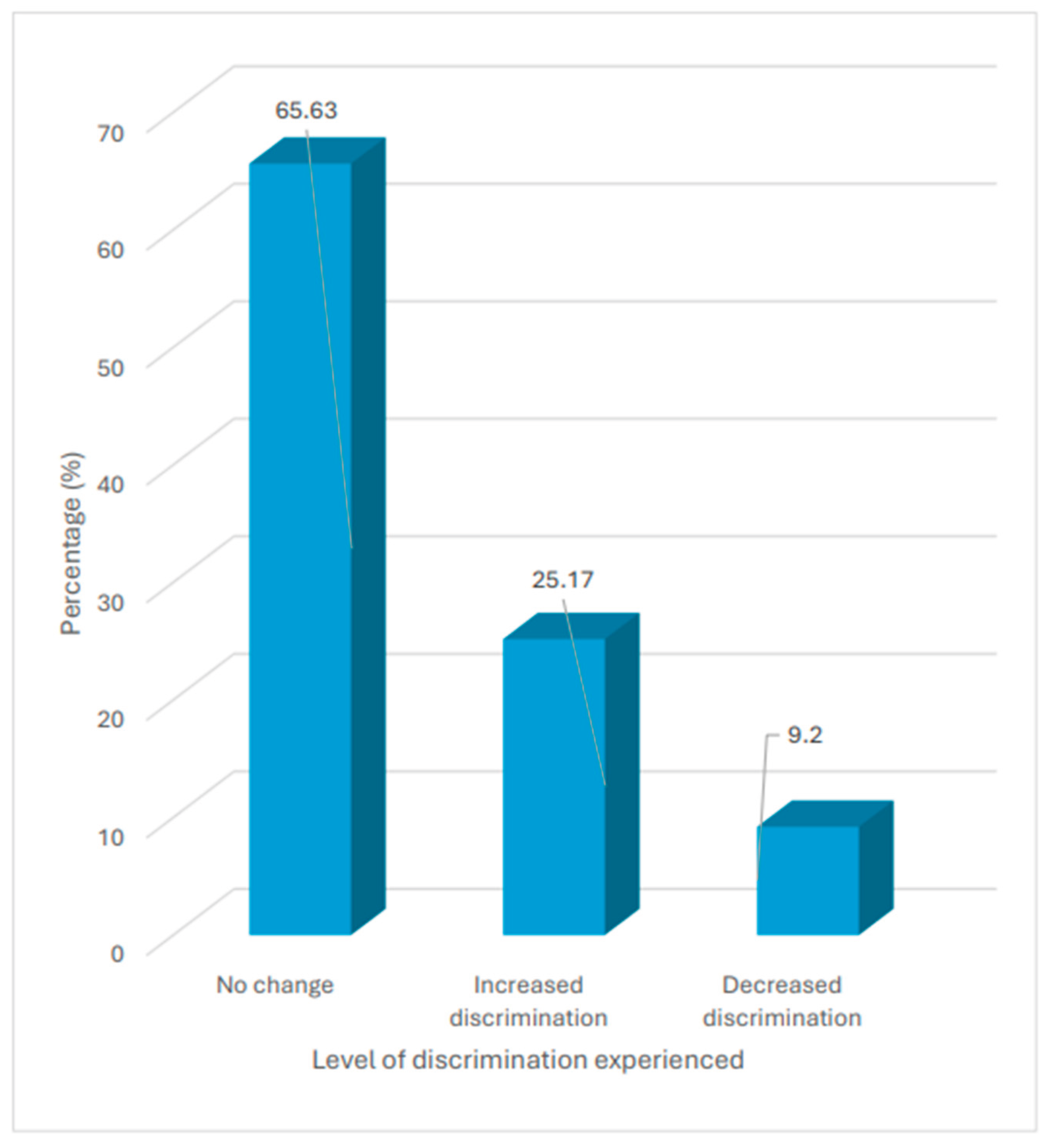

Table 1.
Characteristics of study participants.
| Characteristic | N | % |
|---|---|---|
| Province or territory of residence | ||
| British Columbia | 169 | 10.9 |
| Alberta | 170 | 10.9 |
| Saskatchewan | 30 | 1.9 |
| Manitoba | 19 | 1.2 |
| Ontario | 664 | 42.7 |
| Quebec | 197 | 12.7 |
| New Brunswick | 62 | 4.0 |
| Nova Scotia | 54 | 3.5 |
| Prince Edward Island | 67 | 4.3 |
| Newfoundland and Labrador | 81 | 5.2 |
| Territories | 39 | 2.5 |
| None of the above | 2 | 0.1 |
| Age (years) | ||
| 18-24 | 178 | 11.4 |
| 25-39 | 616 | 39.6 |
| 40-54 | 519 | 33.4 |
| 55-64 | 173 | 11.1 |
| 65+ | 70 | 4.5 |
| Race or racial background | ||
| Black African | 983 | 63.2 |
| Black Caribbean | 441 | 28.3 |
| Black Indigenous or Black Canadian | 113 | 7.3 |
| Black American | 27 | 1.7 |
| Black Latin American | 17 | 1.1 |
| Multiracial (one Black parent) | 103 | 6.6 |
| Another Black race | 25 | 1.6 |
| Gender identity | ||
| Cisgender woman | 990 | 66.2 |
| Cisgender man | 462 | 30.9 |
| Transfeminine | 11 | 0.7 |
| Transmasculine | 33 | 2.2 |
| Sexual orientation | ||
| Heterosexual or straight | 1271 | 81.8 |
| Gay or lesbian | 73 | 4.7 |
| Bisexual | 102 | 6.6 |
| Two-spirit | 10 | 0.6 |
| Other | 55 | 3.5 |
| Don’t know | 42 | 2.7 |
| Citizenship status | ||
| Canadian born citizen | 358 | 23.2 |
| Canadian naturalized citizen | 630 | 40.8 |
| Permanent resident | 291 | 18.8 |
| Refugee or protected person | 59 | 3.8 |
| Refugee claimant or person needing protection | 35 | 2.3 |
| Asylum seeker | 5 | 0.3 |
| Temporary resident | 155 | 10.0 |
| Undocumented or no immigration status | 7 | 0.5 |
| Other | 6 | 0.4 |
| Number of years lived in Canada (years) | ||
| <5 | 282 | 29.0 |
| 5-9 | 229 | 23.5 |
| 10-14 | 167 | 17.2 |
| 15-19 | 81 | 8.3 |
| 20-24 | 63 | 6.5 |
| 25+ | 152 | 15.6 |
| Education | ||
| Less than high school | 67 | 4.6 |
| High school | 105 | 7.2 |
| Some college/vocational training | 94 | 6.4 |
| Completed college/vocational training | 159 | 10.9 |
| Some university | 111 | 7.6 |
| Completed university certificate or diploma | 131 | 9.0 |
| University undergraduate degree | 356 | 24.4 |
| University graduate or professional degree | 429 | 29.3 |
| Other | 10 | 0.7 |
| Employment | ||
| Unemployed | 336 | 22.6 |
| Student | 141 | 9.5 |
| Work part time | 263 | 17.7 |
| Work full time | 749 | 50.3 |
| Housing status | ||
| Stable housing | 1456 | 93.6 |
| Precarious housing | 99 | 6.4 |
| Health insurance coverage | ||
| Yes | 1031 | 66.3 |
| No | 373 | 24.0 |
| Don’t know | 150 | 9.7 |
N=frequency, %=frequency in percentage.
Table 2.
Forms of discrimination experienced by participants when accessing health care services.
| Indicator | N | % |
|---|---|---|
| Experienced race-based discrimination since start of COVID-19 pandemic | ||
| None | 328 | 33.6 |
| Any | 647 | 66.4 |
| Change in experienced race-based discrimination since start of COVID-19 | ||
| Increase | 202 | 31.2 |
| No change | 426 | 65.8 |
| Decrease | 19 | 2.9 |
| Experienced gender-based discrimination | ||
| None | 405 | 42.2 |
| Any | 555 | 57.8 |
| Change in experienced gender-based discrimination | ||
| Increase | 85 | 15.3 |
| No change | 453 | 81.6 |
| Decrease | 17 | 3.1 |
| Experienced sexual orientation-based discrimination | ||
| None | 505 | 53.2 |
| Any | 445 | 46.8 |
| Change in experiend sexual orientation-based discrimination | ||
| Increase | 48 | 10.8 |
| No change | 384 | 86.3 |
| Decrease | 13 | 2.9 |
| Experienced substance use-based discrimination | ||
| None | 604 | 64.5 |
| Any | 333 | 35.5 |
| Change in experienced substance use-based discrimination | ||
| Increase | 53 | 15.9 |
| No change | 270 | 81.1 |
| Decrease | 10 | 3.0 |
| Experienced economic status-based discrimination | ||
| None | 414 | 42.7 |
| Any | 555 | 57.3 |
| Change in experienced economic status-based discrimination | ||
| Increase | 104 | 18.7 |
| No change | 376 | 67.8 |
| Decrease | 75 | 13.5 |
| Experienced disability-based discrimination | ||
| None | 565 | 59.7 |
| Any | 382 | 40.3 |
| Change in experienced disability-based discrimination | ||
| Increase | 65 | 17.0 |
| No change | 294 | 77.0 |
| Decrease | 23 | 6.0 |
| Experienced age-based discrimination | ||
| None | 484 | 51.1 |
| Any | 463 | 48.9 |
| Change in experienced age-based discrimination | ||
| Increased | 84 | 18.1 |
| No change | 372 | 80.4 |
| Decreased | 7 | 1.5 |
N=frequency, %=frequency in percentage.
Table 3.
Factors associated with increased experience of discrimination during COVID-19 – bivariable analysis.
Table 3.
Factors associated with increased experience of discrimination during COVID-19 – bivariable analysis.
| Characteristic | N | % | Increased experience of discrimination | P-values | |
|---|---|---|---|---|---|
| OR | 95% CI | ||||
| Province or territory of residence | |||||
| Western (BC) | 36 | 27.69 | Ref | ||
| Central (ON, QC) | 27 | 25.47 | 0.89 | 0.50-1.60 | 0.70 |
| Prairies (AB, SK, MB) | 112 | 24.14 | 0.83 | 0.54-1.29 | 0.41 |
| Atlantic (NB, NS, PEI, NL) | 47 | 27.33 | 0.98 | 0.59-1.63 | 0.94 |
| Northern (YT, NWT, NU) | 5 | 16.67 | 0.52 | 0.19-1.47 | 0.22 |
| Age (years) | |||||
| 31-40 | 79 | 30.74 | Ref | ||
| ≤20 | 4 | 14.81 | 0.39 | 0.13-1.17 | 0.09 |
| 21-30 | 54 | 25.23 | 0.76 | 0.51-1.14 | 0.19 |
| 41-50 | 58 | 28.43 | 0.90 | 0.60-1.34 | 0.59 |
| >50 | 32 | 16.00 | 0.43 | 0.27-0.68 | <0.01 |
| Gender identity | |||||
| Cisgender female or transfeminine | 153 | 25.21 | Ref | ||
| Cisgender male or transmasculine | 66 | 24.00 | 0.94 | 0.67-1.31 | 0.70 |
| Sex orientation | |||||
| Not heterosexual or straight | 45 | 29.03 | Ref | ||
| Heterosexual or straight | 182 | 24.43 | 0.79 | 0.54-1.16 | 0.23 |
| Canadian citizen | |||||
| No | 85 | 27.96 | Ref | ||
| Yes | 81 | 21.95 | 0.72 | 0.51-1.03 | 0.07 |
| Number of years lived in Canada (years) | |||||
| <5 | 48 | 31.17 | Ref | ||
| 5-10 | 42 | 22.46 | 0.64 | 0.39-1.04 | 0.07 |
| >10 | 64 | 24.71 | 0.72 | 0.47-1.13 | 0.15 |
| Education | |||||
| High school | 61 | 28.77 | Ref | ||
| Less than high school | 22 | 24.18 | 0.79 | 0.45-1.39 | 0.41 |
| Some college/vocational training | 71 | 23.20 | 0.75 | 0.50-1.11 | 0.15 |
| Completed university certificate or diploma | 72 | 25.71 | 0.86 | 0.57-1.28 | 0.45 |
| Housing status | |||||
| Living with friend/roommate | 38 | 29.23 | Ref | ||
| Living with family | 140 | 23.73 | 0.75 | 0.49-1.15 | 0.19 |
| Living alone/shelter/homeless | 48 | 28.57 | 0.97 | 0.58-1.60 | 0.90 |
| Employment | |||||
| Unemployed | 42 | 26.75 | Ref | ||
| Student | 18 | 24.66 | 0.90 | 0.47-1.70 | 0.74 |
| Work part time | 43 | 26.38 | 0.98 | 0.60-1.61 | 0.94 |
| Work full time | 120 | 24.19 | 0.87 | 0.58-1.32 | 0.52 |
OR=unadjusted odds ratio, Ref=reference variable category, CI=confidence interval, P-value < 0.25 suggests possible association with experiencing discrimination.
Table 4.
Factors associated with increased experience of discrimination during COVID-19 – multivariable analysis.
Table 4.
Factors associated with increased experience of discrimination during COVID-19 – multivariable analysis.
| Characteristic | N | % | Increased experience of discrimination | P-values | |
|---|---|---|---|---|---|
| OR | 95% CI | ||||
| Province or territory of residence | |||||
| Western (BC) | 36 | 27.69 | Ref | ||
| Central (ON, QC) | 27 | 25.47 | 0.89 | 0.43-1.85 | 0.75 |
| Prairies (AB, SK, MB) | 112 | 24.14 | 0.83 | 0.48-1.44 | 0.52 |
| Atlantic (NB, NS, PEI, NL) | 47 | 27.33 | 0.74 | 0.37-1.47 | 0.39 |
| Northern (YT, NWT, NU) | 5 | 16.67 | 0.41 | 0.11-1.57 | 0.19 |
| Age (years) | |||||
| 31-40 | 79 | 30.74 | Ref | ||
| ≤20 | 4 | 14.81 | 0.77 | 0.21-2.81 | o.69 |
| 21-30 | 54 | 25.23 | 0.65 | 0.37-1.13 | 0.13 |
| 41-50 | 58 | 28.43 | 0.74 | 0.37-1.47 | 0.39 |
| >50 | 32 | 16.00 | 0.38 | 0.21-0.69 | <0.01 |
| Sex orientation | |||||
| Not heterosexual or straight | 45 | 29.03 | Ref | ||
| Heterosexual or straight | 182 | 24.43 | 0.78 | 0.45-1.33 | 0.36 |
| Canadian citizen | |||||
| No | 85 | 27.96 | Ref | ||
| Yes | 81 | 21.95 | 0.75 | 0.41-1.35 | 0.34 |
| Number of years lived in Canada (years) | |||||
| <5 | 48 | 31.17 | Ref | ||
| 5-10 | 42 | 22.46 | 0.75 | 0.41-1.31 | 0.31 |
| >10 | 64 | 24.71 | 1.11 | 0.56-2.22 | 0.77 |
| Education | |||||
| High school | 61 | 28.77 | Ref | ||
| Less than high school | 22 | 24.18 | 0.82 | 0.37-1.83 | 0.63 |
| Some college/vocational training | 71 | 23.20 | 0.72 | 0.42-1.23 | 0.23 |
| Completed university certificate or diploma | 72 | 25.71 | 0.90 | 0.52-1.56 | 0.71 |
| Housing status | |||||
| Living with friend/roommate | 38 | 29.23 | Ref | ||
| Living with family | 140 | 23.73 | 0.83 | 0.47-1.45 | 0.51 |
| Living alone/shelter/homeless | 48 | 28.57 | 1.35 | 0.69-2.66 | 0.39 |
aOR=adjusted odds ratio, Ref=reference variable category, CI=confidence interval, P-value < 0.05 are statistically significant association with experiencing discrimination.
Disclaimer/Publisher’s Note: The statements, opinions and data contained in all publications are solely those of the individual author(s) and contributor(s) and not of MDPI and/or the editor(s). MDPI and/or the editor(s) disclaim responsibility for any injury to people or property resulting from any ideas, methods, instructions or products referred to in the content. |
© 2026 by the authors. Licensee MDPI, Basel, Switzerland. This article is an open access article distributed under the terms and conditions of the Creative Commons Attribution (CC BY) license (http://creativecommons.org/licenses/by/4.0/).
Copyright: This open access article is published under a Creative Commons CC BY 4.0 license, which permit the free download, distribution, and reuse, provided that the author and preprint are cited in any reuse.


