

Submitted:
02 March 2026
Posted:
03 March 2026
You are already at the latest version
Abstract
Staten Island is less developed than the other boroughs of New York city, however outcrops of rock and surface sediment are limited, making interpretation of its geologic history challenging. When small areas of sediment are exposed, they can be used to improve our understanding of changes in sediment erosion and deposition over time. In this study of two small temporary outcrops, the beds of sediment were logged in the field and samples were collected for textural and compositional analyses. The results were interpreted in the context of previous work on similar exposures nearby. The sediments were found to be sands and gravels of fluvioglacial origin, containing reworked sediments of both the Pliocene Pensauken Formation, and older Triassic rocks of the Newark Basin. It is likely that they were deposited on an outwash plain during the Illinoian glaciation. They were deposited in a topographic low, directly overlying Cretaceous sedimentary rocks, but adjacent to sediments of the Pensauken Formation which had in turn been deposited as an earlier valley fill. This interpretation solves an apparent disagreement between previous studies, by illustrating how both the Pensauken Formation and later fluvioglacial sediments can be exposed over a small area.
Keywords:
Illinoian glaciation
; fluvioglacial
; Pensauken formation
; Staten Island
1. Introduction
Staten Island lies strategically between New Jersey and Long Island, and is key to correlating geological formations between these locations. The southwestern portion of Staten Island is underlain by the Cretaceous Raritan Formation of the Atlantic Coastal Plain [1], which also crops out nearby in New Jersey [2], but lies deeper beneath Long Island [3]. The Pensauken Formation was deposited on the eroded surface of the Raritan Formation during the Pliocene as observed across New Jersey [4], as well as in a few locations on Staten Island [5], but not on Long Island [3]. Overlying this are deposits of outwash of Illinoian and pre-Illinoian age, capped by till, including the terminal moraine from the Wisconsinan glacial maximum [4,6].
Much of Staten Island is developed, leaving very few small exposures of the surface sediment, and these are usually only accessible for a maximum of a few years before construction takes place or thick vegetation regrows [7,8]. This research focuses on two small outcrops of sand and gravel exposed in a road cut and a construction site in Charleston, in the southwest of Staten Island (Figure 1). This and other temporary exposures in the area have been used by previous researchers to determine the age and origin of sediments covering the area to the north of the terminal moraine, beneath the surface ground moraine [6]. However, these studies have resulted in different interpretations, with some identifying sediments of the Pensauken Formation [5,9,10], while others identified pre-Illinoian fluvioglacial deposits [11,12].
The Pensauken Formation is a fluvial deposit from a Pliocene drainage system ancestral to the modern Hudson and Delaware rivers [4]. It consists of sands and gravels, deposited as valley fill, in a temperate climate. Gravels are predominantly composed of quartz and chert, with smaller amounts of granite, sandstone and mudstone [15,16]. Sands are mostly subarkosic, with some arkose and glauconitic sands [4,15,17]. Pollen samples yield an age of approximately 3.5 Ma [4], superseding earlier work which assigned ages as Pleistocene [18] or late Miocene [17]. The Pensauken Plain extended from the Long Island Sound to the Delmarva Peninsula, with the Pensauken River flowing towards the southwest (Figure 1), and the sediments reached a maximum thickness of up to 40 m [4]. There are no deposits identified as Pensauken Formation on Long Island, probably as a result of subsequent glacial erosion. However, it is possible that the lithologically similar Mannetto Gravel represents the northeastern extension of the Pensauken Formation [3,4]. Previous studies of the Pensauken Formation on Staten Island have identified outcrops in the Charleston area, close to the location of this study [5,9].
There is evidence for at least three glaciations in sediment deposits from New Jersey and New York [19]. The pre-Illinoian was the earliest, and represents the first expansion of the Laurentide ice sheet about 2.4 Ma [19,20]. The limits of this expansion have been mapped in New Jersey, but can only be inferred for Staten Island and Long Island (Figure 1). This pre-Illinoian event diverted the Pensauken drainage system, resulting in the Hudson River moving close to its present-day location [4]. The extent of the Illinoian glaciation has been mapped in New Jersey from moraine deposits (Flanders and Bergen tills), as well as fluvioglacial outwash (Lamington Formation) and glaciolacustrine sediments [19]. These deposits are thought to correspond to the Montauk Till, and fluvioglacial Jameco Gravel and Merrick Formation on Long Island [21]. They have all been dated as corresponding to marine isotope stage 6, between 191 and 130 ka [19,20]. The most recent glaciation was the late Wisconsinan expansion of the Laurentide ice sheet [20], which reached its maximum extent in New Jersey 25 ka and began a rapid retreat 24 ka [19]. New Jersey segments of the Wisconsinan terminal moraine include the Perth Amboy, Madison, Mountain Lake and Budd Lake moraines [22], while the Harbor Hill terminal moraine extends across Staten Island and western Long Island [3,12]. As the ice sheet retreated, a series of glacial lakes formed and drained, including glacial Lake Bayonne directly to the west of Staten Island along the Arthur Kill and Newark Bay [19,23]. This lake initially drained through the Richmond Valley spillway before moving south to the Perth Amboy spillway, both of which fed the outwash channels of the paleo-Hudson River, across the present-day Hudson Shelf [14,23] (Figure 1).
Because much of the Wisconsinan terminal moraine remains at the surface, the extent of the most recent glaciation is well known across the region (Figure 1). However, this most recent glacial event removed evidence for previous glacial cycles in the New York City area [19]. The extent of the pre-Illinoian and Illinoian ice sheets are inferred to a limited extent from moraine deposits in New Jersey, but are essentially unknown on Staten Island [4,13,19]. However, their maximum extent is thought to be further north than for the Wisconsinan on Staten Island (Figure 1), so the study location was unlikely to have been glaciated during these events and would have experienced a periglacial environment. Potential deposits of pre-Illinoian and Illinoian outwash have been identified on Staten Island [12].
The goal of this study is to use a detailed analysis of grain size distributions, sedimentary structures and provenance of clasts, in conjunction with an interpretation of past topographic surfaces, to resolve the previous disagreement as to whether the sediments are Pensauken or fluvioglacial in origin, and to interpret glacial meltwater flow across Staten Island. The sediments were determined to be fluvioglacial, based on their texture and composition, and probably of Illinoian age. However, this does not refute the identification of nearby outcrops as Pensauken. An interpretation of the 3-dimensional structure of the area suggests that a history of erosional surfaces and valley fill has resulted in the juxtaposition of sediments of different ages and origins.
2. Materials and Methods
The study area comprises two small outcrops of sediments in Charleston, in the southwest of Staten Island (Figure 2). Outcrop 1 was exposed in a road cut around 2004 [10], and was logged and sampled in May 2013, before it became fully revegetated and inaccessible [7]. Outcrop 2, located 30 m from Outcrop 1, was exposed during construction in July 2022 [8]. There is some lateral variation within the outcrops, so two sections 10 m apart (Sections A and B) were logged in Outcrop 1, and three sections 5 m apart (Sections C, D and E) were logged in Outcrop 2. Samples were collected from every bed at each logged location. Because the outcrops are small, almost vertical cliffs, they represent a single flat surface, so it was not possible to collect any data showing the 3-dimensional orientation of the beds or cross-laminations. Unlithified and poorly lithified sediments comprise the bulk of the outcrop, so sampling of each bed was achieved by scooping the sands and gravels into sample bags using a trowel. The single partially lithified bed in Outcrop 1 yielded easily removable soft pieces of mudstone.
All samples were dried at 50 °C for one week, then separated into identical subsamples using the coning and quartering technique [24] for samples from Sections A and B, and using a Gilson Universal Mini-Splitter for Sections C, D and E. One half of each original sample was dry sieved for 15 minutes using a Gilson tapping sieve shaker model SS-8R. Sieve sizes ranged from -5 Φ (32 mm) to 4 Φ (63 μm) in 1 Φ intervals. Sediment finer than 4 Φ was collected in the pan and comprises all silt and clay size particles (mud). Each size fraction was then weighed to determine the proportions of mud, sand and gravel. Examination of each size fraction under a binocular microscope confirmed that all grains were fully disaggregated.
Data for each sample were processed using G2Sd [25]. The grain size descriptions reported here (mean, sorting, skewness and kurtosis) for each of the bulk samples, follow the methods of statistical analysis described by Folk and Ward [26]. Specific grain size classifications follow Folk [27]. All clasts larger than -2 Φ were observed under a binocular microscope to determine their lithology. All data supporting this work are deposited in CUNY Academic Works at location to be provided during review.
3. Results
3.1. Correlation of Beds Between Sections
The initial field site, where sections A and B were logged, had been investigated several years earlier (2004), when the underlying contact with the Raritan Formation was still visible [10]. By the time of this investigation (2013), this contact had been covered by a concrete barrier, but was known to exist less than a meter from the base of the observed outcrop. Sections C, D and E are at a topographically higher location by a few meters, and include a cap of glacial till that had been eroded from sections A and B (Figure 3). Overall, the combined sections include all sediments recorded between the bedrock Cretaceous (Raritan Formation) and the most recent Wisconsinan glaciation, a thickness of approximately 3 m.
Most of the sediments are sands and sandy gravels, many of which display planar horizontal and cross laminations (Figure 3). Beds range from 6 to 40 cm in thickness. These sediments vary laterally, and beds can be correlated over short distances, but not across all five sections. However, there are also three distinct layers that can be correlated over larger distances. The lowest of these is a thin (5 cm) soft siltstone identified in sections A and B, which is stratigraphically lower than the base of sections C, D and E. The second is a thick gravel deposit (30–80 cm), that can be correlated across all five sections. Finally, there is the gravel deposit of the till, which caps sections C, D and E. These key beds have been used to divide the sands and gravels into groups to aid their description and interpretation; Group 1 below the siltstone bed, Group 2 between the siltstone and the thick gravel, and Group 3 between the thick gravel and the till (Figure 3).
3.2. Grain Size Analysis and Sediment Texture
Grain size analysis was completed for all samples of sand and gravel, excluding the partially lithified siltstone and the till. The till was excluded as boulders are too large to incorporate, so processing an accurately representative sample was not possible. One sandy gravel sample from Group 3 was also removed due to the sample size being too small to be representative. Sample texture classification follows the system developed by Folk [27] (Figure 4). Samples referred to as “sand” in Groups 1, 2 and 3 include both sand (<0.1% gravel) and slightly gravelly sand (0.01–5% gravel). Samples described as “sandy gravel” include both gravelly sand (5–30% gravel) and sandy gravel (30–80% gravel). The gravel bed referred to in figures as “gravel” also has a texture of sandy gravel, but with a higher gravel content than sandy gravels in Groups 1, 2 and 3. Mud content of all samples is low enough (1.4–7.6%) that none of the samples have a texture code that includes mud.
The cumulative frequency curves illustrate the differences among the groups of sediment. Sandy gravel sediments from all three Groups (Figure 3) show similar grain size distributions (Figure 5A-E). They have mean grain sizes of coarse sand to fine gravel, and are poorly to very poorly sorted. They are bimodal, with the modes being medium to coarse sand and pebbles. The sandy gravels are the most variable of the sediment classifications, but there is full overlap between Groups 1, 2 and 3. The sand samples from Groups 1 and 2 have similar grain size distributions to each other, but are distinct from the sands in Group 3 (Figure 5A). For Groups 1 and 2 (Figure 5C,D), the sands have mean grain sizes of medium to coarse sand, and are moderately to poorly sorted. Most are unimodal with a mode of medium sand. However, there is some variability, and a few have a second mode of granules. The three sands from Group 3 (Figure 5D) are almost identical to each other and unimodal, with both mode and mean grain size of medium sand. They are poorly sorted with more fine sand and silt than the sands from Groups 2 and 3, but with no gravel. The Gravel bed (Figure 5B) has a higher content of gravel clasts than the other sandy gravels and is much less variable. These sediments have a mean grain size of fine gravel, and are poorly to very poorly sorted. They are bimodal with modes of medium or coarse sand and pebbles.
Scatter plots of the grain size parameters assist with the interpretation of the environments in which the different sediments were deposited [26] (Figure 6). The sediment classifications described above clearly plot in distinct fields in the charts of standard deviation (which represents sorting) versus mean clast size (Figure 6A) and skewness versus mean clast size (Figure 6B). The sandy gravels of Groups 1, 2 and 3 show a linear correlation between mean grain size and standard deviation (sorting), as would be expected when higher fluid flow incorporates gravel in addition to sand. They follow the trendline for sorting in bimodal sediments, where the poorest sorting occurs at a mean grain size at the mid-point between the two modes (Figure 6A), typical of a fluvial environment [26]. Most are coarse to very coarse skewed, due to the presence of gravel, and follow the sinusoidal trend for fluvial sediments [26]. However, one sample from Group 2 is an outlier and is fine skewed (Figure 6B). The sands of Groups 1 and 2 cluster loosely in the medium to coarse sand size mode and have a lower standard deviation representing a higher degree of sorting (Figure 6A). Their skewness is also more variable, ranging from symmetrical to very fine skewed (Figure 6B). The sands of Group 3 cluster tightly on both plots (Figure 6). They have a finer mean grain size than the sands of Groups 2 and 3, but are more poorly sorted and very fine skewed due to the presence of fine sand and silt. As a result, they are more fine skewed than typical fluvial sediments, which would not normally have a positive skewness greater than the magnitude of negative skewness in samples from the same fluvial environment [26]. This suggests a different environment of deposition to the other sands and gravels. The Gravel bed samples form clusters on both charts, with one outlier (Figure 6). They represent the coarsest mean grain sizes and high standard deviation indicating poor to very poor sorting (Figure 6A). Skewness increases to become very fine skewed at the highest mean grain size, again not fully following the predicted trend for fluvial deposits [26] (Figure 6B), potentially suggesting a different environment of deposition.
3.3. Clast Composition
All pebble clasts were identified for each sample, and combined into representative summaries for Group 1, 2 and 3 sands and gravels, the gravel bed and till (Table 1). The most common clasts overall are red siltstone and sandstone, followed by other siltstone and sandstone and quartz. Minor constituents include chert, conglomerate, basalt, granite and gneiss, in descending order of prevalence. Gravels from Groups 1 and 2 contain more quartz than those of Group 3 or the gravel bed, while the till contains very few quartz pebbles. The highest concentrations of red sandstone and siltstone are seen in Group 3 sands and gravels and the till. Quartz pebbles are most likely to represent reworking of sediments from the Pensauken Formation, while red sandstone and siltstone represent a source area in the Newark Basin [13]. Hence, this indicates a changing source area for the sands and gravels over time.
3.4. Facies Analysis
The characteristics of the sediments allow each of the beds to be associated with one of six sedimentary facies (Table 2). These facies all relate to fluvioglacial or glacial environments. Specifically, the fluvial sands and gravels (FSG) and fluvial sand (FS1) are deposits of glacial outwash and are typical of a braided river environment [29,30]. The siltstone (S) is an overbank deposit. The sequence that includes FSG, FS1 and S is similar to a “Donjek Type” braided stream profile [31]. The gravel bed is an outwash flood gravel (OFG), representing a change from the braided river environment. It was probably deposited during a significant meltwater flood event, such as the breaching of an ice or moraine dam retaining a glacial lake as the ice retreated. The deposit is typical of a flow with high sediment content, which typically occurs if there is a long time interval between floods [32]. The OFG bed is overlain by fluvial sand (FS2) in Sections B, C and D, which is texturally different to FS1. It represents the dewatering of the underlying OFG sediments, which then remobilized and deposited sediment of a finer grain size, as it seen in present day glacial outwash floods [32]. The gravel capping the outcrops of Sections C, D and E represents a glacial till, from a more recent glaciation than the fluvioglacial sediments below [12,33].
4. Discussion and Concluding Remarks
The facies analysis of the sediments strongly suggests that these two outcrops represent a series of fluvioglacial outwash deposits between the Cretaceous Raritan formation below and the overlying Wisconsinan till, a total thickness of 3 m. They do not represent a temperate climate fluvial deposit like the Pensauken Formation. There is a complete absence of any plant material in the sediments collected, including pollen that could potentially be used for dating. The fluvioglacial interpretation is also supported by the lithologies of the pebble clasts present in the sandy gravel and gravel beds. These are dominated by sandstone and siltstone, with lesser amounts of quartz, chert, conglomerate and other rock types. This is similar to other fluvioglacial sediments described on Staten Island [11,13]. In contrast, the Pensauken Formation is predominantly composed of quartz, quartzite and chert, with lesser amounts of conglomerate, sandstone, siltstone and other rock types [5,17]. Silty sands in the Pensauken Formation contain up to 50% mud [5], whereas none of the sand beds in this study contained more than 8% mud (Figure 4). Sand and gravelly sand is often cemented in the Pensauken Formation [17], while similar beds in these outcrops were not lithified.
However, this interpretation needs to be reconciled with previous reports of outcrops of the Pensauken Formation nearby. Due to the developed nature of the area, none of these outcrops are currently accessible, so an assessment of the limited available data was undertaken. The two outcrop descriptions and sediment analysis by Bowman seem compatible with being assigned to the Pensauken Formation [5]. The third outcrop from a field guide did not include a lithological description [9].
The next objective was to assess where the Pensauken Formation could potentially be present on Staten Island. The geographic extent of the Pensauken Plain was combined with the estimated altitudes of the base (15 m) and surface (55 m) of the plain [4]. To achieve this, elevation data [35] was brought into a geographic information system to select locations between 15 m and 55 m (Figure 7). Surficial geology data [36] was used to identify the locations of till, ground moraines, and artificial fill. Due to the altitude of the Fresh Kills landfill site, the artificial fill designation was used to remove incorrectly identified Pensauken Formation locations. Based on this assessment, all previously reported Pensauken Formation exposures [5,9], the location of the pre-Illinoian sediments [11,12] and the present study location could potentially lie within the Pensuaken Formation (Figure 7). However, this initial assessment does not consider that the Pensuaken Formation was a valley fill, deposited on a topographic surface eroded into the underlying Cretaceous sedimentary rocks [4]. The true extent of the Pensauken Formation is therefore less that predicted by this calculation.
A more detailed assessment of reported contact altitudes was necessary to evaluate the past topographic surface of the Raritan Formation, and how this may have influenced the deposition of Pensauken sediments. The locations of the contacts between the Raritan Formation and overlying sediments [5,7,9, and this study], were identified on a present-day topographic profile (Figure 8). From this information, an estimate of the surface of the Raritan Formation could be interpolated. This illustrates that the outcrops of the Pensauken Formation (P1 and P3) represent topographically lower positions, where more sediment would have been deposited, and these deeper sediments would also have been protected from later erosion. The fluvioglacial sediments were then deposited on this new topographic surface, directly overlying the Raritan Formation (Figure 8). This location was not ice covered during pre-Illinoian and Illinoian glaciations, and so would have been on the outwash plain (Figure 1).
This fluvioglacial deposit most likely correlates with Illinoian glacial meltwater deposits (Lamington Formation, Drakes Brook and Drainards outwash) in northern New Jersey and the Merrick Formation on Long Island. The surface altitude of the Drakes Brook outwash is between 198 and 201 m and the Drainards outwash altitude is between 122 and 146 m [22], while the Merrick Formation is seen in boreholes at a depth of between 15 and 20 m below present day sea level [21]. The outcrop height of 25 to 27 m in in this study fits well with a meltwater flow from the uplands of New Jersey towards the Hudson Shelf. Potentially, the outcrop on the southern shore of Staten Island [12,13] (SG2 on Figure 7), beneath the terminal moraine, is a more distal example of sediments on this outwash plain.
The sand (facies FS1) and sandy gravel (facies FSG) are typical of braided river deposits on an outwash plain [29,30,31], while the gravel (facies G) and overlying sand (facies FS2) represent a flood deposit, probably due to the rapid release of sediment-laden meltwater from a glacial lake, due to the breaching of an ice or moraine dam [30,32]. The change in clast composition from the base to the top of the outcrop is also significant for the interpretation of its provenance (Table 1). Pebble clasts from beds in Groups 1 and 2 contain a higher proportion of quartz and chert (~25–30%) than those of Group 3 (~14%) or the Gravel bed (17%). This suggests that much of the material deposited initially was reworked from the Pensauken Formation, which would have been exposed nearby, to the south of the ice sheet. Then as the ice retreated, there was a greater input of sediment from the Triassic age sedimentary rocks of the Newark Basin further north in New Jersey. The few granite clasts present are less weathered than those reported in pre-Illinoian sediments [12,19], confirming an Illinoian age. It is unknown how much more sediment was deposited before erosion continued, including during the expansion of the Wisconsinan ice sheet which covered the area [19]. However, this deposit remains, capped by a layer of ground moraine till (Figure 8). As the ice retreated, meltwater became dammed by the terminal moraine to the south. This led to the formation of glacial Lake Bayonne in the present-day Arthur Kill, one of many such lakes in the Hudson Valley and New Jersey [23]. The surface of this lake reached a height of at least 15 m above present-day sea level [4,23], and would have flooded the valleys to the north and south of the study area, with this topographic high potentially forming an island. The lake drained initially through the Richmond Valley spillway, probably through the southern valley in Figure 8. As the terminal moraine was eroded, the lake level dropped and drainage moved to the Perth Amboy spillway in the Arthur Kill [4,14,23], leaving behind the topography seen today.
In conclusion:
- The sediments investigated in this study of a small outcrop in southwestern Staten Island are fluvioglacial in origin, most likely of Illinoian age.
- These fluvioglacial sediments were deposited on an outwash plain in a low-lying area of a topographic surface, between older preserved sediments of the Pensauken Formation.
- Many sediments in this area were eroded by the later Wisconsinan ice sheet and the flow of meltwater through the Richmond Valley spillway.
- The few outcrops that are occasionally exposed in this densely populated area can reveal the complex sedimentary history.
Author Contributions
Conceptualization, J.A.; methodology, J.A.; software, J.A. and S.T.; validation, J.A. and V.R.; formal analysis, J.A., V.R. and S.T.; investigation, J.A., V.R. and S.T.; data curation, J.A. and S.T.; writing—original draft preparation, J.A.; writing—review and editing, J.A., V.R. and S.T.; visualization, J.A. and S.T.; project administration, J.A.; funding acquisition, J.A. All authors have read and agreed to the published version of the manuscript.
Funding
This research was funded by a PSC-CUNY Award (65225-00 43), jointly funded by The Professional Staff Congress and The City University of New York.
Data Availability Statement
The original data presented in the study are openly available in CUNY Academic Works at location to be provided during review.
Acknowledgments
Thank reviewers after review.
Conflicts of Interest
The authors declare no conflicts of interest. The funders had no role in the design of the study; in the collection, analyses, or interpretation of data; in the writing of the manuscript; or in the decision to publish the results.
Abbreviations
The following abbreviations are used in this manuscript:
| Ma | Million years before present |
| ka | Thousand years before present |
| Fm | Formation |
References
- Soren, J. Geologic and Geohydrologic Reconnaissance of Staten Island, New York; USGS, 1988.
- Sugarman, P.J. Stratigraphy and Hydrogeology of the Upper Cretaceous Raritan, Magothy, and Cheesequake Formations, New Jersey Coastal Plain. In Proceedings of the Field Trip Guide for the 68th Annual Meeting of the NY Geological Association; NYSGA, 1996; pp. 99–112.
- Sirkin, L. Stratigraphy of the Long Island Platform. J. Coast. Res. 1991, 11, 217–227.
- Stanford, S.D. Onshore Record of Hudson River Drainage to the Continental Shelf from the Late Miocene through the Late Wisconsinan Deglaciation, USA: Synthesis and Revision. Boreas 2010, 39, 1–17. https://doi.org/10.1111/j.1502-3885.2009.00106.x. [CrossRef]
- Bowman, J.F. Petrology of the Pensauken Formation, Rutgers University: New Brunswick, NJ, 1966.
- Cadwell, D.H.; Connally, G.G.; Dineen, R.J.; Fleisher, P.J.; Franzi, D.A.; Fuller, M.L.; Gurrieri, J.T.; Haselton, G.M.; Kelley, G.C.; LaFleur, R.G.; et al. Surficial Geologic Map of New York—Lower Hudson Sheet 1991.
- Alexander, J.L.; Thatcher, S.T.; Rivelli, V.; Bond, V. Origin and Age of Fluvial Sediments, Charleston, Staten Island. In Proceedings of the Geological Society of America Abstracts with Programs; Geological Society of America, 2014; Vol. 46, p. 45.
- Alexander, J.; Rivelli, V.; Thatcher, S.T. Interpreting the Glacial History of Staten Island, NY from Small, Temporary Exposures.; 2024.
- Roberts-Dolgin, G.R. The Geology of Staten Island and Western Long Island, Kings and Queens Counties, New York. In Proceedings of the Geology and Engineering Geology of the New York Metropolitan Area; AGU, 1989; Vol. T361, pp. 51–57.
- Benimoff, A.I. Data Collection, and Analysis of Sediments Exposed on Staten Island, NY. In Proceedings of the Geological Society of America Abstracts with Programs vol. 37(1); 2005; p. 12.
- Merguerian, C.; Sanders, J.E. Staten Island and Vicinity. In Proceedings of the New York Academy of Sciences, Section of Geological Sciences Field Trips; 1994; pp. 56–92.
- Sanders, J.E.; Merguerian, C. The Glacial Geology of New York City and Vicinity. In Proceedings of the Geological Association of New Jersey; 1994; Vol. 11, pp. 93–200.
- Stanford, S.D. Glacial Geology and Geomorphology of the Passaic, Hackensack, and Lower Hudson Valleys, New Jersey and New York. In Proceedings of the Field Trip Guide for the 82nd Annual Meeting of the NY Geological Association; NYSGA, 2010; pp. 47–84.
- Thieler, E.R.; Butman, B.; Schwab, W.C.; Allison, M.A.; Driscoll, N.W.; Donnelly, J.P.; Uchupi, E. A Catastrophic Meltwater Flood Event and the Formation of the Hudson Shelf Valley. Palaeogeogr. Palaeoclimatol. Palaeoecol. 2007, 246, 120–136. https://doi.org/10.1016/j.palaeo.2006.10.030. [CrossRef]
- Bowman, J.F.; Lodding, W. The Pensauken Formation-a Pleistocene Fluvial Deposit in New Jersey. Geol. Sel. Areas New Jersey East. Pa. Guideb. Excursions. S. Subitsky Ed 1969, 3–6.
- Stanford, S.D. Late Miocene to Holocene Geology of the New Jersey Coastal Plain. In Proceedings of the Geological Association of New Jersey Field Guide and Proceedings; 2003; Vol. 20.
- Owens, J.P.; Minard, J.P. Upper Cenozoic Sediments of the Lower Delaware Valley and the Northern Delmarva Peninsula, New Jersey, Pennsylvania, Delaware, and Maryland.; USGS, 1979.
- Campbell, M.R.; Bascom, F. Origin and Structure of the Pensauken Gravel. Am. J. Sci. 1933, 26, 300–318. [CrossRef]
- Stanford, S.D.; Stone, B.D.; Ridge, J.C.; Witte, R.W.; Pardi, R.R.; Reimer, G.E. Chronology of Laurentide Glaciation in New Jersey and the New York City Area, United States. Quat. Res. 2021, 99, 142–167. https://doi.org/10.1017/qua.2020.71. [CrossRef]
- Richmond, G.M.; Fullerton, D.S. Summation of Quaternary Glaciations in the United States of America. Quat. Sci. Rev. 1986, 5, 183–196. https://doi.org/10.1016/0277-3791(86)90184-8. [CrossRef]
- Rampino, M.R.; Sanders, J.E. Upper Quaternary Stratigraphy of Southern Long Island, New York. Northeast. Geol. 1981, 3, 116–128.
- Stone, B.D.; Stanford, S.D.; Witte, R.W. Surficial Geologic Map of Northern New Jersey; U.S. Geological Survey; For sale by Information Services: Reston, Va., Denver, CO, 2002; ISBN 978-0-607-99358-5.
- Stanford, S.D.; Harper, D.P. Glacial Lakes of the Lower Passaic, Hackensack and Lower Hudson Valleys, New Jersey and New York. Northeast. Geol. 1991, 13, 271–286.
- Lewis, D.W.; McConchie, D. Analytical Sedimentology; Springer US: Boston, MA, 1994; ISBN 978-1-4613-6131-2.
- Fournier, J.; Gallon, R.K.; Paris, R. G2Sd: A New R Package for the Statistical Analysis of Unconsolidated Sediments. Geomorphol. : Relief Process. Environ. 2014, 73–78. https://doi.org/10.4000/geomorphologie.10513. [CrossRef]
- Folk, R.L.; Ward, W.C. Brazos River Bar: A Study in the Significance of Grain Size Parameters. J. Sediment. Petrol. 1957, 27, 3–26. [CrossRef]
- Folk, R.L. The Distinction between Grain Size and Mineral Composition in Sedimentary-Rock. J. Geol. 1954, 62, 344–359. [CrossRef]
- Ortiz, J.R.; Jaramillo, C.A. SDAR: A New Toolkit for Stratigraphic Data Analysis in R 2018.
- Miall, A.D. Architectural-Element Analysis: A New Method of Facies Analysis Applied to Fluvial Deposits. Earth-Sci. Rev. 1985, 22, 261–308. https://doi.org/10.1016/0012-8252(85)90001-7. [CrossRef]
- Marren, P.M. Magnitude and Frequency in Proglacial Rivers: A Geomorphological and Sedimentological Perspective. Earth-Sci. Rev. 2005, 70, 203–251. https://doi.org/10.1016/j.earscirev.2004.12.002. [CrossRef]
- Miall, A.D. A Review of the Braided-River Depositional Environment. Earth-Sci. Rev. 1977, 13, 1–62. https://doi.org/10.1016/0012-8252(77)90055-1. [CrossRef]
- Maizels, J. Jokulhlaup Deposits in Proglacial Areas. Quat. Sci. Rev. 1997, 16, 793–819. [CrossRef]
- Haldorsen, S. Grain--size Distribution of Subglacial till and Its Relation to Glacial Crushing and Abrasion. Boreas 1981, 10, 91–105. https://doi.org/10.1111/j.1502-3885.1981.tb00472.x. [CrossRef]
- Lawson, D.E. Mobilization, Movement and Deposition of Active Subaerial Sediment Flows, Matanuska Glacier, Alaska. J. Geol. 1982, 90, 279–300. https://doi.org/10.1086/628680. [CrossRef]
- NYC OpenData 1 Foot Digital Elevation Model (DEM) Available online: https://data.cityofnewyork.us/City-Government/1-foot-Digital-Elevation-Model-DEM-/dpc8-z3jc/about_data (accessed on 26 February 2026).
- NYS Museum Technology Center Surficial Geology Available online: https://nysm.nysed.gov/research-collections/geology/gis (accessed on 26 February 2026).
Figure 1.
Map of Staten Island and vicinity showing location of the Charleston field site. Extent and flow direction (large black arrow) of the Pensauken plain [4], maximum extent of Pleistocene glaciations [4,13] and location of Richmond Valley spillway (RV) [13] and paleo-Hudson River fluvial outwash channels [14] included for reference.
Figure 1.
Map of Staten Island and vicinity showing location of the Charleston field site. Extent and flow direction (large black arrow) of the Pensauken plain [4], maximum extent of Pleistocene glaciations [4,13] and location of Richmond Valley spillway (RV) [13] and paleo-Hudson River fluvial outwash channels [14] included for reference.
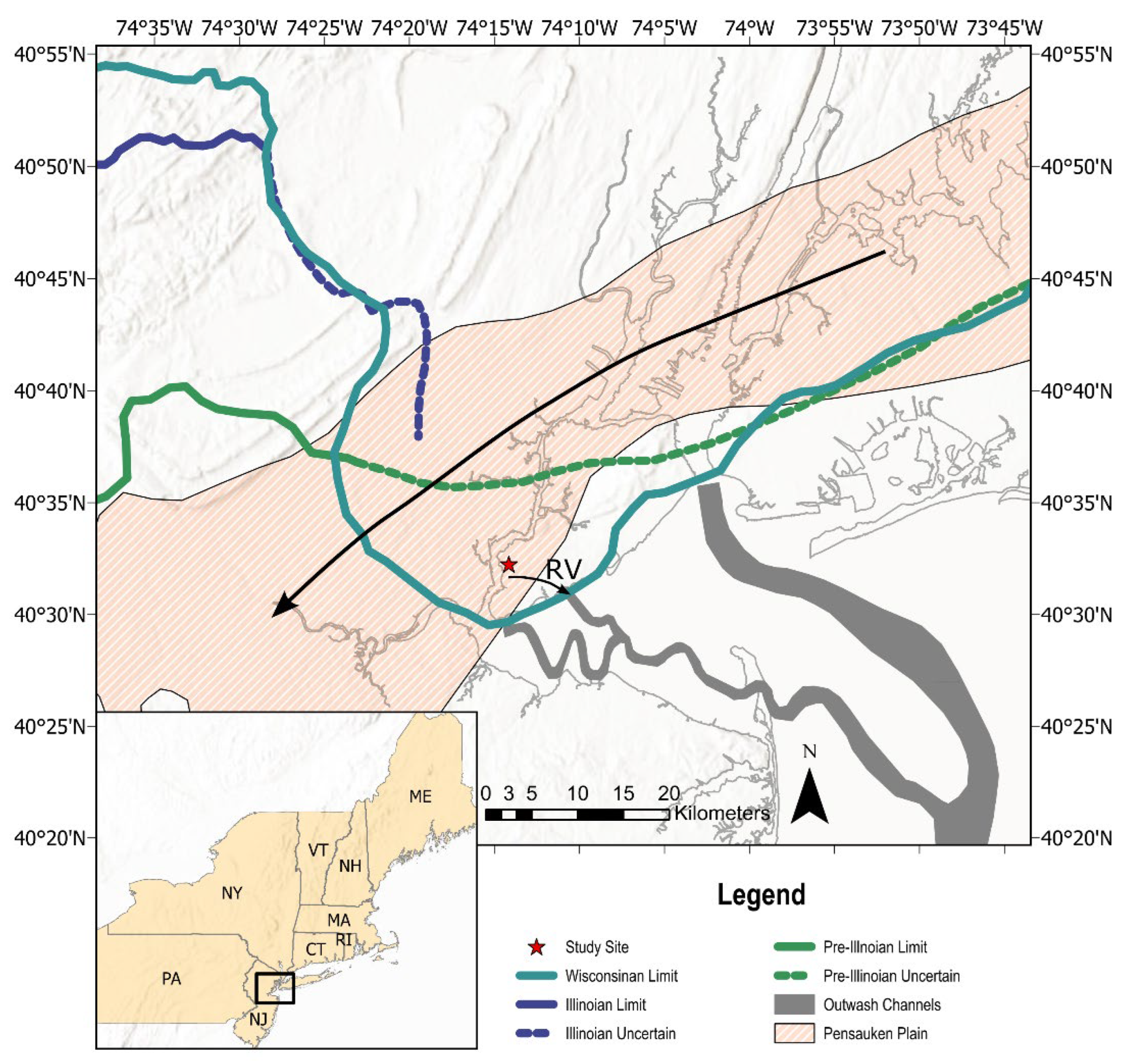
Figure 2.
Google Earth image of the study area showing locations of the two outcrops and the individual sediment logs. Imagery date 6/19/2022.
Figure 2.
Google Earth image of the study area showing locations of the two outcrops and the individual sediment logs. Imagery date 6/19/2022.
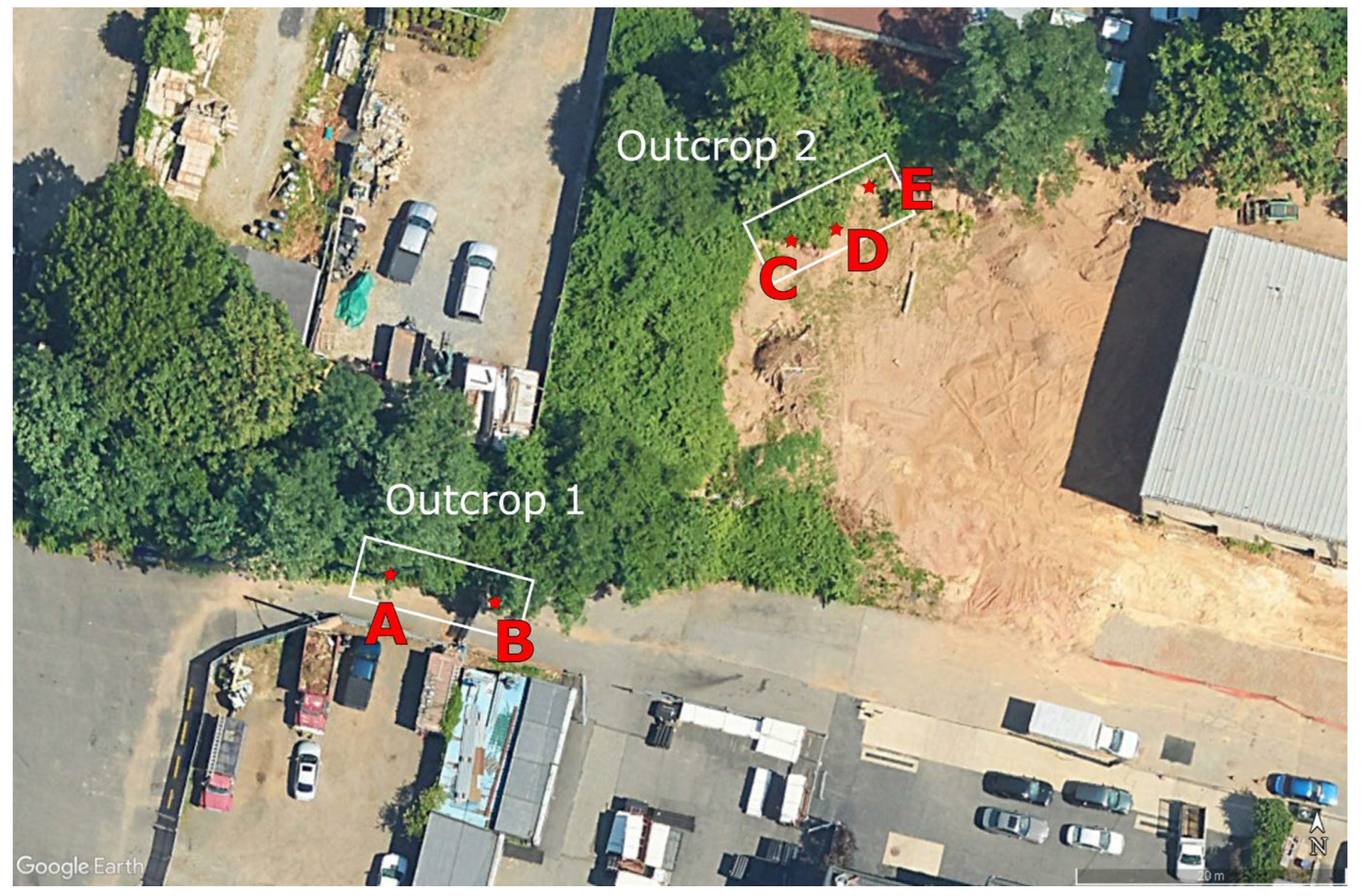
Figure 3.
Graphic sedimentary logs showing the sequence of beds measured at each of the two outcrops across the five field sections (A–E). Beds are numbered from base to top of each section. Horizontal separation of the columns is not to scale. Created using the SDAR package in RStudio [28].
Figure 3.
Graphic sedimentary logs showing the sequence of beds measured at each of the two outcrops across the five field sections (A–E). Beds are numbered from base to top of each section. Horizontal separation of the columns is not to scale. Created using the SDAR package in RStudio [28].
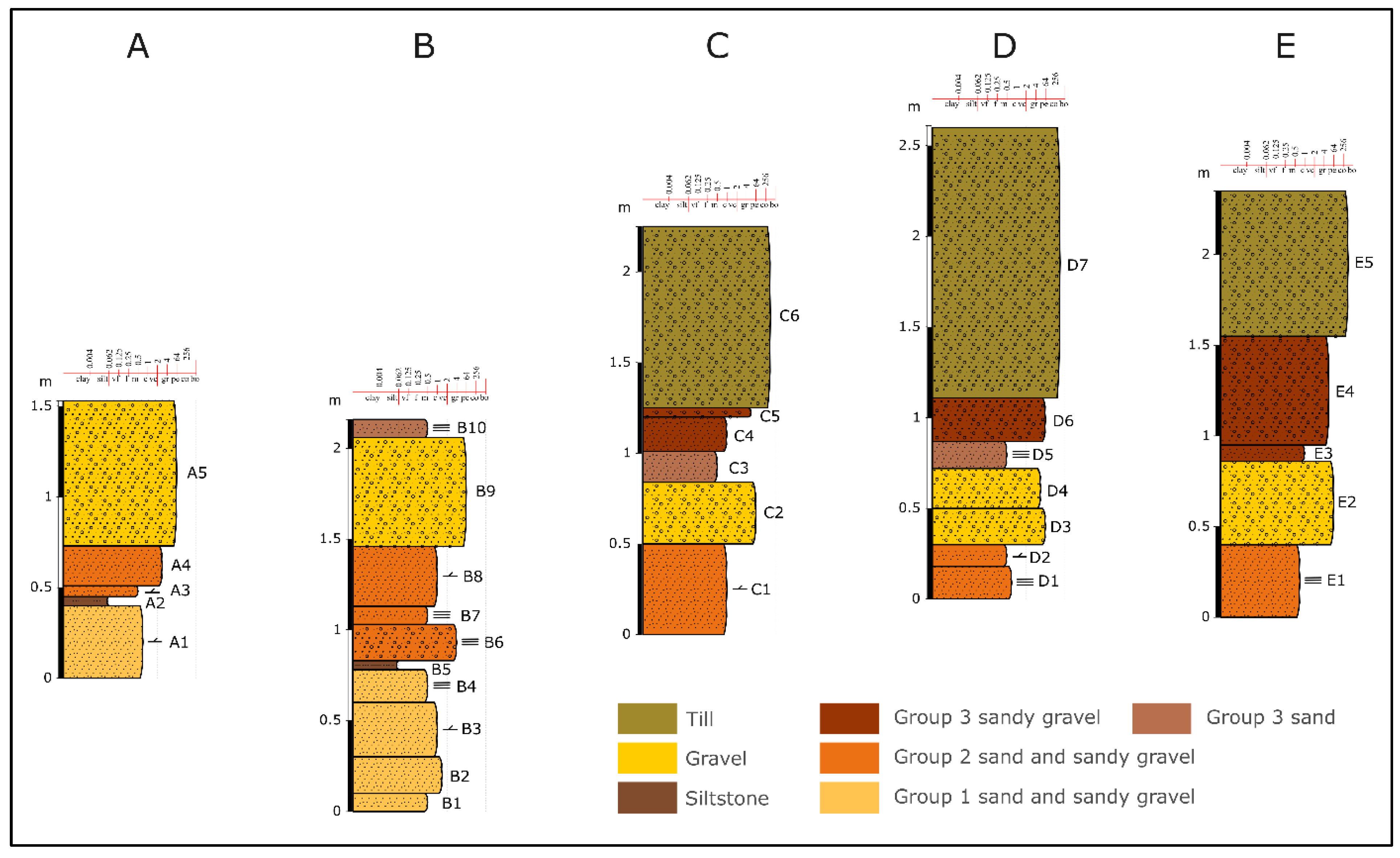
Figure 4.
Ternary diagram showing proportions of gravel, sand and mud in all samples. Relevant textural fields labelled [27]: (g)S Slightly gravelly sand; gS Gravelly sand; sG Sandy gravel; G Gravel.
Figure 4.
Ternary diagram showing proportions of gravel, sand and mud in all samples. Relevant textural fields labelled [27]: (g)S Slightly gravelly sand; gS Gravelly sand; sG Sandy gravel; G Gravel.
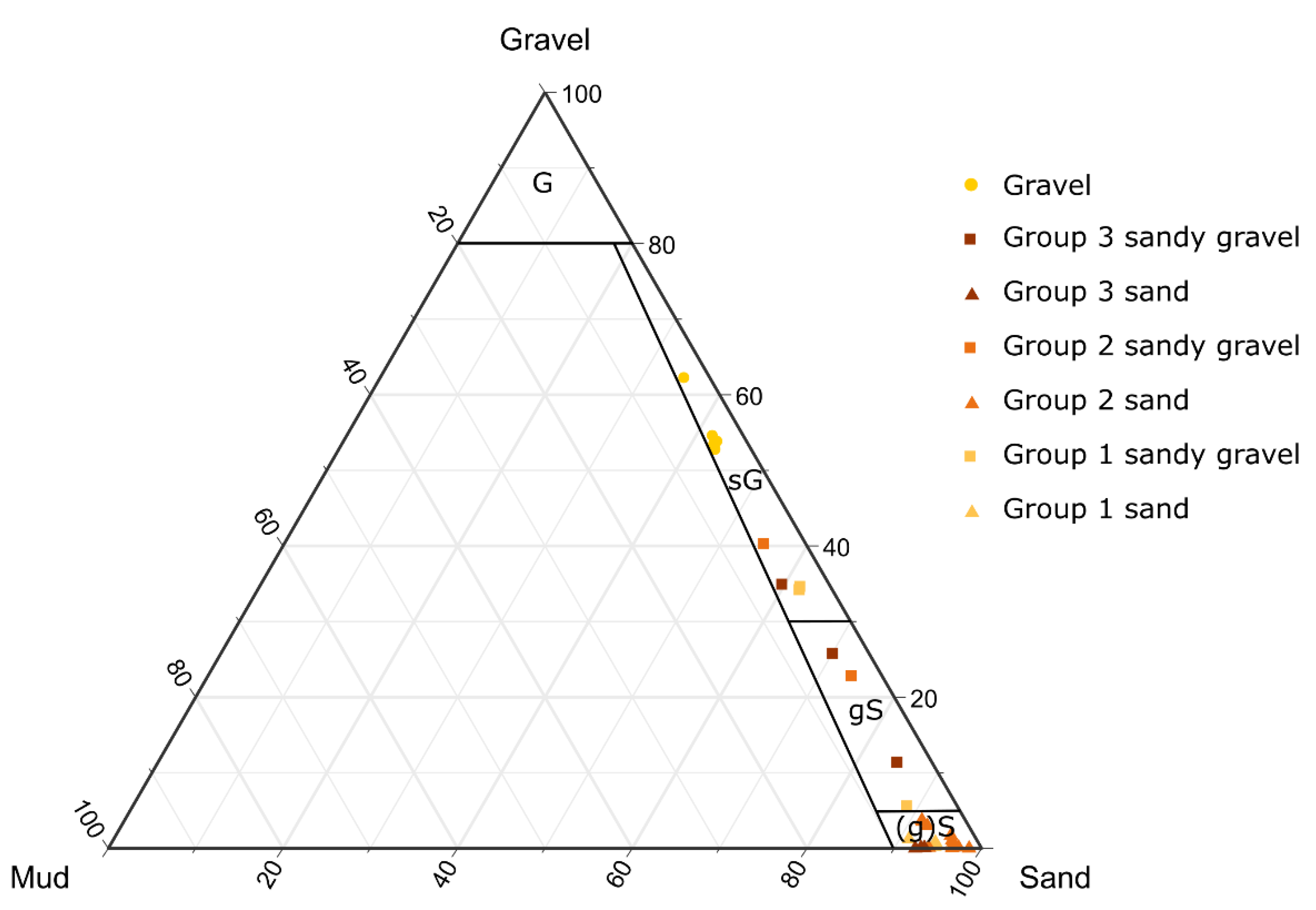
Figure 5.
Cumulative frequency curves for different size fractions (Φ). (A) includes all sand, sandy gravel and gravel samples. The remaining charts show subsets of the data by group (B) Gravel layer, (C) Group 1 sediments, (D) Group 2 sediments and (E) Group 3 sediments (see Figure 3).
Figure 5.
Cumulative frequency curves for different size fractions (Φ). (A) includes all sand, sandy gravel and gravel samples. The remaining charts show subsets of the data by group (B) Gravel layer, (C) Group 1 sediments, (D) Group 2 sediments and (E) Group 3 sediments (see Figure 3).
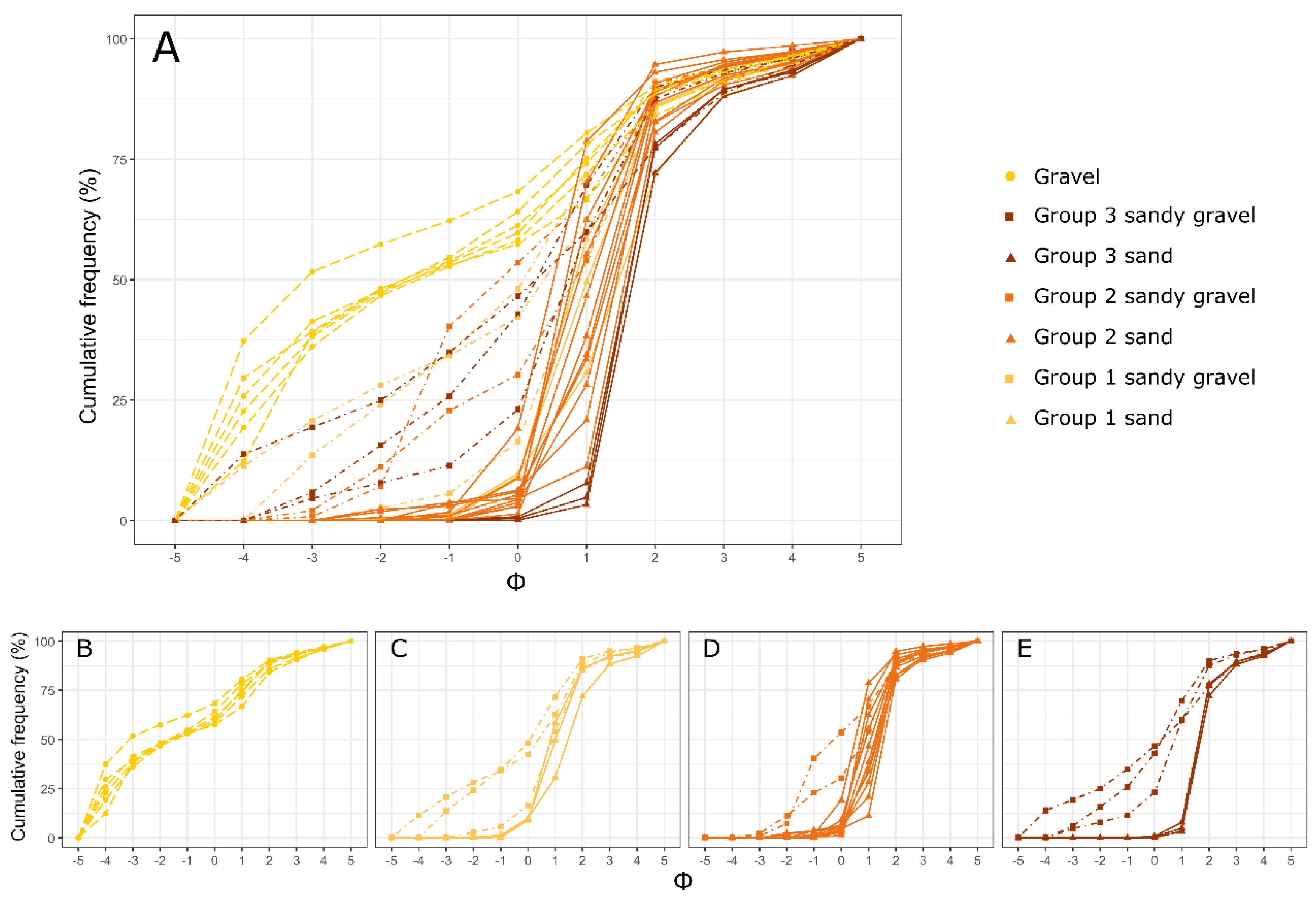
Figure 6.
Scatter plots of (A) standard deviation (sorting) versus mean clast size (Φ) and (B) skewness versus mean clast size (Φ). Dashed lines are trend lines illustrating typical interrelationships between these characteristics in fluvial sediments [26].
Figure 6.
Scatter plots of (A) standard deviation (sorting) versus mean clast size (Φ) and (B) skewness versus mean clast size (Φ). Dashed lines are trend lines illustrating typical interrelationships between these characteristics in fluvial sediments [26].
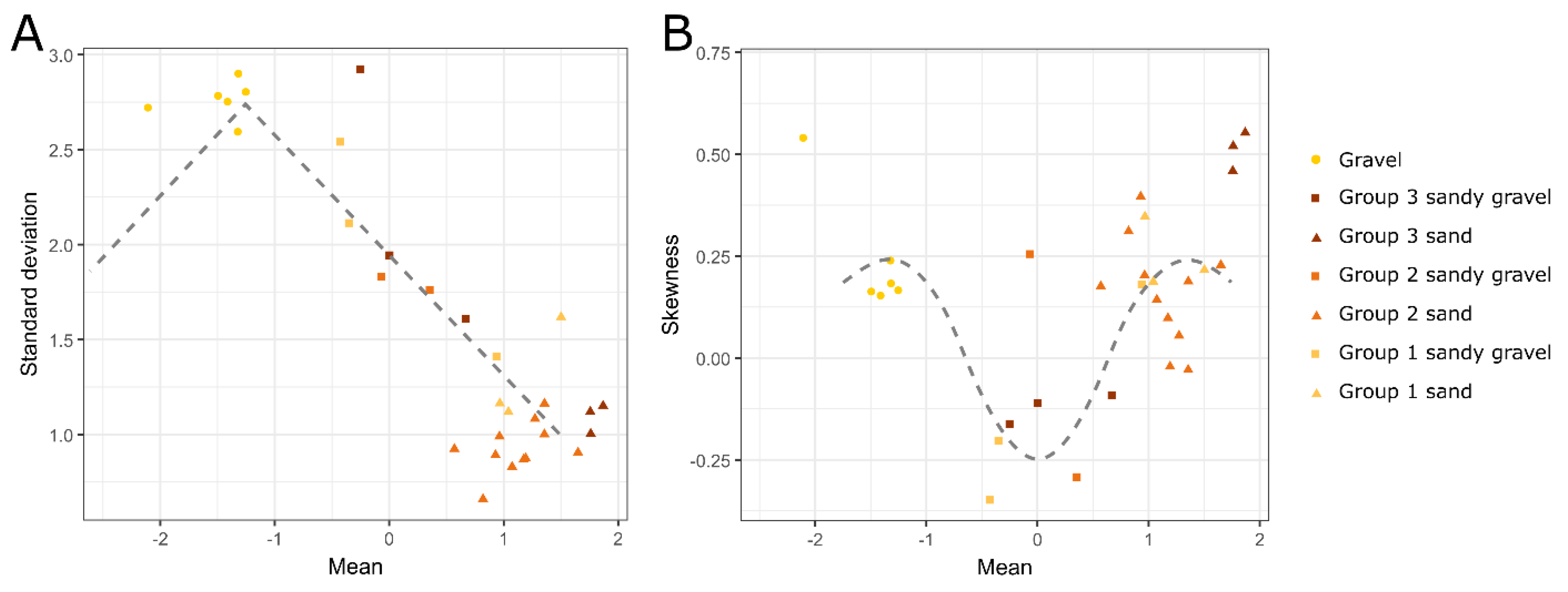
Figure 7.
Map of southwestern Staten Island. The Pensauken Formation extent on the map shows potential locations of outcrop, based on the geographic extent of the plain and the estimated altitude of the surface (55m) and base (15m) of the plain [4,35,36]. Surface deposits of the terminal moraine and ground moraine (till) are also shown [6,12,36], along with locations of the present study and previously reported outcrops of the Pensauken Formation (P1, P2 [5] and P3 [9]) and fluvioglacial outwash sediments (FG1 [11] and FG2 [11,13]).
Figure 7.
Map of southwestern Staten Island. The Pensauken Formation extent on the map shows potential locations of outcrop, based on the geographic extent of the plain and the estimated altitude of the surface (55m) and base (15m) of the plain [4,35,36]. Surface deposits of the terminal moraine and ground moraine (till) are also shown [6,12,36], along with locations of the present study and previously reported outcrops of the Pensauken Formation (P1, P2 [5] and P3 [9]) and fluvioglacial outwash sediments (FG1 [11] and FG2 [11,13]).
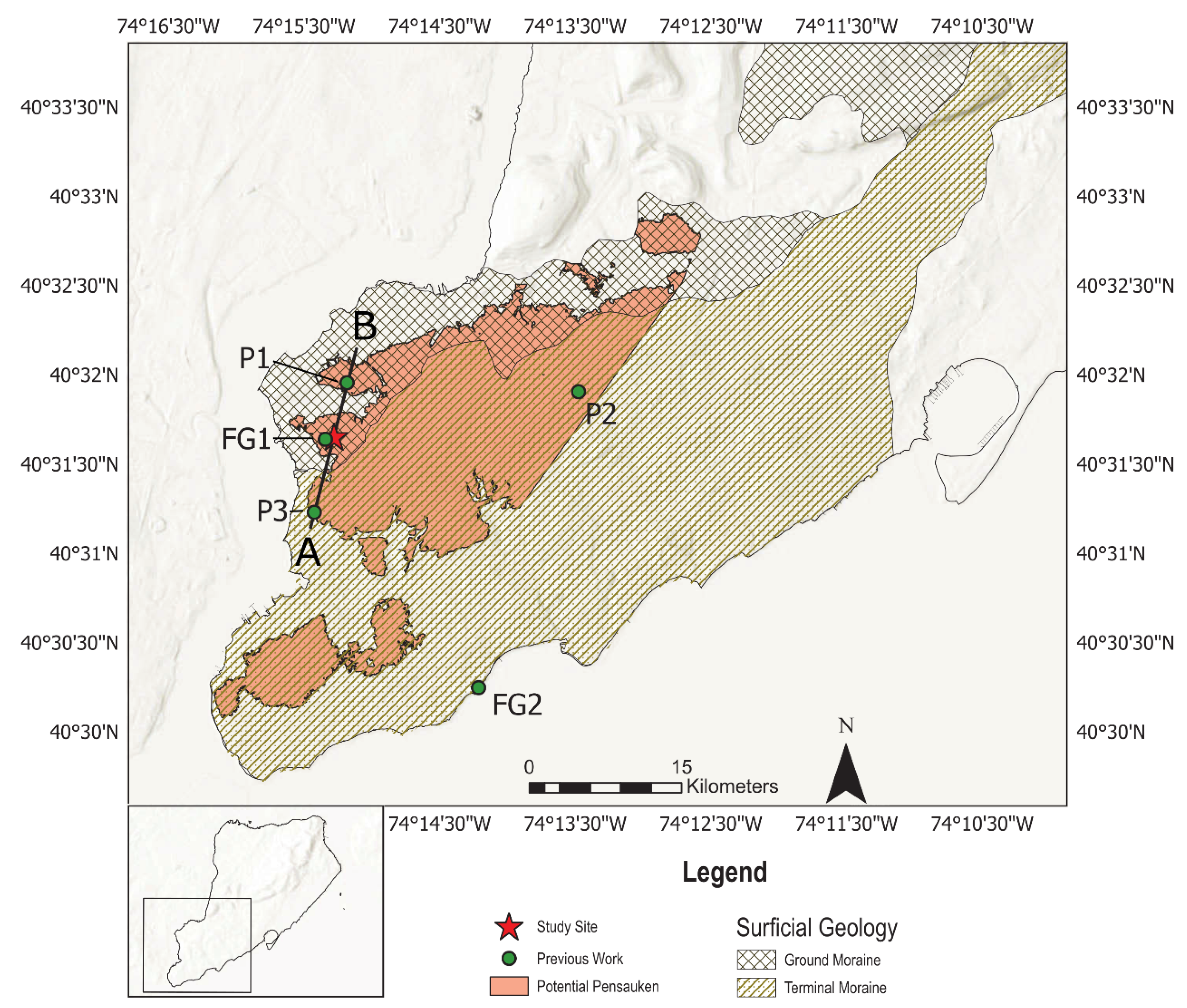
Figure 8.
Cross section A-B (Figure 7) through the Charleston area of Staten Island, including the field location of this study, previously identified outcrops of the Pensauken Formation P1 [5] and P3 [9], and pre-Illinoian fluvioglacial sediments FG1 [11].
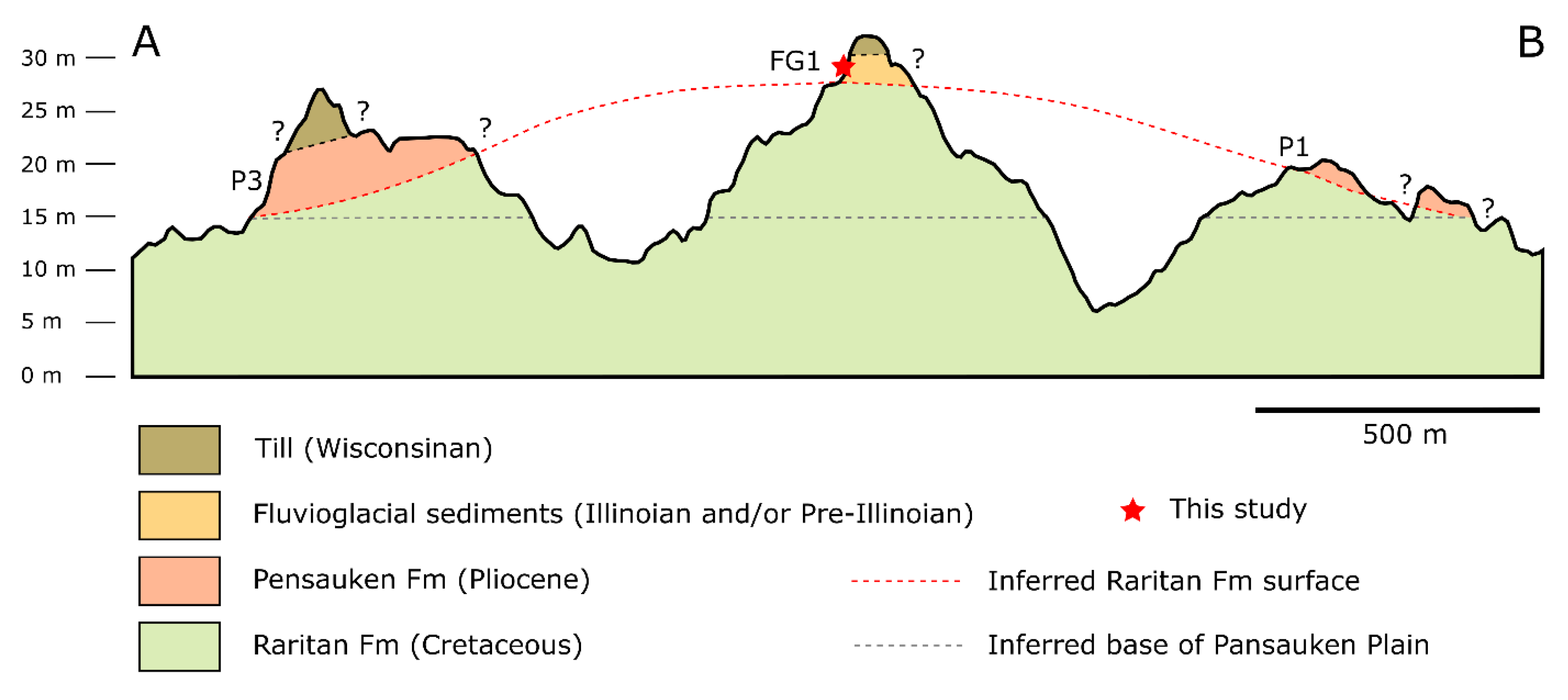

Table 1.
Clast count of all pebbles. Results are presented as percentage of total pebbles for each sample group. The lithologies are divided into the same categories as those used in previously published pebble counts from this region. “Other” includes granite, schist and unidentified clasts.
Table 1.
Clast count of all pebbles. Results are presented as percentage of total pebbles for each sample group. The lithologies are divided into the same categories as those used in previously published pebble counts from this region. “Other” includes granite, schist and unidentified clasts.
| Group | Quartz | Chert | Red sandstone and siltstone | Other sandstone and siltstone | Conglomerate | Gneiss | Basalt | Other |
|---|---|---|---|---|---|---|---|---|
| Group 1 | 23.9 | 1.3 | 35.2 | 29.2 | 9.6 | 0.3 | 0.0 | 0.3 |
| Group 2 | 28.2 | 3.9 | 25.2 | 38.8 | 0.0 | 0.0 | 1.9 | 1.9 |
| Gravel | 16.9 | 2.8 | 34.5 | 39.6 | 4.0 | 0.3 | 0.9 | 1.0 |
| Group 3 | 14.4 | 7.8 | 53.3 | 21.1 | 2.2 | 0.0 | 0.0 | 1.1 |
| Till | 3.7 | 5.6 | 63.0 | 14.8 | 3.7 | 0.0 | 3.7 | 5.6 |
Table 2.
Facies description and interpretation based on sediment texture and composition.
| Facies | Description | Beds | Interpretation |
|---|---|---|---|
| Fluvial sand and gravel FSG |
Gravelly sand and sandy gravel deposits from groups 1, 2 and 3 with gravel content from 6% to 68%. Beds 20–30 cm thick with some displaying planar horizontal or low-angle cross laminations on the scale of a few mm to cm. Mean grain size coarse sand to fine gravel, poorly to very poorly sorted, most are coarse to very coarse skewed. Bimodal with modes of coarse sand and pebbles. Pebble size clasts, mostly sandstone and shale (65–75%) and quartz and chert (22–32%), in an iron oxide stained quartz sand. Pebble source changed over time (Table 1). | A4, B2, B3, B6, B8, C4, C5, D6, E3, E4 | Deposits of glacial outwash in a braided river environment. Typical deposit from low-magnitude, high frequency meltwater events [30]. Massive gravels with horizontal bedding and planar crossbeds are found in gravel bars and bedforms in the braided river environment [29]. No evidence of vegetation or soil formation on bars. |
| Fluvial sand (braided stream) FS1 |
Sand and slightly gravelly sand deposits from groups 1 and 2. Beds 6–40 cm thick, with most displaying planar horizontal or low-angle cross laminations on the scale of a few mm. Mean grain size medium to coarse sand, moderately to poorly sorted, symmetrical to very fine skewed. Most are unimodal with a mode of medium sand. Mostly quartz, with strong iron oxide staining and some feldspar and minor minerals. Limited gravel clasts include sandstone, siltstone and quartz. | A1, A3, B1, B4, B7, C1, D1, D2, E1 | Deposits of glacial outwash in a braided river environment. Typical deposit from low-magnitude, high frequency meltwater events [30]. Horizontal and cross laminated sands represent channel fills and sandy bedforms in the braided river environment [29]. |
| Siltstone S |
Soft, partially lithified red siltstone, 5 cm thick. Bed is disrupted by influx of overlying sediments. | A2, B5 | Flood plain sediment resulting from overbank deposits of silt and clay [29]. |
| Outwash Flood gravel OG |
Sandy gravel bed found in all sections, with thickness of 30–80 cm and 53–62% gravel. Mean grain size fine gravel, poorly to very poorly sorted, fine to very fine skewed. Much less variable than FSG. Bimodal with modes of medium or coarse sand and pebbles. Pebble size clasts predominantly sandstone and shale (75%), with quartz and chert (20%) in an iron oxide stained quartz sand. Includes large pieces of soft red siltstone that appear to be rip-up clasts from facies S. Low sphericity clasts show imbrication in Sections A and B. | A5, B9, C2, D3, D4, E2 | Glacial outwash flood event resulting in the deposition of a sheet of massive, poorly sorted gravels [32]. Typical deposit from high-magnitude, low frequency meltwater events [30]. Rip-up clasts of soft silt were probably preserved due to being frozen, and are commonly found in this type of flood deposit [30]. |
| Fluvial sand (stream channel) FS2 |
Sand and slightly gravelly sand deposits from group 3. Bed 10–15 cm thick with planar laminations on the mm scale. Found above the outwash flood gravel in sections B, C and D. Mode and mean grain size medium sand, poorly sorted, very fine skewed. More fine sand and silt FS1 and no gravel. Quartz sand with less iron oxide staining than FS1. | B10, C3, D5 | Stream channel sand, probably resulting from the dewatering of the underlying flow deposit which would remobilize and deposit sediment of a finer grain size [32,34]. Different fluvial environment to FS1 [26] (Figure 6) |
| Till T |
Matrix supported boulder gravel, very poorly sorted. Clasts predominantly sandstone and shale (78%) with quartz and chert (9%), conglomerate (4%), basalt (4%) and other rock types (5%). Erosional surface between till and underlying beds. | C6, D7, E5 | Subglacial till deposited as ground moraine when the most recent (Wisconsinan) ice sheet melted [12,33]. |
Disclaimer/Publisher’s Note: The statements, opinions and data contained in all publications are solely those of the individual author(s) and contributor(s) and not of MDPI and/or the editor(s). MDPI and/or the editor(s) disclaim responsibility for any injury to people or property resulting from any ideas, methods, instructions or products referred to in the content. |
© 2026 by the authors. Licensee MDPI, Basel, Switzerland. This article is an open access article distributed under the terms and conditions of the Creative Commons Attribution (CC BY) license (http://creativecommons.org/licenses/by/4.0/).
Copyright: This open access article is published under a Creative Commons CC BY 4.0 license, which permit the free download, distribution, and reuse, provided that the author and preprint are cited in any reuse.