

Submitted:
03 March 2026
Posted:
04 March 2026
You are already at the latest version
Abstract
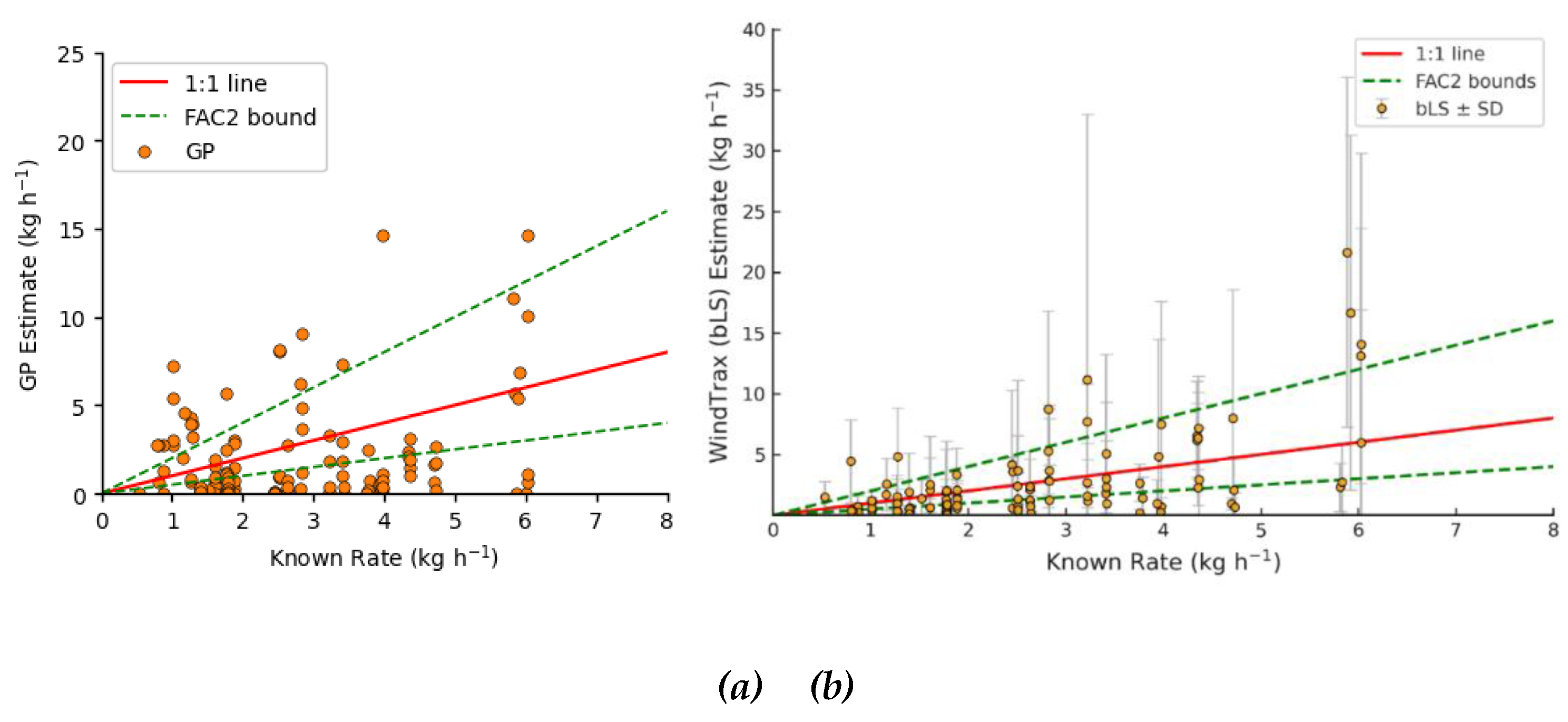
Methane (CH4) is a major component of natural gas and a potent greenhouse gas. Increasing atmospheric methane concentrations are attributed to emissive anthropogenic activities by an average of 13 ppb per yr since 2020 and are linked to a changing global climate. Mitigating CH4 emissions from oil and gas production sites has recently become a target to reduce overall greenhouse gas emissions, however, monitoring the efficacy of mitigation strategies depends on accurate quantification of CH4 emissions at the facility-level. Near-field quantification of methane (CH4) emissions from oil and gas (O&G) facilities remains challenging due to the effects of atmospheric variability and sensor configuration on atmospheric dispersion models. This study evaluates the performance of two atmospheric dispersion models, the Gaussian Plume (GP) and backward Lagrangian Stochastic (bLS), by comparing calculated CH4 emissions to controlled single-point emissions of between 0.4 and 5.2 kg CH4 h-1. Emissions were calculated by both models using 121 individual sets of measurements comprising five-minute averaged downwind methane mixing ratios and matching meteorological data. Comparison shows the bLS approach showed better predictive performance with twice as many emission estimates were within a factor of two (FAC2) of the known emission rates compared to those calculated using the GP approach. The emissions calculated by the bLS model also had a lower multiplicative error and reduced bias relative to GP. Other error-based metrics further confirmed the bLS model performed better, as it yielded lower RMSE and MAE than GP. Statistical analysis of the emission data shows the lateral and vertical alignment of source and sensor plays a critical role in emission estimations as measurements made closer to the plume centerline and at a distance between 40 to 80 m downwind yielded the best FAC2 agreement. High wind meander degraded ability of both approaches to generate representative emissions particularly with the GP approach as it violates the modelling approach’s assumption of steady-state emissions. Data suggest emissions calculated by the bLS model are comprehensively in better agreement but the computational demands of the modeling approach and integration into fenceline systems limit real-time applicability. While it is likely that the results presented here are suitable for informing leak detection technology in relatively flat unvegetated environments, it is currently unknown if these findings will be applicable in more vertiginous or heavily vegetated oil and gas producing regions of the Marcellus or Uinta Basins.
Keywords:
1. Introduction
2. Materials and Methods
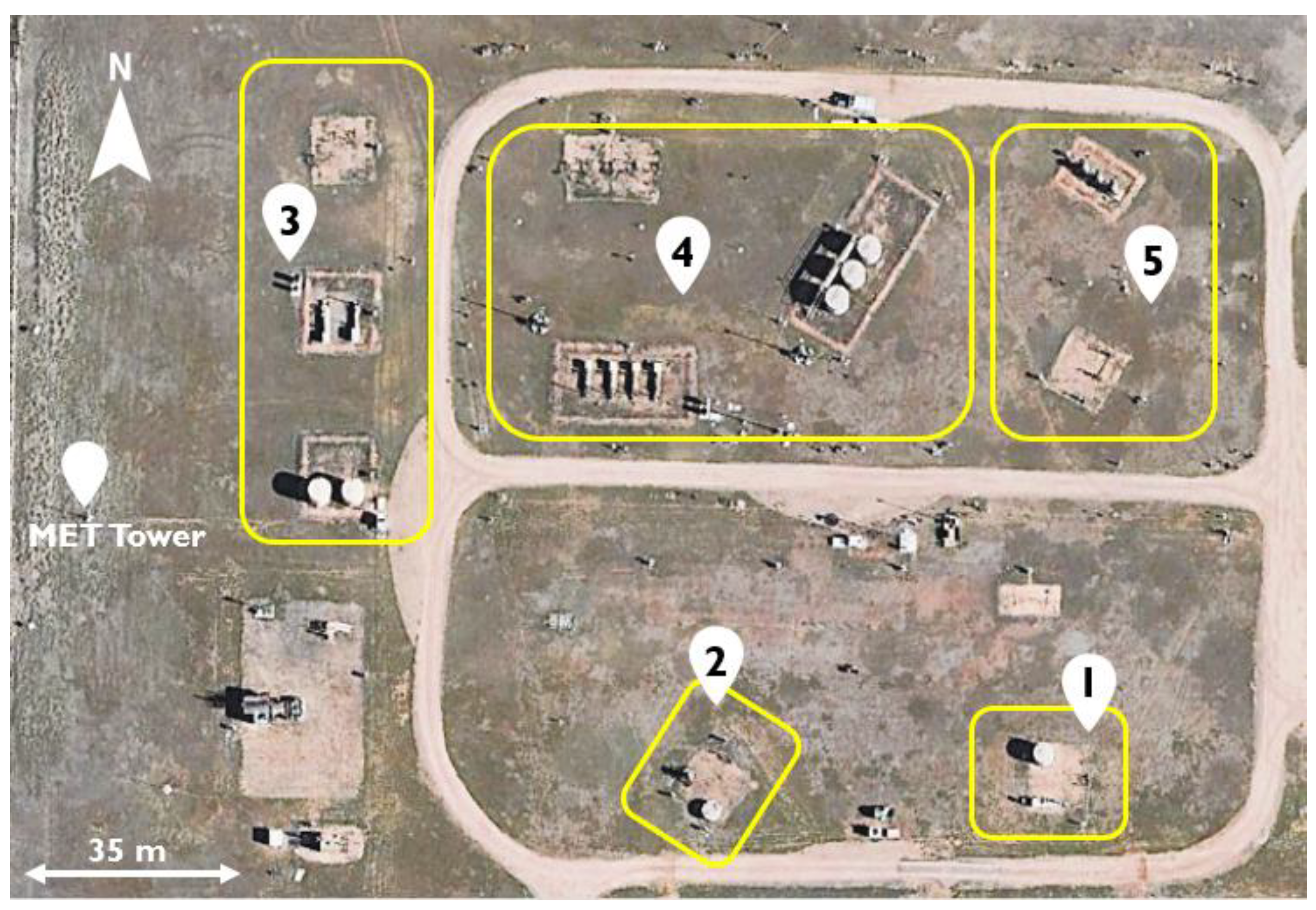
2.1. Site Description and Experiment Design
2.2. Meteorological Measurement
2.3. Methane Mixing Ratio Measurement
2.4. Controlled Release System
2.5. Modeling
2.5.1. Gaussian Plume (GP) Approach
2.5.2. Backward Lagrangian Stochastic (bLS) Approach
2.6. Performance Analysis
2.7. Statistical Analysis
3. Results
3.1. Measurement Data
3.1.1. Methane Mixing Ratio
3.1.2. Meteorology
3.2. Emissions
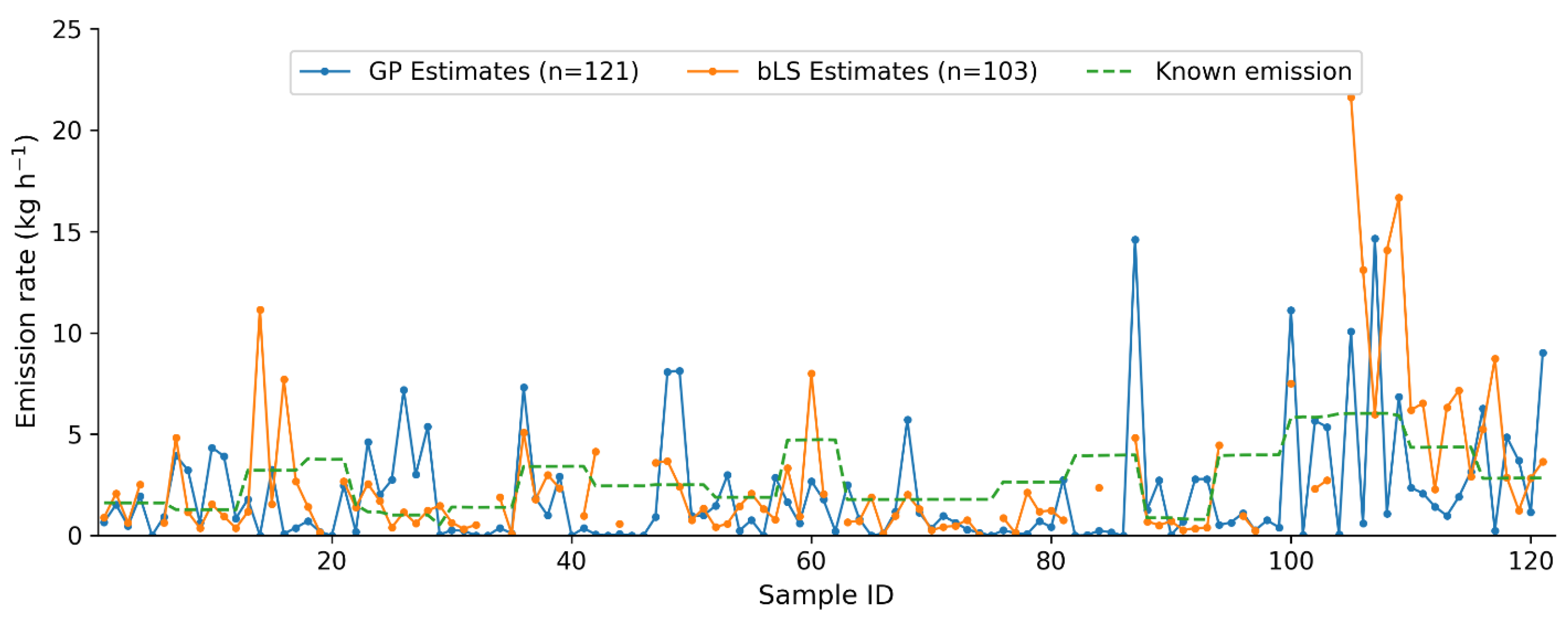
3.2.1. Calculated Emissions
3.2.2. GP and bLS Performance Analysis
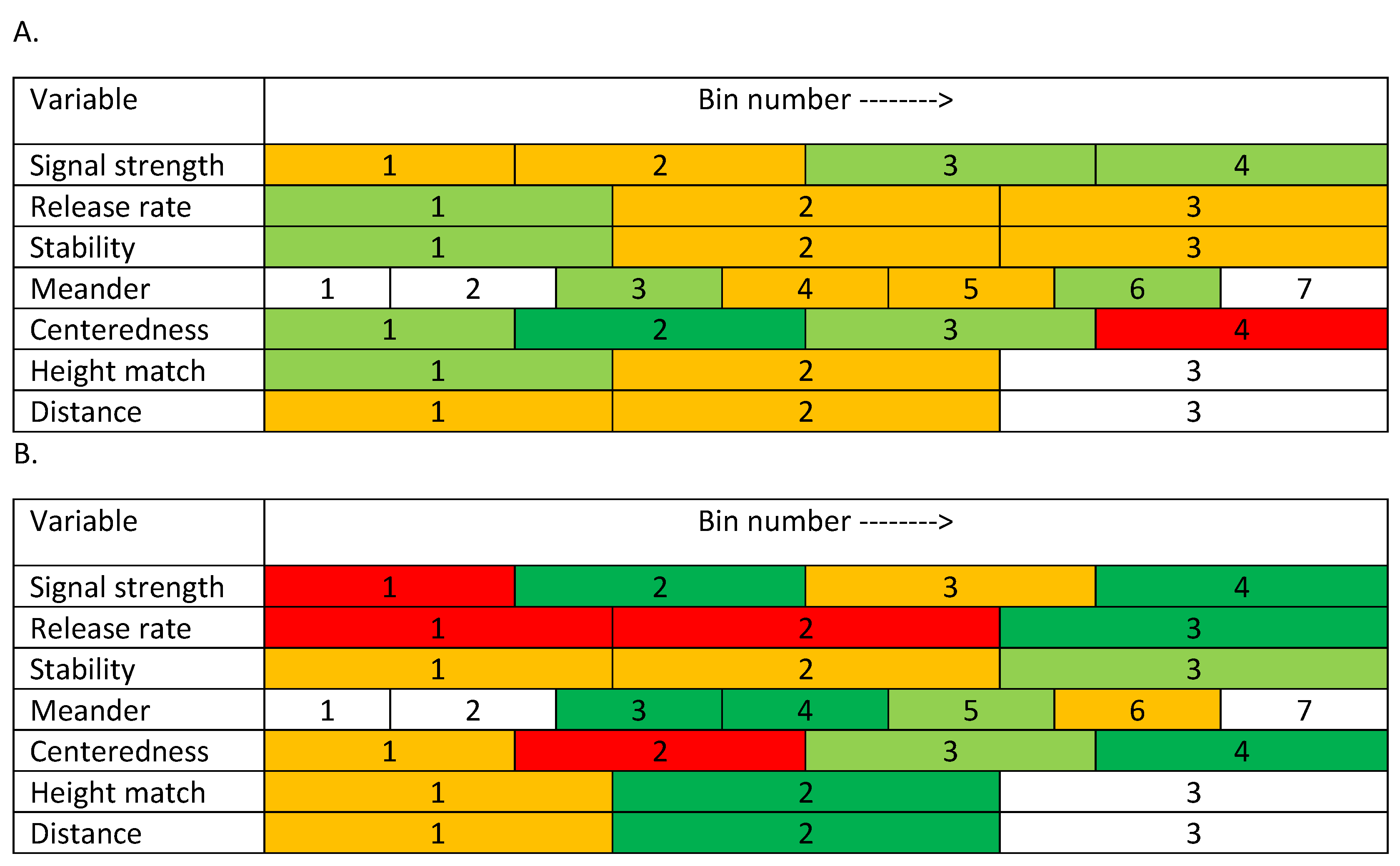
3.3. Statistical Analyses
4. Discussion
4.1. Comparative Performance of GP and bLS
4.2. Statistical Analyses
4.3. Limitation and Scope
5. Conclusions
Supplementary Materials
Author Contributions
Funding
Institutional Review Board Statement
Informed Consent Statement
Data Availability Statement
Conflicts of Interest
References
- Forster, P.; Storelvmo, T.; Armour, K.; Collins, W.; Dufresne, J.-L.; Frame, D.; Lunt, D.; Mauritsen, T.; Palmer, M.; Watanabe, M.; Wild, M.; Zhang, H. Chapter 7: The Earth’s energy budget, climate feedbacks, and climate sensitivity. In Climate Change 2021—The Physical Science Basis: Contribution of Working Group I to the Sixth Assessment Report of the Intergovernmental Panel on Climate Change; Cambridge University Press: Cambridge, UK and New York, NY, USA, 2021; pp. 923–1054. Available online: https://www.ipcc.ch/report/ar6/wg1/chapter/chapter-7/ (accessed on 24 October 2025).
- Saunois, M.; Martinez, A.; Poulter, B.; Zhang, Z.; Raymond, P.A.; Regnier, P.; Canadell, J.G.; Jackson, R.B.; Patra, P.K.; Bousquet, P.; Ciais, P.; Dlugokencky, E.J.; Lan, X.; Allen, G.H.; Bastviken, D.; Beerling, D.J.; Belikov, D.A.; Blake, D.R.; Castaldi, S.; Crippa, M.; Deemer, B.R.; Dennison, F.; Etiope, G.; Gedney, N.; Höglund-Isaksson, L.; Holgerson, M.A.; Hopcroft, P.O.; Hugelius, G.; Ito, A.; Jain, A.K.; Janardanan, R.; Johnson, M.S.; Kleinen, T.; Krummel, P.B.; Lauerwald, R.; Li, T.; Liu, X.; McDonald, K.C.; Melton, J.R.; Mühle, J.; Müller, J.; Murguia-Flores, F.; Niwa, Y.; Noce, S.; Pan, S.; Parker, R.J.; Peng, C.; Ramonet, M.; Riley, W.J.; Rocher-Ros, G.; Rosentreter, J.A.; Sasakawa, M.; Segers, A.; Smith, S.J.; Stanley, E.H.; Thanwerdas, J.; Tian, H.; Tsuruta, A.; Tubiello, F.N.; Weber, T.S.; van der Werf, G.R.; Worthy, D.E.J.; Xi, Y.; Yoshida, Y.; Zhang, W.; Zheng, B.; Zhu, Q.; Zhu, Q.; Zhuang, Q. Global methane budget 2000–2020. Earth Syst. Sci. Data 2025, 17, 1873–1958.
- Stein, T. No sign of greenhouse gases increases slowing in 2023. NOAA Research 2023. Available online: https://research.noaa.gov/no-sign-of-greenhouse-gases-increases-slowing-in-2023/ (accessed on 24 October 2025).
- National Oceanic and Atmospheric Administration. Current greenhouse gas levels. NOAA Climate.gov 2025. Available online: https://www.climate.gov/ghg/current-levels (accessed on 24 October 2025).
- Omara, M.; Zavala-Araiza, D.; Lyon, D.R.; Hmiel, B.; Roberts, K.A.; Hamburg, S.P. Methane emissions from US low production oil and natural gas well sites. Nat. Commun. 2022, 13, 2085. [CrossRef]
- Guo, J.; Zhang, J.; Shao, J.; Chen, T.; Bai, K.; Sun, Y.; Li, N.; Wu, J.; Li, R.; Li, J.; Guo, Q.; Cohen, J.B.; Zhai, P.; Xu, X.; Hu, F. A merged continental planetary boundary layer height dataset based on high-resolution radiosonde measurements, ERA5 reanalysis, and GLDAS. Earth Syst. Sci. Data 2024, 16, 1–14.
- National Academies of Sciences, Engineering, and Medicine. Methane emission measurement and monitoring methods. In Improving Characterization of Anthropogenic Methane Emissions in the United States; National Academies Press: Washington, DC, USA, 2018. Available online: https://www.ncbi.nlm.nih.gov/books/NBK519293/ (accessed on 03 October 2025).
- Peng, S. Challenges and opportunities in the global methane cycle. iScience 2023, 26, 106878. [CrossRef]
- Storm, I.M.L.D.; Hellwing, A.L.F.; Nielsen, N.I.; Madsen, J. Methods for measuring and estimating methane emission from ruminants. Animals 2012, 2, 160–183. [CrossRef]
- Alvarez, R.A.; Zavala-Araiza, D.; Lyon, D.R.; Allen, D.T.; Barkley, Z.R.; Brandt, A.R.; Davis, K.J.; Herndon, S.C.; Jacob, D.J.; Karion, A.; Kort, E.A.; Lamb, B.K.; Lauvaux, T.; Maasakkers, J.D.; Marchese, A.J.; Omara, M.; Pacala, S.W.; Peischl, J.; Robinson, A.L.; Shepson, P.B.; Sweeney, C.; Townsend-Small, A.; Wofsy, S.C.; Hamburg, S.P. Assessment of methane emissions from the U.S. oil and gas supply chain. Science 2018, 361, 186–188. [CrossRef]
- Lyon, D.R.; Alvarez, R.A.; Zavala-Araiza, D.; Brandt, A.R.; Jackson, R.B.; Hamburg, S.P. Aerial surveys of elevated hydrocarbon emissions from oil and gas production sites. Environ. Sci. Technol. 2016, 50, 4877–4886. [CrossRef]
- Mbua, M.; Riddick, S.N.; Kiplimo, E.; Shonkwiler, K.B.; Hodshire, A.; Zimmerle, D. Evaluating the feasibility of using downwind methods to quantify point source oil and gas emissions using continuously monitoring fence-line sensors. Atmos. Meas. Tech. 2025, 18, 5687–5703. [CrossRef]
- Zavala-Araiza, D.; Lyon, D.; Alvarez, R.A.; Palacios, V.; Harriss, R.; Lan, X.; Talbot, R.; Hamburg, S.P. Toward a functional definition of methane super-emitters: Application to natural gas production sites. Environ. Sci. Technol. 2015, 49, 8167–8174. [CrossRef]
- Allen, D.T.; Torres, V.M.; Thomas, J.; Sullivan, D.W.; Harrison, M.; Hendler, A.; Herndon, S.C.; Kolb, C.E.; Fraser, M.P.; Hill, A.D.; Lamb, B.K.; Mohan, J.M.; Robinson, R.F.; Stone, J.E.; Szwec, E.T.; Yacovitch, R.L. Measurements of methane emissions at natural gas production sites in the United States. Proc. Natl. Acad. Sci. U.S.A. 2013, 110, 17768–17773. [CrossRef]
- Pandey, S.; Worden, J.; Cusworth, D.H.; Varon, D.J.; Thill, M.D.; Jacob, D.J.; Bowman, K.W. Relating multi-scale plume detection and area estimates of methane emissions: A theoretical and empirical analysis. Environ. Sci. Technol. 2025, 59, 7931–7947. [CrossRef]
- Worden, J.; Green, P.; Eldering, A.; Sherwin, E. Common practices for quantifying methane emissions from plumes detected by remote sensing. NIST Interagency Report NIST.IR.8575; National Institute of Standards and Technology: Gaithersburg, MD, USA, 2025. Available online: . [CrossRef]
- Clarke, L.; Wei, Y.-M.; De La Vega Navarro, A.; Garg, A.; Hahmann, A.N.; et al. Energy systems. In Climate Change 2022: Mitigation of Climate Change; Contribution of Working Group III to the Sixth Assessment Report of the Intergovernmental Panel on Climate Change; Cambridge University Press: Cambridge, UK; New York, NY, USA, 2022; pp. 613–746. Available online: . [CrossRef]
- U.S. Environmental Protection Agency. Subpart W—petroleum and natural gas systems. EPA Greenhouse Gas Reporting Program 2025. Available online: https://www.epa.gov/ghgreporting/subpart-w-petroleum-and-natural-gas-systems (accessed on 11 February 2026).
- Rutherford, J.S.; Sherwin, E.D.; Ravikumar, A.P.; Heath, G.A.; Englander, J.; Cooley, D.; Lyon, D.; Omara, M.; Langfitt, Q.; Brandt, A.R. Closing the methane gap in US oil and natural gas production emissions inventories. Nat. Commun. 2021, 12, 4715. [CrossRef]
- Williams, J.P.; El Hachem, K.; Kang, M. Controlled-release testing of the static chamber methodology for direct measurements of methane emissions. Atmos. Meas. Tech. 2023, 16, 3421–3435. [CrossRef]
- Ravikumar, A.P.; Brandt, A.R. Designing better methane mitigation policies: the challenge of distributed small sources in the natural gas sector. Environ. Res. Lett. 2017, 12, 044023. [CrossRef]
- Jacob, D.J.; Varon, D.J.; Cusworth, D.H.; Dennison, P.E.; Frankenberg, C.; Gautam, R.; Guanter, L.; Kelley, J.; McKeever, J.; Ott, L.E.; Poulter, B.; Qu, Z.; Thorpe, A.K.; Worden, J.R.; Duren, R.M. Quantifying methane emissions from the global scale down to point sources using satellite observations of atmospheric methane. Atmos. Chem. Phys. 2022, 22, 9617–9646. [CrossRef]
- Sherwin, E.D.; El Abbadi, S.H.; Burdeau, P.M.; Zhang, Z.; Chen, Z.; Rutherford, J.S.; Chen, Y.; Brandt, A.R. Single-blind test of nine methane-sensing satellite systems. Atmos. Meas. Tech. 2024, 17, 765–782. [CrossRef]
- Barkley, Z.; Davis, K.; Miles, N.; Richardson, S.; Deng, A.; Hmiel, B.; Lyon, D.; Lauvaux, T. Quantification of oil and gas methane emissions in the Delaware and Marcellus basins using a network of continuous tower-based measurements. Atmos. Chem. Phys. 2023, 23, 6127–6144. [CrossRef]
- Rocky Mountain Institute. Clean energy 101: Methane-detecting satellites. 2023. Available online: https://rmi.org/clean-energy-101-methane-detecting-satellites/ (accessed on 11 February 2026.
- Anand, A.; Riddick, S.; Shonkwiler, K.B.; Upreti, A.; Moy, M.; Kiplimo, E.; Mbua, M.; Zimmerle, D.J. Computational fluid dynamics-based modeling of methane flows around oil and gas equipment. Atmosphere 2025, 16, 811. [CrossRef]
- Flesch, T.K.; Wilson, J.D.; Yee, E. Backward-time Lagrangian stochastic dispersion models and their application to estimate gaseous emissions. J. Appl. Meteorol. 1995, 34, 1320–1332. [CrossRef]
- McGinn, S.M.; Beauchemin, K.A.; Flesch, T.K.; Coates, T. Performance of a dispersion model to estimate methane loss from cattle in pens. J. Environ. Qual. 2009, 38, 1796–1802. [CrossRef]
- Riddick, S.N.; Ancona, R.; Mbua, M.; Bell, C.S.; Duggan, A.; Vaughn, T.L.; Bennett, K. A quantitative comparison of methods used to measure smaller methane emissions typically observed from superannuated oil and gas infrastructure. Atmos. Meas. Tech. 2022, 15, 6285–6296. [CrossRef]
- Riddick, S.N. Quantifying methane emission rates using downwind measurements. Encyclopedia 2025, 5, 57. [CrossRef]
- Ball, D.; Ismail, U.; Eichenlaub, N.; Metzger, N.; Lashgari, A. Performance evaluation of multi-source methane emission quantification models using fixed-point continuous monitoring systems. EGUsphere 2025, preprint. [CrossRef]
- Blackmore, D.C.; Hickey, J.-P.; Wigle, A.; Osadetz, K.; Daun, K.J. A Bayesian technique for quantifying methane emissions using vehicle-mounted sensors with a Gaussian plume model. Atmos. Environ. 2025, 344, 121002. [CrossRef]
- Jia, M.; Daniels, W.S.; Hammerling, D.M. Comparison of the Gaussian plume and puff atmospheric dispersion models for methane modeling on oil and gas sites. ChemRxiv 2023, preprint. [CrossRef]
- Stockie, J.M. The mathematics of atmospheric dispersion modeling. SIAM Rev. 2011, 53, 349–372. [CrossRef]
- United States Environmental Protection Agency. Air quality dispersion modeling—alternative models. Environmental Protection Agency 2025. Available online: https://www.epa.gov/scram/air-quality-dispersion-modeling-alternative-models (accessed on 07 October 2025).
- Flesch, T.K.; Wilson, J.D.; Harper, L.A.; Crenna, B.P.; Sharpe, R.R. Deducing ground-to-air emissions from observed trace gas concentrations: A field trial. J. Appl. Meteorol. 2004, 43, 487–502. [CrossRef]
- Crenna, B. An introduction to WindTrax. Thunder Beach Scientific: Ontario, Canada, 2006. Available online: http://thunderbeachscientific.com/ (accessed on 24 October 2025).
- Flesch, T.K.; McGinn, S.M.; Chen, D.; Wilson, J.D.; Desjardins, R.L. Data filtering for inverse dispersion emission calculations. Agric. For. Meteorol. 2014, 198–199, 1–6. [CrossRef]
- Cusworth, D.H.; Duren, R.M.; Thorpe, A.K.; Olson-Duvall, W.; Heckler, J.; Chapman, J.W.; Eastwood, M.L.; Helmlinger, M.C.; Green, R.O.; Asner, G.P.; Dennison, P.E.; Miller, C.E. Intermittency of large methane emitters in the Permian Basin. Environ. Sci. Technol. Lett. 2021, 8, 567–573. [CrossRef]
- Day, R.E.; Emerson, E.; Bell, C.; Zimmerle, D. Point sensor networks struggle to detect and quantify short controlled releases at oil and gas sites. Sensors 2024, 24, 2419. [CrossRef]
- S. Environmental Protection Agency. Meteorological monitoring guidance for regulatory modeling applications; EPA-454/R-99-005; Office of Air Quality Planning and Standards, Office of Air and Radiation, U.S. Environmental Protection Agency: Research Triangle Park, NC, USA, 2000. Available online: https://www.epa.gov/sites/default/files/2020-10/documents/mmgrma_0.pdf (accessed on 07 October 2025).
- ABB Inc. GLA131 Series Micro-Portable Laser Greenhouse Gas Analyzer—Technical Datasheet, Rev. E; ABB Measurement & Analytics: Zurich, Switzerland, 2024. Available online: https://library.e.abb.com/public/38c584d5512742aeae816d8dd62c00b3/ABB+GLA133_series+Datasheet_EN_Rev.E.pdf (accessed on 24 October 2025).
- United States Environmental Protection Agency. OTM 33A—Point Source Gaussian (PSG) analysis standard operating procedure, Revision 0; Office of Research and Development, National Risk Management Research Laboratory: Research Triangle Park, NC, USA, 2013. Available online: https://www.epa.gov/sites/default/files/2020-08/documents/otm_33a_appendix_f1_psg_analysis_sop.pdf (accessed on 24 October 2025).
- Zimmerle, D.J.; Vaughn, T.L.; Bell, C.M.; Bennett, M.L.; Duggan, G.A.; Harrison, B.K.; Schneider, J.; Robertson, A.L.; Heath, M.K.; Lyon, D.R.; Hamburg, S.P.; Brandt, A.R.; Alvarez, R.A. Methane emissions from the natural gas transmission and storage system in the United States. Environ. Sci. Technol. 2015, 49, 9374–9383.
- Riddick, S.N.; Mbua, M.; Laughery, C.; Zimmerle, D.J. A review of offshore methane quantification methodologies. Atmosphere 2025, 16, 626. [CrossRef]
- Seinfeld, J.H.; Pandis, S.N. Atmospheric chemistry and physics: From air pollution to climate change, 3rd ed.; John Wiley & Sons: Hoboken, NJ, USA, 2016.
- Chang, J.C.; Hanna, S.R. Air quality model performance evaluation. Meteorol. Atmos. Phys. 2004, 87, 167–196.
- Hanna, S.R.; Chang, J.C.; Strimaitis, D.G. Hazardous gas model evaluation with field observations. Atmos. Environ. A 1993, 27, 2265–2285. [CrossRef]
- Hanna, S.R.; Briggs, G.A.; Hosker, R.P., Jr. Handbook on atmospheric diffusion; DOE/TIC-11223; U.S. Department of Energy: Washington, DC, USA, 1982. Available online: . [CrossRef]
- South Coast Air Quality Management District. Meteorological data for AERMOD. South Coast AQMD 2025. Available online: https://www.aqmd.gov/home/air-quality/meteorological-data/data-for-aermod (accessed on 07 October 2025).

| Metric | GP | bLS |
| FAC2 (%) | 24.8 | 51.5 |
| GM | 0.08 | 0.63 |
| MFoE | 3.5 | 1.9 |
| MAE (kg h-1) | 2.4 | 1.5 |
| RMSE (kg h-1) | 3.0 | 2.6 |
| MB (kg h-1) | -0.8 | 0.04 |
Disclaimer/Publisher’s Note: The statements, opinions and data contained in all publications are solely those of the individual author(s) and contributor(s) and not of MDPI and/or the editor(s). MDPI and/or the editor(s) disclaim responsibility for any injury to people or property resulting from any ideas, methods, instructions or products referred to in the content. |
© 2026 by the authors. Licensee MDPI, Basel, Switzerland. This article is an open access article distributed under the terms and conditions of the Creative Commons Attribution (CC BY) license (http://creativecommons.org/licenses/by/4.0/).


