
Submitted:
28 February 2026
Posted:
03 March 2026
You are already at the latest version
Abstract
This study investigates the influence of circular-economy transparency (CET) on responsible purchase intention (RPI) within the electronics market, elucidating the mediating role of perceived green authenticity (PGA) and the boundary condition of greenwashing skepticism (GWS). We used PLS-SEM (SmartPLS 4) with bootstrapping to test direct effects, mediation, moderation, and moderated mediation on a cross-sectional online survey of 400 adult electronics customers in Saudi Arabia. The results indicate that CET positively predicts PGA and RPI, with PGA significantly enhancing RPI. This suggests that perceptions of authenticity convey a significant aspect of transparency's impact on responsible intentions. Nonetheless, GWS considerably diminishes the CET→PGA and PGA→RPI relationships and lessens the potency of the indirect CET→PGA→RPI pathway, indicating that skeptical consumers more rigorously disregard cues of transparency and authenticity. The model provides a strong description of the observed variance in both PGA and RPI, justifying its explanatory and predictive value. These results suggest that electronics brands and policymakers would do well to complement transparency programs with measurable, decision-relevant information disclosures and trust-enhancing procedures (e.g., traceability and third-party validation) in order to minimize distrust and enable responsible purchasing.
Keywords:
circular-economy transparency
; perceived green
; green authenticity
; responsible purchase intention
; electronic market
; Saudi Arabia
; PLS-SEM
; moderated mediation
1. Introduction
The shift towards a circular economy increasingly relies on consumer s willingness to select products that are designed, used and recovered in a more responsible manner with respect to resource deployment an issue of particular concern within the (often technically complex, rapidly changing and high material/environmental footprint) electronics market. However, many circular characteristics that matter when making responsible choices (e.g., recycled content, repairability, refurbishment pathways, take-back options and lifecycle impacts) are difficult to validate at the point of purchase, requiring consumers to trust in firms’ communications and marketplace information infrastructures [1,2]. This information asymmetry leads to overstatement or selective disclosure of credence-type sustainability claims, increasing the level of uncertainty and skepticism among stakeholders [3].
Circular-economy transparency (CET)—meaning giving clear, complete, easy-to-find, and verifiable information about circularity—has been put forward as a useful solution to problems with evaluability in circular markets [1,2]. From the standpoint of information economics and signalling, transparency serves as a discernible indicator that enables consumers to deduce imperceptible attributes of a firm (e.g., integrity, competence, and genuine commitment) when disclosure is explicit and challenging to replicate without significant operational effort [4]. In line with this reasoning, clear circularity labels and scores can change what people choose and how much they are willing to pay [5], easier access to second-hand channels can make people more likely to buy used electronics [6], and sharing information about green production can lower information asymmetry and encourage green buying by building trust [7]. Related research contends that enhanced circular disclosures mitigate perceived risk and fortify value-based assessments, thereby fostering a willingness to pay [8]. Furthermore, Digital Product Passports (DPPs) can enhance decision-making comfort by facilitating access to and processing of sustainability information [9,10]. Evidence from adjacent circular categories indicates that credible information and knowledge cues facilitate the formation of intentions towards circular fashion and remanufactured products, while end-of-life information can guide consumers towards circular choices [11,12,13,14,15]. Nonetheless, these effects are not consistent: circularity cues may elicit quality apprehensions or risk assessments [5,16], and convenience can influence the extent to which circular initiatives (e.g., take-back) result in behavioural intentions [17]. This diversity suggests that “more information” may be required but insufficient in claim-dense electronics markets.
One possible reason may be that transparency influences RPI mainly by means of authenticity judgements made by consumers. Perceived green authenticity (PGA) measures the extent to which a firm s environmental and circular talk is perceived as authentic, as in being consistent with its actions, and prior research suggests that it is strongly related to trust and intentions in sustainability contexts [18,19,20,21,22,23,24]. Furthermore, authenticity can enhance moral engagement or environmental commitment, driving greener purchasing intentions [25], while digital credibility indicators (e.g., trustworthy endorsers in livestreaming) can bolster perceived quality and intentions [26]. However, many of the results on this dimension are context-inclusive and hardly incorporate authenticity as the process by which circular transparency translates into conscientious intentions in electronics more specifically (in which performance uncertainty/information risk and deceptive greenwashing might be more prominent).
To fill in this gap, we proposed and tested a model that integrates CET with PGA and RPI under the S-O-R framework of [27], viewing CET as a stimulus, PGA as an organismic evaluation, and RPI as response. The model is also compatible with Theory of Planned Behavior, as RPI is an intention behavior and evaluative beliefs and perceived feasibility are suggested in this latter theory to determine intention [28]. Importantly, we propose greenwashing skepticism (GWS) as a boundary condition driven by persuasion knowledge and attribution logics: once the persuasive intent is elicited consumers devalue claims [29], and once associations of green communications are made with opportunistic purposes authenticity and downstream intentions deteriorate [30,31]. Skepticism of green claims appears to be empirically tied to reduced trust and weaker purchase intentions [32,33,34,35], can be exacerbated by perceived greenwashing [36,37,38] and might reduce the strength of attitude → intention links as well as conditional indirect effects [39]. Third-party verification cues can help to mitigate attributions of opportunist motives and to inhibit skepticisms [40], while the crowded green-claim environment may render it difficult for consumers to tease out truly green brands, thereby increasing discounting exposure [41,42].
Thus, our study CET and RPI in the electronics market: The mediating role of PGA and moderating role of GWS contributes to the literature by (i) examining the transparency intention relationship in a high uncertainty, claim-rich domain that is electronics products, (ii) explaining how CET drives RPI via PGA, and (iii) illustrating when this pathway attenuates by modeling GWS as a moderator on both the CET→PGA and PGA→RPI relationships, as well as on overall indirect effect. The remaining portions of the paper talks about the hypotheses and measurement model, shows the PLS-SEM results, and talks about the theoretical and practical effects of verifiable transparency infrastructures (like circular labels, repairability/durability information, traceability systems, and DPP-like initiatives) in electronics markets.
2. Underpinned Theories
Based on the theoretical rationale provided by Stimulus Organism Response (S-O-R), this study defines circular-economy transparency (CET) as an external stimulus that influences internal evaluations of consumers particularly perceived green authenticity (PGA) which manifest themselves in responsible purchase intention (RPI) as a response [27]. In this sense, CET reflects the availability of consumers clear, complete and verifiable information about circular attributes (e.g., recycled content, repairability, take-back routes), PGA represents to what extent such claims are considered as genuine/green practices, and RPI means the intention of choosing electronics responsibly. Crucially, we introduce greenwashing skepticism (GWS) as a boundary condition that potentially diminishes the (S-O-R) translations, in line with (S-O-R) applications acknowledging individual-difference factors that moderate the effect of external cues [27].
To justify CET’s effects on PGA and RPI, the model derives from information economics and signalling theory. Circular characteristics of electronics are also commonly as credence characteristics, which can be hard to verify at time of purchase and contribute information asymmetry that increases uncertainty and doubt [3]. CET pressures, as per signalling theory, offer an observable signal that is credible to consumers (for example, inferences about intangibles such as honest and hardworking) based on observable evidence of corporate disclosure [4]. Therefore, stronger CET should increase authenticity perceptions (H1) and facilitate responsible intention formation (H2), especially when disclosure is specific and difficult to emulate without major operational effort.
Because RPI is an intention-based concept, we also ground our reasoning in the Theory of Planned Behaviour (TPB), which highlights intention as the core determinant of behaviour and proposes that intentions are products of evaluative beliefs and perceived feasibility [28]. In this work then, PGA can be considered an evaluative judgement that enhances legitimacy and desirability of responsible purchasing, boosting RPI (H3), while CET contributes also inputs at the informational level, by improving evaluability and confidence.
Finally, we conceptualise GWS by the Persuasion Knowledge Model (PKM) and attribution theory to support H5–H7. PKM posits that when consumers perceive persuasive intent, they engage in coping responses and discount marketing-related claims, thus blunting the effectiveness of transparency and authenticity cues [29]. Based on attribution theory too, it is suggested that when distrustful consumers are suspicious regarding firms’ green communications, they may attribute them to the firm s opportunistic goal rather than its sincere dedication, disconfirming authenticity inference and attenuating downstream intentions [30,31]. Combining these perspectives, we anticipate that GWS will (i) attenuate the CET→PGA path (H 5), (ii) attenuate the PGA→RPI path (H 6), and (iii) weaken the indirect effect of CET on RPI via PGA relative to when GWS is low (H 7) implying a conditional mediation process which would be particularly salient in claim-dense, high-uncertainty electronics markets.
3. The Hypotheses’ Development
As presented in Figure 1, the theoretical model suggests a significant direct relationship between CET and RPI as well as an indirect effect of CET on RPI through PGA. Besides, the model includes GWS as boundary condition being moderating variable at CET→PGA and PGA→RPI paths (and hence of overall CET→PGA→RPI indirect effect). Thus, the following hypotheses are conceived to explain why verifiable circular information could lead to authenticity judgments and responsible purchase intentions in the electronics industry, but with consideration that increased skepticism might attenuate these effects.
3.1. Circular-Economy Transparency and Perceived Green Authenticity
Circular-economy transparency (CET) refers to consumers’ ability to access clear, full, and verifiable information about a company’s circular practices and environmental efforts [1,2]. Because many circularity attributes are hard to see at the time of purchase, consumers have to guess how credible claims are, which is a situation where credence-type sustainability claims may be misrepresented and cause doubt [3]. According to signalling theory, credible disclosures lower this kind of uncertainty by letting customers guess things they can’t see from things they can see [4]. So, CET can work as a higher-order signal when disclosures are clear and hard to copy without real operational effort. This makes people think that words and deeds are more aligned, which in turn makes people think that green authenticity (PGA) is higher. Process transparency enables credibility [43] and congruence inferences [44], and explicit brand communication (e.g., production/cost information) is associated with higher perceptions of transparency and authenticity as well as more positive reactions towards a brand [45,46]. Sustainability and CSR communication research also suggested that transparency and factuality are two determinants to enhance perceptions of green-claim authenticity [19,47]; in digital commerce, especially for third-party certification marks, combined with detailed label information, this could add additional factors as credibility enhancement mechanisms and assist consumers’ evaluation of green-claim truthfulness management [48]. CSR cues also affect how people judge authenticity [49], and how evidence is shown and repeated can affect online authenticity tests [50]. Circular-economy mechanisms provide additional CET levers: circular labelling can reduce asymmetry and build confidence in circular offerings, supporting authentic inferences about circular/green claims [5], and traceability-based transparency offers verifiable information that strengthens perceived claim robustness [2]. Digital Product Passports enhance CET by providing traceable lifecycle information that facilitates credibility assessments and authenticity [1,51]. Similarly, blockchain-enabled transparency may augment perceived trustworthiness and authenticity by diminishing uncertainty through verifiable traceability [52]. Lastly, apps that make things more transparent and digital spaces that are more open can help people judge disclosures by giving them more information and making them feel like they are being honest and fair [53]. Accordingly, we propose:
H1:
Circular-Economy Transparency (CET) has a positive effect on Perceived Green Authenticity (PGA).
3.2. Circular-Economy Transparency and Responsible Purchase Intention
Circular-economy transparency (CET) is the idea that clear, easy-to-find, and verifiable information about circular attributes (like recycled content, repairability, and take-back) will lead to more responsible purchase intentions (RPI). CET provides observable cues that can lessen doubt about circular claims that are like credence claims and make them easier to evaluate [3,4]. Previous evidence is directionally supportive: circularity labels/scores alter choice and willingness to pay [5], and enhancing the accessibility of second-hand channels elevates the intention to purchase used electronics [6]. Work related to other disclosures reveals that the disclosure of green production can nurture online green trust and stimulate green purchases [7], whereas more comprehensive circular information is expected to reduce perceived risk and increase values associated with WTP [8]. The Digital Product Passports can also support an easing in information processing and a feeling of comfort in decisions, thus supporting greener decisions [9,10]. Across more categories, transparency/knowledge cues and credible information are shown to be related to stronger intentions towards circular fashion/remanufactured products [11]. Also revealed is that they result in the choice of a circular option when end-of-life information is salient [14]. However, influences seem to be conditional: extremely high circularity value can raise quality issues [5], similarity and quality beliefs may re-steer the demand [16], and convenience conditions the responses to landfill-diversion messages in take-back schemes [17]. Furthermore, the trustworthy durability/repairability labelling and ethical supply-chain disclosure also imply that transparency operates through perceived credibility and trust [15,54], in line with trust-based traceability effects [55]. Therefore, although the literature strongly suggests CET→RPI, the literature very infrequently demonstrates how CET gives rise to perceived green authenticity or under what circumstances skepticism of greenwashing may diminish this effect—gaps that our electronics-market investigation fills.
H2:
Circular-Economy Transparency (CET) has a positive effect on Responsible Purchase Intention (RPI).
3.3. Perceived Green Authenticity and Responsible Purchase Intention
PGA is seen as the primary driver of RPI because it increases trust in the firm and decreases skepticism about green positioning being symbolic [24]. Existing evidence has indicated that genuine green branding creates cognitive trust toward the environmental claim and can deepen moral engagement/environmental commitment, which in turn leads to an increase in green purchasing intention [25]. Following the same logic, authenticity-enhancing cues and technology cues in digital settings (e.g., identity credibility cues and the green colour associated with livestreaming) could increase perceived quality and purchase intention [26]. The formation of intentions is, however, not affective alone but also originates in evolved evaluations. Based on the Theory of Planned Behaviour, beliefs that a behaviour is worthwhile and feasible determine intention via attitudinal and control beliefs [28]. Consistent with this perspective, ethical obligation, self-concept where green is concerned and holding green attitudes in particular under higher perceived green knowledge are the drivers of stronger green purchase intentions [56,57,58], while subjective norms, perceived behavioural control, environmental knowledge and sensitivity may further moderate them among different segments [59]. Several studies indicate a direct correlation between authenticity and consumer intention: individuals exhibit more favourable responses and heightened purchase intentions when sustainability and CSR initiatives are perceived as authentic [18]; perceived authenticity enhances confidence in the legitimacy of environmental actions and fosters patronage intentions through trust [19]; and the authenticity of green engagement and claims is consistently linked to increased green purchase intentions and loyalty-related responses [20,21,22]. Evidence from circular resale markets similarly positions authenticity (genuineness/integrity) as a mechanism for fostering trust and enhancing intentions [23]. However, a significant portion of this evidence is context-general and seldom scrutinises electronics-specific circular claims, where performance risk and greenwashing skepticism might be more pronounced—underscoring the necessity for our model that integrates PGA within CET-driven decision-making and evaluates skepticism as a boundary condition. Consequently:
H3:
Perceived Green Authenticity (PGA) has a positive effect on Responsible Purchase Intention (RPI).
3.4. Mediating Role of Perceived Green Authenticity
According to this logic of information asymmetry and signalling, CET offers reliable tangible claims that assist consumers in assessing obscure circular features, which results in diminishing uncertainty and allowing authentic judgement [1,2,3,4]. In S-O-R terms, CET [60] is an outside stimulus that affects internal evaluations, in this case perceived green authenticity (PGA), which then leads to responsible purchase intention (RPI) [27]. In practice, the more transparent transparency signals, such as outlining processes, clarify the integrity of a company brand, be it positive or negative [44,45,46], whereas accessible and credible sustainability/CSR information stokes credibility perceptions [19,47,49] that can be reinforced or weakened by the manner in which evidence is presented and with what frequency on digital platforms [50]. For circular purposes, material transparency instruments (e.g., own scores/labels or product traceability tools and DPPs supporting verifiability through blockchain and transparency apps) eliminate such links between evaluability on the one hand and credibility on the other—often seen as crucial—and “genuine” inferences lead to greener decisions [2,5,10,51,52,53,61]. In the same period, PGA is repeatedly associated with trust, moral/environmental concern and stronger sustainable purchase intentions across settings such as CSR/sustainability claims or circular resale [18,19,20,21,22,23,24,25]. This model includes credible endorsers, ethical obligation/self-identification, attitudes, norms, perceived control, knowledge and self-efficacy [26,56,57,58,59]. Note, however, that CET→RPI relationships can be subject to the moderating effects of quality/risk perceptions and convenience [5,16,17], which calls for a mechanism-based test: our electronics-market model suggests that CET raises RPI through PGA because it heightens greenness reputation, with greenwashing skepticism potentially stifling this translation [6,7,8,11,12,13,14,54,55].
H4 (Mediation):
Perceived Green Authenticity (PGA) mediates the relationship between Circular-Economy Transparency (CET) and Responsible Purchase Intention (RPI).
3.5. Moderating Role of Greenwashing Skepticism
Greenwashing skepticism (GWS) shows that people are less likely to believe environmental claims when they are not true or sincere. This affects when sustainability cues lead to positive evaluations and intentions. According to the Persuasion Knowledge Model, skeptical consumers are more likely to engage coping mechanisms in response to perceived attempts at persuasion, thereby dismissing corporate sustainability messages and diminishing the efficacy of transparency and authenticity signals [29]. Attribution theory posits that elevated skepticism leads consumers to ascribe “green” communications to opportunistic motives rather than sincere commitment, consequently eroding authenticity perceptions and subsequent intentions [30,31]. In the S–O–R framework, CET serves as an external stimulus, PGA as an internal evaluation, and RPI as the behavioural response; GWS acts as a boundary condition that can inhibit the translation from stimulus to organism and from organism to response [27]. Empirically, individual dispositions influence the transformation of pro-environmental drivers into identity-based evaluations and green purchasing intentions, thereby underscoring the significance of skeptical orientations as moderating factors [62].
Within digital sustainability communication, the perception of greenwashing may trigger persuasion knowledge and increase skepticism that limits greener purchase intentions [63]. Episodically, stronger green skepticism moderates the positive effects of pro-environmental motives on green purchase intention [64], or crowded “green-claim” contexts render it more difficult to discriminate authentically green brands, thereby attenuating how transparency-based cues are translated into trust and pro-environmental choices [41]. Contrasting evidence indicates that skepticism towards green advertising decreases trust in green claims while also decreasing the intention to buy green products [32], and skepticism associated with sustainability claims negatively affects attitudes toward purchasing and reconditions how information related to sustainability is converted into intentions [33]. At a higher level of abstraction, transparency effects are context dependent, where CSR message transparency can interact with contextual cues to influence skepticism and purchase intent as well [65], buttressing the possibility for conditionality. moderation by skeptical orientations. Green skepticism also dampens purchase intentions and triggers information searches and word-of-mouth advising against making a green-related purchase (i.e., negative WOM), indicating that skeptical consumers devalue positive sustainability signals [35]. Evidence substantiates conditional process effects: concerns regarding greenwashing can diminish the attitude–intention relationship and lessen conditional indirect effects via intention [39], while perceived greenwashing can heighten skepticism that reduces green purchase intention, dependent on information/knowledge [36]. Attribution-based accounts demonstrate that when green messages are perceived as inconsistent with actual performance, consumers deduce greenwashing, adversely affecting attitudes and purchase intentions [37].
On the other hand, trustworthy ratings from third parties can change how people think about motives from external to internal and make them less skeptical, which makes CSR communication more effective [40]. In the same way, sustainability signals can create green brand associations that lead to trust, but this connection gets weaker when people are more skeptical about sustainability [66]. Other research demonstrates that both perceived greenwashing, which is related to attitude erosion, and increased perceived risk indirectly reduce intentions toward eco-friendly purchases [38], as well as skepticism toward sustainability labels, which decreases sustainably labelled purchasing behaviour and moderates the influence of on-pack sustainability information [42]. Last, but not least, skepticism of green claims can erode confidence in the brand and diminish purchase intention even when consumers are environmentally concerned [34]; the positive effects of transparent brand communication on authenticity and intentions may be moderated by activating skepticism or persuasion knowledge [45]. Our electronics market study builds on these streams by testing GWS as a boundary condition and, most importantly, as a moderator of the CET→PGA→RPI mechanism to find out when CET most effectively strengthens PGA and RPI. So, we suggest:
H5 (Moderation):
Greenwashing Skepticism (GWS) moderates the relationship between Circular-Economy Transparency (CET) and Perceived Green Authenticity (PGA), such that the positive effect is weaker when GWS is high.
H6 (Moderation):
Greenwashing Skepticism (GWS) moderates the relationship between Perceived Green Authenticity (PGA) and Responsible Purchase Intention (RPI), such that the positive effect is weaker when GWS is high.
H7 (Moderated Mediation):
Greenwashing Skepticism (GWS) moderates the indirect effect of Circular-Economy Transparency (CET) on Responsible Purchase Intention (RPI) through Perceived Green Authenticity (PGA), such that the indirect effect is stronger when GWS is low (and weaker when GWS is high).
4. Methods
4.1. Measures
For this purpose, established multi-item scales on electronics derived from previous work were used and adapted to the context of circular-economy practices (such as repairability, take-back, recycling) focused on consumers in Saudi Arabia. Respondents were asked to think about an electronic brand/product, which they purchase or seriously consider purchasing in last 12 months while residing in Saudi Arabia and then evaluate their agreement with all statements on a five-point Likert scale (1 = strongly disagree; 5 = strongly agree). Five reflective items were used to measure Circular-Economy Transparency (CET). These items asked about the perceived availability, completeness, and credibility of information about the brand’s circular economy and related sustainability practices. These items were based on [67]. Five reflective items were used to measure Perceived Green Authenticity (PGA). These items looked at how sincere, genuine, and value-driven the brand’s sustainability and circular initiatives are perceived to be, rather than just being symbolic. This was based on [68] (CSR authenticity scale). We used four reflective items to measure Greenwashing Skepticism (GWS). These items showed how much consumers doubted and didn’t trust sustainability and circular claims made in marketing and product information. We adapted these items from [69]. One item was worded in the opposite way and then reverse-coded before analysis to make sure that higher values always meant higher skepticism (for the five-point format: GWS1_R = 6 − GWS1). Three reflective items were used to measure Responsible Purchase Intention (RPI). These items asked respondents if they would choose the focal electronics brand/product because it is environmentally responsible and follows the principles of a circular economy [70]. Lastly, the questionnaire had demographic and purchase-profile variables (like gender, age, education, income, how often they buy, where they buy, and what category of product they buy) to help describe the Saudi sample and check the results.
4.2. Data Gathering Methods
Reason for choosing the target population. The research targeted adult consumers in the Kingdom of Saudi Arabia (≥18 years old) who utilise digital channels and have purchased or intended to purchase electronic goods in the 12 months preceding the study. This population is theoretically appropriate as the focus constructs (circular-economy transparency, perceived green authenticity and skepticism towards greenwashing, and responsible purchase intention) are derived from consumers’ exposure to and evaluation of sustainability/circular information disseminated by electronics brands via digital and retail touchpoints. Eligibility corresponded with the informed consent and screening data presented in the questionnaire (adults included, 12 months reference period).
Recruitment and sampling. As there was no convenient sampling frame available for circular economy aware electronics customers, the study employed non-probability online convenience sampling. The self-administered survey was distributed through popular digital media and social-media outlet (WhatsApp, X/Instagram/Snapchat) and on particular online consumer communities and university networks. Respondents were asked to participate on a voluntary basis and they could opt out at any time without repercussion.
Sample size rationale. We determined a target sample size (N = 400) on a priori power calculations for PLS-SEM type models. Using a power logic for multiple regression (α = 0.05; 1 − β = 0.80) and assuming small effect size (f2 = 0.03) for the most complex endogenous variable with three predictors, minimum sample was approximately 368, so we aim to get total of at least 400 usable responses in order to be well above our minimum requirement which ensures greater stability in estimate parameter estimates and makes it possible to exclude low-quality cases [71].
Ethics, screening, and data quality. Before entering into the survey, information was provided above an informed consent page that described the purpose of study, expected time to completion (i.e., 6–10 min), voluntary nature of participation participants could leave at any point without providing a reason; tools in place to protect confidentiality; and nonremunerated compensation. Screening questions ensured that respondents were adults and directed them to respond with respect to a brand/product associated with an electronics category for purchase in the past 12 months. Open-ended responses were inspected for completeness, and patterns of response quality (e.g., low quality or near-straightlining), resulting in a total of 400 completed and usable surveys. Demographic and purchase-behavior variables (age, gender, education level, monthly income, and frequency of buying electronic goods) were also obtained to describe the sample.

Table 1.
Respondents’ characteristics (N = 400).
| Category | Group | Frequency | % |
|---|---|---|---|
| Gender | Male | 206 | 51.5% |
| Female | 194 | 48.5% | |
| Age (years) | 18–24 | 120 | 30.0% |
| 25–34 | 155 | 38.8% | |
| 35–44 | 66 | 16.5% | |
| 45 and above | 59 | 14.8% | |
| Education | High school or less | 69 | 17.2% |
| Diploma | 81 | 20.2% | |
| Bachelor’s degree | 188 | 47.0% | |
| Postgraduate | 62 | 15.5% | |
| Monthly income (SAR) | Less than 3000 SAR | 72 | 18.0% |
| 3000–5999 SAR | 92 | 23.0% | |
| 6000–9999 SAR | 119 | 29.8% | |
| 10,000–14,999 SAR | 77 | 19.2% | |
| 15,000 SAR or more | 40 | 10.0% | |
| Electronics purchase frequency | Less than once a year | 71 | 17.8% |
| Once every 6 months | 100 | 25.0% | |
| Once every 3 months | 139 | 34.8% | |
| Once a month | 90 | 22.5% | |
| Nationality | Saudi (local) | 308 | 77.0% |
| Non-Saudi | 92 | 23.0% |
4.3. Statistical Methods
The study’s questionnaire utilised a five-point Likert scale, which can promote uniform response patterns and may elevate the risk of common method bias (CMB) in self-reported cross-sectional designs [72]. So, Harman’s single-factor test [73] was done using SPSS (version 22). The results showed that one factor accounted for 43.49% of the total variance, which is below the 50% benchmark. This suggests that CMB is not likely to be a big problem. Collinearity diagnostics also showed that the item VIF values ranged from 1.69 to 3.48, which is less than the usual cutoff of 5.0 [74]. Finally, the distributional properties were checked, and they showed acceptable normality indicators. The absolute skewness and kurtosis values stayed within the recommended limits (|skew| ≤ 0.23; |kurtosis| ≤ 2.83), which meant that there was no clear sign of non-normality [75].
To examine the proposed direct, mediating, moderating, and moderated-mediation relationships, the study utilised partial least squares structural equation modelling (PLS-SEM) with SmartPLS 4. PLS-SEM is more appropriate than covariance-based SEM (CB-SEM) when the goal is prediction and maximising explained variance, particularly in models with intricate relationships, such as mediation and interaction effects, as demonstrated in the current study [74,76,77]. We used bootstrapping to estimate the structural model to find out if the paths were significant and to get strong standard errors for both direct and indirect effects. Moderation was modelled by generating latent interaction terms (GWS × CET and GWS × PGA) through a two-stage procedure, facilitating a direct examination of whether greenwashing skepticism influences both the S-O-R connections within the proposed framework.
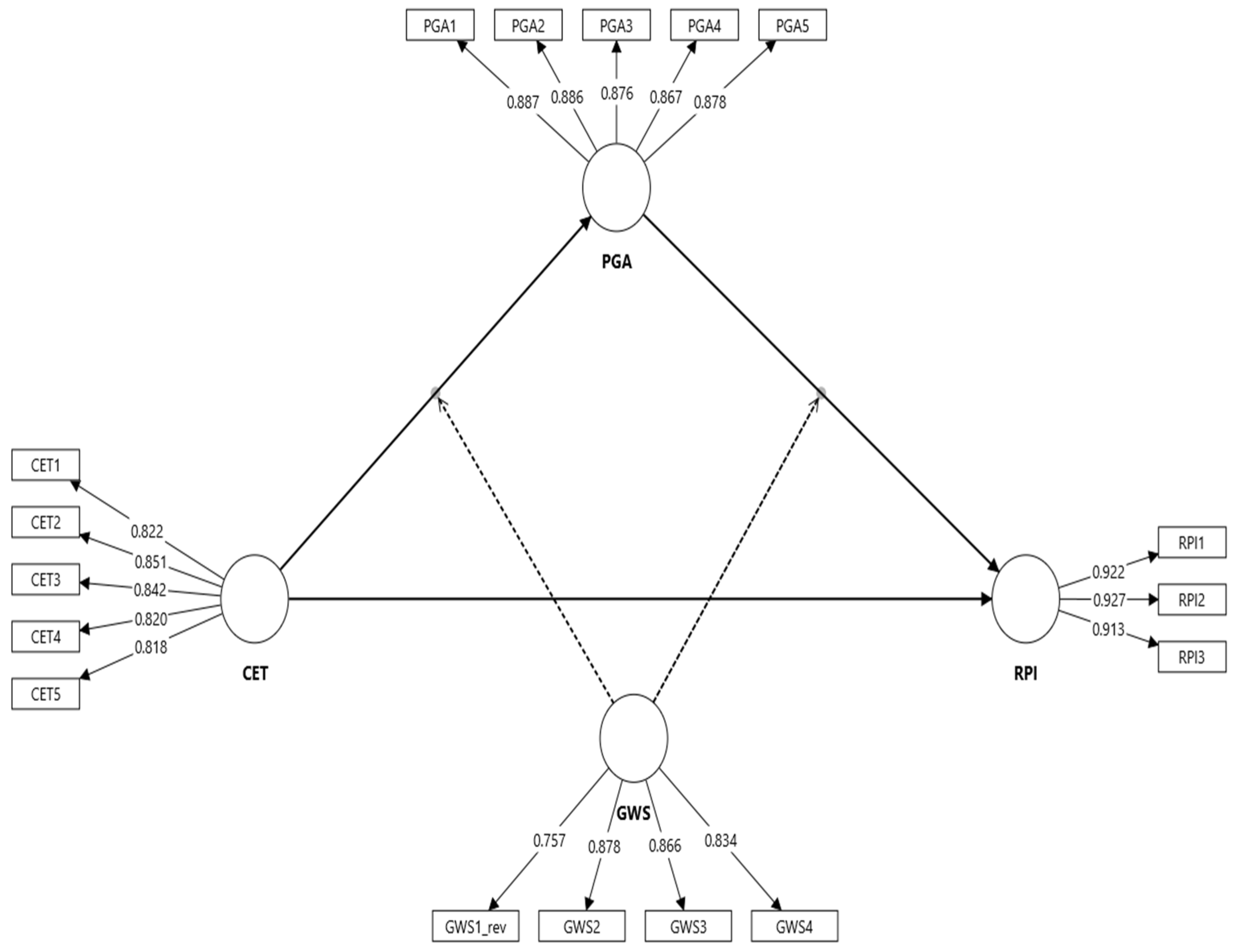
Figure 2.
Research model (PLS-SEM) with standardized indicator loadings.
5. Results
5.1. Evaluation of Construct Validity and Reliability
Reflective constructs (CET, PGA, RPI and GWS) were evaluated for measurement quality based on several criteria. Internal consistency reliability was initially tested using Cronbach’s alpha (α), which ranged from 0.856 (GWS) to 0.926 (PGA); all of the values met or surpassed the suggested threshold for acceptable-to-good level of reliability [71] (Table 2). We then examined the convergent validity with indicator loadings, Composite Reliability (CR), and Average Variance Extracted (AVE). All standardized loadings were above 0.70 (range: 0.757–0.927), CR ranged from 0.902 to 0.944, and AVE varied between values of 0.690–0.848, thus fulfilling the cutoffs (CR > 0.70; AVE > 0.50) proposed by [74] and [78] See Table 2. Furthermore, collinearity diagnostics confirmed acceptable VIFs (all in a range 1.710–3.271), implying that multicollinearity will not prejudice the parameter estimates [74].
Discrimination validity was tested according to Fornell–Larcker criterion and Heterotrait–Monotrait (HTMT) ratio. Square roots of AVE on the diagonal of the Fornell–Larcker matrix (Table 3) varied between (0.831–0.921), all values above construct inter-correlations, which reached a maximum value of 0.675; therefore, we confirm the discriminant validity (Fornell & Larcker, 1981). As for HTMT, the four values all fell below the acceptable thresholds of 0.90 (and ideally 0.85) [79,80], with the highest possible HTMT value being 0.735 in this study sample (Table 3). In total, these findings support that the measurement model has satisfactory reliability, convergent and discriminant validity for further analysing structural model.
5.2. Hypotheses and Model Testing (Structural Model Assessment)
Table 4 and Figure 3 show the results of the structural model assessment and hypothesis testing. They show the standardised path coefficients for both the direct and indirect (mediating) effects. Table 4 shows that Circular-Economy Transparency (CET) had a positive and statistically significant effect on Perceived Green Authenticity (PGA) (β = 0.568, t = 17.488, p < 0.001), which supports H1. CET also had a strong positive direct effect on Responsible Purchase Intention (RPI) (β = 0.260, t = 6.491, p < 0.001), which supports H2. Additionally, PGA significantly predicted RPI (β = 0.481, t = 12.351, p < 0.001), thereby validating H3. Concerning the mediating mechanism, the indirect effect of CET on RPI via PGA was significant (β = 0.273, t = 9.835, p < 0.001), thus supporting H4 and suggesting that perceived green authenticity conveys a portion of the impact of circular-economy transparency on responsible purchase intentions.
When we look at boundary conditions, Greenwashing Skepticism (GWS) made the CET → PGA relationship much weaker (β = −0.222, p < 0.001), which supports H5. It also made the PGA → RPI relationship weaker (β = −0.079, p = 0.025), which supports H6. Consistent with these interaction patterns, the moderated mediation effect was significant (β = −0.107, p < 0.001), supporting H7 and suggesting that the positive indirect influence of CET on RPI through PGA becomes weaker at higher levels of GWS.
In terms of controls, age (β = 0.006, p = 0.872) and education (β = −0.056, p = 0.091) were not significant predictors of RPI. However, gender was significantly associated with RPI (β = −0.213, p = 0.002), showing that demographic effects were mostly limited within the model. The model elucidated a significant portion of variance in the endogenous constructs (R2 = 0.385 for PGA; R2 = 0.548 for RPI), thereby affirming the explanatory sufficiency of the proposed framework.
Figure 4.
GWS moderation of the CET–PGA link (simple slopes).
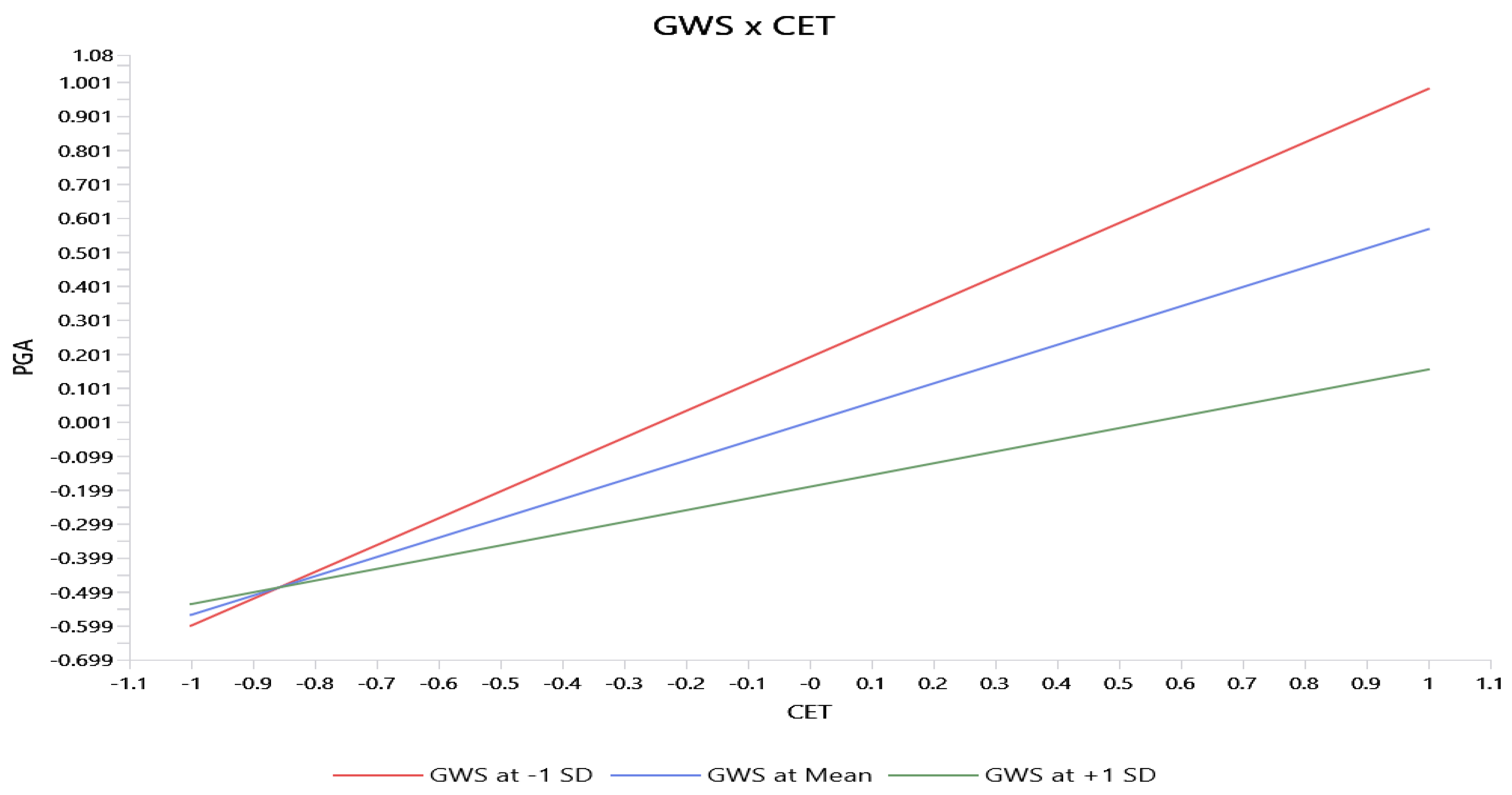
The simple-slope plot depicts a positive CET→PGA linkage at low, medium and high levels of GWS; however, the slope declines as GWS increases. Thus, in conditions of low skepticism about greenwashing (−1 SD), rising levels of circular-economy transparency results in a substantially increased perceived green authenticity, while under high (+1 SD) skepticism the same increase in transparency leads to a much lower rise in authenticity perceptions—demonstrating that GWS weakens the CET → PGA relationship.
Figure 5.
GWS moderation of the PGA–RPI link (simple slopes).
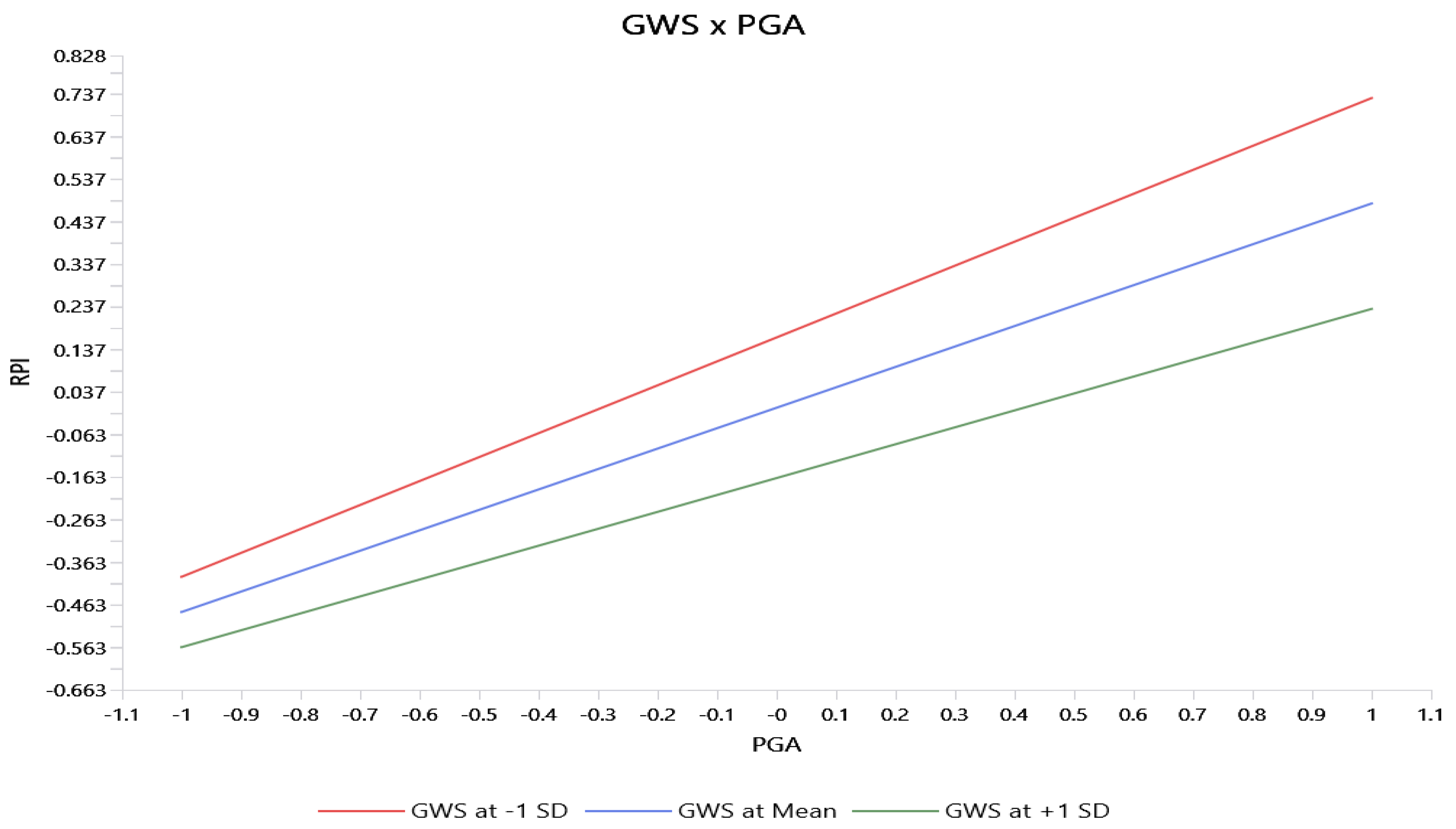
The simple-slope graph reveals that perceived green authenticity (PGA) is positively related to responsible purchase intention (RPI) at low, medium and high levels of greenwashing skepticism (GWS); but the relationship’s strength decreases when GWS ascends. More precisely, when GWS is low (−1 SD), variations in PGA deliver gains in RPI that are greater compared to an identical increase in PGA under high skepticism (+ 1 SD)—so as to endorse the weakening of the positive PGA → RPI effect by GWS.
We looked at the R2 values and Cohen’s f2 effect sizes of the endogenous constructs to see how well the model explained things. According to [81], f2 values of 0.02, 0.15, and 0.35 can be seen as small, medium, and large effects, respectively. Table 4 shows that the f2 values in this study ranged from 0.012 to 0.514. This means that the effects ranged from small (GWS × PGA → RPI) to large (CET → PGA). The main explanatory paths (PGA → RPI and CET → RPI) made significant contributions. The model explained a large part of the variance in the endogenous constructs, with R2 = 0.385 for PGA and R2 = 0.548 for RPI. This is higher than the commonly used benchmark of 0.26 for strong explanatory power in behavioural research [81]. These indices collectively indicate that the proposed framework exhibits an adequate to robust level of explanatory power, thereby validating its appropriateness for predictive structural evaluation utilising PLS-SEM [74].
6. Discussion
This study investigates the influence of circular-economy transparency (CET) on responsible purchase intention (RPI) within the electronics market, both directly and indirectly via perceived green authenticity (PGA), while also considering greenwashing skepticism (GWS) as a significant boundary condition. We use PLS-SEM with bootstrapping to look at the model’s direct paths (H1–H3), the mediating mechanism (H4), and the conditional effects that skepticism suggests (H5–H7). This comprehensive framework is theoretically based on information economics and signalling [3,4], the S–O–R model of stimulus–evaluation–response [27], and skepticism-driven discounting mechanisms as elucidated by persuasion knowledge and attribution theories [29,30,31].
The structural model supports H1, showing that Circular-Economy Transparency (CET) has a positive effect on Perceived Green Authenticity (PGA) (β = 0.568; t = 17.488; p < 0.001), with a stable bootstrap estimate (STDEV = 0.032). This means that giving people clear, complete, and verifiable information about the circular economy (like recycled content, repairability, take-back schemes, refurbishment routes, and life-cycle impacts) makes them more likely to believe that green or circular claims are true [1,2]. The outcome aligns with information economics, as circular attributes are frequently difficult to discern and may be misrepresented in situations of information asymmetry, thereby heightening uncertainty and skepticism [3]. According to signalling theory, CET seems to work as a reliable signal that lets customers infer unobservable integrity and commitment from observable disclosure [4]. This is similar to evidence that transparency signals improve perceived credibility and word-deed congruence [44,45,46]. Our findings align with sustainability and CSR research indicating that verifiable transparency enhances the perceived authenticity of environmentally friendly actions, and that credible indicators, such as third-party labels with comprehensive information, bolster authenticity assessments, particularly in digital retail environments [19,47,48]. The primary contribution is the adaptation of this mechanism to the electronics market, characterised by intricate circularity claims and authenticity assessments that are influenced by the presentation and repetition of evidence [50]. By demonstrating CET as a robust antecedent of PGA in this high-uncertainty context, our study strengthens the case for emerging transparency infrastructures—circular labels, traceability systems, DPPs, blockchain, and transparency apps—as practical routes to enhance perceived authenticity [1,2,5,51,52,53], complementing broader evidence that CSR cues shape authenticity perceptions [49].
H2 is supported, showing that circular-economy transparency is a good predictor of responsible purchase intention (CET → RPI: β = 0.260, t = 6.491, p < 0.001). This indicates that when consumers have access to clear, verifiable, and decision-relevant circularity information (such as recycled content, repairability, and take-back routes), they are more inclined to convert pro-circular preferences into intended responsible choices. This finding is consistent with theories of information asymmetry and signalling: transparency serves as a visible indicator that diminishes uncertainty regarding credence-like circular claims and allows consumers to deduce credibility and quality, thus enhancing evaluability and purchase confidence [3,4]. It is empirically supported by evidence indicating that circular labels and scores influence consumer choices and willingness to pay [5], that enhanced access to second-hand markets increases the intention to purchase used electronics [6], and that transparency fosters trust and encourages environmentally friendly purchasing [7,54,55]. It also fits with research that shows that richer circular disclosures and tools like DPPs can make people feel less risky and less mentally taxed, which makes them more likely to make sustainable choices [8,9,10]. It also fits with research that shows that credible information can change people’s minds about remanufactured and circular products [11,12,13,14,15]. The moderate magnitude indicates that transparency is essential yet insufficient; responses may diminish when circularity cues evoke quality apprehensions or when convenience influences behaviour [5,16,17]. This pattern drives our model’s emphasis on perceived green authenticity as a mechanism and greenwashing skepticism as a boundary condition that determines when CET most effectively transitions into RPI.
H3 is supported: PGA positively and significantly predicts RPI (β = 0.481, t = 12.351, p < 0.001), indicating that when consumers perceive green efforts as genuine, they are much more likely to intend to purchase responsibly. This aligns with the view that authenticity builds trust and reduces skepticism toward symbolic green positioning [24] and can deepen moral/environmental commitment that motivates sustainable purchasing [25], with similar effects observed for authenticity cues in digital settings [26]. The result is also consistent with TPB’s logic that favourable beliefs and evaluations strengthen intention [28] and with prior evidence linking authenticity to higher green purchase and patronage intentions via trust and loyalty mechanisms [18,19,20,21,22,23], alongside the broader roles of attitudes, norms, perceived control, and knowledge in shaping green intentions [56,57,58,59].
The results support H4, showing that circular-economy transparency has a positive and significant indirect effect on responsible purchase intention through perceived green authenticity (CET → PGA → RPI: β = 0.273, t = 9.835, p < 0.001). This means that being open and honest doesn’t automatically make people responsible; instead, it helps people figure out if a company’s green claims are true and match what they actually do. The finding aligns with information asymmetry and signalling theories, suggesting that credible, difficult-to-replicate disclosures diminish uncertainty regarding unobservable circular attributes and enhance judgements of alignment between words and deeds that underpin authenticity [1,2,3,4]. It is consistent with the S-O-R model, in which CET would serve as an external input to produce PGA, and then affect RPI [27]. Previous research supports this route by demonstrating that process transparency and clear brand communication positively affect credibility/congruence inferences [44,45,46], while accessible CSR/sustainability information reinforces perceived credibility and can be influenced by how evidence is provided and reiterated in a digital environment [19,47,49,50], and that circular transparency tools like labels and scores, traceability tools, DPPs, blockchain verification, and transparency apps make it easier to evaluate and verify things, which leads to better judgements of authenticity [5,9,10,15,51,52,53]. The mediation is of importance as it reveals how CET affects RPI in the electronic market where quality/risk concerns and convenience are potential factors which may decrease the effectiveness of transparency-intention link [5,16,17] this finding also resonates with previous research suggesting that higher perceived authenticity is associated with stronger sustainable purchase intentions through trust-related mechanisms [18,20,21,22,23,24].
Our moderation tests indicate that GWS is a critical boundary condition in the electronics industry. The negative GWS × CET → PGA interaction effect (β = −0.222, p < 0.001) suggests that highly skeptical consumers will be less likely to convert circular-economy transparency into perceived green authenticity, as consistent with discounting in Persuasion Knowledge Model and opportunistic motive attributions [29,30,31], perceptual greenwashing increases skepticism and narrows down greener choices [36,37,63]. The negative interaction GWS × PGA → RPI (β = −0.079, p = 0.025) provides additional support for the idea that despite authenticity perceptions emerging, skepticism attenuates their transference into responsible purchase intention, consistent with research drawing on skepticism to lower trust and purchase intention [32,33,34] and circumscribed intention formation [35,38]. Crucially, a negative moderated mediation (β = −0.107, p < 0.001) supports that the indirect effect CET → PGA → RPI is stronger when GWS is low and weaker when GWS is high, providing additional evidence for conditional-process exalting that skepticism attenuates signal-to-trust translations and indirect effects [39,66] and label skepticism attenuated the influence of sustainability information on purchase behavior [42]. In sum, this sequence is consistent with an S–O–R model of CET with PGA and RPI being (stimulus) shaping (organism) and (response), respectfully, although the chain itself appears weak under doubt [27,65]. In practice, however, because electronics is a claim-dense product and verifiability challenged (plus transparency alone can fail [unless/without active] skeptical reduction through third-party-validated claims [40], and skepticism-disruptive communication where differential belief utilities typically disappear under skepticism [45], or benefits discounted to nothingness under skepticism [41].
7. Conclusions
This study investigated the influence of circular-economy transparency (CET) on responsible purchase intention (RPI) within the electronics market, and whether this relationship is mediated by perceived green authenticity (PGA) and is dependent on greenwashing skepticism (GWS). The results from the survey and PLS-SEM show that CET has a positive direct link to both PGA and RPI, and that PGA is a strong predictor of RPI. The findings also show a significant indirect effect of CET on RPI through PGA. This means that transparency encourages responsible intentions by making consumers believe that circular and environmental claims are true and in line with what companies actually do. The moderation tests show that GWS is a key boundary condition. More skepticism makes (i) transparency less effective at building perceptions of authenticity, (ii) authenticity less effective at leading to responsible purchase intention, and (iii) the overall indirect pathway from CET to RPI through PGA less effective.
In general, the results show that CET works best when it makes things seem more real and works in situations where people are less likely to be skeptical. This means that electronics companies and policymakers should go beyond general messages about sustainability and focus on verifiable, consistent, and decision-relevant information. This could include information about how easy it is to repair and how long it will last, quantified circularity indicators, credible take-back details, and traceability-enabled evidence (like DPP-like infrastructures). Strengthening third-party support and making sure that all channels are consistent can help reduce discounting based on skepticism, strengthen inferences of authenticity, and, in the end, keep consumers more responsible about their purchase intentions in a product category with a lot of claims and a lot of uncertainty.
7.1. Theoretical Implications
This paper provides a number of theoretical implications. First, it advances the application of Stimulus-Organism-Response (S-O-R) to decision making in circular economy context for electronic goods through framing CET as a stimulus external to the individual, PGA as an internal organism evaluative and RPI response [27]. Empirically grounding the CET→PGA→RPI route, our results also consolidate S-O-R theorising within sustainability research by demonstrating that transparency impacts responsible intentions mainly by shaping appraisal through authenticity-based processes rather than acting merely as an informational cue.
Second, we extend information economics and signaling theory by demonstrating that CET functions as a credibility relevant market signal in a claim-dense product category with circular attributes which are difficult to verify at purchase (3; 4). In electronics, circularity attributions (i.e., claims such as repairability, recycled content or take-back pathways) are similar to credence attributes, raising uncertainty and rendering the judgment of authenticity critical. The fact that CET emerged as a strong predictor of PGA further supports theory-appropriate evidence that verifiable disclosures enable consumers to guess on unobservable integrity and words deeds congruence and such an inference is fundamental to authenticity and downstream behavioral intention.
Third, the study introduces greenwashing skepticism (GWS) as a boundary condition, which integrates skepticism-based theories with the literature on circular transparency. Consistent with the Persuasion Knowledge Model, increased skepticism may engage coping that savages’ sustainability messages as efforts to persuade thus undermining both transparency → authenticity translation and also authenticity → intention conversion [29]. According to attribution theory, vested consumers might also attribute firms’ transparency to cynical motivation-based causes, which reduces authenticity inferences and weakens responsible intentions [30,31]. Therefore, our mediated effects place GWS as a constraining psychological mechanism preventing otherwise conducive S-O-R pathways in green consumption.
Last, the supported moderated mediation provides an important new perspective on transparency and broadens conditional-process theorizing; it shows that the indirect influence of CET on RPI via PGA is conditionally contingent on skepticism greater when GWS is low and weaker when GWS is high and helps explain not only when transparency-based mechanisms work in uncertain markets but also why they fail. Together, these contributions transplant transparency and authenticity theories into the confines of an electronics-specific circular economy while also providing a more nuanced description of how disclosure infrastructures create (or lose) behavioral leverage in skeptical contexts.
7.2. Practical Implications
The results have many real-world uses for managers and policymakers who want to make responsible buying in the electronics market stronger. First, businesses should understand that circular-economy transparency works best when it is clear, specific, decision-relevant, and verifiable, not when it is framed as general talk about sustainability. In practice, the study means telling customers about the circular features of products in a way that they can use to make a decision, such as indicators of repairability and durability, disclosure of recycled content, information about how to return items, and summaries of the product’s lifecycle impact, all backed up by easy-to-find evidence (e.g., QR-linked documentation). This kind of openness makes credence-like circular claims less uncertain and makes people feel more authentic, which is key to getting individuals to want to buy responsibly.
Second, given that greenwashing skepticism undermines the potential benefits of both transparency and perceived authenticity in a systematic manner, credibility management should be considered as a key organizational strategic ability rather than as add-on. Or, if it’s too undefined, or exaggerated, or symbolic: these circular claims risk turning on skepticism and discrediting otherwise worthwhile revelations. To reduce skepticism-induced message discounting, decision-makers must deploy evidence-based communication (concrete metrics, consistent terminology, and traceable proof points), establish cross-channel consistency (packaging, websites, marketplaces and social media), and invest in independent verification where possible (e.g., trustworthy third-party certification systems, audited sustainability reporting or a standardized definition of circularity). In electronics where performance risk and labyrinthine supply chains make all involved wary, suspicion is particularly high.
The third effect, mediated pathway suggests that operational closure needs to be closely linked with communication. Fact-based practices in sourcing design-for-repair spare-part availability warranty/after sale support reverse logistics should be the basis for any marketing claim. Concerting sustainability, operations and marketing activities may enhance the likelihood that transparency is supported by tangible capabilities; thereby enhancing perceived green authenticity, and increasing intentions to act responsibly on transparency.
Lastly, such effects can be enhanced by policy and regulation in the form of standardized transparency infrastructures for electronics. Advice around digital product passports, repairability scoring and durability labelling can also help clarify the market and ease the interpretive load on consumers. Public awareness programmers/awareness raising and clearer standards for sustainability communication enforced against misleading claims can also help reduce skepticism, support informed choice and drive responsible consumption in a high-impact product category.
7.3. Study Limitations and Future Research
Our study has various limitations that must be kept in mind while interpreting the results. First, the study is based on a cross-sectional online self-report survey that precludes strong causal inference and may be subject to common method variance and social desirability bias despite applying procedural and statistical remedies. Second, the use of non-probability (convenience) sampling could result in an under-representation of consumer segments that are less active digitally or less exposed to circular-economy information, so caution should be exercised if generalising beyond electronics consumers to other publics. Third, our scales measure perceptions of circular-economy transparency, authenticity and skepticism, rather than actual circular performance, and consumers’ perceptions might be influenced by the communication format used, past brand experiences of the consumers or the marketplace context. Fourth, the research framing is on the electronics market as a general category and fails to distinguish among product types (e.g., smartphones vs. home appliances), price segments, or brand reputations that can condition the effects of transparency and authenticity in terms of responsible purchase intention.
Future studies may further the understanding of causality using longitudinal or experimental methods (e.g., by manipulating transparency presentation, introducing third-party authorisation processes, or providing DPP-style disclosures) and assess differences in PGA and RPI over repeated exposure to circular information. They could also examine other factors that might influence how the model operates, such as how much people care about the environment, trust in others, whether they consider a product to be risky, the reputation of the brand and sales platform, their level of expertise and cultural elements (Subsequent work should directly compare various transparency infrastructures, such as repairability labels in place for durable goods or blockchain-enabled traceability for food, and test which mechanism best reduces skepticism and increases perceptions of authenticity.). Finally, by including real-life behaviour (such as verified purchases and participants in take-backs and repair decisions along with willingness-to-pay measures) in the model combined with objective product circularity scores, we could provide more reliable proof of how transparency and authenticity influence sustainable consumption not only in electronics but also in other circular-economy categories.
Appendix A. Scales of the Study Variables
| Circular-Economy Transparency (CET) (independent) |
| CET1: It’s easy to find out how the brand uses the circular economy (for example, by repairing, taking back, or recycling things). |
| CET2: Getting enough information about the brand’s circular-economy practices is simple. |
| CET3: This brand is open and honest about how its products affect the environment and society. |
| CET4: I trust that this brand will handle environmental and social problems that come up because of its products. |
| CET5: This brand really tries to lessen its impact on the environment and society by using circular-economy methods. |
| Perceived Green Authenticity (PGA) (Mediating) |
| PGA1: I think this brand’s efforts to be more environmentally friendly are for the greater good. |
| PGA2: I believe that the brand’s efforts to be more sustainable and circular are real. |
| PGA3: This brand really cares about the environment and society. |
| PGA4: I believe that the brand’s efforts to be more sustainable and part of the circular economy are not just for show. |
| PGA5: The brand’s efforts to be more environmentally friendly and to support the circular economy are real. |
| Greenwashing Skepticism (GWS) (Moderating) |
| GWS1 (R): Most of the claims that electronics brands make about being environmentally friendly or part of a circular economy (in ads, on product pages, or on labels) are true. |
| GWS2: Electronics brands often make exaggerated claims about sustainability or the circular economy. To protect consumers, these claims should not be made in ads, on product pages, or on labels. |
| GWS3: Most of the time, electronics brands use ads, product pages, and labels to make false claims about sustainability or the circular economy. |
| GWS4: I don’t believe most of the claims that electronics brands make about being environmentally friendly or using a circular economy. |
| Responsible Purchase Intention (RPI) (Dependent) |
| RPI1: I want to buy this brand/product because I care about the environment. |
| RPI2: The environmental and circular-economy performance of this brand would affect my decision to buy it. |
| RPI3: I feel good about buying this brand/product because it is good for the environment and follows the principles of a circular economy. |
References
- Jensen, S.F.; Kristensen, J.H.; Adamsen, S.; Christensen, A.; Waehrens, B.V. Digital Product Passports for a Circular Economy: Data Needs for Product Life Cycle Decision-Making. Sustain. Prod. Consum. 2023, 37, 242–255. [Google Scholar] [CrossRef]
- Rinaldi, F.R.; Di Bernardino, C.; Cram-Martos, V.; Pisani, M.T. Traceability and Transparency: Enhancing Sustainability and Circularity in Garment and Footwear. Sustain. Sci. Pract. Policy 2022, 18, 132–141. [Google Scholar] [CrossRef]
- Akerlof, G.A. The Market for “Lemons”: Quality Uncertainty and the Market Mechanism. Q. J. Econ. 1970, 84, 488. [Google Scholar] [CrossRef]
- Spence, M. Job Market Signaling. Q. J. Econ. 1973, 87, 355. [Google Scholar] [CrossRef]
- Boyer, R.H.W.; Hunka, A.D.; Linder, M.; Whalen, K.A.; Habibi, S. Product Labels for the Circular Economy: Are Customers Willing to Pay for Circular? Sustain. Prod. Consum. 2021, 27, 61–71. [Google Scholar] [CrossRef]
- Clemm, C.; Matsumoto, M.; Chinen, K.; Chun, Y.-Y.; Romadona, M. Circular Economy in Practice: The Influence of Second-Hand Stores on Used Electronics Consumption in Japan and Germany. J. Clean. Prod. 2025, 527, 146717. [Google Scholar] [CrossRef]
- Fu, S.; Liu, X.; Lamrabet, A.; Liu, H.; Huang, Y. Green Production Information Transparency and Online Purchase Behavior: Evidence from Green Agricultural Products in China. Front. Environ. Sci. 2022, 10, 985101. [Google Scholar] [CrossRef]
- Fu, H.; He, W.; Feng, K.; Guo, X.; Hou, C. Understanding Consumers’ Willingness to Pay for Circular Products: A Multiple Model-Comparison Approach. Sustain. Prod. Consum. 2024, 45, 67–78. [Google Scholar] [CrossRef]
- Jeganathan, K.; Szymkowiak, A. Bridging Digital Product Passports and In-Store Experiences: How Augmented Reality Enhances Decision Comfort and Reuse Intentions. J. Retail. Consum. Serv. 2025, 84, 104242. [Google Scholar] [CrossRef]
- European Parliament; Directorate General for Parliamentary Research Services. Digital Product Passport in the Textile Sector; Panel for the Future of Science and Technology (STOA); Scientific Foresight Unit (EPRS); European Parliament: Brussels, Belgium, 2024; ISBN 978-92-848-1818-1. [Google Scholar]
- Kanwar, S.; Sharma, M.; Gupta, Y. Antecedents of Circular Purchase Intention: Assessing the Moderating Effects of Gender and Type of Circular Clothing Using PLS-MGA. Res. J. Text. Appar. 2026, 1–19. [Google Scholar] [CrossRef]
- Pisitsankkhakarn, R.; Vassanadumrongdee, S. Enhancing Purchase Intention in Circular Economy: An Empirical Evidence of Remanufactured Automotive Product in Thailand. Resour. Conserv. Recycl. 2020, 156, 104702. [Google Scholar] [CrossRef]
- Sharkasi, N.; De Maeyer, P.; Lababdi, H.C.; AlMansoori, S.; Agag, G. A Sustainable Step Forward: Exploring Factors Influencing the Purchase Intentions towards Remanufactured Products Using fsQCA. J. Retail. Consum. Serv. 2025, 82, 104115. [Google Scholar] [CrossRef]
- Tari, A.; Trudel, R. Affording Disposal Control: The Effect of Circular Take-Back Programs on Psychological Ownership and Valuation. J. Mark. 2024, 88, 110–126. [Google Scholar] [CrossRef]
- Milios, L.; Dalhammar, C. Consumer Perceptions of Product Lifetimes and Labelling: Implications for Introducing a Durability Label. J. Circ. Econ. 2023, 1, 1–15. [Google Scholar] [CrossRef]
- Lv, J.; Liu, X.; Cheng, S. The Impact of Remanufactured Products’ Similarity on Purchase Intention of New Products. Sustainability 2021, 13, 1825. [Google Scholar] [CrossRef]
- McKie, E.C.; Sáez De Tejada Cuenca, A.; Agrawal, V. The Role of Information, Rewards, and Convenience in Take-Back Programs for Clothing. Manuf. Serv. Oper. Manag. 2025, msom.2023.0561. [Google Scholar] [CrossRef]
- Afzali, H.; Kim, S.S. Consumers’ Responses to Corporate Social Responsibility: The Mediating Role of CSR Authenticity. Sustainability 2021, 13, 2224. [Google Scholar] [CrossRef]
- Alyahia, M.; Azazz, A.M.S.; Fayyad, S.; Elshaer, I.A.; Mohammad, A.A.A. Greenwashing Behavior in Hotels Industry: The Role of Green Transparency and Green Authenticity. Sustainability 2024, 16, 1050. [Google Scholar] [CrossRef]
- Fang, Z. Greenwashing Versus Green Authenticity: How Green Social Media Influences Consumer Perceptions and Green Purchase Decisions. Sustainability 2024, 16, 10723. [Google Scholar] [CrossRef]
- Keilmann, J.; Koch, T. Little Green Lies: Greenwashing’s Detrimental Impact on Corporate Perception and the Interplay of Perceived Motives, Skepticism and Authenticity. Corp. Commun. Int. J. 2025, 31, 259–276. [Google Scholar] [CrossRef]
- Poulis, A.; Theodoridis, P.; Zacharatos, T. Green Branding in the Digital Era: The Role of Influencer Credibility and Greenwashing in Shaping Brand Authenticity, Trust and Purchase Intentions. Sustainability 2026, 18, 451. [Google Scholar] [CrossRef]
- Slaton, K. Company-Controlled vs. Seller-Controlled Resale Platforms: Consumer Trust, Risk, and Purchase Intention in Circular Fashion. Sustainability 2025, 17, 9847. [Google Scholar] [CrossRef]
- Wahyuni, A.; Zulfikar, R. The Role of Perceived Authenticity in Increasing Green Purchase Intention: Systematic Literature Review. RSF Conf. Ser. Bus. Manag. Soc. Sci. 2024, 4, 8–15. [Google Scholar] [CrossRef]
- Subagja, G.; Hartati, B.; Evrina, E. The Influence of Green Brand Authenticity on Consumer Purchase Intention: Mediating Role of Environmental Commitment. Brill. Int. J. Manag. Tour. 2025, 5, 231–238. [Google Scholar] [CrossRef]
- Zhu, Q.; Liu, W.; Liang, X.; Zhou, X. Effect of Public-Interest Live-Streaming Anchor’s Official Identity on Green Product Purchase Intention. Soc. Behav. Personal. Int. J. 2024, 52, 12. [Google Scholar] [CrossRef]
- Mehrabian, A.; Russell, J.A. An Approach to Environmental Psychology; The MIT Press: Cambridge, MA, USA, 1974; ISBN 0-262-13090-4. [Google Scholar]
- Ajzen, I. The Theory of Planned Behavior. Organ. Behav. Hum. Decis. Process. 1991, 50, 179–211. [Google Scholar] [CrossRef]
- Friestad, M.; Wright, P. The Persuasion Knowledge Model: How People Cope with Persuasion Attempts. J. Consum. Res. 1994, 21, 1–31. [Google Scholar] [CrossRef]
- Heider, F. The Psychology of Interpersonal Relations; John Wiley & Sons, Inc.: Hoboken, NJ, USA, 1958. [Google Scholar]
- Kelley, H.H. The Processes of Causal Attribution. Am. Psychol. 1973, 28, 107–128. [Google Scholar] [CrossRef]
- De Sio, S.; Zamagni, A.; Casu, G.; Gremigni, P. Green Trust as a Mediator in the Relationship between Green Advertising Skepticism, Environmental Knowledge, and Intention to Buy Green Food. Int. J. Environ. Res. Public Health 2022, 19, 16757. [Google Scholar] [CrossRef]
- Kim, Y.; Oh, K.W. Effects of Perceived Sustainability Level of Sportswear Product on Purchase Intention: Exploring the Roles of Perceived Skepticism and Perceived Brand Reputation. Sustainability 2020, 12, 8650. [Google Scholar] [CrossRef]
- Ulusoy, E.; Barretta, P.G. How Green Are You, Really? Consumers’ Skepticism toward Brands with Green Claims. J. Glob. Responsib. 2016, 7, 72–83. [Google Scholar] [CrossRef]
- Leonidou, C.N.; Skarmeas, D. Gray Shades of Green: Causes and Consequences of Green Skepticism. J. Bus. Ethics 2017, 144, 401–415. [Google Scholar] [CrossRef]
- Nguyen, T.T.H.; Yang, Z.; Nguyen, N.; Johnson, L.W.; Cao, T.K. Greenwash and Green Purchase Intention: The Mediating Role of Green Skepticism. Sustainability 2019, 11, 2653. [Google Scholar] [CrossRef]
- Nyilasy, G.; Gangadharbatla, H.; Paladino, A. Perceived Greenwashing: The Interactive Effects of Green Advertising and Corporate Environmental Performance on Consumer Reactions. J. Bus. Ethics 2014, 125, 693–707. [Google Scholar] [CrossRef]
- Barbosa, B.; Oliveira, Z.; Coelho, A.M.R. Perceived Greenwashing and Its Impact on Eco-Friendly Product Purchase. Tour. Manag. Stud. 2024, 20, 1–12. [Google Scholar] [CrossRef]
- Margariti, K.; Hatzithomas, L.; Boutsouki, C. Elucidating the Gap between Green Attitudes, Intentions, and Behavior through the Prism of Greenwashing Concerns. Sustainability 2024, 16, 5108. [Google Scholar] [CrossRef]
- Parguel, B.; Benoît-Moreau, F.; Larceneux, F. How Sustainability Ratings Might Deter ‘Greenwashing’: A Closer Look at Ethical Corporate Communication. J Bus Ethics 2011, 102, 15–28. [Google Scholar] [CrossRef]
- Chua, B.-L.; Kim, S.; Baah, N.G.; Moon, H.; Yu, J.; Han, H. When Hospitality Brands Go Green: The Role of Authenticity and Stereotypes in Building Customer-Green Brand Relationships. J. Sustain. Tour. 2024, 32, 1118–1141. [Google Scholar] [CrossRef]
- Rossi, C.; Rivetti, F. Young Consumers’ Purchase Behaviour of Sustainably-Labelled Food Products. What Is the Role of Scepticism? Food Qual. Prefer. 2023, 105, 104772. [Google Scholar] [CrossRef]
- Chebat, J.-C.; Slusarczyk, W. How Emotions Mediate the Effects of Perceived Justice on Loyalty in Service Recovery Situations: An Empirical Study. J. Bus. Res. 2005, 58, 664–673. [Google Scholar] [CrossRef]
- Cambier, F.; Poncin, I. Inferring Brand Integrity from Marketing Communications: The Effects of Brand Transparency Signals in a Consumer Empowerment Context. J. Bus. Res. 2020, 109, 260–270. [Google Scholar] [CrossRef]
- Yang, J.; Battocchio, A.F. Effects of Transparent Brand Communication on Perceived Brand Authenticity and Consumer Responses. J. Prod. Brand Manag. 2021, 30, 1176–1193. [Google Scholar] [CrossRef]
- Kim, N.L.; Kim, G.; Rothenberg, L. Is Honesty the Best Policy? Examining the Role of Price and Production Transparency in Fashion Marketing. Sustainability 2020, 12, 6800. [Google Scholar] [CrossRef]
- Li, J.; Sun, X.; Hu, C. The Role of Skepticism and Transparency in Shaping Green Brand Authenticity and Green Brand Evangelism. Sustainability 2022, 14, 16191. [Google Scholar] [CrossRef]
- Behre, B.; Cauberghe, V. Signaling Sustainability in Online Fashion Consumption: The Role of Credibility Induced by Certification Labels. Clean. Responsible Consum. 2025, 17, 100287. [Google Scholar] [CrossRef]
- Markovic, S.; Iglesias, O.; Qiu, Y.; Bagherzadeh, M. The CSR Imperative: How CSR Influences Word-of-Mouth Considering the Roles of Authenticity and Alternative Attractiveness. Bus. Soc. 2022, 61, 1773–1803. [Google Scholar] [CrossRef]
- Illia, L.; Ballester-Ripoll, R.; Clausen, A.K. Fabricating CSR Authenticity: The Illusory Truth Effect of CSR Communication on Social Media in the AI Era. Public Relat. Rev. 2025, 51, 102588. [Google Scholar] [CrossRef]
- Zhao, R.; Liu, C. Consumer Acceptance of Digital Product Passports: The Roles of Technological Awareness and Value Orientations. Sustainability 2025, 17, 10878. [Google Scholar] [CrossRef]
- Hina, M.; Islam, N.; Luo, X. (Robert) Towards Sustainable Consumption Decision-Making: Examining the Interplay of Blockchain Transparency and Information-Seeking in Reducing Product Uncertainty. Decis. Support Syst. 2025, 189, 114370. [Google Scholar] [CrossRef]
- Brans, L. “Who Made My Clothes?” How Transparency Apps Bring Politics to Cultural Fields. J. Consum. Cult. 2023, 23, 990–1016. [Google Scholar] [CrossRef]
- Nguyen, M.H.; Nguyen, D.H. How Do Transparency and Traceability Enhance Purchasing Behaviors via Consumer Trust? Insights for Food Supply Chains. J. Consum. Mark. 2025. [Google Scholar] [CrossRef]
- Doanh, D.C.; Tram, T.B.; Vu, P.Q.; Linh, L.T.N.; Huong, N.T.T. Blockchain-Based Food Traceability System and Green Brand Image: Enhancing Product Trust and Purchase Intentions for Online Agricultural Products. Clean. Responsible Consum. 2026, 20, 100368. [Google Scholar] [CrossRef]
- Bangakh, S.; Sohail, M.M.; Bashir, Z. Role of Ethical Obligation and Self-Identification in Green Purchase Intention of Quick Service Restaurants: The Mediating Role of Green Attitude. Int. J. Hosp. Tour. Adm. 2025, 1–21. [Google Scholar] [CrossRef]
- Hartanto, P.; Hurriyati, R.; Dirgantari, P.D. Pengaruh Green Perceived Value (GPV) Dan Green Brand Knowledge Terhadap Purchase Intention to Buying Green Product Melalui Attitude Toward Purchasing Green Products. J. Manaj. Organ. 2023, 14, 15–33. [Google Scholar] [CrossRef]
- Han, E.; Utama, L. Factors That Influence Consumers’ Intention to Purchase Environmentally Friendly Products. Int. J. Agric. Environ. Biotechnol. 2024, 2, 206–216. [Google Scholar] [CrossRef]
- Moazzam, M.; Ahmad, M.; Hussain, A.; Akram, M.A. Examining the Factors That Shape Green Purchase Behavior: The Role of Subjective Norms, Self-Efficacy, Attitude and Intention. Bull. Bus. Econ. BBE 2023, 12, 221–232. [Google Scholar] [CrossRef]
- Greenwald, A.G.; Leavitt, C. Audience Involvement in Advertising: Four Levels. J. Consum. Res. 1984, 11, 581. [Google Scholar] [CrossRef]
- Yu, W.; Zhou, J.; He, M.; Si, D. Does Brand Truth-Telling Yield Customer Participation? The Interaction Effects of CSR Strategy and Transparency Signaling. Behav. Sci. 2022, 12, 514. [Google Scholar] [CrossRef] [PubMed]
- Ahmed, H.A.M.; Abdelghani, A.A.A.; Fayyad, S.; Rashwan, K.A. From Commitment to Action: The Mediating Effect of Environmental Identity in Green Buying, with Eco-Conscious Behavior as a Moderator. Adm. Sci. 2025, 15, 303. [Google Scholar] [CrossRef]
- Alkhofaily, F.; Noureldin, A. Digital Sustainable Marketing and Green Consumer Choices in Saudi Arabia: A Dual-Path Mediation Model of Green Perceived Value and Green Scepticism. Sustainability 2026, 18, 1269. [Google Scholar] [CrossRef]
- Alotaibi, A.; Abbas, A. Islamic Religiosity and Green Purchase Intention: A Perspective of Food Selection in Millennials. J. Islam. Mark. 2023, 14, 2323–2342. [Google Scholar] [CrossRef]
- Lee, T.H.; Comello, M.L.G. Transparency and Industry Stigmatization in Strategic CSR Communication. Manag. Commun. Q. 2019, 33, 68–85. [Google Scholar] [CrossRef]
- Riva, F.; Magrizos, S.; Rizomyliotis, I.; Uddin, M.R. Beyond the Hype: Deciphering Brand Trust amid Sustainability Skepticism. Bus. Strat Env. 2024, 33, 6491–6506. [Google Scholar] [CrossRef]
- Kim, S.-B.; Kim, D.-Y. The Influence of Corporate Social Responsibility, Ability, Reputation, and Transparency on Hotel Customer Loyalty in the U.S.: A Gender-Based Approach. SpringerPlus 2016, 5, 1537. [Google Scholar] [CrossRef]
- Liu, H.; Jung, J.-S. The Effect of CSR Attributes on CSR Authenticity: Focusing on Mediating Effects of Digital Transformation. Sustainability 2021, 13, 7206. [Google Scholar] [CrossRef]
- Mohr, L.A.; Eroǧlu, D.; Ellen, P.S. The Development and Testing of a Measure of Skepticism Toward Environmental Claims in Marketers’ Communications. J. Consum. Aff. 1998, 32, 30–55. [Google Scholar] [CrossRef]
- Chen, Y.-S.; Chang, T.-W.; Li, H.-X.; Chen, Y.-R. The Influence of Green Brand Affect on Green Purchase Intentions: The Mediation Effects of Green Brand Associations and Green Brand Attitude. Int. J. Environ. Res. Public Health 2020, 17, 4089. [Google Scholar] [CrossRef]
- Nunnally, J.C.; Bernstein, I.H. Psychometric Theory, 3rd ed.; McGraw-Hill: New York, NY, USA, 1994. [Google Scholar]
- Podsakoff, P.M.; MacKenzie, S.B.; Podsakoff, N.P. Sources of Method Bias in Social Science Research and Recommendations on How to Control It. Annu. Rev. Psychol. 2012, 63, 539–569. [Google Scholar] [CrossRef]
- Harman, D. A Single Factor Test of Common Method Variance. J. Psychol. 1967, 35, 359–378. [Google Scholar]
- Hair, J.F.; Risher, J.J.; Sarstedt, M.; Ringle, C.M. When to Use and How to Report the Results of PLS-SEM. Eur. Bus. Rev. 2019, 31, 2–24. [Google Scholar] [CrossRef]
- Curran, P.J.; West, S.G.; Finch, J.F. The Robustness of Test Statistics to Nonnormality and Specification Error in Confirmatory Factor Analysis. Psychol. Methods 1996, 1, 16–29. [Google Scholar] [CrossRef]
- Hair, J.F.; Ringle, C.M.; Sarstedt, M. PLS-SEM: Indeed a Silver Bullet. J. Mark. Theory Pract. 2011, 19, 139–152. [Google Scholar] [CrossRef]
- Sarstedt, M.; Ringle, C.M.; Smith, D.; Reams, R.; Hair, J.F. Partial Least Squares Structural Equation Modeling (PLS-SEM): A Useful Tool for Family Business Researchers. J. Fam. Bus. Strategy 2014, 5, 105–115. [Google Scholar] [CrossRef]
- Fornell, C.; Larcker, D.F. Evaluating Structural Equation Models with Unobservable Variables and Measurement Error. J. Mark. Res. 1981, 18, 39–50. [Google Scholar] [CrossRef]
- Henseler, J.; Ringle, C.M.; Sarstedt, M. A New Criterion for Assessing Discriminant Validity in Variance-Based Structural Equation Modeling. J. Acad. Mark. Sci. 2015, 43, 115–135. [Google Scholar] [CrossRef]
- Gold, A.H.; Malhotra, A.; Segars, A.H. Knowledge Management: An Organizational Capabilities Perspective. J. Manag. Inf. Syst. 2001, 18, 185–214. [Google Scholar] [CrossRef]
- Cohen, J. Statistical Power Analysis for the Behavioral Sciences; Routledge: London, UK, 2013; ISBN 978-1-134-74270-7. [Google Scholar]
Figure 1.
Study’s conceptual framework and hypothesised paths.
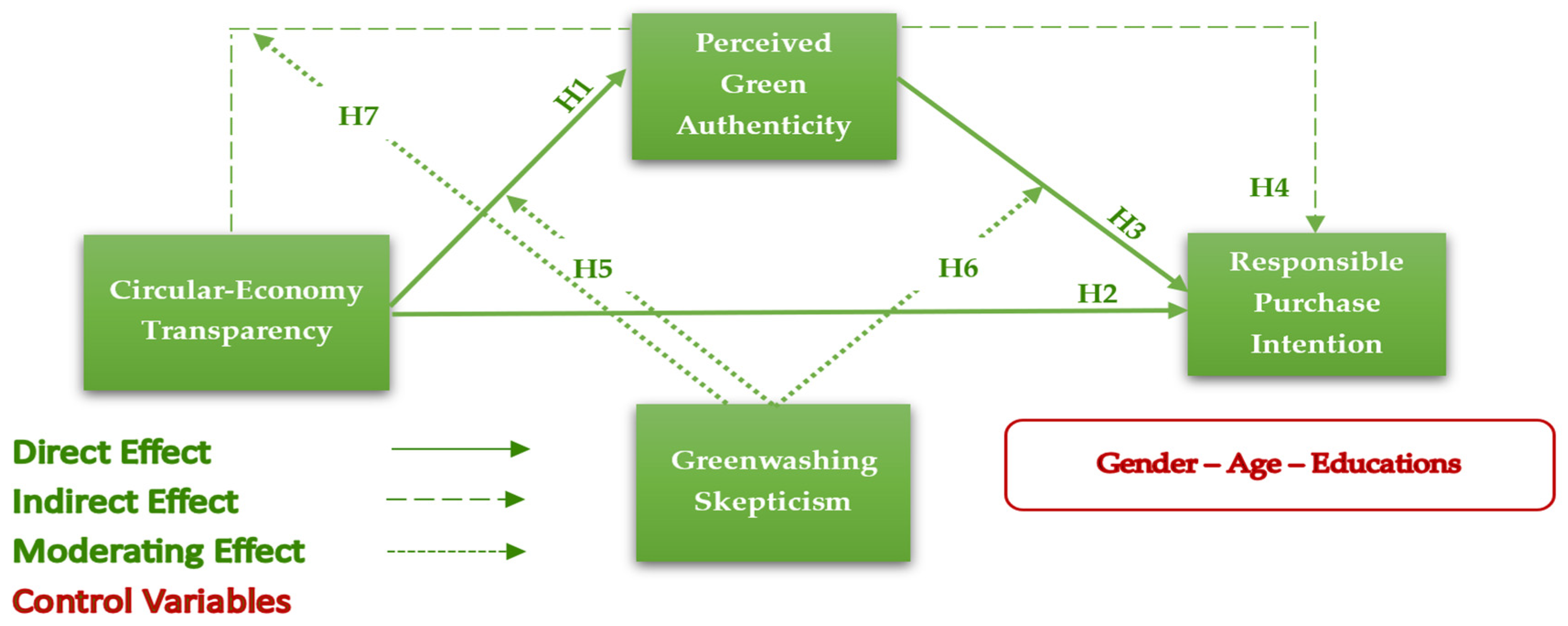
Figure 3.
Estimation of the structure model.
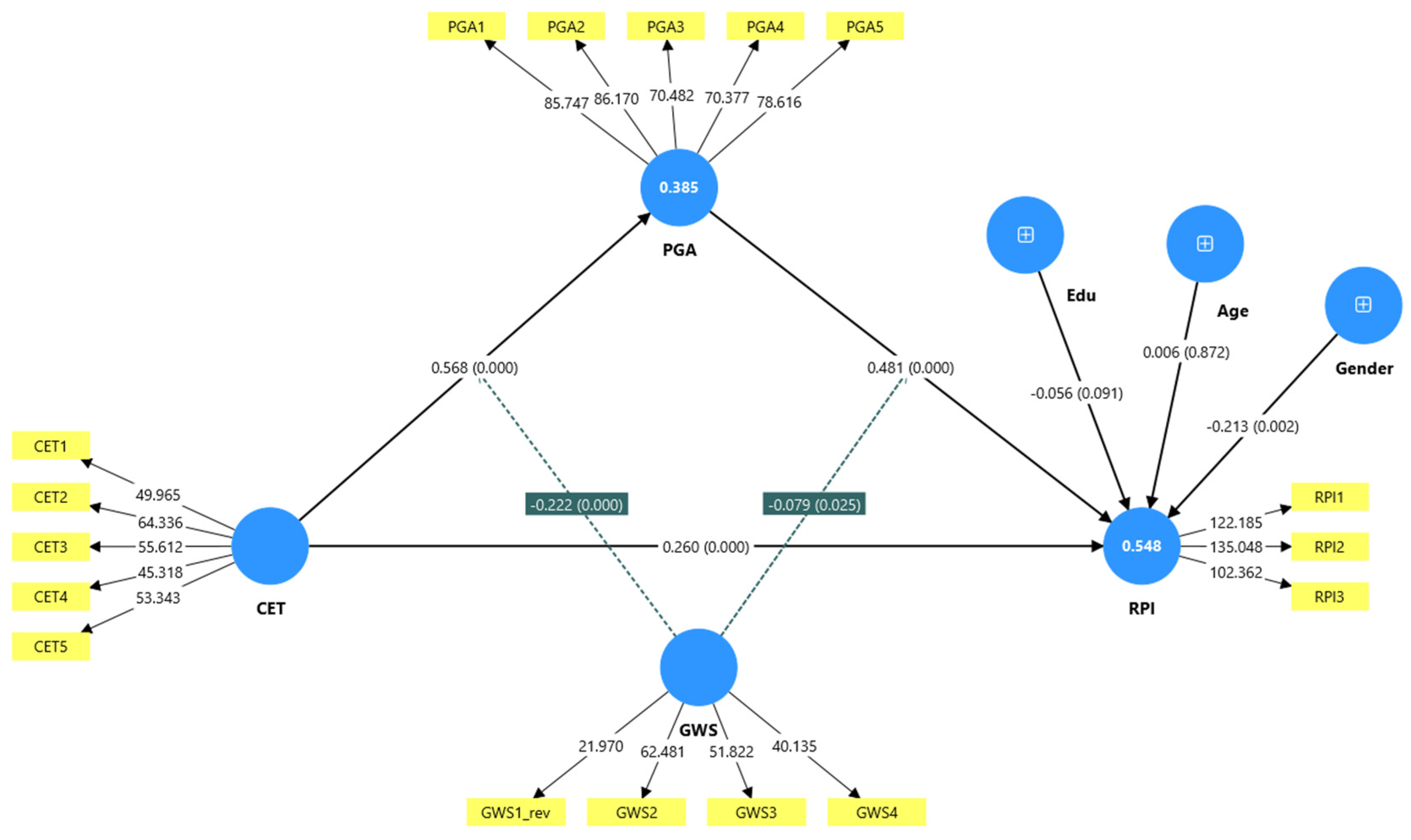
Table 2.
Reliability validity.
| Factors and Items | λ (>0.7) | VIF (<5) | M | SD | SK | KU |
|---|---|---|---|---|---|---|
| Circular-Economy Transparency (CET) (α = 0.888, CR = 0.918, AVE = 0.690) | ||||||
| CET1 | 0.822 | 2.100 | 3.217 | 0.912 | −0.140 | −0.276 |
| CET2 | 0.851 | 2.307 | 3.231 | 0.937 | −0.249 | −0.159 |
| CET3 | 0.842 | 2.226 | 3.267 | 0.895 | −0.170 | −0.318 |
| CET4 | 0.820 | 2.046 | 3.238 | 0.911 | 0.005 | −0.376 |
| CET5 | 0.818 | 2.026 | 3.214 | 0.919 | 0.006 | −0.394 |
| Greenwashing Skepticism (GWS) (α = 0.856, CR = 0.902, AVE = 0.697) | ||||||
| GWS1_rev | 0.757 | 1.710 | 2.952 | 0.922 | 0.003 | −0.443 |
| GWS2 | 0.878 | 2.287 | 3.081 | 0.953 | 0.003 | −0.329 |
| GWS3 | 0.866 | 2.091 | 3.093 | 0.922 | −0.167 | −0.257 |
| GWS4 | 0.834 | 1.962 | 3.038 | 0.915 | −0.019 | −0.206 |
| Perceived Green Authenticity (PGA) (α = 0.926, CR = 0.944, AVE = 0.772) | ||||||
| PGA1 | 0.887 | 3.062 | 3.157 | 1.007 | −0.094 | −0.342 |
| PGA2 | 0.886 | 3.002 | 3.162 | 1.081 | −0.133 | −0.564 |
| PGA3 | 0.876 | 2.821 | 3.200 | 1.036 | −0.150 | −0.451 |
| PGA4 | 0.867 | 2.684 | 3.171 | 1.021 | −0.093 | −0.508 |
| PGA5 | 0.878 | 2.851 | 3.217 | 1.041 | −0.049 | −0.573 |
| Responsible Purchase Intention (RPI) (α = 0.910, CR = 0.943, AVE = 0.848) | ||||||
| RPI1 | 0.922 | 3.106 | 3.281 | 1.103 | −0.092 | −0.739 |
| RPI2 | 0.927 | 3.271 | 3.252 | 1.141 | −0.121 | −0.798 |
| RPI3 | 0.913 | 2.842 | 3.219 | 1.082 | −0.139 | −0.636 |
Table 3.
Discriminant Validity Assessment (Fornell–Larcker and HTMT).
| Construct | CET | PGA | RPI | GWS |
|---|---|---|---|---|
| CET | 0.831 | 0.605 | 0.610 | 0.054 |
| PGA | 0.549 | 0.879 | 0.735 | 0.237 |
| RPI | 0.549 | 0.675 | 0.921 | 0.316 |
| GWS | −0.049 | −0.219 | −0.284 | 0.835 |
Note: CET = Circular-Economy Transparency; PGA = Perceived Green Authenticity; RPI = Responsible Purchase Intention; GWS = Greenwashing Skepticism. Diagonal values (bold) are √AVE (Fornell–Larcker); values below the diagonal are inter-construct correlations; values above the diagonal are HTMT ratios.
Table 4.
Hypothesis testing.
| Hypothesis/Path | β | t | p | f2 | Remark |
|---|---|---|---|---|---|
| Direct effects | |||||
| H1: CET → PGA | 0.568 | 17.488 | <0.001 | 0.514 | ✓ |
| H2: CET → RPI | 0.260 | 6.491 | <0.001 | 0.102 | ✓ |
| H3: PGA → RPI | 0.481 | 12.351 | <0.001 | 0.333 | ✓ |
| Indirect effect | |||||
| H4: CET → PGA → RPI | 0.273 | 9.835 | <0.001 | — | ✓ |
| Moderating effects | |||||
| H5: GWS × CET → PGA | −0.222 | 6.178 | <0.001 | 0.076 | ✓ |
| H6: GWS × PGA → RPI | −0.079 | 2.236 | 0.025 | 0.012 | ✓ |
| Moderated mediation | |||||
| H7: (GWS × CET) → PGA → RPI | −0.107 | 5.432 | <0.001 | — | ✓ |
| Control variables | |||||
| Age → RPI | 0.006 | 0.161 | 0.872 | 0.000 | X |
| Education → RPI | −0.056 | 1.692 | 0.091 | 0.007 | X |
| Gender → RPI | −0.213 | 3.116 | 0.002 | 0.025 | ✓ |
| Endogenous construct | R2 | R2 (adjusted) | |||
| PGA | 0.385 | 0.381 | |||
| RPI | 0.548 | 0.540 | |||
Note: CET = Circular-Economy Transparency; PGA = Perceived Green Authenticity; RPI = Responsible Purchase Intention; GWS = Greenwashing Skepticism; β = standardized path coefficient; t = bootstrap t-statistic; p = two-tailed p-value; f2 = effect size; ✓ = supported/significant at p < 0.05; X = not supported (not significant); “—“ = not applicable for indirect effects.
Disclaimer/Publisher’s Note: The statements, opinions and data contained in all publications are solely those of the individual author(s) and contributor(s) and not of MDPI and/or the editor(s). MDPI and/or the editor(s) disclaim responsibility for any injury to people or property resulting from any ideas, methods, instructions or products referred to in the content. |
© 2026 by the authors. Licensee MDPI, Basel, Switzerland. This article is an open access article distributed under the terms and conditions of the Creative Commons Attribution (CC BY) license (http://creativecommons.org/licenses/by/4.0/).
Copyright: This open access article is published under a Creative Commons CC BY 4.0 license, which permit the free download, distribution, and reuse, provided that the author and preprint are cited in any reuse.