
Submitted:
02 March 2026
Posted:
03 March 2026
You are already at the latest version
Preprints on COVID-19 and SARS-CoV-2
Abstract
Sustainable human resource management is critical in infrastructure sectors, yet firm-level resilience may conceal uneven health burdens within the workforce. This study examines a »resilience paradox« in a large Slovenian energy company using a two-level design. At the macro level (2012–2022), we explore associations between absenteeism categories and three efficiency ratios. At the micro level, we estimate a Poisson quasi-maximum-likelihood model with log planned hours as an exposure offset and cluster-robust inference on a balanced group-month panel (960 observations) built from 82,033 payroll records (2018–2022). Macro indicators remain stable, and we do not detect negative correlations between absenteeism and efficiency ratios, suggesting that operational continuity can be maintained despite absence shocks. However, micro-level estimates reveal pronounced inequalities: compared with employees aged ≤30, absenteeism rates are higher for ages 31–45 (incidence rate ratio—IRR 1.335), 46–55 (IRR 1.538), and >55 (IRR 1.829). Field/operational groups have higher rates than office/administrative groups (IRR 1.829), and female groups show higher rates than male groups (IRR 1.252). During COVID-19, absenteeism declined for office groups (IRR 0.840), while the additional effect for field groups was small and statistically uncertain (interaction IRR 1.179). The results call for targeted sustainable HRM interventions addressing aging, occupational risk, and equitable health protection across job types.
Keywords:
sustainable HRM
; employee absenteeism
; organizational resilience
; Poisson regression
; critical infrastructure
; COVID-19
1. Introduction
In the contemporary business environment, sustainable human resource management (sustainable HRM) is becoming a central paradigm of strategic management, particularly in sectors managing critical infrastructure [1,2,3]. Unlike traditional management, which primarily focuses on short-term profit maximization, sustainable HRM integrates economic, ecological, and social goals, emphasizing the long-term preservation of employees’ psychophysical well-being and the prevention of burnout [4,5,6]. Recent research highlights that incorporating sustainable HRM represents a shift from reactively resolving health issues to proactively creating a work environment that protects employees from overload, thereby directly reducing absenteeism [7]. In the energy sector, where continuous operation and high reliability are vital to broader society, health-related absenteeism presents a complex challenge that directly impacts both the economic and social sustainability of companies [8,9]. In a broader societal context, this topic directly addresses the United Nations Sustainable Development Goals SDG 3 (Good Health and Well-being) and SDG 8 (Decent Work and Economic Growth).
Labor economics literature often treats health-related absenteeism in a distinctly unidimensional manner—as a cost burden and a direct threat to the financial stability and productivity of an organization [10,11,12]. Numerous empirical studies posit the existence of a linear negative correlation between absence rates and key efficiency ratios [13,14]. However, organizational resilience frameworks suggest that highly structured and flexible systems may be capable of assimilating such personnel shocks without drastic declines in macroeconomic indicators [15,16,17,18]. We define this phenomenon as the “resilience paradox,” as stable overarching financial indicators can successfully mask severe micro-dynamic issues within the workforce [19]. The concept of the resilience paradox stems from findings that system resilience is not always linearly associated with individual well-being. At the individual level, the paradox highlights the weak predictive power of general resilience correlates during external shocks, while at the organizational level, building resilience incurs costs and increases operational complexity, which is often transferred to employees in the form of heightened demands [20,21]. Theoretically, cushioning staff shortages can manifest as increased job demands placed on present workers, which, according to the Job Demands-Resources (JD-R) model, leads to a long-term risk of quiet quitting and exhaustion [22,23,24]. Therefore, for a comprehensive understanding of sustainable business operations, merely analyzing the financial consequences of absenteeism at the macro level is insufficient; an in-depth identification of its generators at the employee micro level is essential.
The European energy and industrial sectors are facing an accelerated aging of the workforce, which, coupled with the physically demanding nature of certain jobs, exponentially increases health risks [25,26,27,28,29,30]. Recent studies within the energy sector clearly demonstrate that operational workers are under immense stress due to physical demands and the simultaneous imperative of ensuring continuous service delivery [31]. The decline in psychophysical capacities among older workers necessitates adaptations to the work environment, which in practice are often insufficient [32,33]. The specific nature of the work also significantly contributes to these risks, as operational and field workers are exposed to direct occupational injury hazards to a far greater extent than administrative staff [34]. An additional dimension of social sustainability is social inequality, particularly gender disparities in work-life balance and in shouldering the burden of care for family members [35,36]. Global crises, such as the COVID-19 pandemic, exacerbated these inequalities while simultaneously drastically altering workplace attendance patterns [37,38,39]. The transition to remote work proved to be a potential protective factor for certain groups of employees, whereas those whose nature of work required physical presence remained exposed to risks [39,40].
Most previous research analyzes either exclusively the macroeconomic impacts of absenteeism or solely its specific health causes; studies rarely integrate and compare both aspects within the same homogeneous organizational environment. Because our micro-level analysis includes not only sick leave and injuries but also absences due to caring for or accompanying family members, we define the term »health absenteeism« in this study more broadly as health-related absence.
The purpose of this article is to analyze these dynamics using a two-level approach within a large Slovenian company. In doing so, this research makes three key contributions to the literature. First, we empirically demonstrate that organizational “resilience” at the macro level does not necessarily imply social sustainability at the micro level. Second, we employ a two-level design (a macro analysis spanning 2012–2022 and a micro panel covering 2018–2022) within the same organization, minimizing contextual confounding in the interpretation. Third, we identify specific vulnerable groups (based on age, gender, and nature of work) and show that disparities can widen during crisis periods.
Based on the literature review, we test the following hypotheses:
- H1: Higher levels of health-related absenteeism are negatively associated with the company’s macroeconomic efficiency ratios (K1, K2, K3).
- H2: Demographic factors, specifically increasing age and female gender, significantly increase the incidence rate of absenteeism.
- H3: Employees in operational and field positions are exposed to a higher risk of absenteeism compared to administrative workers.
- H4: The implementation of emergency measures and the transition to remote work during the COVID-19 pandemic asymmetrically affected absenteeism rates among field and office workers.
The article is structured as follows. Section 2 details the methodology for both levels of analysis, the sample definition, and the regression model used. Section 3 systematically presents the macro and micro analysis results. Section 4 offers an in-depth discussion of the findings in light of existing literature on organizational resilience and social sustainability. The article concludes (Section 5) with a summary of the key findings and practical implications.
2. Materials and Methods
2.1. Research Design and Context
This research employs a two-level analytical approach to comprehensively examine the dynamics of absenteeism and its consequences in the energy sector. The case study is based on a large Slovenian company managing critical infrastructure. The selection of such an environment is purposely justified, as the continuous operation of energy companies demands a high level of organizational resilience and stable human resource management, particularly during external shocks such as the COVID-19 pandemic. To address both the economic and social dimensions of sustainability, data were obtained from two official corporate sources and analyzed at both the macroeconomic firm level and the micro level of individual employee panel groups.
2.2. Macro-Level Analysis: Organizational Resilience
The first part of the methodology tests the associations between aggregated absenteeism and key efficiency ratios. For this purpose, annual data were collected over an eleven-year period between 2012 and 2022 (N = 11). Three standardized efficiency ratios, obtained from the company’s annual reports, were used as dependent variables:
- K1: Total revenue efficiency ratio.
- K2: Operating revenue efficiency ratio.
- K3: Financing efficiency ratio.
Aggregated annual values of various absence types were used as independent variables: sick leave up to 30 days, sick leave over 30 days, occupational injuries, non-occupational injuries, and care for or accompaniment of a family member. The macro-level analysis was conducted using descriptive statistics, graphical trend analysis (absences compared to K1–K3 over the years), time series analysis to identify multi-year trends, and bivariate correlation analysis (Pearson and Spearman correlation coefficients). The purpose of this section was not merely to seek linear correlations but to assess organizational resilience—i.e., the company’s ability to maintain the stability of economic indicators despite specific absenteeism shocks. Due to the small sample size (N = 11) and consequent low statistical power, the macro-level analysis is exclusively exploratory and descriptive in nature.
2.3. Micro-Level Analysis: Determinants of Absenteeism
Because aggregated data obscure internal employee dynamics, an extensive dataset of microdata from HR and payroll records covering a five-year period from January 2018 to December 2022 was utilized in the second part of the research. The initial raw database comprised 82,033 individual monthly working time records. During data cleaning, administrative payroll corrections with negative hours were removed. To facilitate processing in a panel model and prevent the inflation of statistical power, individual records were aggregated into homogeneous groups based on gender (2 categories), age (4 categories: under 30 years, 31–45 years, 46–55 years, over 55 years), and work profile (2 categories). In this model specification, the work profile was operationalized using an organizational proxy: office/administrative groups were defined as employees assigned to the headquarters (Sedez), while field/operational groups were defined as employees assigned to distribution units (DE locations). This resulted in 16 unique groups (2 × 4 × 2). Observing these groups over 60 months formed a balanced group-month panel with an effective number of observations N = 960. Variables for the COVID-19 period and seasonality (month of the year) were included in the model as time determinants at the panel level.
The dependent variable in this model was »health-related absenteeism«, which comprehensively includes hours of sick leave, injuries (both occupational and non-occupational), and care for or accompaniment of a family member. Specific absences due to COVID-19 isolation or quarantine were excluded to observe classical health-related absenteeism. In the payroll records, hours are logged as integers, supporting their treatment as a non-negative count outcome at the aggregated group-month panel level. Because the dependent variable represents count data and exhibits substantial overdispersion, a Poisson regression with robust standard errors clustered at the accounting month level (year-month) was used. Such clustering reasonably captures shared monthly shocks across groups, such as seasonal viral outbreaks or organization-wide operational disruptions. The Poisson Quasi-Maximum Likelihood Estimator (QMLE) with robust standard errors provides consistent parameter estimates given a correctly specified conditional mean, even if the variance is misspecified (a typical trait of overdispersion) [41]. As a robustness check in such cases, the use of a negative binomial model is also recommended as an alternative [42].
To account for differences in the total work volume among the individual groups, the natural logarithm of total planned hours was included in the model as an offset variable. Planned hours were defined as the sum of regular presence hours and absence hours, excluding overtime. By using an offset, modeling the raw number of absent hours is transformed into modeling incidence rate ratios (IRRs), allowing for standardized comparisons between groups. An interaction term between the work profile and the COVID-19 period was also introduced into the model to test for potential differential effects of the pandemic across various employee profiles.
3. Results
3.1. Macro-Level Analysis: Economic Performance and Organizational Resilience
In the first part of the analysis, we investigated whether aggregated trends in health-related absenteeism impacted the company’s economic efficiency between 2012 and 2022. Descriptive statistics indicate that the company maintained a high level of operational stability over the observed eleven-year span. The average total revenue efficiency ratio (K1) was 1.15, while the operating revenue efficiency ratio (K2) was 1.14. The financing efficiency ratio (K3) exhibited greater fluctuations (averaging 0.41), but these were primarily driven by occasional strategic investments in energy infrastructure rather than personnel shocks. The concurrent trends of absenteeism and efficiency ratios are illustrated in Figure 1.
The correlation analysis yielded interesting results regarding organizational resilience. Associations between various forms of absenteeism and key efficiency ratios (K1, K2) were not statistically significant (p > 0.05). The only marginal statistical significance was detected between the financing efficiency ratio (K3) and occupational injuries (r = 0.597, p = 0.052). Despite individual fluctuations, such as a surge in occupational injuries in 2020 or changes in the volume of long-term sick leave, no negative impact on overall economic efficiency was observed. These results demonstrate a high degree of flexibility in work processes, enabling the company to successfully absorb staffing shortages without compromising its financial sustainability.
3.2. Micro-Level Analysis: Predictors of Absenteeism
Although the company is economically stable at the macro level, the microdata analysis reveals significant challenges in the domain of social sustainability. The Poisson regression with an offset applied to the balanced group-month panel of 960 observations (derived from 82,033 raw payroll records) identified key determinants influencing the incidence rate of absenteeism. Detailed results, including 95% confidence intervals (CIs), are presented in Table 1.
The Poisson regression results reveal several key demographic and occupational determinants of health-related absenteeism. When analyzing the effect of age, a strong positive trend was observed. Compared to the youngest reference group (employees under 30 years), employees in the 31–45 age cohort exhibit a 33.5% higher absence rate (IRR = 1.335; p = 0.001). This gap widens exponentially among older employees; in the 46–55 age group, the absence rate increases by nearly 54% (IRR = 1.538; p < 0.001), while for the oldest group (over 55 years), absenteeism is an astonishing 83% higher (IRR = 1.829; p < 0.001). Controlling for age and nature of work, the model also shows that women experience a 25.2% higher absence rate compared to men (IRR = 1.252; p < 0.001), which most likely primarily reflects their assumption of a disproportionate burden in caring for family members.
The most pronounced disparities, however, stem from the nature of work and its interaction with the COVID-19 pandemic. Even prior to the implementation of pandemic measures, field/operational groups had an 82.9% higher likelihood of health-related absence (IRR = 1.829; p < 0.001) compared to office/administrative groups. During the period of strict pandemic measures and the shift to remote work, absenteeism among office/administrative groups significantly decreased by 16% (IRR = 0.840; p = 0.046). The interaction term between the field/operational work profile and the COVID-19 period was positive, albeit only marginally statistically significant (IRR = 1.179; p = 0.074). The combined coefficient indicates that the net effect of COVID-19 on field/operational groups was close to zero. The absence rate for field/operational workers thus remained at practically the same level as before the pandemic, meaning the relative gap between office and field profiles only widened further under crisis conditions.
4. Discussion
This study offers a two-level insight into the phenomenon of health-related absenteeism within a company managing critical infrastructure. The results suggest a pattern consistent with the organizational resilience paradox: the macro level does not exhibit robust negative associations between absenteeism and efficiency ratios, whereas the micro level reveals specific vulnerabilities within the workforce that require special attention regarding social sustainability. In the context of sustainable development (SDG 3 and SDG 8), the findings emphasize the need for interventions that simultaneously protect employee health and support the long-term operational reliability of the organization.
Economic Stability and Organizational Resilience
The first part of the study tested the impact of health-related absenteeism on financial indicators. Contrary to established studies that frequently report a direct negative impact of absenteeism on productivity and business efficiency [10,11,12], our correlation analysis over an eleven-year series showed no statistically significant negative effects on the K1, K2, and K3 ratios. Therefore, Hypothesis 1 (H1) (expected negative relationship) cannot be empirically confirmed at the macro level. The obtained results align more closely with recent findings on organizational resilience [15,16,17,18]. This theoretical framework suggests that large, highly structured companies (especially those managing critical infrastructure) can successfully absorb personnel shocks through efficient reorganization and employee rotation. Nevertheless, warnings from the literature must be emphasized [19,22,23,24], indicating that such macroeconomic stability often transfers a hidden burden onto present employees, raising job demands and increasing long-term burnout risks. This subsequently points to a systemic transfer of risks from the organizational level to the individual level, which is the very core of the resilience paradox.
Risk Factors and the Aging Workforce
The key contribution of our micro-level analysis is the precise identification of the most overburdened employee groups. The finding that employees over 55 have an 83% higher rate of absenteeism than their colleagues under 30 aligns with broader demographic trends of an aging workforce in the European Union [30]. This result also supports Hypothesis 2 (H2), as demographic factors (particularly age) significantly increase the incidence rate of absences. As noted in previous studies within the industrial and energy sectors [31,32,33], the natural decline in psychophysical capabilities among older workers inevitably leads to longer and more frequent health absences, especially if job demands remain unchanged. Our results are consistent with this explanation and warn that merely relying on organizational flexibility will likely not suffice in the future; measures promoting active aging and ergonomic adaptations are highly warranted [25,26,32].
The Importance of the Nature of Work and Gender Inequalities in Caregiving
Further comparison with existing literature confirms the pronounced impact of the nature of work on the frequency of health absences. The results support Hypothesis 3 (H3), as employees in field/operational groups are subjected to significantly higher absence rates. The observed 83% increase in absenteeism among field workers is entirely consistent with occupational safety studies [32,33,34], which highlight the higher exposure of operational profiles to physical strain, injuries, and adverse environmental factors. The model also showed a 25.2% higher absence rate among women. This finding strongly illuminates the broader societal challenge of social sustainability in the workplace. Consistent with findings from other authors [35,36], part of this difference may be linked to inequalities in reconciling work and private life, as well as the fact that women still primarily assume the role of caring for sick family members.
COVID-19 and the Asymmetrical Effects of Remote Work
A significant insight from our research is the potential asymmetrical impact of the COVID-19 pandemic depending on the work profile. The finding that absenteeism decreased by 16% exclusively among office workers, while remaining unchanged for field workers, offers a glimpse into work organization during crisis situations. However, since the Field × COVID-19 interaction term is only marginally significant (p = 0.074), Hypothesis 4 (H4) cannot be strictly confirmed in a Null Hypothesis Significance Testing (NHST) sense; rather, the result is better understood as a suggestive trend aligning with the premise of differing pandemic effects across work profiles. Our data therefore logically coincide with the segment of recent literature [37,39,40] noting that the rapid transition to working from home and established physical distancing drastically reduced the transmission of common seasonal viruses and lowered the frequency of logistical injuries. At the same time, the indicated asymmetry serves as a serious warning about the »double standard« problem in ensuring social sustainability, since flexible measures benefit only specific employee profiles. Sustainably oriented organizations should therefore retain hybrid forms of work as a long-term mechanism to protect the health of administrative staff, while simultaneously developing alternative compensatory and preventive health measures for field workers.
5. Conclusions
By employing a two-level analytical approach, this research contributes to the understanding of sustainable human resource management in the critical infrastructure sector, positioning itself within the context of SDG 3 and SDG 8. The macro-level analysis revealed no statistically significant negative associations between absenteeism and efficiency ratios (K1, K2, K3), aligning with a certain degree of organizational buffering against staffing shocks. The company thus successfully absorbs staffing deficits; however, based on the JD-R model, we highlight the hypothesis that this may occur at the expense of redistributing workloads to present employees, a premise warranting further empirical investigation.
Conversely, the micro-level analysis uncovers workforce vulnerabilities that are crucial for the company’s social sustainability. The aging workforce (employees over 55 are 83% more likely to take health-related absences) and the physically demanding nature of field work (an 83% higher risk compared to office staff) represent core risks that cannot be resolved in the long run through organizational flexibility alone. Furthermore, the higher absence rate among women (25%) underscores the need to better address the reconciliation of work and family life. The positive effects of working from home during the COVID-19 pandemic (a 16% drop in absenteeism exclusively among office workers) offer clear evidence that spatial and temporal flexibility acts as a powerful preventative factor.
The findings of this study have direct practical implications for human resource management. Companies in the energy sector must urgently transition from reactively reducing absenteeism to adopting proactive measures. Our identification of vulnerable groups allows for precisely targeted interventions: (1) for employees over 55, we propose the rapid implementation of active aging programs, timely ergonomic task adjustments, and more frequent preventive health check-ups; (2) for field and operational workers, enhanced safety protocols, mandatory micro-breaks, regular task rotations, and state-of-the-art protective equipment are essential; (3) to reduce gender disparities, improved work-life balance policies (especially regarding caretaking obligations), greater working-time flexibility, and transparent HR procedures are required.
Despite its robust methodological design, this research has certain limitations. The analysis was conducted within a single, albeit large, company, which limits the generalizability of the findings to the broader economy. Future research should expand this study to include other organizations both within and outside the energy sector. We also recommend that future studies incorporate qualitative methods to measure the stress and burnout levels of employees who take on additional job responsibilities during periods of increased coworker absenteeism.
Funding
This research received no external funding.
Institutional Review Board Statement
Ethical review and approval were waived for this study due to the retrospective analysis of fully anonymized, aggregated administrative HR data, which poses no risk to individuals.
Informed Consent Statement
Patient/employee consent was waived due to the use of pre-existing, fully anonymized corporate data.
Data Availability Statement
The data presented in this study are not publicly available due to strict corporate confidentiality and privacy restrictions. Aggregated data are available upon reasonable request from the corresponding author.
Conflicts of Interest
The authors declare no conflicts of interest.
Abbreviations
The following abbreviations are used in this manuscript:
| HRM | Human Resource Management |
| IRR | Incidence rate ratio |
| JD-R | Job Demands-Resources |
| K1 | Total revenue efficiency ratio |
| K2 | Operating revenue efficiency ratio |
| K3 | Financing efficiency ratio |
| QMLE | Quasi-Maximum Likelihood Estimator |
References
- Kramar, R. Beyond strategic human resource management: Is sustainable human resource management the next approach? Int. J. Hum. Resour. Manag. 2014, 25, 1069–1089.
- Ehnert, I.; Harry, W.; Zink, K.J. Sustainability and Human Resource Management: Developing Sustainable Business Organizations; Springer: Berlin/Heidelberg, Germany, 2014.
- Aust, I.; Matthews, B.; Muller-Camen, M. Common Good HRM: A paradigm shift in Sustainable HRM? Hum. Resour. Manag. Rev. 2020, 30, 100705.
- Pfeffer, J. Building sustainable organizations: The human factor. Acad. Manag. Perspect. 2010, 24, 34–45.
- De Stefano, F.; Bagdadli, S.; Camuffo, A. The HR role in corporate social responsibility and sustainability: A boundary-shifting literature review. Hum. Resour. Manag. 2018, 57, 549–566.
- Stankevičiūtė, Ž.; Savanevičienė, A. Designing sustainable HRM: The core characteristics of emerging field. Sustainability 2018, 10, 4798.
- Stankevičiūtė, Ž.; Savanevičienė, A. Can Sustainable HRM Reduce Work-Related Stress, Work-Family Conflict, and Burnout? Int. J. Environ. Res. Public Health 2019, 16, 798.
- Boin, A.; McConnell, A. Preparing for critical infrastructure breakdowns: The limits of crisis management and the need for resilience. J. Contingencies Crisis Manag. 2007, 15, 50–59.
- Weick, K.E.; Sutcliffe, K.M. Managing the Unexpected: Resilient Performance in an Age of Uncertainty; Jossey-Bass: San Francisco, CA, USA, 2011.
- Nicholson, S.; Pauly, M.V.; Polsky, D.; Sharda, C.; Szrek, H.; Berger, M.L. Measuring the effects of work loss on productivity with team production. Health Econ. 2006, 15, 111–123.
- Darr, W.; Johns, G. Work strain, health, and absenteeism: A meta-analysis. J. Occup. Health Psychol. 2008, 13, 293–318.
- Zieringer, R.C.; Zapf, D. The effects of an employee assistance program on productivity at work, workability, absenteeism, and smartphone measures of heart rate and heart rate variability. J. Occup. Health Psychol. 2024, 29, 280–298.
- Grinza, E.; Rycx, F. The impact of sickness absenteeism on firm productivity: New evidence from Belgian matched employer–employee panel data. Ind. Relat. 2020, 59, 150–194.
- Aarstad, J.; Kvitastein, O.A. Effect of long-term absenteeism on the operating revenues, productivity, and employment of enterprises. Adm. Sci. 2023, 13, 156.
- Duchek, S. Organizational resilience: A capability-based conceptualization. Bus. Res. 2020, 13, 215–246.
- Conz, E.; Magnani, G. A dynamic perspective on the resilience of firms: A systematic literature review and a framework for future research. Eur. Manag. J. 2020, 38, 400–412.
- Linnenluecke, M.K. Resilience in business and management research: A review of influential publications and a research agenda. Int. J. Manag. Rev. 2017, 19, 4–30.
- Välikangas, L. The Resilient Organization: How Adaptive Cultures Thrive Even When Strategy Fails; McGraw-Hill: New York, NY, USA, 2010.
- Zimmerman, R.D.; Swider, B.W.; Woo, S.E.; Allen, D.G. Who withdraws? Psychological individual differences and employee withdrawal behaviors. J. Appl. Psychol. 2016, 101, 498–519.
- Bonanno, G.A. The resilience paradox. Eur. J. Psychotraumatol. 2021, 12, 1942642.
- Williams, T.A.; Gruber, D.A.; Sutcliffe, K.M.; Shepherd, D.A.; Zhao, E.Y. Organizational response to adversity: Fusing crisis management and resilience research streams. Acad. Manag. Ann. 2017, 11, 733–769.
- Demerouti, E.; Bakker, A.B. The job demands-resources model: Challenges for future research. SA J. Ind. Psychol. 2011, 37, 1–9.
- Bakker, A.B.; Demerouti, E. Job demands-resources theory: Taking stock and looking forward. J. Occup. Health Psychol. 2017, 22, 273–285.
- Hakanen, J.J.; Schaufeli, W.B.; Ahola, K. The Job Demands-Resources model: A three-year cross-lagged study of burnout, depression, commitment, and work engagement. Work Stress 2008, 22, 224–241.
- Kooij, D.T.; Zacher, H.; Wang, M.; Heckhausen, J. Successful aging at work: A process model to guide future research and practice. Ind. Organ. Psychol. 2020, 13, 345–365.
- Ilmarinen, J. From work ability research to implementation. Int. J. Environ. Res. Public Health 2019, 16, 2882.
- Fasbender, U.; Gerpott, F.H.; Oreg, S. Investigating age and occupational well-being. Work Aging Retire. 2019, 5, 1–14.
- Wang, M.; Shultz, K.S. Employee retirement: A review and recommendations for future investigation. J. Manag. 2010, 36, 172–206.
- Ng, T.W.; Feldman, D.C. The relationship of age with job attitudes: A meta-analysis. Pers. Psychol. 2010, 63, 277–318.
- EU-OSHA. Safer and Healthier Work at Any Age; European Agency for Safety and Health at Work: Bilbao, Spain, 2016.
- Li, H.; Liu, Z.; Liu, R.; Li, L.; Lin, A. The relationship between work stress and work ability among power supply workers in Guangdong, China: A cross-sectional study. BMC Public Health 2016, 16, 236.
- Bortolini, M.; Gamberi, M.; Pilati, F.; Regattieri, A. Ergonomics and age-related changes in industrial physical tasks. Sustainability 2020, 12, 1604.
- Toivanen, S. Blue-collar work and health. In The Oxford Handbook of Work and Aging; Oxford University Press: Oxford, UK, 2015.
- Won, J.; Ahn, Y.; Song, J.; Koh, D.; Roh, J. Occupational injuries in Korea: A comparison of blue-collar and white-collar workers’ rates and underreporting. J. Occup. Health 2007, 49, 53–60.
- Xue, B.; McMunn, A. Gender differences in unpaid care work and psychological distress in the UK COVID-19 lockdown. PLoS ONE 2021, 16, e0247959.
- Yerkes, M.A.; André, S.C.; Besamusca, J.W.; Kruyen, P.M.; Remery, C.; van der Zwan, R.; Beckers, D.G.; Geurts, S.A. ‘Intelligent’ lockdown, intelligent effects? Results from a survey on gender (in)equality in paid work, the division of childcare and household work, and quality of life among parents in the Netherlands during the Covid-19 pandemic. PLoS ONE 2020, 15, e0242249.
- Awada, M.; Becerik-Gerber, B.; Hoque, S.; O’Neill, Z.; Pedrielli, G.; Wen, J.; Wu, T. Working from home during the COVID-19 pandemic: Impact on office worker productivity and work experience. Work 2021, 69, 1171–1189.
- Kniffin, K.M.; et al. COVID-19 and the workplace: Implications, issues, and insights for future research and action. Am. Psychol. 2021, 76, 63–77.
- Mutambudzi, M.; Niedwiedz, C.; Macdonald, E.B.; et al. Occupation and risk of severe COVID-19: prospective cohort study of 120 075 UK Biobank participants. Occup. Environ. Med. 2020, 78, 307–314.
- Kramer, A.; Kramer, K.Z. The potential impact of the COVID-19 pandemic on occupational status, work from home, and occupational mobility. J. Vocat. Behav. 2020, 119, 103442.
- Wooldridge, J.M. Econometric Analysis of Cross Section and Panel Data, 2nd ed.; MIT Press: Cambridge, MA, USA, 2010.
- Mansournia, M.A.; Nazemipour, M.; Naimi, A.I.; Collins, G.S.; Campbell, M.J. Reflections on modern methods: demystifying robust standard errors for epidemiologists. Int. J. Epidemiol. 2021, 50, 346–351.
Figure 1.
Trends in absenteeism and efficiency indicators.
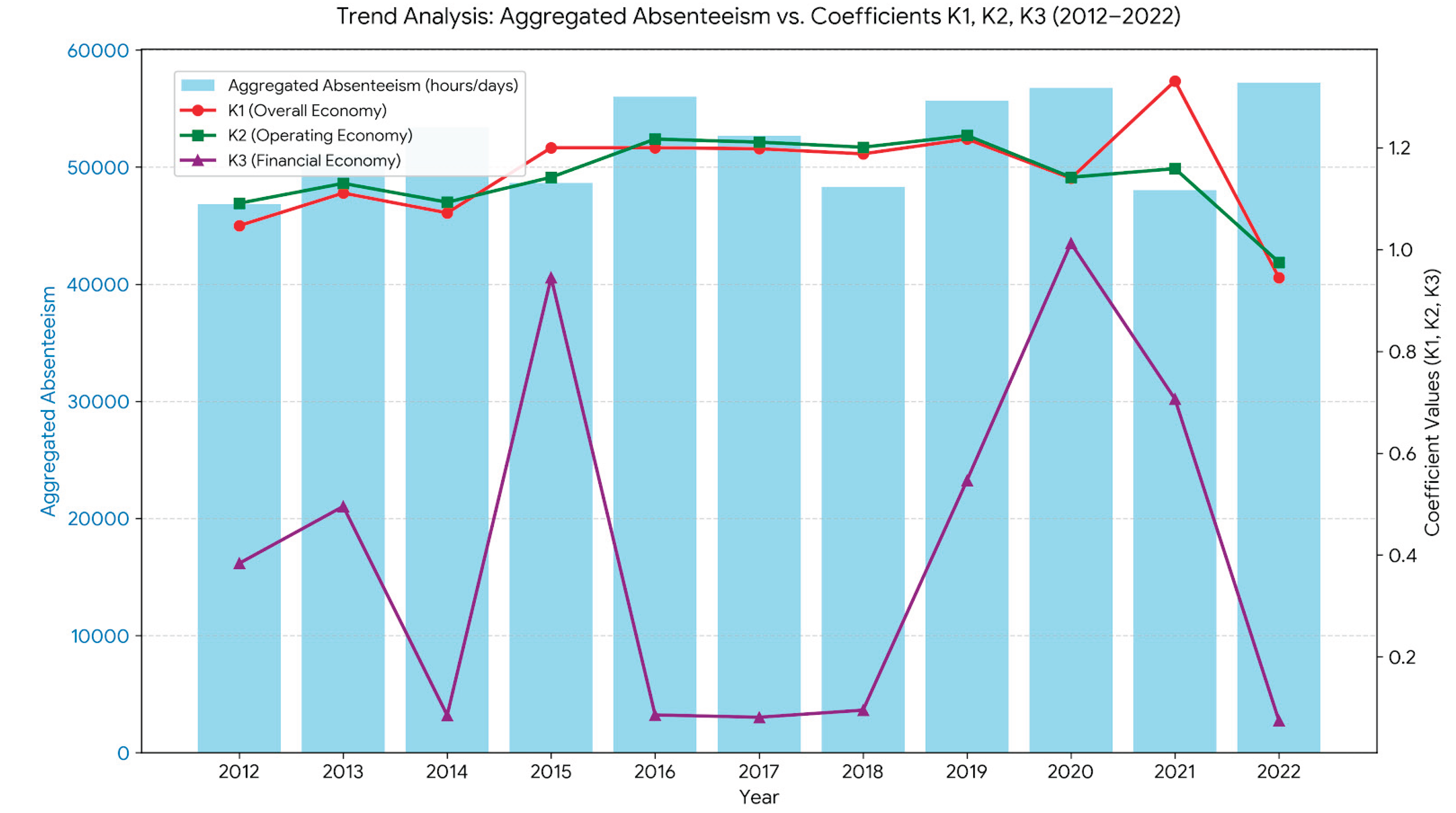

Table 1.
Poisson regression results with cluster-robust standard errors.
| Predictor | IRR | 95% CI | p-value |
| Gender (Female vs. Male) | 1.252 | (1.107, 1.417) | <0.001 |
| Age: 31–45 | 1.335 | (1.118, 1.595) | 0.001 |
| Age: 46–55 | 1.538 | (1.282, 1.845) | < 0.001 |
| Age: >55 | 1.829 | (1.539, 2.174) | < 0.001 |
| Field vs. Office Work | 1.829 | (1.649, 2.030) | < 0.001 |
| COVID-19 Period | 0.840 | (0.708, 0.997) | 0.046 |
| Interaction: Field x COVID-19 | 1.179 | (0.984, 1.413) | 0.074 |
Note: Office/administrative groups were proxied by headquarters (Sedez), whereas field/operational groups were proxied by distribution units (DE locations). Planned hours equal regular presence hours plus absence hours; overtime was excluded.
Disclaimer/Publisher’s Note: The statements, opinions and data contained in all publications are solely those of the individual author(s) and contributor(s) and not of MDPI and/or the editor(s). MDPI and/or the editor(s) disclaim responsibility for any injury to people or property resulting from any ideas, methods, instructions or products referred to in the content. |
© 2026 by the authors. Licensee MDPI, Basel, Switzerland. This article is an open access article distributed under the terms and conditions of the Creative Commons Attribution (CC BY) license (http://creativecommons.org/licenses/by/4.0/).
Copyright: This open access article is published under a Creative Commons CC BY 4.0 license, which permit the free download, distribution, and reuse, provided that the author and preprint are cited in any reuse.


