

Submitted:
02 March 2026
Posted:
03 March 2026
You are already at the latest version
Abstract
Evacuation planning is increasingly challenged by compound hazards in which interacting threats degrade infrastructure, influence human behavior, and destabilize transportation systems. Although agent-based models and dynamic traffic simulations have advanced substantially, much of the evacuation literature remains hazard-specific, case-bound, or difficult to transfer across regions. In parallel, transportation resilience research shows that multi-hazard effects are often non-additive and that cascading infrastructure failures can amplify disruption beyond directly affected areas. These realities motivate the development of evacuation modeling frameworks that are modular, adaptable, and able to represent co-evolving behavioral and network processes under compound conditions. This review synthesizes advances in evacuation agent-based modeling, dynamic traffic assignment, hazard-induced network degradation, and compound disaster research to propose an adaptable compound-hazard evacuation framework integrating three interdependent layers: hazard processes, transportation network dynamics, and agent decision-making. The proposed framework is organized around four principles: (1) modular hazard representation, (2) decoupling behavioral decision logic from hazard physics, (3) dynamic network state evolution, and (4) neighborhood-scale performance metrics. The framework prioritizes planning-relevant, spatially resolved outputs, including neighborhood clearance time, isolation probability, and shelter demand imbalance. By prioritizing modularity, configurability, and policy-aligned metrics, this review bridges the gap between methodological advances in evacuation modeling and the operational needs of local multi-hazard planning.
Keywords:
agent-based modeling
; evacuation simulation
; infrastructure resilience
; disaster response
; compound hazards
; local planning
1. Introduction
Extreme events are increasingly characterized not by isolated hazards, but by overlapping and interacting disruptions that strain physical infrastructure, social systems, and emergency management capacity [1,2,3]. Hurricanes, for example, combine wind, storm surge, and inland flooding and can generate non-additive impacts on transportation and power systems [4,5]. Wildfires can coincide with smoke-induced visibility loss, roadway blockages, and power shutoffs, producing rapidly evolving constraints on mobility and situational awareness [6,7]. Earthquakes can similarly trigger debris accumulation, bridge damage, and cascading utility failures that alter network accessibility during evacuation [8,9,10]. Under these compound conditions, planning approaches that treat hazards independently or assume static infrastructure availability are increasingly misaligned with contemporary risk realities [11,12].
Evacuation remains one of the most consequential protective actions available to emergency managers when implemented in a timely manner, reducing mortality, injury, and exposure [13,14] However, evacuation outcomes emerge from interacting behavioral and infrastructural processes. Decisions to leave depend on risk perception, trust in authorities, household constraints, prior experience, and social influence [15,16,17]. Once departures begin, transportation networks experience sharp demand surges that may exceed capacity, particularly when infrastructure is simultaneously degraded by hazard impacts [18,19,20]. In hurricane contexts, variation in compliance and route choice can substantially alter congestion formation and clearance times [21,22], while wildfire studies show that limited vehicle access, delayed awareness, and fast-changing hazard conditions can produce critical bottlenecks [23]. These findings highlight the need for evacuation models that capture feedback among household decisions, network dynamics, and hazard-driven disruption.
Over the past two decades, evacuation modeling has advanced substantially [24,25,26]. Agent-based models (ABMs) support representation of heterogeneous households [27], probabilistic departure timing [17], adaptive rerouting [28], and congestion feedback mechanisms [3]. Dynamic traffic assignment approaches further capture time-varying demand and spillback effects that static clearance calculations cannot reproduce [29,30]. In parallel, hazard modeling has improved representations of inundation extents, debris blockages, fire spread, and network fragility, while transportation resilience research has shown that multi-hazard effects are often not additive and may differ qualitatively from single-hazard analyses [1,2,31].
Despite this progress, three structural gaps remain. First, many evacuation models are designed for specific hazards or case studies, with hazard physics embedded directly into scenario assumptions and network representations (e.g., hard-coded flood rasters, wildfire perimeters, or debris ratios), limiting usability across hazards/regions with minimal re-engineering. Second, behavioral decision logic and hazard representation are frequently intertwined, making it difficult to adapt models across contexts without substantial recalibration or redesign. Third, performance is commonly summarized with aggregate measures such as total clearance time or average travel duration, which can obscure localized vulnerabilities and distributional inequities. These limitations are amplified under compound hazards, where interacting disruptions and cascading service failures can reshape accessibility beyond directly damaged zones [11,32,33,34] and degrade travel time reliability disproportionately relative to simple connectivity metrics [35,36]. Simultaneously, municipal decision environments demand tools that are transparent, configurable, and aligned with operational questions such as evacuation order timing, shelter placement, route prioritization, and contingency planning across plausible scenarios. Decision support systems have been developed to support routing and shelter allocation [37,38,39], yet many remain tailored to specific contexts or require specialized expertise that can limit routine use.
This review proposes an adaptable, modular compound-hazard evacuation framework that synthesizes existing methodological strands into a coherent architecture organized around four principles: (1) modular hazard representation, (2) decoupling of behavioral decision logic from hazard physics, (3) dynamic network state evolution, and (4) neighborhood-scale performance metrics. The framework is intentionally hazard-agnostic, allowing wind, flood, wildfire, seismic debris, or other disruptions to be incorporated as interchangeable modules that affect capacity, speed, or accessibility through scenario-based or probabilistic processes, while preserving consistent behavioral structures for departure timing, destination choice, and rerouting. The review has two objectives: (O1) to synthesize advances in evacuation ABMs, shelter system modeling, dynamic traffic assignment, compound disaster research, and transportation network resilience to identify design requirements for adaptable modeling; and (O2) to articulate how a modular architecture can support multi-hazard evacuation planning across regions with differing risk profiles. The contribution is a conceptual structure that improves methodological coherence while supporting policy relevance of evacuation modeling under compound impacts.
2. Behavioral and Network Mechanisms in Evacuation ABMs
Agent-based models (ABMs) conceptualize evacuation not as an aggregate flow problem but as an emergent outcome of interacting decision-makers whose behavior evolves with changing environmental conditions and network performance. This perspective has become a dominant paradigm for representing evacuation as a decentralized, adaptive process embedded within dynamic infrastructure systems. Over the past decade, ABM-based evacuation research has matured substantially, incorporating richer behavioral adaptation, congestion formation, and hazard exposure mechanisms [3,25,28]. However, the increasing sophistication of individual components has not always been matched by system-level architectural coherence [30]. As behavioral, traffic, shelter, and hazard modules advance in parallel, integration, transferability, and consistency become central design concerns. This section reviews the behavioral and network foundations of evacuation ABMs and emphasizes how these elements can be organized in a unified, modular structure capable of supporting compound-hazard analysis.
A defining contribution of evacuation ABMs is their ability to represent behavioral heterogeneity within system-level simulations [40,41]. Across hazard contexts, evidence consistently shows that evacuation outcomes are highly sensitive to departure timing, risk perception, information exchange, compliance dynamics, and mobility constraints [42,43]. Evacuees are not passive users of infrastructure; staggered departures, adaptive rerouting, and socially mediated compliance reshape congestion and accessibility in ways that feed back into subsequent decisions. Wildfire simulations illustrate how delayed awareness and limited vehicle access can amplify exposure [23,44], while integrated fire-traffic models demonstrate how hazard propagation can alter route viability in real time [45,46]. Similar sensitivities occur in tsunami, landslide, and technological hazards, where small changes in participation or departure timing can generate disproportionate shifts in congestion and survival outcomes [47,48,49]. Architecturally, these findings imply that behavioral modules must remain flexible under uncertainty while avoiding hazard-specific assumptions that reduce adaptability [50].
Recent modeling developments extend beyond simple decision rules to represent cognitive, physiological, and strategic dimensions of evacuation behavior. Agents are increasingly treated as adaptive entities whose movement speed, spacing, and route choice evolve under perceived threat, social contagion, and stress amplification [51,52]. Motion dynamics increasingly incorporate acceleration variability, collision avoidance, and density-dependent interactions, enabling crowd behavior to emerge from micro-scale heterogeneity rather than imposed flow assumptions [53,54]. Demographic diversity further recognizes systematic variation in mobility, response delay, and assistance needs across age groups and physical abilities, with nontrivial consequences for system performance [27]. In parallel, strategic modeling introduces probabilistic learning and game-theoretic reasoning, enabling agents to anticipate congestion, revise expectations, and adapt to evolving network states [55,56]. From an adaptable framework perspective, the key challenge is not simply adding behavioral realism, but organizing behavioral submodules so that complexity is extensible without sacrificing clarity or cross-context portability.
Model structure also matters in how uncertainty is represented. Systematic reviews report a shift away from deterministic “if–then” rules toward probabilistic decision structures that better reflect uncertainty in hazard forecasts, infrastructure availability, and social influence [25,57,58,59,60]. Behavioral research on compound emergencies further indicates that risk perception under multiple threats may diverge from single-hazard assumptions, particularly when public health, flood, or wildfire risks coincide [61,62]. This reinforces the need for behavioral architectures that can accommodate multiple concurrent signals and evolving credibility without hard-wiring hazard-specific logic into the core decision engine.
Despite advances in behavioral representation, a persistent gap remains between behavioral sophistication and empirical grounding. Many hurricane-focused ABMs reproduce large-scale traffic patterns and evacuation orders by integrating road networks, forecast cones, and evacuation zones to simulate congestion, contraflow, and demand surges [21,63,64]. Microsimulation-based optimization frameworks further enhance temporal realism by coupling dynamic programming with traffic simulation [65]. Yet behavioral inputs such as participation rates, destination splits, and departure timing, are often indirectly calibrated through socioeconomic predictors or machine-learning models [66,67], with fewer studies anchoring agent decisions directly to survey-reported evacuation probabilities at meaningful spatial strata. In addition, evacuees are frequently introduced at zonal centroids rather than realistic household-to-road access points, which can mask localized bottlenecks and distort neighborhood-scale performance assessment. Thus, while ABMs capture heterogeneity conceptually, empirical and spatial specificity remains uneven across applications.
Parallel progress has occurred in representing traffic dynamics and congestion feedback. Whereas clearance-time approaches typically rely on deterministic flow assumptions and static assignments, dynamic traffic assignment frameworks incorporate time-varying demand, background traffic, rerouting behavior, and spillback [29,30]. Mesoscopic and microscopic approaches can capture queue formation, spillback, and adaptive detouring [27,68]. Research shows that communication-induced surges can intensify congestion [69] while locally rational detours may degrade system-level performance [24]. Wildfire evacuation simulations further confirm that route switching, and phased strategies can substantially alter exposure and clearance times [14,70]. These findings underscore the importance of congestion feedback mechanisms and endogenous route adaptation within evacuation models. However, many applications still report system-wide clearance time as the primary performance metric, giving less attention to spatially uneven impacts across origins or to localized isolation risks under network disruptions. This limitation is especially consequential under compound hazards, which can degrade accessibility nonuniformly across space.
Shelter modeling has also progressed from simple capacity accounting toward spatially and behaviorally informed allocation frameworks. Recent work incorporates geographic distribution, capacity constraints, and optimization routines to improve allocation efficiency and reduce exposure [71,72]. Moreover, evidence indicates that increasing shelter supply alone does not guarantee improved performance without attention to placement and accessibility [73], and evacuees’ destination choices reflect social ties, logistics, and perceived safety rather than strict proximity [74,75,76]. In system terms, shelters function as dynamic sinks whose effectiveness depends on how origin-specific demand propagates through constrained infrastructure and how behavioral decisions interact with capacity thresholds. When analyses rely primarily on system-wide occupancy totals, they risk obscuring the spatial origin of imbalances and the feedback mechanisms that generate them. Shelter modules must therefore be designed to interact explicitly with origin-resolved demand and evolving network states, enabling localized deficits to be identified without embedding hazard-specific assumptions.
Destination modeling has similarly shifted from static aggregate designs toward adaptive, context-sensitive decision structures. Early models treated destination choice as probabilistic selection among predefined alternatives conditioned on socioeconomic attributes and travel impedance [77,78], generally assuming stable hazard conditions and infrastructure availability. Subsequent work introduced temporal dynamics so preferences could evolve with changing trajectories, congestion, and accommodation constraints [79]. More recent approaches incorporate strategic anticipation and collective effects [80] and use data-driven predictors to refine spatial allocation patterns [81]. Empirical findings consistently show that income, housing tenure, and social capital shape accommodation outcomes: lower-income households and renters are more likely to rely on public shelters, while higher-income households more often evacuate to hotels or friends and relatives [16,82,83]. Structural inequality also shapes shelter reliance and post-evacuation hardship [84,85], while social networks influence both destination choice and response timing [83,86]. Prior experience, perceived shelter safety, and information credibility further mediate these patterns [15,87,88]. These results motivate destination modules that can represent both resource constraints and network-mediated social options.
Departure-time modeling has moved beyond static assumptions to incorporate adaptive learning, social influence, vulnerability, and warning system dynamics. Early work emphasized that evacuees may not optimize timing but learn and adjust based on evolving information and perceived congestion [89]. Later studies highlighted the interdependence of departure time and destination/route choices, especially in rapidly evolving hazards, motivating integrated choice structures [90,91]. Information credibility and dissemination delays have been shown to meaningfully affect participation timing [17,92]. Social vulnerability indicators have also been linked to evacuation decision latency, suggesting resource constraints and risk perception interact to delay or accelerate departure [3,93]. Although these models increasingly represent nuanced determinants of timing, socioeconomic variables are still more often used to parameterize decisions than to assess disparities in outcomes such as isolation probability, clearance time, or unmet shelter demand [94]. For compound-hazard planning, this gap is consequential because layered disruptions can differentially constrain departure feasibility across neighborhoods.
Modeling scale, validation, and usability remain central challenges. Microscopic models capture fine-grained interactions shaping evacuation time [53,95,96], while mesoscopic approaches emphasize scalability for system-level flow [97,98]. Appropriately, hybrid frameworks attempt to bridge these strengths [52,99]. Early spatial decision support systems (DSS) highlighted the value of integrating simulation with geographic information systems (GIS) for practical planning [100,101,102,103]. More recent resilience-oriented DSS work continues to stress interoperability and usability across hazards [104,105]. Methodologically, verification and validation remain challenging given behavioral uncertainty and data scarcity during extremes. Emerging approaches include virtual reality (VR)-based behavioral calibration [106], machine-learning-assisted parameter tuning [107], and structured verification/validation protocols emphasizing documentation, consistency testing, sensitivity analysis, and reproducibility [108,109]. Yet for municipal planners, sophisticated engines can still appear opaque, and outputs are often reported in aggregate technical metrics rather than neighborhood-scale indicators directly usable for shelter planning, mitigation prioritization, or routine preparedness.
Overall, the literature discussed herein demonstrates that evacuation ABMs can represent heterogeneous behavior, congestion feedback, shelter allocation, and adaptive routing under hazardous conditions. However, persistent limitations remain in empirical grounding, spatial specificity, compound-hazard integration, and practitioner-facing usability. These gaps motivate modular evacuation architectures in which behavioral, network, shelter, and hazard components can be flexibly composed while producing origin-resolved, decision-ready metrics suitable for compound-hazard planning.
3. Dynamic Traffic, Network Degradation, and Evacuation Reliability
Evacuation performance emerges from the interaction between individual decision-making and transportation network dynamics. Even when behavioral rules are specified with high fidelity, evacuation outcomes depend on how departures and route choices propagate through constrained, time-varying road systems [17,24,26]. Empirical and simulation-based studies show that route switching, congestion awareness, and information exchange can either improve or degrade system performance depending on network conditions and coordination mechanisms [27,69,110]. This interaction has motivated a long-term shift in evacuation modeling away from deterministic clearance-time calculations and toward dynamic traffic assignment and agent-based traffic representations that can capture congestion formation, spillback, rerouting, and capacity constraints under evolving conditions [29,30,111,112]. Compared with aggregate clearance approaches, these models improve realism by allowing demand to vary over time, incorporating background traffic, and representing adaptive routing in response to changing network states [30,47,113,114].
Traditional clearance models estimate evacuation time primarily as a function of demand and network capacity under fixed roadway availability [39,64,115]. While useful for preliminary planning, they typically assume stable infrastructure, uniform exposure, and predictable demand patterns [47,116]. Dynamic models relax these assumptions by representing time-dependent demand, route switching, multimodal travel, and congestion feedback loops [29,30]. Agent-based or mesoscopic simulations further capture localized density effects, queue spillback, and nonlinear system responses to small behavioral shifts [27,68]. The broader modeling shift exposes a structural limitation that becomes critical under compound hazards: network availability is still often treated as exogenous and predetermined, rather than evolving probabilistically during the evacuation as hazard intensity changes [1,117]. Multi-hazard resilience research shows that infrastructure functionality can evolve nonlinearly under sequential or interacting hazards, producing outcomes that differ substantially from single-hazard estimates [10,118].
Congestion also actively reshapes decision-making, creating feedback cycles between perception, route selection, and network loading [17,26]. Information dissemination can trigger synchronized departure surges that intensify early bottlenecks [69], and locally rational detours can degrade overall system performance when agents act independently [24]. Reviews of group evacuation dynamics similarly emphasize that collective movement patterns and coordination failures can amplify congestion waves in high-stress environments [119]. These findings reinforce that evacuation networks function as adaptive socio-technical systems, where behavioral responses and traffic dynamics co-produce accessibility outcomes.
A parallel line of research emphasizes that infrastructure functionality often changes during the event itself and should be represented explicitly. Monitoring and assessment frameworks for transport infrastructure exposed to multiple hazards highlight the importance of real-time damage detection and dynamic functional evaluation [120]. Road closures, contraflow strategies, and rerouting under disrupted conditions can substantially alter clearance outcomes [121,122]. In wildfire contexts, reduced visibility, debris, and roadway temperature changes measurably affect speeds and route viability [123,124]. Foundational work argues that roadway capacity constraints and occupancy thresholds should be incorporated explicitly into community planning [125]. Hurricane evacuation studies similarly show that network performance is sensitive to dynamic shelter allocation and background traffic conditions [29]. These contributions move beyond demand–capacity calculations under fixed assumptions and motivate time-evolving representations of accessibility.
Infrastructure interdependencies further complicate this evolution. Integrated network models demonstrate that transportation systems are tightly coupled with power, communication, and water infrastructure, such that failure in one subsystem can propagate across others [126,127]. Transportation has been identified as an underestimated backbone of community resilience because disruptions in mobility constrain access to healthcare, shelter, and emergency services even when other systems remain partially functional [128]. Policy-based recovery models show that restoration sequencing and infrastructure prioritization significantly influence overall system resilience under uncertainty [129]. However, evacuation traffic models rarely integrate such interdependent restoration dynamics into simulations of ongoing population movement.
These gaps become more consequential under compound hazards. Emerging literature demonstrates that multi-hazard effects are often non-additive and that the timing and interaction of concurrent events can produce outcomes that differ substantially from single-hazard estimates [1,2]. Spatial hazard configuration also matters because resilience depends on how hazard intensity overlaps with network topology [130]. For example, flood-related road loss combined with wind-driven debris may isolate neighborhoods even when each hazard alone would not [117,131,132,133]. Transportation resilience studies further show that travel-time reliability can deteriorate disproportionately under multi-hazard stress relative to simple connectivity metrics [36], yet these insights are still rarely embedded within evacuation simulations that couple demand, routing, and disruption processes.
Cascading failures introduce additional pathways through which evacuation outcomes can diverge from single-system assumptions. Behavioral responses to evacuation orders can overload communication networks and induce flash congestion, generating nonlinear stress patterns [18,134]. Power outages may disable traffic signals and reduce effective roadway capacity precisely when evacuation demand peaks [20]. These interdependencies can expand impacts beyond the direct hazard footprint and reshape accessibility gradients across neighborhoods, yet they remain underrepresented in many operational ABMs and traffic-based evacuation models.
Taken together, the literature demonstrates substantial progress in modeling traffic dynamics, congestion feedback, rerouting, and infrastructure constraints. However, current approaches remain fragmented: behavioral models, traffic assignment models, hazard impact models, and infrastructure resilience frameworks are often developed in parallel rather than within unified architectures. As a result, many evacuation simulations remain hazard-specific, region-specific, and difficult to adapt across contexts.
This fragmentation motivates the development of a modular, adaptable compound-hazard evacuation framework. Such a framework must (1) represent hazard impacts as stochastic, time-varying processes affecting network links; (2) couple behavioral adaptation with evolving infrastructure functionality; (3) quantify neighborhood-scale performance metrics rather than only aggregate clearance times; and (4) remain adaptable to different hazard combinations, from wind–surge systems to wildfire–smoke scenarios or earthquake–landslide interactions.
In this context, evacuation modeling should move beyond reproducing historical traffic patterns toward constructing configurable socio-technical systems capable of simulating interacting hazards, adaptive agents, and evolving infrastructure states within a unified structure. The next section, therefore, synthesizes emerging work on compound hazards and infrastructure interdependencies, highlighting the conceptual foundations necessary for such an adaptable framework.
4. Proposed Conceptual Framework
4.1. Micro-Scale Compound-Hazard Evacuation
Existing evacuation models have achieved substantial sophistication in representing behavioral heterogeneity, congestion dynamics, shelter allocation, and hazard-specific disruptions. However, much of the literature remains hazard-specific, geographically tailored, or structurally rigid. Models developed for hurricanes often assume surge-based road closures; wildfire models focus on fire spread and smoke-induced visibility reduction; earthquake simulations emphasize debris and structural collapse [135]. While each of these approaches advances hazard-specific realism, they are rarely structured for cross-hazard transferability or modular adaptation across regions. This fragmentation presents a fundamental limitation for emergency planning in an era of compound and cascading risks. Climate-driven hazard intensification, urban expansion into high-risk zones, and increasing infrastructure interdependencies require evacuation models that are not only behaviorally realistic but also structurally adaptable [1,11,119]. Sequential or interacting hazards produce non-additive impacts on transportation networks, shelter demand, and evacuation timing [2,36].
Accordingly, Figure 1 presents an overview of an adaptable evacuation modeling framework organized around four foundational pillars and their associated structural components. Each pillar reflects a core requirement for scalable compound-hazard evacuation modeling: modular hazard representation, behavioral parameterization that can be recalibrated across settings, dynamic network-state evolution, and neighborhood-scale performance assessment. The figure serves as a roadmap showing how these elements interact while preserving flexibility to accommodate different hazard processes, data availability, and geographic contexts.
4.1.1. Modular Hazard Representation
Hazards should be represented as modular processes that affect network availability, travel speed, and departure behavior through probabilistic link degradation and time-varying disruption states rather than through hard-coded scenario assumptions. Instead of embedding a specific hazard directly into routing logic (e.g., “storm surge closes these roads”), the hazard layer should operate as an independent module that modifies network attributes dynamically. This modular approach allows wind, flood, wildfire, earthquake, landslide, or cascading infrastructure failure processes to be incorporated as interchangeable components without altering the behavioral core of the model. Such modularization aligns with emerging multi-paradigm and meta-model approaches that separate agents, environment, and events into reusable structures [136]. Modular representation enables scenario-based compound simulations, where multiple hazards can be activated independently or jointly. For example, a single-hazard flood scenario may produce specific patterns of link closures and reduced speeds, while a wind–flood compound scenario may introduce both inundation-based closures and debris-induced stochastic failures. A wildfire–heatwave scenario may combine fire spread constraints with increased departure rates driven by risk perception.
In this framework, compound hazards are not treated as exceptional cases but as configurable combinations within a standardized simulation environment. Each scenario yields distinct performance metrics such clearance time, isolation probability, congestion duration, shelter overflow, or exposure time allowing comparison across hazard combinations rather than relying on a single deterministic “worst-case” assumption. This scenario-based architecture supports uncertainty analysis and stress-testing of evacuation plans under evolving risk landscapes [2,11].
4.1.2. Decoupling Behavior from Hazard Physics
Behavioral decision rules such as departure timing, destination choice, compliance with evacuation orders, and rerouting should be parameterized independently of specific hazard types. Whether agents respond to wildfire proximity, rising water, seismic debris, or chemical plumes, the underlying processes governing risk perception, social influence, and congestion adaptation can be represented with a common behavioral architecture, while hazard inputs enter as context-specific signals that shape perceived risk and feasible routes.
For this decoupling to be meaningful, behavioral rules must be grounded in empirical evidence rather than synthetic assumptions. A persistent limitation in evacuation modeling is reliance on assumed participation rates or socioeconomic proxies without direct calibration to observed or survey-reported behavior. Empirical datasets such as post-event evacuation surveys, stated-preference studies, and behavioral experiments provide more realistic depictions of how households respond to warnings and infrastructure constraints [3,16,17]. Embedding empirically estimated probabilities into agent decision rules improves realism and portability because parameters can be swapped or recalibrated across regions without restructuring hazard or traffic modules. By separating hazard physics from behavioral logic and anchoring behavior in observed decision-making, the framework avoids conflating infrastructure disruption with assumed compliance patterns and enables consistent comparison of how the same population responds under wildfire, flood, hurricane, or compound scenarios.
4.1.3. Network State as a Dynamic System
Transportation infrastructure should be modeled as a time-evolving system whose effective capacity changes in response to hazard intensity, cascading failures, and adaptive loading from evacuees. Instead of assuming static road closures or fixed capacity reductions, the framework represents network links as dynamic entities whose operational states transition probabilistically over time.
Hazard impacts can reduce speeds, lower capacity, or trigger link failure, while evacuation-induced congestion can amplify disruption through spillback, queue propagation, and overload of adjacent corridors. Research on cascading infrastructure failures further shows that evacuation behavior can create nonlinear stress on interdependent systems, including power grids and communication networks [18,34]. Infrastructure vulnerability is therefore not purely exogenous but can emerge partly from feedback between behavioral responses and evolving network conditions. This representation shifts evacuation modeling from static routing to a co-evolving system simulation in which behavior and infrastructure jointly shape accessibility and performance.
4.1.4. Neighborhood-Scale Performance Metrics
Most evacuation studies report aggregate system-level metrics such as total clearance time or overall evacuation rate. Although useful for high-level benchmarking, these metrics can mask spatial disparities and localized vulnerability. In contrast, spatially disaggregated outputs enable planners to identify neighborhoods that repeatedly experience elevated delay, isolation, or unmet shelter demand across scenarios, and to determine which hazard combinations amplify these localized deficits. In addition, this supports targeted interventions, such as corridor reinforcement, phased messaging and information campaigns, or shelter redistribution, based on origin-specific performance rather than uniform mitigation. Crucially, neighborhood-scale metrics also create the analytical foundation for examining differential outcomes across socioeconomic groups. When evacuation performance is resolved at fine spatial scales, it becomes possible to stratify results by income, renter share, age distribution, disability prevalence, or vehicle access, thereby revealing whether certain populations face systematically longer clearance times or higher exposure to network disruption. Rather than using socioeconomic indicators solely to parameterize behavior, this approach enables their use in post-simulation equity assessment, distinguishing between behavioral assumptions and outcome disparities.
To make these principles operational within a usable and adaptable modeling approach, the framework is implemented through three interacting layers. First, the agent layer represents heterogeneous households and individuals using probabilistic decision rules grounded in empirical evidence. Second, the network layer represents transportation infrastructure with dynamic capacity, congestion propagation, and hazard-induced degradation. Third, the hazard layer represents one or more hazards as time-varying disruption processes that probabilistically affect network links and, where appropriate, departure conditions. Separating these layers allows future applications to incorporate wildfire spread, storm surge, seismic debris, or floodplain inundation without restructuring the core evacuation engine. The hazard layer updates network states, the agent layer governs decision-making, and the network layer governs traffic flow propagation. This architecture directly addresses limitations identified in prior literature, including hazard-specific rigidity, limited compound-hazard integration, and weak adaptability across regions [11,25].
4.2. Agent-Based Modeling Methodology
Figure 2 presents the overall conceptual flowchart of the proposed agent-based modeling (ABM) framework. Unlike hazard-specific implementations, this diagram illustrates a high-level, adaptable architecture that separates core components into modular layers: hazard modules, behavioral decision processes, dynamic network states, and performance evaluation outputs. The flowchart emphasizes how scenario-based hazard inputs (i.e., single or compound) modify network conditions and perceived risk, which in turn influence agent-level decisions regarding departure timing, destination selection, and rerouting. These individual decisions propagate through the transportation network, generating congestion dynamics and potential cascading effects that feed back into subsequent agent behavior. By structuring the framework in this layered manner, the figure demonstrates how different hazards can be interchanged without altering the behavioral core, enabling application across diverse geographic regions and risk contexts. The modular flow also clarifies the distinction between exogenous hazard processes and endogenous congestion dynamics, reinforcing the framework’s flexibility for scenario testing and decision support.
Although the framework is presented conceptually, it is compatible with a wide range of existing ABM platforms. General-purpose environments such as NetLogo, Repast, and GAMA have been widely used to construct evacuation simulations with heterogeneous agents and spatially explicit networks [84,137,138,139,140]. More scalable or hybrid modeling environments, including AnyLogic and Unity-based simulation ecosystems, support integration with dynamic traffic assignment, 3D visualization, and complex decision logic [55,141]. Specialized evacuation platforms such as ESCAPE, CrowdEgress, and PRISM further enable detailed social-force modeling and immersive or virtual-reality–enhanced experimentation [142,143,144]. Table 1 summarizes commonly used platforms and their relative strengths and limitations for evacuation and infrastructure modeling [145,146,147,148,149,150,151]. The layered architecture outlined in Figure 2 is intentionally software-agnostic, allowing implementation within any platform capable of representing agent-level decision rules, network dynamics, and scenario-driven hazard inputs. This ensures that the methodological contribution lies in structural organization rather than dependence on a particular computational tool.
5. Discussion & Policy Relevance
Evacuation modeling has matured considerably over the past two decades, yet the translation of modeling advances into operational municipal planning remains uneven. Sophisticated agent-based simulations now incorporate behavioral heterogeneity, probabilistic decision rules, congestion feedback, and dynamic routing. However, many implementations remain hazard-specific, data-intensive, or optimized for academic validation rather than for iterative use by local planners. Thus, the gap is not primarily technical; it is structural. Academic models often prioritize validation, algorithmic sophistication, or hazard-specific realism, while municipal agencies require adaptable, scenario-driven tools that can be updated, interpreted, and deployed under evolving risk conditions. Policy implications and relevance are built around two components: (1) methodological implications for compound-hazard modeling and multi-layer system integration, and (2) practical implications for municipal planning, shelter management, and infrastructure prioritization.
5.1. Compound-Hazard Preparedness in Municipal Planning
For local governments, evacuation planning is not an abstract modeling problem; it is an operational responsibility that must function under uncertainty, resource constraints, and changing hazard profiles. Effective evacuation performance emerges from the interaction of three interdependent systems: individual decision-making, transportation network dynamics, and evolving hazard processes. Although prior research has significantly advanced each of these components, implementation in planning practice often remains fragmented. Behavioral realism may be incorporated without dynamic infrastructure representation. Hazard overlays may be added without endogenous congestion modeling. As a result, many evacuation plans implicitly assume that disruptions are predictable, isolated, or static.
Operational planning requires a different approach. Instead of embedding hazard impacts within case-specific assumptions, municipal models must be structured to accommodate uncertainty across multiple interacting drivers. A modular hazard architecture provides this flexibility. In practical terms, this means representing hazard effects not as fixed closures derived from a single flood raster or wildfire perimeter, but as probabilistic and time-varying degradation processes that influence link capacity, accessibility, and travel speed. Wind damage, storm surge, wildfire spread, seismic debris, or landslide obstructions can then be introduced as interchangeable modules without altering the behavioral decision core of the model. Guo et al. [136] emphasize the value of separating agents, environment, and event processes to enhance reusability; within evacuation planning, this separation enables towns in different hazard contexts to apply a common structural framework while customizing local hazard inputs.
This modularization has direct policy implications. Many municipal evacuation studies remain hazard-specific, developed in response to a recent event or regulatory requirement. Flood closures may be hard-coded from a single storm scenario. Wildfire impacts may rely on one historical fire footprint. Earthquake disruptions may be simulated using assumed blockage ratios. While such approaches can improve realism for a single case study, they limit adaptability. When a new hazard profile emerges, or when climate-driven intensification alters exposure patterns, planners must often reconstruct models from scratch. An adaptable compound-hazard structure reduces this institutional friction by allowing scenario substitution rather than model redesign.
Equally important is the representation of infrastructure as a dynamic system rather than a static background condition. Traditional clearance models treat network capacity as fixed throughout the evacuation window. Even some dynamic simulations introduce closures exogenously and maintain them for the duration of the run. However, research on cascading infrastructure failures demonstrates that evacuation demand itself can destabilize system performance. Barrett et al. [18] show that compliance levels can trigger nonlinear congestion and communication overloads. Mühlhofer et al. [34] further demonstrate that cascading disruptions often account for most service impacts during compound events. From a municipal planning perspective, this means that evacuation-induced loading and hazard-induced degradation must be modeled as co-evolving processes rather than sequential inputs.
A dynamic network-state representation therefore becomes central to operational planning. Instead of binary open-or-closed road segments, links may experience probabilistic failure, partial capacity reduction, delayed clearance, or staged recovery. Congestion feedback influences travel time, which then reshapes departure decisions and route selection. Spillback effects can propagate disruptions beyond initially affected corridors, amplifying localized impacts. Smyrnakis and Galla [26] and Firdausyi et al. [27] demonstrate how individually rational routing decisions can degrade overall system performance, reinforcing the importance of endogenous feedback modeling. For planners, this translates into a clearer understanding of where congestion hotspots may emerge under compound conditions and how network fragility varies across neighborhoods.
Compound hazards further emphasize the need for scenario-based evaluation. Multi-hazard resilience research indicates that hazard interactions are rarely additive. Argyroudis et al. [1] show that sequential or simultaneous hazard exposures can produce markedly different system performance trajectories compared to isolated events. In evacuation planning, this implies that wind damage preceding storm surge, wildfire smoke preceding traffic surges, or seismic debris combined with infrastructure outages may generate qualitatively distinct clearance patterns. Rather than relying on a single deterministic clearance estimate, planners benefit from evaluating performance distributions across hazard combinations, intensity levels, and compliance assumptions. Scenario-based simulation enables municipalities to assess robustness, identify thresholds of system instability, and compare intervention strategies under varied compound-risk conditions.
Importantly, the framework does not prescribe hazard-specific parameters. Its value lies in defining structural requirements that support adaptability: probabilistic link degradation, time-varying capacity, endogenous congestion feedback, and configurable scenarios. This structure allows coastal towns, wildfire-prone communities, seismic regions, or multi-risk metropolitan areas to implement the same methodological backbone while tailoring hazard modules to local conditions. The result is not a model tied to one geography, but an institutional planning tool that can evolve alongside changing hazard landscapes.
Embedding neighborhood-scale performance metrics into planning practice addresses a persistent blind spot in evacuation assessment. Aggregate clearance time remains a dominant indicator across many studies [47,64]. While useful for benchmarking overall performance, system-wide averages can obscure spatial inequities. Certain communities may experience prolonged isolation, limited shelter accessibility, or disproportionate congestion even when total clearance appears acceptable. For municipal decision-makers, these localized disparities are often more relevant than aggregate efficiency. Incorporating origin-based metrics such as block-group clearance time, isolation probability, normalized evacuation duration, and unmet shelter demand enables targeted mitigation strategies rather than uniform system-wide prescriptions.
Operationalizing compound risk, therefore, requires more than improved simulation fidelity. It demands structural reconfiguration of evacuation modeling to support adaptability, scenario comparison, dynamic infrastructure interaction, and spatially resolved outputs. The methodological implications of this planning-oriented shift are summarized in Table 2.
5.2. Decision Support for Shelter, Infrastructure, and Evacuation Timing
Even the most sophisticated evacuation model has limited value if it cannot inform real decisions under real constraints. Municipal emergency managers operate within budget cycles, staffing limits, political oversight, and public scrutiny. Tools that require extensive recalibration, advanced programming expertise, or opaque optimization routines are unlikely to be integrated into routine planning practice. What local governments need are systems that translate simulation outputs into interpretable, scenario-sensitive insights that directly support timing, shelter, and infrastructure decisions. To synthesize these planning implications, Table 3 organizes the framework’s operational contributions across key municipal decision domains, including evacuation timing, shelter allocation, infrastructure prioritization, and communication strategy. Rather than presenting abstract methodological features, the table translates simulation capabilities into concrete planning actions, associated metrics, and potential implementation pathways.
Scenario-based simulation plays a central role in this translation. Instead of producing a single evacuation time estimate tied to one assumed hazard condition, planners can examine performance variability across alternative compound configurations. A coastal municipality may compare wind-only impacts, surge-only inundation, and combined wind-surge degradation to determine how road fragility shifts under each configuration. A wildfire-exposed jurisdiction might test smoke-induced speed reduction together with phased evacuation compliance levels to identify when visibility constraints begin to destabilize network flow. In seismic regions, debris-related link failures can be layered with congestion surges to evaluate secondary isolation risk. The objective is not prediction of a single outcome, but stress-testing of the system across plausible hazard combinations. This approach shifts evacuation planning from reactive estimation toward anticipatory resilience design. Rather than asking how long evacuation would take under one assumed scenario, planners can ask which hazard combinations generate persistent bottlenecks, which compliance ranges trigger network overload, and which neighborhoods repeatedly experience delayed clearance. Such insight directly informs evacuation order timing, staged departure policies, and pre-event infrastructure reinforcement.
Shelter system evaluation similarly benefits from origin-resolved analytics. Traditional shelter planning often emphasizes total capacity or optimized allocation, yet system-wide adequacy does not guarantee spatial equity. Du et al. [73] demonstrate that adding shelters without strategic siting does not necessarily improve performance. Milburn et al. [76] further show that evacuees do not consistently select the nearest shelter, undermining simplified proximity assumptions. When shelter demand is traced back to specific origins, planners can detect which neighborhoods generate overflow under varied scenarios, whether imbalances stem from capacity constraints or routing congestion, and how alternative shelter activation strategies redistribute flows. This transforms shelter planning from aggregate capacity accounting into spatial demand management.
Departure timing represents another actionable layer. Empirical research highlights the importance of information dissemination and behavioral responsiveness in shaping congestion dynamics. Siam et al. [92] show that warning delays materially alter evacuation curves, while studies such as Roy et al. [17] and Sun et al. [3] illustrate how compliance and risk perception influence participation rates. Incorporating behavioral sensitivity testing into scenario runs enables planners to evaluate how earlier orders, staggered departure windows, or targeted communication campaigns affect peak loading. Rather than assuming fixed participation rates, municipalities can identify threshold conditions where marginal increases in compliance begin to overwhelm infrastructure capacity. This supports more nuanced communication strategies that balance urgency with network stability.
Infrastructure prioritization also becomes more defensible when informed by repeated scenario performance. Road segments or intersections that consistently exhibit high congestion, extended spillback, or elevated isolation probability across multiple hazard combinations represent structural weaknesses. These recurrent bottlenecks provide empirical justification for targeted capital improvements such as signal backup systems, lane widening, contraflow planning, debris clearance prioritization, or culvert reinforcement. Aligning such findings with hazard mitigation funding mechanisms strengthens grant applications by grounding proposals in simulation-based evidence rather than anecdotal observation.
Beyond technical optimization, transparency remains critical. Municipal decision environments require metrics that can be communicated clearly to elected officials, grant reviewers, and community stakeholders. Aggregate optimization outputs or abstract efficiency scores rarely translate into actionable policy language. In contrast, neighborhood-level indicators such as clearance time distribution, evacuee percentage-normalized evacuation duration, isolation probability, and shelter deficit mapping align more directly with planning discourse. These metrics allow stakeholders to visualize disparities, compare alternatives, and justify interventions without requiring familiarity with simulation algorithms.
Importantly, the framework also allows planners to examine equity implications without embedding deterministic demographic assumptions directly into agent behavior. Instead of prescribing behavior based on socioeconomic proxies, post-simulation analysis can evaluate performance disparities across neighborhoods. If certain areas consistently exhibit longer clearance times, higher isolation probability, or elevated shelter overflow under comparable hazard exposure, planners can investigate structural causes such as limited egress routes, constrained vehicle access, or communication gaps. This approach aligns with vulnerability-informed planning perspectives while avoiding reductionist behavioral modeling.
Ultimately, the policy relevance of this framework lies in its ability to integrate multiple planning dimensions within a single, adaptable architecture. It supports evacuation order evaluation, shelter strategy refinement, communication timing analysis, and infrastructure prioritization without requiring hazard-specific reconstruction. By linking modular hazard representation with dynamic network interaction and spatially resolved outputs, the framework transforms evacuation modeling from an academic exercise into a practical decision-support instrument. The result is not simply improved simulation fidelity, but improved institutional capacity to plan under uncertainty, justify investments, and communicate risk transparently across communities.
6. Conclusions
Evacuation modeling is entering a phase in which the central challenge is no longer behavioral realism or traffic representation in isolation, but the integration of interacting hazards, adaptive agents, and evolving infrastructure within coherent and reusable system architectures. While substantial methodological progress has been achieved across behavioral, traffic, and hazard modeling domains, these advances often remain compartmentalized within hazard-specific or region-specific implementations. The contribution of this review lies in articulating an adaptable compound-hazard framework that organizes these advances into a modular and adaptable structure, positioning evacuation simulation as a configurable planning instrument rather than a single-case analytical exercise.
The proposed architecture provides a foundation for comparative, scenario-driven analysis under uncertainty. By supporting interchangeable hazard modules, dynamic network evolution, and spatially resolved performance outputs, the framework enables systematic exploration of how compound drivers alter evacuation outcomes across varying intensities, compliance conditions, and infrastructure stress states. This shift from deterministic clearance estimation toward variability-based performance assessment aligns evacuation modeling with contemporary resilience thinking and risk-informed planning.
Future work should focus on operationalizing this architecture across diverse geographic contexts and hazard portfolios to test its transferability in practice. Applied case studies can evaluate how the modular structure performs under coastal wind–surge systems, wildfire–smoke interactions, seismic–landslide coupling, or other region-specific compound risks. Empirical calibration of behavioral processes, probabilistic infrastructure degradation functions, and recovery dynamics remains a priority for strengthening predictive validity. In parallel, deeper integration of cascading infrastructure interdependencies and communication system effects will enhance the representation of nonlinear disruption patterns.
Ultimately, advancing compound-hazard evacuation modeling requires moving beyond isolated methodological refinement toward integrative, cross-disciplinary development. By structuring behavioral, network, and hazard processes within a unified yet adaptable framework, evacuation simulation can better support comparative planning, institutional learning, and equitable resilience strategies under increasingly complex risk environments.
References
- Argyroudis, S.A.; Mitoulis, S.A.; Hofer, L.; Zanini, M.A.; Tubaldi, E.; Frangopol, D.M. Resilience Assessment Framework for Critical Infrastructure in a Multi-Hazard Environment: Case Study on Transport Assets. Science of The Total Environment 2020, 714, 136854. [Google Scholar] [CrossRef]
- Markogiannaki, O.; Karatzeztou, A.; Stefanidou, S.; Tsinidis, G. RESILIENCE ASSESSMENT OF ROAD BRIDGES IN MULTI-HAZARD ENVIRONMENT. In Proceedings of the COMPDYN 2023 9th ECCOMAS Thematic Conference on Computational Methods in Structural Dynamics and Earthquake Engineering, Athens, Greece, 2023. [Google Scholar] [CrossRef]
- Sun, Y.; Forrister, A.; Kuligowski, E.D.; Lovreglio, R.; Cova, T.J.; Zhao, X. Social Vulnerabilities and Wildfire Evacuations: A Case Study of the 2019 Kincade Fire. Saf. Sci. 2024, 176, 106557. [Google Scholar] [CrossRef]
- Ansari, A.; El-Hussain, I.; Al Shijbi, Y.; Mandhaniya, P.; Alluqmani, A.E.; Al-Jabri, K. Robustness Assessment of Muscat Coastal Highway Network (CHN) under Multi-Hazard Scenarios Focusing on Traffic Stability and Adaptation Measures. Scientific Reports 2024 14:1 2024, 14, 30632-. [Google Scholar] [CrossRef]
- Nofal, O.M.; Amini, K.; Padgett, J.E.; van de Lindt, J.W.; Rosenheim, N.; Darestani, Y.M.; Enderami, A.; Sutley, E.J.; Hamideh, S.; Duenas-Osorio, L. Multi-Hazard Socio-Physical Resilience Assessment of Hurricane-Induced Hazards on Coastal Communities. Resilient Cities and Structures 2023, 2, 67–81. [Google Scholar] [CrossRef]
- Rohaert, A.; Kuligowski, E.D.; Ardinge, A.; Wahlqvist, J.; Gwynne, S.M.V.; Kimball, A.; Bénichou, N.; Ronchi, E. Traffic Dynamics during the 2019 Kincade Wildfire Evacuation. Transp. Res. D Transp. Environ. 2023, 116, 103610. [Google Scholar] [CrossRef]
- Pishahang, M.; Ruiz-Tagle, A.; Ramos, M.A.; Droguett, E.L.; Mosleh, A. A Bayesian Agent-Based Model and Software for Wildfire Safe Evacuation Planning and Management. Proc. Inst. Mech. Eng. O J. Risk Reliab. 2025, 239, 515–534. [Google Scholar] [CrossRef]
- Rahimi-Golkhandan, A.; Aslani, B.; Mohebbi, S. Predictive Resilience of Interdependent Water and Transportation Infrastructures: A Sociotechnical Approach. Socioecon. Plann. Sci. 2022, 80, 101166. [Google Scholar] [CrossRef]
- Twumasi-Boakye, R.; Sobanjo, J. Civil Infrastructure Resilience: State-of-the-Art on Transportation Network Systems. Transportmetrica A: Transport Science 2019, 15, 455–484. [Google Scholar] [CrossRef]
- Farahani, S.; Shojaeian, A.; Behnam, B.; Roohi, M. Probabilistic Seismic Multi-Hazard Risk and Restoration Modeling for Resilience-Informed Decision Making in Railway Networks. Sustain. Resilient Infrastruct. 2023, 8, 470–491. [Google Scholar] [CrossRef]
- Cegan, J.C.; Golan, M.S.; Joyner, M.D.; Linkov, I. The Importance of Compounding Threats to Hurricane Evacuation Modeling. npj Urban Sustainability 2022 2:1 2022, 2, 2-. [Google Scholar] [CrossRef]
- Shan, S.; Guo, X.; Wei, Z.; Sun, W.; Zheng, H.; Pan, H.; Lin, J. Simulation Analysis of Evacuation Processes in a Subway Station Based on Multi-Disaster Coupling Scenarios. International Journal of Disaster Risk Reduction 2023, 96, 103998. [Google Scholar] [CrossRef]
- Kim, J.; Takabatake, T.; Nistor, I.; Shibayama, T. A Comparison between Agent-Based and GIS-Based Tsunami Evacuation Simulations: A Case Study for Tofino, BC. Canadian Journal of Civil Engineering 2022, 49. [Google Scholar] [CrossRef]
- Zhao, B.; Wong, S.D. Developing Transportation Response Strategies for Wildfire Evacuations via an Empirically Supported Traffic Simulation of Berkeley, California. Transp. Res. Rec. 2021, 2675, 557–582. [Google Scholar] [CrossRef]
- Adjei, E.; Murray-Tuite, P.; Ge, Y.; Ukkusuri, S.; Lee, S. Estimating Hurricane Evacuation Destination and Accommodation Type Selection with Perceived Certainty Variables. Transp. Res. D Transp. Environ. 2022, 105, 103235. [Google Scholar] [CrossRef]
- Opdyke, A.; Bodo, D.D.; Smyth, J. Higher Ground or into Harm’s Way? Household Storm Surge Sheltering and Evacuation Plans. International Journal of Disaster Risk Reduction 2024, 106, 104452. [Google Scholar] [CrossRef]
- Roy, K.C.; Hasan, S.; Abdul-Aziz, O.I.; Mozumder, P. Understanding the Influence of Multiple Information Sources on Risk Perception Dynamics and Evacuation Decisions: An Agent-Based Modeling Approach. International Journal of Disaster Risk Reduction 2022, 82, 103328. [Google Scholar] [CrossRef]
- Barrett, C.; Channakeshava, K.; Huang, F.; Kim, J.; Marathe, A.; Marathe, M. V.; Pei, G.; Saha, S.; Subbiah, B.S.P.; Vullikanti, A.K.S. Human Initiated Cascading Failures in Societal Infrastructures. PLoS One 2012, 7, e45406. [Google Scholar] [CrossRef]
- Rouhana, F.; Jawad, D. Transportation Network Resilience against Failures: GIS-Based Assessment of Network Topology Role. Int. J. Disaster Resil. Built Environ. 2021, 12, 357–370. [Google Scholar] [CrossRef]
- Zhu, Y.; Ozbay, K.; Yang, H.; Zuo, F.; Sha, D. Modeling and Simulation of Cascading Failures in Transportation Systems during Hurricane Evacuations. J. Adv. Transp. 2021, 2021, 5599073. [Google Scholar] [CrossRef]
- Ghorbanzadeh, M.; Vijayan, L.; Yang, J.; Ozguven, E.E.; Huang, W.; Ma, M. Integrating Evacuation and Storm Surge Modeling Considering Potential Hurricane Tracks: The Case of Hurricane Irma in Southeast Florida. ISPRS International Journal of Geo-Information 2021, Vol. 10, Page 661 2021, 10, 661. [Google Scholar] [CrossRef]
- Harris, A.; Morss, R.; Davis, C.; Roebber, P.; Boehnert, J. FLEE 2.0: An Improved Agent-Based Model of Hurricane Evacuations. Weather, Climate, and Society 2025, 17, 729–744. [Google Scholar] [CrossRef]
- Grajdura, S.; Borjigin, S.; Niemeier, D. Fast-Moving Dire Wildfire Evacuation Simulation. Transp. Res. D Transp. Environ. 2022, 104, 103190. [Google Scholar] [CrossRef]
- Zhang, B.; Chan, W.K.; Ukkusuri, S. V. Agent-Based Modeling for Household Level Hurricane Evacuation. Proceedings - Winter Simulation Conference, 2009; pp. 2278–2284. [Google Scholar] [CrossRef]
- Senanayake, G.P.D.P.; Kieu, M.; Zou, Y.; Dirks, K. Agent-Based Simulation for Pedestrian Evacuation: A Systematic Literature Review. International Journal of Disaster Risk Reduction 2024, 111, 104705. [Google Scholar] [CrossRef]
- Smyrnakis, M.; Galla, T. Effects of Communication and Utility-Based Decision Making in a Simple Model of Evacuation. The European Physical Journal B 2012 85:11 2012, 85, 378. [Google Scholar] [CrossRef]
- Firdausyi, A.M.; Dini, S.U.; Nurafni, S.; Viridi, S. Pedestrian Evacuation Modeling Using Agent-Based Model and Social-Force Model. J. Phys. Conf. Ser. 2024, 2734, 012032. [Google Scholar] [CrossRef]
- Yin, D.; Wang, S.; Ouyang, Y. ViCTS: A Novel Network Partition Algorithm for Scalable Agent-Based Modeling of Mass Evacuation. Comput. Environ. Urban Syst. 2020, 80. [Google Scholar] [CrossRef]
- Idoudi, H.; Ameli, M.; Van Phu, C.N.; Zargayouna, M.; Rachedi, A. An Agent-Based Dynamic Framework for Population Evacuation Management. IEEE Access 2022, 10, 88606–88620. [Google Scholar] [CrossRef]
- Zhang, T.; Ren, G.; Cheng, G.; Yang, Y.; Jin, M. A Stochastic Dynamic Traffic Assignment Model for Emergency Evacuations That Considers Background Traffic. IEEE Intelligent Transportation Systems Magazine 2022, 14, 206–220. [Google Scholar] [CrossRef]
- Rouhana, F.; Jawad, D. A Spatial-Network Approach to Assessing Transportation Resilience in Disaster-Prone Urban Areas. ISPRS International Journal of Geo-Information 2025, Vol. 14, 2025, 14. [Google Scholar] [CrossRef]
- Sakamoto, M.; Sasaki, D.; Ono, Y.; Makino, Y.; Kodama, E.N. Implementation of Evacuation Measures during Natural Disasters under Conditions of the Novel Coronavirus (COVID-19) Pandemic Based on a Review of Previous Responses to Complex Disasters in Japan. Progress in Disaster Science 2020, 8, 100127. [Google Scholar] [CrossRef]
- Tripathy, S.S.; Bhatia, U.; Mohanty, M.; Karmakar, S.; Ghosh, S. Flood Evacuation during Pandemic: A Multi-Objective Framework to Handle Compound Hazard. Environmental Research Letters 2021, 16, 034034. [Google Scholar] [CrossRef]
- Mühlhofer, E.; Bresch, D.N.; Koks, E.E. Infrastructure Failure Cascades Quintuple Risk of Storm and Flood-Induced Service Disruptions across the Globe. One Earth 2024, 7, 714–729. [Google Scholar] [CrossRef]
- Yin, K.; Wu, J.; Wang, W.; Lee, D.H.; Wei, Y. An Integrated Resilience Assessment Model of Urban Transportation Network: A Case Study of 40 Cities in China. Transp. Res. Part A Policy Pract. 2023, 173, 103687. [Google Scholar] [CrossRef]
- Zhu, W.; Wang, S.; Liu, S.; Gao, X.; Zhang, P.; Zhang, L. Reliability and Robustness Assessment of Highway Networks under Multi-Hazard Scenarios: A Case Study in Xinjiang, China. ustainability 2023, Vol. 15, Page 5379 2023, 15, 5379. [Google Scholar] [CrossRef]
- Alçada-Almeida, L.; Tralhão, L.; Santos, L.; Coutinho-Rodrigues, J. A Multiobjective Approach to Locate Emergency Shelters and Identify Evacuation Routes in Urban Areas. Geogr. Anal. 2009, 41, 9–29. [Google Scholar] [CrossRef]
- Di Gangi, M.; Belcore, O.M. RISK REDUCTION IN TRANSPORT SYSTEM IN EMERGENCY CONDITIONS: A FRAMEWORK FOR DECISION SUPPORT SYSTEMS. WIT Transactions on The Built Environment 2021, 206, 299–311. [Google Scholar] [CrossRef]
- Russo, F.; Rindone, C. Safety Of Users In Road Evacuation: Modelling And DSS For LFA In The Planning Process. WIT Transactions on Ecology and the Environment 2009, 120, 453–464. [Google Scholar] [CrossRef]
- Harris, A.; Morss, R.; Roebber, P. What Improves Evacuations: Exploring the Hurricane-Forecast-Evacuation System Dynamics Using an Agent-Based Framework. Nat. Hazards Rev. 2023, 24. [Google Scholar] [CrossRef]
- Trivedi, A.; Rao, S. Agent-Based Modeling of Emergency Evacuations Considering Human Panic Behavior. IEEE Trans. Comput. Soc. Syst. 2018, 5, 277–288. [Google Scholar] [CrossRef]
- Ahmed, M.A.; Sadri, A.M.; Hadi, M. Modeling Social Network Influence on Hurricane Evacuation Decision Consistency and Sharing Capacity. Transp. Res. Interdiscip. Perspect. 2020, 7, 100180. [Google Scholar] [CrossRef]
- Chang, K.H.; Hsu, C.C.; Su, W.R. An Agent-Based Simulation Framework for Emergency Evacuations from Toxic Gas Incidents and an Empirical Study in Taiwan. Comput. Oper. Res. 2024, 167, 106645. [Google Scholar] [CrossRef]
- Grajdura, S.A.; Borjigin, S.G.; Niemeier, D.A. Agent-Based Wildfire Evacuation with Spatial Simulation: A Case Study. Proceedings of the 3rd ACM SIGSPATIAL International Workshop on GeoSpatial Simulation GeoSim 2020 2020, 56–59. [CrossRef]
- Rice, C.L.; Coleman, R.J.; Price, M.; San, E./; Inc, J. Clarifying Evacuation Options through Fire Behavior and Traffic Modeling. In: McCaffrey, Sarah M.; Fisher, Cherie LeBlanc, eds. 2011. Proceedings of the second conference on the human dimensions of wildland fire. Gen. Tech. Rep. NRS-P-84. Newtown Square, PA: U.S. Department of Agriculture, Forest Service, Northern Research Station 2011, 84, 104–111. Available online: https://research.fs.usda.gov/treesearch/38523 (accessed on 15 February 2026).
- Ronchi, E.; Rein, G.; Gwynne, S.M. V.; Intini, P.; Wadhwani, R. Framework for an Integrated Simulation System for Wildland-Urban Interface Fire Evacuation. Paper presented at Fire Safety 2017, Cantabria, Spain; Available online: https://portal.research.lu.se/en/publications/1840add0-243c-40b1-a60c-e7f7e2be3b51 (accessed on 15 February 2026).
- Kim, M.; Cho, G.H. Influence of Evacuation Policy on Clearance Time under Large-Scale Chemical Accident: An Agent-Based Modeling. ternational Journal of Environmental Research and Public Health 2020, Vol. 17, Page 9442 2020, 17, 9442. [Google Scholar] [CrossRef]
- Takabatake, T.; Fujisawa, K.; Esteban, M.; Shibayama, T. Simulated Effectiveness of a Car Evacuation from a Tsunami. International Journal of Disaster Risk Reduction 2020, 47, 101532. [Google Scholar] [CrossRef]
- Zayn, A.R.; Ramdani, F.; Bachtiar, F.A. Agent-Based Modeling and Simulation for Evacuation of Landslides Natural Disaster. Journal of Information Technology and Computer Science 2020, 5, 194–206. [Google Scholar] [CrossRef]
- Beyki, S.M.; Santiago, A.; Laím, L.; Craveiro, H.D. Evacuation Simulation under Threat of Wildfire—An Overview of Research, Development, and Knowledge Gaps. Applied Sciences 2023, Vol. 13, Page 9587 2023, 13, 9587. [Google Scholar] [CrossRef]
- Flores, C.; Lee, H.S.; Mas, E. Understanding Tsunami Evacuation via a Social Force Model While Considering Stress Levels Using Agent-Based Modelling. Sustainability 2024, Vol. 16, Page 4307 2024, 16, 4307. [Google Scholar] [CrossRef]
- Perepelitsa, I.; Quaini, A. Coupling Microscopic and Mesoscopic Models for Crowd Dynamics with Emotional Contagion. Front. Phys. 2025, 13, 1644470. [Google Scholar] [CrossRef]
- Barnes, B.; Dunn, S.; Wilkinson, S. Replicating Capacity and Congestion in Microscale Agent-Based Simulations. Travel Behav. Soc. 2022, 29, 308–318. [Google Scholar] [CrossRef]
- Ye, J.; Liu, Z.; Liu, T.; Wu, Y.; Wang, Y. Crowd Evacuation Simulation Based on Hierarchical Agent Model and Physics-Based Character Control. Comput. Animat. Virtual Worlds 2024, 35, e2263. [Google Scholar] [CrossRef]
- Wang, Y.; Ge, J.; Comber, A. An Agent-Based Simulation Model of Pedestrian Evacuation Based on Bayesian Nash Equilibrium. 2022:93:2 2023, 26, 2023. [Google Scholar] [CrossRef]
- Wu, W.; Li, J.; Yi, W.; Zheng, X. Modeling Crowd Evacuation via Behavioral Heterogeneity-Based Social Force Model. IEEE Transactions on Intelligent Transportation Systems 2022, 23, 15476–15486. [Google Scholar] [CrossRef]
- Kuligowski, E. Evacuation Decision-Making and Behavior in Wildfires: Past Research, Current Challenges and a Future Research Agenda. Fire Saf. J. 2021, 120, 103129. [Google Scholar] [CrossRef]
- Alqurashi, R.; Altman, T. Multi-Level Multi-Stage Agent-Based Decision Support System for Simulation of Crowd Dynamics. Proceedings of the IEEE International Conference on Engineering of Complex Computer Systems, ICECCS 2018, 2018-December, 82–92. [CrossRef]
- Kolen, B.; Helsloot, I. Decision-Making and Evacuation Planning for Flood Risk Management in the Netherlands. Disasters 2014, 38, 610–635. [Google Scholar] [CrossRef]
- Rodrigueza, R.C.; Estuar, M.R.J.E. A Spatial Agent-Based Model for Preemptive Evacuation Decisions during Typhoon. Proceedings of the 2021 IEEE/ACM International Conference on Advances in Social Networks Analysis and Mining, ASONAM 2021 2021, 39–42,. [CrossRef]
- Sohn, W.; Kotval-Karamchandani, Z. Risk Perception of Compound Emergencies: A Household Survey on Flood Evacuation and Sheltering Behavior during the COVID-19 Pandemic. Sustain. Cities Soc. 2023, 94. [Google Scholar] [CrossRef]
- Yusuf, J.E.; Whytlaw, J.L.; Hutton, N.; Olanrewaju-Lasisi, T.; Giles, B.; Lawsure, K.; Behr, J.; Diaz, R.; McLeod, G. Evacuation Behavior of Households Facing Compound Hurricane-Pandemic Threats. Public Adm. Rev. 2023, 83, 1186–1201. [Google Scholar] [CrossRef]
- Harris, A.; Roebber, P.; Morss, R. An Agent-Based Modeling Framework for Examining the Dynamics of the Hurricane-Forecast-Evacuation System. International Journal of Disaster Risk Reduction 2022, 67. [Google Scholar] [CrossRef]
- Liang, W.; Lam, N.S.N.; Qin, X.; Ju, W. A Two-Level Agent-Based Model for Hurricane Evacuation in New Orleans. J. Homel. Secur. Emerg. Manag. 2015, 12, 407–435. [Google Scholar] [CrossRef]
- Alam, M.J.; Habib, M.A. A Dynamic Programming Optimization for Traffic Microsimulation Modelling of a Mass Evacuation. Transp. Res. D Transp. Environ. 2021, 97, 102946. [Google Scholar] [CrossRef]
- Li, B.; Liu, C.; Mostafavi, A.; Lab, U. Evac-Cast: An Interpretable Machine-Learning Framework for Evacuation Forecasts Across Hurricanes and Wildfires. ArXiv 2025, arXiv:2508.00650. [Google Scholar]
- Liu, T.; Meidani, H. Graph Neural Networks for Travel Distance Estimation and Route Recommendation under Probabilistic Hazards. International Journal of Transportation Science and Technology 2025, 4744–4749. [Google Scholar] [CrossRef]
- Wang, X.; Mohcine, C.; Chen, J.; Li, R.; Ma, J. Modeling Boundedly Rational Route Choice in Crowd Evacuation Processes. Saf. Sci. 2022, 147, 105590. [Google Scholar] [CrossRef]
- Stephens, K.K.; Jafari, E.; Boyles, S.; Ford, J.L.; Zhu, Y. Increasing Evacuation Communication Through ICTs: An Agent-Based Model Demonstrating Evacuation Practices and the Resulting Traffic Congestion in the Rush to the Road. J. Homel. Secur. Emerg. Manag. 2015, 12, 497–528. [Google Scholar] [CrossRef]
- de Araujo, M.P.; Lupa, M.R.; Casper, C.T.; Waters, B. Wildfire Evacuation Scenario in Colorado. Transportation Research Record: Journal of the Transportation Research Board 2014, 2430, 133–144. [Google Scholar] [CrossRef]
- Zhao, L.; Li, H.; Sun, Y.; Huang, R.; Hu, Q.; Wang, J.; Gao, F. Planning Emergency Shelters for Urban Disaster Resilience: An Integrated Location-Allocation Modeling Approach. Sustainability 2017, Vol. 9, Page 2098 2017, 9, 2098. [Google Scholar] [CrossRef]
- Qiu, J.; Tan, H.; Yuan, S.; Lv, C.; Wang, P.; Cao, S.; Zhang, Y. Selection of Urban-Flood-Shelter Locations Based on Risk Assessment. Water-Energy Nexus 2024, 7, 151–162. [Google Scholar] [CrossRef]
- Du, E.; Wu, F.; Jiang, H.; Guo, N.; Tian, Y.; Zheng, C. Development of an Integrated Socio-Hydrological Modeling Framework for Assessing the Impacts of Shelter Location Arrangement and Human Behaviors on Flood Evacuation Processes. Hydrol. Earth Syst. Sci. 2023, 27, 1607–1626. [Google Scholar] [CrossRef]
- Choi, S.; Maharjan, R.; Hong, T.T.N.; Hanaoka, S. Impact of Information Provision on Tsunami Evacuation Behavior of Residents and International Tourists in Japan. Transp. Policy (Oxf). 2024, 155, 264–273. [Google Scholar] [CrossRef]
- Lee, H.S.; Sambuaga, R.D.; Flores, C. Effects of Tsunami Shelters in Pandeglang, Banten, Indonesia, Based on Agent-Based Modelling: A Case Study of the 2018 Anak Krakatoa Volcanic Tsunami. J. Mar. Sci. Eng. 2022, 10. [Google Scholar] [CrossRef]
- Milburn, A.B.; Clay, L.; McNeill, C.C. An Exploration of the Nearest-Shelter Assumption in Shelter Location Models. International Journal of Disaster Risk Reduction 2023, 93, 103749. [Google Scholar] [CrossRef]
- Cheng, G.; Wilmot, C.G.; Baker, E.J. Destination Choice Model for Hurricane Evacuation. Proceedings of the Transportation Research Board 87th Annual Meeting 2008, Washington D.C., United States. Available online: https://www.ltrc.lsu.edu/pdf/2008/08-0840.PDF (accessed on 15 February 2026).
- Kumar Modali, N. Modeling Destination Choice and Measuring the Transferability of Hurricane Evacuation Patterns. In LSU Master’s Theses; 2005. [Google Scholar] [CrossRef]
- Cheng, G.; Wilmot; Chester; Asce, M.; Baker, E.J. Development of a Time-Dependent Disaggregate Hurricane Evacuation Destination Choice Model. Nat. Hazards Rev. 2013, 14, 163–174. [Google Scholar] [CrossRef]
- Toumi, N.; Malhamé, R.; Le Ny, J. A Mean Field Game Approach for a Class of Linear Quadratic Discrete Choice Problems with Congestion Avoidance. Automatica 2024, 160, 111420. [Google Scholar] [CrossRef]
- Anyidoho, P.K.; Ju, X.; Davidson, R.A.; Nozick, L.K. A Machine Learning Approach for Predicting Hurricane Evacuee Destination Location Using Smartphone Location Data. Computational Urban Science 2023 3:1 2023, 3, 30-. [Google Scholar] [CrossRef]
- Mesa-Arango, R.; Hasan, S.; Satish; Ukkusuri, V.; Asce, A.M.; Murray-Tuite, P. Household-Level Model for Hurricane Evacuation Destination Type Choice Using Hurricane Ivan Data. Nat. Hazards Rev. 2013, 14, 11–20. [Google Scholar] [CrossRef]
- Grace, R.; Na, H.S. Evacuation Social Support Among New Orleans Households: Implications for Evacuation Management Systems. In Proceedings of the International ISCRAM Conference, 2024. [Google Scholar] [CrossRef]
- Collins, A.J.; Frydenlund, E.; Elzie, T.; Robinson, R.M. Agent-Based Pedestrian Evacuation Modeling: A One- Size Fits All Approach? In Proceedings of the the Symposium on Agent-Directed Simulation, 2015; Vol. 47. Available online: https://dl.acm.org/doi/10.5555/2872538.2872540 (accessed on 15 February 2026).
- Rouhana, F.; Zhu, J.; Bagtzoglou, A.C.; Burton, C.G. Analyzing Structural Inequalities in Natural Hazard-Induced Power Outages: A Spatial-Statistical Approach. International Journal of Disaster Risk Reduction 2025, 117, 105184. [Google Scholar] [CrossRef]
- Salazar, A.T.; Medrano, M.; Medina, M.D.; Roa, J.; Pesantez, J.E.; Salazar, A.T.; Medrano, M.; Medina, M.D.; Roa, J.; Pesantez, J.E. Enhancing Evacuation Warning Responsiveness: Exploring the Impact of Social Interactions through an Agent-Based Model Approach. Mineta Transportation Institute 2024. [Google Scholar] [CrossRef]
- Farmer, A.K.; Zelewicz, L.; Wachtendorf, T.; DeYoung, S.E. Scared of the Shelter from the Storm: Fear of Crime and Hurricane Shelter Decision Making. Sociol. Inq. 2018, 88, 193–215. [Google Scholar] [CrossRef]
- Collins, J.; Polen, A.; Dunn, E.; Maas, L.; Ackerson, E.; Valmond, J.; Morales, E.; Colón-Burgos, D. Hurricane Hazards, Evacuations, and Sheltering: Evacuation Decision-Making in the Prevaccine Era of the COVID-19 Pandemic in the PRVI Region. Weather, Climate, and Society 2022, 14, 451–466. [Google Scholar] [CrossRef]
- Xiong, C.; Zhang, L. Positive Model of Departure Time Choice under Road Pricing and Uncertainty. Transp. Res. Rec. 2013, 2345, 117–125. [Google Scholar] [CrossRef]
- Gehlot, H.; Sadri, A.M.; Ukkusuri, S. V. Joint Modeling of Evacuation Departure and Travel Times in Hurricanes. Transportation (Amst). 2019, 46, 2419–2440. [Google Scholar] [CrossRef]
- Golshani, N.; Shabanpour, R.; Mohammadian, A.; Auld, J.; Ley, H. Analysis of Evacuation Destination and Departure Time Choices for No-Notice Emergency Events. Transportmetrica A: Transport Science 2019, 15, 896–914. [Google Scholar] [CrossRef]
- Siam, M.R.K.; Lindell, M.K.; Wang, H. Modeling of Multi-Hazard Warning Dissemination Time Distributions: An Agent-Based Approach. International Journal of Disaster Risk Reduction 2024, 100, 104207. [Google Scholar] [CrossRef]
- Rouhana, F.; Zhu, J.; Bagtzoglou, A.C.; Burton, C.G. Examining Rural–Urban Vulnerability Inequality in Extreme Weather-Related Power Outages: Case of Tropical Storm Isaias. Nat. Hazards Rev. 2025, 26, 4025039. [Google Scholar] [CrossRef]
- Zhu, Y.; Xie, K.; Ozbay, K.; Yang, H. Hurricane Evacuation Modeling Using Behavior Models and Scenario-Driven Agent-Based Simulations. In Proceedings of the Procedia Computer Science, 2018; Vol. 130. [Google Scholar] [CrossRef]
- Aljamal, M.A.; Rakha, H.A.; Du, J.; El-Shawarby, I. Comparison of Microscopic and Mesoscopic Traffic Modeling Tools for Evacuation Analysis. IEEE Conference on Intelligent Transportation Systems, Proceedings, ITSC 2018, 2018-November, 2321–2326. [CrossRef]
- Hamacher, H.W.; Tjandra, S.A. Mathematical Modelling of Evacuation Problems: A State of Art. Berichte des Fraunhofer ITWM, Nr. 2001, 24. Available online: https://nbn-resolving.de/urn:nbn:de:hbz:386-kluedo-12873 (accessed on 15 February 2026).
- Albi, G.; Bongini, M.; Cristiani, E.; Kalise, D. Invisible Control of Self-Organizing Agents Leaving Unknown Environments. SIAM J. Appl. Math. 2016, 76, 1683–1710. [Google Scholar] [CrossRef]
- Feng, Y.; Yang, J. Mesoscopic Evacuation Model Based on Adaptive Grids Partitioning. https://doi.org/10.1117/12.3036698 2024, 13219, 880–886. [Google Scholar] [CrossRef]
- Bulumulla, C.; Singh, D.; Padgham, L.; Chan, J. Multi-Level Simulation of the Physical, Cognitive and Social. Comput. Environ. Urban Syst. 2022, 93, 101756. [Google Scholar] [CrossRef]
- de Silva, F.N.; Eglese, R.W. Integrating Simulation Modelling and GIS: Spatial Decision Support Systems for Evacuation Planning. Journal of the Operational Research Society 2000, 51, 423–430. [Google Scholar] [CrossRef]
- Pidd, M.; Eglese, R.; De Silva, F.N. CEMPS: A Prototype Spatial Decision Support System to Aid in Planning Emergency Evacuations. Transactions in GIS 1996, 1, 321–334. [Google Scholar] [CrossRef]
- Pidd, M.; De Suva, F.N.; Eglese, R.W. CEMPS: A Configurable Evacuation Management and Planning System - A Progress Report. Proceedings - Winter Simulation Conference 1993, Part F129590, 1319–1323. [Google Scholar] [CrossRef]
- Mora, M.; Forgionne, G.A.; Gupta, J.N.D. Decision-Making Support Systems: Achievements and Challenges for the New Decade. In Decision-Making Support Systems; 2003. [Google Scholar] [CrossRef]
- Elkady, S.; Hernantes, J.; Labaka, L. Decision-Making for Community Resilience: A Review of Decision Support Systems and Their Applications. Heliyon 2024, 10, e33116. [Google Scholar] [CrossRef]
- González-Villa, J.; Cuesta, A.; Spagnolo, M.; Zanotti, M.; Summers, L.; Elms, A.; Dhaya, A.; Jedlička, K.; Martolos, J.; Cetinkaya, D. Decision-Support System for Safety and Security Assessment and Management in Smart Cities. Multimedia Tools and Applications 2023 83:22 2023, 83, 61971–61994. [Google Scholar] [CrossRef]
- Juřík, V.; Uhlík, O.; Snopková, D.; Kvarda, O.; Apeltauer, T.; Apeltauer, J. Analysis of the Use of Behavioral Data from Virtual Reality for Calibration of Agent-Based Evacuation Models. Heliyon 2023, 9, e14275. [Google Scholar] [CrossRef] [PubMed]
- Choi, M.; Crooks, A.; Wan, N.; Brewer, S.; Cova, T.J.; Hohl, A. Addressing Equifinality in Agent-Based Modeling: A Sequential Parameter Space Search Method Based on Sensitivity Analysis. International Journal of Geographical Information Science 2024, 38, 1007–1034. [Google Scholar] [CrossRef]
- Troost, C.; Huber, R.; Bell, A.R.; van Delden, H.; Filatova, T.; Le, Q.B.; Lippe, M.; Niamir, L.; Polhill, J.G.; Sun, Z.; et al. How to Keep It Adequate: A Protocol for Ensuring Validity in Agent-Based Simulation. Environmental Modelling and Software 2023, 159, 1–21. [Google Scholar] [CrossRef]
- Moon, I.C.; Kim, D.; Yun, T.S.; Bae, J.W.; Kang, D.O.; Paik, E. Data-Driven Automatic Calibration for Validation of Agent-Based Social Simulations. Proceedings - 2018 IEEE International Conference on Systems, Man, and Cybernetics, SMC 2018 2018, 1605–1610. [CrossRef]
- Wang, F.; Magoua, J.J.; Li, N. Modeling Cascading Failure of Interdependent Critical Infrastructure Systems Using HLA-Based Co-Simulation. Autom. Constr. 2022, 133, 104008. [Google Scholar] [CrossRef]
- Chapuis, K.; Minh-Duc, P.; Brugière, A.; Zucker, J.D.; Drogoul, A.; Tranouez, P.; Daudé, É.; Taillandier, P. Exploring Multi-Modal Evacuation Strategies for a Landlocked Population Using Large-Scale Agent-Based Simulations. International Journal of Geographical Information Science 2022, 36, 1741–1783. [Google Scholar] [CrossRef]
- Szeto, W.Y. Dynamic Traffic Assignment : Formulations, Properties, and Extensions; 2003. [Google Scholar] [CrossRef]
- Rahman, R.; Hasan, S. A Deep Learning Approach for Network-Wide Dynamic Traffic Prediction during Hurricane Evacuation. Transp. Res. Part C Emerg. Technol. 2023, 152, 104126. [Google Scholar] [CrossRef]
- Kim, K.; Kaviari, F.; Pant, P.; Yamashita, E. An Agent-Based Model of Short-Notice Tsunami Evacuation in Waikiki, Hawaii. Transp. Res. D Transp. Environ. 2022, 105. [Google Scholar] [CrossRef]
- Hobeika, A.G.; Kim, C. Comparison of Traffic Assignments in Evacuation Modeling. IEEE Trans. Eng. Manag. 1998, 45, 192–198. [Google Scholar] [CrossRef]
- Zhan, F.B.; Chen, X. Agent-Based Modeling and Evacuation Planning. GeoJournal Library 2008, 94, 189–208. [Google Scholar] [CrossRef]
- Nguyen, D.T.; Shen, Z.J.; Truong, M.H.; Sugihara, K. Improvement of Evacuation Modeling by Considering Road Blockade in the Case of an Earthquake: A Case Study of Daitoku School District, Kanazawa City, Japan. Sustainability 2021, Vol. 13, Page 2637 2021, 13, 2637. [Google Scholar] [CrossRef]
- Gidaris, I.; Padgett, J.E.; Barbosa, A.R.; Chen, S.; Cox, D.; Webb, B.; Cerato, A. Multiple-Hazard Fragility and Restoration Models of Highway Bridges for Regional Risk and Resilience Assessment in the United States: State-of-the-Art Review. Journal of Structural Engineering 2017, 143, 04016188. [Google Scholar] [CrossRef]
- Sun, H.; Han, G.; Zhang, X.; Ruan, X. Grasping Emergency Dynamics: A Review of Group Evacuation Techniques and Strategies in Major Emergencies. Journal of Safety Science and Resilience 2025, 6, 1–20. [Google Scholar] [CrossRef]
- Achillopoulou, D. V.; Mitoulis, S.A.; Argyroudis, S.A.; Wang, Y. Monitoring of Transport Infrastructure Exposed to Multiple Hazards: A Roadmap for Building Resilience. Science of The Total Environment 2020, 746, 141001. [Google Scholar] [CrossRef]
- Al-Zinati, M.; Zalila-Wenkstern, R. A Resilient Agent-Based Re-Organizing Traffic Network for Urban Evacuations. In Lecture Notes in Computer Science (including subseries Lecture Notes in Artificial Intelligence and Lecture Notes in Bioinformatics); 2018; Volume 10978 LNAI, pp. 42–58. [Google Scholar] [CrossRef]
- Mamdoohi, S.; Miller-Hooks, E. The Role of Information Dissemination in Sustaining a Stable and Resilient Traffic Network under Disruption. Sustain. Resilient Infrastruct. 2024, 9, 599–615. [Google Scholar] [CrossRef]
- Barzegar, M.; Wen, H. Modeling Roadway Temperatures for Wildfire Evacuation and Assessment of Pavement Damage. Journal of Infrastructure Preservation and Resilience 2023 4:1 2023, 4, 18. [Google Scholar] [CrossRef]
- Intini, P.; Ronchi, E.; Gwynne, S.; Pel, A. Traffic Modeling for Wildland–Urban Interface Fire Evacuation. J. Transp. Eng. A Syst. 2019, 145, 04019002. [Google Scholar] [CrossRef]
- Cova, T.J. Public Safety in the Urban–Wildland Interface: Should Fire-Prone Communities Have a Maximum Occupancy? Nat. Hazards Rev. 2005, 6, 99–108. [Google Scholar] [CrossRef]
- He, X.; Cha, E.J. Modeling the Damage and Recovery of Interdependent Civil Infrastructure Network Using Dynamic Integrated Network Model. Sustain. Resilient Infrastruct. 2020, 5, 152–167. [Google Scholar] [CrossRef]
- Sharma, N.; Gardoni, P. Mathematical Modeling of Interdependent Infrastructure: An Object-Oriented Approach for Generalized Network-System Analysis. Reliab. Eng. Syst. Saf. 2022, 217, 108042. [Google Scholar] [CrossRef]
- Anderson, M.J.; Kiddle, D.A.F.; Logan, T.M. The Underestimated Role of the Transportation Network: Improving Disaster & Community Resilience. Transp. Res. D Transp. Environ. 2022, 106, 103218. [Google Scholar] [CrossRef]
- Sun, W.; Bocchini, P.; Davison, B.D. Policy-Based Disaster Recovery Planning Model for Interdependent Infrastructure Systems under Uncertainty. Structure and Infrastructure Engineering 2020, 17, 555–578. [Google Scholar] [CrossRef]
- Shen, Z.; Ji, C.; Lu, S. Transportation Network Resilience Response to the Spatial Feature of Hazards. Transp. Res. D Transp. Environ. 2024, 128, 104121. [Google Scholar] [CrossRef]
- Castro, S.; Poulos, A.; Herrera, J.C.; de la Llera, J.C. Modeling the Impact of Earthquake-Induced Debris on Tsunami Evacuation Times of Coastal Cities. Earthquake Spectra 2019, 55, 137–158. [Google Scholar] [CrossRef]
- Takabatake, T.; Chenxi, D.H.; Esteban, M.; Shibayama, T. Influence of Road Blockage on Tsunami Evacuation: A Comparative Study of Three Different Coastal Cities in Japan. International Journal of Disaster Risk Reduction 2022, 68, 102684. [Google Scholar] [CrossRef]
- McEligot, K.; Brouse, Dr.P.; Ferreira, Dr.C.M.; Crooks, Dr.A. A Coupled Hydrodynamic and Agent Based Model for Flood and Wind Adaptation Policy Analysis: Myrtle Beach, South Carolina Case Study. 2023. [CrossRef]
- Barrett, C.; Beckman, R.; Channakeshava, K.; Huang, F.; Kumar, V.S.A.; Marathe, A.; Marathe, M. V.; Pei, G. Cascading Failures in Multiple Infrastructures: From Transportation to Communication Network. 2010 5th International Conference on Critical Infrastructure, CRIS 2010 - Proceedings; 2010. [Google Scholar] [CrossRef]
- Costa, R.; Haukaas, T.; Chang, S.E. Predicting Population Displacements after Earthquakes. Sustain. Resilient Infrastruct. 2022, 7, 253–271. [Google Scholar] [CrossRef]
- Guo, H.; Hu, Y.; Liu, J. Model Framework of Emergency Evacuation System Based on Multi-Paradigm Modeling. In Proceedings of the 32nd Chinese Control and Decision Conference, CCDC 2020; 2020; pp. 2565–2570. [Google Scholar] [CrossRef]
- Almeida, J.E.; Kokkinogenis, Z.; Rossetti, R.J.F. NetLogo Implementation of an Evacuation Scenario. In Proceedings of the Iberian Conference on Information Systems and Technologies, CISTI, 2012. [Google Scholar] [CrossRef]
- Hung, N.M.; Vinh, H.T.; Jean-Charles, R. Modeling and Simulation of Fire Evacuation in Public Buildings. Advances in Computer Science : an International Journal 2015, 4, 1–7. Available online: https://www.acsij.org/index.php/acsij/article/view/328 (accessed on 15 February 2026).
- Macatulad, E.G.; Blanco, A.C. 3DGIS-Based Multi-Agent Geosimulation and Visualization of Building Evacuation Using GAMA Platform. The International Archives of the Photogrammetry, Remote Sensing and Spatial Information Sciences 2014, XL–2, 87–91. [Google Scholar] [CrossRef]
- Pluchino, S.; Tribulato, C.M.G.; Caverzan, A.; Mc Quillan, A.; Cimellaro, G.P.; Mahin, S. Agent-Based Model for Pedestrians’ Evacuation after a Blast Integrated with a Human Behavior Model. Structures Congress 2015 - Proceedings of the 2015 Structures Congress 2015, 1506–1517. [Google Scholar] [CrossRef]
- Perron, A.J.; Hall, N.; Sabouni, H.; Mcarthur, C.H.; Nelson, K.; Sanaei, M.; Javadpour, N.; Gilbert, S.B. Using Agent-Based Modeling to Calculate an Ease Score: Evacuation with Acceptable Simplicity in Emergencies. In ANNSIM 2024 - Proceedings of the 2024 Annual Modeling and Simulation Conference, 2024. [Google Scholar] [CrossRef]
- Kim, G.; Heo, G. Agent-Based Radiological Emergency Evacuation Simulation Modeling Considering Mitigation Infrastructures. Reliab. Eng. Syst. Saf. 2023, 233, 109098. [Google Scholar] [CrossRef]
- Barbosa, P.C.; Macatulad, E.G.; Ramos, R. V. ESCAPE: EVACUATION SIMULATION USING COGNITIVE AGENT-BASED MODELING ON POSSIBLE EARTHQUAKE IN GAMA PLATFORM FOR THE CASE OF KALAYAAN RESIDENCE HALL. The International Archives of the Photogrammetry, Remote Sensing and Spatial Information Sciences 2024, XLVIII-4-W8-2023, 39–46. [Google Scholar] [CrossRef]
- Wang, P.; Wang, X.; Luh, P.; Olderman, N.; Wilkie, C.; Korhonen, T. CrowdEgress: A Multi-Agent Simulation Platform for Pedestrian Crowd. arXiv preprint 2024. [Google Scholar] [CrossRef]
- Cotfas, L.A.; Delcea, C.; Iancu, L.D.; Ioanas, C.; Ponsiglione, C. Large Event Halls Evacuation Using an Agent-Based Modeling Approach. IEEE Access 2022, 10, 49359–49384. [Google Scholar] [CrossRef]
- Clark, L.P.; Harris, M.H.; Apte, J.S.; Marshall, J.D. National and Intraurban Air Pollution Exposure Disparity Estimates in the United States: Impact of Data-Aggregation Spatial Scale. Environ. Sci. Technol. Lett. 2022, 9, 786–791. [Google Scholar] [CrossRef]
- Macal, C.M.; North, M.J. Agent-Based Modeling and Simulation: Introductory Tutorial. In Proceedings of the Proceedings of the 2013 Winter Simulation Conference: Simulation: Making Decisions in a Complex World; IEEE Press, 2013; pp. 362–376. Available online: https://dl.acm.org/doi/10.5555/2675983.2676031 (accessed on 26 February 2026).
- Taillandier, P. Traffic Simulation with the GAMA Platform. In Proceedings of the International Workshop on Agents in Traffic and Transportation; Université de Limoges: France, May 2014; p. 8 p. Available online: https://hal.science/hal-01055567/ (accessed on 26 February 2026).
- Railsback, S.F.; Lytinen, S.L.; Jackson, S.K. Agent-Based Simulation Platforms: Review and Development Recommendations. Simulation 2006, 82, 609–623. [Google Scholar] [CrossRef]
- Bradley, M.; Bowman, J.L.; Griesenbeck, B. SACSIM: An Applied Activity-Based Model System with Fine-Level Spatial and Temporal Resolution. Journal of Choice Modelling 2010, 3, 5–31. [Google Scholar] [CrossRef]
- Bradley, M.; Bowman, J.L.; Griesenbeck, B. Development and Application of the SACSIM Activity-Based Model System. proceedings of the 11th World Conference on Transport ResearchWorld Conference on Transport Research Society, 2007; Available online: https://trid.trb.org/View/878111.
- Kitamura, R.; Chen, C.; Pendyala, R.M. Generation of Synthetic Daily Activity-Travel Patterns. Transp. Res. Rec. 1997, 154–162. [Google Scholar] [CrossRef]
- Zheng, H.; Son, Y.J.; Chiu, Y.C.; Head, L.; Feng, Y.; Xi, H.; Hickman, M. A Primer for Agent-Based Simulation and Modeling in Transportation Applications; U.S. Department of Transportation, Research and Innovative Technology Administration: Washington, DC, USA, 2013; Available online: https://rosap.ntl.bts.gov/view/dot/36178/dot_36178_DS1.pdf (accessed on 26 February 2026).
- Cotfas, L.A.; Delcea, C.; Iancu, L.D.; Ioanas, C.; Ponsiglione, C. Large Event Halls Evacuation Using an Agent-Based Modeling Approach. IEEE Access 2022, 10, 49359–49384. [Google Scholar] [CrossRef]
- Clark, L.P.; Harris, M.H.; Apte, J.S.; Marshall, J.D. National and Intraurban Air Pollution Exposure Disparity Estimates in the United States: Impact of Data-Aggregation Spatial Scale. Environ. Sci. Technol. Lett. 2022, 9, 786–791. [Google Scholar] [CrossRef] [PubMed]
Figure 1.
Foundational components of a comprehensive and adaptable micro-scale compound hazard evacuation framework.
Figure 1.
Foundational components of a comprehensive and adaptable micro-scale compound hazard evacuation framework.
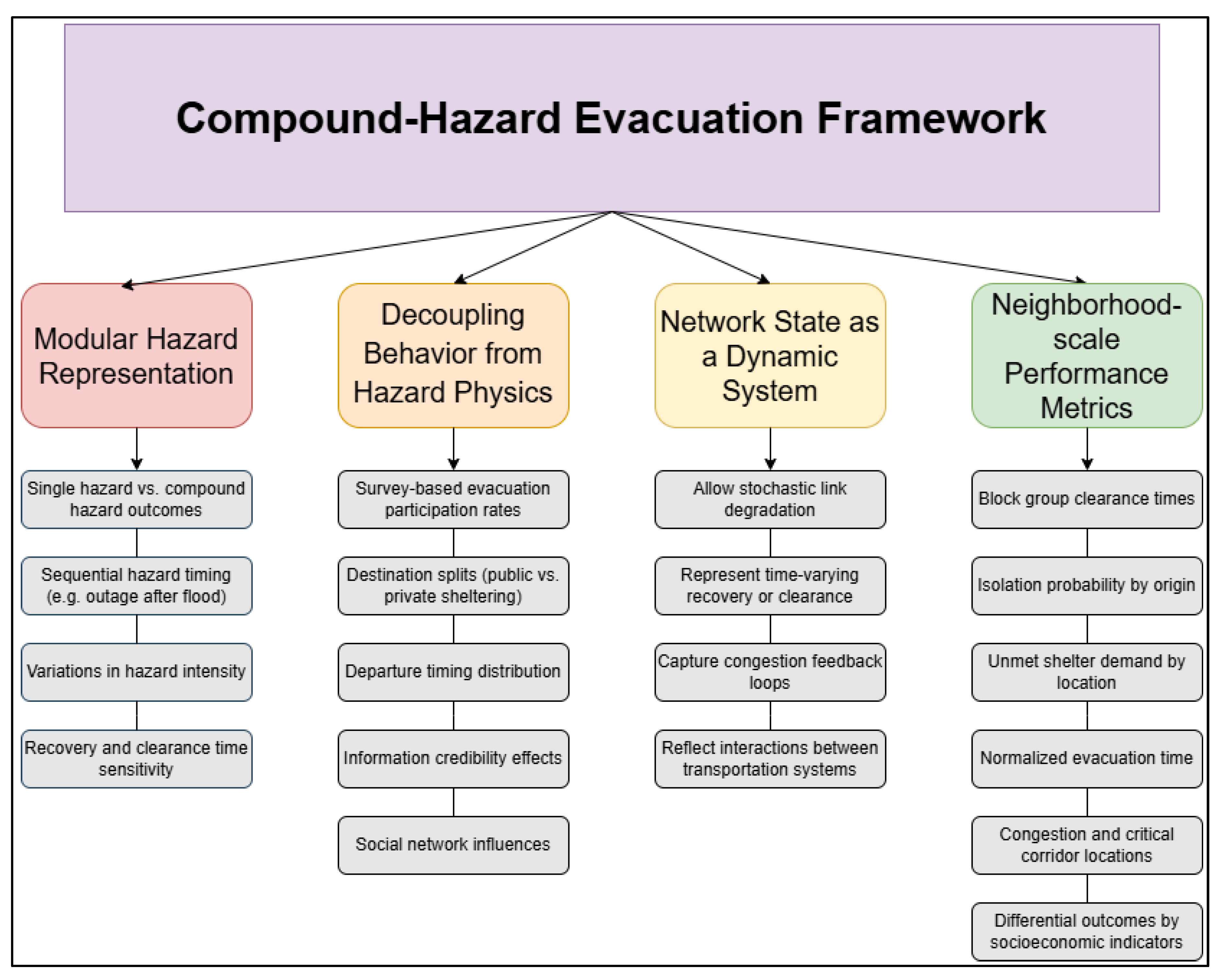
Figure 2.
Flowchart of the overall ABM methodology.
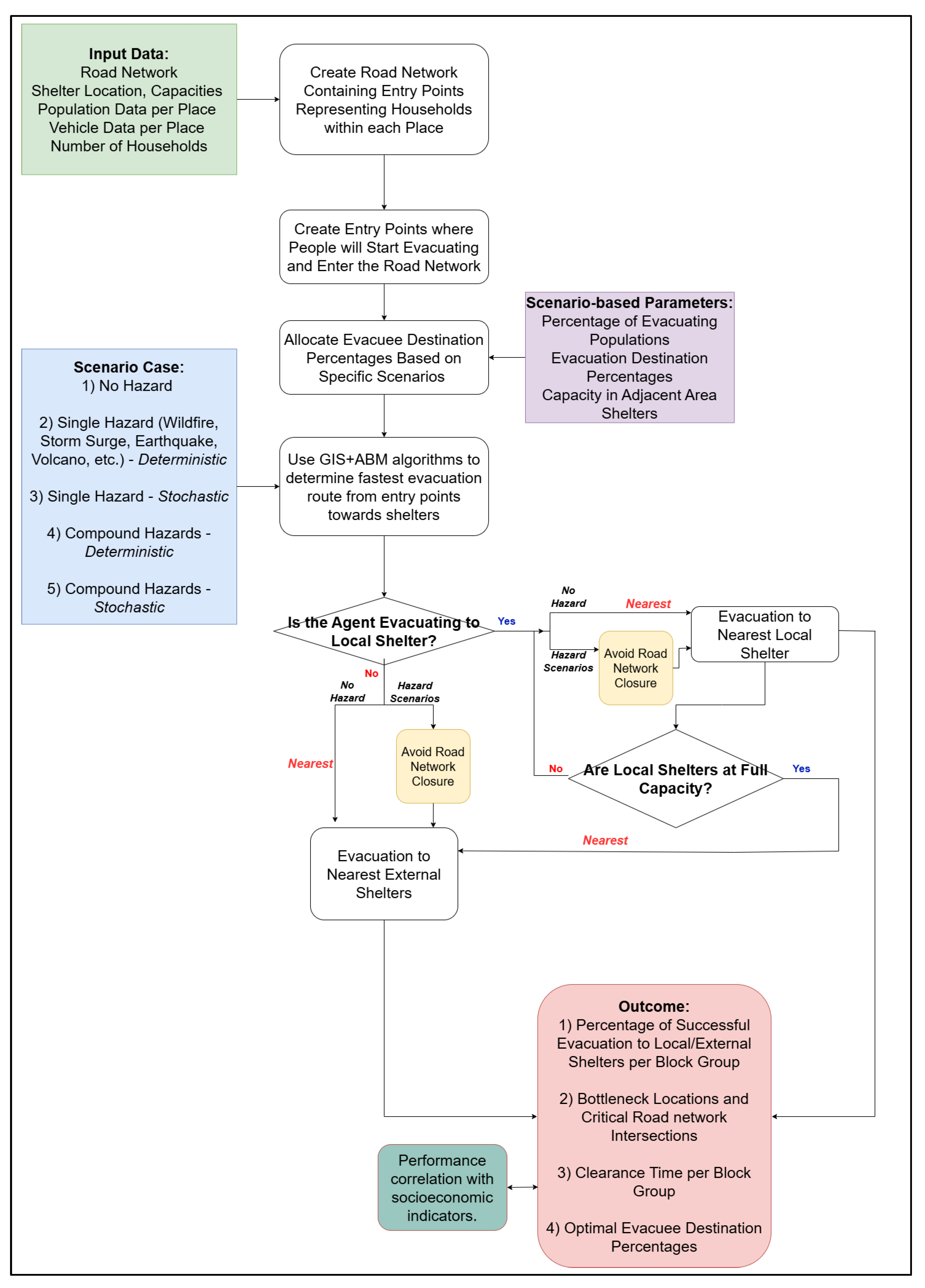

Table 1.
Comparison of Common Agent-Based Modeling Platforms for Evacuation and Infrastructure Simulation.
Table 1.
Comparison of Common Agent-Based Modeling Platforms for Evacuation and Infrastructure Simulation.
| Platform | Typical Scale | Programming Language | Strengths | Limitations | Typical Use Context |
|---|---|---|---|---|---|
| AnyLogic | Large-scale, hybrid | Java (with visual modeling interface) |
Multi-paradigm (ABM + system dynamics + discrete event); strong GIS integration; 2D/3D visualization; built-in traffic libraries; commercial support | Proprietary license; limited low-level control compared to pure-code frameworks | Urban evacuation, transportation, infrastructure systems |
| NetLogo | Small–medium scale | NetLogo | Highly intuitive; rapid prototyping; strong educational use; extensive model libraries; good visualization | Performance constraints for large-scale simulations; limited scalability; less suitable for high-resolution traffic modeling | Social science, crowd modeling, conceptual evacuation models |
| MASON | Large-scale | Java | High performance; discrete-event scheduler; strong for distributed simulation; scalable | Minimal built-in visualization; requires strong programming expertise | Large computational experiments, urban systems |
| Swarm | Medium-scale | Objective-C / Java | Early ABM framework; object-oriented; reusable components | Limited modern support; dated ecosystem | Historical ABM research |
| Repast | Large-scale | Java, Python, C++ | Flexible architecture; good data logging; supports GIS; strong academic use | Steeper learning curve; less plug-and-play than visual tools | General-purpose social and infrastructure modeling |
| MATSim | Large-scale | Java | Activity-based transport simulation; dynamic traffic assignment; iterative replanning; strong for evacuation traffic | Focused primarily on transport; less flexible for non-transport agent logic | Transportation systems, evacuation traffic |
| TRANSIMS | Large-scale | C++, Python | Detailed traffic microsimulation; activity-based demand; queue-based traffic models | Complex setup; less intuitive for behavioral modeling | Regional traffic and evacuation planning |
| GAMA | Medium–large scale | GAML | Intuitive modeling language; strong GIS integration; data-driven modeling; 2D/3D visualization | Smaller user base than Java platforms; scalability depends on model structure | Urban planning, environmental and evacuation modeling |
| OpenAMOS | Regional-scale | R | Activity-based travel demand; econometric modeling integration | Limited real-time traffic detail; smaller development community | Travel forecasting and planning analysis |
| SACSIM | Regional-scale | C# | Activity-based travel forecasting; integrated traffic assignment | Specialized for travel demand; less general-purpose ABM flexibility | Regional travel demand modeling |
Table 2.
Methodological Implications for Compound-Hazard Evacuation Modeling.
| Modeling Dimension | Common Limitation in Literature | Framework Advancement | Policy Relevance |
|---|---|---|---|
| Hazard Representation | Hazard-specific, case-bound implementation [117] | Modular, interchangeable hazard processes [127,136] | Enables cross-regional adaptability [120,128] |
| Infrastructure State | Static closures or fixed capacity [39] | Stochastic degradation and recovery [10,118] | Captures cascading and nonlinear effects [18,36] |
| Behavioral Coupling | Behavior embedded in hazard assumptions [57] | Decoupled behavioral core [42,60] | Supports and reuse across hazard types [50,119] |
| Performance Metrics | Aggregate clearance focus [47,152] | Micro/Neighborhood-scale outputs [27,51] | Reveals spatial inequities [3,88] |
| Scenario Testing | Single scenario evaluation [29,153] | Configurable compound scenarios [133] | Supports comparative planning analysis [38,104] |
Table 3.
Planning Applications of the Proposed Adaptable Evacuation Framework.
| Planning Domain | Key Question | Model Output | Practical Action |
|---|---|---|---|
| Evacuation Orders | When should evacuation begin under compound hazards? | Scenario-based clearance time ranges | Adjust order timing and phasing |
| Shelter Management | Where will unmet demand occur? | Neighborhood-level shelter deficits | Expand or redistribute capacity |
| Infrastructure Hardening | Which links repeatedly fail or congest? | Bottleneck frequency and isolation probability | Prioritize reinforcement and backup systems |
| Communication Strategy | How does compliance affect network overload? | Participation sensitivity analysis | Improve warning dissemination |
| Hazard Mitigation Funding | Where are compounding risks highest? | Multi-scenario vulnerability mapping | Target investments strategically |
Disclaimer/Publisher’s Note: The statements, opinions and data contained in all publications are solely those of the individual author(s) and contributor(s) and not of MDPI and/or the editor(s). MDPI and/or the editor(s) disclaim responsibility for any injury to people or property resulting from any ideas, methods, instructions or products referred to in the content. |
© 2026 by the authors. Licensee MDPI, Basel, Switzerland. This article is an open access article distributed under the terms and conditions of the Creative Commons Attribution (CC BY) license.
Copyright: This open access article is published under a Creative Commons CC BY 4.0 license, which permit the free download, distribution, and reuse, provided that the author and preprint are cited in any reuse.


