

Submitted:
27 February 2026
Posted:
02 March 2026
You are already at the latest version
Abstract
Minimal residual disease (MRD) refers to the persistence of low-level malignant cells or tumor-derived nucleic acids that remain after curative-intent therapy and are undetectable by conventional diagnostic methods. In oncology, MRD has emerged as a powerful biomarker with well-established prognostic value in hematologic malignancies and rapidly expanding relevance in solid tumors. Advances in sensitive detection technologies, including multiparameter flow cytometry, quantitative real-time polymerase chain reaction, next-generation sequencing, and digital polymerase chain reaction, have enabled the identification of residual diseases at the molecular level, often preceding clinical or radio-logical relapse. Beyond its conventional role as a binary indicator of treatment response or cure, MRD is increasingly recognized as a dynamic longitudinal biomarker that supports personalized disease management. Within this evolving paradigm, patient-informed MRD strategies that incorporate tumor-specific molecular profiling and serial monitoring, particularly through circulating tumor DNA, offer the potential to guide treatment adaptation, including escalation, de-escalation, maintenance optimization, and surveillance strategies across both hematologic and solid malignancies. In this review, we summarize the biological basis of MRD, current and emerging detection methodologies, and clinical applications across cancer types, with a focus on patient-informed approaches. We also discuss key limitations, including assay standardization, biological variability in solid tumors, and the lack of clearly defined actionability thresholds. Finally, we highlight future directions for integrating MRD with multi-omics and AI-driven analytical frame-works to enable adaptive, risk-informed cancer management and advanced precision oncology.
Keywords:
patient-informed minimal residual disease
; circulating tumor DNA
; predictive biomarkers
; precision oncology
1. Introduction
Cancer is a complex disease characterized by the uncontrolled growth and spread of abnormal cells to other parts of the body, as defined by the National Cancer Institute (NCI, 2023) [1]. Cancers are typically classified according to their tissue site of origin. Carcinomas, which arise from epithelial cells, account for approximately 80–90% of human cancers and are subdivided into adenocarcinoma, occurring in the mucus membranes of organs or glands, and squamous cell carcinoma, originating from the squamous epithelium. Sarcomas are solid tumors derived from connective tissues, including muscle, fat, bones, tendons, and cartilage. Leukemias, also known as blood cancers, originate in the bone marrow, the site of blood cell production, and typically develop through the overgrowth of immature white blood cells. Lymphomas arise from the lymphatic system, a network of vessels, nodes, and organs such as the spleen, tonsil, and thymus [2].
Cancer treatment strategies are multifaceted and include surgery to remove the entire tumor; chemotherapy to target rapidly dividing cells; targeted therapy to inhibit specific molecular pathways; hormone therapy for hormone-sensitive cancers; and immunotherapy to enhance the immune response against cancer [3].
The accurate diagnosis of cancer relies on a variety of techniques, including imaging, laboratory tests, endoscopy, surgery, genetic testing, and biopsy. Among these procedures, biopsy is an important tool and may be performed using needle, endoscopic, surgical, skin, or liquid approaches. Liquid biopsy is a minimally invasive sampling method that detects cancer-related components—such as circulating tumor cells (CTCs), circulating tumor DNA (ctDNA), tumor-derived extracellular vesicles (EVs), tumor-educated platelets, and circulating free RNA—in the blood or other body fluids [4,5]. Compared with tissue biopsy, liquid biopsy is particularly valuable for early screening. It plays a significant role in early cancer detection and in monitoring minimal residual disease (MRD) after treatment, thereby enabling personalized and timely therapeutic decisions [6,7].
MRD is defined as the presence of a very small number of cancer cells or cancer-derived DNA in the patient’s body during or after primary treatment, the detection of which remains challenging. MRD is a potentially critical biomarker for managing both hematological malignancies and solid tumors. These residual cells may be dormant, resistant to therapy, or located in sanctuary sites such as the bone marrow, lymph nodes, or distant organs. In gastric cancer (GC), Yang et al. demonstrated that ctDNA is a sensitive and specific biomarker for identifying patients at high risk of recurrence after definitive therapy for locoregional disease in GC [8]. More broadly, ctDNA is used as a biomarker for non-invasive molecular profiling, monitoring, and prediction of treatment response in cancer [9]. Although conventional techniques, such as flow cytometry and polymerase chain reaction (PCR)-based assays, are commonly used, their sensitivity and scope for MRD detection are limited [10,11]. Consequently, ctDNAs can be detected using highly sensitive, specifically designed commercial ctDNA-based MRD detection assays [12]. In addition, multi-omics strategies integrate various datasets to offer a holistic view of tumor biology and enable more precise disease monitoring. Early detection of MRD facilitates prognostic stratification and guides more precise interventions in cancer care.
Notably, MRD is no longer viewed solely as a binary marker distinguishing cure from relapse. Instead, it is increasingly recognized as a dynamic, longitudinal biomarker that supports personalized disease monitoring and treatment management. Within this evolving paradigm, MRD informs therapeutic escalation or de-escalation, maintenance duration, surveillance intensity, and treatment-free remission strategies in selected hematological settings [13,14,15]. This conceptual shift—from MRD as a marker of cure to a tool for ongoing disease management—represents a central advancement in precision oncology.
In this review, we discuss the biological basis of MRD and its relationship with metastasis, summarize established and emerging technologies for MRD detection, and evaluate their clinical utility across hematologic and solid malignancies. Particular emphasis is placed on patient-informed MRD strategies that integrate tumor-specific molecular profiling, longitudinal sampling, and advanced multi-omics approaches, while outlining current limitations and future directions for MRD-guided cancer care.
2. MRD and Metastasis
During MRD, surviving tumor cells may undergo dynamic genetic or epigenetic changes that enhance their ability to survive, evade the immune system, and metastasize. Some of these cells enter the bloodstream as CTCs, which are precursors of metastasis. Detecting these cells or their DNA (ctDNA) can therefore indicate metastatic potential [16]. MRD may also include micrometastases and small clusters of cancer cells in distant organs that are not yet detectable by imaging but that can later progress into overt metastases.
Cancers typically progress from benign to malignant. Benign tumors remain localized and cannot invade or spread to other parts of the body, whereas malignant tumors form metastases, which account for over 90% of cancer-related deaths [13]. The metastatic cascade comprises five steps: (1) cancer cell invasion and migration, (2) intravasation into the bloodstream or lymphatic system, (3) survival and transport through circulation, (4) extravasation into distant tissues, and (5) colonization and proliferation at secondary sites [17]. During this process, cancer cells disseminate to distant organs as CTCs [18]. In patients with metastatic cancer, CTCs are exceedingly rare, typically representing one cell per 109 blood cells [19]. The acquisition of migratory and self-renewal (stem-like) properties by cancer cells is driven by epithelial-mesenchymal transition (EMT), a critical mechanism for metastasis. The expression of EMT markers, such as vimentin and N-cadherin, in CTCs is associated with increased metastatic potential and poor clinical outcomes [20,21]. The loss of epithelial characteristics and the acquisition of a mesenchymal-like transcriptional program are driven by the activation of the TGF-β, WNT, and NOTCH pathways, with regulation mediated by transcription factors such as ZEB, SNAIL, SLUG, and TWIST1 [22]. Cells that successfully colonize distant organs are referred to as disseminated tumor cells (DTCs). DTCs can enter a prolonged non-dividing, dormant state that may persist for several years. DTCs in the bone marrow (BM) serve as surrogates for MRD and are associated with the persistence of cancer cells after therapy, representing a strong indicator of poor prognosis. The potential activation of these dormant MRD cells is believed to trigger late-stage metastatic recurrence and tumor relapse. This metastatic process involves genetic and epigenetic alterations that occur throughout tumor initiation, promotion, and progression [23]. Genetic alterations play a pivotal role in enhancing the metastatic potential of tumors. For example, upregulation of mitogen-activated protein kinase kinase kinase 21 has been shown to promote migratory and invasive phenotypes in breast cancer cells [24]. Epigenetic alterations involved in carcinogenesis include DNA methylation, histone acetylation, microRNAs, and nucleosome remodeling [25]. Abnormal DNA methylation—either hypomethylation or hypermethylation—is associated with mutations in tumor suppressor genes (TSGs) and proto-oncogenes. Hypermethylation of TSGs leads to transcriptional silencing, whereas hypomethylation activates proto-oncogenes and retrotransposons [26].
MRD represents a critical intermediate step in metastasis. Detection and targeting of MRD can help prevent or delay the development of metastatic disease, a leading cause of cancer-related deaths. If not eliminated, cancer cells that persist as MRD can proliferate, acquire additional mutations, and develop the ability to invade tissues and blood vessels, ultimately leading to metastasis.
3. MRD in Hematologic and Solid Tumors
MRD is a critical prognostic and predictive biomarker in hematologic malignancies such as acute lymphoblastic leukemia (ALL), chronic lymphocytic leukemia (CLL), and multiple myeloma (MM). In solid tumors, the application of MRD is more complex owing to spatial tumor heterogeneity and the absence of a uniform clonal marker.
3.1. In Hematologic Malignancies
Clinical studies have demonstrated that MRD negativity is strongly associated with improved progression-free survival (PFS) and overall survival (OS) [27]. The European Medicines Agency (EMA) recognizes MRD as a surrogate efficacy endpoint in clinical trials, which may accelerate drug approval [28]. Moreover, the European LeukemiaNet (ELN) provided updated guidelines (ELN-DAVID MRD Guideline, 2025 Update) to standardize thresholds and measurement timing based on specific molecular markers in patients with acute myeloid leukemia (AML), particularly when multiparameter flow cytometry (MFC) and quantitative real-time PCR (qPCR) are used for MRD detection [29].
3.1.1. In Acute Myeloid Leukemia
Numerous clinical trials have confirmed the prognostic importance of MRD negativity, which predicts significantly improved OS and lower relapse rates in patients treated with both intensive [14,30,31] and non-intensive chemotherapy regimens [32,33]. In AML, MRD is also used as a predictive marker to guide therapeutic decisions, specifically in determining whether allogeneic stem cell transplantation (alloSCT) offers greater benefits than consolidation therapy. Pasquini et al. reported that MRD positivity before transplantation was significantly associated with higher relapse rates and poorer survival outcomes [34]. This predictive role is further supported by studies suggesting that alloSCT should be mainly reserved for MRD-positive patients in first complete remission, even among favorable-risk AML subtypes [29].
Current limitations of molecular MRD assessment in AML are addressed in this study. Common biomarkers include t(15;17) promyelocytic leukemia (PML)-retinoic acid receptor alpha (RARA), t(8;21) AML1-RUNX family transcription factor 1 partner transcriptional co-repressor 1(RUNX1T1), B cell lymphoma2 (BCL2), fms-like tyrosine kinase 3 (FLT3), isocitrate dehydrogenase (IDH)1/2 and nucleophosmin (NPM1) [35]. qPCR is typically reliable only for monitoring the NPM1 gene and core-binding factor-mutated leukemia. To overcome challenges of standardization and inter-laboratory variability in other AML subtypes, Nachmias et al. [36] developed a new methodology: they created a synthetic minigene vector containing both Abelson tyrosine-protein kinase 1 (ABL1) and the sequence of the desired gene mutation, enabling objective and sensitive MRD evaluation. Inclusion of the ABL1 sequence permitted quantification of the mutation of interest using commercially available ABL1 standards for copy number estimation. This proof-of-concept test in patients with atypical RUNX1 and IDH1/2 mutations successfully demonstrated that MRD monitoring could detect relapse earlier than conventional flow cytometric assessments, particularly for atypical NPM1 and RUNX1 mutations.
Although its prognostic value is well established, the routine and standardized integration of MRD testing into surveillance and clinical management for every patient with AML is still evolving. MRD assessment is increasingly used for dynamic monitoring and treatment adjustment.
3.1.2. In BCR/ABL1 and Philadelphia Chromosome-Positive Leukemia
Extensive data on MRD in BCR/ABL1 and Philadelphia (Ph) chromosome-positive leukemias primarily focus on chronic myeloid leukemia (CML) and Philadelphia chromosome-positive Acute Lymphoblastic Leukemia (Ph-positive ALL). CML is defined by the presence of a Ph chromosome, resulting in a BCR/ABL1 gene fusion. MRD assessment in CML is standardized through measurement of BCR/ABL1 transcripts on the International Scale, which categorizes molecular responses and guides management, particularly regarding the potential for treatment-free remission.
Zuna et al. [37] performed a retrospective analysis of 147 children with BCR/ABL1-positive ALL treated between 2000 and 2021 to assess prognostic factors. A key finding was that MRD monitoring was a significant prognostic tool for typical ALL but not for patients with CML-like ALL (resembling chronic myeloid leukemia crisis). They specifically compared outcome differences between the “CML-like” subtype and typical BCR/ABL1-positive ALL. Although OS was similar between the groups, patients with typical ALL experienced more relapses, whereas patients with CML-like ALL more frequently succumbed to the disease during the first remission. These findings indicate that MRD monitoring is crucial for guiding treatment intensity in ALL and highlight the need for distinct treatment approaches in future protocols for these biologically different subtypes.
The successful application of MRD monitoring in managing acute PML (APL) and CML has been reported by Chandhok et al. [38]. This success is largely due to both diseases being defined by specific, identifiable genetic translocations: the PML-RARα translocation in APL and the BCR-ABL translocation in CML. MRD assessment, primarily through highly reliable qPCR testing, has become integral to clinical practice for both conditions, guiding crucial decisions, such as treatment duration, evaluation of treatment effectiveness, and prediction of potential relapse. Furthermore, MRD monitoring has reduced the need for frequent invasive procedures in APL and informs decisions regarding therapy modification or eligibility for treatment-free remission in CML. Consequently, MRD assessment is now firmly incorporated into major international treatment guidelines for leukemia.
3.1.3. In Multiple Myeloma
MRD plays a critical role in the management and treatment of MM. Chen et al. [39] noted that despite improvements in MM therapies, complete eradication of malignant plasma cells remains difficult, making MRD monitoring essential for evaluating treatment success and predicting patient prognosis. They highlighted the superior sensitivity and applicability of newer methods, such as next-generation sequencing (NGS). A large meta-analysis of > 8,000 patients with MM confirmed the positive impact of MRD negativity on long-term survival outcomes [40]. Moreover, Anderson et al. [41] discussed the evolving role of MRD in MM treatment and new drug registration. They highlighted emerging blood-based assays, including mass spectrometry and cell-free DNA (cfDNA), as less invasive complementary tools and demonstrated the clinical utility of MRD across various patient scenarios throughout the disease spectrum. The treatment landscape for MM has been fundamentally transformed by the development of novel therapeutic agents, making the achievement of an MRD-negative response a viable goal for patients with newly diagnosed and relapsed/refractory diseases. Current standard practice for MRD assessment relies on NGS and next-generation flow for bone marrow analysis, supplemented by positron emission tomography/computed tomography for extramedullary disease. However, the field is rapidly evolving, with emerging technologies such as mass spectrometry, cfDNA analysis, and advanced imaging poised to redefine future MRD assessment strategies.
Across acute leukemia, chronic leukemia, lymphoma, and myeloma, MRD positivity after treatment is consistently associated with a higher relapse risk and inferior survival, whereas MRD negativity predicted better outcomes. For example, in AML, 5-year OS can be approximately halved in patients who remain MRD-positive compared with those who become MRD-negative after achieving remission [15,38,42,43]. The detection and monitoring of MRD are therefore indispensable in managing hematological malignancies, as they provide high-fidelity information that accurately predicts long-term patient outcomes and informs subsequent therapeutic strategies.
Altogether, measurable MRD in hematological malignancies functions as an established fundamental prognostic marker, with critical predictive value for guiding individualized therapeutic decisions across various disease types. MRD negativity is consistently and strongly associated with improved PFS and OS, whereas MRD positivity after treatment is uniformly linked to a higher relapse risk and inferior survival outcomes. The clinical utility of MRD is recognized by major regulatory bodies, such as the EMA, which supports MRD as a surrogate efficacy endpoint in clinical studies.
3.2. In Solid Tumors
Advances in liquid biopsy technologies have enabled the detection of ctDNAs for MRD assessment in cancers such as colorectal cancer (CRC), non-small cell lung cancer (NSCLC), and breast cancer [44,45]. ctDNA-based MRD monitoring provides dynamic, non-invasive surveillance and can predict disease recurrence months before it becomes detectable by imaging [46].
3.2.1. Colorectal Cancer
Liquid biopsy approaches using stool and plasma samples have emerged as promising tools for cancer detection. In particular, stool-based assays are effective for CRC detection because genomic and epigenomic alterations arising during CRC tumorigenesis can be readily identified in stool samples. Methylation signatures in tumor-derived DNA obtained from stool or blood enable early cancer detection [47]. Stool-based biomarkers, including multigene fecal DNA methylation panels and microbiome-associated markers, have demonstrated high sensitivity in identifying residual or recurrent diseases, especially in early-stage or localized tumors. A panel of three methylated gene markers—syndecan2 (SDC2), alcohol dehydrogenase iron containing 1 (ADHFE1), and protein phosphatase 2 regulatory subunit b gamma (PPP2R5C)—showed a sensitivity of 87.1% for CRC detection, with higher sensitivity for distal CRC than for proximal CRC [48,49].
For instance, ctDNA-positive patients showed a 43.5-fold higher risk of CRC recurrence than ctDNA-negative patients [50]. Multiple studies have shown that postoperative ctDNA positivity after curative surgery identifies a subgroup with a very high recurrence risk and can stratify benefit from adjuvant chemotherapy, leading to ongoing trials of ctDNA-guided treatment escalation or de-escalation. Similar retrospective and prospective data in lung, breast, bladder, and other cancers indicate that ctDNA-defined MRD positivity after definitive local therapy is associated with markedly worse recurrence-free survival and OS and often precedes radiologic relapse by several months [36,51].
Notably, ctDNA levels can be transiently elevated immediately post-surgery owing to the release of tumor DNA during surgical manipulation; therefore, most studies recommend delaying MRD assessment beyond the first few postoperative days to avoid false-positive results. When MRD is present, ctDNA-based assays typically detect recurrence a median of several months earlier (often 6–8 months in some series) than conventional imaging or clinical symptoms in localized disease, offering a potential window for earlier intervention [51,52].
In contrast, a real-world study reporting the utility and performance of ctDNA monitoring, specifically the K-track assay, was performed by Hoang et al. [53] to predict cancer recurrence and treatment response, primarily in a Southeast Asian patient population. The researchers analyzed 623 patients with various solid tumors (stages I–IV) in Vietnam to assess how ctDNA testing is utilized in clinical practice and to determine its prognostic value for predicting recurrence, often months before detection by imaging. The key findings indicated that postoperative ctDNA positivity significantly increased the risk of recurrence across multiple cancer types, demonstrating the high sensitivity and specificity of the assay. The authors concluded that ctDNA serves as a strong prognostic biomarker for cancer management, although its real-world implementation is often limited by factors such as high costs and logistical challenges related to sample quality.
In patients with CRC who have undergone definitive therapy, recurrence of advanced-stage disease is common, often occurring within 2 years of surgery [54]. Several studies have shown that ctDNA-based MRD detection is highly sensitive and specific for predicting relapse, providing a lead time significantly longer than that of conventional markers, such as carcinoembryonic antigen [44,55,56]. These studies employed specific commercial ctDNA assays, including Signatera™ and Guardant Reveal™, to assess recurrence risk and showed that integrating serial testing with epigenomic signatures can further enhance ctDNA sensitivity. In stage I–III CRC, longitudinal tumor-informed ctDNA assays have reported median lead times of roughly 8–9 months between the first ctDNA detection and radiographic recurrence, with individual ranges extending from < 1 month to approximately 16–17 months [44,57]. Ultimately, ctDNA status serves as a powerful independent predictor of recurrence-free survival in both non-metastatic CRC and resectable colorectal liver metastasis.
3.2.2. Non-Small Cell Lung Cancer
Abbosh et al. [58] reported a phylogenetic approach for analyzing ctDNA to monitor NSCLC progression and recurrence. This study was part of the larger TRACERx (Tracking NSCLC Evolution Through Therapy) study, in which patient-specific ctDNA was profiled using multiplex-PCR NGS to track tumor evolution following primary surgery. The findings identified several clinicopathological predictors of ctDNA detection, including non-adenocarcinoma histology and tumor necrosis, and established a correlation between tumor volume and ctDNA variant allele frequency. Crucially, longitudinal analysis demonstrated that this phylogenetic ctDNA profiling could predict and characterize NSCLC relapse, often providing a significant lead time before clinical confirmation, and could even track resistance to adjuvant chemotherapy. Overall, the findings support the use of ctDNA platforms to guide therapeutic studies by identifying residual disease and targeting emerging subclones in the adjuvant setting.
A meta-analysis by Lu et al. [59] evaluated the effectiveness of ctDNA detection for predicting recurrence in patients with early-stage NSCLC after surgery. They systematically reviewed 30 publications to assess the utility of ctDNA-based MRD testing for both diagnosis and survival prognosis. A core finding is that longitudinal ctDNA monitoring substantially improves predictive sensitivity compared with single fixed-time point (landmark) testing. The analysis also compared two main strategies, tumor-informed and tumor-agnostic, and found that, although the tumor-informed approach excels in specificity, the tumor-agnostic method often provides higher sensitivity and identifies more clinically actionable genetic variants over time. The authors concluded that ctDNA-MRD testing offers clinically significant prognostic information and should be tailored to individual patient needs.
In resected NSCLC, early studies reported median ctDNA lead times of approximately 2–5 months before radiologic relapse, with ranges from approximately 10 days to nearly 1 year, depending on the assay and follow-up. Updated analyses using more sensitive technologies have reported median lead times of approximately 5 months and sensitivities around 80%, confirming that MRD-positive lung cancer almost invariably relapses despite apparently clean imaging.
3.2.3. Breast Cancer
In early-stage breast cancer, serial personalized ctDNA monitoring detected metastatic recurrence with a median lead time of approximately 8–9 months, with some patients showing ctDNA positivity for more than 1–2 years before overt relapse. These studies show that ctDNA-based MRD can be intermittently detectable, and lead time varies by subtype—often longer in estrogen receptor (ER)-positive disease—but persistent or rising ctDNA strongly correlates with eventual relapse [60,61].
Eliott et al. [61] conducted a longitudinal evaluation of ctDNA as an emerging biomarker in patients with early breast cancer receiving neoadjuvant therapy. The authors employed a highly sensitive tumor-informed assay to assess its clinical validity and prognostic value in a real-world cohort. The findings indicate that ctDNA detection at baseline is frequent and associated with a shorter recurrence-free interval, with persistent ctDNA detection midway through neoadjuvant therapy serving as a strong predictor of disease recurrence, especially in human epidermal growth factor receptor (HER)2-negative cases. HER2, a member of the epidermal growth factor receptor (EGFR) family, regulates cell growth, cell cycle progression, and survival, and its overexpression increases tumor aggressiveness, making its detection vital for treatment decisions [62]. Notably, ctDNA detection post-surgery or during follow-up demonstrated a 100% positive predictive value for subsequent recurrence, highlighting its potential utility for risk monitoring. This study supports prospective trials integrating sensitive ctDNA testing to guide individualized treatment strategies [61].
In other tumor types, such as bladder, gastric, liver, and ovarian cancers, emerging data suggest similar or slightly shorter median lead times, generally ranging from 3–6 months, with substantial inter-patient variability. Factors influencing lead time include tumor biology and DNA shedding (e.g., low-shedding or sanctuary sites can shorten or eliminate lead time), assay sensitivity (tumor-informed vs. agnostic), and sampling frequency, as infrequent sampling can underestimate the true interval between molecular and clinical relapses [53,60]. Despite these promising results, challenges remain in standardizing assay sensitivity, interpretation, and timing for patient-informed MRD assessments in solid tumors.
4. Techniques for MRD Detection
Accurate detection of MRD is crucial for evaluating treatment response, predicting relapse, and guiding therapy for both hematologic and solid tumors. Several advanced methodologies have been developed to sensitively and specifically detect residual cancer cells beyond the limits of conventional diagnostics. The most commonly employed techniques include flow cytometry, qPCR, NGS, and digital PCR (dPCR), each with distinct advantages and limitations. These methods differ in sensitivity, specificity, and clinical application, providing complementary insights. Integration into clinical practice depends on disease type, available biomarkers, and logistical feasibility. As technology evolves, multi-platform approaches may offer the most comprehensive MRD assessment.
4.1. Conventional Techniques
In addition to qPCR, which remains a reliable tool for monitoring MRD and assessing treatment responses, advanced technologies with high sensitivity have further enhanced MRD detection and analysis. One such technology is NGS, a powerful tool applicable across both hematologic malignancies and solid tumors. NGS enables comprehensive characterization of clonal mutations, chromosomal alterations, and gene fusions at deep sequencing depths, allowing the detection of rare residual tumor cells at levels as low as 10⁻⁵–10⁻⁶ [63]. Furthermore, NGS-based assays are patient-specific while capturing the genetic heterogeneity of cancer, which is critical for monitoring therapy resistance. Notably, NGS is used for relapse prediction and to guide personalized treatment decisions, including identifying actionable mutations for targeted therapies [64].
Additionally, dPCR is a high-performance technology that allows absolute quantification of nucleic acids. Two main types of dPCR are available: (i) chip-based dPCR, which uses microfluidic devices to partition the lipid bilayer chamber system and nanoliter self-priming compartmentalization chip, and (ii) droplet-based dPCR (ddPCR), which partitions a sample into thousands of individual droplets. ddPCR has been widely used for ctDNA detection and monitoring in patients with cancer, detecting 62.5% of tumor protein p53 (TP53) mutations in patients with ovarian cancer, 83.1% of phosphatidylinositol 3-kinase catalytic subunit alpha (PIK3CA) mutations in patients with breast cancer, and 86.3% of EGFR mutations in patients with NSCLC [65,66,67].
Single-cell RNA sequencing (scRNA-seq) has emerged as a transformative tool for understanding MRD complexity, enabling profiling of individual tumor cells and revealing the diverse genetic and functional landscapes hidden within bulk samples. For example, scRNA-seq provides a comprehensive map of tumor heterogeneity in MM by analyzing thousands of cells independently, thereby detecting rare malignant cell populations often missed by bulk RNA sequencing methods [68]. Matera et al.[69] demonstrated the feasibility of using scRNA-seq to identify patient-specific clonotypic V(D)J rearrangements, which serve as molecular fingerprints to track residual tumor cells post-treatment in MM. By enriching scRNA-seq libraries with V(D)J sequences, the authors reliably identified residual malignant plasma cells and analyzed their gene expression profiles and surface protein markers in detail. Combining conventional scRNA-seq with V(D)J library enrichment presents a practical solution, as it does not require additional tissue input, remains cost-effective, and simplifies data analysis workflows, making it highly suitable for routine MRD investigations in MM.
Another technology used to detect and quantify MRD is MFC. MFC enables the identification of abnormal cell populations based on immunophenotypic markers in various hematological malignancies. In hematologic cancers such as ALL or CLL, MFC can detect MRD with high sensitivity (10⁻5 to 10⁻6) by analyzing surface and intracellular antigens [70]. Recent advances in standardized antibody panels and automated analyses have improved the reproducibility and clinical utility of this technique [71]. Fürstenau et al. [72] evaluated MRD in CLL following highly effective combination treatments using ctDNA analysis compared with multicolor flow cytometry, which is less effective at detecting disease in the lymph nodes. The authors tracked patient-specific V(D)J rearrangements and somatic driver mutations in blood plasma using ddPCR during the CLL2-BAAG trial (NCT03787264) and systematically compared the results with matched flow cytometry data. Although the two methods showed high overall concordance, ctDNA detected residual disease in a significant portion of samples deemed undetectable by flow cytometry, particularly in patients with predominantly nodal residual disease. Therefore, the authors concluded that ctDNA-based MRD assessment is a promising complement to cell-based methods, such as flow cytometry, for reflecting the total disease burden across different compartments.
4.2. Emerging Methods and Multi-Omics Integration
Recent advances in precision medicine underscore the importance of integrating comprehensive molecular data to better understand cancer biology and improve clinical outcomes. Lim et al. [73] reviewed the latest advancements in single-cell omics and multi-omics technologies for high-resolution molecular profiling. Single-cell omics allows the analysis of individual cells to uncover cellular diversity and dynamic states across various layers, including the genome, transcriptome, proteome, methylome, chromatin accessibility, chromatin conformation, and histone modifications. Single-cell multimodal omics has further evolved by combining multiple omics layers to provide a holistic view of complex cellular processes [73]. This systems-level approach facilitates the identification of novel biomarkers, elucidation of dysregulated pathways, and prediction of therapeutic responses across cancer types [74]. Integrating multi-omics with liquid biopsy has enhanced the sensitivity and specificity of cancer diagnostics and monitoring [75]. By combining multi-layered molecular profiles with non-invasive sampling, this approach enables personalized assessment of tumor evolution. Together, multi-omics and liquid biopsy represent a transformative strategy in oncology, advancing patient-informed MRD for individualized cancer care.
Integrative multi-omics approaches have played key roles in refining AML risk stratification and MRD monitoring by combining RNA, proteomic, and ctDNA data. New methods leveraging multi-omics have been developed to improve MRD detection in patients with AML. Saeed et al. [76] examined the effectiveness of ultra-deep sequencing (UDS) as a highly sensitive method for detecting MRD in pediatric AML and compared it with conventional MFC. The authors first used WES to identify leukemia-specific mutations in diagnostic samples and then applied UDS to track these mutations during treatment, finding that UDS was significantly more sensitive than MFC. Over half of the samples negative by MFC were positive using UDS, demonstrating the ability of this molecular method to detect lower levels of MRD. Furthermore, single-cell multi-omics analysis characterized the genomic and protein signatures of the residual mutated cells, confirming the UDS findings and showing that these cells could be either founding stem/progenitor cells or mature leukemic cells. These results support the use of UDS as a sensitive tool for MRD detection in pediatric AML.
However, Thompson et al. [77] introduced a novel multi-omics single-cell MRD (scMRD) assay designed to overcome the limitations of existing methods for detecting MRD in AML. This scMRD assay, with a 0.01% limit of detection, utilizes a multistep pipeline that includes blast cell enrichment and a specialized DNA and protein panel to provide comprehensive single-cell clonal architecture and immunophenotyping. Using Mission Bio technology, the assay identifies and correlates co-occurring variants, reducing false positives compared to bulk assays, and can construct phylogenetic trees of detected cells. The integration of genotypes and immunophenotypes further enhances MRD detection by revealing genotype-specific protein expression patterns. Its robust performance and reproducibility were confirmed in both surrogate samples and samples from patients with AML, suggesting its potential as a scalable tool for guiding patient stratification and therapeutic decisions.
In a review article, Sanches et al. [78] focused on strategies for integrating multi-omics data, specifically transcriptomics, proteomics, and metabolomics, to achieve a comprehensive understanding of biological systems. The authors detailed various computational techniques, such as co-expression analysis, network construction (e.g., gene–metabolite networks), and genome-scale metabolic models, which facilitate the identification of complex biological patterns and interactions often missed by single-omics analyses. A novel approach for cancer monitoring was described by Widman et al. [79], who introduced MRD-Enrichment and detection using Genomic Enrichment (EDGE), a platform that utilizes machine learning and whole-genome sequencing (WGS) to enhance ctDNA detection for assessing MRD and therapeutic response. The authors evaluated MRD-EDGESNV for single-nucleotide variant detection using deep learning and MRD-EDGECNV for copy number variant detection, which integrates read depth, B-allele frequency, and fragment length entropy. The MRD-EDGE approach offers several clinically significant applications and demonstrates comparative performance benefits, particularly in low-tumor-fraction settings. They demonstrated the high sensitivity of the platform for detecting ctDNA across various clinical contexts, including early-stage and metastatic cancers, as well as following surgery in multiple cancer types, such as CRC, triple-negative breast cancer, and NSCLC. For therapeutic response monitoring, MRD-EDGE could track changes in the tumor fraction in response to neoadjuvant immunotherapy in NSCLC, as well as in advanced melanoma and small cell lung cancer. Notably, its high sensitivity enabled early lesion detection by identifying ctDNA shedding from precancerous colorectal adenomas and pT1 carcinomas (polyp cancers), suggesting that dysplastic tissue may release ctDNA even in the absence of a significant invasive component. This finding supports the feasibility of ctDNA-guided detection of premalignant lesions. Furthermore, the authors showed that combining WGS breadth with machine learning-guided signal enrichment improved MRD-EDGE performance, overcoming sensitivity limitations associated with deep targeted sequencing panels, and enhancing prior WGS-based approaches.
Artificial intelligence (AI) techniques are increasingly applied to the study of MRD, particularly in hematological malignancies such as MM and AML. These approaches enhance the reliability of MRD detection and facilitate prognostic prediction. Integrating genomic, transcriptomic, and proteomic data with AI enables a more comprehensive understanding of MRD biology and supports the identification of novel biomarkers and therapeutic targets. Machine Learning and deep learning methods have been used to analyze high-dimensional data generated by flow cytometry, NGS, and PCR, thereby improving the sensitivity and specificity of MRD detection. Moreover, mixture models and feature-agnostic transformer-based encoders have been applied to flow cytometry data to automate MRD assessment while providing interpretable and clinically actionable results [80].
Notably, AI models integrate clinical, genetic, and immune-related biomarkers to predict which patients are likely to achieve MRD negativity, a key prognostic factor for risk stratification and personalized treatment planning. Martinez-Lopez et al. utilized NGS combined with AI to categorize patterns of MRD evolution over time in 482 patients with MM. They demonstrated that greater clonal diversity of immunoglobulin genes, which may reflect immune recovery, is associated with a favorable prognosis in MM. These results suggest that integrating MRD dynamics with clonal diversity assessments can accurately predict disease progression and inform clinical decisions [81].
Mocking et al. developed a fully automated, interpretable, and objective computational pipeline to assess MRD in AML using Gaussian mixture models (GMMs). This method reduced analysis time from 30 min to 3 s while maintaining high accuracy, demonstrating that GMM-based computational pipelines can provide a robust, rapid, and interpretable alternative to manual MRD assessment in AML, with the potential for broader clinical adoption [80].
In addition, AI can be applied for dynamic MRD monitoring by analyzing longitudinal MRD data to predict relapse risk and optimize therapeutic strategies, such as adjusting consolidation therapy in leukemia or MM [80,81].
Figure 1 illustrates a paradigm shift in cancer therapy in which the role of MRD has evolved from a single-time-point assessment aimed at curing (“MRD for Cure”) to a framework for longitudinal MRD-guided disease management. Conventional analog treatment strategies rely on uniform drug administration, often resulting in increased costs and treatment-related toxicity. In contrast, serial MRD measurements generate digital molecular data that enable continuous monitoring of disease status over time. The integration of these data with AI-driven models allows accurate risk stratification and personalized clinical decision-making, including treatment escalation, de-escalation, or surveillance. This digital MRD-guided approach improves treatment efficacy while reducing unnecessary interventions and costs, highlighting MRD as a central driver in the transition from cure-oriented cancer therapy to precision management-focused oncology.
Collectively, these innovations highlight a pivotal shift toward highly sensitive, high-resolution molecular diagnostics that support individualized patient management. As multi-omics technologies continue to mature, their integration into routine clinical workflows promises to refine prognostication, optimize therapeutic interventions, and advance the delivery of personalized cancer care (Table 1).
5. Eradicating MRD Positivity
Treatments aimed at eradicating MRD positivity are mainly described in hematologic malignancies and fall into several major categories: MRD-directed immunotherapies (particularly in B-ALL), hypomethylating agents and other “pre-emptive” therapies in AML/myelodysplastic syndromes, post-transplant immunomodulation (e.g., donor lymphocyte infusion, interferon), and MRD-adapted intensification or switching of systemic therapy. In solid tumors, MRD is typically detected as ctDNA after surgery, and current strategies focus on escalation or prolongation of adjuvant systemic therapy within clinical trials rather than the use of specific MRD-targeted drugs.
5.1. Immunotherapy
MRD represents a critical juncture in cancer treatment, marking the transition from measurable disease to potential cure. Integrating immunotherapy into MRD-driven treatment strategies offers a promising approach for eradicating residual malignant cells and achieving durable remission. MRD positivity after initial therapy serves as a biomarker to escalate or introduce immune-based treatments. For example, in head and neck cancer, MRD detection via ctDNA allows immune checkpoint blockade to predict treatment response and recurrence risk [84]. The curative potential of immunotherapy is enhanced when guided by patient-informed MRD, enabling timely and personalized interventions aimed at complete disease eradication. Moreover, MRD negativity after immunotherapy is increasingly regarded as a surrogate endpoint for cure, particularly in relapsed/refractory MM [85]. Future therapeutic paradigms may rely on patient-informed MRD monitoring to optimize immunotherapy regimens and minimize overtreatment. Notably, no cancer currently has a drug with a regulatory label explicitly requiring treatment initiation, discontinuation, escalation, or de-escalation based on MRD results, even though MRD is widely used in practice and clinical trials across many malignancies.
MRD plays an increasingly complex role in hematological malignancies, specifically ALL, AML, and MM. Initially, MRD clearance—for example, with the FDA-approved agent blinatumomab, an anti-CD19 Bispecific T-cell engager in ALL—was strongly correlated with improved outcomes [86,87,88]. However, recent findings complicate the relationship between MRD status and survival, suggesting that drug mechanisms may extend beyond simple MRD clearance, or that the biological heterogeneity of diseases such as ALL challenges straightforward biomarker interpretation [89].
In contrast, inotuzumab ozogamicin (INO) and CD19 chimeric antigen receptor (CAR) T cells are used to eradicate MRD in B-cell ALL (B-ALL), demonstrating high MRD clearance rates and increasingly being administered earlier in the disease course to eliminate residual disease. Short et al. [90] reported a retrospective analysis of a dose-dense treatment regimen involving 21 patients with B-ALL, combining mini-hyperfractionated cyclophosphamide, vincristine, and dexamethasone, alternating with mini-methotrexate and cytarabine chemotherapy, INO, and blinatumomab, administered earlier than standard practice. The authors found that this therapy was safe and achieved rapid, deep MRD negativity in all responding patients, often after only one cycle. They concluded that this regimen warrants further prospective evaluation owing to the high rates of early MRD clearance and favorable 1-year OS observed in both frontline and MRD-positive patient groups [90].
Moreover, a clinical trial investigating a novel CAR T-cell therapy for relapsed or refractory B-ALL was conducted by Ghorashian et al. [91]. This study included 12 heavily pretreated pediatric patients and found that the dual-targeting approach was well tolerated, with no severe cytokine release syndrome, and successfully induced MRD-negative complete remission in 83% of patients. Crucially, with a median follow-up of 8.7 months, no cases of relapse owing to antigen-negative escape were recorded, suggesting that dual targeting may effectively prevent this form of treatment failure, although longer CAR-T cell persistence remains a goal for future optimization.
In contrast, the effectiveness of various Bispecific Antibody (BiAb) therapies in achieving MRD negativity is generally high, with several products demonstrating particularly strong MDS clearance in patients who achieve a complete or better response [92]. Data from the MajesTEC-1 (NCT03145181/NCT04557098), MonumenTAL-1 (NCT03399799/NCT04634552), MagnetisMM-1/3 (NCT04649359), and LINKER-MM1 (NCT03761108) clinical trials indicate robust MRD negativity rates for BiAbs such as B-cell maturation antigen (BCMA)-targeted Teclistamab, Elranatamab, Linvoseltamab, and G protein-coupled receptor, class C, group 5, member D (GPRC5D)-targeted Talquetamab [93,94,95,96]. BCMA and GPRC5D are cell surface transmembrane proteins expressed on multiple cell types and serve as immunotherapeutic targets for MM. CD3, a protein complex on the surface of T cells, mediates the cytotoxic killing of cancer cells by simultaneously binding BCMA or GPRC5D on myeloma cells and CD3 on T cells. This interaction triggers T-cell activation, proliferation, and the release of cytotoxic molecules (such as perforin and granzyme), directly killing myeloma cells [93,94]. This approach can induce deep and sustained responses, including the eradication of MRD [92].
5.2. Targeted Therapies
Oral azacitidine (oral-AZA), also known as CC-486, has demonstrated positive effects on MRD outcomes in patients with AML in first remission after intensive chemotherapy. Döhner et al. [97] reported that oral-AZA therapy conferred OS and/or recurrence-free survival (RFS) benefits, even in patients with adverse prognostic features and MRD positivity. Maintenance therapy with oral-AZA was associated with a higher rate of MRD response—defined as conversion from MRD-positive at baseline to MRD-negative—in patients harboring NPM1 or FLT3 mutations compared with placebo.
Overall, these findings suggest that oral-AZA prolongs OS and RFS independent of the initial MRD status and actively promotes MRD clearance and sustains MRD negativity in patients with AML.
Levis et al. [98] reported results for quizartinib, a highly selective type II FLT3 inhibitor, in the phase 3 trial QuANTUM-First trial (NCT02668653), which investigated the upfront addition of quizartinib to intensive chemotherapy in patients with FLT3-internal tandem duplication (ITD) mutant AML [98]. The addition of quizartinib improved OS compared with placebo, and patients receiving quizartinib had lower post-induction FLT3-ITD NGS-MRD levels than the placebo group. However, although a higher proportion of patients achieved undetectable MRD with quizartinib, this deeper clearance did not appear to confer a significant survival benefit. Furthermore, quizartinib, along with other FLT3 inhibitors such as gilteritinib and sorafenib, have been used as MRD-guided salvage therapy for molecular failure in patients with AML and baseline FLT3-ITD mutations. In one cohort of 48 patients treated with these FLT3 inhibitors for MRD failure, an overall MRD response was achieved in 64%, with 40% of evaluable patients reaching MRD negativity, resulting in an estimated 2-year OS of 80% [99,100].
A phase 2 clinical study (Clinicaltrials.gov #NCT04113018) published by Bhutani et al. [101] evaluated an MRD-driven treatment strategy for newly diagnosed MM using the combination of daratumumab, carfilzomib, lenalidomide, and dexamethasone (Dara-KRd) as induction therapy, followed by treatment escalation or de-escalation based on each patient’s MRD status. This regimen achieved high rates of stringent complete responses and MRD negativity, which improved over time, supporting the use of MRD-adapted post-induction strategies. Correlative analyses of immune cell activity demonstrated that the Dara-KRd combination strongly activated memory T cells, which are associated with MRD negativity. The authors concluded that these findings support the need for randomized trials comparing upfront autologous stem cell transplantation (ASCT) versus no ASCT for MRD-negative patients and for treatment escalation for MRD-positive patients.
Therapeutic approaches are often combined or tailored based on cancer type, patient risk factors, and response to initial treatment. The overarching goal is to achieve and sustain MRD negativity, which is strongly associated with improved survival and reduced relapse rates.
6. Limitations
The use of MRD detection as a clinical prognostic and diagnostic tool has transformed the management of hematological malignancies; however, several important limitations remain. Chandhok et al. and Chen et al. [38,102] evaluated the current utility and limitations of MRD testing in the diagnosis and treatment of both hematological and solid cancers. They highlighted that, although MRD testing is useful for risk stratification, especially in some acute leukemias, its predictive value is often variable and insufficiently accurate to reliably identify patients who will relapse. MRD positivity after therapy does not always predict relapse, and MRD negativity does not guarantee a cure. Despite the enthusiasm surrounding MRD, its complex use and inherent limitations can result in high false-positive and false-negative rates, calling into question the robustness of many MRD-guided therapeutic interventions. Additionally, the presence of low-level residual blasts may not always reflect true MRD, leading to potential misinterpretation. This creates limitations in clinical management and in the use of MRD as a therapeutic target within personalized medicine, with these challenges being closely interdependent.
Current methodologies for MRD detection primarily include qPCR, MFC, and NGS. A broad consensus exists regarding the limitations of these techniques in fully characterizing MRD and in using MRD to establish diagnosis or prognosis [82,103,104]. qPCR is a well-standardized technique with high sensitivity, offering high sample throughput and rapid turnaround times; however, this advantage applies only to patients with specific genomic abnormalities. Indeed, qPCR is applicable to only a subset of patients because it relies on the presence of defined mutations or translocations, and does not adequately capture clonal heterogeneity or evolution. Moreover, qPCR provides only relative quantification of targets within the analyzed sample, typically by comparison with a standardized transcript, such as ABL1. In contrast, MFC has broader applicability and can be used in nearly all patients, including approximately half of patients with AML who lack a specific mutation or fusion gene detectable by qPCR.
However, the sensitivity is lower than that of PCR, and MFC is difficult to standardize because of differences in laboratory equipment, sample processing, and cytometer configuration, leading to poor comparability between institutions. This technique utilizes gene panels to detect molecular aberrations and allows in-depth analysis of a large number of genes. However, a major challenge is the inability to distinguish true AML-specific mutations from those associated with clonal hematopoiesis. Mutations in genes such as DNA methyltransferase 3 alpha, Tet methylcytosine dioxygenase 2, or additional sex combs like 1 are common in age-related clonal hematopoiesis and should not be considered MRD in isolation. Currently, NGS is not recommended as a single MRD detection method.
Newer exploratory techniques, including dPCR, combinatorial approaches, and liquid biopsies, are being investigated to overcome some of these limitations. However, dPCR shows high variability depending on the sample material (peripheral blood vs. bone marrow) and may not cover all types of mutations [82]. Despite their strong prognostic value, key challenges include variable ctDNA shedding (especially in small, indolent, or sanctuary-site diseases), assay standardization, false-negative and false-positive results, and the definition of actionability thresholds across tumor types. Large randomized trials are needed to demonstrate that altering therapy solely based on ctDNA MRD status improves survival; therefore, most applications remain confined to clinical trials or specialized centers rather than being universally incorporated into treatment guidelines [51,105].
Although MRD detection is a valuable and increasingly important tool in oncology, its limitations, such as variability in sensitivity, lack of standardization, and the need for careful interpretation, must be considered when it is used for clinical prognosis and diagnosis. Therefore, MRD assessments should not replace comprehensive clinical evaluations; rather, they complement other diagnostic and prognostic tools needed to guide therapy [38]. Furthermore, ongoing efforts address regulatory considerations from the Food and Drug Administration (FDA) and industry to validate MRD as a surrogate endpoint to expedite drug development, highlighting the need for greater collaboration and standardized trial designs. The push to standardize and implement MRD assessment is not an isolated effort, but a major collaborative initiative [41].
7. Conclusions and Future Directions
MRD assessment has become a transformative and indispensable tool in oncology, defined by the presence of a very small number of cancer cells that remain after curative treatment and are undetectable by conventional diagnostic methods. MRD assessment provides powerful prognostic and predictive insights into both hematological malignancies and solid tumors.
In hematologic malignancies such as ALL and AML, the utility of MRD is well established; MRD negativity is consistently and strongly associated with improved PFS and OS, whereas MRD positivity is uniformly linked to higher relapse risk and inferior survival outcomes. The clinical utility of MRD in these diseases is recognized by major regulatory bodies, with the EMA supporting MRD as a surrogate efficacy endpoint in clinical studies.
For solid tumors, the application of MRD has advanced significantly, primarily through liquid biopsy technologies that detect ctDNA. ctDNA-based MRD monitoring provides dynamic, non-invasive surveillance, enabling the prediction of recurrence months before it becomes detectable by imaging in cancers such as CRC, NSCLC, and breast cancer. Accurate detection relies on highly sensitive techniques, including flow cytometry, qPCR, NGS, and dPCR. Among these, NGS has emerged as a powerful tool, offering broad applicability and the ability to detect very low levels of residual disease. The future of MRD monitoring is moving toward high-resolution diagnostics through the integration of multi-omics (such as transcriptomics and proteomics) and single-cell sequencing analyses, which enhance diagnostic sensitivity, characterize residual disease, and support the development of truly personalized cancer care.
The paradigm of cancer care is undergoing a fundamental transition from a cure-oriented approach to a long-term management strategy, encompassing early diagnosis, post-treatment surveillance, and recurrence monitoring. Within this framework, MRD has emerged as a critical component of precision oncology and serves as a sensitive indicator of treatment responses and disease dynamics. Advances in medical technologies, including early cancer detection and the development of high-performance anticancer therapeutics, have underscored the clinical importance of MRD assessments, particularly in aging societies. Notably, key MRD detection technologies are directly applicable to early cancer detection, highlighting the urgent need for research to improve analytical sensitivity and specificity. As clinical and technological datasets related to MRD continue to accumulate, the integration of AI-based approaches is expected to further enhance MRD applications, ultimately enabling more cost-effective, efficient, and patient-centered cancer management strategies.
Several challenges must be addressed before MRD-guided management can be universally implemented. These include assay standardization, biological variability in ctDNA shedding, interpretation of low-level positivity, and the establishment of clinically actionable thresholds across tumor types [42,101,102,103,104]. Notably, large prospective trials are required to demonstrate that modifying therapy based on the MRD status translates into meaningful improvements in survival, particularly in solid tumors.
In summary, MRD serves as a high-resolution molecular lens through which clinicians can detect, monitor, and intercept cancer recurrence. As technological, analytical, and clinical frameworks continue to mature, the integration of patient-informed MRD with advanced computational and multi-omics platforms is expected to redefine precision oncology, shifting the focus from static endpoints of cure to dynamic personalized disease management.
Author Contributions
Conceptualization, J K, F M, Y K, and Y J S; writing—original draft preparation, J K and F M; writing—review and editing, J K, F M, Y K, and Y J S; supervision, Y K and Y J S; funding acquisition, Y K and Y J S. All authors have read and agreed to the published version of the manuscript.
Funding
This work was supported by the National Research Foundation of Korea (NRF) grant funded by the Korean Government (MSIT) (No. RS-2024-00341405), and by the Ministry of Research and Higher Education (MESR) of Luxembourg under the Personalized Functional Profiling (PFP) program and Colopan study.
Institutional Review Board Statement
Not applicable.
Informed Consent Statement
Not applicable.
Data Availability Statement
Data sharing is not applicable to this article. No new data were created or analyzed in this study.
Acknowledgments
Graphic illustration was performed by the multimedia part of Samsung Medical Center.
Conflicts of Interest
The authors declare no conflicts of interest. The funding sponsors had no role in the design of the study; in the collection, analyses, or interpretation of data; in the writing of the manuscript; or in the decision to publish the results.
Abbreviations
The following abbreviations are used in this manuscript:
| ABL1 | Abelson tyrosine-protein kinase 1 |
| ADHFE1 | alcohol dehydrogenase iron containing 1 |
| AI | Artificial intelligence |
| ALL | acute lymphoblastic leukemia |
| alloSCT | allogeneic stem cell transplantation |
| AML | acute myeloid leukemia |
| ASCT | autologous stem cell transplantation |
| BCL2 | B cell lymphoma2 |
| BM | bone marrow |
| cfDNA | cell-free DNA |
| CLL | chronic lymphocytic leukemia |
| CML | chronic myeloid leukemia |
| CRC | colorectal cancer |
| CTC | circulating tumor cell |
| ctDNA | circulating tumor DNA |
| ddPCR | droplet-based dPCR |
| dPCR | digital PCR |
| DTC | disseminated tumor cells |
| EDGE | Enrichment and detection using Genomic Enrichment |
| EGFR | epidermal growth factor receptor |
| ELN | European LeukemiaNet |
| EMA | European Medicines Agency |
| EMT | epithelial-mesenchymal transition |
| ER | estrogen receptor |
| EV | tumor-derived extracellular vesicles |
| FLT3 | fms-like tyrosine kinase 3 |
| GC | gastric cancer |
| GMM | Gaussian mixture model |
| GPRC5D | G protein-coupled receptor, class C, group 5, member D |
| HER2 | human epidermal growth factor receptor |
| IDH | isocitrate dehydrogenase |
| ITD | internal tandem duplication |
| MFC | multiparameter flow cytometry |
| MM | multiple myeloma |
| MRD | minimal residual disease |
| NGS | next-generation sequencing |
| NPM1 | nucleophosmin |
| NSCLC | non-small cell lung cancer |
| OS | overall survival |
| PCR | polymerase chain reaction |
| PFS | progression-free survival |
| Ph | Philadelphia |
| Ph-positive ALL | Philadelphia chromosome-positive Acute Lymphoblastic Leukemia |
| PIK3CA | phosphatidylinositol 3-kinase catalytic subunit alpha |
| PML | promyelocytic leukemia |
| PPP2R5C | protein phosphatase 2 regulatory subunit B gamma |
| qPCR | quantitative real-time PCR |
| RFS | recurrence-free survival |
| RUNX1T1 | RUNX family transcription factor 1 partner transcriptional co-repressor 1 |
| scMRD | single-cell MRD |
| scRNA-seq | Single-cell RNA sequencing |
| SDC2 | syndecan2 |
| TFR | treatment-free remission |
| TP53 | tumor protein p53 |
| TSG | tumor suppressor gene |
| UDS | ultra-deep sequencing |
| WGS | whole-genome sequencing |
References
- Brown, J.S.; Amend, S.R.; Austin, R.H.; Gatenby, R.A.; Hammarlund, E.U.; Pienta, K.J. Updating the Definition of Cancer. Mol Cancer Res 2023, 21, 1142–1147. [Google Scholar] [CrossRef]
- Sonnenschein, C.; Davis, B.; Soto, A.M. A novel pathogenic classification of cancers. Cancer Cell Int 2014, 14, 113. [Google Scholar] [CrossRef] [PubMed]
- Liu, B.; Zhou, H.; Tan, L.; Siu, K.T.H.; Guan, X.Y. Exploring treatment options in cancer: Tumor treatment strategies. Signal Transduct Target Ther 2024, 9, 175. [Google Scholar] [CrossRef]
- Lone, S.N.; Nisar, S.; Masoodi, T.; Singh, M.; Rizwan, A.; Hashem, S.; El-Rifai, W.; Bedognetti, D.; Batra, S.K.; Haris, M.; et al. Liquid biopsy: a step closer to transform diagnosis, prognosis and future of cancer treatments. Mol Cancer 2022, 21, 79. [Google Scholar] [CrossRef]
- Nikanjam, M.; Kato, S.; Kurzrock, R. Liquid biopsy: current technology and clinical applications. J Hematol Oncol 2022, 15, 131. [Google Scholar] [CrossRef]
- Connal, S.; Cameron, J.M.; Sala, A.; Brennan, P.M.; Palmer, D.S.; Palmer, J.D.; Perlow, H.; Baker, M.J. Liquid biopsies: the future of cancer early detection. J Transl Med 2023, 21, 118. [Google Scholar] [CrossRef] [PubMed]
- Kurtz, D.M.; Soo, J.; Co Ting Keh, L.; Alig, S.; Chabon, J.J.; Sworder, B.J.; Schultz, A.; Jin, M.C.; Scherer, F.; Garofalo, A.; et al. Enhanced detection of minimal residual disease by targeted sequencing of phased variants in circulating tumor DNA. Nat Biotechnol 2021, 39, 1537–1547. [Google Scholar] [CrossRef] [PubMed]
- Yang, J.; Gong, Y.; Lam, V.K.; Shi, Y.; Guan, Y.; Zhang, Y.; Ji, L.; Chen, Y.; Zhao, Y.; Qian, F.; et al. Deep sequencing of circulating tumor DNA detects molecular residual disease and predicts recurrence in gastric cancer. Cell Death Dis 2020, 11, 346. [Google Scholar] [CrossRef]
- Nong, J.; Gong, Y.; Guan, Y.; Yi, X.; Yi, Y.; Chang, L.; Yang, L.; Lv, J.; Guo, Z.; Jia, H.; et al. Circulating tumor DNA analysis depicts subclonal architecture and genomic evolution of small cell lung cancer. Nat Commun 2018, 9, 3114. [Google Scholar] [CrossRef]
- Chatterjee, T.; Mallhi, R.S.; Venkatesan, S. Minimal residual disease detection using flow cytometry: Applications in acute leukemia. Med J Armed Forces India 2016, 72, 152–156. [Google Scholar] [CrossRef]
- Dohner, H.; Wei, A.H.; Appelbaum, F.R.; Craddock, C.; DiNardo, C.D.; Dombret, H.; Ebert, B.L.; Fenaux, P.; Godley, L.A.; Hasserjian, R.P.; et al. Diagnosis and management of AML in adults: 2022 recommendations from an international expert panel on behalf of the ELN. Blood 2022, 140, 1345–1377. [Google Scholar] [CrossRef] [PubMed]
- Chen, K.; Shields, M.D.; Chauhan, P.S.; Ramirez, R.J.; Harris, P.K.; Reimers, M.A.; Zevallos, J.P.; Davis, A.A.; Pellini, B.; Chaudhuri, A.A. Commercial ctDNA Assays for Minimal Residual Disease Detection of Solid Tumors. Mol Diagn Ther 2021, 25, 757–774. [Google Scholar] [CrossRef]
- Steeg, P.S. Tumor metastasis: mechanistic insights and clinical challenges. Nat Med 2006, 12, 895–904. [Google Scholar] [CrossRef]
- Jongen-Lavrencic, M.; Grob, T.; Hanekamp, D.; Kavelaars, F.G.; Al Hinai, A.; Zeilemaker, A.; Erpelinck-Verschueren, C.A.J.; Gradowska, P.L.; Meijer, R.; Cloos, J.; et al. Molecular Minimal Residual Disease in Acute Myeloid Leukemia. N Engl J Med 2018, 378, 1189–1199. [Google Scholar] [CrossRef] [PubMed]
- Jamroziak, K.; Pula, B. Measurable Residual Disease in Hematological Cancers. Cancers (Basel) 2024, 16. [Google Scholar] [CrossRef]
- Honore, N.; Galot, R.; van Marcke, C.; Limaye, N.; Machiels, J.P. Liquid Biopsy to Detect Minimal Residual Disease: Methodology and Impact. Cancers (Basel) 2021, 13. [Google Scholar] [CrossRef]
- Fares, J.; Fares, M.Y.; Khachfe, H.H.; Salhab, H.A.; Fares, Y. Molecular principles of metastasis: a hallmark of cancer revisited. Signal Transduct Target Ther 2020, 5, 28. [Google Scholar] [CrossRef]
- Nagrath, S.; Sequist, L.V.; Maheswaran, S.; Bell, D.W.; Irimia, D.; Ulkus, L.; Smith, M.R.; Kwak, E.L.; Digumarthy, S.; Muzikansky, A.; et al. Isolation of rare circulating tumour cells in cancer patients by microchip technology. Nature 2007, 450, 1235–1239. [Google Scholar] [CrossRef]
- Kahn, H.J.; Presta, A.; Yang, L.Y.; Blondal, J.; Trudeau, M.; Lickley, L.; Holloway, C.; McCready, D.R.; Maclean, D.; Marks, A. Enumeration of circulating tumor cells in the blood of breast cancer patients after filtration enrichment: correlation with disease stage. Breast Cancer Res Treat 2004, 86, 237–247. [Google Scholar] [CrossRef]
- Badia-Ramentol, J.; Linares, J.; Gomez-Llonin, A.; Calon, A. Minimal Residual Disease, Metastasis and Immunity. Biomolecules 2021, 11. [Google Scholar] [CrossRef] [PubMed]
- Massague, J.; Obenauf, A.C. Metastatic colonization by circulating tumour cells. Nature 2016, 529, 298–306. [Google Scholar] [CrossRef]
- Dongre, A.; Weinberg, R.A. New insights into the mechanisms of epithelial-mesenchymal transition and implications for cancer. Nat Rev Mol Cell Biol 2019, 20, 69–84. [Google Scholar] [CrossRef]
- Janin, M.; Davalos, V.; Esteller, M. Cancer metastasis under the magnifying glass of epigenetics and epitranscriptomics. Cancer Metastasis Rev 2023, 42, 1071–1112. [Google Scholar] [CrossRef]
- Marusiak, A.A.; Prelowska, M.K.; Mehlich, D.; Lazniewski, M.; Kaminska, K.; Gorczynski, A.; Korwat, A.; Sokolowska, O.; Kedzierska, H.; Golab, J.; et al. Upregulation of MLK4 promotes migratory and invasive potential of breast cancer cells. Oncogene 2019, 38, 2860–2875. [Google Scholar] [CrossRef] [PubMed]
- Ilango, S.; Paital, B.; Jayachandran, P.; Padma, P.R.; Nirmaladevi, R. Epigenetic alterations in cancer. Front Biosci (Landmark Ed) 2020, 25, 1058–1109. [Google Scholar] [CrossRef]
- Szyf, M.; Pakneshan, P.; Rabbani, S.A. DNA methylation and breast cancer. Biochem Pharmacol 2004, 68, 1187–1197. [Google Scholar] [CrossRef]
- Mian, H.; Wildes, T.M.; Venner, C.P.; Fonseca, R. MRD negativity: considerations for older adults with multiple myeloma. Blood Cancer J 2023, 13, 166. [Google Scholar] [CrossRef] [PubMed]
- Boyiadzis, M.; Wei, A.H.; Paiva, B.; Freeman, S.D.; Kaspers, G.; Chyla, B.; Hersey, S.; Patel, R.; Maloney, B.; Blanchet Zumofen, M.H.; et al. Measurable residual disease (MRD) as a surrogate end point for clinical drug approval in acute myeloid leukemia (AML): Perspectives from the MRD Partnership and Alliance in AML Clinical Treatment Consortium. Cancer 2025, 131, e35960. [Google Scholar] [CrossRef] [PubMed]
- Shimony, S.; Stahl, M.; Stone, R.M. Acute Myeloid Leukemia: 2025 Update on Diagnosis, Risk-Stratification, and Management. Am J Hematol 2025, 100, 860–891. [Google Scholar] [CrossRef]
- Ivey, A.; Hills, R.K.; Simpson, M.A.; Jovanovic, J.V.; Gilkes, A.; Grech, A.; Patel, Y.; Bhudia, N.; Farah, H.; Mason, J.; et al. Assessment of Minimal Residual Disease in Standard-Risk AML. N Engl J Med 2016, 374, 422–433. [Google Scholar] [CrossRef]
- Short, N.J.; Zhou, S.; Fu, C.; Berry, D.A.; Walter, R.B.; Freeman, S.D.; Hourigan, C.S.; Huang, X.; Nogueras Gonzalez, G.; Hwang, H.; et al. Association of Measurable Residual Disease With Survival Outcomes in Patients With Acute Myeloid Leukemia: A Systematic Review and Meta-analysis. JAMA Oncol 2020, 6, 1890–1899. [Google Scholar] [CrossRef]
- Pratz, K.W.; Jonas, B.A.; Pullarkat, V.; Recher, C.; Schuh, A.C.; Thirman, M.J.; Garcia, J.S.; DiNardo, C.D.; Vorobyev, V.; Fracchiolla, N.S.; et al. Measurable Residual Disease Response and Prognosis in Treatment-Naive Acute Myeloid Leukemia With Venetoclax and Azacitidine. J Clin Oncol 2022, 40, 855–865. [Google Scholar] [CrossRef] [PubMed]
- Othman, J.; Tiong, I.S.; O'Nions, J.; Dennis, M.; Mokretar, K.; Ivey, A.; Austin, M.; Latif, A.L.; Amer, M.; Chan, W.Y.; et al. Molecular MRD is strongly prognostic in patients with NPM1-mutated AML receiving venetoclax-based nonintensive therapy. Blood 2024, 143, 336–341. [Google Scholar] [CrossRef]
- Pasquini, M.C.; Wallace, P.K.; Logan, B.; Kaur, M.; Tario, J.D.; Howard, A.; Zhang, Y.; Brunstein, C.; Efebera, Y.; Geller, N.; et al. Minimal Residual Disease Status in Multiple Myeloma 1 Year After Autologous Hematopoietic Cell Transplantation and Lenalidomide Maintenance Are Associated With Long-Term Overall Survival. J Clin Oncol 2024, 42, 2757–2768. [Google Scholar] [CrossRef]
- Tiong, I.S.; Loo, S. Targeting Measurable Residual Disease (MRD) in Acute Myeloid Leukemia (AML): Moving beyond Prognostication. Int J Mol Sci 2023, 24. [Google Scholar] [CrossRef] [PubMed]
- Nachmias, B.; Krichevsky, S.; Gatt, M.E.; Gross Even-Zohar, N.; Shaulov, A.; Haran, A.; Aumann, S.; Vainstein, V. Standardization of Molecular MRD Levels in AML Using an Integral Vector Bearing ABL and the Mutation of Interest. Cancers (Basel) 2023, 15. [Google Scholar] [CrossRef] [PubMed]
- Zuna, J.; Hovorkova, L.; Krotka, J.; Koehrmann, A.; Bardini, M.; Winkowska, L.; Fronkova, E.; Alten, J.; Koehler, R.; Eckert, C.; et al. Minimal residual disease in BCR::ABL1-positive acute lymphoblastic leukemia: different significance in typical ALL and in CML-like disease. Leukemia 2022, 36, 2793–2801. [Google Scholar] [CrossRef]
- Chandhok, N.S.; Sekeres, M.A. Measurable residual disease in hematologic malignancies: a biomarker in search of a standard. EClinicalMedicine 2025, 86, 103348. [Google Scholar] [CrossRef]
- Chen, B.; Pan, Q.; Dong, Y. Advancing MRD Detection in Multiple Myeloma: Technologies, Applications, and Future Perspectives. Am J Clin Oncol 2025, 48, 376–380. [Google Scholar] [CrossRef]
- Munshi, N.C.; Avet-Loiseau, H.; Anderson, K.C.; Neri, P.; Paiva, B.; Samur, M.; Dimopoulos, M.; Kulakova, M.; Lam, A.; Hashim, M.; et al. A large meta-analysis establishes the role of MRD negativity in long-term survival outcomes in patients with multiple myeloma. Blood Adv 2020, 4, 5988–5999. [Google Scholar] [CrossRef]
- Anderson, K.C.; Auclair, D.; Adam, S.J.; Agarwal, A.; Anderson, M.; Avet-Loiseau, H.; Bustoros, M.; Chapman, J.; Connors, D.E.; Dash, A.; et al. Minimal Residual Disease in Myeloma: Application for Clinical Care and New Drug Registration. Clin Cancer Res 2021, 27, 5195–5212. [Google Scholar] [CrossRef] [PubMed]
- Szalat, R.; Anderson, K.; Munshi, N. Role of minimal residual disease assessment in multiple myeloma. Haematologica 2024, 109, 2049–2059. [Google Scholar] [CrossRef]
- Jimenez-Vicente, C.; Cardus, A.; Castano-Diez, S.; Ramil, G.; Garcia-Avila, S.; Gomez-Perez, L.; Esteban, D.; Arribas, I.; Sturla, A.L.; Lopez-Guerra, M.; et al. Prognostic value of measurable residual disease (MRD) for venetoclax in combination with hypomethylating agents in patients diagnosed with acute myeloid leukemia: validation of the ELN-2021 MRD recommendations. Blood Cancer J 2025, 15, 94. [Google Scholar] [CrossRef]
- Reinert, T.; Henriksen, T.V.; Christensen, E.; Sharma, S.; Salari, R.; Sethi, H.; Knudsen, M.; Nordentoft, I.; Wu, H.T.; Tin, A.S.; et al. Analysis of Plasma Cell-Free DNA by Ultradeep Sequencing in Patients With Stages I to III Colorectal Cancer. JAMA Oncol 2019, 5, 1124–1131. [Google Scholar] [CrossRef] [PubMed]
- Garcia-Murillas, I.; Schiavon, G.; Weigelt, B.; Ng, C.; Hrebien, S.; Cutts, R.J.; Cheang, M.; Osin, P.; Nerurkar, A.; Kozarewa, I.; et al. Mutation tracking in circulating tumor DNA predicts relapse in early breast cancer. Sci Transl Med 2015, 7, 302ra133. [Google Scholar] [CrossRef]
- Zheng, J.; Qin, C.; Wang, Q.; Tian, D.; Chen, Z. Circulating tumour DNA-Based molecular residual disease detection in resectable cancers: a systematic review and meta-analysis. EBioMedicine 2024, 103, 105109. [Google Scholar] [CrossRef] [PubMed]
- Mannucci, A.; Goel, A. Stool and blood biomarkers for colorectal cancer management: an update on screening and disease monitoring. Mol Cancer 2024, 23, 259. [Google Scholar] [CrossRef]
- Niu, F.; Wen, J.; Fu, X.; Li, C.; Zhao, R.; Wu, S.; Yu, H.; Liu, X.; Zhao, X.; Liu, S.; et al. Stool DNA Test of Methylated Syndecan-2 for the Early Detection of Colorectal Neoplasia. Cancer Epidemiol Biomarkers Prev 2017, 26, 1411–1419. [Google Scholar] [CrossRef] [PubMed]
- Kim, J.H.; Park, S.C. Syndecan-2 Methylation as a New Biomarker for Early Detection of Colorectal Neoplasm. Gut Liver 2018, 12, 479–480. [Google Scholar] [CrossRef]
- Ma, D.; Gao, X.; Wang, L.; Yin, H.; Feng, L.; Zhu, Y. Circulating tumor DNA for MRD detection in colorectal cancer: recent advances and clinical implications. Biomark Res 2025, 13, 89. [Google Scholar] [CrossRef]
- Peng, Y.; Mei, W.; Ma, K.; Zeng, C. Circulating Tumor DNA and Minimal Residual Disease (MRD) in Solid Tumors: Current Horizons and Future Perspectives. Front Oncol 2021, 11, 763790. [Google Scholar] [CrossRef]
- Chin, R.I.; Chen, K.; Usmani, A.; Chua, C.; Harris, P.K.; Binkley, M.S.; Azad, T.D.; Dudley, J.C.; Chaudhuri, A.A. Detection of Solid Tumor Molecular Residual Disease (MRD) Using Circulating Tumor DNA (ctDNA). Mol Diagn Ther 2019, 23, 311–331. [Google Scholar] [CrossRef]
- Hoang, V.-A.N.; Nguyen, N.; Le, D.N.; Nguyen, V.S.; Thi, H.G.N.; Vu, H.T.; Ho, H.H.; Le, H.M.; Nguyen, T.D.; Vo, H.N.; et al. Real-World Utilization and Performance of Circulating Tumor DNA Monitoring to Predict Recurrence in Solid Tumors. JCO Oncology Advances 2025, e2400084. [Google Scholar] [CrossRef]
- Duineveld, L.A.; van Asselt, K.M.; Bemelman, W.A.; Smits, A.B.; Tanis, P.J.; van Weert, H.C.; Wind, J. Symptomatic and Asymptomatic Colon Cancer Recurrence: A Multicenter Cohort Study. Ann Fam Med 2016, 14, 215–220. [Google Scholar] [CrossRef] [PubMed]
- Tie, J.; Wang, Y.; Tomasetti, C.; Li, L.; Springer, S.; Kinde, I.; Silliman, N.; Tacey, M.; Wong, H.L.; Christie, M.; et al. Circulating tumor DNA analysis detects minimal residual disease and predicts recurrence in patients with stage II colon cancer. Sci Transl Med 2016, 8, 346ra392. [Google Scholar] [CrossRef]
- Tie, J.; Wang, Y.; Cohen, J.; Li, L.; Hong, W.; Christie, M.; Wong, H.L.; Kosmider, S.; Wong, R.; Thomson, B.; et al. Circulating tumor DNA dynamics and recurrence risk in patients undergoing curative intent resection of colorectal cancer liver metastases: A prospective cohort study. PLoS Med 2021, 18, e1003620. [Google Scholar] [CrossRef]
- Parikh, A.R.; Van Seventer, E.E.; Siravegna, G.; Hartwig, A.V.; Jaimovich, A.; He, Y.; Kanter, K.; Fish, M.G.; Fosbenner, K.D.; Miao, B.; et al. Minimal Residual Disease Detection using a Plasma-only Circulating Tumor DNA Assay in Patients with Colorectal Cancer. Clin Cancer Res 2021, 27, 5586–5594. [Google Scholar] [CrossRef]
- Abbosh, C.; Birkbak, N.J.; Wilson, G.A.; Jamal-Hanjani, M.; Constantin, T.; Salari, R.; Le Quesne, J.; Moore, D.A.; Veeriah, S.; Rosenthal, R.; et al. Phylogenetic ctDNA analysis depicts early-stage lung cancer evolution. Nature 2017, 545, 446–451. [Google Scholar] [CrossRef] [PubMed]
- Lu, D.; Lin, N.; Li, S.; Jing, Q.; Yin, J.C.; Shi, L.; Zhang, Z.; Chen, Z.; Wang, Z.; Tong, Y.; et al. Predictive Effectiveness of Circulating Tumor DNA in Recurrent Early-Stage Non-Small Cell Lung Cancer: An Updated Meta-Analysis. JCO Precis Oncol 2025, 9, e2500489. [Google Scholar] [CrossRef] [PubMed]
- Bartolomucci, A.; Nobrega, M.; Ferrier, T.; Dickinson, K.; Kaorey, N.; Nadeau, A.; Castillo, A.; Burnier, J.V. Circulating tumor DNA to monitor treatment response in solid tumors and advance precision oncology. NPJ Precis Oncol 2025, 9, 84. [Google Scholar] [CrossRef]
- Elliott, M.J.; Echelard, P.; Pipinikas, C.; Main, S.; Fuentes Antras, J.; Dou, A.; Veitch, Z.; Amir, E.; Nadler, M.B.; Meti, N.; et al. Longitudinal evaluation of circulating tumor DNA in patients undergoing neoadjuvant therapy for early breast cancer using a tumor-informed assay. Nat Commun 2025, 16, 1837. [Google Scholar] [CrossRef]
- Cheng, X. A Comprehensive Review of HER2 in Cancer Biology and Therapeutics. Genes (Basel) 2024, 15. [Google Scholar] [CrossRef]
- Chen, H.; Gu, M.; Liang, J.; Song, H.; Zhang, J.; Xu, W.; Zhao, F.; Shen, D.; Shen, H.; Liao, C.; et al. Minimal residual disease detection by next-generation sequencing of different immunoglobulin gene rearrangements in pediatric B-ALL. Nat Commun 2023, 14, 7468. [Google Scholar] [CrossRef] [PubMed]
- Pulsipher, M.A.; Han, X.; Maude, S.L.; Laetsch, T.W.; Qayed, M.; Rives, S.; Boyer, M.W.; Hiramatsu, H.; Yanik, G.A.; Driscoll, T.; et al. Next-Generation Sequencing of Minimal Residual Disease for Predicting Relapse after Tisagenlecleucel in Children and Young Adults with Acute Lymphoblastic Leukemia. Blood Cancer Discov 2022, 3, 66–81. [Google Scholar] [CrossRef] [PubMed]
- Corne, J.; Le Du, F.; Quillien, V.; Godey, F.; Robert, L.; Bourien, H.; Brunot, A.; Crouzet, L.; Perrin, C.; Lefeuvre-Plesse, C.; et al. Development of multiplex digital PCR assays for the detection of PIK3CA mutations in the plasma of metastatic breast cancer patients. Sci Rep 2021, 11, 17316. [Google Scholar] [CrossRef] [PubMed]
- Taly, V.; Pekin, D.; Benhaim, L.; Kotsopoulos, S.K.; Le Corre, D.; Li, X.; Atochin, I.; Link, D.R.; Griffiths, A.D.; Pallier, K.; et al. Multiplex picodroplet digital PCR to detect KRAS mutations in circulating DNA from the plasma of colorectal cancer patients. Clin Chem 2013, 59, 1722–1731. [Google Scholar] [CrossRef]
- Shong, L.Y.; Deng, J.Y.; Kwok, H.H.; Lee, N.C.; Tseng, S.C.; Ng, L.Y.; Yee, W.K.; Lam, D.C. Detection of EGFR mutations in patients with suspected lung cancer using paired tissue-plasma testing: a prospective comparative study with plasma ddPCR assay. Sci Rep 2024, 14, 25701. [Google Scholar] [CrossRef]
- Pilcher, W.; Thomas, B.E.; Bhasin, S.S.; Jayasinghe, R.G.; Yao, L.; Gonzalez-Kozlova, E.; Dasari, S.; Kim-Schulze, S.; Rahman, A.; Patton, J.; et al. Cross center single-cell RNA sequencing study of the immune microenvironment in rapid progressing multiple myeloma. NPJ Genom Med 2023, 8, 3. [Google Scholar] [CrossRef]
- Matera, A.; Marella, A.; Maeda, A.; Da Via, M.C.; Lazzaroni, F.; Fabris, S.; Pioggia, S.; Porretti, L.; Colombo, F.; Torricelli, F.; et al. Single-Cell RNA Sequencing for the Detection of Clonotypic V(D)J Rearrangements in Multiple Myeloma. Int J Mol Sci 2022, 23. [Google Scholar] [CrossRef]
- Soh, K.T.; Tario, J.D., Jr.; Hahn, T.E.; Hillengass, J.; McCarthy, P.L.; Wallace, P.K. Methodological considerations for the high sensitivity detection of multiple myeloma measurable residual disease. Cytometry B Clin Cytom 2020, 98, 161–173. [Google Scholar] [CrossRef]
- Engelmann, R.; Flores-Montero, J.; Schilperoord-Vermeulen, J.; Ritgen, M.; Hengeveld, P.J.; Kohlscheen, S.; Grigore, G.; Rodriguez, R.F.; Lecrevisse, Q.; Philippe, J.; et al. Novel Flow Cytometric Antibody Panel and Dedicated Analysis Algorithm for Automated Fully Standardized Minimal Residual Disease Detection in Chronic Lymphocytic Leukemia. Am J Hematol 2025, 100, 724–728. [Google Scholar] [CrossRef]
- Furstenau, M.; Weiss, J.; Giza, A.; Franzen, F.; Robrecht, S.; Fink, A.M.; Fischer, K.; Schneider, C.; Tausch, E.; Stilgenbauer, S.; et al. Circulating Tumor DNA-Based MRD Assessment in Patients with CLL Treated with Obinutuzumab, Acalabrutinib, and Venetoclax. Clin Cancer Res 2022, 28, 4203–4211. [Google Scholar] [CrossRef]
- Lim, J.; Park, C.; Kim, M.; Kim, H.; Kim, J.; Lee, D.S. Advances in single-cell omics and multiomics for high-resolution molecular profiling. Exp Mol Med 2024, 56, 515–526. [Google Scholar] [CrossRef]
- Li, Y.; Jiang, G.; Wu, W.; Yang, H.; Jin, Y.; Wu, M.; Liu, W.; Yang, A.; Chervova, O.; Zhang, S.; et al. Multi-omics integrated circulating cell-free DNA genomic signatures enhanced the diagnostic performance of early-stage lung cancer and postoperative minimal residual disease. EBioMedicine 2023, 91, 104553. [Google Scholar] [CrossRef] [PubMed]
- Tivey, A.; Lee, R.J.; Clipson, A.; Hill, S.M.; Lorigan, P.; Rothwell, D.G.; Dive, C.; Mouliere, F. Mining nucleic acid "omics" to boost liquid biopsy in cancer. Cell Rep Med 2024, 5, 101736. [Google Scholar] [CrossRef]
- Saeed, B.R.R.; Saboli, A.; Rehammar, A.; Molnar, A.; Delsing Malmberg, E.; Depreter, B.; Shah Barkhordar, G.; De Moerloose, B.; Lammens, T.; Palmqvist, L.; et al. Ultra-Deep Sequencing and Single Cell Multi-Omics Characterize Measurable Residual Disease and Identify Therapy-Survived Clone in Pediatric Acute Myeloid Leukemia. Blood 2024, 144, 4994. [Google Scholar] [CrossRef]
- Thompson, K.; Geller, B.; Nousheen, L.; Krishnan, I.; Wang, S.; Mendoza, D.; Druley, T.E.; Sciambi, A. A Multiomic, Single-Cell Measurable Residual Disease (scMRD) Assay for Simultaneous Assessment of DNA Mutations and Surface Immunophenotypes in Acute Myeloid Leukemia. Blood 2024, 144, 6168–6168. [Google Scholar] [CrossRef]
- Sanches, P.H.G.; de Melo, N.C.; Porcari, A.M.; de Carvalho, L.M. Integrating Molecular Perspectives: Strategies for Comprehensive Multi-Omics Integrative Data Analysis and Machine Learning Applications in Transcriptomics, Proteomics, and Metabolomics. Biology (Basel) 2024, 13. [Google Scholar] [CrossRef] [PubMed]
- Widman, A.J.; Shah, M.; Frydendahl, A.; Halmos, D.; Khamnei, C.C.; Ogaard, N.; Rajagopalan, S.; Arora, A.; Deshpande, A.; Hooper, W.F.; et al. Ultrasensitive plasma-based monitoring of tumor burden using machine-learning-guided signal enrichment. Nat Med 2024, 30, 1655–1666. [Google Scholar] [CrossRef]
- Mocking, T.R.; Kelder, A.; Reuvekamp, T.; Ngai, L.L.; Rutten, P.; Gradowska, P.; van de Loosdrecht, A.A.; Cloos, J.; Bachas, C. Computational assessment of measurable residual disease in acute myeloid leukemia using mixture models. Commun Med (Lond) 2024, 4, 271. [Google Scholar] [CrossRef]
- Pawlyn, C.; Davies, F.E. Predicting the Future: Machine-Based Learning for MRD Prognostication. Clin Cancer Res 2022, 28, 2482–2484. [Google Scholar] [CrossRef]
- Moritz, J.; Schwab, A.; Reinisch, A.; Zebisch, A.; Sill, H.; Wolfler, A. Measurable Residual Disease Detection in Acute Myeloid Leukemia: Current Challenges and Future Directions. Biomedicines 2024, 12. [Google Scholar] [CrossRef]
- Chan, H.T.; Nagayama, S.; Otaki, M.; Chin, Y.M.; Fukunaga, Y.; Ueno, M.; Nakamura, Y.; Low, S.K. Tumor-informed or tumor-agnostic circulating tumor DNA as a biomarker for risk of recurrence in resected colorectal cancer patients. Front Oncol 2022, 12, 1055968. [Google Scholar] [CrossRef]
- Ruiz-Torres, D.A.; Merkin, R.D.; Bryan, M.E.; Mendel, J.; Efthymiou, V.; Roberts, T.; Patel, M.J.; Park, J.C.; Chevalier, A.; Murray, C.; et al. Personalized circulating tumor DNA dynamics inform survival and response to immune checkpoint blockade in recurrent/metastatic head and neck cancer. NPJ Precis Oncol 2025, 9, 298. [Google Scholar] [CrossRef] [PubMed]
- Zhu, L.; Nawaz, M.A.; Zuo, Y.; Zeng, P. Next-generation immunotherapy in relapsed/refractory multiple myeloma: Strategies to achieve sustained MRD negativity. Crit Rev Oncol Hematol 2025, 214, 104913. [Google Scholar] [CrossRef]
- Gökbuget, N.; Dombret, H.; Bonifacio, M.; Reichle, A.; Graux, C.; Faul, C.; Diedrich, H.; Topp, M.S.; Brüggemann, M.; Horst, H.-A.; et al. Blinatumomab for minimal residual disease in adults with B-cell precursor acute lymphoblastic leukemia. Blood 2018, 131, 1522–1531. [Google Scholar] [CrossRef] [PubMed]
- FDA; U.S.F.a.D.A. FDA granted accelerated approval to blinatumomab (Blincyto, Amgen Inc.) for the treatment of adult and pediatric patients with B-cell precursor acute lymphoblastic leukemia. Available online: https://www.fda.gov/drugs/resources-information-approved-drugs/fda-granted-accelerated-approval-blinatumomab-blincyto-amgen-inc-treatment-adult-and-pediatric (accessed on).
- Curran, E.; Stock, W. Taking a "BiTE out of ALL": blinatumomab approval for MRD-positive ALL. Blood 2019, 133, 1715–1719. [Google Scholar] [CrossRef]
- Boissel, N.; Chiaretti, S.; Papayannidis, C.; Ribera, J.M.; Bassan, R.; Sokolov, A.N.; Alam, N.; Brescianini, A.; Pezzani, I.; Kreuzbauer, G.; et al. Real-world use of blinatumomab in adult patients with B-cell acute lymphoblastic leukemia in clinical practice: results from the NEUF study. Blood Cancer J 2023, 13, 2. [Google Scholar] [CrossRef] [PubMed]
- Short, N.J.; Jabbour, E.; Jamison, T.; Paul, S.; Cuglievan, B.; McCall, D.; Gibson, A.; Jain, N.; Haddad, F.G.; Nasr, L.F.; et al. Dose-Dense Mini-Hyper-CVD, Inotuzumab Ozogamicin and Blinatumomab Achieves Rapid MRD-Negativity in Philadelphia Chromosome-Negative B-cell Acute Lymphoblastic Leukemia. Clin Lymphoma Myeloma Leuk 2024, 24, e168–e173. [Google Scholar] [CrossRef]
- Ghorashian, S.; Lucchini, G.; Richardson, R.; Nguyen, K.; Terris, C.; Guvenel, A.; Oporto-Espuelas, M.; Yeung, J.; Pinner, D.; Chu, J.; et al. CD19/CD22 targeting with cotransduced CAR T cells to prevent antigen-negative relapse after CAR T-cell therapy for B-cell ALL. Blood 2024, 143, 118–123. [Google Scholar] [CrossRef]
- Shim, K.G.; Fonseca, R. Measurable Residual Disease Testing in Multiple Myeloma Following T-Cell Redirecting Therapies. Cancers 2024, 16, 3288. [Google Scholar] [CrossRef]
- Chari, A.; Minnema, M.C.; Berdeja, J.G.; Oriol, A.; van de Donk, N.; Rodriguez-Otero, P.; Askari, E.; Mateos, M.V.; Costa, L.J.; Caers, J.; et al. Talquetamab, a T-Cell-Redirecting GPRC5D Bispecific Antibody for Multiple Myeloma. N Engl J Med 2022, 387, 2232–2244. [Google Scholar] [CrossRef]
- Lesokhin, A.M.; Tomasson, M.H.; Arnulf, B.; Bahlis, N.J.; Miles Prince, H.; Niesvizky, R.; Rodriotaguez-Otero, P.; Martinez-Lopez, J.; Koehne, G.; Touzeau, C.; et al. Elranatamab in relapsed or refractory multiple myeloma: phase 2 MagnetisMM-3 trial results. Nat Med 2023, 29, 2259–2267. [Google Scholar] [CrossRef]
- Garfall, A.L.; Nooka, A.K.; van de Donk, N.W.; Moreau, P.; Bhutani, M.; Oriol, A.; Martin, T.G.; Rosiñol, L.; Mateos, M.-V.; Bahlis, N.J. Long-term follow-up from the phase 1/2 MajesTEC-1 trial of teclistamab in patients with relapsed/refractory multiple myeloma. 2024. [Google Scholar]
- Rasche, L.; Schinke, C.; Touzeau, C.; Minnema, M.C.; van de Donk, N.W.C.J.; Rodríguez-Otero, P.; Mateos, M.-V.; Christine Ye, J.; Vishwamitra, D.; Singh, I.; et al. MM-492 Long-term Efficacy and Safety Results From the Phase 1/2 MonumenTAL-1 Study of Talquetamab, a GPRC5D×CD3 Bispecific Antibody, in Patients With Relapsed/Refractory Multiple Myeloma (RRMM). Clinical Lymphoma Myeloma and Leukemia 2024, 24, S561–S562. [Google Scholar] [CrossRef]
- Dohner, H.; Wei, A.H.; Roboz, G.J.; Montesinos, P.; Thol, F.R.; Ravandi, F.; Dombret, H.; Porkka, K.; Sandhu, I.; Skikne, B.; et al. Prognostic impact of NPM1 and FLT3 mutations in patients with AML in first remission treated with oral azacitidine. Blood 2022, 140, 1674–1685. [Google Scholar] [CrossRef]
- Levis, M.J.; Erba, H.P.; Montesinos, P.; Vrhovac, R.; Patkowska, E.; Kim, H.; Zak, P.; Wang, P.-N.; Rohrbach, J.E.C.; Chang, K.C.; et al. Quantum-First Trial: FLT3-ITD-Specific MRD Clearance Is Associated with Improved Overall Survival. Blood 2022, 140, 546–548. [Google Scholar] [CrossRef]
- Othman, J.; Potter, N.; Mokretar, K.; Taussig, D.; Khan, A.; Krishnamurthy, P.; Latif, A.-L.; Cahalin, P.; Aries, J.; Amer, M.; et al. High Molecular Response Rate and Overall Survival with FLT3 Inhibitors As MRD-Guided Salvage Treatment for Molecular Failure in AML. Blood 2022, 140, 2002–2004. [Google Scholar] [CrossRef]
- Wood, H.; Bourlon, C.; Kulasekararaj, A.; Borg, A.; Pavlu, J.; Elder, P.; Taussig, D.C.; Veitch, S.; Knapper, S.; Othman, J.; et al. Venetoclax-Based Non-Intensive Combinations Successfully Salvage Molecular Relapse of Acute Myeloid Leukemia and Are an Important Bridge to Cellular Therapy in Relapsed/Refractory Disease - Real-World Data from a UK-Wide Programme. Blood 2022, 140, 9016–9018. [Google Scholar] [CrossRef]
- Bhutani, M.; Robinson, M.; Foureau, D.; Atrash, S.; Paul, B.; Guo, F.; Grayson, J.M.; Ivanina-Foureau, A.; Pineda-Roman, M.; Varga, C.; et al. MRD-driven phase 2 study of daratumumab, carfilzomib, lenalidomide, and dexamethasone in newly diagnosed multiple myeloma. Blood Adv 2025, 9, 507–519. [Google Scholar] [CrossRef]
- Chen, J.; Gale, R.P.; Hu, Y.; Yan, W.; Wang, T.; Zhang, W. Measurable residual disease (MRD)-testing in haematological and solid cancers. Leukemia 2024, 38, 1202–1212. [Google Scholar] [CrossRef] [PubMed]
- Song, M.; Pan, W.; Yu, X.; Ren, J.; Tang, C.; Chen, Z.; Wang, Z.; Deng, Y.; He, N.; Liu, H.; et al. Minimal Residual Disease Detection: Implications for Clinical Diagnosis and Cancer Patient Treatment. MedComm (2020) 2025, 6, e70193. [Google Scholar] [CrossRef] [PubMed]
- Li, W. Measurable Residual Disease Testing in Acute Leukemia: Technology and Clinical Significance. In Leukemia; Li, W., Ed.; Brisbane (AU), 2022. [Google Scholar]
- Moding, E.J.; Nabet, B.Y.; Alizadeh, A.A.; Diehn, M. Detecting Liquid Remnants of Solid Tumors: Circulating Tumor DNA Minimal Residual Disease. Cancer Discov 2021, 11, 2968–2986. [Google Scholar] [CrossRef] [PubMed]
Figure 1.
Paradigm shift in MRD: Transitioning from analog cancer therapy to digitalized, AI-driven disease management. This conceptual diagram illustrates the evolving role of Minimal Residual Disease (MRD) in oncology. Left (Analog): Conventional MRD testing primarily focuses on a single time point to confirm the success of curative-intent therapy. Right (Digitalized AI): The emerging paradigm emphasizes longitudinal management through serial MRD monitoring. By tracking the molecular disease burden scale over months or years, clinicians can make informed decisions on whether to escalate therapy or to continue maintenance/treatment-free remission (TFR) surveillance. This transition toward digitalized and AI-integrated approaches enables personalized treatment, minimizing unnecessary side effects while maximizing therapeutic outcomes.
Figure 1.
Paradigm shift in MRD: Transitioning from analog cancer therapy to digitalized, AI-driven disease management. This conceptual diagram illustrates the evolving role of Minimal Residual Disease (MRD) in oncology. Left (Analog): Conventional MRD testing primarily focuses on a single time point to confirm the success of curative-intent therapy. Right (Digitalized AI): The emerging paradigm emphasizes longitudinal management through serial MRD monitoring. By tracking the molecular disease burden scale over months or years, clinicians can make informed decisions on whether to escalate therapy or to continue maintenance/treatment-free remission (TFR) surveillance. This transition toward digitalized and AI-integrated approaches enables personalized treatment, minimizing unnecessary side effects while maximizing therapeutic outcomes.
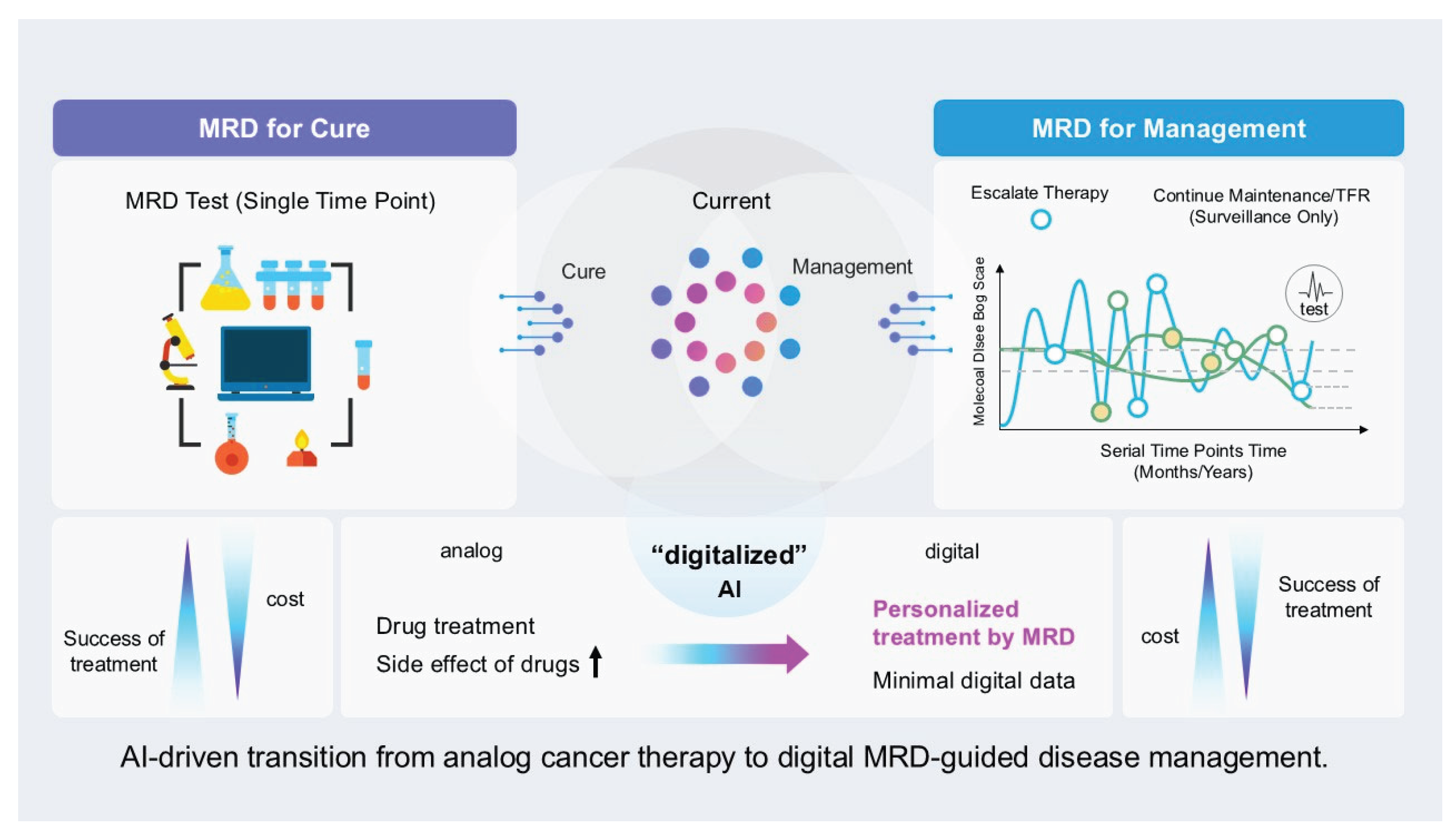

Table 1.
Characteristics of techniques used for MRD detection.
| MRD Method | Sample Type | Typical Sensitivity | Primary Clinical Use | Strengths | Limitations | Current Clinical Actionability | References |
|---|---|---|---|---|---|---|---|
| Multiparameter Flow Cytometry (MFC) | Bone marrow, blood | 10⁻⁴–10⁻⁵ | Hematologic malignancies (ALL, AML, CLL, MM) | Broad applicability; rapid turnaround | Lower sensitivity than molecular methods; inter-lab variability | High in hematologic malignancies (risk stratification, transplant decisions) | [70] |
| RT-qPCR | Bone marrow, blood | 10⁻⁵–10⁻⁶ | Fusion genes / recurrent mutations (e.g. BCR-ABL1, NPM1) | High sensitivity; standardized for selected targets | Limited to known targets; relative quantification | High for selected molecular subtypes | [82] |
| Next-Generation Sequencing (NGS) | Bone marrow, blood, plasma | 10⁻⁵–10⁻⁶ | Hematologic and solid tumors | Detects clonal heterogeneity; tumor-informed assays | Cost; bioinformatics complexity; clonal hematopoiesis confounding | High (hematologic); Moderate (solid tumors) | [63] |
| Digital PCR (ddPCR / cdPCR) | Blood, plasma | 10⁻⁴–10⁻⁵ | Targeted mutation tracking | Absolute quantification; high precision | Limited multiplexing; target-restricted | Moderate–High for known mutations | [65,66,67] |
| ctDNA (tumor-informed) | Plasma | 10⁻⁵–10⁻⁶ | Solid tumor MRD detection | High specificity; early relapse detection | Requires tumor tissue; cost | Moderate (mainly within trials) | [83] |
| ctDNA (tumor-agnostic) | Plasma | 10⁻³–10⁻⁵ | Broad surveillance, variant discovery | No tumor tissue required; broader mutation capture | Lower specificity for MRD | Low–Moderate | [83] |
| Single-cell sequencing (scRNA-seq / scMRD) | Bone marrow, tissue | <10⁻⁶ (theoretical) | Clonal architecture, resistant subpopulations | Ultra-high resolution; biological insight | Cost; scalability; limited clinical validation | Exploratory | [69] |
| Multi-omics / AI-integrated platforms | Plasma, tissue | Variable | Advanced MRD detection and prediction | Signal enhancement; low tumor fraction detection | Regulatory and interpretability challenges | Exploratory / Early clinical | [80,81] |
Abbreviations: MRD, Minimal Residual Disease; ALL, Acute Lymphoblastic Leukemia; AML, Acute Myeloid Leukemia; CLL, Chronic Lymphocytic Leukemia; MM, Multiple Myeloma; RT-qPCR, Reverse Transcription Quantitative Polymerase Chain Reaction; ddPCR, Droplet-Based Digital PCR; cdPCR, Chip-based Digital PCR; ctDNA, Circulating Tumor DNA; scRNA-seq, Single-cell RNA Sequencing; scMRD, Single-cell MRD assay; AI, Artificial Intelligence.
Disclaimer/Publisher’s Note: The statements, opinions and data contained in all publications are solely those of the individual author(s) and contributor(s) and not of MDPI and/or the editor(s). MDPI and/or the editor(s) disclaim responsibility for any injury to people or property resulting from any ideas, methods, instructions or products referred to in the content. |
© 2026 by the authors. Licensee MDPI, Basel, Switzerland. This article is an open access article distributed under the terms and conditions of the Creative Commons Attribution (CC BY) license.
Copyright: This open access article is published under a Creative Commons CC BY 4.0 license, which permit the free download, distribution, and reuse, provided that the author and preprint are cited in any reuse.


