

Submitted:
02 March 2026
Posted:
03 March 2026
You are already at the latest version
Abstract
Plastic recycling technologies are rapidly being reoriented toward process-, operations-, and quality-centered innovation, driven by the expansion of the circular economy and digital transformation. This study uses patent data to quantify long-term trends in plastic recycling and to compare technological structures and thematic shifts before and after 2015, thereby identifying core technological axes and convergence patterns. We collected and curated 64,639 triadic patents (2005–2024) and conducted IPC portfolio analysis, IPC co-occurrence network analysis, and period-split topic modeling. The results indicate that, since 2015, technologies related to data- and AI-enabled sorting, quality assurance, and process optimization (G06), along with tracking and connectivity (H04), collection and logistics (B65), water treatment (C02), and quality modification/compounding (C09), have expanded, while the relative prominence of some synthesis- and conversion-oriented technologies has declined. Convergence has shifted from material formulation–centered combinations toward stronger linkages with downstream processing–productization–standardization and operational infrastructure. Topic trends likewise show the rising salience of reuse-oriented packaging take-back, washing and standardization, remanufacturing, and data governance in the later period. Overall, these shifts suggest that recycling technologies are evolving beyond isolated process improvements toward maximizing circularity performance across the value chain, supporting sustainability objectives such as reducing environmental burdens and carbon emissions and improving resource efficiency.
Keywords:
sustainability
; plastic recycling
; patent analytics
; technology convergence
; digital transformation
1. Introduction
Plastic pollution has expanded across marine, terrestrial, and atmospheric environments alongside surging production and consumption, and has become a global environmental challenge that requires coordinated international action as a key agenda for achieving sustainability goals—namely, protecting ecosystems and reducing resource and energy use [1]. In particular, short-lived use patterns and fragile collection systems structurally amplify environmental leakage, indicating that pollution mitigation must extend beyond end-of-life treatment to address all stages of the value chain, from production and distribution to consumption and collection [1]. Prior research shows that a substantial share of plastics produced worldwide has not been recycled but has instead been landfilled or accumulated in the environment; this cumulative characteristic sharply increases the long-term burden of management over time [2]. The large magnitude of plastics entering the ocean and the complexity of inflow pathways further suggest that national-level policies alone are insufficient, and that simultaneous transitions across technology, markets, and institutions are required [3]. Moreover, because plastics often degrade very slowly under environmental conditions and can gradually transform into microplastics—thereby increasing the potential for ecosystem and human exposure—these dynamics underscore the need for technology strategies oriented toward hazard and risk reduction rather than simple volume reduction [4].
Plastic waste management is also closely linked to greenhouse gas emissions, and recycling is increasingly viewed as a potential means not only of closing material loops but also of substituting for carbon-intensive virgin feedstock production [5]. From this perspective, advancing recycling capabilities can be regarded as a key lever of sustainability transitions that pursue both circular economy objectives and carbon neutrality. However, mechanical recycling remains vulnerable to mixed and contaminated streams, and repeated processing commonly degrades material properties, often limiting expansion into high-value applications [6]. Accordingly, plastic recycling needs to be reframed as an industrial system transformation task that goes beyond improving the efficiency of individual processes and instead optimizes the entire value chain—from collection and sorting to washing/treatment, quality control, and reintegration into production [7]. In this context, technological development is expanding from “technologies that decompose or convert better” toward “technologies that collect better, classify more accurately, and control quality more consistently,” indicating a shift in the locus of innovation from unit operations to operations- and data-enabled integration [7].
The circular economy has been discussed as a major strategy for addressing plastic challenges, emphasizing a system transition in which reuse, repair, remanufacturing, and recycling are incorporated from the product design stage to minimize resource inputs and waste generation [8]. While the concept has been widely embraced, quantitative evidence is still needed regarding which combinations of technologies relieve bottlenecks across the value chain and translate into measurable outcomes [9]. In addition, performance should be assessed not only in terms of recycling volumes but also through sustainability indicators such as reductions in environmental burdens and improvements in resource efficiency. From a policy standpoint, the European Union’s 2015 Circular Economy Action Plan provided strong signals to technology development and corporate strategy by articulating transition tasks such as promoting circularity, building markets, and strengthening recyclability [10]. The revised 2020 Action Plan further emphasized sustainable product policy, enhanced circularity across value chains, and the importance of data-driven management, expanding attention from recycling technologies per se to broader “circular system implementation technologies” [11].
On the industrial and technological side, Industry 4.0 has accelerated digitalization in manufacturing and operations by combining sensors, IoT, cyber–physical systems, and AI analytics, substantially extending the applicability of process optimization, traceability and quality management, and automated sorting in recycling [12]. The core of Industry 4.0 lies not simply in equipment automation but in a paradigm shift in operations that includes data connectivity and automated decision-making, which is particularly critical for converting heterogeneous waste plastic streams into standardized resources [13]. Recent work has synthesized evidence that AI- and IoT-enabled smart waste management can contribute to route optimization, improved sorting accuracy, and higher operational efficiency in recycling processes, reinforcing the view that technological solutions can alleviate bottlenecks along the recycling value chain [14]. Such digital optimization can also jointly reduce energy and water use, transport inefficiencies, and quality variability, thereby enhancing the sustainability of recycling systems in practical terms. In other words, if the circular economy has catalyzed institutional and market transitions, digital transformation is acting as a catalyst that advances “measurement–decision–control” in recycling processes and operations, expanding recycling from a process technology domain into an industrial systems technology domain [7].
Many existing approaches to understanding research trends in plastic recycling rely on bibliometric analyses of academic publications, which are useful for tracing the accumulation of scientific knowledge but may be limited in early detection of industrial application signals and commercialization directions [15]. Patents, by contrast, are outcomes of technological development and knowledge assets tightly coupled with firms’ market strategies, and have long been used as quantitative indicators that reflect the direction and pace of innovation [16]. The use of patent statistics as measures for economic and innovation analysis has been discussed for decades, offering advantages for observing shifts in R&D outputs and technological competition [17]. Triadic (US–Europe–Japan) patents, which entail substantial international filing costs, tend to represent relatively high-value inventions and have therefore been used as a comparatively stable sample for monitoring global innovation signals [18]. In the plastics domain, reports have also demonstrated the practical utility of patent-based analyses for technology and policy decision-making by synthesizing innovation directions such as recycling, circular design, and alternative feedstocks [7].
Nevertheless, prior patent trend studies often focus on specific technologies or remain at the level of keyword-frequency–based categorization, providing limited integrated explanations of which technology combinations strengthen across the full value chain and how convergence structures are reconfigured [19]. From the perspective that technological innovation emerges through recombination of existing knowledge, combinational analyses based on co-occurring classification codes and network structures are effective for structurally interpreting the strengthening or weakening of technological convergence [20]. In addition, topics that rise sharply at specific points can be quantitatively captured through burst detection, which helps clarify “when” trend transitions occur within long time-series data [21].
Approaches that visualize changes in knowledge structures from the perspectives of research fronts and intellectual bases can help interpret the context of emerging themes in complex technological domains [22]. Topic modeling has also been widely used to uncover semantic structures in large-scale patent texts; while LDA has been broadly adopted, it has been criticized for insufficiently reflecting contextual information [23]. With the spread of contextual embedding methods, topic modeling that leverages BERT-family embeddings has evolved to improve topic coherence and interpretability [24]. BERTopic combines embeddings, clustering, and class-based TF–IDF to derive semantically grounded topics from large corpora, and can be applied to technical documents such as patent abstracts and claims [25]. Accordingly, a more precise understanding of structural change in plastic recycling innovation under circular economy and digital transformation requires an integrated analysis that combines IPC-based portfolio shifts, IPC co-occurrence–based convergence networks, and semantic topic evolution [19].
Against this backdrop, the objective of this study is to structure the innovation landscape of plastic recycling technologies from a value-chain perspective using patent data and to comprehensively examine how post-2015 changes in technological portfolios, technological convergence, and semantic topic dynamics co-evolved. Specifically, by comparing the periods 2005–2014 and 2015–2024, we (1) identify changes in IPC-based portfolios (section–class–subclass), (2) assess the strengthening and weakening of convergence patterns using IPC co-occurrence networks, and (3) extract patterns of topic emergence, disappearance, and transition through topic modeling, thereby suggesting promising technology groups and promising convergence combinations.
Academically, this study extends the discussion of plastic recycling beyond unit-process–centered perspectives by proposing an integrated framework that explains paradigm shifts through the combination of classification-based structural change and semantic topic change. Practically, it provides evidence that can support firms’ redesign of R&D and IP portfolios, prioritization of investments in process and operational upgrading, and identification of potential collaboration partners. From a policy perspective, it contributes to identifying priorities for infrastructure and standards—such as collection, sorting, quality management, and traceability systems—and to deriving directions for policy support required during circular-economy transitions.
The remainder of the paper is organized as follows. Section 2 reviews the theoretical background and prior studies on plastic recycling, the circular economy, technological convergence, and topic evolution analysis. Section 3 details the procedures for patent data collection and preprocessing, IPC portfolio analysis, convergence network analysis, and topic modeling. Section 4 presents the results on annual trends, IPC structural change, shifts in convergence patterns, and topic change and transition. Section 5 interprets the findings and derives implications from academic, industrial, and policy perspectives. Section 6 concludes by discussing limitations and proposing directions for future research.
2. Related Literature and Hypothesis Development
2.1. General Research on Waste Plastics
Research on waste-plastic recycling gained momentum as scholars began to systematically synthesize the potentials and limitations of conversion technologies capable of handling mixed and contaminated waste streams [26]. Subsequent work extended beyond comparisons of single-process performance toward a systems perspective, emphasizing that overall efficiency and the quality of recycled outputs are determined when sorting, pretreatment, and reprocessing are sequentially coupled. In parallel, the discussion has increasingly recognized that mechanical and chemical recycling can assume differentiated roles depending on feedstock composition, contamination levels, and target quality requirements [27,28]. Collectively, this literature highlights that recycling bottlenecks repeatedly converge on feedstock heterogeneity and quality degradation, implying that advances in collection and sorting must accompany process innovation [29].
From an environmental-impact perspective, evidence has accumulated in favor of condition-dependent comparisons rather than definitive claims of superiority across technologies. Life-cycle assessments (LCAs) comparing pyrolysis-based chemical recycling of mixed waste plastics with mechanical recycling and energy recovery show that conclusions can vary substantially with assumptions regarding the electricity mix, product-quality scenarios, and system boundary definitions [30]. A review of LCAs covering both bio-based and fossil-based plastics further notes that sensitivity is strongly driven by functional units, allocation approaches, and data quality [31]. In addition, reports by public agencies have structured key sources of uncertainty in life-cycle impact assessments of plastics—such as boundary choices, emission factors, and scenario assumptions—thereby clarifying critical cautions for comparative interpretation [32].
Quality and hazard concerns are particularly salient in relation to the fate and behavior of additives and contaminants. Studies synthesizing the migration, release, and environmental impacts of plastic additives have been used to explain potential hazards and quality variability in recycling processes [33]. Beyond this, prior work has documented how product design, source separation practices, detection limits in sorting, and property deterioration in recycled materials jointly create trade-offs [34], alongside emerging attempts to quantify the technical upper bounds of packaging circularity [35]. Comparative analyses of packaging recycling systems across European countries further indicate that differences in institutions, source-separation arrangements, and sorting infrastructure translate directly into recycling quality and costs [36].
More recently, as recognition has grown that high-purity sorting and quality correction are decisive for the real-world performance of the circular economy, research on sensor-, spectroscopy-, and AI-enabled automated sorting has intensified. Systematic reviews of sensor technologies for solid-waste sorting compare application conditions as well as strengths and limitations across sensor types [37]. Reviews addressing the integration of IR/Raman/LIBS with chemometrics emphasize that data preprocessing, robustness to contamination and coloration, and model generalization are central challenges for deployment in operating facilities [38]. Hyperspectral-based plastic detection and sorting studies further discuss opportunities to extend these approaches beyond recycling plants to environmental monitoring [39]. In parallel, for PET in particular, advances that substantially improved enzymatic depolymerization performance have attracted attention by demonstrating the feasibility of recovering high-quality feedstocks [40].
On the policy and standards front, a growing body of work argues that technological upgrading becomes more effective when coupled with institutional and information infrastructures. ISO 15270 has been widely used as a representative guideline that outlines quality requirements and options across the full chain of plastics waste recovery and recycling [41]. In the context of transboundary movement, the Basel Convention’s plastic waste amendments have altered rules governing international trade and shipment, directly affecting constraints faced by the recycling industry [42]. Regulations targeting single-use plastics have also been institutionalized in ways that simultaneously drive product redesign, substitution, and collection systems [43]. Moreover, the EU’s ESPR provides a framework for codifying product-level circularity requirements, supporting the need to integrate improved recyclability with information-based management, including traceability and standardization [44]. At a macro level, circular-economy syntheses and reports from international organizations consistently argue that pollution reduction is difficult to achieve without applying reduction, reuse, substitution, and recycling as an integrated package [45,46,47,48].
2.2. General Research on Waste Plastics
Technological change in the waste-plastics and recycling domain has been quantified by combining publication-based (bibliometric) analyses with patent-based analyses of innovation activity. Patents are widely used as core data for technology landscape studies because they can capture, relatively early, signals of competitors’ R&D directions, the reconfiguration of technological axes, and potential pathways to commercialization [50,51]. An OECD study proposed a framework that quantifies plastic innovation linked to the environment and circularity through patents and interprets policy and technological change in tandem [50], while an EPO Technology Insight report structured plastic waste management technologies over a long time horizon and highlighted a strengthening trend toward sorting, purification, and digitally enabled management [51].
In publication-based trend analysis, a growing body of bibliometric research has derived research clusters and identified growth areas using keyword co-occurrence and citation networks [52,53,54]. VOSviewer and bibliometrix have been widely adopted as implementation tools, supporting large-scale network visualization and reproducible workflows [55,56]. However, because signals of academic expansion do not necessarily coincide with signals of industrialization, there is an increasing emphasis on cross-validation with, or integrated analysis of, patent-based results.
Methodologies for patent analysis have also evolved beyond simple application-count trends toward network analysis, mapping, and statistical modeling. Patent citation network analysis, for instance, enables structural interpretation of knowledge diffusion and the distribution of technological influence [57]. Classification (IPC/CPC)-based portfolio mapping and overlay analysis are particularly effective for comparing technology landscapes across firms, countries, and time periods, and “difference map” approaches have been proposed to visually contrast relative strengths and weaknesses among competing actors [58]. Studies using global IPC maps (overlays) have further refined landscape comparisons by visualizing technological distance and positioning [59]. Algorithmic approaches that link IPC to other economic and industrial classifications via concordance have also suggested avenues for extending long-term comparisons and convergence analyses [60]. In addition, research leveraging IPC/CPC classifications to extract applicants’ technological patterns and their temporal dynamics complements trend analysis at the level of innovation actors [61]. Analyses that track dynamic patterns of technological convergence using IPC co-occurrence provide a framework for quantifying changes in the convergence structure itself [62].
In parallel, studies have systematized how patent information can be used from a strategic technology management perspective—such as competitive monitoring, technology valuation, and portfolio management—thereby clarifying how patent indicators connect to decision-making processes [63]. Approaches that combine bibliometrics and patents have also been proposed to forecast and anticipate emerging technologies [64]. Text-mining–based patent networks have been suggested as tools for trend detection in high-technology fields [65], and SAO-based patent intelligence systems illustrate how semantic structures can be extracted from patent texts to support mapping and network analysis [66]. Keyword-based patent maps have become a representative method for exploring new technology opportunities [67], and two-stage patent analyses that customize opportunity exploration by incorporating firm capabilities have also been proposed [68]. Moreover, patent-based technology opportunity discovery and roadmap construction have expanded to include opportunity identification using text and classification information [69], patent roadmaps for competition and strategy formulation [70], and data-driven roadmaps based on association rules [71]. Approaches that analyze developmental patterns in patent texts to build patent roadmaps are often presented as representative cases [76].
Finally, interpretation of patent trends becomes more persuasive when combined with up-to-date syntheses of the underlying technologies Reviews that summarize the current status and outlook of chemical recycling provide background for interpreting patent trends by delineating process categories and differences in technological maturity [72,73,74,75]. Likewise, reviews on AI-enabled waste management synthesize trends in which classification, sorting, and logistics optimization are increasingly strengthened through integration with digital technologies, offering a basis for interpreting signals of digital transformation [77].
2.3. Methodological Studies Related to IPC
The International Patent Classification (IPC) is an international standard classification system that organizes patents by technological domain, and its structure and rules of use are summarized in WIPO’s guidance documents [78]. A central issue in long-run time-series analysis is code migration caused by revisions to the classification scheme; WIPO explains the purpose and use of the Revision Concordance List (RCL) in its FAQ materials [79]. The practical basis for revision procedures and consistency management is further detailed in the IPC revision guidelines [80]. The Cooperative Patent Classification (CPC) is used as a more granular system that extends IPC, and CPC–IPC concordance tables are useful for conversion across classification systems and for comparative analyses [81,82]. In addition, documents that map IPC codes to technology fields—thereby enabling cross-country and cross-field comparisons—have served as a de facto standard reference for defining technology fields, improving both analytical boundary setting and the comparability of results across studies [83]. Accordingly, IPC-based trend analysis should be designed to jointly address (1) revisions and consistency management, (2) code mapping and crosswalk-based conversion, and (3) portfolio- and network-based interpretation, in order to ensure reproducibility and comparability.
3. Data and Methodology
The purpose of this study is to quantitatively identify the long-term technological axes and structural changes in waste-plastic recycling technologies using patent data from 2005 to 2024, and to derive core technological axes and convergence relationships by comparatively analyzing the reconfiguration of technology portfolios and directions of thematic evolution around the inflection point of 2015. In particular, while conventional chemistry- and process-based technologies remain salient, we seek to empirically interpret how the expanding trend of digitally integrated technologies—such as data- and AI-enabled sorting and quality management, tracking and connectivity, and collection and logistics—materializes as changes in both classification-based structures and meaning-based thematic structures.
To this end, we collected and curated 64,639 triadic patent families filed between 2005 and 2024 to construct an analysis corpus, and then split the observation window into two periods (2005–2014 and 2015–2024) to apply an identical analytical workflow to each. The analysis consisted of (1) technology portfolio analysis by computing IPC section-, class-, and subclass-level distributions and change rates; (2) identification of inter-technology coupling structures by constructing IPC co-occurrence networks; and (3) interpretation of thematic structures and transition patterns through period-specific topic modeling and topic–IPC subclass mapping. As illustrated in Figure 1, the research procedure proceeded through data collection, data curation, IPC-based quantitative analysis, and topic-evolution analysis linked to IPC. By cross-examining the outputs generated at each stage, we synthesized the timing, direction, and structural implications of technological transition in a coherent manner.
3.1. Data Collections
To empirically examine long-term changes in technologies related to waste plastic recycling and resource circularity, this study adopts patent data as its primary analytical source. Patents represent codified knowledge outputs whose novelty and industrial applicability have been assessed to a certain extent, making them well suited for long-horizon comparisons and for tracking shifts in both the composition of technological domains and their combinational relationships. Accordingly, we collected triadic patent applications from the Wips On patent database, yielding a final analytical sample of 64,639 patent applications filed over the period 2005 to 2024.
The overall observation window spans 20 years from 2005 to 2024. To account for exogenous changes that could plausibly serve as inflection points in technological development, such as the diffusion of circular economy initiatives, digital transformation, and the broader adoption of data-driven operational technologies, we split the period into two subperiods centered on 2015, namely 2005 to 2014 and 2015 to 2024. This design allows us to move beyond assessing simple growth in patenting activity and instead compare how technological structures and thematic systems were reconfigured across the two periods. In addition, we standardized the rights stage to patent applications to minimize timing distortions arising from grant lags and cross-country differences in examination systems.
As shown in Table 1, the search query was constructed by combining keywords covering waste plastics and plastic waste and major resins such as PET, PE, PP, PS, and PVC, terms representing circular activities such as recycling, recovery, reuse, and upcycling, and terms related to chemical and physical treatment processes including depolymerization, solvolysis, and pyrolysis. This design simultaneously reflects three dimensions, namely materials as target resins, activities as circular actions, and processes as treatment mechanisms, thereby defining a search scope that avoids undue bias toward any single process route or polymer type.
To this end, we collected and curated 64,639 triadic patent families filed between 2005 and 2024 to construct an analysis corpus, and then split the observation window into two periods (2005–2014 and 2015–2024) to apply an identical analytical workflow to each. The analysis consisted of (1) technology portfolio analysis by computing IPC section-, class-, and subclass-level distributions and change rates; (2) identification of inter-technology coupling structures by constructing IPC co-occurrence networks; and (3) interpretation of thematic structures and transition patterns through period-specific topic modeling and topic–IPC subclass mapping. As illustrated in Figure 1, the research procedure proceeded through data collection, data curation, IPC-based quantitative analysis, and topic-evolution analysis linked to IPC. By cross-examining the outputs generated at each stage, we synthesized the timing, direction, and structural implications of technological transition in a coherent manner.
3.2. Pre-Processing
The collected raw data were subjected to a curation process to ensure internal validity. First, duplicate patents were removed to prevent the same invention from being counted multiple times. In particular, duplicate records arising from patent-family overlaps or database integration can introduce systematic bias in estimating the scale of technologies by domain; therefore, duplicates were identified and eliminated using patent identifiers and bibliographic fields. Second, documents that could be captured by the search query but were non-plastic in scope or otherwise outside the study boundary were excluded. This step was intended to keep the analytical sample consistently aligned with the thematic scope of waste plastic recycling and resource circularity.
Third, IPC information was collected for both primary and additional assigned codes, and then standardized through a normalization procedure to enable aggregation at the section, class, and subclass levels. Specifically, we harmonized discrepancies arising from spacing and delimiter conventions, version-related differences in code notation, and potential inconsistencies introduced when truncating codes to class or subclass levels. This preprocessing was designed to minimize code-matching errors in subsequent portfolio analyses, including share and growth-rate calculations, as well as in IPC co-occurrence network analysis.
3.3. IPC-Based Technology Portfolio Analysis
The purpose of this section is to use the IPC classification system to identify the macro-level composition and distribution of waste-plastic recycling technologies, to delineate meso- and micro-level core technological axes at the class and subclass levels, and to quantitatively derive changes in portfolio reconfiguration around 2015 in terms of shares and change rates, as well as shifts in inter-technology convergence structures based on co-occurrence networks. To this end, the unit of analysis is hierarchically organized into section, class, and subclass levels, enabling a stepwise extraction of results from the broad technology landscape down to detailed technological domains. This section is designed to jointly address two questions: which technological domains expanded, and which domains evolved through combinational development with other domains.
3.3.1. Section Distribution Analysis
At the IPC section level, we examine the macro-level structure of the target technology set and assess whether the portfolio is concentrated in a single section or distributed across multiple sections. We compute patent counts and shares by section to summarize the overall structure, and we compare the two periods, 2005 to 2014 and 2015 to 2024, to identify the direction of shifts in section composition. This analysis provides a macro-level check on whether chemistry- and process-oriented sections remain dominant and whether digitally related sections, including data processing, communications, and measurement, expand in relative terms.
3.3.2. Yearly Trends in IPC Sections
The year-by-year section analysis is conducted to examine the continuity of long-run trends and to identify potential inflection points. For each year, we calculate section-level shares and assess the direction and pace of annual change. This allows us to distinguish sections that expand sharply after a particular period from those that contract gradually, and to further verify how the timing of portfolio reallocation relates to the period around 2015. When necessary, auxiliary indicators such as moving averages can be used to separate short-term fluctuations from long-term trends for interpretation.
3.3.3. Class Analysis
Class-level analysis is conducted to identify the core technological axes of the portfolio. After truncating IPC codes to the class level, we compute patent counts, shares, and rankings for each class. We also examine the cumulative share accounted for by top classes to assess the degree of concentration and dispersion in the technology portfolio. These results provide a basis for discussing categories such as core classes, defined as large-scale domains; growth classes, defined as domains with rapid increases; and niche classes, defined as relatively small but persistent domains. Where appropriate, the same indicators can be calculated by country, institution, or applicant to extend the framework for comparing actor-level technological positioning.
3.3.4. Class Change-Rate Analysis
To more directly capture technological structural transitions, we compute the difference in class shares between the two periods as a change rate expressed in percentage points. This metric helps distinguish whether growth in absolute counts reflects overall increases in patenting activity or a genuine shift in portfolio composition. By analyzing changes in shares, we identify rapidly rising and rapidly declining classes and quantitatively present technological axes that gained importance after the transition as well as those whose relative importance diminished. For classes with the largest changes, we further interpret the substantive content of the shift by linking them to related subclasses and topic-modeling results.
3.3.5. Subclass Analysis
Subclass-level analysis traces the drivers of change at a more granular technological level. We compute counts, shares, and period-by-period changes for each subclass to assess which specific subdomains underpin expansions or contractions observed at the class level. Because different subclasses within the same class can exhibit opposing trends, subclass analysis helps explain the micro-level mechanisms of portfolio reconfiguration. When needed, subclass–keyword linkages can be used to further verify whether classification-based changes align with meaning-based changes derived from text analysis.
3.4. Topic Evolution and IPC Mapping Analysis
The purpose of this section is to compare and trace the thematic structures and evolutionary patterns of patent-text topics across two periods, 2005 to 2014 and 2015 to 2024, using topic modeling, and to systematically interpret how meaning-based thematic change manifests in conjunction with changes in specific technological domains by mapping topics to IPC subclasses. Whereas the IPC analysis provides a classification-based representation of technological domains, topic modeling provides a text-based representation of semantic and application-oriented themes. By integrating the two, this study offers a more multidimensional explanation of technological transition. To ensure comparability, we apply an identical analytical workflow to both periods.
3.4.1. BERTopic Modeling
Patent texts in each period are treated as the unit of analysis, and an embedding-based topic model is constructed. We then apply class-based TF–IDF to the clustering results to extract representative keywords for each topic, and we examine the distribution and proximity of topics in the thematic space through distance-based visualization. In addition, hierarchical clustering is used to infer topic hierarchies as a complementary structure, enabling interpretation not only of parallel relationships among similar topics but also of broader inclusion relationships.
3.4.2. Topic Identification
In the topic identification stage, we assign topic labels by reviewing representative keywords and representative documents, or representative sentences, for the topics derived in each period. Labeling is conducted to reflect the technical content of each topic while maintaining consistent naming conventions to support subsequent comparative interpretation. Topics are also organized to align with value-chain stages such as process, operations, quality, traceability, logistics, and conversion, allowing us to capture how themes can differentiate by application context even within the same technological domain.
3.4.3. Comparative Interpretation
Comparative interpretation distinguishes persistent, emerging, and disappearing topics across the two periods and examines topic movements in terms of merging, splitting, and thematic transition. Topics observed in both periods are treated as persistent, topics that rise after 2015 are classified as emerging, and topics that decline in prominence or disappear are categorized as diminishing or disappearing. In addition, the analysis differentiates cases in which similar keyword clusters are consolidated into a single topic, interpreted as merging, from cases in which an existing topic becomes more fine-grained by application context or process stage, interpreted as splitting. Topic proximity in the embedding space and the substantive content of representative documents are jointly considered to ensure that the results are interpreted as shifts in semantic structure rather than superficial keyword variation.
3.4.4. Topic-IPC Subclass Linkage
Finally, to connect the comparative findings to the technological classification system, we compute topic–IPC mappings by aggregating the IPC subclass distributions of documents assigned to each topic. This enables us to examine which subclasses are associated with each topic, how topic composition varies within the same subclass, and whether classification-based change, reflected in IPC share shifts, aligns with meaning-based change, reflected in topic share shifts. Furthermore, by cross-examining the topic–IPC mappings with the change-rate analysis and convergence network results from Section 3.3, we establish an empirical basis for discussing whether technological transition is characterized by the co-occurrence of changes in both classification structures and thematic structures.
4. Results
4.1. IPC-Based Technology Portfolio Analysis
4.1.1. Results of the IPC Section Distribution Analysis
Figure 2 presents the IPC section distribution, based on a single-classification rule, for 64,639 triadic patents filed between 2005 and 2024. The overall portfolio is dominated by Section C, Chemistry and Metallurgy, with 28,299 patents, accounting for 43.8 percent, followed by Section B, Performing Operations and Transporting, with 16,713 patents, accounting for 25.9 percent. Together, these two sections comprise 69.7 percent of the portfolio, suggesting that plastic recycling technologies have developed primarily on a technological base centered on chemical treatment and material conversion, as well as process-related operations including processing, separation, and transport.
Section A, Human Necessities, accounts for 6,200 patents, or 9.6 percent, indicating that technology development has proceeded in parallel at a meaningful scale in downstream application and productization stages, such as packaging, containers, and consumer goods. Meanwhile, the presence of Section G, Physics, with 4,491 patents, or 6.9 percent, and Section H, Electricity, with 3,702 patents, or 5.7 percent, reflects an increasing integration of digital and measurement-oriented technologies with recycling processes, including quality evaluation, instrumentation, sensing, control, data processing, and equipment connectivity. Overall, while the conventional chemistry- and process-centered axes represented by Sections C and B form the core of the portfolio, physics- and electricity-based enabling technologies in Sections G and H appear to be accumulating in a complementary manner to support greater precision and automation in process operation.
Sections D, Textiles, with 1,901 patents, accounting for 2.9 percent, F, Mechanical Engineering, with 1,829 patents, accounting for 2.8 percent, and E, Fixed Constructions, with 1,504 patents, accounting for 2.3 percent, represent relatively small shares. Nevertheless, their presence indicates non-negligible technological demand in areas such as application materials for recycled feedstocks, including textiles, equipment and machinery design, and infrastructure and facility development. Overall, the technology landscape exhibits a multilayered structure comprising four main components: chemistry- and composition-oriented technologies, captured by Section C; process- and operations-oriented technologies, including separation, washing, processing, and transport, captured by Section B; downstream product and application expansion, captured by Section A; and measurement-, sensing-, control-, and connectivity-oriented enabling technologies, captured by Sections G and H. In subsequent analyses using IPC classes and subclasses as well as co-occurrence networks, the key focus is to examine how the internal axes within Sections C and B become differentiated and how technologies in Sections G and H couple with specific stages of the recycling process.
4.1.2. Results of the Annual IPC Section Distribution Analysis
Figure 3 presents a time-series of annual IPC section distributions for the period 2005 to 2024, based on adjusted counts. Throughout the entire period, Sections C, Chemistry and Metallurgy, and B, Performing Operations and Transporting, form the core of the technology portfolio, with their combined share remaining within an approximate range of 65 to 72 percent each year. This indicates that waste-plastic recycling technologies have been driven over the long run by chemical treatment and material conversion in Section C, together with process operations such as separation, washing, processing, and transport in Section B. At the same time, while these foundational axes persist, the portfolio exhibits a gradual rebalancing as cumulative shifts in section shares accrue around the period of 2015, suggesting a progressive relocation of the technological center of gravity.
The direction of change can be summarized as a relative expansion of process and operations technologies and a strengthening of digital integration. Section B increases by 5.0 percentage points and Section H, Electricity, also expands by 3.1 percentage points, whereas Section A, Human Necessities, declines by 5.6 percentage points, Section G, Physics, by 4.7 percentage points, and Section C, Chemistry and Metallurgy, by 4.5 percentage points. This pattern does not necessarily imply a weakening of chemistry-based technologies; rather, it suggests that innovation progressed more rapidly in operational stages spanning collection, sorting, treatment, and transport, resulting in a faster relative expansion of Section B. In parallel, the growth of Section H supports the interpretation that electricity- and communications-based enabling technologies, including equipment control, process monitoring, and traceability and connectivity functions, are becoming increasingly embedded across the recycling value chain.
The most recent five-year window, from 2019 to 2024, shows an even clearer reallocation across sections. Section B records the largest increase, rising by 7.0 percentage points, while Section D, Textiles, expands by 2.9 percentage points, implying that application pathways for recycled feedstocks may be broadening toward textile materialization. By contrast, Sections E, Fixed Constructions, H, Electricity, F, Mechanical Engineering, and C, Chemistry and Metallurgy, decline by 3.8, 2.1, 1.7, and 2.3 percentage points, respectively. This suggests that growth in infrastructure and facility development or in machinery- and chemistry-centered domains did not keep pace with the expansion in process and transport technologies, or that some functions were redistributed and absorbed into other sections during a period of adjustment. Overall, these time-series patterns indicate that, while Sections C and B maintain a dominant structural backbone over the long term, the technological system has been reconfigured since 2015 in a direction that strengthens process and operations in Section B together with connectivity and control elements in Section H.
4.1.3. Results of the Class-Level Analysis
Figure 4 presents the IPC class distribution for the full period from 2005 to 2024, based on the top 20 classes within the total sample of 64,639 patents. Among 122 classes, the top 20 account for 76.44 percent, or 45,408 patents, indicating a portfolio structure that is highly concentrated in a limited set of core classes. Notably, G06, Computing, Calculating, and Counting, is the largest class with 9,447 patents, representing 15.90 percent, followed by H04, Electric Communication Technique, with 7,867 patents, representing 13.24 percent. Together, these two classes alone comprise approximately 29 percent of the portfolio, suggesting that the core locus of competition in recycling technologies has shifted strongly toward operational upgrading elements such as data processing, automation, control, and connectivity across equipment and systems, in addition to process and material innovations.
At the same time, classes including C07, Organic Chemistry, B01, Physical or Chemical Processes or Apparatus in General, C08, Organic Macromolecular Compounds, C10, Petroleum, Gas, Fuel, and Lubricants, and C12, Biochemistry and Microbiology, remain prominent, indicating that chemistry- and process-based axes related to conversion, composition, separation, and reaction still form the foundational base of the technology landscape. The inclusion of G01, Measuring and Testing, H01 and H03, Basic Electric Elements and Basic Electronic Circuitry, C02, Treatment of Water, Waste Water, Sewage, or Sludge, C09, Dyes, Paints, Polishes, Resins, and Quality Modification, and B65, Conveying, Packing, and Handling, further supports the interpretation that instrumentation, quality management, wash-water and wastewater treatment, and logistics are being integrated as constituent components directly linked to process performance.
Figure 5 and Figure 6 compare changes in the composition of the top 20 IPC classes by splitting the observation window into 2005 to 2014, the earlier period, and 2015 to 2024, the later period. In the earlier period shown in Figure 5, G06 records 2,680 patents, accounting for 14.77 percent, and H04 records 2,248 patents, accounting for 12.35 percent, indicating that these digital and connectivity-related classes were already positioned at the top. However, the relative prominence of chemistry- and apparatus-oriented classes such as C07, with 1,337 patents or 7.36 percent, and B01, with 1,006 patents or 5.53 percent, is more pronounced. By contrast, in the later period shown in Figure 6, both the scale and share of the digital and connectivity axis expand, with G06 increasing to 6,789 patents, or 16.48 percent, and H04 increasing to 5,619 patents, or 13.64 percent, thereby strengthening their dominance. Over the same period, the share of C07 declines to 2,138 patents, or 5.19 percent, while B01 increases to 2,161 patents, or 5.24 percent, but its growth does not match the magnitude of the rise in the digital classes. This pattern suggests that the locus of differentiation in technological development has shifted from novelty in chemical reaction and material pathways toward optimization, automation, connectivity, and traceability in process operations, resulting in a reconfiguration of the upper tier of the portfolio around digitally oriented classes.
In addition, the later period from 2015 to 2024 shown in Figure 6 includes stable representation of G01, Measuring and Testing, with 1,038 patents or 2.52 percent; C02, Treatment of Water, Wastewater, Sewage, or Sludge, with 801 patents or 1.94 percent; C09, quality modification and compounding-related technologies, with 750 patents or 1.82 percent; and B65, logistics and handling, with 459 patents or 1.11 percent. This indicates that, as the recycling value chain expands from collection and sorting to washing, recycled-feedstock quality management, and transport and traceability, instrumentation, water treatment, and logistics are becoming embedded not merely as auxiliary functions but as core elements that shape process performance and output quality.
4.1.4. Results of the Period-by-Period Class Share Analysis
Figure 7 reports changes in the shares of the top 20 IPC classes as percentage-point differences between the later period, 2015 to 2024, and the earlier period, 2005 to 2014. Classes with large shifts separate clearly into two groups, indicating that the portfolio’s center of gravity moved in the later period toward operational upgrading, encompassing data, connectivity, and measurement, together with an outward expansion of the process boundary that incorporates washing, quality correction, and logistics.
The largest increases are observed for G06, which rises by 1.63 percentage points, and H04, which rises by 1.28 percentage points. The expansion of G06 reflects the growing weight of digitally enabled process-operation technologies, including data processing, machine-vision and AI-based sorting, process monitoring, and optimization. The increase in H04, in turn, captures the integration of IoT and communication-based connectivity that links equipment, plant operations, and logistics across the recycling system. Concurrent increases in C02, up by 0.62 percentage points, and C09, up by 0.55 percentage points, suggest that wastewater treatment and process-water reuse needs have become more salient as washing and pretreatment intensify, and that composition, additive, and modification technologies for correcting quality variability in recycled feedstocks have emerged as more important constraints in the later period. Increases in H01, up by 0.56 percentage points, and G01, up by 0.15 percentage points, indicate a strengthening of measurement and control enabling technologies, such as electromechanical and power-control components as well as sensing, inspection, and analytical functions, to stabilize operations and secure product quality. B65 also rises by 0.10 percentage points, consistent with a gradual expansion of collection, transport, and storage infrastructure within the portfolio.
By contrast, the decline group is led by a pronounced decrease in C07, down by 2.16 percentage points. This suggests that, while the organic-synthesis–oriented conversion axis remains active, its relative prominence within the upper portfolio has fallen because technologies related to process operations, quality, and system integration grew more rapidly in the later period. Decreases in H03, down by 0.97 percentage points, and C10, down by 0.46 percentage points, are consistent with a reallocation from traditional circuit-centric approaches toward communications, data processing, and system connectivity captured by H04 and G06, and with fuelization and conversion-oriented pathways not keeping pace with the growth of operations, quality management, and materialization-oriented axes. Declines in B01, down by 0.28 percentage points, C12, down by 0.26 percentage points, and C08, down by 0.12 percentage points, likewise are better interpreted as relative reweighting rather than absolute contraction, as digitally enabled sorting and control and the expansion of peripheral process functions, including washing and water treatment, quality correction, and logistics, accelerated in the later period.
These share shifts substantiate, at the class level, the section-level pattern observed in the previous subsection, namely the strengthening of Section B and the expansion of Section H. In other words, while the chemistry and process core, represented by classes such as C07, C08, and B01, remains foundational, the later period exhibits a portfolio reconfiguration in which operations-centered structures combining data and connectivity in G06 and H04, measurement and control in G01 and H01, auxiliary process functions in C02 and C09, and collection and logistics in B65 increasingly shape the upper tier of the technology landscape.
4.1.5. Results of the Subclass-Level Analysis
Table A1 in the Appendix provides a more fine-grained view of which specific functions underpin the class-level structural changes identified in the previous subsection. Subclasses that increase toward the later period from 2015 to 2024 can be summarized along two main axes. The first axis concerns data processing and recognition-driven upgrading of process operations within the G06 family. Electrical digital data processing in G06F increases by 1.05 percentage points, and computing based on specific computational models in G06N rises by 0.57 percentage points. Image and video recognition in G06V and image data processing in G06T also increase by 0.23 and 0.21 percentage points, respectively. This pattern suggests that sorting and quality management, repeatedly identified as key bottlenecks in recycling processes, are being strengthened through automation and intelligentization based on sensor and image data. By contrast, some subclasses related to recording media and data handling in G06K decline by 0.25 percentage points, and data processing for administration, supervision, or forecasting purposes in G06Q falls by 0.11 percentage points. This contrast indicates that digital transformation in this domain has progressed less through administrative or commerce-oriented data processing and more through recognition, processing, and computation functions that couple directly to on-site operations.
The second axis relates to integrated operations enabled by on-site connectivity and wireless networking within the H04 family. Wireless communication networks in H04W increase markedly by 1.78 percentage points, and digital information transmission in H04L rises by 1.01 percentage points, whereas traditional communication subdomains such as multiplex communication in H04J, general transmission in H04B, and telephonic communication in H04M decline by 0.54, 0.32, and 0.13 percentage points, respectively. This contrast implies a reallocation in which demand grows for IoT- and network-oriented communication functions that connect equipment, production lines, logistics, and traceability across the recycling value chain, while the relative weight of general-purpose communication technologies decreases. In other words, the shift reflects less an expansion in the variety of communication technologies than a selective strengthening of network functions required for real-time transmission and interoperability of process data.
An outward expansion of the process boundary is also evident at the subclass level. The rise in water treatment in C02F, up by 0.62 percentage points, reflects increasing environmental and operational requirements, including process-water reuse and pollutant-load reduction, alongside intensified washing and pretreatment. Increases in composition- and materials-related subclasses linked to quality correction, such as C09K, up by 0.38 percentage points, and adhesive and processing-related functions in C09J, up by 0.13 percentage points, indicate a strengthening emphasis on post-treatment and formulation optimization to correct property variability in recycled feedstocks and to meet application-specific requirements.
By contrast, declining subclasses point to a relative weakening of traditional chemical conversion and separation unit operations. Within the C07 domain, the subclass associated with acyclic or carbocyclic compounds, C07C, decreases substantially by 1.65 percentage points, suggesting that, although synthesis- and reaction-centered conversion activities remain, they did not keep pace with the growth of operations, quality, and connectivity-oriented axes in the later period. Separation processes in B01D also decline by 0.38 percentage points, which is more plausibly interpreted as a relative reweighting under rapid expansion of digitally enabled sorting and quality management in areas such as G06V and G06T as well as analytical functions in G01N, and system integration functions in H04W and H04L, rather than as an absolute contraction of separation technology development. Within the fuel and gas domain in C10, subclasses such as fuels in general in C10L and gas production including synthesis gas in C10J decrease by 0.23 and 0.14 percentage points, respectively, indicating that fuelization and conversion-oriented pathways have moved to a relatively lower priority under the recent growth phase dominated by operations and quality considerations. Within the H03 domain, declines in coding and decoding in H03M and modulation and demodulation in H03D, down by 0.36 and 0.35 percentage points, align with a broader reallocation from traditional circuit- and signal-processing functions toward network-based connectivity captured by H04W and H04L.
Overall, the subclass-level shifts reported in Table 2 decompose the class-level expansion of G06 and H04 into concrete functional changes, namely AI- and computer-vision–based sorting and quality management and wireless-network and digital-transmission–based connectivity and traceability. At the same time, increases in water treatment in C02F and quality correction in C09K and C09J support the interpretation that waste-plastic recycling technologies are evolving beyond conversion technologies alone toward configurations that simultaneously satisfy operational performance, environmental constraints, and quality standardization requirements.
4.2. Topic Evolution & IPC Mapping Analysis
4.2.1. Bert Topic Modeling
Figure 8 visualizes, in a two-dimensional space, the embedding-based distribution of 10 topics derived using BERTopic for the 2005 to 2014 period. Because points belonging to the same topic form dense clusters and greater inter-topic distances indicate lower lexical and contextual similarity, the map suggests that documents in this period are organized into several relatively separated thematic groups. The largest clusters are dominated by process- and material-oriented themes such as thermal energy recovery, fluid surface processing, and polymer coating. By contrast, optical networking and optical imaging form distinct clusters, indicating that instrumentation and communication elements related to process operation existed as independent themes alongside core process topics.
In addition, topics such as semiconductor wafer processing, inorganic quartz, circuit design, nuclear fuel systems, and nucleic acid extraction appear as separate clusters with weak direct linkage to the recycling domain. This pattern can be interpreted as a signal that the dataset is not perfectly confined to plastic recycling alone, and that a broader set of technical documents related to processes, materials, and equipment may be co-captured. Accordingly, the topic map for this period serves to visually confirm a structure in which core process- and material-centered themes coexist with adjacent-industry or general-purpose process and materials themes.
Figure 9 presents word scores for the most representative keywords within each topic, providing a basis for topic interpretation. Thermal energy recovery, Topic 1, is characterized by energy- and fluid-mediated terms such as gas, water, stream, heat, and recovery, forming a context related to heat recovery, utilization of thermal sources, and the recovery or reuse of process fluids. Optical networking, Topic 2, is characterized by clock, network, storage, recovery, and optical, indicating a focus on communication and networking functions such as data transmission, synchronization, and storage. Fluid surface processing, Topic 3, features terms such as fluid, ink, surface, and reusable, capturing contexts that link coating or surface-treatment processes with reusability or surface functionalization in recycling-related operations. Polymer coating, Topic 4, is represented by coating, compound, polymer, material, and polymerization, consistent with a materials-oriented theme centered on polymer formulation, polymerization, and film formation.
For topics that are less specific to the recycling domain, the keyword sets align with typical technical vocabularies of those fields and thereby support the validity of the assigned labels. Nucleic acid extraction, Topic 5, includes terms such as nucleic, silicon, treatment, and extract, indicating a strong bio-analytical and treatment-related context. Optical imaging, Topic 6, includes image, light, display, and apparatus, reflecting an optical-device and image-generation context. Semiconductor wafer processing, Topic 7, is characterized by semiconductor, wafer, silicon, and processing, while inorganic quartz, Topic 8, is dominated by titanium, quartz, sodium, and sio2, suggesting an independent theme focused on inorganic material composition and feedstocks. Circuit design, Topic 9 includes design and circuit, as well as terms such as tessellation and constraint that reflect optimization and structuring in design contexts. Nuclear fuel systems, Topic 10 is dominated by fuel, fission, uranium, and fissile, which are typical keywords of nuclear fuel and fission technologies.
Overall, the topic structure for 2005 to 2014 is centered on process- and material-oriented themes related to heat, fluids, and coatings, while also exhibiting the coexistence of separate clusters drawn from adjacent technological domains such as optics, communications, semiconductors, inorganic materials, biotechnology, and nuclear fuel. In comparison with the 2015 to 2024 results reported in the subsequent subsection, the analysis focuses on whether topics directly linked to operational upgrading, including sorting, measurement, control, and connectivity, become more prominent; how the relative weight and cluster cohesion of domain-nonspecific topics change; and how topics mapped to subclasses associated with G06, H04, and G01N are reconstituted in terms of representative keyword structures.
Figure 10 visualizes the embedding-based distribution of 11 topics derived using BERTopic for the 2015 to 2024 period in a two-dimensional space. In the visualization, topic groups directly related to recycling appear in a relatively cohesive form. In particular, reverse logistics themes, including take-back, washing, labeling, and refill for reusable packaging, Topic 1; remanufacturing, Topic 2; chemical recycling for packaging, Topic 3; thermal and fluid-stream–based energy and process operation, Topic 4; system recovery and safety, Topic 5; and automation and data sources, Topic 10, are located near the central area. This suggests that, in the later period, the thematic structure of recycling technologies was reorganized from a focus on single conversion processes toward a value-chain perspective linking collection, operations, quality, safety, and data. At the same time, topics such as radiation patterning, ferroelectric fatigue, sequence imaging, robotic surgery scaffolds, and hybrid vehicle technologies remain separated as themes with weak direct linkage to the recycling domain, indicating that broad process, materials, and equipment-related documents can still be co-captured in this period.
Figure 11 reports word scores for representative keywords of each topic, strengthening the basis for topic labeling. Reverse logistics and reusable packaging, Topic 1, is characterized by sorting, label, return, refill, and reusable, forming an operational context centered on take-back, classification, return, and refill. Chemical recycling for packaging, Topic 3, is characterized by recycled, supply, glycolysis, packaging, and methanolysis, clearly reflecting chemical recycling pathways centered on depolymerization and conversion routes such as glycolysis and methanolysis. Thermal and fluid streams, Topic 4, is represented by gas, stream, heat, material, and water, indicating a focus on process fluids, heat sources, and operating conditions. Remanufacturing, Topic 2, includes remanufacturing, repairability, refurbishment, and recovery, representing life-extension circular strategies such as repairability and refurbishment. Data sources, Topic 10, features source, properties, coding, statistical, and metadata, indicating an analytical-infrastructure theme related to the collection, coding, and statistical processing of process and quality data.
The topic configuration in the later period is meaningful in that themes directly connected to the recycling value chain become more clearly articulated than in the earlier period. The simultaneous presence of reverse logistics, including take-back, labeling, and refill; chemical recycling, including depolymerization and conversion; remanufacturing as a life-extension strategy; thermal and fluid-based operation; system recovery and safety; and data-oriented analytical infrastructure supports the interpretation that the focus of technological development has expanded beyond upgrading unit process technologies toward integrating operational systems, including traceability, data, and automation, and managing quality and safety constraints.
4.2.2. Topic Change Based on the Transition Map
The topic transition visualization map in Table 2 aligns topics from the early period, 2005 to 2014, with those from the later period, 2015 to 2024, within a shared embedding space. The mapped movements indicate that the thematic structure was not simply replaced, but was reorganized through processes of refinement, recombination, and disappearance. In the early period, process- and materials-oriented themes such as thermal energy recovery and fluid flow, fluid surface processing, and polymer coating and polymerization form the main focus. In contrast, the later period shows strengthened themes that are more tightly coupled to circular value chains and operational systems, including reverse logistics for reusable packaging, remanufacturing, chemical recycling of packaging, system recovery, and data sources.
At a more granular level, E1 connects to L2, thermal and fluid streams, and L1, system recovery and stability, suggesting that attention to energy recovery expanded toward operational conditions and system reliability. E2, optical networking and circuits, is only partially absorbed into L1, indicating a reconfiguration in which emphasis shifted away from communications and circuit technologies per se and toward connectivity functions that couple directly to process operation. E3 is linked to L3, remanufacturing, and L4, operations and reuse, implying that enabling technologies related to surfaces, cleaning, and contamination management were recontextualized toward life-extension strategies and take-back and reuse systems. E4 is reassigned to L4 and L6, suggesting a shift in emphasis from coating and polymerization toward conversion and regeneration pathways, including depolymerization. By contrast, several topics with stronger adjacent-industry characteristics, such as E8 through E10, show weak correspondence or disappearance in the later period, indicating a relative strengthening of recycling-centered topics after 2015. These movements are also consistent with the IPC findings of expanded process and operations technologies in Section B and increased data and connectivity functions captured by G06 and H04, supporting the interpretation that the later-period technology structure was reconfigured toward a systems-level perspective.
4.2.3. Comparative Interpretation
Figure 12 schematically aligns the BERTopic results for 2005 to 2014 and 2015 to 2024 to illustrate pathways of topic evolution, extinction, and emerging themes. Solid links indicate semantic continuation or transformation from an early-period topic to a later-period topic, dashed links indicate relative extinction of early-period topics, and green arrows with the “new field” label denote themes that emerge as independent topics in the later period. The diagram indicates that thematic change proceeded not as simple replacement, but through the simultaneous progression of continuity in selected themes, function-centered redefinition, and the emergence of new thematic clusters driven by value-chain expansion.
Core themes in the early period consist largely of process-, materials-, and device-centered topics, including thermal energy recovery, fluid and surface processing, coating and polymerization, and optical imaging and networking. Within these, the transition from Thermal energy recovery to Thermal fluid streams suggests that a focus on energy recovery expanded toward an operations and management perspective that incorporates thermal and fluid streams within the process. The transition from Optical imaging to Sequence imaging indicates that measurement and imaging functions shifted toward more advanced and precision-oriented analytical domains. The transition from Optical networking to Data sources implies that connectivity technologies became less of an end in themselves, while data-oriented operational infrastructure such as collection, coding, and metadata management of process and quality data rose as an independent technological axis. Material and surface-oriented topics such as Polymer coating and Fluid surface processing link to later-period themes including Chemical recycling for packaging and System recovery, which can be interpreted as a reallocation from materials functionality toward system-level performance goals such as conversion and regeneration of post-consumer packaging through depolymerization and related pathways, as well as process reliability and recovery.
In contrast, topics such as Nucleic acid extraction, Inorganic quartz, and Nuclear fuel systems show weak direct inheritance or are depicted as extinct, while operational and strategic themes directly tied to circular-economy implementation, such as Reusable packaging logistics and Remanufacturing, appear as “new field” topics. This indicates that the later-period thematic structure expanded beyond unit-process technologies toward an integrated value-chain perspective linking take-back, reuse, remanufacturing, and conversion.
4.2.4. Link topics to IPC subclasses
Table 3 summarizes changes in the shares of IPC subclasses associated with each transition pathway from early-period topics to later-period topics as depicted in Figure 12. A plus sign indicates technological elements whose relative weight increases in the later period, a minus sign indicates elements that decrease, and neutral or other categories indicate elements that are linked to the transition without a clear directional change. The table shows that topic-level semantic change is structurally coupled with operational upgrading based on data, connectivity, and measurement in subclasses within G06, H04, and G01; with logistics and collection functions within B65; and with process-peripheral functions such as water treatment in C02F and quality correction in C09-related subclasses.
Across transitions directly connected to the recycling value chain, strengthening of digital connectivity and operational infrastructure is repeatedly observed. The transition from Optical imaging to Sequence imaging is associated with increased shares of image recognition in G06V, digital data processing in G06F, and analytical and inspection functions oriented toward material and contamination identification in G01N, indicating that measurement, discrimination, and data processing became core functions in the later-period topic structure. Similarly, the transition from Optical networking to Data sources is accompanied by increases in wireless networking in H04W and digital information transmission in H04L, together with increases in G06F and G06N, supporting the interpretation that connectivity technologies evolved into operational systems centered on data collection and processing rather than constituting an end goal. The transition from Circuit design to System recovery is also accompanied by increases in G06F and in H04W and H04L, while traditional signal-processing subclasses such as H03M, H03D, and H03K decline, indicating that network-based interoperability and system recovery and reliability functions became more important than circuit- or signal-centric functions in the later period.
Transitions related to chemical recycling and expansion of the process boundary show concurrent strengthening of post-treatment, quality correction, water treatment, and logistics. The transition from Polymer coating to Chemical recycling for packaging is associated with simultaneous increases in polymer post-treatment and compounding in C08J, logistics and take-back and transport in B65D, B65F, and B65G, formulation and additive-based quality correction in C09K and related C09 subclasses, and water treatment in C02F. This indicates that later-period chemical recycling is not sustained by reaction and conversion technologies alone, but expands in combination with an operational system spanning take-back, sorting, washing and water treatment, property correction, and transport and handling. In contrast, the same transition shows decreases in C07C, a key organic-chemistry subclass, suggesting that synthesis- and reaction-centered traditional organic chemistry becomes relatively less prominent.
The same pattern is reinforced in newly emerging topics. Reusable packaging logistics and Remanufacturing display common increases in B65-related collection and logistics functions, H04-related connectivity, and G06-related data processing and recognition, indicating that later-period emerging themes are formed on the basis of operations and logistics integrated with digital capabilities. In particular, Remanufacturing is additionally associated with increased material and quality identification functions in G01N and selected materials processing in C08J, implying that life-extension circular strategies are implemented through integration of quality assessment, process treatment, and logistics systems. By contrast, adjacent-domain topics such as Nucleic acid extraction and Robotic tissue scaffolds are associated with decreases in C12P and neutral patterns in medical subclasses such as A61, suggesting that these shifts are better interpreted as structural adjustments of adjacent-industry topics within the dataset rather than as changes directly coupled to the recycling domain.
In summary, Table 4 shows that the later-period reconfiguration of the technology structure can be explained by the concurrent strengthening of data processing, recognition, and inspection functions, including G06F, G06V, G06N, and G01N; wireless and digital-transmission–based connectivity functions, including H04W and H04L; collection, transport, and storage functions, including B65D, B65F, and B65G; washing and water-treatment functions, including C02F; and formulation and quality-correction functions, including C09K and C09. In other words, the subclasses that repeatedly appear as increasing elements along topic-transition pathways reaffirm, at a micro-level, the operations- and systems-centered expansion trend identified in the IPC portfolio analysis, and they provide empirical support for the interpretation that, since 2015, plastic recycling technologies have shifted from a focus on unit process technologies toward value-chain operations integrated with digital capabilities.
5. Discussion
This patent-based analysis shows that, over 2005–2024, plastic recycling technologies retained core chemistry-, materials-, and process-based axes while undergoing a marked reconfiguration around 2015 toward operations- and digitally integrated capabilities. Patent filings increased sharply after 2015, peaked in 2021–2022, and then moderated slightly, consistent with a transition from research and experimentation to industrial deployment and scale-up competition under the joint influence of circular-economy institutionalization and digital transformation.
At the IPC section level, Sections C and B consistently dominated the portfolio, confirming that the field is fundamentally driven by material conversion and formulation in chemistry and by operational functions such as separation, washing, processing, and transport. Over time, however, the relative weight of Section B increased and enabling elements associated with electricity, communications, and measurement became more tightly coupled to the recycling process. This pattern indicates that competitive differentiation has expanded from chemistry and materials alone to include precision operations and broader system integration.
Class- and subclass-level results further specify the mechanisms of this shift. Post-2015 growth concentrated in data processing and computing, connectivity and communications, measurement and inspection, collection and logistics, water treatment, and quality correction. Rising subclasses related to sensor- and vision-based recognition and classification, digital computation and processing, wireless networking and digital transmission, and analytical inspection for material and contamination identification highlight sorting, quality management, and operational optimization as decisive bottlenecks. The concurrent rise of process-water and wastewater management alongside intensified washing and pretreatment, and the growth of formulation and modification technologies that compensate for property variability in recycled resins, show that high-quality recycling depends on operational solutions that jointly satisfy environmental constraints and quality requirements. In contrast, relative declines in selected conversion- and unit-operation–oriented subclasses are best interpreted as portfolio reweighting driven by faster growth in operations-, connectivity-, and quality-centered technologies rather than as the disappearance of those domains.
IPC co-occurrence networks provide structural support for this transition mechanism. Early-period convergence was centered on polymer formulation, synthesis, compounding, and post-treatment linkages, whereas the later period exhibits strengthened coupling between processing and product or material indexing and between post-treatment, formulation, and processing, reflecting the rising importance of standardization and processing optimization at manufacturing and productization stages. Additional strengthening of linkages involving separation and catalysis, packaging and transport, and water treatment indicates that innovation has expanded beyond material performance improvements toward routinized processing, industrialization, and supply-chain integration. Competitive advantage is therefore increasingly shaped by the ability to configure technology combinations that integrate processing, logistics, environmental management, and digital operations.
Topic modeling and transition analyses show parallel shifts at the semantic level. Early topics emphasize thermal and fluid-based processing and coating or surface treatment, whereas later topics more directly align with circular value chains and operational systems, including chemical recycling of packaging, reverse logistics for reusable packaging, remanufacturing, system recovery, and data sources. Recurrent increases in data-, connectivity-, and inspection-related subclasses along topic-transition pathways indicate that semantic reorganization co-occurs with structural reconfiguration in technology codes. Because some topics reflect adjacent domains, interpretation is most robust when grounded in the alignment between value-chain–relevant topics and IPC axes tied to data and connectivity, logistics, water treatment, and quality correction.
Overall, the results indicate that performance in plastic recycling is determined less by conversion chemistry or individual unit equipment alone than by the capability to integrate a functional chain spanning collection, sorting, washing, quality correction, transport and traceability, and operational optimization. Practically, corporate R&D and IP strategies should combine the chemistry and process core with digitally enabled operations, with prioritization of quality correction, water treatment, and logistics as leverage points for easing commercialization bottlenecks. At the policy level, in addition to process R&D support, a coordinated package is required that strengthens sorting infrastructure, traceability and data standards, quality measurement and certification, and criteria for process-water and contamination management, consistent with the finding that later-period growth converges on operational integration and data-driven management.
6. Conclusions
This study quantitatively examined the long-term evolution of plastic recycling technologies using 64,639 triadic patents filed between 2005 and 2024 and comparatively analyzed shifts in technological structure and thematic focus across the pre- and post-2015 periods, namely 2005–2014 and 2015–2024. Following data collection, the analysis assessed the technology portfolio and convergence structure by examining the IPC single-classification distribution and annual changes, share increases and decreases at the class and subclass levels, and IPC co-occurrence networks. In parallel, BERTopic-based topic modeling was combined with topic-transition analysis to interpret changes in meaning-based thematic structures.
The results show that, at the section level, Sections C and B remained dominant foundational axes across the full period, while the post-2015 period exhibits a relative expansion of Section B and stronger coupling with elements associated with Sections H and G. At the class and subclass levels, increases are concentrated in G06, data processing and computing, H04, communications and connectivity, G01, measurement and inspection, B65, logistics and handling, C02F, water treatment, and C09, formulation and quality correction. This indicates a clear shift in which operations-centered functions spanning sorting, washing, quality management, traceability, and operational optimization increasingly reconstitute the upper tier of the technology portfolio. Co-occurrence networks further reveal a reconfiguration of convergence axes from early-period linkages centered on polymer formulation and synthesis toward later-period combinations that integrate processing, pre- and post-treatment, standardization, and elements related to logistics and environmental management. Topic-transition results similarly show that later-period themes more tightly coupled to circular value chains and operating systems become more prominent, including chemical recycling, particularly for packaging, reverse logistics for reusable packaging, remanufacturing, system recovery, and data sources.
These findings provide empirical evidence that the focus of technological competition in plastic recycling is no longer confined to improvements in individual conversion processes or material performance. Instead, it increasingly emphasizes operational capabilities and data-driven integration that manage feedstock variability and contamination and standardize the quality of recycled feedstocks. A further contribution of this study lies in integrating IPC portfolio analyses at the section, class, and subclass levels, convergence structure analysis based on co-occurrence, and meaning-based thematic analysis through topic modeling and transitions within a single analytical framework. This integrated design connects three complementary questions within the same research logic: which technologies expanded, how technologies co-evolved through convergence, and how thematic structures were reorganized. The pre- and post-2015 comparison further demonstrates that digital, connectivity, and measurement functions associated with G06, H04, and G01N, together with logistics in B65, water treatment in C02F, and quality correction in C09, repeatedly appear as common denominators of later-period growth. This yields practical implications that future R&D and patent strategies should shift toward portfolio designs that combine process cores with operational infrastructure. From a policy perspective, the results also support a package approach that strengthens sorting infrastructure, traceability and data standards, quality measurement and certification systems, and criteria for process-water and contamination management as enabling conditions for technology diffusion.
Several limitations should be noted. First, as a general constraint of patent-based analysis, application strategies, examination regimes, and differences in appropriation practices may introduce biases such that patent counts do not fully represent the scale of underlying technological activity. Second, although IPC provides a systematic taxonomy of technologies, its resolution and the timing of labeling can lag early diffusion of emerging technologies, and similar technologies may be dispersed across multiple codes. Third, topic-modeling outputs include some adjacent-industry topics weakly linked to the recycling domain, reflecting the challenge of achieving perfect domain purity given the breadth of the search query and the characteristics of triadic patent data. Fourth, because the study explains structural change primarily through share shifts and co-occurrence-based convergence, it does not directly link these structural dynamics to performance indicators such as recycled-material properties, process costs, or carbon-mitigation effects.
Future research can address these limitations in several ways. First, beyond volume-based indicators, it is important to incorporate qualitative patent metrics such as forward and backward citations, patent-family expansion, and proxies for claim scope, including the number and length of claims, to evaluate technological influence and diffusion speed. Second, domain purity can be improved by combining IPC-based analysis with CPC, keyword-based technology dictionaries, or classification refinement using embedding- or LLM-based methods, alongside systematic procedures for reducing topic contamination. Third, co-occurrence networks can be extended beyond static comparisons by using dynamic network analyses based on annual snapshots and by tracking changes in centrality and community structures to identify the timing of convergence formation and potential transition thresholds. Finally, empirical scope can be broadened by decomposing and comparing portfolios by process route, such as mechanical, chemical, thermal, and biological pathways, by product group, such as packaging, textiles, automotive, and electrical and electronic products, or by region, and by quantitatively linking structural changes in patenting to exogenous variables such as policy shifts, oil prices, or the timing of regulatory adoption. These extensions would enable more precise testing of how the observed transition toward operations- and data-driven integration relates to industrial and policy conditions and how it translates into measurable outcomes in quality, economics, and carbon reduction.
Author Contributions
Conceptualization, Y. A., W.J. and K.C.; Methodology, Y. A., W.J.; Software, W.J.; Validation, Y.A. and K.C.; Formal analysis, W.J.; Writing—original draft preparation, Y.A.; Writing—review and editing, Y.A., W.J. and K.C.; Supervision, K.C. All authors have read and agreed to the published version of the manuscript.
Funding
This research received no external funding.
Institutional Review Board Statement
Not applicable.
Informed Consent Statement
Not applicable.
Data Availability Statement
The data used to support the findings of this study are included in the article.
Conflicts of Interest
The authors declare no conflicts of interest.
Appendix A

Table A1.
Subclass-level analysis.
| level | code | name | section | parent_class |
|---|---|---|---|---|
| subclass | G06F | Electric digital data processing | G | G06 |
| subclass | G06N | Computer systems based on specific computational models | G | G06 |
| subclass | G06V | Image or video recognition or understanding | G | G06 |
| subclass | G06T | Image data processing or generation, in general | G | G06 |
| subclass | G06K | Recognition of data; presentation of data; record carriers; handling record carriers | G | G06 |
| subclass | G06Q | Data processing systems or methods, specially adapted for administrative, commercial, financial, managerial, supervisory or forecasting purposes | G | G06 |
| subclass | G06G | Analogue computers | G | G06 |
| subclass | G06M | Computing arrangements for specific functions | G | G06 |
| subclass | H04W | Wireless communication networks | H | H04 |
| subclass | H04L | Transmission of digital information, e.g. telegraphic communication | H | H04 |
| subclass | H04J | Multiplex communication | H | H04 |
| subclass | H04B | Transmission | H | H04 |
| subclass | H04N | Pictorial communication, e.g. television | H | H04 |
| subclass | H04K | Secret communication; jamming of communication | H | H04 |
| subclass | H04M | Telephonic communication | H | H04 |
| subclass | H04Q | Selecting | H | H04 |
| subclass | C02F | Treatment of water, waste water, sewage, or sludge | C | C02 |
| subclass | H01M | Processes or means, e.g. batteries, for the direct conversion of chemical energy into electrical energy | H | H01 |
| subclass | H01J | Electric discharge tubes or discharge lamps | H | H01 |
| subclass | H01R | Electrically-conductive connections; structural associations; coupling devices; current collectors | H | H01 |
| subclass | H01G | Capacitors; capacitors and condensers | H | H01 |
| subclass | H01B | Cables; conductors; insulators; selection of materials | H | H01 |
| subclass | H01L | Semiconductor devices; electric solidstate devices not otherwise provided for | H | H01 |
| subclass | H01T | Spark gaps; overvoltage arresters; voltage limiters; discharge tubes | H | H01 |
| subclass | H01S | Devices using stimulated emission | H | H01 |
| subclass | C09K | Materials for applications not otherwise provided for; compositions thereof | C | C09 |
| subclass | C09J | Adhesives; non-mechanical aspects of adhesive processes, in general | C | C09 |
| subclass | C09C | Treatment of inorganic materials, other than fibrous fillers, to enhance their pigmenting or filling properties | C | C09 |
| subclass | C09G | Polishing compositions other than French polish; ski waxes | C | C09 |
| subclass | C09D | Coating compositions, e.g. paints, varnishes, lacquers; printing inks; etc. | C | C09 |
| subclass | C09B | Organic dyes or closely related compounds for producing dyes; mordants; lakes | C | C09 |
| subclass | C09F | Obtaining, purification, or chemical modification of natural resins | C | C09 |
| subclass | C09H | Preparation of glue or gelatine | C | C09 |
| subclass | A61B | Diagnosis; surgery; identification | A | A61 |
| subclass | A61K | Preparations for medical, dental, or toilet purposes | A | A61 |
| subclass | A61L | Methods or apparatus for sterilising materials or objects; disinfection; etc. | A | A61 |
| subclass | A61J | Medical/pharmaceutical containers; administering forms; etc. | A | A61 |
| subclass | A61G | Transport or accommodation for patients; assisting disabled persons | A | A61 |
| subclass | A61F | Prostheses; orthopaedic, nursing or contraceptive devices; bandages; etc. | A | A61 |
| subclass | A61M | Devices for introducing media into, or onto, the body; etc. | A | A61 |
| subclass | A61C | Dentistry; apparatus or methods for oral or dental hygiene | A | A61 |
| subclass | G01N | Investigating or analysing materials by determining chemical or physical properties | G | G01 |
| subclass | G01K | Measuring temperature; measuring quantities of heat | G | G01 |
| subclass | G01S | Radio direction-finding; radio navigation; locating by radio waves | G | G01 |
| subclass | G01F | Measuring volume, volume flow, mass flow, or liquid level | G | G01 |
| subclass | G01B | Measuring length, thickness, angles, areas; measuring surface irregularities | G | G01 |
| subclass | G01V | Geophysics; detecting masses or objects; etc. | G | G01 |
| subclass | G01C | Surveying; navigation; gyroscopic instruments; photogrammetry/videogrammetry | G | G01 |
| subclass | G01M | Testing of structures or apparatus not otherwise provided for | G | G01 |
| subclass | E21B | Earth or rock drilling; obtaining oil, gas, water, etc. from wells | E | E21 |
| subclass | E21C | Mining or quarrying | E | E21 |
| subclass | E21D | Shafts; tunnels; galleries; underground chambers | E | E21 |
| subclass | E21F | Safety devices; transport; rescue; ventilation in mines or tunnels | E | E21 |
| subclass | B65D | Containers for storage or transport of articles or materials | B | B65 |
| subclass | B65F | Gathering or removal of refuse; refuse transport; sorting; disposal | B | B65 |
| subclass | B65G | Transporting; conveying; storing | B | B65 |
| subclass | B65B | Packaging machines/apparatus; unpacking | B | B65 |
| subclass | B65H | Handling thin or filamentary material | B | B65 |
| subclass | B65C | Labeling or tagging machines, apparatus, or processes | B | B65 |
| subclass | F01D | Non-positive-displacement machines or engines, e.g. steam turbines | F | F01 |
| subclass | F01N | Gas-flow silencers or exhaust apparatus | F | F01 |
| subclass | F01P | Cooling of machines or engines in general | F | F01 |
| subclass | F01L | Cyclically operating valves for machines or engines | F | F01 |
| subclass | F01B | Reciprocating machines or engines; steam engines | F | F01 |
| subclass | F01M | Lubricating of machines or engines in general | F | F01 |
| subclass | F01C | Rotary-piston machines or engines | F | F01 |
| subclass | F01K | Steam engine plants; engine plants not otherwise provided for | F | F01 |
| subclass | H02M | Apparatus for conversion between ac and dc or between dc and dc; power supplies | H | H02 |
| subclass | H02K | Dynamo-electric machines | H | H02 |
| subclass | H02S | Generation of electric power by conversion of light, e.g. photovoltaic | H | H02 |
| subclass | H02J | Circuit arrangements or systems for supplying or distributing electric power; energy storage | H | H02 |
| subclass | H02H | Emergency protective circuit arrangements | H | H02 |
| subclass | H02N | Electric machines not otherwise provided for | H | H02 |
| subclass | H02P | Control or regulation of electric motors, generators, or converters | H | H02 |
| subclass | H02G | Installation of electric cables or lines | H | H02 |
| subclass | C08J | Working-up; general processes of compounding; after-treatment | C | C08 |
| subclass | C08L | Compositions of macromolecular compounds | C | C08 |
| subclass | C08H | Derivatives of natural macromolecular compounds | C | C08 |
| subclass | C08F | Macromolecular compounds obtained by reactions only involving C=C unsaturated bonds | C | C08 |
| subclass | C08B | Polysaccharides; derivatives thereof | C | C08 |
| subclass | C08G | Macromolecular compounds obtained otherwise than by reactions only involving C=C unsaturated bonds | C | C08 |
| subclass | C08C | Treatment or chemical modification of rubber | C | C08 |
| subclass | C08K | Use of inorganic or non-macromolecular organic substances as compounding ingredients | C | C08 |
| subclass | F02M | Supplying combustion engines with combustible mixtures or constituents thereof | F | F02 |
| subclass | F02D | Controlling combustion engines | F | F02 |
| subclass | F02N | Starting of combustion engines | F | F02 |
| subclass | F02F | Cylinders, pistons, casings for combustion engines | F | F02 |
| subclass | F02C | Gas-turbine plants; air-intakes for jet-propulsion plants; etc. | F | F02 |
| subclass | F02B | Internal-combustion piston engines; combustion engines in general | F | F02 |
| subclass | F02G | Hot-gas or combustion-product positive-displacement engine plants | F | F02 |
| subclass | F02K | Jet-propulsion plants | F | F02 |
| subclass | A23N | Machines or apparatus for treating harvested fruit/vegetables in bulk | A | A23 |
| subclass | A23F | Coffee; tea; substitutes; manufacture or infusion | A | A23 |
| subclass | A23L | Foods or non-alcoholic beverages not covered by A23B-A23J; preparation or treatment | A | A23 |
| subclass | A23J | Protein compositions for foodstuffs; working-up proteins; phosphatide compositions | A | A23 |
| subclass | A23C | Dairy products; substitutes; making thereof | A | A23 |
| subclass | A23G | Cocoa; chocolate; confectionery; ice-cream | A | A23 |
| subclass | A23K | Fodder | A | A23 |
| subclass | A23B | Preserving meat/fish/fruit/vegetables; chemical ripening; preserved products | A | A23 |
| subclass | C12Q | Measuring or testing processes involving enzymes, nucleic acids, or microorganisms | C | C12 |
| subclass | C12N | Microorganisms or enzymes; compositions; genetic engineering | C | C12 |
| subclass | C12F | Beer; preparation thereof | C | C12 |
| subclass | C12G | Wine; other alcoholic beverages; preparation thereof | C | C12 |
| subclass | C12H | Pasteurisation/sterilisation/preservation/purification of alcoholic beverages | C | C12 |
| subclass | C12P | Fermentation or enzyme-using processes to synthesise a chemical compound or composition | C | C12 |
| subclass | C12C | Brewing of beer | C | C12 |
| subclass | C12M | Apparatus for enzymology or microbiology | C | C12 |
| subclass | B01L | Chemical or physical laboratory apparatus for general use | B | B01 |
| subclass | B01J | Chemical or physical processes, e.g. catalysis; colloid chemistry; apparatus | B | B01 |
| subclass | B01D | Separation | B | B01 |
| subclass | B01F | Mixing, e.g. dissolving, emulsifying, dispersing | B | B01 |
| subclass | C01F | Compounds of Be, Mg, Al, Ca, Sr, Ba, Ra, Th, or rare-earth metals | C | C01 |
| subclass | C01B | Non-metallic elements; compounds thereof | C | C01 |
| subclass | C01G | Compounds containing metals not covered by C01D or C01F | C | C01 |
| subclass | C01D | Compounds of alkali metals | C | C01 |
| subclass | C01C | Ammonia; cyanogen; compounds thereof | C | C01 |
| subclass | C01J | Inorganic materials or general use; compositions thereof | C | C01 |
| subclass | C10B | Destructive distillation of carbonaceous materials for production of gas, coke, tar, etc. | C | C10 |
| subclass | C10L | Fuels not otherwise provided for; natural gas; additives to fuels; etc. | C | C10 |
| subclass | C10J | Production of producer gas, water gas, synthesis gas from solid carbonaceous materials | C | C10 |
| subclass | C10G | Cracking hydrocarbon oils; production of liquid hydrocarbon mixtures; etc. | C | C10 |
| subclass | C10M | Lubricating compositions | C | C10 |
| subclass | C10C | Working-up of tar, pitch, asphalt, bitumen | C | C10 |
| subclass | C10K | Purification or modification of gaseous fuels | C | C10 |
| subclass | C10H | Production of acetylene or similar unsaturated hydrocarbons | C | C10 |
| subclass | H03L | Automatic control, starting, synchronisation, or stabilisation of generators of oscillations or pulses | H | H03 |
| subclass | H03M | Coding, decoding or code conversion | H | H03 |
| subclass | H03D | Demodulation or transference of modulation | H | H03 |
| subclass | H03K | Pulse technique | H | H03 |
| subclass | H03H | Impedance networks; resonators | H | H03 |
| subclass | H03B | Generation of oscillations | H | H03 |
| subclass | H03C | Modulation | H | H03 |
| subclass | H03F | Amplifiers | H | H03 |
| subclass | C07G | Compounds of unknown constitution | C | C07 |
| subclass | C07C | Acyclic or carbocyclic compounds | C | C07 |
| subclass | C07D | Heterocyclic compounds | C | C07 |
| subclass | C07F | Acyclic/carbocyclic/heterocyclic compounds containing elements other than typical set | C | C07 |
| subclass | C07H | Sugars; derivatives; nucleosides/nucleotides/nucleic acids | C | C07 |
| subclass | C07J | Steroids | C | C07 |
| subclass | C07K | Peptides | C | C07 |
| subclass | C07B | General methods of organic chemistry; apparatus | C | C07 |
References
- United Nations Environment Programme. Taking on plastic pollution. UNEP Annual Report 2024, 2024.
- Geyer, R.; Jambeck, J. R.; Law, K. L. Production, use, and fate of all plastics ever made. Science Advances 2017, 3(7), e1700782. [CrossRef]
- Jambeck, J. R.; Geyer, R.; Wilcox, C.; Siegler, T. R.; Perryman, M.; Andrady, A.; Narayan, R.; Law, K. L. Plastic waste inputs from land into the ocean. Science 2015, 347(6223), pp. 768-771.
- Chamas, A.; Moon, H.; Zheng, J.; Qiu, Y.; Tabassum, T.; Jang, J.; Abu-Omar, M.; Scott, S. L.; Suh, S. Degradation rates of plastics in the environment. ACS Sustainable Chemistry & Engineering 2020, 8(9), pp. 3494-3511.
- Zheng, J.; Suh, S. Strategies to reduce the global carbon footprint of plastics. Nature Climate Change 2019, 9, pp. 374-378.
- Ragaert, K.; Delva, L.; Van Geem, K. Mechanical and chemical recycling of solid plastic waste. Waste Management 2017, 69, pp. 24-58.
- European Patent Office. Patents for tomorrow’s plastics: Global innovation trends in recycling, circular design and alternative sources. European Patent Office, 2021.
- Stahel, W. R. The circular economy. Nature 2016, 531(7595), pp. 435-438.
- Korhonen, J.; Honkasalo, A.; Seppälä, J. Circular economy: The concept and its limitations. Ecological Economics 2018, 143, pp. 37-46. [CrossRef]
- European Commission. Closing the loop – An EU action plan for the circular economy (COM/2015/0614 final). European Commission, 2015.
- European Commission. A new Circular Economy Action Plan: For a cleaner and more competitive Europe (COM(2020) 98 final). European Commission, 2020.
- Kagermann, H.; Wahlster, W.; Helbig, J. Recommendations for implementing the strategic initiative Industrie 4.0. acatech, 2013.
- Hermann, M.; Pentek, T.; Otto, B. Design principles for Industrie 4.0 scenarios. Proceedings of the 49th Hawaii International Conference on System Sciences (HICSS) 2016, pp. 3928-3937. [CrossRef]
- Lakhouit, A. Revolutionizing urban solid waste management with AI and IoT: A review of smart solutions for waste collection, sorting, and recycling. Results in Engineering 2025, 25, 104018.
- Bornmann, L.; Mutz, R. Growth rates of modern science: A bibliometric analysis based on the number of publications and cited references. Journal of the Association for Information Science and Technology 2015, 66(11), pp. 2215-2222.
- Hall, B. H.; Jaffe, A.; Trajtenberg, M. Market value and patent citations. RAND Journal of Economics 2005, 36(1), pp. 16-38.
- Griliches, Z. Patent statistics as economic indicators: A survey. Journal of Economic Literature 1990, 28(4), pp. 1661-1707.
- OECD. OECD Patent Statistics Manual. OECD Publishing, 2009.
- Hoffmann, J.; Glückler, J. Technology evolution in heterogeneous technological fields: A main path analysis of plastic recycling. Journal of Cleaner Production 2024, 468, 143083. [CrossRef]
- Uzzi, B.; Mukherjee, S.; Stringer, M.; Jones, B. Atypical combinations and scientific impact. Science 2013, 342(6157), pp. 468-472. [CrossRef]
- Kleinberg, J. Bursty and hierarchical structure in streams. Data Mining and Knowledge Discovery 2003, 7(4), pp. 373-397.
- Chen, C. CiteSpace II: Detecting and visualizing emerging trends and transient patterns in scientific literature. Journal of the American Society for Information Science and Technology 2006, 57(3), pp. 359-377.
- Blei, D. M.; Ng, A. Y.; Jordan, M. I. Latent Dirichlet Allocation. Journal of Machine Learning Research 2003, 3, pp. 993-1022.
- Devlin, J.; Chang, M.-W.; Lee, K.; Toutanova, K. BERT: Pre-training of deep bidirectional transformers for language understanding. Proceedings of NAACL-HLT 2019, pp. 4171-4186.
- Grootendorst, M. BERTopic: Neural topic modeling with a class-based TF-IDF procedure. arXiv 2022, arXiv:2203.05794.
- Rahimi, A. R.; García, J. M. Chemical recycling of waste plastics for new materials production. Nature Reviews Chemistry 2017, 1, 0046.
- Vollmer, I.; Jenks, M. J. F.; Roelands, M. C. P.; et al. Beyond Mechanical Recycling: Giving New Life to Plastic Waste. Angewandte Chemie International Edition 2020, 59(36), 15402–15423.
- Coates, G. W.; Getzler, Y. D. Y. L. Chemical recycling to monomer for an ideal, circular polymer economy. Nature Reviews Materials 2020, 5, 501–516. [CrossRef]
- Hopewell, J.; Dvorak, R.; Kosior, E. Plastics recycling: challenges and opportunities. Philosophical Transactions of the Royal Society B 2009, 364(1526), 2115–2126.
- Jeswani, H.; Krüger, C.; Russ, M.; et al. Life cycle environmental impacts of chemical recycling via pyrolysis of mixed plastic waste in comparison with mechanical recycling and energy recovery. Science of the Total Environment 2021, 769, 144483.
- Walker, S.; Rothman, R. Life cycle assessment of bio-based and fossil-based plastic: A review. Journal of Cleaner Production 2020, 261, 121158.
- Rikhter, P.; et al. Life Cycle Environmental Impacts of Plastics: A Review. NIST GCR 22-032. National Institute of Standards and Technology, 2022.
- Hahladakis, J. N.; Velis, C. A.; Weber, R.; Iacovidou, E.; Purnell, P. An overview of chemical additives present in plastics: Migration, release, fate and environmental impact during their use, disposal and recycling. Journal of Hazardous Materials 2018, 344, 179–199.
- Hahladakis, J. N.; Iacovidou, E. An overview of the challenges and trade-offs in closing the loop of post-consumer plastic waste (PCPW): Focus on recycling. Journal of Hazardous Materials 2019, 380, 120887.
- Brouwer, M. T.; et al. Technical Limits in Circularity for Plastic Packages. Sustainability 2020, 12(23), 10021. [CrossRef]
- Picuno, C.; Van Eygen, E.; Brouwer, M. T.; et al. Factors Shaping the Recycling Systems for Plastic Packaging Waste—A Comparison between Austria, Germany and The Netherlands. Sustainability 2021, 13(12), 6772. [CrossRef]
- Zhao, Y.; et al. Sensor-Based Technologies in Effective Solid Waste Sorting: Successful Applications, Sensor Combination, and Future Directions. Environmental Science & Technology 2022.
- Neo, E. R. K.; Yeo, Z.; Low, J. S. C.; Goodship, V.; Debattista, K. A review on chemometric techniques with infrared, Raman and laser-induced breakdown spectroscopy for sorting plastic waste in the recycling industry. Resources, Conservation & Recycling 2022, 180, 106217.
- Moroni, M.; et al. Plastics detection and sorting using hyperspectral sensing and machine learning algorithms. Waste Management 2025.
- Tournier, V.; et al. An engineered PET depolymerase to break down and recycle plastic bottles. Nature 2020, 580, 216–219.
- International Organization for Standardization. ISO 15270:2008 Plastics—Guidelines for the recovery and recycling of plastics waste. ISO, 2008.
- Basel Convention. Plastic Waste Amendments – Overview (effective 1 January 2021). Basel Convention, 2019–2021.
- European Parliament and Council. Directive (EU) 2019/904 on the reduction of the impact of certain plastic products on the environment. Official Journal of the European Union 2019.
- European Parliament and Council. Regulation (EU) 2024/1781 establishing a framework for the setting of ecodesign requirements for sustainable products (ESPR). Official Journal of the European Union 2024.
- Ghisellini, P.; Cialani, C.; Ulgiati, S. A review on circular economy: The expected transition to a balanced interplay of environmental and economic systems. Journal of Cleaner Production 2016, 114, 11–32. [CrossRef]
- Ellen MacArthur Foundation. The New Plastics Economy: Rethinking the future of plastics. 2016.
- OECD. Global Plastics Outlook: Policy Scenarios to 2060. OECD Publishing, 2022.
- United Nations Environment Programme. From Pollution to Solution: A global assessment of marine litter and plastic pollution. UNEP, 2021.
- United Nations Environment Programme. Turning off the Tap: How the world can end plastic pollution and create a circular economy. UNEP, 2023.
- Dussaux, D.; Agrawala, S. Quantifying environmentally relevant and circular plastic innovation. OECD Environment Working Papers, 2022.
- European Patent Office. Plastics in transition: Innovation trends in plastics waste management. EPO Technology Insight Report, 2024.
- de Sousa, F. D. B. Management of plastic waste: A bibliometric mapping and analysis. Waste Management & Research 2021.
- Rinanda, R.; et al. Plastic Waste Management: A Bibliometric Analysis (1992–2022). Sustainability 2023, 15(24), 16840.
- Tsuchimoto, I.; et al. Recycling of Plastic Waste: A Systematic Review Using Bibliometric Analysis. Sustainability 2022, 14(24), 16340. [CrossRef]
- van Eck, N. J.; Waltman, L. VOSviewer, a computer program for bibliometric mapping. Scientometrics 2010, 84(2), 523–538.
- Aria, M.; Cuccurullo, C. bibliometrix: An R-tool for comprehensive science mapping analysis. Journal of Informetrics 2017, 11(4), 959–975.
- Chakraborty, M.; Byshkin, M.; Crestani, F. Patent citation network analysis: A perspective from descriptive statistics and ERGMs. PLOS ONE 2020, 15(12), e0241797.
- Leydesdorff, L.; Kogler, D. F.; Yan, B. Mapping patent classifications: portfolio and statistical analysis, and the comparison of strengths and weaknesses. Scientometrics 2017, 112(3), 1573–1591.
- Kay, L.; Newman, N.; Youtie, J.; Porter, A. L.; Rafols, I. Patent overlay mapping: Visualizing technological distance. Journal of the Association for Information Science and Technology 2014, 65(12), 2432–2447.
- Lybbert, T. J.; Zolas, N. J. Getting patents and economic data to speak to each other: An ‘algorithmic links with probabilities’ approach for joint analyses of patenting and economic activity. Research Policy 2014, 43(3), 530–542. [CrossRef]
- Chae, S.; Gim, J. A study on trend analysis of applicants based on patent classification systems. Information 2019, 10(12), 364.
- Tang, Y.; Lou, X.; Chen, Z.; Zhang, C. A study on dynamic patterns of technology convergence with IPC co-occurrence-based analysis: The case of 3D printing. Sustainability 2020, 12(7), 2655.
- Ernst, H. Patent information for strategic technology management. World Patent Information 2003, 25(3), 233–242.
- Daim, T. U.; Rueda, G.; Martin, H.; Gerdsri, P. Forecasting emerging technologies: Use of bibliometrics and patent analysis. Technological Forecasting and Social Change 2006, 73(8), 981–1012.
- Yoon, B.; Park, Y. A text-mining-based patent network: Analytical tool for high-technology trend. The Journal of High Technology Management Research 2004, 15(1), 37–50. [CrossRef]
- Park, H.; Kim, K.; Choi, S. A patent intelligence system for strategic technology planning. Expert Systems with Applications 2013, 40(7), 2373–2390.
- Lee, S.; Yoon, B.; Park, Y. An approach to discovering new technology opportunities: Keyword-based patent map approach. Technovation 2009, 29(6–7), 481–497. [CrossRef]
- Lee, Y.; Kim, S. Y.; Song, I.; Park, Y.; Shin, J. Technology opportunity identification customized to the technological capability of SMEs through two-stage patent analysis. Scientometrics 2014, 100(1), 227–244.
- Song, K.; Kim, K. S.; Lee, S. Discovering new technology opportunities based on patents: Text-mining and F-term analysis. Technovation 2017, 60–61, 1–14.
- Yu, X.; Zhang, B. Obtaining advantages from technology revolution: A patent roadmap for competition analysis and strategy planning. Technological Forecasting and Social Change 2019, 145, 273–283.
- Geum, Y.; Lee, H.; Lee, Y.; Park, Y. Development of data-driven technology roadmap considering dependency: An ARM-based technology roadmapping. Technological Forecasting and Social Change 2015, 91, 264–279.
- Maisels, A.; et al. Chemical Recycling for Plastic Waste: Status and Perspectives. ChemBioEng Reviews 2022. [CrossRef]
- Schade, A.; et al. Plastic Waste Recycling—A Chemical Recycling Perspective. ACS Sustainable Chemistry & Engineering 2024.
- Harasymchuk, I.; et al. Chemical recycling: comprehensive overview of methods and technologies. International Journal of Sustainable Engineering 2024, 17, 124–148. [CrossRef]
- Luo, H.; et al. Fundamental, technical and environmental overviews of plastic chemical recycling. Green Chemistry 2024.
- Jeong, Y.; Yoon, B. Development of patent roadmap based on technology roadmap by analyzing patterns of patent development. Technovation 2015, 39–40, 37–52. [CrossRef]
- Fang, B.; et al. Artificial intelligence for waste management in smart cities: a review. Environmental Chemistry Letters 2023. [CrossRef]
- WIPO. Guide to the International Patent Classification (IPC). WIPO, 2024.
- WIPO. International Patent Classification (IPC) FAQ: Revision Concordance List (RCL). WIPO.
- WIPO. Guidelines for revision of the IPC. WIPO, 2025.
- CPC Group. CPC Concordances (CPC to IPC). Cooperative Patent Classification.
- CPC Group. CPC-to-IPC Concordance (2026.01). Cooperative Patent Classification, 2026.01.
- Schmoch, U. Concept of a Technology Classification for Country Comparisons. WIPO, 2008.
Figure 1.
Summary of the Research Procedure.
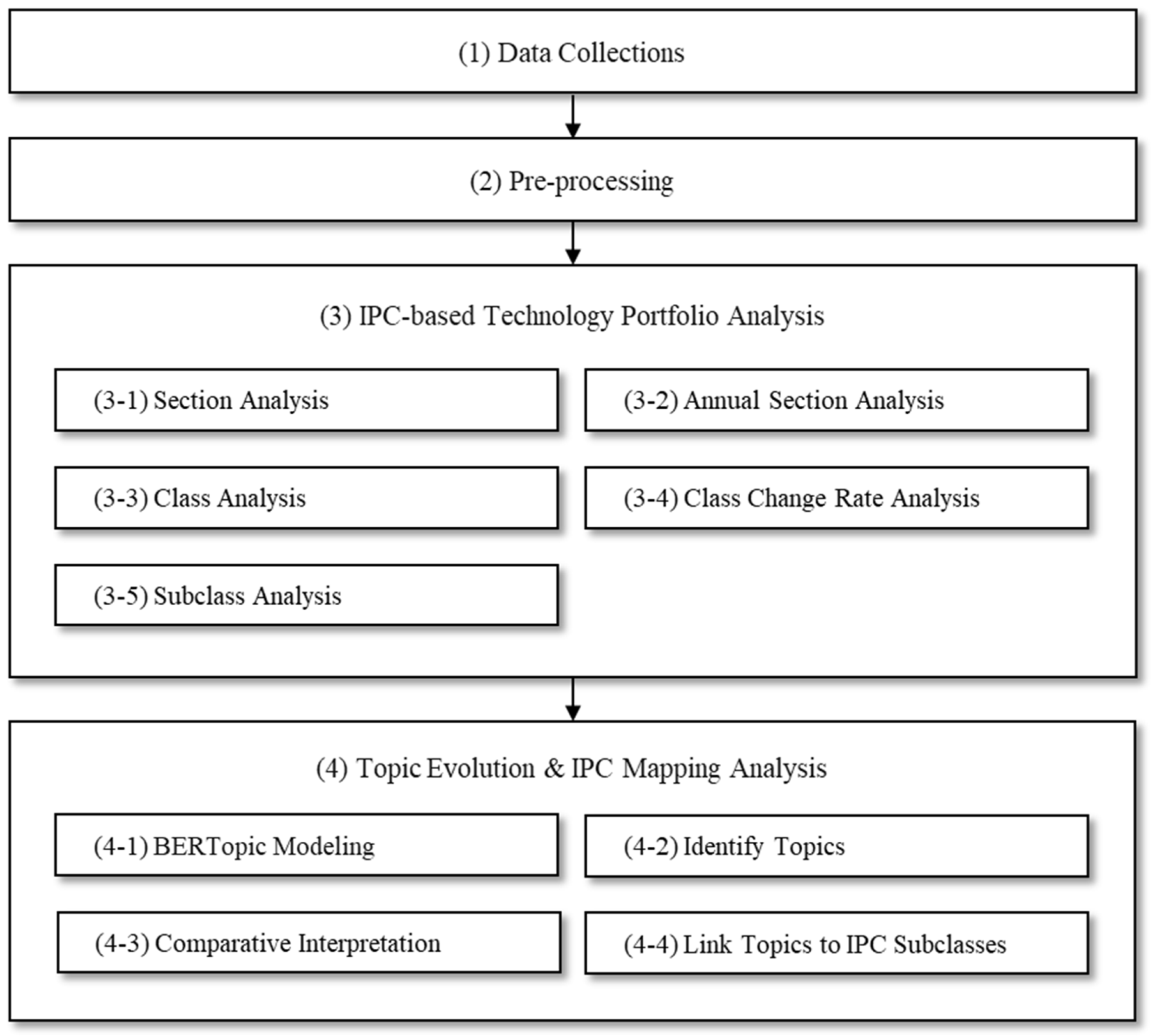
Figure 2.
IPC Technology Distribution.
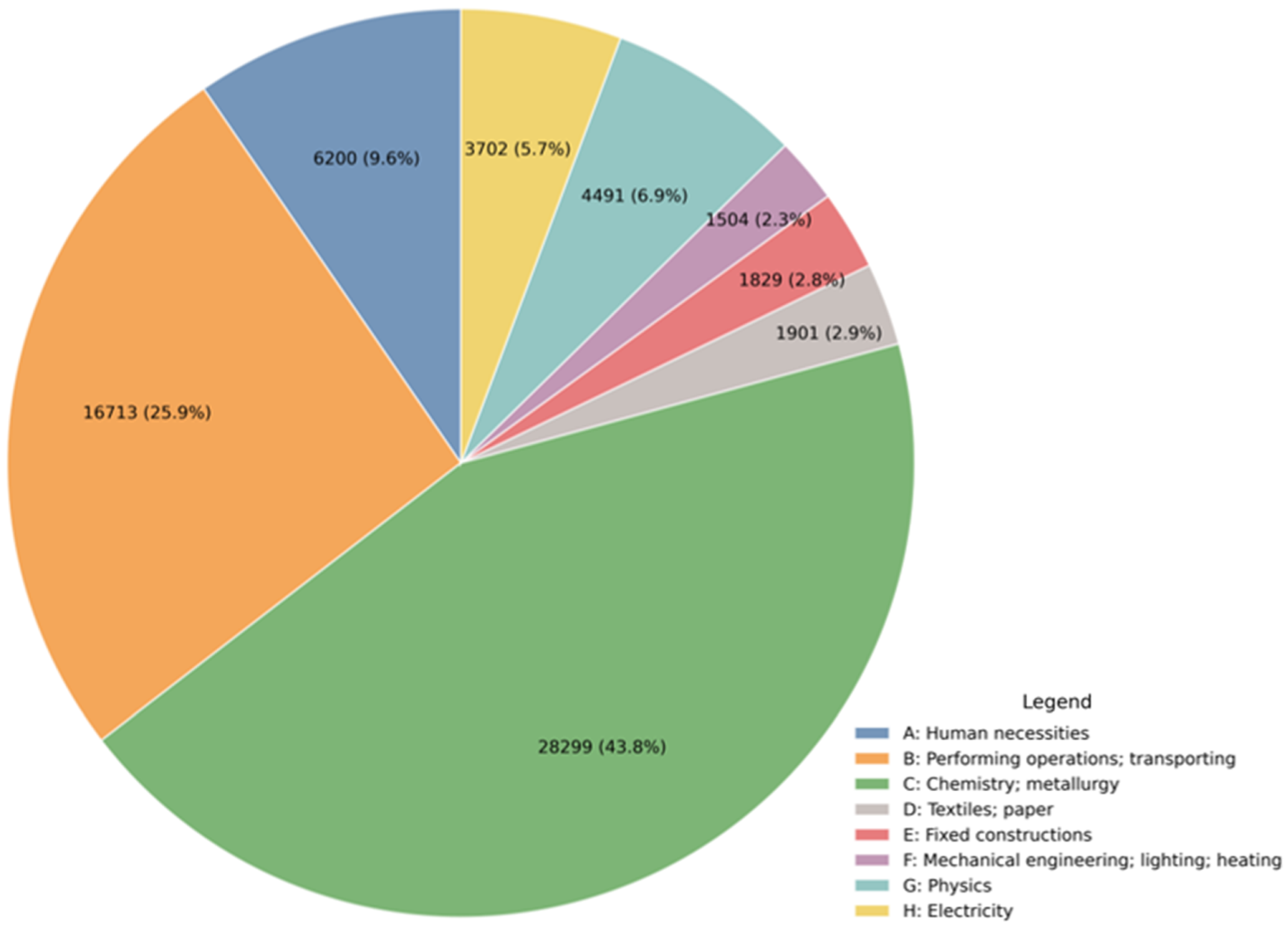
Figure 3.
Annual IPC Section Distribution.
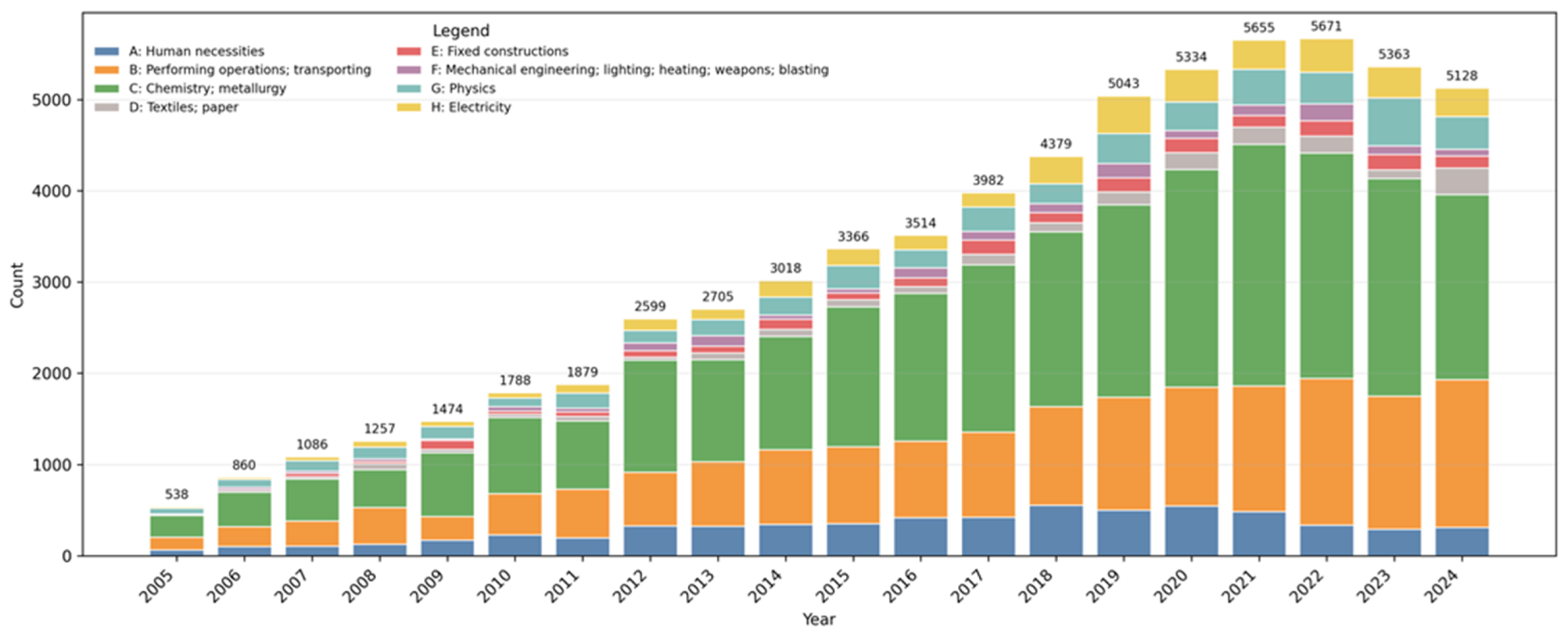
Figure 4.
IPC Class Distribution.
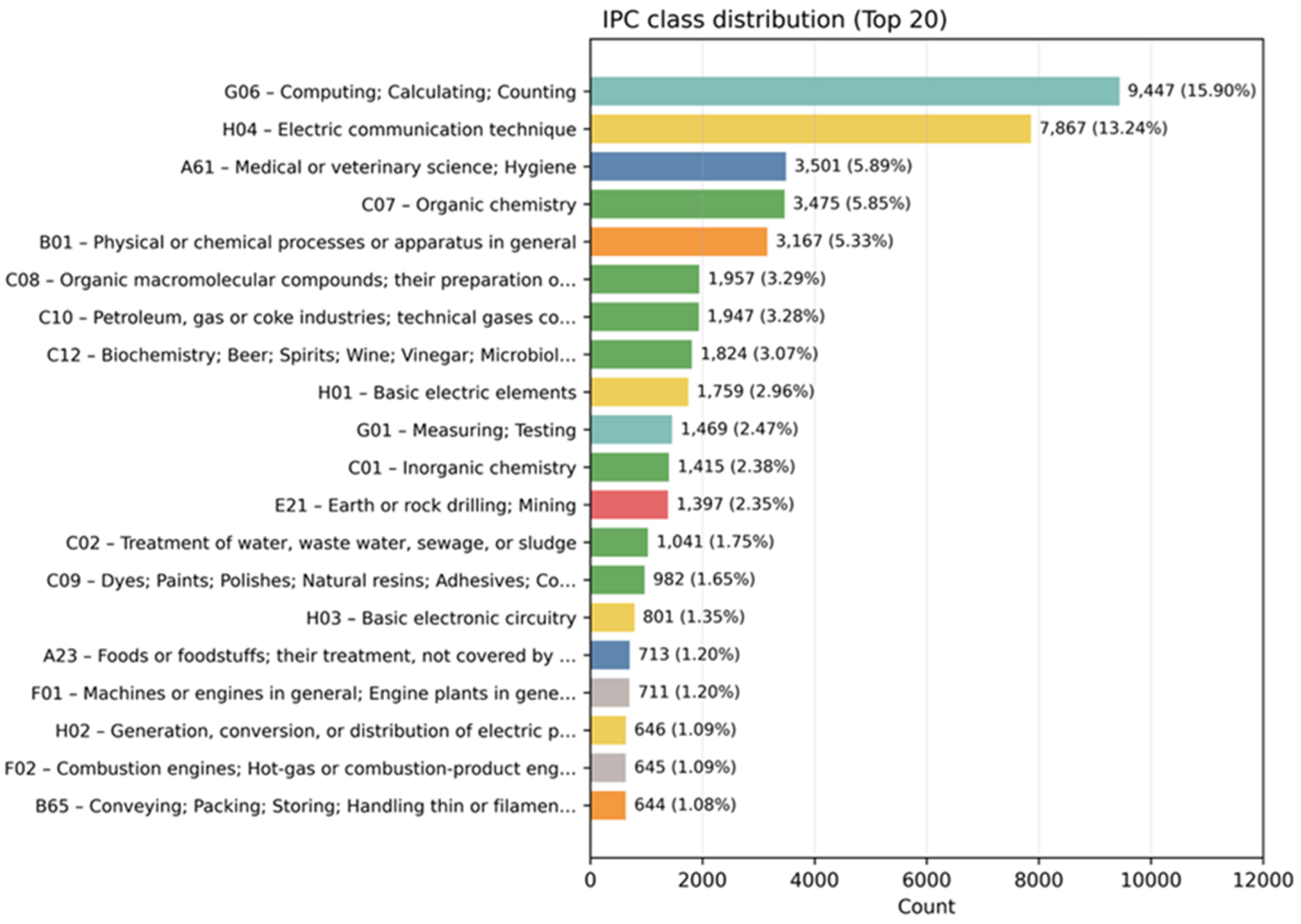
Figure 5.
IPC Class Distribution.
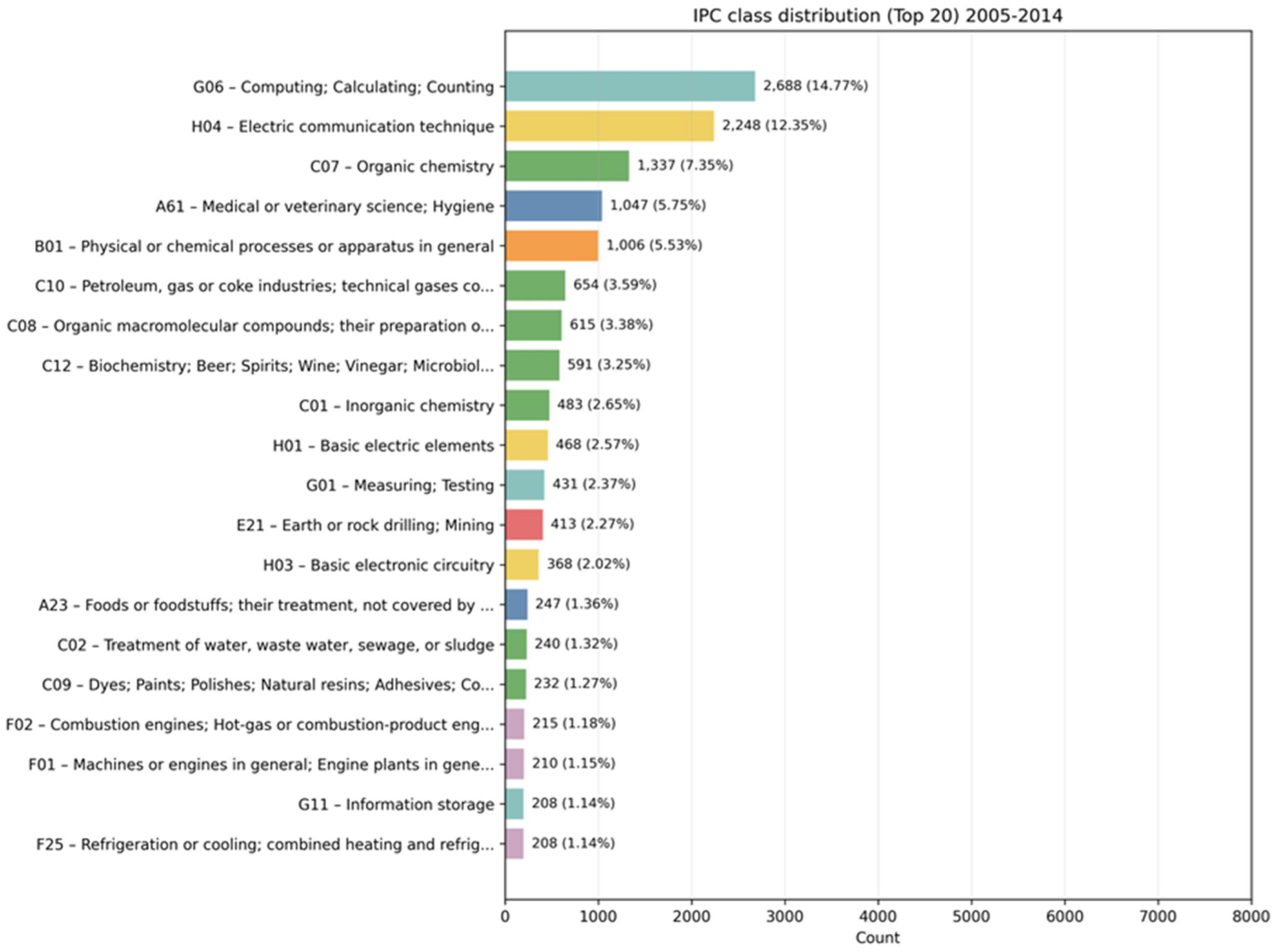
Figure 6.
IPC Class Distribution, 2015–2024.
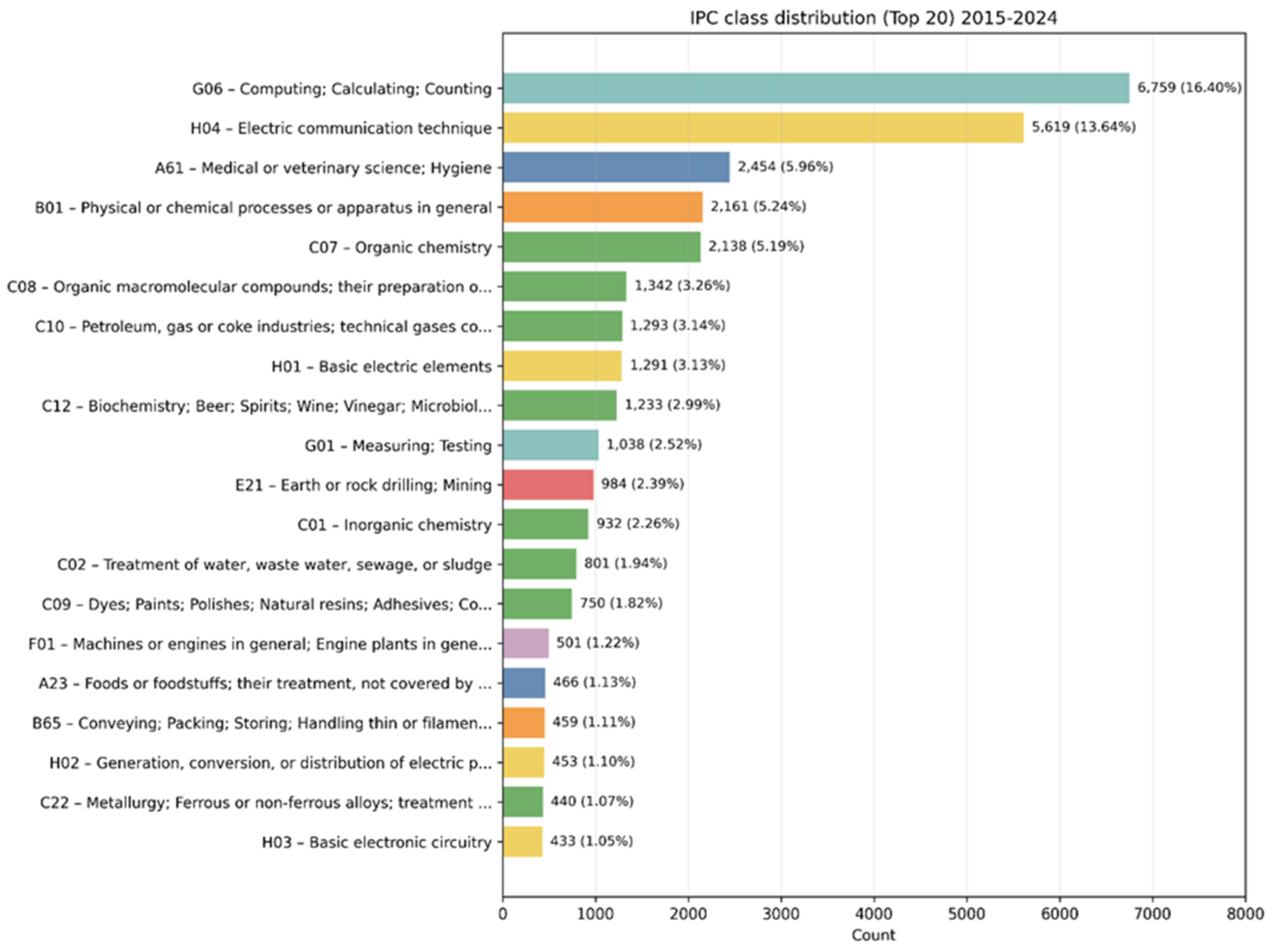
Figure 7.
Period-by-Period Class Share Changes.
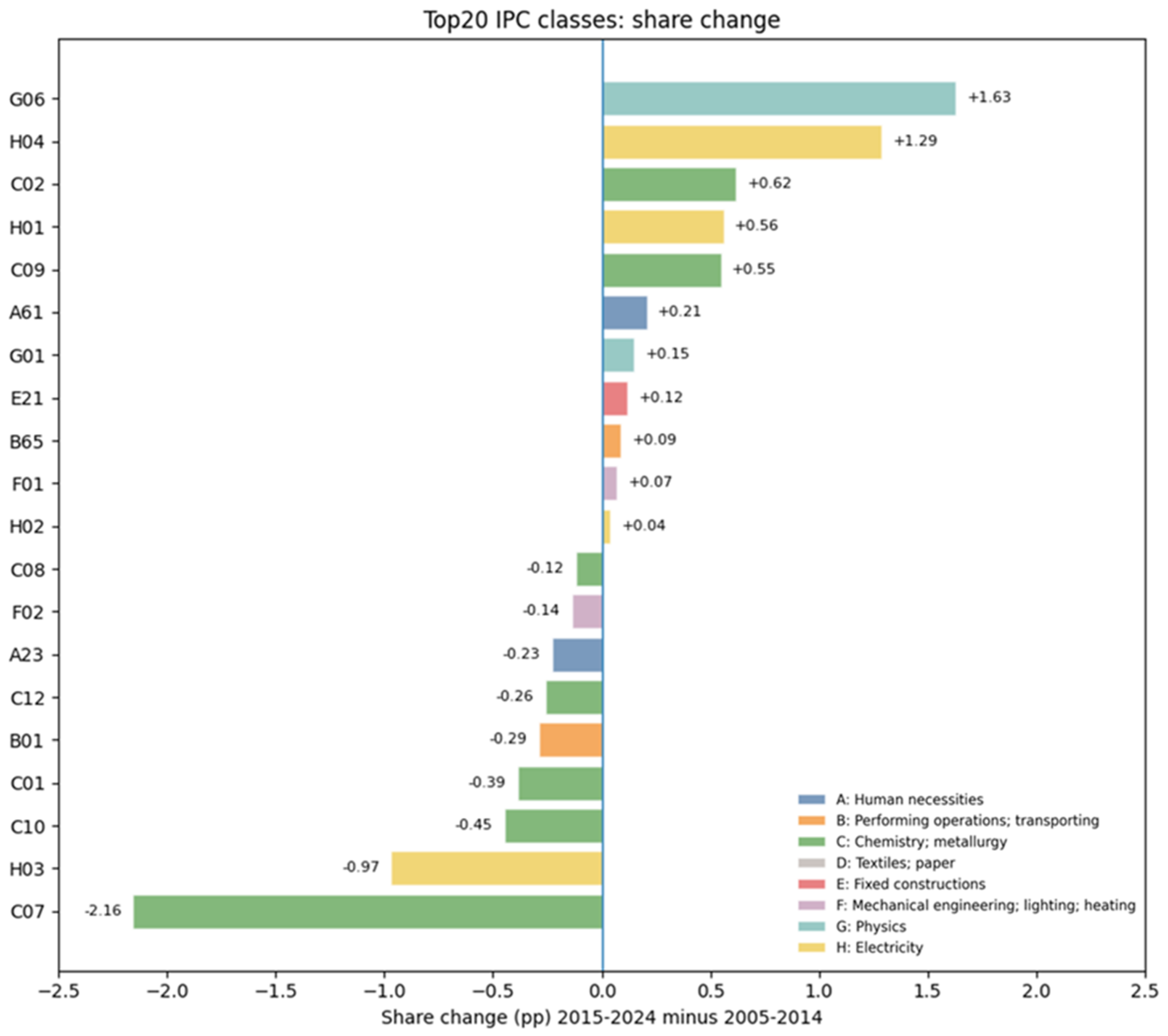
Figure 8.
BERTopic Visualization Map, 2005–2014.
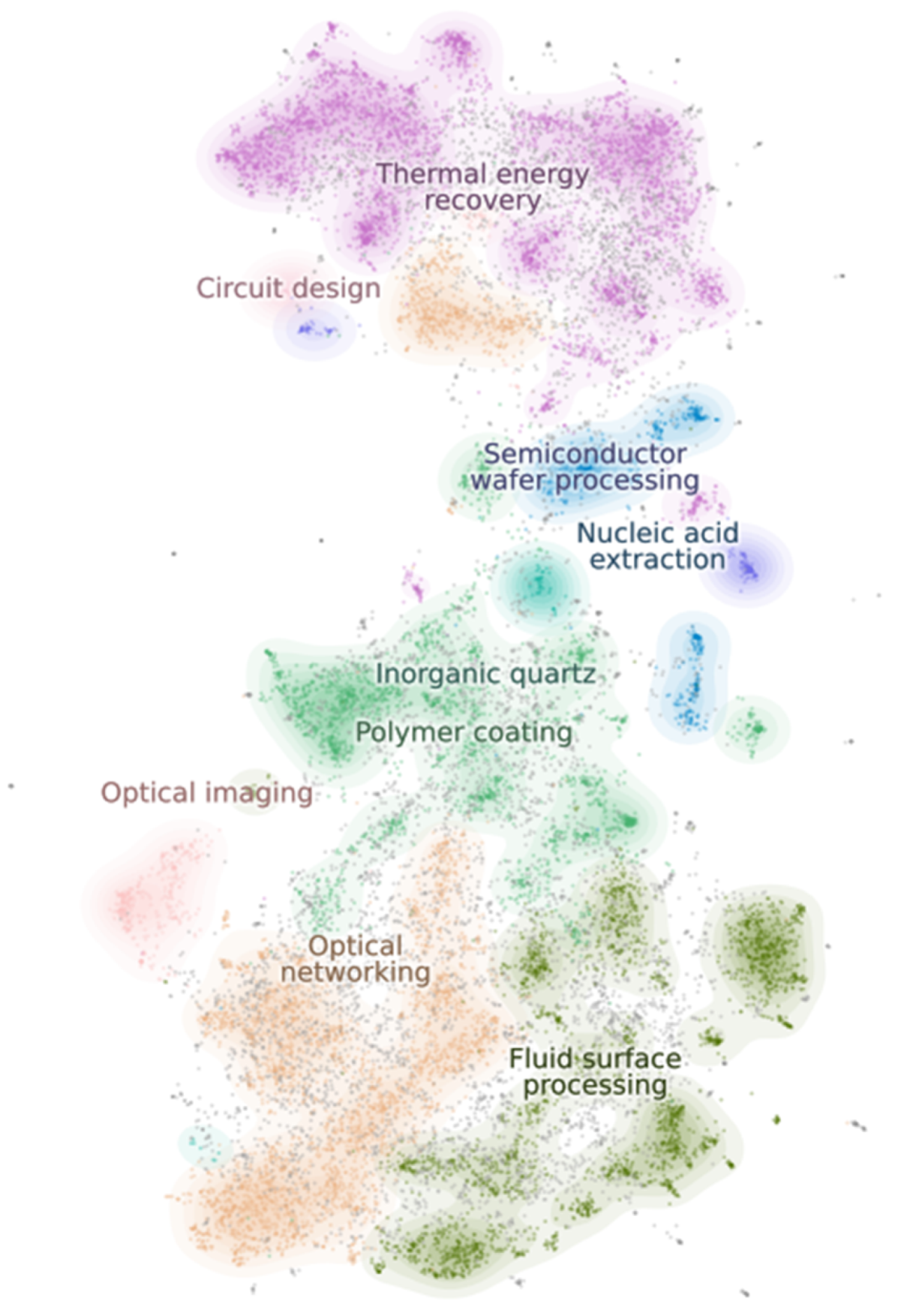
Figure 9.
BERTopic Word Scores, 2005–2014.
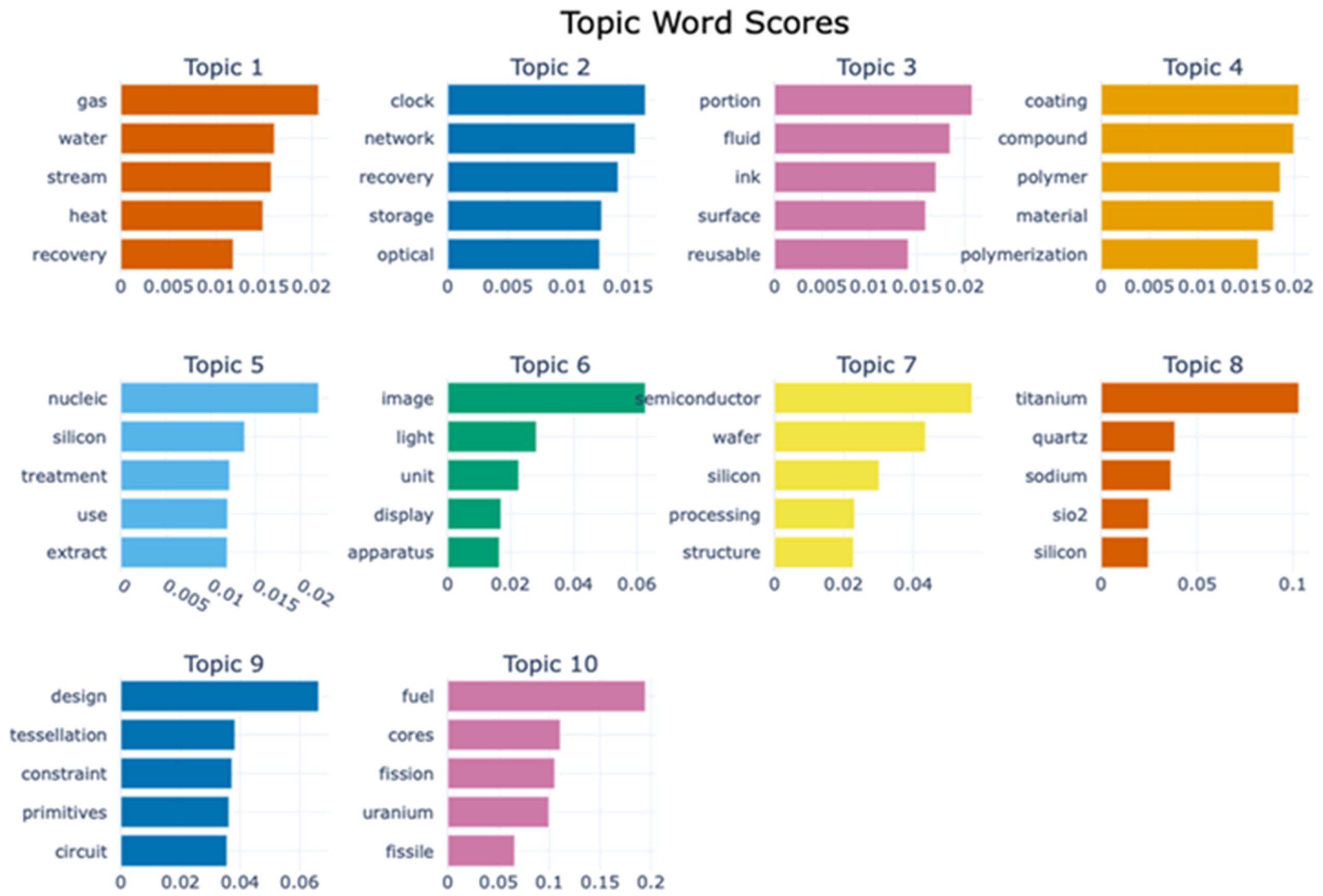
Figure 10.
BERTopic Visualization Map, 2015–2024.
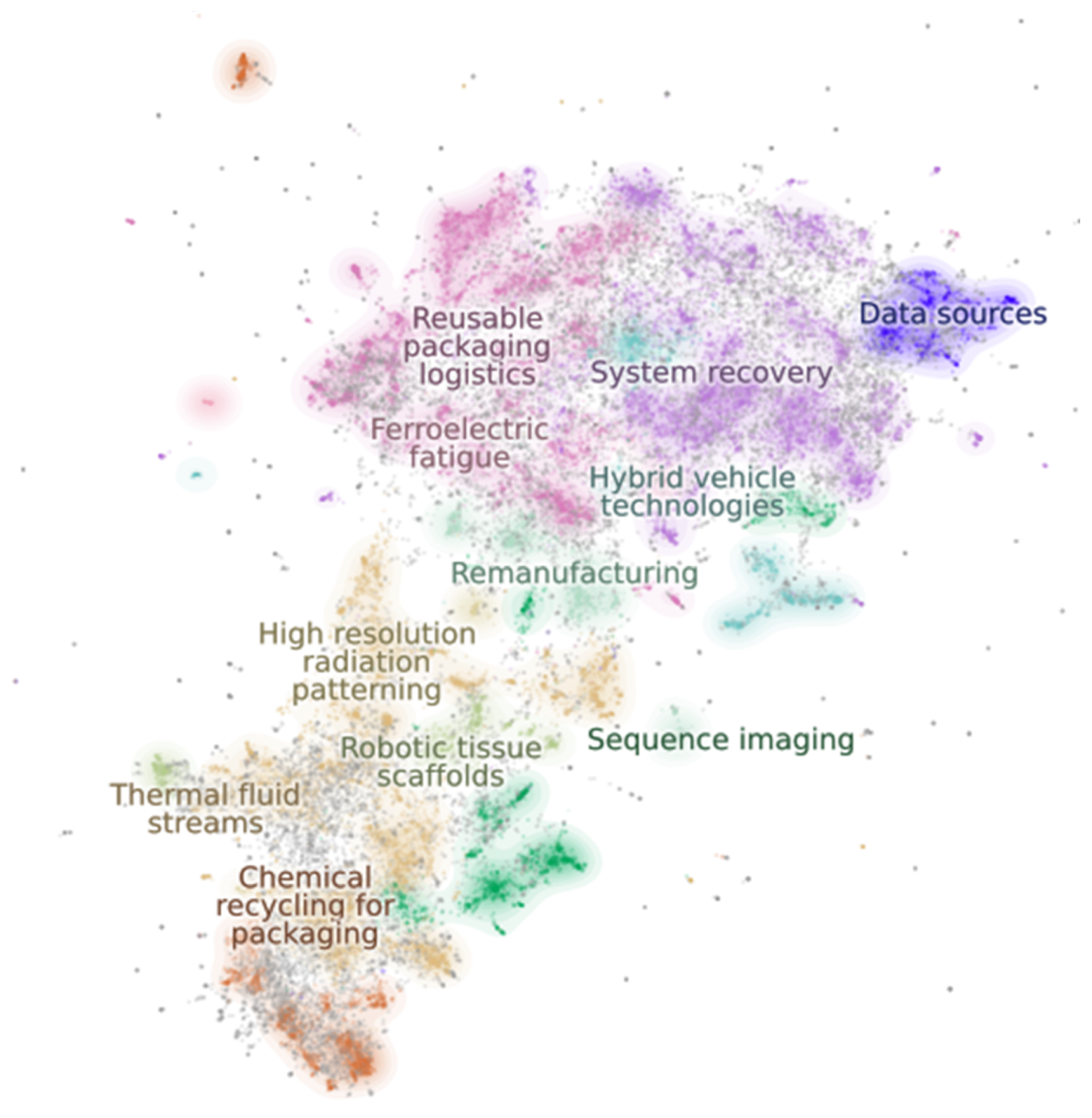
Figure 11.
BERTopic Word Scores, 2015–2024.
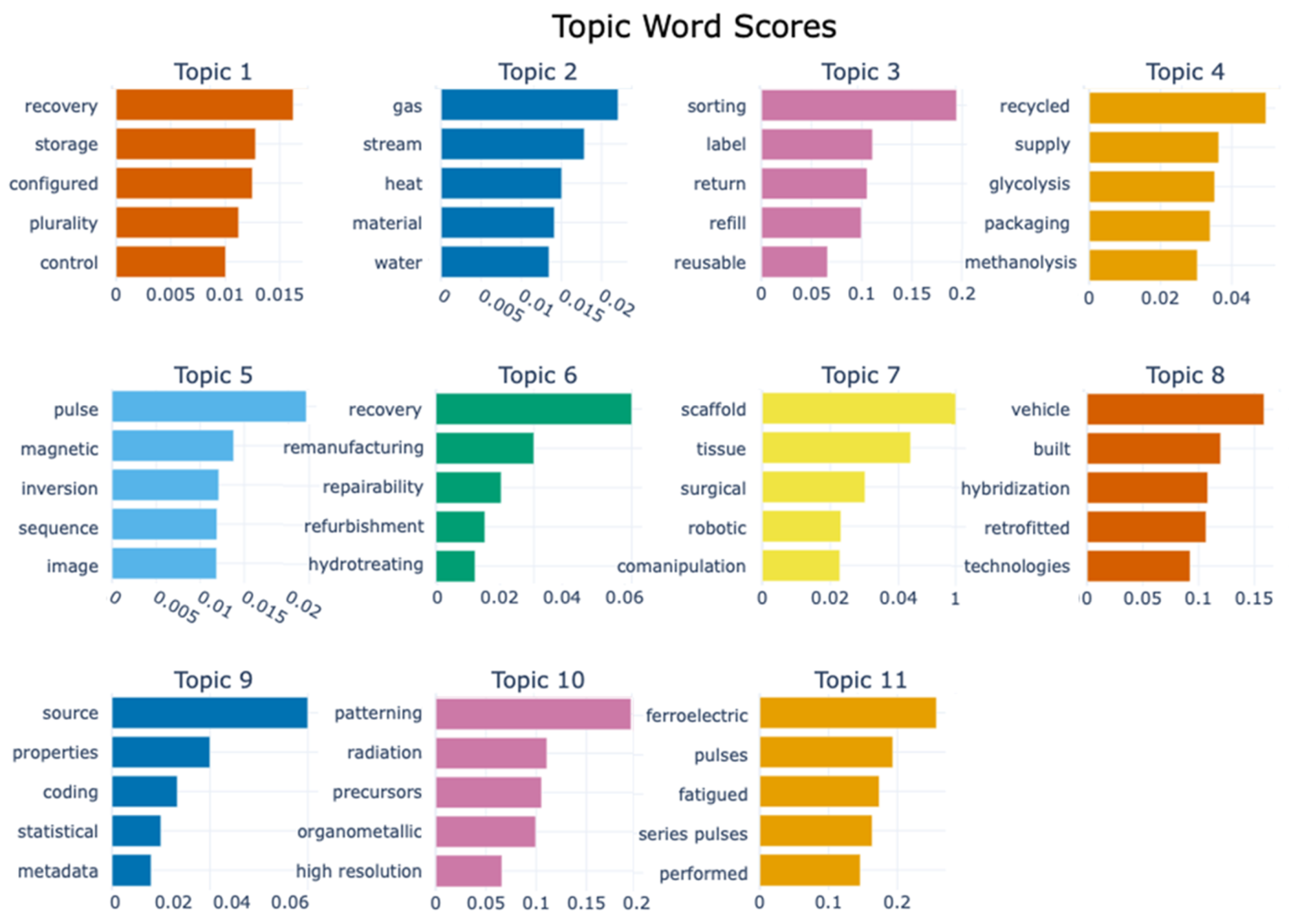
Figure 12.
Comparative Interpretation.
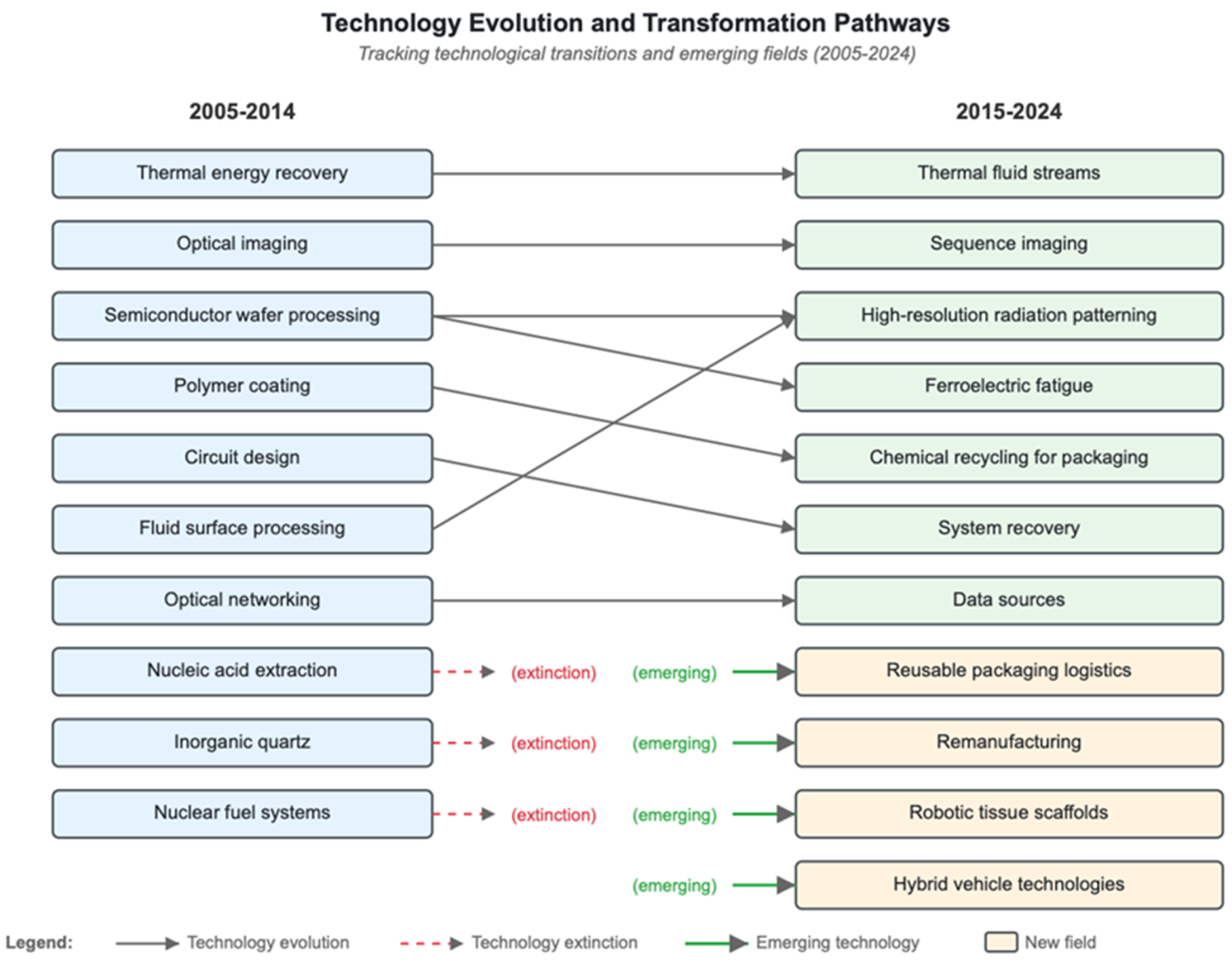
Table 1.
Search Formula.
| Search Formula |
|---|
| EN_ALL: (‘plastic waste’ OR ‘waste plastic’ OR ‘polymer waste’ OR ‘post-consumer plastic’ OR ‘post consumer plastic’ OR ‘post-industrial plastic’ OR ‘post industrial plastic’ OR PET OR ‘polyethylene terephthalate’ OR PE OR ‘polyethylene’ OR PP OR ‘polypropylene’ OR PS OR ‘polystyrene’ |
| OR PVC OR ‘polyvinyl chloride’) AND EN_ALL: (waste OR scrap OR discarded OR refuse OR ‘post-consumer’ OR ‘post consumer’ OR ‘post-industrial’ OR ‘post industrial’) AND EN_ALL: (recycling OR ‘mechanical recycling’ OR ‘chemical recycling’ OR reuse OR ‘re-use’ OR upcycling OR recovery OR reclaimOR depolymer OR solvolys OR hydrolys OR glycolys OR methanolys OR pyrolys) |
Table 2.
Topic Transition Map and Thematic Change.
| Early-period ID | Early-period topic label | Status | Later-period correspondence or destination |
|---|---|---|---|
| E1 | Thermal energy recovery and flow | Split | L2, L1 |
| E2 | Optical networking and circuits | Shrink or absorbed | L1, partial |
| E3 | Fluid and surface and reuse | Reordered as applications | L3, L4 |
| E4 | Polymer coating and polymerization | Reordered as applications | L4, L6 |
| E5 | Nucleic acid extraction, bio | Split or converged | L5, L7 |
| E6 | Optical imaging and display | Refined | L5 |
| E7 | Semiconductor wafer processing | Split toward precision·reliability | L10, L11 |
| E8 | Inorganic quartz and minerals | Disappeared | None |
| E9 | Circuit design and tessellation | Disappeared | None |
| E10 | Nuclear fuel and fission | Disappeared | None |
Table 3.
Link topics to IPC subclasses.
| No | Topic (A→B) | Increase (+) | Decrease (-) | Neutral/Other |
|---|---|---|---|---|
| 1 | Thermal energy recovery → Thermal fluid streams | — | C10L, C10J | F01 |
| 2 | Optical imaging → Sequence imaging | G06V, G06F, G01N | — | A61 |
| 3 | Semiconductor wafer processing → High-resolution radiation patterning | G06F | C07C | H01, C08 |
| 4 | Semiconductor wafer processing → Ferroelectric fatigue | G06F | H03M, H03D, H03K | H01 |
| 5 | Polymer coating → Chemical recycling for packaging | C08J, B65D, B65F, B65G C09K, C09J, C02F |
C07C | — |
| 6 | Circuit design → System recovery | G06F, H04W, H04L | H03M, H03D, H03K | — |
| 7 | Fluid surface processing → High-resolution radiation patterning | C09K, C09J, G06F | — | H01, C08 |
| 8 | Optical networking → Data sources | H04W, H04L G06F, G06N |
— | — |
| 9 | Nucleic acid extraction → — | G01N | C12P | A61 |
| 10 | Inorganic quartz → — | — | — | C01, H01 |
| 11 | Nuclear fuel systems → — | — | — | G21 |
| 12 | Reusable packaging logistics | B65D, B65F, B65G, H04W H04L, G06F, G06V |
— | — |
| 13 | Remanufacturing | B65D, B65F, B65G, H04W H04L, G06F, G01N, C08J |
— | — |
| 14 | Robotic tissue scaffolds | G06N, G01N | C12P | A61 |
| 15 | Hybrid vehicle technologies | H04W, H04L, G06F | — | H02, F01 |
Disclaimer/Publisher’s Note: The statements, opinions and data contained in all publications are solely those of the individual author(s) and contributor(s) and not of MDPI and/or the editor(s). MDPI and/or the editor(s) disclaim responsibility for any injury to people or property resulting from any ideas, methods, instructions or products referred to in the content. |
© 2026 by the authors. Licensee MDPI, Basel, Switzerland. This article is an open access article distributed under the terms and conditions of the Creative Commons Attribution (CC BY) license (http://creativecommons.org/licenses/by/4.0/).
Copyright: This open access article is published under a Creative Commons CC BY 4.0 license, which permit the free download, distribution, and reuse, provided that the author and preprint are cited in any reuse.


