

Submitted:
28 February 2026
Posted:
02 March 2026
You are already at the latest version
Abstract
This study examines the role of music education as an instrument of national identity construction in the five Central Asian states and analyses the consequences of this function for regional educational integration. Drawing on the theory of invented tradition (Hobsbawm and Ranger, 1983) and the concept of imagined communities (Anderson, 1983), the research analyses music curriculum content in the principal conservatories of Kazakhstan, Uzbekistan, Kyrgyzstan, Tajikistan, and Turkmenistan. The source material includes publicly available curriculum documents, programme descriptions, UNESCO Intangible Cultural Heritage nomination files, national education laws, and World Bank statistical data. The analysis maps the divergent national music canons that have been constructed through higher education curricula since independence in 1991. A pattern we term curricular nationalism emerges from this mapping: the deliberate use of music education curricula to construct nationally specific cultural identities by selecting canonical instruments, elevating particular musical genres to national heritage status, and incorporating specific musicians and composers into national pantheons. Each of the five states has built a distinct canon within its conservatory system. Kazakhstan has centred its curriculum on the dombra and the kuy tradition; Uzbekistan on the Shashmaqom classical system and the dutar; Kyrgyzstan on the komuz and the Manas epic tradition; Tajikistan on a reframing of the shared Shashmaqom heritage as distinctly Tajik; and Turkmenistan on the dutar and the bakhshi bardic tradition. These divergent canons are not accidental products of institutional development but purposeful constructions that serve to distinguish each newly independent state from its neighbours. The study identifies a structural paradox: the cultural proximity of the five states, including shared musical traditions, instruments, and performance practices that could in principle support regional cooperation, is precisely what drives curricular divergence, because shared traditions become objects of competitive national appropriation rather than a basis for integration. We suggest that this dynamic forms an identitarian barrier to regional music education integration that the structural mechanisms of the Bologna Process and the relational mechanisms of bilateral cooperation are largely unequipped to resolve, since the obstacle is not technical or institutional but political in nature.
Keywords:
music education
; nation‐building
; Central Asia
; curricular nationalism
; invented tradition
; imagined communities
; intangible cultural heritage
; regional integration
1. Introduction
In 2003, UNESCO inscribed Shashmaqom, the classical musical tradition of the urban centres of Bukhara, Samarkand, and Khujand, on the Representative List of Intangible Cultural Heritage of Humanity. The inscription was a joint nomination by Uzbekistan and Tajikistan. On the UNESCO certificate, the two countries share equal credit for a tradition that spans the political border between them. Inside the conservatories of Tashkent and Dushanbe, however, Shashmaqom is taught as two quite different things. At the State Conservatory of Uzbekistan, it appears in the curriculum as a pillar of Uzbek classical music, performed on instruments associated with Uzbek identity and taught within a faculty structure that positions Uzbek musical heritage at the institutional centre. At the Tajik National Conservatory, the same tradition appears as evidence of Tajik cultural sophistication, connected to the Persian-language literary tradition and presented as proof that Tajik civilisation predates and transcends the Soviet-imposed boundaries that separated it from its own heritage.
The same musical tradition, the same melodic material, the same historical lineage, yet two different national stories told through two different curricula. This paper asks why that divergence exists, how it was constructed, and what it means for the possibility of regional integration in music education across Central Asia.
Research on music education in the region has identified the structural barriers to integration: divergent degree formats, incompatible credit systems, the absence of mutual recognition mechanisms (Nikolaev et al., 2023; Bischof, 2018). Scholars have documented knowledge-level barriers as well, particularly the tension between oral tradition pedagogy and codified curriculum formats (Casas-Mas et al., 2022; Polanyi, 1966). The role of external actors, including the competing governance logics of the Bologna Process and China’s Belt and Road Initiative, has also received attention. What has not been examined is the possibility that the governments of the five Central Asian states do not want music education to converge, because music curricula serve a function that is more important to them than regional integration: the construction and maintenance of national identity.
The theoretical basis for this argument rests on two bodies of scholarship. Hobsbawm and Ranger (1983) showed that traditions which appear ancient and organic are frequently recent inventions, deliberately constructed to serve specific political purposes, typically the legitimation of new institutions, the creation of social cohesion, and the establishment of historical continuity for political entities that lack it. Anderson (1983) showed that nations are imagined communities, political entities that exist because their members imagine themselves as belonging to a bounded, sovereign community, even though they will never meet most of their fellow members. Both ideas carry direct implications for music education. If nations are imagined, then the cultural content through which they are imagined matters. And if traditions are invented, then the music curricula that transmit those traditions are not neutral repositories of heritage but active instruments of political construction.
The purpose of this study is to analyse how music education functions as an instrument of national identity construction in the five Central Asian states and to identify the consequences of this function for regional educational integration. The specific objectives are as follows: to apply the theories of invented tradition and imagined communities to the analysis of music curriculum content in Central Asian conservatories; to document the divergent national music canons constructed through higher education curricula since 1991; to identify the pattern of curricular nationalism and characterise its mechanisms; and to analyse the structural paradox created by the coexistence of cultural proximity and political divergence in the region’s music education systems.
2. Theoretical Framework
2.1. Invented Tradition and the Construction of National Music
Hobsbawm (1983) defined invented traditions as “a set of practices, normally governed by overtly or tacitly accepted rules and of a ritual or symbolic nature, which seek to inculcate certain values and norms of behaviour by repetition, which automatically implies continuity with the past” (p. 1). The concept does not imply that invented traditions are false or inauthentic. Rather, it implies that the process of selecting, codifying, and institutionalising certain cultural practices while excluding others is a political act that serves present purposes rather than merely preserving the past. Hobsbawm identified three functions that invented traditions typically serve: the establishment or symbolisation of social cohesion and collective identity, the legitimation of institutions and authority relations, and the socialisation of individuals into particular value systems.
In Central Asia, the independence of the five states in 1991 created a classic situation for the invention of tradition. Five new nation-states, each with Soviet-drawn borders that did not correspond to pre-existing ethnic, linguistic, or cultural boundaries, needed to construct national identities that would legitimate their existence as sovereign political entities. Frolova-Walker (1998) documented how the Soviet Union had already conducted one round of tradition invention in Central Asian music through the creation of “national” musical cultures under the formula “national in form, socialist in content.” This involved the selection of folk melodies, their harmonisation according to Western classical principles, and the establishment of conservatories that institutionalised these newly codified traditions as the official musical heritage of each republic. The post-Soviet period represents a second round, in which the same institutional infrastructure (the conservatories, the music schools, the state ensembles) is repurposed to construct a different kind of national identity: one defined not by socialist internationalism but by ethnic distinctiveness.
Applying Hobsbawm’s framework to music education reveals that the curriculum of a conservatory is not simply a pedagogical document. It is a political document that encodes decisions about which instruments count as “national,” which genres represent the authentic heritage of the nation, which historical figures deserve the status of cultural heroes, and which musical practices belong to “us” rather than to “them.” Once embedded in curricula, these decisions acquire the appearance of naturalness. Students learn them as facts about their national heritage rather than as political choices made by specific actors at specific moments.
2.2. Imagined Communities and the Role of Education
Anderson (1983) argued that nations are imagined communities because members of even the smallest nation will never know, meet, or hear of most of their fellow members, yet in the minds of each lives the image of their communion. Anderson identified print capitalism, the mass production and distribution of texts in vernacular languages, as the primary mechanism through which national consciousness was created in the modern period. Education systems function as an extension of this mechanism: they are the institutions through which the imagined community is reproduced in each generation, ensuring that children learn to think of themselves as members of a particular nation with a particular history and a particular culture.
Ho (2010) applied Anderson’s framework to music education in China, showing that the Chinese government uses school music curricula as an instrument for transmitting state-prescribed values and constructing a national identity rooted in the politics of memory. Ho showed that the selection of songs, the framing of music history, and the treatment of Western versus Chinese traditions in textbooks are not simply pedagogical decisions but identity-constructing acts that shape how students understand themselves as Chinese citizens. Music education, in Ho’s analysis, serves a dual function: it transmits musical knowledge and skills while simultaneously reproducing the narrative of national identity that the state wishes to maintain.
In Central Asia, this dual function operates with particular intensity because the national identities being constructed are recent, contested, and in direct competition with neighbouring states. Unlike China, where the continuity of the state provides a stable frame for national identity construction, the five Central Asian states must construct identities that justify borders drawn by Soviet administrators in the 1920s and 1930s. Those borders divided shared cultural spaces, separated related ethnic groups, and created political entities that lacked the historical depth to generate automatic loyalty. Music education, in this context, does not merely contribute to national identity. It is one of the primary mechanisms through which the reality of the nation-state is produced and maintained in the consciousness of each new generation.
2.3. Curricular Nationalism as an Analytical Concept
We introduce the concept of curricular nationalism to describe the deliberate use of music education curricula to construct and maintain nationally specific cultural identities. Curricular nationalism, as we use it here, is not a normative claim that national music curricula are inherently illegitimate. It is an analytical category that identifies a specific institutional practice: the selection, organisation, and presentation of musical content in ways that serve the political function of national differentiation. The concept draws on Hobsbawm’s insight that tradition is constructed and Anderson’s insight that national communities are imagined, and applies them to the specific institutional site of the conservatory curriculum.
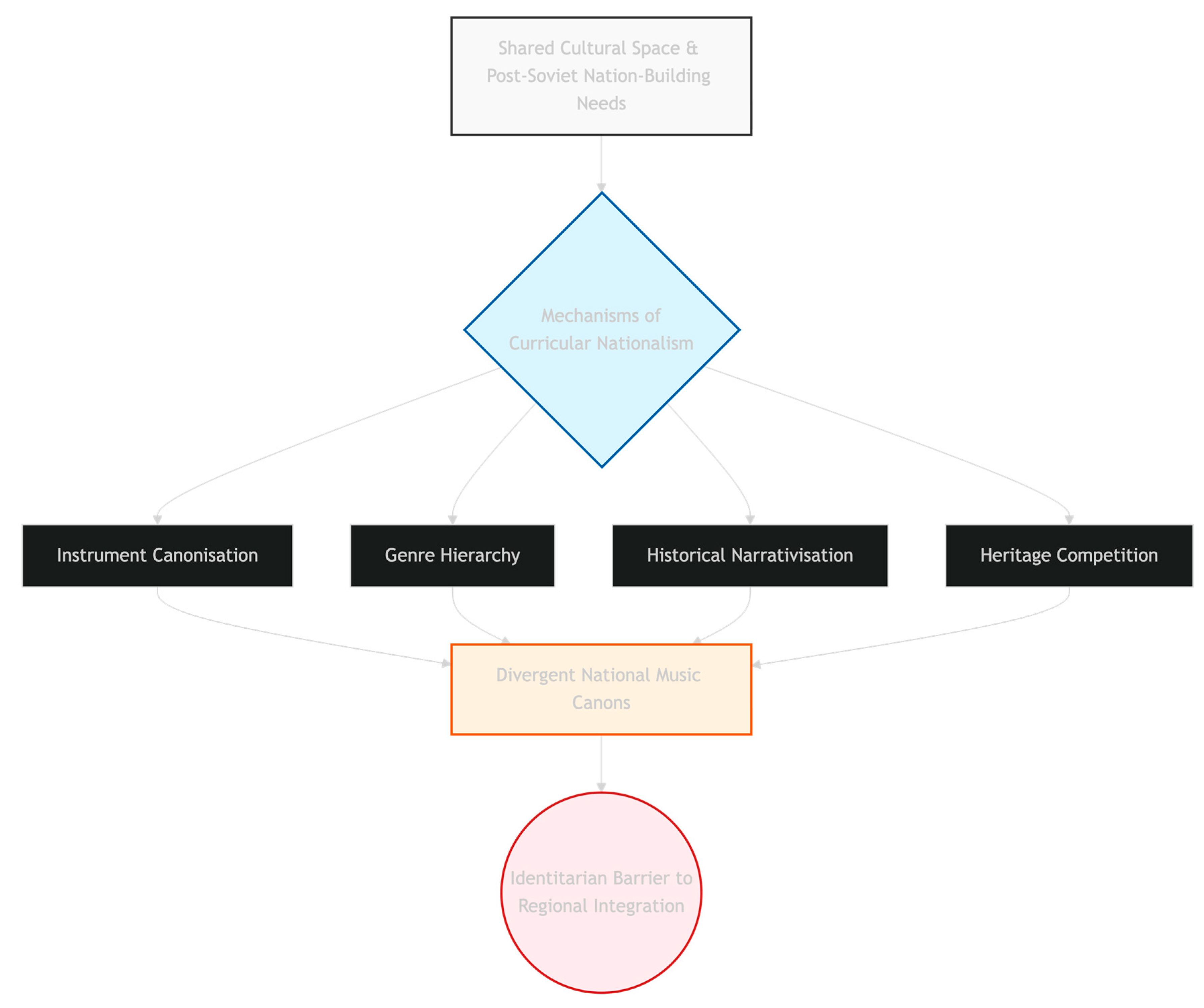
Curricular nationalism, as observed in this study, operates through several interlocking mechanisms. Institutional resources are often directed toward instrument canonisation: a particular instrument is elevated to the status of national symbol within the curriculum, receiving a disproportionate share of teaching resources, performance opportunities, and cultural prestige. This is accompanied by genre hierarchy, in which musical genres are ranked so that forms associated with the titular ethnic group occupy a privileged position. The curriculum also engages in historical narrativisation, constructing a national music history that traces a continuous lineage from ancient origins to the present and connects the contemporary nation-state to a pre-Soviet and often pre-Russian cultural identity. Running through all three is heritage competition, whereby shared musical traditions are reframed as national property, with each state claiming exclusive or primary ownership of traditions that cross political borders.
Figure 1.
The Theoretical Model of Curricular Nationalism.
3. Materials and Methods
The study uses comparative curriculum content analysis combined with documentary analysis of cultural policy instruments. The five principal conservatories in the region serve as cases: the Kurmangazy Kazakh National Conservatory (Almaty), the State Conservatory of Uzbekistan (Tashkent), the Kyrgyz National Conservatory (Bishkek), the Tajik National Conservatory (Dushanbe), and the Turkmen National Conservatory named after Maya Kuliyeva (Ashgabat). These institutions were selected because they sit at the apex of the music education system in each country and because their curricula represent the official position of the state on what constitutes the national musical heritage.
The documentary sources include publicly available programme descriptions and curriculum documents from the five conservatories; national education laws, including the Law of the Kyrgyz Republic on Education No. 179 (2023), the Education Law of the Republic of Kazakhstan No. 319-III (2007, amended), and relevant decrees from Uzbekistan, Tajikistan, and Turkmenistan; UNESCO Intangible Cultural Heritage nomination files for music-related items from the five states, which contain detailed descriptions of the traditions, their perceived significance, and the safeguarding measures that states commit to (UNESCO, 2024); publications of the Aga Khan Music Programme on curriculum development in Kyrgyzstan and Tajikistan (AKDN, 2024); and Levin, Daukeyeva, and Köchümkulova’s (2016) textbook on Central Asian music, which provides an independent scholarly account of the region’s musical traditions against which the national narratives in conservatory curricula can be compared.
The analysis proceeds in two stages. The first maps the national music canon of each country as expressed in conservatory curricula, identifying the canonical instruments, privileged genres, historical narratives, and heritage claims that constitute the curricular content. The second compares the five canons to identify points of overlap and divergence, with particular attention to cases where the same musical tradition appears in the curricula of multiple countries but is framed differently to serve different national narratives. Statistical data on education expenditure and tertiary enrolment rates come from the World Bank (2024). Data on music-related UNESCO inscriptions are drawn from the official ICH lists (UNESCO, 2024).
4. Results
4.1. Five National Music Canons: Mapping Curricular Divergence
The analysis of curriculum content and institutional documentation shows that each of the five Central Asian states has constructed a distinct national music canon within its conservatory system. These canons share a common structural logic: each centres on a particular national instrument, privileges a specific set of genres, constructs a historical narrative of cultural continuity, and claims specific UNESCO-inscribed traditions as national property. The content of each canon, however, diverges in ways that serve the particular identity needs of each state.
In Kazakhstan, the curriculum revolves around the dombra, a two-stringed plucked lute, and the kuy tradition of instrumental composition. The Kurmangazy Conservatory, named after the nineteenth-century kuy composer Kurmangazy Sagyrbayuly, centres its teaching on dombra performance and kuy interpretation. The kuy was inscribed on UNESCO’s Representative List in 2014, and the inscription file frames it as a distinctly Kazakh art form with ancient nomadic origins (UNESCO, 2024). A historical lineage runs from legendary performers such as Korkyt and Asan Qaygy, through the classical kuy composers of the eighteenth and nineteenth centuries (Kurmangazy, Tattimbet, Dina Nurpeisova), to the contemporary academic study of Kazakh music. This lineage ties Kazakh musical identity to nomadic steppe culture, setting it apart from the sedentary urban musical cultures of Uzbekistan and Tajikistan. Kazakhstan has also claimed joint ownership of Aitysh, the tradition of improvised poetic-musical contest inscribed jointly with Kyrgyzstan in 2015 (UNESCO, 2024). Within the curriculum, Aitysh appears as evidence of a broader Turkic heritage that Kazakhstan treats as its own, rather than as a tradition shared with a neighbour.
Uzbekistan anchors its institutional identity in Shashmaqom and the classical urban musical tradition of Bukhara and Samarkand. The State Conservatory of Uzbekistan, which maintains six faculties, gives Shashmaqom a central position in its curriculum, treating it as the defining expression of Uzbek classical music. The curriculum traces a narrative of cultural continuity from the Timurid period through the khanates to the present, casting Uzbekistan as the inheritor of the region’s sedentary civilisations. The dutar (a two-stringed plucked instrument) serves as the primary national instrument, alongside the tanbur, doira, and nay. The Katta Ashula tradition, inscribed by UNESCO in 2009, and the Bakhshi bardic tradition, inscribed in 2021, further populate the national canon (UNESCO, 2024). The curriculum excludes or marginalises the musical traditions of Uzbekistan’s ethnic minorities, including Tajiks, Karakalpaks, and Russians, in favour of a narrative centred on the titular Uzbek ethnic group.
Kyrgyzstan’s system is built around the komuz, a three-stringed fretless plucked lute, and the epic tradition of Manas. At the Kyrgyz National Conservatory, the komuz functions as the defining instrument of Kyrgyz identity, linked to the nomadic pastoral culture that Kyrgyz national mythology treats as the authentic core of the national character. The Manas epic, inscribed by UNESCO in 2013, serves as the centrepiece of Kyrgyz cultural identity not only in music education but across the entire educational system, appearing in literature, history, and social studies curricula as the foundational text of the Kyrgyz nation. The Art of Akyns, improvisational poetic performance accompanied by the komuz, was inscribed by UNESCO in 2003 and occupies a prominent place in the conservatory curriculum. The Aga Khan Music Programme’s Centre Ustatshakirt has supported the Umtul programme, which teaches komuz in 80 schools to over 7,000 students, extending the institutional reach of the national music canon beyond the conservatory into primary education (AKDN, 2024).
The Tajik case is distinctive because it rests on a competing claim to Shashmaqom. The Tajik National Conservatory, established in 2009 as the newest of the five institutions, presents Shashmaqom as a Tajik heritage: an expression of the Persian-Tajik literary and musical tradition that flourished in Bukhara, Samarkand, and Khujand before Soviet border-drawing placed the first two cities in Uzbekistan. The curricular narrative assigns Shashmaqom to the Tajik-speaking civilisation of the region rather than to the Uzbek state that currently controls the cities where it developed. The Falak vocal tradition, inscribed by UNESCO in 2021, provides an additional element of distinctly Tajik musical identity that does not compete with Uzbek claims (UNESCO, 2024). The AKMP’s Khunar Centre in Khujand operated a master-apprentice training programme and developed the “Meros” pilot curriculum for 30 schools, and the Academy of Maqom (2003–2015) trained elite performers in Shashmaqom, both initiatives reinforcing the national claim to the tradition through educational infrastructure (AKDN, 2024).
Turkmenistan presents perhaps the most opaque case. The curriculum centres on the dutar (sharing the instrument name but not the repertoire with Uzbekistan) and the Bakhshi bardic tradition. The Turkmen National Conservatory named after Maya Kuliyeva operates within the most closed educational system of the five states, and publicly available curriculum documentation is limited. The available evidence indicates that the curriculum centres on the Gorogly epic tradition (inscribed by UNESCO in 2015), the Kushtdepdi ritual dance (inscribed 2017), and the art of dutar craftsmanship and performance (inscribed 2021) (UNESCO, 2024). Of the five states, Turkmenistan’s curricular nationalism takes the most explicit form, with the state maintaining tight control over cultural production and using music education as a direct instrument of regime legitimation.
Table 1 presents the comparative structure of the five national music canons.
4.2. Heritage Competition: Shared Traditions as Sites of National Appropriation
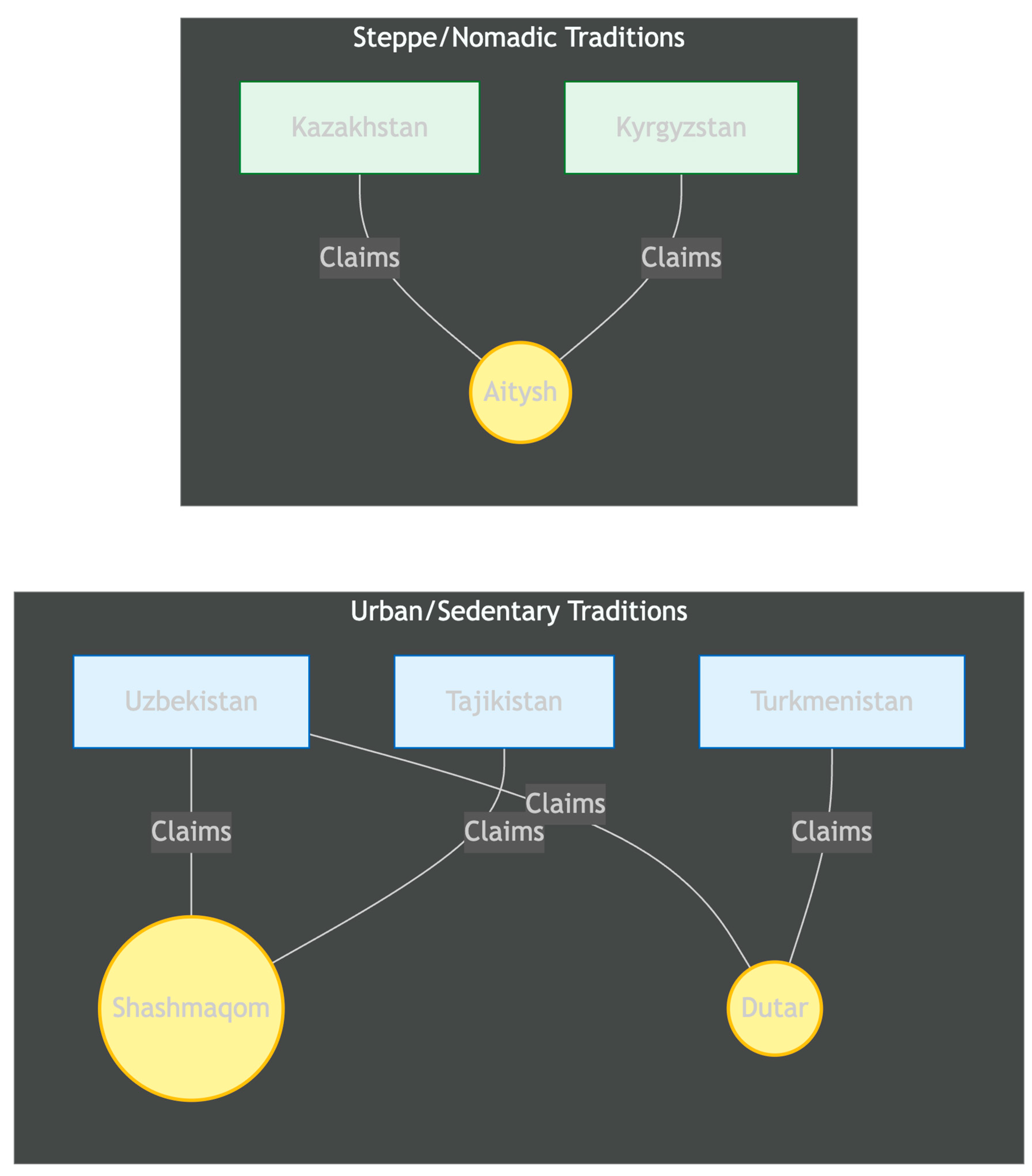
The most revealing evidence for the operation of curricular nationalism appears in cases where the same musical tradition is claimed by multiple states. Three such cases illustrate the mechanism of heritage competition.
The joint inscription of Shashmaqom by Uzbekistan and Tajikistan in 2003 offers the most telling example. The inscription itself represented a diplomatic compromise: both countries agreed to share credit for a tradition that historically belonged to the Persian-speaking urban centres of Bukhara and Samarkand, cities that Soviet border-drawing placed in the Uzbek SSR despite their significant Tajik-speaking populations. Within the conservatory curricula, however, the joint status dissolves. The State Conservatory of Uzbekistan teaches Shashmaqom as an Uzbek classical tradition, performed in the Uzbek language, connected to Uzbek national history, and transmitted through an Uzbek lineage of master performers. The Tajik National Conservatory teaches the same tradition as a Tajik heritage, performed in the Tajik (Persian) language, connected to the Tajik literary civilisation, and transmitted through performers who are identified as Tajik regardless of their geographical location in what is now Uzbekistan. The musical content is substantially the same: the maqom scales, the formal structure, the repertoire of compositions. The national narrative wrapped around it is entirely different.
Similar dynamics emerge around Aitysh, the tradition of improvised poetic-musical contest, jointly inscribed by Kazakhstan and Kyrgyzstan in 2015. Aitysh exists in both Kazakh and Kyrgyz oral traditions and is performed in closely related Turkic languages. The joint inscription acknowledges the shared nature of the tradition, but the conservatory curricula in Almaty and Bishkek frame it differently. At the Kurmangazy Conservatory, Aitysh appears as an expression of the broader Kazakh oral tradition, connected to the steppe culture and the nomadic heritage that Kazakhstan claims as its defining characteristic. At the Kyrgyz National Conservatory, Aitysh appears as part of the Kyrgyz tradition of improvised performance, connected to the Art of Akyns and the Manas epic. Each curriculum presents the shared tradition as evidence of its own nation’s cultural richness rather than as a bridge to the neighbouring culture.
A further instance concerns the dutar, a two-stringed instrument that appears in the national canons of both Uzbekistan and Turkmenistan, and in regional traditions across the wider area including Tajikistan. UNESCO inscribed the Turkmen art of dutar craftsmanship and performance in 2021, creating a situation in which a shared instrument becomes the officially recognised heritage of one specific country. Within Uzbek conservatory curricula, the dutar is taught as a distinctly Uzbek instrument with a different repertoire and performance technique from the Turkmen version. The instrument is physically similar, historically connected, and etymologically identical, but the curricular framing separates what musical practice connects.
These three cases illustrate the central mechanism of heritage competition: shared cultural material that could serve as a foundation for regional cooperation is instead converted into national property through the curriculum, creating divergence precisely at the points of greatest cultural proximity.
Figure 2.
Venn Diagram of Contested Musical Heritage in Central Asia.
4.3. Consequences for Regional Integration
The pattern of curricular nationalism identified in this analysis carries several consequences for regional integration in music education, each operating at a different level.
At the most basic level, curriculum harmonisation in music education is not merely a technical challenge but, under current conditions, a political impossibility. The Bologna Process assumes that curriculum compatibility can be achieved through the adoption of shared structural formats such as learning outcomes, credit systems, and modular design. In music education, however, the content of the curriculum is itself a political product. Asking Kazakhstan and Kyrgyzstan to develop a shared curriculum framework for traditional music would require them to negotiate which version of Aitysh represents the standard, a negotiation that touches on questions of national identity and cultural ownership that no technical framework can resolve. The TuCAHEA project’s exclusion of music from its eight subject areas (Isaacs, 2014; Cheng, Toksobaev, & Kambarova, 2026) may reflect not an oversight but an implicit recognition that cultural education is too politically charged for the kind of voluntary convergence that the Bologna model requires. Indeed, Cheng, Toksobaev, and Kambarova (2026) found that even in less politically sensitive fields such as management education, the TuCAHEA initiative in Kyrgyzstan encountered institutional barriers and legal hybridity that limited its harmonising effect; in music education, where curriculum content is tied directly to national identity, these obstacles are compounded by the identitarian dimension identified in the present study.
The consequences extend to student mobility, which in music education carries identity implications that do not exist in other fields. A Kazakh student of dombra who studies at the Uzbek conservatory enters an institution whose curriculum is organised around a different national canon, a different set of cultural references, and a different historical narrative. This is not simply a matter of studying in a foreign institution; it is an encounter with a competing national identity project that may challenge the student’s own sense of cultural belonging. This identity dimension of mobility helps explain why cross-border movement of music students within Central Asia remains minimal despite the geographical proximity and linguistic accessibility of the five states. The political investment in curricular differentiation creates cultural barriers that tend to be more effective than the structural barriers identified in previous research.
Given this situation, external cooperation frameworks, whether European or Chinese, are poorly positioned to resolve the integration problem because they operate at a different level from the barrier they are trying to address. The Bologna Process operates at the structural level, offering tools for degree recognition and quality assurance that do not touch the political content of curricula. China’s Belt and Road Initiative operates at the relational level, offering bilateral exchange programmes and cultural events that create connectivity between Chinese and Central Asian institutions but do not address the intra-regional divergences that curricular nationalism produces. The Aga Khan Music Programme operates at the pedagogical level, supporting curriculum development and teacher training within individual countries but working within each country’s national framework rather than across national boundaries. None of the three external actors engages with the identity-political dimension that this paper identifies as the primary barrier to regional integration.
Table 2 summarises the relationship between curricular nationalism and integration barriers.
5. Discussion
The findings of this study recast the problem of music education integration in Central Asia. Earlier research has treated the failure of integration as a product of structural barriers (incompatible degree systems, weak accreditation mechanisms), knowledge barriers (the tension between oral tradition and codified curricula), or external framework competition (Bologna versus BRI). The present analysis suggests that these barriers, while real, are secondary to a more basic obstacle: the governments of the five Central Asian states have invested heavily in using music education as an instrument of national identity construction, and regional integration in this field would require them to partially dismantle the very identity projects that their conservatory curricula were built to serve.
This does not mean that integration is permanently impossible. What it does mean is that the path to integration in music education runs through identity politics rather than around it. The structural tools of the Bologna Process and the relational tools of the BRI are poorly suited to a field where the barriers are identitarian. Cheng and Toksobaev (2026) demonstrated that Bologna-style reforms, even when formally adopted in Kyrgyz management programmes, undergo substantial localisation that dilutes their harmonising intent; Cheng, Du, and Kambarova (2026) argued more broadly that post-Soviet higher education integration requires governance mechanisms that move beyond the Bologna template altogether. In music education, where curriculum content carries national identity claims, this mismatch is especially acute. Structural compatibility and bilateral goodwill do not, on their own, resolve the question of which national narrative takes precedence when shared traditions are taught across borders.
The Chinese case offers a useful point of comparison. Ho (2010) and Yang and Welch (2023) have documented how the Chinese state uses music curricula to construct a unified national identity that encompasses the country’s ethnic and regional diversity. China’s music education system manages the tension between diversity and unity through a hierarchical model: the overarching category of the “Chinese nation” (zhonghua minzu) sits at the top, and ethnic minority traditions are incorporated as subordinate elements within that national whole. The five Central Asian states cannot reproduce this arrangement. There is no overarching regional identity category that could subsume the five national identities. The Soviet attempt to create one through the concept of “Soviet people” (sovetskiy narod) collapsed with the Union itself, and nothing comparable has appeared since.
The UNESCO Intangible Cultural Heritage framework, which might be expected to provide a neutral international platform for recognising shared traditions, tends in practice to work in the opposite direction. The ICH nomination process requires states to identify specific traditions as belonging to their national heritage, to describe safeguarding measures that the state will undertake, and to show that the tradition serves an identity function for the nominating community (UNESCO, 2024). This process gives states reason to claim traditions as national property and to present their educational institutions as safeguarding mechanisms. That is exactly the pattern this study identifies as the obstacle to regional integration. The joint inscriptions of Shashmaqom and Aitysh were exceptions, achieved through diplomatic negotiation, and even these have not prevented the co-nominating states from framing the same traditions competitively within their respective curricula.
The situation is not without precedent elsewhere. Kertz-Welzel (2021) identified similar dynamics in European music education, where national traditions and their institutional transmission through conservatories have historically served nation-building purposes. What distinguishes Central Asia is the recency and intensity of the process. The five states have been constructing national identities for only three decades. The borders between them remain contested in cultural terms. And the shared heritage that they are trying to divide is sufficiently similar that the act of division requires constant reinforcement through institutional means, music education being among the most important of these.
One pathway toward partial resolution can be drawn from the analysis. The areas where curricular nationalism creates the sharpest divergence are content-level issues: the framing of shared traditions, the canonisation of specific instruments as national symbols, the construction of national music histories. These cannot be addressed by structural or relational frameworks alone. But there are areas of music education where cooperation does not require content convergence. Joint documentation of endangered performance practices, collaborative digital archiving of audio and video recordings, exchange of pedagogical methods for oral tradition transmission, and the creation of multilateral platforms for performance exchange that allow for diversity rather than requiring standardisation all represent functional niches. In these areas, integration can proceed without threatening the identity investments that curricular nationalism is designed to protect.
6. Conclusions
This study set out to examine how music education functions as an instrument of national identity construction in Central Asia and what consequences this function has for regional educational integration. The analysis shows that the five Central Asian states have, since 1991, constructed divergent national music canons within their conservatory curricula. These canons serve a political function: they distinguish each nation-state from its neighbours through the canonisation of specific instruments, the privileging of specific genres, the construction of national music histories, and the competitive appropriation of traditions that are, in fact, shared across borders.
The concept of curricular nationalism, introduced in this paper, identifies a barrier to regional integration that operates at a level deeper than the structural, knowledge, or external framework barriers discussed in earlier research. The barrier is political and identitarian. Regional convergence in music education would require governments to renegotiate the cultural content through which national identities are constructed and maintained, and no current integration mechanism, whether Bologna, BRI, or philanthropic, is designed to facilitate that kind of negotiation.
These findings have relevance beyond the Central Asian context. In any region where newly independent states share cultural heritage across political borders, the use of education as a nation-building tool creates a tension with the goals of regional integration that better structural tools or more generous cooperation programmes alone cannot resolve. What can be done, as this study suggests, is to identify functional niches where cooperation does not threaten identity. Technology-enabled approaches, such as the blockchain-based credential recognition and federated learning frameworks proposed by Cheng and Kambarova (2026), offer one such niche: they can facilitate cross-border cooperation at the infrastructural level without requiring governments to negotiate the cultural content of their curricula. That task requires sustained attention from researchers, policymakers, and educational practitioners who understand both the political function of cultural education and the practical demands of regional cooperation.
References
- Aga Khan Development Network. Music curriculum development centres and schools. 2024. Available online: https://the.akdn/en/how-we-work/our-agencies/aga-khan-trust-culture/aga-khan-music-programme/music-curriculum-development-centres-and-schools.
- Anderson, B. Imagined communities: Reflections on the origin and spread of nationalism; Verso, 1983. [Google Scholar]
- Anafinova, S. Norm localization and the Bologna Process in Kazakhstan: Domestic factors in international education policy adoption. European Journal of Education 2024, 59(1), e12578. [Google Scholar] [CrossRef]
- Barkholt, K. The Bologna Process and integration in the world of higher education. Higher Education in Europe 2005, 30(1), 23–30. [Google Scholar] [CrossRef]
- Bischof, L. Effects of the Bologna Process on quality assurance regimes in the post-Soviet space: A comparative study of Moldova, Russia, and Kazakhstan. Doctoral dissertation, University of Kassel, Kassel University Press, 2018. [Google Scholar]
- Brubaker, R. Nationalizing states revisited: Projects and processes of nationalization in post-Soviet states. Ethnic and Racial Studies 2011, 34(11), 1785–1814. [Google Scholar] [CrossRef]
- Casas-Mas, A.; Pozo, J. I.; Montero, I. Learning cultures in music education: The oral tradition as a model of implicit and participatory learning. Music Education Research 2022, 24(5), 547–561. [Google Scholar] [CrossRef]
- Cheng, J.; Du, X.; Kambarova, Z. Beyond Bologna: A governance framework for regional higher education integration in post-Soviet contexts. Preprints 2026. [Google Scholar] [CrossRef]
- Cheng, J.; Kambarova, Z. Towards a technology-enabled unified educational space in Central Asia: A Chinese perspective on blockchain, federated learning, and neural machine translation. Preprints. 2026. Available online: https://www.preprints.org/manuscript/202602.0675.
- Cheng, J.; Toksobaev, B. Localizing Bologna-style reforms in Kyrgyzstan: A comparative documentary case study of three management master’s programs. Preprints 2026. [Google Scholar] [CrossRef]
- Cheng, J.; Toksobaev, B.; Kambarova, Z. Internationalization of higher education in Kyrgyzstan: Institutional barriers, legal hybridity, and policy implications from the TuCAHEA project. Preprints. 2026. Available online: https://www.preprints.org/manuscript/202601.2313.
- Cummings, S. N. Symbolism and power in Central Asia: Politics of the spectacular; Routledge, 2009. [Google Scholar]
- DiMaggio, P. J.; Powell, W. W. The iron cage revisited: Institutional isomorphism and collective rationality in organizational fields. American Sociological Review 1983, 48(2), 147–160. [Google Scholar] [CrossRef]
- Frolova-Walker, M. “National in form, socialist in content”: Musical nation-building in the Soviet republics. Journal of the American Musicological Society 1998, 51(2), 331–371. [Google Scholar] [CrossRef]
- Hobsbawm, E.; Ranger, T. (Eds.) The invention of tradition; Cambridge University Press, 1983. [Google Scholar] [CrossRef]
- Ho, W.-C. Music education in China: In search of social harmony and Chinese nationalism. British Journal of Music Education 2010, 27(3), 339–351. [Google Scholar] [CrossRef]
- Ho, W.-C. Globalisation and localisation in music education in Hong Kong and Taiwan. Comparative Education 2013, 49(2), 228–249. [Google Scholar] [CrossRef]
- Isaacs, A. K. Tuning in Central Asia: A pilot project to reform higher education. Tuning Journal for Higher Education 2014, 2(1), 145–175. [Google Scholar] [CrossRef]
- Kallio, A. A. Decolonizing music education research and the (im)possibility of methodological responsibility. Research Studies in Music Education 2020, 42(2), 177–191. [Google Scholar] [CrossRef]
- Kertz-Welzel, A. Internationalization, hegemony, and diversity: In search of a new vision for the global music education community. In The politics of diversity in music education; Kallio, A. A., et al., Eds.; Springer, 2021; pp. 201–214. [Google Scholar] [CrossRef]
- Laruelle, M. The return of the Aryan myth: Tajikistan in search of a secularised national identity. Nationalities Papers 2007, 35(1), 51–70. [Google Scholar] [CrossRef]
- Law, W.-W.; Ho, W.-C. Globalization, values education, and school music education in China. Journal of Curriculum Studies 2009, 41(4), 501–520. [Google Scholar] [CrossRef]
- The music of Central Asia; Levin, T., Daukeyeva, S., Köchümkulova, E., Eds.; Indiana University Press, 2016. [Google Scholar]
- Marginson, S. Space and scale in higher education: The glonacal agency heuristic revisited. Higher Education 2022, 84(6), 1365–1395. [Google Scholar] [CrossRef] [PubMed]
- Nikolaev, D.; Kazimzade, E.; Bischof, L.; Sabzalieva, E. Higher education in Central Asia: The challenges of modernization; World Bank, 2023. [Google Scholar]
- Phillips, D.; Ochs, K. Processes of policy borrowing in education: Some explanatory and analytical devices. Comparative Education 2003, 39(4), 451–461. [Google Scholar] [CrossRef]
- Polanyi, M. The tacit dimension; University of Chicago Press, 1966. [Google Scholar]
- Rees, K. Thirty years of nation-building in the post-Soviet states. Nationalities Papers 2023, 51(1), 1–17. [Google Scholar] [CrossRef]
- Sharikadze, N.; Sigua, M.; Schmelz, P. J. Throwing off the Russian lenses from Soviet music: The colonization and decolonization of Georgian and Ukrainian music. Journal of the American Musicological Society 2024, 77(2), 389–445. [Google Scholar] [CrossRef]
- UNESCO. Representative List of the Intangible Cultural Heritage of Humanity. 2024. Available online: https://ich.unesco.org/en/lists.
- World Bank. World Development Indicators: Education statistics. 2024. Available online: https://data.worldbank.org/.
- Yang, Y.; Welch, G. A systematic literature review of Chinese music education studies during 2007 to 2019. International Journal of Music Education 2023, 41(2), 175–198. [Google Scholar] [CrossRef]

Table 1.
National music canons in Central Asian conservatory curricula.
| Element | Kazakhstan | Uzbekistan | Kyrgyzstan | Tajikistan | Turkmenistan |
|---|---|---|---|---|---|
| Canonical instrument | Dombra | Dutar, tanbur | Komuz | Tanbur, dutar | Dutar |
| Privileged genre | Kuy (instrumental) | Shashmaqom (classical vocal-instrumental) | Manas epic, Akyns | Shashmaqom, Falak | Gorogly epic, Bakhshi |
| Identity narrative | Nomadic steppe culture | Sedentary urban civilisation | Nomadic pastoral culture | Persian-Tajik literary civilisation | Turkmen tribal heritage |
| UNESCO ICH music items | Dombra kuy (2014), Aitysh (2015), Orteke (2022) | Shashmaqom (2003), Katta Ashula (2009), Bakhshi (2021) | Art of Akyns (2003), Manas (2013), Aitysh (2015) | Shashmaqom (2003), Falak (2021) | Gorogly (2015), Kushtdepdi (2017), Dutar (2021) |
| Historical figures in curriculum | Kurmangazy, Tattimbet, Dina Nurpeisova | Abdurahim Hamidov, Yunus Rajabi | Toktogul Satylganov, Sayakbai Karalayev | Abduvali Abdurashidov, Barzu Abdurakhimov | Maya Kuliyeva, Sacly Kariyev |
| Conservatory named after | Kurmangazy Sagyrbayuly | (State designation) | (State designation) | (State designation) | Maya Kuliyeva |
Source: compiled based on Kurmangazy Kazakh National Conservatory (2024), State Conservatory of Uzbekistan (2024), UNESCO (2024), AKDN (2024), Levin et al. (2016).
Table 2.
Curricular nationalism and its interaction with integration frameworks.
| Integration framework | Level of operation | Mechanism | Interaction with curricular nationalism |
|---|---|---|---|
| Bologna Process | Structural (degrees, credits, QA) | Multilateral norm convergence | Cannot address content-level divergence driven by identity politics |
| China BRI | Relational (exchange, events, partnerships) | Bilateral cultural cooperation | Creates China-CA connectivity but not intra-CA convergence |
| Aga Khan Music Programme | Pedagogical (curriculum, teacher training) | Philanthropy-supported capacity building | Operates within national frameworks, reinforces rather than bridges national canons |
| Intra-regional cooperation | Political (government-to-government) | Absent in music education | Would require negotiation of national identity claims; currently politically unfeasible |
Source: author’s analysis.
Disclaimer/Publisher’s Note: The statements, opinions and data contained in all publications are solely those of the individual author(s) and contributor(s) and not of MDPI and/or the editor(s). MDPI and/or the editor(s) disclaim responsibility for any injury to people or property resulting from any ideas, methods, instructions or products referred to in the content. |
© 2026 by the authors. Licensee MDPI, Basel, Switzerland. This article is an open access article distributed under the terms and conditions of the Creative Commons Attribution (CC BY) license (http://creativecommons.org/licenses/by/4.0/).
Copyright: This open access article is published under a Creative Commons CC BY 4.0 license, which permit the free download, distribution, and reuse, provided that the author and preprint are cited in any reuse.