

Submitted:
01 March 2026
Posted:
02 March 2026
You are already at the latest version
Abstract
Deterministic and probabilistic models of measured quantities, processes and fields in production process control systems, as well as physical and probabilistic measures, make it possible to form the measurement result and give it the properties of objectivity and reliability. The issue of improving and developing models and measures in measurement methodology plays an increasingly important role in achieving high measurement accuracy in control systems and the reliability of decision-making by expert systems in production processes. The measure is formed by many factors, most of which are random in nature. The stochastic approach in measurement theory is of particular importance in the measurement of physical quantities that are probabilistic in nature and in the construction of decision rules for expert systems. Probabilistic measures play a key role both in the process of measuring physical quantities and in the construction of decision rules when using a stochastic approach. The main idea of the article is to show the peculiarities of the transition from the well-known triad "model → algorithm → program" to a more meaningful methodology "model → measures → algorithm → program" and to show an example of using this approach. The methodology allows to increase the accuracy and reliability of the results obtained from measuring control systems and decision-making by expert systems of production processes. Examples of the use of this approach are considered in this work.
Keywords:
stochastic measurements
; physical measures
; probabilistic measures
; measurement uncertainty
; random fields
; autoregressive models
; entropy-based measures
; expert systems
; manufacturing processes
; digital twin
; industry 4.0
; decision-making algorithms
; industrial diagnostics
1. Introduction
It is predicted that by 2030, more than 70% of new value creation in the economy will be based on digital platforms [1]. Thanks to the rapid development of new analytical technologies within Industry 4.0, control theory, big data analytics, and artificial intelligence have come into intensive use in Smart Infrastructure [2,3,4], as well as Internet of Things (IoT) analytics, cloud manufacturing (CMg), digital twin (DT)/cyber-physical systems (CPS) and blockchain [5,6].
Industry 4.0 is rapidly digitising with IoT (Internet of Things) devices, software and interconnectivity with suppliers, customers, etc.) [7]. In the process of transitioning to digital transformation, it is important to determine the degree of transition, which, in the case of a statistical approach, is a probabilistic measure. Digital Twin (DT) technology opens up new perspectives for production planning methods and related software. One of the first public definitions of a digital twin was published by [8]. DT is a model that takes uncertainties into account. First, the model must take into account uncertainties in the physical object's environment, as it includes some parameters that can never be accurately predicted. Second, any model must be approximated to the complex real world. The model must be reliable to provide enough for real decisions to be made despite these approximations. One possible approach to solving this problem is to use digital twins. Digital twins (DT) can be defined as virtual copies of entities such as processes and systems [9,10,11]. DTs improve understanding of how these systems work now and how they will work in the future [12]. DTs are used in various industries for applications including real-time monitoring, process design and optimisation, remote access and troubleshooting, quality improvement, and predictive maintenance [13,14]. Digital transformation is driving growing interest among professionals and governments in developing automated and sustainable concepts such as smart energy, smart homes, smart cities, smart manufacturing, and smart government. Transformation maturity models [15] must meet many criteria. One criterion is the definition of measurement attributes, which is the level of completeness of explanations regarding the parameters for measuring the level of maturity, which have attributes, practices, and success indicators to enable the measurement of the level of maturity of digital transformation. However, from a metrological point of view, such a transformation can be considered as a transformation of continuous measures into discrete ones. In mathematics, such transformations have already been considered in [16]. In terms of application, the analysis of measured results is shown to be one of the important steps in the functioning of a medical information system [17].
An important issue for reliable production is the uninterrupted, high-quality and reliable operation of its equipment [18]. The productivity, cost and quality of the final product depend on a large number of factors, and their combination will determine how competitive the finished product is. Maintenance can be classified into two main classes: corrective maintenance (CM) and preventive maintenance (PM) [18]. CM is implemented when a machine breaks down or some equipment components are damaged and need to be replaced or repaired. However, PM is performed before the equipment malfunctions. There are two types of preventive maintenance strategies: time-based maintenance (TBM) and condition-based maintenance (CBM). The CBM strategy involves real-time diagnostics, during which decisions are made about the technical condition of the equipment, the system and its components [19].
Detecting abnormal operating conditions is essential to ensure the safe, reliable and economical operation of technical equipment and systems. Kulbak-Leibler divergence was used to assess the degradation process of technical system components [20]. Wiener degradation models with normally distributed measurement errors are used to predict the remaining service life of machines. He can apply appropriate maintenance actions before the equipment breaks down [21].
For comprehensive control of the enterprise's operations, a specific set of performance indicators is used, grouped into a sequential system called performance measurement systems (PMS).
For comprehensive control of the enterprise's operations, a specific set of performance indicators is used, grouped into a sequential system called performance measurement systems (PMS). Since business performance measurement emerged in the 1900s, a large number of approaches have been developed by researchers and practitioners [22]. The design and implementation of performance indicators and performance measurement systems is discussed in [23].
Production efficiency can be improved by using a combination of physical measures and probabilistic methods to analyse production processes and assess the quality of manufactured products. Of course, such analysis must be performed in accordance with the relevant standards. For example, standards for information systems ISO/IEC 15504-2, ISO/IEC 15504-3, ISO/IEC 15504-4, ISO/IEC 33000, ISO/IEC 33004, ISO/IEC 33020 [24,25,26,27,28,29], energy ISO 61850-1, ISO 61850-3, ISO 61850-5, [30,31,32], mechanical engineering ISO16269-8, ISO/TS21749 [33,34].
The creation of an appropriate certification system for such products, which in principle is the know-how of the respective manufacturing company, is of great importance for obtaining high-quality innovative products.
The lack of measurement results or their inadequate accuracy makes it impossible to solve a number of pressing and important problems of our existence. For example, climatic and environmental problems on our planet cannot be solved due to the lack of necessary database data to determine the dynamics of environmental characteristics in time and space. This is primarily due to insufficiently adequate mathematical models and the corresponding information support for environmental research [35,36].
2. Models of Measurement Signals
Solving measurement and decision-making problems involves using physical and mathematical models. Each of these models, physical and mathematical, complements the other, enabling increased measurement efficiency, reduced variable identification errors, and the development of effective production process control systems.
2.1. Measurement Signal Model
Second-order energy characteristics (e.g., energy, power, dispersion) are finite, i.e., such functions are physically realised and are not a mathematical idealisation, such as, for example, a continuous random white noise process, which has infinite dispersion and is not physically realisable, although it has extremely wide use [37,38].
Let us consider some elements of mathematical model construction.
When modelling complex production processes, it is advisable to use a mathematical model of the type (where is a set of simple events ) allows conducting research work to determine the spatial and temporal characteristics of signals and fields. In this case, measurements are taken in different limited areas of space at finite time intervals. In most cases, statistical estimates of the characteristics of random processes and fields are used within the framework of correlation (energy) theory when using probabilistic models. For a random field , these are the following characteristics [37]:
- the mean value of a random fieldwhere is the mathematical expectation operator;
- the variance of the random field
- autocorrelation function of the field
- structural function of the field
For each case of obtaining measurement results for estimates of the characteristics of multidimensional fields that characterise production processes, it is necessary to conduct independent scientific and technical research.
2.2. Linear AR Field
One of the possible models of a random field that can be used as a mathematical model of some production processes is a linear AR field
which is defined on the probability space , where is a generating random field defined on the set of integer spatial numbers ; is the dimension of the set; is the autoregression vector; is the domain of integer summation indices, which has the dimension (); is the autoregression order vector; is the vector of dimension
If the roots of the characteristic equation
lie inside the unit ball (n is the dimension of the equation), equation (7) has a unique stationary solution.
We have considered the general case of a generating random field. A generating field is a random field with multidimensional independent values.
The representation of the characteristic function for a random field in Kolmogorov form is as follows:
where the parameters and determine the characteristic function of the random field; and are the kernel of the random linear field ; is a non-decreasing bounded function such that
Regular random fields play an important role in random field theory [38]. An autoregressive random field is called regular if it can be represented as
where is the multidimensional kernel of the AR field.
Most existing methods of random field analysis assume their stationarity and homogeneity. However, experimental fields cannot always be considered stationary and homogeneous. Therefore, before proceeding to the autoregressive analysis of a real random field, it is necessary to assess its stationarity and homogeneity [38].
3. Measures and Their Application
When developing measurement tools, a measure is a fundamental element on the basis of which quality is quantitatively assessed. New quantitative information reduces the uncertainty of the objects, phenomena and processes under study. This makes it possible to adjust the well-known triad of research methodologies "model → algorithm → program" to a more reasoned "model → measures → algorithm → program". The effectiveness of the practical implementation and use of measures is determined by their uncertainty values.
A mathematical measure is a countably additive function of sets that takes non-negative values, including infinity. In mathematics, a number of measures are studied, for example: Jordan measure, Lebesgue measure, Lebesgue-Stieltjes measure, stochastic measure, etc. The definition of the Jordan measure is close to the definition of area and volume in a measurable space, the Lebesgue-Stieltjes measure is used in probability theory, and the stochastic measure is a random countably additive function of sets. It should be noted that various types of convergence are used to prove the countable additivity condition of a stochastic measure, namely: probabilistic convergence; RMS; convergence with probability 1.
The probability measure of a random variable as a function of sets cannot be directly written in general form; it has a generating function The probability measure determines the probability that a random continuous function takes values from a continuous numerical interval:
Thus
Hence, the one-dimensional probability measure is integral, normalised and dimensionless with a defined range of values.
Sometimes in scientific research, there are other approaches to determining the null hypothesis test, which is widely used in communication tasks, equipment diagnostics, manufacturing processes, and biomedical research. For example, in the work [39], the concept of "falsifiability" was proposed. This extends the concept of statistical power of testing the null hypothesis to what can be called "falsifiability". "Falsifiability" can be defined as "the probability of finding a test statistic that provides at least some falsifying information against a non-zero hypothesis, if the null hypothesis was true."
In modern metrology, a physical measure is defined as follows: a measure is a means of measurement that reproduces and/or preserves a physical quantity of specified dimensions. Physical quantities usually have a corresponding dimension. This definition of a measure is focused on the practical implementation of measurements and does not reflect its physical and mathematical essence. According to this, the measure of a physical quantity is a certain numerical function , which assigns a certain number to each subset A of the set of values of the physical quantity X. For the measure of a physical quantity, the axioms of the measure of sets are preserved. A certain difference is associated with the need to measure named and negative physical quantities. The latter feature is determined by the choice of zero on the measurement scale and can be formally taken into account by artificially introducing, under a certain logical condition, the sign "-" or by taking into account a certain constant C: .
4. Combination of Physical and Probabilistic Measures in Manufacturing Processes
There is a certain contradiction between the continuous production process and the control and management process based on digital technologies.
With regard to Industry 4.0, the concept of a digital twin (DT) has been expanded. DT includes not only simulation models, but also mathematical models and data models. On the one hand, the data model must take into account uncertainties in the environment of the physical object, as it may include some parameters that cannot be accurately predicted. On the other hand, any model is only an approximation of the complex real world [7]. Therefore, the measurement aspect plays a significant role in creating the DT, and ignoring it can lead to a significant violation of the DT's adequacy.
The stochastic nature of measurement is characterised by uncertainty, i.e. the probability that the set of true values of the measured quantity lies within a given coverage range. Most often, the measurement result is presented as a coverage interval, defined by its boundaries and the corresponding probability of coverage.
Let us briefly dwell on the logical-mathematical concepts of isomorphism and homomorphism, and their use in measurement theory. These concepts express the sameness (isomorphism) or similarity (homomorphism) of the structure of systems (sets, processes, constructions, etc.). Two systems, considered abstractly from the nature of their constituent elements, are isomorphic to each other if each element in one system corresponds to one element in the other system, and each connection in one system corresponds to one connection in the other system, and vice versa. A mutually unambiguous correspondence is called an isomorphism. Complete isomorphism occurs only between abstract, idealised objects (for example, the correspondence between a geometric figure and its analytical expression in the form of a formula; a line segment as many points and many real numbers). Most often, isomorphism is associated not with all, but only with some properties fixed in the cognitive aspect and the relations of the compared objects, which may differ in other respects. Unlike isomorphism, "homomorphism" is a one-to-one correspondence of objects (systems) in only one direction.
Thus, a homomorphic image is an incomplete, approximate reflection of the original's structure. Homomorphism relations are more general (and weaker). Therefore, any isomorphism is a homomorphism, but not vice versa. Reverse problems consist in finding causes (properties of production processes based on known signals), i.e. in the direction "against" cause-and-effect relationships. Direct problems arise at the stage of design and analysis of measuring instruments, while reverse problems arise during measurement and control in production systems. As an example of the application of a reverse task, consider the development of a characteristic function of the generating process for linear autoregressive processes. Such a task occurs when constructing simulators for control and diagnostic systems of production processes (for example, in the energy sector).
A linear stationary autoregression process can be specified as follows
where, are real values of autoregression parameters; is a set of integers; is the order of the autoregression process; is the generating process. Usually, the generating process of linear AR processes is considered as a sequence of independent random variables with the same distribution [40]. But for the generating process , it makes sense to define when the generating process is considered as a sequence of independent random variables with infinitely divisible distributions. However, the sequence must converge uniformly to zero. (Converge in probability).
A linear stationary autoregression process defined on the probability space can be represented as a difference equation
where is the kernel of the linear autoregression process. It is assumed that
The kernel is recursively related to the parameters of autoregression:
- if , then
- if , then
It is assumed that the process is strictly stationary and the ergodic theorem holds [41].
The process has a Kolmogorov representation in a one-dimensional form of the logarithm of the characteristic function (CF):
where the parameter and the spectral function of jumps uniquely determine the characteristic function.
The logarithm of the one-dimensional characteristic function of a linear stationary autoregressive process can also be written as
where the parameters and determine the characteristic function of the generating process , and is the kernel of the linear random process . The parameters and, and the Poisson jump spectrum, are interrelated as follows
where is the kernel of the transformation, which is invariant to the generating process and is uniquely determined by the coefficients .
There is an inverse kernel and an inverse integral transform as well:
Sometimes in applied problems it is necessary to find the statistical characteristic of the generating process when the autoregressive parameters are known. The statistical characteristics of the observed linear process AP are known. Sometimes such a problem is called an inverse problem.
It is known [42] that any stochastically continuous process with independent increments can be represented as the sum of two stochastically independent components, which may not be present simultaneously: Gaussian and Poisson. We call these components Gaussian and Poisson processes. The first type includes homogeneous (Viennese) and inhomogeneous Gaussian processes with independent increments. The second type includes simple Poisson processes, renewal processes and their linear combinations, and generalised Poisson processes with independent increments. Being created by each of the mentioned processes, linear random processes (LRPs) have some typical properties. The statement can be generalised to a random process with discrete time. This fact is taken as the principle of classification and modelling algorithms.
Note that the solution of the inverse problem in the class of infinitely divisible laws is not an isomorphic problem, except for the Gaussian case. The representation and identities of isomorphism for infinitely divisible laws are presented in [43]. The specification of LRPs refers to constructive methods for specifying random processes. LRPs with infinitely divisible distribution laws have corresponding properties of characteristic functions. For example, characteristic functions for such laws have no zeros on the real axis (theorem 5.3.1 [44]).
The isomorphism for linear AR processes (the possibility of solving the inverse problem) depends on the properties of its kernel.
For example, the linear process AR
has a Gamma distribution [40]. In this case, the kernel of the linear random autoregression process is a decreasing positive function. Isomorphism for such a process exists. And the process
does not have isomorphism because it has an oscillatory kernel (isomorphism exists only for the Gaussian process).
A similar inverse problem is considered for the discrete distribution , namely, the negative binomial distribution [41].
Other properties of linear AR processes are presented in [40,45,46]. The methods of this approach can be very useful for developing a comprehensive modelling of production processes. The need to combine physical and probabilistic measures to form a measurement result is shown in Figure 1. A physical measure gives only one number (or a vector in the case of multidimensional measurements). The measurement result, as a vector formed by a certain set of values of the measured quantity together with other relevant information, is formed using a probabilistic measure.
1. The sensor can convert the physical quantity g into another quantity K(g) for which it is much easier to create a measure .
2. Applying the measure of the physical quantity to the quantity K(g), in the general case of measuring a field at a point in space with Cartesian coordinates (x, y, z) at time t, gives the quantity
where is the designation of the operation of extracting the integer part of a number.
3. Due to the action of the vector of unaccounted influencing factors, the inverse transformation gives not one value, but a certain range.
4. The measurement result is obtained not only by comparing the measured physical quantity with the quantity taken as the unit of measurement using technical means, but also by applying a probabilistic measure, a specific mathematical apparatus and mathematical statistics.
5. The conversion of various physical quantities into angular quantities (plane angle, phase shift of signals) is a convenient type of conversion, since the unit of measurement of the latter (radian or π) is reproduced by computer technology with virtually unlimited accuracy, regardless of the place and time of measurement.
6. The stochastic approach in measurement theory is of particular importance when measuring physical quantities that have a pronounced probabilistic nature, for example, in nanometre measurements, the study of quantum effects, etc.
Let us consider the features of using the "model → measure → algorithm → program" methodology with examples.
5. Example of Using the "Model → Measure → Algorithm → Program" Methodology
Let us assume that over a certain period of time, the control system has taken measurements and accumulated a certain data field K. From this field K, we can extract a certain amount of data, characterised by a rectangular matrix A with dimensions m n:
Let ai be the i-th row of matrix A, and aj be the j-th column of matrix A:
Also, let m quantities y1 , y2 ,…,ym be expressed linearly and uniformly through n other quantities x1 , x2 ,…, xn :
The system of equations (22) can be reduced to the following expression:
The elements of the linear transformation of the values x1 , x2 ,…, xn to the values y1, y2 ,…,ym uniquely determine the matrix (19) and vice versa. Thus, the elements of matrix (19) can form a unique property (parameter) of a given object (for example, a separate measuring station or control system as a whole). This makes it possible to analyse objects of the same dimension and compare their properties with each other.
For further processing, the obtained data must be systematised. In general, cluster analysis methods can be used for this purpose: genetic algorithms, neural networks, fuzzy clustering methods, k-means or k-median methods, EM algorithms, and other methods.
The following metrics can be used as measures of similarity between objects:
- Euclidean distance
- square of Euclidean distance
- Manhattan distance
- Chebyshev distance
- power distance
- Mahalanobis distance
where T is the transpose operator; is the correlation matrix of the values .
When comparing data sets from information and measurement systems, particularly air pollution control systems, certain difficulties arise, notably because such systems generate large volumes of data. Therefore, when forming data groups X, it is necessary to identify the properties B that this group should possess and to classify it. Thus, in the binary version, in the considered matrix A from field K, it is possible to identify two groups of data X that possess or do not possess the specified property B:
With this approach, it is possible to determine whether a parameter has been measured or not. However, information and measurement systems are often characterised by the measurement of a large number of parameters at high update frequency. At the same time, sensors that measure various parameters may not work at certain points in time due to technical issues and external factors. This leads to a situation where, with a large number of measured parameters, the overall level of informativeness of such a system remains almost unchanged, but such cases cannot be correctly interpreted as level "0" because the system has measured other parameters. The assessment of the level of informativeness of such a system should be characterised by a data group , which is characterised by an extended set of properties :
Thus, the data set of such a system can be characterised not by two states (0 or 1), but by a much larger number, depending on the level of detail of the properties .
Also, the number of these properties can be specified not only by a numerical value. For visual interpretation of such datasets, it is convenient to use the RGB colour model, which generally has more than 16 million shades. Such interpretation methods have been used, for example, to build cybersecurity systems [38,47].
If necessary, the resulting colour image of the data set matrix can be reduced to an image in shades of grey in one of the following ways:
- classical (according to the CCIR-601 standard):
- by calculating the arithmetic mean of the components of the three channels:
where Re is red, Gr is green, and Bl is blue.
The functioning of the air pollution monitoring system of the Sreznevsky Central Geophysical Observatory (Kyiv, Ukraine) was studied. Measurements were taken using 16 stationary posts located in different areas of the city. Samples were taken 6 days a week and 4 times a day. Chemical analysis of the samples was carried out in the Central Geophysical Observatory (CGO) laboratory in accordance with RD 52.04.186-89.
The data sets were compared between stations No. 7 and No. 20 and No. 3 and No. 5, as they are available on the CGO website (http://cgo-sreznevskyi.kyiv.ua), have a similar set of measurement parameters and were activated at the same time (Table 1).
For the analysis, data obtained by stations No. 3 and No. 5 between September 2018 and September 2020, and stations No. 7 and No. 20 between November 2017 and January 2020, were selected (https://bit.ly/3QFOXK4, due to COVID-19 restrictions and military operations, data for 2021 and 2022 were not considered).
To create matrices reflecting the level of informativeness of the control network posts and the system as a whole, it is proposed to use matrices of the following dimensions: for posts No. 3 and No. 5 – 2531, for posts No. 7 and No. 20 – 3531, where 25 and 35 are the number of rows reflecting the number of the month of observation, and 31 is the number of columns corresponding to the number of the day of observation.
To simplify the visual comparison of matrices, the proposed parameters of data groups have both numerical and colour values (Table 2).
In this case, the numerical value "3" corresponds to the following status of the measuring station: all 4 samples were taken during the day (in accordance with the monitoring program), "2" corresponds to 3 to 1 air samples taken during the day, "1" corresponds to no air samples taken during the day, and "0" corresponds to no control day.
Thus, the total number of elements for the data sets shown in Figure 2 is 775, and for the data sets shown in Figure 3 is 1085.
The matrices shown in Figure 2 and Figure 3 can be a useful tool for visualising the operating modes of both individual measuring stations and the control system as a whole. The data set presented in numerical and colour form can also be used for further cluster analysis of data and finding dependencies, for example, between the operating mode of the control system and the day of the week. The colour and numerical data sets presented can also be expanded by introducing additional characteristics of the system's operating modes or certain features of control, for example, specifying the number of samples taken during the day, etc.
Table 3 shows the general characteristics of the data sets obtained for posts No. 3, 5, 7 and 20.
In Table 3, parameter SC is equal to the sum of sets 1, 2, and 3, i.e. SС=”1”+”2”+”3”, and parameter (“3”/SС)100% corresponds to the number of days when the system performed 4 measurements daily, as a percentage of the total number of days.
Thus, it can be stated that the level of correct functioning of the air pollution control system for the periods under consideration ranges from 56.6% to 76.3%.
However, as can be seen from Figure 2 and Figure 3, the values of the group sets for the pairs of measuring stations under consideration also differ. In particular, Figure 2 shows that with the same level of correct functioning at 76.3%, the values of the group sets on different days differ.
In order to compare the values of group sets for selected pairs of posts (3-5 and 7-20), the Manhattan distance (26) can be used as a measure of comparison. Thus, each element aij of the matrix (group set) for selected pairs of posts is compared.
6. Entropy Measures for Constructing Decision-Making Rules
The use of the "model → measures → algorithm → program" methodology makes it possible to construct decision-making rules and algorithms for expert systems of production processes not only using Euclidean distances, but also using the concept of information entropy such as Shannon entropy, Rényi and Tralis entropy, and to use criteria such as Kulbacka-Leibler and Rényi to construct algorithms for recognising the state of a production process. Let us consider this in more detail.
Entropy is a measure of disorder in physical systems or the amount of information that can be obtained by observing disordered systems. Claude Shannon defined a formal measure of entropy called Shannon entropy [48]:
where is the probability of an event occurring (the value of a feature) is an element of an event (feature) , which can take the values . Shannon entropy is a decreasing function of the dispersion of a random variable and is maximum when all outcomes are equally probable.
Shannon entropy can be used globally, for all data, or locally, to estimate the entropy of the probability density distribution around certain points. This concept of entropy can be generalised to provide additional information about the importance of specific events, such as emissions or rare events. When comparing the entropy of two distributions corresponding, for example, to two characteristics, Shannon entropy assumes an implicit trade-off between the contribution from the tails and the bulk of the distribution. It is important to control this trade-off carefully, as in many cases it may be important to distinguish a weak signal that is superimposed on a much stronger one.
Entropy measures that depend on probability degrees, , provide such control. If has a large positive value, this indicator is more sensitive to events that occur frequently, while for a large negative it is more sensitive to events that occur rarely.
The paper [49] provides an illustration comparing the entropies of Renyi, Tsallis [50] and Alfred Renyi and Shannon [51] for two probabilities and , where .
The paper [52] notes that the problem of density estimation lies in finding the sparsest (best) probabilistic model that fits a given set of empirical data with as little external information as possible. The paper proposes a generalised cross-entropy (GCE) method by emphasising the use of generalised cross-entropy (CE) measurements [53,54], as opposed to the use of traditional Shannon and Kullback–Leibler information measures. Similar to the Bayesian approach, the GCE approach starts with an a priori (prior) probability density with respect to empirical data. This prior density is then updated in light of empirical data by minimising the loss (or risk) function criterion. This Bayesian approach is generalised in the CE postulate [55,56].
CE postulate. For any three of:
1. the prior probability density ,
2. the CGE distance (also known as relative/directed divergence) between two probability densities,
3. finite set of constraints connecting the probabilistic model of the data,
4. the posterior density,
under appropriate conditions, the fourth entity can be found unambiguously.
We use the concept of cross-entropy distance (directed divergence) between two probability densities. We limit our attention to the class of directed divergence measures first analysed by Csiszár [57]. These measures are a direct generalisation of the most widely used and computationally amenable information-theoretic measures. A distinctive property of these measures is their convexity.
The Csiszár family of measures includes all information-theoretical measures used in practice [55,58]. For example, if , for some parameter α, then the family of divergences with index α
includes the Hellinger distance for α =1/2 and the Pearson χ2 divergence measure for α =2.
Let us consider the use of such an entropy method for constructing a solution rule for vibration diagnostics of bearing assemblies of electrical equipment.
The first stage of this method is to evaluate the distribution of empirical histograms of vibration signal realisations. One method that allows this to be done is Pearson's histogram smoothing method. The approach proposed by K. Pearson is based on the use of 13 types of smoothing curves. The approximation is built using the method of moments. K. Pearson assumed that for most continuous distributions encountered in practice, the probability density function satisfies the differential equation of the form
are numerical constants that can be expressed in terms of the first four moments of the distribution, if they are finite.
It should be noted that normalized values are used in the ratios.
The method of smoothing empirical distributions is as follows. Based on experimental estimates of diagnostic parameters, the first four moments are evaluated, followed by the parameters of the smoothing curve from Pearson's system (Pearson 1885, 1901 [59,60]).
The parameters are found from the following ratios
where are the second, third and fourth central moments, respectively.
The parameter introduced by Pearson is determined as follows
The distribution type is determined using the parameter , which is determined based on the following relationship
For type III Pearson curve systems [59], the probability distribution density is determined by the following relationship
For this type of distribution, (in practice, is accepted). As noted in [60], this type of curve lies along the line .
In relation (42)
The work [61] considers the features of constructing the likelihood ratio for generalized gamma probability density distributions. Recall that the generalized gamma probability density distribution is described by the following relation [1,61]:
where denotes the gamma function; are positive definite real parameters.
It can be shown that
- when and , relation (44) describes the Gaussian probability distribution;
- when and , relation (44) defines the Laplace probability distribution;
- where and , relation (44) describes the gamma probability distribution.
Then, using the results of the work [61] with known parameters, of the generalized gamma distributions (44) for the hypotheses and , we can construct the likelihood ratio
Having obtained the likelihood ratio, one can use the Neyman-Pearson and Wald procedures, and in the case of known prior probabilities of events, the Bayesian procedure to construct decision rules.
Given that Gamma, Gaussian, and Laplace are distributions that refer to absolutely continuous distributions, the Kulback-Leibler divergence can be used to construct decision rules in the form of
Then, by selecting the appropriate value of the Kulback-Leibler divergence threshold, a decision rule can be constructed to determine the state of the production process.
Example of using entropy methods to construct diagnostic algorithms
Let the vibration process corresponding to the operation of an electrical machine that has no defects (hypotheses ) have a Gaussian distribution, i.e., in relation (44) – and , and it has the following form
and the vibration process corresponding to the operation of an electrical machine that has a defect has a Gamma distribution, i.e. in relation (44) , and it has the following form
Then the Kulback-Leibler divergence corresponds to the following relation
The solution rule is constructed using a priori information about the Kulback-Leibler divergence and boils down to choosing a certain threshold and accepting one of the hypotheses
- (hypothesis H1 is accepted);
- (hypothesis H2 is accepted).
Use of Mutual Entropy
Sometimes it is necessary to investigate the relationships between information signals of production processes. The simplest of these is a linear relationship or correlation.
There are two types of correlation relationships between information signals describing the technical condition of the object under study [62].
The first type is a linear relationship, which is estimated by mutual covariance or correlation based on a normal distribution for modelling the structure of dependence between information signals. The problem is that the linear dependence method ignores parameters such as asymmetry and excess distributions. If the sample of the information signal is not large enough, the assumption of its normal distribution is problematic.
Another type of dependence is measured by a linking function (sometimes called a copula). This is a function that links one-dimensional distribution functions and uses a flexible multidimensional distribution instead of a multidimensional normal distribution. A copula is a distribution function that takes into account the heaviness of the tails of the distribution and the asymmetry of the information distribution.
To describe the dependencies of information signals, we use the concept of entropy. Shannon [63] introduced a similar measure of information in his communication theory, Jaynes [64] used the concept of entropy in statistical mechanics problems, and Kulbak and Leibler [65] used this concept to describe the divergence (distance) between statistical populations.
Mutual information (MI) can be used to describe the nonlinear correlation between two random variables [66]. Accurate calculation of MI remains a difficult task for continuous random variables. Considering a continuous random variable X, its Shannon entropy can be expressed as:
where is the marginal probability distribution function of X. Further, considering another continuous variable Y, MI between X and Y can be expressed as:
where I(X,Y) is the MI between X and Y; and are the marginal probability density functions for X and Y, respectively; and f(x, y) is the joint probability density function for X and Y. This study introduces cumulative theory for a more accurate estimation of MI.
If is a multidimensional joint distribution function of two random variables X and Y, and and are the corresponding marginal distribution functions, then a functional relationship can be established between the joint distribution function and each marginal distribution function:
where ,, U~U(0,1), V~U(0,1). The probability density function corresponding to C(u,v) is represented as:
where c(u,v) is the copula function, the joint probability density function of random variables u and v, and its support range is [0,1]. Furthermore, we substitute equation (53) into equation (51) to obtain the copula entropy:
Combining expressions (51) and (54), we obtain:
The above formula means that MI of random variables is equal to the negative entropy of the copula. When estimating MI based on copula entropy, it is only necessary to estimate the corresponding copula function based on the observations of random variables, and then substitute it into equation (54) to solve. This study presents a kernel density estimation (KDE) method for obtaining the marginal probability density and as follows [67].
7. Artificial Intelligence in Production Process Control Tasks
Today, there are systems for collecting and storing information data on production processes, and this large amount of information can improve decision-making at the strategic, tactical, operational and control levels. Artificial intelligence (AI) can now be integrated into production systems to support high-level decisions such as the design of production and logistics systems, planning and scheduling, maintenance planning, as well as process optimisation and intelligent control systems.
Artificial intelligence systems are designed to learn from experience, recognise patterns and make decisions based on input data.
However, there are also challenges associated with the implementation of artificial intelligence systems, because if artificial intelligence systems learn from biased or insufficient data, they can make irrational decisions.
Maximising the benefits of artificial intelligence while minimising potential risks requires collecting relevant, high-quality data, properly training algorithms, implementing cybersecurity measures, and maintaining active, ongoing human oversight to make responsible decisions.
The application of automated learning based on constraints and mathematical programming methods, combined with the inclusion of uncertainty management in these models, has the potential to improve decision-making models for production planning and scheduling, as well as for designing reliable and flexible systems [68].
It is worth noting that the ASSISTANT project, "Learning and Decision Support Systems for Flexible Manufacturing Environments," was funded by the European Commission under the Horizon 2020 program (ICT-38-2020 call for proposals, "Artificial Intelligence for Manufacturing") and received approximately €6 million. This project brought together 12 partners, including leading research institutes, universities and world-renowned industrial enterprises [69]. The ASSISTANT project proposed and validated the concept of intelligent digital twins. This concept based on the combined use of machine learning (ML), optimisation methodologies, simulation modelling and domain models for the design, management and operation of collaborative and adaptive manufacturing systems. ASSISTANT has introduced advanced generative design-based software that empowers decision-makers in various manufacturing industries. A set of intelligent digital twins provides adaptive solutions, eliminating the need for individual coding in each sector through data-driven model learning and simulation technology [70,71,72] (Table 4).
Cutting-edge technologies for designing manufacturing and logistics systems based on artificial intelligence are based on research into the use of AI to improve the efficiency, accuracy and autonomy of manufacturing processes and logistics networks. In addition, research in this category aims to solve a wide range of problems in modern manufacturing environments and explores various aspects, including quality control in additive manufacturing, conceptualisation of digital threads, recognition of human actions during assembly, semantic segmentation of parts, ontology-based explanatory AI, knowledge graph frameworks.
Meyers et al. [71] propose a framework for specialised analytics based on knowledge graphs. This system supports workflows and tools for data analysts and knowledge engineers, and the authors show how to integrate the system with existing data sources [73].
An important part of AI usage is production process planning based on artificial intelligence. This topic explores the use of artificial intelligence to optimise planning and scheduling tasks in manufacturing systems. Various issues are considered, including process planning automation, dynamic resource allocation, mixed-model sequencing, AGV planning, and robotic manufacturing service planning. Research demonstrates the application of digital twins and artificial intelligence technologies, such as reinforcement learning and machine learning, to improve the efficiency and adaptability of production and logistics planning [72]. A digital twin concept for process planning is presented, which automatically analyses the product, determines the production processes and selects the appropriate resources. The digital twin links information about products, resources, and processes to automate and understand process planning. The effectiveness of the digital twin concept is demonstrated by examples of its use, particularly in the production of compressor components.
Quality Control and Preventive Maintenance Based on AI
This topic highlights the role of data analytics in improving quality control and enabling predictive maintenance in manufacturing. Methods that use artificial intelligence technologies and data for real-time monitoring, diagnostics and fault detection, performance evaluation, predictive analysis and predictive maintenance are being explored to ensure high production quality and reduce downtime. Research on this topic covers various aspects, including online performance evaluation, hybrid federated learning, and explainable AI for fault diagnosis.
Shen et al. [73] developed an online prediction performance evaluation index (OPPEI) to evaluate prediction models in terms of accuracy, degradation rate, and stability. The authors also propose a model maintenance evaluation method based on principal component analysis (PCA) for proactive maintenance. The effectiveness of these methods is confirmed by modelling and experiments with real load forecasting.
Chakroun et al. [74] present a predictive model based on machine learning and artificial intelligence (discrete Bayesian filter) to evaluate and predict the gradual deterioration of robot power transmitters. The model demonstrates better prediction performance compared to the NaiveBayesFilter model. The resulting tool allows the company to create a well-founded and effective maintenance schedule.
Mäkiaho et al. [75] present a federated data prediction model (FDPM), a new hybrid temporal prediction model for predicting blade wear during milling. FDPM combines static and dynamic machine characteristics to generate simulated results that correlate with actual blade wear measurements. The model demonstrates impressive prediction accuracy, exceeding 93% when trained on only 50% of the available data.
The paper [76] proposes a new deep learning (DL) framework based on information fusion, combining CNN architecture with subject matter expert (SME) knowledge for equipment condition monitoring. The framework integrates unsupervised and supervised learning strategies, developing independent feedback based on CNN to extract features from multi-sensor data. Empirical research demonstrates the effectiveness and practical viability of the proposed framework. Nowadays, modern production machines are typically equipped with advanced sensors for data collection, which can be further analysed thanks to the emergence of Industry 4.0. This study proposes a new DL framework based on information fusion, combining CNN architecture with SMEs for equipment condition monitoring. The author integrates unsupervised learning with supervised learning strategies, which offers several advantages. Unsupervised learning helps identify underlying patterns and relationships in the data without the need for labelled data, while supervised learning trains the model based on labelled data to obtain prediction results. Furthermore, due to the characteristics of sensor data, this study develops an independent CNN-based backbone network to extract features from multi-sensor data and to allow the proposed architecture to flexibly adapt to an arbitrary number of sensors attached to the equipment. An empirical study was conducted to demonstrate the effectiveness and practical viability of the proposed structure. The results show that the proposed algorithm has higher performance than other machine learning models. A general framework can be adopted to support equipment performance.
Cohen et al. [77] investigate the performance of Shapley values for a clustering framework compatible with semi-supervised learning for fault diagnosis and prediction. The methodology is tested on two case studies: a dataset of thermal maps from semiconductor manufacturing and the N-CMAPSS benchmark dataset. The approach allows obtaining dense and meaningful clusters that are related to the predictions of the basic fault diagnosis model, with highly accurate decision rules characterising these clusters [77].
8. Conclusions
The combined use of physical measures and probabilistic measures to form the measurement result makes it possible to overcome the problem of measurement homomorphism to a certain extent. The measure is formed by many factors, most of which are random in nature. This makes it possible to define such a measure as probabilistic, which can be applied to individual operations, for example, the transmission of measurement data via communication channels, the recording of measurement results of production processes. The results of considering the peculiarities of production process measurements allow us to move from the general data processing methodology according to the triad "model → algorithm → program" to a more reasonable methodology "model → measures → algorithm → program". The application of such a methodology, which includes both models and measures of the objects under study, allows for an increase in the accuracy and reliability of the measurement results obtained in the field of production processes. The use of such a methodology allows for the use of entropy methods for constructing solution rules, which makes it possible to create effective solution rules.
Building on this methodological shift, the incorporation of probabilistic measures into the measurement chain yields several concrete metrological advantages. First, it permits explicit quantification and propagation of uncertainty at each stage of data acquisition and processing, which enhances the traceability of final indicators to the underlying measurement conditions and to the stochastic characteristics of the processes being observed. Second, by treating a substantial part of the measurement environment as probabilistic, the methodology enables the design of algorithms that are robust to typical sources of variability — for example, communication noise, intermittent sensor faults, and process fluctuations — thereby reducing the incidence of spurious conclusions drawn from single deterministic outputs.
Practically, the “model → measures → algorithm → program” paradigm facilitates modular validation and calibration workflows. Measures and their statistical descriptions can be validated independently (e.g., via laboratory characterisation, intercomparisons, or controlled field trials) before being integrated into algorithmic pipelines, which simplifies error budgeting and supports targeted improvement of the weakest links in the measurement chain. Moreover, this modularity enhances reproducibility: when measures are documented as formal probabilistic objects, other researchers and practitioners can reproduce, compare, and combine results without requiring identical hardware or identical operating conditions.
The explicit use of entropy-based methods for constructing decision and fusion rules offers a principled route to optimise information extraction under uncertainty. Entropy measures permit objective selection among competing aggregation strategies, support adaptive weighting of information sources according to their informativeness, and provide a natural criterion for sensor selection and network design. In contexts where measurement redundancy is costly, entropy-guided rules can identify the minimal set of observations that retain the required informational content, thus improving cost-effectiveness without compromising metrological rigour.
Integration with contemporary data-fusion and machine-learning techniques further expands the applicability of the proposed approach. Hybrid schemes — in which physically based models supply constraints and priors while data-driven components learn residual structures — benefit from probabilistic measures because they allow coherent combination of disparate information types and facilitate uncertainty-aware learning. Such integration also enables advanced functionalities (e.g., anomaly detection, real-time quality flags, and predictive maintenance cues) that are essential for deploying measurement systems in operational production environments.
We recognise several limitations and avenues for further refinement. The effectiveness of probabilistic measures depends on the adequacy of the underlying statistical models; where model assumptions (such as independence or stationarity) are violated, additional diagnostic and robustification procedures are required. Computational demands of full probabilistic propagation and entropy optimisation may be non-negligible for large-scale or real-time systems, motivating research into efficient approximations and incremental algorithms. Finally, the development of standardised formats and protocols for representing and exchanging probabilistic measures is necessary to ensure interoperability across laboratories and industrial users.
In conclusion, elevating measures to a central role within the methodological pipeline strengthens both the theoretical foundations and practical performance of measurement systems in production settings. The proposed paradigm promotes transparency in uncertainty accounting, enables principled decision rules based on information theory, and supports flexible integration with modern analytical tools. Adoption of this approach can improve the accuracy, reliability, and interpretability of measurement results, thereby contributing to higher-quality process control, regulatory compliance, and scientific insight.
Author Contributions
Conceptualization, A.Z., V.B. and V.Z.; methodology, V.Z., A.Z. and V.K.; software, V.H. and V.V.; validation, V.B., S.K. and V.H.; formal analysis, A.Z. and V.K.; investigation, V.B., V.H. and V.V.; resources, V.Z and S.K..; data curation, A.Z., V.K. and V.V.; writing—original draft preparation, A.Z. and V.Z.; writing—review and editing, V.B and S.K.; visualization, V.H., V.K. and V.V.; supervision, V.B.; project administration, A.Z. and V.Z.; funding acquisition, A.Z and V.B. All authors have read and agreed to the published version of the manuscript.
Funding
This work was supported by project “Intelligent tools of identifying environmental parameters based on geographic information data” (2026–2028), which is financed by National Research Foundation of Ukraine.
Data Availability Statement
The raw air-quality monitoring data analysed in this study were obtained from the Sreznevsky CGO public archive (CGO observation posts No. 3, 5, 7 and 20; data periods used: Sept 2018–Sept 2020 and Nov 2017–Jan 2020), as referenced in the manuscript. Processed datasets produced for this study (daily informativeness matrices, derived group-sets, and summary tables) together with the analysis scripts used to generate the figures and perform the comparisons are available from the corresponding author upon reasonable request (a.o.zaporozhets@nas.gov.ua).
Conflicts of Interest
The authors declare no conflicts of interest.
Abbreviations
The following abbreviations are used in this manuscript:
| AI | Artificial Intelligence |
| AR | Autoregressive |
| AR field | Autoregressive random field |
| CBM | Condition-Based Maintenance |
| CE | Cross-Entropy |
| CF | Characteristic Function |
| CGO | Sreznevsky Central Geophysical Observatory |
| CM | Corrective Maintenance |
| CMg | Cloud Manufacturing |
| CPS | Cyber-Physical Systems |
| DL | Deep Learning |
| DT | Digital Twin |
| EM | Expectation–Maximisation |
| FDPM | Federated Data Prediction Model |
| GCE | Generalised Cross-Entropy |
| IoT | Internet of Things |
| ISO | International Organization for Standardization |
| LRP | Linear Random Process |
| MI | Mutual Information |
| PM | Preventive Maintenance |
| PMS | Performance Measurement System |
| RMS | Root Mean Square |
| SC | Sum of control sets (SC = “1” + “2” + “3”) |
| SME | Subject Matter Expert |
| TBM | Time-Based Maintenance |
References
- World Economic Forum. (2018). Digital Transformation Initiative: Maximising the Return on Digital Investments. Geneva, Switzerland; pp. 1–27. https://www3.weforum.org/docs/DTI_Maximizing_Return_Digital_WP.pdf.
- Dolgui, A.; Ivanov, D.; Sethi, S.P.; Sokolov, B. (2019). Scheduling in Production, Supply Chain and Industry 4.0 Systems by Optimal Control. International Journal of Production Research, 57(2), 411–432. [CrossRef]
- Ivanov, D.; Dolgui, A.; Sokolov, B. (2018). Scheduling of Recovery Actions in the Supply Chain with Resilience Analysis Considerations. International Journal of Production Research, 56(19), 6473–6490. [CrossRef]
- Babak, V.P.; Babak, S.V.; Myslovych, M.V.; Zaporozhets, A.O.; Zvaritch, V.M. (2020). Methods and Models for Information Data Analysis. In: Diagnostic Systems for Energy Equipments. Studies in Systems, Decision and Control, 281, 23–70. Springer: Cham. [CrossRef]
- Ivanov, D.; Dolgui, A. (2020). A Digital Supply Chain Twin for Managing the Disruption Risks and Resilience in the Era of Industry 4.0. Production Planning & Control, 32(9), 775–788. [CrossRef]
- Ivanov, D.; Sokolov, B.; Dolgui, A. (2020). Scheduling in Industry 4.0 and Cloud Manufacturing. Springer: New York, NY, USA. [CrossRef]
- Luo, D.; Thevenin, S.; Dolgui, A. (2023). A State-of-the-Art on Production Planning in Industry 4.0. International Journal of Production Research, 61(19), 6602-6632. [CrossRef]
- Shafto, M.; Conroy, M.; Doyle, R.; Glaessgen, E.; Kemp, C.; Le Moigne, J.; Wang, L. (2012). Modelling, Simulation, Information Technology & Processing Roadmap. National Aeronautics and Space Administration, 32, 1–38. https://www.researchgate.net/publication/280310295.
- Tao, F.; Zhang, H.; Liu, A.; Nee, A.Y.C. (2019a). Digital Twin in Industry: State-of-the-Art. IEEE Transactions on Industrial Informatics, 15(4), 2405–2415. [CrossRef]
- Grieves, M.; Vickers, J. (2017). Digital Twin: Mitigating Unpredictable, Undesirable Emergent Behaviour in Complex Systems. In: Transdisciplinary Perspectives on Complex Systems: New Findings and Approaches, 89-113. Springer: Cham. [CrossRef]
- Psarommatis, F.; May, G. (2023). A Standardised Approach for Measuring the Performance and Flexibility of Digital Twins. International Journal of Production Research, 61(20), 6923-6938. [CrossRef]
- Haag, S.; Anderl, R. (2018). Digital Twin – Proof of Concept. Manufacturing Letters, 15, 64–66. [CrossRef]
- Barricelli, B.R.; Casiraghi, E.; Fogli, D. (2019). A Survey on Digital Twin: Definitions, Characteristics, Applications, and Design Implications. IEEE Access, 7, 167653–167671. [CrossRef]
- Liu, Z.; Meyendorf, N.; Mrad, N. (2018). The Role of Data Fusion in Predictive Maintenance Using Digital Twin. AIP Conference Proceedings, 1949, 020023. [CrossRef]
- Gökalp, E.; Martinez, V. (2021). Digital Transformation Maturity Assessment: Development of the Digital Transformation Capability Maturity Model. International Journal of Production Research, 60(20), 6282–6302. [CrossRef]
- Billingsley, P. (1999). Convergence of Probability Measures, 2nd ed.; Wiley-Interscience: New York, NY, USA; ISBN 9780471197454. [CrossRef]
- Williams, P.; Cert, G.; Lovelock, B.; Cabarrus, T.; Harvey, M. (2019). Improving Digital Hospital Transformation: Development of an Outcomes-Based Infrastructure Maturity Assessment Framework. JMIR Medical Informatics, 7(1), e12465. [CrossRef]
- Garsia, E.; Montes, E. (2019). Mini-term, a novel paradigm for fault detection. IFAC PapersOnLine, 53(13), 165–170. [CrossRef]
- Falkenauer, E. (2013). Real-World Line Balancing of Very Large Products. IFAC Proceedings Volumes, 46(9), 1732–1737. [CrossRef]
- Zeng, J.; Kruger, U.; Geluk, J.; Wang, X.; Xie, L. (2014). Detecting Abnormal Situations Using Kullback–Leibler Divergence. Automatica, 50(11), 2777–2786. [CrossRef]
- Ge, R.; Zhai, Q.; Wang, H.; Yuang, Y. (2022). Wiener Degradation Models with Scale-Mixture Normal Distributed Measurement Errors for RUL Detection. Mechanical Systems and Signal Processing, 173, 109029. [CrossRef]
- Ravelomanantsoa, M.; Ducq, Y.; Vallespir, B. (2019). A State of the Art and Comparison of Approaches for Performance Measurement Systems Definition and Design. International Journal of Production Research, 57, 5026-5046. [CrossRef]
- Ravelomanantsoa, M.; Ducq, Y.; Vallespir, B. (2020). General Enterprise Performance Measurement Architecture. International Journal of Production Research, 58(22), 7023-7043. [CrossRef]
- ISO. (2003). ISO/IEC 15504-2: Information Technology – Process Assessment – Part 2: Performing an Assessment. https://www.iso.org/standard/37458.html.
- ISO. (2004). ISO/IEC 15504-3: Information Technology – Process Assessment – Part 3: Guidance on Performing an Assessment. https://www.iso.org/standard/37454.html.
- ISO. (2004). ISO/IEC 15504-4: Information Technology – Process Assessment – Part 4: Guidance on Use for Process Improvement and Process Capability Determination. https://www.iso.org/standard/37462.html.
- ISO. (2015). ISO/IEC 33001: Information Technology — Process Assessment — Concepts and Terminology. https://www.iso.org/standard/54175.html.
- ISO. (2015). ISO/IEC 33004: Information Technology – Process Assessment – Requirements for Process Reference, Process Assessment and Maturity Models. https://www.iso.org/standard/54178.html.
- ISO. (2015). ISO/IEC 33020: Information Technology – Process Assessment – Process Measurement Framework for Assessment of Process Capability. https://www.iso.org/standard/54195.html.
- IEC. (2020). IEC 61850-1-2: Communication Networks and Systems for Power Utility Automation – Part 1-2: Guideline on Extending 61850. https://webstore.iec.ch/en/publication/59652.
- IEC. (2013). IEC 61850-3: Communication Networks and Systems for Power Utility Automation – Part 3: General Requirements. https://webstore.iec.ch/en/publication/6010.
- IEC. (2013). IEC 61850-5: Communication Networks and Systems for Power Utility Automation – Part 5: Communication Requirements for Functions and Device Models. https://webstore.iec.ch/en/publication/75090.
- ISO. (2004). ISO 16269-8: Statistical Interpretation of Data – Part 8: Determination of Prediction Intervals. https://www.iso.org/ru/standard/38154.html.
- ISO/TS. (2005). ISO/TS 21749: Measurement Uncertainty for Metrological Applications — Repeated Measurements and Nested Experiments. https://www.iso.org/standard/34687.html.
- Acciaio, B.; Penner, I. (2011). Dynamic Risk Measures. In: Advanced Mathematical Methods for Finance, 1-34. Springer: Berlin, Heidelberg. [CrossRef]
- Zhu, X.; Kuo, W. (2014). Importance Measures in Reliability and Mathematical Programming. Annals of Operations Research, 212, 241–267. [CrossRef]
- Babak, V.P.; Babak, S.V.; Eremenko, V.S.; Kuts, Yu.V.; Myslovych, M.V.; Scherbak, L.M.; Zaporozhets, A.O. (2021). Models and Measures in Measurements and Monitoring. In: Studies in Systems, Decision and Control, 360, 266 p. [CrossRef]
- Babak, V.; Zaporozhets, A.; Zvaritch, V.; Scherbak, L.; Myslovych, M.; Kuts, Yu. (2022). Models and Measures in Theory and Practice of Manufacturing Processes. IFAC PapersOnLine, 55(10), 1956–1961. [CrossRef]
- Coenen, L.; Smits, T. (2022). Strong Form Frequentist Testing in Communication Science: Principles, Opportunities and Challengers. Communication Methods and Measures, 58(52), 237-265. [CrossRef]
- Babak, V.P.; Babak, S.V.; Myslovych, M.V.; Zaporozhets, A.O.; Zvaritch, V.M. (2020). Technical Provision of Diagnostic Systems. In: Diagnostic Systems for Energy Equipments. Studies in Systems, Decision and Control, 281, 91–133. Springer: Cham. [CrossRef]
- Zvaritch, V.N. (2016). Peculiarities of Finding Characteristic Function of the Generating Process in the Model of Stationary Linear (AR) Process with Negative Binomial Distribution. Radioelectronics and Communication Systems, 59(12), 567–573. [CrossRef]
- Pugachev, V.S. (1984). Probability Theory and Mathematical Statistics for Engineers. ISBN 978-0-08-029148-2. [CrossRef]
- Rosinski, J. (2018). Representations and Isomorphism Identities for Infinitely Divisible Processes. Annals of Probability, 46(6), 3229–3274. [CrossRef]
- Lukacs, E. (1970). Characteristic Functions, 2nd ed.; Griffin: London, UK; 350 p.
- Zvaritch, V. (2023). Some Singularities of Linear AR Processes Characterisation in Applied Problems of Power Equipment and Power Systems Diagnosis. In: Power Systems Research and Operation. Studies in Systems, Decision and Control, 512, 263-278. Springer: Cham. [CrossRef]
- Zvaritch, V. (2020). Some Mathematical Models Which Can Be Applied to Develop Arctic Cybersecurity System. In: Cybersecurity and Resilience in the Arctic. NATO SPS Series D: Information and Communication Security, 58, 373–386. IOS Press: Amsterdam, The Netherlands. http://. [CrossRef]
- Zvaritch, V.; Davydiuk, A.V. (2019). The Method of Color Formalization of the Level of Information Security Risk. Electronic Modelling, 41(2), 121–126. [CrossRef]
- Zvaritch, V.N.; Myslovych, M.V.; Gyzhko, Y.I. (2021). Application of Linear Random Processes to Construction of Diagnostic System for Power Engineering Equipment. In: Advances in Production Management Systems. Artificial Intelligence for Sustainable and Resilient Production Systems (APMS 2021). IFIP Advances in Information and Communication Technology, 630, 617–622. Springer: Cham. [CrossRef]
- Maszczyk, T.; Duch, W. (2008). Comparison of Shannon, Renyi and Tsallis Entropy Used in Decision Trees. In: Artificial Intelligence and Soft Computing – ICAISC 2008. ICAISC 2008. Lecture Notes in Computer Science, 5097, 643–651. [CrossRef]
- Tsallis, C.; Mendes, R.; Plastino, A. (1998). The Role of Constraints within Generalised Nonextensive Statistics. Physica A: Statistical Mechanics and its Applications, 261(3-4), 534–554. [CrossRef]
- Rényi, A. (1970). Probability Theory. North-Holland Publishing Co.: Amsterdam, The Netherlands; 670 p.
- Botev, Z.I.; Kroese, D.P. (2011). The Generalised Cross Entropy Method, with Applications to Probability Density Estimation. Methodology and Computing in Applied Probability, 13, 1–27. [CrossRef]
- Rubinstein, R.Y.; Kroese, D.P. (2004). The Cross-Entropy Method. Springer: Berlin, Heidelberg, New York.
- Rubinstein, R.Y. (2005). The Stochastic Minimum Cross Entropy Method for Combinatorial Optimisation and Rare-Event Estimation. Methodol Comput Appl Probab, 7, 5–50. [CrossRef]
- Kapur, J.N.; Kesavan, H.K. (1987). Generalized Maximum Entropy Principle (with Applications). Sandford Educational Press: Waterloo, Canada.
- Kesavan, H.K.; Kapur, J.N. (2002). The Generalized Maximum Entropy Principle. IEEE Transactions on Systems, Man, and Cybernetics, 19(5), 1042–1052. [CrossRef]
- Csiszár, I. (1972). A Class of Measures of Informativity of Observation Channels. Periodica Mathematica Hungarica, 2, 191–213. [CrossRef]
- Havrda, J.H.; Charvat, F. (1967). Quantification Methods of Classification Processes: Concepts of Structural α Entropy. Kybernetica, 3, 30–35. https://dml.cz/handle/10338.dmlcz/125526.
- Pearson, K. (1895). Contributions to the Mathematical Theory of Evolution. – II. Skew Variation in Homogeneous Material. Philosophical Transactions of the Royal Society of London. Series A, 186, 343–414. http://www.jstor.org/stable/90649.
- Pearson, K. (1901). Contributions to the Mathematical Theory of Evolution. – X. Supplement to a Memoir on Skew Variations. Philosophical Transactions of the Royal Society of London. Series A, 196, 443–459. [CrossRef]
- Shin, J.W.; Chang, J.-H.; Kim, N.S. (2007). Voice Activity Detection Based on a Family of Parametric Distribution. Pattern Recognition Letters, 28, 1295–1299. [CrossRef]
- Zhao, N.; Lin, W.T. (2011). A Copula Entropy Approach to Correlation Measurement at the Country Level. Applied Mathematics and Computation, 218, 628–642. [CrossRef]
- Shannon, C.E. (1948). A Mathematical Theory of Communication. Bell System Technical Journal, 27, 379–423. [CrossRef]
- Jaynes, E.T. (1957). Information Theory and Statistical Mechanics. Physical Review, 106, 620–630. [CrossRef]
- Kullback, S.; Leibler, L.A. (1951). On Information and Sufficiency. The Annals of Mathematical Statistics, 22, 79–86. https://www.jstor.org/stable/2236703.
- Sun, Y.-N.; Pan, Y.-J.; Liu, L.-L.; Gao, G.; Qin, W. (2024). Reconstructing Causal Networks from Data for the Analysis, Prediction, and Optimisation of Complex Industrial Processes. Engineering Applications of Artificial Intelligence, 138, 109494. [CrossRef]
- Sun, Y.; Qin, W.; Zhuang, Z. (2021). Nonparametric-Copula-Entropy and Network Deconvolution Method for Causal Discovery in Complex Manufacturing Systems. Journal of Intelligent Manufacturing, 33, 1699–1713. [CrossRef]
- Dolgui, A.; HaddouBenderbal, H.; Sgarbossa, F.; Thevenin, S. (2024). Editorial for the Special Issue: AI and Data-Driven Decisions in Manufacturing. Journal of Intelligent Manufacturing, 35, 3599–3604. [CrossRef]
- Castañe, G.; Dolgui, A.; Kousi, N.; Meyers, B.; Thevenin, S.; Vyhmeister, E.; Ostberg, P.O. (2023). The Assistant Project: AI for High-Level Decisions in Manufacturing. International Journal of Production Research, 61(7), 2288–2306. [CrossRef]
- Gkournelos, C.; Konstantinou, C.; Angelakis, P.; Tzavara, E.; Makris, S. (2023). Praxis: A Framework for AI-Driven Human Action Recognition in Assembly. Journal of Intelligent Manufacturing, 51(5), 3697–3711. [CrossRef]
- Meyers, B.; Vangheluwe, H.; Lietaert, P.; Vanderhulst, G.; Van Noten, J.; Schaffers, M.; Maes, D.; Gadeyne, K. (2024). Towards a Knowledge Graph Framework for Ad Hoc Analysis in Manufacturing. Journal of Intelligent Manufacturing, 51(5) ,3731–3752. [CrossRef]
- Wagner, S.; Gonnermann, C.; Wegmann, M.; Listl, F.; Reinhart, G.; Weyrich, M. (2023). From Framework to Industrial Implementation: The Digital Twin in Process Planning. Journal of Intelligent Manufacturing, 51(5), 3793–3813. [CrossRef]
- Shen, Y.; Wang, T.; Song, Z. (2024). Online Performance and Proactive Maintenance Assessment of Data-Driven Prediction Models. Journal of Intelligent Manufacturing, 51(5), 3959–3993. [CrossRef]
- Chakroun, A.; Hani, Y.; Elmhamedi, A.; Masmoudi, F. (2024). A Predictive Maintenance Model for Health Assessment of an Assembly Robot Based on Machine Learning in the Context of Smart Plant. Journal of Intelligent Manufacturing, 51(5), 3995–4013. [CrossRef]
- Mäkiaho, T.; Laitinen, J.; Nuutila, M.; Koskinen, K.T. (2024). Remaining Useful Lifetime Prediction for Milling Blades Using a Fused Data Prediction Model (FDPM). Journal of Intelligent Manufacturing, 51(5), 4035–4054. [CrossRef]
- Dang, J.F. (2024). The Multisensor Information Fusion-Based Deep Learning Model for Equipment Health Monitor Integrating Subject Matter Expert Knowledge. Journal of Intelligent Manufacturing, 51(5), 4055–4069. [CrossRef]
- Cohen, J.; Huan, X.; Ni, J. (2024). Shapley-Based Explainable AI for Clustering Applications in Fault Diagnosis and Prognosis. Journal of Intelligent Manufacturing, 51(5), 4071–4086. [CrossRef]
Figure 1.
Joint use of physical and probabilistic indicators in measurements
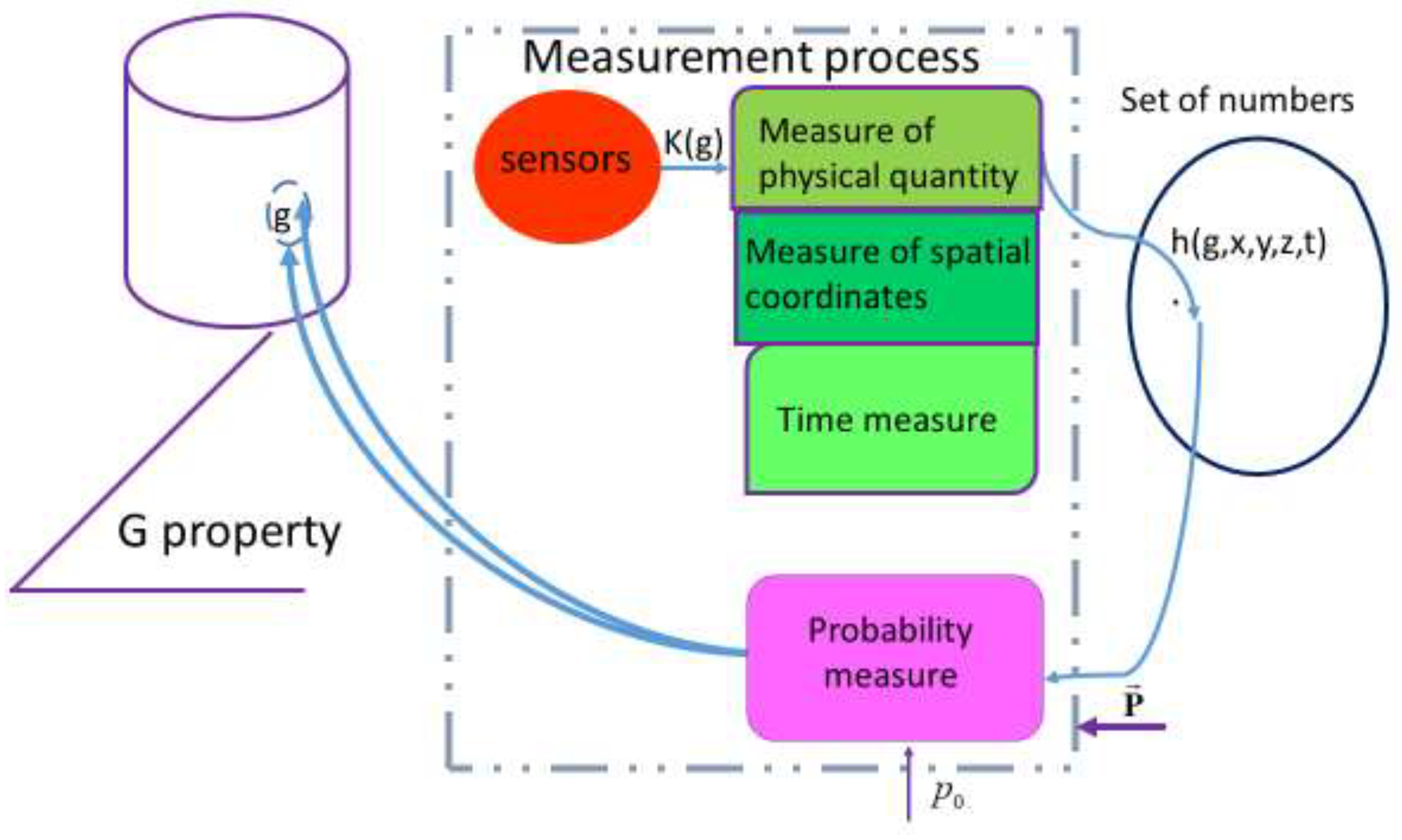
Figure 2.
Comparison of the results of matrix analysis of posts No. 3 (a) and No. 5 (b)
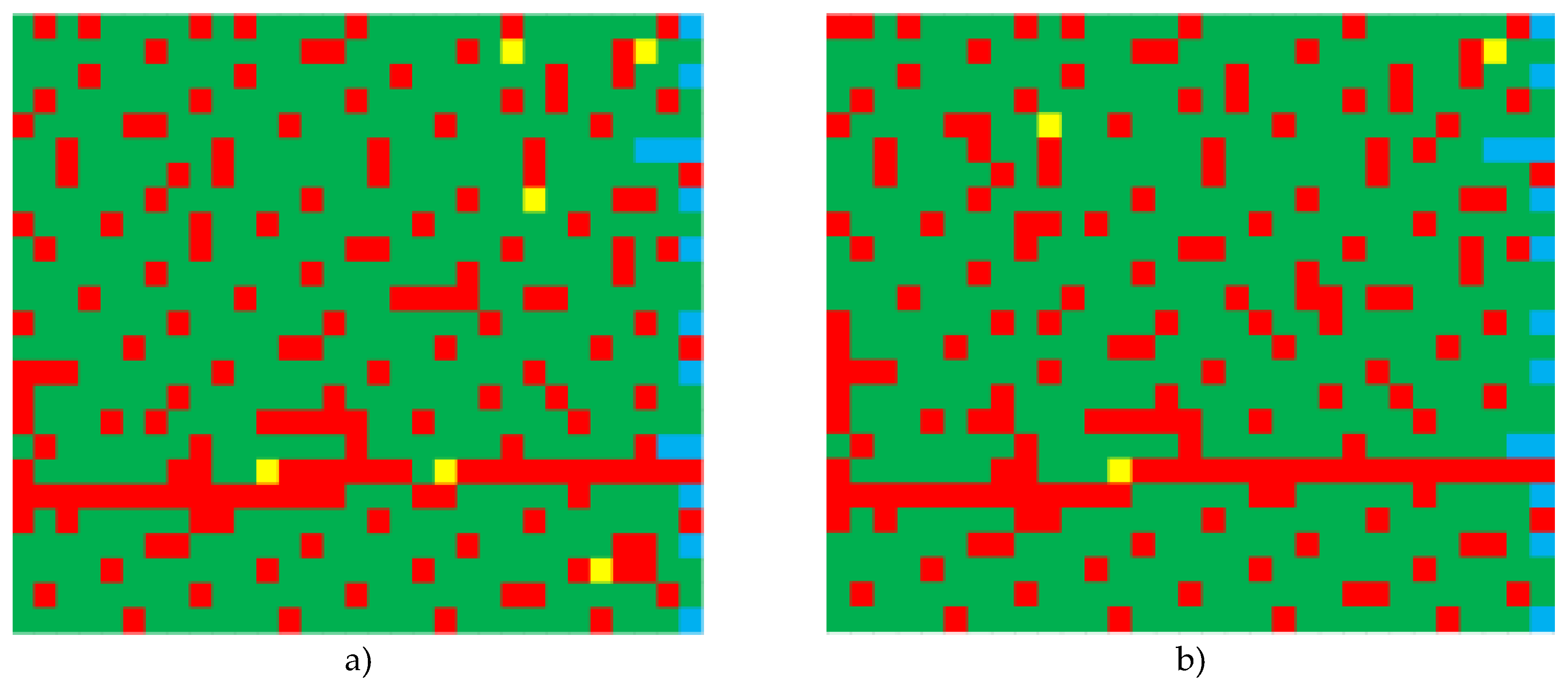
Figure 3.
Comparison of the results of matrix analysis of data from posts No. 7 (a) and No. 20 (b)
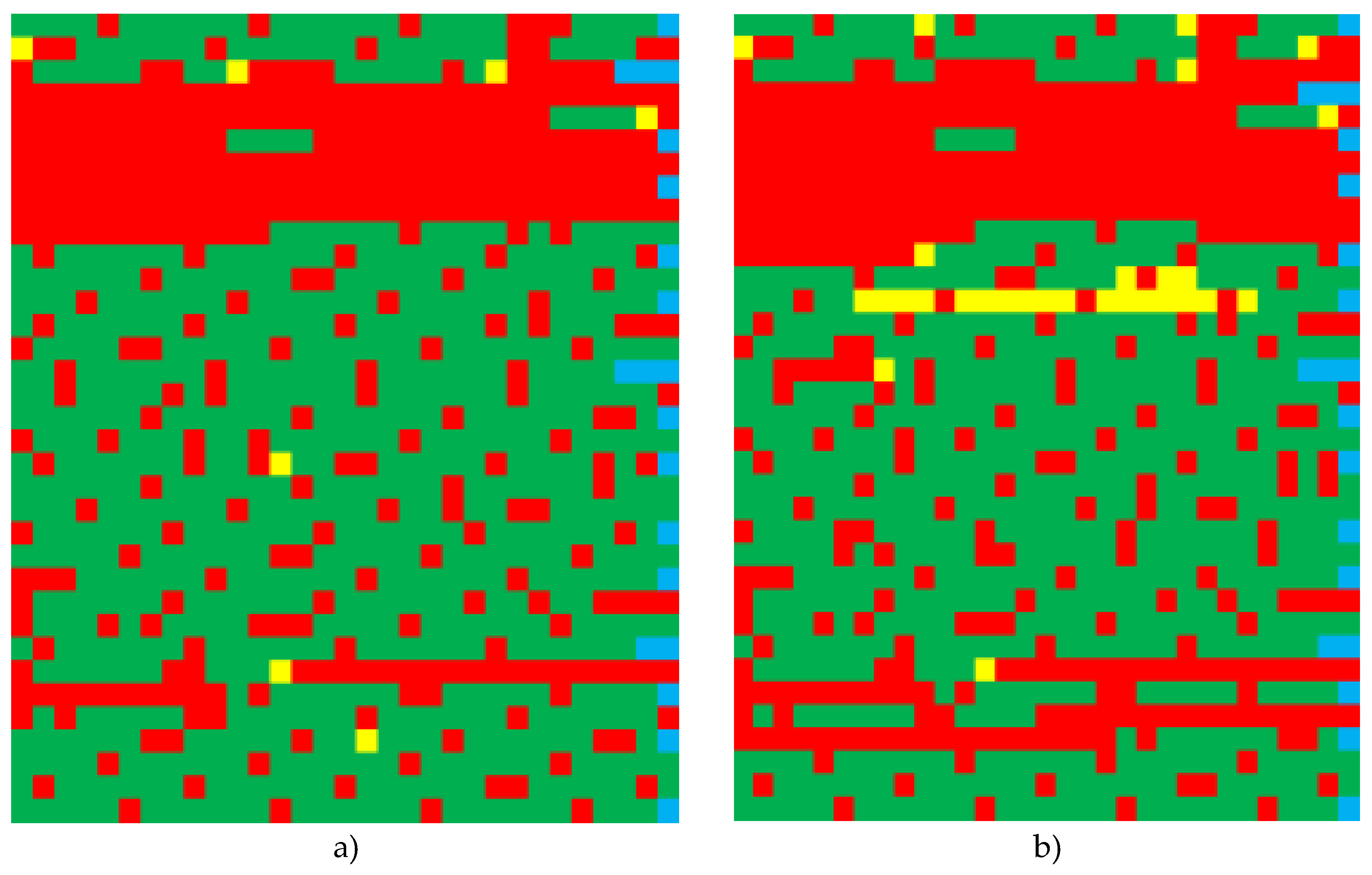

Table 1.
Characteristics of the data from CGO observation posts
| No. | Parameters* | Activation time |
| 3 | PM, SO2, CO, NO2, CH2O | September 2018 |
| 5 | PM, SO2, CO, NO2, CH2O | September 2018 |
| 7 | PM, SO2, CO, NO2, HF, HCl, CH2O | November 2017 |
| 20 | PM, SO2, CO, NO2, NO, HF, NH3, CH2O | November 2017 |
* PM – particulate matter; SO2 – sulphur dioxide; CO – carbon monoxide; NO2 – nitrogen dioxide; NO – nitrogen oxide; HF – hydrogen fluoride; NH3 – ammonia; CH2O – formaldehyde.
Table 2.
Parameters of the data groups considered
| No | Parameter | Parameter value | Colour |
| 1 | 3 | 100% of planned data received | |
| 2 | 2 | Data obtained within the range 0<x<100 (%) | |
| 3 | 1 | Data not obtained | |
| 4 | 0 | No control date |
Table 3.
Characteristics of data groups obtained from measuring posts No. 3, 5, 7 and 20
| No | Number of groups | SС | 100% | |
| 3 | 0 | 14 | 761 | 76.3 |
| 1 | 174 | |||
| 2 | 6 | |||
| 3 | 581 | |||
| 5 | 0 | 14 | 761 | 76.3 |
| 1 | 177 | |||
| 2 | 3 | |||
| 3 | 581 | |||
| 7 | 0 | 20 | 1065 | 63.4 |
| 1 | 383 | |||
| 2 | 7 | |||
| 3 | 675 | |||
| 20 | 0 | 20 | 1065 | 56.6 |
| 1 | 429 | |||
| 2 | 33 | |||
| 3 | 603 | |||
Table 4.
Basic artificial intelligence models for use in diagnostic tasks
| Artificial intelligence model | Key features | Application for electrical equipment diagnostics |
| Neural networks (NN) | Capable of modelling complex, non-linear processes | Fault prediction, anomaly detection, recognition of patterns in equipment behaviour |
| Convolutional neural networks (CNN) | Specialised for processing data in the form of a grid (such as images) | Detect defects based on images, such as insulator defects or component overheating using thermal imaging |
| Recurrent neural networks (RNN) | Effective for sequential data such as time series | Predictive maintenance by analysing time series data on equipment performance |
| Support vector machines (SVM) | Good for classification and regression tasks | Classification of equipment status as normal or faulty based on characteristic data |
| Decision trees (DT) | Easy to understand and interpret | Determination of fault conditions by tracing the decision path in the tree structure |
| Random forests (RF) | An ensemble of DT, less prone to overfitting | Diagnosis of faults in complex scenarios with high-dimensional data |
| Gradient boosting machines (GBM) | Building models sequentially, good predictive performance | Increased fault prediction accuracy by combining weak predictive models |
| Autoencoders (AE) | Used for data encoding and dimensionality reduction | Detection of anomalies by training on normal operating patterns and identifying deviations |
| Generative adversarial networks (GANs) | Used to generate new data instances | Data augmentation to improve the reliability of diagnostic models by generating synthetic fault data |
| Reinforcement learning (RL) | Training to make sequential decisions | Adaptive control systems for electrical equipment to optimise performance |
Disclaimer/Publisher’s Note: The statements, opinions and data contained in all publications are solely those of the individual author(s) and contributor(s) and not of MDPI and/or the editor(s). MDPI and/or the editor(s) disclaim responsibility for any injury to people or property resulting from any ideas, methods, instructions or products referred to in the content. |
© 2026 by the authors. Licensee MDPI, Basel, Switzerland. This article is an open access article distributed under the terms and conditions of the Creative Commons Attribution (CC BY) license (http://creativecommons.org/licenses/by/4.0/).
Copyright: This open access article is published under a Creative Commons CC BY 4.0 license, which permit the free download, distribution, and reuse, provided that the author and preprint are cited in any reuse.


