

Submitted:
28 February 2026
Posted:
02 March 2026
You are already at the latest version
Abstract
The globalization of high-technology supply chains has concentrated design and tech-nological control in advanced economies, limiting the industrial upgrading potential of emerging regions. At the same time, increasing sustainability pressures demand the integration of circular economy principles into production systems. However, existing research rarely integrates supply chain localization strategies, circular value creation mechanisms, and regional capability development within a unified explanatory framework.
This study develops a conceptual circular supply chain framework for the sustainable localization of high-technology unmanned aerial vehicle (UAV) systems in emerging economies. Drawing on localization theory, circular supply chain design, and capability accumulation literature, the framework conceptualizes localization as a systemic config-uration composed of three interdependent structural dimensions: (1) core technological supply chain processes, (2) transversal circular value creation mechanisms, and (3) re-gional capability accumulation pathways.
Unlike linear acquisition models, the proposed framework embeds modularity, re-pairability, remanufacturing, and lifecycle management within the supply chain's op-erational architecture. This integration enables simultaneous outcomes in environmental sustainability, economic resilience, and social upgrading. The framework further iden-tifies boundary conditions and aligns structurally with Sustainable Development Goals related to responsible production, industrial innovation, and climate action.
Keywords:
circular supply chain
; sustainable localization
; industrial upgrading
; UAV systems
; emerging economies
1. Introduction
High-technology supply chains for unmanned aerial vehicle (UAV) systems have become increasingly globalized and centralized, concentrating design, manufacturing, and technological control in a limited number of advanced economies. China dominates the export of light-to-medium civil UAVs, while the United States leads in the export of high-end, heavy UAV systems [1] Economies characterized by high openness, favorable institutional environments, advanced technological capabilities, and strong economic performance shape the core structure of the UAV trade network, reinforcing the centralization of control over critical UAV technologies [2].
While this configuration enhances efficiency and accelerates technological innovation, it simultaneously generates structural dependency for emerging economies. These economies frequently participate only as end-users or low-value assemblers due to high initial investment costs, technological immaturity, and limited absorptive capacity [3]. Such structural asymmetries constrain the development of local capabilities, technological autonomy, and long-term industrial upgrading.
At the same time, sustainability imperatives are reshaping industrial production systems worldwide. Circular economy (CE) principles, such as modularity, repairability, remanufacturing, and resource recovery, are increasingly recognized as strategic mechanisms to reduce environmental impacts and improve resource efficiency. Designing products with modular architectures enables easier repair, upgrading, and disassembly, thereby extending product life cycles and reducing waste generation [4,5]. In sectors such as agriculture [6] and steel manufacturing [7] circularity is increasingly conceptualized as a structural design constraint rather than a downstream environmental adjustment.
However, in high-technology sectors, circularity is often treated as an operational afterthought rather than being embedded as a foundational design principle within supply chain configuration and technology localization strategies. This limitation is particularly relevant in emerging economies, where integrating CE principles into localized supply chains produces measurable yet highly context-dependent effects on regional industrial development. Empirical evidence indicates that circular performance outcomes vary significantly depending on infrastructure availability and institutional capacity. For example, regions with infrastructure coverage above 60% have achieved substantial environmental gains, such as the European Union reaching 60% waste reuse by 2023, whereas regions with infrastructure availability below 30%, including parts of Sub-Saharan Africa at approximately 20%, face structural implementation constraints regardless of policy support.
Although CE integration has been shown to influence regional industrial development through employment generation, resource efficiency gains, and structural transformation [8] these effects materialize only when infrastructure thresholds, institutional coordination, technical capabilities, and market readiness for environmental technologies are aligned. Barriers such as qualification gaps for digitization and systemic information deficits further constrain CE implementation and require targeted training and infrastructure investments [9]. While studies examine CE challenges in emerging countries, including Brazil [9] India [8] and Southeast Asia [10], few frameworks integrate supply chain localization, circular design principles, and regional capability development into a unified strategic model for high-technology industries.
This gap is particularly salient in the context of UAV-based environmental monitoring systems. These systems combine advanced electronics, modular hardware architectures, embedded software, and specialized service components, making them suitable candidates for circular supply chain structuring. Although research has examined UAV innovation ecosystems and science–industry collaboration [11], little attention has been paid to embedding circular supply chain mechanisms into UAV localization strategies. As a result, circularity remains largely conceptual rather than structurally integrated into the design of high-technology supply chains in emerging economies.
Therefore, this paper proposes a circular supply chain framework for the sustainable localization of high-technology UAV systems in emerging economies. The framework integrates supply chain localization theory, circular supply chain design principles, technology transfer mechanisms, and regional capability development into a multi-layered structure. Unlike traditional linear acquisition models, the proposed framework conceptualizes circularity as a structural driver of industrial upgrading, resilience, and sustainable regional development.
The central research question guiding this study is: How can circular supply chain design principles be integrated into high-technology UAV localization strategies to foster sustainable regional industrial development in emerging economies?
This study contributes to the sustainability and supply chain literature in three ways. First, it integrates circular economy principles into the theory of high-tech supply chain localization. Second, it conceptualizes circularity as a mechanism for regional capability accumulation rather than merely as an environmental compliance strategy. Third, it provides a strategic framework that links technological integration processes with sustainable industrial transformation pathways, offering implications for policymakers, manufacturers, and regional innovation ecosystems.
The remainder of this paper is structured as follows. Section 2 reviews the relevant literature on sustainable supply chains, the integration of the circular economy, and regional industrial development. Section 3 describes the conceptual methodology used to develop the framework. Section 4 presents the proposed circular supply chain model. Section 5 discusses its sustainability and policy implications. Finally, Section 6 concludes and outlines directions for future research.
2. Materials and Methods
2.1. High-Technology Supply Chain Localization
High-technology industries are characterized by concentrated production structures and globally distributed value chains, where advanced economies retain control over high-value activities such as design, innovation, and system integration. Supply chain localization strategies have been proposed as mechanisms to enhance regional capability accumulation, technological autonomy, and industrial resilience. These strategies typically include supplier development, local sourcing, and structured technology [12,13].
Recent research highlights that localization is often driven by cost efficiency, time responsiveness, and supply chain security considerations [12,14], as well as by long-term strategic positioning linked to environmental, social, and governance (ESG) performance [15]. However, these approaches tend to favor developed economies characterized by technological maturity, advanced infrastructure, and institutional stability, where supplier–customer relationships facilitate knowledge spillovers and long-term productivity gains [16].
In contrast, emerging economies frequently adopt sequential localization models, in which digitalization and infrastructure upgrades precede deeper participation in buyer–supplier networks. Evidence from Vietnam suggests that digital readiness enhances the effectiveness of subsequent industrial integration strategies [17]. Despite these contributions, existing localization frameworks rarely integrate sustainability-driven design principles or circular economy mechanisms into the structuring of high-technology supply chains [18,19,20].
2.2. Circular Supply Chain Design in High-Tech Industries
Circular supply chain (CSC) research has evolved from closed-loop logistics optimization to systemic frameworks that incorporate product design, reverse flows, remanufacturing, recycling, and service-based value models. CSC implementation has been associated with improvements in resource efficiency, waste reduction, and sustainable development performance, particularly in emerging economies [21].
Key enablers of circular value creation include modularity, repairability, and design for disassembly, which facilitate lifecycle extension and material recovery [22]. Effective implementation typically requires four interrelated dimensions: business model innovation, product design adaptation, service design integration, and supply chain coordination [23]. Digital technologies, such as IoT, blockchain, big data analytics, and AI, further enable real-time resource tracking, environmental monitoring, and demand-driven optimization [24,28]
Empirical syntheses indicate measurable performance improvements from CSC implementation, including enhanced resource utilization and waste reduction [24]. However, implementation challenges persist, particularly in high-technology industries, where technological complexity, high investment costs, and organizational resistance limit adoption [2]. Most studies emphasize environmental performance metrics rather than structural supply chain reconfiguration. As a result, the integration of circular mechanisms into strategic high-tech localization processes remains insufficiently developed.
2.3. Circular Economy and Regional Industrial Development in Emerging Economies
In emerging economies, the intersection between supply chain localization, circular economy (CE) integration, and regional industrial development remains underexplored. Although CE initiatives have been linked to employment generation, resource efficiency gains, and structural transformation [8], their outcomes are highly context dependent. Infrastructure availability, institutional coordination, digital readiness, and absorptive capacity significantly condition circular performance [19].
Comparative evidence indicates that developed economies achieve higher rates of resource recovery and waste reuse due to advanced policies and technological capabilities. In contrast, developing countries face structural barriers, including policy fragmentation, limited financing, and inadequate enabling conditions [19]. Case studies from Brazil and Mexico highlight the difficulties SMEs face in implementing CE models due to insufficient regional support systems and misaligned business strategies [9,25].
High-technology sectors demonstrate varied levels of sustainability integration. Electronics manufacturers adopt green control, lean, agile, and clean innovation strategies aligned with product life cycles and supply chain structures [26]. Advanced industries increasingly incorporate circular models and recycling technologies, as illustrated by developments in battery ecosystems [27]. However, the effectiveness of these initiatives depends on collaborative governance mechanisms, digital integration, and lifecycle coordination [28].
Even in complex industries such as aviation, sustainability integration operates through multi-layered synergy mechanisms involving core enterprise governance, industry chain collaboration, and cross-organizational innovation networks [29]. Organizations that treat sustainability as a strategic priority rather than as regulatory compliance demonstrate stronger competitive positioning and long-term resource efficiency [30]. Nevertheless, empirical evidence continues to show substantial disparities in circular performance between developed and emerging contexts, where infrastructure thresholds strongly influence industrial outcomes [10].
Despite these insights, research has not sufficiently examined how circular principles can be structurally embedded within high-technology supply chain localization strategies to support sustained regional industrial upgrading in emerging economies.
2.4. Technology Transfer, Innovation Ecosystems, and Capability Accumulation
Technology transfer literature emphasizes absorptive capacity, knowledge spillovers, and institutional coordination as central drivers of industrial upgrading. Developmental buyer–supplier relationships, particularly those involving multinational enterprises, facilitate the transfer of tacit knowledge and the accumulation of technological capabilities [31]. Local and global business linkages jointly enhance learning processes and strengthen innovation capacity.
Recent studies highlight the role of Industry 4.0 technologies in improving innovation performance through data-driven decision-making, digital platforms, and cross-organizational collaboration [32,33]. Sustainable supply chains further enhance productivity through green technological spillovers, particularly among high-tech and state-owned enterprises [15]. In strategic sectors such as semiconductors, sustainable industrial positioning is increasingly linked to global value chain competitiveness [30].
Innovation ecosystems within aviation and high-technology industries demonstrate the importance of science–industry collaboration and coordinated governance structures [29]. However, while these studies advance understanding of technology transfer and ecosystem development, few frameworks integrate supply chain localization, circular economy principles, and regional capability accumulation into a unified model that can guide high-technology system localization while simultaneously fostering circular value creation.
This fragmentation across research streams motivates the development of an integrative framework addressing the structural embedding of circular supply chain mechanisms within high-technology localization strategies in emerging economies. To clarify the positioning of existing research streams and highlight the conceptual gap addressed in this study, Table 1 synthesizes the main contributions and limitations of prior literature on high-technology localization, circular supply chains, and regional capability development.
3. Conceptual Methodology
This study adopts a conceptual research design to develop an integrative framework that bridges high-technology supply chain localization, circular economy principles, and regional capability development. Rather than conducting empirical testing, the objective is to synthesize and structurally integrate fragmented theoretical streams into a coherent explanatory model that can guide sustainable UAV localization strategies in emerging economies. Following Jaakkola [34], this study employs an integrative conceptual approach that connects and extends distinct theoretical domains into a unified structure.
Conceptual research is particularly appropriate when existing literature is theoretically fragmented and lacks integrative explanatory models [34,35]. In management and supply chain research, theory-building through conceptual synthesis enables the articulation of relationships among constructs that have traditionally evolved in isolation [36]. In such studies, theoretical contributions emerge not from statistical inference but from the structured clarification of relationships among core concepts and from the development of explanatory configurations [35].
In this study, “findings” are generated through the systematic integration of theoretical mechanisms across domains. Specifically, the framework articulates how circular value-creation mechanisms embedded in localization strategies influence regional capability accumulation and sustainability outcomes. The explanatory logic resides in the structural configuration of interdependent dimensions rather than in empirical estimation.
3.1. High-Technology Supply Chain Localization
The present study addresses theoretical fragmentation identified in Section 2 across four complementary research streams:
- High-technology supply chain localization
- Circular supply chain design
- Circular economy implementation in emerging economies
- Technology transfer and capability accumulation
These streams were selected because each captures a distinct but interrelated dimension of the localization–circularity–development nexus.
- High-technology localization literature explains operational restructuring and strategic autonomy dynamics.
- Circular supply chain research provides environmental and lifecycle-based integration mechanisms.
- Circular economy implementation studies in emerging economies highlight contextual and infrastructural constraints.
- Capability accumulation and technology transfer theory explains long-term industrial upgrading processes.
Individually, these streams offer partial insights. However, their analytical separation limits the development of structurally integrated localization models that can simultaneously address environmental sustainability and industrial transformation. Following the logic for conceptual framework development proposed by Seuring and Müller [38], this study integrates constructs across these domains to generate a unified structural model.
3.2. Framework Development Process
The framework structures a three-stage analytical process consisting of:
Stage 1: Construct Identification
Key mechanisms and constructs were extracted from the literature, including localization strategies (supplier development, local sourcing, technology transfer), circular design principles (modularity, repairability, remanufacturing), absorptive capacity, knowledge spillovers, and regional capability upgrading.
Stage 2: Cross-Domain Mapping
Conceptual complementarities and overlaps were identified across research streams. For example, localization mechanisms were mapped against circular design principles to determine how structural supply chain decisions could embed repair loops, modular upgrades, and service-based value capture. This stage clarified how environmental sustainability mechanisms could be operationalized within localization architectures.
Stage 3: Structural Integration
Constructs were organized into a multi-dimensional framework that links technological supply chain processes with circular value-creation mechanisms and regional capability-accumulation pathways. This configuration establishes directional relationships among dimensions, thereby generating explanatory propositions regarding how circular localization influences sustainability and industrial upgrading outcomes.
3.3. Conceptual Structure of the Framework
The structured configuration builds upon sustainable supply chain integration logic [37] and capability accumulation theory [31] while extending these perspectives into a unified localization architecture.
The proposed model conceptualizes supply chain localization not as a linear acquisition process but as a systemic configuration composed of three interdependent structural dimensions:
Structural Dimension 1: Core Technological Supply Chain
Design adaptation and system specification, component acquisition, integration, testing, deployment, and after-sales functions representing the operational architecture through which localization decisions materialize.
Structural Dimension 2: Circular Value Creation Mechanisms
Modularity, repair loops, remanufacturing processes, recycling flows, and service-based models that extend product life cycles and enhance resource efficiency. These mechanisms operate transversally across operational stages.
Structural Dimension 3: Regional Capability Accumulation
Supplier development, employment generation, knowledge spillovers, digital infrastructure enhancement, and institutional coordination mechanisms supporting long-term industrial upgrading.
Each structural dimension performs a distinct analytical function within the explanatory model:
- The first dimension defines the operational infrastructure.
- The second embeds sustainability mechanisms within that infrastructure.
- The third captures cumulative industrial and developmental outcomes.
By structuring the framework in this configuration, circularity is reframed as a structural localization mechanism rather than as an environmental compliance tool.
3.4. Boundary Conditions and Scope
The framework is designed for application in emerging economies characterized by partial industrial capability, evolving digital infrastructure, and active industrial upgrading strategies. It assumes minimum absorptive capacity within regional ecosystems and institutional support for sustainable transformation.
The framework does not assume full technological sovereignty in core UAV components. Rather, it accommodates staged localization strategies in which system configuration, modular integration, and lifecycle service capabilities precede deeper proprietary design capabilities.
Although illustrated through UAV-based environmental monitoring systems, the framework’s structural logic applies to other modular high-technology manufacturing sectors seeking to integrate circular supply chain principles within localization strategies.
3.5. Methodological Contribution
This conceptual methodology contributes by:
- Structurally integrating fragmented research streams into a unified explanatory configuration.
- Making explicit the generative logic linking circular mechanisms to regional capability accumulation.
- Reframing circular economy principles as structural drivers of localization and industrial upgrading rather than peripheral environmental adjustments.
- Extending sustainable supply chain framework logic toward high-techno-logy industrial transformation [38].
The integrative logic developed here provides the analytical foundation for the circular supply chain framework presented in the following section.
4. Proposed Circular Supply Chain Framework for Sustainable UAV Localization
4.1. Overview of the Framework
Building upon the theoretical integration developed in Section 2 and Section 3, this study proposes a circular supply chain framework designed to guide the sustainable localization of high-technology UAV systems in emerging economies.
Unlike traditional cost-driven localization models that prioritize supplier substitution and operational efficiency [12,14], the proposed framework embeds circular value-creation mechanisms and regional capability-accumulation processes directly into the structural architecture of high-technology supply chains. Circularity is therefore positioned not as a downstream environmental adjustment, but as a core architectural component of localization strategy.
The framework is structured into three interdependent structural dimensions (SD):(1) the core technological supply chain,(2) circular value creation mechanisms, and(3) regional capability accumulation pathways.
4.2. Structural Dimension 1: Core Technological Supply Chain
This structural dimension represents the functional architecture through which localization decisions materialize operationally and where circular integration must be embedded from the earliest design stage onward. It constitutes the operational backbone of high-technology UAV systems and includes six primary stages:
- Design adaptation and system specification
- Component acquisition
- System integration
- Testing and validation
- Distribution and deployment
- After-sales service and maintenance
In conventional localization strategies, these stages emphasize cost efficiency and incremental technology transfer. In contrast, the proposed model restructures each stage to enable circular integration and long-term capability development.
In Stage 1 (Design adaptation and system specification), emerging economies with developing aerospace and advanced manufacturing ecosystems may initially focus on system configuration, modular adaptation, and application-specific customization rather than full-scale proprietary core component design.
Circular integration across this structural dimension includes:
- Design incorporating modular architectures and traceable components, consistent with circular design principles [22].
- Acquisition prioritizing standardized, repairable, and interoperable components.
- Integration enabling firmware upgradability and system adaptability.
- After-sales operations incorporate preventive maintenance, component recovery, and refurbishment loops.
By embedding circular logic within core operational stages, the supply chain transitions from a transactional configuration toward a lifecycle-oriented capability system.
4.3. Structural Dimension 2: Circular Value Creation Mechanisms
The second structural dimension introduces transversal circular mechanisms operating across all supply chain stages. These include:
- Modular product design
- Design for disassembly
- Repair and refurbishment loops
- Remanufacturing processes
- Recycling and responsible material recovery
- Service-based value capture models
These mechanisms align with circular supply chain integration frameworks linking product design, business model innovation, and supply chain coordination [23].
Unlike the first structural dimension, which defines the operational sequence of activities, this second dimension operates transversally, embedding circular logic within each functional stage. Rather than treating circularity as an end-of-life strategy, the framework integrates it structurally across the supply chain architecture.
Embedding these mechanisms into localization strategies extends product life cycles, reduces dependency on full-system replacement, and enhances resource efficiency. Importantly, circular mechanisms generate stable demand for diagnostics, calibration, maintenance, and recovery services, thereby supporting localized economic activity and reinforcing technical specialization.
4.4. Structural Dimension 3: Regional Capability Accumulation
The third structural dimension captures the industrial development implications of circular localization. By integrating circular mechanisms within operational supply chain architecture, the framework generates cumulative regional effects, including:
- Supplier development opportunities
- Skilled technical employment
- Knowledge spillovers across firms
- Strengthening of digital and industrial infrastructure
- Institutional coordination within regional ecosystems
This logic is consistent with technology transfer and absorptive capacity theory, which emphasize learning mechanisms and buyer–supplier linkages in capability upgrading [15,31].
By shifting value capture from simple assembly toward integration, service provision, and lifecycle management, circular localization enhances regional resilience under global supply chain disruptions and strengthens participation in nearshoring dynamics
4.5. Operationalization of Circular Localization Across Supply Chain Stages
To operationalize the structural configuration proposed above, this subsection maps core supply chain stages (SD1) to transversal circular mechanisms (SD2) and resulting regional capability effects (SD3). This mapping clarifies how the interaction among structural dimensions generates cumulative sustainability and industrial upgrading outcomes.
Table 2 illustrates that circular localization is embedded throughout the supply chain architecture rather than confined to end-of-life recovery processes
This operationalization demonstrates that circular localization is not an isolated environmental intervention but a structural configuration linking operational decisions, circular mechanisms, and regional capability accumulation. Through iterative interaction across stages, sustainability outcomes emerge cumulatively rather than instantaneously, reinforcing the dynamic nature of localization as a capability-building process.
4.6. Sustainability Outcomes
The first structural dimension provides the operational infrastructure, the second embeds circular mechanisms within that infrastructure, and the third captures the cumulative industrial effects generated by this integration. The interaction among the three structural dimensions produces multidimensional sustainability outcomes:
Environmental: Reduced electronic waste, increased material recovery potential, extended product lifespan, and lower lifecycle material intensity.
Economic: Local value capture, supplier ecosystem strengthening, and industrial upgrading.
Social: Skilled employment creation, technical training, and institutional capacity building.
Unlike linear localization models, the proposed framework aligns industrial competitiveness with circular sustainability objectives and long-term regional transformation.
4.7. Theoretical Implications
The framework advances theory in three principal ways:
- It reconceptualizes circular economy principles as structural localization mechanisms rather than environmental compliance tools.
- It connects supply chain design decisions with regional capability accumulation and industrial upgrading outcomes.
- It extends sustainable supply chain logic into the domain of high-technology localization in emerging economies [37].
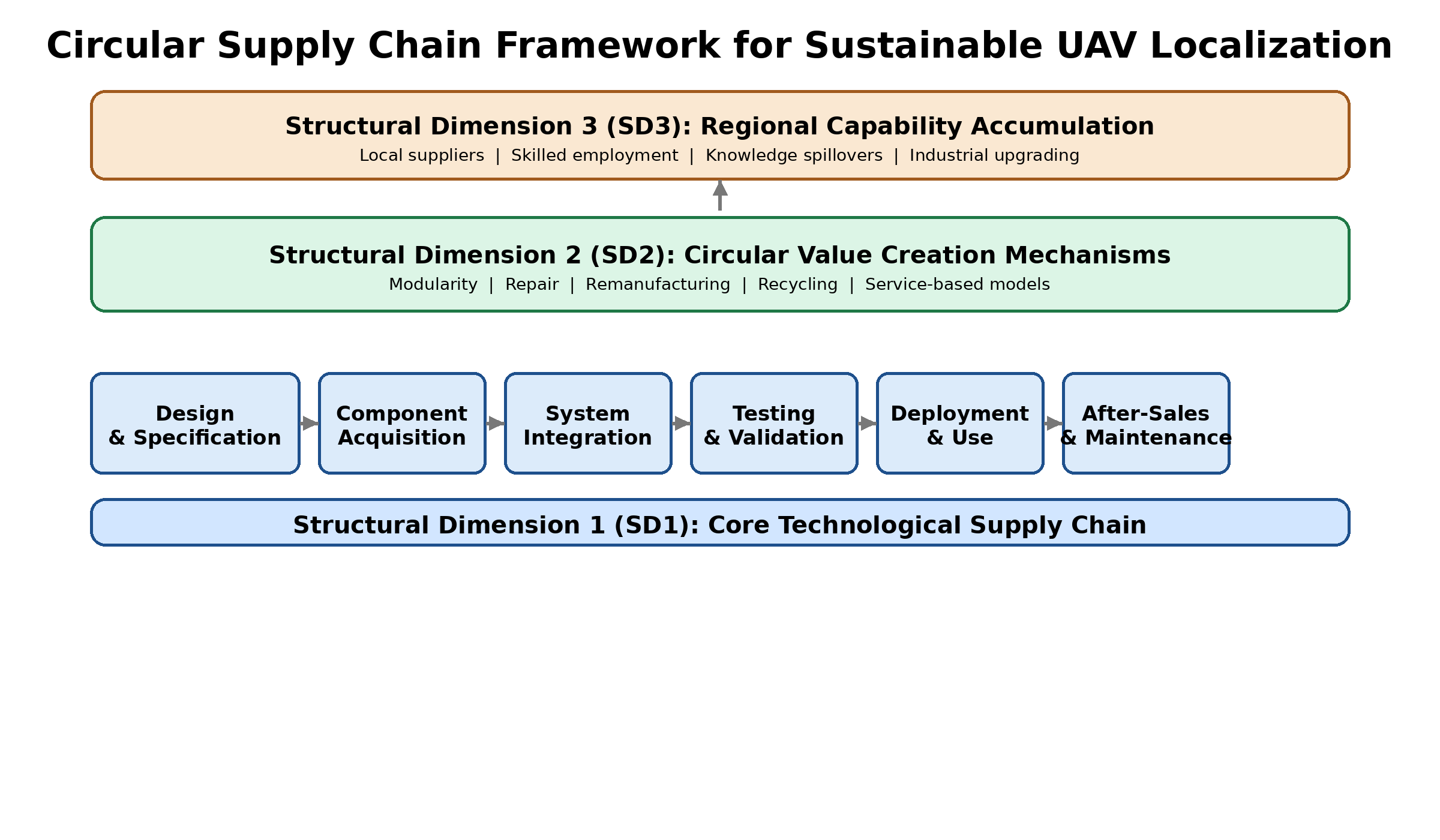
Figure 1 conceptualizes localization as a systemic configuration composed of three interdependent structural dimensions. Rather than treating circularity as a downstream adjustment, the framework embeds circular mechanisms into the supply chain's operational architecture to generate cumulative regional capability and sustainability outcomes.
5. Discussion: Sustainability and Circular Transformation Implications
5.1. Environmental Sustainability Implications
The proposed framework repositions UAV localization as a sustainability-oriented industrial strategy rather than a purely economic or geopolitical decision. By embedding circular value-creation mechanisms within the supply chain's operational architecture, the framework directly addresses three major environmental challenges associated with high-technology systems: electronic waste generation, resource intensity, and premature product obsolescence.
High-technology UAV systems involve complex electronic components, batteries, composite materials, and embedded digital systems. In linear localization models, system replacement often occurs due to firmware incompatibility, component failure, or lack of repair infrastructure. The integration of modular design, design for disassembly, and remanufacturing loops reduces material throughput and extends system lifecycles.
Consistent with circular economy paradigms that conceptualize sustainability as systemic value retention rather than waste management [38], this structural embedding of circular mechanisms contributes to:
- Reduced electronic waste generation through component-level replacement rather than full-system disposal.
- Increased material recovery potential through traceable and separable components.
- Lower embodied carbon intensity over the product lifecycle.
- Reduced dependency on raw material extraction.
Thus, environmental gains emerge not only from recycling activities but from systemic lifecycle optimization.
5.2. Circular Resource Efficiency and Lifecycle Extension
The framework advances circular supply chain logic by operationalizing resource efficiency at multiple stages of localization. Circular mechanisms embedded in SD2 act transversally across SD1 stages, transforming supply chain processes into lifecycle management systems.
Lifecycle extension mechanisms include:
- Firmware upgradability instead of hardware replacement.
- Predictive maintenance enabled by digital monitoring.
- Component refurbishment and reuse.
- Modular upgrades for sensor integration.
These mechanisms reduce material intensity per functional unit delivered. Instead of measuring sustainability solely by production efficiency, the framework shifts attention toward functional longevity and service-based value capture.
In emerging economies, where material recovery infrastructure may be uneven, extending product lifespan becomes a particularly critical sustainability strategy. Lifecycle extension reduces waste pressure even when recycling systems remain incomplete.
5.3. Socio-Economic Sustainability Effects
Although environmental outcomes are central, circular localization also produces socio-economic sustainability effects aligned with Sustainable Development Goals (SDGs) [39], SDG 8 (Decent Work and Economic Growth), SDG 9 (Industry, Innovation, and Infrastructure), and SDG 12 (Responsible Consumption and Production).
Circular integration structurally reconfigures demand patterns within the regional ecosystem, creating sustained requirements for:
- Maintenance technicians
- System integrators
- Calibration specialists
- Remanufacturing services
- Digital monitoring and lifecycle analytics
These activities are more knowledge-intensive than basic assembly operations, promoting skill upgrading and technical workforce development. When embedded within regional ecosystems, such mechanisms can foster resilient industrial clusters capable of sustaining long-term innovation.
Importantly, sustainability outcomes are cumulative. Environmental performance improvements reinforce economic resilience, while capability accumulation strengthens the capacity for circular implementation.
5.4. Boundary Conditions and Limitations
Despite its integrative potential, the framework operates under several boundary conditions.
First, circular localization requires minimum digital infrastructure and traceability systems to enable lifecycle monitoring. Without such infrastructure, circular mechanisms may remain fragmented.
Second, intellectual property regimes and technological concentration in advanced economies limit the extent of full technological sovereignty in UAV core components.
Third, institutional coordination is critical. Circular integration demands alignment between manufacturers, service providers, recyclers, regulators, and training institutions.
Finally, this study is conceptual and does not empirically test the magnitude of sustainability impacts. Future research should evaluate lifecycle carbon reductions, electronic waste diversion rates, and employment intensity associated with circular UAV localization strategies.
Therefore, the framework should be interpreted as a structural explanatory model rather than a predictive or performance-quantifying instrument.
5.5. Alignment with the Sustainable Development Goals (SDGs)
The proposed circular supply chain framework aligns structurally with several United Nations SDGs [39], particularly those related to responsible production, industrial transformation, and sustainable economic development.
SDG 12: Responsible Consumption and Production.
By embedding modularity, repairability, remanufacturing, and material recovery mechanisms within high-technology UAV localization, the framework promotes responsible resource use and reduces electronic waste generation. Lifecycle extension strategies directly contribute to sustainable material management and improved circularity performance.
SDG 9: Industry, Innovation, and Infrastructure.
The integration of circular mechanisms into high-technology supply chains fosters innovation in product architecture, service-based models, and digital lifecycle monitoring systems. By encouraging supplier development and strengthening industrial ecosystems, the framework supports resilient infrastructure and sustainable industrialization pathways in emerging economies.
SDG 8: Decent Work and Economic Growth.
Circular localization generates demand for skilled technical employment in system integration, maintenance, refurbishment, and digital monitoring. These knowledge-intensive activities contribute to higher-value-added participation in global value chains while promoting stable employment in advanced manufacturing sectors.
SDG 13: Climate Action.
Although the framework does not provide quantified carbon-reduction estimates, lifecycle extension and reduced material throughput can contribute indirectly to lower embodied emissions and reduced resource-extraction intensity. Future empirical research may assess the framework’s climate-mitigation potential using lifecycle assessment methodologies.
Importantly, the alignment with SDGs is not treated as symbolic positioning but as a structural outcome of embedding circular principles within the localization strategy. The framework demonstrates how sustainability objectives can be integrated into industrial upgrading processes rather than addressed as external compliance requirements.
5.6. Measurement and Evaluation Indicators
Although the proposed framework is conceptual, it enables the identification of measurable indicators for future empirical assessments of circular localization performance. These indicators operate across environmental, economic, and circular dimensions and reflect the structural integration of supply chain processes, circular mechanisms, and the accumulation of regional capabilities.
Consistent with lifecycle-oriented sustainability assessment approaches in circular economy and sustainable supply chain research [37,38], performance evaluation in circular localization should prioritize lifecycle-based metrics over purely production-oriented efficiency indicators.
- Percentage of components designed for repairability versus full replacement.
- Annual repair rate of localized systems.
- Extension of average product lifespan attributable to maintenance and refurbishment.
- Percentage of materials recovered or recycled at end-of-life.
- Estimated reduction in electronic waste generation.
- Frequency of firmware updates relative to hardware replacement cycles.
These indicators shift performance assessment from production efficiency toward resource retention and lifecycle optimization.
The framework also suggests economic and capability-based evaluation dimensions, such as:
- Number of direct technical jobs generated (integration, maintenance, remanufacturing).
- Number of indirect jobs within supplier and service ecosystems.
- Percentage of localized value content within the integrated system.
- Number of regional suppliers incorporated into the value chain.
- Investment in digital infrastructure supporting lifecycle monitoring.
- Technical training hours associated with circular integration activities.
Importantly, these indicators should not be interpreted as immediate outputs but as cumulative measures of capability accumulation over time. Their relevance lies in capturing the structural interaction between localization decisions and sustainability outcomes.
6. Conclusions
This study developed a circular supply chain framework for the sustainable localization of high-technology UAV systems in emerging economies. By structurally integrating localization theory, circular supply chain design principles, and mechanisms for capability accumulation, the framework reconceptualizes localization as a sustainability-oriented industrial transformation process rather than a cost-driven restructuring strategy.
Through the interaction of three interdependent structural dimensions—core technological supply chain architecture, transversal circular mechanisms, and regional capability accumulation pathways—the model demonstrates how environmental sustainability, economic resilience, and social upgrading can be co-generated within a unified configuration. Circularity is not treated as an add-on or end-of-life intervention, but as a structural feature embedded within operational decision-making.
From an environmental standpoint, the framework shifts attention from waste mitigation to lifecycle optimization and material-intensity reduction. By prioritizing modularity, repairability, remanufacturing, and service-based value capture, the model advances a resource-retention logic that aligns industrial upgrading with sustainability imperatives.
For emerging economies, sustainable localization does not require immediate full technological sovereignty. Instead, staged capability development through system configuration, integration, and lifecycle management may provide a viable pathway toward progressive industrial deepening. In this sense, circular localization functions simultaneously as a sustainability mechanism and as a dynamic capability-building process.
The theoretical contribution of this study lies in integrating previously fragmented research streams into a coherent explanatory architecture, reframing circular economy principles as structural localization mechanisms, and extending sustainable supply chain logic into high-technology industrial transformation contexts.
Future research should empirically examine the environmental performance, lifecycle carbon intensity, employment effects, and institutional coordination mechanisms associated with circular localization strategies. By doing so, subsequent studies may test and refine the structural relationships proposed in this framework.
In an era defined by supply chain reconfiguration, technological concentration, and accelerating sustainability pressures, embedding circular principles within high-technology localization strategies offers a structurally grounded pathway toward resilient, resource-efficient, and capability-enhancing industrial systems. Circular localization thus emerges not merely as an environmental alternative, but as a strategic configuration for sustainable industrial transformation.
Author Contributions
Conceptualization, E.S.H.-G.; methodology, E.S.H.-G.; theoretical integration, E.S.H.-G.; writing—original draft preparation, E.S.H.-G and E.C.-R.; writing—review and editing, D.C.G. and E.C.-R..; visualization, E.S.H.-G.; supervision, D.C.G. All authors have read and agreed to the published version of the manuscript.
Funding
This research was supported by the Secretaría de Educación, Ciencia, Tecnología e Innovacion (SECTEI) of Mexico City through the Innovation Project “Mapping and quantification of CH₄, CO, CO₂, NOx, and SO2 in soi and air in Mexico City as a mitigation strategy for reducing climate change effects SECTEI/083/2024.”.
Data Availability Statement
No new data were created or analyzed in this study. Data sharing is not applicable to this article.:
Conflicts of Interest
The authors declare no conflicts of interest.
References
- Ma, Y.; Lv, H.; Zhu, L. Characteristics analysis and trade security evaluation of the global unmanned aerial vehicle trade network. Int. J. Mod. Phys. C 2026, 2642001. [Google Scholar] [CrossRef]
- Zhang, Z.H.A.; Lu, M.; Qin, Q.; Wu, Y. Topological characteristics, influencing factors, and impact scenario simulation of global unmanned aerial vehicle trade network. Resour. Sci. 2025, 47, 1772–1791. [Google Scholar] [CrossRef]
- Chen, X.; Yan, R. Tripartite evolutionary game analysis of UAV technology investment and application under government incentives: Based on the low-altitude economic background. In Proceedings of the Int. Aussino Academic Publishing House; Li, Y., Zhang, H., Zhang, H., Eds.; 2025; pp. 078960–0011. [Google Scholar]
- Khaenamkhaew, D. Key principles of a circular and sustainable economy: Emphasising responsible resource management and environmental conservation. J. Sustain. Sci. Manag. 2025, 20, 736–765. [Google Scholar] [CrossRef]
- Rautrao, R.R.; Nille, N.S.; Mishra, M.V.; Sivasamy, S.; Gupta, H.; Whig, A. Sustainable waste management and circular economy. In Sustainable Solutions for Environmental Pollution; Elsevier, 2026; pp. 565–587. [Google Scholar] [CrossRef]
- Rossi, L.A.; Srai, J.S. Configuring circular by-product supply networks through public-private partnerships—A case study of rice straw stubble agri-waste in Punjab. J. Clean. Prod. 2024, 468, 143093. [Google Scholar] [CrossRef]
- Pinto, J.T.; Diemer, A. Supply chain integration strategies and circularity in the European steel industry. Resour. Conserv. Recycl. 2020, 153, 104517. [Google Scholar] [CrossRef]
- Mangla, S.K.; Luthra, S.; Mishra, N.; Singh, A.; Rana, N.P.; Dora, M.; Dwivedi, Y. Barriers to effective circular supply chain management in a developing country context. Prod. Plan. Control 2018, 29, 551–569. [Google Scholar] [CrossRef]
- Cezarino, L.O.; Liboni, L.B.; Oliveira Stefanelli, N.; Oliveira, B.G.; Stocco, L.C. Diving into emerging economies bottleneck: Industry 4.0 and implications for circular economy. Manag. Decis. 2021, 59, 1841–1862. [Google Scholar] [CrossRef]
- Zvarych, I.; Drapak, T. Optimisation of value chains in the circular economy: Global trends and regional features. Econ. Rozv. Syst. 2025, 7, 169–173. [Google Scholar] [CrossRef]
- Bugayko, D.; Hryhorak, M.; Smoliar, L.; Zaporozhets, O. Creating an innovative ecosystem for the development of unmanned aviation in Ukraine: Synergy between science and industry. Mark. Inst. Nauk. Badawczych 2024, 51, 87–116. [Google Scholar] [CrossRef]
- Nalcioglu, H.; Kilic, H.S. Localization of material supply: A literature review. AJIT-e 2017, 8, 7–22. [Google Scholar] [CrossRef]
- Luo, J.; Li, T. Pathways for China’s key industries to secure core positions in global supply chains: A comparative and empirical study. Systems 2025, 13, 758. [Google Scholar] [CrossRef]
- Verboeket, V.; Khajavi, S.H.; Krikke, H.; Salmi, M.; Holmström, J. Additive manufacturing for localized medical parts production: A case study. IEEE Access 2021, 9, 25818–25834. [Google Scholar] [CrossRef]
- Chen, L.; Shen, Q.; Yu, X.; Chen, X. Knowledge spillovers along the sustainable supply chain of China’s listed companies: The role of long-term orientation. J. Innov. Knowl. 2024, 9, 100478. [Google Scholar] [CrossRef]
- Yan, M.R.; Chien, K.M.; Yang, T.N. Green component procurement collaboration for improving supply chain management in the high technology industries: A case study from the systems perspective. Sustainability 2016, 8, 105. [Google Scholar] [CrossRef]
- Akbari, M.; Hopkins, J.L. Digital technologies as enablers of supply chain sustainability in an emerging economy. Oper. Manag. Res. 2022, 15, 689–710. [Google Scholar] [CrossRef]
- Nagaraja, S.; Suresh, R. An integrative framework for circular manufacturing system in Indian industry. Circ. Econ. Sustain. 2025, 5, 5657–5673. [Google Scholar] [CrossRef]
- Sharmin, R.; Ali, K.; Karim, M.R.; Mallik, S.K. Adoption of circular economy: A comparative analysis between developed and developing countries for sustainable waste management. Am. J. Environ. Econ. 2025, 4, 104–117. [Google Scholar] [CrossRef]
- Patwa, N.; Sivarajah, U.; Seetharaman, A.; Sarkar, S.; Maiti, K.; Hingorani, K. Towards a circular economy: An emerging economies context. J. Bus. Res. 2021, 122, 725–735. [Google Scholar] [CrossRef]
- Lahane, S.; Kant, R. Investigating the sustainable development goals derived due to adoption of circular economy practices. Waste Manag. 2022, 143, 1–14. [Google Scholar] [CrossRef] [PubMed]
- Sami, A.; Manzoor, U.; Irfan, A.; Sarwar, F. Characterizing circular supply chain practices in industry 5.0 with respect to sustainable manufacturing operations. J. Manag. Res. 2023, 10, 84–105. [Google Scholar] [CrossRef]
- Suppipat, S.; Hu, A.H. A scoping review of design for circularity in the electrical and electronics industry. Resour. Conserv. Recycl. Adv. 2022, 13, 200064. [Google Scholar] [CrossRef]
- Supriadi, S.; Safrida, S.; Isnaini, D.B.Y.; Yusrita, Y.; Riana, Z.; Fahmi, N.A.; Susilawati, E. Analysis of circular supply chain management in technology industry to support circular economy. In Proceedings of the International Conference on Science and Technology UISU, 2025; pp. 209–214. [Google Scholar]
- Cantú, A.; Aguiñaga, E.; Scheel, C. Learning from failure and success: The challenges for circular economy implementation in SMEs in an emerging economy. Sustainability 2021, 13, 1529. [Google Scholar] [CrossRef]
- Ye, Y.; Lau, K.H.; Teo, L. Alignment of green supply chain strategies and operations from a product perspective. Int. J. Logist. Manag. 2023, 34, 1566–1600. [Google Scholar] [CrossRef]
- Adegboye, O.; Olateju, A.P.; Okolo, I.P. Localized battery material processing hubs: Assessing industrial policy for green growth and supply chain sovereignty in the Global South. Int. J. Comput. Appl. Technol. Res. 2024, 13, 38–53. [Google Scholar] [CrossRef]
- Feng, D.; Wang, H.; Zhao, L. Digital technologies for sustainable supply chain performance: Source-push and value chain-pull mechanisms. Sustainability 2025, 17, 5524. [Google Scholar] [CrossRef]
- Hou, R.; Song, X.; Yan, Q.; Zhang, X.; Deng, J. Synergistic innovation pathways in aviation complex product ecosystems: Enabling sustainability through resource efficiency and systemic collaboration. Sustainability 2025, 17, 7650. [Google Scholar] [CrossRef]
- Liu, Q.; Xue, D.; Li, W. A sustainable production segment of global value chain view on semiconductors in China: Temporal and spatial evolution and investment network. Sustainability 2024, 16, 8617. [Google Scholar] [CrossRef]
- Ivarsson, I.; Alvstam, C.G. Local technology linkages and supplier upgrading in global value chains: The case of Swedish engineering TNCs in emerging markets. Compet. Change 2009, 13, 368–388. [Google Scholar] [CrossRef]
- Sahoo, S.; Kumar, A.; Mangla, S.K.; Tiwari, A. Industry 4.0 adoption and eco-product innovation capability—Understanding the role of supply chain integration. Bus. Strategy Environ. 2024, 33, 8798–8814. [Google Scholar] [CrossRef]
- Karuppiah, K.; Virmani, N.; Sindhwani, R. Toward a sustainable future: Integrating circular economy in the digitally advanced supply chain. J. Bus. Ind. Mark. 2024, 39, 2605–2619. [Google Scholar] [CrossRef]
- Jaakkola, E. Designing conceptual articles: Four approaches. AMS Rev. 2020, 10, 18–26. [Google Scholar] [CrossRef]
- Whetten, D.A. What constitutes a theoretical contribution? Acad. Manag. Rev. 1989, 14, 490–495. [Google Scholar] [CrossRef]
- Meredith, J. Theory building through conceptual methods. Int. J. Oper. Prod. Manag. 1993, 13, 3–11. [Google Scholar] [CrossRef]
- Seuring, S.; Müller, M. From a literature review to a conceptual framework for sustainable supply chain management. J. Clean. Prod. 2008, 16, 1699–1710. [Google Scholar] [CrossRef]
- Geissdoerfer, M.; Savaget, P.; Bocken, N.M.; Hultink, E.J. The circular economy—A new sustainability paradigm? J. Clean. Prod. 2017, 143, 757–768. [Google Scholar] [CrossRef]
- United Nations. Transforming our world: The 2030 Agenda for Sustainable Development. 2015. Available online: https://sdgs.un.org/2030agenda (accessed on 28 February 2026).
Figure 1.
Circular Supply Chain Framework for Sustainable UAV in emerging economies.
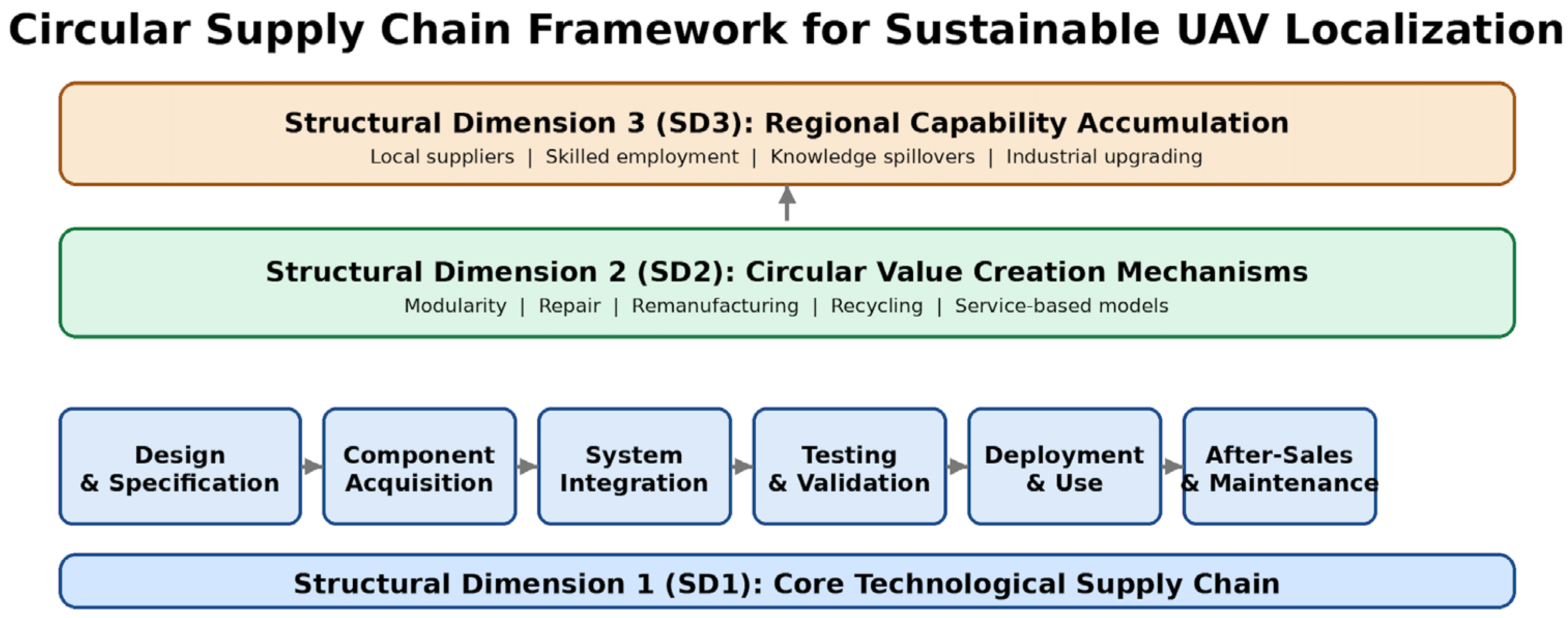

Table 1.
Research Gap Addressed in this Study.
| Research Stream | Representative Studies | Main Contribution | Key Limitation | Gap Addressed by This Study |
|---|---|---|---|---|
| High-Tech Supply Chain Localization | Verboeket et al. [14]; Luo and Li [13]; Akbari and Hopkins [17]; Chen et al. [15] | Explains localization strategies, supplier development, and capability upgrading mechanisms | Focuses on cost efficiency, autonomy, and security; limited integration of circular design principles | Integrates circular supply chain mechanisms into localization frameworks |
| Circular Supply Chain Design | Lahane and Kant [21]; Sami et al. [22]; Suppipat and Hu [23]; Supriadi et al. [24]; Zhang et al. [2] | Develops models for remanufacturing, reverse logistics, and resource efficiency | Emphasizes environmental metrics rather than structural supply chain localization | Embeds circular mechanisms within high-tech localization processes |
| CE in Emerging Economies | Mangla et al. [8]; Cezarino et al. [9]; Sharmin et al. [19]; Zvarych and Drapak [10]; Cantu et al. [25] | Links CE to employment, infrastructure thresholds, and institutional constraints | Fragmented analysis; lacks integration with high-tech supply chain structuring | Connects CE implementation with regional industrial upgrading in high-tech sectors |
| Technology Transfer & Innovation Ecosystems | Ivarsson and Alvstam [31]; Chen et al. [15]; Sahoo et al. [32]; Karuppiah et al. [33]; Hou et al. [29]; Liu et al. [30] | Explains absorptive capacity, knowledge spillovers, and ecosystem coordination | Does not integrate circular supply chain design into technology localization | Proposes unified framework combining localization, CE, and capability accumulation |
Table 2.
Operationalization of Circular Localization Across Supply Chain Stages.
| Supply Chain Stage | Circular Integration Mechanisms | Regional Capability Outcomes |
|---|---|---|
| Design adaptation and system specification | Modular architectures; traceable components; design for disassembly | Development of engineering capabilities; system configuration expertise |
| Component acquisition | Selection of standardized, repairable, and interoperable components; supplier traceability | Strengthening of local supplier networks; quality management competencies |
| System integration | Firmware upgradability; modular sensor integration; adaptable system configuration | Technical integration skills; software–hardware coordination capabilities |
| Testing and validation | Preventive maintenance protocols; calibration cycles extending product lifespan | Specialized technical services; certification and quality assurance capabilities |
| Distribution and deployment | Reusable or recyclable packaging; logistics optimization | Development of specialized logistics services; reduction of material waste |
| After-sales service and maintenance | Repair loops; refurbishment; remanufacturing; component recovery | Skilled technical employment; service-based value capture; lifecycle management expertise |
| End-of-life management | Responsible recycling; material recovery; partial system reconditioning | Emergence of circular service providers; new value chains in recovery and recycling |
Disclaimer/Publisher’s Note: The statements, opinions and data contained in all publications are solely those of the individual author(s) and contributor(s) and not of MDPI and/or the editor(s). MDPI and/or the editor(s) disclaim responsibility for any injury to people or property resulting from any ideas, methods, instructions or products referred to in the content. |
© 2026 by the authors. Licensee MDPI, Basel, Switzerland. This article is an open access article distributed under the terms and conditions of the Creative Commons Attribution (CC BY) license (http://creativecommons.org/licenses/by/4.0/).
Copyright: This open access article is published under a Creative Commons CC BY 4.0 license, which permit the free download, distribution, and reuse, provided that the author and preprint are cited in any reuse.


