

Submitted:
15 April 2026
Posted:
17 April 2026
You are already at the latest version
Abstract
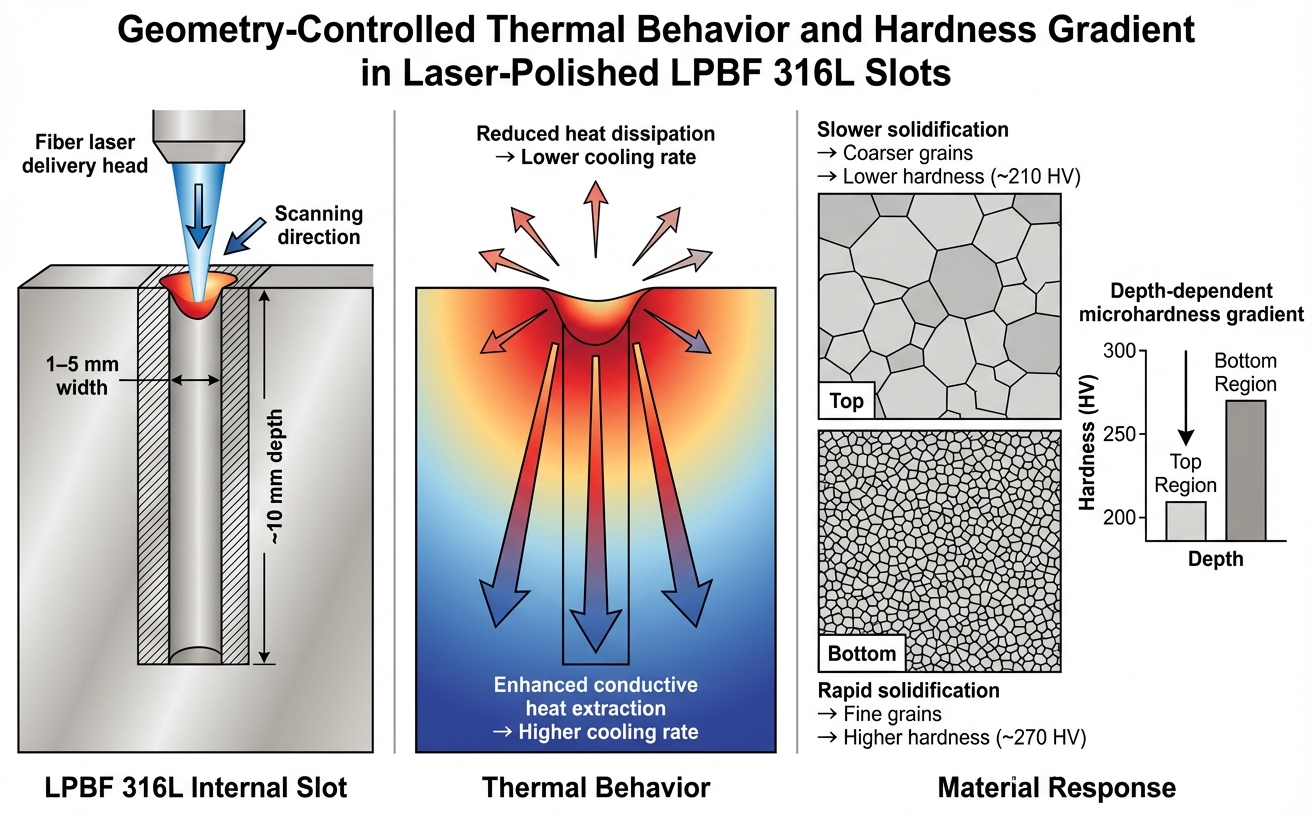
Laser polishing (LP) is widely employed to enhance the surface quality of additively manufactured (AM) metals; however, its behaviour within deep or confined internal geometries remains insufficiently understood. Many high-performance AM components, such as biomedical implants, turbine cooling channels, and metal microfluidic systems, incorporate narrow internal features where heat-transfer conditions differ significantly from open surfaces. In this study, laser powder bed fusion (LPBF)-fabricated 316L stainless steel specimens containing ~10 mm deep slots with widths ranging from 1 to 5 mm were subjected to laser polishing using a continuous-wave fibre laser (power: 80–120 W, scan speed: 450–750 mm/s, spot size: ~80–100 µm, ~60–70% track overlap, single-pass strategy). The influence of internal geometric confinement on microstructural evolution and mechanical response was systematically investigated. A pronounced depth-dependent microhardness gradient was observed along the slot wall, with hardness decreasing from approximately 270 HV in the lower region to ~210 HV near the slot opening, with more significant gradients in narrower geometries. Quantitative grain-size analysis revealed finer grains (~8–12 µm) in the lower region and coarser grains (~18–25 µm) toward the upper region, indicating progressive grain coarsening with increasing height. These variations are attributed to geometry-dependent thermal boundary conditions, where enhanced conductive coupling to the bulk substrate in the lower region promotes higher cooling rates, while reduced thermal extraction near the slot opening results in slower solidification. The results provide clear experimental evidence that internal geometric confinement can significantly influence microstructure–property evolution during laser polishing, even under constant processing parameters. This study highlights the importance of incorporating geometric effects into post-processing strategies for AM components and offers practical insights for achieving more predictable and uniform mechanical performance in confined internal features.
Keywords:
laser polishing
; additive manufacturing (AM) 316L
; thermal confinement
; depth-dependent microhardness
; slot and channel geometries
; microstructure–property relationship
; biomedical and aerospace components
Copyright: This open access article is published under a Creative Commons CC BY 4.0 license, which permit the free download, distribution, and reuse, provided that the author and preprint are cited in any reuse.


