

Submitted:
28 February 2026
Posted:
02 March 2026
You are already at the latest version
Abstract
Ecological restoration, both active and passive, comprises forest development, forest rehabilitation, and other activities that fall under the purview of eco-system services. To provide a formal framework, here we were hypothesized how do reforestation (through different forestry practices) affect the conservation of soil functionality?, that is: Reforestation/Afforestation/Forest restoration improves soil quality?; and specifically physical properties (such as structural stability, infiltration), chemical properties (such as CEC, soil organic matter content)?. For this purpose, here, we conducted a meta-analysis of numerous articles in order to compiled a large database of forest restoration studies, with emphasis on the Mediterranean region, to make robust conclusions about how it affects soil quality. Additionally, three case studies are synthetically presented concerning the short-, medium-, and long-term outcomes of forest restoration projects conducted in central and northern Spain. These cases corroborate the significant role of forest restoration in the control and enhancement of ecosystem services, particularly in relation to soil improvement, the enhancement of hydrological regulation processes within watersheds (runoff, infiltration, erosion), landscape amelioration, and the socio-economic aspects of rural environments. Ultimately, forest restoration is established as a necessary and essential practice in ecological restoration efforts to counteract the impacts of anthropogenic activities.
Keywords:
afforestation
; agroforestry
; forest ecosystem services
; forest restoration
; land restoration
; plantation
; soil functions
; soil health assessment
; soil properties
1. Introduction
The relationship between forests and healthy soils is fundamentally symbiotic, constituting the core foundation of global environmental stability and the resilience of terrestrial ecosystems [1]. Forests function as indispensable carbon sinks, reservoirs of immense biodiversity, critical regulators of hydrological cycles, and natural buffers against erosion [2]. However, widespread land degradation over recent decades—driven by deforestation, unsustainable agricultural practices, climate change, and various other anthropogenic pressures—has severely compromised both the ecological integrity of forest ecosystems and the vitality of soils across extensive global scales [3]. This deterioration often culminates in desertification, reduced agricultural productivity, a decline in biodiversity, and increased vulnerability to extreme climatic events [4].
Conceptually forests are defined, assessed, and valued through different vantage points. This is how they are understood as a source of timber and non-timber products, an ecosystem composed of trees along with myriad forms of biological diversity, a repository for carbon storage, and especially as a source of multiple ecosystem services. The Food and Agriculture Organization [5] defines a forest as land that is not classified as agricultural or urban. It must cover more than 0.5 hectares and contain trees that are more than five meters tall, with a canopy cover of at least 10%, which can be reached in situ. Forests can be categorised as natural, primary, closed, permanent forest estate or planted [6].
It is widely accepted that the soil is a complex system where chemical, physical, and biological factors interact, maintaining a dynamic equilibrium. In this way, soil is a vital component of the forest ecosystem, such that it is required for successful forest regeneration [7]. Improving and maintaining soil quality is critical for ensuring environmental sustainability and forest recovery; And conversely, maintaining forest health is vital to maintaining soil quality and non-degradation [8]. Forests are essential for biodiversity conservation and climate change mitigation [9].
Today, we witness a series of natural disturbances such as wind, fire, and snow that are occurring with increasing frequency and intensity, which have a significant impact on forest condition. This, which affects both regional and local levels, ends with forest and soil degradation. Thus, it is not surprising that, according to the key findings of the Millennium Ecosystem Assessment, globally, ecosystem services are declining [10,11,12]. The consequence of the current challenges posed by climate change and variability, rapid population growth, and escalating environmental degradation, it seems necessary to implement multi-functional and sustainable land management strategies. And of course, the conservation or rehabilitation of forests. However, for some authors such as Mayer et al. [13] or Mäkipää et al. [14], Kocsis et al. [15], forest management practices do not always have a positive effect on the soil; sometimes they have a negative impact.
Under the premise of taking natural forests as a benchmark to assess the impact of reforestation on soil properties, quality and functionality, this review article aims to compile a body of information on forests rehabilitation, to which they are added the evaluation of soil properties in selected rehabilitated Mediterranean mountain forests.
Following the introduction, the present article is organized as follows: The research methodology is presented in the next section, while the descriptive and thematic findings are presented below. In addition, three synthetic research examples in Mediterranean mountain forest are follow. Understanding that soil quality assessment refers to the monitoring and evaluation of soil attributes, soil functions, and soil conditions essential for ecosystem functioning, based on the review conducted, we aim to address three key questions: To what extent do reforestation/afforestation/forest restoration practices enhance overall soil quality? Specifically, how are physical soil properties (e.g., structural stability, infiltration capacity) and chemical soil properties (e.g., cation exchange capacity, soil organic matter content) affected by these interventions?. Therefore, this review explores the core concept of soil quality, tracing the impact of various factors and advancement in technologies applied to improve soil functionality.
2. Materials and Methods
A meta-analysis of numerous articles has been carried out to gather data on forest restoration/rehabilitation and on the impact on the soil quality of forest habitats, with special reference to Mediterranean mountain regions.
The comprehensive search was carried out mainly across two renowned electronic databases: Scopus, Google Scholar, and Web of Science. The literature search was conducted using the following keywords: “ecological restoration”, “restoration strategies”, “active restoration”, “passive restoration”, “soil quality”, “soil management”, “soil health”, “soil properties”, “forest management”, “forest habitat”, “forest restoration”, “forest recovery”, “forest regeneration”, “forest structure”, “forestry”, “afforestation”, “reforestation”, “Mediterranean mountain regions”. We assume that “afforestation” and “reforestation” they could represent a form of active forest restoration. Obviously, both the titles and the abstracts were examined based on their relevance. Results from these databases led to an in-depth understanding of the current state of the literature.
Of the reviewed articles, the largest proportion addressed forest restoration/forestation/afforestation (33%, n=48) and soil health/soil properties (32%, n=46). Categories with less representation include ecosystem services (14%, n=20), deforestation (8%, n=11), restoration ecology (5%, n=7), and other (8%, n=11). The sum of these values exceeds the total number of studies because some investigations reported multiple objectives or covered several thematic areas.
3. Forests: Ecosystem Services
Forests provide critical contributions to both humanity and the planet by bolstering livelihoods, supplying clean air and water, conserving biodiversity, and addressing climate change (Figure 1). Quantitative data demonstrates that forests contribute to the achievement of Sustainable Development Goals (SDGs) related to livelihoods and food security for many impoverished rural populations, access to affordable energy, sustainable economic growth and employment, sustainable consumption and production, climate change mitigation, and sustainable forest management. Furthermore, forests play a role in combating land degradation [12].
In a generic way, the so-called ecosystem services can be defined as the set of benefits that people obtain from ecosystems [10,16,17]. The concept of forest ecosystem services can be defined as a function in a forest that directly or indirectly offers a benefit to society [18,19,20,21]. Within them four broad types can be established:
- Provisioning services, which provide things like food, water, pharmaceutical products, genetic resources, timber and fibre.
- Regulating services, which affect climate (e.g. through carbon sequestration), pollination, biological pest control, floods, disease, waste and water quality.
- Cultural services (non-material benefits), which provide recreational, aesthetic and spiritual benefits.
- Supporting services, which include soil formation, habitat provision, photosynthesis and nutrient cycling.
On a global scale there is movement to recover the forest land in such a way to improve ecosystem services and to lessen the effects of human induced global warming and climate changes [22]. As is known, the functioning of an ecosystem includes processes such as decomposition of organic matter, but also the fixation of carbon, intervention in nutrient and water cycling as well as the degradation of toxic compounds.
According to Pan et al. [23], among the main functions of forest ecosystems it is worth mentioning carbon fixation which, evidently, is directly related to the ecosystem services carbon sequestration, a topic so relevant today. In agreement with Jenkins and Schaap [24], the world's forests cover thirty percent of the earth's surface, and serve as a source of diverse values to human society. Specifically, they point out the next ecosystem services:
- Biodiversity conservation.- Forest biological diversity encompasses a multitude of plants, animals, and microorganisms that inhabit forested areas, along with their associated genetic diversity, and is susceptible to loss if forests are cleared.
- Climate regulation.- The forest cover and, generally, land uses, can function as either a carbon source or a carbon sink, holding the potential to sequester carbon and, consequently, to reduce net CO2 emissions. Furthermore, forests play a role in buffering the microclimate [25].
- Soil conservation and prevention of degradation and desertification.- Forests play a crucial role in the formation and maintenance of soil fertility. Furthermore, forest ecosystems promote soil stability, as the complex networks of tree roots present in a healthy forest act to retain soil in place, even on steep slopes or during intense rainfall, situations where the soil would otherwise erode in the absence of a protective forest cover. However, when the forest is cleared, the resulting bare land becomes vulnerable to a process of soil degradation that, in some cases, can lead to desertification and the inability of the land to support both agriculture and forestry. In arid, semi-arid, and dry sub-humid lands, desertification constitutes an environmental and socioeconomic problem of paramount importance. Therefore, forest restoration—for example, through the oasification strategy [26] —can represent a realistic and effective solution.
- Water regulation and conservation.- Healthy forest ecosystems can filter water pollution, regulate river flows, recharge aquifers, and provide protection against floods. Moreover, ecosystems, including forests and wetlands, improve water quality by trapping and filtering sediments and contaminants before they reach surface waters.
- Recreation.- For millennia, human societies have valued the aesthetic, recreational, and spiritual offerings of forest ecosystems.
- Disaster risk reduction.- Forest ecosystems can play a fundamental role in disaster risk reduction, acting as a natural buffer to prevent or mitigate natural catastrophes that threaten property, infrastructure, and human life. These natural risks notably include floods, landslides and earth movements, and snow avalanches.
However, the Millennium Ecosystem Assessment [10] report that more than 60% of ecosystem services are being degraded, pointing out a transcendental fact that they are being degraded faster than they can regenerate.
4. Deforestation
Globally it is understood that deforestation refers to the destruction of forests so the land can be put to other uses, while forest degradation refers to a more gradual process related to unsustainable harvesting that causes a loss of forests' capacity to produce wood or support biodiversity. Citing Brown and Brown [27] and FAO [28], authors such as Rodrigues et al. [29] stated that deforestation and forest degradation began 20,000 years ago and still persist in modern days.
Deforestation occurs due to both natural and human-induced events. The causes of deforestation are similar in many regions of the world [30,31,32,33]: forest clearing in order to meet the demands of the growing population specifically agriculture and urbanization, logging, mining, extensive grazing, timber supply for the industry. Furthermore, of course, we must not forget wars and fires (Figure 2).
Deforestation refers to forest clearing for agricultural, logging or urban development purposes, leading to altered climate, vegetation and animal ecology [34]. When a natural forest is cut down it leads to massive soil degradation, since without a tree canopy to cover the soil, the direct impacts of sunlight and rainfall promote soil erosion at a rapid pace [35]. Thus, for example [36,37], point out an increase in soil compaction due to machinery decreases air and water in the soil, while inhibiting the activities of soil organisms.
Numerous scholars mention that deforestation not only alters above-ground vegetation, but also leads to substantial changes in soil properties and particularly in biochemical cycles of soil ecosystems [38,39,40,41,42]. Likewise, other researchers [43,44,45] report that deforestation in Mediterranean is one of the most critical factor in soil degradation, since it modifies, among others, the availability of nutrients, the carbon cycle.
5. Afforestation and Reforestation
Globally speaking, afforestation involves converting degraded and abandoned agricultural land into forests, including planting forests on land where they did not previously exist. Reforestation is the conversion of deforested land (where the forest has been removed) into forests. Reforestation (or forest restoration) refers to a set of processes that lead to, among other things, the restoration of the soil's chemical, physical, and biological properties. Thus, reforestation improves soil through increased organic matter, better soil structure and aggregation, increased cation exchange capacity, and a more diverse and active microbial community. Consequently, soil health and functionality tend to improve. However, the degree and speed of recovery depend on various factors, especially the type of restoration and, naturally, the duration of the intervention.
In a certain way, restoration/reforestation practices have been carried out for centuries, although only in recent decades has a certain attention focused on the so-called restoration ecology, been perceived by scientists and also by society [46,47,48]. Thus, today there is a real boom internationally [49] in this way.
As stated Kocsis et al. and Veldkamp et al. [15,50], deforestation and reforestation impact on soils. For Le et al. [51], reforestation refers to the process by which trees are planted in areas from which they have been previously cleared. In any case, it is a complex sequential decisions problem involving ecological and socioeconomic factors [52]. Reforestation of forest land cover is part of the goals of sustainable development, especially goal number 17 “life on land” [53]. Potentially, ecological restoration has the capacity to improve and recover soil quality, and thus contribute to mitigating soil degradation.
In general, the main objective of forest restoration is to restore the deforested area closed to its or original state; that independently to provide a continuous supply of economically important woody and non-woody products. Tree restoration in degraded landscapes occurs through a series of pathways, such as ecological restoration planting (native tree species are planted for biodiversity conservation), relatively simple plantings (selected native and exotic species for timber production and land rehabilitation purposes), or by spontaneous regrowth of vegetation on abandoned or marginal agricultural land [42,54,55].
Based on the growing population pressure, there is an awareness that we must not only conserve, but also to restore forest ecosystems. Keep in mind that, although forests cover nearly one third of the land area and they contain over 80% of terrestrial biodiversity [56], the extent and quality of forest continue to decrease [57]. But at the same time, deforestation alters the original forest structure and plant communities, affecting both biodiversity and the regeneration capacity and vitality of forests [58]. Today we see the establishment of global restoration initiatives employing a gradient of interventions from natural regeneration to tree planting [7,59,60].
In the literature there appear numerous works aimed at investigating time series forests at different periods (for example 5, 10, 15, 20 or more years after starting restoration by planting trees. And, generally, a whole series of soil properties are determined (such as pH, cation exchange capacity, infiltration), frequently including the soil C stocks. Obviously, a primary forest is used as reference. Thus Bieluczyk et al. [61] finds that, in addition to forest restoration for 6–30 years recovered 16–20 Mg C·ha−1 stored in soils, soil functions such as supporting root growth, aerating the soil, nutrient storage capacity, and providing C energy for microbial activity were gradually recovered; they even point out that after thirty years of active restoration was sufficient to reach the primary forest state.
Finally, we must mention the agroforestry, which is fundamentally focused on a multifunctional land management criterion, in order to increases biodiversity and soil health. Thus, compared to intensive agriculture, mitigates the environmental impact. The concept of agroforestry was started near the beginning of the 1980s, with some of its bases being that it provides economic, ecological, and environmental benefits, services, and advantages [62]. But it also improves the physical, biological, and chemical properties of soil.
6. Effects of Forest Restoration on Soil Properties and Soil Quality
Today, there are numerous searches for scientific bases on the positive or negative impacts of reforestation, especially on soil quality [63,64,65,66,67,68,69]. Specifically, other authors, such as Carter and Ungar, Zheng et al., North et al., Qasha et al., van Meerveld & Seibert, [70,71,72,73,74] report that that vegetation changed soil properties in degraded areas, such as textural fractions, bulk density, porosity, electric conductivity, pH, some nutrient levels, cation exchange capacity, and organic matter (Table 1). Also, recently, Mongil-Manso et al. [75] delve deeper into the impacts generated by afforestation on soil properties in a Mediterranean mountain area.
Generally, reforestation positively impacts soil properties by improving soil organic matter, nutrients, and microbial activity, although results vary based on factors like tree species and time. It generally enhances soil carbon sequestration, and can improve soil structure and water infiltration over time. However, reforestation can sometimes decrease soil moisture, especially in arid areas, and long-term recovery is a slow process.
Tree species are known to influence soil properties and biota, as well as changing litter inputs, influencing light availability [76,77,78,79,80]. It is therefore not surprising that there is extensive research focused on the impact of tree species on forest soil characteristics. In fact, the accurate assessment of the impact of tree species on soil is crucial when undertaking afforestation.
Generally, establishing forest ecosystems on degraded or marginal lands significantly improves soil quality. This is largely because forests provide perennial ground cover, thereby contributing to the provision of multiple ecosystem services [81,82,83,84]. Indeed, a growing body of literature reports that forest restoration enhances soil properties relative to degraded lands, shifting soil conditions closer to those of natural forests [63,66,85,86,87,88,89,90]. The primary improvement is typically observed in organic matter content, driven by the accumulation of litterfall from the tree canopy [90]. Furthermore, studies such as those by Carter & Ungar, Zheng et al., BierbaB et al., and Zhang et al. [70,86,87,90] have demonstrated increased concentrations of key nutrients—including N, P, K, Na, Ca, and Mg—following forest restoration.
Researchers such as Sparling et al. and Kalhoro et al. [91,92] have reported that the afforestation of arable or non-forest soils increases soil porosity and capillarity while decreasing bulk density. These changes lead to improved hydrological properties (e.g., water-holding capacity), soil aeration, and stability. Given that the degree of soil compaction is a determinant of plant growth success, compacted soils create stressful conditions for root development by impeding soil penetration [36]. Therefore, particular attention must be paid to soil bulk density and compaction, as they can constrain vegetation recovery [93]. Notably, soil bulk density often recovers (i.e., decreases) following restoration [94]. regarding chemical properties, Sidari et al. [95] investigated the influence of slope on soil biochemical characteristics in a Pinus laricio forest to determine the soil's capacity to supply nutrients. Furthermore, several authors have documented the acidification effect of afforestation on various soil types [96,97]. Soil acidity is a fundamental indicator of soil quality and, as Brunet et al. [98] point out, must be included in any land-use management evaluation.
Regarding carbon storage there is abundant literature [99,100,101,102]. Thus Czimczik et al. [103] describe the different effects of reforestation, deforestation, and afforestation on carbon storage in soils. In a meta-analysis of 33 recent publications, Laganièere et al. [104] conclude that the main factors affecting soil organic carbon restoration are previous land use, tree species, soil clay content, disturbance (plowing, mounding, trenching and/or mechanical tree planting), and climate, while Holatko et al. [105] report that afforestation of agricultural land affects soil structural stability.
Finally, regarding the influence of different forest types on soil biological properties, it should be noted that forests influence biological soil properties by increasing organic matter from leaf litter and roots, which increases microbial populations and activity. Consequently, this affects enhanced decomposition, nutrient cycling, and improved soil structure. In addition, tree roots also stabilize the soil, while the forest canopy creates a favourable microclimate [106,107]. More specifically, reforestation positively influences biological soil properties by increasing soil organic matter, which boosts fertility and microbial activity [108]. This leads to a better soil structure, improved water retention, and altered microbial community composition and function, although some soil properties may take decades to fully recover. Naturally everything depends on the type of tree species and the length of time since reforestation began. It has also been studied that tree planting affect soil fauna communities and depend on former ecosystem types [109].
There is a global trend toward adopting management practices that facilitate forest restoration [110,111,112], using ecological indicators such as species richness, canopy structure, and biomass to track recovery [113]. In this context, soil health—defined as 'the continued capacity of soil to function as a vital living ecosystem that sustains plants, animals, and humans' [114]—is paramount. As maintained by Nolan et al. [115], ensuring healthy soil is essential for the establishment and long-term sustainability of functional forest ecosystems. Evidence of this recovery was recently reported by Aguilar-Garavito et al. [116], whose study revealed that, after 17 years of restoration, reforested sites showed significant increases in key indicators such as organic matter (OM), potassium (K), cation exchange capacity (CEC), and total nutrient content.

Table 1.
Synthesis of the main potential effects of forest restoration/reforestation/afforestation on soil properties. These effects are neither universal nor consistently realized across all scenarios; rather, they are generally dependent on climate, the species planted, soil preparation techniques (or tillage practices), and previous land use (e.g., agricultural land, mine spoils, degraded soils, etc.).
Table 1.
Synthesis of the main potential effects of forest restoration/reforestation/afforestation on soil properties. These effects are neither universal nor consistently realized across all scenarios; rather, they are generally dependent on climate, the species planted, soil preparation techniques (or tillage practices), and previous land use (e.g., agricultural land, mine spoils, degraded soils, etc.).
| Physical properties | Chemical properties | Biological properties | |
|---|---|---|---|
| Texture (changes) | Increases capillarity | Electric conductivity (changes) | Increases microbial populations |
| Decreases bulk density | Decreases soil compaction | pH (changes) Increases acidification |
Increases microbial activity |
| Improves soil structure | Enhances soil air capacity | Increases some nutrients levels (N, P, K, Na, Ca, Mg) | Enhances soil fauna comunities |
| Increases water retention | Improves soil stability | Increases cations exchange capacity (CEC) | |
| Improves water infiltration | Reduces soil moisture | Increases plant debris | |
| Increases porosity | Increases organic matter | ||
| Increases C sequestration | |||
| Improves soil quality and edaphic ecosystem services | |||
7. Three Case Studies Under Mediterranean Mountain Environments
Within the Mediterranean region, many native forests remain, but others have been converted into agroforestry systems. There has also been a transformation of abandoned agricultural lands into reforested soils. All of this has led to reduced soil degradation, increasing the soil organic carbon (SOC) storage capacity. For example, Guo and Gifford [116]. Below we show three cases of forest restoration application in the Mediterranean mountain region.
7.1. Short-Term Forest Restoration in a Mediterranean Mountain Area: Navalperal (Avila Province, Central Spain)
A study was executed in an area situated within a Mediterranean mountain environment [75], with the primary objective of assessing the influence of afforestation and associated land-use changes on soil infiltration capacity and edaphic evolution. Within this research locale, four distinct vegetation covers were analyzed: native holm oak forest, a 20-year-old pine plantation (afforestation), shrubland, and grasslands. The non-forested covers are the product of several centuries of progressive degradation of the native Quercus species forest.
The resulting data indicate that infiltration rates are consistently higher in the pine-afforested areas (857.67 mm·h−1) when compared to the native holm oak forest (660.67 mm·h−1), grasslands (280.00 mm·h−1), or shrubland (271.67 mm·h−1) (Figure 3). Notwithstanding this hydrological disparity, no statistically significant differences were detected in key edaphic parameters such as soil fertility, organic matter content, bulk density, or effective porosity between the afforested zones and the other cover types. Nevertheless, pine afforestation clearly improved soil drainage, evidenced by an infiltration rate that surpassed even that of the native holm oak stand.
Consequently, this investigation demonstrated that forest restoration significantly optimized the soil's capacity for water infiltration. Despite the observed improvement in infiltration, the young pine plantations derived from afforestation exhibited soils with more hydrophobic conditions than those found under holm oak, shrubland, or grassland. Interestingly, no direct correlation was established between soil infiltration rates and edaphic water repellency in the pine afforested plots. This complexity is likely attributable to the inherent intricacies of both processes and the specific site circumstances under examination. For instance, the observed heterogeneity may stem from differing historical trajectories of land use, the specific afforestation schemes implemented, or the slow kinetics of organic matter decomposition under the prevailing cold and dry climatic conditions, among other factors. Similarly, it was not feasible to establish conclusive differences in the remaining edaphic properties between the afforested areas and the cleared grounds. This suggests that the elapsed time of 20 years remains insufficient to induce significant alterations in soil properties, given the slow pace of pedogenetic processes and the sub-optimal climatic conditions (cold and dry).
7.2. Medium-Term Forest and Hydrologic Restoration in Corneja River Watershed (Avila province, Central Spain)
A preceding study [89] focused on the edaphic evolution, vegetation dynamics, and hydrological characteristics of a badlands area within the Corneja river basin (central Spain), a site that underwent restoration efforts six decades ago. Subsequent work in the same locale [69] specifically highlighted the improved infiltration capacity observed in the restored plots of this watershed. The following sections summarize the key findings of these investigations, framing them within the objectives of the present review article.
Historical analysis of the evolving vegetative cover demonstrated that traditional land management—characterized by the absence of effective legal protection measures for the native holm oak forest (Quercus ilex subsp. ballota (Desf.) Samp.) and the rebollo oak stands (Quercus pyrenaica Willd.)—precipitated the collapse of the original ecosystem within the study area. This significant forest degradation resulted in a substantial increase in bare and unprotected soil, leading to the aggravation of erosive processes. This included sheet erosion, the formation of rills, the activation of gullies, and the subsequent development of ravines.
The restoration intervention was carried out in a unique area featuring granitic-matrix soils with an arenaceous texture, subjected to a Mediterranean-continental climatic regime. The measures implemented involved the construction of 123 check dams and the reforestation of 730 hectares. Presently, the soils have embarked upon a regeneration trajectory. The thickness of the organic mantle (litter and humus) measures 3.7 cm under the established pine plantation, in stark contrast to the completely absent layer in degraded soil zones. The restored forest soil exhibits higher penetration resistance and elevated concentrations of potassium (K) and phosphorus (P). Nevertheless, no significant differences were detected in the percentage of soil organic matter (down to 30 cm depth), nor in the concentrations of calcium (Ca), magnesium (Mg), sodium (Na), and nitrogen (N). These findings strongly suggest that a substantially longer timeframe is required to achieve complete edaphic evolution of the system. Regarding infiltration rates, these were found to be markedly higher in the 60-year-old pine reforestation sites (1198.00 mm·h−1) and within the sediment wedges behind the check dams (1088.00 mm·h−1), compared to the degraded slopes (365.00 mm·h−1) and the scrubland areas (420.80 mm·h−1). The rates recorded in the reforested area closely approximated those observed in the remnant patches of native holm oak forest (770.40 mm·h−1) (Figure 4). The research further revealed that soil organic matter, the depth of the humus and litter layer, and the height and coverage of vegetation are all factors that potentiate infiltration rates. Conversely, slope gradient, the presence of coarse fragments and stoniness, clay content, bulk density, and electrical conductivity all function as inhibitory factors.
The results confirm the crucial role of forest restoration as an ecosystem service, specifically in regulating hydrological conditions in degraded watersheds by increasing edaphic infiltration and controlling surface runoff and erosion. Appropriate silviculture and edaphic management of the current pine stands are essential, as these measures will not only improve the edaphic conditions but also facilitate the successional recovery of the former native oak forest that predated the intensive historical degradation.
7.3. Long-Term Forest and Hydrological Restoration (Saldaña, Palencia Province, Northern Spain)
A detailed study [85] analyzed the historical trajectory of badlands development in the Saldaña region (Northern Spain), alongside the successive changes in vegetation, soil, and erosive processes documented eight decades following the initiation of restoration efforts. The intervention consisted of intensive afforestation complemented by the construction of over 100 check dams and numerous wattle fences.
Currently, the dense forest cover (at 87% coverage) contrasts notably with the degraded and highly eroded landscape recorded at the beginning of the 20th century (which presented a coverage below 5%). The forest restoration, executed primarily using conifers, has facilitated the accumulation of a substantial litter layer thickness that effectively protects the soil. Furthermore, the presence of certain indicator species serves as a valuable tool for ecosystem assessment [118]. In the present study, species such as Quercus pyrenaica, Paeonia broteroi, and the edible mushroom Lactarius deliciosus were observed, providing clear evidence of the ecosystem's recovery and successional maturity.
Evidence exists for soil regeneration, particularly concerning the litter layer, organic matter content, a lower soil penetration resistance, improved shear strength, and an increase in infiltration rates, which are 43.4 times greater than the initial values. Despite these improvements, several key soil properties (such as erodibility, bulk density, pH, and electrical conductivity) showed no statistically significant differences relative to those in the degraded zones. This suggests that while the soil has benefited from the protection afforded by the vegetative cover and litter, and biological activity has increased, significant differences in the structural evolution of the soil have not yet been attained within this study period, notwithstanding the documented enhancement of other edaphic properties. On the restored slopes, surface runoff is negligible. This fact is complemented by the near cessation of erosion, driven by the litter layer, the protective effect of the vegetative cover, and the improved infiltration capacity.
The erosive processes that were documented at the beginning of the 20th century—including rill erosion, gullying, piping, mudflows, creeping, and landslides—which characterized the area as badlands, are currently (after 80 years) relegated to marginal areas of small surface area and steep slope where restoration failed to establish forest cover.
The comprehensive analysis of short, medium and long-term restoration projects reveals its full achievement of initial objectives across eight decades (Table 2 and Figure 5). The strategy effectively controlled erosion, particularly gullying, and resulted in nearly complete forest vegetation cover, confirming the durability and efficacy of the employed restoration techniques for comparable degraded landscapes.
Specifically, the combination of pine reforestation and check dam construction significantly improved forest cover and critical soil properties. This intervention mitigated soil erosion, accelerated pedogenesis, and notably enhanced the soil's infiltration capacity, bringing the watershed's hydrological conditions close to the native forest's baseline. The findings underscore the crucial ecosystem service role of forest restoration in regulating hydrological processes and controlling surface runoff in degraded areas. However, the studies suggests that the final soil evolution is modulated by forest age and historical land use, anticipating even more pronounced differences over longer temporal scales.
The global revision discussed here contributes to knowledge in forest restoration, providing ideas aimed to improving soil quality through forest restoration and soil monitoring processes in Mediterranean mountain regions.
8. Conclusions
This review article aims to compile a body of information on reforestation/afforestation/forest restoration practices aimed at establishing the impact on overall soil quality focused in Mediterranean mountain forests. Although some criticisms exist regarding the potential negative impact of afforestation on soil quality, there is a general consensus that afforestation contributes to improved soil quality. For example, a significant amount of organic matter is transferred to the soil, initially superficially, leading to increased carbon storage, reduced bulk density, and consequently, positive implications for water retention. However, the need to carry out reforestation according to the local context is recognized.
Studies report a higher content of certain nutrients after forest restoration, such as N, P, K, Na, Ca, and Mg. Other authors maintain that caring for healthy soil is essential for the establishment and long-term sustainability of functional forest ecosystems. Data from three case studies are presented, highlighting the most relevant finding that infiltration rates are consistently higher in pine-afforested areas compared to native holm oak forests, grasslands, and shrublands. Therefore, it is demonstrated that forest restoration significantly optimizes the soil's capacity for water infiltration.
Finally, the potential of forests to promote sustainable landscape change should not be overlooked. It is expected that this study contributes to knowledge in forest restoration, providing ideas aimed at improving soil quality and soil monitoring processes in Mediterranean mountain regions.
Author Contributions
Conceptualization, J.M.M. and R.J.B.; methodology, J.M.M., R.J.B. and M.M.M.; validation, J.M.M. and R.J.B.; formal analysis, J.M.M. and R.J.B.; investigation, J.M.M. and R.J.B.; resources, J.M.M. and R.J.B.; data curation, J.M.M. and R.J.B.; writing—original draft preparation, J.M.M., R.J.B. and M.M.M.; writing—review and editing, J.M.M., R.J.B. and M.M.M.; visualization, J.M.M. and R.J.B.; supervision, J.M.M. and R.J.B.; project administration, J.M.M. and R.J.B. All authors have read and agreed to the published version of the manuscript.”.
Funding
This research received no external funding.
Data Availability Statement
The data and materials will be made available from the corresponding author upon reasonable request.
Acknowledgments
The authors would like to acknowledge the Universidad Católica de Ávila for its support in carrying out this work.
Conflicts of Interest
The authors declare no conflicts of interest.
References
- Raj, A.; Jhariya, M.K.; Yadav, D.K.; Banerjee, A.; Meena, R.S. Soil for sustainable environment and ecosystems management. In Sustainable agriculture, forest and environmental management; Springer Nature Singapore Pte Ltd.: Singapore, 2019.
- Jinsheng, Y.; Boyuan, L.; and Xingyuan, H. Forest ecosystem health assessment: Frameworks, challenges, and strategies for the future. Ecosyst. Health Sustain. 2025, 11, 0414.
- Kashian, D.M.; Zak, D.R.; Barnes, B.V.; Spurr, S.H. Forest ecology; Wiley: Hoboken, NJ, USA, 2023.
- Safriel, U. Desertification. In Terrestrial Ecosystems and Biodiversity; NATO Science for Peace and Security Series C: EnvironmentalSecurity, Springer Science+Business Media, 2020.
- FAO. Global Resources Assessment 2010 Country Report: Malaysia; Food and Agriculture Organization: Rome, Italy, 2010.
- Hertel, D.; Moser, G.; Culmsee, H.; Erasmi, S.; Horna, V.; Schuldt, B.; Leuschner, C. Below- and above-ground biomass and net primary production in a paleotropical natural forest (Sulawesi, Indonesia) as compared to neotropical forests. For. Ecol. Manag. 2009, 258, 1904–1912. [CrossRef]
- Gatica-Saavedra, P.; Aburto, F.; Rojas, P.; Echeverría, C. Soil health indicators for monitoring forest ecological restoration: A critical review. Restor. Ecol. 2023, 31. [CrossRef]
- Osman, K.T.; Osman, K.T. Forest Soils; Springer: Dordrecht, The Netherlands, 2013.
- Maes, J.; Bruzón, A.G.; Barredo, J.I.; Vallecillo, S.; Vogt, P.; Rivero, I.M.; Santos-Martín, F. Accounting for forest condition in Europe based on an international statistical standard. Nat. Commun. 2023, 14, 1–15. [CrossRef]
- Millennium Ecosystem Assessment. Ecosystems and Human Well-Being: Scenarios; Island Press: Washington, DC, USA, 2005.
- Helfenstein, J.; Kienast, F. Ecosystem service state and trends at the regional to national level: A rapid assessment. Ecol. Indic. 2014, 36, 11–18. [CrossRef]
- FAO. The State of the World’s Forests 2024 – Forest-sector innovations towards a more sustainable future. Food and Agriculture Organization: Rome, Italy, 2024.
- Mayer, M.; Prescott, C.E.; Abaker, W.E.A.; Augusto, L.; Cécillon, L.; Ferreira, G.W.; James, J.; Jandl, R.; Katzensteiner, K.; Laclau, J.-P.; et al. Tamm Review: Influence of forest management activities on soil organic carbon stocks: A knowledge synthesis. For. Ecol. Manag. 2020, 466, 118127. [CrossRef]
- Mäkipää, R.; Abramoff, R.; Adamczyk, B.; Baldy, V.; Biryol, C.; Bosela, M.; Casals, P.; Yuste, J.C.; Dondini, M.; Filipek, S.; et al. How does management affect soil C sequestration and greenhouse gas fluxes in boreal and temperate forests? – A review. For. Ecol. Manag. 2023, 529. [CrossRef]
- Kocsis, I.A.; Tállai, M.; Zsuposné Oláh, Á.; László, Z.; Mokos, B.; Kincses, I.; Juhász, E.K.; Lowy, D.A.; Sándor, Z. Unveiling the transformative effects of forest restoration on the soil chemistry and biology of sandy soils in Southern Nyírség, Hungary. Agriculture, 2025, 15, 1030.
- Costanza, R.; d’Arge, R.; de Groot, R.; Farber, S.; Grasso, M.; Hannon, B.; Limburg, K.; Naeem, S.; O’Neill, R.V.; Paruelo, J.; et al. The value of the world’s ecosystem services and natural capital. Nature 1997, 387, 253–260. [CrossRef]
- Haines-Young, R.; Potschin, M. Common International Classification of Ecosystem Services (CICES): Consultation on Version 4, August-December. EEA Framework Contract No EEA/IEA/09/003; University of Nottingham: Nottingham, UK, 2012.
- Müller, A.; Knoke, T.; Olschewski, R. Can Existing Estimates for Ecosystem Service Values Inform Forest Management?. Forests 2019, 10, 132. [CrossRef]
- Taye, F.A.; Folkersen, M.V.; Fleming, C.M.; Buckwell, A.; Mackey, B.; Diwakar, K.; Le, D.; Hasan, S.; Ange, C.S. The economic values of global forest ecosystem services: A meta-analysis. Ecol. Econ. 2021, 189. [CrossRef]
- Nolander, C.; Lundmark, R. A Review of Forest Ecosystem Services and Their Spatial Value Characteristics. Forests 2024, 15, 919. [CrossRef]
- Martínez de Arano, I.; Maltoni, S.; Picardo, A.; Mutke, S. et al. Non-wood forest products for people, nature and the green economy. Recommendations for policy priorities in Europe. A white paper based on lessons learned from around the Mediterranean; EFI and FAO: Barcelona, Spain, 2021.
- Gosain, B.G.; Negi, G.; Dhyani, P.; Bargali, S.S.; Saxena, R. Ecosystem services of forests: Carbon stock in vegetation and soil components in a watershed of Kumaun Himalaya, India. Int. J. Ecol. Environ. Sci. 2015, 41(3–4), 177–188.
- Pan, Y.; Birdsey, R.A.; Fang, J.; Houghton, R.; Kauppi, P.E.; Kurz, W.A.; Phillips, O.L.; Shvidenko, A.; Lewis, S.L.; Canadell, J.G.; et al. A Large and Persistent Carbon Sink in the World’s Forests. Science 2011, 333, 988–993. [CrossRef]
- Jenkins, M.; Schaap, B. Forest Ecosystem Services. Background study prepared for the thirteenth session of the United Nations Forum on Forests. Global Forest Goal; United Nations Forum on Forests. 2018. https://www.un.org/esa/forests/wp-content/uploads/2018/05/UNFF13_BkgdStudy_ForestsEcoServices.pdf (Accessed: November 12 2025).
- Mwamulima, T.; Bennett, L.T.; Lane, P.N.; Sheridan, G.J. Quantifying forest structure effects on microclimate buffering across a climatic gradient in temperate Australia. For. Ecol. Manag. 2025, 586. [CrossRef]
- Martínez de Azagra, A.; Mongil, J. Concepts, models and examples for oasification. In Congress Forests to combat desertification. Afforestation and sustainable forests as a means to combat desertification; Jerusalén, Israel, 2007.
- Brown, K.S.; Brown, G.G. Habitat alteration and species loss in Brazilian forests. In Tropical deforestation and species extinction; Whitmore, T.C., Sayer, J.A., Eds.; Chapman & Hall: London, UK, 1992.
- FAO. State of the world’s forests; Forestry Department-Food and Agriculture Organization: Rome, Italy, 2005.
- Rodrigues, R.R.; Lima, R.A.; Gandolfi, S.; Nave, A.G. On the restoration of high diversity forests: 30 years of experience in the Brazilian Atlantic Forest. Biol. Conserv. 2009, 142, 1242–1251. [CrossRef]
- Allen, J.C.; Barnes, D.F. The Causes of Deforestation in Developing Countries. Ann. Assoc. Am. Geogr. 1985, 75, 163–184. [CrossRef]
- Kaplan, J.O.; Krumhardt, K.M.; Zimmermann, N. The prehistoric and preindustrial deforestation of Europe. Quat. Sci. Rev. 2009, 28, 3016–3034. [CrossRef]
- Busch, J.; Ferretti-Gallon, K. What drives deforestation and what stops it? A meta-analysis. Rev. Environ. Econ. Policy 2017, 11 3–23.
- Hosonuma, N.; Herold, M.; De Sy, V.; De Fries, R.S.; Brockhaus, M.; Verchot, L.; Angelsen, A.; Romijn, E. An assessment of deforestation and forest degradation drivers in developing countries. Environ. Res. Lett. 2012, 7, 044009. [CrossRef]
- Yasuoka, J.; Levins, R. Impact of deforestation and agricultural development on anopheline ecology and malaria epidemiology. Am. J. Trop. Med. Hyg. 2007, 76, 450–460. [CrossRef]
- Jennings, S.; Brown, N.; Boshier, D.; Whitmore, T.; Lopes, J.C. Ecology provides a pragmatic solution to the maintenance of genetic diversity in sustainably managed tropical rain forests. For. Ecol. Manag. 2001, 154, 1–10. [CrossRef]
- Canillas, E.C.; Salokhe, V.M. Regression analysis of some factors influencing soil compaction. Soil Tillage Res. 2001, 61, 167–178. [CrossRef]
- Hamza, M.A.; and Anderson, W.K. Soil compaction in cropping systems: A review of the nature, causes and possible solutions. Soil Till. Res. 2005, 82, 121-145.
- Vitousek, P.M.; Reiners, W.A. Ecosystem Succession and Nutrient Retention: A Hypothesis. BioScience 1975, 25, 376–381. [CrossRef]
- Piccolo, M.C.; Neill, C.; Cerri, C.C. Net nitrogen mineralization and net nitrification along a tropical forest-to-pasture chronosequence. Plant Soil 1994, 162, 61–70. [CrossRef]
- Arévalo-Gardini, E.; Canto, M.; Alegre, J.; Loli, O.; Julca, A.; Baligar, V. Changes in Soil Physical and Chemical Properties in Long Term Improved Natural and Traditional Agroforestry Management Systems of Cacao Genotypes in Peruvian Amazon. PLoS ONE 2015, 10, e0132147. [CrossRef]
- Maloney, K.O.; Garten, C.T.; Ashwood, T.L. Changes in Soil Properties Following 55 Years of Secondary Forest Succession at Fort Benning, Georgia, U.S.A.. Restor. Ecol. 2007, 16, 503–510. [CrossRef]
- Paul, M.; Catterall, C.P.; Pollard, P.C.; Kanowski, J. Recovery of soil properties and functions in different rainforest restoration pathways. For. Ecol. Manag. 2010, 259, 2083–2092. [CrossRef]
- Rezapour, S.; Alipour, O. Degradation of Mollisols quality after deforestation and cultivation on a transect with Mediterranean condition. Environ. Earth Sci. 2017, 76, 755. [CrossRef]
- Christopoulou, O. Deforestation/reforestation in Mediterranean Europe: The case of Greece. In Soil erosion studies; Godone, D., Ed.; InTech: Vienna, Austria, 2011.
- Bruun, T.B.; Elberling, B.; de Neergaard, A.; Magid, J. Organic Carbon Dynamics in Different Soil Types After Conversion of Forest to Agriculture. Land Degrad. Dev. 2015, 26, 272–283. [CrossRef]
- Cairns Jr.; Heckman, J.R. Restoration ecology: The state of an emerging field. Annu. Rev. Ecol. Syst. 1996, 21, 167–189.
- Palmer, M.A.; Falk, D.A.; Zedler, J.B. Ecological theory and restoration ecology. In Foundations of Restoration Ecology; Falk, D.A., Palmer, M.A., Zedler, J.B., Eds. Island Press, Washington D.C., USA, 2006.
- Young, T.P.; Petersen, D.A.; Clary, J.J. The ecology of restoration: Historical links, emerging issues and unexplored realms. Ecol. Lett. 2005, 8, 662–673. [CrossRef]
- White, P.S.; Walker, J.L. Approximating Nature's Variation: Selecting and Using Reference Information in Restoration Ecology. Restor. Ecol. 1997, 5, 338–349. [CrossRef]
- Veldkamp, E.; Schmidt, M.; Powers, J.S.; Corre, M.D. Deforestation and reforestation impacts on soils in the tropics. Nat. Rev. Earth Environ. 2020, 1, 590–605. [CrossRef]
- Le, H.D.; Smith, C.; Herbohn, J.; Harrison, S. More than just trees: Assessing reforestation success in tropical developing countries. J. Rural. Stud. 2012, 28, 5–19. [CrossRef]
- Kersten, G.E.; Meister, D.; Mekonnen, G. Representation and support of reforestation processes. In Proceedings of IEEE International Conference on Systems, Man and Cybernetics, vol. 2; IEE, 1994. [CrossRef]
- Zhang, J.; Fu, B.; Stafford-Smith, M.; Wang, S.; Zhao, W. Improve forest restoration initiatives to meet Sustainable Development Goal 15. Nat. Ecol. Evol. 2020, 5, 10–13. [CrossRef]
- Catterall, C.P.; Kanowski, J.; Wardell-Johnson, G.W. Biodiversity and new forests: Interacting processes, prospects and pitfalls of rainforest restoration. In Living in a Dynamic Tropical Forest Landscape; Stork, N.E.; Turton, S.M. Eds.; Wiley-Blackwell: Oxford, UK, 2008.
- Kanowski, J.; Kooyman, R.M.; Catterall, C.P.; Dynamics and restoration of Australian tropical and subtropical rainforests. In New models for ecosystem dynamics and restoration; Hobbs, R.J.; Suding, K., Eds.; Island Press: Washington D.C., USA, 2008.
- United Nations International Year of Forests. 2. United Nations Resolution adopted by the General Assembly 61/193 International Year of Forests, 2011. Available online: http://www.un.org/en/events/iyof2011/resolution.shtml (Accessed: November 12 2025).
- DeFries, R.S.; Rudel, T.; Uriarte, M.; Hansen, M. Deforestation driven by urban population growth and agricultural trade in the twenty-first century. Nat. Geosci. 2010, 3, 178–181. [CrossRef]
- Nepstad, D.C.; Verssimo, A.; Alencar, A.; Nobre, C.; Lima, E.; Lefebvre, P.; Schlesinger, P.; Potter, C.; Moutinho, P.; Mendoza, E.; et al. Large-scale impoverishment of Amazonian forests by logging and fire. Nature 1999, 398, 505–508. [CrossRef]
- Gatica-Saavedra, P.; Echeverría, C.; Nelson, C.R. Ecological indicators for assessing ecological success of forest restoration: A world review. Restor. Ecol. 2017, 25, 850–857. [CrossRef]
- Giles, A.L.; Schietti, J.; Rosenfield, M.F.; Mesquita, R.C.; Vieira, D.L.M.; Vieira, I.C.G.; Poorter, L.; Brancalion, P.H.S.; Peña-Claros, M.; Siqueira, J.; et al. Simple ecological indicators benchmark regeneration success of Amazonian forests. Commun. Earth Environ. 2024, 5, 1–12. [CrossRef]
- Bieluczyk, W.; Merloti, L.F.; Cherubin, M.R.; Mendes, L.W.; Bendassolli, J.A.; Rodrigues, R.R.; de Camargo, P.B.; van der Putten, W.H.; Tsai, S.M. Forest restoration rehabilitates soil multifunctionality in riparian zones of sugarcane production landscapes. Sci. Total. Environ. 2023, 888, 164175. [CrossRef]
- Cai, Z.; and Aguilar, F.X. Economic valuation of agroforestry ecosystem services. Agroforestry and Ecosystem Services 2021, 477-494.
- Vallauri, D.R.; Aronson, J.; Barbero, M. An Analysis of Forest Restoration 120 Years after Reforestation on Badlands in the Southwestern Alps. Restor. Ecol. 2002, 10, 16–26. [CrossRef]
- Ludwig, J.A.; Wilcox, B.P.; Breshears, D.D.; Tongway, D.J.; Imeson, A.C. Vegetation patches and runoff–erosion as interacting ecohydrological processes in semiarid landscapes. Ecology 2005, 86, 288–297. [CrossRef]
- Ilstedt, U.; Malmer, A.; Verbeeten, E.; Murdiyarso, D. The effect of afforestation on water infiltration in the tropics: A systematic review and meta-analysis. For. Ecol. Manag. 2007, 251, 45–51. [CrossRef]
- Perkins, K.S.; Nimmo, J.R.; Medeiros, A.C. Effects of native forest restoration on soil hydraulic properties, Auwahi, Maui, Hawaiian Islands. Geophys. Res. Lett. 2012, 39, 39, 1–4 (L05405). [CrossRef]
- Laudicina, V.A.; De Pasquale, C.; Conte, P.; Badalucco, L.; Alonzo, G.; Palazzolo, E. Effects of afforestation with four unmixed plant species on the soil–water interactions in a semiarid Mediterranean region (Sicily, Italy). J. Soils Sediments 2012, 12, 1222–1230. [CrossRef]
- Benegas, L.; Ilstedt, U.; Roupsard, O.; Jones, J.; Malmer, A. Effects of trees on infiltrability and preferential flow in two contrasting agroecosystems in Central America. Agric. Ecosyst. Environ. 2014, 183, 185–196. [CrossRef]
- Mongil-Manso, J.; Navarro-Hevia, J.; Martín, R.S. Does forest restoration influence soil infiltrability? A case study in the restored woodland of Sierra de Ávila (Central Spain). J. Mt. Sci. 2021, 18, 1778–1793. [CrossRef]
- Carter, C.T.; Ungar, I.A. Aboveground Vegetation, Seed Bank and Soil Analysis of a 31-year-old Forest Restoration on Coal Mine Spoil in Southeastern Ohio. Am. Midl. Nat. 2002, 147, 44–59. [CrossRef]
- Zheng, H.; Chen, F.; Ouyang, Z.; Tu, N.; Xu, W.; Wang, X.; Miao, H.; Li, X.; Tian, Y. Impacts of reforestation approaches on runoff control in the hilly red soil region of Southern China. J. Hydrol. 2008, 356, 174–184. [CrossRef]
- North, M.P.; Stevens, J.T.; Greene, D.F.; Coppoletta, M.; Knapp, E.E.; Latimer, A.M.; Restaino, C.M.; Tompkins, R.E.; Welch, K.R.; York, R.A.; et al. Tamm Review: Reforestation for resilience in dry western U.S. forests. For. Ecol. Manag. 2019, 432, 209–224. [CrossRef]
- Qasha, V.; Manyevere, A.; Flynn, T.; Mashamaite, C.V. Assessing the impact of ecological forest restoration on soil carbon stocks in Sub-Saharan Africa: A systematic review. Carbon Manag. 2024, 15. [CrossRef]
- van Meerveld, I.; and Seibert, J. Reforestation effects on low flows: Review of public perceptions and scientific evidence. WIREs Water 2025, 12(1), e1760.
- Mongil-Manso, J.; Navarro-Hevia, J.; Martín, R.S. Impact of Land Use Change and Afforestation on Soil Properties in a Mediterranean Mountain Area of Central Spain. Land 2022, 11, 1043. [CrossRef]
- Zinke, P.J. The Pattern of Influence of Individual Forest Trees on Soil Properties. Ecology 1962, 43, 130–133. [CrossRef]
- Giardina, C.P.; Ryan, M.G.; Hubbard, R.M.; Binkley, D. Tree Species and Soil Textural Controls on Carbon and Nitrogen Mineralization Rates. Soil Sci. Soc. Am. J. 2001, 65, 1272–1279. [CrossRef]
- Deng, Q.; Cheng, X.; Yang, Y.; Zhang, Q.; Luo, Y. Carbon–nitrogen interactions during afforestation in central China. Soil Biol. Biochem. 2014, 69, 119–122. [CrossRef]
- Kooch, Y.; Samadzadeh, B.; Hosseini, S.M. The effects of broad-leaved tree species on litter quality and soil properties in a plain forest stand. CATENA 2017, 150, 223–229. [CrossRef]
- Hu, M.; Wang, Y.; Li, H.; Hu, L.; Liu, Q.; Zhou, F.; Yang, A.; Yu, F.; Ouyang, X. The Impacts of Tree Species on Soil Properties in Afforested Areas: A Case Study in Central Subtropical China. Forests 2024, 15, 895. [CrossRef]
- Schoenholtz, S.H.; Miegroet, H.V.; Burger, J.A. A review of chemical and physical properties as indicators of forest soil quality: Challenges and opportunities. For. Ecol. Manag. 2000, 138, 335–356. [CrossRef]
- Teepe, R.; Dilling, H.; Beese, F. Estimating water retention curves of forest soils from soil texture and bulk density. J. Plant. Nutr. Soil Sci. 2003, 166, 111–119.
- Boussougou, I.N.M.; Brais, S.; Tremblay, F.; Gaussiran, S. Soil Quality and Tree Growth in Plantations of Forest and Agricultural Origin. Soil Sci. Soc. Am. J. 2010, 74, 993–1000. [CrossRef]
- Sauer, T.J.; James, D.E.; Cambardella, C.A.; Hernandez-Ramirez, G. Soil properties following reforestation or afforestation of marginal cropland. Plant Soil 2012, 360, 375–390. [CrossRef]
- Navarro, J.; Araújo, J.C.; Mongil, J. Assessment of 80 years of ancient-badlands restoration in Saldaña, Spain. Earth. Surf. Process. Landf. 2014, 39, 1563–1575.
- Bierbaß, P.; Wündsch, M.; Michalzik, B. The impact of vegetation on the stability of dispersive material forming biancane badlands in Val d'Orcia, Tuscany, Central Italy. CATENA 2014, 113, 260–266. [CrossRef]
- Zhang, Y.; Zhou, Z.; Cheng, J.; Zhang, H. Soil quality and plant diversity inmanaged forest in the hilly purple soil Southwestern China. J. Food Agric. Environ. 2013, 11, 945–951.
- Jandl, R.; Lindner, M.; Vesterdal, L.; Bauwens, B.; Baritz, R.; Hagedorn, F.; Johnson, D.W.; Minkkinen, K.; Byrne, K.A. How strongly can forest management influence soil carbon sequestration? Geoderma 2007, 137, 253–268. [CrossRef]
- Mongil-Manso, J.; Navarro-Hevia, J.; Díaz-Gutiérrez, V.; Cruz-Alonso, V.; Ramos-Díez, I. Badlands forest restoration in Central Spain after 50 years under a Mediterranean-continental climate. Ecol. Eng. 2016, 97, 313–326. [CrossRef]
- Zheng, H.; Ouyang, Z.Y.; Wang, X.K.; Miao, H.; Zhao, T.Q.; Peng, T.B. How different reforestation approaches affect red soil properties in southern China. Land Degrad. Dev. 2005, 16, 387–396. [CrossRef]
- Sparling, G.P.; Hart, P.B.S.; August, J.A.; Leslie, D.M. A comparison of soil and microbial carbon, nitrogen, and phosphorus contents, and macro-aggregate stability of a soil under native forest and after clearance for pastures and plantation forest. Biol. Fertil. Soils 1994, 17, 91–100. [CrossRef]
- Kalhoro, S.A.; Xu, X.; Chen, W.; Hua, R.; Raza, S.; Ding, K. Effects of Different Land-Use Systems on Soil Aggregates: A Case Study of the Loess Plateau (Northern China). Sustainability 2017, 9, 1349. [CrossRef]
- Hattori, D.; Kenzo, T.; Irino, K.O.; Kendawang, J.J.; Ninomiya, I.; Sakurai, K. Effects of soil compaction on the growth and mortality of planted dipterocarp seedlings in a logged-over tropical rainforest in Sarawak, Malaysia. For. Ecol. Manag. 2013, 310, 770–776. [CrossRef]
- Mendoza-Vega, J.; Ku-Quej, V.M.; Messing, I.; Pérez-Jiménez, J.C. Effects of Native Tree Planting on Soil Recovery in Tropical Montane Cloud Forests. For. Sci. 2020, 66, 700–711. [CrossRef]
- Sidari, M.; Ronzello, G.; Vecchio, G.; Muscolo, A. Influence of slope aspects on soil chemical and biochemical properties in a Pinus laricio forest ecosystem of Aspromonte (Southern Italy). Eur. J. Soil Biol. 2008, 44, 364–372. [CrossRef]
- Labaz, B.; Kabala, C.; Waroszewski, J.; Dudek, M.; Bogacz, A.; Gruszka, D.; Mlynek, S. Medium-term transformation of Chernozems under broadleaf forests in the temperate climate of south-east Poland. Geoderma Reg. 2022, 30. [CrossRef]
- Novák, T.J. Afforestation affects vertical distribution of basic soil characteristics and taxonomic status of sodic soils. Plant, Soil Environ. 2022, 68, 245–252. [CrossRef]
- Brunet, J.; Falkengren-Grerup, U.; Tyler, G. Herb layer vegetation of south Swedish beech and oak forests—Effects of management and soil acidity during one decade. For. Ecol. Manag. 1996, 88, 259–272. [CrossRef]
- Paul, K.I.; Polglase, P.J.; Nyakuengama, J. G. and Khanna, P. K. Change in soil carbon following afforestation. Forest Ecol. Manag. 2002, 168(1), 241-57.
- Nijnik, M. Carbon capture and storage in forests. Environ. Sci. Technol. 2010, 29, 203.
- Li, D.; Niu, S.; Luo, Y. Global patterns of the dynamics of soil carbon and nitrogen stocks following afforestation: A meta-analysis. New Phytol. 2012, 195, 172–181. [CrossRef]
- Nave, L.E.; Swanston, C.W.; Mishra, U.; Nadelhoffer, K.J. Afforestation Effects on Soil Carbon Storage in the United States: A Synthesis. Soil Sci. Soc. Am. J. 2013, 77, 1035–1047. [CrossRef]
- Czimczik, C.I.; Mund, M.; Schulze, E.D.; Wirth, C. Effects of reforestation, deforestation, and afforestation on carbon storage in soils. SEB Exp. Biol. Ser. 2005, 319-30.
- Laganiere, J.; A Angers, D.; Pare, D. Carbon accumulation in agricultural soils after afforestation: A meta-analysis. Glob. Chang. Biol. 2009, 16, 439–453. [CrossRef]
- Holátko, J.; Holubík, O.; Hammerschmiedt, T.; Vopravil, J.; Kintl, A.; Brtnický, M. Afforestation of agricultural land affects soil structural stability and related preconditions to resist drought. J. For. Sci. 2022, 68, 496–508. [CrossRef]
- Bargali, S.S.; Padalia, K.; Bargali, K. Effects of tree fostering on soil health and microbial biomass under different land use systems in the Central Himalayas. Land Degrad. Dev. 2019, 30, 1984–1998. [CrossRef]
- Shankar, A.; Garkoti, S.C. Influence of forest types on soil physicochemical and biological characteristics of associated agroecosystems in the central Himalaya. Sci. Total. Environ. 2023, 906, 167731. [CrossRef]
- Yuanqiu, L.; Xiaohua, W.; Xiaomin, G.; Dekui, N.; Junxia, Z.; Xia, G.; Yumei, J. The long-term effects of reforestation on soil microbial biomass carbon in sub-tropic severe red soil degradation areas. Forest Ecol. Manag. 2012, 285, 77-84.
- Zhijie, L.; Ling, X.; Lars, V.; Qiqian, W.; Peñuelas, J.; Yue, K.; Shengmin, Z.; Zimin, L.; Kun G.; Petr, H.; Fuzhong, W.; Yan, P. Global effects of tree planting on soil fauna communities depend on former ecosystem types. J. Plant Ecol., 2025, rtaf147,.
- Lohbeck, M.; Poorter, L.; Martínez-Ramos, M.; Bongers, F. Biomass is the main driver of changes in ecosystem process rates during tropical forest succession. Ecology 2015, 96, 1242–1252. [CrossRef]
- Crouzeilles, R.; Curran, M.; Ferreira, M.S.; Lindenmayer, D.B.; Grelle, C.E.V.; Benayas, J.M.R. A global meta-analysis on the ecological drivers of forest restoration success. Nat. Commun. 2017, 7, 11666. [CrossRef]
- Pengshuai, S.; Chao, L.; Laurel, L.; Hongtu, X.; Xuelian, B. Reforestation accelerates soil organic carbon accumulation: Evidence from microbial biomarkers. Soil Biol. Biochem 2019, 131, 182-190.
- Londe, V.; de Sousa, H.C.; Kozovits, A.R. Key plant indicators for monitoring areas undergoing restoration: A case study at the Das Velhas River, southeast Brazil. Ecol. Eng. 2017, 103, 191–197. [CrossRef]
- Lehmann, J.; Bossio, D.A.; Kögel-Knabner, I.; Rillig, M.C. The concept and future prospects of soil health. Nat. Rev. Earth Environ. 2020, 1, 544–553. [CrossRef]
- Nolan, M.; Stanton, K.J.; Evans, K.; Pym, L.; Kaufman, B.; Duley, E. From the ground up: Prioritizing soil at the forefront of ecological restoration. Restor. Ecol. 2021, 29, e13453. [CrossRef]
- Aguilar-Garavito, M.; Isaacs-Cubides, P.; Peña-González, N.; Warren-Thomas, E. Challenges for policy and practice in meeting ambitious ecological restoration targets by 2030: A perspective from Colombia. Biol. Conserv. 2025, 302. [CrossRef]
- Guo, L.B.; Gifford, R.M. Soil carbon stocks and land use change: A meta analysis. Glob. Chang. Biol. 2002, 8, 345–360. [CrossRef]
- Rueda, M.; Saiz, J.C.M.; Morales-Castilla, I.; Albuquerque, F.S.; Ferrero, M.; Rodríguez, M.Á. Detecting Fragmentation Extinction Thresholds for Forest Understory Plant Species in Peninsular Spain. PLoS ONE 2015, 10, e0126424. [CrossRef]
Figure 1.
Some examples of ecosystems services provided by healthy soils.
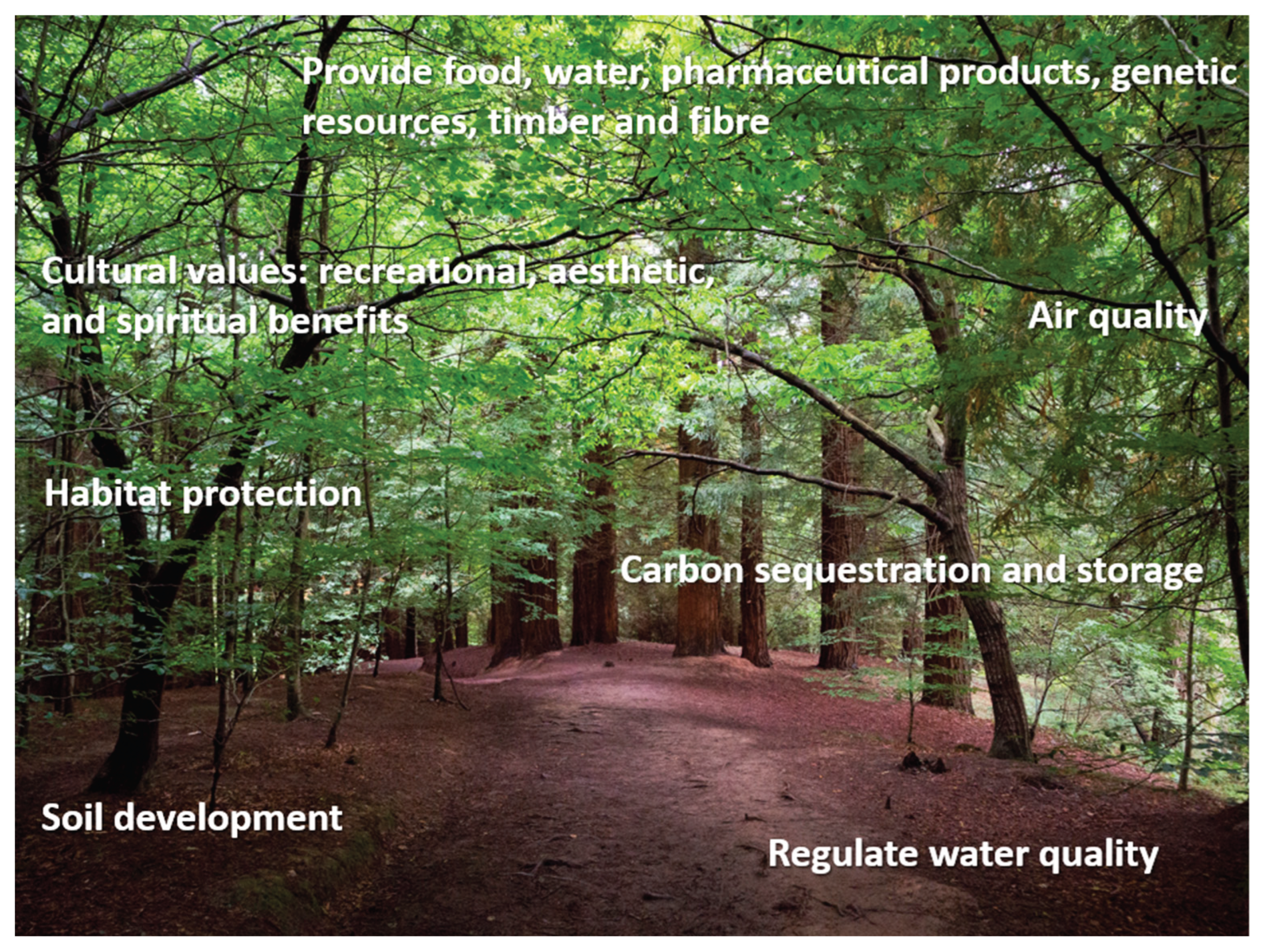
Figure 2.
Deforestation in the Mediterranean region. Left: A Pinus pinaster forest burned during a forest fire in 2005 (Riba de Saelices, Guadalajara, Spain); the subsequent autumn's intense rainfall led to severe erosion of the unprotected soil. Right: Gullies in Gea de Albarracín (Teruel, Spain); the causal factors for deforestation in this case include historical land clearing for woody crops, intensive grazing and overgrazing, and the irrational exploitation of fuelwood and timber over centuries.
Figure 2.
Deforestation in the Mediterranean region. Left: A Pinus pinaster forest burned during a forest fire in 2005 (Riba de Saelices, Guadalajara, Spain); the subsequent autumn's intense rainfall led to severe erosion of the unprotected soil. Right: Gullies in Gea de Albarracín (Teruel, Spain); the causal factors for deforestation in this case include historical land clearing for woody crops, intensive grazing and overgrazing, and the irrational exploitation of fuelwood and timber over centuries.
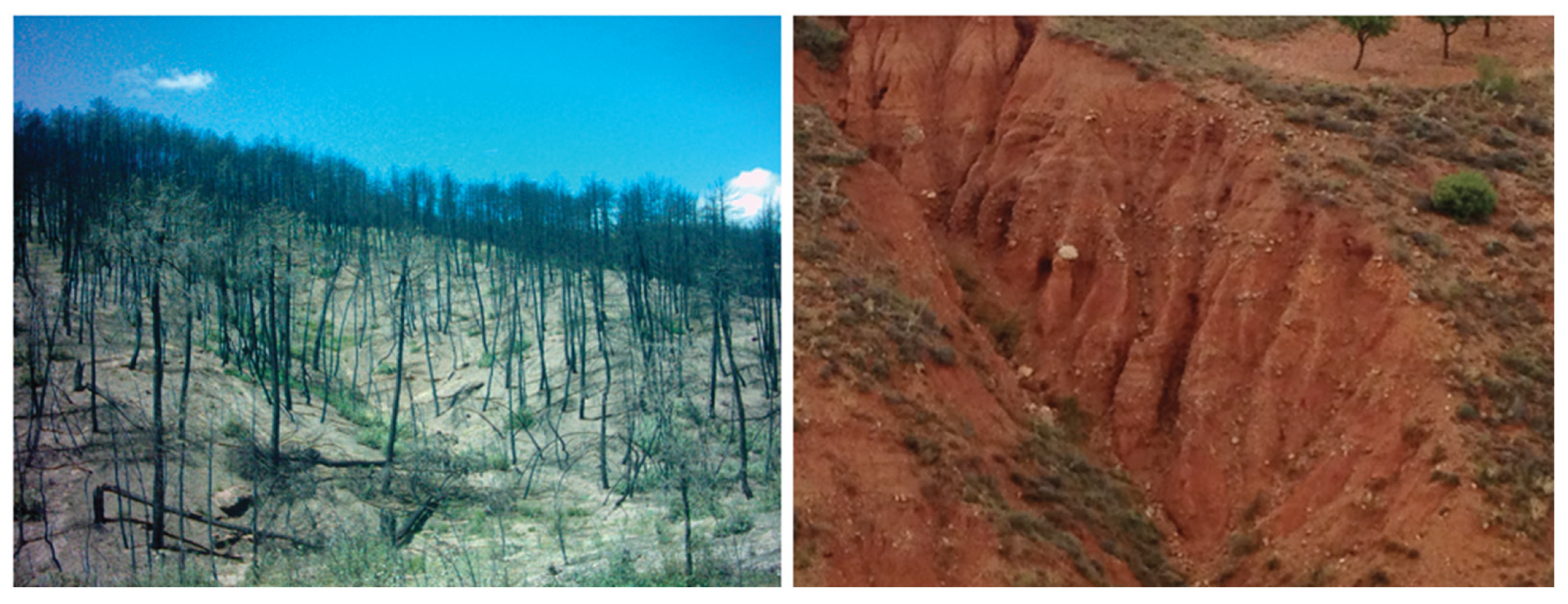
Figure 3.
Diagram illustrating the anthropic evolution of vegetation in the study area (modified from [75]). The native, dense holm oak forest can be cleared due to livestock grazing, potentially resulting in a treeless state. This grassland may transition into scrubland/shrubland if grazing is abandoned. Both grassland and shrubland can be afforested. Concurrently with the vegetation change, alterations in soil properties occur. Abbreviations: fC: Steady state infiltration rate; Ep: Effective porosity; OM: Organic matter; MFI: Macrofertility index; SB: Sum of bases.
Figure 3.
Diagram illustrating the anthropic evolution of vegetation in the study area (modified from [75]). The native, dense holm oak forest can be cleared due to livestock grazing, potentially resulting in a treeless state. This grassland may transition into scrubland/shrubland if grazing is abandoned. Both grassland and shrubland can be afforested. Concurrently with the vegetation change, alterations in soil properties occur. Abbreviations: fC: Steady state infiltration rate; Ep: Effective porosity; OM: Organic matter; MFI: Macrofertility index; SB: Sum of bases.
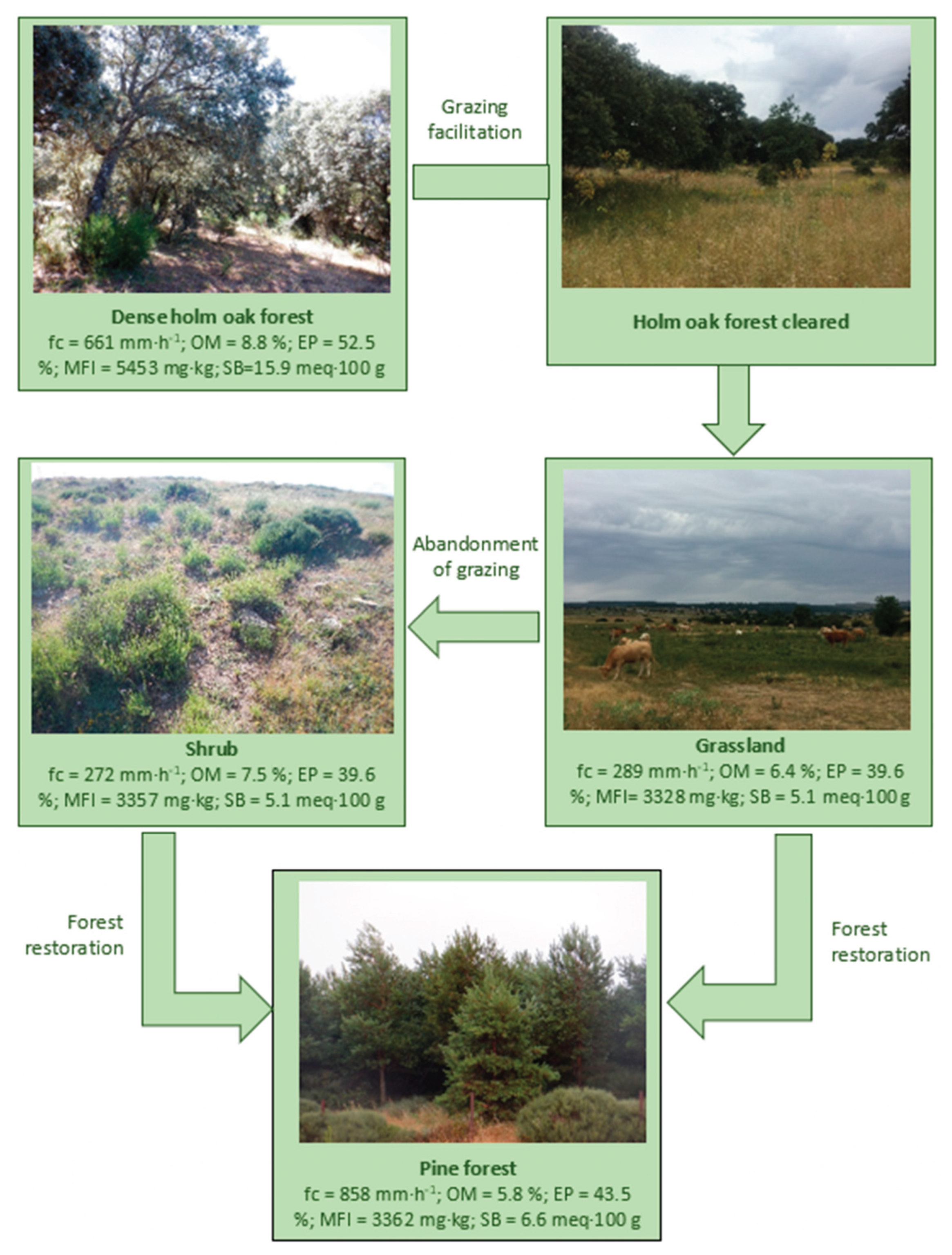
Figure 4.
Infiltration curves for different vegetation types present in the Corneja River Basin case study (Central Spain). Adapted from Mongil-Manso et al. (2021) [69].
Figure 4.
Infiltration curves for different vegetation types present in the Corneja River Basin case study (Central Spain). Adapted from Mongil-Manso et al. (2021) [69].
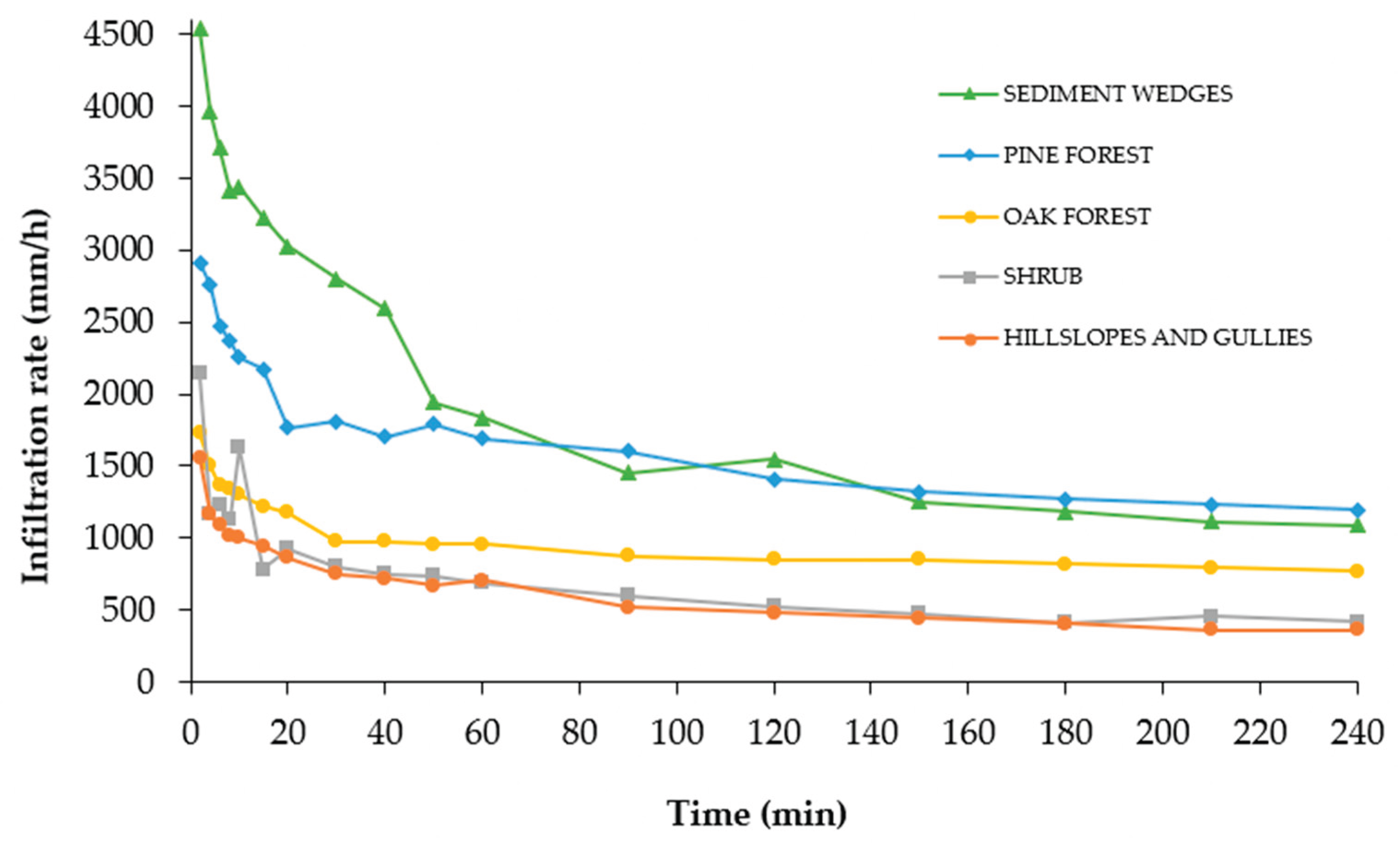
Figure 5.
Comparative images of the case studies. Short-term forest restoration in a Mediterranean mountain (Central Spain): (a) Shrubland, (b) Forest restoration. Medium-term forest and hydrologic restoration in the Corneja River watershed (Central Spain): (c) Deforested terrain in 1964 (Duero Hydrographic Confederation Archive), (d) Forest restoration, current status. Long-term forest and hydrological restoration (Northern Spain): (e) Badlands in 1930 (Duero Hydrographic Confederation Archive), (f) Forest restoration, current status.
Figure 5.
Comparative images of the case studies. Short-term forest restoration in a Mediterranean mountain (Central Spain): (a) Shrubland, (b) Forest restoration. Medium-term forest and hydrologic restoration in the Corneja River watershed (Central Spain): (c) Deforested terrain in 1964 (Duero Hydrographic Confederation Archive), (d) Forest restoration, current status. Long-term forest and hydrological restoration (Northern Spain): (e) Badlands in 1930 (Duero Hydrographic Confederation Archive), (f) Forest restoration, current status.
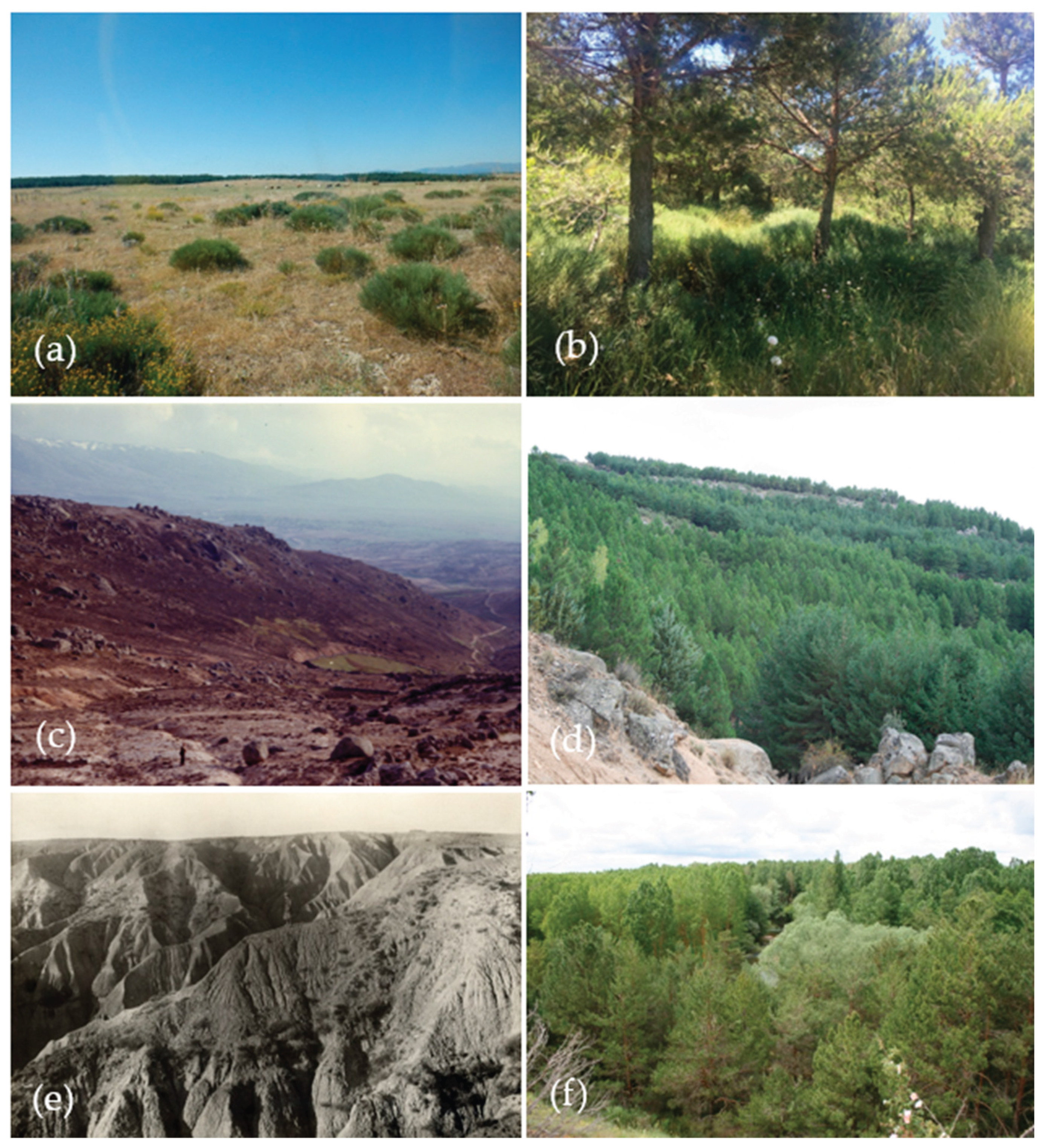
Table 2.
Comparison of edaphic parameters across different forest restoration projects at short, medium, and long-term. The data were sourced from [69,75,85,89].
| Variables | Short-term Navalperal [75] |
Medium-term Corneja River basin [69,89] |
Long-term Saldaña [85] |
|||
|---|---|---|---|---|---|---|
| Forest restoration |
Grassland | Forest restoration |
Gullies and hillslopes | Forest restoration |
Bare slopes |
|
| fc (mm·h−1) | 858 | 289 | 2915 | 1560 | 138.9 | 3.2 |
| OM (%) | 5.79 | 6.43 | 0.64 | 0.34 | 1.11 | 0.03 |
| P (mg·kg−1) | 8.35 | 18.20 | 15.71 | 8.13 | - | - |
| K (mg·kg−1) | 242.78 | 284.00 | 115.22 | 41.67 | - | - |
| Ca (meq·100g−1) | 2.67 | 3.85 | 6.18 | 8.77 | - | - |
| Mg (meq·100g−1) | 1.10 | 0.93 | 1.26 | 2.64 | - | - |
| Na (meq·100g−1)[69,75,85,89 | 0.63 | 0.01 | 0.14 | 0.19 | 0.14 | 0.31 |
| N (%) | 0.24 | 0.31 | 0.04 | 0.03 | - | - |
fc=Steady state infiltration rate; OM (organic matter).
Disclaimer/Publisher’s Note: The statements, opinions and data contained in all publications are solely those of the individual author(s) and contributor(s) and not of MDPI and/or the editor(s). MDPI and/or the editor(s) disclaim responsibility for any injury to people or property resulting from any ideas, methods, instructions or products referred to in the content. |
© 2026 by the authors. Licensee MDPI, Basel, Switzerland. This article is an open access article distributed under the terms and conditions of the Creative Commons Attribution (CC BY) license (http://creativecommons.org/licenses/by/4.0/).
Copyright: This open access article is published under a Creative Commons CC BY 4.0 license, which permit the free download, distribution, and reuse, provided that the author and preprint are cited in any reuse.


