

Submitted:
26 February 2026
Posted:
02 March 2026
You are already at the latest version
Abstract
Military veterans returning from combat frequently struggle with psycho-spiritual or psychological wounds that resist conventional clinical approaches. This paper argues for an interdisciplinary methodology that integrates Jungian depth psychology, comparative mythology, and narrative therapy to support veteran healing and meaning-making. Drawing on the work of Carl Jung, Joseph Campbell, J.R.R. Tolkien, Marie-Louise von Franz, and contemporary authors and mythologists, this synthesis demonstrates how fairy tales and mythological narratives provide archetypal maps for the individuation journey that veterans undertake. It suggests that archetypal characters and patterns within traditional tales mirror the veteran's psychological journey from wounding to wholeness. For example, J.R.R. Tolkien’s narratives of loss, abandonment, and hope offer meaningful interpretive lens for finding meaning from grief and trauma for veterans. Also, Joseph Campbell’s mythic structure, and current research on responses to veterans suffering and loss, show how stories can provide pathways toward recovery, communal support, and renewed purpose. By integrating narrative reflection with evidence‑based insights, mythic stories and fairy tales offer veterans and clinicians symbolic language for understanding their experiences of trauma, moral injury, descent into darkness, and the return to civilian life. For those working with veterans, fairy tales provide culturally-informed therapeutic tools that honour both individual psychological needs and universal human patterns. The paper offers some practical frameworks for spiritual and mental health caregivers, enabling them to facilitate veterans' re-storying of traumatic experience into integrated narratives of transformation and renewed purpose. The paper concludes noting limitations and proposing future research including examining mythic structures beyond Western clinical paradigms.
Keywords:
veterans
; fairy tales
; mythology
; positive psychology
; self-compassion
; Carl Jung
; J. R. R. Tolkien
; Joseph Campbell
; Marie-Louise von Franz
; psycho-spirituality
Introduction
When military veterans return from deployment, they often carry wounds that exceed the diagnostic categories available in contemporary mental health frameworks. Terms such as post-traumatic stress disorder (PTSD), moral injury, and traumatic brain injury capture important dimensions of suffering but may not fully address deeper existential and spiritual crises which combat can engender (Shay, 1994, 2002; Tick, 2005). Many veterans describe feeling “stuck between worlds,” unable to return to civilian life yet no longer belonging to the military community (Demers, 2011). They speak of disillusionment, shattered moral frameworks, and memories that resist integration into coherent life narratives (Litz et al., 2009).
This paper proposes that such struggles reflect not merely clinical pathology but a rupture in the inner meaning, symbolic and narrative structures through which human beings make sense of their lives (Herman, 1992). Traditional societies recognized the profound psychological and spiritual changes produced by combat and developed rituals of purification, reintegration, and symbolic transformation to support returning warriors (van Gennep, 1960; Turner, 1969). Contemporary Western culture offers no equivalent processes, leaving veterans to navigate this liminal territory without adequate symbolic or communal resources (Tick, 2005).
The Case for Interdisciplinary Integration
Addressing military veterans’ complex psychological and psycho-spiritual needs requires moving beyond single-discipline approaches toward genuine interdisciplinary integration. This paper draws on depth psychology, comparative mythology, anthropology, narrative therapy, positive psychology, and spiritual care to construct a comprehensive framework for understanding and supporting veteran healing. Three interconnected domains inform this synthesis.
Depth Psychology, Comparative Mythology and Archetypal Theory
Carl Jung’s analytical psychology offers crucial insights into how the psyche responds to overwhelming experience through archetypal patterns (Jung, 1959, 1968). Jung understood trauma not only as damage but as a potential catalyst for psychological and spiritual transformation through individuation (Jung, 1966). Concepts such as the shadow, descent into the unconscious, and integration of split-off aspects of personality provide veterans with a framework for understanding inner turmoil in non-judgmental ways as meaningful rather than merely pathological. Marie-Louise von Franz’s work on fairy-tale interpretation further demonstrates how ancient stories map archetypal processes and provide symbolic templates for navigating life transitions and integrating difficult experiences (von Franz, 1970, 1972, 1993).
Joseph Campbell’s comparative study of world mythology revealed recurring patterns in hero narratives such as the call to adventure, ordeal, descent, and transformative return (Campbell, 1949). His monomyth offers veterans a universal narrative structure that honours their experience while situating it within humanity’s oldest transformation stories. J. R. R. Tolkien’s work on fairy tales (Tolkien, 1947), and his literary embodiment of these principles in The Lord of the Rings (1954–1955), illuminate how myth and fantasy address fundamental human needs for eucatastrophe (a sudden joyous turn), healing and consolation that enables renewed engagement with reality.
Positive psychology
Self-compassion, as a vital positive psychological and self-caring action, appears deeply embedded in the mythic structures described by Joseph Campbell and embodied in Tolkien’s narratives, which could offer traumatized veterans’ symbolic resources for healing. Campbell’s (2008) hero’s journey frames suffering not as personal failure but as an expected stage of descent, ordeal, and return, where compassion toward one’s own wounds becomes essential for transformation. Tolkien’s characters repeatedly enact this dynamic: Frodo’s burdened journey and Aragorn’s reluctant kingship both illustrate the “wounded healer” archetype, in which strength emerges through vulnerability, humility, and the acceptance of one’s limitations (Tolkien, 1999).
However, a preliminary literature search produced no recent research that integrates myth, fairy tale and self-compassion in a military veteran-focused therapeutic framework. There is also a dearth of research that applies self-kindness and healing-related archetypal narratives to moral injury and combat trauma. This does not mean that self-compassion is not a potential bridge for veterans between trauma and transformation. It does, however, serve as one key motivation for this paper.
Contemporary research shows that self-compassion reduces shame, moral injury distress, and PTSD symptoms among veterans (Dira & Kassam, 2024; Hiraoka et al., 2022), suggesting that mythic narratives may strengthen therapeutic outcomes by offering symbolic structures that normalize suffering and support re-storying. This paper is motivated by the possibility that when combined, Neff’s (2023) model of self-compassion and these mythological frameworks provide veterans with a narrative posture that reframes wounds not as failures but as meaningful elements of the human journey toward integration and renewed purpose.
However, the fantastical worlds created by writers such as J.R.R. Tolkien offer more than escapism. They can serve as profound vehicles for cultivating self-compassion in veterans. Tolkien’s narratives, with their emphasis on flawed heroes undertaking impossible journeys, mirror the internal struggles veterans face when faced with hardship and suffering. The hobbits’ journey through Middle-earth, fraught with self-doubt yet sustained by fellowship and mercy, resonates with self-compassion: treating oneself with kindness during failure, recognizing suffering as part of shared human experience, and maintaining balanced awareness of difficult emotions rather than over-identification.
Anthropology and Cultural Wisdom
Anthropological research shows that traditional societies developed sophisticated ritual technologies for managing warrior trauma. Van Gennep’s (1960) three-stage model of rites of passage i.e. separation, liminality, reintegration, and Turner’s (1969) elaboration of liminal states help explain why veterans struggle in societies lacking structured return rituals. Contemporary work in narrative medicine (Charon, 2006) and re-storying approaches (White & Epston, 1990) demonstrates how reconstructing fragmented narratives into coherent life stories supports psychological healing and identity reconstruction.
Why These Foundational Thinkers Matter
A twenty-first-century scholar examining veteran healing through myth and fairy tale must engage Jung, von Franz, Campbell, and Tolkien not out of nostalgia but because they established the conceptual architecture that makes such interdisciplinary work coherent and therapeutically viable. Jung’s premise, that the psyche responds to overwhelming experience through archetypal patterns, has been repeatedly validated by contemporary neuroscience on trauma’s impact on narrative processing and meaning-making.
Von Franz remains unmatched in demonstrating how fairy tales function as psychological maps, providing methodological rigor for interpretive work that later narrative therapists have extended. Campbell’s comparative methodology revealed cross-cultural narrative patterns that remain empirically observable, offering veterans a universal framework for understanding their experience. Tolkien’s contributions on eucatastrophe and sub-creation articulate why myth meets psychological needs that realist therapeutic discourse cannot address.
To exclude these foundational theorists would be like omitting Freud from discussions of the unconscious, not because his work is uncontested, but because they established interpretive categories upon which subsequent scholarship depends. Contemporary trauma theory, narrative medicine, and cultural psychology build upon rather than supersede such foundations, making engagement with these seminal thinkers a necessity for any serious interdisciplinary synthesis.
Aim and Focus
This paper argues that engaging the work of key mythic and fairy-tale theorists offers veterans and clinicians, a powerful and under-utilized pathway for meaning-making, self-compassion, restoration of hope, and psychological and psycho-spiritual healing. Veterans’ descriptions of feeling “stuck between worlds” echo archetypal motifs of descent, threshold crossing, and the struggle to return. Myth and fairy tale provide symbolic frameworks that speak directly to these dimensions of combat experience in ways conventional diagnostic language may not.
This paper proposes that veterans’ suffering can be understood not merely as pathology but as participation in a universal narrative of transformation. Motifs such as the shadow, woundedness, compassion, the perilous journey, and hope validate veterans’ experiences as meaningful rather than aberrant. These stories supply what contemporary Western culture often lacks: structured pathways for purification, transformation, and reintegration once offered through traditional warrior rituals.
By integrating psychological, psycho-spiritual, mythological, and narrative perspectives, this paper positions fairy tales and mythic narratives as therapeutic resources that help veterans reconstruct fragmented identities, locate universal patterns within personal suffering, and access culturally informed wisdom for navigating profound change. This interdisciplinary approach honours both the clinical realities of trauma and the deeper existential crisis of shattered meaning.
Method
This paper employs qualitative synthesis to integrate insights from depth psychology, comparative mythology, narrative therapy, and spiritual care (Noblit & Hare, 1988; Sandelowski & Barroso, 2007). Unlike systematic reviews or meta-analysis, qualitative synthesis constructs interpretive frameworks by bringing diverse perspectives into dialogue rather than statistically aggregating findings (Dixon-Woods et al., 2005). This approach assumes that complex human phenomena such as veteran healing require integrative engagement in psychological and psycho-spiritual paradigms. So, the methodology is grounded in interpretive traditions that emphasize circular, iterative understanding (Gadamer, 1975). Rather than testing hypotheses, interpretive synthesis deepens comprehension by moving between parts and wholes, individual cases, broader patterns, constructs and lived experience (Ricoeur, 1970). This makes it well suited to depth psychological and mythological material, which resists reduction and requires sustained, often eclectic interpretation (Romanyshyn, 2007).
Literature was purposively sampled for theoretical and practical relevance across three domains. First, primary texts were analyzed iteratively to identify convergent themes, complementary insights, and productive tensions. Second, archetypal patterns were mapped onto veteran experience through comparison of psychological, mythological, and clinical literature. Third, myths and fairy tales featuring wounded heroes, descents, helpers, trials, transformation, and return were selected for their relevance to veteran healing. Overall, the synthesis seeks to build bridges between themes and patterns. For example, Jung’s motifs of shadow and individuation can dialogue with Campbell’s hero’s journey and contemporary accounts of post-traumatic growth, illustrating how multiple frameworks illuminate different facets of veteran experience (Tedeschi & Calhoun, 2004).
Literature review
Myths and fairy tales possess profound psychological and symbolic depth that renders them uniquely suited to support veteran healing. This literature review explores how key theorists such as Carl Jung, Marie-Louise von Franz, Joseph Campbell, and J.R.R. Tolkien illuminate the therapeutic potential of fairy tales for those navigating trauma, moral injury, and reintegration. Drawing from analytical psychology, archetypal theory, comparative mythology, and literary theology, these frameworks reveal how symbolic narratives of descent, trial, and transformation mirror the veteran’s journey. Jung’s concepts of archetypes, individuation, and the wounded healer provide foundational insight into the psyche’s capacity for integration through symbolic storytelling. Von Franz demonstrates how fairy tales express collective unconscious processes and offer archetypal maps for psychological development. Campbell’s monomyth reveals the structure of heroic experience, resonating with the arc of military service and the challenges of return. Tolkien’s eucatastrophe idea affirms the redemptive power of fairy-stories to offer hope, recovery, and symbolic resolution.
Carl Jung: Archetypes, Individuation, and the Wounded Healer
Carl Jung’s analytical psychology provides foundational concepts for understanding how fairy tales facilitate psychological healing. Jung (1959, 1968) proposed that the human psyche contains a collective unconscious—a deeper layer containing universal patterns and images he termed archetypes. These manifest across cultures in myths, fairy tales, religious symbolism, and dreams, representing fundamental structures of human psychological experience.
Jung’s concept of individuation i.e. the lifelong process of psychological development toward wholeness, is central to veteran healing (Jung, 1966). Individuation requires integrating split-off aspects of personality, particularly the shadow: those qualities and experiences the ego finds unacceptable. Combat generates intense shadow material. This can include acts of violence, moral transgressions and unbearable losses. Some veterans return carrying shadow material they cannot acknowledge or integrate, leading to internal fragmentation and suffering (Shay, 1994).
Fairy tales dramatize the individuation journey through symbolic narratives of descent, trial, transformation, and return. The hero who ventures into dark forests, battles monsters, and undergoes ordeals represents the ego confronting unconscious material (Jung, 1968). Helper figures symbolize resources within the psyche that support development.
Jung’s archetype of the wounded healer holds special significance for veterans (Jung, 1966). This archetype suggests that healing wisdom emerges from one’s own wounding. One who has descended into darkness and returned carries unique capacity to guide others through similar journeys. Veterans, having experienced profound wounding and potential transformation, may discover vocation as healers for others struggling with trauma, moral injury, or existential crisis (Tick, 2005).
This represents not merely coping with suffering but transforming it into purpose and meaning which is a fundamentally psycho-spiritual process. Fairy tales frequently feature protagonists who must be wounded, undergo trials, and emerge transformed before they can fulfill their destinies, mirroring this archetypal pattern of meaning-making through suffering.
Marie-Louise von Franz: The Psychological Interpretation of Fairy Tales
Marie-Louise von Franz, Jung’s collaborator, developed systematic methods for psychological interpretation of fairy tales. Her writings demonstrate how fairy tales provide ‘the purest and simplest expression of collective unconscious psychic processes’ and offer unparalleled insight into archetypal patterns of psychological development (von Franz, 1970, p. 1). Specifically, Von Franz (1972, 1993, 1996) argues that fairy tales address essential archetypal needs across the lifespan. This is the deep, universal psychological patterns that shape human development. For veterans, certain tale types prove particularly relevant: stories of the returning warrior, tales of descent into the underworld, narratives of cursed figures seeking disenchantment, and stories of restoration and healing after devastating loss.
Tales provide symbolic containers for unbearable affect. They create spaces where traumatic material can be held, examined, and gradually integrated without overwhelming the person (von Franz, 1996). This offers veterans distance through symbolism while maintaining emotional resonance, enabling engagement with overwhelming experiences through archetypes rather than raw personal memory.
Crucially, fairy tales model self-compassion through their treatment of the wounded protagonist. Unlike clinical diagnoses that may pathologize suffering, fairy tales normalize struggle as part of the hero’s journey. The protagonist’s wounds, failures, and dark moments are not aberrations but necessary elements of transformation. This narrative structure invites veterans to extend compassion toward themselves and view their struggles not as personal failings but as participation in timeless patterns of human experience. Von Franz (1972) notes that fairy tales consistently show that transformation requires descent, suffering precedes integration, and wholeness emerges through accepting rather than rejecting one’s wounded parts. This archetypal permission for self-compassion proves therapeutically powerful for veterans carrying shame or self-blame.
Joseph Campbell: The Hero’s Journey and Threshold Crossing
Joseph Campbell’s comparative mythology reveals universal patterns in hero narratives across cultures. His monomyth which is about the call to adventure, threshold crossing, ordeal, descent, and transformative return offers veterans a framework for understanding their experience (Campbell, 1949). One can map military service maps onto Campbell’s structure: departure from civilian life (separation), intense training and deployment (initiation), combat experience (ordeal), and attempted return to civilian society. Combat represents psychological descent into dark territories. The challenge veterans face is completing the return journey and reintegrating into civilian community while bringing back hard-won wisdom (Campbell, 1988).
Campbell (1968) emphasizes that the hero’s return may prove more difficult than the outward journey. The hero returns bearing gifts such as knowledge, healing power, spiritual insight, yet often finds the ordinary world cannot receive or understand what has been gained. Veterans frequently report this experience: they return transformed by ordeals their communities cannot fathom, carrying insights and moral knowledge that civilian life ignores or minimizes (Demers, 2011).
Campbell’s concept of ‘supernatural aid’ which is the appearance of helpers and guides at critical moments—resonates throughout Tolkien’s work and offers profound comfort: help often comes from unexpected sources when we are most vulnerable (Campbell, 1949, p. 73). This recognition can cultivate self-compassion in veterans who may feel they failed by needing assistance or support.
Campbell (1949) also describes ‘the refusal of the return. Some heroes, having touched transcendent or extreme experience, resist returning to ordinary reality. Veterans may experience this as inability to engage civilian life, longing for the intensity of deployment, or feeling fundamentally alienated from conventional society (Tick, 2014). Recognizing this pattern helps frame such struggles as archetypal rather than merely pathological, offering a meaning-framework that validates the veteran’s experience while pointing toward potential resolution. The monomyth suggests that successful return requires the hero to find ways to share their hard-won wisdom with the community, transforming private suffering into communal gift which is a profoundly meaningful psycho-spiritual achievement.
J.R.R. Tolkien: Fairy-Stories, Eucatastrophe, and Hope
J.R.R. Tolkien’s essay ‘On Fairy-Stories’ (1947) provides a theoretical foundations for understanding why fairy tales offer unique therapeutic potential. Tolkien argues that fairy tales serve essential human needs that other narrative forms may not fully address: recovery, escape, and consolation.
Recovery means regaining clear vision or seeing the world freshly rather than through the dulling filter of habit and familiarity (Tolkien, 1947).
Trauma destroys ordinary perception, leaving veterans unable to trust previous frameworks of meaning (Herman, 1992). Fairy tales, through their deliberate departure from realism into fantasy, enable recovery of wonder and renewed perception. By acknowledging the shocking, marvellous, and terrible, fairy tales validate veterans’ experiences of having encountered realities that exceed normal categories.
Escape represents legitimate need to step back from immediate circumstances to gain perspective. Tolkien (1947) distinguishes the escape of the prisoner (legitimate, necessary) from the flight of the deserter (abandonment of responsibility). Veterans, imprisoned by traumatic memories and constrained by misunderstanding, require legitimate escape into imaginative space where experiences can be processed symbolically.
Significantly, Tolkien (1947) introduces eucatastrophe. This is the sudden joyous turn, the unexpected happy ending that provides ‘a fleeting glimpse of Joy, Joy beyond the walls of the world, poignant as grief’ (p. 68). This element reflects the human need for hope and the possibility of unmerited grace and unexpected redemption or rescue. For veterans carrying moral injuries, guilt, or despair, eucatastrophe offers symbolic possibility that transformation and restoration remain possible even from darkest circumstances (Litz et al., 2009).
This concept operates at the intersection of psychology and spirituality, suggesting that healing involves not merely symptom reduction but restoration of hope, meaning, and the capacity to imagine redemptive futures. Tolkien’s deeply spiritual understanding of fairy tales positions them as vehicles not just for psychological integration but for reconnection with transcendent sources of meaning and purpose.
Tolkien’s literary work, particularly The Lord of the Rings (1954-1955), embodies these principles while offering profound meditations on warrior experience, moral injury, and the possibility of healing. Frodo’s inability to fully return after destroying the Ring and the ultimate departure to the Undying Lands provide veterans with powerful symbolic resources for understanding struggles with return and reintegration (Birzer, 2014).
Tolkien’s narratives of loss, abandonment, and hard-won hope offer a distinctive lens for understanding contemporary experiences of grief and trauma. His legendarium, shaped by personal bereavement and the devastations of war, provides a mythic grammar for exploring how individuals navigate suffering, meaning-making, and the slow work of healing. Most protagonists in The Lord of the Rings lost one or both parents during childhood—Frodo, Aragorn, Faramir, Boromir, Éowyn, and Éomer all experienced devastating early losses. Yet the story shows how hope persists even in darkness, wounds can be acknowledged, and community sustains us.
Aragorn embodies hope and his name means “hope” (Estel in Elvish). His healing powers represent how hope restores life to those stricken by despair. The contrast between Théoden, who chooses hope despite his despair, and Denethor, who surrenders to despair, demonstrates that veterans retain agency even in their darkest moments. This insistence on choice, even amid overwhelming suffering, can help veterans to cultivate self-compassion rather than self-condemnation.
Éowyn’s journey is particularly moving: a shieldmaiden driven by despair who awakens from near-death with suicidal despair, seeking only death in battle. Through Faramir’s compassionate love and renewed purpose, her winter passes and the sun shines on her. Her story shows the transformative power of connection and purpose, themes that resonate with those who feel isolated or purposeless after experiencing loss or trauma. Significantly, Éowyn’s healing comes not through self-sufficiency but through allowing herself to receive compassion, to be vulnerable, and to accept that her worth is not defined solely by warrior prowess. This models the self-compassionate acceptance of one’s full humanity, including one’s needs and limitations.
Contemporary Scholars: Applied Mythology and Narrative Therapy
Contemporary scholars have extended these foundational insights. Clarissa Pinkola Estés’s Women Who Run With the Wolves (1992) demonstrates how fairy tales address specific psychological wounds and support recovery of lost instinctual knowing. Then, Narrative therapy, developed by Michael White and David Epston (1990), provides clinical frameworks for helping individuals re-story problematic narratives. This approach aligns closely with mythological work, emphasizing that we live within stories and that changing our relationship to our stories changes our lives (White, 2007). For veterans, narrative therapy offers methods for separating identity from problem-saturated stories and constructing preferred futures.
Edward Tick’s (2005, 2014) work on warrior healing explicitly integrates Jungian psychology, mythological frameworks, and veteran care. Tick argues that combat trauma represents a soul wound requiring soul-level healing not merely symptom management but profound transformation of identity and meaning. His therapeutic approach includes myth-making, ritual, and connection to traditions of warrior identity across cultures.
Tick emphasizes that healing requires addressing not just psychological symptoms but the deeper spiritual and moral injuries that combat inflicts. This psycho-spiritual approach recognizes that veterans’ suffering often involves shattered worldviews, violated moral frameworks, and severed connections to sources of meaning and purpose. Fairy tales and myths, by engaging these spiritual dimensions directly, offer pathways toward restoration that purely symptom-focused interventions cannot provide.
Jonathan Shay’s (1994, 2002) classical studies of combat trauma, drawing explicit parallels between Vietnam veterans and Homeric warriors, demonstrate the timeless nature of warrior psychological wounds. Shay’s work validates using ancient narratives to understand contemporary veteran experience while highlighting the essential role of community in healing. Shay argues that moral injury which includes the betrayal of what’s right by someone in legitimate authority in high-stakes situations, represents a fundamentally moral and spiritual wound that demands moral and spiritual repair. This necessitates approaches that engage veterans’ meaning-making capacities, their need for moral reintegration, and their search for renewed purpose.
Fairy tales, as vehicles for moral and spiritual wisdom across millennia, provide exactly such resources. The literature demonstrates how myths and fairy tales function therapeutically by providing symbolic containers for overwhelming traumatic material, offering archetypal maps that normalize the veteran’s disorienting journey between worlds, and enabling meaning-making through narrative restructuring. These stories speak directly to psycho-spiritual dimensions of combat experience in ways conventional diagnostic language may not, offering veterans pathways toward self-compassion, hope, and wholeness.
Self-compassion
Turning to positive psychology, Neff’s (2003) foundational model of self-compassion which comprises self-kindness, common humanity, and mindful awareness seems to align closely with the mythic and archetypal structures found in Tolkien’s legendarium and in Campbell’s (2008) articulation of the hero’s journey. Neff argues that recognizing suffering as part of the shared human condition reduces isolation and shame, a dynamic that parallels Jung’s (1969) concept of the collective unconscious, where archetypal patterns such as the wounded healer provide symbolic pathways for integrating trauma. So too, Tolkien’s characters, particularly Frodo and Aragorn, embody this archetype through their capacity to carry wounds with humility, accept limitations, and extend compassion to others as narrative expressions of the same psychological processes.
Campbell’s monomyth reinforces this connection by framing the hero’s descent, ordeal, and return as a transformative cycle in which self-acceptance and compassionate insight emerge from suffering rather than in spite of it. Contemporary research with veterans demonstrates that self-compassion reduces PTSD symptoms, moral injury distress, and self-criticism (Dira & Kassam, 2024; Hiraoka et al., 2022), suggesting that mythic narratives may enhance therapeutic work by offering veterans culturally resonant story-forms that normalize suffering and support re-storying. Together, Neff’s psychological model and these mythological frameworks provide a coherent interpretive lens through which veterans can understand their wounds as meaningful elements of a universal human journey toward integration and renewal.
Recent research with veterans shows that self-compassion reduces shame, moral injury distress, and PTSD symptoms (Dira & Kassam, 2024; Hiraoka et al., 2022), suggesting that mythic narratives may strengthen therapeutic outcomes by offering symbolic structures that normalize suffering and support re-storying. When combined, Neff’s model and these mythological frameworks provide veterans with a narrative posture that reframes wounds not as failures but as meaningful elements of a universal human journey toward integration and renewed purpose.
Fairy tales model self-compassion by normalizing struggle, validating suffering as meaningful rather than pathological, and demonstrating that transformation emerges through self-acceptance rather than rejection of one’s wounded parts. They provide meaning-making frameworks that position veterans’ experiences within timeless patterns of human heroism, descent, and return. Through concepts like eucatastrophe, they sustain hope, and a psycho-spiritual conviction that redemption, renewal, and unexpected grace can arise even from the darkest places. For veterans navigating the complex terrain of psychological and spiritual wounds, these ancient stories offer what clinical frameworks alone cannot: a language for the soul’s journey through trauma toward integration and renewed purpose.
Discussion
Myths and fairy tales address profound archetypal needs that emerge across the human lifespan (von Franz, 1996). For veterans, several configurations prove particularly salient. The need to confront and integrate shadow material which includes the dark aspects of human nature revealed in combat, appears in tales of heroes battling dragons or wicked sorcerers. These adversaries represent not just external threats but projections of the hero’s own destructive capacities and moral complexities (Jung, 1959). With pastoral compassion, caregivers can help veterans recognize that encountering their shadow is not evidence of moral failure but a necessary step toward wholeness. They can also teach self-compassion to the veteran.
Self-compassion is crucial because, like fairytale characters, veterans often return from deployment carrying unbearable knowledge of what humans can do and what they themselves have done. Fairy tales offer a symbolic language for this darkness that neither minimizes its reality nor condemns those who have witnessed or participated in it. The hero who slays the dragon does not become evil for wielding a sword; rather, the tale acknowledges that confronting evil requires entering its territory and emerging transformed but not destroyed.
The archetype of descent and return appear in countless fairy tales: Inanna’s descent to the underworld, Orpheus seeking Eurydice, Persephone’s seasonal journey between worlds (Perera, 1981). These narratives can speak to veterans’ experiences of descending into psychological underworlds through combat trauma, moral injury, or post-deployment depression, and the arduous journey back toward life and light. Crucially, these tales acknowledge that descent transforms the traveler; return does not mean restoration to pre-descent innocence but rather integration of underworld knowledge into expanded consciousness (Hillman, 1979). This archetypal truth offers veterans self-compassion: they need not be who they were before, only who they are becoming.
Veterans have undergone profound ordeals that can, in archetypal logic, result in transformation and new capacities. When society fails to recognize this transformation or does not provide a pathway for applying hard-won wisdom, veterans experience deep frustration and alienation (Tick, 2014). Fairy tales validate the expectation that suffering should yield growth while modeling how transformation unfolds through symbolic death and rebirth—a pastoral recognition that honors the veteran’s journey.
Archetypal Characters and the Individuation Process
Understanding archetypal characters within fairy tales enables veterans and caregivers to recognize parallel figures in psychological journeys. The protagonist represents the ego or conscious personality navigating challenges (von Franz, 1996). For veterans, recognizing themselves as protagonists in ongoing heroic journeys (rather than damaged victims) supports self-kindly choice, agency and meaning-making creating a fundamentally self-compassionate reframing.
Helper figures such as wise old men or women, fairy godmothers, magical animals, loyal companions, represent inner resources and external supports (Jung, 1968). In veteran care, identifying helping figures means recognizing both internal capacities (resilience, moral courage, loyalty) and external supports (fellow veterans, therapists, chaplains, compassionate communities). Myths and fairy tales teach that heroes cannot succeed alone; accepting help represents wisdom rather than weakness (Campbell, 1949). This pastoral truth invites veterans to extend compassion toward themselves by acknowledging their need for support.
This recognition proves particularly vital in military culture, which often valorizes self-sufficiency and stoicism. A veteran struggling to ask for help may find permission in fairy tale wisdom: even the mightiest heroes such as Odysseus, Frodo, the boy in Iron John, required guides, companions, and supernatural aid to complete their journeys. The chaplain or therapist can gently point to these archetypal patterns, normalizing the veteran’s need for assistance not as weakness but as participation in the universal pattern of heroic transformation. Sam’s presence does not diminish Frodo’s heroism; rather, Sam’s faithful companionship makes Frodo’s journey possible. This reframing supports self-compassion by repositioning vulnerability as inner strength and interdependence as wisdom.
Adversaries and obstacles symbolize both external challenges and internal resistances (von Franz, 1980). The dragon hoarding gold may represent trauma symptoms jealously guarding access to emotional life. The wicked stepmother might symbolize harsh inner critic voices demanding perfection. Understanding adversaries symbolically helps veterans recognize that ‘enemies’ often point toward aspects of self, requiring kindly inner attention and integration (Jung, 1959). This self-compassionate perspective transforms self-condemnation into curious self-kindly exploration.
Threshold guardians such as figures who test whether heroes are ready to proceed, appear at critical junctures (Campbell, 1949). For veterans, these might manifest as challenges that must be met before moving forward: confronting specific memories, making amends, or developing new capacities. Recognizing these figures helps frame obstacles as meaningful tests rather than arbitrary suffering, supporting both meaning-making and calling the veteran develop self-compassion.
Teaching the Art of Meaningful Translation
For chaplains and psychologists to employ myths and fairy tales effectively with veterans, they must develop interpretive competence. This is the art of meaningful translation between symbolic narrative and lived experience. This requires several capacities grounded in pastoral care:
- Symbolic Literacy. Caregivers develop symbolic thinking, recognising that myth and fairy tale elements operate on multiple levels simultaneously (von Franz, 1996). A forest may represent the unconscious, the unknown, or wilderness. Water might symbolize the unconscious, emotion, or purification (Jung, 1968). This literacy enables caregivers to help veterans discover personal meanings within universal symbols.
- Cultural Sensitivity. Different cultural traditions express archetypal patterns through distinct symbols and values. Caregivers must recognize universal patterns while honouring culturally-specific expressions, ensuring veterans from diverse backgrounds find tales that speak to their heritage and lived experience (Sue & Sue, 2016).
- Amplification Skills. Von Franz (1996) teaches amplification which enriches understanding by gathering multiple variations of tale elements and tracing motifs across cultures. When a veteran resonates with a particular symbol, caregivers can deepen appreciation of its archetypal significance, supporting meaning-making through expanded symbolic awareness.
- Personal Engagement. Effective fairy tale work requires caregivers to engage tales personally (von Franz, 1993). Caregivers must know their own shadow material and how veterans’ stories activate their own psychological material (Kalsched, 1996).
- Timing and Readiness. Caregivers must develop sensitivity to which tales match veterans’ context, culture, and psychological positions (von Franz, 1972). A veteran in acute crisis may need tales of protection and survival and one engaged in meaning-making might benefit from transformation narratives. This requires judgment and deep compassion.
In The Lord of the Rings, Frodo receives aid from unlikely sources: Tom Bombadil, the Elves, Aragorn, and ultimately Gollum, whose obsession paradoxically enables the Ring’s destruction. Sam Gamgee, a simple gardener, becomes the steadfast companion who carries Frodo when he can no longer walk (Tolkien, 1954-1955). These examples illustrate Campbell’s principle that help arrives unbidden at the darkest hour can offer veterans hope that support can come from unexpected quarters.
Self-Compassion and the Wounded Hero
Tolkien’s said that his heroes remained permanently marked by their ordeals. This can validats veterans’ experience that some wounds don’t heal in conventional ways, while simultaneously modelling self-compassion rather than self-blame (Shippey, 2001). Frodo cannot find peace in the Shire and must sail to the Undying Lands (also called The Blessed Realm). This is an acknowledgment that some can never fully return. This mythic framework recognizes suffering as inherent to transformative experience rather than as personal failure, creating space for veterans to reframe their struggles within the shared human experience of bearing unbearable things.
This acknowledgment of permanent wounding can offer profound relief. Veterans need not achieve “recovery” defined as return to pre-deployment functioning. Instead, the fairy tale wisdom suggests that transformation, not restoration, is the true goal. The caterpillar does not return to being a caterpillar after becoming a butterfly; it integrates its previous form into a new being. Similarly, veterans integrate their combat experiences into expanded identities that honor both who they were and who they have become. This reframing from “broken and needing repair” to “transformed and still becoming” cultivates self-compassion by removing the implied failure in ongoing struggle.
Myths and fairy tales offer veterans language for moral complexity that avoids the binary narratives of hero versus coward which can intensify self-condemnation (Campbell, 1949). The archetypal pattern Campbell identifies, being about departure, initiation, and return, mirrors the veteran’s journey while acknowledging that return does not mean avoiding what occurred. It invites self-compassion: veterans need not become who they were, only integrate who they have become.
Both Gollum, a shadow adversary, in The Lord of the Rings, who has lost all respect for others and his own self-compassion exists in perpetual self-loathing. This serves as cautionary shadow to Frodo’s struggle to maintain kindness toward himself despite bearing an unbearable burden. The Ring itself might be understood as metaphor for harsh self-judgment that grows heavier the more we identify with perceived failures, while Sam’s unwavering support models the voice of self-compassion veterans can cultivate (Tolkien, 1954-1955). This offers veterans a pathway from self-condemnation to self-kindness.
The caregiver can help veterans recognize which voice they are listening to: the Gollum-voice of self-loathing and obsessive guilt, or the Sam-voice of steadfast loyalty even in darkness. Both voices emerge from the veteran’s psyche, but only one leads toward healing. Fairy tales model this inner dialogue explicitly, giving veterans permission to acknowledge the harsh ‘inner critic’ while choosing to strengthen the compassionate inner companion. This is not denial of wrong; it is the spiritual work of extending to oneself the same mercy one would offer a friend carrying an impossible burden.
Recognizing Cultural Patterns of the Inner Heart
By working with tales from various traditions, caregivers learn to recognize different patterns of the inner psyche shaped by diverse cultural systems. This cultural-archetypal competence proves essential for effective pastoral veteran care. Germanic fairy tales often emphasize individual heroism and overcoming adversity through personal strength (Tatar, 1987). Asian folktales frequently emphasize filial piety, collective harmony, and transformation through acceptance rather than conquest. Developing this cultural-archetypal awareness enables caregivers to select and interpret tales that honour veterans’ cultural backgrounds while accessing universal psychological patterns.
Practical Implementation: Fairy Tale Work in Veteran Care
Implementing fairy tale work with veterans can take multiple forms grounded in compassion:
- Individual Therapy. Therapists can introduce relevant tales, invite veterans to self-compassion, to share associations and resonances, and support active imagination.
- Group Work. Veteran groups can explore tales collectively, sharing diverse interpretations and recognizing common archetypal patterns across individual experiences.
- Ritual and Ceremony. Tales can structure rituals marking transitions such as completion of treatment, anniversaries of deployment or return, commemoration of fallen comrades.
- Creative Expression. Veterans can create their own tales, rewrite traditional stories or express their journeys through artistic engagement with fairy tale themes (McNiff, 1992).
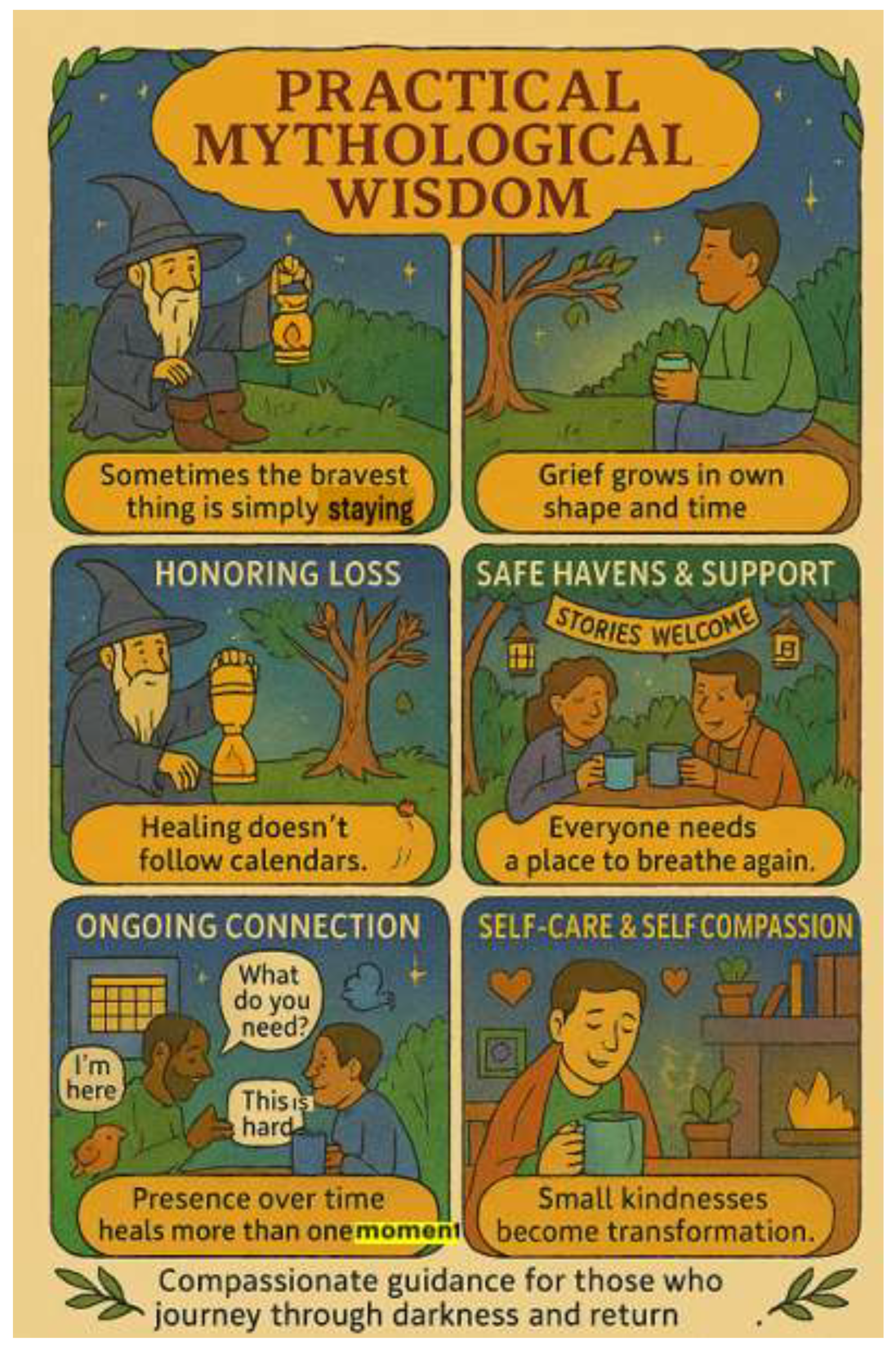
Guided by narrative wisdom and contemporary research, veteran clinicians can implement strategies grounded in compassion. These include:
- Being present and prepared to act tenderly: despite our fears and sense of inadequacy. Like Gandalf’s presence to Frodo in moments of despair, pastoral caregivers offer their steady presence even when they have no ready answers. Sometimes the most healing response is simply staying with veterans in their darkness without rushing to fix or minimize.
- Acknowledge the reality of loss: Like Tolkien’s honest portrayal of permanent wounds, recognize that not all grief resolves quickly. There is no single right way for grief to present itself. Veterans need permission to grieve fully, for fallen comrades, lost innocence, shattered beliefs, and the person that they were before deployment.
- Provide adequate time and flexibility: Organizations should consider flexible work arrangements, reduced hours, or assistance catching up on workload. Healing follows its own timeline, not calendars. Pastoral care recognizes that transformation cannot be rushed.
- Offer unconditional support and professional pathways: Trauma care loss should be central to well-being strategies. Fast access to mental health services without barriers allows veterans to get care when needed. Like the healing houses of Rivendell and Lothlórien in Tolkien’s, organizations can create sanctuaries where veterans find rest and restoration.
- Create conversation spaces: Like the council meetings in Tolkien’s work where characters shared their burdens, create spaces for talking openly about grief. Use compassionate language: “I’m here if you need to talk,” “I know this is hard, what do you need?” Then, shared storytelling builds community and breaks isolation.
- Maintain ongoing communication: Remember that holidays and anniversaries can be especially difficult times. Stay in touch and offer sustained presence, not episodic intervention.
- Support self-care and self-compassion: Encourage tokens of comfort in workspaces and can include favourite photos, teas, blankets. Support participation in activities like yoga or counselling that aid healing (SOCAP Global, 2020). Small rituals of self-compassion accumulate into meaningful transformation.
Limitations and Future Research Directions
This paper presents a theoretical framework requiring empirical validation. The qualitative synthesis methodology, while appropriate for interdisciplinary theory-building, does not demonstrate therapeutic efficacy. Future research should examine veterans’ direct engagement with mythic narratives through qualitative studies and controlled trials measuring outcomes in PTSD, moral injury, and reintegration.
The predominantly Western mythological sources may require cultural adaptation for diverse veteran populations, necessitating cross-cultural investigations of culture-specific tales embodying similar archetypal patterns. Additionally, this approach demands trained facilitators with competence in depth psychology and spiritual care, limiting scalability. Research should also identify which veteran populations benefit most from narrative approaches and when conventional therapeutic modalities should take precedence. Despite these limitations, the framework offers promising avenues for integrating spiritual wisdom with evidence-based veteran care.
Conclusion
This paper has demonstrated how myths and fairy tales offer veterans powerful therapeutic resources by providing archetypal maps for navigating trauma, moral injury, and the challenging return to civilian life. Through the foundational work of Jung, von Franz, Campbell, and Tolkien, integrated with contemporary research on self-compassion and narrative therapy, these ancient stories emerge as vital tools for chaplains and psychologists supporting veteran healing.
The synthesis reveals that fairy tales can address veterans’ needs on multiple levels: they provide symbolic containers for unbearable experiences, normalize suffering as part of heroic transformation, model self-compassion through wounded protagonists who emerge stronger, and can sustain hope. By recognizing themselves within archetypal narratives of descent and return, veterans can reframe their struggles not as pathological damage but as participation in timeless human journeys to wholeness.
The interdisciplinary framework presented here offers a foundation for future work, bridging psychological science, spiritual care, and the ancient wisdom encoded in humanity’s oldest stories. For veterans navigating the complex terrain between psychological wounds and spiritual crises, these narratives offer what clinical frameworks alone cannot: a language for the through trauma toward integration, renewed purpose, and the hard-won wisdom that emerges from bearing unbearable things.
Funding
There was no funding received nor involved in this research.
Data Availability
No datasets were generated or analyzed during the current study.
Conflicts of Interest
The authors declare no competing interests.
References
- Birzer, B. J. (2014). J.R.R. Tolkien’s sanctifying myth: Understanding Middle-Earth. ISI Books.
- Campbell, J. (1949/2008). The hero with a thousand faces. Princeton University Press. [CrossRef]
- Campbell, J. (1968). The masks of God: Creative mythology. Viking Press. [CrossRef]
- Campbell, J. (1988). The power of myth. Doubleday.
- Charon, R. (2006). Narrative medicine: Honoring the stories of illness. Oxford University Press.
- Cousineau, P. (2003). The art of pilgrimage: The seeker’s guide to making travel sacred. Conari.
- Demers, A. (2011). When veterans return: The role of community in reintegration. Journal of Loss and Trauma, 16(2), 160-179. https://doi.org/10.1080/15325024.2010.519281. [CrossRef]
- Dira, S. J., & Kassam, K. (2024). Self-compassion as a buffer against moral injury among military veterans. Journal of Traumatic Stress, 37(1), 112–124. https://doi.org/10.1002/jts.23045. [CrossRef]
- Dixon-Woods, M., Agarwal, S., Jones, D., Young, B., & Sutton, A. (2005). Synthesising qualitative and quantitative evidence: A review of possible methods. Journal of Health Services Research & Policy, 10(1), 45-53. https://doi.org/10.1258/1355819052801804. [CrossRef]
- Estés, C. P. (1992). Women who run with the wolves: Myths and stories of the wild woman archetype. Ballantine Books.
- Gadamer, H.-G. (1975). Truth and method. Seabury Press.
- Hillman, J. (1979). The dream and the underworld. Harper & Row.
- Hiraoka, R., Meyer, E. C., Kimbrel, N. A., DeBeer, B. B., Gulliver, S. B., & Morissette, S. B. (2022). Self-compassion as a moderator of the association between moral injury and posttraumatic stress disorder symptoms in military veterans. Psychological Trauma: Theory, Research, Practice, and Policy, 14(3), 466–474. https://doi.org/10.1037/tra0001084. [CrossRef]
- Jung, C. G. (1969). The archetypes and the collective unconscious (R. F. C. Hull, Trans.). Princeton University Press.
- Jung, C. G. (1966). Two essays on analytical psychology (R. F. C. Hull, Trans.). Princeton University Press. (Original work published 1943).
- Jung, C. G. (1968). Man and his symbols. Dell Publishing.
- Kalsched, D. (1996). The inner world of trauma: Archetypal defenses of the personal spirit. Routledge.
- Litz, B. T., Stein, N., Delaney, E., Lebowitz, L., Nash, W. P., Silva, C., & Maguen, S. (2009). Moral injury and moral repair in war veterans: A preliminary model and intervention strategy. Clinical Psychology Review, 29(8), 695-706. https://doi.org/10.1016/j.cpr.2009.07.003. [CrossRef]
- McNiff, S. (1992). Art as medicine: Creating a therapy of the imagination. Shambhala.
- Neff, K. D. (2023). Fierce self-compassion. HarperCollins.
- Neff, K. D. (2023). Mythological archetypes in self-compassion therapy: Integrating Jungian frameworks. Mindfulness, 14(4), 891-908. https://doi.org/10.1007/s12671-023-02087-4. [CrossRef]
- Noblit, G. W., & Hare, R. D. (1988). Meta-ethnography: Synthesizing qualitative studies. Sage Publications.
- Perera, S. B. (1981). Descent to the goddess: A way of initiation for women. Inner City Books.
- Ricoeur, P. (1970). Freud and philosophy: An essay on interpretation. Yale University Press. [CrossRef]
- Romanyshyn, R. D. (2007). The wounded researcher: Research with soul in mind. Spring Publications.
- Sandelowski, M., & Barroso, J. (2007). Handbook for synthesizing qualitative research. Springer.
- Shay, J. (1994). Achilles in Vietnam: Combat trauma and the undoing of character. Scribner.
- Shay, J. (2002). Odysseus in America: Combat trauma and the trials of homecoming. Scribner.
- Tatar, M. (1987). The hard facts of the Grimms’ fairy tales. Princeton University Press.
- Tedeschi, R. G., & Calhoun, L. G. (2004). Posttraumatic growth: Conceptual foundations and empirical evidence. Psychological Inquiry, 15(1), 1-18. doi.org/10.1207/s15327965pli1501_01. [CrossRef]
- Tick, E. (2005). War and the soul: Healing our nation’s veterans from post-traumatic stress disorder. Quest Books.
- Tick, E. (2014). Warrior’s return: Restoring the soul after war. Sounds True.
- Tolkien, J. R. R. (1947). On fairy-stories. In C. S. Lewis (Ed.), Essays presented to Charles Williams (pp. 38-89). Oxford University Press.
- Tolkien, J. R. R. (1954-1955/2004). The Lord of the Rings. George Allen & Unwin.
- Tolkien, J. R. R. (1964). Tree and leaf. Allen & Unwin. (Original work published 1947).
- Tolkien, J. R. R. (1981). The letters of J. R. R. Tolkien (H. Carpenter, Ed.). Houghton Mifflin.
- Turner, V. (1969). The ritual process: Structure and anti-structure. Aldine Publishing.
- van Gennep, A. (1960). The rites of passage (M. B. Vizedom & G. L. Caffee, Trans.). University of Chicago Press. (Original work published 1908).
- von Franz, M.-L. (1970). The interpretation of fairy tales. Spring Publications.
- von Franz, M.-L. (1972). The feminine in fairy tales. Spring Publications.
- von Franz, M.-L. (1980). Projection and re-collection in Jungian psychology. Open Court.
- von Franz, M.-L. (1993/1996). The interpretation of fairy tales (Rev. ed.). Shambhala.
- Watkins, M. (2000). Invisible guests: The development of imaginal dialogues. Spring Publications.
- White, M. (2007). Maps of narrative practice. W. W. Norton.
- White, M., & Epston, D. (1990). Narrative means to therapeutic ends. W. W. Norton.
- Yalom, I. D., & Leszcz, M. (2005). The theory and practice of group psychotherapy (5th ed.). Basic.
- Young, J. (2001). The hero’s journey: A guide to living.
Disclaimer/Publisher’s Note: The statements, opinions and data contained in all publications are solely those of the individual author(s) and contributor(s) and not of MDPI and/or the editor(s). MDPI and/or the editor(s) disclaim responsibility for any injury to people or property resulting from any ideas, methods, instructions or products referred to in the content. |
© 2026 by the authors. Licensee MDPI, Basel, Switzerland. This article is an open access article distributed under the terms and conditions of the Creative Commons Attribution (CC BY) license (http://creativecommons.org/licenses/by/4.0/).
Copyright: This open access article is published under a Creative Commons CC BY 4.0 license, which permit the free download, distribution, and reuse, provided that the author and preprint are cited in any reuse.