
Submitted:
28 February 2026
Posted:
02 March 2026
You are already at the latest version
Abstract
The increasing vulnerability of global food systems – exacerbated by the pandemic, climate change, and disruptions to international supply chains – has highlighted the importance of local food production for sustainability, food security, and rural resilience. At the same time, the LOHAS (Lifestyles of Health and Sustainability) value system is gaining prominence, shaping consumer demand for locally produced, environ-mentally responsible, and health-oriented products. While the existing literature pre-dominantly addresses LOHAS consumers and local food systems as separate research domains, limited empirical attention has been paid to the value-based alignment be-tween LOHAS principles and local food producers, particularly from a territorial and place-based perspective. This study seeks to address this gap by examining how LOHAS value dimensions are reflected in the self-identification and operational practices of local food producers, and by analysing how such value alignment contributes to the sustainability and resilience of territorially embedded rural production systems. From a systems perspective, LOHAS-related value alignment functions as a coordination mechanism that strengthens feedback loops between producers and consumers and enhances the adaptive capacity of short food supply chains as socio-ecological systems. The empirical analysis draws on an online survey conducted in the second quarter of 2024 among 73 local producers operating in Zala and Vas counties in Western Hunga-ry. Factor analysis and cluster analysis were applied to identify underlying value structures and producer typologies. The results reveal two distinct producer clusters, one of which exhibits a strong alignment with LOHAS values. Producers within this cluster place particular emphasis on sustainability, environmental responsibility, health consciousness, and authenticity, alongside a pronounced commitment to local embeddedness and community-oriented practices. Overall, the findings demonstrate that LOHAS-related values are not confined to the consumer side but are increasingly embedded in territorially grounded local production models. This value alignment may play a significant role in strengthening short food supply chains rooted in specific geographical contexts, thereby contributing to the long-term socio-economic and environmental sustainability of rural regions.
Keywords:
local food systems
; LOHAS values
; short food supply chains
; rural resilience
; value-based clustering
; territorial embeddedness
; systems perspective
; complex adaptive systems
1. Introduction
The growing vulnerability of global food systems – intensified by the COVID-19 pandemic, the impacts of climate change, and disruptions to international supply chains – has once again brought the strategic role of local food production to the forefront of academic and policy debates. An expanding body of international literature emphasises that locally embedded production systems should not be understood merely as alternative arrangements, but as key components of sustainability, food security, and the socio-economic resilience of rural areas [1,2]. In this study, local food systems are interpreted through a systems perspective, conceptualising short food supply chains as complex adaptive socio-economic systems shaped by interacting actors and shared value configurations.
At the same time, the significance of local food systems extends beyond purely structural or logistical considerations. The functionality and long-term sustainability of short food supply chains are increasingly shaped by value-based connections that emerge between producers and consumers. Direct interactions, transparent production practices, and strong attachments to local identity and the natural environment represent factors that extend beyond conventional economic rationality [3,4].
In parallel, a consumer segment committed to sustainability, health consciousness, and ethical responsibility has gained prominence. This segment is commonly described in the literature through the concept of LOHAS (Lifestyles of Health and Sustainability) [5,6,7]. While the vast majority of LOHAS-related research focuses on consumer attitudes and purchasing behaviour [8,9], considerably less empirical attention has been devoted to how these value dimensions are reflected on the supply side, particularly in the operational practices and self-identification of local food producers [10].
This study seeks to address this research gap by exploring whether the core dimensions of the LOHAS value system are reflected in the self-identification and everyday practices of local food producers. These dimensions include health orientation, environmental awareness, ethical commitment, authenticity, and a holistic worldview.
The empirical analysis was conducted among local food producers operating in the Western Transdanubian region of Hungary, specifically in Zala and Vas counties. Drawing on quantitative data collection, factor analysis and cluster analysis were employed to identify distinct producer attitudes and value orientations. The results reveal the emergence of a producer type that closely aligns with the LOHAS value system. Producers within this cluster not only apply sustainable production practices but also actively cultivate value-based relationships with their consumers [4,11].
By extending the application of the LOHAS framework beyond the consumer side, this study contributes to international debates on local food systems and sustainable consumption. It highlights the role of value-based producer embeddedness in fostering territorial sustainability and provides empirical insights into how LOHAS-related values can shape locally grounded production models. Accordingly, the study addresses the following research question: How are LOHAS-related value dimensions configured among local food producers, and in what ways may these configurations contribute to system-level coherence and resilience within short food supply chains?
2. Theoretical Background and Conceptual Framework
2.1. Local Food Systems and the Role of Territorial Embeddedness
Local food systems have become a key component of sustainable territorial development, particularly in rural areas where strong dependence on global supply chains has generated structural vulnerabilities. Short food supply chains are characterised by production and distribution methods that significantly reduce the physical, social and informational distance between producers and consumers [12].
An expanding body of literature emphasises that the viability of short food supply chains cannot be explained solely by logistical or economic factors. The concept of territorial embeddedness highlights the extent to which local producers’ activities are closely connected to landscape characteristics, local knowledge systems, cultural traditions, and community-based networks [10,13]. These elements not only play an important role in shaping producer identities but also contribute to the social and economic resilience of rural areas [14,15].
From this perspective, local food production cannot be understood merely as an economic activity, but rather as a complex social practice in which producers’ value choices, decision-making logics, and communication strategies directly influence consumer trust and long-term sustainability [16].
2.2. The LOHAS Value System as an Analytical Framework
The LOHAS (Lifestyles of Health and Sustainability) model was originally developed to describe consumer lifestyles that prioritise sustainability, health consciousness, and ethical considerations. The decision-making processes of LOHAS consumers are shaped by a set of interrelated value dimensions, including health orientation, environmental awareness, ethical commitment, authenticity, individual responsibility, and a holistic worldview [4,9,17,18].
The LOHAS academic literature has predominantly focused on analysing consumer attitudes and purchasing preferences. However, a growing body of research suggests that these value dimensions influence not only demand, but also supply, particularly in sectors where there is direct interaction between producers and consumers [19].
In this sense, the LOHAS model can be understood as both a framework for describing a specific consumer segment and an analytical lens through which to study producer attitudes, value orientations and operational practices. This perspective is especially relevant in the context of local food production, where sustainability, transparency, and authenticity function not as marketing tools, but as core principles of everyday operation.
The analytical application of the LOHAS value system is well illustrated by Paul Ray’s lifestyle model, which conceptualises the interrelationships between individual values, worldview, and everyday practices (Figure 1) [20]. This model enables LOHAS to be interpreted not merely as a set of consumer attitudes, but as a complex, value-based framework guiding action.
The application of the model makes it possible to interpret the LOHAS value system at the level of producer self-identification and operational practices, thereby directly linking it to the issue of value-based alignment discussed in the following subsection.
2.3. Value-Based Alignment Between Producers and Consumers
One of the key determinants of the success of local food systems lies in the extent to which producers are able to align with consumer expectations on a value-based basis. The LOHAS value system and the specific characteristics of local food production overlap at several points: short transportation distances, environmentally responsible production practices, the strengthening of local economies, and the cultivation of community relationships all represent elements situated at the intersection of sustainable consumption and production [21].
While the literature extensively examines the preferences of LOHAS consumers and the advantages of short food supply chains, considerably less empirical research has focused on how these value dimensions are manifested among producers themselves, and how they shape producer self-identification and everyday operational practices [22,23]. In particular, there is a notable lack of studies that analyse producer value orientations within a territorial and place-based context.
The present study seeks to address this gap by examining the LOHAS value system from the perspective of local food producers and by identifying value-based patterns that may strengthen the sustainability and resilience of short food supply chains [24].
To integrate the above theoretical considerations into a coherent analytical framework, Figure 2 conceptualises the LOHAS value system as a system-level alignment mechanism within short food supply chains, highlighting feedback processes and adaptive interactions between producers and consumers.
Figure 2 summarises the key theoretical points of connection through which the LOHAS value system can be operationalised within local producer practices. This conceptual framework provides the foundation for the formulation of the research questions, measurement dimensions, and analytical logic of the empirical investigation.
The proposed framework highlights that the relationship between the LOHAS value system and local food production cannot be understood merely in terms of thematic overlaps. Rather, it constitutes a value-based alignment mechanism that structures producer self-identification, operational practices, and relationships with consumers within territorially embedded short food supply chains. Producer-level advantages interpreted along LOHAS value dimensions thus emerge not as isolated attributes, but as interrelated patterns that influence interaction, coordination, and trust among actors.
Interpreting these patterns requires moving beyond individual-level attitudes toward a broader perspective in which local food production is seen as a dynamic configuration of interacting actors and value orientations. From this standpoint, LOHAS-related values may be conceptualised as elements that contribute to the internal coherence and adaptive functioning of the overall system. The following subsection therefore situates local food production within a systems-theoretical framework, providing the conceptual bridge between value-based alignment and the empirical analysis that follows.
2.4. Local Food Systems as Complex Adaptive Systems
Building on the above conceptualisation of value-based alignment, local food systems can be interpreted as complex adaptive systems in which interdependent actors, institutions, and practices interact within a specific socio-ecological context. From this perspective, short food supply chains are not merely organisational arrangements that reduce spatial distance between producers and consumers, but dynamic systems characterised by continuous interaction, feedback processes, and adaptive learning.
Complex adaptive systems are typically defined by non-linearity, interdependence, and emergent properties. In the context of local food production, producers, consumers, local institutions, regulatory frameworks, and environmental conditions form interconnected subsystems whose interactions shape overall system performance. Changes occurring at one level – for example, shifts in consumer preferences towards sustainability – may trigger adaptive responses at the producer level, which in turn influence consumer trust, purchasing behaviour, and the long-term viability of short food supply chains.
Within such systems, shared values can function as coordination mechanisms that reduce transaction costs, strengthen mutual expectations, and stabilise interactions among actors. Value alignment between producers and consumers may therefore be interpreted as a form of “soft governance” embedded in everyday practices rather than formal institutional regulation. When producers internalise sustainability- and health-oriented principles, these values shape not only their product characteristics but also communication strategies, transparency practices, and modes of cooperation. In turn, these practices generate feedback loops that reinforce consumer trust and strengthen relational embeddedness.
Resilience, understood as the capacity of a system to absorb disturbances while maintaining its core functions, emerges from these interlinked processes. In local food systems, resilience is not solely a matter of infrastructural robustness or logistical flexibility; it is also a function of relational density, trust, and shared normative frameworks. Systems characterised by stronger value coherence may exhibit higher adaptive capacity, as actors are more likely to coordinate responses to external shocks, such as market volatility or environmental disruptions.
At the same time, internal differentiation within the producer community – reflected in varying degrees of alignment with LOHAS-related values – should not be interpreted as system weakness. Rather, diversity of value orientations may enhance adaptive potential by enabling multiple strategic responses to coexist within the same territorial context. The coexistence of differently aligned producer clusters may thus contribute to system-level flexibility and learning.
Interpreting local food production through a systems lens therefore allows the LOHAS framework to be repositioned from a descriptive model of consumer lifestyle to an analytical tool for examining system-level dynamics. In this study, LOHAS-related value dimensions are treated not only as individual attitudes but as structural components of interaction within short food supply chains. This conceptual shift provides the theoretical foundation for the empirical investigation that follows, in which factor and cluster analyses are employed to identify value configurations among local producers and to explore how these configurations contribute to the functioning and resilience of territorially embedded food systems.
3. Research Design and Methodology
3.1. Research Objectives and Analytical Approach
The objective of this study is to explore how the core dimensions of the LOHAS value system are manifested in the attitudes and operational practices of local food producers, and to identify distinct producer types based on these value orientations within the context of short food supply chains.
The study employs an exploratory research approach, which is particularly appropriate in areas of research where existing empirical evidence is limited, particularly with regard to value-based analyses of the supply side. Rather than testing predefined hypotheses, the analysis focuses on identifying and categorising attitude patterns relating to the LOHAS value system among local food producers.
The analytical framework is based on the collection of quantitative data and is complemented by multivariate statistical techniques, namely factor and cluster analyses. These methods allow us to identify underlying value structures and delineate producer groups that emerge along these dimensions.
While the study does not directly measure system-level resilience indicators, the identification of value-based producer configurations allows theoretical inference regarding potential system-level coordination and adaptive mechanisms. Accordingly, the first part of the research question is addressed through empirical statistical analysis, whereas the second part is examined through systems-theoretical interpretation grounded in these configurations.
3.2. Study Area and Data Collection
The empirical investigation focused on local food producers operating in the Western Transdanubian region of Hungary, specifically in Zala and Vas counties. The selection of the study area was justified by several considerations. First, the region is characterised by highly fragmented, predo minantly rural landscapes, where small-scale, diversified production and short food supply chains have traditionally played a significant role [4]. Second, the presence of active local producer networks and cooperation initiatives provides a suitable empirical context for examining value-based producer attitudes [3,16].
Data collection was carried out in the second quarter of 2024 through an online questionnaire survey. The final sample comprised 73 local food producers. Respondents were reached with the support of professional and local development organisations, and publicly available producer databases were also utilised, including the Zala Thermal Valley Association (https://nyitottportak.hu/ ) and the Göcsej Knowledge Centre (https://gocsejitudaskozpont.hu/ ), as well as Local Action Groups operating within the LEADER programme.
Prior to finalising the questionnaire, a pilot test was conducted incorporating feedback from experts and producers. The purpose of the pilot phase was to ensure the clarity and relevance of the questions and to maintain an appropriate level of respondent burden.
3.3. Measurement Instruments and Variables
The development of the questionnaire was informed by the main dimensions of the LOHAS value system identified in the literature. The measurement scales covered elements related to health orientation, environmental awareness, authenticity, philanthropic attitudes, and a holistic worldview.
Producer attitudes were measured using a six-point Likert scale (1 = not at all characteristic, 6 = highly characteristic), which allowed for a nuanced assessment of respondents’ value orientations. The scale items were developed through a combination of adapting indicators used in previous empirical studies and formulating statements tailored to the specific context of local food production.
In addition, the questionnaire included demographic and business-related background variables (gender, age, level of education, duration of production activity, and regional location). These variables enabled the identified value patterns to be interpreted within their broader social and territorial context.
3.4. Data Processing and Analytical Methods
Data analysis was conducted in several stages. First, descriptive statistical methods were used to present the basic characteristics of the sample. This was followed by factor analysis to identify the underlying dimensions of the scale items related to the LOHAS value system. The suitability of the data for factor analysis was assessed using the Kaiser–Meyer–Olkin (KMO) measure of sampling adequacy and Bartlett’s test of sphericity.
Building on the results of the factor analysis, K-means cluster analysis was applied in order to identify producer groups differentiated along LOHAS value orientations. The interpretation of the resulting clusters was supported by mean values associated with the extracted factors and background variables, as well as by significance tests.
All statistical analyses were carried out using SPSS version 25.0. The objective of the analytical procedure was not to construct predictive models, but to identify interpretable and theoretically grounded producer types that are suitable for illustrating the manifestation of LOHAS-related values on the supply side.
Following factor extraction, the internal consistency of the factors was assessed using Cronbach’s alpha. In most cases, alpha values exceeded the commonly accepted threshold of 0.7, indicating satisfactory reliability. Within the “Authenticity” factor, one item (“I received environmentally conscious upbringing within my family”) was removed, as its inclusion reduced the Cronbach’s alpha value to 0.671.
The “Individualist values” factor, which did not meet the minimum acceptable reliability level (α = 0.565), was excluded from subsequent analyses, particularly from the cluster analysis.
4. Results
4.1. Sample Characteristics
The empirical analysis included a total of 73 local food producers operating in Zala and Vas counties. The gender distribution of respondents was relatively balanced, with a slight predominance of female producers. In terms of age, the sample primarily represents middle-aged and older cohorts, which is consistent with typical entrepreneurial life courses observed in local food production.
With regard to educational attainment, more than half of the respondents reported holding a tertiary-level qualification, while the remainder indicated secondary or vocational education. The vast majority of producers are active in rural areas and have strong ties to their local environment. They are primarily located in the Göcsej, Őrség and Zala Valley regions.

Table 1.
Sample characteristics of local producers.
| Characteristics of local producers | Frequency | Percent | |
|---|---|---|---|
| Gender | Male | 30 | 41.1% |
| Female | 43 | 58.9% | |
| Age group | 1943 - 1965 | 22 | 30.1% |
| 1966 - 1979 | 27 | 37.0% | |
| 1980 – 1995 | 23 | 31.5% | |
| 1996 - 2010 | 1 | 1.4% | |
| Educational attainment | Secondary school leaving certificate | 17 | 23.3% |
| College/university | 38 | 52.1% | |
| Advanced vocational qualification | 11 | 15.1% | |
| Intermediate vocational qualification | 2 | 2.7% | |
| Technical qualification | 5 | 6.8% | |
| Region | Göcsej region | 24 | 32.9% |
| Hetés region | 2 | 2.7% | |
| Keszthely basin | 5 | 6.8% | |
| Őrség (Vendvidék region) | 18 | 24.7% | |
| Zala Valley region | 24 | 32.9% | |
Source: Authors’ own survey, 2024.
4.2. Underlying Dimensions of LOHAS Values
In order to explore the underlying structure of attitude items related to the LOHAS value system, factor analysis was conducted. The adequacy of the data for factor analysis was confirmed by the Kaiser–Meyer–Olkin measure (KMO = 0.786) and a significant result of Bartlett’s test of sphericity (p < 0.001).
The analysis resulted in the extraction of five well-interpretable factors, which together accounted for 64% of the total variance. Based on their content, the factors were labelled as follows: knowledge and awareness, authentic values, philanthropic values, spiritual-holistic values, and individualist values.
Table 2.
Factor structure and scale items of LOHAS-related value dimensions.
| Scale items | Knowledge and awareness | Authentic values | Philanthropic values | Spiritual-holistic values | Individualistic values |
|---|---|---|---|---|---|
| I prefer high-quality products (I favour them). | 0.687 | ||||
| I always thoroughly gather information before making purchases or concluding business deals. | 0.703 | ||||
| I favour domestic products when making purchases. | 0.735 | ||||
| I am happy to share my knowledge of sustainability and health with my customers and clients. | 0.657 | ||||
| I am happy to participate in programs where we can offer our customers experiences and other values in addition to our products (e.g., tastings, lectures, product introductions, etc.). | 0.692 | ||||
| Health consciousness is also a priority in my local farming activities. | 0.576 | ||||
| The principle of naturalness is extremely important to me and influences all my activities. | 0.841 | ||||
| I strive to display information about the origin and quality of my products. | 0.563 | ||||
| I was raised to be environmentally conscious in my family. | 0.424 | ||||
| I am incorporating more and more environmentally friendly solutions into my work. | 0.465 | ||||
| Physical and mental fitness are also important to me. | 0.650 | ||||
| I use environmentally friendly packaging solutions. | 0.637 | ||||
| As an entrepreneur, I believe it is important to support charity and fundraising programs. | 0.783 | ||||
| I am happy to get involved in volunteer programs. | 0.668 | ||||
| Traditions are important to me. | 0.683 | ||||
| I am delighted when I manage to make products that are as sustainable and/or healthy as possible. | 0.682 | ||||
| I strive to make products that are as sustainable as possible. | 0.618 | ||||
| I strive to provide transparent information about my products. | 0.559 | ||||
| Self-improvement is important to me, and I regularly train myself. | 0.573 | ||||
| I am open to the latest technologies and novel/innovative solutions. | 0.849 |
Principal component, Promax with Kaiser normalisation. KMO 0,786; (Bartlett test p= 0,000; total variance explained 64%); Source: Authors’ own calculations, 2024. N = 73.
4.3. Descriptive Patterns of LOHAS Value Dimensions
The descriptive statistical results showed that several LOHAS value dimensions had high mean scores among the local food producers surveyed. In particular, the spiritual–holistic values and authentic values dimensions proved to be dominant, with most associated items located in the upper range of the scale.
The knowledge and awareness dimension also showed relatively high mean values, indicating that a substantial proportion of producers consciously reflect on their sustainability-oriented and health-related practices. In contrast, items related to philanthropic values displayed more moderate scores across the sample.
Table 3.
Descriptive statistics of LOHAS-related value dimensions among local producers based on factor analysis.
Table 3.
Descriptive statistics of LOHAS-related value dimensions among local producers based on factor analysis.
| Scale items | Average | Standard deviation | Median |
|---|---|---|---|
| Knowledge and awareness (α=0.836) | |||
| I prefer high-quality products (I favour them). | 4.64 | 0.653 | 5.00 |
| I always thoroughly gather information before making purchases or concluding business deals. | 4.19 | 0.793 | 4.00 |
| I favour domestic products when making purchases. | 4.59 | 0.620 | 5.00 |
| I am happy to share my knowledge of sustainability and health with my customers and clients. | 4.40 | 0.759 | 5.00 |
| Health consciousness is also a priority in my local farming activities. | 4.62 | 0.592 | 5.00 |
| I am happy to participate in programs where we can offer our customers experiences and other values in addition to our products (e.g., tastings, lectures, product introductions, etc.). | 4.30 | 0.996 | 5.00 |
| Authentic values (α=0.751) | |||
| The principle of naturalness is extremely important to me and influences all my activities. | 4.63 | 0.514 | 5.00 |
| I strive to display information about the origin and quality of my products. | 4.58 | 0.622 | 5.00 |
| I am incorporating more and more environmentally friendly solutions into my work. | 4.30 | 0.701 | 4.00 |
| Physical and mental fitness are also important to me. | 4.44 | 0.687 | 5.00 |
| Philanthropic values (α=0.716) | |||
| I use environmentally friendly packaging solutions. | 4.14 | 0.732 | 4.00 |
| As an entrepreneur, I believe it is important to support charity and fundraising programs. | 3.74 | 0.913 | 4.00 |
| I am happy to get involved in volunteer programs. | 3.56 | 1.258 | 3.00 |
| Spiritual-holistic values (α=0.760) | |||
| Traditions are important to me. | 4.41 | 0.779 | 5.00 |
| I am delighted when I manage to make products that are as sustainable and/or healthy as possible. | 4.81 | 0.430 | 5.00 |
| I strive to make products that are as sustainable as possible. | 4.56 | 0.552 | 5.00 |
| I strive to provide transparent information about my products. | 4.78 | 0.479 | 5.00 |
| Individualistic values (α=0.565) | |||
| Self-improvement is important to me, and I regularly train myself. | 4.40 | 0.740 | 5.00 |
| I am open to the latest technologies and novel/innovative solutions. | 4.16 | 1.041 | 4.00 |
Note: Likert scale ranging from 1 = not at all characteristic to 6 = highly characteristic. Source: Authors’ own calculations (2024). N = 73.
Based on Cronbach’s alpha, the internal consistency of the factors proved acceptable. Items with low reliability and factors that failed to meet the minimum reliability threshold were excluded from subsequent stages of the analysis.
4.4. Producer Clusters Along LOHAS Value Dimensions
Based on the results of the factor analysis, a cluster analysis was conducted to identify producer groups that exhibited different levels of alignment with the LOHAS value system. This analysis revealed two distinct clusters.
The first cluster comprises producers for whom most LOHAS value dimensions play a more moderate role. By contrast, the second cluster displays significantly higher scores across dimensions related to sustainability, health consciousness, authenticity and a holistic worldview.
In most cases, differences between the two clusters across the LOHAS value dimensions are statistically significant, supporting the empirical validity of the proposed value-based producer typology.
Table 4.
Results of the cluster analysis.
| Factors | Clusters | Cluster 1. | Cluster 2. | ANOVA p-value | ||||
|---|---|---|---|---|---|---|---|---|
| Responses | Average | Standard deviation | Median | Average | Standard deviation | Median | ||
| Knowledge and awareness | I prefer high-quality products (I favour them). | 4.10 | 0.852 | 4.00 | 4.85 | 0.411 | 5.00 | 0.000 |
| I always thoroughly gather information before making purchases or concluding business deals. | 3.60 | 0.883 | 3.00 | 4.42 | 0.633 | 4.00 | 0.000 | |
| I favour domestic products when making purchases. | 4.05 | 0.686 | 4.00 | 4.79 | 0.454 | 5.00 | 0.000 | |
| I am happy to share my knowledge of sustainability and health with my customers and clients. | 3.60 | 0.681 | 4.00 | 4.70 | 0.540 | 5.00 | 0.000 | |
| Health consciousness is also a priority in my local farming activities. | 3.95 | 0.605 | 4.00 | 4.87 | 0.342 | 5.00 | 0.000 | |
| I am happy to participate in programs where we can offer our customers experiences and other values in addition to our products (e.g., tastings, lectures, product introductions, etc.). | 3.15 | 1.137 | 3.00 | 4.74 | 0.445 | 5.00 | 0.000 | |
| Authentic values | The principle of naturalness is extremely important to me and influences all my activities. | 4.25 | 0.550 | 4.00 | 4.77 | 0.423 | 5.00 | 0.000 |
| I strive to display information about the origin and quality of my products. | 4.05 | 0.605 | 4.00 | 4.77 | 0.505 | 5.00 | 0.000 | |
| I am incorporating more and more environmentally friendly solutions into my work. | 3.75 | 0.550 | 4.00 | 4.51 | 0.639 | 5.00 | 0.000 | |
| Physical and mental fitness are also important to me. | 3.80 | 0.616 | 4.00 | 4.68 | 0.547 | 5.00 | 0.000 | |
| Philanthropic values | I use environmentally friendly packaging solutions. | 3.75 | 0.550 | 4.00 | 4.28 | 0.744 | 4.00 | 0.005 |
| As an entrepreneur, I believe it is important to support charity and fundraising programs. | 3.10 | 0.852 | 3.00 | 3.98 | 0.820 | 4.00 | 0.000 | |
| I am happy to get involved in volunteer programs. | 3.25 | 1.020 | 3.00 | 3.68 | 1.327 | 4.00 | 0.196 | |
| Spiritual-holistic values | Traditions are important to me. | 3.80 | 0.894 | 4.00 | 4.64 | 0.591 | 5.00 | 0.000 |
| I am delighted when I manage to make products that are as sustainable and/or healthy as possible. | 4.40 | 0.598 | 4.00 | 4.96 | 0.192 | 5.00 | 0.000 | |
| I strive to make products that are as sustainable as possible. | 4.20 | 0.410 | 4.00 | 4.70 | 0.540 | 5.00 | 0.000 | |
| I strive to provide transparent information about my products. | 4.45 | 0.510 | 4.00 | 4.91 | 0.405 | 5.00 | 0.000 | |
| Other LOHAS motives | Environmental awareness | 4.20 | 0.616 | 4.00 | 4.58 | 0.570 | 5.00 | 0.014 |
| Health consciousness | 3.95 | 0.686 | 4.00 | 4.66 | 0.649 | 5.00 | 0.000 | |
| Concern about environmental problems and sustainability challenges | 3.65 | 0.587 | 4.00 | 4.28 | 0.744 | 4.00 | 0.001 | |
| Connection to the natural environment | 4.35 | 0.489 | 4.00 | 4.83 | 0.379 | 5.00 | 0.000 | |
| How important environmental protection and sustainability are in your work and decision-making | 3.75 | 1.164 | 4.00 | 4.36 | 0.736 | 4.00 | 0.010 | |
| Customer experience elements | Do customers expect experiences, programs, and services related to local products? | 3.30 | 0.979 | 3.00 | 3.70 | 1.049 | 3.00 | 0.145 |
| The appearance of experience programs, other experience motifs, and services offered to customers in local producer businesses. | 2.70 | 1.218 | 3.00 | 3.85 | 0.949 | 4.00 | 0.000 | |
| To what extent do customers expect sustainable/green solutions in relation to local products? | 3.35 | 1.089 | 3.00 | 3.57 | 0.888 | 3.00 | 0.387 | |
For certain variables, primarily related to community participation, differences between the clusters were not statistically significant, further reinforcing the interpretation of internal differentiation within the LOHAS value system.
4.5. LOHAS-Oriented Local Producer Profile
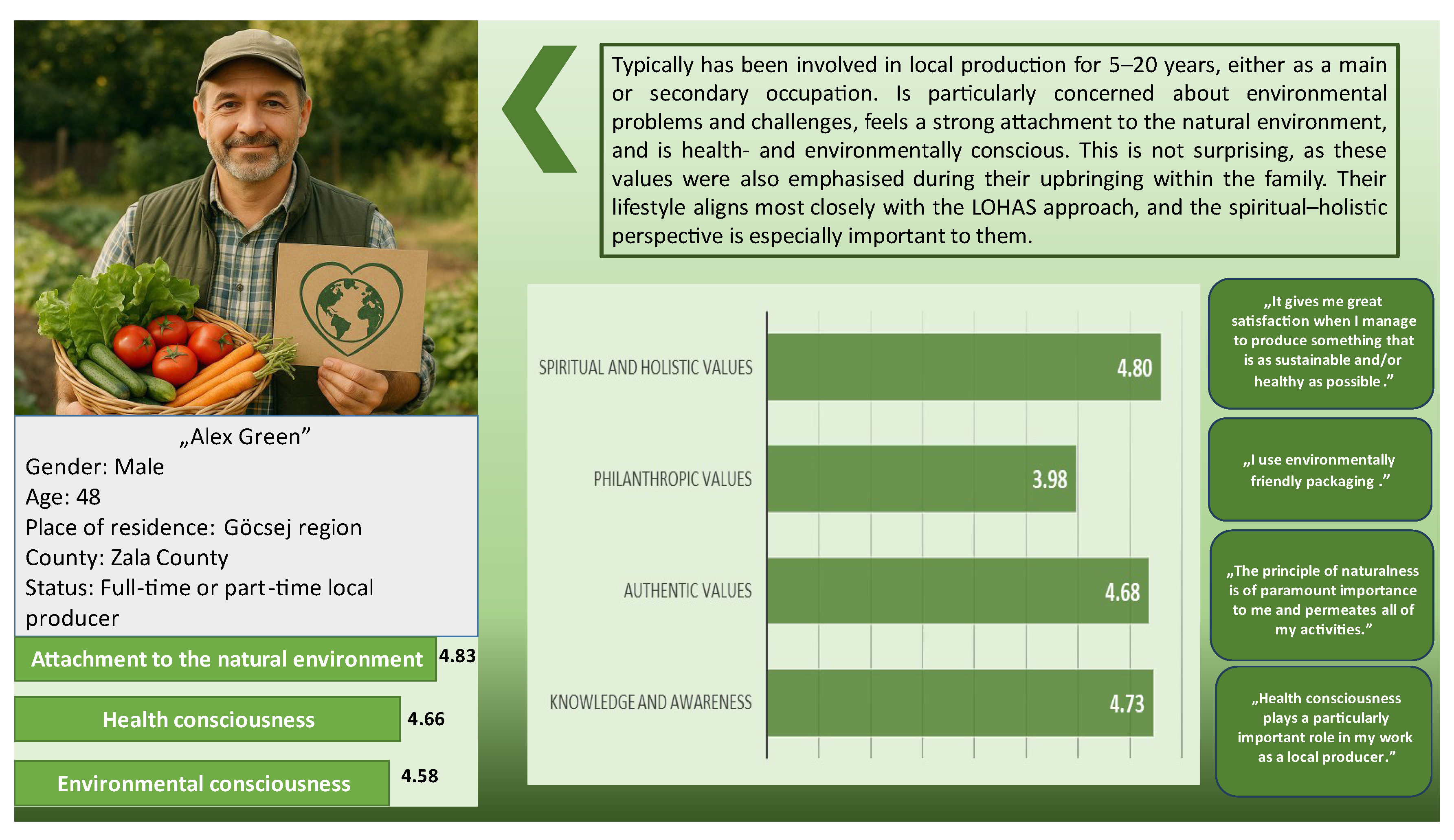
To synthesise the results of the cluster analysis, a profile of a LOHAS-oriented local producer was developed. This can be interpreted as an adaptation of Paul Ray’s value–worldview–lifestyle model from the study’s theoretical framework. This profile does not constitute an independent empirical unit, but rather represents an analytical synthesis of the characteristics associated with the identified LOHAS-oriented cluster.
The application of this model enables the integration of core LOHAS-related values, the reference points shaping producer worldviews, and everyday operational practices within a single analytical framework. Accordingly, the LOHAS-oriented local producer profile functions as an analytical tool that links the empirical findings with the theoretical approach and provides a transparent representation of the key features of a value-based producer identity aligned with LOHAS principles.
Producers belonging to the LOHAS-oriented cluster are characterised by a strong value orientation centred on environmental responsibility, health consciousness, and an emphasis on naturalness. These values are closely embedded in a broader worldview framework in which attachment to the local environment, respect for traditions, and a preference for domestically produced goods function as key reference points.
At the level of producer practices, this value orientation is reflected in strong intrinsic motivation to produce sustainable and healthy products, transparent communication with consumers, and the consistent application of environmentally friendly solutions. The integration of knowledge sharing and experiential elements further strengthens producer–consumer relationships and contributes to the social embeddedness of short food supply chains.
Table 5 provides a structured overview of the main empirical characteristics of the LOHAS-oriented local producer profile, organised along the dimensions of Paul Ray’s value–worldview–practice model. The table translates abstract value dimensions into observable producer-level practices, thereby operationalising the LOHAS framework on the supply side.
Figure 3.
An abstract LOHAS-oriented local producer persona profile (“Alex Green”). Source: Authors’ own compilation based on the results of cluster analysis, 2025. AI-generated illustration by the authors. Note: The profile represents a synthetic analytical construct based on cluster-level empirical results and does not describe an individual producer.
Figure 3.
An abstract LOHAS-oriented local producer persona profile (“Alex Green”). Source: Authors’ own compilation based on the results of cluster analysis, 2025. AI-generated illustration by the authors. Note: The profile represents a synthetic analytical construct based on cluster-level empirical results and does not describe an individual producer.
5. Discussion
5.1. LOHAS Values as a System-Level Structuring Mechanism
The findings of this study suggest that the LOHAS value system operates not merely at the level of individual producer attitudes but as a structuring mechanism within local food systems. When interpreted through a systems perspective, LOHAS-related value configurations contribute to the internal coherence of short food supply chains by shaping interaction patterns, mutual expectations, and coordination processes among actors.
Rather than functioning as isolated ethical preferences, dimensions such as environmental responsibility, health consciousness, authenticity, and holistic thinking form interconnected value constellations. These constellations influence production decisions, communication strategies, and relational practices, thereby affecting how producers position themselves within the broader network of consumers and territorial institutions. In this sense, LOHAS values can be conceptualised as system-integrative elements that reduce relational uncertainty and enhance predictability within producer–consumer interactions.
From a systems-theoretical standpoint, value alignment operates as a form of informal coordination mechanism. It stabilises exchanges not through formal contracts alone, but through shared normative frameworks that generate trust-based feedback loops. As these loops are reinforced over time, they contribute to the consolidation of short food supply chains as relatively stable yet adaptive socio-economic systems.
5.2. Territorial Embeddedness and Emergent System Properties
The empirical results highlight a strong association between LOHAS-oriented value patterns and territorial embeddedness. Producers belonging to the LOHAS-aligned cluster demonstrate high attachment to the natural environment, respect for local traditions, and commitment to transparent communication. From a systems perspective, these characteristics should be interpreted not only as identity markers but as structural components of system functioning.
Territorial embeddedness enhances relational density within the system by anchoring economic activity in locally meaningful contexts. This anchoring strengthens feedback processes between producers and consumers, as proximity facilitates repeated interaction, knowledge exchange, and mutual learning. Through these processes, resilience emerges as an emergent system property rather than a predefined objective.
Resilience in this context is not reducible to infrastructural robustness or logistical efficiency. Instead, it arises from the interaction between value coherence, relational trust, and adaptive practices. Systems characterised by stronger alignment between producer values and consumer expectations may exhibit higher capacity to absorb disturbances – such as market volatility, regulatory shifts, or environmental challenges – while maintaining core functions and relational stability.
5.3. Value Alignment and Adaptive Capacity in Short Food Supply Chains
The cluster analysis revealed differentiated patterns of LOHAS alignment among local producers. From a conventional perspective, such differentiation might be interpreted as heterogeneity within the producer community. However, from a systems viewpoint, internal differentiation represents subsystem diversity that may enhance adaptive capacity.
The coexistence of a strongly LOHAS-aligned cluster alongside a more moderately aligned cluster suggests that the local food system does not rely on a single dominant value configuration. Instead, multiple value orientations coexist within the same territorial framework. This diversity enables the system to respond flexibly to shifting external conditions, including evolving consumer preferences and policy environments.
In this sense, value alignment should not be interpreted as a binary condition but as a spectrum along which producers position themselves. Strongly aligned producers may function as innovation nodes or normative reference points within the system, diffusing sustainability-oriented practices and influencing relational standards. Meanwhile, moderately aligned producers contribute to structural stability and continuity. The interaction between these subsystems enhances overall system adaptability.
Furthermore, practices identified among LOHAS-oriented producers – such as knowledge sharing, experiential engagement, and transparent communication – can be understood as mechanisms that intensify positive feedback loops. These practices reinforce consumer loyalty and deepen relational embeddedness, thereby strengthening system-level cohesion.
5.4. Implications for System Dynamics and Sustainable Transitions
By extending the LOHAS framework to the producer side, this study demonstrates that value-based alignment plays a critical role in shaping the dynamics of short food supply chains. LOHAS-related values operate as internal regulatory principles that guide behaviour, reduce coordination costs, and stabilise expectations within the system.
From a broader sustainability transition perspective, local food systems may be viewed as meso-level socio-economic systems embedded within larger national and global food regimes. Within this multi-level configuration, value-oriented local producers contribute to incremental system transformation by embedding sustainability principles into everyday practices. These micro-level configurations accumulate and may gradually influence system-level trajectories.
The findings therefore suggest that sustainable transitions in food systems are not driven solely by policy interventions or technological innovation, but also by the diffusion and internalisation of shared value frameworks. When such frameworks are widely embedded among producers, they enhance system coherence and facilitate coordinated adaptation.
Importantly, the presence of differentiated producer clusters indicates that transformation processes are uneven and contingent. System evolution depends on ongoing interaction, learning processes, and feedback between actors rather than linear progression. This insight underscores the relevance of systems-oriented analytical approaches for understanding the long-term viability of territorially embedded food systems.
6. Conclusions and System-Level Implications
6.1. Main Conclusions
This study examined how LOHAS-related value dimensions are manifested among local food producers and how these value configurations influence the functioning of short food supply chains within a territorially embedded context. By extending the LOHAS framework beyond the consumer perspective, the analysis provides empirical evidence that sustainability-oriented value constellations operate not only at the level of demand, but also as structuring components of local production systems.
The findings demonstrate that a substantial segment of producers exhibits a coherent configuration of environmental awareness, health consciousness, authenticity, and holistic thinking. These values are not isolated attitudes but interrelated elements that shape production decisions, communication practices, and producer–consumer interactions. From a systems perspective, such value coherence enhances internal system integration by stabilising expectations and strengthening trust-based coordination.
The identification of differentiated producer clusters further reveals that local food systems are characterised by internal structural diversity. Rather than representing fragmentation, this differentiation may contribute to adaptive capacity by allowing multiple value configurations to coexist within the same territorial framework. Strongly LOHAS-aligned producers may function as normative reference points or innovation nodes, while other producers contribute to continuity and structural stability. Together, these subsystems form a dynamic configuration capable of responding to environmental and socio-economic changes.
By linking LOHAS values to territorial embeddedness and short food supply chains, the study contributes to a systems-oriented understanding of place-based sustainability. It shows that resilience emerges not solely from infrastructural or economic factors, but from relational density, shared normative frameworks, and feedback processes embedded in everyday practices.
6.2. System-Level and Policy Implications
From a systems-theoretical standpoint, value-oriented producers represent important leverage points within local food systems. When sustainability principles are internalised by producers, they function as endogenous regulatory mechanisms that guide behaviour and reduce coordination costs. Policies aimed at strengthening short food supply chains and rural resilience may therefore benefit from recognising value-based producer identities as structural components of system stability.
In this respect, the findings are particularly relevant in the context of Hungary’s Common Agricultural Policy Strategic Plan (2023–2027), which emphasises sustainability, short food supply chains, and environmentally responsible production practices. Supporting learning processes, peer-to-peer exchange, and transparency-enhancing mechanisms can amplify positive feedback loops within local food systems and enhance adaptive capacity.
More broadly, the results suggest that sustainable food system transitions depend not only on technological innovation or regulatory intervention, but also on the diffusion and consolidation of shared value frameworks. When such frameworks are embedded at the producer level, they strengthen system coherence and facilitate coordinated adaptation across multiple levels of governance.
6.3. Limitations and Directions for Future Systems Research
The study is based on a regionally focused empirical sample, which limits the generalisability of the findings. Although the sample size (N = 73) is appropriate for exploratory factor and cluster analysis, it does not allow for statistical representativeness at the national level. Furthermore, as participation was voluntary and facilitated through local producer networks, a degree of self-selection bias cannot be excluded. Consequently, the findings should be interpreted as analytically grounded patterns rather than statistically generalisable conclusions. However, this place-based approach enables a detailed examination of system dynamics within a specific territorial configuration. Future research could extend the analysis to other regions and national contexts to explore how differing institutional and cultural environments influence value alignment and system performance.
The cross-sectional design captures value configurations at a single point in time. Longitudinal research would provide deeper insight into how LOHAS-related value patterns evolve and how they respond to external disturbances, such as market shocks, policy changes, or climate-related challenges. Integrating producer and consumer data within a unified analytical framework could further illuminate feedback processes and co-evolutionary dynamics within short food supply chains.
6.4. Final Remarks
Overall, this study demonstrates that the LOHAS framework can be productively reinterpreted as a systems-analytical tool for examining sustainability transitions in territorially embedded food systems. By conceptualising value alignment as a system-level coordination mechanism, the paper contributes to a more integrated understanding of how shared normative frameworks may contribute to resilience and adaptive capacity within complex socio-economic systems.
In this sense, LOHAS-oriented local producers are not merely market actors responding to consumer demand, but active participants in shaping the internal dynamics and long-term viability of local food systems. Their value-based practices strengthen feedback loops, reinforce relational trust, and contribute to the emergence of more coherent and resilient configurations aligned with broader sustainability objectives.
Author Contributions
Conceptualization, M.B.L., A.S. and J.B.; methodology, formal analysis, M.B.L.; writing—original draft preparation, M.B.L., A.S.; writing—review and editing, J.B.; funding acquisition, J.B. All authors have read and agreed to the published version of the manuscript.
Funding
The APC was funded by using MDPI reviewer vouchers.
Data Availability Statement
The data will be made available on request.
Conflicts of Interest
The authors declare no conflicts of interest.
References
- Béné, C.; Bakker, D.; Chavarro, M.J.; Even, B.; Melo, J.; Sonneveld, A. Global Assessment of the Impacts of COVID-19 on Food Security. Glob. Food Secur. 2021, 31, 100575. [Google Scholar] [CrossRef] [PubMed]
- Blay-Palmer, A.; Carey, R.; Valette, E.; Sanderson, M.R. Post COVID 19 and Food Pathways to Sustainable Transformation. Agric. Hum. Values 2020, 37, 517–519. [Google Scholar] [CrossRef] [PubMed]
- Balázsné; Lendvai, M.; Schlett, A.; Beke; Schlett, J.A. Helyi termelők élményteremtő eszköztára a magyarországi Zala-völgyi térségben. In Proceedings of the Logisztika – Informatika – Menedzsment Nemzetközi Tudományos Konferencia, 2024; Budapesti Gazdasági Egyetem: Budapest Business University PSZK; p. 18. [Google Scholar]
- Balázsné, L.; Schlett, A.; Beke, J. Zala és Vas vármegyei helyi termelők a közösségi értékteremtés útján. Bus. Dipl. Rev. 2025, 3, 185–200. [Google Scholar]
- Osti, L.; Goffi, G. Lifestyle of Health & Sustainability: The Hospitality Sector’s Response to a New Market Segment. J. Hosp. Tour. Manag. 2021, 46, 360–363. [Google Scholar] [CrossRef]
- Hsu, S.-Y.; Chang, C.-C.; Lin, T.T. An Analysis of Purchase Intentions toward Organic Food on Health Consciousness and Food Safety with/under Structural Equation Modeling. Br. Food J. 2016, 118, 200–216. [Google Scholar] [CrossRef]
- Pittner, M. Strategische Kommunikation für LOHAS: Nachhaltigkeitsorientierte Dialoggruppen im Lebensmitteleinzelhandel; Springer-Verlag, 2014; ISBN 978-3-658-05191-4. [Google Scholar]
- Mohr, J. From an Affluent Society to a Happy Society: Vital Signs Promising a Change and the Impacts on Industries; Diplomica Verlag, 2011; ISBN 978-3-8428-0578-1. [Google Scholar]
- Lendvai, M.B.; Kovács, I.; Balázs, B.F.; Beke, J. Health and Environment Conscious Consumer Attitudes: Generation Z Segment Personas According to the LOHAS Model. Soc. Sci. 2022, 11, 269. [Google Scholar] [CrossRef]
- Migliore, G.; Schifani, G.; Cembalo, L. Opening the Black Box of Food Quality in the Short Supply Chain: Effects of Conventions of Quality on Consumer Choice. Food Qual. Prefer. 2015, 39, 141–146. [Google Scholar] [CrossRef]
- Balázsné Lendvai, M.; Beke, J.; Kovács, I. Helyi termékek és a „jó étel, jó hangulat” trend terjedésének vizsgálata egyetemisták körében. In Szemelvények a BGE kutatásaiból; Szegedi, K., Ed.; Budapesti Gazdasági Egyetem, 2022; pp. 12–19. ISBN 978-615-6342-49-2. [Google Scholar]
- Ušča, M.; Tisenkopfs, T. The Resilience of Short Food Supply Chains during the COVID-19 Pandemic: A Case Study of a Direct Purchasing Network. Front. Sustain. Food Syst. 2023, 7. [Google Scholar] [CrossRef]
- Tregear, A.; Cooper, S. Embeddedness, Social Capital and Learning in Rural Areas: The Case of Producer Cooperatives. J. Rural Stud. 2016, 44, 101–110. [Google Scholar] [CrossRef]
- Benedek, Z.; Baráth, L.; Fertő, I.; Merino-Gaibor, E.; Molnár, A.; Orbán, É.; Nemes, G. Survival Strategies of Producers Involved in Short Food Supply Chains Following the Outbreak of COVID-19 Pandemic: A Hungarian Case-Study. Sociol. Rural. 2022, 62, 68–90. [Google Scholar] [CrossRef] [PubMed]
- O’Connor, G.; Reis, K.; Desha, C.; Burkett, I. Valuing Farmers in Transitions to More Sustainable Food Systems: A Systematic Literature Review of Local Food Producers’ Experiences and Contributions in Short Food Supply Chains. Agric. Hum. Values 2025, 42, 565–592. [Google Scholar] [CrossRef]
- Schlett, A.; Beke, J.; Balázsné, L.M. Unveiling the Experiential Dimensions Driving Local Producers, and the Potential Ways of Transmitting the Experience to Consumers. In Proceedings of the 7th International Scientific Conference on Recent Advances in Information Technology, Tourism, Economics, Management and Agriculture; Association of Economists and Managers of the Balkans: Belgrade, Serbia, 2023; Vol. 7 Selected Papers, pp. 225–233. [Google Scholar]
- Gelfer, J. Lohas and The Indigo Dollar: Growing The Spiritual Economy. New Propos. J. Marx. Interdiscip. Inq. 2010, 4, 48–60. [Google Scholar]
- Kneafsey, M.; Cox, R.; Holloway, L.; Dowler, E.; Venn, L.; Tuomainen, H. Reconnecting Consumers, Producers and Food: Exploring Alternatives; Bloomsbury Publishing, 2008. [Google Scholar]
- Choi, S.; Feinberg, R.A. The LOHAS (Lifestyle of Health and Sustainability) Scale Development and Validation. Sustainability 2021, 13, 1598. [Google Scholar] [CrossRef]
- Formádi, K. A fogyasztás szociológiája - A fogyasztás tématerületei - MeRSZ; Akadémiai Kiadó, 2025; ISBN 978 963 664 097 2. [Google Scholar]
- Kiss, K.; Ruszkai, C.; Szűcs, A.; Koncz, G. Examining the Role of Local Products in Rural Development in the Light of Consumer Preferences—Results of a Consumer Survey from Hungary. Sustainability 2020, 12, 5473. [Google Scholar] [CrossRef]
- Kovács, I.; Balázsné Lendvai, M.; Beke, J. The Importance of Food Attributes and Motivational Factors for Purchasing Local Food Products: Segmentation of Young Local Food Consumers in Hungary. Sustainability 2022, 14, 3224. [Google Scholar] [CrossRef]
- Szakály, Z.; Popp, J.; Kontor, E.; Kovács, S.; Pető, K.; Jasák, H. Attitudes of the Lifestyle of Health and Sustainability Segment in Hungary. Sustainability 2017, 9, 1763. [Google Scholar] [CrossRef]
- Cappelli, L.; D’Ascenzo, F.; Ruggieri, R.; Gorelova, I. Is Buying Local Food a Sustainable Practice? A Scoping Review of Consumers’ Preference for Local Food. Sustainability 2022, 14, 772. [Google Scholar] [CrossRef]
Figure 1.
Paul Ray’s model of values, worldview, and lifestyle. Source: based on [20].
Figure 1.
Paul Ray’s model of values, worldview, and lifestyle. Source: based on [20].
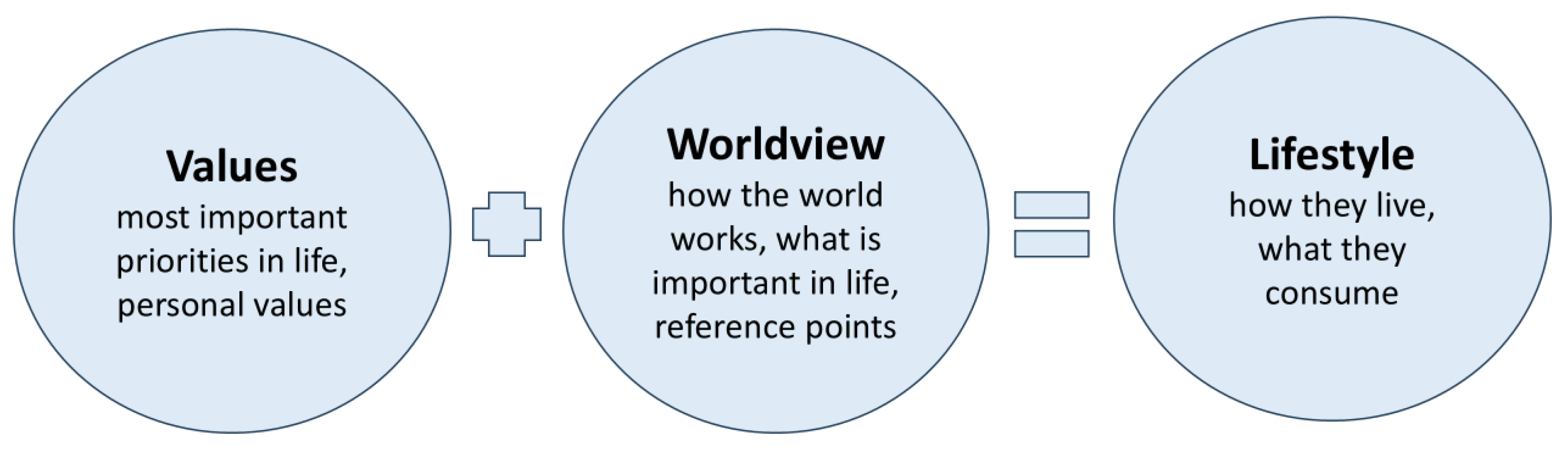
Figure 2.
Conceptual framework illustrating the central role of LOHAS-oriented producers within short food supply chains, including feedback processes and adaptive interactions. Source: own compilation.
Figure 2.
Conceptual framework illustrating the central role of LOHAS-oriented producers within short food supply chains, including feedback processes and adaptive interactions. Source: own compilation.
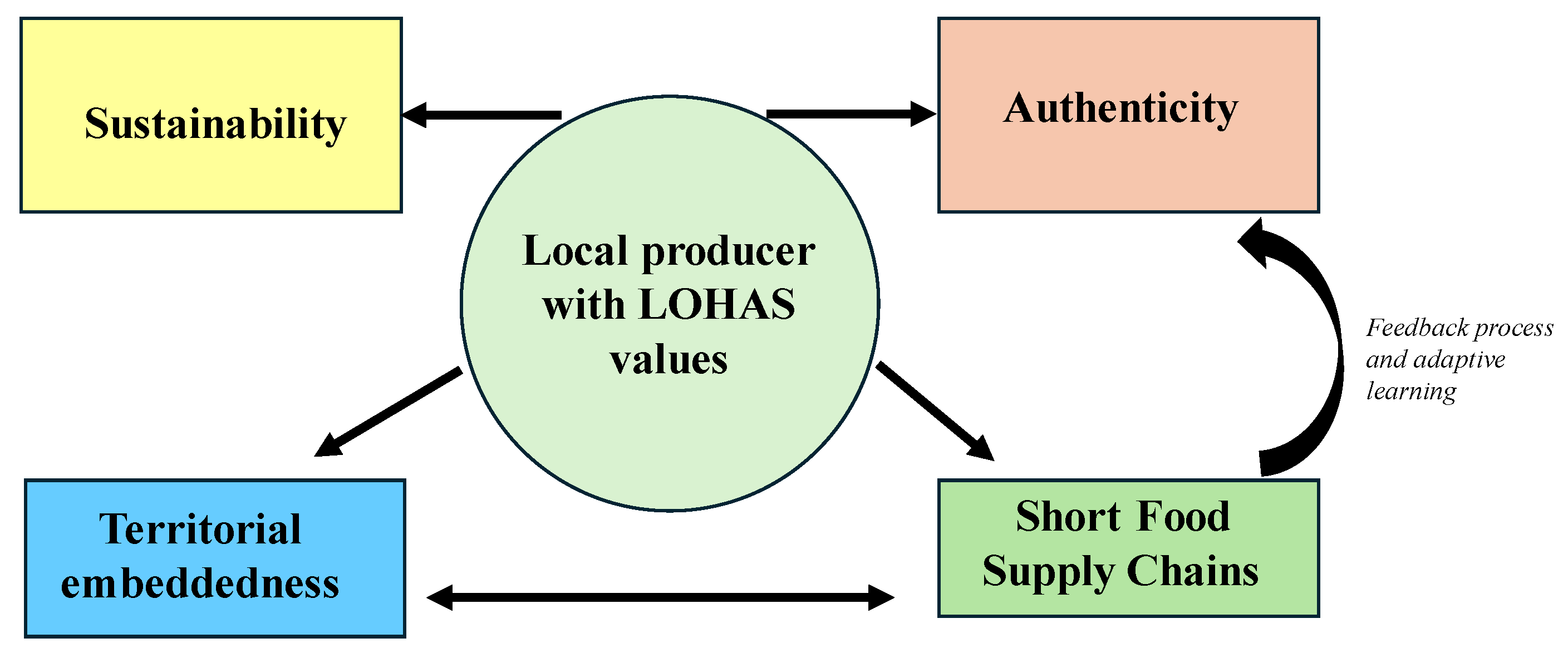
Table 5.
LOHAS-oriented local producer profile based on the value–worldview–practice framework (Analytical synthesis based on cluster-level mean values).
Table 5.
LOHAS-oriented local producer profile based on the value–worldview–practice framework (Analytical synthesis based on cluster-level mean values).
| Analytical dimension | Empirical indicator (mean value) | Interpretation |
|---|---|---|
| Core values (LOHAS priorities) | Strong attachment to the natural environment (4.83) | Environmental responsibility constitutes a central reference point in the producer’s value system. |
| Importance of physical and mental well-being (4.68) | Health consciousness extends beyond products to personal lifestyle and work practices. | |
| Environmental awareness (4.58) | Sustainability considerations are consistently integrated into production-related decisions. | |
| Health consciousness (4.66) | Health-oriented thinking plays a significant role in shaping production philosophy. | |
| Emphasis on naturalness (4.77) | Naturalness functions as a guiding principle in product development. | |
| Willingness to engage in voluntary activities (3.68) | Community engagement is present but less dominant within the overall value structure. | |
| Worldview and reference points | Respect for traditions (4.64) | Tradition is perceived as a stabilising reference rather than a restrictive framework. |
| Concern about environmental and sustainability challenges (4.28) | Awareness of global sustainability issues informs local production practices. | |
| Preference for domestic products in procurement (4.79) | Local economic embeddedness is a key element of the producer’s worldview. | |
| Practices and producer identity (LOHAS-oriented style) | Satisfaction derived from producing sustainable and/or healthy products (4.96) | Sustainability-oriented production generates intrinsic motivation and professional fulfilment. |
| Increasing integration of environmentally friendly solutions (4.51) | Continuous improvement towards environmentally responsible practices is evident. | |
| Provision of transparent product information (4.91) | Transparency functions as a core trust-building mechanism. | |
| Importance of sustainability in decision-making (4.36) | Sustainability considerations influence strategic and operational decisions. | |
| Careful information gathering prior to procurement and business decisions (4.42) | Decision-making is characterised by deliberation and responsibility. | |
| Use of environmentally friendly packaging solutions (4.28) | Environmental considerations extend to packaging and logistics. | |
| Display of origin and quality-related information on products (4.77) | Traceability and quality signalling are integral to producer identity. | |
| Willingness to share sustainability- and health-related knowledge with consumers (4.70) | Knowledge transfer strengthens producer–consumer relationships within short food supply chains. |
Note: The profile represents a synthetic analytical construct based on cluster-level empirical results and does not describe an individual producer.
Disclaimer/Publisher’s Note: The statements, opinions and data contained in all publications are solely those of the individual author(s) and contributor(s) and not of MDPI and/or the editor(s). MDPI and/or the editor(s) disclaim responsibility for any injury to people or property resulting from any ideas, methods, instructions or products referred to in the content. |
© 2026 by the authors. Licensee MDPI, Basel, Switzerland. This article is an open access article distributed under the terms and conditions of the Creative Commons Attribution (CC BY) license (http://creativecommons.org/licenses/by/4.0/).
Copyright: This open access article is published under a Creative Commons CC BY 4.0 license, which permit the free download, distribution, and reuse, provided that the author and preprint are cited in any reuse.


