

Submitted:
26 February 2026
Posted:
02 March 2026
You are already at the latest version
Preprints on COVID-19 and SARS-CoV-2
Abstract
This review explores a hypothetical and previously underexplored ecological pathway that may contribute to virus dispersal, including human pathogens, through passive transport involving free-living nematodes and migratory animals. Available data on nematode-associated viruses, nematode survival in diverse environments, and mechanisms of passive dispersal are synthesized to propose a conceptual framework for long-distance pathogen movement. Particular attention is given to the ecological interactions among nematodes, animals, and viruses, and to the potential role of these interactions in shaping pathogen distribution patterns under environmental and anthropogenic pressures. The article discusses a theoretical model of possible virus transfer across ecological niches and highlights key gaps requiring experimental validation. This study highlights a previously underestimated route of potential virus transmission, including human pathogens, through possible long-distance dispersal (500 km or more) by free-living nematodes and migratory birds. Data on the spread of viruses of nematodes of the genus Caenorhabditis spp., the survival of nematodes in various conditions, and their spread by various groups of animal carriers, including their ability to pass through the gastrointestinal tract of birds in a viable state, are analyzed. The role of a number of migratory bird species as biological carriers not only of free-living nematodes themselves over considerable distances, but also of viruses hypothetically associated with nematodes on/inside their bodies, is considered as a potential mechanism. This work raises questions about previously underestimated biological risk factors associated with this potential route of passive pathogen dispersal to new territories and ecological niches, especially in conditions of environmental stress, intensive animal husbandry, and global movement of wild animals. The article discusses a hypothetical scenario in which SARS-CoV-2 and other viruses could be passively dispersed through ecological interactions involving nematodes and migratory birds. Understanding the ecological dynamics of the interaction between birds, nematodes, and virusesmay contribute to ecological risk assessment and understanding of emerging pathogen dynamics. This manuscript presents a conceptual ecological hypothesis and should not be interpreted as evidence of confirmed transmission pathways.
Keywords:
virus dispersal
; free-living nematodes
; Caenorhabditis
; ecological transmission
; pathogen ecology
; animal-mediated dispersal
; SARS-CoV-2 ecology
; emerging pathogens
; zoonotic interfaces
; environmental transmission
; conceptual framework
; passive dispersal
Introduction
The taxonomy of nematodes (phylum Nematoda) in modern systematics is based on morphological and molecular phylogenetic data and includes several main classes. Currently, most authors recognize the division of nematodes into two main classes — Chromadorea and Enoplea (previously, the taxa Secernentea and Adenophorea were also used), while the internal classification continues to be refined based on molecular phylogeny data [1,2,3,4]. According to modern estimates, more than 25,000 species of nematodes have been described. However, the total actual diversity of the group is estimated to be significantly higher — from 500,000 to more than 1,000,000 species, which makes nematodes one of the most numerous types of animals on Earth [5,6,7,8,9]. Nematodes are ubiquitous and inhabit marine, freshwater, and terrestrial ecosystems, as well as often plant, animal, and human organisms. Parasitic forms constitute a significant part of nematode diversity. According to various estimates, at least 40–50% of described nematode species are parasites of plants, invertebrates, vertebrates, and humans. At the same time, the number of parasitic species is estimated to be in the tens of thousands, taking into account undescribed biodiversity [7,10,11,12,13]. Among the nematodes that are of particular interest as model organisms and subjects of evolutionary biology are Caenorhabditis elegans, Caenorhabditis briggsae, Pristionchus pacificus, Oscheius tipulae, and Panagrellus redivivus, which are widely used to study developmental evolution, genomic evolution, host–pathogen interactions, and adaptive mechanisms to the environment [14,15,16,17,18]. It can be assumed that such an ancient and widespread group of organisms as nematodes must have a specific viral reservoir and their own mechanisms of virus transmission. Although individual cases of viral infections in nematodes and their tissue tropism have been partially described, and the pathways of free-living nematode spread have been studied primarily from an ecological perspective, there is currently no comprehensive integrated concept linking viruses associated with nematodes and other hosts, their transmission involving animal vectors, spatial spread trajectories, and comparison with epidemiological models involving human viruses. In this article, we attempt to fill this gap.
Below is an analysis of the spread of viruses in nematodes, mainly in free-living nematodes, the spread of Caenorhabditis in nature and their carriers, the passive dispersal of Caenorhabditis nematodes, groups of animals that transmit Caenorhabditis nematodes, the role of birds in the passive dispersal of Caenorhabditis nematodes, the role of mammals as passive agents of trophic transmission of C. elegans, and a detailed analysis of the theoretical possibility of SARS-CoV-2 spreading to new ecological niches via free-living nematodes. We have attempted to fill this gap. Below is an analysis of the spread of viruses in nematodes, mainly in free-living nematodes, the spread of Caenorhabditis in nature and their carriers, the passive dispersal of Caenorhabditis nematodes, groups of animals that transmit Caenorhabditis nematodes, the role of birds in the passive dispersal of Caenorhabditis nematodes, the role of mammals as passive agents of trophic transmission of C. elegans, and a detailed analysis of the theoretical possibility of SARS-CoV-2 spreading to new ecological niches via free-living nematodes.
The present manuscript proposes a hypothesis-generating ecological framework based on published data and theoretical integration. It does not claim direct experimental evidence for the described transmission scenarios and aims to stimulate further empirical investigation.
Methods/Analytical Approach
This review is based on an analysis of over 150+ peer-reviewed publications, preprints, and open epidemiological sources (1974–2025) covering virology, nematology, ornithology, zoology, and factors affecting pathogen stability in the environment. Sources were selected through targeted searches in PubMed, Scopus, bioRxiv, and medRxiv databases using keywords such as “free-living nematodes,” “migration/movement of animals and birds,” “virus dispersion,” “environmental stability of SARS-CoV-2,” etc. Data integration was performed using analytical data analysis and a comparative synthetic approach combining ecological, virological, and epidemiological perspectives. Particular attention was paid to indirect transmission routes, non-traditional biological vectors, and scenarios of long-distance spread of pathogens in the natural environment.
Results, Discussion
Viruses and Nematodes
So far, epidemiologists have not shown much interest in nematode viruses. However, modern epidemiology still has many gaps in its knowledge of the ecology and transmission of viruses, especially those with pandemic potential. This situation persists despite the rapid development of instrumental research methods, the development of new methodologies, and progress in the development of preventive strategies to prevent the spread of mass viral infections, etc. Much is already known about transmissible viral diseases and virus carriers (transmitters) to susceptible organisms. However, there are still more questions than answers.
Let's briefly return to the latest COVID-19 pandemic, which has claimed 7,110,188 lives [19] (WHO data as of January 25, 2026). However, the number of cases of detection of specific antibodies, specifically SARS-CoV-2, in animals is increasing. The question remains: how did the pathogen that caused this pandemic in humans occupy a new ecological niche and end up in populations of many unrelated animal species, including wild fauna in different regions of the world?
SARS-CoV-2 has been detected in 68 animal species across 49 countries and territories, while MERS-CoV has been identified in seven animal species across 16 countries (WOAH report, 18 December 2025) [20]. Animals proven to carry the virus include a wide range of species: Bovidae, Canidae, Cebidae, Cercopithecidae, Cervidae, Cricetidae, Felidae, Hominidae, Hyaenidae, Mustelidae, Procionidae, Viverridae, Hippopotamidae, Myrmecophagidae, Atelidae, Rhinocerotidae, Suidae, Agamidae, Phasianidae, Anatidae, Castoridae, Muridae, Chlamyphoridae, Leporidae, Vespertilionidae, Sciuridae, Didelphidae, Procyonidae, and Fringillidae. While one might be tempted to dismiss this problem, the fact remains that it is necessary to explain how the virus entered the animal population. This is especially important since reverse transmission of the virus from animals to humans is possible. Moreover, it can occur with altered properties. Although rare, reverse transmission of SARS-CoV-2 from animals to humans has been reported in the Mustelidae family, with cases of mink transmitting the virus to humans in the Netherlands, and in the Cricetidae family, with cases of hamsters transmitting the virus to humans in the Hong Kong Special Administrative Region of China [21,22].
We can look for the reasons for the sensitivity of different animal species to SARS-CoV-2 in the physiology of their cells, in the presence of specific receptors, or in changes in metabolism under the influence of various factors, etc. [23]. However, there is no answer to the question of how this virus is transmitted from humans to animals and whether there are possible carriers among the significant diversity of biological objects. It is necessary to take into account the spread of this pandemic virus over considerable distances from places where COVID-19 patients are present. Here, we can blame not only untreated sewage, airborne transmission, modern transport flows and means, transmission through infected objects and surfaces, but also other factors. For example, it can be assumed that the virus is physically transmitted through various living organisms: insects, nematodes, mollusks, reptiles, amphibians, and others, which may not themselves have specific receptors for the virus but are capable of being carriers (reservoirs)/transmitters of the virus in the chain between hosts.
Let us consider one possible hypothesis to explain the possible routes of virus transmission between different species, using the example of the pandemic coronavirus. However, we must bear in mind the need to explain the spread of other human and animal viruses, for which the question of spread/transmission remains open.
Since nematodes are so numerous and widespread in different habitats, let's consider some virological aspects related to them.
So what is known about the circulation of viruses among nematodes? The question concerns not only the presence of specific nematode viruses, but also other viruses that do not harm them but may be present in nematodes in one way or another and either be released by them into the environment or circulate further along the food and parasitic chain, etc. Despite some known data, the effect of viral infections on worm biology is still largely unclear.
Let us consider several aspects in more detail. It is known that many viruses have been found in nematodes. Recent reviews from 2025 [24,25] indicate that the phylum Nematoda has an extensive and diverse virosphere. That is, there are many viruses that make up a rich viral ecosystem among these organisms, some of which are well adapted to nematodes, even if obvious pathologies are rare or poorly studied. It is believed that severe viral diseases in nematodes are rare. Parasitic nematodes, which parasitize various organs and tissues and affect more than a billion people worldwide, pose a medical danger to humans [26]. In this context, it is important to note that humans and animals are often infected with several species of parasitic worms and suffer from chronic, lifelong infections and constant reinfection, which in turn can infect them with viruses present in these nematodes. However, we will not address issues of viral load associated with parasitic nematodes, which are well covered in the literature.
For example, the results of transcriptomic analysis among 41 parasitic nematode species and the detection of 91 RNA viruses across 13 virus orders from 24 families /and virus-like genomic sequences across 28 species [27] have been described. There are known infections caused by RNA viruses that have been detected in phytoparasitic nematodes [28]. Nematodes (Longidoridae, Trichodoridae) are natural vectors of a number of plant viruses, especially nepoviruses and tobraviruses, which are transmitted through the soil environment when nematodes feed on plant roots. Classic works on the transmission of viruses to plants via nematodes describe in detail the mechanisms, virus-vector-plant specificity, and impact on agroecosystems [29,30]. For example, a review (Macfarlane SA, 2003) describes the molecular determinants of plant virus transmission by nematodes [31].
Knowledge about viruses associated with plant-parasitic nematodes (PPNs) has expanded. For example, 94 PPN-associated viruses have been identified. This is many times more than previously documented. Previously unknown viral groups (orthomyxo-like, Jingmen, ormycoviruses) have been found in plant-parasitic nematodes, which broadens our understanding of viral diversity and its possible role in plant and parasite pathogenesis [32]. Huang H., et al. (2025) provide an overview of the current global metagenomic analysis of the nematode virosphere, which confirms the great diversity of viruses associated with PPNs (Ditylenchus, Heterodera, Meloidogyne, etc.) [32]. The identification of 94 viruses associated with PPNs exceeds previously known data by eight times. These viruses were from eighteen established families and six unclassified viral groups, including the first detection of orthomyxovirus-like viruses and Jingmen viruses in nematodes, which expands the possible range of hosts for these viruses [32]. However, we will not dwell in detail on the phytonematode viruses that have been described [33,34,35].
There is some information available on viruses and free-living nematodes [36,37]. For example, Caenorhabditis elegans (C. elegans) is used as a model for screening toxicological and genetic studies or for studying various molecular evolutionary mechanisms, apoptosis, and aging.
C. elegans has long been a laboratory model organism for which no natural pathogens were known. However, in recent decades, natural viruses (Orsay virus) have been isolated from C. elegans caught in the wild, and viruses have also been found in its relative Caenorhabditis briggsae (Santeuil virus, Le Blanc virus, and Melnik virus) [38]. All of them are positive-sense RNA viruses and were initially considered nodavirus-like. In the modern ICTV taxonomy, they are not included in the Nodaviridae family and are considered a separate evolutionary line of nematode-associated RNA viruses within the Riboviria kingdom [39,40]. They infect intestinal cells and are transmitted horizontally. The presence of these viruses indicates that free-living nematodes may be stable natural reservoirs of viruses and may have deep evolutionary links with nematodes. This directly supports the idea that nematodes are not accidental carriers but ecologically significant hosts for a number of RNA viruses.
The structure of the Orsay virus capsid has been determined. The use of Orsay virus has enabled the identification of evolutionarily conserved proviral and antiviral genes that function in nematodes and mammals. These pathways include endocytosis via SID-3 and WASP; uridyl transferase, which destabilizes viral RNAs by uridylating their 3'-ends; modification and renewal of proteins by ubiquitin; and an RNA interference mechanism that recognizes and destroys viral RNA [41].
The first natural viruses of Caenorhabditis briggsae (Santeuil virus, Le Blanc virus) and Caenorhabditis elegans (Orsay virus) were described in 2011 in an article that is considered a “foundational paper” and the starting point for systematic research into nematode viruses [38]. Since then, nematode virology has continued to develop. Several viruses are now known to naturally infect C. elegans and related species [42,43,44]. Thus, the virus named Orsay virus (OrV) is the first identified natural virus of C. elegans.
The Orsay virus and related viruses have been found in other nematodes of the genus Caenorhabditis. For example, Santeuil virus (in C. briggsiae) is a weaker pathogen than the Orsay virus, but it also infects the intestine, as does Le Blanc virus, which infects C. briggsiae, whose genome differs from that of the Orsay virus and also predominantly infects the intestinal epithelial cells of the worm [38,44,24]. Using standard laboratory lines of C. elegans on E. coli OP50 and working lines of C.elegans/C.briggsae, it was shown that viral infections can be transmitted horizontally. The virus is preserved and spread during co-cultivation (through contact/feeding). At the same time, cultured infected nematodes showed characteristic morphological changes in intestinal cells. There was a decrease in fertility and pronounced changes in intestinal enterocytes: deformation of microvilli, vacuolization of the cytoplasm, and disruption of the integrity of the apical surface (apical membrane) [38]. Interestingly, a similar type of cellular-morphological damage to enterocytes is also observed in other viral infections. For example, when piglets were infected with the intestinal coronavirus transmissible gastroenteritis virus (TGEV), microvilli deformation, cytoplasmic vacuolization, and apical membrane degeneration were also observed [45,46].
In addition, the human coronavirus SARS-CoV-2, similar to enterotropic animal viruses, causes a convergent type of cellular-morphological disorders of the intestinal epithelium, characterized by damage to the apical surface of enterocytes and disruption of their ultrastructural organization. A number of morphological studies of gastrointestinal biopsies from COVID-19 patients have described signs of damage to the epithelial barrier, including changes in the ultrastructure of microvilli and vacuolization of the cytoplasm of intestinal epithelial cells [47,48]. SARS-CoV-2 productively infects human enterocytes, as demonstrated in small intestine biopsy material and intestinal organoid models [47,49]. At the ultrastructural level, infection is accompanied by pronounced rearrangements of intracellular membrane compartments, including the formation of vesicular structures associated with SARS-CoV-2 replication, as well as the localization of virions near the apical domain of enterocytes (brush border) [49,50]. Although the mechanism of action of the viruses under consideration and the pathogenesis of infections may differ, this indicates the convergence of morphological manifestations of intestinal epithelial damage caused by various viruses in phylogenetically distant hosts, which also requires separate study, taking into account the comparison of all parameters of the mechanism of action.
Viruses associated with parasitic nematodes can enter the bodies of vertebrate hosts along with parasitic nematodes and induce an immune response. Quek et al., 2024 [27] showed that these viruses associated with parasitic nematodes can elicit an antibody response in vertebrate hosts even in the absence of evidence of active replication, indicating immune exposure to viral antigens without the formation of a full-blown infection. In fact, it can be considered that nematode viruses exist on the border between a “parasite virus” and a “host immunological stimulus.” Let us consider examples of the detection of nematode viruses, which are given in Table 1.
From the data presented in Table 1 it can be concluded that mainly RNA viruses were found in nematodes. However, fragments of DNA virus–like sequences in nematode genomes/metagenomes” integrated into chromosomes are found in nematode genomes: parvo-like, densovirus-like, polinton-like elements [65,66,67,68]. But these are not active viruses, not infections, but presumably relics of ancient viral integrations. Such DNA genomic virus-like elements have been described, for example, in a number of nematodes [65,66,67,68,69]. However, this is more viral paleogenomics than modern virology. One can say “DNA virus–like sequences detected in nematode-associated metagenomes” and not “nematode viruses”. Thus, unlike many other groups of Metazoa, in nematodes, only RNA viruses have been confirmed to date [27,32,37,51,53,54,57,58,72,73,74], whereas data on DNA viruses are limited to endogenous viral elements and metagenomic fragments without evidence of productive replication.
It has been shown that C. elegans supports complete replication of the RNA genome of Flock House virus (FHV), a two-segment (+)ssRNA virus from the Nodaviridae family (which is not a natural pathogen of C. elegans) and that replication was artificially initiated [70]. It has also been shown that C. elegans can support virus replication and activate the host's RNAi-mediated antiviral response. Other authors have also shown that C. elegans generates an RNAi response to Orsay virus infection, indicating the nematode's ability to mount antiviral RNAi resistance. In this case, infection is limited by the antiviral RNAi response, which can also be inherited by offspring [71].
Thus, various viruses circulating among free-living nematodes have been identified, which can also spread over certain distances when nematodes disperse. The question remains open as to whether, in addition to viruses specific to these nematodes, such nematodes are carriers/transmitters of other viruses, such as human and animal pathogens. If the answer is yes, then it is necessary to analyze the possible range of distribution of such nematodes in natural conditions. To do this, we will consider issues related to the carriers of free-living nematodes and the possible range of their distribution.
Distribution of C. elegans in Nature and Its Vectors
C. elegans is a free-living soil nematode that inhabits decaying plant substrate and spreads mainly passively, primarily in the dauer-larva stage [43,76,77], with the participation of various animal vectors, including insects (e.g., Drosophila spp.), terrestrial mollusks, small mammals, and birds, which facilitate the transfer of nematodes between decaying substrates [43,75,76,78]. C. elegans is now a laboratory model rather than a focal object of ecology. It has been studied for decades: in soil, on decaying organic matter, with invertebrate vectors (mites, isopods). Since C.elegans has its own viruses and other viruses may also be present in an inactive state, it is necessary to determine how far dispersion is possible in C.elegans.
The collective dispersal of Caenorhabditis nematodes through vertical movement provides a mechanistic explanation for phoretic transmission by insects and other animals. Recent studies by Perez et al., 2025 show that nematodes of the genus Caenorhabditis have specialized behavioral mechanisms of collective dispersion, such as the formation of “towering behavior,” which increase the probability of individuals being transferred to new substrates [79]. However, even these forms of active dispersal remain spatially limited and are not comparable in scale to the long-distance transport provided by other animals, including vertebrates.
Passive Dispersion of Caenorhabditis Nematodes
The modern understanding of the ecology and dispersal of nematodes of the genus Caenorhabditis is an active, evolutionarily shaped process based on the idea of predominantly passive dispersion, due to the extremely limited mobility of these organisms and the presence of a specialized, stable dauer stage designed for transfer between temporary and spatially separated habitats. stage designed for transfer between temporary and spatially separated habitats. The WormBook review emphasizes that the spread of Caenorhabditis in nature largely depends on animal carriers, primarily invertebrates, with which nematodes enter into phoretic and opportunistic associations [75]. The role of vertebrates is considered only as potential and practically unexplored. Experimental data summarized in Petersen et al. [80] confirm that C. elegans effectively uses a wide range of invertebrate vectors for passive dispersal in the dauer stage, which ensures the transfer of viable individuals between spatially separated substrates and the successful colonization of these new substrates. In a recent review by Braendle et al. (2024) [81], these results are integrated into a broader evolutionary-ecological framework, where dispersal via phorhesia on animals is considered a key strategy of the genus Caenorhabditis. It is emphasized that the participation of vertebrates in the dispersal of representatives of this genus remains virtually unexplored, despite the ecological plausibility of such a mechanism, which indicates a significant gap in understanding the scale and pathways of long-distance dispersion of Caenorhabditis.
Mechanisms such as worm towers only enhance local and mesoscale dispersal and do not replace the role of other transmitters, including vertebrates, as factors in interregional spread.
Taken together, these data indicate that Caenorhabditis has multilevel dispersal strategies. However, despite the proven ability of free-living nematodes to survive passage through the digestive tract of waterfowl, the involvement of other vertebrates in the spread of Caenorhabditis remains virtually unexplored, which forms a key gap in understanding the mechanisms of their long-distance dispersion.
Experimental and review studies have shown that free-living nematodes are able to survive passage through the digestive tract of waterfowl and be excreted in a viable state in feces, confirming endozoochory as an effective route of dispersal, which we will discuss in more detail below. Unfortunately, in existing publications, nematodes are usually not identified to the genus level, and the transfer of nematodes of the genus Caenorhabditis, including the model species C. elegans, by vertebrates has not been directly studied to date, which creates a significant gap in our understanding of the mechanisms of long-distance dispersal of this genus. Archer et al. (2020) [82] also experimentally confirmed that nematodes, predominantly in the dauer stage, can attach to the body of isopods, remain viable during transport, and then leave the vector, colonizing a new substrate. At the same time, the interaction is not specialized or obligatory. C. elegans does not depend on a specific carrier species, but uses a wide range of animal vectors upon accidental contact.
Animal Carriers of Nematodes Caenorhabditis
Let us consider the dispersal agents/phoretic or trophic carriers of C. elegans nematodes between substrates at different stages of development (eggs, L1–L4, dauer larvae). C. elegans spreads in nature mainly in the dauer larva stage with the help of: animals that feed on the substrate; animals that come into contact with decaying organic matter; synanthropic species. Let us consider six groups of animals that carry C. elegans: insects, mollusks, other invertebrates, reptiles and amphibians, birds, and mammals. Let us take a closer look at each group of these animals.
1. Insects (especially through Drosophila and Diptera). These are among the most important carriers. Drosophila spp. often carry C. elegans dauer larvae. Transmission occurs: on the body surface, through the intestine, through shared use of the substrate [83,84]. Individual phoretic events of C. elegans transmission on Drosophila have been experimentally studied, where Drosophila melanogaster and Drosophila hydei were directly used as vectors [85].
2. Terrestrial mollusks (snails, clams, slugs). The role of these animals is to act as mechanical carriers when swallowing and subsequently excreting live nematodes. Moreover, C. elegans (including dauer larvae) survives passage through the gastrointestinal tract of snails. After defecation, nematodes remain viable [76,86]. It has been shown that C. elegans passes through the slug's intestine, while the microbiota is preserved/changed and the effects of “slug gut passage” are recorded. This is direct experimental confirmation of the role of slugs as carriers/a “transport medium” [87].
3. Other invertebrates (beetles, woodlice, mites). The role of these invertebrates in phoresy and mechanical transfer is possible due to their frequent cohabitation in composts. Dauer larvae can attach to the skin of these animals [88]. It can be concluded that C. elegans eggs are rarely transferred, with L1–L4 eggs being transferred to a limited extent, and the dauer larva is the primary stage of transfer [89].
4. Reptiles and amphibians. Free-living nematodes of the genus Caenorhabditis, including C. elegans and C. remanei, can potentially spread over considerable distances through mechanical transport by vertebrates such as reptiles and amphibians, via fecal-transit and ectozoochore mechanisms, despite the absence of signs of parasitism. Let us consider in more detail the role of reptiles and amphibians in the spread of free-living nematodes. They are in constant contact with soil, litter, and decaying organic matter, and also use the same microbial niches where Caenorhabditis live, moving distances that exceed the active dispersal of nematodes. For Caenorhabditis, even a few meters is a significant expansion of its range. For example, Caenorhabditis (Caenorhabditis remanei) has been detected in snake feces [90,91,92]. The authors emphasize that these findings are not interpreted as elements of the diet, but are considered as accompanying or transient organisms identified during metabarcoding. There is a description of an atypical case, but one that is actually documented in the work of Schaftenaar et al. (2000) about the opportunistic invasion of rabdid nematodes (a group that includes mainly free-living nematodes capable of opportunistically invading vertebrates under certain conditions (high humidity, organic pollution, host stress)) in the monitor lizard (Varanus prasinus) [93]. The nematodes discovered and described in this article are not typical specialized parasites of reptiles. However, if we consider the possible transfer of pathogens by free-living nematodes to other animals, in this case to reptiles, the fact of their invasion may confirm this possibility. On the other hand, in a study by Imai et al. 2009, histological and molecular studies of Asian horned frogs (Megophrys montana) revealed rabdite nematodes in the tissues of the eye and central nervous system [94]. Sequencing of the LSU and ITS regions showed their identity with Caenorhabditis elegans. The authors interpret the finding as an opportunistic invasion of a free-living nematode, documenting the ability of C. elegans to enter and survive in the body of amphibians, although the question of the mechanisms and ecological role of such transfer remains open. However, this study showed that, at a minimum, contact/transfer of C. elegans into the body of amphibians is possible. And if this nematode is considered a carrier of pathogenic viruses, then there is a possibility of transmission of pathogens to amphibians by these nematodes. Table 2 provides an assessment of the ability of these cold-blooded animals to move/migrate.
These distances greatly exceed the active dispersal range of free-living nematodes, including Caenorhabditis. Even meters to hundreds of meters are ecologically significant for soil and semi-aquatic nematodes, while kilometers represent long-distance dispersal for them. For snakes and lizards, multiple seasonal movements are key, while for amphibians, the connection between different microhabitats (forest litter ↔ water body) is crucial. Thus, we can judge the fairly long migration distances of nematode transmitters, and with them the possible carriage of pathogenic viruses of humans and animals at ~1–10 km. However, even though amphibians and reptiles such as the eastern massasauga (Sistrurus catenatus), the green tree monitor (Varanus prasinus), and the Asian horned frog (Megophrys montana) are capable of moving from meters to several kilometers, these distances remain significantly shorter than the migratory movements of waterfowl (hundreds to thousands of kilometers), which highlights the unique potential role of birds in the long-distance dispersal of nematodes and microorganisms, including nematode propagules. Therefore, we will further consider the issue of the transmission of these nematodes by birds.
5. The role of birds in passive breeding is based on living nematodes Caenorhabditis
It appears that, of the above-mentioned animal species, birds have the potential for widespread geographical distribution of free-living nematodes over long distances as passive carriers via their feces and feet. Birds visit compost heaps and rotting vegetation, where they can pick up C. elegans. This route of transmission is particularly interesting because Dauer larvae are resistant to drying out and temperature fluctuations. Such hypotheses were put forward by Kiontke KC, Sudhaus W., (2006) [95,76]. However, there are no direct experimental studies showing the transmission of Caenorhabditis elegans through specific bird species. That is, these are only ecological assumptions and indirect data, not direct experiments. It is emphasized that the long-distance dispersal of nematodes remains poorly studied, and birds are mentioned as potential but unproven agents of transmission, along with other animals [95,76]. A field study of wintering waterfowl [96] in Doñana (Spain) investigated the transmission of nematodes in selected fresh faeces of specific bird species: Northern Pintail (Anas acuta), Mallard (Anas platyrhynchos), Eurasian Coot (Fulica atra), Northern Shoveler (Anas clypeata), and Eurasian Teal (Anas crecca). It was noted that the transmission of nematodes (as a taxon, without detailed species identification of nematodes) in birds is more often associated with external transmission (on feet/feathers/adhering soil) than with internal (via the intestine) [78]. Analyzing which stages of C. elegans are transmitted, it can be stated that eggs are rarely transmitted, L1–L4 are transmitted to a limited extent, and the Dauer larva is the main stage of transmission [89].
However, it has been shown that nematodes and other representatives of the meiofauna can remain viable after passing through the intestines of birds and subsequently be excreted in feces, making it possible for them to be passively dispersed over considerable distances in this way. Endozoochory by birds is a potentially important but understudied mechanism for the long-distance dispersal of free-living nematodes. As shown in a review by Ptatscheck and Traunspurger (2020), free-living nematodes are able to survive passage through the digestive tract of birds and be excreted in feces, which is considered a potential mechanism for their long-distance dispersal [97]. Live invertebrates, including nematode propagules (any stable viable life stage of nematodes (eggs or specialized larval forms, such as dauer larvae) that enable passive dispersal and population recovery after transfer, including transfer through the digestive tract of animals. That is, there is the ability to survive adverse conditions and ensure the dispersal and recovery of the nematode population in a new location, without the need for immediate feeding or reproduction. It has been shown that not only propagules, but also nematodes emerged from feces alive, which directly confirms the endozoochory of nematodes via waterfowl. For example, the potential for endozoochory has been confirmed for 12 of 14 species of waterfowl in one publication [98]. Specifically, these are 12 species of birds for which the potential for endozoochory has been confirmed, as shown in Table 3.
It should also be noted that the authors [98] did not check: - the presence of nematodes in the gastrointestinal tract of birds before defecation, - the presence of nematodes on the feathers/feet of birds, - the presence of nematode DNA, - the presence of dead or damaged propagules. They only recorded whether “anything alive came out during cultivation”. This is a conservative minimum, not evidence of the full spectrum of transmission. The absence of nematode hatching from the feces of some bird species (listed in Table 3) does not exclude their participation in the mechanical transmission of nematodes, since the registration method is based on the successful development of propagules in laboratory conditions and does not reflect the fact of ingestion, transit, or excretion of non-viable or dormant forms. Thus, the fact that nematodes did not hatch in the experiment in five bird species does not mean that these birds did not ingest nematodes, did not transmit them mechanically, or did not participate in their dispersion. It only means that in this particular experiment, the final stage—the successful development of nematodes after feces cultivation—was not recorded.
It is claimed that waterfowl and waders (groups of birds (Anatidae, Ardeidae, Charadriiformes, etc.) are effective vectors for the dispersal of invertebrates, including nematodes, and that birds of these groups migrate over distances ranging from hundreds to thousands of kilometers, indicating a potentially high dispersal range for nematodes [78], significantly exceeding the active capabilities of the nematodes themselves. It has been noted earlier that representatives of various groups of invertebrates, including nematodes, were obtained from fecal samples of waterfowl after cultivation, and that nematode propagules (eggs) pass through the gastrointestinal tract of birds, which after defecation begin active movement/development during cultivation [96]. The authors do not specify the species of birds, but pointed to ducks (Anatidae), coots (Rallidae/Fulica), and other birds that feed in shallow water bodies.
Thus, direct experimental data confirm that free-living nematodes are capable of surviving passage through the digestive tract of waterfowl and being excreted in a viable state [96,98]. This confirms endozoochory as an effective mechanism for their long-distance dispersal. Schematically, this process can be represented as follows: nematodes → survival → passage through the digestive tract of birds → excretion → dispersal over distances determined by the migratory capacity of specific bird species.
However, existing studies generally do not identify nematodes to the genus level, and the transfer of nematodes of the genus Caenorhabditis, including the model species C. elegans under consideration, by vertebrates has not been the subject of targeted research to date. Thus, it remains unclear to what extent representatives of this genus participate in long-distance dispersal via birds, indicating a fundamental gap in our understanding of the mechanisms of long-distance dispersal.
However, although the transport of C. elegans by birds has not been studied directly, its biology (dauer stage) and position among free-living rhabditids allow us to consider such dispersal as ecologically realistic. Thus, we can conclude that passage through the digestive tract of birds is not a serious barrier to the dispersal of many groups of invertebrates, including nematodes. This conclusion is very important for our further analysis of the circulation and transmission of viruses by free-living nematodes. Given that representatives of the nematode genus Caenorhabditis are important components of microbial communities and are closely associated with bacteria, fungi, and potential pathogens, their long-distance dispersal may contribute to the formation of new ecological interactions and the initiation of invasive processes in previously isolated ecosystems. This may have indirect implications for the spread of emergent pathogens, as such nematodes can serve as temporary reservoirs, mechanical vectors, or ecological modifiers of microbial communities. The lack of data on the role of other vertebrates in the spread of nematodes of the genus Caenorhabditis, including C. elegans, makes it difficult to assess potential pathways for interregional transmission of pathogens, such as emerging viruses, and the associated risks to ecosystems and animal and human health. Therefore, several questions arise that require experimental confirmation:
1. Are nematodes of the genus Caenorhabditis capable of surviving passage through the digestive tract of not only waterfowl but also other bird species and remaining viable after defecation?
2. Which propagule stages of Caenorhabditis (eggs, L1–L4, dauer larvae) are involved in endozoochory by vertebrates?
3. Does the probability of Caenorhabditis transmission and survival depend on the species affiliation of the bird group (Anatidae, Ardeidae, Charadriiformes) and their feeding strategies?
4. To what extent can the migratory movements of waterfowl and other birds determine the spatial structure of Caenorhabditis populations and related free-living nematodes?
5. Can the transfer of Caenorhabditis by vertebrates contribute to the formation of new microbial communities and changes in local ecosystem interactions in the places where they are introduced?
6. Could the long-distance dispersal of free-living nematodes by vertebrates indirectly influence the spread of microbial agents (pathogenic viruses in humans and animals) potentially associated with emerging diseases?
7. How long can human pathogenic viruses (zoonoses) remain infectious when passively transferred through nematodes to potential hosts?
Thus, we support the statement made in the WormBook review [75] that the spread of nematodes of the genus Caenorhabditis in nature relies heavily on passive dispersal involving animal carriers and on the specialized dauer stage as a key propagule form. However, despite the recognition of evidence of endozoochory of free-living nematodes by waterfowl, there is a significant gap in our understanding of the mechanisms of dispersal of Caenorhabditis species on an interregional and global scale. This leads to new challenges in elucidating the interregional passive transmission of pathogens dangerous to humans.
6. The role of mammals as passive trophic transfer agents C. еlegans
C. elegans is not parasitic, but it can presumably survive and be transmitted in transit through mammals. Thus, in the review by Frézal & Félix (2015), mammals are considered potential passive carriers of C. elegans through feces and manure. However, specific animal species are not specified in the article [43]. Unfortunately, there appears to be a knowledge gap in the available evidence and list of mammalian species that carry C. elegans. The article by Kenney S.J. et al. (2006) only provides information on Bos taurus, where C. elegans actively migrates into bovine manure and composted bovine manure. The experiment considers manure as a substrate and its potential role in pathogen transmission [99].
Thus, despite some data on the role of vertebrates in the dispersion of nematodes, for free-living rhabditids, including C. elegans, it is currently necessary to collect an extensive evidence base confirming the preservation of nematode viability after passing through the gastrointestinal tract of mammals. Most of the information is limited to the association of these nematodes with manure and decaying organic matter, while the direct path of “ingestion - intestinal transit - excretion with feces” remains a significant gap in understanding their ecology and mechanisms of long-distance dispersal by mammals [43,99].
Thus, all of the above allows us to conclude that various groups of animals, from invertebrates to vertebrates, are capable of spreading free-living Caenorhabditis nematodes over various distances: from several kilometers to ≈ 3000 km, with birds having the greatest potential for their passive dispersal.
The Theoretical Possibility of SARS-CoV-2 Spreading to New Ecological Niches and the Role of Nematodes
Let us analyze the data on the dynamics of SARS-CoV-2 spread in animal populations on the planet for the period 2022-2025, i.e., during the virus's expansion into new ecological niches, which occurs in parallel with the pandemic and post-pandemic periods. The worldwide geographical distribution of SARS-CoV-2 outbreaks in animals reported to WOAH is shown in Figure 1 (for 2022) and in Figure 2 (for 2025). The first case of SARS-CoV-2 in animals was officially reported to WOAH by Hong Kong (SARC) on February 29, 2021, in a dog. Figure 1. Worldwide distribution of SARS-CoV-2 outbreaks in twenty-three animal species reported to WOAH on July 31, 2022 [100]. Note that dot size on the map is proportional to the number of outbreaks reported. Based on the data presented by WOAH [100], shown on the world map in 2022, when the pandemic virus began to spread to fauna, including wildlife, we observe the beginning of the spread of this virus in animal populations.
It should be noted that these animal populations are located at considerable distances from both the initial source of the pandemic outbreak, where the first patients appeared (Wuhan, China), and are geographically separated from each other by enormous distances. As of July 31, 2022, there were 23 animal species in which the circulation of SARS-CoV-2 had been confirmed. Comparing this with the data presented in Figure 2, there has been a significant expansion in the range of circulation of this virus, both among different animal species and in terms of area. In 2025, as of December 18, WOAH reported 68 animal species (actually 60 species directly with SARS-CoV-2) across 49 countries and territories [20]. Thus, the evolution of the virus and its expansion into new ecological niches and territories continues. This is already a fact that requires explanation. To begin with, let us present the data for 2025 on these animal species and conduct a study of their possible range of distribution/migration, which is shown in Table 4. In this table, one animal species, Mink (Neovison vison), is divided into two separate positions (rows 13 and 18) given their possibly different epidemiological roles (divided by habitat conditions).
Thus, based on the data in Table 4, it can be concluded that among the animals in which SARS-CoV-2 was detected, there were both wild animals and domestic animals. The distances that these animals are capable of traveling in natural conditions are given for comparison. It should be noted that some of them are capable of long-distance movements ≥500 km (“continental”) and 20-499 km (‘regional’), while most other animals are capable of ~20 km (“local”). There are four species of animals capable of continental natural distribution, including the waterfowl Duck (Anas platyrhynchos), in which the virus has been found in domesticated animals. However, this species of bird should be considered, as it is capable of covering continental distances in the wild (in some cases up to 3000–5000 km). The largest group of animals (consisting of 38 species) covers regional distances (20–499 km), and there were 18 species with a local distribution pattern (1–19 km). Among the animals with possible regional movement is the House finch (Haemorhous mexicanus) in the wild, which is sometimes capable of covering up to ≥500 km (seasonal movements, partial migration). Let us focus on these birds for now to consider our main hypothesis. Our hypothesis answers the question: how did SARS-CoV-2 enter populations of different animal species located at great distances from each other and far from infected humans (COVID-19 patients)? Let us assume that SARS-CoV-2, present in the environment, enters the body of free-living nematodes, such as C. elegans, as a transmitter. Through the further dispersion of these nematodes with birds (in their intestines or on their surfaces), it overcomes continental distances of ≥500 km (up to 3000–5000 km) and enters new territories and new susceptible hosts (60 vertebrate species), thus undergoing widespread interregional expansion into new ecological niches. Earlier, we answered the question that free-living nematodes have several mechanisms that allow them to travel long distances, and birds are the most suitable objects for their further dispersion, especially since they are able to be excreted from the intestines of birds without losing their viability. Now let us assume that a pandemic virus has entered a nematode and traveled long distances with it. The question arises: how long will the virus remain infectious under the different temperature conditions possible in the body of C. elegans (both in the intestines of birds and on the surface of their feet, feathers, etc.)? VOC variants (including Alpha, Beta, Delta, and Omicron (BA.1/BA.2/BA.5)) may differ in their environmental stability on surfaces, with Omicron (and a number of VOCs) often showing higher stability compared to the early Wuhan Hu-1 strain [105,106]. Let us consider the known data on the preservation of SARS-CoV-2 infectivity under different conditions, presented in Table 5.
Analyzing the data in Table 5, the most interesting data appear to be those for the early pandemic Wuhan-Hu-1 virus (an early strain). In a liquid, cell-free medium, it retains infectivity for ≥14 days without a significant loss of infectious titer at 4°C, and for 3–7 days at 22–25°C. In both cases, this is sufficient time for nematodes to travel significant distances. Also of interest is the data on the persistence of virus infectivity for ≥14 days in models simulating human skin at 4°C, and for up to 96 hours at 22°C, while at 37°C it remains infective for approximately 10 hours (≥8 hours). In an aquatic environment, virus infectivity persists for ≥7 days at 4°C and 1–3 days at 20°C, from where the virus and nematodes can enter waterfowl, which then carry the virus over long distances. In organic matrices (feces, sludge, wastewater—analogous to cold compost), virus infectivity persists for hours to days, and at 4°C, for up to several days. Thus, virus infectivity persists from 96 hours to over 14 days, depending on temperature, and persists longer at 4°C. (up to weeks in favorable environments). On indoor surfaces, the virus can remain infective for hours to days (depending on the material and temperature), while sunlight/UV dramatically accelerates inactivation compared to dark conditions. Thus, the infectivity of SARS-CoV-2 persists significantly longer at low temperatures, while increasing temperature accelerates inactivation. The interstrain variation in virus resistance in the environment should also be considered. Many may argue that the virus on the birds' feet and bodies is exposed to UV radiation during flight and is therefore quickly inactivated. This would be true if the virus were unprotected. But what if the nematode acts as a "capsule," within which the virus is not directly exposed to environmental conditions?
Let's analyze whether birds have enough time to migrate/travel long distances during these time intervals, during which SARS-CoV-2 retains its infectious properties. Let's consider two examples of birds from Table 4 in which the virus was identified: Mallard (Anas platyrhynchos) and House finch (Haemorhous mexicanus) - data are presented in Table 6. Studies with GPS tags have shown that the average migratory flight speed of mallards is approximately ~82.5 km/h during direct flight (migratory flight speed) [101]. Thus, the regional boundary (20-499 km) of movement is covered in approximately ~4.8 hours of continuous flight. However, during actual migrations, birds make stops for feeding, resting, and overnight stays, meaning the actual migration time for 400 km can be significantly longer (in days). This, given the virus's properties, allows it to travel long distances without losing its infectivity. Unfortunately, no direct measurements of the flight speed of this second bird species, the House finch, have been found in the available literature. However, for small passerines (which can be compared to this species), the typical flight speed during active migration is ~30–45 km/h for small passerines in flight (estimates from literature on small bird migrations)[102].
We presented data for birds confirmed to be infected with SARS-CoV-2 in Table 6. Now let's analyze the approximate flight times for the 12 bird species listed previously in Table 3, for which the potential for endozoochory of free-living nematodes has been confirmed. Table 7 shows the approximate time it takes to cover the maximum migratory distance [103,104] for birds that transmit free-living nematodes.
Thus, for these birds, without stopping, the approximate maximum travel time ranges from ~7.1 hours to ~46.2 hours. Of course, the actual time will be longer. However, even taking into account the birds' stops for feeding, etc., it can be concluded that, theoretically, SARS-CoV-2 will retain its infectious properties throughout this period, as noted above, depending on temperature conditions and whether it is on the skin, in an aquatic environment, or in a cage-free environment. However, at lower temperatures (up to 4°C), it will remain infectious for up to 14 days. This suggests that birds that transmit free-living nematodes, when carrying the pandemic virus, are capable of spreading the virus to new territories inhabited by new hosts. This raises two further questions:
1. What is the internal body temperature of the nematode when it enters/onto the host bird?2. How could the pandemic virus, specifically its early variant Wuhan-Hu-1, have entered the compost where free-living nematodes initially inhabited?
Direct data on the internal body temperature of the nematode in the gastrointestinal environment of birds has not been published in the literature. However, free-living nematodes often survive passage through the intestines of birds and are excreted alive (as described above). This indicates the resistance of their vital functions to the effects of the conditions of the bird's intestine (including high temperature, enzymes, pH, and mechanical abrasion). However, the precise temperature conditions inside the nematode/on the body surfaces of birds are unknown to answer the question of whether SARS-CoV-2 retains its infectious properties when entering such a host nematode. If we cannot answer this first question because such data are not available, then we will attempt to answer the second question. Under what circumstances could an early variant of the Wuhan-Hu-1 virus have entered compost, a habitat for free-living nematodes? Let's hypothetically assume that SARS-CoV-2 entered compost near private homes in China where people with COVID-19 were living at the beginning of the pandemic in 2020. This was before the infection had been recognized, quarantine measures had been implemented, and patients had not been isolated in special hospital wards. A possible scenario: the virus could have entered the compost containing free-living nematodes, through food scraps from infected people, or through their excrement (urine, feces). Based on the data in Table 5, it is important to consider that SARS-CoV-2 retains infectious properties in organic matrices (feces, sludge, wastewater—analogous to cold compost) at temperatures of 4–20 °C for a period ranging from hours to several days (at 4 °C, up to several days) [112] and in human feces and urine at temperatures of 20–25 °C, the infectious virus remains infectious for up to 3–4 days (in urine) [110]. And as we know, the emergence of COVID-19 is associated specifically with the cold seasons of the year (winter-spring), when ambient temperatures were precisely within the range of 4–25 °C. Previously, before the COVID-19 pandemic, the stability of coronaviruses in water was studied using model viruses—surrogates. In particular, Casanova et al. (2009) showed that TGEV and MHV remained viable in aquatic environments for up to 17–22 days at 25°C and significantly longer at 4°C, suggesting potential stability for related coronaviruses as well [113]. It can be hypothesized that SARS-CoV-2, having entered compost and then free-living nematodes as vectors, could have spread to new territories with preserved infectious properties through further dispersal of nematodes via birds. Let us assume that the virus's route to new hosts was as follows:
People infected with SARS-CoV-2 
|
Compost |
|
Caenorhabditis nematodes in compost | |
Animals, birds that carry nematodes | |
New territories | |
Animals in new territories far from the source of SARS-CoV-2 origins |
Thus, this study substantiates the existence of a separate viral ecosystem — the “virosphere” — among free-living nematodes, as well as their potential role in the intercontinental spread of viruses, particularly with the participation of animal carriers. It has been demonstrated that some species of animals and migratory birds can be vectors for the transmission of nematodes over considerable distances — from local (1–5 km) to regional and even continental scales (up to 2,500–3,000 km). In addition, the possibility of transmitting viral pathogens, including SARS-CoV-2, in a similar way — through association with free-living nematodes in birds — is discussed. Such a mechanism could potentially provide the virus with access to new territories and ecological niches, including aquatic biotopes that are simultaneously used by both local or migratory birds (with viruses in nematodes) and animals of the local fauna that may be susceptible to the new virus. As shown in previous studies, SARS-CoV-2 remains infectious in water at 4°C for more than 7 days [112], reinforcing the hypothesis of the ecological stability of the virus outside the host organism and its potential for survival in aquatic ecosystems. Against this background, free-living nematodes, capable of passing through the digestive tract of birds and remaining viable, can act as biological containers — a kind of transporter of pathogenic viruses, including human pathogens. The proposed hypothesis and arguments presented in the paper require further experimental confirmation, including the study of interactions between the host, vector, nematode, and virus in a dynamic environment. This is particularly relevant given that complex vectors of interaction between virus, host, vector, environment, and new host are decisive for the emergence and spread of infectious diseases, especially those with pandemic potential.
Conclusions
Our analysis shows that free-living nematodes are capable of surviving passage through the digestive systems of various bird species, including both migratory and sedentary taxa. The combination of free-living nematodes' resistance to gastrointestinal and environmental stresses with the high mobility of birds creates a natural mechanism for the passive biotransport of viruses and these organisms over long distances — from local to continental (up to several thousand kilometers). This little-known but potentially significant route of transmission of microfauna, including virus-carrying nematodes, may serve as a hidden factor in the interregional spread of viral pathogens, including those dangerous to humans. Birds, not usually considered carriers of non-parasitic nematodes, can act as ecological vectors that contribute to the spread of viruses into new ecosystems, for example, through the use of shared water reservoirs. These findings underscore the need to consider indirect pathways of pathogen spread in pandemic preparedness and early warning systems for new bio-threats. Further research should focus on the concept of “One Health,” including the molecular-genetic, ecological, and epidemiological aspects of this interaction, taking into account global climate change, animal migration routes (including birds) and increasing anthropogenic pressure on natural ecosystems.
Conflict of Interest
Any conflict of interests.
References
- Blaxter, M; De Ley, P; Garey, JR; Liu, LX; Scheldeman, P; Vierstraete, A; et al. A molecular evolutionary framework for the phylum Nematoda. Nature 1998, 392(6671), 71–75. [Google Scholar] [CrossRef] [PubMed]
- De Ley, P; Blaxter, M. Systematic position and phylogeny. In The Biology of Nematodes; Lee, DL, Ed.; Taylor & Francis: London, 2002; pp. 1–30. [Google Scholar]
- Hodda, M. Phylum Nematoda: trends in species description, the documentation of diversity, and species richness estimation. Zootaxa 2011, 2861, 1–44. [Google Scholar] [CrossRef]
- Van Megen, H; van den Elsen, S; Holterman, M; Karssen, G; Mooyman, P; Bongers, T. A phylogenetic tree of nematodes based on about 1200 full-length small subunit ribosomal DNA sequences. Molecular Phylogenetics and Evolution 2009, 51(2), 314–329. [Google Scholar] [CrossRef]
- Lambshead, PJD. Recent developments in marine benthic biodiversity research. Oceanography and Marine Biology: An Annual Review 2004, 42, 1–70. [Google Scholar]
- Platt, HM; Warwick, RM. Free-living Marine Nematodes. Part I: British Enoplids; Cambridge University Press: Cambridge, 1983; p. 307 p. [Google Scholar]
- Decraemer, W; Hunt, DJ. Structure and classification. In Plant Nematology, 2nd ed.; Perry, RN, Moens, M, Eds.; CABI: Wallingford, 2013; pp. 3–39. [Google Scholar] [CrossRef]
- May, RM. How many species are there on Earth? Science 1988, 24d1(4872), 1441–1449. [Google Scholar] [CrossRef] [PubMed]
- Mora, C; Tittensor, DP; Adl, S; Simpson, AGB; Worm, B. How many species are there on Earth and in the ocean? PLoS Biology 2011, 9(8), e1001127. [Google Scholar] [CrossRef]
- Perry, RN; Moens, M. Plant Nematology; CABI: Wallingford, 2011. [Google Scholar]
- Anderson, RC. Nematode Parasites of Vertebrates: Their Development and Transmission, 2nd ed.; CABI Publishing: Wallingford, 2000; p. 650 p. [Google Scholar]
- Hotez, PJ; Brindley, PJ; Bethony, JM; King, CH; Pearce, EJ; Jacobson, J. Helminth infections: the great neglected tropical diseases. New England Journal of Medicine 2008, 358(10), 1010–1022. [Google Scholar] [CrossRef] [PubMed]
- Blaxter, M; Koutsovoulos, G. The evolution of parasitism in Nematoda. Parasitology 2015, 142(S1), S26–S39. [Google Scholar] [CrossRef] [PubMed]
- Brenner, S. The genetics of Caenorhabditis elegans. Genetics 1974, 77(1), 71–94. [Google Scholar] [CrossRef] [PubMed]
- Félix, MA; Braendle, C. The natural history of Caenorhabditis elegans. Current Biology 2010, 20(22), R965–R969. [Google Scholar] [CrossRef] [PubMed]
- Sommer, RJ. Pristionchus pacificus. In WormBook. The C. elegans Research Community; 2006. [Google Scholar] [CrossRef]
- Cutter, AD. Caenorhabditis evolution in the wild. Molecular Ecology 2015, 24(18), 4187–4201. [Google Scholar] [CrossRef]
- Markov, GV; Meyer, JM; Panda, O; Artyukhin, AB; Claaßen, MH; Witte, H; et al. Functional conservation and divergence of the Panagrellus redivivus genome. BMC Evolutionary Biology 2016, 16, 40. [Google Scholar] [CrossRef]
- WHO. Number of COVID-19 deaths reported to WHO (cumulative total). Reported COVID-19 deaths on 25.01. 2026. Available online: https://data.who.int/dashboards/covid19/deaths.
- WOAH, report from. 18 December 2025. Available online: https://www.fao.org/animal-health/situation-updates/emerging-zoonotic-coronaviruses-in-animals/en.
- Oude Munnink et al. (2021),Transmission of SARS-CoV-2 on mink farms between humans and mink and back to humans. Science 371, 172–177. doi:10.1126/science.abe5901; (Larsen C.S., Paludan S.R. Corona's new coat: SARS-CoV-2 in Danish minks and implications for travel medicine/ Travel Med Infect Dis. 2020 Nov 20;38:101922. [CrossRef]
- Hui-Ling, Yen; et al. Transmission of SARS-CoV-2 delta variant (AY.127) from pet hamsters to humans, leading to onward human-to-human transmission: a case study. Lancet 2022, 399(10329), 1070–1078. [Google Scholar] [CrossRef]
- Klestova. Possible spread of SARS-CoV-2 in domestic and wild animals and body temperature role. Virus Res. 2023, 327, 199066. [Google Scholar] [CrossRef] [PubMed]
- Xi E, Félix MA, Wang D. Beyond pathogenesis: the nematode immune network as the arbiter of a host–virus truce. Viruses. 2025;17(11):1485. doi:10.3390/v17111485 Available from: https://www.mdpi.com/1999-4915/17/11/1485.
- Huang, H.; et al. Expansion of the plant-parasitic nematode RNA viruses: unprecedented diversity, intron-bearing viruses, and cross-kingdom evolutionary links. npj Biofilms and Microbiomes 2025. [Google Scholar] [CrossRef]
- Abbafati, C.; et al. Global burden of 369 diseases and injuries in 204 countries and territories, 1990–2019: a systematic analysis for the Global Burden of Disease Study 2019. Lancet 2020, 396, 1204–1222. [Google Scholar] [CrossRef]
- Quek S, Hadermann A, Wu Y, De Coninck L, Hegde S, Boucher JR, Cresswell J, Foreman E, Steven A, LaCourse EJ, Ward SA, Wanji S, Hughes GL, Patterson EI, Wagstaff SC, Turner JD, Parry RH, Kohl A, Heinz E, Bentum Otabil K, Matthijnssens J, Colebunders R, Taylor MJ. (2024). Diverse RNA viruses of parasitic nematodes can elicit antibody responses in vertebrate hosts. Nature Microbiology. 2024 Oct;9(10):2488–2505. doi:10.1038/s41564-024-01796-6. Epub 2024 Sep 4.
- Vieira, P.; Nemchinov, L. G. A novel species of RNA virus associated with root lesion nematode Pratylenchus penetrans. J. Gen. Virol. 2019, 100, 704–708. [Google Scholar] [CrossRef]
- Macfarlane, SA. Molecular determinants of the transmission of plant viruses by nematodes. Molecular Plant Pathology 2003, 4(3), 211–215. Available online: https://pubmed.ncbi.nlm.nih.gov/20569381/. [CrossRef] [PubMed]
- Sarwar, M. Chapter “Different nematodes and plasmodiophorids as vectors of plant viruses.”. In Plant Virus Diseases and Their Control; Available from; Elsevier, 2020; pp. 1–22. [Google Scholar] [CrossRef]
- Macfarlane, SA. Molecular determinants of the transmission of plant viruses by nematodes. Molecular Plant Pathology 2003, 4(3), 211–215. Available online: https://pubmed.ncbi.nlm.nih.gov/20569381/. [CrossRef]
- Huang, H; Mao, H; Wu, T; Xie, J; Zheng, J; Cheng, J; Fu, Y; Cai, Q; Lin, Y; Chen, T; Li, B; Yu, X; Hsiang, T; Jiang, D; Xiao, X. Expansion of the plant-parasitic nematode RNA viruses: unprecedented diversity, intron-bearing viruses, and cross-kingdom evolutionary links. npj Biofilms and Microbiomes. 2025. Available online: https://www.nature.com/articles/s41522-025-00867-8. [CrossRef]
- Gallet, R; Michalakis, Y; Blanc, S. Vector-transmission of plant viruses and constraints imposed by virus–vector interactions. Current Opinion in Virology 2018, 33, 144–150. [Google Scholar] [CrossRef] [PubMed]
- MacFarlane SA, Robinson DJ. Transmission of plant viruses by nematodes. In: Elliott SL, Blanford S, Thomas MB, editors. Microbe-Vector Interactions in Vector-Borne Diseases. Cambridge University Press; 2004.p. 127–148. Available from: https://www.cambridge.org/core/books/microbevector-interactions-in-vectorborne-diseases/transmission-of-plant-viruses-by-nematodes/0DE42B7342FC74AC26212FF5F562ACE1. p. 12.
- Schellenberger, P; Sauter, C; Lorber, B; Bron, P; Trapani, S; others. Structural insights into viral determinants of nematode-mediated Grapevine fanleaf virus transmission. PLoS Pathogens 2011. [Google Scholar] [CrossRef] [PubMed]
- Dheilly, N. M.; Lucas, P.; Blanchard, Y.; Rosario, K. A world of viruses nested within parasites: unraveling viral diversity within parasitic flatworms (Platyhelminthes). Microbiol. Spectr. 2022, 10, e0013822. [Google Scholar] [CrossRef]
- Vieira, P.; Subbotin, S. A.; Alkharouf, N.; Eisenback, J.; Nemchinov, L. G. Expanding the RNA virome of nematodes and other soil-inhabiting organisms. Virus Evol. 2022, 8, veac019. [Google Scholar] [CrossRef]
- Félix MA, Ashe A, Piffaretti J, Wu G, Nuez I, Bélicard T, et al. Natural and experimental infection of Caenorhabditis nematodes by novel viruses related to nodaviruses. PLoS Biology. 2011;9(1):e1000586. doi:10.1371/journal.pbio.1000586. Available from: https://journals.plos.org/plosbiology/article?id=10.1371/journal.pbio.1000586. e1000586.
- ICTV. Virus Taxonomy: 2023 Release; International Committee on Taxonomy of Viruses; Available online: https://ictv.global/taxonomy.
- Lefkowitz, EJ; Dempsey, DM; Hendrickson, RC; Orton, RJ; Siddell, SG; Smith, DB. Virus taxonomy: the database of the International Committee on Taxonomy of Viruses (ICTV). Nucleic Acids Research 2018, 46(D1), D708–D717. [Google Scholar] [CrossRef]
- Félix, M. A.; Wang, D. Natural viruses of Caenorhabditis nematodes. Annu. Rev. Genet. 2019, 53, 313–326. [Google Scholar] [CrossRef]
- Ashe, A; Bélicard, T; Le Pen, J; Sarkies, P; Frézal, L; Lehrbach, NJ; et al. A deletion polymorphism in the Caenorhabditis elegans RIG-I homolog disables viral RNA dicing and antiviral immunity. ЕLife 2013, 2, e00994. [Google Scholar] [CrossRef]
- Frézal, L; Félix, MA. Caenorhabditis elegans outside the Petri dish. Current Biology 2015, 25(19), R936–R949. [Google Scholar] [CrossRef]
- Wang, D; Pujol, N. C. elegans innate immunity against viruses. Current Opinion in Immunology 2016, 38, 47–53. [Google Scholar] [CrossRef]
- Pospischil, A; Hess, RG; Bachmann, PA. Light microscopy and ultrahistology of intestinal changes in pigs infected with epizootic diarrhoea virus (EVD): comparison with transmissible gastroenteritis (TGE) virus and porcine rotavirus infections. Zentralbl Veterinarmed B 1981, 28, 564–577. [Google Scholar] [CrossRef] [PubMed]
- Cox, E.; Pensaert, M. B.; Hooyberghs, J. Sites of replication of transmissible gastroenteritis virus in the intestinal tract of pigs. In Research in Veterinary Science; 1988; Vol. 44. pp. 342–348. [Google Scholar]
- Livanos, AE; Jha, D; Cossarini, F; Gonzalez-Reiche, AS; Tokuyama, M; Aydillo, T. Intestinal host response to SARS-CoV-2 infection and COVID-19 outcomes in patients with gastrointestinal symptoms. Gastroenterology 2021, 160(7), 2435–2450.e34. [Google Scholar] [CrossRef]
- Xiao, F; Tang, M; Zheng, X; Liu, Y; Li, X; Shan, H. Evidence for gastrointestinal infection of SARS-CoV-2. Gastroenterology 2020, 158(6), 1831–1833.e3. [Google Scholar] [CrossRef]
- Mithal, A; Hume, AJ; Lindstrom-Vautrin, J; Villacorta-Martin, C; Olejnik, J; Bullitt, E. Human pluripotent stem cell–derived intestinal organoids model SARS-CoV-2 infection revealing a common epithelial inflammatory response. Stem Cell Reports 2021, 16(4), 940–953. [Google Scholar] [CrossRef]
- Lamers, MM; Beumer, J; van der Vaart, J; Knoops, K; Puschhof, J; Breugem, TI; et al. SARS-CoV-2 productively infects human gut enterocytes. Science 2020, 369(6499), 50–54. [Google Scholar] [CrossRef] [PubMed]
- Franz, CJ; Renshaw, H; Frezal, L; Jiang, Y; Felix, MA; Wang, D. Orsay, Santeuil and Le Blanc viruses primarily infect intestinal cells in Caenorhabditis nematodes. J Virol. 2012, 86(14), 7686–7695. [Google Scholar] [CrossRef]
- Franz, CJ; Zhao, G; Félix, M-A; Wang, D. Complete genome sequence of Le Blanc virus, a third Caenorhabditis nematode-infecting virus. J.Virol. 2012, 86(21), 11940. [Google Scholar] [CrossRef]
- Bekal, S; Niblack, TL; Lambert, KN. Discovery and initial analysis of novel viral genomes in the soybean cyst nematode Heterodera glycines. J Gen Virol. 2011, 92 Pt 8, 1870–1879. [Google Scholar] [CrossRef]
- Bekal, S; Domier, LL; Gonfa, B; Lakhssassi, N; Niblack, TL; Lambert, KN. A novel flavivirus-like virus infecting the soybean cyst nematode Heterodera glycines. J Gen Virol. 2014, 95 Pt 6, 1273–1281. [Google Scholar] [CrossRef]
- Gammon, DB. Caenorhabditis elegans as an emerging model for virus-host interactions. J Virol. 2017, 91(23), e00509-17. [Google Scholar] [CrossRef]
- Ruark, CL; Gardner, M; Mitchum, MG; Davis, EL; Sit, TL. Soybean cyst nematode culture collections and field populations reveal high incidences of infection by viruses. PLoS ONE 2017, 12(1), e0171514. [Google Scholar] [CrossRef]
- Ruark, CL; Gardner, M; Mitchum, MG; Davis, EL; Sit, TL. Novel RNA viruses within plant parasitic cyst nematodes. PLOS ONE 2018, 13(3), e0193881. [Google Scholar] [CrossRef]
- Lin, XD; Zhou, XB; Guo, WP; Wang, W; Wang, MR; Tang, K; et al. Discovery and genomic characterization of a novel RNA virus, sugar beet cyst nematode virus 1, infecting Heterodera schachtii. J Gen Virol. 2018, 99(12), 1586–1592. [Google Scholar] [CrossRef]
- Vieira, P; Nemchinov, LG. A novel species of RNA virus associated with root lesion nematode Pratylenchus penetrans. J Gen Virol. 2019, 100(4), 704–708. [Google Scholar] [CrossRef]
- Frézal, L; Jung, H; Tahan, S; Wang, D; Félix, MA. Noda-like RNA viruses infecting Caenorhabditis: from persistence to pathogenesis. J Virol. 2019, 93(21), e01170-19. [Google Scholar] [CrossRef] [PubMed]
- Richaud, A; et al. Vertical transmission in Caenorhabditis nematodes of RNA molecules encoding a viral RNA-dependent RNA polymerase. Proc Natl Acad Sci USA 2019, 116(49), 24738–24747. [Google Scholar] [CrossRef] [PubMed]
- Williams, SH; et al. Discovery of two highly divergent negative-sense RNA viruses associated with the parasitic nematode, Capillaria hepatica, in wild mice. J Gen Virol. 2019, 100, 1350–1362. [Google Scholar] [CrossRef]
- Kud, J; Dahan, J; Orellana, GE; Dandurand, LM; Karasev, AV. A novel rhabdovirus associated with the Idaho population of potato c yst nematode Globodera pallida. Viruses 2022, 14(12), 2718. [Google Scholar] [CrossRef] [PubMed]
- Vieira, P; Subbotin, SA; Alkharouf, N; Eisenback, J; Nemchinov, LG. Expanding the RNA virome of nematodes and other soil-inhabiting organisms. Virus Evolution 2022, 8(1), veac019. [Google Scholar] [CrossRef] [PubMed]
- Jeong, D-E; Choi, JY; Lee, J; et al. DNA polymerase diversity reveals multiple incursions of Polintons during nematode evolution. Molecular Biology and Evolution 2023, 40(6), msad120. [Google Scholar] [CrossRef]
- Widen, SA; Feschotte, C; Malik, HS. Virus-like transposons cross species barriers and drive genome evolution. Science 2023, 380(6649), eabq1165. [Google Scholar] [CrossRef]
- Koonin, EV; Krupovic, M; Yutin, N. Evolution of double-stranded DNA viruses of eukaryotes: from bacteriophages to transposons and back. Microbiology and Molecular Biology Reviews 2015, 79(4), 448–470. [Google Scholar] [CrossRef]
- Liu, H; Fu, Y; Jiang, D; Li, G; Xie, J; Cheng, J. Widespread endogenization of densoviruses and parvoviruses in animal and plant genomes. Journal of Virology 2011, 85(19), 9863–9876. [Google Scholar] [CrossRef]
- Aeby, P; Spicher, A; Nigon, V. Structure and genomic organization of a proretrovirus-like dispersed genetic element (Tas) of Ascaris lumbricoides. Proceedings of the National Academy of Sciences of the USA 1986, 83(10), 3560–3564. [Google Scholar] [CrossRef]
- Lu, R.; Maduro, M.; Li, F.; Li, H.W.; Broitman-Maduro, G.; Li, W.X.; Ding, S.W. Аnimal virus replication and RNAi-mediated antiviral silencing in Caenorhabditis elegans. Nature 2005, 436(7053), 1040–1043. [Google Scholar] [CrossRef]
- Sterken, MG; Snoek, LB; Bosman, KJ; Daamen, J; Riksen, JAG; Bakker, J; Pijlman, GP; Kammenga, JE. A heritable antiviral RNAi response limits Orsay virus infection in Caenorhabditis elegans N2. PLoS ONE 2014, 9(2), e89760. [Google Scholar] [CrossRef] [PubMed]
- Frézal, L; Felix, MA; Wang, D. Natural viruses of Caenorhabditis nematodes. J Virol. 2019, 93(15), e00290-19. [Google Scholar] [CrossRef]
- Richaud, A; Frézal, L; Joffard, N; Felix, MA. A viral RdRp as a new transgenerational element in nematodes. Proc Natl Acad Sci U S A 2019, 116(7), 2475–2484. [Google Scholar] [CrossRef]
- Williams, T; Corrigan, RM; Meaden, S; et al. Divergent negative-sense RNA viruses associated with the parasitic nematode Capillaria hepatica. J Gen Virol. 2019, 100(7), 1026–1036. [Google Scholar] [CrossRef]
- Félix, MA; Braendle, C. Ecology of Caenorhabditis species. In The C. elegans Research Community; WormBook: Pasadena (CA), 2006. [Google Scholar] [CrossRef]
- Félix, MA; Braendle, C. The natural history of Caenorhabditis elegans. Curr Biol. 2010, 20(22), R965–R969. [Google Scholar] [CrossRef]
- Cassada, RC; Russell, RL. The dauerlarva, a post-embryonic developmental variant of the nematode Caenorhabditis elegans. Dev Biol. 1975, 46(2), 326–342. [Google Scholar] [CrossRef]
- Green, AJ; Brochet, AL; Kleyheeg, E; Soons, MB. Dispersal of plants and invertebrates by waterbirds: a review of current knowledge and future priorities. Freshwater Biology 2023, 68(1), 1–19. [Google Scholar] [CrossRef]
- Perez, DM; Greenway, R; Stier, T; Font-Massot, N; Pertzelan, A; Ding, SS. Towering behavior and collective dispersal in Caenorhabditis nematodes. Curr Biol. 2025, 35(12), 2980–2986.e4. [Google Scholar] [CrossRef] [PubMed]
- Petersen, C.; Krahn, A.; Leippe, M. The nematode Caenorhabditis elegans and diverse potential invertebrate vectors predominantly interact opportunistically. Frontiers in Ecology and Evolution 2023, 11, 1069056. [Google Scholar] [CrossRef]
- Braendle, C.; Paaby, A. B. Life history in Caenorhabditis elegans: from molecular genetics to evolutionary ecology. Genetics 2024, 228(3), iyae151. [Google Scholar] [CrossRef]
- Archer, H.; Deiparine, S.; Andersen, E. C. The nematode Caenorhabditis elegans and the terrestrial isopod Porcellio scaber likely interact opportunistically. PLoS ONE 2020, 15(6), e0235000. [Google Scholar] [CrossRef]
- Barrière, A; Félix, MA. Temporal dynamics and linkage disequilibrium in natural populations of C. Elegans. Genetics 2007, 176(2), 999–1011. [Google Scholar] [CrossRef]
- Félix, MA; Duveau, F. Population dynamics and habitat sharing of natural Caenorhabditis populations. BMC Biology 2012, 10, 59. [Google Scholar] [CrossRef] [PubMed]
- Williams B, Nelson M, McRobert S, Fingerut J. An easy and inexpensive method for determining the rate of individual phoretic events of nematodes. MicroPublication Biology. 2023 Sep 21;2023:10.17912/micropub.biology.000942. doi:10.17912/micropub.biology.000942.
- Kiontke, K; Félix, MA; Ailion, M; et al. A phylogeny and molecular barcodes for Caenorhabditis. BMC Evolutionary Biology 2011, 11, 339. [Google Scholar] [CrossRef]
- Pees, B; Johnke, J; Möhl, M; Hamerich, IK; Leippe, M; Petersen, C. Microbes to-go: slugs as source for Caenorhabditis elegans microbiota acquisition. Environ Microbiol. 2021, 23(11), 6721–6733. [Google Scholar] [CrossRef] [PubMed]
- Sudhaus, W; Kiontke, K. Comparison of the cryptic nematode species C. elegans and C. Briggsae. Journal of Nematology 2007, 39(1), 1–20. [Google Scholar]
- Cassada, RC; Russell, RL. The dauerlarva, a post-embryonic developmental variant of the nematode C. Elegans. Developmental Biology 1975, 46(2), 326–342. [Google Scholar] [CrossRef]
- Swinehart, A.; et al. Diet of a threatened rattlesnake (eastern massasauga) revealed by DNA metabarcoding. Ecology and Evolution 2023, 13, e10029. [Google Scholar] [CrossRef]
- Swinehart, A. Fecal Findings: Investigating Eastern Massasauga Rattlesnake Diet Using DNA Metabarcoding. MSc thesis, Grand Valley State University, 2021. Available online: https://scholarworks.gvsu.edu/theses/1008.
- Swinehart, А. Diet reconstruction of the eastern massasauga (Sistrurus catenatus) using fecal DNA metabarcoding reveals prey composition and non-target taxa. Ecology and Evolution 2023, 13(3), e9890. [Google Scholar] [CrossRef]
- Schaftenaar WGM, Dorrestein GM, Mensink JMCH, Cremers HJWM. An unusual infestation with rhabditid nematodes in a green tree monitor lizard (Varanus prasinus): diagnosis and treatment: a case report. In: Proceedings of the European Association of Zoo- and Wildlife Veterinarians Scientific Meeting, Paris; 2000. p. 67–69. Available from: https://www.researchgate.net/publication/46628105_An_unusual_infestation_with_rhabditid_nematodes_in_a_green_tree_monitor_lizard_Varanus_prasinus_diagnosis_and_treatment_a_case_report.
- Imai, D. M.; Nadler, S. A.; Brenner, D.; Donovan, T. A.; Pessier, A. P. Rhabditid nematode-associated ophthalmitis and meningoencephalomyelitis in captive Asian horned frogs (Megophrys montana). Journal of Veterinary Diagnostic Investigation 2009, 21(4), 568–573. [Google Scholar] [CrossRef] [PubMed]
- Kiontke, KC; Sudhaus, W. Ecology of Caenorhabditis species; WormBook, 2006; Available online: https://www.wormbook.org/chapters/www_ecology/ecology.html. [CrossRef]
- Frisch, D; Green, AJ; Figuerola, J. High dispersal capacity of a broad spectrum of aquatic invertebrates via waterbirds. Aquatic Sciences 2007, 69(4), 568–574. [Google Scholar] [CrossRef]
- Ptatscheck, C.; Traunspurger, W. The ability to get everywhere: dispersal modes of free-living, aquatic nematodes. Hydrobiologia 2020, - 847, 3519–3547. [Google Scholar] [CrossRef]
- Silva, G. G.; et al. Invertebrate dispersal by waterbird species in neotropical wetlands. Brazilian Journal of Biology 2021, 84(1), e250280. [Google Scholar] [CrossRef]
- Kenney, SJ; Anderson, GL; Williams, PL; Millner, PD; Beuchat, LR. Migration of Caenorhabditis elegans to manure and manure compost and potential for transport of Salmonella Newport to fruits and vegetables. Int J Food Microbiol. 2006, 106(1), 61–68. [Google Scholar] [CrossRef] [PubMed]
- WOAH, report from 31 July 2022. Available online: https://www.woah.org/app/uploads/2022/08/sars-cov-2-situation-report-15.pdf.
- McDuie, F.; Casazza, M. L.; Keiter, D.; Overton, C. T.; Herzog, M. P.; Feldheim, C. L.; Ackerman, J. T. Moving at the speed of flight: dabbling duck-movement rates and the relationship with electronic tracking interval. Wildlife Research 2019, 46(6), 533–543. [Google Scholar] [CrossRef]
- Chevallier, D.; et al. Influence of weather conditions on the flight of migrating black storks. Proceedings of the Royal Society B 2010, 277(1688), 2359–2366. [Google Scholar] [CrossRef]
- Alerstam, T.; Rosen, M.; Bäckman, J.; Ericson, P. G.; Hellgren, O. Flight speeds among bird species: allometric and phylogenetic effects. PLoS Biology 2007, 5(8), e197. [Google Scholar] [CrossRef] [PubMed]
- Newton, I. The Migration Ecology of Birds; Academic Press, 2008; ISBN 9780125173674. [Google Scholar]
- Hirose, R.; Itoh, Y.; Ikegaya, H.; Miyazaki, H.; Watanabe, N.; Yoshida, T.; Nakaya, T. Differences in environmental stability among SARS-CoV-2 variants of concern: both Omicron BA.1 and BA.2 have higher stability than the Wuhan strain. Clinical Microbiology and Infection 2022, 28(11), 1486–1491. [Google Scholar] [CrossRef]
- Wang, B.; Chen, L.; Sui, H.; Dong, X.; Huang, H.; Wang, X.; Wang, J. The environmental stability of SARS-CoV-2 variants Omicron BA.1 and BA.5 on the surfaces of widely used transport packaging materials. Microbiology Spectrum 2023, 11(3), e04881-22. [Google Scholar] [CrossRef]
- Chin, A. W. H.; Chu, J. T. S.; Perera, M. R. A.; Hui, K. P. Y.; Yen, H. L.; Chan, M. C. W.; Poon, L. L. M. Stability of SARS-CoV-2 in different environmental conditions. The Lancet Microbe 2020, 1(1), e10. [Google Scholar] [CrossRef] [PubMed]
- van Doremalen, N.; Bushmaker, T.; Morris, D. H.; Holbrook, M. G.; Gamble, A.; Williamson, B. N.; Tamin, A.; Harcourt, J. L.; Thornburg, N. J.; Gerber, S. I.; Lloyd-Smith, J. O.; de Wit, E.; Munster, V. J. Aerosol and surface stability of SARS-CoV-2 as compared with SARS-CoV-1. New England Journal of Medicine 2020, 382(16), 1564–1567. [Google Scholar] [CrossRef]
- Riddell, S.; Goldie, S.; Hill, A.; Eagles, D.; Drew, T. W. The effect of temperature on persistence of SARS-CoV-2 on common surfaces. Virology Journal 2020, 17, 145. [Google Scholar] [CrossRef]
- Jeong, H. W.; Kim, S. M.; Kim, J. Y.; Lee, E. Y.; Kim, H.; Kim, S. G. Viable SARS-CoV-2 in various specimens from COVID-19 patients. Clinical Microbiology and Infection 2020, 26(11), 1520–1524. [Google Scholar] [CrossRef] [PubMed]
- Ratnesar-Shumate, S.; Williams, G.; Green, B.; Krause, M.; Holland, B.; Wood, S.; Bohannon, J.; Boydston, J.; Freeburger, D.; Hooper, I.; Beck, K.; Yeager, J.; Altamura, L. A.; Biryukov, J.; Yolitz, J.; Schuit, M.; Wahl, V.; Hevey, M.; Dabisch, P. Simulated Sunlight Rapidly Inactivates SARS-CoV-2 on Surfaces. The Journal of Infectious Diseases 2020, 222(2), 214–222. [Google Scholar] [CrossRef]
- Bivins, A; Greaves, J; Fischer, R; Yinda, KC; Ahmed, W; Kitajima, M; Munster, VJ; Bibby, K. Persistence of SARS-CoV-2 in water and wastewater. Environ Sci Technol Lett. 2020, 7(12), 937–942. [Google Scholar] [CrossRef]
- Casanova, L; Rutala, WA; Weber, DJ; Sobsey, MD. Survival of surrogate coronaviruses in water. Water Res. 2009, 43(7), 1893–1898. [Google Scholar] [CrossRef] [PubMed]
- Bivins, A.; North, D.; Ahmad, A.; et al. Wastewater-based epidemiology: global collaborative to maximize contributions in the fight against COVID-19. Water Research 2020, 191, 116127. [Google Scholar] [CrossRef] [PubMed]
Figure 1.
Worldwide distribution of SARS-CoV-2 outbreaks in twenty-three animal species reported to WOAH (as of 31 July 2022). Note that dot size on the map is proportional to the number of outbreaks reported. https://www.woah.org/app/uploads/2022/08/sars-cov-2-situation-report-15.pdf.
Figure 1.
Worldwide distribution of SARS-CoV-2 outbreaks in twenty-three animal species reported to WOAH (as of 31 July 2022). Note that dot size on the map is proportional to the number of outbreaks reported. https://www.woah.org/app/uploads/2022/08/sars-cov-2-situation-report-15.pdf.
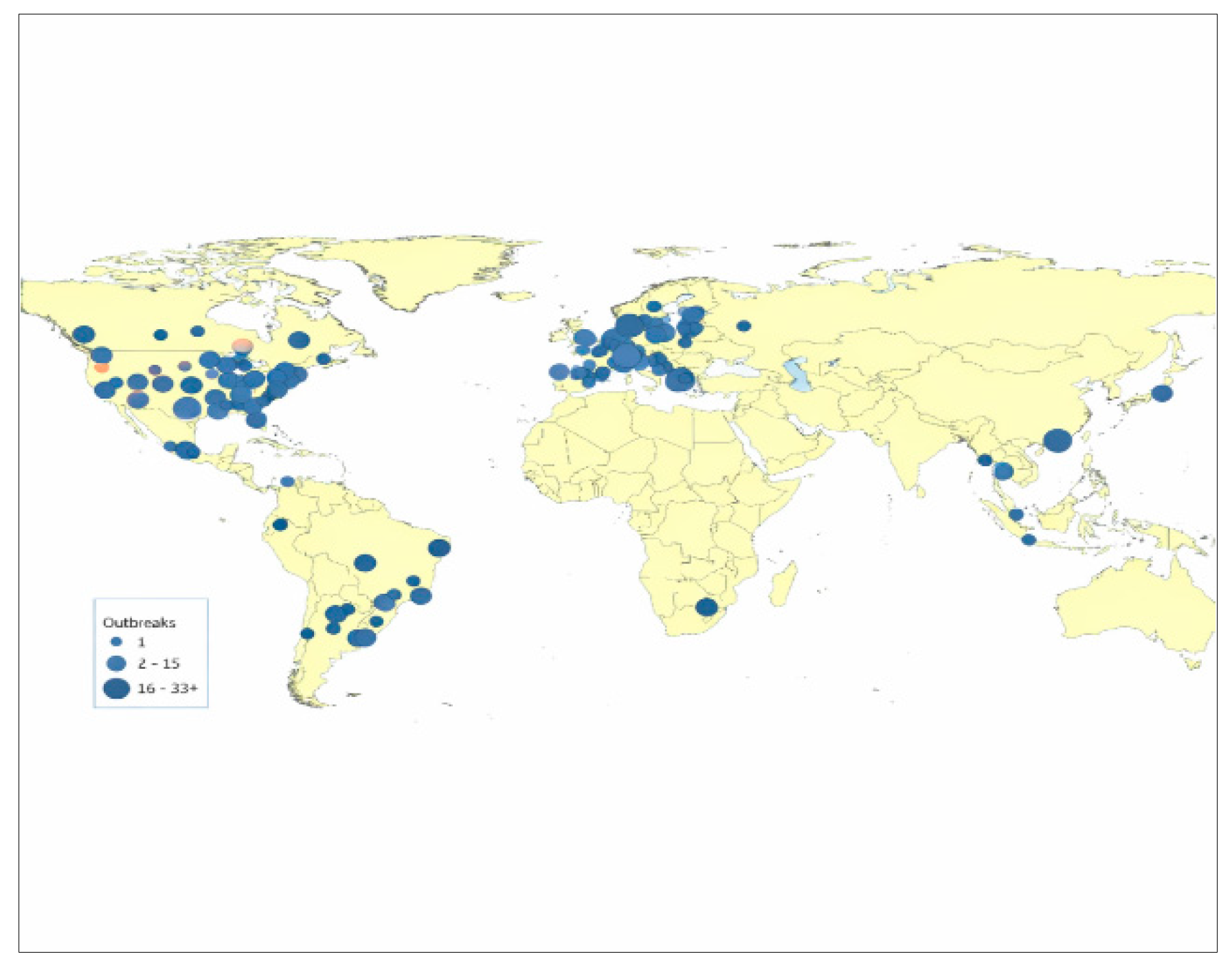
Figure 2.
Worldwide distribution of SARS-CoV-2 outbreaks in 68 animal species across 49 countries and territories, while MERS-CoV has been identified in 7 animal species across 16 countries to WOAH (18 December 2025,16:00): https://www.fao.org/animal-health/situation-updates/emerging-zoonotic-coronaviruses-in-animals/en.
Figure 2.
Worldwide distribution of SARS-CoV-2 outbreaks in 68 animal species across 49 countries and territories, while MERS-CoV has been identified in 7 animal species across 16 countries to WOAH (18 December 2025,16:00): https://www.fao.org/animal-health/situation-updates/emerging-zoonotic-coronaviruses-in-animals/en.
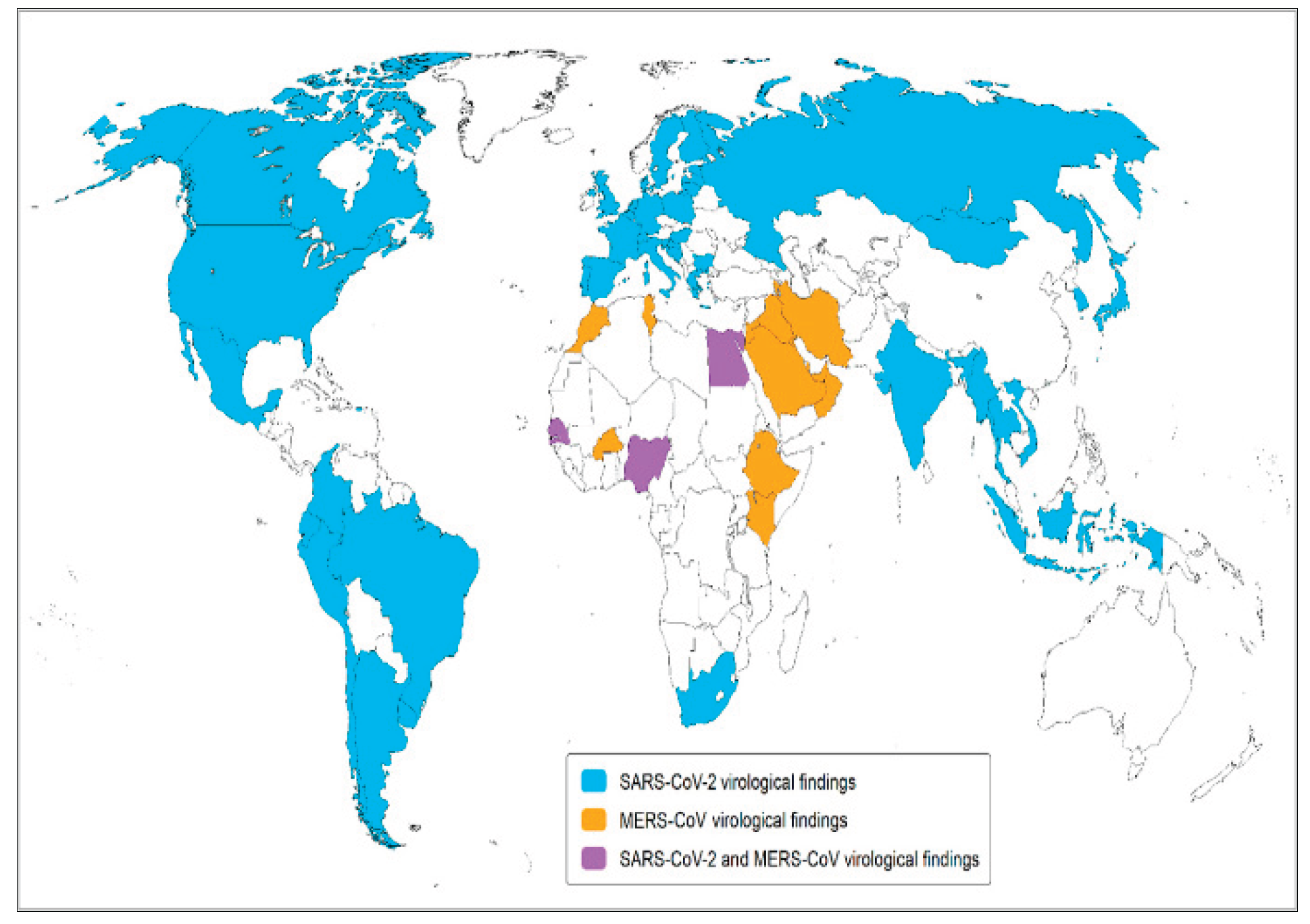

Table 1.
Chronology of nematode virus discovery.
| Year | Virus/group | Genome type | Primary host (nematode) | Pathogenicity/effect | Source |
| 2011 | Orsay virus | (+)ssRNA, two-segment,, nodavirus-like | Caenorhabditis elegans | Intestinal infection, microvilli damage, decreased fertility | [38,51] |
| 2011 | Santeuil virus | (+)ssRNA, nodavirus-like | Caenorhabditis briggsae | Subclinical intestinal infection | [38,51] |
| 2011 | Le Blanc virus | (+)ssRNA, nodavirus-like | Caenorhabditis briggsae | Moderate pathogenicity, intestinal infection | [38,51,52] |
| 2011 | Novel RNA viruses in soybean cyst nematode | (+)ssRNA (flavi-like, picorna-like) | Heterodera glycines | First description of viruses in cyst-forming plant-parasitic nematodes | [53] |
| 2012 | Le Blanc virus (complete genome) | (+)ssRNA, nodavirus-like | Caenorhabditis briggsae | Genomic characteristics of the virus | [52] |
| 2013 | Orsay-like viruses (варианты) | (+)ssRNA | Caenorhabditis spp. | Antiviral immunity model (RNAi) | [42] |
| 2014 | Novel flavivirus-like nematode virus | (+)ssRNA | Heterodera glycines | Flavivirus-like lineage in nematodes | [54] |
| 2017 | Orsay-like viruses | (+)ssRNA | Caenorhabditis spp. | Used as a model for antivirus protection | [55] |
| 2017 | High incidence of viral infection in SCN populations | (+)ssRNA | Heterodera glycines | High prevalence of cryptic viral infections | [56] |
| 2018 | Novel RNA viruses (nematode-associated), diverse lineages | (+)ssRNA (picornavirales-like, nodavirus-like) | Plant-parasitic cyst nematodes (Heterodera glycines, Globodera pallida, G. rostochiensis) | Pathogenicity has not been established | [57] |
| 2018 | Sugar beet cyst nematode virus 1 (SBCNV1) | (+)ssRNA, picorna-like | Heterodera schachtii | Pathogenicity has not been established | [58] |
| 2019 | RLNV1 (picorna-like) | (+)ssRNA | Pratylenchus penetrans | Replication has been confirmed, but significant pathogenicity has not been described | [59] |
| 2019 | Noda-like RNA viruses diversity in Caenorhabditis | (+)ssRNA | Caenorhabditis spp. | Variability and evolution of Orsay-like viruses | [60] |
| 2019 | Vertically transmitted viral RNA elements | (+)ssRNA (RdRp-encoding) | Caenorhabditis spp. | Vertical transmission of viral-like RNAs | [61] |
| 2019 | Highly divergent negative-sense RNA viruses | (−)ssRNA | Capillaria hepatica | Confirmation of (−)ssRNA viruses in parasitic nematodes | [62] |
| 2022 | Rhabdovirus-like nematode virus (PcRV) | (−)ssRNA, non-segmented | Globodera pallida | Pathogenicity not established; possible impact on fitness is under discussion | [63] |
| 2022 | Diverse RNA viruses (picorna-like, noda-like, tombus-like, bunya-like и др.) | ssRNA (+) и ssRNA (−) | Soil-inhabiting nematodes (Pratylenchus, Globodera, Heterodera, Meloidogyne etc.) | Clinical pathogenicity has not been demonstrated; cryptic infections are suspected | [64] |
| 2024 | 91 RNA viruses (13 orders, 24 families) | ssRNA (+/−) и dsRNA | Parasitic nematodes (Brugia malayi, Onchocerca volvulus etc.) | Induces an antibody response in vertebrates; no evidence of productive replication has been detected | [27] |
| 2025 | Expansion of plant-parasitic nematode RNA viruses | RNA (ssRNA+, ssRNA−, dsRNA) | Free-living and parasitic nematodes | A review of the wide diversity of nematode viruses and their interactions with their hosts | [25] |
Table 2.
Potential movement distances of reptiles and amphibians and their ability to transport free-living nematodes.
Table 2.
Potential movement distances of reptiles and amphibians and their ability to transport free-living nematodes.
| Animal species | Movements/migrations (assessment) |
| Sistrurus catenatus (eastern massasauga) | Usually hundreds of meters – up to ~1–2 km during the season; rare dispersal movements between wintering grounds and summer habitats can reach ~3–5 km (exceptionally – up to ~8–10 km). |
| Varanus prasinus (green tree monitor lizard) | Mainly local movements within an individual's territory (tens to hundreds of meters); when dispersing juveniles and changing habitats, movements of up to ~1–3 km are possible, probably episodically. |
| Megophrys montana (Asian horned frog, captive) | Short distances: usually tens to hundreds of meters between ground shelters and breeding sites; in natural conditions, as a rule, do not exceed ~0.5–1 km per season, rarely up to ~1–2 km. |
Table 3.
Birds, wireless transmitters, in this species of nematode stage, etc Orientation scales and adjustment before migration (in km).
Table 3.
Birds, wireless transmitters, in this species of nematode stage, etc Orientation scales and adjustment before migration (in km).
| # | Birds:Latinname/English name | Frequency of propaguls found, % (s/n×100) /Comment | Approximate distance of movement/migration* |
| 1. | Amazonetta brasiliensis (Brazilian teal) | 0 % /Nematodes did not hatch * |
local migrations up to ≈ 500 km (partial migrations) |
| 2. | Anas flavirostris (Yellow-billed teal) | 23.5 (4/17)/There were isolated cases | migrations up to ≈ 1500 km (South American) |
| 3. | Spatula versicolor (Silver teal) | 0 %/were not recorded** | local/regional movements up to ≈ 800 km |
| 4. | Callonetta leucophrys (Ringed teal) | 6.9 (2/29)/Fixation of hatched nematodes | mainly local (≤ 500 km) |
| 5. | Coscoroba coscoroba (Coscoroba swan) | 48.1 (13/27) | migration up to ≈ 1500-2000 km |
| 6. | Dendrocygna viduata (White-faced whistling-duck) | 17.6 (6/34) | migration/movement up to ≈ 1000–2000 km |
| 7. | Chauna torquata (Southern screamer) | 16.7 (3/18) | local/regional up to ≈ 300–600 km |
| 8. | Fulica armillata (Red-gartered coot) | 0.0/не фиксирoвались ** | movements of up to ≈ 500-1000 km |
| 9. | Theristicus caudatus (Buff-necked ibis) | 14.3 (2/14) | Local/regional distance is ≈ 800 km |
| 10. | Theristicus caerulescens (Plumbeous ibis) | 0.0/ не фиксирoвались** | Local/regional distance is ≈ 800 km |
| 11. | Nycticorax nycticorax (Black-crowned night-heron) | 0.0/ не фиксирoвались** | Migration to ≈ 1500–3000 km in the new population |
| 12. | Egretta spp. (Little blue heron & Snowy egret) | 16.7 (1/6) | migration/movement up to ≈ 1000–2500 km |
Notes: *Actual maximum distances traveled by birds depend on population, season, and geography (southern birds in South America may migrate less than northern species). Data taken from standard ornithological atlases/monographs on bird biology (within the framework of general knowledge on the bioecology of migration). ** Zero values mean that in none of the fecal samples of this bird species under the conditions of this experiment was it possible to obtain viable nematodes that reached the stage of active development. The nematode eggs did not hatch: this is only a fact of non-hatching of nematodes after laboratory cultivation of feces. This meant that, under the conditions of this experiment, it was not possible to obtain viable nematodes that had reached the stage of active development from the feces of these bird species for various reasons. Transfer did occur, but it was not detected by the “hatching” method. With Dauer larvae, the method could give a false negative result, as in the case of a small number of samples.
Table 4.
Animals with confirmed SARS-CoV-2 infection (as of December 18, 2025) and their ability to spread the virus.
Table 4.
Animals with confirmed SARS-CoV-2 infection (as of December 18, 2025) and their ability to spread the virus.
| # | Animal (English) | Scientific name (Latin) | Conditions under which SARS-CoV-2 was detected in animals | Natural geographic range/arial | Dispersal/migration capacity under natural conditions | Mobility category |
| 1. | Duck | Anas platyrhynchos | Backyards/farms (isolated cases) | Cosmopolitan (domestic ducks); wild ancestor—mallard (Anas platyrhynchos, Holarctic) | Max.: wild ducks usually migrate hundreds to thousands of km (up to 3–5 тис. km); domestic ducks are non-migratory and usually move locally (≤1–5 km), except for human-mediated transport |
Continental (≥500 km) |
| 2. | Puma | Puma concolor | Zoos/captivity | Americas (Canada–Patagonia) | Max.: up to > 1000 km; usually: Non-migratory; dispersal juveniles can be >1000 km | Continental (≥500 km) |
| 3. | Canadian lynx | Lynx canadensis | Zoos/captivity | Canada/Alaska/northern USA | Max.: n/a; usually: Non-migratory; long-distance settlements are possible in years of mining deficit | Continental (≥500 km) |
| 4. | Red fox | Vulpes vulpes | Wild populations and/or zoos (single) | Holarctic (native); Australia introduced |
Max.: ~1036 km (cumulative dispersal); usually: tens–hundreds km | Continental (≥500 km) |
| 5. | House finch | Haemorhous mexicanus | Wild populations (USA) | North America | Max.: seasonal movements up to ≥500 kmkm (partial migration); usually: tens–hundreds km | Regional (20–499 km) |
| 6. | Mule deer | Odocoileus hemionus | Wild populations (USA) | Western North America | Max.: up to~390 km; usually: Seasonal migration in some populations | Regional (20–499 km) |
| 7. | White-tailed deer | Odocoileus virginianus | Wild populations, massively in the USA/Canada | North America | Max.: usually about 10–50 km, sometimes >300 km; usually: Partial migration | Regional (20–499 km) |
| 8. | Lion | Panthera leo | Zoos/captivity | Africa (and a small population in India) | Max.: dispersal young males to ~200 km; usually: Non-migratory | Regional (20–499 km) |
| 9. | Red deer | Cervus elaphus | Zoos/captivity | Europe and West Asia (introductions) | Max.: 10–50 km (partial seasonal/altitude migration in some populations; usually: 1–20 km | Regional (20–499 km) |
| 10. | Antillean manatees | Trichechus manatus manatus | Wild populations/rehabilitation | Caribbean Basin, coastal waters | Max.: n/a; usually: Seasonal movements along the coast: tens–hundreds of km | Regional (20–499 km) |
| 11. | Asian small-clawed otter | Aonyx cinereus | Zoos/captivity | South and Southeast Asia | Max.: n/a; usually: Non-migratory; linear sections along waterbodies | Regional (20–499 km) |
| 12. | Eastern red bat | Lasiurus borealis | Wild populations (USA) | North America | Max.: n/a; usually: It migrates seasonally: hundreds of km | Regional (20–499 km) |
| 13. | Domestic American Mink | Domestic American mink (Neovison vison domesticus ) | Fur farms (Europe, North America, etc.), occasional escapes | North America (introduced/naturalized in Europe) | Max.: ~100 km; usually: up to ~50 km (more often along watercourses) | Regional (20–499 km) |
| 14. | Snow Leopard | Panthera uncia | Zoos/captivity | Central Asia (high mountains) | Max.: ~200 km ; usually: movements within the range | Regional (20–499 km) |
| 15. | Spotted hyena | Crocuta crocuta | Zoos/captivity | Sub-Saharan Africa | Max.: ~27 km/night (average); usually: active night movements tens of km | Regional (20–499 km) |
| 16. | Tiger | Panthera tigris | Zoos/captivity | Asia | Max.: ~315 km (long-range dispersal); usually: tens of kilometers dispersal juveniles | Regional (20–499 km) |
| 17. | White rhinoceros | Ceratotherium simum simum | Zoos/captivity | Southern Africa | Max.: ~25 km (distance from the release point/movements along the section); usually: tens of km | Regional (20–499 km) |
| 18. | Wild American Mink | Wild American mink (Neovison vison) | Wild populations (near farms/in the wild, singly) | North America; introduced в Еврoпе | Max.: ~100 km; usually: up to ~50 km (often along watercourses) | Regional (20–499 km) |
| 19. | Giant anteater | Myrmecophaga tridactyla | Zoos/rehabilitation/captivity | Central and South America | Max.: dispersal up to ~50–100 km; usually: daily movements 3–11 km | Regional (20–499 km) |
| 20. | Indian Leopard | Panthera pardus fusca | Zoos/captivity | Indian subcontinent | Max.: dispersal of young up to ~300 km; usually: movements within the range of tens of kilometers | Regional (20–499 km) |
| 21. | Mandrill | Mandrillus sphinx | Zoos/captivity | Equatorial Africa | Max.: seasonal nomadic movements groups up to ~50–100 km; usually: 5–10 km/day | Regional (20–499 km) |
| 22. | Maned wolf | Chrysocyon brachyurus | Zoos/captivity | Central South America (Cerrado/Pampas) | Max.: dispersal дo ~100–200 km; usually: nights movements 7–14 km | Regional (20–499 km) |
| 23. | Raccoon | Procyon lotor | Wild populations (USA) | North America; introduced in Europe/Japan | Max.: dispersal up to ~300 km; usually: tens of km | Regional (20–499 km) |
| 24. | Sheep | Ovis aries | Backyards/farms (isolated cases) | Cosmopolitan (domestic sheep) | Max.: Regional (20–499 km) movements herd up to ~100–300 km; usually: local | Regional (20–499 km) |
| 25. | Virginia opossum | Didelphis virginiana | Wild populations (USA) | North America | Max.: dispersal up to ~200 km; usually: movements within tens of kms | Regional (20–499 km) |
| 26. | Western lowland Gorilla | Gorilla gorilla gorilla | Zoos/holding facilities (human-to-animal transmission) | Central Africa (tropical forests) | Max.: seasonal nomadic movements groups up to ~50 km; usually: 2–10 km/day | Regional (20–499 km) |
| 27. | White-eared opossum | Didelphis albiventris | Wild populations (South America) | South America | Max.: dispersal дo ~150–200 km; usually: tens of km | Regional (20–499 km) |
| 28. | Wild Eurasian River Otter | Lutra lutra | Wild populations (sporadic detections) | Eurasia and North Africa | Max.: movements along rivers up to ~40–100 km | Regional (20–499 km) |
| 29. | Black- and brown headed Spider Monkey | Ateles fusciceps | Rehabilitation/captivity | Northwestern South America (Colombia/Ecuador) | Max.: n/a; usually: Non-migratory | Regional (20–50 km) |
| 30. | Brown rat | Rattus norvegicus | Synanthropic/anthropogenic populations (trapping/studies) | Cosmopolitan | Max.: n/a; usually: Non-migratory | Regional (1–10 km) |
| 31. | Common woolly monkey | Lagothrix lagothricha | Rehabilitation/captivity | Western/northern Amazonia | Max.: n/a; usually: Non-migratory | Regional (20–50 km) |
| 32. | Domestic Dog | Canis lupus familiaris | Domestic animals (human contact), cases in many countries | Cosmopolitan | Max.: n/a; usually: Non-migratory | Regional (5–20 km) |
| 33. | European fallow deer | Dama dama | Zoos/captivity | Europe/Western Asia (widely introduced) | Max.: n/a; Usually does not migrate; local seasonal movements | Regional (10–30 km) |
| 34. | Fishing cat | Prionailurus viverrinus | Zoos/captivity | South and Southeast Asia (wetlands) | Max.: n/a; usually: Non-migratory | Regional (10–30 km) |
| 35. | Goat domestic | Capra hircus | Farms/backyards (isolated cases) | Cosmopolitan (domestic goats) | Max.: n/a; usually: Non-migratory | Regional (5–20 km) |
| 36. | Gray brocket deer | Subulo gouazoubira | Zoos/captivity | Central and South America | Max.: n/a; usually: Non-migratory | Regional (10–30 km) |
| 37. |
South American squirrel monkey |
Saimiri sciureus | Zoos/captivity | Northern South America (Amazonia/Guiana) | Max.: n/a; usually: Non-migratory | Regional (20–50 km) |
| 38. | Pantanal cat | Leopardus braccatus | Zoos/captivity | Central South America (Pantanal/savannas) | Max.: n/a; usually: Non-migratory | Regional (10–30 km) |
| 39. | Pig | Sus scrofa domesticus | Farms/backyards (isolated cases) | Cosmopolitan (domestic pigs) | Max.: n/a; usually: Non-migratory | Regional (5–20 km) |
| 40. | domestic buffalo | Bubalus bubalis | Farms/backyards (isolated cases) | South Asia (domestic water buffalo is widespread) | Max.: n/a; usually: Non-migratory | Regional (5-30 km) |
| 41. | Coatimundi | Nasua nasua | Zoos/captivity | South America | Max.: n/a; usually: Non-migratory | Regional (5 -30 km) |
| 42. | White-fronted capuchin | Cebus unicolor | Captivity/rehabilitation | Western Amazonia (Peru, etc.) | Max.: n/a; usually: Non-migratory | Regional(20–50 km) |
| 43. | Eurasian beaver |
Castor fiber | Farms/captivity (single) | Europe and Northern Asia (reintroductions) | Max.: dispersal of young usually up to ~10 km (sometimes more); usually Non-migratory | Local (1–19 km |
| 44. | Hippopotamus | Hippopotamus amphibius | Zoos/captivity | Sub-Saharan Africa | Max.: up to 10 km; usually: Non-migratory; nights movements usually 2–10 km | Local (1–19 km) |
| 45. | large hairy armadillo | Chaetophractus villosus | Captivity/rehabilitation | South America (Pampas/steppe) | Max.: n/a; usually: Non-migratory | Local (1–5 km, limited) |
| 46. | Binturong | Arctictis binturong | Zoos/captivity | Southeast Asia | Max.: n/a; usually: Non-migratory; local movements | Local (1–5 km, limited) |
| 47. | Black-Tailed Marmoset | Mico melanurus | Wild populations (South America) | Центральная South America (Brazil/Bolivia/Paraguay) | Max.: n/a; usually: Non-migratory; local | Local (1–5 km, limited) |
| 48. | Cactus mouse | Peromyscus eremicus | Wild populations (USA/Mexico) | Southwestern USA and northern Mexico | Max.: n/a; usually: Non-migratory | Local (1–3 km, limited) |
| 49. | Cattle | Bos taurus taurus | Farms/backyards (isolated cases) | Cosmopolitan (domestic) | Max.: n/a; usually: Non-migratory | Local (1-20 km) |
| 50. | Chicken | (Gallus gallus domesticus) | Backyards/farms (isolated cases) | Cosmopolitan (domestic chickens) | Max.: n/a; usually: Non-migratory | Local (0.5–2 km, limited) |
| 51. | Domestic cat | Felis catus | Domestic animals (human contact), cases in many countries | Cosmopolitan (worldwide alongside humans) | Max.: n/a; usually: Non-migratory; usually km- (territory/free range) | Local (1–5 km / limited) |
| 52. | Domestic Ferret | Mustela furo | Domestic/laboratory animals; detected after contact with humans | Domesticated; kept in captivity worldwide | Max.: n/a; usually: Non-migratory | Local (1–3 km, limited) |
| 53. | Eastern cottontail | Sylvilagus floridanus | Wild populations (USA) | North America | Max.: n/a; usually: Non-migratory | Local (1–5 km, limited) |
| 54. | Eastern deer mouse | Peromyscus maniculatus | Wild populations (USA) | North America | Max.: n/a; usually: Non-migratory; small radius of activity | Local (1–5 km, limited) |
| 55. | European polecat | Mustela putorius | Wild populations (Europe) | Europe | Max.: ~5 km/day (linear movements within a few km); usually: no migrations, nomadic movements within the area | Local (1–15 km, limited) |
| 56. | Groundhog | Marmota monax | Wild populations (USA) | North America | Max.: n/a; usually: Non-migratory | Local (1–10 km) |
| 57. | Syrian hamster | Mesocricetus auratus | Pet hamsters/pet shops (e.g., Hong Kong), linked to trade | Native range: Syria; kept in captivity worldwide | Max.: n/a; usually: Non-migratory | Local (<1 km/ limited) |
| 58. | House mouse | Mus musculus | Synanthropic/anthropogenic populations (trapping/studies) | Cosmopolitan | Max.: n/a; usually: Non-migratory | Local (<0,5-2,0 km/ limited) |
| 59. | Lizard/ red-headed rock agama | Agama agama | Near a house/yard (single) | West and Central Africa | Max.: n/a; usually: Non-migratory; local movements | Local (0,5-2,0 km/ limited) |
| 60. | Domestic turkey | Meleagris gallopavo domesticus | Backyards/farms (isolated cases) | Cosmopolitan (domestic turkeys) | Max.: n/a; usually: Non-migratory | Local (1-5 km/ limited) |
Note: The provided estimates of movement distances correspond to the potential dispersal distances of animals in the wild, including rare but biologically significant movements (dispersal of young animals, seasonal and stress movements), and not just daily activity. The term "local" is used to denote movements within ~20 km; "regional": 20-499 km; "continental": ≥500 km; - "n/a" = "no data", i.e. there are no reliable quantitative field data on the maximum distance.
Table 5.
Preservation of the infectious properties of SARS-CoV-2 at different temperatures and under different conditions.
Table 5.
Preservation of the infectious properties of SARS-CoV-2 at different temperatures and under different conditions.
| Virus variant/lineage | Which option does the data belong to | Temperature | Object / environment | Duration of infectivity | Source |
| Wuhan-Hu-1 (ранний штамм) | Direct evidence for an early pandemic variant | 4 °C | Liquid culture medium (without cells) | ≥14 days without significant loss of titer | [107] |
| Wuhan-Hu-1 | Direct evidence for an early pandemic variant | 22–25 °C | Liquid culture medium (without cells) | 3–7 days | [107] |
| Wuhan-Hu-1 | Direct evidence for an early pandemic variant | 37 °C | Liquid culture medium (without cells) | Loss of infectivity within 1–2 days | [107] |
| Wuhan-Hu-1 | Direct evidence for an early pandemic variant | 70 °C | Liquid culture medium (without cells) | Inactivation in ~5 min | [107] |
| Wuhan-Hu-1 | Direct evidence for an early pandemic variant | 21–23 °C | Plastic, stainless steel | Up to 72 hours | [108] |
| Wuhan-Hu-1 | Direct evidence for an early pandemic variant | 20 °C | Glass, polymer | Up to 28 days | [109] |
| Wuhan-Hu-1 | Direct evidence for an early pandemic variant | 30 °C | Glass, polymer | Up to 7 days | [109] |
| Wuhan-Hu-1 | Direct evidence for an early pandemic variant | 40 °C | Glass, polymer | <24 hours | [109] |
| Wuhan-Hu-1 | Direct evidence for an early pandemic variant | 4 °C | Skin (human skin model) | ≥14 days | [105] |
| Wuhan-Hu-1 | Direct evidence for an early pandemic variant | 22 °C | Skin (human skin model) | Up to 96 hours | [105] |
| Wuhan-Hu-1 | Direct evidence for an early pandemic variant | 37 °C | Skin (human skin model) | ~8 hours | [105] |
| Alpha (B.1.1.7) | Прямые данные для варианта Alpha | 22 °C | Plastic | Up to 7 days | [105] |
| Delta (B.1.617.2) | Прямые данные для варианта Delta | 22 °C | Plastic | Up to 7 days | [105] |
| Omicron (BA.1) | Прямые данные для варианта Omicron | 22 °C | Plastic | Up to 7-9 days (higher than Wuhan) | [105] |
| Wuhan-Hu-1 | Direct evidence for an early pandemic variant | 20–25 °C | Human feces | Infectious virus for up to 2-3 days | [110] |
| Wuhan-Hu-1 | Direct evidence for an early pandemic variant | 20–25 °C | Human urine | Infectious virus for up to 3-4 days | [110] |
| Wuhan-Hu-1 | Direct evidence for an early pandemic variant | 4 °C | Aquatic* environment | ≥7 days | [112] |
| Wuhan-Hu-1 | Direct evidence for an early pandemic variant | 20 °C | Aquatic* environment | 1–3 days | [112,114] |
| Wuhan-Hu-1 | Direct evidence for an early pandemic variant | 20–25 °C + УФ | Surfaces | Rapid inactivation (minutes–hours) | [111] |
| Wuhan-Hu-1 | Direct evidence for an early pandemic variant | 4–20 °C | Organic matrices (feces, sludge, wastewater - similar to cold compost) | Hours–days, at 4°C possibly up to several days | [112] |
| Wuhan-Hu-1 | Direct evidence for an early pandemic variant | 50–70 °C | Organic matrices/active compost | Rapid inactivation (minutes to tens of minutes) | [107] |
* Casanova L. et al., 2009 — besides other coronaviruses and SARS-CoV data are used in water as a valid ecological analogy for SARS-CoV-2 [113].
Table 6.
Time (approximately required) for birds to fly 400 km.
| Bird species | Approximate flight speed of a bird | Theoretical time for 400 km without stops |
| Mallard (Anas platyrhynchos) | ~82–83 km/h | ~4,5–5 hours |
| House finch (Haemorhous mexicanus) | ~~25–40 km/h (estimated) | ~10–16 hours |
Table 7.
Time to cover the maximum migration distance (without stopping) by nematode-carrying birds.
Table 7.
Time to cover the maximum migration distance (without stopping) by nematode-carrying birds.
| № | Bird species | Max. distance (km) | Average speed (km/h) | Flight time (hours) |
| 1 | Amazonetta brasiliensis | 500 | ~70 | ~7,1 h |
| 2 | Anas flavirostris | 1500 | ~75 | ~20 h |
| 3 | Spatula versicolor | 800 | ~75 | ~10,7 h |
| 4 | Callonetta leucophrys | 500 | ~70 | ~7,1 h |
| 5 | Coscoroba coscoroba | 2000 | ~75 | ~26,7 h |
| 6 | Dendrocygna viduata | 2000 | ~70 | ~28,6 h |
| 7 | Chauna torquata | 600 | ~65 | ~9,2 h |
| 8 | Fulica armillata | 1000 | ~70 | ~14,3 h |
| 9 | Theristicus caudatus | 800 | ~60 | ~13,3 h |
| 10 | Theristicus caerulescens | 800 | ~60 | ~13,3 h |
| 11 | Nycticorax nycticorax | 3000 | ~65 | ~46,2 h |
| 12 | Egretta spp. | 2500 | ~65 | ~38,5 h |
Disclaimer/Publisher’s Note: The statements, opinions and data contained in all publications are solely those of the individual author(s) and contributor(s) and not of MDPI and/or the editor(s). MDPI and/or the editor(s) disclaim responsibility for any injury to people or property resulting from any ideas, methods, instructions or products referred to in the content. |
© 2026 by the authors. Licensee MDPI, Basel, Switzerland. This article is an open access article distributed under the terms and conditions of the Creative Commons Attribution (CC BY) license (http://creativecommons.org/licenses/by/4.0/).
Copyright: This open access article is published under a Creative Commons CC BY 4.0 license, which permit the free download, distribution, and reuse, provided that the author and preprint are cited in any reuse.