

Submitted:
25 February 2026
Posted:
28 February 2026
You are already at the latest version
Abstract
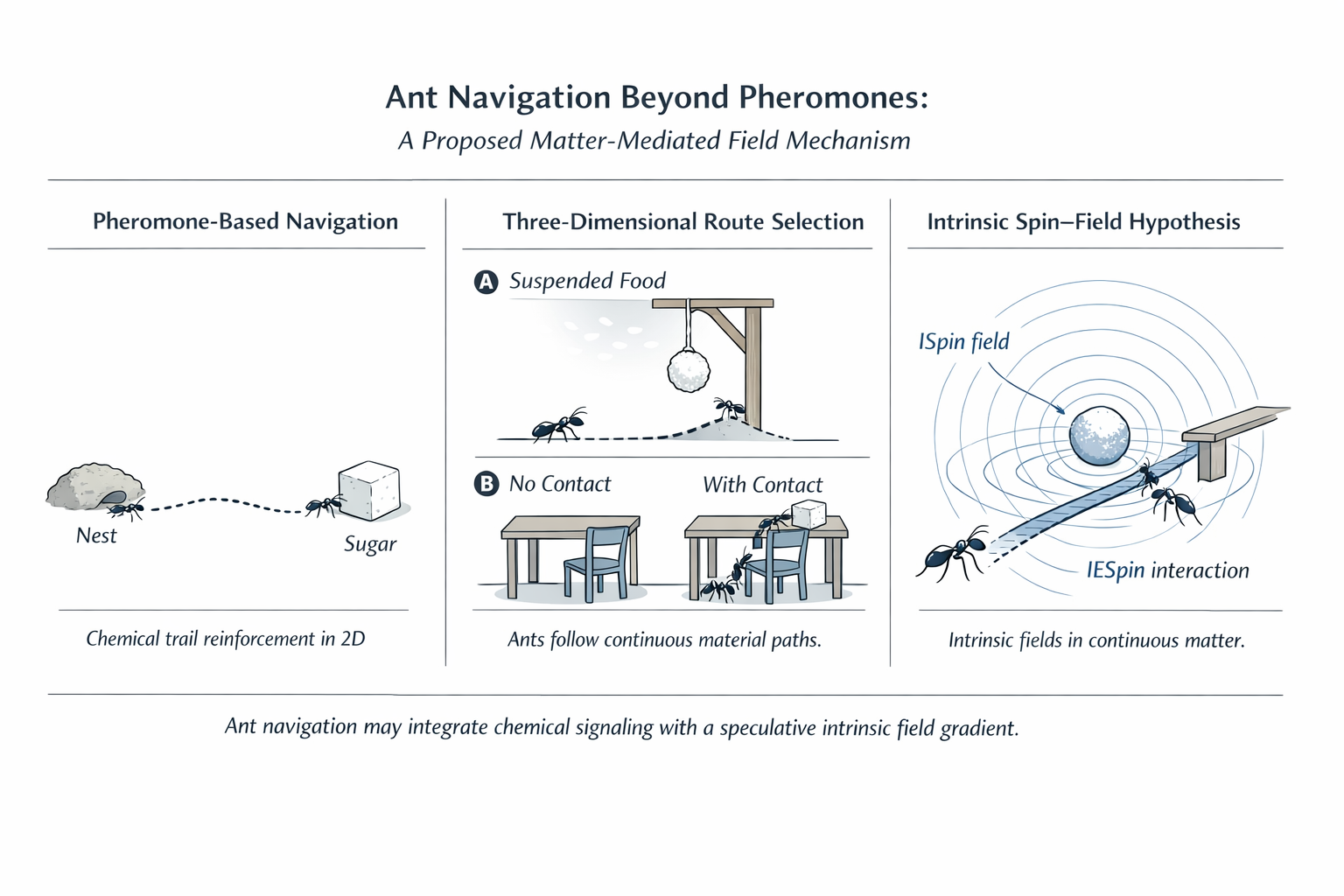
Ant navigation is widely explained through pheromone-mediated trail formation and reinforcement, which accounts for efficient shortest-path selection in two-dimensional environments. However, certain three-dimensional foraging behaviors—such as navigation toward suspended food sources or the rapid use of newly established material paths—raise questions about whether chemical gradients alone fully explain route detection and selection. This paper examines experimental observations that appear difficult to reconcile with purely diffusion-based pheromone models and proposes an expanded framework incorporating the concept of Intrinsic Energy Spin (IESpin) fields. According to this hypothesis, all entities possess an intrinsic spin (ISpin) that encodes their fundamental intrinsic properties. The ISpin field propagates through space and interacts with other entities in the universe, giving rise to an IESpin field. These fields are proposed to propagate preferentially through continuous matter, potentially allowing organisms to detect spatial pathways and resource signatures via field gradients. The hypothesis generates experimentally testable predictions concerning material-dependent transmission, pheromone-independent navigation, and the possible existence of non-chemical sensory mechanisms in ants.
Keywords:
ant navigation
; pheromone signaling
; three-dimensional foraging
; route optimization
; intrinsic Spin
; field-gradient detection
; non-chemical communication
; collective behavior
1. Introduction
Ants are paradigmatic models for studying collective behavior and navigation. Classical ethological research identifies olfactory chemical cues—pheromones—as the primary mediators of ant foraging [1,2]. Ants deposit pheromone trails that reinforce successful routes, leading colonies toward resources over time. This reinforcement mechanism explains emergent shortest-path selection in two-dimensional (2D) labyrinths due to positive feedback and differential evaporation of pheromones [3].
Despite this well-supported model in planar domains, certain three-dimensional (3D) foraging choices challenge its explanatory sufficiency. Here, we explore such phenomena and propose a hypothesis that pairs existing biological insights with a physical model of Intrinsic Spin (ISpin) and Intrinsic Energy Spin (IESpin) fields [4,5].
3. Materials and Methods
Observation-Led Framework for Mechanistic Analysis
Before proceeding to a highly controlled experimental design—readily reproducible by independent investigators—it is possible to gain insight into the underlying mechanism through simple, direct observations. Much like the classic demonstration of gravitational attraction through the fall of an apple associated with Isaac Newton, fundamental principles may be inferred from carefully interpreted, minimally instrumented experiments.
The logic underpinning the present study relies primarily on such foundational observations. These straightforward experimental setups provide the essential empirical evidence required to frame the central question: by what mechanism do ants detect and localize food sources?
Accordingly, based on a series of structured observations and exploratory experiments, two representative methods were selected for detailed presentation in this paper. These methods are intended to elucidate the phenomenon of food-location behavior in ants while maintaining conceptual clarity and experimental accessibility.
3.1. Suspended Food Experiment
When a small sugar cube of few millimeters is suspended a just 10 mm above ants by a rope from a L-shaped wooden post as shown in Figure 1. All components of the experiment, as well as the floor surface, were cleaned with 80% ethanol prior to setting up the experiment.
3.2. Results: Observations for Suspended Food Experiment
- Ants do not cluster directly beneath the food.
- Instead, they ascend via the shortest path from the floor to the attachment point of L-shaped wooden post then down the rope to the food.
This behavior persists even when airborne chemical gradients toward the food are negative. No consistent pheromone trails on the floor align directly under the suspended food prior to ants finding the rope.
3.3. Table & Insecticide Constraint Experiment
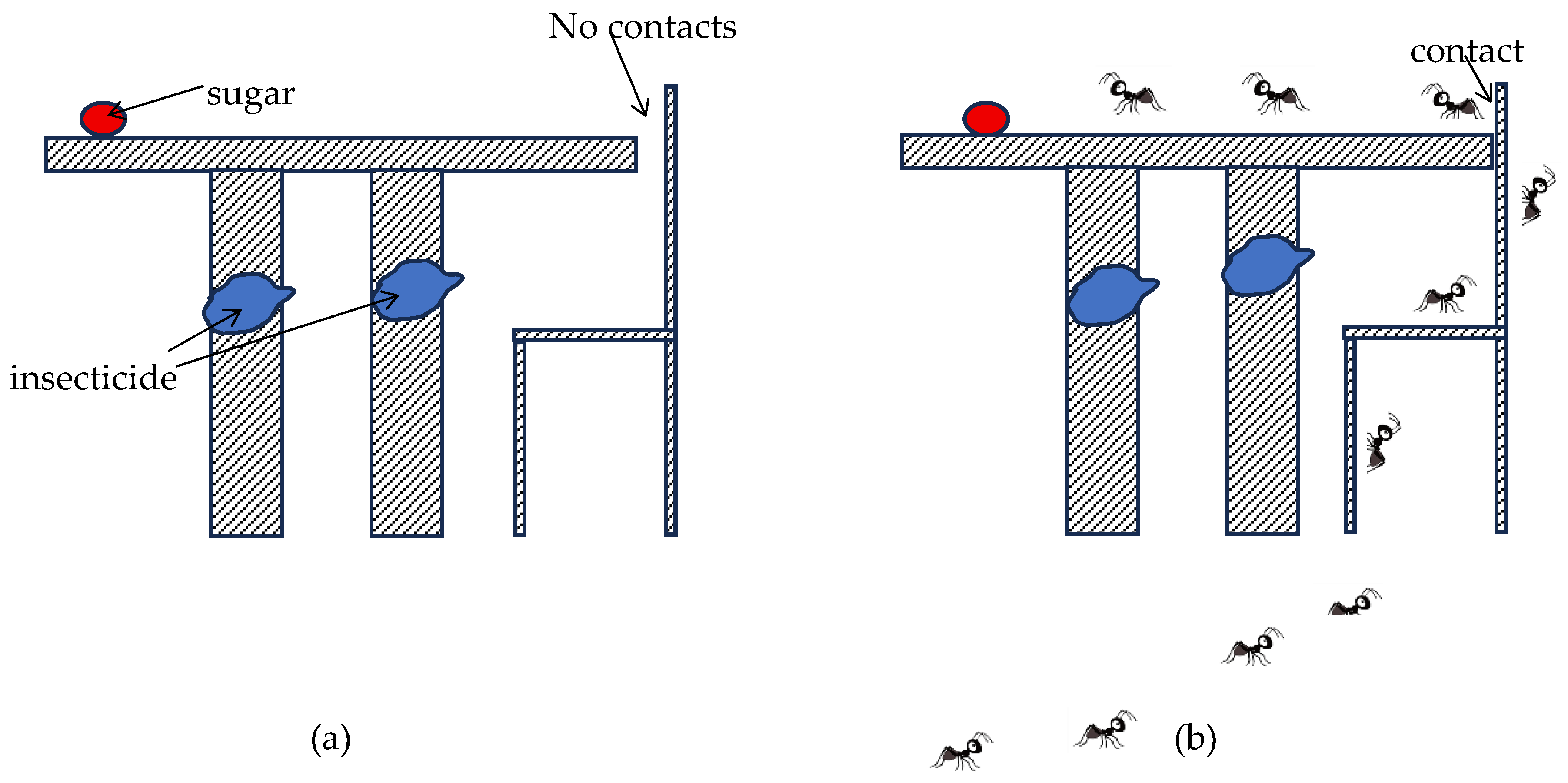
A sugar source placed on a table as shown in the Figure 2(a):
- Each table leg is coated with an insecticide barrier.
- A chair is placed within 2 - 3 mm of the tabletop surface - too wide for ants to bridge until the chair contacts the table.
3.4. Results: Observations for Table & Insecticide Constraint Experiment
Ants do approach the table via untreated chair at the moment of direct contact makes a continuous matter path available due to touching the table top surface by the chair.
Once contact between chair and table exists, ants immediately navigate via the chair to the food, again selecting the shortest accessible route.
4. Discussion
4.1. Pheromone Model Insufficiencies
These observations pose challenges:
- Pheromone gradients from the suspended food should be isotropically weaker in air, lacking directional information for ants to locate the rope path.
- No detectable chemical trail exists prior to ants establishing movement toward the elevated route.
- Avoidance of insecticide barriers is consistent with contact deterrents but does not explain anticipation of route geometry without prior diffusion cues.
Consequently, there is a need for an expanded framework capable of explaining how ants detect:
- 1)
- Presence of food after contact,
- 2)
- Available spatial paths through matter,
- 3)
- Optimal route geometry in 3D contexts.
4.2. Alternative Hypothesis: Intrinsic Energy Spin Fields (IESpin)
Electromagnetic Perspective
One possible explanation for long-range food detection would be electromagnetic (EM) sensing. If ants were capable of perceiving EM signals, and if sugar emitted characteristic EM signatures - particularly signals associated with substances attractive to ants - that could travel through non-metallic materials, then food localization might be interpreted within a conventional EM framework.
However, sugar is not known to function as an active source of EM radiation. In addition, non-metallic materials do not transmit or block EM waves in the simplified manner often assumed in such reasoning. Most importantly, there is no established biological evidence that ants possess specialized sensory systems designed for detecting EM emissions from food sources.
Therefore, explaining the phenomenon within a purely EM model would require additional assumptions: namely, that sugar generates a distinct, transmissible signature capable of propagating through metals, non-metals, and other media, and that ants are biologically adapted to detect and decode such signals. In the absence of empirical support for these conditions, an alternative theoretical framework—such as the proposed Intrinsic Energy Spin (IESpin) field model—must be considered.
4.3. Overview of the ISpin Model
- Every entity in the universe possesses an intrinsic spin (ISpin) with an associated intrinsic spin field that propagates isotropically.
Refer to the reference [5]: The presence of a solitary entity in space holds no inherent significance. This entity possesses intrinsic characteristics, including matter, energy, and other yet-to-be-identified properties[4]. The information pertaining to these intrinsic properties is encoded within the entity through a physical quantity defined here onwards as the intrinsic spin (Ispin).
- The Intrinsic ISpin fields encoded all the information of the entity that the ISpin is originated.
- These fields propagate isotropically through entire universe regardless of the media.
Entities (for example, ants and sugar molecules) are proposed to interact and become mutually aware through their respective Intrinsic Spin (ISpin) fields. Through these fields, they can in principle detect each other’s presence and infer spatial relationships, even without direct contact. The interaction between ISpin fields is suggested to generate a resultant force field termed the Intrinsic Energy Spin (IESpin) field. This field is described as propagating preferentially through a medium, with its influence amplified in denser materials. The behavior is presented as analogous to magnetic field propagation in matter, where the characteristics of the medium affect the strength and distribution of the field.
Refer to the reference [5] : When another entity emerges within the vast expanse of the universe, their intrinsic fields intersect. This overlap facilitates a mutual recognition of each other's existence in space through their respective intrinsic fields. The intrinsic fields of the entities establish a shared understanding of their coexistence in the universe, along with the intrinsic properties encoded within these fields. Once this mutual acknowledgment occurs, unique force fields (Inherent force field which is also represented by intrinsic energy spin force – IESpinF - field) materialize between them, shaped by the information recognized by their intrinsic fields. The emergence of these force fields takes place over time, dictated by the parameters of the intrinsic properties inherent to both entities. These collective forces are designated names based on their specific properties and interactions, such as gravitational forces, electric forces, magnetic forces, and so forth.
4.4. Relevant Postulates
Key aspects from the referenced works include:
- Postulate on free space propagation: ISpin fields exists for all the entities in the universe.
- Recognition between two specific entities through ISpin fields.
- Establish a link between two entities similar to definition of magnetic field analog: Energy propagation inside matter can be modeled similar to conduction mechanisms where the field preferentially travels through continuous substrates.
Together, these suggest an inherent sensitivity of organisms to field gradients mediated by the structure of the environment itself.
4.5. Hypothesis Application to Ant Behavior
Mechanism of Detection
Under this hypothesis:
- Food sources emit an ISpin field signature that propagates outward omnidirectionally into the surrounding space.
- Continuous matter (such as the ground, rope, chair, or table) enhances field transmission more effectively than less dense air.
- The ant sensory system detects gradients of this field, enabling recognition of the food source as well as the structural pathway attributes leading to it, in addition to conventional chemical cues.
Thus:
- In the suspended-food experiment, the ISpin field associated with the food preferentially propagates along the rope and supporting structures rather than dispersing through the air.
- Ants detect stronger field gradients along these continuous material pathways and follow them toward the source.
- In the table experiment, no effective field gradient spans the air gap until physical contact between the chair and table establishes a continuous matter path. Before contact, although a geometric route appears possible, it includes treated surfaces containing substances harmful to ants, thereby preventing safe traversal.
4.6. Route Selection
Ants likely use multiple strategies to locate food, similar to other animals. For example, humans rely on different sensory organs - eyes for vision and the nose for smell. In a comparable way, ants may depend on both chemical signaling and the IESpin field gradient when selecting a route.
When following a field-based mechanism, ants may prefer:
- Paths with stronger ISpin field gradients.
- Paths that require minimal traversal through free space.
- Optimal (shortest) routes, where greater gradient steepness corresponds to higher path efficiency.
- Routes that avoid potential dangers along the way.
Such preferences would produce behavioral patterns consistent with experimental observations.
4.7. Predictions and Testable Implications
The ISpin hypothesis makes several testable predictions
- Altering material properties (e.g., conductivity for ISpin fields) should affect ant path choice.
- Field detection should persist even when pheromones are suppressed or removed.
- Sensory structures in ants (e.g., antennae) should respond to non-chemical field gradients.
Neurophysiological studies could identify receptors sensitive to such fields.
4.8. Summary
Classical models of ant navigation, grounded in pheromone deposition and gradient-following, are strongly supported by decades of ethological and mathematical research. Studies on species such as Lasius niger and Linepithema humile demonstrate that positive feedback and pheromone evaporation dynamics can produce emergent shortest-path optimization in planar networks. These mechanisms explain a wide range of collective behaviors under controlled two-dimensional laboratory conditions.
However, the suspended-food and table–chair experiments described here highlight scenarios where chemical diffusion alone may not readily account for the rapid identification of viable three-dimensional routes. In the suspended sugar configuration, ants preferentially ascend via the supporting structure rather than congregating beneath the food source, despite the expectation that airborne diffusion would produce weak or isotropic gradients. Similarly, in the table experiment, route selection appears contingent on the establishment of continuous material contact, even when the geometric proximity of an alternative path is minimal.
The proposed ISpin hypothesis offers a speculative physical complement to biological models. In this framework, every entity- including ants and food molecules - possesses an intrinsic spin field encoding its properties. When two entities coexist, their fields intersect and generate an Intrinsic Energy Spin (IESpin) field. This field is hypothesized to propagate more effectively through continuous matter than through less dense media such as air, analogously to how certain physical fields behave in conductive or magnetizable materials.
If such a mechanism were biologically detectable, ants might respond not only to chemical gradients but also to matter-mediated field gradients. This could, in principle, explain preferential route selection along ropes, wooden supports, chairs, or other contiguous substrates. Importantly, the hypothesis does not reject pheromone models; rather, it proposes a complementary detection layer operating alongside established chemosensory processes.
Nevertheless, the ISpin framework has been discussed successfully [4] in the context of electromagnetic phenomena and remains experimentally unverified in biological systems. In contrast, pheromone signaling is well established and mechanistically understood at molecular, behavioral, and neurophysiological levels. To date, there is no direct empirical evidence demonstrating the existence or biological detectability of ISpin fields.
Therefore, rigorous experimental validation is essential. Controlled material-substitution experiments, pheromone-suppression trials, and neurophysiological recordings from ant antennae would be required to determine whether sensitivity to non-chemical field gradients exists.
5. Conclusions
Pheromone-mediated trail formation provides a robust explanation for many aspects of ant navigation, particularly in two-dimensional environments. However, certain three-dimensional route-selection behaviors invite further investigation into whether additional mechanisms may contribute to spatial detection and optimization.
The Intrinsic Spin (ISpin) hypothesis offers a speculative but structured extension to existing models. By proposing that entities emit intrinsic fields capable of interacting and propagating preferentially through matter, it suggests a possible explanation for the rapid detection of viable physical pathways in complex environments.
At present, this model should be regarded as a theoretical proposition requiring substantial empirical validation. Its value lies not in replacing established biological theory but in motivating new experimental designs that probe the limits of purely chemical explanations. Future interdisciplinary research integrating physics, neurobiology, and behavioral ecology will be necessary to determine whether ant navigation relies solely on chemical communication or whether additional field-based mechanisms play a role.
Furthermore, if such a mechanism were shown to exist, its implications would extend beyond ants to other species—particularly within the insect taxa. Many insects demonstrate sophisticated spatial orientation, collective coordination, and rapid environmental assessment that are not always fully explained by known sensory pathways alone. Exploring whether comparable field-based interactions could operate in bees, termites, or other social and non-social insects may open new avenues for understanding biological communication and environmental perception. Such investigations could reshape our broader conception of sensory ecology, potentially revealing conserved principles of information exchange across diverse forms of life.
Author Contributions
Conceptualization, methodology, investigation; analysis, writing - original draft preparation; C.K,G.P.
Funding
This research received no external funding.
Institutional Review Board Statement
The Institutional Review Board Statement and approval number is not relevant to this study and did not require ethical approval.
Informed Consent Statement
Not applicable
Data Availability Statement
Not applicable
Acknowledgments
In this section you can acknowledge any support given which is not covered by the author contribution or funding sections. This may include administrative and technical support, or donations in kind (e.g., materials used for experiments).
Conflicts of Interest
The authors declare no conflict of interest
Abbreviations
The following abbreviations are used in this manuscript:
| ISpin | Intrinsic Spin |
| IESpin | Intrinsic Energy Spin |
| EM | Electromagnetic |
References
- Hölldobler, B. E. O. Wilson, The Ants; Belknap Press of Harvard University Press, 1990. [Google Scholar]
- Beckers, R.; Deneubourg, J. L.; Goss, S. Insectes Sociaux 1992, 39, 59. [CrossRef]
- Deneubourg, J. L.; Aron, S.; Goss, S.; Pasteels, J. M. Journal of Insect Behavior 1990, 3, 159. [CrossRef]
- Piyadasa, C. K. G.; Annakkage, U.; Gole, A.; Rajapakse, A.; Premaratne, U. Open Physics 2020, 18, 212. [CrossRef]
- Piyadasa, C. in Preprints. Preprints 2024. [Google Scholar]
Figure 1.
A sugar ball is suspended by a thread, which is attached to an L-shaped wooden post. The ants immediately choose the indicated path to reach the sugar ball, without loitering directly beneath it. (a) Side view (b) view from the top.
Figure 1.
A sugar ball is suspended by a thread, which is attached to an L-shaped wooden post. The ants immediately choose the indicated path to reach the sugar ball, without loitering directly beneath it. (a) Side view (b) view from the top.
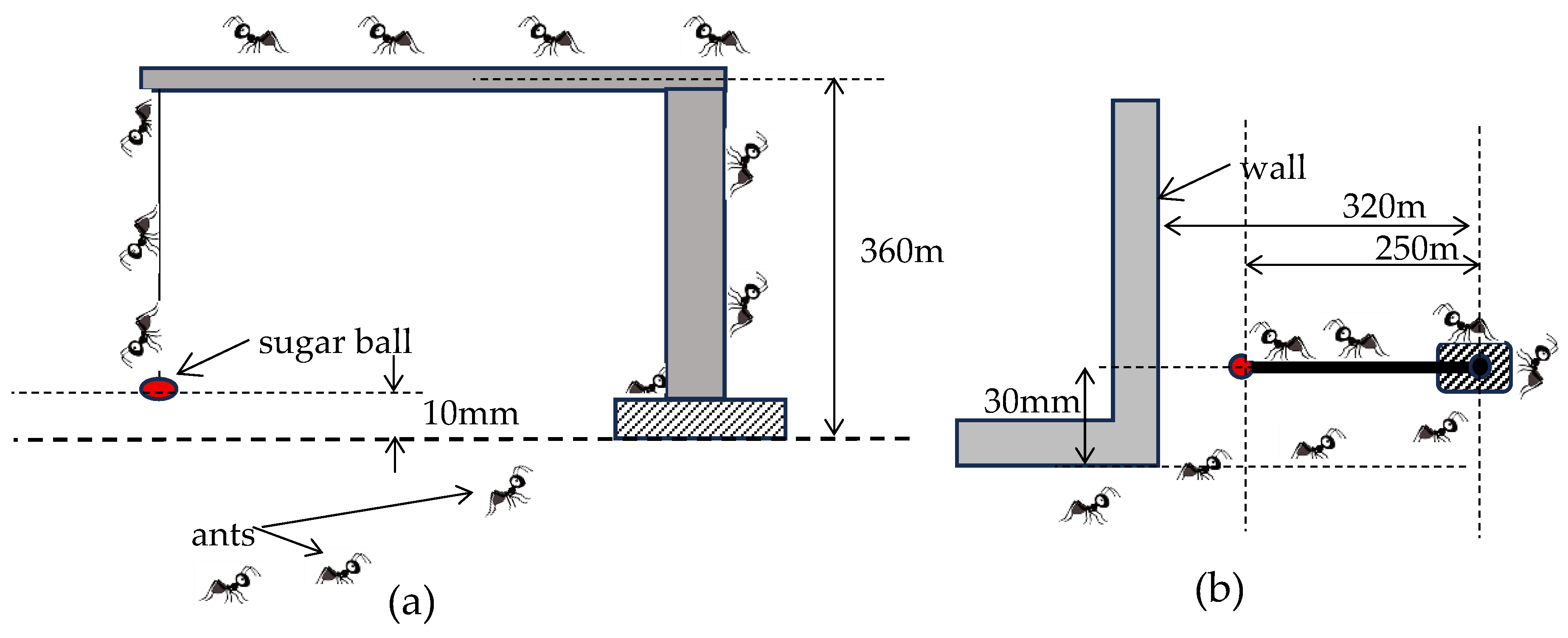
Figure 2.
The sugar ball is placed on the tabletop, and the table legs are coated with insecticide (shown in blue). (a) A chair is positioned very close to, but not touching, the tabletop, and no ants are observed in the vicinity. (b) When the chair is brought into contact with the table, ants immediately choose the indicated path to reach the sugar ball, without loitering around the table.
Figure 2.
The sugar ball is placed on the tabletop, and the table legs are coated with insecticide (shown in blue). (a) A chair is positioned very close to, but not touching, the tabletop, and no ants are observed in the vicinity. (b) When the chair is brought into contact with the table, ants immediately choose the indicated path to reach the sugar ball, without loitering around the table.
Disclaimer/Publisher’s Note: The statements, opinions and data contained in all publications are solely those of the individual author(s) and contributor(s) and not of MDPI and/or the editor(s). MDPI and/or the editor(s) disclaim responsibility for any injury to people or property resulting from any ideas, methods, instructions or products referred to in the content. |
© 2026 by the author. Licensee MDPI, Basel, Switzerland. This article is an open access article distributed under the terms and conditions of the Creative Commons Attribution (CC BY) license.
Copyright: This open access article is published under a Creative Commons CC BY 4.0 license, which permit the free download, distribution, and reuse, provided that the author and preprint are cited in any reuse.