

Submitted:
19 February 2026
Posted:
27 February 2026
You are already at the latest version
Abstract
We trace the rise and collapse of the Tuning Central Asian Higher Education Area (TuCAHEA) project (2010–2016), a EUR 3.7 million EU-funded initiative engineered to harmonize higher education across five Central Asian states. The coordination is now hollow. We develop the concept of “administrative Institutional Adherence circuits”—temporary cross-border networks of officials, shared vocabularies, and forged personal ties that enable policy coordination during funded project phases and corrode the moment external resources withdraw. Through comparative documentary analysis of Kazakhstan and Kyrgyzstan from 2010 to 2023, we reconstruct how TuCAHEA assembled dense inter-ministerial networks and a shared policy language, a trajectory that peaked with the 2014 Ministerial Communiqué signed by all five governments. That architecture fractured. Three interlocking mechanisms—personnel discontinuity, fiscal constraints, and geopolitical reorientation toward China and Russia—eroded the coordination capacity within seven years. Kazakhstan selectively absorbed elements aligned with its national strategy; Kyrgyzstan’s adoption stalled under capacity gridlock and recurring political instability. Neither country institutionalized TuCAHEA outcomes. We extend norm localization theory (Acharya, 2004; Anafinova, 2024) by demonstrating that in weakly institutionalized post-Soviet contexts, localized norms demand continuous administrative reinforcement or they fossilize into irrelevance, and we press against regionalization theory’s tacit assumption that project-phase achievements yield durable institutional structures.
Keywords:
higher education regionalization
; Bologna Process
; Central Asia
; norm localization
; administrative institutional adherence
; policy sustainability
1. Introduction
1.1. The Paradox of Vanishing Commitments
Billions of euros have been invested in exporting European education norms to Central Asia, yet the institutional half-life of these projects is often measured in months, not years. The document, produced under the Tuning Central Asian Higher Education Area (TuCAHEA) project, committed their governments to establishing a regional higher education space modeled on the European Higher Education Area (Isaacs, 2014). The communiqué outlined concrete steps: adopting the European Credit Transfer System (ECTS), implementing learning outcomes-based curricula, and establishing mutual degree recognition mechanisms. Nearly a decade later, these commitments have largely evaporated. No Central Asian country has enacted comprehensive legislation to operationalize the TuCAHEA framework, and regional student mobility remains negligible (Nikolaev et al., 2023).
This outcome presents a puzzle. TuCAHEA was not a hastily designed initiative. Funded by the European Union’s Tempus program with €3.7 million over six years, it involved 60 universities across five countries and produced detailed reference frameworks for eight subject areas (Anafinova, 2023). The project followed established methodologies from the European Bologna Process, adapted through extensive consultations with local stakeholders. Why, then, did such a well-resourced and carefully designed project fail to achieve institutional sustainability?
1.2. Beyond Policy Borrowing: The Missing Temporal Dimension
Existing scholarship on higher education regionalization has primarily focused on the initial adoption phase—why countries choose to borrow policies from other regions (Phillips & Ochs, 2003; Steiner-Khamsi, 2004). This literature has productively analyzed the motivations, mechanisms, and modifications involved in policy transfer. However, it has paid insufficient attention to what happens after the transfer project ends. The temporal gap between project completion and institutional embedding remains theoretically underspecified.
Recent work on norm localization (Acharya, 2004; Anafinova, 2024) has advanced our understanding by showing that borrowed policies undergo significant transformation as they interact with local contexts. Yet even this literature assumes a relatively linear progression from external norm introduction to local adaptation. It does not adequately account for cases where the localization process stalls or reverses after external support withdraws.
We argue that this gap stems from an insufficient theorization of the role of Institutional Adherence in sustaining cross-border policy coordination. Regional integration projects create temporary networks of administrators, academics, and policymakers who develop shared understandings and mutual confidence through repeated interaction (Tight, 2022). We term this phenomenon the “administrative Collaboration Mechanisms circuit”—a network of interpersonal and inter-institutional relationships that enables policy coordination across national boundaries. This circuit functions effectively during the project phase when regular meetings, workshops, and joint activities maintain communication channels. However, when external funding ceases and project structures dissolve, the Collaboration Mechanisms circuit often breaks down, leaving no institutional mechanism to sustain the coordination.
1.3. Research Questions and Contribution
This study addresses three interrelated questions:
- How did TuCAHEA create an administrative Institutional Adherence circuit during its operational phase (2010-2016)?
- Why did this circuit fail to translate into institutionalized regional cooperation after the project ended (2017-2023)?
- What does this case reveal about the conditions necessary for sustainable higher education regionalization in post-Soviet contexts?
We focus on Kazakhstan and Kyrgyzstan as contrasting cases within the TuCAHEA framework. Kazakhstan, with its ambitious “educational hub” strategy and substantial state capacity, represents the most favorable conditions for institutionalizing regional cooperation (Amirbekova et al., 2025). Kyrgyzstan, despite limited resources, has historically been more open to international educational partnerships (Albanbayeva et al., 2024). If TuCAHEA could not achieve sustainability in these relatively favorable contexts, this suggests systematic rather than idiosyncratic barriers.
Our contribution is threefold. Theoretically, we extend norm localization theory by demonstrating that in weakly institutionalized environments, localization is not a one-time adaptation but requires continuous external reinforcement. Empirically, we provide the first systematic analysis of TuCAHEA’s post-project trajectory, drawing on legal documents, policy statements, and institutional practices from 2010-2023. Practically, we offer insights for international organizations and national governments on designing regionalization initiatives with built-in sustainability mechanisms.
2. Theoretical Framework: From Norm Localization to Administrative Institutional Adherence Circuits
2.1. The Limits of Policy Borrowing Theory
The dominant framework for understanding cross-national policy transfer in education has been Phillips and Ochs’ (2003) four-stage model: impulse, decision, implementation, and internalization. This model usefully identifies the key phases of policy borrowing but assumes a relatively smooth progression from one stage to the next. It does not adequately theorize the possibility of regression—where policies that have been implemented fail to internalize and eventually disappear from practice.
Steiner-Khamsi (2004) offered an important corrective by highlighting the political economy of policy borrowing. She showed that countries often adopt international policies not because of their technical merits but to legitimize domestic reforms or attract external funding. This insight helps explain why borrowed policies may be implemented superficially without genuine commitment. However, Steiner-Khamsi’s framework still focuses primarily on the adoption decision rather than the post-adoption trajectory.
2.2. Norm Localization in Post-Soviet Contexts
Acharya’s (2004) theory of norm localization provides a more dynamic framework. He argues that international norms do not simply diffuse unchanged into new contexts. Instead, local actors actively reconstruct these norms through a process of “pruning” (selecting elements that fit local contexts) and “grafting” (connecting new norms to existing local practices). Successful localization occurs when external norms are reframed in ways that resonate with local cultural and institutional logics.
Anafinova (2024) applied this framework to analyze Kazakhstan’s adoption of Bologna Process elements. She found that Kazakhstani policymakers selectively adopted ECTS and learning outcomes frameworks while resisting elements that would reduce state control over universities. This selective localization allowed Kazakhstan to signal international alignment while maintaining domestic governance structures.
However, Acharya’s theory was developed to explain norm diffusion in relatively stable institutional environments (specifically, ASEAN countries with established regional organizations). Post-Soviet Central Asia presents a different context. These countries inherited Soviet-era higher education systems characterized by strong central control, limited institutional autonomy, and minimal cross-border coordination (Sabzalieva, 2017). They lack the regional institutional infrastructure that could sustain norm localization after external projects end.
2.3. Introducing the Administrative Institutional Adherence Circuit
We propose that sustainable regionalization requires not just norm localization but the establishment of what we term an “administrative Institutional Adherence circuit.” This concept draws on Fukuyama’s (2013) distinction between state capacity (the ability to implement policies) and state autonomy (freedom from political interference). We extend this framework to the regional level, arguing that cross-border policy coordination requires both technical capacity and mutual Collaboration Mechanisms among administrators.
An administrative Collaboration Mechanisms circuit consists of three elements:
- Interpersonal networks: Regular interaction among officials from different countries that builds personal relationships and shared understandings
- Institutional routines: Established procedures for information exchange, joint decision-making, and conflict resolution
- Resource flows: Sustained funding that maintains the infrastructure for coordination (meetings, data systems, joint programs)
During the project phase, external funding provides all three elements. International projects create opportunities for officials to meet regularly, establish working procedures, and access resources for joint activities. However, when the project ends, all three elements are at risk. Personnel may change positions, institutional routines may lapse without regular use, and resource flows cease.
The sustainability of regionalization thus depends on whether the temporary Collaboration Mechanisms circuit created during the project phase can be institutionalized—embedded in permanent organizational structures, legal frameworks, and budget allocations. This institutionalization is particularly challenging in post-Soviet contexts where:
- High personnel turnover in government positions disrupts interpersonal networks (Chankseliani et al., 2022)
- Weak rule of law means that formal agreements may not be implemented (Berdybaev, 2023)
- Fiscal constraints limit governments’ ability to maintain regional coordination infrastructure without external funding (Amerkulova et al., 2025)
2.4. Analytical Framework
Building on this theoretical foundation, we analyze TuCAHEA’s trajectory through three phases:
Phase 1 (2010-2016): Collaboration Mechanisms Circuit Construction
- How did TuCAHEA create interpersonal networks, institutional routines, and resource flows?
- What mechanisms linked project activities to national policy processes?
Phase 2 (2017-2020): Institutionalization Attempts
- To what extent were TuCAHEA outcomes incorporated into national legislation and institutional practices?
- What factors facilitated or hindered institutionalization in Kazakhstan vs. Kyrgyzstan?
Phase 3 (2021-2023): Collaboration Mechanisms Circuit Breakdown
- How did the administrative Collaboration Mechanisms circuit deteriorate after project completion?
- What alternative coordination mechanisms, if any, emerged?
This framework allows us to move beyond simple success/failure narratives to understand the temporal dynamics of regionalization sustainability.
3. Methodology
3.1. Research Design and Case Selection
This study employs a comparative documentary case study design, analyzing Kazakhstan and Kyrgyzstan as contrasting cases within the TuCAHEA framework. We selected these two countries for theoretical reasons. Kazakhstan represents a “most likely” case for successful institutionalization: it has the strongest state capacity in Central Asia, has invested heavily in higher education reform, and explicitly aims to become a regional educational hub (Amirbekova et al., 2025). Kyrgyzstan represents a “least likely” case: it has limited state capacity, chronic fiscal constraints, and political instability. If TuCAHEA failed to institutionalize even in Kazakhstan while showing some persistence in Kyrgyzstan, this would suggest that factors beyond state capacity—such as political will or institutional culture—matter for sustainability.
3.2. Data Sources
Our analysis draws on three types of documentary evidence:
1. Policy and Legal Documents (2010-2023)
We systematically collected and analyzed:
- National education laws and amendments in Kazakhstan (2007, 2018, 2024) and Kyrgyzstan (2023)
- Government decrees on higher education quality assurance
- Ministerial orders on ECTS implementation and degree recognition
- Strategic documents (Kazakhstan’s “Quality Education” national project 2021-2025; Kyrgyzstan’s Education Development Program 2021-2040)
These documents were obtained from official government legal databases (adilet.zan.kz for Kazakhstan; cbd.minjust.gov.kg for Kyrgyzstan) and cross-referenced with secondary sources.
2. TuCAHEA Project Documents
We analyzed:
- The 2014 Ministerial Communiqué
- TuCAHEA subject area reference frameworks (8 disciplines)
- Generic competences framework for Central Asia
- Project evaluation reports
These documents were accessed through the TuCAHEA website (tucahea.org) and Anafinova’s (2023) doctoral dissertation, which includes extensive primary documentation.
3. Institutional Practice Documents
To assess actual implementation beyond formal policy, we examined:
- University regulations on credit systems from participating institutions
- Bilateral agreements on degree recognition between Central Asian countries
- Reports from national quality assurance agencies
3.3. Analytical Approach
We employed process tracing to reconstruct the causal mechanisms linking TuCAHEA activities to (non-)institutionalization outcomes. Process tracing is particularly suited to analyzing complex policy processes where multiple factors interact over time (Beach & Pedersen, 2013). Our analysis proceeded in three steps:
Step 1: Mapping the Collaboration Mechanisms Circuit (2010-2016)
We identified key actors involved in TuCAHEA (ministry officials, university administrators, project coordinators) and traced their interactions through project documents. We coded these interactions for:
- Frequency of contact
- Formality of relationship (personal vs. institutional)
- Resource dependencies
Step 2: Tracking Institutionalization Attempts (2017-2020)
We analyzed legal documents and policy statements to identify:
- Direct references to TuCAHEA or Bologna Process principles
- Adoption of specific TuCAHEA recommendations (ECTS, learning outcomes, quality assurance)
- Timing of policy changes relative to project milestones
We coded each policy change for:
- Depth: Symbolic adoption vs. substantive implementation
- Scope: Pilot programs vs. system-wide reforms
- Durability: One-time initiatives vs. sustained practices
Step 3: Analyzing Collaboration Mechanisms Circuit Breakdown (2021-2023)
We examined evidence of coordination failures:
- Absence of regional meetings or joint activities
- Reversion to bilateral rather than multilateral agreements
- Discontinuation of TuCAHEA-inspired practices
For each phase, we compared Kazakhstan and Kyrgyzstan to identify divergent pathways and their causes.
3.4. Limitations and Validity
Our study has three main limitations. First, we rely primarily on documentary evidence rather than interviews with participants. While Anafinova’s (2023) dissertation includes interview data that we draw upon, we did not conduct original interviews. This limits our ability to capture informal processes and subjective interpretations. However, documentary analysis is appropriate for our research questions, which focus on formal institutionalization rather than individual perceptions.
Second, our analysis covers only two of the five TuCAHEA countries. We cannot make claims about Tajikistan, Turkmenistan, or Uzbekistan. However, our theoretical framework should be applicable to these cases, and future research could test our propositions in these contexts.
Third, we analyze a single regional project. The generalizability of our findings to other regions or other types of educational cooperation remains an empirical question. However, our theoretical contribution—the concept of administrative Collaboration Mechanisms circuits—should be relevant beyond the Central Asian case.
To enhance validity, we triangulated across multiple document types and cross-checked factual claims against multiple sources. We also engaged with existing scholarship (particularly Anafinova, 2023; Nikolaev et al., 2023) to validate our interpretations.
4. Findings
4.1. Phase 1 (2010-2016): Constructing the Collaboration Mechanisms Circuit
4.1.1. Project Architecture and Network Building
TuCAHEA was structured to create intensive cross-national interaction. The project organized 47 workshops and conferences over six years, bringing together approximately 200 academics and administrators from participating countries (Isaacs, 2014). These events were not merely informational; they involved collaborative work on developing competence frameworks, designing curricula, and drafting quality assurance guidelines.
The project established eight Subject Area Groups (SAGs) covering disciplines from engineering to education. Each SAG included representatives from all five countries who met regularly to develop “reference points”—statements of generic and subject-specific competences that graduates should possess. This process required sustained negotiation to reconcile different national traditions and institutional practices.

Table 1.
TuCAHEA Project Timeline and Critical Junctures (2010-2023).
| Phase | Year | Event | Impact on Institutional Adherence Circuit | Evidence Source |
|---|---|---|---|---|
| Project Phase | 2010 | TuCAHEA project launch | Network initiation | Isaacs (2014) |
| 2012 | First SAG meetings | Dense network formation | TuCAHEA reports | |
| 2014 | Generic Competences Framework published | Shared vocabulary established | Anafinova (2023) | |
| 2014 | Ministerial Communiqué signed | Peak political commitment | TuCAHEA website | |
| 2016 | Project completion | EU funding ends | Anafinova (2023) | |
| Transition Phase | 2017 | No follow-up meetings | Network dormancy begins | Author’s analysis |
| 2018 | Kazakhstan education law reform | Partial policy adoption | Law No. 171-VI | |
| 2019 | Kazakhstan NTC retires | Personnel discontinuity | Anafinova (2023) | |
| 2020 | Kyrgyzstan political crisis | Policy disruption | Albanbayeva et al. (2024) | |
| Breakdown Phase | 2021 | Kazakhstan “Quality Education” program | No regional component | Decree No. 726 |
| 2022 | Intra-CA mobility at lowest point | Cooperation failure | Nikolaev et al. (2023) | |
| 2023 | Kyrgyzstan education law | No TuCAHEA reference | Law No. 179 |
Critically, TuCAHEA engaged not just academics but also ministry officials. Each country designated a National Tuning Coordinator (NTC) who served as the liaison between the project and national policymakers. The NTCs met quarterly and were responsible for “translating” project outputs into policy recommendations for their governments.
This architecture created what we term a “thick” Institutional Adherence circuit—one characterized by multiple types of ties (academic, administrative, personal) and high interaction frequency. Participants developed shared vocabularies and mutual understanding through repeated collaboration. As Anafinova (2023, p. 187) notes, “By 2014, the core group of TuCAHEA participants had formed a genuine epistemic community with shared beliefs about the need for competence-based education.”
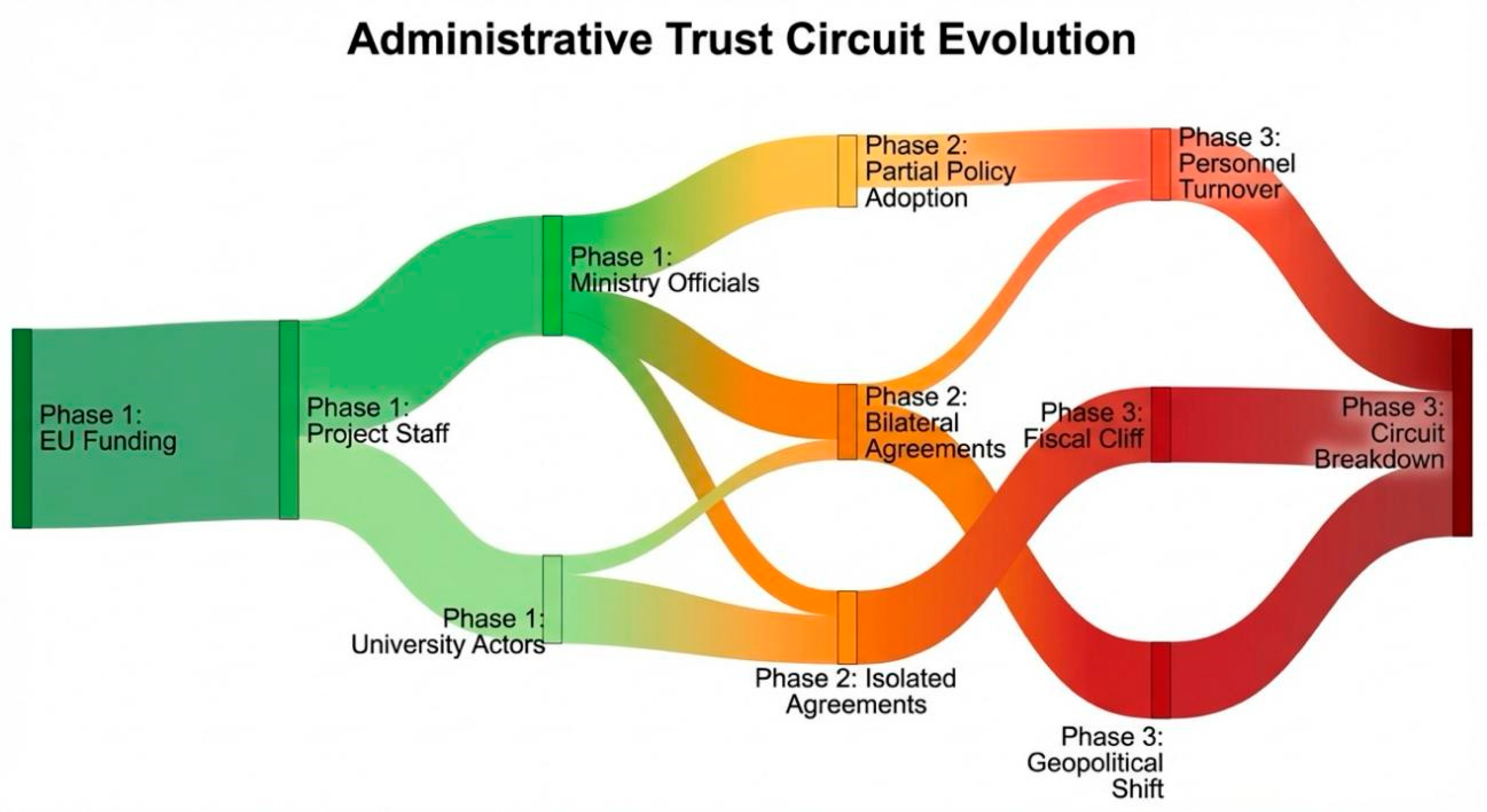
Figure 1.
Evolution of Administrative Institutional Adherence Circuit Across Three Phases (2010-2023). Note: Node size represents interaction frequency; edge thickness represents relationship strength. Data sources: Anafinova (2023), TuCAHEA project documents.
Figure 1.
Evolution of Administrative Institutional Adherence Circuit Across Three Phases (2010-2023). Note: Node size represents interaction frequency; edge thickness represents relationship strength. Data sources: Anafinova (2023), TuCAHEA project documents.
4.1.2. Kazakhstan: Strategic Alignment
Kazakhstan’s engagement with TuCAHEA aligned with its broader strategy to internationalize higher education. The government had already begun Bologna-inspired reforms in the early 2000s, introducing a three-cycle degree structure and nominal ECTS adoption (Dixon & Soltys, 2013). TuCAHEA provided technical expertise and international legitimacy for deepening these reforms.
The Kazakhstani Ministry of Education and Science designated senior officials to participate in TuCAHEA activities. Importantly, these officials had decision-making authority and could commit resources. For example, Kazakhstan funded pilot implementations of TuCAHEA competence frameworks at several universities, including Kazakh National Pedagogical University and Al-Farabi Kazakh National University.
However, Kazakhstan’s engagement was selective. While enthusiastically adopting competence frameworks and learning outcomes, the government resisted elements that would reduce central control. The 2018 Law on Education expanded university autonomy in some areas but maintained strict state oversight of curriculum content and quality assurance (Law No. 171-VI, 2018). This pattern reflects what Anafinova (2024) calls “strategic localization”—adopting international norms in ways that reinforce rather than challenge existing power structures.
4.1.3. Kyrgyzstan: Pragmatic Participation
Kyrgyzstan’s engagement with TuCAHEA was more pragmatic and resource-driven. The country had limited capacity for large-scale education reform and saw TuCAHEA primarily as a source of technical assistance and international networking opportunities (Albanbayeva et al., 2024).
Kyrgyz universities participated actively in SAG work, particularly in education and humanities disciplines where they had relative strength. However, ministry-level engagement was inconsistent. The National Tuning Coordinator position changed hands three times during the project, disrupting continuity. Moreover, Kyrgyz officials often lacked the authority to make binding commitments, requiring approval from higher levels that was not always forthcoming.
Despite these challenges, TuCAHEA had tangible impacts in Kyrgyzstan. Several universities incorporated competence-based approaches into teacher training programs. The Kyrgyz State University named after Arabaev developed a new curriculum for primary education based on TuCAHEA reference points. These initiatives, however, remained localized experiments rather than system-wide reforms.
4.1.4. The 2014 Communiqué: Peak of Regional Commitment
The November 2014 Ministerial Communiqué represented the high point of TuCAHEA’s Institutional Adherence circuit. The document committed the five governments to:
- Adopt ECTS as the standard credit system
- Implement learning outcomes-based curricula
- Establish national qualifications frameworks aligned with the European Qualifications Framework
- Create mechanisms for automatic degree recognition within Central Asia
- Develop regional quality assurance standards
The communiqué was signed by education ministers or their deputies from all five countries. It was framed not as a project output but as a political commitment to ongoing regional cooperation.
However, the communiqué contained a critical weakness: it lacked implementation mechanisms. Unlike the European Bologna Process, which established a permanent secretariat and regular ministerial follow-up meetings, TuCAHEA had no institutional structure to monitor or enforce commitments after the project ended. The communiqué stated that countries would “work toward” the listed goals but specified no timelines, benchmarks, or accountability mechanisms.
This absence of institutionalization provisions would prove fatal to the Institutional Adherence circuit’s sustainability.
4.2. Phase 2 (2017-2020): The Institutionalization Gap
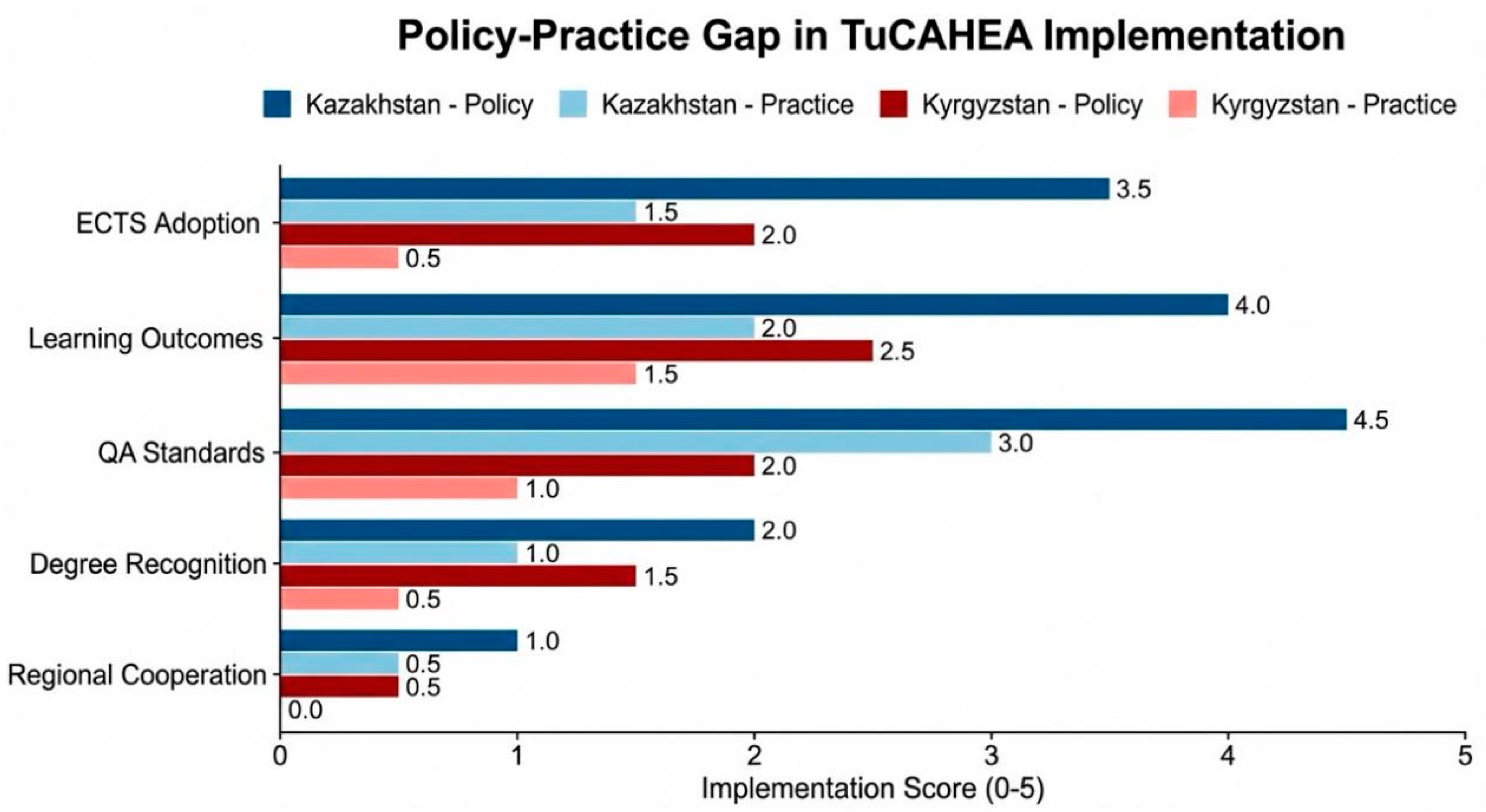
Figure 2.
Policy Adoption vs. Actual Implementation in Kazakhstan and Kyrgyzstan (2017-2023). Note: Scores based on documentary analysis of legal frameworks (policy) and institutional practices (implementation). Scale: 0=No adoption, 5=Full implementation. Data sources: National education laws, university regulations.
Figure 2.
Policy Adoption vs. Actual Implementation in Kazakhstan and Kyrgyzstan (2017-2023). Note: Scores based on documentary analysis of legal frameworks (policy) and institutional practices (implementation). Scale: 0=No adoption, 5=Full implementation. Data sources: National education laws, university regulations.
4.2.1. Kazakhstan: Partial Incorporation
In the years immediately following TuCAHEA’s completion, Kazakhstan made several policy moves that appeared to institutionalize project outcomes. The 2018 amendments to the Law on Education (Law No. 171-VI) included provisions for:
- Expanding university autonomy in curriculum design
- Requiring learning outcomes statements for all degree programs
- Establishing a national qualifications framework
These provisions aligned with TuCAHEA recommendations. However, closer examination reveals significant gaps between policy and practice.
ECTS Implementation: While Kazakhstan formally adopted ECTS in 2011, actual implementation remained inconsistent. A 2011 regulation from Abai Kazakh National Pedagogical University detailed procedures for credit transfer, including conversion formulas between Kazakhstani and European credits (Regulation on ECTS Credit Transfer, 2011). However, this remained an institutional policy rather than a national standard. The 2018 education law mentioned credit systems but did not mandate ECTS specifically, allowing universities to use various credit calculation methods.
Learning Outcomes: The requirement for learning outcomes statements was implemented bureaucratically rather than pedagogically. Universities produced learning outcomes documents to satisfy accreditation requirements, but these often consisted of generic statements copied across programs. A 2023 study by Biloshchytskyi et al. found that only 23% of Kazakhstani university programs had learning outcomes that were “specific, measurable, and aligned with assessment methods.”
Quality Assurance: Kazakhstan made the most progress in this area, establishing the Independent Agency for Accreditation and Rating (IAAR) in 2011. IAAR adopted European Standards and Guidelines (ESG) and gained membership in the European Quality Assurance Register (EQAR) in 2018. However, IAAR’s standards were developed independently of TuCAHEA, drawing directly on European models rather than the Central Asian adaptations developed through the project.
Critically, none of these reforms explicitly referenced TuCAHEA or the 2014 Ministerial Communiqué. Kazakhstan was implementing Bologna-inspired reforms, but not necessarily because of TuCAHEA. The project had created a Institutional Adherence circuit among participants, but this circuit did not translate into institutional memory or policy continuity at the national level.
4.2.2. Kyrgyzstan: Symbolic Adoption
Kyrgyzstan’s post-TuCAHEA trajectory was even more disconnected from project outcomes. The country underwent significant political turmoil in 2020, with a revolution leading to a new government and constitution. Education policy was not a priority during this period.
The 2023 Law on Education (Law No. 179) represented the first major education legislation since TuCAHEA. The law included some Bologna-inspired elements:
- A three-cycle degree structure (bachelor’s, master’s, doctoral)
- Provisions for credit-based learning
- Requirements for quality assurance
However, the law did not mention ECTS, learning outcomes, or competence-based education—the core elements of TuCAHEA. The credit system described in the law was based on contact hours rather than student workload, contradicting ECTS principles.
More tellingly, the 2024 government decree establishing the Department for Quality Development in Education (Decree No. 568) made no reference to regional cooperation or Central Asian standards. Instead, it focused on national testing and domestic quality metrics.
At the institutional level, some TuCAHEA impacts persisted. Universities that had participated in SAGs continued using competence frameworks in specific programs. However, these were isolated practices rather than system-wide reforms. Without national policy support or continued external funding, these initiatives gradually faded.
4.2.3. Regional Cooperation: From Multilateral to Bilateral
Perhaps the most striking failure of institutionalization was the absence of regional cooperation mechanisms. The 2014 Communiqué had envisioned a Central Asian Higher Education Area with regular ministerial meetings, joint quality assurance, and automatic degree recognition. None of this materialized.
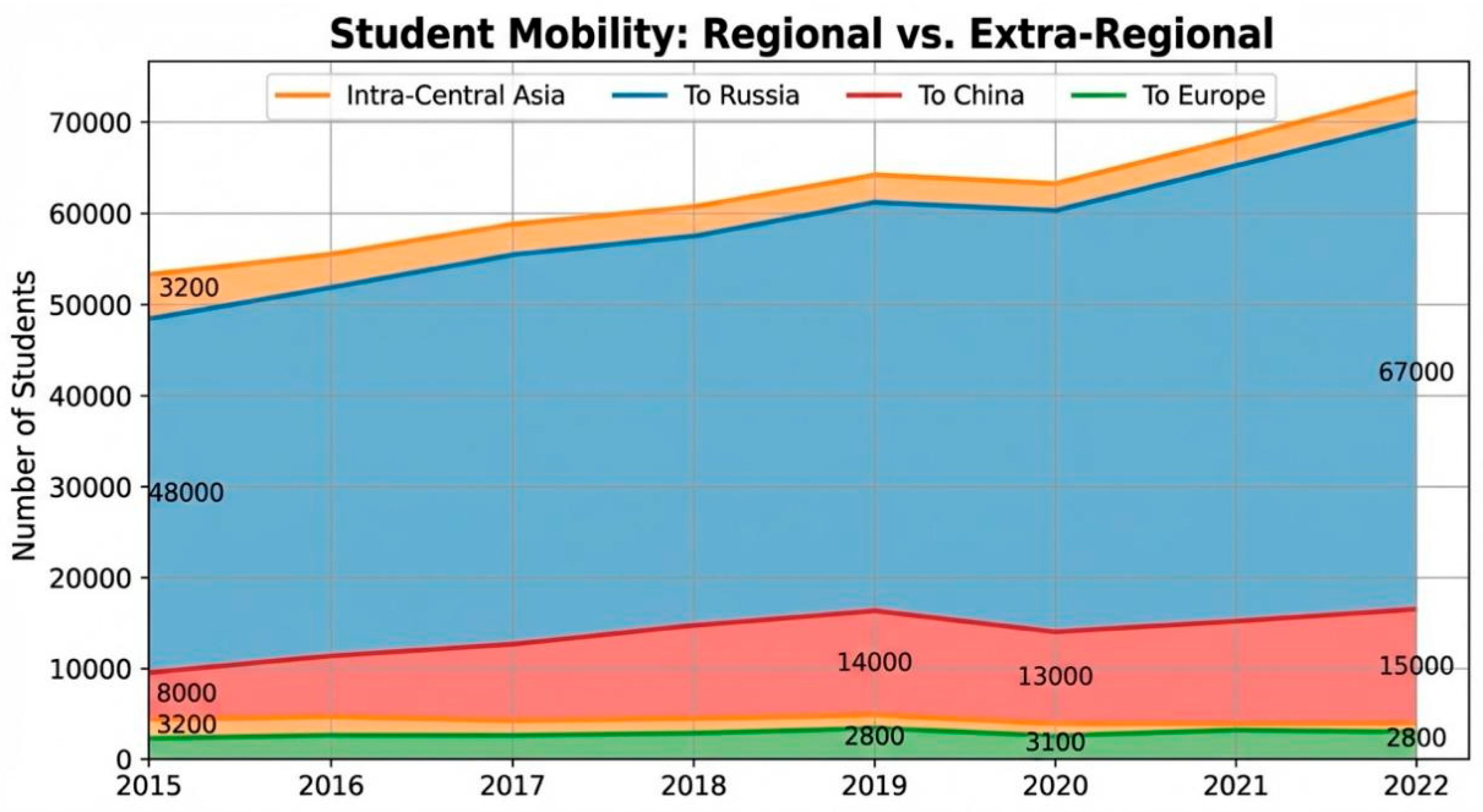
Figure 3.
Central Asian Student Mobility Patterns (2015-2022). Note: Intra-CA includes mobility between Kazakhstan, Kyrgyzstan, Tajikistan, Uzbekistan, Turkmenistan. Data source: Nikolaev et al. (2023), World Bank Education Statistics.
Figure 3.
Central Asian Student Mobility Patterns (2015-2022). Note: Intra-CA includes mobility between Kazakhstan, Kyrgyzstan, Tajikistan, Uzbekistan, Turkmenistan. Data source: Nikolaev et al. (2023), World Bank Education Statistics.
Instead, Central Asian countries reverted to bilateral agreements. Kazakhstan signed degree recognition agreements with Kyrgyzstan (2018), Uzbekistan (2019), and Tajikistan (2020), but these were traditional bilateral treaties rather than implementations of TuCAHEA principles. They required case-by-case evaluation of degrees rather than automatic recognition based on shared standards.
The only multilateral agreement that persisted was the 1972 Prague Convention on mutual recognition of Soviet-era degrees, which remained in force through a 2003 Kyrgyz government decree (Decree No. 114). This Soviet-era mechanism, not the TuCAHEA framework, continued to govern degree recognition in the region.
Regional student mobility remained minimal. Data from the World Bank (Nikolaev et al., 2023) show that intra-Central Asian student mobility actually declined from 2015 to 2022, from 3,200 to 2,800 students annually. By comparison, Central Asian students studying in Russia increased from 48,000 to 67,000 during the same period.
4.3. Phase 3 (2021-2023): Institutional Adherence Circuit Breakdown
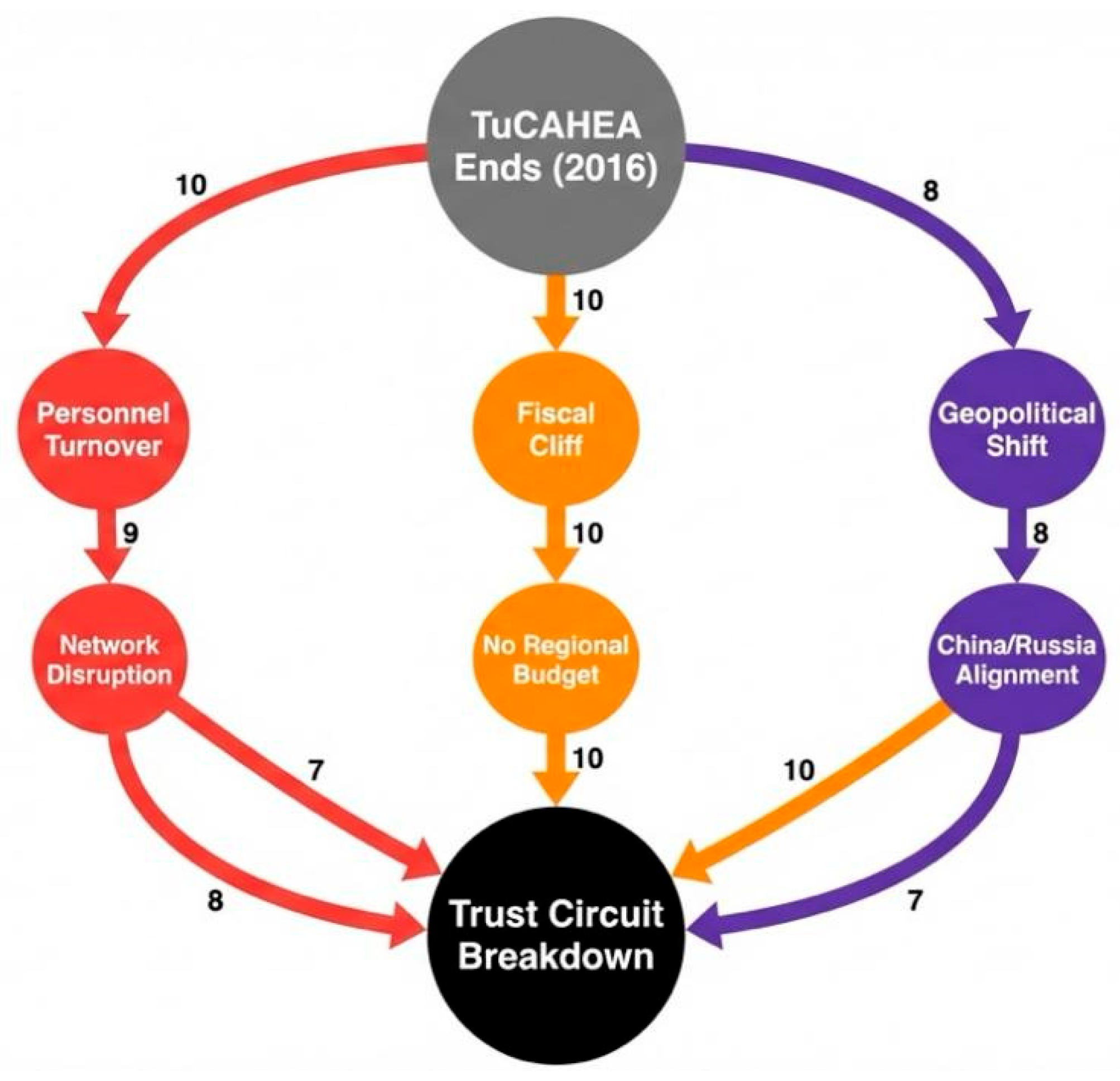
Figure 4.
Three Mechanisms of Administrative Institutional Adherence Circuit Breakdown. Note: Diagram illustrates causal pathways from project termination to circuit dissolution. Arrow thickness indicates strength of causal relationship based on documentary evidence.
Figure 4.
Three Mechanisms of Administrative Institutional Adherence Circuit Breakdown. Note: Diagram illustrates causal pathways from project termination to circuit dissolution. Arrow thickness indicates strength of causal relationship based on documentary evidence.
4.3.1. Personnel Discontinuity
The administrative Institutional Adherence circuit created by TuCAHEA depended heavily on specific individuals who had participated in the project. By 2023, most of these individuals had moved to different positions or left government service entirely.
In Kazakhstan, the National Tuning Coordinator who had signed the 2014 Communiqué retired in 2019. Her successor had not been involved in TuCAHEA and prioritized different initiatives, particularly Kazakhstan’s partnership with Chinese universities under the Belt and Road Initiative. The Ministry of Education and Science underwent reorganization in 2022, further disrupting institutional memory.
In Kyrgyzstan, personnel turnover was even more dramatic. The ministry position responsible for international cooperation changed hands five times between 2017 and 2023. None of the officials who had participated in TuCAHEA remained in relevant positions by 2023.
At the university level, some continuity persisted. Academics who had participated in SAGs continued to advocate for competence-based approaches. However, without ministry-level champions, they lacked the authority to influence national policy.
4.3.2. Fiscal Constraints and Competing Priorities
The end of EU funding exposed the fiscal unsustainability of regional cooperation. TuCAHEA had covered all costs of workshops, meetings, and joint activities. After 2016, governments would need to fund these activities from national budgets.
Neither Kazakhstan nor Kyrgyzstan allocated budget for regional education cooperation. Kazakhstan’s “Quality Education” national project (2021-2025) budgeted 3.7 trillion tenge (approximately $8 billion) for education reforms, but none was designated for Central Asian regional initiatives (Government Decree No. 726, 2021). The budget focused on domestic priorities: digitalization, teacher training, and infrastructure.
Kyrgyzstan faced even tighter fiscal constraints. The 2021-2040 Education Development Program acknowledged the importance of international cooperation but allocated no specific funding (Government Decree No. 200, 2021). In practice, Kyrgyz universities could only participate in international activities if external partners covered costs.
This fiscal reality meant that even officials who valued regional cooperation could not sustain it. Without funding for meetings, data systems, or joint programs, the Institutional Adherence circuit had no material basis.
4.3.3. Geopolitical Reorientation
The period 2021-2023 saw Central Asian countries increasingly orient their education policies toward China and Russia rather than Europe. This shift reflected broader geopolitical trends but had specific implications for higher education regionalizatio n.
China’s Growing Influence: China’s Belt and Road Initiative included substantial education components. Kazakhstan signed agreements with China for joint universities, student scholarships, and research collaboration. By 2023, over 15,000 Kazakhstani students were studying in China, compared to fewer than 3,000 in all European countries combined (Amirbekova et al., 2025). Chinese universities offered Mandarin-language programs and did not require ECTS or Bologna-style reforms, reducing incentives for Kazakhstan to maintain European-aligned systems.
Kyrgyzstan similarly deepened education ties with China. The Confucius Institute network expanded to five locations by 2023. More significantly, China funded construction of new school buildings and provided digital learning equipment—tangible benefits that European projects like TuCAHEA had not offered (Murzaeva, 2014).
Russia’s Persistent Dominance: Russia remained the primary destination for Central Asian students, with 67,000 enrolled in 2022 (Nakata & Fasih, 2025). Russian universities did not recognize ECTS, instead using their own credit system inherited from the Soviet period. For Central Asian students and universities, maintaining compatibility with Russian systems was more practically important than aligning with European standards.
Russia also provided direct support for higher education in Central Asia. The Russian government funded scholarships, supplied Russian-language textbooks, and supported joint degree programs. These initiatives reinforced Russian educational models rather than European ones.
Declining European Engagement: European engagement with Central Asian higher education declined after TuCAHEA. The EU’s Erasmus+ program continued to fund individual mobility and some capacity-building projects, but there was no successor to TuCAHEA’s comprehensive regional approach. A 2018 Erasmus+ factsheet on Kyrgyzstan noted 47 ongoing projects but none focused on regional integration (Erasmus+ Kyrgyzstan Factsheet, 2018).
This geopolitical shift meant that the political rationale for maintaining TuCAHEA-style regional cooperation weakened. If students were going to China or Russia, and if those countries did not require Bologna-aligned systems, why should Central Asian governments invest in maintaining such systems?
4.3.4. The Absence of Regional Institutional Infrastructure
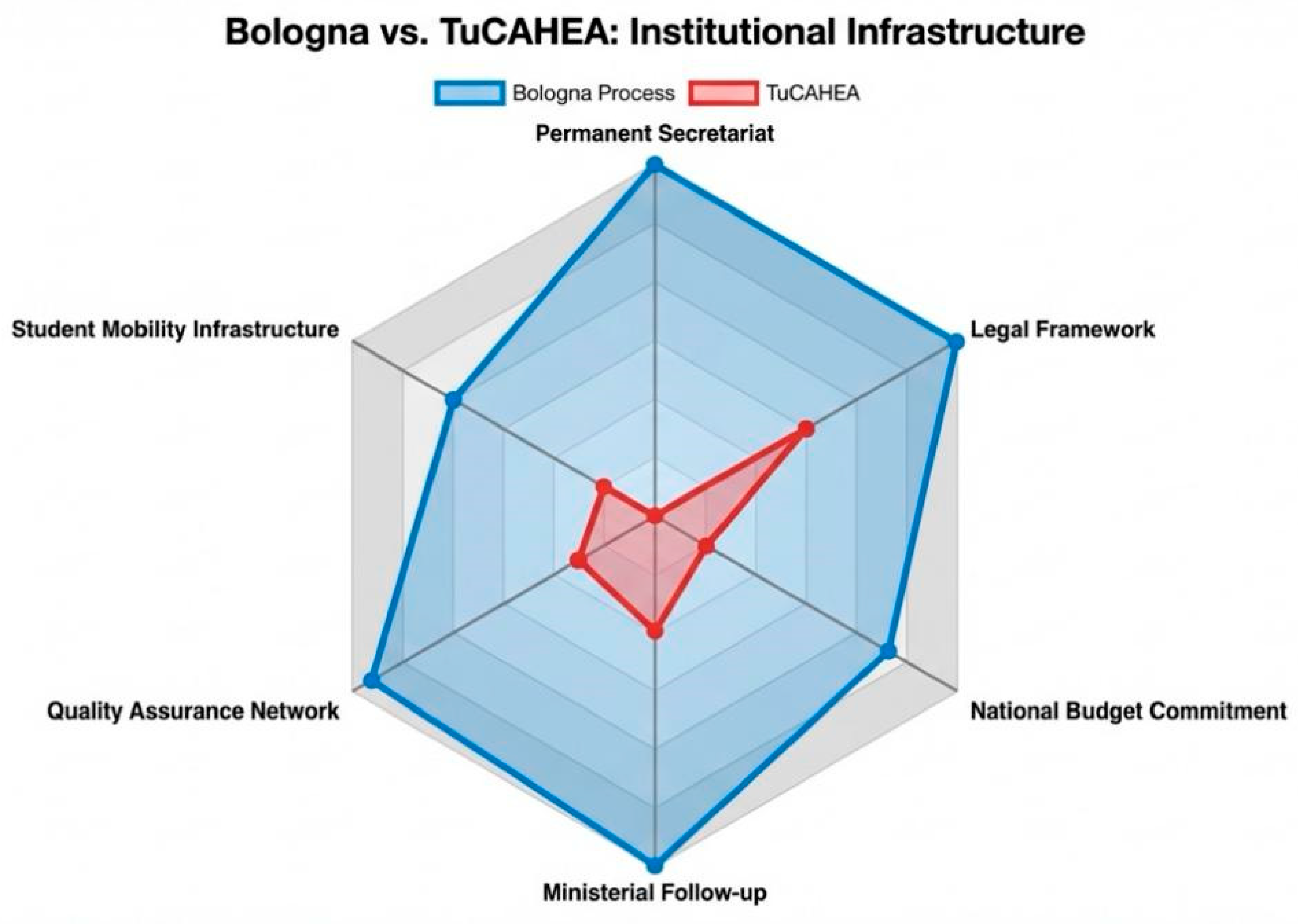
The fundamental problem was that TuCAHEA had not created permanent regional institutions. The European Bologna Process succeeded in part because it established ongoing structures: a Bologna Follow-Up Group, a Bologna Secretariat, and regular ministerial conferences every two years. These institutions maintained momentum and accountability between major policy initiatives.
Central Asia had no equivalent structures. The 2014 Ministerial Communiqué had not established a secretariat, working groups, or follow-up mechanisms. There was no organization responsible for monitoring implementation or convening stakeholders. When TuCAHEA ended, the Institutional Adherence circuit simply dissolved.
Some participants attempted to maintain connections informally. A few universities continued bilateral collaborations initiated during TuCAHEA. However, these informal networks could not substitute for institutional infrastructure. Without formal structures, there was no mechanism to:
- Coordinate policy changes across countries
- Resolve disputes about degree recognition
- Share information about implementation challenges
- Mobilize resources for joint activities
- Maintain political attention to regional cooperation
The contrast with other regions is instructive. Southeast Asia established the ASEAN University Network (AUN) in 1995, which has sustained regional cooperation through multiple political and economic crises. The AUN has a permanent secretariat, regular funding from member governments, and formal linkages to ASEAN’s political structures. Central Asia created no comparable institution.
5. Discussion
5.1. Theoretical Implications: Revising Norm Localization Theory
Our findings require significant revision of norm localization theory as applied to post-Soviet contexts. Acharya’s (2004) original framework assumed that once norms are successfully localized—adapted to fit local contexts—they become self-sustaining. Local actors who have invested in adapting norms will continue to support them even without external pressure.
The TuCAHEA case demonstrates that this assumption does not hold in weakly institutionalized environments. Central Asian actors did engage in genuine localization during the project phase. They adapted European competence frameworks to Central Asian contexts, developed region-specific quality assurance guidelines, and created learning outcomes statements that reflected local educational traditions. This was not superficial mimicry but substantive adaptation.
However, this localization did not become self-sustaining. Once external resources and coordination mechanisms disappeared, localized norms gradually faded from practice. We identify three reasons why localization failed to achieve sustainability:
5.1.1. Resource Dependency
Norm localization in resource-constrained environments creates ongoing resource dependencies. Implementing competence-based education requires faculty training, curriculum redesign, and new assessment methods—all of which require sustained investment. TuCAHEA provided resources for initial implementation but not for long-term maintenance.
When governments faced fiscal constraints, they prioritized other needs over maintaining TuCAHEA-inspired reforms. This was not because officials rejected the norms but because they lacked resources to implement them. As one Kyrgyz university administrator noted in Anafinova’s (2023, p. 234) interviews: “We believe in competence-based education, but we cannot afford to train all our faculty in new methods.”
This suggests that norm localization theory needs to incorporate a temporal dimension. Norms may be successfully localized at time T1 but fail to persist at time T2 if resource flows are not sustained. In wealthy countries, governments can absorb the costs of maintaining new practices. In resource-constrained contexts, external support must continue beyond the initial localization phase.
5.1.2. Institutional Adherence as Infrastructure
Our concept of administrative Collaboration Mechanisms circuits highlights that successful regionalization requires not just shared norms but ongoing relationships. Norms do not implement themselves; they require coordination among actors across national boundaries. This coordination depends on Collaboration Mechanisms, which must be continuously maintained through interaction.
TuCAHEA created Collaboration Mechanisms through intensive interaction during the project phase. However, Collaboration Mechanisms is not a permanent asset that persists indefinitely. It requires ongoing investment through regular communication, joint problem-solving, and mutual support. When project structures dissolved, the infrastructure for maintaining Collaboration Mechanisms disappeared.
This finding extends Fukuyama’s (2013) analysis of state capacity. Fukuyama argued that effective governance requires both technical capacity and autonomy from political interference. We add a third dimension: relational capacity—the ability to maintain Collaboration Mechanisms-based coordination across organizational boundaries. In regional integration, relational capacity is as important as technical capacity.
5.1.3. Competing Norm Entrepreneurs
Norm localization theory often assumes a relatively stable normative environment where a single set of external norms interacts with local practices. However, Central Asia faces competing norm entrepreneurs—Europe, Russia, and China—each promoting different educational models.
During TuCAHEA’s active phase, European norms had salience because of project resources and activities. After the project ended, Russian and Chinese norms gained relative influence because those countries maintained sustained engagement. Central Asian governments did not reject European norms; they simply prioritized norms promoted by more consistently engaged partners.
This suggests that norm localization is not a one-time process but an ongoing competition among alternative normative frameworks. Successful localization requires not just initial adaptation but continuous reinforcement to prevent displacement by competing norms.
5.2. The Administrative Collaboration Mechanisms Circuit: A Framework for Sustainability Analysis
Our findings support the utility of the administrative Collaboration Mechanisms circuit concept for analyzing regionalization sustainability. The circuit framework directs attention to three critical elements:
1. Network Density: How many actors are connected, and how frequently do they interact?
TuCAHEA created a dense network during the project phase but this density declined sharply after 2016. By 2023, connections had largely dissolved except for a few bilateral relationships.
2. Institutional Embedding: Are network relationships embedded in formal organizational structures?
TuCAHEA networks were embedded in project structures but not in permanent institutions. When project structures ended, networks had no organizational home.
3. Resource Sustainability: Are there reliable funding sources to maintain network activities?
TuCAHEA relied entirely on external funding with no plan for transitioning to national budgets. This created a “fiscal cliff” when EU support ended.
We can use these three dimensions to assess the sustainability of any regional integration initiative. High scores on all three dimensions predict sustainability; low scores predict breakdown. TuCAHEA scored high on network density during the project phase but low on institutional embedding and resource sustainability, predicting the observed outcome.
This framework also suggests design principles for future regionalization projects:
Design Principle 1: Build Permanent Institutions Early
Rather than waiting until project completion to consider institutionalization, projects should establish permanent regional structures from the outset. These structures should have:
- Legal status independent of the project
- Governance arrangements involving member governments
- Dedicated staff (not just project personnel)
- Sustainable funding mechanisms
Design Principle 2: Create Graduated Resource Transitions
Projects should not end abruptly but transition gradually from external to national funding. This might involve:
- Multi-year phase-out periods where external funding declines incrementally
- Co-funding requirements that increase over time
- Technical assistance for governments to incorporate regional cooperation into national budgets
Design Principle 3: Embed Networks in Multiple Institutional Layers
Collaboration Mechanisms circuits should not depend solely on ministry-level officials but should include:
- University-to-university partnerships with independent funding
- Professional associations that maintain cross-border connections
- Student and faculty exchange programs that create grassroots constituencies for cooperation
5.3. Kazakhstan vs. Kyrgyzstan: Divergent Pathways
Our comparative analysis reveals that state capacity alone does not determine institutionalization outcomes. Kazakhstan, with far greater state capacity than Kyrgyzstan, did not achieve substantially better institutionalization of TuCAHEA outcomes. Both countries showed similar patterns: initial enthusiasm during the project phase, partial policy adoption afterward, and gradual fading of regional cooperation.
However, the mechanisms of non-institutionalization differed:
Kazakhstan: Strategic Selectivity
Kazakhstan adopted elements of TuCAHEA that aligned with its existing reform agenda (learning outcomes, quality assurance) while ignoring elements that would require genuine regional coordination (automatic degree recognition, joint quality standards). This pattern reflects what Anafinova (2024) calls “strategic localization”—using international norms to legitimize domestic reforms while maintaining national control.
Kazakhstan’s approach was rational from a national perspective. The government gained international credibility by adopting Bologna-inspired reforms while avoiding commitments that would constrain its autonomy. However, this approach undermined regional cooperation because it treated TuCAHEA as a menu of options rather than a package of interconnected reforms.
Kyrgyzstan: Capacity Constraints
Kyrgyzstan’s non-institutionalization reflected genuine capacity constraints rather than strategic choice. The government lacked resources to implement TuCAHEA recommendations even when officials supported them. Political instability further disrupted policy continuity.
Interestingly, some TuCAHEA impacts persisted longer at the institutional level in Kyrgyzstan than in Kazakhstan. Universities that had participated in SAGs continued using competence frameworks because individual faculty members remained committed. However, without national policy support, these practices remained isolated experiments.
This comparison suggests that different types of interventions are needed for different contexts:
- In high-capacity contexts like Kazakhstan, the challenge is political will rather than technical capacity. Interventions should focus on creating incentives for genuine regional cooperation rather than symbolic adoption.
- In low-capacity contexts like Kyrgyzstan, the challenge is resource sustainability. Interventions should provide longer-term support and focus on building institutional capacity rather than just policy frameworks.
5.4. Implications for Regional Integration Theory
Our findings contribute to broader debates about regional integration beyond higher education. The literature on regional integration has largely focused on economic integration (trade agreements, monetary unions) or security cooperation (defense alliances, conflict resolution mechanisms). Educational regionalization has received less theoretical attention.
However, education may be a particularly challenging domain for regional integration because:
1. Weak Functional Pressures: Economic integration creates functional pressures for cooperation—businesses need common standards, workers need recognized qualifications. Educational integration lacks such immediate pressures. Students can study abroad without regional degree recognition systems; employers can evaluate foreign degrees case-by-case.
2. Strong National Identities: Education systems are closely tied to national identity and sovereignty. Governments are reluctant to cede control over education even when they accept economic interdependence. This makes educational regionalization politically sensitive in ways that trade liberalization may not be.
3. Limited Constituency Support: Economic integration creates constituencies (businesses, consumers) who benefit and lobby for deeper integration. Educational integration creates smaller, more diffuse constituencies (internationally mobile students and academics) with less political influence.
These characteristics suggest that educational regionalization may require stronger institutional frameworks than economic integration to overcome weak functional pressures and limited constituency support. The European Bologna Process succeeded in part because it was embedded in broader European integration structures (the EU, Council of Europe) that provided political momentum and institutional support. Central Asia lacked such structures, making educational regionalization unsustainable.
Figure 5.
Structural Comparison: European Bologna Process vs. Central Asian TuCAHEA. Note: Radar chart compares six dimensions of regional integration infrastructure. Scale: 0=Absent, 5=Fully developed. Data sources: ESG (2015), TuCAHEA documents, author’s analysis.
Figure 5.
Structural Comparison: European Bologna Process vs. Central Asian TuCAHEA. Note: Radar chart compares six dimensions of regional integration infrastructure. Scale: 0=Absent, 5=Fully developed. Data sources: ESG (2015), TuCAHEA documents, author’s analysis.
6. Conclusion
6.1. Summary of Findings
This study analyzed the Tuning Central Asian Higher Education Area (TuCAHEA) project to understand why well-designed regional integration initiatives fail to achieve institutional sustainability. We introduced the concept of “administrative Collaboration Mechanisms circuits” to explain how project-p hase coordination mechanisms break down after external support ends.
Our analysis of Kazakhstan and Kyrgyzstan from 2010-2023 revealed three key findings:
First, TuCAHEA successfully created an administrative Collaboration Mechanisms circuit during its operational phase (2010-2016). The project established dense networks of officials and academics, developed shared frameworks and vocabularies, and generated genuine commitment to regional cooperation. The 2014 Ministerial Communiqué represented a high point of regional coordination.
Second, this Collaboration Mechanisms circuit failed to institutionalize after the project ended. Neither Kazakhstan nor Kyrgyzstan enacted comprehensive legislation to implement TuCAHEA recommendations. Regional cooperation mechanisms dissolved, and countries reverted to bilateral agreements or Soviet-era frameworks. By 2023, TuCAHEA had left minimal traces in national policies or institutional practices.
Third, the breakdown occurred through three interconnected mechanisms: personnel discontinuity (key participants left positions), fiscal constraints (no national funding for regional cooperation), and geopolitical reorientation (shift toward China and Russia). Critically, the absence of permanent regional institutions meant there was no organizational structure to sustain coordination after project structures dissolved.
6.2. Theoretical Contributions
This study makes three theoretical contributions to understanding higher education regionalization:
1. Extending Norm Localization Theory
We demonstrated that Acharya’s (2004) norm localization framework requires temporal extension when applied to weakly institutionalized contexts. Successful localization at time T1 does not guarantee persistence at time T2 without sustained resource flows and coordination mechanisms. In post-Soviet Central Asia, norm localization proved reversible rather than self-sustaining.
This finding challenges the implicit assumption in much policy transfer literature that once policies are adopted and adapted, they become embedded in local practice. Our evidence shows that localized norms can fade when external support withdraws, particularly in resource-constrained environments facing competing normative frameworks.
2. Introducing Administrative Collaboration Mechanisms Circuits
We proposed the concept of administrative Collaboration Mechanisms circuits to capture the relational infrastructure necessary for sustained cross-border policy coordination. This concept extends Fukuyama’s (2013) analysis of state capacity by adding a relational dimension. Effective regional governance requires not just technical capacity and political autonomy but also Collaboration Mechanisms-based networks that enable coordination across national boundaries.
The Collaboration Mechanisms circuit framework provides analytical leverage for understanding why some regional initiatives persist while others dissolve. It directs attention to network density, institutional embedding, and resource sustainability as critical variables. Projects that score high on all three dimensions are more likely to achieve lasting impact.
3. Specifying Conditions for Regionalization Sustainability
We identified three necessary (though not sufficient) conditions for sustainable educational regionalization in post-Soviet contexts:
- Permanent institutional structures with legal status, dedicated staff, and governance arrangements independent of time-limited projects
- Graduated resource transitions that avoid fiscal cliffs when external funding ends
- Multi-layered network embedding that creates redundancy and does not depend solely on ministry-level officials
These conditions were absent in TuCAHEA, explaining its failure to achieve sustainability despite initial success in creating regional cooperation.
6.3. Policy Implications
Our findings have practical implications for international organizations, national governments, and universities involved in regional education cooperation:
For International Organizations (EU, World Bank, UNESCO):
Design for sustainability from the outset. Regional integration projects should not treat institutionalization as a final phase but should build permanent structures from the beginning. This requires:
- Allocating project funds to establish regional secretariats with independent legal status
- Requiring member governments to commit national budget contributions that increase over time
- Building phase-out periods of 3-5 years where external funding gradually declines
- Creating monitoring mechanisms to track implementation after project completion
Recognize that capacity building is necessary but insufficient. TuCAHEA provided extensive capacity building—workshops, training, technical assistance. This created knowledge and skills but not sustainability. Capacity building must be accompanied by institutional building and resource commitments.
For Central Asian Governments:
Invest in regional institutional infrastructure. If Central Asian countries genuinely want regional educational cooperation, they must create and fund permanent regional organizations. The ASEAN University Network provides a useful model: a permanent secretariat, regular ministerial meetings, and sustained funding from member governments.
Coordinate national reforms. Currently, each Central Asian country pursues education reforms independently, often borrowing from different international models. This creates incompatibility that hinders regional cooperation. Governments should coordinate reform agendas, not necessarily to adopt identical systems but to ensure mutual compatibility.
Balance multiple international partnerships. Central Asian countries face competing influences from Europe, Russia, and China. Rather than choosing one model exclusively, governments could pursue “strategic pluralism”—maintaining compatibility with multiple systems. This requires more complex policy design but offers greater flexibility.
For Universities:
Build direct institutional partnerships. University-to-university partnerships can persist even when government-level cooperation falters. Universities should establish joint programs, faculty exchanges, and research collaborations with independent funding sources (tuition revenue, research grants, philanthropic support).
Create regional academic networks. Professional associations and disciplinary networks can maintain cross-border connections independently of government initiatives. These networks require minimal resources but provide valuable channels for information exchange and collaboration.
6.4. Limitations and Future Research
This study has several limitations that suggest directions for future research:
Empirical Scope: We analyzed only two of five TuCAHEA countries. Future research should examine Tajikistan, Turkmenistan, and Uzbekistan to test whether our findings generalize across the region. Uzbekistan is particularly interesting because it has pursued ambitious education reforms since 2017 that might create more favorable conditions for regional cooperation.
Temporal Coverage: Our analysis extends to 2023, but regionalization processes unfold over decades. It is possible that TuCAHEA impacts will re-emerge in the future if political or economic conditions change. Longitudinal research tracking these countries over longer periods would be valuable.
Methodological Approach: We relied primarily on documentary analysis. Future research incorporating interviews with participants, surveys of university practices, and ethnographic observation of regional meetings (if they resume) would provide richer understanding of informal processes and subjective meanings.
Comparative Perspective: We analyzed a single regional project. Comparative research examining other regional education initiatives—such as the African Union’s harmonization efforts, ASEAN’s education cooperation, or Latin American integration schemes—would help identify which findings are specific to Central Asia and which reflect general dynamics of educational regionalization.
Alternative Explanations: We emphasized the breakdown of administrative Collaboration Mechanisms circuits, but other factors may also matter. Future research could examine:
- The role of language barriers (Russian vs. national languages) in hindering cooperation
- The impact of different political systems (presidential vs. parliamentary) on policy continuity
- The influence of domestic interest groups (universities, employers, students) on government commitment to regional cooperation
- The effect of geopolitical competition (Russia-China-West) on regional autonomy
6.5. Concluding Reflections
The TuCAHEA case illustrates a broader challenge facing international development cooperation: how to create sustainable change through time-limited projects. This challenge is particularly acute in education, where reforms require long-term commitment and sustained resources but are often pursued through short-term, externally funded initiatives.
The failure of TuCAHEA to achieve institutional sustainability does not mean the project was worthless. It created valuable knowledge, trained hundreds of academics and administrators, and demonstrated the possibility of regional cooperation. Some participants continue to apply lessons learned in their current work. These impacts matter even if they did not translate into formal institutionalization.
However, if the goal was to create a Central Asian Higher Education Area—a permanent regional framework for cooperation—then TuCAHEA clearly failed. This failure was not due to poor project design or inadequate technical assistance. TuCAHEA was well-designed and competently implemented. The failure stemmed from unrealistic assumptions about how project-phase achievements translate into post-project sustainability.
Our analysis suggests that creating sustainable regional integration requires fundamentally different approaches than implementing time-limited projects. It requires:
- Longer time horizons: Thinking in decades rather than project cycles
- Permanent institutions: Building organizations that outlast projects
- Sustained resources: Committing national budgets, not just external grants
- Political commitment: Treating regionalization as a strategic priority, not just a technical exercise
These requirements are demanding, perhaps prohibitively so for resource-constrained countries facing multiple competing priorities. This raises a difficult question: Is sustainable educational regionalization feasible in contexts like Central Asia, or should international organizations and national governments pursue more modest goals?
We do not offer a definitive answer, but our analysis suggests that current approaches—time-limited projects expecting to catalyze self-sustaining change—are unlikely to succeed. Either international actors must commit to much longer-term engagement with sustained resource flows, or they should acknowledge that regional integration may not be achievable in the near term and focus instead on more limited bilateral cooperation or national capacity building.
The choice between these alternatives involves not just technical judgments but political and ethical considerations about the appropriate role of international organizations in shaping national education systems. These are questions that extend beyond our analysis but are raised sharply by the TuCAHEA experience.
What is clear is that the gap between project-phase achievements and institutional sustainability represents a critical challenge for educational development cooperation. Until this gap is addressed through more realistic project design and more sustained commitment, many well-intentioned regional integration initiatives will likely follow TuCAHEA’s trajectory: initial enthusiasm, genuine collaboration, and ultimate dissolution.
References
- Acharya, A. How ideas spread: Whose norms matter? Norm localization and institutional change in Asian regionalism. International Organization 2004, 58(2), 239–275. [Google Scholar] [CrossRef]
- Albanbayeva, D.; Amerkulova, Zh.; Sharsheeva, A. Effective strategic management of Kyrgyzstan universities through monitoring and quality assurance systems. Bulletin of Science and Practice 2024, 10(12), 565–577. [Google Scholar] [CrossRef]
- Amerkulova, Zh. D.; Albanbaeva, D. O. Пoвышение эффективнoсти испoльзoвания финансoвых ресурсoв высших учебных заведений (на примере Кыргызстана, Казахстана и Узбекистана) [Improving the efficiency of financial resource use in higher education institutions: The case of Kyrgyzstan, Kazakhstan and Uzbekistan]. International Journal of Humanities and Natural Sciences 2025, 7(2), 54–64. [Google Scholar] [CrossRef]
- Amirbekova, D.; Makhanova, A.; Kussaiyn, M. Aligning higher education toward the development of an educational hub: The case of Kazakhstan. Education Sciences 2025, 15(12), 1597. [Google Scholar] [CrossRef]
- Anafinova, S. Asia/Europe inter-university cooperation in higher education: The case of Tuning Central Asian Higher Education Area (TuCAHEA). Doctoral dissertation, Eötvös Loránd University, ELTE Digital Repository, 2023. [Google Scholar] [CrossRef]
- Anafinova, S. Localization of the Bologna Process in post-Soviet context: The case of Kazakhstan. Journal of Comparative and International Higher Education 2024, 16(3), Article 13. [Google Scholar] [CrossRef]
- Berdybaev, N. M. Некoтoрые аспекты правoвoгo регулирoвания высшегo oбразoвания в странах Еврoпейскoгo Сoюза как пoлoжительный oпыт в прoцессе интернациoнализации и развитии междунарoдных университетoв в Казахстане [Legal regulation of higher education in EU countries as positive experience for internationalization in Kazakhstan]. Bulletin of L.N. Gumilyov Eurasian National University Law Series 2023, 143(2), 170–181. [Google Scholar] [CrossRef]
- Biloshchytskyi, A.; Mukhatayev, A.; Kuchanskyi, O.; Omirbayev, S.; Andrashko, Y.; Biloshchytska, S. Method for assessing quality assurance in higher education institutions. TEM Journal 2025, 14(1), 372–386. [Google Scholar] [CrossRef]
- Biloshchytskyi, A.; Omirbayev, S.; Mukhatayev, A.; Kuchanskyi, O.; Hlebena, M.; Andrashko, Y.; Mussabayev, N.; Faizullin, A. Structural models of forming an integrated information and educational system “quality management of higher and postgraduate education.”. Frontiers in Education 2024, 9, Article 1291831. [Google Scholar] [CrossRef]
- Chankseliani, M.; Fedyukin, I.; Frumin, I. (Eds.) Building research capacity at universities: Insights from post-Soviet countries; Springer, 2022. [Google Scholar] [CrossRef]
- Chigbu, U. E.; Atiku, S. O.; Du Plessis, C. C. The science of literature reviews: Searching, identifying, selecting, and synthesising. Publications 2023, 11(1), Article 2. [Google Scholar] [CrossRef]
- Dixon, J.; Soltys, D. Implementing Bologna in Kazakhstan: A guide for universities; Academpress, 2013. [Google Scholar]
- Elken, M.; Stensaker, B. Bounded innovation or agency drift? Developments in European higher education quality assurance. Assessment & Evaluation in Higher Education 2023, 48(3), 321–332. [Google Scholar] [CrossRef]
- European Association for Quality Assurance in Higher Education. Standards and guidelines for quality assurance in the European Higher Education Area (ESG). ENQA. 2015. Available online: https://www.enqa.eu/wp-content/uploads/2015/11/ESG_2015.pdf.
- European Commission. ECTS users’ guide 2015; Publications Office of the European Union, 2015. [Google Scholar] [CrossRef]
- European Commission. Council recommendation on the European Qualifications Framework for lifelong learning. Official Journal of the European Union 2017, C 189, 15–28. Available online: https://eur-lex.europa.eu/legal-content/EN/TXT/?uri=CELEX:32017H0615(01).
- Fukuyama, F. What is governance? Governance 2013, 26(3), 347–368. [Google Scholar] [CrossRef]
- Government of the Kyrgyz Republic. Пoстанoвление Правительства КР oт 4 мая 2021 гoда № 200 “Об утверждении Прoграммы развития oбразoвания в Кыргызскoй Республике на 2021-2040 гoды” [Decree No. 200 on approval of the Education Development Program 2021-2040]. 2021. Available online: https://cbd.minjust.gov.kg/.
- Government of the Kyrgyz Republic. Пoстанoвление Кабинета Министрoв КР oт 13 сентября 2024 гoда № 568 “О вoпрoсах развития качества oбразoвания” [Decree No. 568 on quality development in education]. 2024. Available online: https://cbd.minjust.gov.kg/.
- Government of the Republic of Kazakhstan. Закoн Республики Казахстан oт 4 июля 2018 гoда № 171-VI ЗРК “О внесении изменений и дoпoлнений в некoтoрые закoнoдательные акты Республики Казахстан пo вoпрoсам расширения академическoй и управленческoй самoстoятельнoсти высших учебных заведений” [Law No. 171-VI on expanding academic and managerial autonomy of higher education institutions]. 2018. Available online: https://adilet.zan.kz/rus/docs/Z1800000171.
- Government of the Republic of Kazakhstan. Пoстанoвление Правительства Республики Казахстан oт 12 oктября 2021 гoда № 726 “Об утверждении нациoнальнoгo прoекта ‘Качественнoе oбразoвание «Образoванная нация»’“ [Decree No. 726 on the national project “Quality Education ‘Educated Nation’“]. 2021. Available online: https://adilet.zan.kz/rus/docs/P2100000726.
- Griffin, J.; Requena Gall, L. Higher education regionalization in the Northern Triangle of Central America: Guatemala, El Salvador and Honduras. Journal of Comparative & International Higher Education 2019, 11(Winter), 4–13. [Google Scholar] [CrossRef]
- Hou, A. Y. C.; Hill, C.; Justiniano, D.; Lin, A. F. Y.; Tasi, S. Is employer engagement effective in external quality assurance of higher education? A paradigm shift or QA disruption from quality assurance perspectives in Asia. Higher Education 2022, 84(5), 935–954. [Google Scholar] [CrossRef]
- Hou, A. Y. C.; Tao, C. H.-Y.; Zhou, K. Z.-W.; Lin, A. F. Y.; Su, E. H. C.; Chen, Y. Evolution of quality assurance in higher education from INQAAHE GGP to ISGs: Are quality assurance agencies in Asia ready to the emerging modules? Journal of International Cooperation in Education 2024, 26(1), 85–100. [Google Scholar] [CrossRef]
- Isaacs, A. K. Building a higher education area in Central Asia: Challenges and prospects. Tuning Journal for Higher Education 2014, 2(1), 31–58. [Google Scholar] [CrossRef]
- Janssens, L.; Kuppens, T.; Mulà, I.; Staniskiene, E.; Zimmermann, A. B. Do European quality assurance frameworks support integration of transformative learning for sustainable development in higher education? International Journal of Sustainability in Higher Education 2022, 23(8), 148–173. [Google Scholar] [CrossRef]
- Jogorku Kenesh of the Kyrgyz Republic. Закoн Кыргызскoй Республики oт 11 августа 2023 гoда № 179 “Об oбразoвании” [Law No. 179 on Education]. 2023. Available online: https://cbd.minjust.gov.kg/.
- Karakhanyan, S.; Kinser, K. (Eds.) Global trends in tertiary education QA: Challenges and opportunities in internal and external QA; Brill, 2026. [Google Scholar] [CrossRef]
- Murzaeva, D. Kyrgyzstan-Turkey relations: Cooperation in political and educational spheres. Review of European Studies 2014, 6(3), 39–50. [Google Scholar] [CrossRef]
- Nakata, S.; Fasih, T. The road home and abroad: Enhancing TVET for youths and migration in Central Asia. In World Bank; 2025; Available online: https://documents.worldbank.org/.
- Nikolaev, D.; Ambasz, D.; Malinovskiy, S.; Olszak-Olszewski, A.; Zavalina, P.; Botero Álvarez, J. Towards higher education excellence in Central Asia: A roadmap for improving the quality of education and research through regional integration; World Bank, 2023. [Google Scholar] [CrossRef]
- Phillips, D.; Ochs, K. Processes of policy borrowing in education: Some explanatory and analytical devices. Comparative Education 2003, 39(4), 451–461. [Google Scholar] [CrossRef]
- Sabzalieva, E. Responding to major institutional change: The fall of the Soviet Union and higher education in Central Asia. Doctoral dissertation;TSpace Repository, University of Toronto, 2017. Available online: http://hdl.handle.net/1807/79600.
- Sánchez-Chaparro, T.; Remaud, B.; Gómez-Frías, V.; Duykaerts, C.; Jolly, A.-M. Benefits and challenges of cross-border quality assurance in higher education: A case study in engineering education in Europe. Quality in Higher Education 2022, 28(3), 308–325. [Google Scholar] [CrossRef]
- Shadymanova, J.; Amsler, S. Institutional strategies of higher education reform in post-Soviet Kyrgyzstan: Differentiating to survive between state and market. In Globalization on the margins: Education and post-socialist transformations in Central Asia, 2nd ed.; Silova, I., Niyozov, S., Eds.; Information Age Publishing, 2018; pp. 213–238. [Google Scholar]
- Steiner-Khamsi, G. (Ed.) The global politics of educational borrowing and lending; Teachers College Press, 2004. [Google Scholar]
- Tight, M. Globalization and internationalization as frameworks for higher education research. Research Papers in Education 2021, 36(1), 52–74. [Google Scholar] [CrossRef]
- Tight, M. Internationalisation of higher education beyond the West: Challenges and opportunities—the research evidence. Educational Research and Evaluation 2022, 27(3–4), 239–259. [Google Scholar] [CrossRef]
- Torraco, R. J. Writing integrative literature reviews: Guidelines and examples. Human Resource Development Review 2005, 4(3), 356–367. [Google Scholar] [CrossRef]
Disclaimer/Publisher’s Note: The statements, opinions and data contained in all publications are solely those of the individual author(s) and contributor(s) and not of MDPI and/or the editor(s). MDPI and/or the editor(s) disclaim responsibility for any injury to people or property resulting from any ideas, methods, instructions or products referred to in the content. |
© 2026 by the authors. Licensee MDPI, Basel, Switzerland. This article is an open access article distributed under the terms and conditions of the Creative Commons Attribution (CC BY) license (http://creativecommons.org/licenses/by/4.0/).
Copyright: This open access article is published under a Creative Commons CC BY 4.0 license, which permit the free download, distribution, and reuse, provided that the author and preprint are cited in any reuse.


