

Submitted:
12 February 2026
Posted:
28 February 2026
You are already at the latest version
Abstract
Traditional investment decision-making methods struggle to reconcile multiple policy objectives with systemic risk during economic downturns. Taking enterprises in Leshan, Sichuan Province as its research subject, this paper constructs an integrated framework encompassing six dimensions: decision objectives, risk assessment, financing structure, policy instrument utilization, Evaluation Completeness and digital technology application. It further establishes a three-tier linkage mechanism of “Strategy–Execution–Support.” Drawing on literature review, case analysis, and policy text analysis, the study translates abstract strategic goals into quantifiable indicators, thereby addressing the challenge of quantifying non-financial metrics. The findings demonstrate that this framework enables a shift from a single financial objective to “optimizing strategic adaptability,” and from passive policy compliance to proactive use of policy instruments—markedly improving the precision of corporate investment decisions under uncertainty. The paper offers local enterprises in Sichuan Province an actionable theoretical basis and implementation pathway. It also provides a reference for local governments and financial institutions seeking to refine their support policies, carrying practical significance for strengthening regional economic resilience, advancing green and low-carbon transformation, and easing the financing constraints faced by small and medium-sized enterprises (SMEs).
Keywords:
corporate finance
; project investment
; investment decision-making
; economic downturn
I. Introduction
Since 2025, China’s economy has stabilized progressively, yet structural challenges persist: investment growth and consumption growth remain mismatched, and both the real estate and capital markets continue to underperform. Dai Hui (2025) [1] notes that declines in the Consumer Price Index and the Producer Price Index point to fairly pronounced localized deflationary tendencies. Under these conditions, the role of project investment decisions in rational resource allocation has become even more critical, demanding greater prudence, foresight, and strategic focus. As a key node in the Chengdu–Chongqing city cluster, Leshan combines a traditional manufacturing base with rich tourism resources while shouldering the strategic mission of serving as a green development hub along the upper Yangtze River. The capital flows of its enterprises offer an important window into local economic resilience and structural transformation.
However, prevailing investment decision methods grounded in the Efficient Market Hypothesis—such as the Net Present Value (NPV) method and Real Options theory—exhibit clear limitations. First, their underlying assumptions are disconnected from local economic realities; they struggle to accommodate market incompleteness, unstable growth expectations, and investor irrationality. Second, their explanatory power is insufficient: they cannot adequately reconcile multiple policy objectives, including carbon emission reduction, supply chain security, and digital transformation. Third, their adaptability is weak; they provide little guidance for investment decisions under the new objectives set out in China’s Fifteenth Five-Year Plan* (hereafter “FFYP”), spanning green and low-carbon transition, regional coordinated development, and data security.
Consequently, how to rigorously reconstruct investment decision-making frameworks—building a system under the FFYP that aligns with both national strategy and enterprise operational objectives—has become a pressing concern. This paper analyzes the investment practices of Leshan enterprises and explores optimization pathways for efficient resource allocation amid the multiple constraints and uncertainties of an economic downturn. It aims to provide theoretical support and practical guidance for local enterprises while injecting fresh momentum into high-quality regional development.
II. Literature Review
Brealey et al. (2008) [2] argue that project investment decisions are central to enterprise resource allocation and corporate strategy. Project quality exerts a significant influence on long-term competitiveness, since investment objectives ultimately determine that quality. Fisher (1930) [3] likewise holds that investment decision theory should rest on the theory of capital value: asset valuation ought to be determined by discounting future cash flows. Drawing on this foundation, Modigliani et al. (1959) [4] derived the capital structure irrelevance theorem under no-arbitrage conditions, laying the groundwork for the Discounted Cash Flows (DCF) method. Among DCF applications, the NPV approach remains one of the most commonly used tools for maximizing investment value.
As the economy has evolved, the traditional DCF method has been shown, under certain conditions, to overestimate investment opportunities—producing investment myopia and underinvestment. Myers (1977) [5] and others accordingly introduced the concept of Real Options to correct this deficiency. Real Options theory treats projects as options: under uncertainty, a firm may exercise or abandon them as circumstances evolve, enhancing managerial flexibility and foresight. Nevertheless, the Real Options approach is sensitive to volatility in practice and fails to capture managerial behavior effectively. Dixit (1994) [6] argues that under uncertainty, managers can extract strategic value through deferral, expansion, contraction, or abandonment—yet this conclusion may still produce considerable bias when complex factors interact.
In projects that must account for green and low-carbon imperatives or regional coordinated development, the Real Options model struggles to capture the interplay among non-market factors—policy guidance, social effects, and technological progress—alongside complex exogenous variables, potentially leading to errors. Beyond cash flow analysis, the Internal Rate of Return (IRR), the Payback Period (PP), and the Profitability Index (PI) also appear frequently as appraisal tools. Because these metrics rest on assumptions of perfect markets and rational expectations, they are particularly liable to yield erroneous judgments under an institutional-transformation paradigm. Smit et al. (1997) [7] proposed Option Game Theory, integrating option pricing with game-theoretic modeling. Its advantage lies in embedding market competition and strategy within a unified framework, but its heavy data and modeling requirements have limited practical adoption.
Because traditional theories focus primarily on financial and market variables and overlook policy shifts, social impacts, and technological innovation, the academic community has developed multidimensional methods such as fuzzy membership approaches. These hybrid methods can simultaneously weigh financial indicators—return on investment, net asset value—alongside non-financial indicators such as policy alignment and environmental compliance, further enhancing decision-making rigor. Overall, hybrid methods have proven broadly applicable, though they face challenges including difficult data acquisition, model complexity, and varying comprehension among decision-makers.
In recent years, attention has increasingly turned to integrating evaluation methods with macroeconomic policy. Guo Xinxin (2026) [8] finds that economic policy uncertainty exerts a negative impact on private enterprise development, and that managing uncertainty is the foremost consideration in investment decisions. Scholars have incorporated macroeconomic conditions and policy signals into monitoring and early-warning systems, employing sensitivity analysis and Monte Carlo risk quantification to improve investment precision. However, prolonged economic slowdown and the constant emergence of new productive forces have exposed the limitations of enterprise-centric frameworks, which cannot fully capture the interplay among policy interventions, market fluctuations, and technological iteration.
To address these issues, some scholars have integrated behavioral finance and institutional economics into enterprise investment research. Zhang Jialin (2010) [9] combines behavioral finance with the inherent shortcomings of Chinese SMEs, proposing that decisions be evaluated through human capital, subjective emotions, biases, and probabilistic choice. Thuy et al. (2018) [10] demonstrate that managers do not make fully rational decisions; investment behaviors shaped by individual characteristics and psychological dispositions influence both decision quality and efficiency. Thuy et al. (2018) [10] further note that in complex economic environments, decision-makers are influenced by numerous non-financial factors. Enterprises must therefore balance “short-term survival” against “long-term development”—a balance encompassing not only financial indicators but also regional development strategies and industry technology trends.
With the growth of the digital economy, data-driven investment decision methods have become a research hotspot. Big data and artificial intelligence can furnish managers with more accurate forecasting tools and dynamic evaluation instruments. Zou Yuming (2025) [11] observes that AI has permeated financial investment decision-making but still faces challenges in practice, particularly poor data quality and insufficient algorithmic transparency. Building a decision framework for an economic downturn requires integrating traditional theory with information technology—preserving the rigor of classical models while incorporating the advances of technology-driven approaches.
In sum, at the macro level, economic downward pressure, policy uncertainty, and national strategic direction all influence project investment decisions. At the micro level, decision-maker psychology and technological penetration also play a role. Yet current scholarship rarely integrates the two, producing theoretical bias and limiting practical policy guidance. This paper therefore focuses on constructing a decision framework that combines macro-level policy orientation with enterprise behavior, moving companies beyond “fighting alone” toward effective government–enterprise collaboration. Moreover, traditional decision-making overemphasizes profitability and risk control while neglecting social responsibility and environmental cost; multi-objective optimization is needed to close this gap. Government policies on investment projects must also account for local realities—regional resources, industrial profiles, and the like—and coordinate accordingly.
III. Research Methods and Steps
(i) Research Methods
This study follows a “theory construction–framework analysis–indicator development” research pathway, employing systematic analytical methods to ensure scientific rigor and practical value. The first method is literature review. The paper systematically surveys project investment decision theories—including NPV, Real Options, and behavioral finance—together with relevant policy documents, identifying the limitations of traditional methods under the multiple constraints of an economic downturn. This provides the theoretical foundation for the subsequent “six-dimensional” integrated framework.
The second method is case analysis. Typical industries in Leshan, such as photovoltaic manufacturing and cultural tourism, are selected as research subjects. Their decision-making logic and pain points under policy uncertainty and financing constraints are examined in depth.
The third method involves constructing a “six-dimensional” indicator system. Through the Analytic Hierarchy Process (AHP), the study achieves a scientific assessment of its outputs, resolving the challenge of quantifying non-financial indicators. Additionally, the paper conducts policy text analysis, extracting and analyzing keywords from documents such as China’s FFYP and local industrial policies. This process quantifies the strength and fit of policy support, providing a foundation for the policy instrument utilization dimension.
(ii) Research Steps
The first step is problem diagnosis and theoretical framework construction. Building on existing literature and the current state of investment decision-making in Leshan, the study identifies shortcomings in prevailing frameworks. Drawing on classical literature, it proposes the “six-dimensional” integrated framework and the “Strategy–Execution–Support” three-tier linkage model. The second step is indicator integration: consolidating existing literature indicators, selecting those with strong contextual relevance based on local economic structural characteristics, and reducing assessment complexity. The third step involves simulation and optimization recommendations. Based on model outputs, the study simulates investment decision outcomes under different policy scenarios and identifies targeted collaborative optimization pathways for enterprises, government agencies, and financial institutions.
IV. Analysis of the Applicability of Existing Research
Classical literature and policy documents indicate that project investment decision-making, as the core mechanism for enterprise resource allocation, has evolved from static financial evaluation to dynamic strategic management. Although existing theories have established a well-developed foundation, they exhibit considerable inadequacy under current conditions of sustained downturn, pronounced structural imbalances, and the multiple strategic constraints of the FFYP. This paper argues that such inadequacy does not stem from simple application errors but rather from a fundamental misalignment between theoretical premises and the real-world environment. This misalignment manifests along three dimensions.
(i) Failure of Assumptions: From “Efficient Markets” to “Multiple Frictions”
Both the traditional NPV method and Real Options theory rest on the Efficient Market Hypothesis (EMH) and rational agent assumptions. During an economic downturn, however, market failures intensify, liquidity dries up, and expectations become highly unstable. Existing models cannot endogenize frictions such as strict credit rationing, elevated financing costs, and sharp asset price swings. Field research in Leshan reveals that the financing constraints faced by SMEs do not hinge on whether a project’s NPV is positive; they stem from a systematic decline in financial institutions’ risk appetite, rendering the “optimal investment timing” from traditional models infeasible due to capital chain disruptions.
Meanwhile, although behavioral finance has identified psychological biases among decision-makers, existing models typically treat these as exogenous disturbances. They lack a mechanism for quantifying the impact of collective irrationality on project valuation during a downward “panic spiral.” When the market slides into localized deflation, managers may become excessively conservative or follow the herd, producing substantial divergence from rational-expectation Real Options valuations.
(ii) Singularity of the Objective Function: From “Financial Net Value” to “Strategic Survival”
Existing literature overwhelmingly treats “maximizing financial net value” as the sole objective function. This may be adequate during expansion, but it proves unduly narrow during downturns and national strategic transitions. Investment decisions must now reconcile carbon emission reduction, supply chain security, regional coordinated development, and digital transformation—multiple non-market objectives that traditional models lack the mechanism to internalize.
When enterprises face national strategies such as the construction of a “Green Silicon Valley”** or Chengdu–Chongqing Twin-City Economic Circle coordination, they cannot accurately assess a project’s comprehensive value. Projects that align with strategic priorities but yield modest short-term financial returns risk being erroneously rejected. Furthermore, during a downturn, many enterprises’ core concern has shifted from “profit maximization” to “cash flow security” and “strategic adaptability.” Existing theory does not dynamically account for “survival thresholds,” nor does it incorporate capital chain disruption risk as a hard constraint, causing some highly leveraged projects that are theoretically viable but practically fatal to be advanced.
(iii) Limitations of Risk Dimensions: From “Market Fluctuations” to “Systemic Coupling”
Traditional risk assessment focuses on market price volatility, interest rate changes, and operational risk—typical “first-order” risks. The nature of risk today, however, has undergone a qualitative shift. Existing literature lacks effective quantitative tools for “second-order” systemic risks: abrupt policy changes such as environmental production caps, disruptive technological iteration, geopolitical conflicts, and supply chain disruptions.
In regions like Leshan with concentrated industrial structures, the systemic fragility arising from single-industry dependence cannot be effectively revealed through traditional analytical methods. Moreover, existing models predominantly employ static or semi-static analysis, making it difficult to capture the nonlinear coupling effects among macroeconomic policy, micro-level behavior, and technological change. A sudden carbon tax, for instance, could instantly alter the cost structure of an entire industrial chain. Traditional Real Options models, because of parameter-setting lags, cannot reflect such structural breaks in a timely manner.
V. Analysis of Current Enterprise Project Investment in Leshan
Apart from a handful of industrial systems, Leshan’s development is highly dependent on two pillar industries: agriculture and cultural tourism. Given this industrial structure, enterprises are substantially influenced by policy factors, contingent events, and human factors during project construction. The cultural tourism industry, for example, is significantly affected by seasonal fluctuations and unforeseen events; related enterprises must build greater buffers into their project plans. Most local enterprises are small to medium in scale with limited risk tolerance, tending to favor projects with high short-term return certainty and relatively lower risk—a tendency that objectively engenders conservative investment decisions and the forfeiture of potentially significant growth opportunities. In addition to retaining traditional industries such as chemicals and tourism, Leshan has cultivated advanced manufacturing sectors including Yongxiang polycrystalline silicon photovoltaics and rare earth new materials, while AI and big data industries are gradually being established.
This industrial structure tends to concentrate existing capital in highly cyclical sectors. Once an economic downturn sets in, enterprises face considerable operational and environmental compliance pressures. Meanwhile, the photovoltaic and emerging agricultural sectors are technology- and capital-intensive, requiring large investment outlays, long payback periods, and sustained capital infusions, while also imposing high demands on financial policy. This places exacting requirements on the local financial system and on the investment and financing capabilities of industry-level projects.
Apart from Chengdu, and given the distinctive features of the province’s regional economy, bank lending remains the primary source of external financing for local enterprises. However, as bank loan approval procedures have grown more cumbersome, lending thresholds have risen, and risk controls have been tightened—manifesting in excessively stringent requirements for collateral and credit history—the degree of “financing difficulty” facing asset-light technology firms and startups has been objectively exacerbated. Once enterprises become reliant on their own capital or are compelled to resort to high-cost non-bank financial institutions, the capital threshold and operational risk of projects may become prohibitively high, distorting investment decisions. Furthermore, with the overall expansion of investment in cultural tourism, Leshan’s tourism projects are approaching saturation, placing additional pressure on local enterprises in this sector.
From the perspective of regional coordinated development, Leshan must also explore approaches for integrating into the Chengdu–Chongqing Twin-City Economic Circle—a new opportunity and challenge endowed by national strategy that raises the bar for project investment. During the process of absorbing industrial transfers, the city must manage issues of positioning and division of labor, avoiding hasty trend-following and duplicative construction. In cross-regional collaboration, it must transcend administrative boundaries and balance competing interests, emphasizing optimal resource integration. Sichuan Province’s Fourteenth Five-Year Plan explicitly calls for the development of a “Green Silicon Valley of China” and a world-class tourism destination, among other positioning targets. Projects aligned with such positioning stand to secure greater provincial or national-level preferential policies and financial support, creating “strategic resonance.” These characteristics must be incorporated into evaluation frameworks as assessment dimensions at the earliest opportunity, rather than passively waiting for conditions to mature.
Finally, Leshan enterprises also face information asymmetry and insufficient decision-making tools in project investment. Although big data analytics and AI have achieved a certain degree of adoption, their practical application remains rudimentary. Inadequate data analysis capabilities and mismatched algorithmic models constrain the deep participation of emerging industries in investment decisions. Moreover, formulating investment decisions still requires a fusion of experience and technology; to a large extent, correct judgments must be made on the basis of experience, limiting the influence of new technologies on decision-making.
VI. Optimization Approach and Discussion for the Project Investment Decision Framework
(i) Optimization Approach
Drawing on the foregoing literature review and case analysis, it is evident that local enterprises in Sichuan should, in addition to their own traditional decision indicators, integrate the current economic and policy context. They should coordinate around four dimensions—“objectives, risk, resources, and methodology”—while according high importance to the influence of people and technology. From the objective dimension, enterprises should abandon the legacy mindset of investing purely for financial returns, acting in isolation, and responding after the fact. Instead, they should adopt a multi-objective balancing orientation that accords equal weight to economic, social, and environmental benefits. From the risk dimension, investment decisions need to account for non-traditional risks including abrupt policy changes, technological obsolescence, and supply chain disruptions. From the resource dimension, local governments should explore diversified financing instrument systems. For capable large and medium enterprises, the establishment of data middle platforms is advisable, aggregating internal and external data resources to improve data quality and empower decision-making. Building on this reasoning, the author constructs a “six-dimensional” project investment framework, supplementing the existing literature by introducing two new dimensions: the Decision Objective dimension and the Risk Assessment dimension.
1. Decision Objective Dimension: From “Maximizing Financial Net Value” to “Optimizing Strategic Adaptability”
Firms need to redefine the criteria for investment appraisal; they cannot rely solely on the pursuit of short-term returns. Success in the FFYP hinges on whether a project can elevate the firm’s operating position—or “ecological niche”—within the national and regional strategic landscape. Considerations should include financial prudence (whether stable cash inflows sustain the project), strategic alignment (whether the project is consistent with the firm’s core business and dovetails with FFYP industrial development direction and Leshan’s local plans), and resilience (whether the project strengthens the firm’s capacity to withstand systemic risks such as economic fluctuations and supply chain disruptions). Projects with a high degree of strategic alignment are better positioned to attract non-financial resource support.
Decision objectives should also encompass multiple stakeholders: shareholders expect stable returns, and customers wish to receive novel services and products. Failing to integrate these considerations will render decisions unlikely to serve as robust investment guides. Policy guidance for cultural tourism investment, for example, can leverage the rural revitalization strategy, capitalize on local cultural resources, and develop tourism projects to drive local economic growth. As societal attention to corporate ESG governance intensifies, sustainable development capacity will also be factored in—reflected not only in environmental compliance and resource efficiency but also in the ability to balance social and economic returns at the investment decision level.
2. Risk Assessment Dimension: From “Market–Financial Risk” to a Panoramic Scan of “Systemic–Policy Risk”
Risk assessment models are indispensable for investment decision-making, serving primarily to identify and quantify business risks. Traditional market and financial risk models can no longer meet evaluation requirements in today’s volatile environment; the scope of assessment must be broadened. At the macro level, systemic risk assessment encompasses macroeconomic fluctuations, industry cycles, and regional economic policy adjustments. Global economic uncertainty may be transmitted to local firms through exchange rate volatility or trade barriers; a homogeneous local industrial structure amplifies regional economic instability. In the FFYP context, particular attention must be paid to policy risk: a significant shift in local policy direction can materially affect a project’s feasibility and profitability.
At the micro level, enterprises should build risk assessment models integrating dynamic monitoring with scenario simulation. Big data and AI can forecast the potential impacts of various policy combinations, directing attention to non-traditional risks such as equipment obsolescence and production stoppages from supply chain disruptions. Cross-departmental risk management teams can generate coordinated synergistic effects, enabling firms to better identify latent hazards and strengthen risk-defense capabilities. The assessment system must also incorporate industrial chain security evaluation—analyzing vulnerabilities among upstream suppliers of critical raw materials, core technologies, and key equipment, and gauging the probability of supply disruptions and “black swan” events.
Government agencies should also establish mechanisms for tracking shifts in monetary policy, fiscal policy, industrial regulation, and international trade friction risks. For Leshan’s export-oriented enterprises, early preparation for potential technology blockades and trade barriers is essential. A tiered management approach should be adopted, with policies communicated promptly and a policy information-sharing platform established to facilitate experience exchange and resource integration.
3. Financing Structure Dimension: From “Single Debt Dependence” to “Multi-Instrument Alignment”
First, enterprises should design project-tailored investment plans, leveraging policy instruments effectively. By earmarking readily monetizable project components as anchor assets, firms can target policy-oriented funding—striving to obtain preferential lending for green and low-carbon development, technological innovation, and rural revitalization. They should utilize preferential loans through the People’s Bank of China’s (PBOC) structural monetary policy tools and policy bank special-purpose loans. Enterprises can also explore “investment-lending linkage” models: for emerging industry projects with high growth potential but elevated risk, local industrial guidance funds, venture capital, and private equity can be introduced as equity capital, reducing debt leverage while harnessing investors’ industry resources.
Second, enterprises should dynamically adjust their financing structures. As market conditions evolve and project construction progresses, timely adjustments are essential to prevent rigid arrangements from engendering capital chain risks. Building a multi-channel financing system is a prerequisite for enhancing risk resilience and ensuring smooth project advancement.
Finally, the government can introduce policies to promote regional financing service platforms, consolidating information from financial institutions, enterprises, and third-party agencies to enhance financing-matching efficiency. Strengthening financing structure alignment also requires enterprises to improve their financial management capabilities, raise their credit ratings, refine financial information disclosure, optimize asset-liability structures, and build stable, long-term relationships with financial institutions. With government support, enterprises can maintain dynamic equilibrium in their financing structures amid a complex market environment.
4. Policy Instrument Utilization Dimension: Enabling Enterprises as Genuine Policy Participants
Governments, financial institutions, and enterprises can jointly establish a policy tracking and decoding mechanism. Along the institutional chain running from the national FFYP outline through provincial and municipal implementation plans, it is necessary to identify relevant funding support, tax incentives, market access conditions, and standard-setting processes. All affected units should participate in thorough policy research. Enterprises should actively communicate industry-specific concerns to relevant local government agencies and take an active role in local industrial development planning.
The “connector” function of local financial institutions should be leveraged to forge a “Bank–Government–Enterprise” strategic cooperation ecosystem. Local financial institutions ought to design bespoke financial products based on a thorough understanding of government policy directives, market conditions, and enterprise development needs—treating enterprises’ financing difficulties as ecosystem-wide pain points. Full-lifecycle financing services can fill gaps in the chain and shore up risk identification. Government agencies can capitalize on their advantage in policy interpretation, conducting timely tracking and analysis to further upgrade the “Bank–Government–Enterprise” cooperation model. Relevant departments should jointly explore extended policy guarantee schemes, lowering financing thresholds and costs. This enables enterprises to leverage the cooperative bridge, opening up collaborative market space with upstream and downstream partners and transitioning from “going it alone” to a community of shared interests.
5. Evaluation Completeness Dimension: From Traditional Quantitative Assessment to a “Qualitative + Quantitative” Dual-Criterion System
Every project investment demands a corresponding evaluation. Current systems predominantly rely on financial indicators, but purely financial evaluation can no longer meet enterprise requirements. In addition to traditional financial metrics, enterprises can incorporate non-financial indicators—such as technological innovation contribution, supply chain synergy effects, and policy alignment indices—to better gauge value-creation potential. Constructing the dual-criterion system requires continuous methodological refinement. Fuzzy comprehensive evaluation or the AHP can transform difficult-to-quantify qualitative indicators into measurable standards. Big data and AI can facilitate multi-source heterogeneous data integration, further enhancing accuracy and reliability.
The evaluation system must also feature a dynamic adjustment function, adapting to environmental changes. Because third-party organizations possess evaluation capabilities far exceeding those of enterprises, it is advisable to commission independent professional institutions for assessment. Cooperative mechanisms should be established among internal departments, forming a collaborative structure integrating financial, strategic, and operational perspectives. Evaluation must be linked to actual decision-making, functioning as a closed loop that improves the likelihood of sound investment decisions.
The selection of evaluation methods is itself important. Innovative or technologically intensive projects may suit qualitative methods such as expert review and scenario analysis; traditional industries or mature markets typically call for financial models and statistical approaches. Through pilot projects, firms can accumulate experience, progressively refine processes and standards, and cultivate internal expertise—only through persistent experimentation can a genuinely effective evaluation system be built.
6. Digital Technology Application Dimension: From Simple Digital Empowerment to AI-Driven Application
The emergence of new quality productive forces means that enterprises can harness AI innovation. Business operators must migrate beyond rudimentary information technology tools toward AI-centered, deep digital transformation—supported across the entire process of data collection, analysis, and decision-making. Machine learning can mine historical investment data to uncover latent risk factors and opportunities. Natural Language Processing (NLP) and intelligent agent technologies can rapidly parse policy documents and trending events. Digital twin technology can construct virtualized scenarios for project implementation, anticipating problems and generating solutions for real-world application.
In project investment, AI assists enterprises in transitioning from “experience-driven” to “data-driven” approaches. Li Lan et al. (2025) [12] applied AI to power project investment decision-making, significantly improving management precision. Following large-scale AI deployment, complex problems can be processed automatically and more accurate decisions made proactively. AI also enables whole-lifecycle project management: from feasibility study through operations management, each step can be executed with precision afforded by intelligent algorithms. Computer vision enables real-time monitoring of project sites, mitigating safety risks while precisely controlling progress. AI-powered dynamic early-warning systems can monitor and respond to problems in real time. AI application not only helps enterprises navigate the current downturn but also furnishes a vital safeguard for long-term, stable development.
Figure 1, through its ring-linked structure and layered empowerment design, breaks with the static nature of traditional decision models, highlighting the dynamic coupling between policy and risk. It parameterizes macro-level uncertainty across enterprise production and development, combining the six dimensions into a new composite framework. To articulate the logical connections more clearly, the author integrates the six dimensions into a linked model comprising strategic, execution, and support tiers.
The strategic tier centers on the Decision Objective dimension, providing the top-level design and ultimate direction for the framework. Investment decision guidance shifts from pursuing short-term financial returns to long-term “optimization of strategic adaptability,” with numerical bases used to formulate relevant functions and assign weights—financial return, strategic alignment, risk resilience, and ESG contribution. Yu Tianyi et al. (2022) [13] maintain that a scientifically sound top-level design can reduce uncertainty and enhance the success rate of investment decisions. In implementation, the strategic tier should strengthen its grasp of industry trends and policy directions through strategic backtracking and scenario hypothesizing, anticipating risks or opportunities during project construction.
The execution tier encompasses the Risk Assessment, Financing Structure, and Policy Instrument Utilization dimensions. These three form an interconnected closed-loop chain. Risk Assessment focuses on “identifying constraints”: scanning for systemic and policy risks and quantifying their potential impact on strategic objectives. Financing Structure emphasizes “providing impetus”: setting the optimal diversified financing structure while managing financial risk. Policy Instrument Utilization is the key link for “creating opportunities”: leveraging policies to secure resources, reduce compliance costs, and promptly transmit policy signals. Logically, risk assessment determines financing structure design; policy application may alter risk attributes; a given financing arrangement may necessitate certain policy tools.
The support tier encompasses the Evaluation Completeness and Digital Technology Application dimensions, woven throughout both the strategic and execution tiers. Evaluation Completeness serves as the “measuring standard,” establishing an integrated evaluation system with both qualitative and quantitative elements. Over the project lifecycle, it continually measures and adjusts objective attainment through qualitative methods (expert review, policy alignment assessment) and quantitative methods (financial modeling, Value at Risk). Digital Technology Application is the “performance engine,” harnessing AI and big data to enhance risk quantification, precision-match financing services, track and decode policy information in real time, and drive data-led evaluation refinement. The effective combination of evaluation, technology, and systemic design can substantially enhance an enterprise’s capacity to respond to environmental change. Table 1, building on this foundation, illustrates the multi-dimensional synergy contributing to an enterprise’s project investment decision-support system.
Beyond the primary dimensions, the selection of corresponding secondary indicators determines whether investment decisions can be made with precision. In the Decision Objective dimension, for example, financial prudence and strategic alignment can serve as key secondary indicators, each assigned different weights based on industry characteristics and policy direction. Similarly, in the Risk Assessment dimension, risk indicators can be refined into categories such as traditional and non-traditional risks. This multi-level, multi-dimensional design improves scientific rigor while enhancing decision-makers’ flexibility and adaptability, ultimately achieving optimal resource allocation.
By decomposing the six primary dimensions in Table 2, the framework breaks down the strategic-layer Decision Objective dimension through to the support-layer Digital Technology Application dimension into nearly 30 secondary indicators. Indicator sources are clear and highly targeted, ensuring regional applicability. The hybrid approach—quantitative analysis combined with multi-source data validation—reduces the risk of single-source bias. Indicator selection follows a principle combining classical literature with practical experience; for example, the Digital Technology Application decomposition closely references assessment standards issued by the MIIT in 2024. [14] Table 2 does not fully specify indicator weights, primarily because regional economic structures differ. Evaluation teams can set weight proportions flexibly based on local economic characteristics.
(ii) Discussion
1. Differences from and Innovations over Existing Literature
The “six-dimensional integration” framework and its “Strategy–Execution–Support” three-tier linkage model are designed to address the failure of traditional investment decision theory during economic downturns. Table 3 presents a systematic comparison of key dimensions.
2. Findings During the Research Process
Two “unexpected results” merit reflection. The first is the “double-edged sword” effect of digital technology. Much research assumes that deeper technology application always improves decision efficiency. However, case analysis from Leshan reveals that for some SMEs, blindly adopting complex AI decision models amid poor data quality can actually produce internal decision-making confusion. The second is the “adverse selection” risk of policy instruments. Some enterprises were found to force-fit projects that did not match their core competencies in order to obtain policy subsidies, leading to operational difficulties. This reveals that the Policy Instrument Utilization dimension, if lacking a hard constraint of “strategic alignment,” may trigger new resource misallocation. This study therefore emphasizes the governing role of the strategic tier over the execution tier, guarding against policy arbitrage.
3. Contributions to the Existing Knowledge Base
This study breaks through the strong assumptions of “efficient markets” and “rational agents” in traditional corporate finance, constructing a strategic adaptability decision paradigm suited to environments of “multiple frictions” and “bounded rationality.” By endogenizing macroeconomic policy and regional strategic objectives as core decision variables, it fills the theoretical gap between macro policy and micro investment decisions. The paper proposes a “qualitative + quantitative” dual-criterion evaluation system, translating difficult-to-quantify soft indicators—ESG contribution, policy alignment, industrial chain security—into actionable secondary indicators (see Table 2). It identifies specific application scenarios for AI in investment decisions, providing an operational guide for digital finance theory in tangible investment. Unlike prior generalized research, this paper designs a regionally tailored indicator system based on Leshan’s industrial structure, demonstrating that investment decision frameworks must be customized to local resource endowments and policy orientations.
4. Research Implications
Several lessons emerge. First, avoid “financial-metric-only” thinking: in a downturn, cash flow security and strategic positioning matter more than short-term profit. Second, guard against “technology worship”: digital transformation must be grounded in business reality; without high-quality data governance and clear business logic, technology adds noise rather than clarity. Third, beware of “policy dependency syndrome”: while leveraging policy dividends is essential, project feasibility should not rest entirely on sustained subsidies. Enterprises must ensure that projects remain viable after subsidies are stripped away. Finally, decision-makers must break down “departmental silos”; cross-departmental collaborative decision mechanisms are necessary to address systemic coupling risks.
5. Recommendations for Future Improvement
Future research can advance in several directions. First, strengthen policy predictability and stability: local governments can publish industrial investment “roadmaps” and “negative lists” to reduce wait-and-see sentiment. Second, regional financial institutions can develop differentiated products—such as intellectual property pledge loans and carbon-reduction-linked loans for Leshan’s “Green Silicon Valley” and cultural tourism clusters—reducing reliance on traditional collateral. Third, the government can collaborate with established enterprises to build industry–finance information platforms, integrating tax, social security, environmental, and utility data to break down information silos and provide precise industrial profiles. Finally, the government can establish a “strategic tolerance pool” mechanism, preventing high-quality strategic projects from being prematurely rejected by short-term financial metrics.
VII. Conclusion
This study addresses the failure of traditional investment decision models during economic downturns—models that neglect macroeconomic frictions and nonlinear risks. It constructs an integrated framework encompassing six elements: decision objectives, risk assessment, financing structure, policy instruments, Evaluation Completeness, and digital technology. It further establishes a “Strategy–Execution–Support” three-tier linkage mechanism. Taking the industrial structure of Leshan, Sichuan Province as an example, the study analyzes the current state of investment decisions and proposes optimization pathways. Through the introduction of a dual-criterion evaluation system, the framework significantly improves the survival rate and strategic alignment of investment decisions under extreme uncertainty, effectively correcting the investment myopia and resource misallocation caused by an exclusively financial orientation.
The paper breaks through the strong assumptions of “efficient markets” and “rational agents,” endogenizing the macro-institutional environment and industrial chain security, and establishing a new paradigm of “strategic adaptability over financial net value” for downturn decision-making. It reveals the “nonlinear coupling” characteristics of investment decision risk, extending the risk assessment boundary from single-dimension market–financial risk to systemic “black swan” events such as abrupt policy changes and technological disruption—enriching risk management theory under extreme conditions. The “dual-criterion methodology” resolves quantification challenges arising from unstructured policy information and scarce data, providing actionable theoretical support for digital finance theory in tangible investment applications.
Although this study focuses on optimizing the overall investment decision architecture, its case basis rests primarily on specific industrial clusters in Leshan; the conclusions’ generalizability to regions with different resource endowments remains to be verified. The framework indicators have not undergone sufficient empirical testing. Future work should conduct cross-regional, cross-industry heterogeneity analyses to ensure analytical rigor. At the macro level, the study lacks a full-lifecycle longitudinal framework for investment decisions; future research should conduct longitudinal studies in conjunction with local industrial structures and policy content. At the micro level, the interaction mechanisms between individual managerial cognitive biases and intelligent systems have not been deeply deconstructed. Future work aims to integrate behavioral economics and management theory, further refining investment decision indicators and weights, and using AI to continuously optimize decision models.
Translator’s Notes:
* The Fifteenth Five-Year Plan (“十五五”规划) refers to the People’s Republic of China’s national economic and social development plan for 2026–2030, the fifteenth in a series initiated in 1953.
** “Green Silicon Valley” (绿色硅谷) is a provincial-level planning concept in Sichuan Province referring to a high-tech green industry hub centered on Leshan’s polycrystalline silicon photovoltaic manufacturing capacity. It is not an internationally standardized term.
References
- Hui, Dai. Analysis and Recommendations on the Current Macroeconomic Situation [J]. Journal of Chongqing University of Technology (Social Sciences) 2025, 39(05), 1–7. [Google Scholar]
- Brealey, R. A.; Myers, S. C.; Allen, F. Principles of Corporate Finance [J]. Legal Studies 2008, 29(1), 159–162. [Google Scholar]
- Fisher, I.; Kelley, Augustus M. Theory of Interest [J]; Publisher, 1930. [Google Scholar]
- Modigliani, F.; Miller, M. H. The Cost of Capital, Corporation Finance and the Theory of Investment [J]. American Economic Review 1959, 48(4), 443–453. [Google Scholar]
- Myers, S. C. Determinants of Corporate Borrowing [J]. Journal of Financial Economics 1977, 5(2), 147–175. [Google Scholar] [CrossRef]
- Dixit, A. K.; Pindyck, R. S. Investment Under Uncertainty [J]. Economics Books 1994, 39(5), 659–681. [Google Scholar]
- Smit, H. T. J.; Trigeorgis, L. R&D Option Strategies [R]. Working Paper 1997. [Google Scholar]
- Xinxin, Guo. How Does Economic Policy Uncertainty Affect the Strategic Choices of Private Enterprises? [J]. Enterprise Economy 2026, 45(01), 48–58. [Google Scholar]
- Jialin, Zhang; Jitian, Wang. A Behavioral Finance Analysis of SME Investment Decisions [J]. Business Economy 2010, (09), 95–96. [Google Scholar]
- Thuy, T. H.; Linh, N. N. A Study on Manager Characteristics, Investor Sentiment, and Corporate Investment Behavior [J]. Journal of Yangtze University (Social Sciences Edition) 2018, 41(01), 88–92. [Google Scholar]
- Yuming, Zou. Research on the Application of Artificial Intelligence in Financial Investment Decision-Making [J]. Sales & Management 2025, (32), 21–23. [Google Scholar]
- Lan, Li; Haiying, Ouyang; Xiaoliang, Yi. Design of a Big Data-Driven Intelligent Review Decision Support System for Power Investment Projects [J]. Energy Science and Technology 2025, 23(04), 1–5+11. [Google Scholar]
- Tianyi, Yu; Jingshan, Sun. Evaluation Research on Real Estate Project Investment Schemes Based on the Entropy Weight–TOPSIS Method [J]. Anhui Architecture 2022, 29(03), 171–173. [Google Scholar]
- Ministry of Industry and Information Technology (MIIT). SME Digitalization Level Assessment Indicators (2024 Edition) [EB/OL].
Figure 1.
Schematic Diagram of the Optimized Framework for Project Investment Decisions.
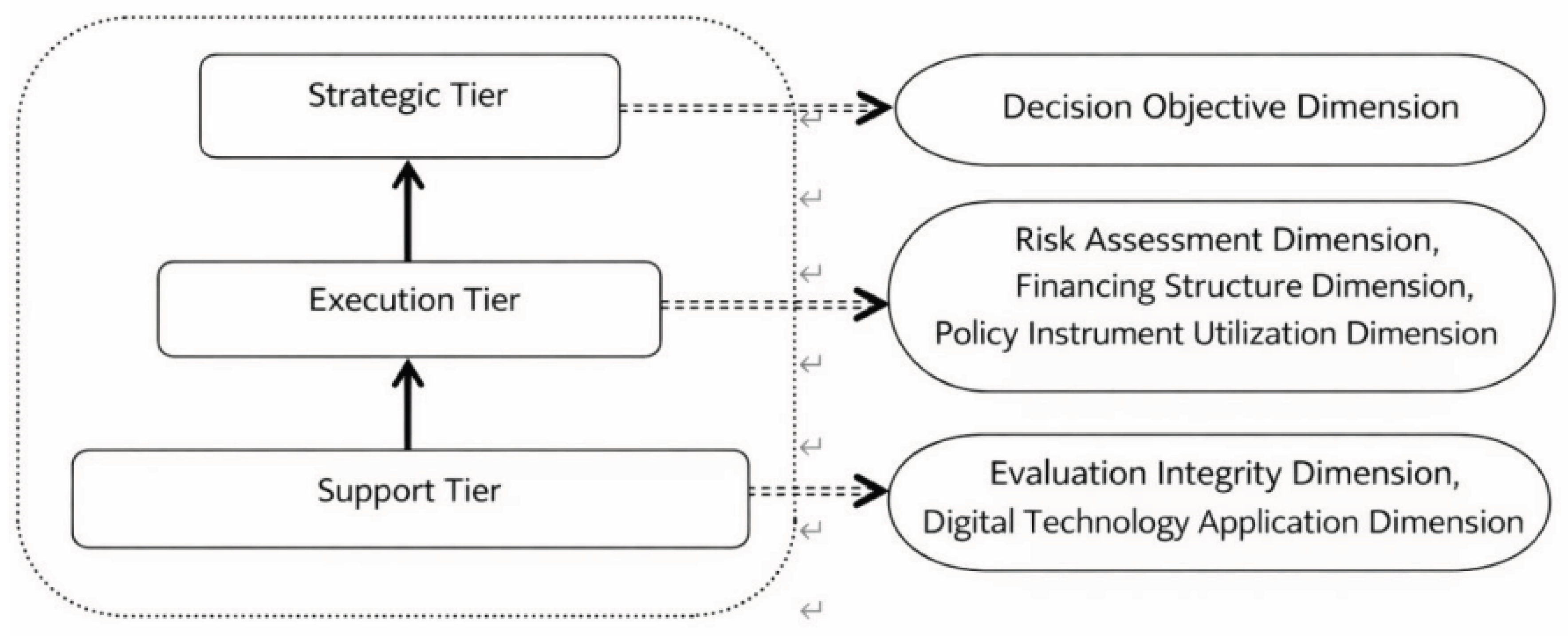

Table 1.
Hierarchical Relationships Among the Dimensions.
| Tier | Dimension | Scope | Secondary Indicators |
|---|---|---|---|
| Strategic Tier | Decision Objective | Top-level design and ultimate direction | See Table 2 |
| Execution Tier | Risk Assessment, Financing Structure, Policy Instrument Utilization | Principal measures for realizing strategic objectives | See Table 2 |
| Support Tier | Evaluation Completeness, Digital Technology Application | Integrated throughout strategic and execution tiers | See Table 2 |
Table 2.
Description of Secondary Indicators.
| Primary Indicator | Secondary Indicator | Indicator Decomposition | Indicator Description | Data Sources |
|---|---|---|---|---|
| Decision Objective Dimension | Financial Soundness | Project cash flow coverage ratio; static investment payback period; net profit margin volatility; debt-to-asset ratio control level | Measures the short-term viability of a project, ensuring stable cash flows and preventing cash-flow disruption during economic downturns | 1. Project feasibility reports, enterprise financial statements; 2. Cash flow coverage ratio = net cash flow from operating activities / debt service (principal and interest) due; 3. Net profit margin volatility = standard deviation of projected net profit margin over the most recent 3 years / mean value |
| Strategic Alignment | Degree of alignment with the enterprise’s core business; compatibility with local industrial planning; degree of adherence to “Fifteenth Five-Year Plan” strategic priorities (green / innovation / regional coordination) | Measures the extent to which a project dovetails with the enterprise’s long-term development and regional/national strategies, enhancing the capacity to secure policy resources | 1. Leshan “Fifteenth Five-Year Plan” industrial plan, Sichuan Provincial Development and Reform Commission industry directory, national strategic documents; 2. Expert scoring method (5-point scale): joint scoring by enterprise management and industry experts, with the mean taken; 3. Alignment degree = overlap ratio between the project’s core business and policy-supported domains | |
| Stakeholder Synergy | Shareholder return satisfaction; customer demand matching degree; upstream and downstream industrial chain synergy value | Balances the interests of multiple parties including shareholders, customers, and the industrial chain, ensuring that project decisions serve as robust investment guides | 1. Shareholder return satisfaction = achievement rate of expected return on equity; 2. Customer demand matching degree = number of overlapping items between project products/services and target customer core demands / total demand items; 3. Industrial chain synergy value = cost savings generated by upstream and downstream enterprises attributable to the project / total project investment | |
| Sustainable Development Capacity | Environmental compliance; resource utilization efficiency; social responsibility contribution; ESG rating improvement potential | Responds to ESG governance trends by incorporating environmental and social value into decision-making, achieving a balance between economic and social/environmental benefits | 1. Environmental authority pollution discharge permits, Environmental Impact Assessment (EIA) reports; 2. Resource utilization efficiency = energy consumption per unit of output / industry average energy consumption per unit of output; 3. ESG rating improvement potential = third-party rating agency (e.g., CSI ESG) projected rating for the project – enterprise’s current rating; 4. Social responsibility contribution = number of jobs created by the project / total project investment | |
| Risk Assessment Dimension | Macro Systemic Risk | Macroeconomic fluctuation risk; industry cycle risk; regional economic stability risk; exchange rate / trade barrier risk | Measures the impact of macro-environmental changes on projects, with particular attention to systemic pressures during economic downturns | 1. National Bureau of Statistics macroeconomic data, industry association cycle reports, customs trade data; 2. Risk quantification: Monte Carlo simulation, forecasting the impact magnitude of macroeconomic indicator fluctuations on project returns based on historical data; 3. Regional economic stability risk = Leshan’s GDP growth volatility over the most recent 3 years / Sichuan Province average growth volatility |
| Policy Risk | Industrial policy change risk; fiscal/financial policy adjustment risk; environmental/carbon constraint policy tightening risk | Measures the potential impact of abrupt policy changes or adjustments on a project’s feasibility and profitability; a core risk concern for local enterprises | 1. Policy documents from all levels of government, State Taxation Administration / central bank policy announcements, Ministry of Ecology and Environment carbon reduction policies; 2. Policy change probability = number of relevant policy adjustments over the past 5 years / 5; 3. Carbon constraint cost escalation = projected carbon tax / carbon quota cost / original projected project profit | |
| Non-Traditional Risk | Technological iteration risk; supply chain disruption risk; contingency event (epidemic / natural disaster) risk | Addresses the heightened frequency of non-traditional risks during economic downturns, measuring a project’s resilience against technological, supply chain, and contingency shocks | 1. Industry technology iteration reports, core supply chain enterprise operating data, emergency management department contingency event statistics; 2. Technology iteration risk = project core equipment renewal cycle / industry average technology renewal cycle; 3. Supply chain disruption risk = probability of supply interruption by core raw material suppliers (based on supplier credit rating + industry concentration) | |
| Industrial Chain Security Risk | Degree of external dependence for core raw materials/equipment; controllability of critical industrial chain links; “Black Swan” event impact exposure | Focuses on vulnerable links in the industrial chain, measuring the project’s capacity to cope with supply chain disruptions and contingent risks; tailored to the demands of Leshan’s advanced manufacturing sectors such as photovoltaics and new materials | 1. Enterprise supply chain ledgers, customs import/export data, industry chain analysis reports; 2. Core raw material external dependence = imported raw material volume / total demand volume; 3. Critical link controllability = number of core links autonomously controlled by the enterprise / total number of core industrial chain links; 4. Expert scoring method to quantify “Black Swan” event impact exposure (5-point scale) | |
| Market Risk | Market demand volatility; product price fluctuation risk; project financing cost risk; accounts receivable turnover ratio | Retains traditional risk assessment as the foundation for a full-spectrum scan, adapted to the characteristics of weak market demand and slow capital recovery during economic downturns | 1. Market research data, historical product price data, financial institution financing quotes, enterprise financial statements; 2. Accounts receivable turnover ratio = operating revenue / average accounts receivable balance; 3. Price fluctuation risk = standard deviation of product prices over the most recent 3 years / mean value | |
| Financing Structure Dimension | Policy-Oriented Fund Acquisition Capacity | Approval rate for green / tech-innovation / rural revitalization loans; subsidy disbursement rate; industrial guidance fund participation level | Measures the project’s ability to access policy-oriented financial instruments, securing low-cost capital and reducing financing costs | 1. PBOC structural monetary policy instrument directory, Leshan Municipal Finance Bureau subsidy documents, local industrial guidance fund announcements; 2. Approval rate = actual approved policy-oriented loan amount / application amount; 3. Subsidy disbursement rate = actual received subsidy amount / policy-approved subsidy amount; 4. Industrial guidance fund participation = fund investment amount / total project investment |
| Financing Instrument Diversification | Equity financing share; bond financing volume; investment-lending linkage cooperation depth; supply chain finance utilization rate | Reduces reliance on debt financing, optimizes capital structure, and mitigates leverage risk during economic downturns | 1. Enterprise financing plans, capital market issuance announcements, financial institution investment-lending linkage agreements; 2. Equity financing share = (industrial fund + venture capital/private equity + equity financing) / total project financing; 3. Supply chain finance utilization rate = supply chain finance financing volume / total upstream and downstream cooperative capital volume | |
| Dynamic Financing Structure Adaptability | Maturity matching between financing tenure and project construction cycle; financing cost-to-project return matching degree; timeliness of financing structure adjustments | Ensures that financing structures are dynamically adjusted in response to market conditions and project progress, preventing rigid financing arrangements from creating capital chain risks | 1. Project construction progress plans, financial institution financing cost variation data, enterprise financing adjustment records; 2. Maturity matching = project construction period / financing tenure (ideal value 1:1); 3. Cost-return matching = projected internal rate of return / weighted average cost of financing; 4. Adjustment timeliness = time required for financing structure adjustment / market environment change cycle | |
| Financing Efficiency and Credit Standing | Financing approval cycle; financing matching success rate; enterprise credit rating; completeness of financial information disclosure | Enhances financing matching efficiency, strengthens the enterprise’s credit standing, and bolsters financial institutions’ willingness to cooperate; tailored to Leshan’s MSME financing difficulties | 1. Financial institution financing approval records, enterprise credit reports, CSRC / tax authority financial information disclosure documents; 2. Financing matching success rate = number of successfully partnered financial institutions / total institutions approached; 3. Financial disclosure completeness = number of financial indicators actually disclosed / number required by regulators; 4. Enterprise credit rating references PBOC Credit Reference Center / third-party rating agency results (e.g., AAA/AA grade) | |
| Policy Instrument Utilization Dimension | Policy Tracking and Interpretation Capability | Timeliness of policy information acquisition; efficiency of policy–project matching identification; accuracy of policy implementation rule interpretation | Ensures that enterprises obtain policy information at the earliest opportunity, precisely identify the nexus between policy benefits and projects | 1. Government websites at all levels, policy interpretation platforms, enterprise policy research department ledgers; 2. Information acquisition timeliness = interval between policy release date and enterprise acquisition date (unit: hours); 3. Interpretation accuracy = expert-reviewed policy interpretation accuracy rate (5-point scale) |
| Policy Dividend Conversion Efficiency | Tax incentive realization amount; policy-guaranteed financing volume; degree of policy-facilitated market access | Converts policy resources into tangible capital, cost savings, and market advantages, quantifying the actual support that policies provide to the project | 1. Tax authority tax incentive filings, government-backed financing guarantee agency cooperation agreements, market regulatory authority market access documents; 2. Policy dividend conversion efficiency = (tax incentives + subsidies + financing cost savings from guarantees) / total project investment; 3. Market access facilitation = policy-supported access approval cycle / standard access approval cycle | |
| Government–Enterprise Collaborative Participation | Number of participations in local industrial planning; success rate of upward transmission of industry-specific concerns; success rate of government project matching | Enables enterprises to proactively participate in local industrial planning, communicate industry-specific concerns, and enhance project-level resonance with local development priorities | 1. Leshan Municipal Development and Reform Commission / Economic and Information Technology Commission planning participation records, enterprise industry concern feedback ledgers; 2. Concern transmission success rate = number of industry concerns adopted by the government / number submitted; 3. Government project matching success rate = number of government cooperation projects won / number of bids submitted | |
| Bank–Government–Enterprise Ecosystem Synergy | “Bank–Government–Enterprise” cooperation platform participation level; number of customized financial products obtained; depth of risk-sharing mechanism participation | Leverages the ecosystem constructed by local financial institutions to obtain customized financial services, realize risk-sharing, and alleviate financing difficulties | 1. Local Bank–Government–Enterprise cooperation platform records, customized financial product agreements, risk-sharing mechanism documentation; 2. Synergy level = (number of customized products + risk-sharing financing volume) / total enterprise financial services; 3. Platform participation level = enterprise financing matching instances via the platform / total financing matching instances | |
| Evaluation Completeness Dimension | Completeness of Quantitative Evaluation Indicators | Financial indicator coverage rate; number of risk quantification indicators; number of financing efficiency indicators; number of strategy quantification indicators | Ensures that quantitative evaluation covers all dimensions—financial, risk, financing, and strategic—avoiding the limitations of relying solely on financial indicators | 1. Enterprise evaluation system documentation, assessment chapters of project feasibility reports; 2. Indicator coverage rate = number of quantitative indicators actually included / number theoretically required; 3. Quantification ratio = number of indicators calculable from data / total number of evaluation indicators |
| Rigor of Qualitative Evaluation Methods | Effectiveness of expert review; comprehensiveness of scenario analysis; qualitative scoring for policy alignment; qualitative assessment of industrial chain value | For dimensions that are difficult to quantify—such as strategy, policy, and industrial chain—supplements the evaluation through rigorous qualitative methods | 1. Expert review records, scenario analysis reports, industry expert scoring sheets; 2. Expert review effectiveness = number of review opinions incorporated into decisions / total number of review opinions; 3. Scenario analysis comprehensiveness = number of simulated risk/opportunity scenarios / number of scenarios commonly observed in the industry; 4. Joint expert scoring method (5-point scale) to determine qualitative indicator results | |
| Professionalism of Third-Party Evaluation | Third-party evaluation agency qualifications; degree of consistency between third-party results and enterprise self-assessment; reference value of evaluation opinions | Introduces independent third-party professional evaluation to mitigate the subjectivity of enterprise self-assessment, enhancing the objectivity of evaluation outcomes | 1. Third-party evaluation agency qualification certificates, evaluation reports, enterprise decision reference records; 2. Consistency degree = number of indicators on which third-party and enterprise self-assessments agree / total evaluation indicators; 3. Reference value = number of evaluation opinions adopted / total number of evaluation opinions | |
| Dynamic Adaptability of the Evaluation System | Indicator update frequency; adaptability adjustments of evaluation methods; linkage between evaluation results and decisions | Ensures the evaluation system dynamically adjusts in response to changes in market conditions, project progress, and policy environment, forming an “evaluation–decision–feedback” closed loop. For different project types (innovative vs. traditional), appropriate evaluation methods should be matched to avoid methodological pitfalls | 1. Enterprise evaluation system update records, evaluation method adjustment ledgers across project phases; 2. Indicator update frequency = number of indicator updates per year / total evaluation indicators; 3. Decision linkage = number of instances in which evaluation results influenced decisions / total decisions. Additional: for innovative projects, proportion of qualitative methods (recommended ≥ 60%); for traditional projects, proportion of quantitative methods (recommended ≥ 70%); 4. Expert scoring method to assess the reasonableness of method combinations (5-point scale). Sources include project type classification files and evaluation method selection records | |
| Digital Technology Application Dimension | Data Collection and Integration Capacity | Internal and external data coverage rate; data quality compliance rate; data middle platform development completeness; multi-source data integration level | Lays the foundation for digital technology application by ensuring the enterprise aggregates comprehensive internal and external data, enhancing data reliability | 1. Enterprise data platform development documentation, data collection ledgers, data quality inspection reports; 2. Data coverage rate = number of internal and external data items actually collected / number theoretically required; 3. Data quality compliance rate = number of qualified data entries / total data entries (compliance rate ≥ 95% as benchmark); 4. Multi-source data integration level = effective data volume after integration / sum of raw data volumes from individual sources |
| AI Technology Application | Deep machine learning risk-mining efficiency; NLP policy interpretation speed; intelligent decision model accuracy; AI whole-lifecycle management coverage rate | Leverages AI to achieve risk mining, policy interpretation, and automated, precision-enhanced decision-making, replacing traditional experience-based judgment | 1. Enterprise AI technology application system records, machine learning model output reports, NLP policy interpretation results; 2. Risk-mining efficiency = number of latent risks identified by AI / number identified manually; 3. Policy interpretation speed = time for AI to interpret a single policy document / time for manual interpretation; 4. Intelligent decision model accuracy = degree of concordance between model predictions and actual outcomes; 5. AI whole-lifecycle management coverage = number of project phases in which AI participates / total project lifecycle phases | |
| Digital Twin and Scenario Simulation Capacity | Project virtual scenario construction completeness; simulation problem identification accuracy; simulation solution implementation rate | Constructs virtualized scenarios for project implementation, anticipating problems and formulating solutions in advance to reduce trial-and-error costs during economic downturns | 1. Digital twin system construction reports, project scenario simulation records, problem resolution implementation ledgers; 2. Scenario construction completeness = number of project links replicated in virtual scenarios / total actual project links; 3. Problem identification accuracy = number of problems identified by AI simulation / number of problems actually occurring in the project; 4. Solution implementation rate = number of simulated solutions actually implemented / total number of solutions proposed in simulation | |
| Digital Monitoring and Early Warning Capacity | Computer vision on-site monitoring coverage; project progress intelligent monitoring accuracy; dynamic risk early warning response speed | Achieves real-time monitoring, progress control, and risk early warning after project implementation, enabling timely responses to contingent issues | 1. On-site monitoring equipment deployment records, project progress monitoring system data, risk early warning system response records; 2. Monitoring coverage = number of project zones with deployed monitoring / total project zones; 3. Progress monitoring accuracy = intelligently monitored progress value / actual progress value; 4. Early warning response speed = elapsed time from early warning issuance to activation of countermeasures (unit: hours) | |
| Digital Technology Empowerment Efficiency | Cost reduction attributable to digital technology; decision-making efficiency improvement ratio; return on investment (ROI) of digital transformation | Quantifies the actual empowerment impact of digital technology on projects, ensuring that technology investment is matched by returns and preventing indiscriminate digitalization | 1. Enterprise digital transformation investment ledgers, project financial statements, decision-making efficiency statistical data; 2. Cost reduction = (pre-digitalization cost – post-digitalization cost) / pre-digitalization cost; 3. Decision-making efficiency improvement ratio = (pre-digitalization decision time – post-digitalization decision time) / pre-digitalization decision time; 4. Digital ROI = benefits attributable to digitalization / total digital investment |
Table 3.
Comparison of Key Differences.
| Dimension | Prior Research | This Study | Analysis |
|---|---|---|---|
| Decision Objective | Maximize financial net value (NPV/IRR): assumes market efficiency, centers on shareholder wealth, ignores non-market constraints. | Optimize strategic adaptability: expands to “financial prudence + strategic alignment + ESG contribution + stakeholder synergy.” | Breakthrough: Prior research rests on mature-market assumptions. In a downturn, “survival” and “strategic positioning” take precedence; purely financial metrics can cause strategically aligned but low-return projects to be rejected. |
| Risk Identification | Market and financial risk: first-order risk; treats policy as exogenous. | Panoramic systemic-coupling risk scan: incorporates policy changes, supply chain disruptions, technological disruption, and climate risk (second-order); emphasizes nonlinear macro–micro coupling. | Deepening: Traditional models struggle to quantify “black swan” events. Policy risk and industrial chain security now surpass traditional market risk in determining project outcomes. |
| Financing Logic | Capital structure irrelevance / pecking order: assumes frictionless markets. | Dynamic multi-instrument alignment: “policy fund anchoring + equity de-leveraging + investment-lending linkage”; structure adjusts to policy windows. | Correction: In a downturn with strict credit rationing, pecking order often fails. Proactive use of policy instruments (e.g., green re-lending) can significantly reduce costs. |
| Decision Methodology | Predominantly quantitative (DCF / Real Options): relies on historical data, assumes manager rationality. | “Qualitative + Quantitative” dual-criterion system + AI: introduces fuzzy comprehensive evaluation for non-financial indicators; uses AI for policy decoding and scenario simulation. | Innovation: Resolves the challenge of quantifying non-financial indicators and uses digital technology to compensate for predictive bias in data-scarce environments. |
| Government–Enterprise Relationship | Passive recipients: enterprises as price takers, passively adapting to policy. | Proactive co-creators: enterprises participate in policy feedback, build “Bank–Government–Enterprise” ecosystem, internalize policy dividends as competitive advantage. | Paradigm shift: From unidirectional adaptation to bidirectional interaction; government–enterprise collaboration significantly reduces investment delays from information asymmetry. |
Disclaimer/Publisher’s Note: The statements, opinions and data contained in all publications are solely those of the individual author(s) and contributor(s) and not of MDPI and/or the editor(s). MDPI and/or the editor(s) disclaim responsibility for any injury to people or property resulting from any ideas, methods, instructions or products referred to in the content. |
© 2026 by the authors. Licensee MDPI, Basel, Switzerland. This article is an open access article distributed under the terms and conditions of the Creative Commons Attribution (CC BY) license (http://creativecommons.org/licenses/by/4.0/).
Copyright: This open access article is published under a Creative Commons CC BY 4.0 license, which permit the free download, distribution, and reuse, provided that the author and preprint are cited in any reuse.


