

Submitted:
27 August 2026
Posted:
31 August 2026
You are already at the latest version
Abstract
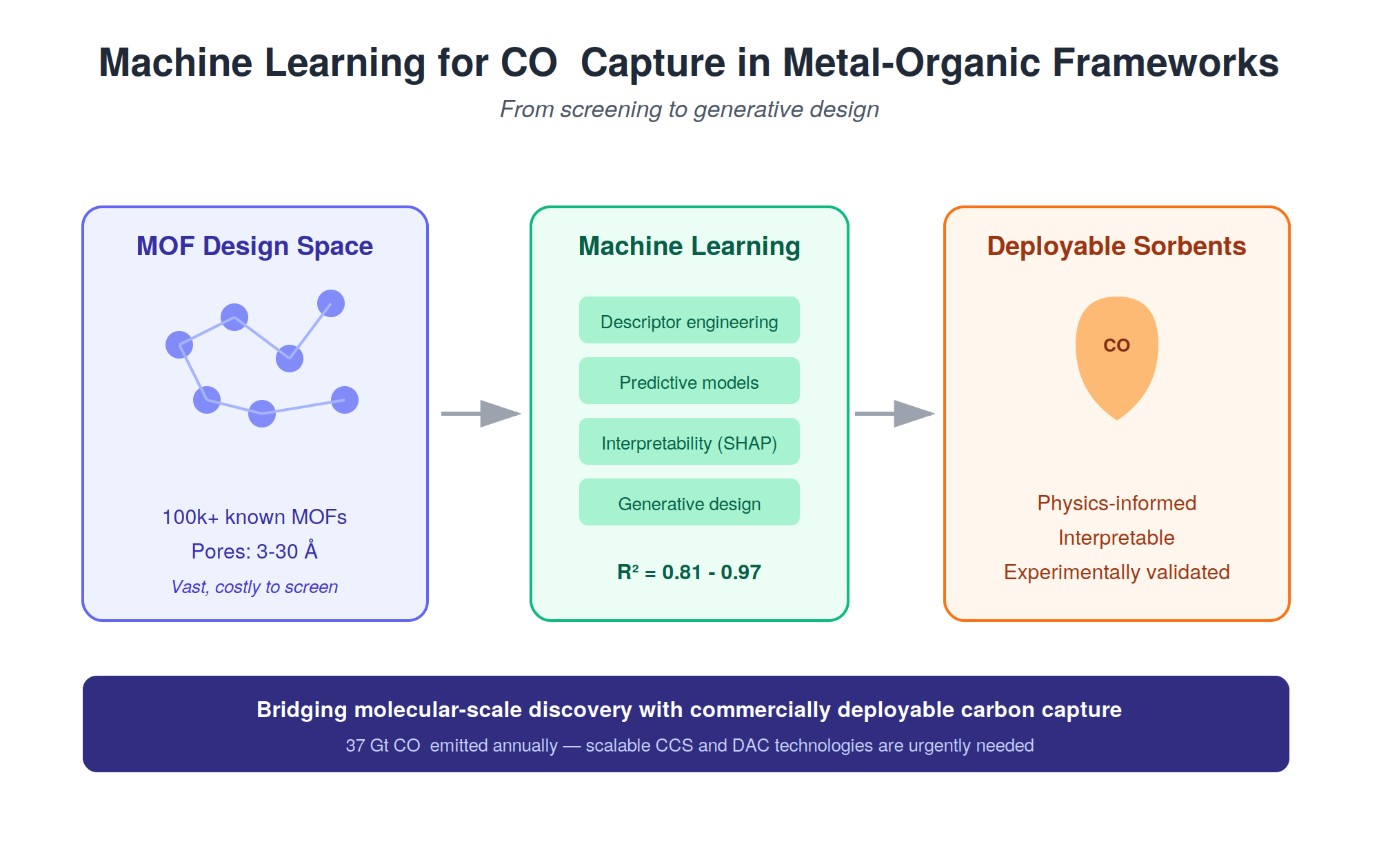
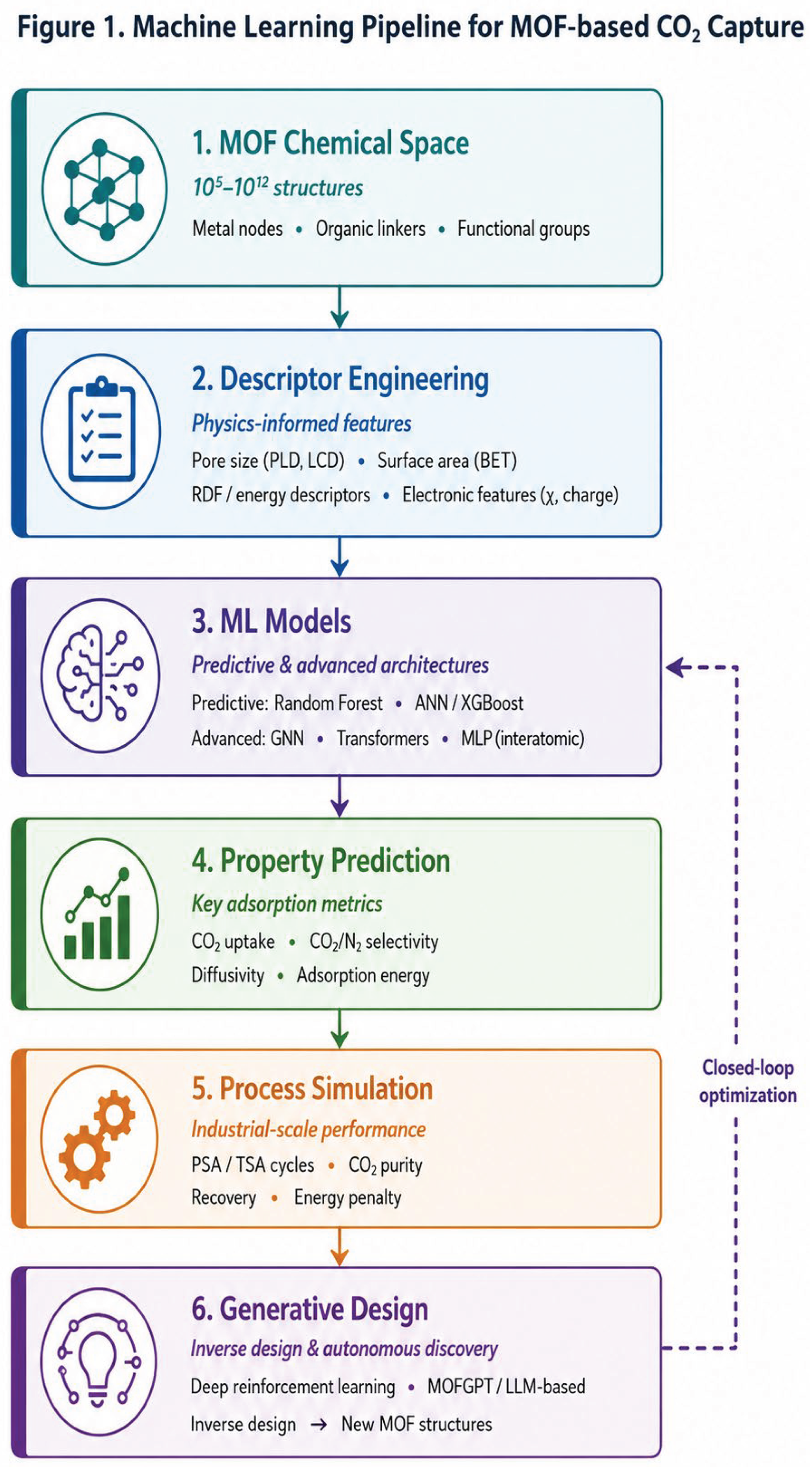
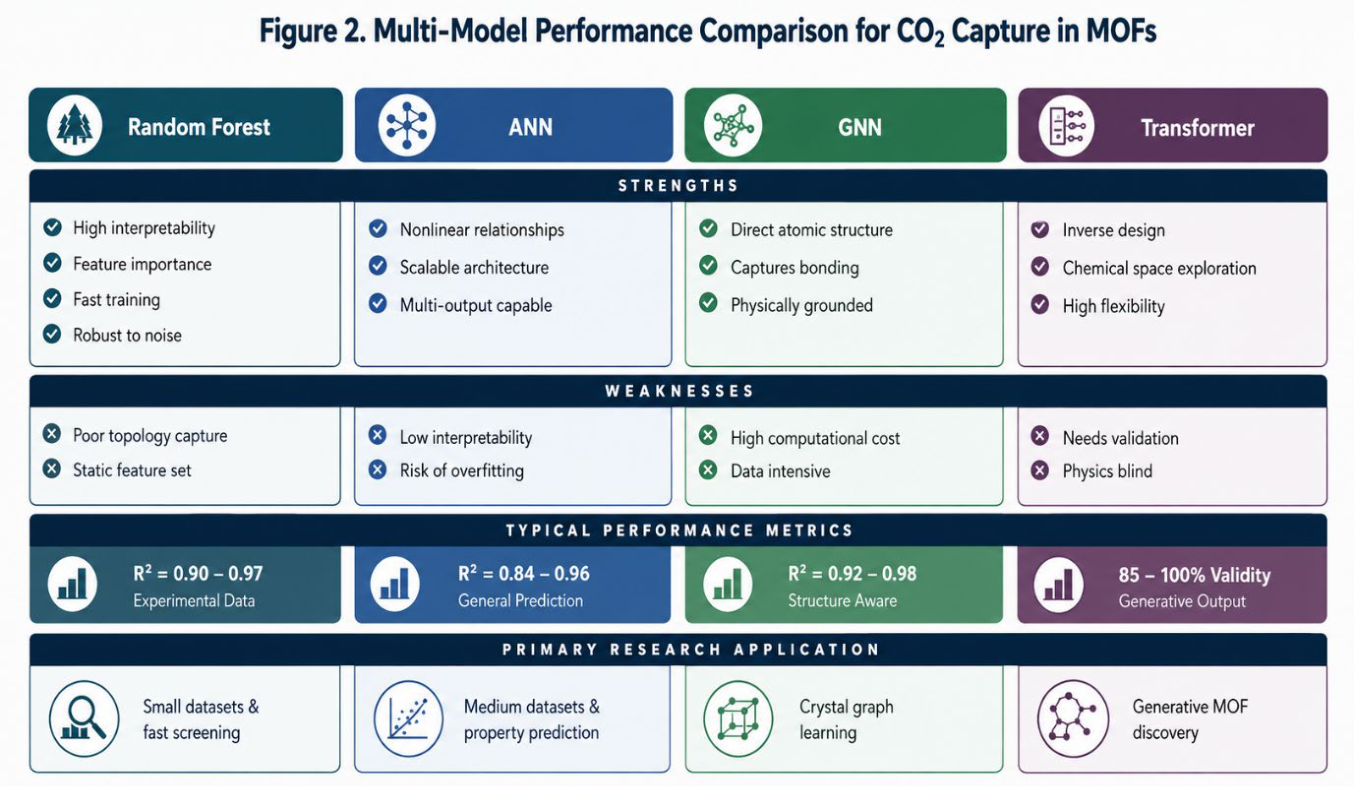
The ongoing climate crisis, caused by the annual release of 37 billion metric tons of CO2 emissions, is putting pressure on the advancement of Carbon Capture and Storage (CCS) and Direct Air Capture (DAC) technologies. Metal–Organic Frameworks (MOFs), with their high surface areas and modular pore topologies, present a very attractive class of sorbents for CO2 capture; however, it currently remains computationally prohibitive to explore their extensive chemical design space. Herein, we provide a thorough evaluation of how machine learning (ML) (as an emerging technology) has played an increasing role in furthering our understanding of CO2 capture from MOFs. Through an organized investigation, we provide evaluations of the latest generation of models across four key areas: application at a process level, mechanistic interpretable modelling; physically relevant descriptors, and predictive performance metrics. Recent work with Machine Learning Interatomic Potentials (MLPs) shows that traditional assumptions about rigid frameworks are being challenged by the fact that diffusion properties and adsorption thermodynamics are heavily influenced by the flexibility of the framework. The use of physics-informed descriptor engineering yields R2 values of 0.81-0.97 across gas species and pressure regimes, while the generative nature of Deep Reinforcement Learning and transformer-based architectures has been shown to allow for the inverse design of frameworks with high affinities for gas species. The trend in this sector is moving towards optimization of multiple scales simultaneously and integrating processes to achieve an optimized property prediction. Current work with machine learning is focusing on using a combination of material properties and operational indicators (such as how much gas is recovered through pressure swing adsorption) to make predictions. As these techniques improve, there will be a similar need for a design that is both physically informed and understandable, thus allowing for a link between molecular discoveries and water-stable materials that have been experimentally verified and are suitable for use in commercial applications.
Keywords:
1. Physics-Informed Descriptor Engineering
1.1. Descriptor Engineering Strategies
1.2. Hybrid Textural-Optimization and Outlier-Aware Predictive Modelling
1.3. Ensemble Interaction Mapping and Node-Affinity Hierarchies
2. High-Throughput Screening and Universal Property Prediction
2.1. High-Throughput Screening and Discovery
2.2. Universal Property Prediction and Isotherm Generalization
2.3. Property-Driven ML Applications
3. Model Interpretability and Thermodynamic Mapping
3.1. Model Interpretability and Physical Insight
3.2. Ensemble-Averaged Thermodynamics and Potential Energy Surface (PES) Mapping
4. Molecular Transport and Multicomponent Separation Mechanisms
4.1. Molecular-Level Transport and Adsorption Mechanisms
4.2. Multicomponent Gas Separation and Structural Design Strategies
5. Active-Site and Electronic Structure Engineering
5.1. Lewis Acid-Base Site Engineering and Catalytic Kinetics
5.2. Electronic Property Modulation and Electrocatalytic Selectivity
5.3. Synergistic Site Engineering and Composite Pore Modulation
6. Multi-Objective Inverse Design and Generative MOF Discovery
6.1. Multi-Objective Inverse Design and Chemical Subspace Exploration
7. Multiscale Generative Design and Process-Oriented Optimization
7.1. Process-Integrated Generative Design and Material Optimization

| Study Focus | Primary ML Algorithm(s) | Key Descriptor(s) | Predictive Performance (R2) | Core Scientific Insight |
| Pore Energy Mapping [8] | XGBoost | Energy-based RDFs & Surface Histograms | > 0.81 CO2 > 0.97 N2 | Spatially aware energy RDFs resolve the “intermediate pressure bottleneck” in isotherms. |
| Composite Modulation [23] | CNN (Inception) | Geometric + Chemical (Ionic Liquids) | ≈ 0.90 | Ionic liquids can act as synergistic sites, creating new potential energy minima for CO2. |
| Kinetic Transport [17] | DeepPot-SE (MLP) | Atomic coordinates (Flexible) | 0.9916 (Energy) | Framework flexibility accelerates CO2 diffusivity by 10x compared to rigid models. |
| Generative Design [25] | MOFGPT (Transformer) | MOFid (NLP-based strings) | 35–100% Validity | Reinforcement learning effectively navigates the “extreme tail” of property distributions. |
| Process-Level Design [4] | MOF-NET (ANN) | Word Embeddings of Building Blocks | Elite purity/recovery | Optimal design bifurcates into small-pore exclusion vs. large-pore binding. |
| Mixed Matrix Membranes [13] | Stacking Ensemble | Polymer FFV + MOF PLD/LCD | 0.96 | A “10x permeability rule” exists where filler must exceed polymer permeability for gain. |
| Experimental Benchmarking [12] | Stacking (RF/XGB/MLP) | Textural (BET) + Operational (P, T) | 0.9833 | Identified a metal-affinity hierarchy where Mg and Cu centers provide superior binding sites. |
| Hybrid Optimization [11] | LSSVM-GO | Textural + Operational | 0.9798 | Growth Optimization (GO) significantly reduces prediction errors in high-uptake regimes. |
| Multicomponent Separation [20] | Random Forest | Structural + Chemical Descriptors | 0.922 (R%) | MOF renderability is optimized within a specific density window of 0.5–1.7 g/cm3. |
| Electrocatalytic Selectivity [22] | Gradient Boosting (GBR) | Electronic (EA, chi, d-band) | 0.9998 | Catalytic activity is primarily governed by electron affinity and electronegativity. |
| Universal Zeolite Prediction [15] | GBT / RF / DL | Si/Al Ratio + Cation type | 0.936 | Provides a universal framework without case-specific parameter fitting required by Langmuir models. |
Conclusions
References
- Ozkan, M.A.; Coley, Amir-Ali; Shang, William; Ma, Ruoxu; Yi. Progress in carbon dioxide capture materials for deep decarbonization . Chem 2022, 8, 141–173. [Google Scholar] [CrossRef]
- Carrascal-Hernández, D.C.; Grande-Tovar, C.D.; Mendez-Lopez, M.; Insuasty, D.; García-Freites, S.; Sanjuan, M.; Márquez, E. CO2 Capture: A Comprehensive Review and Bibliometric Analysis of Scalable Materials and Sustainable Solutions . Molecules 2025, 30(3), 563. [Google Scholar] [CrossRef] [PubMed]
- Mahajan, Shreya; M.L. Recent Prog. Metal.-Org. Fram. (MOFs) CO2 Capture At. Differ. Press. J. Environ. Chem. Eng. 2022. [CrossRef]
- Deng, Z.; Sarkisov, L. Multi-Scale Computational Design of Metal-Organic Frameworks for Carbon Capture Using Machine Learning and Multi-Objective Optimization Chem. Mater. 2024, 36(19), 9806–9821.
- Hussin, F.N.; Aqilah, Siti; Mohamed Hatta, Nur Syahirah; Aroua, Mohamed; Mazari; Ali, Shaukat. A systematic review of machine learning approaches in carbon capture applications . J. CO2 Util. 2023. [Google Scholar] [CrossRef]
- Coudert, François-Xavier. Recent advances in stimuli-responsive framework materials: Understanding their response and searching for materials with targeted behavior Coord. Chem. Rev. 2025, 539.
- Fathalian, F.A.; Sepehr; Ghaemi, Ahad; Hemmati, Alireza. Intelligent prediction models based on machine learning for CO2 capture performance by graphene oxide-based adsorbents Sci. Rep. 2022, 12, 21507. [PubMed]
- Deng, Z.; L.S. Engineering machine learning features to predict adsorption of carbon dioxide and nitrogen in metal-organic frameworks J. Phys. Chem. C 2024. [CrossRef]
- Zuo, J.; Qu, F.S.; Yang, Z.; Xie, C.; Zhang, L.; Li, Y.; Li, X.; J. Unraveling the coupling effect of micropore confinement and functional sites of carbon-based adsorbents on flue gas CO2 adsorption: A machine learning study based on multi-scale simulations Carbon Capture Sci. Technol. 2025. [CrossRef]
- Teng, Y.; G.S. Interpret. Mach. Learn. Mater. Discov. Predict. CO2 Adsorpt. Prop. Metal.-Org. Fram. 2024. [CrossRef]
- Longe, P.O.; Mehrad, S.D.; Wood, M.; D.A. Robust machine-learning model for prediction of carbon dioxide adsorption on metal-organic frameworks; J. Alloys Compd., 2024. [Google Scholar]
- Iyiola, Z.; Okeke, E.T.B.; Sanni, N.J.; Longe, K.; P. Carbon capture using metal-organic frameworks (MOFs): Novel custom ensemble learning models for prediction of CO2 adsorption Processes, 2025.
- Wan, H.; Hu, Y.F.; Guo, M.; Sui, S.; Huang, Z.; Liu, X.; Zhao, Z.; Liang, Y.; Wu, H.; Gao, Y.; Qiao, H.; Z. Interpretable machine learning and big data mining to predict the CO2 separation in polymer-MOF mixed matrix membranes . Adv. Sci. 2024. [Google Scholar] [CrossRef] [PubMed]
- Achour, S.; Z.H. ML-Driven Model. Predict. CO2 Uptake Metal.-Org. Fram. (MOFs) Can. J. Chem. Eng. 2024. [CrossRef]
- Kirtil, E. Universal prediction of CO2 adsorption on zeolites using machine learning: A comparative analysis with Langmuir isotherm models ChemEngineering 2025. [CrossRef]
- Kotov, E.V.; Logabiraman, J.S.; Dhall, G.; Chandna, H.; Madan, M.; Sharma, P.; V. Carbon capture and storage optimization with machine learning using an ANN model . E3S Web Conf. 2024, 588, 01003. [Google Scholar] [CrossRef]
- Zheng, B.; dos Santos, G.X.G.; Ferreira, C.; Steiner, R.N.B.; Luan, M.; B. Simulating CO2 diffusivity in rigid and flexible Mg-MOF-74 with machine-learning force fields . APL Mach. Learn. 2024, 2, 026115. [Google Scholar] [CrossRef]
- Lim, Yunsung; H.P.; Walsh, Aron; Kim, Jihan. Accelerating CO2 direct air capture screening for metal-organic frameworks with a transferable machine learning force field Matter 2025. [CrossRef]
- Tayfuroglu, O.; K.S. Modeling CO2 adsorption in flexible MOFs with open metal sites via fragment-based neural network potentials J. Chem. Phys. 2025, 163(5), 054704. [PubMed]
- Zhou, Y.; He, S.J.; Fan, S.; Zan, W.; Zhou, L.; Ji, L.; He, X.; G. Machine-learning-assisted high-throughput screening of metal-organic frameworks for CO2 separation from CO2-rich natural gas Ind. Eng. Chem. Res. 2024. [CrossRef]
- Bai, X.; Xie, Y.L.; Chen, Y.; Zhang, Q.; Li, X.; J.-R. High-throughput screening of CO2 cycloaddition MOF catalyst with an explainable machine learning model Green Energy Environ 2024. [CrossRef]
- Xing, G.; Sun, S.L.; Liu, G.; J.-Y. Modification of metals and ligands in two-dimensional conjugated metal-organic frameworks for CO2 electroreduction: A combined DFT and machine learning study SSRN Electron. J 2024. [CrossRef]
- Sheng, Mengjia; X.Z.; Cheng, Hongye; Song, Zhen; Qi, Zhiwen. Multi-Criteria Comput. Screen. [BMIM][DCA] @MOF Compos. CO2 Capture Green Chem. Eng. 2025. [CrossRef] [PubMed]
- Park, H. Inverse design of metal-organic frameworks for direct air capture of CO2 via deep reinforcement learning Digital Discovery 2024, 3(4), 728–741.
- Badrinarayanan, Srivathsan; Antony, R.M.; Meda, Akshay; Farimani, Radheesh Sharma; Barati, Amir. MOFGPT: Generative Design of Metal-Organic Frameworks using Language Models . J. Chem. Inf. Model. 2025, 65(17), 9049–9060. [Google Scholar] [CrossRef] [PubMed]
- Zhang, Z.; Pan, F.; Mohamed, S.A.; Ji, C.; Zhang, K.; Jiang, J.; Jiang, Z. Accelerating Discovery of Water Stable Metal-Organic Frameworks by Machine Learning . Small 2024, 20(42), 2405087. [Google Scholar] [CrossRef] [PubMed]
- Terrones, G.G.; Huang, S.-P.; Rivera, M.P.; Yue, S.; Hernandez, A.; Kulik, H.J. Metal-Organic Framework Stability in Water and Harsh Environments from Data-Driven Models Trained on the Diverse WS24 Data Set . J. Am. Chem. Soc. 2024, 146(29), 20333–20348. [Google Scholar] [CrossRef] [PubMed]
- Zhang, Z.; Jiang, Z. Discovering Ultra-Stable Metal-Organic Frameworks for CO2 Capture from A Wet Flue Gas: Integrating Machine Learning and Molecular Simulation Environ. Sci. Technol. 2025, 59(18), 9123–9133. [PubMed]
- Wilmer, C.E.; Leaf, M.; Lee, C.Y.; Farha, O.K.; Hauser, B.G.; Hupp, J.T.; Snurr, R.Q. Large-Scale Screening of Hypothetical Metal-Organic Frameworks . Nat. Chem. 2012, 4(2), 83–89. [Google Scholar] [CrossRef] [PubMed]
- Willems, T.F.; Rycroft, C.H.; Kazi, M.; Meza, J.C.; Haranczyk, M. Algorithms and Tools for High-Throughput Geometry-Based Analysis of Crystalline Porous Materials . Microporous Mesoporous Mater. 2012, 149, 134–141. [Google Scholar] [CrossRef]
- Wang, W.; Wang, D.; Song, H.; Hao, D.; Xu, B.; Ren, J.; Wang, M.; Dai, C.; Wang, Y.; Liu, W. Size Effect of Gold Nanoparticles in Bimetallic ZIF Catalysts for Enhanced Photo-Redox Reactions . Chem. Eng. J. 2023, 455, 140909. [Google Scholar] [CrossRef]
- Shi, W.-J.; Chen, M.-W.; Li, Y.-Z.; Chen, H.-Y.; Lin, Y.; Wang, H.; Hou, L.; Wang, G.-D. Integrating Hydrogen-Bonding Nanotrap into a Cage-like MOF for Natural Gas Upgrade and MTO Product Separation . Chem. Eng. J. 2025, 526, 170811. [Google Scholar] [CrossRef]
- Obaid, A.; Sun, T.; Babarao, R.; Wang, L.; Gao, L.; Wang, Y.; Hao, D. Integrating Machine Learning in Catalyst Design for Sustainable Hydrogen from Plastic Waste . Energy Mater. 2026, 6(5). [Google Scholar] [CrossRef]
Disclaimer/Publisher’s Note: The statements, opinions and data contained in all publications are solely those of the individual author(s) and contributor(s) and not of MDPI and/or the editor(s). MDPI and/or the editor(s) disclaim responsibility for any injury to people or property resulting from any ideas, methods, instructions or products referred to in the content. |
© 2026 by the authors. Licensee MDPI, Basel, Switzerland. This article is an open access article distributed under the terms and conditions of the Creative Commons Attribution (CC BY) license.