

Submitted:
21 February 2026
Posted:
27 February 2026
You are already at the latest version
Abstract
The Riemann Reciprocal Sum (formula) for all nontrivial zeros of the Riemann zeta function is a constant, namely, 1/2 (2 + γ – ln4π) [1], and also a supernatural result. Our paper provides a proof of this formula based on research findings since the Riemann Hypothesis was proposed.
Keywords:
the Riemann Reciprocal Sum Formula (Constant)
; the nontrivial zeros
; the Riemann zeta function
; Riemann Hypothesis
1. Introduction
In his epoch-making paper “On the Number of Primes Less Than a Given Magnitude” [2], Bernhard Riemann proved the only analytic expression, to date, that reveals the essence of prime numbers, which is the following prime counting function [3, p.34] – the number of primes less than any given magnitude x,
where, μ(n) is the Möbius function, and J(x) is a new step function – the Riemann prime counting function with the evaluation of the terms in the formula [2] [3, p.33] as
where, Li(x) and ρ are the logarithmic integral function and the nontrivial zeros of the Riemann zeta function, respectively.
At the same time, Riemann also estimated the number, N(T) [2] [4, proved] [3, p.18] [5, p.17] of nontrivial zeros within the region, 0 < Re(s) < 1, 0 < Im(s) ≤ T, which nontrivial zeros should appear as,
and proposed the renowned Riemann Hypothesis [2] – all nontrivial zeros of the Riemann zeta function lie on the critical line, Re(s = σ + it) = 1/2 in the complex plane.
Throughout the mathematical derivation process in Riemann's paper briefly described above, the reciprocal sum (formula) of all nontrivial zeros as
is not necessary, so it did not appear in his paper. Instead, this formula (constant) only exists in the Riemann's nachlass [1] below that conceived his paper.
Figure 1.
The Riemann's reciprocal sum formula and its numerical value [1, p.72/168].
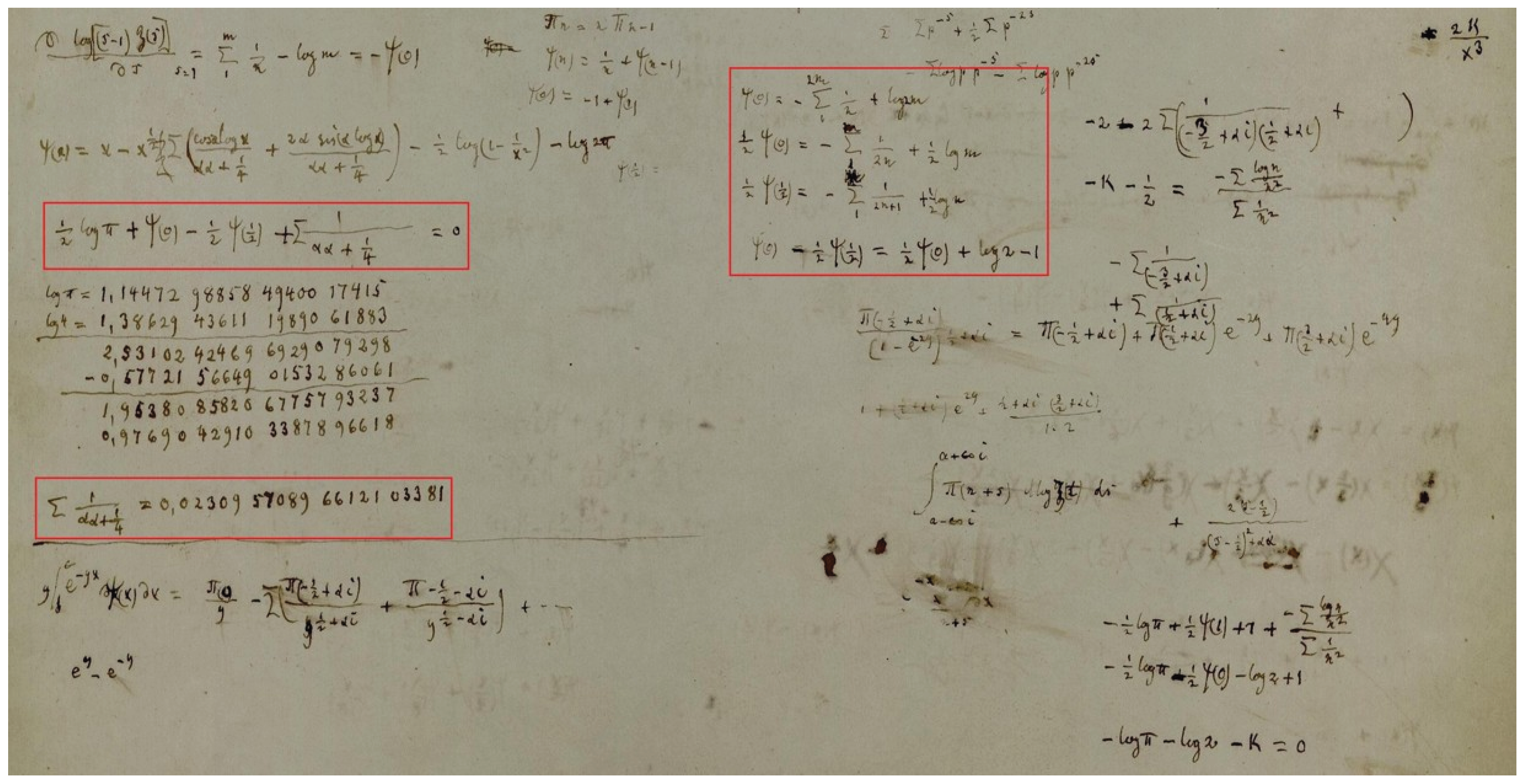
We believe this formula may have helped him in his computations of the first few (at least three) nontrivial zeros on the critical line [1, p.134-137] [3, p.67] [6], especially to calculate and iteratively determine the smallest (first) nontrivial zero [6].
To this day, 166 years have passed, there is still little understanding about the characteristics of the nontrivial zeros for the Riemann zeta function. Even without knowing the value of any one in infinitely many nontrivial zeros, it is magical that the reciprocal sum (infinite series) unexpectedly converges to a constant, 1/2 (2 + γ – ln4π) [1]. Therefore, this formula (constant) is naturally fascinating.
2. The Proof of the Riemann Reciprocal Sum Formula (Constant)
The reciprocal sum [1, p.72/168] of all nontrivial zeros of the Riemann or function can be expressed as
2.1. To Verify
2.2. To Confirm
By the product formula with the form of the Weierstrass factor theorem [7, p.1] [8, p.132] of the Gamma function,
2.3. To Prove
where, γ is the Euler- Mascheroni constant.
We notate this as the Riemann reciprocal sum constant and , separately.
Proof:
Taking the logarithmic differentiation on both sides of the equation above yields
where, is the Digamma function.
Below is an analysis of the asymptotic behavior of the last three terms in the above equation:
The Taylor expansion of [7, p.36] [8, p.118] is shown as
where are the Bernoulli numbers.
where , is Euler's 1735 solution of the Basel Problem.
where are the Stieltjes constants and .
And so
hence
also namely,
So that,
For alternative proofs about this subsection see [3, p,66-67] and [3, p.134-135].
taking logarithmic differentiation on both sides of the above equation yields
Notice: the formula above is the series form of the Digamma Function.
So,
taking logarithmic differentiation on both sides of the above equation yields
taking logarithmic differentiation on both sides of the above equation yields
Combining the two equations above, and limiting them on both sides, gives us
Therefore, we finally obtain (2) as
Regarding the absolute convergence of the Riemann reciprocal sum formula, ∑, it is better to refer to Edwards's brilliant proof [3, p.42-43]. □
3. Remarks
(a) Besides helping Riemann calculate the first few nontrivial zeros, the determination of the Riemann reciprocal sum constant, for all nontrivial zeros may also have been one of the key factors motivating the Riemann Hypothesis;
(b) This constant (formula) is also needed in deriving the Riemann product formula;
(c) This constant (formula) may have even more important potential applications.
Funding
This research received no external funding.
Conflicts of Interest
The authors declare no conflicts of interest.
References
- Riemann, B.; Riemann, Cod. Ms. B. Available online: http://resolver.sub.uni-goettingen.de/purl?DE-611-HS-3226542.
- Riemann, B. Über die Anzahl der Primzahlen unter einer gegebenen Grösse On The Number Of Primes Less Than A Given Magnitude. In Monats berichte der Berliner Akademie; English translation by H. M. Edwards in [3], 1974; November 1859; pp. 671–680.
- Edwards, H. M. Riemann’s Zeta Function; Dover Publications- New York, 1974. [Google Scholar]
- von Mangoldt, H. Zu Riemann’s Abhandlung ‘Ueber die Anzahl der Primzahlen unter einer gegebenen Grösse’. J. Reine Angew. Math. 1895, 114, 255–305. [Google Scholar]
- A. Ivić, The Theory of the Riemann Zeta-Function with Applications; John Wiley & Sons, Inc., 1985. [Google Scholar]
- Siegel, B. L. Über Riemanns Nachlass zur analytischen Zahlentheorie. Quellen und Studien zur Geschichte der Math. Astr. Phys. 1932, 2, 45–80. [Google Scholar]
- Magnus, W.; Oberhettinger, F.; Soni, R. P. Formulas and Theorems for the Special Functions of Mathematical Physics; Springer-Verlag Berlin Heidelberg GmbH, 1966. [Google Scholar]
- Zeidler, E. The Oxford Users' Guide to Mathematics. English Translated and typeset by Bruce Hunt; Oxford University Press, 2004.
- Wikipedia®. Available online: https://en.wikipedia.org/wiki/Digamma_function.
- Wikipedia®. 2026. Available online: https://en.wikipedia.org/wiki/Stieltjes_constants.
Disclaimer/Publisher’s Note: The statements, opinions and data contained in all publications are solely those of the individual author(s) and contributor(s) and not of MDPI and/or the editor(s). MDPI and/or the editor(s) disclaim responsibility for any injury to people or property resulting from any ideas, methods, instructions or products referred to in the content. |
© 2026 by the authors. Licensee MDPI, Basel, Switzerland. This article is an open access article distributed under the terms and conditions of the Creative Commons Attribution (CC BY) license (http://creativecommons.org/licenses/by/4.0/).
Copyright: This open access article is published under a Creative Commons CC BY 4.0 license, which permit the free download, distribution, and reuse, provided that the author and preprint are cited in any reuse.


