

Submitted:
20 February 2026
Posted:
27 February 2026
You are already at the latest version
Abstract
Recent advances in artificial intelligence (AI), especially large language models, have accelerated the integration of multimodal data in scientific research. Given that scientific fields involve diverse data types, ranging from text and images to complex biological sequences, graphs, and structures, multimodal large language models (MLLMs) have emerged as powerful tools to bridge these modalities, enabling more comprehensive data analysis and intelligent decision-making. This work, S3-Bench, provides a comprehensive overview of recent advances in MLLMs, focusing on their diverse applications across science. We systematically review the progress of MLLMs in key scientific domains, including drug discovery, molecular & protein design, materials science, and genomics. The work highlights model architectures, domain-specific adaptations, benchmark datasets, and promising future directions. More importantly, we benchmarked open-source MLLMs on a range of critical molecular and protein property prediction tasks. Our work aims to serve as a valuable resource for both researchers and practitioners interested in the rapidly evolving landscape of multimodal AI for science.
Keywords:
MLLMs
; AI for science
; survey
; benchmark
; drug discovery
; molecular & protein design
; materials science
; genomics
1. Introduction
Recent breakthroughs in artificial intelligence (AI) have been driven by foundation models—large-scale neural networks trained on broad data that can be adapted to diverse tasks [55,132]. In particular, large language models (LLMs) based on the Transformer architecture [162] have achieved remarkable proficiency in natural language processing, exhibiting emergent abilities such as few-shot learning [5,14,81,175,176] and human-aligned dialogue generation [48,133,237]. However, these advances remain confined to text-based inputs and outputs, whereas scientific problems are inherently multimodal—spanning modalities such as clinical text, biomedical images, genomic sequences, molecular graphs and protein structures, among others [35,86,108,119]. This has catalyzed a new generation of multimodal large language models (MLLMs) designed to bridge diverse data modalities and enable more comprehensive reasoning.
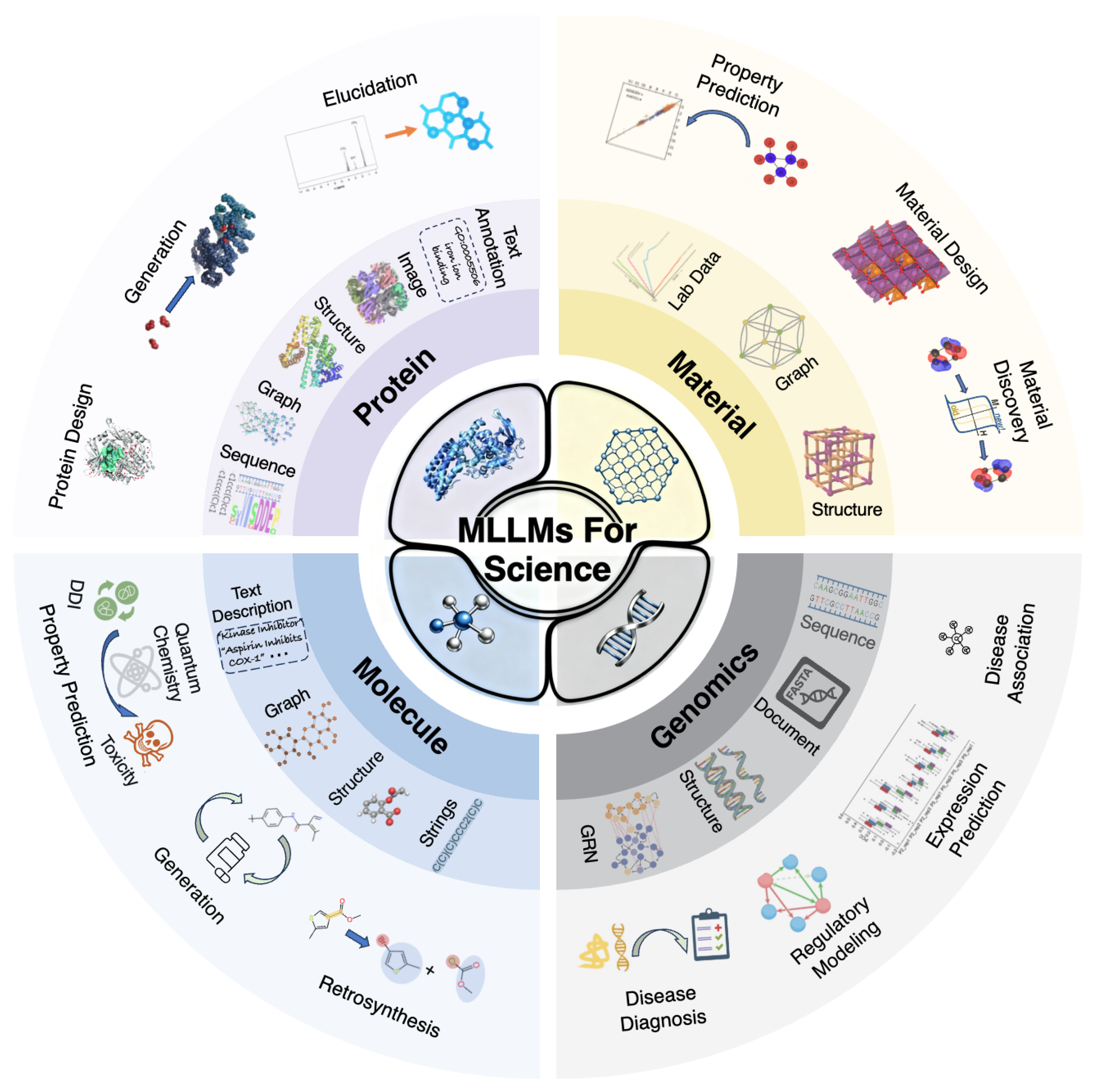
MLLMs extend language modeling beyond text, enabling AI systems to ingest and generate diverse data types such as images, audio, and structured scientific representations [98,181,201]. Early examples like Flamingo [5] and Kosmos-1 [70] showed that LLMs can be adapted or trained to jointly reason over visual and textual inputs, while open-source efforts such as MiniGPT-4 [233] and LLaVA [87] align vision encoders with LLMs, marking a shift from text-only AI towards generalist multimodal agents. This multimodal trend is especially impactful in science, where tasks often integrate multiple modalities. Biomedical models such as BioMedGPT [119] unify protein sequences, molecular structures, and textual knowledge for drug discovery. In genomics, systems like Geneverse [113] and GeneChat [35] connect DNA sequences with biomedical knowledge. In materials science, multimodal AI can parse literature and microstructure images jointly to propose new materials or predict properties [4,11,15,136]. Across these domains, MLLMs act as engines that fuse language with domain-specific modalities, enabling holistic analysis and accelerating discovery (Figure 1).
Given this rapid progress, there is a pressing need to systematically survey MLLMs in science. Existing surveys mainly focus on general-purpose LLMs (e.g., [223]) or on narrower multimodal techniques (e.g., [201]). Domain-specific reviews exist for biology or biomedicine [60,106,157,165,167,185,215,218,226,228], but no prior work offers a unified overview across natural language, biomedical imaging, molecular data, genomics, and material science (Table 2).
- Our Contributions.
To fill this gap, we present , a comprehensive study of MLLMs for scientific discovery. Our contributions are threefold: (1) We present the first comprehensive survey work of MLLMs across major scientific domains—including drug discovery, protein engineering, genomics, materials science, and biomedicine—highlighting representative model architectures, domain-specific adaptations, and benchmark datasets;(2) We synthesize emerging directions, including diffusion-based LLMs and multimodal diffusion-based LLMs, and outline open challenges for future research (Section 8); and (3) we conduct benchmarking experiments on selected open-source MLLMs, evaluating their performance on highly significant tasks such as molecular property prediction and protein function prediction (Section 9).
In summary, MLLMs are rapidly evolving and hold immense promise for advancing scientific discovery, by consolidating progress across diverse modalities and domains and by providing empirical benchmark results, this survey aims to serve as both a reference and a foundation for future work. The paper is organized as follows: Section 3, Section 4, Section 5, and Section 6 review domain-specific developments of MLLMs in small molecules, proteins, genomics, and materials, respectively. We also discuss emerging topics and future directions in Section 8.
Figure 2.
Overview of our -Bench, highlighting four major components discussed in the paper and presenting the key modalities and their corresponding applications in this field.
Figure 2.
Overview of our -Bench, highlighting four major components discussed in the paper and presenting the key modalities and their corresponding applications in this field.
2. General Overview for LLMs and MLLMs
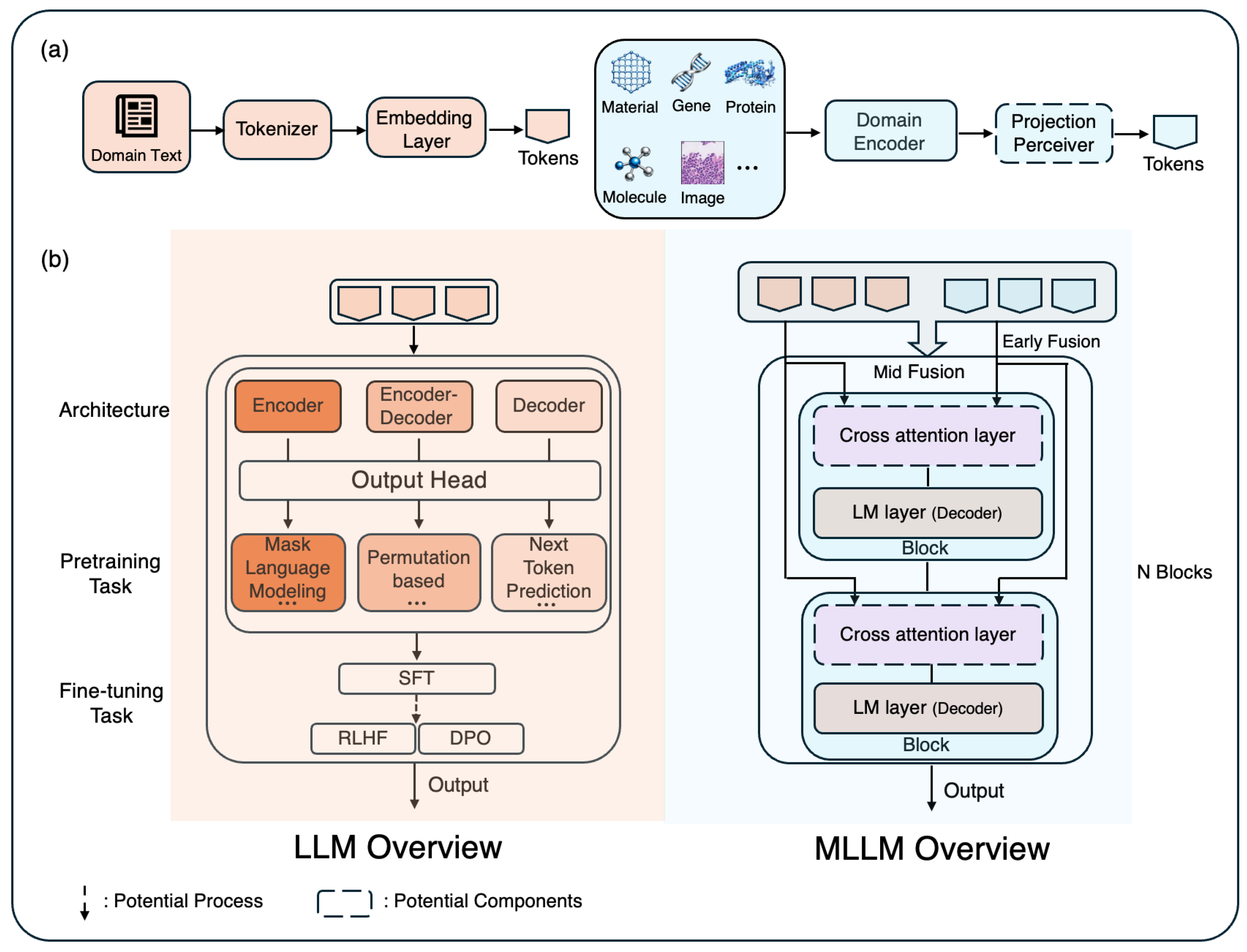
In this section, we aim to provide readers with a coherent background framework by reviewing the foundational components and architectural innovations of LLMs and their multimodal counterparts (MLLMs). By systematically discussing their core components, training paradigms, multi-modal extensions, we establish a clear understanding of how these models function. We also present a high-level overview of the framework for the LLMs and MLLMs in Figure 7. This overview sets the stage for the the main paper, where we turn to the specific applications of MLLMs in scientific domains.
- Core Components of LLMs.
The backbone of modern LLMs is the Transformer architecture [162], which revolutionized natural language processing by introducing self-attention mechanisms. At the input stage, text is first processed into tokens through a tokenizer. Depending on the domain, these tokens may correspond to words, subwords, or characters, while specialized tokenizers are designed for structured domains such as DNA sequences or chemical molecules. Each token is then mapped into a dense vector representation by the embedding layer, where positional embeddings (absolute or relative type) inject sequence order information into the otherwise permutation-invariant architecture. The central component of LLMs consists of stacked Transformer blocks. Based on the original Transformer architecture, three mainstream LLM architectures have emerged: encoder-only, represented by the BERT [42] family; decoder-only, exemplified by LLaMA [96]; and encoder-decoder, represented by models such as GLM [37]. Specifically, each block (often referred to as an LM layer) contains multi-head self-attention layers, feed-forward networks, normalization steps, and residual connections, which together enable the model to capture long-range dependencies across large contexts. After that, models employ different pretraining tasks to acquire their language understanding capabilities. For instance, encoder-only models are typically trained with Masked Language Modeling (MLM), decoder-only models with Next Token Prediction (NTP), and encoder-decoder models with permutation-based tasks. In recent years, it has been observed that fine-tuning large models after large-scale pretraining effectively bridges the gap between the next-word prediction objective of LLMs and the users’ objective of having LLMs followhumaninstructions [133,147]. Finally, the model is equipped with an output layer: generative models project hidden representations to vocabulary probabilities, while encoder-based models connect to task-specific heads for classification, retrieval, or regression. These components collectively determine the expressive power and adaptability of LLMs across tasks.

Table 1.
Comparison of coverage of recent survey papers on LLMs/MLLMs across different domains.
| Survey | Protein | Drug & Samll Molecule | Gene | Material | Biomedicine | Target Multimodal | Benchmarking |
|---|---|---|---|---|---|---|---|
| Our Survey | ✓ | ✓ | ✓ | ✓ | ✓ | ✓ | ✓ |
| LLMs/MLLMs for Science | |||||||
| [218] | ✓ | ✓ | ✓ | ✓ | |||
| [216] | ✓ | ✓ | ✓ | ✓ | |||
| [69] | ✓ | ✓ | ✓ | ✓ | ✓ | ||
| [20] | ✓ | ✓ | ✓ | ||||
| LLMs/MLLMs for Biomedicine | |||||||
| [186] | ✓ | ||||||
| [200] | ✓ | ||||||
| [164] | ✓ | ✓ | |||||
| [228] | ✓ | ||||||
| [16] | ✓ | ✓ | ✓ | ||||
| [226] | ✓ | ||||||
| [106] | ✓ | ||||||
| [60] | ✓ | ||||||
| [185] | ✓ | ||||||
| [167] | ✓ | ||||||
| [165] | ✓ | ||||||
| [157] | ✓ | ||||||
- Training Objectives and Techniques.
The objectives used in training LLMs directly shape their behavior and suitability for downstream tasks. Autoregressive models, exemplified by the GPT family [137], learn to predict the next token in a sequence, which makes them particularly effective for text generation. In contrast, masked language modeling (MLM), popularized by BERT [34], involves randomly masking tokens and training the model to recover them, producing strong bidirectional representations useful for understanding tasks. Other approaches, such as XLNet [197], introduce permutation-based objectives to combine the strengths of both autoregressive and masked methods. Beyond these pretraining objectives, finetuning strategies are used for models to better perform on downstream tasks or align better with human preferences. alignment with human preferences has become increasingly important. Instruction tuning and reinforcement learning with human feedback (RLHF) represent major advances that allow models to follow instructions more reliably and produce outputs that align with user intent. By training LLMs on a dataset consisting of instruction and output pairs or using reinforcement learning with human feedback, instruction tuning bridges the gap between the next-word prediction objective and users’ objective of having LLMs adhere to human instructions [133,147]. These techniques have been critical to the deployment of interactive models like ChatGPT and GPT-4.
- Multimodal Large Language Models (MLLMs).
While LLMs excel in language tasks, many real-world applications demand reasoning across multiple modalities such as text, images, audio, or structured scientific data. MLLMs extend LLMs by introducing architectures capable of integrating heterogeneous inputs. Typically, they first leverage modality-specific encoders which are aligned with the text modality via contrastive learning to transform non-textual modalities into language-aligned embeddings, such as pretrained CLIP visual encoder [87]. Textual inputs are processed in a manner similar to LLMs. These embeddings may be then projected into the language space through a projection layer or a perceiver module, followed by the adoption of various fusion strategies to integrate information across modalities. Early-fusion approaches combine embeddings from different modalities at the input stage, often through direct concatenation [233]. In contrast, late-fusion architectures encode each modality independently and combine their outputs only at the reasoning or decision stage. The strategy has become less common as LLM capabilities have advanced. More sophisticated Fusion strategy can occur in the mid stage. For example, cross-attention architectures allow one modality to attend to features from another, exemplified by models such as Flamingo [5] and BLIP-2 [89], which achieve strong results in vision-language tasks. To address the prohibitive cost of retraining entire LLMs for multimodal tasks, adapter-based techniques such as LoRA [67] introduce lightweight, trainable components into frozen models. These advances make MLLMs more efficient and practical for specialized multimodal scenarios.
Figure 3.
The overview of the architecture for LLMs and MLLMs. (a) presents the encoding strategies by which heterogeneous modalities are transformed into unified representations suitable for processing by LLMs and MLLMs. MLLMs may project or inject the representations into the language embedding space via projection layers or perceivers (b) illustrates three major LLM paradigms (encoder-only, encoder-decoder, and decoder-only) with their pretraining and supervised fine-tuning stage. Beyond these, additional refinement approaches, including Direct Preference Optimization (DPO) and Reinforcement Learning from Human Feedback (RLHF), may be employed. LLMs serve as the foundation of MLLMs which fuse multi-modal embeddings to generate the final output.
Figure 3.
The overview of the architecture for LLMs and MLLMs. (a) presents the encoding strategies by which heterogeneous modalities are transformed into unified representations suitable for processing by LLMs and MLLMs. MLLMs may project or inject the representations into the language embedding space via projection layers or perceivers (b) illustrates three major LLM paradigms (encoder-only, encoder-decoder, and decoder-only) with their pretraining and supervised fine-tuning stage. Beyond these, additional refinement approaches, including Direct Preference Optimization (DPO) and Reinforcement Learning from Human Feedback (RLHF), may be employed. LLMs serve as the foundation of MLLMs which fuse multi-modal embeddings to generate the final output.
- Pretraining Datasets and Modalities.
The performance of LLMs and MLLMs is intimately tied to the scale and diversity of their pretraining datasets. For text, models typically rely on large and diverse corpora such as Wikipedia, Common Crawl, PubMed, and patent databases. In the multimodal domain, paired datasets such as LAION-5B [146] provide billions of image-text pairs for training vision-language systems. Scientific and technical applications require more specialized resources. Biological sequence data (e.g., UniProt), molecular graphs (e.g., ChEMBL), and crystallographic structures are increasingly integrated into pretraining. Moreover, structured ontologies and knowledge graphs such as the Gene Ontology (GO) or UMLS are used to augment factual reasoning and reduce hallucinations. The combination of unstructured and structured data creates rich environments for pretraining models capable of bridging multiple domains.
- Common Use Cases Across Domains.
The versatility of LLMs and MLLMs is reflected in their broad range of use cases. One major paradigm is zero- or few-shot inference, where models solve novel tasks with little to no labeled data by leveraging their pretraining knowledge. When higher domain specificity is needed, fine-tuning can adapt general-purpose LLMs to specialized applications such as drug discovery, clinical prediction, or materials design. Increasingly, LLMs are being used as tool-augmented systems. By integrating with external APIs, databases, or scientific engines such as AlphaFold DB, models can dynamically expand their capabilities beyond what is encoded in their parameters. A further evolution of this idea is the emergence of agent-based workflows, where models orchestrate multi-step reasoning, execute code, and autonomously coordinate experiments or data analysis pipelines.
3. MLLMs for Molecule Science and Drug Design
Multimodal large language models (MLLMs) are transforming molecular science and drug discovery by combining different chemical representations such as SMILES (1D) [177], SELFIES (1D) [83], molecular graphs (2D) [40] and geometric structure (3D) [49]. They improve key tasks including property prediction, molecular generation, reaction planning, and synthesis optimization, thus accelerating the discovery of novel compounds. In this section, we review recent progress along four directions: (1) LLMs for molecular representation and design, focusing on SMILES- and graph-based embeddings as well as generative models; (2) MLLMs for 1D and 2D tasks, where string and graph/image representations are fused; (3) MLLMs with 3D integration, which enhance structural understanding and retrosynthesis; and (4) chemistry-focused agents and specific applications, covering tool-augmented systems, puzzle-style reasoning, and reaction optimization. Table A1, Table A6, Table A7 and Figure 4 summarize models, datasets, and the research landscape. We also present the benchmarking results of molecular property prediction in Section 9.
3.1. LLMs for Molecule Representation and Design
While our work centers on multimodal LLMs, we also include an overview of LLMs for molecular science to give readers a comprehensive understanding of progress in this field. LLMs are advancing molecular science by learning from diverse chemical representations [179], including the aforementioned 1D, 2D, and 3D data. Transformer models such as ChemBERTa [30] and MolBERT [43] yield rich embeddings that improve property, drug-target, and drug-drug interaction prediction [62,74]. For de novo design, models like MolGPT [9], ChatMol [209], and ChatDrug [114] generate valid and novel compounds via conditional generation, reinforcement learning, or molecular editing [28]. LLMs further support multi-objective optimization and iterative refinement with expert or oracle feedback [184]. In reaction prediction and synthesis, the Molecular Transformer excels in forward and retrosynthetic tasks [102], while multimodal and instruction-following models bridge chemical language with experimental reasoning [156]. Overall, LLMs are emerging as powerful engines for molecular discovery, optimization, and synthesis.
Table 2.
Comparison of coverage of recent survey papers on LLMs/MLLMs across different domains.
| Survey | Protein | Drug & Samll Molecule | Gene | Material | Biomedicine | Target Multimodal | Benchmarking |
|---|---|---|---|---|---|---|---|
| Our Survey | ✓ | ✓ | ✓ | ✓ | ✓ | ✓ | ✓ |
| LLMs/MLLMs for Science | |||||||
| [218] | ✓ | ✓ | ✓ | ✓ | |||
| [216] | ✓ | ✓ | ✓ | ||||
| [69] | ✓ | ✓ | ✓ | ✓ | ✓ | ||
| [20] | ✓ | ✓ | |||||
| LLMs/MLLMs for Biomedicine | |||||||
| [186] | ✓ | ||||||
| [200] | ✓ | ✓ | |||||
| [164] | ✓ | ✓ | |||||
| [228] | ✓ | ||||||
| [16] | ✓ | ✓ | ✓ | ||||
| [226] | ✓ | ||||||
| [106] | ✓ | ||||||
| [60] | ✓ | ||||||
| [185] | ✓ | ||||||
| [167] | ✓ | ||||||
| [165] | ✓ | ||||||
| [157] | ✓ | ||||||
3.2. MLLMs for 1D and 2D Molecular Tasks
Recent advances in molecular AI highlight a fundamental paradigm shift from single-modality models toward deeply integrated MLLMs, particularly focusing on the fusion of 1D (e.g., SMILES, SELFIES) and 2D (e.g., molecular graphs, structure images) representations [10,18,25,33,66,74,84,85,90,107,117,118,120,143,160,211]. This shift is motivated by the realization that 1D string representations provide scalability and access to abundant chemical databases, but alone cannot capture the rich spatial, topological, and functional information encoded in 2D modalities. Early progress in the field centered around models leveraging 1D molecular strings, but these were soon recognized as insufficient for tasks demanding a nuanced understanding of molecular connectivity and spatial arrangement. Addressing this, recent works such as MolPROP [143] pioneered the fusion of pretrained language models with GNN-based graph encoders, achieving significant gains in property prediction. This line of research has since been extended by LLM-MPP [74], Mol-LLM [85], and related models such as [66], which employ advanced architectural innovations such as cross-attention between SMILES, molecular graphs, and textual descriptions, large-scale instruction tuning, and multi-level graph feature integration, resulting in strong and generalizable performance across property prediction, reaction, and generation tasks. Modular and adapter-based approaches, including MolX [84] and ChemLML [33], make it possible to flexibly combine graph encoders with LLMs and rapidly adapt to new tasks with minimal parameter overhead. Meanwhile, tokenizer-based solutions like UniMoT [211] unify 1D and 2D information at the token level, enabling seamless molecule-to-text and text-to-molecule generation. Beyond graph representations, vision-enhanced models such as ChemVLM [90], GIT-Mol [107], and Mol2Lang-VLM [160] incorporate 2D structure images alongside textual and graph modalities, further boosting captioning and molecular understanding. On the system level, frameworks like ModuLM [25] and nach0 [117] generalize the multimodal paradigm by supporting arbitrary combinations of 1D, 2D, and even 3D encoders, while InstructMol [18] and BioMedGPT [120] demonstrate the value of multi-stage instruction tuning and domain-specific integration for high-stakes biomedical applications. Importantly, domain-specialized models such as BioGPT [118] represent a milestone in biomedical molecular research. Pre-trained on large-scale PubMed literature, BioGPT achieves state-of-the-art results in biomedical text generation and knowledge extraction, accelerating automated molecular discovery from unstructured data. Collectively, these studies demonstrate that fusing 1D and 2D modalities not only consistently improves accuracy and generalizability for property prediction, generation, and retrosynthesis tasks, but also lowers the barrier for extending models to new modalities and domains. As such, the evolution from 1D-only to 1D&2D-fused MLLMs marks a major leap for molecular AI, setting a new foundation for interpretable, robust, and transferable molecular representation learning in chemistry, biology, and drug discovery.
3.3. MLLMs with 3D Geometry Integration for Molecular Tasks
Recent advances in MLLMs with 3D geometry integration can be broadly categorized by their target molecular tasks. For representation learning and property prediction, MolBind [188] aligns scientific language, 2D molecular graphs, 3D conformations, and protein pockets into a unified representation space via contrastive learning, enabling cross-modal retrieval and zero-shot molecular property prediction. Similarly, ModuLM [25] provides a modular framework that flexibly combines 1D, 2D, and 3D encoders with diverse LLM backbones, facilitating benchmarking and adaptation across a wide range of molecular tasks. For reaction modeling, RetroInText [78] integrates 3D geometry, 2D molecular graphs, and in-context reaction text to enhance multi-step retrosynthesis, particularly for long and complex synthetic routes. For materials and polymer science, PolyLLMem [217] couples Llama3-based SMILES embeddings with Uni-Mol 3D embeddings through a gated fusion mechanism, demonstrating strong performance in polymer property prediction under limited-data scenarios. Overall, these approaches reflect a growing trend toward fully multimodal MLLMs that combine complementary molecular representations (1D, 2D, and 3D) to achieve improved accuracy, interpretability, and generalizability across chemical and biological domains
3.4. MLLMs for Chemistry-Focused Agents and Special Applications
(1) Chemistry-Focused Agents. Recent work has introduced chemistry-focused agents that couple MLLMs with domain-specific tools to automate molecular data processing and reasoning [12,76,154,204,207]. Examples include ChatMolData [207], which integrates modules for literature mining, structure handling, and database operations; ChemCrow [12] and ChemToolAgent [204], which enhance LLMs for synthesis planning and property prediction; and ChemAgent [154] and ChemThinker [76], which introduce memory or multi-agent designs for more accurate and interpretable reasoning. (2) Puzzle and Reaction Condition Recommendation. Beyond standard benchmarks, chemistry also involves expert-level reasoning tasks that require integrating diverse data sources. Puzzle-style problems [1,17,46,128,238], such as structure elucidation from spectroscopic clues, test the limits of MLLMs; MolPuzzle [57] shows that while models like GPT-4o handle simple cases, they still lag behind human experts. Similarly, tasks such as reaction condition recommendation and synthesis optimization demand advanced reasoning. MM-RCR [219] exemplifies progress here by unifying textual, graph, and SMILES data, achieving state-of-the-art results and strong generalization. Overall, MLLMs are moving from unimodal to fused 1D/2D/3D, agent-augmented systems that boost property prediction, generation, retrosynthesis, and condition recommendation. We believe key hurdles remain in rigorous reasoning, interpretability/reproducibility, and closed-loop experimental and safety integration.
4. MLLMs for Protein Science
As protein-related tasks increasingly involve diverse data modalities, including natural language descriptions (1D), amino acid sequences (1D), protein graph (2D), and protein geometric structures (3D), MLLMs have emerged as a powerful framework for integrating these heterogeneous sources of information [58,108,230]. Unlike unimodal models, MLLMs can jointly reason across multiple biological representations, enabling more expressive learning and flexible interaction with biological data. In this section, we review recent advances in MLLMs across three major categories: (1) we examine models that integrate protein sequences with textual information, supporting tasks such as protein captioning, design, and function prediction. (2) we discuss models that incorporate geometric representations alongside sequence and text, enabling structure-aware learning for enhanced prediction and generation. (3) we highlight MLLMs developed for specialized tasks, including protein–protein and free-text-based biological translation. Table A2, Table A8, Table A9 and Figure 5 summarize models, datasets, and the research landscape. We also present the benchmarking results of protein function prediction in Section 9.
4.1. LLMs for Protein Science
We likewise begin by providing an overview of LLMs in protein science for readers to contextualize the broader advances in this domain. Large language models have revolutionized protein science, enabling efficient and scalable solutions for major challenges in protein property prediction, function annotation, structure prediction, and protein engineering [6,41,77,123,142]. In property prediction, models such as UniRep [6] and ProtTrans [41] leverage large-scale pretraining to achieve state-of-the-art accuracy on tasks including stability, solubility, and fluorescence. For function annotation, transformer-based models like ESM-1b [142], MSA Transformer [140], TCR-BERT [182], and ProteinBERT [13] have significantly improved label prediction, enzyme classification, and TCR-antigen binding. In structure prediction, advances such as AlphaFold2 [77], ESMFold [101], and ESM-IF [65] have enabled end-to-end and inverse folding, approaching experimental-level 3D accuracy. Models like GearNet [221], SaProt [152], and OntoProtein [214] integrate structural knowledge and ontologies, further enhancing performance on structure-aware tasks. For protein engineering and generation, ProGen [123], ProtGPT2 [45], and ProGen2 [130] apply autoregressive and conditional generation to produce novel, functional, and diverse proteins. Specialized models such as IgLM [149] and PALM-H3 [59] address antibody and virus-specific design. Collectively, these advances establish Protein LLMs as powerful engines for biological discovery and rational protein design, expanding the reach of AI-driven protein science [13,77,101,123,142].
4.2. MLLMs for Protein Sequence–Language Integration
Recent advancements in MLLMs that integrate protein sequences with textual descriptions have led to significant progress in protein-related tasks [22,36,71,94,108,116,119,122,134,135,155,171,174,212,224,227,230,236]. ProteinDT [108] combines protein sequences with textual prompts for protein design, achieving high accuracy in generating novel proteins. ProtT3 [116] excels in generating text descriptions from protein sequences using a Q-Former encoder, specifically targeting protein captioning and QA tasks. ProtCLIP [227] enhances protein function prediction by integrating protein sequences with textual knowledge graphs, further improving prediction accuracy. BioMedGPT [119] expands this by incorporating both protein sequences and textual knowledge for biomedical question answering, enabling improved understanding and reasoning in the biomedical domain. PROTLLM [236] and ProLLaMA [122] bridge protein sequence understanding and generation tasks, with ProLLaMA excelling in multi-task learning, particularly in protein structure and function prediction. InstructProtein [171] aligns protein sequences with natural language through knowledge-guided instructions, improving task handling.
Other models such as DrugGPT [94] and ESM-AA [224] target drug design and molecular modeling, tackling ligand generation and protein interaction analysis. BioT5 [135] and BioT5+ [134] integrate molecular properties with text for multi-task protein understanding. OntoProtein [212] fuses Gene Ontology with sequences to improve function prediction (e.g., GO-CC/GO-BP). Galactica [155] trains on a curated scientific corpus for multimodal reasoning, outperforming GPT-3 on LaTeX and PubMedQA. For multimodal protein tasks, BioBRIDGE [174] links unimodal biomedical models via knowledge graphs to predict drug–target and protein–protein interactions. xTrimoPGLM [22] unifies protein understanding and generation, achieving state-of-the-art results. ProteinChat [71] conditions on sequences and text prompts to describe protein functions in free-form and classification settings. LLaPA [230] combines sequences, PPI networks, and instructions for multi-label PPI and multi-protein affinity prediction. Lastly, MProt-DPO [36] employs Direct Preference Optimization to surpass the ExaFLOPS barrier in protein design, improving efficiency. Collectively, these models showcase the power of MLLMs that couple sequences with text for protein design, function prediction, and interaction analysis.
4.3. MLLMs for Protein Structure–Sequence–Language Integration
Given the critical role of geometric information in understanding protein behavior, recent research has increasingly focused on integrating structural modalities into MLLMs [47,58,92,99,144,153,163,168,187,190,231,235]. Several representative models—including ESM3 [58], DPLM2 [168], FoldToken [47], ProTokens [99], Saprot [153], and ProSST [92]—incorporate protein structural information using various tokenization strategies. Compared to other models, ESM3 [58] incorporates additional functional tokens designed to support specific protein function design tasks. DPLM2 [168] leverages a GVP-based encoder and an IPA-based decoder to learn structural tokens, fine-tuned from DPLM [169], and achieves strong performance in generative tasks. ProTokens [99] employs an SE(3)-invariant transformer to obtain latent structural representations, which are then quantized into discrete tokens that capture structural features. FoldToken [47], identifies the limitations of classical quantization approaches and proposes three custom-designed quantizers, whose effectiveness is validated through experimental evaluation. Saprot [153] constructs structure-aware tokens with the aid of Foldseek [161] and performs well across various downstream tasks. ProSST [92] differs from previous models by constructing a local structure codebook that captures contextual information beyond individual residues and introducing a sequence–structure disentangled attention mechanism, which is validated through ablation studies.
Beyond tokenization-based approaches, other MLLMs integrate structural information primarily through encoders and align the resulting representations with corresponding sequences or textual data. Models such as ProtChatGPT [163], ProteinGPT [190], STELLA [187], InstructBioMol [235], Evolla [231], and ProseLM [144] exemplify this strategy. The overall architectures of ProtChatGPT [163], STELLA [187], InstructBioMol [235], and ProteinGPT [190] are similar, as they all utilize protein structure encoders. However, ProtChatGPT uniquely incorporates a second protein structure encoder to enhance structural feature extraction, while InstructBioMol adds an additional molecular encoder to integrate molecular information. ProseLM [144] employs a causal encoder that integrates structural and functional contexts, successfully designing a PD-1 binder with a binding affinity of 2.2 nM. Evolla [231] also integrates structural information through protein encoders; however, its distinguishing feature is the use of Direct Preference Optimization (DPO) [138] as a post-pretraining method. The model is primarily designed for protein-related question answering tasks.
4.4. MLLMs for Protein Interactions and Specialized Applications
Understanding protein–protein interactions (PPIs) [131] is critical for elucidating protein function, and several MLLMs have been developed for this task. LLaPA [230] integrates protein and graph encoders with a language model in a multimodal fusion framework, while BioBRIDGE [174] links diverse biological modalities through a knowledge graph, both achieving strong PPI performance. Although BioT5 [135] and BioT5+ [134] were not explicitly designed for interaction prediction, they still perform competitively on PPI benchmarks. Beyond interaction tasks, multimodal translation is another emerging direction: MolBind [189] supports protein-related zero-shot cross-modal retrieval, and BioTranslator [192] converts free-text descriptions into biological representations across modalities, enabling more flexible interaction with scientific data.
Collectively, these advances highlight the growing potential of MLLMs to unify heterogeneous protein modalities, enabling more accurate prediction, versatile design, and broader applications in protein science.
5. MLLMs for Genomics and Gene
MLLMs and LLMs are rapidly advancing genomics by enabling tasks such as sequence modeling, gene function prediction, functional annotation, and knowledge retrieval. Compared to traditional computational approaches, these models offer greater flexibility, interpretability, and the ability to integrate heterogeneous biological data [26,68,75]. In this section, we review recent progress from two perspectives. First, we introduce LLMs for genomics, covering their applications in molecular and drug design, functional annotation, gene and variant prioritization, regulatory network modeling, and sequence-level protein or gene tasks. Second, we focus on MLLMs for genomics and gene function prediction, highlighting how multimodal integration of sequences, biological data, and language enables richer reasoning, interpretable predictions, and generalist genomic analysis. Table A3, Table A10, Table A11 and Figure 6 summarize models, datasets, and the research landscape.
5.1. LLMs for Genomics
LLMs are rapidly transforming bioinformatics and genomics, with applications spanning molecular and drug design, functional annotation, gene and variant prioritization, regulatory network modeling, sequence analysis, and synthetic data generation [21,26,64,68,75,159]. In molecular design, models such as GexMolGen [26] align gene expression features with chemical structures to enable gene-guided de novo molecule generation. For functional annotation and knowledge retrieval, LLMs are evaluated on summarizing gene sets [68], discovering gene–disease associations [21], and augmenting biomedical search with APIs [75], while GeneTuring [64] provides systematic benchmarks. In gene and variant prioritization, LLM-based approaches [93,95,159] integrate literature, biological data, and phenotypes to rank causative genes, with automated pipelines supported by API-driven workflows [79,80]. For network modeling, LLMs aid cancer driver gene discovery [208] and reconstruct regulatory networks from single-cell and multi-omics data [170]. In sequence-level tasks, models like ProGen [124] generate functional proteins, while others annotate genes and structures directly from sequence data [3,38,105,148,234]. Beyond these, LLMs support antimicrobial resistance prediction [202], variant effect modeling [61], and even generate synthetic training data for fine-tuning and benchmarking [125]. Together, these studies highlight the broad and transformative role of LLMs in genomics, offering new levels of automation, accuracy, and creativity for precision medicine.
5.2. MLLMs for Genomics and Gene Function Prediction
The integration of MLLMs into genomics has introduced a transformative paradigm for gene function prediction, gene expression modeling, and broader biological tasks [10,35,63,113,126,141]. Traditional methods based on sequence homology, ontology classification, or narrow supervised models often lack flexibility and interpretability. In contrast, MLLMs enable free-form reasoning and cross-modal understanding. For example, GeneChat [35] reframes gene function prediction as a language generation task, combining DNABERT-2 [232] as a gene encoder with Vicuna-13B [29] as a decoder to produce rich natural-language descriptions from raw DNA input. Extending this idea, Geneverse [113] provides a suite of open-source models tailored to genomic and proteomic data, demonstrating strong results in gene/protein function summarization and spatial transcriptomics. ChatNT [141], built on the Nucleotide Transformer [31], supports unified instruction-based inference across DNA, RNA, and protein tasks, making advanced analyses more accessible. Other methods, such as GTA [63] and GeneBERT [126], further improve regulatory modeling by aligning sequence features with language embeddings or leveraging multimodal pretraining. Despite ongoing challenges—such as limited annotations and multimodal heterogeneity—these advances highlight the potential of MLLMs as generalist, interpretable, and conversational engines for genomics and molecular biology [10].
6. MLLMs for Material Science
The use of MLLMs in materials science is still at an early stage but shows strong potential. By integrating text (1D), images (2D), and geometric structural data (3D), these models promise to accelerate material discovery, property prediction, and design optimization [4,11,15,136]. In this section, we review progress from two angles: (1) we discuss LLMs for material discovery, highlighting their role in crystal structure generation, property prediction, and inverse design. (2) we turn to MLLMs for material discovery, where multimodal fusion of textual, visual, and structural representations further enhances property estimation, data extraction, and design pipelines. Table A4 and Figure 6 summarize models and the research landscape.
6.1. LLMs for Material Discovery
Recent advancements show that LLMs can significantly aid materials discovery by generating crystal structures, predicting properties, and supporting inverse design [7,24,32,54,56,72,104,151,172,194,195]. CrystaLLM [7] autoregressively generates CIF sequences to produce plausible crystal structures. MatterGPT [24] targets properties such as formation energy and band gap and enables multi-property inverse design, demonstrating control over both lattice-insensitive and lattice-sensitive attributes [24]. LLMatDesign [72] provides an agentic, iterative framework where LLMs propose material modifications, while domain-aware prompt engineering further boosts property prediction [104]. FlowLLM [151] couples LLMs with Riemannian Flow Matching to refine representations and generate stable, novel materials. CrystaltextLLM [56] fine-tunes LLMs by encoding atomistic data as text and using energy calculations for stability prediction. [32] demonstrate ChatGPT’s ability to suggest compositions and processing routes, accelerating design. GenMS [195] combines language conditioning with diffusion to generate low-energy crystal structures, and Mat2Seq [194] offers SE(3)- and periodic-invariant crystal sequences for robust LM generation. Finally, studies on material selection show that prompt-refined LLMs can assist decisions by comparing expert recommendations [54]. Collectively, these advances expand the searchable chemical space and strengthen data-driven materials design.
6.2. MLLMs for Material Discovery
The integration of MLLMs into materials science is advancing rapidly for discovery and property prediction [4,11,15,136]. A key direction is multimodal fusion of text, images, and molecular representations; for example, LLM-Fusion [11] flexibly ingests SMILES/SELFIES/fingerprints to enhance property prediction over unimodal baselines. Cephalo [15] applies vision–language integration to bio-inspired materials, combining images and text from documents and experiments for property estimation and design optimization. MaCBench [4] identifies current limitations—especially spatial reasoning and cross-modal synthesis—highlighting the need for stronger multimodal reasoning. Recent work also targets automatic extraction of materials data from literature and visual content to enable scalable prediction [136]. Overall, these multimodal approaches are poised to transform materials discovery by enabling robust, data-driven design pipelines for both research and industrial applications.
7. MLLMs Bridging Molecular Science and Biomedicine
The biomedical field encompasses a vast array of disciplines, from fundamental biological research to complex clinical applications [164], and naturally involves a variety of data modalities, amog which analyses of molecules, proteins, genes, and cells play a crucial role. MLLMs have opened new possibilities for integrating heterogeneous biomedical data, enabling not only multi-molecular data fusion [97,113] but also the combination of microscopic-level data(e.g., molecular or cellular information) with macroscopic-level data such as pathology images [100,193], offering valuable insights into disease machanisms and improving diagnostic accuracy. In this section, we primarily focus on the recent surge of studies employing MLLMs to integrate molecular science with biomedicine,along with their methodological approaches. Table A5 summarizes the models discussed in this section. Based on existing advancements, we discuss the limitations identified and outline future directions for further integrating molecular science into biomedicine.
7.1. LLMs for Biomedicine
Genomic, epigenetic, and transcriptomic analyses such as gene pathway finding, gene expression analysis, and so on, greatly facilitate our understanding of biological processes and mechanisms in both normal organism development and disease [173]. These sequences modalities are escpecially suitable for LLMs to process. Some methods [2,173] integrates domain knowledge and study context into LLMs to enable gene analysis at different levels of granularity. Specifically, [173] focuses on gene set enrichment analysis to explicitly consider gene interactions and regulatory relationships within gene sets, while [2] aims to infer gene regulatory networks (GRNs). Together, these approaches facilitate the characterization of caner-related pathways and the elucidation of disease mechanisms, ultimately aiding the idendification of effective treatments. In more recent applications, GenoMAS [103] orchestrating six specialized LLM agents, each contributing complementary strengths to a shared analytic canvas, is applied to gene expression analysis which exposes biologically plausible gene-phenotype associations corroborated by the literature.
7.2. MLLMs for Cross Modal Tasks
With the advent of MLLMs, it has become possible to analyze biomedical problems from multiple perspectives — not only at the macroscopic level (e.g., images and audio) but also at the molecular level. Unlike traditional multimodal fusion approaches [19,127,145], which rely on human-designed summarization, MLLMs can autonomously provide highly interpretable insights and handle cross-modal tasks such as visual question answering and report generation.
(1) Multi-omics Fusion Models. Combining omics data into biomedical research has achieved some success [39]. Current research primarily focuses on developing methods to effectively harmonize diverse omics modalities [200]. One line of research leverages the intrinsic capability of MLLMs to directly fuse heterogeneous omics data, such as genes, molecules, and proteins. Geneverse [113] fine-tunes LLaVA by incorporating protein structural information, gene expression profiles, and functional descriptions as inputs. BioMedGPT [119] further integrates a broader range of biomedical modalities with different encoders, unifies the feature spaces of molecules, proteins, and natural language through encoding and alignment. Another line of research first transforms different modalities into a shared representation before feeding them into MLLMs. LLaMA-Gene [96] trains a single BPE (Byte Pair Encoding) tokenizer to encode genes, proteins, and natural language sequences without additional markers and further converts gene-related task data into a unified format for instruction fine-tuning, constructing a unified model for diverse gene tasks. Collectively, these works support downstream applications such as protein identification and marker gene discovery with the potential to greatly accelerate the discovery of new drugs and therapeutic targets.
(1) Richer Multimodal Fusion in Biomedicine. At the same time, beyond exploring modality fusion within a specific domain or dimension, there have been growing efforts to integrate a broader range of modalities. For example, multi-omics data are fused with cell even organ type data, offering more subtle information about the condition. OmniCellTOSG [210] encodes textual annotations with an LLM and leverages a graph neural network (GNN) to capture the topology of signaling(TOSG) networks labeled with annotations like organ, cell subtype, and quantitative gene and protein data. By integrating these two representations, it constructs patient-specific single-cell TOSG maps, thereby enabling precise cell classification, cancer cell state prediction, and other clinically relevant tasks transforming research in life sciences, healthcare, and precision medicine. SpaLLM [91] combines LLM representations from single-cell transcriptomics with spatially resolved multi-omics data (e.g., RNA, chromatin accessibility, proteins), enabling precise identification of functionally specialized cell types, providing essential molecular and spatial references for disease diagnosis. Recently, another popular direction in MLLM-based research has been to leverage spatial transcriptomics (ST) technologies, which provide both molecular signatures and the spatial localization of cells within tissues. ST-ALign [100] leverages ST technology to achieve fine-grained alignment between histological morphology and molecular features, including image–gene alignment at both the spot and niche levels, following by an Attention-Based Fusion Network used to fuse visual and genetic features. Extending spatial transcriptomics to pathology, mSTAR and spEMO [112,193] integrate microscopic slides, macroscopic reports, and gene expression via multi-level alignment into a pathology foundation model, enabling tasks such as diagnosis, molecule prediction, survival analysis, and report generation. Furthermore, spEMO introduces the novel task of multimodal alignment, offering a new perspective to evaluate information retrieval ability and guide the development of future pathology foundation models.
7.3. Outlook
Although MLLMs have begun to explore the integration of multiple modalities, current progress remains at an early stage. For instance, while some models [91,96,113] have been trained on multi-omics data simultaneously, few are capable of jointly processing image-based data, largely due to the weak consistency across such heterogeneous modalities. integrating more diverse data types thus remains challenging. A few models, such as [112,193], have attempted to combine pathological images with genomic information for disease diagnosis, but such approaches are still limited. There remains a clear need for more comprehensive methods that effectively integrate diverse multimodal data in the future. A promising direction for sustainable progress is to curate large-scale, comprehensive multimodal benchmarks and datasets to facilitate the development of future methods.
8. Emerging Hot Topics and Future Directions
In this section, we (1) examine several emerging hot topics, with a particular focus on diffusion-based paradigms that are reshaping large language models and their multimodal extensions, and (2) discuss future directions in scientific applications of MLLMs, covering domain-specific challenges and opportunities across molecular science, protein modeling, materials discovery, and genomics.
8.1. Emerging Hot Topics
The rapid progress of large language models has spurred a new wave of research into alternative training and decoding paradigms, as well as extensions to multimodal understanding and generation. In this section, we highlight two directions that have recently gained considerable momentum. The first is diffusion large language models (dLLMs), which replace the conventional autoregressive decoding strategy with an iterative mask–denoise process and have shown promising advances in reasoning, controllability, and efficiency. The second is diffusion multimodal large language models (dMLLMs), which extend this paradigm to vision, audio, and other modalities, enabling more flexible cross-modal reasoning and structured generation. Together, these emerging topics illustrate how diffusion-based methods are shaping the future landscape of language and multimodal modeling.
8.1.1. Diffusion Large Language Models
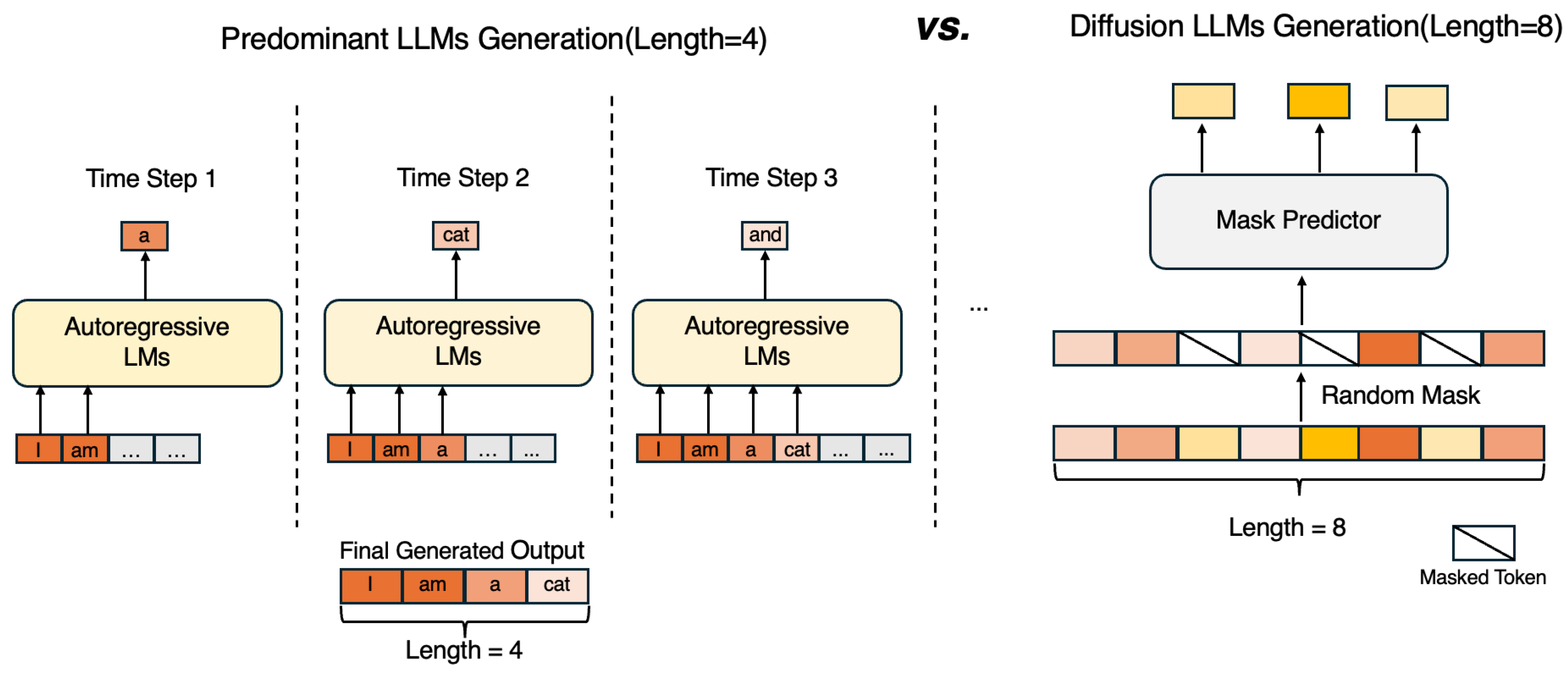
dLLMs replace the traditional left-to-right next-token prediction paradigm with a mask-and-denoise process over discrete tokens. Instead of generating text sequentially with unidirectional attention, dLLMs begin from a heavily masked (or absorbed) sequence and iteratively denoise it using bidirectional attention. This design enables parallel decoding of many tokens at once, providing explicit trade-offs between quality, latency, and controllability through adjustable steps and scheduling [51,115,150,205,225]. Compared with autoregressive (AR) models, which suffer from rigidity in mid-sequence editing and lack global structural control, diffusion-based decoding offers greater flexibility and coherence.
Figure 7.
The comparison between predominant Autoregressive language models and Diffusion language models. In autoregressive models, the model generates text sequentially from left to right using “next token prediction,” and the generated length is unrestricted. In contrast, diffusion language models generate text by randomly masking and predicting masked tokens, which are not constrained by spatial position but typically produce sequences of fixed length.
Figure 7.
The comparison between predominant Autoregressive language models and Diffusion language models. In autoregressive models, the model generates text sequentially from left to right using “next token prediction,” and the generated length is unrestricted. In contrast, diffusion language models generate text by randomly masking and predicting masked tokens, which are not constrained by spatial position but typically produce sequences of fixed length.
(1) Core Mechanics. The forward process in dLLMs typically applies random masking or absorbing states, while the reverse process learns to reconstruct clean tokens from noisy inputs. Recent advances, such as reparameterized discrete diffusion (RDM), reduce training variance and enable confidence-aware decoding by prioritizing high-confidence tokens during generation [225]. Training objectives span from NLL-equivalent token prediction to reweighting strategies at the token or sequence level. For example, multi-granularity diffusion (MGDM) emphasizes difficult tokens and subgoals to enhance complex reasoning [198]. At inference, specialized schedulers such as dilated unmasking explicitly minimize conditional entropy in each round, thereby reducing the number of iterations [121].
(2) Scaling Strategies. Two main approaches have emerged for scaling dLLMs. The first is training from scratch, exemplified by LLaDA, which pre-trains an 8B-parameter diffusion LLM on 2.3T tokens and demonstrates competitive or superior performance to comparable AR baselines, particularly on reversal-style tasks that reveal AR brittleness [129]. The second strategy adapts pretrained AR models by gradually relaxing the causal mask and shifting prediction targets, yielding variants such as DiffuGPT & DiffuLLaMA that achieve strong zero/few-shot and fill-in-the-middle abilities with significantly reduced training cost [50].
(3) Capabilities and Directions. Diffusion decoding has opened new research avenues across multiple fronts: (i) Reasoning and planning. Diffusion-of-Thought supports parallelized chain-of-thought and multi-step self-correction [199], while MGDM reports substantial improvements on tasks such as Countdown, Sudoku, and SAT [198]. Recent work like d1 combines supervised fine-tuning with a diffusion-compatible policy-gradient method (diffu-GRPO), further improving math, logic, and coding performance [222]. (ii) Program synthesis and structured generation. DiffuCoder introduces analysis tools for “AR-ness” of dLLMs and a coupled-GRPO RL procedure, matching or beating similar-sized AR coders on several leaderboards [52]. For controllable outputs (JSON/tables), the S3 scaffolding method uses schema templates and null tokens to achieve high structural validity without retraining [191]. (iii) Seq2Seq and one-step generation. DiffuSeq extends diffusion to conditional text generation [51]. DLM-One distills iterative denoising into a single forward pass via score-based distillation—reporting up to 500× speedups on classic Seq2Seq tasks at near-teacher quality [23]. (iv) Systems & efficiency. At inference, dilated unmasking reduces rounds from to roughly per block [121]; Fast-dLLM adds block-wise KV caching plus confidence-gated parallel decoding, reporting up to 27.6× speedups with minimal accuracy loss [180]. Block diffusion interleaves AR across blocks with diffusion within blocks, closing perplexity gaps while preserving parallelism [8]. (v) Industrial interest. Google DeepMind’s Gemini Diffusion signals growing product-level exploration of text diffusion [53].
(4) Safety Outlook. The novel dynamics of dLLMs introduce distinct safety challenges. Parallel decoding and mask-aware mechanisms create new attack surfaces, and recent jailbreak methods such as PAD and DIJA achieve high success rates across multiple diffusion models [178,220]. These results suggest that AR-based defenses cannot be directly applied, underscoring the need for diffusion-native alignment and guardrails.
(5) Takeaway. dLLMs combine parallelism, global coherence, and fine-grained controllability, positioning them as a promising alternative—and in some regimes, a superior paradigm—to autoregressive models [205]. With both training-from-scratch and AR-adaptation paths maturing, and with rapidly improving inference-time efficiency, dLLMs are evolving from niche prototypes to competitive large-scale systems.
(6) Open Problems and Future Directions. Key challenges remain: (i) establishing theoretical foundations for scheduling, convergence, and optimality; (ii) developing scalable diffusion-native alignment and RLHF methods [222]; (iii) hybridizing diffusion with AR, retrieval, and external tools [8,198]; (iv) designing standardized evaluation protocols for latency–quality trade-offs and structural validity; (v) advancing security via mask-aware defenses and robust red-teaming [178,220]; and (vi) optimizing serving systems for KV-cache consistency, adaptive decoding, and distributed/edge deployment [121,180].
8.1.2. Diffusion Multi-Modal Large Language Models
dMLLMs are also attracting increasing attention in the multimodal domain. Compared to autoregressive approaches, iterative mask–denoise refinement provides global context modeling, parallel token prediction, and natural support for structure priors (e.g., layouts, JSON schemas) as well as fill-in-the-middle editing. These properties make diffusion particularly suitable for vision–language, audio–language, and other structured multimodal tasks, while offering explicit quality–latency trade-offs through the choice of denoising steps [205].
(1) Representative Models. Several recent systems demonstrate the potential of diffusion in multimodal scenarios. (i) Vision–language. Llada-v extends LLaDA with visual instruction tuning while retaining diffusion-style parallel decoding, enabling visual question answering and multimodal dialogue [203]. Dimple adopts a two-stage training paradigm: an initial AR phase aligns vision and text representations and supports instruction following, after which diffusion decoding is reinstated to recover parallelism and structural control. At inference, Dimple incorporates confident decoding and explicit structure priors (e.g., JSON length control), achieving state-of-the-art results with fewer denoising steps (often less than one-third of the response length) [206]. (ii) Audio–language. DIFFA freezes Whisper and a diffusion LLM backbone, training only lightweight dual adapters (semantic and acoustic). This adapter-based design yields strong performance across multiple audio–language benchmarks at modest data and compute cost, highlighting the efficiency of multimodal diffusion tuning [229]. (iii) Broader ecosystem. Beyond academic prototypes, Gemini Diffusion illustrates early integration of diffusion-style generation into large-scale product pipelines, signaling practical interest in retrieval- and tool-augmented multimodal agents [53].
(2) Capabilities and Engineering Patterns. Diffusion multimodal models inherit many of the strengths of their text-only counterparts. (i) Controllability and structure. By conditioning on scaffolds such as schemas or layouts, these models substantially reduce format errors and hallucination in chart/table reasoning and structured generation; S3-style prompting can be readily reused in multimodal contexts [191,206]. (ii) Throughput and latency. Inference accelerations developed for dLLMs, including KV-cache reuse, confidence-gated parallel decoding, and dilated scheduling, transfer cleanly to vision and audio modalities [121,180]. (iv) Applications. Iterative refinement proves beneficial for fact-faithful summarization (Arg-LLaDA) and for constrained scientific design/optimization where diffusion acts as a constrained sampler over feasible manifolds [82,88]. Other applications include controllable user-facing content generation such as poll/question generation with attribute control [27].
(3) Risks and Challenges. Despite these advances, several challenges remain open. (i) Security. Mask-aware, parallel denoising can amplify multimodal jailbreak attacks, including cross-modal prompt mixing and masked injection; diffusion-native safeguards are still underdeveloped [178,220]. (ii) Long-context efficiency. Processing long videos or extended speech raises issues of memory and cache consistency across denoising steps, requiring more principled architectural solutions [121,180]. (iii) Data and alignment. High-quality multimodal instruction data remain scarce; balancing frozen-backbone adapters (e.g., DIFFA) with full-parameter training (e.g., Dimple) is still an open question for efficient scaling [206,229].
(4) Future Directions. Promising research avenues include: (i) designing unified diffusion agents that couple vision, audio, and text with retrieval and tool use; (ii) developing verifiable generation under hard structure/layout constraints; (iii) scalable alignment via multimodal preference modeling and reinforcement learning for diffusion; (iv) building diffusion-native defenses and safety benchmarks; and (v) systems co-design for efficient step-adaptive serving, block-wise diffusion, and distributed or edge inference [8,121,180,191].
9. Selected Benchmarking Evaluation
9.1. Molecular Property Prediction
Experiment setting. We evaluate on the MoleculeNet benchmark [183], which comprises three single-modal binary classification datasets for assessing the expressiveness of pretrained molecular representation methods. Performance is reported as the area under the receiver operating characteristic curve (AUROC).
Benchmarking Models. We identify several MLLMs, including InstructMol [18], MoleculeSTM (Graph) [110], MoleculeSTM (Smiles) [110], GIT-Mol [107], Token-Mol [166], and M3LLM [66], which target the downstream task of molecular property prediction. For non-MLLM models, we adopt the results reported in the InstructMol paper [18]. Since the model weights of InstructMol, M3LLM, and GIT-Mol are not publicly available, we rely on the reported results of InstructMol from the original paper, while M3LLM and GIT-Mol are excluded from our evaluation. For the remaining models, we rerun the experiments ourselves.
Analysis. Overall, as show in Table 3, the results show that MLLM-based models achieve competitive performance in molecular property prediction, but they generally lag behind strong specialist models such as Uni-Mol and MolFM. Among the evaluated MLLMs, Token-Mol and MoleculeSTM (Smiles/Graph) consistently perform comparably, while other generalist LLM-based methods (e.g., Galactica and Vicuna variants) exhibit significantly weaker performance across all tasks. InstructMol demonstrates strong results as reported in the original paper, though its lack of released weights prevents direct reproducibility. Notably, Token-Mol achieves results that are on par with MoleculeSTM, indicating that specialized adaptation of MLLMs can substantially narrow the performance gap with task-specific molecular models.
9.2. Protein Property Prediction
Experiment setting. We evaluate models on the TAPE benchmark [139] to assess their capability in protein property prediction across six tasks: secondary structure(SS) prediction, contact prediction, homology prediction, fluorescence prediction and stability prediction. Secondary structure and homology prediction are multi-label classification tasks with accuracy used as the evaluation metric. Contact prediction is performed using the precision of the top predicted contacts, where L denotes the sequence length, focusing on medium- and long-range interactions. Fluorescence prediction aims to predict the logarithm of a protein’s fluorescence intensity, while stability prediction estimates a proxy for protein stability. Both tasks are evaluated using Spearman’s rank correlation coefficient(). Benchmarking Models. We identify OntoProtein [212], ProtBERT [?], and ProteinDT [108]. For non-MLLM models, we adopt the results reported in the ProteinDT [108].
Analysis. As shown in Table 4, traditional baselines such as TAPE Transformer, and MSA Transformer perform moderately, while specialist models like ProtBERT and OntoProtein achieve stronger results. ProteinDT further improve performance across most tasks.
10. Conclusion
This work provides a comprehensive overview of recent advances in MLLMs for science, highlighting representative architectures, datasets, and benchmarks, as well as their emerging applications in science. Beyond cataloging progress, we also emphasize the growing role of diffusion-based LLMs in multimodal generation and reasoning. Looking ahead, MLLMs hold the potential to reshape the way scientists explore and integrate diverse data sources. Continued progress will require addressing open challenges in factual reliability, modality-specific reasoning, interpretability, and ethical deployment. By synthesizing current advances and pointing toward future directions, this work aims to serve as both a reference and a foundation for further research in multimodal scientific AI.
Appendix A. Summary Model Tables
Table A1.
Summary of recent representative MLLMs for drug and molecule representation, property prediction, and chemistry-focused tasks.
Table A1.
Summary of recent representative MLLMs for drug and molecule representation, property prediction, and chemistry-focused tasks.
| Model | Year | Modality | Architecture | Size | Category | Main Task |
|---|---|---|---|---|---|---|
| MolPROP [143] | 2024/05/22 | SMILES, Graph | Encoder-Only | 46M | Property Prediction | Molecular property prediction |
| LLM-MPP [74] | 2025/05/20 | SMILES, Graph, Text | Decoder-Only | 8B | Property Prediction | Property prediction |
| interpretability | ||||||
| ModuLM [25] | 2025/06/01 | 1D, 2D, 3D, Text | Modular/Encoder | 14B | Property Prediction | Flexible property prediction |
| GIT-Mol [107] | 2023/08/14 | Graph, Image, Text | Encoder-Decoder | 700M | Property Prediction | Property prediction |
| generation | ||||||
| PolyLLMem [217] | 2025/03/29 | Polymer, Structure, Text | Encoder-Only | 8B | Polymer Informatics | Polymer property prediction |
| Molbind [188] | 2024/03/13 | Structure, Protein, Text | Encoder-Only | 150M | Property Prediction | Binding affinity prediction |
| BioMedGPT [120] | 2023/08/18 | Protein, Text | Encoder-Decoder | 10B | General-purpose | Biomedical QA |
| multi-modal tasks | ||||||
| InstructMol [18] | 2023/11/27 | Graph, Text | Encoder-Decoder | 2.2B | General-purpose | Instruction following |
| generation | ||||||
| UniMoT [211] | 2024/08/01 | Graph, Text | Encoder-Decoder | 7B | General-purpose | Generation |
| multi-task | ||||||
| Mol-LLM [85] | 2025/01/01 | SMILES, Graph, Text | Encoder-Decoder | 7B | General-purpose | Generation |
| multi-task | ||||||
| ChemVLM [90] | 2024/08/14 | Graph, Image, Text | Encoder-Decoder | 20B | General-purpose | Vision-language tasks |
| Token-Mol [166] | 2024/07/10 | SMILES, 2D/3D | Decoder-Only | N/A | General-purpose | Generative modeling |
| M3LLM [66] | 2025/08/03 | Graph, Text | Encoder-Decoder | 1.28B | General-purpose | Generation |
| granularity study | ||||||
| ChemCrow [12] | 2023/04/11 | Text, Tools | Agent (LLM+Tools) | 100B-1T | Agents & Special Tasks | Chemistry agent |
| ChatMolData [207] | 2024/11/19 | Text, Molecular Data | Agent (LLM+Modules) | 100B-1T | Agents & Special Tasks | Data analysis |
| retrieval | ||||||
| ChemToolAgent [204] | 2024/11/11 | Text, Tools | Agent (LLM+Tools) | 100B-1T | Agents & Special Tasks | Tool-use agent |
| ChemAgent [154] | 2025/01/11 | Text, Memory | Agent (LLM+Memory) | 100B-1T | Agents & Special Tasks | Agent with memory |
| ChemThinker [76] | 2024/09/28 | Text, Tools, Agents | Multi-Agent | 70B | Agents & Special Tasks | Multi-agent reasoning |
| MolPuzzle [57] | 2024/01/01 | Multimodal | Special Task | N/A | Puzzle Task | Structure elucidation |
| reasoning | ||||||
| MM-RCR [219] | 2024/07/21 | Text, Graph, SMILES | Encoder-Decoder | 7B | Reaction Condition | Reaction condition recommendation |
| Chem3DLLM [73] | 2025/08/14 | Text, 3D structure | Encoder-Decoder | ∼ 7B | Drug discovery | Generation |
Table A2.
Summary of recent representative MLLMs for protein representation, prediction, and design tasks.
Table A2.
Summary of recent representative MLLMs for protein representation, prediction, and design tasks.
| Model | Date | Modality | Architecture | Size | Category | Main Task |
|---|---|---|---|---|---|---|
| ProteinDT [108] | 2023/02/09 | Sequence, Text | Encoder-Decoder | 220M | Sequence-Text | Protein Design |
| ProtT3 [116] | 2024/05/21 | Sequence, Text | Encoder-Decoder | ∼1.3B | Sequence-Text | QA tasks, |
| Protein captioning | ||||||
| ProtCLIP [227] | 2024/12/28 | Sequence, Text | Encoder-Only | 770M | Sequence-Text | Function prediction |
| OntoProtein [212] | 2022/01/23 | Sequence, Graph | Encoder-Only | 220M | Sequence-Text | Multi prediction tasks |
| BioMedGPT [119] | 2023/05/26 | Sequence, Text, Graph | Encoder-Decoder | 10B | Sequence-Text | Different QA tasks |
| ProtLLM [236] | 2024/02/28 | Sequence, Text | Encoder-Decoder | 7B | Sequence-Text | Protein understanding, |
| Generation tasks | ||||||
| ProLLaMA [122] | 2024/02/26 | Sequence, Text | Encoder-Decoder | 7B | Sequence-Text | Protein understanding, |
| Generation tasks | ||||||
| InstructProtein [171] | 2023/10/05 | Sequence, Text, Graph | Decoder-Only | 1.3B / 7B | Sequence-Text | Protein design, |
| Prediction tasks | ||||||
| ESM-AA [224] | 2024/03/05 | Sequence, SMILES | Encoder-Only | 35M | Sequence-Text | Classification, |
| Property prediction tasks | ||||||
| BioT5 [135] | 2023/10/11 | Sequence, SMILES, Text | Encoder-Decoder | 252M | Sequence-Text | Diversity prediction, |
| Generation tasks | ||||||
| BioT5+ [134] | 2024/02/27 | Sequence, SMILES, Text | Encoder-Decoder | 252M | Sequence-Text | Diversity prediction, |
| Generation tasks | ||||||
| Galactica [155] | 2022/11/16 | Sequence, Text | Decoder-Only | 120B | Sequence-Text | Prediction, |
| QA tasks | ||||||
| ProteinChat [71] | 2024/08/19 | Sequence, Text | Encoder-Decoder | 14B | Sequence-Text | Function prediction, |
| categories | ||||||
| ESM3 [58] | 2025/01/16 | Sequence, Text, Structure | Encoder-Decoder | 1.4/7/98B | Geometric-Sequence-Text | Design, |
| Generation tasks | ||||||
| proseLM-XL [144] | 2024/08/03 | Sequence, Structure | Encoder-Decoder | 6.5B | Geometric-Sequence-Text | Protein Design |
| SaProt [153] | 2023/10/01 | Sequence, Structure | Encoder-Only | 650M | Geometric-Sequence-Text | Prediction tasks |
| FoldToken [47] | 2024/02/04 | Sequence, Structure | Encoder-Decoder | 280M | Geometric-Sequence-Text | Reconstruction, |
| Antibody Design | ||||||
| Evolla [231] | 2025/01/05 | Sequence, Text, Structure | Encoder-Decoder | 80B | Geometric-Sequence-Text | Diverse QA tasks |
| DPLM-2 [168] | 2024/10/17 | Sequence, Structure | Encoder-Decoder | 150/650M | Geometric-Sequence-Text | Protein generation, |
| Folding | ||||||
| ProTokens [99] | 2023/11/27 | Sequence, Structure | Encoder-Decoder | 7B | Geometric-Sequence-Text | Protein Design |
| ProSST [92] | 2024/04/15 | Sequence, Structure | Encoder-Decoder | 110M | Geometric-Sequence-Text | Prediction tasks |
| ProteinGPT [190] | 2024/08/21 | Sequence, Text, Structure | Encoder-Decoder | 10B | Geometric-Sequence-Text | Protein QA |
| Protein understanding | ||||||
| ProtChatGPT [163] | 2024/02/15 | Sequence, Text, Structure | Encoder-Decoder | 13B | Geometric-Sequence-Text | Protein QA, |
| Protein understanding | ||||||
| STELLA [187] | 2025/06/04 | Sequence, Text, Structure | Encoder-Decoder | ∼9B | Geometric-Sequence-Text | Structure understanding, |
| QA tasks | ||||||
| InstructBioMol [235] | 2024/10/10 | Sequence, Text, SMILES, Structure | Encoder-Decoder | ∼7B | Geometric-Sequence-Text | Protein Design, |
| QA tasks | ||||||
| BioBRIDGE [174] | 2023/10/05 | Sequence, Graph, Text | Encoder-Only | ∼3B | Special-case | PPI Prediction |
| LLaPA [230] | 2024/09/26 | Sequence, Graph, Text | Encoder-Decoder | ∼10B | Special-case | PPI Prediction |
| MolBind [189] | 2024/03/13 | Text, SMILES, Graph, Structure | Encoder-Only | N/A | Special-case | Retrieval tasks |
| BioTranslator [192] | 2023/02/10 | Text, Gene, Sequence, Graph | Encoder-Only | 230M | Special-case | Modal Translator |
Table A3.
Representative MLLMs for gene function prediction, regulatory genomics, and multimodal biological tasks.
Table A3.
Representative MLLMs for gene function prediction, regulatory genomics, and multimodal biological tasks.
| Model | Date | Modality | Architecture | Size | Category | Main Task |
|---|---|---|---|---|---|---|
| GeneChat [35] | 2025/06/05 | DNA, Text | DNABERT-2 + Adaptor | ∼13B | Function Prediction | Free-text gene function generation |
| + Vicuna-13B | ||||||
| ChatNT [141] | 2024/04/30 | DNA, RNA, | Nucleotide Transformer + | ∼7B | Multi-task Genomics | Multimodal sequence |
| Protein, Text | Perceiver + Vicuna-7B | Language Q&A | ||||
| Gene classification | ||||||
| Structure prediction | ||||||
| LLaMA-Gene [96] | 2024/11/30 | DNA, Protein, | LLaMA3-7B | ∼7B | Multi-task Genomics | MSA |
| Text | Function prediction | |||||
| Regression | ||||||
| OmniCellTOSG [210] | 2025/04/02 | RNA, Text | DeBERTa+DNAGPT+ | ∼16B | Multi-task Genomics | Predict cellular states |
| ProtGPT2+GAT | Predict cell types | |||||
| Geneverse [113] | 2024/07/21 | DNA, Protein, | Multi-model | ∼7/8/13B | Multi-task Genomics | Multi-modal gene/protein tasks |
| Text, Figure | LLM/MLLM collection | |||||
| GenoMAS [103] | 2025/07/08 | DNA, RNA, | LLM Agents | N/A | Gene Expression Analysis | (Un)conditional GTA |
| Text | Report Generation | |||||
| cGSA [173] | 2025/06/04 | DNA, Text | LLaMA 3.1-70B | ∼70B | Gene Expression Analysis | Gene pathway finding |
| GTA [63] | 2024/10/02 | DNA, Text | Sei Encoder + Token Alignment | ∼8B | Gene Expression Analysis | Long-range gene expression modeling |
| + Llama3-8B | ||||||
| LLM4GRN [2] | 2024/10/21 | RNA, Text | LLaMA3.1-70B | ∼70B | Regulatory Genomics | Gene regulatory network discovery |
| GeneBERT [126] | 2021/10/11 | DNA (1D), | BERT+ | ∼110M | Regulatory Genomics | Multi-modal self-supervised pre-training |
| TF-Region (2D) | Swin Transformer | |||||
| GeneCompass [196] | 2023/09/28 | RNA, Text | Transformer | N/A | Regulatory Genomics | GRN inference |
Table A4.
Summary of recent representative LLMs and MLLMs for material discovery, property prediction, and design tasks.
Table A4.
Summary of recent representative LLMs and MLLMs for material discovery, property prediction, and design tasks.
| Model | Date | Modality | Architecture | Size | Category | Main Task |
|---|---|---|---|---|---|---|
| CrystaLLM [7] | 2023/07/10 | Text | Decoder-Only | 25/200M | Crystal Structure | Generate crystal structures |
| LLMatDesign [72] | 2024/06/19 | Text | LLM Agent | N/A | Autonomous Discovery | Autonomous materials discovery |
| FlowLLM [151] | 2024/10/30 | Text | LLM+RFM | N/A | Material Design | Generate stable novel materials |
| GenMS [195] | 2024/09/10 | Text, Graph | LLM+Diffusion | N/A | Crystal Generation | Low-energy crystal structure generation |
| Mat2Seq [194] | 2024/12/01 | Text, Graph | Encoder-Decoder | 25/200M | Property Prediction | Crystal sequence representation |
| CrystaltextLLM [56] | 2024/02/06 | Text | Encoder-Decoder | ∼70B | Stability Prediction | Generate stable materials |
| ChatGPTMaterial [32] | 2024/02/12 | Text | Decoder-Only | 11B | Material Design | Suggest material compositions |
| ICGPT [104] | 2024/04/22 | Text | Transformer | N/A | Property Prediction | Accurate material property prediction |
| ELLM [54] | 2024/04/23 | Text | Encoder-Decoder | N/A | Material Selection | Expert recommendations for materials |
| ElaTBot [111] | 2024/11/19 | Text, Quantitative Data | Llama2-7B | ∼7B | Material Discovery | (Details TBD) |
| CrossMatAgent [158] | 2025/03/25 | Text,Image | Agent | N/A | Material Discovery | Multi-agent material design framework |
| AutoMEX [44] | 2025/03/– | Text,3D Document | Agent | N/A | Material Selection | Autonomous material extrusion workflow |
| Structure Data | ||||||
| LLM-Fusion [11] | 2024/12/19 | Text, SMILES, Fingerprints | Encoder-Decoder | N/A | Property Prediction | Multimodal property prediction |
| Cephalo [15] | 2024/05/29 | Image, Text | VLM | ∼600M | Bio-Inspired Design | Analyze bio-inspired materials |
| MaCBench [4] | 2024/10/08 | Text, Image | VLM | N/A | Material Discovery | Evaluate multimodal models’ performance |
| FMMD [136] | 2024 | Text, Image | Fusion Model | N/A | Material Prediction | Scalable property prediction |
| MatterGPT [24] | 2024/08/14 | Text | Transformer | 80M | Property Prediction | Generate solid-state materials |
Table A5.
Representative MLLMs for biomedical science.
| Model | Date | Modality | Architecture | Size | Main Tasks | |
|---|---|---|---|---|---|---|
| GenoMAS [103] | 2025/07/08 | DNA, RNA, Text | LLM agents | N/A | Gene expression analysis | |
| cGSA [173] | 2025/06/04 | DNA, Text | LlaMA 3.1-70B | ∼70B | Gene pathway findiing | |
| LLM4GRN [2] | 2024/10/21 | RNA, Text | LLaMA3.1-70B | ∼70B | Gene regulatory networks discovery | |
| GeneCompass [196] | 2023/09/28 | RNA, Text | Transformer | N/A | Gene Regulatory Network inference | |
| Geneverse [113] | 2024/07/21 | DNA, Protein | Multi-model LLM/MLLM collection | ∼7/8/13B | Multi-modal gene/protein tasks | |
| Text, Figure | ||||||
| Natural Language | BioMedGPT-LM+ | Protein Question Answering | ||||
| BioMedGPT [119] | 2024/11/25 | Molecular Graphs | Multimodal encoder | ∼10B | Molecule Question Answering | |
| Protein Sequences | ||||||
| Gene classification | ||||||
| LLaMA-Gene [96] | 2024/11/30 | DNA, Protein, Text | LLaMA3-7B | ∼7B | Gene structure prediction | |
| Multiple sequence analysis | ||||||
| Function prediction | ||||||
| OmniCellTOSG [210] | 2025/04/02 | RNA, Text | DeBERTa+DNAGPT | ∼16B | Cellular States Prediction | |
| +ProtGPT2+GAT | Cell Type Prediction | |||||
| Survival prediction | ||||||
| mSTAR [193] | 2024/07/22 | pathological images, | CLIP | Varies | Diagnosis | |
| RNA-seq, Text | Molecule prediction | |||||
| Report generation | ||||||
| ST-ALign [100] | 2024/11/25 | pathological images, gene | Image encoder + Gene encoder | N/A | Spatial clustering identification | |
| Spot Gene Expression Prediction | ||||||
| Pathological images | Spatial domain identification | |||||
| spEMO [112] | 2025/01/13 | spatial multi omics | PFM+LLM | N/A | Disease Prediction | |
| Report Generation | ||||||
| SpaLLM [91] | 2025/07/03 | Single-cell transcriptome data, | LLM+omics encoder+GNN | N/A | Region Identification | |
| Multi-omics data |
Appendix B. Summary Dataset Tables of MLLMs for Science
Table A6.
Summary of pretraining / instruction-tuning datasets for MLLMs in molecular tasks.
| Datasets | Year | Modality | Tasks | Source | Application | Stage |
|---|---|---|---|---|---|---|
| PubChem (77M SMILES) | – | SMILES, Text | MLM, MTR, caption/retrieval | Source | [143] [107] [84] [18] [211] [117] [25] [74] |
Pretraining |
| ChEBI-20 | 2021 | SMILES, Text | Captioning, generation | Source | [107] [211] [85] [18] |
Pretraining |
| ZINC | – | SMILES | Language modeling, generation | Source | [117] | Pretraining |
| USPTO (full/50k) | 2012/2017 | Reaction SMILES, Text | FS/RS/RP reaction modeling |
Source (full) Source (full) Source (50k) |
[85] [211] |
Pretraining/Instr. |
| Mol-Instructions | 2023 | Text, SMILES, Graph | FS, RS, RP, caption-guided gen | Source | [85] [211] |
Instruction |
| SMolInstruct | 2024 | Text, SMILES, Graph | FS, RS, RP, generation | Source | [85] | Instruction |
| PCdes | – | Molecule, Text | Retrieval (M2T/T2M) | Source | [211] | Instruction |
| MoMu | 2022 | Molecule, Text | Cross-modal retrieval | Source | [211] | Instruction |
| Molecule3D | 2021 | 3D | Conformations Graph–3D alignment |
Source Source |
[188] | Pretraining |
| GEOM | 2020 | 3D | Conformations Graph–3D alignment | Source | [188] | Pretraining |
| PDBBind | 2016 | Protein pockets, 3D | Conf.–Protein alignment | Source | [188] | Pretraining |
| CrossDock | 2019 | Protein pockets, 3D | Conf.–Protein alignment | Source | [188] | Pretraining |
| DrugBank | – | SMILES, Text (properties) | Molecular relational learning | Source | [25] | Pretraining |
| L+M-24 | 2024 | Image, Text | Captioning (Mol2Lang) | Source | [160] | Pretraining |
| Chem Exam | 2024–2025 | Image, Text | OCR, VQA, Chem QA | Source | [90] | Pretraining |
| Chem OCR | 2024–2025 | Image, Text | OCR, VQA, Chem QA | Source | [90] | Pretraining |
| Web-Chem | 2024–2025 | Image, Text | OCR, VQA, Chem QA | Source | [90] | Pretraining |
| PubMed abstracts | – | Text (biomedical) | Domain LM pretraining | Source | [118] | Pretraining |
Table A7.
Summary of downstream task datasets for MLLMs in molecular tasks.
| Datasets | Year | Modality | Tasks | Source | Application | Stage |
|---|---|---|---|---|---|---|
| ESOL (LogS) | 2012 | SMILES, Graph | Regression (solubility) | source | [143] [74] [85] [84] |
Downstream |
| FreeSolv | 2014 | SMILES, Graph | Regression (hydration free energy) | source | [143] [74] [25] |
Downstream |
| Lipophilicity (Lipo) | 2016 | SMILES, Graph | Regression (logD/logP) | source | [143] [74] [85] |
Downstream |
| QM7 | 2011 | SMILES, Graph | Regression (atomization energy) | source | [143] [74] |
Downstream |
| QM9 | 2014 | SMILES, Graph | Regression (HOMO/LUMO etc.) | source | [18] [85] |
Downstream |
| BBBP | 2018 | SMILES, Graph | Classification (BBB) | source | [143] [74] [85] [84] |
Downstream |
| BACE | 2016 | SMILES, Graph | Classification (binding) | source | [143] [74] [85] [84] |
Downstream |
| ClinTox | 2018 | SMILES, Graph | Classification (toxicity) | source | [143] [74] [85] [84] |
Downstream |
| Tox21 | 2014 | SMILES, Graph | Multi-task toxicity | source | [107] [211] [84] |
Downstream |
| ToxCast | 2013 | SMILES, Graph | Multi-task toxicity | source | [107] [211] |
Downstream |
| HIV | 2014 | SMILES, Graph | Classification (anti-HIV) | source | [85] [84] |
Downstream |
| SIDER | 2015 | SMILES, Graph | Multi-label side effects | source | [107] [85] [84] |
Downstream |
| MUV | 2013 | SMILES, Graph | Virtual screening | source | [84] | Downstream |
| ChEBI-20 | 2021 | SMILES, Text | Captioning, generation | source | [107] [85] [211] [84] |
Downstream |
| L+M-24 | 2024 | Image, Text | Captioning | source | [160] | Downstream |
| PubChem Captions | – | Image, SMILES, Text | Captioning, Image→SMILES | source | [107] | Downstream |
| USPTO-50k | 2017 | Reaction SMILES, Text | FS, RS, RP | source | [85] [18] |
Downstream |
| RetroBench | 2024 | Reaction network | Multi-step retrosynthesis | source | [78] | Downstream |
| ORDERly | 2024 | Reactions | OOD reaction evaluation | source | [85] | Downstream |
| AqSolDB | 2019 | SMILES | OOD solubility evaluation | source | [85] | Downstream |
| ChEMBL-02 | 2020 | Pairwise molecules | Molecule optimization | source | [84] | Downstream |
| PCdes | – | Molecule, Text | Retrieval (M2T/T2M) | source | [211] | Downstream |
| MoMu | 2022 | Molecule, Text | Cross-modal retrieval | source | [211] | Downstream |
| ZhangDDI | 2017 | SMILES, Graph | Drug–drug interaction | source | [25] | Downstream |
| ChChMiner | 2018 | SMILES, Graph | Drug–drug interaction | source | [25] | Downstream |
| DeepDDI | 2018 | SMILES, Graph | Drug–drug interaction | source | [25] | Downstream |
| TWOSIDES | 2012 | SMILES, Graph | Drug–drug interaction | source | [25] | Downstream |
| MNSol | 2020 | SMILES, Graph | Solute–solvent interaction | source | [25] | Downstream |
| CompSol | 2017 | SMILES, Graph | Solute–solvent interaction | source | [25] | Downstream |
| Abraham | 2010 | SMILES, Graph | Solute–solvent interaction | source | [25] | Downstream |
| CombiSolv | 2021 | SMILES, Graph | Solute–solvent interaction | source | [25] | Downstream |
| CombiSolv-QM | 2021 | SMILES, Graph (QM) | Solute–solvent interaction | source | [25] | Downstream |
| Chromophore | 2020 | SMILES, Graph | Chromophore–solvent interaction | source | [25] | Downstream |
Table A8.
Summary of pretraining / instruction-tuning datasets for MLLMs in protein tasks.
| Datasets | Year | Modality | Tasks | Source | Application | Stage |
|---|---|---|---|---|---|---|
| SwissProt | 2000 | Sequence, Text | Sequence–text alignment, Captioning | Source |
[109] [116] [227] [71] [231] |
Pretraining |
| TrEMBL | 2000 | Sequence, Text | Sequence–text alignment | Source |
[227] [231] |
Pretraining |
| ProtAnno-S | 2024 | Sequence, Text | Contrastive alignment (sparse, curated) | Source | [227] | Pretraining |
| ProtAnno-D | 2024 | Sequence, Text | Contrastive alignment (dense, auto) | Source | [227] | Pretraining |
| ProteinKG25 | 2022 | Sequence, Graph, Text | KG-enhanced pretraining | Source |
[214] [116] |
Pretraining |
| PrimeKG | 2023 | Graph, Text | Biomedical KG bridging | Source | [174] | Pretraining |
| UniRef50 | 2007 | Sequence | Language modeling corpus | Source | [122] | Pretraining |
| UniRef90 | 2007 | Sequence | Language modeling corpus | Source | [168] | Pretraining |
| AlphaFold DB | 2022 | Structure (3D) | Structure-aware pretraining | Source |
[153] [224] [58] |
Pretraining |
| PDB | 2000 | Structure (3D) | Structure and token pretraining | Source |
[168] [99] |
Pretraining |
| PDBbind (v2019) | 2019 | Structure, Binding | Binding-aware pretraining | Source | [224] | Pretraining |
| S2ORC | 2020 | Text (scholarly) | Biomedical text pretraining | Source | [119] | Pretraining |
| PubMed abstracts | 1996 | Text (biomedical) | Biomedical text pretraining | Source |
[119] [236] [134] |
Pretraining |
| bioRxiv | 2013 | Text (preprints) | Biomedical text pretraining | Source | [134] | Pretraining |
| PubChem | 2004 | SMILES, Text | Chem–structure pretraining | Source |
[135] [134] |
Pretraining |
| ChEMBL | 2012 | SMILES, Bioactivity | Chem–structure pretraining | Source |
[224] [135] |
Pretraining |
| ZINC (ZINC15) | 2015 | SMILES | Generative pretraining | Source |
[135] [134] |
Pretraining |
| InterPT (instruction set) | 2024 | Sequence, Text | Protein–text instruction pretraining | Source | [236] | Instruction |
| ProteinChat Corpus | 2024 | Sequence, Text | Instruction/QA pretraining | Source | [71] | Instruction |
| SwissProtCLAP | 2023 | Sequence, Text | Sequence–text alignment | Source | [109] | Pretraining |
Table A9.
Summary of downstream task datasets for MLLMs in protein tasks.
| Datasets | Year | Modality | Tasks | Source | Application | Stage |
|---|---|---|---|---|---|---|
| TAPE | 2019 | Sequence, Structure | SS, Contact, Homology, Fluorescence, Stability | Source |
[109] [214] [236] [224] [171] [144] [153] |
Downstream |
| DeepLoc | 2017 | Sequence, Text | Subcellular localization | Source |
[227] [171] |
Downstream |
| Solubility (DeepSol) | 2017 | Sequence | Solubility prediction | Source | [135] | Downstream |
| Localization | 2017 | Sequence | Membrane/soluble classification | Source | [135] | Downstream |
| SwissProt | 2000 | Sequence, Text | Function description classification | Source |
[171] [71] |
Downstream |
| CASP15 | 2022 | Structure | Protein folding | Source | [58] | Downstream |
| CB513 | 1999 | Sequence | Secondary structure prediction | Source |
[153] [92] |
Downstream |
| SCOPe | 2014 | Structure | Fold/superfamily classification | Source |
[122] [144] [92] |
Downstream |
| TAPE Stability | 2019 | Sequence | Stability prediction | Source | [144] | Downstream |
| TAPE Contact | 2019 | Structure | Contact map prediction | Source |
[153] [171] |
Downstream |
| STRING | 2021 | Graph (PPI) | PPI classification | Source |
[214] [236] [171] [174] [230] |
Downstream |
| SHS27k | 2019 | Sequence, Graph | PPI classification | Source |
[214] [236] [171] [174] |
Downstream |
| SHS148k | 2019 | Sequence, Graph | PPI classification | Source |
[214] [236] [171] [174] |
Downstream |
| BioGRID | 2003 | Graph | PPI classification | Source | [230] | Downstream |
| PPI (Yeast, Human) | 2019 | Sequence, Graph | PPI classification | Source | [135] | Downstream |
| BioSNAP | 2018 | Sequence, Graph | DTI, PPI prediction | Source | [135] | Downstream |
| DMS (-lac, AAV, Thermo, Flu, Sta) | 2018 | Sequence | Mutational effect prediction | Source | [227] | Downstream |
| ProteinGym | 2023 | Sequence | Mutational effect prediction | Source |
[58] [153] [92] |
Downstream |
| PubMedQA | 2019 | Text | Biomedical QA | Source |
[119] [155] [192] |
Downstream |
| MedMCQA | 2022 | Text | Biomedical QA | Source |
[119] [155] |
Downstream |
| USMLE | 2020 | Text | Medical exam QA | Source |
[119] [155] |
Downstream |
| UniProtQA | 2023 | Sequence, Text | Protein QA | Source |
[119] [155] [192] |
Downstream |
| ProteinQA benchmark | 2024 | Sequence, Text | Protein QA | Source |
[71] [190] [163] [187] |
Downstream |
| PDB-QA | 2024 | Structure, Text | Protein QA | Source | [116] | Downstream |
| MMLU-bio | 2021 | Text | Multitask biomedical QA | Source | [155] | Downstream |
| ChEBI-20 | 2019 | Molecule, Text | Molecule QA, Captioning | Source |
[119] [135] |
Downstream |
| ChemProt | 2019 | Text | Relation extraction | Source | [135] | Downstream |
| BindingDB | 2007 | Sequence, SMILES | Binding prediction | Source |
[224] [135] [189] |
Downstream |
| MoleculeNet | 2018 | Molecule | Property prediction | Source |
[224] [155] |
Downstream |
| USPTO | 2019 | SMILES, Text | Reaction prediction | Source | [155] | Downstream |
| PubChem BioAssay | 2014 | SMILES, Text | Retrieval | Source | [189] | Downstream |
| SAbDab | 2014 | Structure | Antibody design | Source | [47] | Downstream |
| Inverse folding sets | 2019 | Sequence, Structure | Inverse folding | Source | [99] | Downstream |
| Protein design benchmarks | 2024 | Sequence, Structure | Protein generation, Design | Source |
[58] [231] [235] |
Downstream |
Table A10.
Summary of pretraining / instruction-tuning datasets for MLLMs in gene tasks.
| Datasets | Year | Modality | Tasks | Source | Application | Stage |
|---|---|---|---|---|---|---|
| NCBI Gene | 2005 | DNA, Text | Function modeling | source | [35] | Pretraining |
| NT | 2023 | DNA | Sequence classification | source | [141] | Pretraining |
| BEND | 2022 | DNA | Regulatory element classification | source | [141] | Pretraining |
| AgroNT | 2023 | DNA | Plant genomics tasks | source | [141] | Pretraining |
| ChromTransfer | 2022 | DNA | Regulatory element transfer | source | [141] | Pretraining |
| ATAC-seq fetal atlas | 2020 | DNA, TF-region | Chromatin accessibility | source | [126] | Pretraining |
| Sei | 2022 | DNA, Chromatin | Epigenomic feature extraction | source | [63] | Pretraining |
| SwissProt | 1986 | Protein | Protein sequence modeling | source | [96] | Pretraining |
| TrEMBL | 1996 | Protein | Protein sequence modeling | source | [96] | Pretraining |
| S2ORC | 2020 | Text | Scientific text modeling | source | [96] | Pretraining |
| scCompass-126M | 2024 | RNA | Cross-species modeling | source | [196] | Pretraining |
| Ensembl GRCh38 | 2013 | DNA | Genomic sequences | source | [113] | Pretraining |
| GTEx v8 | 2015 | RNA | Expression profiles | source | [113] | Pretraining |
| UniProt | 2023 | Protein | Protein sequences | source | [113] | Pretraining |
| PubMed abstracts | 1996 | Text | Biomedical language modeling | source | [113] | Pretraining |
Table A11.
Summary of downstream task datasets for MLLMs in gene tasks.
| Datasets | Year | Modality | Tasks | Source | Application | Stage |
|---|---|---|---|---|---|---|
| NCBI Gene | 2005 | DNA, Text | Function prediction | source | [35] | Downstream |
| NT | 2023 | DNA | Sequence classification | source | [141] | Downstream |
| BEND | 2022 | DNA | Regulatory element classification | source | [141] | Downstream |
| AgroNT | 2023 | DNA | Plant genomics tasks | source | [141] | Downstream |
| ChromTransfer | 2022 | DNA | Regulatory element transfer | source | [141] | Downstream |
| DeepSTARR | 2019 | DNA | Enhancer activity prediction | source | [141] | Downstream |
| APARENT2 | 2022 | RNA | Polyadenylation prediction | source | [141] | Downstream |
| Saluki | 2022 | RNA | RNA degradation prediction | source | [141] | Downstream |
| GM12878 | 2012 | RNA | Expression prediction | source | [63] | Downstream |
| Geuvadis | 2013 | RNA | Expression prediction | source | [63] | Downstream |
| GenoTEX | 2025 | DNA, RNA | Gene–trait association | source | [103] | Downstream |
| GEO | 2002 | RNA | Expression prediction | source | [103] | Downstream |
| TCGA | 2008 | RNA, DNA | Expression prediction | source | [103] | Downstream |
| Curated gene sets (102) | 2025 | Gene sets | Pathway enrichment | source | [173] | Downstream |
| Case studies (melanoma, breast cancer) | 2025 | RNA, Text | Disease-specific analysis | source | [173] | Downstream |
| UniProt | 2023 | Protein | Function prediction | source | [96] | Downstream |
| Pfam | 1997 | Protein | Domain classification | source | [96] | Downstream |
| InterPro | 2000 | Protein | Domain classification | source | [96] | Downstream |
| PBMC-ALL | 2017 | RNA | GRN inference | source | [2] | Downstream |
| PBMC-CTL | 2017 | RNA | GRN inference | source | [2] | Downstream |
| BoneMarrow | 2019 | RNA | GRN inference | source | [2] | Downstream |
| OmniCellTOSG | 2025 | scRNA-seq, Text | Cellular state prediction | source | [210] | Downstream |
| HCA | 2017 | scRNA-seq | Cross-species GRN inference | source | [196] | Downstream |
| MCA | 2018 | scRNA-seq | Cross-species GRN inference | source | [196] | Downstream |
| Tabula Sapiens | 2022 | scRNA-seq | Cross-species GRN inference | source | [196] | Downstream |
| GO annotation | 2000 | DNA, Text | Function prediction | source | [113] | Downstream |
| UniProt | 2002 | Protein | Protein classification | source | [113] | Downstream |
| GTEx v8 | 2015 | RNA | Expression prediction | source | [113] | Downstream |
References
- Paul D Adams, Pavel V Afonine, Gábor Bunkóczi, Vincent B Chen, Nathaniel Echols, Jeffrey J Headd, Li-Wei Hung, Swati Jain, Gary J Kapral, Ralf W Grosse Kunstleve, et al. The phenix software for automated determination of macromolecular structures. Methods, 55(1):94–106, 2011.
- Tejumade Afonja, Ivaxi Sheth, Ruta Binkyte, Waqar Hanif, Thomas Ulas, Matthias Becker, and Mario Fritz. Llm4grn: Discovering causal gene regulatory networks with llms–evaluation through synthetic data generation. arXiv preprint arXiv:2410.15828, 2024.
- Genereux Akotenou and Achraf El Allali. Genomic language models (glms) decode bacterial genomes for improved gene prediction and translation initiation site identification. Briefings in Bioinformatics, 26(4):bbaf311, 2025.
- Nawaf Alampara, Mara Schilling-Wilhelmi, Martiño Ríos-García, Indrajeet Mandal, Pranav Khetarpal, Hargun Singh Grover, NM Krishnan, and Kevin Maik Jablonka. Probing the limitations of multimodal language models for chemistry and materials research. arXiv preprint arXiv:2411.16955, 2024.
- Jean-Baptiste Alayrac, Jeff Donahue, Pauline Luc, Antoine Miech, Iain Barr, Yana Hasson, Karel Lenc, Arthur Mensch, Katherine Millican, Malcolm Reynolds, et al. Flamingo: a visual language model for few-shot learning. Advances in neural information processing systems, 35:23716–23736, 2022.
- Ethan C Alley, Grigory Khimulya, Surojit Biswas, Mohammed AlQuraishi, and George M Church. Unified rational protein engineering with sequence-based deep representation learning. Nature methods, 16(12):1315–1322, 2019.
- Luis M Antunes, Keith T Butler, and Ricardo Grau-Crespo. Crystal structure generation with autoregressive large language modeling. Nature Communications, 15(1):10570, 2024.
- Marianne Arriola, Aaron Gokaslan, Justin T Chiu, Zhihan Yang, Zhixuan Qi, Jiaqi Han, Subham Sekhar Sahoo, and Volodymyr Kuleshov. Block diffusion: Interpolating between autoregressive and diffusion language models. arXiv preprint arXiv:2503.09573, 2025.
- Vivek Bagal, Rohit Aggarwal, Yash Deshmukh, and Alexander Noskov. MolGPT: Molecular generation using a transformer-decoder model. Journal of Chemical Information and Modeling, 61(11):5071–5080, 2021.
- Manojit Bhattacharya, Soumen Pal, Srijan Chatterjee, Sang-Soo Lee, and Chiranjib Chakraborty. Large language model to multimodal large language model: A journey to shape the biological macromolecules to biological sciences and medicine. Molecular Therapy Nucleic Acids, 35(3), 2024.
- Onur Boyar, Indra Priyadarsini, Seiji Takeda, and Lisa Hamada. Llm-fusion: A novel multimodal fusion model for accelerated material discovery. arXiv preprint arXiv:2503.01022, 2025.
- Andres M Bran, Sam Cox, Oliver Schilter, Carlo Baldassari, Andrew D White, and Philippe Schwaller. Chemcrow: Augmenting large-language models with chemistry tools. arXiv preprint arXiv:2304.05376, 2023.
- Naomi Brandes, Dan Ofer, Yuval Peleg, Nadav Rappoport, and Michal Linial. Proteinbert: A universal deep-learning model of protein sequence and function. Bioinformatics, 38(8):2102–2110, 2022.
- Tom Brown, Benjamin Mann, Nick Ryder, Melanie Subbiah, Jared D Kaplan, Prafulla Dhariwal, Arvind Neelakantan, Pranav Shyam, Girish Sastry, Amanda Askell, et al. Language models are few-shot learners. Advances in neural information processing systems, 33:1877–1901, 2020.
- Markus J Buehler. Cephalo: Multi-modal vision-language models for bio-inspired materials analysis and design. Advanced Functional Materials, 34(49):2409531, 2024.
- Lukas Buess, Matthias Keicher, Nassir Navab, Andreas Maier, and Soroosh Tayebi Arasteh. From large language models to multimodal ai: A scoping review on the potential of generative ai in medicine. Biomedical Engineering Letters, pages 1–19, 2025.
- Gábor Bunkóczi, Nathaniel Echols, Airlie J McCoy, Robert D Oeffner, Paul D Adams, and Randy J Read. Phaser. mrage: automated molecular replacement. Biological Crystallography, 69(11):2276–2286, 2013.
- He Cao, Zijing Liu, Xingyu Lu, Yuan Yao, and Yu Li. Instructmol: Multi-modal integration for building a versatile and reliable molecular assistant in drug discovery. arXiv preprint arXiv:2311.16208, 2023.
- Siwar Chaabene, Amal Boudaya, Bassem Bouaziz, and Lotfi Chaari. An overview of methods and techniques in multimodal data fusion with application to healthcare. International Journal of Data Science and Analytics, pages 1–25, 2025.
- Chiranjib Chakraborty, Manojit Bhattacharya, Soumen Pal, Srijan Chatterjee, Arpita Das, and Sang-Soo Lee. Ai-enabled language models (lms) to large language models (llms) and multimodal large language models (mllms) in drug discovery and development. Journal of Advanced Research, 2025.
- Jiayu Chang, Shiyu Wang, Chen Ling, Zhaohui Qin, and Liang Zhao. Gene-associated disease discovery powered by large language models. arXiv preprint arXiv:2401.09490, 2024.
- Bo Chen, Xingyi Cheng, Pan Li, Yangli-ao Geng, Jing Gong, Shen Li, Zhilei Bei, Xu Tan, Boyan Wang, Xin Zeng, et al. xtrimopglm: unified 100b-scale pre-trained transformer for deciphering the language of protein. arXiv preprint arXiv:2401.06199, 2024.
- Tianqi Chen, Shujian Zhang, and Mingyuan Zhou. Dlm-one: Diffusion language models for one-step sequence generation. arXiv preprint arXiv:2506.00290, 2025.
- Yan Chen, Xueru Wang, Xiaobin Deng, Yilun Liu, Xi Chen, Yunwei Zhang, Lei Wang, and Hang Xiao. Mattergpt: A generative transformer for multi-property inverse design of solid-state materials. arXiv preprint arXiv:2408.07608, 2024.
- Zhuo Chen, Yizhen Zheng, Huan Yee Koh, Hongxin Xiang, Linjiang Chen, Wenjie Du, and Yang Wang. Modulm: Enabling modular and multimodal molecular relational learning with large language models. arXiv preprint arXiv:2506.00880, 2025.
- Jiabei Cheng, Xiaoyong Pan, Yi Fang, Kaiyuan Yang, Yiming Xue, Qingran Yan, and Ye Yuan. Gexmolgen: cross-modal generation of hit-like molecules via large language model encoding of gene expression signatures. Briefings in Bioinformatics, 25(6):bbae525, 2024.
- Le Cheng and Shuangyin Li. Diffuspoll: Conditional text diffusion model for poll generation. In Findings of the Association for Computational Linguistics ACL 2024, pages 925–935, 2024.
- Vasudev Chenthamarakshan, Payel Das, Samuel C. Hoffman, Hendrik Strobelt, Kumar Padmanabhan, Patrick Riley, and Bonggun Kim. CogMol: Target-specific and selective drug design for covid-19 using deep generative models. arXiv preprint arXiv:2004.01215, 2020.
- Wei-Lin Chiang, Zhuohan Li, Zi Lin, Ying Sheng, Zhanghao Wu, Hao Zhang, Lianmin Zheng, Siyuan Zhuang, Yonghao Zhuang, Joseph E. Gonzalez, Ion Stoica, and Eric P. Xing. Vicuna: An open-source chatbot impressing gpt-4 with 90%* chatgpt quality, March 2023.
- Ananya Chithrananda, Gabriel J. Grand, and Bharath Ramsundar. ChemBERTa: Large-scale self-supervised learning for molecular property prediction. arXiv preprint arXiv:2010.09885, 2020.
- Hugo Dalla-Torre, Liam Gonzalez, Javier Mendoza-Revilla, Nicolas Lopez Carranza, Adam Henryk Grzywaczewski, Francesco Oteri, Christian Dallago, Evan Trop, Bernardo P de Almeida, Hassan Sirelkhatim, et al. Nucleotide transformer: building and evaluating robust foundation models for human genomics. Nature Methods, 22(2):287–297, 2025.
- Jyotirmoy Deb, Lakshi Saikia, Kripa Dristi Dihingia, and G Narahari Sastry. Chatgpt in the material design: Selected case studies to assess the potential of chatgpt. Journal of Chemical Information and Modeling, 64(3):799–811, 2024.
- Yifan Deng, Spencer S Ericksen, and Anthony Gitter. Chemical language model linker: blending text and molecules with modular adapters. arXiv preprint arXiv:2410.20182, 2024.
- Jacob Devlin, Ming-Wei Chang, Kenton Lee, and Kristina Toutanova. BERT: Pre-training of deep bidirectional transformers for language understanding. In Proceedings of NAACL-HLT, pages 4171–4186, 2019.
- Shashi Dhanasekar, Akash Saranathan, and Pengtao Xie. Genechat: A multi-modal large language model for gene function prediction. bioRxiv, pages 2025–06, 2025.
- Gautham Dharuman, Kyle Hippe, Alexander Brace, Sam Foreman, Väinö Hatanpää, Varuni K Sastry, Huihuo Zheng, Logan Ward, Servesh Muralidharan, Archit Vasan, et al. Mprot-dpo: Breaking the exaflops barrier for multimodal protein design workflows with direct preference optimization. In SC24: International Conference for High Performance Computing, Networking, Storage and Analysis, pages 1–13. IEEE, 2024.
- Zhengxiao Du, Yujie Qian, Xiao Liu, Ming Ding, Jiezhong Qiu, Zhilin Yang, and Jie Tang. Glm: General language model pretraining with autoregressive blank infilling. arXiv preprint arXiv:2103.10360, 2021.
- Chenrui Duan, Zelin Zang, Yongjie Xu, Hang He, Siyuan Li, Zihan Liu, Zhen Lei, Ju-Sheng Zheng, and Stan Z Li. Fgenebert: function-driven pre-trained gene language model for metagenomics. Briefings in Bioinformatics, 26(2):bbaf149, 2025.
- Ran Duan, Lin Gao, Yong Gao, Yuxuan Hu, Han Xu, Mingfeng Huang, Kuo Song, Hongda Wang, Yongqiang Dong, Chaoqun Jiang, et al. Evaluation and comparison of multi-omics data integration methods for cancer subtyping. PLoS computational biology, 17(8):e1009224, 2021.
- David K Duvenaud, Dougal Maclaurin, Jorge Iparraguirre, Rafael Bombarell, Timothy Hirzel, Alán Aspuru-Guzik, and Ryan P Adams. Convolutional networks on graphs for learning molecular fingerprints. Advances in neural information processing systems, 28, 2015.
- Ahmed Elnaggar, Michael Heinzinger, Christian Dallago, Ghalia Rehawi, Yu Wang, Llion Jones, Tom Gibbs, Tamas Feher, Christoph Angerer, Martin Steinegger, et al. Prottrans: Toward understanding the language of life through self-supervised learning. IEEE transactions on pattern analysis and machine intelligence, 44(10):7112–7127, 2021.
- Devlin et al. BERT: Pre-training of deep bidirectional transformers for language understanding. https://arxiv.org/abs/1810.04805, 2018.
- Benjamin Fabian, Simon Edlich, Hadrien Gaspar, Marwin H.S. Segler, Mark Ahmed, Kathrin Rother, Jan A. Hiss, and Gisbert Schneider. Molecular representation learning with language models and domain-relevant auxiliary tasks. Journal of Chemical Information and Modeling, 60(11):4894–4905, 2020.
- Haolin Fan, Junlin Huang, Jilong Xu, Yifei Zhou, Jerry Ying Hsi Fuh, Wen Feng Lu, and Bingbing Li. Automex: Streamlining material extrusion with ai agents powered by large language models and knowledge graphs. Materials & Design, 251:113644, 2025.
- Noelia Ferruz, Steffen Schmidt, and Birte Höcker. Protgpt2 is a deep unsupervised language model for protein design. Nature Communications, 13(4348), 2022.
- Patrick C Fricker, Marcus Gastreich, and Matthias Rarey. Automated drawing of structural molecular formulas under constraints. Journal of chemical information and computer sciences, 44(3):1065–1078, 2004.
- Zhangyang Gao, Cheng Tan, Jue Wang, Yufei Huang, Lirong Wu, and Stan Z Li. Foldtoken: Learning protein language via vector quantization and beyond. In Proceedings of the AAAI Conference on Artificial Intelligence, volume 39, pages 219–227, 2025.
- Amelia Glaese, Nat McAleese, Maja Trębacz, John Aslanides, Vlad Firoiu, Timo Ewalds, Maribeth Rauh, Laura Weidinger, Martin Chadwick, Phoebe Thacker, et al. Improving alignment of dialogue agents via targeted human judgements. arXiv preprint arXiv:2209.14375, 2022.
- Vladimir Golkov, Marcin J Skwark, Atanas Mirchev, Georgi Dikov, Alexander R Geanes, Jeffrey Mendenhall, Jens Meiler, and Daniel Cremers. 3d deep learning for biological function prediction from physical fields. In 2020 International Conference on 3D Vision (3DV), pages 928–937. IEEE, 2020.
- Shansan Gong, Shivam Agarwal, Yizhe Zhang, Jiacheng Ye, Lin Zheng, Mukai Li, Chenxin An, Peilin Zhao, Wei Bi, Jiawei Han, et al. Scaling diffusion language models via adaptation from autoregressive models. arXiv preprint arXiv:2410.17891, 2024.
- Shansan Gong, Mukai Li, Jiangtao Feng, Zhiyong Wu, and LingPeng Kong. Diffuseq: Sequence to sequence text generation with diffusion models. arXiv preprint arXiv:2210.08933, 2022.
- Shansan Gong, Ruixiang Zhang, Huangjie Zheng, Jiatao Gu, Navdeep Jaitly, Lingpeng Kong, and Yizhe Zhang. Diffucoder: Understanding and improving masked diffusion models for code generation. arXiv preprint arXiv:2506.20639, 2025.
- Google DeepMind. Gemini diffusion: Our state-of-the-art, experimental text diffusion model. Web page, 2025. May 20, 2025; experimental text diffusion model; accessed 2025-09-20.
- Daniele Grandi, Yash Patawari Jain, Allin Groom, Brandon Cramer, and Christopher McComb. Evaluating large language models for material selection. Journal of Computing and Information Science in Engineering, 25(2):021004, 2025.
- Aaron Grattafiori, Abhimanyu Dubey, Abhinav Jauhri, Abhinav Pandey, Abhishek Kadian, Ahmad Al-Dahle, Aiesha Letman, Akhil Mathur, Alan Schelten, Alex Vaughan, et al. The llama 3 herd of models. arXiv preprint arXiv:2407.21783, 2024.
- Nate Gruver, Anuroop Sriram, Andrea Madotto, Andrew Gordon Wilson, C Lawrence Zitnick, and Zachary Ulissi. Fine-tuned language models generate stable inorganic materials as text. arXiv preprint arXiv:2402.04379, 2024.
- Kehan Guo, Bozhao Nan, Yujun Zhou, Taicheng Guo, Zhichun Guo, Mihir Surve, Zhenwen Liang, Nitesh Chawla, Olaf Wiest, and Xiangliang Zhang. Can llms solve molecule puzzles? a multimodal benchmark for molecular structure elucidation. Advances in Neural Information Processing Systems, 37:134721–134746, 2024.
- Thomas Hayes, Roshan Rao, Halil Akin, Nicholas J Sofroniew, Deniz Oktay, Zeming Lin, Robert Verkuil, Vincent Q Tran, Jonathan Deaton, Marius Wiggert, et al. Simulating 500 million years of evolution with a language model. Science, 387(6736):850–858, 2025.
- Haohuai He, Bing He, Lei Guan, Yu Zhao, Feng Jiang, Guanxing Chen, Qingge Zhu, Calvin Yu-Chian Chen, Ting Li, and Jianhua Yao. De novo generation of sars-cov-2 antibody cdrh3 with a pre-trained generative large language model. Nature Communications, 15(1):6867, 2024.
- Kai He, Rui Mao, Qika Lin, Yucheng Ruan, Xiang Lan, Mengling Feng, and Erik Cambria. A survey of large language models for healthcare: from data, technology, and applications to accountability and ethics. Information Fusion, page 102963, 2025.
- Megha Hegde, Jean-Christophe Nebel, and Farzana Rahman. Language modelling techniques for analysing the impact of human genetic variation. arXiv preprint arXiv:2503.10655, 2025.
- Shion Honda, Shoi Shi, and Hiroki R Ueda. Smiles transformer: Pre-trained molecular fingerprint for low data drug discovery. arXiv preprint arXiv:1911.04738, 2019.
- Edouardo Honig, Huixin Zhan, Ying Nian Wu, and Zijun Frank Zhang. Long-range gene expression prediction with token alignment of large language model. arXiv preprint arXiv:2410.01858, 2024.
- Wenpin Hou, Xinyi Shang, and Zhicheng Ji. Benchmarking large language models for genomic knowledge with geneturing. bioRxiv, pages 2023–03, 2025.
- C Hsu, R Verkuil, J Liu, Z Lin, B Hie, T Sercu, A Lerer, and A Rives. Learning inverse folding from millions of predicted structures. biorxiv (2022). URL https://api. semanticscholar. org/CorpusID, 248151599, 2022.
- Chengxin Hu, Hao Li, Yihe Yuan, Jing Li, and Ivor Tsang. Exploring hierarchical molecular graph representation in multimodal llms. arXiv preprint arXiv:2411.04708, 2024.
- Edward J Hu, Yelong Shen, Phillip Wallis, Zeyuan Allen-Zhu, Yuanzhi Li, Shean Wang, Lu Wang, and Weizhu Chen. Lora: Low-rank adaptation of large language models. In International Conference on Learning Representations, 2022.
- Mengzhou Hu, Sahar Alkhairy, Ingoo Lee, Rudolf T Pillich, Dylan Fong, Kevin Smith, Robin Bachelder, Trey Ideker, and Dexter Pratt. Evaluation of large language models for discovery of gene set function. Nature methods, 22(1):82–91, 2025.
- Ming Hu, Chenglong Ma, Wei Li, Wanghan Xu, Jiamin Wu, Jucheng Hu, Tianbin Li, Guohang Zhuang, Jiaqi Liu, Yingzhou Lu, Ying Chen, Chaoyang Zhang, Cheng Tan, Jie Ying, Guocheng Wu, Shujian Gao, Pengcheng Chen, Jiashi Lin, Haitao Wu, Lulu Chen, Fengxiang Wang, Yuanyuan Zhang, Xiangyu Zhao, Feilong Tang, Encheng Su, Junzhi Ning, Xinyao Liu, Ye Du, Changkai Ji, Cheng Tang, Huihui Xu, Ziyang Chen, Ziyan Huang, Jiyao Liu, Pengfei Jiang, Yizhou Wang, Chen Tang, Jianyu Wu, Yuchen Ren, Siyuan Yan, Zhonghua Wang, Zhongxing Xu, Shiyan Su, Shangquan Sun, Runkai Zhao, Zhisheng Zhang, Yu Liu, Fudi Wang, Yuanfeng Ji, Yanzhou Su, Hongming Shan, Chunmei Feng, Jiahao Xu, Jiangtao Yan, Wenhao Tang, Diping Song, Lihao Liu, Yanyan Huang, Lequan Yu, Bin Fu, Shujun Wang, Xiaomeng Li, Xiaowei Hu, Yun Gu, Ben Fei, Zhongying Deng, Benyou Wang, Yuewen Cao, Minjie Shen, Haodong Duan, Jie Xu, Yirong Chen, Fang Yan, Hongxia Hao, Jielan Li, Jiajun Du, Yanbo Wang, Imran Razzak, Chi Zhang, Lijun Wu, Conghui He, Zhaohui Lu, Jinhai Huang, Yihao Liu, Fenghua Ling, Yuqiang Li, Aoran Wang, Qihao Zheng, Nanqing Dong, Tianfan Fu, Dongzhan Zhou, Yan Lu, Wenlong Zhang, Jin Ye, Jianfei Cai, Wanli Ouyang, Yu Qiao, Zongyuan Ge, Shixiang Tang, Junjun He, Chunfeng Song, Lei Bai, and Bowen Zhou. A survey of scientific large language models: From data foundations to agent frontiers, 2025.
- Shaohan Huang, Li Dong, Wenhui Wang, Yaru Hao, Saksham Singhal, Shuming Ma, and et al. Language is not all you need: Aligning perception with language models. arXiv:2302.14045, 2023.
- Mingjia Huo, Han Guo, Xingyi Cheng, Digvijay Singh, Hamidreza Rahmani, Shen Li, Philipp Gerlof, Trey Ideker, Danielle A Grotjahn, Elizabeth Villa, et al. Multi-modal large language model enables protein function prediction. bioRxiv, pages 2024–08, 2024.
- Shuyi Jia, Chao Zhang, and Victor Fung. Llmatdesign: Autonomous materials discovery with large language models. arXiv preprint arXiv:2406.13163, 2024.
- Lei Jiang, Shuzhou Sun, Biqing Qi, Yuchen Fu, Xiaohua Xu, Yuqiang Li, Dongzhan Zhou, and Tianfan Fu. Chem3dllm: 3d multimodal large language models for chemistry, 2025.
- Chang Jin, Siyuan Guo, Shuigeng Zhou, and Jihong Guan. Effective and explainable molecular property prediction by chain-of-thought enabled large language models and multi-modal molecular information fusion. Journal of Chemical Information and Modeling, 2025.
- Qiao Jin, Yifan Yang, Qingyu Chen, and Zhiyong Lu. Genegpt: Augmenting large language models with domain tools for improved access to biomedical information. Bioinformatics, 40(2):btae075, 2024.
- Jiaxin Ju, YIZHEN ZHENG, Huan Yee Koh, Can Wang, and Shirui Pan. Chemthinker: Thinking like a chemist with multi-agent LLMs for deep molecular insights, 2024.
- John Jumper, Richard Evans, Alexander Pritzel, ..., and Demis Hassabis. Highly accurate protein structure prediction with alphafold. Nature, 596:583–589, 2021.
- Chenglong Kang, Xiaoyi Liu, and Fei Guo. Retrointext: A multimodal large language model enhanced framework for retrosynthetic planning via in-context representation learning. In The Thirteenth International Conference on Learning Representations, 2025.
- Taushif Khan, Mohammed Toufiq, Marina Yurieva, Nitaya Indrawattana, Akanitt Jittmittraphap, Nathamon Kosoltanapiwat, Pornpan Pumirat, Passanesh Sukphopetch, Muthita Vanaporn, Karolina Palucka, et al. Automating candidate gene prioritization with large language models: Development and benchmarking of an api-driven workflow leveraging gpt-4. bioRxiv, pages 2024–12, 2024.
- Junyoung Kim, Kai Wang, Chunhua Weng, and Cong Liu. Assessing the utility of large language models for phenotype-driven gene prioritization in the diagnosis of rare genetic disease. The American Journal of Human Genetics, 111(10):2190–2202, 2024.
- Takeshi Kojima, Shixiang Shane Gu, Machel Reid, Yutaka Matsuo, and Yusuke Iwasawa. Large language models are zero-shot reasoners. Advances in neural information processing systems, 35:22199–22213, 2022.
- Lingkai Kong, Yuanqi Du, Wenhao Mu, Kirill Neklyudov, Valentin De Bortoli, Dongxia Wu, Haorui Wang, Aaron Ferber, Yi-An Ma, Carla P Gomes, et al. Diffusion models as constrained samplers for optimization with unknown constraints. arXiv preprint arXiv:2402.18012, 2024.
- Mario Krenn, Florian Häse, Akshat Nigam, Pascal Friederich, and Alán Aspuru-Guzik. SELFIES: a robust representation of semantically constrained graphs. Machine Learning: Science and Technology, 1(4):045024, 2020.
- Khiem Le, Zhichun Guo, Kaiwen Dong, Xiaobao Huang, Bozhao Nan, Roshni Iyer, Xiangliang Zhang, Olaf Wiest, Wei Wang, and Nitesh V Chawla. Molx: Enhancing large language models for molecular learning with a multi-modal extension. arXiv preprint arXiv:2406.06777, 2024.
- Chanhui Lee, Yuheon Song, YongJun Jeong, Hanbum Ko, Rodrigo Hormazabal, Sehui Han, Kyunghoon Bae, Sungbin Lim, and Sungwoong Kim. Mol-llm: Generalist molecular llm with improved graph utilization. arXiv preprint arXiv:2502.02810, 2025.
- Chunyuan Li, Cliff Wong, Sheng Zhang, Naoto Usuyama, Haotian Liu, Jianwei Yang, Tristan Naumann, Hoifung Poon, and Jianfeng Gao. LLaVA-Med: Training a large language-and-vision assistant for biomedicine in one day. arXiv preprint arXiv:2306.00890, 2023.
- Chunyuan Li, Cliff Wong, Sheng Zhang, Naoto Usuyama, Haotian Liu, Jianwei Yang, Tristan Naumann, Hoifung Poon, and Jianfeng Gao. Llava-med: Training a large language-and-vision assistant for biomedicine in one day. Advances in Neural Information Processing Systems, 36:28541–28564, 2023.
- Hao Li, Yizheng Sun, Viktor Schlegel, Kailai Yang, Riza Batista-Navarro, and Goran Nenadic. Arg-llada: Argument summarization via large language diffusion models and sufficiency-aware refinement. arXiv preprint arXiv:2507.19081, 2025.
- Junnan Li, Dongxu Li, Silvio Savarese, and Steven Hoi. Blip-2: Bootstrapping language-image pre-training with frozen image encoders and large language models. arXiv preprint arXiv:2301.12597, 2023.
- Junxian Li, Di Zhang, Xunzhi Wang, Zeying Hao, Jingdi Lei, Qian Tan, Cai Zhou, Wei Liu, Yaotian Yang, Xinrui Xiong, et al. Chemvlm: Exploring the power of multimodal large language models in chemistry area. In Proceedings of the AAAI Conference on Artificial Intelligence, volume 39, pages 415–423, 2025.
- Longyi Li, Liyan Dong, Hao Zhang, Dong Xu, and Yongli Li. spallm: enhancing spatial domain analysis in multi-omics data through large language model integration. Briefings in Bioinformatics, 26(4):bbaf304, 07 2025.
- Mingchen Li, Yang Tan, Xinzhu Ma, Bozitao Zhong, Huiqun Yu, Ziyi Zhou, Wanli Ouyang, Bingxin Zhou, Pan Tan, and Liang Hong. Prosst: Protein language modeling with quantized structure and disentangled attention. Advances in Neural Information Processing Systems, 37:35700–35726, 2024.
- Peng-Hsuan Li, Yih-Yun Sun, Hsueh-Fen Juan, Chien-Yu Chen, Huai-Kuang Tsai, and Jia-Hsin Huang. A large language model framework for literature-based disease–gene association prediction. Briefings in Bioinformatics, 26(1):bbaf070, 2025.
- Yuesen Li, Chengyi Gao, Xin Song, Xiangyu Wang, Yungang Xu, and Suxia Han. Druggpt: A gpt-based strategy for designing potential ligands targeting specific proteins. bioRxiv, pages 2023–06, 2023.
- Lungang Liang, Yulan Chen, Taifu Wang, Dan Jiang, Jishuo Jin, Yanmeng Pang, Qin Na, Qiang Liu, Xiaosen Jiang, Wentao Dai, et al. Genetic transformer: An innovative large language model driven approach for rapid and accurate identification of causative variants in rare genetic diseases. medRxiv, pages 2024–07, 2024.
- Wang Liang. Llama-gene: A general-purpose gene task large language model based on instruction fine-tuning. arXiv preprint arXiv:2412.00471, 2024.
- Wang Liang. Llama-gene: A general-purpose gene task large language model based on instruction fine-tuning, 2024.
- Zijing Liang, Yanjie Xu, Yifan Hong, Penghui Shang, Qi Wang, Qiang Fu, and Ke Liu. A survey of multimodel large language models. In Proceedings of the 3rd International Conference on Computer, Artificial Intelligence and Control Engineering, pages 405–409, 2024.
- Xiaohan Lin, Zhenyu Chen, Yanheng Li, Xingyu Lu, Chuanliu Fan, Ziqiang Cao, Shihao Feng, Yi Qin Gao, and Jun Zhang. Protokens: A machine-learned language for compact and informative encoding of protein 3d structures. 2023.
- Yuxiang Lin, Ling Luo, Ying Chen, Xushi Zhang, Zihui Wang, Wenxian Yang, Mengsha Tong, and Rongshan Yu. St-align: A multimodal foundation model for image-gene alignment in spatial transcriptomics, 2024.
- Zeming Lin, Halil Akin, Roshan Rao, Brian Hie, Zhongkai Zhu, Wenting Lu, Nikita Smetanin, Robert Verkuil, Ori Kabeli, Yaniv Shmueli, et al. Evolutionary-scale prediction of atomic-level protein structure with a language model. Science, 379(6637):1123–1130, 2023.
- Bowen Liu, Bharath Ramsundar, Prasad Kawthekar, Jade Shi, Joseph Gomes, Quang Luu Nguyen, Stephen Ho, Jack Sloane, Paul Wender, and Vijay Pande. Retrosynthetic reaction prediction using neural sequence-to-sequence models. ACS central science, 3(10):1103–1113, 2017.
- Haoyang Liu, Yijiang Li, and Haohan Wang. Genomas: A multi-agent framework for scientific discovery via code-driven gene expression analysis. arXiv preprint arXiv:2507.21035, 2025.
- Hongxuan Liu, Haoyu Yin, Zhiyao Luo, and Xiaonan Wang. Integrating chemistry knowledge in large language models via prompt engineering. Synthetic and Systems Biotechnology, 10(1):23–38, 2025.
- Huaqing Liu, Shuxian Zhou, Peiyi Chen, Jiahui Liu, Ku-Geng Huo, and Lanqing Han. Exploring genomic large language models: Bridging the gap between natural language and gene sequences. bioRxiv, pages 2024–02, 2024.
- Lei Liu, Xiaoyan Yang, Junchi Lei, Xiaoyang Liu, Yue Shen, Zhiqiang Zhang, Peng Wei, Jinjie Gu, Zhixuan Chu, Zhan Qin, et al. A survey on medical large language models: Technology, application, trustworthiness, and future directions. arXiv preprint arXiv:2406.03712, 2024.
- Pengfei Liu, Yiming Ren, Jun Tao, and Zhixiang Ren. Git-mol: A multi-modal large language model for molecular science with graph, image, and text. Computers in biology and medicine, 171:108073, 2024.
- Shengchao Liu, Yanjing Li, Zhuoxinran Li, Anthony Gitter, Yutao Zhu, Jiarui Lu, Zhao Xu, Weili Nie, Arvind Ramanathan, Chaowei Xiao, et al. A text-guided protein design framework. Nature Machine Intelligence, pages 1–12, 2025.
- Shengchao Liu, Yanjing Li, Zhuoxinran Li, Anthony Gitter, Yutao Zhu, Jiarui Lu, Zhao Xu, Weili Nie, Arvind Ramanathan, Chaowei Xiao, Jian Tang, Hongyu Guo, and Anima Anandkumar. A text-guided protein design framework (proteindt). Nature Machine Intelligence, 2025. Advance online publication.
- Shengchao Liu, Weili Nie, Chengpeng Wang, Jiarui Lu, Zhuoran Qiao, Ling Liu, Jian Tang, Chaowei Xiao, and Animashree Anandkumar. Multi-modal molecule structure–text model for text-based retrieval and editing. Nature Machine Intelligence, 5(12):1447–1457, 2023.
- Siyu Liu, Tongqi Wen, Beilin Ye, Zhuoyuan Li, and David J. Srolovitz. Large language models for material property predictions: elastic constant tensor prediction and materials design, 2024.
- Tianyu Liu, Tinglin Huang, Rex Ying, and Hongyu Zhao. spemo: Exploring the capacity of foundation models for analyzing spatial multi-omic data. 2025.
- Tianyu Liu, Yijia Xiao, Xiao Luo, Hua Xu, W Jim Zheng, and Hongyu Zhao. Geneverse: A collection of open-source multimodal large language models for genomic and proteomic research. arXiv preprint arXiv:2406.15534, 2024.
- Xianggen Liu, Yan Guo, Haoran Li, Jin Liu, Shudong Huang, Bowen Ke, and Jiancheng Lv. Drugllm: Open large language model for few-shot molecule generation. arXiv preprint arXiv:2405.06690, 2024.
- Xiaoran Liu, Zhigeng Liu, Zengfeng Huang, Qipeng Guo, Ziwei He, and Xipeng Qiu. Longllada: Unlocking long context capabilities in diffusion llms. arXiv preprint arXiv:2506.14429, 2025.
- Zhiyuan Liu, An Zhang, Hao Fei, Enzhi Zhang, Xiang Wang, Kenji Kawaguchi, and Tat-Seng Chua. Prott3: Protein-to-text generation for text-based protein understanding. arXiv preprint arXiv:2405.12564, 2024.
- Micha Livne, Zulfat Miftahutdinov, Elena Tutubalina, Maksim Kuznetsov, Daniil Polykovskiy, Annika Brundyn, Aastha Jhunjhunwala, Anthony Costa, Alex Aliper, Alán Aspuru-Guzik, et al. nach0: multimodal natural and chemical languages foundation model. Chemical Science, 15(22):8380–8389, 2024.
- Renqian Luo, Liai Sun, Yingce Xia, Tao Qin, Sheng Zhang, Hoifung Poon, and Tie-Yan Liu. Biogpt: generative pre-trained transformer for biomedical text generation and mining. Briefings in bioinformatics, 23(6):bbac409, 2022.
- Yizhen Luo, Jiahuan Zhang, Siqi Fan, Kai Yang, Yushuai Wu, Mu Qiao, and Zaiqing Nie. Biomedgpt: Open multimodal generative pre-trained transformer for biomedicine. arXiv preprint arXiv:2308.09442, 2023.
- Yizhen Luo, Jiahuan Zhang, Siqi Fan, Kai Yang, Yushuai Wu, Mu Qiao, and Zaiqing Nie. Biomedgpt: Open multimodal generative pre-trained transformer for biomedicine. arXiv preprint arXiv:2308.09442, 2023.
- Omer Luxembourg, Haim Permuter, and Eliya Nachmani. Plan for speed–dilated scheduling for masked diffusion language models. arXiv preprint arXiv:2506.19037, 2025.
- Liuzhenghao Lv, Zongying Lin, Hao Li, Yuyang Liu, Jiaxi Cui, Calvin Yu-Chian Chen, Li Yuan, and Yonghong Tian. Prollama: A protein large language model for multi-task protein language processing. IEEE Transactions on Artificial Intelligence, 2025.
- Ali Madani, Ben Krause, Eric R. Greene, Subu Subramanian, Benjamin P. Mohr, James M. Holton, Jose L. Olmos, Caiming Xiong, Zachary Z. Sun, Richard Socher, James S. Fraser, and Nikhil Naik. Large language models generate functional protein sequences across diverse families. Nature Biotechnology, 41:1099–1106, 2023.
- Ali Madani, Ben Krause, Eric R Greene, Subu Subramanian, Benjamin P Mohr, James M Holton, Jose Luis Olmos Jr, Caiming Xiong, Zachary Z Sun, Richard Socher, et al. Large language models generate functional protein sequences across diverse families. Nature biotechnology, 41(8):1099–1106, 2023.
- Somshubra Majumdar, Vahid Noroozi, Mehrzad Samadi, Sean Narenthiran, Aleksander Ficek, Wasi Uddin Ahmad, Jocelyn Huang, Jagadeesh Balam, and Boris Ginsburg. Genetic instruct: Scaling up synthetic generation of coding instructions for large language models. arXiv preprint arXiv:2407.21077, 2024.
- Shentong Mo, Xi Fu, Chenyang Hong, Yizhen Chen, Yuxuan Zheng, Xiangru Tang, Zhiqiang Shen, Eric P Xing, and Yanyan Lan. Multi-modal self-supervised pre-training for regulatory genome across cell types. arXiv preprint arXiv:2110.05231, 2021.
- Su Mu, Meng Cui, and Xiaodi Huang. Multimodal data fusion in learning analytics: A systematic review. Sensors, 20(23):6856, 2020.
- Jorge Navaza and Pedro Saludjian. [33] amore: An automated molecular replacement program package. In Methods in enzymology, volume 276, pages 581–594. Elsevier, 1997.
- Shen Nie, Fengqi Zhu, Zebin You, Xiaolu Zhang, Jingyang Ou, Jun Hu, Jun Zhou, Yankai Lin, Ji-Rong Wen, and Chongxuan Li. Large language diffusion models. arXiv preprint arXiv:2502.09992, 2025.
- Erik Nijkamp, Jeffrey A Ruffolo, Eli N Weinstein, Nikhil Naik, and Ali Madani. Progen2: exploring the boundaries of protein language models. Cell systems, 14(11):968–978, 2023.
- Irene MA Nooren and Janet M Thornton. Diversity of protein–protein interactions. The EMBO journal, 2003.
- OpenAI. Gpt-4 technical report. arXiv:2303.08774, 2023.
- Long Ouyang, Jeffrey Wu, Xu Jiang, Diogo Almeida, Carroll Wainwright, Pamela Mishkin, Chong Zhang, Sandhini Agarwal, and et al. Training language models to follow instructions with human feedback. In Advances in Neural Information Processing Systems (NeurIPS), 2022.
- Qizhi Pei, Lijun Wu, Kaiyuan Gao, Xiaozhuan Liang, Yin Fang, Jinhua Zhu, Shufang Xie, Tao Qin, and Rui Yan. Biot5+: Towards generalized biological understanding with iupac integration and multi-task tuning. arXiv preprint arXiv:2402.17810, 2024.
- Qizhi Pei, Wei Zhang, Jinhua Zhu, Kehan Wu, Kaiyuan Gao, Lijun Wu, Yingce Xia, and Rui Yan. Biot5: Enriching cross-modal integration in biology with chemical knowledge and natural language associations. arXiv preprint arXiv:2310.07276, 2023.
- Edward O Pyzer-Knapp, Matteo Manica, Peter Staar, Lucas Morin, Patrick Ruch, Teodoro Laino, John R Smith, and Alessandro Curioni. Foundation models for materials discovery–current state and future directions. Npj Computational Materials, 11(1):61, 2025.
- Alec Radford, Jeffrey Wu, Rewon Child, David Luan, Dario Amodei, and Ilya Sutskever. Language models are unsupervised multitask learners. https://cdn.openai.com/better-language-models/language_models_are_unsupervised_multitask_learners.pdf, 2019. OpenAI Technical Report.
- Rafael Rafailov, Archit Sharma, Eric Mitchell, Christopher D Manning, Stefano Ermon, and Chelsea Finn. Direct preference optimization: Your language model is secretly a reward model. Advances in neural information processing systems, 36:53728–53741, 2023.
- Roshan Rao, Nicholas Bhattacharya, Neil Thomas, Yan Duan, Peter Chen, John Canny, Pieter Abbeel, and Yun Song. Evaluating protein transfer learning with tape. Advances in neural information processing systems, 32, 2019.
- Roshan M Rao, Jason Liu, Robert Verkuil, Joshua Meier, John Canny, Pieter Abbeel, Tom Sercu, and Alexander Rives. Msa transformer. In International conference on machine learning, pages 8844–8856. PMLR, 2021.
- Guillaume Richard, Bernardo P de Almeida, Hugo Dalla-Torre, Christopher Blum, Lorenz Hexemer, Priyanka Pandey, Stefan Laurent, Marie Lopez, Alexandre Laterre, Maren Lang, et al. Chatnt: A multimodal conversational agent for dna, rna and protein tasks. bioRxiv, pages 2024–04, 2024.
- Alexander Rives, Joshua Meier, Tom Sercu, Siddharth Goyal, Zeming Lin, Jason Liu, Demi Guo, Myle Ott, C. Lawrence Zitnick, Jerry Ma, and Rob Fergus. Biological structure and function emerge from scaling unsupervised learning to 250 million protein sequences. Proceedings of the National Academy of Sciences, 118(15):e2016239118, 2021.
- Zachary A Rollins, Alan C Cheng, and Essam Metwally. Molprop: Molecular property prediction with multimodal language and graph fusion. Journal of Cheminformatics, 16(1):56, 2024.
- Jeffrey A Ruffolo, Aadyot Bhatnagar, Joel Beazer, Stephen Nayfach, Jordan Russ, Emily Hill, Riffat Hussain, Joseph Gallagher, and Ali Madani. Adapting protein language models for structure-conditioned design. BioRxiv, pages 2024–08, 2024.
- Daan Schouten, Giulia Nicoletti, Bas Dille, Catherine Chia, Pierpaolo Vendittelli, Megan Schuurmans, Geert Litjens, and Nadieh Khalili. Navigating the landscape of multimodal ai in medicine: a scoping review on technical challenges and clinical applications. Medical Image Analysis, page 103621, 2025.
- Christoph Schuhmann, Romain Beaumont, Richard Vencu, Cade Gordon, Ross Wightman, Mehdi Cherti, Theo Coombes, Aarush Katta, Clayton Mullis, Mitchell Wortsman, et al. Laion-5b: An open large-scale dataset for training next generation image-text models. arXiv preprint arXiv:2210.08402, 2022.
- Zhang Shengyu, Dong Linfeng, Li Xiaoya, Zhang Sen, Sun Xiaofei, Wang Shuhe, Li Jiwei, Runyi Hu, Zhang Tianwei, Fei Wu, et al. Instruction tuning for large language models: A survey. arXiv preprint arXiv:2308.10792, 2023.
- Aleksei Shmelev, Artem Shadskiy, Yuri Kuratov, Mikhail Burtsev, Olga Kardymon, and Veniamin Fishman. Genatator: de novo gene annotation with dna language model. In ICLR 2025 Workshop on AI for Nucleic Acids.
- Richard W Shuai, Jeffrey A Ruffolo, and Jeffrey J Gray. Iglm: Infilling language modeling for antibody sequence design. Cell Systems, 14(11):979–989, 2023.
- Yuerong Song, Xiaoran Liu, Ruixiao Li, Zhigeng Liu, Zengfeng Huang, Qipeng Guo, Ziwei He, and Xipeng Qiu. Sparse-dllm: Accelerating diffusion llms with dynamic cache eviction. arXiv preprint arXiv:2508.02558, 2025.
- Anuroop Sriram, Benjamin Miller, Ricky TQ Chen, and Brandon Wood. Flowllm: Flow matching for material generation with large language models as base distributions. Advances in Neural Information Processing Systems, 37:46025–46046, 2024.
- Jin Su, Chenchen Han, Yuyang Zhou, Junjie Shan, Xibin Zhou, and Fajie Yuan. Saprot: Protein language modeling with structure-aware vocabulary. BioRxiv, pages 2023–10, 2023.
- Jin Su, Chenchen Han, Yuyang Zhou, Junjie Shan, Xibin Zhou, and Fajie Yuan. Saprot: Protein language modeling with structure-aware vocabulary. BioRxiv, pages 2023–10, 2023.
- Xiangru Tang, Tianyu Hu, Muyang Ye, Yanjun Shao, Xunjian Yin, Siru Ouyang, Wangchunshu Zhou, Pan Lu, Zhuosheng Zhang, Yilun Zhao, et al. Chemagent: Self-updating library in large language models improves chemical reasoning. arXiv preprint arXiv:2501.06590, 2025.
- Ross Taylor, Marcin Kardas, Guillem Cucurull, Thomas Scialom, Anthony Hartshorn, Elvis Saravia, Andrew Poulton, Viktor Kerkez, and Robert Stojnic. Galactica: A large language model for science. arXiv preprint arXiv:2211.09085, 2022.
- Igor V. Tetko, Pavel Karpov, Ruud Van Deursen, and Gaston Godin. State-of-the-art augmented NLP transformer models for direct and single-step retrosynthesis. Journal of Chemical Information and Modeling, 60(12):5744–5752, 2020.
- Arun James Thirunavukarasu, Darren Shu Jeng Ting, Kabilan Elangovan, Laura Gutierrez, Ting Fang Tan, and Daniel Shu Wei Ting. Large language models in medicine. Nature medicine, 29(8):1930–1940, 2023.
- Jie Tian, Martin Taylor Sobczak, Dhanush Patil, Jixin Hou, Lin Pang, Arunachalam Ramanathan, Libin Yang, Xianyan Chen, Yuval Golan, Xiaoming Zhai, Hongyue Sun, Kenan Song, and Xianqiao Wang. A multi-agent framework integrating large language models and generative ai for accelerated metamaterial design, 2025.
- Mohammed Toufiq, Darawan Rinchai, Eleonore Bettacchioli, Basirudeen Syed Ahamed Kabeer, Taushif Khan, Bishesh Subba, Olivia White, Marina Yurieva, Joshy George, Noemie Jourde-Chiche, et al. Harnessing large language models (llms) for candidate gene prioritization and selection. Journal of translational medicine, 21(1):728, 2023.
- Duong Tran, Nhat Truong Pham, Nguyen Nguyen, and Balachandran Manavalan. Mol2lang-vlm: Vision-and text-guided generative pre-trained language models for advancing molecule captioning through multimodal fusion. In Proceedings of the 1st Workshop on Language+ Molecules (L+ M 2024), pages 97–102, 2024.
- Michel van Kempen, Stephanie S Kim, Charlotte Tumescheit, Milot Mirdita, Cameron LM Gilchrist, Johannes Söding, and Martin Steinegger. Foldseek: fast and accurate protein structure search. Biorxiv, pages 2022–02, 2022.
- Ashish Vaswani, Noam Shazeer, Niki Parmar, Jakob Uszkoreit, Llion Jones, Aidan N. Gomez, Lukasz Kaiser, and Illia Polosukhin. Attention is all you need. In Advances in Neural Information Processing Systems (NeurIPS), volume 30, pages 5998–6008, 2017.
- Chao Wang, Hehe Fan, Ruijie Quan, Lina Yao, and Yi Yang. Protchatgpt: Towards understanding proteins with hybrid representation and large language models. In Proceedings of the 48th International ACM SIGIR Conference on Research and Development in Information Retrieval, pages 1076–1086, 2025.
- Chong Wang, Mengyao Li, Junjun He, Zhongruo Wang, Erfan Darzi, Zan Chen, Jin Ye, Tianbin Li, Yanzhou Su, Jing Ke, et al. A survey for large language models in biomedicine. arXiv preprint arXiv:2409.00133, 2024.
- Dandan Wang and Shiqing Zhang. Large language models in medical and healthcare fields: applications, advances, and challenges. Artificial Intelligence Review, 57(11):299, 2024.
- Jike Wang, Rui Qin, Mingyang Wang, Meijing Fang, Yangyang Zhang, Yuchen Zhu, Qun Su, Qiaolin Gou, Chao Shen, Odin Zhang, et al. Token-mol 1.0: tokenized drug design with large language models. Nature Communications, 16(1):1–19, 2025.
- Peng Wang, Wenpeng Lu, Chunlin Lu, Ruoxi Zhou, Min Li, and Libo Qin. Large language model for medical images: A survey of taxonomy, systematic review, and future trends. Big Data Mining and Analytics, 8(2):496–517, 2025.
- X Wang, Z Zheng, F Ye, D Xue, S Huang, and Q Gu. Dplm-2: a multimodal diffusion protein language model. arxiv. arXiv preprint arXiv:2410.13782, 2024.
- Xinyou Wang, Zaixiang Zheng, Fei Ye, Dongyu Xue, Shujian Huang, and Quanquan Gu. Diffusion language models are versatile protein learners. arXiv preprint arXiv:2402.18567, 2024.
- Yue Wang and Xueying Tian. Qwendy: Gene regulatory network inference enhanced by large language model and transformer. arXiv preprint arXiv:2503.09605, 2025.
- Zeyuan Wang, Qiang Zhang, Keyan Ding, Ming Qin, Xiang Zhuang, Xiaotong Li, and Huajun Chen. Instructprotein: Aligning human and protein language via knowledge instruction. arXiv preprint arXiv:2310.03269, 2023.
- Zhenzhong Wang, Haowei Hua, Wanyu Lin, Ming Yang, and Kay Chen Tan. Crystalline material discovery in the era of artificial intelligence. arXiv preprint arXiv:2408.08044, 2024.
- Zhizheng Wang, Chi-Ping Day, Chih-Hsuan Wei, Qiao Jin, Robert Leaman, Yifan Yang, Shubo Tian, Aodong Qiu, Yin Fang, Qingqing Zhu, et al. Knowledge-guided contextual gene set analysis using large language models. arXiv preprint arXiv:2506.04303, 2025.
- Zifeng Wang, Zichen Wang, Balasubramaniam Srinivasan, Vassilis N Ioannidis, Huzefa Rangwala, and Rishita Anubhai. Biobridge: Bridging biomedical foundation models via knowledge graphs. arXiv preprint arXiv:2310.03320, 2023.
- Jason Wei, Maarten Bosma, Vincent Y Zhao, Kelvin Guu, Adams Wei Yu, Brian Lester, Nan Du, Andrew M Dai, and Quoc V Le. Finetuned language models are zero-shot learners. arXiv preprint arXiv:2109.01652, 2021.
- Jason Wei, Yi Tay, Rishi Bommasani, Colin Raffel, Barret Zoph, Sebastian Borgeaud, Dani Yogatama, Maarten Bosma, Denny Zhou, Donald Metzler, et al. Emergent abilities of large language models. arXiv preprint arXiv:2206.07682, 2022.
- David Weininger. Smiles, a chemical language and information system. 1. introduction to methodology and encoding rules. Journal of chemical information and computer sciences, 28(1):31–36, 1988.
- Zichen Wen, Jiashu Qu, Dongrui Liu, Zhiyuan Liu, Ruixi Wu, Yicun Yang, Xiangqi Jin, Haoyun Xu, Xuyang Liu, Weijia Li, et al. The devil behind the mask: An emergent safety vulnerability of diffusion llms. arXiv preprint arXiv:2507.11097, 2025.
- Daniel S Wigh, Jonathan M Goodman, and Alexei A Lapkin. A review of molecular representation in the age of machine learning. Wiley Interdisciplinary Reviews: Computational Molecular Science, 12(5):e1603, 2022.
- Chengyue Wu, Hao Zhang, Shuchen Xue, Zhijian Liu, Shizhe Diao, Ligeng Zhu, Ping Luo, Song Han, and Enze Xie. Fast-dllm: Training-free acceleration of diffusion llm by enabling kv cache and parallel decoding. arXiv preprint arXiv:2505.22618, 2025.
- Jiayang Wu, Wensheng Gan, Zefeng Chen, Shicheng Wan, and Philip S Yu. Multimodal large language models: A survey. In 2023 IEEE International Conference on Big Data (BigData), pages 2247–2256. IEEE, 2023.
- Kevin E Wu, Kathryn Yost, Bence Daniel, Julia Belk, Yu Xia, Takeshi Egawa, Ansuman Satpathy, Howard Chang, and James Zou. Tcr-bert: learning the grammar of t-cell receptors for flexible antigen-binding analyses. In Machine Learning in Computational Biology, pages 194–229. PMLR, 2024.
- Zhenqin Wu, Bharath Ramsundar, Evan N Feinberg, Joseph Gomes, Caleb Geniesse, Aneesh S Pappu, Karl Leswing, and Vijay Pande. Moleculenet: a benchmark for molecular machine learning. Chemical science, 9(2):513–530, 2018.
- Zhenxing Wu, Odin Zhang, Xiaorui Wang, Li Fu, Huifeng Zhao, Jike Wang, Hongyan Du, Dejun Jiang, Yafeng Deng, Dongsheng Cao, et al. Leveraging language model for advanced multiproperty molecular optimization via prompt engineering. Nature Machine Intelligence, pages 1–11, 2024.
- Hanguang Xiao, Feizhong Zhou, Xingyue Liu, Tianqi Liu, Zhipeng Li, Xin Liu, and Xiaoxuan Huang. A comprehensive survey of large language models and multimodal large language models in medicine. Information Fusion, page 102888, 2024.
- Hanguang Xiao, Feizhong Zhou, Xingyue Liu, Tianqi Liu, Zhipeng Li, Xin Liu, and Xiaoxuan Huang. A comprehensive survey of large language models and multimodal large language models in medicine. Information Fusion, 117:102888, 2025.
- Hongwang Xiao, Wenjun Lin, Xi Chen, Hui Wang, Kai Chen, Jiashan Li, Yuancheng Sun, Sicheng Dai, Boya Wu, and Qiwei Ye. Stella: Towards protein function prediction with multimodal llms integrating sequence-structure representations. arXiv preprint arXiv:2506.03800, 2025.
- Teng Xiao, Chao Cui, Huaisheng Zhu, and Vasant G Honavar. Molbind: Multimodal alignment of language, molecules, and proteins. arXiv preprint arXiv:2403.08167, 2024.
- Teng Xiao, Chao Cui, Huaisheng Zhu, and Vasant G Honavar. Molbind: Multimodal alignment of language, molecules, and proteins. arXiv preprint arXiv:2403.08167, 2024.
- Yijia Xiao, Edward Sun, Yiqiao Jin, Qifan Wang, and Wei Wang. Proteingpt: Multimodal llm for protein property prediction and structure understanding. arXiv preprint arXiv:2408.11363, 2024.
- Zhen Xiong, Yujun Cai, Zhecheng Li, and Yiwei Wang. Unveiling the potential of diffusion large language model in controllable generation. arXiv preprint arXiv:2507.04504, 2025.
- Hanwen Xu, Addie Woicik, Hoifung Poon, Russ B Altman, and Sheng Wang. Multilingual translation for zero-shot biomedical classification using biotranslator. Nature Communications, 14(1):738, 2023.
- Yingxue Xu, Yihui Wang, Fengtao Zhou, Jiabo Ma, Cheng Jin, Shu Yang, Jinbang Li, Zhengyu Zhang, Chenglong Zhao, Huajun Zhou, Zhenhui Li, Huangjing Lin, Xin Wang, Jiguang Wang, Anjia Han, Ronald Cheong Kin Chan, Li Liang, Xiuming Zhang, and Hao Chen. A multimodal knowledge-enhanced whole-slide pathology foundation model, 2025.
- Keqiang Yan, Xiner Li, Hongyi Ling, Kenna Ashen, Carl Edwards, Raymundo Arróyave, Marinka Zitnik, Heng Ji, Xiaofeng Qian, Xiaoning Qian, et al. Invariant tokenization of crystalline materials for language model enabled generation. Advances in Neural Information Processing Systems, 37:125050–125072, 2024.
- Sherry Yang, Simon Batzner, Ruiqi Gao, Muratahan Aykol, Alexander Gaunt, Brendan C McMorrow, Danilo Jimenez Rezende, Dale Schuurmans, Igor Mordatch, and Ekin Dogus Cubuk. Generative hierarchical materials search. Advances in Neural Information Processing Systems, 37:38799–38819, 2024.
- Xiaodong Yang, Guole Liu, Guihai Feng, Dechao Bu, Pengfei Wang, Jie Jiang, Shubai Chen, Qinmeng Yang, Hefan Miao, Yiyang Zhang, et al. Genecompass: deciphering universal gene regulatory mechanisms with a knowledge-informed cross-species foundation model. Cell Research, 34(12):830–845, 2024.
- Zhilin Yang, Zihang Dai, Yiming Yang, Jaime Carbonell, Ruslan Salakhutdinov, and Quoc V Le. Xlnet: Generalized autoregressive pretraining for language understanding. arXiv preprint arXiv:1906.08237, 2019.
- Jiacheng Ye, Jiahui Gao, Shansan Gong, Lin Zheng, Xin Jiang, Zhenguo Li, and Lingpeng Kong. Beyond autoregression: Discrete diffusion for complex reasoning and planning. arXiv preprint arXiv:2410.14157, 2024.
- Jiacheng Ye, Shansan Gong, Liheng Chen, Lin Zheng, Jiahui Gao, Han Shi, Chuan Wu, Xin Jiang, Zhenguo Li, Wei Bi, et al. Diffusion of thought: Chain-of-thought reasoning in diffusion language models. Advances in Neural Information Processing Systems, 37:105345–105374, 2024.
- Jiarui Ye and Hao Tang. Multimodal large language models for medicine: A comprehensive survey. arXiv preprint arXiv:2504.21051, 2025.
- Shukang Yin, Chaoyou Fu, Sirui Zhao, Ke Li, Xing Sun, Tong Xu, and Enhong Chen. A survey on multimodal large language models. National Science Review, 11(12), November 2024.
- Hyunwoo Yoo. Can large language models predict antimicrobial resistance gene? arXiv preprint arXiv:2503.04413, 2025.
- Zebin You, Shen Nie, Xiaolu Zhang, Jun Hu, Jun Zhou, Zhiwu Lu, Ji-Rong Wen, and Chongxuan Li. Llada-v: Large language diffusion models with visual instruction tuning. arXiv preprint arXiv:2505.16933, 2025.
- Botao Yu, Frazier N Baker, Ziru Chen, Garrett Herb, Boyu Gou, Daniel Adu-Ampratwum, Xia Ning, and Huan Sun. Tooling or not tooling? the impact of tools on language agents for chemistry problem solving. arXiv preprint arXiv:2411.07228, 2024.
- Runpeng Yu, Qi Li, and Xinchao Wang. Discrete diffusion in large language and multimodal models: A survey. arXiv preprint arXiv:2506.13759, 2025.
- Runpeng Yu, Xinyin Ma, and Xinchao Wang. Dimple: Discrete diffusion multimodal large language model with parallel decoding. arXiv preprint arXiv:2505.16990, 2025.
- Yi Yu, Huien Wang, Libin Zong, Bo Chen, Yaqin Li, and Xiaohui Yu. Chatmoldata: A multimodal agent for automatic molecular data processing. Advanced Intelligent Systems, page 2401089, 2024.
- Haolong Zeng, Chaoyi Yin, Chunyang Chai, Yuezhu Wang, Qi Dai, and Huiyan Sun. Cancer gene identification through integrating causal prompting large language model with omics data–driven causal inference. Briefings in Bioinformatics, 26(2), 2025.
- Zheni Zeng, Bangchen Yin, Shipeng Wang, Jiarui Liu, Cheng Yang, Haishen Yao, Xingzhi Sun, Maosong Sun, Guotong Xie, and Zhiyuan Liu. Chatmol: interactive molecular discovery with natural language. Bioinformatics, 40(9):btae534, 2024.
- Heming Zhang, Tim Xu, Dekang Cao, Shunning Liang, Lars Schimmelpfennig, Levi Kaster, Di Huang, Carlos Cruchaga, Guangfu Li, Michael Province, et al. Omnicelltosg: The first cell text-omic signaling graphs dataset for joint llm and gnn modeling. arXiv preprint arXiv:2504.02148, 2025.
- Juzheng Zhang, Yatao Bian, Yongqiang Chen, and Quanming Yao. Unimot: Unified molecule-text language model with discrete token representation. arXiv preprint arXiv:2408.00863, 2024.
- Ningyu Zhang, Zhen Bi, Xiaozhuan Liang, Siyuan Cheng, Haosen Hong, Shumin Deng, Jiazhang Lian, Qiang Zhang, and Huajun Chen. Ontoprotein: Protein pretraining with gene ontology embedding. arXiv preprint arXiv:2201.11147, 2022.
- Ningyu Zhang, Zhen Bi, Xiaozhuan Liang, Siyuan Cheng, Haosen Hong, Shumin Deng, Jiazhang Lian, Qiang Zhang, and Huajun Chen. Ontoprotein: Protein pretraining with gene ontology embedding. arXiv preprint arXiv:2201.11147, 2022.
- Ningyu Zhang, Zhen Bi, Xiaozhuan Liang, Siyuan Cheng, Haosen Hong, Shumin Deng, Qiang Zhang, Jiazhang Lian, and Huajun Chen. Ontoprotein: Protein pretraining with gene ontology embedding. In International Conference on Learning Representations (ICLR), 2022.
- Qiang Zhang, Keyan Ding, Tianwen Lv, Xinda Wang, Qingyu Yin, Yiwen Zhang, Jing Yu, Yuhao Wang, Xiaotong Li, Zhuoyi Xiang, et al. Scientific large language models: A survey on biological & chemical domains. ACM Computing Surveys, 57(6):1–38, 2025.
- Qiang Zhang, Keyang Ding, Tianwen Lyv, Xinda Wang, Qingyu Yin, Yiwen Zhang, Jing Yu, Yuhao Wang, Xiaotong Li, Zhuoyi Xiang, Kehua Feng, Xiang Zhuang, Zeyuan Wang, Ming Qin, Mengyao Zhang, Jinlu Zhang, Jiyu Cui, Tao Huang, Pengju Yan, Renjun Xu, Hongyang Chen, Xiaolin Li, Xiaohui Fan, Huabin Xing, and Huajun Chen. Scientific large language models: A survey on biological & chemical domains, 2024.
- Tianren Zhang and Dai-Bei Yang. Multimodal machine learning with large language embedding model for polymer property prediction. arXiv preprint arXiv:2503.22962, 2025.
- Yu Zhang, Xiusi Chen, Bowen Jin, Sheng Wang, Shuiwang Ji, Wei Wang, and Jiawei Han. A comprehensive survey of scientific large language models and their applications in scientific discovery. arXiv preprint arXiv:2406.10833, 2024.
- Yu Zhang, Ruijie Yu, Kaipeng Zeng, Ding Li, Feng Zhu, Xiaokang Yang, Yaohui Jin, and Yanyan Xu. Text-augmented multimodal llms for chemical reaction condition recommendation. arXiv preprint arXiv:2407.15141, 2024.
- Yuanhe Zhang, Fangzhou Xie, Zhenhong Zhou, Zherui Li, Hao Chen, Kun Wang, and Yufei Guo. Jailbreaking large language diffusion models: Revealing hidden safety flaws in diffusion-based text generation. arXiv preprint arXiv:2507.19227, 2025.
- Zuobai Zhang, Chuanrui Wang, Minghao Xu, Vijil Chenthamarakshan, Aurélie Lozano, Payel Das, and Jian Tang. A systematic study of joint representation learning on protein sequences and structures. arXiv preprint arXiv:2303.06275, 2023.
- Siyan Zhao, Devaansh Gupta, Qinqing Zheng, and Aditya Grover. d1: Scaling reasoning in diffusion large language models via reinforcement learning. arXiv preprint arXiv:2504.12216, 2025.
- Wayne Xin Zhao, Kun Zhou, Junyi Li, Tianyi Tang, Xiaolei Wang, Yupeng Hou, Yingqian Min, Beichen Zhang, Junjie Zhang, Zican Dong, et al. A survey of large language models. arXiv preprint arXiv:2303.18223, 1(2), 2023.
- Kangjie Zheng, Siyu Long, Tianyu Lu, Junwei Yang, Xinyu Dai, Ming Zhang, Zaiqing Nie, Wei-Ying Ma, and Hao Zhou. Esm all-atom: multi-scale protein language model for unified molecular modeling. arXiv preprint arXiv:2403.12995, 2024.
- Lin Zheng, Jianbo Yuan, Lei Yu, and Lingpeng Kong. A reparameterized discrete diffusion model for text generation. arXiv preprint arXiv:2302.05737, 2023.
- Yanxin Zheng, Wensheng Gan, Zefeng Chen, Zhenlian Qi, Qian Liang, and Philip S Yu. Large language models for medicine: a survey. International Journal of Machine Learning and Cybernetics, 16(2):1015–1040, 2025.
- Hanjing Zhou, Mingze Yin, Wei Wu, Mingyang Li, Kun Fu, Jintai Chen, Jian Wu, and Zheng Wang. Protclip: Function-informed protein multi-modal learning. In Proceedings of the AAAI Conference on Artificial Intelligence, volume 39, pages 22937–22945, 2025.
- Hongjian Zhou, Fenglin Liu, Boyang Gu, Xinyu Zou, Jinfa Huang, Jinge Wu, Yiru Li, Sam S Chen, Peilin Zhou, Junling Liu, et al. A survey of large language models in medicine: Progress, application, and challenge. arXiv preprint arXiv:2311.05112, 2023.
- Jiaming Zhou, Hongjie Chen, Shiwan Zhao, Jian Kang, Jie Li, Enzhi Wang, Yujie Guo, Haoqin Sun, Hui Wang, Aobo Kong, et al. Diffa: Large language diffusion models can listen and understand. arXiv preprint arXiv:2507.18452, 2025.
- Peng Zhou, Pengsen Ma, Jianmin Wang, Xibao Cai, Haitao Huang, Wei Liu, Longyue Wang, Lai Hou Tim, and Xiangxiang Zeng. Large language and protein assistant for protein-protein interactions prediction. In Proceedings of the 63rd Annual Meeting of the Association for Computational Linguistics (Volume 1: Long Papers), pages 11312–11327, 2025.
- Xibin Zhou, Chenchen Han, Yingqi Zhang, Jin Su, Kai Zhuang, Shiyu Jiang, Zichen Yuan, Wei Zheng, Fengyuan Dai, Yuyang Zhou, et al. Decoding the molecular language of proteins with evolla. bioRxiv, pages 2025–01, 2025.
- Zhihan Zhou, Yanrong Ji, Weijian Li, Pratik Dutta, Ramana Davuluri, and Han Liu. Dnabert-2: Efficient foundation model and benchmark for multi-species genome. arXiv preprint arXiv:2306.15006, 2023.
- Deyao Zhu, Jun Chen, Xiaoqian Shen, Xiang Li, and Mohamed Elhoseiny. Minigpt-4: Enhancing vision-language understanding with advanced large language models. arXiv:2304.10592, 2023.
- Yi-Heng Zhu, Chengxin Zhang, Dong-Jun Yu, and Yang Zhang. Integrating unsupervised language model with triplet neural networks for protein gene ontology prediction. PLOS Computational Biology, 18(12):e1010793, 2022.
- Xiang Zhuang, Keyan Ding, Tianwen Lyu, Yinuo Jiang, Xiaotong Li, Zhuoyi Xiang, Zeyuan Wang, Ming Qin, Kehua Feng, Jike Wang, et al. Instructbiomol: Advancing biomolecule understanding and design following human instructions. arXiv preprint arXiv:2410.07919, 2024.
- Le Zhuo, Zewen Chi, Minghao Xu, Heyan Huang, Heqi Zheng, Conghui He, Xian-Ling Mao, and Wentao Zhang. Protllm: An interleaved protein-language llm with protein-as-word pre-training. arXiv preprint arXiv:2403.07920, 2024.
- Daniel M Ziegler, Nisan Stiennon, Jeffrey Wu, Tom B Brown, Alec Radford, Dario Amodei, Paul Christiano, and Geoffrey Irving. Fine-tuning language models from human preferences. arXiv preprint arXiv:1909.08593, 2019.
- Peter H Zwart, Pavel V Afonine, Ralf W Grosse-Kunstleve, Li-Wei Hung, Thomas R Ioerger, Airlie J McCoy, Erik McKee, Nigel W Moriarty, Randy J Read, James C Sacchettini, et al. Automated structure solution with the PHENIX suite. Springer, 2008.
Figure 1.
Average monthly number of publications on MLLMs in science (2022–present), collected from arXiv, Nature, and bioRxiv, showing the increasing attention to MLLM applications in science.
Figure 1.
Average monthly number of publications on MLLMs in science (2022–present), collected from arXiv, Nature, and bioRxiv, showing the increasing attention to MLLM applications in science.
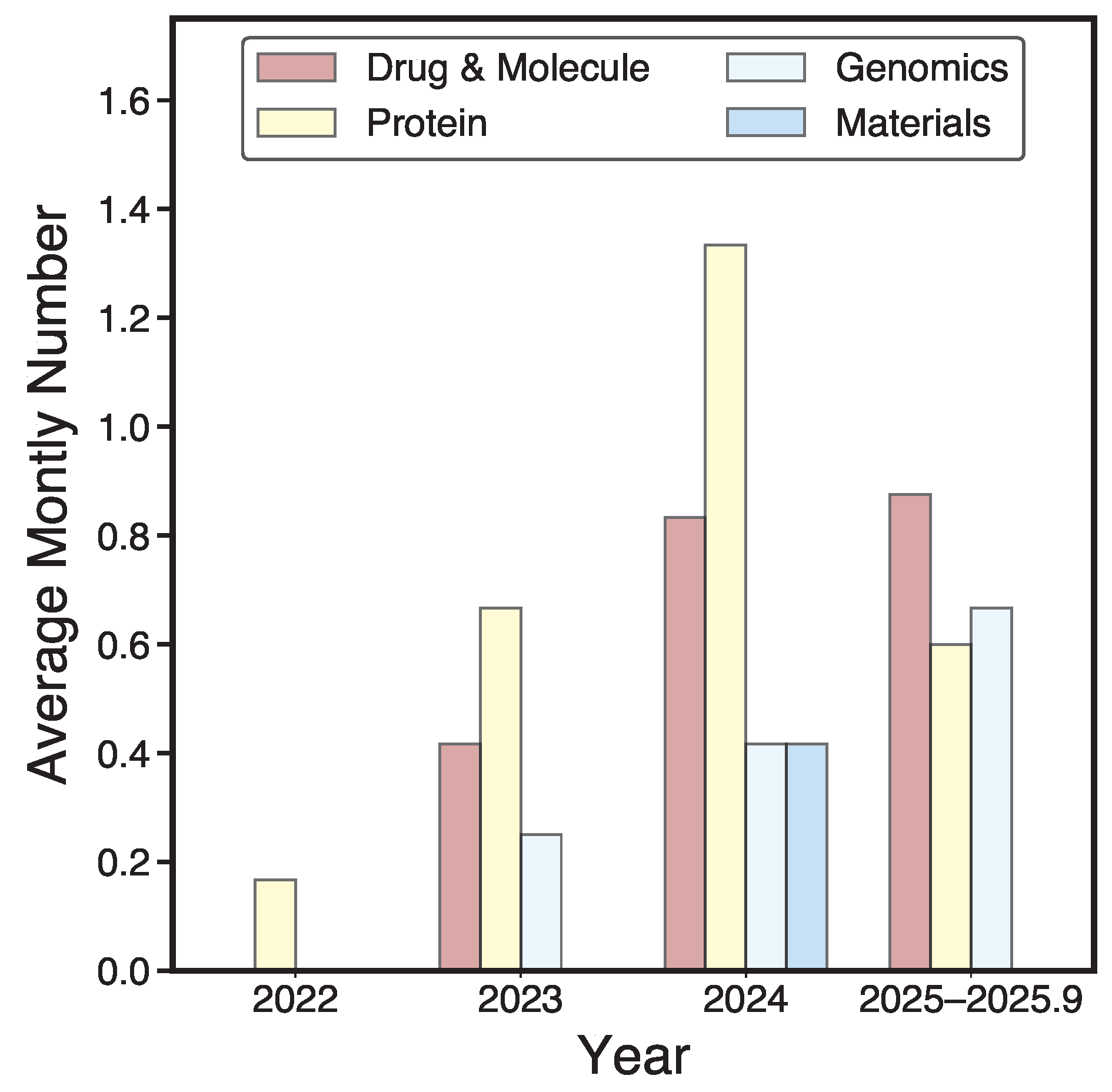
Figure 4.
Distribution of MLLMs for drug and molecule tasks, presenting each model’s release date, scale, architecture and application.
Figure 4.
Distribution of MLLMs for drug and molecule tasks, presenting each model’s release date, scale, architecture and application.
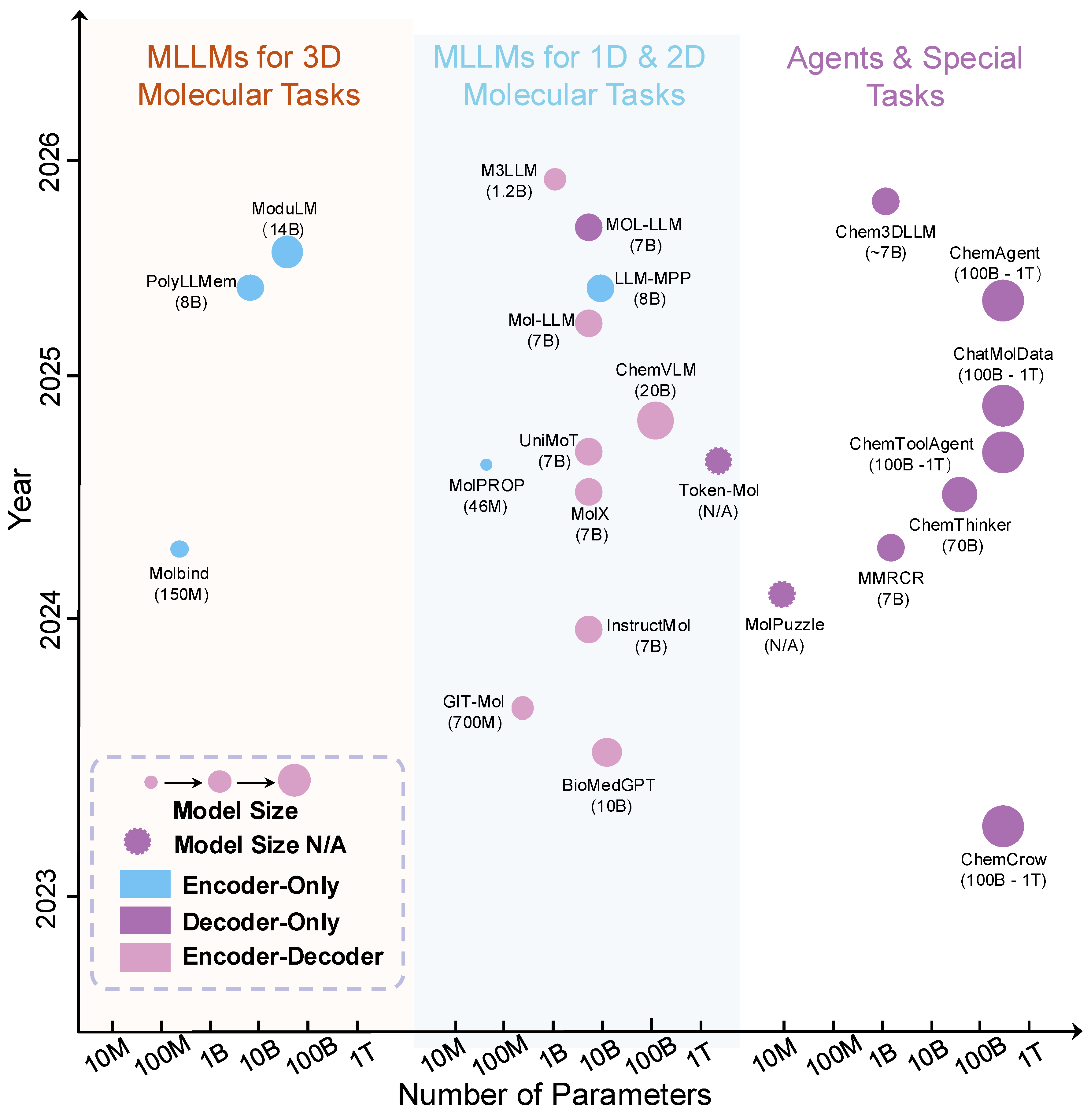
Figure 5.
Distribution of MLLMs for protein tasks, presenting each model’s release date, scale, architecure and application.
Figure 5.
Distribution of MLLMs for protein tasks, presenting each model’s release date, scale, architecure and application.
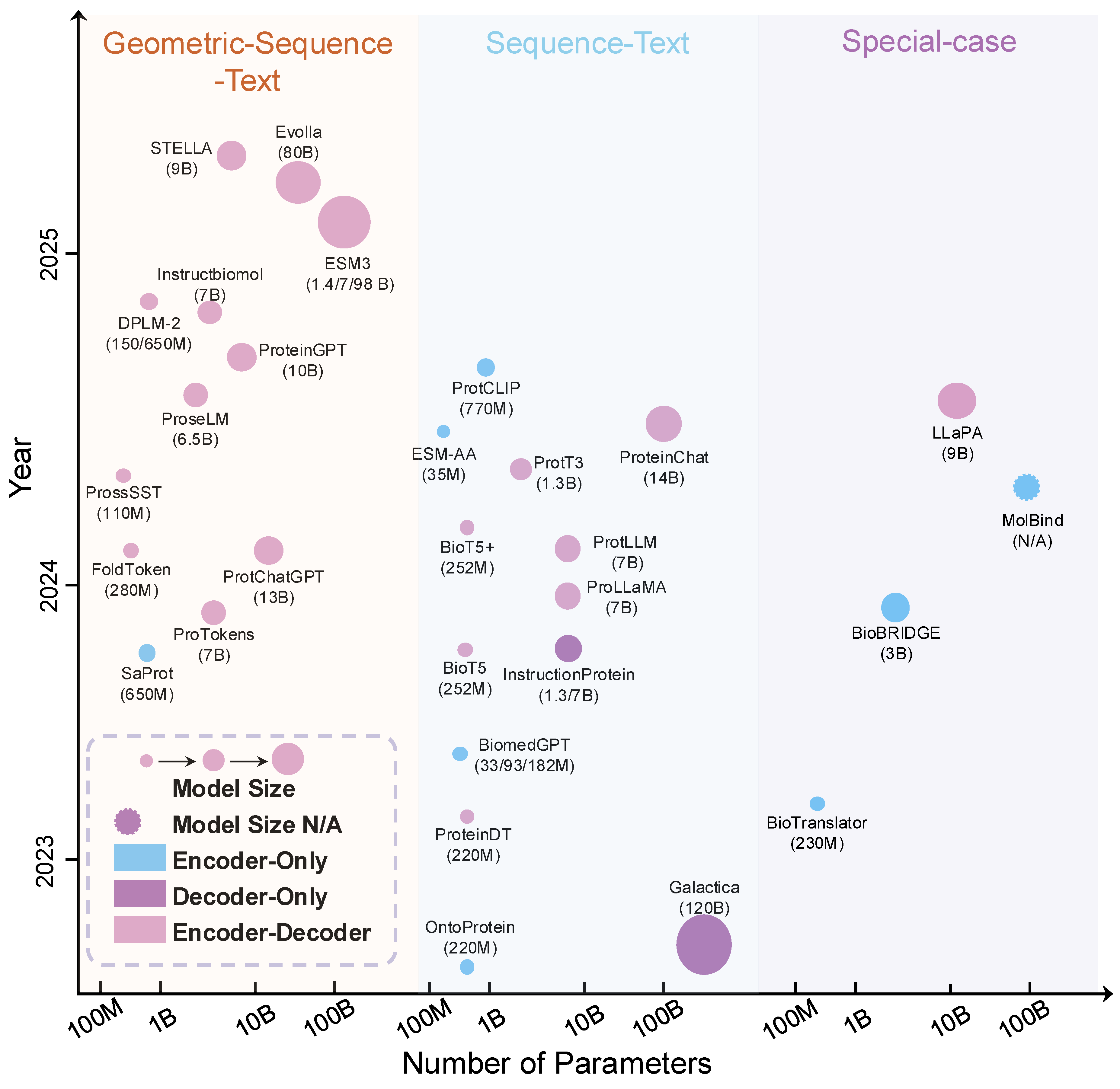
Figure 6.
Distribution of MLLMs for gene and materials, presenting each model’s release date, scale, and architecture.
Figure 6.
Distribution of MLLMs for gene and materials, presenting each model’s release date, scale, and architecture.
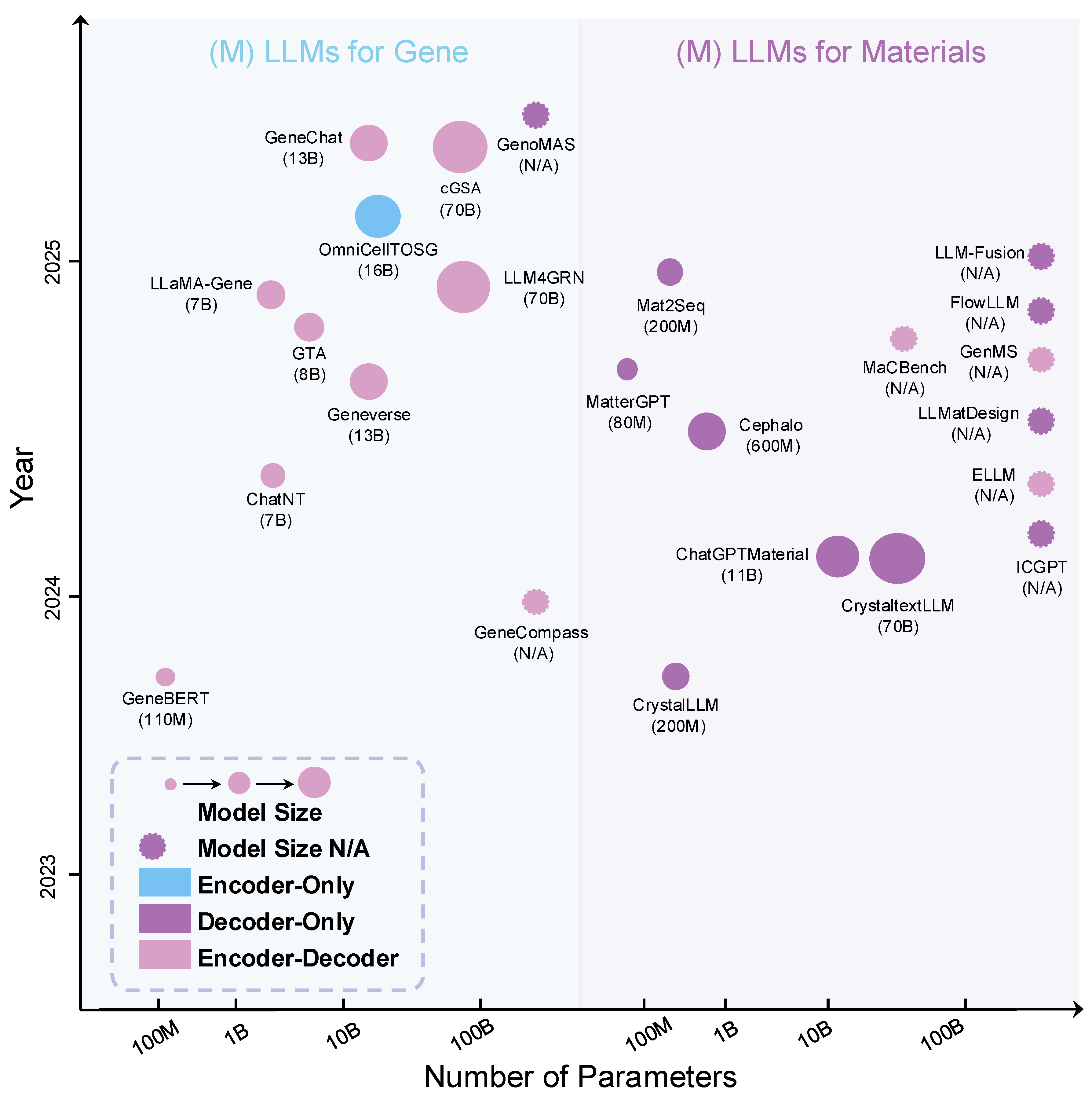
Table 3.
ROC-AUC (%) results on molecular property prediction tasks (BACE, BBBP, HIV) from the MoleculeNet benchmark [183]. For non-MLLM models, we adopt the results reported in the InstructMol paper [18].
| Method | BACE ↑ 1513 |
BBBP ↑ 2039 |
HIV ↑ 41127 |
|---|---|---|---|
| Specialist Models | |||
| ChemBERTa v2 | 73.5 | 69.8 | 79.3 |
| DMP(TF+GNN) | 89.4 | 77.8 | 81.4 |
| KV-PLM | 78.5 | 70.5 | 71.8 |
| GraphCL | 75.3 | 69.7 | 78.5 |
| GraphMVP-C | 81.2 | 72.4 | 77.0 |
| MoMu | 76.7 | 70.5 | 75.9 |
| MolFM | 83.9 | 72.9 | 78.8 |
| Uni-Mol | 85.7 | 72.9 | 80.8 |
| LLM Based Generalist Models | |||
| Galactica-6.7B | 58.4 | 53.5 | 72.2 |
| Vicuna-v1.5-13b-16k (4-shot) | 49.2 | 52.7 | 50.5 |
| Vicuna-v1.3-7B* | 68.3 | 60.1 | 58.1 |
| LLaMA-2-7B-chat* | 74.8 | 65.6 | 62.3 |
| MolCA(1D) | 79.3 | 70.8 | – |
| MolCA(1D + 2D) | 79.8 | 70.0 | – |
| Instruct-G | 84.3 (±0.6) | 68.6 (±0.3) | 74.0 (±0.1) |
| Instruct-GS | 82.1 (±0.1) | 72.4 (±0.3) | 68.9 (±0.3) |
| MoleculeSTM (Graph) | 80.77 (±1.34) | 69.98 (±0.52) | 76.93 (±1.84) |
| MoleculeSTM (Smiles) | 81.99 (±0.41) | 70.75 (±1.90) | 76.23 (±0.80) |
| Token-Mol (averaged across five runs) | 89.52 (±1.32) | 91.67 (±0.98) | 82.40 (±0.17) |
Table 4.
Benchmark Results covers six protein property prediction tasks from the TAPE [139] benchmark. For non-MLLM models, we adopt the results reported in OntoProtein [213] and ProteinDT [108].
| Method | Structure | Evolutionary | Engineering | |||
|---|---|---|---|---|---|---|
| SS-Q3↑ | SS-Q8↑ | Contact↑ | Homology↑ | Fluorescence↑ | Stability↑ | |
| LSTM | 0.75 | 0.59 | 0.26 | 0.26 | 0.67 | 0.69 |
| TAPE Transformer | 0.73 | 0.59 | 0.25 | 0.21 | 0.68 | 0.73 |
| ResNet | 0.75 | 0.58 | 0.25 | 0.17 | 0.21 | 0.73 |
| MSA Transformer | - | 0.73 | 0.49 | - | - | - |
| ProtBERT | 0.81 | 0.67 | 0.59 | 0.29 | 0.61 | 0.82 |
| OntoProtein | 0.82 | 0.68 | 0.56 | 0.24 | 0.66 | 0.75 |
| ProteinDT-ProteinCLAP-InfoNCE | 0.8354 | 0.6912 | 0.6011 | 0.3109 | 0.6047 | 0.8110 |
| ProteinDT-ProteinCLAP-EBM-NCE | 0.8310 | 0.6941 | 0.6023 | 0.2865 | 0.6127 | 0.7978 |
Disclaimer/Publisher’s Note: The statements, opinions and data contained in all publications are solely those of the individual author(s) and contributor(s) and not of MDPI and/or the editor(s). MDPI and/or the editor(s) disclaim responsibility for any injury to people or property resulting from any ideas, methods, instructions or products referred to in the content. |
© 2026 by the authors. Licensee MDPI, Basel, Switzerland. This article is an open access article distributed under the terms and conditions of the Creative Commons Attribution (CC BY) license (http://creativecommons.org/licenses/by/4.0/).
Copyright: This open access article is published under a Creative Commons CC BY 4.0 license, which permit the free download, distribution, and reuse, provided that the author and preprint are cited in any reuse.


