

Submitted:
14 February 2026
Posted:
27 February 2026
You are already at the latest version
Abstract
This study aims to design a context-sensitive data governance framework for nonprofit sport organizations in Iran within the era of digital transformation. A qualitative research design grounded in Corbin and Strauss’s grounded theory was employed. Seventeen semi-structured interviews were conducted with managers, coaches, IT specialists, and decision-makers in Iranian nonprofit sport organizations. Participants were selected based on their experience with data-driven projects, decision-making authority, and familiarity with organizational information systems. Data analysis involved open, axial, and selective coding to identify causal, contextual, and intervening conditions influencing data governance. The constant comparative method ensured conceptual consistency and saturation. Key dimensions such as data ownership, quality, infrastructure, organizational culture, and literacy were explored in depth to develop an empirically grounded conceptual model. Results reveal that digital transformation acts as a major causal condition, increasing pressure on organizations to manage large, heterogeneous data sets. Contextual constraints such as limited financial resources, informal structures, and fragmented data processes interact with intervening factors including leadership commitment, staff data literacy, and acceptance of technology to shape governance strategies. These strategies, when implemented, enhance decision quality, transparency, accountability, and organizational trust. The study demonstrates that without formal governance mechanisms, data remain underutilized despite technological adoption.
Keywords:
data governance
; digital transformation
; nonprofit sport organizations
; grounded theory
; decision-making
; Iran
Introduction
The era of digital transformation is bringing fundamental changes to the way businesses plan and operate. Every business sector is affected by its impact. This change is not just in technology; it requires a deeper reconsideration of how companies interact with their customers and run their businesses. Digital technology is becoming more pervasive. It modifies what customers expect from you. This is driving companies to constantly innovate in various areas (Wang & Wang, 2024). Digital transformation is a multifaceted and ongoing process that encompasses the strategic and systematic integration of digital technologies, data driven insights, and innovative business models into an organization’s operations, culture, and customer interactions. It represents a fundamental shift in the way businesses, government entities, and other organizations leverage digital tools and capabilities to adapt, evolve, and thrive in a rapidly changing digital and scape. The convergence of consumer needs worldwide has necessitated unique and effective ways to communicate with consumers (Santomier, 2024). Big data analytics, artificial intelligence, and cloud computing have become important components of strategic decision-making, and they enable companies to deliver personalized experiences and gain valuable, data-driven insights (Sarker et al., 2022). In the current era of deep integration between digital technology and the sports industry, sports data is gradually evolving into a commercial asset with diverse value (Zhu et al., 2025).
The digital transformation of the sports industry has dramatically increased the volume and variety of data generated about athlete performance, fans, competition operations, and finances. Recent research shows that sports organizations at various levels are using technologies such as data analytics, wearables, information management systems, and fan platforms to improve performance, fan experience, and decision-making (Chen & Dai, 2024; Golbova et al., 2025).
As data become fundamental to how organizations operate and compete, they intricately link to value in organizations by mediating insights that enhance decision-making, knowledge creation, and strategizing (Benfeldt & Persson, 2025). In response, organizations recognize that data must be governed as assets. However, most efforts tend to overemphasize practices that protect and regulate data, often at the expense of innovation that enables new opportunities for value creation (Vial & Grange, 2024).
Governments and sport organizations worldwide are beginning to implement AI-based services to exploit data and seek solutions that provide value to citizens and employees and assist in decision-making. AI-driven transformation and smart data management can replace the workforce or enhance it (Valle-Cruz & García-Contreras, 2025). At the same time, many of these organizations still lack clear mechanisms for data management and governance, which can hinder the transformation of this data into quality strategic and operational decisions.
Meanwhile, the exponential growth of data production and the expansion of communication networks have made the need for effective data governance systems more evident than ever before (Heidari & Karami, 2024). In such an environment, the concept of “Data Governance” as a comprehensive and multidimensional approach has found a central place in organizational macro-policies.
Data governance refers to the formal processes, roles, policies, standards, and metrics that ensure the effective and ethical management of organizational data (Pavone et al., 2024). It is not merely a technical mechanism but a multidimensional construct encompassing institutional, cultural, ethical, and operational aspects (Mao et al., 2022). In the context of nonprofit sport organizations, data governance ensures that data generated from athlete performance, fan engagement, and operational activities are accurate, secure, accessible, and usable for strategic decision-making. Recent studies emphasize that weak governance leads to fragmented data, inconsistent decision-making, and underutilization of digital technologies (Rascao, 2021; Benfeldt & Persson, 2025).
Data governance not only includes the technical management of data but also oversees the ethical, institutional, legal, and cultural dimensions associated with the production, sharing, and use of data (Mohammadi et al, 2025). In fact, data governance is no longer just a technical or administrative issue, but has become a fundamental issue in public policymaking, digital ethics, decision-making and international law (Van den Hoven et al., 2024).
Recent literature identifies several critical dimensions of data governance:
Data Ownership and Accountability: Clearly defined responsibilities for data creation, storage, and use (Fadler & Legner, 2022;Maharani et al., 2025).
Data Quality and Standardization: Ensuring completeness, accuracy, consistency, and accessibility (Efimova et al., 2021;Lian, 2025).
Data Security and Ethics: Compliance with legal and ethical standards, including privacy protection, issues surrounding confidentiality, data privacy, consent, and trustworthiness (Bavli et al., 2025;Ali, 2025;Bena et al., 2026).
Infrastructure and Integration: Technical capabilities to consolidate, store, and analyze data effectively (Price et al., 2025;Kopparapu, 2025).
Organizational Culture and Literacy: Staff competencies, attitudes toward data, and willingness to adopt data-driven processes (Fattah, 2024; Sargiotis, 2024; Glasgal & Nestor, 2020;Koltay, 2016).
These dimensions serve as the foundation for designing governance frameworks capable of supporting digital transformation in nonprofit sport contexts.
However, simply having data does not mean improving decision-making; what matters is how rules, structures, and responsibilities govern the data and ensure its quality.
Recent research on the digital transformation of sports organizations shows that non-profit clubs and federations are increasingly using digital tools for communication, member management, and data management, but their level of digital maturity and organizational capacity is very heterogeneous (Ehnold et al., 2021; Stegman & Lang, 2025).
On the other hand, this expansion of data is simultaneously faced with challenges such as lack of transparency in data collection, excessive concentration of data power in central institutions, and lack of clear ethical frameworks (Camilleri, 2024).
At the level of non-profit sports organizations and voluntary clubs, studies show that the use of digital tools for member management, reporting, communication and administrative matters is expanding rapidly, but the extent and type of use depends largely on organizational capacity, club goals and structural support (Ehnold et al., 2021). A review by Stegman and Lang (2025) of digital transformation in voluntary sports organizations shows that although these organizations have moved towards standardizing processes and using digital tools for data management and communication, important questions remain unanswered about how this transformation should be guided, regulated and governed and to what extent it solves their traditional challenges such as recruiting and retaining members and volunteers. This situation highlights the need to address the data governance dimension alongside the issue of digital transformation.
Despite the growing recognition of data as a strategic organizational asset, existing research on data governance has largely evolved within commercial, technology-driven, and private-sector contexts, emphasizing efficiency, regulatory compliance, and competitive advantage (Arner et al., 2022; Opriel et al., 2024). At the same time, studies addressing digital transformation have predominantly focused on technological adoption and analytics capabilities, often overlooking the institutional and governance mechanisms required to ensure that data can be reliably transformed into high-quality decisions (Vial, 2021; Mikalef et al., 2023). Within the sports domain, prior research has mainly concentrated on performance analytics, technology-enabled training systems, or innovation in professional sport, while offering limited insight into how data are governed at the organizational level (Ratten, 2016). This gap is particularly evident in nonprofit sports organizations, which operate under distinct structural, financial, and governance constraints and therefore cannot directly adopt data governance models developed for private or for-profit organizations. Moreover, the literature provides little empirical evidence on how data governance mechanisms are shaped in practice within nonprofit sports settings, how they interact with ongoing digital transformation initiatives, and how they ultimately influence strategic and operational decision-making quality. Existing frameworks tend to be either conceptually abstract or technologically oriented, lacking grounding in the lived experiences of decision-makers who navigate fragmented data environments, limited resources, and multiple stakeholder pressures. Consequently, there is a clear lack of context-sensitive, empirically grounded models that explain how data governance emerges, operates, and creates decision-making value in nonprofit sports organizations undergoing digital transformation. Addressing this gap requires qualitative, theory-building research capable of capturing organizational complexity and producing a validated framework that aligns governance structures, data practices, and decision-making processes within this underexplored context.
Therefore, the need to develop and implement macro-level data governance policies in public education is felt more than ever. Data governance in education not only helps standardize and integrate information, but also increases accountability and public trust in the system.
The vitality and dynamism of the sports environment, the multi-level nature of the goals of non-profit sports organizations (combining social, educational, and sometimes economic goals), and their heavy reliance on voluntary human resources and informal structures, exacerbate the complexity of data governance in these organizations. In such a context, if the roles and responsibilities related to data are not clearly defined, data quality standards are not clear, and there are no monitoring and accountability mechanisms for data use, data is likely to become more of an administrative burden than a source of value creation for strategic and operational decision-making.
Therefore, the main issue of this research is that despite the expansion of digital transformation and the increasing reliance of non-profit sports organizations on data, specific and indigenous frameworks for data governance in these organizations have not been clearly formulated and tested. Thus, this study aims to design and validate a data governance model for nonprofit sports organizations in Iran in the era of digital transformation.
Methodology
This study adopts a qualitative, exploratory research design grounded in the Grounded Theory approach as articulated by Corbin and Strauss (2008). The aim was to develop a context-sensitive and empirically grounded framework of data governance within nonprofit sports organizations. The statistical community includes professionals, senior managers, coaches, data analysts, IT managers, and decision-making and data experts working in non-profit sports organizations. Data were collected through 17 in-depth semi-structured interviews, which allowed participants to articulate their experiences, perceptions, and practices related to data governance and decision-making processes. An initial purposeful sampling strategy was employed to identify information-rich participants, followed by theoretical sampling to refine emerging categories and relationships until theoretical saturation was achieved. Interviews were conducted face-to-face or via online platforms, depending on participant’s availability, and each interview lasted approximately 45 to 70 minutes. Inclusion criteria required participants to have at least three of the following are required: At least 5 years of experience in a sports organization, Management or decision-making experience at an operational or strategic level, Experience directly interacting with data, information systems, or analytics, Participation in intelligence, digitalization, or data-driven projects, Related education (sports management, management, IT, data analytics) and Awareness of data policies, processes, and challenges in the organization; individuals lacking substantive decision-making responsibility or practical exposure to data-related processes were excluded from the study. All interviews were audio-recorded with informed consent and transcribed verbatim.
Data analysis was conducted concurrently with data collection following the systematic procedures proposed by Corbin and Strauss. Open coding was used to identify initial concepts through line-by-line analysis of the interview transcripts, followed by axial coding to establish relationships among categories and subcategories by linking causal conditions, contextual factors, actions or interactions, and consequences. In the final stage, selective coding was applied to integrate and refine the categories around a core phenomenon, leading to the development of a coherent and grounded conceptual framework. Throughout the analytic process, the constant comparative method was employed to continuously compare data segments, refine emerging categories, and enhance conceptual consistency.
To ensure the trustworthiness of the findings, the study adhered to the criteria of credibility, transferability, dependability, and confirmability. Credibility was strengthened through prolonged engagement with the data, iterative analysis, and the use of participant feedback to assess the alignment between interpretations and participants’ experiences. Transferability was supported by providing rich contextual descriptions of the research setting and participants, enabling readers to assess the applicability of the findings to similar contexts. Dependability and confirmability were enhanced through systematic documentation of the research process, maintenance of an audit trail, and the use of analytic memos and reflexive notes to minimize researcher bias. Furthermore, data source and methodological triangulation were employed by incorporating perspectives from participants with diverse organizational roles and integrating interview data with field notes and analytic memos, thereby strengthening the robustness and analytical depth of the findings.

Table 1.
Calculations related to retest reliability.
| Row | Interviewee code | Sum of the codes of two coders | Number of agreed codes | Number of failed codes | Retest reliability |
| 1 | Interview 1 | 45 | 18 | 7 | 0.72 |
| 2 | Interview 4 | 55 | 26 | 6 | 0.81 |
| 3 | Interview 9 | 60 | 22 | 8 | 0.73 |
| 4 | Interview 12 | 40 | 19 | 5 | 0.79 |
| Total | 200 | 85 | 20 | 0.77 | |
In the above table, the retest reliability results for the intended qualitative study, the characteristics of the interviews and the results related to the agreement between the two coders for each interview are presented. This table includes the interview number, the total number of codes by two coders, the number of agreed codes and the number of unsuccessful codes.
The reliability of the coding process was assessed using the retest reliability method. A total of 200 open codes were independently generated by two coders. The overall retest reliability coefficient was 0.77, indicating an acceptable level of agreement between coders. Reliability coefficients across individual interviews ranged from 0.72 to 0.81, which is considered satisfactory for qualitative content analysis.
Results
This study is based on the opinion of 17 experts in the field of study. Their demographic characteristics in the interview by gender, age, education, degrees and work experience are presented in Table 2.
According to the results of the above table, 64% of the interviewees are men and 36% are women. The evaluation of the age range of the interviewees shows that 47% of them are 35-45 years old which is the highest rate. Master's and Ph.D degree with 47 percent has the highest frequency among specialists. The field of study of 35.5% of the interviewees was information technology and sport management, 29% of the interviewees was data analytics. Also the highest amount of sports experience was related to 10 to 20 years of experience (64%).
The results of data analysis using three methods: open coding, axial coding, and selective coding, which are fully described in the methodology section, can be seen in Table 3.
After coding and classifying the data, the final research model was designed and developed based on the model proposed by Corbin and Strauss (2008). Figure 1 shows a conceptual model derived from data-based theory for the data governance model for nonprofit sports organizations in Iran in the era of digital transformation.
Data analysis followed the systematic procedures proposed by Corbin and Strauss, involving open coding to identify initial concepts, axial coding to relate categories and subcategories through conditions, actions, and consequences, and selective coding to integrate and refine a core category that explained the central phenomenon. Throughout the analysis, the constant comparative method was applied to ensure analytic rigor and conceptual consistency, enabling the emergence of a coherent and theoretically grounded data governance framework tailored to the context of nonprofit sports organizations in the era of digital transformation.
Discussion and Conclusion
The stiff competition in the sports industry, which is spurred by the ever-demanding public audience, has forced organizations to adopt novel strategies to achieve and maintain relevance. Flexibility in governance has become one of the factors that have contributed to success in modern sports organizations (Filipe, 2024).
The dramatic evolution of digital technology over the past several decades has led to a new era in which data has emerged as a strategic and decisive factor in economic, social, and political development. At the same time, artificial intelligence, which has been identified as one of the most impact-driven transformative technologies of this century, takes on a prominent role in relation to data analysis, processing, and large-scale implementation. As a result of the exponential growth of data production and communications networks, it has become increasingly imperative to establish adequate data governance frameworks that take into account a proper balance between value creation, protection of citizens' rights, security, and public welfare (Floridi, 2018). On the other hand, the unprecedented growth of artificial intelligence at a national and transnational level has posed certain challenges to policymakers, regulatory authorities, and the international community, taking into account that automated decision-making based on algorithms has a direct effect on privacy, social justice, and human rights issues (Jobin et al,. 2019).
The findings of the study indicate that designing a context-sensitive data governance model for nonprofit sport organizations in Iran is not only feasible but a strategic necessity in the era of digital transformation, because without such a model the growing volume of sports data does not translate into reliable, accountable decision making and tends to become an administrative burden rather than a value-creating asset (Rascao, 2021).
By combining causal conditions, such as increased data volume and digitalization pressure, with contextual conditions, including scarce financial resources, informal structures and fragmented data processes, and intervening conditions like leadership commitment, data literacy and cultural acceptance, the results show how governance strategies are shaped and how they ultimately influence decision quality, transparency and organizational trust (Viljoen, 2021).
The results show that the pressures of playing in a league, comparing with successful soccer teams, and the obsession with the use of technology in the sport industry have greatly contributed to the pressures to leverage the data, whereas the ability to effectively manage the data has not. The absence of data governance policies, the lack of clarity with respect to ownership of sports data, and the use of individual technology devices and simple tools for data storage heighten the possibilities of privacy violation and undermine the reliability and continuity of the decision-making process. The current literature on data governance asserts that data lacking ownership, standards, and assurance is rendered ineffective and even becomes a source of conflict and distrust.
At the same time, limited technology budgets, the low priority of data in resource allocation and structural dependence on higher-level bodies create an environment in which managers may express rhetorical support for data, but do not consistently invest in infrastructure, tools and human capacity.1 This pattern is consistent with recent studies on digital transformation in voluntary sports organizations, which show that digital tools are often adopted for basic administrative and communication purposes, while deeper layers of analytics and data governance remain underdeveloped (Ehnold et al,. 2023).
Iranian studies on data governance in the public and sport sectors also point to this gap between high expectations and limited institutional capacity to standardize, integrate and exploit digital data (Karami Tirehshabankare et al,. 2021).
The category of “human capital and data learning” highlights that the shortage of professional analysts, the lack of clear data-related career paths and reliance on self-taught staff or external consultants all constrain the internal capacity of organizations to build sustainable, data-driven capabilities (Ruslan et al,. 2022).
As a result, analyses tend to be project-based, person-dependent and poorly documented, which prevents the accumulation of organizational learning and leads to significant loss of analytical knowledge whenever individuals leave or change roles. At the same time, the growing data interest and learning motivation among younger managers and coaches represents a latent capacity that can be leveraged to strengthen internal expertise and reduce dependence on external actors (Zhu et al,. 2025).
Regarding decision culture, the dominance of intuition-based choices, limited trust in data and resistance from some highly experienced coaches are serious barriers to institutionalizing data governance (Fattah, 2024).
Recent research on digital transformation in sport organizations shows that even when tools are available, without changes in underlying norms and attitudes, data are more often used to “justify” decisions already taken than to proactively guide new strategic options, a pattern that closely mirrors the findings of this study (Stegmann & Lang, 2025; Chen, 2025).
The results reveal three main strategic domains in the model—sports performance analysis, operational decision making and strategic decision making—all of which are shaped by weaknesses in data governance, albeit to different degrees.
In performance analysis, the use of partial, non-standard training and competition data and the lack of integrated dashboards mean that coaches rely primarily on cross-sectional comparisons and personal judgment rather than on predictive models and long-term scenarios for talent development and injury prevention (Ishaak et al,. 2025; Salerno & Maçada, 2025).
Current guidebooks on digital and data transformation in sport stress that unifying athlete, fan and competition data into a “single source of truth” and deploying advanced analytics are prerequisites for systematic value creation, underscoring how far many nonprofit organizations are from this ideal (Chew, 2025).
At the operational level, the “analysis–to–action” gap is visible in delays in producing reports, selective use of findings and the tendency to rely on data mainly in crisis situations, which together suggest that there are few formal procedures, timelines or accountability mechanisms that embed data into everyday management routines.
In strategic decisions, the use of data predominantly for ex-post justification, the scarcity of long-term analyses and the limited evaluation of transfers and development projects indicate that data governance remains mostly symbolic and has not yet reshaped how major choices are conceived and negotiated (Bena et al,. 2025).
International reports warn that many sports organizations are stuck in a phase of “digitalization without governance transformation”, a diagnosis that aligns with the patterns identified in this research (Villemaire & Huang, 2025).
An important contribution of the findings is to show that both short- and long-term consequences of gradually implementing data governance mechanisms can already be observed in some organizations, including relative improvements in decision quality, increased awareness of the value of data, reductions in obvious errors and the emergence of initial trust in analytical outputs (Benfeldt & Persson, 2025).
In the longer run, the model suggests that as governance mechanisms mature, organizations can expect stronger institutionalization of data, sustained enhancement of decision quality, higher levels of accountability and a gradual transformation of organizational culture toward evidence-informed practice.
For sport policy makers in Iran, the results clearly indicate that any digital transformation agenda must include explicit actions in five key domains: leadership and data policymaking, infrastructure and architecture, data quality and standardization, human capital and data literacy, and an evidence-based decision-making culture (Salerno & Maçada, 2025).
Practically, it is recommended that the Ministry of Sport and Youth and national sport federations adopt the proposed model as a reference for drafting a “data governance charter for nonprofit sport organizations”, including clearly defined data roles (such as data stewards at federation and club level), minimum standards for data recording, shared and secure centralized databases, and structured training programs in data literacy for managers and coaches. Establishing long-term partnerships with universities and research centers for joint analytics projects can simultaneously enhance the quality of sport decision making and bridge the gap between cutting-edge academic knowledge and everyday management practice in Iran’s nonprofit sport sector.
In conclusion, this study demonstrates that data governance is not a technical add-on but a foundational organizational capability that shapes how data contributes to performance, accountability, and trust. For nonprofit sport organizations in Iran, investing in context-sensitive data governance represents a strategic pathway toward sustainable digital transformation. Future research should extend this work through comparative international studies and longitudinal evaluations of governance implementation, enabling a deeper understanding of how data governance reforms translate into measurable organizational and sporting outcomes over time.
Beyond its theoretical contributions, this research has direct and actionable implications for nonprofit sport organizations in Iran, including national sport federations, provincial sport boards, and private or semi-private sport clubs operating within the nonprofit ecosystem. First, the proposed context-sensitive data governance model provides these organizations with a structured and realistic roadmap for transitioning from fragmented, person-dependent data practices toward more institutionalized, transparent, and accountable decision-making systems. In an environment where financial resources are constrained and formalized digital infrastructures are unevenly developed, the model helps organizations prioritize governance mechanisms—such as role definition, minimum data standards, and accountability structures—before investing in costly technologies. This is particularly relevant for Iranian sport federations, where data initiatives often fail not due to lack of technology, but due to unclear responsibilities, weak coordination, and absence of shared rules for data use.
Second, for sport clubs and federations, this research clarifies how data governance can directly enhance decision quality across three critical domains: performance management, operational control, and strategic planning. By addressing issues such as data ownership, standardization, and documentation, organizations can reduce reliance on intuition-based judgments and ad hoc analyses, thereby improving the consistency and credibility of decisions related to athlete development, competition planning, budgeting, and talent recruitment. In practice, this means that even clubs with limited analytical sophistication can achieve measurable improvements by institutionalizing basic governance practices, such as unified data repositories and routine data validation procedures, rather than attempting to emulate advanced professional clubs without the necessary organizational foundations.
Third, the findings offer policymakers and governing bodies—particularly the Ministry of Sport and Youth and national federations—a practical framework for designing sector-wide policies that promote coherence and interoperability across organizations. By adopting the study’s model as a reference for a national data governance charter, policymakers can reduce fragmentation between federations, clubs, and oversight institutions, while simultaneously enhancing data comparability, reporting quality, and regulatory compliance. Such an approach also strengthens public accountability, which is especially important in nonprofit sport organizations that rely on public funding, sponsorships, and social legitimacy.
Fourth, this research contributes to capacity building by highlighting the central role of human capital and data literacy. For Iranian sport organizations, the model underscores that sustainable digital transformation depends less on external consultants and more on developing internal expertise through structured training, clear career pathways, and partnerships with universities and research centers. By institutionalizing learning and documentation practices, organizations can prevent knowledge loss caused by staff turnover and gradually build endogenous analytical capabilities that are aligned with local cultural and organizational realities.
Finally, at a broader systemic level, the study demonstrates that implementing data governance can act as a catalyst for cultural change within nonprofit sport organizations in Iran. As governance mechanisms mature, data use shifts from symbolic or justificatory functions toward proactive, evidence-informed decision making. This cultural transition not only improves organizational effectiveness but also enhances trust among managers, coaches, athletes, and external stakeholders. In this sense, the research shows that data governance is not merely a technical or administrative concern, but a strategic lever for strengthening institutional legitimacy, improving governance quality, and supporting the long-term sustainability of Iran’s nonprofit sport sector.
Funding
No specific financial resources have been used.
Ethical Considerations
.
Compliance with ethical guidelines
Ethical points have been observed.
Acknowledgments
The authors would like to thank all participants in this research.
Conflicts of Interest
There is no conflict of interest.
References
- Abraham, R.; Schneider, J.; Vom Brocke, J. Data governance: A conceptual framework, structured review, and research agenda. International journal of information management 2019, 49, 424–438. [Google Scholar] [CrossRef]
- Akbari, M.; Kok, S. K.; Hopkins, J.; Frederico, G. F.; Nguyen, H.; Alonso, A. D. The changing landscape of digital transformation in supply chains: impacts of industry 4.0 in Vietnam. The international journal of logistics management 2024, 35(4), 1040–1072. [Google Scholar] [CrossRef]
- Ali, A. Ethical Implications of Artificial Intelligence: Ensuring Patient Data Security. In Transforming Healthcare Sector Through Artificial Intelligence and Environmental Sustainability; Springer Nature Singapore: Singapore, 2025; pp. 149–164. [Google Scholar] [CrossRef]
- Arner, D. W.; Castellano, G. G.; Selga, E. Financial data governance: The datafication of finance, the rise of open banking and the end of the data centralization paradigm. 2022. [Google Scholar] [CrossRef]
- Balzano, M.; Bortoluzzi, G. The digital transformation of soccer clubs and their business models. Impresa Progetto 2023, 1. [Google Scholar] [CrossRef]
- Bavli, I.; Ho, A.; Mahal, R.; McKeown, M. J. Ethical concerns around privacy and data security in AI health monitoring for Parkinson’s disease: insights from patients, family members, and healthcare professionals. AI & SOCIETY 2025, 40(1), 155–165. [Google Scholar] [CrossRef]
- Bena, Y. A.; Ibrahim, R.; Mahmood, J.; Al-Dhaqm, A.; Alshammari, A.; Yusuf, M. N.; Ayemowa, M. O. Big data governance challenges arising from data generated by intelligent systems technologies: a systematic literature review. IEEE Access 2025. [Google Scholar] [CrossRef]
- Bena, Y. A.; Muchtar, F.; Ibrahim, R.; Mahmood, J.; Chan, W. H.; Shah, M. Z. M. Z.; Fattah, S. Enhancing Big Data Governance Practices: Addressing Security, Privacy and Ethical Challenges. Journal of Advanced Research Design 2026, 142(1), 159–176. [Google Scholar] [CrossRef]
- Benfeldt, O.; Persson, J. S. Semiotic mediation in data governance: Towards valuing data as assets. Information and Organization 2025, 35(3), 100588. [Google Scholar] [CrossRef]
- Camilleri, M. A. Artificial intelligence governance: Ethical considerations and implications for social responsibility. Expert systems 2024, 41(7), e13406. [Google Scholar] [CrossRef]
- Chen, H. Digital Transformation of Sports Enterprises and Construction of Governance Performance Evaluation Indicators. The Frontiers of Society, Science and Technology 2025, 7(4). [Google Scholar] [CrossRef]
- Chen, Z.; Dai, X. Utilizing AI and IoT technologies for identifying risk factors in sports. Heliyon 2024, 10(11). [Google Scholar] [CrossRef]
- Chew, K. X. Data-Driven Dynamics in Soccer: Exploring the Impact of Data Analytics on Strategy and Fan Engagement. SURJ: The Stanford Undergraduate Research Journal 2025, 20(2), 70–75. [Google Scholar] [CrossRef]
- Christodimitropoulou, M.; Choustoulakis, E.; Antonopoulou, P. Digital transformation in sport management: Technologies, trends, and strategic implications. European Journal of Management and Marketing Studies 2025, 10(2), 135–152. [Google Scholar] [CrossRef]
- Efimova, O. V.; Igolnikov, B. V.; Isakov, M. P.; Dmitrieva, E. I. Data Quality and Standardization for Effective Use of Digital Platforms. 2021 International Conference on Quality Management, Transport and Information Security, Information Technologies (IT&QM&IS), 2021; IEEE; pp. 282–285. [Google Scholar] [CrossRef]
- Ehnold, P.; Faß, E.; Steinbach, D.; Schlesinger, T. Digitalization in organized sport–usage of digital instruments in voluntary sports clubs depending on club's goals and organizational capacity. Sport, Business and Management: An International Journal 2021, 11(1), 28–53. [Google Scholar] [CrossRef]
- Ehnold, P.; Faß, E.; Steinbach, D.; Schlesinger, T. Digitalization in organized sport–usage of digital instruments in voluntary sports clubs depending on club's goals and organizational capacity. Sport, Business and Management: An International Journal 2021, 11(1), 28–53. [Google Scholar] [CrossRef]
- Ehnold, P.; Steinbach, D.; Schlesinger, T. Categorisation of digitalisation practises in voluntary sports clubs. Managing Sport and Leisure 2023, 1–18. [Google Scholar] [CrossRef]
- Fadler, M.; Legner, C. Data ownership revisited: clarifying data accountabilities in times of big data and analytics. Journal of Business Analytics 2022, 5(1), 123–139. [Google Scholar] [CrossRef]
- Fattah, I. A. The mediating effect of data literacy competence in the relationship between data governance and data-driven culture. Industrial Management & Data Systems 2024, 124(5), 1823–1845. [Google Scholar] [CrossRef]
- Filipe, G. F. Data Governance for Effective Sports Companies: A Strategy to Enhance Performance and Compliance in the Age of Sports Information. Master's thesis, Universidade NOVA de Lisboa (Portugal)), 2024. [Google Scholar]
- Floridi, L. Soft ethics, the governance of the digital and the General Data Protection Regulation. Philosophical Transactions of the Royal Society A: Mathematical, Physical and Engineering Sciences 2018, 376(2133), 20180081. [Google Scholar] [CrossRef]
- Glasgal, R.; Nestor, V. Data Governance, Data Stewardship, and the Building of an Analytics Organizational Culture. Big Data on Campus: Data Analytics and Decision Making in Higher Education 2020, 122–148. [Google Scholar]
- Glebova, E.; Su, Y.; Desbordes, M.; Schut, P. O. Emerging digital technologies as a game changer in the sport industry. Frontiers in Sports and Active Living 2025, 7, 1605138. [Google Scholar] [CrossRef]
- Heidari, S.; Karami, P. Global Trends in Data and Artificial Intelligence Governance. Intelligent Management and Development Strategies 2024, 2(3), 1–12. Available online: https://jimds.com/index.php/jimds/article/view/31.
- Ishaak, S. M.; Qasim, S.; Jahan, M. The Language of AI in Sports: Athletes’ Perspectives on AI-Driven Coaching Technologies. ASSAJ 2025, 3(02), 1950–1961. Available online: https://assajournal.com/index.php/36/article/view/474.
- Jobin, A.; Ienca, M.; Vayena, E. The global landscape of AI ethics guidelines. Nature machine intelligence 2019, 1(9), 389–399. [Google Scholar] [CrossRef]
- Karami Tirehshabankare, M.; Torkfar, A.; Mirhoseini, S. M. A.; Jamshidian, L. S. A model of data-driven governance development in Iranian sport. Sport Management Journal 2021, (). [Google Scholar] [CrossRef]
- Koltay, T. Data governance, data literacy and the management of data quality. IFLA journal 2016, 42(4), 303–312. [Google Scholar] [CrossRef]
- Kopparapu, V. S. Healthcare Insurance Data Infrastructure: A Comprehensive Analysis of EDI Standards and Processing Systems. International Journal of Research in Computer Applications and Information Technology (IJRCAIT) 2025, 8(1), 2341–2353. [Google Scholar] [CrossRef]
- Kraus, S.; Durst, S.; Ferreira, J. J.; Veiga, P.; Kailer, N.; Weinmann, A. Digital transformation in business and management research: An overview of the current status quo. International journal of information management 2022, 63, 102466. [Google Scholar] [CrossRef]
- Li, Z.; Gong, P.; Wang, Y.; Qu, S. The impact of digital transformation on enterprise organizational structure. Highlights in business, economics and management 2024, 41, 732–740. [Google Scholar] [CrossRef]
- Lian, J. Research on Data Quality Analysis Based on Data Mining. Computers and Artificial Intelligence 2025, 2(1), 1–7. [Google Scholar] [CrossRef]
- Maharani, D. P.; Kusumadara, A.; Widhiyanti, H. N.; Dewantara, R. Revisiting personal data: Ownership theories and comparative legal perspectives from Europe, Indonesia and the United States. Journal of Data Protection & Privacy 2025, 7(3), 274–291. [Google Scholar] [CrossRef]
- Mao, Z.; Wu, J.; Qiao, Y.; Yao, H. Government data governance framework based on a data middle platform. Aslib Journal of Information Management 2022, 74(2), 289–310. [Google Scholar] [CrossRef]
- Mikalef, P.; Islam, N.; Parida, V.; Singh, H.; Altwaijry, N. Artificial intelligence (AI) competencies for organizational performance: A B2B marketing capabilities perspective. Journal of Business Research 2023, 164, 113998. [Google Scholar] [CrossRef]
- Mohammadi, S.; Rastgar, M.; Mousavi, F. Macro Data Governance Policies in Public Learning and Education. Intelligent Learning and Management Transformation 2025, 3(1), 1–13. [Google Scholar]
- Opriel, S.; Strobel, G.; Otto, B.; Möller, F. Data sovereignty in inter-organizational information systems. Business & Information Systems Engineering 2024, 67(6), 833–853. [Google Scholar] [CrossRef]
- Pavone, P.; Ricci, P.; Calogero, M.; Capaccioni, P. A literature overview on data-driven value and accountability: Connecting the private and public dimensions. Public Integrity 2024, 26(3), 285–304. [Google Scholar] [CrossRef]
- Price, G.; Peek, N.; Eleftheriou, I.; Spencer, K.; Paley, L.; Hogenboom, J.; Faivre-Finn, C. An overview of real-world data infrastructure for cancer research. Clinical Oncology 2025, 38, 103545. [Google Scholar] [CrossRef]
- Rascao, J. P. Data Governance in the Digital Age. In Handbook of Research on Digital Transformation and Challenges to Data Security and Privacy; IGI Global Scientific Publishing, 2021; pp. 34–62. [Google Scholar] [CrossRef]
- Ratten, V. Sport innovation management: Towards a research agenda. Technological Forecasting and Social Change 2016, 186, 122129. [Google Scholar] [CrossRef]
- Ruslan, I. F.; Alby, M. F.; Lubis, M. Applying data governance using DAMA-DMBOK 2 framework: The case for human capital management operations. In Proceedings of the 8th International Conference on Industrial and Business Engineering, 2022; pp. 336–342. [Google Scholar] [CrossRef]
- Sarker, S.; Arefin, M. S.; Kowsher, M.; Bhuiyan, T.; Dhar, P. K.; Kwon, O. -J. A Comprehensive Review on Big Data for Industries: Challenges and Opportunities. IEEE Access 2022, vol. 11, 744–769. [Google Scholar] [CrossRef]
- Salerno, F. F.; Maçada, A. C. G. The effect of data governance on data-driven culture: the mediating effect of data quality. In The TQM Journal; 2025. [Google Scholar] [CrossRef]
- Santomier, J. Digital transformation: The global sport industry. In Reference module in social sciences; Elsevier, 2024. [Google Scholar] [CrossRef]
- Sargiotis, D. Establishing a Data Governance Culture: Change Management and Leadership. In Data Governance; Springer: Cham, 2024. [Google Scholar] [CrossRef]
- Stegmann, P.; Lang, G. Digital Transformation in Voluntary Sports Organizations: A Scoping Review on Multi-Level Drivers, Promoting Factors, Forms and Consequences. Current Issues in Sport Science (CISS) 2025, 10(2), 053–053. [Google Scholar] [CrossRef]
- Valle-Cruz, D.; García-Contreras, R. Towards AI-driven transformation and smart data management: Emerging technological change in the public sector value chain. Public Policy and Administration 2025, 40(2), 254–275. [Google Scholar] [CrossRef]
- Van den Hoven, J.; Pozzi, G.; Stauch, M.; Lishchuk, I.; Musiani, F.; Domingo-Ferrer, J.; Ruggieri, S.; Pratesi, F.; Trasarti, R.; Comandé, G. The European approach to artificial intelligence across geo-political models of digital governance. 2024. [Google Scholar] [CrossRef]
- Vial, G. Understanding digital transformation: A review and a research agenda. Journal of Strategic Information Systems 2021, 30(2), 101695. [Google Scholar] [CrossRef]
- Vial, G.; Grange, C. Conceptualizing digital service: coconstitutive essence and value cocreation dynamics. Journal of Service Management 2024, 35(3), 408–437. [Google Scholar] [CrossRef]
- Viljoen, S. A relational theory of data governance. The Yale Law Journal 2021, 573–654. [Google Scholar]
- Digital Transformation in Sports. In CRC; Villemaire, J. M., Huang, H., Eds.; Press, 2025. [Google Scholar]
- Zhang, P.; Wang, Y. Digital transformation: A systematic review and bibliometric analysis from the corporate finance perspective. arXiv 2024, arXiv:2412.19817. [Google Scholar] [CrossRef]
- Zhu, C.; Jiang, Y.; Wang, L. Ethical boundary and governance path of commercial application of sports event data. Journal of Contemporary Art Criticism 2025, 1(1), 70–80. [Google Scholar] [CrossRef]
Figure 1.
Research data model based on Corbin and Strauss' systematic approach (2008).
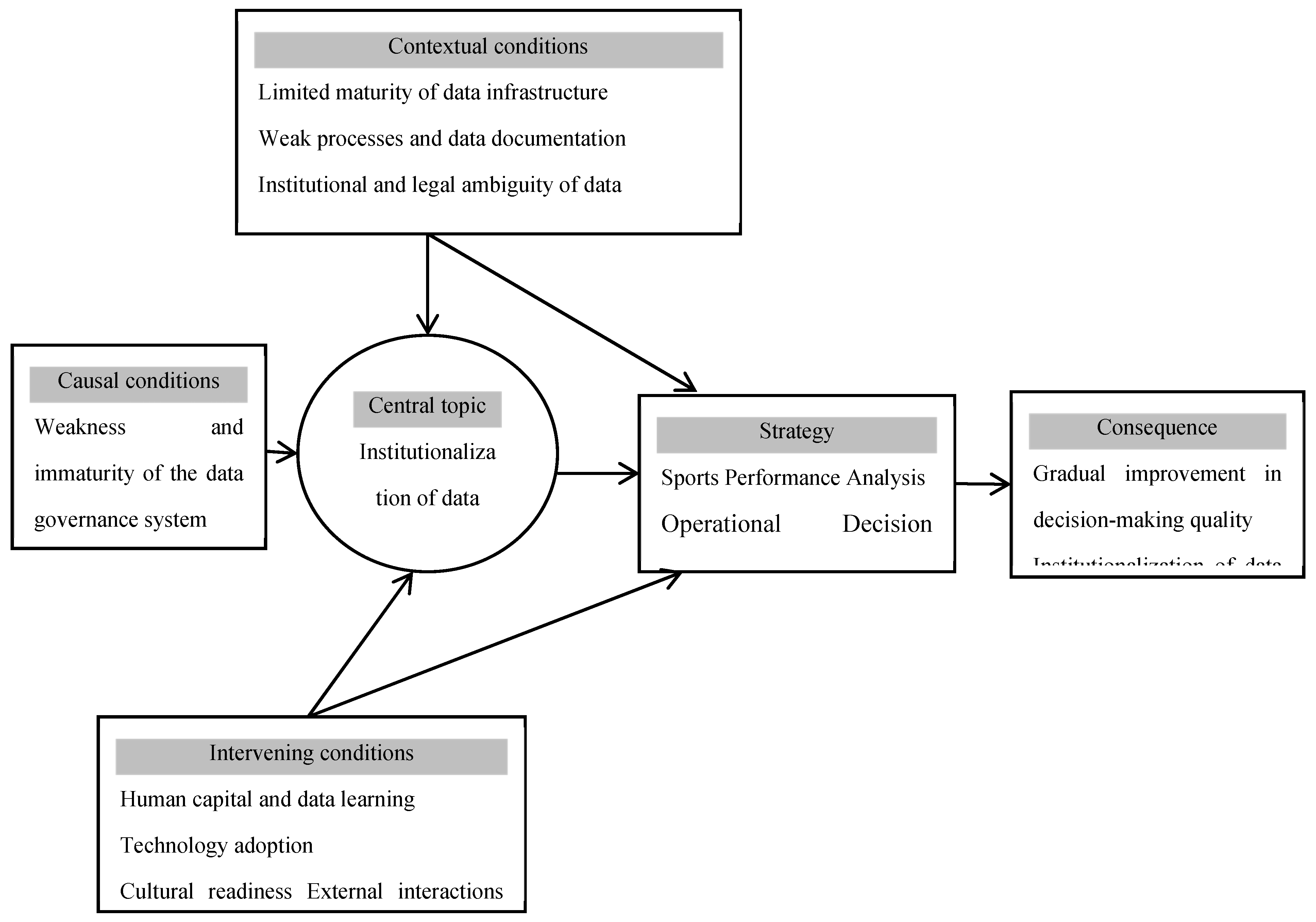
Table 2.
Demographic characteristics of the qualitative section.
| Demographic characteristics | Abundance | Percentage | |
| Gender | Man | 11 | 64.5 |
| Woman | 6 | 35.5 | |
|
Age |
less than 35 years | 4 | 24 |
| 35 to 45 years | 8 | 47 | |
| 45 years and more | 5 | 29 | |
|
Education |
Bachelor | 1 | 6 |
| Master's degree | 8 | 47 | |
| Ph.D | 8 | 47 | |
|
Field of study |
Sport Management | 6 | 35.5 |
| Information Technology | 6 | 35.5 | |
| Data Analytics | 5 | 29 | |
| Work history | 10 to 20 years | 11 | 64 |
| over 20 years old | 6 | 36 | |
Table 3.
Secondary codes and concepts.
| Categories | Concepts | Initial code |
|
|
Lack of a clear data leader Partial support of data by senior management Interest in data analysis by young managers Instability of management decisions Lack of data-driven vision Managers' individual desire for transparency |
|
No formal data policy No data ownership regulations Existence of informal data guidelines Uncertainty in responsibility for data decisions No data decision-making structure Split efforts to formulate policy |
|
|
Uncertainty in player data ownership Conflict between units Lack of definition of data owner Verbal agreements Legal concerns over data use Limited effort to clarify |
|
|
|
Incomplete training data Irregular recording of competition data Limited availability of reliable data Human error in data recording Lack of data quality control Individual efforts to correct data |
|
Lack of standard data recording unit Difference in data format between units Limited effort to standardize data Lack of common definitions of variables Data recording based on individual taste Existence of semi-standard templates |
|
|
|
Lack of central database Data storage on personal laptops Limited use of cloud space Limited access to secure server Attempt to consolidate data Reliance on simple storage tools |
|
Lack of connectivity between technical and medical systems Simultaneous use of multiple software Manual data transfer between systems Lack of integrated API Limited integration experiences Perceived need to connect systems | |
|
Extensive use of Excel Limited access to specialized software Limited video analysis tools Lack of complete management dashboard Limited successful experience with tools Need for localized tools | |
|
|
Lack of specialized data analysts Existence of self-taught data individuals Reliance on external consultants Interest of some employees in learning data Lack of data career path Limited internal analysis capabilities |
|
Lack of formal data analysis training Experiential learning of employees Short-term case studies Interest of young trainers in data Lack of competency development program Informal knowledge transfer |
|
|
|
Dominance of intuitive decision-making Limited trust in data Relaxation of data acceptance among younger generations Resistance from some experienced educators Use of data as a tool Gradual change in decision-makers' attitudes |
|
Positive attitude towards new technology Fear of the complexity of tools Demonstrative use of technology Limited successful experience with technology Tendency to simplify tools Gradual adoption of digital systems |
|
|
|
Lack of formal data workflow Manual execution of analysis steps Individual efforts to organize Lack of analysis scheduling Unwritten processes Perceived need for formal process |
|
Lack of analytical documentation Personal maintenance of files Limited documentation of projects Knowledge dependence on individuals Ad hoc efforts to record analyses Lack of analytical archiving |
|
|
Lack of data security policy Open access to sensitive data Concern about data disclosure Informal access control Limited awareness of privacy Personal trust in key individuals |
|
|
|
Limited technology budget Low priority of data in allocation Budget Project funding Cost-effectiveness of tools Tendency for low-cost solutions Maximum use of available resources |
|
Non-profit structure of the organization Dependence on upstream institutions Regulatory constraints Responsibility pressures Limited institutional opportunities Relative structural flexibility |
|
|
|
Descriptive performance analysis Lack of predictive analysis Limited use of indicators Focus on individual data Cross-sectional analyses Interest in deeper analysis |
|
Limited use of data in practice Delay in providing analysis Analysis-to-action gap Data use in crisis situations Selective reliance on analysis Incremental improvement of decisions |
|
|
Major decisions without data Data use for justification Lack of long-term analysis Managers' interest in evidence Limited analysis of transfers Changing view of data |
|
|
|
Limited technical-medical communication Irregular analysis meetings Informal transfer of information Person-centered collaboration Efforts for coordination More Need for interaction structure |
|
League competitive pressure Modeling successful clubs Data-driven performance comparison Motivation to improve competitive advantage Limited technological competition Learning from competitors' experience |
|
|
Interaction with universities Use of consultants Limited joint projects No long-term contract Incomplete knowledge transfer Desire to develop cooperation |
|
|
|
Relative improvement of decisions Increase in data awareness Limited transparency of decisions Reduce obvious errors Gradual trust in analysis Organizational experiential learning |
|
Gradual institutionalization of data Maturity of data governance Improvement of decision-making quality Sustainability of strategic decisions Increase in organizational accountability Gradual transformation of organizational culture |
Disclaimer/Publisher’s Note: The statements, opinions and data contained in all publications are solely those of the individual author(s) and contributor(s) and not of MDPI and/or the editor(s). MDPI and/or the editor(s) disclaim responsibility for any injury to people or property resulting from any ideas, methods, instructions or products referred to in the content. |
© 2026 by the authors. Licensee MDPI, Basel, Switzerland. This article is an open access article distributed under the terms and conditions of the Creative Commons Attribution (CC BY) license (http://creativecommons.org/licenses/by/4.0/).
Copyright: This open access article is published under a Creative Commons CC BY 4.0 license, which permit the free download, distribution, and reuse, provided that the author and preprint are cited in any reuse.


