
Submitted:
15 February 2026
Posted:
27 February 2026
You are already at the latest version
Abstract
This study explores how the Fes Medina's traditional courtyard house design has influenced urban form and has developed from its roots in the Andalusian and Islamic eras to a Westernized city in the 19th century. The study analyzes privacy, climate moderation, and socialization and poses the question of how courtyard houses of the city create the structure and hierarchy of the city. It employs a multi-scalar analysis, including a historical overview of the city, micro-scale spatial arrangements of individual houses, and meso-and-macro-scale mappings of the structure of neighbourhoods. The research shows that while individual courtyard houses agglomerate into dense fabrics in the three medinas to provide a seamless continuity between the private interiors and the public realm, they are also generative elements that provide evaporative cooling and cross-ventilation to improve thermal comfort and facilitate social order. The conclusion of this study is that the urban form of the Fes Medina reflects the socio-cultural and domestic values of the city, and it advocates for a re-evaluation of contemporary applications of courtyard house designs to address issues relating to privacy and environmental sustainability.
Keywords:
courtyard house
; urban design
; Fes
1. Introduction
The central courtyard is one of the elements used in different eras and geographies, especially in regions with hot climates. Islamic architecture has extensively utilized this technique, not only for its climatic role, but also as a means of providing privacy, This was clearly stated by Elizelle and Wim “Spaces, places and buildings are more than just props in people’s lives, they are imbued with meaning and resonance, as they symbolize people’s personal histories, interpersonal relationships, and shared events in people’s extended relationships, families, communities and wider culture” (Elizelle J Cilliers, Wim Timmermans, 2014). That was made courtyards an important element of Islamic architecture. Moroccan architecture has used this technique in a variety of buildings, including the Moroccan riad.
In old Medinas such as Fes and Marrakech, two historic Islamic cities, we find this type of architecture in abundance. Therefore, the riad is a powerful representation of buildings based on the central courtyard style. It represents a focal point for the building’s design, providing privacy and an internal outlet that regulates life within the home. It also embodies the values and principles upon which Islam is based, regarding women’s privacy and security.
Today, the riad has taken on many functions, with some repurposing it as a luxury hotel or restaurant based on tourism, reflecting the nature of Moroccan architecture. Riad and old Medinas still preserve spatial values, unlike contemporary house designs, which have increasingly pursued economic objectives far removed from spatial ones. Architecture faces numerous challenges, such as rising urban growth and climate change.
This research discusses the courtyard style in architecture and examines the Moroccan Riad in terms of its design and the concept behind it. By studying two cases from two different cities, Fes and Marrakech, a clearer understanding is gained by comparing the two.
This study aims to examine Riad strategies in terms of privacy, cooling, and spatial organization.
Figure 1.
(a) courtyard wisdom, (b) gridiron planning patternon.
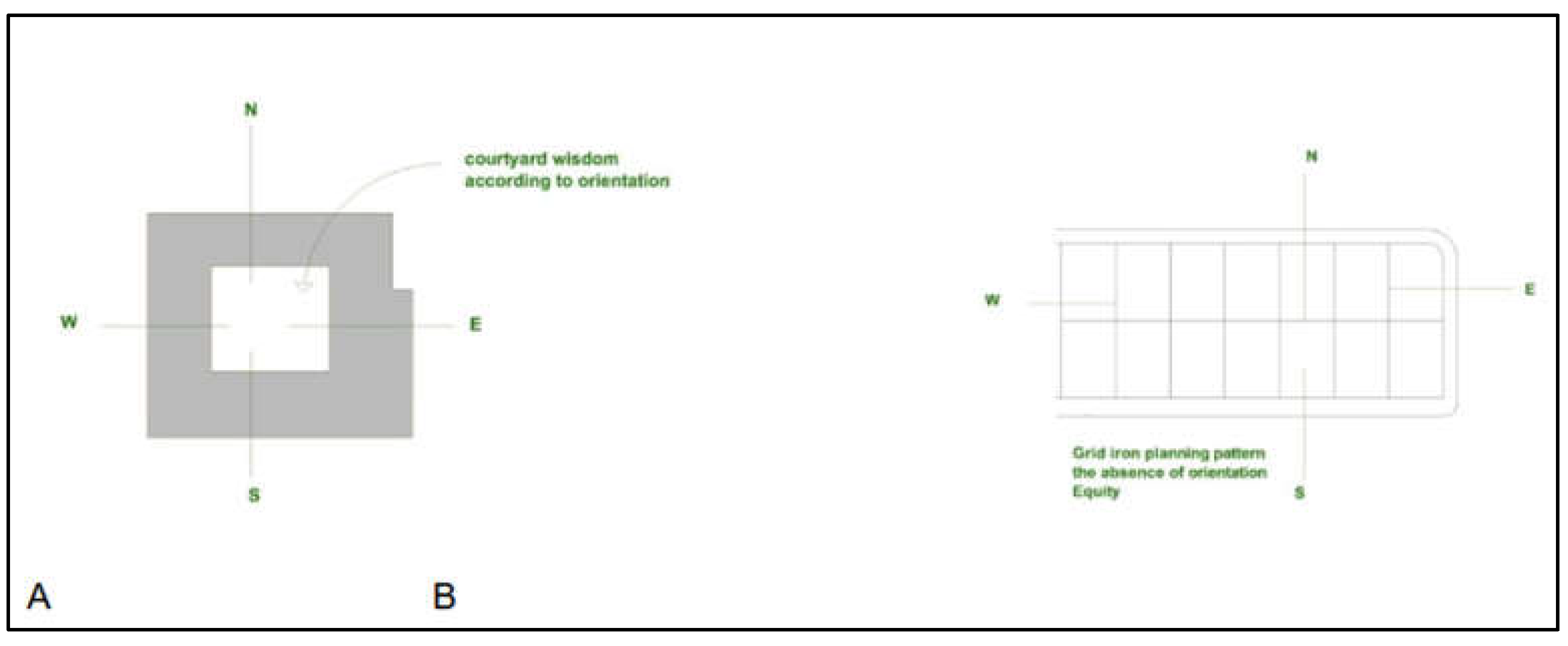
This study deals with one of the most widespread patterns in Islamic countries due to the hot and dry climate, where we find the courtyard pattern in a group of different buildings where the courtyard has floors mentioned in the following table.

Table 1.
Declares Basic Courtyard Function And Values.
| Function | Values |
|---|---|
| Religious | Transcendental issue, center |
| Environmental | Thermal comfort |
| Economical | Sustainable climatic adaptation |
| Social | Privacy, chance of meeting |
| Aesthetical | Inward looking, essence, details & colors |
1.1. Problematic and Research Question
Spatial organization and user privacy are among the most important topics of interest to architecture, with buildings that prioritize user needs and possess characteristics that are compatible with the environment. Morocco, with its climate and values, has relied on buildings that align with the aforementioned, including the riad.
This building relies on a central design, with each area of the house connected to a central courtyard. This was a smart solution to suit the hot climate, as well as the architectural values of Islamic architecture, which are based on privacy and urban living.The central courtyard came to integrate everything related to the interior and exterior design of the riad, distinguishing between public, private, and semi-private areas.
Moreover, contemporary buildings have come to rely on reducing space and utilizing all the latest technologies, disregarding privacy and environmental concerns. This historical shift away from traditional techniques has pushed architecture toward economical approaches, far removed from the values and principles related to user comfort and privacy. Lately seeing large complexes and modern buildings lacking any privacy for users, and even weak environmental protection and sustainability.
This research seeks to study and understand how Riad has addressed spatial organization and the potential for using the same ideas in modern buildings to create sustainability. The study is guided by the following questions:
- • How is privacy spatially expressed in the design of Moroccan riads?
- • How are the Fes and Marrakech courtyard typologies different in their functional applications, yet within a shared tradition?
- • What are the principles from riad architecture that can inform current housing design to improve privacy, climate control, and social interaction?
1.2. Methodology
This study is based on applied and theoretical studies. It also relies on a case study to better illustrate the research, examining one of the riads in the city of Fez as an illustration of the application of the central courtyard approach in Moroccan architecture. This study also draws on a range of literature related to the research topic, using various information from sites such as books, articles, and theses. The study also relies on practical experience with the topic. The studies also rely on a set of tables and diagrams created using digital programs such as Photoshop and AutoCAD, which are adapted to the topic and research context.
The study focuses on the courtyard style, which is widely used in a group of traditional Moroccan buildings, and on which we see the influence of Islamic architecture, especially the Moroccan riad, through an examination of its concept, spaces, and organization.
This study examines the case of one of Morocco’s oldest cities, the city of Fez, to provide an example of this type of building.
2. Literature Review
According to Suha Özkan, a Turkish architect, The idea of courtyards has remained a basis for building design since ancient times, since the Neolithic era, which was based on providing a safe area from wild animals. This style developed to be used positively in many regions and civilizations, and it has also become used as an environmental solution in many buildings. (Ozkan, 2006). This frame of reference is helpful to understand the historical background of courtyard typology that played an interesting role in architectural history, so the main objectif of this research to analyse and study this typology in term of architecture.
Suha Özkan investigates the courtyard as an integral part of the house plan in Morocco and other Islamic countries. It has become an integral part of architecture in hot and dry environments and forms the basis of the urban pattern in cities in the Islamic world. In addition to its climatic and functional efficiency, its cultural significance is equally significant. One of the most important characteristics of Islamic architecture is preserving the privacy of the resident, and creating a space that creates greater privacy for women. The courtyard style is like a space that connects the resident to nature and preserves his privacy with the presence of a green space, plants, and sometimes trees to preserve the environment of the residence and create life inside the house.
Figure 2.
Courtyard houses in Agadir, Morocco, by François Zevaco.
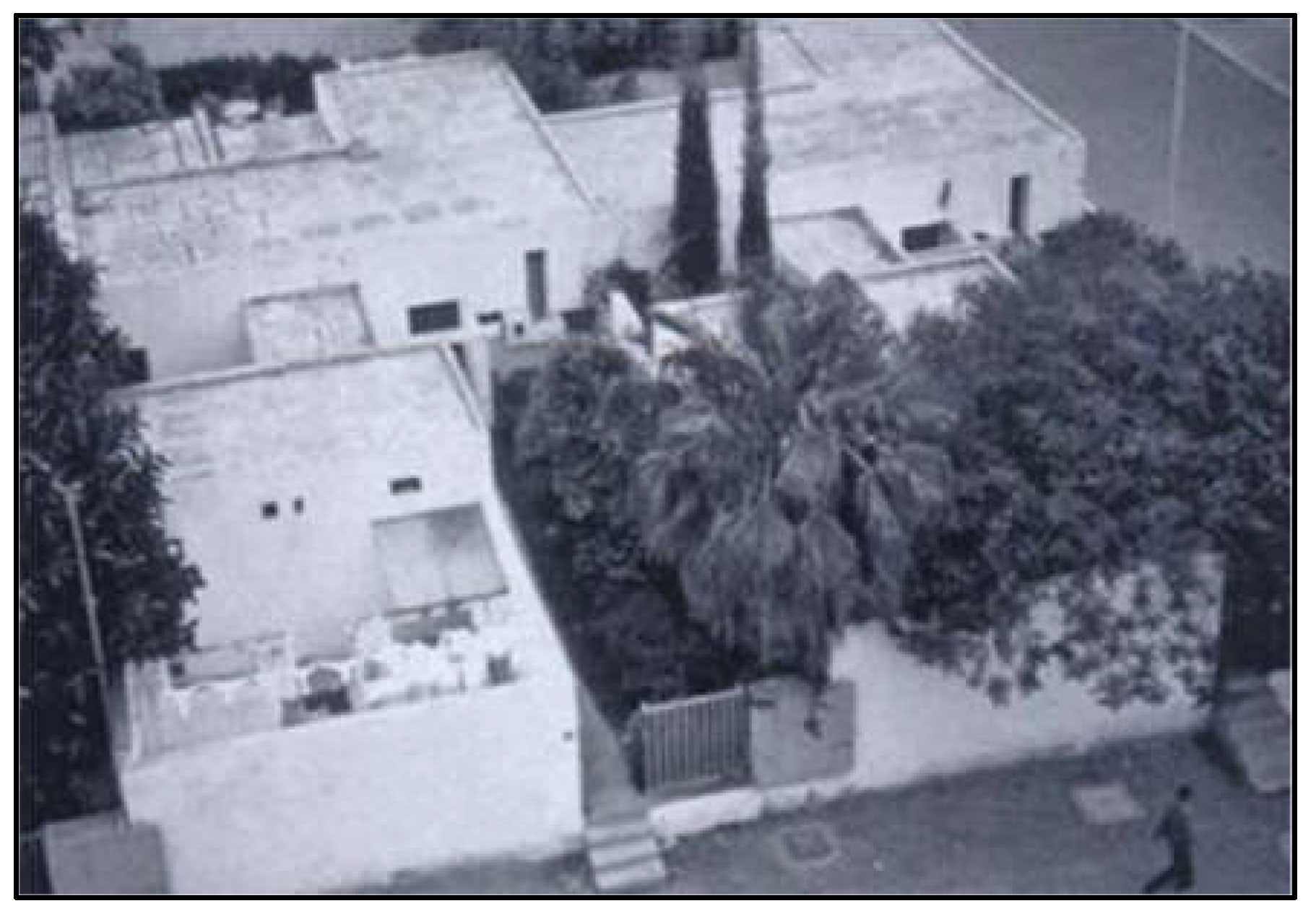
The author discusses the houses of François Zevaco, houses with courtyards designed for the victims of the famous Moroccan earthquake in the city of Agadir. The architect tried to create an easily accessible space by giving life to the residents inside the house through the open courtyard. The idea comes from old palaces that cared about the safety of the residents and provided them with a private area that was easy to access, with the addition of nature. It also provides a clean environment and a moderate climate that maintains the quality of life. The courtyard will remain an important part for designers, enabling you to connect history with the present.
Figure 3.
Tuwaig Palace in Riyadh, Saudi Arabia, by Basem Shihabi and Nabil Fanous.
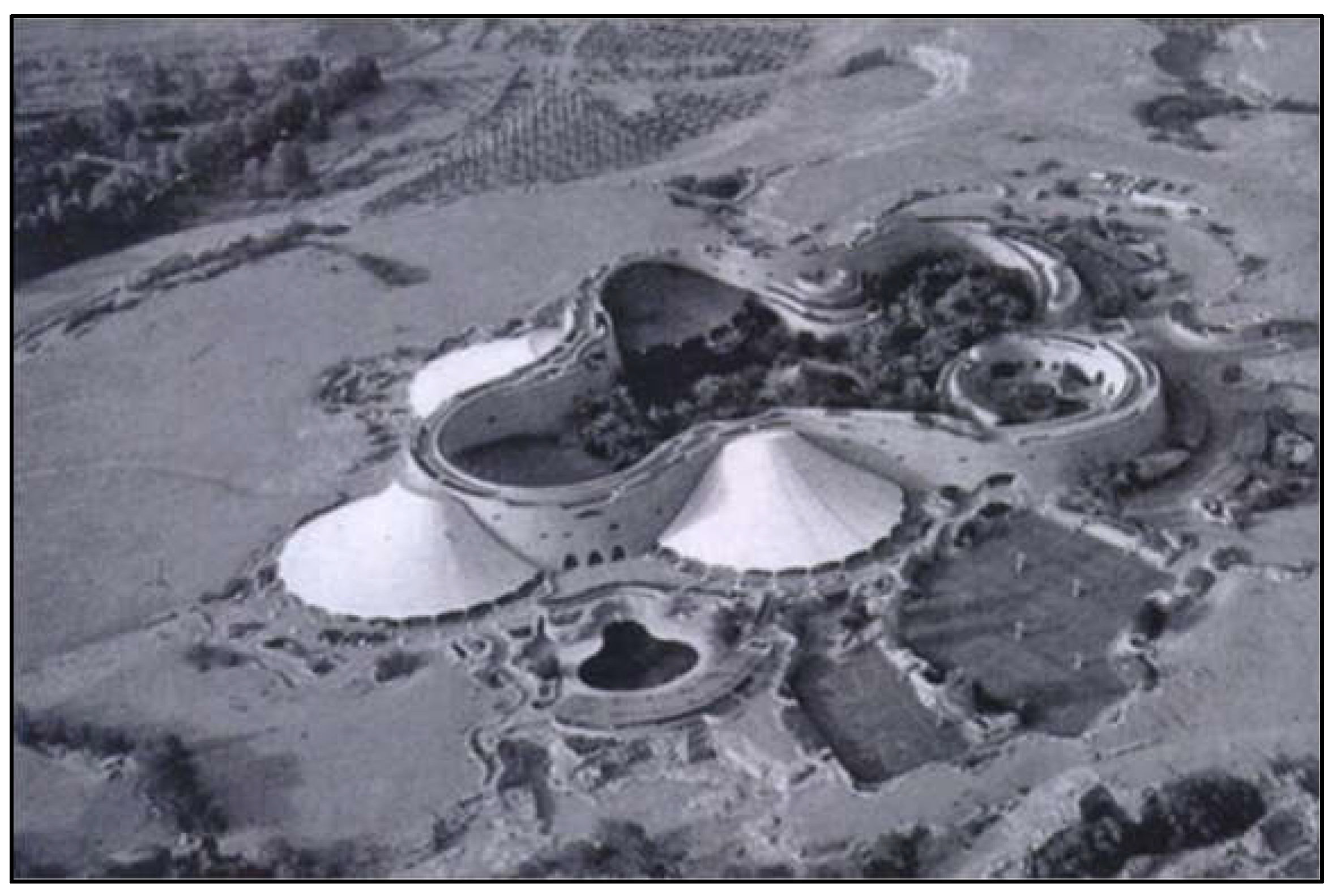
The concept of privacy and harmony in residential construction are two fundamentals of Islamic architecture, especially in the Riyadh style. The design creates creativity for the user and the outdoor space in terms of creating a space that can be used through creating a community through public, private and semi-private spaces, where the resident has the opportunity to create a social life within a private life and also not to connect with nature through his space outside, however, the way of living directly affects how the specialist understands the cultural concepts of privacy, environmental adaptation and society.
3. Courtyard as an Architectural Typology
3.1. Courtyard Origins and International Interpretations
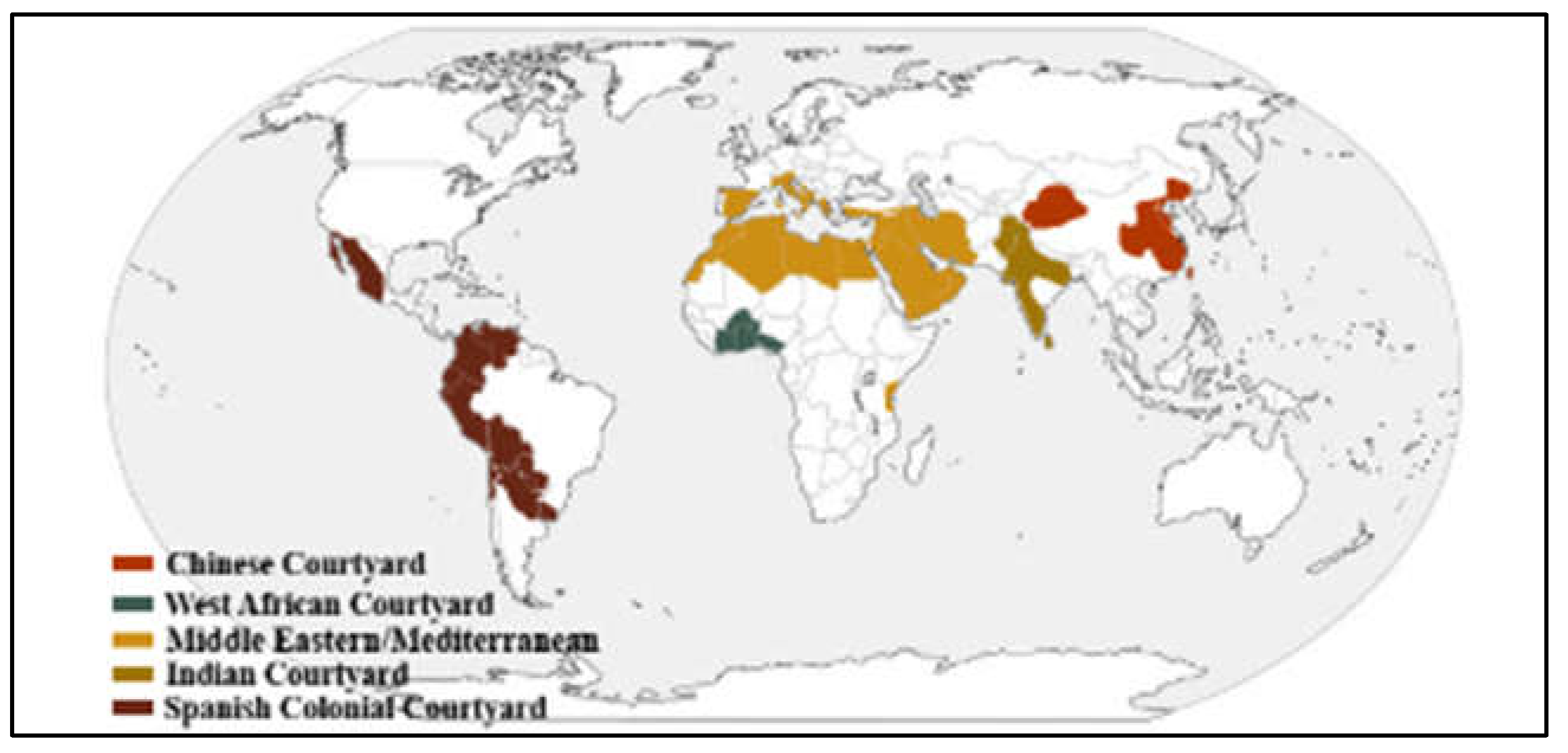
Humans, by nature, seek safety and tranquility. They seek a close area that connects them to nature and provides privacy. This logic is the courtyard (Blaser, 1985). These types of buildings with courtyards have spread throughout the world and are widely used across cultures, providing residents with a peaceful life and a pleasant environment that fulfills their basic needs. Housing design is supposed to provide for our basic human needs (Maslow, 1970). Roderick J. Lawrence, in his book “Housing: Dwellings and Houses” (1970), stated that homes and their design must follow a social, cultural, and psychological study of the environment. This study enables us to understand the foundations upon which design should be based
Figure 4.
Distribution of Courtyards in the World.
3.2. Use of Courtyard in Climate, Light, and Ventilation
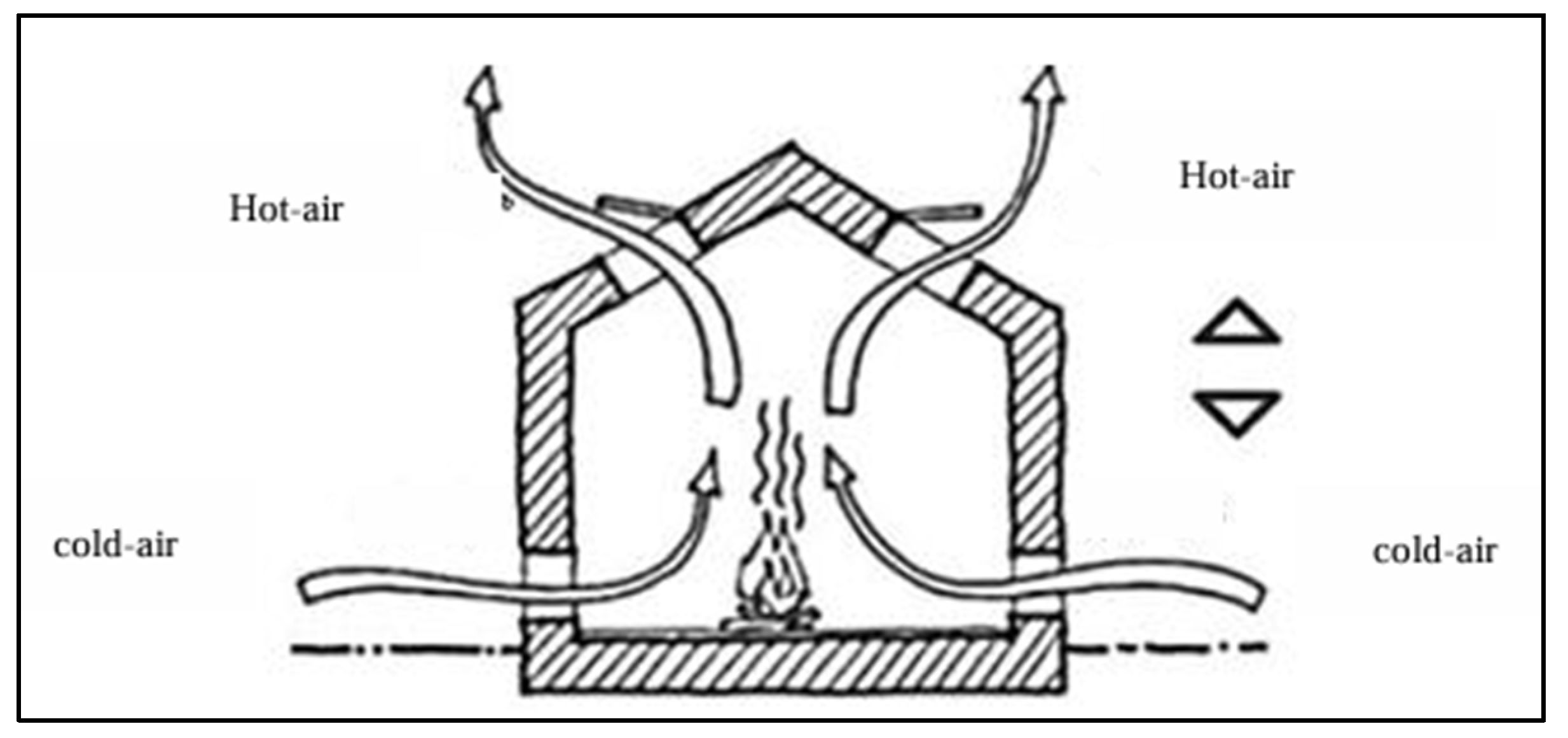
The courtyard is the center of the design and a source of natural light, temperature moderation, and air renewal. In the evening, warm air rises due to direct sunlight and warm walls, and is replaced by cool air from above, where it enters the courtyard and seeps into the surrounding interior spaces. The process is reversed, as shown in Figure 5 and Figure 6. The surrounding walls help provide shade for the courtyard, which helps its air slowly gain and lose heat. This helps provide the longest period of cooling during the day. Scientific studies have proven that the courtyard is clearly important for humans in terms of air renewal and eliminating stale air. Sunlight kills bacteria and germs and disinfects the interior of the spaces. Changing lighting levels, shadows, and viewing angles stimulate the user’s attention centers and maintains their IQ.
3.3. Social and Cultural Roles of Courtyards
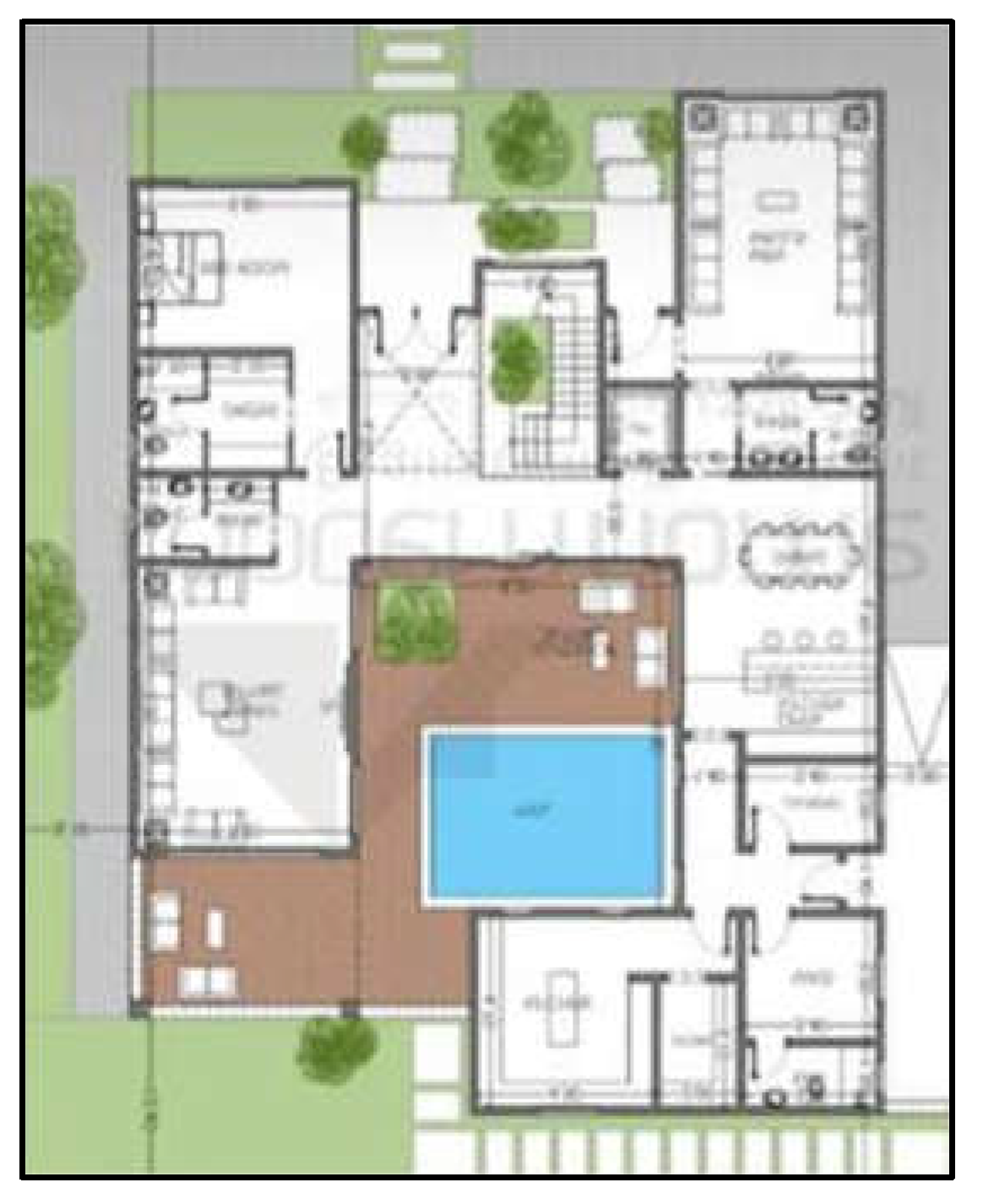
One of the most important features of the inner courtyard is the consideration of privacy and the feeling of security and safety. We find that providing opportunities for children to play and play inside the inner courtyard gives the child a feeling of security and complete freedom to spend a fun time without fear and anxiety compared to playing in the outer courtyard, as in Figure 7. Also, the presence of a swimming pool in the inner courtyard allows women the freedom to practice swimming freely, as it is appropriate for the culture of our Arab societies, as in Figure 8.
Figure 7.
An interior courtyard designed by architect Meirav Galan.
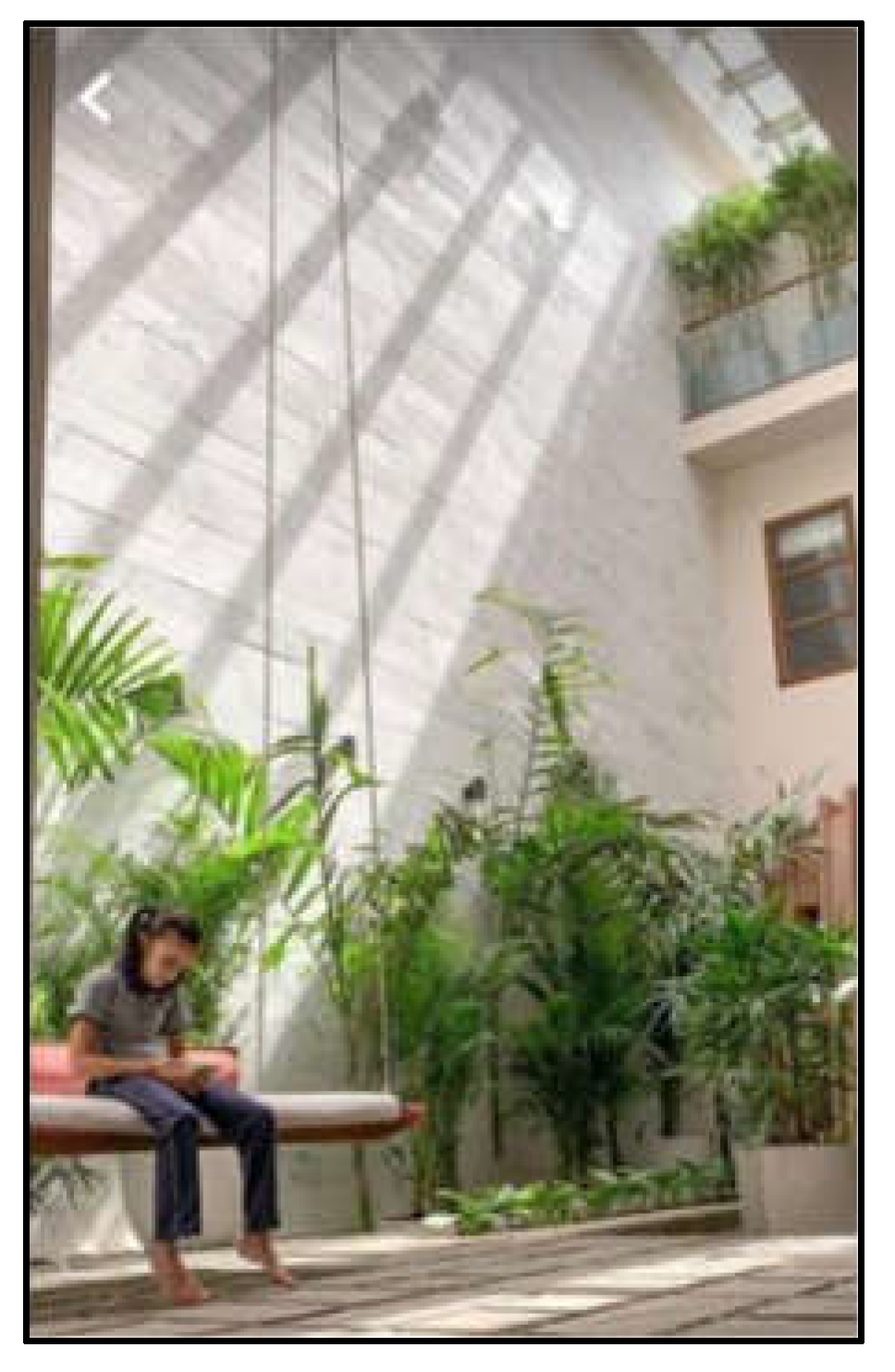
Figure 8.
Horizontal view of Horizontal view of an internal courtyard of a residential.
3.4. Courtyards in Islamic and North African Contexts
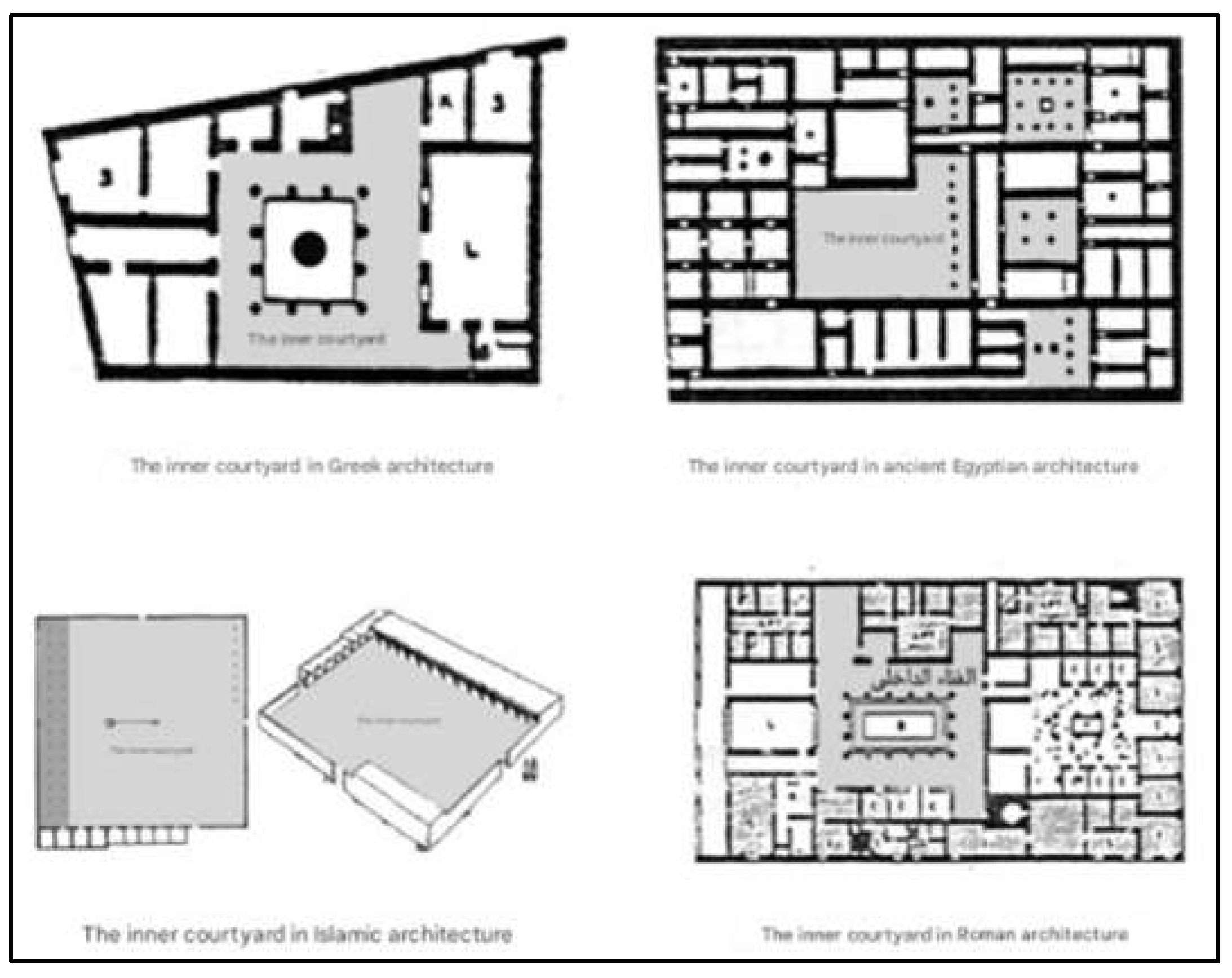
The courtyard has appeared in many forms, treatments and names in ancient civilizations since prehistoric times, from one era to another, and its design and the design of the internal and semi-internal spaces surrounding it, such as the iwan, the takhtabush and the majd, have evolved, as shown in Figure 9. Since ancient times, the design of the dwelling has been linked to the idea of the internal courtyard, as man has been closely linked to the sky in the Arab countries. He considered it the compassionate face of nature. The land around him represented nothing but a barren desert, disturbing him with its sand and dry winds. He was trying to bring the purity and sanctity of the sky into his dwelling and shut out the desert. His means of achieving this concept was the inner courtyard. We find that the dwelling was surrounded by solid, windowless walls, while all its rooms overlooked the interior of a courtyard from which nothing could be seen but the sky. The courtyard became more than just a means of privacy and protection for him. He therefore considered the courtyard a source of peace within the dwelling. Below, we will discuss some examples of inner courtyards throughout history.
A-In ancient Egyptian architecture: The inner courtyard appeared during the Old Kingdom in the symmetrical homes of villagers. During the Middle Kingdom, it was found in large residences and was surrounded by four wings (the master’s wing, the living room wing, the servants’ wing, and the kitchen and storage room wing).
B-In Greek and Roman architecture: Inner courtyards appeared in Greek civilization as essential elements in the planning and architecture of its cities and were of utmost importance. People placed statues of their gods in them and exercised in them to build a harmonious body, in addition to their climatic role. Two types of inner courtyards were available: the first was the courtyard surrounded by columns, as in Figure 9, and the second was the distinctive floor plan with a rectangular reception hall preceded by an entrance supported by two columns. The entrance opened onto the inner courtyard (Pompeii), which was located in the middle of the house. The inner courtyard surrounded by columns appeared in Roman architecture in the city of Pompeii, with rooms arranged around it in an ideal manner. The courtyard became the main center around which all family activities took place, and it was distinguished by the presence of gardens and water fountains.
Figure 9.
The inner courtyard as a major design determinant throughout.
C-In Islamic architecture in Egypt: The inner courtyard acquired a new dimension and special attention, which led to its association with the Arab-Islamic civilization. It has been proven that the inner courtyard is one of the important elements used in most religious and civil architecture throughout the Arab world, despite the differences in values and social, religious, and cultural influences. This demonstrates its success as an architectural solution that fulfills the various functional needs of Islamic residential designs. The Prophet’s house and mosque (peace be upon him) are considered the first to have an inner courtyard. The courtyard was defined by its walls and the rooms built on one side of it, opening onto it. The inner courtyard appeared primarily in the residences of the Fatimid and Mamluk eras, but it distinguished itself in the Ottoman era, as some new architectural elements were introduced that open completely onto the inner courtyard. These include the “takhtabush,” designated for receiving visitors on the ground floor, as well as the seat designated for the owner of the house and his guests to benefit from the cool northern breeze, in addition to Protecting it from the sun’s rays and overlooking the shady courtyard garden is an important example of houses with an inner courtyard in Islamic architecture in Egypt. For example, the House of Zainab Khatun (1125 AH - 1713 AD) has a rectangular inner courtyard. In its southwestern corner, there is a staircase leading to the seat. The ground floor storerooms, as well as the windows of the harem and the staircase, open onto the inner courtyard. In this house, the courtyard is considered the heart and axis of the house, around which the various elements of the house are distributed. As for the House of Al-Kirdilya (1041 AH - 1631 AD), it has an inner courtyard that is almost trapezoidal in shape. It is made of white marble and has an octagonal shape, furnished with geometric decorative units. It is surrounded by a basin of tiles, with a colored fountain in the middle, reflecting the clear blue sky in the morning and the face of the moon at night. All the floors and halls of the house open onto the inner courtyard. Al-Suhaymi House (1211 AH - 1769 AD) has two courtyards - the first is rectangular, centered in the middle of the house and surrounded by a garden with a fountain. It opens onto the courtyard, which houses the sitting area, entrances to the storerooms, and a corridor leading to the second courtyard. It is large and contains elements serving the house, such as the waterwheel that supplies water to the residents and the mill that grinds the grain. This house is distinguished by the presence of mashrabiyas overlooking the inner courtyard, providing sensory and visual pleasure to the viewer and also serving the climatic conditions. The width and narrowness of the architectural openings in the mashrabiyas are linked to the level of the human eye, as these openings narrow at eye level and widen upwards.
Although the inner courtyard suffered from a weakness in its architectural vocabulary during some eras, it has proven its social role. It reflects the character of the era, as in the picture (an architectural crucible for the elements of light, air, and others). With the development of architectural culture, buildings became multi-story, making it difficult to have an inner courtyard due to the use of the central space in the building for vertical transportation (elevators). The courtyard became a shared area between buildings, taking the shape of the letter U. However, it lost its status for a long time until it was revived again in green, sustainable, and smart architecture to achieve thermal comfort without paying attention to the aforementioned aspects. With this, the formation of the courtyard changed, becoming an additional external façade composed of metal mesh partitions that provide privacy and shade for the inner façade that reflects inward. Its formation evolved from its symbolic and ideological concept to the environmental concept with the aim of providing thermal comfort within the spaces surrounding it. Then, in our current era, it evolved into a covered courtyard, or one equipped with glass windows that allow natural.
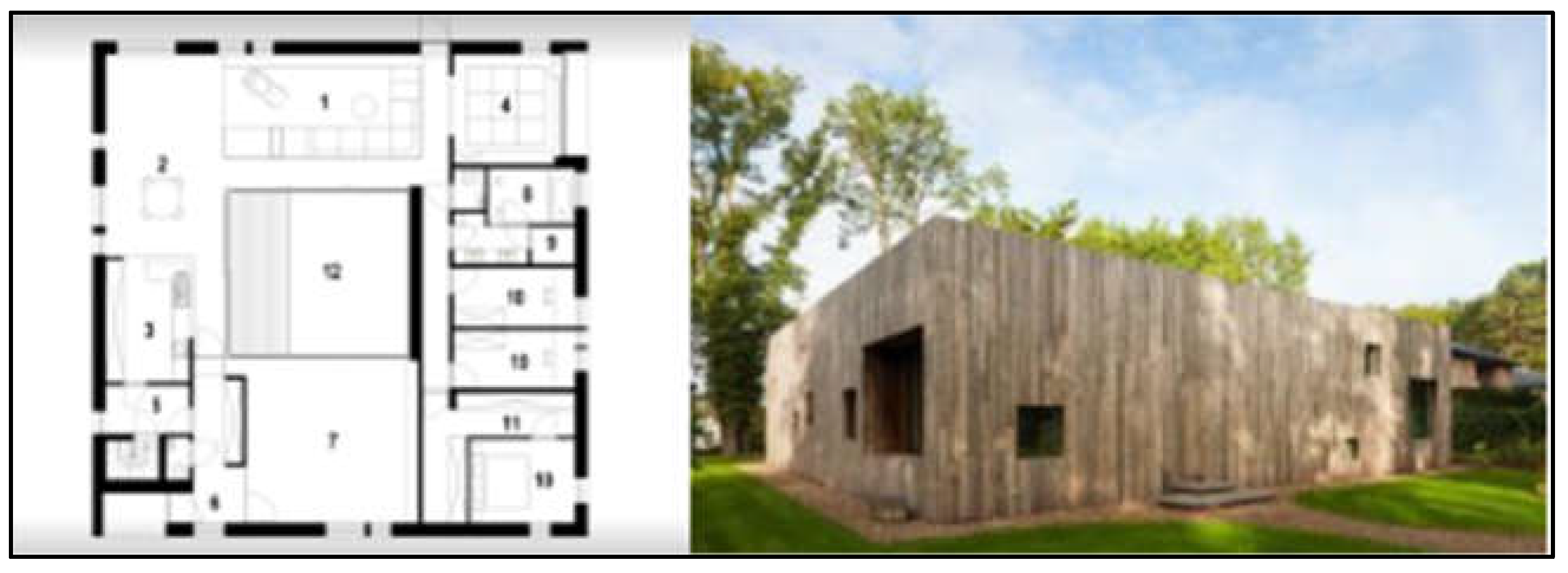
Figure 10.
A model of a residential unit demonstrating the design’s emphasis on the interior courtyard.
Figure 10.
A model of a residential unit demonstrating the design’s emphasis on the interior courtyard.
4. Riad Architecture in Morocco
4.1. The Riad as a Model of Housing
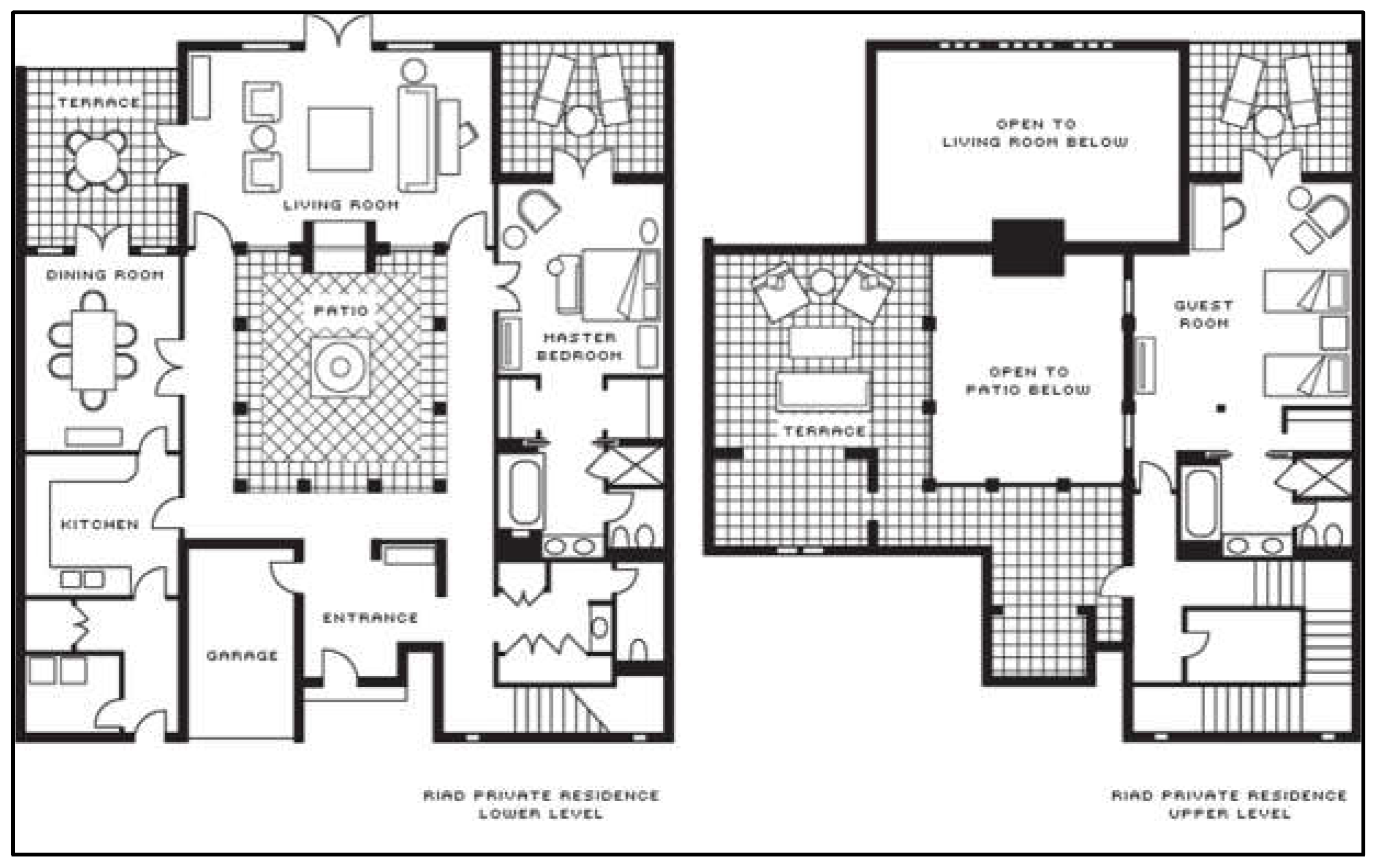
The Moroccan riad represents one of the most luxurious examples of Islamic architecture within the Moroccan country, as it is one of the forms of traditional housing characterized by a central courtyard around which the rooms shine, as it is a garden full of plants and trees and a water element in the middle of that courtyards, as this represents a point of multiple living and moderate temperature within the house, so all the spaces , room are around that courtyard which connects everything together so it can be easier to access.
Figure 11.
Moroccan Riad plan example.
4.2. Urban Context of Medina in Fes
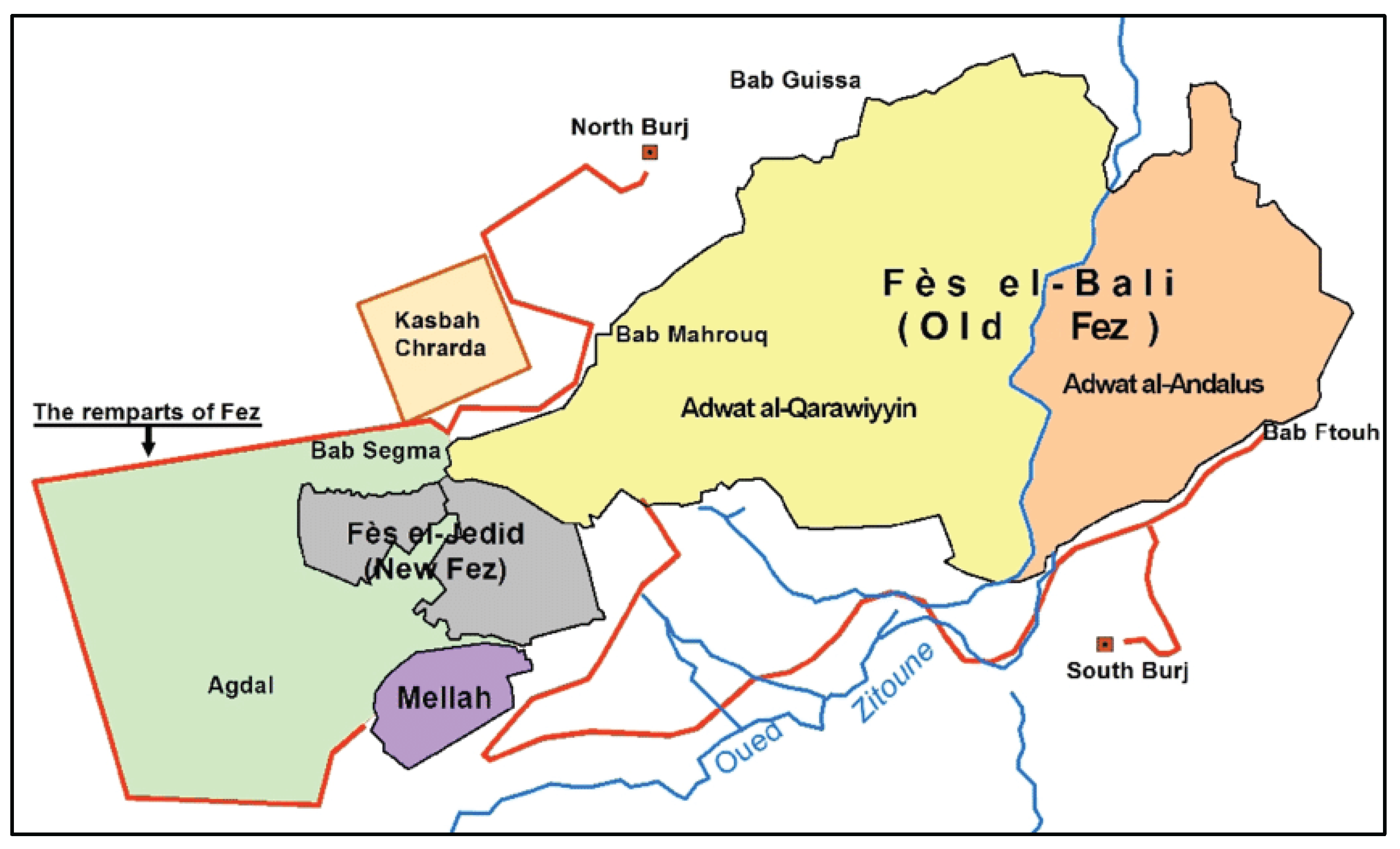
Fez is one of Morocco’s oldest cities, home to diverse civilizations. It has two ancient cities, the most famous and largest of which is Fez El-Bali, which is more complex than Fez Jdid.
Fez is characterized by traditional urban planning, the most important of which is the organic design of the areas, with many historic buildings made from natural materials, and narrow streets that were characterized by trade at the time. Over time, during the French and Spanish occupations before that, some European styles appeared in these ancient cities.
Houses are made of mud with few windows to provide privacy for women, and high walls provide shade in the morning to keep pedestrians cool. Meanwhile, the lack of roads sufficient for vehicles preserves the environment of this ancient city. (Bain-bridge, Bing, Ranger, & Clammer, 2011). The Medina offers a traditional living experience through the merchants and the weaving for which the region is famous, as well as the roads, the last of which are distinguished by the presence of mosques, which shows the influence of Islam on the region.
Figure 12.
Fes old Medina.
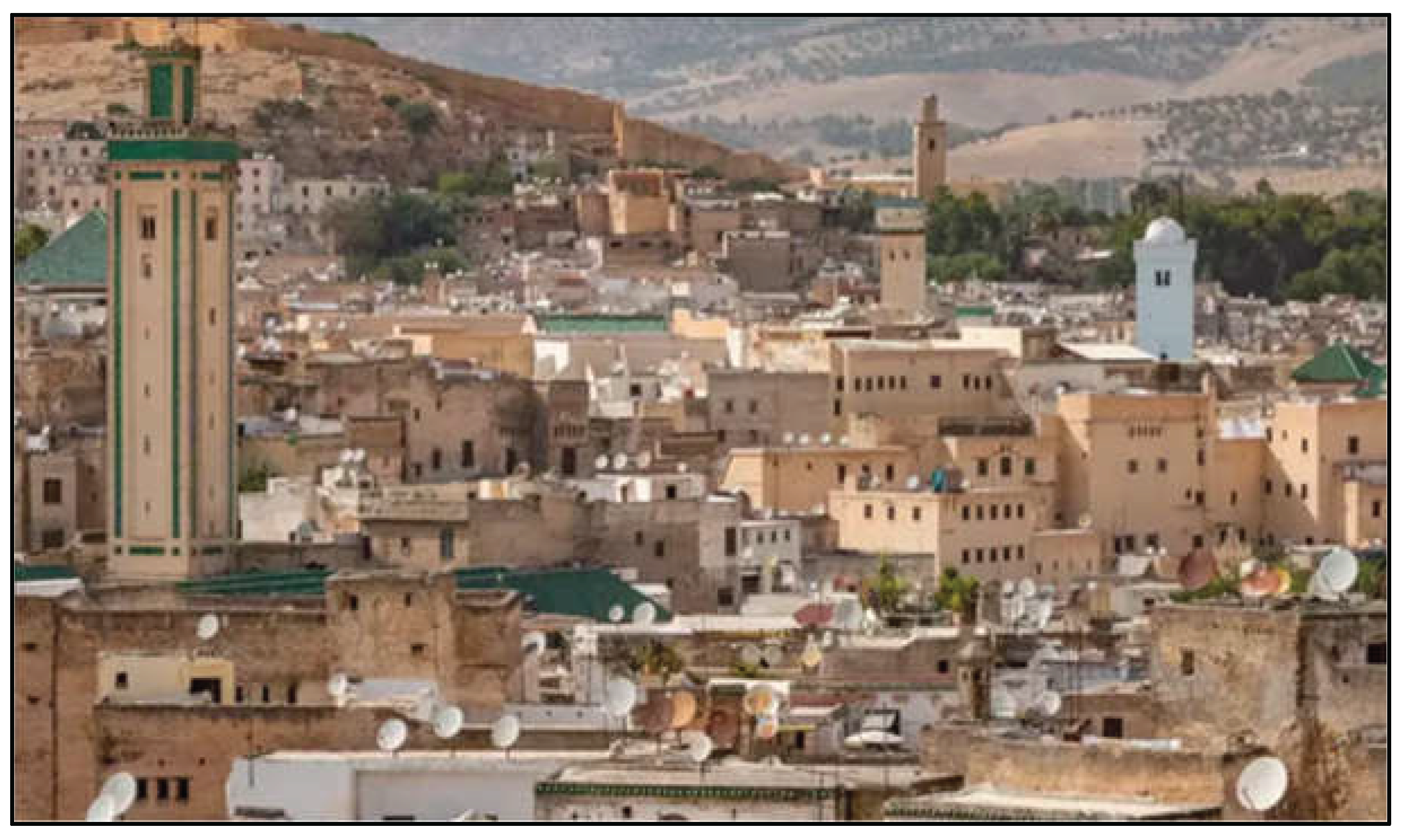
Figure 13.
The old city of Fez with main districts.
4.3. Spatial Organization of the Riad
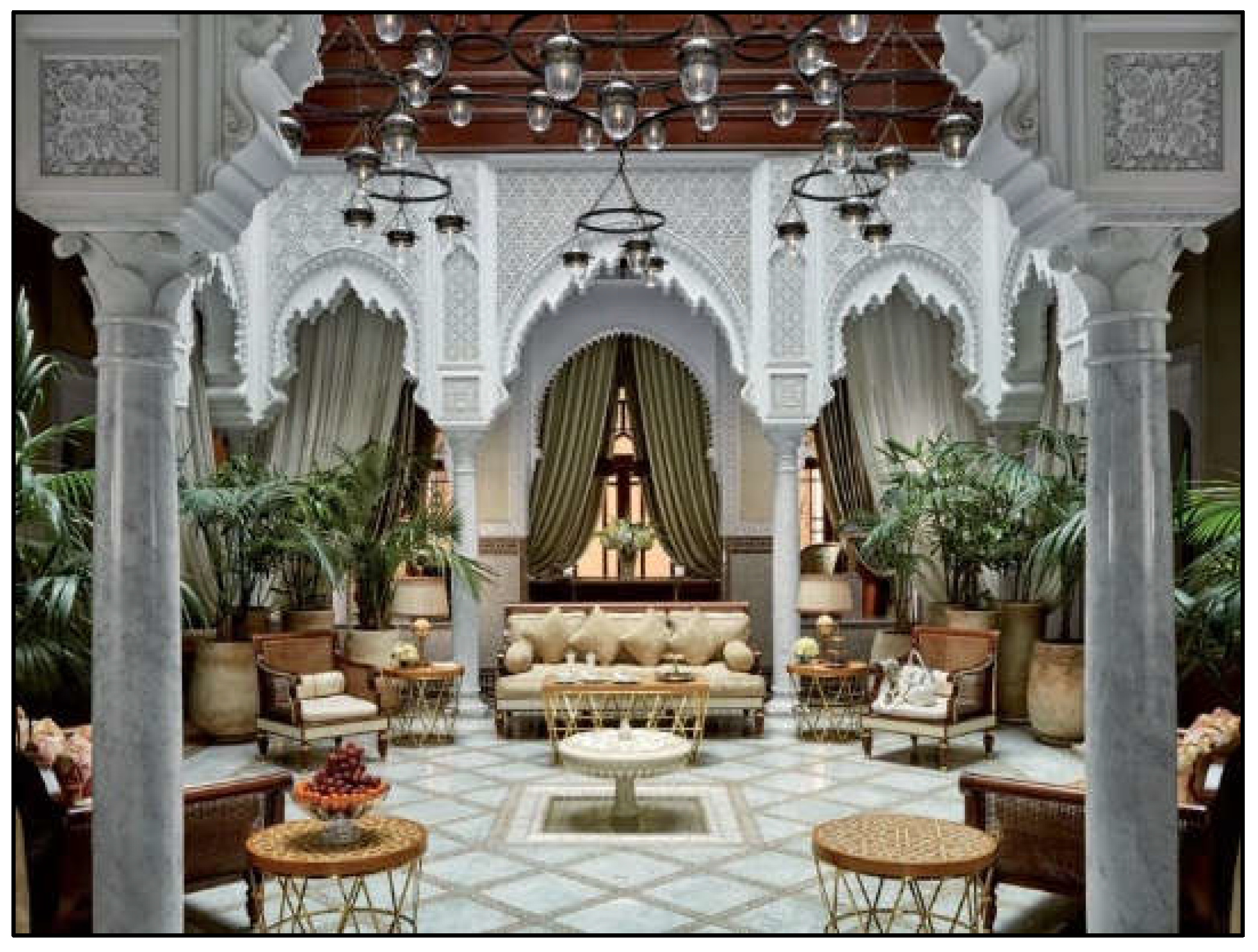
Moroccan riads are unique in their spatial organization. The design features a central courtyard with a water feature in the middle, surrounded by greenery. All rooms are located around this courtyard. The primary goal is to provide privacy. Therefore, the ground floor spaces are more for public use, while the first floor is organized for private spaces such as bedrooms.
Figure 14.
Riad courtyard.
5. Case Study : Riad Al Bartal in Fes
5.1. Choice Reason and Context
The old Medina of Fez has a large group of Moroccan riads, some of which have become hotels to stimulate tourism and the economy in the old Medina. My choice of Riad Al Bartal was due to the display of some of the developments related to these buildings through its function, the idea of which is to promote Moroccan culture and heritage through the use of decorations,sculptures and Zelij tiles used in the project and everything that is from the heritage of the luxurious Moroccan old buildings.
5.2. Spatial Configuration and Courtyard Layout
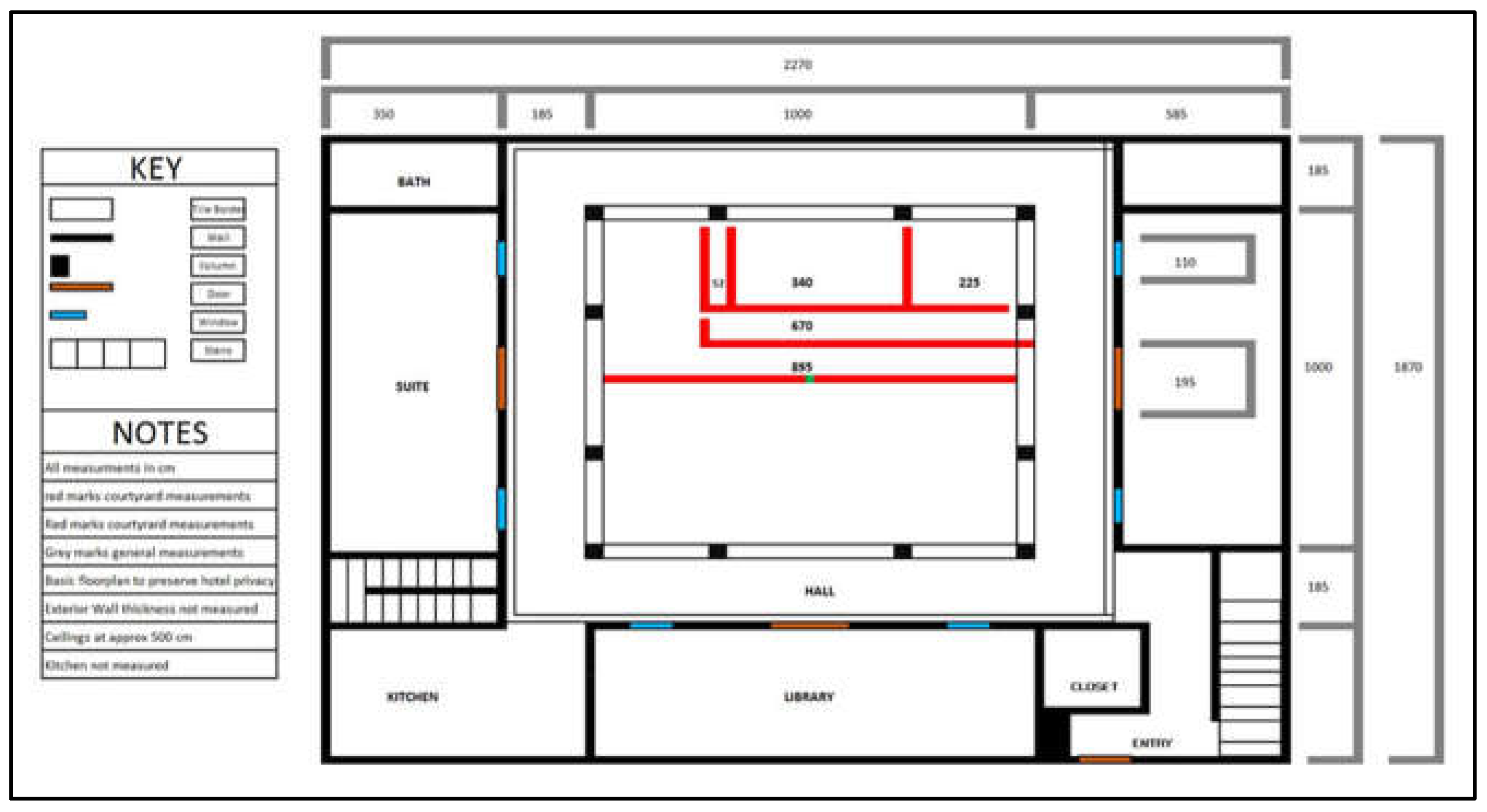
This riad features the usual central courtyard with additions that match its new function as a hotel for bedrooms and public areas such as a library, kitchen, and seating areas adjacent to the courtyard. This makes it a wonderful space for the tourists to enjoy, with sunlight from above, greenery surrounding them, and water features.
Figure 15.
Riad Al Bartal – Ground Floor measurements.
With many different colored lights making the whole experience around the courtyard.
Figure 16.
Riad Al Bartal Lighting Diagram .
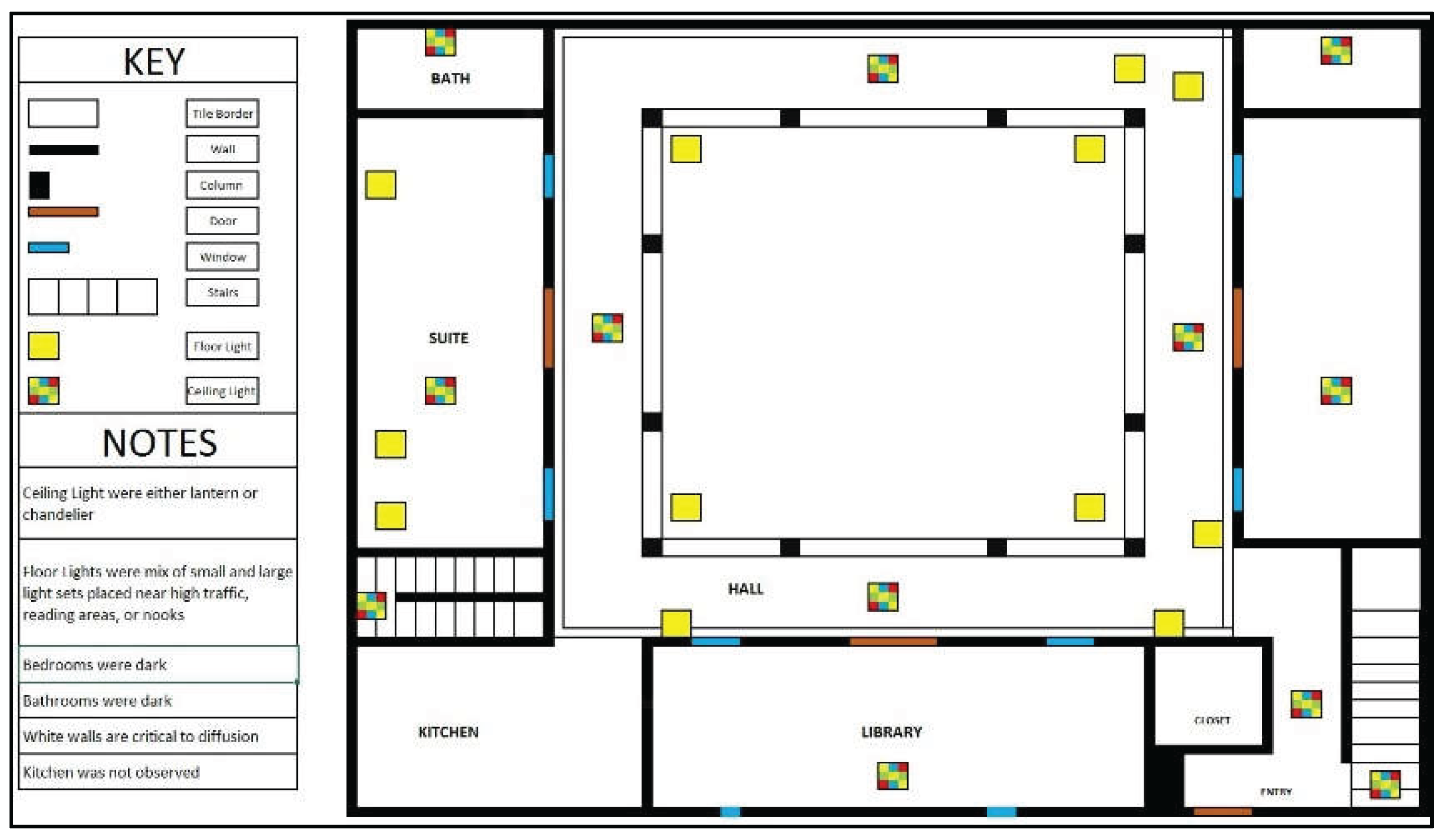
Figure 17.
Riad Al Bartal courtyard.
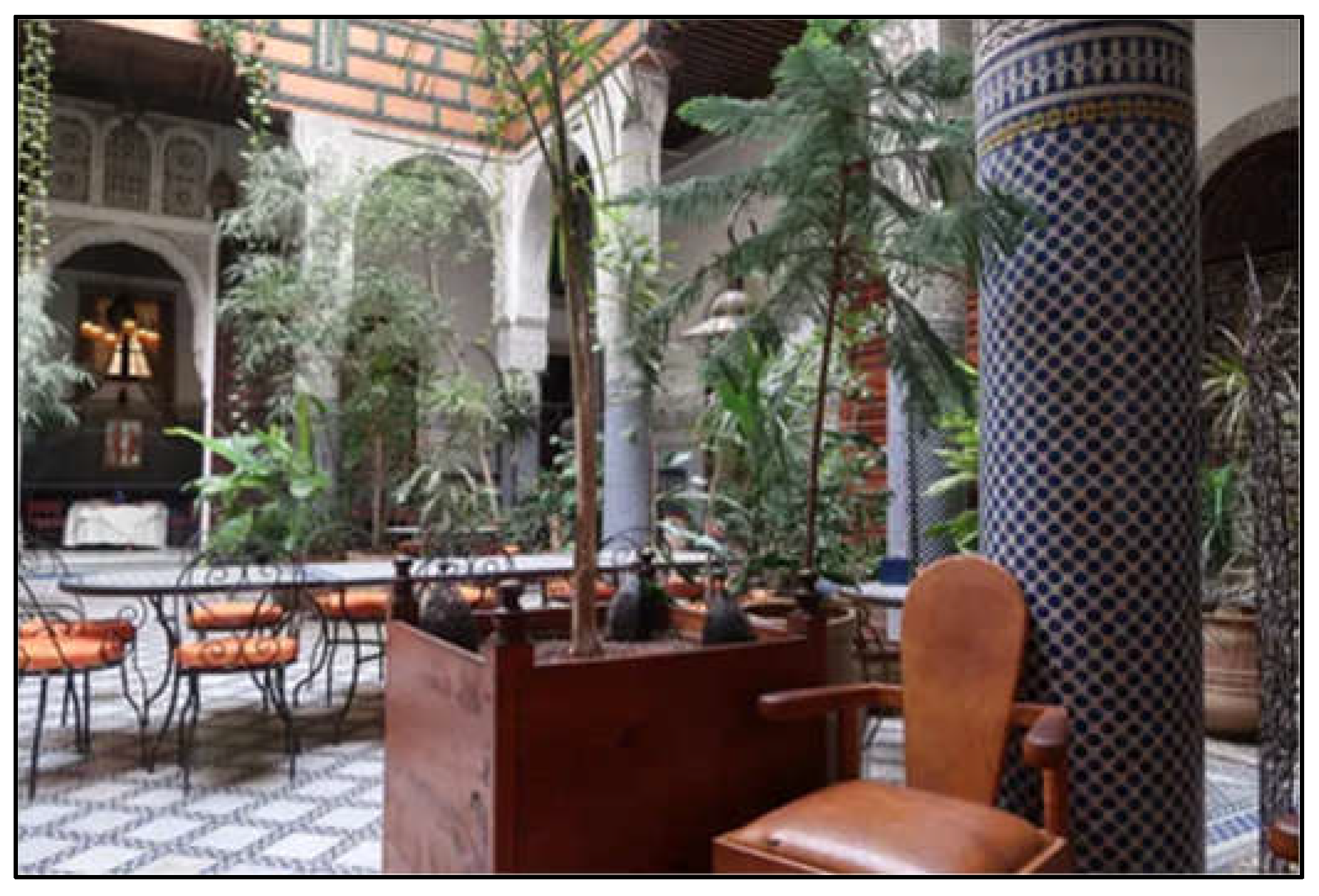
Figure 18.
design concept diagram .
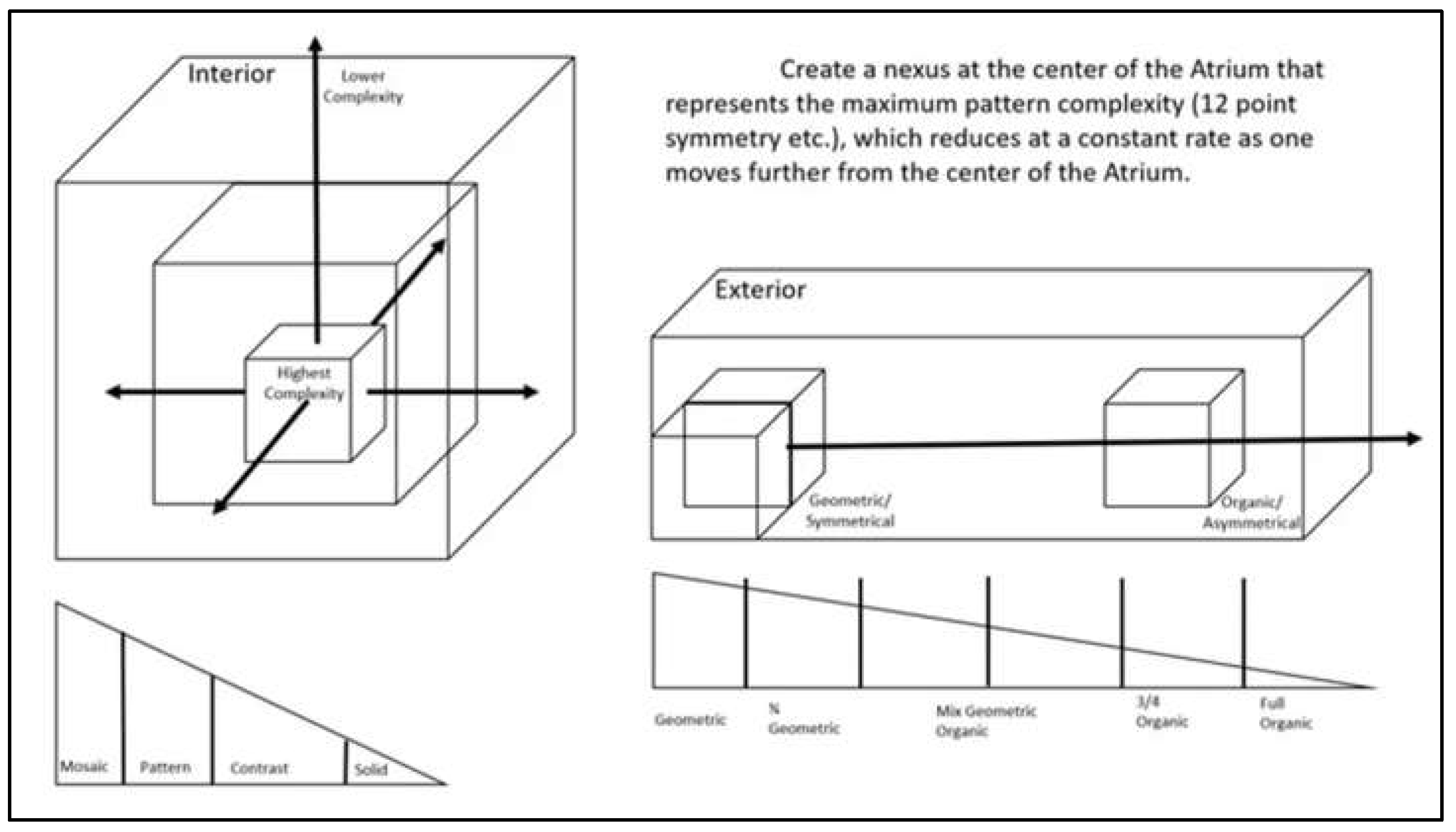
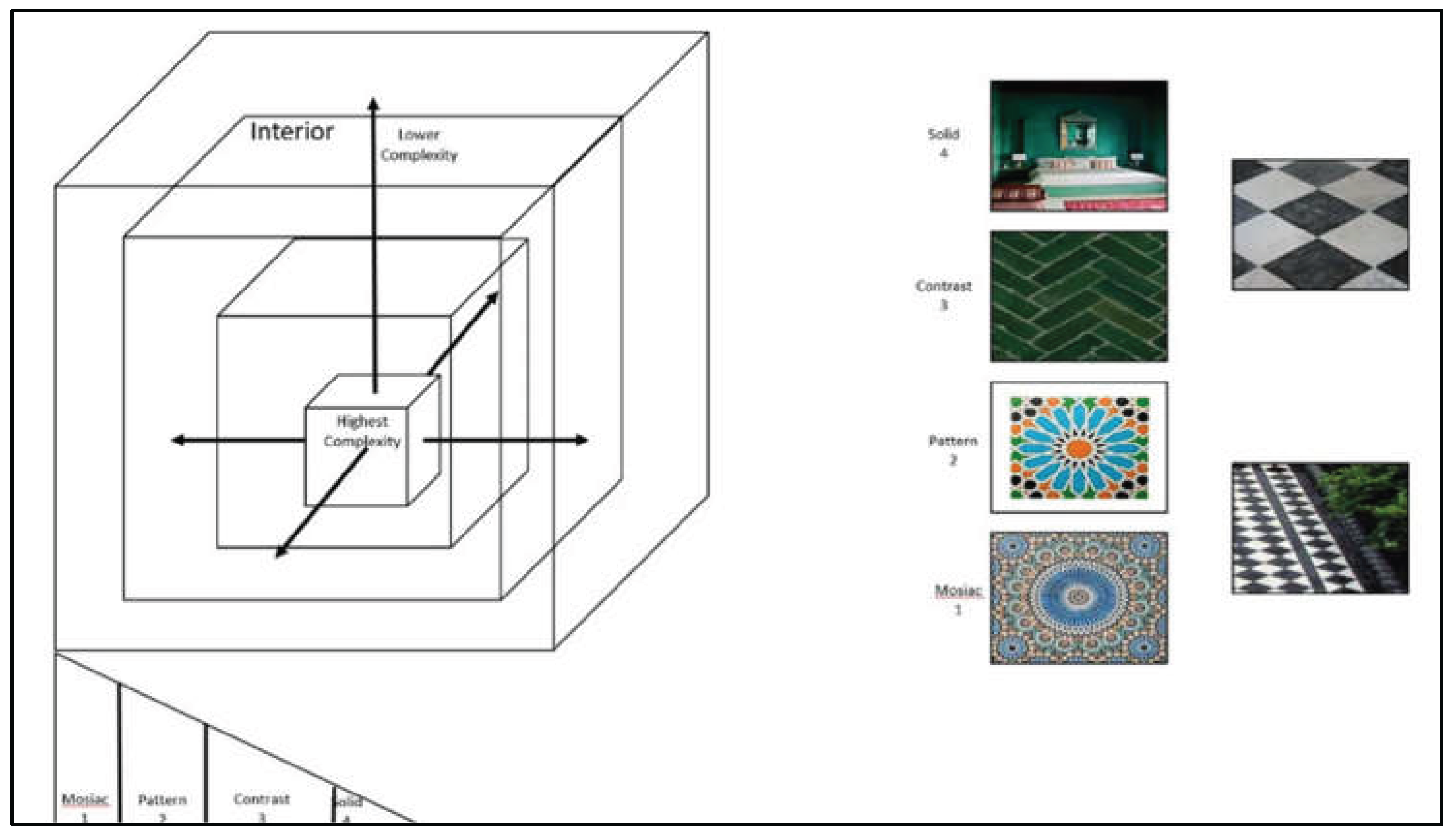
Moroccan heritage related to buildings has several parts related to interior and exterior design, through the use of zelij for floors in various shapes and colors in different places to create a traditional atmosphere inside the riad, and through the decorations on the walls and Moroccan arches, as well as the use of natural materials through the wooden windows and doors, which creates a natural environment inside it.
Figure 19.
Interior design concept.
6. Conclusion
The courtyard is one of the most important designs that humans have reached in architecture, through its many roles, which are represented in its human, psychological, social and even environmental role, and this is what made it widely spread on the global level, and we still see it in many examples in new architecture in new forms that are different from its previous concept in terms of privacy, and this is what we conclude through research, which is that the idea of it is to provide privacy and comfort for residents, as it has a psychological aspect through communication with nature, and this is what we saw in old designs, and even its environmental role on the climate, which will not be less important as a solution to many of the environmental problems facing architecture.
Conflicts of Interest
The authors declare no conflicts of interest.
References
- Ahmad, M. Al-qiyam al-Islamiyya fi al-‘imara al-mu‘asira [Islamic values in contemporary architecture]. In Majallat ‘Alam al-Bina’; 1988; p. 41. [Google Scholar]
- Aksoylu, Y. Courtyard house form: Response to the traditional and modern needs of man. Journal of Architectural and Planning Research 1987, 4(3), 228–239. [Google Scholar]
- Al-Hussayen, M. Significant characteristics and design considerations of the courtyard house. Journal of Architectural and Planning Research 1995, 12(2), 91–103. [Google Scholar]
- Bainbridge, J.; Bing, R.; Ranger, M.; Clammer, J. Culture: A user’s guide, 2nd ed.; Cengage Learning, 2011. [Google Scholar]
- Blaser, W. Mies van der Rohe: The art of structure. In Verlag Gerd Hatje; 1985. [Google Scholar]
- Cherkaoui, T.-E.; Medina, F.; Mridekh, A. Re-examination of the historical 11 May, 1624 Fez earthquake parameters. In Física de la Tierra; 2017. [Google Scholar] [CrossRef]
- Cilliers, E. J.; Timmermans, W. The importance of creative participatory planning in the public place-making process. Environment and Planning B: Planning and Design 2014, 41(3), 413–429. [Google Scholar] [CrossRef]
- Edwards, B.; Sibley, M.; Hakmi, M.; Land, P. Courtyard housing: Past, present and future; Taylor & Francis, 2006. [Google Scholar]
- Ibrahim, H. I. M. Qiyam al-fina’ al-dakhili wa in‘ikasatuha ‘ala al-tasmeem al-dakhili al-mu‘asir [The values of the inner courtyard and their reflection on contemporary interior design]. Majallat al-Turath wa al-Tasmeem 2024, 4(Special(Issue 1), 1626–1648. [Google Scholar] [CrossRef]
- Lawrence, R. J. Housing: Dwellings and houses; Architectural Press, 1970. [Google Scholar]
- Maslow, A. H. Motivation and personality, 2nd ed.; Harper & Row, 1970. [Google Scholar]
- Project Riad. Riad design: Lessons learned in Fez. 28 December 2016. Available online: https://projectriad.com/2016/12/28/riad-design-lessons-learned-in-fez/.
- Sixsmith, J. The meaning of home: An exploratory study of environmental experience. Journal of Environmental Psychology 1986, 6(3), 281–298. [Google Scholar] [CrossRef]
- Taufiq, A. J. Tarikh al-‘imara wa al-funun fi al-‘usur al-ula: Al-juz’ al-awwal [History of architecture and arts in early ages. Maktabat al-Anglo al-Masriyya, 1997; Vol. 1. [Google Scholar]
- Vellinga, M.; Oliver, P.; Bridge, A. Atlas of vernacular architecture of the world; Routledge, 2007. [Google Scholar]
- Yu, N. The urban courtyard housing form as a response to human needs, culture and environment. Master’s thesis, University of Guelph, 1999. Available online: https://atrium.lib.uoguelph.ca/server/api/core/bitstreams/431c9d1f-bfc7-4485-b3cc-32a642fb3f41/content.
- Zevaco, F. Courtyard houses in Agadir, Morocco. In Courtyard housing: Past, present and future; Edwards, B., Sibley, M., Hakmi, M., Land, P., Eds.; Taylor & Francis, 2006; p. p. 15. [Google Scholar]
Figure 5.
illustrates the mechanism of the courtyard and its role in moderating temperature.
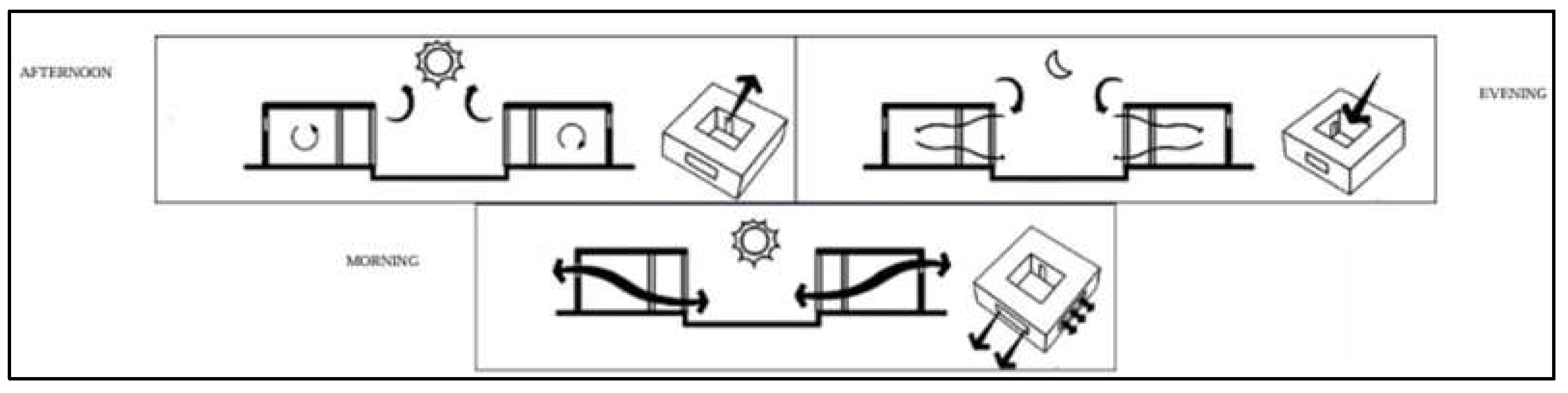
Figure 6.
illustrates how air moves and the role of geometric shaping.
Disclaimer/Publisher’s Note: The statements, opinions and data contained in all publications are solely those of the individual author(s) and contributor(s) and not of MDPI and/or the editor(s). MDPI and/or the editor(s) disclaim responsibility for any injury to people or property resulting from any ideas, methods, instructions or products referred to in the content. |
© 2026 by the authors. Licensee MDPI, Basel, Switzerland. This article is an open access article distributed under the terms and conditions of the Creative Commons Attribution (CC BY) license (http://creativecommons.org/licenses/by/4.0/).
Copyright: This open access article is published under a Creative Commons CC BY 4.0 license, which permit the free download, distribution, and reuse, provided that the author and preprint are cited in any reuse.